
#93 – An Interview with Tom LeMense - Cacaesthestic Chronometric Carriwitchet
Download episode · 34 MB
Also on Apple · Spotify · YouTube · RSS
Show Notes
[display_podcast]
Welcome, Tom LeMense!
- Tom is a grad of Michigan State University and has worked throughout the automotive electronics supply chain, including at Ford Electronics, Lear, TRW and a large automotive chip manufacturer.
- Prior to the work, he helped design the boards that detected the Top Quark at Fermi Lab.
- He recently got the boards he designed back, which were designed using ECL logic

 Here's what Tom wrote to us after the show about them:
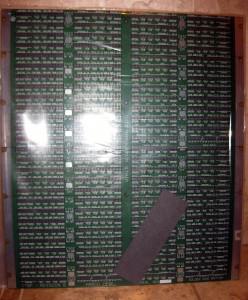
Attached are some photos of a couple of the "D0" (D-zero) equipment cards that I designed back in the late 1980's for the Fermilab particle accelerator in Neperville, IL. These were part of the experiment that confirmed the "top quark" and are closing in on the potential of the Higgs boson. The Fermilab Tevatron and collider was shut down just last September, but there's so much data that the physicists can continue to crunch, that they keep finding stuff.
I should have put a scale in the photos to make clear how large these are. The floor tiles that they are resting upon are 12x12 inch (30x30cm). If you look at this photo, towards the bottom you can see blue-yellow racks - those house these cards (amongst others):
The “master timing generator” (MTG) was loaded with a whole slew of bipolar PAL’s to generate the weird trigger/transfer control signals required in the rest of the system. 6 layers, mixed TTL and ECL. 54 MHz accelerator ring resonance frequency, but skew was super critical so hence the ECL signal path and bipolar pals.
The closeup of the MTG shows the whimsical icon (recognize it if you’ve ever read Mad magazine’s “Spy vs. Spy” cartoon) that I got to stamp on all my creations. We all had an icon. There was a surfer guy, a fleur-de-lis, the RCA victor dog, etc. Gotta love working in a university environment, funded by the US Department of Energy…
The Calorimeter Trigger Backplane was my PCB layout masterpiece - those interconnect signals aren’t simply bussed - there’s a very complicated interconnect scheme between them to reflect the physical layout of the calorimeter detectors. PCB is 16 layers, 4 plane layers, the remaining 12 are signal layers with the differential ECL traces between, with all attempts made to control the impedance of the interconnect (ECL likes 100 ohm Z0). Blind and buried vias were used as well. I recall the day we sent out the magnetic tape reel (!) with the gerber data to the only company that returned a bid on the job - we commented that we could either order two of these backplanes, or go and buy a new Chevy Corvette - each PCB was about $11K in 1988 dollars, IIRC.
These were designed on an Intergraph CAD workstation, based upon a VAX 11/750 minicomputer, dual 20-something-inch monitors, 2-foot x 4 foot electromagnetic mouse+digitizer, etc. Pretty heavy duty stuff for a dumbass college student to be using! I became a complete CAD snob after that experience.
- In recent news, Cray (the supercomputing company) was bought by Intel.
- Tom got his start in RF working on the Super Regenerative circuit. He sent us a great scan of a 1922 article from Armstrong about the Super Regen Circuit.
- Armstrong also invented the Super Heterodyne circuit.
- For those interested in automotive testing, Tom sent us a link to a paper Ford published about their EMC testing requirements.
- We also talked about the automotive supply chain and how the chip vendors are required to do stringent temperature testing and guarantee parts for 10 years.
- Cars primarily use the CAN bus to communicate these days, though they also use the lower cost LIN bus in more places where it's less critical.
- Dave was thinking about the previously discussed news about BugLabs pairing with Ford on opening up their infotainment system.
- We announced the Lemnos Labs hardware incubator program, which is closing its applications in 2 weeks. While we don't know a lot about the program, people encouraging hardware sound good to us!
Update: Tom has capitulated and joined Twitter since we recorded the show. Hooray! Find him on there as @TomLeMense!
Transcript
Tom Laments: This is the Amp Hour Podcast, recorded April 29th, 2012. Episode 93, with guest Tom Laments. Cacesthetic, chronometric, carry widget.
Dave Jones: Welcome to the Amp Hour. I'm Dave Jones from the EEV blog.
Chris Gammell: And I'm Chris Gammell of Chris Gammell's Analog Life. And I'm Tom Laments, joining from the depths of the automotive industry.
Dave Jones: The bowels of the automotive industry. The bowels, sorry.
Tom Laments: Also known as Detroit.
Dave Jones: Detroit. Or near Detroit. Is this something that you want to differentiate yourself from right up front?
Chris Gammell: Oh, it's not necessary to really go into a lot of depths about differentiating. It's sort of, Detroit's kind of like this donut, right? It's sort of a really complicated inside core and not really so populated. And then you kind of, you move out just a few miles and suddenly you're in just about any other metropolitan area of the United States. Right.
Tom Laments: That's like Cleveland too. I mean, Cleveland and Detroit are, not surprisingly, quite similar. So, another Midwestern brother here. So, Tom, we welcome you. We welcome you to the Amp Hour. I'm outgunned again.
Dave Jones: I'm going to have to get an Aussie on the show, really. Yeah, at some point, yeah.
Tom Laments: Well, we've had a couple. We've had Alan at least, right? Oh, yeah, true.
Dave Jones: Yes, we have had Alan. And we're probably going to have Alan on again. So, yeah.
Tom Laments: Yeah, we'll have to have some other Aussies to make you feel better, huh? Absolutely.
Dave Jones: Now, is it true, Tom, that like in Cleveland, you can buy the house for the price of a VCR? Is that true? I've got to ask for my Australian curiosity.
Tom Laments: People are buying VCRs these days so often, right?
Chris Gammell: A what? Yeah, exactly. Guess what? That's about right. Laser disk. That's about right. But just like that VCR, you probably wouldn't want to live in it either. I mean, you know. Right. Right. But, yeah, absolutely. Yeah, if you're a – in fact, there's a lot of real estate speculation going on right now in the Detroit area with people really just gobbling up properties left and right. And it's kind of become a problem because then, you know, the property owners don't actually live anywhere near there. So, they're not really taking care of it.
Dave Jones: Exactly. And it runs down. Yep.
Chris Gammell: Yep.
Dave Jones: But it will almost start a chain reaction of the prices going up because of the speculators. That's what speculating does to the market really. So, it can artificially bump it up for good or bad, but that's the effect it can have.
Chris Gammell: Well, haven't seen that one yet, but – Ah, right. Okay. Eventually. Maybe it doesn't work. I hope I'm moving anytime soon. That's –
Dave Jones: Is Detroit coming back? In terms of getting its automotive industry back and getting jobs back, is it – can you see things picking up?
Chris Gammell: Well, you know, so it's definitely picking up. And here's where you kind of have to really differentiate between, you know, Detroit and then just the whole southeastern Michigan. So, you know, Detroit proper has got a popular – well, they just fell under a million people a few years ago, which really made them angry.
Dave Jones: How – what was the peak?
Chris Gammell: Oh, God.
Dave Jones: How many? Yeah.
Chris Gammell: Was it 10 million or, you know, is it – No, I don't know. It was never that big. But, I mean – Right. Okay. I'm guessing it was at least double that. I mean I should – I'm remiss. I didn't study up. It's like you're here to talk about electronics or something.
Dave Jones: Yeah, exactly. I just got – I'm just fascinated by the whole Detroit thing. But the whole – Because it's a shame, really.
Chris Gammell: Oh, yeah. It's – and honestly, so I've lived in the Detroit area with the exception of when I was at university, you know, all my life. So it's just been this kind of – so is it coming back? Yeah, it's been coming back since like, you know, 1980. But, you know, it's kind of like a – It's got a long way to go, right? It's got a long way to go. Yeah. But the whole southeastern Michigan area, it's got about – it's like four and a half million people or something like that. Like I said, it's kind of the donut effect, right?
Tom Laments: And it's quite spread out too, just like Cleveland is. I mean it's very –
Dave Jones: Well, that's the same here in Sydney. We've got, you know, four million people in Sydney or something. But they're spread out around a 50 kilometer – sorry, about 25, 30 – about 30 mile radius, you know. Thank you, Dave. Yeah. Yeah, so it's – Half radius, I should say, because the other half is ocean.
Chris Gammell: Well, then it's a lot like Detroit because our other half is Canada. So you're right. Right. Okay.
Tom Laments: So, Tom, tell us more about your background. I mean you kind of touched on college a little bit, but where did you come from? You know, what have you done in the past and where are you going in the automotive side of it? Sure.
Chris Gammell: So, well, so I guess I've been in electronics nerd since about age seven or something like that. That was back in – Excellent. Nice. It was 1974. And I – We don't judge here. We don't judge. I feel kind of creaky. Yeah, I remember, like, buying my first LED at Radio Shack, right, and just going home and watching it glow, you know, until I killed it or something. I didn't say that.
Dave Jones: And you went there and bought your two resistors in the packet, right? Exactly. Off there. Yeah.
Chris Gammell: For 39 cents or whatever.
Dave Jones: Which you can still do for many years.
Chris Gammell: I mean –
Dave Jones: You can do that here again from J-Car here in Australia. They actually sell, like, I think it's five or ten resistors in the cardboard pack, the old-fashioned. Yeah.
Tom Laments: Yep.
Dave Jones: Wow. It's coming back. Exactly.
Chris Gammell: Ooh. Yay. Yay.
Chris Gammell: Yeah. You're five weeded quarter-wise sisters, right? Yeah. That's it for a dollar.
Dave Jones: Yeah. It's great. Inflation at all. Yeah.
Chris Gammell: That was probably a dollar or something. Yeah. And, okay, so like I said, I kind of stuck around in the Midwest. I went to school at Michigan State University, so I got my bachelor's at EE there. And, well, while I was in school, I earned bar money by, you know, had a job there outside of school kind of designing and constructing analog sound and audio equipment. Nice. He was a psychoacoustics professor because he had cool experiments to do about human sound perception and stuff like that.
Tom Laments: I was going to say, was he just an acoustics professor who was crazy or was he actually about, like, the mind and how it perceives audio? Because it could have been either, really.
Chris Gammell: Well, I mean, he was in the physics department, so there's, like, for sure there's a little bit of crazy there. I mean, just kind of.
Tom Laments: Right. But not psychoacoustics, right?
Chris Gammell: That's probably good, yeah. Right. So, in case he's listening. Yeah. You know, he's the heat. Yeah. He's not psycho. But, yeah, it was really cool. I mean, honestly, that was, and he had a really good electronics background anyhow. So, I mean, it was, and I didn't know anything about psychoacoustics. So, it was fun. It was a good, it was a great job to do while a student. And then, and then later on in college, I actually got to work on some instrumentation for the Fermilab particle accelerator. Yeah. Yeah. Excellent. Nice. Yeah. Nice. So, my, my. That's out in Chicago, right? Well, yeah, it was. I think they just, like, buried part of it or whatever. Oh, really? Yeah. Well, you know, I guess they can't really bury it because it's radioactive and stuff. So, oh, you know what? Sorry. I heard they turn it into a museum, right? So, if you can't dispose of it properly, you open it to the public.
Dave Jones: Yeah. Yeah. Exactly. And charge them admission to come and get, get irradiated. Brilliant. Admission's $1.
Tom Laments: Lead underwear is $10.
Chris Gammell: Yeah. So, yeah, that was kind of cool. Yeah. Because, yeah, that, so that stuff actually that I worked on helped find the top quark back in 95. Wow. Yeah. That's cool. And I, and I got the board. Just, just earlier this year, the, the, the, one of the really cool guys that I worked with there said, hey, you want to, you want a piece of history? I said, sure. He's like, here you go. And it's huge. These boards were just racks and racks of these things. And they were, they're, so they're 9U, right? So, a U was like, yeah. That's big. So, it's 9U on a side. So, it's like, wow. Yeah. And it's full, and it's, and it's stock full of 10K and 100K ECL stuff. Yeah. That was, yeah. Oh, that was like the body of visual logic.
Dave Jones: With nice big gold, nice big gold caps on them, you know. Oh, yeah. Yeah. All those, you know, those nice ceramic packages with the big gold caps. You know, yeah.
Tom Laments: Tom, do you have pictures of that? Maybe we can post those later.
Chris Gammell: You know what? I'll take, I'll take a picture and send it to you. Nice. Yeah, that was, that was a lot of fun. Yeah, I mean, it's just ridiculous. You know, each package was like a, you know, it's like a 16-pin ceramic dip or whatever. And each package just dissipates about half a watt. And it's got like three NOR gates in it or something. Yeah, that's right. It's just incredible, you know. And back then, you were very like, oh, this is awesome. Oh, it was the whip. Yeah, for sure. So modern. Yeah. Yeah, that was 200 megahertz, baby. Yeah.
Dave Jones: Whoa, that was quick back then. Yeah, actually, it was. Yeah, so. You know, that was, yeah, that was screaming along. Especially when you've got to get it from one side of the frickin rack to the other. You know, that's pretty, you know, that's an art in itself. Let alone actually from one side of the board to the other at 200 megahertz with all this digital, you know. Oh, yeah. And it would have been working at, you know, at not, you know, low voltages like we used to these days. So, you know.
Tom Laments: Oh, yeah, right. What, a swing at 10 volts kind of thing or what?
Chris Gammell: Well, ECL was kind of neat because, I mean, ECL is sort of, I look at it, it's, it's the way an analog guy would do digital logic, right? Yeah, okay. And so, I mean, for one thing, it was kind of weird that it, you had ground and then a negative five volt power supply. Yeah. Go figure. Okay. And then, but really the logic swing was only a few hundred millivolts. It was maybe four or five hundred millivolts. And everything was differential. Yep. So, quite honestly, it's sort of like the 20 year precursor to LVDS or something like that, right?
Dave Jones: Yeah, true. Yes. And it's still you, people still use ECL, I think, today. There's still a few obscure retro applications. People still use it, I think.
Chris Gammell: God, do they really? Oh, that's sad.
Dave Jones: Well, they maybe have to interface with, you know, old stuff. So, you can still buy ECL to, you know, LVDL, you know, converters and stuff like that, I think.
Chris Gammell: Yeah, you're right. Actually, they made really good, the ECL, yeah, there was, they made really nice line drivers.
Dave Jones: Yep.
Chris Gammell: Right? For that reason. Yeah. And so, yeah, crazy stuff. So, yeah, that was, that was school. And then, and then was all ready to go work for a now defunct computer company on the East Coast that made mini computers. And I was like, oh, that'll be great. Cause I was all computer architecture guy and high speed digital. Right. And, uh, so this was 1990 and I found really kind of a.
Dave Jones: Oh, mini computers in 1990? Mini computers. Yeah, exactly.
Tom Laments: Big iron. Can you guys explain this to me? I'm sorry. I'm just out in the cold. You guys are laughing. I'm sorry. Young guy. I'm going to raise my hand. Sorry. A little help.
Dave Jones: Mini computers came along before micro computers.
Tom Laments: Okay.
Dave Jones: As in, you know, a micro computer. As a consumer desktop computer. Mini computers. Oh, so these are like the ones that were like. Yeah, big floor standing. Cabinets. Cabinets, you know. Right. Yeah.
Tom Laments: And it was going to modernize the home, that kind of thing. Yeah, exactly. Put it in the garage, heat it in the winter kind of thing.
Chris Gammell: No, no, no. The mini computer companies didn't care about your home. No, no. No, exactly. Yeah, whatever. And in fact, that was their, that was their downfall, right? Oh, okay.
Dave Jones: Yes, that they didn't see the consumer computer revolution.
Tom Laments: And they. Oh, so was it mini micro personal? Is that kind of how the progression went? Yeah.
Dave Jones: The micro computer is the personal computer.
Tom Laments: Oh, right. So that's.
Dave Jones: No, then it was mainframe. Well, well, there's mainframe, which they still do mainframe. That was top of the scale.
Chris Gammell: Right.
Dave Jones: So technically they still make mainframe computers these days. They're the big racks of, you know, IBM still make these huge. Yeah. And other companies, Cray and companies make these huge, you know, rack based computers, but they're all Intel. You know, they've got.
Tom Laments: Cray got bought by Intel.
Dave Jones: Sorry?
Tom Laments: Cray got bought by Intel. Yeah. Oh, when? Last week. Oh, really? Just, just recently.
Dave Jones: Oh, okay. There you go.
Tom Laments: Look at that. Working news in with the. Oh, well done. That's pretty good. Right, Tom? Up to the minute. Yeah. This was not recorded three weeks ago. Right. Yeah. That's the official date. Yeah. Yeah, exactly.
Dave Jones: Please, Chris, tell us that you've heard of like the PDP 11. Yeah. Right. They're mini computers, you know.
Tom Laments: Okay. Okay. Yeah. So, Tom, it didn't work out with these so-called mini computers?
Chris Gammell: Well, no.
Tom Laments: He was smart enough not to join, weren't you? Well, no.
Chris Gammell: Honestly, I think it was kind of being lucky, right? That they sort of imploded about a few months before I graduated that there was a for sale sign on the lawn out at Digital in Boston. It's like, hmm, so that's probably not where I'm going to head off to then. Right. And then, of course, it was, oh, shit, I got to find a job. Right. And then ended up, because I tried to get out of Detroit, and then I actually ended up working for this small company that made car alarms, right?
Dave Jones: The car alarms were big in the 80s and still into the 90s, weren't they? Yeah. Yeah, so this is 1990. They're gone now.
Chris Gammell: Yeah. They're pretty much gone now. Yeah. The automaker finally said, yeah, we'll do that. And then that pretty much sank. That was the end of that, right? That was pretty much the end of that, yeah. Yeah.
Dave Jones: Well, actually, cars, most new cars I've seen don't have car alarms. Oh, they do? Oh, really? In Australia, yeah. Because people just ignored car alarms when they went off. They were just annoying.
Tom Laments: So much crime.
Dave Jones: Yeah, well, no, because they were just annoying.
Tom Laments: You know Detroit's bad, folks.
Speaker ?: Right. No. No.
Dave Jones: Like, we bought a new car. You know, it's a Japanese car. And it doesn't have a car alarm. You know, my car doesn't have a car alarm. It's only 10 years old. You know? None of them have car alarms. Right. Right. That didn't, you know, like they've got these engine kill immobilizer things, you know. But the, yeah, the fact that, you know, to actually have a car alarm with the motion sensors and the, you know, all that sort of stuff. No. Certainly not here.
Chris Gammell: Yeah, you're absolutely right, Dave. That it kind of morphed into the whole, you know, look, the, you know, what really drove this was like, you know, those like the car insurance lobbies. Right. And for the most part, they were just mad having to pay out claims for people's cars that got stolen. Right. So, they said, you know, so it's like, look, I don't care if the thing beeps and drives everybody crazy. I just don't want it to get, you know, don't let them drive it away. So, it turned into the, yeah, the whole engine kill or the immobilizer and all this other stuff. And you're absolutely right that even back in the 90s, the car alarms were sort of like, oh, God, you know, someone's damn horn is going off.
Dave Jones: Wah, wah, wah.
Tom Laments: And then there was a club, too. I mean, that must have put you guys out of business, too, right? The club.
Chris Gammell: No, honestly, the club company was owned by one of the car alarm companies. Nice. Right. Smart. Smart. It wasn't, there were probably like six or seven companies, and even in the course of about three or four years, they all kind of bought each other and kind of, you know. Right. Amalgamated or whatever.
Tom Laments: As a very bright, bright burning flame that quickly went out, huh? Exactly.
Dave Jones: It sounds like the component supply industry. You know, all these components supply, they all buy each other out and morph and merge and do all sorts of things. Oh, yeah. Change their names. Change their names for the 10th time. Yep. Exactly.
Chris Gammell: Try to hide stuff. But that, honestly, for me, that was a great job because it was a small company, so you wore about 100 hats, right? And so, you know, like I said, I had kind of this high-speed digital, you know, background, and there's this, like, it's microcontroller stuff. It's 68 HCO5, and it's like, oh, okay, you know, yeah, I can, you know, but I always liked assembly language. I've been doing that for ages. It's like, okay, that's fun. That's good. That's good stuff. And then one day the owner, you know, kind of walked to my office, and he, so the RF receiver for these car alarms was always in this little daughter board. It was kind of like a two-inch by one-inch, let's say, kind of little sub-assembly, right? Okay. And then he kind of threw it on my desk, and he said, fix this. I was like, huh? I heard on. The defining moments. Because the guy who touched it last quit, like, six months prior, and it's like, you know, they were building them okay for a while, and it's like, hey, these aren't really working anymore. And so, that was my sink or swim introduction to RF. Wow. And honestly, it was a trip because this was all still, like, these are all still through-hole components, and RF with through-hole components just sucks. It's just, I mean.
Tom Laments: Everything's an antenna, right?
Chris Gammell: Well, everything's an antenna, and just, I mean, literally, the receiver that the guy threw on my desk, there were, you know, so there were TO92 transistors that had to be bent at, like, a 30-degree angle. There was, like, a little jig in the factory. Really? Because, oh, my God, if you bend it at 22 or, you know, 45, it's not going to work. Oh, no. Oh, yeah. It was just a total disaster, yeah. Brilliant. Wow. Yeah. And so, I was like, oh, okay, fine. And actually, it was a cool circuit. It was, I don't know if you've ever heard of it. It's called the super regenerative receiver. Yep. Super regen. And so, it's, in my mind, it stands as just a really awesome, and it was kind of also my introduction into vintage electronics. So, this is a circuit dating back from, like, God, I want to say it's, like, 1917 or 1919.
Dave Jones: I was going to say, when was the first super regenerative receiver? You know what I'm talking about.
Speaker ?: Yeah.
Dave Jones: Super regen. Yeah. Yeah. Yeah. That's why I say that. It's easier to shorten the word.
Tom Laments: Yeah. And that's all based on, like, just like a lot of the radio transmission stuff, that's where it all came from, right? I mean, the super regen was a big part.
Dave Jones: That was one of the big radio, you know, inventions was the super regen receiver. It was one of the, you know, huge inventions of the, yeah, probably, what, 20s?
Chris Gammell: Yeah, actually, yeah, you're right. It's probably like 22 or something. You know, actually, I've got the paper on, I've got the PDF. So, this is from Armstrong, you know, Edwin Armstrong, who also invented the super heterodyne receiver as well. So, pretty cool guy. And I've actually got the PDF of the paper from 1920 or whatever that I'll send that along to you as well. Yeah, send it along. We'd love to link that in. But why that circuit's so cool is just because it's basically with one active device. So, then it was a tube, and then later on it's a transistor. But with one active device, it's a complete receiver with actual gain. I mean, and so, and it was this crazy idea where it's an amplifier that's just on the brink of oscillation at the RF carrier frequency. So, it's about 315 megahertz here in the U.S. It's kind of a normal remote control car alarm frequency thing. And so, it's this amplifier, and it's going to oscillate. It's going to oscillate in the matter of like a few hundred microseconds or something like that. And then as soon as it oscillates, it draws more, you know, it draws a different amount of current. The bias point shifts, and you put this other little kooky feedback circuit in it to kind of thwack it again, and then it stops oscillating.
Dave Jones: Just keep it under control.
Chris Gammell: Right, yeah, and then it kind of starts all over again.
Dave Jones: It's this teeter-totter arrangement. I'm using the U.S. term there, teeter-totter.
Chris Gammell: Teeter-totter, yeah, exactly. Teeter-totter, yeah, exactly.
Tom Laments: Versus Seesaw. Seesaw. Seesaw, right?
Chris Gammell: Yeah. Okay. And then what happens is then when – so, you get this – basically this oscillator that kind of like starts up and shuts down every, you know, a few hundred microseconds or something like that. Or even, you know, or faster. Around a megahertz. Actually, yeah, it's around one or half a megahertz. So, yeah, so around one or two microseconds. But what happens is then when F comes in, it's got extra energy coming in, and so it can oscillate quicker. And so you get this kind of wacky sawtooth wave that's either running around a megahertz or also like doubles up to like two or three or four megahertz when something's coming in. And then you put a low-pass filter and you integrate it, and then you ram it through an op amp or something to square it up. But basically that active circuit, it's just – it's one transistor. To me, that's just so cool, right? Yeah, it's awesome. It's pretty minimalist. Yeah.
Dave Jones: I love it.
Chris Gammell: And they had all sorts of problems, right? They drifted like crazy and all that. But – so anyhow, that was the thing that the guys had fixed this, right? I was like, okay. So first it was like, well, what the hell does it do? How does this thing actually work? And so that was fun.
Dave Jones: So what did you do after this car alarm?
Chris Gammell: Stuff. So what happened was is like – so I was there for two years, and at the ripe old age of about 25, I was the go-to guy. I'm like, oh, this is wrong.
Tom Laments: Yeah. If you look around a room and you're the smartest guy there, you're in the wrong room. Exactly. That kind of thing.
Chris Gammell: At that age, holy crap, that's just wrong, right? So I said, yeah, I'm the go-to guy. I don't know anything, right? So I managed – so I'm like, okay, I got to find some place where – first of all, I learned because it was a small company. I learned that if you want to be an RF engineer, you got to have equipment, right? Oh, yeah. It helps. Lots of it. And it's all really expensive, right? Right. So I'm down.
Dave Jones: That's why our esteemed third-wheel co-host, Jeff, buggered off to Valve because he wanted the test gear to work on RF. He can't afford it at home. It's just – Yeah.
Chris Gammell: That's a tough road to hoe. Yeah, exactly. That's – I mean, I've got my own smattering of RF stuff at home. But, you know, yeah, it's all pretty vintage and certainly nothing I'd want to try to work on like Bluetooth or Wi-Fi or something like that with. Right. And so I looked around and said, okay, so where are there like a bunch of RF engineer kind of gray hair kids that I can really learn from, right? And so Ford Electronics was just down the road because that's one of the advantages of this whole automotive thing going on here in Michigan.
Dave Jones: Ford Electronics, they were a separate company, were they?
Chris Gammell: Ford Electronics. Like a – well, a subsidiary. Yeah, exactly. Yeah, it was a separate company. Right. Yep. So – and so I said, okay, hey, that's pretty cool. I can go be a punk and learn from the guys there and success. You know, really after a couple of years, you know, really got some just awesome on-the-job training from some super knowledgeable guys and AM, FM tuner stuff and, you know, more of the UHF remote entry stuff. And then even though the low frequency, the immobilizer that, you know, that 125 kilohertz RFID stuff, right?
Dave Jones: Yep.
Chris Gammell: So –
Dave Jones: Yeah, which actually – if people don't know, they actually embed these RFID tags inside the key. So that's how you can't – you know, you can't – that's part of this, you know, car alarm security thing. You can't start the car without the proper key that has the RFID tag. Is that correct?
Chris Gammell: Exactly. Yeah. Your key's got – I mean, there's only like – I think it's like 3,000 combinations, you know. Yeah. Really? You know, there are always these stories like, oh, you know, my wife and I, we both got a Ford and, you know, use the same key, you know. And you go, oh, that's – no way. And it's like, no, definitely possible. It's there. Yeah.
Tom Laments: Well, it's the key – the key has to be the same too, right? I mean, like the key would be the same and the RFID would have to be the same.
Chris Gammell: Oh, yeah. Now – I'm sorry. What I meant was, you know, back in the olden days before the – Oh, back in the day. I got you. Oh, yeah, that pellet or that tag, that's 32 or no longer than that, 64. And, you know, actually that's evolved, right? That's gotten better over time. I'm sure it's gotten bigger and bigger with time, yeah. Oh, yeah.
Tom Laments: Okay, right. Okay, I thought you meant –
Chris Gammell: No, but just the mechanical key, like I said, there's only about 3,000 combinations of the key. I got you. Yeah.
Tom Laments: Yeah. And – That's pretty crazy. Exactly. So – And so I think that's a really smart idea what you did there. I mean, we were talking about careers last week, but, I mean, going where – especially if you don't necessarily have any, like, I need to live here, you know, if like – if you don't – if you need to move to, you know, Florida or something like that or whatever, if you do want to chase talent, that's a really smart idea to go where there's a lot of people to teach you and a lot of room for mentorship. I think that that was a really smart move on your part.
Chris Gammell: Well, and I also think it was – I mean, I think it was kind of fortunate too in terms of, you know, kind of the way things work at the time, right? I think now I don't know how well that – I mean, I still think it's a good idea. I still think it's a good strategy. But just everyone is so lean now, right? I mean, this was kind of – this wasn't – things weren't quite – we weren't super fat and happy then, but it certainly was pretty cozy, let's put it that way. So at Ford and so – There was time to work on special projects. Oh, absolutely. That kind of cozy. Yeah, that kind of cozy, right. Or just, you know, kind of – it was an awesome setup. They had like about 20 of these little individual RF shielded rooms, right? And each one had a full bench setup with a spec and an RF gens and, you know, a few of them had network and a lot. Oh, it was just – oh, yeah. It was just – I just needed a towel all the time. I was drooling so much. It was just great, yeah. Right. And so you kind of go, hmm, oh, it's knock on room number seven here. See what's going on? Oh, hey, so-and-so is working on a new IF amplifier or something. Oh, okay, cool. Yeah.
Dave Jones: Yeah, it was – actually, it was cool. Oh, that's great.
Chris Gammell: It was really cool.
Dave Jones: And you end up taking that sort of – those resources for granted too, I found. Oh, yeah. When you work at big companies like that, you know, who spend millions and tens of millions on, you know, setups and labs and things, you really take that for granted. And when you go somewhere else, you know, and you've got, well, a multimeter and an oscilloscope and a pair of wire cutters on your desk. I was going to say, I miss my test gear from Keith Lee.
Tom Laments: I definitely am lacking these days. Yeah.
Chris Gammell: Well, for me, I didn't take it for granted because I came from the, you know, the pauper place, right? I mean, honestly, it was – you know, the car alarm company, once a year for a month, they would rent a network analyzer, right? I mean, dead serious. So you sort of queued up all your antenna matching and, you know, little – and like, okay. And then that thing showed up and then we all just like used that thing around – there was about three of us. We all used it just around the clock and you just booked weekends and – oh, my God. Wow. Wow. Yeah. And then it's like, well, see you next year. Hope this works. Hope this works. Yeah. There was a lot of that. So coming from that into – wow. Wow. I got my own shielded room with, you know, $2 million of the stuff sitting in front of me. Like, oh, yeah, okay. Yeah. But you're right. It's easy to take for granted if you're not –
Dave Jones: So you were working on RF electronics. Was that your main forte at Ford? Yeah.
Chris Gammell: Yeah. And so that was, again, sort of the remote keyless entry stuff, you know, so the car opening stuff. And then that kind of, you know, eventually kind of broadened out, right? So, I mean, I've always kind of had RF as a competency. But, you know, I kind of had that – you know, I picked up that microcontroller background at the other place. And, you know, I've always liked analog electronics in general. So – Woo. Yeah. I mean – Yay. Actually, what, Jeff, last week he mentioned something like, you know, what is it, the T model kind of? Yeah, being a T. Yeah. Yep. Yep. Right. And I definitely feel like a T where my pillar there is RF and then kind of a smattering of other stuff to varying degrees enough to be dangerous in some areas and enough.
Tom Laments: Better watch out, man. They're going to try and get you out to Seattle if you keep talking about that. So just be careful what you say on the show. That's all I'm saying.
Chris Gammell: I don't know. It sounded like that was one hell of an interview vetting process. Yeah.
Tom Laments: Yeah. Yeah. But – So – and I had a question about RF and just in cars in general. I mean, how long have those remote keyless entries been around even? I mean, have those been – I don't – I know my buddies, like, old Buick had one. That was probably like a 1990s kind of car. But, like, what year did they start really introducing those?
Chris Gammell: So they were first through the aftermarket, right? So, like, these little goofy car alarm companies and stuff like that. Yep. And there you're kind of into, like, the early to mid-'80s, I guess.
Dave Jones: Is that how most auto electronics starts? It starts as third-party stuff because they've got less regulatory, you know, and faster development cycles and all that sort of stuff. So you can buy all these car accessories and the automakers go, oh, people like that stuff, do they? It's a feature. We'll look at incorporating that. And it takes 10 years. And to me, it seems like it takes, like, 10 years for something you can buy as an aftermarket thing to – when it filters into an actual production car or a production car that your average Joe buys anyway. As opposed to, like, a Mercedes SC class or something like that.
Chris Gammell: Right. Not so much for your average Joe, right? Yeah. Yeah.
Dave Jones: Because I remember it took so long for, like, a USB – no, like a CD player to play MP3s, right, in a car. That was, like – it took forever. Like, how hard can that – you know, you could just buy an off-the-shelf one and stick it in. Like, I don't know. Do tell.
Chris Gammell: No, you're absolutely right, Dave, that – and for the reasons you said, right, that really – you know, look, in terms of, you know, from the automaker side or, you know, I'll probably say it sooner or later. So OEM, that's always the – OEM, yes. That's the key word for automaker. So I'm sure I'll lapse into that. Just there's way too many TLAs, three-letter acronyms in the auto industry, right? Yeah. Yeah. So anyhow – yeah, so the automakers, they'll – they're not going to want to make, like, 1,000 or 2,000, right? I mean, it's always – we're going to commit to this as sort of an option level in a particular vehicle platform, and it's going to be at least, like, 100,000 pieces, right? Yeah. And then – and they're just so used to really long design cycles and, you know, all the qualification and all this other stuff that hopefully we'll get into. And so you're absolutely right that the stuff starts off in the aftermarket. And, I mean, it's – yeah, it's not only radios that don't suck, but it's also things like LED lighting inside cars, you know, all this ambient lighting and kind of neat mood lighting and stuff. I mean, yeah, that's been in cars for ages now from the aftermarket. And, you know, and so for the past few years, you've been seeing it in actual production models too. Yeah, it's a – you know, you said 10 years. I went, oh, no way. And it's like, well, no, you're probably about right, actually. Yeah, that's what it's saying.
Tom Laments: It's almost like the app model too, like how, like, Google and Apple and all them, they see apps and then they're like, oh, yeah, we'll roll that into the next release. Yeah. You know, for, like, phones and stuff like that. It seems like it's smart. It's a smart idea, you know? You see what works first and then you push it in. If people aren't screaming about it, why not, you know? Yeah.
Dave Jones: Because the key – the problem with the automotive industry, which is why we got Tom on the show, we wanted him to talk about this sort of stuff, is the development cycle time and the regulatory approval process and all that sort of stuff. It's, you know, it's very lengthy and very difficult just to put into a car what you think might be something simple like lead mood lighting, right? You can't just stick it in there. It's, you know, it's got to go through regulatory approval, probably not as much as like a, you know, like a, you know, an anti-lock braking system or something like that. But still, you know, it's – well, I'm sure Tom's going to tell us about it. Right, Tom?
Chris Gammell: Sure. Absolutely. Yeah. I mean, that design cycle, though, you're banging on, though. I mean, it's, you know, for a typical – and so I guess I – and here's where I have to really make clear. So my experience, you know, I've never made a car before.
Speaker ?: Right. Right.
Chris Gammell: Wait a second. Why is he on the show, dude?
Dave Jones: He said he makes cars. Exactly. I thought you were a T-model engineer. Come on. I'm not quite that old yet.
Chris Gammell: And no, so – and so the – in the auto speak, it's, you know, you make modules, right? And so there's just modules everywhere, right? And yeah, back in, you know, in the 80s and 90s, you know, there weren't really any modules. It was like your radio and then – Right. But that was probably the most complicated thing in your car, right? Yeah. And to me, really, so I – you know, I left Ford in 95 and entered the automotive supply chain, right? So I went to go work for TRW Automotive for a number of years and then went to work for a company called Lear for a few years after that. So, again, they're kind of competitors of each other. Pretty typical in the industry, too. They're all in the same geographic area. So it's – we're kind of like migrant workers, right? Yeah, just bounce between them, right?
Tom Laments: Across the street, get a little bit more money. I need to pick the beans.
Chris Gammell: Yeah. When the beans are picked, they'll go across the street. Yeah, exactly. Yeah. And – but you're right. I mean, so typically, you know, the – so when the automaker decided they're actually going to do something like your LED mood lighting or a radio with a USB port or whatever, you know, you're really talking about – I guess, assuming that you – assuming that everyone's really decided, you know, all the functional of, you know, what it's going to do and how it's going to do it. You know, that actual design cycle, it's about 30 months. Whoa. So – yeah. Yeah. Yeah. Wow. And really, in about a third of that time is just pure testing time.
Dave Jones: That's amazing because in the general electronics industry, most people don't even last at a company for 30 months. You know, they'll get bored because they've worked – or already worked on four projects and they buggered off to another company.
Tom Laments: And does that happen? I mean, does that same kind of thing happen in the auto industry or is there less turnover there?
Chris Gammell: I mean, there's certainly turnover but I guess maybe it just proceeds at a slower pace then, you know. Yeah. Yeah. I mean, yeah. Usually, I mean, it's pretty – I don't know. I mean, I've – so you can tell at this point I've quit more than a couple of jobs. You know, it's always a crappy feeling to quit before something's, you know, finished. Oh, yeah. Or at least, you know, sort of finished-ish, right? Right. So, yeah. I mean, so, yeah, there's turnover but it's – it tends to – I mean, you know, yeah. So, it kind of tends to align with when the project launches or so.
Tom Laments: I suppose there's such a design center there, right? There's such a cluster in Detroit and the Detroit area or, you know, in the metropolitan area and stuff that it's like there's not as much incentive to move across the country, right? Or maybe outside of Detroit in the area, you know, you'd have to go so far to move that it wouldn't make sense, right? I mean, there's only so many places around there.
Chris Gammell: Well, I mean, I'd say it's just more of kind of a convenience factor, right? I mean, it's – I guess I turned the other way around and said, like, look, I've already got a house and a family and all that other stuff. And, yeah, okay, there's, you know, seven more companies I could work for and, you know, without even having to think about, you know, or think too hard about other names. And, yeah, sure, we'll see what's going on over there, right? So, you know. Yeah, I got you. Okay. And that's starting to happen again. Actually, that's starting to really pick up in the last – say, in the last year or so. The churn between companies. Oh, yeah, the churn. And it's funny because now that I'm – like I said, so about six years ago, I turned to the dark side and went to work for a chip maker. So I've kind of had this trajectory of heading towards the basement of the supply chain, right?
Tom Laments: Next up, you're going to be the broker or the salesperson. Oh, God. No, I'll probably shoot myself before that. Right.
Dave Jones: Right now, you probably won't notice the slide to the dark side, you know, to the end of the dark side.
Tom Laments: All you'll see is more zeros on your paycheck. I mean, that's all I'm saying. I'll just wake up and go, oh, my God. What am I doing? Why am I selling everything? I sold my kids.
Chris Gammell: I'm a bad man. Yeah. Yeah. Yeah. So – and so it's really amusing in this position because now it's – so basically these companies where I used to work, now they're my customers, right? Which is cool. Right. Actually, it's a lot of fun because all the people I still work with, I get to see them all the time. It's great. And then I can take them out to lunch and then my lunch is paid for too and everything's good, right? Nice. Yeah, exactly. So – but it's funny then because now I've got the visibility of like all the people plotting of where they're going to work next. And it's kind of funny because like, oh, what do you think – what's going on over at so-and-so place? Oh, yeah, yeah. Well, I'm kind of thinking like, hmm, you know, in probably about another few weeks there's going to be an opening because there's a guy over there that's looking – Yeah, he's taking your job. Exactly right. Yeah. So you're right. Honestly, the darkest side I could turn to is I could become a recruiter, right? I mean that would be – Oh. Don't do it. Exactly. And then I –
Dave Jones: Oh, boy. So we're talking a 30-month design cycle. How is that broken down? How much is actual design time? How much is regulatory? How much is testing? How much is just general red tape or –
Chris Gammell: Sure. So – and I'm going to kind of – you know, obviously this is sort of a hypothetical, right? I mean in terms of generally speaking, right? But in general of the 30 months, there's about – so about a third. So about 10 months of that in kind of – and really in kind of two, four or five-month chunks are really just crazy serious testing, right? And so like – you know, you're kind of like – you're highly accelerated life testing, you're stress testing, you know, shaker tables, thermal chambers, all that good stuff. Yeah.
Dave Jones: Well, because I was going to say the two things you – well, three things you care about in automotive and really have to rigorously test for would be vibration, you know, shock and vibration, temperature, and RFI – RFI immunity, right? They're the three key things.
Chris Gammell: Yeah. And I'd probably add a fourth. That can go wrong? I'd probably add a fourth and say that really the whole – some people kind of lump it into RFI or immunity. But also, you know, it's – yeah, it's a 12-volt battery. But boy, that's just one messy power supply. For instance.
Dave Jones: Oh, right. Yeah, the – yeah, the – you know, if your regulator – if your alternator fails and all that sort of – Exactly, yeah. You can get huge spikes, can't you, on your automotive systems? Oh, yeah.
Chris Gammell: Yeah, there's –
Dave Jones: Huge amounts of energy too, like not just voltage as in, you know, a small amount of – we're talking huge energy, you know, wham.
Chris Gammell: Yeah, it's joules. Yeah, I mean –
Dave Jones: Joules, yeah, we're talking joules. Yeah. It's not, you know, nano joules.
Chris Gammell: No, no, joules. No, no, no prefix. Right. Yeah, and yeah, that's the – yeah, that's the really cool one. Yeah, surge, of course, yeah. That's the load dump, right? So it's – Yep. And so it's anywhere from about a 40 to – there's a whole bunch of standard pulses, you know, ISO kind of standardizes one. But I'd say kind of a typical load dump pulse is about 90 volts. It's maybe about 300 milliseconds long. And it's got – and the source impedance is in the single digit ohms. And so you work all that out and it's around like 300 to 400 joules of energy. Yeah. Yep. Wow. And it used to be that every module had to just survive this test, right? And it just – Right. And so you've got these big crazy – these, you know, these big – these varistors and huge, you know, transorbs and all this other stuff. And they kind of – I think the automakers got sick of paying for one of those per module. So they've kind of toned things down and they've – either they've designated that – Right. Either they've taken – you know, they've kind of divvied up the modules and said, okay, you four guys over there, you're going to have this junk in it. And then, you know, all the rest of you modules, you don't need to have this. And so then you get to test it to a lesser spec. And so – but, I mean, there's all these dips and drops, you call it. So it's really just interrupting the supply and all that stuff. Yeah. So I'd add a four to supply.
Dave Jones: So all your vital modules like your anti-lock braking systems and things, you know, your really essential ones that stop people, you know, from dying, they would be the really critical ones you would have to protect. Whereas you wouldn't care about surge overload on your mood LED lighting controller or something, perhaps.
Chris Gammell: Well, it's not so much that – so it can't blow up. I mean, I don't care if it's the mood lighting controller or not. I mean, that's not acceptable. No smoke. No smoke allowed. No smoke. Right. And so really there's – so there's varying levels of – so it's the acceptance criteria, right? It's – and it's the same goes for – Oh, wake word.
Dave Jones: That's a nice – that's word of the day. Acceptance criteria.
Chris Gammell: Well, that's not your fault, is it? And so – and same goes for like the immunity testing for RF2, right? It's – look, everybody's got to go – all the modules have to – you know, they all have to go through immunity testing. Yep. But for example, yeah, your LED mood lighting, it's maybe – you know, look, at 30 volts per meter field, you got to work. Yep. At 60 volts per meter field, fine. I don't care. Don't lock up. Don't make smoke. You know, as soon as I take the field away, you better work again. But that's – you know, so that sort of loss of function is allowed. And then – but like for example, like a powertrain controller or a transmission controller or an airbag module or ABS, yeah, you're up into like the 1 to 200 volts per meter. And, you know, then it's sort of – well, you have, you know, degraded functionality, but for example, you can't kill anybody. Yeah.
Tom Laments: Yeah, you have safe shutdown, that kind of thing, right? Yeah.
Dave Jones: Have you ever worked on the airbag stuff?
Chris Gammell: A little bit. A little bit.
Dave Jones: Or is that – or is there some third-party company? Does every manufacturer do their own or is there some third-party company that really specializes in, say, you know, airbag controls and they're the world's best at it and that sort of thing?
Chris Gammell: Well, there's – so the supply chain, right, you've got the automakers or the OEMs or the customers, right? And then you've got this so-called tier one level. These are the guys that – you know, these are the guys that they get the specs from the OEM and then they say, okay, we'll develop this product and we'll sell you this module or we'll sell you this subsystem. And, yeah, there are some tier one supply – and, you know, these are big names. These are like, you know, your TRWs and your Siemens and, you know, they're not called Siemens anymore, but okay, fine. So these are your big names. And so they all have kind of their own, I'd say, core competencies, their own specialties. So they don't all make airbag modules, but actually a number of them do, right? Right. And that's definitely really serious stuff. Oh, yeah. I was going to say that. Yeah. And as an engineer, that's kind of – it's really creepy. I mean, I thought it was, right? It's sort of like, ooh, man, if this doesn't work, like someone could die.
Dave Jones: Yeah, that's right.
Tom Laments: Yeah, your failure rate of 0.001%, that's still – I know. It's still – That's still dead bodies, right? I know. Yeah, exactly. Yeah, that sucks.
Chris Gammell: Yeah, and as an engineer, you're going to get called into depositions and stuff like that. Oh, yeah. Good times, good times. Right.
Dave Jones: Have you ever been involved in stuff like that? Yeah, yeah. Yeah? Okay. Yeah. As an expert witness or are you trying to defend yourself as that?
Chris Gammell: Well, it's sort of – so for the company I was working at at that time who made airbag modules, there was a – here's another potential wank word warning. There was an inadvertent deployment.
Dave Jones: Right.
Tom Laments: You punched someone in the face with an airbag, huh?
Chris Gammell: Yeah, exactly.
Dave Jones: Someone died. There was an inadvertent deployment.
Chris Gammell: Yeah, and so it was bad, right? And the – so – but fortunately, the line of questioning was just sort of, you know, did you follow the procedures? Like, yes, of course I did.
Dave Jones: And as long as you follow the procedures, nobody's at fault, even if the procedures are wrong. It's great.
Chris Gammell: Yeah. I love it. That's how big companies work, right? You settle, right? Exactly. I mean, I don't know where that case went. I'm sure it settled, right?
Speaker ?: Yeah.
Tom Laments: That's a mess.
Chris Gammell: Yeah. It is a mess. So, yeah, that's kind of the darker side, right, is that, you know, the safety stuff. But, you know, the good news is the safety stuff, it's working, right? The mortality rate in the U.S., at least the mortality rate, it's – this past year, it's about half of what it was in, like, the 1960s, 1970s. Yeah. And you consider there's a hell of a lot more cars on the road now.
Dave Jones: And there's a lot – I was going to say, a lot more, and they're going faster and they – you know. Right. Yeah.
Tom Laments: And people aren't getting better at driving at all.
Dave Jones: I mean, they're getting worse if anything, you know.
Tom Laments: Yeah. So, yeah.
Dave Jones: So, what sort of – with regards to temperature, what sort of temperature ranges do you test these electronics over? And is it market dependent? Because, like, here in Australia, I can remember I got my car and it's a European car, right? It's a German car. And it came with a freaking battery warmer, right? This, you know, this little cover that's going to have a battery to keep it warm in Australia.
Tom Laments: Yeah, we probably wouldn't do that here in Detroit or Cleveland, right?
Dave Jones: Unbelievable.
Chris Gammell: Yeah.
Speaker ?: You know.
Chris Gammell: Well, that's the whole product marketing side. Sounds like a failure there, right? All right. We could probably dial back on the take level for the battery warmers in Australia. Yeah. Yeah. So, normally the – so, again, it kind of depends on where the electronics are in the car. So, if you're just in the passenger compartment somewhere, typically you're minus 40 to plus 85C.
Speaker ?: Yep.
Tom Laments: And then – Just only minus 40 to plus 85. Oh, that's the easy one. Yeah, right. Yeah, that's the mid-tier. Yeah.
Chris Gammell: Yeah, that's sort of the – oh, yeah. You can't cut that.
Tom Laments: The cheapest parts out there, as far as I know, are zero to 70 parts. Maybe there's even more screens from that.
Dave Jones: Well, there's three levels, right, of chips. There is the consumer temperature grade. There's the automotive temperature grade. And there's the military temperature grade. You have industrial in there, too. Oh, industrial. Industrial, sorry.
Chris Gammell: They're usually the same. And so, that's normally your minus 40 to plus 85. Yeah. And then the – and then, honestly, inside the passenger cabin, but, like, if you're over – like, if you're on the roof – I'm not – sorry. If you're on the inside of the roof, like an overhead console kind of thing.
Dave Jones: Right, yeah.
Chris Gammell: Because there's heat rising, so then –
Dave Jones: Then you're right. And you're right under the metal roof plate, right?
Chris Gammell: Yeah. Right, right. And so, then you're 105C.
Tom Laments: Yeah. Yeah. You know, that's what I think of it as automotive. I would think 85 is usually industrial and 105 is automotive because I never buy 105 because you have to pay more.
Chris Gammell: Exactly. Ooh, bad parts. Yeah, yeah.
Dave Jones: Over-engineered. So, I doubt you'd be using any electrolytic caps in there, right? Oh, no. They dry out pretty quick.
Chris Gammell: There's 105C electrolytic caps.
Dave Jones: Really?
Chris Gammell: Yeah, yeah.
Dave Jones: Even in those roof modules?
Chris Gammell: All it takes is money.
Tom Laments: Sure. Right. Okay.
Dave Jones: And buy them from a reputable manufacturer.
Tom Laments: So, you, like, insulate the circuits with money? Is that how it works or what?
Dave Jones: Right. Wrapped all the bills around your electrolytic caps.
Chris Gammell: No, there's a lot of, actually, there's a lot of 105C rated caps now that are a bit electrolytic caps. That's crazy. And then if you're in the engine compartment, then you're the minus 40 to plus 125. So, not quite mill because mill is like minus 55 to 125. Yeah. Huh. Okay. I mean, minus 55 is nonsense. That's correct. Minus 40 is kind of normal.
Dave Jones: Where the hell do you get those sort of negative temperatures? Siberia or? Bemidji, Minnesota.
Chris Gammell: Ask me how I know that. Okay. How do you know that? Burr. That's actually, and there's other places too, but that's a Ford Electronics, or Ford has a cold temperature test range there. And then the wintertime, the average temps, I think they're about minus 25. So, they're kind of like that minus 30 to maybe around zero. Wow.
Tom Laments: Yeah. So, are you guys working in all, I mean, work all metric? That's, I guess that was another question of mine is, or is it just attempts that it's always convenient to do Celsius? It's, no, it's pretty much all metric. Nice. Even like engine compartment, like measuring like engine block stuff? Oh, definitely. Yeah. Yeah. Yeah. Oh, that's great.
Chris Gammell: I mean, but there's a lot of holdovers, right? I mean, like, I'm sorry, if someone starts telling me about like how powerful their cool new car is in kilowatts, I just give them a blank look like, whatever.
Tom Laments: What's that in horsepower? Exactly. Yeah.
Chris Gammell: And even the Germans, right? I mean, so I work for a German company now, right? So, even the Germans, they don't talk about kilowatts. They talk about, they have, yes, right? It's like Purgis Sturgen. It's like a German horse. I'm sure it's better. Right.
Tom Laments: So, it's like, it's like real snooty and thinks it's better than you. Yeah. I'm sure it's. Sorry, German listeners. I'm sorry. I work with Germans too.
Chris Gammell: I love them. So, yeah, it's about a horsepower. I think it's actually a little bit, I think a PS is a little bit more. So, and yeah, they don't say kilowatts or at least I've never heard anybody say kilowatts. So, there's some holdovers, right? Kilowatts. And.
Tom Laments: Those are almost like colloquial though, you know? It's not like. Right. That's not like a measurement so much as just a, you know, it's like a judgment, you know? It's like a, I don't know. It's an anecdote. It's marketing. Exactly. Exactly.
Chris Gammell: Yeah. Well, and, you know, quite honestly, there are, you're exactly right that when it comes right down to it, there's only a handful of people that, you know, how many kilowatts or horsepower the engine's making, it really matters, right? I mean, to the rest of us is sort of a yardstick, right? For how do we. Or is it a meter stick? Or a meter.
Tom Laments: I was going to say that earlier. That's why, that's why I called it out.
Chris Gammell: You were, you were quick on that. Yeah. So, and yeah, so absolutely that, yeah, it's, it's, it's mostly metric. But that being said, there are an awful lot of really strange metric numbers, right? That are obviously inch equivalents, right? So, you know, yeah. So, I would say that measurements are conducted in metric, but the parts that are being purchased are the same old parts as, you know, before. I get you. Yeah.
Tom Laments: Okay.
Chris Gammell: Yeah.
Tom Laments: So, we talked about power on here, or when, when you and I had talked before the show, we had mentioned power, and you said that there, I mean, that's a pretty significant part of, of a lot of car design is just dealing with, you know, we talked about the surge dump, what was it called? The, the, the, the load dump. Load dump, right.
Chris Gammell: Yeah. That's, that's supposed to simulate what happens if you're driving down the road and like your battery cable falls off the battery, right? And, wow. So, the alternate, so the alternate has got this big, huge chunk of energy it wants to give to someone and it can't give it to the battery anymore. So, it has to go everywhere else. Oh my God. Yeah.
Tom Laments: Wow. So, are there, are there, are there a lot of other big power concerns within the engine compartment or even the, the cabin?
Chris Gammell: I mean, well, I mean, there's certainly, because of the wide temp range, for example, you know, so even, even with the 85C upper limit, you know, you've really got to pay attention to, so, so basically what happens then is really every, you know, every design engineer has a very good working knowledge about, you know, R theta JA and, you know, how that all matters, you know, so, you know, to really know how to do that thermal analysis because, you know, automotive electronics, it's, it's, it's, and for the most part, it's not, especially in the body stuff, it's not rocket science, right? It's, you've got a, some controller, you got a bunch of inputs, you got a bunch of outputs.
Speaker ?: Yeah.
Chris Gammell: And usually, and usually those outputs are, you know, there's, they're, they're actuators, so there's, you know, a lot of motors or things like this and, or, or lamps or loads like that. And, and so they, they need a, you know, a fair amount of power to drive them. And so you've really got to pay attention to, you know, properly derating and making sure you've got, you know, some, you know, you know, you know, proper PCB design for heat sinking and, and, you know, all that sort of good stuff. So, yeah. So, so it really, I would say that that's a, in my mind, at least that's a huge difference between like your typical consumer electronic stuff, right? I can't, I've lost track of how many, God, for me, it's, it's been these, these stupid USB external drives, you know, hard drive in a box with a little USB bridge. I think like four, I'll even plugged in, you know, kind of like as an external, I think I've burned up like four of them, right? Oh yeah. Yeah. Yeah. I'm not like putting them in a shoe box full of socks or something. I mean, they're just sitting on top of the computer, right? Well, it's vibrating a little bit, right? And in every case, the hard drive was fine. Oh. It was a stupid little, it was a stupid little USB bridge board. And I'm sure it just died of heat death. I mean. Right. Yeah.
Dave Jones: Yeah. Well, cause they're not, they're, you know, they're not, they don't care. You know, they don't have a restriction. Yeah, you've pegged it, Dave. Yeah, that's the bottom line, right? They don't care. Right? Because they don't, you know. Okay, I'm not going to say anymore. Not that they want to be said. They don't care.
Tom Laments: I mean, Tom, how much are you paying for these boxes? I'm guessing not much, right?
Chris Gammell: Right, right. But I mean, I honestly, sometimes I'd be willing to pay double if I could get one that didn't suck.
Tom Laments: Yeah. No, that's true. Yeah. Yeah. And that price is kind of baked. I mean, is that baked into car electronics or is it just, cause I mean, I think about like, like I drive a Civic, you know, simple car, but still like a good chunk of money, but like all the, just all the junk that's in there, you know, like the, the pricing on that and just the economies of scale are just huge. And so like, is quality always in there? I mean, is there any kind of D rating from top to bottom if I buy like a, you know, a Mercedes versus a Civic? I mean, like, what is it? I mean.
Chris Gammell: You know, it's funny that, um, I really the, uh, um, it's not so much that, oh, you're buying the Mercedes. So the quality is, you know, 10 times better, you know, therefore reflected in the price. Right. I mean, um, it's, it's, I mean, I think the, you know, we, we saw the U S car companies learn this, right. That, Hey, you know, it turns out if you build a car that that's crappy, even if it's cheaper, you get a bad, you know, you really get a bad name. Right. So the, you know, and so that's a, that's a really serious thing. And, um, yeah, so, so, so the quality really is baked in everywhere. And so really the differences, I mean, as you've, I think you're seeing is that it's more in just how many bells and whistles are in the cars. Right. I mean, or, or, okay, I find are in the, in the really high end car, I can get the bigger, more powerful engine that I can't get in the smaller car or, you know, or it's just bigger, you know, for example, yeah, that, um, yeah.
Tom Laments: So then the rest is just brand name and, and, and you're paying for luxury quote unquote and all that other crap too.
Chris Gammell: Yeah. You're paying for luxury or, you know, it's, it's like a little bit of, you know, feature functionality kind of stuff, but you know, and I, I'd say that the differences are probably a lot more in like the, the whole man machine interface area than they are. And just, you know, carrying out the functions of being an automobile. Right. Yeah. I get you. Yeah. Cause yeah, just because the car's cheap, it can't, you know, it can't get crappy gas mileage. It can't have bad power or whatever. I mean, that's, that's not going to be accepted. Right.
Dave Jones: Well, there's a certain minimum thing that people expect these days in a car. You know, they expect it to last be, be reliable for, you know, cars are getting, I don't know about in the U S but here they've got like a five year, a hundred thousand K, a hundred thousand K warranty. Right. Which is, I don't know, 50,000 miles or something, 60,000 mile warranty. Yeah. Yeah. Right. Which is, you know, pretty substantial. And, uh, so they're, they're obviously building them and that wasn't the case 15, 20 years ago, right? You were lucky to get freaking warranty at all with the car. I think 15 months. Yeah. Whereas now it's, you know, it's, that's one of the incentives to buy in a new car. Is that the fact, you know, it's going to be trouble free and it won't cost you anything for apart from service for, you know, five years or something.
Tom Laments: So when you go be a recruiter, Dave's going to go sell cars. You can hear it in his voice already. We'll get them. We'll, we'll, we'll, we'll get them a plaid sport jacket and we'll just set them up.
Chris Gammell: It'll be awesome.
Tom Laments: How can I get you into this car today?
Chris Gammell: I'm thinking of a number, you know? Oh my goodness. Yep. You're right. That's sort of the lowest of the low right there. Oh good. We're not the only ones who think that. No.
Tom Laments: Everybody in the car industry thinks that too.
Speaker ?: Yeah.
Chris Gammell: No. And, and, well, it's funny because even that's changed, right? I mean the, you know, even the, the used cars, right? It's, you know, now they're not used, they're pre-owned.
Dave Jones: They're, and, and they, you can buy a used car with a three year warranty here.
Chris Gammell: Exactly. Yeah. They're certified by the manufacturer.
Dave Jones: They're certified by the manufacturer. Yeah.
Tom Laments: Yeah. So it's. So do they rip out electronics for that too? I mean, do they, I mean, do they change out electronics when they do that? I don't know if you know that stuff because obviously that's at a, at a, at a warranty company or whatever. But like, what is the longevity expected from electronics? I guess that that's what ultimately comes down to is a 10 years, 20 years.
Chris Gammell: 10, 10 years. And so it's, it's always the, always the expectation is 10 years, a hundred thousand miles. Wow. Yeah. Right. Yeah. And, but.
Tom Laments: So you guys asked for that from your, from your vendors then? I mean, you're a vendor now, but. Yeah. You were, you were asking that from chip companies and stuff?
Chris Gammell: Yeah, exactly. So, and, and, you know, most of these things, they really are, they really are powered for 10 years. Right. I mean, it's not like it's, you know, even though the key is off, there's a lot of stuff in your car that's. It's still on. Yeah. It used to be, it used to be the ignition switch in your car was this 40 amp switch, right? Yeah. That's right. It just went cold, you know? And that ain't the case anymore. You know, there's, there's all sorts of stuff on and, you know, everything's all network together. There's, you know, all these buses and things like that.
Tom Laments: Oh, can bus.
Chris Gammell: Can bus.
Dave Jones: Can, right?
Chris Gammell: Yeah, can.
Dave Jones: Why, what, is it only can or is, that's the impression I get is that can bus is the standard in automotive, end of story.
Chris Gammell: At this point, it's can. Prior to, prior to can taking over here in the U.S., that was probably about thousand and five or so. There was a, there was a, so, so there've been, there've been automotive buses since like the eighties, right? I mean, yeah. To, you know, with varying amounts of success and things like that. But the, yeah, can kind of won out in, in, I'd say mid two thousands. But before that, there was, there was a, there was a one that was standardized under the, the SAE, the Society of Automotive Engineers. And it was really a, it was really a mess. Because it, because basically it wasn't a standard. It was, it was kind of this umbrella thing that sat over the Ford way and the GM way and the Chrysler way. And they're all totally different, but they all had the same speed. It was, it was.
Dave Jones: So why did CAN bus win out? Is it because it was forced on the manufacturers by some standards? What happened?
Chris Gammell: Or something?
Speaker ?: Or something?
Chris Gammell: Or? No, that's a good question. So, so CAN, I think CAN, so yeah, I don't, I don't know the answer. I'm going to speculate recklessly. I think it won out because it had a tremendous amount of traction behind it in terms of the, the components that you could buy from the chip makers that supported CAN. Yeah. Because the, because the various flavors, you know, the GM and the Ford and the Chrysler flavors, those were standalone kind of bus interface chips, not just the physical layer, but also like the Mac, right? They were standalone chips. Oh, yeah. And, you know, that's expensive and, you know, and I can't. And they license it too, right? Yeah. I mean, that's only. And, and, and, and, and Bosch is the one that came up with CAN, I mean, God, in the 80s as well. Um, and it's still around today and honestly it works pretty well. So, you know, I'd say it's good enough. Um, it's, it's a little slow by modern standards. It, it pretty much tops, it tops out at about a megabit. Um, and so there's, there's newer, faster ones. There's, uh, FlexRay and there's some, uh, optical ones that are called Most and things like that. Right.
Tom Laments: But it's, yeah, people always end up comparing these bus standards to like Ethernet, but isn't CAN, CAN's like single, or it's just, it's two, two devices, right? No, no. Or is it multi-device?
Dave Jones: Can's more like RS-485, I believe.
Chris Gammell: Uh, can, yeah, CAN's a multi-drop. Um, it's, it's, it's, but basically what's interesting about CAN is that, um, built into the physical layer is arbitration.
Tom Laments: Um, oh, okay. So there's no collision. That's what I was getting at. Is that Ethernet has tons of collisions that can slow everything way down.
Chris Gammell: Right. And, and, and that, and, and, and that's what makes CAN really attractive, right? Is that the, the, the, the chronometrics, right? Yeah. I can really count on when am I going to get, that is another word.
Dave Jones: There's a word, chronometrics.
Tom Laments: That's got to win. That might get into the title, I got to say.
Dave Jones: Oh, yes. That might be the title, chronometrics.
Chris Gammell: Ah, I agree. So, and, and I'm by no means a CAN bus expert, but that's, um, but that, but that's really a key point of it though, is that the, the arbitration is built into the, it's built right into the protocol. It's built into the physical layer. It's got more fail safe and safety stuff than the, it just blows your mind. And so, I mean, as far as it's, every CAN node has to be able to shut itself off if it thinks it's babbling on the bus. And I mean, it's just, it's incredible. I mean.
Dave Jones: Is there only one CAN bus in the car or are there dozens? Because I know that there's like hundreds of modules in modern cars, isn't there? Or it can, can be upwards in a really complicated car. I'd say up to a hundred. That's what I've been hearing, right? Yeah, absolutely.
Chris Gammell: So, so typically what happens is you, you, you've got a high speed CAN, that's your one megabit and that's your powertrain bus. And so on, so on there, you've got your transmission controller, you've got your engine controller. They live on that. And then like, they'll usually connect up to like your instrument cluster and that's, and that acts as a gateway. Right.
Dave Jones: Right. Cause you wouldn't want your LED mood lighting controller taking down your powertrain. Right. That's the, that's the idea.
Chris Gammell: Try explaining that one to the, to the CEO. Yeah. Right. Sorry.
Dave Jones: Who tested this? Yeah. Go back to testing for another 10 months.
Chris Gammell: Ooh.
Tom Laments: And Corey.
Dave Jones: And Corey. Yeah. Yeah. How, how could you test and ensure the interaction of a hundred different modules on the one bus? It'd be next to impossible. Right. So you would have to just as a, you know, just to ensure that you're going to meet your reliability targets for your critical stuff, like, like your powertrain, you'd have to isolate them.
Chris Gammell: Right. But, but, but honestly, it's not broken into that many buses. I mean, so typically you've got, so you've got this high speed bus for the powertrain and you've usually got one bus that's for the body stuff. And that's what I would have expected.
Dave Jones: Like two or three. Yeah. 50 or a hundred K bit.
Chris Gammell: Yeah. Something like that. And, and some run really low.
Dave Jones: And there might be at, and there might be 50 modules hanging off that car bus, you know?
Chris Gammell: Yeah. Yeah. And, and honestly what's happened is, is that, I mean, you know, so, so the can hardware, it costs, I mean, it's not super expensive, but you know, you're going to, you know, you're going to spend, you know, like, you know, 50, 50 cents or so to get, to get a can transceiver right in high volume. Yep. So, um, and, um, and so what's happened then is there's a, so there's this other, there's this Lin bus, right? So you probably heard of that before. Yeah. Okay. So that's, so, and that, that was created to be a sub bus, right? Right. Okay. And that's super cheap. That's a UART based protocol. Yeah. Um, and you can do that. I mean, it's just, you know, it's a big open collector, open drain, you know, it's, yeah. Yep. And so, yeah. So, so what happens then is you really remove the number of clients that are on the can bus, you know, so that number is really not super high. And then you, then you kind of put your sub modules on these, on these independent sub buses. Right. And then those don't care, you know, and then you have many of these Lin buses, for example.
Dave Jones: So the airbags and things like that be on the can bus.
Chris Gammell: Absolutely. Yeah.
Dave Jones: Because they would have to report back, right? Because at the end, you know, you've got all these, you know, warning lights come up when your airbags have failed or something like that, if it doesn't get the report back. Right. So that's, you know.
Chris Gammell: Right. But, but the other thing I guess it's key to point out too, is that like, for example, in the case of like an airbag, like it's not that the airbag, um, so the, so the squib, that's the propeller, that's the charge and, you know, that, that's not sitting on the can bus. Oh, no, no.
Dave Jones: That would be a, that works autonomously. Even if the can bus interface fails, right? The airbag would still work. Exactly. Right. Right.
Chris Gammell: And, and so all, for example, all the sensors that feed into the airbag module for the crash decision and then all of the, all the firing loops. Yeah. These are all dedicated copper. Yeah.
Tom Laments: Yeah. Right. So it's, it's, is it all, so that, that means it's all like down and embedded, very, everything's embedded in cars basically. And then they're just throwing back messages. Is that kind of the idea?
Chris Gammell: Yeah. So, yeah. So what's on the can bus, it's, it's, you know, it's, it's information that gets, it's, you know, it gets published and, and, and that's really where the automotive, uh, where the OEM does the systems engineering, right? It's, it's a, it's an incredible task, right. Of really deciding, you know, what's the, what's the information that's on the can bus, you know, in order that, you know, so you've got the, you've got the, uh, you've got the publishers and you've got the, you know, the clients that want the information published and, you know, so stuff like, you know, what's the engine RPMs, what's the battery voltage, you know, that stuff's floating out there all the time. And then, you know, less frequently are things like, you know, well, you know, are the doors locked or not?
Dave Jones: Or so, so there's, there's now talk about having, like, there's the, uh, ODB bus. I don't know what that stands for. On board diagnostics.
Tom Laments: Yeah, you know me.
Dave Jones: On board diagnostics. Right. And they're talking about, I think some cars have now got that accessible on the instrument panel. Like you can actually plug like stuff into it. I've heard that this is going to be the new thing. Like, and, and it's going to be open, like, so that you can design like open products to plug into these, uh, buses. Have you heard anything about that? Or is that only a selling?
Chris Gammell: I think it's already here. Oh, no, no. I think, I mean, yeah, that, that, that, um, so yeah, it's that, it's that OBD, that onboard diagnostics. And that was, uh, that was sort of, uh, started by, uh, California, uh, a long time ago, right? When they, that was part of their clean air, um, uh, actions that they've been, you know, so famous for over the years. And, um, and so one of them was, Hey, we got to have a, or what kind of came out of that somehow was a standardized, um, engine. And so it was, it was started off just being, you know, your, your, your engine diagnostic connector. And, um, but it's a standard connector. It's got a standard, you know, pin out. Um, and it's always pretty accessible. I mean, it used to be just kind of underneath the, you know, kind of, you know, underneath the, uh, the instrument panel kind of thing, you know, on, you know, above your feet, you know, and it moves around, you know, to put it in somewhere that's, you know, sort of accessible, but not obtrusive. Um, and then, but all that is, is it's just where the can bus goes to. And, you know, I mean, it's, it's nothing new. It's just a connector. Yeah.
Tom Laments: Like it's a drop basically, or a access point. Yeah, exactly.
Chris Gammell: It's a drop. Yeah. Yeah. And, um, um, there's a, there's a set of standard messages then that appear on that. And so that's why you can go to like your, you know, your local auto supply store, right. And you can buy, you know, for like 20 or 30 bucks, you know, you can buy a little thing that'll read out the diagnostic codes and yeah. So it's all, it's all standardized and spec lockdown. So. Nice. I think that's what you're talking about, Dave.
Dave Jones: Well, yeah, but, um, I've heard.
Tom Laments: Dave, are you talking about that, that thing with Ford and bug labs, how they were collaborating together?
Dave Jones: That could be it. Yes. I think you might be talking about that. That's where it came from. Was that, yeah. Now they're actually.
Tom Laments: That was like the infotainment system though. That was, I don't think there was any like useful information on there. Okay. Got it. Yeah. Yeah. We've mentioned that on here before. Right. But infotainment, yeah.
Chris Gammell: Horrible time. I know. Yeah.
Dave Jones: Yeah.
Chris Gammell: That is so not automotive electronics. It's hilarious. Yeah, I know.
Dave Jones: It's home entertainment, right?
Chris Gammell: It's home hi-fi. And watching, and it's, it's actually hilarious watching the infotainment crew interact with like your hardcore, you know. Oh yeah. Right. It's like, wow. So you want to put a screen where? Underneath the hood? Why? I don't get it. Or just, I mean, in terms of, you know, so again, for automotive obsolescence is a huge thing, right? Yeah. You've got to be, you know, so typically what happens, you go 30 month design cycle, you've gone through this horrible bouts of testing and the thing's done. It's approved, right? It's ready to go into volume production. And typically that'll run, you know, and it gets put on, you know, one or more vehicle, you know, platforms, right? So several different, you know, kind of vehicle types. Yeah. Models. Right. And then, and that'll typically run for, you know, three, four, five years, something like that. And, you know, if it's, turns out you don't need to, if it's working fine, everybody's happy, you know, fine, you let it ride, you know, let it go again. Right. Or, you know, or usually it's make it cheaper, you know. Right.
Dave Jones: Well, I can imagine it wouldn't be uncommon for the same module to be used for 10 years in different, uh, models as they evolve. Cause why redesign it? If you, if the functionality is going to stay the same for some, you know, anti-lock braking system, right? You'd just keep it the same across all your models. You would think.
Chris Gammell: All right. Okay. No, it's always make it cheaper. It's make it cheaper. Yeah. Right. It's like, that's, you know, so basically you're right, Dave, that's sort of the spirit of, Hey, uh, tier one supplier, I've been buying this ABS module, you know, for X amount of dollars and it, you know, it's been a great product. We're all really happy. We want to, we want to go around again. Same thing, but you know, like not 20% of the cost. Right. Yeah. And, you know, and go. Right.
Tom Laments: But make it like exactly the same or even a little better.
Chris Gammell: Why not? Yeah. Well, actually it should be better. Right. You know, and that's, and that's always the, you know, the purchasing guys, the automotives are like, well, you know, I'm reading in the, you know, whatever the EDN or whatever they are, MIPS and stuff. You know, it's like, oh shit. And suddenly you're roped into, oh, look. So, you know, you were making, you know, you were, you know, the ABS was running in a, you know, a hundred millisecond loop before and you should probably do it like a 50, right? Isn't that, you know, it seems pretty easy. Yeah. So, yeah, it's always sort of make it better, make it cheaper, but don't change anything. Right. And, uh.
Tom Laments: Well, going forward, I mean, we're kind of running out of time, but I'm curious about where you see electronics and cars going in the future. And obviously that doesn't include the infotainment side of things, but where do you see all this stuff going? And I mean, like I know in the U S at least we are, we're supposed to get to the 53.5 miles per gallon or some ridiculous standard coming up. And I don't know how the hell that's going to happen. I'm guessing there's going to be electronics in there. Where's all this going?
Chris Gammell: Well, you know, the, the, the big focus seems to be, you know, there's really kind of four, four areas, right? It's the performance and the efficiency. And these are kind of the same, right? You know, or they're, or they're very tightly coupled and then you've got the safety and then just the whole complexity, right? Of what's going on. And, um, you know, on the one hand, the performance and efficiency is kind of amazing, right? The internal combustion engine, it's, you know, like 100 years old or something like that, right? The concept, right? It's not new. And, you know, we've got more horsepower per, you know, kilogram or whatever than we've ever had before. We've got, you know, the, the control schemes are super sophisticated. Um, the, the sensors and things like that. There's a, you know, there aren't so many 200 year old technologies that get improved, you know, continue to improve. Right. But, um, but the efficiency is kind of what's driving stuff, you know, big time in terms of the power, like, you know, the powertrain electronics and you've got different motivators in different regions, right? So, you know, North America, it's about, you know, saving money so people aren't complaining about gas prices, right? Or, you know, filling up the tank price. Right. And, but like, but in Europe, it's all about being green. Right. And, and there's government subsidies and mandates and a whole web of that stuff that kind of shape how that stuff works. And so, um, you know, um, you, you've got a whole set of drivers there, you know, technology drivers. Right. So in terms of the efficiency, it's not even just attacking the engine itself, making it more efficient. But now I'm seeing that the electronic modules, like, for example, you've got an electronic module in your door, right? It's got the little switches for the windows and stuff like that. Yeah. Well, normally that's powered all the time, you know, because, you know, why not? You might hit the window switch, you know, at random. Yeah. Yeah. I should watch, watch for an action, right? Yeah. Yeah. I mean, yeah. It's in a loop and it's sitting on some bus and blah, blah, blah. And well, guess what? They want to turn that off now in Europe.
Tom Laments: Yeah. It could sleep, right? It could sleep, right? Right.
Chris Gammell: And you think, you know, my God, why? You know, you're talking about something that's, you know, it's maybe drawn like 20 milliamps or something like that or 30 milliamps. Which is nothing for a cop actually. It's just to sell it, right? You've got the engine running. That's nothing, right? Yeah. But it's all about, they're super motivated by the CO2 emissions, right? I mean, they've got such strength. Yeah. So it's really interesting how these mandates really drive different approaches, right? So definitely a lot of technology just being applied or a lot of improvements being applied towards the performance and the efficiency.
Tom Laments: Yeah. And a lot of that comes with silicon updates too. I mean, smaller nodes and stuff like that. You get lower power in parts and you do more with less parts and stuff too, right?
Chris Gammell: You know what? It's not the processors that's sucking down on the current. It's all these, you're dealing with a bunch of sensors and actuators and relays. And yeah, I mean, there's still a lot of relays. And to replace relays with solid state, I mean, my company would love to do that. We do that, right? That's fantastic. But what's nice about a relay is in one state, it consumes no current at all in the quote.
Tom Laments: That's right.
Chris Gammell: That's right. Yeah. So it's...
Dave Jones: Well, I was going to ask, how is all this complexity? It's getting more and more complex. All the electronics, all the money, everything. How has that driven the reliability of these things? Is it just getting harder or have they had to lower the reliability?
Chris Gammell: It could blow up once in a while. Expected lifetime standards. No, it's just getting harder.
Dave Jones: It's just getting harder, right? Yeah.
Chris Gammell: It's the same stuff. In fact, there's more and more tests, you know, all the time. Yeah. I mean, and the... It's really a big deal, right? Yeah. Of course. Guess what? The old half micron, quarter micron, you know, CMOS stuff, that stuff was pretty rugged. You know, you could do all sorts of crazy stuff and it worked. Right. Yeah. Now you're in your 65, 130.
Dave Jones: Putting a freaking ARM processor in the thing that, you know, is down, you know, using a 90 and a meter fab, you know? Yeah.
Chris Gammell: Yeah, exactly. And you've got, you know, and clock rates are higher and they're all driven off of PLLs and those have all sorts of interesting things they can do, you know, injection locking and all sorts of fun stuff. Yeah.
Tom Laments: Yeah. Man.
Dave Jones: It just boggles my mind. It really does that they can get such complex systems to work in such a harsh environment for 10 plus years. It's, you know, it really is difficult.
Tom Laments: Maybe they don't, you know?
Dave Jones: Well, maybe they just get lucky, right? Maybe.
Tom Laments: Maybe the fail safe systems are good enough. You know, maybe you build backup systems just to watch everything now, right? And you have safe shutdown modes.
Chris Gammell: Yeah, exactly. There's a lot of emphasis on fail safes and just, you know, or really planning for failure, right? Designing for failure is really key. You know, it's...
Dave Jones: Well, you find that with a secondhand car, like you'll buy and you'll find, or, you know, a really old car, you'll find things start failing. But, you know, the engine still runs, right? The car still functions as a car, but... I can drive with the windows down. You know, you can't put your windows down anymore or your radio doesn't work or your, you know, your mood lighting's dying.
Tom Laments: You gotta get out through the back passenger door, whatever. You know, like... No big deal. Come on. Yeah, but I... We've been in college.
Chris Gammell: But I... Yeah, exactly. I remember that car.
Tom Laments: It's not a problem until you're taking someone on a date, you know? It's not a big deal.
Chris Gammell: That's right. Yeah, that's when... Oh, yeah. The... But, you know, I think that's an interesting point, Dave, because, you know, yeah, you say... And I mean, I have the same view, right? But honestly, the cars with... I mean, the cars that you and I are probably thinking of that are 20 years old, these are cars that the engine's mechanical. Yeah, yeah. Right? I mean, I'm kind of shuddering to think that what's going to happen when you got your, you know, in about another 10 years...
Dave Jones: Modern cars in 20 years' time, will they be, you know?
Chris Gammell: Well, or it's failed, and what do I do? Yeah. I mean, okay, fine. Because it's so complicated. I mean, well, fine. So the engine controller's dead. I need another one. Well, hell, we haven't made that part for, you know, 25 years. Yeah, I know. You just can't do it. Yeah, you can't do it. So basically, your car's going to become bricked.
Tom Laments: Yeah, exactly. Yeah, well, you'll probably see, though, is you'll probably just... You'll start seeing a market of people buying these modules and stockpiling them. That's the only option, yeah. And you'll have a failure rate of 80% just from age, but, you know, some of them will still work, and they'll charge a crap load of money, and, you know, you'll get a part.
Dave Jones: But that increases the wastage, because you have to dump X amount of cars now, you know, sitting there doing nothing, just to scrap the part, you know, just to, you know, rip all the parts out of it so you can get X number of good cars working. And you end up with all these chassis that are just stripped of, you know...
Tom Laments: You said chassis? Chassis. Oh, yes.
Dave Jones: Chassis.
Tom Laments: I thought you said chassis is like S-H. Chassis.
Chris Gammell: Right.
Tom Laments: I thought it was an Aussie term.
Chris Gammell: Yeah, it's sort of an organ harvesting operation.
Dave Jones: Exactly. That's it.
Chris Gammell: So suddenly your 1987 Buick wakes up in a bathtub packed in ice, missing a kidney, right? Because it's like, oh, I guess somebody needed an engine controller. Yeah, well.
Tom Laments: Yeah. For the greater good.
Dave Jones: Yeah, well, they might be stealing cars not to sell them as cars, but to strip all the parts, you know, the valuable modules out of them, right?
Tom Laments: To get those MOSFETs out of there, whatever they need.
Dave Jones: And they don't even have to steal the car. All they've got to do is climb under and disconnect it and, you know, just slide under your car with some screwdrivers and disconnect your module.
Chris Gammell: Well, and that happens even just for body parts, right? I mean, a friend of mine, he's had an older car and he's had the... It's sort of the taillight assembly, you know, feeling out of his car driving. Right, yeah, yeah. Probably by the same guy, right? Yeah. Because it's... And I'm like, well, you know, why the hell? That's just bizarre, right? I mean, he's like, I know why they stole it, because I had to find this one and it cost me, you know, $200 to find this.
Tom Laments: Ah. That's probably the guy who sold it to him. He's like, probably. I'm going to sell this again. Another $2.
Dave Jones: Write your address down here. Yep, yep.
Chris Gammell: Yeah. Yeah, so then...
Dave Jones: And you go back the next day, oh, yeah, I've got another one, mate. I'll sell it to you. Yeah, fresh. I got it fresh. Oh, boy. I've got to ask, with the electronics, does any of them get potted with, you know, like potting compound to help with, like, vibration or anything like that? Or are they just non-potted?
Chris Gammell: Some do, but it's avoided, right?
Dave Jones: What would be the criteria for potting an automotive module?
Chris Gammell: Right. So, you can see potting, for example, in some of the engine-mounted assemblies, the modules there? Yep. Because, yeah, they're the vibrations crazy.
Dave Jones: They're the vibration killers. Right.
Chris Gammell: And dirt, too, right? I mean, dirt's a big deal around there. Yeah. Well, I mean, honestly, but at that point, you know, you're probably, like, in some die-cast aluminum box and you've got gas kits and all sorts of stuff. Those, I mean, if you're in the underhood, you're serious, right? Right. You got your game on as far as environmental stuff.
Tom Laments: So, are those guys, like, do you, like, walk by those guys at the company and you're, like, ooh, the badasses?
Dave Jones: They're the potting people. The potting people. Yeah, exactly.
Chris Gammell: Well, potting is such a disaster in production, though, right? It takes... Oh, it's horrible. Yeah. This one I know because one of the products that's been near and dear to mine for the last few years has been the little tire monitors that go in your tires. Oh, yeah. Oh, those things suck. Yes, they do suck. Yes. I'm sorry. That's okay. Yeah, because those are all RF, right? I mean, those talk to the... Yeah, so they're powered off a battery. And those are potted, right? Because the tire is evil as far as its environment. Yeah. I mean, like, hey, here's what I learned. They use sulfur during the vulcanization process of making the rubber. Yeah. And then you put in your... In Akron, Ohio. And then you put in... Yeah, exactly. And yeah, in Dave State. And then you put in your kind of wet, moisty air when you're filling the tire. And then it gets cold. And then the water condenses. And then the water and the sulfur mix up. And you've got sulfuric acid. And it's... Oh, yes. Wow. I didn't know about that. So... Yeah. Yeah. Oops. Guess I'll pull out my chemistry book. Yeah. I'm not a good chemist. So... Yeah. And the... Yeah. So those are potted. So... But honestly, I mean, that one, I just know that it just adds hours to your manufacturing cycle. Right? Oh, no. It's terrible. Yeah. It's just... Oh, God. What a mess. Avoid at all costs. Yeah. Yeah. So, yeah, exactly. So when are they potted? When they have to be. Yeah. Exactly. Yeah. Way over time, Chris.
Tom Laments: Tom, any last words?
Chris Gammell: Wow. Time flies. No, I know. Well, hey, thanks for having me on. It's been a pleasure. And hopefully I've opened a few doors and opened some cracks and let people see the weirdness that goes on in automotive land, huh?
Dave Jones: You have.
Tom Laments: Thank you very much. Yeah. Thanks for being on. Tom, do you have like a Twitter account or anything? Could people reach you on there? Or how do people find you if they want to find you?
Chris Gammell: You know, I'm old. I just have like email. Email.
Tom Laments: Okay. So if people want to really get in touch with Tom, get in touch with us on Twitter.
Dave Jones: And he'll sell you some pots.
Tom Laments: Yeah. Maybe. Maybe.
Chris Gammell: What's it going to take you to get you in a new part today, right? Yes. You look like you need some silicon.
Tom Laments: Hey, buddy. You know, he's got a trench coat. Yeah, yeah, yeah. You want to buy a chip for an automotive grade?
Chris Gammell: I got this trench coat. It's got all sorts of MOSFETs and stuff hanging. Yep. It's great.
Tom Laments: All right. Well, you can find us on Twitter at The Amp Hour or me and Dave at Chris underscore Gamble, Dave at EEVblog. And you can find Tom hopefully in the comment section or by email if you want to really talk to him.
Dave Jones: Hang on. We've got some news we wanted to add because it's time sensitive.
Tom Laments: Oh, that's true. Sorry, dude. Yeah. That's true.
Dave Jones: You wanted me to add it. Quick.
Tom Laments: Yeah, yeah, yeah. Okay, so Lemnos Labs is, there's another, we talked about the Hexcelerator program on here. We told people about the day or two before and actually someone ended up going to that. Getting that. Yeah. Yeah, we thought people might like that again. So, Lemnos Labs, we'll put it in the show notes, but they've got a deadline coming up for two weeks. It's another hardware accelerator program. So, if you got an idea, you can go there. If you're working on automotive electronics, you can give Tom a call and get a bunch of free parts.
Chris Gammell: All the MOSFETs you can eat.
Tom Laments: Yep. Yep. Well, thanks so much for being on the show today. Oh, thanks. It's been a pleasure. Catch you all next week. See ya.
Archived Discussion (18)
Comments are closed. Archived from the original site.
Show archived discussion (18)Hide discussion
Keep current
Every episode, plus the occasional job post, in your inbox.
It would have cost them a bit more than what they paid for the interconnect technology to get the entire company. They paid 140 million for the technology. Cray's market cap at the time the deal was announced was about twice that. It is now about 400 million thanks to their stock jumping from $7 to $11 after the deal was announced.
"Chop shops", as they are colloquially called, are a thriving business and EXTREMELY profitable. That is why a ton of parts have the vehicles VIN number stamped on them.
Any fans of Cromemco out there? A minicomputer built into an office desk. The guts were mounted where the drawers would be, and you had your choice of wood (maple or cherry). Oh, bring back the days of 8" floppies!
Just kidding thank you very much! I have excellent results with Seagate external drives. I have had several and have been upgrading because of space, the originals are still being used as 'hand me downs'.
http://www.thetruthaboutcars.com/2012/03/quick-why-wont-this-car-pass-the-smog-check/
Even I worked on vacuum circuits used in automotive HVAC controls... Those were the days, when mechies were let loose on logic {reminisces}...{shudders}
A google search will turn up a few instances of the _MECL System Design Handbook_, which is the ECL Bible in terms of using these parts. More importantly, it contains a ton of good information about high speed design and high frequency design in general - things that never really go out of style: PCB design guidlines, thermal considerations, power supply distribution, etc. I highly recommend seeking out a soft copy and giving it a read if you're concerned about high-speed or low-skew.
I also started as a child doing radio, and it is something absolutely magical about it: making a Galena/Germanium diode radio work only with the power from the antenna bears witchcraft! :)
Unfortunately stealing cars for parts is a very common business back in my home country; the older the better. I recall my dad and I making ignition anti-theft systems with hidden switches and installing them in our cars and in some close family ones.
Regarding CAN one of the big advantages is that it is deterministic, i.e. you can actually determine the time it takes for a priority message to reach a client on the bus, i.e. you can actually tell how long (max) it will take from the accelerometer to the airbag in microseconds...
But the CAN itself is quite neat in terms of robustness. There are estimations of 1 undetected error every 1000 (10^3) years.
One thing that CAN (and MOST, and maybe FlexRay - if it lives) bring to the party is interaction between subsystems. For example, when you use YOUR RF keyfob to unlock the car, the entry system can tell the rest of the vehicle "here comes user #1" and the seat position, radio presets, etc. can all be set accordingly. In the pre-bus days, discrete wires had to be run between these modules - so it actually cost money to do these "personality features" - now, it costs no additional hardware to implement.
Diagnostics became much easier to implement also - but, then again, if there were no bus, the systems would all be much simpler, so maybe the diagnostic capability is more of a symptom than a feature! :-)
More, Please more!!
Thanks.