
#7 – Love Robots and Pantyhose Screens
Download episode · 29 MB
Also on Apple · Spotify · YouTube · RSS
Show Notes
Due to time constraints this week, we’re going to try going back to a mostly link-based page. If you find yourself really longing for silly and extraneous commentary encapsulating the links, be sure to let us know in the comments! Curious about the title of the episode? Now you have to listen to the show!
[display_podcast]
- The Pantyhose Screen!
- Events
- Chris will be at ESC Boston
- And the Open Hardware Summit!
- Dave is going the BrizTube!
- Shoutouts
- Shoutout from Jason! Thanks!
- Thanks to Jon from Freetronics for the Arduino kit! Having tons of fun with it!
- Tech News
- Tech Discussions
- Jim Williams: Analog Badass
- Modularity in practice at Buglabs
- Talking SPICE simulators and mentioned the experience of Flying Flux
- Rants
- Iranian walking robot
- Clay Shirky's book about Cognitive Surplus
- Dave's followup to the calling out the IEEE about their Kindle review
- Dave's experience with Digikey reminds him of the Tenacious D song The Government Totally Sucks!
And finally, thanks to the folks over at The Conversations Network; The Levelator seems to have cured ALL of our sound woes! Holy moly was it easy and effective at making us sound good! Many thanks to George Graves for giving us the heads up!
Transcript
Dave Jones: Welcome to the Amp Hour. I'm Dave Jones from the EEV blog.
Chris Gammell: And I'm Chris Gammell from Chris Gammell's Analog Life.
Dave Jones: How are you doing, Chris?
Chris Gammell: Pretty good, Dave. How's it going over there in the morning in Sydney?
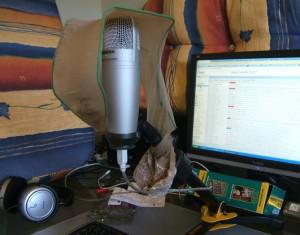
Dave Jones: Not too bad at all. I've got myself a new pop filter because I... You know how we talked about that before, how the breath on the microphone and all that sort of stuff? So, I'll have to put up a photo of it. I've got the Weiss stocking here. I stole one of her stockings and I've got it stretched over a coat hanger and it's jury-rigged hanging over my microphone. So, we'll see how it goes. But it looks like it attenuates the breath by at least 6 dB, maybe 10 dB or even 12. So, yeah, I'm quite happy with that. That's just in my limited little trial there. So, we'll see how it goes. And I've got my pillows again here surrounding so we get nice quality audio.
Chris Gammell: Do-it-yourself studio right there.
Dave Jones: Yeah. And we're going to try a new audio filter auto-leveling program as well. So, hopefully, this audio should be really schmick apart from our horrible voices, our non-radio voices. But technically, it should be quite good. Well, that's right. So, what's happening?
Chris Gammell: Oh, not too much here. We've got a couple events coming up. Got a couple shout-outs to go through. Some projects. Some ranting, I'm sure, is on the list.
Dave Jones: Yes, absolutely. Always a rant. I've got a couple of rants.
Chris Gammell: Yeah.
Dave Jones: And you're going to ESC Boston. That's right. You lucky bastard.
Chris Gammell: I will be at ESC Boston. I'll be poking around there. And if you happen to be going, give me a shout. Maybe we can meet up. I'm going to be probably going to one of the tweet-up events. I'm sorry about that. I don't have any stockings in front of my filter. Oh, there you go.
Dave Jones: Not as high-tech as my setup.
Chris Gammell: That's right. Yeah. So, I'll have to steal the girlfriend's pantyhose at some point here. But anyways, I will be at ESC Boston and poking around there. Have you ever been to Boston before?
Dave Jones: No, no. I haven't been to Boston. I would love to go. I was trying to set up going to ESC Boston, but that didn't come through. So, unfortunately, no, I won't be there. My trip to the US doesn't time up with that. So, when is the Boston thing again? It's the end of September, isn't it?
Chris Gammell: Yeah, like the 20th or so. And Boston's a great... I got to go for... My relatives used to live out there. And so, I was there when I was a lot younger. But now, I went back just recently, actually, for Independence Day. And I drove out there. I don't want to drive again, but Ohio to Massachusetts isn't a fun drive. Right. But, man, it's a great city. It's... You know, like, if you don't mind paying a lot of money to stay there and stuff, it's a fun place. And, you know, good seafood and fun times out there. So, looking forward to it. Hopefully, if anyone's listening and is happy to be there, maybe we can grab a beer.
Dave Jones: Fantastic. And you're going to the Open Source Hardware Summit 2 again, you lucky bastard. I know. God, you're getting to go to everything. And I'm stuck here in Sydney, Australia.
Chris Gammell: Well, you know, you get the nice nature and the funny accents.
Dave Jones: Exactly. And the... Yes. Yeah. Although, there's some bad things about living in Australia, which we'll get onto later. You've got to remind me about that. I'll rant about, yes, various things.
Chris Gammell: Yeah. But, yeah, if you haven't seen the Open Source Hardware Summit.org, I think it is. No, it's OpenHardware.... OpenHardwareSummit.org. Thank you. That's it. It's actually a great speakers list. Like, I think we talked about it last time. A lot of the hobbyist type people are going to be out there. But, you know, even like Chris Anderson from Do-It-Yourself Drones. And, you know, he writes for Wired. So, a lot of different people, you know, a lot of magazine people there. So, I'm really looking forward. I don't know if I'm actually going to get to meet anyone. But hopefully, I'll get to, you know, maybe grab some sound clips. So, I'm going to bring a recorder with me and hopefully grab some sound clips and get to chat with some people during, in between sessions. So, we'll see.
Dave Jones: Fantastic. And we can upload those to the Amp Hour. That's right, yeah. Not really as part of this show because we're not that advanced. We haven't figured out. I don't think we've figured out how to sync in audio in real time here while we're doing it.
Chris Gammell: Yeah. So, that'll probably be two or three episodes away. I'll be able to talk about that stuff.
Dave Jones: Excellent.
Chris Gammell: Looking forward to it. Yeah. What about you? I see you're going to some kind of YouTube thing. What's that?
Dave Jones: I'm going to the YouTube. Apparently, Australia's biggest YouTube get-together, which is called BrizTube 2010. Yeah. It's up in the north of Australia. It's about 12 hours away by car. Oh, good Lord. Are you going to drive? I don't know. Well, we probably don't have time. So, we'll probably try and get some cheap tickets or something like that and fly. But yeah, it's halfway north up Australia. And yeah, I'll be going because I figure, you know, I'm pretty big on YouTube. Well, actually, I'm not. But I'm certainly climbing my way up the Australian YouTube.
Dave Jones: Yes. I'm like number 30 with a bullet or something like that on the Guru channel. Guru check-parting. Well, I think I mentioned this before. I'm like number two or something, two or three, if you look at the Guru Science and Technology channel in Australia. So, yeah, I don't have a huge number of subscribers. I've only got 2,800 or so, which compared to some of the others. Because of like, you know, you've got 600,000 or 100,000 or 20,000. Yeah. Everyone seems to have like 20,000, but they've been around a long time.
Chris Gammell: Well, I'm also a little more encouraged that there's 20... I'd rather have 2,800 people that like electronics than 100,000 people that are looking at cats playing pianos. So, to everyone out there that is a subscriber, good for you.
Dave Jones: Yeah, they have all these subscribers, but I seem to get a similar number or more hits than them every week. So, they're subscribers. They've all signed up, but they don't listen or they don't watch. Right. Yeah, they don't watch. I'd say that's better any time. Exactly. So, it's not the number of subscribers. It's really... So, I'm looking at like the number of, you know, the number of hits per week or, you know, per day or per month. And I'm doing pretty good. In fact, some days I'm number one. All right. In number one in Australia for number of views. That's right.
Chris Gammell: Taking the continent by storm.
Dave Jones: Awesome. So, yeah, I figure I'd just meet up with some fellow YouTubers up there. Yeah. Even though I'm more of a video blogger, I have a blog separately. I still like to think I have a, you know, I'm mostly YouTube based because that's where all my videos are hosted. So, anyway, I'm going to that. So, we'll turn that into a mini holiday. And yeah, obviously, I have to pay to go to that, you know. It costs money to fly out there and stay and everything. But yeah, it's a holiday. So, it sounds good to me. Yeah, you know, and it's good too.
Chris Gammell: I mean, you know, like for engineers out there or even hobbyists out there, you know, you don't really realize it until you kind of get out. Like at least when I was in school, I never, never thought about it. But like, you know, you always kind of hear like the engineer archetype of like, oh, they're kind of to themselves or whatever. But yeah, like getting to know people. And it's pretty true though. It is. But, you know, getting to know people is not, I mean, if you can get into it, you know, you get people that like the same things as you. Then, you know, like if you get to know them, that can really help you out later on. I mean, like finding jobs, even just keeping in touch, bouncing circuit ideas off of them, all that kind of stuff is, it sounds, you know, like people always say network, blah, blah, blah. But like if you're just talking to some friends online, that's a much better thing and probably more useful. Because networking always has a stigma of like, oh, well, I have to go glad hand all these people and whatever. But it's like.
Dave Jones: Exactly. Yeah.
Chris Gammell: If you just know people, you know, like hopefully if I ever needed a job out in Australia, Dave would be able to help me out. I don't know if he'd want me out there and I don't know if I'd survive.
Dave Jones: No. Well, exactly. You know someone out here. So, yeah, I'm sure I could, you know, make some calls and set something up.
Chris Gammell: So, yeah. Yeah. It's not like a definite thing, but just getting to know people is a good thing and keeping in touch with them. So, that's my little human side. That's the human side of Chris talking there.
Dave Jones: Well, that's the difference that the communication revolution has made these days because, you know, when I was a boy. Oh, yes. Every amp hour must have a when I was a boy story. Yeah. Like, you know, the only way you could know people was by mail, you know, as in physical letters and things like that. Or you get something published in the magazine and, you know, that's how I got known back in the old days because I'd publish something in the magazine. And then email came along and it was a little bit easier. Right. And message boards and everything. Yeah. Yeah. There were forums and stuff like that. But, yeah, that was about the limit of it, you know. There's no, you know, Twitter and social networking and Facebook and LinkedIn and all the other social networking stuff these days, which is really easy to keep contact.
Chris Gammell: Yeah, but even with all those things, you still have to actually, like, you know, try and, like, talk to people and get to know them a little bit. Because you can connect with a thousand people on LinkedIn, not know a single one of them, and it doesn't matter. So, I think also I wanted to add, if we do have a when I was a boy section on the amp hour, I think it should be, like, sponsored by Geritol or, you know, like, a retirement center. Just throwing it out there.
Dave Jones: Excellent.
Chris Gammell: Yeah. Okay. All right. So, yeah, I want to give a shout out real quick. We will. Yeah, Jason over at nt7s.com. That's a ham radio site. So, we talked about ham last time and how those guys are analog rock stars. And so, he actually is one of the first people I know of that actually used our logo. And it's on his site now. So, we'll link that in there. Thanks, Jason, for linking to us. Absolutely. Thanks, Jason. We always like that. And, you know, hopefully a lot of hams are getting into this and listening to us, you know.
Dave Jones: Hope so. Yeah. And hopefully we have some decent content for everyone to listen to.
Chris Gammell: Yeah. We'll find out.
Dave Jones: But I guess the whole idea is that, yeah, we just want to put together a show that not necessarily has a massive amount of technical content. And it's just, you know, it's just two electronics guys just talking about the electronics industry in general and stuff like that. So, it's something you can put on if you're in the car on the way to work or, you know, something like that. Or you're sitting at work, you whack your headphones on and you want to take your mind off Dilbert land. You can put on The Amp Hour and listen to Dave and Chris land. Yes.
Chris Gammell: We have a land now. It is in the ether. It is in the ether.
Dave Jones: In the ether. Yes. I love the ether. Back when you were a boy. Yes. The ether exists. Yes. When I was a boy, everyone believed in the ether. I still believe in the ether. I think there's an ether there. Absolutely.
Chris Gammell: You know, I saw a theory. They were talking about bringing that model back.
Dave Jones: Oh, yeah. They've talked about that quite a few times. And quite a few major physicists have brought back the ether as a, you know, or in some incarnation of it to explain various things. So, there you go.
Chris Gammell: Yeah. It's a little outside of my circle of competence, but still, it's fun to talk about. Absolutely. Yeah. So, I had another shout out too. John over at Freetronics, he was really nice. He sent me over a couple of boards and it was for my birthday actually. And so, I have a brand new Arduino board from Freetronics. Yeah. It's really sweet. And I had never had one before. So, now I have one. I saw you had talked about how you still have yet to play with one, right?
Dave Jones: Oh, I've played with it a bit as part of my, I have a, I did a blog on it about, oh God, how long ago was that now? About six months probably. Yeah. Yeah, but I haven't really used it since then. And I haven't really had a need to lash up something fast just to control something. But if I did, I'd certainly consider using the Arduino because it is really quick and easy.
Chris Gammell: Yeah. Yeah, it really is. And I was, you know, I was playing with it and I had this, I mean, I really, I've used like IDEs before and stuff like that. And I really like how it's like, you know, standalone application. Yeah. And then it just kind of downloads. It seems like really, all of it seems really intuitive and it just, I started imagining these college classes. Like I think about like programming classes and high schools and colleges and stuff like that. They start you out with like, oh, well now we're going to talk about structures and classes and all this other stuff. Yeah, I know. And you're like, your eyelids just start drooping immediately. And why not instead give them a board, say, hey, you're going to try and flip this little light at first. And yeah, okay, we did that. But even just that, you think about someone who's learning Java for the first time and then saying, okay, you're going to get down through all the crap on your computer and then eventually you're going to flip a little bit. And it's like, well, you know, most people that start out learning these high level languages, it takes them years to get down to that level. Why not start down there and then build up from a good foundation? So they actually learn like memory spaces and all that other stuff that you need to know. Yep. Yep. So if you're putting together college programs.
Dave Jones: Yeah, it's just a different way of, you know, there's nothing wrong with starting at the high level and working backwards, you know. There's just nothing wrong with that at all. And it keeps the fun up. Maybe it's how people learn. Because if you start out, well, yeah, it depends how you like to learn and things like that. But I think it's better to start out with the high level stuff because then you get excited and, oh, look, the lead's flashing and, you know, something like that.
Chris Gammell: That's low level. I'm saying that's low level. I'm saying like high level would be like, you know, just running like a, you know, a Hello World program in Java or C++. You know, and then you start doing all these like classes and functions and all this other stuff that you don't really get. Whereas if you're just having an Arduino where there's, you know, an initialization loop. Sorry, there's initialization, a beginning loop, and then a main loop, and that's all you have, that's going to limit you eventually. And then you'll have to build up to, you know, throwing functions and throwing all these other things. So I think that they should start on the, I would say that low level is Arduino and high level would be programming Java or Python or Perl or anything like that.
Dave Jones: Well, see, well, that depends on your definition. See, I consider Arduino very high level. Really? I don't consider, yeah, because compared to a pick, because, you know, you have to compare it apples to apples. So compared to a pick or an Atmel, you know, like how much work goes into just setting up and getting a program running on a pick or an AVR, you know, it's quite a lot of work. And you've got to flip, if you want to flip an individual bit on an ADR, it's a pain in the ass, you know. And whereas, you know, you can do that easy or you want to send a command out of serial port or something. You know, you've got to set up the registers and you've got to do all that sort of stuff. Right. With the pick and it's so in that respect, that's why, that's what I was talking about. So that's why I consider Arduino, as far as microcontrollers are concerned, it's about as high level as you can get. But really, I think, unless you want to go to, you know, even higher level again where you've got these, you know, real high-end micro kits and they have GUIs and they have, you know, all that sort of, you know. Ridiculousness. But then they're not microcontrollers, they're full-on microprocessor development systems and stuff like that.
Chris Gammell: Yeah, I guess I was talking more about the languages stuff. I guess I was thinking about it from a language perspective of, you know, the first time I started looking at programming stuff. It was a language, you know, and why not just throw that stuff out the door, get what you call a high level, and actually I agree with you, it is really a high level, except immediately associated with hardware. Because, I mean, yeah, web stuff's the future, but if you have a double E program, you can separate that from a CS program because your CS programmers are going to be the web guys anyways.
Dave Jones: Exactly, they're going to be all web-based these days, which, yeah, I know absolutely nothing about.
Chris Gammell: Yeah. Yeah. So, yeah, it was fun trying it out and, you know, I enjoyed it and I'm going to keep trying some new projects and I'll update them when I get to them. I mean, we talked about it and you said, just do it, so that's what I'm doing. Yeah, absolutely.
Dave Jones: Oh, awesome. So, there you go, the Arduino. If Chris, the analog guy, thinks the Arduino is the duck's guts, then there you go. Get into it, guys.
Chris Gammell: Yeah. So, we had some other stuff about tech news and discussion points and, oh my God, there's so much stuff here.
Dave Jones: Yeah, we've got the Memrista from HP. HP are trying to commercialize the famous Memrista, which they developed some time ago now. And, yeah, I don't know, I'll believe it when I can buy a chip from DigiKey, you know. Yeah, well, yeah. It's just one of those things. Yeah, I really don't care about, yeah, unless the chip's on the market. So, yeah. Well, basically, yeah, this article we found. And, yeah, it's yet another memory technology and, you know, it's, yeah.
Chris Gammell: Yeah. Yeah, the article was about Hynex, the Korean semiconductor manufacturer, is actually going to production, or they say going to production. But, basically, it's, you know, when you can get it from DigiKey. So, you're going to keep hearing about it.
Dave Jones: What are the details, what's the yield, what's the price, you know, and what's the reliability, what are the specs. You know, there's lots of unknowns in there. So, yep. I'll believe it when I have the data sheet and I have the chip on my desk and I can plug it into a breadboard, you know. Yeah. That's about, yeah. Although, I'm sure you won't be able to plug it into a breadboard. I'm sure it's a BGA package or something like that, which I hate. God, I hate BGA packages. Yeah. Anyway, let's not go there. Yeah. Yeah, I know, unfortunately.
Chris Gammell: Well, speaking of DigiKey, you were just talking about them. Yes. I saw you said they were...
Dave Jones: Yeah, I tweeted, DigiKey is now a billion dollar company. That's one billion dollars, boys and girls. Yeah, they just tweeted the other day, I think it was yesterday or the day before that. Yeah, they have just surpassed one billion US dollars in sales. So, I guess there's a lot of money in the component supply business. Yes, there is. It's terrible. Yeah.
Chris Gammell: And, you know, they have entire marketing campaigns building up around them. Exactly.
Dave Jones: Watch out for them. And I've heard they do spend a lot on marketing too. And if you check the magazines out, you know, they've got all these full page ads and things like that. And they've got a big marketing budget, I'm sure, with their one billion dollars. I'm not sure of the details of that billion dollars, if they're actually making a profit on that. I'm sure they are. Yeah. Because they've got very optimized, you know, inventory systems and distribution systems and stuff like that. So, yeah.
Chris Gammell: I mean, at the end of the day, they're just a warehouse company, basically. I mean, they happen to be carrying electronics. Pretty much, yeah. Yeah. A warehouse and distribution. Electronics. Yeah. Yeah. It's almost like it's all logistics then. So, they just have a marketing group that knows something about electronics and maybe a tech support group that knows a little bit about electronics. And the rest is just straight business.
Dave Jones: Yeah.
Chris Gammell: Boring.
Dave Jones: They're trying to encourage, like most of the component supplies, they're trying to encourage EDA companies to, you know, build their databases into their EDA products so you can search to actually make the search much easier to find their parts and to be able to buy them and generate bill of materials and all that sort of stuff. So, that's how they're trying to edge ahead of everyone else. But everyone's trying to do that at the same time. So, yeah. I'd love to know how much the other companies make. If anyone knows, let us know. I'm sure we can find out. They're all publicly listed companies. Mauser and Newark. Newark, I think, are the biggest. I think Newark might actually be bigger than DigiKey. Yeah. But don't quote me on that one.
Chris Gammell: Bigger than a billion. And yeah, that's pretty big. Yeah. Yeah.
Dave Jones: But yeah, good on DigiKey, I guess. And they do provide a great service. Apart from, here we go, I'm going to rant. I'm going to rant. It's the bloody US government again. And DigiKey this time, I ordered some parts. Sorry, Chris. I know you're a yank and all that sort of stuff. But I've got to complain about the US government again.
Chris Gammell: You know, I do represent the US government in its entirety.
Dave Jones: Right. Okay. Well, there you go. Good. I can rant to someone direct. Yeah. Awesome. Yeah, that's right. Leave your feedback here.
Chris Gammell: Tea partiers need not apply.
Dave Jones: I was buying some parts from DigiKey yesterday.
Chris Gammell: Okay.
Dave Jones: And as usual, every time, because I'm from Australia, I'm not from the US. The US thinks everyone outside their country is evil and they're going to do evil things. So when you buy parts from DigiKey and a lot of other suppliers, before you can finish your shopping cart and buy them, you have to fill out this little thing which, you know, says, are these products going to be used in military things? Are they going to be used for government surveillance? Are they going to be used in nuclear bloody weapons and chemical weapons and all that sort of stuff? Some of the other companies do the nuclear weapons, but that's what they're implying, basically. And you've got to fill this out. So I filled it out, as I normally do. And they put down an example like, oh, if it's for personal use, put down person. So I put down, it's for personal use, you know, as the parts were. And we're only talking like LEDs, resistors and op amps here. You know, it's not like we're doing a trigger for a nuclear detonator or something. God. And they're, yeah. So I fill it out and it goes through, no problems at all. And then I get an email from DigiKey saying, oh, we need more details on your project. What exactly are these parts going to be used in? Tell us about.
Speaker ?: Yeah.
Dave Jones: And otherwise we're not going to ship your goods. Well, freaking hell.
Chris Gammell: Can you start making things up? Like, I'm making a love robot? Yeah.
Dave Jones: Like, yes, I'm going to. Yes. It's a government surveillance device. And I'm going to. Yes. It's a nuclear trigger. And it's a. No, no. I wouldn't go that direction. It's a drone. Oh, no. Why not? That'll get you in trouble. I'm very tempted to go in that direction.
Chris Gammell: I would go the other direction and try and like think of the most ridiculous thing you could possibly, like love robot or. Right. It's in a sex toy or something like that. Yeah. I don't know. Yeah. Yeah. I guess it could get weirder than that.
Speaker ?: Like.
Chris Gammell: I guess you could. Undersea.
Dave Jones: Something that would piss off the US government. No, no, no. Or piss off the US people.
Chris Gammell: I don't think love robots would piss off the US government.
Dave Jones: Oh, I don't know. But yeah.
Chris Gammell: I mean, that's really annoying that they keep asking you that. But I think that's probably just. I mean, I've had export compliance stuff like training before. Yeah. Because they'll just shut you down. That's the thing. I mean, like. Yeah, yeah. But here is an interesting question. I didn't. I didn't realize you were going to talk about this, but. And kind of related to other stuff we talked about before. What is going to happen when all these component companies aren't in the US anymore? Yes. You know what I mean? So. Yeah. So, say 10 years from now. We obviously know Asian suppliers are doing really well. Because they're making all the chips anyways. And if they're not making them, they're packaging them. And the only next logical step is they're going to start developing IP and selling out of China. Or, you know, Korea or wherever. Yeah. And at that point, then the US doesn't really have any leverage anymore. And in fact, people like you, Dave, are going to be so pissed off that you have to fill out this form. Then you're not going to want to buy any American parts. Or not even American parts, but just from American suppliers anymore. And that'll actually become a hindrance. Yes. And so, what's going to happen at that point?
Dave Jones: Well, I don't see it as being that bad. Because a lot of the... Because most of the companies who design the chips are based in the US. So, you know, it's going to take a long time for a lot... Even though they're manufactured, they're all manufactured in Asia. I think it's going to take a long time for that to actually happen. All the things you're saying there. But they certainly could. Yeah. And, you know, the US have to put measures in place. I think I heard something recently that Obama's going to invest like a couple of billion dollars or a hundred billion... No, sorry. It's a lot of billions. It's a lot of billions. But yeah, like a billion dollars in new R&D incentives in the US or something. Oh, yeah. I'll have to dig up a link on that. Yeah? I saw he was doing that. Yeah, did you hear about that?
Chris Gammell: I saw he was doing job creation stuff. Right. I think I tweeted about that at one point. Maybe he listened.
Dave Jones: Right. There you go.
Chris Gammell: Do you think anyone cares? No? Whatever works. I don't care. Obama listens to the amp hour. Well, exactly. Yeah. As long as there's money flowing somewhere. I mean, politics aside, someone's got to spend money. And a lot of people don't like that it's a government. But whatever. I think R&D needs more money. Hopefully, they'll be able to... The only thing I worry about is if they'll get it out within the next three years. Because if it comes out in three years, who gives a crap?
Dave Jones: Yeah.
Chris Gammell: Politics aside, I'm okay with it.
Dave Jones: Okay. But it is one of those long-term things, really. It's something you've got to put in place now. And you probably won't see immediate benefits from. Somebody has to have some future vision to see those problems coming.
Chris Gammell: So, I don't know. I mean, no one should kid themselves. Like, China does this on a daily basis. Like, their solar incentives, their... Oh, yeah. You know, all of their R&D spending, it's very government-driven. And a lot of people say, well, we don't want it to go that direction. But someone's doing it. So, it's like, whew, man, there's a lot of good investment going on there. And I know they have a tight grip over there. But they are very technologically minded. And it's going to win them some battles in the future. Exactly.
Dave Jones: But then, in the US, the problem the US has is the big C word, the big communism word comes out. You know, and things like that. Oh, get over yourselves. Jeez. Really?
Chris Gammell: That's a little more politicky than we should probably get at at this point.
Dave Jones: Yeah, probably. But, yeah, anyway, it's really annoying trying to get parts. You know, just real simple parts that you can buy. You know, why do they care? It's just ridiculous. It's not going to stop anyone. It's just another stupid layer of, you know, that only stops the honest people. You know, well, that only hinders the honest people. It's not going to stop anyone from building their nuclear weapon or their biological weapon or.
Chris Gammell: Yeah, someone's like building a nuclear missile somewhere being like, oh, I got to fill out this form. I'm done.
Dave Jones: Oh, damn. I have to tick. Yes, oh, that's going to stop me.
Chris Gammell: Guess I'll go build a well for my community. Oh, okay.
Dave Jones: Oh, that's crazy. And I think I heard a couple of years back that Dell were doing the same thing because Dell are a big U.S. company. And if you bought a Dell computer online. Oh, Texas, is it?
Chris Gammell: Yeah.
Dave Jones: Everything's bigger in Texas. Anyway, they apparently had the same thing. When you ordered your Dell online, you had to, you know, say this computer is not going to be used for nuclear simulations and stuff like that. And, yeah, I think there was a groundswell of people that were willing to actually tick yes to that and just, you know, see what happens just to prove that it's a joke or something like that. So, yeah, I'm not sure how many people actually went through and did that.
Chris Gammell: Yeah, Dell has to cancel half their orders and then they're like, oh, I'm not sure we want to do this anymore. Yeah.
Dave Jones: Anyway, let's get off that, shall we? What else have we got?
Chris Gammell: Oh, let's see. Well, I guess another industry thing. Did you see the NXP? It's going public. I thought they already did, but.
Dave Jones: They did. Well, they announced it quite a few weeks back, but I don't think it's physically happened yet. I don't think the paperwork has. Well, you know, the paperwork's gone through. And here's share number one and share number two. Exactly. And then the champagne corks pop for the investors who, that's the main thing, you see. Yeah.
Chris Gammell: Well, we got to make sure they're taken care of. That's basically what I wanted to rant about is, you know, like all these companies. And I was reading an article today. I'll link it in here. But it was like, oh, I don't know if there's a link actually. But, you know, like at first all these companies like took all this money out and all these private investors took them all private. And now they're going back public again. And then they'll probably go private again. And in the whole mess of this stuff, you know, you know one or two of them is going to go under. Oh, yeah. Why? Why does this happen? I mean, and obviously the answer is money. We know the answer is money. But stop doing it. Please stop doing it. Because then Dave and I have to go out and if we're using an NXP part and they go under, we got to go find a replacement. And, you know, it's ridiculous.
Dave Jones: Well, the thing is, you know, NXP is one of those companies that I don't like to say it, but they're almost too big to fail. You know, if they were going down the Gurgler, someone would buy them and keep their parts going. Because the Gurgler, that's the, is that not a US word?
Chris Gammell: No.
Dave Jones: No, Gurgler?
Chris Gammell: If it is, I've never heard it.
Dave Jones: Oh, okay. To go down the Gurgler. The Gurgler is the drain hole here in Australia, which of course goes in the opposite direction of what it does in the US.
Chris Gammell: Unless there's that, you ever seen that Simpsons episode where they actually built a device that allows it to go the correct direction? America sponsors it.
Dave Jones: Oh, no, I haven't seen that one. Oh, I'm going to have to try now.
Chris Gammell: Oh, so many horribles. Don't watch it. It's so many bad stereotypes are like acted out.
Dave Jones: Oh, no, I love that sort of thing. I've got to watch it now.
Chris Gammell: It's a great, it's one of my favorite episodes of The Simpsons, but yeah. Anyways, yeah, the Gurgler.
Dave Jones: I will Google, yes, I'll Google Simpsons, you know, drain hole or something like that. I'm sure it'll pop up on YouTube. Awesome.
Chris Gammell: Yeah. Anyway, you said NXP is too big to fail.
Dave Jones: Well, yeah, because, you know, because they've got such a massive cash flow selling these parts that companies like that don't really just go under, I don't think. They're just, there's so many huge companies invested in using their parts that sort of, you know, there's a whole base level of industry support for a company like that. So, yeah, so I think if they were in trouble, if they ended up going in trouble, which might happen because, you know, the new management or something might, new IPO management might, you know, drag them down the toilet. And yeah, someone else will buy them out and continue using their parts. So, yeah, I actually, I don't know if has a semiconductor company like a large one, a major one actually gone under in the last 30 years. I don't know. I don't know either. I don't think so. Offhand, I can't remember any.
Chris Gammell: Well, like gone under under? I don't know.
Dave Jones: Well, yeah, as in, yeah, like- I think they shrink first. You know, they've gone out, no one's bought them. You can't buy their parts anymore. You're screwed. Yeah. You know, because you've designed their parts into your product. So, I can't remember. I'm sure there's got to be, I'm sure there's got to be one, but I certainly can't remember.
Chris Gammell: They talked about that with Freescale. There was worries about Freescale happening too because they went private too. I think Blackstone bought them out and it's a mess.
Dave Jones: Yeah, well, see, that's the thing. Somebody always eventually buys you out. So, I don't think you've got too much to worry about with NXP. You just have to, you know, be concerned about the longevity of the parts, really, because if they start getting into trouble, then they might start cutting back on their number of products and their portfolio and stuff like that. And they cancel a chip you've designed in, which can be really annoying. So, it's one of those things to consider.
Chris Gammell: Yeah.
Dave Jones: And I think I've talked about this before is that some, I've worked on designs where it's very important that you've actually got to get written assurances from the companies to ensure that they're going to supply that part for the next 10 years. Because if I'm designing something for the military, they require like a 10 plus year lifetime. And you've got to get assurance that they will supply that part in 10 years. And it's very difficult to get, but you can eventually get written assurance from the company. Eventually, they'll start to lie. Eventually, they'll just lie to you. So, yeah, what can you do? But, yeah, you've just got to trust them. And I don't know, hopefully use second source parts or use parts with a common footprint in their family or something like that. Or, yeah.
Chris Gammell: Yeah.
Dave Jones: So, they can change components relatively painlessly.
Chris Gammell: With like really fancy, not even fancy, but just like really unique parts. Oh, yeah. And that's actually something I want to talk about today. I was going to ask you about the, have you seen those LT parts? I love linear technology. I don't know if that's too much of a shout out.
Dave Jones: They do great parts. They do really sex on a stick parts. Sex on a stick parts. Sex on a stick. They really are. That's nice.
Chris Gammell: But, yeah, they have a lot of parts for energy harvesting. You know, you and I kind of bitch about that sometimes and how a lot of it's full of crap. You know, like RF energy. But some of it is legit. I mean.
Dave Jones: Oh, yeah. Yeah. You can generate small amounts of and store small amounts of energy.
Chris Gammell: Yeah. Yeah. I mean, if you're doing a sensor, that's a really cool idea. So, you know, you just harvest the energy right there and then you try and transmit it. And hopefully you got enough energy there. So, there's some really cool parts there.
Dave Jones: Oh, yeah. There's some really cool applications out there too. Like, I've heard about forest management systems where they go and place all these sensors out in these forests to detect, you know, temperature and humidity and all that, you know, like little weather things. And what they do, instead of powering them from batches, they actually plug them into trees. Really? Because apparently if you get two metal spikes and you plug it into a tree, you can actually harvest energy from the tree or something like that. So, you know, like really minute amount of power. But on a continuous basis, it's enough to power a little flea-powered microcontroller and a sensor. Wow. So, yeah. Some really cool apps.
Chris Gammell: You could definitely monitor a potato field. I'm sure, yeah. Doing that experiment as a kid with a little light bulb. Lighting up a, yeah.
Dave Jones: Yeah, that'd be fantastic. Yeah, I've got an energy harvesting kit from a company called Symbet. S-Y-M-B-E-T. And apparently the chip, I haven't played with it much really. It's got like a little solar cell on there in it. But the idea is that the chip actually stores energy. It's a silicon-based thing. It actually stores the energy on the chip. So, it's a single chip solution. Oh, yeah. That's pretty cool. And it handles, you know, cool ohm counting and all that sort of stuff, I think. That's pretty cool. That's pretty cool.
Chris Gammell: As long as you have like good parts that don't leak a lot of power as, you know, when they're just sitting there. That's obviously a really important thing. But, you know, other than that, you know, once you, energy is energy. You know, it's just a matter of efficiently, you know, capturing it all and storing it. It might take a long time to store it. And you might end up not having a lot total. But if you can work with little amounts of power, you can do it. I mean, a lot of people think, you know, like we talked about last time with the, you know, you have to understand the scale. So, you're not going to be harvesting tons and tons of energy from a piezoelectric sensor, you know, like. Exactly. But if you need a little bit of energy, you could probably get some kind of vibrational sensor there. You know, it harvests the vibrations from a motor or something else like that. Yeah. It monitors the motor and makes sure it's not broken and then it sends you the data back. So, that's pretty cool.
Dave Jones: Absolutely. Yeah, I think there's a real good niche there for these type of applications. And also, there's a real art to low power, to true low power design, you know, low power analog and digital design. There's a lot of, you know, there's a lot of tricks you can do to actually keep devices and microcontrollers and other items, you know, extremely low power. So, yeah, there's a bit of an art there. And, you know, people are used to, you know, just absolutely pissing away energy, you know, with a 10K pull-up resistor or something like that. Yeah, yeah. And, you know, that just doesn't cut it for a low power design. You really have to optimize things. And as I always say, you know, God, you can fly to the moon on, you know, 5 milliamps.
Chris Gammell: Yeah.
Dave Jones: You know, it's a massive amount when you're talking about ultra low power, you know, things. So, if you've got a single LED and you're running it at even a very low 2 milliamps, you know, you're just really pissing away your current there. Yeah. Yeah.
Chris Gammell: And I'd like to throw my own little pitch in there about, you know, a lot of times you're going to need to do it in analog now. So, I like that a lot. Right. Yeah. Be sure to, you know, check out some great sites about analog and you can, if you've got any questions, just let me know.
Dave Jones: Just type analog into Google, right, and see who comes up at number one.
Chris Gammell: Well, maybe not analog, just analog. Anyway. Right. Maybe someday. Well, anyways.
Dave Jones: Maybe analog blog your number one or something, I think. Yeah, something like that. Yeah. Yeah.
Chris Gammell: Anyways, there's some great parts from LT. And another thing from LT, actually, one of my favorite things out of LT is Jim Williams. Do you ever watch any of his videos?
Dave Jones: Yeah, across the old Jim Williams. Yep. Absolutely. That guy. Yeah, they're excellent. They really are.
Chris Gammell: I can't, I was reading this article, so I always, that's always my favorite part of like tech magazines and everything is the design notes. And you get to see how, you know, usually it's just the finished product. But Jim Williams has this recent one about looking at a wideband amplifier because, you know, a lot of times your scope can't handle it. You know, like you either can't trigger it at the right time and then see all the response you need to see. But he's got this cool, cool circuit for triggering everything. And so he builds it up though. And so I'm like kind of flipping through pages and looking. I'm like, oh, that's a nice little circuit. And then there's another one, nice little circuit. And then you turn the page and you open it up. And he must have like, like 20 op amps and like a bunch of discrete fets. And I'm like, where, where did this come from? This is amazing. Magic. Oh my God. It's, I, it's just, it's good. It's good stuff. He's got some really good articles. So I'll link that one in and, but if you're looking for like low level analog stuff, man, Jim Williams has some good stuff. So just wanted to give that a shout out.
Dave Jones: And that brings us into a discussion point. You want to talk about Spice.
Chris Gammell: Yeah. Yeah. I love it, but I know that, I know that you're a very, very big, very big fan of trying it out first and breaking it. Hmm.
Dave Jones: Well, I'm a practical guy. My favorite programming language is solder. That's right. Yeah. Yeah. Yeah. Absolutely. But yeah, Spice is, is valuable. There was some talk about this on the forum, some beginner question, you know, like, you know, should I use Spice or should I build stuff? Well, you really need both these days. Because Spice allows you to just, you know, it allows you to make changes so quickly, you know, instantly. And you can go, well, what if I change the value of this resistor? Or what if I change the, you know, what if I add a capacity here or change this type of transistor? And you don't need a big parts bin. And you can learn all that sort of stuff of how basic building blocks change when you change the parameters and things like that.
Chris Gammell: You cut out the need for a technician sitting right next to you and helping you desolder parts.
Dave Jones: Yeah, and building it up and stuff like that. Right, right, right. But of course, everyone knows Spice has, you know, traps for young players. It doesn't simulate parasitic effects. Like when you build something on a breadboard or a PCB and you've got parasitic capacitance between things and inductance in your traces and things like that. It just doesn't simulate those sort of things.
Chris Gammell: You know, I think that's kind of like the magic is like if you understand where that point is and if you can say, okay, this is where Spice stops being realistic. And now I need to go try it and see what all the other crap coming out of the circuit is. You know, if you see a perfect 20 dB roll off, you know, out of your circuit and you're like, oh, this is perfect. Everything's wonderful. And then you go and you look at a spectrum analyzer and you're like, oh, oh, that's not cool. Or network analyzer, sorry. And you're like, oh, that's a lot of spikes.
Dave Jones: Oh, check out all the crosstalk from the power supply and stuff like that. Yeah, exactly. You're going to find that out. Yeah, exactly. But yeah, if you can recognize those, if you're using Spice and you can recognize those things, then you've hit the big time. You've, you know, you've instantly become a really good engineer, you know, because you understand the limitations of components and the effects and parasitic effects. So once you begin to understand that, that's when you become a real valuable engineer, I think.
Chris Gammell: So yeah, yeah, I've actually I've talked to Flying Flux about that before. He comments on our on the amp power sometimes and he writes about analog, too. That's how I got to know him. But he actually does chip design. And so he's actually doing Spice from that perspective, from like, yeah, that's a different ballgame. All the way down. And that's crazy. Like you have to know.
Dave Jones: That is insanely complex. Yeah.
Chris Gammell: Like the leakage of, you know, if you increase your transistor size by a nanometer, he's like, whoa.
Dave Jones: Whoa. Yeah, exactly.
Chris Gammell: So not necessarily doing that. But I mean, they're still doing the same kind of concepts where they have, like you were saying, with the modeling of parasitics. You know, there's a lot of that in silicon. Oh, absolutely. Absolutely. And understanding all that stuff. So it's it's pretty great.
Dave Jones: Yeah. And that's the other reason why those tools, these silicon design tools cost hundreds of thousands of dollars, half a million dollars, even a million dollars for one of those, you know, for the really top high end ASIC layout and simulation tools. Oh, yeah. You know, it's got 100 million lines of code in them. And they're just so hideously complex. I'm surprised anyone's able to understand them at all. It's just, you know, how a single person could, you know, understand how those. Like how do you get started doing that stuff? It's just, yeah, it's crazy. But yeah.
Chris Gammell: If anyone happens to be, you know, if you're listening to Amp Hour while you're laying out your circuits and you want to let us know, well, maybe we can give you a chat sometime and talk about it. But yeah. How do you get started with that kind of thing? You know, like where do you, you probably don't learn that in school because schools can't afford that stuff.
Dave Jones: No, no. You just start off bit by bit and after 20 years, you know what's going on, you know. Yeah. Or you know most of it. Yeah. But there's always something you don't know. You know, you can be working on something for 20 years and someone comes along and they know something, you know, that you don't. So, yeah. Spice has its good and its bad things. Which spice package are you using?
Chris Gammell: I use two for just simple stuff. I used to use LT because it's just.
Dave Jones: Yeah, that's the one I use. It's LT spice.
Chris Gammell: I like how you can click on. I've reviewed it before on my blog and, you know, I really like the ease with which you can look at signals. That is the definite. I mean, there's a lot of great stuff about it. But if I name one thing, that would be it. Like being able to click somewhere and being like, okay, there's all your signals. That's awesome. Right. I also use one called top spice. They have some cool built-in back-end features that I use. So, it's nice. I mean, they're all good. I mean, do you ever do any like text stuff anymore where you actually do a net list and type those in?
Dave Jones: Oh, God, no. No, I haven't done text-based, you know, net list and all that for a long time. I just love the user, you know, the high-level user interfaces on, you know, LT spice and Circuit Maker 2000 is another one I use, which is discontinued now. Altium discontinued that. But that was a really top package. Yeah. Yeah. Circuit Maker 2000 was really nice. Yeah, it's nice too because... From just that real easy use point of view, you know, drag your components in, you know, click on it and... Yeah, exactly. And your current waveform pops up in your component and it's just so easy to use. Any dummy can use it. It's great.
Chris Gammell: It's nice too because then it kind of doubles as a... I mean, it'd be nicer if you could just drop it right into a schematic. But, you know, if you need to show a circuit to a friend or something, you could just do it in spice real quick and shoot it over to them or, you know, and then you could even have models all ready to go and stuff, so...
Dave Jones: Yeah. Yeah, that's another thing in the EDA industry. It's not easy to tie in the actual schematic capture package with the full-on simulation. Oh, yeah. So, I still do it separately. I just find there's too many quirks to, you know, to integrate that with your actual schematic, which you're going to DRC and then you're going to take to your PCB. So, I just... Yeah, I normally only... And I don't simulate full things. I just simulate one little op-amp circuit or, you know, a couple of transistors or something like that. Oh, boy. Yeah. I've learned that one the hard way. Not... Oh, really?
Chris Gammell: Yeah. Oh, yeah. Yeah. One time I laid out this entire, like, I was just starting out, but it was this huge, you know, like, full system, full control loop and everything. Yeah. And I got to the end and I'm like, oh, I got all the components in there and I got all these models from the vendors. And as I... Yeah. Even as I was going, my co-worker's like, Chris, you're doing too much. Just make it simple. And I'm like, no, no, that's cool. I know what I'm doing here. You know, like, you know, cocky kid who thinks he knows what he's doing. And then I get to the end. Have faith in the tool too. Yeah. And I click go and it's like, yeah, right. You know, it might as well have said that. Yeah, right. Yeah. Exactly. That's right. And so, I went back and started deleting stuff and ended up getting down to a little single op-amp circuit and then you built from there.
Dave Jones: Oh, well done.
Chris Gammell: Yeah. So.
Dave Jones: Yep. There you go, kiddies.
Chris Gammell: Word to the wise for the youngins out there. Start small. Well, make sure it works. Save it. Plop that into another one and then start again. And then you always have a back. It's like kind of like that troubleshooting book that we talked about that one time. Yeah. You always have a backup point so you know, okay, it definitely worked here. And if you keep a good record like that, you're going to be a lot better. I will save you gray hair and hair ripped out and left on your keyboard. Oh, yes. Just don't build too much at once.
Dave Jones: Oh, I wholeheartedly agree. And yeah, and making backups. I will, even for the simplest circuits in Spice, I will make 10 different, if I'll make one little change, I'll back it up. And then it works, I'll back it up. Because, you know, trying to backtrack through to a point where you had something and it was working and doing what you wanted and then you make changes and you bust it and you don't know how to get back. Backups really save your bacon there. So, yep. Save your spice circuit.
Chris Gammell: As the generations kind of progress here, we're going to have, you know, kids growing up with video games and knowing where the save point is, maybe that'll really help things out. Right. Oh, I know how to do this. I know how to save a game here. It's cool.
Dave Jones: Yeah. So, there you go, kiddies. Yeah. Valuable advice from the Amp Hour.
Chris Gammell: That's right. Yeah.
Dave Jones: What else have we got? We've still got some time left.
Chris Gammell: Yeah. Definitely got some time.
Dave Jones: We've jumped around our list of topics here. Yeah.
Chris Gammell: We're all over the place. Yeah. Well, I was going to talk about that. So, I got an email from the IEEE today and, you know, I still give them a look-see and see what they got going on there. So, there's a robot that Iran recently, or scientists in Iran recently developed. And they're like, hey, this is a walking robot. And I don't know if they just don't check the news and see that those have existed for 10, 20 years. Right. But, you know, whatever. And I just kind of wanted to rant about it. Like, I can't believe that people are still using scientific exploration and, like, discovery as, like, oh, hey, we're dominant here. You know, like, nuclear stuff aside, like, really? That's, like, how you're going to, like, that's how you're trying to show that you're a superpower to the world by having a walking robot?
Dave Jones: Exactly. Well, Japan's had one for ages. I've seen him. He did a tour, Asimo, you know? Yeah, Asimo, yeah. Yeah, it's not rocket. I wasn't too impressed by that. You know, I went there to see him. Like, it was in a local park. They had this huge tent and everything. Yeah. And, you know, a big stage. And Asimo comes out. I wasn't that impressed, you know? Yeah. I thought, was that the best I can do? You know? I was a bit went down.
Chris Gammell: Yeah, you think it's going to be a lot more impressive. Yeah. But, I mean, there's a ton involved there. There's actually a really great.
Dave Jones: Oh, yeah. Yeah. I understood the engineering behind how advanced it was. Yeah. But I was still disappointed. I know, right? So, I wanted the whole fantasy to come true, you know? Yeah. Yeah. I know what you mean. And that just didn't happen. Yeah. Yeah. Speaking of the IEEE.
Chris Gammell: Uh-oh.
Dave Jones: I'm not just talk. You know how I ranted on about that Amazon Kindle? That shocking Amazon e-book reader review? Well, I just didn't talk about it. I put my money where my mouth is. And my 30-minute review of the Amazon Kindle is up. Oh, yeah. That was pretty good.
Speaker ?: So, there you go.
Dave Jones: In your face, IEEE. So, there you go. That's what you can do with an off-the-cuff review.
Chris Gammell: I was like, what are you talking about? You didn't talk about the IEEE at all in the Kindle review. And I didn't even put it together that that's what we were talking about.
Dave Jones: I probably should have. Yeah. I probably should have.
Chris Gammell: Yeah.
Speaker ?: I wish you would have.
Chris Gammell: But there you go.
Dave Jones: Well, now we know. In your face, IEEE. That's how you do a video review. Yeah, take that, guys. That's right. That's how it's done. And they had six editors with two months bloody work or something. And, man, you've got to be kidding me. I just sat in front of a camera for an hour.
Chris Gammell: Yeah, it was good. I liked your review a lot. I was surprised you took it apart. Did you say your wife was going to beat you up?
Dave Jones: Yes, that was my wife. Yeah, she was not too happy that I took it apart. But, yeah, I was a bit hesitant to do that. But, you know, I sort of got my knife out and I popped off one clip. And I thought, oh, okay. And you just get the temptation. Close enough. You pop off the next clip. Oh, you know, look, I can always go back if I get too scared. And I start popping off more.
Chris Gammell: Yeah.
Dave Jones: That's funny. And it worked.
Chris Gammell: Do you ever see the T-shirt that says Ivoid? That's not your T-shirt, is it? No, no, no.
Dave Jones: Ivoid warranties or something like that. I always like that one. Yeah. Yeah. Yeah. They're very cool. All those sort of T-shirts. Absolutely.
Chris Gammell: I'm sure your warranty is gone, but it was worth it.
Dave Jones: Yeah, it was worth it. It's fun. So, I've got some nice high-res pickies of it. And it was interesting to see inside. So, yeah. Yeah. It's really good. So, I did those as a separate video, a teardown and a review if you haven't seen it. Little plug there. Yeah. Anyway.
Speaker ?: Yes.
Chris Gammell: Oh, well. What else have we got here? So, well, I was going to keep going about this rant thing with the... Oh, go for it. I guess it's not that, you know, it's not really that much of a rant. But, you know, like, it's interesting because, you know, the scientists and I ran. They're like, all right, well, we built this robot. We need more work on it. But, you know, now they're out showcasing and whatever. And I was thinking, it's kind of like the iPhone effect. You ever had that where, like, someone shows you their phone and they're like, oh, look at this cool thing I can do where they're, like, saying it like it's their own thing. But it's like, you're not doing... You didn't do anything.
Dave Jones: Exactly. You just bought it. You just walked into a shop and bought it, dude. Yeah.
Chris Gammell: Yeah, exactly. You went to the app store and you downloaded something and this is, like, you. So, basically, you should go out and invent something and then show it off. And for countries out there, go out and invent something worthwhile that hasn't been done yet. Don't show us 10-year-old technology and expect some kind of recognition at that point, you know? Yeah.
Dave Jones: Well, I ran. You've got to cut them a break, you know? No, I don't. They're trying to get... Well, they're trying to get a foothold, you know, into... It's all, you know, it's all politics. It's all... Yeah, well, that's what I'm saying. That's the problem.
Chris Gammell: Propaganda and everything else, but... Yeah, that's the problem. Like, you know they have brilliant scientists there and either educated there or educated outside their country. And it's, like, the fact that they're doing that, like, showing it off and stuff. Oh, look, we can... It's, like, come on, guys, really? Show us you guys fixing, you know, poverty in your country, you know? Something a lot of countries can't do. Show us some technology for that and then show it off. Okay, I'm impressed then, you know?
Dave Jones: Okay, yeah. Yeah. But that's the whole politics of it. Right, right. But from a scientific... Like, you can't really... I don't think you can blame them just from a technical point of view. They want to... You know, everyone thinks they're some backward country, you know? To showcase what they're doing is a step forward, at least, in that narrow aspect, I think. So, yeah, I don't blame them. Other countries... I guess showing that their science is good. India are the same thing. Yeah. Well, India... We talked... Did we talk about this on the first episode or something? Yeah. How India came, you know, claimed they'd released that, you know... Yeah, $20. ...$30. Yeah, thing, you know? That was all hype and bullshit, but...
Chris Gammell: Right.
Dave Jones: Yeah. That was just... So, are they actually showing this robot? Have they demonstrated it? Is it a...
Chris Gammell: Yeah, there's a video of it and stuff, so... Oh, right. Okay. I'll have to check it. There'll be a link there, but... Yeah. Right.
Dave Jones: So, anyways... They actually have something tangible, so they're ahead of India, are they? Is that the... Yeah, I guess so. Yeah. I guess they are, yeah.
Chris Gammell: Yeah. Yeah. Yeah. Well, I mean, we'll see, but... I don't know. Tacked onto that, I wanted to talk about cognitive surplus. Have you ever heard about that concept before? Tell us. So, like, you ever heard of Clay Shirky? He's a... I'm not sure what he does now. He, like, has some institute, I think, at NYU. Right. But he wrote this great book about... Here Comes Everybody, and I love that book. It's a great book about just, like, you know, interconnectedness of people now and kind of lofty stuff, but he's got this new book about cognitive surplus and basically how, you know, I was saying, don't just... It's kind of like what you said, too. Don't just talk about it. Go do it, right? Or don't just say, oh, well, we're so great. We have this thing that's already been invented. Go invent something that means something. And basically, Clay Shirky talks about how this time and... This period in time is like... It's never been anything like this. I mean, like, you and I, 200 years ago, right? I'd be working in a field. You'd be working in a field. Yep. There's never been this much free time and free access to information to actually do this stuff.
Dave Jones: By the way, I would probably be burned at the stake as a heretic or something like that, I think. Anyway, that's just an aside.
Chris Gammell: Well, there's... Yeah. It might still happen. Who knows?
Dave Jones: Right. It could do.
Chris Gammell: Yeah. Don't go to this... Yeah. All right. Yeah. Yeah. So, but yeah, it's amazing like what people can do now. And it's just kind of like the... I think the book talks about, you know, if people actually... The only thing that really slows it down now is like television, you know? And you already started seeing that with like Make Magazine, all these people kind of going out and just using this time and resources of theirs to like make stuff and make cool stuff. And it's kind of leads towards that creative economy that we had talked about last time too. And it's... I don't know. It's cool. I've only read the summary on the book so far, but I'm definitely... I got that on order at the library. So, we'll try and talk more about it later.
Dave Jones: Awesome. I have to check it out. And I think that's about all we have time for for our Amp Hour, unless there's anything you want to add. I think we're done and dusted.
Chris Gammell: Well, yeah, we might be done. I don't know if this is actually an hour this time, but we'll... Maybe we can make it the Amp 50 minute.
Dave Jones: All right. Well, no. If I... Well, I've almost got an hour here, but no. Have we got any more points? We can keep going. We can go all day.
Chris Gammell: I think because we had a little cutout earlier and...
Dave Jones: We did. We had a technical glitch where, yes, our Google Talk thing, Google just shut down and logged me out at least. I think something happened at Chris's end as well. Yeah. Yeah. Maybe Google had a little brain fart. I don't know. Yes. Blame Google there. Yeah. It's amazing that it can stay up for an hour without going down or something like that. Yeah, right? We're like complaining about it. Yeah. No. Yeah, I don't know. So, we'll have to edit that bit out. So, if you see something weird in the middle there, that's what happened. Yeah. Yeah. If it doesn't quite make sense where we... You know.
Chris Gammell: If we just put in a beep over top of it, Dave was not swearing the whole time. It was just because there was no... It was cut out. So, yeah. I guess... I don't know.
Dave Jones: Ah, there's modular electronics. You want to talk about that?
Chris Gammell: Yeah, that'll be a good last couple of things.
Dave Jones: Yeah, we can get that 10 minutes. You basically linked to the buglabs.net, which they make these little encased electronic modules and you can plug them together to build bigger systems. You know, one's a base CPU with all sorts of things. Yeah. And then they've got add-ons for cameras and speech and sound and all that sort of stuff. Right, right, right. And IO. And you can add those things on them. Yeah, nothing new there. I don't know what you wanted to talk about with regards to that modular thing or not. What's your thoughts on that?
Chris Gammell: Well, I mean, it's interesting because the... So, if you look at the buglabs thing, you know, this is actually all... Each individual piece is encased in plastic.
Dave Jones: Yeah, it's very funky looking, yeah.
Chris Gammell: Right, yeah. I mean, like, the whole thing looks pretty bulky and, like, because in the end, you end up making, like, what is essentially like a flip, HD flip or an iPad or some other kind of commercial electronic device that already exists, but it's modular and then you can switch it around and program it, whatever. So, that's pretty cool that it's like a platform. But, basically, my question would be, how easy is it to make things modular like that but then also not break the bank because of it? You know, obviously, they have to pay some more because of it.
Dave Jones: The fact, I've looked into this extensively because more than a decade ago, I was involved in... I was involved with some people trying to set up something like that and it just... There were just so many limitations involved, so many trade-offs that it just never got off the ground. We called them blobs or something like that. I can't remember the exact silicon blobs or hardware blobs or something. And we could never really figure out a way to do it that would keep everyone happy. You know, it'd keep the cost low, but it looked good or it was physically in a format that you wanted. And it's just ultimately... It's fine for just like building a one-off thing, experimenting, you know, in the classroom or something like that, playing around with it. But for any practical use, you really have to go sort of custom or semi-custom kind of things. So, yeah, I don't... Yeah, you almost start to run into limitations. There's a very small niche there. You run into limitations very quickly and...
Dave Jones: Or, you know, power or something like that. Oh, yeah. You run into all sorts of limitations very quickly. So, there's a small niche there and these companies, I'm sure, they're selling quite a few of these things to, you know... Yeah. Yeah, I found out about them actually. ...educational market. Yeah. Yeah, they're part of the open source. Is it open source?
Chris Gammell: Yes, it is. That's how I... Yeah, yeah. They're part of the open source hardware summit. Yeah. Sponsoring the hardware summit.
Dave Jones: That's right.
Chris Gammell: But, yeah.
Dave Jones: Yeah, I'm sure they've got a nice little niche business there. I'm sure they're pulling in, I don't know, maybe even a million bucks. Who knows? But, yeah. Yeah. But, yeah, it's not the be-all-end-all solution. It never will be. It's just not possible. Yeah. It's, you know, you can't have something that's a, you know, just a jack-of-all-trades, really. Right. Yeah.
Chris Gammell: It's like, if you try and be everything, you're going to be-
Dave Jones: You're going to be nothing. Yeah. You're going to be- Mediocre. Yep. Yeah. Exactly.
Dave Jones: That's unfortunate.
Chris Gammell: That's why we only talk about electronics on here, on the app hour. Oh, do we?
Dave Jones: Oh, okay. Right. Well, we better stick to electronics. Yeah.
Chris Gammell: I guess no more fashion talk, Dave.
Dave Jones: No more fashion talk or politics or, yeah. Yeah. Well, politics seem to creep in regardless. Politics is good, though. Everyone wants to hear about politics. Oh, yeah. Especially when it relates to the electronics industry.
Chris Gammell: Yeah.
Dave Jones: Well, it seems to creep in. Maybe people don't want to listen to it, but it's fun to rant about anyway.
Chris Gammell: Yeah. It seems to spark our hatred pretty easily, so.
Dave Jones: Exactly.
Chris Gammell: Yeah.
Dave Jones: So, that's all good.
Chris Gammell: Yeah.
Dave Jones: But we'll try and stick to it. That's the other thing. Didn't somebody want to- They had a suggestion for the amp hour? Didn't they want to, you know, see us do, maybe if we could cover some things? What was the- You put that in. What was the basis there? I think it was on the forum from John.
Chris Gammell: Oh, yeah. He was basically- You know, I keep asking for suggestions usually, but he was kind of thinking about for trending towards people that are newer to electronics. Right. And just kind of like some projects and stuff like that. And so, he had some good suggestions here about like, you know, he had left this on our suggestions page, like just things to try out if you're a new person to electronics, like designing a power supply, trying out a 555 timer kind of stuff, and then audio. And, you know, we talked about that before, about how we're probably not going to be able to do too much of that stuff on the amp hour, but, you know, there's a lot of great projects you can do like that. You know, switch mode you can eventually get into. I'd probably point people towards like your forum, though. So, you know, that's usually the best place to find that kind of thing.
Dave Jones: Yeah, I think so, because there's a huge groundswell of beginners on the forum and people who are answering questions. So, it's really a good place to go to if you, you know, ask a beginner question like that. And, yeah, we are limited to what we can cover on the amp hour. I mean, you know, we can't do tutorials and things like that, but we can certainly come up with, you know, ideas what, you know. So, if you've got a question, we can, you know, talk you out, talk you through it in sort of like a, you know, a rant style format, I guess. And when it comes to, I think John's list is, you know, is fairly standard. It's been like that for, you know, 50 years. If you're starting out in electronics, you build your little 5-volt, you know, power supply, little linear power supply. You build up some triple 5 timer circuits and experiment with the values and, you know, little op amp circuits, audio amps and stuff like that. They're all your traditional, you know, example circuits, really. So, nothing's changed at all. Yeah, I know the whole world's moving towards microcontrollers and embedded systems and all that, but, you know, that's, no, you've got to start.
Chris Gammell: Yeah, we'll get to that eventually, you know.
Dave Jones: Yeah, exactly.
Chris Gammell: Yeah, and I hope it didn't sound like I was copping out there. I mean, like, anyone who is new to electronics, hopefully, you know, is, if they're listening to this show, hopefully they're getting something out of it. But sometimes, if you can only talk about those projects so many times before you start repeating yourself, so.
Dave Jones: Well, that's the thing about the radio, about the Amp Hour and the radio show, I guess. Is it education or just entertainment? I think it's mostly just entertainment, really. You know, we might mention some things, you know, but we're not really educating. That's not really, I don't think that's our goal, is it? It's just to...
Chris Gammell: Yeah, I don't know if it's possible to learn a lot of stuff in an hour. I mean, like, you can learn little snippets, but there's a lot of great resources out there. You know, we linked those one or two episodes ago with the, you know, like, Make Podcasts and, like, Dave, your videos are often pretty good about that stuff. So, there's a lot of good resources out there, and if you need any more, always feel free to ask us about those.
Dave Jones: Absolutely. Yeah. I see the Amp Hour as more of a... As more of an entertainment thing for people who are interested in the industry, interested in electronics. Be you a beginner or, you know, you've been... You know, you've got a gray beard and you've been in the industry for 20 years. Yeah. I just think, yeah, we're just two guys chatting about electronics and the industry. So, hopefully, people are listening. I don't know what our current viewer stats are, but... I don't either. Yeah. Let's hope they're growing. I'm sure they're growing. Yeah. Let's be confident.
Chris Gammell: Tell your friends, please. We love feedback, and we love when you tell your friends and when we see our logo places. So, all those things are great, but not even necessary. We just like your ears, too, so we can pump our thoughts in your ears.
Dave Jones: Absolutely. That's the whole idea. Yeah. And on that note, we'll end, I think. We'll end our amp hour, and we'll catch you all next time. Thanks for joining us.
Chris Gammell: Thank you for listening. Bye.
Dave Jones: Absolutely. See ya. See ya.
Archived Discussion (12)
Comments are closed. Archived from the original site.
Show archived discussion (12)Hide discussion
BuglabsClay ShirkyDigikeyESCFreetronicsHPHynixIranJim WilliamsMemristorOpen HardwarePolitics
Keep current
Every episode, plus the occasional job post, in your inbox.
Thanks
john
And about the walking robot rant: you hit a nerve in me guys (yeah, I tried to implement an equilibrium system myself) but that's true, I wasted time researching the big set of sensors and variables involved and then, the enlightenment, my work was all BS from 15 years ago, a noble effort on understanding it, but no use for the 600 US$ that my team spent. (I recycled most of the hardware thou)
Great show as always, the audio is excellent!
Great episode and top sound quality.
Dave, for youtube calculate the amount of man-hours that go into watching them. 10k people watching a 30min teardown ~ 600k 30sec lolcat hits.
Not all the components are for the one thing. Some are for the company i work for, some are for me for home stock and who knows what project it'll end up in and some are for a side project a friend or colleage and i are working on.
Plus the guy that sends you the email asking export regs questions is out of your time zone. So I ordered something on Tuesday, went to training Wednesday and Thursday expecting a package to be there on Friday and was met with the email instead.
It reminds me of the DRM analogy where piraters are still getting unhampered use of games and music but the rule followers get shafted. I wouldn't be surprised if people fudge the export regs questionairres in order to get the stuff they need. The joke is most of the stuff is available via local suppliers, it's just cheaper,quicker or more convenient (besides export regs) via Digikey.
I also wonder if ordering certain devices like high speed FPGAs trigger flags in their exports department. I found at one time a while ago there were certain uCs it wouldn't let me buy at all. That may have been due to that patent/copyright case thing that Freescale (and maybe others?) were dealing with last year where there was a freeze on them selling some of their chips.
*sigh*... at least they don't think I'm from Austria anymore.
JD
What was it? They didn't mention it again, was it cut out?
On a more positive note, thanks for linking to the Flying Flux. I appreciate the fact you make it sound like using complicated EDA tools to do IC design is really hard to get into. It discourages others and reduces competition for me. Thanks! ;-)
And I really have to agree with the Iranian robot.
I actually love the DigiKey thing. It is same kind of user agreement that there have been for many software programs. I really am wondering if they think that saying I will not make nuke with it makes anyone stop or do anything...