
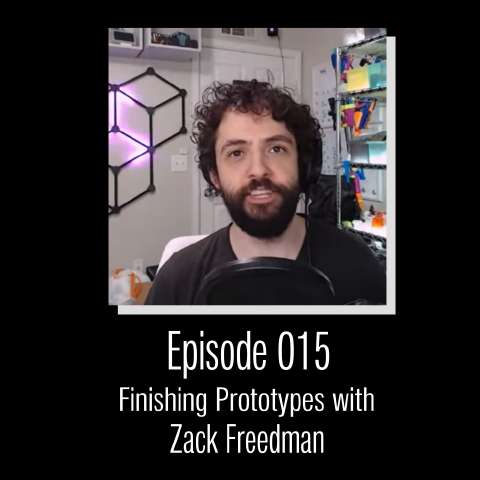
#550 – Finishing Prototypes with Zack Freedman
Download episode · 95 MB
Also on Apple · Spotify · YouTube · RSS
Show Notes
This is a crossover episode with The Contextual Electronics podcast (also made by Chris). There is a video version of this podcast available as well. Interested in keeping up with The CE Podcast? Search or subscribe on the iTunes page, Spotify, Stitcher, Google Podcasts
- 0:00 Introduction
- 2:05 What Zack is building (a computer)
- 2:40 A water cooled oscilloscope
- 3:40 How Zack got started
- 4:40 Hackaday article
- 5:20 Bluetooth heads up display
- 5:40 Hoboken Hackerspace
- 7:15 NYC electronics scene
- 8:30 Working with artists
- 10:00 Working on the set of Mr Robot
- 11:05 Doing a first run prototype for a startup
- 13:10 Building skills in high pressure environments and on consulting jobs
- 17:45 Working on deadlines
- 19:10 How many projects are in a single video?
- 20:45 Building subassemblies
- 21:30 Building projects "backwards" (outside in)
- 23:00 Not thinking your idea is the last good idea you'll ever have
- 24:15 The prototyping mindset
- 27:00 Ranking risk in a project
- 29:15 Usability in wearable projects
- 31:30 "The role of most prototypes is to try to kill the idea"
- 33:30 What makes people want to buy a prototype?
- 35:45 Minimizing features in any one prototype / test
- 36:30 Consumer products should be shown to thousands before going to market
- 38:00 YouTubers' battle for attention (check out Voidstar Lab to see all of Zack's videos)
- 41:00 YouTube theories
- 44:45 Zack's persona
- 47:00 Filming b-roll to keep things interesting
- 51:00 YouTube comment positivity
- 52:25 Maker Twitter
- 54:00 Full time YouTube
- 54:20 Changes in the hardware space since 2012
- 56:40 Prototyping tools
- 58:30 "The Maker Movement"
- 59:25 Working for industrial clients
- 1:01:40 Focusing on the technology vs the purpose of the technology
- 1:03:30 Building a project because you want the thing (output)
- 1:05:30 Technology being used to move the world forward
- 1:07:15 What will Zack build in the future?
- 1:09:40 The Cyberdeck
- 1:12:15 Cyberdeck cafe Discord
- 1:13:10 Building on a stream vs on a video (streams happen on Zack's Patreon every Monday and Friday)
- 1:14:40 Previously wanting to go into game design
- 1:16:30 Providing a representation of what people think the process is
- 1:17:20 People think IronMan is reality
- 1:18:20 Bringing people into the field
- 1:20:25 "Finish more projects"
- 1:23:30 Going beyond the getting started projects
- 1:26:20 People genuinely interested in a topic will skip beginner classes
- 1:27:35 Engineering is intrinsically solitary
- 1:29:30 Trying to figure out gender discrepancies in making
- 1:31:05 "What's it like to put yourself out there?"
- 1:32:30 Putting yourself out there will help you find more positive feedback
- 1:35:05 Building community
- 1:37:00 Finding Zack's work and joining his community
- 1:38:40 Conclusion
Transcript
Dave Jones: We had a last minute scheduling problem this week, so we did not actually get to record with Dave and I like we planned. We will be back next week. Instead, I'm here to offer you the Contextual Electronics Podcast. Now on episode 15, I took a big break to support my wife during our child being born. I hope you enjoy it. It's a slightly different podcast. You know, I'm trying to cover people maybe that aren't 30-year veterans of electronics, but people that are doing stuff that are new and dynamic and just trying to find people all throughout the spectrum of electronics. And so if you like it, there's actually another feed that you can go subscribe to. You won't get this normally on the Amp Hour, but, you know, once in a while, they might show up if we're having scheduling problems. This week, it's Zach Friedman. You'll hear him here. And Voidstar Labs is a great YouTube channel. Contextual Electronics is still a thing. It's still ongoing. It's an online course to teach you more about how to do layout. And there's some new stuff on there, like how to be a consultant and how to design a cellular and Bluetooth board. That's something that I did last year. So check that out if you're interested. If not here, enjoy the Contextual Electronics Podcast Episode 15, Crossing Over Into the Amp Hour, Episode 550. This is the Amp Hour Podcast. Released July 18th, 2021. Episode 550. Finishing Prototypes with Zach Friedman. Welcome. I'm here today with Zach from Voidstar Labs. Zach, how you doing? I'm all right. What you been up to and what you been building lately?
Chris Gammell: That was a nice musical transition there. That's slick. Oh, yeah. Welcome to Voidstar Lab. What have I been building?
Dave Jones: I mean, that's what I think about for you. I mean, you are a builder. You are a guy putting stuff out in the world and making physical objects. So what have you been building lately?
Chris Gammell: There are a lot of projects going on. Even more now that I'm streaming all the time. The main thing I've been working on, though, is a new computer. A few weeks ago... So I do everything off. I built this gaming computer a while ago. I do everything off of it. And, well, a few weeks ago, it melted down. One of the liquid cooling tubes came loose. And it was a whole thing. So I had to run off to a certain electronics store and buy a bunch of parts and rebuild this computer from scratch. And I finally just worked out the last kinks. And now I'm doing a video on it. And it's a whole thing. So you've also got the oscilloscope, the water-cooled $18,000 oscilloscope. We've been hacking away at that in streams. There's all kinds of crazy stuff. I put some internet on my shelves. Here, check this out. Check this out. I put the internet in there.
Dave Jones: Live demos.
Chris Gammell: That's good stuff.
Dave Jones: All right.
Chris Gammell: Still feels like magic, doesn't it? Yeah. It's funny because I've built lots of projects. I've built hundreds of projects over the last 10 years or so. But I've never put Wi-Fi in a microcontroller until a few months ago. I just never had a need for it. And now I've got so many of these projects have Wi-Fi in them because I need the ability to control them on stream and stuff.
Dave Jones: Yeah. And it's also effectively free with ESP32s or 8266s these days.
Chris Gammell: Yeah. ESP32 is sweet. Yeah. I mean, my love for the TNC is well-known. But that thing has given it a run for its money. I got it. Got it.
Dave Jones: Yeah. So let's talk about you and your background. I mean, so you've been designing stuff, designing products for a long time. How did you kind of get into it? How did you get started into this prototyping mindset and this kind of pushing stuff out in the world mindset?
Chris Gammell: Huh. Well, it started when I was a kid and I used to play Lego all the time. That's... No, I don't believe anyone who says that. No, I... So I went to school for engineering because people told me it would make me money. And people didn't tell me it had so much math in it. So I didn't... I wasn't doing too well. So basically, I switched to a business degree. And in one of my internships, right? Like I was working for this company that... Sort of like a third-party app store. And I was writing... I was in charge of the blog. So I ended up on this site that I'd never... Ended up with this blog I've never seen before called Hackaday. And this guy has a heads-up display, right? He built a cybernetic heads-up display. It was the coolest thing ever. So, yeah, he used this part from a... Like a Spy Gear... Like I think it was a Spy Gear video car.
Dave Jones: Yeah.
Chris Gammell: It was like a radio control car with a camera on it. Yeah. And I went on the website and the camera was... You know, the thing was in stock. So I decided, you know what? It's $35. I'm going to wait until I get home. And I'm going to think this one through. I get home and it's now out of stock. It turns out that it's almost always out of stock. Like that was the first time they ever had one in stock in like three years. It's the first... It's the last time they had it since. And that was it. Like I'm just like, that's it. I'm going to build a heads-up display if it kills me. So, yeah. I grab a coat hanger, a pair of video glasses, an Arduino. Very important. I've never used any of these things before. Like I knew how to solder from... Oh. I knew how to solder from like, you know, engineering lab at school. But I've never really done any serious development of any kind. And somehow I put together this Bluetooth connected heads-up display that connected to my phone. And like, you know, showed me like a little compass to a waypoint and showed tweets nearby or something. Anyways, wore it to a meetup. Someone's like, hey, would you be interested in joining a hacker space? I'm like, that sounds cool. Yeah, sure. Why not? Turns out he wasn't... He didn't have a hacker space. He was making a hacker space. So I founded a hacker... Co-founded a hacker space. And yeah, built a lot of projects and people started wanting to pay me for them. So I called off my job search, which... Yeah. Job searching hasn't got... Like hasn't gotten easier now, but it wasn't very easy during the 2012 recession. Anyways, yeah, I called off the job search and took on freelance electronics projects. And that was... Yeah, it was like almost 10 years ago. And that was just the start of it all, huh? Yeah.
Dave Jones: It was... Serendipity into product design, huh?
Chris Gammell: Yeah, it was great. I went to lots of meetups, met people, met clients, went to shows, worked for artists, went to trade shows and stuff, did corporate work. Kickstarter became big, incubators popped up. And then we had this pandemic and I couldn't do any of that anymore. And I had to find a plan B.
Dave Jones: Yeah. Well, I mean, it's interesting too, because it feels like the people I know who are doing electronics design or consulting in New York, it's like there's such a more diverse crowd of, like you said, artists and maybe fashion or just all of the various industries that come together in like a crazy big city like New York.
Chris Gammell: New York is a very unique startup. And I don't want to say startup because it extends beyond that, but it just has a very unique culture, especially with respect to California. Like in New York, it's... I guess the best way to say it is that there are... The cliques matter a lot less. Like there are meetups all over the place. There are shows everywhere. People are a lot more comfortable with you just calling them up and saying, hey, you want to grab a coffee? So like you could fill every... Like, all right. When it's not a pandemic, you can fill up every night with some sort of meetup or trade show or something, meet different people. And yeah, it's a great place to find and pitch talent, I guess. I mean, there are people in like the startup world, there are engineers, there are artists coming out of like the art schools. You got marketing, finance, entertainment, and it's not like... I don't think it's just... It's not very sharply... Not so sharply delineated, right? Like you can rub elbows with all kinds of people. It was a great place to get clients and to do this. Yeah. Yeah.
Dave Jones: I mean, does that then also bring in like a unique set of challenges for the constraints that are on a problem? Like an artist might have a different set of constraints than a financial tech company will have or...
Chris Gammell: Oh, yeah. It depends a lot on the project, depends a lot on the context they're making it in, and depends a lot on the individual. Yeah. Being a... I call myself a prototype developer, but it really comes... It really comes... Like exactly what I'm doing depends a lot on the client and the task. For artists in particular, right? Artists are working off a grant. So they always have a fixed... So like at least the ones I've worked with, they always have a fixed amount of money to spend on the entire project. And by the time I get brought in, they have spent a certain portion of it. So it's really resource constrained environment. And there's... For some reason, they always seem to wait till last... They always seem to wait till two weeks before the show. I don't know why it's always two weeks. Right. Right.
Dave Jones: And we need this thing to light up and spin some motors and talk over RS-485 and on and on and on and on and on.
Chris Gammell: Yeah. Except that like they were really ambitious and they're like, okay, so we have these two 12 kilovolt electron guns and we need you to draw patterns with them on this 8 by 12 foot wall. And I'm like... Yeah. Okay. Yeah. So you always have two weeks. It's always something really weird like that. And you always have a certain amount of money to do it. That's like, let's be... It's an artist grant. Like it's not... You do those jobs because they're fun and because you do something neat. Artist jobs are really cool. But I mean, yeah, there are all kinds of weird things. There's... I've done some work on... I've done some work on sets. I worked a bit on set of Mr. Robot. Oh, really?
Dave Jones: Cool.
Chris Gammell: Yeah. Like a lot of the blinky... Have you ever seen any of the servers? Any of the blinking servers? I think there's this one scene where there's some sort of noise detector and there's this gauge going up. I built the electronics or I built some of the electronics that ended up in some of those. And I got called in on stage because they have a really demanding set director and they wanted those lights to blink in a specific way. So yeah. And with that, I got a call. I got a call like, yeah, hey. The set director needs you to change the things. I'm like, oh, all right. Like you can edit the code like X, Y, and Z. He says, no. She wants you personally to come there. I'm like, oh, all right. Like, I guess I could... I guess I have some availability when you need me. He's like, how close are you to an L train? So yeah, it's all kinds of different constraints. And then you have like... And it's completely different from, for instance, doing a prototype, like doing a first run prototype or something for a startup, right? Because they hire a consultant because they haven't... Like I'm sure you know this because this is your line of work. But for folks who aren't, you often end up in a situation where you have the idea, you secure the idea, you secure the funding, right? You secure members of your team, but you haven't had time to build... You haven't found your CTO. You haven't built out your tech staff. So you'll hire a consultant to build your product out and keep the process moving until you build out your in-house team. And those jobs, like I... It's not just building the project, right? It's also making sure that I can disengage at any time and someone else can just jump right in. All the documents are there. All the code is sensible. We're not using any crazy parts that they're not going to be comfortable with. So it's entirely different set of constraints. On top of that, the project... Like if you're doing something for someone with investors, the project always has to look like it's moving forward. That's right. Investors want to see progress. Yeah. Yeah. So...
Dave Jones: It's not just functionality. It's also like, does it feel good? Does it... You know, it's this kind of... Right. Quasi...
Chris Gammell: And also, is it moving forward? So if I know like, oh, we got to do some refactoring, I have to sandbag a feature or two so we can make... So we can look like, you know, we're moving forward. Right.
Dave Jones: And at five this morning, I did an all-nighter, bro. And like, you know...
Chris Gammell: Yeah. I mean, some different clients, different contacts have different amount of heroics. I generally try to... I generally try to work less than nine hours a day. But you never know how it works. It was a lot of fun. I really like how you never really know what you're getting into with each job. It's always something different. On top of that, they're all kind of... You never know what kind of skills you'll need. Some of them, like, I have to start... I have to, you know, learn to solder under a microscope. Some of them, I have to sew.
Dave Jones: Okay. Yeah. So I'm curious about that. So like, it feels like these are high-pressure environments. It feels like this is something where you learn, maybe not on the job, but on your feet, right? You're kind of just really having to adjust as necessary. What are some of those skills that you did end up pulling out of that? So I hear you talk about the teensy all the time as a tool, but I would say there's also like, you know, the skill would be knowing how to apply that tool and knowing how to slot things into different situations. So what are some other skills that you've pulled out of that?
Chris Gammell: I mean, from freelancing and consulting, like, the absolute biggest skills are, first off, being able to sell yourself, right? Because if you think about it, every single job that I get, I have to convince a fresh person. You know, sometimes I get a little referral, but basically I'm convincing them that I can do your job, even though I don't necessarily have something like their job to show. So it's kind of like this, kind of, kind of like that. And it's also, um, it's a way of saying it. Yeah. There's this aspect of, uh, being able to sell yourself and being able to act with confidence and then figure it out later. You know, like someone says, someone says, uh, yeah, like I, I need a, um, I'm doing this wallet thing and we're not sure if the electronics can fit in the wallet. And I say, Oh, like, why don't we just 3d print a model of the device? And then you can have people put it in their pockets and see how well it fits. And they're like, yeah, sure. That'll be great. And then I leave and I go, all right, I have to get a 3d printer now. True story. That the 3d printer costs. That's how you got started. Yeah.
Dave Jones: Yeah.
Chris Gammell: Well, 3d printing. We might, we might, we might talk about this later, but the 3d printer cost me $180,000. Oh my. Or something, something like that. Uh, the guy paid me in Bitcoin and I needed to sell the Bitcoin on the spot. Like, yeah, I think it was like, this was like eight years ago or something. And he, he paid me two and a half Bitcoin to, uh, not, not, I think I'm off by an order of magnitude. He paid me like two and a half Bitcoin to do it, which at the time I think was like 1200 bucks. And I needed to liquidate most of that. So I could buy a replicator too. Like I, there's one, there was someone selling one for cheap and I needed the, I needed the cash. Yeah. And if I had held those Bitcoins, I would have been able to retire on it or something. Any, anyways, uh, there's that. And the other thing is pricing. Uh, a lot of people have a very difficult time talking about money, negotiating pricing. And, uh, for somebody who does a lot of work on YouTube, that has gone a lot further than I expected. Cause you know, I mean, sponsors are sponsors and partners are like where the there's where the money is. And like, luckily I have experience, you know, having, having these conversations, but I imagine a lot of folks are like, I want to pay me a thousand dollars. Am I worth a thousand dollars? They don't know that like you'd say, all right, but what about 2000?
Dave Jones: Like, yeah. Like where is the, what is the absolute level of value? Right. I mean, like maybe it's worth $2,000 to one client, but maybe not to another.
Chris Gammell: Right. And if you haven't dealt with this a lot, you don't always know that like, if you propose like an insulting, like for instance, an insultingly high amount, it's not necessarily, they're not necessarily going to say like, oh wow, what a jerk. Screw this guy. No, they're going to bargain with you. That's right. That's right.
Dave Jones: But it's not, well, we don't have, we have budget for less than that or. Right.
Chris Gammell: Yeah. Right. But it's, it's, it's part of this sort of feeling out what folks sort of feeling out what folks want, feeling out what they're, what's available, having these hard conversations and also kind of getting ahead of yourself and making promises that you're not sure if you can deliver yet.
Dave Jones: Okay.
Chris Gammell: All right. So sometimes you have to move faster. What's the way of saying it is that sometimes you have to move faster than you've moved in the past. Hmm. I usually say fake it till you make it. This is another way of saying that, but, uh, I'm not, I'm not being like, I'm not, I don't know. Like on one hand, on one hand, like an outright deception doesn't last very long. That's right. Uh, you can't over the longterm pretend like just, you can't over the longterm pretend, you know, something is like, you can psych yourself up, but you can't put on a new persona for months on end. On top of that, like it's, it's, it's hard. This is why I'm having a hard time articulating it. Cause like, for instance, I've never done an embroidery project before. Right. But I've used sewing machines. I've used sergers. I've done soft circuits. So I'm fairly confident that even if it's, even if like embroidering this, this like conductive thread is harder than I expected. I think I'll be able to figure it out without having to push the deadline back. And it's kind of having the confidence to having the confidence to do that. And also to approach the client, you know, knowing that you can approach the client and say like, I thought this job would be a lot easier than it actually was. Right. Right. Yeah. It's part, it's part of the font. A lot of the skills are translated. On top of that, there's the deadline thing. Uh, I'm used to working on bonkers deadlines. Turns out to be very, very important for YouTube. Okay.
Dave Jones: Self-set deadlines or actual like, uh, externally. Imposed deadlines.
Chris Gammell: Uh, it's combination of both. Right. Cause like it's combination of both. Cause you have like the client deadlines. Like sometimes you have an unreasonable deadline, but they're also, there's also something unreasonable about the project. So it's worth hitting it. So there's that like, okay, I have this project that normally would take me three weeks and I've been given six days. Um, how do I like, how am I going to structure my time here? But there's the other, the other element of it, which is like, this client told me take as long as you want, but how much time can I actually take on this? Like, you know, how, what are the ramifications to the business and to them? If I do this in two weeks instead of one, and both of those are important for you for, for content creation in general, uh, YouTube, especially because of the cadence at which you're expected to, to do stuff. Yeah.
Dave Jones: Yeah. I mean, I'd imagine that a lot of your, I mean, your audience has changed. Obviously your audience has changed as a YouTuber, but also your audience has changed in terms of the people that are looking at the output of your work. And it's not necessarily just is, does this device serve its purpose, but also now is it done in an interesting way? Is it, is it entertaining and is the process shown and all that other stuff?
Chris Gammell: Yeah. Yeah. Yeah. In, in a way each, uh, in a way each video is almost, I I've been, I've been trying to put a number on this for a while. It's, it's surprisingly hard of how many projects are actually in a video. Oh, because like in a way the, we have the thing itself, right? The thing that's shown, we have the video itself, right? The production process of the piece of content. Uh, but then afterwards, if we release the project, right? So other people can make it, that's a project in and of itself because it needs instructions, documentation, comments, support, all that, all that good stuff. Uh, and like, you could also, could also say there's like an element of, uh, if there are other people involved, right? Like if other people are working on it, there's the relationship management aspect of it. That could be a project you could even. And on top of that, the project is even probably going to be revisited in the future because things break things.
Dave Jones: Well, you also, it seems like a lot of your builds as well. So people don't know what we're talking about here. Obviously I introduced Zach is from void. So check, check out his YouTube channel. Yeah. Some people are listening. Some people are watching. If you haven't check out his YouTube channel, we'll have, we'll have videos in here and we'll have links and all the show notes and stuff like that. But, but another thing that you do well is you, you show some of your process and often there's experiments that kind of build up to the, the final thing. And so I would almost say those are sometimes sub projects. I mean, you could say that R and D is sort of its own thing.
Chris Gammell: Yeah. I, I, I talk about, I actually have a, I talk about this in, uh, I have the YouTube channel, by the way, is, is youtube.com slash Zach Friedman. I've been looking for a good time to actually formally call it void star lab. Long story about the name. Anyways, I did a video on finishing her projects and I like, instead of just making a, designing a project and doing it, I like to break it down into like sort of sub assemblies, finish those individually and then start putting them together. Cause the whole idea is that things are going to happen. Life is going to get in the way. Uh, and you're no project. Like it's, it's especially if you don't get to put in all of your weekday hours into it, uh, things are going to get in the way and force you to abandon your project. And you always want to get that project to a point where you can stop working and you still have something to show for it. So in a way, a project is like a sec, like a set of projects. Um, yeah. Like, I mean, you even called it the code, like the code, its own project. Like, so I kind of do it backwards, right? Like for most people, they first, uh, I think for most people who build stuff, they first breadboard, the circuit, write the code, and then implement the circuit properly and, or yeah, implement the circuit properly and put it in its form factor, put it in, you know, its enclosure or whatever. I start with the enclosure, then add the electronics, then add the code. And then I write the real code. And the whole point of that is that if I, if I have to stop part way, I have something to show for it. Like if using the data glove, for instance, uh, if I had to stop in the first third, I would still have a cool looking glove and I could wear it to meetups and stuff and tell people it works.
Dave Jones: Uh, yeah, there might be something behind the curtain, but that's okay. Right. Yeah.
Chris Gammell: They don't know that. Um, and, uh, and then like, uh, if I built out the hardware, but I didn't get too far into the software, then at least, you know, it blinks, at least it does something. I can show it working and I can talk about the possibilities. Uh, and then finally I write some provisional code for it. So now it arguably works. It's arguably done. I could like walk away right now and claim that it's finished. And, uh, then, you know, then I can knuckle down and work out the real code, make all the refinements really bring it to a hundred percent. And, you know, hopefully I can stop during that at any point I can abandon it and, uh, I have something to show for it. Yeah. I think it's, I think a lot of folks just, they get this, they get a really ambitious idea and they think of the kind of like, they get a very ambitious idea. And I, yeah, I, I, this is something that I've never, I don't really struggle with. So, but I'm, it's something I try to be sympathetic to. A lot of folks get an idea and they think it's the last good idea they'll ever have. So a lot of folks feel compelled to get it down and do it exactly the way they think through. Like, like, and they don't want to tell anyone about it. Right. They don't want to stop part way. Like they don't like, they think this is the last good idea they're going to, they're ever going to have, they have to cut it down and cut it out a whole cloth. Um, and that's, that's, that's not true. Like, like first off. Yeah. I mean, there are a lot of ways, there are a lot of ways not sure, but.
Dave Jones: I feel, I feel like the, the, the, uh, especially like the traditional engineering education kind of thing is kind of bottom up and it's like, oh, well, we're going to start from transistors and we're going to build up to this thing. And then the next thing, and then the next thing, and then eventually you write code and whatever. Right. And I, I feel like I, in my own life, I've done that too, where I'm like, oh, well, I'm starting a new project. I need to start with a circuit board or start with a start at the circuit. Whereas it would have been just as easy to go and grab a dev board and glue a bunch of them onto a piece of, you know, cardboard wire stuff together and then prove out the idea first and then revise it and then step it back. You know, that's kind of that top down versus bottom up type of thing.
Chris Gammell: A big part of the prototyping, kind of the prototyping mindset, if you will, it sounds kind of pretentious when I say it that way. But a big part of the process.
Dave Jones: It's really more of a method. It's, you know, if you buy my tapes, you can check out my method. Oh yeah.
Chris Gammell: I got to do an ebook, right? For passive income. Isn't that what I'm supposed to do at this stage in my career? That's right. Yeah. Buy my, if you buy my ebook, the first chapter is free. Anyways, the, so the prototyping mindset, you're not thinking like, I feel like in a sort of engineering or inventor mindset, it's sort of like what builds off what in the prototyping mindset is let's figure out everything that goes into this project and rank it in descending order of how risky it is, how likely it is to fail, how little, how little I know about it, right? You know, like just let's rank it in terms of unknowns because you want to do the unknowns first. Like if you're not sure if, for instance, you'll be able to fit a piece of electronics into a glove, you got to do that first, right? Like if you're not sure if a certain sensor will be able to pick up a given, uh, like a given method or you're not like do, do that. If you like a microcontroller, but you've never used it before, you better not do anything at all until you get your butt into an IDE and make sure you can actually write code for that microcontroller. Uh, like you have to do the stuff. Basically you got to find all the band-aids, rip them off. You got to find all the rocks with bugs under them and turn them over. You got to find all the, you got to find all the parts, all the, all the pain points and stick pencils in them. You just, you have to go aggressively go out and find anything that could possibly go wrong. Anything you don't know, anything that scares you, anything that scares the client and immediately do all of that. Uh, because the, basically the, the, the way a prototype, way a prototype fails is it doesn't come together fast enough. Yes.
Dave Jones: And system integration is by far the hardest part of any project. And it's usually if you do the Gantt chart to say this little bit at the end, it's like, oh, and we'll stick together the board and the software and the mechanical and I'll just, it'll work. What's the problem?
Chris Gammell: Well, generally the thing that messes, generally the thing throws off your schedule, the thing that messes all that up. Like, it's not that the entire project comes apart. Like people say things, like you'll say something to the boss, like, like, oh, it turned out to be a lot harder than we expected, but it's generally like one part. Like, oh, I thought we could easily, I thought we could easily cross compile Python three into this, uh, into this Yocto, into this like Yocto distro. But it turns out that that tool chain is really hard to use. So we had to do it, uh, you know, so we had to like add it in a different way, which cost us three weeks, right? Even, even stuff like, uh, like, oh, I thought I would be able to write, um, C++ code on this Raspberry Pi 2040, but I, it turns out I have to use Python and I didn't know circuit Python and micro Python were different. So I just blew my deadline.
Dave Jones: Yeah.
Chris Gammell: Right. Right. Yeah. It's, it's all stuff like that. Like you have to suss out the unknowns. Yeah.
Dave Jones: So, and how do you start to rank them though? I mean, that's, that's always the thing that I run into is like, is it just best guess
Chris Gammell: and then you're just running through them? Well, how do, how do I, how do I rank it? Well, the first thing is gotta check, gotta check your gut. Right. Cause like, if you're any, if you're anything like me, uh, if you're anything like me, like our first off, like you're going to have things that you don't want to do, right? Like those, you definitely want to write those down. If you don't want to do it, there's a reason. Um, next thing, the next thing is, uh, basically like I sort of like think of each part that goes into, I sort of try to break it down hierarchically. Right. So if using the glove, for instance, that's going to involve a glove. It's going to have some sensors, going to have something to hold the sensors, going to have some electronics, wireless, maybe a motor.
Dave Jones: Uh, I'm going to play this in the background too, so that we can see the glove that you're talking about here is. Yeah.
Chris Gammell: This is, this is, uh, this is the first data glove. It's the P5. Uh, yeah, if you can, if you can start by modifying something off the shelf instead of, uh, building it all yourself, you can actually save a lot of time on it. So I started this data glove project by modifying it off the shelf on, uh, there's things like, uh, like for instance, this thing is going to detect gestures, right? So is the sensor data coming off like usable? What format is it? Is it quaternions or is it Euler angles? Right. Uh, what's, what's the math involved in that? I want to use a neural network. Can I train a neural network? Can I get a neural network onto the glove? Uh, like all, all these things, none of, none of these, by the way, involve actually building the project. Uh, these are all things that are worth testing individually in isolation because if a single one doesn't line up, the entire project is screwed. Like I, like, you know, I fired up TensorFlow on my laptop and then I just deployed a micro, like a TF light, uh, TF light model to a teensy. It doesn't matter. It didn't matter what it did. I just have to make sure it's, it's practical, you know, like for a wearable project, I'll build models out of cardboard and wire and stuff to, you know, that's all, this is also why I like building the, uh, the enclosures, build the, uh, the, the three, build the non-electronics part first. Cause I have to know how much space I have to put electronics in.
Dave Jones: Yeah.
Chris Gammell: Yeah.
Dave Jones: I mean, so when you're doing all this, like, like wearable type stuff as well, I mean, are you trying to also get a feel for like usability or like, uh, kind of the, that's the other
Chris Gammell: wax.
Dave Jones: Yeah.
Chris Gammell: Oh man. Well, when I can, I mean, I'll tell you about where I, this, this applies to all kinds of usability, but it's very prominent in wearables. I learned this in wearables. You need the entire thing to evaluate usability. Uh, you can't build a usability. You can't really build a usability prototype. Usability and user experience are affected by so many factors that it's important. It's really impossible. Like for instance, uh, I had this idea a long time ago to make a, a sort of a heads up display for bikers, right? You'd, instead of having a watch or thing on your handlebars, you wear a heads up display. So I built a prototype heads up display, you know, it was a helmet with a bunch of wire and stuff stuck to it. And I brought it to bike meetups and I said, Hey, uh, what do you think of this? Uh, I brought to biking and running meetups and said, Hey, what do you think about this, this device? And people like, well, is it going to look like that? Yeah. Uh, you can't, you can't get accurate feedback without something that people think is the real thing. So unfortunately, uh, you have to, um, for stuff like, for stuff like that, you gotta just, you have to pick projects that even if they're worthless are still worthwhile. The data glove stuff, this is why I like wearables, right? Cause even though nearly all wearables are either useless or a worse, or like you'd be better off not making a wearable. Uh, there's, they still inspire people. People's minds fill in the gaps. I don't need to explain what you could, what you do with it because people will think of that for themselves. And that also disclaims me of making false, uh, false claims on top of that, making something genuinely useful is a, it's really hard.
Dave Jones: Yeah. Right. Right. Exactly. Yeah. It's like bolting technology onto people now. It's like, okay, well, do I really need this? I mean, like I'm trying to bike here, man.
Chris Gammell: Or, you know, the other aspect of the prototyping process is that for the, the other part, the other part of the prototyping process is that the end product, basically what you're making when you're prototyping most of the time is a decision to kill the idea. The role of most prototypes is to show that an idea is unworkable because most ideas are, are unworkable. Like it's just force of numbers. If you, if you prove out an idea, odds are you're going to discover it's not worth making. And that's why you made a prototype instead of just jumping straight into product development.
Dave Jones: Okay. So tell me a little bit more about this then. So, so you're trying to kill an idea, but then what makes you keep going after that? Like why?
Chris Gammell: All right. Well, yeah. Okay. So it's, it's different for, all right. So like, it's different for making, it's different for making a side pro like side projects, projects for content and professional projects are different in this respect, but in terms of professional projects.
Dave Jones: I was going to say, can I guess that the professional projects, is it because someone comes to you and says, really, we really want to do X. And then you're saying, no, you don't.
Chris Gammell: Yeah. I mean, I'll say that, but the odds of someone actually listening to it are not high.
Dave Jones: Well, maybe you say you don't want to do it like that though. Right. Maybe you say you don't want to do it in this form factor and let's try these other things.
Chris Gammell: I'll, I'll try to say it more. Like if we made it like this, you'd be able to test a few more assumptions and you'd be able to get a few, you'd be able to get more, more pointed feedback. Right. Like that's, yeah, that's great. It's more, it's, it's, it's, it's very diplomatic.
Dave Jones: Yeah. I see. You're much better at this than I am. Apparently I'm just like, nah, bad idea.
Chris Gammell: It took a lot of falling on my face. It took a lot of cringe that keeps me up at night. Anyways, the thing you want for a professional prototype is that people try to buy the prototype.
Dave Jones: Mm.
Chris Gammell: If someone, people try to buy or steal your prototype, you are onto something. At the end of the day, you are making a device so that somebody sacrifices money to, to get the device. That's the purpose. Look, that's why you're making the product. Like you're making the product so that somebody can turn money into more money. If that person could make more money investing in meme stonks, they'd be investing in meme stonks. They can make more money, you know, smelting cars for scrap. They'd be smelting cars for scrap. The whole idea is to try to get people's money. So like if people try to buy the prototype, that is exactly what you want. That's why it's also helpful to try to make the prototype at least presentable as the real product, because then people think it's something that's for sale. You'll get that feedback. It's really hard to suss that out otherwise.
Dave Jones: I mean, there's a lesson of those elements that would make that be that next level, right? So far you've said you want people to be real enough for people to buy it. It has to have these levels for people to think it's a thing and give you true feedback. But then does that like fit and finish or is that presentation or what does that look like as a prototype being a more real thing?
Chris Gammell: So it's, I mean, those are aspects. You're right, but like those are aspects of it. Like, but like the fit and finish, the functionality, the way it behaves, the story you tell about it. Yeah. They're all, but they're all elements of versimilitude. Basically, it has to be internally consistent. Like the parts of it all have to make sense. For instance, if it's a, let's say it's a fitness wearable, right? It has to be small enough that it makes sense that you could run in it, right? Right. It has to have a user experience.
Dave Jones: Just take this car battery and put it on your shoulder and then you get this little LED on your face.
Chris Gammell: Exactly. Like it's, it has to, it doesn't, that doesn't mean it has to be like as small and thin as it would be in real life. It just has to be small enough that it makes sense that you could wear this and run, right? The UI needs to look like a running UI. Maybe it has like a little speedometer on it. Maybe it has like a, a picture of a person running and a picture of a person running behind it. So you, so you chase them and you tell a story and you have like a story to tell that's consistent with it, right? Like you put this on, you hit the button, you know, fires a starting gun and off you run and get to erase yourself from yesterday. So none of these features have to work, right? Like, like that, that little guy can always trail, like it can just make a random walk behind the, the one that represents you. Like none of it has to work. It just has to look sensible. It has to, and it all has to be internally consistent. Also work together. Like basically you don't want people saying, why is this here? Why? Like what's this do?
Dave Jones: Cause it should all make sense. Uh, so, so, so there's some aspect of minimalism then as well, like not overdoing it, not being like throwing all the features at the wall and seeing what sticks.
Chris Gammell: That kind of, right. Right. On top of that, the more thing, like the more things you try to test at once, the worst feedback you're going to get about any of them. Yeah. Uh, on top of that, you'll also, the more, the more features you try to test at once, the more things you throw at someone, the more feedback will be how the features relate to each other instead of whether each individual one is worth making. Okay. Uh, it's, yeah, it's kind of, uh, it can, it can be tricky and it's, it's not something that you, it's something that takes iteration. You have to, you have to try over and over again, the, to do a, to do a really excellent prototype, the number of, a number of people you need to test it is astronomical. Uh, ideally you want to ask that number a hundred, a thousand for, for, for a consumer product, you're probably going to, by the time it goes to market, you probably will have exposed it to like a few thousand new people. Wow. If you're assuming you're dotting your I's, crossing your T's and really going, going crazy at the very least, every one of your friends and family, uh, and as many of their friends and family as you can get, uh, will have seen some version of it because you can't, you have a limited ability to use the same person twice, right? Cause they take things they know about it before and bring it in. And you have to be careful because some, some testing groups just aren't very numerous. Uh, especially if you're doing something like style related, you can only show it to so many people to get their thoughts before, you know, you, before like you start to, you start to hear an echo style and stuff. That's another, that's another, that's a, that's another ball of wax entirely. But, uh, but yeah, at the end of the day, what you want is you want people to either like the, the, the, the strong version is they try to buy the prototype. The weak version is they don't want to give it back to you. They want to keep using it and they want to, they like, they say, Hey, you saw that, you saw that, that, that, that thing that like lets me race against a virtual person. Can I, can I borrow that? I'm training for a 4k. Like then, you know, it's good.
Dave Jones: Yeah.
Chris Gammell: That's great. That was great. At the end of the day, like a, like a good product is one that convinces people to make sacrifices for it because that's what buying something is, uh, in a way that, that holds for content too. Cause every time someone watches my video, they're not watching someone else's video.
Dave Jones: You're saying it's a battle of the fittest amongst the, uh, the electronics YouTubers and, uh, and such.
Chris Gammell: Well, I mean, it's, it's a bad, it's well, I mean, sort of, but, uh, attention economy, right? I also get the ability, remember, like I also get the ability to kind of, to kind of select who I'm fighting against, right? Like I, I get to, I get to kind of pick which arenas I, I I'm, I'm playing in as for electronics. I, so I'm an electronics builder, but I don't actually do a lot of my videos about electronics and the electronics in my videos tends to be very lightweight because electronics is very tough. First off is very time consuming. So it's really hard to make, especially things involving like, like a circuit board. I haven't made any custom circuit boards since I started the channel. I used to make circuit boards for every one of my projects.
Dave Jones: No, wait, I thought you did for the glove. The, uh, the, not the, sorry, not the glove, the wrist computer. I thought that thing had to, uh.
Chris Gammell: All the projects involving custom circuit boards were made before I started the channel. They were completely finished before I started the channel. I, I don't, I don't talk. I don't, I try to be a little unclear about a lot of timeframes to give myself more flexibility to use old projects now. But if you think about like, even if I'm, even if like, let's say like I'm using advanced circuits here in call here and here in Colorado and I convinced them to let me drive to Aurora and pick them up myself. That's still three days just to get the circuit board. Assuming I'm paying $500 per. Like that's, that's, that's, that's unworkable. It can't be done. That's too slow.
Dave Jones: Oh, you're saying because of the iteration cycle. Okay. Okay. And you're not using rapid, rapid prototyping tools like other mill or something like that. Yeah.
Chris Gammell: I don't, yeah. I don't have access to stuff that, to stuff, to stuff like that. So that's why so many of the projects involve 3d printing because 3d printing is fast enough that I can actually do it on the one week schedule of building, uh, building projects for the channel. Got it.
Dave Jones: So that's another thing that we're learning about you is that from idea to a video output, it is that one week cycle. It's not like paralleled. Well, there might be some parallel stuff, but it's not necessarily just the, that.
Chris Gammell: Just, just to, just to bring home, to bring home what we're talking about before. I decided to pick my fight with 3d printing. I decided that the channel, the channel is going to be like projects on a high level and 3d printing on a low level, because on a high level, people just love seeing cool stuff.
Dave Jones: Yes.
Chris Gammell: And I, but the thing I get technical about is 3d printing because I, there are, there are a lot of 3d printing channels out there, but there really aren't any of them that are totally gangbusters. No, there's no electro boom of 3d printing. There's no, there's no styro pyro. There's no Michael Reeves. There's no Colin Furtz. So it's a battlefield that I can actually fight in.
Dave Jones: Hmm. So you're saying it. Yeah. So a lot of the 3d printing channels I see are like, like the ones where they're like Joel is doing like reviews and, uh, there's other people that do that. Yeah. There's, there's makers muse and CNC kitchen that get very technical.
Chris Gammell: There's like wild rose bills that make, that just show the process, but none of them are real like category killers. Cause like the whole thing, what you want with YouTube here, like I've got my, I've got my YouTube theories.
Dave Jones: Okay.
Chris Gammell: What you really want with YouTube is you want to get a chain going. You want someone to see one of your videos and then they get recommended another and another and another and another. And I suspect that the more popular your competition is, the more likely YouTube will show the person one of their videos. So at the end of the day, like, that's what I want. I like it's if, you know, if I want to get a million views, I can either get a million views in a video or I can get 300,000 views ish on three videos. And it's a lot easier to do the second when you're new. Got it. So yeah, that's kind of, that's very strategic.
Dave Jones: That's like a reverse engineering of what you know about videos and you'd make my, my
Chris Gammell: approach to YouTube has been, has been very strategic before I, before I even started writing my first video, uh, I spent about two straight weeks just conducting research, uh, conducting research, you know, review, looking at things on social blade, uh, tracking new videos to see if my predictions actually seem actually played out. Just getting an idea of how the, how the system works on a hot, like the system is unscrutable, but it definitely has some patterns and, uh, any other secrets you drew out of there that,
Dave Jones: uh, you're willing to share there.
Chris Gammell: I mean, there were, uh, oh man, I could, I mean, I could talk about you. I could talk about YouTube game theory for, for, for, for millennia. Uh, but I think some of the, some of the big ones are first, you have to make all your videos bangers. They all have to be consistent quality. You can't have a good, you can't have people say like, I don't like for instance, um, and this isn't a slight against like, this isn't a slate against any particular channel because like, again, I don't know the strategic dynamics of, of anyone for sure. But for instance, uh, using 3d printer channels as an example, some of them do things like, can you print with not, can you print with weed whacker line? Like really neat, cool stuff that is going to draw eyeballs and they mix it in with videos like let's review the, uh, let's review the, uh, the, the XYZ cubic, uh, box M20. The printer was sent to me.
Dave Jones: Right. We need, we need a video this week. Right.
Chris Gammell: There are far fewer people who want to watch a review video than want to watch an interesting experiment. And that I think is an, I think releasing that video would be a net negative for the channel because it reduces your average view count. That's a video that can't show up or start a chain. Uh, cause unlikely that people are going to, cause like, it's unlikely that people who watch your other popular videos are going to also get recommended and then watch that. Remember all it takes is a person to click away once during any of your videos at any point and you've broken the chain.
Dave Jones: Huh? Uh, so like, no, this is great theory. This is really interesting. I mean, uh, so you want to make sure that viewer and I've is a, is a subpar maker myself.
Chris Gammell: Uh, well, I, I don't think the second thing is production. Quality counts. It's not everything. Uh, production quality counts. And basically like the, the, the, the, the second YouTube theory of the, of the Zach is that the table stakes, basically what it takes to put your chips on the table is you need excellent audio. You need your videos to be tightly cut and fast moving and well paced. And you need to be charismatic. Yeah. Uh, as to, as for actually what you put in the video, the content, like that's up to you. You, you, you pick your content based on a combination of what you can be charismatic about and, uh, what people want to see. And, uh, also what you can do practically. Uh, yeah. Let's see.
Dave Jones: There's the, the charismatic part is interesting too, because we talked about that beforehand. I said, you know, I, I had mentioned to you that like, you've been, you know, over the, from the beginning of your channel to now, like you've been kind of developing this performance persona or been shaping it more. And I said, I w I wasn't sure if it's actually just the more, uh, the more authentic Zach coming out, or if it's you getting more comfortable in front of the camera or, you know, you developing this, this persona. But I think that is really important because if I walked up to you at a meetup, I'd expect, you know, effusive, well-scripted, funny throat, you know, like, you know, sarcastic type of comments, because that's what I'm used to watching Zach doing and it being around electronics and 3d printing and all these other things.
Chris Gammell: So, so when, when you're, when you're doing something like YouTube, uh, really, really anything, really anything public, but especially something, especially something that can be scripted, you're sort of playing yourself, but amped up to 11. That's right. Yeah. The, the main difference between pardon the main difference between my, all right. So I, I initially tried YouTube a few years ago, right? I, the channel, the channels, I started my channel four years ago and I left those first two videos up for historical reasons, but they're awful. And those videos, uh, I did in the traditional maker YouTuber style, which is that I showed myself, I showed my face for maybe a scene or two, but otherwise I'm doing a voiceover. And, uh, so then for the first few videos in the channel, uh, I scripted the videos and I was trying to do that in a different YouTuber style, right? Which is memorize a couple of lines, say the lines, memorize a few lines, say the lines. Uh, and then, uh, when the channel really kind of like, kind of like, you know, got its footing when I started using the wearable display as a teleprompter, because then I could make the scripts as intricate and crazy as I could want. And, uh, because I see all the stuff right in front of my face, like normally with the teleprompter, you're, you're not prompting yourself with the exact script, right? Cause it's not that easy to read every single word. Uh, but with the, um, with the, uh, the wearable, I can make the most elaborate script I can think of and then read it up, rattle it off perfectly word by word. So that's when everything kind of got to, uh, that's when the gap closed between the writing and the talking, I'm a much better writer than I am a live, than I am a, uh, an improv artist. Uh, so that's when it really caught on, uh, the problem with the first, right? It just, this is another part. It's another bit of YouTube tech for anyone listening. Uh, the problem with the first approach, right? Uh, reading, you know, not, not doing talking head is that it multiplies the amount of B roll you need. Basically without the ability to point the camera at yourself, you have to film something interesting for every single scene, right? Nothing. So when I talked about pacing before pacing is so important, your script has to move. Bang, bang, bang, bang, bang. Uh, Chris, if you're watching the video here, Chris, isn't scared. Skipping forward through my video. This is the actual pace of the video. No cut really lasts longer than two or three seconds. They're all different. I do maintain, you know, proper blocking. I'm always on the left side of the screen, all that good stuff. But like you have to keep things moving because again, the moment someone, the moment the, the, the, the pace drags, people are going to click off and, and you're done. They got something else going on, right? They gotta, they gotta go do that. Right. And, and if you think about it, that means that you need to film like hundreds of shots if you're not putting your face on it because people are interested. People can hold attention much longer than stuff. It's cheating. Uh, so that's the problem with the first one. The problem with the second one is that, uh, first off, if you're memorizing lines and then like, you know, kind of riffing on them. Uh, first of all, I don't, I'm not very good at that. A lot of people just aren't, I can't memorize things that fast. I'm not a memorizer, but you're also rarely as funny as you're rarely as funny. Like you're off the cuff as you are with unlimited time to prepare. And on top of that, it's really hard to cut a video like that. Uh, it takes a long time to cut all those little mini takes together. And you know, like time is, especially if you're building a project, right? Like time, you need every second you can get. Uh, I like the teleprompter approach because it closes the gap between the, because like, it gives you lots of footage that you can use to pad out the, uh, you know, the project and stuff. And it closes the gap completely between the writing room and the, and like the studio.
Dave Jones: Right. And, and it still maintains the persona. I feel like too, of like, you know, Zach, the narrator, Zach, the effusive person that's in front of the camera telling you about this thing he's passionate about. So that, that helps too. Yeah.
Chris Gammell: What's funny is that like, what's funny is that the, the, the, the tele, the wearable teleprompter and what you're talking about, the effusiveness, I tend to be very animated, not not when I'm doing a podcast though, because I have a boom mic here. And if I hit it, the shot, the shots ruined, it's all over, man.
Dave Jones: Yeah.
Chris Gammell: Yep. So, uh, but, um, yeah, those two things are the most, those two things are the, the most common things that people, I don't want to say complain about because it's much more hostile. Uh, those are the things that people most common attack me for. Hmm. Uh, like I'm of, of, of all the negative comments, like, all right, the, on 3d printer videos, the most common negative comment is dude, you got to tune up your 3d printer. You got strings and your, your layers are inconsistent. I'm like, who cares? I don't have time for that crap. Uh, but on other videos, yeah, the most common one is like, yeah, I really, I really want to like your videos, but, but like that wearable computer, just, just, uh, like it just breaks on, it's just, I just, I just can't, I just can't, I can't, I can't respect you unless I can look you in the eye. Like I, I, I, you seem like a smart person, so I don't know why you think it was a good idea to wear the, the wearable. These are actual comments by the way. Oh, I don't doubt it.
Dave Jones: I mean, uh, yeah, YouTube knows the depths there's, I mean some, yeah, community can be great. Right. But it's, uh, you know, there's, there's also the, well, return to that in a sec, but the
Chris Gammell: hand, like I, another common, another common comment is like, yeah, I love your videos, but I have to listen to them because your hand gestures make me want to fly to Colorado and murder you, uh, in, in, in language that got in language that made it automatically filtered out by YouTube. That said for anyone listening, who's thinking of, uh, you know, doing this yourself, the YouTube comments have been far more positive and far less hostile than I expected by orders of magnitude. I expected like, we're talking like when I say this, like I'm talking like on an average video, I'll get like five to 10 truly nasty comments and you know, maybe another five to 10 comments that come off as nasty, but are more likely the person saying them has, uh, you know, impaired social ability. Uh, I was expecting like, you know, I'd get, I'd expect that like, you know, 60%, hundreds of comments would be just pure, pure vile spite poured into your ears and you just be like,
Dave Jones: Oh wow. I am. Yeah. It's, it's not nearly that bad according to the internet. Yeah.
Chris Gammell: It's not nearly that bad. And, but at the end of the day, look, the, what people say doesn't matter what, what people will say, what people say doesn't, it doesn't matter what the analytics page says matters. What your bank statement says matters. If people, you know, people could be like the, that's right folks.
Dave Jones: He said he was a business major as, and there we go.
Chris Gammell: I made it very clear. I'm in this for the money. Yeah. I, I do. I, I do like, I, I make that joke, but then I go ahead and like stay up till five o'clock, you know, building new water cooling for a finished oscilloscope project because I just really want to put it on my desk. I just really like, like building stuff anyways. Yeah. But it's not nearly as bad as you think the, the bad one, uh, the worst thing. Social media is by far Twitter, but maker Twitter tends to be very friendly. Uh, in fact, I would, I would go so far as to say, yeah, you've experienced with this maker, maker Twitter's oddly friendly. I don't like creepy friendly. Like, like, like, come on. Okay. No, like, like, like, I don't know where the lines are. Right. Okay. Cause like, you know, you've things like, uh, like, uh, like, like gender equality. Twitter is hyper hostile. And if you step one millimeter out of these very sharp lines, you're going to be knocked off the internet with a firestorm. But maker Twitter, like you really have to push far for anything, uh, for, for you to hear anything.
Dave Jones: It's very low drama, very chill, which I actually, I think when it, I, when I get to meet anyone from maker Twitter in real life, it's, it's instant, instant friendship. So that has been, that has been very positive.
Chris Gammell: The maker community is, is super friendly. It definitely helped buoy the channel early on. Cause just, you know, I got so many people, like so many people who I was like, I didn't even know knew me. Right. Like people who like saw my name on Hackaday or, you know, built my projects or things like, you know, promoting the, the show and, you know, an extra a thousand views or so early on makes a, makes a huge extra a thousand views or so early on makes a tremendous difference.
Dave Jones: Yeah.
Chris Gammell: But, uh, yeah, it's, it's, it's a biz, it's a, it's a real business. I'll tell you this, never worked harder in my life, like high school, college job, finding work during a recession. None of them even approach how difficult, uh, this is as a career. Yeah.
Dave Jones: And so, well, that's an interesting question. So, I mean, are you, I mean, you're in this full time, you're doing this thing, you know, putting yourself out there.
Chris Gammell: Are you a full time YouTuber?
Dave Jones: I'm the, I'm the most, I'm the most in demand job among, among children.
Chris Gammell: Among the, the, the, the youth.
Dave Jones: Yeah. The youth. Yeah. The youth of America. Yeah. Uh, so any thought to go back to prototyping ever? I mean, or just, just for yourself. I mean, you're, you are your own.
Chris Gammell: I mean, that depends. I mean, that depends on, uh, it depends on circumstances outside my control. Like right now it's not, right now it's not practical to find clients cause you know, pandemic. Uh, so I don't know.
Dave Jones: Well, I'd imagine they'd start finding you through YouTube though too. So that's another interesting thing. To, to, to an extent, uh, to an extent there, there's also the pot.
Chris Gammell: Yeah. On top of that, like the world that I kind of like the, the world has changed a lot since I started doing this. Right. When I got into elect, when I got into the prototyping business, it was, you know, like kind of the peak of the, it was like near the, near the end of the 2012 tech bubble, but it was kind of the peak of the hardware startup tech bubble. Like this is where Fitbit was making the news pebble. Yes, that's right. Kickstarter companies were going crazy. Uh, nest nest was made. This was before nest was acquired. This was nest making a name for itself. Google was releasing hardware products for the first time. Like this was a real hardware startup boom. And, uh, there was a, there's also a lot of money going around to the art scene because like, you know, the world wasn't nearly as on fire and people were doing things like, you know, making art that other people want to, to see other people could look at without crying. And, uh, basically it was a great, it was a great, it was a, it was a perfect storm to get into, but now that's cooled off a lot. Uh, there are fewer people doing companies, uh, of the ones who are doing startups. More of them are, uh, doing software or early, you know, financial tech. Uh, there are, you know, there, there are fewer artists and of the ones who are left, uh, they, their needs are being met more and more by art school students who've graduated and couldn't find work. Interesting.
Dave Jones: So like art school students who have this prototyping capability as well, and they can. Well, who, who will work for free? Oh, okay. That too.
Chris Gammell: Uh, yeah. The world is much, the world is, the world, let's, let's just say like it favors, uh, it favors things with a higher gross profit a lot, a lot more. Um, not to say it's impossible, right? Like, you know, not to, not to say it was impossible, but, uh, it's still a different world. So I think there's a real, there's a real question of whether, even if there weren't a pandemic, if my hand would have been forced to do something or other.
Dave Jones: Oh, interesting. But that said, like, what about the, what about the prototyping tools? I mean, do you feel like the, I mean, the stuff that you talk about, like the teen seas of the world and the ESP 32s. Oh man. Are they, are things getting easier? Oh, they've never been better.
Chris Gammell: Yeah.
Dave Jones: Yeah. They're getting easier. So does that also impact like who might be doing the kind of work that you started doing?
Chris Gammell: Uh, well, I mean, let's, let's, let's, I guess I would say it like this. Like the, the tools are easier, especially when you're trying to build connected devices has become a lot easier to make things with Bluetooth things with, with wifi things that provide their own connection with cell or Laura or something. Uh, yeah. Like there are a lot more tutorials out there. 3d printers have become easier to use prototype. Like the tools are better, but I would argue that when I got into it in 2012, the tools had already crossed that threshold where there were easy enough. Like I am not a very, I'm not an engineer, right? Like I, I, I'm not, I'm not an engineer. I'm not very good at, I don't, I don't have a huge body of knowledge. I'm not very good at knuckling down and studying. I've tried to read the art of electronics. I make a mark in it every time I try to read it. And as right now it has, I think, I think 12 marks and I've never got past the third chapter.
Dave Jones: Yeah.
Chris Gammell: But people trying to read it cover, cover to cover is just, it's, well, I mean, I'm trying, you're trying to learn it properly. Do all the work, you know, do all the exercises and stuff. Do all the exercises, right. Solve all the proofs. And I just, I just can't. And if I could, if I can do this job, anyone, like really anyone can do this job. So yeah, I think it's become easier, but has become to a point where it substantially improves how accessible it is. I don't know. It's still expensive. Um, you know, it's still a very expensive hobby. Uh, the tools are basically the same in terms of, you know, like soldering irons, CAD software, et cetera. Um, you know, like the, when I, when I got into kind of, when I got into this, the maker movement, oh man, I, I wish I had a giant, giant foam fingers so I could properly air quote maker movement. Uh, the maker movement was so called, uh, uh, was all rights reserved by O'Reilly media. Yeah, that was in full swing. So every company was like making stuff to, to appease makers. Uh, so like there were a lot of, there were a lot of tailwinds. I don't think that I, I think it's, I think this is more of a supply issue. I think there are, I mean, let's be honest, like we were in a prolonged recession and, uh, like, yeah, look, we're in a prolonged recession. We were before we got into the, uh, like not to depress all the viewers and listeners, but yeah, we were before the pandemic. Um, it was hidden by businesses doing well, but those businesses aren't hiring consultants or at least they're not hiring single, like one man armies to, to build their electronics. So I don't know. Uh, most of my clients near my, the, my biggest clients near the end were, uh, we're all like industrial stuff, like HVAC controllers, kiosks, uh, things, things, things of that sort. So, yeah. I mean, I love the industrial space too.
Dave Jones: I think it's, it's interesting. Cause you, you have mentioned a lot of like consumer level or like wearables. I think about that. And just like the feedback mechanism you mentioned. Like, yeah, I mean, those are the projects I have the best stories about. I think so. Yeah. Yeah. I mean, who cares about like, you know, it's like, oh, I improved the efficiency of an axle inside a John Deere tractor. It's like, it's cool, but like, it's probably not easy to talk about. Right. Or look, I think it's, yeah, I hear what you're saying.
Chris Gammell: Like on one hand, on one hand, yeah, it's kind of unsexy, but on the other hand, I think people make this harder, like the maintenance and incremental improvement, like it is important and it pays off. Like, oh yeah, that is the important part of engineering. Right. That's where the money comes from. It's not just money. That's what moves humanity forward. Like, but like, it's not, it's not sexy when you, it's not, I think the challenge is a lot of people think of the tech, like in terms of like incremental improvement, maintenance tasks and whatnot, people think a lot of like the stuff, right? Like, oh, I made a, I made a, like, oh yeah, we made this type of rebar that makes concrete 20% stronger. Uh, like that sound like, okay, fine. All right, whatever. Um, but instead it's smarter to say we made, we made concrete that enables, uh, we made concrete that enables trucks to travel through lesser used roads, uh, that enables trucks that usually would have crumbled bridges under them to, uh, to cross those bridges, which reduces traffic. It means that you don't have to pass as many big rigs on your commute.
Dave Jones: Hmm.
Chris Gammell: Like we, uh, we, yeah, we enabled like our concrete is, uh, yeah. Like we built this, yeah, we, this new rebar, uh, enabled this little Island that formerly had to have, you know, everything flown in, uh, to have things trucked in. And that means that these folks now get to go to a supermarket for the first time in their lives. Like you got like the incremental incremental improvements and all that stuff. It, it, it, it allows thresholds to be crossed even. Yeah. Like, yeah, it's, I think folks, folks are a little, sometimes get a little too focused on the technology and not enough on the purpose of the technology. Hmm. Yeah. In what way though?
Dave Jones: So in terms of the, uh, what people put money towards or where funding goes and that sort of thing.
Chris Gammell: Yeah. Like if someone says like, I don't know, like using a, using that and also where the attention goes, um, I call it the school, I call it the Scoble effect. This idea that's this idea that technology is in school.
Dave Jones: Like the, the, the Google glass in the shower thing.
Chris Gammell: Yeah. Uh, I, I'd be, I have, I have Scoble stories. I, my Pat, my path has crossed with him a number of times. Okay. I'm not going to tell him, I'm not going to tell any of them cause you never know when Scoble will be listening, but he's very, uh, he finds, he finds technology itself intrinsically interesting. Hmm. And I, I don't like, it's not the technology. It's, it's what the technology enables. It's what it does. Wearable computers, a wearable computer does nothing. It's the soft, it's like, okay, what does it do? Can you wear it during class to improve your grades? Can you use it as a teleprompter to allow you to say these, uh, super intricate, uh, scripts that you couldn't otherwise do.
Dave Jones: Like it's, it's, you wear it in a factory to do in situ repairs by scanning a QR code or something.
Chris Gammell: Gotta go, gotta go even deeper than that. Like, what does it do is let the guy clock out an hour early. Does it, or does it, or does it, uh, allow the warehouse to fire 20% of the staff?
Dave Jones: Um, right.
Chris Gammell: Like it's, it's gotta go to technology. It's, it's not about the technology. It's about, it's about the, the, it's about the effect on the world. I feel like that's another, that's another thing I think that separates. That's the, another thing that I found, I don't want to like, I'm not like other girls. I don't mean it like that. I just mean like a difference in mentality. Like I have never built a project because I wanted to, with, with a few, with very few exceptions, I haven't built a project because I wanted to learn something or I wanted to use a specific part. Like I build the projects cause I want the thing and I want the thing for a specific reason. It doesn't usually play out that way, but this is an interesting contrast though, because
Dave Jones: you know, early in the show you said what I, what I like is the money, but this is also like a very like principled stance of like, I want to build things that help improve the world. So it's like those two don't necessarily meet, uh, you know, I mean, not every way of making
Chris Gammell: money screws people.
Dave Jones: No, sure. Sure.
Chris Gammell: It's not always at the end of the day, the, at the end of the day, the, the, the, the reason why at the end of the day, the reason why we have this association between like a growing economy and technology is because technology, technology lets you make, it lets you improve things to such a degree where basically you can make value without having to pull it out of someone else's pocket with it. You know, instead of like my, instead of like me making money by, by selling a log that I had to make sure no one else could hack that tree down first. Instead, like, you know, I'm multiplying the amount of work someone can do per day by, by 50%. So that person, so like I'm making money. Basically I'm getting a part of a pie that didn't exist before. This has been really abused by the way, like this has been used to rationalize a lot of terrible, a lot of like really predatory things. I, I try to be like, I guess like you have to really be both. I think you, you have to, you know, like you gotta pay, you gotta pay the bills. You have to have enough of a war chest that, that you can, you know, deal with emergencies and seize opportunities. But at the same time, like you gotta find ways to do it that don't involve selling your soul. Otherwise, you know, I'd feel terrible about myself.
Dave Jones: Yeah. Sure. Yeah. Yeah. Okay.
Chris Gammell: Does it make, does it make it harder? Yeah. I'm playing it. I'm playing everything. Sometimes it feels like I'm doing everything in hard mode, but it makes it, uh, makes it worth
Dave Jones: it as for, um, I wasn't really calling it out. Like, Oh, you know, you, you're like mentally conflicted type of thing. I just say it's interesting because it is like, you have these, these very interesting views on the, you know, like the technology should move things forward and that you're, you know, featuring things that are hopefully moving the world's knowledge forward too. So it's, yeah.
Chris Gammell: And, you know, helping people get more stuff. Look, technology is just, it depends what technology makes stuff more efficient and it's up to you whether like it's up to the user, whether for instance, they use that to do, you know, to do a baseline amount of work with less skills or whether they give it to someone who's already excellent to make them super excellent or whether they use it to fire part of their staff, right. Or whether they use it to, you know, get people who like, whether they use it to, uh, you know, fire the members of their staff who they can't control and replace them with people they can, or whether they use it to make things that they could otherwise never make before. Sell the same product for cheaper, right. It all comes down to where, which direction you're pointing it in.
Dave Jones: Yeah.
Chris Gammell: You know, if you, if you make a, you make a chip that's like, I think like Moore's, Moore's law, I like this Moore's law is like the ultimate expression of this, right? Like people think that Moore's law says that chips get, you know, what chips double in speed every, uh, every 18 months, but that's not true. It's chip density doubles every 18 months. So it's up to the manufacturer, whether they want to use that, those extras, whether they want to use that extra power to double the speed or to have the battery consumption or to make, uh, or to make 50% more on, you know, with the same piece of Silicon. Yep. So like technology is all like, it's all, it's all how you use it. It's which direction you point it. Yeah. And, uh, yeah. Can't always know that from the outset either. You never know what the effect is going to be.
Dave Jones: Yeah. Well, so this mindset, I mean, so how, how does this, how do you see this impacting your channel in the future and things you want to build? Like what are, what are some of the things you're hoping to build in the near term, short term, longterm, you know?
Chris Gammell: The way this affects the channel is that kind of one of my, one of my soft rules, this is a soft, I've broken it. It's a, it's a soft rule is that I try not to make useless projects. Um, I try to make sure that every project ostensibly has a use and that use ostensibly kind of makes sense. Uh, in part, in part, because they're the types of projects that I get excited to make.
Dave Jones: Yeah.
Chris Gammell: Uh, but also because, I mean, the side of making that involves like shocking yourself, shocking your friends, shocking you. Whenever you say a word, shocking something at a distance, shocking something from orbit, shocking something with a dog, making the dog piss beer and then shock you. It's, I can't compete with that. It's been done to death. So that's kind of the flavor. So this is, this is kind of like the bedrock. Every project that I come up with starts with some idea of something I could do with it. Um, that's great. Yeah. Yeah. So there's actually a purpose.
Dave Jones: People can kind of see themselves in it, see their own desires and wants in it.
Chris Gammell: It also kind of justifies existence. It makes people feel a little better about watching it. Yeah, that's great. I guess people's head spinning and it also kind of centers the project in the video kind of gives it a, kind of gives it a story. Like if I were building a project that were like, I don't know, if I were building a Nerf, like a Nerf blaster that shoots a charged capacitor to shock me, like I got to spend part of that video, either explaining, either explaining why I'm doing this or make a very goofy and infantile video that like justifies that, that tone. Um, you know, it's, I don't know. It kind of makes me feel bad too, but the, uh, yeah, like upcoming projects. Um, I have a bad habit of promising to make videos in my videos and then not making them because the, the, the topics I make depend a lot on the sponsor I get for the video. I try to, I try to integrate the two so that like, you know, I seem like less of a shill and the sponsor does better. And the, the people, people feel less compelled to whip out their phones and skip ahead by, by 90 seconds. Uh, but yeah, the ones that I promised that I have to do, I have to make a new heads up display. Um, that one I've, I said, I would make one that's easier to build. I have not found a good display to build it off that costs less than $800. And I think it's really, it's really gauche to make a, a DIY project that costs a thousand bucks in this, in this, uh, in this economy. I feel like that would be a little, a little uncool. So I've been putting that off, uh, the, the, the cyber deck. I wish that video did better. That project is one of that project came out. It's one of my best projects, but that one, I have to make that one. I'm actually, I'm actually planning that one out. That one's in the works for, uh, for making a version that's easier for people to build themselves because a portable, a portable raspberry, a portable raspberry pie, uh, console, I think it's something that a lot of people could really get, get some value out of those. So, oh, that one's going to be great. I'm gonna try to make it modular. So you can pull the keyboard part out and just use this. So basically like you can build the, the individual parts of the circuit that you want. Like you'll be able to pull out the keyboard part and use it as a keyboard. You'll be able to just build the power part and use it as like a multi-voltage rail power, like USB power bank, uh, the TTC or the TTC, the, um, the raspberry pie module itself will just be kind of like a mini tablet that you can use as a kiosk. Mm-hmm. Uh, yes. Look at my hacking. And can you find cyberdeck for people who don't know what a cyberdeck is? Oh, right. Of course. I, this happens often. I often forget to explain something because I'm just so used to saying it. A cyberdeck is sort of like an 80s style all-in-one computer. Uh, cyberdecks generally have a processor. Oh, look at that. I'm feeding, Pete, feeding Brooke a peep. This isn't going to make any sense to people listening to this on, on a, on a podcast app. They should just go and watch it though. We'll have links to everything. So yeah, you got to go on the YouTube channel, like comment, subscribe. That's right. But the, um, uh, yeah. Cyberdeck is generally like an all-in-one computer with battery screen keyboard, uh, often exotic things like, you know, like a wearable display or software defined radio. Um, personally, I put in the extra, I put in the extra constraint that it can't have a hinge because that would make it a laptop. Okay. Generally, uh, generally they're, if they are laptop, they're generally like rugged eyes. It's sort of like an 80s style, like, like the type of thing, like a hacker would, would bring when he would bring into the bathroom at Weyland-Yutani to, you know, break their ice and access their, their data. Yeah. They're really cool. They're really cool projects.
Dave Jones: They did this in a, they did like a modified version of it in, uh, diehard 74 or whatever that one was with Justin Long. He had like a Cyberdeck setup style. I mean, it was a laptop, but yeah, you know, he's like plugging into his phone and like, you know, that sort of thing.
Chris Gammell: And yeah, they're all kind of, they're all, the Cyberdeck community is, there is a Cyberdeck community. Is it like a slash R slash Cyberdeck or something? Yeah. Uh, and also the discord, the Cyberdeck discord is where it's at. It's called Cyberdeck cafe. Uh, you can go to cyberdeck.cafe. There's a link there. It's so active. It's crazy active for such a niche project. You're like thousands of members and it's like each, you know, their most popular boards have like hundreds of chat messages a day. It's ridiculously active community. Wow. Uh, yeah, the Cyberdecks are pretty, uh, pretty fine. Um, I think I really want the cyber, I really want to make the Cyberdeck project to like something other people can make. Because frankly, if I see one more Raspberry Pi laptop built into a Pelican case, I'm going to destroy the internet and I'm going to just find where that internet thing is. And I'm just going to rip all the wires out of it. I'm going to go to their house. I'm going to, I'm going to knock on their door and I'm gonna explain my situation calmly. Uh, yeah, other, let me see other projects. I got to make more stream stuff. Uh, these things. Yeah.
Dave Jones: So that's another thing that you do, you do as well, right? So you do regular streams. People could check this out. Yes.
Chris Gammell: I switched from doing four videos per month to two videos and eight streams. And it, that is intense. So it's, it's so much easier. It's so much better. Streams are so the pressure for on a stream is so little compared to a video, making a video in a week, especially even if, even if you make a video in a week, especially a video that, that requires you to make hardware for it is bananas. It's, it's such a brutal death march. I do not know how even the talking head channels that like, you know, speak that like talk about YouTube drama over little animated, like stick figures or whatever. I don't even know how they do it. Uh, it's ridiculous cadence. Two weeks is so much better. I get an entire week to build my project. Um, and, uh, the streams help kind of make up for some of the, they make up for, they kind of keep me current in people's minds. They, uh, they, you know, they make a couple extra bucks to help, to help bridge the gap. Uh, but more than that, they show an aspect of the construction process that I can't put in videos. Cause it wouldn't be punching up, right? Yeah. It wouldn't be fun. It wouldn't be fun to watch. And it's also not what a lot of people want to watch. Right. Like they're great. Like, all right, great. Here's another, another YouTube, uh, another YouTube thing. So before I used to, uh, to let me know if I'm going too far off topic and we've been talking about this is great change. All right. So before I started building electronics and realized, and the skies parted and we're like, Zach, you should do this. Like, like a lot. Okay.
Dave Jones: I did that. Yes. Yes. Biblical references. Right.
Chris Gammell: Right. Before all that happened, I wanted to go into video game development in game design. So I got really deep in game design. And, uh, one of the principles that you, that you learn in game design and game feel is, I don't know if it has a name, but I call it the, I call it the, uh, the horse, I call it the, uh, the horse riding principle. So company makes a, all right. Some Japanese company, I forget who, uh, makes a horse riding game. They make like an equestrian racing game and they design that game to be like as close to a simulation of actually being a jockey as possible. Like they, you know, they send people out to the races.
Dave Jones: What kid hasn't wanted to grow up to be a jockey, you know? Right.
Chris Gammell: It was like, you know, it was, it was during like, you know, the SimCities days, like, you know, people like sim games. So they, they wanted to make a sim, like a jockey simulator. So they, they talked to horse racers. They actually went out and rode themselves. You know, they, they did motion studies and they put people, they put people down in front of, they put people down in front of the game and they say, this game sucks. This doesn't feel like what horse racing is. Like this, this doesn't feel like horse racing. It feels like I'm doing something else. And they're, you know, they basically, they look at each other and one of the junior developers, like one of the junior developers, like searches for like horse movie on Google or whatever, and just quickly waxed together a prototype that plays like a horse movie or, you know, like a horse race on TV, how that looks and the play testers loved it. So that's the thing, like when you're doing, so the moral of the story here is when you're doing media, you're not providing an accurate rep. You should not provide an accurate representation of the thing. You should provide an accurate representation of what people think the thing is. So my show isn't about the prototyping process. It's about what people think the prototyping process is.
Dave Jones: Doesn't that perpetuate stereotypes though? And there's nothing you can do about it. Interesting. And that's, I guess one thing you could do though, is you get people interested enough that they come and check out the stream and then they see the real thing, right?
Chris Gammell: In part, there's a stream. Yeah. And also I make it a point to break it. I make it a point to break immersion is like fairly often and kind of like break the fourth
Dave Jones: wall and be like, actually, this isn't it sort of thing.
Chris Gammell: I call it breaking the second wall because I'm breaking the wall between the writer's room and the stage. So it's, so every once in a while, like I'll do something like, yeah, like I'll, we'll be telling the story about like how I came up with this feature and then, oh crap, I realized I can't fit all the wiring in the back of this oscilloscope. So I scrapped this whole part, you know, like stuff like that to kind of show that kind of showed there are, there are hidden complexities, but yes, the streams, let me kind of get part of that in there. What people want to see, what, what, what people think is authentic is Iron Man. They think that it's, I come up with some crazy idea and I head to the lab and smash things together and there are 3D things spinning around and there are 3D prints building up out of nowhere. Oh yeah. The time, people love the time lapses. Oh yeah. And yeah, that's, I mean, that's what they think it is.
Dave Jones: The machine says, this will be done in six hours. I'm going to go machine a ton of stuff out of metal and it'll be done in six hours. So come on back then it'll be complete.
Chris Gammell: If I had to talk, if I had to, um, if I had to explain like how long 3D prints take in my videos, they've, oh man, like it makes it, it makes a hard, so that's a tricky part of the streams is like, I often will have to start a print, but finish it later. Cause you know, it's, it's a 3D print. It takes six hours. Sure. But it's, uh, it's, it's not so much giving people the wrong impression. Uh, it's so much, it's so much making people feel like it's accurate. Remember people don't, people don't know whether it's accurate or not. People have to feel like it's accurate.
Dave Jones: So is it any part of your mission to bring people into the field in? No.
Chris Gammell: Like that first prototype that like, uh, no, it's no, it's not. Uh, that's actually like, I have this list of, of yet I wrote this list out of ways that I'm going to like, kind of like rules to kind of focus my channel. And no, uh, it's not, even though I seem to be very effective at it. Sure. Yeah. Uh, no, cause like virtually every maker channel, especially the educational ones is about how to get started. Sure. I mean like nearly all of them. They're all about how to get started.
Dave Jones: I actually don't, I don't mean like, uh, how to do X or, you know, like how to get into Blinky, right? That's a video I have, right. I'm actually saying to inspire to go and go somewhere else and find it or just to go and like, Oh yeah, I want people to make projects. Right. So the first thing that you said, you said, well, I saw this thing on Hackaday with a head sub display and I couldn't not build it. Right. That is, that is something I have talked to a lot of people building a lot of things. And if there's one thing aside from the fact that people say, always say Lego, like you joked about it. The other thing they say is they say, I just couldn't not do it. I couldn't stop myself. I couldn't resist. I had to put this thing in the world. And that is such a common thread.
Chris Gammell: Wait, wait till you get the Gen Z people in. They're going to be talking about Iron Man. They're going to be talking about Minecraft and Roblox.
Dave Jones: Hey, Minecraft. If for my, for the Minecraft crowd, I, I'm not, I can't do video games personally. I get super addictive. But if, if you get someone who then flips the switch and says, you know what, actually I want to build this in the real world, or I built an entire, you know, the, those crazy people that build an entire CPU in Minecraft. It's like, man, it's crazy. Cool. You know, but, but it said, that's a switch over, right? It's that switch between I'm watching this thing. I'm, I'm a consumer too. I want to be a creator. And that is a, that's a tough thing to do, but people like you have made that switch and other, and I'm assuming that you're also converting others, maybe not on purpose though. That's what I'm kind of getting.
Chris Gammell: Yeah, it, it, it happens. It's, it's, it's tricky. The, the, the kind of the guiding principle of the channel is finish more projects. Okay. Right. Like that's kind of the, that's kind of like the, um, the mantra. Yeah. It's, it's the, it's the message I want to get across, finish more projects. And that's a great message, but like, I, but like it's, it's got a bit of a fine point on it. Cause I'm not saying make more things, right. I'm not saying start more projects. I'm not saying learn to make things. I'm saying take the projects that you have already started and finish them. Yeah. Push them. Like if you haven't started a project, all right, well enjoy the show. If you have started a project, I want you to finish it and I want you to get, I want you to see how close you are to it being done. Yeah. Uh, but you know, like, I think a part of that is, um, I, a lot of, a lot of folks on the discord, uh, like a lot of folks, uh, on the discord and in a few comments say something along the lines of like, I thought this stuff was impossible, but you showed me it's merely hard. So I got into it. Yeah. And like, I think that's a, that's a, that's a great message. I think there are a lot of folks who say there are a lot of, I think there are a lot of folks who get the message across that like, this is easy and you can do it. Or this is, or like, if you go to engineering school, this is what you'll be able to do. Yeah. But I just, I feel like I somehow ended up being, like, I ended up being one of the few people saying like, like, this is not a particularly difficult project. Although it is a, what's the way of saying it? Like it's, I guess I said before it's hard, it's really hard, but it's not impossibly hard. And here's how you can start attacking it.
Dave Jones: Yeah.
Chris Gammell: Uh, which is kind of neat. I never really thought of, I never really thought of that. I don't know. I, I got kind of, I got kind of burned out on beginners when I was, uh, when I ran the, when I, when I, I got burned out on beginners running classes at the Hoboken maker bar at that, uh, hacker space. I helped, I helped co-found. Uh, yeah. Cause I don't like, I don't like doing big, I don't like doing stuff for beginners. No, no offense to any of the beginners out there. I just don't, I just don't care about you.
Dave Jones: I think it's tough. It's tough because it is the same thing over and over. I think the people that are, that are into it are like, they love the process, right? They love the seeing people cross that threshold or like repeating their process over and over again and refining it and trying to get people across that line. But that doesn't necessarily strike me as your, I got the, I got theories.
Chris Gammell: Okay. All right. Uh, I think a lot of folks, I think a lot of folks, I think there's the reason why there's such a focus on beginner content. I have a hypothesis that it's because a lot of folks who make those videos are insecure and they, they haven't like, they don't think they can make advanced stuff. It's some combination of, they don't think that they're qualified to make advanced stuff and they don't think they can make advanced stuff fun to watch.
Dave Jones: But like, he's playing on all my fears.
Chris Gammell: Look, I, I, I do this very often. I, I, the, the show has a dark streak in it. Like you have to, you have to stare into the abyss. You have to confront the dark.
Dave Jones: This is, this is Zach being like, you know, that thing, the painful thing that you're supposed to do first, all of the things that you're supposed to get out of the way in a prototyping process. This is you doing that.
Chris Gammell: Oh yeah.
Dave Jones: Look, that's running, running towards the pain, running towards the pain.
Chris Gammell: It's the, it's the nature of the game. You like, uh, but, uh, wow. What was I going on? Beginners. It was a really good point. Oh, right. The thing that bugs the hell out of me about beginners, it's not so much teaching the same thing over and over again, right? Like if anything, you get more effective at that over time. Sure. Yeah. It's that very few people, very few beginners will ever go beyond that. Very few people will ever, will ever use the things you learn. Like, so at the, so at the fab lab, right? I ran a whole bunch of beginner classes and I ran all the open houses. And you'd think that after taking beginner classes, people would start showing up to the open houses because now they, now they can start building projects. So they showed up, you know, like they would show up to learn the basics and then they bring their project and show up to get some help, uh, you know, moving it forward. We made it very clear that people can do this, but folks almost never showed up. The overlap between the classes and the open house events actually ran the opposite direction. People would show up to the open house events and then go to the classes.
Dave Jones: Huh? So, yeah. So what was presenting them from, is it just the, is it the self-talk of like, I can do this or I can, I can map this to the thing I actually want to be doing?
Chris Gammell: I think in part, I think it's, there are, there are a lot of, there are a lot of things that, that, that, that manifest this, uh, in one, I don't think a lot of folks who take a class have a genuine interest in using it. I think a lot of folks just take a class just to see what it's about or to see what all, you know, just to get their feet wet or to see if it's some, or, you know, or it's not always, it's not a negative thing necessarily. It could be like, they just want to see if this is something they're really interested in.
Dave Jones: I've had, uh, uh, so I gave, I gave some courses or classes at DEF CON on like high CAD, the thing I teach a lot on my channel. And, uh, and it was like in person, I was really nervous about it the first time. And so I asked people like, why are you here? And they're like, well, the seat was open.
Chris Gammell: Yeah. Like a lot of folks who take a lot of beginners just are not, are not there. They have a lot of beginners. Very few beginners are beginners because they intend to use that as a stepping stone to being experts. Most people are beginners just because they're curious. And that goes double for something like YouTube where people will get recommended a video, the video out of the blue. Uh, you know, someone will be, somebody will be looking at, this is, this happens fairly often. Someone's looking at, uh, 3d printed firearms, like, you know, actual real steel pew pew, uh, pew pew weaponry. And they get recommended my 3d printed nerf video. They have no interest in 3d printing. They have no interest in nerf. They like, it's an algorithmic glitch that brought them there. So I, and that, and that just, that just bugs me. I don't like the idea of putting like, I don't.
Dave Jones: So you're saying you would never follow that on with a, and let's go step-by-step on how to build your first nerf gun. You're saying that's, that's what you're kind of getting at here.
Chris Gammell: I don't think, well, yeah, I just don't, I just wouldn't want to, because like, it just really bugs me that, that very few people would use that as a, uh, like very few people go beyond that. People be like, oh, this is neat. And then they'll never touch it again. And that, and that, I don't want to waste my time in that.
Dave Jones: So some do. So maybe let's focus on some of the positives.
Chris Gammell: Yeah. The positives. I, I, so I have an, so my, my working theory here is that very few people who are genuinely interested in a topic will take beginner classes. Cause I think people's interest propels them beyond the beginner stage on their own. And then, you know, they, you know, like they, they like the, they like the water. So they jump into the pool on their own. And then, you know, in their paddling, they find themselves like neck deep in the deep end and they need, and they need to take some instructions.
Dave Jones: It's a swim class. Yeah. Okay. Yeah. I can use the floaties.
Chris Gammell: So, so I, I think, I think people pass that on their own and it's the intermediate stuff. It's like, okay, I have bits and pieces here, here and there. Right. I got, I bought an Arduino. You know, I, I, I followed the instructions to make the led blank. I tried to make a robot, but every time I plugged a servo directly into the IO pin, it made the computer, it made the computer explode. Like, what do I, what, what, where am I supposed to go from here? Like, that's what you really want to see. It's on top of that, on top of that, the hottest, the hottest sack for even hot take, the one that like the one that I work here for. I've been trying to do. Yes. I like the enthusiasm. I've been trying to figure out a way to get this into a video, but I think engineering, engineering general electronics and programming specifically are intrinsically solitary. There's this whole idea that we're a community and people build off the work of each other. And, and you know, it's, it's, it's what it's, it's when I found the welcoming community that got me really into it. I don't, I'm not going to say it's BS, but I think it's peripheral. I think at the end of the day, engineering is something you do yourself in solitude at a work bench for hours into the night, every once in a while, talking to someone about it. Right. Usually being like, I just can't get this.
Dave Jones: Sometimes.
Chris Gammell: I think a lot of people though, like that's the last time they want to talk to someone. They don't want to let people know how, how, how rough of a time they're having.
Dave Jones: I talk very often about how big a component ego is in engineering, both in design reviews, in terms of seeking help, in terms of. It exists. It is. It's a huge problem. But also I think some of it, there is some positive to it. You know, like that's also what pushes people through, you know, that's also what drives people. Yeah.
Chris Gammell: It's part of, it's part of what makes people smash their heads. You have to, you have to kind of be a bit of a loser to have all the, to like have the solitude in time to just smash your head against a problem. Or get lucky. Right.
Dave Jones: I mean, I, I think I got very lucky in that I was put in a situation where I could do that at work. That's the only reason. Yeah. I was able to do that.
Chris Gammell: Often. Yeah. Usually this happens during people's free time, especially when they're younger. And you know, if you are not, if you're, I'm going to be honest, if you're not a loser, you're, you're not going to have a lot of free time to, to bash your head against this, to figure out like, hang out at parties. You're going to, going to coffee shops with people. Doing all your homework. You're playing sports. You're doing the debate club after school. You know, it's the, the sheer volume of time you need is, is, is crazy. I, I suspect this is why at least for now you see a lot more, uh, you see a lot more guys than, see a lot more people who identify male as people who identify, uh, female in, uh, in making. Cause I just, I think it's like, and this is, this is not grounded in anything. This is just my hypothesis. I've been, I've been trying to figure out why there's such a gender discrepancy for, uh, for, for ages. Cause I would really like to close. I mean, there's no reason how you look at your channel and you're like 95% male.
Dave Jones: It's like, okay, come on.
Chris Gammell: Like it's actually, it's actually 97 and change. Okay. Well, yeah, yeah. Right. And it's like, it's, but there's no reason for it. Like half the population is just cutting themselves off from a phenomenal hobby for no reason. I've been trying to bash my head against it. I suspect that it's because I think guys just have an easier time being complete rejects as kids. Uh, I suspect. And on top of that, I think it's a, I think that component ego factors into it too. Like you, like a lot of folks feel the need to, uh, like a lot of folks feel the need to, um, ask tricky to articulate in a way that doesn't sound mean. Cause it's not mean it's, you know, it's a personality, it's a personality, it's a personality trait. It's, um, but like a lot of folks feel the need to take themselves to the highest possible level before they show their face and they feel the need to like keep their, just to kind of keep their, like, yeah, keep, keep your failures to yourself. And in the process, you'll learn way more than you should like way more than you need to. It's not a good thing. I want to be very clear here. It's a waste of time.
Dave Jones: Yeah. Yes.
Chris Gammell: But I suspect it's, I suspect it's quiet desperation, right?
Dave Jones: I mean, that's what it is. Uh, yeah.
Chris Gammell: But with a learning component, you know, with a progress component, I guess like learning comes to learning. I think it's more of a matter of luck really, whether you need it again, but yeah, it's just, I just, I guess, um, this, I mean, I think this brings up one of the, the, the, the most critical questions of being a, an online maker is like, what's it like to put yourself out there?
Dave Jones: Hmm.
Chris Gammell: Um, and like, I think this is, this is the one that I get asked often on stream. Okay. Uh, I think it's completely identical to not putting yourself out there. I, nothing will protect. No. Uh, the snide comments will come. The jerks will arrive. Know it all. Know it all. Dudes. Know it all. Dudes like lurk in every technically sophisticated corner. It's the nature of the game. You can't hide. You can't hide from them by keeping your stuff private. No matter how good your project is, you will never outrun the criticism. They will always find you. So it doesn't matter how good your project is. It doesn't matter whether you keep it private or make it public because the, the, the, the douches are going to find you and making it, making it public actually increases the percentage of people who have positive things to say to people who have negative things to say, because before the people who have positive things to say, I'll never find you. Right. The people have negative things to say, go out of their way to find things to rag on. Uh, like I, yeah, like before I did, uh, uh, what's it, what's my call it before, before I, before I started doing the YouTube, the only comments I would ever get on like, you know, posts on hack a day on, um, you know, on my GitHub. Yeah. They're all vitriolic and now it's actually a lot more balanced. Interesting. Yeah. So it's actually a net.
Dave Jones: Zach says, put your stuff out there because you, you'll find fewer a-holes.
Chris Gammell: Well, I mean, you'll, you'll increase the volume of eight. You'll increase the number of jerks, but you will be much, much more orders of magnitude increase the number of supportive people. And you'll be surprised how you'll be surprised both how little it takes to get people to say positive, just to get positive responses and how much it takes to deflect negative responses. Uh, because like I get people asking all the time, like, oh man, I, I could, I, I save, I screenshot them. I, uh, I, I love, I love some of these. They're so creative in how, uh, in how mean they are. Uh, but for many, for a lot of them, they're like, take off that stupid Google glass. It wasn't pop, like take off your stupid Google glass. It wasn't popular. It was useless in 2012 and it was just as useless now. And I come and I like, you know, reply and say, Hey, I, this is my teleprompter. I did an entire video on it. Or, or when people say like, oh man, people talk about like how, how poorly the 3d printer is, is tuned like for the 3d printer episode, right? Like the meta prints, which I actually start with the, which I actually like, I deliberately make the 3d printer worse as a joke. Uh, and I say that in the video and, but people aren't, people don't watch the video. They make their comment before they do. I, the number of comments, like, I guess to put the finest possible point on this, I get tons of comments saying like, like, Hey, that's a really like, Hey, that, that part's really stupid. Why would you do that? And then edit, uh, edit, wait a second. Like that. He explained it. It's actually really smart or, or you should, or why, why didn't you make one of these? You like, like, I like the, the smartwatch. Someone's like, someone's like, why didn't you put a battery backup in it? You idiot. And then edit, I didn't edit. I didn't realize the circuit board was so jam packed. Like, like people are going to be nasty without even knowing what they're being nasty about. Like just there's no defense against them. It's, it's just, it can, it can be psychologically hard, but it's not as hard as it sounds.
Dave Jones: It sounds like kind of getting over the hump and like the, the kind of natural inclination, but once you do it, then you realize that it's like, Oh, okay.
Chris Gammell: This is, it's, it's more like hearing a barking, snarling dog. And yes, there is a barking, snarling dog, but it's actually a chihuahua and it's eight inches tall. It's a, yeah. If you're, if you're not putting your, if you're not like, if you're not going public with your stuff, like you're just, you're leaving things on the table for no reason.
Dave Jones: It's what it seems like in a, you know, an isolated field, you know, if every, if every electronics person is that, that weirdo stuck in the lab, the putting stuff out there actually helps to build some community. I mean, you're still going to have to put time in on the bench, but it, it can build community. It can bring you closer and, you know, introduce you to weirdos on Twitter like me and you get us interacting. Right. I mean, yeah.
Chris Gammell: You also never know which part of the process, which part of the project someone's going to care about. Right. Right. Like, you know, I, I got eight, I got 8,000 lines of code in the smartwatch project, but the only one I think anyone will ever use is the part that generates the random flavor text. Like I've got people like, um, uh, which am I called? I've got a whole lot of interest from the first person, uh, video drone flying community. I never even touched a drone in my life, but a lot of people want a one-eyed heads up display so they can keep an eye on their, uh, keep an eye on their, their, their, their, their helicopter. Yes. That's how I'm so cool. Uh, on their, on their, on their quadrocopter when they're, uh, when they're flying it. So like, you never know what aspect of the project is going to, people are going to care about you. You might have inadvertently solved someone else's problem.
Dave Jones: Yeah.
Chris Gammell: Just incidentally.
Dave Jones: Yeah. Serendipity lurking in your project.
Chris Gammell: Yeah. Like the, the, the, the, the, the, the, the idea of using, uh, the idea of using hall sensors is flex sensors in the glove. Like someone made a really cool keyboard with that. Uh, they never thought that was a, never thought that was something you could do, but you know, it's turns out to be very fast and accurate when you share your stuff. You never know what's going to happen. You never know who's going to be affected by it. And it's, I think it's part of the, it's part of the fun part. It tends to take on a life of its own, especially if you do use a permissive license, you know, especially if you're, if you're using creative commons or MIT and you're actually letting people modify it, like then, ah, it's the best.
Dave Jones: It's the best. So Zach, where can people find some serendipity serendipity in your project? Where can they find your stuff?
Chris Gammell: Oh, I mean, for, if you want to find a, if you want to find the videos, I mean, the videos and the streams are where it's at. You go to youtube.com slash Zach Friedman. That's Zach C-A-C-K. You know what? Just search for Zach Friedman. I tag all my videos with every possible spelling of Zach Friedman, Voidstar Labs. So it'll, it'll show up. That's the best video to watch first. Um, I think for this, like, uh, I think for this group, the, my, my, my recent video on the singular aero tron smartwatch, I think, I think is the one that the audience is going to love. Yeah.
Dave Jones: It's got all the sensors and it's got everything kind of plugging in and modularity and things like that.
Chris Gammell: So this giant six inch long modular smartwatch, it's great. Uh, yeah. YouTube.com slash Zach Friedman. Um, you can also talk to, you also chat with me on discord. It's discord.gg slash Voidstar Lab. Oh, of course. Uh, I do videos every couple of weeks, but I also do live streams every Monday, every Friday, starting at noon mountain time. That's not 1800 UTC. Yeah. 1800 UTC. Yeah. Every Monday, every Friday we build projects and shoot the ball. I'm also on all kinds of social media, Zach Friedman, but yeah, get on, get on YouTube. That's where the, that's where the cool stuff is.
Dave Jones: That's right. All right. Well, we'll have links to all that stuff, uh, down below and, uh, that Zach, thanks for joining this year and giving us your, your perspective on life and prototyping and learning how to build stuff and put more projects out in the world and finish. Yes.
Chris Gammell: Finish more projects. Don't start new ones. Finish the old ones. Thanks a lot for having me. It's been a blast.
Speaker ?: x x x
3D printingArtistsCyberdeckmakerNYCPersonaProjectPrototypeYoutube
Keep current
Every episode, plus the occasional job post, in your inbox.