
#539 – The King of Trash with Big Clive
Download episode · 145 MB
Also on Apple · Spotify · YouTube · RSS
Show Notes
Dave talks with the king of trashy youtube channels, Big Clive!
Big Clive Live
- All about running the trashiest channel on youtube
- His production and editing style
- The amazing technology in professional studio lighting
- COB LED arrays
- Laser LED headlights
- Are products designed to fail?
- The long life Dubai lamp
- Blue LED's
- Failing Tesla LCD screen
- Dodgy LCD connectors
- Trying to generate ozone using a ceramic capacitor
- Capacitor dielectrics
- Living on the Isle of Man
Transcript
Dave Jones: This is The Amp Hour Podcast, released April 26th, 2021. Episode number 539, The King of Trash with Big Clive. Welcome to The Amp Hour. I'm Dave Jones from the EEV blog.
Big Clive: And I'm Big Clive from BigClive.com.
Dave Jones: Hey, Big Clive. Nobody's heard of you, mate.
Big Clive: No, they haven't. I'm the trashy channel.
Dave Jones: The trashy junk channel. The preeminent.
Big Clive: Yep, you're the Rolls Royce channel. I'm the quad smashed into a tree channel.
Dave Jones: Hardly Rolls Royce. I'm just like, yeah, I'm just like the Toyota Corolla of, you know, channels, I think, aren't I?
Big Clive: So who is the Rolls Royce channel then? Oh, that's a tricky one. Oh, I don't know. Does Electroboom hold that title for just being so huge?
Dave Jones: Electroboom, Great Scott, maybe. Great Scott, definitely. You know, the flashy production. Which is highbrow. You know, on all the scripts. Absolutely. We hereby decree the Rolls Royce tag onto Great Scott.
Big Clive: Okay, that's reasonable enough.
Dave Jones: This is great. Anyway, thanks for joining us, Clive.
Big Clive: You're welcome. It's good to be here.
Dave Jones: You just got hot off a live stream every week, do you?
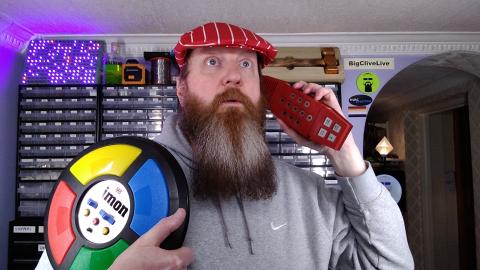
Big Clive: Yes, it was a sneaky little behind the scenes Patreon live stream and it wasn't rude this time, so it probably will get released. Sometimes it goes over the boundary and I can't release it to general viewing, but there is a live stream every Saturday on Big Clive Live. I keep it separate. I can't do it in the same channel because everybody has this image that I'm some lovely old man with male patterned malness who wears a business suit while I'm recording the videos, sort of BBC style. And then they see me and it's like, oh, we are disappointed. So I had to go Big Clive Live, it's for the face videos.
Dave Jones: Right. Do you get many people surprised by how you look, you know, the big bushy goatee? Because most of the time you don't appear on camera, right? You're just the hands with the top down camera shot.
Big Clive: Indeed, talking hands as people describe the videos. Right. Whenever I may do a face video, it results usually on the main channel in a sudden flurry of unsubscribers. So I'm not really sure that's a good sign. That's why I ended up, although recently I made the video, which is basically just scraping the edge of legality. I distilled a bottle of whiskey and just spoofed it up and did it all clickbaity style. And it's actually resulted in a huge surge of subscribers. So it's very random. The internet is so strange.
Dave Jones: Well, that's the definition of your channel, isn't it? Skirting the boundaries of legality.
Big Clive: Absolutely, yes.
Dave Jones: Is there anyone, any stuff you've had taken down?
Big Clive: Right now, I can't really think of stuff I've actually had to take down. Have I had any? I've had videos, lots of videos flagged. Remember in the early days when they used to just orchestrated flagging was a bit of an issue before YouTube had basically evolved to the point that they recognised that some disgruntled minorities will just basically orchestrate. You've had that as well, haven't you?
Dave Jones: Of course, yeah.
Big Clive: You've had that when you've basically revealed spoof products or basically fraudulent products and you've had orchestrated attacks on you. The only things I've had have been things like that where people have been very upset and they've basically, yeah, basically organised group flagging.
Dave Jones: What were they upset about generally? Is there a consistent theme?
Big Clive: There is one video that I had, the only video I've ever had to disable comments on and it was the 5G video. And it brought all the, oh yeah, the anti-5Gers. That resulted in tracking down my phone number and then aggressive calls during the night. Really? And bulk spam, bulk addition to university mailing lists, attempted bulk additions. And it was just very unpleasant for a while.
Dave Jones: Wow. I didn't get that with my, because I've done a 5G video. I didn't, you know, I got some in the comments, but I didn't get anything more than usual, I guess.
Big Clive: I think it may have been because I called someone out because they were making videos about the 5G deathbeam street lamps. And they were, I don't know if they were doing it because they wanted to cash in on this. You know, you can basically, the conspiracy industry is an industry. They make a lot of money out of doing the conspiracy videos. But this guy was showing the insides of streetlights and pointing out all the components like the 400.
Dave Jones: I remember that. Yeah, that was hilarious.
Big Clive: The 400 volt capacitor and saying, why do they need 400 volts? It's for deathbeams. So that's why, by my videos, if I'm looking at a power supply now, I call it the deathbeam capacitor. Because that's obviously what it's for.
Dave Jones: I was just dealing with one this morning. Actually, I shot a video. I'm repairing a bloody mains power supply at the moment for a dumpster TV. And I actually forgot that it didn't have a discharge bleed resistor in it. And I was soldering it. I was removing it. I got a little bit of a zap. It still had 150 volts on it, it seems. That didn't make it into the video. I wasn't filming it at the time that I got my little zap. But, you know, it was like, eh.
Big Clive: You're never filming when these things happen.
Dave Jones: No, I know.
Big Clive: I recently deliberately took the discharge resistor off a small capacitor. I mean, it's only about, say, about 6.8 microfarads at 400 volts. But it was left charged up to 240 volts. And it gives you quite a zap, particularly because the contacts are so close together. Yeah, exactly. It was an LED lamp. But it seems that every disaster I have happens while the camera is not running. It's just, people have suggested I should have 24-7 CCTV running just so those things could be shown.
Dave Jones: Right. Because you're sort of famous for, you used to, you still do, don't you? You shoot this on your phone or your tablet or whatever. You don't have any fancy cameras. You don't even really edit on a real computer, do you?
Big Clive: I don't. Everything gets done on a phone. Right at the moment, it's a Moto G7 Power, which is actually getting a bit long in the tooth now. But it's just, the camera is so good. And the apps have evolved now. It used to be the apps were terrible. There was very little editing facility. But now you can fairly accurately trim videos, splice them together, do basic splicing. And most importantly of all these days, you can adjust the audio. There's an app called Audio Fix that just fixes a lot of the problems. Magic. Just boosts the volume up and just compresses it a little bit just to make it that bit fuller, shall we say.
Dave Jones: Right. So how do you edit with your finger? Or do you hook up a mouse to your bed? No. Is that even possible? I don't know.
Big Clive: I do very little editing. Quite often, it all just goes in. Most of the things I do, if I don't do a video on a single take, using the pause button, if I have to pause briefly to do something. Yep. If I have to say, for instance, I stopped, take something to bits, take the circuit board out, take photos of it, and then do the reverse engineer it. If I have to stop, I record it as two sections and then use something like VidTrim Pro just to physically just merge those two sections, just join them end to end. That's about it. There's very little editing. Yep.
Dave Jones: Yep. Mine's not much more advanced than that, although it all drops into the timeline, but I'm starting and stopping all the time. It's like I'll shoot 30 seconds or a minute waffling on or a couple of minutes waffling on, and then I'll stop, and then I'll change camera angle, and I'll waffle on about something else.
Big Clive: Sometimes I do wonder how many great technical channels don't exist because they took it too seriously and they basically jaded themselves by feeling they had to live up to the high BBC expectations. Right. Yes. And the ones who listened to their own voice and didn't like it, when in reality, you're the only person who hears your voice that way. It just makes me wonder how many people have just been put off by that and the fact that it was so much work that they just put too much work into it. They actually spoiled it for themselves. To me, it's more important to just get content out there.
Dave Jones: Yes, exactly. I agree. I kind of put a bit more spit and polish into the editing now. Like I'll go through two passes or whatever to make it, you know, to sort of condense it, take out the any ums and ahs, and just, you know, save a minute of people's lives. If it's a 31-minute video, I'll get it down to 29 minutes or something, you know. Yeah. Yeah. I've got a friend, Carl von Moller, who's done an Australian documentary series. It's all on YouTube about the electronics industry here. And he shot, he came and visited me 10 years ago. And that's, he's still releasing and shot that footage like 10 years ago now, back when I was in the garage. And he's still kind of releasing content to this day because he's a professional filmmaker. So, and so he's, he's, he traveled the country. He spent his own money traveling the country, interviewing all, you know, famous industry people and, and stuff like this. Absolutely fantastic content. And he actually flew to Sydney and he came to my garage and he recorded me and everything else. And, you know, like dozens and dozens of, you know, big name people in the Australian industry. And like all this content and he's, it just took years and years because he didn't want to release anything that wasn't professional film standard. So he had to color grade it. He had to get release signed, you know, forms from everyone saying that release, you know, and he had to, and he even hired like actors to like recreate scenes and stuff like this. And it's magnificent. Some of his finished product is magnificent, but it's just the amount of effort that went into it. I just went, oh, everyone would be happy with just the, you know, just the interviews.
Big Clive: But that sounds, that sounds like mainstream TV production values. Yes, it is. That is not how YouTube works. YouTube is someone sticking their phone to a window with double-sided stickers and then using the outside light and then just doing a video. And that's it. Just basically just off the cuff.
Dave Jones: Well, the key is in the name, YouTube. YouTube. It's just you and your dodgy little camera. And that's it.
Big Clive: Yes, indeed.
Dave Jones: So, yeah.
Big Clive: It's the future of media.
Dave Jones: Yeah. I don't feel the pressure to increase my standard. I don't think I could. I don't think I could like make a great Scott, you know, polished video. I don't think it's in me.
Big Clive: Here's the thing. I was thinking about this recently. I find it harder to make videos these days because subliminally my standards have increased from the early days. Things that didn't bother me in the past do bother me now. And as you go over time, you have to keep reminding yourself that, you know, keep it simple because there's almost an expectation. You feel that because your channel is getting bigger, you're supposed to be more professional. And it actually slows you down. It reduces. It makes things harder. And so sometimes you're better just giving yourself a reality check and saying, this is YouTube. Just let it flow, so to speak.
Dave Jones: Yep. I agree. Now, we were just briefly discussing before the show how you think that my voice is more suited to YouTube than your dulcet, magnificent radio voice.
Big Clive: Well, the snag about the radio voice is, well, I've got loads of bass in my voice and it sounds rich. It sounds like the BBC, but unfortunately, that doesn't work with a mobile phone that has a 10mm speaker in it because that is not suited to boomy, bassy sound. It's much more suited to your voice, which has the sort of more mid-range frequencies. High-pitched, yeah. Yep. Which will sound much better out of a mobile device.
Dave Jones: I've never thought about it. Because I don't use my phone to actually, especially the speaker in the phone, to actually watch videos much. I've never really noticed. But yeah, of course, that would be a thing. So yours just sounds muffled and I'll definitely have to try it after this.
Big Clive: Indeed, especially if you look at some of my earlier videos because for a period of time, before I was adding a little bit of processing, it was just far too muffled. You literally couldn't listen to my videos on a mobile device because even with the volume up full, it just sounded dank, so to speak.
Dave Jones: Wow. It was headphones. Oh, okay. Yes, of course. So headphones, no problem. It's just the dinky little speakers. Well, most people use their stupid wireless ear poddy things these days, don't they?
Big Clive: Yes. I'm not that modern.
Dave Jones: Yeah, no. Me neither. I proudly tweeted a photo of me using a wired set of earbuds like a few months back. It was like none of this wireless rubbish. So if people haven't seen your channel, we've talked about it's the trashiest channel on YouTube. It is indeed.
Big Clive: Utter trash.
Dave Jones: Utter trash.
Big Clive: Because the worst stuff I can find on eBay. It's like if it looks dangerous, I buy it and it usually lives up to the expectations.
Dave Jones: Has your channel always been like that? Because you've been around about seven or eight years or something, haven't you? What led to the fascination with the cheap Chinese stuff?
Big Clive: Started off with the LED lamps, but then I discovered things like, I think one of the pivotal moments was when I had a string of pink LED fear lights. And I plugged them into the mains and the power supply just went bang and it detonated so forcibly. You know that thing about how fluke meters and other posh meters have that nice deep seam to actually stop the flames? This one did not have a deep seam. And I've still got the photo that I took on my hand afterwards. And you can see the outline, the shape of the seam in a suit mark all over my hand.
Dave Jones: It blew up in your hand.
Big Clive: Yep. And I thought it was just hilarious. It's the fact that I just imagined this little Japanese schoolgirl with her pink fairy lights plug it in and then just detonating forcibly. And that's why the theme of the channel, whenever I buy something that looks dangerous, I try and buy it in pink. Because there's just something so ridiculous about this cheap plastic pink thing just being 240 volt in the 5 volt output and stuff like that.
Dave Jones: And it would look great in the thumbnail, wouldn't it?
Big Clive: It does.
Dave Jones: How much work do you put into the thumbnail? Not much, just like me. You just sort of pick something that's meh, you know.
Big Clive: In the past, I didn't even bother choosing a thumbnail. And basically, it was two hands on a bench. And it was every single picture looked identical. And I remember seeing that YouTube said, hey, a thumbnail is quite important, you know. And I thought, oh, I suppose I should do a thumbnail. So I will try and pose a thumbnail. And most recently, I've been adding text onto it. But using just a website called picfont.com that lets you just add brightly colored text on the image and then basically download it. And it works pretty well. Works quite good. It's nice.
Dave Jones: Yeah. It does look better. Occasionally, if I think of something that might make a good thumbnail during the video, I might actually go to the effort to set up a shot and angle the camera and then shoot some video. And then I'll screen capture from that kind of thing. But most of the time, I just choose something from the actual video itself. But I'm always changing my camera angles and doing different things. So I've got more choice than you do with the two hands kind of thing.
Big Clive: I usually do try to take a dedicated thumbnail picture because I think it's kind of important to do that because the thumbnail is the advert for the video. Yes, of course. If I'm being professional about it, really.
Dave Jones: Makes a difference. I see your most popular video, though, is A Simple Guide to Electronic Components.
Big Clive: It is indeed. That's a surprise. It's nice. Yeah. It overtook Fanny Flambeau, which is really impressive.
Dave Jones: What is that? I've seen it years ago. It's a doll that catches on fire or something. What's the story with that?
Big Clive: It is. It was a silly thing. It was designed just as the original Fanny Flambeau. It was just going to be a doll that smoke came out from under the dress. But then I thought, let's go all the way. It was designed as a viral video and it succeeded that way. It was a doll out of Poundland with a hole in its butt and a cake fountain firework. And then I modified the packaging with basically printed out on glossy photo paper, added little bits and the little instruction book. And then just pretended that this was a doll out of a shop that had a flamethrower built in. I was trying to find the flamethrower and it turned out it was basically under its skirt. And then faking surprise. But it's just, it did go viral.
Dave Jones: So you set out to make a viral video with that?
Big Clive: I did. Yeah.
Dave Jones: That's interesting. Had you tried before and failed? No. To make a viral?
Big Clive: Well, having a background in the entertainment industry, I know that things like the first take is the best take, so to speak. Right. It was also a lesson in things did go wrong in that video, but you just have to cover over them as, you know, like you do normal videos. But it was my first attempt at that. And it was just purely aimed. And it just kind of obviously hit the correct buttons.
Dave Jones: Yep.
Big Clive: It worked.
Dave Jones: So did you try again after that to make that same success, that viral?
Big Clive: I've not. I mean, the most recent one, the whiskey one was really spoofy and it was done in the style of clickbait.
Dave Jones: I kind of, yeah. Is that your latest one?
Big Clive: It's the latest one with the stripy hat and the soy face and wall on the picture, which if you've actually watched, it's quite a short video, which is quite important as well. It has to be short to catch the attention of the masses. Yep. In the video itself, that is a frame from the video where I posed with the soy face while the whiskey's pouring into the still. And then I said afterwards, rather sarcastically, that I'd add the word wall for extra drama and then did it.
Dave Jones: And then you did it. And that's your thumbnail. I can see it now. That's a, yeah, that's a killer thumbnail. You've captured the soy face and that. Yeah. It's a bit embarrassing. Because that got 289,000 views and the one before it got 70,000 and the one before that 120,000, which did pretty good, the pound lamp one. But, you know, generally you'll get around 50 or 70,000 views or something.
Big Clive: So, yeah, it works. It yields up and down. Do you know, one of the worst things about the electronic videos is the more technical it is, the more serious it is, the less views it gets because it's got a more niche market. Sometimes you're better just going for a broader spectrum. And that's where Electroboom won outright because he's got so many audiences there. Yeah. He's got the sort of people there that don't really understand the technology. In fact, have you noticed when Electroboom does a deeply technical video, it actually gets less views because people aren't there for the technology. They're there to see the funny guy with the unibrow blow himself up fundamentally.
Dave Jones: That's it. So, yeah, I wouldn't like to be in that position where, you know, well, it has its advantages and disadvantages. Like you can't just suddenly like start making a slew of like uninteresting videos to most of your audience. You know, it's like when you're, thankfully I built my channel based on just a huge mix of content. So it's like I still do a huge mix of content. So, you know, people are still a bit disappointed, but at least I'm not pigeonholed into anything. So I can do pretty much anything I want, which means I'll never be successful.
Big Clive: Yeah. Yeah. But that's it. You know, the better your content is in a sense, the more technical and more niche, even though you're covering a broad spectrum. It's not quite putty pie, so to speak.
Dave Jones: Exactly. So is this your day job now?
Big Clive: It is now. I mean, particularly over the last years, I do still do real work. And I don't plan on giving that up because there's no security, as you know, with YouTube. Literally, do you remember the apocalypse?
Dave Jones: Oh, yes. Where you couldn't forget the apocalypse. Well, which one? We're up to adpocalypse three or four, aren't we?
Big Clive: Absolutely. Where they decide that technical channels and scientific channels like Cody's Lab and NerdRage are, and Niall Red, and all the electronic channels that work with dangerous electrical stuff that were just too dangerous and the sense of the advertising. What comes to mind is Eric the Car Guy. It was a guy with a mechanical sort of car fixing channel. And when Apocalypse hit, he was affected so badly that from being a really huge channel, he just basically stopped making videos for a while. He was so jaded about the fact that basically his wage had just been terminated because that's what it was like at Apocalypse. It was like a daily job where you put the same amount of work in, but they suddenly give you a fraction of the wages. They say, we're just not paying you for those videos. And it's like, oh, yeah, there's no security. So I'm always going to keep doing real work because ultimately it is security that you're actually going to get a predictable income from that.
Dave Jones: Exactly. And what is your day job? Has it been revealed before?
Big Clive: To a degree. I've done videos from behind the scenes. These days, it's firmly in the entertainment industry working as a lighting technician on fairly large shows, but prominently the Embraer Military 2, which is like hopefully happening this year. But at this point in time, because it's an event with lots of public at it, we don't 100% know what's happening yet.
Dave Jones: Yeah. So how does that work? Are you like a freelance contractor or are you contracted to some other outfit? Yeah.
Big Clive: I've been freelance since the 90s. Not long after my apprenticeship, I went out and a government thing called Sim14 where they were basically, it was the brainchild of Margaret Thatcher, who decided that to protect her buddies in the construction industry from the complications of pensions and paid holidays. Oh no, shock horror. Yeah, I know. Just terrible things. She'd encourage people to go self-employed. And actually, for some technical people, it worked out really well. It worked out well for me.
Dave Jones: Right. Excellent.
Big Clive: It gave lots of variety. It meant instead of working for one company, I could work for lots of different companies with a wide, diverse range of technical stuff, which just kind of worked out well for me. So I work subcontract to a company called PRG, Production Resource Group, when I'm on the tattoo. And they're basically hired by the day, so to speak.
Dave Jones: Got it. So the production companies hire that company to produce, you know, to do all the stage stuff. And then they subcontract you as one of their lighting people.
Big Clive: That's it. One of their technicians. Got it.
Dave Jones: Yep.
Big Clive: PRG are interesting because they have their own products. They manufacture their own lights and they're ultra, super high profile. They're lights that you can't actually buy. So the only way to get to play with them is to actually subcontract to them. And you get to play with very, very interesting equipment. Very good.
Dave Jones: What is the difference between the cheap ass lights that the consumers actually play around with and the big industrial ones? The lead. Are they mostly switched over to leads or are they still using arc lamps or what?
Big Clive: They have not. They've got discharge lamps, but they run them from electronic ballasts that can actually overdrive the lamps. But in normal operation, if, say, for instance, the shutter closes, if the light effectively turns off, but it can't turn the discharge lamp off, a shutter will cross over the lamp. But the lamp will then cut to below its operating normal operating power to the point that it keeps it lit. Because otherwise, if it went out, it would have to go through the complete re-strike procedure. It would have to cool down before it could re-strike it.
Dave Jones: Oh, OK. Because they can't restart when they're hot.
Big Clive: That's it. You do get hot re-strike, but it's quite nasty in the lamp. It causes major sputtering of the electrodes. It damages them.
Dave Jones: Oh, so they want to avoid doing that for longevity's sake because these things are expensive, right?
Big Clive: Yes. So it's got built-in lamp timers and it also has built-in power level settings that you can deliberately overdrive the lamp to quite a significant degree at the cost of lamp life. The increase in power results in a massive increase in light output. And beyond that, the optics are super precise. All the coated lenses, pretty much a professional camera, but in the form of a light. They're just extraordinary compared to the cheap disco crap you get from China. They're very unusual. I've made a video about it. If you go on my channel and just do a search for Best Buy, you'll find one of the most interesting ones and you'll see how much engineering is in it. It's spectacular.
Dave Jones: Oh, I'm going there right now. Oh, looking up at Best Buy Automator light. Wow, that looks complicated.
Big Clive: It's stuffed. It's very complicated. The whole lot is run. But it's modular. The people who designed that light were the same people who designed the original Vary lights. And they've been in the industry for a long time. And can you imagine a product that has actually been designed by people who actually have experience of repairing them in real life? So everything is designed for the engineer. It's a beautiful light. It's fantastic.
Dave Jones: What are the spinning disks in there? Is this some sort of... What's the deal?
Big Clive: It has a stack of dichroic mirrors. You have what's called... They are, but they're dichroic mirrors. You have, for the dimmer, it's a graduated standard silver mirror. So as it rotates, as the disk rotates, it dims it down so you can go from zero to full output. Then you have cyan, yellow and magenta for mixing colours. So you can have any colour from those by mixing, by positioning those graduated dichroic mirrors. And you also have CTO, which is correct to orange, which adjusts it to compensate for the metal halide bluish discharge to bring it more compatible with tungsten filaments, tungsten lights in the vicinity. Interesting. Wow.
Dave Jones: I had no idea they were that complicated.
Big Clive: Oh, they're huge inside. Fortunately, they have tons of diagnostics. And one of the nice features of that light is it's got what we call the brain. It's in a pull-out drawer that you can undo some fixings. You can basically replace the whole brain of the light in situ. That's got the computer and the memory backup battery. And it's not just the memory backup battery. If you go up to that unit and you press power on while the light isn't powered, you can access the screen lights up and you can set addresses and you can access all the parameters and look at the past diagnostics even without plugging the light in. It's all geared up to maximum serviceability and usability.
Dave Jones: That's insane. How much does something like that cost? How much does this big boy, best boy cost?
Big Clive: We're talking in the region of £40,000 theoretically.
Dave Jones: For one light?
Big Clive: For one light. But you can't buy them. There is no price. And it's when you do something like you inadvertently break a dichroic disc in it, it's like that little horror of the cost of something you've just broken in it because it is custom to these lights. But as I say, you can't buy them anyway. They're made in-house because ultimately they make their money big time by hiring these out to big shows that tour the world.
Dave Jones: Oh, right. So the company will not sell them to you. They'll rent them to you. Is that the...
Big Clive: Yes, they will. That's it.
Dave Jones: Ah, got it. Okay. And where is this company based?
Big Clive: Everywhere. America and Australia. You'll find PRG in Australia.
Dave Jones: Oh, okay. Right.
Big Clive: They're just all around the world. And do you know the weirdest thing about the company is that the management of the company turn up in sweatshirts and jeans with like Stetsons and things like that because they're based in Texas.
Dave Jones: Texas.
Big Clive: It's so laid back. It's just so weird. It's like the ideal company to work for because although it's very professional, it just is also just technical. It's just laid back. It's very weird.
Dave Jones: Right. What is the lumens output equivalent of a light like that? Is it lumens or is it luxe in the industry? Which... What are you guys...
Big Clive: I couldn't honestly tell you. These things do not bother me. That is for the lighting designer. I just hang the lights up there, set their dress, run all the cables in and fix it, so to speak.
Dave Jones: Right. So there's no LED equivalent to something like this, is there, in terms of light output?
Big Clive: There are LED fixtures, but nothing compared to this. The throw of this, that's a problem we've got at the moment. On the tattoo, part of the lighting is these moving lights that give all the textures and colors in the stage. But we also have rows as a secondary backup for general illumination because it's also broadcast on television, of PARCANs, traditional 1-kilowatt PARCANs. And the ban on tungsten filaments is just causing so many problems right now because nothing compares even to a traditional 1-kilowatt PARCAN. We've tried loads of LED fixtures. These are used outdoor in quite stormy weather at times. Nothing compares for intensity, the beam shape, and also the ability to weather rain and things like that.
Dave Jones: Wow. So they put a blanket band. They did that here, but I thought things were exempt, like oven bulbs and things. There are exemptions. So there weren't any exemptions there for these industry lights?
Big Clive: They are exempt, but the manufacturers said, well, it's not really worth our effort making them anymore because we're not going to make any money out of this because it's such a niche market now for the exempt industries. So they're trying to push, and people are bringing out products. They're saying, like, it's just like a PARCAN, and we try it on the job, and we aim it at the arena, and it doesn't. It's nothing like it.
Dave Jones: Oh, gee. So what do you have to try and salvage them from the eBay or anywhere you can? What's the?
Big Clive: The PARCANs themselves are absolutely fine, but we've got a huge stock of lamps, and we're working on the basis that by the time we get there, by the time we get down to the stock, something will hopefully have arrived that we can actually use as an alternative. But most of the lights on the job have gradually transitioned for just general washes of light. They have been going strongly in the direction of LED, where they're creeping in gradually over time.
Dave Jones: Interesting. So how far can these – like, I see one video where you're, like, up on the top of a stadium, like you're up in the rafters in this gigantic outdoor stadium with one of these lamps. What is the spot distance at, what, a couple hundred meters these things can throw?
Big Clive: Okay, we have one of the lights is – one of the versions is called a bad boy, and we actually use it as follow spots. And that's – the effect of the throw you get is just absolutely mind-boggling. If you're up at that light and you're using the controls, this thing can put basically almost like a pin spot of, like, sub one meter or a couple of feet of light onto the stage at any distance, but it can widen up to the full – to basically flood the whole arena. They're extraordinary, but their throw is absolutely staggering. That's why the LED can't compete, because, as you know, the LEDs – you can get high-power LEDs, but the advantage of the discharge lamp for the optics of these lights is all that light has been generated in a very tiny area, which is completely incompatible with LED technology. Yes. You know, LEDs want to spread that over a large area. They can't handle hundreds of degrees of temperature.
Dave Jones: Mm. Wow. That's just – a meter, less than a meter at a couple hundred meters. That's just – and then you broaden out to light up, you know, like almost 180 degrees.
Big Clive: Yep. That's just crazy. Yep. If you watch the video about the Best Boy and you look at – because it's going – in the video, it's actually going through its self-test routine, and it's got the multi-element lens, which is super, ultra-precise. To get the precision, it has little gold-plated pins that touch onto circuit boards, the gold-plated pads, so it can get to basically 3D printer-level accuracy, you know, that sub-micron accuracy. Yeah. That's how accurate – and all the lenses are riding up and down with each other with very strict rules about what you can use to clean the lenses. It's basically – it's like a Pentax or Olympus precision optical system in those. It's quite staggering.
Dave Jones: Unbelievable. Wow. So you've done a lot of those COB lamps, right, those COB LEDs, those large ones and stuff like that. What's the general consensus with those these days? Is it you get what you pay for or –
Big Clive: Yeah, those – do you know the thing – the thing that's most interesting that's changed in those is the type of LED. Do you remember the first ones that basically had the LED chips, the little gold bond wires onto the top? One of the most common failures was the little bond wire. Have you seen the flip chip LEDs? Well, you have, but you've not possibly realised you're looking at them.
Dave Jones: I probably haven't realised, no. I'm only familiar with the bond wire type.
Big Clive: Okay. Well, modern LEDs do not have bond wires. The bare chip itself has been designed in such a way that it can literally be soldered directly across two pads and a circuit board. But it's like almost pick and place but super microscopic. So these big COB arrays are basically these pick and placed bare LED chips that are then flow soldered and then covered in the phospho-loaded gel. So the technology has evolved, but these are great for large panels of illumination, but they're not great for the point source.
Dave Jones: Right. Is there any, like, high-temperature LED that is suitable for that sort of thing, or is that just not compatible with the semiconductor physics of LEDs, I guess?
Big Clive: Well, the thing I see being used these days in cars, like the BMWs, are using the laser-powered LEDs.
Dave Jones: Laser, I've seen. Yeah. Was it your video on that? Somebody did a video on that.
Big Clive: I don't have that. Now, who was it?
Dave Jones: It was Mike. It might have been Mike's electric stuff.
Big Clive: It was Mike's electric stuff. Right. It was.
Dave Jones: Yep.
Big Clive: And it's basically, it's pointing a laser at the phosphor gel, and you think, well, the phosphor gel. Yeah, what the hell? The phosphor gel is not going to last very long. It's like designed to fail.
Dave Jones: Yeah. Yeah. So for those who can't visualize this, just picture your normal LED, right? So it's in a middle LED surface, and then you have a laser that points in at the surface of the LED and then bounces off. Is that how it works? That's nuts.
Big Clive: The stimulation of the phosphor is basically a laser firing at the phosphor, and you think, well, I'm not convinced that that's going to be reliable over the long term. But then again, it's a BMW, so they're probably relying on that, quite frankly.
Dave Jones: I'm sure they know what they're doing, yeah.
Big Clive: And it will be very, very expensive to replace in the future, most likely.
Dave Jones: Although, a bit of a non sequitur there, but that leads me to cars, Teslas. You've heard about some of the reliability. Have you heard about the screens in the Teslas are starting to fail? I've not. And yeah, because that's the whole thing. The Tesla has nothing but this gigantic touchscreen, right? You know, 15-inch touchscreen or something. And they've come out, and basically, when they started failing, I don't know what mechanism they failed in, but they came out and said, oh, yeah, we only expected them to have a five-year lifetime anyway. It's like, well, okay. They basically admitted that publicly. That's nuts.
Big Clive: That's like modern houses. They say your house is only designed to last 10 years, and it's like, really? I'd expect it to last 100 years.
Dave Jones: Oh, that's just...
Big Clive: What do you think the failure mode is of their screen?
Dave Jones: I couldn't imagine, because generally, LCDs are pretty reliable. So I don't know what the...
Big Clive: I'm going to make a wild guess that it's the Bond, that horrible little plastic strip that's got conductive glue glued onto the edge of it.
Dave Jones: Oh, yes. Yes, that's horrible stuff. I've done a few videos on how they fail over time. There was Flukes multimeters. No, they're Flukes scope meter. Famously, all of them are dead now because of these strips. They actually use conductive glue to stick the membrane contacts down to the PCB, and they all just fail over time.
Big Clive: And you can heat it. You can rub it down to try and make contact again. Yeah, you can. But it's just going to be a temporary thing. And then it just fails again.
Dave Jones: Yeah, I was able to fix it. And then, yeah, sure enough, it lasted like a month, and then it was dead again.
Big Clive: Yeah. That's like modern televisions. The large screen televisions, the LEDs are being absolutely grilled in them. When you first get your television, you have to turn the brightness down on it because it's just like they're designed to fail. Modern products are literally designed to fail really quickly just to keep the money rolling in.
Dave Jones: Because they want to use the lowest cost part and it's going to cost more to engineer a better thermal solution, I guess?
Big Clive: No, I think they just want it to fail relatively quickly.
Dave Jones: So you have to buy a new one. You think it's actually deliberate, you reckon?
Big Clive: Absolutely. I've been looking at some of the modern LED lamps. Now, one of the trends, and it's fascinating in modern LED lamps, is that you're getting a standard sized lamp, but it's rated 15 watt LED. And you think, well, that's going to get really, really hot. Yeah. And inside, they've got a circle of LEDs, but the LEDs are multi-chip. And typically, some of these LEDs measure 50 volts across the LED because they have the multiple chips inside a standard tiny little 2835 type package. But those absolutely bake. And people say, oh, yeah, it didn't even last a year. But who keeps the receipt and says, excuse me, this lamp failed. It's not worth it. And how else could you sell a 10 watt LED lamp in Poundland or a dollar store that, you know, is so cheap? But I don't know if you've seen my recent videos that show you can hack them. That there's just, you can actually use a spudger to slice the top cover off, the sort of silicon glue that holds it on. And there's just, there's the current sense resistors. There's usually two in parallel, roughly the same value. If you just physically, without even so desoldering, if you just snap one off or damage it, it halves the power rating of the lamp. And it doesn't half the light output because the efficiency is impaired by the fact they're driving them too hard. And then you can glue the cover back on and you end up with a dimmer lamp that's only running at five watts instead of 10 watts. But it's going to last massively longer.
Dave Jones: And it's got what, 80% of the output or something, does it?
Big Clive: I wouldn't say 80%, but instead of maybe running at 50% power, but it's actually putting out something more like 60% of the output instead of 50%.
Dave Jones: Ah, right.
Big Clive: So you are getting less light, but it's going to last a lot longer. And you can always use two of them.
Dave Jones: Now, you've done a series on these Dubai lamps. Can you explain the deal with that? Because I thought that was fascinating. Fascinating.
Big Clive: Yeah. Okay. The Dubai lamp was a custom lamp made for the, is it the prince? The ruler of Dubai. That's, I can't remember his name. It's Sheikh. No, I'm not even going to try.
Dave Jones: Sheikh Mohammed, I'm sure. Yeah. Absolutely.
Big Clive: But he did a deal with Philips for a 10-year contract, I think it was, that they supplied a custom lamp that was the most efficient lamp in the world. And the circuitry is just spectacular in them. It uses two layers. It uses a capacitive dropper as the first stage, but it's got extra. Everything is duplicate inside it. But it also has a little two-transistor linear current regulator that it's, initially I thought it was just to compensate for voltage fluctuations, but it looks as though it may actually be to compensate for ripple. So that, you know, there's not even ripple in the 50 hertz ripple, the capacitors that you'd normally expect.
Dave Jones: Which can dry out the caps, of course, which can age the caps, of course, if you've got too much ripple.
Big Clive: Well, the capacitors aren't really stressed because they're only seeing the sort of, well, effectively it's double mains frequency, so it's 100 hertz, 120 hertz. So they're not really stressed as it is. And they've also got duplicate capacitors. But this thing can, although there's very little ripple to start off with, it gets rid of that, even that ripple by dynamically regulating the two-transistor circuit based on a standard bipolar transistor and a MOSFET. But the real secret to the longevity and efficiency is the fact it uses four times as many LEDs as normal. So whereas you can buy out your local supermarket, you can buy the four-watt filament LED lamps that have the four filaments with one watt rating each. If you bought the same filament lamp as a Dubai lamp, it would have 16 filaments in it. They'd be running them at a quarter watt each. And that increases efficiency and increases the longevity. They're very stylish.
Dave Jones: Much more expensive, of course, because you're doubling up on your capacitors, you're doubling up on your LEDs and stuff like that.
Big Clive: I would expect so. But it's upset the lighting designers in Dubai, the architects and lighting designers, because they've been told you don't have any real choice but to use these lamps. And they're only available in two color temperatures and one watt, two watt and three watt. Which is tiny. But you say it's tiny. But a two watt Dubai lamp puts out theoretically as much light as a four watt Australian or British or American lamp. Because it is resulting in much greater efficiency from the circuitry and the LEDs. I think they've also cheated that, though, by restricting the color rendering index, which means they've used phosphors in the LEDs that are more pronounced peaks at the peak of the eye spectral sensitivity. But sacrificed color rendering quality of color of what they're lighting in the process.
Dave Jones: So they appear brighter in quote marks because of the nonlinear nature of the eye and stuff like that. So the eye is very poor at gauge intensity and stuff like that. Because the eye, for those who don't know, is the world's, I believe it is the world's largest dynamic range sensor, is the human eye.
Big Clive: So it's ludicrous. It's ludicrous. I mean, you look at it, you can go out and bright sunshine. I'm not going to recommend people look at the sun. But you could glance across the sky with the sun in your vision. And then you can go into a pitch black room and have one LED running at one milliamp in that room. And it will still light the room. It's ridiculous, the range of the eye.
Dave Jones: Wow. So it's not. So why hasn't anyone else done this? Once again, it's the market. They wouldn't sell as many, right?
Big Clive: A, it's more expensive to make. And B, it's designed to last. It's underrunning the LEDs. It's not grilling them. It's going to last for ages. I think the only reason that Philips got involved in that is ultimately because they were offered a fairly lucrative 10-year contract. I would not be surprised if they don't release that to anywhere else in the world because it doesn't make sense. It's like basically shooting yourself in the foot as a manufacturer. You're not going to make money from the lights by selling products that last forever.
Dave Jones: Well, have you seen the recent, I think it's fairly recent, Veritasium video on the history of lights and how they're designed to fail?
Big Clive: Yes. Now, was it the Phoebus cartel?
Dave Jones: Something like that. Yeah. And this is not a conspiracy thing. This is all documented, you know, real stuff. They actually had, and it was known back in the day. They actually, and it was government regulated or something too, wasn't it?
Big Clive: But there is a practical aspect, a technical aspect to that as well. Because if you got a Tungsten lamp of that era and you overdrove it, you could increase the output. Do you remember the photo flood lamps that used to be really, really bright? They were used for photography.
Dave Jones: Oh, yes. Yeah. Yep.
Big Clive: But you sacrificed. You got a much higher intensity, much greater efficiency, but they were much dimmer. Not dimmer. They didn't last as long. Their lifespan was rated in hours. And likewise, you get the rough service building site lamps that are underrun in the filaments and they can last for, well, they're just designed to be more rugged. They're designed to take impacts and bumps. But if you take a rough service lamp and you put it in your house, it will last for like 5,000, 10,000 hours as opposed to the 1,000 hour lamp. But you'll pay a lot more in the long run with electricity because the efficiency of the output drops dramatically. If you turn your dimmer down to 50% to the midpoint, the sine wave, so the lamp's getting 50% power, you're not getting 50% the light. The efficiency drops way down to something like 10% or 20%. So the Phoebus cartel, kind of that 1,000 hour was really an optimum level at which you had a good long lifespan and a good efficiency, but it was a nice middle of the road type of level. So it wasn't 100% conspiracy, but it was a bit of conspiracy as well.
Dave Jones: And you think they do it, you think it's probably deliberate these days that people are designing these products to fail.
Big Clive: Yeah. Well, do you remember the old days when modern electronic, the old electronic components that you had to keep them cool or, you know, they'd fail really, like it was something like 75 degrees, they'd start failing. You look at modern, the modern LED lamps, the temperatures are so hot that you can actually smell baked components.
Dave Jones: Yeah, I know.
Big Clive: Oh, it's disgusting. That started, you know what it's like when you get a failed compact fluorescent lamp, you open it up and the circuit board is brown inside. The components are all brown. You think, how are those transistors even still working in that? Because it's that charcoal burnt smell, this sort of phenolic smell. Yeah, that's kind of their driving LEDs these days. They're really pushing them right up to the limits.
Dave Jones: That's insane. Why? I can't imagine being a design engineer at one of these companies. I can't imagine them actually sitting around a table and going, right, we have to design a lamp that doesn't last for more than a thousand hours. I'm sure it's more, I'm sure it's not that open because engineers are just going to go, wouldn't it? No.
Big Clive: The engineers don't have any choice over this. If the engineers were left to their own devices, we'd have forever lamps and the marketing department would be very displeased about that.
Speaker ?: Yes.
Dave Jones: I'm sure it's more subtle though. I'm sure it's not, they're not deliberately told to design a thousand hour or a couple hundred hour lamp, but they're coerced, I guess. They're massaged into.
Big Clive: I think they are. You reckon? I'm pretty sure they are because the earliest lamps, the earliest LED lamps when they were still a novelty, they're still lit. You know, many of them are still working.
Dave Jones: Yes. Yes.
Big Clive: And the modern ones, you look at them, I mean, go to your local dollar store and buy an LED lamp and open it and take some temperature measurements. And it's admirable, the circuitry in them, but you think it's such a waste because these, all the work went into this aluminum substrate PCB and the heat sinking and these LEDs, and yet it's going to be dead within a year. And, you know, it must be engineered because it's so precise that literally they have to allow also for the fact it's going to be, some of them are going to be in open lights, like a table light. Others are going to be in recessed down lighters where they're actually in a hot ceiling. So there must be a sort of delicate balance, but they are designed to fail. That's fundamental. They're maximum bang.
Dave Jones: Right. I'm looking at the schematic for the Dubai lamp and it's got one bipolar transistor and one MOSFET. But they didn't duplicate the MOSFET. They only put the LED strings in parallel for redundancy.
Big Clive: Yes. They just use one regulator circuit at the end, but you'll also notice there's zener diodes that bypass that in the event that something goes wrong with that.
Dave Jones: If the transistor fails, it'll still give output.
Big Clive: Yes. Can I also mention there's a slight error on that schematic? It says 407 decay resistors in series to 407 decay. These are 4.7 mega ohm. Because initially I looked at that as a standard linear current regulator with the two bipolar transistors. I didn't realize initially that was a MOSFET because when I tested it on the circuit board, just because of other components in the vicinity, it tested out at 0.6 volts, you know, as if it was a bipolar transistor. And it's only afterwards when I had to take that transistor off the board because I was like thinking this isn't right. I had to take it off and put it on a component tester to actually work out what it actually was. Found out at the MOSFET. And then the value of the resistors makes sense. Those two 4.7 mega ohm resistors plus the lower value one in the divider actually stops the gate voltage going too high to the point it would damage the MOSFET. So that kind of makes sense. But I didn't realize that at the time.
Dave Jones: Right. Ah, interesting. I mean, if I was designing this and price was no object, I'd be duplicating everything. I'd be duplicating my diode bridge. I'd be duplicating my caps as they've done. They've put the, you know, they've put two 4.7 mics in parallel. The input capacitive divider, they've put four in parallel there.
Big Clive: Yeah, they've put four in parallel. Two are the high value. They're the main current dropper capacitors.
Dave Jones: I was going to say, why are they different values?
Big Clive: And then there are two little ceramic, well, little ceramic capacitors. The only thing I can think of is that's to protect the metal film capacitors from spikes. Not really sure.
Dave Jones: Or is it an RFI thing? Is it a, no, because this thing's not switching.
Big Clive: Capacitive droppers. Yeah, capacitive droppers are one of the quietest lamps. That's incidentally, that's another nice thing about these linear regulator lamps. With the linear regulator circuits, they're very quiet from an RF noise perspective. Yeah, there's no switching stuff.
Dave Jones: Yeah.
Big Clive: Yep.
Dave Jones: Yeah, I would double up on everything. Assuming that you had the space and you had the luxury.
Big Clive: Oh, that's the problem, isn't it? That you've basically got that tiny little base. I took the one watt lamp apart as well. And it also had similar circuitry, but it wasn't duplicated simply because they were trying to squeeze it into a much smaller area. But it had more or less the same circuitry.
Dave Jones: Right.
Big Clive: It's the curse of LED lamps as the base size. You know, I could see a future where houses actually have a 24 volt lighting bus going around them instead of. Really?
Dave Jones: Okay. Yep. A lot of people have talked about that over the years. It's like, you know, everything in our house is DC. Why don't we have a DC distribution points? You know, why is it 240 volts?
Big Clive: What's the reason that Edison originally wanted? There was a point in Glasgow that one side of one of the main roads in Glasgow, Western Road, was DC and the other side was AC. Really? When the electrical industries were having their fight to see which one. And ultimately it's Westinghouse and Tesla that won with the AC supply because it was just more practical for transformers and motors and things like that.
Dave Jones: Yeah, of course. Yep. So that was always going to win out. But yeah, people have talked about like at the house level, I guess. It's like, why don't we have DC outlets?
Big Clive: Having a lighting power supply with a power factor corrected power supply, a modular one that could just be clipped into a holder and then just the 24 volts running around the lighting. Because that would not only be a safety aspect, but it means that dimming would be so much easier because pulsed modulation would be much easier as opposed to the phase angle control. Because traditional phase angle control dimmers are completely incompatible with modern electronics. They're so nasty and spiky and they're just unflickery. They're just not ideal. So the DC would have advantages there.
Dave Jones: But everything, people are what the Internet of Things crap these days. They want to control their lights from their bloody shoe phone.
Big Clive: It's just like so much electronic stuff stuffed permanently into walls and ceiling fixtures. It's A, it's a fire hazard. And B, it's a hacker's playground. Am I just being cynical because I'm old that, you know, stuffing random bits of software onto your home network just seems like a bad idea?
Dave Jones: It's a bad idea. It isn't just you. It is demonstrably a bad idea. But I think like the novelty is going to wear off. I don't see the future of Internet connected light bulbs. I just don't see it. Once a novelty wears off, it's like, eh, you know, the switch is just easier.
Big Clive: Yeah, because ultimately now they're talking in the UK, the wiring regulations used to say you cannot run a feed to a light via the switch because you can't have live and neutral at the switch in case people run sockets off it. You know, they just mount a socket next to the switch and use that power.
Dave Jones: Oh, right. Yeah.
Big Clive: But so it used to be that the power could only run up to the ceiling rows and then you had a switch wire going down to the switch. But now that's changing because now, of course, you need power at the switch because the switches are all filled with computers that are prone to crashing for some reason. And also. Yeah, go on. There's the other thing that the more now that's kind of irrelevant because you get even Wi-Fi enabled circuitry that can operate on a slight leakage across the lamp. You can put a capacitor across the light and it just passes that one or two milliamps that can means that you don't need the neutral down at the switch anymore because it can actually just power itself from being part of the circuit, so to speak.
Dave Jones: That's I've had that as well. I was going to do a video on it where I replaced a an old fashioned filament like it was out. It was outside. You know, it's one of those porch light things. You know, it was an old filament lamp. I replaced it with a lead lamp and it was always partially on. And of course, it was. Yeah, it's the capacity. It's the wire. Yeah. Well, it's the wiring. No, it's the wire. It's the wiring capacitance. The capacitance of the wiring at 50 hertz was enough to put a couple hundred microamps or tens of. Yeah, a couple hundred microamps into the lamp and light it up.
Big Clive: This is why many lamps actually have a one megaohm resistor after the bridge rectifier to try and shunt that down to try and add that load.
Big Clive: Yep. But the worst for that is two-way lighting, two-way switching or multi-way switching because you end up with a big long run of the switch cable. Run of cable.
Dave Jones: And that's got, what, tens of nanos? That's got how many puffs of capacitance is that? It's a lot. Oh, talking of capacitance.
Big Clive: I've been playing about with ozone generators recently and one of the ways of generating ozone is to get a piece of ceramic material and have an electrode on either side and basically couple high volts across capacitively and it creates a corona discharge. So I was thinking it'd be really interesting just getting a ceramic capacitor and basically dissolving the resin and using that little disc and seeing if you could turn a disc ceramic capacitor into an ozone generator. And it did not work. Didn't work. No, it didn't. It was a strange brown ceramic inside.
Dave Jones: Yeah.
Big Clive: And the coating on each side, it was just basically a printed metallic disc on either side of the ceramic formed the capacitor. But it was just basically almost like a conductive ink that as soon as the resin was dissolved off, the wires fell off as well. But more interestingly, I looked at it and thought, that's tiny little discs and the capacitor material is about 0.5mm thick. So I then got equivalent. I got some copper foil and stuck it either side of a piece of paper thinking it was going to be equivalent capacitance.
Dave Jones: And it was nowhere near.
Big Clive: It was like a fraction of a nanoamp. And yet somehow in these tiny ceramic capacitors, what is so special about the dielectric that makes it the capacitance value so high? I don't know how they're achieving that. It's magic woofoo.
Dave Jones: It's like, yeah, that's why they have the Y5U dielectrics. And they're horrible dielectrics. Like they're absolutely, like they change with temperature and voltage. They're absolutely enormous. But that's how you can get 100 microfarads in a bloody 603 or something these days. When I was a boy. Jeez.
Big Clive: It kind of ruined a project. I had this big idea. I was going to make an ionizer where the capacitors were just pads on either side of a double-sided circuit board with just the diodes. And that was it. You know, a classic Cockroft Walton multiplier. And then when I tested it, when I actually stuck, I got a piece of circuit board material and stuck foil on it to test that. And it was like nowhere near the size of those little pads on those capacitors. So that kind of blew that whole project out the window.
Dave Jones: No, it's the dielectric constant. It's just magic material science woofoo. You know, it's incredible. Unbelievable. But they're absolutely horrid. Back when I was designing underwater acquisition stuff, we needed high values of capacitance for AC coupling caps. But they had to be completely linear. So there couldn't be any of this newfangled, you know, this newfangled dielectric constants. They had to be the strictly controlled, non-temperature dependent dielectrics. Right. And the biggest we could get at the time was like 2.2 nanofarads or something. And it was like we had to string a bunch of these in parallel nowadays that you can get the same ceramic dielectric material. But in like, you know, 100 nanofarads or something. It's just nuts. The material science progress in that area.
Big Clive: I will say that's an area of failure I see an awful lot is those multi-layer ceramic capacitors. Oh, yes. Because they're so thin now. The layers are so thin that the slightest stress or fracture turns them into a resistor.
Dave Jones: I've done a video on that. And it's, yeah, it's horrible. You can get special ones with little flex terminations built into them. Okay. A little flexible. Yeah. They're designed for the automotive industry and high vibration industries. They're a multi-layer ceramic capacitor that the end caps on them that sold to the PCB, they're actually like, kind of like floating. They're kind of like wobbly. It's got this flexible end thing to take out the stress.
Big Clive: But I see things like, you know, like you've got a passive infrared detector, battery operated, and its quiescent current should be real low, but it's just eating the batteries. And the culprit is always the first little ceramic capacitor across the battery. Yeah. It's just basically just discharging it. And with the thermal imaging camera in a dark, sort of thermally dark environment, you could actually see that capacitor just glowing in the thermal imaging camera. Really? You could see it. Yeah, you can.
Dave Jones: Wow. That's incredible. I didn't think you'd get the temperature resolution for that. I didn't. Wow. That's incredible. Leakage through the capacity. You can see thermally.
Big Clive: Yeah, because it's acting as a resistor. So, you know, it's tiny. You know, it's like it might just be one or two milliamps, but it is actually having that effect. And it just makes that slight contrast.
Dave Jones: Oh, fascinating. Oh, boy. Yeah, because they get the capacitors are one of the biggest failure modes, either multi-layer ceramic capacitors or the electrolytics, as you know. Have you ever seen tantalums in lead lamps?
Big Clive: I've never. Oh, have I? What was that recently I was looking at? Oh, you know what it was? It was in a RCD, Earth Leakage Circuit Breaker. They've got their different names, GFCI in America.
Dave Jones: Yeah, there's tons of them.
Big Clive: Yep. The only electronics in it were a tantalum capacitor or two and a resistor network in series of the coil, between the sense coil and the trip coil. And they presumably just use them for size, but they'd actually be seeing AC, which is odd.
Dave Jones: Yes, you wouldn't be using a tantalum in that.
Big Clive: There were diodes, but it still didn't really inspire much confidence. No. But they did seem to be tantalum-style capacitors. I try and avoid them. I remember going through a phase of using tantalum capacitors because they were so much smaller than the electrolytics. Oh, yes. When it comes to crunch, I'd rather use electrolytics, to be honest.
Dave Jones: Yep. Yep. And you can get solid electrolyte material these days. It's all the gamer kiddies want their motherboards to have, you know, solid tantalum capacitors.
Big Clive: I wonder how many of them are actually solid electrolyte as opposed to actually just liquid electrolyte and just being told they're solid.
Dave Jones: Solid, yeah. I'm sure. Maybe there's a conspiracy teardown video idea there, perhaps.
Big Clive: I could have a grump about this, how stuff from the 1980s that ran at 50 or 60 hertz and the big, huge, fat electrolytics, and they're still working to this day. And you get the modern circuitry with just, they just absolutely bake their brains out. I mean, bulging electrolytics didn't happen unless you had a bit of an incident in the past. Now it's just the first thing you look for is like old capacitors.
Dave Jones: Oh, you remember the reefer caps? Oh, yes.
Big Clive: The gold ones. I used them in some of my products, but fortunately, I've never, ever had reports on bursting to flames.
Dave Jones: Oh, yes. They went into everything in the, everything in the 70s and 80s. Those reefer mains caps.
Big Clive: Yeah. Fortunately, they weren't connected directly across the main incoming supply. Oh, they were.
Dave Jones: Oh, yes. They were. Yes, they were.
Big Clive: They were suppression capacitors. They were the X2 and what better place? Unlimited power to blow up with. And they used to just burst into flames inside the equipment.
Dave Jones: That's what you need, a whole grid behind you to supply all that energy to explode your capacitor into flames. Oh, fantastic. Oh, brilliant. Lead lights. Jeez, you know, it's a whole niche. You've built an entire audience on cheap Chinese lead lamps, I think. It's incredible.
Big Clive: They've been evolving quite quickly, you know. Initially, sometimes I think I must run out of content for the channel. And it's like, no, there's a backlog. It's so huge. It's just like this endless supply of LED lighting and tat. It's just like, it's just always there.
Dave Jones: Well, I can remember one of our early Amp Hour episodes. We're talking eight, nine years ago now or something. Been going 10 years now, I think. Anyway, one of the early ones was, I forget his name. The CTO of Cree was on the Amp Hour. Oh, right. CTO of Cree. And we're talking about LEDs back then. And they were still like just as little as 10 years ago. They were still sort of newish technology. You know, they hadn't made a pervasive thing into the home lighting sector and all sorts of stuff. You know, people were still using their compact fluoro lamps. And it's amazing. In the last 10 years.
Big Clive: Yeah. It took so long for the blue LED to be cracked. And ultimately, although they've developed it, it's a completely different technology. Because you remember the old red and green gallium arsenide and gallium phosphide LEDs were a big chunky crystal like a diode. And they were super reliable. Then comes along the new technology. And it was good to have the blue. And it's very high output. But it's based in thin film technology that is actually less reliable than the old LEDs. So like the blue and green and white introduced new failure modes. I think a lot of people have been caught out by that. Where they've built products based on them. And then they've discovered LEDs can actually fail after all. And some just fail straight out the bag, so to speak. Particularly when they're bought off eBay in bulk.
Dave Jones: The blue LED was so important at development. It won the Nobel Prize in Physics. That's how important it was. I can't remember who developed it.
Big Clive: It was the guy who did it with Nokia. Nokia? That's wrong. Nichea, should I say. Similar. It was the guy who developed the Nichea that won it. But it was Cree developed at the same time. But I think. Oh, did they? Okay. Nichea specialised in the sapphire substrate, was it not? And Cree were using the silicon carbide substrate.
Dave Jones: Could be. Yeah. Yeah. I forget the history there. But I think there were rivalries. Hmm.
Big Clive: Because I can remember just out the blue. In a local electronic shop, Maplin. And suddenly, like blue LEDs hadn't been available. At the same time they arrived, they suddenly had red, green, blue moving message display signs actually made by Cree were available, which was just out the blue.
Dave Jones: Oh, and I can remember. Do you remember the craze when blue LEDs became available to the design market? Every designer put a blue LED in something. It was, and they might have as bright as possible.
Big Clive: I reckon I may have got the first blue LED on the BBC. I might be wrong here.
Dave Jones: Oh, really?
Big Clive: I put it in a clock. How so? It was a clock, which just had basically an LED pendulum and LEDs around the hour positions, but a standard clock movement. And a prop department saw the clock in my house and asked if they could borrow it and used it in a sort of educational program. So it was one of those first LEDs that cost £10 for one five-millimeter LED. So there was only one LED. So I reckon that was one of the first to actually make it to TV. Wow.
Dave Jones: There you go. Fascinating. Oh, my goodness. LEDs. We'll have to get the Cree CTO back on after a decade to see how things have changed.
Big Clive: Absolutely. That would be interesting. Yeah. Are they still maintaining a foothold, particularly with companies like Epistar, the Chinese LED? Oh, Epistar.
Dave Jones: There's lots of them. Yeah. Epistar's one of them.
Big Clive: And all the litigation that went on because they're...
Dave Jones: Oh, was there?
Big Clive: Oh, absolutely. Who sued who? Oh, everybody was suing each else. It was like Nitya and Epistar and Cree were suing the pants off each other because Epistar was just having... Well, imagine this. A Chinese company was just having utter disregard for payments at the time.
Dave Jones: Oh, shock horror.
Big Clive: Yeah. Imagine that happening.
Dave Jones: Could you even have success in suing a Chinese company? I imagine it's going to be pretty hard.
Big Clive: Absolutely not. It would... You'd never, ever be able to sue a Chinese company because they're so flash in the pan. You know, first you'd have to find them and all... There's all little tiny companies. A lot of the disco lights that you buy from China, the moving head disco lights, they're based on standard components. But there's lots of little companies literally working out their living rooms, just building these lights up. So if you order... Yeah. If you order five of this model from one company or... And then maybe a year later, you order another five, the software and the hardware will be completely different because they just use whatever components they can get at the local market.
Dave Jones: It's amazing. It's incredible.
Big Clive: I have to go over to China at some point. Just Shenzhen.
Dave Jones: I actually, yeah, regret that I haven't... I didn't go sooner to Shenzhen. Yep.
Big Clive: It looks my type of place. It looks very technical and cyberpunk-y. Like, it's very much... Naomi Wu fits in absolutely perfectly in that place. It just has that feel to it, that industrial sort of image.
Dave Jones: Yeah. It's absolutely incredible what you can do there. And yeah, they literally do work from their kitchen table or from, you know, two square metres in this giant... They've just got things packed to the rafter and...
Big Clive: A big grey factory with the tables all laid out and just people in their little, like, lab courts sitting, soldering all day long.
Dave Jones: Oh, it's remarkable. Yep. We... I doubt we'd be able to do the same thing here. It's just... It's not in our nature, is it?
Big Clive: It's red tape would get in the way, you know.
Dave Jones: Yeah, red tape would get in the way. Just a wall. Just a wall. Labour laws and all sorts of, you know, pesky things like that.
Big Clive: I'd love a big, huge industrial unit here to put all my stuff into and film all my videos in, maybe even just have a little sort of living area in it. But I just could not afford that because it's just... Everybody's speculating property to the point that industry can't even exist in our countries anymore.
Dave Jones: Really? Really? So you're in the Isle of Man.
Big Clive: Oh, the Isle of Man is just investment central. Really? So much property is just bought by people purely as investment, which means the people who live here can't afford to buy a house. They have to rent it instead from these people that are speculating on it.
Dave Jones: Yeah, well, it's not that different here. Although, just yesterday, woohoo, I got a second storage unit. I got a storage unit downstairs in my lab building here. I got a 32 square meter storage unit.
Big Clive: But did you buy it or are you...
Dave Jones: I bought it. No, no, no. I bought it. Oh, right. Okay. I've been waiting 10 years for one of these to come up in the building since I bought this lab. Oh, that's good. Yeah. Because normally people hold these things like gold. You know, they just hoard these things. But yeah, a company was selling their unit and they were selling and it had a separate title. It already had a separate title for the storage room. And I went, can I buy the storage room? And they went, okay.
Big Clive: Can I predict though, you're going to fill it with shelving and then you're going to absolutely fill it with technical stuff.
Dave Jones: Oh, everything. Not only technical stuff, all the stuff in the dumpster is going in there.
Big Clive: Every square inch must be filled with technical stuff. You must surround yourself with technical stuff. It's the correct thing to do.
Dave Jones: It is. I know. But it's great. I've now got a direct, I can wheel stuff on the trolley from the dumpster room straight to my storage unit. Oh, right. Okay. That means bigger stuff now. Bigger stuff, more stuff. Yep. Yep. It's just great. Whereas, you know, my little 50 square meter windowless office that I'm in here now, it's, you know, it's okay, but it's not big enough to hoard. So yeah, I need places to hoard. I could get, like, if I go out in the Western suburbs, if I want to drive far enough out West, I can get, you know, like huge amount of space for not much money, but it's, you know, the, it's the inconvenience of the travel and stuff like that. So, yeah, pain in the butt. So what, what made you move to the Isle of Man?
Big Clive: I didn't really have much choice. My mum had Alzheimer's. So me and my brother moved across to look after her. And that's fundamentally why I moved across.
Dave Jones: Oh, got it. Okay.
Big Clive: Spent a lot of time nursing her. That's how the channel ended up happening as well. Because when I built my, well, you know, one of the first things you need to do when you move into a house is build a bench. So you have a workplace. Of course. Because I like watching general technical channels. I thought, okay, I like to give back to the internet what I take. So I just thought, well, I'll have a, initially it was an iPad pointing straight down, add some lighting and I'll just make videos just because this is what I do. I take stuff to bits and I'll video it and put it on the internet. Didn't realize it was going to be quite so popular.
Dave Jones: So that's kind of how that happened. You know, I thought if I got, oh, you know, I thought, imagine if I had a thousand people watch me. Holy shit. That'd be amazing. Like, you know, that was my grand deal. That was big back in 2009. If you had a thousand subs, you know, that was a big deal.
Big Clive: I never even thought I'd get to a hundred thousand. It seemed impossible to get that silver play button. It was in the distance.
Dave Jones: Yep. No, you've smashed it. So would you, do you think you appeal to a fairly broad audience? I think it'd be broader than mine, perhaps.
Big Clive: I don't think so. I think we both appeal to a similar group. You'll find that a lot of people view, say your channel and my channel and Electroboom and Julian and Fran, and it's quite a closed technical group, the technical family.
Dave Jones: Oh, for sure. Yeah.
Big Clive: But I don't think my videos appeal out with that other than just sort of as a freak video from time to time. So it is a fairly.
Dave Jones: The occasional video. Yeah.
Big Clive: Yeah. It's a niche market. We're, we're never going to be poody pie by any stretch of the imagination.
Dave Jones: No.
Big Clive: But you wouldn't want to be because there is a point it gets so big that it actually stops being personal. You know, it gets just awkwardly big. Yep. And it basically takes a bit of the fun out and the personality, so to speak.
Dave Jones: No, I, I pride myself in that. I, once I, once I stop not caring about reading or replying to the comments or reading or, or replying to email, that's the day I give it up. I think. Absolutely. It's the day the joy will go from it. So.
Big Clive: I, I like it. If I say, for instance, I, I left a comment on your channel and one of your videos and you reply, that still feels personal. That feels nice. Yeah, exactly. And it's such an important thing, you know, to actually get that feedback. It just makes a channel more special than those channels that are just so big that they don't even bother looking at the comments.
Dave Jones: I don't know how you could get that big on YouTube and not read, not even go to the, not even be half-assed enough to like harder comment on every video. Like. It's a different market.
Big Clive: I mean, you look at the, you look at the non-technical channels and you look down at the comments and it's just, just arrogant as the, you know, the comments, that's just gibberish. It's just people ranting in the comments and you wouldn't actually want to go down there. At least with us, it's technical people. Exactly. And it's actually worth looking at the comments and replying to them.
Dave Jones: Except if you do a 5G video.
Big Clive: Absolutely. Yes. And then you have to turn the comments off. Yeah. The copy paste warriors.
Dave Jones: I have not had to turn the comments off once yet. I'm pretty proud of that, but might've come close.
Big Clive: And when I did turn the comments off and put in the description of the video, why I'd turned the comments off, it was the fact that people had been bombing every single comment with copy and paste.
Dave Jones: Yeah.
Big Clive: You know, pointing to all the inverted commas, peer reviewed science, close inverted commas, where all the people that had reviewed the science were all friends and in the business. Even when I'd put that and turned the comments off, they just found my most recent video and let rip in that instead.
Dave Jones: Right.
Big Clive: Lovely. Oh, God.
Dave Jones: Oh, YouTube for the win. Absolutely. Yep. Oh, well, big Clive. Our amp hour is up, mate. Thank you very much for joining us.
Big Clive: It whizzed by, as it always does, doesn't it really?
Dave Jones: It does. Yeah.
Big Clive: Talk technical and just time flies. This is why my streams end up three hours or more. They're just ridiculous. Three hours long.
Dave Jones: Yeah. I've done a five hour stream once that was like, oh.
Big Clive: Yep. And you don't set out planning to do that length of stream. No. It just happens. Get carried away answering questions. Absolutely. Yep. So easy to do with technology because it's just such a massive area.
Dave Jones: Yep. All right. Well, thank you very much, mate. Where can people find you? Obviously, I will link in your YouTube channel. Are you on the Twitteries?
Big Clive: I'm not on Twitter. No, I'm not on Twitter.
Dave Jones: Hence, you're sane. YouTube.
Big Clive: Yeah, absolutely. But there's bigclive.com and there's also bigclivelive if you want to see my ugly face.
Dave Jones: I'll link that one in too. So that's just live videos. I should probably do that. I should get off my ass and have a dedicated live channel maybe. So does that work? Does that work?
Big Clive: Yes, because it's just technical people in the pub. It's basically a couple of thousand technical people. It varies between one and two thousand people at the weekend. That's a lot. I encourage them. Bring a drink. Bring a snack. And just chill out. And sometimes it's technical. Sometimes it's not. It just goes in random directions. But imagine it as a big pub meeting. That's the best way to look at it.
Dave Jones: I'm going to have to. Yep. I'm going to have to try it. Because I don't like. Well, I've got a second channel for that, which I, you know, if I do a live show, I'm probably going to do it on my second channel, which is a catch all channel for just random crap I put up.
Big Clive: And we should do more of those Zoom meetings because that was quite fun. Yes.
Dave Jones: That was fun.
Big Clive: It worked really well. But get drag, drag Fran in against her will.
Dave Jones: Against her will. Yes. Yeah. I agree. All right. Thank you very much, mate.
Big Clive: You're welcome. Thank you. Thanks a lot.
Dave Jones: Catch you next time. Bye.
Speaker ?: Thank you.
Archived Discussion (8)
Comments are closed. Archived from the original site.
Show archived discussion (8)Hide discussion
Keep current
Every episode, plus the occasional job post, in your inbox.
You still get one application where you find incandescent lamps, as the lighting in substations, as those lamps typically have to last 50 years in service, with nobody turning the light on for more than a half hour in that time, and only incandescent lamps will survive that long with no failures.
https://youtu.be/o-7b1waoj9Q?t=521
2) Clive - Consider heading to Shenzhen in November for the China High Tech Fair - The stuff they show there shows up at CES a year later.. The Weather is just about right in November. I'm hoping to get there myself, Covid permitting, and will be happy to introduce you to HQB, and the SEG market. Reach out if you want to discuss!