
#25 – NASA, WOTW & Modular Design - The NASA Nostalgia

Download episode · 29 MB
Also on Apple · Spotify · YouTube · RSS
Show Notes
[display_podcast]
- WotW
- Followup
- Suggestions
- Eddie suggested we were being hypocritical for railing against eWaste and promoting CFLs simultaneously. Chris and Dave want to have low power DC in the home to cut down on ballast electronics needed.
- Discussion Point
- CES is going on this week but is way commercial. Who cares?
- Listener Brian J Hoskins is designing what he hopes will be a universal interface for instrumentation on a helium balloon he is designing.
- Is anyone younger than 30 still wearing watches these days?
- VOTE FOR DAVE in the iiNet Top Geek competition! (no need to sign up, just click the VOTE button!
http://www.youtube.com/v/oY59wZdCDo0
And one that’s much more rock and roll:
Transcript
Dave Jones: Welcome to the Amp Hour. I'm Dave Jones from the EEV blog. And I'm Chris Gammell from Chris Gammell's Analog Life.
Chris Gammell: Hey Chris.
Dave Jones: Hey Dave. What's next?
Chris Gammell: Another week, another show.
Dave Jones: Yeah, another cold day in Cleveland.
Chris Gammell: Cold day in Cleveland, huh? It's pretty miserable out here. I'm looking out my window and it's drizzling down rain and it's not looking that great here. But it is very summery. It's still 22, 23 degrees here in the morning. Celsius, which you have no idea about, but that's okay. Right, right. I'll let you off.
Dave Jones: Plus 22 here as well.
Chris Gammell: Yeah. Right. Which is about minus 2 degrees here or something. Yeah. Yeah. Oh boy. What episode number is this? 25.
Dave Jones: 25. Wow.
Chris Gammell: Oh, quarter century.
Dave Jones: Yeah. Awesome. If we were base 5, we'd really care about this one.
Chris Gammell: Yeah. Well, exactly.
Dave Jones: Yeah.
Chris Gammell: Well, interesting you note. Today's date is the 11th of the first 2011. So, if you leave out the 20 and you just go 11 for the first 11, well, it's 11 here. It's probably still 10 there.
Chris Gammell: I was going to say, what? I'm confused. It's a binary date. It's all ones and zeros. There you go. So, all you've got to look out for is come 11 a.m., 11 minutes and 11 seconds or thereabouts, you can have all.
Dave Jones: So, what's that decimal value then? That's 25? Right. No, that's not right. 31, rather, right?
Chris Gammell: 31 what?
Dave Jones: So, 11, 11, 11 would be 31, I think.
Chris Gammell: Oh, God. I haven't converted it. It would be 31, I think. Who cares about converting to decimal? Nah. I do. I love decimal. Keep it in binary.
Dave Jones: Oh, come on. Nah. Ah, come on. Keep it in binary. Oh, analog.
Chris Gammell: Right. And decimal is somehow analog. Well, it is, I guess, if you have a clock. I'm going to claim that one. One of those analog clocks. I bet you're an analog clock man, too. An analog watch man.
Dave Jones: Oh, I don't wear watches.
Chris Gammell: Are you an analog or digital watch man?
Dave Jones: I don't wear watches. Who wears watches?
Chris Gammell: You don't wear a watch?
Dave Jones: Nah, man. Oh, man. People my age, we don't wear watches. We pull cell phones out of our pockets.
Chris Gammell: Oh, nah, nah. Sorry, that's wrong. I feel naked without my watch. I know, that's the thing.
Dave Jones: I used to wear one, but I don't do it. I'm sure, I'm guessing that strikes a nerve with anyone under, you know, 30 out there. A lot of people just don't wear watches anymore. They're just fashion steaks now.
Chris Gammell: Yeah. I don't understand it. The watch is the ultimate in simplicity and practicality. The mobile phone to get that out, and the screen's turned off to save power, and you've got to turn it on, and you might have to swipe the damn thing to get it to switch on past keyboard lock to get to the time. It's ridiculous. I don't know. Nah. And then you've got to take it out of your pocket, whereas you can just twist your wrist, and there it is. Instant. Yeah. Not to mention the stopwatch and the timer and the alarm, and it's just there. You don't have to... Nah.
Dave Jones: I don't know. I think I'm going to have to pull a Douglas Adams quote on you there. What's that? Blah, blah, blah, blah, blah. He says, there's an utterly insignificant little blue-green planet whose apes descendant life forms are so amazingly primitive that they still think digital watches are a pretty neat idea.
Chris Gammell: Right. I haven't heard that one from Douglas. He's talking about humans in general.
Dave Jones: I think that's from the Hitchhiker's Guide. I always love thinking about it. I saw a watch. I saw a digital watch for sale. It looked like it was made in 1985 in Hot Topic the other day. Yes, I was in Hot Topic. Go ahead and make fun of me. You know, people who know what that is. I have no idea what that is. It's just like a kid's store. It's got all these funky t-shirts, whatever. There was a Hello Kitty watch. Oh, dearie. Yeah, I know, right? But I was looking at it, and I was like, oh my God, a digital watch, right? And tiny, tiny little display. This thing couldn't have cost more than a dollar to make. And that's the markup. They were charging $25 for it. And I was just like, wow. That is a hell of an industry to be in.
Chris Gammell: Absolutely. Why do you think they still churn out billions of them a year?
Dave Jones: Vintage, crappy watch business. So, you know, either that or calculator watches. Those are the two big industries I hear.
Chris Gammell: Oh, yeah. Calculator watches have made a bit of a retro comeback, but you still can't get the scientific one. They still have no idea. Yeah. They still think everyone wants their address book in there. You know, see, that's pointless. That deserves to be on the phone, but nah.
Dave Jones: Yeah. I really like the iPod Nano. I know we're not even close to talking about electronics yet, but the iPod Nano now, it's about the size of a watch face, and they actually have things where you can put them onto watches.
Chris Gammell: The strap, that's right, yeah.
Dave Jones: So now that might be a comeback, because, I mean, a Nano is pretty powerful.
Chris Gammell: Yeah, but who wants power? You want long, you want, well, in a watch, you almost want infinite battery life. It digs a music and a video. And you want to be able to belt the hell out of it, you know? Oh, nah. Yeah, the iPod Nano watch, kind of cool, but it just draws too much power. It's impractical. Who wants to charge their watch every day? It's crazy.
Dave Jones: It might be every other day. I don't know. Oh, yeah, but still.
Chris Gammell: Yeah. Nah.
Dave Jones: Yeah. Well, I'm not going to watch anytime soon. I have my cell phone.
Chris Gammell: Right. Well, I don't see, I don't carry my cell phone everywhere. Like, if I go to work, my cell phone stays in my cell phone. I hate calling it mobile phone. Mobile. That's what we're calling it.
Dave Jones: Mobile phone.
Chris Gammell: And it stays in my bag. And I don't take the damn thing out. Nobody calls me. What's the point lugging the damn thing around? Sure, if I go out somewhere, you know, I'll take it with me. But it's just, nah, it's inconvenient. Give me a watch. And give me a digital watch. I don't like analog. I'm not an analog watch man. They look nice. Analog watches look nice. But I think they require more thought process to interpret. So, yep. And that's not efficient. Sorry. I don't like it. Some people, I've had many an argument over that. That, oh, but you just have to glance at the hands. But no, you've got to interpret because your mind thinks in numbers. And, you know, you have to translate the hand position into numbers. So, I prefer analog watches that actually have the real numbers on them. Not that Roman numeral shit or no numbers at all. You know, if I get an analog watch, it's got to actually have the physical numbers on it.
Dave Jones: This is an interesting list of criteria, Dave. It's pretty picky, I've got to say.
Chris Gammell: Well, you know, I love product design and I love, you know. Yeah, that's true.
Dave Jones: And as a watchmaker yourself, right? I mean, you are a watchmaker.
Chris Gammell: And as a watch connoisseur and a watchmaker myself, yes. Yeah. So, yeah.
Dave Jones: Now, that's a hell of a title right there, I've got to say. Colin, I mean, like, it doesn't have the same, you know, connotation as it used to have. But, you know, you can still claim it. You know, a watchmaker, right? You know, like, that's always associated with, you know, being able to have very fine precision gears and, you know, like, watchmakers back in the day, they were the cream of the crop, right?
Chris Gammell: Oh, absolutely, yes. Lots of manual dexterity, lots of, you know, intelligence to figure out how all the gears worked back in the day. Yeah. Yeah, absolutely. Now it's just a drawer full of batteries. Yep. And a jewel of screwdriver. And a crystal, yeah. And that's, yeah. Open your watch. Open your watch store, yeah. Oh, boy. I'm sure there's still watchmakers out there. I'm sure there's still craftsmen out there at Rolex or somebody who, you know, take pride in designing the gears and the, you know.
Dave Jones: Yeah.
Chris Gammell: Because they are incredibly complex, those, you know, all the ones with the chronographs and everything in them. And they're amazing design.
Dave Jones: Yeah, especially those kinetic motion ones. Oh, yeah, the motion ones. Yeah.
Chris Gammell: If you don't know what that is, it's like the watch actually winds itself by the movement of your hand. Yeah. So, I'm not sure if Rolex invented it. They may have. Oh, I didn't think so. But some of the top-end Rolexes have it, but, yeah. I thought it was a Swiss maker. Oh, right. Okay. Well, something like that. But, yeah, it's great. They wind themselves. And those mechanisms are incredibly complex and highly balanced. Yeah. All that sort of stuff. Great engineering. I love it.
Dave Jones: Yes. Very good engineering. All right.
Chris Gammell: Speaking of good engineering, let's see what people do at their workbenches. Yes. Workplace of the week.
Dave Jones: Workbench of the week.
Chris Gammell: Workbench of the week. Sorry. It's not workplace. We'll get there. See, you should never have started that name. Sorry.
Dave Jones: Sorry. My vision at the beginning was that it was going to be people at their workplaces, like, you know, like having swaths of 20 people that were listening to the amp hour, all crammed around a single computer speaker, just listening intently like the old school radios. But, apparently, that doesn't happen anymore.
Chris Gammell: So, you know. Now, sit down, kiddies. And after dinner, we're going to listen to the amp hour. Shh, shh, shh. It's on. It's on now. Crackle, crackle, crackle.
Dave Jones: Oh, the tubes are blown. Someone replaced the tubes on my laptop.
Chris Gammell: Have you seen those motherboards with tubes on them?
Dave Jones: Oh, for, like, audio?
Chris Gammell: Yeah, for audio. Yeah, what a wank. Blow it out their ass. Ah, yeah. I know. Tell me about it.
Dave Jones: I know.
Chris Gammell: Anyway, who have we got? We've got JP Whack.
Dave Jones: JP Whack.
Chris Gammell: Great name.
Dave Jones: Yes.
Chris Gammell: I assume JP is a initials.
Dave Jones: Oh, yeah. He wrote to us. Oh, where was it? Yeah. Yeah, his real name. I think it's Jaime, maybe? Jaime? Is that right? Ah, I'm sorry. JP Whack. He goes by JP Whack on Twitter. So, that's how I see it most often. JP Whack. That's good enough for me. Great name. Sounds good. I like it. So, picture of his office in Chile. Chile. In, what city is it? Santiago. Okay. Santiago, Chile. Man, that's awesome. Man, another southern hemisphere. Chile, we say here. It's Chile, though. I think it's technically Chile.
Chris Gammell: Yeah, well, we call it Chile here. Yeah. Yeah.
Dave Jones: Same here. Yeah. But that's... Yeah. Anyway. Yeah. But yeah, another southern hemisphere for you there, Dave. You guys are both experiencing summer. Absolutely. Absolutely. Magnitudes. Yeah. That's pretty cool. And I mean, just the distance from my... I'm always amazed at how wide the spread of the internet is. I mean, I shouldn't be, but...
Chris Gammell: It's massive. Yeah.
Dave Jones: It's still... It's amazing. Yeah. So anyways, he's got... It looks like a meter... He even tagged... So he has a Flickr photo we'll post the link to, but he even tagged all the stuff on his bench, which is much appreciated. Absolutely. He's only guessing out of it. We could just drool over exactly what it is. I know.
Chris Gammell: Brilliant.
Dave Jones: Yeah.
Chris Gammell: Although he didn't tell us what brand of classic CRT analogosyloscope he has. Yeah.
Dave Jones: Maybe it's kind of...
Chris Gammell: A broken switching supply. Just laying the breadboard. Yeah. Components. ATX PSU bench supply. They seem quite popular. Yeah.
Dave Jones: Oh, those are cool. Yeah. The 5 and the... Or what is it? 5, 12 and... No 15s though, right? So he's basically just using the 12 straight out of that, I think. Yeah. And then it takes care of the rest. So that's pretty cool. Yeah. Sometimes they put like a constant current source on the end or something like that, depending on what kind of source it is. Yeah.
Chris Gammell: I know someone that built like a little board that you plug the ATX supply into and it's got the minimum loads which need it to start up to trick it into starting up and all that sort of stuff. And it's got all... It breaks it out into all the different BNC and all the different 4mm binding terminals and stuff like that. Take a look on his wall. Take a look at the...
Dave Jones: Oh, don't say that out loud, Dave. I know what you're looking at.
Dave Jones: This is brilliant. Don't say it out loud. Come on, man.
Chris Gammell: I'm quoting it. It's one of these, you know, quote signs. Swearing coming up, children. Earmuffs.
Dave Jones: Earmuffs. Yeah.
Chris Gammell: Turn off your kiddies. Turn off your... Tune out now. If you're in the car with your kiddies, turn down the volume. Here we go. Yeah, right. Yeah. It's a quote. The problem contains the fucking solution. It's brilliant. Yeah. It's just...
Dave Jones: It's from a site called goodfuckingdesignadvice.com.
Chris Gammell: I've got to check that out. Yeah. I've got to check it out. Let's go.
Dave Jones: JP Whack has turned Dave on. He's going to be a swearing machine now. So... Oh. That's great. We crossed the R. We're now rated R. Rated R now.
Chris Gammell: Oh. No. Well, who cares? We don't get a toss in this country. That's true. That's right. And it looks like it pops up with a full... Like a big advice. One quote advice. Maybe per day or something like that. But you load up the website. And today's one is work with reliable fucking vendors. This isn't enough. I need more fucking... What's this? Yeah. There you go. There's a link to more advice. Oh, I love it. Wow. Who set up this website?
Dave Jones: Thanks a lot, JP Whack. You just ruined... You just ruined the already shady reputation of Dave's... Of Dave... Dave Jones.
Chris Gammell: Right. Well, I do try and avoid... Not going to be allowed in any of the... I do try and avoid the F-bomb on my... Yeah. On my blog. It's pretty easy on the blog because if you realize you've said it, you know, you've got to be carried away and you said it, you can just, you know, retake it. But on the live shows and stuff, yeah, I think I've dropped a couple of... And I've been very disappointed with myself.
Dave Jones: I can always bleep you out still, huh, Dave?
Chris Gammell: Yeah. Well, you can. I can. No, that's for pussies. That's for pussies. No. Yeah. I love it when Americans come... I love it when American celebrities come here and they get interviewed on, like, Australian radio and TV and stuff. Yeah. And they go, oh, I, you know, sorry, I swore, you know, because they said shit or something like that. And they go, ah, don't fucking worry about it, mate. No worries. We can say whatever we want on Australian television, you know? Well, in the US, they get... And they're so surprised.
Dave Jones: I mean, if that stuff slips out on the air in the US, the FCC fines them, like, 50 grand or something ridiculous.
Chris Gammell: Oh, really?
Dave Jones: Yeah, it's a big deal, so...
Chris Gammell: Right. Yeah.
Dave Jones: Yeah. Anyway, back to JP, his workbench. He's got a massage chair. He says he's reverse engineering the chair's remote control for automated use. So, that's pretty cool. I don't know what you need beyond the remote, but who cares? I mean, I guess if you could have it, like, phone activated or something like that to kind of tap into that and flip a... SMS it. Yeah, right? Yeah. Yeah. But either way, that's pretty cool. I hope you post pictures of that. That'll be great.
Chris Gammell: Yep. Oh, and he's got a... Over his phone, he's got ISDN. He's not dead. There you go. Oh, yeah. I guess some people still have ISDN.
Dave Jones: Maybe in Santiago, that's the thing available still, so... Good luck with that.
Chris Gammell: And he's got chicken's teeth.
Dave Jones: What's that? What's a chicken's teeth? I don't know.
Chris Gammell: He's got... Yep. No idea. Hmm. Wow. Bizarre. Anyway. Next up, who we got?
Dave Jones: Oh, yeah. Good Lord. We got Troy. Troy is from the eBikes podcast, so we had mentioned him on here before. That's right. I think he's in three or four. I think he's got three or four in the bag already. And yeah. Awesome.
Chris Gammell: Keep it up.
Dave Jones: Yeah. That's great. So let's take a look at his bench. Oh, no labels this time. That's disappointing. But he does have a listing of all the stuff he has there. He does have a listing of the stuff.
Chris Gammell: And there he is, giving a big thumbs up. Awesome. Love it. Yeah. Blue jeans and the t-shirt. Yep. I know. What, is he trying to be you?
Dave Jones: That's it. It looks like he's trying to pull the Dave pose there. Right. Oh, wow. So 400 watt linear power supply. That thing has got to be beefy.
Chris Gammell: Man. Yeah, that's a beast. Yeah, look at it. It's big. It's got like four outputs. It looks like it's got four displays. Yeah. Yeah. It's a monster.
Dave Jones: I like the wire reels up top. Yep. That kind of thing is really handy to have something that organizes all your wire and everything. Yep. That's a great thing to have.
Chris Gammell: Highly underrated. Maybe not so much for the home lab. I guess it depends on how much work, how much stuff you do. Yeah, definitely. But if you can't. But at work, you know, stuff like that, we always set up the racks with all the cables on them and you just peel off whatever. You know, you've got the 12 different colors of wire, all the same gauge, and you peel off the colors you want.
Dave Jones: Yeah.
Chris Gammell: Yeah. It's just great.
Dave Jones: I would like to call out in this picture the Monster CRT monitor in the background because I still use one of those too. That's what the computer I'm recording on right now has a Monster. And I know they're not energy efficient, but they're a throwback. And, you know, got to give a little love for that.
Chris Gammell: Yeah. I've got ridden, like most people, I've got rid of all my CRT, you know, on the order of the wife, of course. Of course. Of course. Yeah. Because they're big and they're ugly and I don't use them, so it's got to be turfed. They're the rules. She makes the rules. Yeah. Exactly. So, good work, though. He has progressed to a CRT there. He's got a notebook and he's got a nice old spectrum analyzer. Is that like a HP one or something? I'm not...
Dave Jones: That might be a...
Chris Gammell: Yes. It looks like HP, I think.
Dave Jones: He listed them out. I lost the thing. There it is.
Chris Gammell: Yeah. It looks like an old HP spectrum analyzer. That's one thing I don't have in my lab as a spectrum analyzer, right? Yeah.
Dave Jones: It depends what kind of work you're doing, right? I mean, like...
Chris Gammell: Yeah, exactly. It'd just be nice to have, but they're pretty expensive and they're usually, if you get one of these old ones, which are the affordable ones, you can get them secondhand on eBay, they're huge. And to get them shipped to Australia costs, you know, more than a brand new one on eBay.
Dave Jones: Right. It's crazy. Exactly. You know, the thing I always thought about getting, but I haven't really had any need for it, but like a network analyzer to do like loop analysis and everything like that. Those things are awesome. If people don't know what that is, basically it shoves a signal. You break a loop, right? So like a control loop, because I work with analog control loops a lot. So you break a control loop, you inject a signal somewhere, and then basically you see where the, how that signal travels through the system, you know, because it sweeps from maybe 10 hertz up to 10 megahertz, and then you can see the response of the whole circuit. It's really cool. And I really never knew about it until I got out of school, to be honest. Yeah. Yeah.
Chris Gammell: They're pretty much one of those industry things you learn about, you know, when you get into the industry. Some schools, you know, you might get to play around with one, but yeah, generally not.
Dave Jones: Yeah. They're great though. They're really great. They're really useful. How about this last one?
Chris Gammell: They have two dynamic signal analyzers, which are different to a network analyzer. Well, they do a very similar thing, except they're designed for audio level work. Ah, okay. You know, a really high frequency one might go up to 100 kilohertz, you know, that kind of, so they're designed for doing, you know, seismic measurement and audio and vibration spectrum and analysis and all that. So you hook up accelerometers to them and you measure, you know, all sorts of vibrations and stuff like that. And they're just great.
Dave Jones: They're awesome. That sounds cool.
Chris Gammell: Yeah. But there, once again, I had two of those and they were big. So they just took up too much space in my tiny lab. So, and it's something that you rarely use. So I had to sell them.
Dave Jones: Yeah.
Chris Gammell: Bit sad, but, ah, well, not to worry. But these days, all you need is a sound card and some software and the input amps and you can turn your PC into a dynamic signal analyzer. Yeah, basically. But almost as good as, as a, as a proper, you know, $10,000, $20,000 one.
Dave Jones: Those things are what? Like 24 bit, you know, 192 kilohertz or something like that?
Chris Gammell: No, they're typically 16 bit is a, is a typical one. Yep.
Dave Jones: Oh, really? I thought I was looking at them a bit.
Chris Gammell: Oh yeah, but they've got incredibly low noise flaws. Like your sound card might be 24 bits, but there's no way in hell you're going to get 24 usable bits out of it. Oh, okay. So it's just a marketing thing. Yeah, exactly. It's a marketing wank. So, yeah. Yeah. But yeah, they're usually 16 or 18 bits or something. Some of them might extend to 20 or something like that, but yeah. Yeah. But, but if you've got all of those bits usable, you know, 16 bits is heaps, you know, if you've
Dave Jones: got, yeah. Depends how precise you need to be.
Chris Gammell: It depends on what you're working on. You know, if you're working, like I, I had one of those, um, God, what's the brand name? Uh, mental block. Um, the, the, audio precision, the world's highest performance audio analyzers. They're all 24 bit and they're pretty darn close to true 24 bit performance. That's pretty nice. You know, they're, they're absolutely phenomenal. So I, I had one of those as well and they're absolutely remarkable devices. Yeah. Oh, yeah.
Dave Jones: We do have one more.
Chris Gammell: You can just drool over. One more.
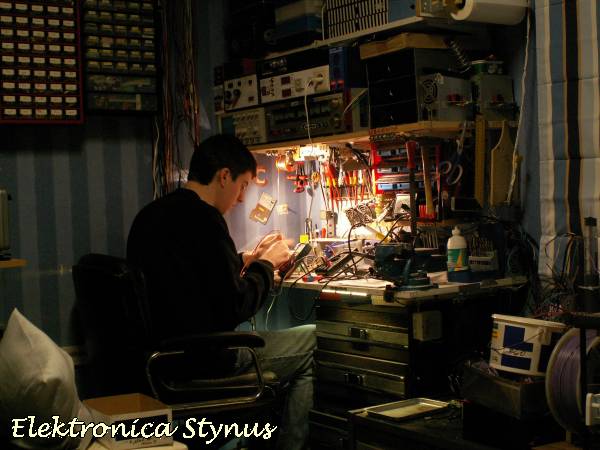
Dave Jones: One more. Uh, Steinus. I think his, his, his name is Stein. It's a, I think I'm saying it right. S T I G A N Stein. And he goes by his nickname is Steinus from Belgium. Another one from, but this is our second one from Belgium, I believe.
Chris Gammell: Awesome.
Dave Jones: Yeah. And so he's got a great picture. Where is it? Oh, yes.
Chris Gammell: Oh, this is what I love. Yeah. Yeah. Lots of component cabinets hanging on the wall. Yeah. That's a great idea. Yeah. Yeah. Yeah. Stacked benches there. And yeah, just massive stuff everywhere. Yeah. It's awesome. Brilliant. That's what you want to see.
Dave Jones: Yes. And, uh, what else do you have in there? He also had, he posted, we'll post the other links he put up there, but he had some to his projects. And of course we should call out the, uh, the Amp Hour logo he put on the top level of his site. So that's very nice of him as well. Thank you very much. Thank you. Uh, and a picture of him with it. He's in the picture as well. So double bonus.
Chris Gammell: I don't see that. Where's the picture?
Dave Jones: You gotta go back to the Amp Hour page.
Chris Gammell: Oh yeah. There he is. Yeah. He's not facing the camera, but there he is like working in the dark with just the light over his bench. And I actually, I, I revise my messy comment because, um, I'm looking at the front on shot now of the bench and, and he's got the cables up on neatly up on racks. All the screwdrivers are putting those little holders up on the wall behind the bench. And it's actually surprisingly neat. So I love his power supply. It's got like five meters there. It's like a five output power supply.
Dave Jones: Yeah. I mean, cables are always hard to make it look neat no matter what you do.
Chris Gammell: No, no. Okay. But that's why, that's why I don't even try. I throw them everywhere and yeah. And you spend 10 minutes hunting around at the start of doing something just to find the appropriate cable. Yep. Yep.
Dave Jones: Man. Hmm. Uh, let's see. So that's, that's all the work place of the week. We finally got to it. That's good.
Chris Gammell: I think it's, uh, have you seen all these projects though? He's got tons of projects on his, yeah. He, where his Amp Hour logo is. And, um, he's got, uh, he's got UV exposure boxes, X, X, etching tanks, PCB. He's got them categorized in measuring equipment. He's got diff probes. Wow. Um, he's got function gens, ESR meters, Xena testers, and then all different types of programmers he's made for various microcontroller power, four different power supplies, dummy loads, audio, light effects, clocks. Jeez, he's into everything. Yeah. He's got like six different clock projects he's made. Wow. Awesome work.
Dave Jones: Yikes.
Chris Gammell: Other parallel port control drivers, a PIC remote controlled car. Oh, it's all happening.
Dave Jones: Winamp remote control. Wow. These are all great.
Chris Gammell: Fantastic.
Dave Jones: Yes. Keep it up. We love seeing projects too. We should mention that because I mean, you guys are the ones doing all the awesome work out there. I mean, we're just talking here. So.
Chris Gammell: And the thing is, that's what you should be doing. If you're building these projects, as you probably are, if you're listening to the Amp Hour, I'm assuming you've at least got some, you've worked on some projects, put them up. Yeah. Put up a website, put them up there, show the world, you know. Yeah. It's so easy to do. As I said before, it's great for job. Yeah. You know, you could put it up there. Potential employers can go to your website and check it out and they'll be impressed. And yeah, absolutely. So don't keep them to yourself. No.
Dave Jones: Share with the world. Share with the world.
Chris Gammell: Absolutely. You know, if you want to keep the circuit to yourself, fine, but at least put up photos and descriptions and, you know, all that sort of stuff. So, yeah, although I do recommend sharing.
Dave Jones: Yeah, I was going to say, somewhere in the open source hardware movement, someone screamed.
Chris Gammell: And someone screamed, yeah. But I respect people's individual. Yeah. I mean, everybody's got the choice.
Dave Jones: I mean, it's just, you're going to get a lot more benefits. If you open it up, you're going to get a lot of benefits because people are going to be adding onto it, feeding it back to you. There's a lot of benefits to it. So we always encourage that.
Chris Gammell: We've got some follow-ups.
Dave Jones: Follow-ups from last week. So we were talking about 6502 last week in the top 25 chips of the IEEE. Yep. And so Adam, who sent us that video of him building his workbench, that awesome workbench he built, he sent me an email about the guy that laid out the 6502. And it's not the team that laid out the 6502. It was the guy that laid out the 6502. It's just like, one guy, really? All by hand? All by hand drawing? It's just like, oh my God. It just, I mean, it's 3,500 transistors as a reference point. And that's a lot of transistors, but it's nowhere near what it is today. But my God, like, he just designed the whole thing. Like, what? You bet. I mean, in 6502, that went into everything. Wasn't it in Nintendos? Not Ataris, but I believe it was in a lot of other game systems.
Chris Gammell: A variant went into the Atari. There were a couple of variants of the 6502. Yeah. So, yeah. I think the Atari one had a couple of address lines missing or something like that. Right. Yeah. Basically a compatible chip. Yeah. And we've talked about how a mob have actually reverse engineered the 6502. Did we talk about this last week or was it on my forum? I can't remember.
Dave Jones: I saw it on the forum. Yeah. There was a video of the guy that did that, right? Yeah. Someone reversed that.
Chris Gammell: They reversed engineered the 6502 by de-capping the chip and doing a high-res photo of the silicon. And they actually mapped out all 3,500 transistors and they built a simulation from that without doing any debugging at all. And it's 100% accurate. That's amazing. Transistor-level simulation. And you can actually go online. There's a web Java app where it shows a photo of the die and you can actually execute an actual program. And you watch as the bits move inside the die. It's fantastic.
Dave Jones: Yeah. That's really brilliant.
Chris Gammell: That's gold, really.
Dave Jones: Yeah. We should mention the guy who did it too because we can't just say the guy. Oh, no. The guy. Chuck Peddle. Chuck Peddle was the...
Chris Gammell: Oh, no. Chuck Peddle is the brainchild behind the 6502, but I don't think he's the one who laid it out.
Dave Jones: Oh, I thought he was. Oh, sorry. Sorry.
Chris Gammell: It was Bill Minch, I think. Oh, jeez. It says here in the thing. Yeah. Sorry.
Dave Jones: It was a single engineer, Bill Minch. Yep. Reading. Not my strong point.
Chris Gammell: Yeah. So everyone forgets Bill, but yeah, Chuck is the designer of the 6502 and...
Speaker ?: Man.
Chris Gammell: Yeah. And if you don't know the story behind it, they used to work at Motorola and Motorola had the 6800 chip, which was in all the computers at the time, all the very early basic computers. But it was like 300 bucks per chip and very expensive. So...
Dave Jones: They probably blew up pretty easy too, huh?
Chris Gammell: Yeah. And Chuck went to management with ideas for a low-cost version saying, 300 bucks is too much. This is crazy. And they just didn't want to borrow it. They just said, you know, bugger off. We're making a shitload of money on these 6800. So him and a couple of other guys buggered off from Motorola and formed... What's the company name? Moss. Yep. Moss. And they developed the 6502, which cost 25 bucks. And that's the chip that went into the Apple One. So Steve Wozniak went, shit, I can't afford 300 bucks. But he got from a trade show. Yeah. Yeah. He bought a couple... He bought two of these... Two of these 6502 chips at a trade show. And they would just, you know, hand over cash and they'd give you a chip, you know? And we...
Dave Jones: Imagine that today.
Chris Gammell: Which was... Well, back in the day, see, that was novel. Because to get a 6800 from Motorola, you had to be a big business and go through the dealers and all that sort of shit. You couldn't just walk in with cash and buy one chip, please. But Steve Wozniak, you know, at the trade show, hand over his 25 bucks and he got his 6502. He went back and the rest is history.
Dave Jones: That's crazy.
Chris Gammell: So... It's just...
Dave Jones: You know, it's interesting too because I mentioned it, I think, last week or the week before. I'm reading the Innovator's Dilemma right now. And they talk about that, how there's these companies that, like, they really want to protect, like, their high value, high margin stuff. Margin, yeah. And then the people come in and they just... They undercut... They don't even undercut them. They just make something as good or better at a lower price and they sell a buttload of them. And then they just keep finding new markets for it. And it's just... I mean, it happens over and over and over again. And you just... Oh, it's crazy because, you know, they want to hold on to the profits. I mean, I understand that. Yeah. Absolutely. Man, you got to watch out because those people are going to... You know, the mosses of the world are going to come and get you. Even if they didn't... You know, that moss isn't still around. I think they got bought out or folded. Oh, yeah.
Chris Gammell: I don't know what happened to them, but yeah.
Dave Jones: Yeah. I mean, but who cares, right? I mean, the 6502 itself, that sparked a revolution. So, you got to watch out for that stuff. Even the 6800.
Chris Gammell: Yeah. If you're working on a design which you think might become popular, I've said this before. Put a lot of effort into lowering the cost. You know, put 10 times as much effort as you normally would into get, you know, every cent counts. If you can optimize a cent off each part, you know, and that board's a dollar cheaper, then, you know, that can only be a good thing. It can actually enable that. And if competitors come along, you can cut your margin and you can keep it cheap. And so, don't underestimate the power of cheapness. Like, would the Arduino be as popular if it was 100 bucks a board? Right. You know? Yeah, that's a good question. No. And sometimes it's not even popular now because it's so expensive. It's reasonably expensive because there's a lot of overhead on there in terms of other circuitry. So, you can get smaller ones which strip off. Right. Smaller versions of the Arduino which strip off all the, you know, extra high cost circuitry and, you know, it's cheaper. So, you can, you know, embed it in, you know, 100 things instead of, you know, to put a full Arduino board in there which costs $30 or $40 is expensive. Yep. Exactly. So, hmm. What's cost?
Dave Jones: Yes.
Chris Gammell: And what about the 6502 having this screaming clock rate of 1 megahertz? 1 whole megahertz.
Dave Jones: That's right.
Chris Gammell: 1 megahertz. Unbelievable. Awesome.
Dave Jones: Awesome.
Chris Gammell: Screaming. I love it. I love old tech like that.
Dave Jones: Yeah. So, that one probably ended up in the waste bin, right? Eventually, a lot of those 65, I mean, they're still designing it with them, but this is Chris trying to make a bad segue. But we had a follow-up from last week about the e-week, or e-waste rather, and apparently there was a study about that recently and there was a surprising finding in there. And they kind of went to the top 25. And these are all consumer manufacturers. So, you know, monster operations. But the thing that was surprising to me, and I'll post a link to the actual thing, that, you know, they said everybody's getting a little bit better. But the ones who are doing the best are Asus, or Asus, or however you say it, ASUS. And I believe they're a Chinese-based company, I believe.
Chris Gammell: Yes. No. Are they Taiwanese?
Dave Jones: Oh, Taiwanese. I believe. Yeah, that might be right.
Chris Gammell: I think they might be Taiwanese. Yeah.
Dave Jones: Yeah.
Chris Gammell: Don't get it mixed up. Taiwan and China. Right. Ooh.
Dave Jones: Yeah. Yeah. So, they're doing the best, though. Whereas Apple and HP and everyone else, and Dell, they all still suck. I mean, they're getting better, but they're at the bottom of the pack, basically.
Chris Gammell: See, now you wouldn't figure that if you just went by the marketing. Because Dell, Apple, and HP put a shitload of marketing into the fact that they're green and they use recycled materials. Even Steve Jobs at his, you know, new product presentations, keynote things that he gives when he whips out the new iPod Nano or the new, you know, iPad or something. He almost always goes on about how green it is and how good the recycled and the manufacturing technologies and there's no harsh chemicals in them and all that sort of shit. So, I find that surprising because, well, I don't find it surprising now that I know it was probably just a marketing wank and they've hyped it up. When you actually look into the real details, they still suck. So, yeah, these big companies like to market. They like to market a lot.
Dave Jones: Yeah, they do.
Chris Gammell: Yep. There you go.
Dave Jones: Yeah. I don't know. Maybe it was partly because, you know, Apple and HP, a lot of those people already go, they go through Foxconn, you know, that's who they're manufacturing through. So, it's not like, I mean, they still control the process, HP and Apple and all those guys do. Of course. But, you know, still built in China and people still love cutting corners and saving those pennies. Right. So, I mean.
Chris Gammell: And disposing of those harsh toxic chemicals inside the actual product. Yeah. Yeah. Probably not, but not that far in. And we're not with the big products anyway, but I do know for a fact Steve Jobs listens to the Amp Hour. So, Steve, get on it. Fix it, mate. Don't be a dickhead.
Dave Jones: That would be ridiculous.
Chris Gammell: Come on. Of course you listen. Everyone listens to the Amp Hour.
Dave Jones: Right. They sit around their radios at home, right? And they gather the family together. They tune it in.
Chris Gammell: Yeah. They tune it in with the big analog dial, which goes to a big pulley and then goes to a variable capacitor. Yeah. And, oh.
Dave Jones: They warm up a glass of Ovaltine. They sit in their comfy polyester chairs and they tune into the Amp Hour. Coming to you live. Whenever you want it.
Chris Gammell: And they do it in front of the flickering fireplace. Oh, that's right. Which is their only light, you know. Right. Of course. Yeah.
Dave Jones: Outside of the weather caveman. Oh, good. I love it. So, speaking of waste, Eddie, one of our listeners, responded last week about us being hypocrites. And, basically, because incandescents versus CFLs, the incandescents are a lot less wasteful. Right. So, we were talking about LED lighting and CFL lighting. Yep. And, basically, you know, you throw away an incandescent bulb and it's a piece of tungsten, some filament, the bottom piece, the Edison screw bulb, right? And then the glass. And that's about it, right?
Chris Gammell: No. See, here's the thing. I pointed this out on my rather extensive post on the forum. No, it does actually contain lead as well. So, technically, you're not allowed to just throw out light bulbs. I did not know that. Technically, well, I guess it depends on the country. I burn them in my backyard.
Dave Jones: It's weird.
Chris Gammell: Yeah. Is that bad? You're supposed to dispose of them properly. Yeah. So, you know. And the thing is, it is possible to dispose of the new CFL bulbs cleanly and safely. It just costs a bit of money. I think it's in the order of 30 to 50 cents per bulb or something like that. So, if countries were to dispose of them properly, they would have to build that into the cost or, you know, set up some sort of management systems for them. Yeah. I think they had that here in Australia at one stage. You could dispose of your CFLs safely by dropping them in a box somewhere. I think they even had them in some of the stores. I think they had like a waste box. You could drop them in and they'd, you know, recycle them safely so the mercury didn't come out and stuff like that. Yeah. Yeah. But, yeah, of course we're a bit hypocritical. Everyone's hypocritical. Right, yeah. You know.
Dave Jones: This show was founded on being hypocrites. Come on, people.
Chris Gammell: Exactly. I don't even know what an electron is. Right. The problem I have with the incandescent bulbs is that it's a ridiculously inefficient way to produce light. It's just from a... Oh, it's...
Dave Jones: It's just so legacy, right? I mean...
Chris Gammell: Oh, it's so legacy and inefficient. It just kills me to switch it on and know that, no, it's not actually a light. It's mostly a heater. Yeah. And when you want light out of it, and then you've got to turn on the air conditioner, typically in hot countries, because you've got to cool down the room more, because you're bloody... You know, you've got a couple of hundred watt heaters in your... Or, yeah, about 80 watts. What are they? 10, 15% efficient or something? They only convert... So maybe, you know, 90 watts of heat. And if you've got five of them in a room or something, you know, that's a lot of heat.
Dave Jones: Yeah.
Chris Gammell: That's like a small bar radiator heater heating up your room, and you've got to combat that with your air conditioner. It's just... Ah! It's insane. It's not as big a deal in the winter. Yeah. I know. Exactly. You get some benefit. But I love the simplicity of it, of course. But... Right. No. The inefficiency. That's why I just don't like it. And, of course, one of the biggest problems facing this planet, here's a rant, is our excess energy consumption and our wastefulness of energy. So, you know...
Dave Jones: Well, it's been pretty free up until this point, right?
Chris Gammell: Well, yeah. Exactly. People are realizing the cost of it. And in terms of, you know, environment and not just the actual production cost. Monetary cost, yeah. Yeah.
Dave Jones: Well, I have a question for you about that, Dave. Because, I mean, one of the things that Eddie was talking about is basically, I mean, with good focus, I mean, like, there are a lot of components in the base of a CFL bulb, the ballast of that thing. There are shitloads. Yep. Yeah. But my question for you is, do you ever think there will be a DC standard? So, you're...
Chris Gammell: Yeah, in homes. I've...
Dave Jones: Yeah. I would love that, personally. I mean, I think...
Chris Gammell: I would love that, too.
Dave Jones: I think they're gearing up for it, too. Because, I mean, you think about, like, a 48-volt standard, right? First off, you could have an actual standard across the world. Wouldn't that be nice? Instead of 120, 240, whatever the hell's out there, 90, 100... And a standard plug, too. Oh, God, standard plug. Let's not get crazy, Dave. Come on, people still need to make money. Let's not get carried away, yeah. Pie in the sky stuff. Still need to make money, regionally. But, I mean, that would be great. Maybe we should start that here, right? The amp hour 48-volt standard DC home wiring. What do you think?
Chris Gammell: Well, no, you see, 48 volts is technically above... Is technically high voltage. I think anything above 32... I thought 60. No. I thought 60 was... No, it's around 30-odd-something, 30-something volts. So, you'll find it's technically... Yeah. Yeah, high voltage. You can get multimeters that warn you if it's above a certain voltage, you know, an audible alert or a visual alert, and it's usually around the 30-odd-volt mark. I had a HP high voltage, you know, 1,000-volt generator once, and it would turn on at, I think, 32 volts. It'd flash up a red light saying high voltage. So, anyway, I'm sure I might be corrected on that. But, yeah, 48 volts is reasonably high, but I'd prefer... Well, either way.
Dave Jones: Okay, so 30 volt. I mean, whatever it is, right? Anyway, whatever it is.
Chris Gammell: DC standard.
Dave Jones: Yeah, some kind of DC standard, you know, like have a standard socket plug-in for LED bulbs. Because, I mean, that's the problem with LED bulbs right now, too, is... Well, that's one of the problems. You know, you still have to rectify the voltage internally, right? Yep. And then the other problem is heat, which is always going to be a problem for LEDs. Yep. Because you have this tiny little die that's outputting a lot of light and a lot of heat. You've got to try and get it away from there as fast as possible. But, I mean, take out one of the problems, and we might be a little closer to LED lighting nirvana, right?
Chris Gammell: Well, LED lighting nirvana is going to happen regardless of whether or not you have a DC system installed. Oh, yeah. Because they will just put in, you know, 240 volt, 110. I just want it down. I know. It'd be great. But your question was, do I think it's going to happen? I think no. You don't think so? Several reasons is because we're so well entrenched in the... The stupid screw sockets. People have been talking about... Screw sockets. I don't think... It might happen. You know, it might come along as an auxiliary system. But there's probably, if you look into the actual details, if you're talking about having one big DC to DC converter out in your box that then powers, you know, 50 different outlets around the home or something like that, you'll find that you need... You would have to cater... Yeah. Your wiring would have to cater for the highest common... The highest current capability. Right, right. So you would need massive amounts of copper, and copper is massively expensive. Right. I don't know about the US, but here in Australia, there's people who are... People going around ripping out copper pipes and copper wiring from all these new homes that are being built. Yeah. Like vandalizing and such. I think it's the same in the US.
Dave Jones: It is, yeah. Yeah. That happens a lot. Especially like...
Chris Gammell: And it's massively expensive. And imagine if you've got to cater for, okay, 48 volts and it's got to be... Or 24 or something. It's got to be... You know, you've got to cater for 10 amps or something like that. That's a... You know, and over, what, the span of hundreds of feet? Well, no.
Dave Jones: The way I would envision it... All right. Since you're asking, the way I would envision it is each room... So you could still have an AC main stuff, because you wouldn't want to be running refrigerators off a DC kind of stuff, right? You still want to have motors that are running off AC. But then in every room, you have a switcher, because you're right. You don't want to have those long drops. You would need it. Yeah. Yeah. You'd have I-squared R drops. If you tried to have a central unit, you'd have I-squared R drops throughout your house. You know, so... It'd be massive. Yep. Yeah, that would suck.
Speaker ?: And...
Dave Jones: Where am I going with that? It's not I-squared R. It's just IR, right? Yeah, just IR drops.
Chris Gammell: But... No, it's I-squared R.
Dave Jones: I-squared R? What am I thinking about?
Chris Gammell: I-squared R losses. Yep. Current squared times resistance.
Dave Jones: Okay. A little brain fart there. But yeah, so you'd have a local swisher in each room, basically. And then you'd have the wiring from that point. And then you could have a dimming module in there. You know, you could... I don't know. I think that kind of thing would be a lot better than a central unit, because otherwise it wouldn't work out.
Chris Gammell: But then the electronics would be, what, embedded in the wall? And it would fail? What do you do then? Or do you have these ugly boxes on the outside of the wall? Yeah. And then you'd need a central box in each room on the wall? Yeah. You know, the practicalities of this start sort of taking over. And people don't want ugly boxes. People live in their lovely McMansions with all their stainless steel and their glass and their, you know...
Dave Jones: You've got a stainless steel cover on it. That's fine with me. I don't care.
Chris Gammell: And their granite benchtops. Yeah, I know. Yeah. Yeah. You could. I think there's actually some homes that have installed a low-voltage system. Yeah. You know, I'm sure I could dig up a... You know, the home of the future or something.
Dave Jones: Yeah. There was one with... There was a feature I saw on Dean Kamen's house. Dean Kamen being the inventor of the Segway personal transport and much other crap. Yeah. And he lives on a little island off of Connecticut, I think it is. And it's called Little North Dumpling Island, I think it is. Right. Really weird. But he actually has this beautiful LED lighting system. And I mean, the guy is a genius in his own right and rich. So, I mean, you could probably get any kind of thing you wanted in your house at that point. Yeah. Really cool, you know, like dimming and color settings for mood lighting and all that other junk. So, definitely high-end still, but it is possible. Maybe not standard, you know. You're not going to run down to Home Depot or, you know, your local hardware store and pick up... Well, you can...
Chris Gammell: There's people doing that now. People have lighting all... LED mood lighting, all everything. Full RGB control, you know, all computer controlled and all that sort of stuff. Yeah, it's pretty basic these days, but I don't know. A DC system in the home. I would like to see it maybe for low-power stuff. Yeah. You know, I don't think it would probably work for high-power, any high-power systems or something like that. No, yeah. But I don't know. Maybe each outlet is a maximum of 5 watts, 10 watts, something like that, perhaps. I don't know. Yeah. Yeah. It'd be cool, but yeah, I don't know. It certainly won't happen anytime soon, that's for sure. Yeah. And by the industry, by its very... All sorts of industries, by their very nature, don't like standards. They just hate them. Everyone wants to control it and do their own thing. Right.
Dave Jones: Everyone wants to put their own stuff in there, so it favors their production, right?
Chris Gammell: Yeah, exactly. I'm surprised that a lot of the mobile phone manufacturers are trying... They're trying to go towards a standard charging connector, which is the micro USB. Yeah. Now, they're trying to go towards that, and that's great. Right. But yeah, not everywhere. Of course, you know, Apple will never do it, and...
Dave Jones: Yeah. Yeah. Well, it's getting standardized, I think, in Europe, too. I think that's what really did it, is there was a government thing in Europe. Oh, was there? Yeah. No individual charger. Like, no... I think they had a standard in Europe, and I think that's really what drove a lot of it, so...
Chris Gammell: Okay. Excellent. Yeah. It kind of needs sort of government. That's where governments can step in and go, you know, you must have this, and that's it.
Chris Gammell: End of story, you know? Yeah.
Dave Jones: Sometimes that's the only way to get it done, unfortunately.
Chris Gammell: Yeah.
Dave Jones: Oh, boy. What about, uh... Man, what else do we want to talk about here? We've got a lot of stuff still, huh? We haven't even gotten to this. No. Man, we haven't gotten to anything. Just give up now, come back next week, and talk about this stuff on the list.
Chris Gammell: And we've been ranting for 45 minutes. Shit, it's almost over. 45 minutes.
Dave Jones: Oh, God.
Chris Gammell: Oh, get out of here. Get out of here.
Dave Jones: CES, you've been watching that crap? You've been watching all that crap come out of there? Oh, I have a couple of things from CES. I'm trying to avoid it. Yeah, I know.
Chris Gammell: Apparently, it's all tablets. Tablets are the big in thing this year.
Dave Jones: I know. Yeah. I didn't even know. I thought CES started on Sunday or Monday. It started on frigging Thursday. Right. Like, people were talking about it so much, and then finally, real announcements started coming out on Thursday, and it's like, oh, so what were you guys doing those other three days? Like, you guessing? It goes for a whole week, doesn't it? But it's just, I think it's, I mean, it starts Thursday. I think it goes like Thursday to Saturday, Thursday to Sunday, or something like that. Oh, okay. But it's so stupid. I don't know. It's getting so built up. It's, ah, I don't know. I know. And it's all consumer stuff.
Chris Gammell: Yeah. It's a junket for everyone in the industry to go to Vegas. It's in Vegas, isn't it? Yes, it's in Vegas, yes. Yeah, it's always in Vegas, I think. And, you know, Vegas is great, you know. So, everyone wants to go to Vegas.
Dave Jones: Yeah, well, big party. I was talking to someone on Twitter, I think, about that. And I was wondering, how many actual engineers and, like, product designers do you think are there? You know, they have these brilliant things.
Chris Gammell: It's geeks who want to play with the latest gadget, and it's big business people on junkets. That's probably it.
Dave Jones: Like, yeah, press reporters and...
Chris Gammell: Yeah, all that sort of stuff, yeah. I don't think there's any real design engineers. I saw that. I'm sure there are, but it's a very small percentage, I'm sure.
Dave Jones: Yeah, I saw MakerBot was out there. Yeah, they were selling a bunch of stuff. Yeah, I saw the MakerBot stand.
Chris Gammell: Yeah.
Dave Jones: That's pretty cool.
Chris Gammell: Yeah, they had about 10 of them all set up, and they all lit it up. They had them all lit up different colours, so they all looked very monolithic and, you know. Yeah. It was good. Good on them. But I've heard it's hard to stand out at those shows, because I've heard, you know, they're so big that you can't walk around them in five days and actually look at all the stands. It's just that huge, so... I don't know.
Dave Jones: And the booth babes, I mean, can't forget that.
Chris Gammell: Ah, the booth babes.
Dave Jones: Right.
Chris Gammell: I'm actually entering a contest. You'll probably see it go up on the site probably tomorrow. I've already shot it last night, a short little intro, and then it's just a... I've just whacked on my clip on the end of it, my standard little, you know, how to entertain a nerd clip, but I've renamed it all Geek, because the contest is the Top Geek Contest. So I'm going to enter that. It's run by an internet service provider here in Australia, and the first prize is a trip to any show you want. So you can go to CES, you can go to, you know, any of the major shows. So it's a free trip there. Oh, that's cool. So I'm going to enter that.
Dave Jones: You should go to Electronica next year, if it's in Germany. Is it in Germany every year?
Chris Gammell: No, it's every second year. Second year? I think I could go to Electronica, but it's probably not on next year. I think you have a year to use it. So, yeah, I don't know. Anyway.
Dave Jones: That's cool. But yeah, it'd be cool.
Chris Gammell: So everyone vote for me, please, when it's up there. Vote for Dave. It closes on the 14th, so I've got to upload it today, I think. And then it's based on votes, the number of votes. So hopefully I can enlist the EEV blog and Ampower audiences.
Dave Jones: And ultimately, if you're out there and you're listening and you're entering, and you think your idea is better than Dave, put that up too.
Chris Gammell: Right, of course. Oh, dear.
Dave Jones: Yeah.
Chris Gammell: Yeah, it's not an idea. You just enter. A video is optional, but I've done a video, of course.
Dave Jones: Of course.
Chris Gammell: And yeah, and then it's votes. And then I think they get to decide who gets the top 10 or something. But yeah, I don't know.
Dave Jones: Cool. Oh, bless you. Thank you. Well, speaking of design, one of our listeners wrote in, and he wanted, it was Brian Hoskins. He wanted an opinion on...
Chris Gammell: Hey, Brian. What? Brian's a long time.
Dave Jones: Yeah. Yeah. He's building a weather balloon, apparently. A helium weather balloon. Awesome. And so he's talking about, he wants to put an interface for sensors on there, and he's going to open source it, which is awesome. So that's great. Yep. But he was kind of wondering about standardizing the output and what we thought about what we should do about the interface to all the sensors for, I believe, for daughter boards. And what we thought about the design and how we would do it. So what do you think, Dave?
Chris Gammell: Yeah. I haven't looked at the actual design. Has he got example block diagrams or circuits up there or something?
Dave Jones: No, just the explanation.
Chris Gammell: Oh, just the explanation. Okay. Yeah. Well, yeah. I mean, that's the holy grail of modular, is modular electronics, you know? Oh, yeah.
Dave Jones: Yeah.
Chris Gammell: Yeah. You know, you develop a universal board that everyone will use and it caters for everything, and it never works. I've tried it myself. I've been involved in various ventures to do it. Many companies have tried. That's great advice, Dave.
Dave Jones: Now, son, listen to me. You're going to fail.
Chris Gammell: You're going to fail. Well, you know, like some people will use it. But really, ultimately, it comes down to, you know, most people are going to want to do their own thing. They're going to go, well, yeah, it's a nice circuit and I'll use some of it, but then I don't want everything else. So I have to lay out my own board. So from a circuit point of view, yes, you can get a modular sort of approach and then people can pick and choose what parts they want and then only use that in their design. But if you start talking, oh, like a modular PCB level system, that's where it starts to break down and not work very well because it doesn't, oh, it doesn't suit somebody's form factor or it uses a part that you can't get now or they can't get easily or cheaply or they may have found a cheaper chip somewhere else, you know, blah, blah, blah, blah, blah, blah. Or it uses too much power consumption or it does this, it does that or it doesn't work at the right voltage they want.
Dave Jones: Yeah, I know, right? A lot of stuff in there. Yeah, there's a lot of stuff. I mean, there is a good example out there right now. I mean, the Arduino is an example of that, right? They have analog push through there. There's digital I.O. So that kind of stuff is an example. I mean, you could even use that kind of thing and design the sensor boards instead if you wanted to. But at the same time, maybe that doesn't have what you need. And I think part of that depends on, you know, what specs you need from the A to D, right? So I think it's only 12-bit out of the, is it 12-bit in the Arduino?
Chris Gammell: It's 12-bit, but it's 12-bit zero to five, which is the, you know, thing. And it uses the internal voltage reference. It doesn't use like a proper precision external reference, I don't think. Right, so. Don't quote me on that.
Dave Jones: Right, so that means you'd have to end up pushing that through digital I.O., right?
Chris Gammell: Yeah, everyone's got their own requirements. And it's hard to design a universal board to cater for everything. So, yeah, I mean, I guess my advice to Brian is don't put too much effort into it. Sort of try and make your schematics modular so that people can then pick and choose, you know, so that they can reuse your modules.
Dave Jones: Yeah, and I would say, you know, use standard pin spacing. So, I mean, that is one of the things about the Arduino is, you know, 100-mil spacing.
Chris Gammell: I think that's overrated, though.
Dave Jones: I don't think so because you can get cheap stuff, though. That drives cost, too. So, you know, if you use like a PCI connector, right? Not the best thing, but very cheap, right? You can get a PCI connector for, what, like a dollar maybe less? Oh, yeah, very cheap. And that's a lot of, I mean, you just have to do gold fingers.
Chris Gammell: That's a shitload of pins, yeah.
Dave Jones: Yeah, exactly. So, I mean, like that, just the volume side of things, if you choose a standard design and use it in a non-standard way, it usually drives cost down. So, that's the only real benefit of that. Yeah, very true. Not necessarily anything else. So, I don't know.
Chris Gammell: I did that on one of my boards some time ago. I actually used a PCI. You know, I can't remember how many way because you can get different size PCIs. And I use that as a standard interface connector for a test board. Nice. And the connector only costs a dollar. And then you build in to your board the actual product I was designing actually had the PCI edge connector on the side of it. And I ran and I broke out all the test signals to it. And that was hidden in the final product. But at the bare board level, you can see it. And you can plug it straight into the test jig. And all the test signals come out on that PCI connector.
Dave Jones: That's great. Yeah. I've seen actually before. I mean, that's a big design component from older modular design too. I have a post on my site about, I took apart my old Techscope 425M. It does. And, you know, that thing has modular, it has these huge analog gold fingers on it. And it's awesome. And even if you look at like, I think even on the Wikipedia page of the 741 op amp, they used to actually sell these, you know, because the op amp wasn't, the op amp design was made before the silicon was made. You know, they had actual system level, you know, like a transistor here, transistor there. And they sold these as modules. And then it had the same thing with gold fingers on the side. You could plug that into sockets. And then when you burnt it up, because, I mean, let's be honest, back then you were probably burning them up pretty easily. Swap it out. Yeah. Then you could just swap in another one for 30 bucks or however how much they cost, which is a lot. Well, it's Tektronix, you know. But, yeah. Well, no, no. That was for like an op amp by itself, too. I mean, not necessarily Tektronix one. Okay. You know, whoever was making this a national or whoever's making these test boards. And replace them. Yeah. Yeah. So, modularity is great, but you got to, I mean, you're going to pay for it either way. I mean, you're going to pay for locking yourself into an interface. Yeah. Or something else. Or for the actual connector cost.
Chris Gammell: So, yeah, just don't compromise your design just to, you know, just to potentially make a modular system that other people might use. I wouldn't compromise your own design for that. If you can do both, great. Right. Yeah. A lot of thought needs to go into it.
Dave Jones: You know, and I would always push, too. So, I mean, like the, I think people, not necessarily Brian or anyone else, but like, I guess other people would be the target here. But, you know, people are really often saying, well, I can't do this because it doesn't have this or this. And sometimes it's better to, not necessarily Arduino, but just other standards that are already out there. It's better to just try and wrap your design to that because there is going to be that same built-in support. You know, so you can roll it from scratch. I was talking to a friend who's doing a design or about to start a design. And he's like, oh, I'm going to redo everything. And I'm like, you know, there's so much stuff out there already. It might be worth it to take some of your time and wrap your daughter board or whatever it's going to be around this standard. And then, you know, you don't have to worry about that piece. You know, basically you remove it from the troubleshooting equation. Same here. And I like that a lot.
Chris Gammell: If it suits your requirements in terms of, you know, all the things I've said, cost and everything else, size and power and blah.
Dave Jones: Yeah, that's true. Yeah.
Chris Gammell: Yeah. It's a tricky question. It's an age old, you know. It's certainly not a new concept. It's an age old concept. And people have been grappling with it for a long, long time. And they will continue to.
Dave Jones: Yeah. I want to see these pictures. I love those balloon projects. I mean, like. Oh, yeah. They're awesome. The father-son team that just sent one up, I think, a little while ago. And that, you know, like you can see the curvature of the earth.
Chris Gammell: You see the curve. Oh, it's great. It's amazing. Yeah. You put an automated camera on it. It's like. So cool. It's worth it just to take the one photo. Yeah, right. You know, it's worth all that effort to get the camera out there and snap one photo. You know, that's just. Yes.
Dave Jones: Beauty. It'd be cool to do like. You know, it works. Past like the. Because, I mean, I think those things get to what? Like 100,000 meters or something like that. Is that totally. 100,000 feet. 100,000 feet. Oh, sorry.
Chris Gammell: 100,000 meters. You'd be out there, right? You'd be well and truly in orbit. Right.
Dave Jones: Yeah. Because 100,000 feet is not true orbit, right? Because that's when the.
Chris Gammell: Well, 100,000 feet is deemed to be space. Oh. So that's technically. Yeah. If apparently if you go over. Like, you know, people who fly in the U-2 spy plane and the SR-71 and all that sort of stuff. If you go above a certain height, you can claim that you've. A, claim that you can. You've been in space. And B, you get some sort of patch. Ooh. Saying. A patch. Yeah. You get a patch saying that you are an astronaut. You've been into space. Because you've got over X height. I think it's even 90,000 or 100,000 feet. Oh, wow. Something like that. But yeah, I'm pretty sure that's the limit of what they deem to be space.
Dave Jones: So how many balloons would I have to tie to myself to get up there and get a patch?
Chris Gammell: I don't know. A shitload. They did that on Mythbusters. Jamie and Adam. Oh, they did? On Mythbusters. I think that was one of their first episodes was the balloon thing. And they blew up like, I don't know, a thousand balloons or something and they could only get, you know, a thousand feet or something like that. Yeah. I don't know.
Dave Jones: I think space is just getting, I mean, like the whole private, I had this a while back on our list and we never really got to talk about it. But like, I mean, that SpaceX launch, just watching that go up, it was so amazing. Like the, how that all is moving in the private sector and stuff. And I just, I think that's going to be a really big deal, you know, I don't know what else to say about it other than it's a big deal.
Chris Gammell: Well, I don't necessarily like it going private. I think it's cool that private are doing it. It's fantastic. But I think it's wrong that government are no longer doing it. I'm talking about the US here. Right. Who have practically shut down their manned space program. Yeah. I'm not a huge fan of that either. You know, and outsourced it. I mean, what a dumb ass decision of the decade. Right. Really. I mean.
Dave Jones: I think, I think the bigger loss is from the, because I mean, like just so much money from that ends up going into research then and helps people later. Right. I mean, NASA is a very big researcher. Of course. And that, that alone. I mean, private industry, you know, they do, they do what they call R&D, but not necessarily on the same, same level as like a scientific agency. Right. I mean, people are going to say NASA is, you know, you know, bloated and whatever. And, and, and that's true, but they still, they do a lot of research that's important to the world. So, I think.
Chris Gammell: Oh, to even for important for our industry in terms of, they've done lots of soldering, research on lead-free soldering. They're one of the world leaders in researching the tin whisker problem. And other, you know, component reliability and radiation hardening and all that sort of jazz. You know, they got, oh. And anyway, they just want to, anyway, they're pissing away their manned space program and I'm pissed.
Dave Jones: Yeah.
Chris Gammell: So.
Dave Jones: I'm not happy about it either. But on the other side, I mean, there is the upside of, you know, hopefully the fact that it is, you know, private spaces, you know, private space exploration is up there. Maybe that'll move people, more people towards it, you know, because there's a lot of languishing and people wanting to, you know, go into that industry for a while. You know, it definitely lulled. And if, and if it, it lulled, not lulled, by the way. Mm-hmm. Oh, nerd. But, you know, maybe, maybe the private exploration will help push more kids into it and want to get up in space a little easier because if there's more people going up, that's a good thing, I think.
Chris Gammell: That's if it stays in the U.S. and doesn't get completely, you know, outsourced and if other companies don't take over. Yeah. Because when it becomes private, then, you know, if somebody else can do it cheaper and better, you're screwed. You're going to shut down. You're going to be out of business. That's true, yeah. So, you know, who knows? In five, ten years' time, every space company in the U.S. could be out of business because somebody else has beat them. Yeah, maybe. Who knows? So, you know, I, yeah, God. Anyway. So, that gets the, yeah, shutting down the manned space program, NASA, that's Dave's dumbass, dumbass award of the week. So, there you go.
Dave Jones: I'm sure NASA's hanging its head in shame somewhere.
Chris Gammell: Oh, they should be. Yeah, the bastards. I'll tweet them.
Dave Jones: That'll teach them. Oh, yeah. Yeah, yeah. Take that. Take that with 140 characters. Yeah.
Chris Gammell: And I'll use every one of the damn characters, too.
Dave Jones: Yeah, that's right.
Chris Gammell: All right, I think we're out of characters for the week. Oh, bloody hell.
Dave Jones: I know. 45 minutes in, we almost got to some of our discussion points, too.
Chris Gammell: We almost got to some of them. Yeah. Yeah. Oh, it's pathetic.
Dave Jones: We'll try and get to more of them next week. Not to worry. A show's a show. It's in the can. That's right. In the can. 25. Awesome. We'll see you next week for 26. See you guys.
Speaker ?: administered administered administered administered you
Archived Discussion (19)
Comments are closed. Archived from the original site.
Show archived discussion (19)Hide discussion
Keep current
Every episode, plus the occasional job post, in your inbox.
I made sure that the latest one is solar and I haven't taken it off since 18th May 2009 - the day I got it, not, once. The battery lasts a month if you do let it charge.
I don't mind using them for one-offs (if the manual is managable) or to concept something.
I'll happily use it if the tech is beyond my ken or beyond my ability, the fibreglass manufacturers ability or the board loaders ability. In those cases you don't have alot of choice anyway.
I'll grudgingly use it if i couldn't hit the same price point doing it myself or if time did not allow.
I like building code/circuits from scratch. You learn something and end up building a little collection of personal IP. If i reinvent a wheel then i know better how wheels work. And then the wheel and the vehicle are a better match.
Props to your friend if he/she is doing it themselves just because they can.
I cringe everytime there's NASA cutbacks. But then i don't pay US taxes. From the perspective of space geeks in space tech starved nations like Australia(University of NSW's BLUEsat is still on the ground 12 years after their first funding), NASA is doing the cool stuff the rest of us can't or won't pay for. And through their excellent public outreach let us feel like we're somehow part of it.
One of my favourite NASA web destinations:
www.jpl.nasa.gov/events/lectures.cfm
I'd like to see a lecture on electronics design considerations for space, other planets and moons.
JD
"Workmanship Problems Pictorial Reference" http://nepp.nasa.gov/index.cfm/5575
So to address your questions:
- Yes, James P. Wack is a anglophone-friendly pseudonym, my name is Jaime (Chris pronounced it righ)
- The CRT scope's brand is HUNG CHANG (no kidding)
- A "chicken's teeth" is any item so rare thats next to impossible to find.
- The massage chair: I was commissioned to remove the remote completely (sooo fragile), sadly the bus wasn't serial (just digital bursts) and I can't see the signals clearly on my scope, I need a Rigol (at least).
- http://www.goodfuckingdesignadvice.com/ is for graphic designers! anyway they're widely applicable and plenty of F-bombs.
On Watches, I'm a few years older than Dave and I have a collection of watches that I no longer wear. Chris is right in that a lot of people rely on their mobile/smart phones to be their timepiece (and alarm clock) these days. For younger folks it's more convenient than Dave thinks, because we have to remember their smartphone is their most used communication device (SMS, Twitter, Facebook, etc) so it's not quite the exercise to get the current time as it would seem.
On incandescent bulbs, I agree with Dave about hating how horribly inefficient they are, but its only until recently have CFLs really meet the same color temperature and light quality as a cheap incandescent light. Don't get me wrong I'm not a tube amplifier purest, but in the workshop and electronics lab I've gone thru quite a few brands and color temperature CFLs to find a good quality light.
The voltage where additional rules kick in for the US National Electric Code is 30V. So maybe it could be 24V. A 20A 120VAC circuit in a house is common. The house could also have some 20A 24V circuits (480W). That won’t run an appliance, but it’s a huge step up from Chirs’s suggestion of having DC outlets that provide 10 – 15W.
If such a thing catches on, it won't be a separate circuit from the mains. It would have to be based on outlet replacements that fit into a standard electrical box and have a power supply to generate DC using the AC line voltage.
http://www.bbc.co.uk/news/world-asia-pacific-12158608
http://tinyurl.com/kuadgy
and a bunch of articles in archive of PopSci.com
Maybe NASA lacks of such visionary like Burt Rutan today...
Greetings from Polska(Poland)
ki3
Enjoyable first show (for me) -- looking forward to the NASA discussion.
Waiting for the scientific calculator watch...
But as you can see, you can send notifications to it :-)
That or maybe 4-pin XLR plugs that are already widely used, at least I know it's used in a lot of audio equipment.
Or else +/-24V phantom power, like it's used for microphones.
And for todays efficient switching power supplies it does not matter that much if they do DC-DC or AC-DC down stepping. The principle stays the same.
You need to have a high supply voltage (small wire diameter), so you still need to down-convert everything.
No big win there.
I would even argue that the suggested 48Volt is too low to scale. Even the 110 V AC in certain backwaters of the world appears to me rather whimpy, but this is perhaps not the point...
And AC is in fact a safety feature. Arcs break off more easy and you have no electrolysis effects.
I could see low voltage DV for room by room for lighting becoming a standard. Like the 12V AC we already know for Halogen lighting.
There is one thing I agree with all of you. The Edison screw needs to die!
I'm in the UK at the moment, and they actually managed to establish a bayonet style lamp socket here. But the Edison screw looks still very strong here. :(