
#162 – Discussing The Open Hardware Summit With MightyOhm - Ostrobogulous Openness Occasion
Download episode · 36 MB
Also on Apple · Spotify · YouTube · RSS
Show Notes
Jeff is back to talk about the Open Hardware Summit with Chris! YESSAH.
- A few former guests were at the summit, including Ryan O'Hara of Ohararp. He was getting along grand with Brent of OSHstencils.com. Frenemies! :-D
- The event was held at the Kresge Auditorium at MIT.
- Didn't make it to the OHSummit? You should be able to see the talks soon! (not available yet, will try to update when the link is live)
- The night before the summit, we had a tour of Bolt (the hardware accelerator) and had a meetup at the Meadhall.
- After the event on Friday night, Chris got to visit Artisan's Asylum, where he finally saw Stompy, the Giant, Rideable Hexapod Robot!
- On Saturday Jeff visited the MIT museum. It was a great reminder of prototyping methods throughout the years.
- They also have modern inventions in there, such as the MakeyMakey.
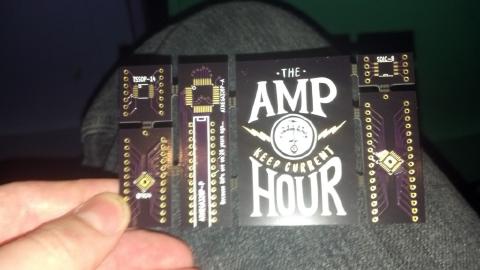
- The 2013 OSHW Goodie Bag was great this year. Dave and Chris both had a design in there, the uRuler and The Amp Hour Breakout Board (shown above), respectively.
- Chris had a bit of a snafu with the soldermask relief, but the OSHpark fab must have fixed it because it wasn't on every board! This can be good...or very very bad (good in this case)
- Low cost tools continue to get better. The Parallela project was laid out with EAGLE and has multiple BGAs on board.
- Really there are some features that are only available on the high end tools, but some creep in to the low end ones as well.
- Jeff loves the PCBs that are reference material as well, such as the uRuler, the Octopart footprint example/resistor color coder and the Sparkfun Silkscreen example board.
- If you're interested in seeing/downloading/making the files for The Amp Hour Breakout Board, they're available on GitHub now. Chris is getting into GitHub for KiCAD files (finally).
- Robert Spitzenfeld wrote a script for GitHub that allows you to do visual diffs, by generating gerbers for each layer and overlaying different versions.
- Jeff is very excited about what we talked about last week with Michael Ossmann, the Hack RF project. He's getting one and will learn more about SDR.
- Chris has recognized that when he has the feeling of threatened, it likely means its something he should be learning. An example would be firmware (or GitHub!) for an analog person because of the increasing levels of integration in silicon.
- Knobs are going away in RF products because SDR and the variety of digital interfacing now available on rigs.
- Jeff will be at TAPR in Seattle in two weekends.
- There is a meetup in Cleveland this Thursday, 9/12/2013. It's called Charged Conversation and will be hosted with Martin Lorton.
- Having a meetup in your city? Let us know and we'll promote it!
- Next week on the show, we'll have Upverter on to talk about online CAD tools and the sharing capabilities of their platform. You can see Chris participating in an online build with them for their activity tracker. Ask your questions for them here!
- Chris also uploaded the rest of his pictures from his trip to his Flickr stream.
Transcript
Chris Gammell: This is The Amp Hour Podcast, recorded September 8th, 2013. Episode 162, Ostrobogulus, Openness, Occasion. Welcome to The Amp Hour. I'm Chris Gammell of ContextualElectronics.com.
Jeff Kaiser: And this is Jeff Kaiser of MightyOhm.com. Making his glorious return. Yeah, it's great to be back. Hey, Chris.
Chris Gammell: Hey, Jeff. It's been a while, man.
Jeff Kaiser: I know. I looked it up today. On the show. It has been a while. You guys are very prolific. There have been, I think, 47 episodes since the last time I was on the show, which was almost exactly one year ago this month. So, yeah. Amazing. Time flies.
Chris Gammell: It does fly. It would be even more, but we did end up skipping two shows during winter last year, during the holidays, which we might make a tradition. You know, nothing happens during the holidays.
Jeff Kaiser: Well, you get to take some time off and you give people a chance to catch up, right? Yeah, yeah.
Chris Gammell: It's not so bad. Plus this year I'll be running around with a chicken with my head cut off, you know? Why is that? What? That'll be right in the middle of Contextual Electronics. Ah, I see. So, we'll see. But you and I, it's not like we haven't seen each other. We were just hanging out, like, what, 24 hours ago? A little more?
Jeff Kaiser: A little more than that. But, yeah. We were just in Boston together for the Open Hardware Summit. Yeah. It was good to see you, man.
Chris Gammell: It was, it's been a while.
Jeff Kaiser: Yeah, because you weren't at the Maker Faire Bay Area, right? Mm-hmm. So, that means it's been quite a while. I can't remember the last time. Maybe Maker Faire New York or something like that. No.
Chris Gammell: Probably Maker Faire before that, even. Probably.
Jeff Kaiser: Oh, so two years ago. 2012 or whatever. Crazy. Yeah, that has been a long time. Yeah. But, yeah, it was great to be in the same city and catch up. And it was a really quick trip for me. I was only out in Boston for a couple days, but it was awesome. I had a really great time. Yeah, you said it had been a while since you'd been out there, right? Yeah, I can't remember the last time I'd been in Boston, but it's probably been at least six or seven years. So, it was long enough that when I got there, I was completely lost and had to, like, crawl around, figure out on maps where to go. And it just, the thing that was interesting to me is that last time, I spent the bulk of my time in Boston itself, like, city center. And this time, pretty much didn't leave Cambridge. And so, it was, like, a completely new experience. Yeah, it's a different city. And really, really cool. Yeah. Cambridge is awesome. I was really impressed. And I spent, so, the Open Hardware Summit, for folks that weren't there or didn't know, was on Friday. And it was only a one-day thing. So, this year, they held it separately from the Maker Faire. So, Open Hardware Summit in Boston, one day, MIT, at... No holds barred. No holds barred, yeah. 20-man entry, one man leaves, you know. And then women, too. So, in previous years, the Open Hardware Summit has been held jointly. I don't think there was any actual connection, but it was done on the same weekend as the New York Maker Faire. And this year was the first year that they were separate. And I honestly was trying to make up my mind, you know, which one do I go to? And I decided that the summit was more interesting to me. And apparently, over 500 other people did, too. Or at least 500 people are going to go to both. Because it was totally sold out and packed. Like, it was amazing. I felt like I got to see people that I hadn't seen in a long time from all parts of the country. So, that was really cool.
Chris Gammell: Yeah, it was nice. I mean, I talked to a lot of people beforehand, too, you know, asking. And there was that decision point a lot of people made. So, it did seem like there was a lot that weren't there that might have been in the past. And, you know, you could see it in the speaker list, too. You know, there's usually, like, the usual suspects. And a lot of them weren't there. And so, that kind of showed it just from the top level. But at the same time, as I told someone while I was there, it's nice. Because then you meet new people. I was saying, like, oh, well, it's disappointing that a lot of people won't be there that I know. But then it's like, but that means that I'll meet even more people, right? I mean, like, that's kind of the benefit of having a conference that's different at that point.
Jeff Kaiser: Yeah, I totally agree. I met a bunch of people that I had never met in person before. Or, like, Ryan O'Hara of O'Hara RP. I also learned how to pronounce his company name. I met the, speaking of guys that are kind of in the stencil business, the guy from OSH Stencils was there, too. A bunch of people. It was great. I really, I think this year there were more familiar faces than the last time I was there, which was two years ago. It kind of felt like it was a who's who of people in the open hardware community. But you're right in that it felt kind of different and new because it was in a different location. And there were also a few folks, and I think students, too, from MIT, which was really cool to see as well.
Chris Gammell: Yeah, definitely. And, I mean, like, and it's cool that it moved to a new location, too, like, for just kind of the surrounding stuff, right? I mean, like, the Hall of Science is interesting, but, I mean, MIT's campus is gorgeous and surrounding areas, like you mentioned.
Jeff Kaiser: It's like geek mecca. I actually spent, so the summit was on Friday, and I spent most of Saturday, which is yesterday for us recording now, just kind of wandering around campus. And it is a gorgeous campus, and it's so interesting to someone who kind of appreciates electronics and technology because you walk around and you see these labs, and it's like you recognize the equipment that's in the labs. You can kind of figure out, oh, yeah, you know, that's what these guys are doing. Or it's a beautiful campus. By the way, MIT has an amateur radio station, which I didn't get to see the inside of. I was kind of bummed, but I did get to see the outside. They have probably the most impressive-looking antenna array of any amateur radio station on a college campus that I've ever seen by far. Like, it is crazy. And I think it's Building 50 is where the ham shack is, and they've got this antenna that just looks bigger than the building. It's really amazing. Oh, wow. So hopefully, if anybody's in the ham radio club at MIT, next time I'm there, I totally want a tour. I want to see the inside of that thing because it must be amazing.
Chris Gammell: Yeah, yeah.
Jeff Kaiser: And did you get up to Harvard at all either? No, I didn't. So I stuck around MIT and was actually hoping to get up to Harvard but just ran out of time. It was such a short trip for me and a short weekend. And I was actually remarking to somebody I was talking to over the weekend that I think the summit totally could have been like a two-day thing. Yeah. It felt really short because it was a single day and because there wasn't another event that weekend. It almost felt like, man, I've come all this way. And then there's just this one day of activity. Right. And then that's it. And everyone, you know, disperses. And I think if I was in the organizing committee, I know it's a huge amount of work to organize an event like that. But I think making it a two-day event would give it a lot more substance. And it would also give people a little bit of a chance to kind of settle in and get kind of comfortable with the venue and being around, you know, all these amazing people. I think it would just make it a much more memorable experience. But that said, it was still totally awesome. I had a really great time. Yeah.
Chris Gammell: I talked to Jimmy Rogers about it after the event on Friday. What was it? Friday? Yeah, it was Friday. Yeah. So we were hanging around afterwards. And I think you had left at that point. But Jimmy mentioned that they were talking about making it more than one day next year. And so I'm sure that I'm sure it'll sell out even faster. And maybe the venue could have handled another probably 600 or 700 people, at least in the seating area. You know, it's in this really cool auditorium. There's pictures all over. There's a picture on the front page of the Open Hardware Summit page that it's like this. I don't know if it's like an eighth of a dome or quarter dome, but it's like this weird metal sphere part.
Jeff Kaiser: And then it looks like it's like insectoid. It's like it's very like a beetle insect looking thing. And yeah, it's what is it? Kresge or Kresge auditorium? Kresge. Yeah. Kresge. And yeah, it was kind of funny because most of the summit was in this beautiful, amazing auditorium. And then in between sessions, there were posters and demos set up in this narrow little hallway that goes around the outside. With 500 people in it. So a couple times a day, we got to experience having 500 people crammed into this tiny little hallway. And I mean, it was it was fun. But I did what I always do at conferences like this. And I skipped a few of the talks so that I could actually wander around and talk to people and take a look at the demos. And I think that was really that was the way to do it was to just kind of get out of phase with the rest of the attendees.
Chris Gammell: Yeah, I agree. I agree. And like and like you said, when you were doing it, I was like, Jeff, why aren't you in the session? Because I was chugging coffee like a crazy person because I haven't sat in a dark lecture hall for God knows how long. My brain doesn't like it. But you mentioned, too, you said, you know, all these are going to be recorded. They're all going to be released. So it makes sense to kind of do that kind of thing. And I agree that the people are the reason to be there in the first place. Yeah. But yeah, so people listening, you can I'm not sure when they're going to actually be posted, but they will be posted eventually if you're interested in the talks. And and then, you know, you can see all and there's the schedules already up, of course. But the actual videos will be up soon, too.
Jeff Kaiser: And speaking of people, the Amp Hour meetup, huge success. Huge success. Yes. Huge success. Yeah, it was epic. Epic way to start the the the event. It was just, yeah, awesome experience. Tons of awesome, wonderful, interesting, amazing people. And for whatever reason, the venue decided that there shouldn't be chairs for us. But it totally didn't matter because I stood and talked to people for it must have been like three or four hours. It was great.
Chris Gammell: We're at a place called the Mead Hall, which is like which unfortunately it had like 100 taps there, like beer taps and stuff. And and we were all we were upstairs like sequestered away from them. But it didn't even matter, like you said, because we were just talking to people. But I'd say I put an estimate like 50 or 60 people probably coming through for the whole party. I mean, it seemed like it was because a lot of people brought others, you know, and they you know, it ended up just kind of being a gathering place, which is what I want in the first place. So it was great. And I really do appreciate the Mead Hall being there. It's it's it's a cool space. I recommend it. Before that, we got to go tour Bolt as well, which is the new hardware accelerator place in Boston, in Boston proper. And that was really cool, too. It was that was a like a it was kind of like a really well funded hackerspace or makerspace. That's kind of how I heard people talking about it. I agree with that.
Jeff Kaiser: Yeah, it seemed like it. And one of the things I thought was most interesting about Bolt is and I think hackerspaces should totally consider this idea. Bolt is a hardware accelerator. And so they have this program where startups can spend, I think it's six months at the Bolt headquarters or facility space, whatever, working on their startup idea. And in that six months, Bolt actually has a mechanical engineer, industrial designer and electrical engineer on staff to help these companies, because they're all kind of they have this great idea, but they may not necessarily have one or more of those skills as part of their you know, it's usually one or two people are trying to start this company. And that to me just seemed like a really interesting way to do this. And it's a I think it works for both parties, right? It it helps Bolt ensure that these companies are successful because Bolt obviously gets equity in these startups. And so it's in their best interest to make sure they they make it. And it's also great for the startups, too, who may not, you know, necessarily have all the skills or resources to get those kinds of things. So I was kind of fascinated by that. It really interesting visit.
Chris Gammell: Yeah, yeah. I'm usually a little bit touchy on the, you know, the equity, you know, what you actually get for that. And that's sort of usually they complain I hear as well. It's like 8% usually. That's like pretty standard for like accelerators, like 8 to 10%, depending on how much money they actually give you. That can be dicey, you know, and they always say, oh, there's mentoring. But yeah, like you said, you know, having having engineers on staff is that's killer. And there's been the space is really nice, too. It's really nicely equipped. And you don't see that, you know, with most accelerators, like most accelerators are software. So it's usually, you know, cubes and, you know, well-stocked food room and everything like that. But this is like shop floor and like a InfiniVision or what was the 4000 series scope that they got?
Jeff Kaiser: Yeah, they had a couple Agilent 3000 and 4000 series scopes and a bunch of milling machines. And they had a couple 3D printers and the biggest epilogue laser cutter I've ever seen in person before. A huge epilogue. The one thing they didn't have was a PCB mill, which I was a little bit surprised by. But they had kind of all the other basic things that you might expect to find in a space. And it actually kind of reminded me a little bit of the Valve workshop as well, because we have a lot of the same equipment. So it looked like they had a lot of the ingredients that you would need to start a hardware company, especially something that's based on either machined parts or electronics, which was really cool to see. I was really impressed. Yeah.
Chris Gammell: Yeah. And the nice thing, too, is that we kind of came in at five. It was nice with Chris and Ben to set up the tour for us there. But, you know, there's a lot of companies that are still working and like, you know, actually just kind of like sitting around and answering questions for us and everything. And that was great, too, because you could ask them about what they're working on and, you know, where they've been and everything. And that's like the best part of a tour, right? I mean, it's, you know, the equipment's interesting, but it's the people using the equipment that's also usually more interesting and hearing about how it's going. Yeah, I agree. So, yeah, that was a whirlwind tour. You missed, you went home early, unfortunately, after the summit. But we ended up walking from MIT out to Somerville. Whoa. I know. We walked to Artisan's Asylum. And that was a long walk. It was about a 35, 40-minute walk, which at the end of the day, you know, after standing up all day, I was, I'll say I was complaining a little bit. It was, I'm sorry to everyone I was complaining.
Jeff Kaiser: You know that Boston has a great public transportation system, right? It does.
Chris Gammell: It does, but not to Somerville. So, basically, Artisan's is like in this weird area. And I was talking, so Jimmy Rogers was the one showing us around because he's one of the main members there. And on the way out there, he actually said a lot of people are, it's getting real gentrified in Somerville because there's not a red line going through there. So, it's like there's some kind of weird hipster thing going on out there. But, anyways, the space is gorgeous. I mean, it's 40,000 square feet and it makes Bolt look like, you know, someone's garage with just the amount of equipment they have there. I'm not sure about this, the, you know, the advanced nature of the equipment in terms of like, you know, especially like the electrical side of things. Their electrical shop's not as good. And their CNC's aren't quite as good. But because they have so much floor space, you know, they've got like three or four CNC'd bridge ports. They have, excuse me, they have an entire wood shop. And this is all like separate areas. I mean, the wood shop alone is probably a good 5,000 square feet. And then there's a whole welding area. There's a whole machining area. I got to see Stompy, my foster child. Do you know who Stompy is? No. It was a Kickstarter project that Artisans put on. And it was a rideable, walking, rideable robot. So two people, 18 foot wide. Two people can ride it in the seat and actually drive this hexapod robot around. It's kind of insane. But I backed, I didn't back it very much. I backed it because the sticker, the bumper sticker says my other car is a, has six legs. Cool. That's now in my car. And so I got that finally seen in person though. I mean, I've seen the updates and everything from Kickstarter, but I mean like these guys are welding like maniacs. I mean, this stuff is like water, water jet cut steel. And, you know, there's, I forget what kind of engines in there. I have pictures I can post. And some kind of intensely, oh, it was a forklift engine. They're actually using like some diesel forklift engine to power the thing. And, and so like some of the Kickstarter backers will actually be riding in it. I mean, it's like insane. Wow. Yeah. And then, you know, they, and they have all the usual stuff. But then the really cool thing about that space is that the majority of the space there is actually like rented out cubicles. And when I say cubicle, I mean like a 50 square foot area that, you know, local artists and, you know, tech people can, can rent and use. And so there's like bike shops in there and jewelers and like, you know, like usual artisanal type stuff in there. But I mean, like, it's just really nice in there. It's just, I was very, very impressed. Jimmy said that they have operating costs of like over 80 grand a month or something like that. Like some, like, but like they're making rent and everything. I mean, like they're, they're, it seems like they're doing really well. And I highly recommend people go stop by there when they get a chance. It's a, it's a really neat space.
Jeff Kaiser: Oh, very cool.
Chris Gammell: Did you have a chance to see the MIT museum while you were there? I did not. I saw some people talking about it on Twitter after I left. I left Saturday morning, unfortunately. So I didn't get to hang out with Jeff that day.
Jeff Kaiser: I was, so Saturday, JJ Walrus from Twitter and I took a look, wandered down to the museum. It was really close to the Meridian Hotel and it was really cool. Actually, I had been there a few years ago, but most of the exhibits had changed and it was kind of cool. There was a Makey Makey on display and I, yeah, I, I hadn't thought of that, but I guess that project has an association with MIT. I think one of the guys behind it is from MIT. Oh, cool. And they also had a really cool robotics exhibit that I think is a little bit older, but was still super interesting to take a look at, not necessarily because of the robots, which were really cool, but because each of these robots was from a very different time period and it spanned all the way from maybe the 80s to the mid 2000s. And so by looking at these robots, you could see not only were these really interesting because of the research that they were doing that the, you know, professor or grad student or whatever it was using them for, but it also gave you this survey of like electronics prototyping and construction techniques over the past 20 or 30 years. Yeah. It was kind of a trick. Like wire wrap and everything? No, totally. So like wire wrap and funky sockets that have IDC on the back of the socket. So you can use like magnet wire to connect sockets and, and like a lot of proto board and point to point wiring. And then, you know, you get into the mid 2000s and then people are starting to actually use printed circuit boards. Yeah. It was just really interesting. And I kept thinking, you know, man, today we are so lazy. There is no way, there's no way that I would do a point to point wired board because some of these were really, really complicated. You know, now I would just use a, a Osh Park or something like that to make a quick board.
Chris Gammell: Well, don't you have an LPKF too? I mean, you have like, you have fancy stuff, but we've got one at the office, but I mean,
Jeff Kaiser: even if you don't PCB prototype, PCBs are so fast and so cheap these days. There's no way that doing a wire wrap board would ever make sense, especially for some of these robots that were kind of symmetric and had lots of the same circuits over and over. Yeah, exactly. I, I really felt for the grad students that were stuck, uh, wire wrapping all this stuff together. Yeah. Amazing. So I thought that was really interesting.
Chris Gammell: I had a coworker come up to me as a technician at work. He, uh, he comes up to me the other day and he had been like going through some storage area stuff. He comes up to me, hands up, he hands me a tool and it looks like, you know, like the base of a screwdriver, just like a metal screwdriver. And then the end it's like, you've got this weird head on it with like a little keyhole on it. And he's like, you know what that is? And I'm like, dude, I've, I'm sorry. I have, I have no idea what I'm looking at right now. He's like, that's a wire wrap tool. Yeah. And he's like, you know how that works? I'm like, yeah, I know how that works. He's like, and he's like, don't you wish you could have done that? I'm like, no, I don't wish I could have done that. Sounds terrible.
Jeff Kaiser: Yeah. It does. It does sound terrible. It sounds maddening.
Chris Gammell: Oh God. Yeah. I never thought about it that with the, uh, the replicating type of stuff too. That, that's a really good point because I'm, you know, like one, one time probably wouldn't be too bad, but you know, four times or six times, you know, and then just having variability between the boards has got to be killer for doing the wire wrap stuff.
Jeff Kaiser: Yep. But yeah, it's, it's really cool though, to see that these research projects are sort of like a time capsule and it's really cool to look at the seventies and eighties stuff and go, oh yeah, you know, I guess those components were common during that timeframe. And then you look at the later stuff and you can kind of see how just everything changes, like the way that you do trim pots and connectors and everything is just totally different. Like the techniques are different and the components are different. And I mean, these guys are just using whatever is readily available or surplus or cheap. And so it's kind of, they're following the, the, you know, forward progress of technology, especially electronics and surface mount.
Chris Gammell: Yeah. That's funny. I think about like, yeah, some of the cheap stuff I, like I was just talking to Jeff about an ATX power supply and how, you know, it's so cheap. I'm going to probably use it in a project coming up. And it's like, yeah, the same kind of thing, right? That's like readily available. They're junk. They're, they're easy to get to. And it's like, yeah, you just use it. You throw in a project and you're done. You just move on. So there must've been stuff like that.
Jeff Kaiser: In 30 years, there's probably, that's going to be different, right? Of course. Yeah. Yeah.
Chris Gammell: It'd be some like 30 megahertz switcher or something like that would be totally commonplace.
Jeff Kaiser: And it'll be the size of a nine volt battery. Yeah. Yeah. Well, that's cool, man.
Chris Gammell: That's a, I'm sorry. I didn't get to go see that. But that's, but you know, that's always, there's always next time.
Jeff Kaiser: And yeah, I hope they have the summit at MIT again next year.
Chris Gammell: I heard, I heard a rumor that next year might be out West actually.
Jeff Kaiser: Whoa. Which would be. That would rock my world. That would be, that would mean that I don't have to travel really far to go there. Oh yeah. It'd be amazing.
Chris Gammell: Yeah. That's a, that would be different for me as well. But no, it's good to move around.
Jeff Kaiser: You get to finally taste some of, you know, you guys in your East coast events, making all of our swesters. Oh yeah.
Chris Gammell: There's nothing out there on the West, right? Definitely that design, design West or make a fair. Yeah, that's true. You know. That's true. Well, that'd be really interesting.
Jeff Kaiser: I can think of lots of places that would be great to have the summit on the West coast. Yeah. Definitely.
Chris Gammell: Cool. Cool. Uh, and people should sign up early next year because I bet we're going to have some one upitude in the, uh, badge and or goodie bag department, which this year was pretty one upitude to start with.
Jeff Kaiser: It sure was.
Chris Gammell: Yeah. Uh, I'd like to first call out the spark fund shovel. This is a, I'm opening it right now. This thing is insane. It's a titanium spork. It's like, it's like a spork. What is it? It's the, the shovel is an acronym for, uh, semi horned, oblong, versatile, eating ladle
Jeff Kaiser: shovel. So weird. And apparently it's open source too, but I haven't tried to download the plans.
Chris Gammell: I, yeah, I'm sure that getting one fabricated would be the, uh, the main barrier to entry. It's not like, uh, you got a lot of titanium machinists around. Yeah.
Jeff Kaiser: I don't even, how do you even do this? It doesn't look like it's machined at all. I don't think you can machine titanium easily.
Chris Gammell: I think that's, no, I know you can. I've looked at it before, but yeah, that's, uh, I think that the shovel, the shovel may
Jeff Kaiser: not warrant, uh, the same types of machining techniques that, you know, aerospace uses. Right.
Chris Gammell: Right. But yeah, there was a lot more, uh, PCBs this year. Uh, there was, uh, some cool kit, like, uh, little bits. The kit maker had, uh, actually a pretty decent sized kit in there as well. I mean, uh.
Jeff Kaiser: Yeah, I was impressed. I was really surprised. Definitely. The last time I was at the summit was, uh, two years ago and this goodie bag was just much heavier. Like I was actually very nervous taking it through the airport this year because there was so much electronics in there, but I made it through just fine. So yeah, it was, it was awesome. Hey, what did you think about the summit being at an academic institution this year? That, I, that actually kind of made me ponder a little bit about kind of how openness fits into traditional academic research and.
Chris Gammell: Oh, and like how journals are super closed and expensive. And how, how typically it's not open.
Jeff Kaiser: Uh, so it was kind of interesting to me, this dichotomy between, uh, this very open event where people are preaching, publish your work, use open source tools, uh, share everything. And then you've got this against the backdrop of a, an academic institution, which I think is admittedly is awesome. I have a lot of respect for MIT, uh, and, and the people that are doing research there. But I mean, this is not a place where, uh, this is a very traditional institution where to my knowledge, most research is published in traditional journals, which are of course not open. Yeah. I thought that was interesting.
Chris Gammell: There was a talk about it. Um, maybe you weren't, I think it's Paulo, maybe it was someone else. Uh, but basically, yeah, they were, and they were talking about that as well, because I, I actually, I think it might also been, it came up more than once the drop bot as well, which was an awesome, awesome product or project rather. Right. Um, but yeah, they, they did talk about that, you know, like the, the, the fact that journals aren't open. And, uh, I actually, it might've also been Matthew Borgatti. He talks about how open is your source, you know, the fact that people don't publish, uh, you know, documentation sometimes as well, like that kind of idea. So yeah, it definitely was an underlying kind of thing. I was kind of struck by, it seemed like maybe, and maybe this has, I've only been to one other time as well. It was actually the first one I went to. Um, I was struck by the, it seemed like a lot of people brought a lot of different things into it. You know, like, like the openings talk was really, really, uh, was really political and there was other stuff about like, you know, and then it jumps into like profit motives for other things as well. Like, and so it was weird. It's like, it seemed like there was a, everyone's coalesced around open source, but at the same time it was, there was a lot of different, uh, well, it was like they were there for different,
Jeff Kaiser: different reasons. People have different reasons to be open and different things that they're expecting to get as a result of being open. Exactly. I thought that was interesting too. Yeah.
Chris Gammell: Yeah. And it, and it's at the base of it, it doesn't matter. Right. I mean, it's, it's good. It's good that people are talking about it regardless. Um, but I think, I think it was, it, it, it's going to, it's probably going to create conflict eventually. Right. I mean, because same kind of thing happened with the free software movement. Right. And, and the, the, the first speaker was Eben Moglen. Uh, he was part of that and that's why they asked him to speak, but you know, like Richard Stallman and Eben and, and they're very, very, uh, uh, principled and very staunch in their views. And it's like, you know, it's like kind of like shades of gray. Cause then also we're talking about people starting businesses out of this and stuff too. Right. And I heard someone tell me a story about meeting Richard Stallman and mentioning open source and he just kept shouting free software and free hardware. How does that work? I don't understand.
Jeff Kaiser: I mean, not to mention that some of the, the projects, I think even the ones that were discussed on, on Friday are DARPA funded as well. So there's this, uh, government connection. Uh, it's interesting. I think it's, it's, uh, I think you're right that there is bound to be conflict, but hopefully it's conflict that's helpful for the community and just good to be talking about these things in, in public and with a wide audience.
Chris Gammell: Um, I, yeah, I was curious as long as people are civil and hopefully drinking beer at some point and, you know, licking their wounds and making friends still, that's all that really matters. Right. I mean, that's as long as you can stay civil and then friendly, it's that, that'll, that'll have the biggest net effect, I think over time. Uh, did you see any awesome PCBs?
Jeff Kaiser: Uh, I did. Uh, are you, are you looking for, I'm looking for a pat on the back, Jeff. I, I was, I was really, no, I have to say that I didn't get to see it until I got home because I pretty much just took the goodie bag, slapped it in my suitcase and then brought everything home, dumped it out on the mattress, you know, like taking a look at everything. It's like Halloween. There were, it was totally like Halloween, but I didn't steal anybody else's, uh, goodies. Oh, right, right. Yeah. Like usual. But, uh, the Amp Hour, the Amp Hour PCBs, totally badass. I was, I really impressed the, the silk screen and solder mask openings and the, the gold finish. Really cool. Really well done. So, good job, Chris. I didn't expect this.
Chris Gammell: I didn't expect this in time words, Jeffrey. No, I, the interesting thing about this is, so there's two things. One, the first time I saw the board in real life was at the, when I opened my bag. That was definitely scary. Uh, I can imagine. Yeah. So, so Lane helped me out with this as well. Um, he also helped sponsor it a little bit, the board at least. Um, and, and it was, so it was really nice of Lane to give me a lot of help and we all know how awesome he is. Um, and so, yeah, I mean like it, it was just getting out of the wire and so I just wasn't going to see it, which is a terrible idea. I mean, I should just state that up front. Um, especially because Lane had sent, well, I sent Lane a, uh, PCB, uh, the, the, the Gerbers rather with the milling directions. How do you, how do you do milling directions when you, when you send out PCBs?
Jeff Kaiser: Uh, milling directions?
Chris Gammell: Yeah. So like if you're doing like routes and stuff like that, like actual cutouts.
Jeff Kaiser: Oh, um, usually just put it on a mechanical layer.
Chris Gammell: Yeah. But do you do it as like a, do you, so if you have, do you actually trace out the outline of like the space? So if it's like a, if you want a, a, a single path cut, right? And it's maybe a hundred or 200 mils wide, do you actually trace the outside of the path? Or do you set the, the path to be a certain width?
Jeff Kaiser: It sort of depends. And I, I'm probably not as consistent as I should be, but usually it's whatever the fab house wants and every fab house is different. And we were talking about this before the show too, like fab houses, they always muck with your data and they always have good, sometimes for good, sometimes not for good. Uh, and I think in my experience, um, I've typically used, uh, like the inside dimension as the routing line and said somewhere in the fab notes or in, you know, an email to route to the, the dimensions as shown in the mechanical layer. But I haven't done really complicated panelized boards, like what this board is that I'm holding in my hand. That's, that is a complicated bunch of routing. Although I, I, I suspect that Lane would have some unique experience.
Chris Gammell: Well, that's how I got started. Like I actually just asked him for some help, like looking at my Gerbers and then he like started launching into like actually helping with the boards as well. And I'm like, Oh, awesome. So, but yeah, this is the first time I actually, so in Kaikad, you can actually set the width of the line. So like if you're drawing the line, I'm not sure in like Eagle, I, I, I did never do any big routes in Eagle, but if you, uh, I saw this on someone who was panelized and they did these wide, wide, uh, cutout lines and I'm like, wow, like that is so much easier because otherwise you think every time, you know, if you have, if you have a space that you're cutting out, right. Maybe like a hundred mils wide and then like a thousand mils long. Right. And that's like a big gap you want. Like you have to actually trace around that and you're making like a square and it's like every time you change anything, then it gets really tough. Whereas if you're just drawing a single line, that's a hundred mils wide, then you not only get the, the, the rounded edges, which is good for like a milling machine like they use, but then you also get, uh, then it's a way easier to draw it as well. And then it's still center line. Um, you can actually track.
Jeff Kaiser: I think that's really inconsistent between CAD tools and that's one of those things that just kind of falls a little outside the bore site of what 99% of users are doing. Um, I think Altium does it differently than how KiCad would do that, but, um, obviously it all worked out in the end because the boards look great.
Chris Gammell: I mean, you know, I just, I just realized I didn't put an open source hardware logo on this. I should release these files. And that was really dumb of me. So I'll do that. If people want to see them, uh, I'll put a note in to actually release these files. But, uh, yeah, it's, uh, it was crazy. And so the, the only thing that was bad, and this is something I'll be talking about in the course later when I actually start making the video about this specific thing, uh, my, my tolerance around all the pads for the solder mask actually wasn't set properly. And so if you look closely at the solder mask, there's actually no solder mask between, at least on my boards, there was no solder mask between the pins for the QFN and the, uh, the, uh, that's actually pretty common.
Jeff Kaiser: That's pretty common. Um, yeah, but it's terrible if you're, you know, if you're doing solder paste type stuff. You know, I found that it doesn't really matter that much. So the reason that that's common is because a lot of, especially low cost fabs, uh, fab houses will have a pretty big solder mask sliver rule, minimum design rule, and almost all QFNs will fall below that. And the, the issue is that if they try to do it anyway, like if you tell them there must be solder mask there, uh, it'll chip off and, and some board houses will change it without even telling you, which is back to what I was saying. Like that's, that's kind of, kind of evil. And I find that unsettling. Um, I mean, it's okay if they're right, but a lot of times they're not. But, um, but some fab houses will just say, oh yeah, you know, whatever you were saying. We changed it. Yeah.
Chris Gammell: Right. And so that is what happened. They changed it in this case, but it was for the better actually. Cause, so I opened up my bag, I was flipping out. I was like flipping out because, you know, like this is the first time I saw it and the solder mask didn't look very good to me. And then, uh, I looked at someone else's and it was. I think you need to relax. It, of course I do too. Come on, man. Have you listened to this show ever? Uh, but yeah, then, uh, I looked at someone else's board and it looks like they fixed it for me. Either Lane did, I haven't heard back from Lane yet or, or the board house did. So my board looks really nice.
Jeff Kaiser: I think they must've fixed it mid run. They probably did a panel and then said, yeah. Yeah.
Chris Gammell: And it was just, just pure luck that I got one that, that was not. So, uh, yeah, it, uh, it worked out okay.
Jeff Kaiser: So you, you did these in KiCad, right? Yeah. Yeah. KiCad. You know, one of the interesting things about the summit, and this is something I'm seeing more and more. I see, I saw a couple examples of really, really impressive boards done using common open source. Well, the tools themselves are not necessarily open source, but hobbyist level tools. Like for example, uh, the parallel computing guys were doing a board that had at least two or three BGAs on it and they were using Eagle and it was like a very dense board. Yep. Uh, and I've used Eagle to try to do four layer stuff and it, I mean, it, it works, it works all right, but it's kind of the hard way to do it. And I was just, was just listening to the show with Michael Osmond and he's using KiCad to do like USB three stuff and just high density that, that blows me away. I mean, I've, I've pretty much converted to Altium designer over the past year and I can't imagine going back. And I, I understand what people say about try to use accessible open source tools, but come on, like there's gotta be a little limit.
Chris Gammell: Well, yeah. And there, and it's a question of that, that line, right? Of because, and that's what I expected too. I honestly expect that with KiCad to run into something and be like, well shit. I mean, I just can't, I can't do it. Right. I mean, sorry for swearing. Uh, uh, but yeah, you know, like just something like, I don't know, like, like BGA stuff, you know, stuff where very few people are doing it. So there's no focus on it in development and you know, there's something weird, just something weird happens.
Jeff Kaiser: See, it's not, it's not just that it's time. And good tools will save you time. And in that time you can be doing design or you can be doing other products. And if you spend too much time trying to compensate for the inadequacies of a CAD tool, I, in my opinion, I mean, there is a trade-off with openness, but I think very quickly, I guess I have a very short attention span. I, it would be very hard to convince me to stop using Altium and to start using Eagle or learn a new tool like KiCad. Because I've, I've just found Altium to be so much more, much more powerful of a tool. And I mean, if you look at people like Bunny who are doing really impressive open hardware designs, he's using Altium. And I think he gets relatively little crap for using a, you know, somewhat expensive proprietary tool. So I think you just, you have to pick your battles. Like you can't. Yeah, definitely.
Chris Gammell: And you know, that's one that I've, I've actually come to peace with because, you know, it's, it's actually not, it's, it's the, the relearning section of it. Right. It's like, right, right. You know, I just, I don't wish that on anyone. Cause I've, I've had to do that two or three times now, you know, and it's like learning new CAD tools is hard. So all I say is I advocate it at the beginning and whenever you're making a big life change, like say you're, say you're leaving your, you know, a job where you're using Altium and you can't afford a license. I'd say, yeah, go learn KiCad, you know, take a month or two and learn it and you'll get into it. Right. But yeah, if you're already in a workflow, it's like, there's no reason for you to stop everything you're doing, you know, unless you have a very strong feeling about being able to share your files, in which case then, yeah, you should, you know, then, then you should try and make provisions for it. So yeah, it's, I've, I've, I've come to peace with that personally. I know a lot of people haven't still. So yeah, what are you going to do? What are the things about Altium that you, that you like the, is it like for like matched impedance type stuff or what kind of stuff?
Jeff Kaiser: No, it's actually the things that I think for me have been big life changing aspects of the tool are that in Altium, and I actually don't know if KiCad's like this, so you'll have to tell me in Altium, when you define a library component, you know, you've got your pads, right? You've got your footprint for the component. Now, if you place an instance of that component on a board, you can actually go in, say you place 10 of these components, you can actually edit the pads of each individual component as needed without having to edit the library component. And in one case, this is like super dangerous and super scary because you can lose the association between the footprint that you've got in your library, which is maybe known good and what you actually spit out on the board. But it's also super awesome, especially for doing rapid prototyping, because if you decide, oh, you know, I'm just going to try to fudge this component in there and I've got this footprint that's kind of close. I can just increase the size of a hole or make a pad bigger without having to edit the library. And that's pretty huge. Altium allows you to do a lot of sort of shortcut-y stuff like that, that just makes it way faster than Eagle, which is the other tool I've got a lot of experience with.
Chris Gammell: Yeah. Well, if you knew KiCad, you'd know that that's pretty much possible in KiCad too. Sorry, buddy. So you have... I was watching Indiana Jones over the weekend again, and you have chosen poorly.
Jeff Kaiser: So then the other thing that I think is really big about Altium is the 3D stuff, which I was a total skeptic about for the first three months I used the tool. And then somebody showed me how easy it is to put step files in your components so that when you make a board, you've got all your connectors and everything all there in 3D. Super awesome, super easy, and you don't have to use a third-party tool. It's just right in the tool. Cool. So I've actually... Wait, wait, wait. Don't tell me KiCad has that feature too. Oh, yeah.
Chris Gammell: Sorry, buddy.
Jeff Kaiser: Damn it! I mean, it's a third-party tool, but it's totally integrated. It's called Windows 3D. No, no, no, no. But can you switch between 2 and 3D with just a single key press? It might be two key presses.
Chris Gammell: I haven't used it much yet. Honestly, I haven't found the point where I need it. But yeah, especially if you're using like CircuitHub or something like that, where they automatically associate 3D models with it, with the footprints. Yeah, sorry, man.
Jeff Kaiser: I am way more impressed by KiCad now than I was five minutes ago.
Chris Gammell: If only you had a course where you could learn it quickly. Oh, that was shill. That was a shilling. But who would teach it to me? I know, I know.
Jeff Kaiser: I think Cad Tool Wars are so fun. They are. And I'm not like religiously attached to any of these. I just, you know, I have the tool that works for me, and I've switched a couple times in the past. And I actually believe the same thing for Cad Tools as I do for operating systems, in that you can't just learn one. But there always is going to be one that you're kind of best at, right? You've got your preferred weapon choice.
Chris Gammell: Then you have a virtual machine running, and you switch to that when you're screwed, right?
Jeff Kaiser: Yeah, it's like SolidWorks versus the 10 other mechanical CAD. At work, we've got this battle between SolidWorks and PTC Creo Direct. Yeah, the artsy people like Creo. That's another religious war. But I mean, everybody's... The truth is, is that if you have the access to them, everyone will use both. Like, it's almost impossible to just use one. So when it comes to CAD tools, the right solution is just to have all. But, you know, the learning curve is a big deal. Right. So anyway.
Chris Gammell: No, I totally agree. If you have the resources for it, that is the best solution.
Jeff Kaiser: Well, when they're free. Yeah.
Chris Gammell: I should also mention, this is the first time I've seen Mr. Ozzyman's Bendy Ruler. He put one of those in the...
Jeff Kaiser: Yeah, I actually totally forgot about that. Because I backed his Possible, whatever it was, campaign. Oh, yeah. And I remember originally he had said that he was making some for the Open Hardware Summit. And it's pretty cool. You know, I have to say, it's smaller than I expected it to be. I don't know what I had in my mind. I think I was thinking of, you know, here in the United States with our Imperial units, rulers are typically 12 inches long. Right. Yeah. I guess the Australian ruler, well, it is a micro ruler after all. Yeah. But still, super, super cool. And I definitely am going to keep that near my desk. Yeah. Along with the Octopart business card that just came out last week. Oh, yeah. There's another campaign. Yeah, we talked about that last week, actually. Oh, cool.
Chris Gammell: Two weeks ago. Two weeks ago, yeah. I'm totally addicted to these things. Oh, yeah. The reference PCBs and everything.
Jeff Kaiser: I've got the SparkFun one with the silkscreen text height in line width. That's a super handy one. Oh, I haven't seen that one. Yeah, that's an old one. It shows you silkscreen at, you know, 30, 40, 50 mils and different line weights. It's got the Eagle units, but it's still kind of handy to see how, like, bold different thicknesses of silkscreen are. Oh, that's really nice. Pretty cool. Yeah, because that stuff is kind of hard to visualize, especially if you don't have 3D built in your tool.
Chris Gammell: Sorry, Eagle. That's what we should do.
Jeff Kaiser: We should just disparage Eagle some more, right? That's a... I... So I used to like Eagle quite a lot, but I am having a hard time using it now just because...
Jeff Kaiser: It's hard to go back.
Chris Gammell: I just downloaded it today again. I just... I downloaded the... I was... I was borrowing... I was looking at some Adafruit open files. And, yeah. I was like, oh, I have no way to look. I don't think there's actually any board file level converters for that kind of thing. And so, yeah, I'll download it. I don't care. Freemium version, whatever. And, yeah, they've actually... They've integrated some other stuff in there, too, like the board ordering from there and the part ordering right from the tool, which is, like, makes sense from Element 14 buying CADsoft or whatever. Yeah. Ever so many years ago.
Jeff Kaiser: Yeah. It took a while, but it is in there now. Yeah. Yeah, definitely. I'm still on 5.11, so I don't get to play with those new features.
Chris Gammell: Right. And that doesn't have the XML files, which is too bad.
Jeff Kaiser: Yeah.
Chris Gammell: It's true. I've actually... I've been having a little man crush on GitHub lately. I know I'm really, really late to the party, but I've been getting into that for KiCad and looking at it because I finally figured out what the hell is going on with it. And now that I have, I'm actually, you know, I'm kind of into it. So have you ever done Git stuff or...?
Jeff Kaiser: I have played with Git a little bit, but I am... So my problem is that I started with Subversion, and now I'm using Perforce quite a bit. And so this is another issue where once you've trained your mind one way, it's really hard to switch. So I've played with Git, but I can never remember the... So I guess GitHub is easy because you could just click and download, but, like, I would not know how to push changes to Git or do anything like that.
Chris Gammell: Okay, so here is my cognitive switch. This is actually what did it for me, and the only reason... I think without this, I wouldn't be able to do it. And I know that some software weenies are going to be all up in arms. Sorry about calling you weenies. But, yeah, the only thing that's really made sense to me is the GitHub Windows tool, which actually connects... It connects to the server, the GitHub servers and everything. You know, you create an account and everything, connects to the servers, and then it shows the linear progression of your changes, like your commits. That alone... Like, the tech stuff, I'm sure that I would get it eventually, but... And I'm sure that I'll probably end up using that eventually as well. But the fact that... I don't know. It was just so... It's so intuitive now, like, seeing this tool. And I know that a lot of people don't like it, but if people are out there listening and they're interested in, you know, revision control in this way, it's... Man, it is... That's it. That's what did it for me. Because I've been looking at it as... I wanted to be able to, like, make boards and go back to very specific points without having, like, the standard, oh, I'm on rev1, you know, save folder rev1, copy the folder 2, you know, rev2, right? But because I'm terrible at that, you know, I'll end up making... You know, a lot of people are terrible at that. You know, you make weird conventions. You go to 1A, 1B, and it's like, why did I do this? I don't... You know, like, having all that stuff. So this... I needed a very specific way of referencing save points for the course, and I started looking at this, and this is it, man. Like, having, like, the hashed revision points, it's killer. So I'll be talking more about it, I'm sure. But I'm finally converted. I know it's not, like... Like, people have been doing this for a long time, but me, I finally made the transition as a hardware nerd. So, yeah.
Jeff Kaiser: Does KiCad support Git or anything like that internally in the tool?
Chris Gammell: No, but it's all plain text, so you can do diffs. And then someone named Robert Spitzenfeld, he does a bunch of videos on YouTube for KiCad. He actually is a Linux user as well, and so he has a bunch of scripts on there, and he actually set up a script... He wrote a script that he just released when I... He actually didn't release it at all, but he had written it for himself that actually does visual diffs. So he'll... Oh, cool. He'll take the changes between two revisions, or two commits, rather, which commits being save points, and then be able to generate Gerbers for each layer. Oh, wow. And then one will be red, one will be blue, and then they'll overlay, and then you can see where your components have changed. I think he said that you have to have the board outline in there for it to really work well for all layers, so you need to have the board outline on all layers, but, I mean, that's kind of a small change, or it's a small price to pay, as long as you remember to remove it at the end of your... before you send it out. And if you don't, I mean, the board router will probably get it, so... So, yeah. That's... I haven't played with that yet, but it's very... That's that... I mean, that's the promise. That could be the killer app for KiCad slash GitHub, you know, like that. And that's why... That's pretty cool.
Jeff Kaiser: And I actually think that's how open source tools will end up beating the proprietary tools, will be that kind of stuff, because the proprietary tools are so bad at integrating features, especially quickly, and so, yeah, more power to them. That's awesome. I would love to have that, but, yeah, I'll have to check that out. Yeah, we talked to...
Chris Gammell: Well, when we were talking to Michael last week, I mean, we were talking about, like, the softwareification of hardware, and, like, that is, like, a very, very visible benefit, right? I mean, like... Mm-hmm. Like, hardware people are never going to do that, right? I mean, we've struggled with CAD programs from the start, but when you start having people who are comfortable writing scripts, and you get these mashups like that, I mean, that is just some killer, killer stuff.
Jeff Kaiser: I actually think, speaking of Michael, I think that's why the HackRF is going to be so successful. So I actually backed that Kickstarter campaign. Oh, you did? Cool. And so the reason I think the HackRF is going to be huge and is potentially going to be the most significant SDR since, what, the USRP, is going to be because it's aimed primarily at software people, and it's not aimed at hardware people. So you abstract away the hardware, and you said this on the last show, I totally agree with that, and I'm actually really excited to be a part of this. And, of course, as a hardware guy, I'm going to be learning. It's going to be a real big learning curve to try to figure out GNU Radio and how to interface with this stuff, but I'm also super interested to see where the community brings this, and I'm super, super excited about the HackRF and everything that Michael's doing.
Chris Gammell: I think there needs... I need to make a cognitive switch, too, because I've done this a couple times, right? Like my friend who I used to work with, he was a hardware guy, but he was really into putting micros on board with some analog components for real close control, real fast control of stuff. And he got a lot of backlash for it, actually, because there was a lot of segmentation between analog and digital, and code, obviously, as well. And because he was trying to do everything, he got a lot of backlash for it, and me included. Why are you bothering with that, right? But it seems like more and more, every time that I have these feelings of, you know, oh, you got to keep that stuff separate, that's... I'm always in the wrong, you know, and I always end up changing my mind. I need to have like a hard and fast rule. It's like that level of integration and that speed that having software on, like close to the hardware, as close as you can get, really, just like SDR is, right? I mean, SDR is basically taking a physical signal and trying to get it into bits as fast as possible. That's right. I mean, I see it. Honestly, I was thinking about this with... Oh, what was it? It was... I saw it as a threat. I've been feeling threatened lately. I think it's just getting older. I know it's really stupid, but I'm sure some people out there, you know, know the feeling. You know, it's just like, oh, that's my job. Why are you doing that, right? And it's like, that is just the wrong feeling, right? I mean, like, talking just as a human being now, like, that's the wrong feeling to have because that's probably the sign of progress, right? If you feel that, if you're feeling threatened by some kind of change, you know, like thinking like Innovator's Dilemma as well, that is probably the sign of you need to get off your ass and learn something new. Like, speaking to myself personally, I need to get off my ass and, you know, learn to code, learn GitHub, that kind of thing. When I feel that feeling, I need to recognize that trigger and be like, oh, oh, I should pay attention. And I should probably buy a HackRF because, you know, you'll just get left behind, right? I mean, like it happens all the time.
Jeff Kaiser: When I graduated college, that was a thing. SDR, I graduated out of an RF heavy program and SDR was already looming on the horizon at that point in time. And there was definitely, I had multiple conversations with professors and people in the industry about, you know, is RF going away as a career option because of SDR? Is it going to make all this stuff obsolete? And I actually did graduate research in SDR and it has taken way longer than I would have expected for this stuff to become commonplace. But it's also actually made it clear to me that it's not really like the RF engineers are becoming obsolete. It's just that their role is sort of changing. And the types of problems that they're having to solve are different. But if you look at the HackRF, there's a ton of RF circuitry in there. I mean, I was poking around in the schematics a couple of weeks ago and there are switches and up converters, down converters, mixers, like everywhere. There's a ton of RF stuff in there.
Chris Gammell: It's still mostly integration, right? It's not like you're doing a ton of discrete stuff. But at the same time, if you get something, if you don't know what you're doing in there, you are going to mess some stuff up.
Jeff Kaiser: You're going to have some bad signals. Yeah, although the beauty of it is that I think STR is going to be fairly forgiving of that. And so you're still going to be able to receive just, yeah, maybe not as well. Or especially you definitely don't want to be transmitting without having some sense of what you're doing because the FCC would be very unhappy.
Chris Gammell: Spewing crap out of the spectrum.
Jeff Kaiser: Yeah, yeah.
Chris Gammell: So 20 megahertz is not supposed to be next to 40 megahertz?
Jeff Kaiser: So I'm actually curious, and not to harp on about the HACRF and SDR, but I'm curious if sales of spectrum analyzers are going to go up as a result of this because one of the first things that you're going to want is to be able to look at your signals. And you can either use another HACRF or you're going to actually need a little bit of test equipment. So it's going to be really interesting to see. I'm, like I said, looking forward to checking this out as I think in January when the units start shipping to see what people do with them. And, you know.
Chris Gammell: Do you have any plans about what you're looking at doing with it?
Jeff Kaiser: Of course not. That's not what you buy it, right? Total impulse buy. Yeah. No, I don't know. I actually want to learn more about SDR and how SDR has changed since I was first exposed to it over, what, about 10 years ago, 15 years ago. So I'm interested in learning and I'm actually interested in applying it to amateur radio, which is, I think, one of the obvious applications. I have a feeling that not long from now, the idea of a radio having a dial that you have to tune is going to feel really old-fashioned. Well, it'll be there for the hipsters, right? It's a good fashion. It'll be like read with an ADC or a digital encoder. That stuff's already kind of going away. And I think that this sort of thing is going to be the last nail in the coffin of having a tuned receiver. Maybe. Because, well, I mean, apart from the nostalgia.
Chris Gammell: Yeah, you'll still get the ham buys, right? You'll get the Greg Charvats drooling over the... I mean, the hardware's really nice and the tactile. Well, it'll become a different thing.
Jeff Kaiser: It's going to be like guys that are interested in classic cars. Yeah, exactly. Because you're interested in the experience of having this old thing. And I mean, I drive a 40-year-old car every day. And there are certain people that are into that stuff. But for all practical purposes, it is obsolete. Like there's just a better way of doing that. And I think that for amateur radio in particular, the ability to look at the entire HF spectrum, maybe even in more than one band at once, is going to completely revolutionize ham radio. And it's already starting to happen thanks to the flex radio and thanks to L-Craft and a lot of the efforts that are going on around having pan adapters and wide bandwidth receivers. I think that things like the Hack RF are going to completely change not only amateur radio, but also I think a lot of other forms of radio. Like for example, there was that car stereo, like TiVo for FM radio that was at the Maker Faire Bay Area this year. I can't remember the name of the project, but it listens to everything and records everything. And so you can tune to any station and then move forward and backward in time. Well, not forward in time from the present. Right, right. Yeah, yeah. If you catch stuff. You can rewind. If you miss the last few innings of a baseball game, you just go back in time and listen to it. So that's cool. That kind of stuff I think is going to become commonplace. I mean, that's my own theory because I think it's just so convenient to have that ability to take sort of the temporal nature, like to either get rid of the time domain or the frequency domain in radio and be able to move between those things easily. So I'm excited. Sounds, I'm looking forward to it.
Chris Gammell: And that's like an abundance effect as well, right? I mean, like at this point, we're kind of inundated with these low cost radio chips that are like, that's what's allowing all this stuff. And same thing for microcontrollers and everything else too, right? It's not like it's a new phenomenon, but yeah. I mean, like you said, with being able to just see the spectrum, right? Like, and I've said this on the show before, when I bought the SDR, I have like a TV dongle, the TV USB dongle. And like, it's not like great, but it's not bad either. And, but having it like, these should be absolutely required in every signals class. Like, I know that like a lot of educational institutions are more about the theory and the math first, but you know, you want to talk about context and understanding what the hell you're talking about. Like looking at a spectrum and realizing that when you're doing a filter, you're just narrowing in on like this little part that's darker where the signal actually is. Like that is such a killer, like mental shift that like, being able to see that, that is so hard to do when you're just doing math problems. And being able to see that immediately is so beautiful. I just, I can't get enough of that. Having these kinds of mental aids that are so cheap and so easily and hackable and like, you know, people can take that and just go, you know, create and build software around it. So yeah, it's exciting, man. It is.
Jeff Kaiser: And I think it's going to spur innovation in classical RF design too, because one of the major weaknesses of software defined radios is on the transmitting side and making RF power amplifiers that are agile in frequency is very hard or at least efficient over a broad range. It's just like making antennas that are efficient over a broad frequency range is hard. This is something that people have been working on for a long time. And it's still not clear what the right answer is, but there are a lot of techniques. And so, yeah, I think along with software defined radio, there's going to be a lot of interesting opportunities to improvise better antennas, better amplifiers on the transmitting and receiving side, just all the stuff.
Chris Gammell: Yeah, multimode stuff, right? Like MIMO, everything.
Jeff Kaiser: I mean, the ability to transmit on multiple frequencies with different modulation formats simultaneously is super interesting. Yeah. And that's something to SDR. Imagine doing that 30 years ago, right? I mean, like one person might have been able to. It's like you could transmit a voice carrier with a data channel alongside it that's giving you, you know, kind of like how a lot of walkie-talkies will transmit a little bit of position information or something. It's like you could do all of that with a single transceiver, just a single chip. It's amazing. So anyway, well, yeah, cool stuff.
Chris Gammell: Cool stuff. Yeah, that's good. We're in a good time. It's a good time. Good time to be around. Good time to go to the conferences together too.
Jeff Kaiser: Yeah, there's actually a digital radio conference coming up in a couple weeks.
Chris Gammell: Oh yeah, the Tapper? Is that right?
Jeff Kaiser: Yeah, Tapper is doing a conference in Seattle this year. So obviously, that's really close to me. So I'm planning on going down there for at least one of the days. And I think registration is still open down by SeaTac. Cool. So I noticed that Michael Osmond is going to be there actually giving a talk. So it might be cool to check out. I'll definitely try to be down there. You guys should have
Chris Gammell: an Ampower meetup. That's honestly my new thing. Actually, so I should mention that too. We are having Ampower and MJ Lorton, Martin Lorton's in Cleveland now too. So we're going to have a meetup on Thursday of this week, the 12th. Cool. So if anyone's in Cleveland, they should definitely sign up for that. But yeah, man, I am all about whenever you're going to conferences, if you look around and you don't see a meetup, just set one up. It's so frigging easy. And you know what? And like I said before, if people are setting up and they tell them, if they tell them to us, you know, and we're not part of the setting up, I'm happy to talk about it on here. It's because nothing, I was talking to Chris, one of the guys I, that's in the CE program, about it. It's like nothing beats, like, you know, like I'm so isolated, not so isolated, but I'm pretty isolated throughout the year, right? I mean, like I have some people at work and you know, there's some people in the area, but Cleveland is not like a technology hub like Seattle or Silicon Valley. And it's like, man, you get to a bar with like 50 people who are interested in the exact same kind of stuff as you are. And there's like good beer and good food and like, and just like time to talk, like man, like that makes the, the introvert melt away. So,
Jeff Kaiser: so actually one of the things that's, and I totally agree with you and, and I think meetups like that are awesome. And I've been to a number of them, usually around the Maker Faire. They're, you know, Jerry always has these awesome, super fun, super interesting meetups. One of the things that, so you say Cleveland is not a technology town. One of the things that's interesting is that Redmond and Seattle kind of is, but yet there isn't anything like that, particularly around Microsoft territory. And I, I kind of am curious about that kind of culturally what it is about Microsoft and the, the kind of people that are in this area. I think Microsoft employs something like 3,000 hardware engineers that are all hardware engineers. Wow. And they're, they're all within five minutes of where I commute on a daily basis and where I live. And yet, walking around, you would really have no idea. Yeah. Well, maybe it's because it's so big. I find that kind of fascinating.
Chris Gammell: They can just stay on campus and get to know one. Like, like when I was at Keith Lee, it was, it was such a big analog group. It's like, well, why bother going outside? We just talk to each other, right? I mean, like that, and that has its benefit too. We're,
Jeff Kaiser: we're definitely guilty of doing that at my office too. Um, I mean, we've, we've got our own, uh, you know, we, we go out for drinks, uh, just at the office and we've got enough people that we can have, you know, pretty interesting technical discussion just among some of the really interesting people that I work with on a daily basis. But there are not five, that are 3,000 of us. There, there are definitely not. Not yet. Not yet. You'll get there, man. Um, so I, I, I just find that super interesting. So maybe, maybe that just means that I need to organize something.
Chris Gammell: That's, that's what I was going to suggest as well. And I suggest that for, I mean, like it's, it's a little, actually it, it's interesting. Meetup.com actually is not free. I didn't realize that, but it's like 15 bucks a month. It's like, I guarantee that that 15 bucks is going to come back to me in spades in terms of, you know, getting to meet people and making connections.
Jeff Kaiser: And you'll be sending annoying follow-up emails to the people that subscribe for years afterwards. Oh yeah. As every, every meetup organizer has always done to me in the history of meetup. Yeah. Well, it's built into the system, you know, if you can't tell I'm not, meetup and me don't really get along very well, but, but you know, Hey, you signed up for the wrong groups, man. Maybe like the Naggers Anonymous was a bad choice. Yes, that's right. I say, you know, whatever tool works, but, uh, it sounds like a great idea. That sounds super fun. And especially, uh, you know, for someone like you, they're, where there isn't a lot going on in the area. I mean, there are probably lots of people that would love to talk to each other and, you know, socialize about that.
Chris Gammell: and that's, you see a lot of the groups that are really good at meetups, like, like a lot of startups are because, you know, they're smaller to start with. First off, they're looking like connections, but they're smaller to start with. And, you know, you need to get out and want to talk to people. So that's why, and usually, you know, like the, the types that do startups are a little more, you know, what's the right term? Uh, social. I'll go with social. Uh, probably not the term I'd use if I was drinking beer, but, uh, yeah, social. Uh, yeah, so, um, but, you know, it's, it's just, I think it's just, it just really fits that model well. And, but I think, I think it can fit hardware too.
Jeff Kaiser: That's why I think the Bay Area is so great, uh, for being in hardware because there are so many people that are, are movers and shakers or trying to be and so many startups that in the Bay Area, there's always something going on. Yeah, right, exactly. We just need to, we just need to help replicate that in other areas. And I think one of the most important things for a meetup to be successful is to not have it be super commercialized or, like, self-serving. And that's why I think the Amp Hour is great because, you know, people are just interested in getting to know each other and there's this genuine curiosity about what other engineers are doing and what it's like to work, uh, in other disciplines, right? And you really get that in the Amp Hour because people come from all different walks of, uh, engineering. Uh, so, yeah, that sounds awesome to, to me.
Chris Gammell: Well, cool, man. Uh, should we talk about anything else? It's been, we talked like, uh, that was like a fast, that was a pretty fast hour even by our standards.
Jeff Kaiser: I'm probably going to get, uh, emails saying that I'm, I talked the whole episode again. So to those people, I'm, I'm sorry. I apologize.
Chris Gammell: No, this is, this is the right amount of, we've missed Jeff for too long. It's, it's worked out nicely because we are recording on Sunday night. So, you know, usually our schedules don't line up and Dave couldn't make it because he's heading out of town. So, uh, hopefully next time we can get it so that maybe we can do a holiday, a holiday Kaiser special. What do you think?
Jeff Kaiser: Yes, sir. Yes, sir. Happy holidays,
Chris Gammell: sir.
Jeff Kaiser: Actually, it'd be great. I haven't, uh, I haven't, uh, been on the show with Dave in a long time. So, should do, what was it just me and you last time? Was that what it was? Uh, I can't remember. Oh, I can't remember.
Chris Gammell: Yeah. Well, you know, you should just get rid of your crazy ass job schedule, you know, I can just,
Jeff Kaiser: I think Mondays are hard. Sunday is a great day for recording. And I mean, we're, we're fortunate just because we're kind of close in time zones, right? So we can, we can do this, but,
Chris Gammell: um, yeah, I, well, and Dave plays, he's, he's, uh, he's the daycare. So that is totally understandable. That's, that's the reason he's, uh, you know, he's working on his own. He's got that kind of freedom to just, well,
Jeff Kaiser: he just needs like a robotic nanny or something like that. Right. First, open source nanny.
Chris Gammell: Open source nanny sounds a little weird, but yeah. All right, man. Uh, we, oh yeah. Should we mention anything else? I mean, uh, yeah. Usual stuff. I think, you know, you guys have seen all this stuff throughout the week. If you haven't seen, ah, the subreddit's there. It's there for the taking. Uh, let's see the, uh, we've been doing rapid fire, uh, uh, news stories at the end. Sometimes it's, uh, uh, yeah. New Zealand got rid of software patents. That was cool. Oh, and, uh, yeah. And also over in that, in that part of the world, they also got Kickstarter now. So now you can have a, uh, a Kickstarter to not patent something.
Jeff Kaiser: Well, it'd be a Kickstarter for a software company.
Chris Gammell: There you go. Yeah.
Jeff Kaiser: Right. Well, more power to those guys. That's awesome.
Chris Gammell: Yeah, that is all. I, I hope that, I hope that takes off. I mean, especially coming off the open source hardware summit. Uh, yeah, that'd be, uh, that'd be cool. Especially for software. What a mess. All right. Uh, yeah, people could check out the subreddit. Sorry, we didn't talk about everything here, but, uh, we'll get to it in two weeks. Next week, next week, we will have the upvitter guys on, which will be interesting. Um, speaking of CAD tools and, uh, you know, yeah, um, because they, they do have a compelling offering for, I mean, we've, I've, I've disparaged them a little in the past from the, the online only, but they'll definitely get that question as well. And we'll, you know, hear about, about the, what, what they see going forward, you know, and, and for making, making hardware and open, then they're, they're very big in open hardware as well. Uh, George Hahn is one of their interns was at the, the summit and, uh, I was talking to him about a little bit and, uh, and I did that hangout with them for, uh, their builds. They've been doing like builds online using the tool and like the collaborative tools, which are definitely a, uh, powerful part of their platform. So we'll see, we'll see how that goes, but we'll have, we'll have questions up too. So people can ask questions for next week.
Jeff Kaiser: Sounds cool.
Chris Gammell: All right, man. Well, don't be a stranger. Uh, I'll try not to be. All right. Come back and see us soon.
Jeff Kaiser: Well, thanks for having me on the show. It's always a lot of fun. And, uh, yeah, maybe, maybe with, with, uh, Dave, love, uh, a, uh, like the good old days of your, back in, uh, 2000 and what? Nine, 2010 when we started, started. Yeah. First time you had me on was probably 2010. Yeah. Yeah. 2010. Time flies. But, uh, yeah, this was a lot of fun. Thanks.
Chris Gammell: Cool, man. Well, we'll see you next time.
Jeff Kaiser: All right. Cheers. Bye.
Speaker ?: Yes, sir.
Chris Gammell: You are correct, sir.
Archived Discussion (2)
Comments are closed. Archived from the original site.
Show archived discussion (2)Hide discussion
Keep current
Every episode, plus the occasional job post, in your inbox.
Cool board, Chris should create a kickstarter to send these out the masses (I'd like one to hang on my lab's wall)