
#157 – An Interview with the SparkFun Team - Efficacious Engineering Ensemble
Download episode · 41 MB
Also on Apple · Spotify · YouTube · RSS
Show Notes


- Jim Lindblom - Content/Tutorials
- Chris Taylor - Engineering Project Manager
- Mike Grusin - Design Engineer
- Pearce Melcher - Tech Researcher
- Toni Klopfenstein - QA
- Mike Hord - Design Engineer
- The SparkFun tutorial system has been reworked in the past 6 months. You should now be able to click any topic and get the background info to work back through more basic material to build up to what you want to learn.
- SparkFun is in the middle of a national tour. Some of which the engineering team has joined in on.
- They also offer a range of in-person classes.
- Each year, SparkFun has a meeting and discusses what the company culture should be like. This includes the company values, the size of the company (how big they should get), whether/when skateboarding needs insurance, the dog policy and more.
- If you're in the area, you can join in on tours of the building on Fridays at 3. This will be even more exciting as the new building is built (slated for Q1 of 2014). Or you can just stop by and pick up your order!
- Great video showing a board go from start to finish through SparkFun manufacturing and shipping https://www.youtube.com/watch?v=VNW4dmqbr9o
- There has been a push to get all projects onto GitHub on the SparkFun channel. This helps to distribute the open information and to
- Dave was asking about the frustrations of people replicating ideas and references his previous video about the unwritten rules of open hardware. http://www.youtube.com/watch?v=NOUaoLjrNPo
- The Makey Makey was copied almost immediately.
- Some companies/individuals don't even try, they just scrape the SparkFun site...including the pictures of the employees! Yikes.
- Interested in getting your project into the store? There is a "Pitching Your Product" tutorial.
- The environment is a concern too, which is why there is an explanation about where your stuff comes from, in this case, the Pro Mini 5V.
- Counterfeit parts have affected SparkFun, especially when there was the atmega 328 shortage that affected lots of arduino-centric companies.
- Mike (Hord) did a Leap Motion teardown http://www.youtube.com/watch?v=XOhIhvSZG94
- SparkFun recently did a donation day for the EFF.
- In addition to helping other companies/organizations monetarily, they also have in-person and on-site events such as the Autonomous Vehicle Competition, participating in the upcoming Northern CO Mini Maker Faire and the short-lived-yet-awesome Antimov competition (an anti-Asimov robotics showcase) http://www.youtube.com/watch?v=EqemNzvJVJ0
- FPGAs aren't a focus at SparkFun yet, but might be in the future. Chris suggests the eBook, "FPGAs...Now What?!" by Dave Vandenbout (of Xess). The Papilio by Jack Gassett of Gadget Factory is a platform highlighted as a good starting point.
Transcript
Chris Gammell: This is the F-Hour Podcast, recorded August 5th, 2013. Episode 157, with guests, the SparkFun Engineering Team, Efficacious Engineering Ensemble.
Dave Jones: Welcome to the Amp Hour. I'm Dave Jones from the EEV blog.
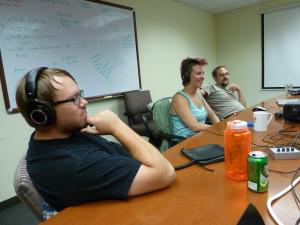
Chris Gammell: And I'm Chris Gammell of Chris Gammell's Analog Life. And who do we have here today? We all ran. Six engineers from SparkFun. I'm Mike Hord, one of the design engineers. I'm Jim Lindblom. I've been here for about four and a half years. I started in a tech support position, moved up to an engineering position, and these days I'm running tutorials and content.
Chris Taylor: And I'm Chris Taylor, engineering project manager, formerly an engineer.
Chris Gammell: I'm Mike Gruson. Let's see, I'm a design engineer here. And I sort of come from an aerospace background, so whenever anything spacey comes along, they tend to come knock on my door here. Good. I'm Pierce Melcher. I am a technical researcher. I have a mechanical background and started in tech support.
Tony Kloppenstein: I'm Tony Kloppenstein. I started in tech support, and I now do quality assurance for engineering.
Chris Gammell: Anyone else? Is that everyone? That's it. No one else failed for the night.
Dave Jones: No one's stuck in yet. And does this constitute the entire SparkFun engineering department, as Chris claimed last week?
Chris Gammell: No, no. We're missing a few people. Most famously, we're missing Pete Docter, according to Pete fame.
Dave Jones: Oh, yes, I've seen these videos.
Chris Gammell: Children, I don't know. I think he's parents.
Dave Jones: Children, right. I don't know.
Chris Gammell: And we're missing a design engineer. Our e-textiles specialist is not here.
Tony Kloppenstein: Product better.
Chris Gammell: One of our design engineers is out. Well, two out of three isn't bad, right? You've got about half. You've got six out of nine. Well, thank you. Thanks for coming on, guys. This is a crazy experiment, and hopefully it works.
Dave Jones: And if it all goes pear-shaped, I told you so, Chris. Because we've had two guests on before, and that was hard enough. Yeah. And now we've got six.
Chris Gammell: But they're on one room. I mean, that's pretty nice. Right. It's like having a studio audience, except we actually get to talk to the audience. That's kind of cool.
Dave Jones: The amp hour filmed in front of a live studio audience.
Chris Gammell: Yeah, we'll be the laugh track. There you go. We'll just cue you when we tell a particularly lame joke. Just watch the light on your computer over there.
Dave Jones: Tony. Tony, being the only female in this group, how many, I'm just curious, because we've talked about it before on the show, how many girls work at SparkFun, do you think, as a percentage-wise? Just out of curiosity, because it always comes up in the engineering field.
Tony Kloppenstein: I'd say in the whole company, maybe like 20%. I don't know. Our finance department has a lot of women. Customer service has a lot of women. Myself and our e-tech sales expert are the only two in engineering. And then we've got our tech support team is about half women as well. So I'd say about 20%, 30%, somewhere in there.
Chris Gammell: For a while there, tech support was 60% female, I think. Yeah. Wow. Three women and two men.
Tony Kloppenstein: Yep.
Chris Gammell: It seems like you guys said that a lot of you came from tech support. Is that kind of the normal process at SparkFun to have people start there and kind of learn the products? Or how does that work? That's kind of in the route. Because the tech supporters need such a deep knowledge of, I mean, I have an engineering degree, and I started in tech support, and most of our tech support people, they need that kind of knowledge as well. So it's been a common path for a lot of people. That's good. That's really good.
Tony Kloppenstein: Our tech support manager hates that, because he keeps hiring good people, and then they leave for an engineering.
Chris Gammell: Yeah, no one likes being the seed team, right? You got to... Mm-hmm. So what is tech support involved there, then? I mean, I've never had to call tech support, but I've used the products before.
Dave Jones: Hello, have you switched it on? Have you tried to turn it off and on again? Is that where it starts? Let me read that data sheet for you.
Chris Gammell: Oh. It's a mixture of people who are using the parts and maybe aren't quite sure how to use them, or people who have an idea for a project and aren't quite sure what they need in order to do that project. It's actually kind of, you know, engineering on the fly. You have to be really quick. When somebody calls on the phone and says, how do you do this? You got to be like, oh, okay, well, try this. Tech support actually got a video a couple weeks ago of somebody plugging something in and it just literally sparking up in flames and smoke rolling out of it. Yeah, but that's your mind. The guy did not intend that. Right, there you go. That's where he came from, too. That's crazy. So it's all telephone-based, then? I mean, or is it, I guess, email as well?
Tony Kloppenstein: Telephone, yeah, telephone, email, live chat, forums, comments on the website. I think that's everything. I don't know if I'm missing anything.
Chris Taylor: GitHub polls.
Tony Kloppenstein: Sometimes issues.
Dave Jones: I was going to say, people don't use telephones anymore, do they? Call up a human? Jeez, that's so 1980s, you know?
Chris Gammell: Well, it's nice if it's there as an option.
Speaker ?: Yeah.
Chris Gammell: And it's tough because, you know, when you're in email, you can run off and do some research and come back with a well-considered answer. But when it's in telephone, you've got to kind of be flipping through the computer real quick and try and come up with answers for people. But people do like to talk on the telephone. It's really surprising.
Dave Jones: And you've got so many products.
Chris Gammell: Yeah.
Dave Jones: How could you, you know, like, oh, wait until I go and get one. I know we've got one here somewhere and let me try it kind of thing. Yeah. A phone call puts you on the spot. That's really tough.
Chris Gammell: More times than not, they would be explaining their issue as I'm frantically trying to figure out what product they're talking about.
Speaker ?: Hey, why?
Chris Gammell: So how many products are there now? I mean, it seems...
Dave Jones: Hands-free headset is your best friend.
Chris Gammell: Yeah.
Dave Jones: Absolutely.
Chris Gammell: How many projects are there these days? We're in the neighborhood of 2,200. Holy cow.
Tony Kloppenstein: You think it's like 500 that we design in-house or something?
Chris Gammell: Yeah, something like 500 in-house builds.
Dave Jones: Wow. That's... We just built our 3 million board. So you'd be churning out one every couple of days, right?
Chris Taylor: Wow. Those are the products that we source, right? So of the 2,200 or so, 400 to 500 are designed by us. So it's more like one or two a week.
Chris Gammell: That's still a lot.
Dave Jones: But you have no shortage of people to do it, though, because SparkFun's got a couple of hundred employees, right?
Chris Taylor: Technically, yes, but those are everything. That's the whole company, the guys that are packaging the... Finance. The guys in shipping. Finance. Yeah. Everybody. So right now, currently, we have our e-textile specialists, our technical writer writing... That's Jim. He's writing tutorials exclusively. And then three engineers designing boards. So right now, we have only three people. Right. Soon to be six people designing boards. We moved him to technical writer, and then we just lost one of our engineers to Motorola.
Chris Gammell: Oh. Okay. Farmer. That happens.
Chris Taylor: Now he's off doing very cool things.
Dave Jones: Yes. Jim, I'd like to consider you the first line of defense against doing all the tutorials and the documentation and stuff like that. The first line of defense before people get on the phone angry. That this damn thing doesn't work or, you know, it's blowing up in flames or whatever like that.
Tony Kloppenstein: Yeah.
Dave Jones: What I'm trying to say here is that they probably don't pay you enough. That's what I'm trying to say. Because all that online information is, you know, all that, that is the first line. That's the first thing you go and check, or most people should go check, is the, you know, have I, you know, is the documentation there on how this thing works? Yeah. So how long would it take you to do good documentation? Yeah, exactly. How long would it take you to do good documentation, thorough for a new board? Right.
Chris Gammell: So every new product we make usually needs some example code to go with it. So usually like an Arduino sketch or something. So that takes a little bit of time. But I, from the few that I've done, because this is kind of a new position and it's kind of a new focus for us, is trying to get a tutorial or something for every product. It's about three or so days to get that product in my hands, play with it, and write something up for it.
Speaker ?: Cool.
Chris Gammell: That's cool. It's fast-paced. We, most of the engineers,
Speaker ?: have been doing our own for, like, if it's a product that we designed, we usually try and do the hookup guide for it.
Chris Gammell: Jim's going to be doing some of those, I think. But right now Jim's also, he's spending a lot of time on sort of tutorials for the essentials, the basics. You know, if you go to the learn.sparkfund.com website, you'll see all of the tutorials that we've got up. And most of the ones that are on the Learn website have been written in the last six months. And there's an absolutely astonishing number of tutorials up there. Jim's been doing a heck of a job.
Dave Jones: Yeah, I see them.
Chris Gammell: Trying to steer away from writing the what is electricity and those concept tutorials, getting a little sick of those. Yeah. No, we're a hookup guide. Yeah. I think we're about to the point.
Dave Jones: Well, I think that's the important stuff because there's so much of the basic stuff on the internet already, really. Sure. So do you really want to reinvent the wheel there?
Chris Gammell: It's hard for us to pick the right audience, though, because sometimes we're writing to college students and other times we're writing to elementary schoolers. Really?
Tony Kloppenstein: And sometimes to NASA scientists. Yeah. The Mythbusters. I mean, all over the place.
Chris Taylor: And with the revamp of the tutorial system, the final goal, which might just be a pipe dream, is to have anyone be able to, you know, regardless of level of experience, be able to go on the site, pick a tutorial, even an advanced tutorial, and then be given a roadmap of all the information they're going to need to accomplish that tutorial. So starting with basic electricity, you are given, you know, read this, read this, read this, and by the end, you should be able to get all the way up to whatever advanced project you wanted to start with to begin with.
Chris Gammell: I like that. I like that a lot. That is a lot of information. No, that's great. Was this an initiative that started about six months ago you mentioned, or was this just kind of a natural thing as you kept hiring people? How did the actual tutorial system get revamped?
Chris Taylor: Well, we started with kind of this scattershot way of making tutorials. If we were interested in something, we'd write a tutorial on it, or someone would ask a common problem like, what resistor do I use with this LED? And we'd say, well, you know, lots of people are having that problem. Let's just write a tutorial about it. And what that got us was a big, long mess of tutorials about everything. So if you're curious about a certain subject, no level of search engine optimization was going to, you know, pour through that list for you and find the exact thing. You just had to kind of get lucky and land on it. So about six months ago, we were working on the Learn site, which is the site dedicated to our education department. And we said, well, why don't we use this as the place to host the new tutorials and kind of organize them at the same time. So we're reformatting all the old tutorials while writing these new tutorials, which involve all the basic knowledge you're going to need to use our products or get into electronics. And that happened about six months ago, yeah.
Dave Jones: Brilliant. You guys have a whole education department, don't you?
Chris Gammell: Yes. Yes, we do.
Dave Jones: And what does that involve? Do they arrange all these road shows?
Tony Kloppenstein: Yeah, they're so busy. We rarely see the entire education department. I think the last time we all saw them in the same place was months ago. So they're constantly out teaching classes all over the US. Yeah.
Chris Gammell: We're currently in the middle of the national tour and we actually bought a big RV and painted it up in SparkFun colors. Nice. And there's teams of three or four SparkFun people driving this route throughout the whole United States, stopping at hacker spaces and schools and basically whoever has responded to us and said they want us to come by and teach a class. And we'll spend all day there teaching them and helping them out with projects and stuff and actually leaving a pretty big package of SparkFun stuff for them to continue working with it. That's pretty cool. Yeah. You know, it was really...
Chris Gammell: I was really surprised.
Dave Jones: And because that's not a profit-making exercise.
Chris Gammell: No, not at all. Either.
Dave Jones: That's a give back to the community exercise. Yeah. As much as possible, yeah.
Chris Gammell: Well, you know, I mean, like, you guys can probably relate to this. Most of us here are a little bit crazy about our evangelism, about making electronics.
Speaker ?: Like, we love doing this stuff.
Tony Kloppenstein: So it makes sense for us to try
Speaker ?: and get other people interested in it
Chris Gammell: because, you know, it's a great hobby.
Speaker ?: Yeah.
Chris Gammell: Do you guys get pulled into the teaching side as well? Or is it mostly you guys are locked away in the lab like Dave and I are? Well, absolutely. We get pulled in for teaching all the time.
Chris Taylor: Tony just got back from the national tour.
Chris Gammell: Yeah.
Chris Taylor: I've got to teach an Eagle class in two weeks.
Chris Gammell: Yeah, I was looking at that on your site as well, the classes and stuff. And obviously I have some vested interest in people teaching classes online and such. But what are those like? Are those mostly on site then? Or are you actually going out to different places and teaching people that stuff?
Tony Kloppenstein: It depends on what we're teaching. I mean, we do do a lot of classes here in the building, which Mike is actually working on trying to get the classes that we do on site recorded and then posted online. So anybody anywhere can, you know, view them and get that information. But as far as the national tour, obviously that was all done on site. We do a lot of local things, you know, anywhere in Colorado or Wyoming or Arizona. A lot of that stuff is all, we'll drive out there and teach the classes there as well.
Chris Gammell: Wow. It's like the Midwest thing, or the far West, I guess.
Tony Kloppenstein: Yeah.
Chris Gammell: We'll go anywhere. I was going to say, we do have Hawaii on our tour days.
Dave Jones: Have you found that there's any states that have a more preoccupation with this kind of thing, a more interest in this side of things?
Chris Gammell: There's hotbeds. I mean, San Francisco area seems to have a lot of this sort of stuff. Boston.
Dave Jones: As you'd expect, yeah.
Chris Taylor: Yeah. Generally, the bigger the city, obviously, the more people just, you know, that's just numbers. But as far as the eagerness to learn this kind of thing or people tinkering with electronics, it is across the board everywhere the same. Right.
Tony Kloppenstein: International and everything.
Chris Taylor: Yeah. Excellent. You're going to get the same amount of fanaticism in a small town in New Mexico as you are San Francisco.
Tony Kloppenstein: Fargo, North Dakota was actually, we spent a lot of time on the leg of the tour that I was on. They were the most excited group that we had, and they were already calling us saying, when can you guys come back? You know, people tweeting at us, oh, why did I miss this class? You know, so not the typical place you'd expect that from.
Chris Gammell: Well, nothing against North Dakota, but what else are you going to do out there, right? Cyber Cleveland, Chris. We love you, Fargo. Yeah, I know. That's true. Yeah, Cleveland probably is on the same plane there.
Dave Jones: That's really great, though. You guys need to bring your van to Australia and go for a tour around Australia. What do you think?
Chris Gammell: Yes, we do. We will do that as soon as we can.
Chris Taylor: Yeah, do us a favor. I'll give you my boss's email. There you go. Just put some floaties on the bus.
Chris Gammell: It'll just get there eventually. Yeah.
Dave Jones: Exactly. You can tell my volunteer work. Oh, boy.
Chris Gammell: Yeah, all of us engineers actually love getting out in the public. There's nobody here that's just, like, staying in their office. It's just really fun, whether you're working with little kids or older kids or whoever. The excitement really kind of motivates you to keep doing a great job of engineering. That's awesome. Can you tell us more about the culture there as well? I mean, so that's obviously part of it is, you know, the external side of things, people being excited. But what's it like working around SparkFun? I mean, what's the company culture like? It's pretty great. Yeah. I've got a beer from the keg in front of me. Oh. There's three of us. Yeah. You're one of those workplaces, luckies. Yeah. I'm one of those in the break room. Yeah.
Tony Kloppenstein: We actually don't have any dogs in here. You didn't bring copper. No, he's hanging out in the office.
Chris Taylor: Yeah, we do our best. The culture around here, we actually have a culture meeting once a year, a company-wide meeting where we all get together and discuss, you know, what we want it to be like working at SparkFun. And the gist of those meetings are that we've stripped away, we tried to strip away any kind of unnecessary.
Tony Kloppenstein: Corporate burrito.
Chris Taylor: Yeah. Unnecessary food in the corporate burrito. But what that amounts to, because we grew organically, we had to start with no rules and then slowly add them.
Chris Gammell: Yeah.
Chris Taylor: And what we come up to with is a set of axioms that haven't changed throughout the years, which are things like we're allowed to fail. So, you know, if an engineer tries something or we try something as a company and it fails, you know, that's perfectly acceptable. Safety third.
Chris Gammell: Is that when you hold up a couple fingers and you're right? Yeah. Yeah. Safety third. We've got skateboards. The order pickers downstairs are riding skateboards through the inventory shelves.
Chris Taylor: Very nice.
Chris Gammell: And we pay more insurance for that. Awesome. We accept paying more insurance to give people the freedom to work the way they want. That's ballsy and bloody, but it's...
Dave Jones: You can actually get insurance for that? I'm surprised. Yeah.
Chris Taylor: We had to special write it into our policy because one of the production guys broke his ankle. Oh, no. We decided it was time to get some actual rules on that kind of thing.
Chris Gammell: So they wrote it in for us. The overwriter there is just like, or the underwriter rather, is probably just like looking at you like, what? Why would you tell me about this? I think part of that is somewhere in the building we have to have a sign that says like, no light guard on duty or something like that. Work at your own risk. Yeah. Yeah. The floor is hard.
Tony Kloppenstein: How to walk upstairs.
Chris Gammell: There's also a great respect for individuality here. You know, everybody kind of has their own weird thing that they like and nobody gets on anybody else about that.
Tony Kloppenstein: And we defend each other for that.
Chris Gammell: Yeah, exactly. Do you have a story about that, Mike? It cross-referenced me painting my fingernails, which I haven't done in a couple of weeks.
Tony Kloppenstein: He has gorgeous fingernails.
Chris Gammell: But yeah, I do try and take care of my fingernails and I was painting them for about six months. And I tell you what, man, electrical engineering is just hell on fingernails. But the soldering and all the dexterity and stuff.
Dave Jones: I don't have fingernails. Oh, sorry. Yeah, I always keep one good fingernail so I can open my, I open the blades on my Swiss army knife and that's, you know, that's all I need.
Speaker ?: Yeah.
Chris Gammell: Yeah. We're in Colorado. We understand that.
Tony Kloppenstein: Yeah.
Chris Gammell: Well, that's good though. So any other, any other quirks or individual, I mean, so like, I guess that's really interesting to like write into your, like, you actually have this written down somewhere, huh? Oh, yeah. Absolutely. Yeah. In fact, there was a front page post about it. If you search back through there, those for, I'm not sure what you'd search for, but cultural values or corporate values. All right. Any, any videos of people skateboarding and picking, picking orders or no? Oh, yeah. Yeah? Okay. I'll have to look for that too.
Tony Kloppenstein: There's plenty of videos about that. Okay. Yeah, they're kicking around.
Chris Gammell: And we actually hold tours of the building. On Friday, I, it's, it's sort of hard to imagine sometimes. We sometimes get a pretty good crowd of people here who want to come see SparkFun and we show them the whole place and they can see the dogs and people skateboarding and lohawks and everything else. And the beers there too, of course.
Tony Kloppenstein: I think we have like 50 dogs in the office on any given day.
Chris Gammell: Five, five zeros. This is a lot.
Tony Kloppenstein: Yeah. Five zero.
Chris Gammell: Holy crap.
Tony Kloppenstein: There's about 150 employees now. So about one dog for every three people.
Chris Taylor: So we, we recently interviewed for, uh, new engineering positions and, uh, that had to go into the, into the job description.
Chris Gammell: Oh, if they're allergic or something.
Chris Taylor: Yeah. We did have someone turn down the position because they were allergic to dogs, which is unfortunate.
Chris Gammell: So, wow. You guys, you guys were tech, tech support. What, uh, has anyone ever called and been like, uh, I got a dog hair in my order. Have they ever sent an order back because of that?
Chris Taylor: Uh, we did have one of the dogs. We have a pretty strict dog policy.
Chris Gammell: Yeah.
Chris Taylor: Uh, yeah. That goes along, you know, with, with being able to have them here. So there's a kind of three strikes rule on barking and that kind of thing. But we did have a few years ago, somebody, somebody's dog butt bit the FedEx guy. Oh no. Uh, so there have been issues in the past.
Chris Gammell: That was stereotypical. Dogs are no longer allowed in inventory. I think at one point.
Dave Jones: And your whole business collapses because you can't get FedEx packages anymore.
Speaker ?: Yeah.
Chris Gammell: I think the dog may have, uh, may have urinated in one of the product bins. Oh no. So now we're not, uh, in inventory area anymore.
Speaker ?: That's amazing.
Chris Taylor: We did not sell that product.
Chris Gammell: That's good. Yeah. So, so we, we do like to have fun here and, and let everybody kind of work the way they want to. But at some, at some point you run into the line where, you know, you need to run a business and everybody has to be able to work together. So, so in, in those cases we have gotten together and, and actually all talked about the rules and, and kind of come up with good compromise rules that everybody can agree to. That's awesome. So I, I wonder about that too, because like you said, you mentioned you grow, you're growing organically and reading about like a company like Hewlett Packard in their early days, they had very similar stuff where it was, you know, people got, they were, they were handed their paychecks by Bill and Dave, you know, and they, they had a lot of the same kind of cultural things, but as they grew, it just got harder and harder and harder. So have you seen that shift at all to the, to the bigger company mentality or is it, is it still small enough that it's still manageable for now? Well, one of the things that, uh, that Nathan has actually mentioned in meetings is, how big do we want to get? Ah, okay. Um, he's actually brought that up of like, you know, do we, I mean like at, at some point Hewlett Packard made the decision to just keep adding business units. Yeah. And, uh, and we have had that discussion as a company. Do we want to get big enough to the point where these things that make us, us are no longer feasible? Yeah. Um, so far we've made, I think at least a relatively conscious decision that we want to maintain our character rather than, uh, you know, necessarily chasing the, the utmost of the bottom line. Um, because it's what makes us who we are. It's a huge part of our success. Yeah. And it, as it helps, I'm sure it helps you make it want to come to work in the morning too, right?
Chris Taylor: I mean, that's a, yeah, as soon as we start, uh, I feel like, uh, the business that we're in and, and as mobile as we have to be in creative, um, if we were to start instituting the, the bigger corporate policies and being a lot stricter with, uh, our work environment and our people, we would lose the environment that allows us to be that creative and to work that, that well. Um, so it is beneficial for us to kind of have as few rules as possible, uh, to just kind of cultivate the environment of, of, you know, being able to make cool stuff. Cause that makes us, you know, it makes our business part of the community that we're, uh, catering to.
Chris Gammell: Well, let's, let's talk about making cool stuff. I mean, uh, you guys have a lot of great kits. You have a lot of, uh, you know, great breakout boards. What are, what are some of your favorite, you know, some of your favorite things that you've made and, and maybe hints on what's coming up? I don't know. Oh, wow.
Chris Taylor: Oddly enough, I never get to ask that question. I recently, let's see. I recently, um, well, yeah, I recently built, uh, sound reactive, uh, forge torch, uh, propane powered forge torch that was connected to, um, a spectrum analyzer chip. It's our spectrum shield. And, uh, the project turned out okay. The solenoid that turned off the, on and off the propane, uh, didn't, uh, quite shut off as, as much as I wanted it to. But it was, it was, that was one of my favorite projects because I got to work with fire. You know, it's, uh, SparkFun essentially paid me to go back to my garage and scare the hell out of my neighbors with a forge torch and then, you know, play electronic music really loud in my garage at three in the morning. Um, so I had no experience whatsoever with, uh, working with propane or, or fire and certainly not any connecting it to electronics.
Chris Gammell: Was that in the, uh, insurance policy too, or should that be written in there?
Chris Taylor: No, that's, I had to do it at home.
Dave Jones: Oh, right. Of course. No, that's why he went home to do it. Yeah, home insurance, right.
Chris Taylor: Well, SparkFun provided one of the, uh, fire extinguishers, but that was awesome. There you go. It's a good product to have in the store.
Dave Jones: That's how you get around any corporate policy.
Chris Taylor: Just go home, man.
Dave Jones: Look, look, I'll just go home and do it, okay?
Chris Taylor: Yeah.
Dave Jones: Look, I'll come back on Monday and it'll be done. You know, that's it.
Tony Kloppenstein: Even one or two projects like that.
Chris Gammell: One of the cool things about SparkFun and about the people who work here is that there's a lot of latitude that you're allowed to kind of present things that you yourself are interested in that you think might be a product. I mean, it's a mix. Pierce is really good at finding possible new products and he presents them to all us and we all talk about them and pick the cool stuff and run with it. And, and people are happy to grab these things and start working on them. But also if you have your own interest, if you, if you think of something cool, I mean, our, our customer base is so eclectic. We've got everything from beginners to like people on NASA and we're not always quite sure what we'll sell if we put it on the storefront and we're, we're small and agile enough that we'll actually try it and see, see what happens. So that, that's a fun thing too about being an engineer here. How do you, how do you judge if something is successful or not? Does it, does it not matter? I mean, there's not, not that it doesn't matter, but is it just a, you know, if, if a couple people buy it, that's enough to be kind of have it in the store and stock it or, or are there actual metrics on, you know, what's a successful product and what isn't? There's, there's sort of metrics. Well, it's kind of, well, this looks like it kind of sells and stuff like that. Um, it's definitely a cool factor involved. Yeah.
Chris Taylor: If something's cool, we will keep it on the site and let it just fail financially for, yeah.
Chris Gammell: Right. And the other one is if it's, you know, if it's like a pretty standard electronics component
Speaker ?: that, then we're like, well, we're an electronics company.
Chris Gammell: We need to be selling this component, you know, even if it's not selling, it's good to have.
Chris Taylor: Right. Yeah. Yeah. Even if no one's buying the 10 K resistors from us, we just have them there. Uh, so you don't have to go to another site.
Chris Gammell: That's good. So yeah. You want to be that all inclusive marketplace.
Tony Kloppenstein: We keep a lot of stuff on the site too, just because we use it so often in house. Yeah. It's easy enough. It's like, Oh man, I really need a AA battery. Just run downstairs and grab one.
Chris Gammell: Yep.
Chris Gammell: Call out the form. Yes. You guys don't have a, you don't have a order fill window, do you? We do. Actually. We do. If you're, uh, if you're ordering from a local Colorado address, you can put in local pickup as an option, come right up to the front desk and, uh, our wonderful, uh, receptionist, Amy will hand you your order.
Chris Taylor: Awesome. Now, I, I don't know if we've ever actually considered making it a window.
Tony Kloppenstein: You do have to go upstairs to get to it. There's a little effort involved.
Chris Gammell: We do have an overall results facilities manager. There you go. Sledgehammer. Yeah. Drive through. What about like a fireman's pole? You could, uh, slide down to have to pick it up.
Chris Gammell: Yeah.
Tony Kloppenstein: For the fireman's pole and the slide. Yeah.
Chris Gammell: One of our guys downstairs, uh, heard himself on Google's fireman's pole and that kind of put the kibosh. Oh, that's true. We were pushing for that for a long time. That or a slide. Yeah. Actually. We can still, slide would be great.
Dave Jones: Here he comes now. He's coming with your kit and he's like, whoosh, comes out of the chute and gives you your kit. You know, that'd be fantastic. That'd be great. That has win written all over it. Let me tell you. Yeah. So you guys manufacture your own boards in house, don't you?
Chris Taylor: Our kits? Yes.
Dave Jones: Oh, as in, well, as in, uh, assembled boards as well. Cause I know, don't know you do have the pick and place machines in house, don't you? So.
Chris Gammell: Yes. Yeah. Uh, any, any like red board that we sell for the most part is, uh, yeah.
Dave Jones: And that's, and that's why you talk about the agile aspect, right? Because you are able to just whack it in the pick and place machine and run off 50 units.
Chris Gammell: Well, there is a decent amount of setup time. Oh, of course. Yeah. The pick and place and all it's, uh, I'd say like 50% of the time, uh, that, that goes along with populating boards and the pick and place is just putting the correct resistors in the right reels and everything. And it can get very catastrophic if you put like, you know, a 10 K resistor and a 0.1 micro farad capacitor.
Chris Taylor: And, and the agility, I think it's more so in the design process. Uh, so a lot of times we'll, we'll get an idea and we'd like to be first to market with this idea. So, uh, you know, the concept comes up in a meeting, someone says, that's a great idea and we can turn around that, that, uh, board or project or whatever it is relatively quickly. Uh, just because, uh, we are open source. Uh, we are selling development tools. Uh, the, a project is usually, uh, worked on by one engineer as opposed to a team of people. Uh, so there's very little in the way of paperwork or, um, you know, we don't have to have an FCC tested, that sort of thing. So that's, that's the agility that, uh, we, uh, uh, I was talking about earlier. Um, but we are actually are, we are, um, also able to produce very quickly. Mike is giving me the stink eye because I mentioned the FCC. Everybody gets the stink eye when the FCC is mentioned. No one likes FCC. Well, he's our, he's our FCC kind of, uh, watchdog. Yeah.
Dave Jones: Now, an interesting aspect of this is you mentioned that each individual engineer does the whole thing. Have you ever discussed that it would be more, possibly more efficient because it is in some companies, it's not in others that it'd be better if say the engineer just does the schematic and then you, the term is throwing over the wall, the board layout to a board layout specialist, for example, because that can bring you optimization efficiencies and consistencies in your design, in your final designs. Has that been?
Chris Gammell: You keep your efficiency concepts to yourself. They enjoy the layout. They enjoy the layout. They enjoy the layout. They enjoy the layout. They enjoy the layout.
Dave Jones: They enjoy the layout. Yeah.
Chris Gammell: One of the great parts of this job is the variety that you get. So one day you might be designing a PCB, but the next year you're doing example code or firmware or, um, tutorials. So.
Tony Kloppenstein: I think it keeps everybody from burning out. Yeah.
Dave Jones: Yeah. Sure. Sure.
Chris Taylor: And we're talking about from conception to product on the storefront, uh, depending on whether or not we have the parts in house, we can turn something around in about a month. Right. And have a production level of that, that product. So if we're having to, to, uh, manage several engineers with, you know, several different people doing documentation, different people doing, uh, all of these different aspects of the design process, it's going to take longer than that. Um, so with the size and the scope of the products that we are, we are creating, it really is more efficient to just have one person, uh, designing the, the, the device. And we keep an eye on each other. There are design reviews. There are things like that.
Dave Jones: Got it. And what cool toys do you guys have? Do you have like a PCB mill in house? Do you have, you know, can you lash up your own board in an hour?
Chris Gammell: We've had discussions.
Tony Kloppenstein: We've been making.
Chris Taylor: That's the one thing we don't have. We cannot etch our own boards. Right. Well, not, not with a machine. We don't have one of those. Yeah. We do have a laser cutter.
Chris Gammell: That's, that's our fun toy. Oh, that's fine.
Speaker ?: Yeah.
Chris Taylor: Got a laser cutter. Got a CNC mill. Yep. That's good.
Chris Gammell: What kind of mill?
Chris Taylor: It's a K2. A big, the big green one. The big green. The big old bridge part.
Chris Gammell: Oh, that's the lane. The CNC, I thought was just a little desktop K2. Oh, like the, uh. Oh, yes. The CNC, yeah. Yeah.
Chris Taylor: So a little brown one. Little brown one. Okay. We do have a big old school metal lathe too, which is pretty cool.
Dave Jones: Come on. Every engineer should have their own PCB mill. They should have their own 3D printer. They should have their own laser cutter all on the desk. You know?
Chris Gammell: We agree. And Dave wants to sponsor all you guys. The entire engineering department sponsored by EEV blog. I'm playing that back for Pete. Yeah, there you go. The address is Pete at sparkfund.com. I'm glad he's not here. So how much, how much do you guys, so when you, when you're coming up with products and stuff, I mean, is it, uh, so Pierce, you said, uh, you're, you're the, the tech researcher product hunter. You said, uh, is it like, uh, you start at it with, uh, with a, uh, end project in mind, like the, the spectrum, the reactive forward sound reactive forge thing you're talking about, or is it, uh, is it more of a, we definitely need a motor driver shield or something or board or how do you actually make those decisions? It's more along the lines of the ladder. Uh, occasionally we will, uh, uh, we'll, we'll look at like, Hey, that's a cool project. How did they accomplish that? And did we have the parts that, that they would have needed to accomplish that? If not, should we look into making sure that we have those parts? Um, most of it though is it's really, you know, I'll see a new technology or something along those lines and say, we, we need to be doing that. Um, and throw out some modules and stuff like that. Uh, those, the new technology and all, I keep an eye on all the blogs. I, I, I, I lurk in forums a lot. And then I have, uh, uh, branded manufacturer reps throwing products at me 24 seven as well. So yeah, is it, uh, one of the, uh, so I say one of the big discussions that we have whenever we're looking at a new product is, is this a product or a project? Is this something that, you know, lends itself to doing just one thing with it? Or is it something that can be incorporated into a lot of stuff? That's good. Yeah. We, we like building blocks. Is that, is that kind of the default, uh, the default first step is to do like a breakout board. Is that kind of the idea or is it more of the do that whenever you need to kind of thing? Cause it seems like a, that's, that's how you guys started, right? It was breakout boards.
Chris Taylor: Yes. And the, the first step is always that do is give the customer only what they need to use the device. Uh, we don't, that way, uh, it can be used in, in any way, in the most general way. So any, any project they're putting that in, uh, they, they are not hindered by some setting that we've made some, some decision that we've made for them. Uh, other than that, uh, it's if we see something particularly novel, some, some particularly novel use for this device. Um, and, and that's, that's the same thing. That's giving the person only what they need to do that project, uh, and, and staying out of it otherwise.
Dave Jones: Tony. Yes. Your quality assurance QA. Can you tell us what your role there is? Or do, do people like, here she comes, here she comes. QA. Hello. QA. Hello. Hide the prototype. Hide the prototype.
Tony Kloppenstein: That's probably what they do when I'm not looking. Um, my, well, my business card title now says engineering quality assurance pistol whipper. Cause I basically have to go around harassing the engineers. I'm like, Hey guys, you know, this is really needs to be updated or, you know, fix this, please, please. So the customers stop yelling at us. Um, no, I mean, it's kind of a, it's, it's actually a new position that just started about four or five months ago. Um, so a lot of what I've been doing is actually, uh, like we were talking about before the show, getting all of our stuff ported over to GitHub so that way we can have an easier way to track customer feedback and customers trying to, you know, give us code that they want us to, that they want us to use or they want to share with the community. So, um, getting all of our board files on there, trying to get, uh, 3d models of all of our boards up and running. Um, a lot of it's just been documentation organization for the product. So that's been a lot of it. And some small revisions, just things that have been sitting around that, you know, the engineers are too busy to, you know, they don't have time to go back and deal with, you know, a tiny little breakout board that just needs a silkscreen update or something like that. So.
Dave Jones: Well, that's what engineers do. They, once they, once I get to that 90% mark, they just, right, done, they move on to the next cool thing, you know?
Chris Gammell: I wish that were true.
Dave Jones: Hence, you have to pistol with them the last 10%, you know?
Speaker ?: Yeah. Yeah.
Chris Gammell: What is your, what is your flow like for, uh, for GitHub? Because I, I was looking at that recently for, uh, KiCad type stuff and I've never done any, uh, GitHub code stuff. Is it just kind of using it as a, as a file dump kind of thing or do you actually have a process for, for utilizing it like programmatically?
Tony Kloppenstein: Uh, I mean, we're still trying to figure that out as we go. It's been a lot of just sort of as boards get revised or as new boards are going up on the storefront, we're adding stuff to GitHub. Um, it's been a lot, a lot of what we've really used it for is, uh, I think the biggest place that's been a good resource for us has been Eagle. Um, cause we do all of our board designs in Eagle and, you know, we try and, we try and add to our SparkFun Eagle parts library every time there's a new board that goes out on the storefront or something like that. But a lot of times, you know, old boards that were four or five years old, those parts aren't in the Eagle library. So it's nice cause we can have our customers design those parts and then, you know, just issue a pull request. We can throw that in and then it's available to everybody instantly. So, um, it's, we're still trying to figure that out.
Chris Gammell: So we've, we've always struggled with revision control and, uh, I think it's, I think we've solved it with GitHub. It's a nice forward facing way to like present our revisions. Yeah. Yeah. Especially if you're, if you're doing open, I mean, why not? Right. Exactly. It's very, it's a very sturdy, sturdy place to put everything. It's, you know, it's popular, popular format. It's, it's good. So speaking of open, uh, are any of you guys going to the open, open hardware summit, uh, coming up? Any going to be there? Yep. All of you? Yep. Tony and I are, uh, Tony and I. Yeah. Tony and Mike. Tony and Tony.
Tony Kloppenstein: Yeah. We'll be going.
Chris Gammell: Awesome. And Nathan, I think we'll be there as well.
Tony Kloppenstein: Yeah.
Dave Jones: I won't be going. I'm only 15,000 miles away. Sorry. Come on. I need some sympathy. Come on.
Chris Gammell: Aww. Aww. Move to the States. So could you, could you tell us more about the, the culture open at, at SparkFun? I mean, like what's, what's it like there? I mean. Uh, vehemently open. Yeah. We, we, uh. Embarrassingly open. Like, like pervasive, like, like, uh, open, uh, salary, like roles and stuff. I've seen that before too, where people talk about like, oh, everybody's salary should be published. Like that kind of openness too? Or what are we talking here?
Chris Taylor: Well, that's, that's something we've talked about a lot is, was where, where do you draw the line? Yeah. We've given talks on, on, at conferences on where do you draw the line as an open company?
Chris Gammell: Yeah.
Chris Taylor: Um, and we kind of decided, you know, what, what do you need to, to, uh, create this environment that we already have? You know, what do we need to make open? What do, what do we need to, uh, release to each other and the public? And, uh, it, you know, we had to draw the line at, at kind of, uh, what is this information actually giving you? You know, if we release our financials to everyone, uh, how does that help us as a business? How does that help them as, as, you know, the, the consumer of that, that information? Um, so we kind of draw the line on a case by case basis, but, uh, uh, around here, it, closed source is, is, uh, a, a kind of disease to us. So if, if we're looking at reselling something, we're looking at, uh, uh, working with someone as soon as we hear the words, uh, non-disclosure agreement, closed source, uh, that's pretty much the, the, the one and final nail in the coffin, uh, for whatever that is.
Chris Gammell: I, I, on multiple occasions, I've had to shoot down pretty terrific projects simply because they, they didn't want to release schematics. They didn't want to release board files or source code or anything like that.
Chris Taylor: And internally we've, we've written our own, uh, ERT, our backend, um, our IT guys built it from the ground up. Uh, so that's how we maintain, uh, what does it stand for? Enterprise software. Enterprise software. I don't know what the, uh, actual acronym is. Oh, ERP. ERP, yeah. ERP. ERP. ERP. ERP.
Dave Jones: Yeah, that's right. Yeah.
Chris Taylor: Yeah. Um, so they've written that from the ground up, tailored, uh, perfectly to, to what we need from it. And they're always threatening to open source that as well. So now we're talking about.
Tony Kloppenstein: Our open source. Yeah.
Chris Taylor: What's that?
Tony Kloppenstein: Uh, parts of it are open source.
Chris Taylor: Parts of it. Yes.
Tony Kloppenstein: Anything that doesn't compromise customer data is available on GitHub. So.
Chris Taylor: Oh, cool. So even that, you know, what would be, um, a very expensive piece of software is, is, uh, we're always trying to open it more.
Chris Gammell: Does it ever, uh, does it ever bug you at all? I mean, like I, I, obviously I'm a big fan of open too, but I mean, I was reading, I was reading Nathan's letter to the, to the Senate, I believe. Uh, you know, he's talking about the, uh, things are copied within a couple of weeks and everything. Is it ever just like, ah, man, again, like does it ever get you guys at all?
Chris Taylor: It bugs the hell out of me. If someone, if someone takes the, the best thing that someone can do is take what I've made and make it better. It makes something cool out of it and, you know, make it more, you know, see something in it that I didn't see and, and copy it, but improve it or change it in some way to make it their own. That is part of, you know, one of the big reasons I do the job, but it, when someone takes it and I see it on a, on a store or a shelf, especially, you know, when I see this physical thing that I've designed and someone has just copied it and, and, you know, put it in some packaging, made it a different color. It is frustrating, but like, I think everybody would agree. That's just the nature of, of how it works. Such as open source.
Dave Jones: That's where most people seem to draw the line in, even if they don't want to admit it, that's where I think most open people, open hardware supporters draw the line. And I've done that in my, you know, unwritten rules of open source hardware video that, that, you know, when you don't add any value to it, that you just copy it, blatantly copy it and rip it off, even though it might be legal, it's just not in the spirit of it. And I think most people seem to, you know, um, accept that as a, you know, as one of the unwritten rules, so to speak. Is that the similar feeling around spark photos? Yeah.
Chris Gammell: You can't prevent people from copying it and still allow people to copy it and innovate it. So sort of our approach is that we would rather, you know, err too large, you know, give everybody the opportunity to innovate it, even though some of them will just copy it. Like, um, Jim made the beautiful board of the Makey Makey and how long did it take before we saw that copied on Chinese websites? Probably a week. Yeah. It was astonishing. Before I click. Probably before the board even went out.
Chris Taylor: Yeah. And the consolation is that, Hey, you know, even though someone is making money off of your idea, you know, imitation is a sincerest form of flattery. So on a personal level, someone, you did work that was good enough for someone to copy. Yeah. And worked really hard to copy. Exactly. Um, and on the other hand, you know, it did. Exactly. Yeah.
Chris Gammell: You know, while we're innovating. Yeah.
Chris Taylor: While we're innovating. So that's the, the big consolation is we're going to be on top of the next thing while they're copying us. Right.
Chris Gammell: Exactly. And that, that's Nate's big point is that, you know, it's okay if they copy you as long as you keep moving and making new stuff. Yeah. And I guess that makes it more exciting for you guys too, right? I mean, it's more stuff to work on, more stuff to dig into. And it's not just a problem for open hardware electronics in general. It's a, it's a problem for like an iPhone, anything, anything can be copied really. So making a closed source delays that counterfeit process by. A way cool too. Yeah, exactly. Do you guys do any, uh, do you have any recourse when people don't, uh, they don't, you know, credit you properly based on license and stuff like that? Do you send them like a letter that just says, not cool or anything like that?
Tony Kloppenstein: That's, that's basically pretty much it. Social media.
Chris Gammell: Yeah. Okay.
Chris Taylor: I don't, I don't know if we've ever called a lawyer about it. No, no, no.
Chris Gammell: I just mean like a letter, just like a, from you guys, like not cool. Yeah. Yeah.
Dave Jones: We just sent a couple of those letters. Check out these idiots, you know? Yeah. Yeah.
Chris Gammell: It's gotta be, it's gotta be pretty far up there. Like we've had a couple of companies where it's, it's very obvious on their schematics that they just copy and pasted. Yeah. They took a screenshot of our schematic and that's theirs.
Tony Kloppenstein: We're the company that copied our employee photo. They were, they copied all of our, yeah, they copied all of our product pages, their schematics, all that. Yeah, they scraped the site. And then they posted a, yeah, they just scraped the site and they posted our employee photo. So we're all like, oh, Hey, we've got second jobs overseas.
Chris Gammell: Start writing them for paychecks. I did not receive my paycheck this week.
Chris Taylor: Uh, I think the only, the only time we, we really get agitated, you know, we get copied all the time. So it's just the nature of the beast. The only time we really get agitated is if someone's using our name. Yeah. We care about, um, cause attribution is, you know, the name of the game. Uh, and even then if someone's using, we've seen people using our logo a few times to sell counterfeit stuff. It is just a sternly worded personal email from our engineering director saying, Hey, we see that you're doing this, take our logo off of it. And that'll be the, yeah, the last you hear of it.
Chris Gammell: Right.
Dave Jones: And, and, and they do comply once they get that usually or usually, yeah. Is it because they just didn't know? Do you think, or was it like they, they just didn't care because they often, right. You know, I don't want to stereotype, but it's usually the Chinese doing it. Right. And that is often their culture. It's a cultural thing that they don't see a problem in doing that. So, you know, um, it's almost as if you can't blame them because that's what they're brought up to think. So it's interesting that you say, yeah, once they, once they're made aware of it, then they go, Oh, okay, sorry, I'll take it off.
Tony Kloppenstein: And it's probably just once they notice somebody paying attention, you know, they move on to the next thing to copy and forget about using our stuff.
Chris Gammell: So, and a lot of times if it's, if they're just copying the board design, it's not, you know, that we're telling them to stop it. We're just, a lot of times we just ask them to provide attribution saying, you know, this was based off a SparkFun design. So what about the store as well? So we had a question, uh, for, on Reddit as well, that, uh, it might be possible to sell stuff through, through your store. So is that, is that actually a thing? I mean, are people able to, to get their own products into the SparkFun stores? Is that more of a, uh, a difficult process? We have a tutorial.
Chris Taylor: We do have a sell your widget tutorial.
Chris Gammell: This is how to go through the process and ask SparkFun to sell the widget. Of course, anything that, that comes to us, the engineering department, that's, yeah,
Chris Taylor: to make sure that we're all on board, that it's a fair product. Yeah. Yeah. It's, it's not as simple as, uh, you know, Hey, I'd like to, yeah, I set up an account and I could start selling where, you know, we don't work like Etsy.
Dave Jones: Right.
Chris Taylor: Uh, but if something is cool enough, we will, we will contact the person or vice versa or the designer and they will, uh, either manufacture themselves and sell through us or, uh, we will take their design with their, you know, blessing, of course, uh, manufacture it in house and then give them a royalty on it.
Dave Jones: Right. Is there a, do you guys prefer one way over the other or are you not fast?
Tony Kloppenstein: It depends on the product.
Chris Gammell: Yeah, it really depends. Um, that more recently we've been just simply because we've been short on design engineers. Uh, we, we, we've preferred they manufacture it themselves, but I mean, with the addition of new design engineers that, that can quickly change.
Dave Jones: Of course.
Chris Gammell: It's yeah. Uh, it is, it's a difficult process. It's part, it's part of my job. And I, I, I sometimes refer to it as dream killing. Yeah.
Dave Jones: Doing that clockwork stuff. Exactly.
Chris Gammell: And I, it's, it's, it's hard because, you know, it, it might be a good project or it
Speaker ?: might be a good product and all, but you know, the market for it's very slim.
Chris Gammell: It wouldn't justify, uh, you know, us putting a lot of time or effort into it, which bums me out a lot. And I'm sure it bums them out when I, I explain that to them.
Chris Taylor: Or in the case of a lot of designers, they have this, uh, you know, very cool board that they're trying to sell at cost. So they think that, that we're going to be able to, you know, sell it, sell something at cost that say, Oh, I've got this, you know, uh, Arduino Uno clone that only costs two 50. And they're very disappointed to hear that we are not going to be able to, to sell it at two. Yeah. Exactly. Yeah.
Dave Jones: A lot of people don't understand margins and how that works because you know, you, you know, you're the kit might cost you $10, but if you want to, uh, sell it through Spark, do you have resellers? Cause you have Spark fund resellers, don't you? So then you guys have to sell to them at, you know, they've got to make their margin. Usually the last person in the food chain makes the highest margin. Um, usually, you know, that's sort of, you know, to a first order, that's how it works. So, you know, it's a lot of people don't realize that and how things scale up as they go through price scales up as they go through the food chain.
Chris Gammell: Yes, exactly.
Dave Jones: You need a tutorial on that.
Chris Gammell: Yeah, I think we do. Yeah. I noticed you guys are selling, uh, like local here, it's called micro center. It's just like a computer store, but, uh, bubble pack stuff. I was, I remember the first time I saw that I walked in, I'm just like, holy crap. I obviously did not realize prior to that. But so what's, I mean, look, what's, what's the response to that? Is, is that like a marketing tool as much as it is, you know, an actual way for people to get parts? I mean, do you see that a lot in the, in the, uh, the customer support stuff? How does that actually affect your business?
Tony Kloppenstein: It definitely, as far as from like a tech support customer service side, makes things a little bit more difficult just because, you know, we try and do it where if somebody buys something through one of our distributors, they go through that distributor as far as returns or replacements or anything like that. So that does get a little difficult because we still support any of our stuff, no matter where you bought it, who you bought it from, when you bought it. Um, I mean, we've had customers call up and say, Hey, I bought this board eight years ago and if we stopped working, can you help me with this? So that does make it a little more complicated, but, um, I don't know if that's really a huge point for our advertising. I don't know if that's really generates a ton of business for us.
Chris Taylor: Yeah. That's, that's tricky because I've also seen, uh, retailers in electronic stores, not micro center necessarily, but in other electronic stores carry our retail products, but they also want to carry some non-retail products that we have and we'll put it in packaging that looks just like our retail packaging themselves.
Chris Gammell: Huh?
Chris Taylor: Uh, I think just so it's easier for people to spot.
Chris Gammell: That's interesting. Yeah. Shout out to our friends at, uh, you do it electronics electronics in Massachusetts. Yeah. They sell a lot of our stuff in, uh, in bags, uh, with little, little headers on them that we don't sell as retail stuff. They just, they're signed up to be distributors and they buy it at the distributor price and put it on their, on their shelves.
Dave Jones: Have you ever had to turn away people for support because they've bought the cheap clone on eBay? Is that like a company? Sorry, you didn't buy it. It's not an official SparkFun product. We can't support you on that. Please go to the forum or something.
Chris Gammell: You know, we really try hard to, I mean, even people who haven't bought any of our stuff, you know, they'll call us and ask us questions. Right. And, you know, depending on what else is going on, we, we will try and help as many people as we can. You know, having said that there, there are lines you have to draw sometimes. Sure. And we've got one or two people who are kind of needy in the tech support area that, um, you know, we do try to help out, but at some point you have to wean them off and send them, you know.
Tony Kloppenstein: Send them to more appropriate resources. Yes.
Chris Gammell: Thank you, Tony. I mean, it's very. The big one lately, I think, has been, I bought this Arduino board at Radio Shack and when I Googled it, your company's name. Yeah. Oh, goodness. That's happened a few times. Yeah. And can you guys come to my house?
Dave Jones: Well, I've got the same dilemma, you know. I get just emails, you know. I've, I've had to resort to, I can't spend the time now, so I've had to resort to sending them a, a form letter response that says, sorry, I don't have time. Please go ask on the forum. That's what it's there for, kind of, you know, as a one man band, um, that's, you know, what I've had to resort to. And it, and it breaks my heart every time because I want to spend the half an hour to write a detailed response to them. But I know I just can't, you know, and that, and that breaks my heart as somebody who's, you know, back in the old day when I used to lick a stamp and actually type it on a typewriter response or handwrite a letter and then stick it in an envelope and send it back to them. You know, that's, I enjoy doing that. I think all of us do.
Chris Gammell: Yeah. It's funny you mentioned the, the, the handwritten letter. Cause we once, I think it's only happened once and it happened, I had to receive it. But when I was in tech support, we did get a handwritten letter. Nice. And it came from Australia. Oh, brilliant. Nice. Not Australia. Yeah, we're a bit back when here in Australia. Yeah. Came from 1985. Didn't they want a printed copy of our catalog? Possibly. Yeah, it could have been. Oh, okay.
Dave Jones: And did you handwrite or apply?
Chris Gammell: I was, I was getting ready to, but they, I noticed they include their email and so I emailed them back. I guess something must have been happening. They had written multiple emails that just kept getting bounced back to them. So I don't know if they were misspelling something or anything, but they finally got fed up and wrote us a handwritten letter. I can't stand SPRAC fund. What's with these guys? Oh, goodness. So you guys don't have a written catalog. Do you have a printed catalog? You never jumped into that space. No, I think we had a really, we have an auto-generating PDF that kind of assembles things from the website that you can print if you're, if you hate trees. It changes so, it changes so quickly. Every week we've got another half dozen products. And so the web's really the best way to do it. And I got, I got to give a shout out to our ID, IT department, because I think we have one of the best websites in the industry. It is pretty good. They've worked really hard on it. Yeah. It's pretty amazing.
Dave Jones: Yeah.
Chris Gammell: I like it.
Dave Jones: Hats off to them. Do you guys, how much, how much do you, how much of your stuff is made in the US? Like, do you get your bare boards made in China? Do you, I know, I know you assemble a lot, you know, you assemble your boards in house and stuff like that, which is fantastic. But what about bare boards or other things? Is that a company policy to try and keep jobs in the US, so to speak?
Chris Taylor: It's the policy to try. Yeah. As far as that goes. Our boards are manufactured in China though. And our, our parts come from where, wherever our parts come from. Usually that's just the cheapest option.
Chris Gammell: I'll say a lot of people probably think the parts with China too, but in my experience, we get silicon from all over the world.
Dave Jones: Well, they can come, when you order a chip, it can come from any one of five different manufacturing plants around the world. You often don't know where it's coming from. You know, it could come from a US fab. It could come from, you know.
Chris Gammell: But most packaging in China, China or Malaysia is most of the packaging too. Oh, right. So it ships from there. They'll fit it in one place and then package it in the other. Yeah. Actually, a week or two back, we had a really cool news post of the carbon footprint behind the Pro Mini. Right. That kind of traced all the destinations. I will have to link that in. Is that online?
Dave Jones: Is that available? Yeah. That'd be awesome. Yeah. And what was the outcome from that? Was it surprising?
Tony Kloppenstein: It was kind of skewed because the numbers, I mean, it looked at, you know, what's the carbon footprint of one plane flying across the Atlantic or something like that. And of course, that's, you know, if you look at it from the standpoint of one board, it's going to be outrageous. Oh, of course. But you have to understand that we're doing and receiving thousands of parts at a time. Right.
Dave Jones: Yeah. It's almost impossible to. Yeah. Yeah. It's an impossible calculation. Have you guys ever been burned by fake slash faulty grey market parts?
Chris Taylor: Uh-oh. You've got the answer to that. That's right. We had a big issue with that, with fake at mega chips. Oh, yeah.
Chris Gammell: It was during a worldwide shortage, wasn't it? Yeah. The 328 was hard to get.
Dave Jones: Fake in what way? Were they just simply like no dye inside, just a package? There was a dye.
Chris Taylor: They were nice enough to include a slug of metal. Oh, right. Yeah. A useless slug of metal.
Chris Gammell: It was a chip of the right footprint. It was just completely with new labeling on it to make it look like a genuine chip. Yeah. It's kind of amazing. We ended up doing x-rays of it, and it was like an on-semiconductor dye or something. Right.
Dave Jones: It was some other chip, and they just, that cost one cent and all they got for nothing. And they just rebadged it out. Some scratch. Is that because you tried to go through a third party, you know, a gray market seller, so to speak? Yeah. Rather than, yeah. Yeah.
Chris Gammell: Times are desperate. Yeah.
Chris Taylor: Those are the dark days.
Dave Jones: Yeah.
Chris Taylor: And we actually wrote a whole news, a blog post on that as well. Right. With pictures and scans of the chips and things like that. Yeah. Just the counterfeit at Megas. Yeah. We briefly tried to sell the slugs, too. We tried to sell them just for- Hey, you got to make it up somehow. Spark from history. Novelty. Yeah. But I think that's illegal.
Chris Gammell: Well, not if you sell them as like gift items or something, right? Details. You're like, yeah. Yeah, I don't know what the exact law is.
Chris Taylor: They give it a key change or something, right? We were saying they were counterfeit. Yeah.
Chris Gammell: But- And to be fair, I mean, this wasn't like, you know, somebody in a back alley offering us checks. Oh, right. This company had a legit looking website and, you know, people kind of checked into it as much as they could and sent them a check and we actually did get parts back. I mean- Yeah, that's good start. That's kind of the funny thing. I mean, they could have just disappeared with the money and not even sent anything. Yeah.
Dave Jones: Well, they're often a parts broker. So they can get- Yeah, they don't know. You're buying through the broker and then they get from wherever source of the source. So you don't know who they're getting from. And, you know, sometimes you get great- 99% of the time you get great stuff. Other times you get bitten.
Chris Gammell: Yeah. And shortly after that, the company just disappeared off the face of the earth. So- That's how it usually goes. And that's a learning experience. I mean, we've got a bunch of buyers right now who are, you know, pretty good at what they do and learn from these things. And we haven't- we don't have too many problems like that anymore, really. That's nice to have buyers in-house. I miss that from my stuff. Yeah. I used to have them in-house. Yeah. You know, like, because they'll have that knowledge that you'll- you know, like, you can be like, oh, of course, you know, you know, that's fine on all the distribution sites. It looks great. And then, you know, the buyer's like, uh-uh, you're not using that. Go back to the drawing board. Start again, buddy, because you're not allowed to use that part.
Dave Jones: There's no way we can get 10,000 of those within a year. Is that something that get, like, if you work on a design and, you know, you're so proud of it and you finished it and then you send it through to the buying people and they just go, uh-uh, sorry, we can't buy this. This is a no-go. Have you ever been hit by that?
Chris Taylor: Eh, not from the purchasers, no.
Chris Gammell: I've occasionally- Okay. They'll get wary if I'm asking for larger quantities of things. All right. The warehouse space is kind of at a premium at the moment. We're getting very big for the space we're in. Did you guys just move?
Tony Kloppenstein: Not yet. Not yet, yeah. Oh, okay. We just broke ground on the new building, so.
Chris Gammell: And so when's your space when you're supposed to move over there? Quarter one of 2014. Oh, cool. Wow.
Chris Taylor: But that is projected, so it's probably going to be- Quarter three. Quarter three. Yeah. Yeah. Yeah, we'll contract that.
Dave Jones: Is there a plan to do that without disrupting your, you know, disrupting all your shipping and all that sort of stuff? Any idea how that's going to work? From the logistics?
Chris Gammell: It's really hard work. Yeah, yeah.
Tony Kloppenstein: Our IT department's already working on tracking inventory, and they're kind of rewriting the whole system for that, so that way when we do move, it's as low impact as possible.
Chris Gammell: Yeah, it really would not surprise me if there's an all-hands Saturday or Sunday or both involved. I think at least both. Yeah. I think it's going to be kind of this complete exodus. Yeah. That'll be a lot of people on skateboards.
Tony Kloppenstein: It's only a mile away, so. All right. Okay.
Chris Gammell: Did you guys get to design your own space? Because that's always, like, awesome. Or is that- Yes, we did. Yeah. We were talking about fire poles and slides earlier, but a lot of people really wanted some crazy stuff in this building, and to their credit, the people working on it actually let us get away with a lot more than probably anybody else would.
Dave Jones: Yeah. We got a climbing- Is it a brand new building, or is it a- Yeah.
Tony Kloppenstein: Built from scratch.
Dave Jones: Oh, it's actually built from scratch, is it? Right. That's what we did at Altium, and the owner said, we must have a glass staircase. Staircase. So we got a glass staircase. We need one, too.
Chris Gammell: Watch out on shorts day.
Dave Jones: And then we wanted to do this- Okay. And then we wanted to do this project where then each- You would put a row of RGB LEDs behind each step, and then you could control them and, you know, light up the staircase as you walk. It would detect your movement and all that sort of stuff, and that was a project that was actually on the cards before they packed up and moved to China. So, glass staircase. Yeah, companies will do crazy things.
Chris Gammell: I'm sure we'll do lots of interesting things in the new building. It's supposed- One of its purposes is to be a showcase for, you know, projects that we do, projects that our customers do. So there's going to be a lot of really cool stuff there. That's great.
Dave Jones: With your projects, what sort of- What would be a high-volume product? Like, you know, is it- Are we talking thousands, tens of thousands? I assume it wouldn't be the hundreds of thousands.
Chris Taylor: Thousands. You're looking at- Yeah. Thousands at a time. Right.
Dave Jones: A thousands would be a popular product. Yeah. So you often can't get good volume discounts, you know. Oh, you only want a thousand chips. Well, maybe.
Chris Gammell: But if they've got them across different products, too, right? I mean, you guys have stuff that shares them across products.
Dave Jones: Oh, of course. If you can reuse them. Yeah, yeah. Yeah.
Chris Gammell: We go through a lot of app-making. It's the 28s. Yeah. It's just kind of our bog-standard jelly bean 8-bit micro-controller. Yeah.
Dave Jones: Right.
Chris Gammell: With bare materials, we often can get pretty good volume pricing. It's the products that we're simply resellers for that it gets a little hairier. Oh, yeah. It often requires a lot of negotiation on my part.
Dave Jones: So you have like a list of parts that- a list of preferred parts for any design, and you do your utmost to sort of design them in, even if they're not optimal. You'll know, oh, I can optimize it, but I'd rather by doing this, but oh, that adds a new part to the inventory kind of- Yeah.
Chris Gammell: Exactly. Yeah. Exactly.
Dave Jones: I can picture you having to, as a designer, having to trade off with that annoying quirk.
Chris Taylor: Yeah. Usually we don't hit those kind of tolerances, though. You know, we're always okay with using the 10% tolerance resistor. Or, so, you know, if it helps improve the functionality of something, we'll usually, you know, add another part.
Dave Jones: Right.
Chris Taylor: And then, you know, now we have that for the next project. So we usually don't run into a problem with that.
Chris Gammell: Yeah. And our production inventory is, I don't know how many thousands of parts, but it's a lot of stuff. And that usually compromises 99% of what's on a board. And it's just those, you know, the new purpose-built chip that you're actually making the breakout board for that turns out to be the new thing that needs to be added to inventory. Yeah. Yeah. So we don't have a lot of people on the show that have manufacturing on site anymore. And I used to be at a place that had manufacturing on site, two different places, actually. And one of the big things is, in engineering, when you need a part, and you go out and grab one, and then you get in trouble later when they're doing inventory. Do you guys have that strife, or is it because, like, do you just go on the website and order it and then go upstairs and pick it up? A little bit of both. If it's a storefront product, we can place an internal order, go downstairs, grab it off
Speaker ?: of the inventory shelf. No problem.
Chris Gammell: The problem is if you're designing something and you need something that we use regularly, but it doesn't, we don't sell it on the storefront. And then you go downstairs and you dip into the production inventory. Oh, yeah. You know, they... You're supposed to reduce the quantities. Yeah. As long as you let somebody know that you're doing it. Yeah. Yeah. They're pretty forgiving of that. Yeah, but... Man, I...
Dave Jones: And then if you only need one, you always take two because then you build up your own secret stash. Every engineer has their own secret drawer of stash. Come on.
Chris Gammell: Why stop at two, Dave? Come on, man. Take 20. It just will. I know. Take 10.
Dave Jones: Like, order of magnitude, you know? Yeah. Yeah.
Chris Gammell: And there always used to be these very nice but very stern ladies that I'd have to get past. There's always the guardians. You have to... You know, you're like slowly counting off the reel. You're like, I've only got 10 ladies. I'm okay. Don't jerk me. Yeah. I can't say that any of us has not been guilty of that at one time or another, but we try to be careful about it because we like the production people. We don't want to make their lives any harder than we do. Oh, yeah. They make their lives easier. Yeah. When inventory time comes, we all end up down there counting parts. Oh, yeah. Oh, yeah.
Chris Taylor: So the whole company counts.
Chris Gammell: See, now there's something that's not a big deal if you guys go bigger, right? Maybe you can try and hand that off to some interns or something, you know? Yeah. You ever count a little jar full of SMD resistors? No, I have interns. Have you ever had any rush jobs?
Dave Jones: Have like, has somebody came in? Oh, look, there's this new chip. I want it by the weekend. Damn it.
Chris Taylor: As far as that goes, no. Usually if something's time sensitive, it's because we want it for an event. So I definitely pushed, like rushed through certain kits because we wanted to teach them at Maker Faire. Other than that, the new technology teardowns are usually the only other thing that really gets rushed. So Mike just did our leap motion teardown. Oh, yeah. We're like, all right, you know, we got to be, you know, as soon as possible on this one. Oh, yeah, you got to be Johnny on the spot.
Dave Jones: Yeah.
Chris Taylor: Drop everything you're doing. And he turned that around in, what, a day, two days? Yeah, about a day.
Dave Jones: You have to. Otherwise, you may as well not bother because somebody else has done it.
Chris Taylor: Yeah, right. So, yeah. I have an Oculus Rift sitting on my desk right now that was supposed to be for a teardown, but we didn't get it in time. Yeah. Nice story. So we're going to have to hack it in some other way.
Chris Gammell: Can't tear it down now. I've got to use it to play a game. Sorry, guys. Right. Well, you guys paid for the Google Glass teardown that Star and I forget the other person. I mean, that was cool, too. That's great. You guys are funding lots of good science-y stuff on the web.
Dave Jones: Is there like a corporate policy that we're going to put X percent of our revenue back into community projects, education, something like that? Or is it just whatever is cool? I guess you guys aren't the best to answer that.
Chris Taylor: Yeah. I mean, that's just the education budget, really. You know, the budget we give to the rocket education. We kind of turn them loose and say, and they're very good at what they do. And a lot of what they do is about half outreach and half curriculum development. And, you know, I guess the third half would be actually going out and teaching it. And they're always, always busy. So a lot of that department is, you know, where that percentage of our budget goes to giving it back to the community. And they, sorry.
Tony Kloppenstein: I was just going to say, even beyond the education department, we also, you know, we try our best to support projects that we find that are cool. Even if we can't necessarily throw funds or parts at them, you know, give them a shout out on the social media or Kickstarter page support or something like that. Just to kind of get the word out there for them.
Chris Gammell: We did just do our donation day for the EFF, too, a few weeks ago. Right. Nice.
Speaker ?: I forget how much we donated, but all of our sales for that day, we donated some portion to the EFF.
Chris Gammell: We do have a sponsorship budget as well.
Chris Taylor: Yeah. And a little bit here and there.
Chris Gammell: You know, there's a show called The Amp Hour, if you guys ever have a place you need to put money. I'm just saying. Not to cross an editorial barrier, but, you know. I'm just saying.
Chris Taylor: The idea of our education department originally was to get it going, funded with Spark Fund's revenues, and then have it break off on its own. Oh, cool. And become its own unaffiliated nonprofit organization.
Chris Gammell: Is there still plans for that?
Chris Taylor: That's still on the table. We're not actively working on it right now. But the more public schools we get into, the more classes we can teach, the more awareness there is of this kind of curriculum and this educational organization as its own entity, the more the discussion turns to turning it into a nonprofit.
Chris Gammell: Do you guys have any anecdotes just about the schools and such like that? I mean, do you know how much of your business roughly is schools? Or maybe just anecdotally, do you know, like, well, two out of the ten kids that my kids know know who Spark Fund is? Like, anything like that? Well, we did just get a big order through for the New York City school system.
Tony Kloppenstein: And Baltimore, too. Baltimore, too, now. Wow. We have the metrics on our site. We have it broken down by, you know, customers and then distributors and then educators, too. And I think for a lot of stuff, that's like 1% or 2% on a lot of the products. So it doesn't seem like a lot, but then, you know, you think about the classes we're teaching. And I don't know, it seems like we get a lot more feedback from those groups. Yeah. So it's kind of, it's hard to gauge it that way, but.
Chris Gammell: It's probably the fastest growing of our customer bases. That's awesome. That's really, really good. So, like, we might see Spark Fund base classes in schools then, huh? I mean, like, that, or at least as fueling the materials, you know? Yep. That's awesome.
Chris Taylor: Yeah, we spend a lot of time agonizing over how to improve on, you know, the light bulb switch battery experiment kids do. And it's very difficult to improve upon that. But anything that makes that kind of education easier is what we spend a lot of our time thinking about.
Dave Jones: Do you know if there's any government grants or support for any of this sort of stuff?
Chris Gammell: Oh, like education or?
Dave Jones: Yeah, yeah. For all this, you know, education or for, you know, doing stuff like that?
Chris Gammell: I know, I'm not sure if it's still going on, but the U.S. Navy had an open call for projects related to STEM education. I think they wanted to, they were prepared to offer up to $200,000 for some projects. I mean, you had a novel that you had to fill out, but there are some government grants out there for stuff like this.
Dave Jones: Because here in Australia, you can get like a tax exemption for R&D, you know, when you put money back into your company for doing research and development as well and stuff like that. But I don't know about the U.S. in that respect.
Chris Gammell: I think that's more enlightened than we are right now. What about upcoming events? So you guys do the autonomous vehicle competition. Do you guys have other big ones coming up that people should know about? I mean, is there like on-site stuff? Well, we've got the Northern Colorado Mini Maker Fair coming up in a few weeks here. That's not our site, though. It's not on our site. It's up 15 miles north in Loveland. Yeah, it's in Loveland. Home of Agilent, too. Loveland. We'll have a big presence there.
Tony Kloppenstein: I think this year a lot of stuff's on hold just because of the new building. That's kind of where a lot of the planning focus has gone towards instead of doing like the – I think the plan is we're going to do a lot of stuff once we get into the new building, such as like an open house and I don't know if Antimov is going to come back or something like that.
Chris Taylor: No, Antimov will probably not. What's an Antimov? Sorry, I don't know what that is. Antimov was – It sounded like a good idea at the time. Yeah. It was a fever dream I had one night for a competition and I mentioned it offhand to Nate, our CEO, and Pete, our engineering director, at a barbecue. And they decided it was a good idea to actually make it a thing. But it was a competition, a robotics competition where the rules were that the robot had to – it had to have one task that it did. It had to do that task poorly and then destroy itself. And that was why it was called the Antimov competition, which is because it was breaking two of the three laws of robotics.
Chris Gammell: Oh, nice.
Chris Taylor: It was not protecting itself. It was not protecting others. And the one thing that it was supposed to do, it couldn't do properly. So the prototypical example of this was a teddy bear, a robotic teddy bear that tried to dunk a cookie in a glass of milk, knock the milk over, and then burst into flame. And that would be a winning entry in the Antimov competition. But the problem was that it turns out people don't like to spend all this time and money building this thing that – That's just so kind. To just watch it fail. They're not insane like me and want to watch it fail spectacularly one time because it's like spending all this money on a firework that only goes off once. So we did get a lot of – we got a good deal of entrance and very good stuff. And actually the winners were some – one of the winners, we had a video competition because it turned out we weren't allowed to have fire on site. Insurance. Because there was a fire ban in Colorado that year. Oh, yeah. So all the entries involving fire, which was about half of them, had to be done on video and we had to have a separate video category. And the people who won that were a couple of kids. We gave these kids – two sub-15-year-old kids, brother and sister, we gave them $1,500. And what they did was they made two – made a bunch of – or a series of robotic stuffed animals that would have a tea party and then caught fire. And it was hilarious. It was great. And these kids loved making it. Their dad was especially excited about it. And so they made some teddy bears that had a tea party and then burst into flame. And then we gave them $1,500 for it. And that was – essentially that was the Animov competition. And we had a live portion too, which was basically we had robots drowning themselves and we had – where else? Falling into washing. Yeah. Washing machine. Robots that fell into a dryer. Yeah. Yeah. Spinning dryer. A spinning dryer. And then in between that, the entrance, we'd have sideshows where we tried to microwave as much metal as we could to see what would happen. And just anything you're not supposed to do that was destructive and dangerous, we tried to do it. And kind of a la survival research labs. And so that was the Animov competition. But because so few people wanted to actually destroy their things, we decided to cancel it for the next year. Sure.
Chris Gammell: So real quick question. You get paid to think about this stuff?
Chris Taylor: No, I think about this stuff and then somebody pays me. Okay. Yeah, that works too. It's not intentional. Yeah.
Chris Gammell: That's awesome. It's really lucky we're employed. Are you guys hiring right now? Because that's always a big question that people ask too. I mean, are you guys looking for new – not for me particularly, but for listeners? Sure. Yeah? Are you always looking for new people?
Chris Taylor: Just miss that engineering window. We always accept applications, especially if you have a bunch of cool projects you can show us. When we do go looking for new creative talent of any kind, if we've got somebody's project that we've seen and we say, hey, what about that person who did the flaming teddy bear? If that person applied, they're going to get a call when we're hiring. But right now we're just hiring for boring things like Shipper or Kidder.
Tony Kloppenstein: Web Development. We're hiring for Web Development.
Chris Taylor: Web Development. Yeah. Which honestly are less boring than a Kidder at a different company, I think.
Chris Gammell: All the open jobs are listed at the bottom of the homepage. Okay. There's a little link for jobs at SparkFun. So you can always go there and see what's available. And yeah, send in resumes. And portfolios, of course. With photos of projects. Otherwise, you won't get anywhere. Yeah. Dave, is there anything else you wanted to ask? Or is there anything else on the Reddit section that we should ask about? Because we did...
Dave Jones: I don't have the Reddit window open. I'm sorry. Oh, okay. I'm totally professional here and don't have it open.
Chris Gammell: FPGAs, they were asking... Someone was asking about FPGAs. Is that going to be focused in the future?
Chris Taylor: Well, we'd love to. Somebody needs to write me the silver bullet FPGA tutorial. That's the hard one.
Chris Gammell: Oh, yeah.
Dave Jones: Hey, good luck.
Chris Gammell: I like Dave Vandenbout's FPGA. FPGAs, now what? I think that's a... Sure. Lots of exclamation points. That's it. Part of the problem is that if you know... If you're attacking a problem that's complicated enough to need an FPGA to solve it, you don't need our help.
Dave Jones: Exactly. But we do... Yeah. It's almost like that, yeah.
Chris Taylor: We do really try to figure out... Find the best avenues for teaching this kind of thing. Yeah. Or at least putting people in the right direction. And with the Papilio, the Papilio is my personal favorite. Yeah. We've also got the Mojo now, too. Yeah. Jack Gassett, the guy who... The main designer of the Papilio has done a really good job...
Chris Gammell: Yeah.
Chris Taylor: ...of writing tutorials for that particular board. Other than that, it is just difficult to teach digital logic and non-procedural programming all at the same time.
Chris Gammell: Yeah. Let's see. Any other questions on here? I think that's about it. I mean, a lot of the other ones we actually involved in here, and people can always... If we missed anything, I don't know if you guys can check the comments afterwards, but... You know, we do have comments on our site. Maybe people forget that as our listeners, too.
Dave Jones: Yeah. They just download it to their bloody iPod and forget about us. Yes, and I do, too. Take, take, take. That's all they do.
Chris Gammell: We have comments, too. We're used to it. Yeah. Yeah. The comments. Yeah.
Chris Taylor: No comments are always better than bad comments.
Chris Gammell: Yeah, right. All right. Well, thank you guys for being on the show. I mean, this has been an interesting experiment. And my apologies to Chris.
Dave Jones: Hang on. Oh, go ahead. It did actually kind of work. It didn't fail completely. It did work. Yeah. A little delay here and there. I thought it'd be a bit of a schmuzzle, but it wasn't.
Chris Gammell: Yes. So next time, we'll go for 16 instead of just six.
Dave Jones: All right. Right. All right. Okay. Yeah, let's do it. Careful what you wish for. Yeah, right.
Chris Gammell: Have you gotten anywhere on which one of you is going to win the integrated service? It's made at home. Oh, Dave says he's winning. I've already won. Dave says he wins.
Dave Jones: I've already won by a country mile.
Chris Gammell: Dave says he wins based on me giving up. That's what I've tapped out.
Dave Jones: You give up because it's impractical.
Chris Gammell: You guys had to bring this up, didn't you? It's impractical. They had to bring it up, didn't they? Everybody's got to bring this up.
Dave Jones: Everyone's got to bring up the chip printer.
Chris Gammell: Yeah, every time. You know what? When it shows up, I'm just going to start laughing. I won't even say anything. The whole show will just be an hour and a half of me laughing at Dave. So whatever. Well, until then, people should check out sparkfun.com. Definitely the learn.sparkfun.com, which is the newer-ish tutorial and learning site. And buy lots of kits and break up boards and everything. It's awesome. Let us know what you think. All right, guys. Well, thanks again. We appreciate it. Cool. Thanks, guys. Thank you very much. Bye. Bye. Bye.
Dave Jones: Bye.
Speaker ?: Outro Music
Archived Discussion (1)
Comments are closed. Archived from the original site.
Show archived discussion (1)Hide discussion
- David Bley (@davbbley)Sparkfun sounds like a great place to work.
Keep current
Every episode, plus the occasional job post, in your inbox.