
#153 – An Interview with Ryan O'Hara - Keyed, Kerfed Kapton
Download episode · 35 MB
Also on Apple · Spotify · YouTube · RSS
Show Notes
[display_podcast]
Welcome, Ryan O’Hara of Ohararp.com!
- Ryan is a mechanical engineer who has crossed into the electrical domain in various ways.
- His PhD work was research around robots that fly like bees. It was also featured on NPR in the US. Later he studied wings similar to the Manduca Sexta.
- Since graduating, Ryan has continued to serve in the US Air Force.
- He used to live down in Dayton, where Chris recently attended Hamvention.
- To construct tiny wings, Ryan used the ablation feature available with the LPKF ProtoLaserU3, a UV (355 nm) laser device. These days Ryan uses a CO2 laser, which burns more than ablating.
- The wing material was partially made from FR1500. See the entire material stack up here (pdf).
- The robot insect was controlled by custom ASIC (metalized gate array), similar to what Jeri Ellsworth is doing for the CastAR.
- Ryan achieved his lift targets for the robot by employing biomimicry. Why not let nature do the heavy lifting?
- Later he did consulting work ,which he got through publishing some open projects. One was glacier monitoring, using a low cost device.
- This is how he got into learning about the need for stencils and the different materials used to construct them. Limor from adafruit did a tutorial using info from Ryan.
- His mechanical background came in handy. Ryan recommends the Protomold draft tutorials to learn more about the importance when molding plastic.
- The thickness of the stencil is a standard 3.5/1000th inch.
- Kapton has about 100 uses before the smaller features start to fall apart. One thing that lowers the life span is using a metal spatula to spread solder paste. Ryan suggests using a credit card/hotel key card instead.
- Ryan suggests the Sparkfun tutorial about paste/stencils.
- Jeff Rowberg from BlueGiga has been working on the KeyGlove recently. He also got it to work with Google Glass (hey, Chris was excited).
- Glass has the invensense MPU-9150, a 9 axis motion tracking device.
- LEDs capture Ryan's attention, as well as his kids and some Christmas decoration enthusiasts. He started a new boutique company, RGB-123.
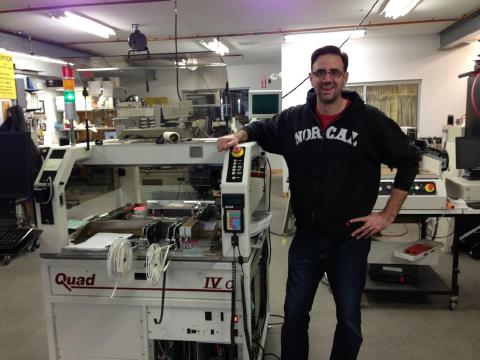
- Ryan picked up a Quad PnP to do in-house assembly as a value-added solution for consulting clients.
- He got a refurbished machine and feeders from GoPPM, a dangerous site since Ryan is a self-confessed tool junkie.
- He also had help from Twitter. @AutoSportLabs and others helped to narrow it down.
- Dave interacted with the PnP that did his boards in the video where he visited his assembly house:
http://www.youtube.com/watch?v=pHNpayYhBvM - Everyone favors surface mount for automation reasons, but Chris recently saw a tiny solder pot for tinning wires.
- Moving to a full time maker business is a big decision, but Dave says it shouldn't be a hard one.
- Ryan was nice enough to mention Chris's upcoming program, Contextual Electronics.
Find Ryan on Twitter at @ohararp Image credit: Ohararp.com
Transcript
Chris Gammell: This is The Amp Hour Podcast, recorded July 8th, 2013, Episode 153, with guest Ryan O'Hara, Keen, Kerft, Kapton.
Dave Jones: Welcome to the Amp Hour. I'm Dave Jones from the EEV blog.
Chris Gammell: And I'm Chris Gammell of Chris Gammell's Analog Life.
Ryan O'Hara: And I'm Ryan O'Hara from O'Hara RP, I'll see.
Chris Gammell: Welcome, Ryan.
Ryan O'Hara: Hey, Ryan. Hey, thanks, guys. Thanks for joining us.
Chris Gammell: Every time I see your company name, I want to be like, O'Hara-p, or Herb.
Dave Jones: Oh, Herb, yeah. Tell us the story with the name.
Ryan O'Hara: Yeah, so it's funny. Every time I get a phone call, I have to explain it to everybody. Well rehearsed. Yeah, yeah. No, so basically, a long time ago, Network Admin gave me, you know, last name and first two initials for a login. And then, man, it kind of stuck, you know, especially when you have so many websites and forums. And I think the forums, the big thing is that's kind of, I felt like I was known as O'Hara RP. And then I was like, hey, I'm going to have a business. And guess what? I'm going to call it.
Chris Gammell: Yeah, it becomes an identity.
Ryan O'Hara: My wife did marketing to her chagrin. She's like, you've got to change your name. I'm like, it's too late.
Dave Jones: It's what I'm known as.
Chris Gammell: Change your actual last name, you mean, at that point?
Ryan O'Hara: Just to, you know, just completely changing the business.
Chris Gammell: Oh, I see. Yeah. See, because I've heard stories in the past where like that kind of thing where like, you know, someone makes up a pen name or they, you know, they get, or like Lane has been on the show before as well, right? And it's just like, it just carries with you, you know? And I'm sure a lot of people in the audience too, they've had similar network admin stories. Like actually one of my friends, you know, they cut off part of his last name and people just started calling him that, you know? It's weird, but it's just the world we live in now.
Ryan O'Hara: Yeah. And I just hate remembering passwords and user IDs. And so I just, I just, and then if anybody, you know, when you're looking up URLs, you know, like everything, all the good ones are taken. And it's like, so it's nice when you can actually go in and, you know, you don't have to worry about, it's kind of unique.
Dave Jones: And it's great on, you know, forums, you're registering for, you know, I, if you're like me, you're registering for forums every day for something new. And, you know, I, oh yeah, I can, I can know, I can use my username because it's, you know, fairly unique. And sure enough, almost every time it's, you know, actually available. So it's great.
Chris Gammell: You don't have to worry about it. That is nice.
Dave Jones: Works every time.
Chris Gammell: Not many other Chris Gammels out there yet, but maybe someday. So, uh, Ryan, what's your backstory? I mean, uh, where, where do you, uh, what have you been doing for the past life?
Ryan O'Hara: So I actually, I feel like I lead a double life. I don't have as many lives as you, Chris, though, with all, all 20 of your businesses. Right. Right. Right.
Chris Gammell: Just, I'm just trying things out guys. Yeah. He'll succeed one day. Yeah.
Ryan O'Hara: I think that's good. And that's kind of what, um, so I'm, I'm actually a military guy. I'm a, I'm a active duty, uh, mechanical engineer in the air force. And, uh, uh, I've done a lot of schooling, um, to the air force academy and, uh, spent some time in Ohio where, uh, so when you were, you were talking about ham, hamvention. Oh yeah. Yeah. So that's, uh, old stomping grounds there. And so, uh, and then, uh, so did that. And then, uh, I recently just left, uh, Ohio. Uh, I got my PhD again, paid by the air force. So that's, that was pretty cool. And I got to do some really neat, um, micro air vehicle work. Uh, the air force was looking into this and then there's some guys out at Harvard, uh, Robert Woods, uh, micro robotics research lab and they're doing the Robo V. I don't know if you guys, I'm sure some of your listeners have seen that. Yeah.
Chris Gammell: I've heard of it.
Ryan O'Hara: Yeah. Yeah.
Chris Gammell: It's, uh, those guys are, it's like the ultimate scary thing, you know, like robots just appearing in the, uh, in the natural environment. You're like, Oh, it's just a little tiny bug, whatever. No. Yeah. No. I'm sure there won't be any privacy concerns in the U S at any point. So I don't know.
Ryan O'Hara: I spent, I spent a good three years working on that. And even some of the stuff, every time I go to look at their site, I was like, Oh my God, I can't believe they just saw that. Some wicked smart guys out there.
Chris Gammell: So, so what is the Robo V then? So it's a, it actually flies and it's robotic and everything like that.
Ryan O'Hara: So the concept is that you would have, um, so, so right now we got a big question that came up, um, was, uh, we already have small UAVs, right? And we got toy helicopters, right? So, but yeah, I'm pretty sure if your toy helicopter was flying your window, you know, and you're the bad guy, you'd be like, Hey, there's a toy helicopter flying by my window. So, so if you could blend in, if you could blend into the environment, you know, so you look like a bee or a hummingbird or whatever it was, uh, you would be, you know, be in plain sight, but you'd be still be inconspicuous.
Chris Gammell: So that's the kind of the idea, but, um, the actual, how many times were there bee jokes like running around?
Ryan O'Hara: So I actually worked with, uh, uh, so my, my work was slightly, we worked with a, an insect called the Manduka sexta. It's the tobacco hornworm, each of your tomatoes, but those things, those things turn into a big moth and then the wingspan, each wing is about the size of your thumb. And so, um, so we were looking at like a slightly larger class of micro UAVs, if you want to call that. And then, uh, so yeah, so there's lots of moth jokes around and then, uh, you know, uh,
Dave Jones: So how do these flying insect slash bird robot, bee robots, um, do in terms of, um, thrust to weight ratio, if that's the correct term, you know, like, you know, flappy wing to rate weight ratio. Cause if you look at a quad or you listen to a quadcopter, right, just to keep that bastard in the air is it makes an absolute terrible racket. It's, you know, it's phenomenally loud. It's got to spin it, you know, how 10,000 RPM or yeah, it's awful. Is it the same thing for these insect stuff or is, or is shooting for something, you know, as silent as a bird, for example?
Ryan O'Hara: Yeah. So, so they ended up being really quiet. And then in terms of power to weight, you only need to make, you know, like 1.1, you know, I think like an F 16, it's only like, it's got a thrust rate of, I don't know, it's like 1.05 or 1.1. So it's not that much. So to go vertical. Right. And so, um, so you don't need that much, but it, it all comes down to payload and then how big is your fast, your battery going to be. Right. So, yeah.
Chris Gammell: So, right.
Ryan O'Hara: So these things use piezo elements and then, um, uh, that move back and forth or by more of actuator.
Dave Jones: And then they're the things that simulate the wings, the wind, the wing structure.
Ryan O'Hara: They actually simulate the, the muscles that would be in the thorax of the, the insects. And then, and then the way the, the UAVs, at least these insects work, cause there's, um, Oh man. Uh, the exoskeleton acts as the transmission. So instead of gears, you actually, the, the muscles actuate, um, kind of like a aluminum can, you know, and you have that spring back effect. Yep. So they, they collapse and then it springs back. So it's elasto and then, uh, and then there's some other muscles and then basically the wings and ligaments, but the, the exoskeleton acts as a, a transmission to transmit a small, um, uh, small displacement at the muscles into a big displacement at the wing tip. Right. And so, um, and so what these guys power transfer kind of thing, uh, yeah, it's, it's basically just, um, it's a bell crank slider. So it's just, um, whoa, whoa, whoa, whoa.
Chris Gammell: This is electronics podcast, Ryan. So you, you're an enemy territory for now until we start talking about your other stuff. Right. Yeah.
Ryan O'Hara: So, um, but, but what, what is cool is that at least for my PhD and then this is where my electronics came in really handy is that, um, the Harvard guys kind of came up with this and we worked together, but, um, we took, uh, thin film electronics. And so we used that LPKF laser, uh, just like, uh, to do a deep analyze circuits. So if I hadn't had that background, uh, you know, I was like, Oh, we need to control these things with the laser. And I was like, well, I know a company that makes this stuff. And we originally started out with LPKF router, but then, uh, wasn't fine enough detail. And then, um, and then we spent some big bucks getting, uh, LPKF laser.
Chris Gammell: Huh.
Ryan O'Hara: Yeah. And then German stuff's expensive. That's, that's what I put it in.
Chris Gammell: You're right. What, uh, what model, what model is it that, that actually does the laser? I've, I've seen them before, but I, I don't know the model name. Yeah.
Ryan O'Hara: So now we're getting all sorts of lasers. That, uh, is a proto laser U. So the U being for ultraviolet or, um, the 355 nanometer stuff. But what's cool about, um, well, well, uh, so for my business, we use a CO2 laser to cut capped on stencils, but, uh, it, it basically the wavelength of the laser, anytime you use a laser, it, you know, physics come into play and it becomes almost like a chemical process and it's all about absorption and then absorption rates. And so the different wavelength, the different materials will absorb it differently. And so, and then also about how fast you pulse your laser, uh, affects things. But, um, basically with a CO2 laser and capped on, I kind of, I almost like am in the burning it phase because it absorbs it so much. But with the UV laser, you're actually, um, ablating it versus there's, or ablating or ionizing material versus heating it up and burning and charring it. So there's a difference.
Chris Gammell: So, so like it kind of, uh, it like heats up and kind of floats away that kind of idea for ablation. Yeah.
Ryan O'Hara: And then it, uh, but when it does it, there's no, uh, damage, all the, it's, it's very localized. Right. And so, so it gives you a nice clean cut. So like for my stencils, I have to go back and have a, uh, mechanical cleaning process, which is me scrubbing it with a scrub brush and water. So whereas, uh, we'll get to the stencils.
Chris Gammell: That's what Ryan's really here for, but we'll get to that. I want to hear more about this B cause this thing's crazy. Yeah. So what, what kind of control was in there though? I mean, so you said you had to get the features, uh, smaller, but like how small are we talking about here? Are we talking about like microns or what?
Ryan O'Hara: So, uh, so, uh, my, so yeah, so one micron is, or 25 microns is a thousandth of an inch. And then a human hair would be, um, uh, three, three thousandths of an inch or 75 micron. And we could, you can machine on this, um, and add a set of precision galvos and then also had a table. But, uh, you know, we were two to five micron accuracy. And then, um, so, which is important because, um, so we would, uh, we did a number of different things. So, so this transmission is really what you're trying to build mechanically. And it have happens to deal with, uh, layers of, um, carbon fiber. And then we would use a bond that's in flex circuits. It's basically a thin sheet of adhesive, uh, um, FR 1500. Um, uh, but like if you had two pieces of capton for a flex circuit, you got to stick them together and you don't, you don't actually glue them together. Right. So you would use this. It's like a tissue paper, but it's glue. And then when you heat it up in a press and, and collapse it, it basically melts and bonds. And so we would use this, uh, as, and you can buy it in different ways. You can buy it here to capton, or you can buy it just on its own, but we do this multi-layer stack up and that's what the Harvard guys do for this. And then you basically create a 3d structure, uh, you know, akin to, uh, you know, what a lot of the guys are doing with CO2 lasers and acrylic, you know, or making a case or whatever. So you create this 3d structure, you sandwich it and do it. And then, um, if you're really smart about where you cut reliefs and do different things, you can actually, um, the idea was that you basically had carbon glue capped on, you put glue again, and then another piece of carbon. And then if you cut away the carbon in the right spots, you could actually have a flex hinge, just like a flex circuit, but instead it was a hinge and now you've bonded it all together. So, well, we can put up some links and videos, but so, so I was working on the, I don't know, our features were like in the 100 to 200 micron range. And then those Harvard guys are going in the, like the 20 micron range, I guess they're doing just like their features are ridiculous.
Chris Gammell: So, so does this actually, is there actually like a control feedback system kind of thing going on in there? Or is it just kind of a open loop?
Ryan O'Hara: Yeah. So this is fast. So for my stuff, I, I was kind of an open loop and we, so when using these piezo actuators, they need lots of voltage, like anywhere from, you know, they would operate minus 150 to 200 volts or so. And then, so you've got to generate all that. So that's the big concern is power, right? So how do I get not only just a, you know, a battery that's small, but how do I bump up the voltage? Yeah.
Chris Gammell: Just drop a transformer on there. I bet that would be really light.
Ryan O'Hara: So, so luckily for my PhD work, I didn't have to focus on that. That's somebody else's problem. So, but, um, so this is where, and this, I thought it was pretty interesting on the show when Jerry was on and talking about different chips and the, with the metal gate, at least gate arrays. And, um, there's some researchers working on control, but doing custom ASICs to, um, and for feedback and all sorts of different stuff like that when you're controlling the wing. So, because basically the idea is that you have two wings, uh, flapping and then basically you can change the, um, the frequency at which they flap. You can change the amplitude and then by doing it in, um, uh, it's kind of neat. There's a whole bunch of control theory. I'm not a huge controls guy, but, uh, I claim to understand a little bit is that you can have a few degrees of freedom, mainly frequency and amplitude. So if you would, so that's two degrees of freedom, but you can get, if the controls guys are real smart, you can get five degrees of control.
Chris Gammell: Oh, wow.
Ryan O'Hara: So, you know, it'd be a roll pitch, yaw, and then, uh, up and down and all sorts of different things. So you can, you can do a lot with just two degrees of freedom, uh, and the control side. So that's, that's kind of a cool.
Chris Gammell: Awesome. I hate, I hate breaking down physical processes to like actual equations and stuff. Cause you're just like, oh, nature is so much better at this than we are.
Ryan O'Hara: And then that's the, you know, when I was studying all this stuff, it was like, oh my God, this is pretty amazing. And my, my job as mechanical engineer was the, the lift mechanism for these things is actually pretty complex. Um, uh, you know, like a traditional airplane, you know, wing flows over one side and, you know, um, creates a pressure differential and you get lift. And it's really simple. And, and we kind of are looking for nonlinear, uh, you know, looking, you're in the linear range, but with insects, they fly in the nonlinear range. And so, so there's basically a vortices that, that are shed off the wings that actually generate the lift. And then, so it's like when you row a boat, you know, and you, you put your, or your paddle in the, and you pull it down along the side and you see the little swirls. Well, that's what's generating the lift for these insects. And that is a completely nonlinear, you know, uh, we can't model it. It's difficult to understand. And then, and I'm not a smart guy. So I said, Hey, these insects have it figured out. So maybe I should just study what they're doing. And so my, my goal is to study the structure of the wing and, and be able to produce an engineered wing with the same properties as the biologic one. And yeah. Biomigry. Yeah. So it's total biomigry. And then, uh, so I was able to do it and we generated, uh, just about, just as much as biological analog. So it was pretty cool.
Chris Gammell: That's awesome. That's really cool. Yeah. I mean, you got to figure that, uh, evolution has been taking care of that for a couple, a couple million years, you know?
Dave Jones: So is this still your ongoing day job?
Ryan O'Hara: No. So I, so I've kind of moved on to that, uh, to different things. And, uh, I'm kind of in, I'm in the land of the equivalent of corporate suck.
Chris Gammell: So I was like, please be designing dinosaurs. Please be designing dinosaurs.
Ryan O'Hara: So, no. So I've, uh, yeah, I've, uh, Bob's came to where I work and said, I need to go to upper middle management.
Dave Jones: So, uh, so luckily I have my business to keep me insane.
Ryan O'Hara: So, you know, yeah.
Chris Gammell: Keep you insane or keep you sane? Keep me sane, right? Sane. Yeah. Okay. Yeah. Well, uh, it sounds like, uh, you're doing some cool stuff though. So tell us about, uh, this side business. I mean, what, uh, what, what's, what's the, what are you doing with it and how does it apply to robot wings?
Ryan O'Hara: Yeah. So, so I think the big, the big thing is I had, uh, started my, my business in 2007, but I, I did it really, I don't know. I'm sure you have some listeners out there. I'm addicted to tools or more locally now development boards, right? Oh, so yeah. Yeah. And then, uh, you know, it started getting really expensive and my wife, you know, of course, uh, started to poo poo that thing. So, so I know the feeling. Yeah.
Chris Gammell: Dave does too, I'm sure. But now it's a business, right?
Ryan O'Hara: So it's, uh, so it's like, well, if I want to buy tools and then for a business. And so, um, so that's kind of what I, I started doing just originally was kind of like this little write off. And then I had some good ideas that I wanted to patent, uh, basically learned that patents are Yeah. Patents are a bad idea. So what a giant waste, at least for a small person, you know, if you're trying to, to patent something, Hey, it's expensive to do it. And then, you know, even if I, somebody did infringe on my patent, I'm like, I had no money to sue them. So, uh, well then I think also too, I, and that's kind of early on. I, I, I really liked the open source hardware. Spark fund had just started and then Adafruit had just started and, uh, different things. And I saw, you know, people were sharing a lot and it's like, Oh man, if you come up with some good products, there's no need to patent it. You know, just, you just keep innovating. And I think that's the key.
Dave Jones: Exactly. But, um, so you went with that. So you dropped all this patent rubbish and, uh, so I had to develop product.
Ryan O'Hara: Uh, it was basically at the time, it was just a DPS logger to SD card. And, uh, but I did it for my, for the, the stuff I was doing previously. It turned out some support work I had done was I made more money from the, the little side device than I, the actual product of the make. And, um, uh, did that for a while. And, uh, prior to getting my PhD, I did on my application. We, we, uh, I'm sure you guys see this a lot. Uh, I did quite a bit of consulting work too. So it's the business and the webpage end up in, um, kind of like a good showcase for, Hey, look at all these cool things I can do. And then people come out of the woodwork and say, man, it'd be awesome if you, uh, so I did a bunch of cattle tracking actually in Australia. Right. Oh, cool. Oh, there you go. Yeah. So we did some stuff with that. And then, um, did you go out there? Uh, I tried, I wanted to really bad, but it just didn't work out. So, uh, but it's good.
Chris Gammell: There's lots of spiders.
Ryan O'Hara: Yeah. And, uh, everybody talks funny down there.
Chris Gammell: So, yeah, that's true too. Yeah. Crazy.
Dave Jones: Weed us.
Ryan O'Hara: But then, um, the coolest project though, it was, uh, a researcher in Norway. They contacted me about glacial monitoring. Like he wanted to see how fast a glacier could move or that's what they were doing and said, Hey, it'd be awesome if we had a low cost device. You know, it's actually interesting. You're talking about this. I'm sure you see this a lot, Dave. There's like a total, uh, it's amazing what corporations will pay for equipment or certain devices.
Dave Jones: Oh yeah.
Ryan O'Hara: And it's like, so, uh, weather and, uh, research are ones where it's like, let's spend thousands of dollars on stuff. And I was. Thousands. Right.
Dave Jones: That's, that's petty cash level, you know, it's tens of thousands, hundreds of thousands. Right. Right. Definitely.
Ryan O'Hara: And so, uh, so I think for like, I don't know, a couple hundred bucks, we put a bunch of basically little stations and, um, on a Norway or a glacier in Norway and, uh, they operated for six months and they have like a big light dark cycle. So once the sun went away, we had some problems, but we got some good data. So it was pretty cool.
Chris Gammell: I think they were solar powered at that point.
Ryan O'Hara: So we had a big, like 10,000 amp hour, uh, lithium battery. So we could run. Oh, right. So we could run for a couple, I don't know. I think it was like two weeks or so. Um, and then, uh, you know, the, the solar power would augment that. So, yeah.
Chris Gammell: Cool. Too bad they haven't figured out the, uh, the cold harvesting technology yet. That one's still in the works folks. So I always be great for glaciers.
Ryan O'Hara: I've always thought, uh, you know, I think a lot of people think analogs like a black voodoo art, but I think power management is just like, whew, sometimes it can be crazy, you
Chris Gammell: know, um, or, you know, you mean like, uh, like sleep cycles and like actually when stuff
Ryan O'Hara: is up and transmit, transmit times and, uh, you know, and people always want their stuff to run as long as possible for cheap as possible and the smallest size. And you're like, uh, there's gotta be some trade-offs.
Chris Gammell: Yeah. Right. Yeah. Right. And then, and they want like full bandwidth data too, right? They want you to be transmitting every minute or something. It's like, no. And then it's like temperature. It's like temperature doesn't change that fast, you know, like that kind of stuff is, is crazy, crazy slow.
Ryan O'Hara: Yeah. No, I agree completely.
Dave Jones: And then at lower temperatures, you lose your battery capacity and it just gets, you know.
Ryan O'Hara: Right. And then, uh, yeah. Horrible. Crystals and oscillations and. Oh yeah.
Chris Gammell: So. Yeah. It seems like a devil in the details kind of thing with, with, uh, with optimizing for, for long life and, and long, uh, long capture cycles and stuff like that. Because you're right. I mean, like this, the, the black art of, of efficient processing like that. Like how do you test that too? Right. That's the other thing. It's like, you know, you either have to sit around and wait for it. You have to accelerate it somehow, you know, like just, or you just have to go off your initial numbers of, well, our active state is, you know, uh, you know, 10 milliamps and our sleep state is, you know, a couple hundred nanoamps or something, you know, and then just extrapolate and hope for the best.
Ryan O'Hara: Yeah. Well, then that's why, you know, uh, so back to Dave, like in the microcurrent, uh, I wish I had one at my desk, but there's, so, uh, I've kind of, it's, well, and that's the other thing too. I've debated kind of getting some of that stuff, but, um, it's good to know, but then there's so many things because once you move it, you know, to the right four inches, you know, it sucks, you know, 10 more milliamps or, or you actually install it at a customer's site. Oh, I didn't know the stars were aligned over here and you know, yeah. Yeah. Irritational pool. Yeah. Right. Yeah. But yeah, so, so I did a bunch of consulting work and then, um, so during this time though, I was getting really pissed off at, uh, turn times, right. And lead times for everything. And I was like, Oh, so I get boards, but then you got to, you know, I, I've a big believer in surface mount. And, uh, I think the engineer in me always wants to like, I was like, I know there's a machine that could do this or so, uh, you know, there's a better, there's a better process, you know? So, uh, so I looked at stencils and I kind of ordered a few and, um, there, you know, at the time there is, uh, acrylic or not acrylic, I think it's acetate, you know, the, the clear, um, stuff.
Dave Jones: Right.
Ryan O'Hara: And then, uh, but I was like, man, it would be really cool to have a laser, right? Cause I'm addicted to tools. And then I was like, how could I justify this? And so I said, Oh, well I'll, I'll make them for myself and then this will be for the business and I'll be more efficient. And then, uh, and then you quickly realize how expensive stuff is. And then, um, but, uh, so this is five, five years ago. So it's big, you know, you're still looking at like $20,000 a minute. And so I was like, I'm going to have to, you know, share this capability with folks. And so I tried to do that. And then, uh, no one at the time was offering cap on stencils. So we started offering those. So you can get a cleaner cut file and it's more efficient process. Yeah. So kind of.
Chris Gammell: So what are some of the other ones that are out there? Right. I mean, so it's, it's mostly, uh, aluminum is one of them, right? Yeah. And, uh, then you said also the acetate, are there any other technologies that you're kind of competing against?
Ryan O'Hara: The classic would be the stainless, uh, well, there's chemically etched, uh, stainless stencils, right? And you can do it one side or two sides. And I don't claim to be an expert in this other than that, you know, you get, anytime you cut material, there's always a curve, which is the, you know, like we use a saw, right? So there's material that's moved in it.
Dave Jones: It's the radius of the, yeah.
Ryan O'Hara: So, you know, chemical etching has different ones and laser has a certain, um, and then it's all about.
Chris Gammell: Are you talking about like the undercut or what are you talking about here?
Ryan O'Hara: I guess it, I guess it, I guess it is the undercut, right? When you chemically etch and then they'll etch from both the, they can, from the top and the bottom too, to, to minimize that.
Chris Gammell: Oh, okay. So you're just talking about the, so if people are thinking about this as like cutting out an actual square out of a, a slab of material, you're saying that there's like bows in the walls then, right? That's, that's the undercut or, or overcut or whatever you're saying.
Dave Jones: Or the corners are rounded instead of perfectly square.
Ryan O'Hara: You know? Well, and then like, if you wanted to cut like a 3D square with straight walls, you don't actually get that. The walls are actually angled. So you get more of like a, a 3D trapezoid, right? It's a draft, like a, like a draft angle would be the equivalent. Yeah. Right. Yeah.
Chris Gammell: Getting into plastics. There you go. Yeah. No, no, I'm sorry. Cause people might not know what draft angle is either, right? That's, that's actually what it is when you have a injection mold and then you can't have straight 90 degree angles. Cause when you pull the mold out, then you'll start tearing at the, the, the, the plastic you just molded. And I only know this because I was just working with some people that know what they're talking about.
Ryan O'Hara: Well, then again, this is kind of a slight distraction. The proto mold guys, they have some like excellent tutorials on draft. Let's stay aside.
Chris Gammell: But, uh, Oh, good. Okay. I'll put that in the show notes.
Ryan O'Hara: Um, but yeah, so, so, so you have their stainless and then you can chemical ash, you can use a laser on the stainless and then they'll go back and like electro polish them. And then, um, I guess next would be acrylic or not acrylic, excuse me, uh, Kapton. And, uh, uh, you can cut those with a different types of laser UV would be the best ones. And then, um, just because we talked earlier about, uh, the absorption rate and clean cuts and different things. So UV gets to the best. And then I actually use a CO2 laser, which, um, so you, a UV laser though runs like anywhere from a hundred to $100,000 for a system. Right. So, so that is out of my, I love tools, but well, then I even got the, I got to use one and you're like, ah, it's, it's good, but you know, it's not worth the, yeah. The value.
Chris Gammell: 10 times. Well, in production environments too, though, it's also about how fast you can produce stuff, not necessarily the accuracy, right? I mean, it's about cranking stuff out and making it good enough.
Ryan O'Hara: So when you start using a laser though, you have spot size, right? With UV laser typically, and then also optics and also you can typically have a really small spot size, usually like two micron, uh, spot. Right. So, um, at least with my setup, I think we're in the, like, uh, I want to say we're in the 20 micron range. So it's a lot bigger, but, um.
Chris Gammell: So that's like the sharpness of the knife effectively.
Ryan O'Hara: Basically. Yep. Or it would be, or, uh, you know, if you had a rod or a dowel, you know, I have a 20 micron dowel versus a two micron.
Dave Jones: Got it. And then, um. But that's good enough for, um. Yeah. For what? Practically everything but bleeding edge SMD.
Ryan O'Hara: And then if you're doing prototypes, you know, uh, I, uh, you know, for the most part we can cut with a CO2 laser and Kapton, you can cut any packet that's out there. BGA, LGA, tiny QFN stuff. Um, uh, I, I don't know how people do it. I've seen like, I've, oh, two, oh, one, you know, oh, four, two. And it's like, oh my God. Yeah. So, uh, you can do all that stuff. Um, and then, you know, the, the, the, the bane of my existence is, uh, high pin count TQFP packages. Right. So.
Chris Gammell: Oh yeah. 208, right?
Ryan O'Hara: Oh yeah. Even like 66 or a hundred pin. Uh, 200 pin. I don't know what the Arduino do. Whatever that giant thing is. I just look at that and cringe. It's like, uh.
Dave Jones: But at least you can see and access the pins. Yeah.
Ryan O'Hara: And so, so you can use a stencil and you can go back and you're going to get bridging. Right. Uh, bridging is a good possibility. And so there's some tricks you can do.
Dave Jones: Well, that's what a soda mask is for. You know, that's the magic of soda mask and the amount of paste you put on. Yeah. If you put too much paste, you're going to, um, you know, yeah, it's all an art.
Chris Gammell: Yeah. And then manufacturing engineering is a fickle, fickle mistress. So, so how much, how much does the accuracy matter? I mean, like, do you have a quantifiable like accuracy spec that you need to meet in order to, I mean, is it like, or is it just a good enough? Like, well, yeah, you are, uh, CO2 is good enough. The accuracies are good enough.
Ryan O'Hara: Yeah. So this is where I think, uh, like as an engineer, I've always prided myself on being able to talk with the technicians. Right. And you talk, you know, you're doing a little bit of machining, you know, Chris, you might have seen this kind of with your CNC. It's like you design something and then you go make, and you're like, oh my God, I can't make this. It's impossible. Or not on this two axis machine. I need a five axis, but then that costs a lot more. But if you had gone to talk with a technician who is going to machine it or doing it, he's like, oh no, I can save all this cost. So, so I don't have any quantifiable numbers, but I can do just from rule of thumb that, and then I think I've got close to 10,000 stencils for folks. Uh, CO2 laser is pretty good.
Chris Gammell: Yeah.
Dave Jones: So do you offer different thickness stencils? Because the thickness of the stencil determines how much paste is applied ultimately to your pad.
Ryan O'Hara: Yeah. So this is, you know, when you look at different business models, I went for simplicity and they're like, seems like three and a half thousandths of an inch is, uh, is, is a standard thickness you can get from most manufacturers. And that, that covers pretty much the broad spectrum of stuff. Now, if you were going to go into production, A, you want to use Kapton, right?
Dave Jones: And then, yeah, exactly.
Ryan O'Hara: And then B, you, you would probably have some sort of multi process setup where you, or you would choose the stencil thickness. That would be perfect. But, but three and a half thousandths is pretty good. So you might get some bridging on some high pitch count parts, but then you say, oh, well, it's just a prototype. And this, and the whole focus here is on prototypes, right? You're like, I'll clean it up. Some solder wake, no big deal. So versus, uh, Kapton's expensive too. And you've got to buy, you've got to buy in 50 or a hundred foot rolls. So, you know, it's, it's a good start, you know, second that up over multiple. Well, then it's actually, it's technically by the pound, right? So the thinner it is, the more you get. And so, yeah. So just keep inventory low and three and a half thousand seems pretty good.
Chris Gammell: So, so why, why is there limited life on, on, uh, Kapton stencils? I saw that, I saw that somewhere else the other day saying that the, you know, you can't use them forever, but what, why is that?
Ryan O'Hara: So, I mean, it's, it's plastic and you're basically cutting, you know, if, you know, think about if you, you have, um, it's a mechanical structure. So basically between like a, say a resistor, you know, you would have two pads or two openings. And then in between that, it's just a little, little piece of Kapton that's there. And then, you know, you kind of go over it back and forth and it's just going to have a lower fatigue life than a metal. Right.
Chris Gammell: And then, you know, it's not a step, but for the most part. Just because you're dragging, you're dragging the piece to cross it with the little scraper thing.
Dave Jones: There's a, there's a sheer force. There's a, every time you wipe the squidgy across that, uh, you know, stencil, there's a sheer force on, on all those little, on all those little bridge points.
Ryan O'Hara: I'd say a lot too. It's a lot about how you use it. And then, you know, so it's a plastic. So some people would use a metal squeegee and I wouldn't recommend that. I would say use like a, I found a hotel key card works perfect. Right.
Chris Gammell: And then that's a good hack.
Ryan O'Hara: And then if you're, if you're, uh, I have a good collection of subway cup cards over here, you know, sure. I'll sign up. Yeah. Give me that card again.
Chris Gammell: So, um, all your circuit boards smell like that terrible manufactured bread smell that subway smell like though. So what about the, uh, fixturing for this then too? Cause that was the other question I have, you know, these are, they're not particularly large stencils, right? I mean, there's a limit to the size. Yeah.
Ryan O'Hara: So this is, you know, this kind of back when SparkFun first started and I think Nate, uh, I think it's Seidel. I don't say it all. Um, you know, he had a really good tutorial on it on his, uh, on SparkFun site. And then basically he was using the, the acetate sheets, but really all you need is, uh, you know, a flat sheet maybe in some PCBs, excess ones and some masking tape. And you just slap them down on the table, hold your board so it doesn't move. And then you basically just masking tape your stencil in place. And, you know, and kind of back to your earlier question, I've easily done like a hundred boards with a single capped on stencil. So it's all about, you know, if you clean it off and you're, and you're, and you're just not manhandling it, you know, you're gentle with it. Yeah. You can get plenty of uses and, you know, and, and then I would even argue, you know, uh, I tell a lot of people, I say, Hey, Hey guys, if you, uh, you know, write back an email after this, if you just put this in a small panel, man, you could, you could, you know, you do, if it, there's like those femtoaduino boards or, you know, you got like a little one inch by one inch piece of, you know, man, put that in a tile, some V-string and you could do crank out a hundred boards, no problem. So, um, and that, and then it's perfect. It's actually, I would say the capped on is even good for small production and kind of seeing with folks. A lot of folks do that now with like Tindy and I'm trying to think of some of those other, um, sites. I saw in Mojo, Jeff, Jeff Roberg and the key glove. Um, you know, Oh, the key glove.
Chris Gammell: Yeah. I was, I had that on my list today of things to talk about. He created a, uh, did you see that? Do you see that link?
Ryan O'Hara: Yeah. He's got with Google glass now or like talking with, I think.
Chris Gammell: Yeah. Yeah. He, he, he basically hacked the Bluetooth and he discovered his key glove, which is a little control mechanism. And he's been able to input, uh, all the different commands you could put in on the glass without actually touching it now, including a mouse input or like a little cursor, which is, I haven't seen anywhere else yet. So, uh, I'm very excited about that.
Ryan O'Hara: Well, he's, he's wicked smart at packets and Bluetooth and, uh, I2C protocols and all that stuff. I see, uh, uh, we were doing some other stuff with him on, he was doing a lot with the MEMS interface sensor that the InvenSense, the, uh, they make the MPU 9150. It's a nine axis chip.
Chris Gammell: Oh yeah, yeah, yeah. That's the one that a lot of the, uh, DIY drones guys use, right?
Ryan O'Hara: I don't know. It's actually in the Google glass. Uh, it's, oh, is it? Okay.
Chris Gammell: I thought it was the actual, it's not the module. It's a chip.
Ryan O'Hara: It's a, it's a little IC with, uh, you know, it's got the MEMS. It's got the gyro, the magnetometer and the accelerometers. And then in that teardown of the Google glass, was it star Simpson did, right? Yeah. Star Simpson. Yeah. So I was like, Oh, 9150. So, but those guys, this goes back to that open openness. Uh, Jeff basically like re-engineered the protocol because they want to publish their register maps. They're like, Hey, here's our magical chip, but we're not going to show you how to interface to it. And then, uh, so he was able to like sniff all that stuff and kind of figure it out. So, so. Wow.
Dave Jones: Now you're a glutton for punishment because, uh, you have got yourself a pick and place machine.
Ryan O'Hara: That's right. Dave, I thought it was funny when you, uh, you're like, I will never own one of those.
Chris Gammell: What is, yeah. What is the reason that you'd go out? I mean, like, are you, are you going to start like a board house now as well?
Ryan O'Hara: No. Oh no, no. So I, you know, that's one of those things, you know, like, you know what I do want to start Chris though. I want this machine. Chip printer? Yeah. How did you know?
Chris Gammell: I figured there's guests are going to start making fun of me as long, along with Dave, you know, I think, I think we've had a couple already.
Ryan O'Hara: I tell you what, you put that on Kickstarter and I would fund it. So that's that. Yeah. Right. Yeah.
Chris Gammell: The first, the first million dollar sham out there.
Dave Jones: So how do you, if you don't, if you're not going into the board stuff in business, how do you expect to get a return of not only financial, but time investment on this pick and place machine?
Ryan O'Hara: Yeah. So, uh, a couple of things is that, you know, I talked to, I did this GPS thing before and so I actually have made, I've made more money doing consulting than actually selling products just because product margins are so thin, you know?
Dave Jones: Of course. Yeah.
Ryan O'Hara: And so, so I find it ends, I mentioned this previously, it ends up being a better advertisement for your work. Like I think kind of based off your microcurrent stuff, I don't know if you've gotten more interest, Dave, from like, oh, Hey, you're really good at power management. Maybe you should be doing consulting or something like that. I don't know.
Dave Jones: Oh, I used to do lots of consulting, but yeah, not anymore.
Ryan O'Hara: But, um, so I kind of looked at that and then, and I wanted, uh, if I was designing stuff, I would talk to people and then they would say, well, two things. They would say is like, Hey, we want to design for China. And I was like, Hey, you guys, we could get these assembled here in the States, you know? And then, um, then I would also argue that I wanted to have the capability. It's like, Hey, you want 10 or 20 of these, or maybe you just want 50. Hey, we can, we can stuff some of those boards for you and put them together. And then, um, plus really Dave, it's cool. Who doesn't want to?
Dave Jones: I know it's cool. Yeah. I want one too.
Chris Gammell: Ryan, did you just say that you, you will do small product runs though? Cause I think that is like saying that is like, like wearing meat underwear, like near a pack of wolves. Right. Like you're on the amp hour saying, yeah, I'll do like 10 or 20. That's like, rah, you know? Like, cause it's hard, it's hard to find places that'll do small quantity stuff and not charge out the wazoo. Right.
Ryan O'Hara: And so that's, I've kind of looked at it. I don't, I guess it would be more, it would have to depend on, so this would be like, if I was doing design, like, like Chris, I would design a board for you. I'd be like, Oh yeah, I'm going to do the layout. I'm going to pick standard parts. I'm going to do all 603, you know, and like, you know, just, I can do things up front in the design process. Turnkey. Yeah.
Chris Gammell: Yeah.
Ryan O'Hara: And then, and then, and then, and then bill for that. Um, so I see. So that's, that makes more sense. And then I'm also working on, so you guys have seen all these, uh, RGB, um, strips, right? The.
Chris Gammell: Apparently people like LEDs.
Ryan O'Hara: Yes. This is what I've determined. So in addition to hardware, I love, or like, you know, tools. I love LEDs and I love clocks on development boards. Right. So, so, uh, uh, your wife should get an award. Oh, she's pretty, she is pretty awesome. But, uh, yeah. So I've seen all these strips everywhere and then Adafruit's been doing them and then there's a bunch of Chinese guys. It turns out the DIY Christmas guys are all about these things. I've, I've learned. Oh yeah. But, um, but no one's offering, uh, you can buy all these strips, but no one's offering them in a matrix, like a pre like.
Chris Gammell: Like a panel. Like a panel.
Ryan O'Hara: Exactly. Exactly. So I, I kind of did it for me. And then, uh, I designed like a kid's table with, for my kids. And I used this, like, uh, I bought one of those strips and cut it all up. And so they play like this, um, I've got it running like long, like old school pong on a 32 by 10 matrix. Right. So the kids. Nice. Yeah. And I don't know what it is about arcade buttons, but people love to hit them. Right. And so, so I put our kid, yeah, put arcade button kids and, uh, Sagan will love this Dave.
Chris Gammell: Yeah. For sure. So that's the thing. I think, I think kids in general just have, have the, you know, like the human brain is just dedicated. You know, they, it wants to see light and then being able to control that light is just really killer. Right. So I think those, those aspects all together really help with led sales. Yeah.
Ryan O'Hara: For people in a note, like, so, uh, uh, like Garrett Mace, Mace tech, and then he's been out there doing stuff. Yeah. But you know, he was doing like, uh, you could use these, these TI chips and then, you know, you could string them all together and do, but you always had to have that, you know, uh, uh, an led and then some passives and then an IC, and then you'd have to gang up a whole bunch of them. And it's like, Oh, you can't make it very small. But man, when these guys put the SMD 50 50 package and then put the RGB in there with the controller, it's like, Oh my gosh, it's like, I don't think of like too many groundbreaking or like revolutionary things, but like to me for RGB LEDs, this is like a huge leap forward. So it's going to have the led and a little passive nano farad cap and you're like good to go. And so you just can string tons of those together. So, um, so yeah, so, but basically I, I designed a little eight by eight matrix of these, uh, 10 centimeters by 10 centimeters. So, um, and, uh, I almost went bat crazy assembling it, even though I had a stencil.
Dave Jones: Well, once you set it up exactly, you want to push the button and you want to see a million of these bastards pop out.
Ryan O'Hara: Yeah.
Chris Gammell: That's so it didn't work like that though.
Ryan O'Hara: So, uh, so yeah. And I was like, had all these big dreams. I'm going to make this huge panel and I'm going to assemble it by hand. And I was like, Oh, this is not going to happen. So, uh, so it's kind of back to the original business is like, Hey, well, how could I justify this? And then, um, basically the, the stencil business is going to take care of itself. And so look at some other options and you got to weigh your risk and stuff. And so it turns out, uh, pick and place machines from 1995 are pretty awesome with DOS and prices. So nice.
Dave Jones: So did you get this on eBay or from a proper secondhand SMD merchant? Yeah.
Ryan O'Hara: So there's, um, man, this is goes back to, to Twitter and, uh, Twitter and a little mix of Kickstarter and all this kind of stuff. But, um, auto sport labs, they did a Kickstarter for like this race capture.
Chris Gammell: They do, uh, I think they like, yeah, it's Brent, Brent Picasso, right?
Ryan O'Hara: Yep. And so I said, you know, I was tweeting, uh, I was like, Hey, you know, really want to pick and place. I'm going blind over here. Uh, you know, what are some recommendations? And he mentioned this quad picking place and I didn't know it at the time, but I guess in the nineties, a lot of, uh, division at Echo Electronics was, they were like the go-to machine, I guess. So, um, and then, so there's a bunch of some folks who basically specialize in, uh, refurbishing and reselling these machines. Cause they're a beast. They're like, I don't know. Uh, I think Adafruit has like a man core machine. I think it's a Japanese type. And then, um, some different ones, but these are all like, they're all like, they're all using 80, 20 aluminum frames. This is like 1400 pounds of steel, you know, like, it's like, it's like cut or like drop
Chris Gammell: forged or something.
Ryan O'Hara: And then like the table's like, you know, one inch thick steel and it's got all these, you know, holes. It's like, Oh, this is awesome.
Chris Gammell: So this is like where electrical and mechanical collide, you know? Well, I think it was Brent that said it. Servos and air.
Ryan O'Hara: And Brent was saying it. He's like, man, these would make the most awesomest, uh, 3d printer ever because the base is real, you know?
Chris Gammell: And then you got, there's no, the rigidity is super high and the servos are really nice.
Ryan O'Hara: And then until you see one of these machines. So I, this little eight by eight would take me about a half hour to place all the parts by hand. It's 256 parts. I can do it. And I just have a single head machine and I can do it in less than three minutes. But when you see this, it is a violent, violent process. The head on that thing moves so fast. So you could, uh, yeah, uh, don't disable the safety guards or whatever on the covers. It's like, stick your hand in there. It's going to eat it. None of this is like, it's going to go. Yeah.
Chris Gammell: Well, yeah. And you know, the, the upper limit of that stuff too, it's like, I mean, people can go on YouTube and just look at the, the insane speed of pick and place machines. And because I mean, that alone, just a, you know, a 95 one is fast, right? Because that was the top notch for the time. But now it's just like, I mean, there's just shooting, shooting parts, you know, it's just insanity.
Ryan O'Hara: Dave, you had that video where you went to your assembly house, right? With that?
Dave Jones: Yes.
Ryan O'Hara: And he had like six heads. That thing was like awesome.
Dave Jones: I know. Yeah. Yeah. And it costs half a million dollars. Yeah.
Chris Gammell: But in 15 years, it'll, it'll be less.
Ryan O'Hara: Right. So that's the, that's the thing is like, uh, this quad machine, I guess went for like a hundred thousand dollars back in the day. Right. Right.
Dave Jones: And then, uh, how much does it cost these days? How much do you pay for it? I paid top. Tell us the price, son.
Ryan O'Hara: I paid top dollar. I paid, uh, just the base machine because you could also get feeders, right? So we were. Yeah, of course. Yeah. And then, so I got a machine that had been basically stripped down and rebuilt and then they replace a number of things on them. Um, like highway parts and make sure all the slides. So I got to work through one that had been gone through and I paid like a little over, uh, 16, five. Yeah.
Chris Gammell: Oh, that's not as bad as I thought. I was going to guess 25. Yeah. But you can. That's good. I mean, like, because you got, you got one that's like guaranteed, right? I mean, you could spend easily three months trying to fix one up. Yeah. So you basically price in the, the guarantee of it working. Yes. And hopefully guarantee from the manufacturer.
Ryan O'Hara: Dave and I agree on this, at least from the podcast. I was like, I, so I bought a machine and I want it to work just, you know, uh, like, like with the laser, I bought a nice laser. You didn't have to get a laser as nice as mine, but you know what? When that thing breaks, you know, epilogue, epilogue overnights me apart and it's there and I put it on and I talked to a technician in America and they say, this works. And then, so that's kind of what I would.
Dave Jones: Big difference. Now you can buy these machines, uh, uh, you know, on eBay, you know, site unseen kind of, you know, here it is. Take your chances, you know, I don't know. It turns on and the lights come on. Yeah. Kind of. Yeah. Good luck.
Ryan O'Hara: Yeah. And then, and that's, and the other thing was these, these guys, they had training and they're real big on like, Hey, come up to the facility and make sure this is the machine you want. We'll run your parts. And it was like, Oh, cause it.
Dave Jones: That's essential. That's essential. Really.
Ryan O'Hara: I've been pretty fortunate in my military career, just like the, the having access to like LPKF and these nice machines. And you're like LPKF comes out three day training session. You know, it's like a big, it's a big deal cause the machines are complicated and, and often you need a technician dedicated to that machine. Right. And then, so they learn the ins and outs and everybody says it'll, you know, it'll do the dishes and fold your laundry, you know, you know, in the sales pitch, but then you get it and you're like, Oh, this is a lot harder.
Dave Jones: I've got to spend my life in front of it, pushing buttons. That's right.
Chris Gammell: And so we have to relearn it each time you come back to it. That's the worst one where you go away for a day and a half and you're like, Oh, what the hell is this thing? What about this Taobao? You, you, you have a Taobao shown that we've talked about on, on the show before the, the smaller $4,000 pick in place, but you decided against that. Why was that?
Ryan O'Hara: Yeah. Well, so, so you can get one of these odds for like right around 10 K and really good shape. Right. So, so that's what, so the 10 K and then you can spend more and make sure we're blah, blah, blah. And be at the 15 per se. Right. So kind of depending where you are, but that, so the Taobao is really interesting, but it's, it's kind of expensive.
Dave Jones: Yeah. It's, it's not cheap. What is it? Four grand or something for that?
Ryan O'Hara: Like four. And then I think by the time you have shipping and you know, like a spare parts kit, it's kind of, it's right at the five, five and a half range it seems.
Dave Jones: And then it's kind of not really there, you know, in terms of the performance and what you want to do.
Chris Gammell: Well, no one's coming out to train you on it. That's for sure.
Dave Jones: Yeah. So it can end up, you can end up being, you can end up buying a $5,000 white elephant.
Ryan O'Hara: You know? Oh, I agree. And then, uh, so these systems don't have machine vision, right? So, and what, so what I found, there's two types of vision. There's obviously cameras, but then there's also a laser alignment. And so, so the, at least quad, it'll pick up a part. So here's a couple of things. It's like when you get things in a reel, it's like, it's all practical things. Uh, there's tolerance. It doesn't fit in there tight. That resistor floats around. So, so yeah. Yeah. So you got to line it up to place it. And then, so that's when you want, um, I learned this with the, the, the laser measurement. You want to, a through axis camera. So, so basically you get to see what the, the vacuum pickup in this case or the laser is doing to align it. Right. So that's one key thing you have. So the Taobao does not have that. I think, I think some guys have hooked up a laser pointer somehow and with an XY offset and kind of back it out, I think. Um, so that's one thing. And then, um, so at least the clock will pick up the part and then it'll actually turn it 90 degrees and it uses like a laser line to basically measure it. And then when it measures it, it knows the orientation, um, like a theta offset. So if it's, you know, kind of came off there twisted and then, uh, it will know if it's XY offset as well. So if it didn't pick it up exactly in the middle, you know, it'll correct for that when it actually places the part.
Dave Jones: So that's. Because it's a real pick and place machine as opposed to one of these toys. Essentially they're, they're just a high end toy. The, uh, Taobao. Oh yeah.
Chris Gammell: Closed loop versus open loop. Right. I mean, that's the, that's effectively the difference.
Ryan O'Hara: And I think probably if you had some bigger parts, like if you were like in the, you know, 1206 or is it 802? What's the one down from 1206? 805. Yeah. 805.
Chris Gammell: Oh, 805.
Ryan O'Hara: Yeah. You could probably be in the tolerances of the solder paste in the, you know, uh, like when you reflow, you know, it kind of wiggles back into place. Yeah.
Chris Gammell: The surface tension.
Dave Jones: The surface tension pulls the part into alignment. Yep. That's what you have to rely on.
Chris Gammell: Right. Yeah. Not the best thing. Cause then if you're, if you've got a stencil that's nearing an end of its life, right. Then you might be, you know, that kind of same thing. Right. Where.
Ryan O'Hara: Well, I'd say with the stencil, it's, you know, you can spend a lot of money on a stencil printer. I'm amazed at that too. But, um, yeah, that's of all the processes, surface mount is very forgiving. Um, you know, as far as alignment and then, you know, hot air reflow is so much easier going back with the, you know, trimming leads off of through whole parts.
Chris Gammell: Oh yeah. And wave soldering. Yeah. Or solder pots. Those things are little fountains of death. Although I just saw one recently that was actually like a really tight, it was just for doing like a wire tip ends, like just for tipping the end of end of wires. It was really cool. It was this little cute thing. It was like a hundred bucks. It was a little, little solder pot. I had never seen one that small before. I always saw like the big massive. No, not. Yeah. Right. De-soldering, you know? Yeah. You can. Big QFP through all stuff. Yeah.
Ryan O'Hara: Yeah. Yeah. So I really, uh, I, I hate through all.
Chris Gammell: So that's, uh, you don't like getting poked through the finger. Yeah. You don't like the little, uh, little tuberculosis. Let's just test every time you pick up the board. Yeah.
Ryan O'Hara: So, but yeah, so, so that it doesn't have vision and then, uh, it doesn't have this laser alignment thing. And then, um, the, the other huge things, this, I learned this, my PhD, but, um, uh, with the LPKF laser, you're doing multiple parts where they have to be aligned, basically fiducials, right? Fiducial alignment. You have to have a vision system with anything because, you know, you know, boards are boards, you know, you, you get them, you know, you send off your design and you get it back in the mail and you're like, it's magic. It could have just appeared, but you know, it's like, uh, it's not magically straight, pretty straight, or, you know, it might be boards can warp and do all sorts of different things. And you got to have that, you know, a, a 10,000th off alignment when you're playing a part could mean whether your pads on the, you know, your passives on the pad or if it's not, you know, or tombstoning versus not tombstoning. So, so yeah, so that's kind of what I wanted. So it basically eliminated, you know, if it was like maybe like two grand, I'd probably be in, but right.
Dave Jones: Yep. It's kind of like that magic threshold where no, you either go all in and get a real pick and place machine or you don't bother you. You might, you're better off just farming it out to somebody with a real pick and place machine.
Ryan O'Hara: And those things are slow when you, I mean, when you compare the speed, it's just like, uh, yeah, so, but yeah.
Dave Jones: As I said, there's always a very narrow niche in there that this machine is applicable to. It's a very narrow niche bordering on no niche at all. It's a toy.
Chris Gammell: You know, it's a, it's an integration over very, very small place.
Dave Jones: Yep. Exactly. So how many feeders have you got for this bad boy? Okay. That's where I had to open my wallet again.
Chris Gammell: That's the tooling. That is the tooling to the machine.
Ryan O'Hara: Well, and then it's like, gosh, I was like, I wish I did. See, I don't know if you guys, I hate, uh, NRE fees on recurring engineering fees. Oh, it's like you get nickel and dime. That's what I feel like. But now that I have a pick in place, I get it. Right. It's, it's a pain. It's a pain in the ass to set up. Right.
Chris Gammell: Right. Because if you have, if you have 20 slots and if you have 20 feeders and you put 21 parts on a board, you have to redo your setup. Right. That's, that's the idea. And that, that's, that's another part of design for manufacturing is like, you want to minimize your part count because that helps lower your overall cost. Right.
Dave Jones: Well, to me, it's not a big deal. Like I'll get charged, you know, $250 set up for my board, you know, to actually set up the machine. I don't think that's a big deal.
Ryan O'Hara: That's really good. But I'm usually like in the $500 range on quotes that I've been getting and it's like, oh.
Dave Jones: Right. But still, it takes some poor bastard all day, right? To actually do this. So, you know, I mean, it's, eh, eh. How much do you value your own time?
Ryan O'Hara: And that, that's where like, at least for these RGB matrices. So, so I'm actually making sellies, but for these, you know, basically I just set up two parts, the LED and a passive. And in that case, I was like, oh, I'm not paying NRE fees. But, you know, if I had to pull my feeders off and, so I ended up with eight, is it 12 millimeter feeders? And then, no, excuse me, eight, eight millimeter. I'm totally guessing. Whatever 0603 parts come on, I got a bunch of that, I got eight of those and I got two big ones for the LEDs. So I didn't, I didn't go crazy. But man, feeders, it's like 200 bucks, you know, as a starting up to 500, you know?
Dave Jones: Well, there you go. I mean, you're limited to only 10 different parts. I mean, that, that wouldn't even do most of my designs, you know? It's like, yeah. I mean, if you have a specific need, like these LED boards, right? You've got LEDs, you've got a driver chip, you've got a bypass cap and, you know, and, and not much else really. I mean, even a small number of feeders is going to do it, but any sort of moderately complex board is going to require, you know, 20 feeders, for example. You know, 10 is probably not enough.
Ryan O'Hara: Don't quote me on this. I'm sure there's more experts out there. I got the impression that there's some board houses that will actually not unreal your parts. They will just keep the feeder, like the whole setup, right? And they'll keep it and then just store those and then put a whole new set of feeders in. Yes. I was shocked.
Dave Jones: Yes, they, they do. I show that in my video. I show a rack and they have a big rack of hundreds of these feeders and they keep the components loaded in the feeder and they just whack the feeder in. Yeah.
Ryan O'Hara: When I saw that in your video, I, I, my jaw dropped. I was like, oh my God, they're going to have so much money. They had some crazy feeders for your stuff too. So when you start getting the. Yeah.
Dave Jones: Yeah. Well, that, that's the other thing, right? If you want to place something simple like a surface mount, a 2032 battery holder, right? You need a big, expensive, wide feeder to do that. Cause these things come in, you know, one and a half inch wide tapes or something, right? You know, you need a specific feeder for that. You need, if you want to put a, a wide connector, just a 0.1 inch surface mount header connector, you need to want a big, you know, three inch wide, you know, and you want to, you know, 26 way connector, you need a big three inch wide feeder. The special tapes. You know, just for a, just for a bog standard part, like a 0.1 inch header connector. You know, it's crazy.
Chris Gammell: Well, but it's better than the alternative, which is hand placing, right? I mean, sometimes they do that, but yeah.
Dave Jones: Well, sometimes they do do that, but yeah. I mean, if you want to take your pick and play seriously, um, as I said, you know, if you're trying to do just any board, any old board, well, you need a very complex array of these feeders.
Chris Gammell: Yeah.
Dave Jones: So yeah, it's tough. So good luck with all that. Yeah, exactly. Good luck if you do anything other than a lead board, you know.
Ryan O'Hara: Dave, you can send me my boards that they will not have as a battery holders. Cause that's, that's probably like a, you know, a one or $2,000 feeder right there just for that part. And it's like, yeah, exactly.
Chris Gammell: Bang. Right. What you do is you include the battery holder and then you say, it's a kid.
Ryan O'Hara: It's a kid. Yeah. That's all. I, I totally, I see that a lot. Well, you know, who's, uh, the Wendelowski and, uh, you know, he's really good at, you know, making their, they use all their through hole parts. And I think it's genius that they, you know, just say, Hey, you know, you're the customer have fun. And so, so, uh, yep.
Chris Gammell: Yeah. There's, there's downsides to that though. Cause then you have to try and source all, all, uh, through hole components, which is getting, getting more difficult.
Ryan O'Hara: Right. You just got to find your niche and, you know, and then, and kind of go with it. And so I'm, I'm trying to avoid that. And, you know, if I did offer for an assembly service, it would be like, Hey, you got, here's the design rules. All 0603 parts, you know, and then, yeah, here's your available parts. Yeah.
Dave Jones: Here's your available parts. And you would have no life left. And it's a mugs game. You know, assembling boards is a mugs game. It really is.
Chris Gammell: Sorry to all assemblers. Basically, I'm telling you, don't do it.
Dave Jones: I appreciate that.
Chris Gammell: So, you know, you could do is you could, you could, if you did it like a recipe or like a today's specials are like you go to a restaurant and they say, Oh, today's specials are, you know, the Reuben sandwich and the grilled cheese. Right. If you put up on a, on a board, here's what I have on my machine today. What can you make? You have to have it here in the next 24 hours. That would be an interesting business. Right. That's, yep. That's interesting. Cause then you can do it. Right. I mean, it would just be a programming file. It wouldn't be much hassle.
Ryan O'Hara: Was it like, was it Woot? Right. I have a Woot off, right. For, uh, for a, for a, yeah. Yeah. Yeah. Right. Yeah.
Chris Gammell: There'd still be a lot of processing there, but, uh, it would be, it'd be an interesting idea.
Ryan O'Hara: I will say this. I don't know about you guys. And I think, you know, uh, even our setup for today's show, you guys have learned a ton about audio and recording and it's kind of like, well, where do you draw the line as far as I mean? But, uh, having a pick and places definitely made me a better design engineer for manufacturer of parts because I was like, Oh yeah, I got a, I got a pick and place. Oh yeah. That requires a nozzle change. Don't put that part in, you know, keep this other one or different things.
Chris Gammell: So yeah, you create like mental constructs basically that where you, where you, you know, how to steer your design decisions based on that. And, and it's, and it's tough at the beginning. Right. I mean, I remember, you know, doing designs as like a, in college, right. And doing like a layout and being like, Oh, of course, why, why not put like a, a huge power plane underneath this thing that I'm going to want to desolder a lot. Right.
Ryan O'Hara: It's like, well, so Chris is a good segment, uh, or segue is, uh, I think kind of what you're doing with the contextual electronics kind of thing is, is, is pretty awesome because just even with my PhD work, I, um, I don't know. I was, I was surprised how many PhDs in electrical engineering had never laid out a circuit board ever.
Dave Jones: Ah.
Ryan O'Hara: Yeah. Yeah. I hear that a lot.
Dave Jones: I mean, it's practically a hundred percent. Yeah.
Ryan O'Hara: It's like baffled me. And so people would come to me and say, Hey man, I heard you're really good with stuff. I was like, where'd you hear that? Cause I'm, I'm in the, you know, I'm in the aero department. I don't even know who you are. So, but it's like a drug deal going down and you're like, Hey buddy, can I get a hit?
Chris Gammell: Can I get a hit a layout?
Ryan O'Hara: But, but you know, there's so such a lack of practical knowledge when it comes to, uh, which I think should be an essential skill. So I think, you know, but, but where do people get it now these days? I don't think they're getting it at university. Right. So, so, so where do you go?
Chris Gammell: You know, co-ops co-ops is, is how I learned. A lot of it, but hopefully contextual electronics is what people say in the future. We'll see. Thanks for the sales pitch, by the way. I owe you like five bucks. Yeah, I know. I think it's good.
Ryan O'Hara: Um, well, you know, that that's, I think you guys were talking on a previous show about interviewing. Was it interviewing co-ops or is interviewing for resumes maybe or for job applications and, you know, asking people, you know, I've asked interns, you know, Hey, what's this on-pam? What's the gain on it? How do you do that? Yeah. Yeah. Yeah.
Dave Jones: Those basic questions. Yeah. To weed out the dummies.
Ryan O'Hara: And I was like, I'm a mechanical engineer. I just read the data sheet, you know, like, Hey, you know, I, man, I, I.
Chris Gammell: See, but right there, even, even just that, like I read the data sheet, you'd be surprised how many people are like the what?
Dave Jones: Exactly. Bingo. You've just passed the first test. Right.
Chris Gammell: Right. Yeah. Yeah. It's in it. Hopefully it'll get better. Well, hopefully, uh, I think a lot of it will. I mean, like you're, I think you're, you're a great example of, you know, you're, you kind of bridge the gap between the consulting world and the, obviously the military career is very impressive as well in your research, but then also you, you get into the DIY stuff as well. And that's, you know, like perfect, perfect cross section of our audience right there. Right. And I, I think it's the DIY section that pulling that towards the academic side and the, and just kind of getting people started making stuff younger and, and experiencing it younger is, is going to be the really key thing. I don't know. Like when, when did you start building stuff? That might be a good question.
Ryan O'Hara: I think that the maker movement or whatever you would call it, you know, I think there's always been people that make things and, and some people are better at teaching themselves how to do stuff than others. And I just learned electronics because no one told me this in school was that I learned quickly as a mechanical engineer, if you want to, you know, you're concerned about stress or temperature or whatever it is in your parts. Well, how do you get that information? Well, you put a sensor on and what do you do with that sensor? Oh, it's powered electrically. And then, well, okay, well now you powered electrically. Hey, how do you record the data? You know, and then, you know, so, so it started with, you go get your E E friend of course,
Chris Gammell: right?
Ryan O'Hara: So you, yeah, but you know, I, yeah. So I quickly learned that, you know, hey, software, you know, I did a lot of design and analysis. So software, you got to learn, you know, some people might poo poo this, but first real language I really learned was MATLAB, right? For an engineer, that's pretty common language, but it's all high level because, you know, at the end of the day, you're like, Hey, I just want to know, I want to invert the matrix. I don't care how it's done. I don't really care if it's the fastest process, but yeah. So, so, so you do that and then, okay, so now I'm going to design my part. Now we're going to go do it. So now, so I worked in a test facility and did different things, but yeah, I quickly learned, you know, you got to interface to, you know, lab view or some data acquisition. And then, you know, and then, so you take your data, you know, you know, the stress, but now you need to automate that. Right. So I'm, I'm real big on automation because I'm lazy and the side of a good engineer, by the way, I think. Yeah. Well, yeah, it's, uh, it's, yeah. So you do this, you learn, you know, so learn MATLAB, you got to like, you know, learn about powering your circuits. We did a lot with RTDs and platinum RTDs and thermocouples and all the conditioning circuits and cold junction compensation and blah, blah, blah. And so basically I just had problems that, and it's like, Oh damn it. I got to learn something new again to solve my problem.
Chris Gammell: And so, you know, it's all, he said sarcastically while actually loving it, but I think in some
Ryan O'Hara: ways, you know, you talked about, you know, people learn it. I think it's actually going to be hard for people to learn young people to learn, uh, academic electronics. Cause it's actually, I'm a electronics is kind of boring. And then I think you mentioned this in one of your previous shows that there's a chip for that. You know, all you do is wait a couple months and they're, man, you're like, I wish there was a magical chip that measured temperature. Well, yeah. Hello. Matt actually just came out with a new one this month and it's smaller and lighter. Yeah. So. Yeah.
Chris Gammell: It costs three bucks. Yep. Yeah. And it sucks and it's awesome. I know.
Ryan O'Hara: So, so a lot starting out electrical engineering to me was a lot about like just connecting the dots. It's like, Oh, net list. Oh, okay. Well, just connect the dots. So power, power. That actually, yeah, that actually is. Yeah. Yeah. And then, uh, yeah. So I don't know. Well, I think it's just going to open. Go ahead.
Chris Gammell: Well, what about going forwards? I mean, like, are you, if this became a full-time business, is this like a, is it like your military for life? Yeah.
Ryan O'Hara: So what I realized, I don't know, I'm actually impressed the day that you're doing this full time. Uh, I, I, yeah. Thank you. Yeah.
Dave Jones: So am I.
Ryan O'Hara: I don't know if I'll ever be able to make the transition and then, you know, just talking with folks that are successful, no one, the people I know who do consulting have their hands kind of like in everything. Right. So, so, so maybe they do some design, maybe do some assembly. Uh, they do some contract work that work for the man, you know, in certain periods of time. But I personally, right now, I don't see being able to provide, I, you know, I got a wife and kids and, and then there's also, you know, what level of lifestyle do you want to have and, and having a full time job.
Dave Jones: Yeah.
Ryan O'Hara: Uh, it's a nice lifestyle, even though, you know, I'm, I'm, I'm up on middle management right now, but you know, uh, uh, the good part of it.
Dave Jones: But you can go home at five o'clock and forget about it. I agree.
Chris Gammell: And then go hang out the garage until two in the morning.
Ryan O'Hara: Oh yeah. I do a lot of that. Right. So, but, um, but, but, but, but the business is also, I have, you know, uh, a room and a garage full of pretty awesome tools and it pays for that. Right. And so my wife doesn't care as long as the business pays for itself. So yeah. Right. But making the full time jump, I don't know. We'll see.
Chris Gammell: Um, well, it's like, it's like what we talked about before, right? I mean, Dave, Dave has said, you know, his, his hobby became his business.
Dave Jones: And now, uh, you'll find that you probably don't have to make the choice. It's not like you wake up one day, right, I'm going to do this full time. It'll just happen. It'll just, you know, naturally happen. I think it will either. It will or it won't. Well, Dave, I don't know. It's a, I think if you have to make that big choice, then you're probably doing it wrong.
Ryan O'Hara: Well, have you guys seen this? I, I just kind of started this as an experiment because I've seen people more like the military side where they get out and they're like, I'm going to be a, I'm going to start a business and, you know, selling ice cream. You're like, you don't know anything about ice cream, you know? And it's like, you know, and I was like, oh, I kind of, you know, like running online business, everybody thinks like online business, that's magical. It's like, no, this is not magical. It is very, it is hard. Yeah. I have all new respect for the shipping department now. I was like, I was so mean to those guys.
Chris Gammell: Yeah. Yeah. I mean, yeah. Almost every internet business is, is a huge logistics business. Like when, when, uh, when Phil and John Janier were showing me around Adafruit's headquarters, like just like everything there is shipping. It's, it's just, and their build out is all shipping. It's very, very impressive. And, and I notice it now too, you know, like. If you, if you do a high volume online sales, it's not, it's not easy, you know? Not for a second.
Ryan O'Hara: And so, you know, and then just running credit cards and doing all sorts. I was like all these things like that are associated with running a business. I'm glad I learned them now because, you know, I can't imagine the guy, you know, just getting out and is going to learn all this stuff from scratch. And it's like, man, you know, and feed your family, you know? So it's like.
Chris Gammell: Right. Yeah. I'll sell ice cream cones with a 3% margin. And then Visa takes 3%. Oh, crap.
Ryan O'Hara: Right. Well, I've been, you know, uh, you guys talk a lot about Kickstarter, but I've been watching and following on that. I might, might do something here soon, but you know, when the big thing is, you know, people will say, oh, here's the product and then shipping's free. I was like, oh my gosh, shipping's so expensive. And, you know.
Chris Gammell: Yeah. Right. Unless you're like shipping thousands and you already have an agreement in place. Yeah. It's, it's insanity.
Ryan O'Hara: You don't realize too, is that, uh, you ship a product and then if it doesn't get there, you're paying for it. You know? Not.
Dave Jones: You, you, you have to eat it. You've got to factor in like a 5% loss or something, you know, just there so that you can, you know, because the last thing you do is argue about it. You just go, look, I'll ship you a new one and then you just, you know, that's just all part of your expense. Really.
Chris Gammell: You know, retail prices in a 10% shoplifting rate as does for a 10% fraudulent claims. It's, it's crazy. You know, it's, they just write it off. Oh well, whatever. Yep. It's not worth worrying about. We'll make it up in fees. Exactly.
Dave Jones: So, you know, if I, yeah, go ahead. So, no, I, I think I just said, yeah, I think you'll find that your business will eventually become big where the obvious choice is, you know, um, that, yeah, you won't need your day job anymore.
Ryan O'Hara: Now, Dave, I have a question for you. Yeah. Have you found that since you're, cause I love beer, right? And everybody, uh, uh, brews beer. They're like, don't start a brewery if you like beer, right? Because you're not going to do it. And so I was curious where obviously with your videos and stuff, but do you, does it take the enjoyment away now that you're doing it full time?
Dave Jones: It, it does. And I've, well, well, it can. Yes. I mean, I, I just took three, four days off, right? That's the first time ever. I just did nothing for the last three, four days. I've had the flu. I thought I'd recover. Right. And I just did nothing. And I felt so good that I just sat there and there was no pressure because that's the thing. Now that there's, you know, well, it's been my full-time business for two years and yes, there's constant continuous pressure all day, every day to produce new content. And in the last month I produced 15 videos in the last month, nine hours of material, you know, in the last month. And, uh, that's a, you know, it's, it's a lot of continuous pressure and it can take the fun out of it. Um, so yeah, it's, you know, yeah, you have to be very careful.
Chris Gammell: You get a lot of mailbag, uh, PCBs, but you don't have as much time to put them together, right? So there's less fun there. Like that kind of thing, right?
Dave Jones: Yeah, exactly. I would love to just sit there and build some kits or work on my projects or whatever. It's like the, you know, the, I've got, uh, two or three projects that I'm working on. Do I have time to work on them? No, because I'm spending time keeping all of my customers in quote marks happy with continuous videos. You know, it's, um, yeah.
Chris Gammell: So what Dave says is he quits.
Dave Jones: Yeah, right. I quit. But then again, would I give it up and go back to a full-time day job? No. Hell no. Right? You know, it's, unfortunately, you know, it's not a free lunch. You, you know, with, um, you know, you have to pay a price for it. And the price in my case is continuous pressure to produce videos and no free time.
Chris Gammell: So, you know, um, well, that's why you can keep other hobbies though, too, right? So Ryan, you, you do beer, you make beer as well?
Ryan O'Hara: I mean, like every now and then, and then, you know, working out and staying fit, you know, it's all life balance and family. And so, you know, that, that's all those things. And I, my big thing is my PhD, I had a taste, I had a taste of the good life, Dave, you know, where, you know, uh, I definitely worked more than I did at my standard day job on my PhD, but it was when I chose to. So if I wanted to wake up with my kids and eat breakfast with them, I could do that. And then, and then, you know what, I could stay and have lunch with them too, or, or, you know, or I can take them to the pool.
Dave Jones: That's why I would not give up this lifestyle to go back to the day job because yes, I have the same flexibility. As I, as I say in the video, if you've watched the video of me, um, talking about my, uh, full-time video blogging, uh, business, the little five minute routine I did, I, I said, you can work any 12 hours a day you want. But, you know, that's the, yeah, you have the flexor. Yeah. I, if I get up in the morning and I go, screw it. I couldn't be bothered doing anything today. I'm going to go play with Sagan all day. I can do that. And the world's not going to end, but ultimately, you know, um, you know, sooner or later, yeah, sooner or later, you've got to keep producing the content. And in your case, if it's beer, you went in the beer business, well, you've got to get out there and keep producing the beer. It's a production business. So is my, you know, I'm in the video production business and I have to continually produce video. So yeah, it's, yeah. And it's weird.
Chris Gammell: Cause you start, you start to, you start to focus on different things. Right. So like with beer, I can imagine you would, you would become like an art, like there was an XKCD comic, right. Where he talks about, there's no, there's no field where you can't become, you know, like a snob about it. Right. And so like beer might be like, oh, hop varieties or whatever, but you know, so you just lose that enjoyment of, of discovery and it becomes more of a, you know, become an expert in a certain field. Right. That, that, that kind of starts to stink.
Ryan O'Hara: Well, I've seen this back to, you know, uh, you know, we fall in blogs or different things and you'll see layouts, right? All this open source hardware. Right. So you see the layout and you're like, oh my God, I would never lay out a board that way. Or, you know, like Dave, in your videos, you're super critical of, you know, different stuff people do. And you're like, ah, and it's, and it's like, you're not trying to be, you know, provide negative feedback, but it's just like, oh man, these are simple.
Chris Gammell: I haven't seen the t-shirt. I don't know why.
Dave Jones: That's who I am. I can't help myself.
Ryan O'Hara: Well, I mean, yeah, it's just, you know, so finding that balance is the, is the key. Right. And if you can do it, uh, but so I had the taste of the good life and then it's like, man, I want it back because I'm not, uh, military, we get up early. You got to be there on time. And, you know, I hate, I hate the, I hate the look, maybe your kid's sick or something. You don't come in, write it when you're supposed to 830 in or whenever it is. And then people say, oh no, that's cool. But they don't, but they don't really mean it. You know what I mean? Yeah.
Dave Jones: Oh, yeah, of course. Yeah. You know? Yeah. So, yeah.
Ryan O'Hara: And then I do like, uh, I've seen a couple of different articles on how engineering is a creative process. Right. And so for me, I'm not creative in the morning. I'm creative in the late evening. So if, you know, you know, so you, it's balancing that. So, you know, no one knows when you're staying up late working on a project, they just see that, you know, you didn't come in at whatever time it was that you're supposed to be there. You know?
Chris Gammell: That's just, right? Yeah. I assume he drinks beer. I wish. And you might be, but you're also designing circuit boards. Yeah. Delicious, delicious circuit boards.
Dave Jones: All right. Well, thank you very much, Ryan. Your amp hour is up.
Chris Gammell: Way exceeded, as usual. So, uh, where can people find your stuff? I mean.
Ryan O'Hara: So, um, I guess two things I want to put out there is that the website is, uh, ohararp.com. So just, uh, O-H-A-R-A and then R-P. So think of my initials.com. And then, uh.
Dave Jones: See, I thought it was like open hardware, error, error, or something. You know? Like, I just, I, you know?
Ryan O'Hara: Yeah.
Dave Jones: I just didn't get it.
Ryan O'Hara: I need to put a bit of a verb up on those silly network admin guys. That's a good idea. And then, uh, so we're working on this other project that it's RGB-123.com. And so that's still pretty early on, but, um, uh, we'll, we'll see how that goes. But, and then I would also put out two, uh, two things I want to put out is, um, Chris, we'll have to coordinate, but I definitely want to give a, like a coupon for stencils and stuff to all the listeners. So maybe we can put that up on the, on the webpage later.
Dave Jones: Yeah. All the listeners?
Ryan O'Hara: Yeah.
Dave Jones: Careful.
Ryan O'Hara: Yeah. I say sure. Sure. Why not? I'm a giving guy. So, and then, uh, yeah, I would say, you know, if anybody wants to contact me and has questions, you know, Twitter or, or, or whatever, I, I, I want to try and give back and, uh, to the community as much as possible. There's, I don't know. It's probably one of the best parts of all this. So.
Chris Gammell: Very cool. All right. Well, we will, uh, give away a coupon for free. Was it free stencils? No, I was kidding. Like 20, 25% off or something. I know. I know. And Chris just ruined Ryan's business. All right.
Dave Jones: He's already raised a thing. Right. Yeah, exactly. Exactly. Right. Hey.
Chris Gammell: Chris is going to have to throw in for some, uh, extra cap time.
Speaker ?: That's right.
Chris Gammell: That's right. The cap time budget just went up.
Dave Jones: And he's just calculated he's working for a dollar an hour. That's right. That's right. Exactly.
Ryan O'Hara: But we did say, uh, we did say free assembly though on the pick and place, right? Yeah. That's right. It was. Yeah. Yeah. Oh yeah. Yeah.
Chris Gammell: Right. Right. That'll be the worst when people start asking you about the proto runs. Yeah. That'll, that'll be much worse than a coupon. Ah, you asked for it. Thanks for being on the show, Ryan. We really appreciate hearing about the, uh, the stencils. That's, that's cool. And I think, I think you're doing some great work.
Ryan O'Hara: Well, thanks again, guys. I really appreciate it. And, uh, yeah. Keep up, uh, keep up the show. I definitely, uh, definitely impressed.
Dave Jones: Cool. Thanks, man. Thanks, Ryan. Talk to you later. Catch you later, mate.
Ryan O'Hara: All right. Take care, guys.
Ryan O'Hara: Bye.
Speaker ?: Bye. Bye. Bye. Bye. x x x x x x x x x x x x x x x x x x x x x x x x x x x x x x x x x x x x x x x x x x x x x x x x x x x x x x x x x x x x x x x x x x x x x x x x x x x x x x x x x x x x x x x x x x x x x x x x x x x x x x x x x x x x x x x x x x x x x x x x x x x x x x x x x x x x x x x x x x x x x x x x x x x x x x x x x x x x x x x x x x x x x x x x x x x x x x x x x x x x x x x x x x x x x x x x x x x x x x x x x x x x x x x x x x x x x x x x x x x x x x x
Archived Discussion (2)
Comments are closed. Archived from the original site.
Show archived discussion (2)Hide discussion
Keep current
Every episode, plus the occasional job post, in your inbox.
Can you recommend any companies similar to Protomold in Australia?
Result when browsing:
This URL has a Web security rating that prohibits it from being accessed based on corporate policy. The requested site is either a known or suspected source of malware.
Event Details:
URL: https://contextualelectronics.com/
Content rating rule: Web Reputation - Very Low