
#135 – An Interview with Mike Harrison - X-ray Examining Xenogogue
Download episode · 43 MB
Also on Apple · Spotify · YouTube · RSS
Show Notes
[display_podcast]
Welcome Mike Harrison of Mike’s Electric Stuff and White Wing Logic!
- Mike's YouTube channel and videos are likely how many of our listeners know who Mike is.
- Mike has been featured on our show in the past, both as the contributor of the show's name and sending in photos of his awesome bench!
- He started in a repair department, where he learned to troubleshoot and prank people!
- Later jobs included early IT work with early IBM PCs.
- While at that job, he started designing with the BBC Micro (based on the 6502 CPU) and for the ACORN (now ARM) Archimedes family.
- Many programs Mike writes to interface with lower level stuff is in Visual Basic 6 (now defunct). Chris says there is a downgrade path from .NET.
- He got started with PICs when they were transitioning from Mask ROM parts to One Time Programmable (OTP) parts and a customer needed an alarm system that could output different types of alarms.
- Mike is also a registered consultant with Microchip, which has netted him a job or two in the past.
- He got started with LEDs at Dorkbot in London
- The arts have gotten a boost in London from the Section 106 planning development, which mandates all money spent on building must have some portion go to development (including the Arts).
- Mike's lab has a pick and place machine in the lab (cost around £8K) which he wrote software to optimize.
- He uses PCAD and does the layout first (!)
- Mike has worked on multiple UFO projects, including one in Gdansk, Poland and one in Seattle for Halo 4 http://www.youtube.com/watch?v=Uynq2cs1xeU
- The UK scene, especially the art and architecture scene, is vibrant right now.
- Working with "Technology Will Save Us", Mike designed the Lumiphone (a soldering project with LEDs and Theramin that costs less than £3) and the Bright Eyes Glasses, which was a Kickstarter campaign.
- Mike is obviously known for his great teardown videos! http://www.youtube.com/watch?v=osAKuPGhK3I
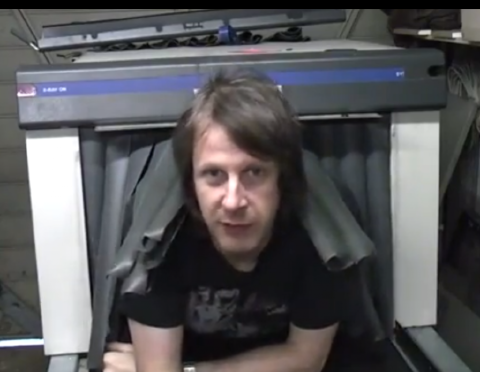
- The baggage X-ray machine took a friend and a van to haul back to his shop...and he broke even on the project! http://www.youtube.com/watch?v=KPyE29ABmoA
- A more recent project has 2106 LEDs and 2106 PICs, one per LED. This new design could have issues if Microchip has supply chain problems, as Steve Sanghi's letter about lead times seems to suggest.
- Mike thinks a good way to get into art is to make your own. He cited the quadcopter stage show.
- See the silly emails Mike has gotten over the years at his "Muppet alert" page.
- You can find Mike on Twitter at @Mikelectricstuf
Transcript
Chris Gammell: This is the Amp Hour Podcast, recorded March 4th, 2013. Episode 135, with guest Mike Harrison, X-ray, examining Xenogod.
Dave Jones: Welcome to the Amp Hour. I'm Dave Jones from the EEV blog.
Chris Gammell: And I'm Chris Gammell of Chris Gammell's Analog Life.
Dave Jones: And I'm Mike Harrison from Mike's Electric Stuff, and Namor of the Amp Hour.
Chris Gammell: That's right.
Dave Jones: Oh, yes, you are the Namor of the Amp Hour.
Chris Gammell: We owe a debt of gratitude. He enabled us, folks. It's all his fault. We have to blame him from now on.
Dave Jones: For our incredible wealth and success.
Chris Gammell: I meant for all the pain that we've brought to people's eardrums. That's what I meant, Dave. All those cringeworthy moments of us talking about how cars work and, you know, chip pinners and all that other crap.
Dave Jones: Well, thanks for joining us, Mike. Are you our first POM? As far as I know, yeah. I think so.
Chris Gammell: Andrew was, but he was calling us from Mexico, so that's why.
Dave Jones: Oh, right.
Chris Gammell: So he doesn't count. He's the first mainland UKer.
Dave Jones: For all you Yanks out there who may not know the word POM or POMMY, it's what us Aussies call English people.
Dave Jones: And often suffixed by the word bastard. POMMY BASTARD, yes.
Dave Jones: It's a term of endearment. Could be worse.
Chris Gammell: Dave could be talking about you like you were a Kiwi. All right.
Dave Jones: That's probably one of the things that comes over better in speech than on email, in that generally when someone's calling you a POMMY BASTARD, the tone of voice tells you that it's a sort of friendly endearment thing. But if you just see it written down, it doesn't look like that.
Dave Jones: Yeah, if I saw Mike in the show, hey, you're going, you POMMY BASTARD. Hey. Hey. Yeah. It's a normal greeting.
Chris Gammell: Well, Mike, we're so glad you could be on, though. I mean, so this is the first time you and Dave have talked, I guess, not in person, but just kind of. Other than my keyboard. Yeah. YouTube giants meeting at last. Yeah.
Dave Jones: I'm just looking. My subscriber count is four away from 10,000 at the moment. All right. We can see if it clicks over by the end of the show. All right.
Dave Jones: If we hear a woo in the background, that's Mike going to five digits. All right.
Chris Gammell: We heard once Mike gets to 10,000, we get to name a show, too. So, you know.
Dave Jones: All right. It actually ends up with a real name, right?
Dave Jones: Yeah. YouTube keep asking me if I want to change my channel name to my real name. I don't quite understand what that's all about. Yeah, those guys. But I have to keep telling them to sort of. It's really annoying. Yeah. Really? Yeah. Yeah. Every time I click upload, it says, you know, do you want to, you know, you should really change your name to your real name. Well, no. Sort of. Go away.
Dave Jones: I've never seen. I've never encountered that.
Dave Jones: And perhaps it's because you're monetized and you've got your official partner and all that sort of stuff. Yeah. Perhaps they're a sec. Maybe this is actually a company type thing.
Dave Jones: But I thought you were a partner, too. No. Oh, really? No. Oh, well, that sucks. You have to get onto them.
Dave Jones: Well, no. I deliberately didn't. Yeah. I don't need the money. So I'd rather not have the adverts, to be honest. Oh, right. If you don't do the monetized thing, you get a lot fewer adverts on stuff. So I'm not particularly bothered about that.
Dave Jones: Okay. Fair call. So you make all your money. You're a contractor. That's what you do.
Dave Jones: Yeah. I mean, I've only ever actually had one real job. And that, you know, that wasn't in the electronics industry at all. So I've been pretty much freelance all the time. I sort of, as a kid, very, you know, there's a lot of parallels with Dave. And, you know, as a kid, I was always taking stuff apart, fixing things and so on. And I got lucked into a job at a repair shop, which I did after school. We did, like, the warranty returns. The company that imported all the cheap rubbish, radios, cassette recorders, all that sort of stuff. And we did all their warranty returns. And, like, you know, it was like a pound a unit fixed flat rate to repair it or throw it in. Oh, wow. Put the red sticker of death, which was beyond economic repair, which means you couldn't fix it in, like, about 10 minutes. Got it, yep. But, I mean, I learned a hell of a lot from that, both doing the repairs, but also there were a lot of other part-time guys working there. A lot of them were, like, telephone engineers working from what was then the GPO. And there were some, you know, really good characters there. And I learned a huge amount from that experience.
Dave Jones: I've worked in that repair field, too. And as you said, like, that red sticker of death, you would go through, like, as a first pass. You'd have, like, these hundred boards in front of you you've got to repair. And you'd go through as a first pass doing quick tests, you know, and you'd know, right, that one, you know, like, that one is rooted, right? It's, you know, it's absolutely gone. And other ones, oh, that should be an easy fix. It's got a known problem. So you'd put a yellow sticker on it or something, and then you'd narrow them down first. And then you'd finally get through all the pile of the easy boards, and then you'd look at the hard boards and go and just sigh. Oh, boy. Yep. We had to fix the hard boards, you know. It was like, you know. Yeah, there was the beyond economical repair.
Dave Jones: The import company basically just said that anything above a 10% BRA wasn't acceptable. So as long as we kept it fairly low, they just went into a bin, basically. Oh, okay.
Dave Jones: Yeah, well, the stuff I worked on wasn't consumer stuff. You know, it was the company's own product. So, you know. Yeah. This was like the cheapest of the cheap. Right. Yep. That's understandable.
Dave Jones: Yeah.
Dave Jones: Those are the days. It's a good way to learn, though.
Dave Jones: I mean, like.
Dave Jones: Repairing boards is a great way to learn. Oh, yeah.
Dave Jones: You learn a lot about how to design stuff based on what things go wrong. Yeah. It's also quite entertaining. There's some quite good characters. Whenever I came in, I used to get in there like half four after school. And it got to the point there was a certain amount of sort of prankery. And it literally got to the point where everything, you know, I got to my bench and I turned everything on at arm's length. Because one of the favorite tricks was a 10 microfarad 16 volt cap inside the mains plug. So, a few of those. But I think I actually won that competition because I started getting more subtle. Oh, yeah. One of the things that every bench had were on these blocks. We called them safe blocks, which allow you to connect mains leads to the mains. You know, like a couple of croc tips under a protective cover. And I took the fuse out of one of the guy's ones. And I emptied it out and put a winding 4007 diode inside it. So, when he connected his crappy clock radio up to it, the sort of transformer started smoking. Oh, God. And it took him ages to figure out what was happening.
Dave Jones: Thinking he was getting, just assuming, what a fool, that he was getting quality mains out of it. Absolutely. What year are we talking here?
Dave Jones: Oh, I've got such a useless memory for dates. I'd have to work it out. That would have been probably end of the early 80s, I think. Yeah, it'd have been 1980-ish, something around there.
Dave Jones: Right.
Dave Jones: And then, sort of, through school, I started off in college. One of my problems was I was never any good at learning stuff that I couldn't see a direct application for. Yeah, same here. So, I was terrible at maths. I was terrible at chemistry. Physics, I was okay at. So, the only college course I could get into without maths was, like, a combined electronics and computing course, which I sort of did. Oh, who's that? Is that your phone, Dave?
Dave Jones: That's our call-up.
Dave Jones: Yeah.
Dave Jones: That's our professional radio show, which you've known, Mike.
Dave Jones: That's the guy who I put that diode in the plug of. But, no, I sort of did college, but I found it a bit too detached from reality, and I sort of dropped out after the second year. But that holiday, I lucked into a job where the college where my father was teaching, their computer services department were moving up the road over that holiday. So, I got a job there looking after – it was basically network wiring for BBC Micros, which were like the 6502 home computers that were big in education at the time. So, I was working there. I started off as a holiday job, and then when I failed to get back into college, I just stayed there. And I think I was there for about seven years altogether through sort of moving into PCs, you know, the old IBM room sort of IBM PC XTs on token ring networks, all horrible stuff like that. Wow.
Chris Gammell: So, it was like the heavy iron type stuff? I mean, like this is like mainframe still, or are you saying – No, no, no, no, no. Like labs and stuff? No, it's all PCs. Okay.
Dave Jones: No, no, IBM PC XTs, a room full of PC XTs with the horrible old EGA monitors and nasty stuff like that. Well, you get a good workout too, right? Amber, green or white? I think we went straight into color. Oh, wow. Yeah, oh, hell no. I think 64 colors. But then basically it wasn't an academic department. It was basically the department that supplied all the computers to the other departments and supplied a computer service. And because it was an education, they couldn't really afford to pay like the going rate for computer professionals. So, most of the people there were there because they just didn't want the stress of like the industry. And there was just a general understanding that as long as you did what needed doing, they really didn't give a toss what else you did on the side. So, quite a lot – a few of us had various odd little sidelines, writing software, whatever. And I got in quite heavily into doing stuff for the early Acorn ARM-based home computers, the Archimedes range, but neither of you have probably heard much about. I know.
Dave Jones: Yes, I know about them.
Dave Jones: But I did a lot of – designed quite a lot of hardware for those like video digitizers, Ethernet boards, SCSI interfaces, all sorts of stuff. And it basically got to the point where I was only more on the side than I was at work. Right. I mean, one of the things that I was quite lucky in that I started off on all the BBC micros. And as things were gradually moving to like PCs and to a lesser extent Macs, my sort of actual – what I needed to do was getting smaller and smaller. And nobody really noticed that I didn't actually have much to do all day. So, I only got to the point where I was literally spending like three days out of five just doing private work at work. Wow. And nobody noticed. Great job if you can get it.
Chris Gammell: Yeah, exactly. Well, as long as you're not too bored, right? Yeah. That's good.
Dave Jones: Yeah, well, I had plenty to do. Yeah. And they didn't mind me. Instead of taking like a two-week holiday, I just took all the days off as I needed and like go and visit customers or go to exhibitions and so on. They got used to that. So, it suited everyone fine, I think. Awesome.
Chris Gammell: So, this is like making circuit boards and stuff like – I mean, actually designing the PCBs and stuff?
Dave Jones: Yeah, it was designing the PCB, writing low-level software. Yeah. Because I started off on BBC Micro, which is the 6502, so I was very into like 6502 machine code, all that sort of stuff. And, you know, even to this day, the software I really enjoy writing is the sort of thing you need a scope to debug. You know, squeezing that last cycle out to cram some ridiculous bandwidth through a processor that was never really intended for that purpose. Yeah. I just hate writing big software for anything. I just can't – you know, 70% or 80% through, I just totally lose interest and get bored with it. Yep. I'm very much a hardware person. I much prefer doing hardware than software.
Chris Gammell: Yeah, yeah.
Dave Jones: You know, I do enough software, you know, embedded software, the low-level stuff I quite like doing. But as soon as it gets to anything resembling a user interface, I get really bored. Yeah, yeah. And if it then spills over into needing to like write something on a PC to like configure and talk to it. Oh, yeah. Yeah, I mean, I've got –
Dave Jones: Yeah, your eyes rolling the back of your head and you go –
Dave Jones: Yeah, for many years, I stuck to Turbo Pascal under DOS. Yeah. Directly hardware bashing. Because, yeah, it's basically just – yeah, it was mostly just sending stuff in and out of a serial port to like set something up or configure it. And then we moved over to Visual Basic 6, which I still use, which is – it's quite nice and it's really quick to just get stuff up and running. The annoying thing is, though, because it's not C. I'm writing C on the microcontroller and then flipping to Visual Basic. So, you know, I keep – half of my Visual Basic, like all the if-statementry in brackets and, you know.
Chris Gammell: It's not bad as long as you don't get like caught up in like the autocompletes of the VB6 stuff, right, where you get used to that. And then you just kind of sit in there when you're writing C. You're like, and? Come on, guys.
Dave Jones: Yeah. The other annoyance is if I need to give a bit of software to a customer, yeah, they can't actually go out and buy VB6 legitimately. Right, yeah. Which is another annoyance. Yeah.
Chris Gammell: Yeah, you can buy .NET and like – and they say you can take it back to VB6, but it's like – it's still such a mess.
Dave Jones: Yeah. Yeah, and I think I need to learn something sort of open source at some point. It's just that I don't do enough of it to – and of course, I've now got all my libraries and stuff for VB for what I want to do. And, you know, it's actually quite powerful. I mean, I've, you know, quite often do stuff to like blast quite a lot of data out from – literally read a file, format it, and throw it out of like eight serial ports on the end of a USB thing simultaneously. And you can get like, you know, a good like couple of megabytes a second pretty much sustained. Oh, yeah.
Dave Jones: It isn't any slouch. It's, you know, it's fairly good.
Dave Jones: It's no worse than Windows in generalism. Of course, with Windows, you always get like the latency and nasty stuff like that. But generally, I try to arrange for that to be somebody else's problem.
Dave Jones: Well, it's not surprising when you throw several gigahertz at it, you know. Like the processor in the OS, you know, it's running several gig in it, you know. It's just crazy. So the bottleneck actually becomes the hardware interface, really. It isn't the language you're using or something like that.
Dave Jones: Yeah, but the bottleneck is not so much that. It's the latency. It's when Windows suddenly decides to go and do something that you don't want it to do.
Dave Jones: It's not a real-time operating system.
Dave Jones: It's the – you know, the peak bandwidth is fine. It's the sustained bandwidth and how big a buffer you need at each end to cover the gaps.
Dave Jones: Yeah. So you've been doing your own stuff ever since, really?
Dave Jones: Yeah, pretty much. I mean, I – so I did a lot of this stuff on the peripherals for the, you know, committee's range. I then started sort of tinkering with picks, and this was probably before Farnell and RS stocked them. So they're a bit harder to get hold of. So you had to go and talk to a franchise distributor, and I went on a couple of the seminars, which were generally pretty good. The seminars were generally pretty good. This is where Microchip were really trying to push stuff. They were basically trying to push the concept of OTP parts for production because prior to that, it was – you know, OTP parts were very expensive, and everyone was using MassGrom. So I just started tinkering around with them with no particular aim, and I was talking to a distributor, and I got a call from him one day, and he was trying to sell picks into a customer who was using MassGrom, and they needed somebody to write the software so that they could sell the picks. So we went into this customer, and basically they're a company that made sounders for things like fire alarms. So it's basically a little box with a little piezo or a magnetic speaker that produced, say, 32 different alarm tones. Each country's got its own weird set of alarms for different conditions. Like France and Australia, actually, are particularly – they've just got their own weird set for everything, whereas, like, for example, most of Europe is standard, but things like that have got standard tones for, like, evacuate, end of evacuation, all that sort of stuff.
Dave Jones: I didn't know that sort of stuff was standardized.
Dave Jones: It's also – there's different industries. Like, for example, the petrochemical industry has its own set of standards. Like, there's a standard Australian tone for, you know, evacuate platform. I, you know, get the hell out of here sort of thing. And also fire has its own set of standards, and other industries have got their own. But there's – we're up to – our standard tone set is up to, like, about 48 tones. And there's specials. And it's usually the French that have really weird specials. Like, they want to emulate a mechanical motor siren or a klaxon or something like that. We actually did a product where you could actually store audio samples into it. Really? To emulate sort of weird sounders like klaxons and so on. But, as I say, me and the industry went into this company, and they were using – I think it was a Panasonic mask ROM for their product. And it was very clear they'd had bad experiences in the past with consultants because apparently this guy had taken six months to do this thing, and they were, you know, not that happy. So I'll sort of just go, yeah, I'm sure we can get something up and running. I'll take away your tone tone, have a look, and maybe – I don't know. We'll come back in about a week and have something. And the guy clearly could tell by his face he just did not believe, you know, that anything was going to happen after this. So, you know, a week later we go in. I'd made up a little prototype on a homemade PCB, and it all worked. And the guy was just speechless. The fact that it was possible to turn something – and it was like, you know, it was 500 bytes of words of code. It wasn't, you know, a great deal of code. But, you know, it was such an alien experience. Where are the invoices in between?
Chris Gammell: Why haven't you charged us more?
Dave Jones: Yeah, I think that's always been my problem, not knowing how much to charge, actually. My problem is I feel guilty charging a lot of money for something that I find easy.
Dave Jones: Yeah.
Dave Jones: Or enjoy, right? But no, I would say after that I basically did all the electronics design and software design for that company for many years. I'm still doing odd little bits of stuff for them today. And that was probably – that must be getting on for 13 or 14 years ago, something like that. Wow. And then I just got into various – I mean, I've been extremely lucky in the work side of things. And the next major bit of work I got was actually a guy that worked for that company, then moved to another company and needed something to be done. And then, like, I got another load of work from a guy whose brother worked for – you know, had his own company and someone I was doing work for in the UK. So it's been very much word of mouth. Occasional stuff that's cropped up from things like, you know, the Microsoft Registered Consultant Program. And the other thing I actually found really effective, most semiconductor manufacturers do these seminars to introduce their product. And I actually found a really good tactic for getting work is you sit at the front and you ask some very specific, highly technical questions that make it very clear that you know exactly what – not an attempt to embarrass the presenter or anything like that. But the things that make it clear that you know exactly what you're talking to and you then just start chatting to people over lunch. And you tend to find that – what I found in a few cases, people go to these seminars saying, oh, yes, we're going to get into using these new microcontrollers or whatever. And halfway through the seminar, they realize, no, I really don't want to do this. I can't be bothered. You know, let's talk to this guy and he can do it for you. This guy down the front was, yeah, he sounds like he knows what he's doing. Yeah, I picked up a few customers that way. It was quite good. Nice work.
Chris Gammell: And that's – I mean that's a good example of the – you know, having relationships over time is a good way to maintain business.
Dave Jones: Well, you have to as a consultant. If you do a good job for people, they will come back for more and they will refer you. It's as simple as that. Yeah. You know, you need to take a long term, though. You don't, you know, screw someone over the last – yeah, the last penny. So, you know, I don't like invoice – you know, if I'm like spend 10 minutes on the phone sorting an issue out, I'm not going to send someone invoice for that. And, you know, I have been probably been very lucky. I've never actually had a written contract. Generally, the way it works is, you know, we initially have a chat about what their requirements are. I then send them a spec on what I think their requirements are because, I mean, I've never, ever seen a spec document from a customer that's been anything like complete enough or usable.
Dave Jones: And will you charge them for that spec? Will you charge them for the time spinner or is that like just a freebie to try and get the job? Like a quote, kind of thing.
Dave Jones: Generally, I've pretty much convinced them that they're going to hire me by that time. Oh, right. Okay. If that's in question, then I won't spend as much time on it. But generally, I think by the time we sort of start – you know, by the time I've started chatting to people, it's generally fairly clear. I will never take on something unless I know for sure I can do it. I will occasionally say, look, you know, I think I can do this, but I'm going to go away, like prototype some little bit of it. Yeah. And just to – yeah, because my worst nightmare is taking on a job and then just finding there's just some real major thing that I just can't do it, which, yeah, hasn't really happened. So I tend to be fairly cautious.
Dave Jones: It's the art of consulting. That's one of the arts of consulting, really. Yeah. Yeah. Yeah.
Chris Gammell: Do you bid by job or do you do hourly, if you don't mind me asking? That changes stuff, right?
Dave Jones: Yeah. I mean, it tends to be – you know, we agree a spec and I'll quote a price to get to a point on that spec. Yeah. Because it's – yeah, I've always found it very hard to figure out what to charge. I generally have a rough idea in my mind of how long it should take me. Yeah. And then work out on like a per-day basis for that. But it almost always takes longer or, you know, one of the problems is I tend to find if I'm not very busy, I just – things just take longer to do. You know, you just sort of don't work so quickly. Yeah. Whereas if you're up against a tight deadline, you've got no choice. You just get on with it.
Dave Jones: We've talked about that here on the show before about engineers are most productive when they're under the pump.
Dave Jones: Oh, yeah. Right? Yeah, definitely. Yeah. Okay, it's more special.
Dave Jones: If you've got a deadline, you – you know, engineers are miracle workers. They get it done, you know, by the deadline. They're, you know, just fantastic. It must be something, you know, some cognitive process that allows us to, you know, do Gantt charts and timelines in our head of, you know, how things are all going to work and then bang. You know? Yeah. I've lost count of the number of times where, you know, I've just gone, you know, like I've finished it with like five minutes to spare. You know, you'll force somebody has to leave to take it on a plane to go overseas. You know? It gets that precise.
Dave Jones: Yeah. Yeah. Yeah. I know. From what I was doing most of the consulting stuff, there weren't many like insane timescales, actually. I was sort of fairly lucky on it. It's a lot more now. The stuff I'm doing now, the art projects and architectural lighting and so on stuff, it's an industry that's more used to like stupid timescales. And the other big problem is, you know, it's not so much the time between the project starting and needing to be delivered. It's the time between someone actually saying, yes, this is how we're going to do it. Here's, you know, we've agreed the budget. Now go. So you've got all these ideas piled up, waiting to go, just waiting for just someone to make a decision. By which time you're already like paying twice as much for the PCBs because they've, you know. Yeah. The one week turns. Yeah. The couriering stuff. One week. Couriers over. All right. Over an eight turn. One week. That's luxury. Nine. Yeah.
Dave Jones: A 24-hour turn for an eight-layer board. Try that. Yeah. See how much that costs. Yeah.
Dave Jones: Your salary. I've got quite a good local PCB guy that will do 24-hour two-layer stuff and they're close enough for me to go up and just physically pick them up.
Chris Gammell: Oh, that's nice.
Dave Jones: But four-layer, it takes about three days. There's another place a bit further away that will do four-layers. But I'm getting a few different places I've done four-layer. Yeah. This local place I tend to use for two-layer. But they're quite enough. Basically, they've been around for quite a few years and I don't think they've bought any new equipment in the last 20 years. Yeah. But they're cheap, you know.
Dave Jones: People don't seem to understand the complexity involved in manufacturing printed circuit boards. No.
Dave Jones: Yeah.
Dave Jones: I've actually got a video which I have edited but I haven't released, had it for ages, showing my microcurrent. My microcurrent's board being assembled and being manufactured. They're only two-layer but there's like 20 steps involved to manufacture just that two-layer board.
Dave Jones: Yeah.
Dave Jones: It's crazy.
Dave Jones: And four layers are even worse because you're all laminating. Yeah. However, I don't quite know how they stick it together. Yeah.
Dave Jones: I know. It's incredible. Yeah. So, yeah, don't take it for granted, people. When they do turn it in 24 hours, it takes them. Some poor bastards working flat out. Yeah.
Chris Gammell: They're headed off to the five minutes left, right? It's the same thing. That's it. Yeah. So, Mike, what kind of work are you doing these days? I mean, you're pretty big in the…
Dave Jones: Well, basically, for the… Yeah. I mean, I was doing all the industrial stuff for quite a long time. Then I went to a Dorkbot meeting. Dave Hewitt, we're a Dorkbot. Their tagline is basically doing strange things with electricity. Yeah. It's sort of people…
Dave Jones: Yeah, they've got one in Sydney, I think. A small one. Yeah.
Dave Jones: And it's basically people doing presentations, and it's pretty much, you know, doing strange things with electricity pretty much covers it. It's like art. It's, you know, makers-type stuff. It's all sorts of things. And I sort of went along and brought some of my high-voltage stuff, which went down. Obviously, it tends to be fairly software-dominated, so hardware stuff really goes down the tree. So I've done quite a few presentations. But say, I went along to this one meeting, and the guy was doing a presentation on this. It's basically like an RFID chandelier, and there's like this sort of colored LED chandelier over a conference table. And all the various, like, bits of table furniture, like the cups and whatever, had RFID tags in them, and there was antennas in the table. So you move stuff around the table, and the lights change to follow it. That's pretty cool.
Dave Jones: Basically, it was quite clear that they were running up against what they could do with off-the-shelf electronics in terms of lighting. And I just sidelined up to the guy at the end of the thing, said, look, I think I can be of use to you guys. I think I can be of use to you guys. And I did. That was a company called Jason Bruges Studio. If you look on my work web page, which is whitewing.co.uk, you'll see quite a lot of entries for them. There was a time when I was doing probably three quarters involved in about three quarters of all their projects. And that was generally designing bits of custom hardware to do what they needed to do. Things like, you know, high channel count dimmers, custom LED boards to fit into weird spaces, custom detection and control systems, that sort of thing. So this was like in fairly early days of sort of when LED lighting and stuff was a lot less developed than it is nowadays in terms of the stuff you can buy from China or whatever. Harder to get drivers and stuff. And there is quite a few people. Again, it's a few people from that company to set up on their own studios. And I've got work from them. And I've got pretty much a reputation. It's one of those industries where everybody knows everyone else. And I've got a reputation as the guy that can just get stuff done and working. Because obviously I can do the hardware, the software. I understand what they're trying to do. I'm enthusiastic about things with a gazillion LEDs in it. I do find when I'm talking to people in the conventional industry, like subcontractors, it can be a bit of a foreign language. Okay, this is a one-off job. We don't want 300 of these a year. It's a one-off job. We have no time or money to do a prototype run. We have to do a run of, let's say, 200 boards. And we cannot get these wrong. There is no budget to make mistakes. And obviously my experience in industry helped a lot with that in that meticulous attention to detail and testing and so on just to make damn sure the thing actually worked first time.
Dave Jones: Because otherwise you've got to bodge each board. Exactly, yeah. And that can chew in your time, let alone re-spin. A re-spin is pretty drastic.
Dave Jones: Yeah, and if there's 200 boards then. And you may have like a fixed install date where it might be something like a shopping center where you can only get in there at night, which is just an absolute nightmare. Shopping centers are the worst. And A, you can generally only get there at night. And B, the managers only care about running their shopping center. And they're generally not the sorts of people that are – once you actually get in there and get with the actual guys on the ground doing the work, they're almost invariably great. It's just the management just make it unnecessarily difficult to actually achieve what you – they act as if they're doing you a favor by, oh, do you really want us to get a cherry picker in so you can get to this thing on the ceiling? And it's just a bit of a nightmare. But generally, it's one of those sort of areas of work where the usual – when someone asks a lot of the people that work in these companies is, what do you do? What often comes out is basically a Venn diagram. And if you sort of draw three bubbles with lighting, design, architecture, and art, it generally sits somewhere within there. It's rarely – sometimes it's right on one, but it's often a mixture of – it's maybe like a new building. They want to put some interesting feature lighting or some interactive lighting effects in there. And there was – quite a few of the big jobs came from – I'm not sure if it actually still happens, but in the UK there was a thing called Section 106 Planning Permission, which basically meant that if you want to do some big development, part of the conditions on getting permission to do it meant that you had to give a certain percentage of that development to some public benefit, one of which is public art. Oh, okay. Some of the bigger jobs, like for example, one of my favourite ones was the one in the lift shaft. If you've seen on my website, we basically – it was a – I think it was a seven-storey office building. And they had two lifts, elevators for you American guys, in like an outside glass shaft. Thank you. And what we did was we – in the gaps between each floor, we made some big custom monochrome lead panels. These were about probably about six foot by 18 inches or so in each floor gap. And we hooked into the lift control system. So basically what happened is during the day it monitored all the movements of the lifts. And then during night it then played these movements back as like ghostly images of like blocks of light moving up the panel. And then the doors opening and closing. That's really cool. And that's actually playing back all the lift movements from the previous day. And I quite like that because it's really public. It's very large scale. It was done right. Nothing was bodged. It was obviously working in the lift shaft. There's quite a few standards and regulations you have to deal with. And that's still there today. It's still working. Never had any problems with it. And that was a Section 106 type thing. So they basically had to spend this money on something.
Dave Jones: Right.
Dave Jones: And the company that I was doing that with, they had good contact to the planning department because sometimes what happened was the counter would say, you've got to do this public art. And the company would say, well, what do we do? They'd say, well, hang on. Talk to these guys. They'll do something for you. They'll send you some art. Don't make anything blank. They'll come up with all the conceptual stuff. You just sort of send them the check and let them in the door to screw it down sort of thing. Yeah.
Chris Gammell: Oh, that's great.
Dave Jones: Because there's probably no other industry, right, where you're going to do, like, you know, say LED lighting on that sort of scale. Really? Is there?
Dave Jones: Well, I mean, there's a lot of it. Yeah, but there's a lot of it. And certainly if you look at, you know, like, you see these cityscapes of, like, China and whatever, and every building is just covered in LED stuff or some description. Often it very badly. Often bits of it not working. And they've skimmed a little bit too much.
Dave Jones: Because they bought them from the local market.
Dave Jones: Yeah, so some of it is just very commercial. Like, you know, there's one of my other customers, they do a lot of shop interiors with interesting lighting effects. So a lot of it's just designing, you know, large-scale lighting for that. So that's very much pure commercial architectural type stuff. But also some of the stuff I'm doing at the moment is literally a pure art piece. They build an art piece, stick it in a gallery, and hope somebody buys it at some ridiculous price.
Dave Jones: So it's not art for art's sake. It's more, maybe I can sell this.
Dave Jones: Yeah, exactly. I mean, you know, there aren't many people doing that because it gets quite expensive, you know, making a wall hanging thing. Oh, of course.
Dave Jones: Yeah, hardware with, you know, when you're paying expensive contractors like you, Mike, and, you know, you're buying 10 million LEDs, you know.
Dave Jones: Yeah, and one-off PCBs and, you know, that sort of thing. Right.
Dave Jones: It can easily cost, you know, 10, 20 grand or more for, you know, just one little art installation.
Dave Jones: Yeah, it depends a lot on the scale and exactly what it is.
Chris Gammell: So what about the design constraints of, like, architecture? I mean, so you said this is one-off for a lot of this stuff. How many extras do you have to make? I mean, do you make double the amount of boards for replacement?
Dave Jones: It depends what you're doing. Obviously, you do spares. Primarily, you do spares for at the time of installation because, obviously, if you've got access to a building, they've shut the lift down, you don't want to be sat there because, you know, you've dropped a connector and haven't got a spare one with you. I mean, that actually won't bother you. There it is. Let's go home. So, you know, you budget for spares to some extent and you judge, really, what sort of thing it is as to how many you do. And also, just to cover, so you don't have to rework everything. You know, you get, like, I don't know, 100 boards off your service mount line and, you know, you round up to the next panel just so that you don't have to rework the really nasty ones. You can just throw those in the corner and deal with them later.
Dave Jones: So, how often do you use your pick-and-place machine in the lab? Quite often. You're one of these lucky bastards who has the pick-and-place. Can you tell what drove your decision to get one?
Dave Jones: Yeah, that was very clear. Basically, I was doing more and more fairly short runs of jobs in fairly short timescales. Now, I've got quite a good subcontractor up the road who's got a couple of lines. One of the problems is I've used various contractors over the years. And the problem is that the really small ones generally just disappear because, you know, they lose one customer and they're screwed. And the big ones aren't interested in doing small jobs. So, you have to find someone that's about the right size with the right attitude. And the place I've got up the road, you know, they're perfectly good. The quality of their produce is great. The problem is they've got a few fairly big customers. And my jobs really just have to fit in between those. So, it's a case of changing. And because it's a small job, you know, I can't say, look, I'll pay twice as much but turn it around quicker. It just isn't worth their while. So, that was probably the main reason. And at the time, I thought, well, you know, is it worth it or isn't it? I mean, I paid probably over the odds for that machine. I paid, I think, about 8,000, something like that. And if you're lucky on eBay… Is that… Yes. Yeah.
Dave Jones: Right. Okay. So, that's what, US dollars? It's… Say 10K US. 15K.
Dave Jones: Yeah, 15K US. Right. But if you're lucky on eBay, you can find these machines for 2,000 to 3,000 pounds with Vidas.
Dave Jones: So, was this new or secondhand?
Dave Jones: No, this was secondhand. And the machine came out in about… It's from Cunnington Versatronics. And it's fairly unusual when it uses a scarotype arm rather than an XY Gantry. Ah, yeah, of course. But even today, it's unusual. Its floor footprint is very small. It doesn't need a compressor. So, it's actually probably one of the best machines for a small… It doesn't need a compressor.
Dave Jones: How does it get the vacuum, then?
Dave Jones: It's got just a little internal vacuum pump.
Dave Jones: Oh, right. Okay.
Dave Jones: A lot of the other machines, they use the compressor more for things like pneumatic feeders and so on. Yeah. But you don't need a very big pump just to suck a component up. It's not a big deal. But, no, it's been a lot more useful than I thought it would be. Just the ability to turn stuff around quickly. Because, I mean, when you're dealing with subcontractors, you've got to generate all the bill of materials. You've got to give them the data. They've got to interpret it. You've got to write out the materials.
Chris Gammell: You've got to write out the paper when you have a dead board, right? Or 20 dead boards.
Dave Jones: But also…
Dave Jones: So, instead of spending a day doing all that paperwork for a couple of days, you can actually be setting up your machine instead. Absolutely, yeah. Even though it does take a couple of days to set up, right?
Dave Jones: Well, no, it doesn't. Because, firstly, I've got a very streamlined process. I actually wrote some software that would take the output from my PCAD files. I'd make sure all the libraries are lined up so that things like all the rotations are right. So, the biggest amount of time is just literally loading the feeders for the parts that aren't actually already on. So, literally, I can be from my PCB design to placing in half an hour if it's a part… Wow, very nice. Perhaps like a dozen different types of components. So, that works out really. It certainly proved very, very worthwhile, you know, the jobs that I've done. Bigger jobs. Basically, anything that's more than about a day's run, I'd subcontract with that.
Dave Jones: But it doesn't just work out of the box. As you said, you had to learn how to use… You had to write your own custom scripts and all that sort of stuff.
Dave Jones: But that wasn't actually a great deal of work, to be honest. It's not a…
Dave Jones: No, but it's got to be done. Oh, yeah.
Dave Jones: It's got to be done, certainly. And, you know, it works reasonably. The accuracy isn't great. I mean, 06, 03s, it will do on a good day. You might need occasional nudging. And half a mil QFPs, you tend to nudge a little bit.
Dave Jones: So, does that mean that you stick to larger?
Dave Jones: I would default to 805s unless it needs to be small. Yeah. Yeah. Oh, 805s, it will do like… You know, it will do like 5,000 of those without getting a single one, you know, needing nudging. Right. It's just the fine-pitched stuff. And obviously, if you're only doing, let's say, 20 or 30 boards, if there's like just one component on each of those boards, it isn't even worth setting up. You just place those by hand. It's much quicker.
Chris Gammell: Do you find a lot of reuse in like board outline sizes? And I mean, you said you do a lot of microchip pick stuff. Yeah. Do you find a lot of reuse though?
Dave Jones: It's not a big problem. Basically, my PCB layouts, I tend to take a bottom-up approach. So, what I don't do is I don't start from a schematic and then export that into the PCB software. I start in the PCB software because a lot of the things I do…
Dave Jones: You're one of those people.
Dave Jones: Yes, one of those evil people. But basically, I mean, I've always done it. But things like, you know, you've got a microcontroller and there are so many different permutations of pins that you can use. You know, I've yet to see any CAD system that handles that well. You can say on your schematic, this node can go to any of these pins. I don't care yet. Yeah. But also, it's complicated because it's not always it can go to any pin. It can go to any particular permutation of pins. And it's so hard to actually express that. So, generally, you know, most of my component library is just footprint. It's like an SO20. It's not a pick whatever it is. And so, I've used PCAD a long time ago when I was doing the Acorn stuff. I actually wrote my own PCB software. But that became a bit more cumbersome to use for various reasons. So, I ended up getting Accel and then PCAD, which is nice. And, you know, the nice thing I love about PCAD is you can just throw a load of footprints down, rats nest them manually, you get all the net names appearing on screen, hand root it, and, you know, job done. You don't need to go anywhere near a schematic program if you don't want to. And there are, you know, I do have some boards that there exists no schematic for.
Speaker ?: Right.
Dave Jones: Again, because it's, you know, one-off jobs. The other thing I absolutely love about doing this sort of work is it's one-off jobs, no production test stuff, no documentation. You know, there's so many of the boring things that just don't happen at all.
Dave Jones: That's being honest, documentation. Don't tell your customers that. Well, yeah.
Dave Jones: I give them enough documentation to be able to, like, you know, identify, figure out what the protocols are, whatever. Yeah, yeah. And I just thought of something I've just forgotten now about that. Oh, my brain's not working. But, yeah. Oh, yeah. Yes, the other great thing is you can design around the parts you can actually get. So, you know, you don't have to worry about a component going obsolete in two years' time. You say, okay, what's in stock in Digi-Key? Right, I'll design that one in. And, you know, then you just press the buy button on Digi-Key and Farnell at the same time you do on the PCBs. That's easy. So that's a luxury.
Dave Jones: Totally different to corporate engineering. Absolutely, yeah.
Dave Jones: Yeah.
Dave Jones: Oh, yep. I can tell you many a story. Yes, there you are. Much of my life is wasted on corporate engineering.
Dave Jones: Well, as you said, a lot of your designs never actually made it out the door, which I think must be a bit frustrating in some ways.
Dave Jones: Yeah, yeah, it is. I mean, like, you still get to work on stuff, but often that's not a bad thing because a lot of the boring shit is that last 10%, right? Yep, yep. So if you don't like that last 10% of actually getting something out the door, then, well, you know, corporate engineering's not bad. Yes, my project was canned. Awesome. I don't have to finish it off.
Dave Jones: I've only had a couple of those where just projects just didn't happen, and I actually breathed a big sigh of relief because I was getting really bored with it at the time.
Chris Gammell: So they drag on, yeah.
Dave Jones: Chris, you're still doing that. You're the only one of us who are still doing the nine-to-five grind.
Chris Gammell: That's right, yeah.
Dave Jones: Yeah. Surely you're going to wise up soon.
Chris Gammell: I'm sure sooner or later.
Dave Jones: Quis and live a fancy and carefree life, isn't it? Yeah.
Dave Jones: I think I find it very hard to go back to an all-job.
Chris Gammell: I can't imagine doing, yeah. I mean, like, just hearing your PCB process alone, like, trying to shoehorn that into, like, other, you know, like, a whole CAD group. Like, I haven't worked without a CAD group, right? I mean, I've done protos myself, but, you know, when you're working with a CAD group, it's like you're just, you're just, you're whatever they want to do.
Dave Jones: Throw that design over the wall, you know, to throw it over the wall to the CAD guys and they take care of it. Yeah, I know, it's easy, but, yeah.
Chris Gammell: That's not easy.
Dave Jones: It's not all, you know, as we said before, you know, you can work any 15 hours a day you like, you know, as a contractor. It's like, choose your own 15 hours, you know. It's not easy. So, Mike, would you take on more than one job at a time? One major job?
Dave Jones: Yeah, I mean, nowadays I try to avoid major jobs wherever possible. I like doing the fairly small, quick things because, you know, the major job, you know, you're doing the big major job, then something else comes along. I mean, I've been fairly lucky when I was doing the more sort of traditional consulting stuff in that, you know, you train your customers to not to expect things on a stupid timescale. And, you know, you'd be realistic about delivery dates and you can generally like multiplex the jobs reasonably well. But, again, that's really down to luck. I've not turned down many jobs. I think one of the problems is a lot of my customers, I've basically been their only electronic resource, which to some extent imposes a certain amount of almost duty in that they've got another job. You know, you can't say, I'll give it to this guy because I don't want to do it or whatever. So, that's probably a slightly frustrating thing.
Chris Gammell: Well, that's smart. You've cultivated clients. You know, that's smart.
Dave Jones: Yeah, the other thing is, for example, training them not to ring me before about 10 in the morning. You know, because I'm a late morning to late night sort of guy. Yeah. And, you know, early mornings are just not, you won't get any sense out of it. It's not good.
Chris Gammell: Well, it's got to be great seeing a lot of your stuff out in the wild, too. I mean, you see, you've got some big projects out there, like that Halo 4 UK launch. Yeah. That was insane.
Dave Jones: Yeah, that was one of the more interesting ones.
Chris Gammell: Yeah. So, could you explain that or what were some of the challenges with that thing?
Dave Jones: Well, if you step back to basically the first UFO we did, which was basically an art project that was flown in Gdansk in Poland and also in Rio. And that was literally a pure art thing for an American artist who'd always had a fascination with UFOs and somehow managed to cobble together enough money to build a custom. I think that was about a seven-meter diameter thing. Unfortunately, that one, he had a lot of donated equipment, so we had to work around that. So, a lot of the way it was all wired up was not particularly optimal. But we spent quite a lot of time looking at things like, you know, okay, you need to fly this thing under a helicopter. The first thing we found out is that you don't want to actually attach anything to the helicopter because then that has to go through all the certification stuff. But if you just hang it underneath, it's cargo. So, that problem, you know, just all those problems just disappear. And we spent a lot of time looking at power sources and came to the conclusion that a good old sort of petrol generator is very, very hard to beat in terms of, you know, power to weight and flexibility.
Dave Jones: Well, when you're talking about large power like this, right? There are the tens of kilowatts or kilowatts.
Dave Jones: The first UFO, I think we had about a six kilowatt generator on that.
Dave Jones: Yeah.
Dave Jones: And we looked at batteries, and batteries would have probably just about done it for a flight. The problem is all the charging in that, you know, you have to know exactly when you're flying. You have to make sure everything's charged. And if there's a delay, you're totally screwed because you can't recharge. Whereas with a petrol generator, you just put some more petrol in and away you go. So, we flew that a couple of times. And that sort of went reasonably well. There were quite a few issues that I won't go into there. You're like people shooting at the UFO? No, no, no. But there was some potential sort of, put it as a, in both times, the pilot did cut the flight short on safety reasons.
Chris Gammell: Oh, wow.
Dave Jones: There was some pendulum crap happening and stuff like that because helicopters are very delicate with loads. Yeah.
Dave Jones: I mean, but these were, you know, helicopters specifically designed for load carrying. And there were a few. One of the main issues was that because of the various politics involved, we couldn't really talk to the pilots to get exactly a two-way conversation to actually learn exactly what the issue is. And our best, our best get was simply that they were using more fuel to stabilize it than they expected to because of the wind loading. But we never really found out. But the, so after that happened, the company that, that did this got, you know, but whenever you do a big, like big, well-publicized job, you get lots of inquiries for people that want, basically want to do the same thing. So there was various other UFO-oriented inquiries over the years. And then this, this, this Halo one came along from Microsoft with a, obviously a very big budget. Yeah.
Chris Gammell: Yeah.
Dave Jones: And the concept sort of pretty UK-like, we're going to, you know, really go to town on this. And we've got a custom structure made. There's a really great company that we've used for quite a few things who they make a lot of things like custom staging for big rock tours and so on. So basically, you know, they will make anything out of aluminum and they will usually weld everything together. Wow. And you, you, you, you drive into their car park and the first thing you see is this massive great argon tank for all the TIG welding they do. It's just amazing. You know, if you're asking to build something, the sort of things you expect most people to screw together, no, we're going to weld it.
Dave Jones: How many people were working on that sort of Microsoft project and, and, and who actually managed it? Who did they hire to, because something, a project of that scale, you'd need someone to manage it, right? Oh, yeah. Hire Mike. Mike is doing it in a weekend, you know? No, no.
Dave Jones: I mean, the, um, the, um, the, the company that did sort of the production on it, there were a lot of my, there were a lot of people from the Microsoft side that I never even really had any contact with, but the actual getting the stuff running, there was a project manager and various people doing all the CAD stuff. There were the guys up, uh, doing all the fabrication, doing the design, batting for all the structural things. Um, because obviously this thing was, I can't, I think it ended up about 10 meters. I think it was one of the things where we start off with, let's say it'll be 20 meters. And then by the time, you know, reality sets in, it sinks down to, I think it was something like 10 meters diameter, a custom made aluminum ring structure. We'll just find a little more. But yeah, but things like figuring out how to mount all the lighting to it. The light was just standard, um, uh, you know, flexible lead strips inside a silicone tube. And we were looking at, because, because one of the problems is we don't know, is it going to be raining or not? So we have to make it waterproof because we don't know if it's going to be raining or not. So we sort of started looking at, you can get these lead strips that are like solid silicone molding within a hangman. Yeah. Those are going to have quite a lot of weight.
Dave Jones: So we ended up using, it's not hard to make anything waterproof, you know, like rain proof. You can just, ah, just, you know, gunk the whole thing in silicone or something. Yeah.
Dave Jones: There was quite a lot of silicone involved. We actually used these silicone tubes, which were then stuck to the aluminum profiles with silicone and some cable tie backups. Because that was just the easiest thing. But yeah, there were a lot of them. I think there was something like, I think about 500 sections of varying lengths. Um, and so we, we looked again at the power issue and because this is a fairly large structure, what we didn't really want is one big generator. Because obviously you'd have quite a big point load to support. The problem with generators is once you get above about 5kVA, they tend to be diesel, which are a lot heavier than petrol generators. So we ended up with four, I think 3kVA petrol generators around, you know, distributed around the structure. So we didn't have any big, big point loads. Um, and the actual control was, uh, there's a product that I've done, I've done for quite a few different installations, which is a 48 channel dimmer. Um, it's basically a DMX dimmer, um, which is just controls like 48 one amp outputs, um, for controlling like lead strips. And we've used those in a lot of like shop installations and other things, things like that.
Dave Jones: Um, would you find that you actually put thought into that when you're designing something? Oh, look, I can make this controller a bit more generic. Yeah. So that it might suit other jobs. Yeah.
Dave Jones: So, I mean, sort of, I mean, that, that came about, you know, we were seeing, you know, quite a lot of jobs. We need to control a lot of, you know, leads of the order of say an amp per channel, things like big lumps of lead strip. And there's a few, you know, like eight channel dimmers from China that are an absolute piece of crap. So it's going to say, well, let's design something. You know, the issue is getting a high channel count without needing loads and loads and loads of boxes, loads of power cabling and whatever. Um, so I, you know, 48 channels came out to be like a nice number. It's like 16 RGB strips or it's 12 RGBW strips or it's 48 monochrome strips. But designing, you know, there's a lot of interesting design challenges in that because you're, you know, if you're producing 48 channels at one amp per channel, well, this thing's going to be hooked up to a 50 amp power supply.
Dave Jones: Yeah.
Dave Jones: But because you want to make it fairly small, you don't really want to use a massive great MOSFET on each output that will withstand a short circuit. Um, and I actually found these really nice automotive drivers that will like turn off in like about 20 microseconds if they get a short. So this thing's, you know, completely short circuit protected, even when it's got a one kilowatt power supply connected to it. Nice. Um, cause the last thing you want to do is like blow out a channel on a 48 channel in the middle of an installation.
Chris Gammell: Looking up at a helicopter and be like, ah, fuse went out, bring it back down.
Dave Jones: Yeah. When it was designed for like slightly more down to earth applications than that. Yeah. I mean, it's been used. I think I've, I recently just did, did the third batch of 50 builds. So, um, there's quite a few out there. And if you look at my website, you'll see quite a lot of the installations that use them. Um, there's like, for example, you just generally sort of large, large chandelier type things or shop fitting type things. But, um, for, for the, the halo thing, we, we got one of these dimmers. We packaged it up into a waterproof box here with a, you know, a kilowatt power supply. Um, and these had all brackets, so they'd all bolt on. Um, and we used a control system from a company called Faros. They make some very good, but very expensive lighting controllers. Um, but they've got really good software. So you can draw out all your map on screen as to how all your lights are actually laid out and like put video into it. And do all your graphics and everything. And that will then automatically remap it to the, the actual layout of the, you know, the, the, um, nodes. And, um, the, the helicopter company was a company that that's specific. They're actually, um, uh, dedicated to doing like installation and lifting work. Um, and they do things like, you know, putting big equipment boxes on the tops of buildings. Uh, and in fact, that often works out cheaper than the cranks. If you have a big crane, you've got to close the street off. You've got to get the crane in. You've got to shut the place down for a couple of days. Whereas the helicopter is literally in point, you know, straight on the roof half an hour later, job done. So the helicopters are expensive. Um, they can actually work out cheaper and the pilots were amazing. I mean, the precision that those pilots were getting on this helicopter was, it was literally, you know, an inch or two. They could move, move something on the ground. Incredible. It was really amazing. And even with us, even with a bit of a wind as well. It's very, very impressive.
Chris Gammell: That's amazing. That's a meat controlled control system, right? Yes.
Dave Jones: Yeah. They had a guy on the ground in radio contact, but I don't think they had any particular special adaptations with that, you know, for like stability for the helicopter. Yeah, yeah, yeah. It was just literally, you know, pilot, pilot skill for that.
Chris Gammell: That's killer. Your, your work site, the whitewing.co.uk, it has so many great examples on it. But you have tons of high voltage stuff on your, your Mike's electric stuff too.
Dave Jones: Yeah, a lot of that's sort of quite old and I've not really done that. Basically when I, I deliberately held off getting onto the internet for about two or three years because I knew it would be a massive time suck. But when I actually did, I sort of discovered Tesla coils. I thought, well, that looks fun. Let's make one. So I made a Tesla coil and that was quite fun. And then I got bored with Tesla coils and I started making Mark's generators, which are basically high voltage impulse generators. They're a little bit like a diode capacitor voltage multiplier, except you replace the diode with spark gaps. And I've got one which will generate a, about on a good day, it will generate a four foot long spark. It's basically, it's two towers, it's bipolus. One tower goes to plus 500 kV, the other one goes to minus 500 kV. So you get a million volt spark flying between them. Oh my God. Which is, it is quite, it's quite, quite fun. They're a really simple device. All it is, if you imagine a ladder where the verticals are a resistor chain and the horizontals are capacitors, you sort of stick, say 25 kV on the bottom of the ladder and all the capacitors charge up to 25 kV. You then have diagonal spark gaps, which when one fires, it basically wires all those capacitors in series. So instead of like 10, 20 capacitors at 25 kV, you've got one capacitor at 500 kV. So they're actually quite simple. But there's a lot of details in actually getting them to work reliably. But I've run that out of a few Tesla cons. I stopped running that at home because one of the days I was testing it, I forgot to ground my garage door. And it glitched my alarm and sent a panic signal through and the police turned up on the door. And sir, what are you doing here? Nothing, officer. When I showed it to him and explained, they sort of made a hasty retreat and didn't really want to know anymore.
Chris Gammell: He's weaponized everything. Oh, brilliant.
Dave Jones: No, I've got all your stuff. I really haven't done very much at all. It's just sort of sat there. I just haven't had time. And sort of something else. I've got the valve collection. Story of your life, right?
Dave Jones: I mean, a lot of things like the valve collection, most of that's just satin boxes. Some of the better examples are hanging up. I've run out of wall space. And my other hobby was making strange digital clocks. And I really haven't got anywhere else to put clocks. So that sort of killed that pretty much. Right.
Dave Jones: And no, folks, Mike is not married. You can tell.
Dave Jones: How did you guess?
Dave Jones: Helps a lot, folks. Although he's open to offers, I believe.
Chris Gammell: So what's the scene like in the UK?
Dave Jones: It's hard to say because I've never really been that employed in the industry, the electronics industry. So my main contact with industry is just things like trade shows. I mean, there was a show a couple of weeks ago called the Southern Manufacturing Show, which is a mixture of electronics and metal bashing mechanics. There's some really cool multi-axis CNC machines going. But that was absolutely heaving. They'd overflowed about three car parks. It was really, really busy. Which I was quite surprised at. So there's obviously a lot of stuff happening. And certainly, you know, anyone that's any good isn't short of work. You know, my big problem is that, you know, there isn't really anyone I could say, I'll go to this guy, you know, if I'm too busy. Because I don't really know anyone that's not, you know, at least as busy as I am.
Chris Gammell: That's a good sign, yeah. I'm in the hobby space as well. I mean, like, just kind of overall, just like, even just that there are other people there, you know, kind of working on stuff that you have a network there to talk to about.
Dave Jones: Yeah, again, I think like Dave, I never really had any other fellow electronics geeks. There were a few when I was in college. But there were, and also when I was doing a lot of the Acorn stuff, I knew quite a little, you know, some of the guys that were actually working at Acorn. And then subsequently became the Arm guys. So, yeah, that was quite interesting. And hobby-wise, I think like pretty much most places, hobby electronics pretty much died a death with, yeah. I think the main thing was just the fact that you could no longer make stuff cheaper than you could buy it. I think that that was really a big part of it. And I was quite lucky at school, there was a guy that was actually a chemistry teacher who ran an electronics club, sort of in his own time after school. And he actually got the school to do electronics, what we call O-levels, which is sort of the exams that people sit at around 15, 16. So, yeah, our school was pretty unique in the borough. And obviously, I learned a great deal. I think at any one time, there was maybe perhaps 20 people in the electronics club, you know, in each year. So, there was a group of people. And there's one guy that I occasionally still hear from who's doing consultancy. So, that was also probably a fairly big influence in terms of learning and enthusiasm and so on.
Dave Jones: So, would you say that was around the end of the 80s, early 90s? That's my experience. It was like all of the 90s was practically, you know, the industry was dead. Yeah. Sorry, the hobby aspect of electronics was dead. Yeah, and it certainly died. Electronics was dead.
Dave Jones: I think I'm a few years older than you, Dave, but not many. But I think, yeah, certainly when I was at school, there were probably five magazines on the shelves. There was like ETI, Practical Electronics, Everyday Electronics. One, there was Wireless World and a few others. And I think over, yeah, those sort of gradually petered out. And, you know, certainly I remember going up to, yeah, Edge Rare Road was like the mecca of electronic shops. You could go and buy, there was like a test gear shop and there was like component shops and they all gradually sort of died out one by one. I think there was actually still one that's just hanging on. There's got like about two shelves in the corner of a few electronic bits. Right. And the rest of it was like CCTV and disco lights. So on. But, yeah, certainly that gradually sort of died out over the years. And I think obviously the whole, you know, home source hardware maker stuff has, I think, I think it's probably coming up rather than going down now. But certainly not. Oh, definitely.
Dave Jones: It's ramping back up.
Dave Jones: Totally. And certainly where, you know, a lot of the places I get involved with, particularly around East London, there's a lot of little companies. There's one of the guys that I do quite a lot of work for. He's basically got two companies. One is like the big architecture stuff, but he also runs a company called Technology Will Save Us, who do a lot of, they run a lot of courses and like do Arduino stuff and do like little kits and so on. I've designed a couple of things for them. That's funny. That they use like as a soldering course, there's a thing called a Lumiphone, which, I'm sure it is. Basically, the design brief for this was, let's make something that somebody who's learning to solder can assemble in under an hour. Yeah. And the material has to be about three pounds. Yeah. And we came up with this little thing. It's basically two LEDs, two light-dependent resistors and an oscillator. Nice. So with your finger, you control both the pitch control.
Dave Jones: Oh, it does work on radio, folks. I was going to say this doesn't work.
Dave Jones: And sort of volume control. So it's a bit like an optical theremin, but it's like really, really simple. And they use that as a nice sort of thing for soldering classes. And the other thing we did was a Kickstarter for the Bright Eyes LED glasses, which, again, they're linked to on my site, which are, to be honest, I think that was a little bit of a ridiculous thing to do as a sort of thing for the general public.
Dave Jones: It was a bit of a wake. Yeah.
Dave Jones: We've done quite a lot of custom stuff for things like product launches and so on, where we were on a fairly unlimited budget. And we did some quite cool stuff with playing video on LED screens, on headphones and other bizarre stuff. But fun stuff like that. I'm sure we'll be doing more stuff like it. And we're just trying to think of, you know, cool stuff to do with fairly simple electronics. And we're really debating, well, shall we go down the microcontroller route or shall we try and keep everything analog and, you know, with logic and so on? But my argument is that, you know, most of the things you can do with simple components have already been done in terms of electronic projects. And, you know, the way to get interesting stuff is use the stuff that wasn't available then, things like accelerometers and whatever. But, of course, those aren't available in easily soldable packages. So there's a bit of a doubt about that. Break out boards.
Chris Gammell: So are you seeing a lot of interest from like – I mean, so you work with artists a lot. I mean, do you see the same kind of interest ramping there? Is that where you see most of the interest ramping or is it just kind of across the spectrum?
Dave Jones: It's hard to say. I think I've got a slightly unusual view of things. So I'm not sure I could really comment on that, to be honest. You know, there's more electronics is being done. Obviously, there's the Arduino stuff and people are – you know, I think, you know, where I come in is people get something running with an Arduino. You know, and then figure, well, how do we scale this, you know, to larger installations? And, you know, they don't have the electronic background to know how to – well, okay, I can run one LED on this one power supply. But if I run 5,000 of them, you know, I don't – you know, it's a thing. It's a scaling issue, yeah.
Dave Jones: Usually, they'll have a go at it and it doesn't work. You know, I have a – I can't get more than 10, you know.
Dave Jones: Why doesn't this 3A LED work on the end of 20 meters of cable to the 12-volt power supply? It should be like that. And just sort of – yeah, just general scaling and, you know, that type of thing. Yeah. A lot of it's as much about power distribution as data and control a lot of times.
Dave Jones: So are a lot of your design challenges – I presume they would be system stuff, right?
Dave Jones: Because most of these things are large-ish scale. Yeah. So it's basically a systems engineering challenge, not an electronics challenge.
Dave Jones: Well, it's both. It's, you know, how do you architect both the power and the data distribution based on how big the thing is, where – you know, how big are lumps the things are in in terms of content. I mean, a good example of this is the lift project. Each of those panels, I think, took something of the order of 100 watts. But only one would ever be on at one time. So instead of having a power supply that was capable of running all of them, I actually designed the protocol such that it was inherent in the protocol. It wasn't the case of there was one channel for each panel. There was a channel that said which panel is on so that whatever happened data-wise, it could never turn more than one panel on and trip the power supply out. So it meant that we could use a fairly small power supply instead of a massive great one. And, of course, the problem is that as soon as you have a big power supply, you then have the problem of circuit protection in that you can't – okay, let's say you're running 50 things off a 1,000-watt power supply. But each of those 50 things is on the end of a piece of Cat5. Now, if you get a short at the end of that Cat5, you suddenly get an awful lot of smoke. So it's things like actually designing the protection so that, okay, you run thick YD, you then split that into polyfuses to make sure that it's protected at each stage. So a lot of when you scale things up, a lot of problems appear that you never had any idea of. Things like not setting the building on fire. And customers are a little bit sensitive to – Details. A lot of people assume, oh, it's low voltage, therefore it's safe. Well, up to a point, yes. Yeah, yeah. Power's power.
Chris Gammell: Exactly. Yeah. That's really interesting, though.
Dave Jones: We've got some viewer. Yep. Queer viewer. Listener.
Dave Jones: I think the number one is where do I get all the stuff for the teardowns? Now, the obvious answer is most of it is eBay. But I do have – it's not just a – I've got a few very carefully crafted search terms that I search regularly. Whenever I see something vaguely interesting, I quite often bookmark that seller because quite often you can see by the range of stuff. This is clearly someone that gets interesting stuff. I'm giving away all the tricks. Yeah, I was going to say, well, I would hold back. I'm talking generics, not specifics here. Yeah. They're not going to give us the terms, right? My bookmark list will die with me. And I now get the odd donation as well, which is quite fun. Like the compact, the underwater sonar beacon, which I'm sure is something you've encountered, Dave, in your career. I actually got – I actually had an email from the director of that company saying, nice teardown, do you want a job? Really? Really? YouTube can pay, folks. I'll just say one. No thanks for any more teardown donations. I'm most welcome. But I didn't hear anything back after that.
Chris Gammell: What about moving stuff? I mean so like the – I was thinking of the x-ray machine. I mean how are you moving this stuff? Are you getting it delivered or what?
Dave Jones: Basically, the story behind that was I actually saw it quite a few months earlier on eBay. He had basically a guy who had a working one for 1,000 quid and a 41 for 100 quid. I thought, well, that's interesting. I thought, oh, it's quite a long way out of the country and I just sort of forgot about it. And then another guy that I occasionally do some work with, Stefan, he said – he just sent me the bookmark to the working one that the guy was still offering. And sort of said, you know, I'm thinking of buying this to put in the garage just to make some Echrazor stuff. And it just – I said, oh, I remember the guy had a 41. Let's see if he still got it. And we rented a van and we went up and we picked it up. And it was one of those fun things that just really had to be done. I don't think I'd do it again, to be honest. But it was – we got good mileage out of it, I think. And I recovered – what we paid for it, I recovered in all the scrap metal. Oh, really? Nice. And I think that – and the few odd bits like the detectors I sold on eBay covered the cost of the van. So I think we pretty much just about broke even on that one. And I've still got quite a few odd bits of kit. I've still got the X-ray tube and a big high-voltage power supply and a few other things that may be put to use at some point when I get around to it.
Chris Gammell: Yeah. So JD asked on the site, do you ever find anything unexpected like wildlife or money or stuff in there? No, not really.
Dave Jones: I don't recall anything. I mean, I think we found a few coins in the X-ray machine and some very disgusting lint and gunk. Yeah. But I don't think I've found anything unusual or particularly strange, unfortunately. I'm sure – I mean, I get a little bit nervous sometimes when I start looking at some medical stuff, to be honest.
Dave Jones: Oh, yeah. I mean, I'm sure we've all seen those eBay photos that do the – eBay photos? Those email photos that do the rounds, you know, of like somebody found a snake inside their power supply. Yeah. Yeah.
Dave Jones: Something like that. I haven't found anything like that, no.
Speaker ?: Right.
Chris Gammell: I had a mouse living inside an old organ once. That's about the worst I've ever gotten. Right.
Dave Jones: That's about right. Yeah. There you go. Nick asks, what is the project where you controlled 2,106 LEDs with 2,106 picks?
Dave Jones: Yeah. That's actually the thing I'm doing. That's actually going to be manufactured probably towards the end of this week. The sort of story behind that was we're looking at doing quite a few different installations. It's actually – again, it's one of those bottom-up things. I found that quite often I think I'll be thumbing through Farnell or whatever and I'll say, oh, that's an interesting chip or an interesting thing. What can I build with it? And sometimes, for example, some of the – like the white matrix-led stuff, I've just built a few sample panels, took them into the guys I was working with, and they said, oh, that's fun. And they then maybe pitch it to a client, and that ends up like a year later as a project. And this really came about was I saw the microchip PIC 10F322, which is a six-pin device, dirt cheap, like 25p in like 1,000 up. But it's got like interrupts. It's got self-programming. It's got PWM channels. So I actually just started tinkering around with code. LED. Let's see if I can get this thing to firstly accept DMX data, which is basically 250k-bit serial stream, which I could by some devious tricks. Again, this is the code I love writing. Yeah. Yeah. Serial reception at 250k-bits. Yes. And we had the two PWM channels, and I then figured out how to make the numerically controlled oscillators a fake and other PWM channel. And I did a few sort of test pieces. Basically, the concept is that if you want to design some weird, you know, leads in some weird configuration, it's a real pain in the butt. You know, generally, I was using 16-channel drivers. And just all the PCB routing to that, unless it's a really regular shape, takes forever. And if you're doing a one-off job, it's really, really tedious. So the concept of this is it's a PIC, which has got basically a single line of data. So let's say you want to do some really weird-shaped structure. Each chip drives three LEDs, or in this case, one LED. But the thing is, they're all just connecting. You connect them all in parallel. So your PCB routing is like, I've done some four-layer stuff where you literally just cut and paste. There's a few things which, for example, the glasses. That was done on a four-layer board, and it was literally a straight cut-and-paste job on the control. So you've got all these things connected in parallel. I figured out a really neat way to do the addressing. So each PIC knows where it knows.
Dave Jones: I was going to say, how do you do the addressing? How do you set it on each PIC without individually programming each PIC?
Dave Jones: This went through several stages of thinking, and actually something I did for a previous project. But what we do is you send a command down the bus that says, you will be addressed 48. But only take action on that if you see this external PIN being pulled low. So I've got a programming process. And the thing that sends that command knows when you're touching this probe on the PIC. So literally, you say, let's say you've got a big matrix of these things you need to address. You just tell it the start address. And literally, you just touch a PIN onto each one PIN on each PIC in turn. And it sequentially addresses them all. And it just works really.
Dave Jones: But you have to go through and physically touch 2,000 PICs.
Dave Jones: Yeah, but it's like a second each. So that really isn't a particularly big deal. Again, that's the extreme example. In most of them, we've got one PIC controlling three LEDs. So it's only every three LEDs. I mean, the last one we did, I think, had about 4,000 LEDs in it. That's the one, I think it's the top one on my site. The ones that look like a set of Venetian blinds. And that's like each one, I think, had about 49 LEDs on it. And there's like 49 blinds. But again, it's a very quick and simple process. But the main thing is if you're doing a one-off, it means the actual PCB routing is really, really easy. You've just got power grounds and data all in parallel. So, okay, the actual unit cost is a little bit more. It works out at probably a little bit under 30p per PIC. So that's either per three LEDs or per one LED. But it means that the rest of the design job is really quick and really easy. So you can turn it around really quickly. And the microchips programming service means that for like, I think about 2p, they'll pre-program it. Because obviously, you know, programming that many pixels with a pin probe is not fun.
Dave Jones: No, it's a pin.
Dave Jones: I have done it because one of the annoying things is they brought this chip out. And it was ages and ages and ages before their programming service supported it. So, you know, the first few jobs I did, but it had to be manually programmed, which is a real pain. But the nice thing, because it's got self-programmed, of course, you can also upgrade all the firmware in one, literally two seconds, you can update the firmware in 2,000 pics, which is... Brilliant. I mean, again, that was something I literally did a few test pieces. And there are certainly projects of three different customers using it in different physical configurations. There's a few that are yet to be seen. And so, yeah, one of the ones we're looking at doing it is doing it really super, super thin. So if you imagine a strip that's got these pics on the back and all the leads on the front, we can get down to about a three millimeter pitch on a PCB that's six millimeters wide. And the length is only limited by power. And if you feed power in both ends and maybe use two ounce copper, we can get like a meter of three millimeter pitch individually controlled leads on a really, really skinny thing. So that will make its appearance in a few arty type things at some point.
Chris Gammell: That's just a really good example of just like, you know, cheaper and cheaper, you know, microcontrollers just enabling that kind of interesting control. That's really cool.
Dave Jones: And also, just taking a slightly sideways look at the problem in that, you know, you're trading off to some extent component cost versus design cost. Okay, it's probably a little bit ridiculous using 2000 pics in one wall hanging piece that's about a meter across. But, you know, it means that we can turn it, you know, the whole thing. I was actually busy doing other things. But if we'd literally gone from cold doing that project, we would probably be, we could probably done it in two weeks from concept to having final hardware. Wow. Okay, they'd have spent quite a lot of money on the PCBs, which they are doing, but that's their problem. But, you know, I mean, it's flexible. I've now got quite a big library of code for this thing, for doing the programming for different versions with different pin mappings and various other things. So probably about the two days I spent writing the original code has sort of paid off quite well. I've just ordered my third reel of 3000 pre-programmed pics from Microchip. Nice. Yeah, and they love you for it, I'm sure. Interesting. On this side of my website, they're talking like their lead times are starting to stretch. There's one of these letters from Steve Sangy saying, you know, expect lead times sort of six to eight weeks and even more for some projects. And in fact, these are these picks they're telling me. Pick up in the same way. Because of Microchip. No, it's not just me. But, I mean, these picks I just ordered. They're talking, I ordered them last week and they're talking mid-April delivery, which I was a bit disappointed at. But, yeah, there's a letter, Microchip on the Microchip website, there's a letter from Steve Sangy, get your orders in now. You've been used to two to four weeks, but it's going to get worse than that.
Dave Jones: We'll have to get him on the show. Yeah, absolutely.
Dave Jones: Chris, to explain. He's your mate, Dave. You've spoken to him. You must be able to get him on.
Dave Jones: Yeah, we'll get him on the show. Definitely.
Chris Gammell: Have him answer for his deliances, yeah?
Dave Jones: Right. Going back to the evil days of 40-week lead times, you know, which we had in the 90s.
Dave Jones: I vaguely remember that. I fortunately didn't have too much dealings with that. It's ridiculous.
Dave Jones: Especially here in Australia, oh boy, when nobody had stock, you know. Like, if you're lucky, you know, in the US you'd be able to find somebody who had some stock squirreled away somewhere, you know. Oh, man. Anyway, a Reddit question alluding to everyone asks, do you still refer to RF design as black magic voodoo? Well, yes.
Dave Jones: I mean, I think, you know, when you see these weird-ass, you know, strip-line, strange shapes. Oh, yeah. I think my problem is I've always been a very practical person that, you know, I won't spend ages trying to, you know, theorize. My math isn't that good. I'll just get the breadboard out and start prototyping stuff. And, you know, just how you prototype that sort of stuff just totally, you know, boggles my mind. So that's why I think you regard it with a great deal of suspicion. But also the fact that, you know, you need, like, very expensive test gear to do that sort of stuff as well. So it's, you know, it's the wizard with the gray beard type of thing situation. So it's not something, you know, okay. It's a lot easier now. See, there's a lot of chips. So I've actually done a two and a half gig, like, just a very simple, like, thing that just transmitted a packet every so often that just literally cut and pasted the Texas reference design and didn't have to worry about, like, approval. It was, like, for one event. So we didn't really worry too much about approvals and things like that. We just built it and it did the job.
Chris Gammell: Yeah, I'm sure there's so many, like, RF people going around being like, I wonder if this artist installation is FCC. Well, I guess it's not FCC, but, you know, certified, whatever, right?
Dave Jones: We take a bit more care on the permanent installations, but for my temporary installs, it's just got to be done, you know. Anything goes pretty much as long as you don't do anything actively dangerous. Yeah, yeah. I know. Talking of actively dangerous, there's actually an installation we're doing at the moment which has 150 green lasers in it. Ooh, that's fun. On sticks. This is a festival over in Holland.
Dave Jones: Are they fixed or are they moving?
Dave Jones: They're basically fixed to six-foot steel poles pointing upwards, and they're mounted on a slightly springy head, so you shake the pole and the laser wobbles around, and that produces, like, some surround sound.
Dave Jones: And all of a sudden there's all these jumbo jets just falling down the sky. All the players got blinded.
Dave Jones: There is a roof, and there's also a tip. Oh, right. The same accelerometer that detects the laser being moved also has an angle center, so if you're tall, you can reach up and grab these things. If you bend it downwards, it just shuts the laser off. Having said that, it's not as dangerous as it might have been because we had – it was a last-minute thing in terms of getting lasers, and nobody spotted the fact that it was Chinese New Year. Oh, yeah. Despite the fact that the person managing the project was actually Chinese. And so we basically had to get what we could get, and the ones we had, you know, they were normally 30-milliwatt lasers, but I don't think we found a single one over 20-milliwatt, and as they warmed up, the power just drifted all over the place, so we had to do a lot of selection of the good ones, but the original plan was like 100-milliwatt lasers, and I said, no, that's a really bad idea.
Dave Jones: Getting back to the FCC stuff, a lot of this stuff will only apply to, like, commercial products and stuff like that. Yeah. This is an area – like, most of – a lot of the stuff – a lot of stuff I've worked on is, you know, even they're actually not used in countries, they're used out in international waters or something, or they're deemed to be one-off prototypes or test gear or something like that, which sort of – Experimental. Avoids all the regulatory – yeah, avoids all the regulatory requirements, because they – you know, the customer will certify it as, no, it's an R&D test run or something, you know, so the project will forever be labelled as an R&D, you know, test or something like that, and it avoids all these –
Dave Jones: It's a bit of a grey area. I think generally it's the situation you're keeping under the radar. I mean, I think, you know, a very large proportion of the whole open-source hardware thing, in theory, is probably actually technically illegal in terms of the regs that they, in theory, have to do, but I think it's one of those things that until somebody gets killed by it or until they start interfering with somebody, then – I think that's the thing.
Dave Jones: Well, you've got companies like Artifruit and SparkFun, right, selling all these gadgets which every man and his dog has designed in their garage, and none of – not a single one has, you know, passed any sort of – Yeah. You know, meets any sort of compliance.
Dave Jones: But also, on the whole kit and, you know, module thing, it's always been a very grey area in terms of what the requirements are. Although some of them may technically be covered by requirements, but it's just completely impractical to actually do any test or measurement because these things are all going to be used differently. Right. I've actually had a couple of interesting situations I've had in the past when the whole CE marking thing came in is that I was making a product which was designed for use with old equipment that was never approved. One example was – if you remember the early microchip in circuit emulators, the PicMaster.
Dave Jones: Oh, yeah.
Dave Jones: That used an ISA card in the PC, and I actually designed a PC MCIA card for it so you could use it on a laptop. And I think I sold about 100 of them to microchip. But the thing about that was that, in theory, it had to comply with the EMC regs. But it could only be used with a piece of old kit that there's no chance in hell it would have to comply with the regs. So there's some slightly – again, also when I was doing a lot of the add-on boards for the old Acorn machines, again, that was a case of you're selling a board now that could be used with a five-year-old computer or something that would just irradiate all over the place. So a lot of these things, you know, if every regulation was enforced completely, no one would ever get anything done. So you tend to have to take a pragmatic approach to things. You know, try to design stuff properly, design it to not be noisy. But in a lot of cases, you know, you just can't afford to go through all the hoops. In Europe, it's a bit different to the US in that we don't really – the CE marking is not a third-party certification. You can legally sell something with a CE mark which basically says you believe it meets all the requirements. Yeah. Without actually having done any formal testing. Obviously, you then have to have a fairly good argument as to why you have to believe if anything happens. But Germany is a bit of an odd one because they actually actively go out and buy stuff and test it. But everyone else, it's policed by the same people that are looking for, like, dangerous toys in market stalls and whatever, employed by the local council. So I don't know how many actual prosecutions there have been, but it's not many. And most of those were people that were just deliberately, very blatantly – Yeah. Live wires on the front of a toy. All that sort of stuff. Yeah. Yeah. They have bigger problems to worry about, I think, is the general answer to that.
Chris Gammell: Well, it's just a benefit, too. I mean, being able to work as an independent contractor as well on these small-run projects, it's just another thing that kind of adds into it, right? I mean, you can work on the interesting stuff and hopefully it's a short enough term that you can leave the other stuff to –
Dave Jones: Yeah. And also, there's a lot of scope for designing the things I want to – the way I want to design it. Yeah. Because it's a way I know it works or it's the easy way. Generally, it's always a two-way conversation. Even with the industrial stuff, the customer would say, look, we want to make this. And I'd say, well, no, you don't. You don't want to do it that way. And this is why. Because sometimes they come in with their own ideas or they've had some bad advice previously. Or the other one, which I echo quite often, was an enthusiastic semiconductor sales rep had given them a dev board.
Chris Gammell: Yeah.
Dave Jones: And that was their entire basis for choosing to use that chip, which when they then go to production and find, well, hang on it, oh, dear, it's on like 12-week lead time. And, you know, oh, it's obsolete. You know, I've encountered that on numerous occasions. Right. And, you know, where literally the sole reason for choosing a particular part was somebody gave them a dev board, you know.
Chris Gammell: And the surrounding chips are from the same company. I don't get how this happened. It's weird.
Dave Jones: It's interesting. I actually encountered something I bought on eBay for a teardown. I don't know if you've seen them. I think Coldplay used them. They're these little light-up wristbands, which are radio-controlled, called, I think, xylo bands. And the idea is you've got a whole stadium full of people. You can press a button, and this whole stadium lights up with all these people. Ah. And I pulled this thing apart because I was quite curious. It's the sort of problem that people have asked me to look at for various applications. And inside was a Scilabs radio receiver chip, which is fair enough. Sat next to it was a Scilabs microcontroller, which I looked it up. And this thing was about, in like, a thousand off, it was well over a dollar. And all this thing was doing was basically listening for a signal and flashing some LEDs. Yeah, yeah. And that was obviously a case that they'd gone to either a Scilabs themselves or a consultant, and they said, okay, well, you're using our radio. I don't know whether that radio was the best solution. I had a quick look. It looked fairly reasonable. But there is no way on earth that that microcontroller, unless they got it at a ridiculous discount, was the cheapest part they could have used for that. You know, they could have done it on a 30p's worth of pick. But that was clearly a case where, you know, they sell the whole solution and whatever. And for something like that, which is very cost sensitive, you know, I'm sure they, I'd be quite surprised if they couldn't have saved a decent amount of money on their bill of materials. But I suppose, you know, if they're selling it to people with a budget of Coldplay. Yeah, Coldplay's got some dough. Exactly, you know, everybody wins, so maybe it's...
Dave Jones: Well, that might be a case where a lot of the cost is not in the parts. It's in the manufacturing of the rubber wristband or... Yeah, it is. I don't know. I haven't seen it. I don't know what material it is. You know, like, there might be much more, you know, orders of making it more expensive. Yeah, to some extent, yeah.
Dave Jones: I mean, it's, I mean, I don't know, I don't really have any experience of getting stuff made in China, so I don't know what the cost are. But I mean, I would have thought it would have been a not insignificant part of the cost on that. But, you know, it's one of those things. But, you know, I always approach things from an engineering point of view, not the business or, you know, the sales marketing nonsense. So, you know, I see something that I know could have been done better, and that annoys me. Okay, they may have had reasons for doing it at the time. Maybe they're on an insane timescale, and they had a solution to do the job, which is fair enough. But I just see a piece of kit, and I see something that, you know, could have been done, in my opinion, better. And I just find it irritating. It's like, the one thing that irritates me a lot is I see a lot of, you know, big lead installations that are just done badly. You've got this massive great lead installation that's got some really slow frame rate, or it's really flickery or jittery, and it just annoys the hell out of me, because I know it can be done better, and not necessarily more expensively. It's just laziness, you know, in my opinion.
Dave Jones: Magic Blue Smoke, awesome name from Reddit, asks, Have you ever had any failures or disasters, I guess, in terms of projects, you know, that have, like, just failed dismally?
Dave Jones: I think, you know, touching my sort of pseudo-wood bench, I've been very lucky in that respect. I can't think of anything which went majorly wrong. Certainly, that was my fault. There's one or two things that have been problems caused by, you know, buying, you know, cheap crap or some other things. Probably one of the ones was where, basically, they just didn't tell me something. I did a lot of work for a company that made equipment for firefighters for monitoring their breathing apparatus. So, instead of, basically, this thing would be, would measure, like, measure the, it would do two things. It would measure the tank pressure and act like a pressure gauge. It was also a distress alarm, so if the guy fell down or stopped moving, it would sound an alarm. And, as well as the tank pressure, it would do things like look at how fast the pressure was decaying and work out how much time he had left. And one of the projects that happened just before that for that company was a simple distress alarm. And, basically, the idea was I'd seen a prototype, which was this thing, which is on, like, a fixed cable to a pressure gauge in the tank. I can't remember. No, I think all it did was use the pressure to turn the thing on or off automatically. And I'd seen this prototype, and we'd designed this circuit, and this was on a stupid timescale, and we had to produce, like, 98 dB sound off a PV3 battery. And there was all sorts of horrendous. And it all has to be intrinsically safe. Of course, of course. I sort of did this prototype. And, by the way. I mean, we did this prototype, and, you know, I tested it. It worked. I sent it up to them, and then they were having problems. And the reason they were having problems was instead of a captive cable going to the pressure switch, this thing clicked into a little holster with two exposed contacts. But, surprise, surprise, when this thing was subjected to its mandatory source spray submersion test, it leaked, and the thing kept turning itself on because nobody had actually told me that this thing was – Wow. Actually had exposed contacts on it. But, fortunately, that was at an early enough stage that that got fixed.
Dave Jones: Well, I guess a lot of that luck comes down to – you mentioned near the start of the show that you try to only take on jobs that you know are manageable.
Dave Jones: Yeah, but also I think the other aspect is, as an engineer, I just assume anything that can go wrong will go wrong because then you only get nice surprises. So, quite often, I scare the crap out of a custom where I say, well, this could go wrong. That could fail. We've got to make sure, you know, we buy spares in case that fails. And they sort of start thinking, oh, hang on a minute, you know. And it's about the attention to detail and, you know, designing things to be reliable. You know, if you buy a power supply, don't run that – you know, if it's a 10 – you need 10 amps. Don't buy a 10-amp power supply. Buy a 15- or a 20-amp power supply. You know, and, you know, don't sort of wrap it in cotton wool, you know. It's, you know, just trying to, you know, design the reliability. I mean, there have been a couple of near misses which I wasn't directly involved with where in two cases could have actually resulted in somebody being seriously injured. That was where basically it was, you know, things like mechanical installations where not enough attention was paid to the mechanical aspects. But obviously I'm not going to give any details of those. But there were some sort of, you know, holy crap, that was close moments.
Dave Jones: I've seen fingers chopped off in production. You know, yeah, some things can, you know. When you're talking about industrial mechanical stuff –
Dave Jones: Yeah, this was basically just heavy stuff falling from a great height, basically.
Dave Jones: Right, yep.
Chris Gammell: Do you find the art stuff to be safer? I mean, is that – or is it just like just as bad because it's big, big and showy kind of stuff?
Dave Jones: It was – so basically not – you know, there wasn't enough scrutiny on the design to say, well, it's probably not a good idea to like suspend this disc which weighs several pounds relying on a single grub screw into a shaft on the motor that was turning it. Little things like that. I just meant in general though.
Chris Gammell: Like if you think – like art being safer than industrial or is it just kind of the generic of everything can be dangerous?
Speaker ?: It's different.
Dave Jones: I mean, the thing about art pieces is it's not working will generally not kill anybody, which is a good start. Unlike, you know, like life support and other things. Yeah. So, you know, it's very random. And there are some pieces that you see which involve like big – I've not got that involved with much mechanical stuff. I'd really like to do some stuff with pneumatics at some point. But, you know, generally it's not stuff that has the ability to cause injury directly. And obviously if you did, you then put lots of safeguards in or just say to guys, just don't do this. This is a really bad idea. Yeah, obviously there's things like the helicopter type thing. But again, you know, if the helicopter guys weren't happy, they would – you know, they – you know, the structure was built by people that they build staging for a living. They're really good at it. The helicopters came. They gave it a damn good look over. It had also been looked at by a third-party structural engineer, all that sort of stuff. And, you know, if the helicopter guys didn't think it was safe, they would not have taken off with it.
Dave Jones: No, because their ass is on the line.
Dave Jones: Exactly. Yeah, yeah.
Chris Gammell: In the air, actually. Yeah. True. Yeah. So one last question. We had some people ask this in separate ways. I mean, because you're involved with the art scene and stuff and it seems like others are interested in that kind of thing. I mean, how would you suggest if – you know, if someone was already doing electronics kind of stuff and wanted to get into that kind of thing, what would you suggest to those people?
Dave Jones: Oh, it's a really bit – you know, it's hard to say. I mean, you have to have – you have to be flexible. You have to be able to learn stuff quickly. And, you know, you need to be able to – the problem is everything is so – and that's one of the great things is all the projects are so different. So, you know, there aren't really any – you know, probably some of the biggest things I've learned are about just the practicalities of installation. Like, you've got to go and install stuff on site. You want to do as much as possible. If you can design something so you can pre-assemble it all and then when you get to site, you just screw it down and plug it in the way it goes. You know, you don't want to be soldering on site. You don't want to be programming on site because it's just – there's so much additional stress. You know, things like, you know, you might not get – you might not physically be able to get access for like three hours while somebody else does something else on site. Because, yeah, building sites, there's so many people doing so many different things. And, you know, you're only a small part of that. So, you know, you can't rely on having access when you think you're going to have access and having tools and having light or power or, you know, things like that. So, it's about just being prepared, knowing, you know, what makes sense to do. It makes sense to spend money on good quality connectors, making your cables up ahead of time, being flexible, taking lots of spare stuff, that sort of thing. But, no, because it is a wide range. It's everything from like pretty much straightforward commercial lighting up to like completely, you know, off-the-wall art stuff. Yeah, I can't really – there isn't really anything, you know. But what I can say is if you are good at it, like particularly on the programming side and hardware side, you will definitely not be short of work. There's, you know, no question about that. There is plenty of work out there. Not all of it necessarily particularly well paid but very interesting, very different. And, you know, you will learn a lot in the process.
Dave Jones: And I think for those who want to get into it, I've always found the best way is to actually do it yourself and publish an example. Yeah. Like and then people will come to – like if you publish, oh, I've done this stuff with LEDs and you publish it on your webpage and it gets on Hackaday or whatever, people will come to you. Absolutely. Because they've seen that you've done that. Oh, you can help me. Yeah. So, you know, that is by far the best way to get into that sort of industry.
Dave Jones: Yeah, I mean, I'm probably the extreme example. You probably saw the video a while ago of the guys that did the quadcopter stage show. Yeah. I'm actually doing some work with those guys on some other projects. And I'm sure that came from, you know, they said, oh, quadcopters, those are fun. What can we do with those? Let's make a stage show sort of thing. So, you know, if you do something really cool, you know, and publish it, you know, word will get around. People will say, oh, you know, let's see if we can do something else with that.
Chris Gammell: Yeah.
Dave Jones: That's happened to everyone I know who's done projects like that, including myself. Like even back – this was before the blog and everything, you know, when I had a crusty old webpage back in 1995, you know, 1996 or something. I would get people who would find my stuff and come to me and ask me to do jobs because they had found me on the internet. You know, oh, you must be an expert. Look, you've done this project. It's very similar to what I want. And, you know. Yeah.
Dave Jones: And that holds true to that. I mean, on the art side, a lot is about just content. You know, okay, sometimes it's like weird lead things, but sometimes it's just about, like, say, an algorithm that produces some really interesting graphic effects. So, you know, if you're playing around with, like, interesting fluid dynamic stuff or you do a few web pages that show this thing, you know, it's quite likely that someone says, oh, that's interesting. Let's see if we can, you know, turn that into something more physical. But, you know, everything's different. There really aren't any generalizations other than I'm always busy. Everyone I know who's good at it is always busy. To what extent that's a UK, you know. Yeah, okay. It is probably, to some extent, very London-centric. You probably have to be, like, based in East London to get to know all the people. But there's, you know, there's certainly similar stuff going around all over the world. There's a lot of stuff in the U.S. I think there's a guy in Australia doing a few sort of interesting odds and ends. And so most of the companies that are, like, I've done work for do work in multiple countries. You know, they're fairly international. You know, I've done insulation. You know, we've done Rio. We did that big chandelier in Moscow. We did stuff all over the place. And it's one of those things. It's really about getting your first big job. And that brings all the others in. And it's very hard work. I mean, all the guys I know have started up on their own and have just worked their asses off for the first couple of years for the first few jobs to come in. And because the other problem is you're doing so many pitches, most of which don't actually come through. So you spend a huge amount of work doing all your visualizations and your modeling and so on. And a lot of which, you know, doesn't come to anything. But you can then quite often modify and recycle for the next job. But it certainly is. I wouldn't say it's easy in any respect. I think if you get...
Dave Jones: And the key point there, folks, is working your ass off. Absolutely. It's not a nine-to-five job. No, it's not.
Dave Jones: You know, you're not going to stick a few leads on a bit of board, hang it on a wall, and then sell it for five grand to some art collector. That just ain't going to happen. Darn.
Dave Jones: Damn it. There goes my project. Well, we're well over time.
Chris Gammell: As usual. That's great hearing about all this stuff. Well, this is the namer of the show.
Dave Jones: We're not worthy. Do I have the authority to redefine the hour?
Speaker ?: There are well.
Dave Jones: Well, we'll probably do another one at some point. There's whole sort of sections of stuff that I haven't even been touched on. So...
Dave Jones: Yeah. Absolutely.
Dave Jones: Next time you're desperate for a guest, I'll be completely coerced into...
Dave Jones: Well, thank you very much for joining us, Mike. No problem. Yeah, thank you. And people can find you, well, if they don't know, because there might be people who haven't, you know, heard of you.
Dave Jones: One or two people. Who's this Mike guy?
Dave Jones: Why is he on the... Mike who? Yeah. Mike Harrison, folks. He's from Mike's Electric Stuff. If you type Mike's Electric Stuff.
Dave Jones: Yeah, electricstuff.co.uk. And there's links to pretty much everything from there. Although a lot of the content on that website hasn't really updated for quite a long time. I'm tend to find it... It is very 1990s HTML-ish. It's basically, you know, I can get more content in a shorter amount of time on video than I can by writing a web page. Because I just... You know, the videos just get slipped in as and when I've got like an evening I'm slightly less busy or some interesting things. It's like I shoot, edit and do the whole thing in one evening, done. Whereas web pages just take a bit more work to... See, that's...
Dave Jones: On the flip side of that, I've been thinking about actually starting a text blog. Because then I can actually put out just a random thought quicker than I can do on video. Yeah, I mean, obviously there's Twitter to some extent.
Dave Jones: But I think... Yeah, well, there's Twitter, yeah. I also think it's about the consumption in that, you know, people, I think, they can put a video on and if it looks interesting they'll keep watching and do something else. Whereas I think reading requires a bit more concentration. It's hard to know really how... You know, I've got a lot of hits on the website. But, you know, there's a lot of it and there's a lot of text on there and it takes a long time to write.
Dave Jones: But most of your fame has come from the video. Possibly. Most of your infamy has come from the video.
Dave Jones: I mean, I never really kept any stats on the website. But, you know, it's always been... It's been going for quite a long time. I'll have to look at it myself and look at the copyright. But... Because it started off as things like the online valve collection and then the high voltage stuff appeared. And then just random other stuff appeared. Yeah, from 1998. So that's, well, 15 years it's been going. And some of the stuff... Yeah, who picked it a week?
Chris Gammell: May 22nd. 2000. 2000.
Dave Jones: Yeah, yeah. There's also quite a lot of deadlinks. At one point it's going to have to have a fairly serious weeding. Because there's an awful lot... There'll be an awful lot of deadlinks on there. But there's still some stuff that people find interesting. I still get a fairly steady stream of random emails from people asking sensible or stupid questions about various things. Oh, yeah. Plus the odd nutters that... I've already got a section called Muppet Alert for just the totally stupid ones. But I've not added much to that recently. But there's a few just really... Probably the best one ever is, you know, I had a gallery of various people's Nixie Tube clocks. And I got this email asking me, you know, please quote me for 200 of this Nixie clock and 300 of that clock. You know, it's totally bizarre. Yeah, Verona Elliott.
Dave Jones: I've had that. I had that for my solar air heater, right? I've got a website for my solar air heater, the solar sponge.com. Yeah, I get... I've had quite a few of those. People, please quote me on 300 solar sponges. It's like, you know... Please, and please, you know, usually from China, please give best price on...
Dave Jones: Plus, there's all the usual stuff of, you know, do you sell, then in brackets, ladders or bearings? Do you accept credit card? Do you ship by FedEx, XYZ in... It's usually somewhere sort of strange. You just ignore those.
Chris Gammell: Oh, boy.
Dave Jones: But the more colourful ones are quite often worth keeping and reading. It's just so out there. You think, you know, what planet is this person on? You know, how can you ever expect to get any positive response to that sort of query? That's awesome.
Dave Jones: And you can follow Mike on Twitter as well, at Mike... Mike Electric Stuff. What? What's with your Twitter name?
Dave Jones: The Twitter name is they don't let you have a long enough name to do Mike's Electric Stuff. So I had to abbreviate it. Yeah, it was a real bummer. I went through a few ones, like sort of turning the K using an X. But I thought the one I picked was the one that visually looked vaguely intelligible. But it was purely a name length limit, which was really annoying. So that's the story behind that one.
Chris Gammell: Next time, come to us. We'll give you a name next time, Mike. Yeah. Come to us.
Dave Jones: Yeah, well, the problem is I already had the name. That was the problem. I didn't want to start with a new one.
Chris Gammell: Yeah.
Dave Jones: Awesome, Mike. Thank you very much. Yeah, thanks again, Mike.
Chris Gammell: It was awesome talking to you.
Dave Jones: All right. You pommy bastard. You deported criminal. Thank you very much. We'll see you next week. Catch you next time. See you.
Chris Gammell: Bye.
Chris Gammell: Bye.
Speaker ?: Outro Music
Archived Discussion (14)
Comments are closed. Archived from the original site.
Show archived discussion (14)Hide discussion
Keep current
Every episode, plus the occasional job post, in your inbox.
And yes Mike, come again in a future show ;-)
But you know, everyone's trying to keep up with the Joneses.
There's nothing quite like fault-finding a huge range of products under pressure for getting to really understand electronics and manufacturing.
I can totally identify with wanting to write Turbo Pascal software! In my case it was Turbo C; Superb fast IDE for just hacking stuff together and getting it up and running quickly and efficiently.
In the mean time, I finally learned how to properly solder, how to troubleshoot and was put in my place (thank goodness). One of those experiences in my life that I now look back on with perspective and smile. I'm sure I'd be an even crappier engineer without it!
You do learn a lot!
The Stories and shared insights of your guests are always a great addition.
Not every episode should have a guest because the mixture
of episodes tih and without guests is just right.
Thank you for what you did and do.
Love the photos of Mike's bench, truly Awesome!!!
Thanks guys