
#133 – An Interview with Ron Quan - Tenacious Transistor Teacher
Download episode · 38 MB
Also on Apple · Spotify · YouTube · RSS
Show Notes
[display_podcast]
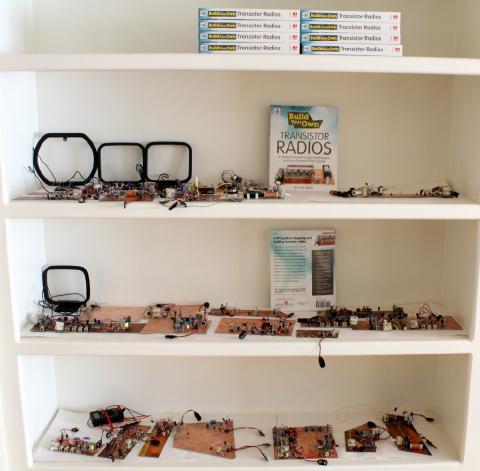
Click the above image for the full resolution photo of all the board Ron built for the book!

Welcome, Ron Quan! He is an engineer and the author of Build Your Own Transistor Radios: A Hobbyist’s Guide to High-Performance and Low-Powered Radio Circuits.
- Ron got his start working for radio stations: KNEW in Oakland (now in SF) (AM) and KALX at Berkeley (FM)
- Prior to that, he grew up playing with #6 ignition battery (dry cell) which is similar to a D cell.
- But that's not all, he also built crystal radios (poly varicom) and tube radios (5 tube superhet)
- Once he entered industry, it was working on video at Ampex
- Later he worked at Sony
- Video has a lot of great signal processing problems and challenges. For example, they would sometimes have a 4 mhz bw signal with only a 5-10Mhz carrier!
- His first patent was of linearity compensation on B&W CRT TVs at Ampex. However, he has lots of patents to his name!
- Dave asked if it was true about Japanese manufacturers removing caps until the products just work; Ron used to put them every other chip, depending on distance between them.
- Howard Sam's photofacts is a place to get schematics.
- They often had to make their own op amps, using parts like CA3086, CA3054, CA3127
- Analog video compensation was done with banks of varacter diodes.
- While he couldn't talk about protection schemes, he did talk about (analog) scrambling of audio and video signals.
- They would move signals by pseudo random frequency shifting; this is different from the simpler and more common sync suppression method.
- Sync suppression could be easily defeated back then, either by DIY solutions or by black market boxes.
- Ron went and had to reverse engineer the reverse engineering of some of these boxes coming out of Brazil and Argentina
- The Analog Aficionados dinner, hosted by Paul Rako and sponsored by various companies, was last Saturday. Ron and various other high profile analog gurus were there.
- Ron published and presented two AES papers which have caused a little bit of a stir; he suggests new ways to measure frequency and develop standards.
- He's not an audiophile (in the negative sense of the word) but he has worked for Monster Cable in the past!
- The old ways of measuring don't tell the whole picture, such as THD and intermodulation distortion and freq response
- Newer methods are CCIF twintone signal (18 & 19 kHz), Transient Intermodulation Distortion or TIM test (square and sine wave) and frequency modulation distortion.
- The book was released a few months ago and has gotten great feedback so far!
- Chris likes that it gives context and builds to do up front.
- The whole thing was done in 26 weeks, including over 25 prototype boards! (see top picture)
- We all agreed that this book would be a good fit for a prototyping class.
Transcript
Ron Kwan: This is the Amp Hour Podcast, recorded February 18th, 2013, episode 133, with guest Ron Kwan, tenacious transistor teacher.
Dave Jones: Welcome to the Amp Hour. I'm Dave Jones from the EEV blog.
Chris Gammell: And I'm Chris Gammell of Chris Gammell's Analog Life.
Ron Kwan: And I'm Ron Kwan in Cupertino, the author of Build Your Own Transistor Radios.
Dave Jones: Thanks for joining us, Ron. Thank you. Is it a self-published book? Or is it through... No, it's Tab, isn't it?
Ron Kwan: It is Tab through McGraw-Hill.
Dave Jones: Right. Tell us about that. How did you... Well, no. Let's start with your background. Let's not jump into the book. Okay. Tell us about your history. Where are you from? Who have you worked for? What do you do?
Ron Kwan: Okay. So I went to San Francisco Public Schools. And the high school that I went to is Galileo High School. Galileo? Yeah. So our high school was one of the few that actually had a real reflecting telescope on the observatory. No way. It fits the name then, huh? Which was really cool. Yeah. Yeah. So we can watch... We can look up and see the rings of Saturn and the moons and stuff like that. And then I went on to the University of California at Berkeley and got my EE degree there. Basically in signals and circuits and also in feedback systems. So that's what... I kind of avoided the transistor physics stuff and the E&M stuff. Right. But in the middle of that, to pay my way, I worked at a radio station that was owned by Metromedia at the time, which is... The call signs are still there. It's called KNEW. And that was in Oakland. And I was their maintenance engineer. And I had also worked previously at the FM 10-watt campus radio station at UC Berkeley, whose call letter is K-A-L-X.
Dave Jones: No wonder you got into radios.
Ron Kwan: Yeah. And so I got... And so the campus radio station is an FM station and KNEW is an AM station. So I got exposure to both types of transmissions and how it's broadcasted. And lots of things related to the studio and some things related to the actual transmitter. Right.
Dave Jones: Like many others, did you have, like us, did you have like a hobbyist... Well, maybe not Chris, but did you have an early hobbyist background?
Ron Kwan: Yeah, I did. I started with playing with compasses and batteries and coils and stuff like that when I was very small. And had my number six ignition dry cell, which probably older people understand what that is. So it looks like an oversized D cell that's huge with battery terminals on it. Endless hours of entertainment. When they're all used up, you can use... You take out the carbon rod and you get two of them and you can start trying to make yourself an arc lamp out of it.
Dave Jones: You can actually take the... You can take the rod out of it. What, you can unscrew the end cap or something? What do you do?
Ron Kwan: Well, what you do is you take a screwdriver and you basically pound out the top of it, pull out all the used up electrolyte. And what's left is the carbon rod. And it actually has still the terminal, sort of a binding post terminal left on it. And so if you get two of them together and you sharpen it the right way, you might be able to make some type of arc lamp out of it.
Chris Gammell: Oh, brilliant. So I'm going to not sell these at Toys R Us these days, I take it? No. No.
Ron Kwan: There was a place in San Francisco that sold the surplus versions of it for like 50 cents. Nice. Right. And so we would buy those. And they would still have a charge on them. And they were about maybe half charged, but they were pretty good. And, you know, and when they were done, you can get these nice, you know, the carbon rods were roughly about, I would say about six to seven inches long. Wow. You can look it up on Google. It's called number six ignition battery. Great stuff. Yeah. And it had great surge current. When they were new, it could surge probably in the order of 20 to 25 amps or something like that. You know, I know at least, yeah, on a really good one and definitely at least 10, you know. So it was very good. They used to use those, I think, out in the farms and things like that back in the 40s and 50s. Yeah. Got it. Got to really crank them over.
Dave Jones: So this was before you were 10, was it?
Ron Kwan: Yeah, it was before I was 10. Excellent. I played with those things. Yeah. And so I had my experience with iron filings and wires and making flashlights, things like that. And then later on, I learned how to build crystal radios, which I think everybody else did. But I had all these different kinds of crystal radios that I would build, you know, things that use polyvaricon, the type of variable capacitors that were used in transistor radios. And then the ones that looked like bread slicers, the electric ones. And messing around with it. And I think as a kid, I never understood how to get enough selectivity out of it until one day I coupled the antenna, the long wire antenna into the tank circuit with a very, very small capacitor. Ah. Like 10 or 20 picofarits. And I said, hey, it's pretty good. I wonder what causes this, but it works, you know. Yeah, exactly.
Dave Jones: And then you find out 10 years later, you know.
Ron Kwan: Yeah, yeah, yeah. And what it does is it decouples any resistive losses from the antenna that you're hooking up. And so it basically takes advantage of the full queue of the tank circuit that you have. Yep. So that was a really neat thing. Except I didn't understand it at the time.
Dave Jones: No, because that's like magic. It's like, but there's nothing there. These wires aren't connecting. It's just two plates. Like, how does the signal, how does that, you know, increase the selectivity of this thing? It's just magic.
Ron Kwan: Yeah. You know? Yeah.
Chris Gammell: Some would say it's still magic.
Ron Kwan: Well, yeah. I know.
Chris Gammell: It still seems like it sometimes, you know.
Ron Kwan: Yeah. Yeah, so by the time I was in junior high school or high school, then I had built tube radios. And actually, I got a five tube super hit actually working. Awesome. And that was pretty good. And then from high school, that was kind of like the end of it. Then it became very serious in terms of trying to get ready for college. And so I had to study, you know, lots of math and science and stuff like that. Boo hoo. And then in between my high school and college entrance, my high school grad, from high school graduation to that summer before I get into Berkeley, I got my radio telephone license. And that allowed me to work in almost any radio station except a real broadcast one. Right. So the summer after that, after my freshman year, I got the first class license. And that allowed me to work at KNEW.
Dave Jones: So it's a combined radio and television. And, sorry, radio and television.
Ron Kwan: Radio. Well, okay. So I got into TV after I graduated because I had worked for Ampex. And Ampex Corporation was the first company that made a practical videotape recorder in the 1950s. Ah. And before that, people had tried to record videos. Some of them you'll see, you know, in these old, I guess, nostalgic TV channels where they basically took a motion picture camera and recorded what was on a picture tube. Right. And they kind of look kind of weird that way. So the fully electronic one was done by Ampex in about 1956 when it was introduced. And then I got in there about roughly 20 years later. More than 20 years later. And worked on really the last of that vintage of kind of recorder. And then I was offered to work for Sony. And at first they didn't tell me what type of videotape recorder would that be. And I said, well, are you recording broadcasts? Oh, yeah, we're recording broadcasts. I said, are you using, you know, this frequency to that frequency for the after modulation? He says, no, no, no, no, no. We're doing something different. And it turns out they scaled everything by about two and a half times. I said, well, what bandwidth are you doing here? He said, oh, we're doing 1125 lines. We're not doing that. Wow. We're not doing that 525 or 625. That's huge. Yeah. When was this? In 1980.
Dave Jones: 1980, right. Yeah. That's massive resolution from back then.
Ron Kwan: Yeah. Could you clarify? Sorry. What was the resolution there? So it was. It's what we call today 1080i. Oh, wow. So it's HD, folks.
Dave Jones: Yeah.
Ron Kwan: It is HD. And it was fantastic. That's when, that's where I learned a lot of the FM wideband detectors, how to do that, how to recover the thing off tape, you know, what to do before you process this thing. And it's very, very, there's kind of a, I guess, an American acronym for FM. And, but it kind of like involves a kind of four letter word instead. Right. Yes. And then later the M stands for magic. So, and that's basically what it is. And because in video, you know, you know, you know, so like if you have 4 megahertz bandwidth, your carrier could be very, you know, could be, you know, in the order of about 5 to 10 megahertz.
Dave Jones: Yep.
Ron Kwan: You know, so for instance, SVHS, if you used to remember that.
Dave Jones: Yes.
Ron Kwan: Format. I think it's from 5.6 to 7 megahertz for the carriers. But the bandwidth is about 4 megahertz.
Dave Jones: Wow. Crazy.
Ron Kwan: So, and, and they can actually recover it. And it kind of, it almost seems like it violates Nyquist in a sense of kind of, but it doesn't quite. Right. And, and you're able to recover with some, you know, something good enough to be viewed.
Dave Jones: So, you were working in the design group at Sony on these cameras?
Ron Kwan: Yeah.
Dave Jones: How big, how big were the design, ah, for the, right, for the video tape recorders?
Ron Kwan: Uh, in our team, we had, we really had one master who did it. Uh, he, he was, and I, and I quote him in the, in the book, uh, Barrett Geisinger. And, uh, but I have to, to maybe just backtrack a little bit at Ampex. I learned how to, uh, the ins and outs of some of the cameras, TV cameras. And then also I had to design a TV monitor while I was at Ampex. So, so I got to design, um, TV monitors at Ampex, learned about video preamps and switchers and things like that. And then when I got to Sony, I got to learn about, um, uh, HDTV and also video switchers, dissolve amplifiers and, and things like that. So it, it, it, it was really quite a experience, a very rich experience because it's not like, um, just designing, you know, one particular kind of instrument for your whole career. I got to do a little bit of everything, but, but actually my specialty is, uh, if I have to say of any, it was the, uh, designing, uh, black and white TV monitors, CRT type displays and things like that. Really? So, yeah. And I actually got my first, um, patent. Well, one of my first patent ideas from that. And, and, and it's kind of mentioned in the book a little bit. And that, that was very exciting story when I, to tell, because, uh, I had this problem where the, uh, TV scans were causing people to be like fatter on one side of the screen and skinnier on the other side. Oh, okay. And that's caused by, uh, a non-linearity in the scan. So, so if you're familiar with RC circuits, you see the, the traditional exponential, uh, waveform. If you put a step response to it, you'll see this exponential. Well, what you want in a scan is you want something to be a real ramp. You know, it does. It's totally linear. There's no change in slope. And, and because there's resistive losses in the deflection coil, it causes, uh, what we call an L over R time constant. Whereas, you know, when you have capacitors, an RC time constant. So, so the problem was how do you fix this? And, and, uh, the way to do it is that you can send an inverse correction signal and fix that, that, you know, fix that so that you give a signal that it's complimentary to this, this exponential, uh, waveform. And so you end up with a linear, more of a ramp.
Dave Jones: Ramp. Right. You end up with a perfect linear, well, almost perfect linear ramp. Good enough so that you don't see it visually. Yeah.
Chris Gammell: So does the compensation happen in the actual, the, the signal being put through the, the, the bending part? It's actually put, yeah.
Ron Kwan: So what, what I did was.
Dave Jones: We're, we're, we're experts here, Ron. Right. Obviously.
Ron Kwan: Okay. So this is what I did. So I took a very, very small resistance in, uh, and put that in series with the coil, sort of as a sense, you know, sort of like how voltage regulators can sense short circuits. You put it like a 0.1 ohm and it doesn't really harm the regulator too much because it's negligible voltage drop. So what I did was I put a small resistor in series with the coil. I said, well, it doesn't matter. This thing's got ohms of, you know, resistances anyway. So adding another, you know, half an ohm is going to, you know, it's not going to make anything that much worse. So I would sense the current and then I would compare it with a real ramp, you know.
Dave Jones: Oh, so you would generate a real ramp in synchronized in real time, would you?
Ron Kwan: Yeah. And so I would, I would take the different signal between the exponential waveform and a real ramp signal and do a subtraction. Of course. That's obvious. Yeah. Well, now we hear it. And then, but then, but then the part is, but then where do you feed this thing back? And I fed it back through, I fed it back through the damper diode, which was not too obvious and it worked. And, and so that was one of my first patents.
Dave Jones: Brilliant. And that, and, and that made it into following products, did it?
Ron Kwan: It did. Right. Fortunately, it, it fixed the problem and it was kind of a, it was a very nice way how to solve it because there were no linearity coils and things like that. But the, the original way how to solve it is you put a linearity coil in series with, with the deflection yoke. And that use, Ampex at that time didn't want to, want me to design it that way. So I came up with this other way and it, it turned out pretty, pretty good.
Chris Gammell: So what, what, what era was this? Was this like, I mean, was this done in, was like op amps for the subtraction or was it done actually like discreetly or?
Ron Kwan: It was done with op amps. Okay. Yeah. Yeah. Matter of fact, I think I had to use a 741 because the 741 were something slow because in that environment with all the high voltage and spikes going all over, it was the only op amp that was bulletproof.
Chris Gammell: Oh yeah. Right.
Ron Kwan: In nearby there. So if I stuck a really faster op amp in there, the input circuits could get fried a little bit more easily. So, so I use the tried and true op amp. And as long as it's close enough, it didn't have to, you know, represent the ramp, you know, down to like 0.1%. It just had to do it close enough so that when people are walking across the screen, they don't look like they changed their weight.
Dave Jones: It's great.
Ron Kwan: So, you know, as the engineers would say, as long as it's close, you know. Yeah, exactly. Right. As long as the boss buys it.
Dave Jones: Speaking of that, you're, you're probably the guy to answer this. There's a, I don't know if it's an urban myth or not, but there's a joke going around that there back in the early Japanese TV. And I guess it extends to video stuff as well, that the Japanese method of manufacture was to actually, you know, really over-engineer something. And then when you go into production, you would start removing components. And then as soon as, and as soon as it stopped working, you would put that last component back and bang, you'd ship it. So that, you know, you just get rid of any components that you didn't need. Is that, is there any truth to that at all?
Ron Kwan: There's probably some because, you know, it is a production thing. I spent a lot of my career doing board level things. I only designed one, one, one IC, and that was for HP. But all the other things that I did, like for a monitor, a video switcher, or an audio system, these are board level things. And some of the people would say, okay, you need to put decoupling caps on all of your power connections for your op amps, your digital circuits, you know, like pins 14 or 16.
Dave Jones: So you'd end up with 50 decoupling caps. Yeah.
Ron Kwan: Exactly. And so, yeah. And so what happened was people would say, but you can do every other. So every now and then I would, if I wanted to save space, I would put every other, you know, every other IC will have a decoupling cap, as long as they were pretty close to each other, like within half an inch or something like that. Yeah. In the transistor radios, when I look at the Japanese transistor radios, actually the only thing they would probably skimp on is probably the decoupling capacitors for the power supplies. There would be only maybe one or two decoupling capacitors for the battery, and then maybe one or two for the audio circuit and one for the automatic volume control capacitor. And then that was about it. But the way how they did design some of these things were kind of inefficient as well. But they just, you know, a lot of them just copy from each other. Right. Got it. That's, yeah, because when I looked at some of these circuits, and I have, in the book, I quote a lot of the Howard Sam's photo fact, which has the schematics of all these radios since almost the beginning. And I look at these, and I said, boy, they could have re-biased this circuit this way or that way or whatever. But you have to remember back in those days, the designers were not very fluent on transistor circuits, but more on tube circuits. Right. You know, so. And most of them did not really quite understand how these transistors really work. And so as I went through some of these things, I said, wow, this is quite amazing how they even got some of this stuff to work.
Dave Jones: Well, that's the thing. Like, I've done a video where I tore down a 1985 vintage Sony video camera. It was one of the first, you know, of the, you know, big tape, you know, handy cam kind of things. And I went through the schematic and everything like that in the video, and it was phenomenal. The complexity involved in the schematic. And I'm going, how the hell did they design this thing? There's so many systems and subsystems and filters and everything else. How does that work? Do they actually go through and do it all in theory, or do they just suck it and see, or?
Ron Kwan: Well, you know, I did work for Sony. And the way that I, when I was there, I, the people came up the ladder very, very slowly. They became specialists. Right. And actually, they started from the beginning. So they actually had to know how to solder and how to work the bureaucracy in terms of ECNs, PCNs, you know, electronic change notices, production change notes. Notice is, yeah. All those kind of things. Nothing's changed, folks. And then eventually, you know, they get to design some stuff, and they would learn that through a mentoring kind of system, you know, so a more senior engineer would do that. But, yeah, a video camera is very complicated because it has to do, it contains scans, scanning circuits. If it's a tube camera, it has to have high voltage supplies as well.
Dave Jones: Yeah, of course.
Ron Kwan: It has to have low noise preamps. The low noise preamps typically have to convert something like anywhere, you know, in order of maybe 100 to 300 nanoamps of current into some type of usable voltage. And then once you have that, you have to now encode that into an NTSC or a PAL signal. So there's another thing called an encoder that takes all the color channels and makes that into what they call a composite signal. And so there's just a lot of – and then, of course, there's an audio system in there as well. So, you know, it's very complicated. The fun thing about video is that there's just so many types of signals you have to learn about. You have to learn about clamp circuits. You have to learn about DC restoration. You have to learn about scan circuits. You have to learn about low noise amplifiers, why input capacitances of JFITs will wreck your signal-to-noise ratio and things like that. How to learn about how to properly design a trans-resistance amplifier, things like that. And then also you have to, to a certain degree, have to do AGC circuits as well. So you have to know how to make voltage-controlled amplifiers. And so –
Dave Jones: There's so many analog building blocks in there. It's almost, you know, you take an analog design building block textbook and you implement every single one of those in some way, shape or form. It's incredible. That's trivial. Yeah.
Ron Kwan: Land tech or whatever and – or what used to be a land tech. Yeah, they've gone bust. Yeah. I think they got so to another IC company. Yep. And work with that. And then if you want voltage-controlled amplifiers, you would go to analog devices or you would have to make your own. And so lots of times we made our own video op amps and voltage-controlled amplifiers with RCA transistor arrays, you know, like the CA3086 or the CA3054 or something like that or the 3127. So those kind of transistor arrays were very, very useful for our things. Yes.
Dave Jones: And they would be matched too, wouldn't they, because they were on the same die. Yes. So they would –
Ron Kwan: Yeah.
Dave Jones: Yeah.
Ron Kwan: Definitely. The other thing about video is that it does go through a lot of signal theory. So you have to know, like, for instance, in cameras – and actually also in videotape, of course, you have to know about what they call aperture correction. And that's like a phase linear treble boost and how to do that. And there's ways how to do that with delay lines. There's ways how to do that with double differentiator circuits, you know. Wow. All sorts of really neat stuff. And also sampling theorem too, because a lot of times, you know, by the time I, you know, got out of college, people were starting to digitize the video signal to make it stable. Because before that, they used analog time-based correction. They used a bank of varactor diodes. And they literally changed the voltage on each of their varactor diodes. Varactor diodes. They changed the delay. And you'd be surprised how many sections there were. There might be about, I don't know, 20 or 50 sections there. Yeah, yeah. So with the advent of, you know, cheap memory, if you can even call that back in the 1970s or 80s, but it was still preferable to, you know, finding 50 match pairs of varactor diodes and, you know, make it manufacturable. So, so, yeah. So we actually, so with video, you actually learn quite a bit also about filter responses. You know, the Chevy Chef, the Besso, the Butterworth filters and Coward Chevy Chefs and stuff like that. And it's, it's very, and also phase equalization as well, which is a subject that not too many people get to play with.
Dave Jones: And all that filter stuff is very important because if you use the wrong type of filter response for the wrong part, you might get, you know, phase distortion and all this analog stuff matters. So your pitcher might start to do something bizarre. Yeah. So you really have to know what you're doing.
Ron Kwan: Yes, exactly. And in an FM system, even in a regular FM tuner that you have for radio, the IF section, if you want low distortion that's demodulated, the IF filter should be phase equalized or phase linear. Yeah. And, and the way how some of the old style IF filters got away with that was they just made it broader than normal, but still good enough to have enough selectivity so that that area where it's demodulating like the first couple of hundred kilohertz for the FM, you know, bandwidth is, has enough phase linearity before it kind of blows up and goes crazy. Right. So, so that's why you will see like in specs where they give you a narrow IF filter. Uh, the, the, the phase linear linearity is not very good and you would get increased demodulated distortion coming out of it. And yeah.
Dave Jones: What point did the industry start to realize, well, look, this analog. This is expensive. Analog video is just pointing, is pushing brown stuff up a hill with a pointy stick. It's useless. We have to go to digital.
Ron Kwan: Yeah. Basically it, it came in two fronts, uh, at least two fronts. One was, uh, when, uh, when the cameras were being built, uh, the tube, the, the, the, the pick, the two pickup tubes called plumbicons or satacons and all that, that was, that was just old stuff. They couldn't get the sensitivity out of that compared to a CCD or CMOS sensor.
Dave Jones: Uh-huh.
Ron Kwan: And so that happened really around the late seventies. And then when it came to recording the, uh, you know, the, uh, video, uh, the, the analog way of doing it was just taking up too much space. Yeah. And, and also, uh, it, it had a problem of, um, you couldn't make a serial copy, like a copy of a copy of a copy.
Dave Jones: It just get worse and worse and worse. Yeah. The Xerox effect. Yeah.
Ron Kwan: Yeah. Essentially, you know, the contrast builds up kind of funny when you do a Xerox of a Xerox of a Xerox and stuff like that. And, and, and, and, and video with, uh, with analog video, if you do a copy of a copy, the noise comes up, the, the, the, the ringing effects of the filters get, get more pronounced, you know, and stuff like that. And it's the same thing with audio. Like if, for instance, if, if you go and say, um, my audio frequency response is 20 to 20 kilohertz plus or minus half a DB or about roughly 5%, you would say, Hey, that's pretty good. But run that through 10 of them like that. Yeah. Then you're up to like plus or minus five DBs. Yeah. Or something like that. And that's, that's huge, you know? So, so the good thing about, so the digital, uh, got in really well, I think toward the late eighties or back to the end of eighties. And then they started using discrete cosine transforms and, uh, you know, having a good compression characteristics. Cause, cause that's the other problem is if you were to put straight, uh, digitized video without any compression onto tape or a hard drive, you'll be burning up a lot of memory, you know? Right. Yeah. So, so, so.
Dave Jones: Well, the, because the frame rate and the pixel rate is just enormous.
Ron Kwan: Yeah. Right. And you have to do some kind of compression. So, uh, that's, that's where, uh, you know, these, these discrete cosine transforms or wavelets or, I don't know, JPEG 2000 kind of stuff. Right. Work out. And, uh, so it, it, there was, there's just a bunch of explosion. And I would say about, by the 1990s, uh, basically most of the analog stuff was gone.
Dave Jones: Yeah.
Ron Kwan: Uh, and the same thing, same thing with, uh, with, uh, with audio stuff as well. Uh, you know, you, it wouldn't make sense to, it wouldn't make sense to buy an open reel tape recorder in the 1990s. It would be better to. No. You know, by the 19, yeah. As a matter of fact, I think like the 19, late 1970s or early 80s, there were, uh, PCM processors for audio. So you would like convert your Betamax or your VHS into a two channel digital audio machine. And, and, and then you can record digitally. So, uh, so I, I saw quite a bit of changes. Yeah. At least.
Dave Jones: And, and, and those compression, um, algorithms, they weren't, they actually had a loss associated with them too, didn't they?
Ron Kwan: Uh, the, the losses, some of them are not that noticeable. Uh, basically, uh, you would start seeing it, uh, you know, motion, you know, in the emotional way, uh, in like, you know, if there was a quick, uh, Yes, of course. A quick, uh, change from one frame to the other. One of the worst things to record on high compression video is, uh, take a picture of a fireplace with a fire burning at, at a random way. Yeah. And, and compress the video as much as you can. You'll start seeing.
Dave Jones: Because it's, it's truly random. Yeah. And it's, yeah. Exactly.
Chris Gammell: Is it high contrast?
Ron Kwan: Yeah. It can't, it can't. Yeah, it can't because the, one of the, one of the, uh, one of the, uh, premise of having compression is you can't assume nothing has changed much from the previous frame. Yeah. That's right. Yeah. And, but if everything changes all the time, then the only thing you have, then the only thing you can do is do the compression from, you know, within the frame, uh, you know, separately. Sort of like, like a, like a JPEG or something like that. Yeah. But that's, that's getting probably a little bit beyond what I'm used to. I'm more used to the, the analog video stuff. Yeah.
Dave Jones: Yeah.
Ron Kwan: Uh, but, uh, in terms of video, there's a lot, I guess to, to just go down some of the things you learn video, you learn lots of INQ modulation. You learn single side band or double side band type stuff, uh, quadrature modulation. You learn filters. You learn phase, uh, response, um, low noise, uh, scan circuits, power supplies, uh, switching power supplies. You know, it's just, just so many things. Uh, and, and, and during those days, we actually, when we did the video op amps, we actually built them with like maybe three or four transistors. And that was it. Excellent. Wow. Yeah. We just, and, and a lot of people said, you can get away with that. I said, yeah, with video, you can. We wouldn't do this for audio. But. Right.
Chris Gammell: So is, so is this, is this an art form that's lost now? I mean, obviously is a, obviously I do different types of analog, but, uh, I mean, on the video side, is it, is it still around anywhere?
Ron Kwan: I don't think so. It's, it's very, it's pretty, it's pretty, it's pretty rare to see that. And I was, uh, I think I went to one of the flea market breakfasts, uh, uh, Paul Reiko had. And, uh, one of the guys asked me like, what do you know about DC restoration? Uh, and he, and I said, well, you have to look at it this way. The DC restorator is really sort of like a halfway rectifier charging up that capacitor and series to a, you know, voltage such that by the time when you reach to the other end of it, uh, everything looks like it's clamped to zero volts or something close to that. And, and, and so, uh, you have to look at it in a different way than just looking at the way that, that it's drawn. So, um, and so there's, there's, it is kind of a loss art, but, um, you know, I don't know whether it would ever reappear. I don't think, I don't think anybody, I don't think it matters anymore. No, well, there's no practical need for it, right? At least not as much.
Dave Jones: Yeah. It's switched to information theory with compression algorithms and all that sort of thing these days.
Chris Gammell: Well, the concepts are still valid, but it's just, yeah, for video specifically, right?
Dave Jones: Not used for practical aspects. Yeah. I mean, you know, these issues still exist. Like I'm a, you know, I make my living as a video, um, editing video and I've got to think about, you know, what, uh, data rate I'm using to, to compress the video, which formats I'm converting to, you know, to minimize my losses and compression, you know, because if you make a copy of a copy of a copy, it still can actually get worse. A lot of those things are still around a lot of those issues. Yeah. Because everything, oh, digital, every copy is perfect. Well, yeah, every copy, but every time you pass it through a, another transcoding algorithm, you're, you know, doing some very fancy analog-y type lossy stuff to it. So.
Ron Kwan: Yeah. It could be, you know, just the interpolation filters and things like that. Uh, I think one of my friends who's into video production said that he couldn't find even a decent program yet to just transcode HD 1080i back to a proper looking 525, you know, or 480i. Exactly.
Dave Jones: And you think that'd be trivial, right? But no, I've, yeah, I've had people, um, yeah, say the same thing, you know, even, you know, you use the best tool in the industry and it's still not good enough. Yeah. So there's, you know. Yeah, definitely.
Ron Kwan: And, you know, the other flip side about doing video is you do go into audio as well. And because in, in, in video tape recorders, they actually have, you know, if you look at the old tape recorders, they actually have, uh, an audio tape recorder section that looks just like an audio, regular open reel, you know, audio tape recorder. So you have a biasing of the erase, uh, biasing of the heads and the erasures and, uh, having to hit, um, uh, the flex densities, I don't know, whatever, 185 nanolievers and all that kind of stuff. And, uh, and also you have to deal with low noise, uh, audio preamps and record amplifiers and, and, uh, line amplifiers and things like that. So it's, it's a very rich experience. Um, I don't particularly recommend it for everybody, but, you know, I, uh, I was very fortunate to have two great mentors to, to do that, you know, to teach me one side of, of, um, uh, cameras and, and video in general. And then the other one who taught me quite a bit about color, you know, the, the coding of it, you know, power and NTC. Oh yes. There's an art in itself. Yeah.
Dave Jones: And you've also been involved. You used to work for Macrovision, right? Everyone from the, who was around in the eighties would know what Macrovision is. It's a copy protection stuff for video, um, which you're not really allowed to talk about not too much. Are you?
Ron Kwan: No.
Dave Jones: Why is that? Can you tell us why you're not allowed to talk about it?
Ron Kwan: I, I'll probably just refrain to just say that there are probably people listening out there.
Speaker ?: Right.
Dave Jones: Okay.
Ron Kwan: So, but I can talk about Macrovision in terms of the scrambling, uh, technologies. Oh yes, please do. Yeah. That was interesting hearing about that.
Dave Jones: Yeah. That, that's very interesting stuff.
Ron Kwan: So this is, this predates the digital scrambling. This is more like the cable TV scrambling days of the analog.
Chris Gammell: So this is maybe if you got a channel that you weren't supposed to and you're trying to figure out what was on the screen. Yeah.
Ron Kwan: And so, so my experience was, is, was in, uh, cable analog scrambling and both for video and audio. And the audio scrambling that I did was based on frequency translation. So it basically took your spectrum and moved it up by about a kilohertz or so. So you ended up sounding like a Donald duck or something like that.
Dave Jones: Yeah. You're right.
Ron Kwan: And, and then what it also did was it changed that one kilohertz shift to maybe 1.1, 1.2, 1.3, and it moved it in kind of a pseudo random way. And so if you go and say, well, the guy offset at the, the spectrum by one kilohertz, that's no big deal. I'll just shift it back down by one kilohertz. And of course, if you did that, what will happen at, you know, a 10th of a second later, it went to a different frequency. So you would, you would, you would, you would have to keep, you would have to keep track of how the shift was going because it, it varied all over the map. And fortunately I had a friend that was, uh, very, very sharp in, in doing this kind of stuff. And I said, why don't you, uh, this is the function I want and stick it on an EEPROM and I'll stick it into my counter circuits. And so he's, he came up with this crazy waveform and we stuck those into, I think the, the presets of my, you know, uh, uh, 163 counters and what it did was, uh, you know, and, and we counted so many frames of video and then we're going to change the presets to something else.
Dave Jones: So this was actually done in the digital domain, so to speak.
Ron Kwan: It was linked to the, to the video. So the video has a frame rate roughly about, you know, 30 frames per second. So we, we did it to like, you know, every frame it, it, we started changing the, the, the preset numbers to it. And so, uh, so they, they only had one 30th of a second to figure out what the next one was going to be because it was going to change and that is, it wasn't worth it for them to do it.
Chris Gammell: So what about, what about in those, is this when those, uh, like they had the de-scrambling boxes that you get on like the black market that then you plug cable into, is that, is that what I'm thinking of? Is that the right time? Yeah.
Ron Kwan: Yeah. Those were, those were what they call sync suppression systems where the horizontal or the vertical sync pulses were either taken out or shifted in a funny way or the video was inverted and stuff like that. And ours was a different scrambling system and we shook up the picture laterally. And, but we also did some, uh, sync suppression as well. And, uh, and so, but even if you restore the sinks in ours, uh, you would still see a shaky picture. So you had to know how to, you, you would have to, to decode it. You would have to come up with a sync signal that shook exactly the same way the picture was shaking. So if the picture was shaking by, you know, one microsecond, you have to give a sync post that was, you know, shifted by one microsecond. So everything tracked.
Dave Jones: Got it. Because I remember all these, these, uh, sync suppression ones, they were very easy to bypass. Every electronics magazine had a project with a couple of transistors that I think it was that easy. It was like a couple of transistors to, you know, overcome that and, uh, right. And just avoid it. Yeah. Yeah. It was trivial.
Ron Kwan: Yeah. It was easy. And so when, when I got down to South America, I, I had to look at the, these black boxes they had and figure out if, if they are going to recreate everything, what do I do to scoop the black box? And so I found out what they were doing and came up with a thing that if you put the black box to try to decode the thing, you came out with something even worse than what it was before. Nice.
Dave Jones: Right.
Ron Kwan: And, and, uh, and, and so.
Dave Jones: So it was a constant cyclic battle between you and the black box makers, was it?
Ron Kwan: Yeah. Yeah. Yeah. So we, and it did work and, uh, you know, for, for the cable black box thing, uh, they, uh, there was a company that, uh, that was building set top decoders with, with our de-scramblers in them. And so that guy got to demonstrate it to, to the people in South America, uh, cause, uh, I, I went there like twice, like within the period of four months or something. And I was just tired. It's, it's like, it's, I think it's like it's four hours ahead of Pacific time or something like eight or four or five. They call it Atlantic time.
Chris Gammell: Yeah.
Ron Kwan: And, uh, this is down, this is in Brazil and in Argentina. Oh, and this is actually where they're making these black boxes. Is that right? Well, they sell them on the street corners. Oh, it's, it's so funny. It's, uh, you know, so you go to the night market where everybody's selling usually, you know, uh, clothes and hats and, you know, uh, maybe, maybe some cell phones or something, you know, the typical, and then you see these guys with these, these black boxes, you know, and they just go from one, one town to the next. So you don't really know who these guys are. So what, you know, so what you do is you buy a couple of these and then you try to find out, you know, what their decoding scheme was and then how to spoof that. And so that was one of the things I found out is that if you add some signals in the right places, uh, you can make that thing, you know, end up having a worse picture than, uh, than if you saw it before. As it made the picture shook up even more. That's great. And, uh, so it's like a spoofing the spoofer or something like that. So it's, uh, it kind of reminds me of that mad magazine. Spy versus spy. Uh, it's a spy versus spy. I was thinking that too. I felt, I felt, I felt like I was, I was in that kind of a merry-go-round. Yeah, that's great.
Dave Jones: Has, has the battle finally been lost for, uh, you know, digital security in, um, content, content security because Apple famously removed their security content like a couple of years back, didn't they?
Ron Kwan: They, I, I really don't know. Uh, and I don't, and I don't even try to follow that at this point because, uh, the, uh, and I'm not being evasive. It's just that I, you know, I, I still have, I still have, somebody gave me an iPod shuffle and to tell you how old it is, it's the one that looks, that doesn't have a screen.
Chris Gammell: Yeah, the white stick.
Ron Kwan: And I only have half, half a gig of RAM in there. That's what I have. And I, yeah. And so that's where I'm at. Yep. So I just, uh, I, I just don't keep up with that stuff anymore. You know, I mean, I'm not that bad. I'm not like, uh, you know, I'm still using cassette tapes or, you know, every now and then I might do it.
Ron Kwan: Yeah.
Ron Kwan: But I, I don't know. I, all I can say in general, it is probably, probably hard to, uh, you know, to, to keep ahead in that arena. Yeah. You know, that's, that's, that's all I can say is, uh, and I, I don't think I could probably comment any further on that. Yeah.
Chris Gammell: Well, and they, they were doing it in hardware back then too. It's interesting how it shifted to software and, you know, there's a whole different set of issues with software. Yeah.
Ron Kwan: I mean, basically when they, they, uh, when they had even the, uh, the cable and satellite decoders, uh, what, what the hackers did was they did not hack the, the algorithm to de-scramble it. That was too hard. So they hacked the authorization codes.
Dave Jones: Ah. Yes. Which is legally a different way to do it too. So you can get sued one way and not the other, and it all becomes a legal minefield. Yeah.
Ron Kwan: But in the United States, as far as I understand, we have this digital millennium copyright act, uh, or something like that. And, uh, and, uh, so I think if you do anything that comes even close to spoofing something, then, then you're going to be in trouble. Right. So, you know, uh, but, but that's, but that's how they used to do it. It's like, we're not going to even try to figure out how you did the scrambling. Yeah. Figure out how do you authorize things. Exactly. Pretend like we're one of the paying customers. Exactly. Yeah.
Chris Gammell: You have a man in the middle type of thing and everything. Well, you actually, you were mentioning a bunch of hackers that you were just hanging out with yet. Was it yesterday or no, two days ago?
Ron Kwan: Uh, you were at the analog. We went to the analog party. Yeah. Well, we're, we're, we're analog engineers. I don't know what we can call it. I guess we're hackers in the sense of, of, of, of tearing apart things and stuff like that.
Chris Gammell: Yeah.
Ron Kwan: And, uh, that, that was, uh, Paul Reiko and others, uh, uh, uh, organized that party. I think along with linear systems and some other people, uh, hopefully I don't forget too many people. And, and, uh, there, I'll send you the, the link to that, uh, when he gets all the pictures and everything. And then I was, I, I had fun with my digital camera. So I was shooting everything at ISO 6400 and Stu managed to get some decent results. Wow. It must've been right. We went in mid room, huh? No, it wasn't. But I use fast lenses. I didn't use any zoom.
Dave Jones: Okay. Yep.
Ron Kwan: Yeah.
Dave Jones: It's, uh, I, I did that once. I went on, I, first time I got my digital SLR, I went on a trip to, uh, you know, and went on holiday and I found I had everything set to like ISO 1600. So every photo I took was all ISO 1600. Oops.
Ron Kwan: Yeah. Yeah. I, I shot.
Dave Jones: So it was noisy, you know, so every video had all this noise. Yeah. Every picture had noise on it.
Ron Kwan: It turns, it turns out on my camera, it, there was a hidden, well, it's not a hidden menu. It was actually well known, but it says noise reduction for 1600 and above, and you can turn it on and it turns on this aggressive 60, you know, noise reduction. Yeah. But, but I figured I'd say, Hey, everybody likes kind of a soft picture anyway.
Dave Jones: Right. So just leave the fuzzy noise in there.
Ron Kwan: You know, because if, if you take pictures, there are too sharp. Sometimes people might complain. If you know what I mean. Yep. Certainly do.
Dave Jones: So that's why people don't like this, you know, newfangled CD music, you know, this digital music, they like the warm, fuzzy valve distortion.
Ron Kwan: Yeah. Yeah. And that, that's, that's another thing I also explore. Uh, I, uh, I have, uh, written two papers for the Audio Engineering Society. Oh. Uh, in, in 2010 and, and just last year. So.
Dave Jones: Right.
Ron Kwan: And, and, uh, it's a, it's a kind of somewhat controversial topic, but I don't see it as controversial. I see it like, Hey, it's there, you know? So, and the premise of those was, um, I, I was finding ways to measure frequency modulation distortion and amplifiers. So, that, uh, so that's another, that's probably another subject, but anyway.
Chris Gammell: So, I dabble in that too. Yeah. What was the, what was the.
Dave Jones: What's your take on all the audio foolery rubbish? Oh, of course Dave was going to ask this. All those audiophile products. Yeah. I've got to ask. Yes, every time. You know, $10,000 speaker cables and power cords and.
Ron Kwan: Well, uh, it's, you know, uh, we, we actually, I actually have a past in, in speaker cables because I actually had work for Monster Cable.
Dave Jones: Oh, you work for Monster Cable. Oh, here we go, folks.
Ron Kwan: Uh, back in the early days. We've got a live one here. And, and at that time, and I think probably, I probably still, you know, uh, they, they sold something that was reasonably economical, uh, compared to some of the other stuff. Uh, yeah, some of the other stuff, um, like for, if you look at speaker cables, uh, some of them have very, very high capacitance. And the reason why is they want to make the characteristic impedance, uh, close to eight ohms. So.
Dave Jones: Right.
Ron Kwan: Yeah, yeah. When you look at what it is, it's the square root of L divided by C. And so typically zip cord has an impedance about 96 ohms or somewhere around there, maybe a hundred ohms. And so what are you going to do if you're going to try to make that thing go all the way down to eight ohms or 10 ohms? Yeah, I know. You need a massive amount of. You can't change the inductance of the wire, you know, because it is what it is, right? I mean, you can increase it by coiling it, but you can't make it smaller.
Chris Gammell: Coiling the wire, yeah, exactly.
Ron Kwan: So the only thing you can do is increase the capacitance to get this thing down. And so, uh, so, uh, although, you know, it, it, it definitely will change the sound to it. Um, now where it does it better, that's another reason, but it does change the sound to it in this sense in that, that you can measure how it affects the, uh, the pulse response of the amplifier. Because all this capacitance hanging on the speaker and then you have to kind of set some snubbing networks, um, you know, along the, you know, either at the, at the speaker end or maybe even at the amplifier end or both or something. And it does change the sound and.
Dave Jones: Oh, it certainly does. Um, that's see, that's the thing that people don't understand with audio fuel. Yes. It makes a difference when the electrical characteristics are different.
Ron Kwan: Yeah.
Dave Jones: So, but when you get two cables that have the same electrical characteristics and then one claims that one sounds better because it's cryogenically frozen, then well, now we're into wankery instead of science.
Ron Kwan: Well, it's, yeah, but it, it kind of depends what the science, uh, has found yet. And, and so that's part of the reason why, uh, you know, in, in the, um, AES, uh, you know, papers that I'm writing, I'm trying to show different ways how to measure things. And, uh, because, uh, there's a, there's just a lot of things that have been done in a very old fashioned way in measuring audio. If you think about it, okay, most people will measure total harmonic distortion and intermodulation distortion and frequency response, right? That's basically the three things, maybe even two. I don't even know if too many people will do intermodulation distortion. No, that's not that common. Yeah. But you look at that, how old is that way of measuring? It dates back to like the 1920s or maybe even earlier. Pre-feedback theory? I mean, that is, that is, yeah, pre-feedback, pre, you know, Harold S. Black, uh, you know, doing his, his negative feedback theory. Right. And when we, when we did video, we always had a new way for him to check out certain things. Like, uh, why, why does the color shift when, you know, this goes through this kind of, you know, filter or goes through this type of trend? They would come up with specific, uh, you know, types of, uh, signals. And we would have things called 20 T pulses, 2 T pulses, pulse and bars, multi-burst, multi-pulse, all of this kind of stuff. But audio is so outdated in that sense in that we're still looking at harmonic distortion frequency response. Right. Which dates back to the 1920s at least or something like that.
Dave Jones: So what are the more modern techniques to do it?
Ron Kwan: Uh, there's other ones that are looking to like the slew rates of amplifiers and that's pretty important. So there's, uh, there's the CCIF, uh, twin tone signal at I think like 19 and 20 or 18 and 19 kilohertz. There's, uh, there's the TIM transient intermod, uh, test, which has a square wave and a sine wave. Uh, and then I have these other ones that I'm looking at to measure specifically, uh, frequency modulation distortion. And there, there's just a lot more to, to look at. So, so the, the whole idea of, okay, uh, I would say don't assume that, uh, these things aren't real. Yeah. Some of them could be suggestively, um, psychological, right? Yeah. Because of course, if you buy, you know, a $10,000 wire, you might have to say it sounds better. At least tell your wife that it does, right? I mean. Yeah, that's right. Yeah. I mean, I totally got my money's worth it. But, but, but there, but there are actually real, um, there, there are real breakthroughs, uh, in, uh, in, in, in audio, uh, in, in, in the sense that, uh, for instance, in, in, in phono preamps, uh, which is a subject that I had designed quite a bit of. Uh, you know, uh, basically you have to look at the reaction, uh, to the input cartridge. Uh, and I think, um, Tom, Tom Homan had written a paper on that. He's the guy that did the THX, um, sound system back in the seventies. Right. And basically he was looking at the nonlinear and capacitive, uh, or the reactive inputs, uh, of, of the, uh, preamp because the cartridge is not a, you know, it's, it's got a lot of.
Dave Jones: And each one's different, right? And each one is different. So in theory, you would have to match. The best way to do it is to match a specific preamp circuit to a specific brand and model cartridge. Yeah. In theory. Yeah.
Ron Kwan: They have like different load capacitances and different, uh, load resistances and, you know, and not all of them are magnetic. Some of the, uh, some of them could be piezo type. Uh, some of them could be, uh, they even had some that were, I think, condenser, uh, you know, types. And, uh, and, uh, and also, uh, you know, then there's moving coil cartridges as well. And of course. And so there are, there are differences. And, but, you know, before, so if you, if you go back, say, uh, back in the 1970s or sixties, well, who would care about this? Because when we test our preamps, you know, everything measures the same, but, but they're using a generator with, you know, 50 ohms or. Yeah. 600 ohm output driving this, this preamp input. They're not using a cartridge that has maybe anywhere from 200 millihenries to a thousand millihenries of inductance. And then, uh, you know, and, and how it reacts with all different capacitances. Right. Yeah. Right. And so, so there was that. And then, then the other thing was the, the, the, the overload of some of these, um, preamps were not really that good. And some people would say, uh, a 12 volt supply is sufficient and, or a particular kind of slew rate was sufficient. And, and if you improve on any of those things, even raising the, uh, the, the supply of the phono preamp and also raising the, uh, the slew rate, you will hear a difference. And, uh, if.
Dave Jones: Well, there's a whole ask in like overload recovery and stuff like that too.
Ron Kwan: Yeah. And, and, you know, there, and there is some of the older preamps, uh, did not even use, uh, global or closed loop feedback. They were just like an independent stage followed by the, by the, uh, RIAA, uh, you know, network. And then followed by another amp. So that's the way some of the old tube ones worked out. Uh, and so that even has a different overload characteristic than if you had feedback, because when you overload a feedback system, uh, it takes, it can take time to recover correctly. Yep. You know, at, at the point when it's clipping, it's no longer under really any feedback. The AC gain of the system has gone to zero basically, you know, and, uh, cause, uh, cause it doesn't matter how much of it should put at that point. It's just this flat top, you know, or, or bottomed out somehow. So, um, so there's, there's a lot of, so there is, uh, quite a bit of things in audio. I would not dismiss them, uh, because, uh, people can hear the differences. And the other thing is it does take people to, are trained to listen to things. Uh, just the same way with video, uh, we, we, or even looking at, uh, evaluating, say, uh, qualities of, of film cameras. Or, or things like that, uh, what to look for. And, uh, I remember, I think, um, one of, actually one of our scrambling systems went to a pretty large network in Australia. And, and we, and we actually satisfied their, their needs. But boy, they're, uh, they, they had one guy there who was known as like the guys with the, you know, with, with the sharpest eyes looking at the video artifacts. And things like that.
Dave Jones: I used to know a guy who had calibrated eyesight for, he used to get it recalibrated every six months. And he would have a certificate that said he was the guy calibrated at the video studio to look for color imbalance and distortion and all sorts of stuff. Yeah. Yeah. Yeah. You have to be specifically trained and have, have proven eyesight.
Chris Gammell: Do you have like a contract where you have to wear sunglasses outside and everything like that? Yeah. Yeah. Yeah.
Dave Jones: That's right. So you don't damage your eyes.
Ron Kwan: Yeah. So it's, it's, uh, you know, for instance, in, in the old days, um, people would look at a VHS, uh, playback, which has, but roughly about a third to half the bandwidth, uh, resolution as, as a live video feed. Mm-hmm. And people would look at these things and say, boy, that looks like a clean picture, doesn't it? Doesn't that look sharp? Yeah.
Ron Kwan: Yeah. Yeah. Relativity in action. You know, or, or I think if you go back to like the 1940s, you know, people who heard, you know, a response that got up to 10 kilohertz at the time would say, wow, doesn't that sound so much like a real. It's like they're in the room. Watch like, yeah, exactly. So, so it's all, it's all kind of relative. Yeah. Yeah. I would say there's kind of a mixture, Dave, that, that, that there are some hi-fi stuff that may actually be, let's say, called hyperbolic in the way how it describes the.
Ron Kwan: Well, there's actually a lot. And then, but then, but then, you know, there are things that, that are kind of real. Yeah, yeah. And, but not everything, we haven't figured out all the measurements on how to relate that yet. Yeah. Yeah. And I was even talking to one person, I said, we don't even have a study where we say, if you have, say, a half a percent of second order harmonic distortion in your, in your audio system, how does that really sound? And actually have maybe a hundred people to agree on that, that actually, that it actually sounds that way, you know?
Dave Jones: And so you haven't even done basic studies like that. Yeah.
Ron Kwan: Yeah. I mean, and, and, and most amplifiers will distort differently in that it has, you know, seconds, thirds, fourth, fifth, you know, all sorts of harmonics and intermodulations. And so we can't even agree on exactly, you know, how the distortion even sounds like. Yeah. Yeah. So.
Chris Gammell: So then people throw their hands up in the air and they say, well, just put it through a tube. I don't care anymore. Yeah.
Ron Kwan: Yeah. But actually my favorite preamps were tubes. I really enjoy playing around with my 12AX7s and my ECC83s and stuff like that. And, and, uh, uh, they, they just have a very nice sound to it. And I was explaining to one person the other day that, you know, open loop, a triode has almost a hundred times lower distortion than a transistor. Interesting. All right. Yeah. There you go. So. Well. Okay.
Dave Jones: Let's, let's talk about your book, shall we? Yes. Is this your only book? This is my only book. This is. Build your own transistor radios. Yeah. It's called folks. We will link it in and, um, it's highly acclaimed apparently.
Ron Kwan: Oh, thank you. Yeah. Yeah. I actually, uh, asked a few professors, uh, to look at it and actually two of them. And both of them thought they looked pretty good. And actually, uh, I think like a third one actually went out and bought the book and thought it was pretty good too. And the hardest part of writing the book was the last half of the book, which contains a lot of equations, formulas that were based on some graduate. Well, one graduate class and another class, um, on, uh, large signal behavior of transistors and to make sure all that was correct. Yeah. Uh, because the worst thing you want to do is to have a book, uh, that, you know, that may be a little bit inaccurate. So I think it's as accurate as it's going to get.
Dave Jones: Is this a new book? Is this fairly, how, how long has it been out?
Ron Kwan: Uh, this has been out for just a couple of months. Uh, the project started in late 2011, I think around December. And I had to get the first manuscript done by the end of, uh, May of 2012. So that was only like, you know, eight months ago or something like that. And, and then we went for the next four months, uh, trying to, uh, make it look, you know, make trans, uh, basically make the, the transition from a transcript, a manuscript into a real, real looking book to make it look, you know, something that's better. Because there's only so much you can do on a word processor. Yeah.
Chris Gammell: Got it. One of the things that I really like about this is, um, you know, you really do start out with a lot of context to start with. And I think, you know, that, that's really important for, because, because it does seem like a, you know, it starts as a high, it's, you know, even tagged as a hobbyist guy to the high performance and low powered radio circuits. But I think, um, you know, if you're coming into it as a hobbyist and then, you know, you flip to the back, you're like, oh crap, equation, equation, equation. But before that, there's actually, you know, tons of context on how these are built, all the components, all of the, uh, you know, test and measurement type stuff of upfront. I, I really do, I really do appreciate that. You know, it's really helpful.
Ron Kwan: Yeah. I, I, I, you know, when I wrote this thing, I said, like we're in chapter four where, uh, I explained, okay, we're going to build some signal generators. And, and the reason why is I didn't really want the reader to go outside and buy, you know, a B and K or, or some HP generator and spend, you know, a lot of money on it.
Dave Jones: Where's the fun in that? Yeah.
Ron Kwan: I mean, for, for people in Silicon Valley, it's fun. We just go to the flea market and pick up one for five bucks and fix it up. Right. But, but it isn't that way, uh, elsewhere. And, and this was also a good way to kind of like, uh, show what the AM signal looks like, what it kind of resembles and how you actually make this thing. And because that's the other thing people might ask that, well, it's an AM signal, but how do you, how did they make it? You know, how is a way how to make an AM signal? So I, I, I decided to show that. And, uh, at actually at the end of chapter 12, uh, on, on the, uh, software defined radios, I say this kind of like ends the first half of the book, but stick around for the second half. You know, if you're an engineer. We're going to blow your mind. Things like that. Yeah. Here comes the math, baby. Yeah. But, you know, I, I restricted it, uh, entirely to high school mathematics. Although I do slip in some Fourier and I do slip in some complex variables, but I kind of say, this is what it is, you know? Uh, and, and I don't explain the, the, uh, the power series expansion based on Taylor series. I, I didn't want to do that. Um, and matter of fact, if you look in other books, when they give you the power expansion, they'll put it in terms of KT over Q and those kinds of, uh, constants. And I just gave real numbers and say, this, this is what it really is. Yeah. And so I really try to, uh, avoid doing that because I, I, I think people who go through college and have to almost suffer through that kind of stuff have seen enough of it. So here's an intuitive way of what's going on. Yeah. And good man.
Chris Gammell: Yeah. Well, Dave, Dave kind of alluded to it before with, with, you know, I, I didn't have a much of a obvious background, but I was, I was ranting about this the other day about, about, you know, math classes and not having the context there and, and, and how it's not there. But if, if you are looking, you know, if you're looking at all this stuff and you're actually figuring out, you know, okay, I built this radio, I see the signal on an oscilloscope. I see that there's, you know, frequency responses and all this other stuff. Then when you finally do get to Taylor series and power series and all that other stuff, you go, oh, just, just like you did, Ron, with, with, um, with, with the tank circuit you were talking about earlier in the show. You know, like you have that context. That's what's important.
Ron Kwan: Yeah. Yeah. It's, and so the book basically walks over some basic concepts in the first 12 chapters. It talks a little bit about output resistance, which, uh, if you take the first IC class or actually maybe second, second electronics class, like, like at a university, they'll talk about this thing about early voltages and, you know, the, the change in, uh, uh, change in collector to emitter voltage over the change in collector current. And they'll give you R0 or something like that. But, you know, in that context, it doesn't really mean a lot, but I show why it's, it's meaningful because, uh, in the, if you stick it directly into a tank circuit, for instance, you can lower the Q of the tank circuit. Yeah, exactly. And, and, and, and why it's not affected as much when you load it into a tapped, uh, tank circuit. And, and then I also talk about, uh, uh, transconductance, but not in the usual manner of what people learn in school. And we have to develop a hybrid pie model or, you know, small signal analysis. Right. And now we're going to learn, you know, all about the node and mesh equations and stuff. So, you know, that's rather not very interesting to look at, uh, because I want to show it in the context of what transconductance really mean and, and what are the consequences of it in the transistor. So, so when you increase, uh, the collected current, the, the transconductance go up proportionally. Yeah. Things like that. And, and then why that is important, because that's actually causing distortion in a sense as well, because. Right. And so I try to, I try to weave everything together as much as I can in this. And it was pretty remarkable in the sense that, uh, I had only 26 weeks to do this.
Dave Jones: Yeah.
Ron Kwan: And, and I was able to do it, uh, at least I think reasonably okay.
Dave Jones: Which is not a lot of time to write a book, let alone a technical book.
Ron Kwan: Right.
Dave Jones: Um, because the, the, the rough rule of thumb is any good book takes you like a year to write.
Ron Kwan: Yes.
Dave Jones: Yet, yet alone, let alone a technical one.
Ron Kwan: Yes.
Dave Jones: Um, you know, you can double that. So did you work full time on it or.
Ron Kwan: I did. I did work full time at it. And, uh, and as I explained to someone in the process of this writing, this book, I also used up, uh, one pound of solder.
Chris Gammell: Wow.
Ron Kwan: Building up all the prototypes. That's great. So that, uh, that tells you how many, how much breadboarding I did. Yeah. Because. Wow. Because the breadboard that you see in the front, that's the one that was shown on EDN magazine. And, uh, but that's actually not really recommended to build. But so I built all the other breadboards, you know, every circuit, virtually every circuit that's project here, it was built. Because I had to make sure it worked and, and, and test it. And, and, uh, I have roughly about 20, roughly about 26 breadboards. It came out. Wow. Almost one breadboard per chapter. Yeah. And so that, that's why I ended up using up a whole pound of solder. Wow.
Dave Jones: That is a ton of work. Yeah. I mean, can you tell us like how much time was spent actually building and testing stuff compared to actually writing? It's so.
Ron Kwan: Do you think? Yeah. So this is how it kind of went for like two, two or three months, uh, before I got into the second half of the book, which is basically a lot of theory. Uh, it was like on Monday, either Monday or Tuesday, Monday or Tuesday, I would come up with the design of what I want to do. So like, suppose I want to do a reflex radio. Okay. I'm going to design all these things from scratch. I'm not going to take things from the web. Because if I design it myself, I know what I'm doing. Right. Then we get to blame you, right? Right. Yeah. So, so, so I would design the thing. I would build it up maybe on day two, test it, everything by day two or three. By Thursday, it will be an ORCAD day. Thursdays were always ORCAD days. And I would take the schematics and, and figure out all the figures I'm going to be using. I'm going to be, uh, for, for that particular chapter. So I would actually map out not only the schematics, but any block diagrams and stuff like that, or any computer generated waveform that's from the graphing calculator. And, and then finish that. Then it would be Friday, Saturday, and Sunday I would do all of the writing. And then that's one chapter.
Dave Jones: And in the meantime, you had no life.
Ron Kwan: Right. And then, and then, and then on Monday it started all over again with the next chapter, which was maybe super hat. And, and it went on like that. And, and so I thought.
Dave Jones: So you set yourself a goal of one chapter a week? Is that. Yeah.
Ron Kwan: Yeah. I didn't have much of a choice because it was mainly my, uh, I was a little bit too slow in getting the idea to them quick enough. And they, they have a hard deadline, uh, at the end of May. So I had to, I had to get this done. And I said, okay, I, I can get it done. I've done some crazy things before, but I think I can do this, you know? And, um, you know, for instance, the, the scrambling system I did for, uh, for South America that I, I designed this board that was like, um, 80 square inches at surface mount components all over at 1100 parts. Did that all within something like four weeks or something like that, you know, and got it working. So it worked. So I said, yeah, it worked. It actually was awesome. And, um, um, and so I said, okay, I, I think I can do this if this is worse because I got to do this for six months. So I said, I hope I got enough stamina to do this. Yeah, man. And, and, and so, and, and there were days where I woke up and I said, what do I tell the reader today? What do I offer different? Because, uh, you know, those who have read the book will notice that it's really not like a, like a typical book on how it explains things. And, and I give it my own interpretation and, and my intuitive, uh, you know, thoughts on it. And so I try to make everything original and that's, that's pretty hard to do every week, you know, on, on a different subject. Oh, absolutely. Yeah.
Dave Jones: So, but my, my, my hat's off to you. That's incredible.
Ron Kwan: Thanks. It's a, I look at it today and I say, I, I, there's no way I can do this.
Chris Gammell: I was going to ask if, if they said you have another 26 weeks, like, would you, would you go for it? Yeah.
Ron Kwan: Uh, you know, I, you know, if I had to do another one, it, it may be simpler than this. Like I'll do one, not for advanced beginners, but for beginners. And then I could spend more time on construction techniques and stuff like that, you know? Yeah. Right. Yeah. And, uh, but on the, on the theory, uh, if, you know, if I should have a chance to add more to the book, I will, there are some topics I want to add some more to, uh, like FM radios and things like that. Yeah. And, uh, cause this one covered only AM radios, but, but FM is, is a whole subject on its own. And, and not too many, not too many universities even cover that too much anymore. So, but FM is pretty near and dear to me because, uh, you know, uh, from the experience from, uh, videotape recorders and also from, you know, the AES papers. So, so I, I can definitely add some more to it, but we'll see how it works out. I'm just happy to, uh, tell, reveal some of the secrets I've known for, you know, the last 30 years. Awesome. You know, it's, it's, and, and I hope that people do find it unique, you know, at least some parts of it.
Dave Jones: Yeah. So how did you get involved in writing the book? Did Tab approach you or did you have an idea and you approach them? How does it work?
Ron Kwan: Oh, the, so if, if you read the, um, the acknowledgements, uh, the biggest, uh, catalyst to this whole thing was Paul Rako. Oh, okay. And he, he had shown some radios on his EDN blog. And I mentioned to him, I think during one of the flea markets, hey, you know, I've built some radios before. Could I shoot you some photos? One was a regenerative tube radio and the other one is the one you see in the front cover of the book.
Dave Jones: Right.
Ron Kwan: And so he said, sure. And so he looked at it, he was intrigued. And so he posted it and he told me that he had never seen so much web traffic on two, you know, on anything, let alone just two radios. And, uh, there's a lot of interest in it. Apparently hit some type of, uh, interest there, you know, some nerve there. So, so, so, and then he told me like, I know this guy at McGraw Hill, like, why don't you give him, you know, a call? And so I, I email him and then he kind of says, well, what do you want to write about? I said, let's try transistor radios because, or radios of some sort, because there's so much web traffic on this thing and let's try it out. And so that's, that's how it started. Wow.
Dave Jones: And they, and they took a chance on that because really as a, as a technical publisher, I would, you know, I would have assumed that they would have gone transistor radios. Are you kidding? You want to release a book on the title transistor radio? Maybe, right? Yeah. 30, 50. But there's a lot of interest still.
Ron Kwan: Well, the interest was, I told them, I said, the first half of the book was going to be, okay, so this is how I worked it out. I worked out the outline and he said, you need to do X number of pages. And I looked at it and I said, well, do I stop at chapter 12 with these radios or do I go on with a chapter 13 to 15 with even more radios? I said, geez, I mean, is the reader going to be so tired of, you know, like how many combinations of radios does this guy going to be, be building? And, and I said, you know what, I should do a second half of the book where it explains in better detail how these circuits work, how the signals work and things like that. And, and that became basically chapters 13 to 22. And then, and then, and as I was outlining it, I said, you know, by the time they go through these next 10 or 11 chapters or whatever, they're going to be tired of all the equations. So the last chapter is called learning by doing, which means that you get to play with the circuits again and you don't really have to look at equations much at all. Just kind of, kind of feel out the circuit, you know, like what a lot of analog engineers do to, to use their intuition and, and things like that. And, and, and I found a perfect vehicle for it using Spectran, which allows you to turn your computer into an audio spectrum analyzer. And from there you can, you can, you can witness, you know, the distortion products, the mixing products, the, um, uh, all sorts of little things, you know, or the four a series of, of a 25% duty psycho waveform. So, uh, I thought that was perfect for that. And then plus some other things like, uh, uh, I kind of dated myself by saying, well, when I was in college, I built my breadboards on these 80 column cards that were used on IBM. I am key punching machines and things like that. But you can do it with an index card today, you know, so all of those, all of those 80 column cards you see back in the 1960s where it goes through these sorters and, you know, you see all the holes, the hollow, uh, hose or whatever on them. And, and, uh, so that's what I used to, used to, to do. And of course that kind of tells you kind of maybe my attitude toward the computers. It only had a use for making a breadboard. I wasn't too interested in the computer programming. Right.
Dave Jones: So people can buy this book on Amazon.
Ron Kwan: They can buy it.
Dave Jones: Build your own transistor radios.
Ron Kwan: Yes. Uh, they can buy it.
Dave Jones: Is it available on the Kindle?
Ron Kwan: It is, uh, electronically. I think both on Kindle and I think, uh, the Sony reader as well. Oh, okay. And it's, uh, it's, uh, priced very nicely, at least here.
Dave Jones: It is for a technical book.
Ron Kwan: Yeah. Right.
Chris Gammell: This is, this is textbook level at, at, at, uh, commercial, uh, prices. Yeah. Yeah.
Dave Jones: Paperback fiction prices. Yeah. Yeah.
Ron Kwan: And, you know, and it's not written exactly like a textbook, but it does get into complex, um, subjects, you know, especially the 13 and 14, uh, those two chapters. And, uh, and, you know, the most favorite chapter I had, uh, was really 15. 15 was my, definitely the most favorite chapter I had written. So. And what's that one? That one has to do with the mixers and, uh, a lot of stuff concerning IQ, um, signals and things like that. It's, it's just.
Dave Jones: That's the black magic.
Ron Kwan: That's the black magic. But it's, it's mostly mixers. Um, let's see. I follow up with IQ later on. Yeah. It's a sampling theory and sampling mixers. But the, but I tried to, I tried to do it without the E to the J omega kind of stuff. Thank you. Thank you. And the reason, the reason why is I once asked a guy, where'd I buy one of these E to the J omega signal sources? You know? The other part of the I sine omega T part, where do you get that? You have to go to the Twilight Zone or someplace like that, you know, because it's imaginary, you know? And so I, I try to do everything with, with real functions. And what you see on a scope, you know? Yeah.
Dave Jones: Right. Yeah. Yeah. That's right.
Ron Kwan: I mean. If it's real, you can scratch and sniff it. Yeah. I mean, you don't go and say, Hey, I'm, I'm, I'm going to use my Tektronix 465 or whatever, or my TDS 210. And then I'm going to look at an E to a J omega signal. Go ahead. Be my guest. You know? I have no idea what you're going to be looking at. Of course, I'll probably give them the pun. We'll use your imagination. Yeah. Catching. So, so I, yeah, so 15 was definitely my favorite one, but there's, there's a lot of fun ones there.
Chris Gammell: Do you have any of the other pictures? There's the one thing that it is short on is, is more pictures of the assemblies because you have these great schematics and all the, the, the bomb, the bomb lists for everything. But, but then, you know, you talk about all these builds you did and there's only a couple in there, unfortunately.
Ron Kwan: Yeah. It's, I think if you go on the McGraw Hill site, they actually, when I posted all 26 of those. Oh, good. Almost all of them. And I'll actually, I'll send you, I'll send you it. Okay. Yeah. We'll get those in the show notes. Yes. Because it's pretty funny when you look at that. Then you kind of like know why I used a whole pound of solder. Yeah. Of doing all that.
Dave Jones: Soldering all that copper clad together. Yeah.
Ron Kwan: And these were all done sort of like the Jim Williams way, except a lot dirtier and cheaper, which is the, the, the, um, basically the ICs were done, you know, upside down. Yes. Dead bug. Dead bug. Dead bug. Dead bug.
Dave Jones: Yep.
Ron Kwan: Because I just did not have time to put on a vector board. It takes, it takes like three times more duration to, to, uh, build something on a vector board.
Dave Jones: And that's probably right.
Ron Kwan: And when you need to change something, it's much easier on a copper clad. Yeah. Yeah. And then you're just unwinding things, you know, in a vector board.
Chris Gammell: Right. It's just very hard. You get that nice ground plane too. I mean, I like that. I mean, the, you get that nice big infinite plane, right? Nice big low impedance. Yeah. Yeah. Exactly.
Ron Kwan: And, yeah. And it's, and this is actually, you know, one to two megahertz stuff. Oh, the only thing that's in there that's higher frequency is the 40 meter front end circuit for the, for the, uh, software defined radio. You know, and, uh, that one, but even then the leads don't have to be that short, you know, because 40 meters is a pretty long wavelength. So if you keep anything within two inches, that's going to be fine. Yeah. And so that's, that's kind of like, uh, the gist of it. But, you know, the, the, the last half of the book, yeah, I, it was actually harder than I thought it was going to be, but, uh, it, it turned out okay. I think because so far, uh, at least a couple of professors think it's, they're, they're fine.
Chris Gammell: Yeah. Well, I tell you what, I, I really hope, you know, so a former guest, uh, Kent Lundberg started a prototyping class and I would love to see something like this book be turned into a class as well. Because, because like what I was saying about the context up front and then you learn the, the theory on the back end. I mean, that kind of stuff is just, it's killer. That's the way to, that's the way to teach. So that's why I really liked this book. I think it's the way to go. Yeah. Actually, I, I've met Kent.
Ron Kwan: Oh yeah. He comes, he comes out at flea market every now and then. And, and, uh, you know, so we, we talk about a few things and, you know, it's, it's, uh, it's, it's good if he's going to do that. I mean, I can, one of the things I had hoped to envision was maybe this could be used as a reference book for lab classes and universities. Right. Um, just, just to show what real things, you know, you have to turn the price up to about 200 bucks.
Chris Gammell: I think at that point. Yeah. Yeah. Yeah. Exactly. Right.
Ron Kwan: You know, I just, you know, I, you know, I have, uh, people who are college age and they tell me that they have to pay like $150 for a calculus book. Yep. Yeah. Yeah. Yeah. It's nothing. And I, I just frown on that. I said, geez, this is, this is so expensive. And, you know, and the book that I want to give to these people are, you know, I mean, it's, it's, there's basically, I think, as one person told me, it's basically like two books in one, maybe even three. Mm-hmm.
Chris Gammell: We need to have you in our earpiece reading it to us. Video as well. There you go. Video would be good too.
Ron Kwan: Well, I thought, no, you should get something, you should get to get a, probably a good radio actor to read this thing with, uh, with more emphasis. Well, that's not us. No, definitely not us.
Dave Jones: My squeaky Australian voice.
Ron Kwan: My nasally, I'm a little bit too monotonic for most people, so.
Dave Jones: Well, I think our time is up. Okay, great. Ron?
Ron Kwan: Yeah.
Dave Jones: We've been going for an hour and a half. Yeah. It's awesome.
Ron Kwan: Okay. That's great.
Dave Jones: Thank you very much, Ron.
Ron Kwan: Okay. Thank you very much, Dave.
Dave Jones: It's been fantastic.
Ron Kwan: And thank you, Chris.
Chris Gammell: Yeah, it was great. Yeah, it was really great having you on here, Ron. And we really appreciate it. And I highly recommend that everybody go out and grab a copy of this book, Amazon or wherever else you can get your hands on it. It's awesome. So, very nice work.
Dave Jones: Thank you for sharing the history of all the audio and video stuff. I find that fascinating.
Ron Kwan: Me too. Yes. Yes, that was, well, I think in general, video is kind of taking a backseat on a lot of the other analog. I guess, topics, you know, most of it's usually like op amps and things like that. Mm-hmm. People, but, you know, those are very important, too. All of the linear, nonlinear IC developments that have been done over the years, that's played a huge role in our industry.
Chris Gammell: Yeah, definitely.
Dave Jones: Absolutely. All right. Thank you very much, Ron. Okay. Thank you. Catch you later.
Dave Jones: Bye.
Dave Jones: Bye.
Speaker ?: Bye. x x x Thank you.
Archived Discussion (11)
Comments are closed. Archived from the original site.
Show archived discussion (11)Hide discussion
Keep current
Every episode, plus the occasional job post, in your inbox.
Gap
Dave :"Hmmm. Yea that's trivial."
Keep bringing in interesting guests!!
Another great podcast guys, we all like professionals with whom we can relate to or just find interesting. In my case if a guest immersed themselves in electronics at a young age, especially in the area of radio/TV, worked in a TV repair shop or in a radio station as an Engineer, I'm all ears. Ron's book was recommended by a fellow Ham, so I had to buy it after this interview - can't wait to receive it.
I received my first marketing email ever from Keithley today, WTF! Chris, did you work on the 2110 DMM? It's probably out of my price range for personal use, but it looks awesome.
http://www.leonaudio.com.au/3-4.ratio.distortion.measurement.pdf
just the type of book I was looking for. Can't wait to receive it so I can start building all the circuits.
Thanks guys.