
#103 – An Interview with Philip Freidin - Xenodochial Xilinx Ex-Employee
Download episode · 33 MB
Also on Apple · Spotify · YouTube · RSS
Show Notes
[display_podcast]
Welcome, Philip Freidin of Fliptronics!
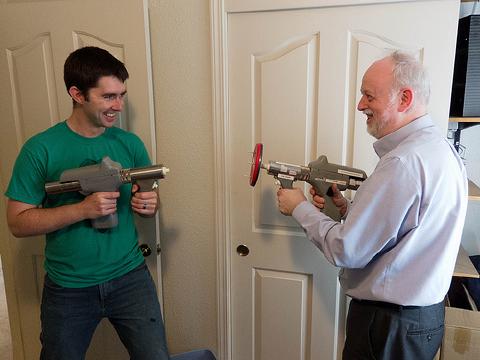
(Philip and Chris face off with ESD guns before Maker Faire)
- Philip has been in Silicon Valley for the past 27 years, working at AMD, Xilinx and for himself.
- Back in Australia, Philip was an FAE for Intersil and AMD, among others.
- At AMD, he became an architect on the AM29000, one of the first commercial RISC processors.
- The other two were in the ACORN (by ARM) and the Fairchild Clipper.
- No crazy instructions at ARM, but there is an EIEIO instruction in the wild. They also outlawed images in silicon after a guy's face messed up a mask set!
- The precurser to the 29000 was the 2900, which was based on the Fairchild 74181 bit slice concept.
- The 2900 was in machines such as the PDP11 and the VAX. Philip joined Xilinx right when they were starting work on the XC4000 series.
- He also helped architect the Virtex series parts and the early Spartan parts.
- Any patent with Ross Freeman on it is brilliant, according to Philip.
- Philip has a couple patents of his own, including the one for Dual Port RAM in an FPGA!
- Dave was wondering if patents expiring in the FPGA industry will encourage other manufacturers to jump in. Philip says only if they have a laser focus.
- Every FPGA manufacturer is fabless, so how do you get a process edge?
- If you're interested in getting started, look up a tutorial on VHDL or Verilog, get your self a dev board (like the Papillo or similar) and download the tools from one of the big vendors. Then start using your imagination!
- Any other questions not answered directly on the show (especially those asked on the Discuss Server) will be answered if they get 10 or more upvotes.
- Update: Philip has posted an album of chips and has posted short blurbs about them.
Thanks to Philip for taking the time to share about his experiences! We hope to have him back on in the future to talk more about what he’s been doing since his time at Xilinx.
Thanks to MightyOhm for the picture of Philip and Chris.
Transcript
SPEAKER_00: This is the Amp Hour Podcast, recorded July 8th, 2012. Episode 103, Xeno Dokio, Xilinx, Ex-Employee.
Dave Jones: Welcome to the Amp Hour. I'm Dave Jones from the EEV blog.
Chris Gammell: And I'm Chris Gammell of Chris Gammell's Analog Life.
Philip Frieden: And I'm Philip Frieden. I'm a consultant. My business is Fliptronics. Previously, I worked for AMD and Xilinx.
Dave Jones: And that, folks, is an Australian accent. Or what's left of it, right, Philip?
Philip Frieden: Yeah. Welcome to the show. Yeah, thank you. Yeah, I've been in the U.S. for 27 years. But in spite of my best attempts, I still have a bit of an Australian accent.
Dave Jones: Beautiful. We like it. It's a Bobby Dazzler.
Chris Gammell: There we go. Whatever the hell that is. Beauty, beauty, mate. No idea, yeah, yeah.
Dave Jones: I love it. Why have you lived in the U.S. for so long? Is that where the work is? Or you prefer living in the U.S.? Yeah. And why did you go there to begin with?
Philip Frieden: Sure. Well, I started off in Australia. Lived there about 28 years. Worked in a number of electronics and computing type places in Australia.
Dave Jones: Any names we're familiar with?
Philip Frieden: Probably not. Right. Mostly little dinky companies.
Dave Jones: That have probably gone the way of the dodo, right?
Philip Frieden: Yeah, they probably have. I did work in medical electronics at Alfred Hospital in Melbourne.
Dave Jones: Oh, okay.
Philip Frieden: I taught for a year or more at RMIT in Melbourne.
Dave Jones: Yep.
Philip Frieden: In the electronic engineering department. I taught undergraduate electronics. I taught bio... Well, I guess it was bioelectronics at... Damn, you know what? My brain just lost... I just lost a neuron. I just saw it fly out the window.
Chris Gammell: Must be that California air.
Philip Frieden: Yeah. Anyway, so a mixture of small companies. But anyway, the move to the US was I really wanted to work in chip design or rather chip definition.
Dave Jones: Right.
Philip Frieden: And I guess the closest I got to that was I was a field applications engineer for a little company you have heard of, Advanced Micro Devices.
Dave Jones: Yep. IMD.
Philip Frieden: And another one you've probably heard of, which is Intercil. Yeah. And then another one you might have heard of, which was Varo, which did Rectifier Products. Varo? And a bunch of other stuff. So anyway, basically, I worked for a distributor called R&D Electronics. Yep. They had main offices in Melbourne and Sydney. And I was the only FAE for all of Australia. So this is in the very early 80s. Wow. I used to travel up to Sydney now and then. But I was basically AMD's technical presence for Australia.
Dave Jones: Oh, there you go. And how long did that gig last?
Philip Frieden: That was for about three years.
Dave Jones: Is that probably the average time that an electronics engineer works in a company? I think it's less than two, isn't it, before they get itchy feet and move on? Yeah.
Philip Frieden: You know, it really depends on the company culture and the person. You know, some people, you know, you'll see people who have been at a company for 25, 30 years. Scary. So, well, not really. I mean, if it's a really good fit, you might stay there forever. But, yeah, I did FAE work for a while and that was really great because I got to see a lot of what sort of electronics was going on in Australia, you know, and didn't see anywhere where I could take my career. Right. And so, eventually, I just sent my resume off to AMD and eventually they stopped throwing it in the basket. And I headed off to the U.S.
Dave Jones: Did they fly you over there to interview or what? How does it work? How does somebody from Australia approach? Did you, like, just send your resume?
Philip Frieden: That was certainly a problem. So, I actually had some contacts because I'd been an FAE. Right, okay. So, I contacted them and they were useless. Whoa. They, you know, if you're not there in front of them. Right. Holding their attention long enough to, hey, could you pass my resume to someone? So, anyway, I sort of did that for a while. And eventually, I guess by accident, they threw it into the bin of someone who actually was appropriate. And the guy that – so, the guy – so, I have no idea if this is typical. I doubt it. But what happened was a guy phoned me up and he interviewed me on the phone for about an hour. And then –
Chris Gammell: And this is back when they actually charged a lot to call Australia too. Yeah, phone calls.
Philip Frieden: Yeah, yeah.
Chris Gammell: A $20 phone call.
Philip Frieden: Oh, more than that. Oh, more than that. It was – I think phone calls were like $2.50 a minute from the US to Australia. Oh, yeah. Wow. And there was no Skype back then. No, right. In fact, actually, fax machines didn't exist back then. Nope. It was telex or – Nor did I. Yeah, it was telex or telephone. It was telex or telephone. So, anyway, the guy that called me, interviewed me for about an hour and said he'd get back to me. And he didn't. Bastard. Well, no, it was better than that. The guy that got back to me was a guy in HR with a job offer.
Dave Jones: Oh. Nice. And that's the only time you want to hear from HR is when they're actually offering you something. Otherwise, it's go away.
Philip Frieden: Yeah. So, basically, it was a few hours after the interview, I got a job offer. Wow. And then he spent all this time trying to tell me about stock options and various other stuff, which meant nothing to me because, like, stock options was an unheard of thing in Australia. All I wanted to know was, you know, when can I come over?
Chris Gammell: Yeah.
Philip Frieden: And, unfortunately, it was delayed by about six months because I was – I'd just started teaching a semester at RMIT.
Dave Jones: Oh, no.
Philip Frieden: And I didn't want to, you know, screw up, you know, 45 students' education. So, I asked them really nicely, could they hold their breath for six months? And they did.
Dave Jones: That's surprising. Yeah.
Philip Frieden: Yeah. So, I finished out my last six months at RMIT and then headed off to America and got dropped into the middle of a brand new project there that was kind of – it wasn't a skunk's work, but it was certainly one that was very much under the radar. It was the first – what became the first commercial RISC CPU as a single chip. Now, there were other CPU chips coming out at around the same time that were RISC. There was, I think, certainly the leader was what eventually became the whole ARM ecosystem back then.
Dave Jones: That was the ACORN. The ACORN RISC processor, yeah.
Philip Frieden: Yeah, ARM stands for ACORN RISC machine. And they were certainly out ahead of us, but theirs was a captive product. What do you mean? What do you mean? The only way you could get that chip was inside a computer.
Chris Gammell: Oh, like it finished good?
Philip Frieden: Right. So, yeah. It was basically – Right. Right. The company was ACORN. They made personal computers and they made their own CPU chips. And this was before they were out trying to license stuff and – Yes. Right. It was a very different model. That came a little bit later. The only other RISC CPU that came out in the same timeframe as ours was Fairchild had something called Clipper.
Dave Jones: Oh, yeah.
Philip Frieden: Which was a 32-bit processor which had two things that we didn't have. It had floating point, which we didn't have. And it was three chips and ours was one chip. One chip. Yeah. Yeah. So theirs was a three chip set on a little module board. Oh.
Dave Jones: Oh, okay. So, right. Right. Whereas we – So did it have like a separate floating point die? Because back then that was very common to have a separate –
Philip Frieden: Yeah. Floating point unit. Somewhere here I have a Clipper manual. It's covered in dust. And to be honest, I don't remember how they partitioned it between the three chips. I'd have to look it up. But anyway, it was this three chip module maybe about – maybe 12 centimeters by five centimeters with three big chips on it. Whereas we did it with one chip. Nice. Yeah. But we didn't have floating point, although we did bring out floating point somewhat later as a second chip. And, you know, so we had a two chip set until eventually the microns got small enough that we could stick it on a single chip.
Dave Jones: And this was the 29,000.
Philip Frieden: Right. 29,000. And, you know, the group that did it was actually lifted pretty much as a unit from the 2900 product line, which was the bit slice CPUs. Got it. So, you know, we sort of came – the project was built with a bunch of people who'd been doing CPU type stuff for a while. Although I got brought in, you know, sort of kind of cold. And, you know, there was – I guess it was like eight of us doing architecture. Right. So, you know, I did instruction set definition, caches, memory management.
Dave Jones: Were you able to sneak in any joke instructions or any hidden instructions or was that off the table? Was that like ruled out by an iron fist?
Philip Frieden: No. There certainly isn't any humor in the instruction set. There is –
Chris Gammell: Like the rubber duck instruction or something? Yeah. The rubber chicken?
Philip Frieden: I think my favorite has to be one of Motorola's. They have an EIEIO instruction. Yeah. Something like extended IO into – I mean, I think they really stretched it to come up – They were tied. To come up – yeah. Right. They worked on it to get that mnemonic. So, no, there's no joke stuff in the instruction set. But on the actual die itself, there is a fair bit of artwork scattered around the perimeter.
Dave Jones: Are there any photos of this?
Philip Frieden: Photos of it? There probably are, but they won't be of a high enough resolution to see the artwork. I actually have a die plot on my wall here, which is about – I've seen it. Yeah, which is about two and a half. Oh, you do? Oh, yeah. Chris actually visited my office. Oh, there you go. Back around the time of Maker Faire.
Chris Gammell: Yeah.
Philip Frieden: When he was in the area.
Chris Gammell: Yeah, Jeff was there too.
Philip Frieden: Be your pardon?
Chris Gammell: Mighty Ohm. Yeah. Jeff came by too.
Philip Frieden: Yeah. It was a fun little get-together for that surplus store crawl.
Chris Gammell: Yeah. Yeah. Yeah.
Philip Frieden: Yeah. Good time.
Dave Jones: Why do I always feel like the one left out?
Philip Frieden: Well –
Dave Jones: Well, move to the US, man.
Philip Frieden: Tell you what, Dave. If you come to California – if you come to Sunnyvale, California – Right. I'll take you for a surplus crawl or whatever else. There's a bunch of nice museums here, including the Computer History Museum. Been there. And the Intel Museum. Been there. Having me know that one. Yeah, that one's worth doing. It's a little bit lighter weight than the Computer History Museum. Mm-hmm. But if you really want to see – if you really want to see the whole process of how chips are made, they have a really nice – I won't call it dumbed down, but simplified enough that you could take a pile of school children through and you wouldn't scare them.
Dave Jones: Got it.
Philip Frieden: So, the Intel Museum's there and there's also a tech museum in San Jose.
Dave Jones: And there's a garage, of course.
Philip Frieden: There's a garage. Oh, yeah. Well, I have one of those.
Dave Jones: Which I'm going to get into one day, damn it. I'm going to somehow, you know, wriggle my way into the HP garage and actually shoot a blog in there. That's a goal.
Philip Frieden: Mm-hmm. Sure. So, let me just tell you that there's just something entertaining that I did see while at AMD. Well, actually, C is too strong a term. You asked about interesting instructions. But by the time we were doing the 29,000, there had been an edict from the highest level that there would be no more artwork on chip.
Dave Jones: Oh, that instruction, no pun intended, came down on stone tablets, did it?
Philip Frieden: It was pretty much that this stuff would stop. And the reason I heard, but I don't know for sure, but here's the mini story. Someone had digitized their face. Oh, no. To put on a chip. And unlike – and they basically turned it into sort of just little stipples of varying size little rectangles or whatever. Yeah. And what had happened was the – some of the rectangles got turned into triangles. And triangles just don't happen normally in a chip layout. Right? And so, this was some topology that the mask-making software hadn't seen before. Oh, God. And so, the triangle that was this guy's nose ended up getting like a floating point overflow. And it shot all the way across the chip. Oh, no. And it got imaged and it screwed the chip up.
Dave Jones: Really?
Philip Frieden: Yeah. So, this guy's nose screwed up a chip. And so –
Dave Jones: That's great. Oh, I love it.
Philip Frieden: So, anyway, there was an edict. But let me tell you that that doesn't mean that we obeyed those edicts. As I said – Of course not. The chip had some interesting artwork on the side. And I think actually it was because it was already in there when this edict came down. But about four or five years later, close to the end of my tenure at AMD, I was designing a very strange controller that actually didn't quite make it out the door. So, you can't buy these, but I have 10 pieces of them. But this is a – it was a micro-coded processor with a writable control store, if that means anything to you. It does? Yeah. So, this was very, very fast. But it actually was a peripheral chip. You'd hang off the side of a, you know, 8080 or a Z80. But you could customize it by first writing –
Dave Jones: Hey, Z80. What's this American – Z80 pronunciation?
Philip Frieden: I've been fully – Z80, mate. I have been fully Californicated.
Dave Jones: Oh, boy.
Philip Frieden: Unbelievable. Fine. Z80, 8080, 6800, whatever. So, yeah, you'd basically put this where you'd put a normal peripheral chip. But the first thing you'd do is you'd write microcode to it to customize it. And then it had single-step instructions and whatever. Anyway, writable control store, there was also a whole bunch of constants that would make writing code a little bit easier. And we had like 34 words. And so that meant we needed six address bits. So that really meant we had 64 words. And in the remaining locations of the constant memory, I encoded in ASCII the initials of all the guys that worked on it.
Dave Jones: Nice. Nice.
Philip Frieden: So if you did a dump of the ROM memory from this chip and just displayed it in ASCII, you'd get all our initials.
Dave Jones: Philip was here. Well, we didn't have that many characters. Right.
Philip Frieden: So, in fact, some of the initials, I used the last letter of one person's initial as the first letter of someone else's. And the interesting thing is even the guys that did the chip layout and the detailed design didn't know that I'd done this.
Dave Jones: Beautiful.
Philip Frieden: Because all they saw was just a table of here are the bits that go into this lookup table.
Dave Jones: Sure. Now, in your LinkedIn profile, it says that you were the last guy out the door and you're the one who turned off the lights.
Philip Frieden: Yeah, kind of tragic.
Dave Jones: Was this in this product department or?
Philip Frieden: It was a – well, so after I worked on the 29,000, I worked on some follow-on 29,000 parts. But they'd sort of left the whole bit slice division to kind of languish in the breeze. And so they transferred me out of 29,000 and put me in charge of 2900. And so I was the last product planning manager for 2900. And in all honesty, the writing was on the wall, although I refused to read it. And that was the 29,000 that I'd worked on was pretty much the death knell for 2900.
Dave Jones: Right.
Philip Frieden: But since I really liked bit slice, I happily took on the thing. And with my small team, it was only three of us actually in Silicon Valley. The actual IC design team was in Texas. Oh, okay. Yeah, so AMD had back then actual IC design and fabs in both Austin and San Antonio. And the group I served was in San Antonio. So for about two or three years, I used to commute between Silicon Valley and San Antonio.
Dave Jones: Oh.
Philip Frieden: Great for frequent flyer miles. Yeah, I bet. Really bad for jet lag, et cetera, just going back and forwards. But yeah, so anyway, we did a few more bit slice parts. There's a 32-bit ALU that I inherited. And I sort of dealt with the conversion from bipolar to CMOS. A few sequencer-type chips and register file chips. And then AMD sort of said, well, you know what? We're not going to even reprint the data book, which we'd run out of. And so the writing was pretty much on the wall. And then one day they told me that since most of the 2900 bit slice group was in Texas, which is all the IC design, fab, and testing, that my job title had moved to Texas. And they won't. Your job title had moved. Yeah. My job title had moved to Texas.
Dave Jones: Is that a subtle hint that you should move there?
Philip Frieden: Well, that was – That's not very subtle, Dave. Basically, it was, you know, look, your job title is going to be in Texas on Monday. Will you be following it? And the answer is I didn't follow my job title to Texas. And in fact, no one ever did. No one ever filled it. And so basically – and by that time, both of the two guys that used to work for me had moved on to other jobs. So I was sort of on my own at that point. And it was clear that I wasn't going to – I couldn't even get a data book printed, let alone design – let alone design another chip.
Dave Jones: I can just picture you sitting down in the basement going, hello.
Philip Frieden: You know that lovely scene of that guy with his stapler in Office Space? Yeah, Office Space.
Dave Jones: Milton.
Philip Frieden: Yeah, that's what the BitSlice group in Sunnyvale looked like at the end. My manager had gone. The guys reporting to me had gone. To be honest, the guys in Texas were looking for anything else they could do other than work on 2900. So it was kind of the end. And there are some – both Cypress Semi and IDT had sort of second sourced or copied our products. And they kept on doing stuff a little bit longer. But basically, the arrival of RISC CPUs pretty much killed BitSlice and microcoded products.
Chris Gammell: Could you give us a little context on the 29000 and like 2900 even, like what those were designed into, like kind of products and timeframes? Sure.
Philip Frieden: So let me start with the BitSlice stuff because it's older. So BitSlice sort of came to life maybe in the mid-70s at Intel, Monolithic Memories, and a few other companies. It was basically we want to build CPUs, but we don't have enough silicon to do it in the packages we have available. And so what BitSlice did – well, let me rephrase that. You certainly could do that with something like an 8-bit micro. But if you wanted to build a 32-bit processor, you just didn't – the size of the microns for the silicon back then, which was probably like two to three micron technology, you just couldn't build a 32-bit CPU on a single chip. And so the way they did it was they looked at it and said, you know what? If you take a CPU core, which is the ALU, the register file, the shifting logic, the buses, if you slice that vertically, then the only communication you need between them is the carry chain for the arithmetic and a single bit each way for the shift paths. The bulk of the communication is vertical with like register file at the top, then the ALU, then maybe a shifter, then maybe an IO block. BitSlice basically said, let's put as much of the CPU path, right, all the different elements that make up a CPU into one chip, make it as wide as we can get away with, and then we'll then just have multiple chips side by side. So pretty much other than one product from Intel that was a two-bit slice, everybody else did four-bit slices. So you've got N registers four-bits wide, an ALU and logic unit four-bit wide, shifter that was four-bit wide, an IO unit's four-bit wide. And if you wanted to build a 16-bit CPU, you put four of them side by side. Got it. The actual precursor to all of this was the Fairchild 7-4-141. Look it up.
Dave Jones: Ooh. Okay.
Philip Frieden: Don't – I don't know that one. You got me. Sorry, 141, 181. Okay. It's been a few years. It's a four-bit ALU. And it does everything, right? It has four bits in on two ports and four bits out plus carry in, carry out, and a whole bunch of control pins to select whether it's adding, subtracting, inverting, et cetera, et cetera.
Dave Jones: That's got everything. Why aren't we still using them?
Philip Frieden: Those parts are still being used, and they were the product of choice for people building mainframes.
Chris Gammell: Interesting.
Philip Frieden: Right. So you pull apart a VAX or a Data General Nova or a PDP-11, and you'll find these – I'm pretty sure it's 7-4-181. Well, it's one of those two. It's 181 and 141. Anyway, so that was sort of the origins of BitSlic in the mid-'70s. And then basically AMD pretty much dominated that market with something called the 2901, which was their four-bit slice. And then they started building a bunch of support chips around it to do sequencing, which is basically the program counterpart of your computer. They then built a 2903, a 29203. So that was sort of the origins of BitSlic taking you through to the early 80s. And so you asked where do those bit slice processes turn up? Pretty much anywhere where people wanted high-performance computing, either as a custom application or building the large machines that everybody buys. Now, they weren't the only ways of doing it, but they were a very common solution. So I saw – but remember I said they can get used in custom stuff. So there were lots of companies building disk drive controllers that had maybe an 8-bit CPU made up of two 2901s. A company called Rolm who made telephone exchange equipment. I saw boards of theirs that had four of them sitting side by side. A little company called Fujitsu built mainframes that competed head-to-head with IBM. They did. And those used some of the later versions of 2900.
Dave Jones: Were Fujitsu part of the big – no, the – what is it, the big seven?
Philip Frieden: Don't remember. They were certainly a mainframe manufacturer. But I don't know if they were counted among the biggest of the lot. Let's see. Where else did I see bit slice used?
Chris Gammell: Well, that's a lot of places. But I mean I was just looking for some general context really.
Philip Frieden: Basically, if your single-chip micros didn't have enough power, then your only choice tended to be something custom with bit slice. Okay. So what was the second half of the question? Where does risk fit in?
Chris Gammell: Well, yeah, where did the 29000 show up but maybe in a somewhat briefer? Yeah, sure.
Philip Frieden: Sorry about that. Hey, cut out all the stuff I said. I don't care. So 29000 addressed exactly the same marketplace.
Chris Gammell: Oh, okay.
Philip Frieden: So basically, it was now a single-chip version. It ran a whole lot cooler because it wasn't bipolar. It was CMOS. It was a fixed instruction set as opposed to every 2900 design was a different instruction set. So you could have standard compilers and in-circuit emulators and a development ecosystem could grow up around it. Sure. Probably the biggest wins for 29000 were HP and Apple who used it in their laser printers. Oh, yeah. So for a while, the 29000 was like one of the highest volume shipping CPUs because both Apple and HP had it in their laser printers.
Dave Jones: Nice. What was the major difference and issues with switching from bipolar to CMOS? Were there any disadvantages to going to CMOS at the time? I guess now with hindsight, Will.
Philip Frieden: With 2020 hindsight, it was something that just had to happen. At the time, it was highly political within companies. You had people who were managers of bipolar fabs who had P&L responsibility. And the last thing… P&L? Profit and loss.
Dave Jones: Ah, profit and loss. One of those management wank words, yeah, which us engineers don't give a closer about.
Philip Frieden: Yeah, sometimes you've got to deal with it. But so, yeah, there were certainly people who wanted all the new…
Chris Gammell: Self-preservation.
Philip Frieden: Yeah, for self-preservation. They wanted to keep their fabs full of new products. And so they wanted… When a new product came along, they wanted it to be implemented in bipolar so it would run in their fab. Right. And so…
Chris Gammell: Plus, at the time, CMOS was probably very, you know, faulty and slow too, wasn't it? Because of the big… They had huge gate widths and everything. Or gate thicknesses.
Philip Frieden: Well, by the time we finally… Well, AMD was really late to the party on CMOS.
Chris Gammell: Wow.
Philip Frieden: So there were other people who had already figured it out and were doing it. And AMD was still, you know, bipolar is the way to go. And they were wrong. And… But that certainly held us back. In fact, certainly for the BitSlice product line, we… As architects, we were begging to convert the product line over to CMOS. But we were tied to a bipolar fab. And so… I got it. Yeah, parts which we knew should be CMOS were being implemented in bipolar.
Chris Gammell: That's interesting.
Philip Frieden: So, yeah.
Dave Jones: And after…
Philip Frieden: Yeah.
Dave Jones: Oh, sorry. After AMD, you moved on to…
Philip Frieden: I moved on to a little company called Xilinx. I joined the…
Dave Jones: How little were they at the time?
Philip Frieden: I was employee number 120, I think. Wow.
Dave Jones: This is in 1989.
Philip Frieden: Yeah, right. 1989. When I joined, yeah, Xilinx annual revenue was, I think, around $20 million.
Dave Jones: Okay. So, what parts were they shipping at the time?
Philip Frieden: So, it was… The last of the 3000 series was just going out the door. So, that was the 3090. So, that was Xilinx's second product line. The first one was the 2000 series. There were two-part numbers. And then the 3000 series, which was, you know, sort of better in almost every possible way, had been designed and was like the largest part that we did, which was the 3090, was coming out. And the follow-on product line, the 4000 series, was still in architecture definition. And so, when I joined, I would say the architecture definition was probably about half done. So, we had the basic look-up tables were decided. The flip-flops were decided. There was still some arguing about how the carry logic would be done. And much more important than anything else on an FPGA for the next 15 plus years was how do we do the routing?
Dave Jones: Yes.
Philip Frieden: That is a problem of astounding complexity.
Chris Gammell: So, do you mean in the software when you're talking about the routing?
Philip Frieden: So, the problem is, unlike a printed circuit board where you have as much space as you want to lay down more tracks or you add another layer or you move chips further apart or whatever you need to get the routing done, in an FPGA, you get to do it once and once only. And then every customer is stuck with that routing topology.
Dave Jones: At the silicon level?
Philip Frieden: Well, no, these are the resources available to you.
Dave Jones: The resources available on the silicon. Right.
Philip Frieden: So, how many wires do we run up and down each channel? Where do we put the switches? The term in Xilinx technology is called a PIP, which is a programmable interconnect point where if you take one wire traveling in X and the other one traveling in Y, if you want them to join, then there has to be a pass transistor and a memory cell to turn it on. Yep.
Chris Gammell: Right. Yeah. So, maybe even to take a step back from there for some of our younger listeners or people who haven't worked with FPGAs before, the way to think about the fabric is like a matrix, right? I mean, it's like a crosshatch of connections.
Philip Frieden: Right.
Philip Frieden: Yeah. If you want to sort of put it into, I don't know, do you think PALs are better understood by?
Dave Jones: PALs are probably easier to understand because they use more traditional sort of, you know, NAND, you know, multiple import NAND gates.
Philip Frieden: Right. So, I mean, back in those days, there were multiple ways that logic was built and one of which was the PAL structure and the inheritor of that architecture was another company called Altera who built bigger and bigger PAL-like things that they call CPLDs. And those types of architectures live on today and are characterized by basically large sum of product type logic structures with global lines running horizontally and vertically and some sort of interconnect that connects them together. They are characterized by consistent timing because everything connects more or less the same way. But they have a problem that they grow by N squared, right? Because they have global routing. Right.
SPEAKER_00: Yep.
Philip Frieden: And so that really limits their ability to scale. Over at Xilinx, we had a different answer and it was, let's build these small modules of logic, which back in those days were called CLBs, the configurable logic block. Mm-hmm. And the way you design that tile is the connections that run off the top edge of one tile have to abut perfectly to the matching ones at the bottom of the tile.
Chris Gammell: Mm-hmm.
Philip Frieden: Right? So you design the tile and then you can build chips of arbitrary size by just tiling them together. Got it.
Dave Jones: So how much infighting went on with coming up with actually deciding on what that CLB architecture is going to be? Because I can imagine everyone would have their own idea of what's best and what would be the most universal for the customers.
Philip Frieden: I would say there was no infighting at all. We had a common vision. Oh. Had some software people who were the people responsible for writing the router who were participating in the architecture. And they certainly argued for more interconnect, but they understood that every additional line that we added that was interconnect as opposed to logic impacted the density of the chip. Of course, yeah. So, you know, there was this juggling act that we knew that the top-of-the-line parts from the 3000 family were difficult to impossible to get full utilization because of the amount of routing that was available. So that's the one problem that if you – although you get incremental routing with every additional tile that you add, there is some routing in these chips which by necessity has to travel a long distance.
Dave Jones: Sure.
Philip Frieden: And so when you build big chips, there's more of that long distance routing, you know, moving between different sections of the chip. And unfortunately, when it runs through a given region, it chews up routing resources that might otherwise have been used for local activity.
Dave Jones: Yep.
Philip Frieden: Right. Right. And there's wonderful research papers ad infinitum on this. And there's some laws. I think Rents Rule is one of them talks about how much global routing you need as you grow these arrays. Mm-hmm. And so the problem was, although we could build multiple products with one tile for the 3000 family, by the time you got to the high – the last one, the 3090, you could certainly build the part, but it was tough to route it.
Dave Jones: Got it.
Philip Frieden: Right. Right. And, you know, eventually we did the same thing with the 4000. We planned for a given largest product, and then we went off and built parts far bigger than we originally planned, and they were, you know, very difficult to route.
Chris Gammell: Does that still happen today, you think? I mean, is it still –
Philip Frieden: Sure. Although, certainly with Altera's Stratix product line and Xilinx's Vertex product line, they have a lot more routing resources, and also the routers have got better. Right. Got it. Right. But what you do find is that for the low-end parts where they have, one could argue, too much routing resources, they are – the term I used to use is they are pathologically routable.
Chris Gammell: I like it. What does that mean?
Philip Frieden: It's hard not –
Chris Gammell: Like people can mess it up?
Philip Frieden: It doesn't matter what you do, the thing is routable. Right? There's more than enough routing resources.
Chris Gammell: Well, not if you use like 90% of your chip, though. I mean –
Philip Frieden: I'm talking about for the small chips.
Chris Gammell: Oh, okay.
Philip Frieden: Right? Where that – right, for that given size, they're not big enough to have – to be burning lots of routing resources for long distances.
Chris Gammell: I get you. Okay.
Philip Frieden: So, yeah. So, you end up with the low-end chips being way too easy to route, and so, unfortunately, you're kind of paying for routing resources you might not need. Sure. And at the other end of the spectrum, it's the exact opposite, right? You don't have enough routing resources, and so you get into these things where, you know, the router sits there for hour after hour not being able to complete.
Chris Gammell: Yeah.
Philip Frieden: Right?
Chris Gammell: So, do you mean for the smaller chips that – like, so within a given family of an FPGA, the smallest version and the largest version within that family will have the same amount of routing logic?
Philip Frieden: Per tile, yeah.
Chris Gammell: Per tile. And can you define tile?
Dave Jones: Yes, per tile, because the architecture is the same. The CLB architecture is the same for that family, is it not? Yes.
Philip Frieden: Yeah. I mean, eventually – I mean, there were some products where we sort of drew a line and said, for all the parts above this point, right, we'll add, you know, three more routing lines in each direction.
Dave Jones: Right.
Philip Frieden: So, it wasn't absolutely set in concrete, but you really wanted – the investment to design the layout, the actual IC layout for one of these tiles is immense.
Chris Gammell: Huh. Right.
Philip Frieden: It is a piece of handcrafted beauty that takes probably more than a man-year effort.
Chris Gammell: Wow. Really?
Philip Frieden: Right.
Chris Gammell: Because then you're just throwing down tiles at that point? You're just defining based on size of the silicon?
Philip Frieden: That's figuring out what the tile – that's just figuring out the tile. Right, right, right. And then you then build chips, which is more work.
Chris Gammell: Right. But then you just multiply the tiles by however big you want the chip to be, right? Yeah, by X and Y. Okay.
Dave Jones: Now, I wanted to ask about – because there was some talk a year or two back or something that the original patent for the FPGA by Xilinx, I believe it was, has now expired. Absolutely. And that was going to change the whole game, meaning that every man and his dog can now come in and FPGAs were going to – you know, everyone would be making them. They'd be the future, yada, yada. And it hasn't happened yet, of course. Do you know anything about that?
Philip Frieden: Well, I can't speak to that particular rumor, but I can tell you how the landscape plays out. Please. Right. What's expired is a patent that's more than 20 years old. So everybody and his dog can go build Xilinx 3000s. God dang.
Dave Jones: We're going to get rich, Dave. Let's go make one.
Philip Frieden: Knock yourself out, guys. Yeah, right. Good luck with that. If you go to Xilinx, they have some corridors in their main corporate building. They actually have a campus with about four or five very large buildings on Logic Drive in San Jose.
Dave Jones: Logic Drive. Nice.
Philip Frieden: Well, they would have liked to have called it Xilinx Drive. I was actually there when we did the move to that campus site. It used to be – there used to be a disk drive company called Corvus.
Dave Jones: Oh, yeah.
Philip Frieden: You ever heard of it?
Dave Jones: Oh, in the deep distant past, yes. Yeah, yeah.
Philip Frieden: So they went bust. But the building we ended up in used to be Corvus, and it used to be called Corvus Drive. And so when we moved in, we wanted it to be Xilinx Drive. And the city of San Jose said that they were sick and tired of renaming streets over and over again with all these – Our mailmen are so confused. These fly-by-night companies. Yeah, yeah. So we couldn't have Xilinx Drive, but they let us have Logic Drive.
Dave Jones: Right. Something more generic.
Philip Frieden: Yeah. So, yeah.
Dave Jones: Nice. Oh, boy, I love it.
Chris Gammell: Well, we know Xilinx went nowhere, so obviously.
Philip Frieden: Yeah, so Xilinx is still on that site.
Dave Jones: So the patent thing, it's not a big deal that it's expired.
Philip Frieden: Yeah, so if you go into the main administration building, there are corridors with – I don't know, I guess it's 10 high by as long as the corridor is of patents on both sides on display.
Chris Gammell: Oh, wow. Right.
Philip Frieden: Right. And then you go – and then you turn a corner and there's another corridor. You know, and these are – I mean, these are wide corridors, you know, with, you know, main thoroughfares through the building. And the walls are just covered with patents, right? Yeah. So, yeah, the original patents for this stuff have all expired. If people want to go look these up, I don't have the magic patents on hand, but what you want to do is look for patents that are assigned to Xilinx and list a guy by the name of Ross Freeman as the inventor. A real genius and a really nice guy. I was honoured to have known him and met him. Unfortunately, he died way too soon. He died only a few months after I joined Xilinx.
Chris Gammell: That's a shame.
Philip Frieden: Very much so. But his legacy is the chips that everybody in the world now use for building logic.
Dave Jones: Nice. And you've got like a couple of dozen patents yourself. I've got about – Did you get paid for these? Like, did you actually get any reward for these?
Philip Frieden: Yeah, I got very well compensated. I got a plaque for each one. Excellent. There you go. Take that to the bank. Yeah, well, they make great cutting boards for cheese. Fantastic. Yeah, so I've got a bunch of them from AMD and a bunch of them from Xilinx. And then when I finally left Xilinx and I became a consultant, I've got a few more since then. But, yeah, I've – I mean, I certainly participated in it, but I was not like a driving force at Xilinx. Right. Xilinx did very, very well in terms of hiring a lot of very smart people. And, you know, it's managed to maintain its innovation. And I would say to a large extent driven by a ruthless competitor or in a robust competitor. It depends how you want to – you know, which side of the fence you stand on. But Altera has been an excellent adversary for Xilinx and vice versa. And so the two companies have relentlessly pushed the envelope of what can be done in programmable logic. And, you know, they've also had some court battles between them that, like many of these things in Silicon Valley, get resolved eventually by cross-licensing all the patents. Sure. Right. In front of me, there's another stuff. They finally get burnt out on throwing their money at the lawyers and want to get back to building ships. And so they end up cross-licensing their patents and agree not to fight with each other for a few months.
Dave Jones: For a few months until, yeah, somebody else needs to make a name for themselves.
Philip Frieden: Until something else comes along.
Dave Jones: Oh, boy.
Philip Frieden: So you asked me about sort of all the other follow-ons. So I've watched – because of how much immersed in this I've been, I've watched all the startups, you know, for the last 20-plus years. And there have been no wild successes.
Dave Jones: No.
Philip Frieden: None. None. And there's probably been at least 20 companies that have said they want to be in the FPGA marketplace. So in some regards, you can look at the problem of competing in this market space. It's a bit different than the typical problem. The typical problem is you've got some absolutely dominant company, you know, the gorilla, and, you know, you've got a bunch of companies trying to compete. In the programmable logic market, you've got two gorillas and they're fighting with each other in the middle of the ring. And if you even step in the ring, you're just going to get stomped on by accident. I like it. And I've got to tell you, there has to come a time when people stop believing this and stop throwing venture capital money at it. But it hasn't happened yet. But it hasn't happened yet and I don't understand why.
Chris Gammell: It's so alluring, you know. I remember seeing an article about it.
Philip Frieden: If you take a step back, all of these companies are fabulous. Yes. Which means they're buying their silicon from the same companies as everybody else. Right? And so that really is a very level playing field. I agree. Except that the really big guys, Ultera, Xilinx, NVIDIA, ATI. Well, they're now swallowed by AMD. But all the really big guys, they have a relationship with the TSMCs and UMCs that are much more than just buyer-seller type agreements. Right? Companies like Xilinx and Ultera have process technology people on staff. Right. So even though they don't have a fab, they have the people who develop technology on staff working one-on-one with the fabs coming up with custom process technology that maybe for the first year after it's been developed, they get exclusive access to it.
Dave Jones: Right. And there is no competing with that.
Philip Frieden: Well, it's very, very difficult.
Chris Gammell: Lots and lots of money. But not enough that a startup could do it probably. No, no, exactly.
Philip Frieden: Right. So, yeah. So the startups can't reasonably do any better. Well, in the limit, the startups can't do any better with the silicon than what Xilinx and Ultera can do.
Dave Jones: Sure. Right.
Philip Frieden: So that kind of limits it. And the biggest barrier to entry really, other than – I mean, you could point at all the patents, but you don't see Xilinx and Ultera using their patents as a club against all of these little startups.
Dave Jones: No. That's right. They just know they're going to get crushed anyway.
Philip Frieden: Well, if not crushed, they're just going to never – they're never going to get traction. Exactly. Or they're going to get – the traction they get will be really, really minimal. Right? They'll have a few boutique design wins and that's it. Right.
Chris Gammell: But – Yeah, the mass market stuff seems like it's really driven by all the add-on stuff as well. I mean, Xilinx not only has – like Xilinx, Ultera, even Actel and Lattice, they all have the software behind it, which is a huge piece. Right. And the dev boards and the agreements and everything else. Right? It's just all there.
Philip Frieden: So this is called barrier to entry.
Chris Gammell: Right?
Philip Frieden: And the – as – both Xilinx and Ultera have been around since 1984. All right? So you're talking 27, 28 years. They have developed a lot of IP in that time. Yeah. And they've developed a lot of customer relationships in that time. All right? Yep. But, yeah, the design software, the – not just the place and route stuff that is tied to each vendor directly, but all the IP, whether it's a memory control or a USB piece of IP. And they're now doing CPUs. So there's a huge amount of IP that's just CPU related. Right? Basically, it says if you want to compete, you not only just have to have a chip that's better. Right? In some way or manner. But you have to also – it's like that checklist on the front of a data sheet. Right? Right? Even though you might not use all those features, the customer is going to look at the checklist on company A and company B's data sheet. Yeah. And it's like, well, they have this feature. Why don't you have this feature?
Chris Gammell: Unless you have that one feature that is so much better than Xilinx is and the customer specifically needs that, then it doesn't matter.
Philip Frieden: Yeah. So there might be a niche where you could sneak your way in. But it's kind of tough to find those.
Chris Gammell: Yeah. What about the assertion? I've heard people saying that like an Intel or people that are just making ARM chips, like other big companies like the TIs and the Intels of the world, they might just start slipping in programmable logic. What do you think about that?
Philip Frieden: I wish them a lot of luck.
Chris Gammell: I'm sure Intel will do it and then they'll turn around and be like, ah, we didn't mean to make this. We're going to stop making it now.
Philip Frieden: So Intel – so every big chip company has seen the profit margins that Xilinx and Altera get and have tried to get into the market. Intel did have a programmable product line. AMD had their own programmable product line. That's right. Motorola had one. TI had one. Every one of your big semiconductor companies and all the Japanese ones too have all enviously looked at the FPGA market. And they have all, without exception, failed. And I believe the reason is the only way you can succeed in the programmable logic market is if it is the only thing you do. Right. You have to have a laser-like focus on programmable logic. Whereas if you're just a division as part of some other company, there is insufficient focus to succeed.
Dave Jones: Interesting. That brings us on to the – because we haven't got much time left. It brings us on to the viewer questions. Listener questions. Listener, Dave. Listener questions.
Philip Frieden: The listener questions. So I had a look and there's about half a dozen of them there. Yep.
Dave Jones: Well, let's – the one I wanted to ask here is – well, one I think is pertinent with the last thing we talked about is why are FPGAs so much more expensive? And that comes from Dimitris – sorry. Can't pronounce that one. Why are the damn things so expensive? Because you said that the profit margins are massive on these things.
Philip Frieden: Well, they're not massive. No, I – well, no, I wouldn't say they're massive. Okay. They are – they are enviable. Well, that's the same thing. But they're enviable as much as the profit margins that Intel has.
Dave Jones: Okay. Fair cool.
Philip Frieden: In fact, if you run the numbers, you'll find that actually FPGAs are not more expensive than any other chip for the size of pieces of silicon that they deliver.
Dave Jones: Okay. So the price of FPGAs is the sheer size of the die, basically. Right. Pretty much.
Philip Frieden: Right. The largest – I mean, if you go look at whatever Intel's latest high-end CPU chip is, right, in retail packaging, it might be a $300 or $400 item.
Dave Jones: Oh, even more than that. Some of them are up to $1,000, I think, aren't they? Yeah.
Philip Frieden: If it has Xeon written on the side of the package, right, then you can just double it just for that X.
SPEAKER_00: Mm-hmm.
Philip Frieden: Right? But, no, if you look at the type of stuff that Intel does, their typical die sizes are around a centimeter on a side for their biggest parts.
Dave Jones: Is that because of yield?
Philip Frieden: Yeah.
Dave Jones: Is that because the yield is poor? Because the dice is so large.
Philip Frieden: At a centimeter by a centimeter, you'd better be yielding really well. If you aren't yielding well on a square centimeter die, then your fab is out of control.
Chris Gammell: Right.
Philip Frieden: Right? But if you look at Xilinx's product, the centimeter on a side chips, those are in the middle of the range. Mm-hmm. There's an upper limit, which I think is around 22 millimeters on a side, which is a function of the largest optics they make for the radicals.
Dave Jones: Right. So it's an optical limit. It's not – you can't, like, make a 12-inch wide die.
Philip Frieden: No, you can't. Right. So the largest dies that I believe Xilinx has ever done – I don't know if they do them currently because I've been out of Xilinx for 17 years. The largest dies are about 22 millimeters on a side.
Dave Jones: Mm-hmm.
Philip Frieden: And at least when you first start running a product with die sizes that size, you don't talk about die per wafer. You talk about wafers per die. Right.
Dave Jones: Wow. It's that bad, is it? Or is that sort of a joke?
Philip Frieden: When you first start building that product before you've found all the problems and sort of done the shakedown that's necessary. Yeah. Right. I mean, eventually, either the geometries will come down and it won't have to be 22 millimeters on a side, or you'll be selling chips that cost several thousand bucks a piece.
Dave Jones: Yep.
Philip Frieden: Right.
Dave Jones: Which they currently do. I mean, you can easily pay several thousand dollars for a Xilinx FPGA on a high-end ones.
Philip Frieden: I don't know about easily pay. I think it would be with some trepidation that I'd pay that much for a chip.
Chris Gammell: If you're in the military style side of things, you're usually not too bothered.
Philip Frieden: Right. But you go look at the bottom end of the Spartan range or the Cyclone range from Altera, and you go look that up in one-off quantities at DigiKey, and it's probably down around 10 bucks. Yep.
Chris Gammell: Right?
Philip Frieden: How different is that from a run-of-the-mill CPU chip? No, it's not too much different. Right. So, yeah. I mean, I've never quite understood this FPGAs are more expensive than anything else. They aren't. They're priced pretty much with the same model. If you look at the gross margin for Xilinx versus, say, gross margin for Intel, they're within a few percent of each other.
Chris Gammell: Right. Well, it could be because of the idea of what you can do. I think a lot of people look at a microcontroller and say, oh, I can do a countless number of programs with that versus an FPGA. And, you know, you have to either instantiate a processor within there or you've got to write custom logic. And you are to ADCs and all the other peripherals go along with it.
Philip Frieden: Well, but hold on. Well, but I mean, I look at an FPGA. But size based. Right. Well, I think there's a perception issue then. Of course. Because I look at an FPGA and I see an infinite number of designs that all can be mapped to one FPGA. Sure. I do too, man.
Dave Jones: It's a $10 part. Whereas if you just need your 50 cent micro, then an FPGA is not, you know, is not the solution for you.
Philip Frieden: Well, yeah. If you can do it with a 50 cent micro, by all means, go off and do it with a 50 cent micro. But, you know, if you have to watch three signal lines that are toggling at 10 megahertz, right, and pull out a bit pattern on the fly, there isn't a processor on the market that can do that.
Chris Gammell: Yeah.
Philip Frieden: Well, three processors, maybe. But a $10 FPGA can. Yes.
Dave Jones: Oh, yeah. They're entirely different market segments. Right. But that's a lot of the argument because there's a lot of people out there who are using FPGAs as almost micro controller replacements, or they're trying to. And they're, you know, and they claim, oh, I can, you know, put my CPU core in there and I can do anything I like. And they're not actually using the advantages of the FPGA. They're just duplicating what a micro controller does, which seems a bit silly to me because I am an advocate of using the right tool for the job.
Philip Frieden: And so am I. And so I agree with you. How about that? Of course. We're both Australian. Yeah.
Dave Jones: Well, you're not anymore.
Philip Frieden: Are you dual citizenship? I'm a dual citizen, yeah. Awesome. I've been, I guess I've been a US citizen for like seven or eight years.
Dave Jones: Oh, okay.
Philip Frieden: Maybe a bit more.
Dave Jones: Did it take you that long to get citizenship? Oh, no, no.
Philip Frieden: I was just slow to get it done. I mean, I could have done it many years earlier. In fact, the day I came away from the courthouse or celebratory with my new citizenship, I called up what, I guess, pretty much my best friend here in the US and said, hey, Bob, guess what? I'm a US citizen now. I'm an American. Right. And he said, great. Now you're part of the problem. Yeah.
Dave Jones: Nice. Yeah. That's great.
Philip Frieden: I think I like you already. Tell you what, for the questions that are left on the discussion server, they all look like they only have like two or three points. For any of them that, here's a challenge to your listeners. Hi, listeners. If any of these get over 10 points, I'll post answers into the discussion forum.
Chris Gammell: Whoa. Sweet. Promoting the forum.
Philip Frieden: I mean, I've read the list of questions and I can answer all of them except the one about the power decoupling on the chip. I have no idea what the answer is to that one. But I can deliver reasonable answers to all the rest of them if there's sufficient interest.
Dave Jones: Well, I don't even think they do power decoupling on chips. Only in very rare analog-y type cases do they do that.
Philip Frieden: Well, they sometimes do put chips into the package.
Dave Jones: Yes.
Philip Frieden: You need to sometimes think of the package as almost a hybrid. You've got a circuit board in there. You've got the BGA balls or whatever going down. The chips in there. There can be decoupling caps in the package. I have seen it. I just don't know whether Xilinx does that currently.
Chris Gammell: I like one of the questions, because it's just a general question, but what do you see about the future of FPGAs?
Philip Frieden: They will continue to dominate how logic is built.
Chris Gammell: Could you explain that a little more?
Philip Frieden: Well, the typical thing that it gets compared against is ASICs. Yes. And ASICs will not go away. They will continue to be a viable solution for an ever-shrinking number of applications. The FPGAs – and that's basically – it's not that FPGAs are super mega wonderful over ASICs. It's that the fabs are relentlessly going to tighter and tighter geometries on larger wafers. And that means the cost of doing an ASIC continues to go up. Because we're now talking about mask sets for chips that are using the most current technology getting over $10 million for a mask set.
Dave Jones: $10 million for one mask. Imagine if you screwed that up.
Philip Frieden: Right. Exactly. So you have to have a very high volume of product to warrant doing it as an ASIC.
Dave Jones: You have to be an Apple or you have to be somebody like that with – Right.
Chris Gammell: Or someone who really wants to protect their IP somehow because of that, right, if they're really worried about that.
Dave Jones: Or you want the absolute lowest power consumption or something like that.
Philip Frieden: There are a whole bunch of parametric things and business reasons why ASICs won't go away. But you can sort of draw this – if I'm only building 10 of something, right, then it's pretty hard to imagine doing that as an ASIC.
Dave Jones: Yeah, you'd be mad.
Philip Frieden: If you're building 1,000 of something, it's probably still not going to be an ASIC. Is it 10,000, 100,000? It depends on what things matter to you. When I joined Xilinx in 89, we said the dividing line was around about 1,000 pieces. Right. So for anything that was less than 1,000 pieces, you'd never do it as an ASIC. And you'd do it as an ASIC at 1,000 pieces only for the very rarest of cases.
Dave Jones: But that was like 15 years ago that that sort of rule – I don't – That's 20 years ago. 20 – you're right. Yep.
Philip Frieden: Right. Right. Okay. So what's happened is that that dividing line has continued to move. It's nowhere near 1,000 now. It's now somewhere between 100,000 and 1,000,000.
Chris Gammell: Right. Wow. And the number of providers have gone down – drastically down, haven't they? Right. I mean, because of the foundry model and everything else.
Philip Frieden: And getting their attention and buying the software tools for doing ASICs are way more expensive than doing FPGAs.
Chris Gammell: Yeah, blame Steve Liebson for that one. That's who we're going to blame for that. Right.
Philip Frieden: Liebson's the lore, is it? So basically, I don't see anything on the horizon. That doesn't mean it's not out there. But I haven't seen anything that's going to displace FPGAs as continuing to now be the dominant way of building logic.
Dave Jones: Logic itself. Now, that brings me to the next question that I've got quickly. Sure. Do you see more of this hard silicon on FPGAs? Because that seems to be – they've realized that, oh, we need this hard silicon, i.e. we need a processor on there, a hard processor. We need hard UARTs. We need hard stuff. Sure.
Philip Frieden: Well, I was one of the ones who pushed for that back when I worked there. Things like multipliers and memory, I can point to documents that have my name on it that said these are the things we need to convert to hard logic. Thank you very much. Well, and you're welcome. So there are – I guess I would call them – well, I don't know. There are blocks of stuff that are commonly used over and over again by people that just – they're well enough to find that they don't have to be – they don't need all the flexibility that FPGAs have to offer. And so you can make it hard. And by the way, as soon as you make those things hard inside an FPGA, whether it's a CPU, a multiplier, a dual port memory, or a high-speed Surtease, all the arguments about performance, power consumption, whatever, versus ASIC, go away.
Dave Jones: Are there still those old-fashioned FPGA guys who don't like this hard silicon? Oh, that's against the philosophy of FPGAs. No. Are they still holdouts like people playing LP records?
Philip Frieden: Hipsters? FPGA hipsters? If they are, they're not the sort of people I'd ever mix with.
Speaker ?: Right.
Dave Jones: Oh, those softies. Yeah, they're – Well, I mean –
Philip Frieden: Softies. Listen, you're welcome to not use the facilities we put into the chip to make your life easier. Right?
Dave Jones: Right.
Philip Frieden: Right? If you don't want to use the brake pedal, if you don't want to use the accelerator, knock yourself out. Right.
SPEAKER_00: Right.
Philip Frieden: I – you know, the features that went in there, and, you know, let me make it clear, right, I'm not claiming I'm the only one who put features into these chips, right? There's a lot of smart people at Xilinx, Altera, you know, Actel, Lattice, et cetera, that come up with interesting and clever ideas. And, you know, there's a lot of cross-pollination, right? I mean, they're all – they all now have high-speed Surtease in there. They all now have multipliers. They all have block memories. Some of them know how to do block memories properly. Some of them do a – Pretty crappy job. No names mentioned. But, you know, there are these things that make a lot of sense. Putting a UART onto an FPGA, dumbest idea in the book, right? Right. There's no point because it's such a – it's a small block of logic, and God knows how many the customer will really want, what special features he wants.
Speaker ?: And slow speed.
Philip Frieden: Right. And, you know, it works more than well enough in the fabric. But a dual-port memory – a dual-port memory is like an element, right?
Chris Gammell: Which we should mention that Philip has a patent for as well, right? Yeah. Weren't you one of the first ones on –
Philip Frieden: I was. It's the – so this one I will take full ownership of. The dual-porting inside the logic tile, not the big block RAMs. I was involved in them too. But the dual-porting that's down at the very low level inside the block RAM that's used for building register files for CPUs and all sorts of other things. That's mine. That's awesome.
Dave Jones: Mine, damn it. Thank you very much again. Yeah, you're welcome.
Philip Frieden: But, yeah, there's a bunch of things that are kind of – they're like primitives or elements, right? If you don't have it built, pre-built for you, it might be impossible for you to build it. Dual-port memory is an example of that. It's a tough one. If you don't have a dual-port primitive that is something that will tolerate two reads that are absolutely concurrent, then there is no way to fake that out.
Dave Jones: Exactly.
Philip Frieden: Well, no rational way to fake it out, right? Something like a SIRDES, right? If you don't have a SIRDES in there, you can't fake that out.
Dave Jones: Especially at 10 gig bits or something like that.
Philip Frieden: Right, 26, the Jumann, 28. Yeah, that stuff is – that's nosebleed technology. Oh, yeah. Right. The double-edged flip-flops out in the I.O. cells, right, that let you pull apart double-clocked data. Again, that's a primitive. If you don't have it, there's no way to work around it. So in terms of your question of what stuff is going to be made hard, things that become really important and for which there's no easy way to implement in the normal FPGA fabric, right? Got it. Are the things that are candidates for it, but there has to be sufficient interest. A good example of something which came along on that path is there's a new standard called JSD204, which is a very high-speed serial communication to A to D converters that moves data in and out of the A to D converters at 3 gigabit per second. Whoa. And what they use – analog devices has them and a few other guys I think have talked about them. This is dealing with the – I'm going to have an A to D that's transferring data at doing 500 mega samples a second. Yeah. How do you want to pull that data back?
Chris Gammell: Right. And serial communication coming back from it, right? Right. Right.
Philip Frieden: So serial – okay, but you see it's serial with embedded clock.
Chris Gammell: Yeah.
Philip Frieden: Right? It's 8B, 10B coded data. And when you do that, all the nightmares of trace matching and other stuff go away. Right? Compare that to running DDR memory with having to length match every twist, every differential pair for each data lane plus a clock line that basically can't tolerate being split and has to be reversed when you're doing a read versus a write. Right? When I saw it, it was like, man, what a great solution. This is going to change the way everything is done. And it has, right? It's now the base – Of course. Right? It's the base of the SATA communication to your disk drives.
Dave Jones: Yep.
Philip Frieden: The HDMI type stuff going up to your TV. The latest version of USB 3.0. They all use this 8B, 10B coded stuff running at – from a gigabit up to 28 gigabits per second on a single lane.
Chris Gammell: Right. That's scary. And it allows your cable not to be like super wide as well. I mean you don't need all the parallel lines and everything. Yeah.
Philip Frieden: Well, I mean they do sometimes – like if you look at PCI Express, that's another one. That's locked to a PC board. Of course. Again, it's the same stuff. It's like four or eight lines, right? Right. And that's called channel bonding. And so there's a little bit of screwing around you have to do to sort of keep them in – keep them more or less locked together. But you don't actually absolutely lock each channel to each other. They actually run independently. And then you need little FIFOs in the chips to deal with the different trace lengths on your PC board.
Dave Jones: Got it. All right. Well, we're way over our time limit. But I do have one last question. Go for it. Which I want you to answer quickly.
Philip Frieden: Yes. If you may. I'll try and do it quick.
Dave Jones: Altera versus Xilinx. Which one has the edge in what areas?
Philip Frieden: So this is a question I am happy to answer because I've been asked it multiple times per year for the last 20 years.
Dave Jones: I'm sure.
Philip Frieden: And the answer is –
Chris Gammell: You just have your update this on Twitter every week. I mean if you want.
Philip Frieden: Yeah. So no, no. I give you the same answer I've given every other time. Yeah. So for 95% of all designs that are likely to end up inside an FPGA, if you can get it to work in one vendor's product, you can get it to work in the other guy's product.
Chris Gammell: Right?
Philip Frieden: Right? The only time that you would pick one vendor over another if there is some specific feature that you absolutely need that the other guy doesn't have. Right. Otherwise, these guys – I mean it goes backwards and forward by a few percent either way.
Philip Frieden: But between those two leaders, the functionality of their parts, the performance of their parts, the density of their parts, it's a wash. So what it comes down to is what did you use in your last project?
Chris Gammell: Yeah. Yeah, exactly. You see people that are just like super loyal too and that's –
Philip Frieden: Yeah, that's right. Well, you know, it's not – there's super loyalty but I think it's more the massive investment you have to make to learn the tools. Sure. Right? Once you've made that investment –
Chris Gammell: Loyalty for a reason.
Philip Frieden: Yeah. I mean if it took you three years to become really competent with Xilinx's tool and the Altera part offers, let's say, a 5% performance advantage.
Chris Gammell: Yeah.
Philip Frieden: Man, you'd better really need that 5% performance advantage to take on a three-year learning curve.
Dave Jones: Sure. Who has the better tool? Let's say we have a –
Philip Frieden: I don't know. He never uses his stuff.
Dave Jones: A person who wants to get into FPGAs. Does it matter? Is there one that's easier entry level or you don't?
Philip Frieden: I believe Xilinx may have the edge there but that – I am so biased that that's really – Right. What I do know is you can go to the Xilinx website and probably the Altera one, certainly the Altera one, and you can download a complete suite of software that includes schematic capture, synthesis, simulation, place and route, debug, libraries, the whole – everything you need to design. Not just with the lowest end parts but low all the way up to the middle of the product line. For sure. And you can get that for free. You can go find FPGA boards for under $100. Yeah. Papilo is one of them.
Chris Gammell: It's a good learning tool.
Philip Frieden: Which one?
Chris Gammell: The Papilo, I think it's pronounced. Yes. It's like a butterfly-looking – I'm not familiar with it.
Philip Frieden: But there are lots of them out there. So for anybody who's just getting started in wanting to do more than just another microprocessor and actually try and learn a bit about VHDL or Verilog and logic design, the free tools from Xilinx and Altera and probably Lattice and Actel probably have stuff too. But if you want to get some experience that's going to be valuable long-term, you'd have to pick one of Xilinx and Altera. They include extensive tutorials in their software. Or you can use this really clever technology I discovered recently called Google. And you can type into Google. You can say Verilog tutorial or VHDL tutorial.
Dave Jones: Yeah.
Philip Frieden: And that will consume the next several months of your life. That's right. And the neat thing is with FPGAs, unlike TTL and soldering iron or wire wrap, with FPGAs, once you've got everything set up, you can make changes to your design and 10 minutes later start watching the LEDs flash a different pattern.
Dave Jones: Yeah.
Philip Frieden: All right. And that is magic.
Dave Jones: I'm going to regret this, but I've got one last quick question.
Philip Frieden: No, no, no. This is your third last question.
Dave Jones: When did the FPGA vendors decide that they're going to go from high-priced tools to free for most of their stuff and wire? You've talked about that before too with the paying. Because that was a big deal. Because back, you know, if you're talking 10 years ago, you could not get these tools for free. There was a high cost of entry. Maybe more than that.
Philip Frieden: I'm thinking Xilinx has been doing some form of free tools for probably at least 10 years.
Dave Jones: Right. But at one point, there was a very high, you know. Right. If you weren't a company with a big budget, you did not get into FPGAs, plain and simple.
Philip Frieden: That's true. Right. The entry price used to be around like $1,000 or $1,500. Yeah. And I don't know if it was Xilinx's first or Altirifus, but it happened at both companies about the same time. And I'm guessing it might have been around 2000, but I'm not sure.
Chris Gammell: I'm pretty sure that stuff was all free when I started doing that stuff in school. Yeah, but you're a youngster. No, but I started school in 2001. Like I said, you're a youngster. Right. So I'm saying that it was free by then.
Philip Frieden: You know, Dave, I'm a little bit older than you. So you're the youngster as well from my perspective. All right.
Dave Jones: Young with a snapper. God damn it. Anyway, I think we better call it a show.
Speaker ?: All right.
Philip Frieden: Thank you very much.
Chris Gammell: Philip is on Twitter so we can find him there.
Philip Frieden: Yeah. Thanks for ruining my life, Chris.
Chris Gammell: Oh, well.
Philip Frieden: You introduced me to Twitter and then I started like adding people to my list. And now – Gotcha. This whole social network stuff is really chewing into my free time.
Chris Gammell: Oh, yeah. Welcome to my life.
Philip Frieden: Yeah. Thank you very much.
Chris Gammell: Hey. I'm glad I can keep in touch with you on there.
Philip Frieden: Okay. All right. Well, it's been a real pleasure for me to chat with you guys. And again, I'll answer any of these other questions that we haven't touched on that are in your – If they get to 10 points. Yeah, if they get to 10 points. So if you want it, upvote it. If they hit 10, I'll type up a nice answer. You can even add additional ones.
Dave Jones: I think Chris is just going internally berserk right about now. Oh, I love that. That's just a beautiful solution.
Philip Frieden: Well, I know how much Chris wants people to use this service, the discussion service. So I figured I'd motivate the process.
Chris Gammell: That's right. Awesome. All right.
Philip Frieden: Thanks, Philip. Thanks again, Philip. It's been a real pleasure chatting to you both. I look forward to doing it again sometime.
Dave Jones: Catch you later, mate.
Philip Frieden: Okay. See you. See you.
Philip Frieden: See you.
Speaker ?: See you. See you. See you.
Archived Discussion (1)
Comments are closed. Archived from the original site.
Show archived discussion (1)Hide discussion
- ChrisDie sized on some current Intel Xeons are in excess of 400sqmm, so > 20mm per side at 32nm. Retail price for those are around $2k though...
Keep current
Every episode, plus the occasional job post, in your inbox.