
#101 – An Interview with Matt Ettus - Quality Quadrature Quidam
Download episode · 35 MB
Also on Apple · Spotify · YouTube · RSS
Show Notes
[display_podcast]
Welcome, Matt Ettus!
- Matt started and still runs Ettus Research, now a 12 person Software Defined Radio (SDR) company located in the Bay Area
- Matt got interested in SDR through the GNU radio project.
- He got his start working at Bluetooth and GPS type startups.
- In 2010, National Instruments acquired Ettus Research and they continue to run quite autonomously.
- The main projects of Ettus Research revolve around the Universal Software Radio Peripheral (USRP). There are multiple flavors of this device.
- The newest products mainly use Spartan3A FPGAs, though previously they ran with Altera Cyclone I's.
- These radios have MIMO capability, meaning they have multiple inputs and multiple outputs.
- The USRPs can mimic the cellphone base stations that talk to the devices we have in our pockets and the femtocells that are becoming more and more commercially available. This device was used to spoof security personnels' phones at DEFCON....and it worked!
- There were once cores from the OpenCores website, but now most of that work is done in house. And it's open source!f
- The Xilinx Zynq7000 now has a ($1400!) dev kits for reconfigurable SDR development.
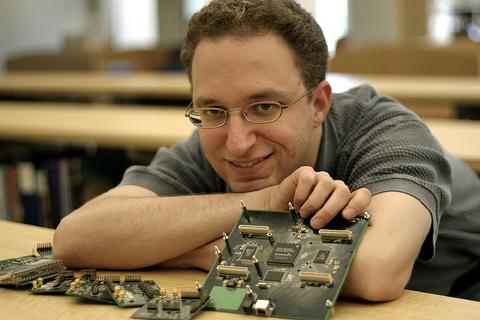
Thanks to Quinn Norton for the picture of Matt
Transcript
Matt Eddis: This is the App Hour Podcast, recorded June 24th, 2012. Episode 101, with guest Matt Eddis, quality quadrature quidam.
Dave Jones: Welcome to the App Hour. I'm Dave Jones from the EEV blog. And I'm Chris Gammell of Chris Gammell's Analog Life.
Matt Eddis: And I'm Matt Eddis of Eddis Research. Welcome, Matt.
Dave Jones: Yes, welcome. Thanks for coming on our show. Sure.
Matt Eddis: Now, are you actually on our usual recording stuff? Are you actually using a software-defined radio to kind of beam in your signal right now?
Chris Gammell: Well, you know, we've got a wired network here at the office. I figure that's probably best for something like this.
Matt Eddis: Yeah. Oldie goldies, right there.
Dave Jones: Because we found that wireless doesn't work very well. You know, everyone raves about wireless, but it just doesn't seem to hold up when we're doing streaming audio like this for some reason. It just, it's a real pain in the butt. I don't know if you've found that, but we certainly have.
Chris Gammell: Yeah, well, you know, a lot of the consumer wireless stuff is designed, you know, not for the levels of reliability that you might want when you're doing something like this. So, you know, it might take more retransmits. If you're on UDP, you're not getting the retransmits and that sort of thing.
Matt Eddis: Okay. Interesting.
Dave Jones: And that's just audio. Imagine if we had to, you know, do live streaming video. I don't think the technology's there yet to do, you know, really good streaming video.
Chris Gammell: Yeah, well, the TAC everybody seems to take is sort of, is really completely over-provisioned. So if you know you need, you know, five megabits per second of video, you sort of give it the 30 megabits per second to make sure you'll be able to get everything through and have enough time for retries and stuff like that.
Matt Eddis: Interesting. Exactly. So how about a little background? I mean, so you work on software-defined radio, but can you give us a little background on, you know, where you come from, a little bit more about your company and what you're working on?
Chris Gammell: So I, you know, I studied electrical engineering and computer science. And then after graduation, I came out to the Bay Area to work for Sun Microsystems, and I worked on Ultra Spark 3. So I did, you know, microprocessors to start with. And then I moved on to a GPS startup, and after that, a Bluetooth startup. And it was while I was at the Bluetooth chip startup that I was, that I discovered the GNU Radio Project, which had been started by Eric Blossom in very early 2001, as I recall. And the GNU Radio Project was a free software, software-defined radio project, you know, to build essentially a framework for software-defined radio. And so I discovered this and joined up, and, you know, we, you know, did a lot of really interesting applications. Early on, we started off with things like FM radio and sort of ham radio bandwidth stuff through sound cards and things like that. And eventually we moved on and did the, basically the first open HDTV receiver. And that was done, I think that was 2002. It might have been 2003. But we did, so it was an HDTV receiver. And it wasn't real time, but we could record samples off the air and then post-process them to get the MPEG output. And we put the MPEG output through Zine, as I recall, and, you know, watched part of an episode of Law & Order, which is the thing you're most likely to find if you record TV at a random time.
Matt Eddis: That's right, yeah. It's a stochastic thing, right?
Chris Gammell: Yeah, yeah. Well, you know, it's like the sun never sets on the British Empire. There's always a broadcast at any time of Law & Order. And so that was the first thing we got.
Matt Eddis: I imagine someday, you know, they're going to beam, you know, some really high-power signal into space. And then, you know, millions of light years later, the first thing an alien civilization will hear is that, dun-dun.
Chris Gammell: Yep.
Dave Jones: No, come on. It's Hitler. Haven't you seen Contact? Haven't you read Contact? No, no, yes.
Matt Eddis: I'm just saying when we really cranked the signal. You know?
Speaker ?: Right.
Dave Jones: Oh, boy. So you joined two startups there, No Variant and Zivo. Yes. If I'm pronouncing those correctly. Was that a conscious decision to go for startups?
Chris Gammell: Yeah. So while I was at Sun, so Sun was my first real job out of school. I had interned when I had been in school. But I got to Sun, and it was a good company. But overall, the experience taught me that I didn't want to be at a huge company and that I wanted to… Why is that? Well, there's a lot of, you know, there's a lot of stuff that goes with being a huge company. Dilbert? Yeah. There was, you know, there were the Dilbert moments. Too much Dilbert style management. There was a good amount of that. But there's also, you know, at a large company, you know, they're able to say, okay, you do, you know, X, where X is something extremely, extremely specific. And I really always thought of myself as a generalist. And so when I, you know, I found this GPS startup, I got to call… Today it's called Novariant. At the time it was called Integronautics, which was an even worse name, to be honest, because we ended up spelling it a lot. Yeah. How do you spell that? Yeah. So we had that happen a lot. Yeah. But that was a lot of fun because I got to work on RF stuff. I got to do GPS. We did controls. So, you know, our technology was used to land airplanes, drive farm tractors. We were tracking jockeys and race cars and things like that. So it was all sorts of stuff. And I got to do all sorts of interesting things, including actually drive tractors, which is fun for a little while. Although that's part of why I decided to move on from there. I found myself spending quite a bit of time on tractors.
Dave Jones: I've hit a low point in my career. I'm driving a tractor.
Chris Gammell: Yeah, pretty much. I mean, it was a great learning experience.
Dave Jones: Right. So you just moved on to a second startup. You liked it so much that you decided to do it again.
Chris Gammell: Yeah. So I went to… I mean, it's sort of the thing to do in the Valley, right? I mean, people sort of… It's like migrant parkers, but for engineering. And so I moved on to a different startup to do Bluetooth chips. And this one was a little bigger. No variant was about 20, maybe less than 20 people while I was there. And the Bluetooth chip company was between 70 and 100. So it was a little bigger. That's a decent-sized company. It was more of a classical startup. Yeah. Yeah. It was sort of the classical venture-funded style startup. And, you know, learned a lot there. Got to work on a lot of different stuff. This time on, you know, ASIC design. So I did a lot of signal processing and system architecture work, you know, on a Bluetooth chip. And so that was… Yeah. So that was interesting.
Dave Jones: So why did you… Did you make the conscious decision to leave there and form Edis Research? Actually do your own company? Or was it like, did you make the big leap? Right. I'm going to quit my job and I'm going to form my own company and then earn nothing for the first year? Or did it slowly build up to a point where you had to leave your… Or it made sense to leave your…
Matt Eddis: The ramen diet and everything else that goes with it, right?
Chris Gammell: Well, so it was kind of interesting. So, you know, I had mentioned that I had started with the GNU Radio Project in 2001. And I was at the Bluetooth chip company from 2001 to 2004 when I left. And so, you know, we did a lot of interesting stuff with GNU Radio. But we found it very limited because there was no… There was no interesting hardware, right? Like when we were doing the HDTV reception, that was done with a $1,500 data acquisition card and a TV tuner evaluation board from a company that had actually already gone out or had already canceled that program and had been acquired by another company and wasn't supporting it anymore. So there really was no interesting hardware. And so I… You know, and this was a hobby project. It was, you know, evenings and weekends and stuff for me. And so I said, well, you know, what would I want in a software radio? And I sort of, you know, came up with a block diagram and then slowly fleshed that out. And, you know, that's what eventually became the USRP. But, you know, this was still 2003. And for the longest time, I tried to convince somebody else to make this thing because really I didn't want to make it. I wanted to use it. I wanted to play with it. And, you know, I wanted to do MIMO and, you know, wide bandwidth stuff and, you know, do signal processing in the FPGA and all that sort of thing. And there was no practical way to do that for less than tens of thousands of dollars. And so I went around to companies and I begged them to make it.
Dave Jones: Right. So you were more fascinated with the software and DSP side than the, you know, hardware was like almost a pain in the ass. It's like, oh, do I have to build it? Why can't I just buy it? Is that the…
Chris Gammell: Yeah. Yeah. I mean, yeah, that's pretty much how it was. And so I tried to convince somebody else to make it. Nobody would. And so I started… I built it myself. But this was still an evenings and weekends project. And, you know, people on the Guru Radio mailing list were like, oh, well, you know, I want one too. And, you know, it sort of went from there. And I was able to… I was very reluctant to quit the day job and sort of start the company. And so I was very lucky. Some people involved with Guru Radio were able to hook us up with some people at NSF and the University of Utah. And I was able to get some consulting work to support Guru Radio and USRP, you know, under contract. And that's how I knew, you know, I'd be able to, you know, pay the mortgage if I quit the day job.
Dave Jones: Yeah, right.
Chris Gammell: And so I did that. And even at that point, even at… So this was August, September of 2004. Even at that point, I did not want to be selling these. The goal was I wouldn't sell them. I would just support them. And all the other options for somebody selling them really fell through. And so I sort of reluctantly did it myself. In retrospect, it worked out really well. And I'm, you know, and I'm glad and very lucky.
Matt Eddis: I guess that's the downside of, you know, software-defined radio in the first place is most people who want to do software-defined radio are software people. And so eventually you have to have someone jump in and do it, right? Right, right. You all kind of take that step backwards and touch your nose.
Chris Gammell: Yeah, I mean, I really consider myself sort of a signal processing and communications guy. But, you know, you can't just stick the antenna into your USB port. You need something in between. And I had a big deal. Damn, it doesn't fit. Yeah. Yeah. I needed the USB to SMA adapter.
Matt Eddis: Yep, yeah. And that's what you built, really. Yeah. Right. So can you tell us a little bit about the first ones? Because, I mean, you know, I'm looking at edis.com right now. That's E-T-T-U-S for listeners who don't want to visit our site for whatever reason. And these things are pretty slick. I mean, they're not huge boxes. Right now they look like they're maybe three, four inches square and maybe an inch high. I mean, they look compact. And so can you tell us about how it started? Because I'm really guessing it didn't start looking this slick.
Chris Gammell: Yeah. Well, so we started with the USRP, which later became the USERP one so that to differentiate it from the future products. And it actually is still being sold in much the same form. It didn't have an enclosure at the time. And we didn't have this big selection of daughter. But the USRP, the original USRP was much like it is now. So it's, you know, by today's standards, small FPGA, the USB 2.0 interface, and the A to Ds and D to As, and then the two connectors for the RF daughter boards. And so at that point, you know, I basically, you know, I was shipping bare boards to people and, you know, and a power supply and a USB cable. And, you know, eventually we designed an enclosure for it and more daughter boards. The newer devices, the sort of second generation stuff, which is most of what you see on the webpage is the stuff in sort of the off-white enclosure color. That, you know, at that point, that was, you know, it was, I already knew it wasn't going to be, you know, just a hobby. And this wasn't just a side thing. At that point, it was a business. And more and more of the customers were non-hobbyists. And so we wanted the professional-looking enclosure and all that stuff. But certainly the block diagram between...
Matt Eddis: Were you a hardware designer at that point? I mean, when did you start considering yourself a hardware designer? Still, no?
Chris Gammell: So that's sort of a distinction I don't know if I necessarily make. I mean, it's more of a, you know, I've sort of always done hardware. I've always done software. But really, I like being in the comm systems area. So if it's software for that, if it's hardware for that, they were both interesting. I mean, I started off, you know, before college and all that, I was a ham radio operator or a ham radio designer. I didn't really, I wasn't much of a sort of get on the air and chat kind of guy. I build it, talk to a guy, prove it works, move on kind of thing. And, but, so I was always, I always had this communications and RF focus to the hardware. Obviously, my time building microprocessors for Sun was a little bit of a diversion from that. But other than that, I've mostly been around communication systems.
Dave Jones: And how long did you go for just working on your own before you sort of expanded the empire?
Chris Gammell: So, um.
Dave Jones: Or is it still a one-man band operation? No.
Chris Gammell: Is it still the midnight engineer? It's not huge. But we, uh, it was just me for the first, you know, first year and a half. And then at that point, I said, okay, I can't design more stuff if I'm packing the boxes myself. So I, you know, would get higher people, you know, off of Craigslist to pack boxes. And they tended not to last very long. They would sort of move on. So it was all temporary people. It was in my house, right? I mean, I was, you know, I used my garage for storage. And like the sunroom was my office. This is great. And, uh, and the dining room table for packing stuff. And, uh, so about, about two and a half years in was when I, I decided, okay, it's time to get an actual office. So I got a, an office that was about a block away from the house, which was really in more of a sort of doctor's offices kind of complex. So like a dentist might've been in this sort of office. So it was about 700 square feet. And, um, and, and then about six months into that. So about three years in was when I first hired a, an actual, you know, formal employee, uh, to, to, um, you know, to do on a regular basis, the sort of bookkeeping and shipping and stuff. And then about, I don't know, about nine months after that. So about three and a half, four years in was when I've hired my first, uh, sort of full-time engineer. And, um, so today we're at about seven and a half years, uh, since we started, we're in the, I guess the third office, if you count my, my, my home as the first.
Matt Eddis: Well, you have to do it for historical purposes. Yeah. HP garage counts as an office, right? For the HP guys.
Chris Gammell: So true. Very true. So yeah.
Matt Eddis: The Edison room, you know?
Chris Gammell: Yeah. Well, now it's, you know, and now it's back to the guest room. And, um, and so, uh, we have today, we have 12 people who are, uh, uh, Edison research employees. Um, and two of those are based in Austin where, uh, our parent company, national instruments is based. And the other 10 are here. Um, we were acquired in 2010 by, uh, national instruments. So it's a little about two and a half years since then.
Matt Eddis: That's great. Yeah. And that's actually, that's actually how we found out about you.
Dave Jones: I've got a little side question. I was going to talk about this more in general on the show later, but I think I'll bring it up now. Is it, um, so these people actually work on the premises, they work in the office?
Chris Gammell: Yeah. Yeah. So we have 10 people in our physical office here and, um, and then, you know, two people in Austin who are at NI's, you know, actual main campus. Um, and that. Okay. But, but the other 10 are all here. And then, then I've always had, I mean, even when it was just me as a form full-time employee, I always had, uh, uh, sort of two to three to four, uh, consultants who would do, um, you know, uh, I would sort of parcel out pieces of the projects to them. Um, so even now we have three or four, uh, consultants who will range between, you know, maybe 10% time with us up to 50, 60% time when a particular project is busy.
Dave Jones: Got it. Because that was going to be my question was that if you're doing a startup these days, how important is it? Or if you're forming a company or whatever, I hate, you know, the term startups used too often, but how important is it to actually have people on site? Is it, are you better off just not leasing a big premises or not buying a big premises and having everyone work from home and trusting them? And, you know, and almost like, even if they're full-time employees still have them from home, or is it better to actually have them in the office where you can crack the whip and, you know, deal with it, manage them?
Chris Gammell: So I've always, um, in particular for, uh, for hardware design and, and, you know, full-time employees, that sort of stuff, I've always leaned towards, uh, having people on, you know, on site. So, um, I, I think there's not, no real substitute for, um, you know, for, for being in the same place. Uh, but that being said, there's, you know, uh, a lot of people have made it work. Um, certainly software is easier, uh, to do remotely. Um, I actually, back when I was looking for that first, um, full-time person to, or part, actually it was part-time person to do shipping. Um, I had a number of people say they wanted to do shipping by telecommute and I didn't understand how that would work, but they insisted they could do it.
Matt Eddis: I'll take all your inventory. You just, you know, we'll lock my front door at night and then I'll just ship it out when you need me to.
Chris Gammell: Yeah, that's pretty much what they wanted to do. But, uh, no, in general, I've always leaned towards, uh, uh, towards having people, um, uh, in the same place. I, I, I think it's, it's just a much higher commission bandwidth. Um, and, uh, and, you know, especially with test equipment and things like that, it's, it's really, uh, it's really helpful to be in the same place.
Matt Eddis: Oh yeah. With RF stuff. Oh my God.
Dave Jones: With RF stuff. Yeah. You can't exactly equip your own, uh, you know, lab with high end gear.
Matt Eddis: So you have to rent stuff like, is that mostly how you did it? Or did you actually have stuff from your own hobbies or how did, how did you actually get started with that kind of stuff? Because, and we've talked to Jeff about that. We know from just looking at test equipment ourselves, how do you, how do you do an RF startup, right? I mean, RF company to begin with, because you need so much stuff. I mean, I know you were building radios, but you got to calibrate them at some point, right? Yeah.
Chris Gammell: Yeah. And even, you know, even when you're building radios, you have to have other people's equipment to test them. Otherwise you can't trust anything, right? You have to have the independent verification. Right. Yeah. But when I first started, I had, uh, you know, even as a hobbyist, I had accumulated a lot of sort of ham fest specials. Um, you know, so I had, I had some really old, you know, stuff. I mean, I had a spectrum analyzer that, that probably weighed about 75 pounds. We need model numbers here.
Matt Eddis: We need model numbers, Matt. We're, we're, we got, we got to hear it.
Dave Jones: We have a technical audience here.
Chris Gammell: I think it was the, the, the, the HP, I think it was 714 or 741, uh, spectrum analyzer. The 8555 plugin that actually went in theory went up to 18 gigahertz, but, um, anything at sort of two would show up at four, eight, six, eight, 10, you know? So you, you had to sort of know where it was, um, what signal was, but there is a signal here. So I had that. And then, then after a few months of consulting, um, I was able to, you know, and through this contract with NSF, I was able to get some, uh, heavily used through eBay, uh, slightly newer generation stuff. And, uh, and over the years we sort of always, um, uh, you know, buying new test equipment, it's, it's like buying a new, a new Mercedes, you know, you drive it off the lot. And the value goes down. So, um, I've always mostly bought stuff off of eBay and then now they're a part of national instruments, you know, we could deal on their stuff. And so we use a lot of that.
Matt Eddis: I'd hope so.
Chris Gammell: Well, not as good a deal as you think, but, but better than, certainly better than outside. Uh, and so.
Matt Eddis: Yeah, you get the 40% discount or whatever. Yeah. So we ended up using a lot of that. The margin.
Chris Gammell: And, um, yeah, yeah, but yeah, I mean, early on it was all, uh, it was, you know, very low cost, make do with what you can, um, you know, rather than a phase noise meter, use a, uh, use a spectrum analyzer and tape data by hand. You know, it didn't have all the conveniences. Wow. Yeah.
Matt Eddis: So was it mostly spectrum analyzer or where, I mean, is it, was that, I mean, that was the main thing. I mean, no, like VNAs or anything like that.
Chris Gammell: The three tools for me are the spectrum analyzer, the signal generator, and, um, the logic analyzer because the FPGA work. And, uh, right. And, you know, oscilloscopes are useful too for power supplies and things, but, you know, sort of, those aren't too expensive. You can get something reasonable there. But the big three are the signal generators, spectrum analyzer, and logic analyzer.
Matt Eddis: Yeah. And these days, logic analyzers, you can push a lot of that stuff on chip. So, but I mean, 2004, it was a little, little different. I mean.
Chris Gammell: Yeah. Yeah.
Matt Eddis: So what, what were you, uh, what were some of your first FPGAs? Because, I mean, so we can actually see on the Wikipedia page about this, which is cool. There's, you know, your, your hardware's on Wikipedia. That's pretty cool to start with. Yeah. Um, but, um, it, it says, uh, it was Spartan 3A DSP. So, I mean, what was it like? I mean, is that kind of top of the line at the time? What was it? I mean, I mean, Spartan isn't Vertex, right? So.
Dave Jones: Yeah. And I, Spartan is the basic range back then. Right.
Chris Gammell: So the original USRP, which, um, and again, is still available in this form. It was, that was based on a cyclone from Altera. Um, and that, and a cyclone one. And I think they're on like cyclone four or five right now.
Dave Jones: I saw, I was going to say cyclone one.
Chris Gammell: Yeah.
Matt Eddis: And so. Oh, okay. I was looking at the N200. Yeah.
Chris Gammell: That's a, that's a, um, uh, the second generation device. The, the first generation one was this, the cyclone one, which, uh, it was, uh, I, I chose that particular one for one very specific reason, which was that it had the most pins of any FPGA that was not in a ball grid package. And because I wanted to do, you know, I, I, it was still a hobby thing at that point. And I, I, I wanted to be able to do rework and stuff by hand. I had to, and I knew I couldn't do that with a PGA. So I got the biggest FPGA you can get without a ball grid. And so that's how I chose this, that particular cyclone, which has no multipliers. So we had to do a lot of, uh, interesting, um, DSP algorithms to avoid, since there's no hard multiplier in it, you have, you either had to use a lot of logic fabric to create a multiplier, which it didn't have much of much or, or come up with algorithms that did not require that. And so that's what we did. Interesting. And then since then we've moved on. The second generation stuff is all based around, uh, Spartan three and Spartan three DSP, um, which is at least, you know, have a lot of. That's right. And multiple accumulate units in the newer ones. And, uh, and those, and, and our ball grid.
Dave Jones: Why the switch from Altera to Xilinx?
Chris Gammell: Uh, well, so the, the Altera choice in, in, in the first place was made, uh, again, entirely based on that, uh, pin out.
Dave Jones: Based on package, yeah.
Chris Gammell: The switch to, to Altera, I, sorry, the switch to Xilinx was, um, uh, partially, uh, Xilinx just tends to be a lot bigger in the comms. Whereas I think Altera is sort of bigger in networking and other, uh, spaces. But, um, and, and also while I was making, you know, Altera based devices, um, I, I would, you know, sort of weekly get somebody, oh, do you have a Xilinx based device? Um, but in, uh, in the entire time I've been making Xilinx based devices, I've only had one person ask for a, an Altera. And, uh, so, and so I think, um, you know, if I was making a box that was completely closed and the user didn't need to modify the FDA, I would consider Altera. I would consider Xilinx. I would even consider Lattice. Um, but since my users want to modify the FPGA and they want to do it in tools they're familiar with, I need to give them the Xilinx chip that they're expecting.
Matt Eddis: What you should do is you should say, well, I'm going to design in whatever chip I want. You have to buy a $50,000 seat of simplicity and then you can target any of them. That's your solution. I mean, geez.
Dave Jones: And, you know, I've had to, but the good thing now is that all of the manufacturers basically have free tools for everything but the extreme high end. Yeah. Yeah.
Chris Gammell: And at the time they're, they're, um, like, uh, Altera had a, you could have a free tool or you could have the Linux based tool, but you had to pay for the Linux based one. And, uh, so I, I've always, you know, they've all sort of been very weird about it, uh, how they, you know, operate that. Uh, I, I, I tried to be sensitive that, you know, okay, we're, we're selling somebody, uh, uh, you know, hardware for like 700 bucks. If they have to spend $3,000 to program the FPGA, that's probably a non-starter. Yeah. And so, um, that's also part of how we chose the FPGAs. So the, the particular, uh, Spartans that we chose from Xilinx are, are chosen so, um, that at least in the smaller version, you can at least use the free tools. So like, that's part of why there's an N200 and an N210. The N210 has the big FPGA. The N200 has the one that you can program without buying the tools.
Matt Eddis: All right. Oh, interesting. Very interesting. Nice. And so we, uh, so it's got a lot of other interesting hardware on here as well. I mean, you don't, uh, it doesn't say the, the brand of the, uh, A to Ds and the D to As on there, but obviously those are, those are higher end, um, higher end chips. So what, what, what kind of went into that hardware decision when you're looking at those?
Chris Gammell: So, yeah, well, so on, on the original USARP one, um, we found this, there was this great chip from analog devices that has both the dual A to D and dual D day in one package. And, uh, and that's why if you look at the USARP one board, it's very, there's very little on the board because there's this one highly integrated chip. Um, but, uh, for the newer devices, uh, or the, the N series in particular, we moved away from that because, uh, although it's, it's nice and low cost and highly integrated, there isn't a sort of a higher sampling rate, higher, uh, precision version of it. So if you look at the N series, it doesn't have, it has a lot more individual chips. It has a separate A to D and D, a separate A to D and D to A converters. It has, and it has low speed A to Ds and D to As, which also were included in that one, one chip on the other device. So, um, where, where one chip on the USARP one became, uh, six chips on the USARP two and N series. And so it's a lot less integrated and a lot more pins as well. Um, which is also the main reason why the original USARP one was two way MIMO in the box, uh, you know, as it came and the, uh, the, the, the newer generation, we've moved to one antenna per, uh, per motherboard, uh, simply because there's just so many more pins when you have the higher end converters that it's not, not as practical to put two on one board. And so to do MIMO, you have to, you, you take multiple boards and tie them together.
Matt Eddis: So could you, could you explain for our audience what MIMO is? Because that, that always confused me when I started learning about it. Sure. Maybe just a real, really quick rundown on it.
Chris Gammell: Sure. So the idea is that MIMO stands for multiple input, multiple output, and it's actually a, a term that comes from the old control systems days. Um, but the idea is that you have more, uh, one, uh, more than one transmitter typically and, uh, more than one receiver. So, um, you know, people will come up with sort of in between terms like MISO and SIMO, but that's, it's silly. Uh, basically it, it, it, so when somebody says two by two MIMO, it means there's two transmitters and two receivers. And the, uh, the reason for that is, is, uh, is that you get diversity out of having, uh, more than one transmitter and out of having more than one receiver. So if, for example, uh, if one antenna, if one receive antenna, uh, happens to be in a fade because of the particular position it's in the, as long as you space the other antenna far enough away, it is, it's probability of the also being in a fade is uncorrelated. And so the chances of both being in a fade is pretty low. And so you get more reliability and, uh, and you know, with higher order signal processing, you can do, uh, more interesting, you know, extensions on that, but it's all basically the same concept, which is you get higher reliability, which you can trade off for either lower power or more bit rate or, or something of the like, uh, based on, um, you know, having more antennas. And so people, so like 802.11 and went to two by two, three by three. And I, I think they do four by four in some situations. And, uh, and like 802.11.
Matt Eddis: And that's why you see routers now having like multiple antennas as well, right? Exactly.
Dave Jones: They've got dual diversities and wireless, uh, mics and things like that. All of your professional high-end wireless microphones, for example, will have a dual diversity antenna on it so that, you know, as you walk around, you know, you, you know, because your source, your transmitting source is always moving, the IE, the person, the microphones attached to someone, then, you know, there's the chance of those, uh, dropouts happening is quite large if you've only got the single antenna. So if you've got that, uh, dual diversity one, then I guess it can eliminate that, but not entirely. How much scaling do you get? How much reliability scaling do you get by going from two to three or four, for example? Is that a, is there a, is there a rule of thumb there?
Chris Gammell: Well, um, so, uh, in the case of the wireless microphones, that's, um, that's a very simple form of MIMO. That's sort of the, the, the original one, uh, that's actually been around a long time. And then, uh, the full MIMO, so like when you have a, uh, an 802.11 or a, or a usurp or something doing MIMO, um, that's actually typically doing a receive on both stage on both antennas at once, whereas the, the wireless microphones will switch. But you, so it's, um, so, but you, you get it, like most things, there's a diminishing return. So you get the bulk of the, the, the bulk of the improvement from the first couple of antennas you add. And then after that, you, you know, you start to have, you know, you start to, you know, get to impractical limits. So for example, 802.11 AC, I think is going up to eight antennas, but, um, uh, it's not like you go from eight, you know, eight antennas doesn't really, uh, give you even as much improvement, uh, over four as four gave you over two, right? It's, it's diminishing returns. So, and at some point it's just impractical, right? You're not going to have 16 antennas in your cell phone because there's, they're not, they're not useful unless they're at least spaced far enough apart physically. Uh, so, you know, and if cell phone is only a certain size, so you're not going to see, you know, eight by eight MIMO in a cell phone. Um, I don't think because just, just cause it's not practical size wise.
Matt Eddis: Hmm. But what about maybe in like in a, uh, Pico, what are those called? The, uh, Pico base stations. Yeah.
Chris Gammell: Well, so the base stations, so the base stations are, you, that's where you will see the eight way take off. I don't 16 way maybe pushing it except for sort of specialized defense applications. But, uh, you will see, I think a lot of cell phone base stations now are, are four way. And I think you'll see them go to eight way, um, without too much trouble because they, they're not as space constrained as your pocket is.
Matt Eddis: Hmm. So what about the, uh, so does, does the, the USRP, does that, does that work on like the different 3G, 4G bands? I mean, can you use, can you use an Edis product to actually look at network traffic and actually capture it and try and decode it, um, from, from cell phone towers and stuff like that?
Chris Gammell: Yeah. So actually, um, I mean, you, you should really think of the, the USRP hardware as way, as really that antenna to USB or antenna to gigabit ethernet adapter. So what you can do with it really only depends on, uh, on, uh, the, uh, the capabilities of the FPGA and the processor speed and the host computer, um, for the most part. So we have people, uh, it was actually, there's a project called open BTS, um, where they built a complete GSM base station stack around the USRP. And so, um, there are actually active GSM base stations, um, typically in sort of, uh, very remote locations, uh, you know, running on USRP. So, uh, uh, they've been used at burning man or some of the first public demos, uh, where, you know, they're not very far away from any, you know, other cellular, um, uh, uh, towers. And so they were this, this project, this open BTS, um, uh, allows you to create a GSM cell phone network. And, uh, so that, that's a two G standard, two and a half G, depending who you, you know, uh, you're, how you count, um, or which marketing person you listen to. Uh, but, uh, people have, uh, used our hardware, uh, on, on edge and GPRS and UMTS. And so, uh, and as well as CDMA. And so we know what people doing, um, you know, most of the 3G standards, uh, with our hardware. Um, they're not, typically they're not released publicly, unfortunately.
Matt Eddis: Um, but people are going to ask about the, uh, legality of that. I mean, what, what is, what are the implications of that because of the FCC regulation and even just the pesky cell phone companies kind of protecting their turf?
Chris Gammell: Well, right. Well, so there's all sorts of, um, there's all, all sorts of legalities there. There's, um, in terms of, uh, uh, transmitting on cell phone bands, uh, if you're going to set up an open BTS, uh, base station and do that, you know, you need to legally, you need licenses, uh, from the FCC and, and, you know, if you just, if you just sort of download the software, set it up, you'll be stomping on like AT&T or something. And, uh, and people's cell phone, if you don't set it up right, people's cell phones will try and talk to your base station instead of, uh, instead of the, the, you know, the public, you know, the base station that they want to be talking to. And so, uh, yeah, there's all sorts of rules and, you know, it's a mishmash. It really depends on what band you're in, what country you're in. And so, uh, you know, our, our hardware is, is, uh, you know, is type certified as, as test equipment with the FCC. But if you're going to transmit, you need the appropriate licenses. Use it on hand bands. You would need, uh, a ham license and you would need to follow the, the ham rules. If you were to use it, uh, you know, as a cell phone base station, you need the appropriate license for that. Um, satellites, you know, no matter what you use it for, uh, you're, unless you're receiving only, you're, you're typically going to need some form of license.
Matt Eddis: Okay. Well, that's, that's interesting because it could be, I mean, it could be used in those ways. I mean, have you seen any problems with that yet or in the future? Cause I could have seen, you know, effectively, you know, with, with so much stuff moving to 3G, 4G service for tablets and cell phones and everything else. I mean, people do man in the middle attacks for, um, you know, for networks right now. It's conceivable they could do the exact same thing for, for cell phone networks, right? I mean, you're just, you're just a different, different piece of hardware.
Chris Gammell: Oh yeah. And, and people have demonstrated, uh, man in the middle cell phone attacks with our hardware. Um, there was, I think it was at Defcon or maybe it was Black Hat.
Matt Eddis: Oh, that's right. Yeah. I think Brian told me about that.
Chris Gammell: That was, uh, Chris Padgett demonstrated that. And, um, that, that used, that was a demonstration of how insecure the cell phone network is because they used open BTS and everybody's cell phone in the audience would camp with their, their base station instead of the AT&T base station. And their base station just said, Hey, I'm from AT&T. Right. And so, uh, and they, and they, and they play in the middle all day long. And, uh, so the newer standards are a little better than, than GSM was, but, um, but really not as much better as you'd hope. And, and, and really, so, I mean, Eric Blossom started the, the new radio project in the first place. That was one of the, one of his goals was to demonstrate how insecure all these networks were. Um, and so, uh, our users have ended up doing that, but, um, there's all sorts of, uh, and one of the big applications for our hardware is, uh, is demonstrating how a lot of these specialized networks are insecure, whether it's, um, you know, whether it's GSM or, or the tire pressure sensors in your car, which are now wireless on new cars or, or whether it's, uh, uh, pacemakers, uh, wirelessly controlled pakers are insecure. And that was demonstrated in, uh, using USRPs. So, um, there, there's a lot, I mean, wireless security, uh, it has really been neglected. So that, that's one of the big applications people have used our hardware for.
Matt Eddis: Has anyone mounted one to a quadcopter yet? Because that's, that's just the first thing my mind jumps to. I know that's just, uh, you know, a dream of mine, I suppose, because that would be doing both. Yeah.
Chris Gammell: So about six months ago, there was a, uh, uh, a group that, that put US, uh, USRP and essentially the man in the middle attack system, uh, that Chris Padgett had demonstrated and put it in a, it wasn't a quadcopter, but it was a UAV. Oh yeah. It was really a remote controlled airplane. Okay. And, uh, and flew it and, and demonstrated that you could, uh, intercept GSM, you know, cell phone calls remotely by flying a model airplane over.
Matt Eddis: Wow.
Chris Gammell: And, uh, and it was actually, it was profiled in, it was either popular science or popular mechanics. Yeah. Um, there was sort of like a half pager on it and, uh, yeah, yeah. I mean, it's a neat application and I, and you know, we, we know, we know the bad guys are doing it. We know governments are doing it. Yeah. And now, uh, now we had some hobbyists demonstrating it.
Matt Eddis: Yeah. Yeah. Dave, Dave dropped out, unfortunately of our, of our call here, but, uh, he would be, he would, he would love to go into his, uh, his conspiracy theories. I'm not sure what happened to his, uh, his network, unfortunately, but maybe, maybe the
Chris Gammell: bad guys got to, maybe.
Matt Eddis: Oh, maybe. Yeah. He, he is, he's been, uh, he's been spouting a lot lately. Uh, hope he hears that later. We love you, Dave. Uh, um, so I wanted to ask just kind of about the technical side of it too, because, so I've done a little bit of RF stuff. I used to work on a, you know, an RF system that when we, we actually crunched down in an FPGA similarly, but is it like you, you mentioned at the beginning, you know, you, you, you were collecting all this data for, uh, HDTV, H, HDTV stuff. Right. And then you actually had this big chunk of data and then you use a computer to process on it. Right. Right. Are you still doing that now? Or actually, are you straight, like, are you pipelining it through the FPGA? We actually have the algorithms in the FPGA doing the DSP in there now.
Chris Gammell: Right. So the goal is always for us, at least is real time processing. Okay. Um, and so, uh, that can be a combination of, uh, FPGA processing and, uh, host computer. Uh, it, it, we do have, um, you know, for some applications, it's, it's not a big deal. Right. So for, if you're in a receive only application, you can just receive and process it offline. And if it takes longer, uh, you know, your, your law and order episode is a little bit delayed, but it, but if you're, um, if exactly, but if you're doing a two way communication system, you really want it to be, uh, real time. Um, and so, uh, you know, computers are obviously getting faster. Uh, multi-cores are, are of course a big part of that. Um, and, you know, GNU radio and all, and our drivers and everything that, uh, all the software that we use is all multi-threaded and it, it really does parallelize pretty well. Okay. So more, more course typically does speed up your applications. Um, but for certain things you're, you just want to do it in the FPGA, um, because it, it, it's, it's not just a question of, uh, of speed, which, you know, the FPGA can be faster in some, uh, you know, on certain types of computations, but it's also, it's typically going to be lower latency and more, uh, more, uh, reliable latency in the sort of real time sense. And so, um, so we, we are, uh, uh, uh, the direction we've sort of headed with our, our hardware is that we, we provide a baseline FPGA image that, um, has the, uh, the sort of modulation independent stuff. So sample rate conversion, uh, frequency, uh, um, translation and that sort of thing, uh, to get the samples in and out of the computer. And then you do most of the interesting processing on the host. And then if people, and so if people find that the host computer is not fast enough for their application, then we suggest, okay, then you might want to look at offloading the, the processing to the FPGA, um, for a lot of applications. And of course, more and more all the time, uh, uh, uh, a plain old laptop is, is more than enough. Um, so today, you know, this was back in 2002, we were doing the HTTV today. You can make your, your laptop do the real time HTTV. Um, and so, so, you know, sometimes it's just like, well, just, just wait for your processor to get fast enough. And sometimes, well, if you can't do that, then you offload to the FPGA. Um, the FPGA is of course harder to program, but, uh, we're working on making that easier for people, but, uh, that, that's a big task. And so, um, it's a more specialized skillset and, uh, it's a more, uh, time developer time intensive, uh, process. So, um,
Speaker ?: Right.
Matt Eddis: And then it kind of, it kind of moves out of the SDR, right? Cause that software defined radio would be more like, uh, EDR, like for embedded defined radio. Right. And that's, and you actually have a series for that also. I said, I was looking down the wiki page and I see that you actually have an onboard OMAP, which you can actually push stuff to that then. Right.
Chris Gammell: Yeah. So in, um, there's basically three series of products we have. We have the, the USB based series, which, um, you know, sends samples to a host computer USB. There's the network series, which sends the samples over gigabit ethernet to the host computer and the embedded device, uh, the host computer is in the box. So the host computer runs Linux on this OMAP module from gumsticks, if you're familiar with them. Uh, and so it, it runs Linux on this OMAP processor, which has an ARM Cortex chip and it runs the same software as if you were running it on your laptop. Uh, it, of course runs it a little bit slower cause it's not going to be as fast as your laptop, but, uh, that, uh, that's in the box. So that, that kind of, uh, so if you, if you have one of those, you don't need the external computer. You just, you know, you sort of send, uh, attach power and attach an antenna and you have the radio. Yeah.
Matt Eddis: And well, yeah. And plus you don't have to squeeze it down through an interface, even, even fast interfaces sometimes can slow down, right? USB 2.0, even gigabit can have collisions, right? So all that stuff on board is a little faster. Yeah.
Chris Gammell: So in this one, the FPGA is directly on the bus of the processor. Um, I mean the, the, the, now the bus of that processor is roughly the speed of USB 2.0, but, um, so the advantage of that is not the speed. The advantage of that one is sort of that it's, it's this, uh, embedded form factor and you don't have to have an external laptop, you know, to go with it. And, uh, so, and that one actually also happens to have a TI DSP on the chip on the TIO map. And, uh, some of our customers have taken advantage of that. Uh, again, it's, it's sort of, it's a little bit easier to use than the FPGA, but it's not quite as easy to use as the host processor. So there's sort of this continuum from really easy to use host processors, but, but, you know, somewhat slower than, than the, the others up through harder to use, harder to use until you get to the FPGA, which is, you know, takes a, you know, it has a learning curve to it, but it's, it can be the fastest option. So it's, are you willing to spend time or execution time is really the question.
Matt Eddis: Okay. No, that, that's, that's, yeah, it's, that's good. That you have all those options there. I saw today that, um, Xilinx actually just announced a kit today. I don't know if you saw in the, the comments list on, uh, the discuss.theamphour.com. Um, but they actually put their, you know, they've got their embedded system now too. They, that new processor, they're doing the zinc and they've got like logic around it. And then they actually just popped a, an ADI chip off of that. And, uh, so that's kind of the same thing as your embedded thing. I think they try, they, and they have, you know, so then you'd write code for the, the hard coded processor in there. You'd be able to put your, your, your fancy DSP stuff around it and then, and push it out to the hardware after the ADC and DAC stuff after that. Um, so yeah, it's the same kind of idea, but, um, there's a hell of a lot more expensive I think too, because what, what kind of prices are you guys talking about here?
Chris Gammell: Well, so our, our devices start, um, you, you can get a full upset at, at, I think around $700 or so. So, um, you know, that's the, the, the bus based device. And if you get the, the embedded devices that it's sort of, uh, $1,300 kind of range plus a daughter board. Um, so, so we have products, you know, you can start out and do interesting things from, you know, $600 or so up to about 2000 for the high end. And, um, and, you know, we're of course working on, you know, a bunch of new products that will, uh, continue to expand the range in, in, in both directions on that, uh, and, and, and extend the capabilities. Uh, so yeah, you know, we have the next generation embedded device coming, uh, which will be, you know, smaller, better, you know, all the, all that stuff. And, uh, yeah, I mean, we definitely see embedded as a, as a very interesting direction.
Matt Eddis: Yeah. I love, I love that stuff personally. I think it's, I mean, I can't, I can't write for, I can't write software for crap, but, uh, I think in terms of the, uh, the processing, you know, when you don't have to attach it to a computer, that's really cool. But obviously that, that throws in a whole lot of other stuff in there. Uh, and, and, and even the prices, I mean, the prices are, you know, that sounds high if you're just, if you just start stepping into it. Right. But then you think about, well, people are paying this much for 3D printers these days. They pay that much for UAVs. You know, it's not, it's, it's definitely, uh, what's that term called? It's not, it's something above hobbyists. It's like some mashup of hobbyist and professional. I forget what it is.
Chris Gammell: Yeah. Um, I, I, within cameras, they tend to call it like prosumer or something like that.
Matt Eddis: That's it. Oh, that's the one. Sorry. I wasn't even close. Was I? Yeah. Prosumer. That's what I was thinking of. So like, yeah, mid range, like cameras, I always hear prosumer about cameras and stuff like that. So that, yeah, definitely seems to fit.
Chris Gammell: Yeah. Well, you know, I mean, I came at this, uh, really from the direction of, of, uh, the hobbyist, you know, I mean, I obviously, you know, uh, uh, I work as an engineer, but, uh, my interest started from the hobbyist direction. I really did. So I, I've tried to, you know, always have, uh, offerings in the, in the, in the range that are reasonable for someone who's a hobbyist and it's, you know, there's no big company paying the, paying the bill when it comes. And so we've, we've tried to always keep, uh, uh, you know, something in that range. Obviously, you know, as we add more capabilities to the, you know, and, and have the sort of the higher end devices, those, those, the prices will go up from there, but we will always keep something in the, in the hobbyist range. Cause that, that's a, you know, near and dear to my heart part of the, the, for this.
Matt Eddis: Yeah. And it's good business too. I mean, it helps bring people in, you know, get some acquainted with, with your company and all the software that's available for it. So could you explain the, uh, the daughter board concept? Because we actually had a question in the, in the, uh, the discussion server about that. Uh, what did they say? So what, why do they all have a single daughter board slot? The original USRP one was the only one with two and UHD support. And now it seems to be lacking some essential features like hardware timestamps. What's the rationale behind that?
Chris Gammell: Okay. So, so there's a, uh, there's a few questions there. I'll start with the, what the daughter board is. So the, uh, the model was always, um, that we, we wanted to be able to cover all sorts of different RF bands, whether it's the 2.4 gigahertz wifi bands or the five gigahertz wifi or 400 megahertz, you know, land mobile radio and ham radio. Uh, you know, there's a whole wide RF spectrum and it, at reasonable cost, it's hard to get huge swaths of that in one piece of hardware. Right. So, uh, so instead we, we did the baseband on the motherboard device. So like the USRP one or the USRP two or the N210, that's the motherboard. And that has the A to D and D to A converters through the interface to the computer. Um, and then the RF side, the part that takes that baseband and translates it to, you know, let's say 700 megahertz or, or whatever that's done by the daughter board. And so the daughter board plugs on and, and it's basically your, for, if you're a hand, the daughter board is a, a transverter. It's a R it up converts the baseband to RF on transmit and down converts it on receive. And it'll have the filters and the amplifiers and, uh, and that sort of stuff. So, uh, it's the RF front end for the device. And so they're interchangeable so that, uh, you know, you could pick the ones for the bands that you're interested in. So when we first started out, the technology was such that for a, you know, reasonable performance, reasonable price daughter boards, they had relatively narrow ranges. So they might be, one board was 400 meg to 500 meg. And one board was 800 meg to a thousand meg. And, uh, our newer stuff is getting wider and wider band because there's more integrated chips that cover wider bands. So our, our newer daughter boards will cover like there's one that covers 50 megahertz to 2.2 gigahertz. And there's one that covers 400 meg to 4.4 gigahertz. So as these get wider and wider band, there's less and less need to interchange them. But, uh, you know, there's still, there's no, at least not yet. We don't have the sort of DC to six gigahertz, uh, coverage that we'd like. Um, but you know, once, once we can get to that in at a reasonable price and reasonable performance, you know, at that point, they won't need to be interchangeable anymore.
Matt Eddis: Right. Well, and that's the problem too, because by the time, I mean, basically at that point you're playing, you're playing almost off the shelf stuff, right? Cause that, that plays to the affordability. And by that point, I mean, people are going to be start asking for 10 gigahertz or something else too, right? Because that's just how technology seems to go. So.
Chris Gammell: Right. Right. It's always, it's ever expanding. So, so that, so that's the daughter boards. Um, the original USRP one, uh, the person asking the question is correct. The, the original USRP one had two daughter boards on there because MIMO was a very important, um, thing that I wanted to be experimenting with. And so it takes two daughter boards and each daughter board gives you one antenna. And so that would be two by two. The newer devices only take one daughter board. So you only get one antenna per motherboard, but you can get MIMO by linking multiple motherboards
Matt Eddis: together.
Chris Gammell: So, um, and the, the rationale behind that was that, um, as we went to the newer, first, a lot of people weren't interested in MIMO. And if we hand, if we gave them two daughter board slots, it was wasting a lot of hardware and it made it more expensive, uh, than it would have to be, uh, you know, because there's parts on there that they're not using. So, uh, having one daughter board per device, uh, sort of made it a little more efficient for the people who weren't doing MIMO, which is still the bulk of, of our users. Um, and you can, and you get your MIMO by taking two motherboards and two daughter boards and linking them. Uh, the other real reason is because of pins as we went to the, the more complex baseband chips, you know, better A to Ds and better D to As, you know, times when you double it, cause you have two daughter boards, that's a lot more pins and the F and the routing. And there's just enough pins on the FPGAs. Each of our daughter board interfaces today takes, takes, I think it's about 110 pins. You put two on there, you now need 220 pins and it's a lot harder to get that in a low cost FPGA.
Matt Eddis: Right.
Chris Gammell: And we ride hard not to be pushed into the expensive FPGAs because that would really, uh, rapidly change our price points.
Matt Eddis: Right. Yeah. And, and that could even affect your connectors too. I mean, I've seen those, the high speed, like mezzanine connectors that they sell. These days, those things, I mean, they go fast and I'm sure, I'm sure you said there are a hundred megahertz, 400 megahertz connectors or, uh, 80 Ds. Right. So that means you're piping data back even faster if it's serial. And, uh, man, that's, you could, I mean, you have to start paying for a lot of, a lot of, uh, connector space there too. I mean, obviously it's probably pales in comparison to the FPGA, but, but still over the overall bomb, it can kill you.
Chris Gammell: Right. So in general, that's why we, we moved to the single daughter board per device. Um, I will say in the future, we have a heavy emphasis on MIMO on, on the things we're working on in the future. And, uh, and we will start to have, uh, multiple, multiple antennas per device again. Okay. But, um, the sort of the generation two stuff that's out right now, um, it's, it's one per.
Matt Eddis: Okay. Okay. So I wanted to get to a couple more, uh, listener questions before we, before we were done here. Uh, Joel B wrote in the quality of a lot of code on sites like open cores is very variable and often poorly documented. The USRP uses a few, but it seems to be written from scratch by you. Uh, is it faster to design as much from scratch so you can just understand how it works? Or do you try and actually license modules where you can for, for any of these?
Chris Gammell: So, um, yeah. So in particular on the, the USRP two and now, you know, our second generation stuff, um, when I first designed it, we, uh, made heavy use of the open cores stuff. Um, we used, uh, the wishbone interface so that we could hook up a lot of different open cores. Uh, the problem with that is as, as, uh, Joel B says, they're very variable in terms of quality. And, um, even when they're, they're good, they, they're not necessarily targeted to what you're doing. So for example, um, right now, I think there's only two cores left that we have from cores. One is the, the ZPU, which is a very tiny CPU. And the other one is a, uh, is the I squared C core. And I think the rest we, we rewrote ourselves. And the, the reason was, um, for example, with the UART, we had a UART core in there from open cores and, uh, it was, it sort of worked, but it was very heavyweight. It, it emulated a full 16C 550, you know, and all that stuff, um, which, you know, multiple baud rates and you could do 8N1 or 7E1. And, and, you know, and it was, it was, you know, basically emulating an old IBM PC, uh, serial port. And really we didn't need that. We just needed something to, to send, you know, 9,600 baud back and forth. And you can do that in about, you know, maybe 20 or 30 flip flops if you do it smart. Whereas this thing, this core was actually taking up more space than the CPU was. And so, uh, you know, so it, it was, uh, a lot of the open, they're, they're, they're great if, if they work for you, but you gotta be careful. Um, it, it helps to like look at the author's name and know, you know, sort of like, okay, this guy knows what he's doing. Um, some of them are.
Matt Eddis: I also look at how, how, how recently they've updated it too. That one, that one bit me once.
Chris Gammell: Yeah, exactly. A lot of those on there are sort of somebody finished a project, uploaded it and forgot about it. Uh, you know, just cause they say it works, doesn't mean it works. It's just cause they say it doesn't.
Matt Eddis: It worked for me. Yeah. Yeah.
Chris Gammell: And I've had ones that say, you know, this probably doesn't work, but it actually worked pretty well. So you sort of have to know, you know, you know, the guy who's putting it up there. Um, also some of them are just written for ASIC style. So they'll have like, uh, asynchronous resets and things that, that aren't really efficient in an FPGA. So it's, it's, it's great in theory, but it's, it, it, you just have to, you know, you have to look at it. You can't just sort of blindly use them.
Matt Eddis: Yeah. So are you guys pushing stuff back onto open cores now or are you kind of keeping it in house? I mean, excuse me. Uh, I was kind of curious just how the whole being acquired by national instruments really affected you in terms of being a hardware maker. And also, you know, like how, how open are you, are you guys allowed to be now because you are part of national instruments? Right.
Chris Gammell: So we still, um, we still produce significant, uh, code that's, uh, released under GPL for, uh, GNU radio. So all of our GNU radio work is still released under GPL. Uh, and you know, we have, uh, I mean, a significant fraction of the GNU radio development is done within Edis research. Um, so we, we still do that. Um, our drivers are still open source. They're all GPL. Um, the, our FPGA code is still open sources. So, I mean, I, I haven't pushed like the cores that we put in our FPGA that I write or the guys here, right. Um, we don't necessarily push it onto open cores just because that's, you know, I mean, that's like saying, well, why, why don't you put it on source for it? So we, we host it, we put it on our, you know, it's all GPL that anybody can get to it. They just won't, they just won't find it on the open cores webpage.
Matt Eddis: And this is geography. Yeah.
Chris Gammell: Yeah. It's internet geography really. Um, it's sort of there, it's just easier if it's, I find it easier if there's one sort of canonical place to find the latest version of everything. And if we have a version there and a version on our site, it's just going to get out of sync. So, um, but yeah, all of our, all of our FPGA development, all of our software development, it's still all open source. Um, and, and national instruments never had any, uh, desire to change any of that. And that was a key factor to me in, in when I was to, you know, determining whether or deciding whether we would, uh, you know, say yes to the acquisition or would continue independently. Um, and it was important to me that we'd be able to continue, uh, you know, contributing and being a part of this open source community.
Matt Eddis: That's great. That's really, and so is, is the hardware open source as well?
Chris Gammell: So open source hardware is, uh, is a nebulous term and a lot of people have been trying to define it. So, um, so I don't know.
Matt Eddis: One of them got dropped off our call actually. Right.
Chris Gammell: So, so I, I, I'm not, yeah. So I, I, I, I'll tell you what is open source. What is open source is the designs that go inside the FPGA and the, um, and the, uh, all the software that we do and all of our drivers, that's all open source. And, uh, and we, we, we publish our schematics.
Matt Eddis: Oh, okay. So just, you know, you're not giving away, uh, board files. That's, that's the only thing you're not doing. Right. Yeah. You know, I, I see it as a continuum for that kind of thing as well. I mean, like that, that's a, that's a pretty good start. I mean, you're maintaining cause you want, you're actually manufacturing. I mean, that right. I mean, or is, is, is national instruments manufacturing at their facilities or how is that working?
Chris Gammell: So, um, as of right now, we're still, um, producing everything at the same contract manufacturer that we used to, which is, is actually just down the road from us in San Jose. Oh, that's great. Uh, so our newer, our newer stuff is going to transition to national instruments manufacturing, but that's a sort of a slow process. So we are continuing with our existing CMs, but we've never done any, you know, build in house, right? We don't have our own assembly lines and stuff. So we have, um, our, uh, our, uh, CMs do that. We, we do the testing in house. So trick manufacturer builds the boards, puts them in the boxes, sends them here. We do all the testing before we ship them out.
Matt Eddis: Yep. Sounds like a pretty standard, uh, contract manufacturing kind of thing. Just like, uh, just like Dave does, right, Dave? Is he back? Looked like he was back. No, maybe he's not. Uh, okay. Well, that's, that's really great though. So what about the, uh, the software integration then? I mean, I'm, I'm guessing national instruments is interested in pulling your, your stuff in as a part of their software ecosystem. I mean, do you guys just kind of throw them an API or, I mean, you guys develop a lot of software yourself, yourselves as well. That's right.
Chris Gammell: Right. So, so from national instruments point of view, um, uh, users. So, so if you buy a user from us, it's typically directly from edis research, you're typically going to use it with GNU radio or open BTS or with your own or, or, or MATLAB or Simulink or something else. If you, if you buy it directly from national instruments that you're typically going to be using it with lab view and national instruments, uh, uh, users, uh, you know, work in lab view typically. And so, uh, they have lab view. So we have created, you know, together with the folks at, uh, in Austin, uh, have created lab view drivers for our hardware and the lab view driver actually talks to the UHD, which is our driver that we released to everyone. So we give everybody the same API, national instruments builds on top of it. Uh, the math works builds on top of it to create a Simulink drivers and MATLAB drivers. Uh, and so GNU radio builds on top of it to make the GNU radio. And so it's the same API. And, you know, so we, we handle all the sort of the hairiness and, and, you know, the sort of down and dirty details of, of dealing with the hardware within our driver. And then from the outside, it doesn't matter which of our hardware devices you use. It has the same UHD API, which stands for use of hardware driver. And so, so the lab view drivers talk to that and every, all the drivers talk to the same API.
Matt Eddis: That's great. And that must work really well across, you know, across all these. I mean, that's just a lot of cooperation too, especially for, you know, uh, commercially owned enterprise. That that's, it's very impressive. I'm very impressed.
Chris Gammell: I mean, before we did this, we had sort of separate drivers for each of our devices and they were, it was messy. And so by going to this one API, uh, which I guess we did about a year and a half ago, um, it, it allows everybody to just, you know, so you can write the same program. It'll talk to a, a usurp one and usurp n210, uh, you recompile, it'll work on your usurp embedded. Uh, and, and it's just made, made things a lot easier for, for everyone.
Matt Eddis: That's awesome.
Dave Jones: Hey, uh, Matt, can you hear me? Welcome back. I'm back. Um, I, sorry, I've missed the, um, probably half of the show here, but I just raced to the office and now I'm recording in the office. Um, with the national instruments, so this may have already been discussed, but with the national instruments, um, acquisition of you guys, um, what did you feel about that at the time? Did you feel, oh, no, I'm being taken over by a monolith or did you go, woohoo, yes, I'm, you know, here's a great opportunity. You know, what did you, oh yes, I'm rich. I'm filthy rich beyond my wildest dreams and I'm sitting on a throne of cash.
Chris Gammell: So I was, I was very lucky to, you know, to not have needed to be acquired. So this, this, uh, acquisition, you know, they, they approached me and, um, and I, I made sure that it would be good for, uh, for the company and good for, uh, the project, um, before agreeing to it. Um, and so, and I, I wasn't even really looking or, you know, I didn't expect to be acquired until, you know, all of a sudden they showed up and said, Hey, have you thought about selling your company? Well, no, I hadn't, but you know, I'm willing to entertain the offer. So, um, but, but basically, um, it was very important to me in the decision process to, to, uh, to make sure that it was a company that was, uh, supportive of our vision. Um, it, it didn't, uh, you know, it, national instruments isn't going to become an open source company, right. But they, they saw the value in what we were doing. They saw the value in our community and they saw, uh, the value in us continuing to be a part of that and continuing to contribute, uh, to the open source community. And so, um, and that was key. It, it, it, I would have, uh, gone ahead with it if, uh, if, if that was not, um, you know, uh, upfront agreed to, so.
Dave Jones: So how do these acquisitions actually happen? Do you get a phone call out of the blue? Do you know, five guys in suits and baseball bats up at your front door and say, you're going to sell your company or how does it?
Matt Eddis: It has a really, really high opinion of it, obviously.
Chris Gammell: It was not, um, it was not how I pictured it at all. First, um, I had been talking with the, you know, some of these people with national instruments, uh, for actually a while, I was trying to convince them to write LabVIEW drivers for our hardware. And, um, and so one day I got a call from the guy I had been dealing with, Matt, we should get together for lunch. I saw, and I was like, okay, no, I thought, oh, they're going to write drivers. And I was really excited. And so we get to lunch and, you know, I said, oh, well, considered selling your company. And so it totally caught me off guard. Um, but, uh, you know, I said, well, you know, so we discussed it and we, you know, went back and forth on numbers and culture. And I visited their, um, you know, their offices and, you know, met a lot of people there and, uh, you know, was very impressed by the engineering driven culture of national instruments. And, uh, you know, that, cause obviously it's a much bigger company. It's these today, it's like 6,300 people, um, in national instruments. Yeah. Edis research has 12. So, um, it, it was important that we wouldn't get swallowed up in that, that we would, you know, retain our independence. Uh, and I, and I felt that, you know, they, they, they shared a vision with us. So, um, so yeah.
Dave Jones: Right. So that guy you had lunch with, was he authorized to do, was he in a position to do deals or was he, uh, in power from high, empowered from higher up to, to sort of talk to you about it or you just dealing with the head honcho?
Chris Gammell: My understanding is, so he was the, uh, he, he sort of was the lead on this. He was the one who, and I didn't know about any of this at the time because, you know, they weren't telling me beforehand, but, um, he, he, you know, had been following us for a while and, uh, and sort of got buy off, you know, all the way up to the highest levels within the company. You know, once they, they went ahead and said, yes, we're going to, we're going to talk to them and make an offer. Then he, he's the one who, uh, you know, communicated with me. But, um, you know, during the, during the process of it, I, I, you know, I was, you know, talked to the CEO and, you know, all, all, all up and down the line, all the people, but he was sort of the point man on, uh, on the, on organizing it.
Dave Jones: So was it easier than you thought, or was there a crap load of legal rubbish involved in, in being acquired?
Chris Gammell: It was, there was a lot, but it was actually less than I expected. Um, and it proceeded really quickly. I mean, they approached me, I think it was late October or early November and we had completed everything by February 1st. Um, so it was way faster than I expected. Part of that was because it, you know, we were a four person company at the time. Um, and, and so it wasn't like, you know, we had to go through, you know, you know, I mean, I, I basically, I went out and hired myself a lawyer to handle this, but, um, uh, so, but it wasn't like, you know, there was big legal departments and, uh, no, no shareholder
Matt Eddis: voting. Right.
Chris Gammell: And it was, it was all very, you know, above board and yeah, there was no, we didn't need to get buy in from shareholders and VCs and stuff like that. It was all, so it was all relatively easy. Um, you know, and they impressed me as a very, uh, honest and above board company. And so, um, it, it, it proceeded very smoothly. There was not, you know, nobody was yelling at each other in meetings and arguing prices and stuff. It was, it was remarkably smooth.
Matt Eddis: That's, that's, that's another, uh, that's another one in your column, Dave, for, uh, bootstrapping bootstrapping companies. I mean, it makes, if you do get acquired, it makes that simpler. Yeah, exactly. That's great. It sounds like it's really a great partnership and, and, you know, that's impressive that National Instruments did, you know, maintain your culture. That's, that's, that's very impressive. You don't see that as much these days.
Chris Gammell: No, I mean, I, I know people have been through sort of all the, all levels of nightmare acquisitions where, you know, they come in and they clean the house and they change everything you're going to do or they tell you what to do. And, and really it's, it's been the opposite of that. It, it's, it's, they've been more hands-off than even I expected at the time of the acquisition. It's been very good.
Dave Jones: Guys. Well, I don't, I don't think it's that surprising though. Because what, what would be the benefit them to come in and, you know, and hack it all up and everything like that. I mean, you know, you're so small. There's so few people that, that you wouldn't want to piss them off because then you'd just end up walking, you know? So, you know, I, I, I don't see any advantage to them to coming in and just, you know, and, and absorbing you in or you must come work here and we're going to change the name of your product and we're going to do this and that. And, you know, or we're going to discontinue it and just acquire your technology or something like that. It, it's, you know, and that would be a bit foolish. Yeah.
Chris Gammell: I mean, I think every, that was, you know, that was clear during the process that everybody was on the same page and everybody wanted the same thing. And so I didn't, you know, I wasn't worried that they were going to come in and change things.
Dave Jones: So I, I guess the obvious, that leads to the obvious question is why they acquired you? Is it because they just want another, another subsidiary that makes money or do they eventually have a longer term goal to tightly integrate your products into LabVIEW and things like that?
Chris Gammell: So, well, so there's, there's a, a, a number of reasons. I mean, so we, uh, uh, national instruments has a big focus, uh, especially these days on RF. And so, um, uh, and RF instruments all up to the, you know, the very high end spectrum analyzers and, you know, automated test spectrum analyzers and that sort of stuff all the way down, you know, to our, uh, you know, sort of our cost points. And, uh, we, you know, we represented a, a good way to get into those lower cost points and to fill out the, the product portfolio. And also, um, you know, they, they, they saw value in, uh, in, uh, sort of, you know, what we, what we had and, um, you know, they, we've since, you know, we've made the LabVIEW drivers, uh, and, uh, and so it all, uh, you know, everything works with LabVIEW, which is a key, uh, key thing for national instruments. And, um, and so you can run the same LabVIEW code with our hardware, or you can run it with, the, you know, the very high end spectrum analyzers. So, um, it, it, it really, it, it really positions, uh, national instruments well in the RF space.
Dave Jones: From the, from the hardware side of things, the hardware and the production, uh, side of the hardware, do you find that national instruments have, or could bring about, um, you know, that, that could be helpful there, like have much more buying power there, you know, larger volumes, that sort of thing, the price down and all that sort of stuff. Yeah.
Chris Gammell: Um, I mean, that's, you know, as we, as we, uh, um, I, I'm not sure if you were on call for this, but we, we talked about how we're still doing our, we have our local contract manufacturer doing, um, our manufacturing, but as, as we transition stuff to national instruments, that would be the hope that the, you know, they have the, the economy of scale, uh, advantage. And also, um, you know, we're on some of our new hardware designs that we're doing right now. Um, we're collaborating with them and there's, there's obviously, you know, with 6,300 people, there's a lot of resources there that we can draw on to, um, to enable us to create more with, you know, just our 12.
Matt Eddis: Yeah. Well, that's great. Um, I'm, I'm really looking forward to stuff, you know, you guys are working on and seeing more stuff in the future. Uh, any, any last thoughts before we get, we, uh, kind of get running? We, uh, we know that you, you have places to be and, uh, we really appreciate your time here.
Chris Gammell: Uh, no, it's been a lot of fun and, uh, and, you know, thanks a lot for the opportunity.
Matt Eddis: Great. So you can find, we can, you can find Matt at, uh, Matt at eddis.com. That's the eddis research page. Uh, Matt also has a Twitter account. Uh, I believe it's at Matt Eddis. Is that right? Uh-huh. All right.
Dave Jones: That's the advantage with having a more unusual name.
Chris Gammell: If I could put in one plug.
Matt Eddis: Sure.
Chris Gammell: Um, we, we are actively recruiting good engineers for, uh, great engineers for, uh, uh, FPGA design, uh, hardware design, board level design, uh, drivers, Linux drivers, uh, low level code. So if you have any of those skills and you don't have to have all of them, but if you're, you're, you're solid in any of those areas, please, uh, you know, let us know. Cause we're, uh, we have about three openings right now.
Matt Eddis: Just sign up with the Amp Hour referral service and we'll get them right over to you.
Dave Jones: The Amp Hour recruitment service. We specialize in this. We, we practically form the entire, uh, valve hardware division. Yep. Yep. From all our guests. I'm surprised they don't, you know, they have enough to do a job.
Matt Eddis: Watch out, Matt. They might try and, uh, buy you away from NI or something. Uh-oh.
Dave Jones: I, I, I think we're up to four now, aren't we?
Matt Eddis: Yeah. Yeah.
Dave Jones: Four of our guests have gone to the valve hardware department. Yeah. Okay.
Chris Gammell: Well, I can tell you the Edis research, uh, jobs at Edis research are a lot of fun. So, uh, we, we try to keep it interesting. So definitely, you know.
Dave Jones: Can they contact you direct or do they have to go through the usual boring as bat shit channels?
Chris Gammell: No, they can send, send an email to either matt at edis.com or, or jobs at edis.com.
Dave Jones: There you go. People jump the queue. That's the way to do it, man. This is how you get the real jobs. You don't go through those recruitment. That's right. Bastards. We like it. No. Go straight to the source. All right. Great. Thanks again, Matt. Thank you guys.
Chris Gammell: Thanks a lot. We'll see everyone next week.
Dave Jones: See you next week. Bye.
Dave Jones: Bye.
Archived Discussion (7)
Comments are closed. Archived from the original site.
Show archived discussion (7)Hide discussion
Keep current
Every episode, plus the occasional job post, in your inbox.
But no, I don't think it's a cultural thing.
hahaha