
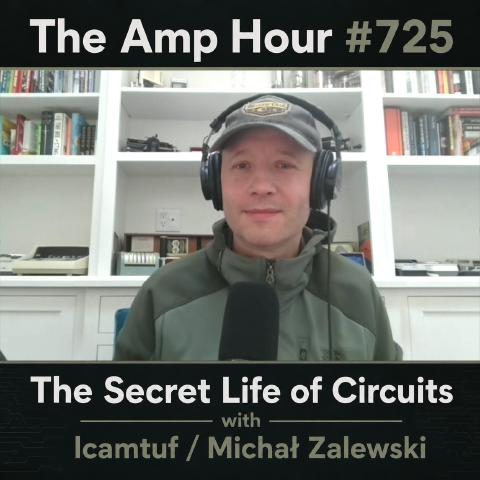
#725 – The Secret Life of Circuits with lcamtuf / Michał Zalewski
Download episode · 100 MB
Also on Apple · Spotify · YouTube · RSS
Show Notes
Welcome Michał Zalewski, AKA lcamtuf!
- The lcamtuf Substack is where Michał is writing most these days
- Chris first found and geeked out about the CNC guide on the lcamtuf original site (discussed many times here)
- Michał is interested in the craft of teaching electronics
- He recently published The Secret Life of Circuits with No Starch Press
- Use the code AMPHOUR26 for 30% off The Secret Life of Circuits valid from June 1st through June 30th
- It was announced on his blog here
- Deriving fomulas from basic trigonometry sometimes bugs people who think electronics should only work with calculus
- Software geeks follow the site, often getting lots of attention on Hacker News
- Row hammer DRAM
- There were no Information Security degrees in the early days, so the field was made up of folks with backgrounds in math and EEs
- Fuzzing for security
- SMBC cartoon for blming humans
- Books
- Security stuff (including books on the subject) ages over time, as opposed to electronics
- On the subjects of Calculators (and Michał's collection)
- Calculators are a footnote in the history of computing, but still intriguing
- Dead ends in calculators
- CRT displays on calculators
- Nixie tubes
- Discrete moving into logic gates into processors
- Mechanical calculators are rare and get a high price online
- Working with transistors
- The Secret Life of Circuits start with FET based transistors vs BJT
- BJTs are often right after diode chapter because of the multiple junctions in an NPN, but that doesn't make it easier to understand
- Projects
Transcript
Chris Gammell: This is The Amp Hour Podcast. Released June 3rd, 2026. Episode 725. The Secret Life of Circuits with El Camtouf. Michael Zalewski. Welcome to the Amp Hour. I'm Chris Gammell on Contextual Electronics.
Michael Zalewski: And I'm Michael Zalewski. Thank you for having me. And for the viewers and listeners, I should probably introduce myself. Maybe a bit uncharacteristically for this podcast, I'm actually a computer security guy. That's what I do for a living. I worked for Google for a good while and helped them build their product security program. And, you know, I worked with a company that makes Snapchat. And I did a lot of other work in that space. The reason I'm probably here is that I was interested in electronics and chemistry from a very early age. I don't actually remember how that happened. Maybe it was the books we had at home. Maybe something else.
Chris Gammell: Kismet. Yeah, whatever it is.
Michael Zalewski: Right. Yeah. But, you know, like I was kind of destined to become an electrical engineer or a chemical engineer. But I was growing up in the 90s. And like many others, I discovered computers along the way. And they sort of, you know, destroyed my life. And so I ended up getting pulled into that universe instead. So, yeah, you know, computers pay my bills. And they are pretty good at that. But I still tinker with electronics. It's just not a job. It's a hobby. And I really enjoy that, right? Like I can work on wildly impractical designs or experiment or blog about whatever. It doesn't need to be desirable. It doesn't have to be practical. It doesn't even have to be good. And so I've been doing that for a very long time. I take electronics seriously. And I try to share that passion with others. I blog about it. I publish projects. And again, I do my best to never let that become a full-time job.
Chris Gammell: Yeah. Well, I think people here will have heard me geeking out about Michael's blog before the substack. So there's a substack now where he's doing a lot of the publishing. But also before that, and I think I mentioned it on the show last week, the machining guide that basically made me run out and buy a CNC mill immediately. So your handle is lcamtuf. Am I saying that right? How do you say it?
Michael Zalewski: I don't think there's a standard pronunciation. No, just smashing the keyboard sort of thing? It was actually a cheat code from a computer game from the 90s. And I think most of the cheat codes were like just randomly generated strings of characters. But this one, you know, this one just felt different.
Chris Gammell: I feel like if I was in front of Doom again, I could maybe like, there was some like through walls sort of thing. I just remember, I think it's like muscle memory. I would probably, it would probably come back. Yeah. Right. Yeah. Yeah. Classic cheat codes, man. That's, yeah. Do they have those still? I don't even know. I don't do video games anymore, but.
Michael Zalewski: I think they do on PC, but yeah, I'm not, you know, yeah, I'm not a hardcore gamer. You moved on. You moved on.
Chris Gammell: Yeah. And so, yeah, your machining guide, of course, is the one I've talked about multiple times on here. That was where you were machining and you were talking about overhang. I think I got to it because I was thinking about a 3D printer. It was like as the MakerBot stuff was all coming up and someone had maybe sent it to me. I don't, I don't remember. I'm sure it's recorded somewhere. And then I ended up following that instead and went the path of a mill. And I'm sorry. It's okay. You know, there's a lot of awkward, like me early YouTube versions of me, like in like in my basement in Cleveland, in like a flannel and like just trying to stay warm enough to like record a video and cut some metal. It was a great, it was a great, great learning journey. I have since moved to a 3D printer, but you know. So electronic side of things, we should also mention right at the top here. You have a new book coming out, which is very exciting. That's from No Starge Press. Yeah.
Michael Zalewski: Yeah. It's called The Secret Life of Circuits. And in a nutshell, it's my attempt to sort of, you know, bridge the gap between two different ways of teaching electronics. And it's a sort of, you know, a culmination of years of writing about this in a less organized way. And again, on my website and then on Substack and in some other places. And to, you know, explain what I mean, I probably need to go off on a bit of a rant. And that rant isn't really about the book itself as much as it is about, you know, my general approach to electronics. First of all, I think that electronics are really unique in that it's one of the few remaining hands-on hobbies that you can still do at home. You can no longer do amateur chemistry, at least not in the open. And that was, you know, my other childhood passion. And if you're in an apartment, you can't really do a whole lot of like, you know, woodworking or metalworking or stuff like that. But electronics is still that sort of, you know, one DIY friendly craft that you can do in your sort of, you know, in your apartment, right? And when it comes to teaching electronics, I always felt that we have sort of, you know, two completely separate tracks. One is that if you're a hobbyist, you're, you know, we're going to tell you that electronic circuits are kind of like plumbing and there's, you know, water running through pipes and diode is a check valve and God knows what a transistor is in that model. And I think that's, you know, very compelling and accessible, but it's also terribly wrong on some level, right? If you explain things that way, then by the end of the day, you will struggle to make sense of analog electronics or sort of, you know, more complex designs. And then you have the other track, which is that you go to college and you've got an electrical engineering degree, which is, you know, what my eldest kid is doing right now. Oh yeah, nice. Yeah. And the thing about that degree and, you know, I know firsthand is that your first year is going to be mostly calculus, right? And you cram that in as a foundation for everything else.
Chris Gammell: I, I always think of the Feynman thing with like, is it a Feynman? It was like kind of the, to first invent the universe, to invent an apple pie first, you must invent the universe. It's like, they take that approach very seriously.
Michael Zalewski: And again, you know, like, I think it makes sense and is expedient in some ways, but it's sort of, you know, not something you can sell to a hobbyist, right? Like they are not going to go to college for a, for a semester or two, just to learn math. And, and, you know, if you go to Stock Exchange or any other forum and you ask, Hey, you know, why the formula for the RC filter cutoff frequency look the way it does. I think the answer is usually, you know, kids go learn some math, right? Go, go to school. Right. And, and, and, and, and I think the reality is that a lot of electrical engineers probably don't even know how to explain any of that stuff differently because that's how they've been taught. And they assume that the complexity is essential to how you teach the craft. And my thesis that I think is probably going to invite some, you know, cranky comments is that I don't think it's really true. I think, especially for sine waves, you can derive pretty much all the fundamental formulas from basic trigonometry and it's going to take longer, but it's not difficult, right? So you can actually explain a lot of analog electronics and other topics of that nature without sort of, you know, requiring college math upfront. So again, this is, this is sort of something I've been trying to, to address with the book, right? I think first to teach electronics in a way that is sort of, you know, biblically correct, but also accessible. So I'm aiming for this middle ground between plumbing and calculus. My second goal, honestly, was just to focus on, on modern practical problem solving. It feels that a lot of like, you know, every electronics book is compelled to talk about, I don't know, tunnel diodes or the 555 timer chip. And, you know, it's like interesting history, but it's not how you approach problems today. And it feels that, you know, we should be spending more time on things like PLLs or how, you know, ADCs and DAX work. And sort of, you know, that's the sort of, you know, the modern way of doing things. And so, you know, I've been trying to sort of, you know, move the needle in the other direction, right? Like there's also no chapter on how to wind your own transformers because no one really does that anymore. Because China, right? Right.
Chris Gammell: That is like kind of a through line for a lot of electronics these days too. It's like, well, China, you know, like, oh, well maybe we should just make a PCB because it's five bucks.
Michael Zalewski: Yeah. And like, look, I, I, I love to, like, I remember, you know, in my childhood, it was like actually really amazing to be able to add your own PCB, but like, yeah, I mean, you can try to do that now or you can, you know, use a CNC mill or whatever, but it's like, kind of like, no, you shouldn't, right? Like it just doesn't make sense.
Chris Gammell: Right. Well, and I feel like the craft of it too. I think that in its own right is actually really good. I think the biggest problem in kind of, especially in the beginning of electronics journeys is just momentum, right? If you lose momentum, man, you were toast. It's just like, oh, well, like, I just remember I was teaching someone and like, he just, fell down the op amp rabbit hole. And it's like, yeah, you, you could learn a lot here. There's so much to learn, but boy, that is a deep hole. You know, it was just like, let's just get through this first one, get through one circuit so that you can come back to it. It's all about doing the reps, you know?
Michael Zalewski: Yeah. I think, you know, that's the other thing that's nice about a book because you can sort of, you know, you can think about pacing and you can also have an editor. So, so, you know, talk some sense into you. Right. I think it's very easy for you to really pigeonhole on something that interests you. Right. Like I could, you know, like there's a, there's a, there's a lot of topics I could have written, you know, a lot more about. And my editor was just sort of, you know, tapping me on the shoulder and saying, Hey, you know, let's, let's not go there. Right. So I think the hardest thing about writing is sort of, you know, deleting text. Right. I think, you know, you, you, you always end up oversharing.
Chris Gammell: Your son being in education, like in going through the journey at the same time, that is incredibly interesting timing. I feel like, because I don't know, I have this, like this story in, in from my past of like, like culling forward, like practical things is so important. And so unrealistic that like, I went through, I was in a signals class and I've, I think I've told this story on the show before, but it was like three weeks of just horrendous math. Just the worst, you know, Fourier series, all this stuff to just try and get it. And then at the end, the professor showed us like a frequency chart, right? Basically just pulled out a spectrum analyzer and showed us that. And I'm like, you couldn't, you couldn't just start with this. I was like, Oh, it's a line on a frequency chart. That's a sine wave right there. Like you couldn't have done this three weeks ago. I would have cared so much more. Yeah. And it was.
Michael Zalewski: Yeah. I think there's this weird tradition, like, you know, you like, if you're actually designing, you know, circuits for a living, you don't do that kind of math, right? Like you have tools that take care of it, or you sort of, you know, you have rules of thumb. And, and so I think there are also like, you know, I get the value of trying to, to, to get that information across on some level, but it's also, you know, also feels like gatekeeping almost, right? Like, you know, we're going to make it difficult for you because it was difficult for us more than you.
Chris Gammell: Only the ones who are, make it through the ones who are worthy, make it through. Right. Yeah. And it truly, it's just, you know, like from a news context, they're just burying the lead, right? The lead is look at this cool thing. And then it's like, and now let's figure out how it's so cool using like fundamental physics and math and like the stuff that most of the nerds in the room are going to care about too. So like, yeah, I just, I just wanted to pull that forward. You know, that's, that's the main thing. It's tough. It's tough. How has the response been, you know, like you've been writing blogs about it. I see on Hacker News all the time. Like, it feels like there's other interested parties out in the world that are maybe also security software, you know, people that are like in electronics at some point. How has the response been as well to all this stuff?
Michael Zalewski: I think, you know, it's, it's the internet, right? So you always have like, you always have funds and you always have the tractors. But yeah, I think, you know, the response has been positive. I think the, the, the interesting thing is that, you know, the, the audience I can reach most easily are the, you know, software geeks, right? Like the people who follow me for my security work, the people on Hacker News and sort of, you know, in other forums like that. But I think the interesting thing is that there's actually a lot of cross-pollination between those two universes. I mean, you know, I probably don't have to tell you that, but like software engineering is all about building abstractions. And it's sort of, you know, a natural extension of circuit design where we observe some like, you know, physical phenomenon. And then we distill that and package that, that specific effect into, into a discrete component. And then we take those components and we built integrated circuits. And again, we don't care, you know, you, you're not supposed to care what's inside. You just have a well-defined interface that you interact with, right? Like you don't need to know. Function block. Right. And software engineering, you know, just sort of, you know, takes over at a certain point, right? Like, but it's the same process. We, we have machine language and then we build higher level abstractions on top of that so that we don't actually have to understand the CPU. We don't need to know how many bits are there in the, you know, ALU or whatever. And then, you know, we add more and more and eventually you end up with a browser running JavaScript, right? And so I think, you know, there's this natural curiosity about how things work and how those abstractions are built. And it's very easy to tap into that when you're talking to software engineers. For security specifically, the interesting thing is that I think a lot of what we do as security professionals is poking holes in those abstractions. We look at the entire stock and say, hey, Mr. Software Engineer, you thought that this abstraction is bulletproof, but actually, you know, there's a corner case, there's a boundary condition we can trigger where it all falls apart, right? And sometimes we do that for hardware as well, right? Like, I'm not sure if you remember the Rowhammer vulnerabilities a while back, but the idea is that by triggering specific abnormal sequences of reads and writes in DRAM, you could actually corrupt data belonging to another process running on the computer, right? Like this completely crazy, you know, like the violation of the sort of, you know, abstraction boundary between software and hardware, right? So yeah, I think, you know, the mindset is there and there's a lot of people who try to learn electronics and sort of, you know, hit a wall, right? Like they learned about the hydraulic analogy and then, you know, they try to build an amplifier and had no idea what to do other than maybe copying something of the internet. So I'm really kind of writing for myself, you know, 10 years ago or 20 years ago or for other people in that predicament. And I think, yeah, I had a very positive reception with that crowd. When you talk to EEs, I think you get more mixed reception because it's sometimes, you know, actually, you know, like the calculus is the way to go. Like you shouldn't be doing all this trigonometry. There's like, there's an obvious answer that you should have, you know, jumped right through.
Chris Gammell: But yeah. It is interesting with kind of the demographic stuff as well. Like the one thing that I've noticed a lot, like for my course and people that were coming into to do it kind of post-career, mid-career, whatever, they were software engineers and like, hey, yeah, I used to do, I used to be in EE, but then it was specifically like the dot, you know, like it was a certain age group, of course, as well, like older, but they were like, yeah, dot com, like all the money was in web. So I went into software and, but I loved electronics and now I'm getting back to it. You know, I'm, you know, near retirement, near retirement, like, or just have some free time because kids are out of the house and now I'm getting back in electronics. And like that also demographic kind of shift has come through as well. Obviously it's 25 years now, but.
Michael Zalewski: Yeah. And I think it's interesting, right? Like security, like back when I was getting into security, there was no information security degree you could get, even if you wanted to, right? Like it was, it was like the very beginnings of security becoming a reputable profession. Right. I think, you know, early in the nineties, it was not something that your parents would approve of. It was like associated with like, you know, like you're guarding a mall or what are you doing? Like in security. Right. Yeah. Right. And, and, and so I think, you know, a lot of people who became very successful in that field were actually coming from other backgrounds. There was a lot of EEs. There were people with like math degrees. There were people with, you know, degrees in chemistry or really random other things that, and, and they just sort of, you know, seized the moment, right? Like they were passionate about computers for whatever reason. And they, they, they, they, they tapped into that momentum. And yeah, I think, you know, we, we had a good run. Like, I, I don't know what's going to happen with AI.
Chris Gammell: I think there's a lot of project glass wing and mythos and all that. Yeah.
Michael Zalewski: There's a lot of anxiety related to that. And, uh, I think some of it is overblown, but you know, it's also like the technology is, is freaky. It is incredibly smart and incredibly dumb at the same time. But I think, you know, it's like, it's, it produces competent results often enough for that, that, you know, many people should be anxious to some extent.
Chris Gammell: Well, like that recent one with like the 700 Python lines that can like give you root access and, you know, if you have an external connection or whatever, I forget what it's called, but it's just like, who would have thought of doing that too? Right. It's like, feels like it's also like almost like fuzzing, fuzzing like entire code bases and then finding stuff.
Michael Zalewski: Yeah. And like, look, I, I used to say is that a lot of security is just text comprehension at a scale. Right. And, and scale is the, is the, is the really the most important part. What we do is usually not profound in any way. We just look at a lot of code and we try to reason about it. Right. And, and, and that's also the bottleneck. You, you, you, we, we don't have enough security people to look at every single line of code that gets written. Right. And so this is where you, this is how you can, you know, get a lot of mileage of out of really dumb tools like fuzzers, which basically you just, you know, throw random inputs at programs and see what happens. Right. From that point of view, LLMs AI is very good at reasoning about text at the scale.
Chris Gammell: And so I think, you know, a lot of sleep, they don't eat, they just need to eat energy
Michael Zalewski: and, you know, the reason I'm not panicking is that I think a lot of jobs are also abstractions for delegating responsibility, right? Like your boss doesn't want to know all that much about, you know, the, like, you know, the, the, the, the things you do day to day. And, and I think, you know, the, like a lot of the responsibility stops with you. Like you're the guy who is going to get a bad performance review or a good performance review who can get fired, who can, you know, go to prison if you, if you do something terrible and that sort of, you know, serves as a, as an abstraction boundary, right? Like, because again, like, you know, your boss is responsible on some high level, but like you bear responsibility for what, for your output day to day with LLMs, you don't have that, right? Like there are no LLM jails. There's, you know, like if they delete your production database, you can get them to write an apology letter, but that's kind of it.
Chris Gammell: Right. Have you seen that Saturday morning breakfast cereal is a cartoon where it's like the future of jobs is just humans that get blamed for all the things that LLMs do.
Michael Zalewski: Yes. I think it's that. I think there's a need, like, no, no, like seriously, I think there's a need for that as a paradigm for her, for, you know, for like an essential paradigm in corporate life. So I don't think, you know, jobs are going away, but they are probably going to change, right? Like there's going to be a downward price pressure because we are no longer unique snowflakes. There's a machine that can produce output that's 70, 80, 90% as good. Right. And the same goes for, you know, electrical engineering and a lot of other sort of, you know, white collar professions. Sure, of course. But yeah, you're still going to be the full guy, I think, for whatever the LLM does.
Chris Gammell: That's right. That's right. Yeah. I think just to bring it back to your sites as well, like, you know, the breadth, I feel like breadth is incredibly important now as well. Maybe people could take the opposite tact and say, well, I'm just going to go deep on one topic in order to truly become the specialist. But I just feel like we're all, I've always been a journalist. I feel like that is the right move going forward because there's all these tools out there. And kind of to your point about, you know, your boss just wants to hand you something and say, solve this problem. We're all just problem solvers now. I think about my kids and like what, you know, what their job's going to be. It's like problem solver, just like the rest of us. Right. It's just fewer specifications on how we're solving those problems.
Michael Zalewski: It's going to be interesting. Right. Like I have the luxury of being sort of, you know, on the tail end of my career, so to speak. Right. And so I can sort of, you know, just watch it with some, you know, interest and amusement. But I think, you know, for people entering the workforce right now, like, again, I can sympathize with the anxiety and I would not have wanted to be in their position. Again, I don't think it's the apocalypse, but it's very difficult to know for sure how the future is going to look.
Chris Gammell: Yeah, definitely. Definitely. And just real quick on the security stuff too. Like we've had some hardware security people on. Are you doing like hardware security, software security? Like what level of that is, is it?
Michael Zalewski: Uh, the bulk of what I do is software security and sort of, you know, securing enterprises because that's, I mean, you know, that's, that's where most of the action is right now. Right. It's like, it's, it's, it's in the software world. I've done a bit of hardware, but not, uh, you know, nothing that was really, it was more like, you know, side projects every now and then. Or some penetration testing where we build sketchy hardware and, you know, but anyway, you know, I, I have some, uh, interesting stories about that, but I, I don't think I can, I can actually talk about them publicly just yet.
Chris Gammell: Yeah. Declassified 20 years from now or something. Right. Yeah. Yeah. Yeah. Well, you've written other books around some signal analysis and stuff as well. So like past books, Silence on the Wire, Tangled Web, that sort of thing as well. So people can also read some of your other writings in this space. Are you still planning to write in the, in the security space or no?
Michael Zalewski: So it's still, you know, an area of my very active interest. The thing that I, I found a bit disappointing about security is that it doesn't last. Like you can write a book today and in, you know, five to 10 years, it's going to be essentially obsolete because people are going to move to different software stocks. You know, like the landscape of application security is going to just change fundamentally, right? Like the applications we use today are completely different from what we we've been using, you know, a decade ago. And so it's useful in the moment. And I think, you know, you, you sort of, you know, you make a positive impact on the lives of any other folks who are sort of, you know, entering the field. But, you know, if you, if you're a woodworker and you build a stool or whatever, it's going to serve you for the next, you know, 40 years, right? If you, if you do it well and, you know, it may be passed on to your children. And if you do something in security, if you, if you find a cold vulnerability, if you publish paper or whatever, it's probably going to be like, you know, it's going to be forgotten in, in, in two years, right? Like it's just so, and I think it's going to slow down, right? Like realistically, I think AI is making security interesting again, but, you know, like the five years before that, I think we're a lot less interesting than, you know, late nineties or early two thousands, right? Where people were sort of, you know, still figuring out what, you know, that whole web thing and whether that's going to be successful or not. And how do we secure that? So I think, you know, the field is maturing. And so, you know, to answer your question directly, I can see myself writing more about that, but sort of, you know, the long-term return on investment is sort of, you know, not as profound as you, you, you, you may be expecting in most other fields, right? Like if you write about electronics, it's going to become outdated as well, but it's probably
Chris Gammell: going to take, you know, 20, 25 years, right? Right. Actually, I think the really funny things are the, uh, the people who are now writing in the electronic space and like bringing new tools in the electronic space, they're like this great new thing called revision control guys. Yeah. But you know, it's all going to, it's interesting, right?
Michael Zalewski: I think, yeah, I think there's a, you know, my, my pet peeve are like people who do electronics, I think get sometimes really stuck in their ways. And like, you know, like you used an op-omp that was like state of the art in the seventies and it's work, then you're going to be using it for life. And, and you know, like it's not inherently bad.
Chris Gammell: Wait, are you saying the 10 millivolts of offset voltage between the pins on the LM741 is not state of the art? Is that what you're saying?
Michael Zalewski: Yeah. I think, you know, there are some electronics adjacent hobbies where it really shows, right? Like if you go, if you get into amateur radio, a lot of people are still refusing to acknowledge that something that this thing called digital communications even exists, right? Like you're just supposed to be doing like AM or FM if you insist and that's it.
Chris Gammell: Yeah. There are these pockets, the pockets of the internet. I guess the pockets of the pre-internet have now become the internet as well. And yeah, it's interesting. Interesting. Actually that, that is an interesting, cause I'm also looking over your shoulder. We have video, but there's an audio podcast and I'm looking at calculators. And so talk about pockets of the internet. Do you want to talk about your, your calculator thing or?
Michael Zalewski: Yeah. So, you know, I'm, I've been always interested in sort of, you know, in the history of things, of, of industrial progress, right? Of how, how we have gotten to the, to, to where we are today. And, and so calculators are obviously sort of, you know, adjacent to electronics. And that's something I've been collecting for a good while. And this stuff is often treated as a footnote in the history of computing, right? Which itself has really blurry boundaries because, you know, like the history of, of computing supposedly goes back to the, like, you know, to the 3000 years to like, you know, not sticks.
Chris Gammell: The ankytheria, whatever you say that, the mechanism, that thing. Yeah.
Michael Zalewski: But, but I think, you know, calculators are quite distinct and sort of, you know, the story of their development is really worth talking about. But there's, there's plenty of really delightful dead ends and experiments you learn about that's really have no parallels in the world of, of, of general purpose computing, especially when it comes to like mechanical calculators and all the, you know, weird input and output schemes that people came up with, or, you know, the moment they figured out that actually, if you have a separate mechanical register called the accumulator, you can do more than you could do with a direct input scheme because you can actually all of a sudden do multiplication and division. And, you know, once you find that out, you, you, it actually clicks. Okay. So this is why, you know, if you look at a CPU, it has an accumulator register. That's the sort of, you know, the historical. There's a lot of really interesting and unexpected details that you'll learn along the way. For example, consumer calculators kind of lagged behind the development of computers. And the major limiting factor was actually the display technology, something that no one really ever talks about. Some manufacturers experimented with CRT displays, and that was, you know, discrete transistor circuits where they would use individual, like, you know, they had like, you know, 700 transistors in this pretty massive box and the CRT, and they were drawing every digit using discrete transistors, right? Like there was no digital programmable logic. So they had like a, like a circuit for a seven sort of thing.
Chris Gammell: Is that kind of like what it was?
Michael Zalewski: Right. Yeah. So, so absolutely insane. And that seven, you know, could be positioned in many different places on the screen. Yeah.
Chris Gammell: Right. And because they're rastering it too. It's like, yeah, seven here. And then the same circuit probably draws a seven over here. You just, you just move it and it's going so fast and has persistence. Right.
Michael Zalewski: So, so I actually have a calculator like that, and it's absolutely insane. And initially the price tag was the same as like, you know, a nice car. Now I think you can, you can get them for less, but yeah, you know, then I think that the first practical display technology for calculators were Nixie tubes, which many, many folks are familiar with.
Chris Gammell: And the little, the little bubble ones I remember as well, like the little red bubble ones, like there were, I think maybe micro Nixie tubes. I don't remember like really old ones.
Michael Zalewski: Yeah. Yeah. There was a couple of things that, that, you know, they, they were still using sort of, you know, gas discharge, but it was more streamlined and it was like planar versus individual tubes. But yeah, you know, even, even Nixie tubes were like, they made it possible to make desktop calculators that had a reasonable price tag and, you know, like sensible dimensions, but you still needed a high voltage to, to operate them. So it was not very, you know, conductive to having a portable devices. And it was also very fragile. So, you know, if you, if you dropped something like that on the floor, it would. The hard part is actually picking them up in the first place because they were probably
Chris Gammell: like 40 pounds, you know?
Michael Zalewski: And so, you know, like the, the, the, the first portable display technology were VFDs and they were still problematic because they, they used a heated element. So they, they actually waste power, but you know, it lowered the voltage requirements quite significantly. So it was basically like a, like a kind of a vacuum tube, but yeah, that, that technology dominated, dominated for a good while. And you, you had some portable calculators back in that era, but they, they would often tailor, you know, C or D batteries. So they were kind of bulky and not, not, not something you really put in your, in your pocket.
Chris Gammell: What about processors as well? Were these all discrete moving into processors like early 4004s?
Michael Zalewski: And the early ones, like, you know, late sixties and early seventies were discrete transistors. Then they started integrating general purpose logic, but it was like, you know, individual logic gates and, and just sort of, you know, stringing them together. And eventually I don't remember which manufacturer did that first. It might have been Texas instruments, but they, you know, eventually someone rolled out a calculator on a chip as a separate product. And it's also sort of, you know, really standardized the input and output schemes as well, because before that it was like wild west, you know, if you look at the keyboards of some of the early calculators, they just make no sense to modern humans, right? Like you have multifunction buttons, like equals combined with plus or minus or whatever. Right.
Chris Gammell: You're doing like multi-step calculations too. You hit the wrong button one time. You're starting over probably. Right.
Michael Zalewski: Oh yeah. And the early designs were also insane because they had like no power on the reset circuitry. So, you know, like cost saving. So they would put up to some like completely random state, random digits on the screen or like, you know, things that are not even digits and you have to manually reset them. And if you forgot, well, you know, good luck. And yeah, they, they also had like, you know, negative numbers where, you know, not supported by some calculators, supported in really weird ways by others. You really had to keep it in the back of your head that, you know, this, this doesn't work the way that, that, that, that you may be expecting it to. Error handling was super sketchy as well. You know, sometimes like if you do, if you perform an illegal calculation, you get a random weird result or maybe the calculator is going to latch and just like cycle through random numbers forever. So yeah. And yeah, by the time they landed on, on, you know, calculator on a chip, this was all more or less figured out. And that was kind of the, the end stage of the evolution of the technology. I think, you know, it's like the, the rest was just miniaturization. Once we figured out LCD displays, which required basically no power in, in the steady state, you ended up with things like, you know, calculator watches or, or like you can, I have a calculator pen, which is actually kind of amazing. You had a calculator lighter, you had, you know, all kinds of like really crazy novelty things from Casio and other companies.
Chris Gammell: Are you up late chain smoking and need to do some math calculator? Yeah, precisely.
Michael Zalewski: I think that's, you know, like whatever, no, but I think for a, for, for a good while, the thinking was that the calculator was going to become the hub of our digital lives. And, and I think, you know, Casio and sharps, sharps were on the, on the forefront of that, you know, revolution. So you, you, you had calculators that had like basically, were basically becoming personal assistants, right? Like they have calendars built in notes, taking stuff like that. They could maybe even sync to your PC. That was like, you know, the early nineties and thereabouts. And it was actually, you know, shaping up to be a pretty interesting future. And, and, and this is why people were also trying to integrate calculators into random other things you may be carrying around, like your, you know, your lighter or, but obviously then, you know, smartphones happened and, you know, we, we lost something profound, I guess.
Chris Gammell: It almost kind of sounds like the, like, you know, they don't really know what like happened to Neanderthals versus like homo sapiens, they're kind of like these parallel paths and then just like, yeah, one, just one. And I think it's like the computers in this case. Yeah. They just won, you know?
Michael Zalewski: Yeah. Yeah. Yeah. I, I think, you know, someone should write like a speculative fiction about like, you know, what, what, what if, what if calculators won, right? Like maybe, maybe it would be like this, you know, utopia.
Chris Gammell: Yeah. Very steampunk regardless, I'm sure. Right. And Nixie tubes everywhere and similar. So when you buy these things, are you like finding schematics or you have to just kind of backtrace everything yourself and, and figure it out? And are you buying working ones?
Michael Zalewski: So, you know, the, the nice thing is that it's not really a serious thing that people do collecting calculators. Like the, the, you know, there's a, there's a couple of folks who, who, who are passionate about this, but like, you know, generally the supply is higher than the demand. So we can go to eBay and you can, you know, usually buy decent ones. And so you don't necessarily, sometimes, you know, and if you have to fix them up, it's usually like something very simple, like a fuse or with the Nixie tube ones, you have to be careful because if the tubes are short, then you're kind of out of luck, but you know, fuses and other stuff like that are easy. I think trying to figure out how they work is an interesting adventure because, you know, a lot of them go back to the era where no one was really doing any standardized circuit design. You were just doing completely crazy things to make, just to, you know, have like one transistor less in there. Right. Uh-huh. Yep.
Chris Gammell: Yep. Yep.
Michael Zalewski: And so thankfully for, for some of the more popular ones, there are people who actually spend time reverse engineering the entire circuit and publishing it online. And you can sort of, you know, work of that blueprint. Yeah. The other nice thing is that, you know, they are generally kind of simple. Like, you know, you can look at the PCB and you know where the trace goes. Like simple.
Chris Gammell: Yeah, no multi-layer PCBs. Yeah.
Michael Zalewski: Simple in the sense that, you know, you can, you can easily tell what's going on just by looking at the, at the board, you know, it's not like, you know, it doesn't have like 11 layers.
Chris Gammell: Yeah, no, it's interesting. I, I do feel like demographics also probably work, work in favor of that as a hobby right now, because it's probably like a lot of people who had calculators in their heyday and they've been in attics for a long time or basements. And now family members are maybe helping to move stuff into the marketplace said in so many words. And yeah, yeah. So.
Michael Zalewski: Yeah. I, I think, you know, that that's actually one of the most challenging problems, especially in the U S a lot of them spent, you know, a decade or two in the attic. Yeah. And it's like, you know, the temperatures in, like exposed to two elements and everything else. So they are just like, you know, like the capacitors may be just.
Chris Gammell: The electrolytic fluid has been gone for decades.
Michael Zalewski: There are some, like, you know, if you, if you get into mechanical calculators, I think the demand is much higher and the supply is more constrained. So if you look at things like Kurtz or, or, or, you know, other sort of iconic designs, they sell for, you know, thousands of dollars in a, in a good shape. Right. And, you know, they are like the mechanical calculators are, are more impressive than electronic ones in many respects. Right. Because just the, this was all pre CNC and, and, and they just, you know, have to crank out hundreds or thousands of, of like very, very precise parts and assemble them. You know, the, I guess the saving grace was that like labor was cheap back, back, back then this is like, you know, the turn of the century. Right. And so they are, they are like really amazing to work with. And they are obviously easy to understand because you, you can just, you know, see, see, see it all in motion and see why it doesn't, you know, advance to the next digit or whatever. But yeah, those ones are, are really interesting and really beautiful. And they are in high demand.
Chris Gammell: Did, did any of these, the circuits that you find inside the calculators, did those make it into the book or I guess, is it, you know, that's kind of logic and not bam, I suppose as well.
Michael Zalewski: Yeah. I, well, I, I, I tried to sort of, you know, stay like, again, like modern problem solving was my, was one, one of my sort of, you know, uh, major themes. So I was for most of the problems in that space, you know, the modern solution is an MCU. That's the bottom line. Like you're, you're, you're, you're going to do it with a microcontroller. You can talk about the underlying logic so that people have an understanding of what a gate or an or gate is. But like you, you, I, I don't want torture people with things that I find interesting. If it's not actually necessary for them today and they can, you know, learn it at their own pace once they have the foundations in place. So no, there's no anti calculators in the book. I have some on my blog. If people are interested, there's a bunch of really good websites on the internet. A lot of them are dated. Like they were, you know, designed in the nineties. Never been updated since. It's the best kind of internet.
Chris Gammell: I think old, old internet is the best internet, you know, I, I, I want to say yes.
Michael Zalewski: Although I think the, for calculators specifically, the, the, the one pain point is that if you have a photo of a PCB, that's like, you know, a hundred pixels wide. Sure.
Chris Gammell: You can't really work with that. Yeah. Not a lot of replicating that. Although that would be fun to like, just do a capture of this like super low res thing. Like do almost like a, like a low fi, like a PCB capture and then actually replicate it in a modern thing where you have like these blocks, you know, that actually like monitor they probably still electrically correct, but, but just following the, the JPEG compression of a, of an image online, you know?
Michael Zalewski: Yeah. I'm sure we can ask AI to do that and see what happens. Yeah.
Chris Gammell: Well, just going back to the book, I mean, and, and I guess your website as well. I mean, you're covering a lot of the, the classic things like off amps, like I mentioned. I mean, what, where do you, where do you usually see people stumbling and where are you trying to, to take, take people in a, in a more practical manner with, with your book?
Michael Zalewski: I think it actually happens much sooner, right? It's probably the transistor where, you know, you, you, you can sort of, you know, like if you, if you go by the simplistic explanation of how it works, there's going to be a lot of things that are going to be mystifying, right? Like you're not going to be able to understand how a current source works. For example, if you don't understand the dynamics of a transistor beyond, oh, it's just, you know, like an electrically operated crank on a, on a pipe or like, you know, valve on a pipe, right? Because, you know, the, like the, the behavior of current sources really depends on the fact that a transistor is really like a current limiter most of the time within, you know, a certain operating regime. And then if you don't understand current sources, then you can't really understand op-amps, right? Like how does a differential amplifier work? Well, you need a current source kind of, right? It's not a single specific thing, but I think there's a lot of stumbling blocks very early on or like, you know, how understanding, like, you know, you can be given a formula for how an RC filter works or how an inductor works, but unless you can actually, unless you actually internalize what it is and what's going on inside. And I think it's, it's really difficult to make sense of a lot of other things you're going to see, like, you know, signal reflections or, or whatnot. So I really try to, you know, in the book, I really try to approach that from first principles and I actually spend maybe a bit too much time sort of, you know, building, building those foundations. That's one thing that always gave me a pause, right? Like, am I, am I, am I striking the right balance there? Because on one hand, you really need this on the other, you know, there's going to be readers who just want to get to the point where you hook up an LED to a battery and, and, and you see it light up. Right. But yeah, the first part of the book is really sort of, you know, building those foundations so that you can actually move more quickly down the line. Again, like, you know, if I were to pick a single culprit, it's probably the transistor, right? Like the, you know, if you, if you don't understand how a field effect transistor works, you're gonna, you're, you're, you're gonna have a really difficult time with everything else.
Chris Gammell: Yeah. You seem to focus on FETs as well. And that's actually, I think that's actually a simpler method at the beginning, right? Because I think a lot of people pick up on, you know, voltage controlled versus current controlled a little bit easier. Like it's a little bit more intuitive, I feel like. And so I think that's a good starting point.
Michael Zalewski: Yes. That's another place where I sort of, you know, looked at how other books approach it and, and, and they felt compelled to walk you through the history of, of technology. Right. So we're gonna start with the BJT because it was the first thing that happened. Although not really, because like they actually had FETs before, but like BJT was the first one commercialized. Right.
Chris Gammell: I think one thing is they, because they also usually list the BJT chapter right after the diode chapter. They're like, look, PN and PN. Right. And they're like, this is natural, but also like the, then the usage is more difficult. You know?
Michael Zalewski: Yes. Yeah. So that's the thing. I think, you know, BJTs are more difficult to understand because of the sort of, you know, like it's not really just current controlled, but it's also kind of voltage controlled because you need to reach a certain threshold, but like, you know, they're, they're like complex dynamics. And then if that sort of, you know, diode on the top becomes forward biased, then you're like the whole thing falls apart. So I think there's a lot more that you need to learn to really understand BJTs. And also like most of the transistors you actually end up using day to day today are probably going to be MOSFETs. Right. So what's the point of subjecting people to that first? So, you know, in the, in the book, we, I talk about FETs early on and all the, like pretty much all the examples are using FETs because I think they are easy to understand, but we, we also have a chapter about BJTs, but it's sort of, you know, further down the line. And again, like I've been trying to challenge a lot of those, you know, assumptions about how you are supposed to teach electronics and what's this sort of, you know, order of topics. And yeah, I hope it resonates with some of the readers.
Chris Gammell: Well, as a student of electronics myself, it resonates with me. So that that's all I care about. All right. Thank you. Yeah. I do feel like, um, kind of starting from physics, right? So like starting from semiconductor physics and talking about mobility of electrons and, you know, all that stuff through, through, uh, electrons and holes and all that in, in semiconductor materials and stuff like that, that often leads us down this path. And really it's like, so now if you're coming top down and you're like, well, but we're going to talk about actual application and things you're going to use in a real, real context that follows more of the FETs and, you know, modern, modern electronics as well.
Michael Zalewski: Yeah. Yeah. Yeah. So I've been trying to mix both because, you know, like the, the other thing about being a hobbyist is that if you're a pro, I think, you know, obviously you are passionate about the field most of the time and you want to learn, but ultimately you also, you know, want to get your job done and you want to go home and, and, and, and spend some time, you know, watching Netflix, right? Don't I ever. But if you're a hobbyist, I think at least for me, I, I always really wanted to know the why, like I was never satisfied with the formula or like someone telling me that, oh, you know, there's a magnetic field that happens magically. Yeah. And it's kind of the same thing as the electric field, but not really. And we're going to treat it completely separately from now on, you know, things like that were always frustrating to me. I really wanted to get to the, to, to the bottom of it and understand, okay, but like, you know, where is this coming from? Is there a, you know, some sensible analogy, something that you can work with to really understand, even just to sort of, you know, satisfy your curiosity. So I, I tried to weave, weave some of that into the book. Obviously, you know, I, I had to check myself all the time because you, you don't want to overwhelm people with complete tangents and you don't want, you know, like.
Chris Gammell: Yeah. The curse of knowledge, right. Of like, you've been doing it long enough that you don't even remember what it feels like, like same, same with me. I don't remember what the beginning feels like, you know?
Michael Zalewski: Yeah. No, that, that, that's definitely, and that's, that's, you know, when I, when I talked about that duality in, in, in approaches to, to teaching electronics, to hobbies and to, to electrical engineers, that always frustrated me because, you know, I would grab a book meant for normal people. And again, it would talk about like, well, hydrooeleconologies or whatever. And then I would say, okay, you know, there are limits to that. Let's grab, let's grab a textbook and see what the actual answer is. And the textbook would be just like sort of incomprehensible. Right. And yeah, it took me sort of, you know, many years to get to a point where I can actually sort of, you know, comfortably talk about, uh, about some of that.
Chris Gammell: And yeah, that's great. And actually, I mean, like, and you are building things too. I mean, so I saw your, your most recent post was about the, the clock. Do you want to mention that real quick?
Michael Zalewski: Oh yeah. No, it's, you know, like the, it's not interesting as far as the sort of circuit design goes because so it, it's not my original idea, but like, you know, there are people taking analog panel meters, like volt meters or whatever, and turning them into clocks. And the idea is that you have three panels. One of them is indicating hours. The middle one is indicating minutes. And the last one is indicating seconds. And it's, you know, very wacky and retro, but also actually quite usable. You can read the time and it's not, uh, it's not that difficult. And again, the, the electronic circuit there is not terribly interesting because you can just do PWM and you don't even need to use digital to analog converters or anything like that. The, you know, you just pull the meter and it takes some intermediate position.
Chris Gammell: What, cause it's inductive? Like you could, the PWM just kind of like smooths itself out?
Michael Zalewski: I think it's inductance plus the fact that there's like inertia to the mechanical assembly, right? If you're toggling it at like, you know, one kilohertz, it's not gonna, you know, move back and forth at one kilohertz. It's just gonna sit somewhere in between.
Chris Gammell: Yeah. Just the energy dumped in under, under the curve sort of thing. Yeah.
Michael Zalewski: So I think, you know, again, like the circuit is just an MCU hooked up to, to a crystal and to, you know, outputting three sort of, you know, one bit digital PWM signals. But, uh, that was actually an excuse to spend time on, on, on my other hobby, which is woodworking. And that I never really get to talk about because it's probably not all that interesting to my usual, you know, geeky audience. And some of it is probably that, you know, you can't really, like, as I mentioned earlier on, you can't really do woodworking in an apartment or, you know, in many other settings like that anymore. So I, I actually did some like, you know, creative wood bending and, and, and some other stuff like that to just make sure that the, that the end result looks, looks really nice and that I can put it in the kitchen or, you know, in the living room and it's going to look good and, and, and people are going to enjoy it. So, yeah, I think, you know, that's the, the, that, that's the beauty of, of treating electronics and woodworking strictly as a hobby and making sure that it never ever becomes a full-time job that you can work on stuff like that. And it can be wildly impractical and you can spend a week doing something, you know, fundamentally silly and pointless and, and be proud of the results. And again, that, that's going to last, right? Like I'm still going to, like, I'm sure that clock is still going to be on the shelf. In, you know, 20 years and people are still going to enjoy it. So I think that's the, you know, there's something to be said about building things in the, in the real world versus just sitting in front of the computer.
Chris Gammell: Yep.
Michael Zalewski: Agree. Agree.
Chris Gammell: I think the, the, the tough thing, I actually had a family member who was a professional, like cabinet maker and woodworker. And just the thing I always remember him talking about was like, you know, he, he makes one of a thing, you know, like truly one of a kind. And then he shows it off somewhere and then they're like, yeah, great. Can we make like a hundred more of those? And it's just like, it's like counterintuitive to like the entire, like the craft, truly the craft is like, the craft is making the one thing that's beautiful and unique, but the marketplace wants replicated, you know, predictable stuff. And it's like that, that's gotta be really tough. Yeah.
Michael Zalewski: And I think that's, you know, that's circling back to our conversation about AI. I think there are some interesting lessons from woodworking specifically because, you know, woodworking is fundamentally pointless on some level because, you know, like, yeah, you can make it on industrial size CNC mills and Ikea can crank, crank, crank out furniture for like, you know, can make a kitchen table for a hundred or 200 bucks. And you're, you're never going to be able to compete with that, but that doesn't stop people from enjoying the craft because, you know, there's something special about being able to make it yourself and be able to use it every day and pass it on and, and, you know, gift it to others. But the other thing is that the market is actually stratified. There are people who can make a living charging, you know, 3K or 5K for a kitchen table that is custom made to order one of a kind from a, you know, special tree. And you can have, you know, Ikea selling stuff by the, by the millions. Right. And it's like, we coexist. And I suspect, you know, like, like I don't want to downplay the impacts because I think like realistically there's going to be a downward price pressure for anything that can be automated with AI. If you, if you were making commodity dining tables before and now, you know, a robot can make them more cheaply than, you know, people are not going to pay you as much as, as, as they did. I'm optimistic that, you know, this is not the end of. Software and jobs as we know it.
Chris Gammell: The end of it all. I'm actually really encouraged by, so my sister has a, like a physical goods store and just like her being like, well, actually I can like afford software now. Like I can afford tooling. And even like, it's going to be, some people have to shift down market and maybe they offer, they're just kind of prompting the clanker to write some code for her and it's customized to her needs or whatever. But like that actually, it does seem like there's more access in the marketplace and there's more need in the marketplace than has been fulfilled because of just economics.
Michael Zalewski: Yeah. And you know, like the, the trade-off for her here is that now she's in charge of this, you know, weird high maintenance creature that writes software for her. She can't just, you know, complain to a vendor or switch vendors, right? Like, you know, if, if it can't make a specific change or if there's a bug, it's, it's unable to fix, she's kind of in a difficult spot, right? So again, I think there's going to be room for people even just to, you know, help orchestrate automated code writing or clean up the mess or, or, or stuff like that, do, you know, systems integrations or whatever. But yeah, things are going to change. And again, like I, I understand the anxiety and you know, I, I, as an author, I have plenty of other misgivings about the technology for other reasons, starting with the fact that, you know, no one has ever asked me if they can train.
Chris Gammell: That's right. Yeah. I did notice the thing at the bottom of your website that says, uh, this shall not be trained upon and similar, right?
Michael Zalewski: Yeah. And it's obviously meaningless, but it's, you know, it's a statement I can make. So I'm going to make, uh, I'm going to make it. Right. But yeah, no, look, I think it does pose an interesting threat for the open internet, because if you're doing something like I do, if you have a non-commercial blog where you're just sort of, you know, publishing stuff because you want other people to get some value out of it, you want to teach them, you want to, you know, share, and all of that becomes, um, you know, an AI search suggestion or answer. No one ever, you know, goes to your website. No one ever interacts with you. No one is ever going to send you a note saying, you know, thanks. Cool.
Chris Gammell: Yeah. Yeah. Gemini really summarized your content. Well, I appreciated that.
Michael Zalewski: So I, I, and I, I think, you know, that removes the incentive for some people to create. And, and the other factor is that, you know, the internet is filling up with content that is automatically generated and that isn't necessarily high quality, but it's basically free. Yeah. Like, you know, it, it, it, it, like there's, there's zero marginal cost to, you know, doing, uh, an LLM generated blog on any topic tomorrow. Right. And so I, I, I do actually worry that, you know, we may have enjoyed this like short period of a usable and, and, and personal internet and, and that is sort of, you know, going away. Like, you know, that was really, you know, from the late nineties to mid 2020s and, and, and, and the future is just going to be mediated through LLM agents. But if people prefer to consume content that way, I, you know, I, I, you know, I, I, I can be sad, but I can't really do anything about that.
Chris Gammell: I really like, you know, speaking of, you know, personally crawling your website, this offsite page where you kind of show all of the things that you have here too, like, uh, the variety of other microcontroller projects you've done, you've done a, uh, physical game of life. You've done a Sokoban. I don't know if Sokoban is, maybe you could talk about that.
Michael Zalewski: So Sokoban was this game, uh, from Japan, like this logic puzzle game where you, you, you get this 2d view of a warehouse and you're a guy who can push, but not pull boxes and you're supposed to get them to specific spots. And, you know, that's a very, very simple premise. It's actually a remarkably interesting and challenging game. And it has never really enjoyed that much popularity in the, in the West. You know, I was trying to do my small part and sort of, you know, bring it, bring it back to life. So I did this hardware project. It was basically like this, you know, handheld single purpose gaming console with like some nice graphics, but also like very retro vibes. I did it on an eight bit MCU just out there.
Chris Gammell: And a fantastic name too, uh, as well.
Michael Zalewski: Yeah. It was called, uh, what's a box a lot. Right. Yeah. Yeah. And I think, you know, the, the, the, the thing that's about this project is that it is futile also because you can't really commercialize it. Not, not, not, not, not in the current reality, because I think, you know, people expect most electronic trinkets like that to cost less than a launch. Right. So you can't sell them for like, you know, what they actually cost just in parts and labor, which is probably like, you know, probably today it would be like 80 to a hundred bucks. And that's not including shipping and, you know, returns and everything else. And you can't really sell them as, I mean, you could sell them as kids, but you're, you know, you're, you're not going to have nearly as much of an audience. And if by some chance you are successful with something like that, someone in China is going to notice and undercut you like in a, in a heartbeat, right? Because this is trivial. And I already published the plans and the source code. It's another thing that makes me sad. I think, you know, like I, I enjoy the fact that, you know, I can buy almost any type of an electronic device for much less than really it should be costing. Right. And we have this almost like throwaway culture where it's cheaper to, you know, put a broken gadget in the dumpster than, than try to repair it. But at the same time, I think, yeah, we, we lose the ability to really make something more out of projects like that. Right. Like the voltmeter clock is another example. Like I had people ask me, Hey, are you selling them? And the basic answer is, you know, I could, but not for a price you're going to like. That's right. That's right.
Chris Gammell: Yeah. Yeah. Tim, uh, Mitzella on YouTube, if you've ever seen his stuff, he has the same kind of thing where he made this like beautiful liquid LED pendant. It was like machine metal and all this stuff. And he's made a couple and he's like sold them for a lot, you know, but like that was the one piece price, you know, it was just like, you know, making that a product and making it like something that's actually accessible. It's just really tough.
Michael Zalewski: Yeah. I think, you know, the, the one thing you can still do is do like a Kickstarter, Kickstarter campaign, you know, collect like a hundred K or 200 K and then just disappear. I think that's, that's still a viable business strategy. Yeah.
Chris Gammell: But then that's like a different, again, that's like moving from like the woodworker craft style thing to being a manufacturer. And it's like, that's probably not what you want to be doing.
Michael Zalewski: Oh, you, you don't have to do the, you don't have to do the manufacturing part, right? Like it just, you know, collect the proceeds and, and, and disappear. Yeah.
Chris Gammell: I think even the management of it though, I think, I think like just dealing with, you know, customer inquiries, just dealing with everything, you know, it's just selling stuff is still difficult. I think it actually is a bit of a moat for the people who really dive into it and are good at it, but it's a, boy, it's a hassle.
Michael Zalewski: So, yeah, I think, you know, like the, the, the fundamental problem is that like, you know, labor is expensive in the West and like, there's no way around that. Right. Like, yeah, just like, I mean, you know, you, you can basically have things manufactured overseas, but even the customer support that you need to provide is, is expensive. If it's your time, you know, it's the time you're not spending on, on, on anything else. And if it's someone else's time, it's going to cost you.
Chris Gammell: Well, Michael, this has been a really great conversation. Um, please keep making stuff because I really, you know, I've been enjoying it for a long time, but I, I, I have a feeling that you've got a lot more stuff in there up in that, the noggin of yours, uh, that's going to keep, keep, uh, entertaining hardware nerds like myself and others listening.
Michael Zalewski: Thank you.
Chris Gammell: Uh, one more time in the book. So we'll, I think we're gonna have a code from the good folks at no starch. We're going to put that in the show notes. So please check the show notes out. You can see other links to Michael's stuff, L cam tuff on various platforms. And yeah, any last, last words, last thoughts?
Michael Zalewski: No, thank you for having me. I really appreciate what you're doing for the community. You and Dave.
Chris Gammell: And yeah, so keep it up. Joy is entirely mine. I wouldn't do it if I didn't enjoy it so much and get to talk to people like you. All right. So thanks for being here. Cool.
Michael Zalewski: Yeah.
Chris Gammell: See ya.
Michael Zalewski: Yeah.
Chris Gammell: Yeah.
Speaker ?: Yeah. Yeah. Yeah. Yeah. Yeah. Yeah. Yeah. Yeah. Yeah. Yeah.
Keep current
Every episode, plus the occasional job post, in your inbox.