
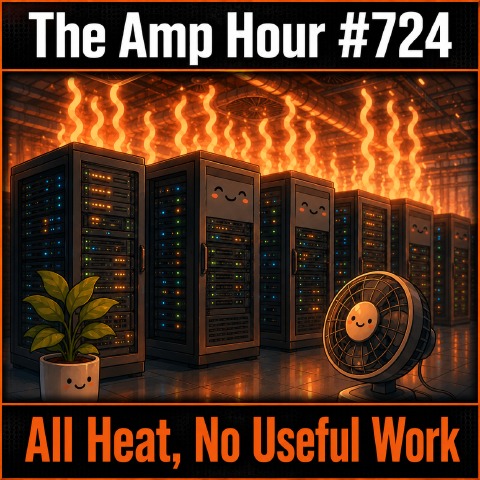
#724 – All Heat, No Useful Work
Download episode · 99 MB
Also on Apple · Spotify · YouTube · RSS
Show Notes
- Chris just got back from a work trip to Madrid
- He also got to hang out with Matt Venn (and coworker Mike Szczys) in Valencia
- Dave has a new data center going in across the street
- Chris enjoyed this episode of Prof G Markets where they talked about the impact of data centers on power and the rise of "behind the meter" generation
- Dave without internet for a week. Chris has had multiday losses after fiber has been cut in his neighborhood.
- Humanoid robots...on a plane!
- Chris has been working on 0201 components on a tiny Bluetooth board
- The Iran War and subsequent rise in petroleum product sourcing issues is starting to impact the PCB industry


- PCBs we are used to ordering at low cost (JLC, PCBway, etc) are normally loss leaders to get larger business later
- Chris found his low cost microscope from Florin/Voltlog trinocular video
- lcamtuf will be on the show soon, Chris bought a CNC mill because of a single webpage of his making
- TagMod board is a new breakout Chris made for injecting power through a 10 pin TagConnect cable.
- NXP devboards somehow have LEDs as bright as the sun
- Dave has been revisiting his solar analytics (update: he figured out he's getting charged more too!)
- Chris has been working at Canonical (makers of Ubuntu, new owners of Golioth) for a few months now. That was the trip to Spain.
- Dogfooding your own product
- Chris created a backronym: "Application Level Program Optimization" or... ALPO
- Chris built a new vibe coded project for talking to Zephyr devices using Web Serial and passing firmware packages over SMP
- CI/CD
- Debian now requires "fully reproducable" builds to harden against supply chain attacks
- Veritasium video about Linux bug
Transcript
Chris Gammell: This is The Amp Hour Podcast. Released May 25th, 2026. Episode 724. All heat, no useful work.
Dave Jones: Welcome to the Amp Hour. I'm Dave Jones from the EEV blog.
Chris Gammell: And I'm Chris Gammell of Contextual Electronics. Hungover from the flight? You've been jet-setting around the world?
Chris Gammell: I have been jet-setting. I am back home.
Dave Jones: Where did you go to this time? I forgot.
Chris Gammell: I went to Madrid.
Dave Jones: Madrid, that's right. Spain. That's right.
Chris Gammell: How was that? It was very nice. You know, we had some people fly in from Australia, and I was thinking about you talking about your past flight stuff and, like, flying to Europe. That was a long way away, you know?
Dave Jones: Oh, yeah. 24 hours of just flying. 30 hours by the time you actually, you know.
Chris Gammell: Yeah, that's rough.
Dave Jones: Leave home and get there, yeah. But you gain a day or something, you know, like, oh, God. Yeah, sure, thanks.
Chris Gammell: Yeah, right. I always find flying west a little bit easier on my body. I don't know. I think just because I can drink enough coffee to, like, stay awake. But that far west, nothing matters at that point, you know. But flying back home for me was okay. So, I'm doing all right. You know, if I fall asleep mid-recording, you'll know.
Dave Jones: Okay. No worries. If we hear a sudden thud against the microphone, we'll know what's happening.
Chris Gammell: Yeah, just a thud and a, you know, like, yeah, yeah.
Dave Jones: Oh, boy.
Chris Gammell: But, yeah, it was great. It was great. I was in, got to hang out with Matt Venn. I went down to Valencia as well, and I saw Matt Venn. You and my friend Mike went to go see him. And so, he's the one doing tiny tape out and similar things. And, yeah, just really nice to, you know, see people in person and shake hands and nerd out for a little bit. So, it was really great. What have you been up to?
Dave Jones: What have I been up to? I've been busy watching the bloody data center being built in my business park.
Chris Gammell: Oh, really? A data center? A data center?
Dave Jones: Yeah. Yeah. As in an AI. Yeah, yeah, yeah. As in an AI data. Well, it's not being built. It was already there. It was the old IBM data center, which was operating for, you know, donkey's years. You know, small little, you know, small, quite small in the scale of these. I think it's a 14 megawatt AI data center. They're going to expand it to like 100 megawatts or something. But, yeah, they're starting out, you know, small fry. But, yeah, it was already like a, you know, fairly decent sized data center. And then they're, yeah, they've sort of like used the same building, but they've sort of like tacked on some things on the outside for all the extra cooling bloody stuff. Yeah. And it's just, oh, it's crazy. I'll see if I can send you a photo here. But, yeah, it's so, I don't know, some Australian company of, you know, AI data set who have various other data centers and stuff. And I'm just looking at it and I'm going, Jesus, look at all that cooling of the bloody towers and everything. Like, you know, and this is a tiny, tiny, yeah, here it is.
Chris Gammell: In a business park, too. Like, I wouldn't think about that. But, like, I've heard, so Cloudflare, who I use for, you know, like it's like our CDN for the Amp Hour and I use it for their hosting things as well. Like, they have like a bunch of like tiny data centers kind of like in business parks as well. I know they do that. But usually when I think data center, I think like massive, you know, AI, you know, terawatts, megawatts. I don't know, like, what we're at here. But gigawatts is a large data center. One gig is a large data center. Yeah. So, I don't know. You know, I think about a big, big, big, big square building in the middle of a field sort of thing. Not necessarily a business park. Yeah.
Dave Jones: It's in the middle of nowhere. Yeah. Yeah. And I just see reports all the time of like people who have to live next to these new data centers that have gone up and they're just recording the noise coming from it. Yeah. It's like they cannot sleep. It's like 24-7. And we have a big, because I know someone who works at the Environmental Protection Authority, which is, you know, into this sort of thing. They say, yeah, the AI data centers get a free pass for just using their diesel backup generators 24-7 because, like, the grid can't supply enough, you know, power for it. So, they just come, screw that. What was burned diesel 24-7? And they have these, you know, tens of megawatt class diesel generators that just burn through the crap 24-7. And the government, you know, is all trying to be all green and everything and going, oh, yeah, but we need the AI. So, we'll, you know, just forget that they're running on, you know, diesel generators.
Chris Gammell: Right, right. But think of the economy, Dave.
Dave Jones: Yeah, think of the economy and think of all those, you know, cat videos. Yeah.
Chris Gammell: Yeah, right, right. Right. Well, generated cat videos, really. Yeah. Right.
Dave Jones: So, yes. So, I sent you some photos here of everyone.
Chris Gammell: Yes, I saw that. Yeah, yeah, yeah. And that looked like a kind of like a standalone building, though. So, that's just like in the vicinity? I was thinking like it was in your building, but it's.
Dave Jones: No, no, no. It's in the business park. It's in the business park. Got it. It's right next to the post office here and it's right next door to some other commercial office places and stuff like that. It is a little bit separate. Oh, but it's still close enough to like, you know. Yeah, yeah. Yeah, it's right there. Anyway, yeah. So, it's small fry in terms of AI data centers, but even I'm looking at it going, holy shit, if this is like literally probably two orders of magnitude smaller than the big daddy AI data centers. It's crazy.
Chris Gammell: I was listening to a podcast about, you know, data centers and just energy usage and stuff like it. And they were talking to, who was it? It was on the Prof G Markets podcast. And Ed, the host, was talking to like two people who are, one was actually like a supplier. So, I thought that was a little off. Yep. But really just about the usage and like they talk about behind the meter power. That was like the, that was the phrase they kept using. So, like basically turning on diesel because a lot of times they can't even get grid connection, you know. They can't tie in for 24 months or more. Exactly. Because they have so many requests. Yep. Yeah, it's pretty wild.
Dave Jones: Behind the grid. That means that, yeah. And that means it's hidden from the national numbers, right? So, if all these AI data centers are running from their diesel backup generators, that never makes the figures for all the black coal, but, you know, like the, you know, the black energy, they call it. You know, that's actually, you know, which is coal and diesel and everything and gas and everything else, right? Which is, you know, powering, powering the grid, the numbers just magically vanish. Poof. Magic trick.
Chris Gammell: Yep. You know?
Dave Jones: So, yep.
Chris Gammell: Yep. Yep. Yeah. And I think another thing that's interesting is like, you know, I'd heard it before listening to this episode, the data center one, but like basically you can't even buy generate, like the generators sold out for like a multi-year backlog. Oh, yeah. Yeah. Of a generator. Yes.
Dave Jones: You know, like large scale generators and stuff. Yeah, it's huge.
Chris Gammell: It's wild. Yeah. You know?
Dave Jones: Unbelievable.
Chris Gammell: It also kind of comes back to, you know, you and I were talking about some of the grid stuff, Pelican? What was the name of that? One of the companies that we were talking about that was doing a lot of like the rah-rah, like, oh, we're going to fix the grid type of thing.
Dave Jones: No, I don't recall that. Okay.
Chris Gammell: Okay. It was, I mean, it was probably like two, three months ago now. Whoever we were talking about, but they had like written this article about how they're going to basically fix the grid. But my assumption was that they were really talking about like these mid-grade, you know, they're data center providers. So like they're getting all this interest from VCs and similar because it's like when you blow out even a transformer these days, it's hard to source new transformers too. Just thinking about like just the supply chain draw across the board in these large scale installations. It just, I don't think the materials can keep up. And when you think about like, oh, well, maybe we can just buy it from China. It's like, yeah, guess what? They want it too, you know? It's like literally, it's like an arms race, you know?
Dave Jones: Exactly. Well, Australia's largest battery. Oh, I can't remember the Waratah big battery. I think it is. It's the largest storage battery in the Southern Hemisphere. It just got taken partially like offline. I'm not sure what percentage of it was taken offline because a transformer blew. And then I think like a second transformer blew. And now they're saying, well, there's like a three-year backlog on these transformers. And it's like the battery didn't fail. The actual, you know, Tesla battery packs or whatever they're using there didn't fail. It was the bloody transformer. And you just can't get them.
Chris Gammell: Yeah, they kind of cover that in the net charge.
Dave Jones: It's like a transformer is just copper windings, you know, around an iron core. I'm sure it's a bit more complicated than that. But, you know, that is the basic premise, right? That's how they still work, right? It's not some magical, you know, fairy dust. It's, yeah, it's coils of wire, like with a magnetic field.
Chris Gammell: Well, and I do think some of the load switching stuff is also critical in this kind of modern, like the power quality and stuff like that as well. But, yeah, it's a wacky time.
Dave Jones: But, yeah, it's the little transformer that melted down, blew up. I don't know how. But, yep. Oopsie. And they're going, yeah, this big battery is down for, you know, years. And it was our like flagship battery. It'll save the grid, you know, blah, blah, blah. Oh, well, what can you do? So, yeah, I'm just like amazed at this. So, I've been watching them expand this thing, right? And, like, and the building hasn't expanded much. They've just like tacked on a few things at like either end, a tiny thing. So, the actual volume of the data center really hasn't changed. And the stuff that added on, it looks like it's just for the cooling and power and diesel generators and all that sort of crap, right? So, the actual data center floor space, I'm not sure has it actually changed. But, it was a data center before. And now it's still a data center. But, because it's AI, they have to add on an entire section of the building just for power. So, how much power did the previous data center? And I watched them install, like, actually running the wires in the trench and the big transformers outside the complex to feed in new, you know, power wiring to it. And I'm going, well, shit, like, it's the same floor space of data center really as far as I know. And yet, it's requiring, what, an order of magnitude more power? What the hell? Like, geez.
Chris Gammell: Right, right. Especially, like, you know, chips have moved on as well. But, I think it's just the scale of, and I play the density as well, right? You know, they're packing.
Dave Jones: Oh, yeah, yeah. Everything's, yeah, the packing density. And, yep, yep. It's just crazy. And people don't realize, people, there's the myth out there that actually, you know, when you, you know, you put X amount of power into a computer slash data center, then, well, X amount of power is wasted in heat, and then X amount of power goes to the compute. No, it's actually 100% heat. The compute is the byproduct of the 100% heating. So, it just uses 100% of the energy, so you have to get that out as heat. It's like, that's how computers work. It's not like, you know, it magically disappears into making numbers happen. Nope.
Chris Gammell: Is that right?
Dave Jones: Yes. Yes, that is correct.
Chris Gammell: So, there's no work being done. Like, just thinking about, like, a physics, like, work being done of, like...
Dave Jones: That's what I'm talking about.
Chris Gammell: ...pushing and pulling transistors around, it all eventually just becomes heat. Is that right?
Dave Jones: It all becomes heat. Yep. And the byproduct, the nice byproduct, very nice byproduct of it, is that you actually can do stuff with it. Yeah, yeah. But, yeah, no, it's 100% heat.
Chris Gammell: I do remember back in the Bitcoin mining days that a friend was talking about, like, heating his apartment just with a Bitcoin rig.
Dave Jones: Oh, yeah, yeah, yeah, yeah, with your Bitcoin miner.
Chris Gammell: Yep.
Dave Jones: It's fun. Yep. I've still got some miners going for funsies. Oh, yeah, okay, yeah. You know. So, yeah, yeah, yeah, it's excellent. I moved them down to my bunker now because I finally... I don't... Yeah, you wouldn't know about this, but I spent a whole week without any internet here at all.
Chris Gammell: Oh, really?
Dave Jones: It went down for an entire week. The entire Norwest Business Park, no internet.
Chris Gammell: Like someone just chopped the cable? Yep. And they couldn't find it?
Dave Jones: Somebody chopped a fiber somewhere on the main street. And I don't think they just chopped it, right? They obliterated it. They actually, like, maybe used... They actually used, like, maybe a rotary digger or something and, like, wound the fiber up because they had to run 450 meters of new fiber.
Chris Gammell: Oh, no way. That sucks.
Dave Jones: Along the street to fix it. Yeah.
Chris Gammell: Yeah.
Dave Jones: It was going to be down for two weeks, but, yeah, it was crazy. And then when it went down, right, everyone switched over to mobile as a backup. Yeah. Right? And then the mobile system went down. Yeah. Right? Telstra, our biggest telco provider here, went, like, you could hardly get any bandwidth or reception in the business park. My phone suddenly stopped working here inside the lab because the whole system just went down. So, yeah, that was nuts. The whole business park down for a week.
Chris Gammell: Yeah. They're still putting new fiber here, which is, you know, I'm grateful for in certain, for the updates and more competition, whatever. But, like, we've had, like, three separate crews come in and they just keep using the same, you know, they only have so many right-aways. So, they get the same, like, trench digger, like, the ditch witch thing. It shoves the thing underground. They don't reuse any of the conduit. Yep. And then sometimes they just, yeah, they knock it out. Oh, whoops. Yeah, three days worth of new.
Dave Jones: And we, and technically, just to my building alone, we actually have four or five different fiber providers. Yeah, right. That come into the building, but only one of them, the NBN, which is our national broadband network, is the one that you can afford to use. All the others are just, you know, pointless because it's like $10,000 a month. I'm not kidding. No way. Really? It's that expensive. Oh, yeah. Business connections or what? No, but, yeah, because it's using this old infrastructure and it's designed for corporate, you know, massive corporate business. Businessing, so, yeah.
Chris Gammell: Yeah.
Dave Jones: Yep. That's why back in the day, if you remember, I had to get my own fiber run to this building. Yeah, I remember that, yeah. Just so I can pay, have the privilege of paying $440 a month for my 10 meg, 10 meg fiber internet connection.
Chris Gammell: 10 meg?
Dave Jones: Because even though there were three or four other fibers coming into the building, I had to run my own fiber.
Chris Gammell: Yeah, I remember you made a video, didn't you?
Chris Gammell: Didn't you have a guy that was like, yeah, dropping it down the conduit and stuff? Yeah, I remember that.
Dave Jones: Yep. So, it's nuts. So, yeah. Oh, man.
Chris Gammell: Yeah. Infrastructure. Infrastructure, folks. It's an infrastructure episode.
Dave Jones: Yeah, so the government pushed everyone on to the NBN and then the NBN fiber is the one that got cut and all of a sudden, boom, you know, like literally 95% of people were down. There were a couple of people that still had some alternate, you know, thing that worked, but yeah, and then the mobile system went down. But the interesting thing is, is that I was in the process at the time of trying to get internet into my underground bunker, my underground storage bunker, right?
Chris Gammell: Oh, so you thought you broke it?
Dave Jones: No, no, no, no. I was just, anyway, so I was trying to.
Chris Gammell: What did I do? Oh, God, what did I touch you?
Dave Jones: So, I was just like, I was trying to figure out, oh, I've got to run power over ethernet along the air duct in and then I've got to install an external 5G antenna outside of the building, blah, blah, to try and get internet in. And then when all this whole thing happened, right, when the whole business park went down, I had to, because Telstra wasn't working, I had to go to an alternate. I had to go to Optus, which is another cellular provider here, and all of a sudden, I found, I discovered that that actually got reception inside my underground bunker. Unbelievable. So, I thought all this time that there's no way I can get internet into my underground bunker, you know, it's going to be really difficult and everything. And then, no, I just had to change providers, and they happened to have a cell tower, which was in the exact location and the exact angle that could penetrate underground into my bunker. And so, sure enough, bam, I've got one of these, now I've got one of these 5G, you know, modemy dongle things, yeah, something like that. And that sits in there, and I've now got internet in the bunker, which was while I was able to move my mining operation over to the bunker from my dungeon. So, anyway.
Chris Gammell: Now you never have to leave there, you know.
Dave Jones: I can install the toilet, and I'm good to go, yeah.
Chris Gammell: One bucket, and you're done, man. Yeah, all right. You've got an internet bucket, you've got another bucket.
Dave Jones: Speaking of buckets, I just bought a bucket yesterday. I haven't got it in the lab at the moment. I decided I really need a fire bucket. I really need a bucket full of sand here in the lab, just in case a lithium-ion battery catches, you know, on fire. Yeah, yeah, yeah. So, I got a bucket, a bag of sand, and some barbecue tongs. I am prepared, dude. I am prepping. I'm prepping for that.
Chris Gammell: When they go off, it's still scary, you know. It's still.
Dave Jones: Yeah, but even like the small, like the little tiny ones, you know, like the little couch cells. Sure, yeah, of course. You know, yeah. Yeah. If it starts catching on fire, you know, you're not going to put it out in a hurry. So, yeah, bucket of sand. Throw a bucket of sand over it, or if you can, transport it to the bucket of sand and throw it in the bucket of sand. So, yeah.
Chris Gammell: You doing new battery stuff?
Dave Jones: No. I think Fran did a video on it, mentioning that there are so many, you know, there's lithium batteries in every, like I've probably got 30 lithium-ion batteries in a product here in the lab, right? And odds are one of them is going to catch fire eventually, you know, or start smoking or doing whatever, you know.
Chris Gammell: Yeah, I was amazed at like how much I was carrying through the airport. You know, like you're not allowed to have like European air security is like, well, you can't be more than 100, there's 100 watt hours.
Dave Jones: 100 watt hours, yeah. It's the same here, I think.
Chris Gammell: But what if I had a bag of 20, you know, 98 watt hour batteries? Like that's still allowed.
Dave Jones: Yes, exactly. Yes, I think it is. I think it is. I know, it's so stupid. You could have a bag of 100 of them and they would still let you put that in carry-on. Yeah.
Chris Gammell: Yeah. Yeah, that doesn't compound apparently, you know. Yeah, I know. The battery goes, oh no, no, no, I'm 98 watt hours. Yeah, yeah. I'm not going to start on fire when my neighbors started on fire in the same bag. But I mean, even without that, I was just carrying so much, you know, all my electronics junk that I was carrying with me to Spain, I had it all on me because, you know, you have to carry it on you. And yeah, I was packing some lithium, you know, like I had some lithium on me, you know.
Dave Jones: Oh, that's great. That reminds me, I'll link, I'll send you the link here. There is a, this made the news, but you're not really on social media anymore, so you don't see it really. There was this company who makes this little, you know, humanoid robot thing. Oh, God. And they took it on a flight. They actually booked this humanoid robot an actual ticket. Oh, boy. So they gave it a seat and then they tried to get the humanoid robot on the plane and they went, no, it's got over 100 watt hour battery in it. So they rejigged it or something. I don't know if, I don't know if that's, it's this exact video. But anyway, so they did a workaround and they put in a smaller battery for it or some sort of removable battery that was under the 100 watt hour limit. And sure enough, they got this little humanoid robot. You can see it like walking onto the plane and stuff. Yeah, true gimmick. Yes, I'm watching it now. Yeah. Yeah, yeah, yeah. Oh, yeah. It's a total marketing thing, but there it is, you know, walking through this little, you know, like, it's only like two foot high or something, you know, tiny little, you know, Asimo style humanoid robot. But yeah, they actually booked it in and it got its seat and stuff.
Chris Gammell: I am so underwhelmed by humanoid. I mean, I'm sure like there's going to be use cases, no doubt about it, but like everything about it these days.
Chris Gammell: I'm just like, guys, it's so, it's very hype cycle-y right now.
Chris Gammell: Like watching this thing is like almost, it is like watching Asimo. Like, it's like, okay, you're going to like stand up and wave to the crowd and do a little dance. I'm like, or like, you know, Unitree is like the, one of the Chinese manufacturers that has all like the Kung Fu marketing video. It's just like, okay, cool. Like, yeah, I know there's use cases.
Dave Jones: Yeah, yeah, yeah, yeah. It's cool, but you know.
Chris Gammell: I don't care that much, you know.
Dave Jones: Yeah, I don't care that much at this point. They're kind of, yeah, they're going to like be useful for something eventually, but I couldn't put a time frame. If you had to press me for a time frame, I'm going to say definitely not this decade. I'm going to say sometime mid next decade. So I'd put almost a 10-year time frame on it before they actually, you know, people will have them, you know, to do something useful. There'll be niche cases, of course, but you know, like, yeah, I'm not buying it.
Chris Gammell: I keep applying this like the same, you know, like, so people in my life who are tech savvy enough, like my wife is very tech savvy, but not like, not technical, not that interested in stuff like this. And like, so I was having this conversation about like, you know, AI agents and I was to a friend, we were talking about AI agents and like everyone's going to just be able to define an app and like do an app. And I'm like, look, my wife is tech savvy. She's not technical, but she's like, she, she can do this stuff. And I just don't see her wanting to do that. Right. To like spin up an app to do this repeatable thing. And it's just that, that as a, I'm not saying that's like the be all end all, but as like just the, the normal tech savvy enough person. And I just, I, same thing for these human, humanoid robotics, like unless it's so simple and so like, like integrated to a workflow that it's like, how could you not do it? You know, I just, I feel like, I feel like that is, it is a ways off. I could be wrong though.
Dave Jones: Yeah. Well, we'll see.
Chris Gammell: The hype, the hype continues.
Dave Jones: Yes, it does. Have you noticed a rise in bareboard PCB prices at all?
Chris Gammell: No, I saw the, I saw the hack and hackaday article about that.
Dave Jones: Oh, is there a hackaday one? It's I did the, there's an article. Oh yeah. I just sent it to you.
Chris Gammell: Yeah. Oh yeah. Okay. Reuters. Yeah.
Dave Jones: Reuters. They've gone up 40%. Bareboard PCB prices surged 40% in April, driven by AI server demand and material shortages. I don't think it's driven by AI server demand. That's bullshit. But I can certainly understand the material shortages, resin, copper, other materials and stuff like that.
Chris Gammell: Raw materials, petroleum base. Yes. For certain. Yeah. And just even shipping. I mean, that's also gone up on so many, like I'm just like food prices are through the roof too, just as a result of just logistics and farming and, you know, all the things that, that, uh, nitrogen, um, and, and petroleum takes on. So it's wild. Uh, I have not, I honestly, I have not, uh, ordered a board in a while. I have a new project coming up that I will be, but no, I, I haven't seen, I haven't tried it yet. So we'll see.
Dave Jones: But the problem is you probably won't even notice it cause they're so bloody cheap these days. Yeah. Yeah. Right, right, right. You know, whereas back in the day, oh, 500 bucks for, for, for my prototype board. And now it's a thousand. Oh, geez. Yeah. I, I certainly noticed that, but you know, oh, it goes from $5 to $8. Like, you know, you're not going to notice it.
Chris Gammell: I think a lot of times too, that you, you, you and I are ordering what, like five boards from a JLC or PCB way as well. It's like that, that is a subsidized price. Right. I think that's the other thing we have to remember is that like, we're, we're getting the subsidized price because they're trying to lost lead in order to get the big orders later. And like, they're just doing such insane orders.
Dave Jones: And get the big, you know, a hundred thousand board order for their main factory. You know?
Chris Gammell: Yeah, exactly.
Dave Jones: There are people who don't actually realize this, that you can't really run a profitable company doing a shared board service at those sort of prices. You know? Right, right, right. Five bucks for five boards, you know? Right. It's like, yeah.
Chris Gammell: Yeah. I think the, the AI stuff for sure is having other impacts. I mean, like I was shopping for another laptop and I'm just like, oh God, just give me, like, I just turned, I just closed the computer. I'm just like, I don't want to see it, you know?
Dave Jones: Oh, really?
Chris Gammell: Yeah. I thought about like, you know, selling my old Mac mini and just, you know, see it and how much money I can make off of it.
Speaker ?: Right.
Chris Gammell: Yeah. It's just, you know, the secondary market's up, everything's up.
Dave Jones: Yeah. There's heaps of secondhand market out there.
Chris Gammell: Yeah. So, but no, I haven't, I haven't been building enough, enough individual hardware to, to really, to really feel that pain yet. But I will report back once I do, because I'm sure I'll be grumpy about it. Yeah.
Dave Jones: I will predict that you won't be. I predict that the prices will be still so minimal that you just won't care.
Chris Gammell: Yeah. Yeah.
Dave Jones: Anyway. Yeah. Apparently if you're ordering boards in volume, yeah. 40% increase in price. Yeah. Or whatever. Yeah.
Chris Gammell: I can see that, you know, that, that will, that'll flow through the system too. Right. If like people making boards that are already.
Dave Jones: Especially if you're making like a complex board, you know.
Chris Gammell: Yeah. Right. Multiple layers.
Dave Jones: Or even if you're just making, you know, if it's like bare resin, it's like that goes into every board, regardless of how complex it is. Right. Not complex it is, you know. So, yeah. And if you're used to paying, you know, two bucks for your board in volume, it suddenly goes to four bucks and your widget bomb cost is 20 bucks, then, you know, that's, that could be substantial. Yeah.
Chris Gammell: Yeah. Yeah. I have been, I've been building with a bunch of O2O1s.
Dave Jones: Oh, what? Why? Just don't. Oh, yeah. You're making that tiny little pissant round board, right?
Chris Gammell: The little one. Yeah. Yeah, that's finally, I finally bucked up and decided to assemble it and spent a bunch of time hunched over my bench. Made a jig. I was proud of myself for that. The jig worked out pretty well. So, just like a match the board outline and 3D printed. And so, that was like nice and flat for the Pace's application. I did okay with Pace, not like super great. I think my proudest moment was like I successfully saw the dot on the O2O1 LED and I got that right.
Speaker ?: All right.
Chris Gammell: For some of it. So, yeah. Yeah.
Dave Jones: What are you using for like a microscope?
Chris Gammell: I still have my like long throw. It's like a cheapie off AliExpress, but it has this like really like shotgun style long throw lens. Is it optical or digital? It's both actually. So, it's got like a.
Dave Jones: Oh, okay. Oh, it's right. Optical stereo view pieces.
Chris Gammell: Not stereo, unfortunately. Yeah. So, I'm.
Dave Jones: Oh. Working like a caveman, Dave. Okay.
Chris Gammell: Yeah, yeah.
Dave Jones: Right. Okay. Right, right. So, it's got a mono eyepiece. And then I. So, it's not a trinocular. It's a binocular.
Chris Gammell: Oh, actually. No, no, no. This is. This is. This is digital only. So, I.
Dave Jones: Oh, okay. Ah.
Chris Gammell: So, it's monocular into the digital sensor. And then I have. Yeah. Out the HDMI. And then basically I line it up so that I'm like looking past the board. So, it's like I'm at my bench. Yep. I'm like kind of hunched down looking. Not hunched down, but like looking down at the boards. I'm assembling it just past it. I can see the monitor right there. So, it's kind of like it's like in the far distance. I can see it. And that helps to. You know, that's what I'm really focused on. And that's worked pretty well for me. It is monocular. So, you don't get like depth of. You know, depth perception. Yeah, yeah. Which is tricky sometimes. Yeah. It's quite tricky. But, yeah. The setup works okay. And it is low cost. So, I do recommend it from that perspective. I think it was Florin from Voltlog. I think he's the one that pointed out this AliExpress camera. And it's been good. I'll see if I can find the video to put in here. So, it was one of his mailbags a long time ago. Oh, you're still using your Mantis?
Dave Jones: I still use the Mantis is the optical one plus the Tigano is the digital one. But I've been trying to get an upgrade to the Tigano because it's only 1080p. And I like to shoot my teardowns in 4K. So, like, that kind of sucks. So, yeah. And they didn't want to upgrade me to a 4K unit. So, okay. Fine. I was talking to another company in Spectus. And they were keen at one point. But then the correspondence kind of just died out. So, I don't know what's going on there.
Chris Gammell: Peered out. Yep.
Dave Jones: Yep. Yep.
Chris Gammell: You're losing your clout, man. You've got to get that clout back up. Yeah, I know. Yeah. I've got to get the clout back. Yeah.
Dave Jones: I'll speak to Inspectus again. I'll try and get them. Yeah. Because they make really cool. They're, like, you know, one of the equivalent big ones to the Tigano in terms of, like, a digital, you know, 4K thing.
Chris Gammell: I mean, they're probably not selling to hobbyists all that much either, right? Oh, no. It's probably, like, they're at the big trade shows. And it's, like, if you don't know someone.
Dave Jones: Yeah, they're the big ones at the trade show. Yep. You see, you know, you walk up the stand and you just go, wow, you know. And how much? Well, we'll send you a quote, you know. You have to ask. Yeah, yeah.
Chris Gammell: You have to ask.
Dave Jones: Yeah. Yeah. They're quite expensive.
Dave Jones: But, oh, yeah. But they're so fantastic. You know, the work, you know, 30 centimeter working distance. You know, 40 times zoom with 30 centimeter working distance. You know, it's just nuts. That's really nice.
Chris Gammell: Yeah. Yeah. Yeah. Yeah, that's the thing I never got. I mean, I think the first time I bought, I'm like, oh, you can get these so cheap. And they're, like, so, you know, but it's like you can't get anything under there. Yeah, I know. The working distance. It's leather on your hands, you know.
Dave Jones: Yeah, like an inch or something, you know. Yeah. An inch of working distance. Can't do it. Even two or three inches isn't enough. That's what she said.
Chris Gammell: I put mine on a Manfrotto arm. I put mine on a Manfrotto arm. And so, it's a little wobbly, unfortunately. Right.
Dave Jones: Oh, yeah. Nah. That's, yeah.
Chris Gammell: Nice for the flexibility, but it's got a little too much, like, lever to it.
Dave Jones: A little wobble, and then you move the bench, you sort of bump the bench a bit, and it all
Speaker ?: kind of wobbles.
Dave Jones: Exactly, yeah. Yeah, yeah, yeah.
Chris Gammell: You get it with your knee, and it's like everything's, the whole world's made to get seasick, you know. Yeah.
Dave Jones: Yeah, bugger that. No. No, thank you.
Chris Gammell: The old eyes aren't getting any younger, Dave.
Dave Jones: You don't wear glasses, do you?
Chris Gammell: I do, yeah. Yep.
Dave Jones: Oh, you do. Okay. I wear contacts.
Chris Gammell: I wear contacts.
Dave Jones: Oh, okay, right.
Chris Gammell: I'm nearsighted, so. Right. I have about, like, 2100 vision. What's 2100? 10, 1050? I don't know. I don't know. It's a 20, 20-20 is, like, the perfect vision.
Dave Jones: Right, so you have a, you have an issue seeing far.
Chris Gammell: That's right, yeah. Actually, I hadn't thought about that. I think it is based on feet, so it probably wouldn't be 20-20 where you are. I think it's, like, 20 feet, things that are 20 feet away look like they're 20 feet away.
Dave Jones: They still use it here. Oh, they do? Okay. Yeah. My optometrist actually custom-built his room to actually be 20 feet long, like the actual distance, like the real distance. He said, yep, all the others cheat, and they're only in this small room, and then they use a conversion factor to make, you know, but I actually built mine, so it's the real distance away. He was very proud of it, you know. Yeah, yeah, yeah. The actual chart is right, the chart's right over there, read it, you know.
Chris Gammell: Yeah.
Dave Jones: And it was, yeah, it was telling me all about it, so.
Chris Gammell: Yeah, so, I mean, I'm not, not, I can't drive, I'm not supposed to drive without, without my glasses. Oh, really? Okay. So, like that level. Yeah, yeah, yeah. Yeah, it's been like that since, since school days, but you wouldn't know, because I got contacts in, you know.
Dave Jones: Right, yes. Yeah, no, I'm sure, when I met you, you didn't have the, didn't have, I don't think I've ever seen you wear a pair of glasses.
Chris Gammell: There's some, I think, on old YouTube, I think. Oh, right, really? YouTube videos. Oh, okay. There's like, you know, a basement, you know, chubby Chris in a basement wearing glasses and like a flannel. I think there's a couple of those. Yeah. The good old days, yeah.
Dave Jones: Playing banjos and, you know.
Chris Gammell: Yeah, yeah. All right. I am actually very excited. So, you remember, like, I got that milling machine a long time ago, back in my Cleveland days. Yeah, yeah. Like CNC milling machine.
Dave Jones: Which you gave away or something or swapped it or something.
Chris Gammell: I gave it away. Yeah. But, do you remember, I remember I was like absolutely fanboying over this article that was like the machinist guide to CNC or something like that. It was like this kind of old looking website. Right. So, the maker of that, McCall. McCall? Michael? I'm not sure how I say his name. So, El Camtoff, who I've mentioned on the show before. He's going to be on the show, I think we're recording later this week. And he also has a new book out about electronics. He's been doing a bunch of great publishing. So, keep an eye out for that. I think that'll be next week when that comes out. And a great new book from No Starch Press and really like nice visual. Oh, yeah. Yeah. So, yeah. And he's great. And just.
Dave Jones: Oh, I think they might have sent me an email about that. Because they're always sending me an email. Yeah, No Starch is great. Would you like to review this book? Yeah.
Chris Gammell: Yeah. Yeah. Yeah. So, yeah. He's going to be on next week. But actually, I asked him to be on the show before I even knew about the book. So, it worked out great.
Dave Jones: Oh, okay. Cool.
Chris Gammell: Yeah. So, on this little board that I've been working on, the 0211 one, I made a new board that I'm hoping to open source. But it's, you know, it's nothing fancy. But it's actually been really useful. So, it's, I took the tag connect, rather. The 10 pin tag connect, which you've used before. And reassigned three out of the 10 pins on there. One is power. So, you already have ground. And you can, so like there's a voltage detect on that pin. Just to know if it's like 3.3 or 1.8 or whatever. And that changes the level shifter on the J-Link. But I made a power inject one as well. So, you can actually power the board from there. And then RX and TX. And this is not novel in any stretch. Actually, Laird, now Isurio, also did something like this. But they didn't have it plugged. They had it plugged into their custom board. Not into a J-Link. So, basically, I made like a power injector board with RX-TX. And it's all tied back to a 20 pin J-Link. So that you can use the onboard virtual serial port. And you can use the switchable power. And I found out a J-Link actually has a built-in current monitor as well. Which is like super, super useful. I don't know if you've ever seen that. Oh, okay. Cool.
Dave Jones: I've never used it, no. Yep.
Chris Gammell: Yeah. Yeah. Yeah. So, like, there's like a power on command you can do from the J-Link command line. And then you can actually, like, see, you know, what the draw is. It's not, like, super accurate. But even just, you know, rough usage is super, super useful. And you can monitor the voltage directly from there. So, yeah. Pretty cool. So, I'll hopefully be releasing that board once I fix one or two. Small resistor errors, you know. Blah, blah, blah. Right. Oh, boy. Just, you know, you'll classics. Every board needs a couple of good errors like that, right? As you say, I hope your board doesn't work. I'm just, you know, fulfilling that promise.
Dave Jones: Yep. Hmm. Somebody emailed me the other day about this project that they were doing. And, you know, it's kind of cool. Like, they put a lot of effort in it. It's really cool. And it's like they wanted my opinion on whether or not it was, like, a worthwhile product. And the idea is that it's a lead photometer that, like, measures the output luminosity of a lead. And then it tells you what current you need to drive it at to get that luminosity, right? And it's like, yeah, okay, right, cool, you know. And they've done all, you know, they've built the prototype and everything. And I think they've been sold a few units or whatever. And I'm going, yeah, cool. But I don't think that's a problem that needs solving because most designers are content just to change the resistor value after the fact. You know, like, if you build up your product and you find, oh, it's not quite bright enough. Yeah, I'll just increase the resistor value. You know, you don't have to engineer that luminosity at the early stage is what I was sort of saying. Anyway, that just reminded me of that. You know, you're placing those tiny O2-O1 resistors there. And it's like, yeah, you know, but even then, you know, yeah, you could just change it later. Just change it into bomb or whatever. Yeah. Anyway.
Chris Gammell: Right, right, right, right. Yeah, send a change notice, that sort of thing. Yeah, it was interesting. I mean, I do wish certain dev board makers from a certain three-letter Dutch company would have looked at their LED output. But I just think the most blinding LED I've ever used to be. Right. Yeah. Like, literally, like, it's like a laser beam that shoots directly into your retina. There's nothing worse than too bright. Yeah, yeah. Yeah. And it's like blue. You know, like that, like, brain-burning blue, you know, that one? Yes. Yeah. It's that. Yeah.
Dave Jones: Yeah. Well, that was all the rage back in the 90s when they invented blue LEDs. You know, when blue LEDs came around, it was like, oh, you've got to make it as bright as possible.
Chris Gammell: It won a Nobel Prize, man. Yeah, yeah, yeah. It was the hot ticket, you know.
Dave Jones: Man, we're going to make that suck, and we're going to make sure you know our product has a blue LED, damn it.
Chris Gammell: We're staring down the barrel of a blue LED, yeah.
Dave Jones: Yeah. Oh, yeah, it's painful. Yeah. But then again, also, you know, they're not quite bright enough, and it's like, oh, yeah, but I turned all my lab lights on, and I can't really, you know, it's kind of not very bright. You know, it's hard to see.
Chris Gammell: Delicate balance. You know, I think it's better to go a little bit up. Yeah, there is a delicate balance. And then, you know, and then PWM it back down, I guess. But, yeah.
Dave Jones: Yeah, but I think that's not something that most designers would fuss over at the actual design stage. You just go, okay, I'm going to whack a 1K resistor in there. It's going to be bright enough, and then I'll change it later if people complain or something, you know. Yeah, yeah, yeah. It's kind of, yeah. Yeah, that's something. I don't think it's that.
Chris Gammell: I think, well, I think about what we're thinking about is like indicator LEDs. It's like if people are doing like actual color science or like, you know, lighting. Oh, yes. I'm sure there's stuff there, you know.
Dave Jones: If you've got a product where the LED is the focus of the product, like the LEDs are the focus of the product, then yes, you've got to engineer that from the start. But that's, you know.
Chris Gammell: Dave, are you? That's kind of. You okay? Are you saying LEDs? I thought you always said LEDs.
Dave Jones: LEDs.
Chris Gammell: When did you start saying LEDs?
Dave Jones: I switch between, you know.
Chris Gammell: Am I infecting you with my. Oh, man.
Dave Jones: Sorry. Sorry. I might just go back to my routing or my routing or my via or my via, you know.
Chris Gammell: Yeah. Yeah. Well, we were very worldly. You know, we're very worldly.
Dave Jones: Yeah, yeah. Yeah, it's in LEDs is one of those. Like, I'm conscious in, like, I'm almost conscious in the video. It's like, oh, I just realized I said LED. Okay, next time I should say LED. And so that people realize.
Chris Gammell: You know what's really tough is when you put the article in front of it, Dan, because it's like if you say, it's like a LED or an LED, right? Like, because it would be like when you have one letter. Yeah, exactly. An LED, right? So then it's like, yeah, that's English is kind of stupid sometimes.
Dave Jones: Yeah, a LED. An LED. Like an AN LED doesn't work. Yeah. I would not write that. I don't think I can physically write AN LED.
Chris Gammell: I don't think you should write AN LED. A LED. A LED, but like AN LED, right? Yes. Yes. Yeah. Exactly.
Dave Jones: Yeah. Yeah. Anyway. Oh, yes. Writing's different to actually pronouncing it, I guess. Yeah.
Chris Gammell: Yeah.
Dave Jones: So, I don't know.
Chris Gammell: It's tough. This is a tough life for us electronics talky-talky people.
Dave Jones: Yeah, but LED brightness is kind of like, meh, you know. You want to know if it's something that just pissed me off? I'm about to cancel a service. Okay. It's pissed me off. It's a product I've been using.
Chris Gammell: My solar analytics system. Oh, yeah. I remember you talked about that on the show before. Yeah. It was like a 3G thing, right?
Dave Jones: It was a 3G thing, and then that caught on fire, and then I upgraded to a 4G thing.
Speaker ?: Oh, yeah, yeah, yeah.
Dave Jones: Yeah. Like, it actually blew. And so, yeah, it's in my fuse box. In Australia, we call it fuse box. Sure, sure. Not that American switchboard rubbish. Right, right, right. Or whatever you guys call it. Do you call it switchboard, or?
Chris Gammell: It's a circuit breaker.
Dave Jones: It's a circuit breaker box or something. Here is the fuse box. Yeah. Anyway, yeah, so this thing's installed in my fuse box, and it used to monitor my solar system as well as have individual current clamps for all the different circuits so I could individually monitor, you know, power and everything else. And then when I upgraded my solar systems and I got my battery system, it kind of broke that because it can't talk to two different solar systems, and it doesn't know that the battery's pulling all the energy in and, you know, blah, blah. Yeah, yeah, like we're drowning too and stuff. Yeah, yeah. Now it's only used for the lamps on the individual circuits so I can monitor all my individual construction, my individual consumption, you know, air con, pool, you know, EV, you know, hot water, all that sort of thing. So I'm really only using it for that now. But what happened is that I just realized, right, it's a yearly plan, right? So you pay for a yearly plan. It used to be $59.95 a year, right? Which is, you know, it's a little bit.
Chris Gammell: That's not bad. Yeah, it's okay. Yeah, $5 a month, right? That's not bad.
Dave Jones: Yeah, yeah, yeah. It's okay, right? I was kind of happy with that. And then I realized, you know, I saw the bill come through and it's suddenly $95. And I went, what the hell's, like, you know, what? What? What's going on? So I went to this.
Chris Gammell: Were they purchased by private equity?
Dave Jones: Yeah, probably.
Chris Gammell: Is that the shortcut?
Dave Jones: Oh, God, I can tell you about a story about that at the end of the show. Private equity pirates, yeah. Well, it's the worst. Anyway, private equity. Yep. So I'm going into my subscription thing and I'm going to my billing history. Yes, it was. I was paying $59.99 a month and it jumped to $95. And I didn't realize, but it was $95 last year as well. And I just didn't, you know, because it auto debited from the card, right? So I didn't notice it. But this year I noticed it. So I went, oh, God, they've, you know, increased their thing by 40% or whatever, right? You know, this is getting a bit much. So I went to their website and it's still the old price. It's still showing the old price on their website, like a year later after I've been charged $95, right? So I contacted them. I contacted their support. They usually get back to me. And I just haven't heard back. And this was a couple of weeks ago. And then I just gave them notice, like, if you don't get back to me in two days, I'm doing a bloody video live cancelling your stupid service. And I'm going to find, so I'll probably shoot that video today, right? Oh, that's true. And what the funny thing is, they've actually got, if you go to my profile in the thing, they've actually got me marked, for some reason, cringeworthy as an influencer. They've got my profile marked as influencer.
Chris Gammell: Oh, boy.
Dave Jones: Hate the term.
Chris Gammell: No influencer discount, though.
Dave Jones: Anyway, so, yeah. So I'm now in need of a, like, open source energy monitor thing. Yeah, yeah, everyone's going to say home assistant. A million people will tell me home assistant, home assistant. But that doesn't help me choose a energy, like, circuit monitoring. Like, I need something with, like, eight channels, maybe.
Chris Gammell: So it's all current clamps? Is that the, that's the main thing?
Dave Jones: They're all the current clamps, yeah. Yeah, yeah. So I've already got the current clamps. Maybe, you know, and it'll be mounted in a DIN rail or whatever. Maybe Wi-Fi to connect into my Wi-Fi network or something, you know. And I want something that I can monitor while I'm actually away. So I probably want something that has, like, a web service so I can just go to the web. Because I don't want to have to do all that shit about, like, opening ports on my router and, like, logging into my router and through my router and my bloody private.
Chris Gammell: That's actually better than it used to be.
Dave Jones: Yeah, but it's just, it's still too, it's still a level above the complicated enough that it's going to piss me off. Right. You know, I just don't want to do that.
Chris Gammell: And you said you've already been willing to pay for it, too. So it's like, yeah, that makes sense.
Dave Jones: I've been willing to pay for, yeah, I'm willing to pay for, like, a small service where I can access it actually remotely. So I can monitor when I'm away. I can monitor things that are still happening.
Chris Gammell: I mean, you are potentially lining yourself up for future heartbreak, though. You know, like, same thing could happen. This is a managed service problem. Oh, yes, yes, of course. Yeah, yeah.
Dave Jones: Yeah, the service could go down. But, yeah. I know.
Chris Gammell: Yeah, I don't know, man. You could, I think, you know, if you, the interesting thing is, like, if you've been, like, vibe coding electronics, like, the clanker is, not that I've been doing this, I basically, you know, poke the clanker once in a while and I say, hey, you know, give me your latest story. Like, the clanker? Oh, you don't call it, I call it the clanker. Yeah, basically.
Dave Jones: I've never heard the term clanker. No. No.
Chris Gammell: I stole it from Neil Stevenson. No. He wrote about it on his blog. And apparently it's, like, a Star Wars thing, too, but I just love, like, the personification.
Dave Jones: Oh, I don't remember it from Star Wars. Okay.
Chris Gammell: I think it was maybe, what was the one with the spies, like, the Bothan spies? Rebel One. I think it was in there. I think that was the.
Dave Jones: Oh, yes. Yeah, right. Okay. Oh, right. Okay. Oh, I have to re-watch it. Yeah. Yeah.
Chris Gammell: Anyways, if you're talking to the clanker and you're like, hey, you know, design me a circuit, right? I'd say, like, you know, eight times out of ten, it is going to tell you it's an ESP32. And I think it's just because of the commonality amongst projects on the internet and stuff like that. So, it would be interesting to, like, have you prompt it and, like, just see what it suggests from that perspective. Because, you know, like, we're kind of using these hive minds that are trained on a lot of the same data. And, yeah, you're going to get some interesting. Everything's getting better. Like, no doubt about that. I will.
Dave Jones: I can ask it for suggested products, but I don't want to design something. This is, like, something that I just want to. Yeah, you want an appliance. Like, install in ten minutes and just want it to work, right? I don't want to spend, you know, weeks and weeks designing something and then construct it and debug it and bloody, you know. No. I just want something that works. It's not that important to me. It's important enough that I still want the feature, the ability to monitor different circuits, but I don't want to, you know. Yeah. So, I just want something off the shelf that works, please. So, anyway.
Chris Gammell: I guess, you know, with clamps, too, if you say you wanted to in the future, you could always keep your appliance and then build one alongside it and have, like, a, you know, verified thing next to it, right, as you're building your own, that sort of thing. It'd be interesting. But, like you said, you don't care. Oh, yeah, I guess.
Dave Jones: But, yeah, no, I don't care. I don't care enough to build my own. Sorry, it's not that interesting to me. And, like, a million people have done this project, I'm sure. Well, it's still a reason to do it, though, I think. You know, just because someone else has done it. Yeah, of course. Yep.
Chris Gammell: You're going to run into issues, and that's still good learning. But, yeah.
Dave Jones: There are 14 standards, so we're going to do the 15th one that's guaranteed to be the standard that everyone's going to use. You know, it's going to be the best one. Woo! Yep. Yeah. Anyway. Classic. So, yeah, anyway, they've pissed me off.
Chris Gammell: So, you haven't been coding up a storm using the Clanker these days?
Dave Jones: No. No, sorry. I'm using it daily, but just for, you know, asking it questions and shit like that. Yeah, of course. But no, no, no.
Chris Gammell: I have something I'm hoping to publish about this week, if not this week, the next week. But I had a very exciting breakthrough with Claude the other day. Right. So, I had gotten, like, a web serial, you know, interface working. There's literally nothing special about that. But I had not really seen one for Zephyr. So, anyways. Okay. Vibe coded up a web serial interface. Basically, you plug in. I think I told you about this. You plug in a board. You can, like, basically connect to it over web serial. And then you can interface with it using your browser, which is super cool. But the big one was SMP. So, like, so SMP is, like, the protocol that a lot of things that use MCU boot talk over, like, Bluetooth or serial, which is the one that I'm using. And the clanker, really, the clanker did all the work. I'm just kind of poking and prodding at it. Got SMP working over web serial, which means that once you plug in a browser now, over, so you plug in a, you know, so I have, like, a cellular board that I built. Right. It's got a serial connection out. I can talk to it over the shell. But the really killer thing is I can push files into it using SMP, which is the transport. So, basically, you know, you have to turn off the shell at the same time. But you can push stuff using SMP over serial. So, I can push, like, certificate files into the file system. So, I can do security stuff there. And I can do firmware updates through the browser, which is very, very exciting for me. Because, like, that has been a long time. Like, so you basically plug in a board.
Dave Jones: Yeah, that's kind of, yeah, yeah. With a bootloader. That's a big thing, yeah.
Chris Gammell: Yeah, yeah. So, hopefully, we'll be out this week or next. But it's already out there. It's, you know, local-shell.goliath.dev. But, yeah, you need to have, like, some test firmware to show how it works. And, you know, you do need to put stuff in there. But, like, you know, so, like, Jason was on the show. Jason Kreidner was on the show the last episode. Not last week. But he was saying he's not a huge fan of MCU boot. But, like, I think maybe I mentioned to him. But it was, like, I was already kind of working on this thing. And I was, like, well, I really do like MCU boot. Because you can do a firmware update through the browser now. Like, that's, you know, it's a local thing still, too. But it's, like, being able to do that from your browser without having to have a separate command line tool. And have a, you know, or, like, nrfconnect for desktop or anything like that. It's, like, yeah, that is, that's freaking awesome. So, nice job, Claude.
Dave Jones: That's good. Have we talked about your new employer yet? We did. Yeah, we talked about it.
Chris Gammell: We mentioned it, right? Yeah, that's right. And so, yeah, that's where I was as well. I was at the Canonical event in Spain. So, yeah, I've been using more Ubuntu stuff, though. So, that's been, I mean, I use it as a desktop. I've done that for years. But, you know.
Dave Jones: Well, you've got to eat your own dog food, don't you?
Chris Gammell: That's right.
Dave Jones: Delicious. When you suddenly started a company like that, you have to eat your own dog food, as they say. For those who don't know, eating your own dog food is when you work for a company and you have to use the company's own product. Yeah.
Chris Gammell: Regardless of whether or not it's the best tool for the job. Sure. Actually, I use that term a lot. And let me find, if I can find it in my chat. I had tried to create a backronym. What's a backronym? A backronym is where you start with the acronym that you want.
Dave Jones: Oh, okay. Yes. And then you work backwards. Yes. Yes. Yeah. Yeah. Gotcha.
Chris Gammell: It's not going to be able to find it now.
Dave Jones: Yeah. Eating your own dog food. Yeah. Yeah.
Chris Gammell: Yeah. But the idea that I came up with was like application level program optimization.
Speaker ?: Yeah.
Dave Jones: Application level. What's that?
Chris Gammell: Application level program optimization or Alpo, which is a famous old brand of dog food, basically.
Dave Jones: Oh, okay. Right. No, I don't. That is. Yeah. No, I don't get it. Yeah. Yeah. I guess if you didn't have Alpo in Australia. No, no. No. Yeah.
Chris Gammell: Alpo was like always like the, it's like just the smelliest. Oh God. It was so disgusting. Right. It was like the smelliest wet food that you could like a dog could eat.
Dave Jones: Yeah. Yeah. Right.
Chris Gammell: Yeah.
Dave Jones: That's cool. Yeah. Eating your own dog food. Yeah. When we're working at Altium, for example, not only do, well, we used Altium, of course, we had to use Altium, which is fine, you know, fantastic product. But then in the hardware group, we had to design our own boards using not just Altium, but the latest daily build every day. That's right. And it was like, we're trying to get a job done here and you want us to use the daily build that may or may not work. Yeah. It's like, oh God, you know.
Chris Gammell: Yeah. Yeah. Yeah. Well, it makes you good at revision control as well.
Dave Jones: Yeah, exactly. So we all secretly agreed in the hardware group to have like a standardized version that we'd use to do serious real world work with, you know, just so that we could get the job done. So, you know. Yes. Yeah.
Chris Gammell: That's like the 2 a.m. version. Yeah.
Dave Jones: Yes. Right. Exactly. It's got to get done. I'm not using the daily build today. No. You know. Yeah. For those who don't know, I assume it's the same in other software companies. Like Ubuntu and everything, you know, like canonical or whatever. But yeah, they do these automated daily builds. So, you know, there's coders in each department. You know, they've somebody working on the PCB module, something working on schematic, someone working on the bomb module, someone working on this and that. Right. Route in module. And then they all submit their code each day. And then overnight it builds. They've got, you know, a massive script thing or whatever that automatically builds a new version daily so that you can try it out as a full on actual product, you know, daily. And then once you, you know, find a stable version, you go, right, ready to release kind of thing. Is that similar there?
Chris Gammell: Yeah. Is that similar there? I think Ubuntu is like closer to that. You know, I'm not part of that build or anything like that. But, you know, I've seen the nightlies. Well, I guess Keycat has nightlies as well. Usually it's like kind of like scale kind of level things. Right. But if you have a, so like, for example, the stuff that I do, right, like the websites I do and these like web tools that I work on with the Clanker, those are so small and like self-contained that you can do those, like that's called CICD, right? So that's like continuous integration, continuous deployment. So if I do a push to a commit, sorry, if I push a commit to the repository and if I have a trigger for that, it'll just go and rebuild that on the server and immediately deploy that out. Right. As like, you know, so like for things. Like some website changes, but like on my analog life.co, right? That's like my consulting site. I host it through Cloudflare and it's all like hosted as like a static page there. So if I do a, you know, even just a one line text change to the, to the source, it'll go and I push that commit. It'll go and do a build using like container that has NPM in there, whatever it builds the whole 11d container or does, does all the HTML generation pushes that up to a static. And then it's like, like a hash, like a, you know, F1A2247 or something like that, whatever the hash number is, dot analog life.co. And I can go and look at that preview. And then eventually that'll just, it'll just destroy that after I've already moved on. And so that's like what the, a lot of the build systems are doing. Have you ever done that kind of thing or no?
Dave Jones: Yeah. Yeah. It's a similar, well, not to that level. No.
Chris Gammell: That's like for smaller, smaller application level things. I think when you start like packaging up a bunch of things like Ubuntu or like a key cat, you know, key cats got lots of modules and all teams got lots of modules and stuff like that. And so I think that's why they, they bundle it more up nightly because the bills take a while as well. But I mean, processing is getting so cheap. I think sometimes they also have more continuous, continuous integration type things as well. Cause you really want to have lots of testing, you know, like inline testing so that it's, you don't have a regression and, you know, something Bob put down, put in three modules down also has a dependency that broke your stuff. So you want to be able to like continuously test that stuff. It's interesting too. Cause like a lot of like, you know, the firmware world is past where I am, right? Like there's people that are way better than I am, but also like.
Dave Jones: Right.
Chris Gammell: You know, you go to conferences and some people are like, wow, CICD. And then like all the software people in the room are like, you know, we had this like 15 years ago. So it's a, and then like, you know, 15 years from now, the hardware people are going to be like, Hey, CICD. It's a thing, you know?
Dave Jones: Right. I will not be able to explain this properly, but maybe you'll get it. There was recent news that one of the Linux providers wasn't Ubuntu. I don't think it was Ubuntu. They announced that they're now going to make sure that all of their modules are verifiable or something. I know that's not the correct term, but there was a big announcement and, oh God, I can't, I can't remember which Linux version it was. And I can't remember the exact term of the thing, but there's kind of like every single module in the build must be build verified or something. And it's some big thing that it's like the Holy Grail of these open source things. It's like the Holy Grail. Every single minute package in the build must be individually build verified. And I'm not using the correct term. God, I wish I could search for it live here.
Chris Gammell: Yeah. Yeah. I think, I think that kind of thing is like, because of, and I, you know, I'm out of my depth on that too. So no worries for me. I think that's because of like a lot of the problems with like supply chain attacks as well. Yes. Yeah. That's where it comes from. Yeah. Yeah. Like stuff that's upstream, like, like a resistor vendor doesn't have the part you need. And you know, that's, that's part of your supply chain. But like in software supply chain, it's like, oh, by the way, someone like, so like one of the, one of the crazy attacks is like you, you type in the wrong. Yeah. Package name. And someone like squats on the, on the misspelled name. Right. And then they inject like, like bad code into your project because NPM upstream, you know, you didn't pay close enough attention and it's close enough and they have a package that's been submitted that doesn't look bad, but it's real bad. And it's like, oh wow, that is. So anyways, like, yeah, supply chain attacks are like kind of, they ripple through systems. Yeah. Yeah. And so I think some of these, these OS level things are trying to fix some of that.
Dave Jones: Who was the big YouTuber? Was it Veritasium recently did a video on that?
Chris Gammell: Oh, I don't know.
Dave Jones: On how one of the Linux distributions got attacked through one of the lower level things. Was it Veritasium? Anyway, I found, I found the thing that I was talking about, Debian. It was Debian. Debian Linux goes fully reproducible. It's called that. That is the term I was looking for. Fully reproducible. So all of the code is reproducible at every single level down the pyramid, you know?
Chris Gammell: Yeah. So Debian is, is upstream from, from Ubuntu as well. So like, so Ubuntu is like a, not a derivative, but like a downstream. So like additional stuff's added on top of, on top of the, the primitives of Debian. So, yeah. And so when Jason was on the show as well, he's building Debian images for a lot of the Eagleboard stuff that they do as well.
Dave Jones: So fully reproducible. Apparently that's a big thing.
Chris Gammell: I'm trying to learn more about how that's all put together.
Dave Jones: Veritasium video. I'm sure it was Veritasium. I'm looking at it now. The secret.
Chris Gammell: Oh, infected. Yep. Yep. I see it. Yes. The internet was weeks away from disaster and no one knew. That's the one.
Dave Jones: That's it. Yes.
Chris Gammell: Yeah. Interesting. Yeah.
Dave Jones: If you haven't seen it, it's very interesting. Their, their videos are getting very long now. I think it's like a long video, isn't it? Yeah.
Chris Gammell: Yeah. Yeah. Yeah. Yeah. That's 53 minutes.
Dave Jones: Long form content for the win. Woo.
Chris Gammell: Yeah. That's right. That's right.
Dave Jones: No, that was absolutely fascinating. So, yep. Yeah. Highly recommended.
Chris Gammell: I don't know, Dave. Are you, are you doing more Linux these days? Are you, are you a Linux person?
Dave Jones: Uh, no, but, uh, Sagan is. Sagan is a Linux fiend. Oh. Like he is. Oh yeah. Oh, he's, he's super mad at the moment. Right. What got him into it? Cause we've, I don't know what technically got him into it. I don't, can't recall exactly. Anyway.
Chris Gammell: Does this mean one member of the Jones family might think I'm kind of cool? Oh yeah. Yeah. Probably. Because I happened to work at a company that got acquired by it.
Dave Jones: I don't think I've told him that. Cool. All right. Yes. All right. You're in. Uncle Chris. Yeah. Oh boy. Um, yeah. Anyway, he's pissed off cause we found this really good laptop in the, uh, dumpster. Right. And he, he was in the dumpster diving video for it and everything. And then he thought, oh, I'm going to take it to school. Cause at school, his, his school laptop is a, you know, a windows surface thing. And it's got to run, you know, it's a surface laptop. Uh, yeah.
Speaker ?: Uh, yeah.
Dave Jones: Uh, yeah.
Dave Jones: he wanted to take a Linux laptop to school because Linux is his thing now. And so he installed Linux on it, went to school, took it to school, and he couldn't log into the Wi-Fi. And apparently the school has some sort of system that, you know, will not work with any flavor of Linux. It's like, so he researched the crap out of this, and he found, oh, I can get around this by patching this, and he was patching all sorts of things, and he still couldn't get it working. And he still couldn't get it to log into the Wi-Fi. It just, like, they've got, the school has some security system. I don't know what it is, right? But it does not work with Linux, right? And so he went to the IT department at the school, and they went, you're the only one who's ever tried to use Linux at the school. You're hired. It's like, yes, yes. And they helped him, and they couldn't get it working either. And he's been, he's still trying to research it, and he reckons he's found a patch, you know, that might work.
Chris Gammell: Interesting.
Dave Jones: And, you know, yeah, yeah, really, really pain in the ass. So, yeah, he's very, very disappointed in that, that he can't be the only student in the school to be running Linux. So they're either using Apple or Windows. Yeah. Yeah, I mean, they're good.
Chris Gammell: Yeah.
Dave Jones: Unbelievable. So, yeah, he's really, yeah, so he's really into that.
Chris Gammell: Grab a hold of that problem, and, you know, shake until he's dead, you know.
Dave Jones: That's what Sagan, he knows all about Linux. Like, he's throwing stuff at me, and I'm just, my eyes are rolling in the back of my head, you know. He's talking about all these workarounds that he can do to try, you know, he can, oh, patch this part of the Wi-Fi kernel, and, you know. Zoom that past me, too. Like, holy crap. Like, he hasn't succeeded yet, but, yeah, it's just nuts. How is this end in his born? Yeah. I really can't believe that. Like, you would think that just the odds of, you know, like 1,000, however many students, you know, they got to the school, you would, you know, yeah, you would think that, you know, a handful would be geeky enough to want to bring a Linux laptop to school. I would have thought. That would have been my guess, but apparently not.
Chris Gammell: So, I don't know. You never, you wouldn't have had these commercials, but, like, there was, like, this, like, classic, like, anti-drug commercial in the U.S. of, like, it's, like, this dad with, like, this terrible mustache in the 80s, and he's, like, his son walks into his bedroom, and his dad's waiting in there with, like, a box of pot, basically. He's, like, what is this? Where did you learn this? And he goes, I learned it from you, dad. And, yeah, it's, like, this very classic anti-drug commercial. But, Dave, I don't think he learned that from you, I got to say. All right. I mean, hacker mindset, sure, yeah, I'll give you that.
Dave Jones: Oh, no, no, I do, I run a Linux box here. What the Linux thing? No, I, no, I probably suggested that he try Linux on something at some point. Dabbled? And, um, no, I've, no, I am not.
Chris Gammell: All right, there we go.
Dave Jones: I dabble in Linux, yes. I will post that commercial.
Chris Gammell: It is a true classic drug commercial. It's been spoofed many times as well. I learned it from you. I remember in Scrubs, there was, like, they did a spoof of it back, the old Scrubs, not the new Scrubs, and they did the same thing with, like, a cappuccino machine, though, but I was, like, addicted to coffee. Where did you learn this?
Dave Jones: All right. Yeah. Learn it from you. So I am, I am, I'm not the Linux dummy that you think I am.
Chris Gammell: Okay, hey, you know what? Hey, you've got a, you've got a kid in the house that, you know. I'm not a complete doofus. Yeah, exactly. Well.
Dave Jones: I'm one level above doofus. Thank you very much. Yeah, yeah.
Chris Gammell: That's about where I am on my firmware stuff these days. I'm a solid level or two above. God knows with my software stuff, too. So. You know, we're all experts nowadays, thanks to the clanker.
Dave Jones: Maybe that's the title of the episode, where we're all experts now.
Chris Gammell: That's right. It's like the, you ever watch The Incredibles? The Incredibles. The Pixar movie about, like, superheroes, like a family of superheroes.
Dave Jones: Oh, right. No, I don't think I've ever seen the full thing. Okay.
Chris Gammell: There's a scene where, like, one of the bad guys, he, like, wants to make everyone, like, a superhero. And he goes, when everybody's special, no one is. It's like, kind of feels like that these days, you know.
Dave Jones: Yeah, yeah, right. Yep. Oh, boy.
Chris Gammell: All right, we should cut it up here. Yeah, it's been good. Good catching up, man.
Dave Jones: Catch you next time.
Chris Gammell: See ya. See ya.
Archived Discussion (1)
Comments are closed. Archived from the original site.
Show archived discussion (1)Hide discussion
- Stuart WardDave what you want is openenergymonitor.org and the emonpi device. I have had mine for 5 years, just works...
ACBehind the meterCI/CDDataceneterDebianDogfoodinglcamtufLinuxNXPPCBPowerTagConnect
Keep current
Every episode, plus the occasional job post, in your inbox.