
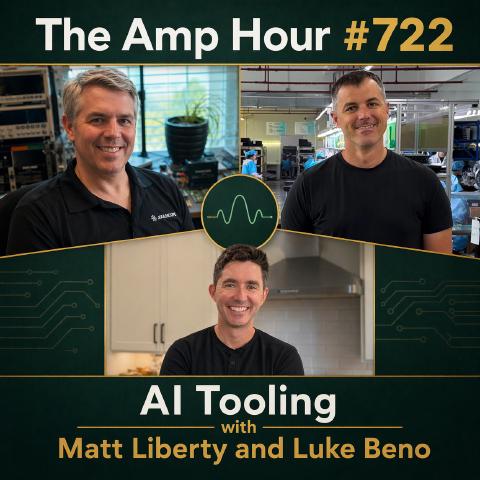
#722 – AI Tooling with Matt Liberty and Luke Beno
Download episode · 105 MB
Also on Apple · Spotify · YouTube · RSS
Show Notes
Welcome back Matt Liberty (Joulescope) and Luke Beno (Werewolf.us)
- Matt has been a guest on episodes 527 and 607
- Luke was a guest on episode 272
- Luke launched a new cable manufacturing and power supply company in the US called Werewolf.us
- Matt is working on the JS320
- We discussed how PartsBox is a great ERP solution but Matt and Luke decided to go fully custom with Claude Code. Jan Rychter was a guest on episode 542
- We discussed the differences with Product Lifecycle Maintenance. Michael Corr of the recently acquired Duro Labs was on episode 577
- CAM workflow
- A fully verticalized PCB factory is something Jonathan Hirschmann talked about on episode 299
- Jeff Bezos is investing 100B in a fund that is looking at automation in the factory using AI
- Matt recently had success with Claude Code and verilog programming
- Saleae for hardware in the loop using their APIs
- Other tools to check out
- pyelf
- pdfdk blast
- superpowers skill (by past guest at Teardown Jesse Vincent)
- Luke used OpenClaw to power a chat agent in his ERP system
- Working with distributors
- TI backlog
- Chris recently learned that Digikey has a developer API
- Cocotb verification framework (in Python)
- Luke is working on vision experiments for inhouse developed AOI solutions
Transcript
Chris Gammell: This is The Amp Hour Podcast. Released April 22nd, 2026. Episode 722. AI Tooling with Matt Liberty and Luke Beno. Welcome to the Amp Hour. I'm Chris Gammell of Contextual Electronics.
Luke Beno: I'm Luke Beno with Tundra Labs and Werewolf.us.
Matt Liberty: And I'm Matt Liberty of JetPurch and Julescope.
Chris Gammell: Welcome back, guys, for an impedance-matching episode. We're going to be talking about AI tooling here today for hardware and firmware people. This actually comes out of a quasi-meetup group I did for the consulting forum. You guys have been very active participants there, and we're really just kind of, I don't know, we've been trading notes. You guys are doing a lot. I asked you to come on and explain some of it here, but I'm trying to figure out what I should be doing. It's kind of like this consistent FOMO, I think I mentioned on the show before, of like, ah, I feel like I could be doing more. And you guys are doing, so I thought, well, I can have Luke and Matt on to talk about it.
Matt Liberty: Definitely. Well, thanks for having us on. We're also figuring it out. We've been playing with AI in a bunch of different areas, but it's changing so fast, and the way that I can actually apply it is changing so fast. You're always missing out on something.
Luke Beno: Yeah, and I completely agree. It's just get started somewhere and keep playing with it until it becomes useful in a way that's meaningful to you.
Chris Gammell: Yeah, I was reading some, like, I was reading a Hacker News thread about, like, OpenClaw. You know, I talked about OpenClaw one or two episodes ago, and just, like, you know, I've been trying it out and playing with it, and then Anthropic changed their policy, and it's like, now I've got to pay for tokens, and, like, that's kind of changed things, and just, you know, there's been a lot of trying stuff and failing, and really it comes down to, like, how much time am I really going to spend on this, too? Not just OpenClaw, but, like, all of the tooling. Some of it actually makes sense, but a lot of it is, like, throwing stuff away. Like, you know, it's trying stuff with the knowledge that it's, like, this might not work out, and then it's almost like, well, it would have been faster to do it myself. I think there's, like, an old XKCD comic of, like, showing, like, the crossover time of, like, writing a script versus, you know, like, just doing the thing. You know, like, this kind of feels like that a lot of the times.
Matt Liberty: For sure. You know, every time that you try to learn something, it is essentially throwing away time if you're a productive engineer, right? But it's also investing in your future. You know, with the AI stuff, there's so many things right now that it can be almost immediately applicable. You know, so simple bug fixes and, you know, for firmware or software, it has gotten tremendously good at. You know, architecting full systems, still a big gap.
Luke Beno: And I think, too, your ability to, like, recover from time wasted, if you can harness the AI tool, has actually really improved. Like, maybe the first hour was a loss, but maybe the second or third hour that you spend on it could recover all of that time and then some more.
Chris Gammell: So I had an interesting experience the other day where I was showing a thing that I kind of I've coded together to a coworker. And he knew way more in the space that it was in. It was like a web tool that I did. And he, like, gave these incredibly good suggestions. And I felt, like, defensive. It was so dumb. I was like, well, I've spent time on this. And I built this thing. And both of those things were not true. It's also that. So it's like this weird psychology. And then, you know, like, then I fixed it and I moved on and it was fine. But it is interesting, like, the psychological aspects of the building things has changed a little bit as well.
Luke Beno: Yeah. And I feel like, too, like, engineer, your engineer brain kind of handicaps what the AI may or may not be capable of doing. And a lot of times you don't even think to try it just simply because you just think it would be too good to be true for that outcome to happen. And then you try it. Sometimes it's real. So that's, yeah.
Chris Gammell: Well, let's step back and give people, so you guys have both been past guests of the show. Let's give people a quick look at where you've been, what you've been doing in the meantime. So Luke, why don't you go first? Then Matt, you go.
Luke Beno: Sure. So I run a company called Tundra Labs. It's been doing it for about seven years, maybe coming up on eight soon. So we build hardware. Our first product was a Kickstarter for a virtual reality device called Tundra Tracker. That's been really successful and, you know, learned a lot about creating a business, selling products, fulfilling products, doing all of the business-like things in addition to the hardware engineering. And then over the past two years, we've been investing in a new product and a new brand called Werewolf. The website is werewolf.us. And we're trying to solve shortcomings of the USBC ecosystem, specifically in power delivery. And so this time around, we're working on building our own manufacturing line. We really focused on high volume production in the United States, particularly of modular electronics. And so the first product that we're bringing to market in that category is a product called V-Flex. And it's essentially a configurable USB power delivery sink that can be programmed for any output voltage and any adapter cable that can connect to traditional things like DC barrel jacks and legacy products.
Matt Liberty: So I founded a company called Jetperch. LinkedIn just told me it was 15 years ago, which is kind of crazy. Initially as a consulting company, but then in 2019 launched the first JewelScope JS110. That went on to sell until I couldn't build it anymore due to COVID shortages. The JS220 launched in 2022, currently working on the JS320, our third generation. It's a product that allows people to design things with lower energy and better battery life. It makes it super easy to measure energy consumption and high dynamic range current. And now I'm figuring out how to run the business more effectively and easier for development and testing and robustness, all using AI and new ways of approaching problems.
Chris Gammell: Yeah, and I mean, from what I've learned from you guys as well, it does seem like Luke's doing a little bit more on the operational side and even into the physical test. And Matt, you've been doing more on the code side, firmware, FPGA, but maybe also some logistical stuff as well.
Matt Liberty: Yeah, I also created a ERP system as well. So that's one of the things that we have in common.
Chris Gammell: Right, yes, that is what we started talking about. And you guys gave a demo of that. It was pretty cool. Maybe we start with that. So like ERP generally, there's what, like Arena is one of the ones? No, it's PLM. See, they always get this stuff confused too. PLM and then ERP. And like, so like give us what's an ERP.
Luke Beno: Yeah, and I kind of view all those tools as kind of like one big massive thing. And there's no like defined lines between them. I guess I can go ahead and my interpretation of an ERP is kind of all of the business functions that you have, like keeping inventory, recording orders and fulfilling orders, doing planning where like inventory of parts that you need in order to do a certain build or something like that. It's all of the like organization around operating your business. ERP means enterprise resource planning. So any resource that you need to use within your business, the ERP will help you to coordinate that.
Chris Gammell: What are the big ERP providers, I suppose? Is that like, I can think of it. I can't think of it.
Matt Liberty: SAP has been around in the big gorilla for decades. There are tons of different solutions. You know, but the thing is like with SAP, if you even want to sit down at the table, you're spending a million dollars to customize it. You know, it's meant for big companies. And I think it's important to say that Luke and I both run small companies. So previously I was using a tool called PartsBox, which is great. If you don't want to roll your own, it's an off the shelf solution that has served me well all, what, four or five years now. But for me, an ERP is really about managing and predicting and ensuring that my builds all come off right. So it's on the engineering side, taking your design and entering into a way that you can track it. Then purchasing components and making sure that you're going to have the components you need when you need them. Also integrating with suppliers so that I can purchase parts easily and then track when they're going to be coming in. Things like change orders. Another thing in the fact, I actually have worked with my contract manufacturer to track parts through the factory. We had an issue over the last few years where parts kind of went missing. I have enough parts that it's hard to find if you just stash them in some random box where those parts are without a three-hour search. So now we're organizing things much more carefully, not carefully as far as time, but carefully as far as tracking so that if someone needs to get a specific part, they can just look it up in the ERP system and know exactly where it is.
Chris Gammell: Yeah, I should say, Jan, who does PartsBox, was also on the show back on 522. And that started kind of like lab management, but also then it did expand into more of a, and you also expanded it, right? I mean, you guys had also like done add-ons to there, but now it's kind of turned into this more of a bespoke system. And it is interesting too, because like it could pull into these other ecosystems as well. Like PLM is product life management. That's like drawings and things like it. You mentioned manufacturing tying into that. It seems like it's like this ties to this times. It's just like so many different pieces that are in there. I think Michael was also, Michael Kaur was also on the show at one point talking about Duro. Like that's, you know, like all of these different tools that are in this space. And so now it's like, well, the relational databases, things that that's like something that AI does, an LLM tool does really well, actually, I feel like. So it does seem like a good target.
Luke Beno: Yeah, it certainly is. And every use case is so unique that you wouldn't be able to find like this Goldilocks system that checked all the boxes for your one specific company. That was the great thing that the AI development unlocked for, I think for both Matt and I is like to be able to build the exact system that we wanted, nothing more and nothing less.
Chris Gammell: What's something you would need there that, you know, like that like a SAP might not have, even if you did pay the million dollars, like what are the, some of the things that you guys put in there that makes it more useful, I guess.
Luke Beno: So I would, I would say that for, for us, because we have manufacturing in house, we, we bring in some of the PLM type stuff where you have, you know, release management tracking of like, say manufacturing files for a given pick and place machine that we can develop. I call it like a cam workflow computer aided manufacturing where we can have tools integrated into the ERP that analyze like Gerber files, pick and place files, and actually create the programs that we run on the pick on our specific Juki pick and place machines. So like it gets really a long tail when you start to compound all of those different things into a single tool. Say for example, running test fixtures where you want to run this specific programming operation and then have the programmer upload a, an archive of like a record that you program that, that can all be one system, one giant monolithic system that does exactly the business practices that you want to do for your specific business.
Chris Gammell: Yeah. Maybe we should also say like, what is the alternative, I guess. So like in the case of like the Juki machine and things like it, so like what would it have been prior to all this stuff? Like what are the flows on a factory floor? Like your, like yours in house?
Luke Beno: Yeah. Well, you're stitching together a lot of disparate software that's been developed on different platforms over time with different user interfaces, you know, might need to run on a specific windows machine, all of these different like hodgepodge Chinese characters that were maybe,
Chris Gammell: you know, exactly. Yeah. Maybe give you license errors.
Luke Beno: So, you know, oftentimes, you know, like one thing is I bought used equipment. So like maybe that software is not updated. It's out of maintenance. It requires windows seven or something like that. Like it gets really fragmented really quickly with just all of the different pieces that you're putting together, something like that.
Chris Gammell: Got it. And then what about on the CM side, Matt? So you're doing now working with the CM as well. You're handing off what, like just a bomb and they're doing all that kind of back of house translation to work on their machines.
Matt Liberty: So as far as integrating into the pick and place machine, that's still all on them. And they have a, they're a small CM. They do a lot of that manually.
Chris Gammell: And when you say manually, do you mean like, like a USB stick sort of thing or like they actually like Dropbox or share window, share drive kind of thing, or doesn't even know?
Matt Liberty: So I'm not as much of a part of that, but I see them literally at the machine entering in parts information and footprints so that it places it correctly. So, so I'm not entirely sure of their process, but as far as my process to integrate to them, it's giving them, you know, they have a bomb. They have the pick list of stuff that they need to get, and they now know where to go to get each of those things and that it's actually there, which makes it much more effective for my inventory to live there at the CM and have them pull it, you know, do the run and then put it back if there's any left for the materials. One of the problems that I had over the years, you know, dual scopes have been around for seven years now. And as you have attrition and things get lost or not ordered correctly, you kind of get out of a sink unless you do a full audit at a regular basis. And that was getting challenging. We had some mistakes were made. So this is all helping us stay on top of things. So as they use like a full reel, they scan that they use it. We know where it is in the build. And we know at that point, it's a checkpoint of inventory so we can stay on top of making sure that, you know, all the inventory is on order for the future. You know, from my perspective, before I did this, I was using parts box with a bunch of custom Python scripts that would help me forecast my builds and what I need to order when. I think parts box is starting to extend into some of that. I'm not sure. I know it was on one of the feature lists items that Jan was considering. But for me, it was all custom Python. Now all of that's integrated into one thing. Also with a better barcode scanning for the way that I want it. This is something again that parts box just implemented at the end of last year, the barcode scanning stuff. So there are definitely alternatives out there that are meant for small businesses. I had gotten to a place where there was enough kludge together that it relied on me being disciplined enough to run it, which means it didn't get run. So I actually having a website that's just working all the time and I just look at it, it's removes that one frictional point that makes it so much easier for me just to stay on top of things. Yeah, it is interesting to like the, the, I feel,
Chris Gammell: I feel like the kind of the engineer way is almost like pushing towards like the Tesla method of like, well, I'll just do everything. Like what, you know, not like a, how hard could it be? But like, I just want to, I want to get my arms around this whole problem. And it does seem like some of this is actually enabling some of that. Of course, there, there are the known downsides of it all as well, right? More to manage more tech debt, all that sort of thing, you know, and unknown bugs that might be under the hood that there's, there's always that sort of thing, but it does seem like what I'm hearing from you guys, you know, as a, as a third party is like, this is like literally money in your pocket or not. Right. It's like parts left or parts, parts lost is like, like you paid for those parts. Those, those, if those get found two years later, it's like, oh shit, like this is, I really could have saved some money there, you know, like that. And like some of the parts you use, Matt, I know are not cheap. So
Matt Liberty: for sure. Yeah. And just being able to stay on top of all that really helps me, you know, be more confident about the business. So yeah, there is definitely time, but there are certain areas where AI is really good because there are tons of examples. An ERP system that is web-based is kind of in that sweet spot because there's tons of web things that are out there, really easy to create a website. You know, my tech stack is just SQLite with Python running and SQLAlchemy to make things, you know, pretty standard. So it's not going crazy off the rails in any direction. And an ERP system's done, been done a thousand different ways by a lot of people. So it's a known thing. Now, obviously we are customizing it, both of us, but it's not like it's something that's invented. It's that we're creating from scratch as something that's never been done before. It is very much out there. And AI is, if nothing, a great pattern recognizer and replicator.
Chris Gammell: One thing I wanted to call out was actually back in episode 299, I mentioned this to you guys when we did the last, you know, AI Hangout thing is Jonathan Hirschman, who was on the show, he did PCBNG, which was kind of like a small version of what Luke's talking about as well, where it's basically like all they kind of reverse engineered all the tool commands. They then set up this, this kind of verticalized mini factory system. Then they got bought by Altium. And I don't know what the hell happened, but I haven't heard from Jonathan in a long time. I hope he's on a sandy beach somewhere enjoying a, you know, a fruity, fruity cocktail or something like that. But to me, this is my kind of reference point for this sort of thing. It does sound like Luke, you're kind of moving in that direction as well, where you might be able to reverse engineer, push more stuff direct in the machines and really find efficiencies that way, where then you'll also run into the problems Matt talked about, where it's like, and AI probably hasn't scanned a lot of Windows 7, you know, tooling from Juki or whatever, right?
Luke Beno: Right. Well, that's pretty interesting actually too, because isolated use case, but the Claude specifically, what, what I'm using for, for this task is really, really good at protocol analysis and diving into like Wireshark dumps of communication between like say the Juki software and something else. So actually it's, it's extremely skilled and diligent at sorting through mounds of data more than any, any human can have stamina to do, right? Like if you, you know, none of us on the call would a want to, or be, be physically capable of, you know, reading a million lines of Wireshark dumps and comprehending it at the level that the, the LLM is capable of. So actually that turns into an actual very easy task for, for Claude to reverse engineer the, the, you know, over the wire protocol that's exchanged between the, the proprietary Juki software and the pick and place machine itself. That that's a major unlock.
Chris Gammell: It is kind of at the level though, that's still kind of at the level of like inducing movement in a hand by like electro stimulating the, the nerve up your arm sort of thing. Right. It's like, it may be a little bit more than that, but, but still it's not like direct control and you know, it is, it's a workaround, but I remember you saying, Luke, you said, you said too, that like these, these toolmakers like Juki and similar, they are so good at mechanical and precision and even dry, you know, like control systems, but the software is just the last thought. And so it's like, actually you could find a lot of opportunity in that space. If you, if you did get into the, into the guts of the thing.
Luke Beno: Yeah, definitely. I think, I think that that's like, uh, you know, the older the machine, like the more elegant the hardware is like the mechanics of the margin and then the software is. Yeah, exactly. So everybody who's used software that is for a particular like machine or whatever knows that it can be very unuser friendly and it has features that are named weird things and they're located in weird places. And like the institutional knowledge that like people who have experience with this is they just know the hiding places for all of these specific knobs to turn.
Chris Gammell: Yeah. It is really interesting to, I, I should, I'm going to find the article now, but, uh, Jeff Bezos is currently investing in like a big fund. That's basically like the, the things we're talking about right here, basically like reversing and implementing like protocol hijacking. If you don't mind the term that is basically like, there's a new 200 plus billion dollar fund, I think in order to bring this same kind of idea into the factory. Right. So like industrial control and similar, and like, you know, finding efficiencies in the factory. I think we could all imagine across, across the space, being able to find more places that basically LLM tools could in theory make things more efficient. So they're kind of chasing that stuff right now. I'll drop that link in if I find it, but for sure. Cause when you're building a factory,
Luke Beno: you don't buy all of your equipment at the same time. So it's, it's just a lot of different isolated systems that get stitched together basically by people and by, you know, people's workflows. This is kind of replacing that with, with like actual structured code.
Chris Gammell: I did misspeak. It was a hundred billion dollars, only a hundred billion dollars guys. So you just, you know, if you want a piece of that, it's only, it's smaller now since I said it.
Matt Liberty: And just keeping on the pattern recognition side of things. So, you know, like Luke, you're using it to do protocol analysis. One thing that I've found, it doesn't matter where that, that massive amount of data, as long as it's structured and it has some, you know, sense to it, the LLMs are really good about figuring out how to parse it. In my case, you know, I had a, an issue with the gateway. So Verilog code where an FPGA implementation of a FIFO was not treating the read flag correctly in one case. And then the empty flag was also not working. So two different errors in the same area, which, you know, is how things work. But I ended up having the cloud code instrument, everything captured all with the salier logic analyzer. And I had this huge trace of where every buffer that was going through these set of FIFOs was being pushed and pop, pushed and pop, pushed and pop, pushed and pop. Sometimes it would pop the same one twice, which it shouldn't do ever, right? Because it has to be pushed on in order to be repopped. So that indicated what was wrong. Cloud code just iterated with hardware in the loop, found the issue, the first one, which was the, the empty flag and fixed it. It wasn't until, you know, a few months or a month later that I actually came across the other one because it's so rare. But again, it was like the same setup, just put it through all this data. And it even wrote Python scripts to go through, which had been interpreted so that it knew where, when these push pops happened. I mean, this was a trace of millions and millions and millions of pushes and pops. And it was able to parse through all of that and fix the issue, commit it and build it and prove that it was working all with hardware in the loop too.
Chris Gammell: And the hardware in the loop piece of that was the salier. So this is actually like programming a new image, pushing the bit file to the FPGA, measuring the output using the salier. That's the, that's the hardware in the loop there.
Matt Liberty: The only caveat is I was also human in the loop for the salier. So it would, it would tell me when I had to capture it because I couldn't figure out how to get the salier to interpret the data using the analyzer correctly. Salier now has an experimental MCP server that was working, but it couldn't figure out how to get the analyzer data out of it. So I don't know if it was something I was doing wrong or if the, if, if the salier code is not quite there yet, but I had to then dump all that out to a CSV file that it would then interpret. So almost, almost complete.
Chris Gammell: Hardware in the loop as a, you know, as like a catch all term is like something that I've, I've seen, I think experienced. I've seen, I've seen the workflows and stuff like it never actually implemented myself directly, but it does feel like one of those things that like, we all felt like it should be possible. Like we all know, like, okay, I'm going to program this new board and then I'm going to plug it into my scope. And then I'm going to look at the trace on this, on the scope screen. It's like, and wouldn't it be easier if there was something that just did all this stuff and hooked it all together? And it's like, yeah, yeah. And actually we're kind of moving in that direction, but now some of the tooling is also capable there. Are there other tools that are, that you find are like, you know, even just like Seger and J links and stuff like it, like hooking in open OCD,
Matt Liberty: things like that. Yeah, definitely. So I'm using Sager with PyLink dash square, which is a way of interfacing through Python. Also PyElf tools so that it can go directly to the, the elf image that you build that's debugging. So it knows exactly where all the symbols are and then it can inspect. One thing that I found, so I'm using an STM 32 H7S. I had to break up the data sheet. It's like a 3000 some page PDF data sheet. So I broke it into pages just using PDFTK BLAST. So PDFTK is the program. BLAST is the command within it or subcommand, and it just splits it out into single pages. And then I also ran that through, I forget which tool, but it's one of the ones that does PDF to markdown. So now the LLM has access to the PDS and the markdown by pages. So it doesn't get overwhelmed in its context and can go through everything. I also had the SVD file, which is arm's way of saying where registers are at, that it could look at too. And with all of that, it's done remarkably well in a few things. I actually had it write the driver for doing signature validation. So it has some crypto, a crypto block. And I pushed down to the bootloader, encrypted images that are signed. And I worked with the Cloud Code to actually figure out how to configure this correctly for the crypto mechanisms I was using, which AES and it's the one that I think is used by Bitcoin, actually, is the one I ended up selecting. But yeah, it could do a bunch of different ones. And with that, again, it's one of those cases where you can set up a feedback loop. You know what the crypto method is, you encrypt it, and you know what the decryption or in the signature validation is supposed to be. And when you have that type of feedback loop, if you can set it up so that there is a clear pass-file criteria, Cloud Code can do really well at just iterating until it figures it out.
Chris Gammell: What about you, Luke, on the iterative side of things? That's one thing that I've struggled with personally. I remember you guys talking about it.
Luke Beno: Yeah. Just one example quickly that's kind of in the same vein as what Matt was talking about. When we were reverse engineering a certain part of the Juki pick and play stuff, there was a binary file that had a lot of critical data encoded into it. And I actually just fed it a screenshot of the Windows GUI that led to that encrypted data. That was enough hint for it to like, so take a screenshot of the GUI, take the output file that was like a proprietary binary blob format. And it was actually able to find those values, those key values inside of the binary data and match them up to reverse engineer that binary blob. So like you can feed it some pretty...
Chris Gammell: Just doing like text search. Just basically doing like OCR and text search then based on the found characters.
Luke Beno: Yeah. And then also just like looking at the encoding of like binary integers or floats and then matching it. Honestly, I don't know how it worked, but it actually, it worked quite well. So I was, that was one of those things where I was just like a little bit out of body experience, like, wow, this is more powerful than what I would have expected. But in general, I'm sorry, what was the original question, Chris?
Chris Gammell: Well, actually I was talking about feedback loops and stuff like it, but I was asking about like, you know, basically going towards a validated solution and having, having feedback based on like a set outcome sort of thing.
Luke Beno: And we should definitely like touch on process a lot more, like how to engage with a tool like Claude Code or OpenClaw. I use it in two different ways. Like sometimes you're doing like major feature development where you're more in like a planning and documentation mode. And then sometimes you're kind of having more of a conversation with the AI where you're trying to nudge it in a particular direction to like refine a feature that's developed. Most of the time, I'm not hardware in the loop like this, but like if you're working on a user interface and you don't know how to describe it specifically, like in one fell swoop with a document, you know, you can piecemeal chat with the tool to say like, I want this button located in this location and, you know, have this function and kind of implement it piece by piece. And that's where the feedback loop is like you curating what it should do next. Almost like if you were a pair programming with, with someone or like it, the interaction is very similar to how you would interact with the software developer, you know, who is working on a project with you. Yeah. So like less of a, less of a,
Chris Gammell: like a written down defined goal. It's more like in your head, you know where it is. And then you're kind of helping to shape the direction in order to get it to what's in your head at least.
Luke Beno: Because it's really hard to like, from the onset to write like this super verbose document that captures all of your requirements. You generally know on broad strokes, but you want, but then there's that step in between where you kind of, that's more of the vibe coding piece of it. So it's not all vibes and it's not all documentation. You have to find the right, the right combination of two.
Chris Gammell: Yeah. And I do feel like some of this, some of the stuff like within the process side too, like kind of like the coming in my own experience of like being frustrated with it, be like, well, I know what I want. Right. And I know that this tool is supposed to be great. Right. Everybody says, oh, like cloud code is great, whatever, like Gemini is great or whatever, whatever's out there. And then I try it and I'm like, Hey, make me a program. And it doesn't do it. And I'm like, oh, this sucks. And I move on. Right. And that's one of the things where it's like, you know, learning from you guys, learning from other people on the forum and run it really just like having some reference points on like, what the hell do I do? And so someone pointed me at this, the superpower skill. Have you guys used that one?
Luke Beno: Not that one specifically.
Chris Gammell: Okay. So it's like a framework. Matt's used it. I've used it. It's actually written by a past guest of the show, Jesse Vincent, who does keyboard.io. He is the author of that and incredibly famous now as a result of that. But it's basically just like a set of like tasks that are in there, set of skills that are there. And then kind of a overarching, like detection of when you're in different stages of planning. And then it is setting up that full document. So like the other side of the, instead of just doing the one thing and guiding it yourself, it's literally like, I'm going to write a full spec on what this thing should be and then go through planning and testing and all that other stuff. And basically it, it lives as like a meta layer on top of the other stuff, right? Is that how you experienced it, Matt?
Matt Liberty: Yeah, I definitely got confused by it. I'll say honestly, it kicked in sometimes. So when I, when I knew I was doing it, asking the superpower skill to do things, it made more sense. But then sometimes it just stepped in when I had it installed and I didn't use it long enough. I've kind of now uninstalled it and I want to try another thing. I just couldn't quite wrap my workflow around it because I think a lot of what I'm doing is not as much of the planning as it wanted to take on. So a lot of what I, the way that I've been using AI is much more like I'd use, you know, an intern or new grad, you know, kind of say, do this little teeny bit. Don't think too much. I don't trust you enough. Yeah. Here's the piece. Yeah. Don't, don't bite off too much. Exactly. Now, when I did the ERP system, things were different.
Luke Beno: Well, and also it's just like, I don't know what to tell it to do until I see the result. Yeah.
Chris Gammell: There's also that, right? Exactly. Truly the iterative like product approach. It's like, yeah, I don't know. I have one in good example where it worked really well. I was making like a documentation generator thing that I needed. And like, this was like, I knew I was working to a spec. I had to make docs that fit that spec. I basically said, Hey, like I need to do all the things to fulfill this requirement. The fulfillment was already there. I pointed to all the different pieces that it needed to, to like do. And, and in that case, it was great, right? It was multi-tiered, you know, development. It was web-based like we talked about, like, so some things are very well defined. You know, I, I kind of didn't care about the architecture, how it was built, whatever. And that is my like best success story with it yet, because I, I, I was firm on the end goal. I didn't care as much about the architecture and kind of let it do it, whatever's the strongest there. And I was just guiding it to, for the, some of the preferential stuff like Luke mentioned as well, like, well, this looks stupid or this interaction is not how I expected it. That's more like a product manager than it is like a directing of intern director of interns.
Matt Liberty: Yeah. And it's just where I've been right now with my development cycle. I'm, you know, finishing things up rather than starting new things with the exception of that ERP,
Chris Gammell: you know, system. And even an ERP system, like you're not going to know, like you might say, like, I've used other ERP systems. I do want it to have this or this or this, but it's like, you know, you guys have been talking about adding stuff on as you go. Like, like Luke, I'd love to talk about like how you've integrated the chat element too, as like a, whereas I normally thought of like a chat in a, in a site is like this hindrance. You've actually developed a really interesting use case here.
Luke Beno: So in that changed a little bit also with some of the changes to. Yeah, I bet it did. So one major unlock for me and the ERP system in something that, so there's two different things. The first is that I wanted the ERP system to be agentic from the beginning. So, or call it agent first. What that means is that it doesn't have a traditional user interface where you have a whole bunch of form and text entry elements or buttons to click, but instead you chat with an agent who manipulates the data for you and enters it for you. So like a good use case is that I can upload a Gerber files, bill of materials, pick and place file, and a step file of a board that I want to load into the ERP. And it has a skill that will like extract all of the parts, find them in the ERP if they exist, create them if they don't, go out to DigiKey and LCSC and match it to manufacturer part numbers and generate like pricing information for it. It'll actually extract the individual component step files from the master step file, so that I can know like the footprint information. So all of these things would be like probably 10,000 button clicks, if you had to manually transcribe the data into the ERP. But since it's, it's in chat, it's literally just uploading the files and say, hey, go do this. And I guess the difference is that corner cases are handled much more elegantly, because if the agent runs into some problem along the way, it can ask you questions, or you can, again, kind of help it with more supplemental information so that it can actually digest the data instead of it needing to be perfect on both ends so that like some, you know, just dumb script could go and extract the data necessary.
Chris Gammell: Yeah. I do feel like there is always this like, you know, like reading kind of criticisms of the, you know, all of these tooling systems out there. It is like, well, a script could have done this, right? Like that is pretty much like a script, a cron job, an innate end flow. All of these things are like tools that have existed. And so like, well, okay, then why is something else important? Like, why did your story, both of these stories like resonate with me? It's because like, there actually is additional value here that like, would not have been with a script or, or even a person in the loop, right? Like there's no added value in some of these cases. It's literally, it's, it's all downside to not use it. So like, then the upside is, is more clear, I feel like.
Luke Beno: Yeah. But, you know, anybody who's written those scripts quickly realizes like that they get on some rabbit hole of some corner case of, you know, someone using a time zone thing or whatever, right? Like all of these different little things that happen. So the LLM is self-healing in that way where it can read between the lines in a way that, you know, it's not just explicitly executing code. It's smart like that, like a, like a human would be, but a human that has infinite patience and like really, really a lot of diligence.
Chris Gammell: I don't, I don't know. I've, I've, I've sent a lot of board files that look very similar to like JLC or similar. And they're just like, yeah, you know, we're just processing it, sending it back. Yeah. I've got it wrong again, Chris. Got it wrong again.
Luke Beno: JLC is agentic too. They just put a human in the loop there.
Chris Gammell: They, a lot of humans too.
Luke Beno: So yeah, it's, it's the same.
Chris Gammell: Yeah. Yeah. Except they're 12 hours delay, which is like, you know, if I can get past the 12 hour delay, then I'm in better shape.
Luke Beno: Yeah, for sure. And then the second benefit of adding the chat previously was that I could do like core feature development inside of that in-app chat too. So like if I saw a feature that I wanted to add to the chat, I could just write in app, you know, ask it to add this feature. It would do the planning and implementation of it. And then it would just magically appear when I hit refresh on the app. That to some extent has been diminished now because of the Anthropic not allowing their subscription plan to be used with OpenClaw, which was a tool that I was using.
Chris Gammell: And that specific, I should say as well, I think I mentioned, I referred to it in the last episode or whenever I was talking about OpenClaw, but basically Luke and Matt talking about this specific element and probably the chat element being built into an app is like, that's what finally got me to be like, oh, I want that. Like, that's what I want.
Luke Beno: Yeah. Because you're not just, you're not just using the app with the chat. You're adding features and it's a closed loop in that way where you're, you're adding features to the app while you're
Chris Gammell: using it. And it is always additive as well. Right. I feel like another piece, well, we probably didn't get far enough down the line where you didn't get far enough down the line or really any of us have where it's like eventually features conflict. Right. And you know, you bolt enough stuff on and then eventually it's like, well, you got 25 databases and all of this data, this data lived in this database, but not this database. And that's why the future thing didn't work. It's probably not at that level yet. I'm sure like any product manager listening right now is like screaming at their, their podcast app, but like, but at the same time, like who cares? Right. It's like some, well, I say it as a, you know, a casual user of this stuff from an ERP perspective, that could have been an
Luke Beno: eventual downside, right? Yes. And no, it is a downside and it is a risk for sure. But you also now have a new, think of it like a human that's extremely diligent that can pour through all of your old legacy data and figure out a plan for migrating it from point A to point B. It's just more tokens, which is costly today, but won't be costly in the future. So like we tend to try to prevent events that would cause a lot of human pain in the future. But if it's an LLM that's incurring the pain instead, the consequences of, of those mistakes are substantially reduced.
Chris Gammell: But that's interesting. Cause you said you stopped doing it when the cop more expensive as well.
Luke Beno: So yeah, I mean, it's a, it's, it's a mind game, right?
Chris Gammell: Sure. Oh, totally. Yeah. Yeah. And I think, I think about like the stuff that you guys have been talking about too. It's like the psychological barrier is just different, right? Like you might've been able to go on Upwork and hire someone to build an ERP system 10 years ago, right? That is exactly your SPAC and you could send them this thing. And it was not necessarily part of the, the, the plan, right? Just because, well, there's cost and there's a lot of hassle. And now those barriers have been reduced quite a bit. So that's where it, it ultimately gets interesting. I always think about like the psychological barrier just to getting started with a project too, or as much lower than it used to be, you know, whether or not we get ourselves into quagmires as a result, that's, that's a future
Luke Beno: Chris problem, you know? Right. Right. Yeah. At the end of the day, if you're more productive, you can pursue more quagmires. I'll have, I'll have so much time. Yeah. Never have more time, but you'll, you'll have more work output, whether it's good or not.
Chris Gammell: Yeah. That's more, that's, that's a question for the site is philosophers, right?
Luke Beno: Well, and like on the, on the cost piece of things, you know, say that you did hire someone from Upwork, I think that you would be prepared to spend probably thousands, if not tens of thousands of dollars to develop the software. And so like, I have to, I said, it's a mind game earlier. It's like, well, then theoretically I should, I should be willing to also spend tens of thousands of dollars with Anthropic for tokens. But for some reason I'm super hesitant to do that. Right. Even though it makes logical sense, it, it's like, I use the analogy of like paying a dollar for an iPhone app. It's like, there's just that once things don't cost zero or $200, then it, there's just a big wall.
Matt Liberty: Yeah. And like, just to put things in perspective, I just did a stats on my ERP project for non comment lines of code. It's 22,000 lines of Python, 12,000 lines of JavaScript, 5,000 lines of CSS, you know, so almost about 40,000 lines total. I mean, that is years, a couple of years of work. I mean, that I did in nights and weekends using Claude and it just, you know, pumped it out. Yeah. So the cost has fallen.
Chris Gammell: I feel like lines of code is kind of an older, you know, that is going to be a thing that will be quaint at some point, right?
Matt Liberty: It is, it is still, it's never been a good metric, but it does give you a sense of scope. Yeah. It's not a thousand lines of code and I, you know, for these lines of code, I actually, I was not vibe coding everything. There's the, the Python side. I was paying very close attention to the database structure, the JavaScript. I did not keep on top of as much, but it's reasonably good code as far as code quality with the unit tests and everything that doesn't include the unit tests. So it's, it's a lot of code. I wouldn't have, without some type of tool like this, I would not have taken on my own ERP system. That would have been crazy.
Luke Beno: It would have been 10, 10 developers working for two to three years to get the same amount of output, right? And that would be untenable.
Matt Liberty: Oh yeah. I would, I would still be on parts box, which is, you know, still great. It's just now I have, you know, everything that I can think of in an ERP system that I want. I can sit down in an hour or two, and have that feature, whatever, whatever new feature I want.
Chris Gammell: Yeah. You had said that you put in your own barcode scanner. That was like an hour, right? Didn't you say like that was, that was a photo based one, or that was an actual bar, like a shooter, like a laser one.
Matt Liberty: So for mine, I'm actually using barcode scanners. So I actually have both like a zebra, like when you'd see at a grocery store, I also have one of the key, the fully integrated, it's an Android phone, really. That's also a barcode scanner. And I have it locked so that it displays the ERP system. So you're scanning in and you have different things like you can transfer, receive, or say you consume this and you just, you know, select that on as the Android app, if you will, which is just the locked in website. And then you scan and it does whatever action you've selected. So yeah. And adding that in was all super easy.
Chris Gammell: Is that the one you give to your, your CM though, is the, is the Android one? Yeah. Is that right? Yeah. Yep. Yeah. Yeah. Super cool. Yep.
Luke Beno: Yep. And actually now too, like the agents are, they have, I think very good image recognition and OCR. Yeah. So we actually, when we check in parts, we just snap a picture of the, of the part package in chat and send it to the agent in it. It, you can do this with, with any agent, just testing it in chat, send it a picture of a reel of parts and it'll extract all the information and put it back to you in structured format. So like even barcode readers are, I mean, I think they're still useful because they're extremely fast and deterministic, but they're, they're kind of optional even because the, the agents are so good at reading images. They're, they're trained on billions of these images.
Matt Liberty: Yeah. They'd work well with the Avnet labels, which are terrible. DigiKey and Mouser now with the 2d barcodes are, are, you know, have a lot of information that just comes right in.
Chris Gammell: Yeah. And how about the tie in to the, to the various distributor systems as well? So you guys, Luke had mentioned DigiKey and LCSC, but like, I actually learned from Ben that there's API access to DigiKey. I always thought that that was locked down for some reason, but there's Ben Hess from DigiKey, but like, do you guys actually tie into all the APIs or is it more like scrapey kind of stuff? What's working there?
Matt Liberty: Yeah. So my ERP ties into DigiKey, Mouser and TI all at different varying levels. You mean some suck more than others? Is that what you wanted to say, but you didn't say it out loud? If you needed a crystal set? No, I mean, they don't always give you the full access. It depends upon who you are and where, where you're at. So I ended up getting a backlog account with TI, which was a huge win for my business. And I thought that as part of this, I would need a way of placing an order through their API because that's how they advertised it. Well, they had recently just introduced a way you can kind of do this upload halfway in between thing. The integration with the ERP system, for some reason, I could not get working. They didn't really want to support me and uploading works fine. So I can still generate my, my PO and just upload that PO and it works. So there's varying levels of integration with the APIs, same with Mouser and DigiKey. But for the most part, I can go in, you know, see what I have to order, select where I want to order it from, build up the PO and then say,
Luke Beno: go and I can place an order. It's a little bit of a cat and mouse game because the, I think rightfully so distributors are trying to like, they're trying to authenticate what is the API calls coming from humans versus what are API calls coming from other AI tools or scrapers. And so there's a little bit of like this back and forth of like, this API might be blocked for an agent because they're trying to prevent like malicious use of it. But then if you want to have like, you know, you want to have use like Matt is talking about where you're just using it to get work done, but sometimes you, they can't tell the difference. And so oftentimes the agent gets thwarted by one of those countermeasures for scraping. So I've encountered that a lot where like, we have to redo how that interface works, because of new countermeasures that DigiKey or LCSC are putting in place.
Chris Gammell: Yeah. And just so we define for people as well, scraping is when it's like, you're going to pay, this is what all the, a lot of the LLMs have done to build up their datasets as well. But also like scraping has been happening on DigiKeyMauser for years, just to have third party sites that offer the same information that might be on DigiKey without actually having like the, you know, for price shopping similar. And so they wanted to prevent that in order to then have people come to their site to also do upsells and all the other things too, which is-
Luke Beno: I'm sure it's very taxing on their servers to continuously be servicing all of these different scrapes or whatever. So.
Chris Gammell: Yeah. I mean, I, you know, knowing what I know about DigiKey, like they have people internal as well that like validate data, like that they're extracting from data sheets and similar or working with vendors. I have to say, if one thing came out of this AI era was the death of the PDF data sheet, like, let's bring it on. Like, I don't know how we do it guys, but like, how about markdown? That's fine with me. I don't care. Like.
Luke Beno: Really? I love a PDF data sheet actually.
Chris Gammell: Why? What about it? I mean, like, it's, I don't know.
Luke Beno: Because the data is like properly formatted on a page. Like when you load a markdown, it's like, I don't know, I just the side rant, but like, you know, I like take TI for example, they've always taken such great care of making sure that like graphs line up on the page and stuff like that. That's kind of lost.
Chris Gammell: Yeah, but that's done with like an intern and a Word document.
Luke Beno: Yeah. I don't know. I'm old school in that way.
Chris Gammell: I guess so. I guess so. This is the great divide right here. Yep. Yep. Pick a side, everyone. Pick a side.
Matt Liberty: I'd love if all the specs, the actual number parts were in some structured format that was shared across the industry. That would be awesome.
Luke Beno: For sure. So that the AI can ingest it easier. Please offer both formats, PDFs for humans and something else for everyone else. But yeah.
Chris Gammell: One thing that's been noticeably absent from our conversation here is kind of like the, you know, Matt kind of got into this a little bit, but like the making of things, right? So like the, we're talking about the testing of things, but also like the, the hardware side. I personally still haven't touched it. This might just be, you know, what I've been working on and things like it, but like the, I don't, I don't particularly want, want to give up that side of it yet. I'm sure there is, there is surely a time down the line where that's coming. Right. But like maybe people started listening to the show and they're like, well, what about all the various CAD tools and things like it? Like, what about that side of things?
Luke Beno: I'm extremely, well, I know that in the longterm I'll eat my words on this, but I'm super bearish about AI for specifically for hardware design, especially layout. I think there are useful pieces that could be used for like DRC or schematics, like creating certain parts of the schematic. But I very much view those things as an art form where there's not like one particular way to do something, but like it, it comes down to like your preference and the way that you like to have something done. And like, it's just like, when I see these layouts from like the AI tools, it's like nails on a chalkboard. Like I, and now it's even hard to know, like in social media, if people are just posting it for like rage bait or like just to get engagement by like trolling people. But like I saw on LinkedIn, a board that like was designed by AI and the circuit was wrong. The USB connector was facing internal to the board instead of external. And like the LED was, I think that that was rage bait, but like,
Chris Gammell: like, like, no, just no. Yeah. I don't think any job is actually secure in this way. Like, don't get me wrong. Uh, you know, but I, you know, like, like we've been talking about here too. It's like the, what is the happiest path for an LLM right now? It's like, it's not been training on that stuff
Luke Beno: yet. So yeah. Okay, fine. But like solve all the other problems and I'll gladly do PCB layout manually. Yeah. For the foreseeable future. Yeah. Yeah. If you can just take, take away all the other, you know, stuff that I have to deal with on a daily basis to make more time for that.
Chris Gammell: That's perfect to me. I was talking to a younger engineer the other day and we were talking about like design and, you know, he's interested in like doing more design and trying to find that kind of stuff. It's like, man, it's, it's so little of the, not so little, but it, depending on what kind of role you have, you know, it might be 10% of your time, right? Like the, the fun stuff might be 10% of your time and the 90% is the everything else. And what you guys are talking about is potentially the everything else being LLM enabled. It's like, man, take it, take it, take it, you know, I don't want it. Yeah. But there's also a value there too. You know,
Luke Beno: if an AI wants to go and stub out like this whole, like complicated, but very reproducible DDR interface, or, you know, something along those lines where it's just not conducive to human brain, but then like leave the analog schematic to like a human, leave the, the layout of like power nets and stuff like that to a human, like do everything else first. Don't, don't touch that. That's my, that's my
Matt Liberty: opinion. Well, it'll be coming. I mean, the, the process of schematics and layout, you know, I can take my, my head design rules that I kind of use and dump them onto something. And if, if I can do that, then eventually they'll be able to be applied by AI. But so far for me, the hardware side of things, so actually doing schematic capture and layout percentage wise is just so much smaller than everything else that's on my plate. It's not, you know, optimizing a hundred percent means I still have 98% of my work to do. So I haven't even really tried the hardware. It's also kind of where I am in this current design cycle. A lot of the hardware was, you know, mostly, you know, air quotes done last year. So before things really started picking up with cloud code. So I really haven't had an opportunity to even want to apply it other than, you know, minor fixes, which are so fast that doesn't matter, but have had a lot of time with gateway. So Verilog with, you know, Coco TB with the test bench side of that, with firmware, software, and all of that, it's dramatically accelerated.
Chris Gammell: What was the test bench again? The Coco TB? Coco TB?
Matt Liberty: Yeah, tell us about that. It's a, yeah, it's a Python, it's a Python based way of writing unit tests, test benches for Verilog code.
Chris Gammell: Oh, cool. Okay. And that you have been using to help construct test benches and stuff?
Matt Liberty: Oh yeah. Yeah. Oak can crank out unit tests like no tomorrow. So way more. So I tend not to write enough unit tests because they just take a long time to go through everything. And I say, you can kind of look at your code and say, I think all this needs to be covered. And the LLM will just go and bang out tests that, you know, they're at least there. And then you can inspect them and see if you think it's covering the right thing. They will make it so to pass, a passing unit test doesn't mean it's, it's working. It just means the unit test pass, right? So it's up to you as the engineer still to be responsible for saying, yep, that looks right. Or no, that's, that's a false positive or false pass. And it's actually, and I've had this happen where it will make the test pass, but the actual design is flawed. So it's up to you still as the engineer to know what's right or provide, you know, that full hardware in the loop feedback loop. So it can, uh, can figure it out on its own. Yeah. Kind of like,
Luke Beno: uh, I always refer to like eating your vegetables, like doing test benches and stuff like that is something that's healthy to do, but not something that like gives you like tremendous satisfaction a lot of times. So yeah, I can eat the vegetables. You should eat your vegetables, Luke. Come on, man.
Chris Gammell: You need fiber fibers, you know, we're, we're not, we're not spring chickens guys, you know?
Luke Beno: One other, one other thing on the AI design, like hardware thing, you know, if like, let's say that you used to design medical electronics and they were extremely complex systems and you'd be in an EMC chamber debugging something. It'd be a total mystery as to what, what's going on because it's such a complex system. But like when you spend time embedded in the layout or you spend time just staring at the schematic and like bumping those traces around and organizing them, like it's soaking into your brain how this thing works and like you're developing a mental model for how it'll work. That, that knowledge is extremely valuable when you're in those hardcore debug sessions where you, you get confronted with those issues that like are just like super hard to, to, to resolve. Like, so if you just depended on AI to generate those things, I don't, you wouldn't have that context to, to be able to debug those issues nearly as much. So that's, that's a good point. I'm traditional in that way.
Chris Gammell: Well, I mean, how, how, how do people that are, you know, like younger listeners, how do they go and develop that sort of thing? You know, in this age of AI as well, where they, you know, people are getting pushed to do this at their work as well. Like, how do they go and develop the intuition? You know, that, that feels like one of the, the struggles of the future of just like, when it's the 2am problem, you're at the bench, you're, you're like, what the hell is actually happening? Like sometimes actually going back to the physics is the answer. Right. And if you don't have that, that tie back and that mental model, like, I don't know, man.
Matt Liberty: I mean, fully delegating your thought process to AI is not going to be a winning strategy. Right. I mean, so we have to have value to add. And it gets really easy. Oh, AI, just go do this. Right. And if you're not diligent about staying on top of things, about being responsible for your designs, then you're only going to be as good as the current AI model. Right. Which means you replaceable. Exactly. You're going to be replaced by, you know, the next version of OpenClaw or whatever. So it's, I don't have a lot of great advice, but you know, as far as learning skills, it's so different now just because there's so many things that are almost free, that are cheap, that are easy to just have an LLM do. Building skills in those, you know, is very valuable because you need to be able to, to know when it goes wrong and to correct things. But actually spending the time to develop those skills is harder and harder because it's not really what you're being asked to do as a new engineer. That training time is just not the same as what it, you know, what it once was. I mean, I still build dual scope prototypes by hand, just one. It takes the better part of a day to build a dual scope by hand. But in doing that, you know where everything is. And that's a huge benefit towards debugging, just like what Luke was saying. But those type of exercises are going to get harder and harder to justify as far as your time. So the future of fully understanding things, you know, if you're working in backend and frontend servers with load balancers, you don't know what's going on anyways. So maybe it's just because, you know, I'm in the embedded space that I still cling on to, you know, trying to make sure I know what's happening. Luke Gromeny
Chris Gammell: I find as well for understanding like how to even guide stuff. So like, again, just to go back to my one example of this documentation builder, I only knew to guide it because I had built other websites. I was using Cloudflare primitives on stuff. Like the only reason I knew that is because of other stuff I'd built. And it turned out as my coworker told me that even that stuff was overloaded and too much. It should have been simpler than that. So like having like all of these, it's like you have to kind of know the universe of problems and then you have to be able to pick and choose successfully from there. And that's to be effective to construct a solution, let alone to the debugger solution, right? It's like, those things are very different skill sets on their own as well. Luke Gromeny
Luke Beno: Well, and you have like, you have like fundamental knowledge and then you have like, I don't know what to call it, but like understanding the minutia of like how Cloudflare works is kind of like a synthetic knowledge. It's a made up, you know, whatever that's not bounded to physics or anything. It's just a context of institutional knowledge almost, right? It's like, yeah.
Luke Beno: Yeah. Versus like Ohm's law. That is a, that is the law, right? So you have to have that fundamental knowledge from the get go and how you learn that with just constructing a simple circuit or whatever is, is timeless. I believe there, there's certain fundamentals that matter even in the world of AI, no matter what always I feel. Yeah. Yeah. It's almost like advising younger
Chris Gammell: people to just be like, push back on their boss, be like, I just, I just need to build stuff just so I know more. Yeah. Right. It's like, I need to be building stuff in order to, to, to not get stuck with crap, you know, like, all right, maybe I'll have to use my, you know, some tooling 20, 30% of my time, but like, I make sure that's effective by letting me build this stuff the rest of the time. Right. It's
Luke Beno: like, yeah. Yeah. It's therapeutic. You still have to care for that side of your thinking.
Matt Liberty: Yeah. You still have to dedicate time to learning, whatever that form of learning ends up being, but it's not just driving an LLM. Right. You can't just listen to the amp hour folks. You have to also
Luke Beno: solder while you're listening to the amp hour. Right. I've done that many times, many, many times.
Chris Gammell: Yeah. Well, uh, what else, what else should people know before we go? I mean, like, uh, what are the things that you guys are, are the things that are missing from your workflow currently that you're like, eh, I need to do this. I need to do X, Y, Z. Like Luke, I remember you said
Luke Beno: you were doing some vision stuff maybe. Yeah. Yeah. One of the things about scaling manufacturing is that very quickly you need a lot of inspection machines. So typically, like in a, in a perfect SMT world, you'd have three inspection machines, one after solder paste printing, one after placement before parts go into the oven, and then one afterwards to know that they baked out right. So like in each machine is quite expensive, but we're, we're doing some experiments to mount a camera to a six DOF robot and have that, that do first we're doing post placement inspection. And that's still really early. Like, unfortunately I haven't had much time to work on it, but it's a key area where it's like, if I could have that capability in house, instead of purchasing it, it would allow me to scale my manufacturing much better and have us have much better quality because right now we just don't have that capability because we didn't invest in that machine yet. So that's something I'm looking at, but I don't really have a lot of knowledge to
Chris Gammell: share about it. Yeah. Well, and the six degrees of freedom robot as well is not like, that's not a standard thing from the things you can buy off the shelf either. Right. I mean, that usually it's like
Luke Beno: a fixed camera, multi-angle sort of thing. Right. Right. Or it's, or it's on like a Cartesian, like X, Y, maybe Z type gantry, but being, being six DOF allows you to get multiple perspectives to do some like quasi 3D things, which is the old sort of thing almost. Right. Even, even if you could just look at the side of a part, sometimes that's important. Even if it's just a 2D image, like getting that oblique view of it to see the pins would be helpful for inspection. So yeah, it, I'm really excited about that. But again, we, we haven't gone through all the steps to,
Matt Liberty: to do that yet. Perhaps some enterprising listener will write into you. We'll get contact info at the end. Yeah. What about you, Matt? So for me, the next thing I have an agent computer that has hardware in the loop now with my, my dual scope JS320 and it's been running, but I am still babysitting it. So the goal is to get, to get away from the babysitting. I did not, you know, I kind of played with Claude code or with open claw briefly, but want to figure out a solution that requires less babysitting. That is not dangerously running with scissors either,
Chris Gammell: which came up in one of our chats. You guys did keep using that, that terminology, running with scissors. I really, I really liked that. I was using that after we, after I heard that from you guys, can you explain what that is real quick on the running?
Matt Liberty: So with Claude code, it's dangerously disable all permissions or whatever the, the flag is. Basically Claude could do whatever it feels like and there's no security. Yeah. I would love to have the auto mode come to the normal subscription plans. So it sounds like they're still trying to make it work well enough before they deploy it, but it's basically another layer of the L, another LLM inspecting the output of what the first LLM is, is saying to do to your system so that you're, it's essentially gauging the security of this command that is about to be issued rather than me sitting there in the loop, just saying, okay, it looks good. Said good. I thought I enabled all saids. Come on. What about grab? I, they enabled all those too. So that, that's the frustrating part right now about security. So getting that agent thing running. And then the second thing that I have is I have a bunch of machines, Windows, Mac OS, Linux, ARM and x86, 64, all variants for doing dual scope UI testing. I would love to have that fully automated so that when I push up a get commit, it will go and dispatch to all of those automatically run, run unit tests. And if there are any issues, look into them, you know, figure out what's going on, triage if necessary, if, if it knows enough or at minimum, just write an issue that we then can work from. So that's, that's the next thing on my list.
Luke Beno: Yeah. That should be relatively approachable with cloud code work actually. Well, yeah, to echo Matt too, it's like cloud code, it, it has this mode where it asks permission for like everything and it's really frustrating. And there's like memes about like making custom keyboards that just have this one button that you press over and over again to like permit it. So like, hopefully that gets resolved soon. Cause it's, that's one of the most maddening things about it. We actually didn't talk much about local models or like the difference in different models, which is a huge topic, probably a separate podcast. And then, yeah, just like the alphabet soup of all, it changes. So every day there's, there's a new model, there's a new optimization of a model that you can run locally. But in the end, like five years from now, I assume, I assume that we're all going to be running pretty capable local models on some pretty beefy hardware that, that that's going to be a big, big thing in the future. Going to the cloud is cumbersome. But we're not there yet.
Chris Gammell: Yeah. And I've been trying on my, my open cloud instance, I had like the new Gemma four on there. That's the Google one that had like that reduction six X reduction. And it's still it's like the expectation is like, that's, this is how I figured out that my open call instance was sending 13,000 tokens. Every time I said, hi, it was sending 13,000 tokens. And when you have a thing that outputs, like, you know, even a hundred tokens a second or that digest that like that, it's just
Luke Beno: like, you know, it's, it's very, very slow. Your perception changes on like how fast the model is when you, when it takes up many tokens to get a reply. Right. It really makes me realize how much
Chris Gammell: energy is being spent on the, on the internet side of the cloud side of things. It's yeah,
Luke Beno: well, we'll see. We'll see how that goes. I've tried, you know, having my open call agent use Gemini flash now, and you can definitely see a step down in the intelligence of it, but it's still able to do some tasks. So like now I'm switching to a hybrid model where like I use Claude, like a state of the art model to do like script development and skill development. But then I try to have it make skills that the, the less capable models can operate just to control like the, the, those operational costs, like you're talking about. Right. Right. Yeah. I do think we're heading into an
Chris Gammell: era of, not an era, but like a, a slight flattening of the, you know, it's no longer Moore's law, but whatever it is, it's a, you know, I think we're reaching some power limits and obviously some scaling limits, thanks to the DRAM makers and this cost DRAM. And so it's like, okay, well now it might get a little bit more efficient and that's good for costs and
Luke Beno: one thing that's energy output and other stuff. Incredible is there's this company called Talus. I don't know if you've seen this before. They've, they've basically baked older models into ROM instead of using RAM. And then they're able to access them like super fast and it's all on chip. And so they can run like a LAMA 3 AI model at like 2000 tokens per second or something. So, and that's like a, it's like a four nanometer chip or it's in that way, like deep sub micron space. So like if anyone was to ever make a custom chip that had like Opus 4.6 and it fit on one or 10 chips, oh my gosh, I would, I would, I would buy one of those for sure. We're heading in a direction.
Chris Gammell: Come on. What are you guys even doing? Yeah.
Matt Liberty: Yeah.
Chris Gammell: All right, guys, where can people find you, reach out to you, get in touch, ask you more about your experiments?
Matt Liberty: So for me, I'm on LinkedIn, Matt Liberty and Jewelscope.com, J O U L E S C O P E. And it's Matt Liberty, all one word at LinkedIn.com. Feel free to reach out. Love to chat more about AI or power consumption.
Luke Beno: Yeah. And Luke Beno at LinkedIn as well. And then best website is werewolf.us. And specifically guys can check out. And I think a lot of engineers would find our new product VFlex, very useful, basically get any output voltage from a USB-C power supply and any, any adapter cable that you need. We, we have on our site really handy, especially in the lab.
Chris Gammell: I can also link in the, I think Mr. Jeff Deerling has been using some of those as well.
Luke Beno: Yeah. Super appreciative.
Chris Gammell: He's been a lot of boards with it. Yeah. I saw a recent one. The boards problem, not the cables problem. I know that.
Luke Beno: I highly encourage blowing up boards.
Chris Gammell: Yep. Exactly. Yeah. All right, guys. Well, Hey, thanks for, uh, thanks for coming here and talking about this stuff. I'm sure we'll have more to talk about in the very near future. Appreciate you being here.
Matt Liberty: Yeah. Thank you. Thanks for having me on the show.
Speaker ?: Bye. Bye. x
AIAOIClaude CodeERPJeff BezosJoulescopeManufacturingOpenClawPartsBoxPythonSaleaeTooling
Keep current
Every episode, plus the occasional job post, in your inbox.