
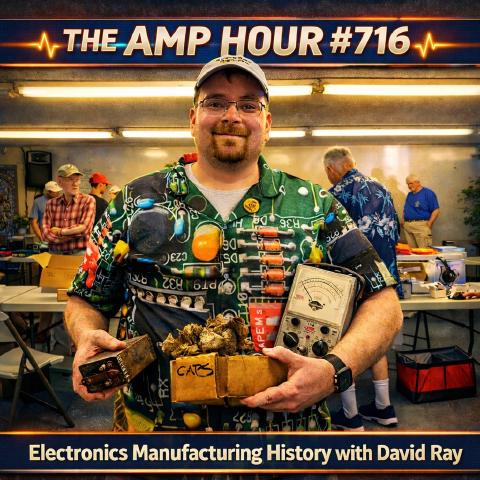
#716 – Electronics Manufacturing History with David Ray
Download episode · 92 MB
Also on Apple · Spotify · YouTube · RSS
Show Notes
Thanks to our sponsor for this episode, SeaSats! Check out their open positions making autonomous ocean vehicles.
Welcome David Ray of Cyber City Circuits
• The “Retro Electro” Series: David explains his passion for writing historical articles for Digi Key, focusing on “giants” like Orstead whose contributions to electricity are often overlooked. • Career Background: David details his path from Marine Corps radio repair to cash register and Motorola radio repair. • Starting the Business: In late 2019, David cashed in his retirement to buy pick-and-place machines and start his own factory. • Teaching the First Lady: David recounts the story of teaching First Lady Jill Biden how to solder during a summer camp. • Growth via Twitter: For the first few years, 95% of his revenue came from relationships built on Twitter (X). • The Kit Business: David discusses his “Soldering Kit of the Month” program, noting that while fun, the kit business is exhausting and low-margin. • Equipment & Machines: A discussion on why he uses Charm High machines and his strong advice to buy new equipment rather than used industrial machines, which are often sold because they are “used up”. • Stencils & Paste: David advocates for framed stencils and GC10 solder paste, which is shelf-stable and prevents cold solder joints. • Soldering Physics: Insights into the thermodynamics of soldering, especially the difficulty of working with 2 oz copper boards. • John Fluke History: David previews his research on John Fluke, explaining that Fluke meters became yellow because the Navy had trouble finding gray ones on the ground. • Upcoming Articles: David mentions future work on the history of Op-amps and strain gauges. • Business Services: Overview of Cyber City Circuits’ services, including reverse engineering, obsolescence engineering, and free DFM (Design for Manufacturing) consulting. • Success Philosophy: David shares his “Monopoly mindset,” viewing business setbacks as “chance cards,” and stresses that persistence is the only way to avoid failure.
Links from David
- Website List: Cyber City Circuits Website: www.CyberCityCircuits.com
- PCB Event Badges: www.BadgesBadgesBadges.com
- X: www.x.com/MakeAugusta
- Collection of Retro Electro Articles: https://cybercitycircuits.com/
retro-electro-the-little-told- history-of-electronics/ - Digikey Magazine: https://www.digikey.com/en/
emedia - GC10 Solder Paste: www.BuyGC10.com
Transcript
David Ray: This is The Amp Hour Podcast. Release February 25th, 2026. Episode 716. Sponsored by CSATS. Electronics Manufacturing History with David Ray.
Dave Jones: Welcome to the Amp Hour. I'm Dave Jones from the EEV blog.
David Ray: And I'm David Ray from Cyber City Circuits.
Dave Jones: Hey, is it David or Dave?
David Ray: You can call me anything, but don't call me late for dinner.
Dave Jones: Right. Thanks for joining us. I'll call you Dave. Thanks for joining us, Dave, because I'm a Dave too. Makes it easy. I used to be David when I was younger, but now it's Dave.
David Ray: Yeah, you know, you're less serious the older you get, you know. I'm probably borderline Dave as it is.
Dave Jones: Okay, right.
Speaker ?: That's great.
Dave Jones: What is that accent? Because that is like American South accent. I'm going to screw it up.
David Ray: Well, yeah. I was born in South Carolina, Southeast United States. I live outside Augusta, Georgia now, which is about an hour from where I was born.
Dave Jones: Got it. And you're from, everyone probably knows you from Cyber City Circuits, which is your assembly company, which we'll get into. But you're killing it on X. Of course, I follow you on X. And people who follow the DigiKey blog, you write for them as well. You write, you're right.
David Ray: They have a,
David Ray: a lot of people don't know this. So I'm glad you brought it up. DigiKey has an industry magazine that they publish online. And they have an online viewer. You can download a PDF, but they also have an online viewer. And you can read it. And they have writers from all over. And I'm just one of many writers. And it's really good stuff.
Dave Jones: Right. Is it like a monthly thing? Is it like a monthly magazine? So it's like a magazine format. It's like, you know, 50, 100 pages or something. Is it like?
David Ray: Yes,
Dave Jones: right. Okay.
David Ray: And I'll give you, I'll give you a link to that for the show notes. Great.
Dave Jones: Everyone can check that out. That's awesome. That people are still going. Are there any electronics magazines, like printed ones left in the U S?
David Ray: You know, there's make magazine.
Dave Jones: Oh, that that's still going. Is it?
David Ray: Yes. It's technically still going.
Dave Jones: Right. Wow. I thought that folded.
David Ray: Yeah. But I mean, yeah, you're, you're absolutely right. All the classic electronics and radio magazines are, they're gone.
Dave Jones: Yep.
David Ray: That's a sad. That's just attrition. Well, I mean, there's 2,600, you know, the hacker digest, right? Oh yeah. Right.
Dave Jones: Of course. Yep.
David Ray: But I write history articles for digi key.
Dave Jones: Those are the ones that I've seen and I like those, but I think I see them on your blog site. Do you link to your, like their individual articles? I do.
David Ray: So, well, I linked to the articles directly a lot on X, but I also have a portfolio on cyber city circuits.com where you can just find every article. I think there's like 24 of them right now.
Dave Jones: I'm looking at those.
David Ray: And you can just go through and find a title that you find interesting or intriguing. I guarantee you every single one of those articles has at least part of a story that you've never heard.
Dave Jones: That's what I love about them. And we've probably shouted them out. Chris and I have probably shouted them out on the amp hour before. How, how long have you been writing these?
David Ray: March would be two years since the first one published.
Dave Jones: Cool. Yeah. I find them absolutely fascinating. And there's lots of historical stuff in there. Are you a history buff?
David Ray: Oh yeah. It's just, it's a lot of fun. Of course. Right. In history, especially like technology, Galileo said you, you stand on the shoulder of giants. There's like a ungodly amount of people that no one even knows about. No one's even heard about, but like, like Orsted, for example, right. Like if Orsted just wasn't there, maybe we'd be 10 years behind or a hundred years, or maybe we'd never have electricity at all. Maybe we'd have like gravity manipulation instead of electricity. But that's not what we had. We had Orsted in a classroom, you know, fooling around with magnets. And now we have electricity.
Dave Jones: Oh no. Yeah. There's hundreds. I'm sure there's absolutely hundreds of maybe even thousands of people that, yeah, it'd be in the thousands.
David Ray: Right. It's insane. It's crazy to think about, but that's, that's, that's what the articles are about is, is trying to find those people and tell their story. And love it. And I know some of those articles are, are really the only comprehensive article on that topic.
Dave Jones: Wow.
David Ray: And like, no one's ever wrote about it. No one's ever done it. Oh, that's a lot of fun.
Dave Jones: That's why I love, um, a former guest of the show. Um, uh, Hathi loves physics. She does.
Dave Jones: yeah. I actually haven't seen a video. Is she still doing them? Cause I haven't, you YouTube's not feeding me up her videos in forever.
David Ray: I gotta say, I did look at them recently and I didn't see anything new. New. Okay.
Dave Jones: I'll have to get it back on the show. Cause yeah. I have to check in. And, um, she's also written a book. Have you actually read that? It's, it's really good.
David Ray: Is it the lightning chasers?
Dave Jones: Yep.
David Ray: Lightning tamers. I have not read it. That she gave, she, she, you know, she's read, I've, I've listened to her read a lot. I need to get that.
Dave Jones: Yeah. She hasn't posted in nine months on a channel. So I'll have to get Kathy back on. Yeah.
David Ray: I hope she's okay.
Dave Jones: Yeah. She's just busy. I think probably. So that would be my assumption.
David Ray: Oh yeah.
Dave Jones: But, oh yeah. Fantastic.
David Ray: Well, I imagine, you know, she's very talented. So it's amazing.
Dave Jones: We can do when you have a passion for something, you know, you can really just turn it into anything.
David Ray: Really huge success. Well, how does it matter if you have a good why?
Dave Jones: Right. Exactly.
David Ray: Yes. So.
Dave Jones: All right. So let's get to how you, how did you get into this business? Tell us how you got started, et cetera.
David Ray: I found some books in the middle school library on electricity, electronics, and eschematics. And it was like, you know, ancient hieroglyphics, right? Never. And, you know, I'm what? Nine years old, 10 years old. And I really, I really want to understand this, but like, I can't, but like I do the cargo cult practice. I take the notes. I, I draw the schematics on the notebook paper, just hoping that through osmosis, I might somehow figure it out. And I joined the United States Marine Corps and I did radio repair for them for a while. And they sent me to school. And when I got out, I did cash register repair and I did radio motor roller repair for the department of energy for some time. There's something that a lot of people don't realize, but once you figure it out, it changes your life forever. And so once you figure out that you really can, it's hard, but you really can make money every day of the week without having a real job, it changes you forever.
Dave Jones: Oh, totally. Don't I know it? And so like, it's hard,
David Ray: but it's a realization. It changes your mindset. Yep. And so that I got that bug, right? And so I quit my job and started doing electronics design. And I learned a lot from Dave Jones and James Lewis, Sean Hemel. These are my, my giants. I stood on along with many others. And I'm leaving out, I'm sure Chris Gammell. Yeah. Started business doing design work. And at the end of 2019, I cashed in my retirement accounts and bought pick and place machines and factory equipment.
Dave Jones: Well, okay. Cause I was going to ask where you got the funding from to start, because, you know, it's like a big commitment to, you know, there's a lot of CapEx expenditure up front to start your own. Yeah.
David Ray: You know, and so I took out a business partner, Chris Williamson, who he did a lot of, uh, well, he's a master machinist. First of all, he did machine work for years. The guy's an absolute genius. But when I found him, he was doing escape room control systems.
Dave Jones: Yeah. There's a niche. Yeah. And he was very good at it. I love doing those escape rooms. Yeah. They're very cool.
David Ray: And so, uh, he wanted to get a pick and place machine to build his own. Cause he didn't want to work with China anymore. He was having issues. And I wanted one cause I want to be able to do build. So we went into business together. He bought into the business and we bought the machines and we got the machine set up in February, right before the pandemic started. Can I say that? Do you need to edit that out?
Dave Jones: No, no, that's all right. Um, we can go there.
David Ray: So at the time I was doing a lot of summer school classes, uh, I'm real big in education. So I was doing a lot of summer school classes with a local tech college, with a local prep school. And I had a lot of stuff scheduled. And then the thing happened and all that, all that died, all that disappeared overnight. Right. That's the same story as everybody else. Right. A million, millions, billions of people had the same story. And exactly. So now we're stuck with this equipment with no work. And we know, we talked about doing contract manufacturing, but like you say, it's, it's, it's hard direct to consumer.
Dave Jones: So you didn't start out with the contract manufacturing. You started out just using it for your own purposes.
David Ray: Yeah, that was right. I wanted to be able to brand all my own stuff. Right. You know, all about that. And so, um, so I didn't make my own circuit boards, my own branding. So I need my own pick and place machine to do that. And for classes, for these summer school classes. And, uh, which I did end up doing, I ended up doing a great deal.
Speaker ?: I ended up doing a great deal.
David Ray: I'm actually the very first person. You can look it up. The very first person in American history that teach a first lady, how to solder.
Dave Jones: I was going to ask about that. Cause I saw that. How did tell us the story? How did that come about? You, you taught the first lady how to solder.
David Ray: Yeah. I was doing a summer camp with, uh, Augusta technical college and the president of college at the time, Dr. Jermaine Worrell, who's a, he's really good at his job. He was making, he's lined up all kinds of political things. And like two days before the summer camp, I got a phone call that like, I need to do an interview with somebody and I need to come in like the day before to talk to somebody. And I was like, why? Like I'm busy.
Dave Jones: Of course. You know,
David Ray: I got, you can't just, you can't do that. Uh, but then they said, well, it's the first lady. I was like, well, okay, I get it. I had to do like the secret service interview and stuff, but it was fun. And I actually, and she had a, I was able to put it in her hand and she did put an iron on a board. So I did technically teach her how to solder.
Dave Jones: Excellent. Was, was she actually really, like actually interested in it or?
David Ray: Yeah, I think so. You know, she at least looked that way. She was asking questions. I was teaching because, uh, the first half of the class I teach about, you know, electron theory and, and how LEDs work and, and stuff like that. And PowerPoints and, you know, try to make it entertaining. So we talked about that a little bit. It was fun. So, so start our own factory. We pick up a lot of customers. Uh, some people aren't going to believe this, but for like the first, like two years, maybe two and a half, three years, like 95% of all our revenue came from relationships. I built on Twitter.
Dave Jones: Wow. And that's not an exaggeration. Wow. Yeah. Well, you do kill it on, uh, the Twitter. How many followers you got on Twitter? Oh,
David Ray: um,
Dave Jones: uh, it's make Augusta. Make,
David Ray: it's make Augusta 23.6.
Dave Jones: Okay.
David Ray: Yep. But you got like 76. Yeah. I got, yeah,
Dave Jones: I think I'm getting close to 80 now.
David Ray: Micro celebrity.
Dave Jones: But that's wow. So you built those all on X,
David Ray: right? Yes. Uh, literally for like the first, I don't know if you remember, we did a soldering kit of the month program. Oh,
Dave Jones: where we shipped soldering kits every month.
David Ray: We did that for a year and a half. Fantastic. And that was, that was exhausting.
Dave Jones: Doing kits is not easy. I, I, I've been selling kits since I was a teenager, you know, and kitting up all the parts is, yeah, it's a quite some effort. So, so you'd bag them all up, you know?
David Ray: Yeah.
Dave Jones: Yeah.
David Ray: Forget one resistor on a hundred kits.
Dave Jones: Yep. Yep. And, and then you get a, a nasty phone call from a, from a customer saying, why doesn't my circuit work? I don't, I don't, yeah. You didn't give me this.
David Ray: It was just really easy because like, if you have to, if you have to send a replacement part to like 75 people, you just burned up all your profit on that entire run. Yep. You did not make any money whatsoever. And so we tried it, we gave it a good go. And it just, it was, it ended up being like 60 hours a month worth of work to pack and design and manufacture and all that.
Dave Jones: How many times do you get people calling you up or emailing you saying it doesn't work?
David Ray: Not, not as many as I thought I would. I think that, and, and if any of my past subscribers are listening, let me know. I think that a lot of people didn't actually build all the kits.
Dave Jones: Right. That's the, the thought of building it is better than actually doing it. So you buy the kit. Sometimes. I, I've got to admit a guilty as charged. Like I've bought stuff thinking, Oh yeah, I'll, I'll build that. And I never got around to it or I'll use that. I'll, you know, do that thing that I bought, you know? Yeah. Right. And yeah.
David Ray: Yeah. I fell into the trap doing the soldering kits. I fell into the trap of the next one has to be better than the last one. Right.
Dave Jones: Oh, okay.
David Ray: And so like, eventually I'm doing like the, I'm doing really outrageous soldering kits and you can't go anywhere from there. Like, how do you do better? You only go well,
Dave Jones: you go to BGA and you go to, you know, it was all,
David Ray: it was all through hole. That was the thing. We didn't do any surface mount.
Dave Jones: Right. Interesting.
David Ray: Or if there was surface mount, like we went on, we use the AT tiny 85 and we put those on every board, uh, S O I C eight and then pre-programmed them. That way they're already programmed when the soldering happens.
Dave Jones: Yep. Gotcha. We don't recommend going into the kit business people. No. It's kind of brutal. So, but there are still people out there.
David Ray: It is a lot of fun. So if you have a fun kit and you want to make it, you want to pack a hundred of them and sell them on 10d.com, do it. Sure. Do it. But don't expect that you're going to like pay any bills doing it.
Dave Jones: Exactly. But let's get into the assembly side of things. Um, because you've got your, how big is your assembly house? What, uh, what actual machines have you got?
David Ray: Well, at the peak, we had a 6,000 square foot building, uh, in downtown Augusta. We had seven employees. Wow. Yeah. Yeah. Yeah. We, you know, that's another trap for young players, right? Like you grow up real fast and then it, then it, then it all blows up in your face.
Dave Jones: Manage people. Yeah. Right. I'm a terrible manager.
David Ray: I'm an absolutely terrible people manager. Great project manager. Terrible people. So we had a bunch of employees and, and that was a lot of fun and we did very well.
Dave Jones: Sorry. Was that mostly like, uh, people to operate the machines? You had full-time people working the machines who were specialized in.
David Ray: Right. Well, we have full-time people running machines, but we never, we couldn't keep the machines running full-time. So we, we, when we did the soldering kits, some people would be packing soldering kits or we dabbled with wire harness fabrication, which, you know, uh, if you don't know, don't, don't, don't, don't let them bother trying.
Dave Jones: Oh, wiring harnesses are a world unto themselves.
David Ray: Right. There's companies that do that. You should just let them do that.
Dave Jones: Yep. Totally agreed. Um, you'll save a lot of gray hair.
David Ray: Yeah. Right. And, you know, we bought, uh, we have charm high machines. Okay. We have another machine that we got recently. And, uh, we just got the feeders for it. It was secondhand or thirdhand, even maybe I figure what brand it is. And we're getting that online. So, so the charm high was new. When we got it, it was new. We have three of them now.
Dave Jones: Yeah. Okay. Why, why did you go for new instead of like a secondhand Yamaha or something like that?
David Ray: Well, the secondhand Yamaha is going to be a whole lot more expensive.
Dave Jones: Oh, really? Okay.
David Ray: Yeah. It's just, it's just how it is. Also, industrial machines get used until they cannot be used anymore. And then they sell. Yup. So you're, you're really, it's worth, and if you're listening, you know, pay attention. You're buying someone else's problems. Got it. Uh, they don't want it anymore for a reason. And unless they're going out of business, which we did one of our machines, we got from someone going out of business, unless they're going out of business, they they're getting rid of it for a reason. Don't do it. Especially in the United States. I mean, you know, there's, you know, a bunch of us, right. A bunch of contract manufacturers, but like, there's only so many machines that, you know, you don't have to import. And so if you're buying one from a domestic source, that thing is used up. So they're okay. I wouldn't necessarily recommend the charm highs, uh, to people that were getting into it today.
Dave Jones: Why is that? They're a bit fussy or what's that? That is the thing I usually hear is that, Oh, it's fussy with Oh four Oh twos or, you know, something. Well,
David Ray: I mean, that's, that has, they need to be tuned to, and there's tricks. And if you have one of these, you know, send me an email and I got some tips I can give you on how to change the acceleration vectors and it makes it run a lot better.
Dave Jones: Got it. So they don't for, for those who aren't aware, that's basically the speed at which the head moves the component. And if you go too fast, they fly off. Right. So,
David Ray: right. Well, it's the speed at which it gets the full speed.
Dave Jones: Oh, like how fast does it accelerate?
David Ray: So like they, by default, they go from zero to a hundred instantly, which that's when, you know, inertia takes over. Yes. So anyway, we have three of them because we know how to use them. That's the only reason.
Dave Jones: Yep. The devil, you know, you know, it's right. Yeah.
David Ray: Right. Right. And if I had to do it over again, I might not use the same one, but then again, who knows? They, they were affordable at the time and that in there, they, they've done a, they've served us very well. We've done a whole lot of work with them. Great. A whole lot. That might be just fine. I don't, we got, like I said, we got the new machine and we'll see how that one goes.
Dave Jones: Got it. So what other machines do you use? Do you have a stencil machines? Do you have optical inspection as well at the end of the line or?
David Ray: We have a stencil machine and it's real nice. It's one of the semi-automatic machines that uses air compressor. And I tell you, if, if you're using frameless stencils and you're having a hard time with bridging and soldering and reflow, start using a frame stencil. Get one of them. T-shirt presses. They're there next to nothing on eBay, but, but you can also get one that's made for PCB stencils. Cause it has like a gridded work table that you can mount on for jigs. Get that. And you will stop having problems as much. God. The frameless stencils. They, I don't, I don't know that was ever a good idea.
Dave Jones: Well, they're okay. If you're doing like a one-off in, in, in your home lab or something, you know, it's fine.
David Ray: Right. But I mean, they're, the cost difference between the two is so negligible now. You know, the only difference is if you have the machines to do the frame stencil or not.
Dave Jones: So do you get those stencils locally or do you mainly provide them or do the customers mainly provide them or half and half?
David Ray: Well, it depends on the customer in the budget. A lot of customers do need us only. So we'll use OSH stencil, which is great. If anybody listened to every OSH, O-S-H stencil.com. Do fantastic work. their, their, their frame stencils are, are very, there's something nice. They're special. And they're made in the U S they're made and cut in the U S and they can do overnight. Right. Wow. You know, it's hundreds of dollars, but it's still affordable. Like if you're in a position where you need a stencil cut right now, you can afford it.
Dave Jones: Exactly.
David Ray: And also start using good solder paste. Stop using the cheap solder paste. What do you,
David Ray: what is the cheap solder paste?
Dave Jones: And what is the good solder paste?
David Ray: Anything that isn't GC 10 is the cheap solder paste.
Dave Jones: Okay. Got it.
David Ray: You can go to buy GC 10.com and I sell it on Tindy. Yep. I buy it direct from the manufacturer. It's a, it's a kind of thing that's hard to keep in stock that DigiKey sells it, but it's hard to keep in stock. And the manufacturer has like a, a 20 piece minimum.
Dave Jones: Right. So I have to buy 20 tubes. 20 tubes or tubs of it or whatever, you know, you get the giant tubs, you know, and scoop it out. Yeah. You know.
David Ray: So once a year I get 20 of them and I sell like 10 to 12 on a Tindy, but GC 10, it really is shelf stable.
Dave Jones: I, I, well, that's what I was going to ask. What is the different, what is the practical issues with bad solder paste? And what are the benefits of the good one? Well, it dries up. It just dries up. How, how fast are we talking about?
David Ray: They say it can stay on a stencil for 72 hours.
Dave Jones: Oh, okay. Jeez. That's a long time.
David Ray: In real life. It's more like 48 hours, but it's still 48 hours.
Dave Jones: Yeah. Yeah. Exactly.
David Ray: Where, you know, regular solder paste, you can't do that, but you need to throw it away. You're going to need to have to get new stuff. I mean, with GC 10, you can mix in a little bit of new stuff and it's good as new.
Dave Jones: So are you filling up your solder paste stencil machine every 48 hours or something? Are you, you're scooping out and putting in, or you do a French batch each time?
David Ray: Well, you know, well, yeah, well, in between jobs, most jobs take less than 48 hours. Got it. So if we're doing 500 or so boards, the stencil will sit on a machine and we'll just keep cranking them out until they're done. We won't necessarily change it out, but, but yeah, after two days, it's trash. It's not worth risking it.
Dave Jones: And what happens if you try, if it, if you use the crap stuff, it dries up and you put that through your, through your reflow machine.
David Ray: It's like cold solder joints. Right. It looks like it. It's, it's like they never actually reflow. It's like the flux and the paste is just gone and it gets crusty.
Dave Jones: Oh yeah.
David Ray: Yep. And, and you cannot make it reflow in an oven. Got it. Uh, you have to use a hot plate in some flux.
Dave Jones: So it just balls up, does it or something or what?
David Ray: It's like a cakes up. Right. Almost. It feels like the kind of thing you can pull off of your fingernail. I don't. Right. I said, I want everything in my fingernail, but that's what it feels like. But I mean, you can fix, you get, put it on a hot plate and add a little bit of flux and, and get it. But it's just, it's not, it's not good business.
Dave Jones: Yep.
David Ray: But it's, it's really good stuff. Otherwise, and no other solder paste. I know if can pull that off effectively. And, and GC 10 can also, it stays past their expiration date. So like, it's supposed to be good for one year. Oh, but like, you know, ask anybody. It's good for like three, four years.
Dave Jones: Who actually makes that GC 10 stuff?
David Ray: It was made by, it was originally made by Hinkle. Right. And it was sold under the Loctite brand.
Dave Jones: Oh, okay. Yes. Yep.
David Ray: In 2022, it was sold to a company called Haramatech.
Dave Jones: Hmm.
David Ray: And that's when they, they really just stopped showing up on the market altogether for the most part.
Dave Jones: Oh, really? What? So you have a hard time buying it now or?
David Ray: Well, I buy, like I said, I buy it directly from the manufacturer. Oh,
Speaker ?: okay.
David Ray: Right. Got it. Uh, so that I can make sure I have some, but like you used to be able to just get it regularly on Mouser and DigiKey.
Dave Jones: Hmm.
David Ray: It's like two, you know, it used to be 125. Now it's $200. It used to be $125 a tube. Hmm. And, uh, you could buy it any day of the week. Uh, but it's less likely now, but I, I promise, you know, and I know it's expensive, but like if you're having solder paste issues and you're having reflow issues, go to a frame, stencil and start using GC 10 and it really, it will change things for you.
Dave Jones: So is this, um, stencil machine, um, like semi automated and is it, is it in, and in, as in line with, so your boards flow into the stencil machine, you know, the thing, no,
David Ray: no, we don't, we don't have a conveyor system. Uh, we've tried that. It's just, it's, it's a lot of things to get right.
Dave Jones: Interesting. Okay.
David Ray: But the, the stencil machine we have is semi-automatic. Uh, it holds the boards with pins. So you can order boards that are panelized one by one, a panel of one board, and then add edge rails to the top and bottom.
Dave Jones: Yep.
David Ray: And then put little mounting holes in them. And so we use that for the stencil machine. It can do solid, uh, perfect stencil paste every single time for like 5,000 times. No problem.
Dave Jones: Wow. Fantastic.
David Ray: It changes everything.
Dave Jones: Do you have one of those, um, selective stenciling robot thing? No. Have you thought about getting one of those for like prototypes or something like that? So you don't have to make a stencil. You can just, you know, if you've got like a one off or 10 or five boards.
David Ray: We looked into that and there's a, a few people on Twitter that have posted about those machines. Uh, you know, there's only a couple of them out there. Unfortunately, none of it looks very impressive.
Dave Jones: Right. It doesn't look like you could use that. It doesn't look like you get a return on investment on that.
David Ray: It looks like a, uh, it could be a problem. Okay. More than you gotta, you gotta, you gotta ask yourself, are you looking for a project or are you looking for a tool? Yeah, exactly. Yes. I kind of want a tool. I mean, it looks great. It looks great on the, on the TV. Yeah, exactly. It looks great. You can't, you can't let it run for five minutes, putting paste down. Like you, you just, you know, paste takes 10 seconds with a stencil. Yeah, exactly.
David Ray: Just one, that's why the machine costs $2,000. So like, where, where is that?
David Ray: I mean, also, also like, you know, you get good enough with flux and some solder. You don't need a stencil for prototyping. Yes. Okay.
Dave Jones: Of course. Yeah. So, so did you hand, hand, uh, soldering a lot or?
David Ray: Oh yeah. So we do a lot of through hole soldering. Oh, well, we don't do a lot as much anymore, uh, I guess, but we have done a lot. And also that's one of the things when I teach soldering, it's all through hole. And what is your iron of choice? I, for a long time, I used Weller and, and I still love Weller. I bought one of those Hako 8, 8, 8, 8, 8, 8,
David Ray: 8, D's because, uh, there was a time. I'm sure everybody remembers when they were just like the status symbol. You're not, it's just how it was. Oh yeah. Yes. You know, I don't, I don't really, they weren't that good to me. I bought some like knockoff counterfeit 1980s heckos. The, the black one. Oh yeah. You know what I'm with the big dial.
Dave Jones: Yes. The old, uh, nine, uh, the old nine. Yeah. Yeah. Right. Right. And so like,
David Ray: I have 20 of those and they're great. I have like three on my bench right now. That's what I use for teaching.
Dave Jones: That, that, that's interesting because, because they're based on the, um, old, uh, tip technology. They're not the, uh, cartridge type. They're the old, uh, you know, tip over, over the element. They work good for low mass stuff, but if you're doing high, you know, high thermal mass stuff, you got to use, um,
David Ray: knife tip and hot plate and heat lamp. Right. You gotta, you know, do the rain dance to make it hotter. Right. You never really think about how soldering, it's just thermo. It's like applied thermodynamics until you're doing with two ounce copper. Oh yeah. There's a lot. There's a lot of, you don't, you don't realize it until you have two ounce copper on your board and then it makes a lot of sense.
Speaker ?: Right.
David Ray: Oh.
Dave Jones: And, and, and then there's a lot of material physics in there. Like the solder goes through the, the plastic region it's called, which is a little temperature range where it, you know, changes state and things like, and if that happens too slowly, you know, boom, you get a cold joint, you know, all sorts of things.
David Ray: Yeah. Yeah. Yeah. If you like, if you don't have your zones quite right, you know, if you don't have a, you can cook off your flux before it even goes into reflow.
Dave Jones: Yeah, exactly. So yeah, bit of a fine art. Okay. I'm, I'm surprised you haven't upgraded to any of the cartridge type irons for high thermal mass stuff.
David Ray: Well, no, we, we, for high thermal mass stuff, we have a special iron we use.
Dave Jones: Oh, okay.
David Ray: We, we do have that, but everywhere else we use conical tips and knife tips on those black knockoff HAKOs. Wow. Cause they're, they're perfect. Um, they're, they're, they're perfect.
Dave Jones: Well, it's, it, it, once again, it is better the tool, you know, right?
David Ray: Yeah. I know a lot of people, what is it? Uh, Metcalf. Yep. People, people swear about Metcalf, but I don't know if I, if I could ever afford one.
Dave Jones: Yeah. They, they do the RF induction ones. They're, they are very good and they do have a rabid fan base. It's like Metcalf or nothing. You know, it's like,
David Ray: yeah,
Dave Jones: they, they, they use a,
David Ray: maybe one day I'll be blessed to have a Metcalf, but yeah,
Dave Jones: they just use a totally different system. Um, uses a 10 megahertz RF, um,
David Ray: in induction type,
Dave Jones: RF induction thing. And, um, yeah.
David Ray: So it heats up like immediately.
Dave Jones: It heats up immediately and stuff like that.
David Ray: So no wonder they have fans.
Dave Jones: Yep.
Speaker ?: Yeah.
David Ray: Actually, Weller talking about soldering irons, uh, Weller invented the soldering iron.
Dave Jones: Yes.
David Ray: And so that's one of the articles I'm looking forward to writing sometime soon.
Dave Jones: Oh, history of soldering irons.
David Ray: Yeah, yeah, yeah, yeah. Oh, wow. My next one is the history on the underwriters laboratory. And then the one after that is probably, it might be the most comprehensive biography of John fluke.
Dave Jones: No.
David Ray: Oh, so, uh, I, I, Oh, that's, I love that. So I, I, I, did you key line me up with like a meeting with their director of, uh, metrology and like their director of marketing. We had him, I'm meeting with him next month to finish the article. Right. But the fluke story is amazing. The guy, he bought a grocery store and turned it into a factory and they still make every single fluke multimeter in that grocery store factory. Oh, it's, it's, it's, it's amazing. I can't wait. Uh, I'm trying to find old family photos and stuff. They're, they're looking for me.
Dave Jones: Right. Well, you also might want to talk to Dave Taylor. Who's been on the amp hour before he's the one he used to work at fluke and he designed the old, uh, fluke 80 60 multimeter. And we've, and we've had him on the amp hour,
David Ray: the big blue desktop one, right?
Dave Jones: No, no, no. It's the, uh, one, one with the side buttons, the buttons on the side.
David Ray: Oh,
Dave Jones: okay. Yeah. Yeah. And everyone loved that. Like that was stated up. Back in the day, everyone lusted after the 80 60 had had like a hundred kilohertz, true RMS. It was like, Oh my God, back in, you know, 19 late seventies or something. That was the duck's guts. Yeah. That was a fascinating episode. Dave was, Dave's really had heaps of Taylor. I have to look into it.
David Ray: I'll go watch or listen to it.
Dave Jones: Dave Taylor. It was episode number, episode number. Let's for the, for those playing along at home, we have to get it. Uh, 180 episode.
David Ray: That must've been like 12, 13 years ago.
Dave Jones: Yeah. Yeah. That was, yes. That was a long time ago in a galaxy, but, uh, yeah, no, he had great stories to tell.
Chris Gammell: The ocean breeze ripples your hair. You hear the surf crashing against the beautiful San Diego shoreline. You glance out and see, wait, is that your electronic gadget floating on the water? Holy crap. That's awesome. SeaSats is a rapidly growing San Diego company that builds solar powered autonomous boats that carry sensors far offshore. They have crossed both Pacific and the Atlantic oceans unsupported and have successfully completed numerous other missions for defense, science, and commercial customers. They are looking for more top quality engineers to join this exciting industry. And they think listeners of the amp hour might be just right. With production and deployment scaling rapidly, they need people who get excited about the ocean, creating robust electronics, and working in tight, high performing teams. If this sounds like you, visit seasats.com and click careers to view their open positions. And now back to the show.
David Ray: So I think I figured out what the secret is to Fluke.
David Ray: Tell us. Is that the guy, John Fluke, had an absolute obsession with precision. Right. He knew that if you could make the most precise meter on the planet, that you could sell it more than anybody else. And you could charge whatever you wanted.
Dave Jones: Exactly.
David Ray: Yeah. To this day, they make their own precision resistors.
Dave Jones: Yes. Yes. They still make the hybrids. Yeah.
David Ray: Right. They roll their own resistors. Yeah. That's how much they obsess with precision. They don't trust anybody else with it.
Dave Jones: Exactly.
David Ray: That's amazing.
Dave Jones: And that's how they got into the standards side of things. Yeah. Because the Fluke calibrators, of course, you know, like, you know, everyone's using a Fluke calibrator in their standards lab to actually calibrate other meters. Yeah.
David Ray: And the, in the meeting I had with them, that was something that they really, you know, harped on is that, that's their claim to feign is that in NIST, all you see is Fluke. Yep. You don't see anything else. If you go in toward NIST, they say, everything's just Fluke meters. Yeah. Everywhere.
Dave Jones: Yeah. Yeah. It's crazy. And, and the amazing thing about them is that they're so stable over time as well. Like if, if you buy a 40 year old Fluke on eBay, the odds of it, if it, as long as it still works, it is going to be bang on. Like, it's just crazy, you know?
David Ray: For sure. It's nuts. People listening. If you want a Fluke, they're really easy to get, go on eBay and just buy an old one. And it'll work just as good as better than anything else you can buy. They're fantastic. From any other brand.
Dave Jones: Yeah. They're great.
David Ray: Yeah. I'm a big Fluke fan boy.
Dave Jones: Excellent. Yeah. Yeah. Totally. Totally. Well, that the video I did on that, I'm not sure if you've seen it, but what was it? Seven reasons why the Fluke meters are so expensive. I don't know if you've seen that video. Of mine.
David Ray: I have not seen that. I'm going to watch it now though.
Dave Jones: I just recorded that video. I was just like, I was almost going to upload it to my second channel. You know, it's just like, it took me like 10, 15 minutes to record it. You know, it was just like a throwaway video. And then I decided to put on my main channel. It's got like a million and a half views or something. It's, it's just nuts. People.
David Ray: Everyone loves.
Dave Jones: I couldn't believe the popularity of that video. That was amazing.
David Ray: Well, he invented the multimeter. Essentially. He invented the modern. Auto ranging and all that.
Dave Jones: Yeah.
David Ray: Yeah. And so like, he's a, you see, you can recognize a Fluke. Like you can see a Fluke from a mile away and they're in the yellow, you know, they're real protective of the yellow. Everybody knows that story. I'm sure we don't need to talk about it.
Dave Jones: Spark fun. No, no, no. Yeah.
David Ray: But for a reason, that's your trademark. If you see a yellow multimeter, you know what it is.
Dave Jones: exactly. They weren't always yellow though. They did start out, you know, dull gray, you know, back in the day. Yeah.
David Ray: Yeah. But so, so the reason that they went to yellow is that they were gray. And then the Navy complained because they were having a hard time finding them on the ground. Oh, when they were setting down, they would have a difficult time finding them. So they made them yellow specifically because the Navy asked.
Dave Jones: Wow. There you go.
David Ray: Yeah. Like I say, the Fluke story is going to be great. I'm real excited to write that. Well,
Dave Jones: I'm, I'm super hyped to read it. That's, that's going to be fantastic.
David Ray: That's probably going to publish in August. I think maybe.
Dave Jones: Okay. That's a long way off. We're only, what are we? February now. Yeah.
David Ray: Yeah. The next one I have coming up is Op Amps. The, the history and origin story of Op Amps.
Dave Jones: Oh, does it involve Bob Pease? Cause Bob Pease used to work at, uh, Tilbrook. Was it? Who did the first commercial Op Amps? Was it Tilbrook? Researcher? Am I got it wrong? Tilbrook. Uh, yeah. Tilbrook. Oh, Tilbrook. Is it Tilbrook? Yeah. Tilbrook.
David Ray: The tube one with the two tubes on the hanging out the top. Yeah. Yep. And, uh, that's the first commercial. I didn't know Bob Pease. He didn't come up with my research.
Dave Jones: He's famously worked there. Yeah. So you might want to research that a bit. Um, that might've was, I might've been his first job.
David Ray: He's not, he is on my short list of, uh, of articles to write about.
Dave Jones: Oh, great.
David Ray: Yeah. But it ended up being more of a Bob Whittler story.
Dave Jones: Okay. Yep.
David Ray: Uh, and so that's a lot of fun. It's signetics. And then after that, the strain gauge, everybody's favorite.
Dave Jones: Oh, right.
David Ray: The history of the strain gauge.
Dave Jones: Oh, fantastic. Well, just a heads up, come March, I'm doing an interview with the former CEO of international rectifier, whose father founded international rectifier. So that will be an interesting story. So hopefully I can ask him about that, you know, the, the history of international rectifier. So.
David Ray: And, and that's the, you know, uh, the computer history museum has been doing a great time, uh, with that kind of stuff because, you know, I asked sometime in the nineties, they realized that all these stories are vanishing because nobody was taking it seriously as a historical, you know, spoken history.
Dave Jones: Yep.
David Ray: And they decided they were going to fix that. So that's great. They're a great resource too.
Dave Jones: Oh yeah. Yeah, they are. I've been there. It's fantastic. Yeah. They do a lot of great.
David Ray: I haven't been, I wish to go. There is a computer museum in Roswell, Georgia. That's very good. So if anybody's in the Southeast, you should just call the Mims museum.
Dave Jones: Yeah. Great.
David Ray: So.
Dave Jones: Yeah. But I highly, highly recommended you go there. It's, it's just fantastic. Yeah.
David Ray: Yeah. No, I need to make my way out there. It's an LA. It's like 3000 miles away.
Dave Jones: Oh God. Yeah. Right. Yes. The, I forgot how big the U S is. Yeah. It's the same size as Australia. Yeah. It's like going from. It's Australia 3000 miles. We are basically the same size. Australia and the continental U S is basically a similar width. Yeah. Kind of thing. Similar width. But there's like nothing in between, right? There's just nothing in between. Yeah, exactly. Absolutely nothing. Yep. That's why we've got a population of 27 million or something. And you guys have what? 360 or something. Million.
David Ray: That's what they say. 350, 360. Yeah.
Dave Jones: Something like that. Well, let's, let's go back to the pick and place machines. Cause I haven't. Okay. Yeah. I haven't finished there. So you've got three charm high machines. Are they all in the one line or like, like, so, so you can load up multiple. Oh yeah. You know, things.
David Ray: Right. Or you can run the same job on three machines. Right. Makes it even faster. You've got the, you have the hands to run it.
Dave Jones: And if you're, and if the board's not that complex and you can fit all of the feeders in the one machine, how many feeders does the charm high take?
David Ray: The one I have, I think has like something like 40 or 50.
Dave Jones: Is that single sided or double sided?
David Ray: The one I have is double sided. A double sided. They make a single sided version, but we have the double sided.
Dave Jones: Okay. But you can put three of those in series if you need to, if you had like, you know, 150 bomb items or something like that.
David Ray: Right. But also like most jobs are going to have less than 50 bomb items. And then a bunch of them are going to be through hole or a bunch of them are going to be like gigantic parts that the machine can't place anyway.
Dave Jones: Got it. So, so for the through hole, do you, do you have a wave soldering machine or do you just do those by hand?
David Ray: We just do them by hand. We've, we looked into the selective soldering machines and stuff, but they just,
Dave Jones: okay. Yes.
David Ray: They're just so, the upkeep on it, it just seems, it's very difficult.
Dave Jones: They're, they're,
David Ray: they're a lot harder than they look.
Dave Jones: Yeah. May, if you got like a big job, would you go, Oh, we can afford to buy a selective soldering machine just for this one job. And it would pay off. Would that be a thing?
David Ray: If we had a job that would buy us a new one. And, and yeah, but you know,
Dave Jones: you, you wouldn't tell the customer that it's going to, you, you wouldn't go to the customers. Oh, you're going to buy me a selective soldering machine. Thank you very much. No, you would do, you would build it into the price.
David Ray: Most jobs don't bring in that much profit too.
Dave Jones: right. Okay. Oh, okay. Right.
David Ray: You know, we, so most of our jobs are, we do up to a thousand units. Are you familiar with Joey Castillo's sensor watch? No. He does. He has a Casio watch mod kit. You take the board out of the Castillo watch.
Dave Jones: Oh yeah. Yeah. We did those. Another one.
David Ray: Yep. And we did like 2,500 of those. So we can do more than a thousand, but most of our jobs are like a hundred, the 250. We, we, we work a lot with like small businesses and individuals. There's a lot of bigger, you know, they don't, they don't, they can't pander to those people. They just can't. They don't have, they don't have the, they have payrolls. They have, they got to make money. And so, you know, if you don't have a big fat payroll, you know, you have more leniency. You can be easier to work with. And so if you ever had trouble working with a U S manufacturer, give me a call, you know, send me an email. We try, we try very hard to be easy to work with. We have 4.9 stars on Google. So let's give us a try.
Dave Jones: Fantastic. So how competitive are you in the price? I mean, obviously you're not going to compete with a JLC and let me, you know,
David Ray: but for a time there, we were, we were able to.
Dave Jones: Oh, really?
David Ray: No, it was just, it worked out that way for a few years. Like it just so happened when we give a quote to somebody, they would say, Oh yeah, PCB way quoted it this way. And, you know, we're about the same price.
Dave Jones: Oh, but you know,
David Ray: when you get to the thousand units, you know, it gets hard to compete, but now I don't fully understand all the trade war dynamics with China and U S, but I'm pretty sure there's a lot of Chinese subsidies being passed out, making it a lot cheaper to shop in China.
Dave Jones: Well, just their postage advantage. Cause they're a developing nation in quote marks for postage reasons. And that's why you can buy something on eBay for two bucks and have it delivered to your door for $10. It's like, because they, you know, the world is subsidized in Chinese postage, you know, it's just,
David Ray: it's hard to say what the way the prices are now. It's hard to say which way it goes anymore, but we do get a lot of work. We have a lot of returning customers and they, they're really happy with us. So we must be doing something right.
Dave Jones: Right. So I mentioned the optical inspection machine and you said you didn't have one of those at the, at the, we had,
David Ray: we bought one. So this is, this is where we learned the lesson, the valuable lesson of not buying used equipment.
Dave Jones: Oh,
David Ray: tell us the story. Well, we, we bought a used AOI machine and it didn't work. And, um,
Dave Jones: how much is a used AOI machine?
David Ray: We went on eBay and it was 99 cents.
Dave Jones: What?
David Ray: Well, we had, we, we got it freighted. Yep. Uh, they palletized it for us and we freighted it over and it was like, you know,
Dave Jones: 99 cents.
David Ray: Yeah. It was like two, 300 something dollars. And we just figured, you know, me and Chris, we're a couple of smart guys. We can, we can figure it out. Right. How hard can it be?
Dave Jones: Right.
David Ray: Uh, we can fix it. They, uh, they said that they got new machine in their line. They don't need it anymore. They don't know if it works or not. It's been sitting up for a while. It was a 2012 model. So at the time it was like, you know, nine years old, which isn't terribly old, uh, but we just could not figure it out, get it to work. So we ended up selling it on eBay. I don't, I don't remember. I don't think we got all our money back out of that, but it was a fun adventure. And, and some lessons are more valuable than others.
Dave Jones: So, so it just flat out didn't work or it was just so troublesome. You just went, Oh, this isn't worth the hours.
David Ray: Well, I don't think we could get it to work. We had somebody come in to, it ran on Linux. So we had like a hacker come in and he gave us all the passwords. Right. And all the usernames for the whole machine. And I can't do that anymore. I used to be able to. And, uh, we, you know, we logged in and we're able to, able to figure out parts of, we had all the manuals. It came with all the manuals and, uh, we tried really hard to,
Dave Jones: you still couldn't get it.
David Ray: We just, we, I don't think it actually works. I think the guy that we sold it to did get it working though. I think he said he had to replace, uh, something or another. I don't know. Don't buy used equipment.
Dave Jones: that's, uh, don't buy used pick and place. Yeah. Don't buy used. Buy new.
David Ray: If you're, if you, if you need a machine, buy the best, one you can afford. Right. And if you can't afford a better one, that's okay. You will someday.
Dave Jones: Start with. Yeah. Exactly. Yeah. Yeah.
David Ray: You got to start.
Dave Jones: So how much of those charm high machines you got worth?
David Ray: Well, at the time in 2019 with tariffs and everything, there were 6,000 us.
Dave Jones: Oh, geez. That's not much. No,
David Ray: it isn't. And, uh, I'm sure they've gone up quite a bit since then, especially with the new tariffs, but I haven't, I don't know how much, uh, again, if you're listening, try, try a different brand, try something else first. Uh, not, not, not to bash on charm high. That's not what I'm trying to do. I'm just saying that there might be something.
Dave Jones: There are a lot of people who do though. Yeah.
David Ray: Overall, I have to say, I have to be able to say that I'm pretty happy with them because I'm making money with them. Exactly. But like, I don't know. I think that you could probably find something a little bit better.
Speaker ?: Right.
David Ray: Um, but yeah, they, they do get a lot of heat, uh, you know, but every, every company goes through that some, at some point. Right.
Dave Jones: Yeah, totally. Well, that's interesting. Oh, wow. So is there any other machines you've got? There, or is that, that it, you've got the three charm highs, you've got a stenciling machine. Oh,
David Ray: we know reflow ovens. Oh yeah. Okay. Two reflow ovens.
Dave Jones: Are they on the conveyor that comes straight out of the machine? Into the reflow or they manually feed them?
David Ray: No, we got to feed them, but it is a conveyor and it runs pretty good. And so if anybody's interested in trying to do at home manufacturing or, you know, small shop stuff, the, the solder paste stencil, that is like the foundation of all of it. Right. If you cannot get a good solder paste application, you cannot have a good reflow. It's impossible. Don't even bother.
Dave Jones: Yep. And it doesn't matter how much you tweak that thermal profile. You're just not going to get it.
David Ray: Right. You, you need to get frame stencils. Stop fooling around with flame of stencils.
Dave Jones: How often do you have to change the thermal profile on the reflow oven?
David Ray: Only when I go to two ounce. Okay. Uh, you know, so we do a lot of badges to, uh, the PCB badges, badgers, badges, badges.com. If anybody's interested.
Dave Jones: I was on there before you badges, badges,
Speaker ?: badges,
Dave Jones: badges.com. Badgers, badges, badges.com. You couldn't get badges.com or you couldn't get badges.
David Ray: It was a friend of mine, David groom, who was, uh, with make magazine until recently. He has a lot of startup history. And I was like, man, I don't know what to do. I need to figure this out. And he's like, well, just sell badges. Get badges, badges, badges.com. And I registered at that moment. And, um, and I like it.
Dave Jones: Yeah. Yeah. It's great. Oh boy. Yeah. They, they seem popular.
David Ray: Well, we were trying to figure out a way to productize it, to flat rate it, to make it like a Shopify for custom, like t-shirts. Like you can custom order t-shirts. Why can't you custom order PCB event badges? It's not that easy.
Dave Jones: Right. Okay. But,
David Ray: but with stuff like that, the reason I bring that up is because like when you have plastic battery holders and speakers and stuff like that, you kind of need a full of the thermal profile. Cause it'll melt the plastic.
Dave Jones: It'll melt the plastic. Yeah. Especially if you get the cheap, no name, you know, your order. Oh, I got a, I got a reel of 5,000 on Ali express for $2. Right. And it's like, yeah, be careful they don't melt.
David Ray: If you buy keystone connectors. Exactly. You know? And so we have to fool around with that a little bit. And, uh, you know, with two ounce copper, you got to jack up the heat a tiny bit. Yes. But other than that, it's pretty, it's pretty steady.
Dave Jones: Hmm. And the two ounce copper boards actually retain the heat for longer when you take them out. So. Oh yeah. Don't touch them. Yeah.
David Ray: You gotta be careful.
Dave Jones: Yeah.
David Ray: You learn that the hard way too. Yes,
Dave Jones: you do learn that. Yeah.
David Ray: Yeah. Yeah. Yeah. They don't work the same. You pick it up, the pieces fall out. Yeah. And another thing is, if you're making a two ounce copper board, all the parts on that board are expensive. You know, you don't use cheap parts on that board. And so like, it just all falls off onto the floor.
Dave Jones: Do, do you only do single sided load or do you do a double sided load? Oh, we do, we do double sided.
David Ray: We also offer DFM consulting for free, free, you know, free consultation. I'll sit down with anybody for an hour, answer any questions they have on their DFM.
Dave Jones: Fantastic.
David Ray: Yeah. And expect nothing to return, no obligation. But if you, you know, you can have us do the manufacturing, but again, no obligation.
Dave Jones: Fantastic. So do you have any issues doing the double sided load parts falling off when it goes through the reflow a second time? Well, no,
David Ray: but that's because we do the DFM review.
Dave Jones: Got it. Yep.
David Ray: That's why I brought that up, you know, and that can happen. And with some parts with the bigger parts, you know, you do those by hand afterwards, maybe, or.
Dave Jones: Right. Yeah. Like if you've got like a heavy transformer or your surface mount transformer, you might have to glue that down. That's not going to reflow very well. Anyway, right. Okay. Right. It may not.
David Ray: So I mean, you're at least going to have to touch it up. Maybe.
Dave Jones: Got it. So you, so you don't have to use any glue on the parts.
David Ray: No, we've never used glue. Never needed to. It's always, it's just really never been a problem doing two sided. You try to put all your low profile, low profile parts and your passes and stuff on one side. On one side. Exactly. And then you put all the, you got to think one side has to go through the oven twice. Yes. And so you want all the big parts to go through the oven once.
Dave Jones: Once. Exactly.
David Ray: But one side has to go through it twice. So you want to, you know, minimize problems.
Dave Jones: That's all part of the service. Service of the DFM. Yeah. Design for manufacturing review. For those who don't know, design for manufacturers looking before you send your board for manufacture, you get a design for manufacture review, which looks at all this sort of parts. Is there, is there clearance between the parts so that the pick and place head, are they too close together? Are they, as you said, on, on the correct side of the board, you may have to relay out your board because yeah, you're, you've got a couple of heavy parts on the bottom and it's like, you know,
David Ray: we can make it work, especially, you know, with low quantity stuff. Right. If you're doing like 10 or 20 or something, we can, we can jig it together and make it work. But if you're doing like 500 or something, DFM plays a bigger role.
Dave Jones: Oh, totally. You, you want to tweak that process and push the button once.
David Ray: And right.
Dave Jones: Yep. How often do you have to, you know, stop the machine? Like if you're doing a run of 500, say you don't have to change the actual reels or anything. How often would you have to, you know, would the machine stop and go, you know, something went wrong.
David Ray: Oh, I mean, often, often, you know, not, not every board. Right. But maybe like one out of every 10 boards, maybe like one out of every few hundred placements.
Dave Jones: Okay. Yep.
David Ray: It's just like the vacuum head sitting on it weird or the part not matching because it has a upward facing camera. Yep. And so it matches, it has a expected size of the part. And so if it doesn't match that size or it uses it for orientation, if something's wrong with that, it'll lock out or it'll, it'll error and beep at you. Got it.
Dave Jones: Would you, can you actually program it to continue on and finish the board and then you'll redo it later? And, and it actually,
David Ray: you do have to go and hit the button, but I mean, you could, you could restart it or you can like take it back a step and have it try the part again.
Dave Jones: Okay.
David Ray: You know, also like a really good pair of tweezers is helpful. Yes.
Speaker ?: Right.
David Ray: Go on AliExpress and find like a really good pair of anti-static tweezers and, and buy like 25 of them. Right. Yeah. Just like spend a hundred dollars on tweezers.
Dave Jones: Yes. Yep.
David Ray: And, and, and, and have a lifetime supply of new tweezers.
Dave Jones: Yes.
David Ray: Cause, cause a bent tip is, it's not fun.
Dave Jones: Exactly. How many excess parts do you tell customers you typically need? Okay. We're placing a thousand resistors. We need 1100 just because we're going to lose a hundred. What's, what's the 10%.
David Ray: We generally ask for 10%. Uh, for Oh, four or two is smaller. We ask for 20%. 20. Ooh. Okay. Yep. But I mean, you know, for passives and, and for high, high cost parts, you know, if something costs a whole lot, you know, we don't, we don't have to get all 10%. We'll, we'll get, we'll get enough to make a few extra boards. Yeah. And so let's say you order a hundred. We'll make probably 105, 107. And, and, you know, give us QC procedure. We'll test all of them. And if all of them pass, you'll get all of them. Got it. You know, that way you're guaranteed to get the hundred working boards. And that's what you pay for.
Dave Jones: So, um, what services you do PCB assembly, but you also do, um, reverse engineering as well.
David Ray: Yes. A lot of it's going to be for like, uh, in the past that I've done is for like enterprise customers. Um, and this, this, uh, this, a lot of people don't realize this. This is a fun story. Imagine that I haven't done work for brother printers. So like, this isn't, you know, but imagine your brother printer, right? And every brother printer has this keypad with the display on the top of the printer. Right. And they all match no matter the model. They're all the same keypad with all the same display. And so they go sometime in like 1995 and they call somebody in China and they say, Hey, I need a keypad that's laid out this way with this display. And, uh, you know, I want 500,000 of them, please. And they say, okay. And then they order them, they deliver. And then like, you know, five years later, Hey, I need that display again, that keypad again. Uh, let me get 500,000 please. And they deliver and that's fine. But eventually that guy they talked to gets fired or doesn't work. And they never, he's gone. They never had design control. They never had it.
Dave Jones: Wow. Yep. It was just one guy. It was one guy.
David Ray: So they will have to hire somebody, not unlike myself to read engineer their own board.
Dave Jones: This is not uncommon folks. You think this is some obscure story. It's not, this is common. So,
David Ray: you know, things along those lines, uh, we've done more complex things. Uh, we've also like redesigned stuff. So like, let's say you work for a company that has, uh, an older board, maybe like something with a picks on it or something or, yeah. And, uh, you need it redesigned. The, the transistors are out. You can't buy them that footprint no more or whatever. And we can take it in and, and we'll reverse engineer it and then we'll redesign it with modern components that we can actually buy.
Dave Jones: Yes.
David Ray: Uh,
Dave Jones: there's a term for this. It is obsolescence engineering.
David Ray: Well, you know, I don't, that's not me.
Dave Jones: Yeah.
David Ray: That's them. No,
Dave Jones: but it's,
David Ray: you know,
Dave Jones: exactly. I've, I've worked at companies where we have a specific component obsolescence engineer whose, whose job is to do exactly that. Oh, we can't buy this special RF transistor anymore. We've, we, we, we, we have to redesign this thing because.
David Ray: Yeah. Just to have that one transistor anymore. So, so we do a lot of that. We also do a lot of design work. Well, again, a lot of small businesses and individuals where they have an idea for a product or they, they have a specific need for PCB and, uh, we'll design that PCB. And when we price it, it's all included. You don't get invoiced twice. It has free shipping. And we try to turn around designs inside of, uh, eight to 10 weeks, maybe 12 weeks, at least, uh, initial prototype. Got it.
Dave Jones: Have you had any inventors in quote marks come to you and just like, you just go, Oh my God, no, no, I don't want to deal with this person because they're just nutters. They're just, you know, they have no clue. They, they think it's going to be, you know, 500 bucks to. Oh, of course. Yeah. Oh yeah.
David Ray: We run into those people. Sometimes you got to take the bad work to get the good work. You know, people make the mistake. If 20% of your customers are making 80% of your revenue, right? That that's kind of 80, 20, right? 20% of your customers will make 80% of your revenue. Yes. So that means you can just cut off the other 80% of customers, right? No, you have to keep the 80% of customers that doesn't make the 80% of revenue. If you want to keep it going that way, because it is a natural law. It is a ratio because if you fool with it, you'll throw it out of equilibrium.
Dave Jones: Exactly. And the, yes, you're going to get bit on the ass by the universe.
David Ray: I have a theory on that. I have a business theory on that. So if, if you're going into business, you got to kind of treat it like a game sometimes, right? It's a game that you're playing a game. And if you win, you win this way, you lose, you lose. Sometimes you win. Sometimes it's just like monopoly. And so if something happens to you in the line of business, and it is something that would appear on a, on a chance card and monopoly, like ATM error, lose $150, right? When beauty contest, when $50, right? If something along those lines happens to you in the line of business, you can't get mad about it. You just can't. It's not, it's, you can't, you got to move on. And as you know, it's kind of what you're talking about. Totally agree.
Dave Jones: Yep.
David Ray: So, uh, and we work a lot of, uh, small businesses and individuals and startups that maybe they don't even know what they need. And I'm not going to sell you something that you don't need, uh, but we can sit and talk about it for an hour. And, you know, sometimes I just say, Hey, all you really need to do is go and add a fruit, get this feather, get this feather wing and learn how to code real quick. And then you have everything you need. Add a fruit that man, they, they changed the way the game is played. Didn't they? Oh yeah. Yeah. I mean, I wasn't around before the game, before they changed it, but boy, they really revolutionized the way that people can learn electronics. Huh? Some of you. Fantastic.
Dave Jones: Hats off. Oh yeah. I'm just doing my own thing, but they're, they're really changing stuff.
David Ray: I mean, they made it to where anybody that, uh, has a lot of free time and maybe a hundred dollars, a couple of hundred dollars can learn to be an embedded systems engineer.
Dave Jones: Yeah. I know. Right. Crazy.
David Ray: You just have to have a lot of free time. Yep. And an internet connection.
Dave Jones: That's it. That's it. I know. There's no, there's no barriers anymore. It's crazy.
David Ray: It's really amazing. And, uh, I don't know. I hope, uh, I hope they get everything they want.
Dave Jones: Well, unfortunately our amp hour is up. Dave, it flew by.
David Ray: Well, I pretty, you have to have me on again sometime though.
Dave Jones: It's great. Where can people, um, thank you for coming on. Uh, where can people find you? Make Augusta on X. I highly recommend. It's a great follow.
David Ray: You make Augusta on X. Give me a follow.
Dave Jones: Yep.
David Ray: I'm also on, you know, LinkedIn and, and all that stuff. Cybercitycircuits.com is the website.
Dave Jones: Uh,
David Ray: retro electro is the digi key article. And we're going to put the link to that in the show notes. Yep. And I do a YouTube channel where I do YouTube shorts explaining, trying to explain electronics in a quick and easy way. Try it.
Dave Jones: Yeah. I see. You're, you're really killing the shorts. How are they going? Are they worth it?
David Ray: Uh, well, you know, it's hard to metric that, isn't it? But it hasn't brought any revenue yet.
Dave Jones: I know. Yeah. It's kind of a pointless question, but I mean,
David Ray: I hope so. Uh, it's fun. It is fun. You know, it's all in the line of marketing. You know, some things you just can't metric. If, uh, if it works or not, you just have to cross your fingers and gaslight yourself into thinking it's going to work.
Dave Jones: Exactly. That's it. That's how you're right.
David Ray: Uh, yeah, right. No, you're, you're dead on. Like you have to be delusional enough to think that it's going to work out. Yes. Yes. And if you, you know, if you're delusional long enough, it will always a hundred percent of the time work out. You just have to do it long enough or die, you know, one way or the other, but you never fail that way.
Dave Jones: Exactly. If you're still working on it, you haven't failed.
David Ray: Right. Exactly. Yeah. You can't fail if you don't give up. So if you just keep going, it's Edison said this, Edison said that the number one failure that man has is quitting. Yes. Like if you just keep going, it's literally impossible to fail.
Dave Jones: Oh, that's great. So yeah. Check out Dave. Thank you very much, mate, for joining us.
David Ray: Oh, thank you, sir. Uh, you have a great, uh, evening and thanks for listening.
Dave Jones: Catch you next time.
Speaker ?: Outro Music
Archived Discussion (1)
Comments are closed. Archived from the original site.
Show archived discussion (1)Hide discussion
Keep current
Every episode, plus the occasional job post, in your inbox.
https://cybercitycircuits.com/2025/12/31/retro-electro-the-untold-stories-of-electronics-history/