
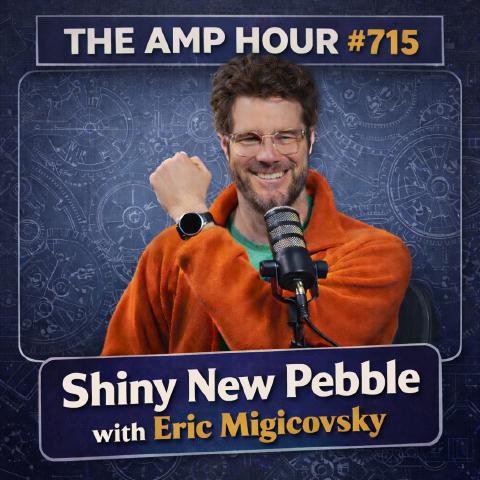
#715 – Shiny New Pebble with Eric Migicovsky
Download episode · 88 MB
Also on Apple · Spotify · YouTube · RSS
Show Notes
Welcome Eric Migicovsky of Pebble!
- Pebble is back after Eric worked with Google to open source PebbleOS and he reaquired the naming rights
- Eric returns to the hardware space after 7 years, including working at yCombinator, a famous accelerator for early stage startups, and on Beeper, a cross platform app for messaging.
- While discussing the difficulties of hardware project, Chris brought up a recent post about a high wattage lamp project HN
- One thing Eric likes about hardware projects vs software is that "hardware projects can be done" as in they have a defined end state
- A more recent project is a smart ring - The Index 01.
- The non-replaceable battery is driven by the product specs, also the need for reliability
- The ring doesn't immediately need to be in range of a phone, it syncs the memory after the fact
- Pebble is no longer a VC backed startup with a subscription model, so that changes a lot of constraints
- Initially they sold 2 million watches, and 250 million in sales
- Eric is driven by "gadgets". He read "pen computing" and "popular mechanics" as a kid
- Consumer companies vs other types (and why Eric likes the former)
- Pebble went through different phases
- The team spent 6 months in China, designing the first consumer version and working directly with factories
- CTO of (original) Pebble, Andrew Witte, was a somewhat early guest of The Amp Hour
- How much did the China ecosystem drive design decisions?
- There was no such thing as a smartwatch factory (but are there ever now!)
- The book Apple in China is supposed to be a great read and mirrors the Pebble Experience
- We heard from Chrissy Meyer when she was on the show about working with the Apple Watch manufacturing proces
- Water proof methods codeveloping in China
- It's an interative process of submerging designs in a glass vessel with pressure and bubbles seep out of the device at different points
- The remedy? According to Eric: "More Glue" :-D
- Eric shares his process on a YouTube channel called Tick Talk (not to be confused with the shortform video site)
- There is a video with the CEO of SiFli, makers of the Bluetooth chip that is in the most recent Pebble devices
- One interesting feature is a custom bus to the Sharp-made ePaper-like screen used onboard
- FreeRTOS pebble OS
- What is PebbleOS?
- It's targeted at an m33 class ARM chip and the kernel is FreeRTOS
- The bluetooth stack is nimBLE
- Eric went back and forth on whether to port to Zephyr for the Bluetooth stack and hw support from vendors like Nordic Semiconductor
- The Index 01 ring is Dialog Semiconductor (now part of Renesas) part
- One challenge is that rings have different sizes...so they mill the rings based on orders. The larger rings get an extra battery!
Transcript
Chris Gammell: This is The Amp Hour Podcast. Release February 9th, 2026. Episode 715. Shiny New Pebble with Eric Migicovsky. Welcome to the Amp Hour. I'm Chris Gammell of Contextual Electronics.
Eric Migicovsky: I'm Eric Migicovsky from Pebble.
Chris Gammell: We know the product well. We're excited to have you here. You have been very busy lately. You were busy before, and I'm sure you were busy in the meantime. Actually, I know you're busy in the meantime because of the other stuff you worked on, but boy, your hardware output lately and the things you've been putting out in the world.
Eric Migicovsky: Well, it's like there was a stopper on a garden hose or something. The garden hose was just knotted up a bit. And then it got unstopped last year and the output has been fast and furious. I love hardware. I mean, I spent seven years off or eight years off hardware between 2016 or 2017 and 2025. And I missed it. It's like, you know, a siren song that was drawing me back into hardware.
Chris Gammell: I get in a similar way. And then it's like 2 a.m. and you're like on a factory floor of troubleshooting or like in your lab troubleshooting. You're like, maybe I shouldn't do hardware. You know, it's always that push-pull,
Eric Migicovsky: like back and forth. Well, I have had extreme rose-colored glasses on. I will say that. Yes. Because what you're just describing is the pain and suffering and tears that we all are very familiar with. But let me give you, let me give everyone, for people who are in the thick of it, a chance to, you know, remember what it was like before you had to do that. So I had been, so I did Pebble. 2016, we sold the company. I went to work at Y Combinator, which is an investment company that makes early stage investments in, you know, small startups. Did that for three or four years. Then I started a software company called Beeper, where we made a universal chat app. One app that lets you chat with anyone on any chat. That was a software company. We sold that in 2024. And then I reverted back to my natural tendencies. But in 2024, I was thinking about doing a hardware company, restarting Pebble, basically. And I wrote a list down of all the things that I love about doing hardware and all the things that I do not love. About doing hardware and specifically a hardware startup, like one that's, you know, making consumer electronics and selling it to people. The list of things that I didn't like was much longer than the things that I did like.
Chris Gammell: But it allows you to maybe carve it out then, right? You're like, oh, well, I just want to do this one thing, you know? Like VC funding, you're not taking VC funding on this current go around, right?
Eric Migicovsky: Well, that's one of those things. But also like being awake on a factory floor at 2 a.m., that's something that I weirdly like. Like that is, that was in the column of things that I like. I also love doing customer support. I love talking to people about, you know, the product and hearing the problems, the good things, the bad things. The things that were on my do not like list were a bit more related to the operational things that are needed to run a large consumer electronics company that's selling in retail and selling through distribution and stuff like that. Forecasting. That was very, that was one of the things that I just did not love about doing hardware. Hardware is special in that way that you cannot make money doing hardware until you physically make and ship something and you can't snap your finger. You can't, you can't tell Claude to, you know, go and go and make more hardware, at least not yet. But even, even though there's like, there's, there's a timeframe that's associated with hardware that's not there with software.
Chris Gammell: Yeah.
Eric Migicovsky: These days. I always think about the,
Chris Gammell: the fact that you can't ship until 100% of the stuff's on the board too, right? Like that is, it's hard. There was a Hacker News article that just came up the other day about the, the person who's doing that really bright lamp. I'll, I'll try and link it in here. It was great, great write up. Yeah, I read that. It was really good. I mean, they ran it like very familiar struggles that, that like felt really real
Eric Migicovsky: and like, but the injection mold, I think there was one part where it's like the injection mold points were at the wrong place in the mold. And I was like, God, yeah, yeah.
Chris Gammell: Yeah. It's like, it's like having a like shell shock and, and also like that warm fuzzy, you know, like, ah, they're part of the club now, you know, but the fact that like, you know, email, yeah. Like the, you know, like the bomb, the bomb issues, right? The shortages, the tariffs, all of the things that we have all been dealing with. Like you just, you can't, like you said, you can't make money. You can't get out the door until you've already paid all the money for all the stock. And unless everything's there and everything's working well and every, everything is like not perfect. It's never going to be perfect, but enough that it's working. You can't send it out the door.
Eric Migicovsky: So I totally agree with that.
Chris Gammell: Yeah.
Eric Migicovsky: But I think that there's another important lesson learned that I learned after eight years of not being in the hardware game. And that is that hardware can be done in a way that software can never truly be done. There's always going to be one more thing that you want to add there. There needs to be, I ran into this bug. I could fix it. I got to fix it. I got to stay up till 2am to fix it with hardware though. You can be done and you are done whether you like it or not. And that's a very clarifying, magical feeling to me, having been on both sides of the fence now. So we shipped the last Pebble in 2016, December, you know, mid December, 2016. And the hardware kept working. The software did too, but the hardware kept working. It's an embedded device. Like there's no dependencies. There's no third party. There's a few third party services, but generally like things kept working. And there might've been a few bugs here and there, but magically, like even the Bluetooth connection to subsequent Android and iOS versions kept working for eight years after that. And that was, and that was important. And that, that has kind of fueled this next phase of Pebble for me in that I'm coming into it knowing that we have something that works and it does. And by works, I mean, it delivers a good experience. It delivers a great experience of what exactly I want out of a smartwatch. And the software's there, it's all on GitHub. It was open sourced by Google. Thank you very much, Google. And you know, every day I put, I put the watch on my wrist or the, I wake up and the watch is on my wrist and it does the same thing that it did the day before. And it works great. And you know, there are probably things that I would love to add to it and things that we will add to it, but the baseline functionality we shipped in 2016, we shipped in 2012, basically. Yeah. And it's still doing the same great job that it was, you know, 12, 13 years ago. And that, that real, I don't know, maybe, maybe this is not a massive realization for everyone else out there. But for me, that was really magical because we were on this treadmill at Pebble where we were always coming up with new hardware. We all, we were always coming up with new software updates, like every month or every week or whatever. And I don't think I ever realized that you could be done something.
Chris Gammell: Yeah. I've worked at companies where also, you know, we ship hardware, we want to ship updates, we want to have product improvements, stuff like that. So I feel like there is that expectation these days too. And totally. Yeah. It is interesting to think about it. Like you could stop, but at a company, I guess there's always bug fixes and improvements. And like, I guess maybe is the, the reason you keep shipping new stuff is to, to, to sell more stuff in the future. Like that, that's part of that treadmill you're talking about. Yeah.
Eric Migicovsky: I think it's just because we're always on that treadmill and because software as we know it gets better, right? You, you're always, you know, hopefully downloading a new software update here or there, or, um, yeah. So again, I don't, I don't think this is a one size fits all thing. Like not all products need to stop development, but I'm just putting it out there and saying, maybe, maybe the product that you're working on can actually be done. And that frees you up to go and work on a new product or work on a new feature or do something else and still enjoy that feeling of accomplishment and feeling of, you know, product benefit that you're getting from, from having made something.
Chris Gammell: Yeah. I think if nothing else, like from a project management perspective, knowing, knowing what the point is, and like you said, getting to it, it saves the budgets in the future and it makes sure that like you have a sane way to maintain sanity. So that does make sense. Well, in your case though, so new Pebble, what are you calling it new Pebble? What is the, uh, it's just called Pebble. We got the trademark back. Just Pebble. Yeah. Yeah. Great. You're adding other projects too. And this was like, you guys made a splash with your, what I saw, you know, we have video here. This is an audio podcast, but I do see on your, on your finger there. I see, I see a ring. I've seen it there. Making all the people who are just listening jealous. Yeah. Well, they can go read all about it. I was really interested about this because you post about this hacker news. And the places that saw a lot of it, but tell us about it as a smart ring. What is that for them?
Eric Migicovsky: So I'll tell you about it, but then I'll also ask you a question. I want to, I want to know what caught your eye about it. What got you interested in it? So what I'm wearing on my index finger right now is a new product that we came out with called index. Oh, one. It's a smart ring that has a button, a Bluetooth chip and a microphone. And when you press the button, you can talk into the ring. Your voice is recorded there. And then it's sent to your phone inside the pebble app on your phone. Your audio is transcribed into text. It's run through a small, local, large language bottle. And it can take a note or it can set a timer or it can add something to your calendar. Just very kind of short, quick, simple voice notes. The whole idea behind this product is so that I have a device on my body that I can always offload some little bit of memory to. So I get ideas. I think of things during the day, things that I need to do, things that I need to change or fix in the product. And I used to take out my phone, open the notes app or worse, open, you know, a text, the texting app and send myself a text. And I would just, you know, if I, if I didn't do that, if I didn't write it down immediately, I would just forget it, you know, and it would kind of be floating around in my brain as something that I remembered I needed to do, but I forgot that it would annoy me. And so I built this, this ring as a means of offloading little things that I need to remember into my kind of digital life rather than having to remember them constantly in the back of my head.
Chris Gammell: So like, like B-RAM, like, like brain, brain RAM.
Eric Migicovsky: Yes, exactly. I think of it as external memory for my brain, like a little scratch pad or a little SD card that I can insert and store things that I need to. And since it's a ring, it's always on my body. I always have it. It's waterproof. The battery life lasts for two years. You don't have to charge it. And so it's just, it's always, always there. And I don't use it that much. Honestly, I only use it five times per day. Maybe, maybe 10 max. Like, this is not something that I'm recording meetings with. I'm not, you know, my life is not that interesting and I'm mostly in front of a computer. So I use my computer to do the things, but when I'm biking or when I'm, you know, lugging groceries or carrying my kids or just relaxing without my phone and I get a brainwave or something, I hit my thumb against my index finger and talk into my ring and it just remembers it for me.
Chris Gammell: Yeah, I think the interesting thing about it is I usually expect from the smart ring industry that everything's, you know, like the full featured, taking your pulse, doing all the quantified self. That's like, that's my reference point for it. I've never really been interested in that stuff in so much as I, to be honest, until a couple months ago, I didn't really wear a watch. Uh, you know, like that Paul Redline in, uh, uh, forgetting Sarah Marshall. He's like, yeah, I just moved to Hawaii, man. Stopped wearing a watch. It's like, yeah, you know, my phone has a smart, my, my, my phone has a time on it. So I just use that instead. It's like, that was always just kind of my MO, but you know, I've enjoyed having a watch on. I can imagine a ring as well, but I do like the simplified nature of like the single use. The main thing that I kind of got caught up in on the conversations about it was, was the, the fact that it's completely enclosed. The fact that you, you know, send it back to the factory for refurb. Just that as a model is actually really interesting.
Eric Migicovsky: What I ended up thinking about the battery life being two years.
Chris Gammell: Yeah, exactly. Like a non-replaceable battery, no charging, that sort of thing. Yeah. And I either figured it was one, a to be added in the future, you know, in the index O2, maybe it was in there or two. It actually helped drive some of the product requirements that made it simpler, cheaper, more accessible in that way. And then it's like a worthwhile trade-off that, that was, that was my take from the outside. I didn't know much more other than that.
Eric Migicovsky: Oh, it was entirely driven from the product definition of, of what this product is. This product is designed to be something that is 100% reliable. I knew that, you know, I have a bunch of Google homes around my house. I have a phone that has Google assistant built in. I have the ability to take voice notes if I wanted to. And I do, I did. I had, you know, a constant, you know, Hey Google, like do this or that, or add this to my calendar, add this to my notes. I would, I would constantly be spreading this up.
Chris Gammell: We apologize for Eric activating people's speaker right there.
Eric Migicovsky: Hope you're wearing headphones. Right, right. And it just wouldn't work a hundred percent of the time. It would work like 80% or 85%. But that last 10% that didn't work, it would, it would fail and would say, sorry, I can't do this or whatever. And that would, that those, those few times that it would happen would cause me not to use the whole system more. I couldn't rely on it. It couldn't be that external memory for my brain. If it failed because my brain already fails. Like I don't need another system. That's not going to work. I need a system that's going to be rock solid and work 100% of the time in order to build this one. The top requirement was that it had to work 100% of the time. And that means it has to be there. It has to be there when you need it. It has to be waterproof. It has to be something that kind of blends into the background, but more than anything, it needed to be something that I didn't need to think about. If I needed to think, oh, when did I charge it? When was the last time I charged? Like you kind of have this mental model I do where I have my laptop. I have my phone. I have my AirPods. I have my, you know, travel stuff, my travel chargers and iPads and stuff like that. And I have this kind of console in my brain. That's that shows green lines for all the battery levels. And I'm, you know, I have this background process that's running of how do I maintain the charge for all these things. And I did not want this ring to be yet another thing that I had to maintain the state of. Plus, if it died and you were charging it on the charger, what if you needed to use it? It wouldn't be there. And all of a sudden, this piece of your brain wouldn't be attached anymore. So this is all a long way of saying it had to be something that you didn't need to charge.
Chris Gammell: And yeah, I like it. I like the spec driven thing as well. You know, from a personal user perspective in all these cases, do you ever read A Celerando by Charles Strauss?
Eric Migicovsky: Yeah, of course.
Chris Gammell: Yeah, like the second brain he's wearing on his face and then it gets ripped off. Like I do worry a little bit about that, like the dependency on it. But like you said, it's already there. We're already doing this. So like any of these pieces are, you know, as much as they are.
Eric Migicovsky: Well, so we did everything in our power to make it dependable. So it has, you know, like I said, a multi-year battery life. You don't have to charge it. It has a click button, like a physical click button that you click and you can feel when you press it. It's fantastic. We looked at touch pads. We looked at everything else. Everything else just didn't work. Nothing beats a tactile button. It has internal memory on the device itself. So if your phone's up there, you're gone for a run, you're out, you're in a tunnel, you're somewhere where your phone isn't. It still can record and then it syncs to your phone the next time that you walk back in range. And then it all works offline. So if you're in the airplane, if you're in the tunnel, if you're, you know, you don't have internet, it still works. It still records. There's there's basically there's no way that it can really. I mean, it could fail, you know, if you smashed it or something like that. But yeah, it just it just works. Hmm. That's great. And it's all done with an incredibly simple and small circuit. Like there's literally batteries, Bluetooth chip, no front end. I think that I think we just like hit a patch antenna or something like that. A little bit of spy flash and the battery and these these kind of hearing aid, silver oxide batteries that go around the side.
Chris Gammell: Yeah, it is very interesting. I mean, the price point here is like 79, 80. I don't want to speak out of terms. 75 bucks. 75. Like, yeah, that's very affordable. The fact that it's not like loss leader for a data plan later as well. Like, oh, yeah, there's no subscription. There's no subscription. Like that's a benefit there, too. Whereas a lot of them, again, expectation being like, oh, well, this is the thing I buy, but it's really so that I'm paying for the primo service later. That sort of thing is a great it's a very refreshing model in, you know, in 2026, that sort of thing, too. So that's great.
Eric Migicovsky: Well, so that's another difference this time around than last time in terms of the whole company. So when we launched Pebble initially, it was a VC backed startup. And we were I was we were trying to grow it to be a really big company. Like we had invented smartwatches. We'd invented, you know, wearables to a certain degree. And we were seeing how big we could take it. How big and how big could this go? And we, you know, built it pretty big. We sold two million watches over a couple of years, you know, did a quarter billion dollars in sales, ended up not being successful. You know, we had to sell it. We had to sell the company in 2016. But, you know, we took a shot at we played our cards and I wouldn't, you know, change anything. I wouldn't take that back for the world. It was a hell of a lot of fun. But this time around, this time we have our sights set on a much more simpler target. And that is to build products, gadgets, really, that we ourselves want.
Chris Gammell: That I want. And that might be broader than watches and rings as well. Like when you say gadgets, it's not just not just wearables. Like are you thinking outside, you know, not to ask you to put all your plans on. But just scratch your own itch sort of thing.
Eric Migicovsky: Exactly. So but going back to this, we were talking about the pricing and the lack of subscriptions. Like this is a company designed to make products that are fun, that that we want, that I want. And that's the end of that's the end of the goal. Like, yeah, we want to make a bit of money and make sure that it doesn't lose money. But there's no grand scheme here of trying to take over the world and, you know, build the next AI platform or whatever. It's like, yeah, if that happens, great. But like that's not the goal. The goal is to build cool gadgets. And here's what a gadget is to me. A gadget is. I grew up. Well, this is going to be another long rambly story. But this is a podcast. So that's this is what it's for. Exactly. This is not this is not this is not this is not a tweet. How we relate as nerds. This is not.
Chris Gammell: Yeah. This is a medium article.
Eric Migicovsky: You're going to need an LLM to to summarize this next next sentence. So I grew up reading gadget magazines. I don't know about you, but I love popular science. I subscribed to a magazine called pen computing in the 90s, which was about like industrial, you know, tablets and stuff like that. And, you know, it talked about Palm pilot and Newton and stuff like that. I loved I just love gadgets. I still do. Gadgets to me are different than electronics or different than tools. Gadgets are more frivolous. They are more fun. There's something to look forward to. They're a gift. They're a they're a present. They're something positive in your life. There are things that I read about. There are things that I look forward to buying. There are things that I lust after. There are toys. They do something. They help in some way. They do a trick. They are something I can show off. And I love gadgets. I have a gadget problem. You know, I have too many, you know, I have too many earbuds. I have too many things. And I don't keep everything. Things to charge. It sounds like. Yeah. Well, what's interesting is that I'll buy everything once and I'll keep it on my desk and I'll look at it because it's beautiful and it looks fun and it's a good story. And I love telling people about it. But the number of gadgets that make it onto my body, onto my person, things that I carry around is actually very few. You know, I carry my phone. I carry my watch. I have my ring now. Ring is the first new thing. I don't even carry headphones 24-7. I carry them probably like 50% of the time. And that's it, you know. But I, you know, I have 19 billion smartphones and, you know, Raspberry Pis and things on my desk as well.
Chris Gammell: I love the gadget stuff too. You know, it's interesting because you are in the consumer space maybe more than most of our guests have been. It's not an easy space to be in. You know, it means being very price sensitive on the bomb side in order to hit the volumes, hit the price point for retail, that sort of thing as well. So I am interested how that kind of all ends up playing together as well and like how you think about hardware and the things you maybe design into these parts, the parts you design in it and things like that as well.
Eric Migicovsky: Everything starts with consumers. One of the reasons why I have all the products and companies that I've built are consumer companies because, well, I am a consumer. I am me and most of the things that I start with are problems or things that I personally need. And I'm not a company. You know, we aren't companies. The unit of human is not a company. It's a person. And so, you know, I look at a lot of people building enterprise software and enterprise hardware and stuff like that. And, you know, I'm like, come on, guys, like we are we are people and companies are made up of people. And so you can use consumer products in the enterprise, but you can't use enterprise products as a consumer. Always. It doesn't work doesn't work that way. Yeah. Pricing usually doesn't work out. And the UI definitely doesn't work out. Yeah. And if you look at the biggest the biggest hardware products and, you know, things in the world, they're all consumer. Like everything is, you know, for consumers, cars, smartphones, electronics. They're all consumer products that are also used for enterprise as well. And consumer doesn't necessarily mean it has to be high volume. You can build low volume consumer. That's that's totally possible. You have to charge more and have to, you know, make sure that you understand your margin structure. But you don't have to go to high volume just because you are doing consumer by definition. You have to do that if you're, you know, choosing to go into, say, retail or distribution or aiming for a larger growth target. Like, yeah, it's at some point you have to go big, but you don't have to. And so, you know, maybe maybe a good good kind of topic would be comparing these several different phases of, let's say, Pebble. So there was, let's say, before the first Kickstarter when we were just building Pebble in our garage, basically. And then the kind of Kickstarter 2012 to 2016 phase where we were building it as a startup. And then now back in 2025, building it again. So in the early days, we didn't know what the hell we were doing. We still really don't. But like, we really didn't know what we were doing. And so we chose to do a board level design for, I remember the chip. It was an LPC 2103. We didn't use modules for the Bluetooth chip. We bought a Nordic more CS, CS, CSR, CSR chip and did a board level design of it. Oh God, total idiots. Because we were like, oh, we got to save some money. We got to squeeze a little bit of module. It would be too expensive or whatever. It was like $10 for a module instead of $1 for, you know, or $2 for the Bluetooth chip. Right, right. God, that was one of the dumbest mistakes that I ever made. Almost killed the company, I think, a couple of times.
Chris Gammell: Just because of like certifications and the challenges. No, we couldn't get the software to work. Couldn't get the hardware to work.
Eric Migicovsky: We couldn't get anything to work. We wasted like eight months, you know, porting BT stack to work with it. Instead of using a module that you could talk to with like AT commands or whatever, we, you know, had to custom write some stupid open source Bluetooth stack. And, you know, I think about that a lot. That it's an easy mistake to make as an early stage developer. To think a hardware builder. To think that I need to optimize the bomb for production, for mass production, for cost savings and stuff like that. No, no, you need to optimize it for what's the least hassle before I can ship this product to an end customer who's going to pay me money. And you really don't have to make money in the early days. You have to not lose money, but you don't have to make a lot of money. You have to first convince yourself that what you're working on is worth working on. And if you know that intrinsically, if you know that inherently, that's fine. But most people don't. They want to get some external validation. And to do that, you have to sell the product. You have to get it out the door onto, you know, someone's into someone's life.
Chris Gammell: And it's interesting. That's kind of at odds with what you said about like the standalone forever device. Right. Because if you have something that is, you know, expensive standalone, it might not be eligible for the updates you do in the future, that sort of thing. Or then you have to maintain backwards compatibility.
Eric Migicovsky: Great point. So you're kind of drawing a point here that like we were talking about, could you be done hardware? Exactly. Yes, exactly. And so here it's an important, the important distinction is that when you're still validating the initial product idea, there's no point in building it forever because you don't know if it's a good product yet. You don't even know yourself if you're going to use it. And why would you spend any second longer perfecting something that you're not even going to use yourself? So don't build the juicero before you validated that people want a juice business. I wouldn't even do it before you validated that you want it. Too many people that I see are building products that they themselves don't want. And that kind of works in the enterprise. Like if you're, you know, you're not an enterprise, so you need to sell it to other people. But if you're building a consumer product and you don't use your own product, why the hell else will anyone else use it? That's a good point.
Chris Gammell: Yeah. And that is a true benefit of a consumer level thing is that you are, you are user zero,
Eric Migicovsky: right? You are. Yeah. And, and, and you, as long as you're not lying to yourself, you should know if you are building something that you want and you will use. And, and this is the exact point that like, if you, if you spend one more second trying to optimize the bomb or use, you know, use something that you could pay for, you build, build something yourself instead of buying something off the shelf. If you have to spend one more second doing that on the road to the starting gate, which is, have I built something that I want?
Chris Gammell: Yeah.
Eric Migicovsky: You're doing it wrong. You know?
Chris Gammell: Yeah. Yeah. It is tough when there's like a six to 12 month build cycle to get into the first people's hands because. Or your hands. All the costs or your hands, right? Yeah. Just all the costs and, and things like it. Yeah. It's, it's, it's tough.
Eric Migicovsky: So where was I was kind of explaining the phases. Yeah. So that was the first phase that was before we even launched. That was 20, 2008 to 2012. And we screwed a ton of things up. That's easier now because there are more modules that you can buy off the shelf. You can go to Amazon and buy a show, a show board that uses, you know, a, you know, you could program with Arduino and it does everything basically for 20 bucks. So way better than it used to be. But I still want to caution people that like, don't, you can still fuck it up. You can still screw it up totally. But don't, you know, use off the shelf stuff to validate your idea for yourself and for your early customers. Okay. And so then the next phase was Pebble. We had a hundred thousand users or a hundred thousand customers right out, right off the bat. And so we knew that we had to shift from the hacker build it in the garage mentality to the, we need to build this in mass production. And we had never done that before. I'd never been to China. I'd never, you know, worked with a factory. I'd never, I never had a real job for that. And so we enlisted some help, some folks that had done it before they had some okay ideas, but in general didn't have all the answers. And I think our naivete helped here in that we didn't get too depressed. If you had talked to a real person who had made a real company or product before and said, we have a hundred thousand orders and our deadline for shipping is, you know, seven months from now, they would have stormed off and, you know, not even taken up the job. But we didn't know what invoice retainer. Yeah, exactly. Yeah. We, we didn't know what was possible and what wasn't possible. So we just did it. We flew to China, basically spent six months living there. We had a small team of seven people or eight people. We all knew what we had to do. There was one person who was the double E one person who was, you know, the firmware engineer, one person who was the iOS person, the one person who's Android, you know, we all knew that we had to ship. We had a very clearly defined set of goals, which was, or requirements, the, the Kickstarter page. It was just, you know, a single page that had all the features that we had promised people. And so we all were aligned on what we had to build and we didn't really stop. We were 23, 24. We didn't sleep. We didn't stop until we just did it. And, you know, if you bang your head against the wall enough times, we managed to get it to work. But in terms of, let's talk about costing and, and, and picking components and stuff.
Chris Gammell: So actually before, before we do that, I'm curious, is this when Andrew joined the team as well? Cause we've, we've had Andrew Whitty on the podcast. Yes. Well, so he, he joined before the Kickstarter. He joined about a year and a half before he designed Pebble. Yeah. I remember talking about this. The screen was like huge, a huge discussion around the, the sharp screen and yeah. Yeah. Like grows and stuff like that. Yeah. It's great.
Eric Migicovsky: Yeah. The screen, I'm not sure if you mentioned was originally used for parking meters. So it was a screen that was used because it's reflective and daylight readable. And so it was perfect and low power. It's a perfect screen for, you know, little parking meters that would show how many minutes or whatever are left. Somehow we heard about it and said, Oh, that'd make a great smartwatch screen.
Chris Gammell: Yeah. It's interesting. People can go listen to that episode as well. After this, uh, you know, get that, get that kind of like on time flavor as well. I think that was around, around that same time that you guys were doing a lot of the manufacturing and the filling out that must've been the first, the first version. Cause you guys had multiples that were on Kickstarter as well. Right? Yes. Yeah, exactly. Yeah. Interesting.
Chris Gammell: So then when you were in China and you were making these decisions, I'd love to kind of work our way back towards modern day because some of your, your recent stuff with like the, the chips that you're using now and stuff like that is very interesting. How much did the, did the Chinese ecosystem actually end up influencing decisions? Cause we've had a lot of people on the show before talking about it and saying that, well, cost being what they are and ecosystem, the availability being what they are, that ended up driving product decisions and like the ability to actually build these things at scale. How much did that end up happening for Pebble as well?
Eric Migicovsky: I think it was less around the components themselves and more around the processes. So in 2012, when we were first making Pebble, there weren't, there was no such thing as a smartwatch factory. There was no such thing as a smartwatch manufacturing line. A lot of the tools and tricks and processes we had to develop alongside our, you know, manufacturers up until Pebble, there weren't really any consumer electronics that were waterproof and there was no need, you know, it was right. Smartphones weren't waterproof. Don't dunk your phone. Yeah, exactly.
Chris Gammell: If it falls in the toilet, you put it in a bag of rice like the rest of us.
Eric Migicovsky: Yeah. So we had to develop, we had to develop those. A lot of the processes kind of got co-developed at these factories. Have you read the book, Apple in China? It was an incredible book. Highly recommended. Yeah, that is on the list. Yeah. That is on the list.
Eric Migicovsky: And my coworker told me about it. So we didn't, I mean, know that this was how Apple was doing it, but you know, Apple followed a very similar path, which is they basically embedded engineers inside the factories and built the processes to do better QA, to do better, you know, manufacturing techniques or whatever. You know, they weren't there before. These processes weren't there before. So that was 2012 to 2016. Now, coming back into the game eight years later, it's incredible. It's like a massive unlock. I could find a factory, you know, go visit them, find them on WeChat, start chatting with them. They know what to do. I'm sure you walk into the showroom and they're like, which watch would you like to brand? No, I mean, they don't, none of them really do e-paper like how we do, but you know, that's just a minor, you know, component difference. The good news is that, you know, everyone's done this before and it's much easier for me now as a much smaller company, like we only have a couple of people on the team to help direct and guide the factory to building the specifications and the thing that we want out of the output.
Chris Gammell: Yeah. We had Chrissy from RootVC talking about her Apple Watch experience. And just as a reminder for people that are listening, like Apple was before, you know, like Apple Watch is just so dominant in the ecosystem as it were. And like, of course, all my, all my Apple acolyte friends, you know, like, oh, this is so groundbreaking. I'm like, actually, no, I, I know, you know, we've had people on the amp hour talking about, this was not the first thing folks, you know, like obviously there was stuff before it, but you know, that second mouse style Apple thing that it is, obviously they make a good product. And Chrissy talked about the manufacturing process specifically for Apple. So that's another one we'll link in here too. Um, yeah, it's, it's wild to think about the, the before times, you know, like that is, that is interesting. Yes.
Eric Migicovsky: But, but it's now a capability that's available to everybody. Yeah. Like anyone can benefit from this simply by connecting with factories or supply chain, people in the supply chain that build existing products. One of my best, the best hack that I have to building things in China is to find a product that's similar or almost exactly like what you want to build and then work your network until you find the factory that actually builds it. Talk to the factory and they're going to be more than willing to, you know, either take that existing design and modify it. If it's kind of like a Gong ban or open source product, or at least they'll have, at least, at least, you know that they technically, that it's, that they technically can do it. They have the capability to do it. They've done it once and they have the team and they have the, the people, you know, that are there that hopefully can do it again for you with your specification change or whatever.
Chris Gammell: Yeah. Yeah. Yeah. I mean, at a very, very, very micro level, I do that on just like Alibaba and Aliexpress. And I'm just like, Hey, can you send me the drawing for this thing? No, that's how you do it. On your thing. Because I just, I just want to add notes to your PDF and you just send it back to me. That'd be great.
Eric Migicovsky: So that's it. So you just described how, how I recommend doing things like go on Alibaba, go on Aliexpress, go on Tmall, go on Taobao and find a factory that makes, or try to find it. It's hard sometimes because there's a lot of distributors that kind of are in between the factory and the end customer, but every so often you can find your way in there.
Chris Gammell: That's great. When you said the, the, you know, the waterproofing didn't exist, the, a lot of these processes didn't exist. I'm sure that just the compactness of some of these electronics as well. What did that look like? You know, kind of boots on the ground factory in China, co-developing processes. What does it look like for, for waterproofing specifically? Cause that's some, that's an area I have never, ever talked. I haven't talked to people on the show about it. I don't think. Yeah.
Eric Migicovsky: And I I've never done it personally. In the early days, we looked at watch manufacturing to get some hints on how to do this. Watch manufacturers use, looks like you'll have to just find a picture. It looks like a pot, but instead of metal walls, it's glass walls. And it has a lid that comes down and you screw tighten it kind of like what you'd imagine a vessel, a pressure vessel cover is. And then you put the product that you're testing above the water, there's water inside, but you put it above the water. Then you pressurize the air while the product is still above the water. The air pressure, if there's a hole in your product, will get into the product, will seep into the product. You leave it there for a few minutes and then you dunk the product still while it's at pressure underwater. So the pressure is equal above the water and below the water. And so nothing should really leave or enter the product. Then you release the pressure of the air above. That creates a pressure differential between what's inside your product underwater and the air. And if there's a hole in your product, you will see bubbles leave your product through the hole and kind of escape upwards. That's how you do kind of prototype testing for air pressure, uh, waterproof testing. Sure. And it exposes where the holes are because you see these trail of bubbles. And so it's really a whack-a-mole game. You find a hole, you change your process to usually you add more glue or you change the gasket or something. That's what I, yeah.
Chris Gammell: And then you, that's what I was wondering about it.
Eric Migicovsky: Then you dunk it again and you see if there's a new hole that wasn't exposed before because the air was escaping out the first one. Then you repeat the process until there's no more bubbles. And so you'll change the pressure. So you'll start with kind of IPX8, which is the basic waterproof test, waterproof kind of rating. IPX8 means that product can sustain being underwater under one meter of water for 30 minutes. And then you'll go from there. So our products are tested to 30 or 50 meters of pressure through three atmospheres or five atmospheres. So it's quite a bit more. And yeah, you see different holes in the product at various different stages. And it's not just about verifying the design. It's also about verifying the production process to make sure that, you know, everything's working in the process and still need to test many units. Like usually we test 50 to 100, if not more than 100. And then you'll need to retest to make sure that it, you know, still is waterproof. So that's the design verification that verifies that the design theoretically is waterproof. And so in the olden days at the beginning of Pebble, that's how we did it in the production line as well. We actually just had this pressure vessel and dunked every watch underwater. Yes, I'm a dunk specialist. We had a person whose job that was. Yes. Later on, some new technology emerged that is a, it's an air pressure, it's an air pressure tester. So it looks, there's no more water anymore. You create a little jig that you put the product in that has that whole kind of holds the product up. And then there's a two, two halves that slide down over top of the product and test under, under test that has a small air cavity around the product. And you do kind of the same thing. You pressurize the product and then you depressurize the air around it and you see if there's any air escaping back outwards. And they have very, very, very precise ways of measuring the airflow. And it can tell you if some air has entered the product and escaped afterwards.
Chris Gammell: And so in terms of like processes, kind of remediations with this sort of thing, it's coating, it's gaseous, like you said, it's glue. Yeah. Yeah. It's a lot of glue. Yeah. And glue machines.
Eric Migicovsky: So there's all these robots, like gluing becomes a science rather than art. And so you have robots that apply, they have a, they look like, you know, a pretty standard 2D robot, but they have a syringe and glue and they have a little stepper motor that pushes the top of the syringe down or, you know, has a glue, you know, and it's all about like, what's the speed, how precise, like, you know, do you have to do any cleaning? Nozzle size, throughput. Yeah, exactly. Yeah. Yeah. And then, and then you have to test different curing times and what is it, how long do you hold it? How long do you clamp it? Oh, and we also, you also have to have these to, to hold things if they're, if they're not screwed together, you have to create these 3D printed or, or injection molded clamps systems, because, you know, say your production line is running at, you know, a couple hundred units per day or 500 units per day. You may need to let your daily batch cure or set for hours, if not days. And so a whole separate part of the production line is creating injection molding and creating these kind of clamp systems that hold the unit, the hold the day's production for the next day so that they can continue production.
Chris Gammell: And you have to like roll them into like an outgassing style, like chamber, that sort of thing. Like, I don't think we do that. Get the bubbles. But they definitely sit somewhere in a closet for a day. In the closet, you know, but, but like a NIST calibrated closet, right?
Chris Gammell: It's jokes. This is just stuff that I've never really thought about. You got to come to the factory. You know, if you can believe it, Eric, you know, you talk about, uh, uh, consumer versus not as someone working in an industrial, you know, very low volume. I've never been to China. So like all, you know, kind of small run us made domestic made, that sort of thing. Um, so yeah, it's on the list. Uh, I'm a little embarrassed about it as someone who works in the electronics industry that I've never been to where all the electronics are
Eric Migicovsky: made, but it's a different slice of life. It's a different, it's just a different, I mean, I, I've had the pleasure of visiting some, you know, industrial facilities here in the U S and it's completely different. You know, I, I, one of my first jobs was at Raytheon in Canada. We were building, um, radar units for airports and, you know, the office was right next to the factory. And so we could walk around the factory and see it in various stages of production. Yeah, it's,
Chris Gammell: it's, everything's a little bit different. Well, I really like, uh, hearing about like this stuff and you actually talk about, we should mention that you also make pretty regular videos about your, your process and how you've been working on this stuff as well with a very clever name, uh, on YouTube that's called TikTok with Eric. Yeah. TikTok. Yes. Yes.
Eric Migicovsky: Yeah. No, I, I mean, part of it's, part of it's for fun. I enjoy doing that. And part of it's for sharing the process with people who are, you know, eagerly anticipating one of the new watches that we're making, but part of it's also to help people try it themselves to give people you know, a bit of exposure and, and, and realize like, it's not this unfathomably difficult or, you know, difficult thing. Like it is easier than ever to build hardware in 2026. And I really encourage people to do it because I love it. It's a lot of fun, but I'm also, you know, I want to, I want to, I want to try other people's gadgets. There it is. I'm a, you know, insatiable gadget, you know, connoisseur. And so, yeah, like I hope that I can help at least one or two or five or 10 or whatever more people build their own dream gadgets so that I might get the chance to use it myself.
Chris Gammell: Yeah. One thing that I was really, one of the videos that I watched and was really interested in was, you know, you're talking about the picking the chip for the, the smartwatch and it was a vendor I hadn't looked at before, but you tell us a little bit about what's, what you're using in the modern, the modern pebble, the recent pebble designs, stuff like that.
Eric Migicovsky: Yeah. So we went through a couple of different generations back in the beginning. We used an LPC chip from NXP, which doesn't exist anymore. Then during the kind of main pebble era, we used an STM 32F series. Great chip. The way that I learned about chips is almost exclusively from friends. I'm lucky in that I have a bunch of really nerdy, fun friends who have a beer and talk about chips.
Chris Gammell: You're living in the right spot for, you know, living in Silicon Valley and, you know, near,
Eric Migicovsky: near other large. No, you don't have to live there. You could go to CCC. You could go to anywhere. You just have to be out there. You just have to be willing to, to talk to people. And so, yeah, I learned about, you know, most of the chips that I, that I love from friends. And so this latest one has come from a company called Sifli out of China. They're kind of competing in the mid range, mid to low end Bluetooth chip market for smartwatches specifically. There's two vendors in this space. There's a company called BES and Sifli. There's a few lower end products that are even lower. And then there's higher end products like Nordic. We chose Sifli. I mean, I learned about Sifli because the CEO reached out to me, just sent me an email kind of out of the blue after we announced the Pebble relaunch. So we, we met up and chatted quite a bit and talked about, it turns out his chip is just purpose built for smartwatches. Like it checked every box, including it had this very weird connector that's needed to talk through a parallel bus to the memory LCD that we're using. And on older generations of Pebble, we needed a, we actually put down an, an, a separate FPGA whose job it was solely to translate, you know, commands to this really weird bus system. You could also buy like a $2 chip from the company that the display maker recommends. They're so happy to provide that for you. I'm sure. Right. Yeah. But like then Sifli just included it on the chip and it works great. So that, that was a big reason, but more than anything, they, they offered to help support us. And so we realized that not many chip makers, you know, have open source SDKs for their chips and they don't all support free RTOS. Like Nordic doesn't have a free RTOS SDK for their new 50, uh, they just released one. 54L series. They, they just,
Chris Gammell: uh, they released a bare metal implementation. So yeah. Okay. After the fact, not, yeah, it would have been, yeah, yeah, yeah, yeah. No, they, they are all Zephyr all the time. Yeah. Yeah, exactly. They're all
Eric Migicovsky: Zephyr all the time. And so we, we looked at porting Pebble OS to Zephyr, which still might happen at some point, but it was just like, it already worked. This goes back to what we were talking about at the beginning. Sure. It already works. Pebble OS, it works. We don't have to change it. Like, we could change it, but we don't have to. And so the prospect of implementing Zephyr was just too much.
Chris Gammell: So the porting exercise going from an STM 32 to this Sifly chip, that was not a huge deal. It sounds like just targeting new peripherals, that sort of stuff. It was, it was actually a huge deal. And
Eric Migicovsky: Oh, okay. I mean, it was a fair amount of work, but as a, as a friend of Zephyr, I I'd like to,
Chris Gammell: you know, put in a pitch, but you know, like that's, it's fine, but it doesn't, Sifly is not in there
Eric Migicovsky: either. The person who built it for us, a guy named Gerard, he's actually on, he's on the Zephyr working committee. So he's, he's a big Zephyr fan already, but he looked at it and he said, like, this would be more, more work than we needed to do. Like the, the, it was a tough decision that we had to make, which was, do we use a chip that uses Zephyr natively, like, like the Nordic 54 and then, and then port, you know, Pebble OS to Zephyr, not really port it, but like swap out the kernel free RTOS for the Zephyr kernel, which would give us the Bluetooth stack, you know, for free or whatever. Or do we keep Pebble OS on free RTOS, find an open source Bluetooth stack and then get, you know, because nothing, because the Sifly chip didn't natively support free RTOS, we'd have to do a bit of work there. It was a tough, it was a tough call. There's a lot of, it's one of those things where you don't know ahead of time, how hard something is going to be. And predicting or, you know, forecasting, software engineering is very difficult. And yeah, that was a, that was a tough call.
Chris Gammell: Well, I do think, like you said, like having, having something that works, you know, like good is better than perfect. Right. And, uh, that sort of thing is like, and not, not that Zephyr's perfect in any stretch of the imagination. I feel like you are also building momentum behind this new relaunch company with, you know, the open source assets, stuff like that. Like that all matters too, like keeping people interested in a very distracted world in, you know, jumping in and being part of the, the relaunch of Pebble as well. Like that, that's not nothing, you know?
Eric Migicovsky: Yeah. We had to keep things moving and it's all open source. So like all the develop, all the development was done on our GitHub and you could see the progress there. Hopefully the process that we've went through was worthwhile. And now we have a good foundation for us to build on and for other people as well, if they want to build on top of Pebble OS, like by all means, it's sitting there on our GitHub. We're happy to help as well. If you have any questions.
Chris Gammell: And what does the, you know, for people that are maybe software challenged, such as myself, what is the Pebble OS actually doing in the, in this use case? Is it the, isn't it the GUI and all the way down to the Bluetooth stack? Like where, where does the, you know, if I booted up the project, what are the things that take care of it?
Eric Migicovsky: Yeah. Let me, let me explain it. So when I say Pebble OS, there's a good, um, YouTube video that you could watch. Um, Pebble OS is everything that runs on the watch itself. And so it runs on a microcontroller, an M32 or M33 class, uh, ARM chip. Um, it includes the kernel, which is free RTOS. It includes the Bluetooth stack now, which is, um, from Nimble. So we're using the Nimble, Nimble stack. It's, it's a rare embedded operating system that allows third party code to run in an untrusted environment. So most even Zephyr and most kind of like other embedded OS's are designed for the primary company that sells the product to do everything. They build the firmware, they ship you the firmware and the firmware works. But in our case, Pebble OS is architected around enabling third party developers to build watch faces and watch apps and add other capabilities and services to the watch. And this is all normal and good in a regular computer model. Like those things are designed to run untrusted third party code, but most embedded devices are not set up in a way to do that. And so with Pebble OS, we built that from the ground up, you know, a native support for third party
Chris Gammell: software. Got it. So like being able to, as, as a, so if I decided to become a Pebble app developer, I'd be able to like access the accelerometer and actually like with, without needing to go through layers and layers and layers of abstraction and APIs and stuff like that, you're getting closer to
Eric Migicovsky: the hardware as a developer. Exactly. So there's that. And then we've also designed a graphical UI structure and UI framework that's designed for the form factor for, you know, a small screen buttons, that kind of thing. And that, you know, in the interim, in the last 10 years, there has been some innovations there. There's LV GL L LV GL didn't exist before. So we probably may have used LV GL. We may have used that if we, if we hadn't built everything ourselves. Um, but nothing kind of at the time offered this like full end to end stack of, you know, the, the, the kernel, the stack, the Bluetooth stack, the, the kind of user land, and then the, the UI kit or framework plus the SDK. So we built an entire SDK that allows you to build and develop apps for it and an emulated environment and everything.
Chris Gammell: So users don't normally do phone side app development, or they can also do that sort of thing.
Eric Migicovsky: They can do phone side app development. Of course. Yeah. You're, you're, you're feeding me the right line. So we even built a framework that allows part of the application that runs on the watch to run on the phone. If you want to run some JavaScript that connects to the internet that pulls data in or does something there, the app component runs in both places simultaneously. And so we built all that. It was great. And. You know, it's, it's now available for anyone who's building a similar product. If you're building like an ink widget for your desk, or you're building a connected device that has a display or a bicycle computer, or I don't know what, like anything that has kind of a similar form factor of a display, a Bluetooth chip, a phone companion app would be very well suited to use Pebble OS and the mobile application that we developed, which is also open source.
Chris Gammell: Yeah, that's great. Yeah. I mean, and that is, you know, you, well, you worked at Y Combinator. I'm sure you had tons of companies coming through being like, well, we're building the next Bluetooth thing to connect people for X, whatever it was, right? It probably was, you probably saw that every
Eric Migicovsky: day or every other day, right? Not too many. There weren't too many. No, no. Okay. Hmm. Consumer products. Let's just put it that way. Okay. Consumer is a tough one to get venture backing for. Because it was more software-y. Yeah. YC specializes in a lot of enterprise.
Chris Gammell: Yeah. It's interesting. I do wonder about, you know, in the age of the clankers or LLMs as they are, if people will move back towards more physical goods, just because, because there's more opportunities, because like you said, manufacturing is getting more accessible, and then enabling on the software side, maybe becomes a slightly less onerous with a cloud code or similar. Yeah. Hopefully. So in terms of this, the Sifli chip, is that something that like people would see out in the world as well? Is that like a dev board that you would get for other non-smart watch projects or is it really super targeted? Like you said, I think it's, it's,
Eric Migicovsky: it's mostly for smart watches. There's probably better chips for other things, but if you're interested, you know, I think they're selling a dev kit that you can run. It's quite affordable at scale, the chip in general.
Chris Gammell: Did that end up implementing, was it the same chipset on the, on the ring then as well? Or is that not
Eric Migicovsky: open? No, for the ring, we're using a dialogue part, a DA 14 535. Yeah. It's not running Pebble OS.
Chris Gammell: Got it. Got it. Okay. The dialogue part. I know one dialogue part, there was, they got bought by someone, ADI, or the ADI? Renesys. Renesys. Renesys. Renesys. Oh, they were going to be bought by ADI, but then they're, yeah, that's, yeah, see. And yeah, that's just insanely small. It must be like crazy process to get down under that, under that board.
Eric Migicovsky: Small, low power, and doesn't have any thrills. Like it does exactly what we needed to do and nothing more. For the index, it's all about power consumption. We needed to get something down as low power as
Chris Gammell: possible. Did that end up the process you mentioned, like finding a modern smartwatch factory, something like that. Did you just then go down the street, find a ring factory as well,
Eric Migicovsky: or is it, or is it similar? No. So the ring one, there's, there's fewer people making rings. So we had to do a bit of that, like create the process from scratch.
Chris Gammell: Oh, interesting. So what, what would, what does that look like that because of the encapsulated batteries and things like that? The hardest thing was waterproofing,
Eric Migicovsky: waterproof testing, because yeah, it's just not that big of a product. And so the existing air pressure testing procedures and, and water testing procedures didn't work. We had to adjust
Chris Gammell: those quite a bit for this. Yeah. Yeah. Another challenge. I remember thinking about the challenges with that as well, because I went through like the, the reservation process and things like it. And the sizing is also interesting with a ring, right? Because you have all manner of fingers and stuff like it. Does that end up impacting the electronic side or is it just purely the
Eric Migicovsky: mechanical and like, it does, it was completely different. So with watches, you have, you know, one size fits all with rings. The band does all the work. We have, uh, eight different sizes and three different colors. It's a lot of skews. And so skew management was quite, quite annoying. And so even production, like we are, you know, normally you'd have like injection molded parts and you'd have to create a different mold for each size, but we're actually CNC milling in production, the ring. So it's, it's stainless steel and we mill it out of, out of stainless. And so it actually allowed us to have more, more sizes, much more easily without a lot of upfront, you know, tooling costs, because it's just CNC. We say, Hey, you know, make us a couple hundred of this size or whatever. Now there's some plastic parts inside it. Uh, and those we designed so that one part could fit three or four different sizes. Like it was slightly flexible and sized enough so that it could fit into different sizes. Got it. So if I have a big finger, I don't get like extra battery too. I think you actually do. I think that the very largest ones get one extra battery. Yeah. I don't even know if I've announced that anywhere. Yeah. You get a
Chris Gammell: little bit more. Okay. I feel like people with big fingers usually don't, don't benefit. They have to pay more for more, more gold if they're buying rings or whatever. So this is like, they're getting a little bit back, you know, uh, Eric, thank you for, you know, talking us through all of this stuff. This has been fascinating. Obviously, you know, you've been through so many iterations of this, the designs and the companies and just all the stuff you've seen. I really appreciate hearing your experience. And honestly, I really look forward to seeing your process on, on your YouTube channel and seeing how you build all this stuff. It's, it's been really nice how you share it too. So thanks for that. I appreciate that. Thank you. Where can people find you online? Where, where's the best place to find you, your products and become a pebble customer?
Eric Migicovsky: Repebble.com. That's the best place. Or you could look for a search for tick tock, but it's not spelled the way that you think it's spelled on YouTube. It's T I C K T A L K.
Chris Gammell: Yes. And we'll have links for all this stuff. So we really appreciate it. And Eric, hope to chat with you again soon. Thank you.
Archived Discussion (1)
Comments are closed. Archived from the original site.
Show archived discussion (1)Hide discussion
BluetoothChinaConsumerIndex 01ManufacturingPebblePebble Watchwatch
Keep current
Every episode, plus the occasional job post, in your inbox.
https://www.youtube.com/watch?v=T-aTyi8q0cQ
Stephen Colbert's guest, John Dickerson has what looks like Eric's Index 01 Ring on his right index finger.