
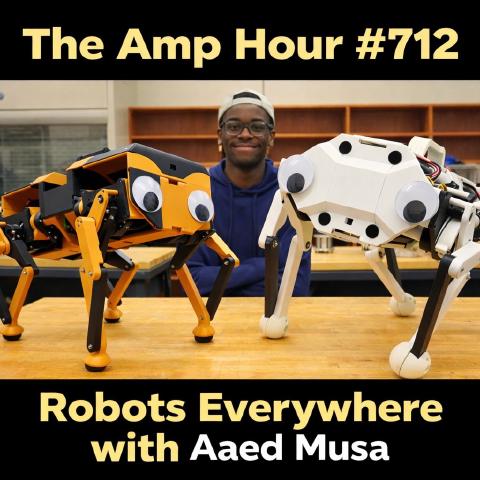
#712 – Robots Everywhere with Aaed Musa
Download episode · 86 MB
Also on Apple · Spotify · YouTube · RSS
Show Notes
Welcome Aaed Musa!
- Aaed is a YouTuber who builds a variety of robots and a mechanical engineering student at Purdue. He just completed his undergrad degree and is now working on his Master's degree. I believe he is the first Amp Hour guest who is still a full time student.
- His channel has a great variety of builds including designing all the way down to gearboxes.
- Aaed says the MIT "mini cheetah" launched many low(er) costs builds of robots, including his own.
- Boston Dynamics (and many others) announced their new ATLAS robotics platform at CES this year.
- FOC motor controller
- Backlash is a measure of how much movement you have between the teeth of gears (and thus how accurate you can be with open loop control)
- Ball bearing balancing robot
- Inverse kinematics
- Past guest of the show James Bruton was a model for the builds that Aaed does
- what does the glue look like
- His recent build uses...rope...to build a robot dog?
- A Capstan drive has virtually zero backlash
- "relatively new rope" DM20
- High precision speed reducer using rope
- the impacts of materials on design processes
- Juicero
- Relationship with classmates and professors as a YouTuber
- Purdue Engineering
- Aaed picked up electronics from youtube
- What's his take on LLMs?
- Making next CARA open source
- New video recently came out about a spinning top
- bulk of the cost is in the motors and motor controllers
- growing up in the age of youtubers
Transcript
Chris Gammell: This is The Amp Houred Podcast. Released January 19th, 2025. Episode 712. Robots Everywhere with Aaed Musa.
Chris Gammell: Welcome to the Amp Hour. I'm Chris Gammell of Contextual Electronics.
Aaed Musa: I'm Aaed Musa and I have a YouTube channel.
Chris Gammell: Hey, welcome Aaed. How are you doing? I'm doing great, Chris. How are you?
Aaed Musa: Yeah, let's see. I've always really been interested in engineering. So like from a very young age, you know, I was a kid who like really liked to play with Lego. You know, my favorite store was like the craft store. Cause I like to just go and buy like popsicle sticks and stuff and go home and, and build a bunch of cool things. So yeah, I was really, I've always really liked to like work with my hands and just build things. And, you know, I love to, you know, play with Play-Doh and clay and stuff like that. I'd say in middle schools, when I really got into robotics, that was when I discovered 3D printing. So that was really when 3D printing started to take off like, you know, mid 2010s. Yeah. I just got into CAD design and, you know, I used this software called 123D design. It's an auto desk software and I would just build like little cool things. I remember at the time I was, I was really into like cosplay and making cool like gadgets from, from superhero movies, still into superhero movies, not much into cosplays, but I would like design like, you know, Spider-Man's web shooters and try to 3D print them out. And, you know, I asked my parents for a 3D printer for, for my birthday and they got me one to my surprise. And that kind of like, you know, kind of launched me into the, the, the robotics space. Yeah. And then in, in high school is when I formally joined a robotics team and got to, to build some cool robots with some, some really cool people. And yeah, I started my YouTube channel short after that.
Chris Gammell: That's great. I love the origin story often on here. Lego's huge part of it. You know, a lot of repair, creative hands-on stuff like that. Yeah. It is interesting. Like the, I think the timing as well, like, yeah, I got little kids, but like, I do wonder about just like, like having the 3D printer, but like specifically into the creation side as well. Like you said, you know, one, two, 3D and like being able to like modify, not just print the thing, but also like build the thing, like design the thing. That's a huge, that's a huge shift as well. So I think that a lot of the ones that caught my eye on your channel and stuff like that are, you know, you've been building kind of these alpha dog style alpha dogs at it. The, it was like, like a shrunk down version of like the Boston dynamics early robots. Is that right? Spot. Yeah. Spot. Yeah. That's it. There was like a really, really early one. That was like, big dog. That's the one. Yeah. Yeah. Yeah. Yeah. Yeah. The one where it was like, it was hard to kick it just because it was so heavy. Yeah. But they still, they still do. I think that one was gas powered too. Yeah, it was. That's right. Yeah, exactly. I know. It's so nuts. I mean, did you watch all like the CES stuff this year too, of like all the. Yeah. Yeah.
Aaed Musa: There was so much cool stuff last week.
Chris Gammell: What's your, what's your take on that? I mean, like in, in terms of the space and where you see things going, maybe even like job prospects, things you're thinking about in that space. Like what, what's robotics doing in your eyes?
Aaed Musa: Yeah, that's a, that's a good question. And I don't think anyone really could really have the right answer, but I guess my prediction is I think right now, right now humanoid robots are all the buzz. Like everyone's like really excited about humanoids, you know, Boston Dynamics showcase their new Atlas design. A lot of the major robotic startups are focusing on, on humanoids, like, you know, figure one X and, you know, you see like places like Tesla too. They also have like their own humanoid. So I think I realistically, you know, anyone you talk to will, will admit this, but, you know, realistically the humanoids, you know, doing a lot of the task-based robotics, I think that's still a little bit away. So we aren't quite there yet. I don't think we'll have like robots in our home, like doing our laundry and cooking and cleaning for a little bit. I think that's really.
Chris Gammell: Despite what the CES show floor is trying to say, like that LG terrible robot. It was like, Oh my God. Yeah.
Aaed Musa: Yeah. A lot of that stuff really looks cool and like the videos and stuff and the demos, but you know, a lot of that is still like pre-programmed and tele-operated being able to like autonomously just go into any home and like, you know, do laundry, for example, that's still at least another like five to 10 years away. So yeah, I think the space is very exciting, but you know, it's still a little bit away. And I guess depending on who you are, that might be a good or bad thing. It's an interesting topic to think about. And, you know, I know a lot of the big question when it comes to robotics is, you know, jobs and whatnot. And yeah, I'm having to talk about my thoughts on that. But yeah, I think, yeah, it's still a little bit away.
Chris Gammell: The Terminator, you know, future. I saw the Atlas robot and, you know, it's very impressive, but just like the power density and that sort of thing. So I am actually curious about, you know, your take on this sort of thing too, especially the stuff that you're building, stuff that is kind of commercially available versus, you know, like Boston Dynamics. I'm sure they're doing custom designs and full ground up, whatever. But like there are still some limitations in terms of how much power you can carry, how much torque you can deliver, that sort of thing. So like what is the normal envelope of the servos and the drivers and the motors and gears and stuff like that? Like what's kind of commercially available that you're using on a regular basis?
Aaed Musa: Well, what I'm personally using are off-the-shelf brushless motors. Pretty much any dynamic robot will use a brushless motor. Boston Dynamics custom makes theirs. But yeah, for me, you know, since I'm an obvious, then it would be just really expensive to make my own custom brushless motors. Just buying an off-the-shelf brushless motor, which is essentially just a drone motor, motors used on, you know, UAVs, that's the best way to go. So buying just a cheap brushless motor and then slapping on like some sort of speed reducer, some sort of gearbox onto that is how I achieve like high torque and high speed.
Chris Gammell: So I actually, I got this notion in my head that I was going to like build a train for my kids at Christmas, right? And I was just like, and I'm like, I'm so, I'm so out in the wild that I'm just like, I don't even know. Like, do you just directly like, do you just turn on a little DC motor? And then I'm like reading about like planetary gears and all this stuff. And I don't really, I don't have the mechanical background at all as well. So like, maybe we could take an even further step back of like, what are kind of the brushless motors you talked about gear reduction? Is that like the kind of thing that you'll be designing and printing that stuff? You're the, the kind of the, the bolt on stuff to it as well? Or what is the, what are the resources that you use and how did you learn to build that stuff up to, to make that higher torque, faster speed sort of thing?
Aaed Musa: Yeah, that's a good question. I think if I had to pinpoint one thing, I'd say the MIT mini cheetah. So that's a quadrupedal robot, a four-legged robot that some students at MIT made back in, I want to say around 2016, that robot was really like what, what really started the, the hobbyist space in robotics in terms of like telling, showing people that you can make a lot of this stuff at home at a low cost. The principle behind it was this idea of a quasi direct drive actuator. So what that essentially means is it's not a directly driven actuator. A directly driven actuator would just be, you have a motor that's directly like turning whatever robot joint that you're trying to move. Whereas a quasi direct drive actuator is you have a motor, but you add a gearbox on top of that, but the gearbox isn't a high reduction gearbox. So maybe you have like a, I don't know, a 10 to one, or maybe even smaller than that, like an eight to one gearbox. So it's increasing the torque of the motor, but it's not increasing it so much where you're losing a lot of speed. So the idea with the MIT mini cheetah was that you have a brushless motor and a, a gearbox where that, that increases your torque. Um, but also keeps your speed pretty high with that idea. A lot of people started, you know, making their own tutorials and building robots, but using that principle, they would go out and buy a cheap brushless motor, a cheap drone motor and, uh, build some sort of gearbox, whether that's like a planetary gearbox or a cycloidal gearbox, or maybe just like, you know, belts and pulleys. And they'd use that to build their, their actuator. So those are in terms of like motion, you have the, uh, the brushless motor and then the gearbox, but then you also have your, your motor controller, which is equally as important because that's how you're going to like have, uh, your, your, your joint to be dynamic. And so, uh, robots use something called FOC motor controllers, uh, which stands for field oriented, oriented control. And that's just a fancy way of saying that you can control the position of the motor, the torque of the motor and the velocity of the motor. Those three things are the main things when it comes to designing the actuators for a robot, the, the gearbox, the motor itself, and then the motor controller.
Chris Gammell: Yeah, that's really, that's a really good guidance there. Yeah, it is interesting. So then when you think about the gearbox and like designing that on like the mini cheetah does, is that something where, so again, if I'm, if I, if I was, if I, since I am a complete beginner, is that something like where I should just go download that design and print it and stick it on like a known, like motor, like a brushless motor, or is that some, is that a worthwhile exercise to go and actually try and design it, try and understand it? Like how much value is there to like me designing my own versus just building one that's already commercially available or already out there? That's a good question.
Aaed Musa: And I think it really depends on what you're trying to accomplish. So yeah, like with any project, I think, you know, setting up your, your goals like ahead of time is, is a good way to like a, not waste time, but also get the most value out of the, out of the project. So if your goal is to, I just want to be able to like make a robot, maybe you go ahead and just find a good design for a quasi direct drive actuator and download that and, and, you know, design the robot around that existing actuator design. But if your goal is like, I really want to understand like from the ground up exactly how this works, then I'd say definitely like go ahead and design and actuate it yourself. And I, for me, that's the more, the more fun path, but I understand some people might not
Chris Gammell: want to invest the time to do that. So when you're then doing it, what are you interested in optimizing in that space? Is it the, the speed versus torque trade-off? Is it size? Is it some other thing? Oh yeah. There's a lot of things.
Aaed Musa: Okay. Yeah. I'd say torque, speed, cost and precision. Yeah. Okay. If I had to just say four things. Yeah. Those, I'd say those are the four main things. Cost especially is a big one because for example, with quadrupedal robots, you have 12, 12 joints. So that's 12 actuators. So if each actuator is taking you like, I don't know, $200 to make 12 times, 200, that's, that's ready, you know, about two and a half days. So yeah, optimizing cost for me is one of the primary goals, but precision is also a big goal. Gearboxes have this thing called backlash where it's like the amount of wiggle, you know, in between the gears. If you, if you've ever looked at a pair of gears, they don't exactly mesh like a hundred percent. There's a little bit of space in between them. And so reducing that backlash amount is very important in robotics because you want your robot to be super, super precise.
Chris Gammell: So that if you, if you tell the robot to stop on a, on a specific spot, you know, exactly where it is kind of in 3d space and you, you do, is that because you don't have necessarily have force feedback or even if you do, it's still kind of floating in, you know, you know, in a robot body or why, why does that, why is that so crucial there?
Aaed Musa: Yeah. I mean, I guess you can kind of think about it like a, I don't know, like a slinky maybe, for example, uh, with the slinky, even if you, you know, your eyes are kind of like the sensors and you can kind of visually see like, you know, how long it is or whatnot. But like, if you try to use like a slinky to like, I don't know, grab something, for example, there's no way to know exactly like how much the slinky has like compressed or deflected. So even if you have like force feedback, uh, still being able to like tell command your actuator to like move five degree or turn five degrees is crucial because a lot of that stuff is hard to fix with, with sensor sensor data. It's also just a lot more work. Like if you can make your actuator, like move to a position exactly, then you don't have to do all of that fixing behind the scenes with software and force feedback.
Chris Gammell: Right. And like calibration routines are less, less required there as well. Yeah. Okay. I started to see that. Yeah. Yeah. I was, I was just watching before we started recording, I was rewatching your one about the, the ball balancing robot with metal metal ball. And that was like super impressive, but like, it doesn't have kind of a lot of those systems have like a Microsoft connect, which are no longer made, but, or a similar like 3d model, 3d camera, that sort of thing. And this one doesn't have that. So this is kind of removing that external element for that, that, you know, that third person sensing in that way.
Aaed Musa: Yeah. Yeah. So the ball balancing robot uses a, um, a resistive touch pad, same kind of touch pad, like that's in your phone, but it's a resisted resistive touch pad. So if you like were to press on it, it'd be able to tell you the X, X and Y location of, you know, what you're pressing. So when you put the ball on there, it knows the position of the ball at any given moment. And it's able to, to use that, to, to balance the, the ball.
Chris Gammell: Yeah. Yeah. And it, yeah. So it does still have a sensing element, but it's not just not a camera external, that sort of thing.
Aaed Musa: Yeah. Yeah. Not an external. Yes. So, you know, if you like turned off all the lights, you'd still be able to balance, balance the ball. Yeah.
Chris Gammell: That's pretty cool. It's, it's very apparent in that video and your other videos as well, but just like your, your sketching process and the fact that you're doing all this like derivations of like reverse kinematics and stuff like that. And I, I am curious about that too, because again, like as a beginner, do I need to then, you know, be math superstar in order to do that sort of thing? Is that, is that something that's kind of like just your process or is that like an actual requirement for robotics and understanding reverse kinematics and stuff like that?
Aaed Musa: No. Yeah. I mean, maybe the, the answer would be different like 10 years ago, but like nowadays you don't need to really know the underlying math behind a lot of these things because, you know, we have AI now. And so you can train things in simulation without having to do all the inverse kinematics and board kinematics. So yeah, I'd say no math shouldn't, isn't really a limitation anymore. So yeah, you don't really have to have a, the math knowledge, but even then I'd say, you know, when I'm like solving like inverse kinematics equations, it's the math itself. It's, it's mostly tedious. It's not really like any high level, high level math. It's like, if you, if you passed eighth grade geometry, then you can do, you can at least understand inverse kinematics. It might take you a while to derive. It takes me a long time to derive, but you know, it's all just basic trig, sine, cosine, all of, all of that good stuff. Nothing more than that. Yeah.
Chris Gammell: Okay. Yeah. I've, I've done those once or twice. It's been a while. It's been a little, it's been a minute on that side of things. Yeah. It is. It is interesting too. Like with the, you know, you mentioned some of the building blocks and things like it. I'm a, I watch a lot of like James Bruton's channel as well, like to your channel, James's channel, things like it. And, and I am interested in like the, the building block. You're kind of building an element. So I was watching this thing with the leg, you were doing a robot leg, but then you are replicating it over multiple times. And then you're kind of having higher level software on top of that as well. So like, so then you as a designer, you're building kind of ground up, you know, gears, motor boxes, control systems. But then you also then have to make them all work together as well. So like, what does that glue look like?
Aaed Musa: Yeah. Integration is always like the hardest part of any project. I try to like start small and like start with like the most crucial subsystem of, of the robot. So for, for, you know, robots, that's usually the actuator. So designing the actuator and then maybe designing one leg of the robot and then yeah, doing that four times. And it's always much, much, much harder to do something to make things work together than it is to just make like one leg work by itself. So yeah, there's a lot of like, you can't really account for everything when you just do one leg. There's a lot of, you know, trial and error when it comes to like integrating, you know, an entire robots, robotic system. There's a lot of things you just won't see until you actually like build the full robot. So it's kind of like, you're kind of taking a shot in the dark in a lot of ways. And sometimes, you know, you might have to go back and like completely redesign like a single leg, just because like you, you realize something that doesn't work with the full assembly. But yeah, it's a lot of, a lot of trial and error, I'd say with, with, with, you know, doing a full robotic system.
Chris Gammell: I always liked the jokey, like can't chart for like engineering projects where it's like, you know, design two weeks, build two weeks, like integration two weeks, final test two weeks. And it's just like always like this perfect looking chart. And it's like, if you really did that, it's like, yeah, integration is like 20 times larger. And then there's like scramble and, you know, rebuild it. No shit. This one prototype doesn't work anymore. And, you know, it's just like, yeah, that's a pretty optimistic, I suppose, is the nicest thing we can say about that sort of planning. No. Yeah. Yeah.
Aaed Musa: I think there's definitely strengths in, I think like one of the most valuable traits that an engineer can have. And Mark, Mark Rober said this actually on another podcast. And I think it's, it's so true. It's naive optimism, like believing that you can do something, even though you might not be able to is like, so, so important because sometimes you just won't start a project. If you think that you're not going to be able to, to complete it. And so like sometimes gaslighting yourself into believing that you can do something, even though it's like way above your skill level is like super important because it'll allow you to start. And then when you start, you're more motivated to finish. So yeah, sometimes, you know, thinking that something might take only two weeks when in reality it might take like a month or more is, uh, is important. Yeah.
Chris Gammell: Uh, my ear has definitely been trained of like, especially hearing other engineers say it, you know, like, Oh, how hard could this possibly be? Like anytime I hear that phrase, my, my, my alarm bells start going off. Just like, Oh my God, what are they saying? And then of course I hear myself saying it too. You know? So yeah, just right down the, right down the middle there, you know, you'd mentioned some of the optimization kind of points you have. And one of them is for cost. And your most recent video is about like using rope as a way to translate force. What does it, what does that ultimately look like for why, why rope? Why did, why does that work well?
Aaed Musa: Yeah. Yeah. So that's a good question. So yeah, uh, they're called, they're called capstan drives, um, and they're rope driven gearboxes. So yeah, if you can imagine like, you know, a set of gears, but without any teeth. So it's like this smooth drum and instead of teeth, you have a rope wrapped around the drum. What that allows you to do, there's a couple of benefits of, of a capstan drive, as opposed to gears, capstan drives have very high precision. We talked about backlash earlier. Capstan drives have virtually zero backlash. So you can command it to move five degrees and it'll move exactly, you know, it'll turn exactly five degrees. So there was super high precision. They also have pretty high torque transparency. So like if you were to feel a capstan drive, it would feel like you're turning the motor itself. You don't feel the friction in the gearbox. Like you would with a, a, say a gearbox with actual gears, like a planetary gearbox. So it's super, super smooth. It feels like you're turning the motor itself. Another benefit is cost. Gears can be pretty expensive, especially like a planetary gearbox. Yeah. That's a, that's pretty much a custom piece of metal that you have to get machined. And with a capstan drive, although you can machine it, I've just 3D printed all of mine. And you know, 3D printing is like super cheap and super accessible these days. They also have pretty low inertia. So you're not swinging around a lot of mass, which isn't really a problem with planetary gearboxes. But yes, capstan drives are super, super cool. You know, rope is, is relatively cheap. The rope I use. That's what they're saying.
Chris Gammell: That's what they say. Rope, you know?
Aaed Musa: Yeah. These rope prices. Right. But yeah, yeah. Rope is relatively cheap. And that's like probably the, the type of rope is probably the most, I guess, niche item in the, the bill of materials for a capstan drive. So, you know, it's just rope and bearings and some 3D printed parts and screws. And you have a super high precision gearbox that can, you know, compete with like the precision of like industrial machines.
Chris Gammell: Yeah. Why don't more people use them then?
Aaed Musa: I don't know the perfect answer to this, but I think there's a couple of, of things that you can look at. I think one is that the rope that, that I'm using, that the most, that most people use when they build a capstan drive, it's called Dyneema DM20. And it's a relatively new rope. I forget the exact year it came out, but I think it's around 2000, 2012. So it hasn't been around for a super long time. And the reason why you use that specific rope is because DM20 is, has virtually zero creep. So it won't stretch over time. So that's like the main, that's the main con of a capstan drive is that you run into the maintenance issue where like over time.
Chris Gammell: The stretchiness of, you just use like twine or something. It's just going to stretch out and like elastically deform.
Aaed Musa: Yeah, exactly. So like pretty much any other synthetic rope, you know, if you get paracord and you stretch it and put it in tension, it'll stretch over time. And it'll be very noticeable in your gearbox because you'll lose that, you know, precision. It no longer becomes zero backlash, gets really sloppy and which kind of defeats like the entire purpose. But yeah, I think maybe it's in part due to the fact that it's a relatively new rope and it's pretty much the only rope that you can use to make a capstan drive to make it well. I also think the limited rotation aspect is a con for a lot of applications. When it comes to building like a quadrupedal robot, I don't see that as a con because you aren't really using the 360 degrees range of motion, even if you do have it. You know, for other applications, if you need high precision, but you also need continuous rotation, capstan drives can't have continuous rotation. I don't know exactly what the max is, but it's less than 360. Maybe if you tried really hard enough, you can get like, I don't know, 300 or maybe a little bit more. But yeah, it's essentially kind of like a, you can only really make it like a servo where you have like limited rotation. So I think those are the two big things, but it is an interesting question why it's not adopted in more places because I think it's pretty cool, pretty useful.
Chris Gammell: Yeah, that's great. I was making a glib joke before about rope, but like it sounds like there actually is like a huge element of like rope technology and like, you know, like, yeah, that's wild. That's really interesting. And you have multiples here about rope as well. So it's not just the, you built a robot dog out of rope, but you're also did some exploring on it.
Aaed Musa: Yeah, yeah, yeah. I did a video, yeah, where I kind of like investigated different ropes and building like a capstan drive. And, you know, I tried like steel cable too. And that didn't really work, even though it like has pretty low creep.
Chris Gammell: Yeah. What about, so you mentioned, you know, the 3D printing aspect and stuff like that. But what about the availability of like kind of offshore send off your design? So say you wanted to go design a planetary gear box. You know, it feels like the on-demand services are out there. They're not cheap, but they are more plentiful than when I was, you know, your age. And so like, how does that end up impacting your cost basis, I suppose, but really just your design process, I suppose.
Aaed Musa: Hmm. Yeah. For me, I only really, I guess it affects my design process in the sense that like I won't really design something to be machined unless I 100% need it to be machined. So, yeah, I'm a huge 3D printing guy. Yeah. If I can 3D print something, I will. And I won't design it to be CNC machined just because I don't have that like readily accessible to me. And if I CNC something, it's, you know, it's going to take a couple of weeks to arrive to me because like a lot of the really cheap online services are overseas in China. So the lead time on that is a bit. So, yeah, I mostly 3D print things. Okay.
Chris Gammell: So I think the real question is going to be when you come back on the show five years from now, you've got this high paying job in some big robotics company and then you have access to all this stuff. Yeah. I think the real question will be like, well, how does things, how do things change now when you got, I mean, like your, your design palette is going to open up in that space, you know, in going from a self-funded space to like a bonker, you know, say you went to like Boston Dynamics or something like they've got bonkers machinists around there. Yeah. And that does impact design process too, right?
Aaed Musa: Yeah. You know, not having the constraint of like, it has to be 3D printed definitely opens you up to a whole new world of like design and design choices. You can build a lot of, a lot of cool things and you don't have to really think about, okay, like how do I design this so that it's as strong as possible? Because, you know, if you're designing it out of, you know, metal, it, it just will be that strong and you might not have to, you know, do a lot of stress analysis and focus on like, you know, optimizing, like, I don't know, infill percentage, you know, with 3D printing or whatnot. So yeah, that'll be, that'll be exciting for sure.
Chris Gammell: Of course, you can go too far. You can go into Juicera land, you know, the Juicera, of course. I do not. What is that? Man, it was like this thing that it was, it must've been like five to eight years ago at this point. It was like this unbelievably over-engineered, like just gorgeous machining. You gotta like, there's a teardown of it, but it was just a machine that just squeezed a bag of juice. That's all it did. It was like, you had to buy the bag of juice. It was like this VC thing where all the VCs loved it because you'd be buying high-end juice machine, high-end juice bags, which, you know, they all were drinking juice at the time too. And literally all it did was just squeeze a bag of juice into a cup. It was just like, and you look inside though, it's all like custom machine gears and like, it's unreal. And it was like $800 and it immediately flopped. But that is the, that is like these amazing engineers that were really good at what they do, but then they have access to all the funding, all the machining tools, all the everything. Like it can go too far in the direction. So it is this interesting, like constraint problem almost.
Aaed Musa: Yeah. I think engineers work best when you have constraints. Like a question I've gotten sometimes is like, what would you build if you had access to, you know, any type of equipment or any type of, any kind of part? And, you know, the answer is like, oh, I don't know. Like, what would I want to build if I just have access to everything? Like, you know, if you, if you have everything, then you'd probably not want to build anything. So yeah, I think it's, that's when you have some sort of constraint, whether that's like a size limitation, a cost limitation or whatnot.
Chris Gammell: Yeah. Yeah. I used to work in consulting and I would, I would work with another engineer who was doing consulting around like mold design, right. For like shooting plastic into a mold. And like, just him talking about being, being there and like sitting next to a manufacturer engineer so that he understood the manufacturing process and then how that like fed back into his design. That still sticks with me because of like the, the implementation, especially in like high volume environment and how the constraints of the injection molding machine really, and the way the plastic flows. And then how that ended up impacting his like design process around designing the mold. It's all throughout engineering. It feels like you're like understanding your tools, understanding your, your constraints and your processes all the way through.
Aaed Musa: 100%. Yeah. A design is only as good as, you know, its ability to be manufactured. So if you're designing a part that just can't be made, then you essentially design nothing. Right.
Chris Gammell: Right. Right. Exactly. I am just, again, I'm gobsmacked that you're, you're, so you are master student, you said? Yeah. Yeah. I'm a master student right now. Yeah. Yeah. How, how the hell do you have time for this? Like, it's so amazing to me that like you're, so you have all your school stuff, but then you're also doing all this stuff and you make really good YouTube videos. Like, how do you do it, man? This is very impressive.
Aaed Musa: Oh God. Well, like a lot of engineers, you know, we aren't exactly the most social people. So yeah, you'll find me, you know, on Friday nights at home working on a project. Got it. Yeah. Yeah. Not out in the club, but yeah. So I spent a lot of my, a lot of my free time is invested into working on projects outside of school. I'm just working on projects for the, for the most part. Weekends for sure are definitely, those, those are times I spend a lot to work on like projects.
Chris Gammell: Hmm. Okay. So then I'm also curious about perception of you as a, you know, popular and growing and popular YouTuber, but then you're obviously you have classmates. So then like your classmates looking at you and like, are they asking for help? Are they, you know, trying to join in? Like, again, I, here's a mind blower. I went to college before there was a lot of internet out there. And so like, I never would have had a YouTuber going to school with me. So then how does that impact like relationship with classmates as well? Yeah. And then professors, I guess, at a certain point.
Aaed Musa: Yeah. Yeah. It's, it's interesting. You know, it's interesting. Like when people like, cause I don't, I don't like go around and like tell everyone, Hey, I have a YouTube channel. So it's interesting. Like when people stumble across my, like when classmates stumble across my YouTube channel and they're like, yeah, dude, you have a YouTube channel. That's pretty cool. Yeah. I guess sometimes people expect me to like, when they see my YouTube channel, they expect me to like be super smart and like a, a genius in, in school. And like, I get, you know, I get all A's and stuff, but I don't know. That's not really the case. I found like being able to like build robots and work on projects, even though it is mechanical engineering, doesn't necessarily make you a good academic mechanical engineer. Um, which just goes back to the idea that like, you know, school won't teach you everything that you need to know to like build things practically. I still see a difference and a slight, a slight gap in between like working in the real world and like, you know, solving equations in a exam. But yeah, it's interesting when, uh, people discover, discover the YouTube channel. Uh, yeah, it's, it's fun to talk about. It's kind of like, I don't know. I feel like, uh, Like your alter ego.
Speaker ?: Yeah.
Aaed Musa: Yeah, exactly. Yeah. I feel like, kind of like Hannah Montana.
Chris Gammell: I did not think that was going to be the reference you're going to make. That's a, that's great though. That was great. Oh man. Yeah. I, uh, yeah, I totally agree. I mean, in terms of like educational stuff, educational rigor. Right. I, I, I personally like had targeted a program. I was all about like co-op hands-on things like it, you know? And it was just because one, I was not academically very strong too. I wanted the hands-on stuff from a company. I mean, is that a big thing at Purdue or is it not a?
Aaed Musa: Yeah. Yeah. Yeah. We have a, uh, an annual job fair, a really big job fair called IR. Yeah. With a bunch of companies, bunch of companies.
Chris Gammell: Yeah. But like, was it full like co-op, like the seven month co-op thing? Or is it like internship type of stuff?
Aaed Musa: They have both. So Purdue doesn't like have any like specific, I know some schools have like requirements for like, you know, you got to complete like X amount of co-op rotations and stuff.
Chris Gammell: I guess if you're a Purdue, you know, you know, some of those weirdos at Rose-Hulman, right? You must know some of them. I do not. No, I don't. You don't know any. Oh yeah. They're another Indiana school. They're like a tiny Indiana school. Oh. Sorry to all my Rose. I have, I have friends from Rose-Hulman. Yeah. Oh, I don't, I don't know. They're not actually weirdos.
Aaed Musa: From there. But yeah. Yeah. So I think it's hard to say whether people dive more into co-ops or internships, but I've only, I've done two internships. I haven't done a co-op. People do both at Purdue. Yeah. Definitely. Hands-on experience for sure is something that students really like try to get more of in engineering because, you know, like again, learning something in classes is one thing, but being able to like apply some of those learnings and also just get hands-on experience that just can't get in class is a completely different thing.
Chris Gammell: Yeah. It was. So our last episode, we had Mark Palmarian, who's a professor here in my town at Duke. And, you know, I was surprised talking to Mark and talking to some other students. And it does seem like a lot of the, the focus on like some of the practical stuff has increased generally, right? Just like pure academic, like, you know, ivory tower rigor of just mathematics, you know, all day on, you know, whiteboards, that sort of thing is like not necessarily the main focus and there are other kind of project-based education and things like it, but that has not shifted as much as probably I would, you know, if, if, if I was in charge of all the schools, you know, I mean, what was your experience in that way? I mean, is, is there a lot of like hands-on project-based learning or is it, is it still more? Yeah.
Aaed Musa: I'd say that you definitely, it's a lot of the academic, you know, sit down and solve this, you know, solve for this equation and, you know, balance these forces out or whatnot. There are some, there's definitely opportunities for you to be able to get the hands-on stuff. But if you're just looking at like, you know, the course curriculum for mechanical engineering, a lot of it is just sit down in a 50 minute lecture, you know, Monday, Wednesday, Friday, take notes and do this exam. So, but yeah, there's, there's some classes, there's some tech electives. I got my school where you can get those hands-on experiences in class. But that's like not part of the actual core, core curriculum, but like some classes do have labs and stuff that helps supplement a lot of that things, a lot of the things you'll learn in, in class. And that's great. But yeah, I think definitely the best way to go about it is like, you know, internships and clubs and personal projects or like research, if you're interested in research and all of those things are like completely outside of like class. So if you really want to get on hands-on learning, the best way to do that is just outside of class because the academic program just won't give you everything you need.
Chris Gammell: Yeah. Yeah. Yeah. And I think they, they even expect that sort of thing too. What about the, you know, the, the kind of the crossover stuff, you're really doing mechatronics as well, right? You're, you're doing the mechanical, you know, the linkages and the designs and the, how this force pushes that force and reverse kinematics, but like then the electronics and the controls and the, you know, PID tuning and the, the teensies and the drivers and all that other stuff too. Is that a focus or is that something that you kind of picked up on your own and, and, and pulled in from builds?
Aaed Musa: Oh yeah. That's definitely something I just, just picked up on my own. Just like watching a bunch of YouTube videos and trying things out. You mentioned James Bruton. Yeah. He's a, he's a really cool guy and I've watched a lot of his videos to like understand a lot of like the electronic side of things. Um, yeah, yeah. He has a great playlist of just awesome builds, but yeah, a lot of that stuff is, yeah, it's literally just me like watching a YouTube video and then like going on Amazon and buying, you know, a teensy or an Arduino and buying some cable and trying things out and, and, you know, just playing around.
Chris Gammell: Making a go. Yeah. That's great. That's really great. Exactly. Yeah. I always expected there'd be like a ton of magic kind of under the, under the hood of like a motor driver and stuff like that. And most of the time it's like an H bridge was a lot of protection circuits. And I was always really, I don't know, I shouldn't be surprised by it, but it does seem like stepper drivers and motor drivers. And generally it's like, they're not like super complex, but it, but it's then what you do with them and how you drive them. And I mean, how much, how much are you digging into the libraries? Are you like writing your own libraries? Is it, what, what level do you have to be at in order to actually drive a motor, you know, that five degrees you talked about for, for a really precise thing?
Aaed Musa: Yeah. So again, I think this kind of goes into like, how, how much do you want to know? Like what's your outcome? Like for me personally, I couldn't tell you exactly how like a motor driver works, especially the FOC motor controllers, the really fancy ones. Like I have no idea what's going on on that board. I, you can show me a schematic on that and I will be completely lost. But the nice thing is like, you don't need to necessarily know like how like that board works in order to be able to use it. And so, yeah, a lot of the times I'm not writing my own library. I think I've done, I wrote, written a couple like Arduino libraries, like just a handful of times in my life. And that was only because I like completely had to, and there was none, there was no open source ones that I could find. But yeah, generally speaking, like if you want to like drive a servo, I mean, you could, you know, if you have all the parts right now, you could just like find a tutorial on YouTube and get it up and running, you know, like an hour or so. I mean, you probably have to troubleshoot, but like being able to do it, like the process is, the process is documented very well online in multiple places. I think if anything, the issue right now is like figuring out which one of the hundreds
Chris Gammell: of tutorials to follow because there's just so much out there. Yeah. I think we've been talking about James a lot, but like one thing I, when I watch James's videos too, that kind of modular design, it's like, you know, like he'll, he'll just throw extra teensies into it there just to make it easier. And just to have one leg gets one teensy or something like that on this particular robot. And it, it does feel like it's like that, that same, not the same block. Cause obviously it's doing different things, but it's like a known block for him. And so it does seem like maybe you're, once you've learned that servo drive or that, that library, that sort of thing, that then you have that to redeploy to future projects.
Aaed Musa: Yeah. One hundred percent. I feel like, and for me, this is especially true with like a, with CAD design. I don't know. I feel like it's almost impossible to have a completely original design. Yeah. At least for me, like every design I have is some, is I've taken some sort of learning from a previous design and applied it to here. So it might look completely different, but there are aspects of it like that I've taken and reapplied. And yeah, I think the same as for code and libraries too. Like you know, once you're able to drive like one servo, you have that code. And then if you're building a robot with five servos or five stepper motors, you, you now can like take that code and copy and paste and, you know, move it around and move things so that, you know, you can drive five. And so you're kind of just like building, you know, sort of building a portfolio that you can later reuse and reapply for other projects.
Chris Gammell: I, uh, younger Chris definitely thought, I thought I was going to be doing all novel things and yeah, no, my entire career has been re-implementing my own work, other people's works. And honestly, you still, it's still, there's so many problems to solve. Even if you, even if I'm ripping someone's thing directly, it's like, oh, well, I didn't do this right. Or, you know, this is a different situation. I should, I have different inputs. So there's going to be different outputs and it's just like, but I feel like the, I feel like a lot of the, uh, mythology is probably the wrong word, but like, yeah, let's just say mythology and engineering is that I am the lone soul engineer and I will make, I am Tony Stark and I will design this in a cave with a box of scraps, like that kind of idea. And it's just, that's not how it works, man. Yeah.
Aaed Musa: 100%. I mean, yeah. The, what's the, the, the famous, you know, one of the most famous engineering sayings is don't reinvent the wheel. You know, if you don't have to completely make something new, then why, why do you, why should you, you know, if it can, it's going to save you time and, uh, stress especially. Um, so yeah, why, why not, uh, just use something existing and adapt it and reapply it to your use case. Yeah.
Chris Gammell: I love this shift in this, in the same vein on the kind of that, that same topic area, but in kind of like your, your student mindset as well. I mean, you also are a student in the age of LLMs and like, I'm curious about like, what's, what's your take? Like what's, you know, your usage, your take, you'd like, um, how you see it impacting career, how you see it impacting your academic career. Like, how do you feel about chat CPT? Yeah.
Aaed Musa: It's an, yeah, it's an interesting conversation. I use, I mean, I think like a lot of people nowadays, I use chat CPT for a lot, like pretty much every day, you know, it's, it's just a really nice way to like, it's a, it's an advanced Google search, I think is the best way to put it. Like, you know, if I'm writing something or if I want to know something like, you know, mechanical engineering problem, I can ask it to sort of give me like a refresher on, you know, statics, for example, like, uh, you know, if I'm trying to remember some equation, I can just ask it that and it'll spit it out to me. And I think that's so useful. I find myself, you know, saving a lot of time that I would have otherwise spent, like just researching a topic for, for, you know, an hour or hours. And I can just, if I can just ask chat CPT to like, give me the rundown, it's super nice. It can be abused for sure. And I think that's what a lot of people are worried about, especially in academia. Yeah, definitely. You know, there's a lot of people who just like use chat CPT to like write essays and stuff. And we don't want to do that for sure. Yeah. Yeah. It's, I think it's here to stay. So it's really just, the question is how do we like navigate around that so that, you know, people aren't just using it to write essays and do homework for them. And yeah.
Chris Gammell: Yeah. I don't know. I, it always comes down to me, like Mark and I talked about this in the last episode as well. Like, what are you really testing for? Like, how do you actually know if someone knows a thing? Right. And I feel like a lot of the paradigms in the educational space for a long time is like, well, a student could read a thing in a book and then they have to come into a room and then they have to prove that it's also in the brain and put it under a page. And it's like a lot of those paradigms have been broken because with the report that maybe was a different way of proving that you knew a thing. Yeah. You just can't do that anymore because people have an incentive system to have an external entity like an LLM or a clanker, you know, do the work for them. I do think there's still a lot of value in like knowing, you know, a thing and universities certifying that a person knows a thing. Right. I think, you know, so now looking at your YouTube channel and if I looked at your resume and your, you know, your academic record, I got to say, I'd throw the last two things out and I would just look at your YouTube channel. You know, like from a resume standpoint, like this is your, the YouTube channel is your CV, but not everybody has that. Right. So like most people have like a degree they hang on the wall and that's enough for some corporations to be like, yeah, you can work here. So.
Aaed Musa: Interesting perspective. Yeah, for sure. I think that definitely, I think in the past I've definitely shied away from like, you know, saying, oh, I have a YouTube channel, but I think it's definitely something that that makes me stand out for sure.
Chris Gammell: Yeah. I mean, no, this should, I mean, that's the thing. I don't know about how it fits on a resume, but you should be, I don't know. Are you looking for jobs? Are you going to be looking for jobs? Maybe this isn't the forum for that. Maybe this is a post-conversation, but like, yeah, it is a very different thing for someone who has shown their work. You know, we, me and my co-host always talk about like bringing your work to a job interview, right? You should definitely bring a robot with you to the job interview. Yeah. But I don't know. It's, it's, it's definitely, it is a feather in your cap and you should definitely lean on it. Yeah. Because it, because I think number one, the fact that you're doing this nights and weekends, it just shows that you like it and that you're interested in it. And like, you're, you're a curious person like that. If I, if I could like somehow gauge that in all potential hires that I ever had, that would be such an important, I'm sorry if I'm fawning over you too much, but like that generally as a characteristic is such an leading indicator of like a successful person in a workplace. I agree. You know, I just feel like that's. I agree. Yeah. You can't, you can teach a lot of things, but it's hard to teach passion. Yeah. Right. I, I actually didn't, I didn't have it before my first job. I actually got it at my second job, my first job I dated my second job. I like had this like crowd of like, like very impressive engineers that I got to work with. And like that, I still remember the day when like it all locked into place and it was at my second job, like three years out of school. And it was like, that's, that's when it all started, you know, but I just got lucky that I got to get to that point.
Aaed Musa: Yeah. I think definitely, yeah, the environment, you know, being surrounded by like smart people and stuff definitely has a big influence on, you know, your passion. And you're in your drive too. Yeah.
Chris Gammell: Yeah. I mean, you were also a pandemic college person. So how did that impact things?
Aaed Musa: I mean, I was pandemic, a high school student. Yeah. Pandemic high school student.
Chris Gammell: Holy moly. How did that impact things? How did that go?
Aaed Musa: Oh, wow. Yeah. So we were online for like a year at my school and oh my God, that was, yeah, that was, it's hard to look back on that and like, think that it actually happened. Like we did school, like come online. And I mean, yeah, it was, it just productivity was like super low that year. Like I would roll out of bed, like, you know, at class of like eight o'clock, I'd roll out of bed at like seven 58, you know, put on my, my, my, my, my, my house robe. And then just like your sweats in your jammies.
Chris Gammell: Yeah.
Aaed Musa: Yeah, exactly. Like half awake, half asleep, doing other things on my computer, you know, and it was horrible for productivity. I think, I think we, something that we all, I think learned in the pandemic is that like interaction, one-on-one interaction, like seeing someone face-to-face going into a place has a lot of benefits. Cause you know, uh, even me for like classes that I actually enjoy, like physics and math, it was just like so hard to like really get into it and really like get that passion just cause I wasn't like interacting with anyone. And I was just looking at a screen. So yeah. Yeah.
Chris Gammell: Zoom is a killer. It sucks. Yeah. I, I remember I did like, uh, you know, like early pandemic, everyone was like, you know, what can we do? What can we do? And there was like, someone had like asked me to like go talk to a bunch of, I think high school kids about engineering, electronics and stuff like that. And it was just like, uh, it was like two or three had their screens on even. And it was just like, what am I doing here? It's like shouting in the voice. It was just horrendous. And it, and it wasn't like, I blame them. It was like, Oh, this just sucks for them so much, you know, like so much the dynamic, like relationship building as well. Does it impact, did it, does it, did it impact like, you know, like group work longer term? Like, it seems like you probably played pretty well with others, right?
Aaed Musa: Yeah. Yeah. Yeah. I work well with, with others. Uh, yeah, I'm definitely a conflict mitigator. If I don't have to, you know, get into an argument or get into some sort of conflict, I will try to de-risk that as much as possible. Yeah. I don't, hmm. Um, I think the only real impact that COVID had with, with groups is that, you know, now we have that option of just being able to like communicate remotely. So people definitely will try to like use that option as much as possible. Like if we don't have to like meet in person, then can we just do like a zoom or teams meeting? And sometimes that's useful. You know, sometimes if you like don't all have to meet together, you know, go to a place and you can just do like a five minute zoom call to like discuss whatever you need to discuss. That's, that's helpful. But yeah, I don't think it really impacted group work outside of that.
Chris Gammell: That's what I'd hope to hear. Yeah. Yeah. That is interesting too. I think about like the kind of the structures of college for me. And it was, it was a lot of that, like, just like logistics of just getting people in a room and how much, how much, so like that would actually, that would have been a welcome change in certain ways, like just the efficiency aspect of that. But yeah. Did any of that stuff lead to the YouTube thing or was YouTube thing just because you were also learning from YouTubers and then you kind of picked it up?
Aaed Musa: Oh, I think I might've started it around the COVID time, but it wasn't due to COVID. Oh yeah. I started the YouTube thing just cause I had, I like, you know, I grew up watching a lot of YouTubers and I was just like super stoked about like the things they were building online. And, you know, I had always worked on projects and stuff. And so, you know, one day I was like, Hey, you know, maybe I can like post a video about the thing I'm making. Maybe people might find that interesting. And fortunately they did. So yeah, I kept on making them.
Chris Gammell: That's great. Yeah. I think that's another interesting, you know, just doing a diff on your engineering experience in mind and like, yeah, having, having the Mark Rober's and the, you know, the James Bruton's and the, um, Colin Furze's of the world, like, holy moly. Like, yeah, it's, I think also the fact that it's still accessible, right? Like I could look at like, I guess Mark has a team and like Mark is great. Right. And he's got a whole team. And, but like, I, you know, I look at someone like Colin, right. And he's just like building so much stuff. And I'm like, I could never do that. But then when you break it down and like, like you were talking about like building that one thing and like focusing on the one thing that that's such an important piece and such an important reminder, honestly to myself and in my forties, I mean, I could still build
Aaed Musa: things. Yeah. 100%. I mean, yeah, there's a lot of power in like seeing like what just one person is capable of. Yeah. Like you said, you know, James and Colin and, you know, even Mark, like he has a team now, but like he used to just be like him. And so, you know, he, he went from the ground up and was able to build that just himself, even if he, he has a team now. So yeah, I think sometimes we, we sell ourselves short for like what we can truly do. And yeah, I think that we, we have a lot more power than we realize.
Chris Gammell: Yeah. Well, what else, what else are you looking to build in the next years? I mean, like, you know, master's degree is now no, no easy task. I mean, what else are you working on that you're excited about building?
Aaed Musa: Yeah. So two projects that I had just, that I just finished. So I just graduated from a undergrad last month for my senior design project. I actually worked on another quadripetal robot. So you might've seen the, uh, Kara, um, the quadripetal robot I built with the, with the capstan drives. That was, that's my most recent video. So I built another one. The goal with that one is to make it open source. So right now I'm just like working on like the documentation and, and getting the video edited. But with that robot, my goal was to make it super affordable and also just super super, you know, super nice and robust. I wanted the design to be good. Even if it's going to be cheap, I don't want it to feel cheap. And I think I accomplished those two goals. It's only $1,300 to build, which is a $2,000 reduction from, from Kara 1.0. So, you know, imagine like getting to own like your own version of, of spot, uh, at home for like a fraction of the cost.
Chris Gammell: And what is the breakdown? I mean, I obviously I'm going to watch the video and stuff like that, but like the breakdown, it's 3d printed Kara 1.0. At least I saw, I have seen is 3d printed. There's O drives or servos, stuff like it is, is that like the majority is like the, the kind of the, the heavy, the heavy lifting stuff.
Aaed Musa: Oh yeah. So the actuation hardware is like the bulk of the cost. So yeah, your motors, your motor controllers, that those just two things in and of itself probably is around like, you know, 80% of your, your bomb costs. And, uh, yeah, that does a lot of the heavy lifting. So for, for car 2.0, like the goal was to like, if I can just find motors and motor controllers that are cheap, that's essentially like my entire cost reduction. Yeah. I found like some really cheap Chinese hardware that I could use. And yeah, that, that was the, the $2,000 reduction. It was mostly just motors and motor controllers. Wow.
Chris Gammell: Yeah. It is amazing. Like how much, how much the drone industry is impacting things, but just generally like the, the Chinese ecosystem, I mean, even, even with tariffs, it's just like, uh, there's still such a massive reduction in a lot of, and the accessibility too. Like the fact that there's just so much volume coming through that also drives prices lower. Yeah. That sort of thing. Yeah. 100%. So then in that case, did you have to then do like the bolt on, like we talked about, like the planetary gearboxes or the gear reductions that you, you like designing. Was that also part of that process to make it more usable?
Aaed Musa: Yeah. Yeah. So I, uh, I also used cap stand drives for car 2.0. Yeah. So that was all custom designed and, and 3d printed. And I used, you know, the same type of rope, uh, but a thinner rope. So it was still Dyneema DM 20, but one millimeter instead of, instead of, uh, three millimeters. But yeah, so all of that was still, still custom designed. And which also, you know, keeps costs low instead of like having to buy like a custom, you know, planetary gearbox out of metal could just 3d print one that, you know, is a fraction of the cost, but also like super high precision. And if anything has benefits over, you know, just making a metal gearbox.
Chris Gammell: If you don't mind me going back to my train project real quick. So I was looking at like these super cheap, like just, I think they must've been brushed DC motors. They were just like super cheap, but they're like 10,000 RPMs, but they can, they've got zero torque effectively. So like, is it even worthwhile to like in that, in that case, not saying that like, that's a good choice, but like, is that even worthwhile to try and use something like that to drive a gear reduction to get more torque out of it? Or is that something like where I should just be going to a similar looking project and, and finding something that's a better, better fit for, for that kind of space, like in terms of like kind of pattern matching and searching for solutions in that, in, in an unknown space like this for me.
Aaed Musa: Yeah. I would say it definitely be easier to find a motor that already a has like a gearbox attached to it that is, you know, increasing torque and reducing speed. Yeah. So I'd say, I'd probably say that's the best way to go instead of like, you know, redesigning, you know, redesigning the wheel and, and trying to like build a gearbox around that. Cause I'm sure there are a lot of, especially if it's like a brushed DC motor, there's a lot of gearbox that you could probably find on like Amazon or like some sort of, you know, electronics hardware store that already have like a good gearbox to, to get the speed that you're probably aiming for. So yeah, I look on, I look to see already made, uh, actuators with, with gearboxes on them that, uh, get the, get the speed that you want. Okay.
Chris Gammell: Yeah. That's good to know. Yeah. I think that's the kind of thing too, like going into a new domain, you know, like, I don't know, I opened up McMaster McMaster and I like, I like love it, but I'm just like, most of the time I don't know what I'm looking at. You know, like, I'm just like, I'm mostly a DigiKey kind of person, you know what I mean? You know, but McMaster once in a while and, uh, but kind of entering that new domain, knowing what to look for, knowing how to like seek it out, that sort of thing is it's tough. And I think, like you said, like starting from known other people's projects, find things you can build up just to understand kind of the space and, and where you can, what you can build that can really help.
Aaed Musa: Yeah. I think the best way to start any project and the best way I start any, every project is to just do a ton of research on what already exists because you'll find like a lot of things, you know, uh, even if someone's project like failed, you know why it failed and you can avoid doing whatever they did. But you know, a lot of the times like you'll find like really helpful things and things that you probably didn't even think about upfront. And, you know, you don't want to spend like three months doing something that someone already spent three months doing and documented online. So like figuring out like, okay, like, you know, okay, I'm seeing like everywhere people are kind of using this type of motor around this speed and this torque. So I'm going to aim for, you know, finding a motor that also has close to those parameters and whatnot. I think that's very helpful, especially in the digital age. You know, it's, it's so easy to like ask ChatGPT even like, Hey, what kind of projects exist? What kind of train projects exist already? Or just, you know, just Googling it yourself.
Chris Gammell: Right. Yeah. And I think like not thinking that I'm going to do anything particularly novel, like we talked about as well. Like it's, I'm just trying to build a thing. I'm not trying to build like the best new thing or really even anything new, you know, like that sort of thing.
Aaed Musa: Yeah. And I mean, yeah, I mean, I wouldn't even, you could probably even, it depends on, you know, what you're building, but sometimes like put, you can put your own twist to, to a lot of these projects and stuff and things that, you know, that's the, I think that's the value of like having things so accessible and open source is that like you can build on someone's work and, you know, that person might've built something and it worked and whatnot. But, you know, if you are looking at it from a different perspective, you can sort of put your own twist and sort of, you know, develop something kind of new. It hasn't really been, been done before or in the same way.
Chris Gammell: Yeah. Yeah. Yeah. And like falling in love with the problem versus falling in love with the solution sort of thing to have like, yeah, it's like, yeah. People that are like that. I, I, one of, one of my friends in Chicago was very much like that. He was just like, he knew what he wanted to build. He's been thinking about it for years and he tried tons of different ways of doing it, but it was because he was still focused on solving that one thing and like then making it better. He's like, Oh, well you got something working, but it's kind of slow or it's kind of bulky or kind of expensive. And then it's still chasing after that end goal. That was ultimately the thing that made him look at the next thing. I made him look at, made him keep asking people for their thoughts and their, their help and that sort of thing. Yeah. Yeah. It's an interesting way to look at it. So you are solving, I mean, we can look at your channel even just, you've solved bipedal or sorry, quadrupedal quite a bit. What, what is it about quadrupedal that you like?
Aaed Musa: Oh God, it's hard to pinpoint, but I think it's mainly due to the fact that like, I really wanted a dog when I was a kid and my parents said no. So I think, yeah. Subconsciously.
Chris Gammell: I mean, it's not great that they didn't give you a dog. I'm sorry, but that, that, that's, that's like a very like emotionally driven decision. Yeah. That's really interesting. Exactly.
Aaed Musa: Yeah. That was, that was, uh, my motivation. So maybe it was a good thing that I never got the dog so I could build, build, build, there you go. Yeah, exactly. Yeah. Yeah. Um, yeah, I think that's where it comes from, but you know, if, if that is where it comes from, it's definitely subconscious for me. I kind of just like quadrupedal robots. They're just fascinating to me. It's so cool how you can like get a robot to like have the same sort of, of locomotion and agility as like an actual animal. That's a good point.
Chris Gammell: It's, I always do wonder about that. Like the spot, the spots of the world, right? The Boston dynamics robots. I still don't feel like they've found their niche other than like looking creepy, but they're super impressive. Like the power density and just like what they can do is super impressive. And I really liked that people make, you know, DIY versions and open source versions as well, because it does seem like, like a absolutely concentrated version of like learning and just like that. I mean, obviously you share all this stuff on your channel too. So like, just like this solid core of things to solve, right? Yeah. It's a lot, it's a lot of learning, but it's a lot of fun. That's great. Well, thank you for being here. What, where can people find you online and, uh, and reach out to you if they want to?
Aaed Musa: Yeah. So I have the YouTube channel at youtube.com slash at a, a, e, d, m, u, s, a, y, t. I think. I don't see a y, t on mine. But yeah, you're right. Uh, it's just slash a, a, at a, e, d, m, u, s, a. Well, patreon is the, yeah. Yeah. The, the, the, the, the, the, the, the, the, the, the, the, the, the, the, the, the, the, yeah. So I have a patreon account. And people should go there.
Chris Gammell: They should go there.
Aaed Musa: Yeah. I appreciate the support. Yeah. With, with, with patreon. Yeah. Yeah. I do. Uh, I do project updates. Actually just going to post one tomorrow. Um, but yeah, I do project updates. I do. Uh, I do. I give files for projects and I also, uh, do like directors commentaries for, for videos and you'll get to know when I'm making a new video and what that video is about way sooner than anyone will. So yeah, if you, if you want to subscribe and support the channel, definitely, definitely consider going to the patron.
Chris Gammell: Yeah. Cause you did say that those robots are still $1,300 a piece and that's, it's not 3,300, but it's still 1300 and come on now.
Aaed Musa: Yeah. Yeah. It's still a bit of change. So yeah.
Chris Gammell: Yeah.
Aaed Musa: Struggling dude in out here. Yeah.
Chris Gammell: I appreciate the support. Well, I really appreciate you telling us all about this stuff. Uh, I'm sorry for all my fawning and my questions about being a student in addition to all the robotics schoolness, but no, no, no, it's really, really enjoyed it. And, uh, and I, I'm really looking forward to seeing all the things you build. Uh, it's a lot of fun to follow along. So thanks so much for being here. Thank you.
Speaker ?: Uh, it's a lot of fun.
Keep current
Every episode, plus the occasional job post, in your inbox.