
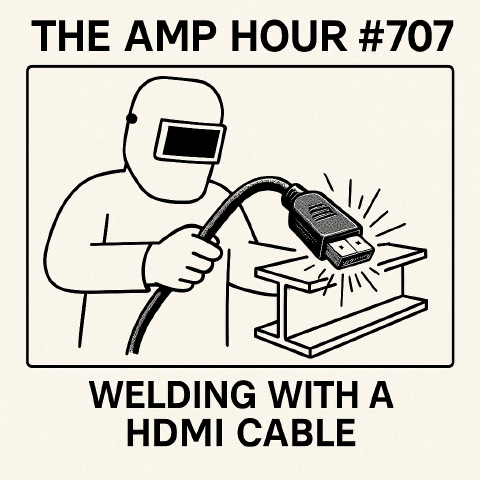
#707 – Welding with an HDMI Cable
Download episode · 80 MB
Also on Apple · Spotify · YouTube · RSS
Show Notes
Thanks to our sponsor Blues this week! Visit the Blues store and use the code AMPHOUR to get 10% off your first order of a kit.
- Capacitors go pop on Dave's audio setup, the Presonus monitors
- Ground loops causing HDMI cable sparking
- Chris was watching Jetman videos and got an 'Is that real?' from the kid. We find ourselves asking the same with all the AI generated video these days.
- Fight between mehdi/electroboom and walter lewin about KVL
- Arduino bought by Qualcomm! They also released the Arduino Uno Q, a single board computer running Debian that also has a beefy microcontroller running Zephyr
- Daves post on X about the purchase
- Arduino switched to Zephyr
- A new enabler of this complex mix of embedded, linux, AI, and ML is a software offering from Arduino called App lab
- Spacey
- Hardware meetup - ACES
- Veritasium is PE owned now
- Chris will be going to a Tektronix event for new gear and past guest Alan Wolke (W2AEW) is giving a class
- Chris has been rebooting his website to follow the ideas of the Small Web
- Follow #electronicscreators on YouTube to not be subject to algorithmic steering
- Chris has been getting into gridfinity after discussing it a few shows ago.
- Altium changed their pricing again...but it might be lower? Hard to tell
- Check out the features coming to KiCad in v10
- YOLO = "You Only Look Once", Chris learned about it from OpenMV
Transcript
An Hdmi Cable: This is the Amp Hour Podcast. Release October 26th, 2025. Episode 707, sponsored by Blues. Welding with an HDMI cable.
Dave Jones: Welcome to the Amp Hour. I'm Dave Jones from the EEV blog.
An Hdmi Cable: And I'm Chris Gammell of Contextual Electronics.
Dave Jones: Hey, nerd. Hey, nerd. You're a muso. Are you still into music?
An Hdmi Cable: I am surrounded by instruments. I'm not sure I'm into music. I think, yeah, many of my cycles are consumed, but I hope to be back into music someday. So I'd love to hear about it. What's up with music?
Dave Jones: Oh, excellent. I just released a video about, are you familiar with electrolytic capacitors going pop and not in the magic smoke terms?
An Hdmi Cable: Oh, oh, oh, oh. Pop like coupling a DC or like a fast transient signal into like an audio chain or something like that?
Dave Jones: Not quite. No.
An Hdmi Cable: Okay. All right. Then I guess not. No. Yeah. Tell me about it.
Dave Jones: Oh, okay. Well, yes. The issue with electrolytic capacitors is you can get dielectric breakdown with voltage, right? Normally not a problem. This is why you have like self-healing capacitors, for example, right? You can get, this can happen in polyester capacitors as well, right? Which is a Wi-Fi mains rated ones. Yeah, yeah. For mains rated X and Y class caps, you get self-healing, right? They must be self-healing. Because what happens with capacitors, especially electrolytic capacitors, which are used a crap ton in audio amplifiers and preamps and stuff, you can get a breakdown between two of the plates and you get a little arc in. And if you get a little microscopic voltage breakdown at one point on the plates inside the capacitor, there's a little arc and there's a little pulse of current inside the capacitor due to that arc. And then if that happens to be in a signal chain somewhere, then you hear that as a pop in your audio. It might have another term in the muso industry, I think. That comes to mind, but I don't actually know what it is. But anyway, you can get these popping. So I just repaired a Studio Monitor speaker here that had this popping and it was an intermittent pop, pop. You would just hear this pop.
An Hdmi Cable: My monitor does that too. So maybe I should be opening this. Oh, really? Yeah. It's like a jalopy, kind of like a really quiet jalopy car. Right.
Dave Jones: Yes. Like it's actually backfiring or something. Yeah. Yeah.
An Hdmi Cable: They're not high quality. I should just say, you know, these are like, you know, $99 speakers. Oh, okay. Yeah. Yeah. Yeah.
Dave Jones: Yeah. Yeah. Well, these ones are pre-Sonus ones, which are a reputable brand, but they're the lower end of the, you know, spectrum. But if you're considering this issue, be aware though, that you can also get static impulses and stuff like that, which could do potentially do similar sort of popping things. So your speakers might not be popping due to that. It might be because you're standing up off your chair or something and you're generating a static charge, which is coupling into your speaker signal chain somehow. And going, pop.
An Hdmi Cable: Well, that's why I never really move. When I'm at my bench or my desk, I just stat you still. Yeah. Yeah.
Dave Jones: You see. Yeah. Yeah. I've done videos on that, but it actually still happens here. If I, if I stand up on my chair and I've got staticky clothing on, one of my screens actually turns off.
An Hdmi Cable: No way. Oh, wow.
Dave Jones: It actually turns off and resets. Yeah. Yeah. It actually couples in, in to the HDMI cable and yep. Causes the reset.
An Hdmi Cable: Yeah. Well, last episode, we talked a little bit about ESD with our guests, but that's at the chip level. ESD stuff all throughout the signal chain, man, all the way up and down. It can, it can really mess you up. I always forget about it. You know, like it's not the same level of like back in the day, you'd be like, oh, if I'm not like super ESD protected, all my stuff breaks. Now it's like, there's such good, like on chip ESD that I'm, I'm so lax about it. You know?
Dave Jones: It hasn't been like that since like the 1970s or something, you know, it's like, you have to go back a long way.
An Hdmi Cable: No, no, no, no. I think it's like as CMOS kept getting smaller and smaller, it just became a bigger, a bigger deal. So there's more and more focus on it. And, you know, just the size of the industry growing. I think basically the entirety of this show being, you know, 2010 onward. Yeah. Like in my career, I've never really had to deal with it in any like appreciable manner.
Dave Jones: No, you just take the requisite precautions. And, you know, I've killed a few things with static over the years, but yeah, it's, it's fairly rare. Especially once you've got things in circuit, right? Once you've got those suckers in circuit, they're pretty right. You know, you have to be doing something really serious to kill it. Unless you're working on audio circuits, like using JFETs or something like that. And then they're still pretty delicate.
An Hdmi Cable: Last time I did some audio stuff, I was really dealing with ground loops. Oh, right. Yeah. Yeah. Like really, really bad. Like I was, I had my keyboard and I was like, oh, I'll just like plug this into my computer across the, across the lab. And it was just a, you know, just like 60 Hertz, like so loud.
Dave Jones: Um, somebody posted this video of a HDMI cable and they were touching the ground of the HDMI cable to this PC case and sparks were flying off like they were welding with it. It's like, what the hell?
An Hdmi Cable: Wow.
Dave Jones: Yeah.
An Hdmi Cable: And that was just from, from ground differences?
Dave Jones: Yeah. It was some sort of grounding issue or something like that, but oh my God.
An Hdmi Cable: Maybe it was an AI generated video. Do you think that did?
Dave Jones: I know. Apparently it's the person who posted it. I think said it was real or something. Real enough. Yeah. And like, it almost looked like it could have been.
An Hdmi Cable: Yeah, I know. Right. That's, that's wild. So, you know, my, my daughter's not, not super old yet, but like very regularly, I'll show her like a video of something online. Like we were watching some like cartoon and I was like, oh, check this out. Like there's like jet man. Did you ever see the jet man thing? Like he was like flying around Dubai.
Dave Jones: As in a man physically flying around with a jet pack.
An Hdmi Cable: Yeah. He had like a carbon fiber wing that was full of fuel. And he actually did like, he would like fly around. It was like super cool. It was like five, 10 years ago. And she always asked me things like, is that real? Increasingly, I just had to be like, ah, I don't know. You know, you know, like these days it's just hard to tell. It's going to, that question is going to be more and more relevant to her generation. I feel like it was like, did it really happen?
Dave Jones: Yeah. They'd grown up in a different age where like literally everything can be faked. When I was a boy, you know, if it was on video, that was it. You couldn't possibly fake that, you know, except the moon landing, except the moon landing.
An Hdmi Cable: Right, right. That's the one thing that really, they really worked hard at.
Dave Jones: Stanley Kubrick in the soundstage in Colorado.
An Hdmi Cable: Oh boy. We can't fake current flow, Dave. I don't know. You can't, you can't stop the signal now. You can't stop the signal.
Dave Jones: Can you fake? Well, I don't know. You can, you can have imaginary current flow.
An Hdmi Cable: The way that most of that stuff flows is in one of my ears and then out the other ear.
Dave Jones: Dude, I can tie this all together. Capacitors anchor. Does current flow through a capacitor? Just say yes. Yes. Damn it. Yes. Yes, it does. I'm going to say yes. I'm going with yes as well.
An Hdmi Cable: Yes.
Dave Jones: I don't care about charge buildup and rubbish like that. Damn it. If I put a current meter in series with a capacitor, the needle, you know, old school analog meter, the needle flicks. So God damn it, there's current flowing in the circuit.
An Hdmi Cable: Why does the needle flake? Is it because there's like a rectifier in the circuit, in the measurement circuit?
Dave Jones: No, it's because the capacitor's charging up. The capacitor's dead. And if you put it on a power supply in series with your current meter, your current meter's going to go whoop, full scale, and then decay back down because the capacitor's charging up. It's a short circuit when you first apply a voltage.
An Hdmi Cable: No, I was thinking going AC going through the circuit.
Dave Jones: Oh, right. Oh, right. None of that AC rubbish. Got it, got it, got it.
An Hdmi Cable: Okay.
Dave Jones: We can always go back to the fight between Mehdi and Walter Lewin about the inductor.
An Hdmi Cable: What was it?
Dave Jones: Oh, I can't remember. It was the inductor, you know, he built, he demonstrated this inductor circuit to demonstrate that Kirchhoff's law doesn't apply. And Mehdi did this video trying to prove that Kirchhoff's current law is for the birds. When you're down at the basic physics level, Kirchhoff's current law doesn't apply. And he had this practical demonstration that left a lot to be desired. Let's just put it that way. I'm on the side of, nah, that demo was shit. He's right. I'm not going to argue fundamental physics with Lewin.
An Hdmi Cable: I don't know who that is. Sorry. Yeah.
Dave Jones: Oh, sorry. He's a, he's a fundamental physicist teaching physics at MIT, I think.
An Hdmi Cable: Okay.
Dave Jones: Walter. Walter Lewin.
An Hdmi Cable: Okay.
Dave Jones: Yes.
An Hdmi Cable: Walter Lewin. Okay.
Dave Jones: Walter Lewin. You don't remember any of this?
An Hdmi Cable: No, man. I got a terrible memory. Terrible memory.
Dave Jones: Oh, man, man. This is all the rage we talked about. I'm sure, yeah.
An Hdmi Cable: I'm sure it's been on the show too, yeah. Walter Lewin. Yeah. Yeah, yeah.
Dave Jones: Right. Yeah, yeah. We've had it on the show several times. Anyway, yeah, he, yeah, tried to prove that Kirchhoff's, and well, he does. At the fundamental physics level, Kirchhoff's current law doesn't apply in changing magnetic fields, blah, blah, blah, blah, blah, blah. Right. Right. And he came up with this practical bench demonstration that he shows all his physics students. And I think it's fundamentally flawed. It doesn't show what he thinks it shows. Not that he's wrong. It's just that his demo sucks. I'm going to cop a lot of hate because there's like a thousand page thread on the EEV blog forum about this. You know, all the nerds just arguing, oh, no, he's right and Mehdi's wrong and blah, blah, blah. And it's like, I'm going, well, why not both? Why can't they both be right? You know? So anyway, does current flow inside a conductor or does it flow in the electric field outside the conductor?
An Hdmi Cable: Yeah, that's another one. Yeah. I don't know.
Dave Jones: Come on. Surely you remember that one.
An Hdmi Cable: I remember that one. Yes, I do remember that one.
Dave Jones: Yeah. Okay. Right. No, I'm an inside the conductor man and I'm current flows through a capacitor and Kirchhoff's current laws hold. Damn it. Yep. In all instances. So anyway, I will die on this hill.
An Hdmi Cable: It's like my father's father's father believes.
Speaker ?: Right.
An Hdmi Cable: We're publishing two weeks after this, but the Arduino got bought. So that's kind of interesting.
Dave Jones: Yes. The Arduino. That was a big thing. Yeah. Yeah. That made all the social media buzz. I know that you're not on social media.
An Hdmi Cable: I'm not, but I saw it. So I was watching, I watched the event on YouTube and stuff like that.
Dave Jones: There was an event?
An Hdmi Cable: There was a launch event. Yeah. Yeah.
Dave Jones: Oh, I didn't care about that.
An Hdmi Cable: Yeah. They like did an announcement and, you know, they'd introduced that new board they released and had a bunch of influencers on, on the stream. Like James Bruton did a robot as part of the launch and stuff like that.
Dave Jones: Yeah. I saw that. Well, I haven't watched it, but I saw that he released a paid video, sponsored video. administered.
An Hdmi Cable: On, uh, he built a robot like he does. and then he used one of the on-device models for tracking faces and then he used that to steer the little go-kart thingy. So it was pretty fun.
Dave Jones: Arduino has been bought out, lock, stock, and barrel. It's gonski, I guess. It's just been sucked into the monolith. Well, they claim they're going to run it as an independent company, right? They claim it's going to continue to be run as Arduino. But we know what happens. I've already publicly stated on X that I've given it 12 months tops before the KPI sales data comes into top management and then they'll bring in the hatchet men and the subscription goblins, I said. So I fully expect Arduino to be subscription some way, shape, or form within 12 months. Prove me wrong.
An Hdmi Cable: Yeah, I mean, they already have Arduino Cloud, so that's sort of subscription already.
Dave Jones: But I looked into this a bit and there was $50 million venture capital that went into Arduino, right? That means they're not going to sell out for anything under like 200 mil, right? So I reckon the deal is in the order of hundreds of millions of dollars. And if you look at, and I ran the numbers, Arduino, I checked, Arduino sell about 2 million boards a year. Most of their income comes from hardware. About 80% of their income comes from hardware sales still. So yeah, that just doesn't add up. The profit margin on those versus a couple of million does not add up to a couple of hundred million dollar, a viable income for a couple of hundred million dollar company.
An Hdmi Cable: Yeah, I mean, I'm sure they're saying that they're going to try and capture more in the market. They always say that sort of thing. And the board they released, so the Arduino Uno Q is the new board they just released. So it looks like an Uno. It's got a STM32U5.
Dave Jones: Smells like an Uno.
An Hdmi Cable: Yeah, right, right. But then it's also got a Linux machine on it. Like, so Debian-based Linux chip on the top. It's one of the, not this, what do they call it? Dragon Wing. That's the Linux-based machine that's running Debian. It's upstream. That's kind of cool. Upstream meaning like the board is supported. So if you went and downloaded Debian right now, you would be able to build for, you'd be able to build for that board without any like additional like libraries needed.
Dave Jones: Right. Oh, okay. It'd be already built in.
An Hdmi Cable: Yeah. So that's the idea. So the same kind of thing happens in like Zephyr, right? So if you, so if I go build a board, right? So like Chris, the schlub, right? I can do it where I have a separate repository. You know, like all of the support for that board is in that repository. But then you, Dave, you can't just go and say, build for Chris's board, right? You have to go and like...
Dave Jones: I have to pull that in manually, right?
An Hdmi Cable: Well, not manually, but using, using the, like the, the package system in Zephyr that's called West and stuff like that. But yeah, you have to have some kind of like downstream out of tree, like way of getting that data in there versus just saying like build for ABC one, two, three board or whatever. So as it so happens, the contextual electronics ABC board, the advanced release cell is upstream in Zephyr for some reason. Excellent. Yeah. So you could build for it if anyone could buy it, but you cannot.
Dave Jones: So I heard that Zephyr was involved in this somehow.
An Hdmi Cable: Yeah. So it's, it's interesting. It's so, so Arduino had announced like, I think 18 months ago that they were switching to Zephyr.
Dave Jones: Right. Okay.
An Hdmi Cable: I'm not that up on it. Yeah. Well, so like, think about like Arduino. So you've used Arduino. I've used Arduino, right? Like Arduino is a compatibility layer and like, and a really a software interface for a lot of people. Like that's how most people think about it. They think about the Arduino IDE. And then a lot of vendors create kind of shims to their own hardware. Right. So you, you say digital pin output high. Right. And, and that sort of thing. And I can't think of the actual, you know, syntax, whatever, it doesn't matter, but that has to then get translated differently for an STM 32 versus like an at mega versus, you know, some huge, huge ass part that's out there. Right. They're all, and that's really the work that the community does and sometimes vendors do. And that's worked well enough for a lot of things. But one of the pieces that was always missing for that was when it came to like IoT and networking type stuff. And so for a long time, Arduino really leaned on embed OS, which is now defunct. So basically when they had like the BLE stacks and wifi stacks. How do you mean defunct? It's gone. It did. It did, man.
Dave Jones: Yeah. But was it open source or was it?
An Hdmi Cable: It was open source. It was run by ARM and they, they just said, we're not doing it anymore.
Dave Jones: Right. But so nobody else took the mantle and ran with it.
An Hdmi Cable: That's right. Exactly. Okay. Yeah. So like, if you look at embed OS, like it really was an ARM project and, you know, ARM's been through so many changes in the past, yeah, five, 10 years. And they've just, that's just, they got completely out of that business. But if you look at like the, the rise and fall of different, you know, ecosystems really, because embed is, there is an OS there, but that's really the ecosystem was the important thing and ARM was like paying to have to like, they were paying their own engineers to do vendor support. You know, some vendors did still do it, but ARM was the one that was driving all that stuff where they would pay their engineers to do a compatibility for an NRF 52 versus a STM 32 versus all the different things out. And I have the vendors wrong. So don't, don't quote me on that stuff, but they, they really, they really made it all go. And so when that funding drew dried up for that, right. Then, then basically the ecosystem just languished. And then it went end of life. And if you look at like when that was announced, you see this kind of like, oh, oh, look at that. Zephyr is really starting to tick up quite a bit as well. A lot of that stuff did migrate in that direction. I'm not saying that was the only cause, but that was the shutdown of one and the kind of the rise of the other were somewhat inner interconnected. This all to say, Arduino, you know, I'm speaking off the cuff here too. I don't have all the numbers and dates and one in front of me. Arduino still needed this interface layer, right? They still need to be able to like, so if you, you or I now want to say digital input high. When I get a. Message over Bluetooth or over wifi. Well, you need to have some kind of interface layer there for all of the networking stack. That's, that's an interval there. And you're not going to be doing that between the different vendors. And really they don't abstract like that. You need some kind of like OS layer thing to, to hand, hand the data down over the various networking layers. And so embed did that for a long time and then kind of ran out of juice. And so that's when Arduino said, Hey, we're going to start switching over to Zephyr. They have switched over. They are, I think mostly switched over now. And so like part of this announcement as well, is that that STM 32 U five three, five, which I think is the microcontroller on the, it's a beast. It's like a beastly microcontroller on there. That's all running Zephyr. But in Zephyr, there's something called a linkable, loadable extension. So LL, E X T, which is basically like the Nintendo's slot cartridge on like a original Nintendo. Right. And what you do is at runtime, you can actually load in these linkable, loadable extensions, right? You could have kind of dynamic memory slot in there. And so that works really well for something like an Arduino, Arduino sketch, where you already have all the plumbing set up down below. But now you or I, again, we change a digital, the characteristic of a digital pin, right? Which is relatively simple thing. You now load that on top of this linkable load extension, and then you can hot swap them in basically. And so that's why it starts to fit together there. I don't have any good data on it. I don't have any feelings about it either way. Actually, I did order a couple of these, you know, cue boards, because I'm very curious. They're very affordable for what's on board. $44 for like a monster machine, right? You know, it's because of Raspberry Pi. It's in line with Raspberry Pi stuff. They're expensive now. They are expensive. Yeah. They've upped their prices. They're really expensive. Yeah, right. They're actually getting hit by the LLMs of the world and all the hunger for memory that's out there. Like that's what they just announced that a couple of weeks ago where they said-
Dave Jones: Yeah, they announced, yeah, we have to increase prices yet over the already extraordinary price increases. They have to do it yet again because the cost of memory is going up drastically.
An Hdmi Cable: Yep. Yep.
Dave Jones: So, yeah.
An Hdmi Cable: So, yeah, I mean, I think it's in line. I think their Arduino also has two different flavors of the hardware. It's a pretty good deal. I'm going to get one of these. I'm really interested. Like there is a ton of like just layer and layer and layer and layer of stuff to like blink an LED, right? Like it's- Yeah, I know. It's nuts. It's really nuts. And it is for the right reasons.
Dave Jones: I'm used to the old school Arduino where I could actually like look and understand the source code that's actually reading and writing the pins. Now it's like 10 layers abstracted.
An Hdmi Cable: Yeah. And I think it's going to be fine until it isn't, right? Like until you have a problem and then it's going to be like tough to support that level of complexity.
Dave Jones: Yeah. Like who's behind Zephyr?
An Hdmi Cable: Oh, well, that's actually a different thing, right? So, so Zephyr is different than Embed in that they're, so it's the Linux foundation that's behind Zephyr, but really it's multiple vendors. So we are on the upswing right now. From my perspective, I think Nordic was one of the fundamental, they were not the earliest ones in there, but I think they really have driven a lot of that growth. They've brought a lot of people into the ecosystem. NXP is doing really good stuff with it right now. So all the other vendors have jumped in because they have to in, you know, with one or two feet, basically like Psylabs is in there. ST is in there. Every vendor is in there now. Basically it has become the de facto. It is not owned by any of them. It cannot be bought by any of them. So like that's beneficial. To Arduino's credit, they simplify a lot of things, right? And like, right. Zephyr has compatibility now across lots and lots of different parts, lots of different stacks, part, part types, connectivity types, all that stuff. It's still super tough, right? On a daily basis, I'm still swearing at Zephyr, right? And it's just, and that's me learning it. It's, it's just a tough thing to learn. And, you know, abstraction layers on top of that. Oh, you know, the downside of course, is that it, you know, you don't really know what's going on underneath, but the upside being it's more accessible then. So like, you know, that actually will be good. Arduino has also introduced a new thing though, which is called App Lab. And that's basically, if you want to now pull in, this is why they're doing all this stuff anyways, right? They bought Edge Impulse, like James did with the face detection. They want to pull in edge AI, you know, AI processing machine learning models, right? It highlights Qualcomm parts. Like that Dragon Wing thing is a, is, is a really powerful part, like an edge processing part. That is the part from my perspective, like the Arduino thing, which is called App Lab is still, it's like utilizing a lot of these models that are out there, Edge Impulse models, other models that are built for this hardware. That is their ecosystem, right? That is, that is kind of a walled garden, despite it is being Arduino. So like, it's still going to be probably more open than other ones might be, but that would be the one that where I'm like, I don't know. But it was so charming when they kept calling it App Lab because it was all the Italians saying that I, you know, I just kind of skirted right past it because it was, it was, it was, it was very nice. App Lab. Love those Italians.
Dave Jones: Anyway, they got their payday, so. Yeah, exactly.
An Hdmi Cable: Yeah, good for them. I mean, they worked hard. They've been working hard for a long time. They brought a lot of people in the fold and there will be an Arduino Uno header on, you know, that probably lands on Mars someday. Not because it wants to, but just because like it has become the de facto, it's just done everything. And yeah, we're just stuck with 0.1 inch headers forever.
Dave Jones: Yeah. Yeah. Speaking of Mars, you've been following the SpaceX Starship flights at all?
An Hdmi Cable: I saw you were doing some streams with it.
Dave Jones: Yeah. Yeah. I'm, I'm always streaming it. Didn't one blow up? Yeah. Yeah. One blew up. Yes. But the last one went 100%. It was so, it was actually boring because it went so well, nothing went wrong at all.
An Hdmi Cable: Yeah. It was great.
Dave Jones: Yeah. Yeah.
An Hdmi Cable: How close are they to putting humans on top of one of those big metal phallic objects?
Dave Jones: They won't be because Starship is not human rated and will not be human rated. Oh, so it'll always be like a dragon type thing. And then it'll always be cargo type thing, except for if it happens, there'll be a Starship variant called the HLS, which is the human landing system, which has been contracted to land on the moon. But they won't launch from here. They will send them up on a regular, like a Starliner capsule to the space station in lunar rectilinear orbit around the moon. And then they take, and then the humans hop in Starship HLS variant to land on the moon. That's the plan. So yes, but they won't ever take off or land on earth in a Starship. That is not, that is not the plan at all.
An Hdmi Cable: You excited about space still? I don't know. Space is cool.
Dave Jones: Oh yeah, yeah. No, no space is cool. I went to the International Astronautical Congress.
An Hdmi Cable: Oh yeah, that's right. We talked about that last time. Here's what you should do, Dave. You should go to Brownville, Texas. That's what I think you should do. You should go to whatever they call the spaceport down there.
Dave Jones: Yeah, I'll just fly to Texas.
An Hdmi Cable: I mean, here's the thing. Like it is the southernmost, I think the southernmost point in the US. There's a two gate, my dad's flown into there before. He's like, it's a two gate airport. That's all it is. He's like, wow. Okay. All right. Obviously, I think infrastructure must be bigger now. It's near South Padre Island, which I've been to, which is very nice. And then you can go watch, you can go watch a launch.
Dave Jones: Oh yeah. That is on my bucket list. Because I've never seen a rocket launch.
An Hdmi Cable: Yeah, same. I was supposed to, but then I went, spent that time. It was right when I was supposed to, you know, propose to my wife. And so I chose the latter. Yeah. Yeah. Yeah. I made the right choice.
Dave Jones: There's a new hardware meetup thing here in Australia, Sydney. Whoa. Really? And it's been going for a while. They're up to their seventh one, but I only just found out about it. It's called the ACES conference. A-C-E-S. I'm going to give a talk there on the 28th of October.
An Hdmi Cable: That's great. What are you going to talk about?
Dave Jones: The theme of this one is war stories. So I'll be telling a, I was a boy in World War II. We were, yeah. Yeah. Yeah. So I'll be giving some industry. Like they're only short talks.
An Hdmi Cable: Every war story should start with on the production line. I feel like that's the, that is a rich, a target rich environment, you know?
Dave Jones: My talk will be a fire on the production.
An Hdmi Cable: Talk about high pressure, you know, like obviously like this callback to space, right? But like space obviously has higher stakes, but man, production line stuff. I don't miss that. No, I don't miss it either. Some of you had to make it, you know?
Speaker ?: Right.
An Hdmi Cable: But now we get to yell at those people. That's what, that's what I guess it is. It comes down to, you know?
Dave Jones: Gotcha.
An Hdmi Cable: Pay enough money to yell at the people making the stuff and then they have war stories about us.
Speaker ?: Right.
Dave Jones: Here we go. I'm going to send you the linkity-dink to this conference. It's, there's another meetup website called Looma. I, I, I didn't know. Yeah, that's what I use now too. Yeah? Oh, okay. Yeah. Right. Yeah. Is it free?
An Hdmi Cable: Yeah, meetup sucks ass. Yeah, I know. I canceled my meetup subscription. They got bought by WeWork.
Dave Jones: Oh God, oh, the kiss of death.
An Hdmi Cable: Yeah, well, I know. You know, WeWork didn't, didn't screw it up too bad. They were not great.
Dave Jones: Right, well, you know.
An Hdmi Cable: And then they spun it back out and then it got bought by Private Equity. And Private Equity is like, we are going to make our money back.
Dave Jones: A lot of YouTube channels now being bought by Private Equity. Really?
An Hdmi Cable: Man.
Dave Jones: Yeah, there's a good chance your favorite science YouTube channel is owned by Private Equity.
An Hdmi Cable: Oh, interesting.
Dave Jones: Derek from Veritasium, for example. Veritasium is now owned by Private Equity. Really? Yes.
An Hdmi Cable: Yeah, I guess, you know, I bet they get to go on vacation now though.
Dave Jones: Yeah, he's like handing off. You can see it in the videos where he's just in his home in Sydney here and he's just like talking from his, you know, lounge chair or whatever.
An Hdmi Cable: Derek was in Sydney? I didn't know that. I thought he was based in San Diego.
Dave Jones: Yeah, he actually moved back. He actually moved back to Sydney. Yeah, with his wife. Oh, cool for him.
An Hdmi Cable: Yeah. Well, see, get him to go to this meetup. They should kick you off the roster. Get him instead.
Dave Jones: Right. Yeah, they should get there. He'll be a slightly bigger drool.
An Hdmi Cable: Yeah, right. Exactly.
Dave Jones: But yeah, you can see that they're bringing in on new hosts now and they host like two thirds of it and he just comes in and you can see he's exiting stage left.
An Hdmi Cable: Yeah, good for him. He's worked hard too, you know?
Dave Jones: Yeah, yeah. Oh, yeah, totally. It's fine.
An Hdmi Cable: I just feel like Chris, 20 years ago, I've been like, rah, rah, rah, rah, rah, right. I can't believe he would sell out, blah, blah, blah. You know? And now I'm like, no, man, take it easy. Like, yeah, you get your payday and relax. Yeah, yeah, take it easy.
Dave Jones: Oh, well, if any private equity firm wants to buy the EV, log, you know, I mean, you know.
An Hdmi Cable: Just the nicest bunch of cantankerous test equipment enthusiasts you could find.
Dave Jones: Exactly.
An Hdmi Cable: And now a word from this week's sponsor. Building connected products shouldn't mean fighting with carriers, contracts, or SIM cards. With Blues, you skip all that. The Blues note card includes 500 megabytes of prepaid global cellular data with no monthly fees, roaming headaches, or carrier certifications. Just power it up and start sending your data to the cloud. When coverage gets spotty, Blues StarNode can take over, switching to satellite so your device stays connected. If cellular or satellite aren't a fit, you can switch to a pin-compatible LoRa or Wi-Fi module, all using the same radioagnostic APIs. Integrate any note card with your product using Blues note carrier, or add an M.2 edge connector to your own board. To top it off, NoteHub, the Blues cloud service, securely routes data from the field to your cloud, no brokers, VPNs, or custom infrastructure required. Plus, it supports full device management and OTA firmware updates for STM32, ESP32, and NRF52 hosts. From prototype to production, Blues makes wireless connectivity simple, scalable, and resilient. Learn more at blues.com, or take 10% off your first cellular, satellite, or LoRaWAN starter kit with the code AMPHOUR at shop.blues.com. And now, back to the show. Ooh, speaking of test equipment, I'm going to a Tektronix event. Oh, right. Because they just released some big one, MSO 7, I don't know, 7,000 series.
Dave Jones: That would be the ultra high-end one, because they've got the one, they've got the one through to the three, to the four, the five, six. Yeah, exactly. Right.
An Hdmi Cable: Yeah, exactly.
Dave Jones: Yep.
An Hdmi Cable: Yeah. But I found out Alan Wolke will be giving a class.
Dave Jones: Has he made it? I haven't seen one of his videos pop up forever. I don't know if that's just him not making them, or is that just the algorithm not giving it to me?
An Hdmi Cable: Definitely the latter, you know, is part of that, right? Like, they just de-emphasize all things. But the only reason I'm going is because it's here, in town. Oh, got it. I'm not flying. I'm driving less than a half hour to get there.
Dave Jones: All right. Okay.
An Hdmi Cable: I know you're not a huge fan of this, but I'm taking part in the tiny web movement.
Dave Jones: I have no idea what the tiny web movement is.
An Hdmi Cable: I know. I know. It's so basic and silly and, like, retro in a way. It's like RSS feeds and web rings. Do you remember web rings?
Dave Jones: I, dude, I, yes, I used to be on the Australian Electronics web ring. I'm surprised that you even know what a web ring is.
An Hdmi Cable: They're coming back, man. Yeah, I was more, the era that I started was more like blog rolls rather than web rings.
Dave Jones: Yeah, right. Yes, I thought that that'd be more your style, blog rolls. Blog rolls, yeah. But no, I'm surprised you have even encountered a web ring.
An Hdmi Cable: Well, no, I know about it because it's come back. That's the thing.
Dave Jones: So, what is it like? I'm on a website called tinyweb.so. Is that it?
An Hdmi Cable: Yeah. I don't know. I think it's a-
Dave Jones: It's like a paid pricing thing? No, no, no. The tiniest, beaseless HTTP client?
An Hdmi Cable: No, no, no. That sounds like a-
Dave Jones: No? No.
An Hdmi Cable: Tinyweb movement?
Dave Jones: No, that's something else. Tinyweb, no, I've got to put movement.
An Hdmi Cable: Smallweb, tinyweb. I don't know. It's basically just like simple-
Dave Jones: Simple- It reminds me of the scene from Under Siege. Under Siege? You've seen Under Siege with Steven Seagal?
An Hdmi Cable: Oh, not for a long time, yeah.
Dave Jones: On the battleship. But it reminds me of the scene where he's saying it's not a movement because a movement moves a certain distance and then it stops. What we need is a revolution because it keeps coming around in your face, you know, like, so you need a revolution, not a movement. Steven Seagal is like its own punchline these days, you know? No, Steven Seagal didn't say that. This was Tommy Lee Jones, so it's legit, right?
An Hdmi Cable: Either way, even though he's just there, you know?
Dave Jones: Right.
An Hdmi Cable: Yeah.
Dave Jones: And the small web will be the new wave of internet. Yeah, the small web is beautiful.
An Hdmi Cable: The Ben Hoyt article, the small web is beautiful.
Dave Jones: Oh, God, I'm on Reddit. Oh, oh, my skin just crawled. Yeah, that'll do it. The web 2.0 movement.
An Hdmi Cable: Every site you go on, YouTube, Twitter, all of them, X, right? It's like they're all like the algorithms are there to keep you there, right? It's like it's annoying and it works. I struggle with it quite a bit. That's why I don't do Reddit anymore. Yeah, so it's just like trying to make it so you can still discover new things, right? We need that for this site, for this show. We need to find out about new things, but do it without getting sucked in for four hours, right? You know, it's like I think your forum is really good at that stuff. Yeah, it's all still text-based. Yeah, there's no like algorithmic, like it's just latest posts, right? That's like the kind of thing.
Dave Jones: No, no, there's the latest post, yeah.
An Hdmi Cable: So that's, anyways, so I've stood up like a mini micro blog back on my, ChrisGamble.com is now like a micro blog in addition to being a blog and that sort of thing. So yeah, nobody reads it. It doesn't matter though. Like I'm not doing it for anyone else. It's like basically it's like my outlet because I miss old Twitter. That's what it really is. It's like me taking photos of the huge box of shrink tubing that fell off my bench the other day and bitching about it, you know? Right.
Dave Jones: Dude, you do realize that new Twitter is the same as old Twitter? It's a skill issue of how you use it?
An Hdmi Cable: Well, I'm not going back, but I don't doubt you being right. Fine. I'm going to opt out of that conversation because it's like even if I agreed with the other stuff, I just, I get so addicted to it, you know?
Dave Jones: So what do I have to do to be part of this tiny web movement?
An Hdmi Cable: There are some like web rings that are out there. You could start your own web ring, you know?
Dave Jones: Yeah, but how does it physically work? How does it physically manifest itself?
An Hdmi Cable: Like there's GitHub repositories that list a variety of different web rings, things like that.
Dave Jones: Okay, but I just put some HTML code on my website, do I? And it works like the old school web ring?
An Hdmi Cable: Yeah, exactly. Yeah. Right. It's like so dumb and simple, right? Right. So, yeah. It's not an either or, right? You could still go and post it onto X and be fine with it. But it's like, how do people that aren't on these sites, like people like me, how do I find out about new things? Like I know to go check your YouTube channel or, you know, I have an RSS reader, stuff like that. But if I'm, say, only in an RSS reader, there's certain things I'm going to see that people only following the algorithms are going to not see probably. And there's certain things that I just, I'm going to miss, you know?
Dave Jones: A few of us electronics YouTubers, we actually started a hashtag thing. If you go hashtag, because we all decided, well, all. A few of us decided that we'd put a hashtag inside each of our videos so that if you search the hashtag electronic creators, you will find all of the, because technically YouTube does support these hashtags. Okay. So you can actually click on the hashtag and get through to the videos. So you can actually find them that way. So you find all the ones that are linked with that hashtag and YouTube never really did anything with it. But technically it's there.
An Hdmi Cable: Yeah. It's like a sort mechanism without having a result.
Dave Jones: Yeah. It's like a playlist thing without doing a playlist kind of thing. You know? Right. It's just, yeah. Yep.
An Hdmi Cable: And that's one word, electronic creators?
Dave Jones: Electronics with an S, actually.
An Hdmi Cable: Ah, with an S.
Dave Jones: So you can put in youtube.com slash hashtag. I'll send you the direct link now. And you'll find. Yeah, yeah. There you go. And if you open that up, you'll find that a whole bunch of videos should actually pop up. They're currently, I'm second with a three-year-old video. It used to pop up with them in the latest ones first, but it doesn't do that anymore. Damn, I haven't looked at it in a while. Anyway, there's 6,000 videos and 316 channels that are using that hashtag. Nice. But yeah, YouTube don't actually promote it. There's no way to find out that it's there. You just have to know kind of thing. You know? Yeah. Yeah, totally. It's just dumb. Totally. Yep.
An Hdmi Cable: Speaking of hashtags and discoverability, did you end up following through on, what's it called? Gridfinity from the last show?
Dave Jones: Yeah, the Gridfinity. I have printed the mesh base and one big tool holder thing, but that's all I've done so far.
An Hdmi Cable: Yes. Got it. Yeah. Yeah. I went kind of nuts on it. I went through a school of filament.
Dave Jones: Right. Okay. Anyway, yeah. So, I've got this like 8x8 grid or something or 12x12 grid or something like that. Oh, wow. Okay. So, yeah. Yeah. I've got the largest one and it just fitted on the bed of my large actual printer.
An Hdmi Cable: Oh, nice. Okay. Yeah, yeah. Cool.
Dave Jones: But yeah, I printed out like a holder for it and I'm going to do other things. I haven't tried out like the custom thing yet where you can create, apparently like they've got a paid tool where you can actually create your own custom plugins. Like you can do your own if you're a 3D model person, you know, but yeah, apparently there's a tool that will do it for you or something. So, okay.
An Hdmi Cable: Yeah. There's a web tool that will.
Dave Jones: Yes. Yes. There's a web tool. I think they give you one as a free sample or something and then it's paid.
An Hdmi Cable: No, no, no, no. There's a generator. It's just OpenSCAD. I mean, that's, it's like a web interface for OpenSCAD. Yeah. No, that's how I generate. You can generate like the height with, you know, how many units wide and stuff. I guess these aren't tool holders though either. Maybe it's a different thing. This is mostly like boxes, you know, like that's right.
Dave Jones: Okay. Right.
An Hdmi Cable: Yeah.
Speaker ?: Yeah.
An Hdmi Cable: Well, speaking of putting people in boxes, Altium has changed their licensing once more. I did not know this.
Dave Jones: Apparently it did not pop up on my radar. So I guess no one cares about Altium anymore.
An Hdmi Cable: So there's some interesting things about it. One is it's actually cheaper.
Dave Jones: Well, I haven't there for quite a few years now. They've had like a monthly thing. You can just get like a one month subscription.
An Hdmi Cable: Oh, like a one and done kind of thing?
Dave Jones: Yeah. So if you only use it, you know, twice a year or something, you're financially better off to simply rent it for a month.
An Hdmi Cable: About a year ago, they started pushing people away from perpetual licenses. It's always been like you buy it one time, you have to pay maintenance on it.
Dave Jones: You had to almost threaten them to leave. And like, I'm threatened. I'm going to leave. I'm going to leave. And unless you give me a perpetual license and then they'll finally relent and give you one. But apparently now that's stopped completely. Yeah.
An Hdmi Cable: Yes. I don't think there actually are any choices at all. I don't think there's anything you can do.
Dave Jones: Except if you've got the old license, it'll continue to work, right?
An Hdmi Cable: Yes. As long as there's no like network key.
Dave Jones: It better. Otherwise, they'd get their ass sued.
An Hdmi Cable: I guess, you know, like every platform's like this where it's moved to like ownership versus rental, basically, you know. Yeah.
Dave Jones: But if you paid for a perpetual license, especially here in Australia, this would be country. Basically, we have very strict consumer laws here. So you could easily go to the consumer affairs and say, no, I paid for this. You must let me use it.
An Hdmi Cable: I don't doubt it. I don't doubt it. Yeah. So the new ones, though, are called Discover, Develop and Agile.
Dave Jones: Well, it's better than Winter and Summer.
An Hdmi Cable: Is that what it was, really?
Dave Jones: Sorry. They were the releases.
An Hdmi Cable: Oh, I see. Yeah. Like every six months. Yeah.
Dave Jones: When I was there, they changed names. You know, it wasn't Altium Designer version 10. It was Altium Designer Summer Winter.
An Hdmi Cable: You know, Salesforce does that too, actually. It's weird.
Dave Jones: Oh, really? Oh, God. Oh, God. Oh, no, it was so bad. Yeah.
An Hdmi Cable: They didn't even say Summer, Winter of the year that it was in. Oh. Like Summer 2023.
Dave Jones: It was so bad. Because, like, contrary to popular belief, the Earth is actually round, I think. And there are different seasons in different hemispheres. Right, right. That is correct. And it kind of confuses things. Oh, God.
An Hdmi Cable: Due to the lawyers telling us that the Altium Summer must be consistent across the world, we are petitioning the Australian government for summer to exist in July. Yes. Despite it being the depth of winter, summer will occur in July in Australia. Yep. And we are being told we are not big enough to control the Australian government.
Speaker ?: Oh, God.
An Hdmi Cable: So bad.
Dave Jones: I've got it. I'm on the pricing page now. Yeah. There's Workspace, Altium Designer, Authors. $1,300 a year. Annual subscription activates a shared Altium desktop environment enables authors and collaborators required to get started. What?
An Hdmi Cable: Right. Exactly. That's what I'm saying. It is cheaper. But I think what it is is like they're trying to pull in more. I remember reading something about it, but it was basically like they're trying to make it so that the, so you as the designer, you don't have to pay that much, kind of like an easy way to get in the door. But then like every single person is going to touch the product. Don't take this as gospel or anything like that. But it was going to be like more people in the total value chain, right? Like all the way through manufacturing are potential like license holders, which is, you know, spread it around, that sort of thing. Yeah.
Dave Jones: Okay. So they've got this workspace. So you can create a workspace for $1,345 Aussie bucks. Oh, that's why.
An Hdmi Cable: It was $9.95 on my site. I was wondering. Yeah. Yeah.
Dave Jones: Right. Yeah. And then you add author seats for $1,345 each. Invite unlimited collaborators for free. So if you just want somebody to review the bomb, something like that, they can do that for free, which is okay. Great. Up to five concurrent authors equals the number of paid seats. Each seat covers one author at a time shared across a team. Oh God. I've read it all and I still don't quite understand it. You still don't get it.
An Hdmi Cable: Yeah. Right. Yeah. And I'm sure there's going to be like, you know, add-ons for AI stuff and like, you know, like all that, all that kind of thing, you know, it's going to.
Dave Jones: It doesn't, it doesn't have any of the add-on. It doesn't have any add-ons on the pricing page. It's just like, is this an all you can eat? $1345. Like it just sounds too cheap. Sounds like they're going down to five, a thousand bucks a year. A thousand Yankee freedom bucks a year.
An Hdmi Cable: All of them are getting pushed down. So I think they're trying to capture more of the chain.
Dave Jones: For those who don't know, it was in the order of $10,000.
An Hdmi Cable: Five for the initial, but then like, but then you'd be paying $1,500, $2,000 for like the maintenance license on that sort of thing too. So yeah.
Dave Jones: Yes. Yeah. The, you had to pay the regular, the yearly maintenance.
An Hdmi Cable: Oh, there's a little calculator at the bottom too. A workspace with five authors and unlimited collaborators would cost $59.70 per year.
Dave Jones: But if you're a one man band.
An Hdmi Cable: Right. I do think consultants actually will be paying less. I do think that's correct. Yeah.
Dave Jones: Oh yes. Yes. Because they only need the one seat. Yeah. They, they, they only, but what happens if you're a design firm and you've got 20 designers, is it now $20,000 because you've got to pay a thousand dollars per offer?
An Hdmi Cable: I think so. Yeah. Yeah. Or maybe the author is like, maybe that floats and you can have five, five concurrent authors or something like that. That sort of thing. Yeah. I don't know.
Dave Jones: Right. Yeah. Well, that's what it says up to five concurrent authors equals the number of paid seats. Each seat covers one author at a time shared across the team where you've got to
An Hdmi Cable: form a team. I think the big thing to know is that again, no matter what, you don't own the software.
Dave Jones: No, no, you don't own it anymore. No. Yeah. Right. Yep. So if you want to try and like snapshot your development tools to, because in 10 years time, you'll want to restart it up again and you want to get it going. You can't really do that. I can't see how you can snapshot a web environment. Well, it's, it still runs locally, right?
An Hdmi Cable: I think it still runs locally. Yep. Yep.
Dave Jones: Right. And it's just using the license server as it always has, I guess. I don't know. I haven't fired mine up in a while. See if it still works.
An Hdmi Cable: Yeah. You should see if it works.
Dave Jones: I think I'm pretty close to expiring actually. Yeah. I've, oh no, sorry. I've got a version.
An Hdmi Cable: Is there expire?
Dave Jones: Yeah. Cause they, they gave me like a three year license. Um, and that what might've been three years ago or it is aspiring 26 or something like that. I'm, I'm loading it now. I'm loading version 22.7.0 copyright 2022.
An Hdmi Cable: Oh yeah. You're good. You're getting there, man. Yeah.
Dave Jones: I know I might, I might have another version cause you can install multiple versions of Altium Designer. There is a beta update to 25 version 25. Oh yeah. I am. Yeah. Cause I'm part of the, uh, beta program as well. No valid. No, I've got, I've still got loads. Altium Designer Professional. I'm not dead yet. 30th of June, 2026. 30th of June, 2026. There it is.
An Hdmi Cable: That's not bad.
Dave Jones: Yep. Yeah. Yeah. It's all right. I've got six and nine months left or something.
An Hdmi Cable: All right. Anyone taking, taking bets on will Dave finish a board before June of 2026? Let's do it.
Dave Jones: Yeah. Probably not. How's your, your timer going?
An Hdmi Cable: Is that still on the bench?
Dave Jones: Oh, the timer going? No, I just haven't had time. I'm here all week. Haven't, you know, I've just, yeah. Like, because I can't just do 10 minutes here, 10 minutes there. You know, I need to like sit down all day and like work on it.
An Hdmi Cable: I am contractually obligated to encourage people to buy a key CAD license. It's expensive, but it's worth it. And you'll get to keep on, you get to hold on to the software.
Dave Jones: Why are you contractually obligated?
An Hdmi Cable: I'm just saying, cause I like talking about key CAD, you know?
Dave Jones: Right.
An Hdmi Cable: It's a contract I hold with myself.
Dave Jones: You're not secretly paid by. Yeah.
An Hdmi Cable: Yeah. It's secretly paid by the open source program.
Dave Jones: I've heard there's George Soros money going into key CAD. Oh boy. You know, he's trying to control the whole thing, you know?
An Hdmi Cable: Yeah. That's what it is. That is your second, second conspiracy theory on the show today, Dave.
Dave Jones: Oh, is it? Oh, well.
An Hdmi Cable: Yeah. The space land, the moon landing was the first one. If you don't remember.
Dave Jones: I knew it was coming from somewhere. Yeah.
An Hdmi Cable: Anyways, I will link in the V10 previews. I'm excited about things, you know, I told Dave this before the show started, but like things that exist in Altium already, but now exist in a key CAD as well. Like blocks, like reusable blocks is going to be in key CAD. That's I think probably my favorite thing. So I'm going to start making my own little library of things to reuse. So that'll be, that'll be great. And dark mode. Oh, dark mode.
Dave Jones: I do enjoy my dark mode.
An Hdmi Cable: Late night board layout sessions.
Dave Jones: So I'm surprised that was not a thing.
An Hdmi Cable: There is like theming. You can get like a theme that is dark, but it's not like dark mode. Right. So it's not like all the menus. Right.
Dave Jones: It's not like kind of. Right.
An Hdmi Cable: It's not like your, your preferred, your preferred OS level thing.
Dave Jones: Well, I was going to do my new board in key CAD instead of Altium. So.
An Hdmi Cable: Oh, great. All right. There you go.
Dave Jones: Yep.
An Hdmi Cable: You can jump ahead and do, I think V10. They're targeting the beginning of the year. So, you know, we're, we're closer to the end of the year than the beginning of the year. That's for sure. Oh, yeah. It's very, yeah. My gosh. If you wanted to fast forward, you could just go to version 9.99 and that's, that's the, that's the nightly. So just YOLO it, man. Just YOLO. YOLO? Yeah. You only live once, you know.
Dave Jones: Oh, oh, okay.
An Hdmi Cable: Is that what the hip kids saying that these days to take it back to the Arduino thing. So YOLO is like, you only live once is like a thing that like people would shout when they go like Canyon diving or whatever. There is a vision model. So say you have a camera on your product, the model that you use to like do machine vision on that camera is called YOLO. So it's always like, you know, like kind of makes me blink and I'm like, what is going on right now? And it's because you only look once. That's what, that's what that YOLO is. So anytime you see like a open MV cam or something like that, you'll see YOLO on it. So yeah, kids are all about tiny web and you know.
Dave Jones: Yeah. I was at the gym the other day and someone was talking about the six, seven meme and I go, what the hell? Six, seven? Is that? Yeah. Well, you're obviously not up on it. Please enlighten me, hip Dave. I totally know what the six, the six, seven meme is. It's, it's from TikTok, Instagram reels. I'm, it comes from some drill rap thing. I don't know. It's some, I don't know, six, seven. So it's off the numbers six and seven show up somewhere. It's like, I don't know. The kids think it's funny.
An Hdmi Cable: Is it because of the classic joke of why is six afraid of seven? Is that, is that what it is? Cause that's what, that's where my mind went. I don't know that joke. Why is six afraid of seven?
Dave Jones: No.
An Hdmi Cable: Because seven, eight, nine.
Dave Jones: Oh, cause seven. Oh God, that.
An Hdmi Cable: Come on, man. Right. That is the only way to properly respond to like hip kid thing is like to just go full dad joke mode. Yeah. Everybody listening. They saw that coming. They knew what it was.
Dave Jones: Right.
An Hdmi Cable: I'm sorry, but I'm not sorry.
Dave Jones: Anyway, the six, seven thing apparently has a hand gesture thing with it. So I don't know.
An Hdmi Cable: Oh, okay. All right.
Dave Jones: All right. Cool. Whatever.
An Hdmi Cable: Gang signs. Yep. Yeah. I always love that. It's like in the first scene of Iron Man where, uh, Robert Downey Jr. is like in the Humvee and like one of the kids, one of the, the soldiers is like just doing peace sign. And he's like, yeah, yeah, yeah. Gang signs throw them up, you know?
Dave Jones: Oh, Robert Downey Jr. I saw him in back to school. I was watching back to school. Not that long ago. Oh, it's great. Yes. Yes.
Speaker ?: Yes.
Dave Jones: Still good. Triple Linderman. Triple Lindy. Oh my God. Anyway. Yes. Yes. He's in that. And he plays this. Oh, for those who haven't seen it, just go watch back to school. And it's got a very young Robert Downey Jr. as a college student who's like a-
An Hdmi Cable: That's the Rodney Dangerfield, right? Back to school? Yes. Yes. Yeah. Classic. Yes.
Dave Jones: Rodney Dangerfield. Fantastic. Yeah.
An Hdmi Cable: And then it's like they always like switch to the back view and it's like him doing the dives and it's like someone that looks completely different physiologically.
Dave Jones: It is still so much fun. Physiologically, yeah. It's great fun. Yeah. So much fun.
An Hdmi Cable: I re-watched Sneakers, which obviously we talked about on the show a bunch, but it was on, yeah. Oh, yes. I re-watched that recently.
Dave Jones: We watched that a couple of weeks back. Yeah.
An Hdmi Cable: So good. I forgot Ben Kingsley's in it.
Dave Jones: Oh, yeah. No, it's great. And we watched Hackers. So we've completed the Hacker Trilogy now. So we've watched War Games, Sneakers, and Hackers.
An Hdmi Cable: What about Real Genius? You've got to do that one too, yeah?
Dave Jones: We've seen it. The kids have- Oh, we might have watched it when they were really young.
An Hdmi Cable: Oh, yeah. That's a good one.
Dave Jones: Yeah. No, they would totally forget it. Yeah.
An Hdmi Cable: Yeah. That's a good one. What do they think of Hackers? I watch Hackers and I'm like, oh, boy, guys, like the 90s, you know?
Dave Jones: I thought it was great fun. I thought it was huge fun. I mean, it is. Yeah. Yeah. Is Real Genius, that's a bit non-kid friendly, isn't it?
An Hdmi Cable: That is correct. Yeah. Yeah. It's a little more rated R.
Dave Jones: Yeah. It's a bit, you know-
An Hdmi Cable: What about Revenge of the Nerds? You watch them watch? You let them watch Revenge of the Nerds?
Dave Jones: Oh, yeah. Yeah. You wouldn't watch Revenge of the Nerds if the kids are kind of- Yeah. I see. Got it.
An Hdmi Cable: Give it a couple more years. Yeah.
Dave Jones: Yeah. All right. I think that's today's show, done and dusted.
An Hdmi Cable: I think so. Wait, did it also have anything else on my list? I'd say follow me on social, but, you know, can you? You just know. You follow me on my website. No, you don't. ChrisGammel.com. ChrisGammel's Analog Life, man. It's back. It's back in the mix. It's back on the tiny web. Yeah. It's back on the tiny web. Yes. The tiniest of webs.
Dave Jones: Which is ironically only accessible via the large web.
An Hdmi Cable: That's right. Yeah. administered in x x x x x x x x x x x x x x x x x x x x x x x x x x x x x x x x x x x x x x x x x x x x x x x x x x x x x x x x x x x x x x x x x x x x x x x x x x x x x x x x x x x x x x x x x x x x x x x x x x x x x x x x x x x x x x x x x x x x x x x x x x x x x x x x x x x x x x x x x x x x x x x x x x x x x x x x x x x x x x x x x x x x x x x x x x x x x x x x x x x x x x x x x x x x x x x x x x x x x x x x x x x x x x x x x x x x x x x x x x x
Keep current
Every episode, plus the occasional job post, in your inbox.