
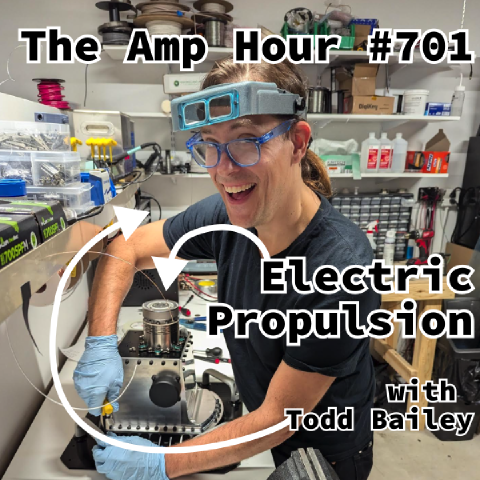
#701 – Electric Propulsion with Todd Bailey
Download episode · 111 MB
Also on Apple · Spotify · YouTube · RSS
Show Notes
Welcome back Todd Bailey of Starlight Engines, now Muon Space! (11 years later)
- Todd was on Episode 194 of The Amp Hour, when he was consulting in the art and design space and building instruments like Where the Party At (WTPA). He was designing 'robot doors' for Calvin Klein's house, discussed last time.
- Through Andy Reitano, Todd learned about a role at Lockheed Martin (a US defence company) working on sonar for submarines.
- "What a good job is"
- Fun
- Lucrative
- Skills / teach you
- Todd, Andy, and other Lockheed Martin friends worked on the VEC9 discussed in ep194
- Clearance was required to work on sonar
- Military electronics had some differences from his past work, but Todd was interestingly complementary of requirements driven design / waterfall
- Chris and Todd were hanging out in a bar before he moved over to working on space and Todd mentioned he wanted to be Zefram Cochrane and do interesting things that matter (in space).
- Star Trek First Contact (gah, I said generations)
- Past guest Shawn Meehan talked to Todd and that's how he started working at the "stealth space startup" at the time
- Astra
- HBO (not Netflix) special called Wild Wild Space
- Other past guests of the show who were at Astra include Charles Aylward and Jeri Ellsworth
- Silicon Valley Startup
- "When the heavens went on sale" (book)
- Commercial space by SpaceX
- Rocket Lab was second
- "Fail on stage"
- Booster state of that rocket motor control
- Electric turbo pump
- Delphin engine
- Cryogenic / feedback was hard
- Alameda indoor test facility
- Meant to fit in shipping container (8x8.5x40 ft)
- System design and market requirements (launches don't want small rockets)
- Working remote
- No place like home Jim Williams essay
- Leaving Astra
- Staying in the trenches
- Rocket Lab
- 3rd stage "Kick stage, now known as "Photon"
- Things you can work on in space
- Radios
- Sensors
- Power
- Electric propulsion (EP)
- Apollo fusion - Alex Zannos (Contemporary) and Mike Cassidy (CEO)
- After working on fusion didn't have legs, they switched to working on Hall effect thrusters
- "Low earth orbit is 50% of the way to anywhere in the solar system"
- Rocket equation
- Stage fires then falls off
- Kick stage is 3rd stage
- Accelerating an ion beam
- Delta V book
- Rocket efficiency
- "Seconds of ISP" How much mass do you use to go distance
- Asteroid mining
- Who buys EP?
- SpaceX built their own Argon thruster
- Torque rods / reaction wheels
- Apollo successfully pivoted
- Acquired by Astra space / finished the apollo constellation engine
- In 2022, Todd and his cofounder Mark Hopkins started Starlight Engines after some initial proof points and then fundraising
- Had opinions about EP
- Goebels and Katz textbooks about EP
- Busek electric propulsion is a family business that has tried all kinds of EP. Run by Vlad Ruby & son Pete.
- Starlight is based on solid Zinc propellant
- Traditionally it's Xenon
- "The honda civic of hall effect sensor systems"
- The atomic mass of Zinc is light
- "Lickable EP"
- Discharge converter runs the ion beam
- Custom magnetics
- 300W - 800W
- 28V spacecraft bus
- "Plume divergence"
- Need to go from solid to gas
- Cathode is a thermionic emitter "Like a tube amp", it emits to boil off electrons
- Zinc gets caught in electron cloud, knocks an electron off to make ions, ejected from a positively charged plate nearby.
- Novel propellent is a differentiator
- Starlight had a scrappy factor, like they built their own vacuum chamber (for 15K!)
- The device is not known to be operational in space yet (they sell it but don't operate it, so it'd be tough to know)
- "Give the first one away"
- Have sold 4 propulsion systems
- Muon space needed a propulsion system and instead decided to buy the company. They weren't put off by "two guys in a garage and contractors".
- Muon builds things like fire detection satellites
- For more info about their past work and see pictures of the plumes, check out Starlightengines.com
- To see the new things they'll be working on, check out Muon space
Transcript
Todd Bailey: This is The Amp Hour Podcast, released August 21st, 2025. Episode 701, Electric Propulsion with Todd Bailey.
Chris Gammell: Welcome to the Amp Hour. I'm Chris Camel of Contextual Electronics.
Todd Bailey: And I'm Todd Bailey from Starlight Engines, now muon space.
Chris Gammell: Hey, welcome back, Todd. 11 years later. This is a trend that I am slowly working through old guests and getting updates of where they're from. We just had another 12 years ago guest and now 11 years ago for you. So you've been busy. You've been very busy.
Todd Bailey: It was, you know, I spent like one minute looking back on what it was that we were talking about then and like, you know, where I was in life. And yeah, it's a good 10 years or 11 years to have bookended. There's definitely stuff to talk about.
Chris Gammell: Oh, yeah, definitely. And, you know, you and I have spoken on and off throughout that time. I think because you have family in Cleveland, I used to live in Cleveland, so we get to like hang out at Thanksgiving. I think that was like the thing I always remember is like you and I would like go meet up at a bar and hang out for a bit.
Todd Bailey: Yeah, I looked forward to it. It was like it was a, you know, fun get out of my hometown and nerd out.
Chris Gammell: Trip. Yeah, I like. And then I had to go and move. I moved away. And, you know, that was all I came to New York. You're still in New York and we got to hang out there. And yeah, it's been good to keep in touch and really fun to watch your progression as an engineer and just like the stuff you're working on. Last time you were here, can you give us kind of a quick glimpse into what we were doing last time? Obviously, I'll link in episode. What was that? 194 of The Amp Hour.
Todd Bailey: Yeah, I think that was 2014. Then I think at that point I was still a contract engineer and I think that I still was largely working in my home lab, which frankly, I still spend probably 90% of my working hours doing. But I had come out of Toy World and I'd moved to New York City to build new media art for people by and large. So I built a bunch of electronics for a show in the Whitney, which was really exciting. And I think at that time I was I was building sort of like vanity robots for the rich and famous, which is cool. Like it's a great gig with a lot of good stories. But, you know, I think like at that point in my life, like, you know, previous to that, I had been like, you know, doing art stuff. And like, you know, I spent many years like, you know, playing in bands and largely working on musical electronics and synthesizers and that sort of thing. And and probably around the time that you and I spoke was sort of a very intentional transformation from being somebody who was mostly interested in cool.
Chris Gammell: I was going to say you were one of the coolest guests we had had. I mean, like, just like I knew you, I knew you were cool because you were just like, you know, you were this like hip kind of dude living in New York, working on art stuff. But also like you're such a nerd, like, like, like unapologetically interested in Jim Williams and like all the stuff that I was interested in. Like, like that alone is that is my definition of cool of like, yeah, maybe you're, you know, whatever you look like. But like, you know, you're actually geeking out on the things you care about. Like that is that's the coolest thing you could be. But also like objectively, you were cool, like, you know, in ways that I will never be.
Todd Bailey: I'll use a I'll use a like a more derogatory term then. I was more interested in being like a hipster then. Yeah. Right. Cool. In Brooklyn?
Chris Gammell: No.
Todd Bailey: Cool is hard to pin down. I mean, it was like too late, you know, so after the fact is already not cool.
Chris Gammell: But we're both dads now. So like it's all over, man. It's like there's no there's no going back to cool. Like in that. Oh, yeah.
Todd Bailey: You know, there's very little. Yeah. Kids. Cool is gone. So anyway, but I guess like like with respect to electronics, I had spent a lot of time building things for performance or for, you know, for sort of like out there stuff. The conclusion that I came to, I came to, and it was hard to come to because it required a lot of soul searching is that I was considerably better at building musical electronics than I was at playing music. Okay. Okay. Andrew Andrew Andrew Andrew Andrew Andrew Andrew Andrew Andrew Andrew Andrew Andrew Andrew Andrew Andrew Andrew Andrew Andrew Andrew Andrew Andrew Andrew Andrew Andrew Andrew Andrew Andrew Andrew Andrew Andrew Andrew Andrew Andrew Andrew Andrew Andrew Andrew Andrew Andrew Andrew Andrew Andrew Andrew Andrew Andrew Andrew Andrew Andrew Andrew Andrew Andrew Andrew Andrew Andrew Andrew Andrew Andrew Andrew Andrew Andrew Andrew Andrew Andrew Andrew Andrew Andrew Andrew Andrew Andrew Andrew Andrew Andrew Andrew Andrew Andrew Andrew Andrew Andrew Andrew Andrew Andrew Andrew Andrew Andrew Andrew Andrew Andrew Andrew Andrew Andrew Andrew Andrew Andrew Andrew Andrew Andrew Andrew Andrew Andrew Andrew Andrew Andrew Andrew Andrew Andrew Andrew Andrew Andrew Andrew Andrew Andrew Andrew Andrew Andrew Andrew Andrew Andrew Andrew Andrew Andrew Andrew Andrew Andrew Andrew Andrew Andrew Andrew Andrew Andrew Andrew Andrew Andrew Andrew Andrew Andrew Andrew Andrew Andrew Andrew Andrew Andrew Andrew Andrew Andrew Andrew Andrew Andrew Andrew Andrew Andrew Andrew Andrew Andrew Andrew Andrew Andrew Andrew Andrew Andrew Andrew Andrew Andrew Andrew Andrew Andrew Andrew Andrew Andrew Andrew Andrew Andrew Andrew Andrew Andrew Andrew Andrew Andrew Andrew Andrew Andrew Andrew Andrew Andrew Andrew Andrew Andrew Andrew Andrew Andrew Andrew Andrew Andrew Andrew Andrew Andrew Andrew Andrew Andrew Andrew Andrew Andrew Andrew Andrew Andrew Andrew Andrew Andrew Andrew Andrew Andrew Andrew Andrew Andrew Andrew Andrew Andrew Andrew Andrew Andrew Andrew Andrew actually the electronics bit of it. And it required admitting that I wasn't as good at the other things. So there was like some self-reflection I had to do. So yeah, yeah. That was probably before I came to New York. And New York was like in the process of like sorting all that stuff out. I was still mostly working on art stuff, but you know, other people's art stuff. And like fairly shortly after that, I got – I knew a guy who also worked on Artsy Farty Electronics. Named Andy Ritano. And Andy worked at Lockheed Martin. And he was like, hey, you should come work at Lockheed. And I was like mind blown. Like, oh, I don't know. It's not very cool. But I was like, why not? Like, why not do it, right? Like, if it's true, if what you really are interested in is learning about the world of complicated electronics, like nobody – like working on a sonar system, which is what I did, is like – if you've ever had to worry about an audio transformer, it's like the time where the specs in that transformer really matter. And like knowing that stuff, it's not like somebody arguing with you about like warmth or something like that. It's like, no, do we get – you know, the signal to noise ratio, is it what it needs to be?
Todd Bailey: Right.
Todd Bailey: And it was like, it was stupid not to. And so I did it. It wasn't what I wanted to do forever, but it was a good team and it was not soul crushing. And it was like, you know, weird for all the reasons that you might think it would be weird to go from that world to – from like art world to defense world.
Chris Gammell: One thing I remember – so we spoke about this when you were making this transition, I think. And I was very curious about it. And I remember you talking very excitedly about some of the gray hairs you got to work with.
Todd Bailey: Yeah.
Chris Gammell: Yeah. And like that as a guiding – like just for young engineers listening, like that as a guiding light. If that's the only thing that guides you, I think, in a career move, I think people almost always do well. I mean, obviously, there's personalities and things like that that can blow up there too, right? But just following talent of people to learn from and like having the opportunity like Andy, like opening that door for you to walk through, like that alone is going to do people a lot of good, I feel like. Like whereas I'm not sure it's followed all that – it's not like promoted all that much, you know, in popular culture.
Todd Bailey: Yeah. I think I have come up with this sort of rubric for what a good job is at this point now. I've had many more jobs since then. And, you know, a good job to do – there are three things that I think you can get out of a job. And this is all – again, this is like, you know, grain of salt. This is coming from a place for somebody who's relatively late in career and has a lot of choices and opportunities. And if you're just starting out and you need to pay your bills, like pay your bills. But if you –
Speaker ?: Yeah, right.
Todd Bailey: Eating is important. You know, a job, in my opinion, it can be fun. It can give you enjoyment. It can be lucrative. It can give you money. And it can teach you something. And for a job to be worth pursuing – I mean, again, caveat, pay your bills. But, you know, for this point, for a job to be worth pursuing, it should be two of those things. And ideally, it should be three. It's hard to do that. But like –
Chris Gammell: Well, there's shades of gray for all things like lucrative too, right? It might be like, you know, bottom of the – like bottom 25 percentile, right? Might not be a lot of money relative, but it might be enough, you know, like that.
Todd Bailey: Yeah. Right. Yeah. My first, like, technician job was like – it did not pay very much. But I was like, I'm rich. So you're right. It's absolutely relative. So, yes. So I would say my whole career has been sort of like – at some point has been like, where can I go to learn a new thing? The more esoteric you get, like the weirder the stuff you worked on becomes and the more specific it gets, the harder and harder it is to find some sort of figure that knows more about it than you. Yes. Right. And so at some point, if you can find someone who is smarter and better than you, you should do that. And if you can't, then it sort of becomes – the onus is on you to find a project which will force you to learn new things.
Chris Gammell: Yeah. And I do think there's always the side thing. So, like, in the example – in the example, like, we're talking about with the Lockheed thing, I'm sure you were working with, like, 30-year experts in Sonar. And some of those guys have probably been doing that their whole career and would continue – you know, like, there's, like, the pigeonholing problem, of course, as well. So if you're trying to sample these different expertises – expertises? I don't know. You know, you'd have to – you might have to pull the lever and get out before you become the new 30-year expert unless that's something you find out you really, really do want to do and, you know, keep making Sonar only for 30 years, right?
Todd Bailey: Yeah. The thing about that job that was valuable was there were certainly Sonar experts. But Sonar is – you know, there's a lot that goes into it. So there were a lot of people who knew, like, the system-level trades of how you make a navigation Sonar. And there were people who knew the algorithms and common filters and, you know, how the ocean works and that sort of thing. But there was a finite number of people who were good at electronics. And so that's how I got in there because there's – they're being like, all right, well, we need this signal to get into the, you know, FPGA to run this transform on. But, man, sure is annoying to get that signal in there. So –
Chris Gammell: Don't you just hate analog? And you're like, nope.
Todd Bailey: No, I don't actually. Yeah. I mean, that's how I got to do that. Like, I got hired to be – to build some test equipment for them. And it was an, you know, equipment rack that tested something. But I spent a lot of time in the lab. Couldn't keep my big mouth shut. And was like, wow, it looks like you're getting some – that's underdamped. Or whatever. And if you poke your finger at it. And you do it better.
Chris Gammell: You do it better, son. Yeah.
Todd Bailey: I mean, it really was like that. And, you know, at some point, I think I came back and, like, you know, built some prototypes. So I absolutely came back and built a prototype circuit here and, like, dragged it in. And they were like, you're crazy. But yes, okay, you can work on this thing.
Chris Gammell: What about getting over that hump? You obviously had all this consulting experience. You had the, you know, your portfolio included very technically complex things, but was not a traditional portfolio. You know, you kind of talked about this, I think, before we started recording, it was like a bona fide. But getting over that hump for, like, Lockheed HR, was that Andy that did that? You know, again, just thinking about the people that are listening that are not in that space yet. How did you get over that hump?
Todd Bailey: I mean, I will say this. I think that probably every single job I've ever gotten, and there may be an exception in here somewhere, has come from knowing another human being. Even, like, at the very beginning. Actually, my first stereo repair job out of college, my first job out of college was repairing stereos. And I got that by answering an ad in the paper. But I think every other job I've gotten since then has had to do with, like, just shooting the breeze with people who do similar things to you. Yep. Also known as networking, right? It is. It's networking, and it's like, you know, I don't know, man. There's a million things to be good at in life. And, you know, nerds historically, like, you know, are some degree of antisocial. And it really helps to just, like, you know, you don't have to compromise yourself. Like, Andy Ritano was a buddy because, you know, he was into the Sega Genesis, and we both liked 6502 programming. That networking was not, like, you know, forced in any way.
Chris Gammell: Right. Exactly. That is like-minded and just happened to be his day job was very beneficial to your career path as well, right? Like, but you're still buddies. Didn't you guys- you talked about that last time when you were on here, too. You guys built your own- like, a VEC9, right? That was who you worked on with then?
Todd Bailey: Yeah. It was actually- I think we all- everybody who worked on that project, almost everybody who worked on that project, worked at Lockheed as a day job. So there was another programmer named Mike Dooley who also worked there. My friend Mike Schmidt, who I worked on, you know, Calvin Klein's Robot Doors with. We got him a job there, too. And so it was just like, you know, like, you know, all the cool kids, like, showed up and, like, worked on Sonars and then made games about the Soviet Union, which, you know, amused us no end. Yes, that is- that is pretty good.
Chris Gammell: Yeah, and there's a little callback nugget in there, too. The Robot Doors that Todd was not allowed to say last time who it was for, 11 years later, you could say it was Calvin Klein. Oh, yeah. Hampton's- yes, so that's episode 194. People can go and listen to that for all the details on that. Well, not all the details, but a lot of the fun stuff in there, so that was good.
Todd Bailey: Yeah, yeah. I learned about, you know, ground loops and conformal coding and all kinds of things on that job.
Chris Gammell: I do remember- I was thinking about that as I was, like, spraying down boards one time. I was thinking about Todd- Todd having to deal with salt spray from the ocean, you know, like, I do remember- remember you talking about that.
Todd Bailey: Oh, yeah, yeah, yeah. Conformal coding is actually still a significant part of my life these days. Yeah, exactly.
Chris Gammell: Yeah, well, we'll get into that for sure. Yeah, yeah. Yeah. Yeah. On the- so the- on the Lockheed thing, you were starting on the test stand, then you started moving your way into the space of, like, more design design of the stuff? Yep. How did- how did that- I guess first off, how did that work with clearance? Like, was it, like, did you have to, like, go get cleared or did we get cleared before that? Okay. I had to get clearance. Yeah, okay. And then, like, what is that like, I guess? I mean, I don't know anything- What's it like to get cleared? No, no, no. And I know that part. I've given people references before. Okay. But what is it like then, you know, working on something that big and kind of important, you know, and kind of like a- we've only had a limited number of kind of military guests in the past.
Todd Bailey: I see. You know, what's, I suppose, so interesting is, you know, the Electrons don't know it's military, right? They follow all the same rules that they always follow. You know, you expect all these people to be, like, you know, weird jarheads or something, and they're not. Like, they're all people who are motivated by the same things that you are, largely. The team, especially the olds who were at Lockheed, like the people who were 20 years older than me, were great. Like, they had been there for a long time. They were a different, like, generation of engineer who had, like, a career and stayed at the same place for a long time and, like, had, like, loyalty and, you know, like, all the stuff that, like, young people-
Chris Gammell: Yeah, company loyalty.
Todd Bailey: Company loyalty, yeah. Whether it was warranted or not, which often it wasn't, but, you know, to my opinion. But, like, but no, they were, like, they were sincere people who really cared about what they were working on. The, um, probably the biggest sort of, like, the biggest transition, I guess, was, um, for those of you who who've only ever worked in, like, cool hacker world, uh, there's a lot of, in, in, like, more legit world, um, like, requirements-driven design, uh, is, is very much a thing. Um, and the first time you encounter it, you're, like, this is so stupid. Like, why are we setting out to, like, have this big, dumb spreadsheet of stuff that mostly doesn't matter? Like, uh, and, um, getting your head around that at first is annoying. Um, and then at some point, if you're me anyway, I'll say, yeah, I'll speak for myself. Like, at some point, you're, like, actually, it's kind of the only way to start a design that matters, right? Like, what's the point? It's, like, it's another way of being, like, what are you sitting down to even do, guy, when you, like, when you sit down and work on this thing?
Chris Gammell: It's done kind of ad hoc, a little bit more ad hoc in a consulting context, right, as well, where it's, like, usually, if, depending on the customer, if the customer has a set of requirements, you're going to do that. But if it's, like, Calvin Klein calls you up and says, I want robot doors, you have to go and, like, figure out what the hell does that mean anyways, right? Like, you're part of that product side of things versus, like, delivering the thing that's on the spec sheet.
Todd Bailey: Yeah, exactly. And I would say, you know, of the things that matter, like, going in with an extremely clear set of goals. Like, I remember there was an older guy, an older engineer named Joe, and Joe was great. He's someone I still keep in touch with. But I remember building this circuit as well as I could, this, you know, sonar-related circuit, and, like, going in and being, like, look how awesome this is. And Joe, like, took the same data that I had and then put it in a graph and then overlaid it with another graph and then was, like, actually, here's the error in your circuit and did this really, like, not very hard to do analysis. And I was, like, mind blown. Like, whoa, that's what I should be doing the whole time. Like, I wasn't rigorous about it. And then I was, like, oh, I've got to learn how to do that. And I guess starting from being, like, what's the point of this circuit or this project is valuable in that it keeps you from focusing on stuff that doesn't matter, right? Like, it's easy for engineers to get hung up on things like efficiency and accuracy. And often those are great things to focus on. But sometimes it doesn't matter. And spending a bunch of time on a part of a design, which is not the most important part of the design, is detrimental to the project design.
Chris Gammell: So you're almost saying in the converse as well, right? So, like, so Joe was saying this isn't spec'd well enough. And it's measured. And you could say this is specifically not spec'd well enough because it doesn't match the graph and here's the error. But you're also saying in the other direction, you could over-engineer it. You could overdo it and you might be wasting time, wasting energy, wasting resources that you would, were not actually being asked for and that you should just move on to the next thing.
Todd Bailey: There's the, you know, done is better than perfect, you know, which you're getting at with that. But there's also the, if you have extra cycles as an engineer, that's great. But focus on the thing which is going to help the system. Like, instead of making this thing hyper-accurate, maybe make it, like, have fewer parts or be more maintainable or, like, you know, have more test points or, like, something which isn't, which is also useful, but it's not the, like, it's not the, like, oh, you know, it was, you know, 12, 12-bit accuracy before and now it has 12 and a half bits, like, you know, and the requirement is 10 bits. So that's great. But, like, you know, like, that's not really, like, you are just kind of screwing around, right?
Chris Gammell: Yeah. I have not had a Joe in my life in a long time. Yeah. But I do have the consulting forum that I run. And I find that on there I've had similar kind of, like, oh, like, levels of, like, the need for rigor. And especially in a vacuum, right? Like, when nobody's looking over your shoulder, when nobody's asking you to do that chart overlay, right? Like, nobody's asking you for that data because there's maybe there's no one above you. It's, like, that's actually when it matters the most, I think. Right. It's, like, you're almost, like, proving it to yourself and building that habit like you're talking about. Like, I'd be very curious where Joe got that from because that is, that's some hard-won knowledge, I feel like. And, you know, he probably, Joe probably also had a Joe, right? Yeah. But, like, if you don't have that and that rigor, it's, or that example, like, positive examples of it, it's hard to come by, I feel like.
Todd Bailey: Yeah, it's true. And it's cool to, like, watch younger people heading down that same path and to, like, smack their hand and be, like, actually, you can save yourself a couple weeks if you just look at this other thing now for just a minute.
Chris Gammell: Yeah. Yeah. Yeah, yeah, yeah. I am curious. But later on, we should circle back to when. I'm curious about your mentoring of people now. Now that you're on. Well, okay. So now, so you were at Lockheed. Yep. I remember another bar conversation with you. And I remember, and maybe this is apocryphal, and maybe this is not actually what happened. But I remember you talking to me about space, and you were interested in space. Yep. And I remember you and I spoke about Zephram Cochran. Totally. And I wanted to bring that up specifically here, because I always think about that with you, especially given what we'll get into. Todd works in space now, just as a spoiler, I suppose. But Zephram Cochran is something that came up between us, and I don't remember why, but I think you had said you want to be Zephram Cochran.
Todd Bailey: Oh, yeah. Oh, yeah. Yeah. Not a pochran rule at all. Accurately remembered, yes, I want to be Zephram Cochran.
Chris Gammell: Okay. So now we should probably explain who Zephram Cochran is. He is a – actually, why don't you explain who he is? Because we both –
Todd Bailey: Sure. In the – so, yeah. I am a big fan of science fiction. I have strong opinions about it. As am I. You know, lest this go down, you know, like some forking path, I'm a big fan of Star Trek, generally. Because mostly, like, for a million reasons, but ideologically, like, I am into Star Trek. Like, Star Trek paints a future, which is like a – you know, it's not grim, which is cool. And there's a lot of things I like about Star Trek. In the world of Star Trek, Zephram Cochran is the engineer who figures out – the human engineer who figures out how to make warp drive, you know, for humanity. You know, other people in the universe have figured out the warp drive as well. But, you know, he's the one who, like, takes Earth's civilization by dint of engineering and, you know, makes it into something which is, you know, valid across the galaxy. Yep. And he's – Zephram Cochran is also, like, DIY. That's the other thing, too.
Chris Gammell: Yeah. And the warp signature – so this is in, what, Star Trek Generations, I think they have him portrayed in the earlier one as well. Mm-hmm. But that's kind of the idea is that he – he's the one that kind of drags people into the future, right? Right. That's the idea. Yeah. And so you're making warp drive of some sort. We'll come back to that for sure. But I remember you talking about that. And then you were saying that you were trying to get into space, right?
Chris Gammell: You were already underwater, somewhat space-like. But then you were trying to get into space. So then, yeah, I remember that. And I think we had talked about who you could maybe talk to. But then I think you did make a transition over to a space – was it a Star Trek at that point? Actually, are you the one that made that introduction? To Sean?
Todd Bailey: To Sean. Yeah, I was. Yeah. Oh, well, thank you. You're the reason why this all happened. Well, barely.
Chris Gammell: Yeah. Yeah, Sean – Meehan. Sean Meehan. Yeah, of course. Past guest of the show. Sean was at what was – that time was a – oh, he was at Planet. And then he was going to a startup, I think. Or maybe he was already at the startup. Yeah. So when Sean was on the show, he was doing robots after having left Planet or something like that. I'll link in the episode. And, yeah, so you talked to Sean. And that's how you got kind of moved over to space, yeah? So the company was Astra.
Todd Bailey: And at the time, they were a stealth space startup, which they were for many years. And there was about 30 people. And, you know, look up Astra if you are curious. There's a Netflix special about them now. Oh, is it really? How wacky they are. It's called Wild Wild Space. There's also a book about it.
Chris Gammell: I remember there were some other names there, though, too, that have been on the show. So Charles, I believe. Charles Aowar. Yeah.
Todd Bailey: Great friend and a fine, fine engineer. Yeah.
Chris Gammell: Yeah. Yeah. And actually, Charles is one of the people on the forum that I was talking about that I think about, like, the level of rigor. And, like, he's top of that list. You know, you and him talking about this sort of stuff is, like, yeah. Yeah, Charles rules. Making sure your stuff doesn't blow up. Real important. Real important. And I think maybe Jerry was there for a little bit as well. Elseworth? Yeah, she was. Yeah. Yeah. So lots of familiar names to people on this show. So that's good.
Todd Bailey: Oh, yeah. You know, it was my first proper Silicon Valley startup experience. It was my first foray into commercial space. It was crazy. That was a crazy job.
Chris Gammell: And it was early in the commercial space kind of stuff, too, right? Like, Planet was, like, an early one as well. But, like, in terms of, like, launch company, it was, what, the second one I thought of after, like, a SpaceX kind of thing.
Todd Bailey: It was, yeah, yeah. So forests have fallen about, like, the history of commercial space. And there's a, Wild Wild Space is a good one. There's another one. It's based on a book called When the Heavens Went on Sale, which is by this guy who wrote a lot about Astra and a bunch of other stuff like that. It's got early history kind of stuff, which is cool. But I think a refresher is sort of, like, you know, space for a long time was not, like, commercial space meant bigger companies, right? Like, Boeing or Maxar or companies that built large satellites and or large launch vehicles. Design cycles were relatively slow. The number of spacecraft in orbit was relatively low compared to today. Really, you know, for better and for worse, the company that really, you know, opened Silicon Valley's eyes to the potential of commercial space was SpaceX. There was a group, I want to say, out of maybe JPL. There was an old Air Force guy who had a bunch of, you know, youngsters under his wing. And that's what sort of Planet came out of. So I think SpaceX was first. And then sort of the first generation of, like, commercial space companies included Planet and maybe some other companies. And I would say Astra et al were, like, the generation following that. And as far as launch vehicles go, obviously SpaceX was first. And then I would say Rocket Lab was second. And then I, you know, when I started at Astra, I was, like, you know, I'm a good engineer. You know, I think should always be a little bit glass half empty. And I was, like, I mean, I can firmly say that, you know, we're in third place, which is not that bad. And it's, you know, but, like, we can do it. We can do better.
Chris Gammell: Yeah. I have a chart that says we can do better. Here's our error.
Todd Bailey: Well, okay. So, yeah, not to get into it, but, like, yeah, all right, I'll get into it. So, like, the thing about Astra that was a wild experience was it was, like, early days at Astra were very much like, we have these problems. We need to solve them very quickly. Here's a credit card. Come back when the thing is done. Wow. It was empowering because, you know, it's Rocket, right?
Chris Gammell: Right.
Todd Bailey: It's a great environment for learning quickly. It is a good environment for examining what is important and what is not important because, like, speed is such a deciding factor, right? It is a good chance to, like, fail on stage a little bit in a way where, like, you're going to mess something up, you know, in a way that, like, everybody in the company sees it and it costs, like, a million dollars. And you, like, that's you. You did that. Todd Bailey. Todd Bailey did that. He cost the company a million dollars. To you. You're saying. He's right over there. That's him.
Chris Gammell: But you're saying that's a good thing. That's what you said? Is failing on stage a good thing?
Todd Bailey: It is an uncomfortable experience. And it is.
Chris Gammell: So it prepares you maybe for other things that might be big, maybe.
Todd Bailey: If it's a world that you want to be in, it's a useful experience to have because there's kind of no – you can reduce the chances of that happening by making good decisions, you know, like slowing down when it's smart to slow down sometimes. But it will never – there will always be a possibility for it happening. And generally, the faster you go, the more likely it is to happen. And all of these companies, at least as of 2025, everyone that I've ever worked for, a prize is going quickly, which means that you will make terrible mistakes and you will have to recover from it. Got it.
Chris Gammell: Just as a frame for – I guess I'm getting older. I'm thinking more about the people – you know, we don't have a ton of young listeners. A ton of young listeners have entered Todd's lab as well.
Todd Bailey: Yes, this is my daughter. That also happened in the last 10 years. That's right. Exactly. Can you say hi to everybody? Say hello. Are you eating Cheerios?
Todd Bailey: Hi.
Todd Bailey: Hello.
Todd Bailey: Can he hear me?
Todd Bailey: He can hear you. I can. I can, yes. So will a bunch of people who are listening to this episode.
Chris Gammell: That's right, yeah.
Todd Bailey: Nice to meet you.
Chris Gammell: Nice to meet you, yeah.
Todd Bailey: Kido, you mind if I'm going with my long, boring daddy story?
Todd Bailey: Okay.
Todd Bailey: All right. Thank you. Bye. Bye.
Chris Gammell: Bye. Yeah, I think about that, you know, that younger crowd and just how it – would this be a thing that you would actually tell people to run towards, right? Is like failing on stage a thing that you would tell them to run towards?
Todd Bailey: What in particular? Commercial space?
Chris Gammell: No, failing on stage. Like that as a thing to like go after.
Todd Bailey: It depends on what you're going for in life, right? Like I think probably a couple years ago I would have been like, yes, you must learn to fail in embarrassing, terrible ways and eat your greens. And, you know, like, you know, there are different people who are into different stuff in life. I think what you really want is to build hard things. One of the ways to do it is to do it in a commercial sector. If you want to do it in a commercial sector, then, yes, you have to learn that lesson.
Chris Gammell: Well, that's good. Yeah. Then that's a thing people should seek out and maybe go towards. And that's important then. Yeah. Okay. How often did that actually happen? Like was it just the fear was there or did you actually cost a million dollars?
Todd Bailey: That was sort of an example I gave. No, I mean, it's things we built totally did blow up sometimes, right? Yeah. And it was expensive and cost a lot of schedule. It was there were unmanned rockets and safety is one of those things that people take pretty seriously at a company like that. So, you know, largely it was just schedule and money and not people. Got it. The hardest thing that I probably maybe have ever built, I built at Astra and it was the motor control electronics for the booster stage engine of that rocket. So if you're a rocket nerd, you know, you'll know that like booster stage engines are typically use an oxidizer and a fuel. They're usually liquid and they're pumped into a thrust chamber where they are combusted, gas expands and you make thrust. In most rocket engines, the pumping happens using turbo machinery, which is mechanically spun. So some of that propellant is burned or some of the exhaust is used. It spins these pumps. The pumps pump fuel and oxidizer into a thrust chamber. Astra's rocket and Rocket Labs rocket, at least Astra's at that time, used, you know, what they called an electric turbo pump, which was an electric motor. The pumped fuel and oxidizer into the thrust chamber. And so early on, my job was building like the power electronics. Like somebody was like, I got hired to be an embedded programmer there, actually. But then they were like, they were like, they were like, you know what an op amp is. And I was like, indeed, I do know what an op amp is.
Chris Gammell: And they were like, you know what an op amp is when it's vibrating back and forth very, very quickly.
Todd Bailey: You know, they were like, they were like, you're going to be the power systems guy. And I was like, all right. They were like, have you encountered batteries? And I was like, I mean, hundreds and hundreds of times, but they were all double A batteries and they were all. And there's there's some overlap there. You know, discharge curve is like still a thing.
Chris Gammell: Transistors, I'm sure, was that were involved in some way.
Todd Bailey: So, you know, I built a bunch of battery management system things and then those got done. And then this this pump motor controller came up where, you know, we were Astro's making a booster stage engine. It was called the Delphin engine. It was a great engine. You know, I have many issues with that. You know, you know, there are many complicated things about that company, but but that Delphin engine was a good engine. And so it was my job to build the power electronics, which ran the pumps. And it was really hard. Right. You had two different fluids. One of them was cryogenic, so like motor feedback was really hard. Like if you couldn't put Hall Effect sensors on them, you couldn't you could you could you could use an encoder, but you had to be really careful about how you did it. It had to be really fancy encoder. And, you know, at the end of it, you know, we made a 40 kilowatt, you know, 500 volt, 30,000 RPM sensorless motor controller. You know, that ran on batteries and it was really hard. That thing was was a challenging circuit. And I think probably the lesson and this maybe goes back to requirements, which God, if like this ends up all being about requirements, I'm going to feel like the lamest dork.
Chris Gammell: But it's just an offset. It's like the universal balance of like how cool you were in the first time we recorded. And now it's like Todd, the spreadsheet guy.
Todd Bailey: Yeah. But the thing about it was right. That was like we made a great electric turbo pump in my opinion, which was deeply biased. But the and ultimately it didn't matter. Right. It didn't matter because the reason why it turns out people use mechanical turbo machinery all the time is over some size of pump. It's actually more efficient. Like you don't have to carry, you know, an electric turbo machinery. Electric turbo pump is physically smaller, but you have to carry all these batteries. And once it's more than a certain number of like watt hours going through those batteries, the batteries weigh more than any pump you're ever going to run off a gas generator. And so we built this thing. It was fabulous. It got used for a handful of Astor's early rockets. And then they're like, we can't use it anymore because we fundamentally the launch business does not want a rocket that is this size class. And we need to build a bigger rocket. And if we're going to build a bigger rocket, these pumps don't do us any good.
Chris Gammell: And there's some context, I think, in there as well. But Astor was trying to do like smaller payload, smaller size rockets. I remember they launched out of the desert, I think, didn't they?
Todd Bailey: Early on in the desert, early on, they tested in the desert. They tested a naval air station, Alameda, which was awesome. It was an indoor test facility. Like that was another cool thing that Astor worked out is they got an unused naval base, which had indoor engine test facilities, which is like unheard of. And so they had these amazing test cells. And so they tested there a lot. And then the early rockets went out of Kodiak, Alaska. So I would go up to Kodiak, Alaska with the rockets and get to that. That's cool for some reasons. It was great. I mean, it was a fabulous experience.
Chris Gammell: What was the scale of these rockets from start to finish when you were there? What were the sizes of them?
Todd Bailey: They were meant to fit in a shipping container. So they were pretty small by rocket standards. I can't remember the exact dimensions, but like, I don't know, like a couple meters in diameter, maybe. And I don't know, 50 feet tall. Not sure.
Chris Gammell: I think shipping containers are 20, 20, 40 for feet. OK, that sounds right. Yeah. Incorrect on two out of three counts. It's eight by eight and a half by variable amount, 10, 20, 40.
Todd Bailey: But I mean, the lesson there was like, it didn't actually matter how good the circuit I built was. Like, it didn't. It was like it was like I could have I could have gotten another 10 percent efficient. I could have made the best one the world has ever seen. And it didn't matter. And it was like it was a sobering thing to learn, which was like good engineers don't build bad circuits. But all the time they built the wrong circuits.
Chris Gammell: And this is kind of going back to the requirements thing then, too, because it was like a little bit or it's just being like it's not.
Todd Bailey: Sometimes it's not how you build it or how you it's not how you build it. It's what you build. And so, like, to make that decision, it's like you have to kind of go back up a step from being a circuit designer and think about, like, what's the problem you're trying to solve in the first place?
Chris Gammell: So, like, system design versus specifics, like, system design is a critical piece because there's so many interwoven pieces there, too. And that almost sounds like a business requirement as well of, like, just the scale didn't fit the market.
Todd Bailey: And for me, like, it sort of comes down to being like the point of making one of these things is to see it work. Is to if you build a thing, you want to see it fly. Right. Yeah. And so the goal is to get it to fly. And if you don't, yes, system level design matters. And, yes, you know, you can't sustain a business that's that, you know, doesn't have a product that people want. But also your project will never go anywhere. Like, you have to chart a path where where this thing that you brought into the world gets used for the thing that you designed it for. And therefore, all these other things do have to be right or it's just going to languish on your bench forever. And so if you really want your thing that you made to go out into the world, you need to see that path for getting it there. So, like, and with that comes system design and finances and stuff. But, like, you want to build a warp drive, you've got to find somebody who's going to buy that warp drive. Otherwise, it's going to sit on a page forever. Yeah, right. And that's like, it's, you know, it's all sides of a coin. But that's how I think of it. If you want to see it go to space, you've got to make a thing that can go to space and that somebody wants to put in space.
Chris Gammell: So this is almost like the ultimate version of good is better than perfect. Like, perfect would be the best circuit on your bench. But good is the circuit that makes it to space. Yeah.
Todd Bailey: It's the one that gets to space that counts. Right. So it's the best one that actually goes to space, which is usually nothing goes to space. So often it's the only one that goes to space.
Chris Gammell: Got it. Yeah. And then you really find out what's wrong with it when it goes to space, I'm sure. Hopefully.
Todd Bailey: Hopefully you find out most of what's going to go wrong with it before it goes to space.
Chris Gammell: Yeah. So before we go into the other, so you kept going with space, right? Astra was a thing. And then you went to other companies. And, you know, I'm just pinging down your LinkedIn, of course. But one other thing that was very interesting to me was that you were working remote for a lot of this as well. I was. Yeah. So that's also very interesting. Like, how did that work? Because I'm guessing that, you know, even with the shipping container, they probably didn't ship one to New York. I'm guessing.
Todd Bailey: No. I mean, I had a pump. Not the whole thing. I had a pump motor controller here. Yeah. So, yeah. So there's, I have many things to say about that, but I'll try and keep it short. I think even probably in the last interview I had with you, the home workbench was the thing that I very much believed in. Jim Williams has an essay about it. Of course. It's called, there's no place like home. You should all go read it. I have always believed in having your own sort of work setup. And there's a few reasons for it. One of them is, there are people who are like, I like to get away from work. And I happen to, like, I've chosen a career where I like, I love this stuff, right? Like, I, this is. It shows, Dot.
Chris Gammell: It shows.
Todd Bailey: Being able to sit down on a weekend or whatever, you know, like to walk across the room and work on a thing is valuable to me. It turns out it's also really helpful for your career if that's a thing that you do as a job. So two things about remote. It's now pretty common. It was less common then. Early on, I think a lot of those companies thought they were, I was going to move. So they'd be like, all right, well, we'll start. We'll start this way. But eventually you'll see how wonderful the San Francisco Bay Area is. And certainly you'll come here. And that, you know, that didn't happen. And there was tension for sure because of that. At the time when I started Astro, I did not have a child. My daughter was born while I was at Astra. And so then it's like a question of like, you know, my partner has a career, which at the time was based in New York City. And I had moved to New York City. I like New York City. I had a great workbench. I had a, you know, kid. It required pushing back to be able to continue to work in the way that I was. And it usually also requires sort of a willingness when things are on fire to drop what you're doing and travel. So having this home lab allows you, when your head is down, when you're like, when your job is really like just being an engineer, sitting there and making simulations and tinkering with circuits on the bench, being alone in a room is actually fabulous. When you build this thing that's part of a bigger system and you can't test this 40 kilowatt, you know, motor controller. I can do like a good like kilowatt, 1200 watts in this tiny room. But like, you know, not 10,000. Yeah. And, you know, testing the system, like if something was wrong, you were like, no, this is the reason I get away with like, you know, being able to be a precious princess about, you know, getting what I want is when the thing doesn't work. Then I show up and you spend like 10 million hours like under the rocket, like fixing it until it works. And then and then you leave. And so you have to convince you have to give people enough faith that you'll actually do that. Conversely, once you've done that a couple of times, they're loath to fire you so you can get away with more stuff.
Chris Gammell: Yeah. So it's basically building, building trust, building relationships, that sort of thing. Yeah. Totally. It isn't I mean, it's interesting, especially because I can't think of many more, you know, kind of like physical things than rockets. Right. I mean, like rockets are like, you know, I can ship tiny circuit boards with Bluetooth chips on them just about anywhere. But yeah, rocket parts are bigger. And, you know, but it's all still gets down to tiny silicon transistors in the end anyways. Right. Microcontrollers, whatever. OK. So then you left Astra. Astra. You went to a couple other rocket companies. What what what did you get to work on there? Why did you move? That sort of thing.
Todd Bailey: So after Astra was over, largely a part of the Astra thing was that Astra was like, hey, really, really want you to come be here in California. And and I, you know, I wasn't willing to do that. And the other thing, too, was, you know, that motor controller wasn't. It was it was a whole lot closer to done. It had been through several revs. It was it was like working. And I, you know. I have learned that I. Did you see did you see the new Top Gun movie? Yeah, of course. I really loved that movie. But there's a lot of there's a lot of old guy stuff in that movie about, you know, like, you know, Tom Cruise is like, I'm where I belong. And it's silly, but it's a little moving. And it's one of those things where I'm like, I'm not I know I am not going to be the happy, positive, productive force that I need to be for someone for whom I'm working. If I'm not actually working on circuits some of the time. So, like, you know, like it is fine to to be a team lead. It is fine to help people to learn. But if for me, if I'm if I don't have my hands on a circuit board some percentage of the time, I'm not it's not going to be a thing I want to do. It's going to be a thing that starts to build resentment. And typically with a lot of these jobs, like you sort of have to fight to keep in the trenches.
Chris Gammell: Right. They want to push you up into management, you know, manage all these people, do all this stuff, use your expertise, that sort of thing. Yeah, totally.
Todd Bailey: And and you have to be like, no, I am not going to do that. And and sometimes that means leaving. Yeah. So so I built the motor controller and I, you know, I didn't want to move to California. And I had I knew that I liked propulsion. At that point, I had spent a lot of time thinking about power. And it was that was like my biggest there was a real like drink from the fire hose, like experience in getting into power. Like I would have said that I was in analog before, but like not like RJ theta, but kind of stuff too much. Right.
Chris Gammell: Did you have a favorite transistor after that and you didn't before that?
Todd Bailey: Is that kind of like, well, a transistor is so complicated. So it's like, you know, there's like there, you know, different strokes for different folks. It really is true. Like, like I'm a big fan of GAN at this point. Like I use a lot of GAN these days. So, yes, I do have opinions about transistors as well. Yeah. But, you know, like I like I use a lot of BJTs these days. Like he's a proper bipolar junction and NPN transistor, which is great. It's like it's like all those synthesizers mattered because I get to make this like blob of BJTs now sometimes. But yeah, so I went to a company after that called Rocket Lab, who also makes rockets. At the time they were they were starting to build. They had a third stage of their rocket, which they called a kick stage, whose job it was to deliver payloads in a precise somewhere precise in orbit. And they had this concept that they could take this kick stage and they could make it something which would reside in orbit. It would be a proper like transfer vehicle or something that would that would support a customer payload. And so that became what is now known as Photon, I think still known as that, which is Rocket Lab's sort of like satellite delivery vehicle. And and, you know, to get the kick stage to turn the kick stage from the kick stage into Photon, it had to have all these electronics that would allow it to survive in orbit. Largely that had to do with power again. So like it was solar array stuff. And so I got hired by Rocket Lab to do that. But they were like, hey, if you get that done, though, then you you can. I knew at the time, like I was I, you know, I went through the same kind of search when I left Astro to be like, all right, well, now, you know, a little bit more about space. You definitely didn't. You definitely didn't before. You didn't know what you didn't know. But now looking at what's out there, if you want to do complicated electronics in space, what is out there? And generally it meant like payloads, like sensor systems or radios and talking back to the earth kind of thing. Yeah. And I, you know, like I love RF as much as the next person, but it's never been my thing. Sensor systems are hard because there's just so few of them. Like most of the the this the commercial stuff that's up there is either earth observation or it's a radio. And so that leaves power, which is like a huge problem. And if you're into propulsion and you're into power and you're an electronics nerd, electric propulsion is like naturally that comes across your mind. You read about it. You're like, wait, wait, wait. You shoot a giant ion beam out of the space and it pushes you around.
Chris Gammell: That sounds like, you know, you know, you know who else did that? Seth from Cochran.
Todd Bailey: Well, well, actually, I think in Star Trek parlance, that's impulse power. Oh, sorry. Sorry. But the anyway, I learned about EP and I knew I wanted to get into that.
Chris Gammell: And that's sorry. EP is electric propulsion.
Todd Bailey: Electric propulsion. Got it. And, you know, Rocket Lab was like, well, hey, we're going to need that for our spacecraft. And so you can build that after you build these power systems.
Chris Gammell: Oh, the dangling carrot.
Todd Bailey: It was the dangling carrot. And they were like, you know, crank out this satellite power system in like five minutes. Right.
Chris Gammell: Did they say, did they say, but you also have to move out here in order to do that? Because that's, that's sometimes how they also dangle carrots.
Todd Bailey: Well, you know what happened right around that time was the pandemic. Everybody goes remote. Well, and it was actually really cool because it shut down everybody's electronics lab, except this one. And all of a sudden, like being able to work in this lab started to be a bonus. Otherwise, I suspect probably the same thing would have happened. But at the time I was like, no, I can, I can like build stuff here and like debug and run my solar array simulator and, you know, get you this data. And so it was valuable. And so we got it done. And, you know, we got the power systems done and they flew. And that was cool. And during that time, again, you know, rocket lab did some studies where they were like, well, you know, we have this, I think it's a hydrogen peroxide motor that already works for the kick stage. So, you know, if you do the trades and like what it takes to get to orbit A or orbit B, you know, we could develop EP, but actually it doesn't serve the mission quite as well. And it's like going to take many years. So why don't we just use the engine that we do have? And it was one of those things where I was, you know, medium mad because I wanted to build EP, but it was also 100% the right decision. Yeah.
Chris Gammell: This goes back to the spreadsheet thing, right? This is like, that is the, that's done, done and it works. And it, oh man. Yeah.
Todd Bailey: So I was like, that's great. That's no, no, I agree, but I'm going to find a new job. And so I did. And I, I worked for a company after that called Apollo Fusion. And a woman who was on my team at Astra was actually at Apollo. Her name is Alex Zanos. She's a great power electronics engineer. She's at Harvard business school now. She also was like, I don't know. I got to chart a new path.
Chris Gammell: But she, she should be running something soon. I'm sure. It's not. Yeah. If she's not already.
Todd Bailey: So I saw that she was working there and I, you know, I pinged her about it and she was like, no, man, this place is great. Apollo Fusion started as a fusion company. Then, you know, fairly rapidly. They, they were like, oh man, you know, it's challenging. They were like, we're really, we may not solve fusion in the next six months.
Chris Gammell: And it may be 50 years away. Now that kind of fusion. Is it wait. So and fusion fusion. Yeah. Is that right? Fusion. Fusion. Yep. Like, okay. Yeah.
Todd Bailey: I think it was, it was like a beam on beam fusion concept. Got it. To the credit, Apollo Fusion was, is very important to my history as a person. One of the reasons is the guy who was the CEO of Apollo Fusion is this guy, Mike Cassidy. Mike Cassidy has founded and sold many, many companies in Silicon Valley. And he's a very shrewd CEO. And this is before I joined Apollo. They, you know, they were doing fusion. And after six months they were like, man, isn't this kind of hard? And, you know, Mike did what he, he, he do. And he was like, all right, if we're not going to solve fusion, we have, you know, this much money left and this team of dorks, what are we going to make that we'll make this company profitable? And they were like, oh, we all these people who know how to make ion beams because you had to make ion beams for fusion. What are we, what, what could you do with an ion beam? Uh, and so then they were like, oh, well, you know, we can make a Hall effect thruster. And so they became an electric propulsion company.
Chris Gammell: In your head, when you read stuff about like Silicon Valley and they start talking about pivoting, do you think about the friends episode? Like I do with like Ross talking, like getting the couch around the corner, pivot, pivot. They never make that connection for my head. Anytime I hear about pivoting in Silicon Valley, I go straight to friends. I don't know.
Todd Bailey: I mean, there's so much that's so, this is like, you know, there's so much that's so cringy about Silicon Valley, but it's like, I could go on for a long time, but, but in this particular case about-
Chris Gammell: Well, there's a documentary about it. It's called Silicon Valley.
Todd Bailey: Oh yeah. Too close. It's too close. It's too close. So the, the, uh, so Mike was like, all right, we're, we're going to make Hall effect thrusters now. And they did, uh, they built a couple of different, um, iterations of thruster. And when I was interviewing, they were like, you know what we should think about doing is get some power electronics for this. Uh, because like, again, not to be all system Z about this, but like, you know, somebody who buys a Hall effect thruster is, um, is a spacecraft manufacturer. Usually they're like trying to put some antenna or some, some telescope in orbit. And that's what they really care about. And they need the, in order to close their mission, they need their spacecraft to move around. Uh, PS got it space in our world. When you say spacecraft, what you pretty much mean is satellite. And they actually do say spacecraft, you know, it's not to make it sound cooler.
Chris Gammell: Okay. Um, well, and, and just as a real quick break, can we talk about, so we've said third stage as well with the kick thing. So just to layer it up. So layer, sorry. Um, stage one is the booster. Is that right? Yes. Can you go one, two, three, and then the spacecraft with the Hall effect. Can you just explain that real quick for listeners?
Todd Bailey: Oh, sure. So there's an old saying, which is low earth orbit is 50% of the way to anywhere in the solar system. Oh, okay. So, so getting off the planet is extremely hard. It's like, you know, uh, that part's tough, but then once you're in space, you have a lot of options for doing whatever it is that you were trying to do in space and go where you need to go to get off of the planet. You need both a lot of thrust because you have to, you know, lift things out of the gravity. Well, um, you, and, and, and you, it is beneficial to have an efficient engine because you carry less propellant. Um, you should all look up a thing called the, the rocket equation. Equation. Yeah. And I knew that was coming. Um, but it basically just says you have to carry a whole, whole, whole lot of propellant and most of your rocket will be propellant and it's, it's in proportion to the mass of your vehicle. So rockets historically are, are staged devices. There's a mythical thing called a single stage to orbit, which nobody has ever built an SSTO yet. As far as I know, somebody out there will be like, no, actually there's a tiny one that they, the JAXA built in the seventies or something. Yeah. Yeah. Um, uh, rockets for delivering payloads to space have some number of booster stages, um, well, you know, a bunch of rocket, uh, you know, a bunch of engines will burn. And then typically the, the bottom part of the rocket comes off and then some more engines will burn and you can have any number of stages. Um, many orbital rockets have two stages, um, you know, booster stage in an upper stage, uh, like the Saturn three have three stages and a stage is just like, you know, rockets fire in that stage. And then that piece of the rocket falls off. The kick stage for rocket lab was a very small, uh, third stage, which was mostly for maneuvering around in different, into different orbits. As I understand it, I could, I could, you know, again, like I could be misrepresenting that somehow.
Chris Gammell: So in that case, the, the first stage was the booster. The second stage was like the get to orbit. The third stage was like positioning in orbit, that kind of thing. The kick stage. Yeah. Yeah.
Todd Bailey: And so, uh, a hall effect thruster or an electric propulsion system, they all have some things in common. Um, there are many ways to get thrust from electricity and, and reaction mass. Um, but they all have in common that they're not, um, combusting something. A proper like booster stage engine that uses, you know, kerosene and liquid oxygen, you know, you mix those propellants together, uh, you set them on fire and then the energy and the chemical bonds is released. And that's how you get thrust. Um, EP doesn't burn anything. Uh, it accelerates an ion. Um, and so the, in theory, you know, if you have a big enough power supply, you can get, you just keep turning that juice up, uh, and you can get, there's no limit. It's not like, you know, there's a finite amount of energy stored in the chemical bond, but there's no, no upper limit in theory to the amount of, of push you could give to an ion. That is the thing EP people like to say in points of fact. Um, there are a lot of practical upper limits.
Chris Gammell: Well, one is you either have to carry it with you or you have to go and capture it from the sun, store it and then redeliver it. Right. That's its own own set of problems. I would think. Right.
Todd Bailey: Yeah. Yeah. It goes back to power electronics sorts of problems.
Chris Gammell: And, and, and yeah, listening to you, Todd, basically there is no other path for you than this. I mean, like basically like everything you've said is like, of course, Todd's going to be working in this space. How could he not?
Todd Bailey: You're right. I did call out stuff from Cochran long before I started this. So yes, it does make sense.
Chris Gammell: It's good. It's a hell of an arc, you know, talk about, talk about science. It's not even science fiction. It's just science, man. It's just science.
Todd Bailey: Well, you know, that's the thing too. It's like, and you know, we'll get to the, like the last part of this anyway. So, so, so yeah. So EP is accelerating an ion beam. It's only good in orbit. Um, you typically, it, it doesn't work in atmosphere because it, because of the gas densities involved in it. So, um, you know, a, it won't, it won't operate. Uh, and B, even if it did operate, um, an atmosphere, it produces a very tiny amount of thrust. So that's fine when you're in a zero G environment. It's, it would not be fine if you were on earth.
Chris Gammell: In, uh, moving satellites around as well. I think about other ways that I've heard about are maybe wrong, but like one is like letting gas out and just the momentum kind of like gas goes this way. You go that way sort of thing. But then you run out of gas, right?
Todd Bailey: It's a cold gas thruster. It's still extremely useful.
Chris Gammell: Sure. Sure. But like hard to do. And like, like long, long-term energy density type of things. Exactly.
Todd Bailey: A cold gas thruster is typically used for maneuvering. Uh, you don't usually use them to like change in orbit or do something. It just like requires a lot of Delta V, which is Delta V is change in velocity.
Chris Gammell: What do you think about the book Delta V? I'm sure you've read that one.
Todd Bailey: I've never read the book Delta V.
Chris Gammell: What's, what's up with the book Delta V? Oh man. Oh wow. Uh, yeah. Daniel Suarez, Delta V. There's two books. There's a third book that's on the way. Okay. Oh, that's, that's gotta go on your list. Okay.
Todd Bailey: Recommendation? You like this? Total recommend. All right.
Chris Gammell: Like a hundred percent recommendation. Definitely mentioned it on the show before. Okay. I love that book. Yeah. I will check it out. I would love, I can't wait to hear your, your, your take on it. Awesome. Okay. Uh, Delta V though, as a Delta V is just like the amount of energy it takes to move to a new orbit, right? Like that's the, that's kind of the shorthand for it.
Todd Bailey: It's velocity change. Uh, the amount of energy, uh, it would be like impulse, like Newton meters. Got it. Got it. Okay. Yes. So anyway, EP generally speaking is, is, is for use in orbit, but the reason you use it is because although the thrust is quite low, the efficiency is really, really high. So you, people talk about rocket efficiency and they use a unit called seconds of ISP. The number of seconds of ISP is a, is a comparative measure, which says how much mass do you use to go some distance basically. Um, and a really, really good booster stage rocket engine is around 400 seconds of ISP. Um, and, uh, uh, crappy hall effect thruster is maybe 1500 seconds of ISP. So even like a, you know, even like the best to like a pretty mediocre one, uh, you know, it's, it's much, much more efficient, uh, to use one of these EP systems.
Chris Gammell: And that's because you also have to take that mass to space, right? That's like one of the problems.
Todd Bailey: Yes. So, so the reason why it's beneficial to, to use less propellant, uh, is yeah, you have to carry it there in the first place. And once you were there, you know, if you're three times as efficient, you can do three times as much maneuvering. Um, right. So you can, you can, you know, if you're maintaining your orbit, you can stay in orbit longer, it limits your lifetime. They're less, uh, you can maneuver if that's, if your spacecraft is into maneuvering, which like, you know, a lot of air force satellites are into that sort of thing. You can maneuver, uh, with, with, in the parlance, the, you know, uh, they like to call maneuvering without regret. Um, uh, that's a good, that's a good, you can, you can, you can orbit raise. So like a common use for thrusters in, in, um, is to, is to change orbits. So you get dropped off by a rocket in some orbit. It's not quite where you want to go. Uh, and so you use your thrusters to get to where you actually want to be.
Chris Gammell: Right. And also, I mean, don't many orbits, not all orbits degrade as well. So you have to like, kind of like charge it back up depending on like drag and thrust or drag from the atmosphere and stuff like that. If you're in low earth orbit.
Todd Bailey: Exactly right. That's called a station keeping. Uh, that's a very common use of thrusters.
Chris Gammell: Again, I've learned that one from, I think that was a lot of things. There's the Martian. They talk about it. And I think maybe Delta V they talk about it too, but yeah, it's a asteroid mining. It's all about asteroid mining. Delta V.
Todd Bailey: We've met some asteroid miners in, in our time. Uh, uh, you know, they, they're, they're trying. Um, and I, I hope for the sake of the sci-fi future that I want to live in, you know, somebody, somebody works it out.
Chris Gammell: It seems like the only realistic way to, I mean, like basically it kind of skips a lot of the, the boost problem, right? Just to, you, you don't take stuff to space, you get stuff from space and you drag it back. Exactly. That kind of idea.
Todd Bailey: So I think, and when people talk about like, uh, what is it going to be good for? There's a company called Carmen plus that is a company that, that I've liked to chat it with a bunch. And yeah, their, their, their tenant was always like, well, you know, you can haul a rock back from space, but if you want to bring it back down to earth, you have all the same sort of problems. Um, but really when it'll be useful is when people need to build things in space, then it's, then it'll be super.
Chris Gammell: Yeah, totally. Yeah. It's really interesting. Really interesting stuff. Okay. So we're talking about satellites, uh, with electric propulsion. So that's the main consumer is like someone who's like doing a consumer, like a sensor or a radio thing or a, not like a SpaceX, but like a, someone like that, that's got a, wants to stay in space. So they, they, they do space station keeping.
Todd Bailey: Yeah. So the people who buy Hall effect thrusters or electric propulsion in general are usually people who make spacecraft. Um, so, so what we would, you know, in my business, uh, you would call them a bus integrator, um, or a bus manufacturer. And that just means people who make or put together satellites. Um, and that's who, that's who buys. There's a, there's an old saying about, uh, circuit design. That's like, you know, the analog part is what? Like 20% of the circuit and takes 80% of the effort.
Chris Gammell: Um, yeah, there's what's that like Pareto, like Pareto principle and stuff. Yeah.
Todd Bailey: Um, and there's a similar sort of saying, well, I don't know if there's a saying, but there's, there's a belief. And I, I, you know, again, granted salt, cause I'm biased that in spacecraft, there is a disproportionate amount of agita that goes into the, uh, power and propulsion systems, um, compared to what the spacecraft's actual job is doing. Like no spacecraft goes up there and it's like, we're just going to zip around and do nothing. Uh, they're, they're always up there to do something, which is hang out, you know, not
Chris Gammell: make any money.
Todd Bailey: Yeah. Yeah. Yeah. Just do that. Uh, but the, you know, generating power and getting from place to places is because they're relatively complicated subsystems. Um, they do, they do sort of suck up, um, a high degree of like thought and money and effort on the part of people who are putting satellites up.
Chris Gammell: And, and the culture is to buy, you know, quote, not off the shelf, but like buy systems that are already proven and then reuse. That's kind of the idea.
Todd Bailey: Depends on, depends on who it is. Right. So like some people make their own, um, SpaceX famously makes their own Hall effect thrusters. Um, they, they build an Argon thruster, uh, and all the star links have one and they, they build it. Most other companies, I think, uh, Kuiper, which is Amazon's constellation is in theory building their own thruster system. Um, rocket lab just started, just was like, you know, what we really need is a Hall effect thruster.
Todd Bailey: We should call Todd. Yeah.
Todd Bailey: Um, yeah, I tried to get them on the phone and be like, Hey, you want, you want to buy one from us? And they were like, yeah, right. Right. Take a walk, Todd. Uh, but, um, but. But many companies, especially companies, um, that build like, you know, fewer than thousands, uh, of satellites typically buy really specialized components. So, uh, like a lot of people make their own torque rods, which is, um, basically a big electromagnet, which is used for, you know, if you're, um, you know, if you've got a, uh, satellite in orbit, you can energize magnets in it and use the earth magnetic field to give you different pointing.
Chris Gammell: Oh, cool. Okay. I didn't know that. It's cool. There was like reaction wheels. I remember when Sean was on the show, he talked about reaction wheels a lot, but I didn't know what, I don't think torque rods were on the list.
Todd Bailey: Torque rods are so much more benign than a reaction wheel. Like you can't always use torque rods because you have to be close enough to the earth for them to be useful. Um, but, uh, God, they're like simple and like, it's nothing to break. Uh, you know, by two cents, if you can use a torque rod, if you get away with using a torque rod, use torque rod. Yeah. Yeah. Sure. Um, they're an example of like a relatively simple space component. So people often buy those, but like, um, or people often it's, it's a good, uh, in the trade space, people are more likely to make that because it's not that hard, but like a propulsion system is esoteric and it's hard to test, you know, ostensibly dangerous. And so like people tend to purchase those if, if you make less than some number of satellites.
Chris Gammell: It kind of sounds like, uh, I don't know, like why I work in cloud space now too, but it's like people buy, you know, kind of cloud component. Like you could engineer everything from the beginning, but like, if you're not big enough and you don't have the requirements for it, like why would you?
Chris Gammell: So they buy off the shelf by, you know, small, medium businesses do that sort of thing. So that makes sense to me. I, yeah. And also like they would never get to space if that was the case.
Chris Gammell: I mean, like, just like, just like, you know, maybe it's a tiny sat satellite companies aren't building their own rockets too. They're hitching a ride. You know, it just doesn't make sense. Right. There's still cost basis, but it's not massive. So did Apollo actually get to the point of making this thing? So you, you know, you had this, so yeah. Okay. So Mike, Mike successfully pivoted. Yes.
Todd Bailey: Uh, yeah. Mike Cassidy successfully pivoted. Uh, after that I got hired to help out designing power electronics. Uh, and you know, worked with Alex, you know, from Astra, uh, worked with, um, my old buddy, uh, Mike Schmidt back from Lockheed and Calvin Klein doors. Like, uh, like, you know, like, you know, it sort of like brought everybody along, like, you know, built a, you know, totally respectable piece of, of space power electronics to run this thruster. And we flew one and we flew exactly one. And then our company was acquired. Um, and they were, they were acquired by dum dum dum Astra space. Um, so, uh, which was, you know, there were many good things about that. Uh, it was a successful exit to Apollo fusion. Good for a lot of people. And, uh, you know, Astra took on that product line and we'll still sell you a thruster to this day. I, you know, had already worked at Astra and, and, uh, you know, as this, this show should be pointing out was mostly interested in building something new.
Chris Gammell: So to quote a great, great philosopher is going to be a no for me, dog. That's what it sounds like.
Todd Bailey: Well, I mean, you know, when that happens, when, when your company gets sold, you're kind of a schmuck if you leave right away.
Chris Gammell: Um, yeah, there's money on the table for sure. Yeah.
Todd Bailey: There's money on the table. And also like, it's bad look.
Chris Gammell: Oh, I see. Okay.
Todd Bailey: You know, to just be like, thanks for the money. I'm out. Um, so Mike being a good boss, did a pretty good job of retaining his team for long enough for me to be like, all right, I'm going to, I and my team will get the PPU, the piece of power, the power processing unit, the piece of electronics to a point where it's like reproducible enough that you should be able to crank them out. And they're, you know, they're, they're, they're sitting here ready for this, our first customer. And, and then I'm going to split. And so that's what I did.
Chris Gammell: Got there, got the job done. You know, that's important. You know? So then you split. But so what was after that done? So then that takes us almost to a couple of this, this takes us to the point where I think I started getting emails from Todd at Starlight Engines, I believe. Right. That's correct. Some of my, some of my favorite emails. Uh, and I, I really liked that you did that. I don't know when that started, but it was, it was great.
Todd Bailey: Uh, it was a chance to use your sort of your own voice, right? Like I could be as weird as I wanted to be, uh, you know, cause it was my sandbox. So at that point, right? Like Apollo had sold, I'd worked on electric propulsion. I had done the thing, which I had sort of set out to do. And, uh, you know, the ACE thruster system, the Apollo constellation engine was a good thruster. Uh, it was a good thruster. It was a great team. It was a good experience. The, the electronics were good. So, you know, I was like, well, what am I going to do now? And I had only been at Apollo for a short time. I was at Apollo, I think for a year. And then, you know, after we were acquired, I think I was around for maybe another year after that, but it was pretty short. Now I had worked on electric propulsion, but now I had all these opinions about electric propulsion. And I was like, oh man, wouldn't it be great if, so there were a couple of things that when I was thinking about what I wanted to do next, I was like, I do want to, I want to build something, which is like not the warp drive, but like 25%.
Chris Gammell: Not yet.
Todd Bailey: Not yet, but 25% better than like what's out there now. Like, like, like footnote in the history book. And then in this year, these people made this novel change to electric propulsion and it mattered in, you know, five years later, somebody else made something that was better and then
Chris Gammell: it wasn't, uh, Wikipedia footnote at least. Yeah.
Todd Bailey: Wikipedia footnote. Actually, what I really wanted is I wanted to be, uh, mentioned in Goebel and Katz, fundamentals of electric propulsion, which is the textbook about, about this. That's what I really want. Uh, so if you're out there, Dan Goebel, uh, you know, Scarlet Engines, you know,
Chris Gammell: holler at me. Goebel and Katz. We'll, we'll, uh, I'll have to take a look at that. I've never, I've never read a book like that. So that's, um, it's a good one.
Todd Bailey: You know, like there's esoteric textbooks about almost everything and sometimes they have information and sometimes they're fun to read and very rarely are they both fun to read and have useful information.
Chris Gammell: Oh man, I still remember my textbook on plasma physics, uh, from dry edge days and like, Oh man, what a great way to fall asleep. Just like the best. Except for the heft of the book as it slams you in the face. Yeah, yeah, yeah.
Todd Bailey: The Dubai length. Yeah, totally. So, um, so yeah, so, so I had opinions about like, wouldn't it be great if you can make a, like a marginally better? Cause you know, a lot of the time, like in commercial space right now, there's, there's a long history of like stuff that has gone to space, but now there's all this, like, there's more, there are more satellites in space now than there ever have been. And that number is going up all the time. There really is a need for things that there didn't used to be a need for. And one of those is like, you know, propulsion that doesn't take like several years to build and doesn't cost like a gazillion, zillion dollars. And so I was like, I think that that's what I want to do. And so you look around and you start looking around and there was, there's only one place that I, I was interested in working. Uh, and that was a place in Massachusetts called Busick. All of you should go buy a Busick t-shirt right now. This company has been around since the eighties. If there's an electric propulsion concept out there, they have tried it at least once. They're like a family owned company. They, I don't think they have taken any venture capital. Uh, they've published a million papers and it's like, they've been at it since before it was cool. And they have built, they're a hugely important part of the electric propulsion community. And it's run, it's run by a guy named, uh, Vlad Ruby and, and, uh, his son Pete now helps him run it. And it's like all the sort of things that it's like a real good guy, success, America, doing the right thing, capitalism working kind of like story. And so I interviewed there and it was cool. And they were just as cool as I expected them to be. And they were really wonderful. But I wondered, space is slow. Uh, getting things into space is hard. It takes a long time. The things that I worked on for Lockheed, I'm not even sure they're on a submarine yet. You know, like sometimes these worlds, these worlds like, like can be slow moving. And I, I don't know if this is true or not, but I really wanted to be able to get something done quickly. And I had just had this experience at Apollo where, you know, I'd watched this really expert CEO, like really pull off a lot of stuff really fast. And I was like, well, what the hell, man? I'm like, not as young as I used to be. Like if now's the time I'll, I'll try starting a company. So I, one of the other guys from Apollo, uh, Mark Hopkins and I, um, co-founded a company called Starlight Engines with the concept of making a new type of Hall Effect thruster system. We started in June of 2022. Uh, we received our first funding in August of 2022 and we developed, um, the first commercial metal propellant Hall Effect thruster system. So, um, we use a zinc propellant, which has been done in the lab before. Busick certainly have done it, but they, no one's built a system, which is flight ready. Part of the, the trade and figuring out what to do was being like, all right, all right, all right. I am like well-versed in like, you can make a clever thing. And if no one buys it or it's the wrong thing, like you're done. And we settled on zinc and this type of Hall Effect thruster system, not because it was like, it was not, it is not the best propellant that you will ever encounter. Right? Like Xenon, the, the, you know, the, the traditional propellant, like Xenon is, is traditional Hall Effect thruster propellant. It's an amazing propellant. Zinc is not quote unquote better in many ways. Um, but you know what zinc is? It's solid. It's solid, which means you can pack it more densely than any dumb gas. It cannot leak and it costs $4 a kilogram. Uh, and so it's like, so it's like all of a sudden your supply chain doesn't involve like stupid, like orifices and clean rooms and like valves that are made for 4,000 PSI noble gases that take 18 months to get. And they're only made like by one company.
Chris Gammell: Like, uh, you're arguing, you're arguing with fabs to get it so that they don't use it up and there's only a limited supply.
Todd Bailey: And no one's gonna, you're never gonna win against a fab. Like they, they just, there's like actual money there. Right. Right. Right.
Chris Gammell: TSMC is big.
Todd Bailey: So yeah. So we were like, no man, like this is the like Honda Civic of Hall Effect thruster systems. It has a lot of great, it has a lot of great, like it's, um, zinc is relatively light, uh, which matters for the, it's an, it's, it, um, its atomic mass is light, lighter than Xenon by a lot. And, um, what that means is that favors, um, efficiency over thrust, which most people want more thrust in this world. But, uh, there are some other good things about it too. Like it's, it's a metal, so it's easy to ionize. Uh, the hardest part is obviously all the other propellants typically are gases. And so you have to make zinc into a gas before you can use it as a propellant. So there's these significant engineering challenges to overcome, but the reason why it's, it's beneficial is because it's a system level advantage, right? Like it's this thing that can't leak that you can leave on a pad forever and nothing bad happens. It's an, like, you know, like, like a hydrazine thruster will totally like, you know, mess you up real bad if it has a leak. Like, you know, you can like, you shouldn't lick the zinc a lot before you put it in the thruster. But if you did, probably nothing bad would happen. Uh, so there's all these, you know, like, it's lickable, lickable EP.
Chris Gammell: You got it.
Todd Bailey: Uh, so, so there's all these like advantages where it's just like, it makes it's, it's easy to use. It's cheap. Uh, it's dense and the performance is better than a lot of the other cheap propellants. Right? So like SpaceX pivoted to use argon. Um, argon is another noble gas. It's a cheap noble gas, but it is like hard to get good performance out of argon. It's not as hard to get good performance out of zinc, but you have to solve all these engineering problems, uh, where you have to, you know, make zinc and do a gas, which is a pain. Um, but we were like, no, we can do it.
Chris Gammell: And so I know I shouldn't, I know I shouldn't do this 85 minutes in to the amp hour, but what do the electronics look like for something like this?
Todd Bailey: Uh, well, all right. So you, um, your viewers can't see it, but this is one of the, the PPUs sitting on my bench right over here.
Chris Gammell: Cool. Um, like block diagram, I guess, really. I mean, that's, we're not going to get into it. Okay.
Todd Bailey: Um, so there's, you know, there's a processor, there's communication section. Ours talks, ours 422, um, you know, housekeeping supplies and whatnot. Um, there's, there's a lot of circuitry associated with that solid metal feed system. Um, and then the main, the main thing that, that, um, EP nerds will talk about in the electronics design is the discharge converter. Um, and the discharge converter is the power supply that runs the ion beam. And so that's like, that takes up a big part of the board real estate, um, and involves custom magnetics. This is my first planar transformer that I've, that I've ever designed. Um, and that was really fun and great. It's throttlable this design. So, right. Like if you're in the power supply design, um, you know, efficiency is the thing that everybody sort of chases. Our, our system's throttlable from 300 Watts to 800 Watts. Really the converter will go down less than that and the, and the, um, you know, it's a 28 volt spacecraft bus and the discharge converter, you know, can run anywhere from 250 volts on down.
Chris Gammell: So in my head, it's, I'm thinking about like a CRT, like you're basically thrusting this. It's not electrons. So it's heavier stuff, but it's like, there's something that's kicking this stuff out the back and then you're steering. Do you steer the beam or you just contain the beam?
Todd Bailey: You just, uh, you contain the beam and that's all done with magnets. So, um, so yeah. Also like a, like a little bit like a CRT.
Chris Gammell: Um, yeah. So ions have charged electrons have charge, right? Yeah. So that's how you kind of keep it with, without going off into every direction. It goes within the direction you want it to, which is out the, out the back part. Right. Yeah. Yeah. Yeah.
Todd Bailey: We talk about, uh, people in EP talk about plume divergence. Uh, how much of, how much of your plume goes in a straight line out of the back? It should be quite a bit if you're doing a good job. Okay.
Chris Gammell: Okay. So what actually makes it go in the first place? Like what, what is pushing the ions out? So you have to make ions first and then you push the ions out? Like what is it?
Todd Bailey: Exactly. So you, um, so you start, you know, in our, in our system, you have to get from a solid to a gas. Most systems, most Hall effect thruster systems, you start with a gas, um, already. So, uh, it's an, it's a neutral gas. It comes into the thruster. Thrusters have an anode and a cathode. The cathode is a thermionic emitter of some kind. Usually just like the cathode. It's a, uh, like historically, it's just like a tube app, right? Like it's a barium oxide. It's barium oxide in a lot of designs and it's lab six, lanthanum hexaboride in a bunch of other designs, but there's an electron donor, uh, which is the cathode. And then there's an anode, uh, and then there in a Hall effect thruster, there's a magnet. And so you'll heat up your cathode or you'll make your cathode emit. Typically it's by heating it up really hot. It will, you know, as they say, quote unquote, boil off electrons and they'll get, they'll get caught in this magnetic field that you've generated in your Hall effect thruster. Then you release a neutral gas. Uh, the neutral gas will flow through, uh, this area of high electron density. And as it goes through that area of high electron density, uh, there's a, there is some high likelihood that a neutral gas atom, which is not moving all that fast will collide with one of the electrons. It will knock an electron off of this neutral gas and it will become positively charged. The location in the thruster where that is most likely to happen is really close to a positively charged plate. So when that ion goes, when that neutral turns into an ion, all of a sudden it feels the push from that positive plate and it's ejected out.
Chris Gammell: So it's basically like a, it's like a tennis ball, uh, shooter. The tennis balls are all kind of bouncing around in, in the hopper at the same time in order to get, you know, ready to shoot out the back or something.
Todd Bailey: Yeah.
Chris Gammell: He's like, no, that's not how electronic, that's not how it works, Chris. Uh, Todd, can I work an EP now? Can I?
Todd Bailey: Um, it's notoriously like.
Chris Gammell: I, I am a communicator, Todd.
Todd Bailey: It's like if you have a cloud of tennis balls, uh, and you know, and you're sitting like near them with a magic wand and you point at one of them and then like that one goes really fast.
Chris Gammell: That one goes. Okay. Yeah. So probably tennis balls was a bad starting point. Huh. So, and so the novel part is first that you're starting from solid and making the gas, right? And then, but then is everything else kind of the same then? Like they, they're just feeding gas in, but you're making gas and feeding it in.
Todd Bailey: Um, that's the hardest part of it. Yeah. The hardest part of it is the, is the novel propellant and that's the sort of the biggest differentiator. Now, I think we happen to do a lot of other things really cleverly. Like, um, you know, like, uh, the sort of like, um, electrical isolation in the thruster head is like good for us. Like, uh, you know, we survive really high shock and vibe levels, which was hard to do. And that took a lot of engineering work, the throttle bowl design, not like I'm particularly proud of, like most of the time, a lot of these thrusters will be a 400 watt thruster. And what it, what it means is that, you know, you can only sell it to a bus that has 400 Watts, but some people will be like, I got 300 or 350 or man, I want twice as much thrust. Is there anything you can do? Um, so you can, you can use it on more missions if you can make it throttlable. So designing the power supply to do that was like a, I was, you know, I was proud of that. Some of the heater design, uh, is novel. Um, so, so I do with it, there, there's some incremental improvements, but the, the big, the one that, you know, matters the most is the propellant.
Chris Gammell: Does Starlight care about the collection and storage of power in the first place? Or is that up to the people that you're selling to, like collecting from solar, storing in batteries or some other mechanism, and then delivering that power to the, to the EP?
Todd Bailey: We don't build anything to do that. Um, I mean, certainly because of my background and certainly because we are often one of the largest consumers of power, uh, in a spacecraft, it's, it benefits us to be savvy and think about that sort of thing, but we don't like to sell batteries or anything.
Todd Bailey: Got it.
Todd Bailey: We thought about it. Uh, there's not a great business case for selling space batteries.
Chris Gammell: Sure.
Todd Bailey: Okay. But I'm eager to be proven wrong on that.
Chris Gammell: Okay. Cool. Cool. I mean, are there other sources as well? So like solar feels like not easy, but easier than like a, like a RT, RTG and what's the RTG, like the RTGs I read about, like are going away. Cause it's like the, this, the plutonium they need for is, is, is, is harder to get because of nuclear arms treaties, but like RTGs can also generate power and then deliver it. But like, is there a benefit? Do people choose between them or no?
Todd Bailey: Um, for commercial missions, solar is kind of the only game in town. Um, so getting an RTG into orbit requires like the president to sign something. Like it's like, uh, it's, uh, it's, uh, flying, uh, nuclear, uh, nuclear, anything is tough. Now there's a big movement in space right now to fly nuclear reactors. Um, and if you're a propulsion nerd, you're probably into that because it opens up all this kind of propulsion, which was not feasible before you, before that reactor is up there. Um, but for commercial missions, not always solar.
Chris Gammell: Got it. Yeah. I mean, I think about it just like if you wanted to go somewhere very, very far away, you know, you could have a little bit of acceleration for a very long time, but you can't do that if you're farther and farther away from a star. So yeah, nuclear would be important. I feel like now that these, that's what people are doing here either. But you know, someday when the fusion reactor comes up, Todd, you're going to have to do this.
Todd Bailey: So I would love to, I would love to be at a point in my like Silicon Valley career where, where I can be like, I too will, will like try and save the world because I've done everything else yet.
Chris Gammell: Uh, you know, to make the world a better place. Yeah.
Todd Bailey: Yeah. A better place. Yeah. I don't know. I mean, if you're going to like, if you're going to get competitive with your, you know, rich buddies about something like saving the world's like you could shoot worse. Yeah.
Chris Gammell: Well, yeah. Uh, okay. So it works. I mean like that is the, that's the punchline here. You got the, what was the getting over that hump? Was the, was it was that solid fuel to making it gas and then using it? Like, or was it just kind of getting everything together and making it work at all?
Todd Bailey: Um, early on before we even got funding, we like ran some tests to make sure that we weren't diluting ourselves. Um, and so, you know, pretty early on we became, as far as I know, the, the first thruster system that ran every bit of it, um, on a solid metal. Um, and so, so that worked, but no, making it, making a thing flight worthy is really hard. That's probably the most challenging thing, right? Like building a thing that will like survive shock and vibe that you can like stick a screwdriver in the output of any of the various, like, and that's like a thing. I have a screwdriver that's sitting over there that is the, is the like final acceptance test screwdriver of being like, when you build a power supply, you jam the screwdriver in the output and you put it on the scope a bunch of times and you watch what the recovery looks like, and then you should expect it to pass all of its tests again after you've done it. Wow. Wow. Um, you know, designing it not just for space, but for, for the fact that like, it's going to live a life before it goes to space and like, you know, to survive and, and make it through all of that is the hardest part. And, and for us, yeah, the, the, the novel propellant system is both like a, like I've built electronics before. Mark has built thrusters before, but nobody's built the feed system and the vaporization system. Um, like the, like the one that we've built. And so that's the one that's full of like surprises where you'll be like, oh, I, we didn't know that before because I don't know if anyone knew that before. And that's, and it's, it's what makes it fun too.
Chris Gammell: Yeah. Yeah. I mean, I'll, I mean, I can imagine there's a, an additional, you know, despite raising funding, it's not like startups have access to all the things that like a space access have started, you know, the access to and all that sort of things you have to, that scrappy factor is also, I'm sure a, a huge piece of, of getting this thing off the ground.
Todd Bailey: Oh yeah. Yeah. Yeah. Yeah. Yeah. Yeah. I mean, our first thruster was, was our first cathode looked like a home depot plumbing pipe because it was a home depot plumbing pipe. Uh, um, you know, there's a hollow cathode inside of it, but the, but the, the, you know, the, the structure of it was like a, a gross iron tube. Um, nice, nice. And yeah, like we built a, we built a vacuum chamber that would get down to Mark really built a vacuum chamber that would get down to 10 to the minus five tour for like $15,000, which is like, which is unheard of. Right. And it's cause he carved it from a tree and cause he's done it a million times, you know? Um, so it's certainly scrappy and that part's fun too. Right. Like if you're like, sure.
Chris Gammell: Yeah.
Todd Bailey: Yeah.
Chris Gammell: That was my favorite parts of the, uh, the newsletter you sent out. I mean, I don't know, I don't know how I got on the mailing list, but I was sure glad I did. And, and then eventually seeing the, the purple flame that you, that you, you shared as well. It was super cool. It's plume, not a flame. Oh boy. Okay. Haven't you been listening?
Todd Bailey: There's no combustion. It's not a flame.
Chris Gammell: Got it. Got it. Well, jokes on you. I don't know how flames work either.
Todd Bailey: I don't know how they work either, but I'm pretty sure it's not.
Chris Gammell: What do I look like? A chemist? A caveman? Yeah. Oh wow. That's, well, that's really cool. So you guys built your own chambers, you tested it, that sort of thing. Yep. I mean, throughout this whole process, Todd, I believe I asked you probably 85 times to come on the show. Yep. And you're like, I can't yet. I can't yet. I can't yet. Yep. And then finally you sold the company and you're like, yeah, now I get to, which is great. And now I get to. Yeah. I was very excited about that. But like the, what's the, where is it in the going to space? Like what is the, is it up there yet?
Todd Bailey: No, it is not up there yet. It's, um, so that's like.
Chris Gammell: Well, I mean, that's its own thing, right? I mean, like you said, we've already set up the stage for that. It's not like it's an easy thing, you know, flying in space.
Todd Bailey: No, it's not. I mean, it's, it's, um, you know, part of the job is when you make a novel thing like this is to, is to try and get someone to believe that you're not a quack. Um, and it helped that we built this other thruster system before that totally did work. Then it's to get somebody to hopefully buy one of these things before anyone else has flown it. Um, which, you know, our, our policy was always just give the first one away. Like it's, yeah. Where you're like, you know, just get it up there and functional. Like the, the, like the, like amount of credibility you get from having an, a system operational in space is so great that, um, that it's worth, you know, whatever money you, you lost, uh, to, to make one. So, so we sold, we've sold a total of four of them, um, for, you know, whatever reasons they're like, we've sold for, we've delivered, um, two kits. Um, and, uh, no, neither one of those, I don't think either one of those has been to space. We actually wouldn't necessarily know if they had been.
Chris Gammell: That's its own thing. Yeah. That's a, that's its own thing. Um, that's like a, yeah. DigiKey doesn't get to know what part, where the parts go, right? Exactly. They know the shipping address. They don't know the end result of if it's in the remote they're holding in their hand at the end of the day. Right. Totally.
Todd Bailey: So, so, I mean, what we can say is that we delivered them to customers. Um, you know, after, after these four, you know, we had a company come around and, and it's cool. It's, it's, it's really a small world in some ways. Like we knew some of the founders from this company and had like met them a handful of times before and, and had been like badgering them to buy engines from us. And they were like, yeah, yeah, yeah, yeah, yeah. And then, you know, this company they're called muon space. They're, they're good engineers and savvy people and, and decent human beings. Um, but you know, they had their own stuff going on and they weren't interested in our thrusters early on. And then something happened, which, you know, read, they had thruster problems. Uh, and, uh, and then they got really interested. And then, you know, we started talking and they, it was cool because they were, they were not put off by the fact that we were two guys in a garage and a handful of contractors. They were into it. And they were like, we, we had the exchange that was like, well, you could buy these thruster systems or you could buy the company. And they chose to do that. And that process, let me tell you, like, if you had another hour and a half, let me tell you about going through that. Like, that's like a gray hair inducing process.
Chris Gammell: It's a rollercoaster ride. So I hear, yeah.
Todd Bailey: Uh, and it really is crazy. Like, you know, being, so I was officially the CEO of starlight engines. Now, starlight was not a big company. Um, and it was a deeply technical company with people who I'd worked with previously. So you'd think how different is that from being, you know, from like being a tech lead at a, you know, another company. Uh, and the answer is it is so different. It is so different.
Chris Gammell: Uh, um, you know, how many lawyers have you talked to in the past couple of years?
Todd Bailey: We had, I mean, a lot, but starlight had a great lawyer. Like, uh, like I came out of this process with like, like such, uh, like, like superhero like admiration for our legal counsel. Um, her name's Rachel Paris from DLA Piper. Uh, you know, anyone who needs a, a fabulous, extremely expensive lawyer, um, or, you know, corporate MNA, you know, you could do a lot worse. She was amazing. Yeah. Yeah. But the process is crazy. Uh, and it's not, it's not like engineering.
Chris Gammell: There's no straight lines, A to B, go, you know, put in more work, get more, get more. Well, I guess they put in more work, but like, uh, yeah, there's a lot of emotional rollercoaster, I'm sure.
Todd Bailey: Yeah. Yeah. Yeah.
Chris Gammell: Well, at the end of it, you did sell and, uh, that's great. Congrats. Uh, but, uh, the job ain't over. So now you're, what are you going to be doing in Milan or what does Milan build? I guess. Milan builds satellites.
Todd Bailey: Um, so, and, and, uh, you know, I'm probably misrepresenting them in some way. They would, they would use their marketing team would use, you know, more complicated terminology than others. They sell a little serious systems. Uh, but mostly I think the parts that the people really want, right. Is the part that goes up to space and, uh, you know, does stuff. Milan is probably the most famous right now for, um, building fire detection satellites. So they, they built a, um, a payload, which is, which is good at scanning different types of infrared, uh, and, and co-leaving that data in such a way where it's, it's, it's quite good at figuring out where fires are in the world. Um, and which was both relevant and like super useful, primarily sensing payloads. So they're like, they're kind of the good guys. They, they have good leadership. Yeah. You know, it was like, it was, they really need thrusters. And it was like, it was a, it was a, that process I think can go really South and time will tell how, you know, how the long-term relationship goes. But so far I'm pretty optimistic about it.
Chris Gammell: Well, I'm really excited to see what you, I mean, last time I had a 12 year old go guest on a similar kind of journey of like, wow, I can't believe you got to where you are now. And I'll say the same thing, like another, let's not make it 11 years, but, uh, wow, 11 years from now, who knows what you're gonna be building Todd. So I have to assume fusion engine, you know, fusion warp drives rather. Sorry. Warp drives.
Todd Bailey: Yeah. I wouldn't have known then. And so, yeah, I think it's fair to say, I don't know now.
Chris Gammell: Where, uh, can people find you, Muon, you know, your starlight stuff? Is that stuff online somewhere people can look it up?
Todd Bailey: Our old website is very vaporwave and has some cool pictures, but, um, you know, not a lot of useful information.
Chris Gammell: Um, but starlight engine has not, uh, has not persisted, but I enjoy it. I enjoy it.
Todd Bailey: It hasn't. Uh, but you know, if you want to blast from, you know, five years ago, uh, um, starlight vengeance.com is like a picture of some of our stuff, muonspace.com is, is, um, where you can find muons, uh, business there in mountain view, California. Um, they're a great company. If you're trying to get into space, that's, you could work at way worse places than you on. Um, and for me, I'm actually not really on social media much anymore.
Chris Gammell: Yeah.
Todd Bailey: Um, but, uh, I am on, I, you know, I am on LinkedIn.
Chris Gammell: Um, business. Yes.
Todd Bailey: Um, yeah, I don't know. That's great. If you want to, if you ever want to, anyone who ever wants to talk electronics, that's usually what, what sort of like. That'll grab your attention. Yeah. Yeah.
Chris Gammell: Great. Great, great, great, great. Yeah. I'm sure, uh, you know, as you build more EP, you'll need more plucky young engineers that you can mentor as well. So that'll, that'll be great. Uh, hopefully some of them listen to this and come work for you and build, build, build the fusion engine of the future, you know? For sure. Sorry. I keep saying it's fusion engine. It's a warp drive for the future. All right. Well, thanks Todd. Thanks for being back and we'll chat soon.
Todd Bailey: Thanks Chris.
Todd Bailey: Bye.
Speaker ?: Outro Music
Archived Discussion (1)
Comments are closed. Archived from the original site.
Show archived discussion (1)Hide discussion
- Matthew SuffidyWith regard to electric space propulsion you would rather have pure non reactive thrust instead of accelerating a gas for example. But if you are accelerating gas, it may be advantageous to charge up the acceleration maximally, but it may not bode well with a timely movement from an orbit. The point is when you are in orbit you have left most air friction and have a purely Newtonian energy scenario which could be slowly additive. But there have been some conjecture of pretty normal pure electrical propulsion, like photon pressure from a laser, maybe EM drive, and maybe some sort of polarization of matter that makes it displace as being somehow off balance internally. I personally don't understand people's idea of warp drive because it seems to me you are still stuck to the part of space you are extending so I don't know.
Astraboosterelectric propulsionhall effect thrusterJim WilliamsRocketSatelliteSpace
Keep current
Every episode, plus the occasional job post, in your inbox.