
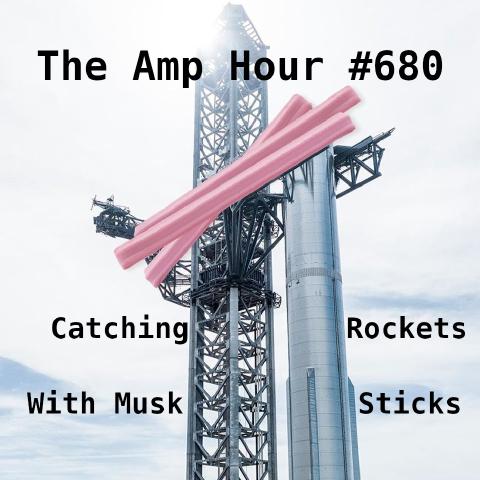
#680 – Catching Rockets with Musk Sticks
Download episode · 83 MB
Also on Apple · Spotify · YouTube · RSS
Show Notes
- Starship 5 landed on chopsticks! (you know, in case you have been offline for 2 weeks)
- Dave's EV had a stuck cable
- Portable charger is surprisingly good
- CCS Charging standard
- Fast charge 36/50 kW
- MKBHD Chevy Silverado review
- JLC is now offering silkscreen QR codes to have individually marked boards
 That's the board that Chris has been designing on a livestream each week
 - 1 wire UID (pioneered by Dallas, then Maxim, now Analog...le sigh)
- Dave is selling a new Bryman multimeter, the BM2257 (teardown photos)
- Chris just returned from Embedded World North America, doing a demo at the Joulescope booth
- Chris also gave a talk at the Zephyr meetup which will be released in a few weeks
- Hackaday article about their comment section and project/article feedback
- References
- Musk Sticks
- NC floods might impact the supply chain due to Spruce Pine NC being a source for quartz. We didn't read this article, but it was a better explainer than we had at the time.
- Meshtastic objects to the proposed FCC changes
Transcript
Musk Sticks: This is The Amp Hour Podcast, recorded October 15th, 2024. Episode 680, Catching Rockets with Musk Sticks.
Dave Jones: Welcome to the Amp Hour. I'm Dave Jones from the EEV blog.
Musk Sticks: And I'm Chris Gammell of Contextual Electronics.
Dave Jones: They caught it. They caught the damn thing.
Musk Sticks: The chopsticks. The Mechazilla. Yeah, that thing was a very impressive video. That was the first time, too.
Dave Jones: Yeah, first shot. Unbelievable. You stayed up for it. You stayed awake. Yes, yes, I did. I did a live stream for it. Wow. There you go. How did the live stream go? I was only half past 11 midnight here.
Musk Sticks: So my friend sent me a link, and we're watching the run-up to the thing. And then it took this really weird turn. So I'm watching it on YouTube, and it was like a weird... I'm like, ah, it said Elon Musk in the title or something like that. And it was like, oh, man, Elon just naming the stream after himself, whatever. And then Elon walks out on stage in front of a rocket. And I'm like, what is going on? And then it's Elon Musk saying, you can get in at the ground floor of this new type of crypto.
Dave Jones: Oh, God. You were watching the scam channel. It was a scam channel. Oh, dude.
Musk Sticks: Oh, man. It was just like, what? Oh, it didn't take too long, but there was a lot of people watching. There was about 300,000 people in that stream.
Dave Jones: Oh, yeah. I know.
Musk Sticks: Yeah. Yeah.
Dave Jones: They hijacked some Paul Bars... I saw one. They hijacked some Paul Bars' channel that had like 300,000 subs or something. I heard somebody else saw a channel where it had like 2 million subs.
Musk Sticks: Yeah.
Dave Jones: And they hijacked it, and they were, yeah, running the live stream. Yeah.
Musk Sticks: Yep. And then there's a QR code to go... Yep. Yep. To go buy some crypto and get scammed. Yeah. I'm sure you had to buy crypto with other crypto, of course.
Dave Jones: No, no. It's you send them your crypto and they'll double it.
Musk Sticks: Oh, they'll double it, of course. Yeah. That always works.
Dave Jones: It's usually the old doubling scam. Yeah. Yeah. Doubles. Yep.
Musk Sticks: Why wouldn't that work? Works with regular money. Totally. Dave, send me some Aussie bucks. I'll double them by turning into freedom bucks. Send them back. Oh, my God. Well, you could use that money that I sent back to you to call the tow truck, because you almost got stuck after your live stream.
Dave Jones: I did almost get stuck after my live stream. Wow.
Musk Sticks: Yeah. What happened?
Dave Jones: It was 2 a.m., 1.30, 2 a.m. in the morning. And I had my car plugged in downstairs. And, you know, getting some extra charge.
Musk Sticks: Yeah. Get the juice, man.
Dave Jones: Yeah. Why not? And I went to, like, normally, if I open the door, then it turns off the charging for 10 seconds so that you can actually pull out the plug. So I went and chucked my bag. I opened the door, went and chucked my bag into the car like I normally do. And then I went to pull the plug out and, and I ain't coming out.
Musk Sticks: Yeah.
Dave Jones: And I'm going, oh, okay. Well, something, you know, odds happen. Yeah.
Musk Sticks: You missed the 10 second window, right? Yeah.
Dave Jones: I missed the 10 second window or whatever, you know, which is, I think, like crazy short. Yeah. So I went inside the, so unlocked the door, went inside where my cable is. And I turn off the power to the charging cable because that always, that always works as well. If you turn off power to the, I've got one of those inline chargers, you know, one of those. Yep. That just. I don't know.
Musk Sticks: Actually, sorry. What does that mean?
Dave Jones: I'm going to do a PowerPoint. Oh, I can, I can send you a video because I've got a, I've got, I've got a tear down and how it works video. It's actually really good. So yeah, here you go. Now, there you go for those playing along at home. Well, you're not because I'm going to show it.
Musk Sticks: It'll be the show notes. Yeah. There you go.
Dave Jones: It's surprisingly good char. It's just a, like a, inline, slow charger. Well, it's not slowish as 3.3 kilowatts, 15, 16 amps, something like that. Yeah. Okay. So, you know, at 240 volts. So anyway, so I switched off the power to that and no, it's still stuck. It's still stuck. It's nothing. And on the Hyundai Ionic, at least my one, there is no, like, you can't go into the car and go to the screen and say, unlock thing. There is no unlock thing. You either have to press the open, the door open button on the remote control, which would do it, or you have to physically open the door, which will do it, or you have to physically switch off the charger. And my, and this charger does not have like a stop charge button, which then, you know, can indicate to the, well, it actually just turns off the power. And then the car is supposed to detect that the power is turned off. The actual, you know, the mains inputs turned off. And then it's supposed to unlatch the little lock-in solenoid pin, which, which holds the cable in. For those who don't have an EV and don't know the culture, they, all EVs have this little lock-in pin in it, that when you plug in your charger thing, it, a lock-in pin comes down. So that when you're at a public charging station, no one can just go, Oh, I need the charger. Screw you. And yank out your cable and, and actually use it on theirs. Right. So, so it's got this lock-in pin and yeah, it just would not unlock. And I tried to turn the car off and on again, as you do, you know, and tried all sorts of weird and wonderful things. And it would not budge. And I've had no problems in four, four years and probably like a thousand, you know, charging things. And yeah. And then I was, you know, I started to figure out, well, how am I going to bloody well solve this? And it took me like 20 minutes before I actually remembered that, Oh, I think there's a manual release or something. And I didn't have the manual in the car anymore because we don't bother, you know, carrying around the manual. Just take the space in the glove box. Bush league.
Musk Sticks: Bush league, man. You always put the manual in the car.
Dave Jones: Oh, well, anyway. So, and I thought, I think it's in the boot somewhere. So I'm looking around in the boot, can't see it. I'm trying to, you know, take panels off and stuff. And then I think, Oh, it might be down the very bottom. So I had to take everything, you know, stuff in the boot, take everything out. And then you take off the bottom trays. And sure enough, right down under the bottom trays is this little manual override cable that you pull. It's, you know, it's actually labeled, you know, manual charge door override cable. And yeah, yank on that and tug and Bob's your uncle. I'm free again. But yeah, it took me like, yeah, it was like half an hour of effort before I actually remembered that. Oh, man. I thought I was going to have to walk home. Yeah, exactly. I was going to walk home at like 2.30. Yeah, exactly.
Musk Sticks: Oh, I was a little surprised to hear about this fact that there's a solenoid in there. I've never tried yanking on a cable, obviously, right? I mean, why would you? I don't use a lot of charging infrastructure either.
Dave Jones: Well, your one looks very, your connector's physically different to mine. You've got like a Type 1, a Combo 1 or whatever.
Musk Sticks: Yeah. Yeah.
Dave Jones: Yeah.
Musk Sticks: I don't know if it's a, I should try this at some point, like on a public charger or something. Cause like, so my home charger, which is what I normally use is just like a super slow, super, I mean, just, it is very, very slow. So, yeah. It's a main story. But it has a, it has a trigger on it. So like you press the trigger and it, you can just press the trigger and it unlatches and it stops because it's not, it's not a significant amount of power flowing through it. Right. I mean, like 12 amps.
Dave Jones: Yeah. Yeah. Yeah. It isn't a big deal. So you can pull it out and break it, you know?
Musk Sticks: Yeah, exactly. And so I don't know. I don't know, actually. I mean, like I, I should, I should do this.
Dave Jones: I'm staring at the, I'm staring at your connector here, which is a Chevy Volt. Bolt. Yeah. That's right. Yeah. And you've got these little like springy latchy thing above the connector. There's like a springy latchy two hooky things. Is that right?
Musk Sticks: Yeah. And that is, that is the release I'm trying to find.
Dave Jones: See mine, mine doesn't have that. Mine, like, like it's integrated. Mine, mine has a hole in the connector and then you plug it and shove it through. And then there's a solenoid, which you can't see, which is inside the car, which brings a pin down, which.
Musk Sticks: I mean, it does make sense to have a lock, right? I mean, that is. Oh yeah.
Dave Jones: Of course.
Musk Sticks: For doing the cable, but also like you have significant. I mean, I'm sure there's like very fast arc detecting and stuff like that. Like you don't want to have a lot of current flowing and then it's stopping. Cause then you'd have a huge spike, right? If you, if you're falling. Oh, you don't want to pull out one of those fast chargers. You don't want to pull out a fast charger. Man, no way. Yeah. I did estimate poorly on a recent road trip. I thought we were going to make it and we did not make it. And so I was on, I was at a, I was just at a level three charger, but I didn't think, oh, I should try and pull this out of here. Right.
Dave Jones: No, you probably can't. I'd be surprised if you can.
Musk Sticks: Yeah.
Dave Jones: I mean, yeah. I'd be stunned.
Musk Sticks: Makes sense to you. Also, I was a little surprised. I was only charging it, even though it's could do 150 kilowatts. Yeah. Car was only doing 36. So. Right. Which is, I mean, it's fine for what I need. I was trying to top it.
Dave Jones: Well, mine can only do a maximum of 50 kilowatts. And, and then it's tapered. Yeah. Every car has a tapered charge profile. So that once it, you know, if you're at, you know, 30% or something, yeah, it might charge at the full rate. But once you hit 60%, it might drop down to a different level. And then 80% will drop down to a lower level. And that's to, that's to preserve the battery. So.
Musk Sticks: Sure. Sure. Yeah. I mean, it's just amazing. Like some of these charges, you see some of the infrastructure says they can do 350 kilowatts. Oh yeah.
Dave Jones: So like, that's nuts. Yeah. I know. Yeah. Yeah. It's crazy. And, and the cables are water cooled. Like you'll actually hear the pump pumping the fluid through it. Oh yeah. Because the actual connectors get so hot and the cables get so hot. They have to have water cooling in there. So yeah. Yeah. It's not.
Musk Sticks: Did you see, did you happen to see Marquez Brownlee's review of the Chevy Silverado?
Dave Jones: No.
Musk Sticks: It's a new EV that just came out. It's got 475 mile range. Right. Not wild. Yeah. I mean, it's like a hundred thousand dollar truck. It's all these trucks are just like so many batteries.
Dave Jones: 80% of the cost is the battery. Yeah, exactly. Yeah. Yeah. That's crazy. Yeah. Oh man. Yep. And somebody on X was breaking. Oh, that's why you should buy a Tesla. And that's why I have Tesla stock. So I replied with a video and some links to people being locked in their Teslas and people having the exact same charger connector issue I was having. Oh my gosh. The exact same charge. Because the Tesla's even smarter, right? It's got, you know, and the Tesla also has a manual pull thing in the boot somewhere. It's got a charger in, you know, override cable.
Musk Sticks: Yeah. Is it a standard connector across all EVs in Australia?
Dave Jones: Yes.
Musk Sticks: It is. Okay.
Dave Jones: Yep. Yep. Even the, if you buy a Tesla here, it's got, it does not have the US Tesla connector. It's got the standard one here. Yep.
Musk Sticks: Right.
Dave Jones: Yeah. In fact, that's the same for every other country in the world, except the US. The US is a special snowflake. So. Yeah. Yep.
Musk Sticks: Yeah. And now we're all adopting the Tesla one. I think, I think that's what is going to happen over time.
Dave Jones: I've heard something like that. Yeah. I think we might've even talked about that on the previous episode way back. Yeah.
Musk Sticks: I know. I keep saying the, I always think of the Chademo. I don't know if that's how you say it. Yeah.
Dave Jones: Chademo. Yeah. Or something. Yeah.
Musk Sticks: That's like the Nissan one. Yeah.
Dave Jones: That was the oldest standard. That was before Tesla became popular and before the type two became popular. Yeah. That was also like, I've got one of those cables in the boot. Cause there are a few like, just in case I've, you know, I've got, I've got one of those conversion cables just in case I've, you know, in an emergency, I might find some other, you know, yeah. Old or outlet one, but no, I have never used it. So. Yeah. The number of times I've charged on the road is like a handful of times.
Musk Sticks: Like, I mean, I barely leave the house, Dave, but you know, we went to the zoo. So the zoo is a little further away from me and we tried it and estimated poorly.
Dave Jones: You estimate. Yes. Yeah. Oh, well. Noob. I know. Exactly. Yeah.
Musk Sticks: You're learning, you know, like learning.
Dave Jones: So what actually happened? And you did start beeping at you and saying, no, it wasn't even close. No, no, no, no, no, no.
Musk Sticks: Not even close like that. No, it was like, we left the house. It said we had, you know, it's going to be miles freedom units coming up to, you know, you know, your ears. Uh, we, uh, it said we had 210 miles. Uh, I have the battery set to only charge 80% as a standard. So I should have turned that to a hundred and that would have gone. Yes. Yeah. That would have been 240 miles or maybe more than that, even. Right. Almost like 270, I think actually is what it usually maxes out at. Um, and so I, I forgot to do that. And then, um, yeah, it's really hilly here. And so by the time we got to the zoo, there was no chargers where we were. And it said we were down to 80 miles and we were 70 miles away from home. And we're like, no, we gotta, we gotta stop on the way home. So nothing like extreme. And, and like, literally it was like pull into a Walmart, 20 minutes of charging. And we had more than enough to get home.
Dave Jones: Yeah. Cool. Nice.
Musk Sticks: Yeah.
Dave Jones: So do you have an app that tells you where all the chargers are?
Musk Sticks: Yeah, but it's not very good. Um, unfortunately there's charge point is one in the U S that's kind of a community.
Dave Jones: We had one here, but I think charge point went bust here.
Musk Sticks: Yeah. Um, and this can be, I think that's mostly community. Contributed cause like the data was real shaky. It was like, oh, we think there's a charger here and then we think this is a capability, but it was like, oh no charge point.
Dave Jones: Yeah. I, I think I used to, I haven't used the app in so long. I actually forget. Um, yeah, because you know, we so rarely, um, charge our car in a public place. It's just like.
Musk Sticks: Yeah. Yeah. Yeah. And then, so then what I did with that is then usually that that's like, look up. What the. Oh yes. Charge. What they will do is they'll tell you what the vendor is. So like the fast charge vendor. Um, and you know, so it's like EV go is one of the ones in the U S and then electrify America and the infrastructure. So it was electrify America. I had not used them before, but man, those, it was cause it was a 350 kilowatt station. Like, you know, they have like a full like substation basically behind it, you know, like many, very many, but like just the size of the transformers is like, whoa, they really are cranking some power out of these things. Yeah. Right. That's impressive.
Dave Jones: Crazy. Yeah. I don't even have the. Damn. I can't even remember. You don't have electrify America?
Musk Sticks: Yeah.
Dave Jones: No, I like the app. I've, I've got five apps on here. We've got charge point. I've got EO. I've got EV. I've got car charge and I've got charge Fox. And I believe all five of them have gone out of business.
Musk Sticks: Yeah.
Dave Jones: Um, it's gotta be tough.
Musk Sticks: I mean, like what are you maybe getting a cut of like referring people to like, and like no one wants to pay more than our rates. So like, it's just, it's a tough thing to do.
Dave Jones: Well, no, people are happy to pay, you know, a rate for an emergency charge somewhere, but there's just so few people doing it because anyone who, anyone with any sense who owns an EV charges it at home. Right. They buy it because they have the ability to charge at home.
Musk Sticks: Yeah. You have a, you have a radius and yeah, you're just kind of staying with them mostly. Yep. Yeah. Uh, that's not a hundred percent true though. I have a friend who's in DC. He doesn't have a place to charge. And so he, he works, he relies on charge infrastructure, but you could argue that like his local fast charge station is, is, you know, that's like his local gas station effectively. Right.
Dave Jones: Right. Yes, exactly. Yeah. Yeah. There are some people who do, but there's not many people in Australia. I don't know many people in Australia. Sure. Sure. In Australia. Yeah.
Musk Sticks: If you're going to order, afford an EV, you can definitely afford charging in your house. Right. Exactly. Yeah. Yeah.
Dave Jones: Yeah.
Musk Sticks: Makes sense.
Dave Jones: There you go. So EV ownership. Yay. EV.
Musk Sticks: We will continue to talk about this folks, but, uh, it's mostly going to be, for me, it's going to be like maintenance over time. Right. You know, I don't think drive this thing to the ground, you know, I don't know.
Dave Jones: Yeah. Yeah. Well, mine's getting towards five years old now. So it's going to be interesting to, you know, I'll be getting towards that, you know, eight year warranty on the battery pack. Oh yeah. Not too distant future, you know? So yeah. I'm actually not, I skipped my last service, by the way. It was, you know, like, like, cause it actually pops up on the screen. Oh, you're 500 kilometers away from your next service. And then it's zero kilometers and go, oh yeah, whatever. Do it next week. And then, you know, and now I'm 7,000 kilometers past my last set. It keeps popping up.
Musk Sticks: Yeah. I'm 7,000 kms past. You could fix that. Like they talk about on car talk with just a piece of electrical tape on the screen. Yep.
Dave Jones: But, but then I looked right. And then I went to maybe, oh yeah, maybe I should book it in. And then I went to look and they wanted to charge me 800 bucks for the service. And then I went to the, like the price, uh, breakdown. Cause normally it's only like 150 bucks or something, right? It's like, it's cheap. Okay. So they don't really do anything. They check it. Right. Right. Right.
Musk Sticks: They loop it up and check your tire pressure.
Dave Jones: And yeah, they actually rotate the tires, which is a good thing. Yeah. Yeah. Very handy, by the way. You actually get just the value out of that just by rotating your tires. So you get extra life on your tires. But anyway. Um, so I went to like, they give you a price breakdown. Then I went, oh, you have to change the entire coolant system, which on an EV, which, which on the Hyundai Ionic is like a major op. It's major surgery. Like changing the coolant. It isn't just topping up coolant. No, no, no, no, no, no. I've, I've mentioned this, but didn't we mention it before? Cause I've, I've, I've, I've actually had this done. Mine was, my EV was popping up with a coolant warning. And apparently I got hit with the Hyundai curse, um, the Hyundai coolant curse, which is, um, where you get some like, they use this special whiz bang, uh, proprietary coolant fluid in there and it goes hard or something. So it had, it turns into crystals or something weird. Like, I don't know. Yeah. Yeah. So it's actually a known problem. And so I took it back to the service center. I got it fixed under warranty, but my local high official Hyundai service center went, well, this is the first one we've done. So it took them a day and a half and they had to strip the car down. They had to actually drop the battery out and everything to actually do this. It was a major operation. He said, they actually sealed, they actually roped off a whole section of the service center just so that they could do it and everyone was standing around learning how to do it. They put on suits like an ET. Yeah, right. Yeah. In the ET movie. That's it. And it took them a day and a half to change the coolant on my, so anyway, so yeah. And apparently that's part of the service. Once you hit 60,000 Ks or something, you know, it's like, but I just went, no, well, I don't need that cause I had it done last year under warranty. So, you know, screw that. So I didn't, you know, I just went, ah, bugger it. I'll just wait until my 75,000 K service and then I'll get it bloody well serviced. So yeah, I think I'm skipping this one. I'm already halfway there.
Musk Sticks: So, I mean, you, we, we, as well, it is well understood on this show that we know very little about cars. And then I think about like, what did they leave in the EV? Like, well, there's brake pads. I'm pretty sure. Yeah.
Dave Jones: No, there's everything. There's still power steering, suspension, everything's the hide hydraulic brakes. Yeah.
Musk Sticks: I guess you still have like the ball joint and like the, yeah, yeah. Your shocks and your struts and your.
Dave Jones: Which is more important than your engine. That's a more important safety thing than your engine. Yeah. Yeah. You get all these idiot EV owners going, oh, I never have to service my EV. Oh yeah. You bloody idiot. It's a two ton fricking lethal weapon.
Musk Sticks: Yeah.
Dave Jones: And you don't want to check that your brakes and your steering and your shocks and everything all else is still intact. And it's really low cost. It doesn't, you know, 150 bucks for, you know, every 15,000 Ks is nothing. Yeah. It's almost free. So what might as well have it done? But no, no, no. Yeah. Snobby EV owners. We're the worst.
Musk Sticks: All right. Well, we should switch away from that. Things that I would like to be snobby about. No, I mean, I snobby about, I would like snobby. Snooty. Snotty.
Dave Jones: Snooty. Sorry. For those who don't know, that was a Ferris Bueller. Ferris. Yeah. Of course. Say Ferris.
Musk Sticks: Yeah.
Dave Jones: Yep.
Musk Sticks: I now have PCBs with QR codes on the back of them. Have you seen this new thing?
Dave Jones: I've put barcades. I've put barcades. You're like a decade and a half behind, dude. I used to have barcades.
Musk Sticks: Are they individually, but are they individually incremented? That's the piece that I'm just wigging me out about that. Really? Okay.
Dave Jones: Oh, on, on the actual board itself.
Musk Sticks: It's in the silkscreen. Yeah.
Dave Jones: Oh, okay. Right.
Musk Sticks: So it's a new JLC option and I, you know, I haven't ordered a board in a while, but now you can basically put a customized, so a customizable QR code that's also auto incremented. So I got five boards.
Dave Jones: So their Gerber program automatically inserts and increments the number.
Musk Sticks: It's got to be a post facto thing. I don't know. Like it's weird, but it's cool. I mean, like.
Dave Jones: Is it actually on the copper or is it on the silkscreen?
Musk Sticks: It's on the silk.
Dave Jones: Then they can, then they've probably got a dot matrix silkscreen printer and they can do that on the fly. Yeah. Yep. Yeah. Right. So the thing for me is. It isn't masked. Okay.
Musk Sticks: It is not. Yeah. It's not, it's not in that. Yeah. Yeah. But the thing for me about this is like, I've wondered in the past with, you know, doing like vinyl sticker, you know, you can get like the chemically resistant. Yes. Vinyl stickers that are encoded as well.
Dave Jones: And they will go through the PCB wash and everything.
Musk Sticks: Yeah, exactly. Exactly. But I haven't figured out how to do like, that is an expensive zebra printer or similar. Yeah. And now if this becomes like a standard feature, it's like, oh, wow. You can like basically start putting ad hoc or even post hoc, like, you know, serial numbers on your boards that. Yep. I really, for me, like in my, you know, simplistic low volume operation type things, I'm literally just, it's just like me in a Sharpie. That's like that. Yeah. That is the most common thing. It's like, oh, this is the Rev A1, Rev A2, that sort of thing. And it's not that different now either. It's like the board name and it's literally one, two, three, four, five because I have five boards. But like, but now it's QR code. It could actually be like scanned into a process as well, which is, yeah, it's pretty cool. I don't know. Nice. So hopefully it goes to more board vendors.
Dave Jones: Right.
Musk Sticks: I'm not, I'm not beholden to JLC, but it's the first time I've seen it. So that's cool.
Dave Jones: Nice. Nice. The other thing you can do, of course, if you want board ID is to put on a one wire chip on the boards. We, we, we did this all the time, um, back in the day because you can buy like a one wire chip. So they're real cheap and simple. And they've all the, their job is, is simply to have a 64 bit, uh, serial number inside the chip and that's it. And then your software can read it out and, you know, so you can have individual board ID, you know, it's great. Yeah. It's very handy. Yeah. Yeah. Yeah. So that is true. This would not. Hardly any bomb cost, you know?
Musk Sticks: Yeah. Yeah. That's true. This one is meant, this actually is a peripheral board. So it's nothing fancy. Right. Um, it actually doesn't have a micro on board. So I guess it doesn't have, it doesn't have a bus. It is bus access. So it could do one wire, I suppose, or I squirt C, but, um, but then how would you then, when you did that, when you had the one wire chip on board, would you then have it go through a process at like at burn in and or not at burn in it, like programming stage or test stage, and then have a printer print a corresponding label? Like how did you do the association?
Dave Jones: Oh, no, that, no, it stayed in electronic association. So, so no way externally to see what it was. Well, through some app or whatever. Yes. Yes, you can. But it was just a way so that the actual product could know what modules were actually plugged in and which serial numbers they were. And, you know, yep.
Musk Sticks: Yeah. Yeah. I mean, a lot of chips these days, I don't know. I've had some cheapy microcontrollers. A lot of them, they'll increment, you know, they'll guarantee some level of like uniqueness as well.
Dave Jones: You know, a lot of micros have a built in unique serial. Yeah. No number now. Yeah. Yeah. Right, right, right. Yeah. It's just at the factory. Yeah. They just do a laser thing and just burn off bits, you know. Yep.
Musk Sticks: Yep. Yep. Yeah. So. Cool. Yeah. It's, it is pretty neat. I mean, it's, I just, I, this is the board that I've been live streaming about. So I just got the boards back in and I'll try firing it up this week on the live stream. Maybe. Yeah. If the parts show up in time, I'll try it. It's, it's a really stupid board. It's just, it's just relays to be honest. It's just a external relay board, but it's got a GPO expander for LEDs and that's about it. Yeah. I guess that's all it does. It's got four, four relays and a bunch of backlit LEDs. So.
Dave Jones: Nice. Speaking of micros and programmability and all that sort of stuff. Um, I'm going to be stocking a new, uh, Bryman multimeter soon. They've, they've just released a new, the BM2257, um, meter. It's basically, uh, you'll probably get the EV blog forum thread as the first, as one of the first Google answers. Yeah. Yeah. Yeah. Yeah. Yep. Anyway, um, it's, it's basically an upgrade to the, uh, old, old school, uh, BM257, which is a quick, and basically an upgrade to the BM235, which I've been selling for like a decade now. Um, okay. Yeah. Anyway. And so it's an upgrade to that. Oh, I have that one.
Musk Sticks: The 235, I think I have, right? Yes. Yeah. That was one of the, the send backs that, uh, landed in my lap.
Dave Jones: Oh, okay. Yeah. Yeah. Cool. Well, it's exactly the same as that, except it's got a bar graph and auto hold and. Got it. Yeah.
Musk Sticks: That's a great meter. I like that one.
Dave Jones: Yep. Yeah. Anyway, this one's even more better. So yeah, in exactly the same form factor.
Musk Sticks: So literally on my bench, I just verified it is the 235.
Dave Jones: Yes. Yep. There you go. Cool. Yeah. Anyway, very nice meter. So yeah, I'm going to start. So they sent me the, uh, prototype. I tore it down. You can get the, um, tear down photos on my Flickr account. I think. Flickr. Oh man.
Musk Sticks: What? Yeah.
Dave Jones: Yeah. But is there anything else I should switch to?
Musk Sticks: I don't know. No. Exactly. Exactly. I've, I've been having stuff on there for a decade. I enjoy. I enjoy. It's like, uh, you know, it's like little bits of internet history that are still in use. Yeah.
Dave Jones: Yeah. Flickr. Like Gmail. Yeah. Right. I'm still, yeah. Unfortunately. Yeah. I'm still, uh, I'm, I'm still Gmail. And anyway, I just sent you a link to the Flickr account there. And, um, and because it's a new design and the, like I've been selling the BM, uh, seven, eight, six for a few years. And that is a new design Bryman. And it actually uses a, uh, firmware reprogrammable flash, uh, controller in it. Right. So this, so this new 2257, there's a little programming port on it. If you have a look at the first photo there, right. There's a little, right. There's obviously a little, and it's even labeled ICP in circuit programming. So I assumed, aha, of course they're using a new flash micro. Now they've changed over and I'll be able to update the firmware.
Musk Sticks: Wait, wait, now you said now, what were they using before?
Dave Jones: Well, actually. One time OTP. Okay. Uh, Bryman have used, always use one time programmable micros. Right.
Musk Sticks: Really? Wow. Still. Yes.
Dave Jones: Well, almost every multimeter on the market uses one time programmable micros. They are not firmware upgradable.
Speaker ?: Huh.
Musk Sticks: Name. Cost.
Dave Jones: You can. Yeah. Cost.
Musk Sticks: This is totally like, I don't know this stuff. So like, just tell me. Well, okay.
Dave Jones: There's, there's, there's two reasons cost. And the other one is, is because an, a multimeter is like a safety thing. Right. It's, it's a say, you know, technically it involves safety. Right. User safety. You don't want the users dicking around with it.
Musk Sticks: You're about to say that you're going to try dicking around with this thing.
Dave Jones: Yeah. Well, the, well, this is why the BM, um, seven, eight X series, the seven, eight six, which I sell, um, it, it does have firmware updating, but the public can't do it. Only dealers like myself have access to the programmer. Oh, dealers. Yes. Only the dealers can do it just in case there's a new firmware release and you've got stock and you want to upgrade it. Right. Got it. But yeah, but no, they will not release it for the, you know, public cannot do it. They don't want the public doing it. Cause the public will just dick things up, they'll muck around with it and I'll screw it up. I don't understand that. And they could die.
Musk Sticks: The argument of like the, you're going to die though. Like this, the fuse is what's saving you. It's not the programming that's saving you. It's not like, oh, enable two things. Yeah. But if it reads, I reprogrammed it to have the metal foil, like short out, you know, the wrong time.
Dave Jones: You know, but no, but, but, but it has a reading which can impact safety. So it's like, oh, okay. It's yeah. You're measuring something high voltage and it says it's zero, but it's actually live and you go touch it and you're dead. Then, you know, right. So I can't blame any multi-meter company for not releasing public firmware. So there's very few meters on the market that will allow public firmware update. Right.
Musk Sticks: But this isn't public. You're saying it's dealer public.
Dave Jones: It's no, it's dealer pub, but select few. Yes. There is a select through that is, that is correct. Brian, I know one of the companies which will not allow public firmware update, but I just assume because this new. model that they've just actually released had a in circuit programming port. I thought, ah, it must be flash upgradable, but no, I just found out this morning. Nope. They're going, going back to one time programmable chips. So, and, and that in circuit programming header on the board is just so that they can program it when, after it's assembled. Yeah. Yeah. That's the one. That's the one time. Yep. That is the one time. So it's one time programmable chip. It's not firmware updatable. So there, there you go. Yeah. They're going back to OTP.
Dave Jones: I don't know if that's a company wide decision or that's just because they had to lower the cost on this one by a few cents.
Musk Sticks: Is this, is this you saying that you're sad cause you thought you had the ability to do it as a dealer?
Musk Sticks: I'm kind of sad. And it was ripped away from you? Yeah. Yeah.
Dave Jones: I thought I had the ability to update the firmware, but no, no, I don't.
Musk Sticks: Welcome. So welcome back to the ground level with the rest of us plebs. Yes.
Dave Jones: So one time programmable is still a thing folks is what I'm saying. None of this flash rubbish, you know? Yep. OTP for the win and you save a few cents on your micro by it being OTP. But you know, but considering that you can get a flash programmable micro for what? Two cents. What does that, um, what does that two cents? No. Is, is it the one cent micro or the three cent micro or something? Three cent micro. Yeah. The Paduk. The Paduk one. Is that flash? I can't actually remember now.
Musk Sticks: That is flash.
Dave Jones: Yeah. Yeah. Yeah. It's flash isn't it? You can, you can reprogram that sucker.
Musk Sticks: I was really surprised when Cian Lohr was on the show. So that's the, he was talking about the CH32 V003. Yeah. I haven't looked up recently. He said the 040506 is supposed to come out soon, but. Right. He actually said that he wished they would make a cheaper non flash part because he said he wanted to operate.
Musk Sticks: Yeah.
Musk Sticks: At boot time and he wanted to just do that all the time. Got it. It was, it was interesting take. I mean, like, obviously he's a, he's the mad lad, you know, he's, he's doing crazy things with, with firmware that I would never do. But like, it is interesting idea of like the idea of having a peripheral that you're just always pushing code to right before you use it. You know, that kind of idea. Yeah. Yeah. Yeah. And then it just lives in Ram. Oh, okay. Sure. You know.
Dave Jones: There you go.
Musk Sticks: Flash. Who needs flash?
Dave Jones: Nah. Yeah. All that modern rubbish. Nah. One time programmable. Thank you very much.
Musk Sticks: Tunneling electrons and blah, blah, blah, blah.
Dave Jones: Real men use OTP micros. Sure. Yeah. One time. Yeah.
Musk Sticks: It's not done right the first time I had thrown it in the trash. Don't screw it up, kid.
Dave Jones: Yeah. Yeah. Get one shot, kid. Don't screw it up. Yeah. Exactly. Yeah. Yep.
Musk Sticks: Yeah.
Dave Jones: Yeah. One time micros put hair in your chest.
Musk Sticks: Okay. Sure. Sure. Yeah. Well, I was just, uh, I was just hawking, uh, test equipment this past week at Embedded World North America. Oh, yes. Yeah.
Dave Jones: How did Embedded World go? At which state was it? It was in Texas.
Musk Sticks: It was in Austin, Texas. Yeah. Austin, Texas. My old hometown.
Dave Jones: Yep.
Musk Sticks: And, uh, it is a very different place than when I lived there. Really? You know, like. What's changed? It's so much bigger. Like, it's like, like there's an, I mean, the part of town I stayed in, did it existed when I, obviously the land was there, but like it was Rainy Street. I was by Rainy Street for people that know Austin. It was just like, there was nothing there when I lived there in 06 to 08. It was like, you know, just run down buildings. And now it's like literally like 20 high rise hotels slash apartments. And like, you know, there's like, there's like a nightlife district there too. It's, it's wacky.
Dave Jones: I'm seeing it now. Yeah. It's right. It's, it's right on the river. And, uh, yeah. Right. Yeah. Oh yeah. Yeah. There's a lot of high rise stuff there. So how are we talking about? What, what, what, what? What time period are we talking about? That I was there.
Musk Sticks: Uh, well, I was there 06 to 08. And so since then, so it's been 16 years since I was there. Yeah. That's a, yeah.
Dave Jones: You can build, build a lot of high rises. You can build a lot in that time. Yeah. Yeah, totally.
Musk Sticks: And they still are. I mean, like there were, I saw at least seven or eight, like under construction, right. Active construction. Yep. Yeah. So it's, uh, it's a whack, it's wacky. It's, it's just, there's a lot of people there. Um, yeah, it was, uh, conference was great. I was actually at the dual scope booth, uh, with Matt, former guest of the show, Matt Liberty. And, uh, uh, I was helping out, helping out of that booth and that was nice. Uh, and I had a demo going that I think you and I talked about a couple of weeks ago, but I had like, remember we talked about EDRX and PSM or like the cellular modes and stuff like that.
Dave Jones: Oh yes. Right.
Musk Sticks: Yeah. So I had scripted this thing to kind of turn everything off and just show different power modes and like get into lower and lower power states over time. And even like turning on EDRX, which is like a, a low power, uh, it's still like kind of checks in with the tower, but it doesn't do anything unless it has a message sort of thing. Gotcha. And, uh, yeah, yeah. I'll be publishing. I'll show a, I'll have a video of the demo at some point, but it was cool. It was a good little demo.
Dave Jones: Excellent. And the conference, it was how well attended was it?
Musk Sticks: It was apparently as 3,500 people, um, which for a first year, it's pretty good. Um, you know, it was a good, you know, there's a lot of locals. Austin's got a lot of stuff around it. So a lot of people drove in from Houston. Austin itself obviously has a lot of tech. Um, I didn't mean anyone from Dallas that those are kind of like the extent of where you'd probably drive in from. And then, you know, it's easy to get there on a plane too. Sure. Um, so yeah, it was, it was a good mix. You know, I saw a lot of big name companies on name badges. So like that is kind of a telling thing. And, um, I bet that'll attract more companies next year. Um, so, but next year it's not in Austin. And that's another thing I learned. Oh, it's going to be in Anaheim, California, which is like three hours closer to you, Dave.
Dave Jones: So I've been to Anaheim.
Musk Sticks: I know you have. Yeah. The Renaissance thing, right? Way back in the day. Yeah. Yeah. Come on in, man. We can go hang out. We can go hang out at Disneyland together. Right. Oh yeah. Been there. Done that.
Dave Jones: Oh boy. Yeah. Disneyland. Oh God. That was packed, dude.
Musk Sticks: Yeah. I'm, uh, I'm, yeah, I'm, I'm not going this year. My, my wife's going with my daughter.
Dave Jones: Ah, right.
Musk Sticks: Uh, yeah, it's, uh, it'll be fun. Yep. It'll be fun for her. Oh boy. Yeah. So, uh, I would, I would recommend it. It was pretty well attended, pretty well put on. Um, good events after the fact, or after the, after the event rather, like the nighttime stuff was good. Uh, I gave a talk about Zephyr. I'll be posting that too.
Dave Jones: Excellent.
Musk Sticks: And, um, I don't know. Got to meet some new people. Got to see some old friends. Good times were had by all. Yeah. I didn't lose my voice. That was probably the most important thing actually. Right. I feel like every time I go to an event now, I lose my voice.
Dave Jones: Yeah. Yeah. Yeah. Yeah. It's nuts.
Musk Sticks: Yeah.
Dave Jones: Yeah. Just all day, you know. Yeah, exactly. Yeah. Yeah.
Musk Sticks: And just, you know, like, you're around a lot of people and you're getting sick and just like, and like, I don't know. I think I've mentioned on the show before, like my, my wife hears me like talking to like nerd friends and she's like, you get so loud. Yeah. Yeah. Exactly. Cause I do. I'm getting excited. I'm like, look at this thing. Look at that thing. And all my God, you got to see this and look what this thing gave you. Whatever. You know, like it's just, yeah. So yes. She ain't wrong. Welcome to the club. Yep. Yeah. Right. Right. We're nerds.
Dave Jones: Speaking about nerds.
Musk Sticks: Yeah.
Dave Jones: Nerds tend to lack tact. I thought this was a given.
Musk Sticks: Yep. Yep.
Dave Jones: Yeah. Hackaday don't seem to think it's a nice thing. Unfortunately.
Musk Sticks: Is this on the list now? I actually.
Dave Jones: This is on the list.
Musk Sticks: I have not yet looked at the list.
Dave Jones: Engineering versus tact. Hackaday. Basically, Hackaday just published this article the other day saying, if you can't say anything nice is the title. And so basically they considered shutting down their comments section entirely on their site. Not just one time either. Oh, right. Okay. It isn't the first time, huh? That's not surprising. Yeah. Yeah. Because they're not happy with people slagging off projects. And because that's what Hackaday mostly do. They publish, you know, builds, right? They publish projects and they weren't happy with people in there being negative in any way. You're supposed to be, they want people to be only positive. Oh, good work. Here's a trophy for your project. Not, oh, you should have done this. You should have. Yeah. Like, hello. Welcome to engineering. Jesus.
Musk Sticks: I think there's a, there's a difference. I was talking to, who was I talking about this? Like, it's possible to be critical. Oh, we were talking about Bill Gates. And it was, it was someone who used to work at Microsoft. He was talking about like Bill Gates's like reaction in meetings. And he said, you know, like it was sometimes very violent reaction. Like very loud. Oh no.
Dave Jones: He would, he would call you an idiot. He'd call you. Exactly. Right.
Musk Sticks: Right. Exactly. Yeah. And like that, that is not necessary. You, you could say it's a bad idea without like ad hominem attacks. Yeah.
Dave Jones: No, you don't. The line, the general line is you don't attack the person, but you're allowed to attack ideas. That is the engineering ethos. Engineering doesn't exist. Without this engineering doesn't exist without engineers, engineers lack intact. I'm sorry. It just, it's just the way it works. So, but yes, if, if, if you want to remove comments that are attacking the person, fine. You know, we, we do that. That's one of the rules on the EEV blog forum is no personal attacks. That's like the, the, the number one rule. Yeah. But apart from that, as long as you don't attack the person personally, you're allowed to slag off their idea as much as you want. Go for it. I think, you know, that's. Yeah.
Musk Sticks: I mean, I think a healthy discourse generally. So, so then let's turn to this hackaday thing. I don't, I'm reading this quickly. So I didn't see this beforehand. So give us a synopsis and I'll keep reading to see if your synopsis is good. And then I'll attack your synopsis if I need to, but not you as a person. Right. Yeah.
Dave Jones: It basically comes down to the fact that, uh, people are publishing these, uh, projects and it's not good to give, you know, to not encourage people to keep, you know, if, if, if everyone sees that article, you know, uh, actual projects are getting slagged off by everyone. Right. Oh, you should have done this, should have done this, should have done this. Then nobody's going to do them. It's going to not encourage people to actually build things or publish things or whatever. Yeah.
Musk Sticks: It's like the bootstrap problem, right? Like how do you get people who are new to a community to like get them encouraged, but also like, you know, not scare them off. Right. I mean, there's some legitimacy to that. Right. Yeah. Okay.
Dave Jones: But, but you can't stop it. It's, it's, it's, it's how engineers think and work. It's, it's our number one trait is that we say what we think, you know, and if we think that's a bad design, then, then we're going to say so, or you should have done it, or, you know, we should have done it this way. Often it's not done with malice. You know, it's, it's done with look, I'm helping you. Like, here's a better way to do it. You know, kind of thing. It's yet some people just can't handle it. You know? Yeah.
Musk Sticks: I think the best people that do that are basically switching to teacher mode as fast as possible. Right. Like, like the, kind of the mentors, like, like the un, the unsolicited mentorship sort of thing. Like, hey, let me tell you about this and this and this. Right.
Dave Jones: Yeah.
Musk Sticks: Right. It's not like that's a bad idea. Well, actually there are times to say it's a bad idea. Right. Like, so like you talked about, right? Like when a DMM doesn't show high voltage, that's a bad, bad idea. That is. There are some objective truths. I feel like around safety. Safety is probably a pretty critical one. Right. Um, in terms of like taste and style, like, I don't really care about that.
Dave Jones: Yeah. Oh, it's the wrong color. You should have painted it red. Yeah. That's like, eh, it's totally subjective. Right. Yeah. Yeah. Yeah. Right.
Musk Sticks: Classic bike shedding, you know? Yep. Um, yeah. I don't know. It's tough. It's tough.
Dave Jones: Yeah. But I, I, well, how about this? Let's look at this.
Musk Sticks: How did the, I mean, you used to be, I mean, you still are, you're a prolific forum poster and yes. BBS, sir. Right. Yeah. What would, what would be your take when you saw like a craptastic project, you know, like someone who's, would you be able to tell if they were new? Oh yeah. Yeah. Totally.
Dave Jones: Yes. Oh, totally. Well, well, there is a beginner's section on the EV blog forum and technically we have slightly different rules for the beginner section in that you shouldn't, you should try and be nicer to the beginner because they are, because they are posting in the beginner section. It's the bunny hill, right? It's the, yeah. Yeah. Right.
Musk Sticks: Don't, don't, don't expect the double black diamond slopes until, you know, you've tried things out. Exactly.
Dave Jones: Whereas if you, that's it. But if you publish in the regular project section, as long as you don't personally attack the person, which is the number one rule on the forum, then it's fair game. And if you can't handle it, like I've actually had some people post in the project section or other parts of the forum. And then they report the post saying he wasn't nice to me. He's being mean as like, dude, no, sorry. You have no right not to be offended.
Musk Sticks: Or you have any example of like what the, what the, I mean, I'm sure there's, you know, it's based in fact, but like, I don't know.
Dave Jones: It was like, it's always like the way they say it, the person took offense because they, they sounded rude in their reply or something like that. Or they're, I'm offended that you said that it's like, no, you have, sorry, dude, you have no right not to be offended. Yeah. Um, that is one of the forum rules as well. But yeah, so technically for the beginner section, but as for Hackaday, it's not for beginners. You, if you project, well, people don't publish their projects on here. It's usually the Hackaday writers, which find a project on some, you know, website or some, you know, GitHub or something somewhere and they go, Hey, here's this really cool thing. So they're the ones writing the article. So I can't, so it's not the author themselves usually. Writing the article for Hackaday. It's not the actual, actual designer. So I think it's fair game. I think it's absolutely, whereas, whereas if they had a beginner section and they were publishing I mean, they do projects from the author themselves. Oh, is it? Okay. Yeah.
Musk Sticks: That's like, they have a Hackaday projects it's called. Okay.
Dave Jones: Well that's probably, is, is there like comments and forum on that?
Musk Sticks: There is, but it's not the same. I mean, it's a different site really. It's a, it's a home homegrown site. So.
Dave Jones: Oh, it's a forum, isn't it? Or something. It's a.
Musk Sticks: Yeah. Well, it's like a, it's like a Hackster Hackaday IO. There's all kind of the same thing where it's like. Oh yes.
Dave Jones: It's like a. Yeah.
Musk Sticks: Instructables. Yes. Right. Right.
Dave Jones: Yeah. Yeah. Yeah. We, we can publish our own projects.
Musk Sticks: I think generally that it's not as trafficked by, by a long shot. I don't think. Right. But it's. Yeah. Yeah.
Dave Jones: Oh yeah. I see. Yeah. There's comments, followers and likes. So I'm trying to find.
Musk Sticks: But it's just a different system. You know what I mean? Like it's not. The same volume. It's not the three hundred eighty six comments on an article like this one got. So.
Dave Jones: Yeah. No, but I'm thinking that, um, no, the regular Hackaday site, they're done by established. Professional authors working for Hackaday. I'm sorry. You should be able to take some negative comments. I'm sorry. That's just the way it is. You know, I know if they personally attack you or somebody else, fine. Kill their comment. But other than that, no, I'm sorry. It's fair game.
Musk Sticks: You know, I mean, it's been a wild west in that comment section for a long time. Oh, I'm sure it has. Yeah.
Dave Jones: Yeah. I'm sure it has. But you know, no, you can't moderate. You're going to die. I've seen forums die by over moderation. I've seen countless forums. Do you know? Like, no, everyone is supposed to be nice to each other. No, no exceptions whatsoever. You'll get banned. If you dare say anything. Nice. Somebody.
Musk Sticks: Nice is, uh, it's tough. Right. I mean, like it's, yeah, criticism generally is, uh, is hopefully constructive. Right. I mean, that is, that is. Yeah.
Dave Jones: Yeah. I, I, I do like, you know, there are some nasty engineers out there that, you know, do it out of spite, but in my experience, most of them are, they're being constructive. Like, yes, you might take it the wrong way as they might've worded it. Well, you know, in a way that you found, you know, like, it sounds like they're personally attacking you, but they're not. They're, they're, they're just talking like engineers do like, oh, I should have done this. Should have done it. Like, here's a better way. Boop, boop, boop. Boop.
Musk Sticks: Uh, anyway.
Dave Jones: Uh, anyway.
Dave Jones: Anyway, yep. Yeah. Yeah. No, you either allow a almost free for all or, or you die is pretty much how it works in the engineering world. I'm sorry. Yeah. Engineers going to be engineers.
Musk Sticks: That is, that is a truism. Yes. Yes.
Dave Jones: We're famous for it. Like, you know, the, the famous business adage, don't let engineers talk to customers. Right. Is, is the number one rule of business and don't let engineers talk to customers because we'll just say shit that, you know, we'll wag our own product.
Musk Sticks: True things too. Yeah.
Dave Jones: I think that's the problem. Yep. So did, did I tell you about my first ever job reference?
Musk Sticks: No, I don't think so.
Dave Jones: I should be able to dig it out of the archives. And I thought I did at one point, but I can't, if I can, I'll scan it and I'll publish it on the X's. Um, my first ever first and only job reference really that I ever got when I was a, uh, teenager. Right. It's, and I'm quoting almost verbatim. I think, um, David, you know, which if people don't know a job reference as somebody, somebody senior at the company writes a letter after you, uh, you know, leave or whatever, a job reference, you know?
Dave Jones: Sure.
Dave Jones: Everyone knows job references.
Dave Jones: Yeah. Well, maybe not. But that's. Anyway, he said, David sometimes lacks tact. But I don't believe this is due to rudeness. And with time, I believe he can improve this, uh, quality or something like that. And spoiler alert. No. Um, I haven't improved. Yeah. Yeah. Um, maybe I've mellowed a bit with some, with, with age of Tad, but, um, no, I still lack Tad.
Dave Jones: You've gone the other direction actually.
Musk Sticks: He's gotten grumpy. Really? Grumpier, but maybe, yeah, you're grumpier. Yeah. You're grumpy.
Dave Jones: I'm probably, yeah, but I'm probably less rude than I was.
Musk Sticks: I, that could be. Yes.
Musk Sticks: Yes. And I think. Yeah. Less maybe quick to judgment. Possibly.
Dave Jones: I'm more. Yeah. I'm more balanced. I'm more. You're slower.
Musk Sticks: That's what it really is.
Dave Jones: I'm slower. Right. I'm slowing down in my. Yeah.
Musk Sticks: In my wheelchair. Yeah. Anyway.
Dave Jones: Yeah. I'm more than a reference and I'll see if I can find it and scan it. Okay.
Musk Sticks: Cause it's. Tell me about references there. Is it actually like you carry the reference with you versus like, like here when people, people ask for references for like jobs, but it's like, uh, you know, just give me some names and numbers and emails and I'll, I'll reach out to them for.
Dave Jones: Well, we are talking the eighties. We're talking pre-internet here, right? Oh, before the headphones. Yeah. Before they, well, before the headphones. Yeah. So it's, no, generally. I just, I didn't know if that's how it was done.
Musk Sticks: I mean, like. Yes.
Dave Jones: You would physically bring a reference. Yeah. I don't think anyone does it anymore.
Musk Sticks: I've never gotten one, but it's a good idea. I do remember.
Dave Jones: Well, though, that's, that, that's why I said I've only ever gotten one and that was my first job. And that was, after that, no, it was, well, no, technically I got no, no, at no other companies I did, but it was my, like a boiler template thing. It wasn't a personal reference. It just, um, stated that you have worked in there, worked at this company from this period to this period and you were employed as such and such engineer, you know? So it was more of a formal reference, not a personal reference. Yeah.
Musk Sticks: Yeah.
Dave Jones: Okay. And, and, and that just came from the HR department. It, it didn't come from your manager or, you know, the boss or whatever. I mean, there's a baller move to show up.
Musk Sticks: I mean, we talk about showing with projects, but showing up with like a binder full of like references. Like it would be like, so I, there is a, so Seth Godin is a marketer that I've always followed. Yeah. Not much recently, but he always taught, he talks about how he's at the end of a project. He's like, he says at the beginning of the project, I'm going to ask you for a reference at the end of the project. And here's what I, you know, here's what I hope to deliver for you. And I hope you'll be able to talk about. And he says it upfront and like, you know, and then he's going to use that and like have a binder full of projects. Yeah. Job references. Well, that is a LinkedIn thing.
Dave Jones: It's all on LinkedIn. Now. Like you can get references from other people in the industry. Right.
Musk Sticks: Isn't that, I mean, I've gotten, I've gotten like, I've gotten testimonials from customers that went onto a, a consulting site that actually was never updated, but I did actually get like the quotes. I got quotes from, I went out and asked for quotes from the, from the references from past clients. So like that is something like that, I guess. And yes, you're right. LinkedIn also has that as a feature, which I have not done in a long time, but people still do personally.
Dave Jones: I think I'm sure it's still a thing. And that's the thing that HR looks at, you know? Yeah.
Musk Sticks: I guess.
Dave Jones: Like, can you imagine if you got a reference from Elon Musk or something, you know, like a, you know.
Musk Sticks: I'm really sick of that guy. But yes, I'm sure that would, that would, that would stand out. Yes. No, I'm talking about, yeah.
Dave Jones: Right.
Dave Jones: It'd totally stand out. Right. Yes. Yeah. Even if you hate him, it'd totally stand out.
Musk Sticks: Yes. No doubt. No doubt. It would, it would definitely grab attention and be like, and yeah. Yes. So. Mm-hmm.
Dave Jones: Mm-hmm. There you go. I know of your eternal hatred. Yeah. For the musk. I'm going to send you a bunch of musk sticks. How about that? I send you some musk sticks.
Musk Sticks: Like what is a musk stick?
Dave Jones: Oh, dude. National lolly here in Australia. It's a lolly or a candy as you guys call it. Okay. So when you say musk, I think of, but is it actually candy? Yeah. It's actually, yeah. It's a soft, a musk stick is, oh, oh, uh, musk sticks. Interesting. Yeah.
Musk Sticks: Let me tell you, as you're searching for that, I've been getting into fragrances lately, which is a hobby that nobody needed to know about. Musk fragrance. Yeah. Musk is like a thing that like, it's like an animal based fragrance that, you know, it's like a thing like that. And like, so when you say musk stick, I'm like, that sounds disgusting. Right. I mean, it actually still sounds disgusting even when you tell me about it, but it must be a flavor. It must be a flavor. What is the flavor like?
Dave Jones: It is. It's a, yeah, it's musk flavor. I don't know if there's no other flavor like it. Can you describe it?
Musk Sticks: Can you, oh. Is it close to anything? It's sugary. So it's, it's candy, right?
Dave Jones: I can't. Oh, musk.
Musk Sticks: How would you describe musk? It sounds disgusting.
Dave Jones: It sounds, it smells. Looks like licorice kind of. No. Well, it's like, it's a stick, but it's, um, it's, it's like, it's the taste and flavor as if you're eating something that's perfume flavored. Oh, okay.
Musk Sticks: So yeah.
Dave Jones: It's like a perfumey, but Aussies love it. Aussies love musk flavor. We have musk sticks. We have musk lifesavers. All right. So yeah. Yeah. Yeah. Musk is a thing here. Musk is a thing.
Musk Sticks: Wait a second. August 2019 article. That's a reference at the bottom of this wiki article. It says, yeah. Musk sticks the lolly that divides a nation. Oh, no.
Dave Jones: A most disgusting food. Get out of here. Maybe you're just in that half that likes it. You know? I'm in the half that. Well, Vegemite as well. Yeah. Not every Aussie loves Vegemite, you know? Oh my God.
Musk Sticks: This is not for me. Yeah.
Dave Jones: Must stick. Would you like me to send you some?
Musk Sticks: I mean, kind of.
Dave Jones: Yeah. Kind of. I'll send you some must sticks. Yeah. And they're-
Musk Sticks: I mean, really I should've, if I knew about them, I would try them if I came back down there, but like, damn. Yeah. Yeah. I bet I could probably, you know, I'll look locally first and see if they'll be obviously like imported so that it'll be like older.
Dave Jones: Right. Yeah. I don't think any other country sells them. I think it's- It says New Zealand as well, but- Oh, probably New Zealand. Probably the same.
Musk Sticks: Yeah. October 2018, the disgusting food museum in Malmo, Sweden included must sticks. Oh, come on.
Dave Jones: Come on. Oh man. And that's Sweden too.
Musk Sticks: And you know, they got some funky food there. So, damn. Oh God.
Dave Jones: Anyway, that's a good one. Anyway. Yeah. And if you're in the Australian military, you know how they get those MREs, right? The MRE kits.
Dave Jones: They come with Musk lifesavers. So the Aussie MREs come with Musk lifesavers. Yeah. That's how, yeah. That's something. Yep. Absolutely. Tastes like home. Tastes like licking pavement back in Australia. Whatever it is.
Musk Sticks: This has to be the title. We've got to have Musk sticks with a photo of Elon.
Dave Jones: We'll try and generate a photo of Elon Musk with a must stick holding a must stick. Why? I mean technically the starship was caught by two Musik sticks.
Musk Sticks: It was. It was. Okay. We'll try and.
Dave Jones: Do a little replacement thing of it being caught. Yeah.
Dave Jones: We at least have to include the Mechazilla catch in the thumb administered in the
Dave Jones: It's got to be in the thumbnails.
Musk Sticks: Something like that.
Dave Jones: It's so popular. Everyone's going to click on it.
Musk Sticks: It was so, so big. My God.
Dave Jones: The size of a freaking skyscraper. Yeah.
Musk Sticks: I know. I was trying to explain. I was watching it because it was like morning time here. I was watching it with my daughter. I was just like trying to explain it. I'm just like, well, that is like, it doesn't look that big because I'm watching my phone too. I'm like, it doesn't look that big, but that's like really, really, really big.
Dave Jones: It's the size of a gigantic building. Yeah. It's just nuts.
Musk Sticks: It's really hard to explain, right? I mean, like, I was also been trying to like explain lately, you know, like, you know, I said old to you earlier, but I've been catching myself doing this a lot lately too. I'm just like, you know, like we're looking at the navigation in the car and I'm just like, well, yeah, you know, like this didn't exist when I was a kid, you know, like just like that, like, just like when it, like the eyes of a young person versus, you know, my rapidly aging eyes and it's, it's just so normalized, right? It's just, oh, it's just the, you know, the, the line on the screen that tells my parents how to get somewhere or the, you know, the building that's caught by chopsticks. Right. It's just like, something that's really weird, you know? Like, yeah.
Dave Jones: It was a red letter day in the history of engineering. I think it was. Oh, I think so. But it's actually, the more I thought about it, like, cause I originally, as like everyone else, I originally thought it was a crazy idea.
Musk Sticks: The more I thought about it.
Dave Jones: Try and catch this thing.
Musk Sticks: I could have done that.
Dave Jones: I could have done that. I was confident. I was very confident it was going to work. Why? Because I changed my mindset. I changed my thinking about it. It is not catching it. It's landing on it. And technically it's easier to land on a top catch than it is to land on the ground. Landing on the ground is hard because the wind can knock you over balance, all that sort of stuff. Whereas if you're catching it from the top or land, what they're doing, the chopsticks aren't actually. They're hovering. Yeah. So it comes down to. Which they've gotten very, very good at. Precisely. Exactly. Can you do it precisely? And once I realized that the last mission, the flight four, they got within five millimeters of their desired landing spot. So once I heard that and then, and then I thought, yeah. And then I thought if they have that precision and they can rotate it with the three gimballed engines, then if they can get five millimeter precision on the landing, then yes, this thing is easy. They all, all I have to do is arrest it down. It's just got to hover and rest down. So, so they're actually landing on the chopsticks. So the chopsticks aren't technically catching them. So I think it's the incorrect way to see it. They're, they're, they're landing on these two arms, which just happened. Yeah. That's not right.
Musk Sticks: Yeah. They have to be out of the way at first, but they have to be out of the way at first and
Dave Jones: then move them in. But that's a trivial kind of, you know, problem. So yeah. Yeah. So I was actually quite confident that it was going to do it. And sure enough, bam. Yeah.
Musk Sticks: I didn't know about it enough before the thing. Right. Yeah. I was very opportunistic. I was like, oh, okay. Yeah. I'll click that.
Dave Jones: Here we go. Yeah. Of course. Crypto.
Musk Sticks: Look, crypto.
Dave Jones: For those who don't know, SpaceX do not publish on YouTube anymore. They haven't for a year. The only place you can watch it is on X.
Musk Sticks: You can watch, you can watch rebroadcast streams. That's how I ended up doing it on YouTube. You can. Yeah. Everyday Astronaut is what I watched. You weren't watching. Which is just like.
Dave Jones: You weren't watching my live stream. I'm disappointed. I didn't, I didn't have the link, Dave. You didn't see it. Yeah. Yeah. Cause you don't follow me on.
Musk Sticks: The thing is with what you're watching someone else watching a stream. Yeah. No offense. What am I getting out of that? You know what I mean?
Dave Jones: Right. I know. I know.
Musk Sticks: I mean, like, I will say this. During the boring parts, it's actually fine, right? Yeah, of course. There's commentary. Because it's either you or the SpaceX, you know, like. SpaceX do a pretty good job. They do okay. And they do like custom stuff. But like, you know, if you're following someone like yourself, that's fine, right? You're giving context. You're talking about things you like about it. Right. Fine. Following your people you like following. That's great. But like during the actual action, like, shut up. I'm trying to watch. Yeah, I know. Shut up. Yeah. Yeah, exactly.
Dave Jones: Well, you chew. Well, then you just go watch the official stream. Exactly. Exactly. Exactly.
Musk Sticks: Yeah. I think I watched Launched Moron X.
Dave Jones: Yeah. Choice is a good thing. Yeah. Totally. And by the way, in all that hoopla, I totally missed that the Falcon Heavy launched the Europa Clipper mission, which was actually delayed due to the hurricane. It was supposed to launch before the Starship thing. Yeah. So it successfully launched. Apparently, they did have the ping from it. And that's a massive space probe. That is enormous space probe. Europa's Jupiter? Europa, the moon. Yes. A moon. Yeah. Moon of Jupiter.
Musk Sticks: Yep.
Dave Jones: And yeah, it's one of the ones which, if there's going to be life anywhere, it's probably going to be there, you know, because there's gigantic oceans.
Musk Sticks: I recognized it from some of my nerd books. Right. Yeah.
Dave Jones: And, uh, and 2010 and 2001, a space odyssey. Europa is for us. Do not go there is the transmission, you know?
Musk Sticks: Yes. I never saw it.
Dave Jones: Oh, you've never seen.
Musk Sticks: I knew this would set you off. Yeah. I've seen the intro and I just, it did. Yeah. I know.
Dave Jones: You've never seen 2001, a space odyssey or 2010, which is a pretty good movie. A pretty good sequel, by the way.
Musk Sticks: Okay.
Dave Jones: An underrated sequel, 2010.
Musk Sticks: You know, it just never grabbed me. I, um, and like, I know it's like classic film. Well, it is a slow burn.
Dave Jones: Like, it's a classic, it's a real slow burn. Like, you know, it's like, really, like, and it's long, I think. It's quite long.
Dave Jones: It's like two and a half hours, I think. Yeah. Yeah. Yeah. And it's long. Yeah.
Musk Sticks: Yeah. Yeah. I feel like if it's like more of a film student, I'd like it. Yeah. Yeah.
Dave Jones: Yeah. Yeah. It's fine. Yeah.
Musk Sticks: And then I can just ask you, you know?
Dave Jones: Right. Okay.
Musk Sticks: Yada, yada, yada, something. Hal, open the bay doors.
Dave Jones: Yeah. Yeah.
Musk Sticks: Totally. I get it.
Dave Jones: I think the Europa things from 2010, I might be mixing that up. Okay. Spoilers then. Spoilers, please.
Speaker ?: Yeah.
Dave Jones: Anyway. Yeah. Yeah. Anyway, great. Great movie. I've seen it in 70 millimeter. Oh, yeah. Yeah. That's the ticket.
Musk Sticks: Classic format. Yeah. Yeah.
Dave Jones: Right.
Musk Sticks: All right. Let's go through some links before we go. One of them, I did want to actually mention. This is, I don't actually get what, so I've seen this article a couple of places, but I don't really get it. So the hurricane Ian came through here.
Dave Jones: Ian.
Musk Sticks: Area, North Carolina, where I live. Yeah. The eastern part of the state.
Dave Jones: I thought I had some other name.
Musk Sticks: No, no problem. Was it Ian?
Dave Jones: There was Milton. Helene. Sorry.
Musk Sticks: It was Helene. It was Helene. Sorry. Yeah, it was Helene. Helene. Sorry. Yeah. Yes.
Dave Jones: What part of North Carolina did you even sense anything was?
Musk Sticks: I'm like middle. I'm like in the middle of North Carolina. There's the coast to our east. And our friend Martin Lorton is in the western part, like where Asheville is kind of Asheville is the center and kind of the main center part. It's in the mountains. And that got just decimated. Oh, really? So how's Martin doing? Martin's okay. But yeah, that area is really, really messed up. Right.
Dave Jones: Okay.
Musk Sticks: And a lot of people died, unfortunately. And one of the things that came out of it, though, is Spruce Pine is a city there. And it's like the only... So the article is that it's the only place that they source quartz for semiconductors. And I don't... Yeah. It's like this really, really pure form of quartz. Yeah. And it just... It's just... The town is gone. I mean, like it's... Wow. Like all of the... Yeah. It's like this little tiny town. And they do mining. It's like mining, basically. Yeah.
Dave Jones: It's a mining town for quartz. Yeah.
Musk Sticks: Yeah. Yep. Wow. And... Yeah. So it's a source. It's like a... It's a very pure source. But I don't understand what it's going to do to the supply chain. Oh. Interesting. I mean, that's a very glib thing of like a tragedy. Right. Like I said...
Dave Jones: So is that the only place in the US that is a quartz mine?
Musk Sticks: It's this level of purity, I believe.
Dave Jones: Oh, right. Okay. Right. Yeah. Super special. Okay.
Musk Sticks: Yeah. And so... Hurricane... I don't understand.
Dave Jones: Yeah. I've got a link here. Yeah.
Musk Sticks: Yeah. Yeah.
Dave Jones: Wow. Yeah.
Musk Sticks: And like it really... So many towns got like wiped out like this. But... Wow. This one... Man. Wow. There's some really bad news sites here. It says operations resume. So like... Okay.
Dave Jones: So they did get back on their feet. Okay. So maybe not a big disruption. Wow.
Musk Sticks: But still like... I don't actually know where this fits into the ecosystem. Like...
Dave Jones: Hmm.
Musk Sticks: The quartz isn't used as like a... I don't even know. Like where is it used in the process? Well, I...
Dave Jones: Like in silicon, I don't... Well, they're talking about solar panels. Like I think oscillators maybe? That's all I think about when I think of quartz. Yeah. Yeah. Yeah. I don't think of anything else.
Musk Sticks: Quartz swatches, right?
Dave Jones: Quartz... Yeah. I don't think of anything but quartz crystals.
Musk Sticks: I mean, you have quartz... Quartz is aligning the inside of the chambers that I used to use in dry etch.
Dave Jones: Okay. Right.
Musk Sticks: So there is that.
Dave Jones: Right. But I didn't think quartz was used in silicon wafer processing. But maybe I'm wrong. Well, that is the...
Musk Sticks: I mean, that's the part that I was talking about. Yeah.
Dave Jones: Yeah. But not actually the wafer itself.
Musk Sticks: No. Oh, yeah. That's...
Dave Jones: Hmm.
Musk Sticks: That's starting usually from high-end sand, I thought.
Dave Jones: Okay.
Musk Sticks: At quartz. Yeah.
Dave Jones: Yeah. Um... Yeah. I don't know. Weird. Okay.
Musk Sticks: Yeah. So... Yeah.
Musk Sticks: So... That might have some ripples in the ecosystem. But... I saw it. I just... I literally don't know. You know? Right. So... Cool. We'll have to look into it. If anyone knows, please leave a comment down below.
Dave Jones: No worries. And what else we got? Any other quick mentions or...
Musk Sticks: Hmm.
Dave Jones: Unmanaged 615 is on the case again.
Musk Sticks: Classic. Yep. Um... There was... Oh, actually, there was a thing. Uh... So MeshTastic, this is... Probably within the time we... Since we last spoke. Um... The 900 MHz band has had basically... There was like a request for comment. Because they're trying to do... Which is the ISM band here in the US. So 915 is like a lot of the radios. And I've talked... Last time you and I spoke, I believe, I talked about MeshTastic and my interest in it. And like... And that uses LoRa weight radios, which are in the ISM band. And basically, there's a... Uh... A navigation system that was proposing a change to the band. Oh. And MeshTastic put out a comment about it. Uh... Because...
Speaker ?: The...
Musk Sticks: That would... That would negatively impact people using LoRa and other ISM radios. Um... And so it was like... Yeah. And so... We'll link to the actual, um... Comment and stuff like that. But it was like an FCC... So NextNav... It says it could reshape the 900 MHz band. Uh... There would be a lot of, uh... Interference, right? So like... Mm-hmm. Um... You know, the uplink, downlink stuff. And, uh... Yeah. I... I don't understand why they would have considered this, the FCC. Like, there is a lot of paid spectrum out there. Right. But there must be something specific about 900 MHz. Like, I'm not actually sure why a commercial company like this would be able to step on unlicensed band. Mm-hmm. Because I thought it was actually a protected status. Yeah, right. But maybe it's just not protected. Maybe it's just like...
Dave Jones: Maybe there's a loophole somewhere?
Musk Sticks: Well, maybe it's just open, you know? It's just like, well, nobody's claimed it yet. So it's like kind of an ad hoc. Right. An ad hoc like, well, you know, people can use it because they use it, right?
Dave Jones: Right.
Musk Sticks: And... But that would suck. So, um... I am officially against it as well. I don't think it passed. I don't think it's gonna happen. But, um... Yeah. This is... MeshTastic published a... Opposition to it. So that was another one on our list.
Dave Jones: Well, that's it. Now I'm bailed out.
Musk Sticks: I think that's it. Yeah, I think that's all we've got. As always, people can follow us on Reddit. We have a subreddit. Slash r slash the amp hour. You can submit your own articles there. You can also leave a comment on our website. We actually have comments. Much like Hackaday.
Dave Jones: Right. Leave comments on our YouTube channel as well. Or on our X. We're on the X's as well.
Musk Sticks: That's right.
Dave Jones: In Twitteries.
Musk Sticks: People not expect very fast responses, but there may be responses.
Dave Jones: There may be. Yeah, we check it periodically.
Musk Sticks: Yeah. Yep.
Dave Jones: Cool.
Musk Sticks: All right, cool. Well, good chat with you. Good luck with your... No worries.
Dave Jones: I'm going to go work on a chopsticks,
Musk Sticks: must stick thumbnail thing. Oh my God. We're not doing that. Come on, man. What? Must stick. Yuck. You haven't even tried it. Yeah. Already you. We'll think about it. We'll think about it.
Dave Jones: All right. Okay. Yeah. Catch you next time.
Musk Sticks: See ya. Bye.
Speaker ?: Bye. x x x Thank you.
Archived Discussion (3)
Comments are closed. Archived from the original site.
Show archived discussion (3)Hide discussion
Keep current
Every episode, plus the occasional job post, in your inbox.
A few thoughts:
1) I think even engineers can frame criticism with positive language. For instance, "have you considered taking this approach...?" Instead of, "this will never work because..." It takes a little more work, but hey you're already leaving a comment, why not make it a good one?
2) Are musk sticks flavored with rose water? Sounds like an old school candy.
3) What's the minimum viable hardware I need to get a meshtastic mode going? This sounds like the same challenge Hams are having, where we need to use the spectrum so commercial interests don't step all over it.
"And don’t get us wrong: we love comments that help improve a project. There’s a not-so-fine line between “why didn’t you design it with trusses to better hold the load?” and “why did you paint it black, because blue is the superior color”. You know what we mean. Constructive criticism, good. Pointless criticism, bad."
(which, coincidentally, is the exact same example that Chris and Dave gave for pointless nitpicking).