
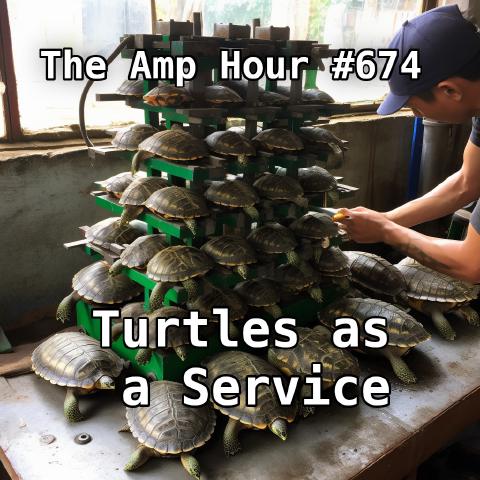
#674 – Turtles as a Service
Download episode · 81 MB
Also on Apple · Spotify · YouTube · RSS
Show Notes
- Murphy
- More efficient with cooled panels
- Battery storage solution
- Server rack batteries
- Chris has been doing hardware Livestreams
- Geofence
- n8n, Similar to Zapier, IFTTT
- Home assistant
- EE Grad wants some insight on new tech
- https://4dsystems.com.au/
- Scott Williams of Xentronix recorded with Dave and then Chris
- Saw at Electronex
- My Cousin Vinny
- Embedded World North America is happening in Austin in October. There is a vendor map now.
- Voltnuts
- Open source book
- Tiny Tapeout
- Tantalum Caps from AliExpress
- What's next for ASML
- Ben Krasnow printing PCB traces again
Transcript
Ethernet: This is The Amp Hour Podcast. Released July 25th, 2024. Episode 674. Turtles as a Service.
Dave Jones: Welcome to the Amp Hour. I'm Dave Jones from the EEV blog. And I'm Chris Gammell of Contextual Electronics. Bloody Murphy. Every time. Every time. Every time. Every freaking time. Story of my life. Is it the story of your life?
Ethernet: Oh, yeah. Murphy and Ockham and...
Dave Jones: Ockham, right. I don't know. All the other razors. All the other razors. I tweeted a list of razors somewhere. I think I bookmarked it. I'll see if I can find it. If I can, I'll include it. Like, there's all these different razors, you know? Ockham's razor and whatnot. And there's all these many different types.
Ethernet: I mean, for me, it's mostly the Dunning and the Krugers of the world. And me knowing better than them, if I'm being honest, you know? Right.
Dave Jones: Oh, boy. You'll want to hear my latest story. My latest Murphy story. Okay. Last night, I released a video. I was answering a question about my hot water system. And put it, you know, cooling down solar panels to preheat your hot water system. Anyway, I actually released that video. I was kind of like bragging about my Reclaim hot water system. My heat pump hot water system that I installed like 12 months ago or something, right? It's been working flawlessly. At the exact... Almost the exact same time. Oh, I see.
Ethernet: I see where this is going now. Okay. Yeah.
Dave Jones: Almost the exact same time that I...
Ethernet: Water starts dripping through the ceiling on your forehead as it's happening.
Dave Jones: Not a hard... Well, not that bad a fault. Okay. But at practically the same time that I released that video, my Reclaim hot... Heat pump hot water system started to oscillate. So it switched on for like 10 or 20 minutes. Then it switched off for 10 minutes. And then it switched back on. And I could see this in my power, you know, because I've got a clamp on there that actually measures just the hot water. And I can see this. And I've got a video on my second channel actually showing people this. I just released it this morning. And yeah, at practically the exact same time, I've never had a single issue with my heat pump hot water system, which turns on via a timer during the day. So I use my solar power and that stays on for like two, three hours, depending on how long it takes to heat up. Then it switches off and it stays off for the rest of the night. And it's always done that since I've installed it. But as soon as I released a video last night bragging about it, nope. The actual heat pump itself started oscillating on and off. On and off, on and off, on and off. So I did the hello IT thing. Have you tried to turn it off and on again? So I've done that. Right. And I think it fixed it, but I don't know because at exactly the same time that this, well, a couple of hours after it started oscillating, my solar analytics monitoring system, which I use to troubleshoot this sort of stuff, it failed as well. What are the odds? Come on. Seriously. Seriously.
Ethernet: I think you just say, I'm under attack. And you go hide at our table.
Speaker ?: Right.
Ethernet: Aliens.
Dave Jones: Or, yeah, it's either I'm under some sort of hacker attack or it's aliens. Yeah. Unbelievable. So anyway. Oh, God. So I think turning it off and back on fixed it. And somebody else on Twitter confirmed that they had a similar unit, which did a similar thing after about nine months and said it started to oscillate and they just recycled the power on it and it fixed it. So I don't know. Some control loopy firmware buggy thing in the controller that causes it to switch off and on. I don't know. Some hysteresis thing got buggy and I don't know.
Ethernet: I had a former job where it would be like this really weird Ethernet thing was happening. And I forget what Timeline was, but my friend who was working on the software, he's like, yeah, it's like really weird. Like every couple of days it goes, it goes out and I just can't figure out what it is. And then finally he did the math on it. And it was something like exactly 64 hours or something like that.
Dave Jones: It was an exact time period.
Ethernet: It was an exact time period. And it was like basically the, I think the Moda or the DHCP was losing its license and it had to reset itself. But it was always on exactly, I don't remember the exact thing what it was, but it was something with the Ethernet losing basically on a cycle, it was losing, it was losing its connection. And it was just like, but you had to wait in order to actually drag it out. Yeah.
Dave Jones: Oh God.
Ethernet: So maybe yours is just on a longer cycle, you know, like nine months.
Dave Jones: It's a nine month cycle and then it starts. Yeah. Right. I'll check it out. We'll confirm in another, you know, nine months.
Ethernet: So we've talked about the heat pump before and it's been working out okay generally, right? So like you're saying this is to cool the panels. That's like a preheater for your actual hot pump, water pump.
Dave Jones: Yeah. Well, somebody asked me on Twitter why I didn't add pipes under my solar panels so that I can pump the water through there and extract the heat from the solar panels and then use that to preheat the water that goes into the heat pump. And there are some people who do this. It's a thing apparently. It's a thing. Okay. It's a thing. And I just found out there's an Australian company. Somebody just emailed me this morning. There's an Australian company that actually make these things which you can put under your solar panels and they have the pipe in and everything. So you can hook it up to your, you know, your pool. You can heat your pool with it or you can heat your factory or something. These are commercial ones, but you can also get ones.
Ethernet: And that benefits you because then the solar panels work better at like lower temperatures. Is that right?
Dave Jones: The solar panels are more efficient to the tune of four to five percent more efficient per 10 degrees C. Wow. Okay. So it's about 0.4 to 0.5 percent more efficient solar panels if you can cool them down by one degree Celsius. So, yeah, so about five percent more efficient if you can cool them down by 10 degrees, for example.
Ethernet: Which is like a pretty simple water pump system. Seems like it. Well, yes. Depending on the volume of the system, right? Yeah, yeah.
Dave Jones: You've got to trade off the volume of the, you know, the water flow and the coupling because, you know, because quite a lot of the heat is lost just via radiation into the air. And if there's any breeze or something like that, you can get those losses as well. But if you couple some pipes to the back of your solar panels, yes, you can actually cool them down and you can get some efficiency increases.
Ethernet: Yeah, and it's also like the backside. It would be the backside of the panel.
Dave Jones: It would be the backside of the panel. Yeah.
Ethernet: Yeah.
Dave Jones: Interesting. So you can buy solar panels specifically with these built in. I think there's an American company that makes them. Oh, cool. That sounds expensive. It sounds expensive and complex. Yeah. Well, they'd be more expensive than regular panels. Yes, of course. Yeah. And then if one of your solar panels fails, you've got to call a plumber instead of a solar guy. So, you know, yeah, yeah. I don't like the idea of, it kind of gives me the heebie-jeebies having water running through a complex system of pipes on my roof. It's just, you know. Yeah. And there's just no point because my heat pump uses so little energy, daily energy anyway, to the tune of three kilowatt hours of energy a day just to heat my hot water. As a baseline, my solar system, even in winter the other day, made 30 kilowatt hours. So it's one tenth.
Ethernet: Sunny Australia.
Dave Jones: Yeah. Sunny Australia. It's just one tenth. But you can increase the efficiency because the efficiency of your heat pump depends on the inlet temperature. Not only the ambient temperature if it's cold outside, but also the inlet water temperature coming in. But because our water pipe is underground, even this time of year, because our incoming water pipe for our house is underground, underground is warmer than the outside air. So the incoming temperature, even in the middle of winter, is still 18 degrees or something, I think. So it's still-
Ethernet: How far underground is your piping there?
Dave Jones: Oh, I don't know. It's got to be a meter or two. Okay. I don't know how far underground.
Ethernet: That's a big difference, actually. Oh, yeah. Yeah. So here in North Carolina, so I basically, I was talking to someone about why they have basements a lot in the north. Yes. And one of the reasons is because the pipes have to be buried. You have to bury pipes below the frost line. And so if you have pipes below the frost line, then you can have a slab, but you have to still have pipes that are buried, buried that come up underneath the slab. Yeah, yeah.
Dave Jones: Well, how deep does the frost line go, so to speak?
Ethernet: Depends how far north you are. Oh, okay. Like some places in the far north, it's like a meter down. I mean, it could be down to a meter, I think.
Dave Jones: Right, yep.
Ethernet: That sounds wrong. But no, it's definitely like-
Dave Jones: I have no idea.
Ethernet: A third of a meter. Okay. Oh, right. Okay.
Dave Jones: All right. In some places, right. Well, that's not far at all.
Ethernet: Right, but the pipes have to be buried much deeper. I think standard pipe depth in Ohio, where I used to live, was like six feet, I think. Oh, okay. Yeah, right. Yeah. So two meters.
Dave Jones: Right. Got it. Okay. Yep. I have no idea how deep my pipes-
Ethernet: Yeah. So here, it's nothing. It's like half a meter where I live now. But what that means is in the summer here, I guess in the summer here, the water is warm when it gets to your house. Right. There is no cool water, right? Where you have to run for a bunch so that the pipes that are buried much deeper outside of your house come up. Because as soon as it comes up, everything's still warm.
Dave Jones: Okay.
Ethernet: So you really start to feel it, you know.
Dave Jones: By warm as in greater than 20 degrees, like greater than normal ground temperature? Yeah. How does that, or by warm?
Ethernet: Well, I expect like tap cold water to be, I don't know, like 10 C. That's what my expectation is. Yeah. But it's closer to, yeah, like 15, 18 C. Yeah. Right. Right. So it's much more tepid in the summer because just everything's so hot here. Yeah. Particularly hot right now, so.
Dave Jones: Got it.
Ethernet: Yeah. Interesting. So yeah. Summers.
Dave Jones: Of course. Summer in, yep. But it's winter here in Australia. I know. I know. Yes. Yes. Other side of the flat earth. Yeah.
Ethernet: Yeah. Right. All right. Flip it over. Yep.
Dave Jones: Anyway, that's, yeah, it's all very interesting stuff. But for those playing along at home, the conclusion that I came to is it's generally not worthwhile to preheat the water going into a heat pump system because they're already so efficient anyway. Yeah. In my particular climate, your mileage may vary as always. Right. Of course. If you're in a different location cooler, you know, it's different. But here, no, that is the reason why I wouldn't bother doing that. Um, there's just no real advantage to it. You're just adding system complexity, plumbing, which has to go onto the second story roof. And like, no, no, no, just isn't worth it. Anyway. Very interesting.
Ethernet: You know, it is, uh, summer and it's, uh, very, very hot here. And I've just been thinking about how much power goes towards just induction these days and just spinning motors around. Like in this case, obviously the cool houses down, cool cars down, whatever. But then also like, you know, like my EV is just spinning motor. It's just like the amount of power that's going to that. I guess. Yep. It's not that out of the normal, but I don't know. It's really hot here, Dave.
Dave Jones: Yeah. Yeah. Right. Well, you can do everything with heat pumps these days. This is why, another reason why I said you're better off devoting your roof space to solar panels because solar panels. Oh, versus. Generate versus just like a hot water. You know, because if you do that, you only get hot water out of it. That's the only thing you get, whereas if you generate power, you can store in batteries, then you can do anything with that. You can charge your EV. You can do your induction cooking. You can run your power, run your house, all the power for your house. And you can heat water with heat pumps and you can do everything once you have that power, either straight or stored.
Ethernet: Capturing the power of the sun.
Dave Jones: Yeah. I will be getting a battery storage solution maybe this week. It's being delivered. Yeah. So I got a viewer who watches my videos and he happens to be an Australian manufacturer. He happens to have an Australian company that manufactures batteries here. So he's going to send me some. So yeah. Nice. That'll be cool. So yep.
Ethernet: Sounds like the price is right.
Dave Jones: Yes. Yes. The price is definitely right. Yeah. Because I was already searching around for, you know, prices and the best solution. He said, hey, you know, here you go. So I'm not going to say no. Anyway, he's going to pop over. He might even help install them for me. And, you know, great. Yeah. So yeah. Yeah. We'll see what happens. So yep. But their bloody thing is they have to get a truck. The actual rack these things are in weighs more than the batteries.
Ethernet: Really?
Dave Jones: Yes. The rack is 91 kilos because these are rack mount ones. So they're 19 inch rack mount. Right. So the batteries weigh like 41 kilos each, which isn't too bad, you know, but the actual rack itself weighs 91 kilos. So getting it off the trucks a bit of a, it's going to be a bit of a problem. So they may need one of those hydraulic lift trucks to lift off the rack. Just the empty rack.
Ethernet: Wow. It's a 19 inch rack, like a server rack? Yeah. Yeah. Yeah.
Dave Jones: Yeah. Yeah. It's a small server rack. Yeah. Yeah. You can buy a battery. Yeah. They're very popular in commercial type installations. So yeah.
Ethernet: Yeah. I'm just curious about the density then. I guess I don't really understand how much density you could or would pack into that sort of thing. It's just, you know.
Dave Jones: Well, the density in the 19 inch box, I haven't done a teardown yet, of course, but I will do when I get it. I think it's going to be pretty good, but it's not probably not as good as, as a, say, a Tesla Powerwall or something like that, you know, which is like a dedicated commercial slimline solution, which is designed to mount on the side of your wall of your house or something, you know. So I would say the design of these 19 inch rack batteries and things aren't probably as volumetrically efficient as something that's actually purpose designed for that. So anyway, find out.
Ethernet: Yeah. Yeah. Okay. Yeah. Coming to an EV blog soon near you. Yeah.
Dave Jones: Yes. And then the good thing is if I need to expand it, there'll be spare slots in the rack. I just slot in a battery, plug it up, because the rack comes pre-wired, I think. So all the wiring's just there. So you literally just did a five minute job just to slide in the new battery, hook it up, boom, boom. And bingo, you've expanded the capacity of your home storage battery. So that's... Yeah, that's great. Yeah. Yeah, it's pretty cool. The only problem is it's not outdoor rated cabinet, so it'll have to go in the garage. So we were hoping to sort of mount them outside, but anyway, we'll deal with that. So anyway, cool.
Ethernet: Cool. Yeah, that's great. That's great.
Dave Jones: That'll be coming soon, hopefully.
Ethernet: Well, I have been live streaming hardware stuff.
Dave Jones: Oh, you have? Yeah. Is this part of work, obviously, or are you back on doing the potential electronics thing?
Ethernet: No, no, this is work. I have probably similar style, smaller stuff for sure. I'm going to do another one. I've been doing it Wednesday. Well, doing it Wednesdays. I have another one on Wednesday. I have done one Wednesday, so this will be my second one. Right. Yeah. I don't know. It's tough. I think you've tried live streaming. Layout before, right?
Dave Jones: Oh, yeah. Yes. Yeah, I tried to do it consistently every Saturday, and it was okay, you know, but then as soon as you get kids, you know, then you have weekend commitments and stuff, you know. Oh, sure.
Ethernet: I just meant the logistics of trying to concentrate on a layout while you're also talking.
Dave Jones: Oh, yes. Yes. Talking. Yes. And you're trying to switch cameras and do all sorts of things and, you know. Yep.
Ethernet: Yeah. All right. Yeah. So that part's tougher, but I'm going to hopefully get better at that. And yeah. Building a little cellular board. Man, when's the last time we, it's been a while since we talked. I've been doing.
Dave Jones: Yeah. Yeah. It has. Unfortunately, because we've both had issues. Yeah. We both had. Life stuff. Yeah. Life stuff. Yeah.
Ethernet: Yeah. Life has been lifey. And I think I mentioned the geofencing thing that I did. I think I told you that.
Dave Jones: Geofencing. Oh, I vaguely rings a bell.
Ethernet: Okay. Well, I have a bunch of videos. This is all for work. So, you know, take that with a grain of salt. But one thing that's really cool, I've been doing, it's called N8N. Have you ever heard of that?
Dave Jones: N8N?
Ethernet: Yeah. No. It sounds like the, you have NBN there.
Dave Jones: No, it sounds like 8N8, which is 8 bits, no parody ones.
Ethernet: No, it's 8N1.
Dave Jones: 8N1. Sorry. 8N1.
Ethernet: Yeah, yeah, yeah. Yeah. No, this is N8N, which is like a, it's like a thing to like, it's almost like Node Red. Have you ever done Node Red? No. Okay. Basically, it's like a graphical, like plugging stuff together. It's like multimodal. So like, for example, or how about Zapier? You heard of Zapier or Zapier? Oh, I've heard of it.
Dave Jones: Yeah, yeah. I think I might have.
Ethernet: Yeah, like that or if this and that. It's kind of like that as well. Where basically it's like you're tying together much API services.
Dave Jones: Yeah.
Ethernet: And so say you've got a new subscriber to an email that you set up. You could do it so that you have a responding email. You send out a tweet. You do all, like you hook in all these different services. Maybe you send a text message using like Twilio. Basically like set up triggers and you can set up like actions as a result. But you can also do inputs from like external services. And so I had set this thing up where I, me and my coworkers, set up this thing where it was like you get all of the Wi-Fi SSIDs. Sorry, all the Wi-Fi MAC addresses. So basically you do a scan and you get all the MAC addresses.
Dave Jones: Yeah, scan of all the nearby things. Yes.
Ethernet: That's right. And then like their power levels. And then you can send those to like a service and the service will basically say, oh, you're probably about here. Yeah.
Dave Jones: So you can do your geolocation based on Wi-Fi power levels. And you can get movement. You can get real-time movement based on that. Yeah.
Ethernet: Yeah, exactly.
Dave Jones: Right.
Ethernet: That's like one of the things I've been working on. But then also I plugged it into ChatGPT as well so that you then, you can have JavaScript or Python running directly in that workflow tool. And you can do a geofence. You can say like, well, I'm approximately at this lat and this long. And if I go outside a radius of 100 meters, 500 meters, whatever, then do something else. And so that was pretty cool. Okay. I'd never really done anything like that before. But there's a bunch of them too. Oh, yeah.
Dave Jones: There's many. There's half a dozen. Yeah. Yeah. Yeah. Yeah.
Ethernet: Exactly. There's one called windmill.dev. N8N is not open source, but it is like you can self-host it. There's Zapier. There's Node.red. There's a bunch of these different things. So, yeah, it's pretty cool. And like I said, you can do it for like workflow stuff. But I'm just kind of thinking about it. It's basically like a fancier version of this, if this than that. And like more. Yes. Yeah.
Dave Jones: I think I used Zapier at one point. I think it had the ability to like if I uploaded a video to YouTube, it would then upload it to Dailymotion or something like that. Yeah. So, I think I had like a Zapier script for that. Yep. Exactly. But then it broke at some point. Yeah, exactly. Right. And it does happen like that. Yeah.
Ethernet: And like this is one thing that's very new for me, but like very old hat for a lot of software type people. Like I just never really knew how APIs work. I still don't really know how they work. Yep. Getting better at like API level stuff, understanding how to push data in, respond to that data.
Dave Jones: Yep.
Ethernet: So, that's a very good skill to have. And, you know, having tools like Copilot and ChatGPT just kind of helps grease the skids now. So, it's like more accessible. It's not like I need to be a JavaScript expert. It's more like, oh, well, I can hack on this code that kind of looks like it might work sort of thing.
Dave Jones: Got it. Okay.
Ethernet: Yeah.
Dave Jones: Yeah.
Ethernet: So, it's more accessible now. I'm not sure all the things. I think it's really then comes down to what could you do with it? What do you need to do with it? Is there, I don't know. There's a lot of stuff out there. I'll keep playing with it. See how that goes.
Dave Jones: Got it. Excellent.
Ethernet: Yeah.
Dave Jones: The thing I find annoying with these is that I find one of these, you know, things like the Zapier thing and I go, oh, that does exactly what I want. So, you know, you sign up for an account and you do your thing and you set it up and then you forget about it and it just works in the background. And then a year later. Who's doing this right now? Yeah. And then a year later you go, yeah, my videos are being uploaded to Dailymotion, but I don't recall how I did it. So, it's like, and you completely forget what service you use.
Ethernet: Some friendly ghost is doing this. Yeah. Yeah. That sounds very familiar.
Dave Jones: Oh, that's happened to me more than once. Yeah. That is just. I agree. Yeah. Yeah.
Ethernet: That happened with the, you know, we used to have from the Amp Hour, we used to have the subreddit was using if this than that and it would like auto post to Twitter. Yeah. Yeah.
Dave Jones: Yes. That's right.
Ethernet: And then some butthole was posting nasty stuff to the Reddit and then it was showing up on our Twitter. And I'm like, how do I turn this off? I don't know.
Dave Jones: That's it.
Ethernet: Yeah.
Dave Jones: Yeah. It's great. So, yeah. Oh, boy. Yep. The dangers of, yeah, these things. So, yeah. Usually you just set it up once and you totally forget about it and then.
Ethernet: Yeah. Totally.
Dave Jones: Yeah.
Ethernet: I keep getting, I forget that I have, I still have home assistant running in my house. Right. And like, you know, I'll be like mowing the lawn and then my phone will start buzzing. I'm like, what the hell is going on? It's like, your garage is open. I know my garage is open. I opened it. You know, like I have this sensor that says your garage is open. Okay. Well, is there a lawnmower setting so that I can like do yard work? I don't know.
Dave Jones: Right. Right.
Ethernet: Go inside, nerd.
Dave Jones: Well, somebody just mentioned that home assistant to me on that video I just released about the hot water system.
Ethernet: I mentioned home assistant to you. Come on, man. No, but no, no, no, no. Oh, now you're a listener.
Dave Jones: No, but somebody said, why am I not using that? Because my solar analytics system failed. And they went, oh, you idiot. Well, you know, not quite, but why aren't you using home assistant? And then I went, well, I, well, okay. I got, well, I can answer it. Right. The, I did answer it in the comments. Right. I got the solar analytics system for free, you know, because the company just said, hey. Oh, this is the really old one.
Ethernet: No, I think this is actually what you told me too. I think this actually is a carbon copy of what you told me. A year ago or something. Yeah. That's right. Yeah.
Dave Jones: So I've had it for eight years. And, and they said, oh, and I've had no issue for it for seven years until it failed last year. And then, so I've had no issues with it. And it's like, oh, why don't you use home assistant as if home assistant is some magical thing that never fails. I bet you, even though I don't know much about home assistant, I bet you, yeah, I could come up with half a dozen reasons, half a dozen ways home assistant can fail on you. Right. It's not magic. So people complain.
Ethernet: You don't need to come up with them. I can just tell you the ones that have happened here.
Dave Jones: Well, please, please tell me, tell me.
Ethernet: The USB stick gets unplugged by accident. Yes. The power goes out and it doesn't reboot properly. Bingo. Yep. The batteries run out on the, the little, the little sensor thingy. Yep. My children run into the sensor and the battery falls out.
Dave Jones: Exactly. And, and, and somebody in the comments is trying to sell me this as some magical solution that, that doesn't fail.
Ethernet: No, no, no, no, no, no. You see, here's where you're wrong, Dave. Here's where you're wrong. You need a second home assistant to monitor your first home assistant.
Dave Jones: Oh, to monitor your first home assistant. And then I need a cloud solution to monitor it just in case the local solution fails.
Ethernet: You know what you need is, I'd like to sell you a service called Turtles. And as long as you order Turtles all the way down, you will be.
Dave Jones: All the way down. Yes. The all the way down option. You will be happy.
Ethernet: Yeah. Yes. The all the way down. Yes.
Dave Jones: Yes. I want the all the way down option, please. Yeah. Turtles as a service.
Ethernet: Turtles as a service. There you go.
Dave Jones: Turtles all the way. Oh, can we have that as our title? Turtles as a service, please. Sure, sure.
Ethernet: Turtles as a service, yeah.
Dave Jones: Turtles as a service, please. Note it down. And we'll have to do an AI generated image of Turtles all the way down.
Ethernet: I mean, surely, surely. Yeah, yeah. Absolutely.
Dave Jones: Okay. So we'll work on that after the show. We'll work on the thumbnail. Oh, yes.
Ethernet: We will. Yes, of course. Yes. We will. Yeah.
Dave Jones: Well, what? I enjoy using this. I enjoy using the. It's true.
Ethernet: We do like going back and forth. Yeah.
Dave Jones: That's another thing I'm paying a bloody subscription for and I don't often use it. Yeah. You know? Same. Yeah. Yeah. Yeah. Mid Journey, you mean? Yeah. Yeah. I'm paying the subscription for Mid Journey because I want my own private little, you know, thing and it keeps all the record of the ones I've done and stuff like that. And yeah, but I don't often use it. It's the modern conundrum, Dave. When I use it, it's nice to have it there. But you know, it's yet another bloody monthly service. And then I'm signed up for ChatGPT. You know, I pay for that. I pay for, maybe I shouldn't. I don't know. Is everyone using free ChatGPT these days?
Ethernet: I switch back to free personally. Oh, really?
Dave Jones: Okay. Yeah.
Ethernet: Yeah. I just don't use it that much.
Dave Jones: I don't think I'm doing enough interesting things. Have you got the phone app now that allows you to talk to it and interact? Yeah. Yeah. Right.
Ethernet: I have used that a couple of times.
Dave Jones: So it works on free? It does.
Ethernet: Yeah. It didn't at first, but then they've enabled it.
Dave Jones: Oh, okay. Right.
Ethernet: And it only is like 10 or 20 queries before it starts responding. You've run out of credits. Please. Oh, yes.
Dave Jones: Okay. Right.
Ethernet: Please subscribe. Okay.
Dave Jones: So that won't happen to me with my monthly sub. That will not. I'll just get unlimited. Yeah. I believe. Yeah. I was going to do a video like just me talking to it and it replying and just seeing, you know, seeing where it goes. But I don't know. Yeah. Anyway.
Ethernet: I mean, it's not bad. Like, I think all of these assistants are like, they're going to, they're going to fade in the background, right? For better or worse. And then they're going to, you know, do stuff we don't expect them to.
Dave Jones: Well, here it is. I just opened the mid-journey bot and the bot has advised me that I, it did my monthly update subscription plan. So I, it automatically re on the 30th of June and I haven't used it since. So I haven't used it for the last 16 days. You know, it's like, so I'm using it like once or twice a month. Yeah. And I'm paying a subscription. That's too bad. So I don't know. Yeah. Oh, bloody.
Ethernet: I used, so the, the talking to it thing, it was like this big splash when it came out. Yeah. Yeah. I do use it if I'm like doing the dishes and I want to like. Yeah.
Dave Jones: It's handy for like, because I, I hate using the swipe thing on my phone, you know, that keyboard swipe thing. It never bloody works and everything's wrong.
Ethernet: You got old man fingers now.
Dave Jones: I got, oh right. I got old man fingers. Great. That's all I need.
Ethernet: No, it's probably, to be honest, you probably have gym rat fingers, right?
Dave Jones: And you got the stubby like you've moved the waist too much.
Dave Jones: I've got nice delicate hands, you know?
Ethernet: Oh, yeah, yeah, yeah. Right. Anyway. Yeah. Moisturize. Yeah.
Dave Jones: It's bloody annoying. So I find that it's actually more convenient to use the voice thing, to actually open that up and just talk it instead of trying to type an entire bloody sentence on my shoe phone, you know? Yeah. Yeah. True. True. Yeah. Yeah. Don't know how many tweets I've done that have words totally wrong in it. Because I'm swiping, you know? Oh, sure, sure. Yeah. Yeah. It's just ridiculous. There you go. Yeah. We were speaking before. I just sent you a link through to the EV blog forum. We were speaking before about a good skill to learn, you know, these online API, you know, these online automation things. Yeah. API services, stuff like that. Yeah. API stuff is a good skill to learn. Somebody, Chris N on the forum who's a new user just says, hi, I've just joined the forum. He's a former EEE grad from way back in the early 2000s, but he wants to get back into the design side of things. And what are the must have skills for a new hardware design guy? Classic Amp Hour. Yeah.
Ethernet: Classic Amp Hour question.
Dave Jones: Excellent. We haven't done it for a long try and try to dip his toes back into the industry. And my immediate response was, well, there are so many things that it's, you know, it's hard to pinpoint anything without knowing what you're interested in, what you want to get into and stuff like that. There's just so many skills and stuff. But I did say, generally speaking, it would pay to update, to be up to date on the latest embedded platforms and how they integrate with the web and other services and stuff like that. So that was just like a general thing without knowing what.
Ethernet: That's good answers on here. I would like to steal some of your forum members' answers.
Dave Jones: Sure. Go for it.
Ethernet: No, I was just joking. I haven't read them all. But yeah, no, this is good. I mean, like, yeah, this is a good question. I think one of the hard things here is, you know, this is basically a big career shift, right? And I think the hard thing is just going to be getting a shot. Oh, yes. Yeah.
Dave Jones: He wants to get back into design. Well, he still works for an engineering company or something, but he's not in the design. He's into operations management, right? So he wants to get back into the design side of engineering. So he hasn't been completely out of the loop.
Ethernet: Oh, so maybe he has opportunities. I see. Yeah. If you have opportunities to cross train and that sort of thing, then that's, I was just going to say, like, if you, if you don't have a defined path in that way, I feel like the thing you have to kind of go towards is the lowest barrier area so that you can actually break in. I feel like that's, that's like a very practical answer, right? That people probably don't want to hear, but it's probably necessary. It's like, if you want to go, Hey, I want to go design nuclear power plants, you know, and I've worked in adjacent industry. It's like, okay, well, there might be degree requirements, might be safety training requirements, whatever. The amount of training you have to do before you get to that first leap might not be worth it. And you might want to sideload instead and say, Oh, well, I know someone like I have a friend who has a small electronics business. And then I would go talk to them and be like, what do I need to do to work for you on the weekends so that I could build the experience that then, you know, lets you level up into the next thing and the next thing and the next thing. That's the boring practical answer.
Dave Jones: Exactly. Well, he, he, he did actually come back and say that he's, he had a project in mind, which would be a small handheld LCD GUI stuff. Right. And then my, yeah. Right. So now we're narrowing it down. So, so my response after learning that, well, I'll actually read it out. It depends on whether or not, whether you want to do chip level design or do high level stuff and use existing modules, which make it easy. And I use the 4D systems, which is the Australian company as an example. They make all these nice little LCDs, which will have all the graphical GUI stuff all built in. So it's very high level programming type thing. Right.
Ethernet: Cause they've got all of the, like a compile, like a graphical compiler.
Dave Jones: It's like a graphical compiler, something like that. I haven't used the backend of it, but it like, it's very high end and they've got their own like scripting language and stuff like that. Right. Really. So you can do bar graphs and you can do, you know, automotive displays with just like a drag and drop kind of thing. Right. But I said, as always, the end product market drives the design decisions. Right. So if you're designing for a small volume or a one-off thing for, you know, you're doing it for a client or it's a test system or something, then you wouldn't waste your time. Actually, you wouldn't waste your development time cost optimizing this solution, like picking the lowest cost micro, picking the lowest cost LCD and writing the routines from scratch and stuff like that. Right. To save space or whatever. You would just like use an off the shelf module and just do high level programming. So they're kind of, you know, it really depends on the end goal you try to do, whether or not, you know, I wouldn't necessarily say, oh yeah, yeah. Go out and learn how to pick the right microcontroller and then learn how to write your low level LCD drivers. And, you know, it's just, no, no, it's kind of.
Ethernet: Yeah. Yeah. And that is kind of like what I was, yeah, that's similar to what I was saying too, is because if you need to be doing, if you want a project where you want to like learn skills, which is what they started with, it's like, that is, that is maybe low level. Like you want to learn how things work under the hood. But if, yeah, if you want to be a person who delivers on time projects, because you want to work.
Dave Jones: Yeah. You don't want to take her out.
Ethernet: Potentially, you know, like that's a different thing. Yeah. So, yeah. Yeah. I remember wondering about my old like coworker and quasi mentor. I think I mentioned on the show before he, he had used this compilation tool that like built into an FPGA tool. And I was like, why are you doing it like this? It just feels like, why don't you just like write VHDL or Verilog and like do all this. And he's like, dude, I don't have time for that. I just need to get it done. It needs to work. I need to have the tool tell me that it works. And I'm like, oh, okay. Then, you know, that makes a ton of sense. And it did. He was someone who delivered, you know, like that's like.
Dave Jones: Exactly. Yep.
Ethernet: Yeah.
Dave Jones: Yep.
Ethernet: So, you know, don't be, don't be academic about it. That's what I'm, that's what I think you're saying. Right.
Dave Jones: Well, speaking of that and doing engineering consulting when design work, I spoke to a former guest, Zentronics, Scott Williams. Oh, cool. How's he doing? Actually met. Yeah, he is doing great. We actually, he's expanded since we last talked to him. Of course he has. That guy's. Yeah. So I.
Ethernet: He's on a path to a 400 person consultancy, I'm sure.
Speaker ?: Yeah.
Dave Jones: Consultancy company. Yeah. Yeah. Yeah. So I think he's got a dozen now employees or something. Oh, wow.
Ethernet: Okay. So yeah.
Dave Jones: Now he's in Melbourne, but he was up in Sydney for the trade show here. So, so I actually met him and I've got a video on my main channel, which I'll link you in. Well, you can just find it on my main channel. And yeah. So chatting about, you know, stuff we've chatted on The Amp Hour before and things like that.
Ethernet: He came back and he talked to just me too, you know. Yes. Yes. Yeah. I know. It's not just you, Dave. It's also me, you know.
Dave Jones: I did link in both of them. I did link in both episodes, by the way. Great.
Ethernet: Great. Great. Great.
Dave Jones: I am perfectly aware of this. Yes. Didn't forget you. Don't worry.
Ethernet: I don't worry about me, Dave. It's fine. You'll forget me.
Dave Jones: Oh, boy. Anyway. Yeah. So that was a fun chat. Yeah. That's great. Yeah. Yeah. Yeah.
Ethernet: How was the rest of electronics? Is it same old, same old?
Dave Jones: It was better. It was probably the best one I've been to. And everyone else looked like the vibe, as we call it here, here in Australia. The vibe was better.
Ethernet: Are the... What? Are the Utes... The Utes are calling it vibe? The Utes? The Utes. You know, the Utes. The Utes.
Dave Jones: As in a pickup?
Ethernet: No. No. The Utes. Oh, Utes. That's a line. Utes. The Utes.
Dave Jones: The young fellas. Right.
Ethernet: Yeah. Yeah. Yeah. That's right. That's from My Cousin Vinny. Have you ever seen My Cousin Vinny? No? No. No. Oh, really? Oh, it's so good. I was just rewatching it this weekend. Oh, man. Joe Pesci. Classic movie.
Dave Jones: Oh, right. Yeah. He's great. Yeah.
Ethernet: Yeah. It's really good.
Dave Jones: Right.
Ethernet: Yes. So vibe. You were saying vibe.
Dave Jones: Yes. The vibe of the show was that, yeah. And there were more overseas companies coming here as well. Oh, wow. Okay. And it was 30% bigger than previous years, I think. Okay. So yeah, yeah. It was, yeah. Things are picking up back here in Australia. That's great. All right. Yeah. For the on-shoring and stuff like that, you know, there's a lot of companies. Yeah.
Ethernet: Okay. That's nice. Yeah. That's great. Yeah, it is.
Dave Jones: I'm very, very pleased.
Ethernet: I'm considering going to a trade show myself. Embedded World North America is in its first year this year. Oh, what? Austin, Texas.
Dave Jones: Right. So this is the German one, the ones that are usually in Germany?
Ethernet: That's right. Yeah. So I've known about this and like they didn't, I think I mentioned on the show, they didn't really mention it at Embedded World, like Germany. Oh, well, that's right. They didn't like mention that they're going to be in North America. I guess they assume they're different audiences or whatever, but.
Dave Jones: No, that seems like a dumb thing not to mention it. Yeah.
Ethernet: Like it's like plastered everywhere. So you're leaving like, see you next year. It's not like, see you in four months in Austin. Yeah, that's really. Come on back for more. Yeah. Yeah.
Dave Jones: Right. Have they got like a layout yet? They got companies. They do. Oh, right.
Ethernet: And it's much bigger than I thought it would be. Right. Yeah. I can send it to you if you want.
Dave Jones: Yeah. Yeah. Yeah. Please. Yeah. And it's like some of the big ones.
Ethernet: I think the big thing I would, you know, I had been asking all the chip companies. I was like, hey, like, are you guys going to be in Austin in October? And they're like, eh, we'll see what happens. And I'm like, that is not a reassuring response. They're a bit skeptical.
Dave Jones: Right. Okay. So you need that critical mass. Maybe they'll scramble on board now once they see it. I think they have. Right. I think they have. Okay.
Ethernet: Yeah. Yeah. Right. I also did, I did apply for Supercon, but I don't know if I'll be going to that.
Dave Jones: As in apply to your company that you work for to go. No, no, no.
Ethernet: I put in a talk proposal for Hackaday Supercon. Right. Yeah. Yeah. Got it.
Dave Jones: Well, if you do go to the Hackaday Supercon, can you tell the Hackaday people, please don't promote all these snake oil crap? Because they just, I'm going to have to do a debunking video. There's this company who claim that they've got these little orbs. I'm going to forget the name of it. Right. Right. These little orbs, like solar absorbing, light absorbing orbs. And they produce like 40 times the energy of a equivalent solar panel. And it's like total bullshit. And it was promoted on Hackaday website.
Ethernet: Well, you know, maybe then you also can get some crystals that help send you your chi and stuff like that.
Dave Jones: Right. Yeah. Yeah. I can get one of those RF stick-on shield things. You know, one of those dots that you stick on your product and saves you from the 5G, you know, mind control.
Ethernet: That's right. That's right. Yeah. Yeah.
Dave Jones: Yeah. Bloody hell.
Ethernet: Well, you know, there's good money in that. That's for sure.
Dave Jones: Yeah. Yeah. There is. There is. I'm in the wrong business. So, yep. All right. I finally sent you a link here. All right. Thank you.
Ethernet: It's pretty boring. I mean, it's a.
Dave Jones: Right. Well, as these things usually are, you know. Yeah. But, oh, yeah. Yeah. That's. It's only one big room. It's only one room. One big hall. Yeah. But it's like one big hall. But that's a lot of stands. Yeah. Yeah. Yeah. It's pretty good. I'd say that's probably about 50% bigger than our one. Okay. Probably about 50. Oh, no. Maybe not. Maybe about 30% bigger than our one. Ours was a pretty decent size this year.
Ethernet: I mean, some of these are pretty big booths too.
Dave Jones: Yeah. Yeah. Right. Yes, they are. Okay. So it might be actually double the size of ours maybe.
Ethernet: Yeah.
Dave Jones: Yeah. Okay. But still, it's not the German big, right?
Ethernet: No. God, no. Yeah. That thing is massive. I think they're going to try and make it that big eventually probably, but they're just, you know, they're trying to figure it out.
Dave Jones: All right. I'm just scrolling around the names here. Geez, I haven't found one that I've heard of. Yeah. Oh, no. There's Silicon Labs. Okay.
Ethernet: Perhaps Analog Devices you've heard of. Yeah. Nordic. Okay. Macro. Macro. Samtech. Mauser. DigiKey.
Dave Jones: Yeah. No, I just happened to zoom in on ones that I hadn't heard of. Yeah. There it is. Oh, Mauser have a big stand. Analog Devices have a huge stand. Yeah. Zeus are there. ST. Okay. Yeah. The Development Agency of Serbia.
Ethernet: Yeah. I noticed that one too because it's pretty great.
Dave Jones: Bunch of funsters. They got one of the biggest stands, the Development Agency of Serbia.
Ethernet: We were trying to figure that out today, what that's going to be. Right. That's always interesting too. They had that at Embedded World Germany too.
Dave Jones: Yeah.
Ethernet: I didn't see the Serbian booth, but there are like these large industry consortiums for different country development basically. Yeah, for country and states and things like that. Taiwan had one. Yeah, right. Yeah. It's interesting.
Dave Jones: Yeah. I think there was one at the Australian one too. I think there was a kind of a weird looking stand that was, yeah, yeah. It was like, yeah, something like that. Anyway.
Ethernet: Yeah. I think it's like there's government money for that sort of thing and then they apply. Oh, yeah, yeah, of course.
Dave Jones: And then they can help you apply to, yeah, I don't know. Yeah. Help you get the government, that government cash cow or whatever. That's right. Yeah. That's actually pretty good. Yeah. There's tons of ones in here I haven't heard of. And this is a good thing about these sorts of shows. You know, you walk past the booth and go, ooh, that looks interesting. And then you find something you haven't seen before. So, yeah, it's great.
Ethernet: Yeah. Yeah. Yeah. Yeah. So, we'll see. I have some travel booked out for it. We'll see though. It'll be my first time back in Austin in earnest since before the show started.
Dave Jones: Right. Well, there you go. Yeah.
Ethernet: Yeah.
Dave Jones: Jeez, Roden Schwartz have a tiny stand. It's smaller than Dualscope. Dualscope have a bigger stand or a slightly bigger or same size stand as Roden Schwartz.
Ethernet: Yeah, get it, Matt.
Dave Jones: What the heck?
Ethernet: Yeah. Matt's going to be representing.
Dave Jones: Yeah. Fantastic. I bet he'll enjoy that. Like, he's right next door to the Roden Schwartz stand, like right opposite. He's going to be standing there proud. Like, my stand is just as big as yours. That's great. I can remember that time that I had my own stand at the trade show. And I wasn't next to the Altium stand, but I was just down a bit from the Altium stand. And my stand was bigger than the Altium stand. It was like, ah, suck it. So, yeah, that was great. Yep.
Ethernet: That's fine. Yeah, that's great.
Dave Jones: And you have to, you know, gloat about those sort of things. Yeah. Anyway, okay. That's interesting. Wow. There you go.
Ethernet: We should go back to this EE grad thing, though. Oh, yeah, yeah, right. Like, what are the other ones on here? I don't know. I'm reading through some of the things here.
Dave Jones: There isn't many replies. Yeah.
Ethernet: I mean, you can go super niche on some things, right? So, there's like mentions of RF design and IoT and things like that. One thing that I would probably say is depending on what this person's mentorship looks like, that could be one way. You know, like if you have someone who has a mentor that's super helpful or whatever your company's doing too, that's probably going to find people in that area. He mentioned he's at like a large electronics company.
Dave Jones: He's at some large engineering company. Yeah. They do engineering and stuff. Yeah. Yeah. There you go. But, yeah, it's hard to give general advice like that. You know, it's just, it's so hard. You've got to have, you know, once they start talking about a specific thing, then you can nudge them in the right direction, you know. But once, you know, just as a general rule, I don't know, because it's so vast. There's so many aspects of engineering. You can just be, you know, like me. I was a full-time PCB designer at one point. Right? I was a full-time test engineer at some other, right? Totally, you know, totally different niche fields. Right?
Ethernet: Has your go-to like starter project changed? Like what do you tell people to?
Dave Jones: What do you mean my go-to starter project? Oh, okay. Right.
Ethernet: Like what would you tell someone to build first? Like for their...
Dave Jones: My go-to starter projects is something they're interested in. That is my response. That's always my response. So I don't tell them... No, no. You can't just tell them, go and make a lead blinker or go and make a, you know... I think you have to. No, well...
Ethernet: I mean, I think that that's... You're right. You're right. But I think that what people are actually looking for is like, give me a list of projects and I'll pick one. Right? That's really what they're looking for.
Dave Jones: But I will do that. But I will first ask them, well, is there anything interesting? Are you interested in? Are you interested in quadcopters? Are you interested in... Home automation. Flashy light products, home automation? Are you interested in robots? Are you interested in, you know, something else, right? Yeah. I don't know. You know, gardening. So you can do, I don't know, things that help you out in gardening or growing your plants or whatever.
Ethernet: Are you interested in 10 volts? 10 volts. That's right. You're just trying to output 10 volts. 10 volts. That's what the entire... 10 volts. Just do a perfect 10 volt reference.
Dave Jones: I happen to have a video on that actually producing a voltage reference.
Ethernet: I know. Yeah. Yeah.
Dave Jones: Yeah. Yeah.
Ethernet: I was just making a joke about how...
Ethernet: I know. I know. That's what the volt... What are they called? Volt heads? Nuts. Something? Volt nuts. Volt nuts. Yeah. Volt nuts. Yeah. Just making a joke about them.
Dave Jones: Yeah.
Ethernet: Don't worry. They're much better at electronics than me, folks. Yeah. I'm not like... I'm not doing this from a place of like superiority. It's inferiority.
Dave Jones: Yeah. Yeah. They are dedicated if anything. They are.
Ethernet: Yeah. That's right.
Dave Jones: They love this, you know, stuff. Oh my God. Well, past two episodes... Hang on. I'll have to try and see if I can link in. Unfortunately, one of the EEV blog forum members passed away recently. Sorry, I don't actually remember his name, but I'll try and find the post. But he was one of these volt nutty guys. And as his last like thing, he actually open sourced a book that he's done. And it's like 400 pages and it like talks about resistance standards and how to wind your own and how to do your own standards and stuff. It's really amazing stuff. Yeah. I'll try and find it and actually link that in. So yeah, just before he passed away, he open sourced his book. And it's amazing. I've actually got it on my website. I actually collated the PDFs together because he had them all as separate PDFs and I put them, joined them all together as one big PDF-y book kind of thing. So I'll try and find that. Link it in down below. But yeah, it's just one of those specific reads that like you just read it and go, holy shit. Like this is like, there's so much detail in just doing these Wheatstone Bridges and, you know, stuff like that. It's just like, oh, you know, it's just crazy. Yep. Crazy stuff. Yep. Unbelievable.
Ethernet: Past two guests have been, so it was Matt Venn two guests two episodes ago and then Bitlooney last episode. Have you considered doing a tiny tape out? Have you thought about trying that out?
Dave Jones: Like an ASIC tape out thing.
Ethernet: Well, using tiny tape. So the service that Matt runs is tiny tape out. That's like a portion of a portion of a run.
Dave Jones: A portion of a portion of a portion of a portion of a run. Yeah.
Ethernet: But then, you know, you can use Silly Whiz. I'm trying to remember the names of these things. Yeah.
Dave Jones: Well, there's a few of them now, aren't there? There's a few ones that you can get your own. Like you can get a share of some ASIC somewhere, can't you? There's a couple of them.
Ethernet: I don't know about a couple of them. Oh, okay. This is the main one. I mean, I'm sure there's other stuff out there, but this is the game in town, I think. Right. But no, I was just thinking the fact that you can just start from a simulator like Wokwe and then you can actually get silicon. I feel like you would really jive with getting silicon. That would be like an interesting one for you.
Dave Jones: Yeah. I've thought about it before because this has been, you know, you've been able to do this for a couple of years now. And I've always thought, oh, that'd be cool, you know, to make a video of me designing the thing and then waiting, I don't know, how much, three months or something to get you. Nine months. Nine months. Yeah, it's nine months. Okay, I have to be patient. Nine months to get my ASIC back and then do another video of like, you know, testing the ASIC and, you know. Is it packaged or do you just get a bare die? Oh, it's packaged.
Ethernet: Yeah, it's packaged, yeah.
Dave Jones: Oh, cool. Okay, right.
Ethernet: Yeah.
Dave Jones: Yeah, all right. So you can dip or surface mount?
Ethernet: It is a QFN that's actually soldered to a board even. And there's like a bunch of components around it.
Dave Jones: Wow. So you actually get it back on a board.
Ethernet: That's right.
Dave Jones: Seriously. Oh, wow. That's great.
Ethernet: You should listen to Ampower, Dave. You'd really like it.
Dave Jones: No, I need to find a spare hour to listen to that episode. Oh, boy. Yeah, no, I've always thought about it. And then I, you know. I think you should.
Ethernet: I think it would be good for the service. It'd be good for you. Yeah, it would.
Dave Jones: But I always.
Ethernet: I struggle with like, what would you make? What would you make? That's what I've done.
Dave Jones: Like, I've sat there for half an hour thinking, just staring into the void, trying to think of like a good project to do. And it's like, what is worthy?
Ethernet: I think you just do the simplest thing you can.
Dave Jones: Like, well, I can. But what is like worthy? You know? Yes, I can. I can choose any one of a million different projects.
Ethernet: What would be good for you would be like your first. Do something like retro where it's like something you did very early as a child.
Dave Jones: Right, right. Yeah, that could be a good idea. Right. Something totally useless to everyone else. But something of relevance to me.
Ethernet: Like emotional. Yeah, exactly.
Dave Jones: Right, right. I could do my Tandy 1000 turbo board.
Ethernet: Oh, wow.
Dave Jones: You know, something like that. Right?
Ethernet: That'd be interesting. Yeah.
Dave Jones: Yeah. Yeah. Yeah.
Ethernet: I mean, you have like transistor level design too. So you could also do that sort of thing. Right? You've done transistor level design in the past. Yeah, of course. Yeah.
Dave Jones: Yeah. It's just like. I got nothing personal.
Speaker ?: I need something.
Dave Jones: I know. Same here. Yeah. See, this is the same thing. This is what we're talking about.
Ethernet: Like that first project, you know? Yeah. Some people are good at this sort of thing.
Dave Jones: Don't complain that I haven't done it. Because you know how hard it is to come up with something worthy. A worthy idea to make it work. But maybe I'm overthinking.
Ethernet: I have very young children at home. That's my excuse.
Dave Jones: Right. Well, that's not yet. And also I'm lazy. My excuse is just that I can't come up with something worthy enough.
Ethernet: Yeah. Yeah.
Dave Jones: Because I'm going to pick it and then I'm going to go, oh, but that's really lame. Like people want to see me do an ASIC for like a micro satellite or something. I don't know. You know? They just want to see something. Like, you know, they want to see something fancy or they want to, you know. Right, right, right.
Ethernet: I'm going to get one chip made and then I'm going to launch into space. That's what you're saying there.
Dave Jones: Maybe I'm going to get my own discrete 555 made or something dumb like that. You know? Like...
Ethernet: I bet that's been... I bet that's possible.
Dave Jones: Yeah. Anyway, I'll have another look and another think about it. But if I don't come up with anything, don't be disappointed. It isn't because I don't want to. It's just, yeah. I don't know.
Ethernet: Totally. Totally. Yeah, yeah.
Dave Jones: All right. How long have we gone? Is our amp hour almost up? No. We've got like eight minutes left. Let's go. Should we... Have we got anything on the list?
Ethernet: Well, Unmanaged has returned. He's...
Dave Jones: Unmanaged has returned. 615 has returned.
Ethernet: That's right.
Dave Jones: Should you buy a tantalum caps from AliExpress? Yes. Well, no. But yes, we should talk about that. Because who's done this video? I've got it open here. It's Amateur Hardware Repair channel, which is 5.7K subscribers. So definitely... Oh, I'll give him a sub right now, actually. And he did a survey of his audience and he said that 80% of them... Well, no. The survey is, where do you usually get your electronics components from? If you have tried all of them, tell me what's your experience with them. And he said 80% of respondents voted AliExpress, 0% Mouser, 13% DigiKey, and 7% LCSC. So maybe he's got a very Asian-oriented audience, perhaps.
Ethernet: I was just going to say young audience or very... Right, okay.
Dave Jones: Right. Because us old folk, we're going to go to our old DigiKeys and we're going to...
Ethernet: I think it's just... You know what it is, Dave? It's just you haven't been burned enough. Have you been burned enough yet?
Speaker ?: Right.
Dave Jones: You haven't been burned enough, yes. Very true.
Ethernet: I haven't been burned by LCSC yet, but I haven't done enough ordering from there.
Dave Jones: Same here. I haven't done enough. I've ordered from them, but I haven't done enough to be burned. Also, like these numbers, like it's 30 votes. No, but LCSC is just as reputable as DigiKey and Mouser in terms of sourcing. In terms of sourcing, you will get the genuine sourced component. They don't substitute, right? LCSC is a... I would put them, maybe not on the same tier, but they're not far off, Mouser and DigiKey. So they won't substitute brands. You will get that actual genuine brand because they are an official supplier for those brands, just like Mouser and DigiKey are. So yes, you can get the lesser brand names. You can get all those Asian sourced brands that you've never heard of, but you will get that genuine Asian sourced part. They won't substitute it for something else. So you're unlikely to get burned on LCSC, but on AliExpress, oh, hell yeah. Hell yeah. Yes. Yeah. So LCSC is the legitimate, as far as I know, the only, well, the only legitimate one that us Western people know about is the only legitimate DigiKey equivalent from China. Yeah. Yeah.
Ethernet: I see.
Dave Jones: Right. So yes, I don't want to disparage LCSC.
Ethernet: It is like centralized too, right?
Dave Jones: Oh yeah. Oh yes. And, but that being said, I did bust LCSC for using those wireless anesthetic wrist straps once. They actually published a, they published a promotional video. Yeah. And I actually emailed them and they went, oh, we didn't know that. We thought they worked. Sorry, we'll fix that. But I'm not sure if they did. Not sure if they did. Cause I think there's evidence that they still use them, but they said they fixed it. They did say that they fixed it with real anesthetic wrist straps. But anyway, yep. I thought that was funny, but you will get the genuine brand. It just might be, might be static damaged. Sorry, LCSC. But no, you know, yeah. So I have, I have to joke about that, but Aliexpress. Oh God. You know, you have to be desperate to order your components from Aliexpress is all I'm going to say. You have to be so desperate.
Ethernet: I mean, yeah. Even just for the UI and like going through it all. Like it's just, yeah.
Dave Jones: Yeah. Well, if you're ordering, if you're ordering resistors or something, fine. You know, that's, that's probably okay. Yeah.
Ethernet: Like, like just one off.
Dave Jones: Just one off a real of, I just need a real of 10K resistors and they're 0.0001 cents each, you know, fine. They're probably going to work, you know, but semiconductors. Ooh. Ooh. Yeah. No, thanks. And, and, and, and I think the more specialized and expensive they get, the more likely you are to be ripped off. Like, oh yeah, I, I, I, I need this $30 Motorola IGBT, you know, and it's like 30 bucks each or something. Cause they're like hugely, you know, rated and special and characterized and specialized and yeah. You're buying that from AliExpress at half the price. Good luck. Yeah. Yep. You're going to get ripped off. You're going to get like a, a second sourced one that's been re laser etched or something like that. Yeah. Because, because it's worth their while. It's worth their while for the fakers to do that on these name brand parts, you know? So.
Dave Jones: Right. Exactly.
Ethernet: Exactly.
Dave Jones: Yeah. And they'll work like in, in most cases they'll work, but they, they're not the genuine part. So they won't, you know, they won't perform the same, but in majority of applications, maybe that doesn't matter. You know, they, they work and people think, oh, AliExpress is good. I got them for half the price and they still worked. You know, and then one of them, and then one day you're going to come a gut. So when it's most critical, Murphy's going to get you. Yeah. Totally. Yes. Totally. Yeah. No, don't do it folks.
Ethernet: Don't learn the hard way.
Dave Jones: Anyway, I'll have to watch the rest of this video afterwards. Yeah. I think it goes into town. So.
Ethernet: One, uh, one recommendation from our channel, be just, you can kind of scroll down and see a bunch of videos from the maker is Asianometry has been doing like really cool videos. Yeah. Yeah.
Dave Jones: I've been watching a few of those. Yeah.
Ethernet: Yeah.
Dave Jones: Yeah.
Ethernet: Like the, the tour of ASML. That was cool.
Dave Jones: They started out being like a business thing, but I think the guy who runs it, I think his dad works in the semiconductor industry. So he's kind of into that. So I think it started out being like a business or something channel, but no, he's done some pivots recently into semiconductor stuff.
Ethernet: Yeah. Great. Great. Like deep, deep content. Yeah. Yeah.
Dave Jones: Yeah. Really deep level content. Yeah. Content. Yeah. It's great. Yep. Yep. Highly recommended.
Ethernet: And then of course, got to call out Ben Krasno for making a chip printer. Thanks buddy. We appreciate it.
Dave Jones: Did he? I haven't seen that. No, of course not. Where is it? Is that on the list?
Ethernet: It is. It's further down, but it's Ben's been using SLS printing. Is it SLS? It's a one. Yeah. It's Micronics SLS nylon printer makes electronic circuits. Oh, I saw that.
Dave Jones: I didn't know he's making semiconductors. So I thought he's making boards. No, no, no, no.
Ethernet: Not actually. No, he's making boards. Of course he is. Oh, he's making boards.
Dave Jones: Oh, okay. Right. Yes. Yes. I did see that one pop up. Yeah.
Ethernet: Yeah. Yeah.
Dave Jones: And I have seen those machines. I've had to play with them. No, no, no.
Ethernet: This is different than what I think you're thinking about. Maybe not. I don't know. This is like a process he's been developing. This is not like the ones that like print.
Dave Jones: Oh, right. I thought he was using a commercial machine. I thought he mentioned a commercial machine. Oh, yeah.
Ethernet: It is a commercial machine, but it's like all Ben videos. You just got to watch it. Oh, okay.
Dave Jones: Right. Because a lot of these commercial PCB machines, they have their own materials. Like you've got to buy their dielectrics. You've got to buy their, you know, stuff, their specific things. So maybe he's using one of those and just manufacturing his own stock or something. Yeah. Maybe. I would imagine that's how he's doing it. Am I wrong? You've seen it, haven't you?
Ethernet: It's been a while. Man, I don't see much. Oh, okay. I don't remember. So, yeah. Yeah.
Dave Jones: Okay.
Ethernet: Cool. Sorry.
Dave Jones: Anyway, he does awesome work. Yeah. Classic Ben. Very unique stuff. Yeah. Yeah. Fantastic. All right. Nothing else exciting on here. Sorry, folks.
Ethernet: Ah, there's tons of great stuff.
Dave Jones: Well, yeah, there is, but nothing we can fill in a couple of minutes.
Speaker ?: Yeah.
Dave Jones: All right. Well, are you- Again, thanks to Manish615 for keeping us up to date. When we eventually do an episode together, you know.
Ethernet: Yeah, that's a good question. When are you and I going to record again together? It's just, you know, summer stuff.
Dave Jones: Yeah. Yep. Yep. Why millions of smoke alarms can't catch modern fires? Why is that? There's ionizing smoke alarms and there's the photo sensitive smoke alarms. Why don't they catch modern fires? I have to watch the video, I guess, to find out.
Ethernet: I guess so. Yeah.
Dave Jones: Who's done the video? Oh, it doesn't mute.
Ethernet: I don't know, Dave.
Dave Jones: It's not even muting for me. Damn. Oh, God. Uh-oh. Sorry. There's something. Something's gone hideously wrong here with my browser tab. It just keeps playing. It's in my earphones and I can't shut it up. I can't even pause it. Oh, my God. Oh, God. No. Hang on.
Ethernet: This is how we all feel when Dave autoplays for us.
Dave Jones: Oh, God. I had to shut down the tab. No, something went horribly wrong with the embedded YouTube thing.
Ethernet: I think it's Reddit. I think it's the Reddit thing. Yeah.
Dave Jones: Oh, I think it's right. Okay. Yeah. That was buggy as hell. I had multiple videos suddenly start playing and I couldn't even mute them or pause them. What the?
Ethernet: I thought they'd get you.
Dave Jones: Yeah. Yeah. Anyway. Turtles All the Way Down. What was the name?
Ethernet: The All the Way Down option, I believe. Or Turtles as a Service.
Dave Jones: Turtles as a Service. That's it. Yes. Turtles as a Service. Yeah. All right. Well, that's our Ampower. Thanks for joining us. It is. Yet again. Yeah. On our semi-regular.
Ethernet: Mostly, sometimes Ampower.
Dave Jones: Mostly, sometimes Ampower. You know, we've both got kids these days. Yep. And we lose track of time. That actually happens.
Ethernet: And there are more episodes than just what Dave and I record. So, don't forget about that too, folks.
Dave Jones: Oh, yes. Yes. And I will eventually get some guests once I get off my lazy ass and do it. Yep. That's cool. That's cool. Yep. All done. All right, man.
Ethernet: All right. Catch you next time. See you next time. Yeah. See ya.
Speaker ?: Bye. Bye. Thank you.
Archived Discussion (1)
Comments are closed. Archived from the original site.
Show archived discussion (1)Hide discussion
Keep current
Every episode, plus the occasional job post, in your inbox.
No need to have an excuse for it to be useful or novel or up to a standard; it only needs to look cool. So see where the journey through logic gates take you.
Plus discussing how to make cool graphics sounds very approachable. As it can speak to ones imagination. I would love to hear someone speak about generating graphics on FPGAs.
I have never designed a chip before nor made anything demo scene related. So maybe I'm thinking to lightly of it. But since the topic came up I wanted to let you know about the contest (not affiliated).
The contest runs now till September 6th 2024. https://tinytapeout.com/competitions/demoscene/