
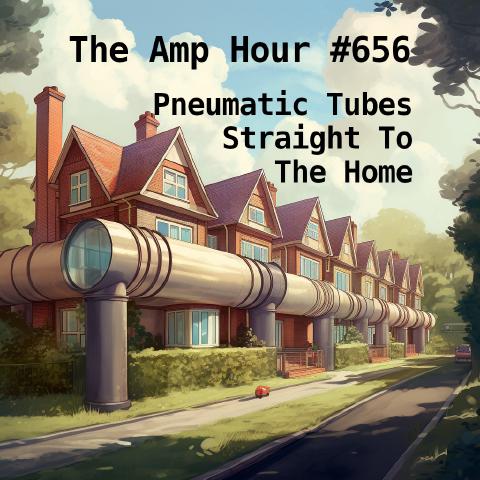
#656 – Pneumatic Tubes, Straight To The Home
Download episode · 69 MB
Also on Apple · Spotify · YouTube · RSS
Show Notes
- Dave just drove 4500 km / ~ 2800 miles
- Dumpster room tier on Patreon?
- Hyperloop failure
- Florida train video (Wendover)
- Pipedream
- Series of tubes
- Guam capsize
- Hugo site builder, based on Go
- Dreamweaver
- Chris recommends buying a foldable lightbox (Light this)
- Chris's blog post when he was going to meet Dave for the first time
- Dehumidifiers are raising money based on ridiculous hype
- Spec Sheet for Genesis Systems
- Chris just got a chest freezer, was surprised at the low energy needs
- Power charges
- Texas grid article on NYT after recent deep freeze
- Energy mix in NC
- Beta voltaic
- Used for aerospace
- Bantam Tools (Bre Pettis) acquires Evil Mad Scientist (Lenore, Windell)
- Vulnerabilities in the ESP32 RISC V parts
- Will people make tools to make it easier to crack into something, like discussoned the CAN episode with Ken Tindell
- Dave might get a free pick and place, the TVM920
- Video about the 1980s "drink robots"
- Chris's daughter is really into robots and gondolas
- Pool robots videos on EEVblog2

Transcript
Chris Gammell: This is The Amp Hour Podcast. Released January 22nd, 2024. Episode 656. Pneumatic Tubes, straight to the home.
Dave Jones: Welcome to the Amp Hour. I'm Dave Jones from the EEV Blog.
Chris Gammell: And I'm Chris Campbell of Contextual Electronics.
Dave Jones: I still remember how to do it.
Chris Gammell: Yeah, you do. Welcome back. Welcome back. How was your holiday?
Dave Jones: Happy New Year. Good. Good. Yes. 4,500 kilometers of driving. Wow. Yeah. Yep. I don't know. What's that in miles? That is not a small amount. You have to divide that by one point.
Chris Gammell: A considerable amount.
Dave Jones: Yes. 3,000 miles maybe. Yeah.
Chris Gammell: That's basically like driving across the US once. Right. Yep. Yep.
Dave Jones: Yep. That is equivalent to driving across Australia once. Yes. Yeah. Right. Yeah. Someone said, oh, is that the same as driving across Australia and back? I went, no, it's one way. No. Don't do that. Yep.
Chris Gammell: Nope. It's a great time to book a short flight. Right. A short six-hour flight.
Dave Jones: You know what I thought about? It briefly, this foolish endeavor briefly entered my mind.
Chris Gammell: I'm sure you had a lot of time to think on that kind of drive, you know? Yeah. Yes. Exactly.
Dave Jones: I was driving. I don't remember the year, but my mate, Tricky Dick Smith, he once set the, I don't know, it's not really a world record, but he was the first to drive across Australia in an EV. Oh, interesting. And this is back when EVs weren't a thing. You know, you got, well, you know, they were basically one of those university research things. No, no. It was basically one of those university research things or something. I don't know where he got the actual EV from, but it was back in the 80s, I think. Yeah. Late 80s.
Chris Gammell: Not trying to drive across the Outback in an experimental vehicle. Experimental vehicle. That's some breaking new ground kind of thing that I am not an adventurer type. I'm not sure if that comes true for me.
Dave Jones: Yeah, no, he's the adventurer type. He's famous for adventuring. He set many world records, many, you know, around the world solo in a helicopter, first person to do that, second person to do it as well. Well, he actually ended up doing it four times, you know, because once wasn't enough. So he said that the third and fourth times were much easier because he had GPS. So, and his family went with him, I think, on the third and fourth time. So, yeah, I think that was maybe the condition. None for me, thanks. None for me. The GPS was maybe the condition of the wife. Oh, yeah, I'll go, but we have to have GPS.
Chris Gammell: I mean, so what did you do on this? I mean, like, is that a lot of podcasts or like were you listening? Did you listen to the whole Amp Hour Back catalog? What kept you busy that all time?
Dave Jones: Well, no, I just downloaded some, you know, stuff during the...
Chris Gammell: Come on, Dave, share your playlist. What are you listening to these days? No, I'm not going to share my podcast playlist.
Dave Jones: No, because there's nothing that you would... It's only stuff that would invite controversy, let's say.
Chris Gammell: Conspiracy theories. That's what I'm hearing here. Okay. Yep. Yep.
Dave Jones: UFOs and the government... The tinfoil hat driving hour. ...and tinfoil hat stuff and... Yep. Yep. The wef and the, you know, and the lizard people and the... Yep. Yes, of course. Of course. Okay. Absolutely.
Chris Gammell: Well, hopefully you got your fill. Yeah.
Dave Jones: Sorry, no electronics. I don't think I listened to any... Oh, no, I did listen to some... I mean, it's not like there's a... A couple of engineering... Well, they weren't podcasts. They were YouTube videos. So I didn't... Got it. I don't think I listened to an actual podcast. I think I listened to YouTube videos, but I didn't watch them.
Chris Gammell: It's catching on. Yeah. Yeah.
Dave Jones: What? Podcast or YouTube? Podcast. Podcast, yeah, yeah. Yeah, podcast or catching on, yeah. Yeah, yeah.
Chris Gammell: I wouldn't know. I barely listen to anything these days, you know. Yeah.
Dave Jones: See, the thing is, it wasn't just me. You know, I had the family in the car as well. So it's not like I can, you know, just stick the earbuds in for six hours and, you know.
Chris Gammell: Got it. Got it.
Dave Jones: Yep. Yeah. But it does help with the monotony, though. Yeah. Yeah. When you're actually driving. I, you know, if I'm not like talking to someone or if I'm not, you know, singing or I'm not, you know, if I don't have some podcast on or something, yeah. It's, you can really start to drift, you know.
Chris Gammell: If you're new Patreon members for the Amp Hour, you actually get an unedited 40-hour recording of Dave singing in the car.
Speaker ?: Right.
Chris Gammell: Don't laugh.
Dave Jones: People will actually sign up and go, well, where's my 40 hours of.
Chris Gammell: I know. I know. I know. Yeah.
Dave Jones: I did that mistake.
Chris Gammell: See, this is the extras that people pay for. Yeah.
Dave Jones: Yeah. Well, did I ever tell you about the time that I jokingly included a thing in one of my, was it Kickstarter or one of my Indiegogo? No, I'd never used Indiegogo. But, you know, one of those crowdfunding things. I included a joke tier. It was obviously a joke tier. But somebody emailed me and said, hey, I'm interested in paying the $5,000 for this thing. Like, it was like $5,000 and I can give you a tour of the, a personal tour of the dumpster room and I would buy you lunch.
Chris Gammell: Yeah, I think I do remember that. Yeah. Yeah.
Dave Jones: And somebody actually emailed me and said, hey, I would love to take you up on that.
Chris Gammell: That's why you got to go big, man. You got to do, you know, like when you're running a Pepsi contest and you're joking about a Harrier jet, make sure you get the points calculated correctly.
Dave Jones: Yes. Oh, God, I remember that. Yeah. Yeah. The Harrier jump shit thing. Yeah. That was, that was Pepsi, was it? Who was it?
Chris Gammell: It was a, it was a Pepsi contest. It was like, you had to screw the cap off. And then someone, they, I think they found a loophole or something. I don't remember all the details, but I do remember they sued. Right. And they won. Yes, they sued them.
Dave Jones: And they won.
Chris Gammell: Yeah.
Dave Jones: Did they, they had to pony up like 10 million bucks or something, didn't they?
Chris Gammell: I, yeah, I think maybe it got reduced on a technicality or something like that. But they won.
Dave Jones: Yeah.
Chris Gammell: They definitely, yeah. Pepsi was in the wrong. I know that. As a kid who wanted to be in a Harrier jet, you know.
Dave Jones: Yeah, exactly. Oh boy. Anyway, for those wondering, no, I did, I declined the $5,000 to go to the dumpster room because I did my research on the, I thought, you know. And anyway, it turns out, yeah, there might've been some conspiracy theories involved. So, oh, not, not, not really. It might've been maybe some free energy involved, if you know what I mean. Got it. Got it. Yes, yes. So the person wanted me to, yep. Yeah. Validate their free energy or something like that. Oh boy. Yeah. Be careful what you, be careful of the hype. Hype.
Chris Gammell: Hype.
Dave Jones: Segue. Segue. Segue. Segue. It's 2024 and still. No flying cars. Dude, they never end.
Chris Gammell: Oh, is this going to be at solar, solar something, something?
Dave Jones: Well, there is. I wasn't going to include that. Oh yeah. Thanks for reminding me. Yes, there is.
Chris Gammell: Dave just actually downloaded thousands of hours of himself ranting about solar roadways. Yeah.
Dave Jones: Well, Hyperloop went bust. Virgin Hyperloop won. Well, Virgin had actually pulled out. No doubt that was going to happen.
Chris Gammell: Yeah. Okay. Yeah.
Dave Jones: Finally went bust. Um, but I did a video on that and there's still like five other Hyperloop companies officially. I think there's only like one or two that are still like actually really serious. Yeah. But still.
Chris Gammell: I just, I mean, whenever this stuff comes up, I just like, I'm like pointed that stuff and like, oh, we're going to, you know, put a vacuum tube all the way across the United States or wherever they're saying about it. Yeah. And at least in the U S we can barely put metal across railroad ties. Exactly. Get a train to go above a hundred miles an hour across it. So like, come on.
Dave Jones: What is the fastest train in the U S it is the Acela express.
Chris Gammell: And it goes from, I'm surprised that you know this. Uh, it's, uh, I like trains. Uh, I've always wanted to ride this one. Uh, it's also the most, it's very expensive to ride on. Oh, really? Which is, it's, it is like the most backwater. Oh, it's just terrible in the U S there's like, I think, I think Wendover has a couple of things about it. And there was, I think there was a video recently about where trains actually have succeeded. And surprisingly it was in Florida. It was like, there's actually, there's actually a quasi, not like high speed, high speed, not like China high speed or Japan high speed or even Europe high speed. It's like high speed for the U S and it's in Europe. It's in Florida between like Miami, Tampa, and I forget the other city, but it's like three relatively large. Yeah. Yeah. Yeah. The relatively large metros and like a lot of people and it, it, you know, it's flat ground too. And it's, you know, you gotta watch out for the haters, but I'll link it in once I find it, but yeah.
Dave Jones: Awesome.
Chris Gammell: Florida train video. Uh, yeah. Yeah. Trains in the U S it, the fastest one is the Acela express as far as I know. And I believe it goes DC, New York, Boston.
Dave Jones: I think that's the, once again, major centers and how fast does it go? Like a hundred mile an hour or something?
Chris Gammell: I think like one 25 is where it tops out. Okay.
Dave Jones: Right.
Chris Gammell: Yeah. So like nothing compared to like China. Right.
Dave Jones: So it isn't even hitting 200 Ks an hour.
Chris Gammell: No, there's true. I think, I think by, um, actual measures, it's, there are, there is no high speed service in the U S there is the fastest in the U S which is the Acela, but it's not high speed
Dave Jones: by any, um, outside of the U S standards. Right.
Chris Gammell: Yeah. Yeah.
Dave Jones: Okay.
Chris Gammell: It stinks. I love trains. I mean, come on. Like who doesn't love trains? Yeah. No, trains are cool.
Dave Jones: Yeah. Totally.
Chris Gammell: Yep. There's all this stuff about like, uh, freight in the U S as well. Like how freight takes priority and how they're extending trains and all the, the, what are the, the off track they call it. I forget what they call it when like a train has to pull up to one side when it's just one track, but like the trains are so long that they still block even when they're pulled off to the side now.
Dave Jones: Oh, right. They still block the line. Yeah.
Chris Gammell: It's, it's, it's a crazy thing. Like I said, Wendover is, we've mentioned that hundreds of times on the show already, but like my, one of my favorite YouTube channels. Yeah. Totally. Yeah. Cause he covers all that sort of stuff. Yeah. It's great. That's right. Yeah. Logistics.
Dave Jones: Speaking of which they, uh, freight, they couldn't even succeed when they actually, uh, pivoted when Hyperloop one actually pivoted to freight instead of passengers. They still couldn't.
Chris Gammell: It's like a pneumatic tube, like in a, like an office building, you know, when you're, yeah. It's funny that someone like looked at that and like, no, we can put people in there.
Dave Jones: Yeah.
Speaker ?: Yep.
Chris Gammell: I found a mouse in there once it was dead, of course, but you know, it got through that tube pretty fast.
Dave Jones: Well, did we ever mention that company? I can't remember the, um, like a pipe dream. I think the company is called pipe pipe and it's got pipe in their name.
Chris Gammell: That's a pretty good name actually. If it was pipe dream. Yeah.
Dave Jones: But it's literally a pipe dream. And the, and the CEO actually wanted to come on my show and actually debate it. And I went, no, it's just free publicity for you, dude. You're, you're just going to. But he was serious. Like he was actually, he genuinely believes that like he started this startup that. Yeah. You have to. You have to be true believer. You have to actually deliver and like Amazon and other, uh, packages by pipes and people would, would go to these little, it wouldn't go straight to your home. Cause you know, having a pipe going to every home is kind of ridiculous. So. I don't know.
Chris Gammell: I think the internet goes to our homes, Dave. And I believe it's a series of tubes.
Dave Jones: It's just a series of tubes. Yeah.
Chris Gammell: Yeah.
Dave Jones: Or tubes.
Chris Gammell: Tubes.
Dave Jones: Oh my God. Who said that? Who was that?
Chris Gammell: Uh, I believe that was an Al Gore quote.
Dave Jones: Al Gore. Was it? I knew it was one of the US politicians. Yeah.
Chris Gammell: I think so. Yeah.
Dave Jones: Or was it, um, yeah. Yeah. Probably. Anyway, it's just a series. Internet's a series of tubes. Very mean worthy.
Chris Gammell: But yeah.
Dave Jones: Anyway. Yeah. It failed. And then like 2024 is here is still here. And you mentioned solar freaking roadways and yes, they're still going, of course, in their 18th. I think this is their 18th year. So round of applause, please. A golf clap for, um, solar freaking roadways. The, uh, brew saws who are, you know, they're, they're still going. They're sucking that government teat. And, uh, I do believe they are still operational. So. Yep. Okay. Milk. Milk and the next funding round. Yeah. Best of luck. Yeah. I was wrong.
Chris Gammell: Sorry. It was not, it was not Al Gore. Sorry. It was a U S Senator Ted Stevens. I got that wrong.
Dave Jones: Oh, really? Ted Stevens.
Chris Gammell: I didn't know what that was.
Dave Jones: That's not the name I associated with that. Okay. Anyway, it's a series of tubes. I just heard that the other day. Somebody put it in a video somewhere. Yeah. Yeah. People love to make fun of politicians. What was, who was that U S politician who thought that, uh, Guam, the Island of Guam would capsize because they were putting too many, they were building too many things on it. I'm not getting, have you ever seen that? Have you ever seen that video? He was like, he was in Congress or something and he had like a general in there or something. And he was like, uh, grilling this general about why you're putting things on. I think it was Guam. And, um, I'm pretty sure. And he said, is there any, you know, I, I fear it might actually, the Island might actually capsized and the general had to try and keep a straight face.
Chris Gammell: That's representative Hank Johnson out of Georgia. That's there. You go.
Dave Jones: Right. Yeah. Yeah. You can actually watch the video.
Chris Gammell: I didn't hear that. No, it was a 20, 2010 that happened. So that's a way. Actually, that is before the show, Dave. It's before the show.
Dave Jones: Oh, it is really. There you go. Anyway, very cringeworthy.
Chris Gammell: Yeah. That's pretty bad.
Dave Jones: That's the caliber of politicians actually, uh, doing this sort of fast. But, uh, uh, uh, hi to all my viewers in the, all my viewers, our viewers, used to the EV people. Listeners.
Chris Gammell: Listeners for us, Dave.
Dave Jones: Listeners. Listeners. Not even viewers. Right.
Chris Gammell: Dave refuses to turn video on for our recording. So.
Speaker ?: Yeah.
Dave Jones: No, it's just a waste of time.
Chris Gammell: Just. Got a face for video.
Dave Jones: No. Yep. Exactly. For radio rather. Yes. The Netherlands, um, they've opened two new solar bike paths, even though they've opened four before and they've all failed. Um, and so, and solar roads in the Netherlands that also failed and they went bankrupt. Somebody actually, after I did the video update video on this, somebody sent me the thing saying, oh yeah, they've actually gone.
Chris Gammell: Do any of them ever like, okay. So like the, the idea of like a raised, raised covered, you know, walkway.
Dave Jones: No, that's only sensible countries like, like Germany that have that.
Chris Gammell: Yeah, I know. But like when someone like approaches them with that though, and just say, well, why don't you just put it up? What do they say?
Dave Jones: I, and it's not innovative enough. It sounds too ordinary.
Chris Gammell: Too straightforward. Too.
Dave Jones: We already do that. Yeah. Cause they, they, they, they look, no, they're looking to put, the politicians are looking to use that money they've got for innovation in quote marks. Uh huh. And just put in roofs on top of, you know, car parks and, and, uh, bikeways. That's not innovative. That doesn't excite them.
Chris Gammell: What if you made it a different color or you put some screens on it or something?
Dave Jones: Something like that. You've got to do something innovative. It's got to like. Got it. Got it. Yeah. Yeah.
Chris Gammell: Okay. Well, there you go.
Dave Jones: Sorry. That's why you don't get any government funding, Chris. It is true. No government funding for you.
Chris Gammell: So this is something I wanted to bring up about. So, uh, you know, 2024 new year, uh, I am on parental leave. I'm spending a little bit of time. Oh yes. That's right. So I'm, I'm out, uh, and I'm trying a new web framework for myself, which is not that exciting in and of itself. I'm sorry.
Dave Jones: What is a web framework?
Chris Gammell: I don't actually know if frameworks is the right term, but basically it's like, uh,
Dave Jones: sounds like a way to term.
Chris Gammell: Yeah. It's like a blogging platform to be honest. It's like a static site generator sort of thing. Okay. Like Jekyll is a very popular one. Uh, I'm trying out Hugo, which is based, it's written in go. And basically it's just like, you know, you, you have a bunch of markdown files. It generates a site for you. You can like synchronize it for GitHub. It's, it's quite nice. Actually. Uh, my friend Dan told me about it.
Dave Jones: Uh, and someone mentioned it for me. Yeah. The world's fastest framework for building websites.
Chris Gammell: It's it is, it is shockingly fast. And like, once you get into the flow, like it's does not as so like you and I have been WordPress denizens for a very, very long time. That's how the empire is done as well. And like, it's great. Uh, you know, there's, especially if you have like a couple of people, like having like the content management backend where like you can share and everybody has logins and stuff like that. That's where it's just really more sense. Yeah. And this would be more like if we were generating files and using GitHub and like, so like if I pushed a new version, you'd be able to see it on GitHub, whatever. And then when we're ready to push it to the, to the cloud, you basically commit to the main branch and it does, it does its thing on the backend.
Dave Jones: Well, people have actually recommended this to me, like these static website generators to me, because my forum is so massive. My website is so massive in terms of the database size. Cause people don't know the static website. It basically just generates a HTML page for every page. Whereas WordPress and the simple machines forum that I use and other, uh, they're all dynamically generated. Every time somebody sends a, a request through to the website, that, that actual request has to go to the database and then they've got to build the page. They've got to dynamically build the page in real time. And when you have 10,000 people bombarding your website at once, that's 10,000 database requests. And then it has to assemble the page. It's a bottleneck. It's a huge bottleneck. And I've, I've been hitting those limits recently. I just had to upgrade my server hardware because we're just getting too much, uh, traffic and everything.
Chris Gammell: I don't think, I mean, you wouldn't use a static center generator for like a forum because it's just moving so fast, right? You'd have to regenerate everything there. But like your blog. But certainly for the website.
Dave Jones: Yeah. Yeah. The, uh, WordPress website. Everyone's going, why do you, why do you use that? I'm going to be honest.
Chris Gammell: This doesn't feel like a Dave thing. Uh, no offense, Dave.
Dave Jones: No, no, it's totally no. I, I, I just don't want to go there. That's why, that's why I upgraded the hardware on the forum and now my website is super slick. Yeah. Totally.
Chris Gammell: That's the way to do it. Yeah. Yeah. So this sort of thing that like, if you're making, so like if you're a website and you're changing it, like, I don't know, once a year or like less, like I am for my personal website or my consulting website, whatever.
Dave Jones: Usually we, we just generate a project and we just dump the info on there and we don't touch it for 20 years. Right. That's right. Exactly. Yeah.
Chris Gammell: I mean like, yeah, I think what the alternate zone is still around, right? Yeah. Yeah. Which is basically how that was written. It was like static HTML. It's static HTML.
Dave Jones: Well, not necessarily hand coded. I did, did use a Dreamweaver at one point. Hands up if you use Dreamweaver.
Chris Gammell: Oh man. That gives me all the feels. Yeah.
Dave Jones: I thought that was the duck's guts. I did start out hand coding, but then I discovered Dreamweaver. Wow. A gooey interface for making websites. Dreamweaver.
Chris Gammell: Yeah. Steve Miller, man.
Dave Jones: Oh, right. Yes, of course. Yeah.
Dave Jones: Yeah. Yeah.
Chris Gammell: Yeah.
Dave Jones: Anybody's still there, right? I mean, that's the thing. Yeah, yeah. It's still there. Pages are still there. But anyway, so Hugo, you've been using this. Why? I've been trying it out. What was the reason for the change?
Chris Gammell: I just wanted to try it out. I had a bunch of problems with my, so my WordPress site kind of got too old and I switched it over and I had a bunch more problems with it. And I was like, okay, I'll give it a shot, whatever. And I was like, okay, well, I'll target my consulting site and start to put projects on there. And so now what has become is beginning of 2024 is me doing a retrospective because I'm trying to put all my projects. You know, we've talked about your one friend who like tracked every single PCBs ever made.
Dave Jones: Oh, has the, or every project he's ever done on his website. Yeah. Yeah. That's awesome.
Chris Gammell: That's what I should have been doing. Yeah. But now I'm trying to do it in 2024. Right. Looking back through Google photos and old emails and like reaching out to people. And yeah, so like I should have been doing this the whole time, but I did not. And now I'm doing it. And it's disappointing. I'm going to be honest. I'm like, I have this like image of myself as somebody who like makes a lot of PCBs, does a lot of stuff. I'm like, oh, I did like two PCBs that year. Okay. All right. Well, you know, and that one wasn't that good. That one never went anywhere. And that one never went anywhere. You know, it's just like. Yeah.
Dave Jones: But it's worth documenting that sort of stuff. Yeah. Especially. Right. Especially if you're, you know, some newbie after a job. Right. You need to have a website that documents all your projects.
Chris Gammell: I think that's right. Even if they went. I think that's. Even if. Yeah. I think even if my site doesn't pan out how I want it to be. I think if people are listening and they learn nothing else. It's start now. The best time is 20 years ago. The next second best time is right now. And yeah. Documenting that stuff. Even if it is still on your computer. Like having it all in one place. That would have even been useful too. Just to have it like all in a Dropbox folder. And be like. Oh. Yeah. Project one for client A is like. Yeah. Right. Right. I just go there and I see all this stuff. You know. And it's all spread across lots of different places. And I. You know. And like we never really take. Like the photos are always just like kind of. I should always put them in a light box too. Like. That's. That is an investment I highly recommend. And one that sits folded up in the corner. Way too. Yeah. Light box. It's like for taking like product photos. Oh. Right.
Dave Jones: Okay. Right. Yeah. Yes.
Chris Gammell: Yeah. For like 75 bucks. You can get like a really. Decent size one. So like. Yeah. I have one that's probably. I don't know. 600. 600 by 600 by 600. You know. Or two foot by two foot by two foot. And like. You know. It folds up in the corner. As like a flat pack thing. And then it just sits there. But then it's got LEDs built in. All the reflective material. And like you can make stuff look. With that in a smartphone. You can make PCBs look like really good. Yeah. And without any trying at all. So. I do recommend that. Again. I'm. Do as I say. None as I do. Right. But I do have all my old PCBs. So I will also probably be taking a bunch of photos of PCBs. And. And those will go on the website. So.
Dave Jones: Got it. So yeah. The main page on your website is ridiculously long.
Chris Gammell: Which website?
Dave Jones: Oh no. Is this still WordPress? Your. Everything is still WordPress. ChrisGammell.com.
Chris Gammell: That's all WordPress. Oh is that all one page? Yeah. Yeah. It's all one.
Dave Jones: It's massively long.
Chris Gammell: Oh I switched to a different theme. And yeah. Ah right.
Dave Jones: And you just didn't tie it right.
Chris Gammell: Yeah. Yeah. Yeah. Yeah. Yeah. Yeah. Oh man. Yeah. I still have a blog. It's weird to think about that. Right. Oh that's great. Oh look there. Your face is on my blog. Look at that. My face is on there. Dave and Chris meet. Yeah. All right. April 6th 2017. Oh there you go. Blung a little glass on the sea floor. Jeez. Link that in. That's when Dave and I met. It's like. Oh yeah. It's like feeling all these emotions about meeting Dave finally. You know. And I was like. Oh you know. There he is. That was at the airport. Yeah.
Dave Jones: Right.
Chris Gammell: That's right.
Dave Jones: I was coming to meet you at the carousel. And then all of a sudden I got a tap on the shoulder.
Chris Gammell: Bingo. It was you.
Dave Jones: Yep.
Chris Gammell: Yeah. Looming over you. Four feet taller than Dave. As that photo shows. Four feet taller. Yeah. Oh boy. Yeah. Nice. I know. And that's the other thing too. Is that like. So like that's 2017. I'm like. Oh yeah. It was like last year. She's like. No Chris. That was seven years ago now. Yeah. Yeah. Scary. Yeah. It does. It does fly by. It is. It's all flying by Dave.
Dave Jones: Anyway. It's 2024.
Chris Gammell: Yeah. I still had not.
Dave Jones: I still had not continued my rant.
Chris Gammell: Oh sorry. Yeah. Go for it.
Dave Jones: It wasn't just solar roadways dude. Okay.
Chris Gammell: Not just solar roadways. Okay.
Dave Jones: Dehumidifiers are back. Made all the hype. Oh God. The number of people who linked me to this. It's Twitter. There's a company called the. It's the water cube. But WC 100 from Genesis systems.
Chris Gammell: Pulling fresh water out of the air.
Dave Jones: Fresh water out of the air dude. It's a dehumidifier. And people. It featured at CES. They had this big stand at CES. Oh my God. And it went viral on Twitter. It was getting millions of views. And like. That's it. The commentators that I actually listen to. They're raving over it. Right. Oh you can buy. You can now buy this machine. That generates all your fresh water for your house. And it's. Oh God. No. No. It's a dehumidifier. Somebody. Yeah. Re-does it every year. And you know. They just got lucky. And the press went. Oh goo goo ga go over this. It's $20,000. And it pulls. I don't know. 500 gallons a day or something. Is their claim. 500 gallons a day. Is their ridiculous claim.
Chris Gammell: That is a lot. I mean if you live in like.
Dave Jones: Yeah.
Chris Gammell: I guess Durham in the summer. Or you know generally North Carolina in the summer. Yeah maybe you could pull. Depending on how big your compressor is.
Speaker ?: Sorry.
Dave Jones: A hundred gallons a day. A hundred gallons a day. Still.
Chris Gammell: I mean like that's still a ton of water. Right. I mean that is a lot of water.
Dave Jones: So the claim. And I like. Their data sheet. I will link you in.
Chris Gammell: 370 liters for you. Non freedom units.
Dave Jones: There's the data sheet for you. And it's a bit underwhelming. The data sheet. And yeah. That weighs 600 pounds. And it only takes six kilowatts. Only six kilowatts.
Dave Jones: Only six kilowatts.
Dave Jones: Okay. Only six kilowatts to generate. And of course. There's no mention on the website. The data sheet. Anywhere else. That the hundred gallons per day. Is totally dependent. Upon everything. It's dependent upon the dew point. The temperature. The pressure. Right. Exactly. The location. The time of year. Oh my God. Oh my God.
Chris Gammell: 600 pounds. Yeah. That's huge.
Dave Jones: Yeah. Yeah. Yeah. Oh man. This thing's a beast. Yeah.
Chris Gammell: And they claim that they have bigger ones.
Dave Jones: You can't actually buy it yet. You can put down a deposit. You see. You can put down a 500 bucks deposit. And everyone's just going ape over this thing. It's just ridiculous. And there's no mention of. They mention it has UV water treatment. But what about the minerals? You've got to add minerals. Yeah. Right. To dehumidify water. Right. You've got to add stuff in. No mention of that.
Chris Gammell: Right. Right.
Dave Jones: And it's just. Yeah. Any company who doesn't actually tell you. Under what operational conditions. You're getting your gallons per day. Liters per day. Then just. No. Avoid.
Chris Gammell: I am. Speaking of compressors. I just bought. We can go back to your ranting. Don't worry. Okay. We just bought a deep freeze here. Because we're just kind of. Growing family.
Dave Jones: As in. Deep freeze.
Chris Gammell: Deep freeze like a chest freezer. Like a chest freezer. Like a chest freezer.
Dave Jones: Thank you. Yep.
Chris Gammell: Yeah. And not a big one. So like. Five. They're really great. I'm not. I'm not sure what the. Sorry. The metric using it is for that. But you know. It's basically. It's not that big. It fits in a closet. Right. That's. That's the only space we have. Really for it. And. I'm really impressed. At like. How little it costs. To operate one. All year. No.
Dave Jones: Five air. Super efficient.
Chris Gammell: It's like 30 bucks a year. Yeah. You know. Like they're. And it's pulling like. I think it's only pulling like. Yeah. It's not much. An amp. An amp at steady state. When it's like. Just running.
Dave Jones: When. When the actual compressor's on. Yeah. That's right.
Chris Gammell: Yeah. administered. Super efficient.
Dave Jones: And opening the door on the things does nothing. In fact, you can leave the door off. You can leave the door off and it's probably only going to take about 10% more power because the freezing settles and the hot air, you don't actually need the lid on it. That's why you can go to the supermarket and they have those open freezers. Yeah, right, right, right. It's the same thing.
Chris Gammell: Yeah. Yeah.
Dave Jones: Yeah. Whereas your regular fridge freezer, which is an upright one, as soon as you open the freezer door on that, whoosh. Mine is a drawer and so it all falls off the bottom. Yeah, same here. Yeah, yeah. It's a drawer and the handle is broken so you've got to grab both sides and you've got to pull it out. Oh, no, I don't. Okay.
Chris Gammell: I'm sure that's coming. Right, yeah. I'm going to have teenage and pre-teenage boys. Yes. Yep. Yep.
Dave Jones: Oh, boy. And as soon as you open the door, whoosh, you've just lost a ton of energy. Yeah, exactly. Then you need to recoup that energy by, you know, then you have to expend that energy again to freeze it back down. Whereas those chest freezers, yeah, very efficient. And you just open the lid and it does nothing. It's great.
Chris Gammell: And I actually, I plugged, I bought like a kilowatt. Oh, a meter, I think. Just a little power meter that plugs in the wall in line. Yeah. And yeah, you program in your electricity rate too. And like the couple of weeks I've had it on, it's been like a dollar worth of electricity. And just like, I think that's the other thing too, is just like it points out just how cheap power is. It's like only 11 cents per kilowatt here.
Dave Jones: 11 cents.
Chris Gammell: Yeah, it's not the cheapest, but it is pretty cheap.
Dave Jones: I just renegotiated. Well, I changed companies. For my lab here, for the power for the lab, I was paying 43 cents per kilowatt hour.
Chris Gammell: Wow, that is more. That is 4X what I'm paying, Dave.
Dave Jones: I'm now down to 34 cents per kilowatt hour. Wow. Hopefully. I just changed like the other day. I haven't got my-
Chris Gammell: What's your average bill for like your lab?
Dave Jones: Oh, it's about 400 bucks. It's not like, it's not huge. 400 bucks per quarter.
Chris Gammell: Wait, these are Aussie, but these are dollar a dues though.
Dave Jones: These are Aussie bucks.
Chris Gammell: Oh, okay. So then also, yeah. Okay. So then a little-
Dave Jones: I'm paying maybe 20 cents, 22 US cents. Yeah, that sounds right. Yeah, but no, that sort of power here in Australia is unheard of. Wow. Unheard of. Yeah.
Chris Gammell: Yeah. Yeah. There's been interesting stuff in the news here as well about power. Where does most of your power come from?
Dave Jones: Oh. Where in- I presume- In my house? Your state generates its own power.
Chris Gammell: Oh, in the state, it's a lot- Everything in the US is switching over to natural gas. Really? And there was an article about how that saved Texas's- You know how Texas grid fell over three years- Two years ago, three years ago? Yeah. They basically- I didn't realize this. One of the root causes of that was that the natural gas lines froze during their- Oh, wow. They had like a really big dip. Really? And because that's like a lot of the instantaneous power- Right. That ended up-
Dave Jones: It couldn't switch on and it took the grid down, yeah.
Chris Gammell: Yeah, right. And then that always cascades as well. Yeah, yeah. And so in the US, like natural gas is like super, super critical right now. And so coal's going offline and renewables are- You know, they're still doing their thing. But obviously in the winter, that's really tough still. And especially at peak loads. So like gas is a huge, super huge part of mix in the US.
Dave Jones: Why don't you dudes just make more nuclear plants? I mean, you've got- I wish. I know Dave.
Chris Gammell: I'm in. Just, it's not there. I don't know. I think it's a lot of bad feels. It's a lot of politics, yeah. As it always is. Yeah, a lot of politics, yeah.
Dave Jones: Everything's politics. Everything to do with energy is politics.
Chris Gammell: I agree, I agree. Yeah. I was also surprised in that article that was talking about Texas is leading the nation in wind generation. And it has been for many years. So I'll find that article. Right. Yeah. But kudos, Texas. But it's still tough, right? I mean, like I said, in the winter, just wind doesn't do as well in the winter. I was actually thinking about that before we started recording too, because obviously right now, this is a huge load. You know, it's been really cold where I am in North Carolina. I've gotten a couple texts about like, hey, please watch your power usage, whatever. Turn off your stuff. You know, like how they send that stuff out. And that actually does have impacts, which is good.
Dave Jones: Oh, yeah. Yep.
Chris Gammell: But, you know, so the heating is obviously a huge part and a huge stressor on the grid, but more consistent. And then your time of year, you are in the middle of summer right now.
Dave Jones: We're in the middle of summer. But even in the middle of winter, like cold is not a problem here in Sydney.
Chris Gammell: Sure, sure, sure. I just meant because the heat is so extreme there and because inductive load.
Dave Jones: Oh, we had to do that here. Like in the middle of peak day, they go, can you please? Just be like conservative with your air con, you know. Can you set it a couple of degrees higher and, you know. Yeah, right, right. But I know people whose energy bills are like, you know, $4,000 and stuff because they just have these huge houses and they leave their air cons on 24-7. They've got fully ducted air cons and they climate control their house 24-7. And they wonder why they have big power bills.
Chris Gammell: That's insane. I know. It's crazy. $4,000 a month? Wow. Even in dollary dues, that's a lot. No, not per month.
Dave Jones: That'd be per quarter.
Chris Gammell: Oh, okay.
Dave Jones: Yeah.
Chris Gammell: Oh, is that how you're paying there?
Dave Jones: Really? Yes. Yeah, we don't pay per month here. No, it's always per quarter.
Chris Gammell: Oh, interesting.
Dave Jones: Energy, gas, it's all per quarter, yeah.
Chris Gammell: Yeah, yeah, yeah. Interesting. I didn't realize.
Dave Jones: Oh, totally different. I didn't know you guys paid monthly. There you go. Learn something new.
Chris Gammell: Culture's coming together. All right. Back to 2024. You were pissed about it.
Dave Jones: I was pissed about it. And yeah. And not only, right, the beta-voltaic batteries are back, right? I'm sure you-
Chris Gammell: Is that the nuclear- The nuclear diamond battery.
Dave Jones: The nuclear diamond battery.
Chris Gammell: Yeah, nuclear diamond. I didn't, I saw it. I'm like, come on.
Dave Jones: They're back again. Chinese company. People see this stuff and they're just like- They go mad. Don't they ask questions? No. They just go mad. When do we hear about this more? Is this because of CES? Is this the problem? Is CES the problem?
Dave Jones: Boy. And no, this was not CES. This was just, it just, people want to believe, you know, people want to, oh, this Chinese company's cracked it. We'll have nuclear, our phones will be nuclear battery powered. And then you go and read the article. Yeah, it's another beta-voltaic battery. Yeah, it's only 100 microwatts. And yeah, it's not, they don't even have pre-production yet. But it's like in pre-testing.
Chris Gammell: Yeah.
Dave Jones: It's not even pre-testing. And they're talking about this is going to, oh my God, this is going to revolutionize the world. And of course, beta-voltaic batteries, you've been able to buy them for decades from companies like City Labs, I think. City Labs is one of them. Yeah. They make one in a dip package in a, like, medical seal gold.
Chris Gammell: Is it used for like a real-time clock or what is it used for? Dip package.
Dave Jones: Oh, they're mainly aerospace. I think if you wanted to buy one of those, you probably can't afford it. Well, you probably can, but you're not going to be wanting to use it. You have to ask, you can't afford it. You're not going to be wanting to put it in.
Chris Gammell: There's no price in this dip package. Like, oh, no, no, no. No, no, no.
Dave Jones: It looks pretty, like it's all gold-plated. It looks pretty specky, you know. Yeah, right. And yeah, so this thing's, you know, a bit better than those, like a bit better density and stuff. But it's the same shit, different smell. It's like 100 microwatts. And okay, 100 microwatts for 50 years, you know, it's a decent amount of energy and stuff like that. But, like, it's not going to suddenly revolutionize everything. Sorry.
Chris Gammell: Dave, I don't want to charge my phone ever again. That's the only thing that people, I never have to charge my phone ever again. It's like, this is the modern inconvenience.
Dave Jones: And it's like, here's a quote from all the articles. The company plans to launch a 1-watt battery in 2025.
Chris Gammell: Yeah, right.
Dave Jones: Well, how about you actually launch the 100 microwatts version first? Yeah. Before you go for it. Like, microwatts, right? And the 1-watt. Like, I couldn't even get a data sheet for this thing. I can't even find the company's website. I wanted to do a video on this. You think I can find any bloody detail apart from the press release? No.
Chris Gammell: No.
Dave Jones: Oh, my God. Just stop it.
Chris Gammell: I would pass something into.
Dave Jones: Stop it, people. Stop. Come on.
Chris Gammell: You don't want to evaluate it, do you?
Dave Jones: Yeah. I didn't like, do I want to evaluate the thing? Ah, bloody hell. Yes. Yeah. Send me one if I was serious. They didn't. They said, just like that, you know, the superconductor thing, that the LK99 or whatever it was, that was like totally really. Oh, yeah. That's back in the news. Yeah.
Chris Gammell: Oh, is it? It's back in the news? It was back in somewhere, yeah.
Dave Jones: Oh, God. Really? Yeah. I didn't know that. Anyway. Anyway, so I did actually put this meme on Twitter and here you go. I'll put it for you. There you go.
Chris Gammell: I'm blissfully unaware, Dave. Oh, I feel so good to not be. That's good. That's a good one. Yeah, that's a good one. Okay. That would be great. That would be great.
Dave Jones: That'd be great. Office space. Yep.
Chris Gammell: Yep. Yep.
Dave Jones: So I'd do the office space meme. Yeah, just stop getting excited over it, please. Like news places, like, but I guess they have to because that's the thing, you know?
Chris Gammell: You know, the thing is like it's expensive to hire people that actually read the stories anymore. Yeah. Wow. Yeah. GPT is just writing all the stories these days, Dave.
Dave Jones: Well, what's the, what's the company? Oh, God. I can't even remember. Did we, I think we talked about this. They went, but it was actually a fraud. It was a, the, hang on. So many things. I don't know if it was a, no, hang on. I've got to search my own bloody channel again. Don't you hate it? Because it won't come into my, uh, fraud. Yes. The, uh, nuclear diamond battery. Yes. Sorry. It was. It's not the same thing. No, no, no, no, no. This is, this is a different thing. Okay. Oh, yes. No, the, the new one's a Chinese company, uh, Beijing beta vault. They're called, right? So that's the nuclear. Chinese. Well, they are, they are using a diamond substrate that they are using a diamond semiconductor, fourth generation semiconductor module to successfully release, you know, that, that's how they convert it into. Anyway. So. Yep. Yep. It's got an isotope of nickel isotope or something like that, you know, some sort of, and it's got a diamond semiconductor converter in it. Anyway, the nuclear diamond battery, did we actually mention this on the air power before?
Chris Gammell: No. No.
Dave Jones: Yeah. They were an outright fraud. They're being sued by the, um, the sec. I call them. Everyone complains that I call it the sec. The securities and exchange commission are actually suing the nuclear diamond battery company. I don't know if that's actually their name, but yeah, they're actually suing them and they're fraudulent. They never had a prototype. They never had anything. And it was big. And they got the funding. They got all this funding because they hired one of these PR firms to generate this, uh, massive, uh, press release, hyping it all up and saying, we've got these deals with these universities and where, you know, we've tested this and it's about to go wild and jump on the bandwagon and invest now. Um, and then every news agent, every news outlet picks it up because it comes from this PR firm, you know, and it's the same thing here, right? This Chinese firm has hired a PR firm to write their press release and then it just goes out. It just spreads out like wildfire to every news agency. And then they go, Oh, we, we, we've got today's exciting new headline, you know, Chinese firm, mass market production. And it doesn't bloody exist, right? They're not even in print. They're in pre-testing, let alone pre-production. You just have to read down the article a bit. Like, Oh God.
Chris Gammell: David, I think the 2024 year is the year you should get off Twitter.
Dave Jones: I can't help it. People are just going to, even if I escaped the internet, people are going to send me letters. They would send me letters in my PO box.
Chris Gammell: You know what will happen? You know what will happen? Is they'll install a tube to your house and it'll show up in one of those pneumatic tubes. Oh my God.
Dave Jones: Oh, please. Pneumatic tubes straight to the home. Yeah. It's like, I just can't keep doing videos on these things. They just, they just keep coming. They just keep coming. Oh, but somebody has to expose them, you know? So I guess it's nice.
Chris Gammell: Yeah. I know you're not a fan. Maybe it's the SEC as well.
Dave Jones: I know you're totally against my debunking videos. You think they're pointless.
Chris Gammell: They're just not for me. It's fine. You know?
Speaker ?: It's fine.
Dave Jones: Yeah. Anyway. Oh yeah. Yeah. And there was the tipper spinning. So no, the, the solar panel that got light from all directions because it bounced off the solar light actually reflects off mirrors and therefore onto multiple solar panels and you can get, you know, a hundred percent efficiency or something. Above a hundred percent. Yeah. Sure. Sure.
Chris Gammell: Sure.
Dave Jones: Yeah.
Chris Gammell: Well, let's talk about some real and positive things. Maybe. Is that okay? Yeah. Sure. Can we switch out of angry mode? Yeah. Yeah. Our friends at Evil Mad Scientist are joining a long forgotten name, Bree Pettis at Bantam Tools.
Dave Jones: Oh, Bree, whoa.
Chris Gammell: Yeah. There's a name.
Dave Jones: I thought he vanished into obscurity on some island there with his 50 million bucks he got from selling MakerBot.
Chris Gammell: Yeah, that's right. He's been the owner of Bantam Tools for a while, which was the circuit board routing company, right? Oh, really? So it used to be Other Mill, if you remember Other Mill.
Dave Jones: Oh, Other Mill. Right. Okay. They renamed it, did they?
Chris Gammell: He bought it and they renamed it Bantam Tools, based out of New York. And now Lenore and Wendell from Evil Mad Scientist are joining as COO and CTO.
Dave Jones: Oh, wow.
Chris Gammell: Because they have a very successful product, the Drawbots that they've been doing have been very, very successful. Right. So, yeah.
Dave Jones: Interesting. Wow.
Chris Gammell: More robots and stepper motors heading to New York. So that's great. So congrats to them, of course. Wendell's been on the show before. Yep. And we've followed their stuff. I remember back in the early days, remember we used to dig through feeds on RSS readers? Dave, do you remember RSS readers?
Dave Jones: Yes, I remember RSS. I still have RSS on my website.
Chris Gammell: Do you remember furiously scouring RSS before we were about to start recording? And then often it would be like Lenore and Wendell from Evil Mad Scientist were doing news aggregation and we're like, oh, yeah, we can just read from this thing. Yeah, yeah, yeah. Yeah. Anyways, great for them. I'm really excited. Excellent. Yeah. It's great news. Great news.
Dave Jones: Bree must be the real deal because he just couldn't keep away. He just couldn't take the money and go to the island and sit there. And now he had to keep doing stuff.
Chris Gammell: I think if Dave or I were doing it, we'd be sipping Mai Tais. But yeah, good for you, Bree.
Dave Jones: Oh, hang on. There's a knock at the door.
Chris Gammell: Please keep the audience entertained. Oh, yeah. This is always, I do great at this. Let's dig through the other lists. So other things that I want Dave to talk about when he gets back. Ah, the ESP32s, the V3, C3, and C6 have been broken open with a side channel attack.
Dave Jones: What's being a broken open? That's all I heard.
Chris Gammell: The ESP32s have been, there's been a published side channel attack where basically you can just kind of rip the memories. Right.
Dave Jones: You can just bypass all the security.
Chris Gammell: Yeah, I mean, yeah. I think I saw a quote about this. It was like, software eventually works, hardware eventually fails. I think that was the quote someone was talking about. And it's like, yeah, I mean, eventually everything can be side channel attacked. But there is a lot of hardware out in the world that is, you know, and the C3 and C6 are also pretty new. So I think that also is potentially problematic. I'm sure it's going to be, I don't know. I don't know how much this impacts like a low cost product, but, you know, being able to extract your memory.
Dave Jones: Sometimes that matters and sometimes it doesn't. Like, you know, people claim that, oh, the Trezor hardware wallet, you know, it's got a side channel exposure or something, you know, insert like hardware wallet here, right? It's got a side channel attack. And it's like, yeah, it does. Okay. Not terrific. But the fact is somebody has to physically get your device first. Like, and that's, and the whole idea is that you have it. Like you physically have it. So it's like the side channel attack is like, eh, okay. Yeah.
Chris Gammell: And for those two, I think like that's also pulling cryptographic keys out. I think this is just dumping the whole flash. So like if you wanted to replicate someone else's product, I think that's, you know, if you think you have right protection on your, on your flash, that's potentially problematic. Got it. Yeah.
Dave Jones: Yeah. But look, if you're trying to protect your product from some company, actually, you know, some Chinese company copying, cloning the thing, right? You're not going to stop them. Like if they want to do it bad enough that they're going to do it. So like, you know.
Chris Gammell: Yeah. Right.
Dave Jones: Right.
Chris Gammell: I do think if you have, you know, then there's other precautions in there. It's like having off board certificate storage and like secure elements, you know, secure elements are more secure than ESP parts are.
Dave Jones: For those who don't know, they actually have physical security in them as well. They put like a mesh over the die and stuff like that. So you can't x-ray them and you can't physically probe them. And, you know, they have extra physical security on top of just the silicon security. So, yep. They're really quite cool.
Chris Gammell: Yeah. Yeah. So I do think the, you know, like your point about having physical access control is something. I think also like if you don't have, you know, network connection for your product, then yeah, it might be more vulnerable to cloning, that sort of thing. So, yeah, it's not super great. But like you said, you know, it's depending on what market you're targeting and stuff like that. Like, you know, probably don't put this into like a government program sort of thing.
Dave Jones: Right. Got it.
Chris Gammell: Don't put it in the X-35 fighter jet or something like that. Right.
Dave Jones: Yeah. And there's also the thing about, well, how much effort do you have to do to actually, you know, side channel attack it? It's not, it's often not that easy. Like there might be some security vulnerability. Oh, somebody's hacked the new Sergeant and Greenleaf safe lock or something like that. Right. And it's like, yeah, okay. It took them two years of research to do that. And they've released this video showing there's this hugely complex method. Well, your average thief who's, you know, trying to hack into your safe is not going to have the tools and the expertise to do this. They would just like slashing and like smashing it with a sledgehammer or an angle grinder or something like that. Like, you know, it's, yeah, that's a good point. It's kind of, yeah. Okay. It happens in theory.
Chris Gammell: Is there a market to commercialize the actual technique of jailbreaking as well? Like, so like the, um, uh, when we talked about the canvas on the amp hour as well, um, right. Uh, trying to remember his name. No, I feel bad about that. Um, uh, Dr. Ken Tindell, uh, search just came through when Ken was on the show, you know, he was talking about the, the, the tool you can just buy on AliExpress, right. You can just buy like a can injector basically. Right. And like that has a lot of value and people will pay for it. And then it's worthwhile to build this thing, even though it's pretty simple. Like it's like a pick processor with a can.
Dave Jones: Once you figure out how to do it, it's easy to make a dedicated doodad to, yeah.
Chris Gammell: That's right. Exactly. And there's like high, high value because you're stealing cars then like maybe the same would exist for safes, but then you, you know, then who knows?
Dave Jones: Well, they only sell on delimited markets. This sort of thing exists with, uh, operating system exploits. For example, I know, I know someone who works in this space, let's just say, um, and there are tools available to, uh, hack into your phone remotely and hacking to your computers remotely. And they use zero day exploits. Um, they're called, which means that the, like it, I said, for example, a zero day exploit on windows 11, right? It means somebody has found a way in can bypass the security on windows 11. That is, and, and windows don't, and Microsoft don't know about it yet. So they can't patch it. That is hugely valuable. You don't just really, you don't just tell the world about that, right? You sell that, you, you, you sell that tool. You sell that exploit for a hundred thousand dollars per license or something like that to, uh, the security agencies. You sell it to the police force and there are, you know, these government and you sell it to other government agencies and they, they actually buy these. There are companies who specifically sell these exploit tools to law, um, agencies. And yeah, and they, you know, the companies that make the products don't know about them.
Chris Gammell: So you think that would be like buying. Yeah. That's, that's interesting. Yeah.
Dave Jones: It's there are. Yeah. They're hugely valuable. If you find one of these zero day exploits in an operating system, it's, it's worth a lot of money to a lot of people, to a certain niche industry. So just saying. Okay. All right. You might want to keep it to yourself. You could be rich.
Chris Gammell: I'm not looking around for those sorts of things myself, nor would I know how to find one. I would not know if I found one, even if it's back in place.
Dave Jones: No, generally these companies don't, that sell these types of, uh, tools, um, don't, I don't really publicize themselves. You've got to be in the law enforcement business to sort of know who they are kind of thing. So, yeah.
Chris Gammell: Yeah.
Dave Jones: And they won't just sell it to anyone. And even if they did, you wouldn't be able to afford it. So, yep.
Chris Gammell: Right. Yep.
Dave Jones: But the CIA can, the local police forces, they, they can, they can buy a license and they can access all your stuff. Isn't that wonderful?
Chris Gammell: No, they can't Dave. Cause I don't use windows. Oh, right. Okay.
Dave Jones: Oh boy. Yeah. Anyway. Yeah. But you've got one of those, uh, shoe phones though.
Chris Gammell: What's a shoe phone? Like a, like a Android. And I do have an Android phone. Yeah. Yeah. Totally. That is totally the way into my house. No, that's, that's right. Yeah. Yes. I agree.
Dave Jones: And it's not an old brick. It's a fear. No. It's one that's running a modern operating system. And yeah. Yep. They know everything you do. Just don't fight it.
Speaker ?: Okay. Yeah.
Chris Gammell: All right. Cool. Well, we do talk about everything we do on the show when we do records. So. It's all good. Speaking of, uh, what is, uh, what's coming up in 2024 for you? What's, uh, what's on the docket of non, non debunking videos? Any, any new projects?
Dave Jones: You know, I don't plan that far ahead. Although I was just offered, was just offered a, uh, free, uh, pick and place machine.
Chris Gammell: Ooh. How free?
Dave Jones: Um, free as in, um, I've got to drive six hours to get it.
Chris Gammell: You gotta go rent a truck.
Dave Jones: I've got to rent a truck and drive six hours to get it, but it's free. And it's a decent one.
Chris Gammell: What vintage?
Dave Jones: Oh, I don't know. I don't know the exact. Come on. You should totally do it then.
Chris Gammell: Free, free? Like, like, like, like, uh, loaders included?
Dave Jones: Yeah. I, I, I believe so. Yep. So.
Chris Gammell: Will they help you load it under the truck, you think?
Dave Jones: I think they might. Yes. I think they'll even help me load it under the truck.
Chris Gammell: I'd say that. I'd say sold. I'd say sold.
Dave Jones: You reckon? Anyway, I did put a, uh, poll on, on, on Twitter, whether or not I should take it or whether or not it's going to just consume my life.
Chris Gammell: And it will, it'll, it might help you. It might give you a hernia. Um, you know, those things are not light.
Dave Jones: No, it's a hundred and, no, it's 180 kilos. It's not too bad.
Chris Gammell: Okay.
Dave Jones: You know.
Chris Gammell: Right.
Dave Jones: Yeah.
Chris Gammell: Wait, what's the relative size? Give me the size of the, of the.
Dave Jones: Oh, it's, um, it just. It just fits through a door. Oh, okay. So it's like 800 mil wide by one meter tall or something.
Chris Gammell: Oh, okay. Yep. And do you know the brand or no?
Dave Jones: Uh, yes. I can't remember offhand. Um, it's, you know, it's one of those Chinese brands, but it's one of the. Oh, it is. Okay. It's a market, you know, it's a. Okay. Chi, Hong, Wong.
Chris Gammell: So it's a relatively recent, but not.
Dave Jones: I don't know. I don't know how recent. Oh, hang on. I'm going to.
Chris Gammell: So it's not like an old quad or something like that. No, no, no. It's.
Dave Jones: It's not one of the more mainstream. Um. Got it. Got it. But it is used and was sold by many. I don't think like you can't buy it anymore. So it's, you know, so it's an older machine. Yep.
Speaker ?: Yeah.
Chris Gammell: It'll be running Windows NT. I'm sure. Because even the new machines run that. Right.
Dave Jones: It's a TVM at nine 20.
Chris Gammell: TVM.
Dave Jones: TVM at nine 20. Here you go. I shall send you the link to the TVM. I already found that. Wait a second. Yep.
Chris Gammell: There's a 2016. The first link on Google for me is a 2016 post on EV blog.
Dave Jones: All right. Is that what you think it's? Of course. Yeah. Well, it's not from 2016. Oh, I see that link too. No, it isn't the same person. The person who did that link.
Dave Jones: That'd be pretty funny. Yeah, yeah, it would.
Chris Gammell: It's just like post after post about like, I hate this machine.
Dave Jones: Yeah, yeah, right. This is crap.
Chris Gammell: No one should ever use this. Oh, boy.
Dave Jones: Yep.
Chris Gammell: Okay.
Dave Jones: And he says it can do 0402, but he hasn't had much success with 0402. So it's kind of like 06 and 03 and above.
Chris Gammell: I mean, that's great. And it runs OpenPNP, it looks like.
Dave Jones: Oh, does it?
Chris Gammell: Well, the link on QHSMT.com links to OpenPNP. So I assume so. I think you get a lot of good content out of this. That's all I'm saying.
Dave Jones: Well, I. That's not the only reason to do it.
Chris Gammell: But yeah, that would be kind of fun. Yep. And if it runs OpenPNP, I'd say you definitely do it. Because then you just. If it runs. If it didn't run OpenPNP.
Dave Jones: Yeah. It would be way better. Yep. Yep. Because then I could test out OpenPNP and not use the. Yeah. You know.
Chris Gammell: Yeah.
Dave Jones: Software that came with it. So I will.
Chris Gammell: Cool. That's great. Yeah.
Dave Jones: So you think.
Chris Gammell: I don't have to help you move it. I don't think because I don't have to help you move it. I think it's a great idea. We'll be able to talk about it on here. I think it'll make you very upset. I think it'll make me laugh. I think. I think it'll fulfill all of the things we've talked about on the shows over the years about. You're not really using it that much, but who cares? It was free. The feeders were included. Did you say yes? Feeders.
Dave Jones: I do believe there's feeders included. I'm not sure of how many. I haven't actually seen an actual photo of the unit itself. Yeah. Now, as for OpenPNP support, it says TVM 920 support is currently working, but there is work to be done to make it configurable and easy to use.
Chris Gammell: Yeah. But you could also put your brand behind it and get some nerves to help.
Dave Jones: Get some help. Yeah. It's a Chi. It's a Chi. Chi. Oh, boy.
Chris Gammell: Dave. Dave pronouncing Chinese company names.
Dave Jones: Yes. It's a Q-I-H-E.
Chris Gammell: Chi.
Dave Jones: Che. Che. Chi. Yeah. Something like that.
Chris Gammell: I don't know. Okay.
Dave Jones: Yeah. Anyway. I don't know.
Chris Gammell: I think you should, Dave. Yes. No, I think you should.
Dave Jones: You think I should. Okay. Right.
Chris Gammell: I mean, you got the space, right?
Dave Jones: I do have the space to put it. Yeah.
Chris Gammell: Here's what you should do. Here's what I think you should do. If nothing else, you could make it into an art piece where you do the slowest pick and place ever created. And it's like, you know, like the century. What is it? Like the century clock or something like that. There's like a clock project where it's like supposed to run for 10,000 years.
Dave Jones: Run for a thousand years. I could have.
Chris Gammell: But it's like the thousand year pick and place. Right. You know? Yeah.
Dave Jones: I could have a 24-7 webcam and just have it operational 24-7.
Chris Gammell: No, it could be coin operated, right? So it's like. Coin operated. Oh, right. Yes. You've got to put. You want this to run faster? You want it to run faster and see what we're placing? Then. Yeah. You could. You could have people submit designs.
Dave Jones: Right.
Chris Gammell: Yeah. I mean, there's tons of. Merchandising. There's tons of things. Merchandising. I know.
Dave Jones: I could actually make like stuff that's. Like I don't even have to make an actual functional product. I could just make art. Yeah.
Chris Gammell: Yeah. As you said. Like it could just be like a big letter rail. Zero-ohm resistors. They're nice. Yeah. Yeah. Yeah.
Dave Jones: Yes. An entire grid of zero-ohm resistors.
Chris Gammell: It could just be your signature in zero-ohm resistors.
Chris Gammell: Yeah.
Dave Jones: I could do totally pointless projects with it.
Chris Gammell: That sounds. Dave, it's art. Yeah.
Dave Jones: Because making an actual. Making and selling an actual functional product is kind of a lot of work if people don't realize. Oh, totally. Right. So it's like, yeah, I could just do pointless products.
Chris Gammell: I think you should. I think that's a great way to get you over the hump. And then maybe, you know, you get so into it, then maybe you will make something. Right. Pointed. Pointful. Pointful. Pointful products. Yeah. Yep. Yep. I think you will make many pointy things. Right. Okay. There you go. Yeah. No, I think that's a fun project. Did I see you have a 3D printer too? Did I see that somewhere?
Dave Jones: I do have a new 3D printer. Yes. Yes. And it kind of just works. Wow, Dave.
Chris Gammell: Which is really amazing. I, in a moment of weakness, I was cursing FreeCAD. Just cursing. Right. I really hate it. And I also love it. I mean, it's fine. It works great.
Dave Jones: I think I said I told you so. Isn't that an I told you so?
Chris Gammell: Yeah, it's probably it. I told you so. I actually downloaded Onshape. Not downloaded. It's a browser. Yes. We used to use Onshape. Yeah, you used Onshape. Yeah. It looks great. It was a web-based thing. It just looks so much smoother. And I just can't drive myself to... I just know that I'm totally locked in that platform then. Right. Yes. Like, I think what I really want to do is get better at parametric stuff. Right. Like, I had a friend asking me about, you know, should I... I want to learn modeling. Should I do that with FreeCAD? And I was like, I don't think that's a good idea. I didn't do that personally. I learned it with Fusion 360. Right. I loved Fusion 360. I'm sure I love Onshape. It's just like, you know, and just learning how to like do modeling and parametric modeling rather and like learning just how to build things in the 3D space is like an important thing. And FreeCAD is not the way to do it. I love... No.
Dave Jones: I do love FreeCAD, but like... I tried it once and it was like... It was just too... It's really tough. Yeah.
Chris Gammell: Maybe someday. But, you know... You're right. It's not the place to do it. I think KeyCAD is the place to start. I do think it's as good... Not as good. It's not as good, but it is good enough.
Dave Jones: No, but it's certainly... It's good enough. Yeah.
Chris Gammell: It is industry standard enough that it's...
Dave Jones: I was going to say it is industry standard enough. Yes. It is now industry standard enough. See, I get that because I don't even have an Adobe account, right? So I don't even have Photoshop. Like I've never used Photoshop, right? Oh, okay. So I'm always using either EarthenVue or I'm using... EarthenVue. Yeah. Oh, you're so good, dude.
Chris Gammell: I've never heard that one. No, I don't know that one. I'm going to look it up.
Dave Jones: Oh, EarthenVue is the Dux Guts image viewer. Oh, EarthenVue. And you can do basic editing with it.
Speaker ?: Oh, EarthenVue.
Dave Jones: Sorry.
Chris Gammell: No, I know EarthenVue. Sorry. I thought you were saying EarthenVue. Oh, no. Like Earth, like the planet. Earth, I-R-F-A-N. It's the guy's name. I know that one. Yeah. Because that's also one of the defaults in like some distro, I think. Oh, is it?
Dave Jones: Okay. EarthenVue is the default. Okay.
Chris Gammell: Yeah, I thought so. Interesting. Maybe a Debian? I don't know. I use GIMP. I've used GIMP for many, many years. I'm locked in on that one.
Dave Jones: I use GIMP, but I don't use it enough to remember anything in it. Right? Yeah. That is super key. You've got all this new whiz-bang AI crap in Photoshop, right? It sucks. Oh, look, you can just do that. It sucks, does it?
Chris Gammell: It sucks. Oh, really? What I've seen, at least. I'm sure it's my friends who are goofing around and showing me stuff.
Dave Jones: I don't know. Should I pay to get the Adobe account and just use Photoshop? And then you get access to the CAD tools and everything, don't you? You get access to like what's the Adobe CAD tool? What is it? Adobe have a CAD tool?
Chris Gammell: I thought it was Autodesk.
Dave Jones: Autodesk? Isn't there another one? No.
Chris Gammell: Does Adobe have a CAD tool? I don't know. I don't know if they do.
Dave Jones: Jeez.
Chris Gammell: It's like 3D, like mechanical CAD?
Dave Jones: Yeah.
Chris Gammell: Oh. I didn't think so.
Dave Jones: And it's got the PCB program built in as well.
Chris Gammell: No, you're thinking Autodesk. You're definitely thinking Autodesk.
Dave Jones: Am I?
Chris Gammell: Yeah, it's Matt Bergeron. That's what Eagle.
Dave Jones: Yeah, yeah.
Chris Gammell: Tucked into. No, that's Autodesk.
Dave Jones: Oh, that's Autodesk, is it? Yeah, yeah, yeah.
Chris Gammell: Adobe is a massive software company. Autodesk is also a massive software company, but they are different companies. Yeah.
Dave Jones: Oh, okay. Yeah. All right. And it's one of those all-you-can-eat things, isn't it? I love it. Like I said, I love Fusion. Fusion 360. That's the one I'm talking about.
Chris Gammell: Fusion 360. I love Fusion. Like, it's great. That's how I learned.
Dave Jones: See, but I don't even have an Adobe account. Should I just, like, because it's-
Chris Gammell: It's not Adobe, Dave.
Dave Jones: Sorry?
Chris Gammell: It's Autodesk.
Dave Jones: So Autodesk is Adobe.
Chris Gammell: Jeez. No.
Dave Jones: I don't know.
Chris Gammell: It's not. They're different, right? Am I going- Are you gaslighting me right now? I don't know. These are different companies. I genuinely don't know. They're different companies.
Speaker ?: I don't know.
Chris Gammell: Adobe is not Autodesk. Right. Adobe is a lot bigger, actually. And Adobe just got blocked from purchasing Figma. Figma is, like, a- Who's that? Webby. It's, like, how, like, very high-paid designers design websites.
Dave Jones: Yeah, right.
Chris Gammell: It's a good tool. But they were trying to buy Figma. It was, like, some blockbuster deal and it got blocked. Because, basically, it's, like, there are very few programs that do that sort of thing anymore.
Dave Jones: All right.
Chris Gammell: Anywho, no. Autodesk is Fusion 360 and then Matt was doing-
Dave Jones: And they've got Adobe Illustrator. They've got InDesign, whatever that is.
Chris Gammell: Are you still confusing this?
Dave Jones: No, no. I'm actually on the Adobe website now.
Chris Gammell: You're on Adobe. Okay. Okay.
Dave Jones: I'm on the Adobe. What their products are. Substance 3D painter. 3D design. Adobe Substance 3D designer. Never heard of it.
Chris Gammell: I don't think they play in the- I don't think they play in the CAD space. I think they're all creative space. Right. Yeah. Okay. I got totally confused. And, like, so Adobe Photoshop, obviously- Dreamweaver. Dreamweaver.
Dave Jones: They've still got it. They've still got it. You can still-
Chris Gammell: See, now, that's what you should download. And you should see what kind of site you could make with that.
Dave Jones: Oh, my God. Seriously.
Chris Gammell: And see if you can get one of those under construction. You remember that? Yeah, yeah. You're right.
Dave Jones: Yeah. The animated under construction site. Yeah. Oh, God. Awesome.
Chris Gammell: You know, Dave, the internet used to be a simpler place. Good times. Up here. Yep. For sure. Simpler. Much simpler. I would love to start just an index site. All it does, it's just a link. It's just a link site. And all it is is linking to sites that still use the animated under construction. I bet that probably exists, actually. I bet there's a crawler that just finds-
Dave Jones: Unfortunately, so much is lost. Like, just YouTube alone. I know. I know. You remember what YouTube used to look like back in the days. Hardly anyone can. I see glimpses of it. There's only a few screen captures of it. Only a few bothered- Only a few people bothered to screen capture it back in the day.
Chris Gammell: You know, and this is the problem with dynamic sites, too, is that when you do something like the Wayback Machine, it can't capture it because it's a dynamic thing. So, yeah.
Dave Jones: Or it can, and it converts it to a static, and it's crappy, and it doesn't- Yeah, exactly.
Chris Gammell: It's like a screenshot with nothing works, right? Of course. It's like, it won't pull up any videos from back then.
Dave Jones: No.
Chris Gammell: It is trippy when you go on YouTube and you're like, this video is 15 years old. You know, that's nuts. Wow. You know, that's- But it's also not that old, right? From a tech perspective. Yeah, yeah. You know.
Dave Jones: No, but, oh, man. Anyway.
Chris Gammell: Yeah. Last time I was on an airplane, this is apropos of absolutely nothing. Last time I was on an airplane, there was a flight attendant who was a very stupid-sounding person, and he was talking to a bunch of kids, and he was telling them that this plane was built 10 or 15 years ago. And I'm like, looking around this plane that was obviously built in the 70s. And he was just like trying to sound smart. I'm like, dude, there is no way this plane, this like CRJ 180 or whatever the hell I was on, like some like crappy plane from the 80s or 70s. It's like, I'm like, this was not built 10 or 15 years ago. If it is, I will eat my shoe. You know what I mean? Right.
Dave Jones: Okay. Oh, man. Oh, boy.
Chris Gammell: But that's how things look. Like, I don't know, like to a kid, like old things just look old, right? I mean, like certain, I don't know, The Amp Hour site looks old at this point. It is old. You know?
Dave Jones: Oh, God. There was this terrific meme. I can't. I wish I could think of it now. Sorry. It's lost. It was on Twitter. Twitter, but of course you're not going to see it because you're not on Twitter.
Chris Gammell: I remember Twitter back in the day, Dave. All right. Dude, it's even better. It's old. It's even better. Okay. Okay. All right. You keep that. You keep that and I'll be over here.
Dave Jones: What? In your little bubble over here?
Chris Gammell: No, I'm not doing anything these days. I'm not doing anything. I'm just in my own little world. Oh, really?
Dave Jones: You aren't even outputting on the other thing that you're on? No.
Chris Gammell: I'm just quiet on the internets, Dave. Okay. All's quiet on the internet fronts. So you're basically giving up social media. Yeah. I don't miss it, man. I don't miss it. All right. I miss people. I still miss people. All right. Don't get me wrong there. Yeah.
Dave Jones: But you can follow people on social media.
Dave Jones: You can interact with them.
Chris Gammell: Barely.
Speaker ?: Barely.
Dave Jones: Anyway, if anyone wants to interact with me, I'm still on social media.
Chris Gammell: All right.
Dave Jones: I'm still on Twitter.
Chris Gammell: Go and send Dave more things to get mad about. 2024 is a new year for Dave to get mad about things.
Dave Jones: I'm there 24-7 responding to every possible tweet. That's right.
Chris Gammell: Oh, my gosh.
Dave Jones: Oh, boy.
Speaker ?: Yeah.
Dave Jones: Do you see that door that ripped out of the Boeing?
Chris Gammell: Yeah. Yeah. Talk about planes that were built along. I guess it's not even that, though. That was a new door, right? No, it was only four months old. That was a Max 9, right?
Dave Jones: It was only four months old. It was brand new.
Chris Gammell: You know, they used to build them better back in the 80s, Dave. They built them better back in the 80s.
Dave Jones: Right.
Dave Jones: Do you see the mobile phone that actually survived the drop? I heard about that. And iPhone, and it actually fell. Yeah, it was like 14,000 feet or something. And everyone's going, oh, it's so fantastic. And I'm going, no, it's just basic drop testing.
Chris Gammell: It's like- Well, it also hit terminal velocity pretty quickly, I'm sure.
Dave Jones: And because it's- It is impressive.
Chris Gammell: You cannot deny that, Dave. Come on.
Dave Jones: No, it's very impressive. But it hits- That's very impressive. Like, you know, stuff broke its fall, and it hits terminal velocity. It might have got to, I don't know, 90 k's an hour or something like that. You know? And then- That's not nothing. And because it's a flat thing, it doesn't just fall like a brick. It actually flaps around and slows itself down. And then, of course, it hits tree branches, and then it lands on soil and grass. And it's totally, you know, somebody's done shock testing. I am not-
Chris Gammell: Another debunk video coming. Surprised. Take that, Apple.
Dave Jones: Yep.
Chris Gammell: Ha! In your face. And the algorithm provides it to you.
Dave Jones: But it is fun. It's a fun thing knowing that it actually survived the fall. You know? It's great. Yeah. Yeah, yeah. Yeah, but- Just like when people do. As somebody has done shock impact and shock testing, it's no major surprise to me. Yep.
Chris Gammell: Okay. All right.
Dave Jones: But once again, it's one of those odds, if you drop 10 of them, nine are probably going to break, you know? Yeah. So, yeah. Yeah. Just depends on how and where they land. Hmm.
Chris Gammell: Okay. One last piece of history here. Yes. Since our friend Unmanaged615 keeps up the Lord's work on The Amp Hour subreddit. The Omnibot 2000. It's a YouTube video about the old drink-serving robots from 85.
Dave Jones: Oh, yes. I used to lust after one of those. Oh, classic. Oh, dude.
Chris Gammell: Who didn't want one of those?
Dave Jones: You're too young to remember that.
Chris Gammell: I know. I remember my friend's parents had one in the basement. Right. And I always wanted to work, and it never did. Right.
Speaker ?: Yeah.
Chris Gammell: This is around the vintage of Chris Gammell being born. Right. Yeah. I'm a little bit older. Yeah, I think by the time. Wow. What a time. What a time to be alive.
Dave Jones: The Omnibot 2000. You could buy it at Tandy. You could buy it at Radio Shack. You could. Yeah. Yeah.
Chris Gammell: And I think that's the other thing. I think I saw the cost-down versions once I started going to Radio Shack as Radio Shack was on its slow and ultimate decline. Right. But, yeah, what a dream to be living in.
Dave Jones: And I haven't watched the video. Lazy Gamer, he's got a new in box.
Chris Gammell: Sorry. What was that sentence?
Dave Jones: It looks like new in box.
Chris Gammell: New in box. Ah, I see. Got it. Got it. Yes. Like, he has one.
Dave Jones: That is the industry term. Yeah. It's already got the original packing foam and everything. New in box. Oh, wow. Yeah. Wow. Oh, where did you score that from?
Chris Gammell: Yeah. Geez. Actually, this is a good question. So, my daughter is young, but every time she sees a robot in a kid's book, which is very common. I don't know if you know that. Oh, really? Yeah. Children's authors love to draw robots into books. Right. And so, she always just says, Wobot. And now she's asking for a pink robot.
Dave Jones: Right.
Chris Gammell: I got to figure out where to buy a pink robot. So, if anyone's listening out there and you know a good source for a pink robot.
Dave Jones: Pink robot.
Chris Gammell: One that I can build. I think I just have to build one is to be honest. I think she likes robots and she loves, loves gondolas.
Dave Jones: You probably have to ask Big Clive, maybe.
Chris Gammell: That sounds like a good idea. I don't need it to be low cost.
Dave Jones: That's a big Clive fan joke, that one.
Chris Gammell: Got it. Yeah. I think it's like you can just, I don't know. Like, it doesn't have to be like a super cheap one. Right. And didn't you, you and your kids, you did like a robot, like a, with a microbit, right? Like a kind of robot?
Dave Jones: Yes, we did a little, yeah, yeah, a little robot microbit thing. Yep. Yep.
Chris Gammell: Yeah. I've been brainstorming about things to build for her. I was thinking about, and she's really into watches now too. So, I was thinking about maybe building like a, uh.
Dave Jones: Please don't get her like an Apple watch or whatever.
Chris Gammell: No, no, no. She's got like a, she's got like a little cheapy, cheapy watch right now. Like it like lights up and has, and tells the time. But no. No, no, no, no. Not like an iPhone. But I was thinking like a, you know, like a CH32 V003 type of thing. Like building one like that with like a little spy screen or something like that. Spy based. Yeah. I don't know. Maybe future episodes we'll talk about it here. That's also something I'm talking about doing on my parental leave is building something like that. So, we'll see. Cool. We'll see. I don't want to pretend I have that much time.
Dave Jones: Yeah, exactly. It's a time. Yeah. It's a.
Chris Gammell: Yeah. Yeah. Yeah. It's a time thing. But pink robots, I would love to build one. I would love to. Pink robots.
Dave Jones: All right.
Chris Gammell: Know where to buy one if there is a good one. And gondolas too. Like I've been, I 3D printed a bunch of gondola ornaments for our Christmas tree this year. So.
Dave Jones: Right.
Chris Gammell: And there are 3D printed gondolas.
Dave Jones: Dude, I just, I just Googled pink robot.
Chris Gammell: Yeah. Okay. Pink robot.
Dave Jones: You can get it on Amazon. I'll send you the link.
Chris Gammell: All right. Okay. Yeah.
Dave Jones: Okay. No. No. All right. That doesn't excite you. Yeah. Yeah. Yeah. It's. Yeah. It's got, you know, it's a rollo robot thing. It's one of those, you know, dual wheel balancing. Yeah. I want it to be like an actual.
Chris Gammell: Yeah. That's like a cheapy, cheapy toy. I see. Yeah. I want it to be like a robot, Dave. Come on. All right. Okay. All right. Yeah. So, it's not bad. All right.
Speaker ?: Yeah.
Chris Gammell: Oh, these are cheap. Okay. Yeah. Yeah. They're super cheap.
Dave Jones: You can get it on Prime. One day, you can have it in an hour.
Chris Gammell: Yeah.
Dave Jones: Just order it right now.
Chris Gammell: I know. I know.
Dave Jones: Oh, boy. Yep. Oh, speaking of robots, I've been struggling. I do have a pool robot.
Chris Gammell: I saw. I saw on your second channel. Yes. You've been doing a lot of time lapses and stuff.
Dave Jones: Yes. I've been doing time lapses of the pool robot and it kind of doesn't do what it claims. Gosh darn it. Surprise. No. It doesn't. The AI is not really much AI in it and it can't get up the walls properly and it's kind of random and it does sort of do mapping. But my third test that I did, it kind of just failed to get up any of the walls really and just confuses itself and then it resets its algorithm and it does map properly. I don't know. I should get in contact with the company.
Chris Gammell: Do you think the SEC or the SEC will eventually make people validate a claim that it has AI? Right. Okay. What the hell does it have in there? It's just like, oh, you mean it's programmed? Yes. It has more. There's a loop. There's a super loop in there?
Dave Jones: If then else statements. Yeah. Yeah. Exactly. It's just got a thousand more if then else statements.
Chris Gammell: It has to have at least 10 of those in order to be called AI.
Dave Jones: Yeah. Everyone's going to throw it. You're going to see that. Like you're seeing that now. Right.
Chris Gammell: I mean, I'm sure one of those pink robots you linked me, I'm sure those things say that too, you know? Yep.
Dave Jones: Right.
Chris Gammell: Yeah.
Dave Jones: Well, if they don't this month, no, this one doesn't, but it will next month. There'll be an AI version. That's exactly the same except has AI sticker on the front. Yeah. Exactly. Exactly.
Chris Gammell: Yeah. Now that CES is over.
Dave Jones: Yeah. Bloody hell. I weep for the future.
Chris Gammell: Oh, it's not that bad. Come on.
Dave Jones: All right. It says he who's abandoned social media entirely.
Chris Gammell: Oh, you should weep for that. If you're not weeping for that, you've got other things coming on.
Dave Jones: Catch you next time.
Chris Gammell: See ya. We'll be right back.
Archived Discussion (3)
Comments are closed. Archived from the original site.
Show archived discussion (3)Hide discussion
Keep current
Every episode, plus the occasional job post, in your inbox.
The link labeled ‘Light this’ is the Dreamweaver link duplicated. Do you have a current link for the lightbox?
Thank you,
Harry