
#649 – History of the Cathode Ray Tube with Kathy Joseph
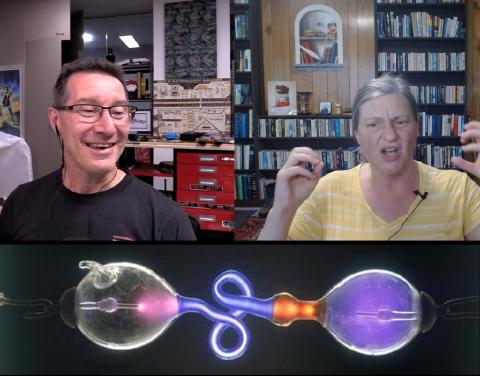
Download episode · 179 MB
Also on Apple · Spotify · YouTube · RSS
Show Notes
- Kathy Joseph from Kathy Loves Physics joins Dave on The Amp Hour to discuss history and physics. They end up discussing the intricate history of the development of the Cathode Ray Tube.
- Read Kathy's Book The Lightning Tamers: https://tinyurl.com/TheLightningTamers
- Video of this recording: https://www.youtube.com/watch?v=CnJ7mQ_Fo-8
- Forum: https://www.eevblog.com/forum/blog/eevblog-1577-history-of-cathode-ray-tubes-with-kathy-joseph/
Transcript
Dave Jones: Welcome to the Amp Hour. I'm Dave Jones from the EEV blog. And I'm Cathy Joseph from Cathy Loves Physics. Hey, welcome back, Cathy. I'm so excited to be back. Is it a year? Has it been a year? I think so. Wow. Yes, a year ago, says you. Yay! There you go. Every year we'll make it a yearly thing. I love that.
Chris Gammell: Faraday had a Christmas tradition. We can have a Halloween. It's scary.
Dave Jones: Oh, no, I don't do Halloween. No, that's an Australian. No, no, Halloween. No. No, that's a big contention here in Australia. No, because we're getting infested with all this Americanism, you see. So we're trying to avoid Halloween.
Chris Gammell: But you can have an early November, late October, like, instead, a replacement. No one's dressing up as anything. We're just, I'm just cracking you up and messing up your entire show. Great. That's what we're here for. That is your tradition. That is how you get scared by an American.
Dave Jones: Maybe we can wear, like, lab coats. We can wear, like, ESL lab coats.
Chris Gammell: No, no, no, no. We're dressed like our usual slobs. I think I saw your shirt. You're wearing, um...
Dave Jones: No, I'm just a... True grit. True grit. Yes, it's an obstacle race thing. It's an obstacle racing. See, now that's perfect. And I'm wearing a t-shirt that I found. Oh, okay. Right. I think that's appropriate. I was going to wear something, but it's actually cropped off on the shot anyway, so it doesn't work.
Chris Gammell: Perfect. I'm dressed as a physicist. Physicists dress however they want. And engineers dress however they want. Yes. Perfect.
Dave Jones: Yes. A tie is a noose for an engineer. Oh, my God. Are you kidding? Except in the 50s, like, except in the 50s and 60s and stuff where, you know, everyone wore a tie, you know, you were like, yep.
Chris Gammell: Philo T. Farnsworth, who came up with the television, got a job. So he made the television in my hometown of San Francisco. And I don't know if I told you this story. No. Tell us, please. Let's... That's what we're here. You're a storyteller.
Dave Jones: You're a historian, technical storyteller. That's what I am. Let's go. We haven't even introduced you. Okay. We haven't... Everyone, you've got the book, Kath, The Lightning Tamers. But that's the whole... So we did... We covered that book in the last video and we covered all sorts of stuff. So listen to that, part one. So we're going to carry on from that. But anyway, your story. Part two.
Chris Gammell: We're going to talk about... This is going to come in my book, my third book. So, like, you're going to have to wait forever for it. So I should tell the story now. About Philo T. Farnsworth, the farm boy who came up with television. Because you will love this. So he was born in Utah because he had a Mormon... He's a Mormon family. And they went on a covered wagon to, like... I'm going to say Montana and I'm going to be wrong and I don't care. But he was a kid. And their new house had two precious gifts in it. The first thing was it had a generator. And the generator always broke. So, of course, he got to take it apart and put it together and take it apart. And put together. And then pretty soon his sister was like, there were no watches. There were no anything. Anything with parts was taken apart and put together. And sometimes it was better. And sometimes they never saw the watch again. Because that's who he was. It's very familiar. The second thing was the attic was filled with kids' magazines that someone had left. Kids' popular science magazines. Right. So, all he did was read all these kids' science magazines and take apart their tractor and put it together and blah, blah, blah, blah, blah. So, he goes to high school and he convinces the chemistry teacher that even though he's a freshman, he should be taking senior chemistry, which is the only science class they have. Right. And tutor him after school. So, he's reading all these magazines. And in it, they're talking about how they try to make electronic fax. Like, you would shine light through these little holes that you spun. And it would go onto this material that would respond electronically to the light. Yeah. And that would change into an electric signal that would be sent wirelessly. And then you would recreate the fax.
Dave Jones: You reproduce it at the other end. There were quite a few people who did something like that, isn't there?
Chris Gammell: Yeah, yeah, yeah. It was very popular. This was like.
Dave Jones: Oh, it was a thing. Okay. It was a.
Chris Gammell: There were heaps of people. It was a thing that they had managed to do. But it wasn't really. It was so crude that you're like, great. I got a piece of. You know, this incredibly fuzzy image. Yeah. Wonderful. Like, it's not really useful. No, but it did what you expected.
Dave Jones: Even in a clean way. It was a precursor.
Chris Gammell: And in it, there was a lot of complaints that, like, there was a limit to how much you could send with the image. It took a long time to get, you know, if you got too small and blah, blah, blah, blah, blah, blah. And at the same time, there was articles about the cathode ray tube. Because, of course, there's articles about the cathode ray tube. There's actually people in Germany, I think. No, Russia. People in Russia who had done something with a cathode ray tube scanning or, like, getting the image with moving the dots.
Dave Jones: Yep.
Chris Gammell: But the problem was that no one could figure out how to get all of these dots in a coherent way to get it from one thing to another. Right. And so he's working the fields on a freaking horse, looking at these wheat fields. I think it's wheat. It's in my head as wheat. So it's going down as wheat. Right. It's wheat.
Dave Jones: Okay. So it shall be for all time.
Chris Gammell: Well, someone can look up a book on playlist. This is off the top of my head, and I did not prepare. So the details are wrong.
Dave Jones: That's all right.
Chris Gammell: You are going to put up with it. It's not my fault. It's not on purpose. Anyway. Wheat fields. On this horse, looking at these fields of wheat, and they're in rows. And it looks like an image with the wind blowing on them. Oh. It looks like a moving image. Right. And he goes, I have it. I have it. We don't need dots. We need rows. Right. We need rows of images. Yeah. And that's how the data, it will look like a full picture if we just have rows of bright and dark, and you can control the movement of the cathode ray with electromagnets.
Dave Jones: Yes.
Chris Gammell: It's moving. And you can change the intensity of it with the strength of the voltage in front of the tube. You can make it brighter and darker. And then you can control the image you make, and you can control the image you get. You've made television. So he goes on his horse to see the teacher. He puts all this stuff on the board. The teacher comes in, and he says, I've made it. I've made an all-electric television. And his teacher goes, what's that?
Dave Jones: Did he even use the word television back then? Yes. That was actually a term. Or did he invent it? That was a term.
Chris Gammell: It was created by Alexander Graham Bell. Alexander Graham Bell was the grandson and son of linguists. And famous linguists. Remember My Fair Lady?
Dave Jones: I know of it. Okay.
Chris Gammell: In My Fair Lady, it's about a mean linguist. And it was based on a book, sorry, a play called Pygmalion, which was partially based on Alexander Graham Bell's grandfather and father, who were cranky linguists, snotty linguists, I guess. And so anyway, he came up with the term telephone and television and all sorts of things. Because he wanted to do this. He just, he didn't get anywhere. You're right. Well, he got kind of, he did something that was sort of something, but it never went anywhere. So they did have the term television. So he legit said, I've made an all-electric television. And his teacher said, this is great.
Dave Jones: I think, I have no idea what you're doing, but it looks good. That's right. That's right. Because they had mechanical televisions before that, didn't they? Yes. That's right. They had mechanical television with those little. Yes. With the slots or something or. The little holes in them.
Chris Gammell: And they got better by the 30s, I think, or 20s.
Dave Jones: Right. Something like that. And all-electric television. Okay. So what did CRT, you said the CRT tube was around then, right? Yeah, yeah, yeah. It was around, it was a thing. So what were they doing with CRT tubes? Was it just an oscilloscope thing? No. Or was it?
Chris Gammell: No. What was the first use? After. So the first thing they did with it was, it was 1850s, I think. There was this guy in Germany named Plucker. Professor. Plucker. Professor Plucker. Professor. And Professor Plucker had a friend in France named Rumkorf. And Rumkorf had made this coil, induction coil machine that could make a really, really, really big voltage, really big spark. And Plucker said, hey, what happens if I put that really high voltage on a vacuum tube filled with a little bit of gas? Obviously. Because. Because.
Dave Jones: Obviously. Right?
Chris Gammell: Well, no. Because in the time of Benjamin Franklin had a rival named Abbé Nollet. Nollet would do these crazy experiments for the King of France, including taking tubes, evacuating it, putting it in a little gas and putting it on a static electricity machine and letting it glow and putting your hands on it sort of like, you know, those.
Dave Jones: The plasma ball things. Yeah. The plasma ball things. Exactly.
Chris Gammell: Like plasma ball things. So Plucker knew his history and he's like, oh, I'll get a plasma ball thing, but with high voltage. So he goes to this glass maker named Geisler. Have you ever heard of a Geisler tube? Anyway. Oh, yes. I think. Yes. Yeah. Yeah. Geisler made this tube because it's not easy to make a glass tube evacuated, blah, blah, blah. He puts the voltage on there and he says it was indescribably beautiful. Hmm. But Geisler's like, yes, it is. I'm going to make a job out of this. I'm going to sell them to novelty shops and make some money. And novelty shops. And that's what he did. It was like early neon light. And these things are gorgeous. Oh my gosh. You can look it up. Geisler tubes. And there's these intricate, like, they have, they made these like paintings. Oh, yeah. Oh, they are beautiful. They are. I'm looking at that now. So sexy. I like it. Just like, they're not neon lights. They're works of art.
Dave Jones: Yeah. And they put, yeah. And they put twists and turns in them and they got bulbs at each end and they can form them in different shapes.
Chris Gammell: And they found that if you added like phosphorescent materials in there, then they would glow more inside there. So it became a big thing. And Walker figured out if you put a magnet near it, you bent the light. You bent it. Right. Wait a minute. How do you bend light? What the hell is this thing? But then it just sat there doing nothing else. And then like 10 years later, he had a student, a former student who was playing with vacuum tubes and realized his vacuum pump, sorry, vacuum pump would form bubbles. And he's like, well, that's a really crappy vacuum. Yeah. And then he realized he needed to chemically treat the glass because it had water in the
Dave Jones: glass. And this is where the phosphor coating comes from. Is it? Do vacuum tubes have, no, you mean on the side? No, no, no. No, I thought on the inside. Okay. No, no. That came from Edison. Oh, okay.
Chris Gammell: Oh, right. We're not there yet.
Dave Jones: Oh, God. Oh, it's so intricate. I'm glad you know the history. It's so intricate.
Chris Gammell: The thing about physics is to me, when you tell the story of physics, it's almost like a musical. It's like incompr... Incompr... Blah, blah, blah. You cannot believe how freaking complicated... Incomprehensible. Yes. How many moving parts. And then when it comes together, it's this weird story where everyone's like, hey, it worked out. And then we put on a play. And then here's the television. That's how I think of it. I'm obsessed with musicals, so it kind of worked out. That's right. And I'm going to do it that way. Because, you know, there are no physicists with normal brains. That would be... That would be wrong. They're not a physicist. If you ever meet one who, like, seems totally normal...
Dave Jones: Yep. They're probably not a very good physicist.
Chris Gammell: No. The same with engineers. If you're like, oh, I met that engineer and they seem really, really, really normal. A little doll. Yeah, no. No. It's like... Oh, my gosh. Okay. So... So... Then we get the other person whose name was Hittorf. Hittorf was this shy guy. He figures out the vacuum pump wasn't working well. So he fixes it. And once he evacuates it more, he realizes that it doesn't glow. But the little pieces of phosphorescence inside glow. And one wall glows. And it's the wall opposite the negative electrode. Right. And when he makes it in different shapes, he can even put a little cross in there. And he can see a shadow. So he's like, it's coming from one side. And since Faraday defined the cathode as where the electricity comes from, which they thought was positive. But this one was negative. They're like, this is a cathode ray tube.
Dave Jones: Ah. Interesting. I never thought... Yeah. I never even, like, thought of how did that term come about? Right. That's where it came from. And then... Well, it always made sense because it was, like, cathode and rays and, like... But I never, like, when you get into the history of it, it's like...
Chris Gammell: And now we're messed up, of course. Because the cathode ray tube, the negative is the cathode. But the battery, the positive is the cathode. Unless you're recharging it. In which case, the negative is the electrode. And then everyone's like, F you. Like, why are we doing this this way?
Dave Jones: So is this how they discovered that electron flow was the other way? Yes.
Chris Gammell: This is how we discovered the electron. Right. Get ready. Get ready. Get ready. It's coming. Oh.
Dave Jones: My mind's about to explode. Okay.
Chris Gammell: Your mind is about to explode. Okay. So there was this guy in England and his name was Crooks. C-R-O-O-K-E-S. And he was a character so large. Larger than life. He has a story. He's from this family of, like, 12 kids. And all he did was chemical experiments. He said the house always smelled terrible. And everyone was like, this lunatic is going to burn us down or poison us. Nobody knew what to do with this guy. And later on in life, you have to look up his picture. Because he has the world's best mustache. It, like, I saw a cartoon of the man. And I'm like, oh, ha, ha, ha. And then I saw a picture. And, like, he must have turned his head sideways to go through the door. And William Crooks, I mean, I don't know. I'm a big fan of mustache. Oh, that's, that's, yep. Because everyone looks the same. I'm trying to memorize thousands of people. And if you have a good mustache, man, I appreciate that. Yeah, it's like an evil mustache, but it's just gone past. It's Salvador Dali type.
Dave Jones: Yeah, yeah, yeah.
Chris Gammell: Beyond the beyond. I love William Crooks. William Crooks was a delight. Spent much of his time as the head of every science department and every department to look for ghosts at the same time. He was just like, he did whatever the hell he wanted. And he wanted to do whatever. So, anyway, he learns about spectroscopy, looking at different lights to figure out what chemicals are. Discovers new chemicals. Gets obsessed with light. He makes that little thing where it's like you have black, like a little flags and four flags. One side is white and one side is black and it's in a little vacuum light bulb and you put in the sunlight and it spins one way.
Dave Jones: Oh, yes. Yeah, yeah. Right. Yes, I know that. I don't know what it's called, but yeah. Like, is it a sun vein or something? It's like something. It's like a sun vein. It's like a light vein. It's a physics toy. Yeah, right.
Chris Gammell: He made this physics toy to show about the energy of light because he felt like that was part of his toy. And when he heard about the vacuum tube and the, you know, thing, he's like, oh, it's a force data matter. It's light that you can move with a magnet. It has weight. It has charge. It's amazing. He's like, he didn't think it was a subatomic particle. He thought it was new set, you know, solid, liquid gas. Gas. And this thing. Right. Right, right, right, right, right. But he did all this crazy stuff to prove it. He made this like little paddle wheel in it. And then he'd shine the cathode ray and the paddle wheel would move down inside the tube. He had this assistant who was this mechanic extraordinaire. And he kept on leaving little notes like, you can do it. I know you can do it. I'm sure he was doing that because he was asking for impossible, impossible bills. Right. No one is that nice to their mechanic. No, they are asking for the impossible. And he would give these talks and people, he would get notes. And like his friends would write him like, everyone is talking about what you said. He actually gave this big speech in 1900. Like we need to make nitrogen fertilizer or everyone will starve. And it started the third law of thermodynamics and nitrogen fertilizer and all sorts of good things and bad things. And it was very, very influential. But anyway, he had this whole big thing. And meanwhile, in Germany, there was a young man named Heinrich Hertz. You might have heard of him. Might have heard of him.
Dave Jones: I don't know. Kind of rings a bell.
Chris Gammell: Kind of rings a bell. Anyway, Hertz's boss had told him to do an experiment to prove Maxwell Faraday's equations. Like to prove that light is electromagnetic wave. And he wrote back and said, no, it's too hard. I can't do it. I'm going to play with vacuum tubes instead. Much more fun. No, that's impossible. No, no, no, no, no, no, no, no, no, no, no. So instead he plays with these vacuum tubes. He's like, okay, if it's a charged part, not charged particle, a charged new form of mass, it should move if you put positive and negative plates. So we put positive and negative plates in there. Nothing happened. Didn't move. He's like, this is clearly a type of light. It's a new magic type of light that you can move with the magnet. So he publishes this. He's doing pretty well. He's still like, his wife published his diary after he died. And not to be mean because he was so famous and he died so young. And his diary entries are all like, did nothing all day. Still a failure.
Dave Jones: Oh, no.
Chris Gammell: This year ended. So glad. This, everything was terrible. Hope next year is better. Like, everyone is like that. Like, I learned nothing. I know nothing. I'm a fool. I'm like, I appreciate you so much. This hurts. I know, right? This is nice. Oh, my God. Plus, if you've ever been in, everyone has been in that situation. Yeah, yeah. And it's so inspiring. It's so wonderful. Like, that is, that's why she published his diary. She's like, hey, have you ever had years where every day is like, no, no, no, no, no, no. Well, guess what? My husband did it worse. So anyway, when he met his fiance, he was showing her around the lab. And he was inspired that a spark from one of these induction coils could create a spark somewhere else. Right. And his boss had figured out that if you put a condenser capacitor on these induction coils, which they had known about before, it made an alternating wave that are very high frequency, a pulse of alternating waves. Tank circuit. It's a tank circuit. It's a tank circuit. Exactly. Exactly. So, but Helmholtz had come up with the equation for the tank circuit. That was his boss. And he's like, oh, well, these are vibrating way slower than visible light. But maybe they're forming a form of invisible light. So he's like, okay, I'm going to take the induction coil with the tank circuit and I'm going to put everything on it I can think of. Maybe long sticks do well. Maybe giant balls do well. I don't know what I'm doing. I'm just putting everything on this. Right. And then he's like, okay, well, how do I catch the spark? He had a, first he had a square and then he changed it to a circle. He had a circle with a tiny little gap in it. And he's like, okay, we'll put a giant spark on one side and we'll catch it in the tiny spark on the other side. And I will see how strong the signal is by the size of the spark. And he's describing it. He's like, you have to see it in pitch dark. Your eye can, it's a barely a millimeter. I mean, like his description of it is so poetic. Like your eyes have to be used to the dark. It's fairly perceptible. And it's almost like it isn't there, but it is.
Dave Jones: It is, right. You could almost imagine it. If you could almost like think you see it, but it's not actually there. It's that small.
Chris Gammell: Right, right. And yeah, you could possibly like see it and then it's not there. Right.
Dave Jones: Or it could be like, who was it who saw the light? Was it Herschel who saw the lines, who saw the Mars canals? Yes. You know, he said just peered through the telescope and he wrote all these. He got famous because he saw all these canals on Mars. There must be life and civilizations. It turned out it was the veins on the back of his eyeball or something. That's what he was seeing. Oh, my God. For so long, he was seeing the veins on the back of his eyes. Apparently.
Chris Gammell: That is so cool. Yeah. Yeah. Yeah. I mean, this is why I'm not an experimentalist.
Speaker ?: Right.
Chris Gammell: Seriously. Like I see little wiggle lines in front of my eyes all the time. Yeah. Yeah.
Dave Jones: Yeah. Yep. I've, I've, I've got scintillating saccoma. I think it's called an occasion when you'll get these people call them floaters, but it's a different thing. It's like a zigzag line. It'll just appear for like 10 minutes. Sometimes. Yeah. Yeah. I think, I think it's scintillating saccoma. I think that's the technical term. I don't know.
Chris Gammell: So yeah, that's. Yeah. Yeah. Right. Right.
Dave Jones: We're seeing things. Okay.
Chris Gammell: Well, it's terrible. So anyway, what was I saying? So he does that. And oh, he also figures out a couple more things. One, it reflects, radio waves reflect. So he can make a standing wave. And by making a standing wave, he could figure out where the nodes were, where the signal got to zero and use that to find the wavelength. Wavelength of the light. Right. And he knew the frequency of the light. So he could prove the radio waves move at the speed of light. Wow. Wow. And he also did one experiment. And he's like, I'm so sick of this bright light from the initial spark. So he's like, why don't I cover it? I'm doing the radio waves. I'll just cover the spark. And when he covered the spark, the signal went down considerably. What did he cover it with? Like, I don't know. But then he changed it to covering it with, he said, what if I put glass there? He put glass there. It still dimmed it considerably. But he put quartz there and it didn't. And he realized that he was the ultraviolet light that was having an effect. This is called the photoelectric effect.
Dave Jones: Effect. Right. Which Einstein won his Nobel Prize for the photoelectric effect, didn't he? Well, for his research on the photoelectric effect.
Chris Gammell: No. Actually, it was Hertz's lab assistant, a guy named Philip Leonard, who developed it. And then Philip Leonard turned into this giant, giant Nazi, like publishing articles, like Hitler is a gift from the gods. Mostly because he got pissed at, jealous of Einstein. Right. Oops. This is much later. This is much later. Sorry, I'm ahead of myself. So, Hertz discovers radio waves. He goes to England to get big awards. Guess who he meets there? William Crooks with the giant mustache. And William Crooks says, you are so wrong about the cathode ray tube. It is clearly important. You're doing something wrong. And he's like, no, I'm not. Goes back to Germany. He's like, okay, I'm going to do some more experiments on the cathode ray tube. Because clearly the mustache man is wrong, wrong, wrong, wrong, wrong, wrong. So one of the things that Crooks did is he had a cathode ray tube focus on a piece of platinum and heat it up. What Hertz did was have it unfocused and go on a very, very thin piece of metal so that he would see what happened when it hit something. I don't know what his logic was. But that's what he decided to do. What Hertz decides to do. And what Hertz found was that it would, it was such a thin piece of gold or whatever, because usually they like gold because you can make it as thin as possible.
Dave Jones: Yeah, you can. Yep. Yeah.
Chris Gammell: And if you have the money. And it would glow a little bit through the piece of gold. But if the gold had little folds in it, it would get darker. You could see the shadows of the folds in the gold. And he found that if you put little pieces of things there, it would make a shadow. It would go through the piece of gold without breaking the gold. Right. And Hertz is like, okay, 100%. This is light. Only light can go through something and not break it. Right. Right. 100% light. But also, this is really cool because we can make a little window of a very, very thin piece of aluminum or something. And then have the cathode ray go through it into a chamber with a different amount of, you know, different vacuum. Because they didn't work unless, if the vacuum was too good, it didn't work.
Dave Jones: If it was too good, it didn't work.
Chris Gammell: Yeah, if it was too good, it wouldn't work. And they didn't know why. Right. Okay. We're getting there. All right. Well, it didn't work if the vacuum was too good because they didn't know to heat the cathode.
Dave Jones: Cathode. Ah, okay.
Chris Gammell: They needed a way for the electrons to come off the cathode.
Dave Jones: It's time to actually boil off. They have to be, yeah. Right.
Chris Gammell: But they didn't know that. Right. So they need a little bit of air in there. So he came up with that idea. But he was getting sick. So he gave it to his student, Philip Leonard. And Philip, he was like, oh, I know what I'll do. I'll just have a cathode ray tube and put a little aluminum window on the end and have the cathode go into the air. Instead of going into a perfect vacuum, I'll have it go in the air. And he holds up a phosphorescent thing and he coats the whole side of the cathode ray tube because you don't want anything glowing except through the window. And he holds up his phosphorescent screen and it glows inches, millimeters away from it, not on the surface, a little bit of distance. He's like, ha ha, I have 100% proved the cathode rays are a ray of light because it goes through a window. And it goes right. Yeah. And then Hertz dies and Philip Leonard gets busy, you know, traveling all around to try to publish his work and to promote him. He doesn't get a job, blah, blah, blah. Meanwhile, another guy in Germany named Röntgen, what was his first name? Röntgen. I can't remember his first name. It'll come to me. Don't look him up, don't look him up. Did you look him up?
Dave Jones: I'm getting pumpkins. Wilhelm Röntgen.
Chris Gammell: No, no, don't look him up yet. No. Don't look him up yet. Okay. Röntgen, he's like, I'm really interested in this. So he builds a whole bunch of tubes, Crooks tubes and Hittorf tubes and Leonard tubes. And he takes a Leonard tube coated. And he takes a phosphorescent screen made of heavy material instead of light material. I'm not even sure if it was on purpose. It might've just been like, that's what he had. And he turns on the machine and the screen glows on the side. It glows through everything that coated it. He holds it in front of the metal part, the metal window. It glows brightly. He starts picking up stuff. He has, I mean, like his paper is like a deck of cards, a piece of wood, a 300 page book. I mean, clearly he's just picking up everything he has.
Chris Gammell: Holding it in front of it. And it's making this shadow. Or it's sometimes a shadow around it. And then it goes through the material. It goes through a 300 page book. It goes through. It's the most powerful ray he's ever seen. And he picks up a piece of, a round, small piece of lead. And he's holding up this piece of lead and waiting and waiting and waiting for the light to go through the lead. And as the light goes through, as he's waiting, he starts to see the light go through his hair. But it doesn't go through his bones.
Dave Jones: Yes.
Chris Gammell: He starts to see the shadows of the bones in his own hair. Awesome. And he goes home and he says, I'm working on something that's going to make everyone say, Rumpkin has gone completely mad.
Dave Jones: Yeah, because that would be, yeah, imagine saying that you could see inside the human body or something like that. You could see a skeleton inside. This would be ghost levels of like witchcraft.
Chris Gammell: That's exactly what happens. So he works in secret. He's an amateur photographer. So he sees if it will develop film while it's wrapped up. And it does. So he invites his wife into the lab, hold her hand there for like 30 minutes because it's a really weak x-ray. Oh, weak. And she holds her hand for 30 minutes. And then they develop it. And supposedly she literally, she just screams and says, I've seen my own death. And books it. Right.
Dave Jones: And never walked in that lab again. Like, that's it. Oh, yeah. This would be evil stuff. You can imagine people thinking this is just pure witchcraft evil.
Chris Gammell: Oh, my God. And he calls it, he says, for brevity's sake, let's call these x-rays in the first paper. So he publishes this without pictures. Like right near Christmas, no one pays any attention. But he sends certain copies to different friends, including a former student, with pictures. And one student was having a New Year's or Christmas party. And his friend there was the son of the local newspaper person in Vienna, I think. Right. So his friend sees these pictures, says, oh, my God. Ringed this to his dad and says, change the... Front page. Stop the presses. Stop the presses. Stop the presses. They didn't have time to include a picture. But they made an article that's like... Wow. This is... It's the most German article ever written. This is like... This is real German science from a real German scientist. It sounds like Jules Verde. But this is real Germany. And by the next day, it's picked up by the London press. And I think I saw something like two days later from like Kansas. Like... Oh, wow. Everyone lost their mind. Because everyone had one of these Crookes tubes or one of these Hitchworth tubes. Because Crookes had made it so popular that every physicist had one. So they could reproduce it straight away. Right. So you could see it straight away. And like, everyone could do it. Supposedly, J.J. Thompson, according to Ernest Rutherford or J.J. Thompson. So J.J. Thompson was the head of the Cavendish Laboratory in England. So he said there was a line out the door of rich people dragging their doctor to get them an x-ray and prove them. They said one person found a, like, shot, buckshot, left in the grave. Oh, wow. Yeah, yeah. And then his doctor told him was gone. And was, like, screaming at his doctor. Everyone had to leave the room. They're like, okay, I'm not part of the... Because that's the only way you could get an x-ray. It's by dragging someone to the physics department. And then suddenly everyone is like, oh, my God. Everyone needs all this stuff. And Edison is like, okay, we should make this a light bulb. Because, of course, he thought we should make this a light bulb. Edison just, yeah. So he's like, okay, we need a better screen. Because this one is very dim. So he put his muckers. He's like, take every chemical you have and shine stuff on it until you get one that glows.
Dave Jones: That was basically his approach to everything was try... He had the world's best stocked lab and he just tried everything until something worked.
Chris Gammell: Yeah. Well, he was known for... He did have brilliant ideas. Yeah. But then his solution to solving said idea was always just like, here's a giant haystack.
Dave Jones: Go through. Find the needle. Yep. Right, right.
Chris Gammell: But his idea was brilliant.
Dave Jones: Yes.
Chris Gammell: But his methods was like, I don't know. Just do it until your mind leaves. And so they did. They made this thing and they would sell it to doctors and traveling shows. Oh, my God. There's this one story. I have to tell you the story. Yeah. So people made a living traveling for carnival shows doing x-rays. Oh, wow. And one man told a story about this young woman came to him and spoke to him very softly on the side. He says, excuse me, sir. I'm about to get married and I'm a little nervous. Would you mind taking a secret x-ray of my fiancee and make sure everything works? Make sure everything works. And he's like, I'm so sorry, honey. You got to pay the fee. You got to ride the ride to know what it's like.
Dave Jones: And I'm sure it'll pass straight through that thing she's interested in anyway.
Chris Gammell: Right.
Dave Jones: Like that doesn't work for that.
Chris Gammell: You can't do secret x-rays. No, no, no, no, no. Actually, this is fascinating. So there was a Serbian engineer named Michael Pupin. I'm pretty sure I'm saying his name right. And he was working and someone came in who was shot. And he's like, well, if you hold up Edison's phosphorescent screen, it takes an hour. And if you use a film, it takes an hour. So he's like, what if I put the screen on the film? And then when he did that, it went to an x-ray in, you know, a couple minutes. So it was actually Pupin who made the medical x-ray. Because really, if you have to lie still for an hour, a medical x-ray is not.
Dave Jones: No. I was going to ask, how do they do that at the carnival show? How do you make a carnival show out of that if it takes so long to process the image? How do they build a show out of that?
Chris Gammell: They wouldn't process the image. They would just have a giant screen. And you'd stand there for 10 or 20 minutes and suddenly you could see the bones in your hand.
Dave Jones: Oh, okay. So someone would stand behind the screen. They'd get a volunteer up, would they? And then I guess.
Chris Gammell: They'd just stand there and they'd talk about it or whatever. Right. They used to have these things in shoe shops, shoe shops, where they had, you could see the x-ray of your foot. They said it was to buy better shoes. Shoes, right. But really, it would get you in the store. Store, yes, of course. It's up to the 70s. Oh, really? Well, I never saw one, but my mom saw one. She said it was her favorite part about going to the shoe shop. The shoe shop was to get x-ray of your foot. And it was continuous. It would just run all the time. And you put your foot in there and you could see your bones wiggling around. And you're like, oh, I want these shoes. And it turns out your feet are very, quite impervious to getting foot cancer from x-rays. Oh, really? Interesting. The people who visited were fine. The shoe salesmen, leaning down, they weren't so fine. Yes. Right. History is littered with people. Yes. Blah, blah, blah. But yeah, Edison did patent a x-ray machine light bulb, which was the worst idea ever. But then he started getting injured by x-rays and his assistant actually died from it, which is one thing that they blame Edison for, which he was actually not guilty in any way. Like, there's a lot of bad things Edison did. This was a really good thing. Edison had patents for this. Edison had all these ways to make money. And he's like, no, x-rays are dangerous as hell. Also, radium, stay away from it. That stuff scares the hell out of me. And no one listened because it looks so cool. But like, there's lots of reasons to be mad at Edison. This wasn't one of them. This was him doing the right thing. Like, his assistant got injured and he's like, you should quit. And his assistant's like, no, I'm fine. I'll use my other arm. It was like that part of Monty Python. Like, it's only a surprise. Yeah, yeah, yeah. He had the arm just chopped off. Honest to God. He just, like, loses body parts. And he's like, it's fine. And Edison's like, I don't think it's fine, man.
Dave Jones: That's all right. Because hardly anyone lived past 40 back then anyway. So, you know.
Speaker ?: Right.
Chris Gammell: But also, Edison, who was really cheap. He paid for all his medical bills. He's like, you're a hero to science. He publishes his name. He, like, tried to do the right thing. And it really makes me mad when people are so black and white. They're like, well, I hate this person for this. So, I will not acknowledge anything good they do otherwise.
Dave Jones: Yeah, I get it all the time.
Chris Gammell: Well, I mean, like, Philip Leonard was a freaking Nazi. He was a Nazi. There's, like, it's not a euphemism. If you publish an article during, like, the 1930s saying, yeah, like, 1920s. He was really early fan. But still, he did some great science. Like, I can say both things. It's okay. Yeah. Anyway. I know. But, so he killed the X-ray light bulb. But other people had the idea. Like, oh, my gosh, instead of using a phosphorescent thing for an X-ray, why don't we use it for these Geissler tubes or these, you know, the things with the mercury in it. We'll put phosphorescence on the outside. And then we'll have a fluorescence tube. And then it took a long time to figure out the ballast, I think it's called. But that took a little while. But that's it. It kind of came from medicine, sort of, maybe.
Dave Jones: When did they realize that putting a heater inside the tube and boiling off the cathode was a thing?
Chris Gammell: Oh, that was much later. See, J.J. Thompson was like, what the hell is going on with the cathode ray tube? I don't get it. Like, on one hand, you can move it with a magnet. Someone in France named Perrin had figured out if you divert the beam into a Faraday something, it's a negatively charged something. Okay, so it's negatively charged. But it's not moved by plates. What's going on? He's like, there must be something wrong with the plate experiment. There must be something wrong. He's like, maybe it has something to do with not being a good vacuum. Let's up the power of the cathode ray tube. He didn't think of heating it, though. What he thought of was making the anode into a donut. He made the positive charge into a ring with a hole in it. And then when he did that, he could make it a better vacuum. And then he figured out that the air in there was acting like a Faraday cage and protecting it from moving by the plates. Right. And that was the problem with the plate experiment. Got it.
Dave Jones: Yes, because we all know that CRTs work with magnetic or electric deflection as well. Yeah, yeah, yeah.
Chris Gammell: But it didn't if there's a little bit of air in there because the air acts like it gets ionized and it acts like a conductor. And it protects it under that high voltage. Got it. Got it. So once they move the air, he had it going through this. It could move by plate. And so what he did was he made an electromagnetic gauntlet. He's like, OK, I got magnets one direction. I'll put plates the other direction and make it so it goes straight. And because the electric force, the magnetic force depends on the speed and the electric force doesn't. I can figure out how fast this is going that way. And he figures out it goes about a third of the speed of light. He's like, that's fast. And then he says, OK, I'm going to remove one of these forces. I think he removes the magnetic. And he says, so the weight is obviously tiny, but the electric force is still pretty strong. He says it's going to fall down like a bullet fired off of a horizontal gun. I know how fast it's going. I know how far it falls. I know how far it went. I can figure out the force on it because I can figure out the acceleration, right? And he figures out that the charge and also someone else had done experiments that seemed like the charge was the same as a positive ion. I mean, same value as a positive hydrogen ion. Yeah, positive hydrogen ion or positive anything ion, like a single ion. So he's like, OK, the charge is like this. If that's true, then the mass is tiny, tiny, tiny, tiny, tiny, tiny, tiny, like 4,000 times smaller than the hydrogen. And hydrogen is tiny, tiny, tiny. And he does it with a whole bunch of different materials in the anode. And they all give the same result. Tiny. He's like, everything is full of these. Corpuscle. And I don't know how to pronounce it because everyone complained. Corpuscle. Corpuscle. Corpuscle. Corpuscle. Well, that's how I've heard it. No, no. That's how I remember it. I trust you 100%. I just, it just sounds so wrong. Do not trust me on pronunciation of anything. Of the two of us, you are going to win because I have an audio processing issue where I can't remember how things are pronounced unless I hear it a bazillion. Times. Right. And so, like, I just know how it's written. And it's not written like that. Really makes me mad. That's why I get German words wrong all the time. Because, like, not pronounced the way I'm expecting it to be pronounced with those letters that way. Like, damn it. I'm still trying to get the W's right. But anyway, so he calls them, they're almost quickly called electrons. Thank God. So anyway, they're called electrons. Yes. Like, they're in everything like a plum pudding. And then his former student, Ernest Rutherford. And then there's the whole story about the nucleus and the core model and all that jazz. Yeah. So that's what they did with cathode ray tubes before the television. Wow.
Dave Jones: Isn't that cool? That's insane. You could have a whole book on just how the cathode ray tube was developed. Oh, yeah. Like, seriously.
Chris Gammell: My book that I'm in theory working on, I haven't done, I think I've written two pages, is called The Radium Revolution. How Einstein's equals MC squared and Curie's radium changed our world. And the first third is the cathode ray tube. Right. Okay. Awesome. Great. Because you can't talk about radium unless you talk about the X-ray because uranium was discovered because this Frenchman... Oh, I have to tell you this. Yeah. I'll tell you this another one. Please.
Speaker ?: Okay.
Chris Gammell: Okay. So there's this guy named Becquerel in France. And Becquerel and his father were obsessed with fluorescence and phosphorescence. And so when he heard about the X-ray, he's like, maybe it has something to do with fluorescence and phosphorescence. Right? Because they glow inside the cathode ray tube. And X-ray, maybe it has something to do with that. So he takes out uranium, phosphorescent uranium, just because randomly he had some. There was nothing special about uranium. And he puts it outside in the sun over a covered piece of photographic plate. And then after two days, he takes it in. He develops the film. And lo and behold, there's a glowing object there. He publishes it like the next day. Physicists used to have guts back in the day. Now they're spineless cowards. Did I say that out loud? Yes. Yes. She's calling you out. Academia. You guys are spineless. Spineless.
Dave Jones: Publish and be damned. Publish and be damned.
Chris Gammell: Publish and be damned. Yes.
Speaker ?: Oh my God.
Chris Gammell: What if someone takes it? Yes. That's good. Get off your... Do something.
Dave Jones: That's how I started. I always say that is my attitude to how I got started in this. Publish and be damned. Because I uploaded my first video. Quickly. I talked about this before. And it's awful. It's horrible. It's the worst thing I've ever produced. I thought it was embarrassing. But I went, you know, publish and be damned. So I published it. And I... And this is now my job. Right. Publish and be damned.
Chris Gammell: I'm... You've seen my video. I'm still proud of my first one.
Dave Jones: It's... Yeah. But... Yeah, yeah. Yes, so am I. I'm... Well, I'm more proud that I actually released it. Right, right, right. That I had the guts to release it than the actual quality of it. Right? But...
Chris Gammell: For me, I am pleased with it because I had already started writing my book for a year before I started my video. So I had put in so much intellectual work into it that it had a lot of substance. But I don't make it perfect before I publish it. Sometimes I have like an hour long video or two... An hour. Yeah. It's long. It takes me months. Yeah. But I am not an obsessive perfectionist. I am just like, it needs to be good.
Dave Jones: Yes. It just needs to be good enough. Publish and then go on to the next thing.
Chris Gammell: But if you kind of something good, you publish it the next day. Yes. If you can publish it the next day, you put it out when it is. And you say what you want to do with it. So if someone else sees it, they can do it first. Exactly. Because the whole point is to get other people to do things. Making this whole video on the poetic kindness of physics versus the dull cruelty of pseudoscience. And the whole thing is, please do something with my... Please do something with my goddamn work. Please, please, please, please, please, please, please, please, please. Please, please, please, please. Please. Yes. Do something. Talk to me. Tell me I'm wrong. Argue with me. Make a video. Do something. And everyone's like, you're the greatest. And I'm like, great.
Dave Jones: Thanks for that. But do something, follow it up. Yeah. Exactly. But I can't do it alone. Yeah. Yep.
Chris Gammell: Sorry. Anyway. So what was I saying? Oh, so he publishes this. Then it's cloudy and he was going to do something about this uranium had to be prepared. And then it lost its phosphorescence. It was a special kind of thing. So he prepared it, but there's no sunlight. So he just put it in a drawer. And then two days later, it wasn't as phosphorescent anymore and it was still cloudy. So he's like, fine, I'll just develop the film. It'll be like a, prove that it's the sunlight working, right? You know, baseline. And it was just as bright as the one he'd had in sunlight. It wasn't the sunlight. It was the uranium.
Dave Jones: It was the uranium or, yep.
Chris Gammell: Yep. No, pure uranium.
Dave Jones: It wasn't uranium. Oh, pure. Oh, okay. It was right. It was. It was pure uranium. It was refined. Okay.
Chris Gammell: And because it was this phosphorescent. So he publishes this and he's like, oh my gosh, I found the new kind of X-ray. Uranium rays. Uranium rays. Right. Uranium rays. And he does a few experiments, including proving that uranium makes the air electrified a tiny bit. Oh. And then, and then he drops it because they're nowhere near as good as X-rays. Like X-rays, a uranium ray of your hand takes forever. And you can't see any, it's just your hand is just a mush. So he's like, okay, well, that's kind of cool, but on a go doing something else. Meanwhile, Marie Sklodowska Curie has her baby and her first baby. And her husband had finished his PhD. And Pierre was like, it's your turn. Your turn. Get your PhD. And she's like, but I have a baby. He's like, my dad's going to move in with us and take care of the baby. And his dad was like an OBGYN who helped deliver the baby. They were very close family. And I don't know where the mom was. And her mom had died many, many years ago and her dad was in Poland. And she was like, okay, here we go. I'm going to do something great. What?
Dave Jones: So she's like, well, that's the same with every PhD person, right? What the heck am I going to do? Yeah.
Chris Gammell: She couldn't get an advisor to give her advice. She had to come up with something on her own and come up to someone and say, I have this great idea. Put your name to it. I'll do everything. You just get the credit, which is exactly what she did. So she looks and she finds the uranium rays and she's like, huh? Pierre and his brother had discovered the piezoelectric effect. Electricity could change the pressure. And he had made, made this little device. That was like a scale, which could determine incredibly small amounts of electricity, because it would change the P, the electricity, put a battery, you know, battery over the gap. And if the air was a little bit electrified, it would change the P as a thing. And it would tilt a little bit. And then you put the weight on the other side. And you can measure incredibly small amount of electricity. So she's like, okay, why don't I use that and study uranium? So she gets the uranium and she's doing all these chemical things. Am I crushing? Am I heating it? Whatever she does, she gets the same amount of radiation, which is a term she came up with because it was all the same. And she's like, okay, if this is a property of uranium, other things must have this property.
Dave Jones: Yeah.
Chris Gammell: So she starts looking around, she finds something else, but before she can publish, someone else says, oh, I got extra uranium rays. Now they're calling them becquerel rays with this thing. And she's like, okay, I'll just publish how radioactive it is compared to uranium because she has the scale. And she says, this thing is about as radioactive as uranium, which is like I said, the term she came up with. Yes. Oh, she published this. Her husband's like, this is the best thing ever. I'm quitting my job. We're just going to work together. So we, they collect everything. Nothing, nothing, nothing, nothing, nothing, nothing, nothing, nothing, nothing, nothing, a whole bunch of nothing until they get some uranium ore. Now, uranium ore is a mixture of all sorts of things.
Dave Jones: Yeah, it's got,
Chris Gammell: well, they put it in there and it's way more radioactive than pure uranium. Oh, okay.
Dave Jones: Can you make a guess? Oh, but well, I did. I'm not a physicist, but does it have different isotope things in it or something? The ore?
Chris Gammell: Different elements in it. It's got different secret elements in it. Not just uranium, but other things. So what they do is they take the uranium ore, they get like truckloads of uranium ore. They're crushing up. They're crushing up. All sorts of weird chemical experiments. And they're like, is it more radioactive or less? Is it more or less? More or less? That's all they do. And they discover something, which I think it's called, she called polonium or it's not plutonium. It's named after home country of polon. That's very radioactive, but there's something else that's so radioactive that they call it radium. And the radium, once you distill it, it starts glowing green all the time and heating all the time. She describes like how romantic it was to work in this laboratory with these glowing green lights. Green glow. And I'm like, oh my God, please stop. And then her husband starts putting it on his body as a way of testing the medical things of it. And it's just like, oh my God, just reading about it. Yep. Yep. It's like a horror movie in the middle of a romance. It's so awful. Oh goodness. Oh my God. So yeah. And then I can go on and on and on. I swear.
Dave Jones: It's a problem. So radium. Yes. Cause she discovered, yeah. She got the note. Did she get the note? One of her Nobel prizes in, was it chemistry for radium? So the first one was. Cause she got two.
Chris Gammell: She won in two different fields, right? Right. So what happened was the Nobel committee decided to give half an award to Becquerel and half award for Pierre Curie for uranium rays. Sorry. Becquerel rays. Rays. Radiation. And Pierre is like, F you. No. This was my wife. This was my wife's job. Oh, he gave it to her. No, he split it. Oh, he split it with her. Oh, oh, is that, ah, huh? No, he couldn't give it to her. So what he said was, I will not accept it without her. Oh, okay. So what they did was, they split it in two. She got a fourth of a Nobel prize. A fourth of a Nobel prize. She got a fourth of a Nobel prize and Becquerel got a half. It's the weirdest.
Dave Jones: I didn't know that was the case. Okay.
Chris Gammell: Because he was just like, no, we'll just reject it. We won't take it. I'm not accepting this without his wife. He was, he was a real, and his love letters to his wife. He was so poetic and so, and so bright. My God. But also just like, I'm just going to let my wife shine as well. It was amazing. It was just amazing. There's a romance book.
Dave Jones: There's a romance book in this for the female. There is so much.
Chris Gammell: Just saying. Because anyone who will put up with a physicist has to be an extraordinary, extraordinary person. It really, seriously, like over and over and over again, there are extraordinary love stories because like, I know that about my husband in order to put up with me. Oh, you must be lovely. You must be so much fun. It's like, yeah. And I forget everything. And I'm half in this world and I'm half in the last world. And I accidentally, you know, Oh God, you know, broke everything. I forgot this was, I forgot the birthday. Yeah. You have to be extraordinary to put up with us. I think it's true with engineers too. Yeah. Like,
Dave Jones: yeah, very.
Chris Gammell: Our spouses, our children are always just extraordinary. Cause they put up with us.
Dave Jones: Anyway, I'm saying that there's a huge market there. I'm saying the female market of love, you know, Mills and Boone type romance. No, if it worked for 50 shades of gray or something, whatever it is, you know, it's like, it's a lot nicer than 50 shades of gray. I'm telling you there's millions to be had. There's millions to be had here. Physics romance. Letters. If I was you, I would pivot. I would pivot to it from the physics books to the romance books. I'm just saying. Physics romance. This is some really small letters. Physics romance. I am not joking. This is, that could be a huge market.
Speaker ?: I,
Dave Jones: I,
Chris Gammell: it just drives me nuts that everyone thinks we're so dull and we're so, I mean, certainly there are plenty of dull people in the world. There are plenty of dull engineers. There's plenty of dull physicists. I've met them, but they tend not to be great. Right. You know what I mean? Yeah. Yeah. When you meet a great engineer, when you meet a great visitor. They're weird.
Dave Jones: Yeah. They're, they're outcasts. They're. But,
Chris Gammell: we're artists. And because we're artists, we are quirky and weird and annoying and smelly. And fascinating. We're always like that. That's what we're like. This is great. Not all of us are smelly. I'm smelly. I'm, I'm not making, I'm making judgments on you. I'm sure there were physicists who smelled delightful. Um, I mean, you know, I bathe regularly.
Dave Jones: I'm sorry.
Speaker ?: It's way too personal.
Dave Jones: I will get you out of this. Did we, did we finish off the wheat field thing? Because I, I lost track. Did we, did we tie in the wheat field thing? Oh, right. So it tells us, uh, the, the wheat field. He's, the wheat field. Did we tie that in or did we tangent and just keep tangenting until infinity? We,
Dave Jones: I thought, I thought it wasn't tied up. Can we tie that up please? Before we go. Let's go. Okay. Okay. How much time do I have? Like five minutes? Oh yeah. Five minutes. Let's tie it up in five minutes.
Chris Gammell: Tie it five minutes. So he does nothing with it. Cause he's a high school kid. And then he gets a job, um, joins the army. He quits the army. He gets a job working for some people and he impresses the hell out of them by fixing their car. And he says, they're like, what are you up to young man? He's like, well, I have an idea for electric television. And they said, well, we have some money for some damn fool idea. This seems like a damn fool idea. Have some money. So he marries his girlfriend. He moves in with his girlfriend and his brother-in-law to LA and starts trying to make a television by themselves, like learning how to solder and learning how to do it all themselves in some, with the people who financed it. And they're like, get met by police. Like, are you an anarchist making a bomb? No, we're making a television. What's a television? Right. Exactly. Exactly. And they're failing and failing and failing. And they run out of money. So they go, the backers go all over the place. They end up going to San Francisco. They get some money from a banker there. So they moved to San Francisco back when you could do that. Back when you wanted to move to San Francisco. I love San Francisco. San Francisco is the best, the most beautiful town. And it is the most expensive town. Like, oh my God, it is so expensive. And yeah, and it's, yeah, exactly. And,
Dave Jones: but anything, I love San Francisco. I'm from Sydney. I know. Right.
Chris Gammell: Exactly. You're like, I love this and hate this at the same time. Like everything simultaneously. But anyway, so they're building this television and their backers just complaining, complaining, complaining, complaining. Finally, they get it to work and they get it to work with this tiny screen. It must've been like two inches by two inches. Right. And the lights have to be so bright. You can't show a person. The first one, you could just show an image. So they had a little rectangular bar that they could move. And you could see the rectangular bar move on the other side. And one of them figured out that you could blow smoke over the image and you could see the smoke on the other side. So they send a telegram to the, one of their original backers, like the damn thing works. So they get the back banker to them. And they're like, we're going to show you a demonstration. Right. And the banker says what he always said, which is when am I going to see some damn cash out of your machine, Farnsworth.
Dave Jones: Yeah, I know.
Chris Gammell: How do we sell this widget? Come on. Right. So he turns it on and shows an image of a dollar sign. Ah, nice, nice.
Dave Jones: Nice. And that's the first television. That's how television was born. Wow. The first television image was a dollar sign. Square. And then an official dollar sign.
Chris Gammell: Yes, exactly. And then his wife became the first television star. He would film her. Right. With like this heavy makeup to protect her from the sunlight.
Dave Jones: I was going to say the light is so bright. Yeah. And she would just like move. Move.
Chris Gammell: It wasn't the star. I mean, they just did that. Yeah. And then there was a whole thing of like the whole thing of how the television thing. And it was very complicated, but yeah.
Dave Jones: Did they end up refining it into anything better? Or did they just go into obscurity? Yes.
Chris Gammell: What happened was he got a job with a company called, um, um, Philco, which he thought was funny.
Speaker ?: Oh,
Chris Gammell: Philco. Ah, yes. And there was banks in Philadelphia. And they were horrible.
Dave Jones: Horrible. They, they, they made the first op amp. Uh, Bob, uh, for my audience, Bob, uh, Pease, it famously worked for Philco, I believe back in the early day, developing op amps. So anyway, famous Bob Pease. the very beginning they sucked. Yeah.
Chris Gammell: Right. Made every engineer work in a suit and tie. All right. Which is what made me think of all those things. Oh, his wife help, even though she knew everything about how to do it because she learned with him. Nope. She can't do it. She had a horrible allergy. She was miserable. Their child died and they wouldn't let him take time off to go to the funeral. I mean, it was for real. And meanwhile, the, um, uh, in New York, uh, RCA was working on it with a guy named Vladimir Zworkin and Vladimir Zworkin made the oscilloscope as a precursor to the television, which is what we use to make study radar. And I don't know.
Dave Jones: I think that was his first use. Wasn't it? It was a radar type thing. I don't know if it was actually as an, as an oscilloscope, but I,
Chris Gammell: it was sold as something. Right. Because when they used it for radar, they had, they could just pick up one of these devices. Yeah. So I think it was sold as an oscilloscope. Oh, okay.
Dave Jones: It would have, oh, okay. Yeah,
Chris Gammell: it would have. And then they're like, okay. Someone read a report that you could take down planes with radio. And they're like, is it possible? And they're like, Nope, no, it really isn't. But maybe you could see where the plane was. Yeah. And that could be useful. Yeah. Yeah, exactly. Right. Actually, they snuck in and put a secret little piece of metal, like, like little metal pieces on the back of the plane to make sure the radar would work. Oh, okay. They cheated. And they cheated. But it turned out you didn't need to do that. You didn't need to. Just in case,
Dave Jones: we're going to put, we're going to fake this. Right. Fake it. Have a transmitter there. Right.
Chris Gammell: Exactly.
Dave Jones: Exactly. Smoke and mirrors demo. Yeah. Oh, this is great. This is great. Oh, unfortunately our amp hour is up. I told you. I told you. I know. I know. I know. But we do like to keep it to an hour these days. No, I'm really pleased. And thank you. I said, it's your job. It's not my job. I had no idea where this would go. I had no question. It just, and we ended up the entire history of CRT development. Isn't that fun? And we tied it off with Bob Pease. Oh my goodness. Yay. Hey, Bob Pease,
Chris Gammell: want to talk to me? No,
Dave Jones: unfortunately he's no longer with us. Oh, I'm sorry. Yeah. No, Bob Pease. Yeah. Like five. Oh God. How long ago? Five, seven years ago. Tragically died in a car accident on his way back from the funeral of, oh, who was it? Another one of his mates, another famous electronics guy. That's, that's not right. Yeah. No, it's not right. And ironically, he wrote a book on driving safely. I, sorry, I can't make, I, I don't make this up. It just like, I tell you,
Chris Gammell: science history is always the most dramatic, the most tragic, the most romantic, the most surreal. And the most coincidental. And the most coincidental. Everything. Everything. No, no, no, no, no, no, no. And there,
Dave Jones: it's all tied together. Yeah. That's what our last episode was about, was about how they're all intertwined. Like people think, you know, like Hertz invented this and, you know, Maxwell invented this in their own little chamber. No, they're all intertwined.
Chris Gammell: All interacting and talking. So if physicists don't say what they're doing, nothing gets developed. And engineers are talking. Yeah, yeah, exactly.
Dave Jones: Yep. Yep. It's, thank you very much, Kathy. When's the next book coming out? Oh God. Oh, no. Oh, okay. Is it, is it actually, hold your breath. Is it complete though?
Chris Gammell: Oh God, no. I mean, not at all. It's, it's mentally complete, maybe. Right. But that don't mean anything. Yeah. I mean, this big thing, I'm trying to fight pseudoscience online.
Chris Gammell: excellent. Cause I'm so sick. I came up with this thing called the box mac and cheese method. Can I just tell you this tiny, I know we're fine.
Speaker ?: Yes,
Chris Gammell: please.
Dave Jones: Okay. Finish it up. Okay.
Chris Gammell: You know, if someone shows you a picture of like commercial for mac and, macaroni and cheese with the box and the bowl, and they say, and then they show you a bowl of pasta from fine dining. Right. And they say, which one of these is fine dining? Anyone would know which one is fine dining. Right. Right. Like fine dining looks pretty and doesn't come with a box. Right. Yes. And. Obviously. Obviously. Obviously. So in my mind, there's tricks for the different kind of pseudoscience. That's commonly out there to help people go. Instead of knowing the rules, know like, okay, if someone discovers some new experiment, they're going to tell you how it works because other people need to copy it. And it doesn't really matter what their theory is, because even if your experiment works, your theory isn't necessarily true. It's just a good guess. Right. Right. So if someone says, I saw this great video where I charged my phone, well, someone charged their phone with an actual apple with a bite. Yeah.
Dave Jones: Right. Okay. Yes.
Chris Gammell: When someone sent to me and said, is this real? This looks really good.
Dave Jones: Yeah.
Chris Gammell: You could say, okay, look, do they explain how the experiment works? And even if they do, that doesn't necessarily mean that the apple is what's trying, you know.
Dave Jones: Right. It's generated enough voltage to turn on the charge detection thing in the phone, which then shows that it's charging, but it's not getting any energy.
Chris Gammell: What it has is a secret battery in there.
Dave Jones: All they've, all they've, all they've.
Chris Gammell: All these people are scam artists. Have you ever seen the Electro Boom video?
Dave Jones: Oh yes. Yeah. Yeah. Yeah. I've, yeah. I've done, I've done debunking videos of, of scams like this. Right. Right. But it's exhausting. It's exhausting. I know. It's, it's well, the old saying that it's an, you need to expend an order of magnitude more energy to debunk something, to debunk bullshit than to actually produce the bullshit in the first place. It's right.
Chris Gammell: And they're scam artists for so little. Yeah. Yeah.
Dave Jones: Yeah. Some of them aren't though. Some of them are just think that they've cracked free energy. You know, and like they, they just think they've cracked it. Right.
Chris Gammell: And people with an experiment are all scam artists because you need to hide a battery in there. You know,
Dave Jones: no one, no one, I debunked once, which was an over unity free energy thing. The guy just didn't do the, he, he, he produced this circle, which apparently, you know, with magnets, it actually produced more energy out than it put in it. Like leads would come on for a certain amount of time. He just didn't do the measurements properly. He didn't account for all these other losses and stuff. And, and it's just like, yeah, he just like, like, it certainly wasn't a scam. It wasn't a scam. He just made engineering mistakes and measurements. And he just didn't account for things. And I did a whole video explaining, you didn't account for this, this, this. And when you add them all up, there's your a hundred percent.
Chris Gammell: There's your thing. But you were trying, you were trying, but like, yeah, yeah, you just,
Dave Jones: but I know there's so many scams out there. You can't even count them. Oh, it's exhausting.
Chris Gammell: So I'm trying to do something about that. And we'll see if I can help at all.
Dave Jones: All right, please join the debunking community. There's not many of us out there. There's only a handful. There's barely even a handful of us debunkers out there on the, I'm trying to be a grand debunker. We'll see what I can do. Awesome. We need it. Thank you very much, Kathy. Where can people follow you? Obviously I'll link your book in your website down below. You've got the audio book, right? No, I haven't done it yet. Oh, I thought that was done. Oh,
Chris Gammell: I thought I was a given. I'm doing a GoFundMe for it. Yeah, I thought that. Thank goodness, because I'm so busy.
Dave Jones: Right.
Chris Gammell: Got it. Okay. But take your time. If you feel like giving me money for it, that's lovely,
Dave Jones: but like, I'm busy. It's fine. Anyway, the book is fantastic. Highly recommended the lightning table.
Chris Gammell: You can get it from the library. You can get it from Amazon. I have a website.
Chris Gammell: Kindle. I've got the, yep. www.kathylovesphysics.com. And that one has my scripts for my videos. So you can read it. And you've got a Patreon as well. I've got a Patreon. Yep. And I think that is it. I've given up on everything else because.
Dave Jones: So you don't have the Twitters. You don't have.
Chris Gammell: I don't have the XXX. I don't have the, um, uh, yeah, like, I think my Facebook page, I did something two years ago.
Dave Jones: Yeah. Just abandoned it. Same as me.
Chris Gammell: I will talk to you later. Bye. Bye. I don't do anything but YouTube and my website.
Dave Jones: Awesome. Stick to that. Yep. Your life will be much better. Yep. Exactly. Exactly.
Chris Gammell: Honest to God. I'm too easily distracted already.
Dave Jones: Awesome. Well, thank you very much, Kathy. We'll definitely get you back on because like we can, all we need is just one little seed and boom. And we're off for an hour on some other new tangent topic. It's great.
Chris Gammell: Let's make this our November, October. That way you will know.
Chris Gammell: we'll do it at least yearly. About Halloween. You'll be like, at least one American doesn't piss me off on Halloween.
Speaker ?: Right.
Chris Gammell: Awesome. Thank you very much, Kathy.
Dave Jones: All right. Catch you next time.
Bob PeaseCurie Piezoelectric Quartz Balance ElectrometerFrancis PerrinHeinrich Geissler and Geissler tubesHeinrich HertzHenri BecquerelJohann Wilhelm HittorfMihajlo PupinPhilipp LenardPhilo FarnsworthProfessor Julius Plucker & Heinrich RuhmkorffScintillating ScotomaVladimir ZworykinWilhelm RontgenWilliam Crookes and the Crookes Radiometer
Keep current
Every episode, plus the occasional job post, in your inbox.