
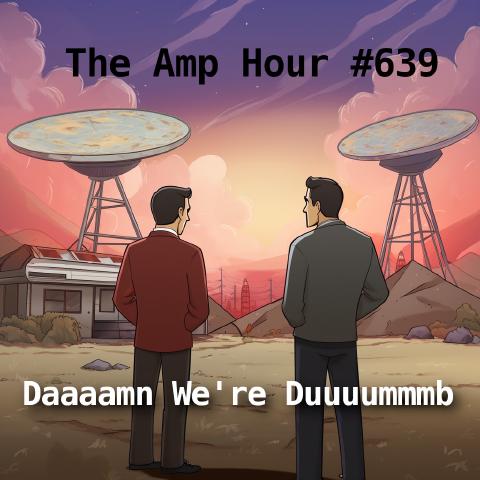
#639 – Daaaamn We're Duuuummmb
Download episode · 57 MB
Also on Apple · Spotify · YouTube · RSS
Show Notes
- Dave has been traveling around Australia with family. He made a video about an old solar thermal facility.
- Chris also has been traveling, he gave a talk at the Embedded Open Source Summit about doing embedded training.
- Solar thermal efficiencies
- What is the efficiency of a mirror?
- What is the efficiency of a transformer?
- Power engineering class
- Nic Bingham giving a talk about high pressure electronics
- Chris was inspired from CNLohr's episode where he talked about building a switcher. He recently bought a bunch of CH32V003 parts.
- WSJ article about Chiplets (Archive)
- Chiplets have been mentioned on the show a bunch before
- Dave reviews the Analog Discovery 3. This is Chris's daily driver at this point, especially when on the move.
- While searching for something during the episode, Chris stumbled onto an old reddit post from 9 years ago about how they decide where to build fabs.
- Chris and Dave both felt dumb while watching Shahriar's Starlink teardown
- Kathy Loves Physics will be doing videos about Maxwell's equations
Transcript
Chris Gammell: This is The Amp Hour Podcast. Released July 17th, 2023. Episode 639. Damn, we're done.
Dave Jones: Welcome to the Amp Hour. I'm Dave Jones from the AEV blog.
Chris Gammell: Who are you? It's been so long.
Dave Jones: It's been so long.
Chris Gammell: I'm Chris Gammell of Contextual Electronics. I don't know.
Dave Jones: Well, you're buggering off tomorrow somewhere.
Chris Gammell: I know, exactly. We're going to, yeah, the summer of two or three shows of Dave and Chris.
Dave Jones: Ah, well, you know, this is not our main gig. You know, it's not like. Good to catch up with the chap. What's been happening?
Chris Gammell: On the Amp Hour, I guess. Some great guests recently. We did an AR show with a college grad who's doing amazing stuff. We did the CH32V003.
Dave Jones: Yes.
Chris Gammell: I just got a reel of those parts today. Not a reel, sorry. Oh, a whole reel. A chunk. I got a chunk. I got a chunk of a reel. 150.
Dave Jones: Okay.
Chris Gammell: Yeah. So lots of fun stuff. What about you, man? You've been walkabout?
Dave Jones: I've been walkabout for a couple of weeks. Yep.
Chris Gammell: Yeah. Living that good life.
Dave Jones: No one realized, did they? No.
Chris Gammell: He planned so well.
Dave Jones: Yes. Oh, boy. Oh, yeah.
Chris Gammell: Where'd you go? Anywhere fun?
Dave Jones: Oh, I drove all the way out to Broken Hill. It was a road trip, which it's in the Outback, for those who don't know. It's in the middle of nowhere. It's not quite the back of Burke, but, you know. Sorry. That's an Aussie expression. Yeah. Yeah, I figured. Anyway, Outback, all the red dirt stuff, things like that. So I've got a video I'll edit after this. I visited the world's first solar power station.
Chris Gammell: Oh, interesting.
Dave Jones: Yeah. Okay. Okay. No solar cell rubbish. This is, you know, solar thermal.
Chris Gammell: Oh, so like reflectors up onto a tower?
Dave Jones: As in a focus. Yeah. As in a focus dish, and then they superheat steam in a pipe at the focal point of the dish. And yeah, it was the world's first one from 1981. So there you go.
Chris Gammell: So when you look at something like that, you like walk up to it. I mean, obviously the dishes are all focused at the focal point, right? Yep. It's like parabolic in that way. Can you feel heat coming off of it? I mean, I don't even know how close you can get.
Dave Jones: It's no longer used, so they weren't pointed at the sun. And there was no sun that day anyway. I, ironically, here I am filming in the highest solar insulation point in the country, and there's no sun. It's like, you know, oops. Yeah, that's how it goes. Yeah. Had a slate of bad weather. Uh-huh. So yeah. Yep. Okay. That's cool though. Yeah. Yeah. But no, it was, it only lasted for 10 years or something like that. And basically nobody does it like that anymore. Nobody does. There are some solar thermal plants around, but they're not done using the dish. With the focal point of the parabolic reflector. They all are like a tower base. So they all have like a central tower. Oh, interesting. I guess I was having a mind. Right. Oh, no, no, no, no. Each one is its own little individual heater. So it's actually a dish. It, it, it, actually, when I was driving, I didn't even know this was there. Right. Yeah. We were going to this little town. I had no idea this was there. And I'm going, why, like, this is the tiniest tin pot town in the middle of nowhere. Right.
Chris Gammell: Uh-huh.
Dave Jones: And, and we're going, what are these dishes? What, what are these satellite dishes? And I'm looking at them and there's like, you know, a dozen of these satellite dishes. I'm going, what the heck is going on here? And then we get closer. I go, they, they're not satellite. Like, there's something weird going on here. Yeah. Yeah. And I find out that, yeah, it was the world's first solar thermal plant. Huh. So there you go. Yeah.
Chris Gammell: And this is just heating water, not heating like salts or anything like that?
Dave Jones: No, no, no. Heating water. No. That's what I was saying. The newer ones, they have like a massive tower and they're like tens of megawatts.
Chris Gammell: Yeah. The tower, sometimes they do, don't they do like molten, molten salts sometimes?
Dave Jones: They're molten salts or something like that. Yeah. Yeah. Yeah. They're usually something, you know, some sort of thermal absorbing material like that. But no, this was basically a coil of wire, which I ran order through and it just superheats it to 500 to a thousand degrees Celsius. And yeah. Yeah. Superheats these. And they've got a, just a, a, they converted a generator into a steam, you know, so that steam can drive the thing.
Chris Gammell: And yeah. Yeah. It does sound like that would be high maintenance, I guess. You know, like it's basically halfway to a steam plant, right? I mean, and that's just a lot of, and then it's also got the elements being down on it. It's like a coal or gas, it's at least all the piping's internal.
Dave Jones: Yeah. It's all internal. It's one big central thing. Yeah. Whereas this is 14 individual dishes. So you've got to run the water up to each dish. And then, yeah. And then you've got to run it through the pivot mount. Cause each dish is like an auto tracking thing, you know, and it's like. Right. So then you're like weight limited too.
Chris Gammell: Yeah. So, and it does seem like there's a lot of like scale. You look at like a nuclear plant. It feels like the scale is probably the most important thing there. One of the most important things, just because you want to have, you know, you've already got a lot of power output. Then you also want to have the, or sorry, you have a lot of energy output from the actual nuclear material, but then you want to also like translate that into steam and all of the turbines turning and stuff like that.
Dave Jones: Yeah. And that's, yeah, this thing just didn't scale. There's a really detailed report, which I'll link in my video, which after 10 years of operation, they, you know, figured out, was it viable and everything. And we're not talking huge amounts of power. We're talking 25 kilowatts here. Right.
Chris Gammell: Oh, wow.
Dave Jones: This is like the equivalent of like a large home solar array. Like some people have, like I know people with like 30 kilowatts, you know, 35 kilowatt home solar arrays. Right. And this thing's 14 gigantic five meter diameter dishes. Right. 14 of these things on their sun tracking pivot thing. And it was only capable of 25 kilowatts. Yeah. Right. So, you know, so that's why nobody uses this type of thing anymore. But they needed to know, right. They needed to research this. So they built it and they researched it. They built a few more in various locations around the world. And they went, nah, it's better if you have like one big central tower and then you have mirrors that just pivot and focus the sun's rays onto that one gigantic tower. That's the kind that I had in mind. Yeah. Yeah. Because that's the only ones that you make.
Chris Gammell: Those reflectors. Yeah. They must catch a lot of heat. I mean, obviously they catch a lot of sun, right? And they're bouncing photons, I guess. But like they still.
Dave Jones: Yeah. But they're mirrors. So they don't actually absorb it. Right.
Chris Gammell: Right. But they still must have some absorption. Right.
Dave Jones: Oh, well, it's going to be non-zero, but it's not going to be. I don't think it's, you know, it depends on the efficiency of your mirrored surface.
Chris Gammell: I guess they're always out in the middle of like deserts too. And I'm like, like thinking like if you're out in the middle of a desert anyways, it's like the ground's pretty hot as well. So maybe I'm just like thinking about it being like that hot because everything else is around. But, or I guess full sun.
Dave Jones: Yeah. But yeah, but it's not much. Right. Because if you think about it, right. The regular solar insulation, let's run some mental numbers here, right? A thousand watts per square meter. Right. Let's say each mirror is 10 square meters. Right. So that's 10,000 watts for a 10 square meter mirror. Right. A single mirror. Right. So, you know, 10. Okay. So we've got 10 kilowatts. Right.
Chris Gammell: But then you have, I don't know what the conversion efficiency is, you know, like.
Dave Jones: Well, yeah. At times, like let's say it's 0.1% like loss. That's only 10 watts. So that entire 10 square meter. So that's only one.
Chris Gammell: You think it's that much? You think mirrors bounce that much power?
Dave Jones: Well, I assume that the materials technology is so good that a mirror is, you can get close to 100% efficiency on a mirror, I would think, a nice polished surface, I would think.
Chris Gammell: What about like super low? I'm just, what I'm really thinking about is like there's, so there's like high frequency stuff and then there's low frequency stuff. And like, you know, some infrared comes in with the sunlight and that's like super long wavelength. I just don't, I didn't think that mirrors would bounce that as well. But honestly, I never even thought about the efficiency of a mirror. Like, it's just like, it's just a mirror, right? But, but at a certain point, it probably does start to add up. Yeah.
Dave Jones: Yeah. Well, yeah, exactly. I don't know. I'm, I'm looking at the moment. I'm looking at solar mirror, Wikipedia page, reflective layer for reflecting the solar edge. In most cases, I'm going to search for efficiency. Reflection coefficient. I know someone will figure this out. Right. Okay. Efficiency, efficiency. Come on. Just give me a percentage.
Chris Gammell: Dave, you can just shit. You just put this on your, so Dave and I are actually recording. We've had a bit of a couple of snafus now with a past recording service. So we're, we're using StreamYard and we have at least video to one another. You could just drop this. I could, I could look at the stream video right now, Dave. You just put it on that window.
Dave Jones: You could. Well, okay, fine. Look, here it is. We'll share together. There you are. Yeah. There you are.
Speaker ?: Look.
Dave Jones: Solar thermal application. It's, come on. There's got to be an efficiency. Yeah. This is where, this is where chat GPT, right?
Chris Gammell: You do think it would have like that as a banner level thing. Yeah. Yeah. What is the efficiency of a mirror? I guess.
Dave Jones: What is the efficiency of a solar mirror? Damn it. I am going, I am going into chat GPT now. Right. I'm going to go open AI. All right. Hang on. This, this makes for great radio. All right. Right. Yeah. We can, we can, we can edit this pause out. Chat GPT. I mean, because I, I, so are you a paid chat, chat GPT person? I am now. Yeah. Okay. Yeah. Which means you have access to the live thing. So you can actually search.
Chris Gammell: I actually didn't know that.
Dave Jones: For the live search results. Oh yeah. I don't use it that much.
Chris Gammell: I use mid journey way more. I pay for both. I have a workplace for both. Yeah. I use, I use a mid journey way more.
Dave Jones: Right. What is the efficiency? I spelled efficient. If fish, E N C. Sorry, Dave. I can't do that. I do that. Of a solar thermal mirror. I assume it'll know where here it is. Solar thermal mirror systems. Also know it's concentrated solar power systems. Use mirrors to concentrate sunlight on the small area. The concentrated light is then converted into.
Chris Gammell: It sounds so like pedantic when it starts. I just wanted an answer. Yeah. Just put a number at the top. You know, like I want that number like on Google.
Dave Jones: Oh, hang on. Typical optical efficiencies are in the range of 60 to 70%. Oh, lower than I would have guessed. That's for the optical efficiency. Thermal efficiency is 80 to 90%. Hang on. Conversion. No, I want the overall, the combined. No, I just want the actual mirror. I just want the, I don't believe.
Chris Gammell: The exercise is left up to the reader.
Dave Jones: Really? I just don't believe that. I don't believe that it's like barely gets to 90%.
Chris Gammell: Well, that's, I guess the other thing too, is that like the, the optical efficiency then too, like just thinking about that. So say 60 to 70%. What is that 30 to 40% number then though? Does that get converted to heat? Or is that just like bounces off in random directions or, you know, electron, sorry, photon?
Dave Jones: Well, you've got to assume it's got, it has to be absorbed, right? Because it's a surface. It's an actual surface, right? And if you've got your one kilowatt per square meter focused at the sun, because these are angled, right? So they're angled properly, right? So they're angled optimally. So you're getting your full one kilowatt per square meter.
Chris Gammell: Is that like a standard kind of like a back of the envelope kind of number? I actually don't know. Oh, not yet. I don't know sun numbers.
Dave Jones: That is the industry standard. The solar insulation for a solar panel. If you look at the data sheet, it'll, it's all, all it's, you know, if you've got a 400 watt solar panel, that's at a nominal one, 1000 watts per square meter. That's taken as the solar insulation.
Chris Gammell: That's like a great, easy to remember number. That's really nice.
Speaker ?: I know.
Chris Gammell: It's awesome.
Dave Jones: Yeah, it's awesome. Thanks, son. Yeah. So in countries like Australia here, right? In a high solar, it might be slightly higher than that. In Sydney here, it might be slower than that some days, but I've actually looked at data and even in Sydney here, it could actually get higher than that. But that's taken as like a worldwide average. So they just rounded it. Somebody somewhere just rounded that off.
Chris Gammell: Not to the nearest. Cleveland, Ohio, I bet.
Dave Jones: Right. No. And, and of course it drops in, uh, in winter and stuff like that, but you know, 1000 watts, but all every solar panel you'll ever get the data sheet. Have a look. Standard. Rated at a thousand watts per square meter, which makes it, you know, which makes it fantastic.
Chris Gammell: You know, it's just really easy.
Dave Jones: So I don't know. I'm not, I'm, I'm, no, I'm not happy with chat.
Chris Gammell: So not a hundred percent though. I think that's pretty clear.
Dave Jones: It's not a hundred percent, but I, I would have been stunned. I said 0.1%.
Chris Gammell: I mean, that's an order of magnitude off, right?
Dave Jones: Okay. Well, let's say it's one.
Chris Gammell: 10% inefficient. 10% seems like it. I would say, I would say, I would say that makes sense. I mean, like just thinking about otherwise, why wouldn't they do this?
Dave Jones: I can understand you would get that as a system efficiency, right? Yeah. I can understand that the system's only 60%. In fact, this one that I, uh, this one that I was, I was looking at, the entire system efficiency is only about 20%. If you take end to end, like a thousand watts per square meter in, and, and then you've got the, not only the, you know, the concentrator itself, but then the engine and, you know, like the, uh, steam generator and everything. And the entire end there.
Chris Gammell: Then you start running into Carnot, Carnot efficiencies as well.
Dave Jones: Right. And you've got like a thousand, a thousand.
Chris Gammell: That was on a video recently.
Dave Jones: Oh, was it? Who was it? Okay. Yeah.
Chris Gammell: I think real engineering or someone talked about, someone was talking about. Oh, okay. Maybe it was fair to ask him. I don't know. Somebody, somebody on the YouTubes was recently talking about Carnot. It was great. I love Carnot.
Dave Jones: So there you go. You've got a five meter diameter dish. I don't know. You have to do your pi r squared thing to work out the area of that, but you know, let's say it's five square meters. So you've got five, five kilowatts coming in. You're only going to get 20% or dead. No, no, it's even lower than that. I think it might've been 12% or something. It was like, yeah, it's, it's actually quite poor system end to end efficiency. But I can't believe a mirror is not like 98, 99% efficient. I'm not buying it.
Chris Gammell: You know, Dave, we may, we may be blessed with some mirror experts right now. Right.
Dave Jones: Screaming in the comments.
Chris Gammell: At the very least, some mirror armchair experts.
Dave Jones: And next week on the show, we'd like to announce the world's best mirror expert.
Chris Gammell: I feel like that would be a different podcast too. I don't, I don't know what the crossover would be of like material science experts and, you know, cause it does feel like a material science field. Yeah. Oh, totally. Even like a, like a PV expert is going to be someone who's probably not like doing electron, you know, microelectronics every day. Oh, no, no.
Dave Jones: They would be a, you would be a, a physicist, a, a material scientist, something like that.
Chris Gammell: Yeah.
Dave Jones: You know? Yeah. So, so what would, what would have your guess have been? I mean, I thought like engineers where that's what we do. Ball purpose assumptions.
Chris Gammell: I've been spoiled now, Dave.
Dave Jones: Right.
Chris Gammell: Yeah, exactly. I was spoiled by now learning that we should have had me guess earlier. Here's what I was thinking. I was thinking the mirrors were going to be hot. Right. So whatever that translates to inefficiency, cause yeah, I just assume that.
Dave Jones: Yeah, but I thought they wouldn't have been, cause that's their job. Their soul, you, you have one job. Your job is to reflect. Yeah. I just think that. The energy. And I thought material science these days.
Chris Gammell: I think like the IR stuff that hits the earth, right? That's like low frequency. And you know, uh, I think you're overcomplicating it with this frequency. You ever see that animation of like how AC passes through a waveform and then it shows a sine wave and it's just going through the gap of a capacitor rather. And it's just like, oh, there it is. Like that's what I'm imagining for a large. My brain is very stupid and getting stupider by the day. Oh boy. But I have fun doing it. So I don't care. I, yeah. So that's why I was asking about it. I was just thinking that these, these things would be kind of kicking off some heat.
Dave Jones: Yeah. But maybe I would think it'd be minimum. Just like when you talk, okay. Do you know the efficiency? Well, no, we've talked about this on the show before. We've even had guests on. Do you know what the efficiency of a power transformer is? Like a mains distribution megawatt power transformer is, right?
Chris Gammell: I know it's not a hundred. Uh, I don't remember what it was. Who was talked about that? Was that the, uh, the sheep farm guy? The one who was doing like lightning stuff? I don't remember what his name was. Oh, okay.
Dave Jones: No, no, no, no, no. But anyway, like, right. Just so you don't know.
Chris Gammell: I don't remember. No.
Dave Jones: Do you think it's near a hundred percent or is it 90%, 95, 90, 85, 80?
Chris Gammell: 60%.
Dave Jones: 60%. Okay.
Chris Gammell: Yeah.
Dave Jones: So you're telling me that a one megawatt, a one megawatt.
Chris Gammell: Oh, that would be kicking off a lot of heat. Yeah.
Dave Jones: Exactly. The transformer would melt, right?
Chris Gammell: It would definitely.
Dave Jones: So by practical engineering inspection. Whoa, whoa, whoa, whoa, whoa.
Chris Gammell: Nobody ever has claimed I was a practical engineer.
Dave Jones: It's got to be high, right? It's got to be close to a hundred percent. It's got to be 99%. Right.
Chris Gammell: Yeah. I guess I didn't really think about the big boys.
Dave Jones: Didn't you ever do a power engineering class? That's one of the first things they taught us. I never did, Dave. They actually got us to do this very thought experiment. That's a good one. Right. They said, think about it. Like, how much loss, right?
Chris Gammell: Well, I think, yeah, once you start thinking about the loss, usually goes to heat, if not RF, and then, yeah.
Dave Jones: Well, no, a transformer, right? Yeah. It's going to go to heat, right? You would melt the insulation on the wires in the transformer. It would just melt and short out, right? If it's more than a few percent, even. You know, if you're talking about a 10-megawatt transformer, for example, right? Just, you know, right? It's these, like, they're incredibly... I'm saying the same thing here.
Chris Gammell: The mirrors would also melt to speak. Well, no, because... But you're not forcing the same amount of power through a mirror.
Dave Jones: Well, no, because there's not much energy coming on them, right? Yeah. Yeah, exactly. Exactly.
Chris Gammell: Like, things sit out in the sun all day, every day, right? Yes.
Dave Jones: Oh, of course. And they get hot, right? They get hot enough to cook.
Chris Gammell: You ever gone down... Here's a little life experience thing. You ever go down a metal slide at a playground in the noonday sun? Better be wearing long pants. Yeah. These are lived experiences these days, yeah. Yes, exactly. Anyway. But I guess probably the sheet metal on a slide is probably not meant as a efficient mirror either.
Dave Jones: But I'm thinking...
Chris Gammell: You're in the 90s.
Dave Jones: It would be in the order of, like, 99%. I would have been surprised. I will be surprised if it's greater than... If it's more than a couple of percent loss. But, hey, I don't know.
Chris Gammell: I mean, it's a good question.
Dave Jones: Is mirror optical technology not that good? All right. Anyway, check GPT. Useless. Yeah.
Chris Gammell: Yeah, seriously. Good luck taking over the world, computers. We already have enough dumb over here. Thanks a lot.
Dave Jones: Oh, boy. Anyway, that's enough of that. Anyway, that was fun. So, hopefully I'll have a video coming on that. It's not hugely informative because I didn't know I was going to this thing. So, if I did, I would have, like, done some research maybe. Look at this. It's like, you know. But here it is. I don't know. I wave my hands and, you know. Yep. Anyway.
Chris Gammell: I also was traveling. I just was in Prague two weeks ago for the Embedded Open Source Summit. And, actually, my talk was published today. So, I gave a talk about training.
Dave Jones: Is that the one that's LinkedIn?
Chris Gammell: Yep. That's on the Reddit right now. Oh, yeah. I see it now.
Dave Jones: Yes, I see it.
Chris Gammell: Yeah. It was pretty good. Definitely the best audio I've ever had for a talk. They gave me, like, a little, like, one of those mics that's, like, real close to your face. I've never had one of those before.
Dave Jones: Oh, the headset mic. Yep.
Chris Gammell: Yeah. Like, the one they give singers on the stage.
Dave Jones: Yeah, yeah.
Chris Gammell: Yeah.
Dave Jones: It's a headset.
Chris Gammell: Yeah. Not like a big, not like a Gwen Stefani headset, though. Like a...
Dave Jones: What's a Gwen Stefani headset?
Chris Gammell: Gwen Stefani, like, had the, you know, she was, like, No Doubt, the singer from No Doubt. Yeah, but, like, I've heard of her. And, like, Madonna had one, too. But it was, like, actually, like, a large black microphone that came in front of their mouth. Oh, okay. And this was actually, like, you know, beige and, like, the small microphone. Yep. Really good explanations here, Chris.
Dave Jones: Actually, that is not a small one, dude. Nah, sorry. You're out of date with your microphone technology. See, that is not a small one. Nah, that's actually quite large.
Chris Gammell: Yep. I'm so ashamed from that and not from thinking that transformers would melt throughout the power system. Right.
Dave Jones: Oh, boy.
Chris Gammell: Yeah, but this is about how I do remote machines, basically, for training. And kind of, like, all of the challenges. How I would prefer if people would show up at a training with a completely new OS installed on their laptop. And that is the stupidest assumption you could possibly have. Yeah, right. Nothing could be further from the truth.
Dave Jones: Yeah, exactly.
Chris Gammell: Yep. So, past guest Joe Fitzpatrick, he does hardware training. And he actually rocks up to training with two or three Pelican cases full of laptops that are, like, imaged the night before. I still think that is... Because if you're going to do in-person training, which I'm not, I'm doing remote training. If you're going to do in-person training, I think that is by far the best one. Because then you get USB access and, like, you can just... You really know... You know, that's what kind of, like, the thing... What people expect out of their... Out of a computer-based training. So, yeah.
Dave Jones: Nice. Training. Seems like a packed room.
Chris Gammell: Yeah, yeah. This was definitely the most full room I've ever given a talk to. Usually it's, like, four people, three of whom are very nice Amp Hour listeners.
Dave Jones: Right, yeah. Well, I'm surprised it's not higher. So, what? So, there are only three or four in that crowd who actually knew who you were?
Chris Gammell: No, no, no. I'm saying in most talks I usually give, it's only three or four people in the room. Oh, okay. Total. Oh, right. Okay, total. Of which three of them are Amp Hour listeners. And they're, like, taking pity on me. They're, like, oh, I heard Chris is going to be giving a talk. Yeah, right.
Dave Jones: I'll sit there and show some moral support, right?
Chris Gammell: Exactly, yes. And I really appreciate it. I mean, I really do. Oh, yeah. But a bunch of people in this room didn't know who I was, which is great. That's what I'm going for. Oh, excellent. So, yeah. It was fun. It was a cool town. I'd never been to Prague before. So, good spot. Yeah, it was nice. And, yeah. Great folks from Czechia and elsewhere. Czechia. I'm not sure how to say it. From the Czech Republic.
Dave Jones: Right. Yeah. I won't even try to butcher it. Yeah.
Speaker ?: Yeah.
Dave Jones: Yep. Cool. And where are you headed off to tomorrow? When you're packing tomorrow?
Chris Gammell: I'm packing tomorrow. Going to, on Friday, I'm going to the Pacific Northwest and doing some more national parks with my family. Oh, okay. Right.
Dave Jones: So, this is a personal. It's not.
Chris Gammell: This is personal. Yeah, yeah. This one is, this time it's personal.
Dave Jones: Are you going to slip one in there? Are you going to, like, slip in a tech visit?
Chris Gammell: I'm going to meet up with our good friend, Jeff Kaiser. Oh, yeah. Mr. Mighty Ohm himself. So, we're going to meet up with him and a couple of the nerds along the way. Okay. Yeah. That's about it. No meetups or anything like that. I'm pretty strictly on, you know, family schedule.
Dave Jones: Yep. Somebody asked me, somebody emailed me yesterday and asked if there's any, like, decent, like, tech events here. And I'm going, no, no, it's just not. It's sad. Yeah. You know, there's just nothing.
Chris Gammell: I think you got to respond with, you should start one. I think that's the way to do it. Right. Okay. That's what you should really do, Dave, next time.
Dave Jones: Yep. But the problem is, like, I can't even get together a bunch of YouTubers. It's like, okay, I'm like, yeah, there's a couple. I don't think there's any. No. Are there any other electronics, even tangentially related electronics YouTubers in Sydney? I don't think so. I don't know. There's a couple in Melbourne. But, like, you know, it's like slim pickings.
Chris Gammell: Sure.
Dave Jones: So, whereas, you know, US or even Europe or UK, you know.
Chris Gammell: Yeah, I mean, YouTubers is kind of a smaller audience, right?
Dave Jones: Yeah.
Chris Gammell: Here's my advice, which I don't always take myself, so take that with a grain of salt. The best way to start a meetup is, one, to put it on some site where people will hopefully find it, like Meetup or similar. I'm not a huge fan of Meetup itself, but it's fine.
Dave Jones: Yeah, no, I've kind of ditched it. Yeah.
Chris Gammell: Yeah, it's not the best. But the most important thing is to tell yourself, I'm going to hold a meetup, and I'm going to be at this bar at this time, and I will be there with electronics projects, and I hope you show up. And you're going to go there, and you're going to enjoy a burger and maybe a drink. Oh, yeah, totally. And if nobody shows up, you have to be okay with that, right? That's the important thing.
Chris Gammell: Exactly. Or if one person shows up. But if one person shows up, you're going to hang out with them. It's going to be great. And then maybe try it again later. Yeah. Yeah. Yeah. So, it's tough. It's tough to get people together. But, you know, you do it over time, and enough people find out about it. The hard part is people finding out about it, I think.
Dave Jones: Yeah. Oh, yeah. Yeah. Totally.
Chris Gammell: So, if you're going to start one in Sydney, tell Dave so he can amplify it, and Dave will definitely amplify it.
Dave Jones: Yeah. I'll probably do the EEV blog thing again, the meetup. Because we had, like, what, 50 people last time? You know, it was quite a lot. It was actually the venue was pretty much packed, you know. So, yeah, it was, like, standard room only, really. Great. Do it. Yeah. I dare you. Exactly. But it's not, you know, it's just a hangout. It's not a event, you know, which is kind of different.
Chris Gammell: Hangouts are great.
Dave Jones: Yeah, I know. Hangouts are great. But I'm wondering, would people be likely to turn up to a hangout, just a casual hangout, than they are to turn up to a formal event? Like, if I organized, you know, talks and, you know, if I held a venue with a, you know, seating and, you know. Like, I'm thinking I'd be struggling to get people to turn up to that. Whereas a hangout, yeah, I think.
Chris Gammell: You'd be surprised. I think people are always looking for technical content and stuff like that. I mean, I used to do these things all the time. So, yeah, no, you'd be surprised. Because, like, then you actually, if you publish what is going to be talked about there, too, it's like. Right, yes. I don't know. Some of that. There is something about the being in person, right? Obviously, we're all coming out of a pandemic. And then, I think, wanting to be part of this live event where it's being talked about, too. And, you know, so someone is going to give a talk about what's one of the ones that used to go. So, how about this? So, maybe a bit news relevant. This guy, Nick Bingham, I think, he gave a talk at HDDG, which is a meetup I used to do, about high-pressure electronics for submersibles. If you gave that talk these days, right, there would be a lot of interest given the recent events with OceanGate.
Dave Jones: I should have done a video on that, but I said I wouldn't.
Chris Gammell: I mean.
Dave Jones: I said I wouldn't do a video on that, and people thanked me for that. But now I'm watching all the videos on it, and they're getting, like, 1, you know, 2.2 million views. And, you know. Yeah.
Chris Gammell: I'll send you this one. It's worth watching.
Dave Jones: Oh, I've probably already seen it. But, yeah. Okay, send it.
Chris Gammell: And then, actually, another person that was at that meetup, he's actually the guest for next week. So, and I've mentioned him on here a bunch before. So, that's Werner Johansson. So, yeah. Cool. You know, and just like you have these weird topics and sometimes.
Dave Jones: Wait, it's the link. I haven't got it.
Chris Gammell: Oh, sorry.
Dave Jones: Come on. Where is it? Press enter. It's that big. It's that bigger key.
Chris Gammell: The middle key? That double width key. Press the N-E-K. Oh. Where's the N-E-K?
Dave Jones: Oh, boy.
Chris Gammell: I think it's, I think it would work. I think you just gotta, you know, the logistics are the shitty part, personally. Getting people there.
Dave Jones: Oh, I have not seen that one. Because that's a, that's a supply frame hardware thing. Okay. That's right. So, ah, so this is not Ocean Gate. Okay. Right. This is not Ocean Gate.
Chris Gammell: No, this is way before. This is from 2017. But it's basically about, like, what happens when you compress capacitors at whatever the, you know, thousands of meters depth thing. Right? So, if you have, even if you have a fully enclosed case and then, but then all your, you know, like all of the, you know, all of the epoxy that you put in there or whatever's enclosed in this thing is still going to get compressed. And then, like, can all of your, these things withstand even just the, the nominal pressure after you have these enclosures. So, yeah, it's, it's crazy stuff.
Dave Jones: Yeah, I know. I've worked in that industry. Yep.
Chris Gammell: Yeah. Yeah.
Dave Jones: Tell me all about pinhole leaks in cables. If, if you think your PVC cable, you know, if your regular cable is, doesn't have pinholes in it. I've got a bridge to sell you. So, yep. Anyway. But it also depends how long you want your stuff to work underwater, you know? It's also a thing, like, you know.
Chris Gammell: Yeah, right, right. There's trade-offs there.
Dave Jones: Stuff I've worked on was reusable. Others, it just had to work for four hours and then it sunk to the bottom. You know, they're very different design criteria. Right. I agree. When it's actually sacrificial, you know? Yeah. So, I think you should do it. Which one? Which one? You've got to tell me which one.
Chris Gammell: Oh, either?
Dave Jones: The, the actual, like, the talk one or the meetup. The meetup one's easy. Like, because it doesn't cost anything. The meetup one's easy. You don't have to organize anything. You've just got to actually publish it and turn up, you know?
Chris Gammell: What is, what is the most likely thing for you to do, Dave? I mean, that's really the...
Dave Jones: Oh, well, the one with the least effort. Yeah, then do that. That's great. Yeah, exactly.
Chris Gammell: Yeah. Yeah, then do that. Okay. And then if, if you enjoy it, then do the other one. I don't know.
Dave Jones: Well, I've already done them before and I did enjoy it. So, I just have to get off my ass and get off and yeah.
Chris Gammell: Yeah, I think that's the real thing. That's the real thing. Speaking of, I have to get off my butt and make a board. I finally, I finally did get off my butt actually. And finally tried out the CH-32V003, which you had made a video about. And you and I bought that board at the same time. And it took me having CN Lore on the show.
Dave Jones: Yeah.
Chris Gammell: Talking about this thing in order for me to actually try it. Have you done anything else with that since you've, since you started with the Moon River?
Dave Jones: Not much, no. No. I just had some play around with it and that was, that was it. Unfortunately, it's not a chip that's suitable for my current project. So, you know, it's just, you know.
Chris Gammell: Yeah. I am wondering some of the limits on it of like the specs and stuff like that. I'm still mostly going through examples and trying stuff out. I will say, so CN Lore talked about it during the recording, but like it is the fastest compile time. Like the, the compile, the compile download try loop is so incredibly fast. I have never experienced anything like that. And I don't know if it's like, because the tool changes are so minimal, this is using his.
Dave Jones: It's minimal. Plus it's not very big. I mean, it's not like it's got to download megabytes worth of, you know. It's not big. Right. Right. Exactly. It's only downloading like 1K worth of code or something.
Chris Gammell: That, I think, yeah, there's not a lot of code. And then also the, the one thing that, that CN Lore did point out is that the interface speed with the one wire that's on there, like the debug port is actually very fast as well. So like, that's another factor, I guess. I don't know.
Dave Jones: Right.
Chris Gammell: So yeah, no, I'm, I'm excited about it. Got to figure out what to build. I think I'm going to try some of the things that he talked about too, of like building a buck converter and similar things like that. Like some of the builder.
Dave Jones: No, that's just wrong. A buck converter with a 32 bit, with a, you know, an arm.
Chris Gammell: With a 10 cent microcontroller.
Dave Jones: Yeah, but yeah, but it's just, no, it's wrong.
Chris Gammell: Why not? That's also what Werner talks about next week. Hey, this, this is how people do it, man. I, I, but it's, here's the thing. So this is one thing we talked about when you weren't, weren't here was like, what if, what if you could always, what if you could always get this chip though? Granted, that's a, that's a very, very long stretch in, in the current world we live in.
Dave Jones: If it's so jelly bean that it's, you know, that you use it for everything.
Chris Gammell: If it's so jelly bean, say it gets replicated by other people too, right? Say this form factor gets really replicated. It's always 10 cents, whatever. And it's, I don't know, 80 to 90% good enough as like a TI switcher. Right. Like maybe it does make sense to put this in, you know, like TI switchers are great. I love them. I put them on parts all the time, boards all the time. But like, if I can control it and maybe customize it more, like that, there was a lot of that push pull of like, should you, should you maintain this stuff too? Cause then there's the burden. One of the things I brought up was the support burden of like maintaining five pieces of firmware on your board. That sucks. Yeah. So, you know, like you have to, you do have to balance these things.
Dave Jones: Have some self-respect. Come on. What's the self-respect?
Chris Gammell: Just bias switcher.
Dave Jones: Using, doing proper engineering and using the most optimal part for the job. You know? Oh, sure.
Chris Gammell: No, no, no, no. This starts as an academic exercise first. But I think, I think there are cases for it.
Dave Jones: The road to hell is paved with good intentions.
Chris Gammell: That is very true.
Dave Jones: It's paved with academic intentions.
Chris Gammell: I think the road, the road to hell is paved with, well, how hard could this possibly be?
Dave Jones: Oh, God.
Chris Gammell: But no, it's just. I want to know how hard it is too. I've never, I mean, I've built switching converters with like 555s before, but I've never done it with micro.
Dave Jones: Yeah. Because it's overkill. It's, it's just. Totally overkill. It's just the wrong path for the job. Sure, you can make it work.
Chris Gammell: Sure.
Dave Jones: But like, should you?
Chris Gammell: Dave, you're not going to talk me out of this, man. You're not going to talk me out of this.
Dave Jones: Fine, fine.
Chris Gammell: Maybe you should. Maybe that's what the real thing is. Maybe you should. Right. Maybe you should follow along.
Dave Jones: No, thanks. I've got too much self-respect.
Chris Gammell: You've got too much self-respect. Okay. Okay. All right. Well, let's hear about, let's hear about your recent build then. Tell me about all these parts that you're putting into your board.
Dave Jones: Well, I've, I've done some videos on it. It's an optimal part. It's got everything I need built in. It's got the LCD controller. It's got the low power. It's got the 32-bit timers that I'm looking for. It's got, you know, I've done a whole selection video on it.
Chris Gammell: I've watched the videos. Yeah.
Dave Jones: Yeah.
Speaker ?: Yeah.
Chris Gammell: What about the other stuff on board?
Dave Jones: Oh, there's, there's not a huge amount on there. It's not a huge amount else. So, so unfortunately it's like, so it makes sense to sort of like optimize, optimize the one part. Yep. Yeah. Yeah. Like, yeah, I could have done it with one of these little 10 cent micros. And then I'd need an external LCD driver chip, of course. And then I would probably need some additional, you know, timer thing, maybe a, like a CP or D or, you know, a little, you know, something like that perhaps. So, and then I'd need a real, does that have a real-time clock in it? The CH? I don't think so. No. No, right? So, you know, so I'd need a separate real-time clock chip. And it's just, meh, meh. Yeah, sure I can. Oh, maybe it does. And that's what you would have done in the 1980s, right? That's, that's what I would have done, right? I'd, Hank, I'd be using 7.74 series logic, you know, or a CP or D or something.
Chris Gammell: Oh, no, the 107, the CH32 V103 has an RTC.
Dave Jones: Oh, okay. Right. So there is a variant that, that has it.
Chris Gammell: Yeah, there's, there's definitely stuff moving up the stack too. Like there's a, there's a F1, F3 family or V1, V3 rather. I think they're just mostly replicating a lot of the STM32 stuff. Right. Yeah.
Dave Jones: I've, I've got a segue. I've got a perfect segue.
Chris Gammell: Hit it.
Dave Jones: You've already got, well, it's in the list, but I will send you the link now. So you have it. It's an article, article about it. It's in the Wall Street Journal. To drive AI chip makers stack chiplets like Lego blocks. It's the old modular electronics thing, but at a silicon level. So there's this new standard. There's this new chiplet interconnect standard. And I can give you a link here and we'll link it in down below. But yeah, a, a chiplet is basically an, a preexisting IC layout, right? So a preexisting chip layout, but then you can join them together with a bus. And there's various standards for this. One is a UCIE. And there's another one, which I like the name of, bunch of wires, BOW. I like that. Bunch of wires. There's open HBI and there's OIF XSXSR. Jeez. No bugger that one off. You can't even say it. A bunch of wires sounds good. But the, uh, UC, uh, the UCIE, if it sounds like the PCIE, you're not wrong because it's a serial interface. So basically in major companies like NVIDIA, AMD, Intel, Microsoft, Meta, Qualcomm, Samsung, TSMC, geez, they're all in it. Right. So all these companies are sort of like agreed to this universal chiplet interconnect express interface, right? U-C-E-I. And, uh, it was, uh, it was only released in March 22. So it's relatively recent. And I think, uh, chips are coming out now that use these chiplets. So the idea is, okay, you've, you know, Intel's got a, a, a CPU. Okay. I'll use that. And, uh, Qualcomm's got, you know, some sort of, you know, what a Qualcomm do that, you know, the, uh, Siri, you know, the comms stuff, right? So it's got some comms thing over here. So you join all these together so you can make an ASIC using off the shelf chiplets and it reduces the design time.
Chris Gammell: Well, Dave, if you search, if you search on the amp hour for chiplet, you will find, uh, episode 469, episode 499, episode 519, episode 535, episode 616. Yes, chiplets have been, although none of them were, I don't think they were talking about the standard. So that's actually interesting. Right. I would say the most, probably the closest one is, uh, Ming Zhang, who was on the show. He was at a, the now defunct Z-Glue where they were basically, instead of using a standard, they were basically making like a, kind of like an FPGA fabric where the chiplets went under that. Right. It wasn't FPGA though. No, it's right. Smart fabric. So it was like reconfigurable.
Dave Jones: Well, that's a different way to do it. There's, there's many ways to do it. Yeah.
Chris Gammell: Yeah. Yeah. Totally. Yeah. But the, yeah, this is, it's definitely a big trend. I think especially like, cause once you move out of like the, I think some of the, some of them are still wire bound, but like, I think wire, wire bonded rather. Yes.
Dave Jones: You can wire bonded. So it's not really like it's an ASIC, but it's a hybrid ASIC.
Chris Gammell: It's like somewhere between a SIP, a SOM, and a, I don't know what the hell all these different things are. And then like Z-Glue was like, basically it was more like, almost like a mini circuit board is kind of how I thought about it, even though it wasn't quite there.
Dave Jones: Yep.
Chris Gammell: And yeah. So it's definitely a cool idea though. Yeah.
Dave Jones: Yeah. Yeah. It's all about the standards. You know, it's all about, okay, how easy is it and how does it suit my system requirements? You know, cause if you go on a serial, this is a heck of a serial bus. It's a 32 gig transactions per second with up to 64 lanes. Right. So, you know, it's like, it's pretty kicking ass.
Chris Gammell: Right. And this is like that kind of system design type thing. It's like, whenever you start shuttling data and you have buses between them, then that becomes one of your bottlenecks. Right. So like, yes. Then you really have to.
Dave Jones: Yeah. And, and, and then the physical distance that that's why the hybrid, like if you're doing the hybrid, yeah. Okay. You've got the multiple chips and they're on the one substrate, but you've got the physical bond wire, which has to go over. And that's just, okay. You've just slowed your throughput down because you have to go through like a five millimeter long bond wire or something.
Chris Gammell: Right. And then I think the other thing too, is that you have to like balance, especially with like the high, high end, like Nvidia type things. I remember reading something about like the, the amount of heat you generate and then how much you can, like how close can you actually put stuff together? Right. There's like some equation there for like, you know, you can, you need to localize your heat because you're just burning so much because of the efficiency of the, of the core that's processing this data. But maybe you could put another chiplet next to it that you're shuttling the data. So you lose the efficiency. So you lose the, the data throughput going from one chip to another, but maybe you gain that, that power going external to the, to the spicy chip.
Dave Jones: And you might have thermal differences between those. So you might only want one of them going to the thermal pad, for example, and not, not all of them. Cause you don't want to, you, you, you want to take your heat away from the, from the dye that gets hot, but you want to, or the part of the dye in this case that gets hot, but you don't want to like as much as possible, spread that heat to the other parts of the dye that aren't getting warm. So you want to sort of like extract it out from the hotspot, so to speak. So I don't know all that thermal packaging stuff.
Chris Gammell: Yeah. Another one. So like, I think more at the level of, so like Ming was doing the Z-Glu stuff. Craig Bishop, who was on the show too, he was doing like, I think his was more like substrate. He was doing like the, cause he talked about an auto router to actually put chiplets together, but it was, uh, the ability to create this. The substrate was ultimately the product that the company, that company he's working at. So yeah, I'm sure this is, this is definitely a big, and you think about like the complexity too. Like you don't want to, I just think about the processing differences of like, uh, you know, one of the, a lot of these chips in the realm that I work on, right? Like the, something that can do RF power. Yeah. RF stuff is very different. Process. No, right. Right. Or like you look inside, like a, like a, you look at a die shot of an expressive part, right? You know, they have these huge inductors and capacitors relative to the rest of the chip, but then, you know, you still have to have all the transistors as well. And then just putting these things side by side at some point, the scale difference is so high. If you want to have all these functions pushed together, it makes sense to just separate and do them on different processes as well. Because, you know, the amount of space you might waste in a 22 nanometer process to make a large resistor or capacitor on silicon. It's like, well, maybe we should just take that off the chip, right? And connect them together later. So it's like the process efficiency stuff. Glad I don't do that stuff, Dave.
Dave Jones: The old jack of all trades, master of none. You know? Yeah. Yeah.
Chris Gammell: Well, I focus more on that second part of that phrase.
Dave Jones: So, but this won't be, you know, some people talk it up as, oh, it changes the entire industry. No, like, no, it doesn't. It helps out in some areas and in others, it's a complete hindrance. So no one's going to touch it. Right? It's like, you know.
Chris Gammell: I'm really surprised. Have you looked at valuations of like chip companies these days? Like. No. Intel is. What's happening? So Nvidia is one of the biggest because they've gotten really ramped up from.
Dave Jones: Yes. I've heard that Nvidia has gone gangbusters recently, but I haven't looked at the chart.
Chris Gammell: I saw a chart. And like, Intel is, I think it's like, Intel is like at one. And again, this is investor, like, valuation, right? Not necessarily like.
Speaker ?: Yeah, right.
Chris Gammell: Yes. This is share market. Good for the world or actual, like, shared. Oh, yeah.
Dave Jones: Nvidia in the last year has gone up 400%.
Chris Gammell: Yeah. It was like a comparison of all of them. But like, Nvidia was one of the biggest. And then AMD is bigger than Intel now because they've been rocking in a lot of fronts. I was just mostly surprised about Intel. Intel is just a little sad.
Dave Jones: Well, Intel's, you know, if you're in the computer business, if you're in the Linus Tech Tips business, you'll know that Intel's been languishing behind. Let's say that. Yeah.
Chris Gammell: So like people are switching to AMD for other stuff.
Dave Jones: Yeah. But I've heard it swinging back, but I could be wrong. I don't know. I don't really keep up to date on that.
Chris Gammell: Yeah. My computer's not very good.
Dave Jones: Intel's gone down a bit, but, you know, it's actually recovering at the moment. Intel's actually recovering, but just a little bit, slightly. But, you know.
Chris Gammell: You're just looking at charts and stuff. Yeah. I'm just looking at that. Yeah. Just total, like, just the size of these companies. I mean, one, I was surprised by how big Nvidia is. And two, I guess I was surprised by Intel's relative shrink comparatively. Yeah. Yeah. So, yeah.
Dave Jones: Oh, yeah. AMD. Oh, yeah. AMD's gone from, oh, God. AMD was just, oh, well, no, I am looking at quite a timeline there. But we're talking about going from 19 bucks to 150 bucks. So, you know, that's almost a 10. That's getting close to a 10 bagger, you know, depending on when you bought it. So, geez. Yeah. Wow.
Chris Gammell: Well, the other thing, too, is I'm not sure that actually represents, like, shipped product as well. I think those are always so priced for the future, right? Oh, no, it's all. No, no, no. Exactly. They're looking at Nvidia and how much it's, like, in these AI applications with GPUs. And they're looking very far forward. And that could crash as well.
Dave Jones: But just remember, folks, to buy the rumor, sell the fact. Okay? That's like, that's how the share market works. I don't know that one, Dave. Okay. Well, you can go Google that one.
Speaker ?: Okay.
Dave Jones: Buy the rumor, sell the fact.
Chris Gammell: Jim Cramer of Electronics over here.
Dave Jones: Right. The inverse Cramer rule. I'm a big believer in the inverse Cramer rule.
Chris Gammell: Yeah, that's a good one. That's a good one. Yeah, yeah. That's great. Buy whatever he's saying to sell.
Dave Jones: Yeah, yeah. That's probably a good idea. Totally. Yep. Apparently, it's got, like, an 80% hit ratio or something. It's pretty good. It's very predictive. Yeah. Oh, God.
Chris Gammell: Speaking of, well, not maybe not speaking of, there was a large purchase of a company. I think maybe we talked about it in the past show, but NI got bought by Schneider Electric? No. Who did they get bought by? It was someone who was, I was surprised. National Instruments got bought. Not National Instruments, sorry. Shoot. Who makes, who owns Digilent? Digilent's owned by?
Dave Jones: Digilent's owned by NI.
Chris Gammell: It is National Instruments.
Dave Jones: Yes, it is National Instruments.
Chris Gammell: I was thinking National Semiconductor. Okay. No, no. National Instruments.
Dave Jones: So what? So you're saying somebody bought National Instruments? Emerson.
Chris Gammell: Emerson Electric bought National Instruments.
Dave Jones: Bought National Instruments.
Chris Gammell: That was three months ago. Okay. Yeah, right. So that was a while ago.
Dave Jones: Yeah.
Chris Gammell: But I also wanted to bring up your Digilent. Yes. Your Digilent review. We both have the Analog Discovery 3.
Dave Jones: We both have the Analog Discovery 3. They sent it to us. Yep.
Chris Gammell: It's my daily driver now.
Dave Jones: Oh, okay. Yeah.
Chris Gammell: Yeah. Yeah.
Dave Jones: Yeah, it's pretty cool.
Chris Gammell: What do you think?
Dave Jones: Oh, I think it's great.
Chris Gammell: Are you going to use it regularly or no? I'll link in Dave's video about it.
Dave Jones: Not really because I have other tools. Like, you know. Well, I'll see how it goes for my streaming recording platform where I have an on-screen scope and an on-screen multimeter. But this one doesn't have a proper multimeter in it. Whereas my – but I've basically got a bigger version of this. I've actually got the NI –
Chris Gammell: Oh, you've got the bench one. Yeah. Right, right, right.
Dave Jones: Lab thing or whatever. And it's got a proper multimeter in it. It's got, you know, a proper power supply. And it's got – Yeah. Right, right. So, yeah. Yeah.
Chris Gammell: This one's coming on the road with me on my trip.
Dave Jones: Which annoyingly, what they did, right? Because NI, before they bought Digiland, they used to have these – what are they called? I can never remember the name of the stupid thing.
Chris Gammell: Yeah.
Dave Jones: NI Lab – come on. Help me out.
Chris Gammell: I don't know. I don't have it. Look at your bench, man. Aren't you in your lab?
Dave Jones: No, I can't.
Chris Gammell: I would have to get up after. Like, literally turn your head. Go look. I don't care.
Dave Jones: Oh, right. Fine. Fine. I'll go.
Chris Gammell: Oh, actually, I have it right here. Virtual bench. It's virtual bench. Here we go. I'm back. Hang on. Wait, wait, wait. Dave, is it the virtual bench?
Dave Jones: Virtual bench, yes.
Chris Gammell: I had it as soon as you stood up because there was another post here on the Reddit from eight years ago. Holy crap. Eight years ago. Wow.
Dave Jones: Oh, really? Wow.
Chris Gammell: We used to get more votes on our subreddit stuff too.
Dave Jones: But yeah, yeah. So they had this virtual bench, right, before they bought Digiland, right? And then when they bought Digiland, what they did is they took one of their virtual benches and they renamed it. So if you get the Digiland Pro or whatever it is, what's it called? The Digiland – no. No, it's got some other weird name. It's got some other weird number or something.
Chris Gammell: Okay. Analog Discovery Pro?
Dave Jones: Yeah, but no, they're a big one. No, it's the – it's not the Pro. It's the test of measurements. It's the shop all.
Chris Gammell: While you're doing that, I actually would like to point out that if you search on Reddit, actually, and you search on the Amp Hour subreddit, you can actually go back and look at the history of when we were talking about things. It's pretty interesting. I know this is a stupid realization of like, oh, look, the search works on Reddit. But nine years ago, I asked, why are fabs located where they are in the US?
Dave Jones: Oh, there you go.
Chris Gammell: Yeah.
Dave Jones: Anyway, yes, it's the Analog Discovery Pro ADP5250. Bloody hell, right? But that is just a rebadged NI product. I was right. What? Analog Discovery Pro.
Chris Gammell: I said Pro. I'm looking at one on my bench.
Dave Jones: Yeah, but no, but there's two Pro ones. That's the Pro 3000. You've probably got the Pro 3000, right?
Chris Gammell: Yeah, that's the 3000. 3450. I have the 3450. Yep.
Dave Jones: Yeah, that is different, right? I'm talking about the ADP5250, which is identical to my NI Virtual Bench, right? So what I want, damn it, it's just a rebadged product, yet it works with the new waveform software. And the waveform software is way, way orders of magnitude better than the old NI software that I've got for my beast. Yeah. So I'm wondering, can I actually...
Chris Gammell: Yeah, I think it's easy to say Digilant was a software company first.
Dave Jones: It was a software company, yeah, exactly.
Chris Gammell: That happens to make dev boards, yeah.
Dave Jones: Yeah, that happens to make, you know, little oscilloscopy interface things, which is basically an FPGA with an analog to digital converter stuck on it, you know, kind of thing.
Chris Gammell: Yep.
Dave Jones: And, yes, I want to use the new waveform software, but I've contacted them on Twitter and they never got back to me. So, bloody hell.
Chris Gammell: You know, literally they email us all the time.
Dave Jones: Yeah, I know.
Chris Gammell: Okay.
Dave Jones: Oh, do that?
Chris Gammell: Yeah, yeah, I'll send you the email afterwards.
Dave Jones: Oh, okay, right. Who?
Chris Gammell: NI or Digilant? Oh, Digilant, yeah.
Dave Jones: Oh, right, okay.
Chris Gammell: How about this? Nine years ago, I asked on Reddit, why are fabs located where they are in the US? Chris, and I said, I was talking to a friend about this today, wondering why someone wouldn't up and build a fab in Cleveland. But they're building one pretty close. They're building one in Columbus, you know, like two hours away. Look at this. Chris is predicting the future. Nine years ago, Chris. Nice job, nine years ago, Chris. Where's the, is there a link? Oh, I'll send you a link, but it was me searching our subreddit.
Dave Jones: Right.
Chris Gammell: Yeah, no, this is a long time ago. I lost her window. That's sad.
Dave Jones: I didn't even know you could search a sub. Oh, yeah, search Reddit or search a subreddit. Yeah, search a subreddit. Oh, yeah. Right. Yeah. I don't know. I don't use Reddit. I don't either. Everyone's now saying Reddit's dying.
Chris Gammell: Yeah, Reddit might be going the way of the dodo. We'll see.
Dave Jones: Yeah. Your reason, talent. Tax breaks.
Chris Gammell: Tax breaks.
Dave Jones: Everything else, it seems important. Tax breaks was right, actually. Reliable power. Good infrastructure. Yeah, tax breaks. Well, it always comes down to tax breaks, doesn't it?
Chris Gammell: Pretty much.
Dave Jones: I mean, come on. Especially in Columbus.
Chris Gammell: I really don't have any other reasons. I mean, Columbus, I suppose, has the Ohio State University. The Ohio State University. But it's not the top program for, like, chips in the country. So that doesn't make a ton of sense.
Dave Jones: So who's building a fab? Intel. Who's building a fab now? Intel's building a fab. Oh, Intel. Intel's building one of their fabs. Is it like a small fab or is it like a... No, no, it was a big one. Is it like a TSMC? Yeah, yeah, yeah.
Chris Gammell: No, it's a big, big, biggie, biggie, biggie.
Dave Jones: Okay.
Chris Gammell: It was basically... That was their CHIPS Act. You know, like, remember how all the chip companies were announcing?
Dave Jones: Yep.
Chris Gammell: Like, probably a year, year and a half ago now. They were all announcing. We were excited about it on the show. And rightfully so. Like, I was very excited as a U.S. person and during the shortages and stuff like that, too. Like, they all said, we're building new fabs. And TI's got new fabs coming in Richardson and Intel's in wherever the hell they... In Columbus and Microchips building another in Arizona, I think. And there's... They're all over the place. Yep. And they've all pulled back. Because they've changed some of the rules on the CHIPS Act. So, like, they're not...
Dave Jones: It comes with a set of golden handcuffs. Yeah, I think so. They talked about this with Steve Sangy, CEO of Microchips. Oh, that's right. Yeah, that's who brought it up. I was like, yeah. I heard this somewhere. Yeah. So, Steve talked about it.
Chris Gammell: And, yeah. And so... But they're all pulling back because of that. So, it was, like, these big announcements. I think Intel has indicated they are still moving forward. Samsung said they're going to reinvest in Austin. They're down there. Mm-hmm. So, I'm still excited about building more chip fabs. I mean, it's not, like, a bad thing. I just... I hope they do. I just don't think they're going to be as big. I think they're going to probably scale it back to get the maximum PR and, you know, and the maximum tax dollars. So...
Dave Jones: Right.
Chris Gammell: Yeah.
Dave Jones: Anyway, there's somewhere on Unmanaged put this link on about China's gallium and germanium export controls.
Chris Gammell: Oh, yeah. That was in the news recently.
Dave Jones: What's going on there? Have you actually watched it? It's a 14-minute video.
Chris Gammell: No.
Speaker ?: No.
Dave Jones: Okay.
Chris Gammell: I mean, it's like trade war stuff, right? So, they control, I think, 80... Oh, yeah. Totally. Yeah. Yep. So... Yeah. This is just... This is the... State... Statecraft? Is that what it's called? What's it called? Statecraft? I don't know. Perhaps. Yeah. Yeah. Something like that. It's just... It's international politics. There was also another one. There was another, like... I was surprised... Norway found, like, a phosphorus deposit. Was it phosphorus? There was, like, a big news story about a big deposit found under Norway. And all I could think was of my sixth grade, like, you got assigned a country, and then you had natural resources that you, like, drew out of a hat. Oh, right. Okay. It was, like... That was, like... And you got Norway, did you think? Model UN. It was, like, aw. No. No. I didn't get Norway. I got some... It was all fake countries there. But it was, like, you had a country, and it would be picked, whatever. And I just remember thinking, like... I remember this emotion very well. It is a phosphate. Yeah. It was phosphate. Okay, yeah. I remember this emotion very well in this. So, thank you, Mr. Simpson, my sixth grade social studies teacher. It's really unfair. Like, some countries just get a bunch of stuff underneath them, and, like... Yeah, yeah. Of course. And, like, that determined... Australia.
Dave Jones: Yep.
Chris Gammell: So much of the, you know, the outcome of the country is just natural resources. Oh, yeah. Of course. Wow. Of course. I learned that in sixth grade, Dave. Hello, Saudi Arabia. Yeah. I learned that in sixth grade. I learned that in sixth grade. Yeah.
Dave Jones: Oh, boy. Yeah. Yep.
Chris Gammell: It's also what you do with it, though.
Dave Jones: It's the world's largest. Yeah, there you go.
Chris Gammell: It's also how you distribute that wealth. So, that's what I think.
Dave Jones: Well, I was going to say, what is phosphate used in? I knew it's used in fertilizers, but also solar panels and electric car batteries need phosphate as well, do they? Yeah, the electrolytes. I didn't know how much. Yeah. Right.
Chris Gammell: Yeah. Yeah. So, like, lithium and phosphate, I think, are the... Oh, is it... Yeah, I guess that is, right? Life EPO, right? Or however you say lithium... Yeah. Yeah. Lithium, iron, phosphate oxide. Yes, phosphate. Yes, of course. It's in the name. L-I-F-E-P-O-4. Is that what it is? It's in the name. Yeah. Yep. Yeah. So, it's literally in the name. I got that P, man.
Dave Jones: I just didn't know how much. Yeah. Is it actually a lot or is it just like two grams per battery or something?
Chris Gammell: Exactly. Right.
Dave Jones: Is it just like a thin film? Like, you know?
Chris Gammell: Well, and like you hear about all of these, you know, there's so many unique elements and all these things like indicum and zirconium and all of these different like things that are somewhat trace elements but might be super critical. Like, you know, you and I aren't material scientists. We don't know. Totally. Yeah. Probably important because they put it in the name but, you know. I think the thing that's interesting about the germanium stuff, gallium and germanium, like those are technologies around like G, which one is it? G-A-A-S? Yeah. Gallium arsenide? Yes. Gallium arsenide. That's the one that's in like RF stuff.
Dave Jones: All the exotic RF chips and stuff use that. Yeah. That's like one of them.
Chris Gammell: You know who I can ask is Jeff Kaiser because I'm going to see him and he used to work on gallium arsenide.
Dave Jones: Oh, I'd ask Sharia actually. That's even better. Sharia would be. How about this? Yeah, yeah.
Chris Gammell: Let's put Jeff. While I'm on vacation, let's just get Jeff. And Sharia in a room.
Dave Jones: Jeff and Sharia, they can just anchor the show. Remember this.
Chris Gammell: You call Sharia and I'll hang out with Jeff and I'll just hand him the phone. Right. Okay. Got it. While we're eating tacos.
Dave Jones: All right. We'll just sit back. Jeff, you're chewing kind of loud. Yeah. Yeah. Oh, boy. Anyway. Cool. Cool bananas. Well, congratulations, Norway. Okay.
Chris Gammell: I haven't read any of the other links on our subreddit, but once again, unmanaged managing very well.
Dave Jones: There's a whole bunch of Starlink stuff in here and I got a Starlink, a destroyed Starlink board.
Speaker ?: Yeah.
Dave Jones: Yeah. I watched that. I had a look at that in one of my mailbag videos. Yeah. Very fascinating stuff, you know? So.
Chris Gammell: Did you know what you were looking at?
Dave Jones: Oh, kind of. Yeah. I sort of bummed my way through the video. Yeah. I thought, you know.
Chris Gammell: I rewatched Sharia's like teardown of a Starlink, like, you know, the phased array and stuff like that.
Dave Jones: I did watch a bit of it after I did my video because I linked it in.
Chris Gammell: He's explaining it on camera and I'm still like, I have no idea what you're talking about.
Dave Jones: Yeah. Yeah. Yeah. But even some of the stuff in here, he was still guessing. He was going, I think it's this. Yeah. I think it's this. He knows so much. Oh, yeah.
Chris Gammell: He's guessing because he doesn't have a schematic in front of him. But like, if he knew.
Dave Jones: Yeah. But I'm saying one of the world's experts still has to guess. Okay. Yeah. That makes you feel a little better. Because he doesn't actually know, you know, because he didn't actually work on it. So he doesn't know the design stuff that when he can, you know, yes, he's probably the best educated guess in the world, but he's still out of the guess, you know. He's like, yeah.
Chris Gammell: We've got to have him in back. We've got to get him back on soon. Yeah. Yep. Yeah.
Dave Jones: Well, you see, there was one little element in there. When I tore it down, there's this tiny little pinprick hole that goes between the air-gapped sections of the panel, right? Because they actually use our floating element passive radiators, right? So the antenna is not physically connected, right? It uses a two-stage passive radiator, right? Which is basically just a floating piece of copper.
Chris Gammell: I don't know these words. What does that mean? Right?
Dave Jones: It's basically a floating piece of copper, right? Which acts as an antenna. It's not directly electrically connected to the actual transmitter.
Chris Gammell: See, this is when my brain stops working. I'm like, okay, well.
Dave Jones: Exactly. I know.
Chris Gammell: I don't know how that works anymore. So is it like redirecting the beam? Is that an easy way to say it?
Dave Jones: I'm not even going to say a word. I'm not going to say it because I'm going to get it wrong. Passive radiators, right? Anyway. Totally. Anyway, there's this tiny little pinprick hole which goes, but- Maybe we should make that the title this week. Right. Man, we're dumb. Yeah. Yeah. Sounds good. We're dumb. Yep. Yep. Yep. Add it. Yep. Lock it in. Oh, boy. And, yeah, so this little tiny pinprick between this, what is essentially a hermetically sealed cell between two layers because it's fiberglass and it's actually glued in place, right? So there's this physical little air gap in there and it's got this little pinprick hole. And I guess that it was some sort of thermal equalization thing, you know, like the thermal, like you don't want the, you know, because the Starlink's out in the sun, right, and it's getting hot and you don't want one side to get hotter than the other and the thermal differentials could cause sorts of problems.
Chris Gammell: I hear that Starlink satellites are 100% efficient as a thermal, thermal reflector.
Dave Jones: As a receiver and radio.
Chris Gammell: It has to be.
Dave Jones: Or else it would melt. 99.9. 99.9. Anyway, yeah, so I guessed it was a thermal thing and then I watched a bit of Sharia's video and he also guessed that it was a thermal thing. But then somebody in the comments who seemed to know this stuff goes, oh, no, it's also part of the electrical. Well, actually. They do this in the design of the passive radiator as well. It's actually part of the, oh, God, it's like, ah.
Chris Gammell: Yeah. Yep.
Dave Jones: Yep. Totally. Yep. And I'm sure we couldn't actually get one of the Starlink designers on the show because they wouldn't be allowed to talk about it, right?
Chris Gammell: Oh, I mean, that would be the last thing they'd ever said, yeah. Right.
Dave Jones: Oh, boy. Anyway, it's like magic voodoo, you know? Yeah.
Chris Gammell: Yep. I mean, that's the thing. At a certain time, like, you know, you talk to, like, an RF person like Sharia or Jeff or, you know, all these people. And they're like, well, let's just look at Maxwell's equations. And I throw up my hands and go, whoa, wait a second, buddy. I don't get out of bed and say I'm going to do Maxwell's equations today. And, like, they're totally right. And physics most, I'm assuming, holds because I don't know. I don't want to go look at it. And, yeah, physics is a thing. I believe that. But I just, not a thing for me. So magic blah, blah, blah is fine for me.
Dave Jones: I watched a video from former guest Kathy last time who does the Kathy Loves Physics thing. And she's talking about her upcoming videos. One of them is going to be, like, a really simplistic explainer of Maxwell's. She re-tells you how Maxwell's equations. And she actually takes Derek from Veritasium to task on his, you know, the famous big argument everyone's had about does electricity flow in the wire outside and energy flow or whatever.
Chris Gammell: I was thinking recently, oh, yeah, we should dredge that up again. I really enjoyed that the first time.
Dave Jones: Well, she is going to dredge that one up again. And she thinks that there's, if you look at the history of it, and she goes back into the history of Maxwell's equations. That's a great angle. And actually, it sounds fascinating.
Chris Gammell: Yeah, yeah, a great angle. No, no, it's anyway.
Dave Jones: Anyway, I think she has a new simplistic way of trying to explain it. So that's what I'm like. That's part of that. I love Kathy's videos. That part's great. Yeah. Anyway. Anyway. Yeah. Anyway, that should be fun. They're in upcoming videos. So definitely subscribe to Kathy's channel.
Chris Gammell: Yes, definitely. If you haven't.
Dave Jones: Our amp hour is well and truly up, dude. Is it?
Chris Gammell: No, we started. We started like five minutes. I know your recorder says like an hour.
Dave Jones: Yeah, well, it's ten minutes past the hour. It's ten past the hour.
Chris Gammell: No, my recorder says an hour and five minutes, but. Well, then we're over. Oh, maybe. Maybe you're right. Oh, maybe you're right. Actually, I maybe started that when we actually started talking. You're right. You're right. Okay. All right. Yeah. Okay. It's up. I'll let you go. I'll just let you go. I can let you go. Fine. All right. Get out of here. Catch you next time.
Dave Jones: We'll be right back.
Archived Discussion (2)
Comments are closed. Archived from the original site.
Show archived discussion (2)Hide discussion
Analog Discovery 3CH32V003chipletEfficiencyengineeringPowerswitchertransformer
Keep current
Every episode, plus the occasional job post, in your inbox.
in my opinion the best way to start an electronics club-or show is to piggyback on the back of an existing show or event! example an Amateur Radio hamfest in the Sydney metropolitan area. radio amateurs buy swap sell almost anything electronics at a hamfest!
so set up a sellers table, and flog off some of your ex-mailbag electronics now cluttering the lab. = cash in the hand!
radio amateurs will buy anything electronics not just used radios. vintage computers, video games ,test equipment.
then try to get on the program as a guest speaker speaking about.? say vintage computers or electric vehicles or test equipment or starting your own
electronics lab. in time as the word gets out more and more will show up for you. growing the event. the event management will be happy with this. free promotion for you too.