
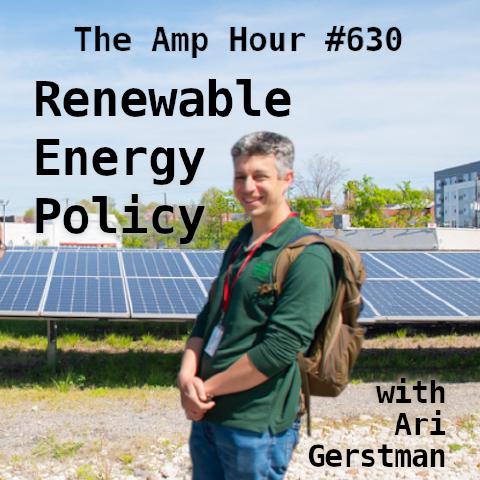
#630 – Renewable Energy Policy with Ari Gerstman
Download episode · 78 MB
Also on Apple · Spotify · YouTube · RSS
Show Notes
Welcome Ari Gerstman, from the US Department of Energy Office of State and Community Programs
- Chris and Ari went to high school together and Chris was excited to have Ari on the show to talk about how renewables are implemented in the US
- Ari recenly started his DOE job
- He was interested in joining the organization after a large funding effort in the US Senate and House (signed into law)
- There is now $100B going towards electrification and upgrading of the US infrastructure and homes in the US.
- The funding is driving supply side incentives to move to renewables, instead of Cap and Trade to disincentivize carbon rich activities.
- Chris asked Ari about the green credits market and whether people should pay attention (John Oliver carbon offsets piece discussed in the past)
- What are the tradeoffs of targeting upgrading homes for efficiency vs solar installs on a roof?
- Solar in the US
- Ari working in a narrow subset at DOE
- Chris has read exactly one book about The Grid, talked about many times on the show before.
- Running capacity building
- Ari is part of the Office of State and Community Programs, which administers a portion of the overall 100B
- There is a large amount of net new electric load, in the form of EVs, appliances, heat pumps, etc. This could roughly double electricity usage for providers and transporters of energy.
- Tennesee has a large manufacturing base and are growing into batteries. This is map of battery activity in the US.
- Ari has 84kW battery in his car, these kind of capacities will only grow over time.
- Is new load a good thing or a bad thing?
- Power providers are excited about it!
- Investor owned utilties are natural monopolies, which is why there is something called a Public Utility Commission (PUC) to regulate them.
- Ari and Chris made up an example about a fake US state (Electifica) with a fake provider company (Utopia), so that we weren't talking about any specific examples.
- Utopia trades on the stock market and there are known returns, so there are expectations about how things will work.
- Utlities are incentivized to maximize costs because they make percentage returns on the costs passed to customers. PUCs want the opposite.
- Microgrid
- DER - Distributed Eletric Resources
- Energy efficiency and demand response programs are where they notify customers of high load and ask the customer to turn things down. Sometimes there is "Smart Grid" style programs where the utility can take action centrally (turning down thermostats, etc)
- There was a Demand Reponse Brooklyn Queens program that worked
- Building a substation is very expensive, but gives an additional control node
- What is the effect of solar on the grid?
- Microgrids can enable additional cross-grid control, but it gets tricky when figuring out billing for the crossing between subgrids (because utilities have very different billing paradigms)
- Peaker plants need to spin up very quickly and are very dirty.
- Utilities encouraging people to buy battieres
- The Duck Curve
- A net zero passive house could extend usage off a battery backup system and highly reduce load on the grid.
- Building codes can have a large impact on future energy usage by determining how future homes load down the grid.
- Codes in Florida also help things like disaster response.
- There is a large chunk of that $100B going "Transmission sighting", because additional control nodes on the grid will require additional land (often in expensive areas)
- Ari previously worked on renewables for the District of Columbia.
- With rooftop and solar on the edge of the city, they could cover about 10% of city usage.
- Power companies moving from owning and operating everything is changing paradigms generally.
- How can you learn more?
- Ari suggests reading legislation
- Check out the Energy.gov site for general info
- Read more about Ari's programs at the DOE SCEP
Transcript
Chris Gammell: This is The Amp Hour Podcast. Release May 2nd, 2023. Episode 630. Renewable Energy Policy with Ari Gerstmann. Welcome to The Amp Hour. I'm Chris Gammell of Contextual Electronics.
Ari Gerstman: I'm Ari Gerstmann at the Department of Energy.
Chris Gammell: Hey, my old friend Ari Gerstmann. How are you doing?
Ari Gerstman: I'm doing great, Chris. It's so good to hear from you, and I am so flattered that you've invited me onto The Amp Hour. I want to congratulate you for a decade plus of a very good podcast.
Chris Gammell: Oh, thanks, man. So Ari and I know each other from high school, and we took very different career paths, and yet we dovetailed into this thing where I talk about electronics all the time, and Ari is now at the DOE working on policy and lots of other cool stuff that we're going to talk about here today.
Ari Gerstman: Yeah. I would say that we were both nerds in high school, and we continue to be nerds. That is very fair. Just in very different things.
Chris Gammell: Yes, that is very, very fair. Yeah, that has not changed. No, not at all. Nobody was looking at us in high school and thinking like, oh, one of these guys is going to be in Hollywood.
Ari Gerstman: Oh, yeah. Oh, yeah. Or like a Formula One racer. Right. Exactly. Exactly.
Chris Gammell: So let's talk about... So you're at the DOE now.
Ari Gerstman: Yeah.
Chris Gammell: You've been at some other places. I think the role just prior is also really relevant, too.
Ari Gerstman: Yeah, it actually might be more interesting to your listeners than my current job, but we could talk about everything.
Chris Gammell: Okay, great. So you're at the DOE now. Let's start there. Let's start with what you're doing right now. Obviously, the DOE is a US-based agency. We have a lot of international listeners. We'll try and explain stuff from an international context, but this is going to be some US-based policy stuff. I'm guessing there are very similar things going on in the EU and other parts of the world.
Ari Gerstman: There are, but I am woefully inadequate in talking to them.
Chris Gammell: Yeah.
Ari Gerstman: But there are some exciting things going on around the world in terms of addressing the climate crisis and doing it in the particular way that the US has embarked on over the past couple years that I think could be really insightful for people from all over the world. So I think it's worthwhile to listen, even if you're not an American.
Chris Gammell: Yeah, don't hang up yet, folks. Right. Give us like five minutes, a couple more dad jokes, and then hang up. There you go. There you go. Does it hang up for a podcast? I don't know. Like, tap? Don't tap? Right. I don't know.
Ari Gerstman: Don't touch that dial. Right. There's the Churchill line, which is, you can always count on America to do the right thing after they've tried everything else. Yeah. Nice. Here in Washington, when you control all three, you could do some pretty exciting things. And we just came out of two years of pretty busy legislative sessions. As many of you know, Congress is not the most effective governing body in history.
Chris Gammell: Terrible. Terrible is the word I believe you're looking for.
Ari Gerstman: Yeah. You know, I am. I'm familiar with its popularity ratings. I think you and I were more popular in high school. Oh, there we go. Yeah. Yeah, yeah, yeah. But actually, Congress got a lot done in the last Congress. And in particular, there are two bills. There are many bills that came out of the last Congress that are really important. But there are two that really inspired me to come and join the department. And one is the bipartisan infrastructure law, which passed in 2021. And the other is the Inflation Reduction Act, which passed in 2022. Those two programs together gave the Department of Energy $100 billion to, yeah, like a lot of money. $100 billion to lead a supply side transition of our energy paradigm, which is a fancy way of saying that Congress is throwing a lot of money at climate change. You know, I think in the past, a lot of climate activists would have preferred some sort of carbon tax or cap and trade type paradigm where, you know, the money necessary to lead the green transition would have come out of taxing carbon rich activities. That ethos is kind of out the door now. Yeah. And more so, it's just, you know, we're going to make it so financially irresistible to engage in the green transition.
Chris Gammell: Uh-huh.
Ari Gerstman: That only an idiot would continue to light stuff on fire.
Chris Gammell: Interesting.
Ari Gerstman: So that's-
Chris Gammell: Real quick on the cabin trade thing, because there is this like weird quasi market. We've mentioned on the show before, like this weird like green credits kind of thing that is not regulated, not anything, but like, and there's been like John Oliver pieces on it. Yeah. And like, what is the visibility of that? Is like that, is that anything? Is that like anything people should pay attention to from your perspective?
Ari Gerstman: I, you know, like I, I, I don't pay attention to it. How about that?
Chris Gammell: Yeah. Yeah. Yeah. Because I feel like it's, it's like those things where like, you know, you're like, oh, Delta, Delta is buying green offset credits. And it's like all this BS around that. So, okay, well, you know, show me the paper trail, I guess. But like nobody, you know, anyone who's clicking a button for like two extra dollars is, it's just like this like thing that goes in your cart, basically. You know, that, that's kind of feels like where the transaction stops.
Ari Gerstman: That's right. It's really hard to, you know, to, to. It's, it's really hard to assign attribution, right? So the activities that so-and-so is undertaking are, you know, beneficial for the climate and you have reserved the benefit of those activities through some sort of transaction, right? If it's a leaky market or a poorly regulated market, it's much more likely that that same person is selling off the, the attribution rights of that activity to a lot of people.
Chris Gammell: Right. Yeah, that's exactly my concern. Yeah. Yeah.
Ari Gerstman: Yeah. And, and, or the activity that they quote unquote are only doing in order to, you know, give you that climate saving credit is an activity they might've done anyways. Right. So it's, it's really, you know, not, not something I pay close attention to.
Chris Gammell: Okay.
Ari Gerstman: Now there are interesting credit markets around renewable energy and we could talk about that later in the show.
Chris Gammell: Sure.
Ari Gerstman: But yeah, a lot of the economic schemes around buying and trading the ability to pump carbon into the atmosphere just aren't successful. Not because they aren't based in sound theory or good economics, but mostly because they're politically unpalatable.
Chris Gammell: Got it.
Ari Gerstman: You know, not to go on too much of a tangent, but it's, it's not dissimilar from energy efficiency versus renewable energy. And if you're thinking about your house and your house's carbon footprint, it is way more palatable for your average Joe homeowner to throw some solar on their roof. Say that the energy that they're consuming is renewable and call it a day then to, you know, go in and retrofit their house. So add more insulation, look for, you know, where, where there's breakage in the ceiling, you know, do all of the fan testing, make sure appliances are efficient, et cetera, et cetera. All of that work is extremely disruptive, whereas, you know, throwing solar on your, on your roof pretty easy. And then after that you get free electricity, you know, and that, and that's just politically a much more, you know, a much easier sell than, than energy efficiency. And so I, it, I would, I would think that a lot of the efforts that the U S government is undergoing right now, uh, through the bipartisan infrastructure law and the inflation reduction act, you know, are similar to that kind of paradigm where we're just going to make it really, really easy to do the right thing and not be too disruptive, uh, to your life. And, uh, we're going to accomplish that by throwing an incredible amount of money at it.
Chris Gammell: Yeah. And that's what we've talked about here on the show too, is that like, it didn't, you know, we've, we've talked about solar for a long time, Dave, my co-host. He's got solar, but like, he lives in Australia where there's like this incentive market that was again, that same kind of thing where it was, it was stupid not to basically put in solar in that case. And like, okay, that makes sense. But like, but at the same time, people were trying to push solar in the U S and it just, it didn't make economic sense. And like, then it becomes only a, you know, what you believe in versus what makes sense for your pocketbook kind of thing. And it does, it does feel like this kind of, if you want to move the, the great masses, you just make it non, make it non-political. You just make it this, this other thing, right. This other economic decision.
Ari Gerstman: Yeah. And, and, and just, you know, I mean, most people can divorce politics from balancing their checkbook. Right.
Chris Gammell: Right.
Ari Gerstman: And if it makes economic sense to do something, they really don't care if it's something that Democrats or Republicans have advanced. They do what's rational and then they go back to their lives. What's interesting about solar in the United States is that it differs wildly state from state. So where you live in North Carolina, it's not nearly as lucrative to put solar on your, on your roof as it is here in the district of Columbia.
Chris Gammell: Yeah.
Ari Gerstman: Every single state and the district, and I'm not sure about territories. We could talk about territories another time, I guess, but every single state and the district has either a renewable energy portfolio standard, or it doesn't. They're also, you know, all sorts of systems across the country in different states for solar subsidies, solar tax credits, et cetera. In fact, nationally right now, you might be aware that in the inflation reduction act, the tax credit for installing renewable energy is up considerably. And in, and in particular, doing so in an historically neglected neighborhood, part of the justice 40 initiative gets you an even better tax break.
Chris Gammell: Oh, interesting.
Ari Gerstman: You know, it really depends where you live and who's doing your taxes and what your tax liability is. Right. One of the, one of the, this is a total tangent, but one of the interesting things that happened with solar and tax credits is that, you know, if you're a nonprofit, how are you going to take advantage of that tax credit? Right.
Chris Gammell: Right.
Ari Gerstman: So the inflation reduction act actually is enabling nonprofits to monetize what would be the tax credit through, you know, some sort of remittance from, from the government. And that's, that's completely unclear to me how that's all going to work. I'm out of my depth there. That's happening over with my colleagues in the department of the treasury.
Chris Gammell: Huh.
Ari Gerstman: But those are, those are some of the interesting things that, that people are figuring out here in Washington in the wake of those bills. I'm working on a very, very, very narrow set of programs. So I mentioned earlier that the department of energy got a hundred billion dollars through BIL and IRA, the bipartisan infrastructure law and the inflation reduction act. The department's mission fundamentally changed as well, because up until now it's. The entire DOE. Well, I mean, up until now it's mostly been a nuclear security agency.
Chris Gammell: Yeah.
Ari Gerstman: A science agency.
Chris Gammell: Yeah.
Ari Gerstman: A research and development, maybe some deployment, excuse me, maybe some demonstration agency, you know, that kind of work. Mostly, you know, lower on the technical readiness level curve kind of activities. And BIL and IRA fundamentally changed it into a deployment agency.
Chris Gammell: I always kind of assumed that there was like a grid aspect in there too. Is that, is that a bad assumption?
Ari Gerstman: So a lot of the activities that DOE does around the grid are, you know, to incentivize new technologies that can be deployed to make the grid, you know, more efficient, more reliable, more available, you know, require fewer upgrades, et cetera, et cetera.
Chris Gammell: But not like hand, not like hands on. Yeah. There's no centralized control. I did know that piece. I mean, like, it's not like.
Ari Gerstman: Right.
Chris Gammell: It's not like centrally owned, centrally managed or anything like that.
Ari Gerstman: No, it's not like Europe where.
Chris Gammell: It's a living organism. That's right.
Ari Gerstman: Yeah. And, and, and it's owned by a lot of different players. Right. Yep. And so we could talk about the grid at length if you want, but.
Chris Gammell: Well, I, I am a kind of an expert. I did read one book on it. So I forget what it's called. I should have, have the book up on my, my screen here, but yeah, I did read that one book and it's a fascinating and wonderful book. But yeah.
Ari Gerstman: Yeah. No, the grid's incredible. Definitely a feat of engineering. Yeah. And also in bad need of upgrade. Yeah. Right. Like of, of seriously, seriously needing upgrade and in a lot of different important ways. And all of those ways have intense policy ramifications. And so that's, that's the area that really piques my interest.
Chris Gammell: Gretchen Bucky, or I'm not sure if I'm saying her name right. That's the, that's the book I'm talking about. And if I'm looking at it right on my computer, it's 299 on Kindle right now.
Ari Gerstman: There you go.
Chris Gammell: Check it out folks. Yeah, that is a good deal.
Ari Gerstman: Yeah. Actually in, in my last job, I dealt more with grid type work because in that job I was, I was advocating on behalf of the district of Columbia in front of our public service commission, which is our utility regulatory body. For specific outcomes and policies and the way that they regulate utilities that were, you know, better for the climate and better for people with less means. So, you know, we could talk at length about the grid, but my, my job now it's, it's running, basically it's, it's running capacity building. One thing that I recognized working in DC government is that state and local governments are critical in tackling a lot of different energy problems. And in particular, you know, enabling a lot of these consumer side and small government side upgrades and transitions. And so I work in the new office of state and community energy programs here in DOE. In that organization, I work on the state energy program. So BIL, the bipartisan infrastructure law gave $500 million to state energy program and $250 million for the states to set up an energy efficiency revolving loan fund. There's also a number of other programs that state energy programs that state energy programs have to run from grid resilience to energy efficiency conservation block grants. And then also the rebate programs for low income. There's the whole homes rebate program, which enables homes to, you know, do whatever it can to, they can to, to lower their energy consumption. And they'll get, they'll get, you know, money back basically from the U S government via state governments. And then there's also one for electrification. So another rebate program focused on getting people heat pumps, hot water, heat pumps, and, and those kinds of activities. So those kinds of appliances. So there's, you know, the state energy offices are, are really at the nexus of deploying a lot of the, the big consumer side programs, uh, in the bipartisan infrastructure law and the, uh, inflation inflation reduction act.
Chris Gammell: That's pretty cool. Yeah. I mean, like what, and so that sounds like boots on the ground, like, especially like the administration of funds, stuff like that. I mean, how, how do you see, how do you see this stuff actually playing out in the longer term? Do you expect that it's, it's going to be more solar installation? It is going to be more of this kind of like house to house style battling, you know, air leaks and insulation type stuff. I mean, like where, where do you actually see the biggest, I guess, what do you think the, the likely outcome is? And where do you think the actual biggest, uh, the biggest impact would be, uh, from a actual energy perspective?
Ari Gerstman: The biggest impact I think from an energy perspective is the new electric load that the United States is about to acquire.
Chris Gammell: Oh, tell me, I don't know anything about this.
Ari Gerstman: Yeah. I mean, we're, we're pooping out EVs like, like bananas. Right. And it's, it's incredible. The amount of work that's gone into creating a domestic supply chain for electric vehicles here in the United States. You know, people are already talking about the battery belt in, uh, in, in, uh, across the, the Southeast, you know, Tennessee is, is, uh, has always been.
Chris Gammell: We're supposed to get a new plant here, I think. Yeah, that's right.
Ari Gerstman: Tennessee's always been fabulous in advanced manufacturing, particularly in, uh, automotive. And they're, they're doing a lot to, to look, uh, towards, uh, vehicle electrification. So there's, there's the manufacturing, which is in and of itself going to be an enormous, you know, new source of load. But even bigger than that is all of the EVs on the road. Right. So I drive an EV, you know, it's an 84 kilowatt hour battery, which is huge. If, if you stop and think about it in, in comparison to things like my house, gosh, I don't know how many kilowatt hours I use a month, probably a couple hundred. Right. And I live in a city. So, uh, you know, if, if you were commuting 30, 40 miles a day, uh, you could do the math. Uh, if you're, if you're doing, if you're driving, you used to drive an internal combustion engine and now you're driving an electric vehicle. Uh, you know, you're, you're probably adding 300 kilowatt hours of load to the grid every month. You know, you aggregate that across the, gosh, I don't know how many cars there are in America. Uh, you know, at least a hundred million probably.
Chris Gammell: Uh, and one in three people, that sounds about right. Yeah.
Ari Gerstman: Right. So you're talking about just an enormous, enormous new demand for electricity. Right.
Chris Gammell: Right. So you're saying this is a good thing or a bad thing? It's, it sounded good, but also it kind of sounds bad.
Ari Gerstman: Yeah, no, it's, it's, it's what I would say. It's a, it's a good thing because. You know, we gotta, we gotta get rid of fossil fuels, right? Like we're done. We gotta be done with fossil fuels. Right.
Chris Gammell: Well, I mean, I guess it depends on who you're talking to though. Like, yeah, so if you're talking to someone who's like got asthma, uh, yeah. Getting more ice, ice cars, internal combustion engine cars off the road. That's good. Uh, or, you know, people that care about climate change also. Right. Right. But if you're talking to a power provider, so who's like, uh, how much more power on the lines? You know, like.
Ari Gerstman: Oh, well, I assure you they're salivating. They're, they're thrilled for, for people to, to want to buy their product more.
Chris Gammell: Interesting.
Ari Gerstman: The, the really big question though, is that, you know, the power providers, as you put them, most of them in America are investor owned utilities. So they are bottom line driven. Uh, and you know, they are, uh, focused on, on for the most part, one thing and one thing only, which is returning value to shareholders.
Chris Gammell: Yep.
Ari Gerstman: You know, that's their job. And in America, because those investor owned utilities are natural monopolies, i.e. it makes zero sense to have electric distribution competition. That just sounds like an enormous mess. So because they're natural monopolies, they have to be regulated by a public utility commission. That regulation happens at the state level. And as you can imagine across the country, some states are pretty good at regulating their utilities, other states do whatever the utilities want them to do. Yep. Yeah. You know, which, you know, every, every state's got its own, you know, political needs and, you know, decisions to make. So I'm not going to pass judgment one way or the other, but.
Chris Gammell: Oh, I will. Uh, Duke, Duke energy is a hot pile of crap. Uh, am I allowed to say that as a North Carolinian? Uh, I think I am.
Ari Gerstman: You're definitely allowed to say that. I would just, as much as I would say is that I have heard this other people say that about Duke energy before. Yeah. I, I don't have opinions on the subject. Got it. No worries. You know, I'm just a simple civil servant. Public service. Yeah. Civil servant. Yeah. Yeah. You got it. Yeah. But, you know, let's, let's, let's imagine that there's a state out there. Let's make up a state. There you go. So.
Chris Gammell: The 52nd state of Electrifica.
Ari Gerstman: There you go.
Chris Gammell: And they have a public utility commission and their local power company is called. You come up with that one.
Ari Gerstman: Oh, I have to. Yeah. Utopia. Okay.
Chris Gammell: Okay. Yep.
Ari Gerstman: So like, let's say, so first of all, let's say Utopia is an investor owned utility, right? So Utopia is like, let's say it's traded on wall street.
Chris Gammell: Okay.
Ari Gerstman: And, uh, you know, Utopia has been delivering dependably very good dividends to shareholders for decades. Right.
Chris Gammell: Yep. Yeah. Yeah. Really stable stock. So it's all like, it's like a blue chip, right? So it's, uh, yeah. Institutional money. They, they have very strong demands on the board.
Ari Gerstman: Yeah, exactly. Calpers loves their Utopia holdings, right? Like they know exactly what they're going to get.
Chris Gammell: Yeah.
Ari Gerstman: Which is fine. Right. And, but so now the state is adding, you know, electrifica is like, we're going to electrify everything. Okay. We're just done with fossil fuels. Let's say that. And, and in particular they are done with gasoline and let's say they're done with natural gas, methane gas. Right. And so coal, coal as well. Well, it really depends. I mean, coal is a whole nother story because it depends where they're getting their power from. Sure. Right. Like some, you know.
Chris Gammell: Is electrifica landlocked or are they, uh, yeah, right. Okay.
Ari Gerstman: Or, or, you know, is electrifica, uh, a net importer or a net exporter of electricity? Right. Right. If it's a, if it's a net exporter of electricity, then electrifica is very focused on what, you know, what they use to, to create electricity. And they might be, you know, really, really focused on that. If they're a net importer, they might be thinking more about, you know, how do we, you know, defray our exposure to, uh, you know, shocks in the energy systems that could come from outside our state's boundaries. Right.
Speaker ?: Okay.
Chris Gammell: Sure.
Ari Gerstman: So, but regardless, let's say, so electrifica is like, we're going to electrify everything and we're going to get rid of natural gas, methane gas that's piped into people's homes and we're going to get rid of gasoline. Right. So everybody in the state has to, uh, switch over to an electric heat pump, uh, an electric stove and an electric hot water heater. Right. Get rid of the, uh, the natural gas in their house. Some, some people actually have natural gas powered dryers, which is wild. Right. Yeah. Yep. Some people have natural gas powered refrigerators, which is also wild.
Chris Gammell: Oh yeah. I've, yeah. I've heard about that. That's also on boats. I think are the, the propane ones on boats. Right. Right. Yeah.
Ari Gerstman: So there's, I mean, like, you know, so electrifica is like, we're ripping all of that out and we're giving everybody brand spanking new electric equipment. Right.
Chris Gammell: Yeah.
Ari Gerstman: So in electrifica, if the state did this and we're just talking about residents right now, we're not even talking about businesses. Yeah. But if the states did this, their electric demand, and they only did this, their, uh, electric demand would probably around double.
Chris Gammell: Wow.
Ari Gerstman: Okay. Right. So we're talking about an exceptional amount of load. Now, Utopia can look at this in one of several ways. One way it could be, all right, we're going to meet all of this load with distributed energy resources. And so what that means is microgrids and solar everywhere. We're not going to overbuild the grid. We're going to solve the load problem at the source. Right. So we're going to get everybody to put a solar on their house theory. And, you know, maybe if electric, electrifica is, is really far North. And so it has, you know, wild swings and electric production from its solar. They might do a battery incentive also. Sure. So, right. There's all kinds of cool opportunities. Also, you could deploy microgrids so that if, you know, if load can't meet generation capacity of your solar panels at this exact moment, you can share load from one of your neighbors. Right. Like that would be the, the opportunity of, of a multi-customer microgrid, uh, where basically something sits sort of behind, but also sort of in parallel with the distribution system. Okay. So Utopia could say, look, we're, we're going to roll out DER and that's going to solve the problem. We're not going to, you know, if we're really, if we do a really, really good job of deploying solar to meet this, that'll solve the problem. Um, they're, they're probably wrong. It probably won't solve the problem. What will also be needed is some kind of energy efficiency measures. And that might mean updating appliances. It might mean, you know, weatherizing homes. It might mean doing a lot to, uh, do deep energy retrofits of homes. Uh, it might mean, you know, redoing all of the streetlights so that the streetlights are, you know, high efficiency LED instead of whatever incandescent bulbs they still got going.
Chris Gammell: Right. So this all sounds like really expensive on the Utopia, the company's perspective.
Ari Gerstman: It depends. I mean, well, first of all, for an investor owned utility, nothing's expensive on Utopia because they would rate base all of this.
Chris Gammell: You mean they would just get it back over time?
Ari Gerstman: They would get it. They would charge, they would charge the rate payers for it.
Chris Gammell: Oh, interesting.
Ari Gerstman: Right. Yeah. So, you know, and the utility commission would decide whether or not their rate payers should be paying for it. There might be other progressive schemes in the, in, in the legislature where, you know, there is a renewable energy portfolio standard, and that might be an opportunity for, um, solar to, to take advantage of market forces to proliferate. Right. Um, at the end of the day though, suppliers pay for renewable energy portfolio standards and they pass that on to customers. So at the end of the day, however, you're going to roll out solar. Usually it's electricity customers that are paying for it.
Chris Gammell: Rolling out solar or rolling out, you said rolling out solar. What do you mean rolling out these changes like this, these general microgrid type of regardless? Okay. Okay. And anything, the grid or anything, the power company does there, they're passing that along to you. Is that kind of the idea?
Ari Gerstman: Pretty much. Or they're passing it along to the federal government by taking advantage of some of these amazing programs that were running at the department of energy to enable the utopias of the world, you know, to avoid charging their, their rate payers for, uh, for, for these upgrades. Right.
Chris Gammell: Right. But that's still getting paid by somebody. Right. Well. As soon as much as taxes go. Yeah.
Ari Gerstman: Right. Or, or your kids. Sure. We could talk about, we could talk about, you know, uh, monetary theory all you want, whenever, whenever you want. Different podcast, man. Different podcast. Yes. All right. So another way that utopia might meet the new load is by rolling out energy efficiency and demand response programs. So basically, uh, you know, if, if load is ever getting too bad in Electrifica, your utility utopia could send texts to everybody in Electrifica saying, Hey, change your thermostat one way up or one way down, you know, so that we can manage the load. Right.
Chris Gammell: Yeah. This is the thing I never understood about that. People don't respond to things.
Ari Gerstman: Yeah. They, they, people are also, they're, they're funny in responding to small incentives. Right. Like the number of people who will bend down to pick up a dime, even though like that really isn't worth the time that it took or the activity it took to pick up the dime. Right. Yeah.
Chris Gammell: But do you actually mean it would be text messages or would it be like, I've already opted in and utopia, the power company, it just has remote control and they can change within some threshold. Yes. Like smart grid style thing.
Ari Gerstman: That would be ideal. Right. So you have a, you have a nest and that nest is hooked up to the wifi and utopia knows where my nest is. And utopia knows if my, you know, feeder on the grid is reaching peak load, you know, they can, they can automatically turn my thermostat down. And, and you know, that, that obviously saves me money in consumption. They might also give me some sort of rebate or. You know, some sort of incentive to, to enroll in the program in the first place.
Chris Gammell: Yeah. My concern about all this is it's like, it's this, uh, experiment, you know, like experimental in a certain way. Right. I mean, like it hasn't, they've tried it in small scale, but like it's never been tried a lot, wide, wide scale before. And it's like, if they get everything rolled out and all this smart grid stuff, and then people are like, yeah, don't touch my thermostat, please.
Ari Gerstman: Yeah. So there is, there's, there's one classic example of where demand response is actually working rather well.
Chris Gammell: Okay. Great.
Ari Gerstman: It's in New York. It's run by NYSERDA, the New York state energy research and development agency. And it's the Brooklyn Queens demand management project, BQDM. Uh, there was a neighborhood, uh, that kind of straddled Brooklyn and Queens that was getting really weird peak demand, uh, signals. And they set up a demand response program to, uh, to level out those signals and it worked. Uh, and it was a lot cheaper than building a new substation. So that's the last thing that utopia could do is that they could just say, look, we're going to, we're going to meet all of this load. Yeah. We're just going to build a hundred substations, you know, and that's going to, and that's going to solve the problem. Uh, of course that's more expensive than deploying the DER. Not to mention the fact that, that a substation doesn't get you anything once it's created, uh, as opposed to a solar panel, which continues to produce solar energy.
Chris Gammell: What would just a sub, so just building a substation, not like a generation plant. Is that, what do you mean by the, just the substation?
Ari Gerstman: So, yeah. So that might be at the distribution level. So a substation will enable the electric distribution company to manage, to, to manage load with more flexibility. So they could basically, they can, the peak load that the entire system can handle before, you know, you get rolling brownouts, uh, goes up with each substation you create. I see.
Chris Gammell: Okay. So the, you're just saying, cause it's basically like a, it's like a valve that you're installing in a piping system basically in this case. Exactly. Yeah.
Ari Gerstman: Exactly. And so maybe you would be able to bring in more pipes into the system, uh, because you've built more valves.
Chris Gammell: And then the, on the Brooklyn Queens program, that was just the, the text message thing?
Ari Gerstman: Uh, yeah. I don't know if they're doing it by text message. I think it might've just been enrollment and automatic.
Chris Gammell: Oh, like, and then remote control. Yeah.
Ari Gerstman: Yeah. Yeah. An IOT solution. I'm not entirely sure what, uh, Siemens did the whole thing.
Chris Gammell: Okay. Well, that must've been cheap.
Ari Gerstman: I don't, yeah, I don't really know.
Chris Gammell: I don't know if Ari's allowed to say any of these. I'm going to say all the thoughts that I think are in Ari's head right now, but, uh, uh, having formally competed with Siemens and, uh, in another very expensive electrical distribution and power generation company, uh, ABB, nothing is cheap in this space. That's what's crazy about it to me is that like, everything is just so frigging expensive. It's crazy.
Ari Gerstman: Right. Right. And, but just remember that like running that demand management program as expensive as it might've been, it's so much cheaper than buying the land to build a new substation because a distribution substation, I mean, forget the amount of engineering and work that has to go into building the substation. Right. Like if you're in Brooklyn and Queens, like this is, we're talking half a city block, right? Like that's, that's expensive.
Chris Gammell: Really expensive real estate.
Ari Gerstman: Really expensive real estate. Right. So that, I mean, and that's forgetting all of the construction and, you know, the.
Chris Gammell: And all the NIMBYs that would be at the meeting saying, no, you can't build that here.
Ari Gerstman: Right. Exactly. Or, and, and all of the metal that needs to go into the, I mean, just like the sheer amount of metals that need to go into these substations is just unfathomable.
Chris Gammell: Yeah. That's nuts.
Ari Gerstman: And, and obviously, you know, each, each metal has to meet certain purity standards and there's a lot of different kinds of metals and some of those metals are very, very expensive and, you know, so it, yeah, it's, it's always going to be cheaper than building a new substation. New substation is extremely expensive, but.
Chris Gammell: Okay.
Ari Gerstman: Here's what's really, really funny about utility regulation. Okay. So, you know, at the, at the beginning of the conversation, you mentioned, you know, oh, all these costs are going to be borne by utopia. That sounds really expensive for utopia. And I said, no, no, no, they'll rate base the whole thing. Right. Right. Now, utility company makes its profit margin off of how much it successfully rate bases.
Chris Gammell: Okay.
Ari Gerstman: So what they want to do is choose the most expensive option because that way their profit is greater. Because they get like some fraction of the, of the overall change that's happened. Exactly. Exactly. So they want the most expensive option. They're going to roll out.
Chris Gammell: This is why Siemens is charging so much because they're incentivized to do so. Right. Sorry. I'll stop.
Ari Gerstman: Well, Siemens isn't the electric distribution company. Siemens is the vendor.
Chris Gammell: But if you're like a subcontractor to a subcontractor, you know, like all that stuff, it just adds
Ari Gerstman: up. Right. Yeah. I know. I mean, I would love to be in a business where my customer is incentivized to spend more money.
Chris Gammell: Yeah, exactly. Exactly right. Yes. I think that, that is the right thing there.
Ari Gerstman: Right. And so the, the role of the public utility commission is to identify the situations where the utility is saying we need to do this really expensive thing because it really is something that needs to happen versus this is just their incentives getting in the way. And they're suggesting the most expensive thing when, you know, and because all of these things are rate-based, you know, it, it means that, you know, when every time you buy a kilowatt hour of electricity, you're paying for whatever that new program is. And as you could imagine, a kilowatt hour of electricity is most expensive for an individual resident as opposed to everybody else in the state. Right.
Chris Gammell: Like if you're a major business, you're, you're getting pretty good rates. Exactly. Yeah.
Ari Gerstman: You're, you're negotiating something really good with the utility company because you'll, you'll, you know, or to technically the supplier, it depends whether or not your supply is deregulated and we could talk all about power markets and yeah. RTOs. Good times.
Chris Gammell: Yeah.
Ari Gerstman: Yeah. So basically costs are disproportionately paid for by residents. And, you know, this isn't the same as the tax system where like the wealthier you are, the more you end up paying for the system. This is flat, right? Right. A kilowatt hour costs a kilowatt hour, no matter if you're dirt poor or the richest man on earth, which is just like, if you take a step back and think about how important the electric distribution system is to a community, it's ridiculous that it's also, that it's not a progressive system, right? That everybody has to pay their own way at the same rate. But regardless, the public utility commission is supposed to consider, you know, what, what the impact is going to be on rate payers every time that the utility proposes something. Unfortunately, in America, a lot of public utility commissioners are not sufficiently educated to know the difference between whether or not this is something that's really essential, or if it's just, you know, the utility is falling victim to their incentives. And again, like utilities aren't bad people. They're just behaving rationally, right? Like you want to, right? Like this is, this is when you're in a private business and your responsibility is to return value to shareholders. It's, you know, it would be immoral to pass up opportunities to do so. So, you know.
Chris Gammell: Yeah. It's kind of their job, right?
Ari Gerstman: I mean, exactly. So like, I don't fault an IOU for proposing the most expensive solutions, but I do fault a PUC for not being sufficiently aware of alternatives.
Chris Gammell: And PUC is a public utility commission. Public utility commission. There's a lot of acronyms here. Yeah.
Ari Gerstman: I'm sorry. Hey, man, I listened to some of your podcasts and you've got a lot of acronyms going over there too. Yeah.
Chris Gammell: And jargon, jargon generally. Yeah. That makes sense. Right. So I have a question generally about this stuff. So, so one of the things that was in that, again, I'm working off one book here, which is stupid and irresponsible to me. I mean, but one thing that they put forward, they kind of put some fire under my bum was just talking about like the, the changing load capabilities as more and more people dump solar onto the grid. And I'm wondering about your insight into that of like, okay, so now we do, you know, you're talking about like the load and the loading capabilities of all this stuff. But now if you do have a community that is incentivizing lots and lots of solar and you're starting to see that dumped onto the grid in daylight hours, you don't have anything to accept that, that source, right? You don't have any sync for that source. Like how is that all going to be worked out in this, you know, this kind of this new vision of, of what the grid looks like and all of the, the legislation that's happening.
Ari Gerstman: So there's three answers to that question. One is the utility can curtail it. So basically. Yeah, that one sucks. I really don't want that. Yeah. Right. Yeah. Me neither. Yeah.
Chris Gammell: That's like basically saying that's like in Maui, I think they said they're, they're not doing hookups anymore. Right.
Ari Gerstman: Right.
Chris Gammell: Because like the sun's always shining there and they're, they're like, nope, we can't take it.
Ari Gerstman: Another option is batteries.
Chris Gammell: Yep.
Ari Gerstman: Which are exceptionally expensive.
Chris Gammell: Right. I know. That's what I'm, that's what I looked at and I'm like, nope, I don't have 18 grand to spend on like a thing that will power my house for like four hours. Like, no. Right.
Ari Gerstman: Or, or you build more infrastructure to enable that supply to, to find load elsewhere. Okay. I mean. Which is also not ideal. Not ideal. Right. The solution that I love is, and is microgrids. And so let's talk a little bit about what a microgrid is. So a microgrid can be single customer or multi-customer. Most of the times you think about it, it's multi-customer and that's, what's really exciting. It's also the one that utilities and utility commissions hate the most. And we could talk about why they hate that later.
Chris Gammell: It's kind of like savings and loan where it's like, your electricity is not in your house. Your, your power's going over there. It lives in Bill's house.
Ari Gerstman: Right. Yeah. Well, there's some of that. There, there's definitely some of that, but, but. You know, in theory, let's, let's say, let's say one area of the grid has too much generation at, you know, noon. Right. During, during peak solar. Yep. And so the utility is faced with curtailment, building more capacity to, so basically another substation, just going in the opposite direction or batteries. Right. A fourth option is that let's say that feeder serves, you know, 12 to 15 square blocks. And those 12 to 15 square blocks just doesn't have the load to accept that generation, but across the street from one of them, it does.
Chris Gammell: There's an arc furnace in the, in the neighborhood that just across the way, let's just say that.
Ari Gerstman: Or let's say it's, you know, let's say it's a, a basketball arena.
Chris Gammell: Okay.
Ari Gerstman: Right. Like, like something that requires just an enormous amount of electricity all the time or a convention center or. Sure. Okay. That's a great example. Yeah.
Chris Gammell: Let's go with convention center. I like that.
Ari Gerstman: Okay. Yeah. And convention centers have, have just massive heating and cooling systems, uh, you know, enormous number of lights, lots of elevators, right? Like plenty of load. So you could build a system that basically enables that convention center to receive supply from across the street off a different feeder during that window through a microgrid. And that microgrid is basically a line that's jammed into the boxes of the two buildings from across the street from each other.
Chris Gammell: Sounds crude.
Ari Gerstman: It is crude. But at the end of the day, what it allows.
Chris Gammell: What we did is we, we had two things and we needed to wire them together. So we put a wire between them.
Ari Gerstman: Well, and, but like you have to appreciate that a, that's a lot easier said than done when, of course, when you're looking at two buildings on different feeders.
Chris Gammell: Yeah.
Ari Gerstman: And a distribution system. B there's a whole lot of regulation that's needed to talk about how that convention center compensates the building across the street for the electricity it's purchasing. And what, you know, what levels of, you know, guarantees the convention center gets in terms of the electricity it's buying. The convention center might strong arm the building across the street and be like, look, your solar is going to get turned off. If we don't build this thing.
Chris Gammell: Better give me a better rate.
Ari Gerstman: You're going to, you're going to sell this to me for pennies on the dollar, right? Because that's better to you than nothing. And also because a lot of the incentive systems, they don't really care about the electricity generation. They care about that the system is turned on at all so that they can generate the credits.
Chris Gammell: Interesting. So, so like, let me just try and paint this picture then, because I'm a little confused here about when you're saying like across the street. So like, okay, so we're block A, so we're back in Electrifica and Utopia, the power company is serving block A and block B and block A has a bunch of solar for some reason and block B doesn't, but it's got this convention center. And you're saying that the only way that power would transfer from block A to block B normally is it would be pushed back onto the grid, you know, from these solar panels onto the grid of block A. It would then have to go back to the substation and go upstream somehow. Correct. But that is not what they want to do. And then have to go back down to block B because it's like at that substation. So then you're saying we're basically cross wiring from block A to block B.
Ari Gerstman: You got it.
Chris Gammell: Okay. And when you think about like the power company and how they know that they're delivering power, like the distribution and the power company and how everybody gets paid now, that is a known kind of function, right? Because customers on block A, they have their little, they have the dials in their house and it goes up when they're using power and it goes down when they're generating power. But now you're saying that because block A would be generating power and their little meter would be going down and it would be going across to block B and their meter would be going up, there'd be no way to know that it would still, but it would look like to the power company that the power was coming from them somehow, right? Because they don't, they don't know in transit.
Ari Gerstman: Exactly. So this is why you need advanced inverters. Okay. At the, at the hookup for a microgrid so that the microgrid can be informing in theory, a third party operator who then shares that data on a need to know basis with the utility.
Chris Gammell: So it's like a toll road to cut across.
Ari Gerstman: It's actually a toll road is a really good example, but imagine that instead of the rest of the roads being publicly owned, they're privately owned by an investor owned road company. And what you're saying is like, ah, actually, no, I want to start my own little road company over here.
Chris Gammell: Right.
Ari Gerstman: I'm not, I'm not actually going to pretend that I'm going to meet the transportation needs of the entire city.
Chris Gammell: Right.
Ari Gerstman: But I've found that there's a business case to create this one road from point A to point B. And I'm going to do that outside of the investor owned road building companies. Yeah. Domain.
Chris Gammell: Right. So this is really interesting because the microgrid, that term, I always assumed I knew what it meant. I always thought it was just like, oh, I'm sharing power with my neighbors, but I never understood that it was this kind of cross hatching type of idea. And like the, the understanding across sub portions of a grid like that, that never appealed, never got to me. I never.
Ari Gerstman: You're already sharing power with your neighbors, right? Cause you're. Right. Cause you and your neighbors.
Chris Gammell: If I have solar and my neighbor needs power, it's, it's making a little hop, right?
Ari Gerstman: You got it. It's making the hop because you and your neighbor are on the same feeder. Right.
Chris Gammell: Okay.
Ari Gerstman: Right. And now let's get into the economics. It's making the hop. Right. Yeah. It's making the hop and your neighbor is paying the utility company the same amount of money that it pays for every other kind of power.
Chris Gammell: Yeah.
Ari Gerstman: And if you're in a net energy metering regulatory paradigm.
Chris Gammell: I am for about another six months, unfortunately. And then I'm not.
Ari Gerstman: No, no, no. NEM is good. NEM is good. Net energy metering is when.
Chris Gammell: No, I know they're changing away from it. Right. Oh, no. That's well, that's too bad. Yeah. It sucks.
Ari Gerstman: Yeah. If you know, you're able to sell it back to the utility for your retail price, which is great. But you could totally see a situation where a utility was like, well, if you're selling it back into the grid, I mean, you're going to just take whatever price we give you.
Chris Gammell: That's right.
Ari Gerstman: Right. And so a microgrid, what it can do is enable you and your neighbor to buy and sell power with each other outside of the utility. Right. Which is a really complex market problem.
Chris Gammell: Don't say blockchain.
Ari Gerstman: No, I'm not. I'm not going to say blockchain.
Chris Gammell: Don't worry. I feel like everybody eventually says blockchain. No. I'm like, come on, man. Use a goddamn spreadsheet.
Ari Gerstman: And so, I mean, to be fair, utilities are nervous about these kinds of paradigms because you already pointed out, they're used to situations where they're all-knowing, not where there are third parties that are giving them information on a need-to-know basis.
Chris Gammell: Right.
Ari Gerstman: So they're very nervous about that. They're also very nervous about potential safety concerns. That's very fair.
Chris Gammell: Yeah. Right. You don't want just Billy Bob hooking up to his neighbor and being like, yeah, I'll flip it on once in a while.
Ari Gerstman: You know, I mean, Billy Bob can't do it now because it's illegal now. Right. And if it ever became legal, undoubtedly, the utility, Utopia is going to have a major role in enabling Billy Bob to have his microgrid hosting a bunch of different distributed energy resources. But yeah, the real question is whether or not people are going to be able to buy and sell power with each other using pieces of the distribution system, but not all of it. And if they're buying and selling power between them without any of it, any of the distribution system, then what is the economic arrangement there? The other thing that's really interesting also is that, you know, a microgrid that hosts distributed energy resources, and in particular, a microgrid that hosts a battery could be a supply asset for the utility. Right. So in a situation where the utility is thinking about buying power at peak demand and is buying power from those peaker plants, which are expensive, really expensive.
Chris Gammell: Yeah. That's like dirty. You're kicking out a dirty coal or a turbine with a gas, natural gas type of thing.
Ari Gerstman: It's rarely coal because coal, I think, takes a long time to fire up. I think sometimes it's actually oil.
Chris Gammell: Oh, interesting. Okay.
Ari Gerstman: Because those oil plants can turn on super fast.
Chris Gammell: Oh.
Ari Gerstman: And that's super dirty and really expensive.
Chris Gammell: Yeah.
Ari Gerstman: Yeah. The utility might prefer to buy electricity from, you know, Billy Joe, who's got it stored. Billy Bob. Billy Bob, whatever his name is. Yeah.
Chris Gammell: Ari, think of the people, man.
Ari Gerstman: Right. You know, the utility might prefer to buy it from Billy Bob. And so they might create a contract with Billy Bob saying like, you know, at 6 p.m. in the summertime, when everybody's air conditioning is running, Billy Bob, now your battery must be at least at 50% capacity and we're allowed to take as much of it as we want. And in exchange for that, you know, you're paid this sort of like monthly premium plus like this negotiated rate for the power purchase. So, you know, there's...
Chris Gammell: I did have that thought when... So like, you know, I was going through this exercise and pricing on batteries and stuff like that here. And I was thinking, I could imagine a future where it is utilities that are incentivizing people to buy batteries as well. Right. So they're not only giving you contracts, but maybe they're giving you incentives to... Just like because the load on the grid is going to be so high. Maybe it would be the grid operators too. But like, if enough, if a sufficient amount of solar comes onto the grid, like there is nowhere else to put it, it would make sense. You know, even when they go negative on rates and they're saying, we'll pay you to take this power. At some point, it might get negative enough. They're like, we'll pay you to put in capacity to take this power. That's exactly.
Ari Gerstman: Exactly. And I don't know what that'll look like. I doubt it'll end up being the utopia that does that. The utility. I think it's more likely that it'll be a government entity that subsidizes you buying the battery because the battery has a lot of uses beyond just being a receiver for extra supply. Right.
Chris Gammell: Yeah. Eventually it fills up too. I mean, that's the other problem.
Ari Gerstman: Well, there's that. And also like in order to keep it healthy for a really long time, you need to cycle the battery.
Chris Gammell: Yeah. True.
Ari Gerstman: So it can't just like always be empty or always be full. Power outages are going to continue to happen. You know, we're working at the department to improve grid resiliency through a number of different programs being run by the grid deployment office, which is really exciting. We can go into all of the different provisions sometime. Power outages are going to continue to happen as climate change manifests in our weather patterns. We're going to have more and more occasions where there are, you know, freak events and your power's out. Having a battery in those moments is nice or having a community center where there's a battery is really nice because, you know, if you're elderly, you might need a place to keep cool or to keep your medication cool. If you're a nursing mother, you might need to keep your milk cool somewhere. If it's in the middle of the summer and it's a heat island, the whole community might need to keep cool somewhere. You might need a kitchen so that you can prepare food for the community. Who knows how long this power outage is going to last for? You certainly need somewhere to charge your cell phones. Yep. So, you know, yeah. My hope is that every neighborhood in America has some sort of battery capacity at some point so that, you know, residents can take advantage of those kinds of services in the event of an outage. So there's a lot of reasons to deploy batteries, but definitely, you know, managing the duck curve, which is, you know, the fact that all of the solar comes on supply way earlier than when peak demand is.
Chris Gammell: Yeah.
Ari Gerstman: And so you need, you know, long duration, you need like six hours basically of, you know, battery capacity to hold all that electricity before you spill it back out onto the load six hours later. So there's a lot of reasons to have a battery is basically the point. If you are, again, if you have that battery on a microgrid rather than just at a single, you know, a single customer or a single meter. Right, right, right, right.
Chris Gammell: Like a utility owned versus a person owned sort of thing.
Ari Gerstman: Right, exactly. So if you have the battery on a microgrid, then, you know, a lot of people can enjoy its use. Also, there are plenty of examples of utilities that are putting in batteries into substations.
Chris Gammell: Oh, interesting. How long do those normally last? Oh, I have no idea. Yeah. I just feel like it's always this amount of capacity. That's what my mind always comes back to. It's just like batteries are great, but how long are they really going to last? You mean how many years? No, no, no. Sorry. Like in an outage scenario, like this thing can last for 20 minutes or like this thing can last for four hours or like four days. You know, four days seems unrealistic, but just like the scale feels like it's never sufficient.
Ari Gerstman: I mean, it depends on, it depends how much, it depends the rate at which you're drawing from it. Right. And so one of the things that's really important about doing energy efficiency measures and, you know, there's all kinds of really exciting ways to do that, to, you know, look up net zero, look up passive house. You know, you could, in theory, build a home that has really, really comfortable climate and can be served by a small battery for three or four days if the home is just built correctly.
Chris Gammell: Yeah. Right, right, right.
Ari Gerstman: Yeah.
Chris Gammell: Yeah. So it is like this thing that it's like everything's going to have to continue to increase over time to serve that kind of lower energy footprint. But in the meantime, I don't know.
Ari Gerstman: Right. And, you know, and we already talked about how difficult it is to come into someone's home and start ripping out walls and putting in new insulation. It's really important, though, that a lot of these principles get adopted into building codes. Yeah, right. So every state and locality has, you know, an electric segment to their code and an energy aspect to their building code. The Inflation Reduction Act included a billion dollars for building energy codes work.
Chris Gammell: Only a billion, Ari? Come on.
Ari Gerstman: I mean, it's, you know, what's funny about it is that we already know what the codes need to be in order to meet the climate challenge. The billion dollars is to try and set up the capacity on the state and local level to understand and adopt them.
Chris Gammell: That's like people, basically. It's just like salaries almost? Like bureaucrats?
Ari Gerstman: Yeah. A lot of consultants. Oh, and paper. You need a lot of paper. You need a lot of paper when you do stuff like that. But codes are really, you know, codes are a really, really important way to respond to climate change. So I don't know if you've ever been to Florida, but in Florida, you know, building codes are unbelievably good at protecting communities from the impacts of hurricanes, right? Yeah, right. Right, right. You know, a lot of people, their homes are on the second level and they're built on stilts.
Chris Gammell: Yeah. There's this piece recently about how they're like moving a lot of the homes that are starting to see a lot of the encroachment from like the ocean. They're like moving homes up now. And like, that's the only option because they thought, but the homes were built before these codes were in place, basically.
Ari Gerstman: Oh yeah, totally.
Chris Gammell: Yeah.
Ari Gerstman: And so that's kind of the same problem, right? Like it's, you know, how much of a pain in the butt is it to move a home that already exists one story up on new stilts versus just building a new house? Yeah. That's right. So it's the same problem in energy efficiency. How much of a pain in the butt is it to turn this old house into a net zero energy building versus just building it right in the first place?
Chris Gammell: Yeah, that's a good point.
Ari Gerstman: So, you know, the, the codes, the codes are going to, they're going to do a lot to enable Americans to shelter in place with a small battery and still have the power needs that they have met while still enjoying comfortable climates because the houses are built correctly. Whereas like if you look at Texas, whenever a Texas has like a freak winter event, which I guess happens more and more frequently lately.
Chris Gammell: Yeah. Past two years, I think, right? Two, three years.
Ari Gerstman: Their homes are not built at all to be, you know, energy efficient during heating. They might be energy efficient during cooling, but that's a different, you know, that's a different standard because heat rises. And, and so when you're, when you're heating a home, you need different things insulated than when you're cooling a home in order to be energy efficient. None of those buildings in Texas are built that way. And so as a result, when there's power outage and most, most buildings in Texas have electric heat, when there's power outage, you know, they, they lose, they lose their heat really, really quickly. Whereas if you, if you built the house to conserve heat, you could go days without needing to turn a heating element on in 30, 40 degree weather. And, you know, it's, it's going to be really, really critical that, that there are places in Texas that can manage a community's power needs for three or four days in the event of an intense winter storm. You know, that, that community needs to do a lot in order to get ready for it.
Chris Gammell: Yeah. Yeah. Some, some crazy stuff coming for sure. Yeah. It's nuts. I am curious, you know, we're already at the hour mark, but I, you know. Oh my gosh. See, I told you at the beginning of the show. Yeah. So you mentioned this a hundred billion and that, so your, your department's doing 250 and 500 for community stuff and state level stuff. Yep. What are some of that other a hundred billion that might be in there? I mean, I know it's outside of what you're normally doing.
Ari Gerstman: Yeah, no, no. So the state and community energy programs where I work is 16 billion.
Chris Gammell: Whoa. Okay. Yeah. Yeah.
Ari Gerstman: A lot of that, most of that is actually for the rebates programs for whole home rebate and for electrification rebate. And those rebate programs are only available to low income residents.
Chris Gammell: Okay.
Speaker ?: Yep.
Ari Gerstman: So that's $9 billion right there. Outside of that, there's I think $23 billion in the office of community energy or office clean energy demonstration. And they're just doing an enormous number of projects to, to roll out clean energy across the country. The grid deployment office, which I already mentioned, I'm not sure how many billion they get, but they're running huge programs like the transmission siting and economic development program, which is a really exciting program to basically make it easier for transmission siting operators to build new transmission across communities that might historically, you know, that might, might not really be interested in having new transmission lines go through
Chris Gammell: their transmission siting. You said like, yeah, by buying the footprint basically to, to get new transmission.
Ari Gerstman: Yeah, exactly. So, you know, I mean, we talked about all of the new electricity that America is going to need because of EVs and heat pumps and other things, right. We're going to need to build a lot more transmission. So transmission is what connects the distribution companies to the power plants. And because a lot more of our power is going to be distributed because that's just how clean energy works better, you know, cause solar takes up a big footprint, right? That if you're going to produce as much energy with solar as you do from a nuclear plant, like you're, you're going to need a whole lot of land. Yeah. That's true. So, you know, that, that means that you're going to need transmission to connect all these things. You're also, we're doing a lot in offshore wind, right? You know, transmission siting from the ocean to shore is extremely difficult because you have a lot of interested parties from fishing to tourism, to shipping, to port authorities. A lot of stakeholders care a lot about where those transmission lines go. So, yeah. So that, that big bucket of money, uh, T said the transmission siting economic development bottom money is basically to, to try and grease this, the wheels to, to make some of those transmission siting decisions a little bit easier. There's just tons and tons of programs like that. I think I only got through $40 billion or so just now. Yeah. There's a lot of programs for the loan programs office, which basically does financing and loan guarantees, uh, for like huge manufacturing programs. There's all kinds of grants and subsidies for manufacturers that want to either build the, the necessary equipment so that the electric supply chain can keep running or wants to convert a manufacturing, uh, center into, uh, one that's more energy efficient. There's tons of new money for hydrogen. So there's the whole hydrogen hub competition. Hydrogen's a really exciting opportunity that's coming out of the bipartisan infrastructure law and the inflation reduction act and not without controversy. You know, so the, so gosh, I don't know if I, if I came close to, to talking about the full a hundred billion, but.
Chris Gammell: That's okay. I mean, like, yeah, it's, it's interesting. I mean, like it is a lot of different things in there. Yeah. I'm also curious. I mean, you mentioned that, you know, you'd been doing solar stuff in the past. I wanted to touch on that before we, we cut this off too, just cause you've done a lot with solar.
Ari Gerstman: Yeah. So yeah, I've actually only been at the department of energy for two months because everything is sort of in startup mode since, since all of this new money is, has passed. They're just trying to bring on people as quickly as possible. And we're, you know, building the plane while flying it. But before that I worked for the district of Columbia department of energy and environment where I was the associate director for policy and compliance. In that job, I oversaw solar for all, which is the nation's largest community solar program. And so we could talk, yeah, we could talk about rooftop solar. We could talk about community solar. If you're excited about solar, there's also a really great EPA program called the greenhouse gas reduction fund. That's going to pour $7 billion into low income solar nationwide over the next few years. So get ready for that. So yeah. What are, what are some of your questions about solar?
Chris Gammell: Mostly around just kind of deployments, you know, what you've seen working, what you haven't. I mean, like the community stuff's interesting. I remember you and I spoke when I was, when I came to visit about some, some of the implementations and stuff like that. But, but just like large scale deployment, I suppose, especially in cities, you know, like what are the actual implications of doing that sort of thing? You know, like when I think about the density of people in cities, that feels like that's the, one of the biggest challenges is like the, just the people per square foot, square meter, like versus the power needs that that individual has.
Ari Gerstman: Yeah. So I think like, I think if a city did things well, just from rooftop solar and maybe some solar arrays, like on reservoirs or in areas that, you know, where they don't want development, like brownfields, et cetera, you know, that's ground Mount. Like, so in the district of Columbia, there's a brownfield all the way at the bottom of the district called Oxen Run, which has a two and a half megawatt facility. But if a city does things well and focuses on rooftop and doesn't focus on, you know, devoting too much land or too much usable land to solar, it could probably meet about 10% of the city's load requirement just with solar being developed inside the city. But 10% like not a lot, right? So where's the solar going to happen? A lot of solar is going to happen at the transmission level, right? So we're talking about, you know, gigawatt size solar arrays, just enormous solar arrays all around the country. You know, in particular, you know, the Southwest where there's a lot of land and a lot of sun, you're just going to have massive solar arrays. And so the difficulty there is going to be setting up the new transmission systems to carry that solar to market. And in a lot of power markets, the interconnection queue for new generation into the grid is, you know, in some occasions years long. So there are several bottlenecks facing solar right now, but probably the biggest bottleneck that's facing solar is making the, you know, basically trying to figure out how to shorten the amount of time that it takes to go from concept to electrification on the transmission level. Because right now between permitting and the interconnection queue, it just takes way too long.
Chris Gammell: Yeah. I always figured it was construction and just like all of that stuff. That's, there's a lot of logistics in there.
Ari Gerstman: I mean, in the city, in the, in a city, the biggest delay is, is the regulatory regime.
Chris Gammell: Um, because it's differentiated between different cities, different states, all that stuff as well.
Ari Gerstman: Well, I, it depends on the city, obviously, you know, here in DC, it's, it's pretty easy to get an authorization to install. It's hard to get an authorization to operate and the amount of work that you have to do to get the utility company to, um, you know, give its blessing before you turn the solar on is, is considerable.
Chris Gammell: Huh. Just because what, what do they, what do they care about? Do they care about like the hookup? The, I don't know. I guess I don't know enough about solar that like thinking it, I guess I think about it as like a pretty simple setup, but that's obviously not true.
Ari Gerstman: It is simple. A lot of their concerns. So some of their concerns is about safety and making sure that the thing is installed correctly. Okay. But really what their concerns are is that they're going to be able to shut the thing off. Ah, in the event that a feeder has too much supply and not enough load. Cause I, I, I, I know nothing about how electricity actually works, but I would imagine that if you try and cram more supply into a grid when load is already met, it's not good.
Chris Gammell: Yeah.
Ari Gerstman: So I think.
Chris Gammell: Yeah. And you kind of mentioned this earlier too. It's like these power companies are coming from the context of like controlling everything to now not controlling everything. You got it feels like a, a big paradigm shift for them. Right.
Ari Gerstman: Yeah, totally. I mean, just the way we do, the way we talk about power in America is radically different now. Right. That like. It used to be that you would have massive power plants. Right. And that you would just.
Chris Gammell: The bigger, the better.
Ari Gerstman: Right. And you would serve however much load you could with that massive power plant. Now, because you know, the, the emphasis is on distributed energy resources, especially on the, the sub distributional level, electric distribution companies have just so many more problems to worry about because now they're, you know, they're accepting electricity into the grid from users. They have to know where all these systems are and they have to know how all these systems are operating also to, you know, to compensate everybody correctly.
Chris Gammell: Sure.
Ari Gerstman: They have to be able to, you know, so, so a lot of utilities insist on really, really intense telemetry systems to make sure that they know, right. They, they, they start hemming and hawing about cybersecurity because I mean, to be fair, like if you know, on a bright sunny day, somebody hacked into every single solar panel in the district and shut it down, like that would, that would be quite the headache for, for our utility.
Chris Gammell: They'd probably hack into the inverter, not the, if anything. Right.
Ari Gerstman: Yes. Sorry. They would hack into the inverter. Very good. Exactly.
Chris Gammell: Although if they did hack into the panel, that would be really impressive.
Ari Gerstman: I don't know. I don't even know if you could hack into that PN junction. Yeah. Yeah. I don't, I have no idea what you're talking about, but yeah.
Chris Gammell: No, it's yeah. I mean, it is really interesting to me that like just the kind of every, the, everything else around this, right. Like solar panel that I have solar panels in a bucket in my lab. They, they work just like every other solar panel that's out there. Right. Or, you know, there's different efficiencies at different outputs. There's different schemes of hook them all together, but like, that is not the hard part. And that's always frustrating to me as someone who designs electronics and like thinks I know something about electricity. It's like the, the mechanics of electricity versus the business of electricity. Yeah. And the latter is like so complex, especially when like government and regulatory and safety issues get involved.
Ari Gerstman: Totally. And also it's just, I mean, like this is, this is what's really challenging about really, really complicated markets that have intense government manipulation and engagement. And, and like, let's, let's be clear. It's like, thank God the government is regulating the electric market. Right. Because like, if, if your vendor for anything is a monopoly and it's something that you need as badly as electricity, like you would really hope that there's someone in the room being like, please don't gouge Chris Gammell.
Chris Gammell: Right. That's right. Yeah.
Ari Gerstman: You know, but it's not the, the, what I often think about when I look at my electric bill that I get in the mail. Right. And I, I work in this business. So it's like, I, I should understand it perfectly and it's still like a lot of it is jargon and fully totally foreign to me. It's like, I have no idea what that fee right there is for. Like sometime open, open up, open up your electric bill. It's like incomprehensible. Right. And it's not radically dissimilar from a hospital bill. Right. When you have these like really, really complex economic systems, government is working really, really hard to align incentives to give customers or patients the, you know, the best value possible. While the providers are all private companies that, you know, that where their incentive is to reward shareholders, you're going to create a really, really crazy Rube Goldberg machine. Like that's just what ends up happening.
Chris Gammell: Right.
Ari Gerstman: And it'll be, it'll be an amazing, you know, next step in American economy. If someone can like figure out how to simplify that.
Chris Gammell: Yeah.
Ari Gerstman: In the meantime, I will continue building my career around like the inanities and idiosyncrasies of the electric market.
Chris Gammell: Yeah, man. There's, there's profit in the margins.
Ari Gerstman: It's complex. Well, I mean, the thing that really wakes me up in the morning is that like, it's just, again, just talking about the fact that the richest person in the world pays the same amount for a kilowatt hour of electricity as the poorest person in the world. If they're, if they're both in the same market. Right. And, and to me, that's just like, I understand that, you know, I understand the, the complications and moral hazards of making electricity free. And I wouldn't want to do that, but it sure does feel like a, you know, a basic need comparable to like healthcare. Right. I mean, during the pandemic, every school went virtual, right? Like if your house doesn't have electricity, like there is a fundamental need that your school child has that the government is supposed to ensure that your school child gets that isn't met because we have an electricity paradigm that, you know, doesn't look at electricity as a right. Yeah. Yeah. And I'm not saying that it should be, but it's just, it's very scary for people on the margins of society, how essential their utilities are and how few programs there are to enable them to continue to get it regardless if they can afford it. And, you know, that's, that's what gets me up in the morning is that like, this has to be simpler for those people because, you know, kids got to log on to virtual school. Yeah.
Chris Gammell: Right. Or turn on the light to even find out where the computer is. Right.
Ari Gerstman: Or, yeah. Or, you know, dad's got to make breakfast.
Speaker ?: Yeah.
Ari Gerstman: Right. Exactly. Yeah. Or mom's got to do the laundry or, you know, I mean like, yeah, these everyday things, right? Like you turn on a light in your house and you probably take it for, maybe not you, but most people take it for granted. Oh, I totally do.
Chris Gammell: No, you know, you know what? Like you listened to the haunted house episode. Like. Yeah, it was a good episode. Nothing, nothing, nothing makes you appreciate power more than not having it in your house. And like.
Ari Gerstman: Oh, yeah.
Chris Gammell: Yeah. It's. So I'm still like in the glow of that, but I will, I will slowly get, work my way back to like, just be like, oh yeah, power is always on. No problem. That's the problem.
Ari Gerstman: Right. Exactly. And, and, you know, and, and the freak out whenever it goes out. Right. Yeah. Like the, the, the neighborhood listserv when the power's out for two hours is just hilarious. Right. Yeah. So, yeah, it, it, it feels to me at least like it's something that's a little bit more than, you know, being able to buy a t-shirt. Right. Like, like if you could afford the t-shirt or not big deal, but like if you could afford the electricity or not, that has real consequences.
Chris Gammell: Right.
Ari Gerstman: And the indignities that we put people through and getting their electricity turned back on when they haven't been able to pay their bills is maddening. Yep. Well. Sorry to be, sorry to be such a downer.
Chris Gammell: No, no. It's, I, I'm glad that there's folks like you doing this kind of stuff. I mean, I'm glad, you know, like this is a very different perspective. I think like on, like, like I said, on the logistics and the, the bureaucracy and the kind of the, everything that happens behind the scenes around getting stuff changed. And like I said, at the top of the show, I mean, it's going to be different in the U S versus in other parts of the world. So there's, there's an interesting perspective there as well. Where can people find out more about what you've been, what you've been working on and what you hope to work on in the future?
Ari Gerstman: Yeah, sure. So a few things, one is read legislation. I know it sounds kind of ridiculous.
Chris Gammell: That's a tough start right there.
Ari Gerstman: I know it sounds kind of ridiculous, but like your Congress is spending a lot of your money.
Chris Gammell: That's true.
Ari Gerstman: And you should be like mildly familiar with what it is they're spending it on. That's kind of your responsibility. And then you can, you know, ask better questions of your elected representatives and maybe even run for office one day.
Speaker ?: Yeah.
Ari Gerstman: With a lot of knowledge, just gained from doing the reading. This isn't undergrad, right? Like you actually have to do the reading.
Chris Gammell: Right. Right. I do. I do have to say, like, I know the numbers may possibly be different, but like when I hear like big round numbers, like a hundred billion, one billion, 250 million, 500 million. I'm like, are they just making these numbers up? It sounds like they're just making these numbers up.
Ari Gerstman: Honestly, like I, I, I don't, I don't know a whole lot about the room where it happens, but sometimes I'm sure they're making the numbers up.
Chris Gammell: Or, you know, just like, just like say like 101.45 billion. And I'd be like, oh yeah, that's fine. Right. You know, like that's an additional 1.45 billion dollars, but like it would, it would make it seem more legit to me, you know, or take it down by 1.45 billion. I don't know.
Ari Gerstman: Yeah. Yeah. I mean, I don't know the answer. Yeah. Yeah. The, the round numbers are funny. Uh, you know, a lot of times budgets are campaign documents. Right. So yeah, read the legislation. Another thing you could do is, and the legislation again, is the bipartisan infrastructure law. So if you Google text bipartisan infrastructure law, it will, it, it will really only take you a couple hours to read it. And it's, it's really interesting. The same with the inflation reduction act. Just take you a couple hours to read it. Really interesting. Like how your government is choosing to solve the climate crisis and also tackle a whole lot of other things. So that's, that's one. You can go to energy.gov, which is our website, uh, which is actually pretty decent.
Chris Gammell: Yeah.
Ari Gerstman: But if you Google, uh, DOE and SCEP and SCEP is the office I work in state and community energy programs, you'll, you'll get to our front page and there's a state and local service center. So if you care about local government or you care about state government and you care about those, uh, or if you work in local or state government. And you care about those entities, uh, having the resources they need to carry out a lot of their responsibilities, both under, uh, you know, all of the funding that's available to them from the federal government, but also just like what their residents and businesses expect from them in the, you know, 2020s. You'll, you'll learn a lot about what's available to state and local governments to, to help them be ready, uh, and, and all of the money that's available to them to spend.
Chris Gammell: Cool. All right. Well, Ari, thanks for, uh, coming on the show and telling us all about this stuff. Uh, I'm going to keep asking you questions on our text chain, of course. And, uh, you know, appreciate you sharing your knowledge with the Amp Hour audience.
Ari Gerstman: Yeah, no, I had a blast. And, um, and sometime, uh, uh, I would actually love to hear from Dave what they're doing in Australia in terms of, uh, you know, how they're, how they're approaching, uh, the climate crisis and what they're doing to, uh, to change their, uh, energy economy. That, that would.
Chris Gammell: I'm sure no matter what it is, good, bad, or indifferent, he's mad about it. So I'll bring it up in the next show.
Ari Gerstman: That's awesome.
Chris Gammell: Yeah.
Ari Gerstman: All right. Well, thanks, Chris. A lot of fun.
Chris Gammell: Thanks, Ari. Talk to you soon.
Speaker ?: Bye.
Archived Discussion (4)
Comments are closed. Archived from the original site.
Show archived discussion (4)Hide discussion
DCDOEDuck CurveGridNet ZeroRenewable EnergySmart GridsolarUSUtility
Keep current
Every episode, plus the occasional job post, in your inbox.
The market hasn't adopted solar over the last twenty years for VERY GOOD reasons. It just doesn't make sense, even with the government POURING in assistance. Not just homeowner tax credits, but the equipment manufacturers and installers get all kinds of tax-payer funded breaks too. RECs also fund solar by increasing the cost of 'poor-people' energy sources like coal.
Even with the incentives they don't make financial sense for the majority of Americans... who make $60k per year and typically rent or own tiny homes.
Dave Jones gets >2x the insolation of most of the USA and his electricity costs >2x as much yet his ROI was something like 7 years.
It might make sense for a vocal minority of areas... where the cost of electricity is artificially high, insolation is high and the government is giving big incentives.... CA for example.
But even in these cherry-picked areas, most people don't consider things like cost of home insurance (don't go over a 10kW install BTW), inflation, loan rates, lost opportunity cost, risk (a 25 year warranty doesn't mean they fix your equipment when it fails after six years), roof repairs/damage, lease/selling, etc.
Without government assistance solar REALLY doesn't makes sense for 99% of USA. The argument for government assistance was originally to reduce solar's cost and improve efficiency... well the cost isn't getting any cheaper and most of the efficiency was already there in more expensive electronics. So what's the argument for MORE government (tax payer) funded solar?
EVERYONE would LOVE renewable cheap energy. Unfortunately solar isn't the answer.
Honest conversations about the environment start with how much crap each person buys and puts into landfills.
I recommend Alec Watson's (Technology Connections) video where he powers his house from his EV. To be fair his home is set up for maximum efficiency. The fact that he could theoretically power all the basics for more than a few days it finally made me realize just how much power EVs need. I know there's been talk of potentially integrating EVs into power companies' emergency-demand strategies too. (I'm sure there's a lot of nuance there.)
And Chris, the easiest way to see the Australian government's policies on switching to green energy is to look up "Honest Government Ads" by thejuicemedia. It's almost like Dave's country is run by Captain Planet villains.