
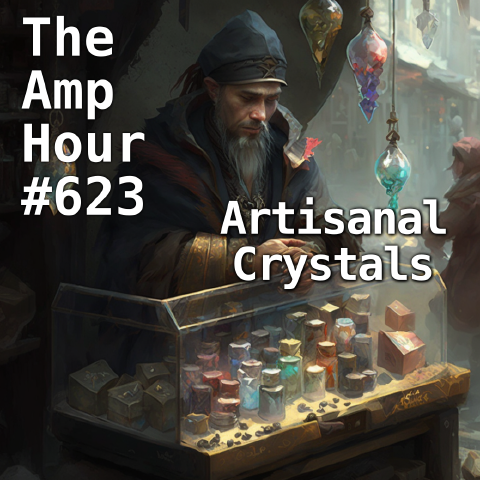
#623 – Artisanal Crystals
Download episode · 56 MB
Also on Apple · Spotify · YouTube · RSS
Show Notes
- Statistically less safe prototypes
- Artisanal crystal
- "Too good for the job"
- Story about boost converters
- Dave video current consumption
- NGA100
- Dick Smith chat
- Beagle Play and Beagle Connect were recently released
- Linus Tech Tips studio
- mHUB moving
- Fran newspaper story (still think it's on Fran's patreon page only)
- Live/work spaces
- Shipstation
- Shipping with Southwest (or other airlines)
- Wendover video about the logistics of cargo carriers during COVID
- New RPi global shutter camera
- The death of Europe's last electronics giant (Philips)
Transcript
Chris Gammell: This is the Amp Hour Podcast. Released March 12, 2023. Episode 623. Artisanal Crystals.
Dave Jones: Welcome to the Amp Hour. I'm Dave Jones from the EEV blog.
Chris Gammell: And I'm Chris Gammell of Contextual Electronics.
Dave Jones: What's up, nerd?
Chris Gammell: Well, I'm still here for today.
Dave Jones: You are still here. I thought you were away this week.
Chris Gammell: Yeah, no, I think that was because we got our way across because I recorded with my co-worker Mike last week and talked about how I was busy working on demos, which I continue to be busy. But actually, I see the light at the end of the tunnel and it's not just the jetway. It's not just the airplane at the end of the jetway. It's actually, I'm feeling better about my demos. So that's a good feeling.
Dave Jones: Excellent. So it's all coming together last minute, last minute, usual last minute scramble for the trade show?
Chris Gammell: A lot of last minute scramble. Yeah. You know, and just like the everything else too, you know, just travel and promotional materials, all that kind of stuff. So.
Dave Jones: Right.
Chris Gammell: Yeah. By the time people hear this, I will probably be in Germany.
Dave Jones: Right. Are you shipping stuff before you go or are you going to hand carry it?
Chris Gammell: No, hand carry it. And this is, you remember, I don't know if you remember it, but last year my luggage was lost on the way there.
Dave Jones: No, I don't remember that.
Chris Gammell: Oh yeah. No. Yeah. I, when I went to Embedded World last year and that was in June, I show up in Nuremberg or sorry, I show up in Frankfurt, which is about two hour train ride away from Nuremberg. And yet no luggage, not going to be there. They have no idea where it was. And so it wasn't like I can just like pop back over the airport because it was a two hour train ride. Right. And it didn't actually matter because the entire time I was there, my suitcase did not get there. I got my suitcase back when I got back to the US. It followed me about two weeks behind me. So was there any gear in there? There was. Yeah. There was some recording gear and there was like a bunch of promotional materials. Right. Most of the stuff was hand carried because I was neurotic about a lot of it.
Dave Jones: Yeah. Right. Yeah.
Chris Gammell: And I don't think it's supposed to be in the hold anyways, right? If you're like got batteries and stuff. So the important stuff made it.
Dave Jones: Did I tell you about my Altium road trip once?
Chris Gammell: I don't think so.
Dave Jones: Maybe. Right. I don't know. Yeah. We manufactured for the trade show. I can't remember. You know, it was a Silicon Valley trade show. I can't remember which one it was. There's too many of them. Anymore. Embedded. Was it? No. Embedded. Well, no. Embedded Systems Conference was the one back in the day. Embedded Systems Conference. Yeah. Maybe it was that. I don't know.
Chris Gammell: Yeah.
Dave Jones: So we were down at the Altium headquarters down in San Diego. La Jolla. And we had like, we manufactured all these prototype cases and they were like delicate handmade fiberglass cases. Because there was no 3D printing stuff back then. You know, it wasn't really, you know. So these were all like hand, like very delicate things. And they'd just been hand spray painted and everything. So they looked like finished cases, but they were delicate ass. Right. And we had like dozens of these things. Yep. And we thought, how are we going to get these to the trade show up in, you know, we've got to go all the way up the coast. And we went, these are not going to survive. A plane trip. Right. These are, we can't just give these to a courier person. It's just like, it's not going to happen. So, all right, let's get in the car. So, no, a van. So, that's a honor of a van.
Chris Gammell: Nice, nice.
Dave Jones: And myself and one of the guys at Altium, we, yeah, we hired this van and we drove it all the way up. Yeah, road trip. And we took the scenic route up the coast from San Diego right up to Silicon Valley. And, yep. Yeah, they were all, yeah, yeah. We were that paranoid that they would have, like, because we would have had nothing to show. And the whole show was about showing off this new, you know, modular hardware product that we had.
Chris Gammell: So, you know, you wonder if the same safety stuff kind of applies to gear as it does to people, right? You know, it's like people always think it's going to be safer to drive, but it's actually, like, statistically less safe.
Dave Jones: Statistically less safe, right. Yeah, right.
Chris Gammell: Is it the same for, is it statistically less safe for gear that you've got prototypes?
Dave Jones: No, no, no, no, no. Nope, nope. I only trust myself to carry delicate. Gear like that.
Chris Gammell: Yeah. I think one thing is, like, the agency of it as well. It's like, hey, look, if there's one person that's going to break, it's going to be me, goddammit.
Dave Jones: And then once I had to hand carry to Singapore, had to hand carry these custom tested crystal oscillators, right? These were hand-picked, hand-tested, hand-selected, hand-crafted. The finest artisanal. The finest artisanal gray beard crystal oscillators, right? Modules. They were MCXOs. So they were a microcontroller base.
Chris Gammell: You know, I'm kind of a crystal oscillator hipster, you know. You may not have heard about them, but yeah.
Dave Jones: Oh, boy. Yes. So, yes. So I had to carry these artisanal crystals and hand carry them in, like, you know, shock absorbent. Like, I made, like, a custom box for them with custom shock absorbing because you couldn't shock them, right? Because I've done, I've talked about this before. A lot of my research I've done on heavy shock response of physical, the physical shock response of crystals and how it resets the drift characteristics of crystals.
Chris Gammell: Right, right.
Dave Jones: So, like, yeah. Like, I had to keep these under a certain number of Gs, right? So I had to handcraft the box. And then, yeah, I get busted by customs. And when-
Chris Gammell: Maybe it looks like you're smuggling that point.
Dave Jones: I got to Singapore. Oh, yeah. Like, yeah, they x-rayed these things. And there's, like, these 12 little metal boxes that appeared in, you know, they were, like, nice, like, just, you know, floating there inside this.
Chris Gammell: And Dave's like, you think the ones in the box are bad? You should see the ones that I'm carrying on my person. Yeah.
Dave Jones: And someone there didn't speak English very well, which was surprising because it was Singapore. Oh, you mean you? And Singlish is there, you know. But I don't know. Right. So I don't know where they were from. But anyway, trying to explain to a person who's carrying, like, a submachine gun. Like, they literally had it slung in front of them, right? Yeah. And they're unpacking my box. And what is this? What is this? And I'm trying to explain how it, you know, it's a clock. It goes tick-tock. Like- Oh, my God.
Chris Gammell: That's the traditional way that you get demonetized for the B-O-M-B word. Is you lose all your money because you're dead.
Dave Jones: Right. Yes. You say to the guy with the submachine gun. The submachine gun. The paranoid guy with the submachine gun. Tick-tock. Tick-tock. Tick-tock. Yeah, right, right. It's like-
Chris Gammell: Oh, my God, Dave.
Dave Jones: Oh, God. Yes. Somehow I survived that encounter. That's good. You know, that's great.
Chris Gammell: That actually really pissed my mind in these. Way lower stakes. Way. I thought a little, you know, battery pouch was going to be a problem. Right. No, but, yep. Like yours.
Dave Jones: Yep.
Chris Gammell: I was considering, I do have an old carry case, like a silver briefcase. And I was kind of like relishing the idea of like having like a silver briefcase. Chain it to your wrist. Chain it to your wrist. Yeah, yeah, yeah. You got to do that.
Dave Jones: Yeah, yeah, yeah. Yep. That'd be great.
Chris Gammell: Yeah. I don't think I'm that risky, though. I think I'd rather just put it in my bag, my normal bag. Like it feels like that like draws more attention to it unnecessarily. And it'll be fine.
Dave Jones: That reminds me of the time I had to defuse a bomb inside a briefcase in a stairwell of an abandoned car park.
Chris Gammell: Well, there's a story.
Dave Jones: I could explain that, but I won't. I'll just leave it at that.
Chris Gammell: Okay. No link. And I'm not kidding.
Dave Jones: Okay. I'll just leave it at that. True story. Okay. True story. Yep. All right, cool.
Chris Gammell: Well, in service of prototypes, I had a question for you because I blew up. I ordered five modules, and I blew up two of them immediately today. And I thought, you know, this is good fodder for the amp hour. Excellent. Because I'm actually not certain what happened. What? Did you blow up? I have some theories there. Okay. So here's the back story. These boxes that I'm making, they're battery powered. They're off of LaPo battery pack. You know, 3.7 nominal. And there's a buck boost converter in there. And really, I'm just running everything off 3.3. Okay. Nothing fancy there. But I have an expansion module that basically plugs in this particulate sensor. And what I noticed was like when I had it all plugged together and I was running off USB, no problem. I unplugged the USB and then the whole thing just doesn't boot. And I'm like, what the hell's going on here? And it turns out that the firmware is waiting for the particulate sensor to come up. But because when it's not plugged into USB, there's no five volts that gets passed through to the particulate sensor and it needs five volts. Okay, fine. So that's totally solvable. Right. So I ordered these off the shelf Amazon next day piece of crap boost little modules. Right. It's like probably it's like less than 10 centimeters by 10 centimeters, like really, really small modules. Maybe now, maybe less than five by five. 10 centimeters?
Dave Jones: That's a lot.
Chris Gammell: Yeah, probably five by five. Power module. Yeah, five by five.
Dave Jones: And still large, quite frankly.
Chris Gammell: But it's like a, you know, wire to board kind of thing. It's not like I'm soldering this down. Like I'm not, I'm sorry, soldering wires to it. I'm not like soldering it onto anything else. Right. Right. So am I getting that right? Maybe. Yeah. Five by five. That sounds about right. But let's go with that. And okay. So now I have this little thing, but I, before I put it into my unit, I wanted to test it. So I get out my source measure unit. I get out my digital load and basically I run some wires to it. And basically, oh, actually I can send you the link here so you can see it. I actually don't know what the part is. Maybe good, maybe bad. But basically I'm just.
Dave Jones: That is not five centimeters by five centimeters, dude.
Chris Gammell: You know, Dave, I don't do.
Dave Jones: You don't do metric.
Chris Gammell: I don't do metric. I do freedom.
Dave Jones: No kidding. That is barely an inch by an inch, dude.
Chris Gammell: Five centimeters.
Dave Jones: Five centimeters is two inches by two inches.
Chris Gammell: Oh yeah. I was way off. I was thinking millimeters. Yeah. It's like more like 10 millimeters by 10 millimeters. Is that right? Maybe a little bit more. Yeah.
Dave Jones: It's like, yeah, that's 10, 12 by 12, 10 by 10, 12 by 12 millimeters.
Chris Gammell: 10 by 10 sounds right. Okay. So much smaller. There we go. See, I should have led with the link. That would have been helpful. Exactly. Okay. I was mostly going off of this thing is available on Amazon and I don't really care what it does because I'm going to just test its behavior.
Dave Jones: Yeah, of course. Okay.
Chris Gammell: So I wire it up. There's a, there's a VN, there's a common ground and there's a V out. Very, very simple. It's supposed to take from five volts all the way down to 0.8 volts. I think it's a 0.9 volts. And then it'll boost it up to five volts, like a standard boost there, unshielded inductor or whatever. So I hook up my source measure unit. I hook up my active load and I program the active load for, I think like 50 milliamps, right? So I'm going to try and draw 50 milliamps out of this thing. And I program the source measure unit to source 3.3 volts. Cause that's my expected voltage on that's the rail.
Dave Jones: Why did you use a source measure unit instead of a power supply?
Chris Gammell: That's a good question. And then I set the compliance on the source. Cause like, honestly, I start with the source measure unit. That's usually where I start for things.
Dave Jones: Ah, right. Okay. Well, I've, I've, I've got a segue with this later. You have to remind me. Sure, sure.
Chris Gammell: Okay. And so I said it like compliance at like, like 300 million, 300 milliamps on the source measure unit. And I turn it on. And I also had already turned on the active load. So the active load was already there and it's not a very good active load. It's one of the signal ones. And like, sometimes it doesn't come up. Like sometimes when I turn it on, like it's already, uh, it like doesn't talk to the ADC. So it's not like super high quality.
Dave Jones: Right.
Chris Gammell: It was a budget play. And so I turned this thing on and I just start seeing like current shoot through to the active load. Like the, the source measure units railed at 300 milliamps. The active load is saying that it's only getting, it's saying that there's no voltage there basically. So it's just like shorting and going back out to the source measure unit. I don't know what's happening at that point that it would be source that shorting through this, this boost converter. Right. I figured that most of the boost that I see, it's basically you're going through a inductor, you're snapping it off. So then you get a spike through that inductor voltage and you can basically boot. That's how you boost it back up. And then it stores it in a capacitor. There's only like three components on this thing. There's four, five components. There's a inductor, diode, two caps and the actual switcher itself, a four pin switcher. It's like nothing fancy here. And so my assumption is that something happened when I turned on the source measure unit.
Dave Jones: Right.
Chris Gammell: But I have no idea what it was.
Dave Jones: So you actually blew, blew these little modules.
Chris Gammell: Yeah. Yeah. It's really weird. All of them? No, two out of the five before I watched it.
Dave Jones: Two out of the five before you.
Chris Gammell: So did you realize what was causing it or what? Well, that's the thing. So, so then I started like being like, you know, so I thought, well, maybe these things were just bad. Right. It's just like, I wouldn't read the reviews again. I'm like, yeah, some people had some problems, but you know, that's a very bad measure there.
Dave Jones: I have some problems with a board with five parts on it. That's supposed to be just a, that has one job. Right. Right.
Chris Gammell: Exactly. Exactly. And so then like, I also, so another thing I did is I took it off the active load, of course, and then I just put it into a DMM. And yes, when I do that, then there's no load. And I see five volts there. I'm like, okay, well maybe I'm trying to source too much current. So I stepped the current on the active load all the way down to like 10 milliamps. Right. Right. But still this thing is, so that was still on the first unit. And even when, even at 10 milliamps, I see the source measure unit is sourcing 300 milliamps through this thing. Whoa. There's no voltage. Right. So it's just shooting right through there. Yeah. So, okay, that's bad. Then I replaced it with the second one. And then I'm like, okay, I'm going to start a little bit different here. Then I changed it over to, I was like, okay, well maybe I can get like switched to in the active load, switched to constant resistance mode. Right. So now I'm going to program in 10 ohms and see if I can just see if that's something different there.
Dave Jones: Constant resistance mode is tricky though. I have actually killed benchtop power supplies with a constant resistance mode. It was one of my tests back in the old days for loads, for actual power supplies. Yeah. Yeah.
Chris Gammell: So I think you're getting at what I think is the, I think what's happening. I'll get to the resolution here in a second, which is very boring. I think what was happening was two things. One, I had the active load on when I also switched on the source measure unit, which I think was part of the problem. Right. And then the other thing is basically because it's two active sources, they're just fighting each other like crazy, right? They're just like, oh, I'm going to go up. Well, I'm going to go up. No, I'm going to go down. I'm going to go down. So I think basically the source measure was oscillating like crazy. And this little piece of crap.
Dave Jones: Yeah. It just couldn't handle it. And then it just, yeah, it went. It's up.
Chris Gammell: So it just swung too high. Right. So now it's driving an inductor. It gets out of control. It's control loop and the voltage gets too high and it probably popped the fat on it or something like that. I didn't see any, I, you know, I, I didn't have a scope on it or anything like that either, but that's my assumption. The boring resolution. I did what you said. I was like, well, I should probably not use the source measure unit. I made sure the active load was off when I wired it all back up to my boring mini power supply and everything was hunky dory. That's right.
Dave Jones: Yep.
Chris Gammell: Yeah. It's weird though. Right.
Dave Jones: I mean, like I have seen such things happen before.
Chris Gammell: So tell me more about the active load thing. So, so how does, how does it actually, is that the control algorithm on the active load or is it the power supply?
Dave Jones: It's the control algorithm on the active load. And if it beats because it has a certain loop time, right? So it's got a certain loop response time. And if that somehow beats, we're talking like a resonance kind of thing. If that beats with the response time of your power supply in constant current mode, then you can cause the, if it's a poorly designed power supply, it can just get caught up its own clacker and it can blow the output fits.
Chris Gammell: Yeah.
Dave Jones: So yeah, it's not a pleasant thing to try hooking up a, it'll, it'll, it'll cause both of them to hiccup, right? Because the electronic load goes, it goes into constant current mode. So the power supply goes into constant current mode and then the load goes into a constant resistance mode, but then the constant current mode drops the voltage, which then causes the load to go back up and they start fighting each other and boom, you know, and yeah.
Chris Gammell: Yeah. Yeah. Yeah.
Dave Jones: Yeah.
Chris Gammell: Yeah. That's another thing I remember from my Keithley days, which is, oh, rapidly in my rear view mirror. I do remember when people would be testing solar cells with source measure units that the capacitance of the cells would throw off the control algorithm like really, really heavily just because it's like, you know, you're dumping current into this thing and it's just like the voltage isn't moving, but the source measure unit expects it to be moving, that sort of thing. So you had to like just slow everything down as much as possible. Yep. Control algorithm stuff.
Dave Jones: Oh yeah. Yeah. Yeah.
Chris Gammell: So.
Dave Jones: It's a big deal.
Chris Gammell: Yeah. I think the source measure was the bad idea. Yeah. The power supply probably should have started with that.
Dave Jones: It's too smart for its own good. You would, you know, you'd use too good of, you used equipment that's too good for the job.
Chris Gammell: Yeah. Yeah.
Dave Jones: Right. Maybe that could be the name of today's episode.
Chris Gammell: Too good. Too good of equipment. Too good for the job.
Dave Jones: Just call it too good for the job.
Chris Gammell: Too good for the job. Yeah. That sounds good.
Dave Jones: There you go.
Chris Gammell: The other thing I was wondering is though, is having an active load already turned on, is that problematic as well? That's, I actually didn't know. I don't use my active load that often if I'm being honest. I use it when, you know, I get into stuff like this, but like, I'm never doing like battery testing like you do. Yep. So like.
Dave Jones: The load can certainly, the load is going to do what it takes based on the input, the supplied input voltage. So it's got a, you know, so if that input voltage is varying, then the load's going to vary, then the load's going to do it, try to do its thing with its own response time. And then if the two don't agree, then yeah, you can get stuff like your blowing up thing or a blowing up bench power supply or something else. No, it's, it's not good. You definitely don't want to be ramping them both up at the same time. Yeah, that's for sure. So yep. Can cause a real problem. And, and that's the problem with, you know, control loop based loads. This is why, you know, a lot of people have a direct resistive load because it's the only way to ensure that you aren't causing a hiccup in your dry, in your, you know, the source.
Chris Gammell: So right, right, right, right, right.
Dave Jones: But have a pure resistive load. So yeah, can make a big deal.
Chris Gammell: All right. Well, you had a segue. So what's the segue?
Dave Jones: A segue is my latest video that I just released this morning. I needed to measure the battery consumption. I needed to measure the current consumption of my BM786 meter, right? Which is in the order of eight, five, five milliamps, right? But I wanted to measure it with some sort of precision, right? But every power supply I've got in the lab is like one milliamp is the best it can do, right? Like you can't even measure 1.1 milliamps, right? It's one milliamp, right? Because their power supplies are always designed for like the maximum current, you know, they're like a five amp power supply or a 10 amp power supply, right? So you never get micro amp resolution on your power supply.
Chris Gammell: So what about something like a, like a Koitek or a Joulescope or something like that?
Dave Jones: Oh, yes, yes. You can use those specialized tools, of course, right? But I'm talking like a regular bench power supply. And like, but I did actually remember that I did have one. I had a Roden Schwartz NGA100, which is not to be confused with the NGE100, which I've also got, which doesn't have this capability. But the NGA that I've got, I think I'm getting that correctly. We can put a link down below. And I've done a review video on this and teardown in that it has one micro amp resolution on its actual current display. So it can actually scale. It can either auto range its current display or you can manually fix it to like, so on the 200 milliamp current range, you can get one micro amp current resolution on the display, which is fantastic, right? But why don't other power supplies do this? Like, you know, hardly, virtually none on the market, like have any sort of current ranging.
Chris Gammell: Even like higher end ones?
Dave Jones: Even the higher, well, this one's fairly high end, you know, it's like a thousand dollar power supply, you know, it's like, you know, it's in the field.
Chris Gammell: What were some of the other ones that you looked at that you didn't have that? Because I found like the, you know, like the Regals and stuff like that.
Dave Jones: Even the same price one from Roden Schwartz, it just happens to be a totally different model. It doesn't have this capability. It's like, it's a niche requirement. I've got a top of the range Roden Schwartz one, right? Top, absolute top of the range. I'm staring at it right now. It's on. It's only got one milliamp resolution. It's their top of the range, big four channel jobby, right? Touchscreen, the whole works.
Chris Gammell: And you're saying the measure output of like the actual or like the programmable?
Dave Jones: No, the output current.
Chris Gammell: Okay.
Dave Jones: The output.
Chris Gammell: Well, what about like a source measure, right? Like also could, I know we're talking about that.
Dave Jones: I thought, oh no, I'm going to have to use my Keithley source measure unit, right? I've got one. I've got a 2000. Sure. Yeah.
Chris Gammell: You get the fancy ones. Yeah.
Dave Jones: Yeah. Well, yeah. It's the old school fancy one. Yeah.
Chris Gammell: Oh, you have the old school one. I thought you had one of the new ones. I thought you were.
Dave Jones: No, no, I don't have one of the new touch screen source measure.
Chris Gammell: Is it Ben has one? Ben Krasnow has one?
Dave Jones: I think he does.
Chris Gammell: Ben has those. Yes. Yeah. Yes. Yes.
Dave Jones: And I've got the old vacuum fluorescent display one, which is like, try and drive that thing. Oh my God. Try and just figure out how to turn the, you know, how to set the output current on the thing.
Chris Gammell: Oh yeah. Yeah. I've been indoctrinated. Yeah. But it still gets confusing sometimes.
Dave Jones: Oh yeah. Yeah. It's nuts. But yeah, I'm just like most power supplies don't bother. It's like, well, if you want to measure low currents, like microamps, well, you need a specialized tool for that. You know, it's like, I don't know. Why can't a trend be set where like even low cost power supplies have a, an adjustable range, you know, thing. I can understand not having auto range and stuff like that, but you know, you could add a, you know, for a couple of bucks more, you can add a relay in there and another higher value current shunt resistor. And, uh, you know, I don't know. Yeah.
Chris Gammell: I guess that, yeah. They don't want to switch through the different. Yeah. Cause like they want to basically have like a DAC that goes to a driver circuit that just turns on the amplifier or the drive.
Dave Jones: There's a 0.1 output current ohm shunt resistor. That's right. And that's it. And then, yeah, sure. You can get, you can whack a 12 bit ADC on there or a 16, 16 bit jobby or something. And you can get decent resolution, but you can't get microamps because your, your opt that is that current shunts optimized for the 10 amp range.
Chris Gammell: That's right. Yeah.
Dave Jones: They just don't have a secondary current shunt, a higher value current shunt resistor.
Chris Gammell: Yeah. And probably how they also do product split too. Right. So like if they're like, well, anyone who wants to go and figure out super low current is going to go and do that with something like a, you know, a battery monitor, like a high dynamic range type thing, like a joulescope. Right.
Dave Jones: Yeah. Or they're going to use my microcurrent or they're just going to use their multimeter. Right. They're just going to put their multimeter around the output.
Chris Gammell: Right. And then you get some ranging. Yeah.
Dave Jones: Yeah. And that was part of my video. I released today, but then you can get into the burden voltage thing because it's outside of the control loop of the power supply. Right. When you, when you shunt resistors inside the control loop, as you get with the power supply, then if it says 4.5. Oh, oh, oh volts on the output, that's what you get. Right. Right. But if your current meters, if you're using a multimeter to measure the output current, then the voltage going, go into your load is not. Yeah. You've got that.
Chris Gammell: Yeah. That's a good point.
Dave Jones: Yeah. Have that drop. So yeah. There you go. Anyway.
Chris Gammell: So if it was easy, Dave, then everyone would do it. I know. I know. If it was easy. Now you have that knowledge.
Dave Jones: I just think this meter's cool. I think this power supply's cool because it has that capability.
Chris Gammell: Yeah. That's neat. Yeah. Yeah. Probably. Do you think it's worth paying for it? I think that's really what it comes down to.
Dave Jones: Oh, it's nice. Yeah. I think it's really nice. You don't have to dig around, right? You can just choose a lower current range.
Chris Gammell: What's the premium for it, do you think? Like what's your estimate on the premium to add something like this?
Dave Jones: What in terms of build cost?
Chris Gammell: It's... Yeah. No. Well, no. Like if you compared this, so you said like the NGA100 and the NGE100 or something, if they're similar except for this feature, it's like 500 bucks?
Dave Jones: They're basically the same cost. I do believe that they're the same cost, but they're just designed for different markets. Got it. Got it. You know, so the one I've got is actually a dual channel 100 volt high voltage supply, right? Yeah. But it happens to be designed for this kind of... In fact, here's such as creating Internet of Things low power designs. You know, it's one of its like banner highlight. I just sent you a link, right?
Chris Gammell: Nobody does that anymore, Dave. Right.
Dave Jones: No, exactly. You know, and it's just... Yeah, it's actually designed kind of more for this purpose, right? So it's not really, you know, a general purpose power supply. It's more, you know, it's a little bit more niche.
Chris Gammell: Yeah. Yeah.
Dave Jones: But, you know, I can't see why, you know, like a bunch of low cost power suppliers can't have... I don't know. Leave it in the comments down below if you know of a... Yeah, yeah, yeah. I don't know of a low current, like a low cost... Because, you know, low cost... Oh, how flooded is the market with low cost power supplies, right? That's right.
Chris Gammell: Close your mind, right? Right. It's absolutely close your mind.
Dave Jones: Oh, it's an absolute race to the bottom, right? You can get some amazing stuff.
Chris Gammell: Have I ever told you the name on my cheapo Amazon special? No.
Dave Jones: No.
Chris Gammell: Dr. Meter.
Dave Jones: Dr. Meter. I thought it was going to be Shitto or something. Yeah, something like that.
Chris Gammell: That's good too. I like that. Right.
Dave Jones: It's the Shitto power supply, you know. Yeah. Yeah.
Chris Gammell: I should print a label for it on top of it.
Dave Jones: Yeah. I was talking to Dick Smith. He was giving a talk. It's on my channel somewhere. But it was afterwards. He was talking to... I don't... No, I think it is in the video. Anyway, he used to sell power supplies in his companies, right? And his face was on the front, you know, the dickhead logo. And he said, I thought about selling this power supply and I was going to call it the mighty dick.
Chris Gammell: The jokes are endless.
Dave Jones: Yes. Yes. The mighty... You know, because he actually played up on the dick name, you know. So, yeah, he's going to call it the mighty dick power supply. I think he said, yeah, he put... Like, he wanted them to label... Like, that was the plan. And then the power supplies came back and they weren't called that. Like, he instructed them. They changed it for some reason. Wow.
Chris Gammell: Insurrection, you know. Yeah, yeah.
Dave Jones: Right. Heads rolled at that company, you know. So, he was kind of upset that they didn't call it the mighty dick, you know. Yeah, it's this big, big power supply. Oh, and anyway.
Chris Gammell: Speaking of product stuff, I had two things that I've worked on be released in the past week.
Dave Jones: Oh, there you go.
Chris Gammell: Yeah. One, actually, I was going to send you because we've talked about it offline.
Dave Jones: Oh, you're going to send in the mailbag, huh?
Chris Gammell: No, no. I'm going to send you a link right now. I'm not going to send you a mailbag. That takes forever. And you barely do mailbag anymore. Sorry, Dave. No offense.
Dave Jones: I'm editing one right now. I just don't.
Chris Gammell: I don't have time for that. You know, this isn't publicly available. So, this is just a thing that I told you about with the backlit LEDs. We talked about it on the show last week.
Dave Jones: Oh, I did. Simul. Yeah.
Chris Gammell: So, that's sort of released in that it's that. But the bigger one is actually that I helped on the Beagle Connect, which is a Beagle board project. Beagle board, if people don't remember, they make the Beagle bone black and the Beagle board and I don't know what else is out there. What do they call it? The Beagle, Pocket Beagle. No idea. Basically, little Linux computers that were similar to, you know, kind of in the same echelon as Raspberry Pi, a little bit more expensive. Yeah, yeah, yeah.
Dave Jones: It was all the rage eight years ago or something. That's right. Exactly. I do like your use of hot snot.
Chris Gammell: Oh, thank you. On the screen. Yeah, on the screen there. Yeah. Yeah, yeah. That one actually was my coworker, I believe, with the hot snot. Oh, okay. Right. Where is the hot snot? Yeah, that's my coworker. Did that. Mine was actually much more.
Dave Jones: And two bodge wires. Nice.
Chris Gammell: Oh, yeah. Yeah. Turns out I2C and I2C1 and I2C2 are different pins. And we'll figure that out later.
Dave Jones: You're a fan of the enamel-coated wire, are you?
Chris Gammell: No, again, that's Mike. That Mike did that. Oh, okay. Right. So I use it sometimes, but no, on the ones when I did the bodge, I was just using normal plastic-coated wire.
Dave Jones: Yep. Sweet.
Chris Gammell: Yeah, nice little. So Dave's talking about the backlit board, the front panel one. The front panel.
Dave Jones: Yep.
Chris Gammell: Yep. So that's the one that we talked about on the show last week. That is, there's now a post about it. So if people want to check that out. The other one, though, is the, so the announcement on the Reddit is actually about a different board. Beagle board just put out the Beagle Play, which is $99 industrial SBC with a bunch of inputs and outputs and stuff on there. But the thing that matters on that one is the CC-1352P7. That has Bluetooth chip. It's got 2.4 gigahertz and 900 megahertz. And that's the same chip that is on the Beagle Connect, which is a board that I helped prototype in early stages in my consulting days. And basically it's like a double-sided click header, the micro bus click headers plug into that. And you can basically, and then it basically uses something called Gray Bus and it can talk back over Gray Bus to something like this Beagle Play. And you can kind of make a wireless network that kind of self heals and forms, which is pretty cool.
Dave Jones: Nice.
Chris Gammell: So that's out. Out now. And I think Jason, we've had on the show before, will be at Embedded World also showing this off. So you can find him floating around there and talk to him and check this thing out. So that's pretty cool.
Dave Jones: Excellent. And I see that unmanaged 615 put a link to the new Arduino Giga. Giga. Is Arduino doomed? Who did this video? Blueprint Internet of Things. I don't know them. They've only got 300 subs.
Chris Gammell: Yeah, I've never heard of it either. Right. Right. So the Giga is like, basically they took the Portenta X8, X7.
Dave Jones: I have no idea what a Portenta is.
Chris Gammell: Yeah. I mean, either. Maybe like, I don't know. I'm guessing it's Italian. That's got like this incredibly beefy processor on it. It's got like a Cortex M7, maybe an H7 even. It's like very, very, very, very powerful for what it is. It's like 500 megahertz plus kind of processor. And now they took that, which had a different form factor that they, with like kind of like a fine pitch breakouts. And now they basically took that and put it into a 0.1 inch header form factor, similar to the Mega, which if you don't know is the, one of the other form factors, one of the other classic Arduino form factors. Right. So, yeah.
Dave Jones: Yeah. But they're saying the Arduino is doomed because this new Arduino Giga, like the traditional Arduino is doomed because the traditional Arduino Mega, I guess, is like 68 euros. And this thing, this new thing is only 60 euros. And it's just no contest. This thing is 1.5 gig speed wise.
Chris Gammell: 1.5 gig. Oh, wow.
Dave Jones: And it's got USB-C. It's got four USB-As. It's got, yeah, it's just nuts. It's got 75 digital lines. It looks like it's not pin compatible with the existing Arduino footprint though. So it's more like a Raspberry Pi form factor.
Chris Gammell: I think that's the price they're actually comparing it to.
Dave Jones: Oh, that is the Raspberry Pi. There's a Raspberry Pi logo on it. Sorry, I'm not watching this video.
Chris Gammell: That's okay.
Dave Jones: Properly.
Chris Gammell: Yeah, I think.
Dave Jones: What the heck?
Chris Gammell: Yeah, I don't think this video is okay. I don't know. Like, it's just another variation here. So I don't think it's, I don't know. It's just another.
Dave Jones: It's just another. Another dev board. Comparison dev board comparison video. All right, scratch that.
Chris Gammell: Here's what I usually get down to though. Okay, so this is like, so I think that the reason that they did this Giga is that you see things like the Mega, which is the form factor, being used in things like 3D printers. Using basically as like aftermarket components. And then they just kind of plug in, they build, they build shields for the top of the Mega. And then they plug those in and those got like motor drivers and things like that for 3D printers. For that, I could actually see this being like a very smart upgrade, right? Now you upgrade it. You've got a ton more processing power. You've got networking and all the other stuff there. For just like, you know, just flashing LED, like what is the smallest thing you can get here? I don't know, like a little ESP32 board. Like, okay, fine. You know, like it really just depends on what the application is. There's so much stuff there. Like, and then also like, I've always even thought like that, you know, I love the Teensy. The Teensy is another one that was like super, super duper powerful thing. But then still running, usually still being programmed through the Arduino IDE. And like, and then Paul and his team, like, you know, they do a custom interface layer to make it so that you can write something in Arduino IDE. And then it will like load itself down into this really powerful part. And for some people that makes a lot of sense, but it's sometimes also like there's so much horsepower being put at like tasks that could be optimized in code. Exactly. And, you know, like other things, like don't get me wrong, other things that the Teensy does, it's outside of the Arduino ecosystem. Like things like the audio processing is amazing. But again, it's like so much power now with like such a simple interface. It's like, I don't know a good analogy. I don't have a good analogy on hand, but like there's a lot of different options out there, I guess. And this is now another one. Is that a fair statement? I don't know.
Dave Jones: I've never had options before. I'm so excited by all these new options that we've never had before. Wow. Yeah, you know, like. I'm going internally berserk.
Chris Gammell: I think the thing is most people who are using this form factor are not going to use it at the beginning. The ones who already are using this form factor and want to upgrade it are going to benefit greatly. And everybody else is just going to be like, okay, there it is.
Chris Gammell: Yeah. Cool. It's nice it's out there.
Dave Jones: All right. Have you seen the new Linus Tech Tips testing lab video?
Chris Gammell: No. Is that? Oh my God. Is that a new facility?
Dave Jones: Yeah. That's the new testing facility, which we have talked about before, I'm sure. Yeah.
Chris Gammell: I remember we talked about it. Yeah, that's right. Yep. Yep. Yep.
Dave Jones: I, well, it's, it's still not set up. Like it's this giant warehouse. Like it's an absolutely enormous warehouse. I'm not sure how many square foot or square meters it is, but it's just insanely big. Like, and they're just installing, they've got a new RF anechoic chamber, which is still in boxes. They haven't set it up. Then they've got that automated power supply test rack, which still have, they've still haven't got that working. Then they're doing, they've got a submersion tank. They've got this automated robot keyboard tester thing. So it, you know, the little finger goes around and automatically presses all the keys so that they can test keyboards. And, uh, they've got, what is it? Oh God. And they, they're going to have an audio room where they, so not only if they haven't got a new RF acoustic test chamber, which is like half a million dollars or something, they've got an acoustic test chamber as well, a giant big walking one. Then they're going to have a home theater testing room, which is another anechoic chamber just for like home theater gear. And then they've got one of these 3d printers, which is so proprietary, a Rapidia.
Chris Gammell: Never heard of it.
Dave Jones: Rapidia. 3d metal printer. And apparently they can't tell you how it works because they're under NDA not to tell anyone how it like the exact show them the exact mechanism inside how it works or something, but it can 3d print like giant metal cases and stuff like, you know, so they're going to use it to actually design their own fan blades out of metal. Right. So they're going to do their own custom cooling fan blades and, you know, wankery like that. Right. It's just absolutely incredible.
Chris Gammell: It seems like a big swing. That's a, that's a big swing.
Dave Jones: Oh, it's like millions and millions of dollars are going into this.
Chris Gammell: Yeah. Yeah.
Dave Jones: Yeah. And, and they're hired people who are dedicated, you know, RF experts, dedicated acoustics. Yeah. That part makes sense. Dedicated power supply experts, you know, and it's like, yeah, it's just, it's just crazy.
Chris Gammell: I haven't finished watching it all yet. I'm more of a rent before I buy kind of thing.
Dave Jones: So I don't know if they're renting this facility or whether or not they bought this gigantic warehouse. I'm not sure what the deal is.
Chris Gammell: Yeah. Leasing is often part of it.
Dave Jones: Wow.
Chris Gammell: Actually one of my, uh, the, where I used to work, Emhub out of Chicago. I hadn't realized, I thought they owned the building that I used to work in. Oh, right.
Dave Jones: Yeah. They did.
Chris Gammell: I don't know if you remember like a tour. I don't know if I ever sent a tour to you, but it was like this 60,000 square foot. So like, what do you divide by a hundred? It's like 600 square meter.
Dave Jones: Mm-hmm.
Chris Gammell: Huge. Huge facility.
Dave Jones: Yeah.
Chris Gammell: And yeah, they got, they got booted.
Dave Jones: Oh, wow.
Chris Gammell: I think because, you know, it's basically a whole city block.
Dave Jones: Right.
Chris Gammell: And that part of town in Chicago is like just condo, condo heaven.
Dave Jones: So it's being gentrified. Is it? Is that?
Chris Gammell: Oh, yeah. I mean, it was like kind of this quasi, that, that is, uh, yeah, I'm not sure. That is a term, I'm not sure. That's, that is totally a term. Yes. Especially my town. Uh, yeah. And I think it's just like, you know, more lucrative to knock it all down and build a huge tower to go up. So anyways, they're moving to a new spot kind of further outside of town and now they actually own the building. So that's very exciting. Ah, yes. If you're a Chicagoan, check out the new M Hub. I'm very excited.
Dave Jones: Interesting.
Chris Gammell: I think, I think that's right. Yeah.
Dave Jones: This reminds me, uh, Fran Blanche, former guest on the show several times, I think. And future, I'm sure. Yeah. Yeah. Absolutely.
Chris Gammell: Yeah. Yeah.
Dave Jones: And she did a video recently. Uh, see if I can find it. Cause she does things where she reports in the newspaper, like she reads the actual newspaper, like the physical newspaper. And she does like stories from the newspaper. It's really, you know, it's actually really good. Yeah. And she reported on how, how in U S States, they want to now bring back the work cohabitation space. Oh, I saw that. Like the work life space or whatever it is. You know, I can't remember the exact word.
Chris Gammell: Because that's what Fran always tries to do.
Dave Jones: Yes. She, she wants to hire these. And she was, yeah, she was basically, yeah. In her, uh, city of, uh, Philadelphia, right. Phil in downtown Philly. She can't get a place that's where we can both live and work in the same place. Like, yeah.
Chris Gammell: Usually you have to squat. You have to like, like lie and then like, just surreptitiously live there. If you're going to try and do that sort of thing.
Dave Jones: Yes. Yeah. Yeah. So you can't like officially do it. And then knocking down all the original places in Philly that were these, you know, live, live workplaces, you know, like, like these giant artists, creative, you know, spaces, you know, that you lived in there and you worked in your studio. You know, they don't have them anymore. Yeah. But apparently they're now, well, they say that they want to bring them back, but she's not really believing it. But, you know, the government's going, oh, we need to bring back the work, live work space again. Cause we knocked them all down and sorry, but not sorry. You know, that would. Right.
Chris Gammell: Well, I feel like those are always in, uh, like old, like rehabbed.
Dave Jones: They use old rehab buildings, you know, they're an old hospital or something. And then they became. Yeah. Right. Right. Right.
Chris Gammell: Yeah.
Dave Jones: Yep. And artistic space. Yeah.
Chris Gammell: Another one that I used to go to artisans asylum, I think that was like a Boston kind of like an, it was before M hub, but it was like really cool space. Kind of, it was like a, it was a workspace mostly where you actually rented kind of like a 10 by 10.
Dave Jones: A, a room. You can actually, that's what Fran. Oh, no, it was open. It was open. Oh, like an open plan. I think Fran rents like a room in one of, in a place like that. That's her little mini factory where she has a lathe and, you know, things like that.
Chris Gammell: Yeah. Yeah. Yeah. Yeah. Yeah. It's tough. I mean, I feel like, you know, especially, I mean, U S cities are changing again and they're very, uh, price. I mean, you know, in Sydney, Sydney is no, no, no stranger to, uh, increasing square footage costs. So, yeah, it's, uh, it's tough when you want to, when you want to live like somewhere that's actually accessible, but have enough space. Oh yeah. Yeah, exactly. Industrial style stuff. Yeah.
Dave Jones: Well, I've, I've, I've been priced out of the lab market here, you know, well, the office market here, like if I, if I want to buy a bigger space, I, you know, it's 800,000, a million bucks. Like if I want to get like a hundred square meter place.
Chris Gammell: Yeah.
Dave Jones: We're talking a million bucks. Right. So, you know, it's nuts.
Chris Gammell: Click those ad folks. Dave needs a new space. He's going to get a new space and add a window.
Dave Jones: Yeah. I've got to pay like a million bucks. That's right. Yeah. Like, yeah. Like, but of course, you know, you're paying for the convenience. I could go out West so I could like drive, you know, go West young man, you know, and yeah. Like I could go into the poorer working class, you know, areas and, uh, yeah. And I can get like a, quite a big warehouse for maybe half that cost. Right. But still, you know, it's like, I've talked to people about this before.
Chris Gammell: Cause they, you know, like they're always like, well, I want to like, you know, I'm young. I want to live in a city, but I want to, you know, I work, work in an engineering job. And it's like, unfortunately a lot of like hardware engineering jobs, you need space. I've been to the show before, right. You just need, and like, that's municipalities that are geared up for industrial style things are like, yeah, they're sorry. You're going to be in Seoul and Ohio. Now you're not going to be in hip, cool downtown Cleveland, Ohio.
Dave Jones: Yep. Well, it aren't even the big, like, you know, the huge campuses, like, you know, HP and Apple and all that sort of stuff. They're like in like more suburban areas. Aren't they?
Chris Gammell: Like Apple's actually there. So like, that's actually, they're coming to my part of the world and they're building a new campus here. But like, as like a contrast, Google is buying a bunch of office space in like downtown Durham. Apple is building a suburban campus, like out off of a highway in Raleigh, basically. So like still drivable. So totally accessible.
Dave Jones: But it's not near anything. It's not walking. It's driving. You have to drive there. Yeah.
Chris Gammell: You got to drive. Or maybe you'll get a bus, right? Right. Of course. Yeah.
Dave Jones: They'll actually bus you in from, you know.
Chris Gammell: Yeah. Yeah. Yeah. So I think it's just, you know, it's just how the different companies operate. Not like Apple's manufacturing hardware in Raleigh, North Carolina, but. Right.
Dave Jones: Yeah. But they still know. But yeah, all this work from home stuff is ending, you know. I know, right? Companies are.
Chris Gammell: Boy, did that snap right back.
Dave Jones: That snapped right back. Elon Musk set the, you know. That was like a door shut in people's faces. It was like, oh, Elon can get away with it. All right. Everyone back. You know, like, yeah.
Dave Jones: Oh boy.
Dave Jones: Yeah. We're not putting up with this crap anymore. You know. Yeah.
Chris Gammell: That really turned on a dime. It really. It shouldn't have shocked me. Yeah. I think I. I think that you said it. I said it like this. It could go right back. But like the speed that it went back. Yeah. Yeah.
Dave Jones: Oh, yeah. The speed. Yeah. Once somebody sets a precedence and then you're not considered a bad company if you do it. Right. You know. Right. It requires one company to take the bad rep first. Yeah. But once. But once they do it, it's like, oh, it becomes a normal thing.
Chris Gammell: Elon is doing that on multiple fronts. So yes. Yeah. Yeah. Yeah. Yeah. That's true. It's true. It sucks. But you know, like hardware is a tough thing to do remote anyways. Only really, really great engineers like myself can do it. So.
Speaker ?: Right.
Chris Gammell: Me. Me and my friends at FedEx, UPS, and DHL. And DHL.
Dave Jones: Boy. Yep.
Chris Gammell: Yep. I will. I will give a life pro tip. I don't know if you. I'm sure you know this too. If you don't know, if you are working remote and you have to ship stuff all over the place for nine bucks a month, I use a thing called ship station, which is just like a, it's like a shipping server. It's like a shipping backend for like, if you know, like Dave has an online store shop and like say Dave wants to give his, he doesn't want to give his packing and shipping person access to something like the store, but he wants to just tell him like, Hey, you have a hundred orders. Click through them. Here's all the shipping stuff. Well, you can just buy that as like a pleb, like myself for like 10 bucks a month. And then you get access to like, I get overnight shipping from like here to California for like 40 bucks. Cause they have like, they're crazy. Yeah. It's, it's insane.
Dave Jones: I don't think there's anything like that here. Like I like, yeah, I've, I've got my shipping online shipping software and stuff like that, but that, but that doesn't get me a shipping deal.
Chris Gammell: Yeah. Yeah.
Dave Jones: I've got a direct contract with a DHL.
Chris Gammell: Right. Right. Exactly.
Dave Jones: A direct business contract.
Chris Gammell: Yeah.
Dave Jones: So in this case, that is totally independent of the shipping system service that I use.
Chris Gammell: That's right. Right. And then that's the thing. Cause it's always like when you're shipping stuff, it's always about volume. Right. And that's why they want direct contracts. But for some reason, ShipStation allowed like their users to get in on their kind of like they they're aggregating all the deals, all the people that are shipping.
Dave Jones: They've got the bulk deal and you can siphon off that.
Chris Gammell: UPS and USPS through that is like the cheapest I've ever seen it. And like, like I said, 40 bucks, 40 bucks to get it across over overnight in the US.
Dave Jones: As far as I'm aware, that's not here in Australia. Yeah. Please leave it in the comments. If you know, please, please, please let us know. But I don't think that's a thing here. Right. You can, you can get, you can buy, you can contract companies to do it, but they will want volume. Right. They will want, okay, how many products do you ship? Okay. We can pack in and ship them for you, et cetera, blah, blah, blah, blah, blah. Right. Yeah. But you can't just use this. So, so you're saying that you can use their service, like you pack it and ship it yourself, but you're using their shipping system to get the rates and the deals. And then the, then the FedEx dude just turns up to your house and actually picks it up.
Chris Gammell: That's right. Right. Well, so it's like their UPS, it's like their UPS account and they have a bunch of like aggregated like volume. And so I pay, I pay ship station and then ship station says, okay, well I'm going to issue because they have like the APIs tied in so that they can issue me that thing. So the only downside is like, if I needed to go and like change stuff, I can go and void stuff through there. But you don't have to drop it off at their facility. No, I can go to, I can, I can drop it off at UPS. I don't have a pickup, like a regular pickup here. So you could schedule a pickup and that usually charges, but like for UPS, I just go drop it off.
Dave Jones: Got it. Okay.
Speaker ?: Yeah.
Dave Jones: Interesting. Like, you know, like you, like you can do like a one-off with FedEx and everything else. You can go on their website, but it costs a fortune, you know, like it's just, yeah. It's silly. Right. It's just nuts. Yeah. Yes. You have to get that corporate, that sweet corporate deal.
Chris Gammell: If you get that sweet deal. Right. I mean, like, well, it's like the same thing. Like, so like, at least in the U S DigiKey overnight is like 30 bucks UPS or FedEx. And that's like, like, you know, like not first thing, first thing in the morning is like 99 bucks. I think for again, like, like by 10 AM it's like 30 bucks, but like, that's cheap. That's even cheaper than what I get. That's like DigiKey because they have crazy volume. And like, you reset this like negotiated stuff. Yeah. It's nuts. I used to think that was a lot of money, but then, uh, what's the cost of not having your parts?
Dave Jones: Once you try and go and try and cost it yourself. No, it's not. No.
Chris Gammell: I just mean like the cost of like having, you know, just the cost of logistics and like having stuff there. Like how much does it cost for your, like your coworker not to have the board in their hands? Yeah. Yeah. You know what I mean? Like that sort of thing is like at as incalculable, but high cost.
Dave Jones: It's worth like even a thousand bucks. Right. Exactly. If you're talking about someone's rates about hundreds of dollars an hour, if they're sitting there twiddling their freaking thumbs for a whole day, right. That's exactly right. You've just blown a thousand bucks. Right. So you're better off. You're actually better off paying 500 bucks for the shipping and getting it there earlier.
Chris Gammell: Yeah.
Dave Jones: You know? Yeah.
Chris Gammell: Yeah. I didn't realize another one that's interesting. I learned some, the consulting forum that all of the commercial airlines, you can sign up. So like Southwest is like a commercial airline in the U S right. I fly them for vacations or whatever, but you can like walk up to the, if you have an account, you can walk up to the counter and you can just ship stuff to the other, the other airports. Right. So like, say you were in San Jose and I'm like, so someone can come and actually pick it up.
Dave Jones: So they just leave it there on. It just goes around on the carousel or something. Does it, what is it? No, they have like a cargo, there's a cargo office. I go pick up. Okay.
Chris Gammell: Yeah. They all have cargo offices basically. And you just sign up with them. But like, we're talking like it can get there in like hours. Yeah. Yeah. Like it'll get on early or flights than the next day. And you can start to do, it's like, I was really surprised by it. Yeah.
Dave Jones: It's really rather cool. If you're sending something one off, that's really expensive. And somebody will, is happy to go to the airport to pick it up. You know, like.
Chris Gammell: We came full circle in this one, right? We could, you could ship your artisanal crystals.
Dave Jones: Yeah. Yeah. Right.
Chris Gammell: If you trusted, if you trusted their handling, you could ship your artisanal crystals. Yeah. That's really interesting. And like super, super casual with like, not super casual. It was super easy to get signed up on like all of the airline sites. Right. And again, if you're like, if you're in a bind and you need to get something there super fast, that's, that's not a bad option. They fly a lot. So that's right. Yeah. Yeah.
Dave Jones: I don't think that it, maybe it exists here, but I've never looked for it. I've never searched for it.
Chris Gammell: Look up cargo stuff. I mean like it would be, so like getting out of Australia, I'm sure it'd be expensive. Okay. So Qantas cargo.
Chris Gammell: Qantas like flies everywhere. Qantas cargo service. So like, say like Qantas, see if you can fly ship something from like Sydney to Dallas.
Dave Jones: Freight. Qantas.com. Okay.
Chris Gammell: That's a huge part of the business too.
Dave Jones: Wait. Up to including 50 kilograms acceptance pre-screen flight 45 minutes before collection and go express freight accepted before 10 AM. We'll be clear. Yep. two-day service book now uh booking but i can book it yes okay it looks like it exists
Chris Gammell: it's like you're buying a very very tiny seat on the plane yes well and a pressurized seat on the plane no actually i learned that did you know that the hold is pressurized is it yeah i learned this because i was like okay well you ever see like dogs oh yes they send them in the cages yeah
Dave Jones: but i thought they had another area for that no okay no yeah the hold is pressurized yeah
Chris Gammell: i think i could be wrong i thought there was a when you know windover does that kind of stuff too yeah and he has another one about about cargo because the cargo is i forget it was like during pandemic times when all the flights got canceled all the cargo got canceled too right that was a huge problem where like like they lean on commercial airlines for cargo all the time i'll i'll link that one and you know i love windover productions but but like just how how the the volume dropped off and so that became that added into part of the supply chain right mess that is finally shaking loose
Dave Jones: we've been talking about that in a while i have a price for you i've got a price for you to ship a 20 kilo box which is 50 centimeters by 50 by 50 from sydney to melbourne the economical is 116 bucks how fast do they get there my dhl would be cheaper than that i think but the convenient price is wait for it 229 and the fastest is go priority at 449 bucks but still if you need it you know if
Chris Gammell: you need to get it i mean it's like the cost of a flight without having to get on the flight yeah yeah
Dave Jones: right yeah exactly so there you go it simply exists and i assume you just yeah you turn up to the i don't know there's a freight freight counter somewhere here's my thing with your label with
Chris Gammell: your pre-done label on it yeah if you pay attention next time you go to the airport like you'll see signs for like the freight yeah sure yeah yeah yeah or usually off the you know they're not in the main like arrivals departures type thing but totally different area yeah yeah wow there you go yeah now you know now you know yeah dave you can ship me a large birthday cake and my birthday i totally
Dave Jones: knew you could do it but i didn't know that they that the airlines did it like straight on their website here there it is just right i'm assuming i can just press go and i book it i put in my credit card number and it prints me out a barcode label which will stick on the box and then i've got to
Chris Gammell: drive all the way to sydney airport you know sure sure in the u.s you have to be pre-approved i think because they want to do like background check type stuff oh yeah because then everyone would just
Dave Jones: ship a uh a uh ticking crystal a ticking uh isn't all crystal right yeah right right tick tock tick tock tick tock to the guy with the submachine gun yeah
Chris Gammell: bad idea oh boy seemed like a good idea at the time anyway yeah yeah um well there's a lot of other links on i haven't read any of the links i haven't been i've been a little heads down lately
Dave Jones: yep sorry to unmanage 615 he's put all the links on here i know so and and and people have upvoted them you know yeah like like there's a new raspberry pi global shutter camera yeah i saw jeff gierling did a video about that yeah there's a new new module for those who want to do high speed photography or anything you know if you use a regular camera they're crap because they've got a rolling shutter so you know that's right that's right yeah that that's why if you're at the airport segue door tie-in if you film the propeller on a plane oh yeah it appears like it's all just chopped up or it's going backwards it appears like it's going backwards because that's that's
Chris Gammell: your rolling shutter on your camera you know yep yeah i thought the going backwards was the frame frame rate stuff i thought the rolling shutter was like the making it look like a bendy like a bendy
Dave Jones: oh it's it's a combo it all ties in i think uh smarter every day has done an excellent explain a video on it way back so oh is it the end of phillips there's a link here it's the death of europe's largest electronics giant and i think it's phillips they're talking about the king is dead
Chris Gammell: uh long live the king nxp yeah phillips is nxp right and that's uh wasn't there another one in the in
Dave Jones: in between oh god i don't know i i i kind of groaned when it was fluke phillips you know phillips i never knew that one oh what you've never used a you've never used a combination branded fluke slash phillips instrument no oh god you've never used it just like a rebadge no it's like fluke bought like the phillips test and measurement division and then for years i don't know how long they they actually co-branded them fluke phillips interesting okay yeah yeah that's there you go i've got a uh fluke phillip i think it's a fluke phillips scope here or is it just i'm gonna have to go check now
Chris Gammell: yeah oh like live oh wow there he goes i was thinking of uh nxp no it's just a fluke combi
Dave Jones: scope it's just a fluke branded but it was fluke phillips branded so i must have a newer one that's
Chris Gammell: you know got it yeah now i was thinking of uh so they've sold they sold some of their some of the stuff became nxp but then some of the stuff out of that i think the like the active silicon portfolio became nxperia it's just like you know it should just pay us to come up with these names
Dave Jones: yeah silly i'm i'm still waiting for uh keysight to change their name again yeah they should they're they're about they're about on time right they're about on time yeah yeah oh boy i wouldn't really be sad if keysight changed their name it was like keysight yeah such corporate wankery name everyone groaned when they when they did oh yeah yeah including on the show yeah yeah multiple times oh boy anyway well i am off to embedded world uh so i
Chris Gammell: will be out next week dave may uh we enjoy be able to find someone to uh yep to go go on the show be fun do my best all right i will be at events if people hear this and you're like hey i didn't hear the last show but now i'm wondering if chris is going to be there i'll be at iot stars on one tuesday night and pcb arts meet up on wednesday night thursday night i'll be driving around the nuremberg area and i have no idea what i'm doing so give me a shout doof doof doof doof he's driving around with his you know flat tire it sounds like a flat tire oh boy or my giant bag of swag that i've gotten from the conference i'd also be right yeah just drag it on the floor oh have fun thanks have a good trip talk to you soon catch you next time
Speaker ?: you
Archived Discussion (2)
Comments are closed. Archived from the original site.
Show archived discussion (2)Hide discussion
BeagleBoardBoost ConvertersCrystalsmHubShippingtrade showWendover
Keep current
Every episode, plus the occasional job post, in your inbox.
For my home workbench, I picked up a used Agilent 66332A power supply. It has two current readback ranges: full-range -5A to +5A and low-range -20mA to +20mA. (The low range is accurate down to 2 microamperes). It can read negative currents, as it is a two-quadrant supply, capable of sourcing or sinking current.
In cases when you want to have a meter in the current loop, you can use remote sense if your power supply supports it.