
#604 – Robo Fry Guy
Download episode · 74 MB
Also on Apple · Spotify · YouTube · RSS
Show Notes
- The Hyper Encabulator (natural successor to the Turbo Encabulator and later the Electro Turbo Encabulator that Dave was part of)
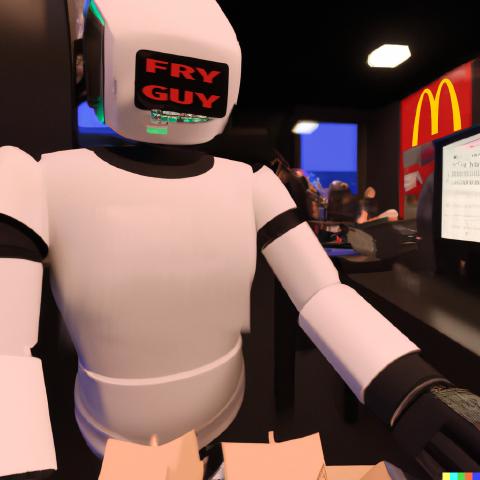
- DALL-E is the AI art engine that made our artwork this week.
- The cool thing you missed at the Tesla AI day (eevblog)
- Laura from Oxide Computer was on the show talking about servers
- The "Open Compute Project" is the FB project Chris was thinking of.
- Robotic Ice Cream Fail
- Fast food robots are being promoted in the press currently. But that's nothing new! NYtimes has a history of "robots doing jobs" at fast food places.
- Jack of All Trades
- Chris is working on what he calls a "Lego" prototype, basically PCBs to replace just point to point wiring between other breakout boards.
- He has been working on an IoT Trashcan Monitor Reference Design and also wrote about the process (and made a video about it)
- The NXP RT1062 is on the Teensy 4 and is a beast of a part...600 MHz microcontroller
- Chris is also looking at getting a milling machine again
- Past guest John Saunders got started with a milling machine in his NYC apartment (hence NYC CNC)
- Dave made a video about how to shop for enclosures...and forgot he made it because of Chris!
- Dave is looking for an enclosure with an angled screen.
- Shopping for boxes is the only activity we'd consider in the metaverse
- Chris has been working on remote hardware training, including build systems for firmware.
- Dave has been doing low power auditing in the home, looking for power leaks.
- X vs Y cap
- Romex is a commercial term for power cables in the wall in the US
- The Smart Grid episode with Paul Zawada is a good reference for people learning about power
- Dave made a recent video about the financial viability of battery backup in the home.
- Vampire power
- Federal Pacific Panels Blow up! Chris had one in the house he bought in 2009 (it was replaced)
- Video of the measurement
Transcript
Chris Gammell: This is The Amp Hour Podcast. Released October 9th, 2022. Episode 604. Robo Fry Guy.
Dave Jones: Welcome to the Amp Hour. I'm Dave Jones from the AEV blog. And I'm Chris Gammell of Contextual Electronics. Recording a day early. A day early, a dollar short. You put me on the spot here.
Chris Gammell: I know, well, you know.
Dave Jones: Usually I do extensive preparation work for the Amp Hour.
Chris Gammell: We're always ready to go. I've opened Reddit.
Dave Jones: Yes, I've opened Reddit. This is my entire preparation. And literally, I've just opened Reddit. I haven't even opened the links within Reddit. So, oh my goodness. This is going to be a dog's breakfast. This one. I mean, you know, if I had a minute's more preparation, I would have been fine. But no. No, you won't. That's what happens.
Chris Gammell: That's what happened last minute. Yep. Yep. Yep. Anyway. So much for that.
Dave Jones: Because we have a guest on next week who I was supposed to record with today. And then she didn't. Well, yeah. The times were goofed up. Time got goofed. Yep. But time got goofed. Did you guys.
Chris Gammell: I know you guys have Daylight Savings coming this weekend, right? No.
Dave Jones: It's already happened.
Chris Gammell: It's already happened. Oh, okay. Oh, yeah.
Dave Jones: It's 1040 AM here, dude.
Chris Gammell: Oh, late. Late in the day. Jeez.
Dave Jones: Yeah. Okay. Exactly.
Chris Gammell: All right. All right. I just thought of another link I should send you. I'm sending you a preview link as well. We could talk about this too. Me and Dave have a back channel we call Google Chat. Right.
Dave Jones: We keep the back channels open to stave off disaster. That's right.
Chris Gammell: Yeah. Well, you know, and now that one of our other channels is going to get all crazy, now that Papa Elon is going to be in charge of Twitter. Hey.
Dave Jones: Yay. That'll be fun.
Chris Gammell: It's going to be something. It's going to be something. Yeah, you're right. You know, Dave? I think if nothing else, it'll be different. It'll be different. Yeah. Yep.
Dave Jones: It'll be a different look and feel. Yep.
Chris Gammell: That's right. I was listening to the, you know, I think I mentioned on the show before, I listened to Pivot, the Kara Swisher, Scott Galloway podcast. I really like it. Highly recommend it. Both of those folks are really awesome. And they did an emergency podcast yesterday where they were talking about the deal. Because, yeah. Yeah. It's his own thing. We don't need to talk about it here. But yeah. Yeah. It'll be, Twitter might get interesting soon. Interesting-er. Right. Okay. Yeah.
Dave Jones: Have you seen the, what I just tweeted out just before this? We're going to have to link it in because it's excellent. I just sent you the link there.
Chris Gammell: Oh, sure.
Dave Jones: Yep. And it's, yes, it is. The, it's the Hyper Encabulator. I have no idea what SANS ICS is. SANS, maybe they make stuff. I don't know. Who is making this stuff? Yeah, they might make network here. I do. But anyway, the Hyper Encabulator, they've got the original Turbo Encabulator guy back.
Chris Gammell: Really?
Dave Jones: And he's looking pretty schmick.
Chris Gammell: Yeah.
Dave Jones: Yep. They've, they've, they've got him back. The guy who did the original Turbo Encabulator, he's back. And he's now telling us all about the Hyper Encabulator. And it's very good. So, yep.
Chris Gammell: I guess we should also link in the, the Turbo Encabulator video.
Dave Jones: Oh yeah. Well, everyone's seen the original Turbo Encabulator video from, when, when was that? When does that, that dates from the 70s sometime, right?
Chris Gammell: Yeah.
Dave Jones: It's like.
Chris Gammell: What a gag, you know? Like. Yeah.
Dave Jones: Terrific.
Chris Gammell: Long, long game kind of gag too, you know?
Dave Jones: Yeah. We, we could also link in my Keysight one as well. Oh yeah. That's right. You did one too. That's right. Yeah.
Chris Gammell: Retro Encabulator. Retro Encabulator.
Dave Jones: Yes. That's right. Yes. There is a mix. There is a mix on the Keysight site where they had myself. Oh, that's right.
Chris Gammell: Daniel put that together, right?
Dave Jones: Yeah. Yeah. Yep. And it was myself, Mehdi, Great Scott, I think, and a couple of other YouTubers. But if you want to see my extended version, the extended cut, it's on my EUVBlog2 channel. So we will link that in. We'll link that. Anyway, the Hyper Encabulator, it looks very good. It's to do with network security. All that sort of stuff. It's yep. Yeah. Absolutely. The production value on it. I want to know how they did it, quite frankly.
Chris Gammell: Well, I haven't watched it yet, so I don't really know what you're talking about. You might get a little weird picture here.
Dave Jones: Just flick through it and just have a look at the actual end and how they go from one angle to the next. And like, you know, it's just, oh, it's just beautifully produced. So I want to know how they, like, they spent some serious coin actually producing this. So yeah.
Chris Gammell: But there's a lot of green screen as well.
Dave Jones: Yeah. Yeah. Yeah. It's, you know, but still it's.
Chris Gammell: That doesn't make it cheap necessarily. No, no. Because it's hard to do that.
Dave Jones: Like, because you can like see the shadow behind him on the inch, like they've, right? Yeah. This is like, yeah, this is serious production coin. So yeah. Anyway, I'm very impressed.
Chris Gammell: I should probably warn people here too. I'm going to give everybody a heads up here in 604. That's the episode we're recording right now. So I am deep into using Dolly, the AI image generator. I don't know if you've seen that, that went open, that, uh, that's not open to the public.
Dave Jones: Right. No, I haven't seen it because it's not open to the public. Obviously I don't have a secret invite.
Speaker ?: Yeah.
Chris Gammell: Well, you don't need a secret invite. That's, that's the thing. You don't need one anymore. So we'd used, I'd used this, uh, I don't know when it was a couple of weeks ago, a couple months ago. Like it was like a photo of like nine people like screaming. It was like humans screaming in the microphone. It was like about eight. We were talking about AI in the show. And so I use this Dolly mini basically, which is like a, you give it a phrase. It's Dally. Dally. Dolly. Dolly.
Dave Jones: It's not an O. There's no O in there. It's not a Dolly. It's not like a camera Dolly.
Chris Gammell: It looks like WALL-E, like the Disney movie. So I think it's like Dolly, but yeah, you're right. It's Dally. Okay, whatever.
Dave Jones: It is D-A-L-L. So however you pronounce that, I'm sure it's not Dolly. D-A-L-L. That's right.
Chris Gammell: Well, uh, anyways, uh, it is so easy to generate images. So I've been doing that for like, for like work stuff and we're going to do it for the amp hour. So just, and I talked to Alicia about it, but at FM's using it too. It's just like, so, you know, like we always kind of struggle, like what the hell should we do with the show and like show notes. And it's usually nonsense anyways, if it's not a guest photo, just preparing people for that. It's going to get more ridiculous.
Dave Jones: Oh, I've got to sign up. Do I, I can't just.
Chris Gammell: Yeah. It's a sign up. Yeah. That's right. Yeah. But then you get like 50 free, basically it's like you get 50 free credits or 50 free like tries basically to put in this phrase and it'll generate images and then pass that. Then you have to pay. Right.
Dave Jones: I see. All right. I see an example here of an astronaut riding a horse in space. Right. So I'm sure if you type in, show me or give me a picture of an astronaut riding a horse in space, you could, that would, that's what it would.
Chris Gammell: Right. And it'll do variations on that too. It's basically grabbing, you know, it's like compounding images from all over the web.
Dave Jones: Yeah. Yeah. Right.
Chris Gammell: It's very impressive what it does, but some of it is just absolute nonsense. Right. So.
Dave Jones: Okay. I'll give it a try.
Chris Gammell: There's like a, there's a PDF on like how to actually like prompt it with stuff as well.
Dave Jones: Oh, okay. Right. Right. The art is in how to prompt it in the correct way.
Chris Gammell: Yeah. It's kind of like if you're doing, if you're doing a, what's it called? Auto routing. Yeah. Yeah. Yeah. You better put the parts in the right place.
Dave Jones: You've got to put them in the right place and set it up and set up the constraints and the rules. And then they can do a nice job. Exactly.
Chris Gammell: And then it can, it really can. So like, that's fine, but it's, it's all about, and like, that's, I think a good, both of those, I think both the art thing and the autorouter thing, I think are both good examples of like that hybrid AI plus human kind of thing. I think that's kind of the future of a lot of work. I'm not sure. We'll see where it plays in. Like, I don't, I don't expect it to do well with, I don't like expect any like AI sourcing engine. Like, I don't think.
Dave Jones: No, it's like.
Chris Gammell: DigiKey is going to be searched for me anytime soon. You know, I would just take a good search engine, but.
Dave Jones: Right.
Chris Gammell: Yeah.
Dave Jones: DigiKey, give me the best op amp.
Chris Gammell: Yeah. Right. Right. Right.
Dave Jones: You know, and like, oh, hello, what? I don't know. It's an LM324. This is the best op amp. Maybe. Exactly.
Chris Gammell: Yeah. Yeah. It's tough. I mean, that's the, that is the engineering piece these days.
Dave Jones: It's, but it's the same with everything. It's the same with full self-driving AI. It's the same with, you know, humanoid robots. Hey, there's a Segway. I've done a video on this. Really?
Chris Gammell: What did you do a video on? I didn't see it.
Dave Jones: Oh, the Tesla AI day.
Chris Gammell: Oh, you did. Oh yeah. No, I did. I saw that headline and then I. Right.
Dave Jones: Well, see, but it wasn't about that. It was about a really cool electronics thing, which I can tell you about if you're, if you would like.
Chris Gammell: Let's give a little sampler. So people go watch the video about that.
Dave Jones: Right. Okay. The sampler was like, don't care about the robot. Right. Like an hour into the presentation, they've developed Tesla, Tesla have developed their own, not mainframe, like, you know, a supercomputer hardware stuff. Right. These, these rack things. I don't, I can't remember the name of them. Anyway, the supercomputer racks, they've developed all these, they've developed their own processes. Of course. This is all to process their, the data that they get from the Teslas figuring out the AI, right? The AI is not just a magic algorithm. It just works. It needs to be trained on real world data. Right. So they've developed their own process to do all this training and then develop their own server racks. And in doing that, they have to actually design, you know, incredibly dense processor and power requirements. Apparently they've developed one of the most dense power supplies in the world in, in like in terms of watts per square centimeter. Right. Yeah. Yeah. And they've got all this technical information in the AI day. So, so forget about the stupid, you know, barely walking humanoid robot. Yeah. Right. No. All the cool stuff. Yeah. All the cool engineering is in there and it's amazing the amount of detail that they share and what they shared was one of their failures, right? How they were, you know, they developed this new supercomputer rack and they start using it and everything and they start getting these failures like, you know, little, little dropouts here because it's all multi process, you know, thousands of processes. Right. So one processor might just suddenly drop out for a bit. Ooh, what's, what's going on?
Chris Gammell: Like in a, like on a canvas or something like that? Or.
Dave Jones: No, it's not a canvas. It's like, you know, the supercomputer cluster array. Oh, sorry, sorry.
Chris Gammell: I was thinking inside the robot. Now you're, so you're saying like.
Dave Jones: No, no, no, no, no. This has nothing to do with the robot. This is, this is Tesla's supercomputer. Got it.
Chris Gammell: So we're talking about network hardware, basically.
Dave Jones: Network hardware. Think big supercomputer racks. Yeah. Right.
Chris Gammell: Got it. So network center, like.
Dave Jones: Network center. Racks. Yep.
Chris Gammell: Oh, Laura from. I forget the name of her company. She was giving a talk about server racks and stuff like that. She was from. Yeah. Anyways, I'll, I'll link that in as well. Yep.
Dave Jones: Cool. And yeah, so they've developed like some of the highest end supercomputer hardware in the world anyway. So they'll get in these dropouts on these racks as they were processing their or individual processes within the rack, you know, in their big supercomputer array. And they were trying to figure out why. And they've got all this information in the AI day about how they found this failure and, you know, figured out what it was and fixed it. It turns out that it was a failure in not, not the power, not the power supply itself. Cause the power supply is like this little thousand watt brick module. And that's one of the world's densest power supplies. You know, it's got, it's a 12 phase. So it's a 12 phase MOSFET. So there's 12 gigantic MOSFETs on there and everything. But because they had to keep this whole thing so dense, they put the main oscillator on there as well for the processor apparently or whatever. So they put it on the power supply board. And I've, I've, I've, I've got to spoil it. There's no way I can leave it hanging. Right. I've, I've, I've got to spoil it here.
Chris Gammell: We could, we could bleep it out. We could bleep it out.
Dave Jones: Oh, right. I can bleep it out. And so it's the bleep, bleep. So it wasn't the actual power supply that failed, but it was the MEMS. It was a MEMS oscillator, a micro-machined oscillator on there that failed. And well, I won't go into reasons why. So maybe put your thinking cap on and figure out how a MEMS oscillator can fail on a power, on a dense power supply board. The answer to our puzzler will be in the third half of the show.
Speaker ?: Right.
Dave Jones: Oh, yeah. Yeah. You have to run. And I'll, I'll give the answer right at the end just before we sign up. Right. Yep. Okay. All right. Anyway. Yeah. That was absolutely fascinating. So I did this video about how I, you know, I don't care about the humanoid robot. Right. So what, but here's this real fascinating thing that they share in the foyer of this thing. Whatever company does that actually, I've got to take my hat off to them. Right. Here they are giving a detailed presentation of how they epically failed. Right. And how they fixed it.
Chris Gammell: Some of them do. Some of them talk about it in like lessons learned. I think usually like open, it was an open source project or no.
Dave Jones: No, no. This is Tesla's own internal stuff. As far as I know, it's not open source.
Chris Gammell: So Facebook has a, Facebook started a network. I think, so Laura was from Oxide Computer. I think she might've mentioned it in the episode, but basically Facebook has a open source project. They started basically for like power supplies around server hardware. And I think there was some stuff like tied into Zephyr, I think, or maybe there's some stuff in there, but.
Dave Jones: Okay.
Chris Gammell: But basically there is this big open source project around that because it's like, they're all reinventing a lot of the same kind of things. Right. Right. So why not make it open source at that point?
Dave Jones: Yep. Fair enough. Yeah. I'm not sure if Tesla are open sourcing their supercomputer cluster and they're.
Chris Gammell: It's actually, it's just the logistical, like, it's just like power delivery systems and stuff like that.
Dave Jones: Oh, okay. Well, yeah. I greatly doubt you can download the Altium files for Tesla's, you know, board that we're talking about, you know? So yeah. Yeah. Anyway.
Chris Gammell: Yeah.
Dave Jones: Yeah. But, you know, but to share this, right. To share this on their huge once a year, you know, presentation day that everybody, you know, every human on the planet's watching. It's like, wow. You know, that's. So I was impressed by that. And of course I, so I upload a video, you know, 90% of us talking about that. And 10% is, Hey, here's the Tesla bot. And of course, in the comments, all anyone can talk about is the stupid humanoid Tesla bot. That's how it goes, man. And I, I made another prediction and I'll stand by it again, that you won't be buying a humanoid robot for use around your home this decade. I, it's just, it's just not going to happen.
Chris Gammell: I, there's all these things about robotics getting into like fast food now. And like, I could start, but like, even still you start seeing like, so there's always these articles that came out about it there. I was just saw there was a joke about it. Like how the robot has to be high to work at a, at a fast food store, a fast food place. And that was on Colbert. And like, there starts to be like, there starts to be like a price thing. Right. So I think the, the price that I saw was like $5,000 for install and then like $3,500 a month or something like that. No, sorry. Like three, $30,000 a month. Basically it started to approach the cost of an employee. That's really what it kind of, that's what they're playing towards. Yeah. And like, okay. Yeah. Like, I mean, if we're being honest, that, that starts to make sense, especially with like rising wages, that sort of thing. Like it just for like repetitive tasks, these things aren't cheap. Yeah. But the robots are, that's, that's right. And I think, I think a lot of these are like lost leaders too, where, yeah. I mean like the, the robot, they're definitely not paying for the development of the robot, but maybe it's like the long-term maintenance and they're looking to do that sort of thing. But like a robot that's controlling a fryer. Like, have you ever worked like a deep fat fryer before Dave?
Dave Jones: I, you, well, we had those in the eighties. Yeah. That was a thing. You probably don't remember this, but every house had a.
Chris Gammell: Oh, you had them in the house. Oh yeah.
Dave Jones: Every house had a deep fryer. Like I'm talking maybe late, late seventies, late seventies, corn baller.
Chris Gammell: What's that? The corn, that doesn't arrest the development joke. Sorry. All right. Okay. No. Corn baller. Yep. Anyways. Yeah. So really you had them in the house. Okay. Yeah. Yeah.
Dave Jones: This was all the thing. Dude, you're just way too young. Yeah. 1970s. Every house.
Chris Gammell: I worked in fast food. So I, I had, I worked fast food for like five years. So I was like the fry guy for a while. And like, it was just a nasty environment.
Dave Jones: Where at?
Chris Gammell: When I was growing up in Buffalo, New York, there's a, uh, a frozen custard and roast beef place called Anderson's.
Dave Jones: All right.
Chris Gammell: And, uh, yeah.
Dave Jones: Here we go, folks. We, we, we, we haven't heard this before. This is news to me.
Chris Gammell: I guess this is new. Yeah. 12 years in learning something new. Yeah. Yeah. Yeah. No, I worked there, uh, five years, like, uh, in summers and sometimes during the school year as well.
Dave Jones: Okay. So it was a summer job as you Yanks call it.
Chris Gammell: And you know what? The most valuable thing I learned in that job is I like getting paid more than the bare minimum. Uh, I wanted to do something interesting with my time. I think it's like really important to just be like, Oh, any old job isn't going to be good enough for me. I should do something I want to do and, you know, decided to go to school and, you know, like just all of it. I just think it's good to level set kind of thing there. But now future, you know, future little Chris's of the world, uh, you know, maybe the robots will be doing all the gross stuff.
Dave Jones: I, I, I just sent you a link. I just sent you a link. I've done a second channel video of a robotic ice cream bar.
Chris Gammell: Oh, that thing. Oh, I think so. I saw that.
Dave Jones: Yeah. Yeah. Yeah. We've probably talked about it before. It's just, it's just. And it's so slow and it's just, Oh my God. Like, no, there's no way I would go back to that. Like I, we walked up to it. We happened to be walking past it in Melbourne. I think it was. And we just saw, Oh, that's, that's like novel. So we went up to it and we went and we're just watching it do its robotic.
Chris Gammell: So, you know, this is the same kind of thing here. So like, so like just watching your video here, you're, it's like an articulating multi-axis arm. And it's like, you're putting this robot into a human context, right? So basically it's like scooping ice cream out of a freezer where you're scooping ice cream. It's like, that's, that's just bad machine design in the first place. Right.
Dave Jones: I know. It's just, yeah, no, they're trying to emulate. Yeah. They're trying to emulate a human behind the counter. Like the robot even looks like a human. It's got big humanoid eye things. And it's got a big screen for it on its chest and it's got these arms and things and it doesn't actually do anything. It's a bit, it slides back and forth on a dolly dolly. It's just, yeah. On a dolly that slides back and forth. Hey. And, and then, yeah, it's got this robotic scooper arm is actually a separate thing by the looks of it. And it's just, it's just, it's dumb and it's so slow.
Chris Gammell: And it's like, I think that's the thing, but a lot of these, I think a lot of these things are, you know, you start to see like alternative serving solutions and stuff like that. Just sticking the food, the food industry type of thing. Right. Like I was just in an airport and I saw like a, you know, there's like a little, like you order at a screen. That's not, that's everywhere now. Oh, that's common. Yeah. Your food comes out of locker. Right. And it's not, you're not as space constrained. Yes.
Dave Jones: I was going to mention those. Yeah. I've seen, I've never actually seen one in real life, but I've, I've heard about them.
Chris Gammell: Okay. Yeah. Well, the Raleigh Durham airport. Uh, and, uh, uh, but the big thing being just like the, you know, like if you're retrofitting into like a traditional, like McDonald's fast Maccas, sorry. Yeah. Yeah. If you're, uh, if you're retrofitting into there, then your, your robot basically has to have like a human form factor. Cause that's what it's all been built for. But if you're, if you're switching to a different context where you're like, okay, if it's robot first, then it starts to make sense, but then you're battling the other direction of like, nobody knows your brand. You're, you're still space constrained. Uh, there's other, it's just difficult to run robots as well. So you'd like, you have to like basically build enough of a brand that you could support the robots. And like, that just is a push pull. That's not, not really there.
Dave Jones: No, no.
Chris Gammell: I can imagine like, you know, a Maccas or a big, uh, Burger King or something like doing a concept store where they, they already have the brand and it's all robot. And like, that might work, but like all of the retrofit stuff is retrofit stuff. You know, it's just like, it's always off the shelf type of hardware. And I don't know.
Dave Jones: Yep. No, it's just, uh, so how do this, uh, these, you know, locker on the wall things work? Are there people like actually behind the wall and they just shove this stuff into the locker and you open it and get it? Yeah.
Chris Gammell: You just get a, you just get a number. Yeah. I mean, it's, it's literally just like a serving. It's just a kitchen.
Dave Jones: Why don't they just have a counter and they, and they serve it to you and smile instead of just shoving it in a locker, like a, you know, it's, it's, it's like.
Chris Gammell: I think it could keep stuff warm and you know, like all of that logistical stuff. And then it's also, you're sure it's your food. Cause your phone gets a thing that says, Hey, your food is at locker five. Oh, how big a problem is that?
Dave Jones: Really?
Chris Gammell: At airports. That's a big problem. Yeah. Instead of someone like coming out and be like, Dave, Dave, and five people say, I'm Dave. Yeah. Yeah. Yeah. Yeah. You know, like that. So I mean, there are, it's still kitschy, right? Don't get me wrong, but it's just, yeah, there are, that's, that's like a, that's like a wallpaper kind of problem rather than a, you know, the stuff behind the wallpaper. Yeah.
Dave Jones: Like I tweeted this yesterday and you mentioned it, you hinted at it before in that, you know, you have to be like a, maybe a huge corporation to invest in this. Yeah. Like a local cafe here in my business park, it's actually for sale. Well, the cafe is not for sale, but the, the company of that, but the actual property is right. You can physically buy the property. And then the company that runs the cafe cafe has a lease. Right. And they actually revealed the details of what the, what they're paying. It's like $170,000 a year for the lease. And it's like, that's a lot. That is a lot. Right. Oh, well, you know, it's a pretty big space. It's premium kind of thing, but still a lot of money. It's a lot of money. Right. A hundred and somebody on Twitter ran through the calculations of what that is per customer per minute or something, $3 per customer per minute or something nuts. Right. So they're already struggling to eke out a living, paying the rent on the place, let alone, you know, to buy fricking humanoid robots or whatever. Oh God. And it turns out I've done a lot of this recently. I did a video on a, I think it was my main channel on the robotic pizza delivery. Yep.
Chris Gammell: Yep.
Dave Jones: And I made the call that they will not be a thing. They, that robotic deliveries will not be a thing.
Chris Gammell: In the, our usual level of preparedness here, I was furiously searching for stuff. I went to New York times and I thought I had seen an article about this robotic food here. And so I searched robot fast food and wouldn't you know it?
Dave Jones: What turns up?
Chris Gammell: August 20, August 24th, 1988, an article, business technology, robots to make fast food chains, people still faster.
Speaker ?: Right.
Dave Jones: And it's still the same today.
Chris Gammell: It's the same. It's the exact same story. It's the same story. It's just like, oh my God, that's perfect. That is perfect.
Dave Jones: Everyone thought that they owned me, right? Cause they sent in, in Milton Keyes, I think it is, is a suburb in the UK. Right. Milton Keyes.
Chris Gammell: Milton Keyes. Like the, isn't that an economist? Like Keynesian?
Dave Jones: No, no, no. That's not Keyes. That's not Keynesian. Not Keynes? Milton Keyes. Like it's a hyphenated name suburb. No, Keyes. But not Keyes. Got it. No N in there. Okay. Not Keyes. Keys. Like jangling. Keys. Yeah. Yeah. Cool, cool. These things. Sound effects. Jangling. Keyes. Got it.
Chris Gammell: Ooh.
Dave Jones: Walking keys. ASMR. ASMR. ASMR. Yep. We're missing the whole market for electronics. I am now soldering. I am now soldering.
Chris Gammell: The sound of your board burning.
Dave Jones: Yeah. Oh God. Anyway. Yeah. Anyway. Yeah. We get onto that. Anyway. The fetish is real though.
Chris Gammell: I know. Yeah.
Dave Jones: Anyway. Yeah. So everyone thought, hey, and Dave, you're completely wrong. Ha. Milton Keyes in the UK has these Starship robots that's been hugely successful. They're running every Starship as a company that make these, you know, automated robots that actually deliver your groceries or your fish and chips from the local store to your house. Right. And they're going, but it works. And everyone loves it. Everyone uses it. And it's like, yeah, Milton Keyes. Okay. They happen to have like 50 kilometers of these, you know, premium maintained cycle ways and everything. Right. That, you know, and they happen to have a nice friendly British town where nobody's going to, you know, actually throw these in the, throw these in the river for fun, steal the food, stuff like that. Right. Yes. You can make these work in certain niche areas and circumstances, the under optimal conditions, but for a generic, you know, but the one I was talking about was trying to run pizza in New York or something. Right. It's like, come on, come on. These things aren't going to last, you know, and, and I went through five reasons why it's not viable. Right. And it's like any one of those is a showstopper. Right. It's like, you've got to solve all of these problems. And it's like, no, no, no, no, no, no.
Chris Gammell: I think that's always the thing. It's always like the, you know, the, the demo, the demo version, the proof of concept versus like the hardened real world version, you know, like the, you know, you know, you know, I'm more on the side of automated or like a self-driving cars and you are right. You're, you're very, uh, bearish. I'm very bullish.
Dave Jones: You still think it's a thing. No, no, no.
Chris Gammell: I know you're, you're like that, but I will say I wouldn't trust. I would never, ever trust a, I wouldn't think at night. I think at night that's, that's really tough. Right. I think it, which is, you know, a ton of driving. And then like, I just can't imagine a self-driving car in the snow. Like I barely, I barely trust myself driving in the snow and, you know, and like, just like just having that as a, as another constraint there. And I just think that's, that's a note for me.
Dave Jones: Here's where, here's where the supporters will come out and, you know, cause I've mentioned this many times over the last decade or so. Right. And, and they'll all come out and say, you know, oh, so I've made the argument for, have you tried driving in Sydney at night in rain on going down the wrong way street because it's, uh, because the roadworks are just, you know, everywhere and they change every single day. And it's like, oh God, driving in Sydney is awful at the best of times. Right. You know, I'm talking about like, you know, in the really congested, like, you know, city areas and stuff like that. And it's like, you know, but, but then all the supporters will come out and say, but Dave, that's the perfect time because these sensors can see things that your eyes can't. You've got the radar sensors that can, you know, see the, you know, they can see through the rain and they can do all this and that. And it's like, no, no, dude. Sorry.
Chris Gammell: No. Yeah. I think we're just going to be, I mean, like, I think, I think you're going to be a very trailing edge, uh, user of that technology. I will probably be a middle of the pack sort of thing. And I think, but I think what it really points to is in all these cases is like, if you, if you have the ability, I think the, the highest likelihood for success, like you said, with that delivery service, like with robots in the right, you know, side of size of a restaurant or whatever, like if you have control over the situation, then like, take it. Yeah. Yeah. Yeah. Of course. Of course. Like design, design your, your setup so that like you, you will be successful because you have really nice roadways or you have really open, you know, a very well formatted kitchen for the robots you're trying to do.
Dave Jones: And this is why, this is why completely robot automated warehouses and stuff work, right? You control the space, right?
Chris Gammell: Right. You can make it work. I think that's ultimately the, the, the fetishization with that's an overused word, but I think it's like the fetishization of, of humanoid robots, because it's like, well, they could do anything. It's like, yeah, but you have to design so many corner cases and then you, you know, that you have to make, make these super robots that are super, super expensive. I think about all the time, like the best robot that I have in my life is my washer and dryer. Like that is, that is a very optimized solution for what it is. Not saying it couldn't improve, but for like what it is and the size constraints, you know, you think about like loading into a house, how big they can be. Yeah. No, they're tiny.
Dave Jones: They're in a standard form factor, 600 mil by 600, you know, like, yeah.
Chris Gammell: And they are robots, right? I mean, they, they're very simple robots, but they are, and they, they allow an automation.
Dave Jones: Well, they've got rather complicated cycles and stuff, you know, that, that optimize the process and stuff. But yeah.
Chris Gammell: I just mean like, versus like, it's a single, it's a single, it's not a single like a algorithm, but it is a single use thing, right? I'm not going to use, I'm not going to use my washing machine to cook my breakfast. Whereas, you know, like a humanoid robot, you'd be like, Oh, fold my clothes and then cook my breakfast.
Dave Jones: Yeah.
Chris Gammell: You know? So it is single use in that way, but it is, you know, there's all of these pieces of automate. Maybe people say, Oh, it's not a robot, but it's at least a piece of automation in my life. That is very, very, very valuable thinking about the alternative. I'm not having it. So, you know, like I don't know where I was going with that, but I'm just trying to say, I love my washer and dryer.
Dave Jones: When, when you try and design a Jack of all trades, it's a master of none. That is the famous saying. And it comes up and it, and it, it is true time and time again, Jack of all trades, master of none. This is why, you know, everyone tries to piece of that.
Chris Gammell: Isn't there? What? No, but isn't there like, I thought that I thought there was like a little poem around that, but.
Dave Jones: Oh no, I, that's news to me. No, it's just Jack of all trades, masters of none. You know, it's like, yeah, like, you know, it's really good in say a Swiss army knife, for example. Right. Okay. You've got like several tools in one, a multimeter, right? Nobody has just a volt meter anymore. Right. Whereas that, that, that was a thing back in the day.
Chris Gammell: Right. Right.
Dave Jones: You would just have a volt meter. You'd just have an O meter. Right. You would just have an amp meter.
Chris Gammell: Isn't that a counter example though? Wouldn't that be a counter example? Cause it's saying, we're saying that like a single use is better in that case.
Dave Jones: Oh, no, no, it's not right. I can, what I'm saying is that you, you can make, you know, Jack of all trades tools work, but only in certain circumstances. More often than not though, you're going to come a gutzer. Right. When you're trying to develop a multipurpose tool, I'm saying that I multipurpose tools can work and you can develop useful ones. And I'm giving examples, but there's so many examples when you can just push it a little bit too far, you know, it's like, and yeah. And it just becomes, you know, if you're trying to solve too many problems at once with the one thing, then it's just, yeah. Yeah. Nah.
Chris Gammell: Yeah. Nah. Yep.
Dave Jones: Yep. Yep.
Chris Gammell: Well, I have been on a, a path towards a single use electronics as, as it were the, I sent you some, uh, some photos of the things that have been not disposable, uh, but basically very, very single use. So, so I, you know, I designed stuff in the, in, you know, for my current role, I've been designing kind of like this generic, monstrously large thing that I call the Aluedel. It's like this big industrial box. And it's like got a bunch of head plugin headers. There's nothing really special about it other than like, it's the form factor that I want.
Dave Jones: Right.
Chris Gammell: And, but it like kind of brings everything in and now it's like, oh, well I started thinking like, well, actually I want to build demos, uh, and like some examples for clients and potential clients, stuff like that. And, uh, and so I'm going the other direction now. So now I'm saying like, well, what if I had a very simple, very, very simple PCB where I'm, I'm not putting down sensors. I still want to like save time and, and complexity by not having to like source everything on a board and like sourcing individual sensors. So I'm still buying off the shelf sensor breakout boards, but now I'm just like making it simple to solder them together in what I call like Lego prototyping. So basically just taking sensor boards, they've got headers on, they've got pointed one inch headers on them and then soldering, you know, basically the point to point wiring I would be doing and have done in, in like some hot glue prototypes. Now I'm making it like a one and done kind of board. So basically the, the five JLC PCBs I buy, that is like the, that is the entirety of the run that I will do for all.
Speaker ?: Yep.
Chris Gammell: Yeah. Got it. You know, like, I don't know. I just, I think about like, like breadboarding stuff is great at first or breadboarding.
Dave Jones: It has its niche, but yeah.
Chris Gammell: Yeah. But then building a second one is, it's like, it's slightly annoying. Yes. I know.
Dave Jones: So you often go straight to the PCB, especially that they're so cheap and easy these days. Or, as you said, you can just cobble together various sensor and demo boards, you know, to actually do something. Yeah. Yeah.
Chris Gammell: Right. And so I'm still like, you know, I'm still in low volume prototype type of thing. I'm still buying relatively expensive. You know, you're still paying for a breakout board is basically like $5, maybe a $5 sensor and then like a tiny PCB and what I like a linear regulator. And then I pay 20 to 25 bucks for that. It's like, why, why would you do that? But you don't care. Exactly. Yeah.
Dave Jones: You don't care because you're making what, five of them?
Chris Gammell: The cost of my time. Right. It's the cost of the time of like thinking about soldering that down or sourcing a part, you know, that sort of thing. It's just like.
Dave Jones: Imagine if you're doing like a switch mode power supply. Why would you, you know, if, if you're only making a small run of, you know, 10 or something, you just buy a off the shelf power brick. You know, you buy one of those little TI power bricks that work, you know, you don't want to have to dick around with, you know, selecting the right MOSFET and inductor and going through all the calculations and then hoping it doesn't bloody oscillate on you or something, you know, and like, no, you just buy the pre-done module. It's easy.
Chris Gammell: Totally. Yeah.
Dave Jones: Yeah.
Chris Gammell: I've been doing that too for like wireless modules too, you know, so I can like, I know how to design antennas and I can, I can do controlled impedance stuff out of, out of chips now. Like I know how to do all that stuff now, but it's a dumb idea. It's a dumb idea for like the volume that I'm doing. It would be really a big waste of time. And so like buying a pre prefab module. Oh, awesome. You know, that's like even a level down from where I usually am these days.
Dave Jones: All right.
Chris Gammell: Yeah.
Dave Jones: Wow.
Chris Gammell: I'm doing this in order to measure garbage. You happen to see my, my garbage measurement?
Dave Jones: I have not seen your garbage measurement. Are you measuring the level of garbage?
Chris Gammell: I am. Yeah. So it's a number 10 on the list. That's what I've been posting about. So yeah. So I'm basically, I made a hot glue prototype to click on the reference design link. I made a hot glue prototype. It's pretty, pretty gnarly inside, a lot of hot glue. And it's got like a bunch of, it's basically these, the same boards that I'm talking about here. Like the breakout boards. It's got a time of flight sensor, gas sensor, temperature sensors, accelerometer. And then I'm piping all that stuff to the internet over, over. So yeah.
Dave Jones: A gas sensor.
Chris Gammell: Yep.
Dave Jones: So you're, so you care that you're, right. Yeah. So you care if your garbage is stinky or not.
Chris Gammell: It's, you know, it's basically opportunistic because it's like, it was free. It came with, it came with the other thing. Got it. Got it. But you know, you think about like a garbage can, if like, if someone was like illegally dumping paint or something in a trash can or exceedingly stinky, you could in theory do that. But really it's just, you know, Chris figuring out a way to say, Hey, we should put another sensor on here.
Speaker ?: Right.
Chris Gammell: It would probably get ripped off. It's not a cheap sensor. Yeah. That's good. Oh yeah.
Dave Jones: They're, they're pretty pricey. Yeah.
Chris Gammell: Yeah. The CCS 811. Right. But yeah, this is, this is, this is the output of me learning, learning more Zephyr stuff. So I've mentioned that on the, on the show before.
Dave Jones: Cool and groovy.
Chris Gammell: Yeah. I'm getting, I'm getting better at it, Dave. I wouldn't call myself a firmware person yet, but I am doing firmware things. Excellent. I am somewhat, somewhat capable now.
Dave Jones: Yeah. But you're doing higher level stuff. You're not doing like, you're not doing like a little pick, you know, you're not doing little 8-bit pick.
Chris Gammell: Like, right, right. Yeah. I don't think you'd use a real-time operating system for that sort of thing anyways. Yeah. It's definitely higher level, but like, you know, you still got to take readings from sensors and, you know, interface to stuff and yeah, you still have to turn stuff on and off and you have to send stuff to the internet. So some of that stuff's tougher. I think the little 8-bit pick is also good for setting timers and that sort of thing. Cool. It's actually interesting, like switching into the, in the real-time operating world. It's like, I actually, unless you need something like really tight timing.
Dave Jones: Yeah.
Chris Gammell: I like, maybe you're like doing like a motor, you know, you're doing like a beam interrupter for like tracking a motor or something like that, or like a rotary encoder. You really don't need hardware timers when you have a real-time operating system, which is kind of, kind of crazy.
Dave Jones: Yeah. I know, but I'm an old school guy. Give me the hardware timer. You know?
Chris Gammell: Yeah. I mean, you still, you still can. It's just like, it's really easy to do it. And so like once you get into a real-time operating system, it's real fast and easy. So that part's cool.
Dave Jones: Well, it depends on how fast you want it. You know, if you want, you know, if you want microseconds, can you do that in, it depends on the, how fast your OS can, you know, do that in real time. Right. It's like, it starts to get hard at microseconds, you know, if you're doing sort of like, you know, something in the early second region, you know, it's, you know, it's fine. But yeah.
Chris Gammell: Yeah. Yeah. I think that's, that's, that's, I agree with that assessment. Yeah.
Dave Jones: Cool bananas.
Chris Gammell: Speaking of how is your, how is your coding, coding and or logic world? Are you still chasing down the RP2040 or something else?
Dave Jones: I am trying to decide at the moment, cause I've got a new project, which I'm, I want to do and I'm deciding. And once again, this would potentially require hardware timers for this. So I'm trying to decide, whoa, how should I, how should I do this? Because I haven't decided the exact spec on how fast I want it to actually be able to time things. So that determines the, so the, so the product spec would determine how you would actually design it. How would you go about designing? You know, would you use, you know, would you use a CPLD or an FPGA with, you know, like really fast hardware counters in there? You know, if you need to time in the megs region. Right. If you want to, you know, then, you know, you can't really do that in a micro kind of, well, it depends some, some micros, you know, but if you want to go up to 300.
Chris Gammell: I use a 600 megahertz microcontroller these days, which is pretty insane.
Dave Jones: That's pretty insane. How, how fast can their internal hardware counters work though?
Chris Gammell: I have no idea. Yeah, exactly. I don't, I don't use them. Yeah, exactly. Or would I? It's actually, it's the same part that's on the, the teen C4. It's a beast. It's the RT 1062. Right. From NXP. Yeah. Beast. Yep.
Dave Jones: Some of them are specifically designed for this. Like, you know, they, they will specifically have extremely fast, hard and multi-channel hardware timers and stuff like that. You can buy specific micros targeted for those niche things. So.
Chris Gammell: Like they'll be above the system clock even? Like they multiply it up? Yes.
Dave Jones: Yes. They will be much faster. They're totally independent. They're like, you know, you, you externally clock them, you know, they've got their own dedicated hardware. Okay. For.
Chris Gammell: Is that for motor control or what's that for?
Dave Jones: Oh, I got motor controls. One of, you know, really high speed motor control and, you know, feedback and, you know, I don't know, stuff like that. Yeah. So. Yeah. Yeah. You can get specific chips.
Chris Gammell: Are you talking about what you're doing or no?
Dave Jones: Not yet. Not yet.
Chris Gammell: Okay.
Dave Jones: So. So anyway, it's a, it's a product for the lab that you probably haven't, probably didn't think you needed, but I'm hoping that there'll be a whole bunch of people that go, oh yeah, that could be handy. Okay. So, you know, yeah. Anyway. So.
Chris Gammell: This week I, uh, I, I got it back into my stupid head that I was like, you know what I need? Dave is a milling machine.
Dave Jones: Oh God. Not again.
Chris Gammell: Yeah, exactly. That's exactly. That is, that is the second thought I had, which was what, what the hell are you talking about? Chris, you've had a milling machine.
Dave Jones: And, but now you, but now you have your own house back then you had a milling machine in your apartment or something, didn't you, or something?
Chris Gammell: No, I had it in a house. I used to have a house as well. Uh, I, I was moving to an apartment and I said, I shouldn't have. That's right. You should have a milling machine.
Dave Jones: Yeah. Yeah. Yeah.
Chris Gammell: I do agree generally with that. Although John Saunders, the, uh, NYC CNC guy, that's how he started. He bought a, he bought a, a, a mill at CNC mill and put it in a New York city apartment. I think so. Right. Okay. Fair enough. But yeah, this is, but this, I think the big difference here is that I'm like, so again, because I'm doing like low quantity prototypes and buying boxes off the shelf, which is another thing we could talk about if you really want, boy, if you really want to get into some exciting stuff, let's talk about plastic boxes and shopping for them.
Dave Jones: Oh, I'm about to do that because the form factor of the product that I'm talking about has almost going to go live last weekend, actually shopping for a plastic, a suitable plastic enclosure for this thing.
Chris Gammell: It is. It is a mess. Yeah. I, all I want, I want someone to roll into my house with, uh, I want someone to like roll up like PT Barnum and Bailey and just like have like, come on up to all of the different boxes you can save. You know, like that's all I really want in life and it doesn't exist.
Dave Jones: I have a whole video. I've got a video for everything. Here's a video dedicated to how to search for electronic plastic enclosures. There you go.
Chris Gammell: I mean, no, I, I know, I know, I know this one, Dave, you know why I know this one?
Dave Jones: Why?
Chris Gammell: Because you made this in response to me.
Dave Jones: Oh, I made this video in response to you, did I?
Chris Gammell: That's right. Yeah. Really? We're talking about folding back on itself there. Yeah.
Dave Jones: I remember I was complaining about, yeah, this is five years ago.
Chris Gammell: I was complaining about not being able to find a box.
Dave Jones: Right.
Chris Gammell: And I said something about like having battery enclosures and you're like, well, I can make a video about that.
Dave Jones: Oh, really?
Chris Gammell: Because even at the beginning of the video, at the beginning of the video, you go, you go, a friend, a friend recently was complaining about not being able to find a box. Yeah. Yes. I just played it. A friend who shall remain nameless. Yeah. That's, that's, that's me folks. Yeah. Yeah. And I think, I think I called you out for that around the time, but anyways, yes, that was, that was a good video. It was, it's a good video. I have since learned how to do it. I think the, I don't remember the context of what it was. I think it was after the show. I was complaining to you about not being able to find a box. Right.
Dave Jones: Okay.
Chris Gammell: Yeah.
Dave Jones: Anyway, I, that was.
Chris Gammell: What are you looking for on, on this, this coming project? That's special.
Dave Jones: A sloped enclosure. So a, a, a desktop with a slopey screen thing. So like a sort of.
Chris Gammell: Oh, so it has the right angle. Yeah. Yeah.
Dave Jones: So like it's a, you know, the sloped enclosures I'm talking about, right? The, you know, you can get like a desktop and it's like, it's not flat. It's like, it's sloped. Right. So the, so if you have controls on there, they're more angled, but I want that sloped, but with an extra slope at the end at, at the top side for a screen. Right. So I want that for sort of.
Chris Gammell: Now I'm having trouble with that.
Dave Jones: Okay.
Chris Gammell: So it's like, if it's at 90 degrees. So like if you had a box sitting up on a shelf in front of you, like on a, like a, where you have your test equipment, you're saying if 90 degrees is straight up and down, it would be, the bottom would be tilted towards you. Is that right? So it would be kind of pointed towards the ceiling more.
Dave Jones: The bottom is pointed towards the ceiling more. The top is angled more to what, like if you're sitting at a desk, then the, then the screen is like, you can get like little desktop clocks with like an angled screen on them. Yeah. You know, it's kind of like that, but kind of like fixed though. So yeah. Okay.
Chris Gammell: And like, what would you estimate the angles like?
Dave Jones: Oh, 45, 60 degrees, maybe. Oh really? That much? Okay. You know, fairly steep. Right. So. Interesting. Okay. Yeah. Okay.
Chris Gammell: So what about like a, cause like I looked at a bunch of like the extrude, like the aluminum extruded extra exposure, uh, enclosures rather. And that wasn't right for what I wanted to do because most of the things I'm doing is like RF based now, but you could do, you could do most of it as extruded and then you can maybe even get a custom milled angled front plate or something like that. You know, you could design something that plugs into basically the extrusion, you know?
Dave Jones: Right. Got it. Yeah. Okay. I'm going to, or I can tell you were searching because you didn't really respond to what I said there. Yeah. Sorry.
Chris Gammell: You went like, no, no, no, that's a terrible idea, Chris. Usually that's what, that's what usually comes then. Right. That's why I can tell you were searching. Oh, well.
Dave Jones: No, no. Sorry. So I'll keep talking about my searches.
Chris Gammell: Anyway, slow. My stuff is like, uh, you know, I, so I definitely wanted ABS. I definitely wanted. Yeah. Small, you know, like there's like this weird middle ground where it's like, and I'm going to speak in inches here. So please, please excuse me for that. I'll try and convert. Yeah. Yeah. Like one and a half to like three inches. Roughly. You can kind of do rectangular up to square up to about three by three inches. And that's what I ended up choosing. But then they don't really go that deep anymore. They don't, they're only like an inch and a half tall. Yeah. Yeah.
Dave Jones: Right.
Chris Gammell: So like 45 millimeters tall by 90 to a hundred millimeters square inch, each X and Y. And like, it's just, you know, there's no middle ground then it's like, it hops from that up to like, like double in the Y direction. You know, it hops up to like, Oh yeah. Now you're basically a huge box.
Dave Jones: Yeah. Yep. Anyway, I, I, I found a photo. I sent you a photo of a, of a kind of a box.
Chris Gammell: Like I'm talking about. I see what you're talking about. Yeah. Yeah. Can I see what this looks like? Is that what, or do you want me to keep this quiet?
Dave Jones: Let this image is quiet.
Chris Gammell: Maybe I have a thing that it kind of looks like in my head. That's why.
Dave Jones: Yeah. Yeah. Like this.
Chris Gammell: Can I say that out loud?
Dave Jones: Okay. Yeah.
Chris Gammell: It kind of looks like a, like an old school calculator. That's like kind of what it looks like.
Dave Jones: Yeah. Yeah. It's, it's like an old school calculator with a tilty screen at the top.
Chris Gammell: At the top. Right. Exactly. So you still had. Yeah. Okay. Yeah. That makes a lot more sense then. Yeah. Yeah. Interesting. Yeah. I've never seen a box. I've never seen an enclosure like that. Okay. But I really wish. You can get them. If there's people listening. Oh, really? Okay. So if there's people listening, I would love to have other. So, you know, I was using DigiQ miles or whatever. I would love. I want like a good way to search from China because I know, you know, people. And I complained about this on Twitter and people were saying. I know.
Dave Jones: Yeah.
Chris Gammell: Mohit from Particle. He was sending me like this video when he got to go to Shenzhen. It was just like boxes and boxes. Yeah. Yeah. Yeah. Yeah. Yeah. Yeah. You get in one of those stands. I want to go to that.
Dave Jones: All they do is make boxes and you can just stand in front of that all day and go, Oh. Yeah. Trade shows have that too. Yeah. Yeah. Yeah.
Chris Gammell: It's just like, I don't, I don't have that now. I want some good way to like shop wherever the most are. Like I want to like have a, you know, if I have to do VR, that's the one thing I'll do VR for Dave. That's what I'll do. I swear. I'll go to the metaverse. I will go to the metaverse.
Dave Jones: You'll go to the metaverse if you can search inside a shop in Shenzhen. Right.
Chris Gammell: Yeah. That's right. Yeah. That's the only thing. And even that I'm still going to complain about it, but I will do it because. Yeah.
Dave Jones: Yeah. He's, he's threatening folks to join the metaverse.
Chris Gammell: That's right. I will.
Dave Jones: I did see about the news the other day that the metaverse is failing because everyone's not using it with the head goggles. They're just using it on the desktop browser in 2d or something. God. Yeah. It's like,
Chris Gammell: also, it's a terrible idea. Yeah.
Dave Jones: I was like, I wouldn't need the goggle things. I just, I just, I just, just go inside the browser and zoom around, you know? Yeah.
Chris Gammell: I, yeah, whatever. I, I just need some way. There's no way there's, there is nothing that they've tried this many, many times in specifically in like the trade show space, because there's like a ton of money in it. Right. If you actually could make a good trade show experience, which they can't, you know, they charge a ton of money. They just charged a ton of money for that sort of thing, both on the vendor side and then also on the attendee side. So if you could actually figure that out, you would make a ton of money, but it sucks. It sucks hard. It's hard to even get like, like a, you know, a 3d view of boxes in most places. So like, until, you know, and, and also like, I don't really blame the manufacturers in these cases because they're selling plastic boxes. It's not like they're like rolling it. It's not like they're selling $1,200 iPhones or something. They're selling literal plastic boxes. It's like, okay, well, yeah, they don't have any money. Okay. That makes sense.
Dave Jones: I love it. So yeah. Anyway. Yes. Boxes. Anyway, I am going to do another video on that.
Chris Gammell: Okay, great. I have a segue about virtual worlds. Oh, I, I also, I sent you another link earlier today about a thing that I'm posting about tomorrow. So it'll be out by the time this comes out. I did a completely remote hardware training. So I trained people how to use hardware without being in person.
Dave Jones: Yeah. You, uh, what's the, you got into their computer, right? You can control their computer.
Chris Gammell: Yeah. The magic is that they didn't have to install anything before they started. Right. So basically I sent people a link.
Dave Jones: Sounds like a security hole, but okay. Continue.
Chris Gammell: It does. It does sound like that. I sent them a link. They click on that link. Actually, I can send you a link of this.
Dave Jones: And you now have their credit card details in there. Yeah.
Chris Gammell: Yeah. Yeah. And now I'm rich and they go to a browser tab and inside the browser tab is a operating system. It's basically Ubuntu with all of the software pre-installed, everything ready to go. The first thing you do is you open a terminal, you put in a line to do compile and you're compiling software. I thought that was pretty cool.
Dave Jones: That is, that is pretty cool. I'll take my head off to that. Yep.
Chris Gammell: Yeah.
Dave Jones: Yep.
Chris Gammell: I learned how, I had to learn how to use Docker, which was difficult, but I had some help. So the only thing that doesn't work with it is that you have to download the binary at the end. So like you, you do whatever you want inside this container, right? You can compile whatever, you know, you write, write different code in there and you, you compile it, whatever. And then at the end, because it's inside a browser window, there's no connection to your computer. Like that's the benefit. The thing that I ran into is that I had done training in the past where it was like, we'd spend half an hour just trying to get everyone in the room to, to get all of the prerequisites installed and everything working. Right. Right. Because it's Zephyr and it's tough to do that sort of thing. So this is like, you just remove everything there. It's like, Oh, you got a Mac, you got a Linux, you got a windows. Who cares? It's a browser. It's a browser. You're inside someone else. You're in my computer. You're in a, you're in a virtual environment that has, everybody has the same, the same starting place from a container.
Dave Jones: Oh, okay. So they're coming into your, so all this is, all this processing has been done on your computer. Yeah.
Chris Gammell: It's done on AWS actually. So like basically they're, they're each getting their own tiny little computer on AWS. They're peeking into it through the browser, which is like super cool.
Dave Jones: Yeah.
Chris Gammell: And then, and then they're running the compiler in there. So then the compiler is pre-installed. There's VS code pre-installed. There's a, there's like a browser within the browser pre-installed. So we have, we can like link people to stuff. Yeah. It's, it's pretty trippy, but the downside is then it's in a browser, right? So then there's no way to get out to USB to actually talk to the device on your desk.
Dave Jones: Oh, okay. So, so you can compile, you can simulate, you can do all that, but you can't. That's right. Actually talk to real hardware. Okay.
Chris Gammell: You can't talk to real hardware yet. That's a, that's a, it's a maybe in the future. But if, but if that does work, I mean, I just think about all the trainings that I've gone to in the past where it's just like, everything's ready to go and you're just learning the thing that actually matters, which is like how to learn, how to use the code that this vendor is telling you about or whatever, just like all of the pain of setup is gone and then you're just ready to go. So we'll see if it works in the longterm, but I can send you, I'll send you a link afterwards. It's pretty cool.
Dave Jones: Well, I'm on the pay. Oh, and, and actual link to do it.
Chris Gammell: Yeah. Like to go into the browser. It's like, it's.
Dave Jones: Oh, right. Okay. Right. Right. Okay. Cool. Yeah. Yeah.
Chris Gammell: Please do. Inside the, inside the, the example program that is called chasm.
Dave Jones: Yeah.
Chris Gammell: There's a, they have a installer just to run doom in the browser, which of course everybody's done before, but you know, just like all the, the different applications you can run is, you know, you gotta have doom. You gotta have doom. Of course. Got it.
Dave Jones: Got it. Yep.
Chris Gammell: Yeah.
Dave Jones: So yeah. Boy, well, I can talk about low power hardware design because I just went around and audited my house. Oh, interesting. Oh, yes. I just ordered it because my house was drawing 120 Watts. Right. In like in phantom power, it's everything supposedly off writing quote marks. Right.
Chris Gammell: Yeah.
Dave Jones: So I went around.
Chris Gammell: So like, when I think about this, I think about like ordering a kilowatt and then like plugging into things, but that seems like a really terrible, boring way to do things is how, so how did you do it?
Dave Jones: There were two ways to do it. One was that incredibly boring and tedious way, which I went around with my power meter. Like it's a proper power meter that can actually measure like apparent power versus real power and you know, the power factor. Okay. Right. So yeah. So I plugged that into every appliance. I went around and systematically unplugged and plugged it in series and I was able to get the power draw from each one.
Chris Gammell: So like it plugs through the power, power meter, like, like a kilowatt or similar, right? Yes. Yeah.
Dave Jones: It's the same thing. Yeah. Except it's a gloss and meter that's specifically designed for this and, and it can do mean and average and data log and can do it. Cool. Right. But anyway.
Chris Gammell: Yeah. That's, that's better to have more data there anyway. Yeah. It's pretty, pretty blunt instrument. I feel like.
Dave Jones: Oh yeah. But it actually does the job. Right. But my one can go down to microwatts. Right. So it like, it can go down like, like I found that the lowest power appliance was my toaster. You would think a toaster should be off. Right. It should draw, you know, like it's, it's not a soft touch button toaster. It's a mechanical clunking toaster.
Chris Gammell: It's a physical, physical thing that's happening. Yeah.
Dave Jones: But, but it drew 0.3 milliwatts. Right. 300 microwatts. Right. Really? Of power. Yeah. Because it, it must, like I haven't opened it up to see, but.
Chris Gammell: Coupling?
Dave Jones: No. Leakage through either a mains filter cap or a transorb or something like that. You know, like. Oh, interesting. You know, a MOV or something like that. Right. It's leakage current. So obviously that protection or filter component is on the main side of the mechanical push down. Yeah.
Chris Gammell: I was thinking about the mechanical thing. Like, like if it was like a big capacitor or something, but it does make sense that if there's like a, like a Y cap across the.
Dave Jones: If that would be an X cap.
Chris Gammell: X cap. Thank you. I get this wrong.
Dave Jones: X cap goes across the mains. A Y cap goes to earth. Yep. Got it. Anyway. So yeah, it's obviously leakage through that. It was 0.3 milliwatts. I thought that was hilarious. And this thing was able to measure that. Yeah. Yeah. Yeah. Anyway. And, but the other method was when you can't, you know, things that are physically connected to the mains, then I had to use, like, I can't just, you know, physically pull the plug and plug in series. Right. And you can't just use a clamp meter either because I, I, I used a clamp meter. I opened my fuse box famously, my famous fuse box, which has is the Australian death trap, you know, that it is. Okay. And, and I got in there with a clamp meter. And of course you can measure the current through individual wires, like, like air cons.
Chris Gammell: And it can't be Romex. I know that one. You can't do, you can't do it when it's Romex and it's going both directions.
Dave Jones: Romex? What's, what's.
Chris Gammell: Romex is like the prefabricated, like, like neutral and hot. Yeah. Yeah. It's neutral. It's not neutral and hot. It's ground and hot. Right. Basically like a black wire, white wire with, with like a rubberized component over it. So that's usually what goes through the walls is like two or three wire Romex that goes to the walls instead of having individual stranded wire instead of not stranded wire, but individual wires going to a PowerPoint. Oh, okay. How do you guys, so what does it look like if you like took a hammer to your drywall in your house and you looked at a PowerPoint, what's going into the, into the actual back of the, of the, the plate?
Dave Jones: Is a three core, uh, white mains cable. It's a three core white flat, flat core, you know, regular PVC sheathed mains cable. Yeah.
Chris Gammell: PVC. Okay. Yeah. That's the same. That's, that's what Romex does.
Dave Jones: Oh, okay. Right. Right. That's like the brand name, I guess.
Chris Gammell: I don't know. Yeah. Yeah. I'm working it up now. Anyway.
Dave Jones: No, it's, it's, it's just a normal cable. It's just a normal mains cable. Oh yeah. Yeah.
Chris Gammell: It redirects to thermoplastic sheath cable. Right. North America. Oh, okay. There we go. Yeah. Yeah. So it's a brand name. Yeah.
Dave Jones: Anyway, so you can put a clamp meter on the individual wires coming out of the fuse box and stuff like that, but that doesn't tell you the power, right? That, that doesn't tell you the true power. It tells you the current, but of course the current can be out of phase with the voltage. And that's actually apparent power. That's not true power, right? You need a watt meter in there. You need to be able to measure the voltage and current at the same time to actually tell you your true power because in, because you're only charged for true power. You're not charged for apparent power, right? So you have to measure the true power.
Chris Gammell: Paul Zawada episode, right? And we have to refer back to Paul was on the show talking about real versus apparent power. The smart grid with Paul Zawada. 583. Yes, you do. Come on. He was, it was both of us on here. He was telling us about those huge ass power. Oh, right.
Dave Jones: Oh, yes. Yes. Of course. Yeah. The power transmission you're talking about. Yeah.
Chris Gammell: Yeah.
Dave Jones: Yeah. Yeah. Right. Yeah. Yeah.
Chris Gammell: It wasn't in the house, but it was still, that was like the most power kind of episode that we've done.
Dave Jones: That we had. Yeah. Yeah. Exactly. I remember.
Chris Gammell: It definitely showed how little we knew about power.
Dave Jones: Yes, exactly. Yeah. It was embarrassing, but I do know the difference between a parrot and real power. So, you know, anyway. So, yeah. So you can't just do it with the clamp meter, but luckily I have four monitoring systems. I have no less than four. Anyway, but I have one main one, which is the solar analytics monitoring system. Right. And it can measure the true power. So what I was able to do, I found that during the day I couldn't do this. Right. I was getting errors because it gets the differential power between the power being imported to my house and being exported from my house. Right. And at large powers and at large amounts of energy during the day, you know, my solar panels are actually producing energy. It's being exported. Right.
Chris Gammell: So it gives you. You did an episode about this too, right? You did, or you did a. I've done heaps of episodes. Analysis for like, I meant the battery thing you did recently. Oh, yeah. That was a good analysis. I like that. I like that video.
Dave Jones: Yeah. So I've done that. And the, yeah. So the differential was giving me a large error when I'm trying to measure small currents. Right. So it just didn't work. So I waited until night when my solar panels weren't producing anything. And then it gave me greater. In fact, it gave me an extra digital resolution at night, actually. So, yeah. So it can measure the differential more accurately. So then I was able to actually use that and go around and systematically turn. Oh, we go to my fuse box and systematically turn something like my aircon power switch off, for example, the fuse off. And then I was able to get the differential power.
Chris Gammell: How'd your family react to this? Were they out of town?
Dave Jones: They were sleeping. So, you know. That helps. Okay. Yeah, yeah, yeah, yeah. Yep, yep. So it didn't matter that I turned the lights off. It didn't matter that I turned the aircon off because the aircon's not being worked.
Chris Gammell: Hopefully you didn't have any alarm clocks set for the morning either.
Dave Jones: Ah, the alarm clocks went. Yep, yep. There was a bit of kerfuffle. You know, anyway, so I was switching stuff off at the middle of the night. And, yeah, I was able to get a differential power measurement, and then I could systematically measure each one.
Chris Gammell: So what was it? You said 130 watts extra? 120 watts?
Dave Jones: Well, it turns out it was about 109 watts, but I was only able to account for 90 watts. So it's an extra 19 watts unaccounted for.
Chris Gammell: Yeah. It's the bogeys and the wire. So what was the 90 watts?
Dave Jones: Oh, well, the 90 watts, well, you have to watch the video and see the spreadsheet. I've got a spreadsheet of all the, well, the highest power ones were the aircons, right? The aircons took like 35, 40 watts, right? Just in standby.
Chris Gammell: Just in standby. Yep. And that's not like, do you think that's on the coil or what is that? Where is that going?
Dave Jones: I have no idea. No idea. Time to rip across the aircon. No, I don't know. It's true. Well, I've got four of them. Summer's coming, but you've got a couple of days. It's four of them. Still, right? Yeah, just stay out of that room, family. Maybe 10 watts each. Yeah, I don't know. God. Anyway.
Chris Gammell: Torturing your family.
Dave Jones: Yeah, yeah. I don't know. It's for science. This is for science. Anyway, it's pretty awful, right? Anyway. So the next highest thing turned out to be my Wi-Fi and my modem were the next. They were like eight each or something. Eight watts each. So if you leave those running overnight, there's like 16 watts just there.
Chris Gammell: I just remember they used to talk about TVs and vampire power. Yes. Vampire power. Oh, oh, oh.
Dave Jones: Phantom power. And yeah. And it turns out, yeah. And I've got a spreadsheet of like 40 different items or something in my house that are physically connected. But I did forget. I think I know where the 19 watts is going from. I've also got three mains connected smoke alarms, which I completely forgot about.
Chris Gammell: Ah, yeah.
Dave Jones: Because they used to be battery powered and they still are actually. They have batteries in there as a backup. You know, and we have to change the batteries, you know, like just in case they leak or something. Yeah. But yeah. So I completely forgot that I had mains powered smoke alarms because we had to install those. It was compulsory when we added the extension on the house. It wouldn't pass compliance unless. That's right.
Chris Gammell: It's everything in the new.
Dave Jones: Yeah. Once you get the new standard. In fact, I'm going to be forced to upgrade my fuse box. If I add anything extra, I think it's compulsory that my fuse box, because my fuse box doesn't meet current standards. If you have a look at the video back, it's a rat's nest. It doesn't, it's not built to current standards at all. So yeah, I have been warned that.
Chris Gammell: When I bought my Cleveland house, they definitely, they're like, oh yeah, this is the, this is the type of fuse box that explodes in the US. There's some like specific fuse box. Yeah.
Dave Jones: What makes it explode?
Chris Gammell: What was, what was the, there was some like fatal flaw that they knew about, but it got grandfathered in a lot of places.
Dave Jones: But anytime you sell a house, let's see if I could find something about it.
Chris Gammell: One of my friends just bought a house and it was one of the federal Pacific electric panel. FPE was one of the most common ones and damage caused by federal Pacific panels. Yeah.
Dave Jones: I don't know.
Chris Gammell: Yeah. What's like, because they were built in the fifties.
Dave Jones: Right. I have a, I have a blog that says what to do if you own a federal Pacific electrical panel.
Chris Gammell: Yeah.
Dave Jones: Yeah. Damage caused. Oh yeah, here it is. Yeah. Right. Yeah.
Chris Gammell: All of these things are basically like, oh, call us. We're electricians. You know, let's let's let these, all of these things are, they're all like SEO type of articles. But, but yeah, you, you literally can't sell a house in the U S if you have one of those.
Dave Jones: Oh, right. Okay. Yeah. So mid really can't sell a house.
Chris Gammell: No, you won't pass inspection.
Dave Jones: So you, so you can't even be buyer beware. Like can't even be sold as is really.
Chris Gammell: Well, maybe I might spoke about that. I think every house and I guess you know you can. Cause nevermind. Cause I was going to say, yeah, I can't believe a house inspector will call that out every time. How about that?
Dave Jones: Oh yeah. You get a house inspector and you won't. Yes.
Chris Gammell: But some people do sight on sight unseen. So yeah, I guess you can, there's no regulations about that, but you should. It's a dumb idea.
Dave Jones: Okay. Here's, here's some of the reasons. So they were produced from the mid 1950s into well into the eighties. And some of the reasons are wires may be crowded inside the panel box box. Bus bars may be spring mounted.
Chris Gammell: Spring mounted. Surprise. Surprise.
Dave Jones: There goes your bus bar. I don't know. I'm sure it's physically not that. Yeah. That's funny. A breakers may be still active when in down position. Well, that's kind of a problem.
Chris Gammell: Yeah.
Dave Jones: Jesus.
Chris Gammell: And breakers work. Oh yeah. Good. Yeah.
Dave Jones: And, and the last one is a split bus breakers may let may no longer meet updated safety codes. So well, you know, that's just, and there's design flaws breakers. There's four design flaws. Breakers may unexpectedly trip when the dead front cover and where the dead front cover is removed. Breakers may lose connections to the bus bars. That's a problem.
Chris Gammell: Lose connections. Yeah.
Dave Jones: Yeah. Breakers are often jammed within their sockets, which can cause overcrowding and breakers can easily split when placed into sockets. Holy crap.
Chris Gammell: Yeah. No, that sounds good. Oh, that's bad. So wait, tell me, tell me what yours is. You actually, is it actually a fuse box or are you just saying fuse box?
Dave Jones: No, it's, it's actually a fuse box. It's a panel box, which you open on the side of the house and it's, it's, it's like a, a bakelite backing. I don't know what the material is, but you know, just, you know, is that a thing in the US?
Chris Gammell: Uh, not anymore, but yeah.
Dave Jones: I mean, it's like a, it's like a fiber board back in, right? So it's a big, it's a big back in that. And, and you just drill, oh yeah. If you want to install a new fuse for something like you get a new aircon installed. Oh, you find a spare physical space in there and you drill holes and then you insert wires through the holes and then you mount, then you screw the little enclosure on the front. So yeah, it's, uh, yeah, I can.
Chris Gammell: But are fuses common versus breakers there?
Dave Jones: Uh, well, no, they're all now, uh, breakers. They're all, you know, like, well, no, it's technically I still. I have a couple of old, my box still has a couple of old wired fuse, you know, actual fuses. So you pull the fuse out and there'd be fuse wire in there and you would have to physically, if the fuse blew, you would have to actually re get a screwdriver out and you'd have to re remove the old one. You'd have to install the new fuse wire, physical fuse wire. And then you plug it back in.
Chris Gammell: I'm just, you know, I'm surprised because you've had, you've had external, like you have your solar stuff and you have your car charger. So I would imagine at a certain point they'd be like, well, why don't you just switch this over to breaker? Isn't a breaker. Is a breaker safe? I guess that's the part I don't know. Oh no.
Dave Jones: All of my things are based on a breaker. They're all based on a breaker, but it's physically how the breaker is mounted inside the panel is the difference really. So yeah, I can, I can send you a, uh, here is the link and go to the 10. I can, I can, hang on. There you go. I will send you a photo. So I will snip it and I will send you a snapshot. So you know what I'm talking about. Oh, come on. And this will come on. This is good stuff. This is great radio. This is, yeah.
Chris Gammell: So I, I have, I've always had the perception that breakers are better than fuses unless they're FP&E or Pacific, whatever. Yeah. But maybe that's, maybe that's not correct. I don't know.
Dave Jones: Yeah. So, so as, as you can see, right, if you, if, if you have a look at my fuse box there, right, you can see that they're all physical breakers, that they're all breakers, right? They're all individual breakers, but normally in, in say in the U S in one of your new fuse boxes, all these little, you know, you can see that as a box with four, four of them there mounted in series, a, a fuse box in the U S would have 20 or 30 of those.
Chris Gammell: Right. That's right. Yeah. So you're saying, so I see what you're saying. So these are all individual breakers. Individually wide. So if you pull out that panel. So I was confused by the term fuse box, but you're just saying that there's not actual fuses. Are there physical fuses?
Dave Jones: No, I was actually mistaken. There are not any, well, there are some, you see the two in the center left that the next white ones, two small white ones is center left.
Chris Gammell: With the yellow dot. Yep.
Dave Jones: Yep. Yep. Yep. With the yellow handle on there. They actually, they're new breakers installed into old ceramic fuse holders.
Chris Gammell: Fuse holders. Yeah. Interesting.
Dave Jones: Right. So yeah, you can physically, like you can go to local hardware store and you can buy replacement breakers that instead of plugging into a din rail, they plug into an existing ceramic fuse holder. So yeah.
Chris Gammell: Right. And I think, so the breakers different, like the, the 220 breakers like you have, this is what I think about when I think about like European style, which I know obviously is Aussie style as well. Right. It's just like the same kind of manufacturer for the higher, higher voltage stuff. But in the U S it's, I think it's because of that split, like dual phase, like the either or stuff. That's, I think part of the reason why. Yeah.
Dave Jones: Your one's different. Yeah. You guys have the split phase thing here is whereas most houses here are single phase. So you've just got the two wires coming in. You'll have the neutral and the active voltage. Yep. Yeah.
Chris Gammell: So that makes more sense then. Yeah. Okay. All right. So I get what you're saying. Maybe I can post this. Can I post this? Is that okay? Yeah. Yeah.
Dave Jones: Yeah. Photo. Oh, it's a screenshot. Yeah. Yeah. That's just a screenshot from the video.
Chris Gammell: Got it. Okay. I'll just, I'll post the video. Yeah.
Dave Jones: And, and then, so, so if you physically swing that out, you can see on the left, there's like hinges there. Oh, sorry. On the right, there's hinges and you physically pull the panel out and it's just a rat's nest of wires !
Chris Gammell: It's usually wired. See, now that part makes me nervous, I think. Yeah. But I would never actually be, an electrician would be swinging that out, not a, not a Chris. Right.
Dave Jones: Yeah. Exactly. I get the heebie-jeebies every time I swing it out, but I'm getting less heebie-jeebie now. I'm getting more comfortable with it, but still.
Chris Gammell: So where do your, where do your mains come in? Like what, what is that the, the actual like power service? Is there like a main 100, 100 amp service?
Dave Jones: You can see on the, on the top, on the left-hand side of the import grid counter box there, there's a big black thing with two white wires coming out of it. That is the 60 amp input from the street. So that's the 60 amp input. That's it? Yep. Oh, wow. That's it. Oh yeah. We've got a single 60 amp. Can you turn that off or no? Yes. Can you turn that off? There's a switch next, next to those two ones we were talking about before with ceramic holder. There's a big black switch. Oh yeah. That is a 60 amp switch. So that, if I physically want to work.
Chris Gammell: It makes me nervous just like looking at this photo. I'm such a wimp. I am such a wimp. No, same here. Same here.
Dave Jones: Yeah. No. Yeah. So if I want to work on this panel, yes, I would switch. I would disconnect. I would switch that flip, flip that black switch and I'm disconnected.
Chris Gammell: But you'd still, you'd still have 60 amps coming to the box.
Dave Jones: Oh yeah. Yeah. There's still 60 amps, 240 amps coming to the box. It's just not going to the rest of the box. No, no. It's just hopefully not, you know, it's just, hopefully that switches.
Chris Gammell: It does make it interesting. Like, why don't they put the kill switch away from the main box? You know, like.
Dave Jones: Yeah.
Chris Gammell: I don't know.
Dave Jones: I know. Yeah. I don't know.
Chris Gammell: Put a nice big red light on it. You know, it's like, oh, this is definitely off. You know.
Dave Jones: This is definitely off. Yep. The entire box is disconnected. No, but yeah. So when you're working in that box, there is at least one live wire there coming from the street.
Chris Gammell: Yeah.
Dave Jones: There's no way to switch it off.
Chris Gammell: And that's the thing. I always used to feel better in my old Cleveland house. So like I, my current place, I have 200 amp service because it's 120 volts, 200 amp service. Yeah. You know, and for like, I got like electric water heater, stuff like that. And you know, it's coming from the street, but a single box from my old house, my old house in Cleveland, that stuff that they ripped out and replaced because it was knob and tube. I think I mentioned on the show before, but they actually put in a sub panel as well.
Dave Jones: Yeah.
Chris Gammell: And the thing I loved about that is that you could go and shut off the whole sub panel. Ah, yes. And that's what I want for the whole, that's what I want for the whole house. Yeah. And then I felt, even though, you know, then I definitely left it on that one time I was working on it by accident and I didn't feel myself, but like, but still I felt better.
Dave Jones: Right. Right.
Chris Gammell: And it was only 60 amps that would have gone through my body at that time.
Dave Jones: Yeah. I, I, I, I have totally not been in my roof one time and cut a mains cable, a live mains cable and had my pliers. There is a, there is not a chunk taken out of my good C and K pliers.
Chris Gammell: Yeah. Yeah.
Dave Jones: That I thought I'd switched it off and no, it never happened. Never happened.
Chris Gammell: Yeah.
Dave Jones: Oh boy. Anyway.
Chris Gammell: Yeah. There you go. Well, we didn't win the Darwin awards this time, but you know what, Dave, there's new, there's new awards every year. There is there every year.
Dave Jones: Every year. Yep. That's right. All you got to do is remove yourself from the gene pool. Yep.
Chris Gammell: Yep.
Dave Jones: Yep.
Chris Gammell: Just, we gotta, we gotta just avoid the award ceremony. That's all we got to do for a couple, a couple more decades and we'll be, we'll be good.
Dave Jones: Yeah. All right. Well, our, our amp hours up. We didn't even get through the list. We didn't get the Reddit list.
Chris Gammell: I was looking at other things that are on the list that are, uh, the top one. We haven't really talked in like a month.
Dave Jones: Yeah. I know.
Chris Gammell: Uh, YouTube made their own chip. There's a new Kai kit or key kit, a plugin. That's pretty cool. What else is on here?
Dave Jones: Someone says, I will like a camera that runs underwater without batteries. I don't know. Oh, it's a saltwater battery. Okay. I guess.
Chris Gammell: There's new chip companies. Start. Uh, what's it? Oh, no. Ultron. Micron is starting a new, they're, they, they're building a new thing in the U S. Probably not that interesting to most people. Uh, this one I do want to mention. This is a, this I found out about from the prepared, which is a newsletter by a former guest, uh, Spencer.
Dave Jones: Sounds like a bunch of, uh, preppers.
Chris Gammell: It does kind of sound, but I think it's actually, I think it's a play on like the, uh, have you subscribed to the, the, the fortune favors the prepared. I think it's like a play on that. But anyways, it's like a logistics and manufacturing and he talks about electronics and he has different editors and whatever. Someone, whoever the editor was last week linked one of the longest videos ever. It was like a 35 day video. Yeah. And this is the edited version down to 72 minutes. I see it.
Dave Jones: I'm watching it.
Chris Gammell: Yeah. And it's basically just following.
Dave Jones: It follows the logistic supply chain.
Chris Gammell: That's right. From a, it's actually, this is shown in reverse, but I think the original thing was in the other direction. It was like a 30 to five day video, but it was basically going from the factory in China onto a shipping container, filming the entire time in the shipping container. And then all the way to Sweden.
Dave Jones: So they slapped the camera on the side of the shipping container?
Chris Gammell: I mean, they must've set it up with the shipping company, however they did this. Oh yeah.
Dave Jones: I know because this is on the top of the, on the top. Yeah. It happens to be on the top of the ship.
Chris Gammell: Yeah. I think this must be in like the actual ship, like on, you know, a GoPro or whatever they did in 2012.
Dave Jones: But, and, and they've just added in like the, the parts where something's happening, you know, that there's a nice sunset or something and they haven't.
Chris Gammell: It's only the beginning and the end are interesting. Everything else is just shipping across the entire over. Right. I mean, it's literally going from like China to Sweden. Like that's incredibly boring. Oh, actually, no, I guess they do have, they have multiple ports they stop in as well, but still like just like really interesting, you know, really interesting kind of stuff. So.
Dave Jones: Wow. Yeah.
Chris Gammell: Something to do if you're like, you know, taking the day off, smoking some pot, just want to chill out and watch a shipping container.
Dave Jones: And it's your logistics. Here comes your funny novelty gadget from. There it is. That's right. Yeah. China to Sweden.
Chris Gammell: Not there yet.
Dave Jones: Not there yet. Great. Good stuff. Yep. Oh my God.
Chris Gammell: Yep.
Dave Jones: Yep. All right.
Chris Gammell: All right. Well. That's it. Good show. Oh. See you soon.
Dave Jones: Don't we have to spoil it? Don't we have to spoil it? Oh yeah. Now you can spoil it. Looking around to the end.
Chris Gammell: Yeah. What happened? What is the spoiler?
Dave Jones: What happened is the MEMS oscillator was on the power supply board and the MEMS oscillator cracked internally because MEMS, you know, it's one of those micro machine things. It's got physical little mechanical arms and stuff. It cracked because of the physical resonance caused by the vibration of the bypass capacitors on the power supply board. They just happened. That's awesome. The switching frequency of the power supply just happened to match. Well, it wasn't maybe some, you know, anyway, if it's switching at 15 kilohertz, it might have, you know, at 30 kilohertz or something might've been the mechanical resonance failure point. But yeah, some, some, some, some harmonic of that caused the physical destruction cracking internally of the MEMS oscillator.
Chris Gammell: Crazy.
Dave Jones: Brilliant.
Chris Gammell: Yeah. Fantastic. That's a good find. They must have fucked up and they found it, but that still sucks.
Dave Jones: Oh, it's great. And they shared it with everyone. And they shared photos and they shared 3D modeling of it and how they found it and everything with their accelerometers and whatnot. And yeah, it was great. Anyway, that, that's what my video is mostly about. So, you know, there you go. Spoiler. Catch you next time.
Speaker ?: Bye.
Archived Discussion (1)
Comments are closed. Archived from the original site.
Show archived discussion (1)Hide discussion
DALL-Eenclosurefast foodIOTMeasurementMillingMonitorPowerRobotserverShoppingTrainingTurbo Encabulator
Keep current
Every episode, plus the occasional job post, in your inbox.
If the functionality that comes with the Iotawatt isn't enough, it's all open hardware and software to boot, so if you want to add something, go right ahead. However, you don't have to build anything - if you prefer something ready-made, you can buy it all ready-to-go off the Iotawatt store, including a variety of CT sizes.
The *one* issue I have is that my unit has locked up after a power outage a couple of times... It took a bit of finagling to get it to boot again each time. I've been meaning to put in the latest firmware to see if the issue has been addressed, but the power outage issue hasn't been a big enough of an annoyance to push to me to do the upgrade. That and it cannot seem to measure the amount of sinusoidal repleneration reduced by the introduction of a drawn reciprocation dingle arm on my encabulator.
--zawada