
#562 – Electroboom!
Download episode · 97 MB
Also on Apple · Spotify · YouTube · RSS
Show Notes
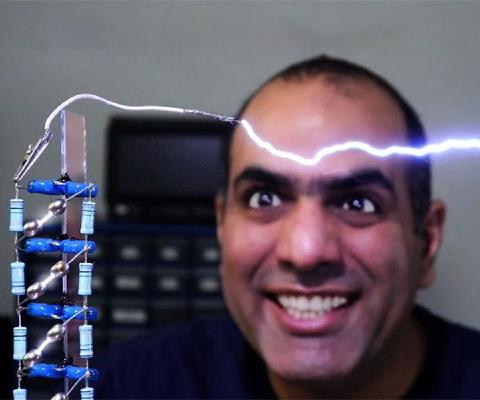
Mehdi Sadaghdar from the Electroboom Youtube channel joins Dave to talk about his hobby and professional background, and how he got started in Youtubing. Along with moving to Canada, the Iranian hobby movement, Maker spaces, commercial spaces, Linus Tech Tips and the infamous conflict between practical engineering and theoretical physics in electricity vs magnetism in his stoush with Professor Walter Lewin
Transcript
Dave Jones: This is the Amp Hour Podcast, released October 19th, 2021, episode 562, featuring Mehdi from the Electroboom YouTube channel. Welcome to the Amp Hour. I'm Dave Jones from the EEV blog.
Mehdi: And I'm Mehdi from Electroboom. Mehdi! The YouTube channel, yes.
Dave Jones: Hi, how are you? Good, thanks, mate. As if anybody doesn't know who you are. I mean, come on. How many subscribers you got nowadays? Four and a half million or something?
Mehdi: It's around 4.7 million now, yeah.
Dave Jones: 4.7? Wow. Is there like a... No, you don't get an award for 5 million, do you?
Mehdi: No, I have to wait until 10 million, yeah.
Dave Jones: Are the stats tracking up towards 10 million? Can you see yourself hitting the...
Mehdi: Well, I mean, over time, it seems like I hit another million every year, maybe? So maybe in five years? Five years, yeah. I have to make better content.
Dave Jones: Right. More broader appeal, content, maybe.
Mehdi: Yeah, I know. Like, my viewers are, according to my stats, 96% of them are male. So I'm pretty much missing half of the society.
Dave Jones: Society. Same here. Every engineering channel is the same. Every science channel is the same. So don't beat yourself up about it. Yep. It's just YouTube, unfortunately. Can we start? Like, what's your background? Because I don't actually know. I know you've got like a master's in EE and stuff, but I don't know. Do you want to share your background, how you got started in the industry?
Mehdi: I studied my bachelor degree in electronics telecommunications back in Iran, and then I moved to Canada and got my master's in microelectronics from SFU, my local university. Then I've been working in electronics ever since, so.
Dave Jones: Right. And just as a Joe Blow engineer at a big engineering company, or what have you been doing for?
Mehdi: Well, regular engineering, electronic engineering design. I was designing boards and PCBs and schematics and things of that sort. Right. I never really liked testing, but other than testing, I did everything else.
Dave Jones: We're opposite, because that's my background. I come from a test engineering background as well.
Mehdi: And that makes me happy that there are people, yeah? There are people out there that enjoy testing, right?
Dave Jones: Test engineering, yeah. There's a niche for everything, and I somehow got stuck in that. I don't know.
Mehdi: No, and that's good. I mean, I don't like testing. You like testing, so we complement each other, right?
Dave Jones: Excellent. Excellent. Once you get to a big enough company, otherwise, if you're at a small company or working for yourself, you have to do everything.
Mehdi: Yeah. You have to do everything yourself. Well, I mean, anything you do, you have to do testing to some extent anyway, right? I have to troubleshoot my own circuits, but...
Dave Jones: No, let's start out. How did the YouTube thing start? I think 2011? Am I right? 2012?
Mehdi: I think close to the end of 2012, I uploaded my first video, if I'm not wrong, and then from then, yeah, and the reason it started... Actually, before YouTube, I wanted to somehow share my electronic knowledge online, and mostly for, you know, I enjoyed communicating with people offline, keyword offline, because I'm an introvert, right? Forums and things, or...? Yeah, same as what you're doing, but yours is much larger. Back then, I made a website, and I put some articles around electronics trying to talk about voltage and current, but then I quickly realized there is a website called Wikipedia.
Dave Jones: Right. Yep. Which is vastly more detailed than you can ever do.
Mehdi: Yeah. And then, yeah, I just didn't continue on that one, and then at some point, I realized some of my friends were making some YouTube videos, sharing their interesting knowledge there. Yep. And I thought that was interesting, but I didn't know if I wanted to do it until
Dave Jones: I got my hands on an ESD gun. Oh, yes. Was that a Schaffner one? Was that a Schaffner?
Mehdi: Yeah, yeah, yeah, that's right. That's a Schaffner one, yeah.
Dave Jones: I've been trying to get one of those on eBay, but they go for like a couple of thousand dollars. Oh, yeah. They're really expensive.
Mehdi: Five, six thousand dollars here, yeah. Yeah, crazy. Not cheap at all, yeah.
Dave Jones: No. So, yes, that was your first video, because I can recall that was when I first, you know, everyone shared it around on the forum or Twitter or something. No, it was, I think Twitter was
Mehdi: a thing there. Yeah, people shared it around. I guess I was lucky that back then there was nobody else crazy enough to zap themselves.
Dave Jones: Zap themselves and do that. So, you did that as a deliberate, like, comedy thing? Yeah, yeah. You just thought that would be an angle?
Mehdi: Yeah, I thought that's what I thought. I thought it would be funny because, you know, everything I did in my video, I had experienced before in actual job. You know probably that how many bad things happened to us during just a regular day of work, right? Exactly. Exactly. And I remembered all those things happening to me and I had the gun. I thought, hey, let's reenact them on a video and just upload it. I didn't know, like, it would get so many views. I was just sharing with my friends and, you know.
Dave Jones: Right. And so, that first video went viral? Did it fast? Or how did that happen?
Mehdi: Not right away. After six months, maybe, somebody, like, after that video, I made four more videos, three or four more videos. And then, after six months, that first one, somebody shared it on Reddit.
Dave Jones: Oh, that was when Reddit was, yeah, exploding as well.
Mehdi: Yeah, and, like, I had 12 subscribers. I refreshed. It was 300. And I was like, what happened?
Dave Jones: Right. And then it got passed around, I guess, because it got passed around the forum and Twitter and that's how I first saw it. Yeah, yeah, yeah. Somebody sent it to me and, hey, check out this guy, you know. And, yeah. And I didn't know you'd made the other videos at the time. I thought, oh, he's just done a, you know, a one-off kind of thing and then you just kept on making them. So, that spurred you on.
Mehdi: I was making, yeah, some random kind of subject videos, really. And now that, after a while that my channel got bigger, I realized that those earlier videos, some of them were not relevant. So, I unlisted them and just kept on.
Dave Jones: Ah, right. Okay, got it. Yep. Because I got, yeah, your first one was ESD. Second one was how electricity can kill you and then don't take capacities for granted.
Mehdi: Capacity on it. Yeah, yeah. Yeah, like, I made another video about, you know, back then the Canadian government came up with these new dollar bills that you could, like, it was a hologram or something. And I made a video about that and I realized that it was irrelevant
Dave Jones: and unlisted that, yeah. Right. Okay. A bunch of them. So, at what point did you realize that, oh, I could do this for a full-time job? Oh, that took a long time, actually. I am presuming it's your full-time job now. Yeah, I am right now full-time YouTube, yeah.
Mehdi: The channel is big enough that I can sustain my family. But as an older guy getting into YouTube, I didn't want to risk, right? So, and it's... That's it. Yeah, yeah. And it took a long time, maybe, maybe four years until I realized. And after four or five years, Patreon actually was coming out and they reached out to me. And they, I signed up with them and people started supporting me. And I realized soon enough that, like, that can, like, that plus the income from the YouTube can cover half of my income. Oh, okay. Right. So, I thought to myself, okay, let's make myself part-time. I made myself part-time. Right. And then, I don't know, like, six months after, I realized that, hey, I can cover my entire salary.
Dave Jones: So, awesome. So, you focused on that? You focused on, like, you know, more views, more viral content?
Mehdi: Yeah, yeah. Well, I mean... Okay. Or tried to? At the beginning, I was trying to get more viral content. But, you know, I can only continue my shtick for so long before it gets boring, right? Right. Yeah, yeah. So, I focused, like, I started increasing the educational content of my videos more, although I try to still keep it funny somehow. And, yeah, it's not an easy thing to do.
Dave Jones: Right. Yeah, that was almost the same as me. I was doing it for two years. And then, I lost my job at Altium. They packed up and moved to China. And my wife was pregnant with our first nine months pregnant, like, weeks away from giving birth. And I just lost my job. And she went, go out and get a real job. But this YouTube thing's bringing in, like, half my income. And she said, I don't care. Go out, get a real job. Right, yeah. And then, yeah, six months later, it wasn't Patreon, but then an advertiser came, a forum advertiser came through. And then that made up the... And I didn't know how much to charge, but I thought, okay, I'm earning about half. Let me charge the other half of what, you know, a regular job would charge. And they accepted. And that, bingo. I was instantly full-time. So, that sounds like the same sort of thing once Patreon came along. And, yep. So, I was going to ask that. Once you... Because you built your channel on the comedic side of shocking yourself kind of thing. So, how have you found the reception to more serious content? I mean, I think... I don't see... I don't think I've seen one of your videos where you haven't added some sort of comedy to it. But how's the reception been to, like, you know, here's Ohm's Law kind
Mehdi: of thing. Right. Yeah. Well, I mean, I always try to put some funny angle to the video.
Dave Jones: Right.
Mehdi: So, although, like, probably you will quickly realize that I'm not funny live. I am funny offline.
Dave Jones: No. I've seen your Make Affair thing. I've seen your Make Affair live demo. And I thought that was really good.
Mehdi: Oh, thank you. Yeah. So, I try to put something funny in there anyway. Because when I... Or maybe that's my thinking. That if I make it too serious, it becomes boring to more people. Right. And so, I try to go with subjects that I personally can add some comedic angle to it.
Dave Jones: Got it. Okay.
Mehdi: So, like, things that are too complex for the audience, I try to avoid unless there is something good can come out of it. I try to keep to basic stuff mainly. My main goal is to encourage people to learn more, not to, you know, teach a PhD student. Because... Right. Well, I don't know really that much either. So, it's beneficial to me too.
Dave Jones: Got it. And so, how's the reception been? Are the views lower on those videos where you're not shocking yourself?
Mehdi: It's mixed. Because even after so many years doing this, I couldn't really figure out what people like. Like, I make something, I try to make it funny, and I think, wow, that's going to have a lot of views, and it bombs. And then, you know, like my 5G... Yes. I made a video about 5G. It's a long one, and it's very... Very, like, mostly explaining how things happen. More serious, less funny, and it has a ton of views. So, it's... I don't know. So, after a long time, after a while, I realized that I just do what I do.
Dave Jones: Right. And then, hope it works. We'll see.
Mehdi: Yeah, exactly.
Dave Jones: Don't try and chase the algorithm as one YouTube, you know, adage. So, you've done, like you said, the 5G thing, the debunking videos. There's not many people out there in our field, like, doing debunking videos. How did you get started? Why did you want to do the debunking videos? You just couldn't help yourself? There was just so much bullshit out there?
Mehdi: Well, yeah, I mean... Originally, I was trying to completely ignore them. I knew that they were false. But thereafter, I realized a lot of people, like, when I was getting bigger and I was getting a lot of messages, a lot of people were saying that, hey, check this. It's interesting. How does it work? Well, it doesn't work.
Speaker ?: Right.
Mehdi: And I realized that a lot of people are believing in it. So, I started making videos about them. But then, after doing so many around free energy, I got bored with free energy.
Dave Jones: Yeah, I know. There's only so many you can do. I actually haven't touched it. I don't think... No, I have done one free energy video, but that was more a response to a YouTube video someone sent me. It wasn't like, here's debunking free energy in general.
Mehdi: Yeah, like, if I... Nowadays, if I see something that is kind of new and people don't know how it works and someone fakes it, I try to cover it and spread knowledge. Other than that, the repetitive stuff, especially there are channels dedicated to making free energy crap. So, you guys... I can't debunk every single one of their videos.
Dave Jones: No, it's... No, it's totally impossible. Just do it a handful of times.
Mehdi: Just take a multimeter and glue it.
Dave Jones: It's... Electric tape to it.
Mehdi: It's annoying.
Dave Jones: Yeah, debunking is... It is... Have you copped a lot of criticism for it? Have your comments been flooded by the 5G, the anti-5G crowd?
Mehdi: Well, my comments in general are nice people. There are always these crazy people that don't believe it and say no. Refer to crap reports and stuff. But in general, people have been positive on my comments. Thank God.
Dave Jones: Nice. So, have you ever had to fake any of the shock stuff yourself? You go, oh, this is just not working. Like, it's... Like, if you ever had to... Yeah.
Mehdi: I mean, yeah. Sometimes... Well, a lot of times I have to fake it because I know if I do it, I have a chance of death. Right. And a lot of things, what happens on my videos are just basically I accidentally do something and the circuit blows up. Circuit blowing up is not really dangerous to me. It's just an explosion, right? Yeah, yeah. Exactly. Unless the shrapnel doesn't... Goes in my eye. It will be... Other than that, it's fine. But for the shocks, I... Well, actually, sometimes I actually make mistakes on the video
Dave Jones: and they shock me. That's different. So, do you keep that content in where you're like genuine,
Mehdi: oh, shit, that wasn't supposed to happen? Yeah, I mean, that's good content. Yeah, exactly. No, I try to keep that on video and whenever I shock myself and the camera is not rolling,
Dave Jones: I just kick myself for it. Yep. So, do you leave the camera just rolling all the time now just in
Mehdi: case something happens? No, that's too much memory. Too much footage. Yeah, I know. Yeah, I'm thinking I should install one of these security cameras on the corner of my room and just keep recording and, you know, as soon as something happens... Yeah, you've got the backup footage. Yeah, because I keep burning and shocking myself off camera and that's unfortunate.
Dave Jones: So, do you worry that people will try and recreate this sort of stuff or is that, you know, it's obviously like leave it... Because I don't think you have a warning in your videos or description,
Mehdi: do you? Like don't try this at home or...? If I... Sometimes when I... Well, in earlier videos, not really. Like, for example, ESD gun, when I shocked myself, I didn't really care because I shocked myself multiple times with that and nothing really bad happens to you, so I didn't care about warning. But the more powerful stuff like playing with a microwave transformer, for example, which almost killed me once, in fact... I was gonna ask about that video. That was your, what,
Dave Jones: 1,000th... No, what was it? No, 1 million subscriber video. And I saw you grab the... You know, it's one... You know, you were generating a Jacob's Ladder or something, weren't you? Yeah, yeah. And then it accidentally fell off the bench and you grabbed it like... Yeah, like an idiot. I grabbed it like an idiot. So you genuinely grabbed that and then what the hell happened in that instant? Did it... How did it drag off the bench or whatever? I can't remember the details. Well, what happened... Like, if you slow down
Mehdi: the video, like look at it frame by frame, when it fell over, I... Like, in my brain, I thought, hey, it's falling over. It shouldn't touch my body, so I better grab it with my hand. Oh, no! Oh! And if you see frame by frame, as soon as it touches my skin, the skin blows up. Like, the arcs you see... Oh, really? The arcs you see, it's the skin jumping, the skin burning, right? Oh, wow. And what happened is that, thank God for my flimsy setup, I connected them with loose wires. So, as soon as I contracted, I pulled the wires off the transformer. Wow! Oh, no! Did you ever think...
Dave Jones: Did you watch that footage back and go, there's no way I can actually release this video? That's just...
Mehdi: Yeah. So... I was debating with myself that should I... Like, I almost died there. Should I release it or not? Yeah, yeah. But then I thought to myself, uh... You know, maybe if people see these accidents and how bad it can be, maybe they try to avoid it. Because if you... Like, for example, if I made a Jacob's Ladder nice and clean and showed this is how it's done, it... I think it would be more likely for people to go try to make it on their own. Right, yes. But if they see that I almost died there, maybe they try to... Like, because I'm thinking just putting a message there that, hey, don't try this, it's dangerous, people will still go and do it, right? But if they actually see that you burned and you almost died... Yep. Wow. And if you want to know my feeling at that moment, like, what happened was... A ton of pain. I don't know how to describe the ton of electric... Like, probably people have touched 120, 240 volts once in a while. Yeah, yeah. 2,000 volts is much worse. Yes. And not only that, like, I was feeling this... cold feeling swooshing over my brain, so it's like... Oh, no. Oh, no. So after I let go of the wires, I just went out of the room and just fell on the ground and I was just breathing heavily and shaking. I can imagine. And I didn't continue filming. Like, the next scene you see that I'm shaking and angry, I actually did it next day.
Dave Jones: Next day and you faked the shaking and angry. Yeah, exactly. Right, okay, right. Because there was much discussion about this on the forum, on the EV blog forum, and everyone's going, oh, you know, like, oh, he's faked it, come on. And I was watching it and I'm going, you can't... That doesn't look fake to me. That looks like he legitimately did that by accident. That was one of the real ones, yeah. And I can't believe he actually released that. But now that you say... You explain the reasons why, I think, yeah, yeah, that's actually... Yeah, it's not bad. It shows the dangers of this sort of stuff.
Mehdi: Yeah, I think it's a good reason. That's why, at least I convinced myself that it's good to put all the mistakes in the video so people can see what can go wrong rather than just make this nice. Even like when you're cutting wood. Like, you don't know how many times I've cut my fingers just sawing something. Like, you watch YouTube videos, everything is done so nicely. It is encouraging. You think that you can do it, but if you don't know what can go wrong and how you can get hurt, it's... I don't know. So I try to put everything in.
Dave Jones: Right. So are you trying to get away? When was your last shock yourself video? I can't actually remember. Are you still trying to do that to keep pleasing at least part of your audience?
Mehdi: Not necessarily. Once in a while I put a jump scare in my videos so that people wake up, continue watching. But I don't really go after shocking myself. Like, my next video is about logic gates and you can't really blow anything up or get shocked with logic gates, right? But there are some videos that you get shocked anyways. Like, I was trying to levitate some metal off a plate using high voltage electricity. And you get shocked. And there is not so many of those contents out there. So, and again, I realize that it, that doesn't really matter as much anymore nowadays. Because like...
Dave Jones: Once you've got the established audience, it doesn't...
Mehdi: Yeah. Yeah. Yeah. And like, people watch my other content too and they still seem to like it at least.
Dave Jones: Got it. Yeah. Yeah. No. Even your tutorial videos still get like 800,000 or a million views or something like that. So that's still amazing.
Mehdi: It's probably... And yeah, I think it's thanks to my channel being big enough that I don't have to kill myself every time for views. Every video.
Dave Jones: Because yeah, as you said, that stick sort of gets old fairly quick, you know.
Mehdi: And also, like if you start making other type of videos, then you start gathering new audience. And maybe some of your old audience go away because you don't get shocked anymore. But I mean, you're switching audience for audience, I guess.
Dave Jones: That's kind of a natural thing though. I'd expect the audience who just came in for the comedy shocking thing, they've probably already left anyway, regardless if you keep doing it or not. Because the fun factor sort of wears off, I would think.
Mehdi: Yeah. So I try to like change my videos up a little bit too. So that it's... Yeah. Like you said, the stick gets old. So I have to keep my audience with different interesting stuff if I can come up with anything.
Dave Jones: Yeah. But so you're now the... You'd now realise that it's the you in... They're watching it for you. That's why it's called YouTube. So yeah. Yeah. They stick around. They come for the shocking viral content and they stick around because they like your content, your delivery and... Yeah, I hope so. And the odd comedy and stuff like that. So that's obviously how it works. And have you found that a lot of those old videos get views still?
Mehdi: Oh yeah. That was what I was going to say. Like, for example, after a while my channel growth becomes steady and not huge. But suddenly one of my old videos gets shared on somewhere.
Dave Jones: Shared around somewhere. Right. And you just see a spike up in there.
Mehdi: Another spike of subscribers and viewers. So yeah. Actually, I could say every month maybe around 15% of my views are from my new videos. Oh, okay.
Dave Jones: Oh, the... Wow. That's actually quite low. Mine's about 50-50. About 50% of my views come from old content. 50% comes from the latest videos. So I'm surprised.
Mehdi: You know, I don't know. Maybe it's... Well... Yeah, some of the videos. Like, you know, my electric guitar one. Oh yes. It just keeps going up. That is your highest video.
Dave Jones: I can't... I know I've watched it, but it was years ago. Yeah. And I can't remember... What is that one about and why is that your biggest?
Mehdi: It's one of those stupid videos that... You know, like... What I... I tried... Well, the first 40 seconds, I tried to make an electric guitar. But it's more like an electric chair.
Dave Jones: Oh, you hooked mains wire up to it. Oh, goodness.
Mehdi: Yes.
Dave Jones: Up to the metallic strings. Yeah.
Mehdi: And like people... Like, I think the main reason for the growth of that video was that at the time, people started copying the first 50 seconds of that video and shared it on their own channels. Oh, really? Even without giving credit, a lot of people... Oh, wow.
Dave Jones: Wow. Okay. And it's only 3 minutes and 14 seconds too. So that's... Yeah. You know, viral, share-worthy length kind of thing.
Mehdi: Yeah, yeah. So like the 50 seconds... The 50 seconds at the beginning of the video was the most viewed part of it. The rest of it, I get into how you can get shocked with electricity.
Dave Jones: Right. Oh, got it. The more educational part of it. Yeah, yeah. Right. So people tune out then. Okay.
Mehdi: Yeah, I try to hook people in with something and then feed them the information.
Dave Jones: Got it. So is that still your formula these days for new videos, even the educational ones? You kind of do something in the first minute or something?
Mehdi: Yeah, I think if I directly get into the serious stuff, people may click away quicker. But if they get stuck somehow...
Dave Jones: Don't stick around longer.
Mehdi: Yeah. Like I try to, like I said, a jump scare, something funny every, I don't know, three minutes or something. So they pop back in. So because people get bored quickly, especially nowadays, like you have TikTok, you just want
Dave Jones: to watch five second videos and move to the next one, right? So... Yeah. Well, you've done a couple of those shorts, haven't you? How have they gone? The vertical video, it's YouTube's equivalent of TikTok?
Mehdi: My first show... Does that work? Yeah. Yeah. It was... It's YouTube short, right? Yeah, shorts. Yeah. The first one was pretty popular, 4 million views. Oh, okay.
Dave Jones: Yeah.
Mehdi: It was like a one minute video about the, you know, how, you know, the stupid thing about this, when you get the vaccine, your body becomes magnetic. Oh, yes.
Dave Jones: The spoon thing. Yes. Yes. Yeah. The spoon one. That's right. Yeah.
Mehdi: Yeah. That was good. And that was funny. I'd like that video. I think 50% views or 25% views of that video come from India. So it suddenly became popular there. Okay. A lot of views from there. I think because most of these fake videos come from that area and people were sharing that maybe too.
Dave Jones: So do you make money on those shorts videos? Because usually you can't demonetize, you can't monetize short videos like that, can you? If they're too short.
Mehdi: I don't... Yeah, I do make money off of them. I don't know how though.
Dave Jones: How? Yeah, I know. Well, maybe it's the ads on the side, like the sidebar ads or something. Yeah. I don't know. I assume a lot of people...
Mehdi: Because there's no pop-up ads. It is the vertical format. So I assume a lot of people watch it on their phones. Phone.
Dave Jones: Oh, and the app might put a...
Mehdi: Yeah, it might put a...
Dave Jones: Thing at the bottom. I don't know. I don't use my phone much.
Mehdi: It's good that we still make money off of those. And I think there was some YouTube incentive for people to... I don't know if...
Dave Jones: They were actually promoting it at one point to us creators, I think. Yeah. For some reason.
Mehdi: I don't know if the income I make is a part of the promotion or actually the ad money that comes in. I don't know, really. But any... They actually don't do bad. Like my shorts get pretty good views compared to my regular videos too. So...
Dave Jones: So are you going to keep on doing those?
Mehdi: If I can come up with good ideas, sure. Why not? I mean, it's easy to make. It's just a one-minute video and it gets good views.
Dave Jones: Right. Okay. Content. Yep. Got to keep churning it out. Now, big thing I wanted to talk about because I love this. I think this is... I think one of the best video you've done really was the Walter Levin Kirchhoff's voltage law thing. And I thought, you know, and this blew up on the forum and everything. The EEV blog forum was, you know, like 50 pages of discussion and people covering it. For those who don't know, can you tell us how that video came about where you... Well, I'll say what it's about. It's where you took on Professor Walter Levin, isn't it? Yep. Lewin, right? Yeah. I'm butchering it. Anyway...
Mehdi: English is not my first language, so I...
Dave Jones: Yeah, so he did this YouTube video where... Well, a lecture in his class where, you know, Kirchhoff's voltage law does not hold in a magnetic field and you did a video basically explaining how you thought his experimental setup was wrong and he's maybe wrong. How did that come about?
Mehdi: Well, I mean, I watched his video before and I briefly... I wasn't looking at it very carefully, so I thought maybe I heard it wrong until some other people brought it to my attention and I watched it again and to my understanding, I thought it was wrong. And so I...
Dave Jones: You thought the video was wrong or you thought that he was right, that Kirchhoff's voltage law doesn't hold?
Mehdi: No, I think the Kirchhoff's law holds. See, that's the thing. Although, like, in my videos I try to seem confident about what I know. Yep. Confident. Confident. But, like, at the end of the day I'm always... Like, I know myself and how... Like, every time I've been too confident I was wrong. Right. Got it. So, I was worried to touch the subject, especially since he's a... Like, he's a very good professor, right?
Dave Jones: And he's... Yeah. And he's famous. Like, he's, you know...
Mehdi: Yeah. He has very good educational content and he is still making content in his channel and it's great. Like, he's very good. But this one didn't sit right with me. So, I made a video about it, talking about how, like... Because my understanding was a little bit different, which... Now that I think about it, maybe it's a difference between new understanding of electronics versus traditional old times electronics. Right. Because according to the old electronics, and frankly, I don't know if that is changed at all. The definitions have changed at all or the definitions... Like, the definitions students learn are still based on their old-time electronics. But in any case, the voltage, according to the old-time electronics, is only created from electric fields. Right. Okay. So, like, voltage is equal to the integral of EDL, for example. Yep. The electric field intensity. According... If you go with that definition, you can't have a voltage... You don't have a definition of voltage across a coil, for example. Got it.
Dave Jones: Right.
Mehdi: Because there is no electric field through the coil. It's just magnetic forces.
Speaker ?: Field.
Dave Jones: Yep. Right.
Mehdi: But according to my understanding, I was saying, hey, magnetic fields also provide energy to the circuit. And my definition was that voltage is available energy per charge, unit of charge. Right? And if you have energy, if you have magnetic energy, you can still have voltage. So, that's the point of debate. And I think that's where we were thinking different. According to his definition, he was right. Yes. According to my definition, I was right.
Dave Jones: I was going to say, this is my... This was my takeaway from the start. And after investigating and thinking about it a bit more, I'm still of this same opinion that it's fundamentally a difference in the approach between an engineer, a practical engineer like yourself, and a theoretical physicist. They just come at it from different points of views. And I think, yes, you're both right if you look at it from that particular perspective. And I actually think he's... I think you're probably right in that his setup is fundamentally flawed. I think he's... Is that still your opinion? That his setup doesn't really explain what he's trying to get across?
Mehdi: I can't say his setup is flawed because according to his definition, if there can't be any voltage across any loop of wire, then his setup is right. He's just showing that he reads different voltages when he moves wire.
Dave Jones: Got it. But then you know that in his setup, there's been magnetic fields induced in the wire, in the coils. That's what's been showed on the scope.
Mehdi: Yes. And that's what I call voltage as well. But he doesn't call those effects voltage, right? And that's the problem.
Dave Jones: Right. It's... Yeah. So it's one of those things where you're both right. And I think it's an absolute... I've repeated a couple of times on the Amp Hour, I think now, is that, yeah, it's a classic example of a fundamentally different approach between a practical design engineer and a theoretical physicist.
Mehdi: Yeah. But my thought is that, like, if in reality it makes more sense to have voltage across coils and define it the way I do, it helps better people understand it better, then why not change the traditional definition, right?
Dave Jones: I totally agree. If you're becoming a theoretical physicist, you learn the theoretical physicist side of things. If you're doing an engineering degree, I think you should learn the engineering, the practicalities of the engineering approach, I think.
Mehdi: I mean, it makes it more touchable, understandable, right?
Dave Jones: It's like conventional current, for example. We still do conventional current flow because it's easier, right? And I've done a video, does current flow through a capacitor? And whoa, that one. Once again, according to Maxwell's equations, you can actually derive Maxwell's equations when you, you know, it all comes out in the wash. Current does actually flow through a capacitor. But in practice, of course, it doesn't. It's just a charge build up on the plates and the electrons flow back this way. But in circuit theory, it's more, it's handier to think about, yeah, the current flows through a capacitor. It's got an impedance at frequency. It's got, you know, 100 ohms impedance at this frequency and current flows through it. Yeah, that's right. It's like, it's just easier to think about it.
Mehdi: But magnetic fields, especially the magnetic fields is the magic black art of electricity too. Like, yeah, exactly. I learned at some point that even magnetic fields are not real. They are just a shadow of electric fields, right?
Dave Jones: Oh, God, you can go into deep into the physics. Yeah.
Mehdi: And then, yeah, I realized that I'm just too dumb for it. Yes.
Dave Jones: Same here. Same here. I don't have a physics background. I got, you know, I barely got through, you know, first, first, second year physics, you know. Oh, I did.
Mehdi: I did try to talk to people, you know, I talked to, you know, Veritasium? Yes. Yeah. He made a video about it and how the, you know, the Einstein's theory of relativity affects the distance between electrons as perceived by a stationary. And he was in his video. He was explaining that's why, like, a charge repels from a wire, for example.
Dave Jones: Guy K. Interesting.
Mehdi: He did it in a very simple way. When I tried to implement it to my knowledge, that didn't make sense. So I tried to ask him for more information. And we got to a roadblock that he didn't know and I didn't know. And I tried to talk to, you know, in my, the debate I had with Professor Lewin. In my second video, I also had a communication with another professor of the same university. And I tried to ask him to explain these to me. And he's pretty good at these, but he presented me with a bunch of equations. And that's not what I want. When I want to learn something, I want to see it happen. I don't, it's not complex equations that makes me go and refresh all my math from high school.
Dave Jones: Got it. Yeah. I couldn't do it. If you asked me to solve, you know, a differential equation, integral or something, I just couldn't do it. It's gone completely out of my head.
Mehdi: You know, I have to go back and just Google.
Dave Jones: Yeah, Google it. Yeah, exactly. And then, and then it slowly comes back to you, but you've still got to make heads or tails of it. You know, you've still got to, yeah. Some things just don't immediately come back. Yeah.
Mehdi: Like I wish, you know, Dr. Feynman, I wish he was still here that could explain these things to us. Because I think he knew it in a way that could explain it without equation. Like, yes, just, you know, simple ways of explaining.
Dave Jones: Well, is it, I don't know who, was it he who said that if you can't explain it simply, you don't understand it?
Mehdi: Maybe. Was that his quote? I think.
Dave Jones: I think it might have been his quote. Yeah. Yeah, possibly.
Mehdi: It's a good quote, yeah. Yeah, you have to know it well.
Dave Jones: So what was the end result of that whole thing? Because you did a, you only did a second video, right? There was a follow-up video. And what was the conclusion that you came to? So the conclusion was. We agree to disagree or?
Mehdi: Oh, yeah. I did mention in that video that our definitions are different. That's why our understanding is different. But I also, like I said, I talked to, I forgot the professor's name. I, actually, he was recommended by Dr. Lewin. He told me. Oh, yes.
Dave Jones: I remember you mentioning him. Yeah.
Mehdi: He told me to go talk to, too bad I forgot his name.
Speaker ?: Yeah.
Dave Jones: No, it's all right.
Mehdi: We'll put it. So, with communicating with him, we ended up agreeing that my definition is correct or better, at least. Okay. Right.
Dave Jones: Okay. What, from an engineering point of view or from a physics point of view?
Mehdi: I think from both.
Dave Jones: Or just a general interest point?
Mehdi: Yeah. Yeah. He was asking me to do some tests for him so he could understand things better. And when we did all those and, like, compared it, you know, to Feynman's lectures.
Dave Jones: Yep.
Mehdi: From Dr. Feynman's definitions, it seemed like my definition fits his, at least Dr. Feynman's explanations or definitions better.
Dave Jones: Oh, okay. Right. I think I remember that now. Yeah. Okay. But still, I don't know. Yeah. I still think you're both right. I still think you're both right. Yeah.
Mehdi: I mean, it all depends on definition, right? So.
Dave Jones: Yep. And I still think that his demo is a poor example, a flawed example of what he's trying to explain. I probably don't even think, well, I'm not going to say you can't do a demo to show exactly what he's talking about, but him just using a single coil like that and a scope and stuff, I don't think that's showing what he thinks it's showing.
Mehdi: It's pretty confusing. Yeah. I mean, everyone understands it differently. Even according to him, all the books, all the physics books also go kind of with my side of definition. And he says all of them are garbage, basically.
Dave Jones: All the garbage, because only the physics matters. Only the pure physics matters. Didn't he title one of his videos, Only the Pure Physics Matters or something? Interesting. But I thought, yeah, that was one of the most fascinating exchanges I've ever seen. Yep. Yep. I loved it.
Mehdi: Yeah, I have to be careful. Like, it doesn't feel good to be wrong in front of a million of people.
Dave Jones: I was going to say, is there any time that you've done your video and you go and edit it and you just go, oh, geez, that's embarrassing. No, I got that wrong. I'm not going to release this video. Is there any, or you had to go back and reshoot it and change it?
Mehdi: Well, as long as I haven't released it, I can always go back and reshoot it. And I will go back and reshoot it if it's wrong or if it's totally wrong. I'll just scrap it completely. Scrap it completely. But typically, like for, I don't think I make major mistakes because they are very obvious. For the minor mistakes, I usually release my video one day earlier to my patrons in Patreon. So they get to watch it. And if there is a massive mistake that I missed, they can bring it up before I release it to public. So I can go back and reshoot or edit and make it correct because I don't want to be wrong in general.
Dave Jones: Got it. Yeah. So do you do scripts? Or do you just sort of do notes? Or how do you do your videos?
Mehdi: I do scripts most of the time because I realize that if I write scripts, especially with my English speaking, if I get my grammar right and my thoughts in order, it's easier to shoot and the video flows better.
Dave Jones: Okay.
Mehdi: Like if I want to explain something, I write it down and I realize that say if I say this paragraph before that paragraph, it sounds better and people understand it better. So I try to do a script for at least those type of videos. But for the ones that I build something, for example, then I just have to go with the build process.
Dave Jones: Yeah, exactly.
Mehdi: Sometimes afterwards, afterwards I build something, I realize that, hey, it's good to have to fit something in some sections to explain better or make it more interesting and things of that sort. But yeah, the problem with unscripted videos is that I end up with a ton of footage.
Dave Jones: Right.
Mehdi: Editing those and bringing them down to this consumable size is a tough job. Well, I do a lot of times do unscripted videos when I review people's submissions on my subreddit, for example. Okay. Yep. I basically sit down, record for three hours and then try to squeeze it in 12 minutes, for example.
Dave Jones: Oh, geez. Okay. So how long does an average video take you to come up with the concept and then script it and then maybe rehearse or shoot, do a couple of retakes and then edit and polish?
Mehdi: Coming up with an idea is the worst part.
Dave Jones: Right.
Mehdi: Because, you know, like we can make a lot of things and just film them, but I want to make it interesting and funny.
Dave Jones: Yeah, of course.
Mehdi: You know.
Dave Jones: Yeah, for your target audience.
Mehdi: Yeah. And that's my interest too, not just for audience. I want to.
Speaker ?: Right.
Mehdi: No, of course. Like, because if the video is not interesting, it will be super hard for me to edit it too.
Dave Jones: Exactly. Yes. I can't do a video that I'm not, that I have no interest in at all. It just isn't possible. I can't do it. Yeah.
Mehdi: Yeah. It's terrible. And like, because, you know, when I edit my videos, I may end up watching the video from beginning to the end, like 20 times until I make sure every single bit is done.
Dave Jones: Oh, no, that's painful.
Mehdi: Yeah. It's painful. Yeah. I think, I think that's my problem. I have some issues. Like, I say, well, the thing is that I see other, I watch a lot of other YouTubers videos too, and people, a lot of people are just good at it. They, things come naturally to them. They speak well. They are funny when they need to be, and they put things together nicely. And those people don't need to put so much work on their edit. Right. But for me, I have to write the script if I want to make it good so that I know it's a, like when I read the script, I like it. Then if it is scripted, like every paragraph takes me somewhere between five to 50 times to repeat until my language. I like, yeah, like my actions in the video, my interactions with the camera. I feel good about it. And then I go edit it and keep watching it to make sure I didn't lose anything in my edit. And it's hard work.
Dave Jones: Right. You've, you've mentioned this a couple of times in that, um, your language thing. I mean, you seem to speak English. So like, as if you were almost, almost born there, you know, I mean, born into an English speaking thing. It's like, so do you have to trans, do you have to think and translate or what, how do you, how does that work? When did you start learning English?
Mehdi: We, we start, we learn English in school. Like in high school, we start learning English. And then in university, we learn English too. It's like one of the choice. You can learn any language, but English is the most popular one. So you learn that. You don't get super good at it. But then when I came to Canada, I started learning more as I talked to people.
Dave Jones: Got it. So when you're studying, um, engineering, is that mostly in English or is that in Iranian? Do you have Iranian textbooks? Do you have, what do you, are they translated textbooks?
Mehdi: There are, a lot of them are translated, but a lot of them are English too. So, and a lot of words and terms are in English anyway, right?
Dave Jones: Yep. Right.
Mehdi: Well, nowadays they try to translate everything, like make a new word for it in Farsi.
Dave Jones: But really, okay.
Mehdi: Which doesn't make sense. Like right now, if I go back to Iran and try to talk to people, a lot of things don't make sense to me anymore because they started translating a lot of foreign words. Interesting. Especially for example, French used to be like before English, French used to be a scientific language in Iran and we had a lot of French words.
Dave Jones: Wow. Okay.
Mehdi: Like the elevator, we called it ascensor, which is a French word, right?
Dave Jones: Wow. Okay. Interesting.
Mehdi: Now all those are translated into like helicopter. We called it helicopter, right? Right. But now they call it like turning wheel or something. Right.
Dave Jones: Okay.
Mehdi: In Farsi. In Farsi. Yeah.
Dave Jones: In Farsi. Yeah. Yeah.
Mehdi: So yeah, they start talking and I wouldn't understand what they're saying and I have to get a new dictionary. Yeah.
Dave Jones: So when did that start? Is that a political movement, like change that started?
Mehdi: I don't think it was political or everything is kind of political. Everything is. Yeah.
Speaker ?: Exactly.
Mehdi: But I don't know. Someone thought that we have to revive our language or something of that sort. Right. That's what happened. Got it. Which might be good or might not be good. I don't know. I don't have really a strong opinion either way. I know a lot of European countries have their own words for everything. Right. Got it. Yep. So Iran can be one of them, I guess.
Dave Jones: Okay. But even then you had to learn English just to do engineering because there were a lot of terms that just weren't available in Farsi. Okay.
Mehdi: And it's good too because like if you don't always work in your own country, you want to communicate with people around the world or learn from people around the world. So it's good to know terms that connect you to everything.
Dave Jones: So have you always lived in Canada? You're in Vancouver, are you? Yeah.
Mehdi: I'm in Vancouver. I came here in 2001. Yes.
Dave Jones: Why Vancouver? Was that a choice or was that a just a random choice or was it a... Well... How did that come about?
Mehdi: Well, my personality is such that when I get stuck in something, I don't really want to change my position. So after university, I started working in Iran and my thought was that, okay, I'm going to make the country a much better place. I'm going to help everyone. And I didn't want to really leave the country. But after two years, like in my university, there were like 100 students in one class. Maybe 95% of them have left the country.
Dave Jones: Oh, really? Wow. Okay. Is that because there's no jobs there or is that... Why did they leave?
Mehdi: Well, after opportunity, right? They want to have better lives, I guess.
Speaker ?: Okay. Right.
Mehdi: And better opportunities, more income, safer environment and things of that sort. So a lot of people leave if they can. A lot of people don't want to leave even if they can. Like, for example, my sister-in-law, she wants to stay there and she likes... Like, there's a lot of good things about Iran. But if you forget, if you ignore the political aspects of the country, like, people are nice. The culture is good. And, like, there is a ton of history there. And people are connected together in good ways. And, like, a lot of people connect to that kind of mindset better than just leaving the country and, you know, having a different type of opportunity. Right? Like, sometimes I feel bad, too. Like, I left the country for a better position for myself instead of staying there and trying to help... Trying to make it better. Make it better.
Dave Jones: Right? Yep. Got it.
Mehdi: Yeah.
Dave Jones: Yeah, I can understand. Yeah, it's tough.
Mehdi: But, yeah, like, so after two years working there, the environment didn't really match my personality. Right. Got it. And then... Join the club. One of my friends... And I... Still, I didn't want to leave. I thought, that's life. See, when you live in an environment and you don't travel because, like, for example... In Iran, barely anyone leaves the country. Like, nowadays, much more. But back then, traveling wasn't norm outside Iran. Okay.
Dave Jones: Wow.
Mehdi: So, I was maybe, what, 24 years old when I first left Iran and went to Dubai, the neighboring country.
Dave Jones: Oh, okay. So, you went there first?
Mehdi: Yeah. Because I had to take, like, English exam for my university admission, right? Oh, right. Okay. Yep. So, like, my friends, some of them were in Vancouver. One of them came to visit Iran and we were talking and he said, like, he mentioned how normal living is in Vancouver. And it was so different for me that I was like, damn, I have to go now. Yeah.
Speaker ?: Right.
Mehdi: So, yeah, right away I told my wife, okay, we are leaving. Eight months. I'm going to apply to a university and I'm going to study there for my master's. And I applied, like, eight months later. I got the admission and started studying in Canada. And then I stayed. Got it. Is your wife... Legally. I stayed legally. Legally. Okay.
Dave Jones: So, is your wife into the sciences as well or...
Mehdi: Not as much. She was my classmate, actually.
Dave Jones: Oh, okay. Right.
Mehdi: She was studying electronic control systems. Yep. It was fun for... And she enjoyed getting the degree because, like, she learned things that she says that it would be good for her in long term anyways.
Dave Jones: Right.
Mehdi: But she... It wasn't the field that she wanted to work in, so she switched to her interest.
Dave Jones: How many females were in your studying there, like engineering or sciences? Was it a big percentage?
Mehdi: I think it was, like, 30 to 50% female, I think. Wow, that's huge. Like, especially in Iran. That's the thing about Iran, too. Like, parents say, if you don't go to university, you're a loser. You have to...
Dave Jones: Right. So, you've got to pick something. Yeah. Yeah, yeah. Yeah, yeah.
Mehdi: And my wife was pretty good. Like, my wife was very good in math. And she wanted to go study math, but her parents told her that, you know, math... There's no jobs in math. There's no future. Go find something else.
Dave Jones: Engineering, engineering. Yeah, yeah.
Mehdi: And good for me, she went to engineering.
Dave Jones: Yes, exactly.
Mehdi: Yeah, electronics.
Dave Jones: Yeah. Yeah, when I went to university, I found so many of them just weren't there. Like, they were there because they just needed to do something. They didn't really care about it, you know? Yeah. They didn't really want to be engineers, but, I don't know, their parents told them, or they got their marks to get in, or they were all good at math, so, I don't know, engineering. Yeah, yeah. You know, it's like, yeah, yeah. Sad to see. Yeah.
Mehdi: As long as they like to do what they do, it's good.
Dave Jones: Yep. So, do you come from a hobby, interest background, or was university your first?
Mehdi: No, actually, the reason I got into electronics was because of my hobby. Like, I was much younger. I don't know how young. Was I 12, 13, 14, or something? Right. And one of my relatives bought me one of these electronic kits that you put together.
Dave Jones: Just the spring terminal ones? Or the, was it the spring terminals? Or was it the, or some other method?
Mehdi: Oh, no, no, no. It was just, it was a PCB with some components that you had to solder yourself.
Dave Jones: Oh, okay. Right. Yeah. Kit. Yep.
Mehdi: Yeah. And it was just a basic, what do you call it, bi-stable blinking LED lights. Right, yeah.
Dave Jones: Right.
Mehdi: Nice. And I put that together, and it was so enjoyable for some reason. Yep. I had no idea how it worked, but it was so enjoyable that I kept dragging my mom to the kit store to buy me new ones. I put, like, a transistor radio together. Nice. No idea how it worked, but I just enjoyed putting it together.
Dave Jones: You just enjoyed building and making something. Yeah.
Mehdi: Other stuff, too. Like, I used to, like, tear things apart at home, like our vacuum cleaners and stuff, and try to clean them and fix them and put them back together. So, yeah, in general, I enjoyed it.
Dave Jones: Standard hobby background. Yep.
Speaker ?: Yes.
Dave Jones: How is the hobby scene over there? Like, you said stores. What kind of stores? Were there, like, just hobby stores like this?
Mehdi: Like, there are stores there that, actually, I wish those kind of stores were here, too. Right. There are much fewer, like the local electronic shops that sell resistors and capacitors and transistors and things of that sort. There is only one that I know in Vancouver. But in Iran, there was a whole, like, a shopping street filled with all sorts of kits and electronics. Really? Wow.
Dave Jones: Has that changed now, do you know? When was the last time you went back there?
Mehdi: I haven't gone to that street for a long time, no reason.
Speaker ?: Right now.
Mehdi: But I think it is still there. It was used to be, like, a very famous street. And, like, everyone, all the students and all the technical people would go there. Like, if you designed a PCB, you would go and give it to a store to make it for you and would get it back. And everything was so cheap. Wow.
Dave Jones: Really?
Mehdi: Yeah. That's fantastic.
Dave Jones: Yeah. So that was around the late 90s, was it? Something like that?
Mehdi: What? Late 90s. It was, yeah. Yeah. That's right.
Dave Jones: Mid, late 90s. Okay. Yeah. You'll probably find that there's probably much fewer of them there now if you do go back. It's just like, it's the same here. It's the same in the US. It's the same in the UK. It's the same in Germany. It's the same everywhere.
Mehdi: Yeah. I don't know. Like, it depends. Like, I don't think online shopping is a huge thing in Iran.
Dave Jones: Okay. So it is possible that the stores are...
Speaker ?: Oh, okay.
Dave Jones: So they might have survived.
Mehdi: Yeah. I think they might still be there. Like, for example, here, if you need anything, we just order from DigiKey. Yeah, yeah, of course. We don't have DigiKey there, right?
Dave Jones: Right.
Mehdi: Or any company of that size that can... Okay.
Dave Jones: There's no equivalent there.
Mehdi: Yeah. So...
Dave Jones: That's sort of... Right.
Mehdi: Or at least the one that I know of.
Dave Jones: Okay.
Mehdi: Food business is very good, though. They deliver food to your home from any restaurant, but... Wow. Oh, okay. Electronics. Electronics, I don't think...
Dave Jones: Electronics in there.
Mehdi: Right.
Dave Jones: So any plans to move from Canada or Canada's it?
Mehdi: Yeah, like I said, when I get stuck somewhere, I don't want to... Yeah, right. Yeah. Like, since I moved to Canada, I traveled a lot. And I've been comfortable here. I didn't feel the need to move anywhere else. But unless... I don't know. I have everything I want here.
Dave Jones: Right. And so your lab, where you are now, that's your house, is it?
Mehdi: Yeah, it's my house. It's a 10 foot by 10 foot or 3 meter by 3 meter room that I work in. Pretty small.
Speaker ?: Yep.
Dave Jones: Are there any plans to get, like, a bigger space?
Mehdi: I think... I sometimes think about it, like, especially since it's getting quite crowded here. Yep. And I don't want to take another room. Yep. And sometimes I feel like if I hire some people, I could get some help expand my work into new areas.
Dave Jones: Yeah, that's a tough decision. Yeah. Have you... So have you given that much thought or...
Mehdi: Not a lot of thought. Like, the way my channel is running right now is steady and good.
Dave Jones: Yep. You don't want to upset the apple cart.
Mehdi: No, I don't think I'll upset it. It's just that when I get stuck in a position, I don't really want to...
Dave Jones: Yeah, of course. Yep.
Mehdi: Yep. Understood. Yeah, but I think it would help me grow much more. Like, for example, one of the thoughts I have is that, like, I put a lot of things together. If I was able to make a kit out of them, like the kits I used to buy... Oh, yes, of course. ...then I would have my own brands of kit, my own flavour of kits. And, yeah, if... Yep. But I would have to have, like, I could hire an engineer to quickly design what I wanted as a kit for me. Got it. Or maybe, you know, someone to edit my videos, although I'm a little bit afraid to pass my editing to someone else.
Dave Jones: Yes, I was going to ask about that. Yeah. Yeah. It's a very personal thing, isn't it? I mean, editing... I... Yeah, a lot of people ask me that. Why don't I get an editor? It's because, well, A, they'd have to know as much as me. Yeah. You know, in terms of what, you know, if I said something dumb in the video, they'd have to know and they'd have to correct that or they'd have to tell me. And, you know, it's just, yeah.
Mehdi: And just the style, you know, the style of the video.
Dave Jones: The style, small things, you know.
Mehdi: Yeah, like I said, I watch every video like 20 times until I get the style down. Now, if I want to give it to someone else...
Dave Jones: You're going to have to watch it again anyway. You're going to have to watch the final product anyway. And then back and forth?
Mehdi: It could help. Like, for example, sometimes I spend a lot of time putting some effects on my video that maybe if somebody else, if they do that or make some animation quickly for what I need, that would be nice to have. I still would have to watch the video like 10 times at least.
Speaker ?: Right.
Mehdi: But it would take some load off of me. But at the same time, you know, by, you know, the technical stuff, we put equations on the screen. We put, like, pictures of this and that.
Dave Jones: Yeah.
Mehdi: By the time we get it right, maybe I just make it myself.
Dave Jones: You make it yourself. Yeah, I have come to that conclusion. By the time, yeah, we muck around with an editor, it's just...
Mehdi: Yeah, I don't know. Maybe I hire... Like, if I have an editor, it must, in my opinion, it must be a local editor, like works for me.
Dave Jones: Right, yes.
Mehdi: And only for me. And I keep...
Dave Jones: You keep them chained to the...
Mehdi: Yeah, and I force them to do what I want until they learn perfectly. And then they find a better job opportunity and leave and I have to do everything. Yeah, exactly.
Dave Jones: And then you're screwed. And, yep, exactly. It's a tough call. It's, yeah, I don't know.
Mehdi: But, you know Linus? Yes. From Linus Tech. Yep. He lives close by to me and I visited him. He has a huge, huge, relatively company. He has, like, 40 people.
Dave Jones: I thought he was in the US. I didn't know he was in Canada.
Mehdi: No, he's in Surrey. He's in Surrey. Really? Like, one of our neighbouring cities.
Dave Jones: Okay, right.
Mehdi: Like, half an hour away. And he has 40 people working for him. Like, two, three cameramen.
Dave Jones: Yeah, it's crazy.
Mehdi: There is a bunch of people that manage his merchandise.
Dave Jones: Wow.
Mehdi: And there is a bunch of people that do the editing and stuff. It's incredible. He has many channels, right? He has, like, seven, eight different channels.
Dave Jones: I know.
Mehdi: It's crazy. He even has different hosts, too. Like, a couple of different hosts.
Dave Jones: Yep, I've seen that.
Mehdi: He makes videos every day, so it works for him. Yeah. But, yeah, I mean, even if I had someone that could help me with my merchandise, like this T-shirt, I designed, I don't know, five years ago, and I still sell the same thing.
Dave Jones: Yeah. I don't know anyone in our little niche who's made it work. I tried to make it work. You know, I had a full-time employee, and, you know, it just, yeah, it wasn't really...
Mehdi: What did he work for you or she?
Dave Jones: He tried to do some content as well, but he was a bit of a... Probably wasn't suited to making content, so I was kind of, like, forcing him to make content, and, yeah, it wasn't really his thing. I thought his content was great, but he really didn't like making them, so it was kind of, you know, he was, yeah, didn't really enjoy it.
Mehdi: He wasn't a YouTuber, basically.
Dave Jones: He wasn't... He was not a YouTuber, and most people aren't. Like, most people don't have the ability to be a YouTuber, so if you're going to hire someone for making content, geez, it'd be really hard to find.
Mehdi: Yeah. You don't know how long I've tried to get my wife into making YouTube videos, but she's not a YouTuber.
Dave Jones: Yep, yep. Yeah, most people just aren't. They can't handle it. And then from a product design point of view, yeah, it was just... It just didn't work, yeah. We went down the rabbit hole. I'll have to do a video on that, and it just, yeah. So, you know, it was handy having someone here, like, you know, helping out on videos, because he would do... Right. He would do... Like, he had skills I didn't, so he had the 3D modeling CAD skills that I didn't. He had the programming skills that I didn't, you know, the really advanced programming skills that I didn't, and other stuff, and web skills and all that, you know, all that sort of modern stuff which I didn't, so that complemented. But then, at the end of the day, it was like, it was too distracting having someone here. So, I think for the last, like, nine months, he just worked from home and I just worked from here, and it was like, you know, we basically didn't see each other, and it just worked out better. Right. Yeah. It was... Because when you have someone here, you end up talking to them and you get distracted and nothing gets done, and, you know, yeah.
Mehdi: Well, I was thinking, maybe if there is someone there that relies on me to make videos for a living, then maybe it encourages me to put more effort and do them quicker, too. I don't know. But one of the things, yeah, one of the things I was thinking is that, like, if I make enough money to be able... Because I like to buy, or at least sponsors give me all the tools that I need, right? If I can have a lot of tools and I won't be able to use them all often, right? If I am able to get a larger studio or a larger office and put those things there and then somehow give membership to people to come and just use those stuff.
Dave Jones: Yeah, like a makerspace, yeah. I've thought about that.
Mehdi: Yeah, like a makerspace kind of thing. So people come in, use those tools, and then between them, maybe I find someone that is good and likes to make videos and maybe has a skill that can help you.
Dave Jones: Yeah. Then we can join up. That's what I thought about, too. Yeah. Yeah. But I think it'd suck all my time, though. I just think I'd end up spending all my time there and not making any content, so...
Mehdi: Well, I mean, if somebody comes in and they're good... And they're good.
Dave Jones: Yeah, right.
Mehdi: And then you let them manage the space...
Dave Jones: Ah, yes, right. They've instantly become a de facto employee then.
Mehdi: Yeah, I mean, you have to kind of decouple yourself from all that work. Because, like, if you are able to decouple yourself... I mean, I'm sure there are a lot of people that would want... For example, I have a 3D printer here that I barely use. But there are a ton of people that would like to just come here and print something and design something and work. So if I had a space that would let people to come use everything for free, then I'm sure a lot of people would come and I'm sure there are some good people amongst them that would be able to just take over the management of that area. And maybe out of that, you can get some... You can find somebody, yeah. Somebody who's enjoying designing electronics would design a kit for you. You want a part 3D designed for one of your videos, somebody would do it for you. For free, too. Exactly. Working there for free and they work for you for free and everyone gets something out of it, right?
Dave Jones: Right.
Mehdi: Maybe.
Dave Jones: So, maybe. Is there any space nearby your house? Is there, like, an industrial park or is there... How does it work near your place? Is there, like, a business park? Is there, like, where you can buy or rent office space?
Mehdi: Oh, well, those kind of things... Well, you know Vancouver. Things are pretty expensive here. At least, like, where Linus is, it's a little bit away from Vancouver. The city... The further away you get, it's a little bit cheaper to rent a place.
Dave Jones: Okay.
Mehdi: But then, see, I'm working... I'm waking up and just coming to my computer and then go back to sleep.
Speaker ?: Right.
Mehdi: Yeah. I'm having a hard time compensating for having to go, like, 45 minutes to work in an office.
Dave Jones: That's why I'd say, like, is there anything nearby? Is there anything like a bike ride away or something like that?
Mehdi: There is, but, like, if you want to rent something like that, it's quite expensive, right? There's... I don't know. I don't know. You would be paying $10,000 a month to get a decent size.
Dave Jones: No. No.
Mehdi: Yeah. No. I need multiple sponsors per month.
Dave Jones: Yeah.
Mehdi: To do that. Yeah, exactly. Yeah, exactly.
Dave Jones: All right, mate. Well, our amp hour's up. Thank you very much for joining us. It was good fun.
Mehdi: Thank you. It was fun. Yes.
Dave Jones: And for the two people out there who don't know who you are, we'll link in your channel down below. You're on Twitter. Are you anywhere else? Are you on the Facebooks? Are you...
Mehdi: I'm on Facebook and Twitter and Instagram, although I, you know, I don't really... I'm not really active different places. Right. Maybe I'm most active on Twitter. Anyway, I'm either ElectroBoom or ElectroBoomGuy, so they search it, they find it. Cool.
Dave Jones: Well, thank you very much for joining us, Matty.
Mehdi: No, thank you.
Dave Jones: It was fun. Excellent. Catch you next time.
Mehdi: Yeah. Take care. Bye. Bye.
Mehdi: Bye.
Speaker ?: Bye. Bye. Bye. Bye. Bye. Bye.
Archived Discussion (3)
Comments are closed. Archived from the original site.
Show archived discussion (3)Hide discussion
Keep current
Every episode, plus the occasional job post, in your inbox.
I apologise for the rant. Great podcast.