
#558 – Toasted Marshmallow Connectors
Download episode · 66 MB
Also on Apple · Spotify · YouTube · RSS
Show Notes
Thanks to our sponsor Mouser Electronics. This week Chris and Paul discuss Industrial Automation during the ad break.
Transcript
Chris Gammell: This is The Amp Hour Podcast. Released September 19th, 2021. Episode 558, sponsored by Maser Electronics. Toasted Marshmallow Connectors.
Dave Jones: Welcome to the Amp Hour. I'm Dave Jones from the AEV blog. And I'm Chris Gammell of Contextual Electronics. We're actually recording this time. We are, yeah. I was kind of getting carried away before thinking we'd already started the show.
Chris Gammell: He's like, hey, folks, you may not know this one, but I'm like, Dave, there's nobody here.
Dave Jones: Yeah, I had totally forgotten that we'd started. We hadn't actually started. We'd started recording, but we hadn't.
Chris Gammell: You know, Dave and I just interact with this every time we talk. Yeah, yeah, yeah.
Dave Jones: As soon as we log on, we start, you know, we actually press record, and then we're yapping for five minutes, setting things up, or doing what is said in links or whatever. And yeah, so we are here. All right, well, let's continue.
Chris Gammell: Maybe we'll make it a Patreon extra, you know. You want to hear our stupid banter, you can hear it maybe on Patreon. We do release the, I have been releasing when we do video interviews that are like live stream. We let those go first to the Patreon. So thank you. First off, thanks to our Patreons, of course. Always. Thank you. And yeah, you get to see stuff. So if you're interested, patreon.com slash theamphour, we appreciate the support.
Dave Jones: We do. We just never plug it, do we?
Chris Gammell: Oh, yeah, right. We were talking about dodgy. About plugs and hot snot around them. And what else? And dodgy reflow ovens. Yeah.
Dave Jones: Which, it's the T962A for those fly along at home. Is there a non-A version or has it just always been the A?
Chris Gammell: I've always seen the 962. This is kind of like, this is sold by different brands. I think they're all made in the same factory, but they're-
Dave Jones: Yeah, they rebadge them under different- I think so. Yeah. Yeah. Yeah. So mine is- You can buy them from 10 different sellers. PaiHui?
Chris Gammell: P-I-H-U-I? It was on Amazon. It doesn't really matter. Right. Like I said, it's all in the same factory.
Dave Jones: How much was this wonderful?
Chris Gammell: About 350. About 350, Yankee? Definitely. Yeah. Definitely more than it would be. I mean, so we talked about the Wizzu. That's like a controller. You could get Arduino controllers. You can get, you know, for like a hundred bucks- For your toaster oven. For your- And a toaster oven, right. Yeah.
Dave Jones: 30 bucks. What does a toaster oven cost? 30 bucks? Yeah. 30 bucks or so. Yeah.
Chris Gammell: I'd say like 150 is pretty safe with all the shipping and other stuff you might need there. Extra capped on.
Dave Jones: So if you are on a budget, the toaster oven's the way to go. But it's not- Like I was just saying, I've got a toaster oven and an external controller, but it's just like fiddly and there's no like proper- Yeah.
Chris Gammell: I think the real thing is like, it's just, so like, we're going to talk about some of the downsides of this T962, but on the upsides, it is a very nice like steel powder coated case.
Dave Jones: It's a really good form factor. It's really compact, like low profile and stuff. Wide drawer.
Chris Gammell: I mean, it definitely has a lot of that stuff. Yep. But there are some downsides as well.
Dave Jones: The first time I ever saw a photo of that, I thought, oh, it's an E-Prom eraser. Cause that looked exactly like the E-Prom eraser drawers from the 1970s and 1980s.
Chris Gammell: When I first looked at it, I thought, you know, it has like a little profile that has like the heating profile on the left side of the actual like panel. It's like on there. And I was like, what is it like light up? Because it's just like a drawing of this, you know, generic profile. And I was like, how does it work? I figured there was LEDs behind it, but no, there's actually a screen to the right of it. And then the, it's like the logo is the, is the profile. I was like, oh, okay. Yeah. And then that makes a lot more sense.
Dave Jones: And then it's, can you change the profile? Is that a.
Chris Gammell: Yes. Yeah. So, so out of the box, there is, it's, you know, there's a English and a Chinese. You could switch around for the firmware, you know, firmware is decent ish. And there's a couple of pre-programmed profiles in there. You could also program in your own in, I think by hitting buttons and, you know, setting different points.
Speaker ?: Yeah.
Chris Gammell: Right. Not going to do that. Basically there's a, you know, there's a leaded, there's two different leaded. There's a couple unleaded. There's like a bismuth, like super low temp kind of thing. And then just like a generic drawer warmer kind of thing. I think I've seen some people use that for like, I was actually always kind of, kind of cheesed when people would use it at a M hub where I used to work out of, they would use it to dry out their filament for like PLA, you know, absorb moisture from the air. And so they would put filament in there for like an, you know, yeah, like eight hours and it's supposed to be better printing fine, but like you're messing with the oven. Come on, man. Yeah. So, yeah, I think that's, that's like the, the easy way to, you know, like baking out components too, right?
Dave Jones: Oh yeah, of course. Yeah. To bake out the moisture for those who don't know, that's a, you know, often when you get supplied like surface mount components, a good supplier will actually send them to you in a moisture, in a hermetically moisture seal package with a, with a, a moisture absorber inside. Desiccant. A desiccant bag. That's the word I was looking for. And you're not supposed to open those until, you know, the, the day you're going to put them into your pick and place machine and put them in. Cause otherwise if there's moisture inside the moisture can seep into your plastic package chip. And then when that goes through the reflow oven, the moisture inside turns into steam and well.
Chris Gammell: Pop goes the weasel.
Dave Jones: Yeah. There's a lot of pressure in steam, you know, locomotives work on steam and, you know,
Chris Gammell: tiny little engines that blow up.
Dave Jones: Hotter than the blazes of hell and damnation itself. That's right. That's right. Oh wow. Back to the future.
Chris Gammell: Back to the future three. Yeah. That's really. Oh, wow. Hey, Chris. That's the deep cuts there.
Dave Jones: So anyway, by the way, you can get, so these huge industrial chip, like baking ovens, like, you know, full fridge size things. You open the gigantic door and you stick racks and racks of all your reels of components in there.
Chris Gammell: Yeah. They're more like humidors than they are anything else, you know, like they're meant to keep it, you know, well, I guess there's, there's the ones that actually bake them out. And then there's also the storage ones that are like humidors.
Dave Jones: There's storage ones and there's baking things and any decent pick and place, you know, large scale pick and place house will have these and stuff like that.
Chris Gammell: So yeah. Actually, Colin O'Flynn mentioned, he actually does that as well. So he'll like throw a desiccant. So when he's storing his own parts, I think he was posted on Twitter about this, but when he stores his own parts, he'll throw a desiccant packet in there. And then he has a sealer at home and like, he'll actually vacuum out the air and then seal it. And then.
Dave Jones: Yeah. Yeah. You can do it yourself. It works well enough. Easy. Yeah. Yeah.
Chris Gammell: I never really think about that, but, but I have been thinking about it as I've been opening parts here because, well, I live in a much more humid climate now. And so I think it's like.
Dave Jones: Right.
Chris Gammell: I actually, I actually have a, uh, someone sent me an IOT tracker and I've been watching the humidity. Actually, I have it up here now. I can, I can send it to you if you'd like to see it. Dave, Dave can see it. No, the rest of the world will not. But at night, at least outside, the humidity is, uh, 91%.
Dave Jones: 91%. And you moved to this location.
Chris Gammell: That's right. It's also nice and warm. I mean, it's great.
Dave Jones: Right. Okay.
Chris Gammell: So if you're Dave, I just sent Dave a secret link, which we will not be sharing, unfortunately, but this is a little Croxel tracker. Croxel is the company. Yeah. Dave, if when you're looking at it, if you go in the upper right, click in the upper right, you can see. Oh yeah. That's where your house is. Yep. Upper right. You can click week and that will show you the week. Acceleration.
Dave Jones: So your house isn't moving. No, your house has moved in the Z axis.
Chris Gammell: Yeah. Actually, if you look at that, look at what the value is.
Dave Jones: 9.8 meters per second. 9.8 meters per second squared. It's Z up. Z up.
Chris Gammell: At first too, I was like, oh, wow. I haven't been moving this thing around. But yeah, that makes sense. That's a cool little thing. This is a friend, Luis sent this to me. It's a very cool, it's a cool platform. It's all cellular and stuff.
Dave Jones: Yeah. It's pretty good. Yeah. Yeah. Sound pressure, sound pressure level. Oh, that's not going live. That one is not live. That's a different friend where I have.
Chris Gammell: So yeah. Right. Anyways, Dave and I are looking at a dashboard. A dashboard. It's one of those internet of things dashboards. Yeah. Things board. Yeah. But it shows the temperature. This is actually outside around here. So this is outside my house.
Dave Jones: No, it only peaked at 70. What's your problem? 68?
Chris Gammell: No, no, no. You're not looking at a long enough timeline. You need to click on the upper right and you'll be able to see a different timeline. So anyways, it does get much more humid here. Last two hours. Oh, okay. And obviously it's going to be in my house. It's climate controlled. So it's going to be- 30 days. I think I have a tracker. It's about 40% average.
Dave Jones: Oh, yeah. It cycles between 40% and 90% every day.
Chris Gammell: Yeah. Yeah.
Dave Jones: Holy crap.
Chris Gammell: Yeah.
Dave Jones: Wow.
Chris Gammell: I mean, the temperature's dropping too, right? It's moisture.
Dave Jones: Yeah, yeah. But it wasn't doing that back in September. Like September 1st. Why not? And all of a sudden at-
Chris Gammell: That was the one that came online. It was offline for a long time. This has only been up for four to five days, so.
Dave Jones: Oh, okay. Right. Yeah. Yeah. Right.
Chris Gammell: It's got some serious data. It is very humid here. So I have been thinking about this as I've been like, you know, I was assembling a board today. I was just thinking about the LEDs and, you know, I opened the package and usually the first thing I do is throw the desiccant out. I was like, oh.
Dave Jones: Yeah, yeah. Right.
Chris Gammell: I shouldn't do that. I still shouldn't eat it probably, but- Yeah, right.
Dave Jones: Okay. Yeah.
Chris Gammell: So, yeah. Love it.
Dave Jones: Cool.
Chris Gammell: So back to the oven.
Dave Jones: Back to the oven. Yes. Oh, I love how it's got two LEDs on the front. One's a fan to tell me the fan's on as if you can't hear the fan, I guess.
Chris Gammell: Oh, it's real loud too. Yeah.
Dave Jones: Yeah, I figured it would be. And the other is lamp instead of heater. It's just lamp. Yep.
Chris Gammell: Lamp. I love lamp. Lamp.
Dave Jones: Yeah. Fantastic. Fantastic.
Chris Gammell: So there are some directions. Past guest of the show, Peter Esdentemski, actually has some directions on his forum about modifying these things. I've been following it because, as he writes, the masking tape that is internal to this oven will heat up and brown up and release a bunch of unwanted chemicals. So basically, he gives directions on how to find all that masking tape and get rid of it. Masking tape.
Dave Jones: Just unbelievable. Yeah. Why would you not put high temperature tape inside something like this? This is just...
Chris Gammell: I'm not sure. And there is... It's like masking tape on top of reflective metal tape, right? So it is like... They are thinking about the metal stuff, but it's definitely covering up... I definitely saw gaps. It was definitely covering gaps.
Dave Jones: Yeah, but the heat's going to seep out. It's not a perfect insulator, for goodness sake.
Chris Gammell: Yeah.
Dave Jones: You know? It's like, oh, wow. That's just...
Chris Gammell: That's one thing. Another one is the earthing connection. It's not really connected. Connected?
Dave Jones: Yes. Yes. For those who don't know, when you screw your earth terminal to your chassis and it's powder-coated, make sure you scrape away the powder-coat first. You've got to get rid of that powder-coating.
Chris Gammell: That's right. I was thinking about that. It's like, well, if the voltage gets high enough, it's going to punch through there, but you don't want it to do that.
Dave Jones: Well, no. It's... Yeah. It's not... You don't want to make it tough. You don't want to wait for...
Chris Gammell: You want to give it the right incentive to just go on home. Yeah. Yeah.
Dave Jones: It's kind of important for your earth leakage because, you know, your voltage won't get there to punch through. It's not like it's going to be some surge or something. It's like, yeah, you want the earth leakage to actually work. Yeah. Yeah. So, yeah. Yeah. Proper earthing. Jeez. And so, yeah, yeah. So it's replaced all that with capped on tape. And yeah, I love how it's got hot snot all around the main switch in there and the mains input is not covered either. Yeah.
Chris Gammell: I don't think mine had that actually. I don't think there was hot snot in mine. So I think it was just...
Dave Jones: You shouldn't have to because that looks like one of those, you know, insert clip ones. You just... As long as your hole's cut to the right size on your chassis, you should just be able to push in and then it clamps in place. Oh, on the switch. Sorry. Yeah. Yeah. Yeah. Yeah. Yeah. Yeah. Yeah. Yeah.
Chris Gammell: Yeah. Yeah.
Dave Jones: Yeah. Yeah.
Dave Jones: Yeah.
Dave Jones: Yeah. Oh, boy.
Chris Gammell: I mean, so I will say overall, like, you know, generally pretty decent build quality, like not a ton going on in terms of electronics. The, you know, the interface is a little bit chunky, but not terrible. But the steps I haven't taken yet, apparently the thermocouples are not, there's only two thermocouples. You can up it to four. So Werner is someone who had built a board. Basically, you can go on Tindy and buy basically a interface board that'll give you two extra thermocouples. And then there's also a separate, basically someone rewrote the firmware. And so you can reprogram it with this firmware. And so that's next steps for me. I haven't done that yet, but that is definitely something I'd like to do.
Dave Jones: And what does this new open source firmware give you?
Chris Gammell: I think it gives you the interface to get the other...
Dave Jones: I was...
Chris Gammell: Yeah.
Dave Jones: Temperature sensors. I was going to say, how did, like, did the original unit support those two extra sensors? And I would have found that surprising. You've got to, I'm sure you have to reflash it.
Chris Gammell: Yeah. And so then like just looking at the, you know, the difference in the, it's just like a cleaner interface. You know, it's not a huge screen, but a cleaner interface.
Dave Jones: Well, look, after all this effort, right? And physically modifying this thing and then reflashing it and installing extra temperature sensors and cleaning that, replacing all the tape and scraping off the earth connection and everything else to bring this thing up to snuff. What is the next best level out there?
Chris Gammell: Yeah. Should you just buy a tool or buy a project? Yeah.
Dave Jones: Is there a next best level? What is? Please leave it in the comments down below if you know. Yeah, I'd like to know that too. Like I would happily pay double this if I didn't have to spend time dicking around doing any of this. And it was just a quality product.
Chris Gammell: Right? Yeah. I agree with that. I think there's definitely still space in the market for that sort of thing. I mean, it could just be, you know, someone does this and just resells these, you know, like someone could go and buy a bunch of T962s. Oh, and do them up. Do them up and then, yeah. And then sell that.
Dave Jones: Or actually, you could contract them and say, hey, I will pay you a hundred bucks extra FOB cost if you do all these modifications for me. Sell me a better quality unit. Yeah. Right. Right.
Chris Gammell: Well, even like, so if you go on Wizzu, which is like the one who does the open source, I forget what it's called now. Wizzu is the company, but not the actual brand. This is the type of controller I used to have. So there was a V2 that I had and it's now on V3, the Control Leo 3. So, you know, cool looking oven, basically, you know, generic toaster oven. He actually will do that. He'll, he'll actually sell you a completely done up oven.
Dave Jones: Oh, right. But it's normally a kit. I can see it. It's normally a kit.
Chris Gammell: I think it's like two to $300 for the kit. Right. But then the fully done thing, I think is like 500. So that would probably be okay.
Dave Jones: And it's just an off the shelf toaster oven, is it?
Chris Gammell: It is. Yeah. Right. Okay. So yeah, the kit is for the USA, the Control Leo itself, $139. If you want all the, all the other stuff in with it, like all the extra tape and extra SSRs and things like that, solid state relays, $289 to, with the convection oven, that's $349. And then ready to build. Oh, wow. I was wrong about that. $1295. Whoa. I was, that was a lot more than I thought.
Dave Jones: I was just about to say, there is a big market out there. If you can produce is for all you entrepreneurs out there, all you midnight engineers out there, like a quality build, fully built reflow oven for $600, $700, something like that. That's like real quality one. That's feature packed. Yeah. And it's super accurate. It's got multiple separate sensors. Easy to modify. Yep. Right. Yep.
Chris Gammell: Yeah.
Dave Jones: Yep. I reckon there's a big market out there for that. I reckon people would happily pay double this for a better quality version.
Chris Gammell: And there was a vapor phase. There was an, there was a, on Kickstarter, there was a vapor phase that was affordable. I don't remember how much it was, but it was like, I expected it to be like thousands and thousands of dollars. And it was more like less than a thousand dollars.
Dave Jones: Really? For a vapor phase one. But then you've got all the problems of sealing and the, and the gases and whatnot. Like, don't you?
Chris Gammell: Yeah. I don't know. Vapor phase one was one of them at least. Uh, I don't have a price here, but yeah, that was one of the ones. And I think there's been other, Oh, someone else posted about this. I think we've talked about it on the show before where they just made one. Not that I would feel confident enough to do that. Cause I don't even know how vapor phase works, but it, uh, yeah, I have seen other DIY kind of ones before. So I think that would be interesting. You need to do some, at least for me, you'd need to educate me on how to safely operate it. Like I feel relatively confident as I showed Dave, I had this thing.
Dave Jones: Outside with a fire extinguisher next to it. We can pay, we can, we can make that a photo for this week. That's right. Maybe. Yeah. Yeah. With a big red circle and arrow pointing to the fire extinguisher. Yeah.
Chris Gammell: And a power switch separate from it. So it wasn't like I had to get close to it to turn the power off. That was another thing. Separate power point.
Dave Jones: Here's a UK company. The first thing that just popped up, you can buy it on element 14 slash Farnells. It's 2,900 Aussie bucks.
Chris Gammell: Yeah. That's a lot.
Dave Jones: So, you know, that's a, that's a lot of coin, but it looks like the business. And it's, I don't know if it's made in the UK, but it's a UK company. You know, that's kind of, it's a little bit pricey, but you know, something half that price, even, even if it was a thousand bucks, if it was, you know, like people would.
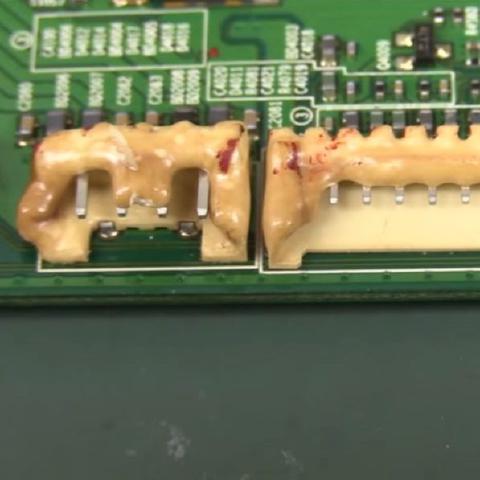
Chris Gammell: Here's what I will say. Already today. So I had a, you know, okay experience with today. It was a little too hot. I kind of melted some of my connectors.
Dave Jones: Yep.
Chris Gammell: They were not probably rated for this and it's not dialed in either. Right.
Dave Jones: Some of them are not rated. Oh yeah. Be careful with SMD connectors. Some of them, especially through hole ones, they're designed through hole, through hole connectors are often not rated to go into a reflow oven. I've, I've done a video on this showing one that was completely and utterly melted. I've got a thumbnail of it somewhere. It's like, Oh, it's absolutely. Yeah. It's, it's just shocking the way they melt.
Chris Gammell: Yeah. Yeah. Yeah. And I should have just left them off. Honestly, I was a little, I was just, you know, running a little, I was running up against dinner time. Yeah. So, I mean, I just, my stuff's definitely not dialed in. I know that. And it will be, but even still, it's like, okay, fine. But this was already way better than it was at mHub. Now, like, you know, I'm not saying mHub was the problem, but I wasn't there enough to like really dial it in on those machines. So they had a man corp machine. I think it's like, it would look expensive, like five to $7,000. Basically the same, you know, it's a reflow machine. The interface was terrible. It was actually a Android tablet. So the interface was not good, but the machine was like built like a champ, very little, like vented very well. You know, it could heat up just fine, but something about the profiles is just never quite right. And then also they had a, like a conveyor belt style one that was from Neoden. And that's like one of the Neoden kits you can buy. So you build it by the pick and place, and then it goes right into the conveyor. But that just had like PLC controllers on it, not PLCs, PID controllers on it. So like it was very grunty in terms of like the actual control. You know, it was just like you set a region. It had like a two bottom controllers and then three top controllers. You set them to different temperatures and you kind of just crossed your fingers and you could control the speed of the conveyor as well. And I just never, you know, even though we didn't know whether the, it was calibrated properly too, you know, you dial in 280 or something like that. And it's like, is it actually 280? You know, it's just like the PID is not necessarily calibrated right. Anyways, not a well calibrated system. And I just never had good experiences with those. So already just having like control here, I'm much more, I feel better about that.
Dave Jones: Yeah.
Chris Gammell: And so, yeah.
Dave Jones: Nice.
Chris Gammell: Because when you don't have that, then you're wasting parts, you're wasting time. Oh, of course. You're wasting a lot of stuff, right?
Dave Jones: Yeah, yeah. And the problem is though, is that often your profile can be different for different types of boards as well. Like if you're always making little Arduino shields and stuff like that, man, you can use the same profile every time. But if you're, you know, going from a tiny little, you know, in the things board to a giant big eight, eight layer. Yeah.
Chris Gammell: You got two ounce copper and you got a bunch of. Yeah. Yeah.
Dave Jones: And then it's totally different. You have to completely experiment and recalibrate your whole thing. And you'll often have to, you know, actually destroy a few boards, just calibrating your reflow oven.
Chris Gammell: Right. And that's assuming you have the control then as well. Right. What if you have like differentiation between the center versus the edges, you know? Oh yeah. Oh yeah. Calls it out too. It's like, you know, you have. That can be a big thing. Yeah. It's like, you know, I used to do process control stuff and it's like having like a flat profile across the whole thing. It's just like, you just can't, you can't really depend on that. And so then like, what if your critical component isn't properly reflowed?
Dave Jones: Yep.
Chris Gammell: But because it happened to be on the edge of your board is like, oh, okay.
Dave Jones: I know. It's nuts. Anyway, I sent you the link to the melted connector. Yeah. So yeah. It's a bit blobby.
Chris Gammell: Yeah. Wow. That one is really, wow. That looks like a toasted marshmallow.
Dave Jones: A toasted marshmallow. Okay. Mine wasn't that bad.
Chris Gammell: Mine was just more like a little bit brittle.
Dave Jones: And everything else on the board survived just perfectly fine. Right.
Chris Gammell: I actually had to put a piece of bubble gum on there.
Dave Jones: This is just a classic example of that through hole connector only being rated for hand soldering temperatures. Right. It just, it was not designed to go in the oven. So it doesn't matter what profile you had, that connector was going to melt. So yeah, I just, you know, oops. Yep.
Chris Gammell: Not, not that. So like reading data sheets and like understanding what parts you're putting on the board and stuff like that, I was actually, I had this thought today because it's not like it was actually a problem, but I soldered down two SOT 23-5s. Right. And one of them was a single op amp, you know, like a high precision single op amp, you know, TLV something, whatever. And the other one was a, a boost converter that could do up to like 900 milliamps. And it's not like, you know, if you put, if you swap the two, it's just not going to work. Right. But like in my head, I'm like thinking just about like the, the difference in the circuits and like, what I was really thinking about was, was like someone who's coming into electronics and they look at a board and they're like, Oh, like little black blob with five legs, little black blob with five legs. It must be the same thing. It's like, nope, that is not the same thing. And it's just like, if we take it for granted that like, these are very different functions for each of these things that are happening on board. But like, for some reason today, I was just like, Oh yeah, that is, that is a stark difference between the functions of those two chips, you know? And it's just, it's just, what did I see? I saw it on Twitter the other day. Someone, someone posted this to me. They said like, yeah, like Silicon is just a rock. We tricked into thinking. That was great. It was great. Yeah.
Dave Jones: I'm sure there are geologists who will take issue with Silicon being a rock or whatever. Whatever. Come at me, geologists. I'll ask Mrs. A.V. blog and she'll slap us down. Yep. Not that she listens to the show ever. Does your better half listen to, ever listen to the show?
Chris Gammell: We were just, we were just talking about this tonight and she said, no, not since we started dating. Right. So she has no idea what we do on here. No. Right. I mean, come on. She would not care. Yeah.
Dave Jones: And not care. Right. Cause she's not in the industry at all. No. She's not. Yeah. No. Yeah. We won't say which industry she's in, but yep. Yep. Yeah. Yep. It's certainly not, uh, what can we say? It's one of our arch enemies almost. Sure. Yeah. It's fine. Kind of. Kind of. Sort of. Yeah. Anyway. No. Everyone's thinking marketing. Everyone's thinking marketing. She's not, she's not interested.
Chris Gammell: I could say that. Yep. Oh boy. But yeah, it was, it was just, you know, it was, it was okay. Like I said, it went okay today. Melted some connectors a little bit. I'll be able to replace them.
Dave Jones: Yep.
Chris Gammell: The bigger, the bigger mistake that I made on this board is actually, you know, SMT, I love SMT female headers. I think those are like great. They're really expensive, but I always get it. I always get it wrong in terms of which pin starts on the right or left. You know, they're like every other side and, uh, yeah, I got that wrong. And so I spent like probably a half hour today of just like pulling these pins out and flipping them around. Right. And actually, uh, so like, these are like, it's basically just like a 16 pin receptacle. And it's just a little piece of, you know, formed metal that's in there and the pin sticking out one side of the other. And so you can just pull it out and flip it around. So I spent a half an hour with this doing this and then I went and melted all the connectors. So yeah. Yeah. Yeah. Do that again tomorrow. Classy.
Dave Jones: Oh boy. Yeah.
Chris Gammell: Yeah. Here on the amp hour, we look for sponsors who help our audience learn. Today, we're talking again with Paul Gulotta, who is a senior technology specialist with Mazda Electronics. We'll be talking about industrial automation. And I asked Paul some of the applications he considers to be quote industrial.
Chris Gammell: Ag tech is one, even though that's probably not something that we think when we think industrial. Automotive is heavily industrial. That's really in several continents where I would say that that's a lot of heavy industry going on with machines and robotics. And then I think there's a lot of things when I take something like Mauser, what I'll call the another big area that again, people wouldn't think is as industrial. It would be like warehousing. I'll call it logistical control. But imagine what's going on in a world of Amazon and what they're doing. They're incorporating robotics and vision systems and automation and processes. All these things we're talking about to get things from A to B.
Chris Gammell: It's interesting to consider logistics as an industrial control system. But anyone who's seen inside a logistic facility will agree with that, given all the moving parts. What are some of the industrial automation elements that allow operations to operate without a human in the loop?
Chris Gammell: There's a variety of things that have been tuned and automated such that the process through the system has a lot less people than you might imagine touching anything per se. And a lot of automated decision-making thing by machines and computers so that hundreds of millions of shipments can happen with very little error, with very high precision, reliability, control. We think of industry as probably a lot more of nuts and bolts and clamping televisions together and those type of things. And that's certainly there, but it's a different type of economy now, right? The digital economy that's demanding this type of agility and ability to go, yeah, I don't know what people are going to order, but what am I going to do once they do and be able to pull it in an automatic way and do that well. I asked Paul about how IoT plays into the industrial space. As we've increased with things like artificial intelligence, as we've increased with the ability to have wireless within the industrial space, now we can connect so that the machines, the processes itself, have a little bit more human type of characteristics. The wireless connectivity, for example, gives us the ability for those machines to communicate both amongst themselves and off to different control centers. AI and machine learning give the ability for it to, you know, have more decision-making that looks to be coming from itself. We know it's programmed by humans and set up accordingly, but we can put that into play so that the machine can just do that repeatedly and reliably within those parameters. And then things are becoming, you know, just cheap and ubiquitous so people can see that, hey, we can take these mechanized ways that we're doing it and augment and make things better. And I think some of the advantages behind that is one, you know, there's always kind of a labor savings and thus maybe a cost savings behind doing that, right? If we can make the machines do things on their own and control themselves, we can eliminate some of the labor component. And so there's always a drive to be more efficient and more productive in industrial settings. And, you know, the more we take out the human element, the more we can squeeze a labor cost. And then there's a repeatability factor. If you automate things, generally what that does is the process becomes very, very controlled. There's much less aptitude to go outside the boundaries. Or if you do go outside the boundaries to immediately correct or adjust or, you know, shut off or whatever is the appropriate action. So this idea of consistency and reliability in a world where you want to go, yes, I'm guaranteed that this product or this end result will always be the same. You know, that's what people care about. They want to know that the quality is embedded into the process. And I think that's one of the reasons motivating factors why industrial automation is so important because it gives some of those benefits.
Chris Gammell: To learn more about how Mauser is enabling industrial IoT, industrial automation, and generally connecting more machines together, check out theampire.com slash industrial. And now we're back to the show.
Dave Jones: All right. News that just broke. Yeah, I just heard this just minutes before the show. Sir Clive Sinclair, someone I've always wanted to have on the show. But he was apparently anti, not anti, but he was not a technology guy. He didn't own a computer, apparently. He didn't own a smartphone. He didn't, you know, partake in modern society.
Chris Gammell: Yep. Yeah. Did his own thing. Made his own ugly ass vehicles.
Dave Jones: Sadly, he passed away at 81 or 82, depending on who you read. But yeah, he, I like Sir Clive Sinclair, the British inventor, I guess, for want of a better.
Chris Gammell: So what were the, run down the things that he did again?
Dave Jones: Oh, come on. What didn't he do? He basically invented low-cost electronics consumer products. He started out, I don't know if he started out, but it was one of his early ones, was the Sinclair Scientific Calculator. This is just after, this is in 1980, 80, God, no. The early 1970s, 1974, where the HP 35 was, of course, the first signed pocket scientific calculator, right? Famously.
Chris Gammell: Really expensive though, right? That was like, wasn't that really pricey?
Dave Jones: Oh, it was $300 at the time, which was a lot. Oh, yeah. Yeah. It's like buying a computer now, right?
Chris Gammell: It's like buying a MacBook, you know?
Dave Jones: But Steve Wozniak, who worked at HP in the calculator division, he famously sold his HP 35 to start up Apple, you know? He famously, like Steve Jobs sold his van or whatever and, you know, the Woz sold his, you know, calculator. And yeah, some of them were quite pricey at the time, but it was, you know, ground, like, you know, it was revolutionary, right? So anyway, that had been out for a couple of years. That was 72, I think. And then, and that famously used five, it used five different chips in it. And then Sir Clive Sinclair came along and he said, well, you know, like, I really want to make like a low, can I sell this for like one third the price? Can I sell it for a hundred bucks? And it's like, sorry, no, it was, no, it was 400 bucks, I think. 400 bucks for the HP. And he said, can I quarter that? You know, I sell it for a hundred bucks, a scientific calculator. And that was like, no, you can't do it. Texas Instruments.
Chris Gammell: Just, just, just, just as I looked it up, $400 in 1972 is the equivalent of $2,600 US dollars today. So that is a MacBook.
Dave Jones: For a pocket calculator. Yeah. So that's a MacBook, right? That's a MacBook.
Chris Gammell: That's a expensive high-end computer.
Dave Jones: Scientific pocket calculator. This is why they had them in their pouch. You know, you had a belt clip for it and you had, you know, oh yeah.
Chris Gammell: I mean, it's also so you could show it off as you're, you know, strutting down the street. Oh yeah.
Dave Jones: Yeah. Oh, exactly. Yeah. Yeah. Just like you'd walk around with your Apple these days, flashing it around. You flashed around your HP 35. That's right. Yeah. Right, right. With your, you know, even though it didn't fit in a pocket. No, you wanted to put it on your belt, you know, so that people can see it. And anyway, so he, he said, why can't we sell this cheaper? And TI at the time, they were, they had just released a calculator chip, but it was like a four banger calculator. Like it didn't do any, so it couldn't do any scientific functions. It had NAFOR memory in it and you know, it, it, it just couldn't do it. And TI said, no, you cannot turn this into a scientific calculator. It just doesn't have the resources. And, uh, so, so Clive Sinclair said, Hey, you want to bet? Yeah. They, they famously did it. They use this cheap ass four banger TI calculator chip and turned it into a scientific calculator and they sold it for a hundred bucks and it was a huge success.
Chris Gammell: Awesome.
Dave Jones: You know, I don't think it sold as many as the HP cause HP. Sure, sure, sure. Like, you know, this was built much cheaper and you know, but still like, yeah, that was like groundbreaking.
Chris Gammell: Yeah. Yeah. It's whenever people think of like innovation, they always talk about like, oh, it's always like the next hottest thing. It's like the next, the next breakthrough, but like this kind of like cost down type innovation.
Dave Jones: Optimization. Yes. Yeah. Yeah. Yeah.
Chris Gammell: Making cheap products with what you've, what you've got available. It makes it more broadly available. It makes people more interested in it. It brings, it brings in, it brings in more like total dollars. So more people enter the fray from like the, the combination of economics and technology and, you know, like looking at the actual process optimization that happens in, in there, like, man, there's just like, this is a super important piece of moving technology forward because then it also frees people up to, to do that next thing to do, you know, like then the bleeding edge innovators are working to race ahead and to, to, you know, make the next dollar on the high end, high margin thing. And so like, yeah, this sort of stuff is really important.
Dave Jones: It pushes everything forward and it, and it didn't even work properly. Like there were a ton, like there were, you had to read the manual. It was, it was, it was like a spec sheet for chips. It was going, well, you can't use it under, like you can't do logs under one or whatever, you know, you can't do logs under a certain value because it doesn't, well, the, the algorithm doesn't work. Sorry. It's like, that's out of spec, right? It'd give you a result, but it'd be wrong. Right? So this calculator did not give you a correct result if you used it outside the boundaries. I've never, I've never been in that.
Chris Gammell: I've talked, I mean, I've heard you talk about it. I've heard other people talk about it before where they, you know, they say like, oh yeah, you have to know that sometimes this calculator is wrong. In my life, calculator has always been right or right enough.
Dave Jones: It's always been right. Yeah, exactly. And well, and the HP 35 was right, because it was designed by a proper engineering company spared no expense. Well, not, not, I wouldn't say they spared no expense, but they did it properly. Right? The HP would not release a calculator that gave you a wrong result.
Chris Gammell: Right? I thought there were still like limits though, of like, you know, like five, six digit kind of stuff. Oh yeah. Yeah.
Dave Jones: No, no, no. There were limits to the precision, but it, but it would never, there was nothing you could do on it that gave you an incorrect result. Whereas the Sinclair could, but because you only paid a hundred bucks for it, like you were willing to live with that. Right? Yeah. And it was like, yeah, no problems, but yeah. And then of course the famous ZX80, of course, and ZX81 computer. When did they come out? 19, was it 1980? Hence the, well, no, it was ZX80 was because it used the Z80 processor in it, but ZX80 wiki. Sorry. I'm going to go to wiki. I should know this being the computer. 1981. No, discontinued 1981 released January, 1980. Yes, I was correct. And this was unheard of. A home computer for 99 pounds. Pounds. I'm going to say it was 99 pounds.
Chris Gammell: It says, I mean, this article says 80, 80 pound in, in kit form. Yes.
Dave Jones: You could get it in kit form or if you wanted it built up.
Chris Gammell: Yeah.
Dave Jones: This was unheard of. Like, you know, at the time, the other competing computers.
Chris Gammell: Plus the design on this thing. I mean, like it is just, yeah. Yeah.
Dave Jones: And he used a, was it a Ferranti programmable logic device in it to reduce the number of chips? Or was that in the ZX81? Because the ZX81 only had like four chips in it or something. Like, you know, it was just insane. He just, he knew that cost was everything. Right? So Clive Sinclair was the master of cost. And everything he produced was produced down to a cost price point. Actually. And this is not due to labor. Right? This is not, oh, we're going to, you know, make it in China and that's how we're going to get our cost down. This was using engineering now to, you know, to just, to produce a product. Optimization. To produce a product that's just good enough.
Chris Gammell: Yeah.
Dave Jones: And meets a price point. You know? So he would go in. Months in.
Chris Gammell: Months in take to another level. Months in.
Dave Jones: Months in to another level. It's what I said, Clive Sinclair. And it worked because he would start with, I want a 99 pound computer. That's it. Yeah.
Chris Gammell: That's the crazy piece. Can you imagine like, just like pulling a number, pulling a number out of your ass and just being like.
Dave Jones: Pull a number out of your ass and trying to make it happen. Yeah. Yeah. And that's exactly what he did. And yeah, he was famous for it. And then he got into portable televisions and which I've done a tear down over the Sinclair portable TV and a little, you know, CRT. I mean, there's a little CRT on that. Yeah. Yeah. Yeah. Yeah. They're amazing.
Chris Gammell: And then of course that ridiculous vehicle that you've been, obviously we've talked about on the show many times. The Sinclair C5. Yeah. Yeah. That's a, that's very, very stupid. I mean, but for the time it's fine. It's fine, Dave. I'm just saying. It's fine. I know. These other things like kind of feel like, uh, kind of like in their time. And it feels like C5 was so cheap. Right. Someone like coming around Epcot, you know, like someone like, you know, like at Epcot and like, it's like this thing that like, you know, it was like a exposition. Yeah. Yeah.
Dave Jones: Please explain Epcot for those who don't. Oh, sorry.
Chris Gammell: That is a, uh, part of Disney world. And yes, uh, it is the, where there's many different, that's where many Americans first experienced overseas cultures. Is it Epcot?
Dave Jones: It was the land of the future. It was, you know, it was like, yeah, you can go to see futuristic things. And, uh, that's right.
Chris Gammell: Yeah. Actually in, uh, Buckminster Fuller, the, uh, the, the, the geodesic dome, that's the, the Epcot center symbol is a geodesic dome. That's right. So pretty famous from that perspective. Yep.
Dave Jones: Yeah. I don't know. I mean, it still happens these days. People go, right. I'm going to sell a $9 computer, you know, and out, out, out pops or, you know, a $9 raspberry pie thing, you know, cheapo thing or something, you know? Yeah.
Chris Gammell: It is interesting when it starts from the price. One thing that I've noticed is actually on the Kickstarter and crowdfunding type sites is that those are often the most popular ones because like you grab attention with like a, oh my gosh, they couldn't possibly make it that cheap. Right. I mean, raspberry pie as well. Right. I mean, that was Evan and his team saying $35 computer. People are like, well, people, people like Dave and I. Yeah. Yeah. Right. Right. I mean, like, and so, and obviously they've delivered and they've had crazy, I mean, the raspberry pie team who was came on the show, they were talked about their cost of optimization and how that was always the first thing that they look at. That's the first thing because they want to get wide, wide adoption. It's like, yeah, that's, I mean, yeah, that's another, I mean, I think that they maybe are the, uh, the bearers of this torch. I think, you know, like they, in the same, they're cut from the same cloth, I think. So.
Dave Jones: We did that at Altium. Actually. That was, I've talked about this.
Chris Gammell: No, no, no, no, you did not. Dave, uh, three weeks ago on the show, you talked about a $4,000 dev board.
Dave Jones: Yeah.
Chris Gammell: Mic drop.
Dave Jones: No, no, but no, but you didn't let me do the follow-up. Okay. It was the $300 one. That was set. Oh, come on. It was, it was the price. No, that, that came down.
Chris Gammell: I will give you an equivalent. I will give you an equivalent, the ST micros, uh, discovery boards at $9 are the dev boards.
Dave Jones: I know, but I'm trying to explain that that was the thing, right? That came down. We want a $300 board, right? So that's what we designed around. Okay.
Chris Gammell: Whoever, whoever was pulling that price out of their ass was not pulling from, was not pulling hard enough.
Dave Jones: Well, well, you could argue that it's, well, it's better than $4,000, right?
Chris Gammell: Sure.
Dave Jones: But it's, you know, but I'm, but I'm saying that is the process, right? That's where we, we had to try and meet that cost target. Right. So that came down. No doubt. $300 board.
Chris Gammell: I have a similar anchoring problem. When I was at Keithley instruments, you know, they start from a $6,000 source measure unit or a $6,000 DMM. And they say, we're going to make a low cost DMM. And they say, okay, what can we get off? What can we get rid of this thing? Well, how about this $35 GPIB chip that we pay for? Oh, no, no, no. Customers definitely need GPIB. Seriously? That's, that's what you're going to say there. Well, what about these really expensive op amps in here? Well, we have to have the specs. And then you go through this entire list and you're like, oh, I guess we have to make, well, this, the, the low cost DMM is now not $6,000. It's 580, $5,850. It's like, oh yes, we've done it. It's low cost DMM.
Dave Jones: Everyone gets a pat on the back and yeah. That's right. Yeah.
Chris Gammell: Bonuses all around. Oh, the price went back up. Don't get me wrong. If any of my Keith Lee coworkers, former coworkers are listening, I love your products. Don't get me wrong.
Dave Jones: No, I had to argue for that in like the $300 Altium dev board. It's going, no, we need a better spec on this ADC. And they go, we can't do it for the price. And I went, bullshit. Like, right. And a day later I came back with a part that I found that we could, you know, a way we can do it.
Chris Gammell: I feel like these kinds of things. So like, this is all like innovators dilemma type of stuff too, where it's like, you basically, you know, like, so again, to remind people of the innovators dilemma of the book and similar things, case studies that Cleet and Christensen always talks about is basically if you're coming from the top down, it's always tough because you always have these kind of like anchored positions. You have people saying, no, no, we need this thing. And the idea is that the people coming from the bottom up are starting from a good place. Right. So like you have a, uh, you know, a Honda building super cheap cars with like no frills at all. And then they move up into a more complicated market later, but they get a lot of market share before then. And it's just like, so just ripping everything off of there. If you're starting with a computer and you're saying, oh, it has to have a screen. It has to have a keyboard. It has to have all the other things. And then Raspberry Pi comes along. It's like, well, it's a circuit board using a media processing chip that we get for really cheap. You know, it's like, oh, that's a totally different context then. You know, like it's just, yeah, it's just like, it's just, you have to completely change the game in order to do that sort of thing. I think one thing that was impressed about Sir Clive is that he still maintained a lot of the form factor and a lot of the things that were really tough. Yeah.
Dave Jones: No, he tried to, yeah. But he, you know, he managed to do it. Like he figured out, you know, engineering ways to do it. It's like, yeah, like he knows that the per chip cost. So, oh, let's design a four chip computer, you know? Yeah, totally. Can we do this in four chips or whatever, you know? And it's like, yeah. And it's like, yes, you can. It's the answer. Yeah. It's amazing. So.
Chris Gammell: Well, rest in peace Sir Clive. Sorry we couldn't have him on the show, but, you know. Yep.
Dave Jones: That would have been great. Would have been great. Would have been great. Classic character. Anyway. Yeah. Definitely. Rip Sir Clive.
Chris Gammell: Yeah. What else is on our list? I guess not much. I haven't really been adding much.
Dave Jones: Oh, God. Maximo. Goodbye, Maxim. You know. Oh, yeah. Yeah. Grown.
Chris Gammell: Yeah. I did have a point today where I could not get a TI chip, but I could get a Maxim chip. And it was just like, you know. Oh, really? Oh, that's. I was like, oh, that's funny. This is a different thing.
Dave Jones: For those who don't know and haven't heard us say before, Maxim used to be the masters of unobtainium.
Chris Gammell: That's right.
Dave Jones: Sorry. You could obtain samples, but you want. Sorry. You want a hundred of those? Yeah. 40 weeks, sir. Thank you very much. It was like, you know. But they had everything. And actually, carrying on from our specifications, you know, in talk we were just on about.
Chris Gammell: Sure. Sure.
Dave Jones: The Nano Vault Design Challenge. Nano Vault Design Challenge on the EEV blog forum. Yes. This is Tin. Use a Tin on the EEV blog forum who's a vault nut. And the EEV blog forum is the, there's a vault nut section on the EEV blog forum. Yeah. There's some hardcore vault nutters on there, right? And they're their own little community. Sorry.
Chris Gammell: We've defined this on the show before, but could you please define it one more time? Vault nuts.
Dave Jones: A vault nut is somebody who's obsessed with having the utmost precision, the utmost resolution in their measurement equipment.
Chris Gammell: So they basically go to sleep dreaming of LTC 1000s every day.
Dave Jones: You've got to at least have an eight and a half digit meter to be in the vault nut club. Seven and a half digit. No, that's for, you know, hobbies. Oh, come on. How dare you? And it's like, yeah, exactly. Get that weak sauce out of here. And these guys count PPMs, right? They dream and think in P, everything's PPM, right? Everything's parts per million. And it's like, and they will develop, you know, they'll design their own custom, you know, jigs and things to, you know, age in their temperature references for six months. And, you know, it's like, I don't want to compare them to audio fools because it's not right. But it's like, oh yeah, like I need to burn this thing in and then it will perform better. But they, as opposed to audio fools, they will actually back it up.
Chris Gammell: I mean, there are people, there are some people that are, that are legitimate, like about, you know, noise figures on. Oh yeah. No, it's getting the utmost lowest noise. They might not be able to hear it, but some people in the audio field actually can measure that stuff. And yeah. Anyways, I feel like there are two groups in there, you know.
Dave Jones: No, but yeah. Yeah, but the vault nut crowd is all about reels versus feel, reels and certainly not feels, right? It's not, oh, this one, I think, I believe this one measures better. No, you prove it, you know. Sure, sure. It's like that.
Chris Gammell: I'm just saying in the audio, you know, there is like THD people that are crazy in the audio field. Yes, I know, I know. But that is not the ones that we usually talk about.
Dave Jones: No, no, no, no.
Chris Gammell: They're not as fun to laugh about because they actually measure things, you know. Yeah, that's right.
Dave Jones: Yeah, so anyway, he's laid down this contest. It's on xdevs.com at NanoVault Challenge. And there's like the rules and acceptance for this sort of stuff is like, you know, what's suitable and what's not. And I haven't read every post, but like there's argument, I can see arguments in there about, oh, why does it, why does it have to have this interface? And does it, why can't it have this interface? And et cetera, et cetera. And they're all, you know, arguing over exactly the terms and conditions of the challenge, you know. It's like, yeah, what rule, why can't I have a Ethernet interface version? And, you know, no, it's got to be RS-232, you know. You know, it's like, yeah, it's great stuff. It's great stuff. Anyway, this is like a, it's a one year long challenge. Who can produce the best NanoVault meter in the next 12 months, you know.
Chris Gammell: And it's like. It's going to be the one guy who could source parts because he had it in his lab.
Dave Jones: But the thing with this, the thing with all this stuff, the Vaultnut crowd, is it's not just about like, you just don't buy an LTZ1000 reference and that's it. I'm a Vaultnut, right? It's all about how it's temperature compensated, how it's mounted and how it's, you know, like all sorts of things. Just the design of the PCBs in the Vaultnut world is an art form, right? Like they have special cutouts because if your board thermally expands a little bit, then that could put uneven tension on the legs of the IC, which then subtly puts pressure inside. And then that can change it by 0.1 parts per million, right? That can change your drift if your PCB expands. So they'll put all these exotic cutouts in their PCB and stuff. And it's just, yeah, it really is very cool.
Chris Gammell: Submissions must be completed by September, between September 2nd and 2021 and May 16th, 2022. So you need to write about it. There's no budget limit. Designs must be verified. You must have noise figure results.
Dave Jones: Must have 10 nanovolt resolution. Noise better than 30 nanovolts peak to peak over 0.1 to 10 hertz. Auto zero capability. It's got to, you know, like it's got to have, it's got to be galvanically isolated.
Chris Gammell: It's just a measurement device. So you're just measuring.
Dave Jones: It's just a measurement device. You're measuring nanovolts, right?
Chris Gammell: So it's not doing some like crazy, there's no like spec you have to meet. You have to just do the best you can basically.
Dave Jones: Oh, no, there's a spec. You've got to have a range plus minus 100 microvolts up to plus minus 10 volts. It's got to have multiple ranges.
Chris Gammell: So, yeah.
Dave Jones: Yeah. So it's got to have certain ranges and it's got to add 40 watts total input power budget, you know? Okay. Because like you do need a power budget for this because, you know, like you can't just throw a thousand watts at the heater and, you know, it's like, yeah, look at a thermal mass in this baby. You know, I've got a one foot cube of ceramic. That's being kept at, you know, a certain temperature by a thousand watts.
Chris Gammell: If there's ranges, you have to have 100 microvolts and also have a one and a 10 volt, which means you also need to have switching in there.
Dave Jones: You've got to have attenuation. Yes. Yes. Yeah. Attenuators at this sort of noise level is incredible because those who don't know,
Chris Gammell: you know. Right. Putting resistors in line with one over F noise. Hello. Johnson noise.
Dave Jones: You know, which is, yeah, based on the larger your resistance value, the higher your intrinsic noise.
Chris Gammell: Yeah.
Dave Jones: Of your resistor. And that's going to ruin your day.
Chris Gammell: I used to support the 2182, which is like Keithley one, but like that was not, that was a nano volt meter, but it was just like, uh, I didn't know what the hell was going on in there.
Dave Jones: I, I, I have, uh, torn down. I've no, I tore down a Pico amp meter. No, I tore down a nano volt model. Didn't I as well?
Chris Gammell: I don't know.
Dave Jones: I've, I've got a Keithley. Yeah.
Chris Gammell: I didn't. They don't, they haven't updated that one in a long time. It it's interesting. Cause like, well, there's that. And then there's also the, I think, but what most people are usually looking at with these things is actually another link that we have on the, or maybe this is what Marco was talking about. Marco reps made a video about the HP 3458. A why is the 31 year old multimeter unrivaled? And so basically I think that's really what people are going for is not necessarily the nano volt meter, which didn't have that many ranges, but the 3458 is like an eight and a half digit. Like it's just the, it's the one, right? I mean, like that's the, do you have one of those or no?
Dave Jones: Sorry. No, no, no. I haven't got one. They're $5,000. Yeah.
Chris Gammell: You know, I think Martin Lorton has one. I think.
Dave Jones: Yes. Yeah. He famous. Yeah. He bought one and everyone's going, why did you, but yeah, he got sucked into the volt nut vortex. Yeah. Yeah. Yeah. Yeah.
Chris Gammell: And I think, I think Shariar has one. I think I see one on his bench.
Dave Jones: Yes. He got, yeah, he got one. And, and who, yeah. Yeah. There's a couple of others that have. I've been around them. Yeah. 3458As. Yeah. And it's like, it just uses an LTZ 1000, right? So why can't you just buy an LTZ 1000 for right now 30 bucks or whatever. Whack it in there. And you've got, you know, it's like.
Chris Gammell: Why be in front of it? You know?
Dave Jones: Yeah. It's like, yeah. Go and look at the sampling capacitor inside a 3458A. What is the sampling capacitor in there?
Chris Gammell: Yeah.
Dave Jones: It's, it's, it's Teflon coax.
Chris Gammell: Yeah.
Dave Jones: It's Teflon coax. Cause that's the only way that they could get the stability in that higher a capacitance value was to use like five, five foot of rolled up coax, Teflon based coax. Right. For the sampling capacitor, for goodness sake. It's bonkers. It's like, yeah, yeah, yeah. It's nuts. Right. It's just, it's crazy. And there's countless other things in there as well.
Chris Gammell: I won't be entering this contest. I don't know about you, Dave.
Dave Jones: Uh, yeah, no, no. You have to devote your life to stuff like this. It's not something you can just go out and do. Like it's not something. Yeah. I'm into micro volts and nano volts and everything else, but like, yeah, no, I would. It'd take me the rest of this year working on this damn thing every day.
Chris Gammell: You know, you're such a troll. I just saw your comments on Marco's video. No wonder it failed at the 21 minute mark. You mounted it. You mounted the DMM on its side. This causes all the electrons to fall out the bottom of the hybrid chip and floods the ADC. You troll.
Dave Jones: Did that get a thumbs in? Did that get any thumbs up?
Chris Gammell: Oh yeah. Did it? Yeah.
Dave Jones: Is that how you saw it?
Chris Gammell: Yeah. That's right.
Dave Jones: Was that, is it right? Let me have a, I'm going to have to have a look. Yeah. I couldn't, I couldn't help. Oh yeah. 190 thumbs up. Yeah. That's why it appears at the top.
Chris Gammell: Boy. Oh boy. What? Come on. I mean, it's funny.
Dave Jones: You don't think that's real. You don't think that's a real phenomenon?
Chris Gammell: Yeah. Actually I do. I do think that there are problems with mounting it on the side, but it's actually not tied to electrons falling at the bottom. It's more about airflow. No.
Dave Jones: Well, don't turn your frequency counter on its side. Hmm. Why is that? You don't know. You need to watch my video. I'm not, I'm not going to.
Chris Gammell: So if you could just tell me, that'd be really great.
Dave Jones: It's called a 3G tip over and it's an effect.
Chris Gammell: You could be just, you could just be totally blowing smoke right now. I wouldn't know the difference.
Dave Jones: Right. Okay. Hang on. Hang on. I'll send you the video.
Chris Gammell: Yeah.
Dave Jones: It's how you can use your frequency counter to detect gravity. Interesting. Okay. Yep. Yep. Yep. Here it comes. Incoming. Incoming. Okay. And what it is, it's a phenomenon. It's a phenomenon inside crystals that, sorry, 2G tip over. What did I say? 3G tip over. 2G tip over. Yeah.
Chris Gammell: Well, 3G shut down now. So that's 2G is still active some places.
Dave Jones: 2G. 2G tip over. Crystal oscillators will change frequency depending on their physical orientation.
Chris Gammell: Because of how they resonate? Like the fork?
Dave Jones: How they resonate. Gravity, actually, yes. How the fork happens. The acceleration due to gravity actually affects how a quartz crystal oscillates. And if you've got a high enough precision frequency counter, you can see it. I'm talking like you need 12, 13 digits before you start to see it. But you can see it. And I demonstrate in my video, I've got my Agilent frequency counter with my ovenized oscillator and I turn it on its side and it changes frequency. The internal reference oscillator.
Chris Gammell: You know what, Dave? You sold me. I'm going to watch it. I'm going to watch it. Yep. That's pretty good.
Dave Jones: Yep. A lot of people don't know this. And I actually released this on April 1st as well. Thinking along with another video on April 1st. Yeah, it is. But it was actually released midnight July 30th. Yeah. A lot of people thought I was joking. A lot of people thought this was an April Fool's joke. It's not. This is a real phenomenon. And it's, yeah. You can detect orientation and gravity of your crystal based on its orientation.
Chris Gammell: Cool. Yeah. That's great. Yeah. Two G's. It's just kind of crazy that like sometimes when you think about the fact, like how many things are controlled by crystal oscillators and it's just like, oh, it's just like a little vibrating rock. No big deal.
Dave Jones: Yep. No big deal. And yeah, a little vibrating bit of quartz. It's absolutely amazing. And, you know, I, like I found this, I, well, I, I didn't discover it, but at the time I didn't know this was a thing, right? As almost nobody knows this is a thing, unless you're working on the extreme precision end of frequency measurement, which I was with my underwater sonar stuff. Right. So we're, we're using rubidium oscillators and we're tracking long-term tracking and stuff like that. And I discovered that if I mounted it in a different orientation, that would slow, that would change the frequency and that would ruin my day. And yeah, and sure enough, I researched it and it's a thing. And it had a name, you know, 2G tip over. It's like, yeah, and there's papers on it and stuff like that. But yeah, you can measure it in your own lab. If you've got a high resolution frequency counter and a rubidium and a, an external reference. So the way you do it is of course the frequency count. Well, no, no, you could do it with just the frequency counter as the reference. As long as you've got a stable enough frequency going in, you can tip your frequency counter and you can see the difference. Very cool. Very cool.
Chris Gammell: That is very cool.
Dave Jones: There you go. You learn something new every day on the amp hour.
Chris Gammell: Yep. Unless you watch the EV blog, then you're probably. Unless you watch the EV blog and then covered back in 2014. Unless you watch every video. I watch a lot of it. Every single video. Don't get me wrong. Come on. Yeah.
Dave Jones: Yep. But no, that was, yep. There you go. All right. What else we got?
Chris Gammell: I think we got to talk about this one is just bananas. Like the, the semiconductor heist of the century. This is a basically armed China. Oh, this is China. Yeah. Yeah. Yeah. Right. Yeah. So people don't, I don't know the details here, but I know anytime I've heard about companies wanting to go do business in China, basically they have to be a wholly owned foreign entity or woofy. I just remember companies talking about woofy. Woofy? What? Woofy. W-O-F-E. Wholly owned foreign entity.
Dave Jones: Oh, okay. Woofy. Right.
Chris Gammell: Which means that basically you can't be a majority shareholder of a Chinese company operating in China. That's how I understand it. I'm not saying that's how it is. That's just what I know. I think arm was also in the same place. They wanted to go operate in China. There's a ton of chips made in China. They want to work there. And there is basically, they form a new company that is effectively armed China, but it's called something else. And in this article, they keep referring to it in the simplified Chinese that I do not know how to say it. So I'm not going to. So I'm just going to say I'm China here, but basically it's a different company. Yes.
Dave Jones: It is not part of the arm company. They basically had to split it off. And they thought that they were doing good business in China. It's like, eh, eh.
Chris Gammell: So then you do tech transfer, right? You basically say, okay, we're going to move some IP over there. We're going to go and make stuff out of this. And then they just stopped talking to them. Yeah, exactly. It's just like, oh, no, no, we're in our own company now. We're going to make sure the IP. We're going to go. It's just like, holy crap.
Dave Jones: What are you going to do? We have nuclear weapons.
Chris Gammell: I mean.
Dave Jones: It's like, come on. I mean, like. Yeah, no.
Chris Gammell: It's just crazy. This whole read. The whole thing just reads like, I don't know, like a Grisham novel or something like, you know, like some kind of like high stakes novel because it is, right? I mean, like it is. Yeah.
Dave Jones: But like, welcome to China. That's how it works. It's an authoritarian state. They do whatever the damn well they like. And it's, you know. Yeah.
Chris Gammell: Interesting. So this is. So there is an update at the bottom that I had not seen when I first posted this article. And you also posted at the same time. Update 83121. Emphasizing that the IP has not been stolen or stopped, according to Arm. Semi-analysis, which is the publisher of this blog, maintains that the heist occurred regarding control of the Arm China entity. Because there is also the talking about Alan Wu about like, basically, they just kind of lost control of the whole company. So Arm says we still, the IP has not been stolen, but they don't have any control over it. They have no control. No, because. Yes.
Dave Jones: No, in China, ultimately, when it comes down to it, the Chinese government owns your company, right? They own your company. They own your land. They own, you know, it's like, it's like technically here in Australia, like the queen owns my gold or something. You know, like, you know, it's like, you know, it's if you take it to its further enough extreme, it's like, yeah.
Chris Gammell: So here's an interesting point for this article, too. Arm has been shaken to its core with the second largest market snatched from underneath it. According to Arm, no IP has been stolen. However, Arm cannot license directly to any firm in China. They must go through the name for Arm China, which is in Chinese. I don't know. Yeah. Wow. That is just bonkers. It's basically like getting locked out of just everything else. Yeah.
Dave Jones: No, that's what happens if you do business in China. Yeah.
Chris Gammell: Well, I keep seeing all these news articles. So obviously, we are in the midst of the worst semiconductor crisis that I've ever heard of. I don't know about you, but I'm having a hell of a time and I've I'm not even touching, you know,
Dave Jones: I can't get new multimeters until first or second quarter next year.
Chris Gammell: Oh, totally. Yeah. I mean like that. And that's and that's nothing. I saw someone posted a picture of an SCM 32 lead time. It said available 1-1-2027.
Dave Jones: That's great.
Chris Gammell: Why don't you just put like either one of two things, either never or screw you. Stop looking at this page.
Dave Jones: You know, dream it. Tell him he's dreaming. Yeah. Just tell him he's dreaming.
Chris Gammell: Yeah. Yeah. Yeah. Yeah. That's so. But I just saw an article that was like, well, you know, one of the things that was happening is that UMC, which was a China fab that was offloading a lot of stuff. And it's just like, but now they were saying, oh, we're moving stuff out of UMC that I don't know if it's a trade war thing. I don't know. You know, like there's so many like big, big moving parts here that I don't have any idea about. Yeah. All I know is I can't buy a goddamn part that I want to get. And and it doesn't seem like this is getting better anytime soon. And nor am I hearing that from anyone. Nobody is saying like, oh, yeah, it's about any better six months. Nope. It's hold on to your butts for the next two years. It's like, oh, God.
Dave Jones: There's quite a few companies, especially the automotive ones that are, you know, publicly coming out with things saying that, oh, we we we have a roadmap for getting back into production in the next six months and stuff like that. How do they know?
Chris Gammell: You know, like they don't have just every single this is the downside to hardware is every single part has to be right on the board. Yeah. Yeah. One part and you were lined down. Yep. Just. Yeah. It sucks.
Dave Jones: Yeah.
Chris Gammell: I mean, in terms of like redesign skills, it's never been a better time to be a engineer who can learn a lot about designing in similar parts. You know, whatever is available, you got to go and evaluate quickly. There is a lot of design to be done. It's not a slow time for electrical engineers. However, it is not a pleasant time for electrical engineers. It is a bad time.
Dave Jones: Oh boy. Yeah. No, not good. Anyway. Yeah. Heist the century. Yeah. It's great.
Chris Gammell: Yeah. It's it's really interesting. I, one thing I'm really curious is, you know, we talk about risk five a lot on the show and I'm just very curious one generally about uptake in China. I think that's going to be very interesting because I think that will leak back out as like other IP type of stuff. And then also just moving outside of like licensing models entirely. That is not actually it won't be outside of licensing.
Dave Jones: I think I'm surprised at how quickly the risk five thing has taken off. I think there's a lot of people. There's something here. There's something here. Like people are realizing that this whole arm thing, it's like we're going to come a gutter.
Chris Gammell: People were telling us a couple of years before that.
Dave Jones: It's like, yeah. Yep. Yeah.
Chris Gammell: I think I do think market forces are accelerating things in that space. A hundred percent. I mean, like it's without this kind of stuff, without trade war, without. The shortages, all this other stuff. Like I think it probably would be coming up in a similar amount of time or sorry, not in a similar amount of time. It would be coming up, but I don't think it would be accelerated like it has been like in terms of announcements and whatever else. Yeah.
Dave Jones: No, it just seems too quick. There's, you know, there's a driving force behind it.
Chris Gammell: There, there is still a lot of lack of capacity. Right. I mean, so like, even if you wanted to go and build a fully custom risk five compatible design using licensing from, you know, an individual or, you know, based on your own design, whatever, it's like, you still got to build the chips. And that is one of the hardest things right now. So it's like.
Dave Jones: And I just saw, I think it was news today. Did I see it on Twitter that TSMC have just raised all their prices 20 or 25%.
Chris Gammell: That was, that's also on our subreddit, but yes. Oh, okay.
Dave Jones: Oh, right. Yeah. It is. Okay. Yeah. They just raise prices across the board. Like, you know. Yeah. Oh yeah. There we go. What are you going to do?
Chris Gammell: They are the juggernaut, right? I mean like, yeah. Okay. Intel is, you know, got a foundry business now. So what? You know, Intel is expensive high end.
Dave Jones: Just, just like assembly, right? You can pay to have other companies bumped from the, from the production line and your boards, either bear boards or, uh, assembly boards, you can pay more to have them bumped up the production line. And that's what I guarantee you, there's companies out there that are going, we don't care if we make a loss on these cars, right? We, we need to start shipping. Right. And they will pay to pump themselves to the top of the queue. Yeah. So if you're waiting for your, you know, your.
Chris Gammell: Yeah. Yeah. It's, it's not real until it's in your hands.
Dave Jones: That's why the lead time just goes out to. Yeah. Basically, you know, they, they cannot give you a lead time. They, they just don't know. So they just whack on, you know, 2027 or something, you know, insane. It's just.
Chris Gammell: One thing that I was discussing with people on the consulting forum was like, uh, well, like kind of suggestion by me. I'm not sure if it's actually a good idea, but like one thing that happens on a lot of my designs is like the very integrated chips. Right. I mean, like even to the point where like I'm doing Psalms and just, you know, whatever I can get at this point. Like I just, on this board, I just assembled today. It's like, it's a buck converter module, but it's basically the size of like a SOIC 14, but it's got everything. It's got the inductor in there. It's got the. Yeah. Yeah. It's not cool little module, but like, yeah, that's got everything in there. Yeah. Right. Yeah. It's way too much, but it's, you know, it's available and it's very convenient. Yeah. Yeah. Very convenient. But do you go in the other direction? Right. So now if you can't source parts that are like super specialized, so just use a buck converter again. Right. Like TI parts are very hard for me to find right now. Anything automotive obviously is out the window. Right. Yeah. Just even general TI switchers or some of the linear regulators hard to get. So now do you go in the other direction? Say you're in a, so like I'm making boards that are very lusciously large, you know, I'm not space constrained at all. Right. Do I go in the other direction and say, okay, well actually I can build a switching circuit using a five, five, five. Not that I would do that actually, but say I could go and grab a small micro that's available.
Dave Jones: You use an op amp, you use a transistor, you use a pass transistor and you whack in. Exactly. A little.
Chris Gammell: Right. Do you, do you do that? Is that more or less responsible? I, I think from a personal enrichment perspective, it's actually very, uh, one thing, it's something to do while waiting for your other parts to show up. But I, but I think that it's probably not that responsible in terms of like long-term development, but as like a workaround hack, I don't know, you know, like it's like, you can probably get, you know, two N7000 twos, or you can probably get one N914, you know, like you can probably get some of the jelly beans and build stuff and you might give up some percentages, but yeah, I don't know. It, it, it, it, yeah. I mean like, but you can also build it. So like, what is the true, like, what is the lever you have to, you know, push at this point in order to just get stuff out the door? Maybe that, but I think that, you know, that might be, you know, going in the other direction, less integrated than it has been and like less feature rich. And then like, what comes of that? And I don't know, you know, like it's, it just, there's, it feels like there's not many options if you really need to get something out the door. And so like, it'll be interesting to see if, you know, if you start doing teardowns six months, a year from now, like, do you start seeing that more in commercial products? Do you start seeing that more in prototypes? You know, like just like, right. Are people listening, doing that right now? I'd love to hear, you know, like just what are people doing to get around this sort of thing?
Dave Jones: Because oftentimes sitting in your head, you know, because you don't want to re-spin your board, but you also can't just tell your boss power module.
Chris Gammell: Yeah. You can't tell your boss, oh, well, you know, we've got to wait six months. It's like, go do something. I'm paying you. Exactly. The other option is I stopped paying you, you know, it's like, oh, okay. So it'll be just be interesting to see how people do this in a, you know, a broad basis. So we'd love to hear if people have thoughts on that. So it's very interesting. A lot of videos to be made here, Dave.
Dave Jones: We've got, no, we're way over time, dude.
Chris Gammell: Oh yeah. Yeah. Yeah. I figured that was my wrap up. That was my wrap it up. Okay. Leave a comment down below, like, subscribe and hit that bell.
Dave Jones: No, you can't like us. Really? You can't. We don't have a thumbs up thing unless it's on the, well, we do have a YouTube channel and I guess that's it.
Chris Gammell: People could share us with their friends. That is the way to show that you like us. I don't give a shit about a thumbs up or a like or a retweet or anything. It's engagement. Share us with your friends. Come on. Just tell another nerd about this nerd stuff.
Dave Jones: We are the world's number one electronics podcast.
Chris Gammell: My parents are in town right now and my parents are asking how the podcast is going and they're like, oh, well, how many, you know, nerds, how many people do you have listening? And I was like, oh, you know, we've got a couple of thousand nerds or a couple of thousand listeners. And my mom goes, oh, that many nerds? I was like, mom, you've got to just say that.
Dave Jones: We're at least five digits.
Chris Gammell: I know. But, you know, it was more about the nerd thing. Okay. Right. Yeah. My mom just said, oh, that's a lot of nerds, you know?
Dave Jones: Yeah. Right. So you're saying your parents care more about what you do than your own wife?
Chris Gammell: No. She was also very interested in the number of nerds. Oh, right. Okay.
Speaker ?: Yeah.
Chris Gammell: She was just not as blunt about it.
Dave Jones: Right.
Chris Gammell: The term of a dearman in the Gamble household, just so you know. Yeah. Right. Okay.
Dave Jones: Yep. And Renesys acquired Dialogue Semiconductor. Dialogue Semiconductor. Oh, you're just sneaking in that news at the end? Yeah. Yeah. Does anyone care?
Chris Gammell: Yeah.
Dave Jones: No. No. No one cares.
Chris Gammell: Dialogue was supposed to be bought by someone else. I forget who.
Dave Jones: Oh, really? Okay.
Chris Gammell: Yeah.
Dave Jones: I can't remember the last time I used a Dialogue Semiconductor part. Jeez.
Chris Gammell: Yeah. I mean, they're automotive, so good luck.
Dave Jones: Oh, boy. Yep. Anyway. Catch you next time. See you. See you. See you.
Archived Discussion (7)
Comments are closed. Archived from the original site.
Show archived discussion (7)Hide discussion
ConnectorControl Leo 3HP3458AIOTOvenReflowSinclairSir Clive SinclairT962AVoltnutsWhizooZX80 Spectrum
Keep current
Every episode, plus the occasional job post, in your inbox.
There was no cold junction compensation and there was no ADC front end.
Although there's a crystal, the timing was about 20% off to start and would slow down during the profile due to inefficient code. Each run would heat the controller, and would occationally cause the thing to lock up with the heating elements hard ON. Even when it wasn't locked up, the hot melt would MELT and the LCD would slowly disappear.
After the thing caught fire, we took it apart and reworked heat shielding, fixed the dangerous wiring and made our own external controller. The damn blower kicked in at the wrong time during one very expensive UVC array build and we stopped using it.
We took its controller and put it on a $20 toaster oven. Works like a dream.
If anyone could recommend a REASONABLY priced professional oven with an exhaust vent please tell. We still can't find a desktop oven for less than $1k. There's no reason they can't sell a good one for $500
And LTZ1000 is old news now folks, ADI ADR1000 is the new king!
I bought even smaller T962 model and went on a safari to look at modifications. There are quite a few, some are really sophisticated such as modifying and reflashing the controller that the oven came with, adding an temp reference and improving software, without having to add/replace any controller board.
But the one that blew my mind is the work of Jerry Walker.
Walker apparently work with precision electronics and its manufacturing at his day job, and recreates boards for vintage electronics in his spare time. He has access to professional equipment to do things like CALIBRATE a thermcoupler...
Walker bought a T962A and did 6 part series on how he finds out what is worth fixing. He sets a goal at the first video and creates a laundry list of fixes to consider.
In the 6th part, he concludes that a lot of the planned fixes was unnecessary.
https://youtu.be/4_7S4vderb4
His major fix was putting in a S-shaped thread (not a propeller that would create draft, more of an air cocktail stir) spinning at 300 rpm in the ceiling of the oven chamber, creating enough turbulence to get an even temperature distribution, eliminating the need for things like additional heaters.
Walkers whole video series on T962A system characterization and modifications (for those playing along at home):https://youtube.com/playlist?list=PLzvLbUxGuZ-zK_24L4maC1OOX__b6bArA
We once had a product with an Ethernet port that would occasionally fail.
The SW guy looking at the issue found that the problem never happened if you turned the unit upside down.
Turns out the Ethernet spec requires a crystal with certain specs. An expensive crystal. Affordable crystals are often a little off frequency and change frequency with temperature and aging. Some units are on the verge of not working and the stress on the crystal due the gravity pushes the frequency just as the electrostatic stress of a DC bias voltage would. Turning the unit upside down would pull the frequency away from the brink of being out of operating range. It turns out that all those cheap NIC cards I have dumped because they stopped working were just using cheap crystals and some drift out of spec. Enterprise NIC cards use high spec crystals and they work reliably. There is always something new to learn.