
#492 – More Electronics Consultant Impedance Matching
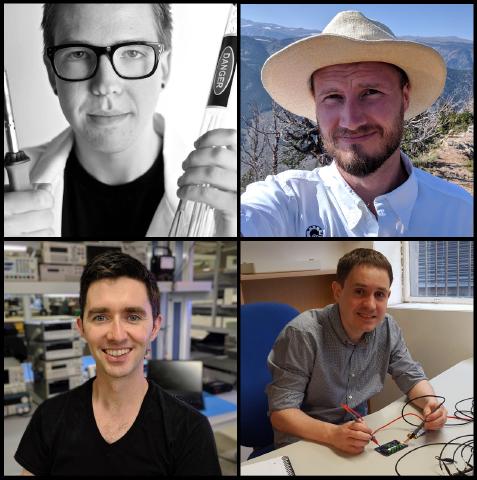
Download episode · 82 MB
Also on Apple · Spotify · YouTube · RSS
Show Notes
Another episode with people talking about consulting for electronics! Welcome to our guests, listed clockwise from the top left in the episode photo.
- Alex Klimaj from ARK Electronics in Utah in the US.
- Jeremiah Gillis from Embedded Bytes, Inc in Wyoming in the US.
- Kieran O'Leary from Mixed Signal Systems, Ltd in Scotland in the UK. Kieran has been on the show on his own in the past.
- We all know each other from the Electronics Consultant Forum. If you're interested in joining you can apply here.
- Episode 409 was also about Electronic Consulting. That episode inspired the consultant forum as a place to discuss issues related to the field.
- Working with remote clients, before and during the lockdown.
- All have considered making hardware for sale outside of client work.
- Alex has made the LiPow
- Kieran does courses and has made some demo boards for SI issues
- Jeremiah will be making some mod hardware for his Mazda RX7
- Chris liked the idea of building a reference design after Ryan Cousins from KRTKL was on the show talking about how the Snickerdoodle is a lead generation tool.
- Having a niche is also important.
- The Long Tail (written by past guest Chris Anderson)
- Past guest / co-host Greg Charvat has written niche books that lead to opportunities at startups as a CTO.
- Schedules at home lab are tough, but not that different than before for the attendees. Kieran is used to working in the middle of the night (it was 1 am during the call for him)
- Alex recorded a video of mountain biking using a Skydio drone
- Keeping up on the latest trends via podcasts. We didn't mention it directly but this included the machine learning episode on embedded.fm.
- Classes are always a good way to learn too, but might be more limited.
- Looking at job postings also calls out what skills are in demand. Chris referenced the HN who's hiring posts.
- Chris wishes there was an Audm for Engineers, that reads you technical articles and/or summaries. If you're interested email chris@theamphour.com with the subject line "Audm for engineers"
- How are you rigorous?
- Standard processes in place
- Jeremiah is learning from the medical industry, since there are more regulations. This includes things like unit testing that links back to a requirement.
- Tracking time for quality, including how well they are doing for estimates.
- Asana with Everhour
- Book: How to measure anything
- The important thing is to check whether it's done or not. "Are we happy? Yes or no"
- A great tip: Every block in the schematic gets a number for PCB reviews
- Using a balance sheet as a budget check. Adding custom categories to your Chart of Accounts (with your accountant's blessing) means you can categorize with more fine control.
- Some of the accounting/tracking tools we use:
- Spend your time billing hours
- War stories
- Once there was a layoff, one the employees was nice enough to update Kieran on the situation
- Jeremiah war story about client
- "I declare Force Majeure!"
- So you want to be a consultant. Also referenced in Jack Ganssle's series on being a consultant.
- Things to learn in the next 5 years:
- Business strategy (Trillion dollar coach - Bill Campbell_
- DC power storage and EVs
- Measuring progress (Measure What Matters - John Doerr)
- Consulting forum application
- Follow our guests online!
- Kieran O'Leary on Twitter, LinkedIn and his personal site
- Jeremiah Gillis on LinkedIn, his company site
- Alex Klimaj on Twitter, LinkedIn and his company site
Transcript
Chris Gammell: This is Ampour Podcast. Released May 10th, 2020. Episode 492. More electronic consultant impedance magic. Welcome to the Ampour. I'm Chris Gammell of Contextual Electronics.
Jeremiah Gillis: Hi, I'm Alex Klimai of Arc Electronics. Hi, I'm Jeremiah Gillis of Embedded Bytes Incorporated.
Kieran O'Leary: Hi, I'm Kieran O'Leary of Mixed Signal Systems in Edinburgh and Scotland.
Chris Gammell: Well, welcome to another Electronics Consultant Impedance Matching Episode 2, Electric Boogaloo. I don't know what we're going to call it, but either way, we're all meeting here, and we are all meeting here because we know each other from the Electronics Consulting Forum that started from this last episode. So if people remember on episode 409, we had Dave Young and Eric Thompson and Peter Ezentepski, and we basically did a show and we were talking about like, why isn't there a forum about this? And then we started one and then all these people showed up and we've been talking about stuff ever since then. And now you're hearing from some of those people, including Kieran, who we've heard from before, so Kieran has already been on the show before, so how about Alex and Jeremiah? Why don't you guys introduce yourselves? Well, obviously you haven't introduced yourselves already, but tell us a little bit about your consultancies and what you guys are working on these days.
Alex Klimai: Sure, I'll go first. Yeah, so I'm Alex Klimai of Arc Electronics, obviously. And yeah, I mostly do electrical engineering, schematics, printed circuit boards. I do a little bit of embedded firmware, a little bit of embedded software, and yeah, that's what I do. Great.
Jeremiah Gillis: And I'm Jeremiah Gillis. My company is Embedded Bytes, like I mentioned before. I primarily do embedded firmware in a lot of different areas like automotive field, consumer electronics, and I'm getting more into medical devices now. I also do a little bit of hardware design, and I'm trying to do more of that just to keep my skills up.
Chris Gammell: And Kieran, why don't you give a quick refresher for people? We'll obviously link in the episode, but for people who haven't listened to the episode yet.
Kieran O'Leary: Sure. So the clue's in the name, Mixed Signal Systems. So it's an embedded systems design services house, and it's got a focus on low noise, high performance analog and mixed signal systems, which is supporting embedded firmware, low level, bare metal firmware development, but mostly on the hardware side, and certainly not as high up the stack as an Android or iPhone app.
Chris Gammell: That's great. Well, you know, welcome all of you. That's great. I think the other thing that's interesting is that we're all, I'm in a big city, in downtown in a big city, and the rest of you are kind of pretty spread out. Now, not necessarily small towns, but we're kind of all over the place. So Alex, you're in Utah. Jeremiah, you're in Montana. And Kieran, you're in Edinburgh, you mentioned. So that's kind of... Edinburgh, yeah. Yeah. And Wyoming. So like pretty... Oh, Wyoming. Sorry, I thought you were in Montana. Sorry about that. So yeah, Jeremiah, Wyoming, how is it being that remote?
Jeremiah Gillis: It's interesting. I like the out-of-doors, and I like rural areas. So Wyoming's great for that. But for a client base, it's absolutely terrible. All my clients are 100% remote. So I'm hoping one day that maybe I'll have some clients from Wyoming or Montana. But you know how it is.
Chris Gammell: They'll only be a couple hundred miles away or something like that. Yeah. Yeah. Yeah. I mean, Alex, a lot of remote for you as well?
Alex Klimai: Yeah. I'd say last year, I was maybe 50-50 remote and local. Pretty much all of my work has come from word of mouth. And I've had a few jobs here in the Salt Lake area. And my previous full-time employment was at a drone startup. And through that, I've been getting a lot of drone work. And all of that has been remote up until recently. And actually, this week, I just got a local... Well, they're about 45 minutes away. But semi-local client on that regard. So yeah, I don't know. I'm still about half and half remote and local.
Chris Gammell: Awesome. Yeah, that's great. I mean, it's interesting too. Like as we... So we were talking a little bit before the show about COVID. Obviously, it's going to be something we're going to talk about in broad terms at least. But a lot of people are switching to remote right now. And for some people, it's a big switch. For people like Jeremiah, I'm sure when you're all remote anyways, maybe it's not that big a deal. You know, like it's not a huge switch. But mindset may be a little bit different.
Jeremiah Gillis: Yeah, definitely. The mindset is different. Because even though I'm 100% remote, usually I'm talking with client engineers from clients every day or video chat or whatever. And now that a lot of them are shut down, it's even more remote. So I have to get my social interaction just from my family that lives near me.
Chris Gammell: Yeah. Yeah. I noticed the incidence of remote Zoom happy hours has gone up quite a bit. One of my buddies had like a weird background just kind of like hanging out when I called him today for work. And I was like, what's going on with that? You know?
Kieran O'Leary: Yeah, I think people are very adoptable. Here in Edinburgh, there's a bunch of my former colleagues from Wolfson. And they've all moved on to different things. But about once a month, we meet up for burger and beer. But yeah, that's obviously off the cards at the moment. So we started doing it on Zoom. Yeah. You know, so just at lunchtime, once a fortnight, just to see how everybody's doing. And the first couple were interesting. Everybody had lots of stories. But now the topics for discussion are quite limited. That's right. I saw an aircraft flying overhead today. How about you?
Chris Gammell: Yeah. Yeah. What kind was it? Oh, my God. Started like a cargo cult or something like that. Yeah.
Kieran O'Leary: Well, the weather is good here at the moment. So people are able to get out into their gardens and everything. So that's not too bad.
Chris Gammell: Yeah. Yeah, that helps. That helps. Yeah. I mean, the switching to remote thing. I mean, I don't know. I don't talk to a lot of people that are full-time engineers all that often anymore. I mean, I guess I still have some friends that do it and whatever, but they're all kind of heads down. So I don't hear as much about it. But a lot of the people that I do talk to who are already remote, they're like, yeah, it doesn't really change all that much. You know, nothing, nothing must have changed my, my workflow.
Alex Klimai: Yeah. It's pretty much all the same to me. I kind of lost track of how many weeks that we've technically been in, in kind of the shelter in place style thing here. It's not, not as strict here in Utah. But yeah, other than my, my partner, she's working from home full-time. Normally she would be going in. That's really the only change for me.
Jeremiah Gillis: Yeah. It's a little different for me. Um, one of my clients, uh, who I actually used to work for their engineers, they're in Wisconsin. So, you know, that they had that shutdown and they're still shut down, I think through towards the end of this month. So they actually sent all the employees home and only a very small group of the engineers are working part-time. So I don't get to talk to them that much.
Chris Gammell: Oh, like they're not even working. They're not working at all. Like, uh, yeah, they're not even working at all. So yeah.
Jeremiah Gillis: Yep. Yeah. They're furloughed. They're working like maybe 50% or 40% just depending on what they're doing. So.
Chris Gammell: Oh, wow. So has that been, is this, I mean, broadly, has that been impacting your business or everyone's business? I mean, what, what do you, what are you guys seeing on the horizon or what do you see in your own businesses? I guess.
Jeremiah Gillis: Uh, yeah, it's impacted my business. Uh, actually starting towards the beginning of this year, like my billable hours have gone down a lot. So I've actually been working on some of my own projects and also volunteering and something else that's happening in Wyoming that I could discuss a little bit later, but, and also looking for new clients, just networking because I'd like to have more billable hours. So.
Chris Gammell: Yeah. Yeah. Chasing that, uh, chasing that, uh, that money, that cashflow, I suppose. Right.
Jeremiah Gillis: Yeah, exactly. I mean, I just want to stay in business. So.
Chris Gammell: Right. Right. Yeah. I mean, one of the things I think about is like with networking, it's, it's so tough to, you know, it's tough on a normal day to meet people and, you know, you go to trade shows, you go to whatever. And now it's like, Oh, networking over zoom or networking over whatever's out there. You know? I mean, I, Kieran, Alex, have you guys seen any drops?
Kieran O'Leary: Um, for me, it, it, it pretty much echoes what, um, Jeremiah had said, you know, like, um, at the start of the year, you know, it looked like it was going to be quite a prosperous 2020. Um, but luckily so far, um, you know, I sustained my existing clients and one or two of them, you know, some businesses are going to do better or others, you know, better than others out of, um, the lockdowns that are enforced around the world. And one or two of my clients are working on products that benefit from the current situation and others, of course, um, there's declining market, you know, markets. So, uh, they've got a bit of a squeeze on at the moment. Um, so yeah, I'm just trying to do things that'll help me upscale and keep the, keep the business, um, operational through kind of the next couple of months. Um, and, and, you know, there's, uh, there's voluntary activities going on here in Scotland as well, which we can speak about, but it's interesting to see that that's echoed, um, you know, around the world.
Chris Gammell: Yeah. I mean, for my, uh, for my, I mean, my work's been like weird and spotty, but like, I think it does depend on sector too. So like having clients that are like industrial or medic, like, uh, Jeremiah said medical too, that could be super, you know, some people, medical clients are, might be building more right now versus other, you know, it's just like such a weird, but then there's always like cashflow issues and like, Oh, we're going to tighten up and we're going to watch every payment that we do. And yeah, I have all that silliness.
Alex Klimai: So, yeah, I was, I was way too busy last summer. I was, uh, pretty much full-time billable hours for many months in a row. And I was having a new client, potential client contact me about every week or two. And I was having to turn them away into the, into the fall and then kind of into the holidays. Yeah. Stuff started slowing down into the holidays and the first couple months of this year. And I was maybe doing half of what I was doing before and, uh, started working on my own, my own projects and products and getting that going. But now I'm pretty much back to being full-time billable. So it's actually picking up for me now.
Chris Gammell: Yeah. And so Alex, you've posted about your product before. What is it that you're making? Cause I like, I like the idea of having like a, a project that you can kind of go back to and kind of like, maybe not in the back burner, but just like kind of think, thinking about things that you are using for personal development or maybe a small, small amount of cashflow or just because you want it, you need this thing on the world.
Alex Klimai: Yeah. I mean, last year I worked on, I designed and started shipping the LIPOW charger and that's a USB-C power delivery input, uh, lithium polymer battery charger. It'll charge two to six S or two to four S, uh, lithium polymer batteries with an XT60 output and balance. It'll do balancing and everything too. So that I, I just wanted a project to do all the hardware, firmware and get it through, you know, do a test fixture that programs it and calibrates it and get it shipping. So that's, that was my last year's product. And, you know, I've got that up on Tindy. I also have a little, the little regulator module off of that is, is up on Tindy as well. It's a little TI programmable regulator, uh, that sells pretty well. And then my latest one that I started last fall, when things started slowing down is a, uh, kind of a reference design smart battery for drones for Pixhawk. And I'm actually involved in the Pixhawk UAV.
Chris Gammell: What is, what does Pixhawk mean?
Alex Klimai: Pixhawk is the open source, like drone hardware, like autopilot standard. Okay. You know, so you have Pixhawk hardware and then you can have different flight control software stacks that run on top of it, like ArduPilot and PX4. So this'll be a kind of a UAV can smart battery for that ecosystem. And I've got prototypes of that. That's what I was working on earlier this year when things were a little slower. And I'm working on getting that built with a partner in China to get that shipping.
Chris Gammell: Nice. Nice. Jeremiah and Kieran, are you guys, uh, you guys doing your own? Kieran, you do courses, right? You'd kind of teach people for the, uh, mixed signal stuff, right?
Kieran O'Leary: Yeah. Yeah. And that was a signal integrity courses and the like. So, uh, I think on the, uh, what's it called? The discord app. I think I'd shared a picture of, um, some two layer boards that I've started developing. And, and, you know, when, when things are busy and never really have time to, um, to work on them, but they're, they're, um, boards that are designed, you know, to intentionally have a bad signal integrity properties to, to, to demonstrate in, you know, in, in, in, in a controlled manner, what can go wrong.
Chris Gammell: And, um, I could have, I could have designed you one of those for free. Yeah.
Kieran O'Leary: Yeah. And, uh, yeah, yeah. I think pretty much everybody can. Yeah. Yeah. So, so, and yeah, like I just haven't got around to, you know, to writing any blog posts on them yet, but now that things are a bit quieter, maybe I will, or I'll post pictures of the boards on Twitter, but they're, they're just a series of boards that focus on one particular, um, signal integrity problem or, or, or even, you know, um, an electrical science phenomenon, like, you know, um, current following the, the path of least impedance on a PCB. And, um, and, and then the board is, is, is, is to demonstrate, um, that in reality, because these things are all very interesting and easy to demonstrate using field solvers. Um, but not everybody has access to those tools and it's, it's still a simulation, you know, and, and the map is not the terrain. So it's perhaps a bit more useful to, you know, for people to have to see them in, um, in reality and real hardware. So that's what I've been doing with my downtime. Um, and I guess every cloud has a silver lining, so I'm kind of hoping to be able to do some good blog posts or videos, you know, um, using those boards, um, over the next couple of months.
Chris Gammell: Yeah. Yeah. That's a great thing. I, you know, especially cause like signal integrity is like, so kind of, I mean, it is very math heavy, right? If you really want to do solvers and stuff, you don't have to do it if you're using software, obviously, but, but like the idea of making it tangible and like measurable is like awesome. Um, I love that idea, um, being able to kind of like show it on the real, on the bench.
Kieran O'Leary: Yeah. It's, um, it is one of those fields where you can really go down as, you know, um, as deep as you like in the physics, you know, you can go down to one of the four fundamental forces, you know, um, electromagnetism, but you don't need to. Uh, and, uh, you know, you hear people say, oh, you know, RF is a, is a black art or, you know, um, black magic or analog design is black magic. And of course it isn't because the physics doesn't change. It's just, um, perhaps you need an appreciation of, uh, of the physical properties that you're dealing with. But, um, you can do a lot without having, you know, a PhD in electromagnetics or anything like that. And, um, the actually, it's good.
Chris Gammell: Cause I'm not coming by one of those anytime soon. Yeah.
Kieran O'Leary: But, but, but actually I've shown the boards to quite a few academics that, you know, knock across along the way. And they're all fascinated by them because they're, oh yeah, we really want that because, um, it's, um, you know, if you're doing equations and simulations and everything, they can tell that people are just dying a slow death listening to them. Whereas if you can just connect it up to scope or spectrum analyzer and you go, okay, you've paid for it, you know, you paid for a 20 bit ADC and you're only getting 12 bit performance. Like, you know, here's where the other eight bits are, you know, and people tend, you know, people tend to be quite interested. Um, and it's more engaging. It's the same as anything else. If you can, if you can pick up something and hold it, it's quite engaging and trying to keep the boards as simple as possible. I mean, they're two layer boards, 10 centimeter a side and, um, and, and that's it. And you, and you can demonstrate a lot with that.
Chris Gammell: Yeah, that's great. Jeremiah, are you, uh, you said you're also doing some, some hardware on the side?
Jeremiah Gillis: Uh, no, unfortunately not. I, I actually right now just have a notebook of ideas that I'm thinking about. Like I have some good ideas, but it's very knit, like niche for like, I have one of my hobbies. I have a Mazda RX seven that I built up and stuff and I wanted to do like water injection. So, you know, driving like a brushless pump, injecting water into it. So you could turn up the boost, make more horsepower and such. But I'm trying to think of a different idea that would be more generalized that maybe the general public might find interesting or the tech community. So.
Chris Gammell: Yeah. It can be hard to do. I do like, so I I'm on the path that Alex was talking about with the reference design idea and I was thinking about, uh, so when Ryan cousins was on here from snickerdoodle, which is critical K R T K L that wonderful company name, uh, from when he was on, he talked about how the snickerdoodle board acts as a reference design. And Alex, maybe you could speak to this kind of thing, but like having like reference design or even just projects more broadly, just projects out in the wild, you know, and using that as a way to like kind of promote yourself and your business. And so at some point, someone's going to walk up to you and be like, I need something that looks kind of like that. Can you do that for me? And I was like, Oh yes, actually, that is, that is my, that's what I do. You guys, have you guys seen that kind of thing?
Alex Klimai: Yeah. Uh, on my, on my side, there's been with the batteries, at least, you know, there's a lot of people who want smart batteries out there and want to just buy one. So, you know, I actually taken the time to develop it and test it and have that solid hard tested hardware and firmware, uh, will, will bring a lot of people to you. And that's part of the reason I want to get, you know, a partner to build and ship a kind of standard version to the mass market, and then maybe bring in the, the companies that want to, you know, slightly different version, you know, different features, battery size, et cetera. And then I can do the customization on that end.
Chris Gammell: The riches are in the niches. I forget who said that someone was on here, I think, but yeah, making the customs. That's where, that's where the dough is.
Jeremiah Gillis: So when you, uh, have a product on 10d, how do you market it? Do you just have people following you like on social media or how does that work? Alex?
Alex Klimai: Yeah, I'm actually really new. And I did work in technical marketing at Keysight. I actually worked with Daniel who's been advertising on here before, but, uh, I'm, it's still kind of doing it all myself is new to me. So I've been trying to spend a little more time on social media, on Twitter and LinkedIn and advertising it. And, um, it did get featured in Hackaday and that brought on the website and that brought a lot of interest to it. And yeah, I've been kind of quiet on my 10d products, advertising them at the moment. I did a little quarantine sale and sold a few, but it's, it's a hard, hard thing when you're working full time to on the design side of things to stop and go do some marketing. Yeah.
Chris Gammell: That's a great point. I mean, like, and you know, there's marketing of products, like the actual physical products that you're talking about, there's marketing of services and all that kind of stuff. I mean, do you guys do, I mean, uh, Kieran, you mentioned blogging, but more broadly, do you kind of, aside from being on the amp hour, do you hawk your services or your products anywhere else?
Kieran O'Leary: Twitter can be quite useful, you know? Yeah. Um, what kind of leads you've gotten to there? Yeah, it's, um, I think you'd mentioned there briefly, um, about having a niche, you know, and, and it's good to be seen as the guy or the girl, you know, for, you know, for a particular field. And, um, you know, there's the book, the long tail, you know, where, um, there's, um, you know, there's, there's, there's a vast array of, um, of specialities out there. And if you can find your niche, then, um, it can be quite useful, you know, to have people that, you know, they keep an eye on things. And then when, um, you know, something pops up, like for example, they've got a, you know, a noise problem on a mixed signal board and they go, ah, yeah, well, I heard that guy on the amp hour. I saw something on Twitter. Um, I think, all right, I'll just track him down. And, um, you know, it, it, it tends to be quite useful. I haven't written a book, but I've heard a number of authors say the same thing like that. Uh, they make no money out of the book, but the, uh, being seen as the, seen as, uh, as the authority in a given areas is, is quite helpful.
Chris Gammell: Yeah. Greg, Greg Charvat, uh, former guests a couple of times, he talked about that for the small signal radar stuff. And that's how he got into like humatics where he is now and, uh, butterfly networks. And obviously he's well-connected anyways, but like, yeah, that kind of thing of like having being the guy or the gal, like you said, I mean, like the being that expert definitely helps being called by CNN, like he was in similar, similar things.
Kieran O'Leary: Yeah. Like, I mean, everybody needs a break somewhere. Like, you know, so, um, you know, giving yourself those opportunities is, um, is all you can do, you know, just try to put yourself in a position and, and most people that have a passion for an area, you know, can, you know, not everybody wants to do a YouTube channel and, you know, some guys prefer to write and some people like podcasts, you know, there's a whole variety of stuff and some people are better, you know, kind of face to face, which is difficult at the moment, but the, um, there's usually, usually an outlet for people in most communities. I think you just have to try to find the one that works for you.
Chris Gammell: Yeah. That's a good point. That's a good point. Yeah. I think it is. I mean, like I've gone through writing and audio and video and all that other stuff and, you know, finding what, finding the one that fits your, your workflow, I think is like, uh, I think, I think the workflow is kind of where it really comes down to it. And like the, you know, having a schedule, I mean, I don't know about you guys, but I've been like trying to really have daily schedule and like, I haven't worked in writing or anything like that, but obviously the amp hours are part of my week every week. Do you like keep, keep kind of regimented in that way?
Jeremiah Gillis: For sure. Um, I work from home all the time. So that's like a double edged sword there where if you're very regimented and have a schedule and you stick to it, you could get a lot done. You could be actually probably more productive than being in a work environment, like a traditional employer work environment, cause there's less distractions. But when you have so many hobbies and things going on at home too, if you let that slip in, you kind of get nailed and your productivity goes way down.
Chris Gammell: Yeah, it's true. And if those, uh, zoom happy hours creep into, you know, eventually then your, your boards, your board layouts get real messy and your code starts to go real bad. I don't know.
Kieran O'Leary: Yeah. Yeah. Look, I moved, um, apartment, uh, recently my wife and I bought a, bought a new apartment here in Edinburgh and, uh, the, the home office now doesn't have any windows. So, uh, so it's like being in a prison cell, but, uh, depending on my mood, it can be highly effective. You know, it can be highly productive or, um, another day, like, it's just like you're crawling the walls, like, you know, and I have no idea if it's day or night, like, but I, yeah, so I do struggle to keep, uh, you know, to keep a nine to five, um, if you know what I mean.
Chris Gammell: Yeah. Oh, totally. Yeah. I mean, this time, I mean, right now I'm just, I'll just pop upstairs at 9 PM to keep soldering something. It's like, no dummy, go back downstairs and, you know, hang out and watch some TV and turn your brain off for a while. That's the hard part is to turn your brain off. I think.
Kieran O'Leary: Yeah. I just noticed actually, just as I said that it's 10 past one in the morning here in Edinburgh. Yeah. Right. And I'd completely forgotten, you know, it's just, well, I tend to be a bit of a night owl anyway, but yeah, like, um, when you don't have that interaction, you know, particularly now when, even if I have local clients, I'm not seeing them and they're all flexible, you know, they have kids and they have to work around that when the kids are in bed and everything. It's really easy to, you know, to, to lose track of time.
Alex Klimai: Yeah. Yeah. I'm pretty, I'm actually pretty bad about keeping a regular schedule. We, my partner and I tend to end up working late and, but we will go for a bike ride or something in the middle of the day and the nicest part of the day and then use up our, our evenings when it's, when it's not as nice, but you know, the weather's getting really good here. So it's really hard to be inside in the middle of the day. It's not too hot yet. It's just like the perfect temperature. So I'm a, I, I struggle with that being inside when it's so nice out.
Chris Gammell: I feel like you should also talk about the video you have where you shared, I think I talked about on the show before, but where you have the drone following you as you're like mountain biking. That is awesome. Where was that? Where's that taken?
Alex Klimai: That was, that was taken about 15, 20 minutes from here up in a, an area called Jeremy ranch. And yeah, that was actually the Skydio, the Skydio, their first drone, their new drone is supposedly even better. I haven't seen it yet, but I know some people that work there and it's, it's pretty cool, but yeah, it's, I live in a pretty nice area.
Chris Gammell: Yeah. It was very picturesque. I guess you all kind of do, right? I mean, like Utah, Wyoming, Scotland. It's some, some nice stuff. I have buildings in Chicago. In Chicago.
Alex Klimai: Yeah. Right.
Chris Gammell: Urban, urban jungle. The buildings get old after a while. What about, you know, keeping up on things? So, I mean, I assume, you know, now that we're 25 minutes in, I should probably say that a lot of people listening are not going to be like, oh, well, this is definitely for me. But you know, people might be interested. I think some people are interested in the lifestyle. Some people are interested in like how the work goes. One thing that I think is universal is everybody's trying to learn more, you know, in their job and trying to get better at what they do. How do you guys keep up on top of kind of the latest stuff? Because that's something I've, I've personally struggled with.
Kieran O'Leary: Well, for me, actually, to be honest with you, I find a couple of the leading podcasts really quite helpful. Like, you know, the, you know, the Empire, for example, or. Don't, don't pander. Come on. Yeah. No, but genuinely it's, you know, or embedded, you know, at least. You know, like, because you can find some really interesting guests and for example, you know, machine learning is an area where, you know, I don't have a direct involvement with, but if somebody wants to use a GPU or an FPGA in a high performance system, then I don't need to know everything on earth about machine learning or AI or anything like that. But an appreciation of the type of modules that are used and that, you know, the levels of power consumption that these things draw and everything, you know, it's really quite helpful to have a, you know, a domain expert speaking and you pick out of it what's useful to you out of the hour, 90 minutes that somebody will be speaking. And, and then of course it's up to you to follow up on that if, if you see fit, like, but I think nowadays there's no shortage of information, you know, in YouTube or podcasts or even Hackaday. It's trying to find interesting people and then picking their brains. Yeah. For me. Yeah.
Chris Gammell: Yeah. Yeah. Go ahead, Jeremiah. I know you want to.
Jeremiah Gillis: Yeah, I do. Uh, I was going to say, well, uh, some of you might not know, but Wyoming's pretty rural, like under 600,000. And I live in a town that's only 10,000 people. And my dad lives in a town that's only 10 people. So. Wow. They have, they have a post office. Anyways, uh, just to match what, uh, Karen was saying, I actually do internet, uh, go on the Udemy. I'm just improving since I do a lot of embedded firmware. I'm just trying to improve that. And so I've just been taking some classes there. It's great. And also I have some friends in some, a few different universities that I talked to just to see what they're teaching now. See what, you know, the job market's like and just trying to learn. And actually that is another good point too, is like, sometimes I do when I'm looking for, uh, job postings, not for myself, I'm just seeing what companies are targeting. And if it's new or something that I don't know, sometimes I just go research it, but it's really a lot of self-learning for me.
Chris Gammell: Well, that's a great idea. Yeah. I watched the, um, I have a, uh, uh, like a word watch thing on hacker news. And so like anytime PCB comes up, I like go and see what they're talking about. And sometimes it's silly, but a lot of them, uh, they're, they have a monthly who's hiring thread and then who wants to be hired and seeing kind of like what the, that's obviously very software focused, but like seeing like though, what people are looking for or what they're, you know, what skills they have on our, on offer. I always think that's kind of interesting.
Alex Klimai: Yeah. For me, it's, it's mostly podcasts. I tend to be so busy that most of the time I'm either working or going out and exercising or driving somewhere. And I feel that time by listening to podcasts, but otherwise it's app notes and all the, all the usual stuff that you come across on your average day working.
Chris Gammell: Yeah. Yeah, it's true. Um, all right. Well, this magic work last time I said, last time I said, why isn't there a, why isn't there a forum for consultants? And then we, we did that idea I had, and I'm not sure if it would work actually. It was like, so I also obviously like listening to podcasts. I like listening to just, I think audio, not everybody learns by audio, but I think at least the four of us, we are very much in that camp. I think many of the listeners here are going to be obviously, but the idea was like, what if you just had, it came from the, uh, autumn AUDM, which is like an audio service. They do like long form content and they read it. Basically they turn it into podcasts for you when they just got bought by New York times. And I was thinking like, I'm not sure if it would work because of like diagrams and the physical or like the visual nature of it. But like, what if that was for like technical journals and like, uh, and similar things where you could have someone like kind of just reading you articles instead of having to consume them. I don't know. It's slower. Some people prefer reading, but like, you know, I, I thought that would be kind of an interesting idea of like reading you the latest journals or, you know, summarizing information or whatever, you know, like the amp hour, but with actual like thought behind it. Yeah. Yeah.
Kieran O'Leary: I, I, I noticed autumn just a couple of weeks ago and they're going, Oh my God, this is amazing. You know? Uh, and, um, yeah, yeah. Like you say, I mean, I mean, you know, it tends to be kind of from, um, respected publications or whatever, like, you know, uh, large established newspapers and, and, and that, and, you know, magazines like New Yorker and stuff. But yeah, I do think it's, um, it's an interesting concept because sometimes you think concepts that are very mathematical in nature, technical in nature, or you can't do without diagrams and that, but I use audible a lot and, um, uh, you know, quite a number of books that you would expect to be, um, difficult to listen to and absorb the information by somebody reading it. It works quite well. Now you might get everything. Yeah. A lot of the time you, you just need somebody to, to express the concepts to you, you know, at the end of the day.
Chris Gammell: Right. Well, it's like that sampling idea, right? Like, like, uh, Jeremiah, I think was saying about like, just kind of knowing what's out there first, you know, you're not going to do a deep dive, but you need to know kind of what's new, what's hot, like what, what's, what should you be researching in depth, you know, and looking into what, or like Alex said, like what app notes should you be going to read, you know, instead of someone reading an app note. And then Jim Williams drew this little thing and then he had an op amp here and it was connected to a transformer, you know, like, uh, I don't know if that would work.
Alex Klimai: I think a big part of it is we stare at screens all day working on code or schematics or printed circuit boards other than when we're soldering. But I think that's the draw of audio and podcasts is you can, you can listen to it while you're driving or exercising or doing something else and kind of get lost in thought a little bit and not be staring at a screen for more hours of the day.
Chris Gammell: Yeah. That's a good point. Yeah. I got so hard up for new stuff. I went back and listened to the Bobaverse books. I'm currently reworking through all the Bobaverse books because I love them so much, but highly recommended if people haven't listened to those yet or watched or read them.
Kieran O'Leary: Yeah. I've, I've been trying to find new podcasts. Um, and I've even started going back over, um, earlier episodes of, um, podcasts that I've, you know, I've listened to for years and I maybe have, you know, forgotten the earlier episodes, but, uh, I mean, there's a, there's a podcast for everything you can imagine. I mean, there's probably a COVID-19 podcast. You know, there's probably many. Yeah. You know, I mean, they're, they're just endless, like, you know, and you can dip in and out. Um, but, uh, you know, there's quite a few drone podcasts now, which I think is interesting. You know, it's, it's a field, you know, barring military UAVs, like, but, um, it's, it's a field that didn't exist maybe 10 years ago. And then now there's just oodles of, um, of drone podcasts and, you know, there's, you know, you can maybe there are only 20, 30 minutes, um, each, but now you can learn a lot that way because, you know, I think being able to dip in and, and get the concepts and, um, you know, it's fight it away in your mind until you need it is, is, is, is, is the way to, is the way to go, I think.
Chris Gammell: Mm-hmm. Yeah. I think the, the hard thing, I think I've mentioned on the show before, but like, I used to get in a lot of trouble because I would be like, oh, well, on a podcast, I heard this and this and this, and, you know, people would be like, shut up, Chris. We don't, you know, like you can only use it so much. So then I started switching it to, well, I heard from a friend, uh, about this new thing. It was the same thing with Reddit too. I was like, oh, I saw this on Reddit. No, no. A friend told me or showed me this thing. I gotta be creative in terms of what, how you, how you share your, your learnings. Yeah.
Kieran O'Leary: I have it on good authority.
Chris Gammell: Yeah. Right. Right. Well, yeah, I don't know. I don't know if that, uh, I don't know if that, uh, autumn for engineers idea will ever come up, but, uh, it's an idea I have. It's, it's tough to learn things, you know, like, and it's, and I think the other thing too, so like one of the things that I, uh, I tried last year was I tried hiring tutors and I think it worked pretty well. Um, but I think kind of one of the things that I deal with is just kind of like, obviously, you know, get a room of consultants or engineers together and eventually imposter syndrome is going to come up. But, but like, I think it's really just not having, even before imposter syndrome is just like not having someone to bounce ideas off of. And that's one of the things that I really struggle with too, of just like, you know, being on your own, needing to be rigorous. I mean, what do you, what do you guys do for being rigorous for your clients and in your electronics works, you don't blow up that board or send out a bad set of Gerbers or something like that?
Kieran O'Leary: Well, uh, this is an area that, um, I've been looking at a bit lately. I mean, I, I feel like that, um, the quality of my deliverables and hardware is quite good. I've been doing it a long time. I have my processes in place, um, and it's just, you know, standard quality control, but the firmware is an area that I'm working on, you know, more and more and I, and I want to do better with that. And, um, there's some great resources out there for, um, for software in general and embedded systems in particular. But a lot of it is, uh, you know, from people kind of, you know, much more qualified than me seems to be like getting it through to engineers that, uh, this is a job and you're a professional and there's an expectation that you deliver, uh, you deliver a quality product, uh, you know, and so I hacked it together. And, uh, you know, that as an industry, you know, the embedded systems industry, you know, it needs to mature. And, um, and, and, and that mindset is, is very much the first step, you know, that the documentation is as much part of the product as a, you know, as the binary that you release to a client. And once you, you clear that hurdle, then it's just about providing the tools, you know, and there's some, you know, variety of tools out there.
Chris Gammell: But, uh, uh, the mind saying that the, uh, the, the, like getting approval to bill for documentation, or are you saying just making, putting it on yourself to actually do it and be rigorous about it?
Kieran O'Leary: It's both. I mean, um, being rigorous on a personal level or, you know, the company wide level is important. And I think the, the, the cream will rise to the top ultimately over, you know, over years or decades. Like you see the companies that take quality seriously are the ones that, that go to distance. Of course, what you say about like, uh, trying to get a customer to buy in upfront or a client to buy in upfront. I, I, I think you really have to have a good story and, uh, you know, a good narrative that you can support hopefully with evidence, but you have to be, be able to communicate the value of that very clearly. Um, I can't remember where I heard it, but, um, on some podcasts recently, uh, uh, you know, I'd been listening to an episode and somebody had said it was, I think you mean a friend
Chris Gammell: told you. Yeah. Yeah. Yeah.
Kieran O'Leary: I have it on good authority. Yeah. Harvard business review or something, but the, um, yeah, there was three, um, three quotes, um, for a block of work. And, uh, the third quote, this guy was telling the story, his quote was multiples of, of the other two quotes, but, uh, his company got the business and, um, the, the, the perception of the, of the client was that, okay, we got three quotes. I mean, you're off the charts, like, you know, you're kind of like six sigma, you're standard deviations, you know, away from, um, the other quotes, but the, uh, but clearly you had thought about all the consequences down the line, uh, of what, you know, what, you know, what if, you know, and, uh, I think, uh, as a, as a, as a consultant or as a contractor, you, you kind of have, um, an obligation, um, to your clients to, you know, to, to bring more than, you know, um, a hex file or a set of Gerbers, you know, you, they're paying you for your experience and the contribution that you can make. And if you can communicate your value, you know, so, okay, well, I can give you the Gerbers, but when you bring these Gerbers to your EMC house, you know, to, to get your certification, C marking or FCC or, or whatever it might be, this board, it's got a very good chance of passing first time. Now you can pay me a little bit more for one good board and that's fully documented and, uh, you know, it's been designed or you can pay somebody else for four boards, you know, and they're only, you know, they're only in all the testing fees. Exactly. And that's the thing. And, and a lot of the time, you know, I work with startups and they, they have no idea, you know, the product testing for hardware could be so expensive, you know, regulatory and, and compliance testing can, can be so expensive. And, um, and, and that's what you offer. So, so being able to communicate that effectively upfront, you know, okay, look, you know, I charge you a little bit more, maybe a lot more, but ultimately you're going to get it back because when I tell you your product will be on the market in three months, it will be on the market in three months or six months or nine months, whatever it may be. Um, but of course, communicating that can be difficult and, and some clients never want to hear it. You know, you get right.
Chris Gammell: Right. They want the short-term cause. They want to see that. Oh no, it's only $10,000 for this thing. Cause that's what I can get approved. Right.
Kieran O'Leary: Yeah. Yeah. So, uh, and, and, and I'm curious to hear, uh, you know, how the other guys, um, deal with this because I'd imagine it's a, it's a problem the world over. It always has been, and probably always will be.
Chris Gammell: Yeah.
Alex Klimai: Yeah. Chris, I think you've talked about this before where there's a difference between being kind of a contractor and being a consultant where in the contracting role, you're maybe coming, stepping in and helping out in a large organization and they already have some EEs or firmware guys on staff and you're working with them. So there's people review it. You know, you're reviewing their stuff and they're reviewing your stuff and you have some, some oversight in both directions versus you come into a small startup and you're the, the EE or the firmware engineer. And that's, yeah, the buck stops with you. Right. Yeah. And I've had it both ways. Mostly I'm, I'm working with other, other people, uh, where they can review my work. And that's been, that's been very helpful because it's, it's nice not to, you know, you can come back and review your stuff again and again and not catch the thing that's going to cause the problem. So.
Chris Gammell: Jeremiah, you're not getting, you're not getting out of this one, man. So you got, yeah, you got to answer too. Oh, I'm going to answer for sure.
Jeremiah Gillis: Well, actually, yeah. One of my newer clients that I've worked with for the past years and the medical industry. So, you know, you got that FDA and they're very rigorous on everything. And that's, you know, good for medical products. And I've actually learned a lot from there because this client also works with like, uh, another company who does all of the, the medical requirements for the FDA. So a lot of the things that I worked on with documentation and integration testing and all that stuff, all those documents get sent to them and they can look at it and they've been giving feedback and, you know, I have to fix to make the document exactly how they want. So the FDA approves the submission. And I think that's going to, I could take some of this back now and apply it to the other industries that I work in because they're not so rigorous.
Chris Gammell: So what are some of those things that you're talking about there? Like the, what, I guess what from the medical industry is, is extensible?
Jeremiah Gillis: Uh, just how like the firmware, every single thing is documented in it. So it has requirements. And I mean, they're very detailed and specific. Uh, there's unit testing, which actually has to link back to each of those requirements and call out the exact, you know, section number and all of that.
Chris Gammell: And you're like, I get, I would give me some more of this. I love this.
Jeremiah Gillis: Well, I mean, I like, it's okay, but I think it, it just gives me more knowledge and I could take what their concepts are and apply them to like consumer electronics or something. Then I could, uh, just give documentation that's more complete, but the client will basically like, I don't know. Sorry.
Chris Gammell: Yeah. Yeah. That makes sense. Yeah. Hmm. I don't know. I've, I've read, uh, there's a book called the, uh, actually I asked about this on Twitter a couple of years ago too, about like checklists and stuff like that too. I mean, do you guys do anything like that of like, like formalized, I mean, I guess, I guess Jeremiah, you're kind of talking about formalized process of firmware. I mean, are, are there other things that you're kind of self-imposing on yourself that might be a good resource for people to think about like checklists or similar things? Okay. I'll take that as a no.
Jeremiah Gillis: I'm thinking about it.
Chris Gammell: Yeah. I mean, like these days I, my, my main thing is like, uh, um, you know, like journaling and similar kind of things. I mean, that's not really rigorous, I guess, but it's, it's a way to track my, it's beyond just like tracking hours. It's actually tracking what I was doing, how I was, you know, it's quasi lab notebook ish, but it's not, not really. Um, I don't know if there's anything like that. I guess in the documentation side, you know, Kieran, you mentioned documentation.
Kieran O'Leary: Yeah. Yeah. Uh, just more generally, I guess, I mean, for my setup for tracking time and everything, and I know that's required for billing, but in terms of quality and close, closing the loop on, you know, on, on how close you're coming to your time estimates for projects and so forth. I use a SANA and, um, to, you know, to manage the projects and a plugin called, um, ever hour, um, you know, to track the time. And you can just literally, I mean, hit play in a SANA when you're working on a task and, you know, it generates all the, you know, the CSV reports and everything. Um, and I think that's quite useful of, of course, financially it's, it's required, but the, um, you know, being able to close the loop, I think a lot of the time you have the processes, you know, and you say, okay, I'll track that, but you never close the loop, uh, on, on, on how effective your estimate was. And there's a very good book, um, or a series of books and it's, it's, uh, it's called, um, how, how to measure anything. And, uh, I think the guy's name was Douglas Hubbard or something along those lines, but he talks about how to measure the intangibles in business. Uh, and, and, and, and, and, you know, and then that was very, very useful. Like, and one of the big tips out of that that I think is quite useful is, um, you know, when you have your project meetings, whether it's agile, I mean, the, the, the methodology doesn't really matter, but the question is, okay, how far along are you? And so, oh, I'm about 80% of the way done. And that just means 80% of the time is gone. It has no correlation with how much of the work is done. And his thing is, you know, I mean, it's, it's, it's, it's a really interesting book, but it's, um, if you're doing a schematic or whatever, you don't say, oh, I've, I've 70% of the schematic done. It's you break down each, you, you, the level of, um, resolution that you need in, you know, is a yes, no answer at the project report, you know? So it's like, uh, so, uh, you know, how, how, how, how, is the MCU done?
Chris Gammell: Is the power supply system done? Right. So it's more like a go, no go of like, uh, of like rocket engine. Yeah.
Kieran O'Leary: And then it makes it very simple for the project manager. Is it done? No. Okay. Well then, okay. We need to look at why that's the case. And that, that, that's proved very effective for me. And then much more specific for hardware guys. What I found is really useful is, uh, with a schematic and because we work remotely a lot, um, um, with my clients, uh, for schematics, um, I take a given page in a schematic and every block in the schematic gets, you know, there's a little border drawn around the circuit and the schematic and it's given a number. So if it's on page one of the schematic, it's 1.1. And then the next section is 1.2, 1.3, 1.4. And then when you come to do the schematic review, even when it's done remotely and, and, and over zoom or Skype or whatever, um, you're just sitting there with a page, you know, piece of paper. Okay. Everybody happy with section 1.1. Yes. Take everything, you know, and, uh, people.
Chris Gammell: I'm feeling that one for sure. That's great.
Kieran O'Leary: So maybe I'll put it up on Twitter. You can link to it, a picture of one of my schematics, but it, and then you, well, I, I use Eagle more than KiCad, but, um, or KiCad, sorry. Always have to keep everybody happy. But, um, but it just means when you're working remotely and you can have a script and it just generates it, you know, and, um, again, like I said, I don't know KiCad so well, but in Eagle, you can give everything a layer and you just pull it out of the, out of the source file, the title, the section number, and then you just generated, you know, CSV file and you go over at section 1.1, any comments? Yes, no. Section 1.2, any comments? And that came out of that book, um, how to measure anything, you know, measuring the intangibles in business. It's having it down to the resolution. Are we happy? Yes or no. And all the hardware engineers that I've showed this stuff when they described it, they're there like, no, that won't work. You don't need that. We're doing an op amp. Why would you draw a box around an op amp and call it, you know, trust me. And then, and when you're doing it face to face, it doesn't really matter. Somebody points at the, you know, the screen or whatever they are on the table in front of you, but when you're doing it remotely and you're billing somebody for a time, all of a sudden it becomes like they're really buy in. Okay. Yeah. We're not paying.
Chris Gammell: I think even you just, you just get rid of the, uh, can everybody see my mouse? I'm, I'm waving the mouse around this, around this one section. Yeah.
Kieran O'Leary: And it's, it's working remotely. We, I mean, it's a, yeah, look, we're not paying you for section 1.1 to, you know, 4.37. Like, I mean, we want to, you know, we want to bill you to review section 5.2 and that's where all the comments are because, you know, you know, my background is in semiconductors reviewing eval boards and reference designs and all that. And, you know, the, the boards could be enormous. Like there could be 30, 40 page schematic and every, you know, you get the design guy, the eval guy, the apps guy, they all come into the room, the product guy, the QA guy, you know, and test guy, and then they all sit there going, okay, page one. And then they, you know, it's, it just takes so much time. It wastes so much paper if you print it out. Um, if you put in the numbers of the section and you go, then it's just like reviewing chapter of a book, you know? Yeah. You know?
Chris Gammell: So it's like a subsection or like a table contents too. Yes. Yep.
Kieran O'Leary: And for quality control and, and, you know, because sometimes people go, oh yeah, it's great. Oh yeah. We'll apply your process. So, you know, be it something like agile or six Sigma, it doesn't matter. Or, you know, like, you know, whatever the process is until people can see tangible examples of where it's useful. Um, then, you know, it's just, it's a concept, but, but for me, that's one, I haven't worked out one for the layout reviews and I'm open to suggestions, but for the schematics that works out, you know, that's worked out well for me.
Chris Gammell: Okay. Can you can do, um, sheets, the sheets are, um, the number based on like, so they, they prepend the sheet number. So if it's like, instead of having, and I'm, this is not obviously, uh, part of. Just, just a KaiCat thing, but it's like, so if it's on sheet one, it's going to be resistor R101, R102, whatever, or R1001, 1002, whatever. And you could even do subsheet, subsheet, subsheet. So if you really wanted to, you can go real bonkers, but then you have, you know, sometimes you have four number, um, you know, resistors are 10, 1204, you know, R1506. So that's the downside, but you could start to break out and say, okay, let's look at subsheet 15, whatever, I guess.
Alex Klimai: Yeah. For, for PCB review, you can, if you have someone to, to review it with, you can, you know, at least remote screen share, and then just same thing, kind of set up a checklist where you go, okay, we're going to go through each of these power rails and highlight them. And we're going to look at them together and make sure you got enough V is got enough copper. And then you can kind of go through, you know, let's go through power, go through each of the power rails and then go through and look at all the high speed and check your length matching. And you can kind of do the checklist approach on it.
Chris Gammell: Yeah, that's good.
Alex Klimai: That's good.
Chris Gammell: Kieran brought up the, uh, the idea of, uh, you know, this book, how to measure anything in business. How do you, how do all of you find the, uh, the mishmash of running a business, albeit small businesses and, uh, and, and interweaving it with, with deliciousness of engineering.
Alex Klimai: How has that been going? I try to spend as little time as possible in QuickBooks to satisfy my, my CPA who happens to be my mother.
Chris Gammell: Oh, nice. Got that family connection. That's good.
Alex Klimai: Yeah. If I, if I don't do things right, I get a talking to, so.
Kieran O'Leary: You're finishing your homework. Yeah. No water for an earth is the same as your mom.
Chris Gammell: And why are you spending so much on resistors? Do you really need that new microscope? I don't think so.
Alex Klimai: Yeah. But it, you know, trying to spend the time on business development and, and bookkeeping and all that it's, it feels like a distraction, but you know, it's a small business. So that's, that's a big part of it, but it's, it's almost tough to stop and go, Oh, I need to, I need to go and balance my books in, in QuickBooks. It's a, yeah. Got something you got to remember to do and pay the taxes.
Chris Gammell: Yeah. I, I had spent a bunch of, a bunch of time at the beginning of the year, really like cleaning up my balance sheet and like learning how to read balance sheets better. And I didn't realize that I could like actually go and modify things like the, the chart of accounts it's called. And like, you can add your own thing in. So it was like, um, you know, like instead of just having one big chunk of like, like revenue and like stuff that's coming in, I can actually split it out. So I say like, Oh, or it's not even just cost of goods sold. It's not like cost of goods sold, like amp hour t-shirts, you know, like cost of goods sold parts for clients, parts for myself. And then actually like being able to split that out. And then it becomes like, it almost like makes your balance. I don't know if this is, I mean, my, my accountant said it looks okay, but like, I don't know if it's generally good, but I love it because now it'd be access like a, as like a budget to be like, Oh, well like last quarter I spent a bunch of money on advertising or I spent a bunch of money on equipment and why did that happen? And Oh, well I bought the VNA or I, Oh, I, you know, spent some money sponsoring this thing, you know? So that really, that's been like a hack for me. And then when I do all the categorization that I have to do anyways, then it becomes like, it's like I'm budgeting, which I actually like doing better than accounting. So small mental switch, I guess, but I, I like doing that.
Kieran O'Leary: Yeah, I guess that kind of stuff is boring, but it's the important part of running the business. You know, it's, again, it comes back to like the quality and the technical sense, like, you know, the, like with the documentation, it's, it's the boring stuff, but it's the difference between success and failure. And, and as I say this now, I know when my wife hears this, she's going, yeah, you should follow your own advice because the engineering is the fun, the engineering is the fun stuff. But of course there's lots of engineers working full time in large companies. It's the differences is all the other stuff that you're required to do, whether you like it or not. And you need to be a grownup about it. And I'll be the first to admit, I don't always get that balance. Right.
Chris Gammell: Yeah.
Alex Klimai: Yeah. Well, yeah. It's good. Cause you end up buying, buying boards and stuff for prototypes and trying to, trying to keep track of how much you're spending on, especially when we're talking about your own product development and you need to kind of track your costs. And you know, people, how many, do you have Excel sheets? Do you do it all in your bookkeeping software? It starts getting unmanageable if you, if you don't reign it in.
Chris Gammell: It's like our managers, all those years that we had to deal with them are like, why do they keep asking about this stuff? It's like, Oh yeah, I get it. You know, it kind of gives them the fee for the other side. Now it's like, Oh yeah. They're asking about like timesheets because they need to know where my time's going. You know, like, it's just like all the things that kind of flash back to me now. And I'm like, I would grumble about it at the time. And I was like, Oh man, I was shit. Yeah.
Kieran O'Leary: Like, I think that is so true. I mean, people ask me, you know, what's it like being on out on your own and everything. And you can talk all day about it, like, but it basically compared to, you know, being an employee, the highs are higher and the lows are lower and you either accept that or you don't. But if I went back to my old job, so as an applications engineer in different semiconductor companies, but if I went back to any of those jobs, I would be so much better at the job now having a much more appreciation of sales and business development and the cost of sales. And, uh, you know, like even things like, um, I don't know, like bribery legislation and you know, you're in these big companies and you have to sit through this thing on, you know, the bribery legislation in the U S or in the UK or whatever, like, and you're going, Oh my God, like, why am I here? You know, wasting an hour of my time. But of course there there's often, often though not always good reasons for these kinds of things. And I certainly have more of an appreciation of that now. So, uh, in terms of, well, why would somebody want to be, uh, you know, a contractor or a consultant, it certainly won't help you or excuse me. It certainly won't hurt you. You know what I mean? Nothing learned is ever lost. And if you try it and it doesn't work out and you go back to work for, um, a larger company, you'll definitely be better for the experience. I think.
Jeremiah Gillis: And I think, uh, the book part and the numbers and all that are, it's kind of fun. Cause I mean, you know, as engineers, we like to work with numbers. So, uh, it's just knowing your system. Like you guys mentioned QuickBooks. I use another one called zero after spending a lot of time doing different things. You could, uh, do a lot of it, you know, in Excel where you don't have to spend any monthly fee on some software. But I found, you know, my time's a lot more valuable working on clients or finding clients. So I ended up just trying to automate everything I can. So like even payroll, I, I pay a monthly fee to a service called gusto and that they file all your taxes. They'll even do States like Wyoming. I think automation's just, you should use automation when you can, because you know, where's your time important. Uh, it's important to invest in your clients and work on their products. So by the time you factor in all that stuff that would take you doing it manually, you know, with Excel or writing yourself a payroll check, um, filing your 941s or, you know, depending on how your business is set up, it's just worth using a service.
Chris Gammell: Yeah. Yeah. It's an interesting point generally too, of, of like just paying for, you know, like I used to grumble about, I was, I always did my own taxes before and I always did all that other stuff and now it's like, Oh, I, I'm willing to pay for this. I'm willing to, I actually, I'm willing to pay for software. Whereas I might've like tried to, you know, find, obviously I use an open source software, uh, but you know, certain things of software, I'm just like, I'll just buy it. I don't care. You know, like where the things I don't actually care about them, I'm just, I just want the answer.
Alex Klimai: And, um, you know, that it's definitely a switch versus working for a full, a company full time when your, your time is worth X amount per hour and you start looking at everything a lot differently going, well, I should just pay for this service or product and spend my time working on billable hours. Cause I can make more money.
Chris Gammell: Yeah. Hmm. So, uh, I wanted to ask about, uh, war stories as well. Everybody's got good war stories. So, um, let's hear some, let's hear some doozies. How long have you include as well? Like how long have you all been actually consulting too? Cause I've only been doing it 20 months. I think now something like that.
Alex Klimai: Yeah, I've, I've been doing, I've been consulting full time for almost a year and a half now. And yeah, the big, I mean, the biggest thing I've seen is maybe architectural issues where you should have used a system on a module and you come into a project halfway and they went chipped down and you're having to debug all the chipped down problems that someone else created. That's been my biggest headache. And yeah, just coming into things kind of half baked and half finished.
Chris Gammell: What have, uh, what about the module, like the chipped down stuff? Like why did they decide to do that? And why, why would you have advised them against that?
Alex Klimai: I don't know the whole history on why they went chipped down. And I think, you know, they thought, who knows, maybe it was, they wanted more billable hours that, you know, that's on the worst, the worst side of things, but from the other side of things, maybe they thought they would improve, uh, cost or, uh, performance. I don't know. Um, but you know, it's just, you spent so many out engineering hours on consultants trying to get this, this chipped down Linux system working when you should have just bought a system on a module and put the headers down and called it good.
Chris Gammell: Okay. I thought you were talking more. Yeah. I was thinking more on like an RF module, but you're saying like a, like a Linux module
Alex Klimai: specific, like a Linux Linux, little Linux embedded computer where, you know, you should have just, should you just purchased the SOM major custom board, plugged it in and all the hard stuff was done. Yeah. Yep.
Kieran O'Leary: Yeah. So, so are you interested in hearing, um, technical war stories or business war stories?
Chris Gammell: Whatever's better, man. Well, let these guys answer. I don't know. Like, what do you guys think?
Jeremiah Gillis: Whichever one's more interesting.
Kieran O'Leary: Yeah. Well, yeah, I guess that's the thing. Like, I mean, the technical, you know, the, the technical challenges are always more interesting, you know, because, you know, okay, I encountered this problem and then I solved it this way. But, but of course, again, you know, from a consultant's perspective, the, um, you know, the legal or the, you know, the commercial, um, challenges are, are perhaps more important than in, in, in, in the long run. And, uh, and that's, you know, with the forum, you know, you see the, the questions, coming up and I think we mentioned earlier, maybe about insurance. I'm not sure if we'd mentioned it before we started or after we'd started, but these kinds of concepts, um, or even legal jurisdiction, you know, cause we're all in unusual places and it's things like, okay, if you have to unfortunately end up in, in, in court with a client, I mean, what's the jurisdiction because I'm in Edinburgh and you're in various rural parts of the United States. And, uh, if you have to, you know, hop in a car or a plane or whatever to, you know, um, file papers in, um, in, in a, in a courthouse three States away, it's inconvenient to say, to say the least things like contracting, uh, you know, contracts, excuse me. And that kind of thing, it's, uh, it's very important. And I haven't always got that right. That's for sure. You want to deal with these things up front as best you can. And that's something that I've kind of learned along the way. And, uh, you know, particularly when I was starting out, I was naive and okay, everybody will pay me and everybody's a good guy and everything. But, you know, of course, you know, in a big company, and of course, I mean, sometimes genuinely, you know, companies go bust. They can't pay you and everything, but then there's, I mean, if it's done in good faith and it just happens, there's, you know, there's credit or indebtor mechanisms and, you know, in all jurisdictions to deal with that. And, you know, um, and, uh, and one of the best experiences, we always think of the bad experiences perhaps, but one of the best experiences I had with a client was, um, they were, they were a large company, but the, um, the division that they were, um, uh, you know, the division with Boston went into administration, uh, here in the UK. And, um, I was about halfway through a project and I, you know, build up front and I'd got, um, and, you know, buffer in advance and everything. So, you know, I wasn't caught for the money, but one of the kindest things that the guy did for me is, uh, he lost his job that day, but pretty much the last thing he did before he, you know, he was, you know, escorted off the premises was to ring me and tell me to stop working because if he, you know, if he hadn't done that, and it was a really interesting project that's going to involve, you know, lasers, like, so it was cool. And, you know, you know, like I, I would have kept on working, um, on a, you know, it was right.
Chris Gammell: Without much contact to you. You would have been like, why are they, they're just not calling me back. Yeah.
Kieran O'Leary: Because, and these guys were losing their jobs and everything. And, you know, I totally wasn't on his radar and he was an engineer. He wasn't a project manager or anything, you know, or perhaps a physicist or something, but he was a technical guy, but he rang me going out the door and said, stop working, file your invoice as it is today. And after that, then you need to deal with the, uh, the administrators. Um, but it was very kind, it was very kind and he was a good client. And, you know, um, if they popped up again and they come out of administration or something, I'd happily work with them again, because, um, that was a very professional way of dealing with it. And, you know, I'm, I'm very grateful for that guy, um, keeping me on the straight and narrow. And then of course you get other horror stories, which is as long as your arm and that, and that's the great thing about the forum that, you know, that, like, you know, people can tell these stories in kind of long form, you know, replies to, you know, to, to queries and everything. So, I mean, I mean, it's a fantastic resource in that sense.
Chris Gammell: Yeah. Yeah. It's been, it's been really good, good, good to get to know people and, and get like flavors of other, yeah, other war stories and stuff like that.
Jeremiah Gillis: Yeah. Well, I guess I'll talk about a business war story. So I've been, uh, doing the consulting for three years now and before I could even start doing it, my previous employer was going to be my client and they're in an industry where, uh, bodily harm could happen. So, you know, you want to make sure you have good professional liability and also general liability. So I started looking around for the professional liability and I wasn't having any luck. And I mean, I've tried, I tried local agents. I've tried a bunch of online companies. I also, I'm a member of IEEE. So they have, they're partnered with somebody for providing insurance like professional liability and they couldn't do anything either. So I took me about four months actually. And I found a, an agent actually in my own state, just in another part, Jackson Hole, Wyoming. And he was able to spend like a month and he found some companies that would provide quotes on Lloyd's of London. That's basically the insurance. Uh, I don't know. I guess they're just the insurance group that, uh, insures things that aren't covered by traditional insurance companies. So it was nuts. And I mean, I learned a lot just reading all of the policies, like it was just so much time spent and that insurance, uh, ended up being astronomically high. And maybe for any of the listeners out there, maybe, you know, some insurance agency that would cover us, uh, electrical engineers, specifically consultants, you know, we could work in a lot of different industries that could be, you know, it could include medical or maybe just consumer or, you know, industrial. And we really need a company that understands, you know, what we do, uh, and that could provide coverage. Cause anytime you go to an insurance agent and say, Hey, you know, you need architects and, uh, engineer insurance are like, okay, you know, what kind of bridge are you building? Or, you know, what kind of, what kind of electrical system are you working on, you know, in a building? And that's not the case. It's most people don't really understand, you know, what embedded consultants do.
Chris Gammell: So, yeah, I think what they're really looking for is, and so Jeremiah and I have gone back and forth about this too, because we talked about the insurance on the forum and stuff. I think one of the big problems, it's just like, you know, insurance companies work off actuarial tables. And if they can't like put you on a table and they'll be like bridges fall down 0.004% of the time, it's like, okay, we can, we can build a model based off that. And, you know, like electrical failures happen 0.006% of the time. Yeah. Yeah. We get priced for that too. What do you do? You do embedded consulting. Nope. No book for that. See you later. You know, it's like, they, it's just like so many corner cases and so you have to like, and it feels like almost the more you say, the more corner case you put yourself into, like the more details they ask for. And it's like, but you have to, in order to not get sued when something bad happens and you think you're covered and you're like, uh, no, we didn't actually cover that in the first place. So that's why Jeremiah is talking about actually covering himself. So yeah, it sucks.
Jeremiah Gillis: Yeah, I know. And, and yeah, you know, they can't cover everything because maybe, you know, they'll have specific writers or something for when you work on medical equipment or whatever, but that's okay. We just need somebody, you know, that could give us coverage and then maybe have those options. So when we do work on that, you know, they'll understand the liability and maybe, you know, how much extra the premium is going to be or whatever.
Chris Gammell: Right. Right. Exactly. It's like, uh, I'm going to work on medical stuff. Okay. My rate has to go up because my insurance is sure as hell going up, you know, it's like, but yeah, there's nothing like that right now. So all of you insurance agents that are listening to the amp hour right now, give us a call. Uh, our number is, yeah, right. Uh, you're not listening right now.
Kieran O'Leary: Yeah. Yeah. Yeah. Only call if you've, uh, you know, pandemic policy, you know, or, you know, pandemic.
Jeremiah Gillis: Oh, and you might find out that pandemic policies don't cover COVID-19, right?
Kieran O'Leary: Yes. Yeah. Yeah. Yeah. Yeah.
Chris Gammell: So one of my buddies works for a, uh, works for a large, large corporation and, uh, and he is in the purchasing department. And he said that all of the, uh, suppliers are like shouting force majeure, which is a thing that's in many, many contracts. It basically means that you don't, don't have to deliver on the date. You think it, you know, that you, you contracted for whatever. But he said that people are like saying it so often that he has a joke going that the people are shouting at like Michael Scott says that he declares bankruptcy. Like I declare bankruptcy. But now it's just that for force majeure. And he's like, that's, that's not how it works. Yeah.
Kieran O'Leary: Yeah. Yeah. There's a related, um, field, I guess, you know, um, that, uh, I've been following on the forum on, on warranty and, um, you know, the, the expectation of warranty that a client can expect to have from, um, again, perhaps it's different for a contractor or a consultant. It is different type of work, but, um, you know, there was some very interesting replies that, you know, were enlightening for me about like, uh, you know, along the lines of regardless of what you've written down, you know, if the client feels that they've been let down and you don't, um, make them feel, you know, um, that the, you know, the situation has been addressed satisfactorily, you know, you're never going to get business from them again. Whereas, you know, you can make up a lot of good mileage if, uh, and then you find it a lot with any company. If you have a bad experience with a company and you file a complaint and, um, the, uh, you feel that the complaint was handled well, then generally, you know, the, the company makes up mileage. I mean, there's lots of evidence for, for that. And it was, it was one of the first things that I was taught actually as a, as an applications engineer when I was in Xilinx as a graduate that, um, you know, you've the opportunity to, to, to, to turn people around on, um, on, on a poor performance or poor delivery. You know, it, it, it ties in with insurance because, uh, you know, it's going to cost you, um, it's going to take time to fix, uh, to fix something if, you know, if, um, you know, if, if, if you are bound by, um, you know, some kind of warranty contract, but as well, of course, there's, there's just a relationship side of things. I thought it was very interesting. And, um, it, sooner or later, everybody's going to encounter that where, uh, you want to make sure a client feels like they've been treated well.
Chris Gammell: Yeah. I think there's, there's like work warranties and there's also product warranties and each have their own. I think you're talking about both, right?
Kieran O'Leary: Sure. Yeah. And, and of course, if you're, um, a consultant, you know, doing kind of consultancy work, you know, you, you can guarantee the input, but you can't guarantee the output, you know, oh yeah, I think you should acquire that business. And, you know, there's just no way you can guarantee a good outcome. However, you can guarantee that the work was done well and, and, and so forth, but it's, uh, it, it, it's, it's a big field and I'm sure there's, uh, lawyers and, uh, uh, you know, of, of, of, of, of, of, of, of, of, of, um, spending a lot of time and effort with this, but just generally I thought, you know, the, the concept of, you know, the client needs to feel like they're being looked after regardless of what you have. Yeah. The warm fuzzies. Yeah, absolutely. Yeah. Yeah.
Chris Gammell: I, uh, I will refer people to the, uh, the, the, the, the, so you want to be a consultant. I'll link that in once again. I've, I've talked about that many times. And then I was extra pleased to see that at the end of Jack Gansel's article on consulting, Jack was on the show a couple of weeks ago, but I didn't know that Jack had this long set of articles that he wrote about consulting at the end. He goes, also, you should check out this. So you want to be a consultant that made me feel vindicated.
Alex Klimai: I, I, I just think part of, you know, why consultants charge so much is you can, you know, you're paying your own insurance or paying your own taxes, but also, you know, charging enough that you can cover those, those warm and fuzzies after the fact.
Chris Gammell: Hmm.
Alex Klimai: Uh, you have an example? Yeah, I just, I'm just generally thinking, you know, you can kind of build in the warranty, the work warranty into your price upfront so that when, you know, someone comes back and they may not necessarily have the money to, to pay you to, to do some, make some changes. You can warranty that work without, without hurting.
Chris Gammell: Oh yeah. Yeah. That's a good point. And that's, you know, that's the kind of marketing almost too. It's like, yeah, I do good work. I'm willing to back it up, but with some small changes perhaps, and that might lead to future stuff, you know, that's all kind of tied together. I think as long as you're not getting stomped on, you know, like some people will take advantage of you. And as long as you're certain, you're not being taken advantage of, you're probably, you're probably in the right to just go forward and do it. I'm pretty lucky. I haven't had any, like, I've had like very good clients so far. I've been very pleased with like the interactions. They've been all very professional, but some have just been like, you know, like the ones that I stopped working for, like the really short run kind of things. It's like, those are usually just because I don't chase it. You know, I don't want to like do more for them because it's maybe the less pleasant of the interactions or the work is less interesting. I mean, yeah, I think also like, I, I have like target things that I'd like to work on, like target industries or target types of things I want to learn, things I want to continue to build skills on rather. And, you know, that, that usually gets a discount or I'll go towards that more than I will like a, a product that's like something that I think is silly or isn't, isn't good for the world, that kind of thing.
Speaker ?: Yeah.
Alex Klimai: Yeah.
Speaker ?: Yeah.
Jeremiah Gillis: Yeah. And just to touch on Chris's comment too, is like, if there's something that I don't, you know, fully know on a client's product that I'm doing, then, you know, I just give them a discounted rate or I don't bill them for the portion where I'm learning only where I'm producing. Yep.
Chris Gammell: What are some things that you, um, what do you, so I asked about like, you know, skills you want to be learning, whatever, but what are, what are some, some skills that you see is critical to your, um, to your business or your operation in the next like five years? Do you see anything kind of coming down the pipe? Like as an example, I would say like, uh, like the open, open FPGA tool chain is definitely on my list of like things that I want to be learning and be able to deploy in a client project in the next five years.
Kieran O'Leary: Um, well, perhaps I'll be a bit contrarian here and it's just from mistakes I've made in the past myself that, um, there is nothing from a technical perspective in any timeframe, five months, five years, 50 years that, um, that I'm particularly concerned about because again, when you're running a business, the, um, whether it's a small business or a large business, whatever you can do to upskill yourself on the side, on the business side of things, it gives you the time and the resources, you know, to learn the technical skills, be it, you know, a tool chain or a new technology like, you know, AI, you know, um, or machine learning or, you know, whatever it may be. And that was a mistake that, um, I made a lot when I was starting out. I thought that the, the challenge was the technical challenge. And I think frankly, for me anyway, that was a mistake. The challenge was the business side of things and the skills I should have been learning were the ones they don't teach you in engineering school or being an engineer in a large company. And, um, the knowledge deficit for me certainly was on that side. Um, because you can always, I think like you said, Chris, you know, you can hire mentors, um, or, um, somebody to talk you through a technology. Um, and you know, there's lots of technical training courses and everything. Now you need to keep an eye to it because you need to stay relevant. But, um, for me, I think the mistakes I made early on were not appreciating the business side of things more. And that's where I'm spending my time now trying to upskill because I'm confident that I can learn the technical stuff or work with people that can teach me. Um, whereas it's a lot harder to identify the business skills, perhaps when you come from a technical background, you know, that, I mean, that's just my opinion and it will be different for everybody. It might come easier to some people than others, but you would say, uh, you know, an appreciation of market cycles, you know, say what's happening in five years and it ties into COVID-19 and, you know, economic battles between the U S and China and all these kinds of things. Um, now you don't need to be an economist or an epidemiologist, but you need to have an appreciation of how these things might, um, affect your market. And what are you going to do to the, you know, to, to be adaptable to that, you know? Um, and that's something that I don't know what the answers are. I don't know if anybody at any level has, you know, has the answers to that. Whereas no matter how difficult the technical challenge is, you can find somebody to give you the answer or guide you towards an answer. And that's just my opinion on it. It's, it's more of a commercial challenge rather than a technical challenge.
Chris Gammell: Yeah, it's a really good point. And I will say, I, I put out a call on the forum for like, uh, actually Jack Gantel's consulting articles, which I guess I'll link into, uh, at the end, he talks about having a business coach and I didn't talk to him when he was on the show about it, but I'm curious and I'm, I'll put it out to the empire audience. If anyone knows of one that's like, you know, specific to consulting, I guess, or more generally just, you know, the hardware industry, I'd be very interested to talk to them. So send me a message if that's the case, Chris, the empire.com. But, uh, yeah, I think that's a good point, Kieran.
Kieran O'Leary: Yeah. Actually, just when you mentioned, I know it was very contrarian though.
Chris Gammell: I think, uh, you know, that won't be, that won't be allowed again.
Kieran O'Leary: Yeah. Beyond subscribing for the podcast. Like, you know, uh, the, um, no, no, I know, I know a guy, I know just the guy you're looking for. Um, unfortunately he, he, he's dead. So like, he's very famous guy, you know? And, uh, yeah. So he might be difficult to get as a guest, but luckily there's a book. Well, you know, Ouija board, Ouija board. Yeah. Yeah. There's a book called a billion dollar coach. Let me just check that, but billion dollar coach. And his name is bill. I can't remember. I don't know. He's second. I'm sorry. I've read the book, but I'm sorry. Excuse me. Patriots coaches. Yeah. Uh, a trillion dollar coach. Sorry. Yeah. Yeah. Yeah. Yeah. Billion dollar coach. Yeah. Yeah. Trillion dollar coach. Here it is by Jonathan Rosenberg, Alan Eagle. And so this guy, let me read the summary here. He's a, it's kind of what you're describing there. The team behind, uh, you know, so it's a bill Campbell is the man's name. And it seems he was a very unassuming character. And, uh, but he was a coach to many of the, um, Silicon Valley entrepreneurs that you'll, you know, know and love, you know, like, um, Google guys and all that. And, and that's what he seemed to do. They all tried to put them on boards and everything. He said, no, I don't want to be on boards. I just want to be the coach to the, um, you know, to the, to the C level guys in all these companies. And it seems he was hugely respected, but, um, unfortunately he's, he's passed away now, but, but it seems he wasn't particularly well known because he was very private guy, but to the guys that you would know, like, uh, he was the guy that they turned to. And, um, the book was very interesting, not written by him, but written about him. Um, but, but, but, you know, yeah. So a trillion dollar coach, but it's very interesting, but of course how you translate down some of the lessons from, you know, large, you know, blue chip companies like down to individual consultancies.
Chris Gammell: So there's another book that I'm reading right now called measure what matters by John Dore. Uh, yes. Also Google, uh, coach kind of guy. And that's where OKRs come from, which is like one of those things where I was like, I was pushed back against them so hard when I was working for startups and companies or whatever. And like, yeah, I get it. OK. I really don't have any snarky comment past that. I get it. I should have not been. I think the problem was the implementation when I was doing it. But even though Kieran said no technical, I want to hear if there's any technical from Alex.
Alex Klimai: And yeah, I think, I think Kieran's hitting the head on the nail for that. You know, we're used to learning new technical things really, really easily. Yeah. Well, nail on the head. Yeah. So you were really used to learning new technical things, but maybe we're not as great at learning the soft skills and picking up all the business side of things. So I agree with that from the technical side. I see, you know, I obviously work in UAVs and drones mostly and the, you know, DC power storage and electric vehicles are going to be a big growing industry in the next five, 10 years. Um, just as, as more things get electrified and energy storage and power becomes a bigger problem. I think that that's where I want to keep learning on the, on the kind of high power DC side of things.
Chris Gammell: Yeah, that's great.
Alex Klimai: Any resources you found so far? Just kind of lots of, lots of battery management app notes.
Chris Gammell: Oh yeah. Okay.
Alex Klimai: Yeah. A lot of the, all the TI BQ series, they've got lots of good app notes and, and. Everything there really, really gets you up to speed. Yeah.
Chris Gammell: And Jeremiah. Any last thoughts?
Jeremiah Gillis: Well, I agree with the others on the business side for me, like for my company, at least it's just, I need to sell myself more often, you know, every chance I get on the technical side, especially in firmware. The common program is C, you know, there's some assembly left and there's C plus plus. I don't think that stuff is really going to change for a while. Cause we could see, you know, it's been here, what, since the seventies or something. Yeah. Yeah. Um, I think it, I think we will see, you know, a lot of embedded systems move towards, uh, like arm based, you know, because you could get something so powerful. If it's not very cost, if it's a, not a cost conscious product, then I think I don't, it's really hard to beat that, you know, unless you need something specific from like an FPGA or something, it's like, why don't you just use, you know, that cheap 32 bit arm or whatever. So.
Chris Gammell: That's a good point. Yeah. Yeah. And we've definitely seen that even just over the life of the amp hour, just of how cheap things are. I mean, and now like risk five coming on the scene too, and kind of pushing back on all the arm stuff too. It's going to be interesting to see how those things kind of interplay with one another. Yeah.
Jeremiah Gillis: Yeah. And I'm hoping that risk five cost does come down because, you know, I was researching it myself just to see, you know, if I could get a processor or something, but there's still, you know, they still don't compete in costs yet for the products that I'm working on. Yeah. Yeah.
Chris Gammell: Well, guys, we've been doing this about an hour and a half now, so we should probably wrap it up, but, uh, thank you for all being here. Is there any thoughts you want to leave the audience with or, uh, things that you're, you're excited about right now?
Kieran O'Leary: Woo. Is it getting out for a beer at some point? Yeah. Well, no, I mean, it's fantastic. And then thank you, Chris, for, um, setting up the forum. It's, you know, like they're just sitting there on a daily basis, just kind of reading the, uh, the different perspectives that people have. It's really interesting. And there's a, there's a, there's a lot of knowledge out there that people are willing to share. And I'm, I'm very appreciative of that.
Chris Gammell: Yeah. Yeah. We'll have a link. Uh, if people are consulting or interested in consulting, there's a application we'll have LinkedIn for joining. If people want to do, I guess this has been like a big ad for the forum, but we'll see if more people join. Well, who knows?
Alex Klimai: Yeah. I think my, my thoughts are, you know, open source hardware, software, all these tools and everything are going to keep getting better and better over the years. And really, it's really enabling a lot of the consulting from consulting within an open source ecosystem to using open source tools to do your consulting. I think it's, it's really a huge benefit to, to everybody.
Chris Gammell: I guess that does cut down on licensing costs and now that, you know, time is obviously still a huge thing, but yeah, the straight up licensing might not be as much of a killer as it used to be.
Alex Klimai: I think just from the, the accessibility and learning standpoint, there's just a lot more, a lot more information out there about certain topics because of open source projects.
Chris Gammell: Yeah. Well, great. Uh, thank you all for being here and, uh, yeah. Where can people find you online? Jeremiah, where can people find you?
Jeremiah Gillis: Uh, they can just find me on my website, uh, embeddedbytes.io. Feel free to email me there or find me even on Facebook.
Chris Gammell: Great. Kieran, how about you?
Kieran O'Leary: Um, well, you can visit kieranolary.com, um, with, but you know, it needs a bit of a facelift, um, or on Twitter, uh, O'Leary Kieran. And, uh, yeah, if you find me on Twitter, you'll find me everywhere else.
Alex Klimai: And then, uh, yeah, you can find me on LinkedIn at under Alex Klimai, or I've got a website, ARK, A-R-K, electron.com. And what else? I'm also on Twitter under ARK Electron. Great.
Speaker ?: Great.
Chris Gammell: Well, thank you all for being here and, uh, we'll see you all on the forum. Thanks so much. Thank you. Thanks guys.
Jeremiah Gillis: Thank you. Thank you.
Speaker ?: We'll be right back.
Archived Discussion (2)
Comments are closed. Archived from the original site.
Show archived discussion (2)Hide discussion
BillingBusinessClientConsultantConsulting ForumdendriteDroneElectronicsfirmwarehardwareLiPowLong TailMeasure
Keep current
Every episode, plus the occasional job post, in your inbox.
It's sci-fi though. Does that sound like what I was talking about?