
#459 – An Interview with Tom Lee
Download episode · 64 MB
Also on Apple · Spotify · YouTube · RSS
Show Notes
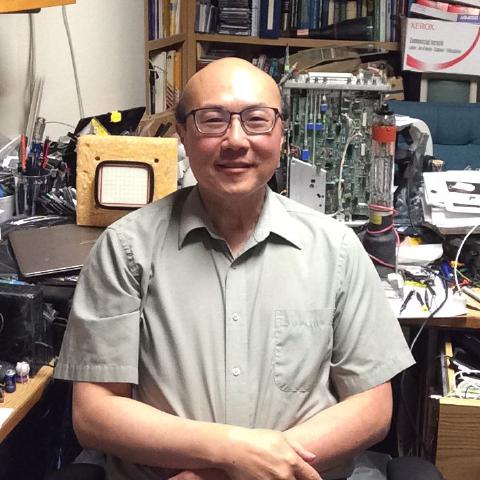
Welcome Dr Thomas (Tom) Lee of the Microwave Integrated Circuits Lab (SMIrC) at Stanford University!
This episode is sponsored by Rohde and Schwarz. Check out AskAnEngineer.us for more info about their value line test equipment.
- Tom is friends with two past guests, Jeri Ellsworth and Kent Lundberg
- Tom owns a LOT of scopes (200 or so)
- First scope was a Heathkit
- The Tek 485 had nice user design
- "I didn't like an intermediate layer."
- John Addis and Wink Gross designed the important parts of the 485
- The 485 added a superfast square wave to the front panel important for calibrating a 350 MHz scope
- Protection circuits
- Tom got started in electronics fixing TVs
- He then went to work for the founders of Wavetek (but not directly for the company) with people like Joe Deavenport
- Tom went to MIT and worked under Jim Roberge (check out the video series where Jim is lecturing on-camera)
- He proposed a thesis that was the world's first integrated CMOS radio
- Marvin Minsky
- "The thesis doesn't change the world...it changes you"
- CMOS was considered crap, was mostly used for wristwatches and calculators
- Other types of MOS and BJT circuits were considered to be much better.
- Tom used MOSIS, the IC bundling service mentioned on this program before.
- Didn't have PDKs
- Magic from Berkeley allowed Tom to see the DRC errors as they happened.
- He ended up building an FM radio...without any inductors!
- Made gyrators into inductors
- Moved to Analog Devices where he learned a lot from Barrie Gilbert and Paul Brokaw
- Moving back to California and went to work for a startup RAMBUS
- Stanford wanted someone to do RF and give a first class on RF chip design
- Tom started in 1994 and started the first microwave IC lab.
- Tom and his grad students created the first GPS CMOS receiver
- Used to be 1 GHz and above is microwave
- Many of Tom's students are (truly) seeing Maxwell's equations for real for the first time
- What are the mental models?
- Tom said he "inflicts history on students". This is also in the early chapters of Tom's book, Planar Microwave Engineering
- Maxwell didn't use vector calculus, he used quaternian form.
- Every course Tom teaches has a lab, including his undergrad lab which involves copper tape and making a radio.
- A lot of faculty have never built stuff
- He is now working with students on mmwave and 5G (because that's where a lot of the research dollars are right now)
- Beamforming to get aggregate bandwidth
- Printed electronics for power delivery, serving devices that are in the mW level not the W level
- Feature sizes of CMOS
- Tom is on the board of Xilinx
- Tom is taking a year sabbatical and working on a book about instrumentation
- He hopes to ask many of the creators about the secrets inside the test equipment he often is reverse engineering
- Jim Williams told him to buy a rubidium clock (standard) at a flea market.
- Worked at DARPA, where his office funded development of a chip scale atomic clock
- That chip subsequently released a bit of smoke in the space station...
- Read more about Tom's research on his group's website
Transcript
Tom Lee: Roden Schwartz is a leading manufacturer of value instruments designed to help you maximize your bench's performance for everyday applications. They just announced an industry-first, complete solutions with all the upgrades up front for one price. Now through December 31, 2019, save up to $10,000 on Roden Schwartz solution packages that come with fully loaded test and measurement instruments right from the start. When you invest in Roden Schwartz products, you get the highest quality engineering, plus all the bandwidth, channels, inputs, memory interfaces, and signal generation you'll ever need. Learn more about Roden Schwartz value instruments and this limited time promotion at askanengineer.us. That's askanengineer.us. This is The Amp Hour Podcast. Release September 22, 2019. Episode 459. An interview with Tom Lee. Welcome to The Amp Hour. I'm Chris Gammell of Contextual Electronics. And I'm Tom Lee. I guess I'll be talking to Chris. Welcome, Tom. I didn't think it was just going to be Tom Lee. I was thinking like professor at Stanford, author of books on RF and microwave and awesomeness stuff there, a scope collector. But I guess we'll get into all that stuff. So thank you for joining us. No, thanks for the invite. I think you're our first Stanford professor. I have talked about your book a couple times now, and you were nice enough to respond to my email. And you actually said you'd heard the show, which like my heart dropped, and I was like super grateful. But you actually are friends with some of our past guests.
Chris Gammell: Yes. Kent Lundberg and Jerry Ellsworth are friends of mine, and I enjoyed hearing their interviews. So I'm proud to be in that group.
Tom Lee: Well, thanks for listening, and thanks for being on the show. I appreciate that. So I take it you and Kent might talk about scopes from time to time. Is that a –
Chris Gammell: Yes.
Tom Lee: It's for the audience. I asked before the show. I was like, Tom, what would you like to talk about? He's like, well, I'm just crazy about scopes. And I'm like, okay. So we're going right into it. We're going to start here. What's with the scopes thing, man?
Chris Gammell: Well, it's one of those things that when you're a kid, there's a certain object that you sort of obsess on. And scopes in old B science fiction movies just grabbed my attention. And then when I actually got my hands on scopes, it was just one of these things where it was a love affair that began almost prenatally, and it continues to this day. That's great. That's great.
Tom Lee: So what was your first scope then, I guess?
Chris Gammell: My very first scope that I ever touched or that I ever owned? Why not both? Well, the first ones I ever got to play with were actually tektronic scopes that belonged to one of my older sister's boyfriends. And so he figured he could work his way into her heart by impressing the younger brother. That didn't work out too well for him, but I had fun with the scopes. But the first one I ever owned was a heath kit, which was quite a step down from the tektronics. But it was mine. Yeah, it was a price difference.
Tom Lee: Yeah, right. And you built it. I mean, assuming you built it too, or was it one of the prefab ones?
Chris Gammell: No, I built it, and I was in such a hurry to get it to light up that I soldered as fast as I could possibly solder. And I discovered at the age of, I guess I was 12, I discovered there was a tradeoff between speed and quality. So some rework was involved, and I learned a lesson from that.
Tom Lee: Yeah, but that's good for learning troubleshooting and everything. And building a scope when you don't have a scope next to you, I mean, that's its own special challenge. Is that just like re-wetting the joints over and over again until it happened to light up or what?
Chris Gammell: Yeah, and just kind of looking very carefully at the places where you have blobs and solder bridges. Clean those up. And you hope that no permanent damage resulted. And I was lucky there was nothing permanently damaged. It was fairly easy to fix.
Tom Lee: So, okay, so then how did we get from there to what was the number you stated? How many scopes do you own now? I stopped counting at around 130.
Chris Gammell: So my guess is, yeah, it's probably pretty close to 200 by now.
Tom Lee: Oh, man. Yeah, and so I was mentioning to Tom before the show too. I was like, I think I've heard of your collection. I think Paul Rako used to write about this one guy down the street who happened to have a crazy collection. So how do you get to 200? I mean, let's just say 200. That's a nice big number. Nice round number, rather. Why so many? I mean, like, are they all different or do you have multiples or what?
Chris Gammell: Well, the vast majority of them are tech scopes. But what happens is you get a few and then you leave them in the dark and then you turn around and all of a sudden they're 200. It's just they reproduce. It just happens. Is that how it works? Okay. Apparently. The birds and the bees and the resistors and the capacitors and all that? Well, what really happens is that once you are known as the guy who has a thing for scopes, then people start bringing you all this debris from basements and attics and lab cleanups around campus. Auctions and dumpsters. Yes. It was one of my embarrassments when early on here I was caught dumpster diving on campus and the dean happened to be walking by. I saw this pair of legs sticking out and he says, oh, that's the new professor. So he told that story for a while. Are we not paying you enough? Is that? You have fine dumpsters here. These are great. Some of the best dumpsters I ever dove in.
Tom Lee: Let me tell you.
Chris Gammell: That's great.
Tom Lee: That's great. How about on a usage basis? I mean, how often are they getting reused or used or tinkered with or fixed up or even just pulled off the shelf?
Chris Gammell: The techs get used actually quite a bit because I've got a setup at school, in my office also, in the downhaul lab. And then at home, for my regular use, I've got a 485, which I just love. It's just a great little box and amazing engineering in it. And the fact that John Addis, who's now a friend of mine, designed it along with his buds, Wink Gross and a few other folks. That's just amazing engineering. And the thought that went into just the user experience, everything else, it's just a beautiful piece of engineering.
Tom Lee: You know, that's an interesting thing you say that, too. Because, like, okay, so I remember my first scope, my first tech scope, rather. I had a 425M that a friend had given to me. And I remember thinking after, you know, obviously, you know, I come from a slightly later era. I had access to really nice, you know, I was very lucky to have access to really nice modern, you know, digital-y scopes and stuff like that. And so that's what I had learned on a 220 or whatever, those terrible 1990s, you know, like the gray scale screens. I didn't like those. But I ended up graduating into the nicer scopes. And then, like, going back, it was really tough for me. So, like, when you talk about the nice user design, could you explain what you mean by that? Sure.
Chris Gammell: Well, and it really is generational dependent. So I like dealing with nature, actually, at nature's level. I don't like this intermediate layer of software interpreting what I should see. I just have too many options to screw that up. And taking, you know, long strings of bad measurements is never fun. So I like being able to just directly manipulate the waveform as nature intended. And the touches that I liked in classic scopes, like the 485, things like, all right, well, you need to calibrate the probes. Because the probes are part of the instrumentation problem, and it's one that usually gets ignored by most users, and they wonder why all their measurements are crap. And you need to have some sort of a clean waveform to drive the probe so that you can adjust it and make sure it's doing the right thing. And a fast scope is a challenge because you need the thing to be clean from DC to daylight. And that usually means you've got to get this extra box to generate fast, clean pulses. Well, John Addis was as much a user of scopes as he was a designer of them. So he made sure that he embedded on the front panel access to a super fast but very, very clean square wave. So you could just put the probe there and make sure it's nice and adjusted correctly. So things like that that I loved. Plus, you know, another common problem with fast scopes is they tend to be very delicate. So it's easy to kill a $10,000 box, and that's not a fun time. So he built in all these protection circuits so that it's really, really hard to blow something up in the front end. It just disconnects you from the delicate stuff if you are running too high voltage or too much power dissipation. So I like the fact that a little red light lights up, which basically says, I just saved your ass, buddy. And if John had designed this in a later era, he could have hooked that up to the web so that every time the red light comes on, it also debits your bank account. So the shame light, yeah. Yeah, it tweets out, oh, Chris did it again. Yeah, and, you know, keeps tally on the web. And also, you know, a penny gets transferred from your bank account to his. Oh, that's great.
Tom Lee: Yeah. Yeah, a penny for instead of replacing a $10,000 scope. That's a good idea. It is. You know, so it's interesting mentioning the generational thing, too, because, like, I can't think of a scope that hasn't had that square wave thing on the front. But there obviously were scopes before that that did not. And similarly, like, yeah, I mean, all of my scopes have always been super protected. And, you know, so I'm just benefiting from the years and years and years that have built onto that 465 and the stuff before it, too. And so it's interesting from that just seeing how that works. I mean, I guess I kind of think about that, too, when I hear people talking about, you know, ESD, right? ESD is obviously a very, very real problem. But, like, you know, the last time that I had a MOSFET just kind of fail just because I had it on the bench sitting wrong, you know, like older peers used to tell me about. It's like that just doesn't happen to me anymore because there's always protection diodes and everything in there. Right. And it's just, like, benefiting from the years of experience. And I don't know if it's better or worse that I haven't experienced that. You know what I mean?
Chris Gammell: Oh, yes, absolutely. I mean, certainly the folks who work on ESD, which is a specialty unto itself, they've really upped their game quite a bit. But there are some areas where you can't even afford the capacitance of even modest ESD. So when you're working at, you know, K-band kinds of things, they have almost no ESD protection. In fact, oftentimes you'll get the device packaged in some metal thing in an instruction seat which says, ESD protection, you must be very careful. That's on you, man. That's on you. Exactly. And the guarantee is if it blows up, we are very sorry. Yeah, right. Here's the order number from the beginning of the next one. Exactly. So, you know, when you consider how low an impedance, you know, one picofarad is at 100 gigahertz, you realize, okay, that's a short circuit. So there can't be any ESD protection on it. So you're looking at the gate raw and it'll blow up if you just think about it sideways. Forget about looking at it sideways.
Tom Lee: Yeah, yeah. Well, and the thing I wanted to get into because you obviously write books and you teach people as well. And like thinking about your experience, I mean, you have many years of experience, obviously, going through the scope world and going with the RF world. And one of the things I was thinking about before I talked to you was like, you know, you've seen RF circuits for so long now. And you've done so much interesting work around it. Can you look at a, you know, a circuit with L's and C's in it and not see the response and not see, you know, just the drawings on the page? Obviously, I'm saying this as well from someone who's trying to get back into RF design and stuff like that or get into RF design. And like, so what is your experience that got you to where you are?
Chris Gammell: Um, it's like anything else. I mean, if you obsess on something long enough, you either develop some level of proficiency or you quit out of frustration. So, you know, so it's, it's a matter of you, you just put in enough hours and you're bound to get better at it. And, uh, you know, I'm, I'm old school. So I tend to do a lot of hand calculations first and then I'll do simulations later. So that sort of forces a kind of a discipline where you have to live at some level of abstraction where things are somewhat understandable. But also, you know, since you've simplified nature, you've also thrown out some phenomena that you want to double check, make sure you haven't simplified things too much. And that's where simulation tools are really great is for, uh, sort of building up on top of that foundation. But to design stuff, you really need a different set of brains than you use for analyzing stuff. And that's where simplified models really, really come into play. And talking to the guys who design the best scopes, they, you know, they, they kind of scoffed at how much dependence engineers have on simulation because these guys designed the stuff with relatively, um, unsophisticated mathematics. I mean, hardly anything was higher than second or third order, but they designed all this amazing stuff. And they said, look, you, you build the thing because you understand it or you hope you understand it. And you go take a look at it and yeah, there'll be some difference and some disappointments, but at least, you know, what it mainly depends on. So, you know, what to tweak and roughly how much, and you can converge on a successful reproducible design very quickly that way. Whereas if all you ever do is simulate, then, you know, it's just a large video game. You don't even know what the rules are. And so, um, you can waste a lot of time producing impressive output, but you've actually not made any progress. So these guys are very pragmatic. They had to be. And yet they pulled off miracle after miracle, which I'm still enjoying, you know, rediscovering because they by and large didn't write most of the stuff down. Right. Yeah.
Tom Lee: That's, that's just a bit of fun. Uh, so when you said the second order, third order things, you mean like the, uh, the auxiliary effects. Like, uh, I was actually telling this to a person the other day, like I flipped through the art of electronics, right. And I get to like Miller capacitance. And it's like, yeah, I know it's there. Obviously it's a very important phenomenon, but like, if I don't care about the capacitance first by itself, you know, sorry, the, the transistor by itself, then thinking about like these, you know, higher, higher order things like, like, uh, the corner cases and stuff like that. It's not gonna, it's not, it doesn't, doesn't matter at the beginning, at least as you're getting started with things. Exactly. So are you saying that like the, the designers kind of have that beginner's mind and focusing on the, the, the basics or what do you mean by that, that second, third order?
Chris Gammell: Oh, that's a great question. So you're absolutely right. When you're starting a design, you know, you can't throw in the kitchen sink because you'll never get to step two. So you first figure out, okay, well, what's the basic DC gain going to be, or what am I trying to get for a gain? All right. Now, then after you have some idea of what that depends on, you say, all right, well, how much bandwidth can I get out of this thing? What does that, what does that depend on? And so then you start adding in things like Miller capacitance, if you have that, or package parasitics. And you need to know, gee, I'm going to be using a SOT 23. It's going to have, you know, a Nana Henry, maybe Nana Henry and a half in series with the two outer leads and maybe, you know, one Nana Henry with a center tab. And you start doing things like that. You start adding those in one at a time as you build up from the first calculation. And either at some point you say, okay, I'm tired of this. I've got something that's very complex. Now I can't understand it. Now it's the time for the simulator. Or you've convinced yourself that, you know, these things probably don't matter and I'll build it and I'll verify whether that's true. So, but you have to do these things hierarchically. You just can't throw in the whole thing at once. You'll never understand your design. So when it inevitably doesn't work, you won't know how to fix it. So, um, right, right. So really the art of, of design is to know what is the simplest model that preserves the relevant features of what you're trying to get at.
Tom Lee: That's a, that's a great bit of, of advice there. Um, and I think that from a, you know, thinking about when it hits the real world too, like from the manufacturing perspective, and I think you, you, you'd said something like this already as well. But like from the manufacturing perspective, then you're, you're starting to tweak things. And if you're really caring about that one thing at the beginning, then you know, that's your most critical, uh, your most critical, uh, spec you need to get at. And then you start to worry about the parasitics and everything else that might end up playing into the same, the same, uh, arena. Right. Exactly. So, uh, as you were getting started, I mean, so you started with scopes early on, what were you, what were you, were you just measuring other scopes or, uh, were you building things up for the radio? I mean, for radios or, or, you know, what was your, um, you know, what were your early days of electronics and stuff?
Chris Gammell: Um, I, well, boy. So I, I started building stuff when I was in kindergarten, didn't understand any of it, but just had fun building it. And, you know, sometimes things even worked, which was a miracle. Um, but by the time I got to the scope part of it, I was fixing TVs and, uh, a five megahertz, uh, Heath kit scope was good enough to get through most of the circuits in a TV. So it matched the, the business that I was in at the time.
Tom Lee: So at 12 years old, you were playing with like 400 volt plate, plate voltages or. Oh yeah.
Chris Gammell: Or 25 kilovolt, uh, second ano potentials on, on color CRTs. Yes. Wow. How do folks feel about that one? Well, I don't know about my folks, but I certainly felt that the sting of high voltage was a very, very good teacher. That's right. That's right.
Tom Lee: And then, I mean, so that was kind of working through just repair. And it's interesting too, because that is a common theme that we hear from, from people is the repair side of things, uh, over and over again.
Chris Gammell: Oh yeah. And I think it was much more common back in my day than it is today, because now when you open something up, it's just this board with a zillion layers and tiny, tiny little chips that are, you know, have house numbers on them. You don't even know what the hell they're supposed to do. So it's a lot harder to get connected with cause and effect that way. Although you learn about capacitors very quickly. But, uh, the, uh, but back in my day, you know, I actually started off in fixing vacuum tube televisions. And that was ideal because tubes were pretty simple devices. Uh, you know, an elementary school kid could grasp the basics of how the thing was supposed to work. And the functions were so basic that, oh, okay, this handles vertical things. I'm seeing a vertical problem. So it's probably around this tube, but if it's not the tube itself. So you, you sort of build up an expectation that you can understand it. And with each success, you get a little juice and you say, wow, this is really fun. I'm, I'm loving this. So just keep going.
Tom Lee: Right. Yeah. Those dopamine squirts, they're, they're addictive. They are. They are. What did that lead to then? I mean, was that kind of your up through into the college world and things like that?
Chris Gammell: Yeah. It just built up from there. It turned out I was lucky that one of my classmates in junior high school, uh, was the daughter of the guy who founded WaveTech. WaveTech. The WaveTech made, um, function generators popular. Oh, wait. Okay. WaveTech. What do I think of? Back in the 1960s. Yeah. They don't exist anymore. They got absorbed along the way, but for a while they were the company that advertised in the back of popular electronics and, you know, everyone wanted a function generator from WaveTech. And later on her dad and the guy who designed the first function generator for the most part, uh, went off and did another startup. And so I joined them for the summer and, uh, got to meet Joe Davenport, who, um, was one of the most natural analog designers I've ever met. He could just sort of look at a circuit and say, ah, you need about a puff and, you know, 10 K and it'll fix it. Man. You know, and I would reach for spice and he would just laugh. He'd say, why are you calculating? In the time that it takes you to enter the net list, I'll have the thing working, you know? So yeah, yeah, yeah.
Tom Lee: Man, that's crazy. And yeah. Just from like looking at waveforms or what was he, what was he looking at in order to say that sort of thing? Oh, you know, for example. Or just like looking at the circuit.
Chris Gammell: If the loop was, uh, unstable, if it was oscillating at some frequency, he could quickly calculate what element was likely causing the lack of phase margin and then he, and then how to fix it. And so, oh yeah, you need to move that pole over this way. And, you know, you kind of got 10 puff already, you know, you shove it over by adding another of this and add the resistor in the right place. Oh man. And, uh, you know, so I was very impressed by the fact that he could just look at it and from a single waveform, figure out with good certainty what it was that was causing it. And then what step two should be. And I just thought that was great.
Tom Lee: I loved working for Joe. And so is that, is that something like where you learned that skill then as well? Is that something you absorbed?
Chris Gammell: Um, well, it kind of reinforced my natural habit anyway, because I was too stupid to be able to do the math when I was starting out. So I had to build up some intuition, but it was all very ad hoc and piecemeal and there are lots of big holes in it. And, you know, when I got to MIT, MIT was very much not build this physical thing. It's, oh no, no, we're going to abstract reality. And it's all this purity of physics. And, uh, that kind of drove me a little nuts for a while because I thought, gee, this isn't fun anymore. What happened? Yeah, right, right. And then they go back, you know, and, and build some circuits and then all would be right with the world again. And it took a while for those two parts to converge. And then luckily I found a professor at MIT who had, I think just the right look, the right way to look at these things. He had total command of the math, but he knew when and when not to yield this tool. And, uh, so he had probably the best taste in how to go about doing these things. And coincidentally, he ended up being both my PhD advisor and Kent Lundberg's advisor, which is how we ended up knowing each other.
Tom Lee: I've wondered about this as ham radio kind of tailed off. I think it's having a resurgence now, but I've wondered about that. And like, uh, people entering into, uh, the electronics sphere, like, or I guess school as well, like having, having at least a background in RF and electronics and kid building and stuff like that, and then layering the math on top of it. And my experience was dead around way around. Actually, it was like, you know, math first and then clawing my way into the practical. And, uh, it was tough. It was really tough doing that. And I think the people that, uh, I saw succeed really strongly, like we're like what you're talking about. They had the background and then they're like, no, no, no. I, I know why I want to learn this math now. I mean, do you see that now as a professor or did you see that as a student or, or is that maybe not your experience?
Chris Gammell: Well, I mean, your experience is fairly normal. I mean, I had that problem when I was a student. I, am I, I see my own students struggling with this thing where if they start with the math, they can get through the math just fine. You know, it's hard, but it doesn't necessarily set them up really well for dealing with what they encounter in the lab. And, uh, because nature turns out to want to hurt you and it will always surprise you with some behavior that you didn't think about. It's in the math, but you know, you don't have time to explore every possible case. And for me, starting off with the experience and then overlaying the math on top of that was easier for my puny neural net to handle. Um, but I find, but I find, you know, students are, you know, they're all different. They come in different brands and operating systems. And some students, you know, they see everything through this lens of mathematics and great. That's fantastic. So you, you try to teach them a different way than you teach the ones who want to go with a soldering iron and their simulator is a roll of solder and a pile of FR4.
Tom Lee: That's right. Yeah, that's great. That's great. Yeah. So, so, okay. So you went through and you, uh, you did a PhD with, uh, what was your, what was your advisor's name? Uh, Jim Roberge. The late, great Jim Roberge. And so what was your, uh, what was your thesis on then?
Chris Gammell: It was the world's first CMOS radio. Really? As far as I can tell.
Tom Lee: That's, that's crazy.
Chris Gammell: It is crazy. And when I started this in 1985, um, I guess friends who were concerned with my sanity said, you know, you should talk to other people about this project. And so I, I sought out different people. And one guy that ran to says, oh, you know, you should talk to Marvin Minsky, the father of AI. He's a genius. And if anyone can tell you about the future, oh, that's interesting. Sorry. I didn't realize that was hot key.
Tom Lee: This is, I feel like I should go out and bat a few, uh, Oh my gosh. I'm not sure if that actually is going to come through the recording, but I hit a sound that made it sound like a charge sound at a ballpark.
Chris Gammell: I guess it's a seventh inning stretch or something. Yeah. Oh my God. Sorry about that. So I went and talked to different professors and I, you know, I, I go talk to Marvin Minsky who I, and I had a passing acquaintance with. And, uh, so he listened very patiently. He said, now, wait a minute. So you want to do something in RF. Why do you want to do RF? I said, well, cause I've, I've always been interested in walkie talkies and stuff like that. So I find wireless fascinating. He says, well, that's kind of a solved problem. There's nothing new. Oh wow. Yeah. So this is, you know, 1985 and there's really nothing new in wireless. And I said, well, still I will press on and I'd like to, you know, take CMOS out of wrist watches and calculators and see, you know, cause it keeps scaling and I don't know what's going to end, but you know, if it just keeps scaling for a while, we'll be able to do some credible RF with that. And he says, wait a minute, CMOS, that crappy cheap technology that's so slow. And so he says, you know, Tom, I hate to tell you, but you've got just terrible taste in picking problems. You know, so you want to solve a solved problem with an inferior technology. That's just not smart. In fact, that's stupid squared. Wow. Oh man. So I said, thank you. Not the most encouraging. Okay. Okay. So I go back to my advisor, I go, Jim, you know, Marvin Minsky thinks that this is stupid squared. And he said, yeah, why do you care? Well, I'm not sure I want to start off my career being known as the stupid squared guy. And Jim just said, well, look, don't worry about this. You know, you don't see a whole lot of MIT PhDs and double E out begging for change at intersections. So it's not like you're going to be homeless or anything. So don't worry about it. He says, the thesis is not supposed to change the world. It's supposed to change you. The job of this is just to pick something hard and learn how to teach yourself because the field changes so fast that, you know, you're going to have five or six revolutions between now and the time you retire. So just pick something hard and learn how to grasp it and, you know, wrestle it to submission. And you'd like this for whatever weird reason. So go do it. And I thought that was the best advice I ever got.
Tom Lee: That is such great advice. And that is so countered. I mean, I hope this doesn't offend you or other college professors, but like, I haven't ever heard of any advice that good coming from a thesis. Like, that is so lucid and like, great. That is just like, I hope people are listening. And like, that is just really great advice.
Chris Gammell: It was really the best advice I ever got. And then he goes one step further, which I laughed at it because I said, you know, if you're trying to motivate me, that part's not what happened. But he says, look, most people's theses are so irrelevant that you could put a hundred bucks in the middle of your thesis, put it up on the library shelf, come back 30 years from now, and the hundred bucks will still be there. It'll be worth less just because of inflation, right? And I thought, well, Jim, but that's a motivating speech. It's not quite the job done. But no, but I understood his point. I thought it was brilliant. It was absolutely true. And so I passed that advice on to my students. So don't get too worked about trying to find the perfect thesis topic that's going to match the big trend of the day. And it's going to get you that great first job. Just, you know, chill.
Tom Lee: Yeah.
Chris Gammell: Wow. That is really good advice.
Tom Lee: Could you give us a little bit of an idea? So people that don't know about like 1985 CMOS, you know, everything, you know, people think about CMOS now. It's like, okay, yeah, CMOS. Great. There's nothing else. 85 CMOS. What was the tension there?
Chris Gammell: CMOS was considered to be, because of its lineage, CMOS started off finding a little toe hole in the marketplace for wristwatches because it was capable of low power. But it couldn't go fast. But that's fine for wristwatches. And then it kind of worked its way into calculators. And then there was talk in the 80s about maybe, you know, the low power aspect is important because we're starting to burn some serious wattage in these microprocessors. There's, you know, maybe the power limit is going to be overarching. And so maybe CMOS is something we should consider. So the mid 80s was when the industry started to make transition toward employing CMOS and microprocessors and memory. And, you know, now it's ubiquitous. You can't find things that aren't CMOS really. It's hard. But back then, it was very much a debate whether CMOS was ever really going to be a mainstream technology.
Tom Lee: Yeah.
Chris Gammell: It's kind of funny, but that's the way it was. Yeah.
Tom Lee: Well, and so what was the high power technology as well that you were talking about? Is that like ECL logic and stuff?
Chris Gammell: So before CMOS, there were several technologies that were vying for primacy. Bipolar stuff like ECL logic was certainly part of the mix for the high performance supercomputer crowd, but there was also NMOS, which just, you know, they knew how to make NMOS. So if you wanted P to get CMOS, that was still in the future. So we had NMOS, which was okay, but it was kind of a high power because you used depletion loads, which burned static power. So you couldn't put a lot of gates on without getting some heat. And even before then was MetalGate PMOS, which was relatively immune to sodium ion contamination, which had sort of made MOS unattractive for a long time. So the early calculator chips that I played with were MetalGate PMOS with negative supply voltages and all sorts of goofy bias requirements. Oh, wow. Yeah.
Tom Lee: And was that done with like charge pumps and stuff like that to get the minus? Or they actually just had big power supplies on them?
Chris Gammell: Oh, charge pumps were, yeah, just had power supplies, external things. So, you know, charge pumps were a gleam in some insane designer's eye.
Tom Lee: Right, right. Okay, okay. Yeah, I guess, yeah, to get a switching supply at that point would have been kind of tough, huh?
Chris Gammell: Yeah, there were a few of them out there, but they were mainly in aerospace.
Tom Lee: Right, right. Yeah, I mean, that's the crazy thing to me. Like how much stuff I take for granted these days. You know, just like, you know, I go to a website and it's just like, oh, you know, we've got 400 different types of buck converters and a thousand, you know, a thousand linear regulators on this and like things that are just based on like layers and layers and layers of technology. It's insane. It is insane. Yeah.
Chris Gammell: Yeah. Well, I love showing my students the first PO from MIT to Fairchild for the ICs that were going to be inside the lunar lander for the Apollo program. And I asked the students to guess how much Fairchild was going to charge for a single three input Norgate. And, you know. $10,000 at least. Oh, that's a pretty good guess. It actually turned out to be pretty reasonable because Fairchild was willing to sort of take a hit in price at the beginning in order to stimulate a business. So they were only going to charge $43.50 for a three input Norgate. Oh, okay.
Tom Lee: All right. Well, I was way off. Yeah. Orders of magnitude off. I just remember like reading about like early, I guess, like Apollo days, like in early Fairchild. I remember seeing like some high numbers for transistors and stuff, but I guess not that high.
Chris Gammell: Yeah. Well, they came down fast because they found out that there were very few buyers at those high prices. Oh, right. Right. And it was one of Bob Noyce's bold moves to assume that they were going to get the cost out in the future. So let's go ahead and price it as if we're already living in the future in order to make the future happen. And it was a pretty controversial, gutsy move, but they decided to do it. And boy, that worked. You know, we'll lose a lot in the beginning, but we're going to make it all up in the tail end, we hope. And that was a gamble that paid off.
Tom Lee: So, okay. Okay. So you were, so now you're doing your thesis, working in CMOS. Are you like, you're in the MIT fab and working, working directly on process stuff or what was that like?
Chris Gammell: Oh, thank God. No. Yeah. I can't cook. And that turns out to extend to running a diffusion furnace. But the, you know, we fabbed it at, this was through Moses, which was this central point that's kind of aggregated fab services and match them to universities and put pizza mass together. So we could all share the mass cost. And I think mine was actually made by a fab called Orbit, which I don't think exists anymore. And it was an exciting three micron CMOS. Yeah. Yeah. Yeah.
Tom Lee: That'll happen. So, so then you were working with a kit then, like a design kit or whatever they call those.
Chris Gammell: Well, at that time we didn't really have PDKs. And so we had, so we had a list of design rules. And so I fought with the primitive CAD tools that we had available at that time. And it took me, I remember about a week to just lay out a single transistor and have it pass all the design rules.
Speaker ?: Wow.
Chris Gammell: And I thought, I'm never going to graduate just because I'm so, you know, maladroit at drawing stuff. And, but thank God, Berkeley came along with a tool called Magic, which had running in the background all the time as you were laying down polygons, a design rule checker. And so if you tried, if you laid something down that violated a design rule, it would start blinking at you. And then you could click on that and it would tell you what rule you, you had violated and you had a chance to fix it more or less in real time. So after I learned how to get up to speed on Magic, I finished my trip in like a two day marathon. So thank goodness for good software.
Tom Lee: So what is the hard part? I mean, like, obviously you've done a lot of stuff since then, and I know that we're still at the beginning here. But I feel like this is maybe graspable for people that are, you know, at the beginning of their careers as well. Like what, what is in a CMOS radio at this point? I mean, like what is, what is in the circuit?
Chris Gammell: Well, that turned out to be a real problem. I actually struggled quite a bit with, first of all, what kind of a radio am I going to build? What can I build? Because the circuit, the transistors were so slow. So it turned out the fastest thing I could imagine building was actually an FM radio. And, but you still need to have tuned circuits and to make tuned circuits that resonate at a hundred megahertz requires some fairly good size inductors, which you can't integrate. So most of my thesis challenge was really how to make electrical analogs of inductors, but without coils of wire. So, so I figured out how to do that. They weren't very good. In fact, they're pretty crappy, but that's all I had as an option. If I didn't want to use external inductors and I didn't want to, I wanted to integrate the whole damn thing. So I had to build these things called gyrators, which convert capacitors into inductors and also give you electrical tunability, which I needed because the models were not very accurate. And so that's what I did. I built an FM radio on a chip with no, no inductors.
Tom Lee: Wow. That is super cool. And obviously you are now Dr. Dr. Tom Lee. That's cool. So where did that take you then? So you built this, I mean, you built this, uh, did you go straight into academia or, or did you go to industry first?
Chris Gammell: I went to industry first, uh, because, you know, so I got done as Marvin Minsky predicted, no one was interested in CMOS radio. And the, the cell phone revolution was just on the beginning of a, of the hockey stick, but it hadn't actually gone very far up. So no one was talking about, um, cell phones at that point. So I graduate and I figure I'm just going to do analog stuff cause I like anything analog. It didn't, it didn't have to be RF. And analog devices showed interest along the way somehow. So I ended up working for analog for a couple of years, loved it. I got to meet people like, you know, Barry Gilbert and Paul Brokaw, these amazing legendary creatures. Um, and they were just incredibly brilliant and super nice to a newbie. I mean, they spent endless hours answering stupid questions without ever once saying, what an idiot, you don't know that.
Tom Lee: So I know it's like that fear that like, someone's going to say that, like, I'm like, oh man, someone's going to find me out at some point. They're just going to, they're, they're going to just turn around and say, no, Chris, I'm not going to answer your question. It's like, no, they want to help.
Chris Gammell: Like they were there too, man. Like that. Yeah. Exactly. So, uh, so that, that was a fun time. Uh, but I, you know, I grew up in California and I was always kind of hoping to get back to California and, um, sort of within a couple of weeks, I got contacted by a university in Southern California as well as a startup company here in Silicon Valley. So I interviewed with both and I ended up going with the startup and that's, that mysteriously led to a lateral shift over to Stanford after a couple of years.
Tom Lee: Yeah. Wow. Okay. And, and I mean, Stanford is, uh, you know, I've, I've heard of that school. It's, it's, uh, it's a pretty, pretty darn good school. So how did you, you shifted them back into academia, which is awesome. Uh, how was that shift for you though? I mean, like, was it something you wanted to do? Or do you, I'm guessing you still work with industry, uh, tangentially, you know, from the research side. Yes.
Chris Gammell: Well, you know, it was one of these things where, you know, I always had it in the back of my mind, but it was definitely in the back of my mind. Part of it was my father was an academic. He taught at UC San Diego medical school for his entire career. And I remember growing up only hearing about complaints about petty personalities and fights over lab space and that sort of thing. It always seemed like a very unappealing kind of lifestyle. And then I, it was really shocked when I got my PhD, my father said, so what schools are you going to apply to? And I said, dad, I just finished school. I'm getting out of school. The vector points in the out direction. He says, no, no, no, no. What, what faculty do you want to join? I said, uh, I'm really confused. And, uh, so when I told him the impression that I had growing up, he says, oh no, no, that's human nature. People don't talk about what makes them happy. They talk about what makes them unhappy. So, so you have to, you have to run an inverse filter on all the memories and it's actually, you know, a pretty good life. And so I said, well, now thanks for telling me. Yeah, right, right. Some footnotes here would be helpful. But, um, it wasn't something that I really thought of as, you know, I got to do this, but it happened by accident working at the startup called Rambus, which had by luck been founded by a Stanford professor. Did you say Rambus? Rambus.
Tom Lee: Like the makers of memory and holders of many patents.
Chris Gammell: Yes. And at one time, the vicious wielder of those patents against any at all.
Tom Lee: Yeah, I was going to say, that's why my, uh, Dell 8100 didn't, uh, didn't get a memory upgraded for entire life. Thanks to RD RAM. RD RAM. Yes, there you go. I had exactly 128 megabytes in the nine years I had that computer. It didn't work out well.
Chris Gammell: Well, the PLLs and that DRAM may very well have been designed by me. Really? Yes. Wow. That's awesome. Well, I don't know about that, but it was, it was fun doing analog stuff in a company that was largely a digital company. Yeah. And, uh.
Tom Lee: Were you like, were you like the alien? You're like walking the room and like hushes down and like, oh no, he's here.
Chris Gammell: Yeah. Well, it was a really weird vibe when I interviewed, uh, cause it was close to Christmas. So actually a lot of engineers were out, uh, for the vacation, but you know, they told me that you will be working with this guy who's going to be the analog guru and you'll be kind of the newbie. And I said, that's fine. And so then I take the job and I show up and I said, so, uh, you know, where's the guy I'm going to be working for this? Oh yeah. Well, there's been some updates. He's gone. And so now you're the guru. That's right. Congratulations, sir. And I said, well, that's, you've been upgraded. Yeah. Well, I said, that's not good. That means I'll be working for an idiot. And, uh, so it all worked out fine. Then it turned out that Stanford decided that they needed someone to do RF and, um, so that's sort of how I ended up here. And so totally unplanned.
Tom Lee: Well, that's great though. I mean, so, and you were, I mean, you're doing PLLs. I mean, what were the frequencies of the PLLs that you were doing?
Chris Gammell: Oh, at the time it was for a, a 500 megabit per second interface. We ran the clock at half that rate and went on both edges. So it's 250 megahertz PLL. And for, for a 0.5 micron technology, that was, that was pushing it.
Tom Lee: So, I mean, then the jump to RF, I mean, obviously that's, you know, 250 megahertz isn't a low number, uh, but, uh, what were you expected to do on the RF side of things? I mean, was it, did you come in as a teaching side or the research side or what was your, what was the, the pitch to get you in there?
Chris Gammell: Yeah. So Stanford, uh, is kind of typical of a research university where you're supposed to do research and then teach the next generation of students to do more of that. And so I had to teach classes. I had to create the first class on, uh, RF IC design here, um, and started, and started the CMOS microwave lab here. And so that was a lot of fun. So I, uh, my first book was written, the first draft of that book was written in nine weeks.
Tom Lee: And, um, okay. So, so like a student, a student experience as well, kind of the, the cramming or the, uh, the final, the final, uh, yes.
Chris Gammell: And I don't remember very much of it at all because I would write all night long and then I would have to hand the stuff over to my suffering admin who then cranked out a bazillion copies just in time for lecture. I'd give the lecture and then I do it all over again. So I was physically exhausted at the end of that time. Oh my God. Um, but much like my first oscilloscope, there is a trade-off between speed and quality. So it took your students, students found a couple of typos, huh? Well, a lot of them would just scratch their heads like, what the hell? And I'm sure they still do that at the book, but at least the book has fewer of those than the, uh, the first pile of notes. But, uh, yeah, it was a, it was a pretty interesting time.
Tom Lee: I do remember I had one professor who was, he gave us like notes that were, you know, a book, you know, like with a binding, the, the, the spiral binding on it. And it's like, uh, this isn't really a book, but it still had the cost of a book. Oh, well, that's. Yeah. It was very ballsy on his part. And then he's, and then he's like, he's like, and if you, uh, you know, if you find a typo or an error, you get an extra credit point. And it's like, come on, man.
Chris Gammell: Give us some cash. Yeah, exactly.
Tom Lee: Right.
Chris Gammell: Right.
Tom Lee: What's this extra credit points? That's right. Right. Well, that's great. I mean, so, and that kind of like high pressure cooker, uh, method of, of, uh, of cranking stuff out. It's, it's, it's not easy, but it's effective. I'm guessing it, it, it definitely pushed it on the track. So you were, you were writing the lectures and the book at the same time or how did that work?
Chris Gammell: Yeah. Well, uh, so I have a, so I never prepare for lectures and it shows, but the, uh, my lectures
Tom Lee: are all. I've talked to multiple, multiple past students of yours and I would actually disagree with that. So, uh, yeah, yeah.
Chris Gammell: That means the payments are working, but, uh, so, so the writing was just the, the challenge, just making sure that at least the equations were more or less correct, at least dimensionally consistent. And, uh, the, the lectures in class would just flow from whatever I needed to talk about and would fill an 80 minute period.
Tom Lee: And so you'd said you'd meant you, you were, you know, kind of start, you're starting up the group there, the lab as well for CMOS chip designs. Is that, is that correct? Correct. For CMOS microwave. Yeah. CMOS microwave. Great. Right. Um, so you were basically teaching kind of that leading edge, like you were talking about. Yes. What was kind of the timeframe of this and like, what was the, the, the state of the rest of the world at that point? Like what, what were people putting out in industry versus what you were teaching and researching on?
Chris Gammell: So this was, so I started on the faculty in 1994 and at that point there were a few other universities that were starting to publish on bits and pieces of RF things. And, uh, but most of these were kind of in the nature of early explorations. Like here's what we, we built this amplifier and it does this. And there wasn't a whole lot of solid theoretical foundation showing how you could do better or what the ultimate limits might look like and whether there was actually a, a pathway to getting to cell phones and things like that. And so I sent my first dozen students, my first dozen PhD students to push all of this stuff. You know, what makes noise and oscillators, what makes noise and amplifiers, how do you architect a radio and that kind of thing. So we built a, um, the world's first CMOS GPS receiver. Really? Wow. All 12 of my students contributed to pieces that we pulled in some master students to fill in the gaps. And we got this thing all put together and unbelievably we turned it on and it worked. Wow. It was, it was truly extraordinary. And all those students have done very, very well. Several are managers at, at Apple. Others have started several companies. Um, others are faculty members at name brand universities. Uh, that was really an extraordinary group of, of students. I was very lucky as a junior faculty to have that as my first 12 students.
Tom Lee: Yeah. Wow. That's, that's awesome. Yeah. And so, and, uh, uh, 1.525, is that, is that right? What is the frequency of, is it 1.525 gigahertz? Uh, 1.575. 4.2. 1.575. Okay. Yeah. Um, so I, I was just going to get at like, what is it? So when you say microwave, what is the, what is the frequency range you usually use when you, when you're, you know, saying microwave on CMOS?
Chris Gammell: Oh, that's a great question because the definition has changed so much. Before it used to be one gigahertz and above is microwave. Uh-huh. And I've sort of argued for a different way of looking at it because it shouldn't be some arbitrary number. It should probably be tied to the way that you think about and design circuits. And that changes depending on whether you're doing a discrete thing or doing an integrated circuit thing. And it really, for me, it comes down to, do I have to worry about transmission lines or not?
Tom Lee: Uh.
Chris Gammell: And if I have to worry about transmission lines, I'll call it a microwave thing.
Tom Lee: Interesting. You said, uh, integrated versus discrete is different.
Chris Gammell: It's just the physical scale. So if you have objects that are small compared to a wavelength, then you can more or less ignore the fact that there are waves. And that's where you have, oh, here's a capacitor. There's an inductor. Here's a resistor. You can localize where energy is stored and how it's stored and where it's dissipated. And so if the energy is stored primarily electrostatically, you call that a capacitor. If it's stored in the magnetic field, you call that an inductor. And as long as the objects are small compared to wavelength, you can make that, uh, one-to-one identification. You can say, ah, here underneath my finger is where the electric field is. So there's a capacitor. And over there, that current carrying wire, that's an inductor. And so my way of thinking about circuits and modeling them and simulating them is going to be the same as if I were doing a one kilohertz thing with discrete. And it's only when they go really, really fast so that the wavelengths are similar to the structures I'm able to build. That's when you start to worry about, okay, I'm going to have to think about this really as a wave. And I can't say the energy is only electrostatic here and only magnetic over there. It's all kind of distributed. And that point, I can no longer talk about a capacitor and an inductor as being separate entities.
Tom Lee: Wow. Okay. That's great. I, I, the last thought I had before you finished your sentence there was, oh my God, I'm thinking about the math too much. I don't know what to ask Tom next.
Chris Gammell: Don't worry. There won't be a quiz on Maxwell's equations.
Tom Lee: Oh my God. Oh my God. Yeah. This is, uh, yeah, this is, so, so when you have students coming in, I mean, you have PhD students coming in there, you have graduate students as well, like, like master's students as well. Is that, is that right? Or no? Yeah. Yeah. I guess they're all the same thing.
Chris Gammell: So yeah, we take everybody from, from bachelor's to, to PhDs. Um, Stanford doesn't require a thesis for anything except PhDs. So, you know, PhDs are the ones that I spend the most time with, but certainly.
Tom Lee: Sure. Sure. So what is, what is the, uh, what is the, as my brain melted there, what is the level of your students coming in? Uh, like, like how much, how much are they learning or relearning coming into a program like yours?
Chris Gammell: Oh, well, a lot of them are seeing Maxwell's equations for real for the very first time. Yeah. Um, and so some of them struggle with it because they, they might find the math inaccessible or just uninteresting. So they won't, you know, get into it as much and trying to make it fun for them is always a challenge and it gets worse every year. Uh, but counterbalancing that the students that are coming in are increasingly very adept at using tools. And so you can challenge them to run some experiments in software land that help bring Maxwell's equations to life or some other issue to life. And some students really get into that. They start writing all sorts of interesting scripts to take the data out of this tool and mashing it up with something from this other tool and they can present it in a way that's visually appealing to them and helps their intuition. So, um, you know, I, some, some older faculty complain about young kids today, but they've been doing that for hundreds of years. Yeah. I have a feeling that Plato was, you know, was probably complaining about these young kids today. They wear their togas funny. That's right. Their sandals just are so, so crazy. So, um, you know, so I just, I just go with whatever initial conditions they have and.
Tom Lee: Yeah. That's right.
Chris Gammell: I'm trying to convince them that, you know, here's what you want to know and here's what you need to know and here's why. And then, you know, it's up to them to accept or reject it as they see fit.
Tom Lee: Uh, I, if you don't mind me interjecting some of my own learnings. So I gave this talk about RF and I'm obviously still learning a bunch of RF, but I was actually doing more research. I was just trying to finish up this talk before I gave it in Germany. I was there. So I was in the middle of a field with a bunch of hackers around and I'm like stressing about Maxwell's equations and like trying to get just my head wrapped around it again. And, uh, what, how do you do that? How do you, how do you, how do you make it fun? How do you, how do you help teach that stuff? Cause it's so much, um, you know, there's vectors everywhere and matrix math and like, how do you, are you giving intuition? I mean, are you trying to create mental models? What are you, what are you trying to impart into them?
Chris Gammell: No, that's a fantastic question. I actually don't teach a special course on Maxwell's equations. I try to give what I hope is a summary, but I know that it's oftentimes the first time they've ever heard it. I tend to inflict history upon my poor students, whether they want to hear it or not. Um, I just forced them to hear the history because then you start to understand, okay, why the world looks the way it works. You know, why do textbooks present it this way? It's not the result of some cruel person trying to inflict pain. It's just a necessary consequence of having tried every other way of explaining it. And those were worse. And so I talk about Faraday a lot cause he's one of my heroes and, uh, how he contributed all of this. And then Ampere, of course, and the, the classic experiments. And then the, the miracle stroke that, uh, Maxwell invented, uh, actually, as it turns out, based on a supposition that Faraday communicated to him. And luckily Faraday lived long enough for Maxwell to have finished the equations and shown them to his mentor and say, you know, you were right. Electromagnetism and light are the same thing. And, um, then the big fights that emerged after Maxwell died over what's the right way to teach it. Maxwell did not use vector calculus. Vector calculus was an invention of the Germans. And there was this big cultural thing between the Brits and the Germans. And so anything German must be bad and we must do the opposite. So there was this type of math called quaternions, which had been invented by Hamilton. Yeah. And, um, so for a while there's sort of this religion that thou shalt teach Maxwell's equations in quaternion form. And, but guys like Heaviside in the UK and Gibbs in the US took the stuff that Gauss had done and said, you know, this is actually the right way to put all this complicated stuff under one simple framework. And they were the ones who worked over decades to convince textbook authors and academicians to use vector calculus. It took a long time. And, and really not until World War II came along and, you know, with it radar and the demands for understanding microwave, did Maxwell's equations really take the form that we're familiar with now. So it took a long time.
Tom Lee: Yeah. Yeah. And I was, uh, you know, I was thinking as you were saying all those things and all those names and everything like that, I was like, you know, I've read this history before. And I was like, oh my God, it's the first chapter of Tom's book.
Chris Gammell: I told you I inflict history on everyone. That's great.
Tom Lee: No, that's great. And I have been telling everyone about, I've mentioned on the show a couple of times. It is, um, boy, it's, you know, Tom, it's a pretty thick book. It's I'm only, I'm only a couple of chapters in still, but it's, uh, I love, man, I love this. I obviously talking to you, uh, obviously you're, you're a funny guy and you, you have this great writing style and like, it's just, it's really good. Uh, it's, it's, it's, it's tough material, right? But it's, it's, uh, it's good. It's good to get it all out there and have that, that history piece in there. Well, I'm glad you liked the history. What else should people know about that book? I mean, like, how do you, how do you expect people to use it? I guess.
Chris Gammell: Oh, that's a really hard question to answer. I, you know, cause as you can tell, my writing style is pretty idiosyncratic. It's not like most, most textbooks. There aren't a whole lot of, um, I don't know, recipes for doing, doing a design or something. And so students who are looking for, you know, just give me the facts, you know, tell me what three steps I need to take to design the sample fire. They'll be frustrated. Where do I plug in the numbers that I need? Exactly. They'll be, they'll be frustrated with a book. They prefer other books and there are luckily lots of other books out there that take that approach. I sort of just like the culture of the intellectual effort that went into making all this stuff happen. And so I spend more time probably on those kinds of things and than other things. And, and perhaps, uh, to the detriment of the book, but you know, that's my style. And as I say, there are lots of books out there that can compliment or displace whatever it is that's lacking in this. And, um, so, so students are interested in sort of the way to think about the designs. And again, part of this echo is what my advisor was saying, you know, don't necessarily focus on just the tactics of how to get this thing done today. Think about building your intellectual scaffolding so that you can put other things on top of it as technology inevitably changes. That's right. You know, what, what's, what are the invariants, what are the intellectual invariants that you can rely on to guide you no matter where technology happens to lead us?
Tom Lee: Yeah. And that's, that's a good, you know, so I have, I've actually pushed back on that before, um, only because, uh, so I've had professors who, who said that and, but they said it actually, I don't think in the same case that you're talking about, but they, they said it because it seemed like they didn't want to update, uh, their, their material. They didn't actually want to update, like they didn't want to do anything like modern code wise or any, you know, anything, modern tools. And like, I get that, like, but like choosing something that's like quasi modern is better and like having a hands-on component. That's what I've always pushed back on is like, give me anything that's like modern now that I can have hands-on and then I can rework that in my brain later and then apply it those same techniques later. Uh, but instead they're like, well, we'll just, you know, have you fill out forms and, you know, theory stuff. So, but it seems like you do a lot of hands-on stuff anyways. Right. So it's not like that's a problem for you.
Chris Gammell: I mean, you're doing, I add labs to almost every class that I teach. In fact, I'm trying to think of anyone that I don't have labs and there are not all my classes have labs. Awesome. And, uh, you know, students and, you know, they, they end the course uniformly enjoying the lab experience, but half of them, and they start off. Being really frightened and experienced. I've had students say, you know, I'm really not good in lab. And I said, well, you will be at the end of the course. Oh, I don't know. I almost burned down the house when I was seven. I said, no, that's perfect. Me too. And so, you know, we have fire extinguishers. Exactly. We have the technology to deal with that. That's right. Yeah. And, um, in fact, in the, uh, uh, first in the sort of the advanced undergraduate RF lab class, I give students literally just FR four discrete devices, an exacto knife and copper foil tape. Oh man. And their job is to make a radio out of it. And they do a piece a week. And by the end of the term, their job is, you know, can we actually get radio signals through this thing? Yeah. And, um, it, by the time.
Tom Lee: That's actually the one that my, my former coworker told me about when he suggested your book. That sounds, that is just such a great idea for lab. I mean, like, it's tough if you're not getting there, like the people, like everyone thinks they're not going to get there. But if you're working with your classmates and you're following along and like doing all the work, it's yeah, you're going to, you're going to get a radio, you know, that's great.
Chris Gammell: Absolutely. And, and you, you learn from your classmates because they're all struggling with the same things. And, uh, it's just really fun to watch these students come together and all of a sudden kind of by week seven, they're looking like, Hey, you know what? I understand this stuff. I got to get this to work, damn it. And they're all of a sudden spending every night in it because they're just having fun exploring other ways to do it. And it's, it's really great to see.
Tom Lee: Yeah. That, so why isn't this more prevalent? Um, if you could, if you give me a, uh, an insight into the entire, uh, you know, teaching world, uh, why don't, why don't, why doesn't this happen everywhere?
Chris Gammell: I, I don't know. That's a good question. I mean, I've, I, part of it is certainly that the, the percentage of people on the planet, forget about academics, just people in general with that weird genetic mutation that makes them want to do hardware is already small. Um, and so, you know, you had to have a lot of people that are going to do it. You have to have, you know, some radiation exposure in the womb or something to want to build stuff. Right. Right. But it, um, so I, I suspect that a lot of it is that there are a lot of faculty who have never built stuff. I mean, I can tell you, I was really surprised when I got to MIT because this is a place that gave us radar that won world war two and all this other stuff. And faculty were coming to me to fix their TVs. Wow. So I thought, well, how come they're not fixing their own TV? Well, it turns out they can tell you the theory of the TV, but actually, you know, this widget over there is the part that you need to replace. Oh yeah. Well, what, what is that? Oh, that's the flyback transformer. Oh, that's great. What's a flyback transformer? So I realized, okay, there is a, there really is a gap between the students who came up through a pure academic route versus the ones who grew up fixing TVs. And it's, it's, it's really that different. I can see why we get along, Tom.
Tom Lee: This is a, this is a, we're kindred spirits in this way. And I think like, I mean, it's not everyone who listens to the show, but I think a lot of people are probably not in their heads as they're listening to this. I mean, like this is, if nothing more than because Dave and I, and you know, other guests we've had on, this is like the people that we like talking to that are doing the things, you know, that's, that's great. So what, so maybe to switch back into the academic side of things. So, so you're working on, or I guess I, I'll explain what I'm about to say, but you had been working on research that leading edge and stuff like that. What was some of the research that you've been, you've been doing in the past couple of years that you've been pushing out with your students?
Chris Gammell: Ah, so most recently we're looking at millimeter wave things. 5G has been a good excuse for doing that. But again, sort of using 5G as a way to pay the bills to do what we really want to do, which is just, again, push the state of the art in ways that I think will be universally helpful. And one of the things that gets really exciting when you push the frequencies to millimeter wave is that now reasonable size antennas can focus the beam down to really, really tiny, tiny spots. And you can direct it electronically. And so you can do interesting things like you can reuse space. So the same for spectrum can now be used multiple times in a given volume. So you can get huge aggregate bandwidths, which is pretty exciting. So the question is, how do you do this cheaply? Because we're all about cheapness here. That's, you know, that was the motivation between, you know, for CMOS to exist in the first place. And then for CMOS RF is if it's the cheapest technology and kind of works, then it's going to win all the sockets. Same thing happened with CMOS cameras. You know, that's not the best camera, but it's good enough. And that's why we have, you know, three of them now on every phone. So. Yeah. And rising. Thanks, Apple. Exactly. Pretty soon it's going to look like, you know, compound lenses from insects. That's right. Exactly. Yeah. So it's pretty much happening as we speak. So I challenged my students to come up with array technologies that would be inexpensive enough that you could stamp these things out by the gazillion so you could have them in every home. And you use them not only as communications fabrics, but also for directing power to all these Internet of Things or Internet of Everything devices that we're going to be bathed in very soon. And so we've recently come up with really cool ideas that are mashups of some old and some new and potentially can be cranked out by roll-to-roll processing for like a buck. And so I'm really, really jazzed about that. Roll-to-roll like printed electronics? Yeah. So you could have, you know, polyethylene sheets spinning out of this machine and you just hang them up in your wall. They're available in decorator colors. And it would be a nice power panel that would energize, say, 100 or 200 devices within a room.
Tom Lee: Oh, my God. Tom, you don't realize that this is like hitting. So we're now 459 episodes in. And I've been talking about printed electronics. And we joke about wireless power quite often around here. So are you saying this is like potentially a real thing that might end up happening? What's the deal here?
Chris Gammell: Yes. I mean, I have a student who's built these things and he's getting close to getting publishable results. It's really exciting. And the thing that I think most people have been working on for wireless power has been, you know, kind of the glamorous stuff is to be able to charge your iPhone from 30 meters away with a device. It turns out you can't do that without killing people. That's right. Yeah.
Tom Lee: That's what we've always talked about here too. When you have, the thing was always like, so like U-beam has been kind of the subject of our ire. And like when you have an ultrasonic transmitter and it's just, I just think about my dog and just like, he would, he would die. Like, you know, like you're putting like that much power in the 80 kilohertz spectrum. He's just going to run away, jump through a window. Exactly.
Chris Gammell: Exactly. And that's the big problem is that it turns out cell phones really require some significant amounts of power to be transmitted. And it's just hard to do that within safety limits. So the ambition of our group is very different. It's much less grandiose than that, but it's grandiose in the idea of servicing maybe the trillion devices that might be hooked up in another generation. And those will be sort of milliwatt level devices, not watt level devices. Right. And it turns out you can serve that market very nicely within all acceptable biosafety limits that are currently in force throughout the world. And especially if you have the ability to direct the beam instead of indiscriminately spraying the entire volume of your room with RF, if you can direct it to the device that needs it, then goodness happens. And so that's what we've done with this device that you can spin out in large, large areas very cheaply.
Tom Lee: So people who are not doing the printed side of things, so people who are still working on the CMOS chip level, what is the process node that they're at? Because the other thing I was thinking about is like, you know, you had mentioned earlier in the episode about transmission lines and starting to get to feature sizes that are matching wavelengths and stuff like that. And there are some practical limits you start to run into, right, with the frequencies you're talking about and the feature sizes of modern chips. Are you running into that? Or what is the deal there?
Chris Gammell: Yeah. So the main problem, of course, has always been that CMOS is being driven by digital electronics. So you want fast flip-flops? That's what CMOS is designed to service. And then the analog people live with whatever table scraps that digital folks condescend to throw our way. Right. And the TI would come by and they'd be like, we're now on 180 nanometers. Yeah! I know. Exactly. You know, you can still see it and the Great Wall of China from outer space. But we're still able to do a lot of useful analog stuff by using digital to sort of band-aid away a lot of the defects of high-speed electronics. So, you know, I'm on the board of Xilinx and we have, I think, the world's best SIRDs. And so those are built in, you know, 14 nanometer technology and soon to move to seven. Yeah. It's nuts. It is nuts. It's completely crazy. And, you know, when you're counting a picosecond as being too long, that's really exciting. Right. So that's kind of the world we're in. So, of course, that same capability can be used to do RF. It's just that the one thing that you don't do well when you're scaling transistors is you can't get lots of power because we're able to scale by making things smaller, which makes them more delicate, which means the supply voltage just keep dropping. But that makes it harder and harder to get significant amounts of power into the antenna. Yeah. So, but there are some cute tricks that you can play. All right. Well, the whole IC shtick is we'll solve your problem by throwing transistors at it. Right. So if each transistor is really weak, well, no problem. We'll just give you more transistors. And you can power combine them in free space. Yeah. And so you just have a tiny emitter, but you have many of them. It's like a bunch of small flashlights equals a big flashlight. So that's a good idea. So there are ways around us architecturally. So even though the physics is going against us at the system level, you can make up for a lot of those deficiencies by just being clever.
Tom Lee: So one of the things that I alluded to earlier is that you used to be doing this research. You are actually going on sabbatical. You are on sabbatical. What's the, what's the status?
Chris Gammell: Yes. So in two weeks, I'll be officially on sabbatical and they can't throw me on any more committees. And so I'll spend a year, I'll spend a year working on finishing up a book on instrumentation secrets and some other things. But that's, that's what I'll be spending the year doing.
Tom Lee: That is awesome. And so what does, what does that involve? What's a book about instrumentation secrets look like?
Chris Gammell: So this is the justification for collecting all those oscilloscopes. Oh, okay. It's a back calculation. Yeah. So I pretend that it's not just a psychological problem that I have. This is all for some grand purpose. That's right. That's right. It's research. It's research. It's research. Exactly. Exactly. So I've spent a lot of time, probably too much time, reverse engineering, HP, Agilent, Keysight, Tektronix gear over the decades. And a lot of the stuff that I discovered was never really written down or it's spread out very craftily among app notes and schematics and patents so that no one can easily figure out what they did or why. And... Yeah. I think that's on purpose, Tom. It's definitely on purpose. You know, when you're in a specialized market like that, there's absolutely no advantage to telling your competitors what you're doing. So before these people leave the earth, I wanted to get their input on whether my reverse engineering speculations were correct and what have I missed. And so thanks to the internet, I've been able to contact a lot of these retirees and they're just delighted that someone new is interested in what they did. And because they've already told all their best stories to each other for the last 30 years. And, you know, they got somebody new to talk to and tell the stories. And I am just so lucky that these guys are very generous with their time. And I've been folding in their comments on my early drafts and the new stuff that they've taught me and putting it all together in a book that I'm... It's subtitled right now, The Dark Secrets of the Instrumentation Wizards.
Tom Lee: Man, that is going to be... That is going to be an exciting book. Yeah. Well, I'm hoping the 12 people who buy it will actually find it interesting. I think the entire EEV blog forum will probably buy it. There's a lot of tested measurement nerds hanging out there. That's for sure. Yeah, that's true. Yeah. So let's see. I actually... I contacted my old friend who told me about stuff that you... The one who suggested the book and everything like that. And he said that I should be asking about atomic clocks as well. Since the EEV blog forum came up and the test and measurement people, I believe atomic clocks would be a thing that they would bring up. What is it about atomic clocks on an IC? Is that right?
Chris Gammell: Well, yeah. So I certainly have not done any direct work on them, although I own a rubidium clock, thanks to Jim Williams, who made me buy it before telling me what it was. Really? Wow. Yeah, he and I used to hang out a lot at these electronic flea markets in Silicon Valley that used to be held once a month. And one day, all of a sudden, I lost his attention. He just jumped over a couple piles of things, picked up this box and put it in my hand. He says, Tom, you got to buy this. I said, well, Jim, what is it? He says, well, first you got to buy it. So I bought it because it was Jim telling me I needed it. So of course I needed it. And I said, so Jim, what is this? He says, you really don't know what it is. He says, well, Jim, the fact that I've asked you three times now, what is it? It should be a clue, but I don't know what it is. He said, Tom, that's a rubidium frequency standard. And I said, oh, you're right. I do need this. And it turned out that right after that, I ended up going to DARPA to head up the Microsystems Technology Office for a couple of years. And one of the projects that was just ending in that office was a chip scale atomic clock made by a company called Symmetricom. And they got into kind of a double size dip package, a full rubidium standard.
Tom Lee: Wow. Yeah. That is not big at all. I mean, those things usually have like crazy heaters and like power supplies that are super stable and everything, right? Exactly.
Chris Gammell: Well, they embedded all that stuff. So the physics package fit into sort of two thirds of it. And the other one third was thermal control and other bits. And it's just an amazing achievement. And I just love powering that thing up, hooking it up to this HP frequency counter and watching that last digit not change.
Tom Lee: Wow. Yeah.
Chris Gammell: That's crazy. I thought it was great. It's, wow, it's 10.0000000000 megahertz. And it just keeps going.
Tom Lee: Oh, man. That's crazy.
Chris Gammell: So I love the fact that they're down to the point where you can get them now on literally a chip scale. That's very impressive.
Tom Lee: And this is like, how many years ago was that? Like, is this people are actually still buying these and putting these in? Like, are they putting them in like GPS receivers or what are they putting them in?
Chris Gammell: Yeah. They're showing up in any place where you need a stratum three clock and don't want to pay a whole lot of volume for it. It's flying in the International Space Station, which we almost burned down. That's a different story. And... How long of a story can we hear it here? Well, the short version is we were invited, we being DARPA, were invited to fly the thing. And... Fly the space station? Yeah. Fly this chip scale atomic clock on an ISS mission.
Tom Lee: Oh, okay. So you're saying fly the... Fly the clock. The place you made. I see. I was like, you got to fly the entire...
Chris Gammell: I was thinking like you're steering the space station remotely. Yeah, I got to drive. Yeah, I got to drive. And no. So the company that we funded apparently threw this together and put it up and it flew into the space station and turned it on. And then smoke was being emitted by the device. You know, and a fire is a bad thing anywhere, but it's really bad in space. But luckily, you know, it wasn't a big fire and they were able to put it out right away before any damage was produced. But it turned out that, unfortunately, the word did not get passed to whoever built this thing that you don't put tantalum capacitors. Oh, yeah. So it's just little tantalum capacitors.
Tom Lee: Oh, yeah.
Chris Gammell: And so, yeah, it's a little cherry bomb just waiting to go off. And sure enough, it chose to do its normal tantalum thing in short. And... We had the worst time, yeah. Yeah. So, yeah, that was embarrassing. Well, at least you had a good story out of it. I used that story to tell my students about tantalum capacitors. That's right. That's right. This could happen to you too, students. Oh, my God. And when you're fixing old tech scopes, check those tantalum capacitors. Chances are high that that's the reason why your scope's dead.
Tom Lee: Well, Tom, I'm sure I could... I'm going to definitely ask you questions in the future. I'd love to have you back at some point. Now that I know that you're on sabbatical for a year, I mean, if you want to be our roving reporter and just turn on a recorder when you're talking to these old school designers, I'd love to do that or something like that. I don't know. I'll talk to you about it after the show. But, yeah, thank you for being on the show. Thanks for the invite. What else should we know about you? There must be something... There's something else hidden in here, I'm sure.
Chris Gammell: Scopes.
Tom Lee: Yeah, I got thousands of vacuum tubes. God knows why. Are you still trolling the flea markets on Saturdays that I hear about people doing?
Chris Gammell: Yes. Yes. People can see you doing that.
Tom Lee: So if listeners are out there like, hey, I'd love to meet Tom, you could probably do that at a flea market or something.
Chris Gammell: The last time I bumped into Jerry, it was at the flea market. Nice. In fact, that's where I first met her. She was selling pieces of an electron microscope. Oh, nice. And that started a conversation. So that's how we became friends. That's great. That's great.
Tom Lee: Tom, where can people find you online?
Chris Gammell: I guess my group's website is somewhere on some Stanford link. Okay. Although I never update it. Okay. All right.
Tom Lee: I mean, a college professor not updating their website. I've not seen anything handwritten in HTML before.
Chris Gammell: Yeah, I think I still have text up there about the resurgence of vacuum tubes, but...
Tom Lee: That's great. All right. Well, Tom, thank you again for being on the show. I really appreciate it and hope to have you back soon. Thank you, Chris. Take care. Bye now. Once again, we'd like to thank our sponsor for this episode, Roden Schwartz, a leading manufacturer of value instruments designed to help you maximize your bench's performance for everyday applications. They just announced an industry first, complete solutions with all the upgrades up front for one price. Now through December 31st, 2019, save up to $10,000 on Roden Schwartz solution packages that come with fully loaded test and measurement instruments right from the start. When you invest in Roden Schwartz products, you get the highest quality engineering, plus all the bandwidth, channels, inputs, memory interfaces, and signal generation you'll ever need. Learn more about Roden Schwartz value instruments and this limited time promotion at askanengineer.us. That's askanengineer.us.
Tom Lee: That's askanengineer.us.
Archived Discussion (4)
Comments are closed. Archived from the original site.
Show archived discussion (4)Hide discussion
Analog DevicesCMOSmicrowavemmWaveMOSISRadioRepairRFScopeStanfordTektronixTransmission Lines
Keep current
Every episode, plus the occasional job post, in your inbox.
And you almost got to the point of discussing what the future will bring us in terms of weather technology is good or bad, and bad in a sense of do we really need all that 5G communications stuff, isnt enough data already transmitted all the time troughout this world.
I would really be keen on listening on those topics from Tom´s perspective, as he said there are a lot of things to come in IoT and so on.
Would he be arguing for those kind of technologies, since his work is kind of dependend on those future technologies to thrive, or is he rather critical, since it simply doesnt help society as a whole.