
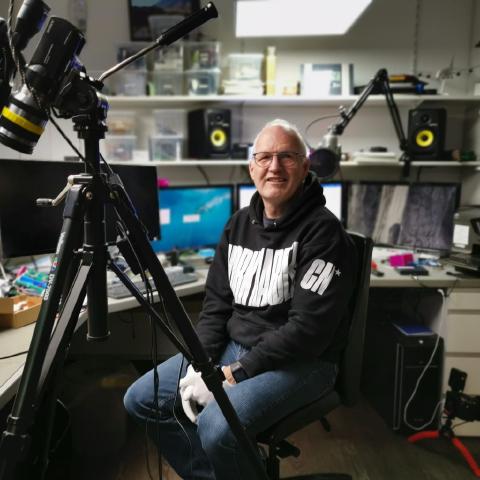
#435 – An Interview with Andreas Spiess
Download episode · 63 MB
Also on Apple · Spotify · YouTube · RSS
Show Notes
wp:image {“id”:5722,“width”:600,“height”:600}
/wp:image wp:paragraph
Welcome, Andreas Spiess!
/wp:paragraph wp:list- You may know Andreas from his YouTube channel about connected devices and electronics, as "the guy with the Swiss accent"
- The content on the channel is for intermediate people
- A lot of his content is piecing things together
- His newest video shows how to use tire pressure monitoring systems for home brewing
- The advantage of age is having seen a lot and having "lots of hooks in the brain"
- Goethe wrote "I didn't have enough time to make it this short"
- Andreas got started in the 70s, working on a forbidden fm transmitter
- CB radio wasn't allowed in Switzerland at the time.
- He was in military service, where he learned Morse code.
- He later worked in Cameroon and Damascus for the International Committee of the Red Cross.
- After a degree in EE, he realized he made his hobby into his job.
- After an MBA, Andreas started doing product management.
- He also had a product that was a Morse code trainer. These were the topics of his first few videos on YouTube.
- "Every engineer should go into sales" to learn about things like sales pressure and budgeting.
- PhD in sales of investment goods.
- Using tech used in manufacturing (SPC) but applied to sales.
- First you had to find a process
- ERP systems
- Automation for buying parts
- Rules are important for automation
- "The most applied rule is 'it depends'. This requires trained people which is expensive."
- Even AI is finding out the rules
- "The most valuable world in the world is no"
- ESP32, ESP8266
- Rules based influenced on IoT interests
- First computer was TRS80
- James Bruton
- Ben Krasnow's cookie machine
- Ben Krasnow's video on laser traces.
- Multiple Dimensions is a company that Andreas helped get started. They make 3D PCBs, shown in the video above.
- Videos about antenna performance
- Influence of battery life on antenna
- Was first meant for PCBs and then later antennas were figured out
- Sleepwalking an ESP32
- Using both cores on the ESP32
- Building a reggae robot.
- AvE and This Old Tony
- Fleet management
- IoT App Story
- OTA updates
- Other things coming on the channel like BLE
- Micro (circuit) python vs arduino
- Will be doing a video with Damien George
- Benchmarks of micropython
- Check any of Andreas' videos for contact info. He's on FB and Twitter but mostly YouTube.
Transcript
Chris Gammell: This is The Amp Hour Podcast. Released March 24th, 2019. Episode 435. An interview with Andreas Spies. Welcome to the Amp Hour. I'm Chris Gammell of Contextual Electronics. And I'm Andreas Spies, YouTuber from Switzerland. How do I say it? Kritsi? Is that how you say it?
Dave Jones: Yeah, exactly. You are pretty good, Chris.
Chris Gammell: All right. So when I met Andreas at Supercon, I was like, are you saying crazy YouTubers? Because I always thought you were saying crazy YouTubers. And then you said, no, that's not. That is crazy YouTubers. What does that mean? What does Kritsi mean?
Dave Jones: It's hello in Swiss German. Got it. And I thought I want to have a little bit of local touch. Because, I mean, you hear from my accent. There is a huge local touch. In my generation, we learned English quite late. So we know the words, but we have usually a bad accent.
Chris Gammell: I think it's a charming accent, actually. I think it's great. I love accents, personally. I think that they're, you know, as someone in the Midwest of the U.S., like it's like super boring here. And I grew up somewhere with like very nasally sounding like, I'm from Amherst, New York. You know, like it's very, very nasally. So I love different accents. That's okay.
Dave Jones: So thank you.
Chris Gammell: So people probably know you from your YouTube channel. It's one of my favorites. Personally, you do lots of great mailbags. You always wear the white gloves. You have the hat. You know, you made yourself distinctive. And people hopefully know your YouTube channel. What would you say you're kind of what you're covering on the YouTube channel?
Dave Jones: Usually it's sensors, microprocessors, and also communication. If we go back in my career, you will see that you always find areas with communication or links to communication. So this is probably the error. It's not for straight beginners. It is more for people either if you are a beginner, but then you want to learn a lot. But usually my subscribers or my viewers are more a little bit advanced. I try also to do some real technical stuff. Not too nerdy, but I try to find a compromise between simple things or present it simple, but still the content should be a little bit complex. Yeah.
Chris Gammell: And I noticed that too. A lot of your projects, you still manage to compress a lot of stuff down. Like you often have 20-minute videos, but you're going through a lot of different things. You're putting together like a weather station and a lorem node and all the different things there. And so it seems like there's a lot of work behind the scenes, but at the end of the day, it's kind of showing what's possible overall. And that's what I really like about it. It's kind of putting together a lot of disparate system.
Dave Jones: Yeah. I always – I say quite often I stand on the shoulders of other people. I'm an assembler in a way. I use other people's work, not that I copy it without mentioning them. Usually I clearly say where I have it from. But like that, I can get quite nice things. And frankly, this is what I love in these days. When I was young, everything was complicated. You had to build everything from scratch, your PC, everything, and handmade. And now we have everything available and readily and cheap. For me, it's a paradise compared to when I was 20 or so. Yeah.
Chris Gammell: I remember your video where you – I think it was a mailbag. And you pulled – I forget what the name it was. It was that little whiteboard. It was a little whiteboard from China. It had a display. It had a Lora chip. It had an ESP chip on it. And it had like I think a battery charger and a USB input or something crazy like that. And it was like 20 bucks. And I remember like watching that and I told people – I was like – I pointed to that. I was like, this is a perfect example of like where we are in the world of electronics right now. How much stuff you can shove into one device and it still be that cheap. And yet, as you point out in your videos, some of them are not necessarily useful. So you have to still understand them and piece them together, you know?
Dave Jones: Yeah. For example, now the next which will come is about tire pressure monitoring systems. It's not well known, obviously, from many peoples. But I met another guy, another YouTuber here in Switzerland. And he does – he brews beer. And he wanted to have a pressure sensor, a wireless pressure sensor. Oh, nice. Basically, to monitor the fermenting process or whatever. I'm an electronics engineer, not a brewer. But basically, then I saw, hey, these tire pressure monitoring sensors, they have pressure sensors. They have batteries, MCUs, and a wireless link. And I thought – and everything for, as you mentioned, 10, 15 bucks each. And then I thought, if we can use something like that, it is, of course, much easier than if we have to build this on our own. And it's very small. The whole thing is tiny and works for years, obviously, on one battery.
Chris Gammell: Right. No, that's a great example of like repurposing technology. And it's like – and people think that that should be an easy thing, though. But then it's figuring out the inner systems and what the other – so like the tire pressure monitoring people that make that. They're obviously working with cars. They don't care about hobbyist projects or anyone else outside the industry, probably. So it's about like taking technology, repurposing it for things, and finding how to glue it all together. And that's kind of the projects it seems like you like doing.
Dave Jones: Yeah. And I mean we get most of our sensors from iPhones or Android devices. This is where the innovation is, and we just use it. And we love it that we can get GPS systems and stuff like that for nothing. And this is mainly because of the series on these smartphones. That's why it's so cheap for us, I think.
Chris Gammell: Right. But the modern skill set is being able to quickly turn around and take that, understand it at least to enough level to use it, and then kind of tie it all together. And that seems like the stuff you focus on.
Dave Jones: Yeah. And this is probably also an advantage of my age. I saw quite a few things in my life. And as I tell people sometimes, I have a lot of hooks in my brains. And I can hook things in that they find a place where they fit to other things. So I'm a fast learner. Got it. Yeah. I can learn. I mean, most of the things I do, I do not know anything before I start. Like the tire pressure monitor systems. I had no clue. I even did not know they existed because my car is obviously older than these devices. So I had to learn more or less everything. But I knew about 433 megahertz devices. I knew about SDR. I knew about hacking. I knew about many things. So I was able to get something together quite fast.
Chris Gammell: Yeah. It's about like that pattern recognition. And like you said, a lot of experience and hooks and being able to then. But then I think another important thing, though, and I think that another thing that your channel does is, is it showing that it's that it's almost like a it's a confidence around that. Like, yeah, this stuff is you can figure this stuff out. You know, if you spend some time on it, you dig into the protocol and underlying whatever you use, the tools that you have, that you can figure this stuff out. And that's, I feel like that's another thing, especially for people getting started. You know, someone might look at that and say, oh, I could never do that. But then, you know, you showcase all these different projects. You say, yeah, no, you can if you spend some time and you go through it. Thanks for that. I appreciate that.
Dave Jones: And this is, thank you. And I have quite an interaction with my viewers. I still try to answer all or most of the comments. And I know from these comments that I'm encouraging for a lot of people. I helped a lot of people and they say thank you to me. I helped a lot of people to get started or to come back also to the hobby. And this is probably what you mentioned before, that they get confident that it is possible. I also hear, of course, sometimes if you tell me it sounds simple and if I try it, then it's not as simple. But this is life.
Chris Gammell: If it was easy, everyone would do it then, you know, like that's kind of how it goes.
Dave Jones: Yeah, but there is one thing we tell here in Europe. It's about, I think, the writer Goethe wrote a letter to one of his friends. And he wrote, I didn't have enough time. So the letter became a little bit longer. Oh. So it needs a lot of time to get short things.
Chris Gammell: Ah, I see. I see. Yes, I see. Yeah. The amount of time it takes to make something short and concise actually takes more time, you're saying.
Dave Jones: Yeah. And this is something I focus very much on it. It takes me a lot of time to do that. I do only scripting. Yeah. I accept the mailbox. Everything is scripted. And I do the videos basically as I would like them concise, precise, and also not steal my time. This is how I want videos. For example, I do not look or I do not watch live streams because the information per minute is just not enough for me. And this is one of the things I want to reach with my channel, to have the information compact.
Chris Gammell: Dare I say Swiss efficiency? Is this something that I could bring up here? Maybe, but it's just me.
Dave Jones: Just you. I try to do the things as it would be for me. Something like that. Right, right.
Chris Gammell: You're scratching your own itch, it sounds like. That's kind of the phrase that I usually use for that one. Ah, okay.
Speaker ?: Yeah.
Chris Gammell: That's great. So, I mean, let's go back a little bit. So how did you get into all this? So you've been doing YouTube about four years or so, it seems like. But what did you get started with? How did you get started in electronics and career and everything?
Dave Jones: I started in the 70s when I was about 14, when my teacher basically helped me to build a completely forbidden FM radio transmitter. This was my first device I built. And then I was hooked somehow with these RF things and these wireless things. And then I started with the CB, which was illegal also in Switzerland this time. And we dreamt of you guys in the United States where you had this Radio Shack catalogs. Sometimes we got one here and this was like Christmas. But unfortunately, we were not able to get them here in Switzerland. What was forbidden about it though?
Chris Gammell: So you said forbidden FM and you said forbidden CB radio. CB radio. So why weren't you allowed to use them? I don't know anything about this actually.
Dave Jones: See, it was just forbidden to transmit anything basically. These public, yeah, in the 70s, I don't know when it started in the States, whether it was forbidden. But still now, most of the frequencies are forbidden. You must not transmit if you do not have a license. And these CB radios were the first where you were able to or allowed to use a radio without a license or without a test or something like that.
Chris Gammell: So this is like amateur radio with a ham radio license versus having like open lines like CB radio you're saying?
Dave Jones: Yeah, CB is 27 megahertz. It still exists now. But this was the first area where we really were able to use transmitters publicly without going to jail. And then, of course, I was in military service and this was still Cold War. And we had our antennas there were not turnable. They were directly east. And east from Switzerland is Russia. And so our job was to listen to these Russian military operations. And this was all done in Morse code these days. This was still the 80s. And that's why I had to learn quite well Morse code. And I had to learn this in military service. And, of course, then I was hooked up and I also did the ham radio license.
Chris Gammell: Okay, so you would basically learn because of work in the military, you had to learn Morse code. And then that helped you get your ham radio license, which you didn't have at the beginning, you're saying. Yeah, exactly.
Dave Jones: And, I mean, we had to listen to 60 characters per minute, which is one character per minute. This was the legal requirement to get the ham operator. But we operated at double or more the speed of that in military service. So, for me, this was an easy thing. And then because I also started to study electronic engineering, I got jobs in Cameroon and in Damascus for the International Committee of the Red Cross. Oh, wow. They searched radio operators for their war operations in areas you wouldn't go for holidays. Right, yeah. But for a young guy like me, this was really fun. I mean, it was adventurous. It was far away from anything. And I was alone there, and I had to do everything on my own to build the radio station, to operate the radio station. Everything was basically – nobody was there who understood anything. And we also maintained then the other technical equipment and so on. And this was fun for me. It was a lot of adventure.
Chris Gammell: What kind of power was the stations that you were building? Was it like kilowatts or lower wattage?
Dave Jones: No, no. It was about 100 watt if I remember right. And we basically had – from Cameroon, I had a connection to Switzerland, to Geneva, where this is the headquarter of the International Committee of the Red Cross. And from – in Damascus, I had two connections. One was to Geneva, and the other one was to Beirut. And this – in 1982, people who know that was Shabran Shatila and stuff like that. Really bad things happened there. They killed lots of people. It was a civil war in Lebanon. And there we exchanged the names of refugees that the families found each other when they were basically separated somewhere. You have to remember, the smartphones did not exist.
Chris Gammell: Right. If you get separated, it's like good luck getting back in touch with people. It's just – yeah, it's really tough to – you got to like ask at different postal stations or wherever you have. It's really tough.
Dave Jones: Yeah, and this was basically one of the services of the International Committee of the Red Cross. They had a database, a global database with all the names. And then we found the people in different countries, and then they were able to meet each other again. So this was one thing. And of course, the other thing was then to help them, medical stuff and food. These were the three things we did, more or less.
Chris Gammell: That's great. That's amazing work, though. So that's like really boots on the ground, like helping people out kind of thing. That's great.
Dave Jones: I didn't did basically for helping people, I think. I did it more for adventures. Okay. That's all right to say, yeah. I mean, I was 20-something then. So what about after that then? And then I had my degree in electronics engineering. And my hobby was basically the profession. And this was not a good decision. Oh, really? Okay. I found this out. And then I immediately did my MBA just after that. And this broadened my horizon quite a lot. Because I had to learn many other things. I mean, I remember you and Dave talking about counting one day.
Chris Gammell: And I thought, ooh, interesting stuff.
Dave Jones: Yeah.
Chris Gammell: Yeah. We probably didn't say many things that were cogent or right. But we both have to deal with it now. So it's nice that you went to school for it. That probably helped a lot, actually. You probably were exposed to similar or a much more rigorous study of accounting practices.
Dave Jones: Yeah, exactly. And this is also where I thought it was probably a good idea for me to broaden the horizon and not just keep the technology in focus.
Chris Gammell: What about doing your hobby as a job? I mean, I think people can feel that same thing. But what about it for you? So you went to go work in electronics and you said this is not what you want to do on a regular basis or what?
Dave Jones: No, somehow I lost my hobby because I did the same thing more or less the whole day. Right. And this was strange for me. But I mean, it's now 40 years ago. I don't remember exactly. But I still remember the feeling that this was not the best idea. But then I still wanted to go as an engineer and work as an engineer. And I even have a European patent from this. Oh, yeah? What kind of patent? It was a completely useless thing. Well, patents tend to go.
Chris Gammell: That happens sometimes. Yeah.
Dave Jones: And the company I worked for wanted to have this patent. And there I also understood that I'm not made for engineering just to solve a problem. I had to solve problems which were useful in a way.
Chris Gammell: Okay. So that kind of ties back to the YouTube thing, too, of like you wanted applying technology, right? It's not just about the technology for technology's sake. You want to actually have a plan for it.
Dave Jones: I'm not a researcher. I'm not a researcher. I'm really an engineer. Somebody who wants to build. I also have my problems with security and these negative things and so on. I want to build. I do not want to. For example, also, tear downs and stuff like that is not what I really love. I mean, tear downs to learn how it works. That's okay for me. But or to destroy something. This is not my world. My world is building. Yeah. It's really creating new things.
Chris Gammell: And solving problems, it seems like, too. Like actually finding a thing that needs to be made in the world and then pieced together to solve that problem.
Dave Jones: Exactly. And then after three years as an engineer or so, I got the chance because I had an MBA to do product management, which was somehow in between engineering and marketing. Because you have to understand as a product manager, you have to understand a lot about technology, but you have also to match it with marketing and market demand and so on. So this was my first area where I had both in mind. And also during, by the way, also during my student time, I created the world best Morse trainer at this point in time. And I was even able as a student to sell it to the Swiss Army. Really?
Chris Gammell: Okay.
Dave Jones: Yeah.
Chris Gammell: And they sold 60 piece. What was it like? Was it an actual electronics gadget or was it just like a course or what does the trainer look like?
Dave Jones: You can look at it if you are really interested. I did my first few videos on YouTube and this is why I mentioned it. Got it. I wanted to build it with the newest technology, with an Arduino. I wanted, because everything had to be done in assembler in the 80s. And I wanted to try this one, to port it in the new time. It was basically to learn to listen to Morse. And it was an adaptive system which adapted the speed and the characters, basically the characters to the characters you did not know or you were not familiar with. Where you did mistakes, it used more of these characters. And if you did not do a lot of mistakes, then the system assumed that on this speed you are proficient and it increased the speed. This, by the way, was also gamification. Yeah. Because I saw adult people playing with this device. And during this play, of course, they learned Morse. And this was probably also the reason why the military guys wanted to buy a few of them.
Chris Gammell: That's super cool. That's like, and that repetitive training type of, I forget what it's called. There's like a certain method where if like it repeats and you kind of advance more or less. The gamification idea, it's used for like language learning as well, which I guess you could kind of say Morse learning it kind of is, right? It's a different language of sorts, just dots and dashes.
Dave Jones: Yeah. And in this respect, you had to be able to program in real time, but you had also to be able to test the system. So you had to be very good in Morse. Otherwise, you were not able to build such a system. So I was really one of the only probably at this time who was able to build such a system because I had both capabilities.
Chris Gammell: Yeah, right. Being able to, you need to troubleshoot it. You have to be like, oh, well, that's an A or that's a Q or whatever it is. You need to actually understand that when you're trying it out and testing things.
Dave Jones: Absolutely. Absolutely. And this was my first money. So I made quite a lot of money there. That's great. That's great. I mean, for a student, it was a lot of money.
Chris Gammell: I think even that is like, you know, that's a positive feedback loop of like, oh, well, I made this thing. And like you were saying with like product marketing, it's like understanding there's actually a need for this product in the market, being able to make it. And then obviously there's a lot of economic benefit from doing that.
Dave Jones: Yeah. And I was also proud that I was able to sell it to such a large organization as a student.
Chris Gammell: Yeah. That's great. So what about after that? Sounds like I'm looking at your CV here as well. And it seems like we're moving into the software world of things after that.
Dave Jones: No, not actually. Afterwards, I had a career advisor and he was absolutely right. He said a young engineer with my capabilities and so on has to go once into sales, into pure sales.
Chris Gammell: That is really good advice that I wish I didn't dislike so much, but it's very good advice.
Dave Jones: And I mention it because I would exactly give the same advice. If you like people, if you are not really the technical guy who will never move out of your lab and so on, then sales is really a very good education. So what about it? To know what a budget is, to know what pressure is, just to understand the other side. If I talk now to salespeople and you talk to salespeople all the time, if you are not salespeople, if you are not a salesman. I mean, you talk to salespeople. And if you have been there once, you understand exactly where they come from.
Chris Gammell: So you're talking about what their motivations are and what they're trying to get out of you and what you might be trying to get out of them, that kind of idea?
Dave Jones: Yeah. And then maybe you find a good compromise. Because if you know what they need and you know what you need, then it's easier to get a compromise. If you do not care about them, you probably do not get the same discount.
Chris Gammell: So what were some of the high-level things that you learned on the sales side then? Is it like on how to influence people, you're saying? Or what was the actual skills that you learned there?
Dave Jones: I mean, as a salesman, you have to influence people. That is clear. That is your job. That's why you're paid for. That's what you're paid for. But I mainly learned also the pressure, the sales pressure, the budget that you start every year with zero, zero turnover, because the counter is set to zero when you start a new financial year. So these kind of things are very important or were very important up till now. To talk to people, to convince people, also not to give orders because you cannot give orders as a salesman. You have to convince people, stuff like that.
Chris Gammell: Yeah, exuding influence without specifically telling someone, you must do this, you must do that. It's more like, well, it would be like offering options and that kind of idea.
Dave Jones: Yeah, or find out what they want or what they need and connect it with their needs. I think this is probably the most important thing is that you understand what they need. And if you can connect your offer with their needs, it's most probable that they will buy something from you.
Chris Gammell: Yeah, I come from a family of salespeople. I actually was the first one not to do sales. My grandfather and my father are both salespeople. And it's interesting. My dad always says, being in sales is not like forcing someone to buy something from you. It's more about being a resource and then being there when they actually decide they need to buy something and being the choice that they have. That's kind of what he always talks about.
Dave Jones: And interestingly, I did my PhD in quality in sales of investment goods. Really? Because, yeah, I was very disappointed that everybody thought that sales of investment goods was considered to be an art. So you were a good salesman, like an artist, or you were not a good salesman. And I thought a lot of this sales stuff is also just process. I mean, a profession. And I wanted to use the technologies used in manufacturing. Very successfully used in manufacturing, like the digital process control and stuff like that. I wanted to use in sales of investment goods. Not at McDonald's or so. Really, sales of investment goods. And this was my PhD work.
Chris Gammell: So basically, you were mapping data around how many contacts you reached out to. And what were some of the other inputs? So I've done some statistical processing control. But the thing I always think about is how much data you need in order to start mapping that stuff. Is that what you're...
Dave Jones: Yeah. First, we had to find a process because sales was not a process. It was an art. And an art is each different. An artist has no formal process. He does whatever he wants. He does not comply to a process. But I had to figure out first the process. And like how many contacts, because contacts was one of the first steps. And then how many leads you had. And then how many interactions with customers, for example. I call them moment of truth, where you were capable to change the mind of your customer or of your prospect. So things like that were measured. And of course, how long you didn't have a contact to a certain person. These kind of things were quality things. For example, a project without a planned action on it was an error, was a default. If you had a project without a planned action, this was a default. So we also tried to do some measuring of quality and so on.
Chris Gammell: So you're like a doctor of sales. That's pretty cool.
Dave Jones: Yeah. It was not very important for me afterwards. But I learned a lot about processes and stuff like that. And this helped me in other areas.
Chris Gammell: I like that. The process focus is very interesting. I mean, it's interesting that it's applied to sales, first off, but then also, I mean, business processes in general. I think that I'm seeing that more and more as companies start to grow. They need to have these things in place or else they're just not going to be able to grow.
Dave Jones: Yeah. And I mean, processes were then later on when I joined the enterprise resource planning stuff. That is all about processes and structures. And rules, of course. And rules.
Chris Gammell: And rules, yeah. And so the ERP system, what is an ERP system?
Dave Jones: An ERP system is what you were talking about, like an accounting system. Like Dave said, if he gets a lot of orders and he has to refill or replenish his stock and all these kind of things. If you remember, you talked there. This is all ERP.
Chris Gammell: Yeah. I always think about, well, like ERP and MRP. MRP is another thing, right? That's like manufacturing research planning. Is that right?
Dave Jones: Yeah. It's not another thing. But ERP is one level higher. ERP is sales, manufacturing, purchasing, finance, and HR, more or less.
Chris Gammell: It's like business. Business systems.
Dave Jones: Completely integrated. What happens these days? I mean, these companies are all integrated. And, of course, on a global basis. Because most of the people do not have an operation like Dave in his lab, where he just has one location. Most of the people have plenty of – of the larger companies have plenty of sites. And they have to coordinate things. They manufacture some things here, other things there. Yeah.
Chris Gammell: I remember thinking – so, like when I used to be at a company, they had an ERP system. I think they used maybe Oracle. Is that – no, it wasn't Oracle. Maybe it was a different one. But, excuse me. But, like, I remember thinking, like, okay, so I just designed – I just designed a resistor onto a board, right? I had to, like, go and find a new resistor. And there's all this struggle because, like, it was a big enough company that, like, it wasn't just go to DigiKey or Mauser and, like, buy a resistor in, like, a pack of 10. It was, no, no, no. This has to go into our system. It has to then get approved through all these different vendors, all these different, like, levels. But there is, like, ultimately a reason behind that because at the end of the day, when 100,000 of those resistors goes into production, then someone has to go and buy reels of those resistors. They need to know the part numbers. They need to be able to not only purchase them and, like, send them to manufacturing and coordinate all this stuff. They also have to be able to pay the company that they're sending money to for the resistors and, like, all the scheduling and everything else. It's just – it layers on so, so fast. And it seems like if you don't have the process stuff there, you're – you know, it becomes a mayhem.
Dave Jones: And you mentioned somebody has to. It's not somebody. These things have all – this has to be all automated these days. So there you're even more – I mean, I mentioned rules. People do not understand the rules too good in – and sometimes they do not like rules or standards. Standards and rules are very similar in my world. And if I start with these people, I always ask about rules, about how they decide, for example, how many resistors have to be purchased or –
Chris Gammell: Right. Well, how do you – yeah, how do you know when to pull the trigger to order that next set, right? So, like Dave was talking about with his multimeters. Exactly. He ran out of stock on multimeters. But, like, if he would have had a rule that, okay, when you drop below 250, your tracking is probably high enough that by the time your lead time is good enough, you'll get enough in to be able to sell more and never have a gap, right?
Dave Jones: Exactly. And if you can formulate such a – if you can say such a form, such a rule, then you can automate it, you can program it, and the system can do it. But, unfortunately, the most used rule or most applied rule – and if you would ask Dave, particularly Dave, I think, he would say, it depends. That is the most used rule.
Chris Gammell: And so you're saying that that's not good for actual setting up, like, automation. Then you have to have a human in the loop, right?
Dave Jones: Exactly. This is the most expensive rule because you have to have a trained guy. You cannot do it with stupid people or untrained people or whatever. You have to have a trained guy and so on. And these are the most important – this is the most expensive rule. So, always, if you hear it depends, your work starts.
Chris Gammell: That's an interesting other side to it, too, because, yeah, we do say that a lot on here, right? But then it requires an expert opinion, like you're saying. And that's either – that holds up the process. If someone has to decide when to click the reorder button or whatever, then it slows things down. It could break, whatever.
Dave Jones: And usually, if you ask the people, if you really go into the details and ask and ask and ask, they know exactly how they decide. And they have rules. Right. But they have it not cautious. It is unconscious. Unconscious? Yeah, that's right. Yeah.
Chris Gammell: Yeah. Yeah. Yeah. So, they haven't actually sussed out the process in like written form or actually in flowcharts. You're saying that's just more of a, well, I have a feeling when it's time to reorder or whatever it is. Exactly.
Dave Jones: But even they don't know the rules, that is one of my speciality to discover with them the rules in their head, that they can basically write it down. And then we check it. And then usually they say, yes, yes, yes. That's the rule. I didn't know it. But it comes from their brains. I do not know anything, just how to extract rules out of their heads.
Chris Gammell: That's good. You're a rule extractor.
Dave Jones: That's good. Yeah. By the way, this is, we talk a lot about artificial intelligence these days. What do these guys do? They create rules and they apply rules. That's right. And the TensorFlow stuff and so on, which is highly, which needs a lot of power. This is the creation of the rules. And then to apply the rules is very simple. So even a small microchip can apply the rules. So they have exactly the same thing. The difference is they use technology to find out the rules. So nobody really knows the rules. And these are the discussions there. In my case, I try to write the rules down. But the principle is exactly the same. Define rules and execute rules.
Chris Gammell: Wow. Are you still consulting on this kind of stuff?
Dave Jones: Yeah. If I get an order of nice people, not too political, then I do that.
Chris Gammell: Yeah, that's great.
Dave Jones: That's great. I just wanted to tell you if you know the most valuable word in the world.
Chris Gammell: I do not know. It's no. Oh, so like turning down work because you have other things you want to do or whatever?
Dave Jones: If you are no more allowed to say no, you are the poorest guy in the world. If you can't say no, you are rich. Yeah. And most of the people forget to say no. Right. Or do not want to say no. And then they get a lot of choices. And this is why it is then expensive.
Chris Gammell: Yeah. Yeah.
Dave Jones: So basically to say no is very important. And we will come to that probably if we come to YouTube. To say no in YouTube is the most important word.
Chris Gammell: Well, let's switch to YouTube. So what are you saying no to on YouTube? Is this to advertisers or to different ideas? Or what are you saying to no to on YouTube?
Dave Jones: Basically, where I say no is to 99% of the topics or 99.9% of the topics. Focus on YouTube is very important.
Chris Gammell: So how do you actually then figure out what you do on it? So like if you're saying no, obviously a lot of people have suggestions for you. How do you figure out what you want to work on then?
Dave Jones: That is probably an art. But there's got to be a rule here. Come on. To me, it's a rule. If I like it, first I have to like it because I have to invest quite a lot of time. So I have to be interested in the topic. And that is an important thing. And the second thing is then I have now quite a good understanding of the people which watch my channel, I think. Because I interact quite a lot with them.
Chris Gammell: Yeah.
Dave Jones: And I always think, would this be interesting for more than a few guys? For example, FGPAs. F-P-G-A. F-P-G-A. Yeah, field programmable games. Yeah. Yeah. Yeah. Yeah. You see, I didn't do anything with them. I have them. I purchased them. I'm interested in. But I still think this is so special that most of the people will not be interested in it.
Chris Gammell: Yeah. That's one of the ones where it seems interesting. But I think ultimately, the application versus just focusing on the technology versus the application. I think a lot of people struggle with the application side of things.
Dave Jones: A solution on the search for an application or for a problem. But this is an example. And this is basically what I see with many YouTube channels. Because if you lose focus, if you want to be too broad, then you will not be successful on YouTube.
Chris Gammell: So what are some of the things that you're interested in these days? I mean, I'm kind of going back through your – I mean, obviously, you've had a lot of videos here. I've been really interested in your Laura stuff. But what are you feeling these days? What do you like going over?
Dave Jones: This is another thing. I do not do usually two Laura videos in consecutive Laura videos. I have my topics like ESP8266, ESP32. And by the way, I like these chips. Why? Because they have Wi-Fi, which is RF. They are connected. They give me huge possibilities because I can connect them to the internet. That is marvelous for me. And this is why I prefer them over Arduino, for example. Oh, over just like an Atmega 328, you're saying? Yeah. Just an unconnected device. I love connected devices because of the possibilities they offer to me. I can connect them with Google Calendar. And now I know when they fetch the cardboard every week because they do not fetch it every week the same day. Now I have a Google Calendar and I have a small device which shows me on the coffee machine tomorrow it's cardboard. Or tomorrow they get the paper or whatever. In Switzerland, we separate everything like that. So I know basically I have a calendar. I do this once a year when the new comes out. And then the device connects to my Google Calendar and shows me what I have to do. With rules, of course.
Chris Gammell: I was just going to say, yeah, it's interesting that this is kind of the thread of your life. Now you're basically being able to use technology to automate things in the world, which are obviously like rules that you're saying. So that's interesting. And so you're saying that's like cardboard recycling or what was that?
Dave Jones: Yeah, it's cardboard recycling. And they have a truck which drives to the whole village and gets the cardboard. But maybe every two weeks at one particular day. And then you have to put your cardboard out. Otherwise, they obviously don't take it with them.
Chris Gammell: It's interesting too about like automation side of things. And generally, I guess this is all of like Internet of Things type of applications. They are automation of one type or another. So is it like your rules-based view on the world has kind of influenced the things that you're interested in doing with it?
Dave Jones: Or vice versa. I don't know. So I loved the computer the first day I saw it. And this was 1979, I think, when I got my first what was called TRS-80 from Radio Shack these days. Imported myself from the United States as a young guy. I was 20 or something there. And there I loved the idea that somebody else works and I can just watch it. This was really something mind-changing for me. And of course, automation creates this feeling that a device can do stuff and I can just look at it or do something else. And for that, we need the rules. And rules and abstraction is also very closely related. And a lot of people cannot abstract things. Is this English?
Chris Gammell: Yeah.
Dave Jones: To bring it to a higher level. Yeah.
Chris Gammell: That's the same phrasing, I think. But what do you mean by that?
Dave Jones: So to see a wood and not only trees.
Chris Gammell: But like, so could you give us a practical example of where someone might not be able to abstract that they could work on it?
Dave Jones: That's exactly the rule. It depends. This is not abstracted.
Chris Gammell: Man, you're breaking your own rules here. Because every...
Dave Jones: No, but if it depends, then it's not abstract. It's every tree is different.
Chris Gammell: Okay.
Dave Jones: And then if you abstract it and then basically you create a rule. For example, every... You mentioned before, if the stock level is below 250, then create an order. That is a rule. Yeah. But you have to abstract. You have to find out what the hell... On which parameters it depends. You could say, okay, if it's more than 20 degrees outside, I have to issue an order. Or if I'm happy, I have to issue an order or whatever. That would all be rules, but not very useful rules in this respect.
Chris Gammell: Got it. So it's about like the data you're actually collecting in the first place. Because there's so many potential data inputs that could be having you a certain process.
Dave Jones: I think the word data is quite important. I try to find a way from data to information. Okay. Because if you have data, sales orders, and to get the information, the 250 or whatever, the rules, this is then... I call that information. Data without information or without rules, you cannot act on it. If you have no rules, you just have plenty of data and you have no idea what to do with it. You do not know what they mean.
Chris Gammell: My experience with this, so like you mentioned a lot of process stuff too, and so I'm going to try and relate it back to my experience I have. It's like when I've done process control stuff in the past, which was like in semiconductor manufacturing, we would basically set up an experiment. And then, you know, we'd tweak different knobs. So like sometimes it was oxygen, sometimes it was nitrogen, whatever we were putting into the process. And the design of experiment, which is like a big process control thing, as far as I remember, is like you're basically setting up like this matrix of like, okay, well, if you vary the nitrogen here and here, then, you know, like what has the most effect? And what you're trying to basically find is like which knob has the biggest effect on the output you're trying to have. And so that's for semiconductor manufacturing. But if I'm like, okay, so I'm going to go toast a piece of bread. There's like the time, there's the temperature, there's like the voltage going to the coils, there's the time, the toast is in the toaster, and there's the maybe like the bread type. And then I want to find out like, if I have these different combinations, what can be the darkest bread or lightest bread or the most optimal bread in there? Exactly. Is that kind of what you're talking about? Like finding that, finding those knobs?
Dave Jones: And what did you do when you find out what the right selection is of the pressure and oxygen and so on? You defined the rule because you wanted to adhere. Yeah, that's right. You wanted to adhere and you didn't look at each and every combination. You then only looked at the rules. So this was the abstraction level. You had thousands of different process or repetitions of your process. Every day you did hundreds probably of them, but you always applied the same rule. There was only one rule for pressure. Or maybe it was a complicated rule, but it was a rule. And your controller knew that if the pressure is like that and the oxygen, whatever, is like that, then I have to close the valve or I have to reduce the valve or whatever. And these are all rules. Exactly. Perfect.
Chris Gammell: Yeah. Right. So the hard thing is kind of stepping back. So the abstraction in that case is stepping back and saying, okay, what is the actual important? I always say knobs, like turning knobs is like, what is the most important knob and will have the most impact? And I guess it's also like a PID system as well. Like what has the most control needed within a particular system? So like James Bruton, who's been on the show before, he does a lot of PID stuff. He often figures out like, you know, speed, figuring out the different PID variables is another way to talk about kind of abstraction.
Dave Jones: And if you ask somebody before you did this abstraction, then he gives you as an answer, it depends. Yeah. Because he knows probably how to figure out these buttons or whatever. Right. These pressures and so on because he is a specialist in this field. But if you ask him, he probably will tell you it depends. And he means I can do it, but it's my feeling, it's my whatever. Right. Right. I mean, tell somebody how you ride a bicycle. You cannot drive it. You just can do it. That's a good point. And basically, the rules to extract the rules is very similar to what you said with the technical systems. We do that with business processes in general.
Chris Gammell: Another good example of that, I think, is the – do you ever see Ben Krasnow's cookie machine? Do you ever see that one? No. No. He made like a – he basically was making an automatic cookie dispenser. So, like, he dispensed flour and sugar and butter and chocolate chips. And basically, then he did a design of experiment effectively where he varied these different things. You know, like, and I – whatever, he found like the optimal cookie from that. You know, it had a certain amount of butter, it had a certain amount of flour, whatever. But you could see which one had the most influence because he actually made like a matrix of it.
Dave Jones: So, basically, he asked nature with his design of experiments. Tell me the rule. And he – the design of experiment is a good way to extract information from nature because you basically – you try to minimize the number of experiments for a maximum of information extraction. That is perfect. It's exactly the same thing. We just do it with – in general with humans. In the ERP. Yeah.
Chris Gammell: Yeah. That makes sense. Well, I also want to bring up Ben Krasnow because he had that video about etching circuit board stuff. And I had brought you up when we talked about it here on the show. So, tell us about this. This is the multiple DIM – what's it called?
Dave Jones: The multiple dimensions is the company.
Chris Gammell: That is a hard – it's hard to read because you use the mu symbol. So, I get it's like mutable dimensions. You use mu as the first thing. But I'm guessing a lot of people are like, what is multiple?
Dave Jones: Yeah. But it's multiple dimensions. I don't remember why we have this name. But the story is basically I saw Ben the first time at Supercon when he did the presentation. And then he showed a demonstrator of a company. I was part of the founding team or the founder team. That's great. Here in Switzerland. And I was very astonished to see Ben showing this demonstrator. And basically, this company does three-dimensional PCBs in a way. But it's mainly – we use the housing of a device. For example, a microphone. A microphone, a wireless microphone, for example, has to have Wi-Fi antennas or Bluetooth antennas, stuff like that in it. And you could put everything inside this case with flexible PCBs. You had this also with Chris in one of your amp hours. And he didn't really understand at this point in time what the difference is between these things. But they are very much different because it's part of the housing. And if you are on high-frequency microwaves like 2.4 gigahertz or higher, then one millimeter is a lot. Yeah, right. And if something moves, you always get troubles with antenna performance and stuff like that. And I did also quite a few videos about antenna performance and so on. If your antenna is bad, you can easily, very, very fast, lose 50% of your RF power. Which means that you lose either range or you have to increase your power, which drains your battery. Most of the people do not know the influence of bad antennas on the battery because it's not obvious. But it is very important for the battery life that you have a good antenna. And for example, we can produce antennas which are absolutely stable because they are part of the housing. They are etched to the housing. Basically, the housing is made out of plastic, normal plastic. I don't know the word in English. Intrusion?
Chris Gammell: Oh, injection molded?
Dave Jones: Yeah. Yeah. Yeah, injection molded. Yeah. Thank you. Basically, we add just a little bit of copper to this plastic. And then we can free this copper with lasers. But only there where we want the traces.
Chris Gammell: Right. And so the idea is that you have this solid structure that you could tie into versus having like something that moves around a lot. Is that kind of the idea? Yeah.
Dave Jones: Yeah. And also you can, of course, omit one assembly step because this is done completely automatic. And then the laser basically frees this copper. But this is not enough copper. And then we do it chemically. We basically attach there copper and other metals that we get traces.
Chris Gammell: Yeah.
Dave Jones: That's great. And these traces then are like on a PCB. Yeah. And we can do quite small traces or very exact traces on the micrometers level. And then you can also solder your SMTs or whatever. You can even solder directly on your housing. And when I saw that you can build three-dimensional PCBs, I thought this is quite a good idea. Why do I want to have two-dimensional PCBs if I can have three-dimensional? Of course, for the moment, this process is more expensive. But I mean, a smartphone was also expensive in the 80s. And now everybody can afford one.
Chris Gammell: Well, I think timing-wise too, it seems like consumer electronics were getting more complex as well. I mean, that was kind of the rise of DSLR, it sounds like, timing-wise. And just the complexity of flex PCBs going around complex shapes. I always think about whenever someone talks about flex PCBs, I'm like, I think of cameras and how they just shoved so much stuff into those things. It's crazy. And it seems like this also kind of fits that curved mold and the curvature of different complex shapes.
Dave Jones: Yeah. And I mean, this is a speciality for the moment. It's really only for very, for example, hearing aids. You can imagine these are very small and you do not want to lose a lot of space there. So it probably could be a good idea to have the PCB basically combined with the structure. So things like that. Also where the one device does not only cost a dollar or two. It has to be a little bit more expensive. Higher margin. Exactly. For example, also protection of paying terminals like Apple Pay and stuff like that. There you might also find this technology because you can create very fine traces.
Chris Gammell: And so was it the genesis of the company, though, was it meant to be for, was it the initial thinking was for antennas or was it just generally for 3D space and electronics?
Dave Jones: It was the antenna stuff was discovered later. It was for PCBs. And we were a few friends and we got the chance to buy this technology together with a few people, with a team. It was basically a spinoff of a PCP manufacturer. They didn't want to invest in this area. So anymore. And then we thought, OK, we, everybody, each of us put the money on the table and then we started.
Chris Gammell: Well, it's great that it's still going around. But, yeah, it's not easy to pick up a technology and just you got to start shopping around then and doing the selling like you're talking about.
Dave Jones: Yeah. And especially here, it's not easy because it's really it's at the leading edge or sometimes, as I call it, on the leading edges also where you can be hurt.
Chris Gammell: Yeah. Yeah.
Dave Jones: So it's it's it's it's it's interesting. I still hope that we will be successful, but it's not easy. Not not technologically, but but but commercially.
Chris Gammell: Yeah. Finding finding the right market for it and getting people to buy into it. Right. So what else? I mean, like, so we talked a little bit about like Laura, Wi-Fi. Are you doing any Bluetooth stuff? Like what else are you what else are you interested in these days or or or what do you what do you like? Yeah. What do you guess? I guess what do you what do you suggest people get started with when when they're watching your videos and and finding what to build?
Dave Jones: I get I get a lot of of hits from search when people search something, a particular component, a particular topic, a particular something. Then they sometimes hit my or quite often hit my my channel. This is exceptional. I think this is not the case if you do a vlog or whatever, because then you do not have topics. And I try to have always a very focused topic in one of the each video has to have a topic like a TPMS now or or or a special thing like using two processors in the ESP 32. And then I try to to do a video around the different aspects of this particular.
Chris Gammell: Yeah. Oh, like the the sleepwalking thing. Is that the one you're talking about? Sorry. No, I didn't. The sleepwalking and the ESP 32. Is that the video you're talking about? No, that is like the lower power.
Dave Jones: The ESP 32 has three three cores, two fast ones. These are exactly the same. So it's a dual core processor. And the third one is this low power one. And I did a video to how to use the low power one. And I did a video on how to use both cores of the fast cores because you can double the basically the capacity of this chip. Got it. Got it. OK. Yeah. And most of most of the people did not know how to do it. And it's also not quite easy because you have to synchronize the two and so on. So you have to understand a little bit about software there. But if you are interested in this topic, in ULP, for example, the ultra low power processor, then if you enter YouTube or even on Google, the search term, the chance is high that one of my videos ranks highest.
Chris Gammell: I bet you also rank high for reggae dancing robots. I mean, that's probably another one that.
Dave Jones: This was actually a fun, fun video. And sometimes these days I learned that fun is became more important.
Chris Gammell: I agree with that.
Dave Jones: Like in the early days of YouTube, technical YouTubes, there you were able to do just technical stuff, hardcore. No problem. But these days I get a lot of compliments for my jokes and my jokes are really not. I like them. Nothing special. Thank you. It's hard. It's hard to to do jokes in a foreign language and then to keep them politically correct. That is even more important if you are not born in America.
Chris Gammell: Well, I think I think you I think you do subtle jokes. I think that's what's that's ultimately good. Like when it's like like who's the other who's the machining guy? There's a machining guy that does really subtle jokes. Yeah. AVE. No, no, no. He's not subtle. He's the opposite of subtle. Yeah. No. This old Tony. This old Tony does great subtle jokes. Like a lot of insider jokes and stuff. Yeah. Yeah. Yeah. AVE. I love AVE. Don't get me wrong. But he is not subtle.
Dave Jones: Well, my problem with AVE is that I only understand probably 50 percent. Yeah. Because he has a slang. Yeah, exactly. A lot of it's hard for. But I still it's still it's still it's still interesting to watch. And sometimes he has he is a very clever guy. Mm hmm. Uh, even if he has a language which is, uh, which is very special, but he knows a hell a lot of things. And he also is, uh, is prepared to, to show it to us.
Chris Gammell: So the last thing I want to ask you about is the, uh, so I had talked on here about, uh, doing like firmware updating and, uh, specifically around like ESP 32. I was asking on Twitter and I think I mentioned on the show too about like platforms to update firmware and manage, manage, uh, firmware images to like a fleet of devices. And I had brought up like Mongoose and then AWS with free RTOS. I had talked about on here. I had forgotten to mention the one that you told me about and the one that you're working on. So can you tell us about that real quick?
Dave Jones: Yeah. It's IOT app story.com. And you can imagine why it's called app story.
Chris Gammell: Uh, I can, I get app store, but why app story?
Dave Jones: I don't. Yeah, exactly. Because if, if we, if we would have called it app store, then you would have, uh, yeah, Apple layers. Yeah, exactly. And, uh, and, uh, and, and, uh, basically, um, it, it, it, it is a platform. So we had a problem that we had, uh, we had a plenty of devices and how do you update them? Because each and every has a different purpose in my, in my household here. And of course needs a different program. And then if you want to update one, you had based over the air, it was not, not easy. Uh, with serial, it was even more complicated. And then, uh, I started to, to have this idea of OTA updates and so on. And then I met one of my viewers who had a similar problem, but even worse because he built a platform for a, for a, a woman, which was nearly blind and lost her, lost her abilities to walk. And then he built, he built, uh, uh, a device with, uh, accelerators and with, uh, feedback, vibration feedback, which helped her basically to find the balance.
Chris Gammell: Yeah.
Dave Jones: That's great. Because she didn't see something. She was not capable to see if she is basically how, how she is in like, uh, is she straight or is she, it's hard to me to, to explain. Yeah. Yeah.
Chris Gammell: So you're talking about like if she's upright or balanced or whatever, right?
Dave Jones: Exactly. And, uh, of course there he had to do lots of updates because to experiment with her and it was hard to, to remove this, uh, this, this device every time from their back and so on. So he, he was searching also for this, uh, over the air update then. And then basically, um, we started, he is a web developer and then he started, we started together. I did the ESP stuff. He did the, the backend stuff. And then we created this, uh, this service, iotappstory.com. And now, uh, uh, it's, it's, it's open source. Uh, it's, it's not open source. The backend is, is not open source. It's his, his own technology uses for his customer projects, but it's free, free to use for, uh, for makers for the moment. And there are discussions whether we can do it open source. But anyway, uh, this is basically the idea we had there. And, uh, I still think it, we do not find a lot of, uh, of, uh, solutions for that. If you have different devices, uh, yes, exactly.
Chris Gammell: The custom device thing is, is what's, is what's hard for me. Cause like, if you, if you use like a particle device, that's great. It's like built into their thing and, you know, and they, they, they basically own everything until the edge of the pins of their, of their boards, which makes sense. That's what a lot of their customers want. But if you are basically controlling everything on the device and the firmware itself, there's no, like the OTA bootloader is the hard part. And then like being able to make sure you're connected and handle that transaction back and forth to like the service, uh, that's where it gets really dicey. Cause then what happens if it, if it fails or whatever else. Right. Yeah.
Dave Jones: And, and also the security thing. I mean, you want to, you want to have your, your firmware on your PC, on your device and not somebody else's. So we had to go to HTTPS. We had to do a lot of synchronization of, or authorization of, of each device. And, and then of course, also if you have different versions, for example, if you create a new version and you only want to have a certain, a certain set of devices, which, which are already updated. So stuff like that. So it's a lot of management in the back, in the backend on how to, which firmware, uh, has to be loaded or, or, uh, uploaded to which device basically. And, uh, this is, this is, uh, is, is solved, uh, in, in this. And of course the device itself must not, or the library must not be very big because it's overhead. And, uh, you do not want to.
Chris Gammell: I was wondering about that for the ESP 8266. That thing is not, does not have a lot of space to start with. So it needs, it needs a web bootloader that can then also have probably what, two consecutive images that can live on there because you need to have a backup, don't you? To, or, or some kind of way to do that.
Dave Jones: I mean, the backup stuff that is native in the, uh, in, in the ESP 32 infrastructure that it downloads, uh, basically a new version. And only if the new version is okay, it switches that we do not have to do. Uh, but, but other things, um, for example, uh, he uses a lot of JavaScript where the ESP does not have any web thing. Most of, of the things we see, they have the web pages in, in the ESP. And this, you can imagine this takes a lot of, a lot of space, but he, he managed basically to, to, um, to have this all in the browser and to interact. And the browser interacts then with the, with the ESP and the ESP just has to have a link basically to the browser. And then the browser does the, the hard stuff for the setup.
Chris Gammell: Yep.
Dave Jones: And then you get very nice pages and, uh, and everything, but still a very, a very small, a very small, um, library. So this is the compromise he did. And he is very good in that. And so did you say that it's, this might eventually become a commercial service as well? It is a commercial service. We have a few customers just at the beginning. Now, these are usually startups and they do not want to have their own infrastructure, but they have the problems. Like, uh, I think one is, uh, uh, has, uh, scooters, stuff like that. Uh, and, and he has to, to update them from time to time. Also over the internet, of course, because they are everywhere. Not just in, and, uh, so these kinds of things, uh, small startups for the moment are, are interested in this, in this because they, they have the issue. As you mentioned, you had also, I think something in mind. Oh, yep. Yep. Basically what we say is if you don't make money with it, then it's okay. If you make money, please share with us. Yeah, exactly. That makes sense. So this is basically the, the open source idea behind the whole thing. Right.
Chris Gammell: Well, I think at a certain point, like, so I think one of the problems that I've run into is that people come to me with an idea. They're like, Hey, I've developed this thing on a ESP 32 or whatever. And you know, it's connected and it's like, that's cool. But then, you know, taking it to that next level of like making something product ready and like making it producible in the world. There's so many, like, there's so many more problems that you run into, you know, like, okay, so now you configure that device and I configure my device, but they're all using the same service. You can't like, you know, basically there's a lot more problems that come into it with needing to abstract effectively. Like you're talking about earlier, needing to be able to abstract out and say, okay, now this is like a different cluster of devices that I have and being able to handle all the services and manage all the firmwares that go between them.
Dave Jones: That's one thing, but also let's assume you have your device somewhere else where somebody tests it and it doesn't work. And then how do you change? I mean, maybe you just have to change one line of code, but you are in Chicago and the other guy is somewhere else. And then with this iotappstory.com, you just upload your firmware, the new firmware, which you tested in your environment to the service. And then the other one boots it in his setup. And then he has the newest version. So also in this respect, it's of course very comfortable. Yeah. Because then you can really cooperate with each other over the internet in IoT devices in a way. And this is very hard if you have to, otherwise he has to have the whole development infrastructure. He has to know how to, and, and, and. So it's much easier like that if he just has to press the reset button and then it calls home and gets a new version because also the device decides if this, if it needs a new version.
Chris Gammell: It's kind of like the promise of the internet, the internet and like the internet of things and the whole, the whole, the whole like thing that people have been talking about for years and years and years, but it needed so much like custom code in order to do that, that it wasn't really extensible between one project and another, unless you had a lot of money, a lot of developers. And now it's, it's finally getting to the point where like something like iotappstory is basically like more, more accessible and it's, you know, like you're saying it's open source and, and people can start to use it on projects that aren't these large scale, really expensive things.
Dave Jones: Yeah. It's, it's not, I actually, I want to be precise. It's not open source. Oh, sure. It's accessible. The backend is not open. It's accessible at least because I want to be very clear with that. Sure, sure. Because I, I, I depend a lot on open source and this one is not. Got it. For the moment.
Chris Gammell: That's okay. But I mean, like you'd be so it's, it's accessible and people can actually use something that may have only been available otherwise in the past.
Dave Jones: And we have, we have some rules, a sort of number of devices, whatever number of uploads and stuff like that. And then you are considered to be a maker. And if you, if you are bigger than that, then we have to talk.
Chris Gammell: Right. That makes sense. That's great. So other things that you're excited about in the future, what else, I mean, what else is coming on the, uh, the, the Andrea Spice channel?
Dave Jones: I would be, uh, really, uh, glad to use BLE as you mentioned, for example, because I think it's a very, very interesting technology, but there are two things, uh, I have a problems with. First is the ESP 32 implementation is horrible.
Chris Gammell: Yep.
Dave Jones: I did a video about that. And it's, I think it's also accept, uh, acknowledged by, by Espressif. And, uh, they obviously bought the, this library somewhere. Maybe they will change it once. Uh, I still, uh, look a little bit at the, the, the Nordic stuff because they are much better in BLE and also low power and stuff like that. But it's, it's not easy to get it in the Arduino environment. And my channel lives with the Arduino IDE. I cannot change to a proprietary IDE.
Chris Gammell: You did a video about MicroPython and I know that those folks are, or CircuitPython, they're, they're, they've got a, uh, a new thing for, for the Nordic, Nordic stuff.
Dave Jones: Yeah. Uh, this was by the way, one of the most, uh, one of the areas where I looked at Python was that this might be a bridge. You will see, uh, Python on my, on my channel, but, uh, this was my success, most successful, um, video from a views point of view, but it was the, the comments were really, uh, very disappointing for me. Most of the people, most of the people, the feedback was no way, uh, I will stay with, uh, with, with, with C or C plus plus. Yeah. And some accuse me even, uh, uh, that I do wrong things and stuff like that. So I, uh, I was not very motivated, but I, I am in contact with the founder of, uh, uh, of, with Damien George, the founder of MicroPython or the, the, the guy who did it. Mm-hmm. And, uh, we are, we agreed basically that we will do a test where an engineer, really engineering approach, where we really try to find out if these ideas I read now, it's low, it's, uh, uh, it's big, it's all these, these, uh, uh, things people said, uh, we, I want to test.
Chris Gammell: Mm-hmm.
Dave Jones: And show, uh, what's the truth. Sure. Yeah. That's good.
Chris Gammell: They got benchmark almost.
Dave Jones: Yeah. Benchmarks. And for example, um, we, we try to, to, uh, create a self-balancing robot to show that it's probably also real time and stuff like that. That's great. Uh, just to, to, not to have just rumors to, to, I would like to have facts there.
Chris Gammell: Yeah. I won't stop people from, you know, stating their opinion on, on YouTube comments, but it's good to have the data out there, I think. And that's, that's a good exercise to do. I'm an engineer.
Dave Jones: Yeah, exactly. I don't like, I don't like rumors.
Chris Gammell: No rules. Rules is where it goes. So now we can have some rules around that. Yeah, rules, of course. Right.
Dave Jones: That's good. You learned something. I did. Yeah.
Chris Gammell: Yeah. Okay. Well, thank you. I mean, thank you for being on the show. I mean, we really appreciate your, uh, your input on all this stuff. I mean, like I, I love your channel. I watch it every, every time a new video comes out and, uh, I'm really looking forward to more stuff you're doing. Please keep, uh, creating more rules for us. That'd be good.
Dave Jones: Thank you very much. And of course I, uh, I have also your podcast on, uh, on my iPhone and I listen it always when I go for a ride with my bicycle. Oh, nice. Okay. I'm a little bit behind now because, uh, in winter I go up, I go a little bit less outside, but now the nice way to start it. So I can catch up with your, with your podcast. That's great. I like them too.
Chris Gammell: Oh, thank you. Thank you. Where can people find your stuff? Are you on other platforms other than YouTube, like a Twitter or Facebook or anything like that?
Dave Jones: Yeah. I'm mostly on YouTube. I'm on Facebook. I'm on, on, on Twitter, but I do not, uh, use these platforms very often. I use, uh, I use Facebook messenger for communication because I still have my, uh, mail for, for my professional work. Got it. I do not want to mix them too much. Uh, so Facebook messenger is probably the easiest to find, uh, or to contact me.
Chris Gammell: Okay. All right.
Dave Jones: And you find the links in the, in, in the description of the videos.
Chris Gammell: Well, thank you again for being on the show. We'll, we'll talk to you soon.
Dave Jones: Yeah. Thank you. And, uh, have a nice week.
Speaker ?: Bye.
Archived Discussion (2)
Comments are closed. Archived from the original site.
Show archived discussion (2)Hide discussion
Keep current
Every episode, plus the occasional job post, in your inbox.
https://github.com/emard/LibXSVF-ESP