
#424 – An Interview with Julia Truchsess
Download episode · 70 MB
Also on Apple · Spotify · YouTube · RSS
Show Notes
Welcome, Julia Truchsess, founder of Pragmatic Designs!
See all products discussed on today’s show in the Pragmatic Designs Gallery.
- Julia got started with Lionel Trains
- 0h 1m 21s
- Chris and Julia met on the KiCad forums
- 0h 1m 39s
- Hickok Scope
- 0h 2m 27s
- Heathkit
- 0h 2m 54s
- Moved into professional days
- 0h 3m 33s
- Electro Harmonix
- 0h 4m 41s
- Mike Matthews
- 0h 4m 54s
- Bob Myer worked at Bell Labs
- 0h 5m 5s
- EH Big muff pi distortion pedal
- 0h 5m 18s
- EH8000
- 0h 6m 35s
- Adaptive filter
- 0h 8m 7s
- Synthesizer in 78
- 0h 13m 1s
- Set up EH in Britain
- 0h 13m 34s
- Space Drums
- 0h 14m 3s
- Crash Pad
- 0h 15m 23s
- Soft Cell (who wrote "Tainted Love", which I think is the song we were discussing)
- 0h 16m 25s
- Collectibles
- 0h 16m 59s
- The clockworks
- 0h 17m 7s
- EH had quality problems in 81
- 0h 18m 30s
- Consumer
- 0h 20m 34s
- Greeting card
- 0h 22m 43s
- VLSI chip
- 0h 22m 49s
- 4 bit cops processors
- 0h 24m 54s
- Quadlogic
- 0h 25m 27s
- ATE for power
- 0h 25m 50s
- PLMX
- 0h 26m 4s
- Power line communication
- 0h 26m 55s
- X10
- 0h 27m 54s
- Playtime products
- 0h 29m 44s
- "real engineer"
- 0h 30m 45s
- Worked 5 years out of a spare bedroom
- 0h 32m 1s
- Toy industry
- 0h 32m 54s
- Low cost sound chips
- 0h 35m 56s
- Shenzhen in 87
- 0h 38m 48s
- Figuring out the Taiwan trading company to figure out the voice chip
- 0h 39m 31s
- Coding up on DAT tapes
- 0h 40m 6s
- Winbond in the speech business
- 0h 41m 27s
- Power Speech
- 0h 41m 40s
- TI LPC speech
- 0h 44m 12s
- Magic bottle baby
- 0h 45m 27s
- LR44 cells
- 0h 46m 42s
- Singing tree
- 0h 48m 18s
- Digital picture frames
- 0h 48m 22s
- $450 when they came out
- 0h 48m 59s
- Digi-Frame
- 0h 49m 25s
- Licensing a design
- 0h 52m 28s
- 22 or 23 granted patents
- 0h 55m 6s
- Spin master
- 0h 57m 3s
- Feasibility studies
- 0h 58m 7s
- Toy factories have costing engineer
- 1h 0m 42s
- Came back to Connecticut
- 1h 1m 47s
- Zildjian cymbals
- 1h 2m 13s
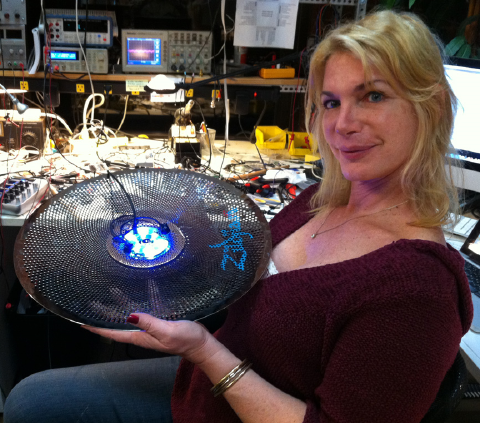
- Perforated cymbals
- 1h 3m 23s
- Zildjian gen16
- Cymbal being hit in slow motion
- Microchip design partner
- 1h 12m 49s
- Consultant stuff from factory
- 1h 15m 46s
- TUV Rheinland
- 1h 15m 57s
- EMC consulting
- 1h 18m 1s
- Henry Ott on The Amp Hour
- 1h 20m 54s
- Keith Armstrong
- 1h 21m 0s
- 3D printer stuff
- 1h 21m 53s
- Zortrax
- 1h 23m 16s
- KiCon
- 1h 24m 20s
- Express PCB
- 1h 24m 38s
- Power distribution
- 1h 29m 15s
- Skill building
- 1h 30m 26s
Transcript
Chris Gammell: This is The Amp Hour Podcast. Released January 6th, 2019. Episode 424. An interview with Julia Truchus. Welcome to the Amp Hour. I'm Chris Gammell of Contextual Electronics.
Julia Truchsess: And I'm Julia Truchus of Pragmatic Designs Incorporated.
Chris Gammell: Welcome, Julia. How are you doing?
Julia Truchsess: Very well, thanks, Chris. And you?
Chris Gammell: I'm good. I'm good. Like we were talking about right before the show, glad to be back from the holidays. And even though we didn't take full breaks as consultants over the holidays, it's good to be back, I guess.
Julia Truchsess: I'm glad they're over and ready to get back to work.
Chris Gammell: Yeah, yeah. So we actually quote-unquote met on the KiCat Forum. And you're a KiCat user, but a long-time consultant.
Julia Truchsess: No, I'm a KiCat user, Chris.
Chris Gammell: Oh, okay. All right, all right. It's going to be like that, huh? Starts early. Starts early. The great divide.
Julia Truchsess: The great divide, yes. There are two kinds of people in the world.
Chris Gammell: That's good. Like we were talking about as well before the show, you kind of have a long history of consulting. But how did you get started? And then maybe we can work our way forward in time to where we are today.
Julia Truchsess: I really – my electrical electronics experience started with Lionel trains under the Christmas tree when I was a very young girl, probably three or four or five. My father was a chemical engineer. And my older brother was very mechanically inclined. And the Lionel trains under the Christmas tree were a big part of our childhoods. So, you know, there were transformers and there were circuits and there were lights and motors and buzzers and solenoids. And that was really the start of it.
Chris Gammell: That's great.
Julia Truchsess: And I just – I gravitated towards it and my parents were very good about encouraging it. They didn't buy me whatever I asked for whenever I asked for something, unless it was something to do with electronics. And there they pretty much got me whatever I needed or they helped me get it. When I was about 10, my mother was the bookkeeper at the local country club and she got me the gig running the concession stand. Nice. Yeah. We would make sandwiches and get the potato chip guy to come around and so forth. And I made like $100 over the summer, which was a fortune in those days. And with that, I bought my first used oscilloscope from the local TV repairman.
Chris Gammell: What was the model of that first scope?
Julia Truchsess: That was a Hickok. I don't remember. It had a free running sweep. It didn't have a triggered sweep. But it glowed and I could finally see what signals looked like. Right. And then I think that following Christmas, I think they got me a Heathkit scope, which again still wasn't triggered sweep. But, you know, putting Heathkits together was a great experience. I built a Heathkit power supply and that scope. And my dad and I built a Heathkit Hi-Fi, all that kind of stuff. And I had one of those breadboards with all the springs on it that you could clip components to. The 200 ones. Yep. And so my parents were very encouraging and that was a big start.
Chris Gammell: That's awesome. That's awesome. And I assume that like having that first scope too really helps with the next scope and the next scope. I just remember my days of like just DMM days and like it helps a lot. But man, yeah, that first scope really makes that difference.
Julia Truchsess: Yeah. You have to be able to see the signals.
Chris Gammell: That's great. So, I mean, okay. So that's early days. Then how did you get into professionally then?
Julia Truchsess: I was always into rock and roll ever since seeing the Beatles on the Ed Sullivan Show in 64. And that's all I really wanted to do was be a rock star ever since that. And so I didn't really do anything professionally with electronics until I was 20. I had dropped out of college in 75 and hitchhiked to Wisconsin to join a band who had advertised for a bassist in Rolling Stone.
Chris Gammell: Yes.
Julia Truchsess: Rehearsed with them for six months in Wisconsin. And then we all packed up and moved to New York. And when I got to New York, my drummer had the New York Times open to the page for auto parts technician because he was an auto parts guy. And just a few lines up from that was an ad for an audio technician. And that was an ad for a job from Electro Harmonics.
Chris Gammell: Oh, really? Okay.
Julia Truchsess: Which was only about two blocks from where we were living. So I went over there and they hired me on the spot.
Chris Gammell: Wow. Okay. And so people don't know that Electro Harmonics is a effects pedals. What do they do?
Julia Truchsess: They were one of the very first effects pedals manufacturers. And at various times, the biggest. They were started by Mike Matthews, who is a force of nature unto himself. In the late 60s, he was a promoter. He worked with Jimi Hendrix and a lot of other big stars back in the day. And he collaborated with a circuit designer from Bell Labs, a guy by the name of Bob Meyer, who came up with a two transistor circuit that would overdrive the input of a guitar amplifier. And thus, the distortion box was born. They followed that up with the Big Mouth Pie, which is a legendary fuzz box that Hendrix used. And the rest is history.
Chris Gammell: I had a brief. I'm more piano these days, but I had a brief guitar phase. And, of course, I went through the lusting after various pedals. And I laugh now about the, oh, man, the analog man, the guy who changed out a single transistor on my Ibanez IB or what is it? The something nine. The IB nine or something like that. But sorry, the TS nine. The TS nine. And it's a overdrive pedal. And like I paid like 100 extra bucks for some guy to change out his Romanian transistor and like a JFET amp. You know, and I think about it now and I'm like, oh, boy, that's that was that was some wasted money.
Julia Truchsess: Now, EH was was very good to me. They Mike hired me just on the basis of of liking me. And I said I could do it. And he trusted me. And I spent about spent about a week on the production line tuning the DC offset trim pots on the analog delay lines. And then I went into his office and I said, I have an idea for a guitar synthesizer. I really want to design a guitar synthesizer. And he said, OK, he gave me an office and said, run with it. And the result a year and a half, two years later, was the EH 8000 guitar synthesizer, which was at the time the most complex product they had ever done. Yeah, it was entirely analog, three voice synthesizer, rack mounted. It was used by Steve Howe of Yes and a few other luminaries.
Chris Gammell: And I was going to say, is that is that a John Schofield thing, too? Because I know he does he does synthesizers on the guitar, too.
Julia Truchsess: I don't know John Schofield. He's a jazz guy.
Chris Gammell: I'm sorry about that.
Julia Truchsess: OK, you know, compared with today's DSP based processors, it's, you know, tracking and so forth. But there were some pretty amazing circuitry in it. It was able to pull the fundamental from a guitar tone, which is quite a complex problem because of all the transients and the harmonic content. Sometimes you've got more harmonics than you have fundamentals. So it's very difficult to track. And this worked without any special pickup or anything. You can plug any guitar into it and it would work.
Chris Gammell: So what is that? What are those circuits kind of? I mean, obviously, there's a lot of circuits in there. But what is kind of like the basic ideas? I mean, I think about pulling out fundamentals and stuff and thinking about doing FFTs. But I'm guessing you weren't you weren't actually doing that. You're probably doing oscillators and stuff.
Julia Truchsess: To get the fundamental. Actually, there was one of the most brilliant circuits I've ever seen in my life. I can't take credit for it. Unfortunately, it was invented by David Cockrell, who is the most brilliant engineer I've ever run into. And he's still, to this day, designing a lot of the electroharmonics DSP-based stuff. Oh, nice. But this was an entirely analog circuit. It was an adaptive filter that can pretty much extract the fundamental from anything. And it was like a four op-amp circuit. But it was amazing. It was a low-pass filter, compared the input and output, and had a servo loop where the low-pass filter would track. Whatever you played.
Chris Gammell: That's awesome.
Julia Truchsess: Within limits, it could pull the fundamental out of anything. And then from there, it was just a matter of squaring it up and putting the whole thing into a big frequency-locked loop. So that the voltage-controlled oscillators that you would actually listen to as the synthesizer output would track the fundamental of the guitar.
Chris Gammell: Okay. Oh, so the idea is, basically, you play a G on a string. And you're saying that all the other harmonics of that kind of make it sound different things. But you basically say, the circuit says, okay, this is roughly a G. And now I'm going to add crazy sounds to that G and make it do other things. Is that kind of the idea?
Julia Truchsess: It was actually oscillators producing their own tones that would track the note that was being played on the guitar.
Chris Gammell: Oh, okay.
Julia Truchsess: So it was a pretty traditional three-voice voltage-controlled oscillator synthesizer similar to an ARP 2600. So you had voltage-controlled oscillators. You had voltage-controlled filters. You had ADSR envelope generators that would fire whenever you'd play a new note. So you had to do pluck extraction. Oh, wow. So you would not actually be listening to the guitar output. You'd be listening to the synthesizer output, which was hopefully following the notes that you played.
Chris Gammell: Got it.
Julia Truchsess: Today's guitar synthesizers are much better because they don't bother with tracking and the fundamental. They basically just process the guitar signal.
Chris Gammell: Okay.
Julia Truchsess: And that's what Cockerell's DSP genius is doing these days. But that's beyond me.
Chris Gammell: Got it. Yeah. So I guess the offset I'm thinking – not the offset, but the comparison I'm thinking of is like when I press a key on a piano, it's very easy to just program something that says when this key's hit, it is a G, and then do all your fancy stuff around it. The hard problem that you seem to solve is like detect that it was a G on a guitar string in the first place, right?
Julia Truchsess: Yes. Yes. And also detect when the note is initiated, which is – Oh, yeah. You know, the articulation detection. And I've run into that problem a number of times over the years, more recently in the early 2000s. Or the 20-teens, rather, where I had to do the same thing except with cymbals. Oh, okay. But we'll get to that later if we're tracking my career.
Chris Gammell: Yeah. Yeah. Let's keep going linearly. I like that. Yeah. Well, the audio field, in my mind at least, is like kind of a thing set apart. Does that feel like that to you? I mean, obviously, we're going to get to the fact that you've gone through a lot of industries. But do you see the audio industry as a separate thing?
Julia Truchsess: Oh, absolutely. You know, there are so many subgenres to electrical engineering. And my career focused on audio for a long, long time in one form or another. But, you know, there's a whole – there are other worlds out there that you can go your entire lifetime and never contact with. You know, a lot of audio guys are totally oblivious to what happens in the radio world. It's very different. But what's really important if you're moving from one area to another is a solid foundation in the fundamental principles. You know, electric waves and how they behave.
Chris Gammell: Yeah, of course. Of course. Yeah, I was thinking about like the – you know, again, I've had pretty limited contact with the audio world. But it seems like some of the more colloquial things that I heard some of the audio people talking about of like warmth and stuff like that. Obviously, that was, you know, in the amplifier world, it's kind of its own kind of sub-niche within a niche kind of thing. But that's what I was really thinking of.
Julia Truchsess: Yeah, there's so much subjectivity, especially in high-end hi-fi. I have a friend who is a published author in the hi-fi business, and he's well-known as a myth buster. And he debunks all these people that are selling, you know, $2,500 power cords that make your stereo sound warmer. Oh, yeah.
Chris Gammell: I saw an article the other day about a Japanese gentleman who has a dedicated transformer outside of his house because he needs really, really clean power.
Julia Truchsess: Yes, and oxygen-free copper. That's right. And audio cables that have to be hooked up in the right direction because the signal sounds better going one way than the other.
Chris Gammell: Yes. Right, right. But you need to pay for the $1,500 guide to figure out which way that is, of course.
Julia Truchsess: Yeah. It's a sucker born every minute.
Chris Gammell: It's unfortunate. Well, so what else did you do in the audio field? I mean, was it pretty similar?
Julia Truchsess: When the guitar synthesizer was done in 78-ish, my band was not doing real well on the New York circuit. We were a prog rock band when punk was just happening. So we figured, let's go to England and see what we can do over there because we were big fans of Brit rock. Mm-hmm. And so I went to Mike Matthews and I said, you know, I'm going to quit the job and move to England with my band. And he said, don't quit. Go over there and open up a service and distribution center. Nice. That was great. So I did. I went to England, opened up a service and distribution center, hired a technician, and set up the office there. And while I was there, electronic drums were just starting to happen. There was the hit single, I forget the artist's name, but it was Ring My Bell. And there was the pew, pew.
Chris Gammell: Oh, yeah. That's right.
Julia Truchsess: Signature drum sound. And so I said, well, I could do that. And I came up with the space drum line for electroharmonics, which was the first really low cost line of electronic drums. Which was, there's a lot of clever circuitry in it that I'm proud of. But the real challenge was that Mike was too cheap to tool up any new special housings for anything. So these electronic drums had to go into the same sheet metal boxes that he was using for fuzz boxes and phase shifters. So that in itself was challenging. But the space drums were fun. And I've always had a fondness for interesting percussion stuff. So that was fun.
Chris Gammell: And when you say space drums, are these actually like hand-actuated or are they actually hit it with sticks?
Julia Truchsess: No, you would hit them with a stick. I took the sheet metal box that they were using for effects, which they had a three-knob version and a five-knob version. And I glued a crystal microphone to the underside of the metal. And I put a leather pad on the top side. And you could whack it with a stick at least a few thousand times until the crystal microphone fell apart.
Chris Gammell: Right. And I'm sure that some drummers, so I used to be a drummer as well. And yeah, I beat the crap out of a bunch of stuff. And that's a tough thing to do, though. It's a different consideration of the physical needs.
Julia Truchsess: Oh, yeah. They were not really rugged. And they were not really too drummer-resistant. But they were innovative nonetheless. And I think they made a sensation. There was one called the Crash Pad, which was a white noise generator that went through a sweat filter. And it was really, really versatile. You could do a lot of stuff with it. And I believe that Soft Cell used that on their hit single, Baby, Where Did Our Love Go? Which was...
Chris Gammell: I don't know. I think I only know one Soft Cell song.
Julia Truchsess: Yeah. Well, it's that one. Okay. It's that one.
Chris Gammell: Okay. Nice. Well, that's great. I mean, and that's the other crazy thing is that you see... I mean, you see these things at the beginning as like making it as a circuit that makes a noise that does a thing. And then some artists go and... Well, many artists take it. And then some of them obviously make the big hits with it, too, which is crazy.
Julia Truchsess: Yeah. It's very gratifying when that happens. Not too often, but it's gratifying.
Chris Gammell: So can your ears still pick it out when you hear a recording? Like any day of the week kind of thing?
Julia Truchsess: Yeah. It's most likely mine if it was in that very, very early era when the Soft Cell hit came out. Of course, there were countless knockoffs and different ways to do it. So sure, if you hear that sound now, it could be anything because there are samplers and all kinds of stuff. But back in the day, you know, in 1980, if it was that sound, that crash sound, it was probably my box.
Chris Gammell: That's cool. That's really cool. I mean, yeah. And it's crazy, too, is that there's like the vintage crowd as well that are like, no, no, no. I need to have the original to have that original sound. And they're probably collecting your gear as well.
Julia Truchsess: Yes. In particular, the Space Drum line, they became very, very rare. The Crash Drum, the Space Drum, the Super Space Drum, and the rarest of them all, this thing I did called the Clockworks, which is sort of a playable drum sequencer. And as of, I don't know, six or eight years ago, they were going for thousands on eBay.
Chris Gammell: Oh, my goodness.
Julia Truchsess: And Electro Harmonics saw the demand that I, of course, reminded Mike, you know, when we would correspond once in a while. I said, hey, you know, I saw Clockworks on eBay for $2,500. Oh, my God. And so he actually reintroduced the line. He reintroduced, I don't know, four or five of the products, I guess, about three years ago. And they put them in nice die-cast metal boxes now because their packaging has gotten more sophisticated. But the thing that was really gratifying to me was 33 years after I originally designed them, they used my circuitry without any modifications.
Chris Gammell: Oh, really? That's awesome. That's really awesome.
Julia Truchsess: The original, my original circuitry is in those re-releases. And that was just, that was a high point for me.
Chris Gammell: Yeah, that's amazing. So, like, what is, I mean, they didn't switch it over to, I guess, the industry as well. Like, the audio industry is still doing a lot of through-hole type stuff, at least for the legacy?
Julia Truchsess: Well, I think they, I'm sure they went to surface mount parts, but they used the circuit designs.
Chris Gammell: Got it. Got it. Well, that's, yeah, that's super cool. So, how long were you at Electro Harmonics for?
Julia Truchsess: In 81, they started having all kinds of problems. They were, their quality was a little bit dodgy due to the mechanical construction. You know, they had circuit boards loosely hanging off of potentiometer leads and the stuff just wasn't rugged.
Chris Gammell: Right, especially for, like, musicians on the road, that matters quite a bit.
Julia Truchsess: Yeah, it was pretty cheesy. And as soon as there were alternatives, there was Japanese competition. There was a company called MXR in the States that had a nice, rugged die-cast box. And those guys just kicked EH's ass. They really ate Mike's lunch. And he also had union problems. And he overextended himself. He had delusions of grandeur. He bought the former headquarters of the Otis Elevator Company, which was a block-sized building in Manhattan. He bought an estate on, he bought Andy Warhol's estate on Long Island, waterfront in Montauk. Oh, wow. He just got, he got overextended and it all collapsed around 81. So, I had to look for more work. And I landed a job around the corner from EH at a company called Schwarztraber Seagan. And they were involved in consumer electronics and toy kind of stuff. They had created the world's first musical Christmas ornaments.
Chris Gammell: Oh, really?
Julia Truchsess: He had a string of plastic bells that would play Christmas tunes. Wow. And they made a lot of money on that. And at the time I joined up with them, they were in the process of, the original ones were microcontroller-based, 4-bit cop microcontrollers. And they were in the process of transferring that over to custom VLSI chips. And that's when I joined up.
Chris Gammell: Really? Oh, wow. That's super cool. I mean, like, and I mean, I open greeting cards these days and they start singing to me. But I assume that at the time, this was actually pretty significant to have that happen in a low-cost consumer product.
Julia Truchsess: Yeah, we actually did the first musical greeting card. In the summer of 83, we took the VLSI chips that had been in the Christmas ornaments and we licensed the technology to Hallmark cards. Oh, wow. And in the summer of 83, we made 5 million greeting cards for Hallmark.
Chris Gammell: Oh, my God.
Julia Truchsess: Yeah. I didn't design the VLSI chip, but I designed all the high-speed production test equipment that was used on the factory floor to test the greeting card modules before they went into the cards.
Chris Gammell: Is this, you needed, like, automated testing because the person who previously had to listen to each card actually went insane from hearing the same tune over and over again?
Julia Truchsess: Well, yeah, when you're making five, if you do the math, if you want to make 5 million cards in three months, you have to be able to test them very quickly. So, actually, this tester could test the entire ROM contents of the chip as well as all the analog parameters of it, standby current, operating current, output drive, so forth, plus the integrity of the ROM contents. It could do it all in about 8 or 10 seconds, I think. Whoa. Whoa.
Chris Gammell: That's awesome.
Julia Truchsess: And, yeah, and we built about 15 of these testers that were used on the production lines in Hong Kong.
Chris Gammell: Nice.
Julia Truchsess: Back in the day, they actually still made stuff in Hong Kong, which they don't do anymore.
Chris Gammell: Right, right. What was the process note that the VLSI was on?
Julia Truchsess: I think it was PMOS, actually. That was the lowest cost process, and this was very low, very cost sensitive. So, it was PMOS. It required like four and a half volts, so we had to put these Polaroid flat batteries, which were the only flat batteries you could get at the time. But that's what was available in the day.
Chris Gammell: Nice. So, what was the design cycle like back then? I mean, was it starting at a circuit and then working with a layout engineer? Were you doing the layout? Like, how did that all work?
Julia Truchsess: The VLSI development process would be you would draw it up, and then you'd make a big wire-wrap breadboard. I didn't work on the original greeting card, but I did a follow-on design, which was a dual-voice melody, harmony chip, actually. So, it had two voices. You could play harmony with it, and it also had a little percussion generator as well. So, I did that one. And, yeah, you'd make a big wire-wrap board. It would be about, you know, 15 inches by 10 inches and just covered with dip sockets and entirely put together with wire-wrap. And you would prove out the design with the wire-wrap board, and then you'd take it to the chip guys, and they would turn it into lithography masks.
Chris Gammell: Yeah, right.
Julia Truchsess: And we'd go over to the chip guys out on Long Island, and they would have the masks all laid out on the floor of a room about 30 by 30, and we'd all take off our shoes and walk around on the masks and our stocking feet. Yeah. Well, this transistor over here, you know, it would be about three inches by three inches each transistor.
Chris Gammell: Yeah. So, yeah, and that's what I'm curious about, too, is like, so you were designing at the transistor level as well versus, like, I think these days, it's much higher cell-level type stuff, right?
Julia Truchsess: Yeah, transistors. And in those days, there's more building blocks, you know? I've designed with 4000 series CMOS logic. But I've always enjoyed designing at the transistor level, particularly in the analog stuff. You could do really fun, clever stuff with the discrete semiconductors. And I still do it. You know, I still put in individual transistors as level shifters and so forth.
Chris Gammell: Yep.
Julia Truchsess: You know, I'm not going to put in a 50-cent IC when a 2-cent transistor can do the job.
Chris Gammell: That's right.
Julia Truchsess: And nowadays, you can get the bias resistors built in. So, it's a single component to do a level shift.
Chris Gammell: Yep. What did the ATE system look like then? Like, the ATE is automated test equipment?
Julia Truchsess: Yeah. So, for this one, it had to be designed quickly. It had to be pretty cheap because we were going to make a bunch of them. We ended up making 15 of them. And it had to be something that I already knew how to do. So, I just built this board based on a 4-bit microcontroller, which I had learned how to do by developing a talking car horn for these guys in the previous year. So, I got pretty good with the 4-bit COPS processors, writing in assembly language, of course. So, I based those chip testers on that. A year or two later, they got – the source driver C-Gent sort of split into two companies. Another one was called Quad Logic Controls. And they were involved in power metering. They had a remotely readable power meter that could be retrofitted to large apartment buildings without doing any additional wiring. Oh, wow. And so, they needed ATE for this power metering. I didn't design the power meter, but I designed the tester for it. And that was a not cost-sensitive design. So, it was based on a DOS PC. And I wrote – I went to – I'd spent three months developing the hardware, which was a bunch of big boards and a whole spring-loaded bed of nails platform to put the power meter board onto. And as soon as the hardware was done, I got on a plane for China, for Hong Kong. And I spent six weeks in Hong Kong writing the code for it. I wrote 10,000 pages of – or 10,000 lines of PLMX code.
Chris Gammell: I guess I know that one.
Julia Truchsess: I don't even – I don't know if there are any remnants of PLMX around anymore. It was a pretty good language. I remember enjoying writing in it, but I don't remember a bit of it. But it was a huge program, and it was a wonderful experience to be in – to be isolated like that in a foreign country where I had nothing to do but work. And it was great. I would get up in the morning, go to the factory, program for eight hours, go out to dinner, and go back to the hotel, go to sleep, and do it all again the next day.
Chris Gammell: That's great. That's great. And that was doing like – was that like doing a power line communication though? Like how was it actually communicated with responses?
Julia Truchsess: Yes. Yes. That power meter worked on power line communication. Awesome.
Chris Gammell: Yeah. I've actually never – I mean, I always hear about it, but I never actually heard about like practical uses of it. I know it can work. I just never have actually seen it happen in the real world scenario.
Julia Truchsess: Yeah. The retrofitting power meters to buildings was a very good business model because it was obviously prohibitively expensive to run a separate meter to every apartment in a building. Landlords would never do that. So everybody had to get estimated bills, which nobody enjoyed. Yeah. So with this scheme, they could do individual metering for every apartment without changing the wiring in the building and read them all remotely.
Chris Gammell: That's great. Can you explain power line real quick?
Julia Truchsess: You basically – you take your digital data and you modulate a high-frequency carrier with that and you couple the high-frequency data, a couple hundred kilohertz or whatever, onto the power lines with capacitors or inductive networks or whatever. So you superimpose the high-frequency modulated carrier onto the power line and you have receivers that can pull it off and demodulate it at any point in the network. Yeah. There's a very popular home remote control technology that's been out since the 80s called X10 that worked the same way.
Chris Gammell: Oh, okay. So that's another – I guess I just never experienced it, but that's like a commercially successful one as well.
Julia Truchsess: Yeah. It was originally developed by BSR, I think, and then RadioShack picked it up. It's been supplanted recently by RF solutions like Z-Wave and Zigbee and so forth. But I actually still have some X10 stuff working in my house. Oh, really? That's cool. I like remote control lighting in my house. Yeah.
Chris Gammell: So that's like the original IoT, huh? Sorry. Yeah. So what about after that? So I'm scrolling up the page and I'll definitely link the gallery page for everyone to see all the pictures and everything. But it suddenly gets very colorful and blinky looking. So what changed? Yeah.
Julia Truchsess: So, well, let's see. So I did a few more things for these guys, more toys. I took a talking plush toy that I had developed for them and we did a custom chip for that, which never got produced, but it was an amazing custom chip. And then in 86, I decided I needed more money. And I went to my boss and I said, you know, I need more money or I'm going to leave. And he said, see you later. Oh, no. At the same time, there had been a recent toy industry article written about the company and I was featured in that article. So I had gotten a call from a head hunter who said, hey, I got this toy company, Playtime Products, and they're looking for somebody to go over to Hong Kong and run their operation there. And I said, sure, I'll do that. And we went through, you know, a little bit of back and forth on that. And eventually he came back and he said, you know what? I've decided I want a real engineer for that job. Thank you very much. He said, but why don't you be a consultant and I'll pay you to develop, you know, a couple of items here and I'll hook you up with some people. And that was really the start of my independent career. So I quit my job, bought a house and started a business all at the same time.
Chris Gammell: Wow. That's a lot of stuff.
Julia Truchsess: Yeah, I pretty much lived in terror for the next couple of years, you know, being able to make the mortgage and so forth. But yes, I got into the wild and crazy world of toys.
Chris Gammell: I wanted to go back to the real engineer thing. So what the heck is that? Because it sounds like you had like 12 products under your belt by that point. So was this a degree thing? Is that what we're getting at here?
Julia Truchsess: I think it was probably the degree thing. Yes. I was perceived as being more of a free spirit, creative type rather than, you know, work out all the equations type, which is more or less accurate portrayal. Okay.
Chris Gammell: But still, like I disagree with the real engineer thing.
Julia Truchsess: I mean, that's I would have I would have I was I was I was more I was more seat of the pants and more pragmatic as the name of my company will attest. But I always just had a good intuitive feel for it. You know, as I mentioned before, having started at a very young age.
Chris Gammell: So, yeah, I'm not I'm not pushing back on you here. I would have been pushing back on that person who said that to you. That's what I'm really getting at. But I guess you left anyway. So you you decided to do the consultant thing anyway.
Julia Truchsess: So, yeah. So I had, you know, one job in hand and I figured, OK, we'll do that and see see where it goes. And as soon as the word got around, you know, there were a couple of inventors that were feeding product to this particular toy company and they had no inside electronics. So once they knew I was available and that I did good work on time and on budget, the work just kept coming and they just kept feeding me more and more jobs. So, yeah, I worked for five years out of a spare bedroom. And then in in 91, I rented an office up the street and I hired my first employee. And then things really exploded because what I found with employees is that, you know, it's it's more than the sum of the parts. It's really a multiplying effect. So it got to the point where I had, you know, a half dozen people working for me. And so I was the idea person and the rainmaker and I would sketch it out and I'd hand it off to the to one of my people and say, here, go do this. You know, so it was. Yeah. Yeah. I didn't have to. I didn't have to sit there making prototypes anymore. I could tell my lab technician, OK, build this. All I would have to do is sketch it.
Chris Gammell: That's great. That's great. And so can you explain the toy? We've had, I think, two or three guests in the past who have done some toy stuff. Can you explain your your take on the toy industry, especially in the time frame you're doing it?
Julia Truchsess: It's well, from there from an inventing standpoint, the idea of being a toy inventor, it's very much like the music business. You can work for years and years and years putting out stuff and not have a hit. And then you can have one hit and it'll set you up for life.
Chris Gammell: Oh, really?
Julia Truchsess: It's pretty much a crapshoot. Back in those days, electronics was magic and there weren't that many people doing electronics in toys. So I was very much a guru and and it was, you know, especially in the in the 90s, it exploded with the advent of the Taiwanese voice chips. And for a time, we pretty much had a lock on on developing with those. And so it was it was really the halcyon days of my company. These days, the barriers to entry have gotten much lower with the maker movement and the democratization of electronics. There's a lot more competition. Yeah. And and also back in those days, the toy industry itself was very different. There were you had medium sized companies, you had small companies, you had small retailers, medium retailers. Kids played with toys a lot more than they do today. So what's happened today is you have many fewer toy companies. They've all been gobbled up by the big guys. So there aren't any more playtime products. There aren't very many Tycos anymore. There's Mattel, Hasbro and Spin Master. And you don't have the mom and pop toy stores anymore. You have Walmart, Target and used to have Toys R Us. Toys R Us, right. Rest in peace. And of course, Amazon. So it's it's much, much tougher. And of course, kids don't play with toys anymore. They play with their phones and their iPads. Used to be girls who play with dolls up until 12. And now they don't play with dolls past, you know, six or eight.
Chris Gammell: So it's almost like a compression of the industry then. It's like the.
Julia Truchsess: Right. Yeah. And there's age compression. As I say, kids don't play with toys for very long anymore. Price points have gotten brutal. Absolutely brutal. We used to be able to get $40 for a feature doll and they'd put it on TV and you'd sell a million pieces. Now you now it's $14.99. So the mandate from the toy company these days is, you know, give us something that's absolutely a wow factor and magical and nothing that anybody has ever seen before. But it can't have more than 99 cents worth of electronics. Oh, my God.
Chris Gammell: Yeah. I was just doing some of the math in my head. Like, so $14.99 retail price that that can't be any. They have barely any material in there. And that's got to be packaged, split stuff and everything. Right.
Julia Truchsess: Yeah. It's like $5 out of the factory. So, you know, you've got a 70 cent electronics budget. Oh, my God. It's just brutal. But we did have a, we had a great run. When the low cost compressed speech chips came out of Taiwan, I was terrified at first because all my sounds prior to that had been made algorithmically in 4-bit microcontrollers. You know, how can I make an engine sound or a musical tone by having software loops? And then these chips came out where you just would record a sound in them and they put that in the mask ROM and it would play it back. And I said, oh, this is going to put me out of business. But actually, it turned into the biggest opportunity I ever had because I got to be one of the first people who learned how to use them. The tools were horrible. Everything, all the documentation was in Chinese. The development, the coding systems were not available in the States. You had to go to Taiwan to use them. But I got to be good at it. And we became pretty much the number one go-to house for most of the toy companies in the States. So we had a great run.
Chris Gammell: So when they said they wanted a sound in there, they knew they got your name somehow to give you a call and get it in front and that kind of thing.
Julia Truchsess: Yeah, we got a reputation as being the sound people in the business. And in 1991, I had a hit with Rumbler's toy trucks, which actually was not a recording chip. It was a circuit that I patented that just used a couple of CMOS gates, digital gates, but they were used in an analog way to make something that sounded vaguely like a revving engine. And that item did very well. And that was my first royalty bearing product. And the cash flow from that enabled me to take on less and less contract work over the next year or two and focus on inventing more.
Chris Gammell: Got it. So doing like your own development based on your ideas and then just selling it to someone pretty much.
Julia Truchsess: And yeah, you license it and you collect a royalty. And, you know, if you load the pipeline with product and the royalties start coming in, it frees you up to do more stuff. You don't have to just keep doing contract work to pay the bills. So by the mid-late 90s, we were pretty rolling along and we had a good mix of work for hire and royalty stuff.
Chris Gammell: That's great. That's great. I have to say before we move on, I think one of your products was one of my first, the rhythm rods. It was like a clip-on thing. I think that was one of my first drum toys. And that's how I got into drumming. So like, thank you for that.
Julia Truchsess: You're very welcome. Yeah. My career-long love of electronic percussion. Yeah.
Chris Gammell: Yeah. That's pretty crazy. Okay. So you were in Hong Kong in the 70s and 80s, right? And Taiwan in the 80s.
Julia Truchsess: 83 was my first trip to Hong Kong.
Chris Gammell: Okay. And then Taiwan in the 80s, 90s, it sounds like. And I'm guessing other places. What was that all like? Because, I mean, obviously, you know, everybody talks about Shenzhen now. But like, I mean, back then, what was it like at all?
Julia Truchsess: The first time I was in Shenzhen was in 87. Yeah. And I think the car that I was in was the only private car I saw the whole time I was there.
Chris Gammell: Oh, wow.
Julia Truchsess: It was people riding bicycles with Cooley hats, you know, and two hours over unpaved roads to get to a factory in the middle of nowhere somewhere. Wow. Yeah, of course. You go now. I was actually, I was there last month. And you go now and it's, you know, it rivals Manhattan or any metropolis in the world. It's, they know how to make stuff over there. They are amazing. I love it.
Chris Gammell: Yeah. Well, so, I mean, did you, you said you were working with these voice trips, but there was no manuals or anything. How did you actually, I mean, do you speak Chinese? Do you, like, did you get those translated? How did you actually dig into those docs and those trips?
Julia Truchsess: Um, I hooked up with a, um, a trading company in Taiwan who, uh, some of my toy company clients were buying chips from. Uh, and they were actually British expats living in Taiwan. And, um, the company owner was married to a Chinese lady and they had a relationship with all these factories. And, uh, they were my interface to the world of, uh, Taiwanese chips. So, uh, they would take care of me. And before the coding systems were available over here, I actually, I would go over with DAT tapes and I would sit down with the, the, the engineers and Sinsu and code up these chips all from DAT tapes. Really? Um, on one, on one trip, I even took my, my Mac two. I schlepped my Mac two all the way over there so that I can edit stuff on, edit stuff on the fly while I was there. Yeah. That was fun getting, fun getting that through customs. Yeah. I was going to say. Nobody, nobody over there had ever seen a Macintosh, but, um, yeah, those were the days.
Chris Gammell: And so like, and was that also assembly though? Like at the end of the day, it was just, you know, like peeking and poking at registers or how, how were you actually interfacing these chips then?
Julia Truchsess: Um, the very first generation had almost no logic. You would, you know, put your sounds in the chip and then you had like a, uh, a paper form where you would check off the triggering options. Do I want it to play this sound twice? Do I want it to play the sound once? Or I want it to play sound a followed by sound B. And it was just, you know, and they would crunch it through their stuff later on. Uh, they came up with rudimentarily, uh, programmable. It's a little generous to call them microcontrollers, but they almost were, they were sort of proto microcontrollers. Yeah. It was kind of a state machine. Yeah. And I actually helped, I actually helped, uh, one of the bigger players architect their product line. And it was a company called wind bond that's now known as a new Voton. They're a memory business.
Chris Gammell: Yeah. Yeah. Yeah. They make tons of memory. Wow. Yeah.
Julia Truchsess: They're big in the memory business. How they, back in the day, they were real big in the speech business. They were, they were one of the first and most sophisticated, uh, speech chip makers. And, uh, I helped them architect the state machine programmable version. I even, I even named it. Uh, they, their engineers said, what should we call this thing? And I said, how about power speech? And that's what it became. Uh, and I think it's still called power speech to this day.
Chris Gammell: Well, there we, there we go. There's a royalty check for that one.
Julia Truchsess: And, uh, eventually the coding systems became available. The documentation got better. Uh, they got competition and you know, now it's, uh, it's not a, not a difficult business to get into. And it's pretty much a commodity business. You know, we used to, uh, we used to get a top dollar for, uh, tweaking these sounds and grooming them and programming the chips and so forth. And now it's pretty much any factory in Hong Kong or China will, will do that part for free just so they get the production business for making the modules.
Chris Gammell: And, and so like basically, so was it basically like a, like an analog to digital conversion process? And then that's what actually the digital bits were compressed down somehow and put onto the right mask on, like you said, or what?
Julia Truchsess: Yeah, we, we would do all our sound editing in full fidelity, 44 kilohertz, 16 bit or whatever. Um, get all our editing down and sequencing and so forth. And then you would take those master wave files or AIFF files or whatever, and run them through the coding system that would compress it into a four bit ADPCM or whatever compression scheme they were using to conserve memory in the chips.
Chris Gammell: Yeah. I assume you would also want to play it back on whatever somewhat low cost speaker they were going to use and amplifier as well, just to make sure it sounded okay.
Julia Truchsess: That, that was the key. And I had to like always go around to my sound engineers offices every other day. And I would say, stop listening on those high cost monitors. You have to listen to it in the one, in the one inch toy speaker.
Chris Gammell: Right. Right. And like, and like have your kids listen to it or have your grandkids listen to it or, you know, someone who's going to actually use this thing. Right.
Julia Truchsess: Yeah. But you have to put the, put that, put that 10 cent speaker into the same plastic housing out of which it's going to play because the plastic housing would have a huge impact on the sound quality. Sure. If you don't monitor, if you don't monitor on the target playback system, it's not going to sound right.
Chris Gammell: That's crazy. And like, so what were the target, I mean, like, so you were talking about putting these into, I mean, I guess they are ASICs, right? They're application specific, but what, what was the target cost of a chip like that?
Julia Truchsess: Um, when they first came out in 1991 was the first one, it was three seconds for a dollar. Oh wow. Today, today you can get 60 seconds for 10, 15 cents. But prior to that, prior to that, there was only the synthesized speech. There was the Texas Instruments LPC speech, which was, you know, speak and spell.
Chris Gammell: Right.
Julia Truchsess: Uh, which had a very robotic sound. It was not really recording. It was restricted in what kind of sounds it could do. And that was a $6 chip.
Chris Gammell: Oh wow.
Julia Truchsess: So these things were, these things were really revolutionary and it's all because memory, memory became cheap, you know, suddenly, suddenly conserving memory wasn't the prime directive.
Chris Gammell: Yeah. I guess the thing is like, I can read about these things on the, you know, on wiki pages or whatever else, even old data books, but I don't really get, I don't, I don't ever see the price sheets and I don't even really understand the, the inflationary aspects of like, like a dollar back then was probably more of the bomb than I even consider it today. Um, and you know, that, that 15 cents you say today as much less than it would have been back, back in the early nineties. Right. So it seems like significant costs for, for what you said was three, three cents, three seconds rather of recording.
Julia Truchsess: Three, three seconds was a dollar, which, which even back in the day was, you know, it was a lot. Yeah.
Chris Gammell: Yeah. Yeah. Right.
Julia Truchsess: But it was, it was so revolutionary to be able to put a realistic arbitrary sound into something rather than a synthesized sound. You know, the first one we ever did was, um, magic bottle baby by Tyco, which was, you know, it just had a, the sounds of baby sucking on a bottle, but it, you know, it hadn't been possible before. Um, and that was the first mass produced toy using a, a Taiwanese, uh, recording sound chip.
Chris Gammell: Right. One, like you were saying to the, you could get the premium for the, for the toys back then too. I think I remember like seeing commercial for that kind of thing and yeah, they, they would have been super expensive for the, that was just like the, the big name at the holidays or whatever.
Julia Truchsess: Yeah. The TV promoted doll, 40, $40 was, uh, the normal, 39.95 was the normal price for a TV promoted doll back in the, in the nineties.
Chris Gammell: Wow. That's yeah, that's, that's pretty, pretty insane. Uh, oh yeah. And I see a Marvel, Marvel talking superheroes. Wow. That's a, that was. Another one.
Julia Truchsess: Yeah. We couldn't, uh, we couldn't, we couldn't miniaturize it enough to get it actually in the talking figure. So the sound modules went in a backpack that was on the figures.
Chris Gammell: So the Hulk wears a backpack because you know, the Hulk goes to school too. All right. Yeah. There you go. So like, what about the, the effects of like batteries and stuff over time? I mean, you've probably seen, I mean, obviously lithium because the rise of lithium and stuff, but, but like something like that was, what was that doing for, was it just a tiny alkaline cell or was it?
Julia Truchsess: Yeah. They're all alkaline, uh, a 76 or LR 44 cells. That's the, that's the standard. And that technology really hasn't changed much. You know, it's still 135 milliamp hours and you still have to, um, be extremely village, vigilant about your standby current. You know, a micro, a micro ramp is a lot.
Chris Gammell: I'm scrolling through all your, your, your things here too. And there's just a lot of.
Julia Truchsess: So yeah, in the late nineties, we had a lot of, we had a lot of hits with seasonal, uh, goods. We had the first talking, singing Christmas tree and that was a huge hit. And then we had talking, singing Santa Claus and so forth. And these all had, um,
Chris Gammell: Was that the animatronic eyeballs? Animatronic. The ones that opened up and down? Yes.
Julia Truchsess: They had, they, they had a synchronized, uh, moving mouth that, that, uh, was in sync with the sound, which I got a patent on that system. I believe. Um, what I did was I encoded, uh, sub audio, very low frequency control signals and embedded that in the audio that would control the mouth. That's awesome. So we had a good run with those. Uh, and then in 1999, I had my best idea, which was also my worst idea, which was for the digital picture frame. Oh, wow. Um, digital photography was starting to take off and I, you know, and I, I went to Hong Kong or Taiwan or somewhere and somebody said, you know, show us some family pictures. And of course you would pull out your wallet with some snapshots. And I said, you know what? It'd be so cool if you had like something with a little LCD and you could show them. Uh, and that, that idea blossomed into the digital picture frame. So we developed that in 1999. I brought over a programmer from Australia, uh, to work, to do that. Um, and we brought it out in 2000. We demoed, we, uh, debuted it at the photo marketing association trade show. We had crowds of people in our booth. Uh, the response was overwhelming. We were reviewed very well in magazines. We had a retail distribution. We were in comp USA and Costco and fries and all over the place.
Chris Gammell: Uh, I mean, I remember when these things came out and I was just like, yeah, that's, that's an amazing idea. But then I looked at the price tag and I was like, I was like, Oh boy. Okay. Yeah.
Julia Truchsess: It was about four, it was about 450 bucks when it came out. Uh, because mostly, mostly because of the cost of the LCD.
Chris Gammell: Right. Exactly.
Julia Truchsess: And, and at the time digital photography was just starting. So a camera costs 400 bucks.
Chris Gammell: Right.
Julia Truchsess: But still the response was very positive and we got off to a great start. And then, uh, uh, it was just a perfect storm of, of bad things that hit, uh, our LCD was discontinued by our supplier without any warning, which there was no standardization and LCD form factor. So all of a sudden, all of a sudden there was nothing that fit into our plastic housing, which we had tooled up for.
Chris Gammell: Right.
Julia Truchsess: Uh, and then the stock market crashed in 2000. Uh, so no investors wanted to touch anything having to do with technology. Right. Um, so the, the company died a, uh, slow and painful death over the next few years. We came out with a larger commercial version, which was a beautiful product, but, um, it was tough and we weren't really geared up to, to sell it. Um, I'm not a very good salesperson. I'm more of a developer. So the whole thing just kind of collapsed. Um, and I took a couple of years off.
Chris Gammell: So this was your company? Is that right? That was doing the whole development then?
Julia Truchsess: Yes. Yeah. I said, you know, when I had the idea for the picture frame, I said, forget this toy business stuff, you know, and this was in the middle of the dot-com boom. This is 1999. And, you know, anybody with a, a website idea was getting $20 million thrown at them. So I said, this will be, I said, this is, this is a, you know, this is a slam dunk. We'll, we'll be real engineers with a real product here. It's all tooled up. It's ready to go. The packaging is done. We're in production. We have the retail distribution. People are going to, you know, we'll be drowning in money.
Chris Gammell: Yeah.
Julia Truchsess: Uh, and it didn't happen.
Chris Gammell: Yeah. And so, I mean, so then as that spun down, like that was basically just trying to sell off inventory, stuff like that.
Julia Truchsess: Yeah. We didn't have inventory. It was basically, you know, trying to keep our houses.
Chris Gammell: Oh yeah. Oh wow. That's super scary. I mean, like, and that is a realistic part of product businesses, right? Of, you know, you take these huge outlays. I mean, tooling isn't cheap.
Julia Truchsess: Yeah.
Chris Gammell: And you spend thousands and thousands on molds.
Julia Truchsess: Yeah. And, you know, unfortunately some of my friends got hurt, but my Taiwanese partners had extended a line of credit that they lost. Some personal friends, I'd borrowed a couple of hundred thousand dollars from a personal friend that I still haven't paid back. Wow. But you know, it's casualties of war.
Chris Gammell: Yeah. That's crazy.
Julia Truchsess: So yeah, it's, it's much cleaner to all you people out there with product ideas. It's much cleaner if you license it to somebody and let them have all the fun of making it and laying out the cash for the tooling and the inventory and all that stuff. And you can just sit back and collect your royalty check.
Chris Gammell: Yeah. I mean, and can you explain that a little bit more too? Because I mean, that, that always feels like the, you know, like the, you see the late night commercials for like, are you an inventor? And like, that's like always the promise of it. But like, what is, what is the reality of, of licensing? Like going through that process and actually getting, getting a signed agreement.
Julia Truchsess: I think it's different in different businesses. Most of my experience as an inventor in a toy business, but I'm sure it's different in, in, in every industry and the toy business is fairly closed environment. You work with people, you know, and people who know you. So there's not a whole lot of, um, uh, thievery or, or, uh, bad dealings that go on. You know, they, these, these people are professionals and they know they need inventor ideas and they're, and they're happy to pay you. Right. You know, maybe there's some games that go on where they, you know, cheat you out of something by reporting, uh, returns or losses or defects or something like that. At the, at the tail end of an item's run, they might say, okay, well, we had to eat some inventory. So we're not going to pay you royalties on that. But, but that's fairly minor. But, you know, you hear of things in other businesses, like the guy that invented some socket wrench or ratchet wrench. And he licensed it to Sears and they just stole his idea outright and he had to sue them. It took him like 20 years, but he eventually got a very big multimillion dollar settlement. So I don't have experience in a lot of inventing outside of the toy industry, but, you know, you want to work with the, the, the people you can trust that you have a good feeling about. You will hopefully have a patent. Um, that was another nice thing about the toy business, especially in the days of the sound chip madness was that you could just walk in and say, you know, they would say, we want you to put a, a, a barking sound in this dog. And you'd say, okay, I'll put the barking sound in the dog. You pay me 5%. And they'd say, okay. Wow. Really? And then, and that'd be it. Wow. It was, it was very, it was very easy, but you know, in a lot of businesses now, sure. You need some intellectual property protection, the patenting process, which is very long and expensive, you know, unless you're dealing with people that you really know and trust that can work with on a handshake, or you find a licensee who's willing to work with something that's unprotected, which is also, um, not, doesn't happen too often. The first thing they're going to ask you, if you try to license something, they're going to say, do you have a patent? And if it's something that can be easily knocked off, they're going to say, why should we, why should we invest a half million dollars in developing this when it's going to be knocked off right away?
Chris Gammell: Right. Right. That's interesting. So, uh, we had a guest on who was a patent attorney a couple, couple weeks ago and, and Joe Long's, uh, advice was, uh, so, you know, he said people come to him and ask, you know, ask about patent stuff. And he, first thing he says to them is don't do it. And so that's interesting. It's like another, another, uh, you know, I think he's really saying don't do it unless you really want to, but you're saying that like this, it sounds like a business case for, for having one.
Julia Truchsess: It gives you a much stronger, uh, negotiating position when you're trying to license something. And of course, you know, once your product is out in the market, it may, it may keep potential competitors and knock off people away. Yeah. Um, but it's, you know, there, there are very often ways to get around patents, so they don't always give you all that much protection.
Chris Gammell: Right.
Julia Truchsess: I'm not a big fan of the patent system. Um, I have 22 or 23 of them granted over the years. Um, and I have a couple more that I'm working on, but they're, um, they're very annoying.
Chris Gammell: I think that's another good soundbite about patents. If you're going to do them, they're going to be annoying. You know?
Julia Truchsess: Yeah. Yeah. They, um, you know, they keep rejecting me saying that my idea is obvious, but it's, it's not. And how do you convince somebody that something isn't obvious? You know, everything is obvious after you've seen it. Right. Exactly. You know, if it's so obvious, how come nobody ever did it? Right. First of all. And secondly, you know, I see so many other patents that are obvious. I look at them, I go, how did they, these people ever get a patent? So it's frustrating.
Chris Gammell: So, uh, so you said you took a break for a while and then.
Julia Truchsess: Yeah. I took, I took a couple of years off, you know, sold my house, got divorced, you know, get down to my last, uh, my, my last dollar. And I bought a, I bought a house out of foreclosure and fixed it up. And, um, then I got a break. Uh, a toy industry friend called me around 06 and said, um, Hey, spin master is hiring consultants. Would you be willing to move to Toronto? And I, I jumped on it. I had just gotten married. Um, I left my husband here in Connecticut and, uh, and moved to Toronto. Uh, it was a great gig consulting onsite for a fast growing company. Uh, I hadn't actually been inside of a toy company before. I hadn't worked for anybody else, you know, in, in, since electro harmonics in 81. Uh, even though I was an independent consultant, I was basically, you know, Right.
Chris Gammell: You're on site and basically you're, you're, yeah.
Julia Truchsess: Yeah. So it was, it was a wonderful experience. So I spent two years in Toronto. Um, I would come home for a week every month. It was a great gig.
Chris Gammell: Yeah. I, interesting Toronto too. Like I, I think of Waterloo for tech stuff, but is there a lot of tech in Toronto?
Julia Truchsess: Um, not really tech, but, uh, spin master is one of the biggest toy companies in the world. Now they weren't at the time. They were probably fifth or sixth at the time, but, um, now they're the third biggest toy company in the world and their headquarters are in Toronto.
Chris Gammell: Okay.
Julia Truchsess: Um, you know, electronics, electronics was a small part of their business. Um, it's bigger now, but, um, you know, they, they do electronics and, uh, and I was in charge of electronics company wide.
Chris Gammell: Oh, that's awesome. Um, so what, what, so what had changed then since the, since you had, it sounds like you kind of stepped away from the toys as you went into the digital frame stuff. What, what kind of had changed in those in that interim?
Julia Truchsess: Uh, not a whole lot. I mean, one of spin master specialty is, is flying toys. So, um, there was some of that, uh, which was new. Um, actually what I did a lot of, there was feasibility studies on concepts that would come in from outside inventors. Toy master is very much, uh, an inventor driven company. So, uh, they were always receiving submissions by inventors. The marketing guys would look at it. They say, yeah, this is interesting, but we don't know a, if it's going to work. We don't know B, if it's going to come in at the, at the price that they claim it's going to come in at. So, uh, the feasibility team would come in and look at it and figure out how it would actually be made, how cheaply it could make, uh, be made, whether it would work. So it was kind of a thankless job of, of being negative and explaining why, explaining why these great sounding ideas wouldn't work. But at the same time is very important because if nobody did that, they could, you know, spend a lot of money developing something that wasn't going to work out.
Chris Gammell: Right. Yeah. That risk assessment, especially like on an architectural level, like if you're using a part that you can't get for less than a dollar and you say the bomb is going to be 90 cents total. It's like, well, no, you can't do that. So you need to have them upfront.
Julia Truchsess: Right. And the inventors, of course, would always low ball the cost. They would say, oh yeah, you can get this made for $4 and we would run it through and we go, no, sorry, you don't understand how this works. It's going to be $8. Yeah. Right. Because they, they, they inevitably underestimate the, the manufacturing costs. You know, when you factor in every single screw and every single piece of tape and every piece of paper that goes into the packaging, it just, it adds up. Yeah. And all of that is, all of that is subjected to a waste adder and it's all subjected to a factory markup adder. So yeah, the, the art of cost estimating is very important. And a lot of new entrepreneurs these days don't have that experience. And that's why a lot of new entrepreneurs get caught up because they have no idea what this thing is truly going to cost to make. They'll, they'll look at their BOM and they'll go, oh, you know, it's an $8 BOM. So I can sell it for, I can sell it for $14 and I'll be making lots of money, but.
Chris Gammell: Forex people, Forex. That's what we use around here.
Julia Truchsess: Yeah.
Chris Gammell: Yeah. Wow. So, and so the toy companies though, did they, do they have a lot of, um, did they have like vertically integrated factories or was it a lot of contract type stuff and then they would seek out a particular factory?
Julia Truchsess: They're independent factories, but, uh, in a lot of cases they might almost just as well be, uh, captive.
Chris Gammell: They go back to them over and over again, kind of thing.
Julia Truchsess: Yeah. There'll be, you know, Mattel will have their favorite factories and they'll keep this factory so busy that they're doing nothing but Mattel stuff. So they might as well be captive.
Chris Gammell: Yep.
Julia Truchsess: It's, it's, you know, it's a partnership more or less, maybe not a formal partnership, but.
Chris Gammell: I was wondering on the cost estimation side of things, like, you know, if you're using rules of thumb or if you actually were, you know, quoting out jobs and things like that with known factories.
Julia Truchsess: Well, all the toy companies generally have a costing engineer, at least one. So these guys really can, can look at something and nail it down. They'll actually weigh every piece of plastic and then factor in the cost of the raw resin and the, and the injection molding cycling time for that part.
Chris Gammell: That's awesome.
Julia Truchsess: So yeah, they, they really get down to it. Yeah. And then, you know, if it passes that first layer of, of feasibility study here in North America, then they'll send it over to the factories and they'll say, give us a quote on this. But, um, you know, we can't drive, they don't want to drive the factories crazy with quoting every little thing. So we have to do our homework here first. So the, the spin master gig wrapped up in 2008 and I came back to Connecticut and, uh, had to decide what I was going to do from there. I realized that I couldn't really work at home. I had to have a facility. So I found an office not far from my home, uh, and rented that and, um, didn't really have much work. I had a couple of contract jobs from spin master, but not a big deal. So it was kind of, kind of back to the way it was in 86 when I first started the company, not, not knowing how I was going to pay the bills. Um, when out of the blue, I got a call for, uh, from some people working with Zildjian.
Chris Gammell: And any drummer out there immediately their ears perk up and they go, Ooh, I know that name.
Julia Truchsess: Yeah. That's a, it's a legendary name. They're one of the oldest companies in the world. They were founded in 1632. I think they're still in, they're still under family ownership in the 16th, uh, 15th or 16th generation of the family, uh, absolutely legendary company. And, um, so yeah, these guys that they had Zildjian had just hired a, um, vice president of business development, um, and they wanted to diversify and he had a vision for electronic drums. Um, and you know, from some longstanding contacts in electronic drum technology, at one point they asked one of the team members, well, who are we going to get to do the electronics? And my name came up and, um, and it just fell into place. And it was, um, one of the most gratifying, uh, gigs I've ever had in my life. It went on for five years and I think five patents came out of it. Good patents that I, that I didn't have to, that I didn't have to pay for, which was nice. Yes. Um, so yeah, it was great. We spent a year developing an electronic drum kit and then they turned around and said, no, we don't want to make electronic drums. We're a cymbal company, which was probably, probably a good decision. And they had these perforated cymbals, uh, which was a technology that, uh, was brought to them by Korg. There was a mathematician in Japan who applied these cymbals that were perforated with a Fibonacci series space pattern of holes. It's similar to the pattern of seeds in a sunflower.
Chris Gammell: A little biomimicry there, huh?
Julia Truchsess: Yes. And the deal is that they have a much lower sound level output than a traditional cymbal. They have about 25% of the volume. So if you've ever been in a room with a real solid traditional cymbal, they're extremely loud. Yep. They're years pretty loud.
Chris Gammell: I played an orchestral band for, uh, for eight years. So, uh, yeah, I smashed some of those right in front of my face.
Julia Truchsess: They're really loud. So you can't, you can't use them in apartments. You can't use them in some smaller clubs. You can't use them in churches and so forth. So we had these perforated cymbals, but they didn't sound all that great.
Chris Gammell: Right. And I'm guessing they're not using like the highest quality brass either for those things.
Julia Truchsess: Right. I think they're difficult to make from the cast metal. So they have to stamp them out of sheet metal, which is a lower grade of cymbal. Um, so the vision that this new VP of product business development had was to, um, put a transducer of some kind on the cymbals and then do DSP on them to make them sound good. Yeah. And, uh, that's what, that's what we did for the next five years. So it was a, it was really a culmination of a lot of things in my career. It was my, my passion for electronic percussion was in there. Um, it involved, uh, hardware. It involved mechanical design for transducers. It involved, um, uh, firmware. There's firmware that goes in some, in the, uh, the controller, uh, and in some of the sensors, it involved, um, ATE. I had to do the production test equipment for the thing. So in there, there's firmware in there, and then there's desktop software that runs the ATE and logs all the test records. And so it was sort of, I got to apply everything in my career up to that point was applied to this project and it was really great. And it, it won, uh, it won pretty much every, uh, award in the music industry in 2011, best in show at NAMM, best in show at Frankfurt. Um, it was really fun. Yeah.
Chris Gammell: So could, could you kind of paint an audio picture of what this looks like for people? Um, obviously we'll have pictures, you know, we'll have links over to your site for that, uh, for, to what it looks like, but like from the transducer up to the, to the box, what does that kind of look like?
Julia Truchsess: Well, the, uh, a symbol produces an extremely chaotic symbol. There are all kinds of, uh, in harmonic things going on. In fact, it's a, it's a very pure picture of chaos. Um, and, and the harmonic structure changes, uh, over time when you first strike it. If you've ever seen a, um, uh, very high speed slow motion picture of a symbol being hit, it looks like it's made out of rubber when you really smash it. The whole symbol bends and it flops and it goes back and forth flopping.
Chris Gammell: Well, it depends where you hit it on the symbol too. I think that's important for people to know. Like, like if you hit that with the edge of your stick on the edge of the symbol, you were going to get a loud frigging noise versus like the tip of the stick on the middle of the symbol or the center of the symbol. You're not much noise at all.
Julia Truchsess: Right, right. Yeah. If you hit the bell with the side of the stick, you'll get a ding, ding, ding. If you hit the middle of the symbol, what they call the bow, you get a ting, ting. And if you hit the edge, you get a crash. And these are all the subtleties that you generally don't get or don't get very controllably with the typical electronic symbols, which are just a piece of plastic with, with a simple piezo transducer on them. So you'll get amplitude response, but you'll always be triggering the same stored sound. So the, the beauty of the gen 16 acoustic electric symbol was you were really hearing the sound of the metal, but we were processing it. So anything that you could do with sticks or mallets or, or your hand or anything would still work. You can do all the subtleties, but you're just, we're processing that to make it sound better with the, with the DSP. Yeah. In particular, people love the hi-hat. The hi-hat is a very complex instrument where it's a foot pedal operates. When you press on the foot pedal, the upper and lower halves of the hi-hat symbol come together. So there's really a very infinitely expressible range going on there and a lot of subtlety and no one has ever done a really good electronic hi-hat.
Chris Gammell: I completely agree with that. My former company had a set, like a, like a $5,000 set, like really, really nice ones. And I was still, I would play it. I'd be like, eh, this isn't, it's not the same. You know, your stick doesn't bounce the same. It just doesn't feel the same.
Julia Truchsess: So there's a lot of people who did not fall head over heels in love with the sound of the Gen 16 cymbals, in particular the crash. A lot of people didn't like the crash. The ride had some issues with the bell sound, but it's pretty much universal. Everybody loves the hi-hat. So there are a lot of people who now have hybrid kits. Will they have the Gen 16 hi-hat? And then we'll have more traditional sample triggering cymbals for the other ones.
Chris Gammell: That's interesting. So I had thought this was just a pure trigger device when I first saw it, too. I didn't quite realize that it was the filtering that you're talking about. Right. It's a stick on metal. So when it goes through, so basically you have a transducer, it's effectively like a piezo again? Is that kind of the idea?
Julia Truchsess: The original version had some condenser microphones that were underneath the cymbal, which had terrible crosstalk and feedback problems, which I warned them about. I said, this is going to have terrible crosstalk and feedback problems. But it was really a matter of, you know, we had to get it to market that year or the project was going to be killed. So unfortunately, that kind of got rushed to market. But as soon as that went out and was a success in the press and so forth, I immediately went back to the lab and I said, I have to come up with a sensor that's going to work better. And I came up with a patented solution to this, which is I took a condenser microphone and potted it in epoxy and put it into a machine, stainless steel or aluminum, actually, aluminum housing that screws directly onto the cymbal. So basically what I did is I made an accelerometer out of an electric microphone.
Chris Gammell: Oh, yeah. That's nice. Yeah.
Julia Truchsess: Accelerometers, typical accelerometers like the monolithic accelerometers generally do not have the frequency response that you need for audio. They generally crap out at about a kilohertz. There are 20 kilohertz accelerometers, but they're like $50 items.
Chris Gammell: Right, right.
Julia Truchsess: So by taking an electric microphone and putting it in a soundproof enclosure, I basically made a high frequency accelerometer. And then that would screw directly onto the cymbal. There's a little preamp that goes under the cymbal, which has all kinds of neat lighting effects. Got to have the bling, right? Yeah. Yeah. Beautiful industrial design there by a company called Gyre 9, not too far from here. And then the preamp signal then went to the digital cymbal processor. And going back to our previous conversation, there's Powerline carrier involved. Oh, really? Okay. Yeah. I didn't have any extra wires. You know, there's like 60 feet of cabling in a complete drum set. So I couldn't put extra conductors in the wire. It would have been very expensive. So I've already got power going to the preamp for the lighting effects. So I just superimposed some modulated high frequency carrier on the 12 volt DC supply going out to the preamps. And then I decode that with a microcontroller in the preamp. So you can issue lighting controls from the cymbal processor out to the preamps to change the lighting effects.
Chris Gammell: That's super cool. Oh. And then basically, so like there's a micro in each lighting thing you're saying as well? Yes. Okay. Was that doing any pre-processing before it sent the audio signal back to the central processor? Just there, just there, just for the lighting. Got it. Okay. And then what did the DSP actually look like on the processor side?
Julia Truchsess: It's a black fin, analog devices black fin, which I did not design. It was done by another contractor out in California called Damage Control. Uh, I think it's a bit of an antique as far as DSPs go, but you know, it's, uh, I wasn't involved in the vendor selection for that. And I think it's something that they had and we could get to market with quick. So, so we use that.
Chris Gammell: Got it. Got it.
Julia Truchsess: There, there were, there were significant, uh, EMC issues with that project. Uh, the controller had, um, really bad radiation on the first iterations because the, um, the black fin was a 266 megahertz processor and it had external RAM. So, uh, that was the project where I learned all about EMC, which is, uh, which has since become another business for me is EMC mitigation. And that was the start of my EMC career.
Chris Gammell: I was, I was also wondering, cause I saw, I see in the bottom of each of your, your site pages as well, that you're a microchip design partner. And I was curious about that, that process and like what that kind of looked like getting into that. Well, like what it is first, maybe so people know.
Julia Truchsess: Well, I've always gravitated towards, uh, picks. I think I start first really started using picks in earnest around 2006. Um, prior to that, I'd worked mostly with four bit microcontrollers, which obviously are, uh, not suitable for a lot of things anymore. Yeah. Um, still use though. I needed something. Yeah. Yeah. I guess. Um, so I needed something with a bit more juice and, you know, picks at all. Always been kind of legendary as being, uh, uh, fairly easy to use and powerful processor. So I, I got with them on 2006 and been using them ever since. Cool. Um, and I get, I guess I became a design partner two years ago or so. Okay.
Chris Gammell: Um, I just always wonder, like, does, does that bring you more work though? Like, like I see the listing on their website and other similar things.
Julia Truchsess: It has not brought me any work. No. Uh, supposedly it will bring me some kind of commission on chip sales if I ever put a pick in something that has high volume, but that will probably, that'll probably never happen because I use picks in low volume stuff. You know, I used them in AT, ATE or, um, you know, that kind of stuff. Um, if anything was going to go into high volume, it would probably end up in a, in a, in a Taiwanese chip for, you know, two cents instead of two bucks.
Chris Gammell: Right. Yeah. So, uh, so basically this is, so this is your, your kind of return product. I mean, it sounds like five years since you kind of came back to the industry, but then this is your, this is your big one.
Julia Truchsess: Yeah, it was, you know, the gen 16 was kind of full cycle, full circle of my career, getting back into percussion, um, you know, 30 years later or whatever it was. Um, and as I said, kind of tapping on everything I'd ever learned about all, all facets from the mechanical to the software and the firmware and the hardware, the test equipment. I, we did, um, pneumatic testers, life testers for symbols. We had to hit symbols really hard a million times to see if they would break. So I built pneumatic testers. It was just, it was so multidisciplinary. It was wonderful. Um, and they, they wrapped up, um, they stopped development in 2014. They still actually make the product, but they stopped developing new stuff. Oh, okay. Um, I had, we, the, uh, business development guy and I had a vision for where we wanted to go with it and we knew what we needed to do to take it to the next level. But, uh, the Zildjian management, uh, decided that they had spent enough money on development and they wanted to get some return on their investment.
Chris Gammell: Ah, these things happen.
Julia Truchsess: So, so that wrapped up in 2014 and, uh, you know, I got, um, variety of business from various sources. I had this, uh, IOT, a medical dispensing device. That was a project from an Australian client that came to me by way of the factory that I had worked with in China who built the Zildjian stuff. Um, and then at this point I started getting, uh, EMC consulting work, um, TUV Rhineland of North America, TUV Rhineland is one of the world's largest testing laboratories. They're like UL, but they're German. Um, and their North American headquarters is five minutes from my office and I have a full EMC lab there. And, um, that's where I actually successfully got the Zildjian symbol processor to pass EMC testing. And they were so impressed with the job I did on that. They started referring clients to me for mitigation work. Um, being, being a testing lab, they have a conflict of interest. Uh, with many, they can't advise customers really on how to solve their problems and it's not really their business. So, uh, they would have a customer who would try and try and try and couldn't get their product to pass testing. And they'd say, look, you know, take it over to Julia and she'll say, uh, for you. So that's actually, that's become a side business for me is doing the EMC mitigation.
Chris Gammell: Well, what are some, uh, I mean, if, I mean, I don't want to, you know, take your business away here, but like, what are some of the high level issues that you see? I mean, is it usually clock-based stuff or is it bad layouts or what does it, what does it usually look like from your perspective?
Julia Truchsess: It's usually bad layout. I mean, for, for radiated emissions, it's usually bad layout. It's usually a poor understanding of, uh, ground planes and how ground planes work. Um, uh, you know, it's all about, uh, minimizing the impedance of the RF ground returns.
Chris Gammell: Yep. Um, big, thick ground planes are my friends. I, I, I definitely push for that all the time. I'm like, well, and I asked about this on, uh, you know, maybe not on the Kiket board, but on the consulting board I run. And it was just like, these days I just go straight to four layer because like, it's not worth maybe failing, you know?
Julia Truchsess: There's, there is no reason not to use a four layer board these days. It's crazy. Um, and, and there's a lot of misunderstanding about how they actually work, what they do. Uh, people think that copper floods on the signal layer is the same thing, but as we know, it's not, that's not a plane.
Chris Gammell: No, no, sadly not.
Julia Truchsess: They may be in the same plane, but it's not.
Chris Gammell: Right, right.
Julia Truchsess: But, but, you know, the neat thing about that, uh, consulting work is that I never know what's going to walk in the door. You know, one day it'll be a, one day it'll be a battery charger and the next day it'll be, uh, a giant three ton paper processing machine. And the next day it'll be a heart defibrillator. So, um, and, and it's extremely challenging because by the time they get to me there, the internal engineers have already been working on it for six or eight months or more without any success and management is fed up. And they're like, you know, you got to solve this. Now we have orders waiting to ship. Um, and you've never seen it before. You have no idea how it works. So you've got, you know, you've got to get up to speed on this thing really quickly, figure out how it works, find out why it's failing testing. Uh, it's, it's really in a heavy pressure. Um, it's, but it's, it's fun.
Chris Gammell: Have you ever walked into a room though? And like, been like, you know, you scratch the chin, look at it and then put your finger somewhere and then it starts working. Cause that's always like the, that's the true magic. Oh, you have really? I haven't. I have actually.
Julia Truchsess: And, and, and, you know, it's really, um, it's, it's tough because you realize when you do that, that you haven't charged them enough.
Chris Gammell: Yeah. Right. Right. Right.
Julia Truchsess: I had one job where the guy had been working on this for, I don't know, he must've been banging his head on it for like six months. He couldn't get this thing to pass. Um, and he was convinced that, um, it was convinced that was the shielding on the connectors. And, uh, you know, the thing had a lot of cables that had a 44 pin cable and had a lot of power going over that. And he was convinced it was in that 44 pin cable. And he kept putting more and more expensive connectors on that cable. The $30 connector didn't do it. So I put a $60 connector on it and, and I'm sure I can see the stuff leaking out there with my little sniffer probe. Oh my God. And then I saw there was a cable coming out of it, going to a foot switch that operated the machine. I said, what about this wire? He said, nope. I said, I measured the common mode current on that wire. And, um, according to the Henry Ott book, uh, that should not, uh, make enough field strength to, to put me over the limit. I said, oh yeah. Well, okay. And so I put it, I put a ferrite on each line of it and boom, it passed.
Chris Gammell: Oh man.
Julia Truchsess: So it was like 30, it was like 30 minutes of work. Yep. And you know, I, I probably saved that company about $30,000 and I got paid, you know, what? 500.
Chris Gammell: Yeah. Oh man. Oh yeah. And I just saw that, uh, Henry's retiring. Did you see that? Uh, he's finally retiring. Yeah. So Henry, Henry, uh, has been on the show before, but he's, I think he's in his eighties. He's gotta be, I mean, he's up there and he's done.
Julia Truchsess: Henry's been on your show. Wow. He's one of my, he's one of my heroes.
Chris Gammell: Yeah. He's, I mean, yeah, his book's amazing and he does a bunch of training and stuff, but maybe, maybe I'm talking to the next Henry Ott right here.
Julia Truchsess: So I don't know. I'll tell you who else is great. And I feel this, uh, Keith Armstrong, you know, Keith Armstrong.
Chris Gammell: I don't.
Julia Truchsess: He's, uh, he's the British Henry Ott. Okay.
Chris Gammell: Nice.
Julia Truchsess: Really nice guy. Really nice guy. I've, I've reached out to him a couple of times and he's responded to my emails.
Chris Gammell: That's great. Yeah. I think that's the thing. It's like, it's not a huge industry when you really get down to it, you know, like EMC testing, like how many people you're really going to call, how many labs are there? And it's like, it's, it's, uh, everybody has to solve this problem still. So it's, it's really important to, to get, get the baseline of the stuff, right?
Julia Truchsess: Yeah. And, um, there's a lot of, uh, intuitiveness and you really have to, you know, you, you have to stop thinking of the electrons as, um, bobbling along nicely inside their wires because, you know, up at these, up at the hundreds of megahertz, you have to start thinking about fields.
Chris Gammell: Yep. Yep. Uh, it seems like you've also kind of started doing 3d printer stuff. There's a bunch of 3d printer stuff on your, your page. Yeah.
Julia Truchsess: I got my, I got my first 3d printer in 2012. I had kept an eye on the, the, the rapid prototyping industry for a long time. And, you know, of course everybody knew about SLA machines when they were a couple hundred thousand dollars. And then, you know, then they came that they started becoming about $10,000 in the, in the 20 teens. And I started, you know, started thinking about it, you know, maybe I could start thinking about getting something like this. And then in 2012, I saw that there was a, a home printer from China, of course, called the up. Uh, and it was like 2,400 bucks, 2,400 bucks. And I said, you know what? I, I have to buy this. I don't know what I'm going to do with it. Uh, but I have to buy it. I have to know what's going on in this world. Um, and maybe I'll find a use for it. And, um, I, I can't imagine being without one now. I have, I think I have six or eight of them. Um, and you know, it's, it's, it was a life changer, you know, all the times back in the toy days in the nineties when we used to hot glue the plastic sheeting together and go to the hobby shop and, and cobble all this. But now it's just, you know, you, you draw it up in the cab, you send it to the machine. And an hour later you have your part. So it's, uh, it's just been a game changer. And I actually made a, I made a little cottage industry out of it. Um, manufacturing, uh, printer accessories for a Polish printer called the Zortrax. Uh, Zortrax was a, it's a closed system where they tried to encourage people to buy only their materials by, uh, not allowing the user to control the temperature and other parameters of the printing process. So I reverse engineered their system and I came up with a temperature controller for it. Um, and, uh, yeah, it turned into a nice little cottage industry for a couple of years. It's, it's tapered off now, but, um, yeah, we make a, we make a line of five of them. I get my, my, my production line is my husband. I say, honey, we need some more Z temps. And he comes in for a couple of days and puts them together. Nice. Nice.
Chris Gammell: I wouldn't say free labor, but, uh, included labor perhaps.
Speaker ?: Yeah.
Chris Gammell: Yeah. That's great. Well, and so, and, and so like to circle back to what we were talking about at the beginning. So now you're doing a KiCad or KiCad for some, uh, for development. And I was wondering like how that, how that's worked out for you, um, you know, from the consulting world and, and reception to doing that kind of thing.
Julia Truchsess: Um, I've always, uh, been on the lookout for good, uh, ECAD stuff. Um, and you know, learning curve is very important to me. So the ones I've used, I've used, uh, express PCB, which I, I love very much. It's like so incredibly intuitive and so unrestrictive, uh, in terms of creating parts, you know, there's, there's no library system. Uh, you can just make stuff up on the fly. Uh, right.
Chris Gammell: Which is double edged sword, you know, it sounds like, you know, experienced person like you would say it's, it's fine, but maybe beginner might be a little dangerous.
Julia Truchsess: And for simple designs, you wouldn't want to do anything super complicated in it, but the learning curve is really, really, really, really short. Um, but it's kind of a dead end manufacturing wise, you know, you can't, to get the Gerbers, you have to pay them another 65 bucks. Um, so, you know, they want you to buy the boards from them. So, um, at one point I was doing EMC consulting for a, uh, French 3d printer company. And, um, I got them to buy me a copy of Eagle, uh, which I absolutely cannot stand. It's got the, one of them, one of the most user hostile UIs I've ever used.
Chris Gammell: I will say it's gotten a little better, but not that much better. Uh, it is, they, they, they had to keep pleasing their users. So, but you know, some people love it.
Julia Truchsess: Yeah. It's user hostile. Um, just goes against all, um, user interface conventions of the, from the GUI.
Chris Gammell: So of course you switched to KiCad then, right?
Julia Truchsess: Well, you know, I had, I had actually, you know, checked in with KiCad every, every couple of years, I guess, you know, I remember back in the, when did it start in the eighties or early nineties? And I looked at it and it, yeah, it was, you know, it was a joke. It was a toy. There was nothing there. And I said, Oh, this is ridiculous. I can't use this. Um, and then I checked back in, you know, sometime not, not that long ago, I guess, uh, you know, three, four years ago and I said, Whoa, this has come a long way. I guess it was in the early days of, uh, uh, version four. Yeah. Yep. And, uh, oh, and, oh, and I, I went briefly into, um, design spark. I did one design in design spark. And while it was better than, better than Eagle, I still wasn't crazy about it. So I, um, I was still looking for something more and I switched over to KiCad and, um, frustrating as it was in a lot of respects. Um, I did, uh, get adept at it and learn to, um, learn to tolerate its, uh, more frustrating aspects. We call it quirkiness. Yeah. I, I, I stuck with it, um, till the present day. And, um, I'm glad I did because version five is just, it's, uh, it's a whole new world. And I, you know, I really love five and I love the direction it's going at. I had sort of given up hope of them ever embracing a standard UI, you know, with, with things like copy and paste. Oh yeah. But, um, much to my astonishment, much to my astonishment, V5 has copy and paste. Yeah. Um, and, and you can actually duplicate and copy symbols, uh, fairly, fairly easily once you remember the magic incantation. Um, so yeah, it's, it's, it's pretty great. There was, there are, you know, certainly some things I would love to have, but there's unfortunately it's not a commercial product. So there's not a really great channel for putting in feature requests.
Chris Gammell: Well, maybe there will be an April. And I, you said you might come to the conference in April.
Julia Truchsess: Um, possibly.
Chris Gammell: Okay. All right.
Julia Truchsess: Um, but, but yeah, you know, I, given a choice, I would rather pay for something that's supported, uh, commercially, but I'm sort of coming over to the open source thing a little bit, just in terms of longevity. Of course, a, a commercial product can always be discontinued and then you're really SOL. Yeah. So, um, uh, I've, I'm embracing the open source thing a little bit, but still I would, I would, um, I'd be happy to pay for it if there were a little bit more, um, input into, uh, features and so forth. Yeah. You know, once things get to a certain size, it's very difficult to get a responsiveness.
Chris Gammell: So, yeah, yeah, we always talk, well, we, we used to joke on, on this program about, uh, we need something like a, you know, not a red hat to the, uh, fedora of, of, uh, ECAD, but we need a, a lead hat. Right. So instead, but I mean, that's kind of the idea is that's what red hat basically was is a support layer and like a pay for features kind of thing. And you pay for support contracts from that company. Yeah. Maybe someday we'll see. Uh, so what, what is, what's the future for you? I mean, you're, you're back to consulting. You're, you're obviously doing lots of EMC stuff. I mean, what are you excited about?
Julia Truchsess: It's, um, my career has turned into power right now, power distribution.
Chris Gammell: Oh, cool. Okay.
Julia Truchsess: So, um, uh, I'm working on crazy high current stuff. I'm doing, you know, hundreds of amps. Whoa. Um, uh, I did, uh, you know, I've done some ATE that involved a hundred amp testing of stuff. And now I'm, uh, I'm actually designing data centers and UPSs that, uh, involve, uh, a hundred thousand kilowatt UPSs and data centers and so forth. So that's a whole new world. I'm learning about, you know, 800 amp circuit breakers that cost $6,000. Oh my God. From, from microamps to, uh, to kiloamps. Yeah. Right. It's crazy.
Chris Gammell: I was going to say, just learn with one hand behind your back. It sounds like that's, uh, potentially dangerous.
Julia Truchsess: It's scary because yes, people can die and millions of dollars of equipment can go up in smoke. So, um, it's much, much higher stakes than anything I've ever been involved in.
Chris Gammell: Well, that's exciting. That's, I mean, like, that's, I think when I think about, you know, obviously I've only been doing consulting a couple months now, but like the thing that I, I like focusing on, obviously I've been thinking about new year's goals and stuff too. And just like, you know, skill building is like my main focus right now. And it sounds like you've been doing that through your whole career of like just building skill after skill after skill.
Julia Truchsess: Always as, um, as required to get the job. Yeah. You know, it's, it's never been, you know, I've never sat down and said, okay, I'm going to go into this field and I'm going to learn about this so that I can maybe get some work. It's, it's always the other way around. It's always the customer comes, customer comes along and says, can you do this? And I say, uh, sure. And then I, and, and then I figure out how to do it.
Chris Gammell: Right. It's back calculated.
Julia Truchsess: Yeah. But you know, the most, the most important thing is, uh, is, is integrity, uh, delivering a really high quality product, delivering it on time, delivering it on budget, being professional, um, documenting, communicating. Yeah. I can't work with, I can't work with people who don't communicate. Um, and, you know, I'm all about the emails and the copying everybody on the emails and not conducting business on, on the phone or on Facebook or Slack.
Chris Gammell: Yeah.
Julia Truchsess: Documentate documentation has become a lost art. You know, you buy software programs now and it's like, well, how do you work it? Where's the documentation? There isn't any. Um, so, so yeah, I'm all about, uh, professionalism in those respects and, and, you know, the quality clients appreciate the quality work and, um, the clients who don't care about quality. Well, I, I don't want to work for them.
Chris Gammell: Right. Yeah. Yeah. I mean, you basically price yourself out of those jobs anyways. Cause you're like, well, this is my, this is my price. I don't want to work for someone who would low ball me or whatever.
Julia Truchsess: Exactly.
Chris Gammell: Yeah. Well, Julia, thank you so much for telling us, but I mean, like, this is, uh, quite, quite the journey from, from the, the, the audio days up to present. It's, uh, it's a lot of stuff. And I really appreciated hearing about all of it.
Julia Truchsess: Thank you, Chris. It's an honor to be on the podcast.
Chris Gammell: Okay. Well, I hope to see you soon at, uh, at a conference. Talk to you later.
Julia Truchsess: All right. Thank you. Bye.
Archived Discussion (3)
Comments are closed. Archived from the original site.
Show archived discussion (3)Hide discussion
Adaptive FilterATECymbalEMCHenry OttKiCadKiConPower Line CommunicationScopeSpeechSynthesizerToyVLSIZildjian
Keep current
Every episode, plus the occasional job post, in your inbox.
Paul Schreiber is another person who would be fun to interview with all his experience working for Radio Shack / Tandy. It would be interesting to have Dave in the conversation because he remembers those days too.