
#401 – An Interview with Brent and Bryce Salmi
Download episode · 114 MB
Also on Apple · Spotify · YouTube · RSS
Show Notes
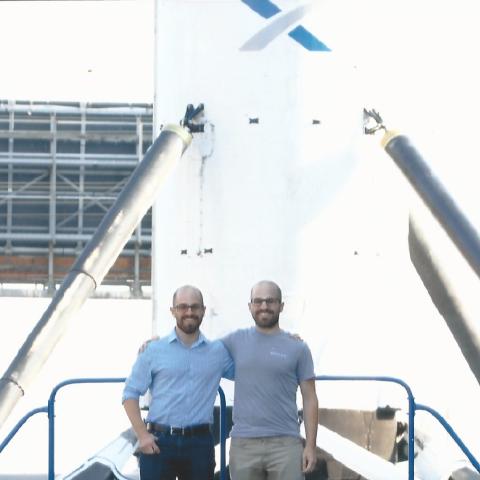
- If you can't tell from the picture, Brent and Bryce are twins
- 0h 0m 57s
- They both went to RIT and ended up working together at SpaceX
- 0h 1m 8s
- They worked on AMSAT for their senior project
- 0h 2m 8s
- Fox series cube sats
- 0h 2m 49s
- AMSAT will make a plugin module
- 0h 3m 51s
- Elona (sp?) grants
- 0h 4m 6s
- 1U cubesats
- 0h 5m 12s
- AO40 - 600 kg satellite
- 0h 7m 29s
- MPPT on github
- 0h 8m 24s
- This actually was an analog computer to cut down on components that are susceptible to cosmic rays.
- 0h 10m 40s
- It relies on feed forward
- 0h 10m 50s
- Stateless design
- 0h 12m 43s
- AO91
- 0h 13m 32s
- AO92 - just under a year
- 0h 13m 36s
- K2GEXT
- 0h 16m 52s
- Balloon hipster
- 0h 17m 7s
- For their balloon project, they prioritized reliability
- 0h 18m 31s
- Used nail polish as conformal coat
- 0h 19m 45s
- Fell through a thunderstorm
- 0h 20m 13s
- Joined SpaceX mid-2013
- 0h 21m 27s
- Around the time of C2 - First dragon mission
- 0h 21m 34s
- 1000 people when they joined
- 0h 22m 40s
- F921 - upgraded version. This is the one outside of SpaceX as a monument.
- 0h 25m 25s
- Engineering as an action sport
- 0h 28m 30s
- Watching conspiracy videos about spacex
- 0h 28m 53s
- Burning out
- 0h 30m 20s
- What electronics are involved
- 0h 32m 44s
- Rio Team
- 0h 32m 57s
- Consumer parts vs aerospace parts
- 0h 34m 1s
- Shaun from Planet episode
- 0h 35m 13s
- MIL standard 1540
- 0h 36m 51s
- NASA derating
- 0h 37m 39s
- Guidance, nav, control
- 0h 39m 28s
- Fault recovery
- 0h 39m 40s
- Sensing the environment
- 0h 39m 58s
- Pyrotechnics
- 0h 41m 26s
- Frangible bolts
- 0h 41m 34s
- RF telemtry
- 0h 42m 16s
- Space race 3.0
- 0h 44m 59s
- Lock step (is having 2 processors normally)
- 0h 47m 6s
- Voting is having 3 systems
- 0h 47m 49s
- Curiosity goes into safe mode
- 0h 48m 58s
- Designing circuits at a very low level
- 0h 50m 58s
- Understanding every way a circuit that is going to fail
- 0h 51m 12s
- As engineers they're really paranoid now
- 0h 52m 1s
- SMPS failure
- 0h 52m 55s
- What is the margin of the components
- 0h 53m 17s
- Derating = overspec'ing
- 0h 54m 52s
- No one complains when it's lighter
- 0h 58m 56s
- FaradayRF
- 1h 6m 56s
- 900 MHz digital radio
- 1h 9m 5s
- Trying to make a platform for people to build on
- 1h 11m 0s
- Delay tolerant network
- 1h 12m 7s
- PSK31, FT8
- 1h 12m 53s
- ISM band
- 1h 17m 8s
- Article about differences
- 1h 17m 47s
- APRS
- 1h 21m 28s
- National projects
- 1h 21m 32s
- SDR vs Faraday
- 1h 24m 5s
- CC430 radio
- 1h 26m 53s
- 10-100kBaud
- 1h 27m 5s
- goTenna
- 1h 33m 56s
- TUN tap
- 1h 47m 39s
- FaradayRF GitHub
- 1h 56m 13s
- Relativity space in LA
- 1h 57m 40s
- Aeon 1 engine
- 1h 58m 17s
- Careers page
- 1h 58m 47s
- Autonomous airplanes
- 2h 1m 55s
- Richard Branson quote
- 2h 4m 36s
- @kb1lqd
- 2h 6m 14s
- @kb1lqc
- 2h 6m 32s
- @relativityspace
- 2h 6m 55s
Transcript
Brent And Bryce Salmi: This is The Amp Hour Podcast, released July 29th, 2018. Episode 401. An interview with Brent and Bryce Salmi.
Chris Gammell: Welcome to The Amp Hour. I'm Chris Gammell of Contextual Electronics. I'm Bryce Salmi of Faraday RF and Relativity Space. And I'm Brent Salmi of Faraday RF and an air transportation startup, South Bend.
Brent And Bryce Salmi: Welcome. The brother Salmi, how you doing? Hey, doing well. Do people refer to you as that? I always thought like the brother's something, you know, is always like a, you know, interesting way to do it. Like Brent and Bryce or... Yeah. It varies. Right. So, I was talking about you guys the other day in preparation for this interview. And I am... It's awesome that you guys are, you know, obviously brothers. You're twins, right? Yeah. Yep. So, twins. But you also are both EEs and you ended up kind of just like on a very parallel path. And like that must have been studying easier. I don't know. I don't know. Like, was it easier or harder? I don't know. It's about as parallel as you can get. Yeah.
Chris Gammell: We both went to school for EEs. Both went to RIT. Basically, we're in classes together. And then both took chances at applying to SpaceX. And got those internships and eventually worked in the same group for five years. Like I sat next to Brent for like four and a half years. That's awesome. We never planned this. It just sort of like kept happening. And we just like... We just didn't stop it. We're like, well, I guess we're both doing the same thing. Let's keep going.
Brent And Bryce Salmi: Another go. Here we go. Yeah, right. Yeah, yeah. Both enjoyed it.
Chris Gammell: Back in 2011 when we replied to SpaceX, it's like, well, we both got the offer. Like, you don't turn that down. You know? Like, it looks like we're working together.
Brent And Bryce Salmi: Yeah. That's crazy. Wow. So I assume you also worked together okay because you not only did that, but then you also went and you're like, hey, you know what? We should spend all our free time together too and do a side project for Ham Radio as well. Pretty much.
Chris Gammell: Yep.
Brent And Bryce Salmi: Yeah. Yeah. Yeah. We sort of get along. Yeah. Okay. Good. Good. Yeah. And then actually even before... No awkward reunions here, right? Right. It's all good. Yeah. We talk a lot.
Chris Gammell: Like, I mean, even before Faraday, we actually did a lot of AMSAT work too for amateur satellites. Oh, nice. Okay. Yeah. Nice. A few things in space there too. So once that wrapped up, we did Faraday.
Brent And Bryce Salmi: Was that a RIT thing or was that like tied to SpaceX or what?
Chris Gammell: More of a RIT thing, like our senior design project. But then it continued for about another two years after we graduated. Oh, wow. Okay. Yeah. And then like after... And then after... Yeah. That's actually the whole story. But like then after that finished, we kind of like dove into Faraday. And so what is AMSAT? AMSAT's the Radio Amateur Satellite Corporation. So they're basically a group that's been around since the early 60s. Putting Amateur Radio in space, in orbit. They just started up in the last several years their Fox series of satellites. And those have been the first AMSAT CubeSats, at least AMSAT North America. And they've been wildly successful as far as I know. It really helped standardize their efforts. And it helped them adapt to a changing launch service environment. They used to get launches basically for free or super low cost. And then once CubeSats came around and people like SpaceX came around and actually kind of changed the whole paradigm of the launch industry, they really couldn't compete. Because now for what they got for free now costs like $300,000.
Brent And Bryce Salmi: And so this is like that service where basically if you're a researcher at a university, you want to put up a CubeSat, you want to put up just any satellite. You're saying that this would basically kind of do the logistical piece and also take it through up to this launch or what?
Chris Gammell: So AMSAT's its own group. So like they have their Fox series satellites where they work with universities who want to do an experimental payload. And AMSAT will provide like a power bus, you know, batteries. Oh, okay. Basically the internal health and data monitoring and RF portion of the satellite. And they get to AMSAT as a group, even though it's not a college or a university, gets to apply for NASA ELANA grants or ELANA grants, which are mainly for universities to get free launches. But since they have hosted payloads for, you know, say like Vanderbilt University or, you know, any one of those, they actually count their school. So then they can get the free launch. But, you know, one of the things that usually fails for most university built CubeSats is like the RF link. Like RF is very hard. So Amateur Radio gets a satellite in space that does science in the background or for a couple months. And then once that mission's done, it goes to full time, you know, transponder mode and is just another, you know, satellite in space, which is great for amateur radio.
Brent And Bryce Salmi: Hmm. Oh, that's great. Okay. And so then that's the standardization of the Fox series you're saying is that it basically serves the amateur radio community by like, so what does that do then? Then it's just like a downlink or an uplink or what is the actual use?
Chris Gammell: Downlink, uplink. Yeah. Brent, do you want to add anything to that? Because, I mean, you worked on it extensively too. Yeah. Yeah. Yeah. So I guess the best way to say the Fox series and its evolution is it started off in 1U CubeSats, like literal cubes. And its main point was to develop like the backbone of battery system, RF system, computing, the ability to put your experimental electronics and tests on it from universities. And the universities do their experiments in space. And we provide a data link down. You can command the CubeSat on the uplink as well. But when the satellite experiment does not need high speed data, you can put the satellite into a full time amateur radio use where you can get slow speed telemetry data from the satellite as you need it. But the main primary transmission is actually voice links up and down. And the way that most CubeSats today, most amateur radio satellites work today is just what you call a bent pipe. So you transmit on one frequency up to the satellite and it retransmits you in real time down to Earth. So the effect of that is having is like you transmit up to the CubeSat and it makes you look like you're a couple hundred miles above the sky. So you're talking on your little walkie talkie. And instead of talking just to your local town, you have the ability to talk to, you know, half of the country.
Brent And Bryce Salmi: So like what was their business model? Were they like a nonprofit or they actually had a business model in there?
Chris Gammell: Yeah, they've been a nonprofit for. Yep. And then their whole business model was basically getting amateur radio into space. And space nerds wanting to do space things. Yeah, yeah. Yeah, that was great. I mean, their first AMSAT satellite went up, I think, about four years after Sputnik. I mean, they were early, early days. Yeah. And like maybe some insiders at NASA, a couple of those space nerds also. Oh, yeah, JPL, Lockheed people. Lockheed. And it's funny because like I would often see some of those like CubeSats on Kickstarter years ago and be like, oh, the first open source, you know, first, you know, volunteer built satellites. Like, no, that means 60s. That was done. But anyway, it's like the first like marketed one. But yeah, like, you know, AMSAT until about five years ago basically built one-offs. Like bigger, you know, 20, 30, 40 kilogram satellites. They actually had built AO-40, launched in 2000. It was a 600, I think it was 600 kilogram satellite. It's crazy big. It had a 400 newton hypergolic thruster on it. But basically, if you think of like Dragon spacecraft from SpaceX, the same thrusters that are Drake, like that same technology, like a similar technology was on this amateur satellite.
Brent And Bryce Salmi: That's crazy. Yeah. Yeah. Yeah. So the new one is like, so you're saying the Fox is kind of like this, it's like a plug and play, almost like a, like it's an Arduino header for scientific experiments kind of. Yeah.
Chris Gammell: That's actually a really great way of saying it. It allowed them to make like five or six of them really cheaply and get them into space real fast. Awesome. Yeah. Okay. And so, so you're doing this in college. You kept going after college. Um, what, what was the payload you were working on? Yeah, we did the, uh, maximum PowerPoint tracker. So actually all the files are up on GitHub. It's, it's, it's public domain. Um, yeah. Nice. And that's for solar, solar tracking and solar. Yeah. So, um, yeah. So we did it as a scene design project. And, uh, it's funny cause I remember we were having conversation cause we, with our teammates and, you know, cause we knew this was a pretty crazy project to go into. Uh, a lot of our IT scene design projects, you know, if actually if they were ambitious, kind of usually like didn't work. Or whatever. And we were like, we're going to put something in space. And, uh, I don't think a lot of people believed us. Um, and we knew this team would, like, we were, we eventually got known as the team that like never left. Um, we were always in the lab, always doing stuff. Um, and you know, one of the, one of the driving factors was we made that promise of like, okay, if you do this, if we achieve this, like, I like, we will get this in space. Like, and that took another two years after graduation to get in in space and, um, to actually go from.
Brent And Bryce Salmi: I can't imagine why SpaceX would have hired two, you know, two plus people that are, you know, really dedicated to getting stuff into space no matter what. Okay. Pretty much. We'll get to that. Yeah. So, so what is the, so MPP, MPPT. Yep. Um, well, uh, that didn't exist there. There wasn't a version of this already up, up there or what, what was different about it? Or was it for that Fox system? And then it got used over and over again.
Chris Gammell: Um, so, uh, it exists in, you know, AMSAT had actually made an MPPT for some prior satellites, but, uh, didn't exist in the CubeSat form factor. Uh, also. Oh, cool. Yep. So, but also most CubeSats, you can buy them for CubeSats, but most CubeSats are designed for six month missions. So if, especially if you use things like a microcontroller, um, you can get radiation bit flips and, you know, your code can literally change ones and zeros, uh, due to radiation. And when you have a six month mission in low earth orbit, the chances that you get a bit flip in six months are pretty low. But AMSAT was aiming for a minimum of five years operation. And most of the orbits, uh, didn't reenter for a good, you know, 10 or so years, if not more. So you can't take that assumption after, you know, a couple of solar storms happen in five years and, you know, you're dead. So, and you can't reprogram it. So, um, we actually went and made an analog MPPT. So it actually is literally an analog computer. So it uses an op-amp to do Y equals, Y equals negative MX plus B, um, and computes what the maximum PowerPoint voltage of the panel should be. And then use, instead of doing feedback, uh, from a DC to DC converter, it does essentially feed forward, uh, or something like that, uh, to control the solar panel voltage, the input voltage, which is really kind of trippy. I remember Brankin probably, you know, explained how crazy this was, but it was like two in the morning at RIT in their senior design lab. Um, and we're just like racking our heads over how does this feed forward work? Like we knew we had to like figure this out and then it finally hit us. Oh, like the solar panel has a, uh, has a, like a large impedance, like 30 something ohms in this, in the case for, for AMSAT. So when you pull more current, the voltage drops. Okay. And then you can, once we've, once that actually hit us, we're like, oh, now we know how to close the loop and you can close that feedback loop. Nice. Yeah. The, the, the, a nice way of saying it is, uh, is it's basically, it's, it's kind of like a, like a normal DC to DC switching converter, uh, that you would put 12 volts in and get five volts out, but it works in reverse. We're actually regulating the input voltage and the output voltage. Based on temperature of the solar panel. Yep. Based on temperature of the solar panel. Um, and we go all into why, like this is, this is actually pretty good and gets you into pretty high efficiency. You can do things to get you higher efficiency, but, um, we, we use all COTS parts in COTS parts that had testing, uh, radiation testing, uh, backgrounds that would last for the minimum, minimum 30,000 rad. And, um, and, and, uh, and yeah, it, it's literally, it's a great idea doing it analog too.
Brent And Bryce Salmi: It was like, you know, there's fewer, I mean, obviously there's still control systems that could, could, you know, have issues with it. Right. But it's, you're using lots of bits, right. And there's lots of electrons at least instead of single bits and single.
Chris Gammell: Yeah. So the really key point, oh, um, I guess a really key point there was that, uh, the, one of the reasons we did analog versus, uh, a microcontroller is that, um, it's, it, it avoided something called state. Uh, so it was a stateless design state would be in a microcontroller, like the, the saving of a variable to say what, like what, what a value is or what it should be that, and that state could get changed. It could get corrupted with an analog MPPT that was constantly doing these computations and analog, uh, analog math. Really. Um, it was, you know, if you had, if you had, um, some particle hit, hit the board and cause a voltage or current spike it quickly, the feedback would just correct it. You know, you know, if hit a capacitor, it might, you might, it might cause a little bit of, of, of, of a blip or, or a diode or something. Uh, but there was no state to save. It was constantly refreshing itself. So therefore that the main, when the main benefits was that we believed it would, instead of failing suddenly, it would slowly degrade over time rather than failing suddenly. Yeah. And there's two in orbit right now. So one on AO 91, um, that's been in orbit, I think for over a year now. And then another on AO 92, um, that's think just under a year. So yeah, one of these got launched on an Atlas five, I believe. And the other one got launched on a PSLV out of India, which really, it was really weird to like watch the video feed from India, watch the PSLV go up and be like, wow. I remember when I was like testing that literal board on that satellite on my kitchen table in Redondo beach, California.
Brent And Bryce Salmi: Yep. Yeah. So what is that time gap there too, between, uh, the end of the project and the actual launch? Like what is that window?
Chris Gammell: Yeah. So this kind of like that hurry up and wait thing because you're not the paying customer. Right. And this is actually, this actually kind of a little bit into like relativity and like the, the small set whole like thing. But if you're not like the main paying customer, uh, you have to abide by everyone else. So, uh, like for those launches, the main customers set the schedule. If you were not ready, you did not launch or, you know, like you, you lost your spot. Um, even if they ended up delaying in the end, like when, when they said you needed to get it integrated or, or like sent to them, you had to. So I think both of those spent like basically in like ready to go, like in the peapod, I believe they probably spent like a year just sitting there waiting to go and then finally launched. Yeah.
Brent And Bryce Salmi: I mean like, yeah, space is a long time. I mean like all this, I'm always amazed at people. I remember when the JPL stuff, uh, the, the, the mission where they were flying past Pluto, right? Wasn't that the big one? No, sorry.
Chris Gammell: No, no, um, deep, deep horizons. Yeah. Deep presence.
Brent And Bryce Salmi: Yeah. Yeah. Right. Right. And it was like, yeah, these people have been doing this mission for like 15 years or something crazy like that. And it's like, oh my God, like that's, that's like a whole, it was like a whole career. Right. Exactly.
Chris Gammell: And it's just, man, that is, that is super impressive. Oh yeah. That was one of the things about SpaceX where like the experience you got, um, just like, like in five years was just like what other people, like you would see similar experience on like LinkedIn or something in like a 15, 20 year career. It was just like, yeah, when you move fast like that, like, you know, move fast, feel fast, you know?
Brent And Bryce Salmi: Sure. Well, let's get, let's get towards that too. So how did, how did the AMSET stuff lead to the SpaceX stuff for obviously both of you? Uh, yeah.
Chris Gammell: Uh, go ahead, Bryce, if you want to take it. Oh yeah. I was just going to let, let you go. Um, the, yeah, I, yeah. So, um, this is good. This is good.
Brent And Bryce Salmi: I'll, I'll extend the delays. So they're, they're extra long and painful. Right. Right. Yeah. I'll just like, like have my finger tapping like, all right, he's going to answer this one.
Chris Gammell: You know, what, what, what's funny is that like, um, Bryce and I, we, we, we tend to have similar thoughts and, and similar times of like when we want to, we want to talk. And we've been trying to do a really, really, uh, a better job over the last couple of years of not like constantly speaking over each other by accident because we both have the same thing to say. And, uh, um, so it's just funny. It's one of those twin things that we've just, you realize is more of a twin thing. And, uh, you know, so sometimes it works. Me and Dave are just like that too. We talk over each other all the time. Yeah. There you go. Um, yeah. So, uh, we're not twins. So, so, so yes. Uh, I mean, AMSET didn't. Didn't necessarily lead into SpaceX. SpaceX was actually more of an RIT, like the, uh, K2GXT, the RIT amateur radio club that we, we, we ran for several years. Um, we ended up doing a project called the, um, I guess we call it RITI one. It was a high altitude balloon back before how it's due balloons were like really popular. Um, and yeah. So 2011.
Brent And Bryce Salmi: Are you a balloon hipster? I'm a balloon hipster. Exactly. I'm a balloon hipster. Yeah.
Chris Gammell: Yeah. Uh, oh man. Uh, so, so we actually did that project, um, with a bunch of people in almost everyone who worked on that project. I got an internship from it, which is really interesting. Um, they can like literally cite like, oh yeah, they, they really liked this project and, you know, offered me something. Uh, so like, it was just like this really hands on. We, we actually like, we, we, this is back when we hand etched boards, like Oshpark, like we didn't really know about Oshpark or anything. So that was like actually really painful to look back at some of the boards and look back at like how long it took to like eight hours to make a board that like that we then had to drill the PCB holes. Um, so we're doing that project and Brent and I actually had this like, in retrospect, really good approach to it. Uh, now that I've worked in aerospace, which is we looked at the mission and said, we don't care about cool videos or pictures. We care about this surviving and responding back all the way to the ground. Like, you know, it, it must not fail. Right. So we didn't even put a camera on it until literally a week before a week or two before launch. We applied for a little more funding from RIT and they gave it to us, give us like a couple hundred bucks. And we like immediately went down to like Best Buy or something and like bought a GoPro at that time. And then like epoxied it on the side.
Brent And Bryce Salmi: You mean like that's the, you're saying you prioritize certain pieces of the mission.
Chris Gammell: Yeah, we prioritize reliability. So we, we didn't even, we just wanted data, right? We wanted to make sure it worked the whole time. It did not drop on someone like in like cause of fire. Like we wanted to make sure it would work exactly as we thought it would, it should in the environments we planned for. Um, and, uh, video was not. What was the payload on this thing? Payload was just the electronics. Like we had no one had, no one at RIT had actually done this because at the time the previous group to do it, um, their only successful flight was like, I think like seven, 60 or 70. 70,000 feet. And then like the balloon popped or something. And everyone after that, like they literally lost communications with it like partway through the one.
Brent And Bryce Salmi: Yeah. So I, when I hear about a balloon launches, usually it's like, okay, they want to see the curvature of the earth. Right. They want to track the location with GPS and hopefully transmit it back. So, you know, where the thing's going, uh, temperature standard, that kind of stuff, like temperature pressure, that wind speed, whatever you can get. But is there other, with other sensors on board as well? Light?
Chris Gammell: Uh, no, there was just like that one. There's just temperature GPS, uh, battery voltage. Um, very basic. It was just like, okay, let's see if we can do this. And, um, at the last minute we put a camera on it and got great photos from it. But, um, we actually did things like we, we didn't know about conformal coat at the time, but we, we actually took like clear nail polish and like completely coated the boards. Cause we figured, well, condensation is going to form this board cause it's going to get really cold at altitude. And then when it falls back down, um, it's going to hit the humid atmosphere of, you know, Rochester, New York summer. And then it's going to like just get totally soaked. And in retrospect, when we opened it up, it was, it was literally, it was still on blinking. And there was like globs of water on like some of the, like the MSP 430s. Right. But because we had sealed it. Yeah. It fell through a thunderstorm. Oh, really? Okay. Yeah. There's actual pictures of hail. Like we, some of the pictures of hail in them. Um, and the. The payload actually went up about 2000 feet. Um, we actually confirmed it with one of the meteorologists in the area that there was a strong updraft, but the GPS log shows it going down to something like 6,000 feet, going back up over several minutes to 8,000 feet and then coming back down. And like, I think to this day, I've never heard of anyone doing that, but it was just total luck. Um, but it survived. And when we were showing this to SpaceX recruiters, uh, when they came to RIT, they just basically latched on and realized a lot of that forward thinking. Oh, like conformal coding boards, designing for reliability and like knowing what your requirements were. Like pictures are nice to have, but it must work. Um, and that essentially got us into SpaceX.
Brent And Bryce Salmi: Um, I'm going to say SpaceX does care about the pictures though. I'm just going to put that out there. They do. They do now. Yeah. Yeah. Yeah. The marketing arm is strong. The marketing arm is very strong. So right after school then, uh, we did an internship and then out to SpaceX. Yeah. Yep. That was it. Yeah.
Chris Gammell: We, we interned and then went, went full-time right after we graduated. Awesome.
Brent And Bryce Salmi: What was the era that you joined in? So I'm, my history is not great.
Chris Gammell: Uh, we interned at the end of 20, 2011 and then, um, came back for full-time, uh, in mid 2013. And then, so what is like, but what was happening? So C2 plus the first space station mission, um, was, uh, it launched. Sorry. You have to break those out. Sorry. C2 is. C2 is the first dragon mission that actually birthed with the international space station. It was the first one. Okay. Uh, prior to this, SpaceX was not taken seriously at all. Right. Like it was kind of like people were writing like, like really bad articles about SpaceX and like, Oh, they don't know what they're doing. And, um, so a week after we, our internship ended, um, they actually launched and went to the space station. And then that's really when SpaceX started kind of like taking off and being taken seriously. Um, because like you don't just connect to the space station. Like that's a pretty monumental, uh, task. Well, yeah. If you, if you mess that up, you kind of bring the whole, the whole kit and the boodle down, huh? Yeah. And then to give it like, yeah, exactly. So it's humanity, like humanity's most expensive vehicle. So like, like I, I really remember people like being like, I don't want to be the world's first company to bump the space station, you know, like, like people were terrified. So, um, so like, yeah, you take that seriously. That risk is serious. Um, so like also to give like a size perspective, um, SpaceX was about a thousand people when we joined, which is a big company, but it's like six, five, 6,000 people now. So. Right.
Brent And Bryce Salmi: And also compared to NASA too. Yeah. Like, and all the contractors and like just generally space companies have a lot of people, right? There's a lot of manufacturing, there's a lot of testing. There's a lot of engineering, a lot more manufacturing, um, so now it's a lot of lawyers for when they bump into the, uh, the station, you know, like you gotta be careful about that stuff. So what, uh, so what was it like? I mean, we've, you know, obviously me and Dave have talked about SpaceX a lot on the show, um, without any reference point, obviously, you know, I, I've been, I got a tour from, you know, you guys. Uh, so that was nice. I appreciated that. No problem. Yeah. Yeah. And, uh, you know, that, uh, but otherwise, yeah, I don't, I don't really have a feeling
Chris Gammell: for what it was like. I think Brent can agree that, um, it was quite a wild ride. Um, you have a lot of responsibility, uh, early on, or at least you did back then. It is definitely turned into a bigger company. Um, whether or not it likes to admit that. Um, but it is definitely, um, changed. But when we first started, like, you know, I was 22, 23. And I literally remember being in like meetings and people were like, do we delay launch? Like your choice? Like, you know, I mean, it, it, it still would have elevated to some higher levels, but like, it was like, there was some pretty intense things where you're like, you're looking at risks in, in, in engineering and you're like, wow. Okay. Like, um, you know, I think, uh, Brent can also attest to like some of the stuff we worked on, but like, you know, uh, you look at other companies in bigger aerospace and it could be a decade before the hardware gets in orbit or, you know, you might have to be, you know, a certain seniority to even work on flight harder. Like, like circuit board with my name on it in my design, you know, deployed satellites when I was 24. Like, yeah, it's pretty trippy. Pretty trippy. Um, I remember like that, that particular launch. So, so any of the orb, comma, radium launches use my, one of some of my boards and, um, cause for the extra payload capacity. So like the one that launched this morning, use my board. And, um, and, uh, um, you know, I remember like that first one when like, when, when it got to orbit, like everyone's cheering and I'm like, I'm like, I'm like white. I'm just like pale. I'm just like, my job's not over guys.
Brent And Bryce Salmi: Like guys, guys. Oh crap. Oh crap. Oh crap.
Chris Gammell: Yeah. And it obviously it's worked every time, which has been amazing. But like, it, like, you know, the stress is real and it teaches you real fast. And I mean, Brent has some crazy experiences too, uh, on that end. Yeah. Yeah. I guess I can talk a little bit about that, which is, um, probably the, the craziest, probably the, one of the craziest days of my life thus far, um, was, was, uh, was my, I can't go into the details of it, but the, the part that I, did, I, did I designed for F921, which was a upgraded, a much upgraded version of a prior design. Um, yeah, that's the booster outside. It's literally the booster. That's the money. Yeah. It was the first, um, the booster, the rocket. Yeah. The rocket. That's like outside space X, like as a big monument. Like that's, it's that one. That's, that's the one that's F921. Yeah. So, so, um, my, my development for that, that was like the first time that, uh, I got the chance to, to really, to really just, uh, uh, own this, this really entire, this entire, this entire, um, critical component that had, uh, mission success tied to it had, um, uh, uh, you know, even a secondary mission of landing. Like, you know, I, I remember going through, um, um, these designs and I actually messed up part of the design. Um, and, and I had to redo it real quick and, uh, and bring it through all of the qualification testing, vibration, thermal, uh, shock, uh, electromagnetic interference, um, testing. And, and, and we had some issues with, with some parts of it and, and realizing, okay, well, like what's the failure mode of this, like going through this night, we, it caused me to go and for, you know, it was like a nine months of just pretty head down work, um, and quantifying different parts of the vehicle and like how this, how this risk plays into, to what the vehicle would do, which was like, Hey, if this actually happens, um, and there's a non-zero chance it could like the rocket will just tip over when it's coming back in the atmosphere and I'll be the reason that it's done, that it, that it breaks up. So like, you know, really, really did it, did it, did a really good like effort to not be that person. And, um, uh, yeah, it, and in the end it was this crazy rollercoaster where on launch day had this really weird feeling of like, it's ready. I feel confident, but like, oh man, like this is, this is a lot. And it's just this feeling of, um, of like when that, when that 10 second countdown was coming, it's like one of the most nervous things I've ever felt in my life. Um, and then once it, once the tie downs let go, I had this amazing, once it starts moving, I had this amazing relief of like euphoria of like, there's no turning back. There's nothing I can do. Whatever I've done is done. And then like five seconds after I'm like, oh no, we're not done yet. I could blow it up. Like, it's like this weird rollercoaster and, um, it was very nerve wracking. And then on the way back down, like it was hitting air currents and I was just like, oh, is it tipping? Is it tipping? And, um, um, and then, and then it landed and it was just, uh, it was one of the times when I, I really got the feeling that engineering could be this amazingly amazing journey of hardship and, and just success and, and, and learning and I learned so much from that. Nerves. Nerves. It's just like, it's like worrying. Right. So, so like, you know, and I don't, I don't, you know, like I, I made some mistakes I probably shouldn't have made on that and fixed them and flew hundreds after that. Hundreds of them have flown since. So like, I'm confident that we, that we, that we fixed it. Uh, it was one of the first times I, I, I got the chance to really experience engineering as, as this lifestyle, um, which as an action sport. Yeah. It's an action sport. That's a really good way of saying it. Aerospace. I mean, new space is kind of like that. It's kind of an action sport.
Brent And Bryce Salmi: I mean, like, yeah, watching, watching you guys go crazy. Like when, when the, you know, the feed turns, all the people going nuts when the landing happens or where the deployment happens. It's great.
Chris Gammell: You bring up a great point. Like one of the, this is probably also its own action sport was, um, watching conspiracy videos about SpaceX as an employee. So first off, like every now and everyone who does it. Oh, we're going to need some links. Yeah. Like, first off, everyone who does that, like the first mistake you make is not using like incognito mode. So then YouTube for like the next four months gives you conspiracy videos. Um, and then, yeah. And then like, secondly, it's like, you're, you're watching this and like, you, you see this like person who's just like, Oh, these are paid actors, like such shills. Like, like this is all obviously stage. And it's like, dude, I'm actually really crying. Like you're like, I'm literally crying on that video. Like, stop. You know, like that was a lot of work. I lost like, you know, lost, but like I worked for like a year and a half on that thing. Like we're not actors. Exactly. I mean, people, people are ails no matter what you do, you know? So yeah. Well, I guess the follow it up is like, um, you can have all these, these, you know, crazy, crazy experiences. Is the important part, um, is that in order for them to be sustainable, you have to sort of not do that 100% of the time. Uh, so, you know, it, you know, you sort of have these crazy experiences and then it, then it gets for a couple months, it gets sort of like standard and normal, and then you might have a different mission or, or some, some other big upgrade. And then it gets intense again and you sort of go in this rollercoaster. Um, and, and that's how you can sustain for, for years doing that. If you just go all in and you're, you're, you're that person working, you know, 16 hours a day, every day, you're going to last a year or two and then you're going to burn out. Yeah. Like that's actually one of the things that when you see a lot of people like on Reddit or something or space tax, which, you know, it's a great subreddit, but like people like, oh my, you know, they've obviously never worked there. And like, oh yeah, like they pull like 14, 15, 16 hour days every day. They'll work weekends. It's like, yes, people do that. And then they leave after a year or two years, they just get completely burnt out. Like it's not sustainable. Um, so, uh, yeah, it's interesting to see how that.
Brent And Bryce Salmi: It does seem. So the, the thing I've heard is it's very mission driven though, in general. It's, and it sounds like it's just because space nerds, you know? Yeah.
Chris Gammell: I mean, now the mission, now every mission, you know, now a mission is like, you know, every couple of weeks. So, right. So like, right. Well, then that changes things too, right? Yeah. Yeah. It's awesome. It's like flying is routine now. It's, you know, it's, yeah, I, it's, it was interesting to watch the amount of people that would come in for, for, to, to watch, you know, a live launch, you know, you know, four years ago, like, you know, it seems like half the company would, would, would, would turn up at four in the morning and now it's, uh, you know, on a weekend and, uh, and, you know, now it's like, oh, well, yeah, you know, we're going to launch, we get this down. Um, the, um, and then, you, you know, like the online, online YouTube video watch, um, you know, you can see the counter there and it, and it's, and it's, you know, it's, it's, I guess it's kind of like the space show. It's like, um, um, yeah, exact same thing happened.
Brent And Bryce Salmi: Right. Exactly. It's not like the landing on the moon, right? It's like the, in the, however many missions of the, the shuttle, you know, in the seventies and eighties, it's just like, yeah, it's just another thing. We've got to, got to haul that crap up for that really expensive vehicle. Yeah.
Chris Gammell: It's amazing though, because like once, once, once you achieve that as like a society, then you can go to the next problem. Okay. Like, like, like, like that was fucking heavy and, and, you know, and, and crew dragon and, uh, and BFR. And then, you know, on the other side of things, like, you know, you're seeing, um, I mean, rockets are autonomous vehicles and now autonomy is becoming, you know, into cars and airplanes and everything else. So, uh, now you can see like, okay, people have figured out how to do the control systems of this and do the engineering to survive the dynamic environments and, and telecommunications and okay, that's a solved problem. Move to the next thing. Yeah. Focus your resources on something else.
Brent And Bryce Salmi: So what, uh, so, I mean, I know you guys aren't allowed to talk about necessarily all the specific things you did, but could you give us a feel for kind of the overview of, you know, you both worked on avionics and testing and all that stuff, but like what, what kind of electronics are even involved?
Chris Gammell: Yeah. So, um, I guess I'll, I'll start with that. So we were both on what's called, what was called like the, the Rio team. So, um, like anything basically analog mix signal design or computing. So, um, uh, everything from like flight computers, uh, where our team, the cameras, um, on the vehicle, uh, that you see like those downlink cameras, that was someone on our team, um, flying the fairing back. And it's not use, and it's not using off the shelf either. It's, it's, I mean, it can't go too far into that. Um, uh, if you'll start looking into space rated components, things get real expensive real fast. And one of the interesting things to note on that is, um, back in the Apollo error, um, integrated circuits and electronics were so new and they were just unreliable. So you had to do something like handpicking, you know, parts and like, you know, basically, you know, doing this, what is the space rated components, uh, methodology. So you could get the reliability you needed now. The, like the, well, back then aerospace was like most of the market. Now aerospace is like almost like non-existent. Like most of the integrated circuit and like electronics market is dominated by consumer. And then when you think about it, okay, if a consumer part, like, let's say, I don't know, like Apple's chip, right. One of Apple's chips. If that has like a failure rate that is like any sizable, like percentage, right. And, you know, like they're built, they're building, I don't know, I'm going to take a guess and say something like 35 million phones a month, right? Like, right. You don't want to throw out 5 million phones. That's a lot of money. So like, um, so it's actually in the engineering levels are similar and that kind of, yeah. So like commercial technology is, is, is actually been forced to become, become so reliable. Um, that there are now I don't, I can't necessarily back this up or at least publicly, but like there's, you know, one can argue like, okay, well if the reliability is so bad for consumer parts, how to, how does a company like, you know, Apple or someone stay in business, like they would be having stuff fail left and right. So, um, it's actually since the space race, um, drastically improved such that commercial components, um, can, can be used and very reliably.
Brent And Bryce Salmi: Right. Well, we've talked to, uh, Sean from, uh, who was it planet and planet was kind of based on that as well. They were obviously, they had a limited scope and I don't know if they've changed since, but they always said like their satellites were like meant to be limited scope anyways. But even still, it seemed like a lot of the stuff that was going out there, it was, you know, it was ready to ready to go even, even though it was, you know, wasn't rated for five plus years.
Chris Gammell: Yeah. Well, you know, like there's, um, the qualification of, of components for aerospace, whether it's a plane or a rocket, um, is, is where, is where like there's confidence that's gained into, into the design and into the components. Um, and, and really if you, if you, if you step back and go, okay, well, if I buy a space rated component that just has a lot of testing and analysis on it, I I'm still probably going to qualify the end design. I started together on a board and sure and put in, um, and, and if, if, if an iPhone, you know, if, if like, imagine if like, if iPhones had like a 5% failure rate, making 35 million phones a year, that's a lot of phones that you just scrap it's gone. And, um, so, okay. So this technology has become really good and then you just merge it together and say, okay, well, like, like it, and I'm not saying that, you know, that SpaceX or any other space companies just, just go buy off like DigiKey or something like, like, um, that's, you know, like there's better lot controls and everything that someone should do. But in the grand scheme of things, if you take a really reliable component, use a reliable process to, in a known process to, to, to, to solder and assemble something together and then put it through, uh, uh, uh, like a, like a testing regime to make sure that the design is, is, is, is as robust as you can. And then also make sure the thing you're actually flying is built to the standard and rigor to, to, to not break. Um, you know, like that's, that, that's a, that's a really good stance to stand on. Um, and like you couldn't do that. Yeah. I would, I would actually add to that, that, um, there's a mil standard. So 1540 or SMC, I don't know, 16, um, that basically says, okay, there's an acceptance test and a qual test like regime that, um, what you're doing is you're taking electronics and you're testing them so that you make sure that they're, um, they're like the bathtub curb of mortality, right? You have the early failures and you have like life and then you have everything in the end dies at some point, right? What you're trying to do is make sure anything you install on that rocket has been like degraded enough, like just enough that it gets you past infant mortality and into that long, um, into that long, like, uh, extended, um, uh, lower bathtub curve, right? Of like just random failures every couple thousand or million hours. Right. And then, um, you want to pamper those, those avionics. So you do what's called like D rating, right? NASA D rating. And, uh, you basically pamper the electronics by design such that once you get to that lower bathtub curb of mortality, um, you've made that failure rate as long as possible before infant, um, uh, end of life happens. And that's like, that's kind of, when you take that approach, um, combined with very reliable commercial components, you can make some very reliable, uh, space rated, not space rated, but like space capable, uh, components for, you know, relatively cheap, like expensive by hobby standards, but like cheap by aerospace standards. I'd like to add to that, that like, if you, and like just take that approach that Bryce and I just talked about, and then apply that to like what AMSAT has done, you know, 20, 30 years ago to now where, you know, they're buying largely commercial electronics and then testing the designs, testing the actual built assembly and putting them up there. There are AMSAT satellites that are still functional to most or all of their capability, um, or at least to some capability that's useful after 30 years in space orbiting, you know, like, so just because something isn't space rated, it doesn't mean it's not good. Yep.
Brent And Bryce Salmi: Okay. Uh, so some of the, I definitely want to talk about more about the considerations of actual, you know, avionics and aerospace, uh, like for actually designing that stuff. But like, so, so you guys were doing, you said you were doing the Rio. Oh yeah. Whatever that was. Let me like, so for example, I don't want to go in. What else is on a rocket though? Yeah.
Chris Gammell: I guess I don't even, I don't even know what a rocket is. So yeah, a rocket basically has, um, you have some form of computing on it, right? You have a flight computer or something like that. Um, no, there's many ways to, you know, skin a cat and then like the many ways to build a flight computer. Um, so like what you really need to answer is, okay, I have computing and those run essentially DNC algorithms. So guidance, navigation and control, uh, and also things like, you know, fault detection and isolation and recovery. Um, so like if something did happen, like, Hey, an engine blew out, um, okay, shut that engine down and adjust the rest of the rockets to compensate for that lack of thrust. Right. So, um, uh, so those are the algorithms running on the computer, but okay, that doesn't do to do any good when you're just computing stuff. So you need to sense the environment. So you, you essentially have an analog world, right? You're sensing a pressure or a tilt or a resistance like a temperature. Um, and then you need to compute that, what, what that all means. And then you want to actuate something like I want to gimbal the engine, you know, one degree in this direction. Okay. Then that computer needs to send a signal all the way down to say the engine to, um, to interface with its servos and hydraulics to, to move, uh, to, to move that engine. And, uh, so along the way you, you have various analog to digital and digital to analog conversions, um, various, uh, sensors like, um, you know, pressure, pressure, temperature. Um, you often have, you know, GPS, uh, and initial measurement units on a rocket. So not only do you know, like at a high rate, like exactly in space and like where you are and what your velocity is, um, like say from a GPS, uh, but you have in between those updates, you have say an IMU that is using like a gyroscope essentially to say, all right, here's a much faster and like almost, you know, not continuous, but much faster rate of like, what is, what is the tip of this rocket? Like, where is it aimed? Um, you know, what do I need to do to, to, you know, keep it from, from keep tipping over or aim it where I want it to go. And then you also have to do things like, um, all right, well, once I'm in orbit, I need to, to deploy the payloads. So then you, you know, actually interface with pyrotechnics or some other type of actuation, um, where you actually deploy them. It's called pyrotechnics? Yeah. Some of them are pyrotechnics. I don't know. Yeah. Yeah. Yeah. Tons of big satellites. You can buy like standard, they're called frangible bolts, like explosive bolts. Well, like, no, well, there's frangible bolts are one way to do it, but like there's national, NASA standard initiators, which are, um, basically like old cold war type satellites would use them basically. They, they, they, they really kick the payload. So like people tend to not use them cause they, um, you know, you get a hell of a kick basically from them, which if you have to design for it means your satellite's less efficient.
Brent And Bryce Salmi: Okay. So, all right. So it sounds like, I mean, so rockets, I guess I should have thought about that too. Basically you, you're blowing stuff out the bottom and you're trying to go up. Right. So you need to, yeah, you need to kind of just understand your flight path though, and then kind of react to it. Right.
Chris Gammell: Well, well, I also, the main thing, I also forgot to add that there's, you know, there's a whole RF telemetry portion of this that you have to get the telemetry down. Um, yep. And if you're not trying to land or do anything like that, like you probably don't even need a receiver on the rocket, but you know, if you're actually trying to land, like, okay, well now you have to like detect your altitude. You have to, um, you know, try to basically get to this GPS point, you know, that is say a barge or a landing pad and you have a ton of more, you know, avionics just to do that. Uh, so. Okay.
Brent And Bryce Salmi: Um, and this is about the, the, uh, the landing portion with the.
Chris Gammell: Yeah. So yeah, really in the end, you're, you're trying to, to interface this world that is essentially continuous or analog, um, with a system that, that is autonomous. Like once, once a rocket lifts off the ground, you're just watching it. It is, it has a, like, there's nothing you can do other than basically blow it up. Um, there's really nothing you can do. Wait, is there, is there a button for that? Um, well there used to be. So like the old rain, uh, flight range. Uh, so there's a Western range and an Eastern range, uh, as they say for, um, basically. Yeah. So traditionally rockets would have a transponder on them and a receiver that, you know, uh, once, once the signal goes away, the rocket just blew itself up. So like you would have like the U S air force or I think it's the air force, um, that is like doing this. And once it gets to a point where even if it did fail, it wouldn't impact, it couldn't not at all impact, you know, human lives. Um, they would, you know, it safe it. Right. So it couldn't blow up. But like the idea is that if a rocket starts going off course or anything, um, you want to disperse all that energy as quickly as possible so that it doesn't hit as one big piece. Um, yeah. Lots of little pieces. Lots of little pieces. Yeah. And, and, and, and speaking in like generalities, I mean, this is, this is true for like all rockets. Like, you know, all the stuff he just went over is like most of the modern rockets that have launched in the last 30 years. There is a new thing for, um, I mean, SpaceX is currently flying and I know that's public that it's autonomous. So it actually doesn't use that system. Um, but even NASA is putting out, I believe it's called CAS or there's like a, I don't know an open source, but it's like NASA has its own version of an autonomous, um, like flight safety system. So, um, so like that is starting to become a thing, uh, with rockets and what it does is it reduces a lot of the burden on, uh, essentially the government, which they charge you for, which is a, it's a huge expense, uh, for a rocket launch. And if you're doing something, what SpaceX doing launching a rock a lot, then that is something that is very enticing to reduce the cost of, you know, cause you're basically paying a ton of people to sit around and, you know, watch and make sure the things on course.
Chris Gammell: And if you think about it, like the space race 3.3 point 3.0 is on, you know, like rocket lab and, and, and all those other people. And like, you know, it, it just makes sense. It's a modern 21st century that, you know, these rockets are becoming autonomous. Um, computing is getting smaller and faster, better. And, you know, like, like, like the range system, you know, like what these rockets already know where they are and what they're doing and you can make them reliable. They can make that decision themselves. You know, you know, we, we trust autonomous cars to, to drive down the highway. Uh, well, I don't think that's actually, I don't know. Depends who you're talking to. It's, it's vacillated back and forth, but hopefully we'll get to that point. Well, we'll, we'll edit that part out, right? Okay. Yeah. Right. Right. No, no, no.
Brent And Bryce Salmi: Uh, well, that's interesting though, because you were talking about like kind of knowing where it is. And so I kind of want to get back to the, the considerations for the, you know, the, the aeronautical electronics, I guess. How much is like the, like you talked about the testing and getting into the bathtub curve, uh, getting, you know, into that, the low failure point. But like, what about the roles of like redundancy and self-check and all that? I mean, like, is that, is that still a key piece of design? Like do you, are you designing a triplicate checked, uh, temperature sensor?
Chris Gammell: You have to be really careful here. Cause, um, you can figure this stuff. Actually, it's funny, like doing what I'm doing now at, I'm at a small startup, but like doing rockets, but like, like if you looked at LinkedIn, you can actually figure a lot of this out, which is about what people put on their, their profiles, which is actually really funny. Um, you can piece it together. But, um, yeah. So redundancy can play a big part in rocketry. It depends on what you want. So, um, uh, that certainly some companies will triplicate their system. Um, and that is a thing you can do. There are some companies.
Brent And Bryce Salmi: I just always remember talking about like, so in the industrial control space, at least, which I used to work in, they talked, they referenced space and they'd be like talking about lockstep. Yes. And that was like, it, like the instruction by instruction, right. You know, lockstep you like, do all three processors agree? That's, that's basically what I think about.
Chris Gammell: This is an area we can't necessarily dive into deep. That is likely very proprietary, uh, from SpaceX. Uh, but, uh, so lockstep is a general term that, that, that NASA does use. And they talk a lot about it. If you find their, their literature, um, I've seen a lot of lockstep used in a dual redundant system where you have, um, like two processors essentially checking each other in the second that one disagrees, you go to like a cold, like the, the cold side of, of the, like there's a hot and a cold, like one is just waiting there to go. And the other one is actively controlling the rocket. Um, if you're, that's not necessarily voting, um, for, you know, from like a triplicated, sorry about that, for like a triplicated standpoint. Um, if you have something that's triple modular redundant, you have an a, b and c string, right? So that's, if you generalize that you're, you're basically saying, I'm going to pick what two agree. Um, you know, if, if, if any two agree, I'm doing that, or that is true. Um, and that is, and that is, so lockstep isn't really voting in that sense where it will switch over very quickly to say the other system waiting to go as a backup. But if something's wrong in that system, then you're, you're done. Whereas with voting, um, if like two out of three agree, then, um, you don't even notice the failure, like if, if say a sensor fails, like, like the system, like the, everything will just keep working. It flies through it. Um, if say your actuator fails, if something like one of your, your motor controllers or something that is a triplicated, uh, fails, then the motor doesn't even do anything weird, right? You know, from telemetry that it's failed, but like, there's no outward appearance of a failure. So when you're doing something like a rocket launch, um, milliseconds can, can kill you. Right. So like you don't have time to say, Oh, go into safe mode. There's no real like safe mode. Right. Right. Whereas if you're in a satellite, like lockstep, there's no blue screen of death.
Brent And Bryce Salmi: There's just death.
Chris Gammell: Like, like, look at like, like, look at curiosity, right? Like curiosity every now and then goes into a, like a safe state. Oh, like I'm going in a very safe mode. And then people spend a couple of days and they figure out, okay, what happened and how do we fix it? Um, by that time, Falcon nine or whatever rocket would be in the bottom of the ocean, right? Like you can't do that. So, um, you often, you're not, you're not talking ill of curiosity though. I know you wouldn't do that. No, I never, no. Curiosity is amazing. I mean, I remember it was funny cause that landed on Mars. Curiosity's my homie. That landed on Mars, um, right after both of us finished our internships at SpaceX. And it was like, it was pretty cool to watch that and be like, okay, I've actually worked on space stuff now. That's insane. Right.
Brent And Bryce Salmi: Exactly. Exactly. Yeah. I think that, that, that always is what I think about when I think of like autonomous too, like all of the different like situations that could have happened, you know, they shot that rocket, what two, three years prior.
Chris Gammell: I think like eight months prior, something a little bit quicker.
Brent And Bryce Salmi: Was it? Okay. I didn't remember how long it traveled, but it's like, basically there was no control there. You couldn't do anything. So you're just sitting and watching and even the transmitting back, you didn't know until a couple of minutes later that what had happened. I remember the fee was delayed just cause it was like 20 minute delay or something like that. Right. And so it's like, okay, well, you know, hope, hope everything goes well. That's like pure autonomous. Right.
Chris Gammell: Space is big. Yeah. Space is very big. You get that one jokester in the background who just to play a prank, like pops a champagne 20 minutes before, like before the telemetry pops in. Right. Just be like, just in case. Yeah.
Brent And Bryce Salmi: That's great. So what about other, I mean, are there other lessons that you've learned from designing for space that you think are applicable to our listeners right now of like, like things that they should be, you know, erring towards or like implementing in terrestrial designs? Sure.
Chris Gammell: I can, I can add some, some of that there. Are there like one of the things that I, I, so one of the things I'm grateful to have learned in my experience thus far in my engineering career in aerospace in general, whether that was on rockets or airplanes, um, has been, uh, there's something to be said about designing a circuit to work and to work right. Um, there's another thing to, to, to, to understand that circuitry or that system so much that, you know, every way it's going to fail and you've protected or mitigated everyone's going to fail. So in my, in my prior life, I would spend probably 20% of my entire effort designing the circuit to work. And then the next year of my life, destroying it in every other way and then making it not get destroyed in that way. So that when, when it went into, into under a mission, whether it's in space or in the air that it, um, I knew it was going to work. And if it didn't work, I knew how it wasn't going to work. And we've already put safeguards in to, you know, to, to fail over to a, a, a, you know, a safe or redundant, um, design or, or, or to not allow that failure to occur, you know, like putting the protection in. Um, and that's really made me change the way I, that I, that I design circuits or systems. Um, you know, always looking for the ways it's going to break really paranoid now, really paranoid. It's like all the ways this is going to break, uh, because making it work is, is only the start of it. Yeah. Making it work every time is really hard over manufacturing, over faults, over everything.
Brent And Bryce Salmi: But what are, what are some of the, you can make up an example if you need to, but like give, give us an example of that, like 20% design, 80% make it fail. And then the fail over to something. Let's see.
Chris Gammell: I have a good example.
Brent And Bryce Salmi: Can we, can we use, can we use a temperature sensor as an example? Right. So, uh, it's a IR based temperature sensor, not that you would ever use that in a space situation. But so, you know, the, the power rails and your I squared C and stuff like that. Is this a good example? I don't even know.
Chris Gammell: But you know, um, yeah, we can, we can, we can go with that. Um, uh, I think maybe a better example might be like, like a switching power supply might be, might be a really good one because, uh, it has a lot of avenues to it that I think most, most people would, would, would have been familiar with. It's like, you know, you have your standard buck converter, um, voltage in voltage out. Um, and you can get it to work, you know, 12 volts in, five volts out. But now you got to start thinking about, okay, um, what, what's, what's the reliability of all of these components that step one, you know, um, what's their margins, you know, things like, like capacitors, you know, if you're going to be going into space, you, or, or just aerospace in general, you want something that's going to last long. The rule number one, don't use electrolytic capacitors because they have a limited lifetime. They leak, you know, they can't survive in the vacuum. And even, even if you're in an airplane, you go up, you know, 30, 40,000 feet or more, um, you're basically dries out. Yeah. So, um, so, so, okay. You're going to use, you know, maybe you're likely going to end up using something like ceramic, you know, how many people, especially like younger engineers know that ceramic capacitors change their capacitance based on the voltage applied to them.
Brent And Bryce Salmi: I'm not a young engineer, but I knew that. Yeah. But I've never had to deal with it. Right. That's probably the main thing is that even though I've, you know, I've read about it, it's like, oh yeah, this is a thing that happens in extreme conditions, but it's like, oh no, no, this is extreme condition. Yeah. Yeah.
Chris Gammell: But the crazy part is the circuit could work perfectly with that error in it. And then in orbit, something happens, right. Or like manufacturing, you know, issue happens. And then it's not just like, oh, this one unit died. It's like, all right, that basically took down the satellite or it took down a whole string of the satellite. So like, like those are like basically the things you worry about that the hidden, the stuff you don't know is on the edge. Yeah. So, so continuing with that. So, okay. So sizing all your components and to have good margins, that's called derating. You can look up derating, like NASA derating online and get a bunch of stuff. And that's basically just give yourself enough headroom so that you're not stressing the component. You know, you might give yourself. Right. Overspeck the crap out of what you're saying. Exactly. Within limits. Exactly. Right. And then you're going to look and go, okay, well, if I put the switching converter together, I can just trust that the data sheet says, you know, to put this thing together with this, these values of components is going to be stable. But how, how stable do you know it's going to be? If you're going into space or like some hostile environment that changes temperature drastically, you know, like orbiting does, you could go through some pretty extreme temperature ranges. How do you know that your phase and gain on your switching converter is really stable, especially like, like expect, you know, do you go into an unstable region? If you hit all of your tolerance specs randomly, because you bought another lot of parts and like you randomly get this tolerance stack up. And then on top of that, you're the temperature swung to like negative 60 degrees C. And suddenly all of this happened in your entire satellite does. So like, like you can't do that. So you have to like, well, you know, it's the end. I'm going to add the dangerous part of that is these are like the problems Brent's talking about. These aren't random failures. Like this is a design, like this is a design error. So even if you have three strings, like redundancy, if it's a design error, all three will fail. Yeah, exactly. Right. So like, these are the things that keep you up at night. So, so yeah. So, so, you know, you work yourself through that and then, then you start looking at, you know, your, your, like in your inductor, you know, you know, okay, I get it. You know, your equivalent series resistance in your inductor is just being heat. What about your, your core saturation and all these different parameters? How much heat are you generating on this inductor? Is it within bounds? Then you start looking, okay, well, transients. What's my, what's, what's my output output bandwidth need to be to handle the downstream switching loads and not go unstable or, or cause a voltage sag. My upstream, like if I'm, if I, if I have lightning hit the area or like someone, someone that's handling the electronics, isn't wearing an ESC strap and zaps the device. Uh, there's going to be a huge surge current that comes in to the input and blow out the, you know, the, the, um, the switching converter electronics. So you have to protect against that with, you know, maybe TVS diodes or, um, or, or other, other devices. Now you put this thing on, on, on, in, in service and you're in an environment where you have transmitters and other computers and that the power bus has hundreds of different computing and like, you know, um, uh, uh, just actuators and, and motors on, on, on top of it. So like, it's really noisy. Now you've got to think about, well, how does EMI play into this? I get a, how much do I really need to filter? If you add, if you just filter everything, you have a really big design. It's heavy and you know, heavy, big designs probably can't survive, probably can't survive high vibrations. So it's five and shock. So like you have to thread this needle, like you have to really understand. These things are like strapped to a Merlin engine, right? Like they're built tough.
Brent And Bryce Salmi: Right. And I'm guessing that you mentioned the weight too. So I, I'm guessing that you're given a, you're like, well, you've got a hundred grams to work with or 250 grams.
Chris Gammell: I don't think we can go like into that, that that's design type, but like, I just meant,
Brent And Bryce Salmi: but there are, there are constraints around weight. That's all. Yeah. Yeah. There are constraints.
Chris Gammell: No one will complain about it being lighter. Yeah. Yeah. That's perfect. But you know, that's like rule number one in space. A really interesting thing to do is like going to Huntsville, Alabama and, and, uh, and walking under the Saturn five and just looking up and, and like seeing how they designed their electronics is fascinating. Like the, like the, the magnetic core memory and just thinking, thinking, okay, like, like these, these aren't tiny integrated circuit. These are, these are like wire, these are like wires together, you know, electronics and, and, and early semiconductors, um, and cores of metal and like, and, and ferret material. And they had to survive all of these same environments, the high temperatures, the high, the high vibrations and shock. Um, and they had to think about all of this. So when you're putting it in your design, like generally, if you think about, okay, well, like why, why can't we just use an iPhone to fly an airplane or to like, like, like launch a rocket? It's like, well, like you have all this high current and you have all of these, these, um, these different functionalities, all in, all of that has to happen within this crazy environment. And generally smaller size means more fragile, not always, but generally. And, and like, you have to, you have to thread this needle of, um, when you're designing for aerospace in general, you have to thread this needle of, of, of performance versus reliability. And if you go in, in either direction, if you go overly performance, you're probably going to be pretty sporty and maybe not survive or like have a failure rate. That's, that's, that's unacceptable. And if you go in the other direction to be overly reliable, you'll either never build the thing you're trying to build because you'll just keep iterating and making it be from here. It'll be so heavy. You can't fly it. Um, yeah. Or you can't fit it inside whatever you're trying to build. Sure. Yeah. That's another good constraint. Right. Of course. I'll give in, I'll give a really, really, this is like a much quicker, like example, just to like from a sensing aspect, um, uh, of like designing for aerospace. It's like not actually, I've never really seen it elsewhere. Um, and it's something to remind, remind, remember is if you have like a requirement to hit a certain, uh, like performance, like, okay, you must sense this temperature or pressure to this accuracy. Like, first off, like, um, one of the, I'm going to use some round numbers here. So they are actually wrong, but they're in the close range. Cause I just want to make sure I don't give away anything. But, um, like there's a mill, some mill standards that essentially say, all right, to put, if you want to follow the standard, you need to subject your circuit to a negative 30 to plus 80 degrees Celsius, 14 times just to get it on the rocket up, down, up, down, up, down, and then vibrate it. 14 times in a certain amount of time or just, just in general. 14 times. Basically, um, this, you, you as go pretty quickly between each extreme, wait there just enough to let everything kind of even out and then test it and then bring it back down to the other temperature. Right. And you do that 14 times. Yeah.
Brent And Bryce Salmi: Um, a little bit of a shrinking and expanding, huh?
Chris Gammell: Yep. A little bit. And then, and then like, and then you do a bunch of, or you actually probably did a bunch of vibe before that and then shock or, well, maybe not shock than that, but like you do a bunch of this testing, right? So like, so like when you say, oh yeah, I need to like measure a temperature to this degree accuracy, it's like over that temperature range. It's like, oh, okay. Whoops. Right. This is not like a plus minus five. It changes a lot.
Chris Gammell: Right.
Brent And Bryce Salmi: You don't get to dis, you don't get to, uh, derate the, the spec either. Right. You're saying. Right. You're saying 1% or whatever it needs to be over that entire range. Yes. Over the temperature.
Chris Gammell: Right. And then on top of that, um, let's say you're, you're, you're measuring, um, I'll just say like a pressure, right? You have a pressure sensor, you're measuring it. Um, let's say you, you are, you have a certain card that has like, I don't know, 10 sensors on it. Right. Right. You don't generally want a failure of one sensor to propagate. Right. So like, let's say I have a big, all these harness bundles going on all of the vehicle and something explodes. Right. And cuts into the harness. It's a legit failure, um, that you have to like a comfort. So suddenly the, the, the battery bus. All right. Well, we'll put it at a standard, you know, the aerospace, uh, or, uh, one of the mill standards is 20 volts. Right. Now you have 20 volts, like going into your sensor is a short circuiting right into your sensor. Right. If you're like a lot of times you would build a project like this, it will probably propagate to the rest of the board and blow the whole board out. Right. But like, you need to actually protect that, make sure that that only affects that one sensor. None of the others, none of the others even change accuracy. Right. Like you need to make sure that like, right. So like drown currents underneath that ground currents. You need to like test this like crazy because, um, like, think about it. If you're doing fault tolerance and you're actually like, uh, or you're just at least trying to, um, sense things over the vehicle, uh, in a very accurate manner. If one sensor gets shorted and the rest of them are all out of their accuracy range, you really can't complete the mission anymore. You, you won't land the rocket. You won't like get to the right orbit. So, um, these are the types of thoughts you have to put in there. And like, um, you owe, and then you also have this competing thing with trying to keep them simple because as you know, you can get a very large board very quick. And, uh, when you start trying to protect all these, so like you have to like, uh, mitigate things in very sometimes clever ways, or at least know what are my requirements I'm trying to mitigate. Um, and then one of the fun aspects that, that I got to do, which is, you know, indicative of using say commercial parts where if I was using a space rated, you know, set of components, you know, a board might, you know, a certain, like a circuit board, right? Like just might cost a couple hundred thousand dollars, one board, right? Space rated components. Um, so you're not going to really want to go and break those. Like there are stories from the old days where like NASA or whatever would like de-solder like rev one and put them on rev two, right? Just because they're so expensive. And, um, when you have a commercial parts, like I literally remember getting like five or six on my boards and spending two days and just destroying them. Like, like shoving, like shoving, you know, battery voltage into every IO pin. It's like, okay, like how does this thing die? And then every now and then I'd be like, oh, that actually caused something to pop. Uh, that should not have happened. You go in, investigate it and go, okay, I know how to fix that. And then you protect against it. And therefore like, like that's like one of the benefits of using commercial parts is you can go in and very, right? Right. You can go in and you can say, all right, like, cool. I'm going to go in and like destroy all this stuff because that's going to teach me what's, what does this actually do when it fails? I don't just theorize it. I then test it.
Brent And Bryce Salmi: Right. It's not, it's not whiteboard based. It's not even simulation based, which is, well, I mean, I held a simulation based a lot of early space guys didn't get to do that either.
Chris Gammell: I mean, I mean, anyone today should be simulating their circuits if they can, but, oh yeah. I'll T spice all the way.
Brent And Bryce Salmi: It's cheap. It's cheaper than buying commercial parts is, you know, and it's less smoke.
Chris Gammell: Yeah. Yeah. Really. It just comes down to, to like crossing your T's and dotting your eyes. And, and, and it's fun because, um, you know, I, uh, you'll end up working if you just build something for airspace, even if you're building a CubeSat, like for, you know, a university, if you really want to do a good job on it, like you're going to be doing the same processes and, um, and design traits and sitting there and you're going to learn so much about a D like my DC to DC converter, um, endeavor. You're going to learn so much about DC to DC converters and about phase and gain analysis and like how they die and all the reliabilities and like, um, transients and, and, um, and then when you go into the testing regimes and put these things through temperature and vibrations and shocks, um, you know, you're going to find out so much about all the components and like the, the, the topologies of DC DC converters. Um, like this randomly that popped in my head, like, like, you know, crystal oscillators controlling computers. Uh, if you, if you hit them hard enough vibration wise, they'll change frequency. So like, like, like just a blip, um, like, like some of them, like, especially like, like, um, especially, you know, some of the more newer ones and I, I don't want to go too far into it, but like, you have to be real careful because if you, if you use that in like an airplane and in that part, in that part of shaking really violently in turbulence, um, I mean, it's be pretty, pretty, pretty violent, but like you can do it. You can, you can see jitter on, um, either frequency change or, or, or just jitter on like a clock and, uh, and you can see it. Yeah. You got to account for it and you got to at least, yeah.
Brent And Bryce Salmi: Understand what that's going to do to your system.
Chris Gammell: Always just go back and ask like, okay, why is that requirement there? Or do I really need to protect against this? Is this a, is this a valid fault case in the, in this mission? Like, and, uh, because if you don't ask that, you're just going to, you're just going to continue adding more and more, more bulk. So like, it was fine line of engineering.
Brent And Bryce Salmi: Well, I think we could talk about space stuff probably all day. Uh, it sounds like you kind of both do that. Uh, but I do want to get to the, uh, the Faraday stuff too, because this is, uh, you know, it sounds like, you know, some of the, obviously some of the, some of these skills are transferable. And so I'm curious how that actually kind of plays out as you go into making these, uh, you know, Faraday, Faraday RF boards and, and, uh, you know, making commercial electronics effectively, even though it's open source and it's open source, software, software, hardware, everything else. So how can it, how it kind of impacts that side of your role? Yeah.
Chris Gammell: So I'm going to start by basically saying that like, um, um, it's been a pretty amazing journey, like doing Faraday RF and like those, you know, many people who actually bought some boards and, you know, helped us with the open source software. Um, uh, so that's like, it's, that's actually been a really cool process. Um, since Brent and I left space X and joined two startups, um, it basically takes all of our time. Um, and then on top of that, it's kind of on the back burner right now. It's kind of on the back burner right now. Um, definitely something like I literally will think about it probably once a day easily, like, just like, Oh, okay. Like, you know, it gives you some time to like step back and think about like, what's the path I want to take on it. So, um, but in general, um, like getting back to, to actually Faraday and how it is currently designed. Um, it's funny because like we often joke, it's, it's somewhat reflexive of like how I would do stuff at space X and, and, and, and, and, in a, in a very abstract way. Um, but like, if you notice there's no electrolytics on it, right? Like it's all like, I just don't, I don't, it's funny. I just don't trust electrolytics. Um, no, who, who does, who does, but like, um, but like audio, audio amps, people right now are like, we do, we love all capacitors. Put it all on there. I hate it too, but they just, they just need a lot of capacity. By the way, that is like aerospace design. Like that was like, and whenever I would design a DC to DC converter at space X and you know, a lot of ones I did were like point of load. They weren't like for the whole vehicle that had a whole team behind it with, you know, very, very good, good engineers. But like, um, even at the point of load, it was just like, you always had this fight for like board area of ceramics versus like capacitance. Cause like you couldn't use electrolytic. So like, Oh man, how do I get like the hundred micro farad here? Like, no, like it takes up all my board area. So anyway, um, uh, yeah. So that's an example.
Brent And Bryce Salmi: Before we get too deep into the design side of things on the Farad AR, uh, maybe we can start with what is Farad AR because I do remember I tried to explain it when you guys were launching this stuff. And, um, I think one of you two wrote to me on Twitter. You're like, yeah, you didn't quite get it. So, so now's your chance.
Chris Gammell: Are you waiting for me? Yeah, I was waiting for you. Okay. Uh, yeah. Why don't you, why don't you do it? Sure. Um, so Farad ARF is a, is a 900 megahertz, uh, as it's currently designed right now, 900 megahertz, um, digital radio. That's meant to be, uh, an open source platform for communications within amateur radio. Um, and how this differs from other digital radios is that, uh, and besides just being open source is that, uh, the, the idea is to allow, allow, uh, allow ham radio to be a means of doing other things. So rather than getting on and specifically making quote unquote contacts with other people, um, if amateur radio is a medium to do other things and pass data and create networks, then, uh, there's the ability to, um, to make, to make ham radio a software problem. So if hammered is a software problem and not a hardware problem, or it doesn't have to be a hardware problem. So you can do things that are interesting, like, okay, let's take and put a bunch of these radios around an area, driving around there are little computers in themselves. Uh, and they go in and out of range all the time. Um, and that's a common problem with even ham radio. Uh, but why can't we make a delay tolerant network? All it is, is a bunch of software and some radios. So, you know, like why?
Brent And Bryce Salmi: I see. So now if, so if each, each node is like a chat program that's talking back, right. And someone is regularly typing just as a bad example, but the regularly typing, then it just caches those messages until they hit back into the area. Yeah. Almost. Almost.
Chris Gammell: So, so, and again, I haven't, it's, I've been a little busy moving around, uh, California here. I haven't, I don't have the, like, you know, like the, the elevator story, elevator pitch on the top of my head, but the, um, um, like a delay tolerant network is, is fascinating because it's, it isn't necessarily just a caching thing. Like the, the example I use is, is, um, if, if I'm hiking out in the mountains of California and I, and I don't have anyone that I can, I can, I can talk to, uh, but I want to send a message to Bryce. He's in Los Angeles. I'm up in the Sierra somewhere or Yosemite. And I'm, I, I, I type him, I type my message out or want to send my photo or, or, or data or, or whatnot. I send, I send these things and it's just sits there waiting, you know, and then, you know, you know, um, Joe or Jen or someone. You're saying it sits there waiting because they don't, it doesn't have any other, uh, transceivers. Exactly. It just sits there waiting, uh, in a delayed tolerant network. It waits until Joe or Jen drives by within the, with one of these radios that can talk to, to me. Um, it makes a connection without me ever knowing it says, oh, Hey, you're, you're mobile. You're, you're driving. Let me dump my data to you because you're likely to get out of the mountains and into the civilization. So you make the communication, you, you, you dump it, you dump it to them. It's now stored forward. It's, it's stored on those people's radios as well. They're driving around finally gets to a city and then connects to the main internet, dumps that data. It finds its way to Bryce. And now I've made a connection. It might've taken six hours to get there, but it made it. And, um, then you can do the reverse. Bryce wants to respond to me and, and he does the reverse and it finds people generally within the area. Now this is, this is a forward looking thing for Faraday. This isn't currently what it does, but this is the idea of a platform that we're trying to develop. It's one thing that we thought was very neat. Yeah. And it's, yeah, um, sure, sure. Yeah. One of the other examples is like in general, like most like, especially digital communications in, in ham radio, like a lot of the popular ones are, are keyboard to keyboard. Right. So, um, PSK 31, or I think it was a JTA to the current like, like rage, or maybe I'm already behind the curve and there's something else. But like, um, but like, yeah, it has to be someone else sitting there. Right. The idea, like it was literally made such that I want to talk to someone else who is also sitting there talking to me. Right. Which is kind of like just how people for literally a hundred years have approached ham radio. Right.
Brent And Bryce Salmi: It's, it's replacing the ADC to, you know, audio amplifier and then microphone system to whatever.
Chris Gammell: Right. It's just like, it's like, it's, it's, I want to talk to someone as if they're in the room with me. Right. And so they're both sitting, we're both sitting there talking. Right. Whereas like, you don't do that for the internet, right? Like the internet, like you don't expect the person to necessarily be there. Right. Like, like you're transferring data, you're transferring information in a way that, um, in some ways is, is, is totally tolerant. Like, okay. Like the person checks the forum on say like the EV blog, like hours after the other person responded to them. All right. Like, like you don't expect that person to be sitting there waiting for your response. So that's kind of how ham radio, like obviously you guys don't hang out on IRC very often. No, no, no, no, um, man. Yeah. Um, so we're trying to like create a platform that allows people to experiment and, uh, really change some of these, these approaches in here radio, you know, like, all right, I don't want to assume that someone has to be sitting there to talk to me. What can I do with that? Um, and as you said, like getting into examples, uh, another really cool example in this kind of has an AMSAT, uh, you know, um, portion to it, like is okay, well, these things are really small and like AMSAT currently does a lot of bent pipe, right? Like, okay, same idea. Someone has to be there to talk to you. I transmit up, it repeats it down immediately. That person responds back to me. Um, all right. Well, like what, like, why can't you have like a digit, like some digital storm forward on the satellite such that if I'm communicating, like I, I, let's say I have something out in the, in Joshua tree now, like three hours away from LA, you know? And it's like, or someone, one of my friends is out there, right. And they want to talk to me, right? Like why can't an AMSAT satellite have a little storm forward on it that they, when a satellite passes over upload to the satellite. And then when it passes over LA or San Francisco or, or even like new England, right? Like they, you know, someone can downlink that and then respond back. Right. Like, why can't you do that? I would just say, like, uh, I realized that there's no, like more immediate, we didn't give any more like immediate, like current examples, um, that weren't like storm forward. So I just to say like, like, uh, as a, as a general data platform within ham radio, that's open source, uh, you can think of Faraday as a really easy way, uh, to make ham radio a software problem where data is data going over ham radio. It, it, it, it, and, and our, what we're, what we're pushing for and almost in very close to is, is like, it's a TCP IP connection, just like the internet. It's a wireless wire. And when you do that, suddenly over ham radio, if like, if, if two people have one in the area and they want to talk, let's say keyboard to keyboard, you just, you can literally, you can fire up IRC and just send it right through. Cause that's TCP IP. It just flies right through your device. Suddenly ham radio is using, you know, these modern tools. Um, now if I want to go and say, have an audio communications, you know, digital, digital voice is a big thing within ham radio. Um, and, and, and unfortunately, in my opinion, the, um, the focus has been to make voice fit into a really small area, like a small, sorry, small frequency spectrum. Like that's not the problem we have. Like you go higher in frequency and it's just, it's, you know, there's tons of bandwidth. Um, you know, and there's open source tools. Like if, if, if, if Faraday is just a wireless wire and you can network that, um, I can suddenly use Opus, which is a, well, an open source audio codec. And I have digital audio, um, coming through both sides of the radio. And, um, and if it's that mobile as a platform, I can write applications for it. It's just your standard. It looks like a standard ethernet connection on your computer when you plug it in.
Brent And Bryce Salmi: Yeah. So you keep, you keep saying ham radio though too. And so like, this is ISM band, right?
Chris Gammell: Ham radio has, uh, has a band that goes over the, uh, the ISM band nine, nine megahertz. So if you have your ham radio license in nine megahertz, you can transmit much higher power. You can transmit, um, than the ISM can. And I believe with an ISM, the maximum limits, um, of effective radiated power from your antennas about four Watts. It's like 36 dB. It's like one more for, I think for 900, something like that. Yeah. I forget where it is in that band, but if you have your ham radio license, uh, you can transmit hundreds of Watts, thousands of Watts. One of the big differences though. One of the big differences, and actually there's actually an article on verityrf.com about this, um, is if you're using ISM band equipment legally, technically you can't change the hardware, right? Like it is, it is tested E like EMI, EMC compliant to part 15.
Brent And Bryce Salmi: And let's, and let's put some names to this too, because I think that would be helpful for at least for me. Right. So like I've been using little Laura modules, which are not obviously high bandwidth, but they are in the 900 megahertz frequency range. Right. And you're saying that I can't go in and decap a chip and tweak a thing on the silicon and, and deal with that. Right. Cause I, you get into like a legal gray zone, right?
Chris Gammell: Like where like technically no one's going to catch you. And sure. Like, like we know everyone basically does it. Like look at hack a day. Every, every, every, you know, a couple months is a really crazy cool project. Right. And someone did something essentially like this and no one really cares. Right. Like in terms of FCC and like, you know, actually like legal issues. Um, but technically that's not really how it works.
Brent And Bryce Salmi: Right. And if you want it to be broadly deployed as well, then you would never suggest that people do that. Right. You want it to do within the confines of the law and everything else.
Chris Gammell: Yeah. And especially if you're selling it. Cause like once you're selling it, you become like a target. Like, like if, if suddenly a company opens up and they're making a bunch of, you know, ISM band, uh, you know, internet of things stuff and they don't do compliance testing. Once the FCC comes knocking, they're in big trouble, really big trouble. Um, whereas if you're just a person working on a project, no one's like, it's not worth usually their time, uh, to, to, to go after you with amateur radio, you are literally allowed, like you are deemed savvy enough to know that you are operating your own custom hardware in compliance. Like you are, you've passed some tests that, you know, basics about radio. So, so they say, all right, good. Like we trust that you are competent enough to do this correctly, you know, stay good. Um, and that's one of the big differences is you can then go and like, you know, sell these things and, and people can build big projects that, um, you know, can be open source and, um, and really can kind of take on a life of their own, um, without having to have like VC capital and all this stuff that I took it. Like, like an EMC test is several thousand dollars. And if you change, if you change apart, like got to do it again. Or even for like, you had that network, that, uh, firmware issue, like a couple of year or two ago where like, there was a law that like, oh, Hey, like let's like lock down the firmware cause that's part of the configuration of your hardware. Right. In routers. Right. So in like, I think the whole like, um, WRT G or whatever that, that custom open source router stuff, you know, you know, that was an issue. Yeah. Yeah. Yeah. Yeah. Yeah. Yeah. Yeah. Yeah. Yeah. Chris, um, Chris, to answer your question directly, um, um, and besides like the compliance and stuff, which, which, you know, you're allowed to change things and, and, and as long as you deem them good and they are good, they're good. But, um, from like a youth standpoint, like why ham radio flourishes in an application like Faraday is because if you think about Faraday on the ISM band, you think about like, well, what, what's, what's the difference in the community and ISM band community. Generally, everyone wants to share 900 megahertz, but not talk to each other. Whereas in ham radio, everyone wants to talk to each other on here on 900 megahertz or any other frequency. So that's why you see these large infrastructure projects like APRS packet radio or like, like, uh, uh, uh, HSSM, uh, him, that stuff going on where you have these large, you know, regional projects or national projects, um, that have thousands of people cooperating over, you know, over these, these, these, the spectrum, because we want to talk to each other because if, you know, APRS, we used on Richie wine or high altitude balloon in college, we used the APRS system to track our, our balloon and it, and it, and it just, it made everything work. We didn't even have to chase the, the, the balloon. We just let it go. And then we went and picked it up in the ground, you know, miles later, like we didn't even chase it because the infrastructure was there. And, um, so like it allows you to do these things that you otherwise can't do, um, in a more closed infrastructure or society.
Brent And Bryce Salmi: Yeah, I guess I, I guess I, I'm thinking about it cause it's like for you guys, it's a product, right? You, you are selling this as a product, but ultimately you're selling a tool set, right? And that's different than a lot of the things that operate in the ISM band, which are like quasi consumer, again, like thinking about the lower radio that I use, right? It's a consumer. I'm the consumer of that chip and that, that technology. I want to do it for something that I'm designing into, but then it's, it's using this very constrained set of, of frequency bands and frequency methods within that band. Right. Um, so I'm just trying to kind of just trying to delineate against these other tools that are out there. You guys are making a new tool set for people to play around in the ISM band using software. And this is the hardware.
Chris Gammell: Yeah. And, and, and the, the interesting thing is that if you really think about what Faraday are, the graph is. Yeah. Yeah. We're only building the hardware because hardware is very hard. Really. Like even getting Faraday to production, there are several big roadblocks that are like, oh man, you know, you just built a hundred of these and like, you know, you have an issue you have to work through and like, it, it, it takes weeks. It can take a lot of time. And, you know, even, even now the boards have been open source for a while. And I don't know of anyone who's actually went and built one for cheaper. Right. Like, like you have to build in high qualities and that's a lot of capital. So like we looked at it and said, all right, we want this to be a tool and this to be kind of a community. We need to provide, like, we know how to build hardware. Let's build hardware, make that not an obstacle that other people have to solve. Right. And so we can solve the, the, the application, the software.
Brent And Bryce Salmi: So, okay. So now let me ask this against another competing product that I think is a competing product, but I think actually it's not a competing product. So, so now Faraday RF versus SDR. Right. So we have Mike from HackRF on here all the time. Right. So then what's the difference at that point?
Chris Gammell: So, so the thing you have to ask yourself when you ask about SDR versus like Faraday, and it's not like we're in like competition or anything. It's like, we're all in the same boat.
Brent And Bryce Salmi: I just want to just differentiate. Right. Yeah.
Chris Gammell: It's from differentiation. Think about what problem you're trying to solve with SDR. You're, you're like a lot of people say, oh, well, like, like an SDR allows you to change your modulation if you want to, and you're so flexible. You really think about it in ham radio in the last 20 years, since the internet has really taken hold and, and, and, and ham radio is like technologically falling behind a lot. What is the problem you're solving? Is it, Hey, do you know this, this audio frequency shift keying or this, this Gaussian frequency shift keying isn't really working out. I, I really should go and do that, you know, orthogonal frequency modulation. Like, like, no, no one says that. It's like, no, the problem is that it's really difficult to have medium speed data just work on ham radio. Like, like you can't just hook up a radio and get, you know, you know, 30 kilobits a second out of, out of your, out of your radio in a, in a, in some infrastructure that's, that's developed or like a radio, you know, if you, that's the problem that we're solving. So, and, and the way, and so, and so Faraday is a very low powered device, whereas SDR is not a low powered device. Yeah. Also on the, on the line of, of, you know, what problem you're solving software defined radio is really flexible, right? Like a lot of people will say, Hey, like I can just change the modulation. I can change the entire radio with software. Like, like, sure. But like when you're looking at, okay, how do I get medium speed data? And how do I, how do I do these applications like store and forward or some form of, of, of network through, through, you know, through ham radio, like SDRs just solve one part of the problem. That's the, like really just the modulation, right? It solves how do I transmit and receive bits of data? Okay. Well then what do you do with it? Like, how does it route? How does it, what is the application? Like, so you'll see, like if you were to take someone working on a new SDR radio, they're going to spend a lot of time. And in the end they can put a bit in and it will come out the other end a bit. Okay. Now what? Right. You just spent a lot of time making this whole new modulation and this whole new radio effectively. And in the end, you still can't really do anything interesting with the data you send through it. Right. That's why you have like huge companies like Broadcom or whatever, who do, you know, cell phones that are SDRs. Like they have whole teams who are like taking those bits from the radios and actually like doing stuff with it. Like, like, like Apple or whatever, like actually making the, the applications and the software and the, the platforms that all this code runs on, um, to actually do something interesting with the data. So that's why Faraday is a harder to find radio, right? Like it's, it's actually, it's got CC, uh, four 30, right? So in it, so it's, it's defined radio. We looked at it and said, we're not trying to solve a problem that is really needs flexibility. We just need a GMSK or something that basically can get tens to hundreds of kilobits or kilobytes of data. And then we really need to focus on what, what do we do with that data? How do we write around? What makes it interesting to use? And that still has taken a long time, you know, to, to figure out. And we didn't even have to solve the modulation problem.
Brent And Bryce Salmi: Yeah. It kind of sounds like it's a, it's an abstraction level kind of thing, right? So, so at the SDR level, you're, you're, like you said, you're doing modulation schemes and you're really, everything's wide open. It's almost like FPGAs in terms of like, I mean, obviously it's sometimes it's FPGAs, but it's more like you can, you can design the whole world, right? You can design the whole world and the whole system, but you might just end up going to put a soft processor on an FPGA in the first place. Right? Yeah. So it sounds like in this case, you guys are like, okay, we've got a processor. We've got a method. We know what we want to do. We're just trying to get this job done. So the job done that you're saying is piping data through. And that an SDR might end up-
Chris Gammell: Doing interesting stuff with it. Right.
Brent And Bryce Salmi: And that SDR might end up doing it the same way that you're doing it, but you just remove that part of the equation. Yeah.
Chris Gammell: We, we literally knocked off six months, a year of work.
Brent And Bryce Salmi: Yeah.
Chris Gammell: Okay. Let's focus on the actual problem. So why didn't this exist in the ISM ban prior to Faraday? That's what we kept asking ourselves. We kept asking ourselves. We thought someone was going to do this prior. And we're like, like we, we literally thought we started talking about something like Faraday back in 2010, but we were in college and, you know, and then, you know, we just didn't have time. And we really didn't start working on it. Like, like until 2014 ish was when we really dove into it, right when AMSAT started tapering off. And in those four years, no one had really come out with anything. And even now that, that, that Faraday has come out, I haven't heard of anything. You didn't really like it. Like I would love for people to, to go and do that. Um, it's interesting because it is a hard problem to solve. Like, like it's, it's really, really easy to do something like, okay, I send bits in onto this radio channel and bits come out the other end, right? Basically a serial connection, right? Like, okay, that's easy. What do you do with it? Like, how do you, what makes it interesting to use? And that's a really hard problem. To add to that, the, going through this process, I believe what, what, what we found was, was that if you, if you get down to actually doing like a Faraday radio, uh, we, you realize there's, there's several major hurdles. One is hardware. What hardware do you use? Do you use like a lower module that's already built and you can buy commercially? Well, you know, what flexibility do you have with that? Is it in the correct bands? Um, we, it's always going to be there. Uh, and it's an open source because like ultimately we open source Faraday because I would love to have other people come in and just blow past us because the goal is not to make a lot of money with Faraday. The goal is to improve the hobby, improve the environment. Um, now, so hardware is one and that's why we did hardware enable it. The second is, is, is, is the application side. Um, and that's really the fundamental reason I think other people haven't really been doing this within, within hand radio is that it takes a lot of effort because, uh, you, you need to be a software, almost a software engineer to really dive heavily in, in, into like the nitty gritty parts of it. Not all of it, but, um, and then you gotta ask yourself, okay, I can make bites come in one side and come out the other side. Now, what do I do with it? And that, and that takes a level of creativity. So not only do you have to be good technically, you have to suddenly start thinking sort of like, uh, in, in like a, in like a new application fun way. What do I do with hand radio in the 21st century besides just talk with people? Right. Yeah. And then it's not easy that I always have too. Right. So it's like, like that's right. You say you do here. Um, so, so, yeah. So, so just to preface that, I've been, I've been an amateur radio operator since like 2004. Love it. It, it's given me a lot of, a lot of good things in my life and, and I still, I still love it. Um, but I'm going to be quite honest. Like most of my peers don't care about it. Like it's a thing. It's just, it's antiquated and, and, and that, and that hurts me. And that's, and that's why one of the reasons that, that Bryce and I did Faraday is that we wanted to see how can we make hand radio more relevant in the, in, in today's society. Um, and, and, and I, and I think we had a lot of success with it. Um, I think we're in a little bit of a low right now.
Brent And Bryce Salmi: Well, you're in good company though, too. So Derek Kozell, who is an SDR type, uh, who's a good new radio. Like he had very similar things to say that like when you, when you are applying the new methods and you bring in new people in, it kind of starts to, you know, it basically is, it's a new solution space, right? It's like telephone solved a lot of the same problems that, you know, ham radio did right in certain regards, but, or cell phones then did that same thing as well. Right. But now it's like finding that next frontier of like, what's interesting, what's fun to poke at. Right. Right. I mean, like smartphones in the age of the internet, smartphones are phones, but they created
Chris Gammell: a whole new industry of, of apps and mobile data and, and this, uh, you know, all omnipresent sort of, um, connection. So like with ham radio, how does cam radio survive in a, or they not survive, but like how, what does ham radio do? If you have this really easy means of connecting to a local infrastructure, that's now national infrastructure, um, you have, you can send, you know, messages or data or, or connect programs or speak audio from one ham radio to another digitally. And it routes through the internet or routes through some, some RF protocol, or you have on top of this, a delayed trawler network, which I think is the more interesting part of the part, I think more like unique to ham radio itself, like a delayed trawler network where suddenly you have this infrastructure of like mobile transmitter receivers that, you know, you can link up at indeterminate times and the network just works. Um, and like what applications can come from that? Yeah. Right.
Brent And Bryce Salmi: We're just, well, I think at the end of the day, it's a, it's a use case thing. Right. So like the other things I think about in the ISM band that I've seen is like the Gotenna, right. Gotenna is a, the consumer level device where you connect it with Bluetooth. It goes to the ISM band, talks to another Gotenna. And basically you talk to your friends at a concert and say, where are you? Right. Cause the cell towers don't work. It's like, okay. But that's like, that's applying a technology to a simple, like that, like simple human problem. Right. Because it, it's just a human thing. Right.
Chris Gammell: It's like, so Gotenna is an interesting use case, right? Like Gotenna, um, now granted I don't own one, so maybe I'm missing a point here, but like, yeah, so you have the whole concert situation where you have tons of people in an area. It's overloaded the cell towers. All right. So let's talk off the cell towers or you have like the rural, um, hunting like aspect. Okay. We're in the middle of nowhere and no service. Let's talk to each other. Okay. Well, you're applying this ISM license, uh, free band technology to these people. The rural, the rural aspects much more interesting in my opinion where, okay, we're going to talk to each other when there's no infrastructure. All right. Well, we, we don't have licenses, right? We don't have licenses. So, um, the company has to use ISM bands cause they don't like, imagine Gotenna where you had to get a hammering license. Like who would buy that? Yeah. That's true. You're not going to go to REI and see it in the stores if that's the case. And like, oh yeah, by the way, before you buy this, you need to take a test. Right. So like wrong market. So with, with Gotenna, they have to compromise. Okay. We're going to use these higher frequencies that have the data capability, but on honestly only go a couple of miles at best. Right. We all looked at the walkie talkies in like Walmart. Right. And like, you're like 40 miles, like mountain to mountain, maybe like, you know, like, okay, stretching it, you know, right. Right. So like they, I think generally that's like the, the, the criticism I've heard of things, even things like, like, you know, like Gotenna where they have to do that because they don't have people generally putting up repeaters. Now I think Gotenna do have a repeater mode, but like you have to be someone really nice. Right. Um, in the area to do that.
Brent And Bryce Salmi: But I think my point with all that was that, is that this is, I mean, that still feels a little trite to me. You know what I mean? Like it's, it's a, it's a problem. I think it's actually a commercial problem that they're hitting decently well and that, that's fine. But I'm just saying that like, that seems trite. Whereas you guys are talking about keeping ham radio alive. It's like, you know, so now someone does have to take a test and does want to play with this new medium or this new method. Right. So, yeah. Yeah. So, so now what, what to do to actually keep it interesting.
Chris Gammell: Yeah. You know, actually that brings up a really good point. When Bryce and I were originally developing this and we were thinking like, okay, well, you know, who are we making this for besides us? Cause like, obviously we wanted it. Good, good questions to ask. Yep. Yep. Yep. Yeah. You know, like, okay. Like, like you and I are exactly the same.
Brent And Bryce Salmi: Maybe other people are as well.
Chris Gammell: So, yeah. So like, like, you know, who's, who's, who are we looking to, to, to market this towards? Cause, um, you know, in the end it is a product and like, in, you know, if, if, if it doesn't catch on, then there's really no point. You want to sell them, right? You gotta, you gotta get the volumes up. So you gotta sell them to more than two people. So, yeah. So like, okay. Um, well, are we going to be looking at like all the ham radio people currently existing? And the answer was no, because most ham radio people, not most, but like a good amount of the active ham radio people are just totally fine and content doing what's currently available. I'm pretty sure a good chunk of them are not even using smartphones, let alone cell phones. Maybe. I mean, I mean, so there's a, there's a, I mean, there's a lot of like, you know, um, I mean, there's, there's a lot of different people. I mean, just go to Hackaday Supercon. There's a lot of people with a ham license there. Yeah. But what we realized. That's more of our market, right? What we realized was there was a lot of people, including a lot of our friends and coworkers that had their license were interested, but just didn't really see the modern point in using it. And we're like, why, why don't they do this? And then we realized, well, it's hard to do anything relevant today. And what is relevant today? Relevant today is, is having some network means that you can easily transfer data and use applications and interact with the outside world over ham radio. There is a catch though, to that. And the catch is that you can't just replace the internet, right? Cause like, if you suddenly, if we were suddenly came, come out and go, oh, well, this is just basically a wifi router that is higher power. Cause you have a ham license, which is essentially hamnet and, and, and, uh, HSSM. Uh, then you get the question of, well, why not just use the internet? I don't even need a license then. Right. Right. Right. Exactly. Why, why go through all this trouble? Which is a completely valid point. And what we're trying to do at Faraday is say, right, well, there are many aspects that ham radio is the only way to solve. Like you would never do a store and forward network in, in, um, in like the, you know, normal internet or cell phone use, uh, because it's, you, you, you just, you, you always have connection. Everything is built for a connection that is currently present. Whereas in ham radio, it is completely acceptable to lose service for, you know, a day or two as you're camping, right? Like imagine, you know, imagine if you go to a certain part of Los Angeles and just have no service on your cell phone, you're going to be absolutely, you know, pissed, you know? Um, whereas, you know, if you go to the country, you just kind of expect it to not work in like the mountains. Right. But in ham radio, even in APRS, you go to certain parts of, of relatively populated areas and APRS doesn't really work. There's nothing there. So like it, there's a different, like people have different expectations and therefore there's different applications that could never work in, uh, in normal, uh, like internet connected situations. Um, like store and forward is not really a thing. It just doesn't exist in like, you would never do that with Facebook or like, you know, you would never do that. Uh, YouTube, right. Good example. It's you're, you just expect it to be there whenever you're online. Um, whereas in ham radio, like I want to send a message and I'm okay if it takes an hour and a half to get there. Okay. If it takes, you know, or if send a message, send it, send an image or a data file. Um, so, uh, that's why you don't see those other things.
Brent And Bryce Salmi: Yeah. I'm thinking, so I'm trying to, trying to find like a good, a good example. I'm thinking about like, okay, so how about like a trail camera, like where you're trying to see if, uh, Bigfoot's walked by. Right. So it's got a motion sensor and it takes a picture and then it has a timestamp. Right. And every time it's in a sense of motion, it takes a picture and it's like squirrel, squirrel, squirrel. And then finally Bigfoot. Right. So, so like, yeah, so some parts of the country, right. Cell phones are great. Some parts, wifi are great. Some parts, if you've waited long enough, you can do slow scan or you could do whatever, right. If you're waiting and you're watching and all the other stuff, but that's maybe a situation where nothing else would work. I'm trying to just kind of think of these corner cases.
Chris Gammell: So Chris, the, the, yeah, you're, you're, you're reminding me of a, of a, of an interesting Bigfoot story. Yeah. Interesting Bigfoot story when I saw Bigfoot. Um, so I, we ran into the same problem, which is like, whoa, what do we do? Like, like, like what, what, what is the killer app of ham radio? And, and realize you can't answer that question. You just can't do it. And, and like, if, if it was that easy to answer, someone would have already answered it by now. And sure. That's, that's commercial at that point too, right? It wouldn't be ham radio. So what we realized was that, was that, um, you know, are, you know, like, like, okay, this isn't like a million dollar industry where someone's just going to try to find out how to do it. It's like, this is a slow moving sort of like endeavor of a whole community. And the, we realized that, that you can't pin it down to one use case, but what you can do is you can realize that, okay, what are people willing to do? And like support like a, like a, like a, like a half finished thing as, and they help, help with it. And it is well, to do any of these end use actions, you need a platform. You need some means to get data from one end to the other and network it. So realize that that is a product of itself of like putting it out there and making it easy to develop. So yeah. And then I mean, just education, like no one buying a wifi router usually is going to want to say, huh, how does this wifi router work? And like, can I program on it? Like very small community. Let me dig into the code here. Dig into the code.
Chris Gammell: Like you do. I mean, there are people who do that, but like in Faraday and in ham radio, in ham radio, like a sizable portion of people doing stuff would ask that question. I want to know how it works. Can I build something? Can I change it? Right. So, so that's like another difference from, uh, from normal commercial technology. Continuing where I was going with that was that, was that, um, okay, we, you, you build this platform, um, and, and people help you as they find, you know, you can do fun things with it. Initial, you know, send an image. I remember the first time I could have like how to send an image over here, Faraday. It was just like super cool to me, you know, I, and, and I was, as I was digging into the lower levels going, okay, well like, like what if I wanted to write my own, my own, um, you know, uh, automatic retry request protocol. And like, like, what is that? Like, how does that work? Like, oh, like that's actually how, like, how, like, like a TCP works in, in, in, in a nutshell where, okay, like, like, let me, or let me figure out how, how can I make sure that if I send an image, you know, bite or, or sorry, a packet or a couple of packets at a time, how do I make sure all of it gets there in a correct order? 100% of the time and like coding all up and realizing, oh wow, like I just coded this up. I learned from an educational standpoint, something that would be pretty hard to do, or you'd have to do it all from scratch on like your own ISM, you know, module that you bought 100% from scratch. Um, you know, it was a cool means of like, well, this is useful. I can get, I'm using him radio. I'm like learning how to build, you know, like some lower level networking protocol functionality and like why it works, why house sliding window works and why you'd use it. And, uh, and like, okay, this is like an educational endeavor. So what I realized was this platform that we're building was also a really good means for ham radio to continue being highly educational to those who wanted to learn about wireless communications. And you could either dive right in and like, you know, start learning how all of these lower level protocols worked and like why we did what we did or, or what you could do with it, or you could just use it for the application sake and say all the stuff that we've been doing, you can just use it to like, you know, make your connection from one radio to another and send voice. So we realized that as we were building this platform for ham radio, uh, there was this educational use case that you could use it for that no one else was answering. It was like, you either buy your module off of spark fund that has bytes in, bytes out or like D star, no networking layer in it, or you go straight to your Zigbee or Laura. I, I, I've never played with Laura, but like, or like, or like, or like, like, hand radio D star where it's like, it's already all done for you. And it's really hard to figure out what, why, why things are doing what they're doing or to hack at it and change it. So we wanted to, we wanted to give something that was extremely hackable and documented.
Brent And Bryce Salmi: So how do people get started with it?
Chris Gammell: Yeah. Right now. Yeah.
Brent And Bryce Salmi: Yeah. So like, okay. They go buy it. They, they buy the, the, the fair day.
Chris Gammell: Well, they're sold out. Okay. Well, so they go and build their own or they borrowed from a friend right now. Like I said, we were taking a bit of a break. Like we sold all of them that we built and size, sizeable number. But we're not like doing like there's, we just don't have the time to really do that right now. And we still haven't necessarily answered the question of like making it just, just kind of work. We did shift in like six months before stopping. And we basically started realizing, okay, let's actually make this look like a, like an ethernet port on your computer. When you plug it in, it literally looks like an ethernet port. And that started abstracting a bit of our work and making it really simplifying it a lot. So we, we haven't actually like literally a few commits away from, from implementing that and making it really useful. But then we both left SpaceX and joined startups. So like it just stopped, which is unfortunate. So to answer Chris's question. Yeah. So once, once they come back or, or even in general, like you can look, we, the main brunt of Faraday is actually software and it's that learning how to integrate ham radio, but make radio software problem and the applications of ham radio software problem. Well, the website is the, the radios themselves. Yeah. The radios themselves give you that access. Um, like, uh, uh, it is, it's a little difficult to answer right now because they're sold out, but well, well, actually, let me, let me actually, I actually will build on that. Sorry. We also like, I, I'm still in rocket mode at the moment. Like, you know, spent all day building rockets. Um, so, um, with, with, with Faraday, like, okay, the hardware's not there. Like we're not a software radio, but technically you could build a software radio that does this. Like if you took an SDR and you programmed it such that, okay, one of the, um, input outputs for the data coming in from the, the radio is put into Faraday software. Like it is put into a, uh, what's called a ton, right? Uh, um, it's, it's a Linux way of doing, um, uh, basically a software interface, virtual ethernet port. And virtual ethernet port. If that is your, if, if you take your software defined radio and use any, any form of getting data from one point to another, and then interface that, then actually the Faraday software that's on GitHub will, will actually work with that. Like, um, or wait some, um, some of the newer branches, the current master branch is, is, is not that, but on the actual development branch. Um, and so that is like how Faraday is not really bound to the hardware. Um, like it is more of an idea, right? It's an idea of, okay, how do we make interfacing with immature radio more digitized and abstracted, you know, using it to do cool things. Not that ham radio is, is the active itself is cool. Right. And, uh, so we go into our GitHub and looking at the code, uh, especially the development branch, we can, we can send you show notes to the actual development branch, um, where this ton tap stuff was being done. Uh, that's kind of a good start. Um, again, it's in a weird, funky place where it's almost done, but ton, the ton tap. Yes. So if, if anyone out there had, um, and you can fake this on your own computer, you can make the ton wrap around itself and like just do software development, which was also the thing that we were going for was like abstract out the hardware as well. So you can build up this entire infrastructure just in software for testing and in developing now, um, it's just bites in and bites out. So like, like, like the Faraday hardware itself, all, all that was doing in its latest, um, revision is taking a bunch of bytes from a serial port, packetizing them and sending them across the radio link and then undoing it at all and sending it back to your serial port, which is then goes to your ton network ethernet device. So basically, um, if you have any device, you know, maybe even a lower module can do this. I'm not, I'm not sure. Um, just sends serial bytes in to serial bytes out. You can essentially use the Faraday software. And, um. And so what is, what does that software actually look like?
Brent And Bryce Salmi: So, so massaging, like, just like a Python script or what is that's what I'm kind of
Chris Gammell: getting at is like, yes, Python script. Yeah. So a lot of it's in Python. Yeah. A lot of it's in Python and the, the ton we're referring mainly to the ton tap stuff. There was some very custom hard software that, that is just, I think is the main current master branch is more of the, like the, the more custom, but like not proprietary, the more custom, just like not standard stuff. Whereas the development branch is, is what we're talking about, which is like kind of the actual thing we need, we need, we want to do. And yeah, that, um, that, that interface is just interfacing with the, uh, with, like, as an ethernet port made everything much easier. And if, if, if you just go in there and you, you see if you, you will have to write some form of code essentially to, uh, in Python mainly, uh, I guess you could do anything, but, uh, you'll have to make your hardware, whether it's a software defined radio or a lower module or anything, talk to a ton. And if you do that, then essentially the, the Faraday IO heart, uh, package that's on, uh, PyPy. So if you like pip install Faraday IO, right? Like that should actually work for you. If, if you, if you appear as a serial port that has bits on it. Yeah. And then to, to add that the, um, so what we really need is to, is to wrap up that last few commits that I was working on to, um, to, to bring in that full functionality of ethernet in ethernet out. Um, and then the fun stuff starts where people can really have fun with, within ham radio, which is, which is, okay. You have this wireless wire through ethernet. You can control these different frequencies. Um, let's start building ham radio applications that, that utilize these platforms, you know, anywhere from, you know, a few kilobits per second to, to a couple hundred kilobits per second is, is a capability. And, um, doing things like digital voice, like, like the first easy one we wanted to get was just use like, like Opus, uh, the Opus codex to the pipe digital voice through these wireless radios and get voice in voice out. Um, then you could, you know, pipe in chat programs.
Brent And Bryce Salmi: That seems like the most, uh, backwards, uh, what we did is we built this whole structural platform and what we did is we replicated ham radio. Yeah. Guys, check it out.
Chris Gammell: So cool. Um, we did it.
Brent And Bryce Salmi: Look, we're talking over radio.
Chris Gammell: So, you know, in, in, in the grand scheme of things though, it's a good test because suddenly, um, you know, if you have this, this, this constant, in this constant bit stream or bite stream of, uh, of, of voice data going through network now, you know, it's between two radios that you can talk, you know, over the air, then you can write the software, uh, the backend to actually pipe that from one over the internet from one station to another. So now you create this, you know, you just have a simple server that basically takes connections in and then, uh, connects them with the other connections, you know, just like an internet voice over IP would do probably just tie into the voice over IP infrastructure. Um, then, but like the main thing I wanted to do to develop, like once I, once I start back on, on developing and once I finally move into my new apartment, um, and settle in, which is, um, I really want to jump into, I want to create a delete tolerant network for ham radio and, um, uh, start creating, uh, uh, uh, an infrastructure that, uh, can pass messages, images, any data you want voice clips, um, can pass that through and route them through some mobile stations, like write the algorithms to actually say, okay, like these stations are active and they're moving, you know, all fairies have a GPS on them. So, you know, where they are. Um, the, the it's, it's, they're moving, they're going near this other station that might want to talk, like, like use that as a routing network, um, that might take an hour to complete. Um, and, and this is, this is an application that is really only in like some NASA and universities and like, um, it is disaster relief, um, applications, uh, but it's super, super accessible to ham radio. And it's a really interesting, in my opinion, application for, for Faraday software and hardware.
Brent And Bryce Salmi: That's great. Yeah. Okay.
Chris Gammell: Yeah. Really. We're at a turning point where like, uh, um, we're almost through this development of the initial, like new platform, um, using these network interfaces and yeah. Uh, other than, um, continuing that development, like it's, it's like, that's really the path forward that needs to happen. But yeah. And that's actually a good point where one of those things you learn, especially like in the space industry, um, is kind of like, don't be afraid of like throwing out work. Right. So the original firmware that I believe is still the master on our GitHub and Faraday RF's GitHub is like a very custom, like takes bits in through serial and like, you know, uh, packages them in a very customized, you know, protocol and sends it out over RF handles all that. And then we realized this every time we wanted to do something new, right? Like, okay. We looked at it one night. I remember we're sitting like at two in the morning, you know, like looking at this development going, how do we send say IRC over there? How do we do a chat program? Right. Over Faraday. Uh, and we're like, okay, well we have to interface with this protocol that we wrote over C report. So now we need to write this like buffer in Python that then like takes the TCP IP stuff and like buffers it in this special way and then puts it out to the Faraday radio that then transmits it. And you have to do the reverse on the other end. And we're like, whoa, every time we do something like too much, too much. Right. Like, all right. And then we realized, wait, ton tap. Like we asked one of our, one of our, actually one of the people who bought the, one of the first radios. Um, I won't say the names privacy, but like, like that particular person, um, he gave it has given us a lot of help. Right. Just like they, they are very deep in software and very smart and very open to helping and exactly what you want in open source community. Right. And like, and that person was like, Hey, look at ton tap. And we looked at it and said, that's exactly what we want. And then when we realized when we were getting it working in development, we realized, wow, once this works, like everything is so fast, we can get IRC over it. Like do a chat program over ham radio IRC want to send audio. Okay. And pick, pick a Kodak. Right. Uh, want to send video or anything. Okay. Like it just, it just works and we don't have to write wrappers. And now we, once that's in, you can move much quicker. So, um, we essentially realized we need to throw out some of that work so we can move quick because we spent way too long trying to, uh, go down one path, you know, and you know, that's life. Like that's learning. And that's why this is not, this is a side project. And then, um, right before we actually finished, uh, that route, like literally going from, at least in my case, um, within like within less than a month, I basically realized I was leaving SpaceX and joining startup. So like, it was very quick. Um, so, uh, we didn't really have time to like, I remember trying to finish it. Um, but it's just, it's also close. But the idea that we really went through and explained the concept, which hopefully someone can take and like really do some cool stuff with. Yeah. Before, if we, if we don't get to it first, that's a good question. Eventually we're going back in it. Right.
Brent And Bryce Salmi: So how, how do people, how do people get involved and how do they, how do they, uh, how do they jump into this, this stuff? Uh, well, the Faraday stuff.
Chris Gammell: Yeah.
Brent And Bryce Salmi: Aside from having the hardware.
Chris Gammell: They should go onto our, um, our website, FaradayRF.com. Uh, they should find their way over to our GitHub, uh, and look at, uh, and we should update our GitHub to, to, to show the, the, the more relevant, recent development branches is the main, is the main branch. And, uh, um, and yeah, I mean, like we're looking to, to, to start helping getting, getting back into it. Uh, and yeah, developing like the hard part is the software infrastructure and you don't need a radio to do this. You can fake, you can fake the software through, you know, your, your, your tongue tap and create two fake radios and, um, yeah, uh, start developing and, and, um, really just the fun part of creating new applications for ham radio, uh, you know, the initial, like we just said the initial, you know, easy, easy wins, but then now it's like the new unique stuff that is only ham radio specific, you know, like how do you, you know, delay child networks is, is what I keep bringing up. But, um, yeah, uh, Bryce and I are hardware engineers and we were learning how to be software engineers. Um, so that sounds like it, um, we're trying to make ham radio way more accessible to software engineers. So if more software engineers want to, I want to, want to learn how to ham radio, um, and play with software, uh, they should come give us a, give us a ring.
Brent And Bryce Salmi: So what about, uh, it sounds like both of your startups are also hiring. Uh, we should probably wrap up on that. Uh, how, how, uh, how can people get in touch if they're interested in learning more about stealth? Well, I'll let you explain what they are, but, uh, how do they get in touch if they're interested in spacey type stuff? Go for it, Bryce. I'll go first.
Chris Gammell: Um, all right. So yeah, the startup I joined is called relativity space. So, uh, we're here in, in Los Angeles and, uh, we're actually, we're 3d printing rocket. Uh, so, um, as you would, as you would, it's pretty amazing technology. Um, and, uh, you know, enough soda to make me, make me jump and, and go and join the team. And, uh, so obviously I do avionics there, but you know, in general, we, you know, relativity space is building, it has built the, what is the world's largest metal 3d printer. Go to relativity, relativity space.com and you can see all, all, all about it. And, uh, also 3d printing the rocket engines, uh, or a on one engine is actually that already been fired a hundred times. Uh, so, um, pretty deep in development and getting, getting some good hardware. So, um, yeah, look, uh, in terms of what I, I directly look for is, uh, any like avionics, harder engineers or software engineers, uh, people doing embedded Linux, embedded, anything really actually embedded, uh, type of programming. Um, uh, at least from an avionics standpoint, um, yeah, go to our careers page on the website and, uh, and find a position that's relevant and apply. Um, I guess if there's nothing there, you could use a contacts or contact us or something. Um, I haven't really thought about that one too much, but, uh, yeah, yeah, yeah. I guess ping me on Twitter. Um, we'll get your positions for programming with, you know, robotics, um, 3d printing. If you look at the Stargate, the 3d printer, um, it is a big robotics problem, right? And it is a big, what big like welding problem, uh, cause we're literally building the structure of a rocket with a three additive manufacturing. So, um, quite a sizable project. And I, yeah, I, every day I like, uh, I'll, I'll see new progress. That's crazy. Literally. I'll like walk in and see like the printers and like, you know, buzzing away at, you know, printing metal structures of a rocket. And it's like, wow, that is kind of mind blowing. Like that's, that's, that's a rocket. Yeah. Ironically, you know, ironically, like there are certain things you're probably not going to do. The future it's over there. But, um, you know, for me, one of the really fun aspects of joining as an avionics engineer, uh, is how do you design an avionics architecture and system and, you know, even all the down to electronics, um, that augments 3d printing, like how, like traditionally, you know, it takes a long time to build even a tank, right? Like the space, look at SpaceX, they're reusing rocket. One of the big benefits of reusing rocket is you don't have to build a new one, right? You can, you can get emissions quicker. So, um, when you can print a rocket very quickly and in, in, right. Currently it is, it is looking like 60 days from print to flight is very possible. And, uh, that you, now you're starting to look at, okay. Um, at least in my past experience, 60 day turnaround time on redesigning an avionics system is incredibly fast. Um, software can change fast, right? But hardware, like that's actually very hard when you heard the first part of this conversation, right? Like all the stuff you have to put into making sure it's going to work. All the testing. All the testing. Yep, exactly. I mean, that gets very difficult and you start basically.
Brent And Bryce Salmi: Right. You're like, I'll just, uh, take the same, uh, you know, metal cutout, please for my electronics. It's the same size. I'll, I'll be over here testing while you guys. Yeah.
Chris Gammell: So that's been a super fun. So anyone who wants to work in either additive manufacturing on the printing end of it, um, certainly there's a ton of open positions on, on relativity space.com. Uh, and then for avionics, like this over time we'll be opening more positions. So, um, you're very much actively hiring, but, um, yeah, that's get in touch. Uh, really looking for some great candidates. Awesome. Cool. Yeah. Um, yeah, so I am, so I'm working at a, uh, we're a little more stealth than, than, than Bryce's Bryce's, uh, um, uh, workplaces, but, uh, I, I'm working on autonomous airplanes and we're doing, uh, we're as you do. Yeah. So, um, sorry.
Brent And Bryce Salmi: I mean, you had to do it for both of these things, right? I mean, if one's going to be like, naturally we're printing rockets, we're autonomous airplanes, whatever, no big deal.
Chris Gammell: So, uh, I, uh, yeah. So I'm, I'm really excited about it. Uh, I've been here for a couple months now and we're making really good progress. And, um, I mean, I've, these are, these are like, these aren't drones. These are, these are real airplanes, like full airplanes. I've flown in the airplane. It's, um, and yeah. How'd that feel? So it's, uh, it's, what'd you say?
Brent And Bryce Salmi: I said, how'd that, how'd that feel? Was it, was it scary? No, no. Was it like my rockets going to space scary or is it more like my life is being, uh, determined by a robot?
Chris Gammell: Well, that was, that was a really cool thing. That's the first time in like, you know, like I've gotten to, I've gotten to sit in something that's flying that I've helped build. So that was, that's a really exciting, you know, that's a really exciting part of engineering. And, um, so it's, it's a really nice.
Brent And Bryce Salmi: Talk about really making sure it works at that point. I mean, it's not like your rocket blows up. It's like you blow up.
Chris Gammell: Yeah. So, um, you need to, you need to, at some point when, when, when Dave, uh, um, when, when Dave can, can, can come over and fly right in, in your, your autonomous airplane, you need to have a mode in there that just goes, I'm sorry, Dave, I can't do that. Uh, thanks Bryce. Um, so, uh, yeah, so yeah, we're, we're doing that. Um, it's, uh, yeah, it's a really small team. Um, so we have, um, we've, you know, between 10 and 20 people. Last time I checked, uh, we were hiring, we're hiring a lot and it's, uh, we're mainly looking for, uh, right now we're looking for mechanical engineers and, um, and, uh, software engineers. Um, and yeah, we're, we're, yeah, if you want to hit me up for more information, uh, you should contact me on LinkedIn or, or Twitter. Um, but yeah, we're, we're flying around where, um, we're actively building out our, our capabilities and, um, and fly and doing some cool engineering. So I spend, I, I mean, we're in like engineering mode. So, uh, so, you know, even as an electrical engineer, you know, I, I'll do a lot of electrical engineering and system design, but, you know, occasionally I'll also play, you know, you know, um, part-time mechanical engineer, you know, nothing crazy, but like, you know, I do get to machine metal and do all these set up these tests. And, uh, it's been a lot of fun. It's been, it's been a very diverse experience for me. And, um, it's really cool. Like I'm getting that, getting a lot of different hats on.
Brent And Bryce Salmi: Even though I think it's a little campy. Um, Richard Branson is, uh, is famous for saying an entrepreneur, someone who jumps off a cliff and builds a plane on the way down. And, uh, that is actually very true. Sounds like you guys are doing that. That is, that is very true. It's a little campy, but I mean, like, yeah, I, I grew with the sentiment at least, you
Chris Gammell: know, I can, I can actually back, back that up a little bit. Cause actually I, I heard a great description of it literally today. Um, that after my experiences at, at, at relativity space, you know, have like, you know, at being at a small startup, you know, um, you know, I'm employee number 17, right? Like, so like, like there were more than 17 people on my, on my group at SpaceX. Right. So it's a whole different feeling, right? There's like, there's over 20 people now at relativity, but like, it's the, the, the notion of like jumping off a cliff and building an airplane on the way down is like, when you look at any startup, right. When you look at like burn, like let's take like Uber or anyone. Uber's probably not a good example for today's climate, but like, like any startup that is growing, right? Like you're spending money to grow. So generally you have a big investment, right? You have like some VC capital that is, is, is, is a finite amount of money. You really don't have revenue coming in. Right. Like look at, look at any of the big startups that don't really have a ton of revenue, uh, yet. And you're like, there's, there's a burn rate and there are, there's a known date that that money's going to run out. Right. So you're, you're falling off a cliff and you're building the airplane on the way down.
Brent And Bryce Salmi: And if you don't build it before you hit, but in y'all's cases, it's actually an airplane or rocket. Yeah. Right. Right. Well, good luck. Good luck with both of you to that. I mean, uh, where can people, uh, where can people send their well wishes and, uh, and flower emojis if needed? Uh, what are your Twitter handles?
Chris Gammell: Um, yeah. So, um, my, my Twitter handle, uh, is Brent, uh, sorry, my, for Brent, my Twitter handle is, uh, at KB one LQD. It's my call sign. That's a kilo Bravo one, uh, Lima, Quebec Delta. Yeah. And, uh, for, for me, uh, it's, uh, at KB one LQC. So just one consecutive letter earlier that was not planned. That was made a really easy. Um, yeah. So did we mention your twins? Yeah. Right. Yeah. Right. Um, right. Yeah. And then also if people are interested, um, the at relativity space, uh, cause we're not really in stealth mode, uh, that you've got some really cool stuff coming out, uh, being shared on Twitter. I think, I believe there's an Instagram. There's definitely LinkedIn, um, as well. So, uh, some really cool stuff.
Brent And Bryce Salmi: Yeah. It sounds like LinkedIn is another good place. Yeah.
Chris Gammell: LinkedIn is a great place to reach me. Yeah. I love that too. Yeah. And that would be just my name is Bryce. Awesome. Look, yeah. Look for Bryce in the aerospace industry, right? Yeah. I believe mine's, uh, Brenton Salmi. Yeah. Should be on there. Cool.
Brent And Bryce Salmi: Well guys, thanks for coming. I mean, like this has been a whirlwind of course, uh, you know, uh, and like I said, we could probably talk more about it. Maybe we will in the future as, uh, you know, Faraday comes back. And as you, uh, announce more about your, the progress of your planes racing towards the ground. Um, hopefully not. I mean, towards the sky, of course. Uh, so yeah, thank you. Thank you for being on the show. And, uh, I appreciate you talking about all the.
Chris Gammell: Always love talking electronics, rockets and everything. Great to be here.
Brent And Bryce Salmi: Yeah. All right. We'll talk to you guys soon. Yeah. Talk to you soon. Bye. Thank you.
Speaker ?: We'll be right back.
Archived Discussion (2)
Comments are closed. Archived from the original site.
Show archived discussion (2)Hide discussion
AMSATanalogAPRSCubeSatFaradayRFham radioISMMPPTMSP430NASAReliabilitySpaceSpaceX
Keep current
Every episode, plus the occasional job post, in your inbox.
- Brenton Salmi
the equipment user can set the bands, size & priority of files torrenting from their radios.
amateur radio has a lot of old traditions that maybe would be opposed to the idea of data torrenting.
or autonomic transmitting on multiple frequencies. amateur radios with artificial intelligence.