
#379 – An Interview with John Saunders
Download episode · 77 MB
Also on Apple · Spotify · YouTube · RSS
Show Notes
Welcome John Saunders of Saunders Machine Works and NYCCNC!
- Chris met John when he was doing a tour of mHub
- John was an early member of NYC Resistor
- Former guest Robert Feranec runs Fedevel academy
- Training on site (prices as stated in podcast, obviously subject to change)
- 2 day introduction $300
- 3 day hands-on $1175
- 2 day advanced
- They cover things like
- CAD (using Fusion360)
- CAM (using Fusion360)
- Workholding
- Wednesday widgets is a regular segment on NYCCNC
- Guerrilla guide to machining
- Pocket NC
- Daishin Seiki helmet video
- David2 mcad solidworks video comparison
- Clickspring
- OnShape
- Injection molding
- Morgan press
- Lego brick drafts
- eMachineShop
- Project Dreamcatcher by Autodesk
- Online tools for getting mechanical things made (by machining)
- John says a good starter project is: a vice handle
- NYCCNC has an Excel file feeds and speeds
- Former guest Claire (nee Clifford) Wolf started the OpenSCAD
- Scraping - precision surfaces
- They do electronics as well! This is a vibe bowl screw feeder controlled by an Arduino.
- John does a podcast along with John Grimsmo, called The Business of Machining
- Other mechanical podcasts
- Other YouTube channels that John follows for machining (aside from Clickspring, linked above)
- Want to try out Fusion360? Check out John's getting started page.
- Want to meet up with John when he's in Australia? He'll be doing a Sydney meetup Tues March 13th
- Not announced at the time of recording, but John will be doing an "open house" at mHub in Chicago on September 9th. This will be the night before IMTS, also in Chicago.
Transcript
John Saunders: This is The Amp Hour Podcast. Released February 11th, 2018. Episode 379. An interview with John Saunders.
Dave Jones: Welcome to the Amp Hour. I'm Dave Jones from the AA Viblo.
John Saunders: And I'm Chris Gammell of Contextual Electronics.
John Saunders: And I'm John Saunders with Saunders Machine Works and NYC CNC.
John Saunders: Hey, John.
John Saunders: Welcome, John.
John Saunders: How are you doing?
John Saunders: Thanks for having me.
John Saunders: Yeah, I'm glad you're here. So, John, you are the guy who taught me how to use parametric CAD. So, thank you for that right at the outset here.
John Saunders: You are more than welcome.
Dave Jones: Parametric CAD?
John Saunders: Yeah, I mean, you know, like 3D parametric, right? So, where you're... Well, John, why don't you explain what parametric CAD is?
Dave Jones: I'm going to play the CAD dummy today.
John Saunders: That's right. Dave is the electronics and not mechanical guy.
Dave Jones: Even though I used to work for a CAD company. Right, right.
John Saunders: You know, it's funny because that term gets thrown out a lot. And I'm not sure a lot of people know. I'm not sure I really know. The idea of parametric really refers back to this idea that you can link things together formulaically. So, like, for example, you could have a circuit board or a PCB formulaically related to the size of another component where it's all... You're not doing any destructive editing. But most people really just think of Fusion 360, which is what I tend to use these days, as just a solid modeling tool where you can build stuff or make stuff to have machined or printed or molded or simulated, rendered, so forth. And it's not? No, it is. Absolutely. Well, it is. But you can actually... Funny, funny you should ask that, Dave. You can, and I highly encourage that you do, edit in Fusion 360 in the normal mode, which is parametric mode. There is a thing called direct modeling in Fusion. And if you're listening to this right now and you're wondering and you're concerned, don't worry. But direct modeling has some pretty cool features where you sort of say, hey, I don't want to know what I was doing. I just want to think of it like sculpting clay. That would be an example of where you're more interested in the outcome and not the inputs.
John Saunders: Right. And yeah, I think that's good too because a lot of people... So like my whole intro to the whole thing in the first place was I got a 3D printer, right, as many people do. And, you know, got it up and running mostly, as many people do. And then, you know, you go to Thingiverse, you download a thing, you get to print it great, whatever, right? But the thing they never tell you about is like, shit, you got to go and model this thing. You got to go and... If you want to make something custom, you have to learn how to make something custom. And that's where I was like, oh, yeah, of course. And, you know, I had used SketchUp for a long time. Sorry to hear that. Yeah, I know. It was great. I designed a 3D model that my company ended up using as a preliminary thing that ended up going back to the industrial designers. So it works as a prototyping, but it's not a real tool. And so then I started looking and then Fusion came up and then I found your stuff. Awesome. Yeah. Thanks for that. You know, and I think that the modeling piece is becoming more and more like a must-have skill, you know, even in the electronics world, right? You have to get a 3D model of your circuit board in there to make sure it'll fit in this case that you have, maybe, you know?
John Saunders: Well, and so much of the thing that ties all of us together, you know, ironically, the reason that you and I met, Chris, and Dave, the reason I'm actually coming to Australia in a few weeks is this overall idea of like making in the 21st century. And we live in a great time, whether it's the 3D printers, whether for me, things like Arduino, low-cost CNC machines, you know, low-cost CAD cam. It's pretty fun. Yeah. It's great. YouTube. YouTube.
Dave Jones: Yeah. YouTube. Speaking of which, for people who don't know who you are, tell us what YouTube channel you run and how you got around to doing that.
John Saunders: NYC CNC. And that is, fun fact, YouTube doesn't really let you change your name. Yes.
Dave Jones: So your user is SornixComp.
John Saunders: Oh, that's even worse. Right. But even the NYC CNC, it would be a Herculean effort to get it to change and there would still be this relic and so forth.
Dave Jones: And what would you change it to?
John Saunders: Well, so when I left New York, NYC stands for New York City, which is where I did live for about 10 years. And now you're stuck with the name. Right. Well, I mean, it's like you. No, but when you started EEVBlog, I don't think you anticipated half a million subscribers in your full-time. Right. Not at all. So here I am knowing, I didn't know what a bridge port was or an end mill, but I was outsourcing machine parts. I wanted to learn. I'm in New York City. I've got a day job. And I had a digital camera. I had used my Mac in the old school iMovie and I enjoyed it. So I thought, you know what? I'm going to try to be one of those guys who hops on the internet forums because YouTube wasn't really a household name then. And I'm going to be one of those guys who doesn't just take, take, take, and then leave as soon as he's gotten everything he needed out of the forum. I'll try to pay it forward. And I figured, yeah, there's got to be 10 or 20 other people that are interested in CNC. And I think I mentioned to you guys a minute ago before we hit record, but I was really lucky. This is right when Arduino came out. And I was one of the earlier members or participants at NYC Resistor, which was like probably arguably like the first makerspace. Is that my point?
John Saunders: That's pretty close, I think. So, yes, Noisebridge and Resistor were the two starting ones in the States pretty much, as far as I know.
John Saunders: I'm not trying to stake a claim so much as to look back. It's funny because it's such a ubiquitous household thing now. And it was really cool to get together with a group of people back then and take these classes on the Ethernet shield of an Arduino or Blender or whatever. They had a laser. It was cool. So, sorry. Anyways, started the YouTube thing. Totally just did it for fun. I loved it. At the time, there wasn't even monetization.
Dave Jones: No, no one was doing it full time. You didn't even think it was possible. It was hilarious.
John Saunders: I remember the first time I broke $100 a month when it finally did turn into a monetization. And I was like, this is great. This will buy me like three drinks in New York City. So, anyways, fast forward. I was able to build my manufacturing company up into something substantial enough. And for a whole bunch of awesome reasons, was excited to have – I loved New York City, but I was also happy to move back to Ohio where I grew up. Ohio! With a wife and now two kids. Wow. Nice. So, life is good. I run – we do videos now, though, focused on making stuff largely with CNC milling machines.
John Saunders: Yeah. And you do training on-site. I was talking to a friend. He's like, yeah, I'm going to one of the training sessions. Oh, really? He's going to Zanesville. That's awesome. Yeah. So, you guys do on-site training, too, which is like really – that's a great idea.
Dave Jones: Can I talk about that from a profit side of things? Because we have – do you remember when we had Robert Fennerich on? Oh, yeah, yeah. Yeah. He runs the PCB design tutorial stuff, and that's his full-time business. He's running – Federvell Academy, it's called. Federvell Academy. Running PCB actual classes. And he's pretty much the only one in the world, I think, doing that, or one of very few doing that. Do you – oh, well, okay. Sorry. Yes. Yeah, maybe in person. How about that? Yeah, yeah. Exactly. Run actual classes, you know. Right, right, right. Yeah. And it like goes on-site to companies to train people up and things like that. And do you think there's more – like from a financial point of view, do you think there's more – there's a better future in that than this silly YouTube thing?
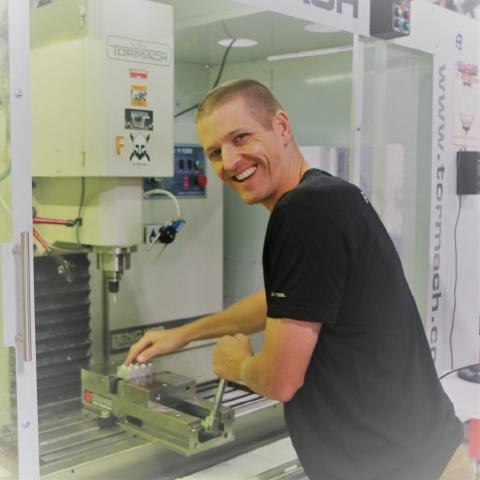
John Saunders: So, that certainly wasn't the goal. And it isn't – it's never been the goal of any of our sort of products or endeavors. The training started because we've had a long-term relationship with these CNC machines called Tormox, which, to summarize, are very affordable machines that you could put in your house and quite capable for the price.
John Saunders: Talk to your wife first. Right. Get permission. Before you bring this.
John Saunders: Much, much, much easier to ask for forgiveness. Now, it's a difficult point to explain why she's never going to be able to park in the garage again. Right, right.
Dave Jones: That's why I had to move my lab out of the garage.
John Saunders: You did this in a New York City apartment, right? Is that the story?
John Saunders: I actually convinced my wife to move outside the city to the suburbs just so that we could buy a Tormox. Oh, well done. Round of applause. Pro-level, pro-level. Our freight elevator wouldn't fit the Tormox at the time. And I had a tag, though. I had actually two machines – three machines in my New York City apartment, but they were smaller, and I needed – I needed – and emphasize N-E-E-D. I needed a bigger machine. This is for the business, dear. Right, right.
John Saunders: Right.
John Saunders: Anyways, so –
John Saunders: Yeah, Tormox.
John Saunders: So we built this brand around those machines. We had people, either companies or we had people who, you know, where they had very little financial limitations in life. And they basically said, John Saunders, I need you to fly out to Phoenix or Oklahoma or Dallas to help train me on this machine for three days to show me how to make parts. And I'm sitting here growing this business in Zanesville now. I've got work to do. I've got a family. I don't want to fly. I like to travel for fun or to tour factories, not to do one-on-one training.
John Saunders: Not to go to Phoenix, right? Sorry, Phoenix people.
John Saunders: That was Chris, not me, just so we're clear. Yeah, yeah, right.
John Saunders: That was Chris, yes. Chris was insulting all of Phoenix, yes. Please let the record show.
John Saunders: No, so I just thought, you know, hey, I'm going to start a training program. And I put it up, and I started advertising. And we have now done it for two years, and we host basically seven to nine days a month of classes. Wow. Yeah. Most of them are sellout. Wow. Really?
John Saunders: Wow. And so what's the range of price for this thing?
John Saunders: A two-day Fusion 360 class where you're just in front of a computer is $300. And that's actually a very low- That's nothing for a company. That's nothing.
John Saunders: Yeah, that's right. Right. That's a very low price. That's all travel costs, really. Yeah. Right.
John Saunders: To the three-day hands-on class where you're actually leaving the class having made multiple parts on a CNC machine where you are actually operating and running your code is $11.75. That's still cheap. And that's compared to that.
John Saunders: I mean, it's, yeah, Tormach. Well, Tormach does training, too, right? Right. I mean, so, and they do training in the many thousands, right, that you could also pay for. So it's got a reference point, right?
John Saunders: Yeah. Our, I mean, I love Tormach. Of course. Our curriculum is much better. Yeah. And we've got it set up to where you're really, you know, the whole thing with a CNC machine is you're going to leave our class and you're going to go run your machine or a Makerspace's machine. So you've got to have some really key fundamental things understood, which is very different than just walking up to a machine that somebody else has set up or programmed and hitting go.
Dave Jones: And you can do that in three days?
John Saunders: We do. It's for sure a full three days, but we do. Yeah.
Dave Jones: Right.
John Saunders: Yeah.
Dave Jones: Is there like a longer call, like a super advanced guru course or something?
John Saunders: After the three day, we have a two day advanced class and a lot of people do, those classes run back to back. So a lot of people end up staying for seven days. Stay for the whole week. Yep.
Dave Jones: Right. Is it, is it most, is it mostly what you find that your market is mostly, is it companies who pay for their employees to go or is it just individuals?
John Saunders: It is probably, it's, it's everything. I mean, literally. Right. Uh, it's probably a third to half companies, but we've, we've had everything from 15 year olds to 89 year olds. Wow. Sweet.
John Saunders: Which is great. Yeah. There's a life goal. Just keep learning. Yeah. Keep learning. Right.
John Saunders: It's super fun. But it's like you said earlier about who else, every, there's not that many other places you can go and actually operate a machine. And the few places you can, it's usually tied to say you having to buy a like $200,000 machine or buy $10,000 software packages or some sales pitch. Ours is just, Hey, you're here to learn. I have nothing to sell you other than really good training.
John Saunders: Well, it's interesting too, because there's such a, I mean, so, so I, I've looked at this stuff with machining as well. And it's like, there, there's nothing but on site, right? You can't, you can't be like, well, buy yourself a Tormach and then, you know, we're going to remote the, you want to be there for safety. You want to be there for the hands-on for the physical, physicality of it. Right. So that all makes a ton of sense. But like, but like there's even on the vocational side of things, right? There's, there's a lot of need for this and it seems like a underserved market. I know there are, there are many programs, so please don't write in and say, you know, look at this program. I know there's a lot of programs out there, but it seems like in terms of how many machinists are needed in terms of the people that are retiring and, and then, and are needed in the near future. It seems like there's not as much out there than, than there should be, you know?
John Saunders: Right. Right.
John Saunders: Agreed.
Dave Jones: And considering that you can buy a machine for like from China for next to nothing these days. Right. Do it cheap.
John Saunders: The, generally speaking, uh, the equipment is less of a barrier than ever. And the knowledge, I mean, yes, it's coming to our class as a great Kickstarter, but the reality is you can watch our YouTube channel or others and you can learn this stuff.
John Saunders: I have, I have a proof on my channel of, uh, messing up many times and yet I, I didn't die and I did end up and I'm actually machining things poorly, but I did it.
Dave Jones: But Chris, didn't, didn't you kind of fall out of favor with your CNC machine, so to speak? Like it wasn't as useful as you thought it might be? Is that through lack of experience or?
John Saunders: I think, well, I'm sure John could speak to the, to the learning curve, but it was, it was a learning curve thing for sure of like, yeah, building, building something, you know, milling a pocket is a lot different than milling a interesting piece. Versus the expectations of like looking at a, you know, a thing on thingy verse and being like, well, I want to make that out of metal. It's like, oh, that's stupid, right? That's, that's not the whole point in the first place. So it's kind of just pairing all this stuff together in my opinion. Maybe John, you could speak to all that stuff as well.
John Saunders: You know, it's a great question. There's, I'm sure there's a lot of similar jokes or quotes in the electronics world where it's like, it's very difficult. It's easy to talk about something. It's very difficult to complete it and finish it and so forth. But a lot of times the machining apart isn't hard. Even the cam, which is using the CAD software to program the tool pass, isn't necessarily all that hard. A lot of times it's really difficult to hold onto parts because a lot of times the part you want doesn't perfectly and neatly fit into a vice that lets you complete the part.
John Saunders: Right. Yeah. And then, yeah, being like keyed up and like, if you have to move it, then is it still in the right place and does your machine know where it is?
John Saunders: Or you've got to do a second operation, which is flipping it over, which is how the heck do I hold it now and so forth. So two things. One, our videos are called the Wednesday widgets. We put them out every Wednesday. Next week's Wednesday widget. In fact, I don't know when your podcast will air, but the Wednesday widget around the middle of February will be on a really, really, really cool trick, which ironically I showed Quinn at M Hub. Oh, nice. As a way to hold onto some really difficult parts, which is a good universal way to hold everything. And the second thing is we now do, sounds like what you have, Chris, and you, Dave, with your ee blog, but nyccnt.com has all this tutorial content on fusion, on machining, on speeds and feeds, on setting up parts for the folks that do want to figure stuff out as a really good resource.
John Saunders: Yep. Yep. Yep. Yeah. And we should mention, that's how John and I met. That's what John was talking about. He was at M Hub, where I work out of sometimes. So, yep, that's how we met. Yeah. Okay. So, and one thing I wanted to bring up is beginners, right? So who should get into machining, right? So the reason I ask is because I got into it from a document, and I can explain that document later, but like, who do you think should or does get into machining these days?
John Saunders: Well, for sure, folks that want to go into the trades to actually work in the manufacturing sector, which is kind of the obvious use case. I think it's really helpful for folks that are in hardware entrepreneurship, whether it's, you know, you go to think back to if you were part of the Pebble team when you were on a Kickstarter project, you know, understanding how the product needs to be designed from an industrial design or a manufacturing standpoint is really helpful to have some basic knowledge of manufacturing processes. And I actually bought my CNC machine, not with the goal of becoming a machinist or doing anything I did. I bought it because I sounded like an idiot when I was sitting down with these engineers and machine shops. I didn't know anything. And it felt really awkward and pathetic. And I thought, no, I want to get smarter at this. So it's kind of like the same thing where I could probably figure out how to get the channel set on an oscilloscope and maybe get a frequency kind of there. But like, I don't, I'd love to increase those skills. And that was how I felt with machining. I don't need to be a master. I need to be able to make basic stuff, prototype in-house, make parts with the goal. And when I make the part and I'm happy, not only can I send it out, but you're so much smarter when you go to send it out because you know how the product needs to be designed. You may know how to make it. You have made some design changes and you are, you represent a better customer to a machine shop because they're ultimately in the business of finding people to make money off of just like any person. So the smarter you say or sound, the more likely they're going to be to, Hey, okay, we'll, we'll bid those parts for you.
Dave Jones: There's nothing worse than a dumb client. You know, like who has no idea what they want manufactured.
John Saunders: But also if they're pushy and dumb, right? That's even worse. Right, pushy and dumb. Yeah. Yeah. Right.
John Saunders: It's funny, it's funny being on this podcast, Dave, because I started watching your YouTube back when you started, which is about the same time I did. And you've never been one to mince your words. No. That is a true statement.
Dave Jones: No, I lack tact. Yes.
John Saunders: Well, speaking of two, I mean, does that, does that play into the whole wanting to learn? Because I mean, at least in my head, you know, the picture of the machinist, the old school machinist is, you know, closer to AVE than, than, you know, your kind grandfather, you know? Right. Yeah.
John Saunders: I don't know. That's a good question. I mean, there's, there's less of a prototypical machinist these days, because honestly, you would probably be, you could potentially be a phenomenal machinist or play a role in a machine shop if you're really good at computer gaming, because really using Fusion 360 and some of the advanced cam stuff is more to do with kind of hacking software than it is necessarily being able to, you know, really, really crank down on a vice. Yeah. Right. Right. Yeah.
Dave Jones: And swear at it. Right. Right. Yeah. Right.
John Saunders: All right. Yeah. That, that, that document I was talking about, the, it was the gorilla guide to machining. Have you ever seen that one?
John Saunders: No.
John Saunders: So it was by a Google engineer. I've talked about it a couple of times on this show. It is just this fantastic, you know, tome of, and it's just a bunch of web pages really, but it's just, it was basically kind of comparing, he was doing like a little universal gear setup and basically really, really tiny stuff. And basically he showed comparison of like, this is where 3D printers are fit in this. And this is where, uh, you know, uh, a milling machine fits into this. And then he was doing, um, poured molds with like vinyl, I guess it's vinyl. Um, so, so yeah, so that's what, that's what got me into the whole thing in the first place. And so that's how I got kind of intoxicated with the idea of a machine. But the expectation was that I'd be building these things. So that, that's what, that's what I was trying to get at is like, where, you know, where should people set their expectations when they're, you know, when they're thinking about going to a machine shop? Like what, what, what do, what do people usually need to make at a machine shop as a beginner? Well, what do you mean? Well, like, so, so you can get someone in front of a 3D printer and be like, go to thingiverse and you know, you can see all the things that you could build. Right. Whereas if you have a beginner and you're like, here's a milling machine, what would you tell that person that they're probably going to build with it? You know what I mean? Like as a beginner.
John Saunders: Got it. So, so the best way to answer that would be think about making a part that requires only what they call 2.5 axes. In other words, um, a true three dimensional shape. Let's pick something like an Xbox controller. Most people probably know what that looks like. It's got a lot of surfaces and curves. It's a relatively complex part. Um, that's not something that you're going to just walk up to a machine, even if you've been using them for a few weeks or months and be able to machine the actual controller or even really the mold for the controller. Although ironically, the mold wouldn't be a basic mold actually be pretty easy because you could hold a large block and just machine the negative. Um, what would be relatively easy are these two and a half degree parts. So in other words, think about if you wanted to machine a custom case to hold an Arduino or a microprocessor or a project box that had a gasket for an O ring so that it could be sealed against the elements. You're able to hold onto a square part that fits into a vice. You're able to machine around it. You're able to machine inside of it. So the reason it's called two and a half degrees or 2.5 axes is that you're usually moving the X, Y, you know, CNC machines work on a, the old Cartesian coordinate system. So they move on X, Y, X is left to right. Y is front to back. And then Z is really only lifting up to move the tool over to a different area and then back down. And then it's going to cut in X, Y. Does that make sense?
Dave Jones: Yep.
John Saunders: So your traditional X, Y parts are relatively easy to make. And most people now are pretty familiar with the capabilities and the limitations of 3D printers and the time and cost and so forth. So machining is nice because let's say I need to make a custom height, you know, block to hold a bearing for a motor and it's got to have some ability to hold some torque and rigidity. That's a great example of a part where you could have some tapped holes in a bracket with a custom sized hole to press a bearing in. That's relatively easy work to do. Got it.
Dave Jones: Can I, with my dummy knowledge here, can I guess what a three axes milling machine is like? So instead of the drill coming down straight, so there's just the one Z axis, that can actually angle and tilt. Is that correct?
John Saunders: Incorrect. No. No? No. Incorrect. That's strike one, Dave. No. What it can do is, it's great to, it's funny, it's great to hear you ask this because it's a, I think it's important that people know this. It's simple. Yeah, are you? Tell me. The drill or the tool can move up and down. That's your Z or Z for the rest of the world.
Speaker ?: Yep, Z.
John Saunders: Yep. And then it's, I always just joke that it's like the Willy Wonka elevator. It can go left to right or front to back. So instead of a drill, which actually drills aren't really used a ton, we do use them, but what we really use a lot are what are called end mills. So those actually cut on the side of the tool.
Dave Jones: Right.
John Saunders: So think about dropping a tool down and then cutting through the part. So there are machines that will tilt and turn and twist. Those are four or five axis and more.
Dave Jones: Oh, so they're not three axes, they're four or five. Right. Correct. Correct.
John Saunders: And that's a whole other world. I think on the show before, we've talked about that. Dave, do you remember that Pocket NC? Do you remember that one? It was like a little green one. That was a five axis machine. Right. And that was pretty complicated for what it was, but it's, you know, it could do a lot of different angles. And they always like show, what's the one they always show, John? They show like a turbine blade or something.
John Saunders: Exactly.
John Saunders: Like an impeller. Oh, okay. One that curves and twists around. Exactly. Right. Yeah. Yeah. Got to get that demo part, right? Yeah.
John Saunders: Right. Well, no, but it's without going off on too much of a tangent, you know, traditionally five axis was that crazy. Like we need to machine a, you know, impeller for a nuclear power plant or something, but really most five axis is what's called three plus two. Same thing. Like I just mentioned, where you're really only orienting the part in a different direction. What's great is, um, let's say you need to machine a part, which has features on the top and on four sides with five axis, you can do all of it in one program and one setup. So it's actually a lot easier to do, uh, in that case to get your completed part without having to say, okay, now I need to flip the part. Now I need to rotate it. Now I need to set it back up and measure it and find out where it is and so forth.
John Saunders: Yeah. And that's usually, uh, the video I always point people at is that Mori Seiki, the helmet, I think that's only a five axis. It's like a aluminum helmet where they machine the whole damn thing. And it's just, it's, it's, it's simultaneous.
John Saunders: There you're actually moving all of them at once.
John Saunders: Oh, oh, I see. I see. So you're saying that like, yeah. Okay.
John Saunders: It's a, it's like an industry joke that most, you know, 89% of statistics are made up on the spot, but you know, 90, 92% of five axis machining is really, I'm just going to twist the part over. So it's on its side, lock it in place and then go do some work on it.
John Saunders: Got it. Okay. So it's just like different reference points really.
John Saunders: Right. Okay.
John Saunders: And so what are the, what are the materials that people are usually, uh, machining as well on, on these kinds of milling machines? And we guys were just talking about milling machines too, right?
John Saunders: Correct. There's lathes as well. Those are your two, for sure, the most common two machine types. Um, most people, many people work with aluminum. It's lightweight. It's relatively inexpensive. It's easy to machine. It's very common. Um, but you can work with steels. You can work with stainless steels. You can get into exotic materials. Um, you can use things like titanium, which are, have benefits of being like biologically inert. Um, really most, there's no practical limitation on materials. You can also machine wood, plastics, et cetera. Cool. Okay.
Dave Jones: How do you, how do you machine a titanium piece? Cause they're so hard. How do you, is it titanium on titanium? Like, how do you, what pieces use to do it?
John Saunders: I'm curious. What makes you think it's hard?
Dave Jones: Oh, I did just from, uh, what, uh, people have told me. Like it's like, isn't it like really expensive to machine titanium?
John Saunders: Wait, I know that. I used to use it for plastics. Oh, okay.
Dave Jones: No, I just got that impression over the years that titanium was really like not easy to machine. Am I wrong?
John Saunders: Everything you said is different. Right. Expensive, hard, easy to machine. No, um, it is expensive. Uh, it is funny. There's some interesting, and I'm not a titanium expert, but, uh, there's this sort of titanium market, which is that most of the titanium that's created, there's different grades, um, or sorry, let me explain this a different way. Most of my friends that buy titanium have realized that a lot of the titanium that falls into our hands, meaning I'm not Boeing, I'm not Lockheed Martin. You're right. We are getting scraps or remnants or the leftovers of run. No, seriously. Yeah. So titanium isn't like aluminum where we just smell huge amounts in the world and you can buy whatever you want, whenever you want. Titanium is a little bit more difficult to get, uh, or expensive. Um, it's not that hard to machine. It's just that it's easy to machine it incorrectly and thus have it. Um, it's kind of like, I don't know, soldering a small SMT. It's actually really easy once you've done it a few times, but it's really easy to screw it up. Right. That's, that's all.
Dave Jones: And hence waste cost and hence why it's expensive. Right. And people get frustrated. One of the reasons. Yeah. Right.
John Saunders: It's not particularly strong. I mean, it depends on how you're defining strength, but no, it's really, it's lightweight. Um, that's about it. Okay.
John Saunders: So, so John, how about like, you obviously have learned a lot of this stuff. I, I didn't, I didn't actually really, I thought you had a machining background too. So like, I apologize about that. But like, I mean, what was your process as you were like going, getting into this field? I mean, what, how the hell did you get to where you are? You know, like, you know, like, you know, literally, literally, I was 20.
John Saunders: Yeah. I bought, I mean, it's, what's funny is it's all on YouTube. You can literally, I highly discourage anybody from doing this, but you can go back and see me like I'm putting tools in the machine wrong. Yeah. I don't know what I'm doing. And you know, that's what's, you know, I feel like an old man when people are like, oh, kids have got it so easy these days. But, you know, it's so much easier now because the, the system has worked itself out. There are very, there are relatively few choices when it comes to software. And that's a good thing. It's really good that there's really only a couple of packages and they're great. Um, I bounced around a bunch because, you know, you never knew. It's like, I used Eagle, I used Fritzing, I used these web plugins. I was like, what do I do for basic electronics work? Um, and, uh, I just, just kept doing it. Uh, I really just did. Took, took 10 years, but, uh, yeah. Okay, cool. That's great.
Dave Jones: Speaking of packages, can we start, can we get into packages? Because, uh, we discussed this a bit before the show, but, um, David to my off-sider, David Ledger, he, uh, made this video because he's like an MCAD guru, right? He loves, like, he's like a solid works expert. Right, right, right. Anyway, um, yeah, he's done lots of complex stuff in them. So he kind of knows what he's doing. And, and he thought we were looking for a package, like for the EEV block, right? Like to buy one for us. Because we're manufacturing the new microcurrents, sorry, the new micro supply project we're working on is going to have like a custom case. Cool. And we're always doing little 3D parts. So we need a package, right? We need to sort of pick and standardize on a package. So he was kind of reviewing, like just internally himself, these different packages to, you know, choose which one to go with. He wanted, of course, solid works because he, he always used that because he had a free student license, right? When he, when he went to university, right? That's where he learned it. And so, but then when it come to me having to actually pony up the money to buy the software, he just went, oh, let's use solid works. And I went, how much? And he went, oh, I don't know, eight, $10,000. And I went, no thanks. Um, you know, like just to do simple, like what, what I thought were relatively simple things. Right. So we tried Rhino and which he had used before and he thought was quite good. And, um, Onshape, which is a free online one. And we compared those three. So I, so I told him, hey, why not just shoot a video, you know, actually dicking around with these and, and comparing them. And it sounded like a good idea until the, until we uploaded it and people started commenting. And, um, yeah, I think we broke, we broke the internet.
John Saunders: Did you find the trolls?
Dave Jones: We found the, uh, the MCAD trolls. Yeah. You, you woke the trolls, I see. And yes. And by far the biggest complaint was, what are you, hell are you doing? You didn't include Fusion 360. Oh, it's funny. You know, as if like that was the tool of choice and we were just so dumb for not doing that. It's just simply because he had never used it before. So, and then a lot of the other complaints were, how dare you compare Solidworks to Rhino and to Onshape. There are three entirely like apples and oranges and pears. Yeah. Kind of thing.
John Saunders: Um, very, uh, very poor judgment on your part. Yeah. Right.
Dave Jones: Okay. Well, you know. No.
John Saunders: So, John, have you, have you been in a similar scrap before? Is that what I'm doing? Okay. Uh, I, I have, uh, I have been a strong believer that you make your own happiness. Uh, we were joking about the fellow ClickSpring and how, what a phenomenal he does, job that he does on his YouTube videos and the projects that he makes. It's the carpenter, not the tools. I don't care what machine you use, what software you use. People get in such a rat race and they're concerned if I'm not, they're not doing the right thing and blah, blah, blah. Um, I will.
Dave Jones: Altium, Eagle, you know. Right. Yeah. Yeah. I get it. And yeah, Kikehead. Yep.
John Saunders: So, so the, the short answer is, um, Fusion 360, which is an Autodesk product and Onshape, which is a startup, but it has a twist to that are the relatively new players in this sector. They're cloud-based models. Everybody uses the F word. They're not actually supposed to be free. Right. Fusion is, is allegedly free for students as is frankly anything these days. Um, and Fusion is free for hobbyists and startups. But you are supposed to pay for Fusion. Uh, they don't, they don't. Yeah.
John Saunders: 300, 400 bucks a year or something like that.
Dave Jones: Oh, that's not too bad. Okay. Right.
John Saunders: No, no. Uh, Onshape is a slightly different business model. And I think what they do is you have to start paying if you don't want your projects public or you could be on a certain. Storage space. We hit the free storage space limit. Yeah. Yeah. Onshape is by and large the old SolidWorks team.
Dave Jones: Right. Yes. Right.
John Saunders: So, and then they switched over and did a new thing. Right. Right. And raised 60 plus million.
John Saunders: A lot of venture capital money. Yeah. Yeah. Um, the thing I don't like about Onshape and the reason for me Fusion was an easier choice is that, uh, we live in a world where frankly there are too many options and options, you know, there's some awesome business books and studies on every time you're forcing a customer or somebody to make a choice, it taxes them. And for me, I'm running a YouTube channel on educational content. Uh, if everybody's using different software or in Onshape's case, they don't, it's not a fully baked software. The idea is that they've got kind of an app store so you can have different plugins, different cam, different ecad, different renders. Well, there's no continuity for learning there. Right. Um, Fusion also happens to have really good cam, which is the stuff machinists care about to go run their CNC machine. So, um, that's why we use Fusion. Fusion also has just crushed it. Um, I, I think, believe it, I think relative to Onshape Fusion is doing a phenomenal job too on user base. So there's this great community around it. Um, it's not as robust or powerful as something like SolidWorks, but as you already discovered, SolidWorks is five to $8,000 plus. Yep. Uh, for me, we used to be a paid SolidWorks user and it was like 1200 bucks a year just for the quote unquote maintenance.
John Saunders: Maintenance life thing. Yeah. Yeah. Yeah. Of course. Let me tell you, I never had any maintenance done. Right. Or my SolidWorks. Right.
Dave Jones: Now here's, um, oh, sorry. No, continue.
John Saunders: No, go ahead.
Dave Jones: Launch. Well, here's the thing, right? Um, where, where, like he's making, he's designing this little, like, it's only like five millimeters by like five million, like a little foot or something for our product. Yeah. And, and he's going, I can't, you know, look, and he's spending hours and hours just like blending these little radii curves in like, um, you know, Rhino or whatever. And he's going, I can't, like, we need to buy this $10,000 package. I can't do like, this is just ridiculous. You know, like, and, and me, dummy me going like, we, I just want a simple extruded aluminium case. Like, I just like, like, it's not like, for me, it doesn't seem like rocket science, but he's trying to explain to me how. Like, crap.
John Saunders: Those kids, kids these days, huh, Dave, you know?
Dave Jones: Even though he loved Rhino and thinks it's really good. He says, I just can't do this simple thing. Well, I, you know, it takes me hours to do this simple thing in Rhino. That takes me 30 seconds in SOLIDWORKS. And I'm going, well, I don't know.
John Saunders: So, Rhino is great software for certain uses in certain people. Right. I wouldn't say a bad thing about it, except in your shoes, Dave, or anybody who's listening, dear God, don't use Rhino. Right. Okay. Right. Rhino is a NURBS modeling software that happens to be really good in the example I give is if you're designing a yacht, like a hundred foot yacht, Rhino has certain capabilities for curved surfaces that are amazing. It's, it's been a year since I used Rhino, but I don't believe it's parametric, which is brutal for what, what most of us actually want to do, which is we want to say, oops, I made a mistake. That needs to be six millimeters, not five. I want to go update that. Yeah. In Rhino. Yeah. Good grief. Grab a Snickers bar. Right. Okay. Right.
John Saunders: Cause then you have to go. Yeah. That's, that's a great point because then if you have to adjust the one thing for five to six millimeters, everything that's dependent on that is now not tied to it. Right. That's so that's like the power of parametric in the first place.
Dave Jones: So what is the best package for someone like me who just wants to design simple custom cases that I might either get machined or like either extruded and or injection molded?
John Saunders: Fusion 360.
Dave Jones: Fusion 360. Okay. Thank you. He's bought and paid for it folks. Yeah. No, it's just, I think it's crazy for me to go out and to spend like $10,000 on a, on a software package that, you know, like to me, we're using the simpler, we're doing the simplest stuff possible. We're not making an Xbox controller or a Tesla Roadster. You know?
John Saunders: Well, here's a question, John, too, is, is it, would it be worthwhile? I mean, like, honestly, with what Dave's talking about, would it be better for if Dave didn't have David to there? Right. So David too, obviously he's a little bit more proficient on this stuff. If Dave was just being Dave, should he be even doing this in the first place? Or should he be, should I just find out? A sheet of paper and yeah, being like, here's what I think I want.
Dave Jones: Or should I just pay someone? Should I go and freelancer or whatever?
John Saunders: Right. Or just going or like even just going to buy a project box. You know what I mean? Like where, where do these lines fit?
John Saunders: For sure. I mean, look, it depends on what you're trying to accomplish, but. But to give you an idea, a proper injection mold, there's lots of different types of molding, but most people are familiar with injection molding. If you're not, the best example would be a Lego brick. That's an ABS plastic. It's injection molded, meaning plastic pellets are heated up and then they're pushed through a screw, which is a way of transferring torque. And under multiple hundreds of tons, that material plasticizes and flows into a mold that's been incredibly insanely precision made or machined or sometimes they're what's called EDM, which is electro discharge machine, which uses spark erosion, super cool stuff. But that's incredibly complex. A, to have a mold for something like a small Lego brick made would probably be, I'm going to just take a guess, $40,000 to $200,000. No.
Dave Jones: No. In China, you can get injection molded NRE cost of like 500 bucks.
John Saunders: I mean, like. I think so.
John Saunders: Have you done that? Have you tried that?
John Saunders: I've gotten stuff made for five grand. I've gotten a mold made for five grand in China. That is, all right.
John Saunders: Okay. Well, so number one, China.
John Saunders: But it's not a Lego, right? No. No. It's just. The precision, the life of the mold, whether it's been hard. Yeah, yeah. Of course.
John Saunders: The big, a big part of the cost is that the production molds have to have cooling lines run through them. Okay. The other thing is that a lot of mold shops won't do what's called throw somebody else's mold.
John Saunders: Uh-huh.
John Saunders: Not because they're trying to make you buy the mold from them, but it's like, hey, I've got a, I've got a $100,000 or $300,000 press. I'm not throwing some random guy's mold. Right. If it's not designed for this, for this thing. Oh, okay. Yeah. Yeah. That makes sense. Right. Right. Right. Interesting. Okay. So, so also it's the number you're going to make too, right?
John Saunders: You're going to make, if you're going to make a 10 million, a 10 million shot mold is going to cost a lot more than a 10,000 shot mold, right?
John Saunders: Uh.
John Saunders: Of like the, the, the, the, the, the, the, the, the, the, the, the, the, the, the, the precision of the thing, right?
John Saunders: I'm not really qualified to answer that. Um, my guess though, is that here, here, here, I'll put it this way. I tend, I, I, I do a decent job of keeping my ear to the, what's happening in manufacturing and stuff. And it's still not the case that people who have a thousand of something are doing it with what we would consider injection molding. Now they may have a shop where there's like, it's a thing called like a Morgan press, like they have at M hub where you're, where you're doing one at a time, but that's not technically that's injection molding, but that's not what we think of as a machine that's just automatically pumping out thousands.
John Saunders: Ka-chunk, ka-chunk, ka-chunk. Right. Yeah, yeah, yeah.
John Saunders: Exactly. Yeah. Um, you're still better off with things like machining with 3d, um, printing, or what we do here at our shop is low pressure mold. So there's a ton of ways to mold things that are not under the multi hundred ton pressure of injection molding. And that can be for testing or it can be for, you know, small run production. Yeah.
Dave Jones: Um, now can these software packages like a fusion 360, can it do like, are there different, would you design, would you model the thing a different way? So to speak, depending on whether you're extruding something, whether you're 3d printing something or whether you're injection molding something or whether you're machining something.
John Saunders: So what you just asked is a phenomenal question because that's kind of, it comes, it encapsulates all different questions about manufacturing.
Dave Jones: Yeah, of course. They're mainly the four, four different types, right?
John Saunders: Yeah. So 3d printing tends to be limitless with the exception of things like overhang, depending on your support material. Machining has, um, has very real limitation. Actually, I'm going to answer your question a different way in a second, but, um, fusion 360 does a great job of helping you at least understand that or start the framework. And then actually has something called like draft analysis. When you do any sort of molding, you need to have some draft or taper so that the part will actually come out of the mold. Uh, it's actually a phenomenal little trivia nugget, which is if you've ever used a Lego, uh, where's the draft?
John Saunders: That's a great, I have no idea.
John Saunders: Where is the draft? Is it the inside? Dave?
Dave Jones: No, I don't know.
John Saunders: Exactly. Legos are a rare example of an injection molder product where the outside is square and perpendicular and they actually run the draft through the ID of a Lego. So next time you have a Lego, uh, nearby, look in the inside. Huh?
John Saunders: That's interesting. Uh, yeah. Yeah. Actually, one of our former guests was, uh, we used to work there too. He said that the static buildup on those molds are really crazy too. Something about the injection process. Yeah. Like they get to hundreds of volts.
Dave Jones: I'll tell you what, I am not a complete dummy at this. I found a package that was so suited to a dummy like me. Um, have you ever used the e-machine shop software?
John Saunders: Yeah, I have.
Dave Jones: But to me, like as a dummy, not knowing anything, I opened that package and I designed a custom case for my three, for my, um, scientific calculator watch with, in virtually no effort. And then it ran the analysis to tell me whether or not it could be machined. And I thought that was, that was my, my mind was blown how easy that was. And every CAD package that I've tried after using that is like, this is so raw and like, how do I even start? It's like a pro tool versus like a friendly tool.
Dave Jones: Right.
John Saunders: Right. Look, I, I, I, I, here, I know you Dave, just through watching your technical videos, if I had an hour with you, um, you, you would be running fusion 360 and smiling. Cool. Now you could go watch our YouTube videos or other people's videos or whatever. The, the, one of the, one of the few drawbacks to fusion, the name comes from the fact that Autodesk is fusing all these different technologies and capabilities into one, which comes with the apparels of there's a lot of different ways you can use fusion. You have the same people like me that are using fusion to machine parts are also using the sculpt tools or the patch environment tools in fusion to do very organic biological shapes. Those are totally different, um, inputs and outputs. And so it's tough because some people I think see fusion and they see like the Pixar lamp being designed and they're like, well, that's not what I want. And I'm like, no, um, I basically use fusion. Uh, I have my fusion set up. So it's basically identical to solid works. Right.
Dave Jones: Right.
John Saunders: Okay. Very, very easy.
John Saunders: I have to ask John too, because we're going to get crap for it. If I don't, um, what do you think about the whole cloud-based thing? Cause obviously me and Dave have railed against cloud-based tools for ECAD stuff for a long time. And I'm still on that side of things. But, uh, what do you think about it being kind of cloud captive and your stuff's kind of stuck with them if you, you know?
John Saunders: So I've, um, I should probably disclose this. I'm on this like sort of informal advisory board for the Autodesk fusion team or whatever. So I have, uh, strong opinions. Um, Autodesk isn't backing down anytime soon on their dedication to the cloud.
Dave Jones: Um, it has a cloud anytime soon. He did say that. Yeah.
John Saunders: Right.
Dave Jones: Well, right. Um, are they still not confident? The collab?
John Saunders: Well, we can, I don't, I tend to be a very positive person.
John Saunders: Um, there are, that has no place here, John. Come on.
John Saunders: No, look, I was, when we were a solid workshop, I used, um, actually sugar sink, but just like drop, uh, Dropbox or Google drive. Yeah. Yeah. So fun fact, I already had the cloud through that. Like I didn't need this, you know, forced, uh, layer, uh, there now it does have some benefits. There's some pretty cool stuff we can do. We can share, like for instance, we have sort of five or six different people here in the shop, I can share through the cloud, the tool libraries across all the machines. That's actually really important. Yeah. Um, so there has some benefits. The reliability is tough. Um, because when it goes down, you know, I'm not a hobby anymore. I have a payroll. I've got machines to run. Um, Autodesk does a great job with it. There's a couple of things they could do a little bit better, but to answer your question, to stop beating around the bush. If I had a checkbox that said use fusion, you know, within our shop or use fusion in the cloud, uh, I would pass in the cloud.
John Saunders: Okay. I mean, that's fair. And I think mostly I think about the longevity piece, really, you know, you're making parts that you want to be making for the next 30 years, maybe. Right. That's not unheard of for machine shops. Right. And if you can't open the part in 10 years, because so that's not really true that there
John Saunders: that's, and I, I've been emphatic with, uh, making sure Autodesk clarifies this because people think that that's a longterm bait and switch. So, um, all of your fusion stuff can still be cached locally. And that cached file format is a file that you can figure out how to open it. Other software.
Dave Jones: But if, if your company internet goes down, can you, and does your shop stop? Like if you're reliant on the cloud?
John Saunders: Uh, it depends on whether it's Tuesday or Friday. No. So the way fusion works is anything you've opened is cached locally. There's a couple of little hiccups to that that aren't worth getting into, but generally speaking, we're fine.
Dave Jones: Um, sorry, does, uh, for fusion for dummy, I haven't even downloaded it. Does it like, is it an executable that runs on my windows machine?
John Saunders: That's so that's the other huge difference. Fusion is software you install. Whereas on shape is just, just a web browser. It's browser.
Dave Jones: Yeah. Right. Right. Okay.
John Saunders: So in other words, there are people, I do not recommend this, but there are people, uh, who will literally start using fusion, force it into offline mode and just use it that way.
John Saunders: Yeah. I'd say if people want to use a, have a comparison, I think like, so like up further is like on shape, right? So that's all browser based. It's tied to the server. And then, uh, what's the one Dave, uh, the Altium maker.
Dave Jones: Oh, the Altium, uh, circuit, uh, circuit. Yeah. Circuit maker.
John Saunders: Although I think that the fusion's a little better on, I mean, yeah, a little bit better on the time.
Dave Jones: Circuit maker is an executable download, but you must be able to, uh, no, no, but it can, it, they realize this problem. And when it first came out, yeah, it was cloud only. And then they introduced very quickly introduced the feature to, uh, actually cache the file locally. Yeah. So you could actually go offline for a while. I think three days if you, you could work for three days and then you had to reconnect or something. Yeah. So yeah. Yep.
John Saunders: Something like that. Can I, uh, can I go back to your question about what, how to design something in the capabilities? Yes, please. So, so this is actually super exciting. Um, Autodesk has this kind of like quasi public, um, I think more is coming soon software called dream catcher. Um, I guess that's a crap name.
Dave Jones: That's not, sorry. That is just a, what, what, what, what freaking committee came up with that?
John Saunders: Uh, I will give them, uh, some credit because if, even if you think the name stinks, what you're about to hear is pretty cool.
Dave Jones: Okay.
John Saunders: So, uh, most of the people in the rest of the world know what formula one is. I feel like it's not as popular in the U S but they used within dream catcher. Um, it has a learning algorithm or intelligence to it. They fed it the PDF of the F one rule book and they said, we need to design a new, I forget what the example was. I think it was sort of like the roll cage around the driver's head area. It was smart enough to read the design parameters and the FIA rules on weight and on size and envelope and tensile load. Then you ready for this day? And I've seen this in person. It has every single different manufacturing technique with sliders for cost, time to market capabilities.
Dave Jones: Oh, you can just parametrically change that.
John Saunders: No, no, no. Sheet metal to 3d printing, to machining, to five access machining, to water jet, to hydraulic molding, to injection molding, to casting, to resins. And you have all these dynamic and variables and it will literally print out 72,000 permutations that meet the design requirements that meet the tensile strength requirements. Based on what machine tools you have available.
Dave Jones: That's insane.
John Saunders: We'll do like a birchwood roll cage or something too. Yeah, right. Very cool.
Dave Jones: So that is awesome. Now here's my question with Fusion 360. Right. Will it, does it have the capability to check my design? Dummy Dave comes along after his three-day training course and designs a file which I want to send off because I don't own a CNC machine. I want to send off to my, the CNC shop. Can it check that for me to make sure I'm not doing anything dumb? That's what I liked about E, the, E machine shop software. Is that before? It was like tied into the process, right? Yeah. Yeah. It was tied into the process. No. Nothing like that. So how do I know that I'm doing something wrong? I'd have to go back and forth with the machine shop 20 times and they just slap me over the
Speaker ?: head.
John Saunders: Dave, you post a video of it and then, and then everybody tells you.
Dave Jones: Oh, then everyone tells me. Right. Yeah. In a hundred different ways. Right. Yeah. Right.
John Saunders: You know, it's a great question. My guess, and it's been years since I pulled up E machine shop. My guess is what it's telling you is pretty basic stuff that, that software like Fusion could do, but then they're representing some ability to, to, to, to represent what the, your model is good and not good. And the reality is that's probably pretty sacrificial within E machine shop. Um, so there, there isn't, I don't have a good answer for you.
John Saunders: Yeah. Well, maybe a good question too is so, okay. So let, let's keep using Dave's example of, you know, he wants to design a project box, right? Yep. So what would you start constraining on those kind of in that situation? Right. Would you, would you tell someone to like, just go and design a custom thing right out? Or I mean, no, absolutely not.
John Saunders: Um, even if you're, even if you are a delusional entrepreneur with aspirations of selling tens of thousands, um, you need to find an existing box and just use it, or you can take that hybrid ground of take an existing product or box. And we actually know companies that do this, bring it in and then modify it, engrave it, tweak it. Um, do that for the first thousand and your, guess what? You're going to learn. You're going to iterate. You're going to design. Um, you, you, most people, most people personally, or their venture capital backers do not endorse you trashing a, or throwing away an injection mold because you design, you want to do a design change. Right, right, right. Yep.
John Saunders: Yeah. That's, that's enough one.
John Saunders: So you've got to, yeah.
Dave Jones: Well, as, as a beginner who's trying to do this stuff, how do I know like how thin I can make the walls of my box, how small I can make the holes, how deep and what axes I can, like what the machines are capable of doing. I can kind of guess using my generic engineering knowledge, you know, um,
John Saunders: Or even like standardized drill sizes, right? Yeah. That's something I always struggle with. It's like, oh, well there's probably standard drill sizes and that would speed it up. But like, there's just so much base knowledge that I don't have in the mechanical realm.
Dave Jones: And, and then it gets like, uh, probably for machining, I can kind of use my intuition to figure that out. But then when you're talking about injection molding stuff and then you've got the problems with pullback in the, of the molds or whatever it's called and all sorts of like stuff like that, I have no clue about.
John Saunders: Well, so there's a, there's a bunch of ways to answer this. Obviously a short timeframe to audio podcast isn't going to come close to like covering it at all. What I would suggest that was the most practical. Is there a YouTube channel they can subscribe to? Well, no, it's funny because I, I tend to, um, hang around machinists a lot. So these questions actually don't come up because we all are kind of, you know, we're all kind of preaching to the choir here. Um, the, let me answer it two ways. One is don't worry too much about that. Get, um, get your design done from what it needs to do. And then you need to, you know, part of entrepreneurship is recognizing what you're not good at and finding the people that can help you. So you need to have a friend or a formal service. Um, we use Upwork weekly here for stuff from electronics designing to, uh, graphics designed, all kinds of stuff, go spend 20 bucks or 50 bucks and say, give me a 10 minute video commenting on what I need to change on this design. Here's what I want it to do. That's for sure the best recipe that I can give somebody who's really, uh, new to this. Uh, if you want a little bit more of a direct technical answer, um, whole diameters and stuff aren't really a big deal on modern CNC machines or drill sizes, but think about this, uh, your traditional three axis machine, which going beyond three axis gets pretty expensive. Um, so for keeping things reasonable, think about things like a, for us, you know, eighth inch or quarter inch drill bit. So, you know, two, four, six millimeters and up not going more beyond like three to five times diameter. So for example, I don't want you to send me a part, uh, that has a two millimeter radius, 20 millimeters deep.
Dave Jones: Right. Okay.
John Saunders: I can't, I can't, I can't machine that reasonably. Now if I have access machine, I could tip the head and come at it from an angle, blah, blah, blah. So keep the parts, think about it like holding a pencil and think about how you would make that part. If your pencil was actually a cutting tool and you had to keep the pencil perpendicular to the part.
John Saunders: Yeah. So no, this is good too, because this is like a, uh, this is some of like knowing the process also informs the design, right? So, so, so Dave and I are co-designing a box, right? We're just co-designing a box and we do want it to be injection molded for whatever God unnows reason. Right. When should we talk to machinists? When should we go to a shop and start like getting stuff quoted or getting, getting something, uh, you know, getting some kind of feedback?
John Saunders: I mean, I would do it now. Um, it, this is sort of a side thing, but, uh, send it to me and I'll, I'll do it as a compliment, no charge. And if eventually, if it's something we can share on our YouTube channel, it'd be a super fun example of saying, Hey, here's what I like. Here's what I don't like. Um, the other thing is, I was going to say, when me and Dave are not actually designing
John Saunders: anything together, I'm not that bold to design something with Dave. No, we would never talk to each other again. Yeah. Hilarious. I'm just saying this is an example of, you know what I mean? Like is Dave critical? It's a little bit. Yeah. I don't know. Have you seen his videos? No. Yeah. Uh, I mean, he pays someone to, to, to, you know, yell at him. Yeah.
John Saunders: Um, take a look at things like, uh, Xometry, which is X O M E T R Y. Proto Labs is another one. Uh, this is the, uh, you know, E machine shop is kind of referred to as a joke in our industry.
Dave Jones: Oh, but for me, it's, it's like, it's magic. Right.
John Saunders: It feels, it sounds like fritzing almost like me and Dave are not like huge fritzing fans, but for people that are getting started, they're like, no, this is awesome. It's, it's very clear. It's, it's something I need, you know, here's the problem, Dave.
John Saunders: I'm like you in the sense that like whatever you need to do to get it done. But if you actually want to get something injection molded, and if the first thing that comes out of your mouth to the, to the potential vendor is E machine shop.
Dave Jones: Oh yeah. No, no, man.
John Saunders: No. Yeah. I know.
Dave Jones: I, I, I, I, I know why it can be seen as a joke, but for just doing a simple machined part, I think it's, it's, you know, it's kind of a tool for the job, right? It's just like the PCB manufacturers. There's a lot, there's some PCB manufacturers who have their own software and I, you know, and you use this software and you can only get their board made by them kind of thing. It's hard to sort of export. Yeah. Is there like an, a service, like an online service or webpage or something where you can like upload your file, your Fusion 360 or SOLIDWORKS file and it analyzes it for manufacturability? Oh yeah. See, that's what I want. That's what I want.
John Saunders: And it's free.
Dave Jones: Oh, where? Is that ProtoLabs? Where?
John Saunders: Is that that thing?
John Saunders: Is that, yep. So ProtoLabs is the one that is probably the best known. Okay, cool. They do all their machining in house. They have this like, it looks like a server farm of Haas machines. It's insane. It looks Photoshopped. We use Xometry, which again is odd spelling, similar front end interface where you go to the website, you upload your file and within like 27 seconds, it gives you a price.
Dave Jones: Nice. That's nice. That is eMachineShop, but for any package, right?
John Saunders: Kind of thing. We use Xometry. It's eMachineShop, but we actually send significant amounts of work to Xometry. Oh God. I trust it. It's good stuff.
John Saunders: Well, I know Plethora too. They're a plugin, I think, for not SolidWorks. Right. That's another one. But that's another one where it's like, it's an online interface and they're trying to remove the machinist from the situation, but it's more about constraining it to the point where it could be more automated more than, they're not trying to put machinists out of jobs. They're just trying to remove the simple jobs basically.
John Saunders: Well, so that's what I like about Xometry is that they will actually, they don't have machines, well, they actually do have machines as backup, but they partner with other shops like mine. Yeah. Where, or shops that have capabilities and they know what those shops are good at. So one shop is really good at lathe parts or small parts or big molds. And so they kind of play broker, but it's a lot more. Oh, so you're like, you're like a feed shop to that too, huh? Exactly. No, we're not. We don't actually do work for them anymore. Oh, you don't. Okay. We looked into it, but we're transitioning our businesses, which is a whole nother story, but we have sourced parts through Xometry. And the point is that the person that's making those parts is a, is a pretty dialed in shop. It's pretty high certainty of success. So like I would have no problem with somebody using Xometry as a key value proposition in a business plan for saying, Hey, this is how we're going to execute on our idea. That's legit. Emotion job is not. Now the Xometry is not going to tell you, Hey, you need to change this fillet or this dimension is no good, but you can upload it and you get a price and then you can upload different versions. Yes. You with me?
Dave Jones: That's what I was going to ask. It does the machining slash manufacturing industry work similar to the PCB industry in that when you send your PCB file, for example, to a manufacturer, they, a lot of them will not tell you that they'll just say, yes, we can do it. And he's surprised, like, even though they had to use their most expensive process and this and this, and they'll just do it without telling you, Hey, if you just move these two things, we could do it for half the price. Cause we use a different process. Is that, will, is there a, like a, are there like, if you send it to a Chinese machine? Yeah. Is there a feedback thing? Will, if you, if I send it to a Chinese, uh, machining shop, will they just do it and charge me whatever they need to, or will they come back and tell me that I'm, you know, give me some feedback?
John Saunders: Um, so as a provider of machine shop services, when we're doing work for other people, we absolutely tell them that that's something we do. Right. Um, that's an easier conversation to have because we tend to work with people that, well, you know, we work with a lot of artists or people that have never done work before. Um, so again, going back to the new sort of web 2.0 or I don't know what 4.0, I have to lose track of what number we're on in the internet these days, but the latest and greatest, these proto labs, the Xometry's, um, they will help you with that. Like Xometry's example, they have in-house engineering that will actually help you out.
Dave Jones: Is that a paid service? Will they?
John Saunders: No, no, but I'm guessing, I'm guessing they kind of vet you.
John Saunders: Like if you're going to buy 10,000 or something. Okay. One. Right. Right. Of course. Uh, right. Which is tough for beginners too, right? Especially people that are in this, this whole space. Right. So it kind of comes back to again of like, where should, where should people really be starting? And I think, I think what you were saying was project box, but no.
John Saunders: By far, by far what I would encourage would be, um, we'll go watch some videos on, you know, go watch eight hours of YouTube on CNC machine. You'll learn a lot. That's true. Just from that and get, or get, make a friend, you know, uh, entrepreneurship is tough. You don't do it in a vacuum. It's, it's difficult to do it in your own garage. You've got to go, go, go to a place like M hub in Chicago where there's people doing this and you can pick up some nuggets of wisdom. Um, go look at how other parts are made or machined and that'll give you a good idea.
John Saunders: Yeah. It's tough without a starter project though too. You know what I mean?
Dave Jones: Like, so you've got to have a real project. Yeah.
John Saunders: So like when I started, I was just like, oh, I'm just going to learn machining. And that was actually, that was the wrong idea. I should have had a thing to build. So what is your go-to starter project for people?
John Saunders: Uh, so in class we make a widget, which is only to prove out a couple of really good processes. It's just a paperweight. And then we make a vice handle. So it's a pretty cool product because it's not square in the end. So it's actually, we use what are called soft jaw. So we actually custom machine, uh, the jaws of the vice to hold round objects or odd shaped objects, um, which is a, what used to be a pretty complex process or something you would consider kind of intermediate and above. And now again, we're doing that with people on day two or three. That's good.
John Saunders: Yeah. So the work, the work holding piece is really, that's something I did not see that coming. That's another thing where I, I just kind of started willy nilly. I didn't, I didn't understand work holding, even though all the books talk about it. I didn't, I didn't give it enough respect. And then the feeds and speeds thing, I remember Ben Krasnow saw one of my videos. He's like, Hey man, look at this chart. You want to look at this chart after I broke like three bits in a row.
John Saunders: So we share our speeds and feeds, uh, Excel file recipes to really break down feeds and speeds is not hard. Um, it's harder when you're trying to optimize. Like, no, no, no. But like, I'm just for people, I don't want you, it's not an excuse to get psyched out and freaked out and just not know what to do. Yes. Titanium is a little bit trickier. Yes. Stainless steel. Or if you're trying to maximize production or get insane surface finishes. Yeah. It's a little bit more tricky, uh, trickier, but to get started, you shouldn't be breaking bits. Go, go to our site, download our Excel file. Look at our, we have a 10 minute video walking through all the basics. You'll have a good starter understanding.
John Saunders: Good. Yeah.
John Saunders: Cool.
John Saunders: Yeah. And that I, the thing I also didn't kind of really get about it is that it's like when you like zoom in on an end mill, it's like, there's only so much material I can remove at once. Right. And it's like, so you got to either speed up the, the rotation speed of the end mill and get a faster rotation around like taking more material in smaller chunks, or you need to get a more rigid machine, or you need to, I don't even know what the other stuff is. You just need to move slower through the material.
John Saunders: So cutting is two different things. It's the rotation or RPMs of the tool. And then it's how fast you're moving along your XY plane. So how long, how, how fast is the part moving into the bit? And the way we explain it in our classes, think about a backhoe. Even if you've never actually operated a backhoe, um, you want to take that backhoe and you want to scoop some dirt out, right? A backhoe isn't meant to go take one millimeter or one sixteenth of an inch of topsoil off the top of the ground. It's meant to take, it wants to scoop, let the thing scoop in. And likewise, what you just said, you can't, you can't take two buckets worth of dirt in one bucket. So speeds and fees are easy because there's basically this recipe, which is one thousandth of an inch per flute per revolution. Done. You're good. You're an Australian here, man. So you got to watch out with those imperial units. Yeah. I will not apologize. Yeah.
John Saunders: Ah, true. Red-blooded American.
John Saunders: 0.02, 0.02 millimeters per flute per revolution. Done.
John Saunders: Right. Okay. That's, that's a great, yeah. Cool.
Dave Jones: Right. I know everything. I'm going to go into sign by. Yeah. So we're seriously, I'm going to give fusion 360 ago because we like our, our rhino license, we've been using rhino and on shape at the moment. Um, just like a free license and the license just ran out on rhino. So we have to like, you know, choose a package, you know?
John Saunders: Right. How about free CAD? You can do that. Oh, free. The number of people. How do you feel about the open source tools, John?
Dave Jones: Oh my God. Like when I've asked about this and a lot of, and when I, when, when we released that video, it was like, use, what is it? Open SCAD or whatever. Open SCAD. Yeah.
John Saunders: That's like the worst decision for you.
Dave Jones: I, like I, like I've done this over the years. Oh, can you, you know, I go on Twitter. Can you recommend a CAD, like a simple mechanical CAD package that a dummy like me can use? And even like half the people say, oh, open SCAD or whatever. So I download it and try it and I, and I sit in at a command prompt or whatever. Like, and I like, are you kidding me? Like, oh yeah, it's great. Try it.
John Saunders: Also, Dave wasn't here, but Dave, I don't know if you know, Clifford Wolf was the founder of that. So former guest. Oh, was he? Yeah. So he started that project, but he's very software focused. So anyways.
John Saunders: Yeah.
John Saunders: John, what's your take on the open sourcing for 3D CAD?
John Saunders: I'm not aware of anybody who's, I mean, to me, we no longer have a problem. It's been solved for most of the people I know. Fusion is adequate for people who have more complex things like super advanced, you know, you're trying to build a Tesla or you're trying to build some spine screw for medical industry. Then you're going to use software, frankly, probably even beyond SolidWorks. SolidWorks is actually low end. Yeah. Right. Crazy. There's these crazy software, Katia and NX and so forth. So here's the irony. Some people that use those high end softwares are still pulling the file back into Fusion to do the machining tool paths. Interesting.
Dave Jones: Right. Yeah. Because it's the right tool for the job, right? Right. Yeah. Well, it's a more optimized tool.
John Saunders: Fusion does everything we need. So it's kind of like, I'm always interested in what comes out. Competition for sure drives innovation. But to me, the investment in software is not just the money to buy it, but it's the time. I mean, it takes time to get good at running that. And so, again, I'm happy that it's now no longer something I really have to decide.
John Saunders: Right. Right. Yep. Makes sense.
Dave Jones: Yeah. And with my choice of, you know, like David wants me to get SolidWorks, of course, because that's his package of choice. But then I've got to think down the track. Not only is it ridiculously expensive for kind of, you know, the amount of work we're doing, it doesn't really justify it. But then, A, I've got to learn it. And then, B, I've got to keep, if I want to keep, you know, if David leaves for, you know, and like, I've got to think.
John Saunders: I mean, there's only so much Dave that anyone could take. So, yeah. You're right. Yeah. No, no. Exactly.
Dave Jones: But these things happen, right? You know, I've got to think long term. Greener pastures, of course. Right. Yeah. I've got to keep using this package for like a long time. And, you know. And so, yeah, it just doesn't seem to make sense. Whereas something that's free or low, really low cost-ish, you know, it's not.
John Saunders: For someone that's competent in SolidWorks, you can learn Fusion 360 in about 20 minutes. Right. It would be my opinion. Comprehensively, extensively, no. But you get it. It's quite straightforward.
John Saunders: Got to learn the hotkeys. So, John, you – so we're already over an hour here. But if you don't mind talking about electronics a little bit. I didn't quite realize, again, about your background. So you kind of – so you said you have an Arduino person or an electronics person on site full time.
Dave Jones: Please don't call them an Arduino person. Sorry.
John Saunders: An electronics person. But he said Arduino person. Yes.
Dave Jones: I know he did before the show. And I wanted to – So what is this person doing? We can start with that.
John Saunders: We can start with that. Hold on. I've got to decide whether I'm going to continue participating in this podcast.
Dave Jones: What's your problem, Dave? Arduino. Like, it's the – it's like e-machine shop. Arduino is the e-machine shop of the –
John Saunders: Oh, my God. It all makes sense now. Yeah. And I don't – and I don't care because it does everything. Like, I don't care that I can't run multiple interrupts or whatever because it does what I need it to do. This is hilarious. I now know why you like e-machine shop.
Dave Jones: It's the equivalent. Yeah. It's the equivalent. That's good. That's good. Totally analogy.
John Saunders: This is literally what I have done. We have literally brought products to market where I have fully – got the product fully functional with an Arduino. Sure. And then I send it off to an embedded guy who converts the whole thing over to a pick chip. Yeah. That's success. I don't care if you want to criticize it.
Dave Jones: No, it's fine. It's just the term is a bit of a joke. Yeah. Yeah, sure. So to call somebody an Arduino engineer or a – it's kind of like – yeah. Yeah.
John Saunders: These are just names. I'm not worried about this. I'm more interested. So, John, your company is actually designing full designs, like full product design then?
John Saunders: Sort of. We have brought some products to market. Mostly what Ed – he has a name. His name is Ed, not just the Arduino guy. Right. It's the Arduino guy. Poor Ed. He's from around here, and he was a fan of the channel. And then he actually joined a thing on – a class that we did here on scraping, which is – Scraping? Yeah. Scraping is a process of making really precision surfaces. It's how machine tools were built, and some still are. So when you scrape, you're removing like, I don't know, a hundredth of a millimeter per scrape.
Dave Jones: How do you scrape? Is there a scraping machine? How does it –
John Saunders: Thank God, yes. Oh, I would have – Right.
Dave Jones: What is it, like a razor blade kind of thing?
John Saunders: No, it kind of looks like – do you guys have sawzaws, like reciprocating? Yeah. I don't know what the sawzall would be in Australia. Right. No. Or like an electric knife to kind of carve a turkey with. Oh, okay. Yeah, yeah. Right. Yeah. It has a little blade on the end.
John Saunders: You're thinking about the things that an Aussie would call a sawzall. Right.
John Saunders: Yeah. Right? That's a tough one. Crocodile. Crocodile. I know what you're talking about.
John Saunders: Shaky cutter thing.
John Saunders: The cool thing about scraping, unlike, say, like grinding or all these other processes, is that scraping can be done in what's called the relaxed state. So you don't have to have the thing clamped down or in a whole vice or – so you can just scrape something super, super flat when it's relaxed and sitting on your desk or over surface.
Dave Jones: How can you get that accurate though?
John Saunders: Well, so you have to start with – we're getting way off topic. But you have to start with a master. So most people have granite plates. Granite plates are lapped in.
Dave Jones: Oh, I was going to say, yeah, once you got – if you got the surface, yeah, right.
John Saunders: Right. So you do a – you use a bluing fluid to transfer the pattern and flatness and you scrape the blue – Anyway. Yeah. We did a class on that. That's where I met Ed. We had a lot of similar interests. I don't have time, unfortunately, because of the real – the business and machining and so forth pays bills. But I love, love, love Arduino stuff. Some of our most popular videos actually on YouTube are still basics on like servos with Arduinos. I'm going to keep saying Arduino just to agitate Dave. Yeah, that's fun. Yeah, yeah. That's fun. We made an automatic dog treat machine with a Raspberry Pi with a Python script which would automatically take a webcam picture and send it back to the recipient. So I have all these –
John Saunders: You did a Vive Bowl feeder, like a feeder, a screw feeder it looks like.
John Saunders: It was a screw – yeah, it was a – had a hopper feed and a screw that moved the treats out to a hobby servo. Cool. So I have all these videos that I wanted to do and it's like, hey, we're in a position now where Ed's full-time job. It's to basically come up with really cool stuff and help execute on that. Nice. Nice. So we have a – we just built a drain for our air compressor which sends me a text message if the drain does not sufficiently remove the liquid from the bottom of the tank, which is really important.
John Saunders: Yeah, of course. So you're basically just automating a lot of machine stuff but also fun stuff too. Exactly. That's great. So – and some of these are going as you're making into products that you then sell. Is that also true?
John Saunders: Mostly not. Okay. So we have some stuff in mind. We have some stuff that we may bring out. Products – my first business was a product-based business and don't get me wrong. It's fun. It's great. But selling actual electronics devices are embedded. I'm not set up to do large-scale orders like thousands or hundreds a day. I'm not set up to do customer service. I'm not set up to do technical support. So when you take a step back and think, what do you enjoy, Saunders? What do you want to do in life? I like making stuff. I like manufacturing stuff. We're actually pretty good at machining stuff. So we make machine products. And then for me, it's YouTube. I really enjoy putting out videos that share, inspire, pay it forward. We're not at Dave's level, but we're not bad. We just broke –
Dave Jones: I'm not much of a bar, though. No.
John Saunders: I mean, hey, it's – I think somebody told me I'm the 21,000th largest YouTube channel or something. Yeah.
Dave Jones: That's about mine. Yeah. I'm about 18,000 or something. Yeah. Right.
John Saunders: Right.
Dave Jones: Yeah.
John Saunders: But who cares? I like to tell myself that even if all those statistics were being made up, I still enjoy it. I'm happy. Right.
John Saunders: Well, I mean, at this point, too, it's like a promotional thing for the other stuff you're doing as well. So that's just as good.
John Saunders: I mean, I met you walking through a hallway because you recognized me and we have common interests. And I'm actually super interested in some projects we had in mind for the hologram with this idea of being able to send cellular data. Look at this. He's selling for me now, Dave, too. This is great. Yeah. The hologram. Yeah.
John Saunders: Pimpin'. All right. Yeah. Yeah. Get a text message when your thing's full, right? Right. That's really cool.
John Saunders: Hey, we live in a rural area. People want to start warm up their airplanes remotely or their tractor remotely or get a picture from a trail camera remotely. Lots of cool things there.
John Saunders: Yeah. Yeah. John, oh, we should mention your podcast as well. Oh, yes. I did very poor at preparing for this, but I didn't realize you have a podcast. Tell us about that.
John Saunders: So there's a Canadian knife maker named John Grimsmo. He and I have similar stories. We're the same age. We bought Tormach machines at the same time, unbeknownst to each other. We didn't know each other. He has become, he has remained hyper-focused on making these insanely high-quality pocket knives.
John Saunders: There's this huge community in the knife thing.
Dave Jones: Oh, yeah. It's crazy. I'm a knife aficionado. Oh, yeah?
John Saunders: Very cool. So just awesome. Our story has been much more kind of bouncing around between products and the YouTube and other stuff, the training. But we're both very much manufacturing entrepreneurs, and we've gotten to know each other pretty well over the past four or five years. And long story short, I'm not a fan of the kind of the BS in the world about how everyone says everything's doing great. And how's your company doing? Oh, we're doing great. It's like, hey, we've had some low points. Entrepreneurship is tough. It's lonely. I love what I do, but that doesn't mean I have times where I wonder if I'm making the right decisions. I have times where I doubt my self-confidence, and I want to just, you want to have a relationship with somebody where you can talk honestly. So we talk every Friday morning, and we've done this for over a year. Some time ago, a friend convinced us to just turn a microphone on as we do it. So our podcast is really just me and John having an intimate conversation that we happen to share with anybody that wants to listen. Nice. Sounds familiar. Yeah. Yep. It's called The Business of Machining.
John Saunders: Oh. That's great. Excellent. I actually, I didn't really know either. So I know the Making It guys. Yep. That's what, Jimmy and I forget the other guys' names. I mean, I know Jimmy, but the other guys, I forget their names. Calvin? Adam? I don't remember. I don't remember. That's a good podcast, and that's kind of in the similar space. Are there other machining podcasts people should listen to if they're into the field?
John Saunders: There's one called Making Chips, I think, which is different. Different?
John Saunders: Yes. That is, that's more, I think that is, I think that's actually based in Chicago, I think.
John Saunders: Yes, exactly. That's correct.
John Saunders: Yeah, because I heard about them during IMTS last, or two years ago.
John Saunders: Otherwise, I don't, I feel bad because I'm not withholding information just to promote my own podcast. Right, right, right, right. There's no one else. I'm the only one. Only listen to me.
John Saunders: Yeah. We are the only electronics podcast, right? Yeah, of course. Right, right, right. That's it. Okay, cool. Well, I'm sure if people will write in if they do hear of other ones as well. But yeah, no, it's tough, too. I think that machining is in a kind of a similar area where it's like, you know, you could talk about, we could talk about the business stuff, but it's like, it's such a visual, hands-on kind of thing that it makes it difficult to not do it with video. Yeah.
Dave Jones: Oh, yeah. Yeah, I think so.
John Saunders: But I think, you know, like I said, I'm a big fan of your channel. I learned all the parametric stuff from you, but I think the machining stuff, too, is just seeing that real hands-on, here's how you actually make stuff thing. It's really useful. Are there other YouTube channels people should think about following as well?
John Saunders: Ooh, good question. That's always tough because a lot of them are my friends, and I feel bad. It's like the Oscars awards you had to tell everybody. Right, yeah, yeah. It's such a great field. The two that I go to when I have free time, OxTool, O-X-T-O-O-L, is a guy named Tom Lipton who's just a genius who works at Lawrence Berkeley Labs running their machine shop. Oh, really? He is just brilliant. You always learn something. And then a smaller channel, but a guy named Robin Renzetti who is a phenomenal toolmaker. I mean, he builds spindles and builds parts where the tolerances and capabilities are insane. But what's unique is that those are both guys who come from a generation where they're both, I don't want to guess their age, but they're not 30. I'm 34. They're not my age. They're older. And that generation tends to not be like our generation, which is my generation is open and sharing and paying it forward in this collaborative environment. And those guys are rare examples of where they just share the wealth of information. Yeah.
John Saunders: Yeah, that is an interesting kind of cultural thing too, huh? I mean, Dave's a little older, but he's pretty open. He's pretty open. You can say a little. Yeah. Yeah.
Dave Jones: So, I think you've sold me, John, on Fusion 360.
John Saunders: All right.
Dave Jones: I think I'm going to go download it and you might maybe see a video on my second channel.
John Saunders: You know what you're really going to do is you're going to get a bunch of tweets, angry tweets from Dave about why the hell do they do this?
John Saunders: Yeah, yeah, probably. How about this? If you like it, shoot me an email and I'll help you with some tutorials. And if you don't like it, email Chris and take it from there. All right. That sounds like you can do.
Dave Jones: So, which video should I watch first? Or should I just download it and bumble around?
John Saunders: If you don't mind, go to nyccnc.com. Under Fusion 360, we have a getting started page. That's going to give you – and you don't have to watch all those videos. Right. But we've tried to curate content that can help get you started. You can look at what you think you need to watch, but get started on making basic parts, how to set up the software, some recommended settings and preferences. Go from there.
Dave Jones: Is there a hyphen in there or something? Sorry, I'm just trying to open the webpage. NYCNC.
John Saunders: No, two Cs. New York City, CNC.
Dave Jones: Oh, New York City, CNC. Okay.
John Saunders: NYC, CNC. What about the – I mean, the software – maybe it's gotten a little more stable, but when I started trying it, it was changing a whole lot. Is it still changing as much?
John Saunders: No, it's pretty stable. Yeah. Okay.
John Saunders: Because I remember I was watching some of your videos. I was like, where is – he's clicking somewhere. It's like when you watch a video, it's so important to be able to just get that muscle memory and follow along that it's like updating videos can be really important.
Dave Jones: Hang on. Hang on. I'm looking at the videos here. I've been triggered. I've been triggered. Like your fifth video on the list here is Snap. Turn it off. Why you should turn Snap to Grid off. No. No, no, no, no, no.
John Saunders: I'm sure that you need to watch the video, Dave. Do you Snap to Grid?
Dave Jones: Absolutely. I'm a PCB guy. Of course I Snap to Grid.
John Saunders: I mean, I'm a Snap to Grid man. They say you never want to meet your heroes. I really came into this podcast liking your YouTube videos and thinking you'd be a good dude. And at this point, I don't think I like you anymore.
John Saunders: You know, John, actually, I'm on Dave's side on this one too. I got to say. Oh, my gosh. And because we come from the PCB, you must. If you miss a wire in a schematic and it looks like it's connected, but it's not actually connected, that will totally ruin your year.
John Saunders: So that's where I would say, why wouldn't the software just tell me it's not there? That's ridiculous. Well, you can, but down the track.
Dave Jones: Down the track. And dude, as a professional, former professional PCB layout guy, it's like Snap is everything.
John Saunders: Yeah. So at least the schematic side. Maybe less on the layout side, but still.
John Saunders: Well, I will save face with this. I'm telling you it's important and I'm telling you my opinion. You can choose to ignore it. All right.
Dave Jones: No, I'm just taking the piss, really. I just like, it's just like, that's the first thing I saw and I went, wow. You know what you should do?
John Saunders: We should get, John, you should just like watch as Dave fumbles around live. That's what we really should do. Right.
Dave Jones: I will make a second channel video downloading it and bumbling around trying to make something without any tutorial at all. Right. Yep. Yep. That'll really trigger a lot of people. And yep. Yep. It'll be great to watch the comments. It'll be real bad. Yeah, it'll be fantastic. I just, sometimes I love kind of like trolling and sort of sitting back and watching the comments, you know, and sometimes it's fun. It's the only way for me to make it stay sane sometimes.
John Saunders: John, to not ruin your image of Dave any further, where can people find you online and find out about your stuff?
John Saunders: Yeah. So NYC CNC, I know that's tough with the two C's, but that is our YouTube channel as well as our website where we've got all this content on. We call it manufacturing entrepreneurship. So it's operating CNC machines. It's starting a hardware business. So tips and tricks. I went to college for entrepreneurship. So that's kind of my passion beyond what people know me as for machining and then Fusion 360. And then the products that we make and sell are SaundersMachineWorks.com. Instagram. Cool. We're very, we have, we violate all the branding and marketing things because like on Instagram, we're Saunders Machine Works. On Facebook, we're NYC CNC. Nah. Sorry. Yeah. Yeah, it's fine.
Dave Jones: All right. Cool. I'm going to go try it. I'm kind of hyped now. You've inspired Dave.
John Saunders: So there you go. John, thanks for being on the show. We appreciate it.
John Saunders: Thank you. Thank you for having me on as a guest. I am flattered and honored and I can't tell you how glad I called my wife after we met in the hallway at Emho. I'm like, this is so cool. Like what they do is awesome. So fortuitous timing. Oh, can I make one more plug?
John Saunders: Oh, sure. Yeah.
John Saunders: In case we have fans in Australia, are you guys allowed to put links in the podcast? Yes. If you don't, we do. That's all I do. That's what we do. That's all he does. If after, as long as this doesn't trigger Dave, if he's willing, we're doing a Sydney, Australia meetup on Tuesday, March 13th, which we'd love to have anybody who'd like to meet up or see more or learn more about Fusion or anything.
Dave Jones: Please put the link in.
John Saunders: Awesome.
John Saunders: Oh, yeah. Oh, yeah. We'll definitely put the link in.
John Saunders: Who is we? Autodesk is hosting the event on my behalf.
Dave Jones: Oh, okay. Right.
John Saunders: Sorry. That's right.
Dave Jones: You're right. So it's an Autodesk event, right? Yeah.
John Saunders: They're footing the bill, huh?
John Saunders: Yeah, that's cool.
John Saunders: Right. I didn't, I'm there on holiday. I didn't care to like find an event space or a restaurant and book something. So I just said, Autodesk, are you willing to host an event for me and to do a meet and greet to meet fans? We actually have a pretty odd number of fans in Australia. Oh, cool.
John Saunders: Australia is great for the tech stuff, I think. Yeah, it is. It's awesome. Yeah, and Dave can tell his meetup group that still hasn't met. No. Shut up. Since I was there in April. Shut up. I've been busy. Uh-huh. Yeah. Yeah. Yeah. So maybe you'll drag Dave out too. That'd be great. Okay. Awesome. Well, thanks, John. Thanks, Mike. Thank you, guys. We'll talk to you soon. Catch you next time. Take care. Cheers. Cheers.
John Saunders: Cheers.
Speaker ?: Cheers. Cheers. Take care.
Archived Discussion (9)
Comments are closed. Archived from the original site.
Show archived discussion (9)Hide discussion
3DarduinoAutodeskCADCAMCNCFusion 360LegoMachiningMillingModelingSolidWorksTraining
Keep current
Every episode, plus the occasional job post, in your inbox.
https://weather.com/weather/tenday/l/USIL0225:1:US
Phoenix:
https://weather.com/weather/tenday/l/USAZ0166:1:US
Phoenix does not look so bad by comparison.
Phoenix ain't bad. Was looking at some articles about solar yesterday, I'm guessing I'd be much better off playing with it out there than here too!
I just realized that the links are the current 10 day forecast. When it is 120F (50C) outside. The comparison results may change.
Great episode,
Thanks,
Wylie
long time viewer from Germany here (mechanical engineer).
You don´t need ANY(!) fancy parametric ord direct modelling 3D CAD-packages like Solidworks, Solidedge, Creo, Autodesk Inventor or their "cloudy" Autodesk Fusion 360 Alternative for simple frontplate milling for switches, Banana sockets, engraving etc..
Just get any simple Autocad-like "2D" CAD package (for example Turbocad) AND a simple book on drafting for mechanical engineering. These CAD packages also do 3D since the mid 1980s, but they are nowadays always called "2D" Software to differentiate them from the later generation (from 1995 onwards) of "true 3D" Modelers liike Solidworks, Solidedge and Autocad Inventor.
Then just draw your parts (frontplate & backplate with holes, mounting screws etc.) and send the Autocad .dxf file to the machine shop. Every machine shop on the planet can work with technical drawings in Autocad DXF format.
This is the fast "getting things done" solution for a few hundred or few thousands extruded cases.
If you want a good 3D-System for FREE (but with your data in the cloud), then get Design Spark mechanical from RS-Components, that would be ideal for your use case (electromechanical construction). Its 3D modeler is based on the wellknown direct modelling software SpaceClaim.
Another FREE "2D" option for a cheap aussie :-) is Draftsight by Dassault Systems (they also make the 3D Solidworks software and give out the 2D Version for free https://www.3ds.com/de/produkte-und-services/draftsight-cad-software/kostenloserdownload/)
A long comment, but i took the time as a thanks for your videos all over the years :-)
Greeting from Germany!
In PCB design it would be stupid to design the whole board with snap off but when using drawing tools like Adobe Illustrator you don't need SNAP TO GRID on but you DO want objects to snap together and your line segments to snap to other lines automatically for the same reason as in PCB packages. You don't want to constantly be zooming in to make sure things that are supposed to be connected truly ARE touching just like you want to know that a PCB trace is connected to via and not just so close that they look connected.
Checkout Alibre Design for MCAD. I am PCB designer who does occasion models and it is a good value. The went through a weird period when they were purchased by 3d systems but the original crew bought the company back. The team are really good guys who care about simple and effective CAD. I have access to Solidworks but find it does about 80 percent of the job at 10 percent of the price.