
#343 – Road trip to the deep space network
Download episode · 46 MB
Also on Apple · Spotify · YouTube · RSS
Show Notes
Dave and Chris record while driving to the Deep Space Tracking Network in Canberra!
- We had a successful meetup in Sydney. People posted lots of pictures to the meetup page.
- Check out what the DSN is tracking on any given day here: https://eyes.nasa.gov/dsn/dsn.html
- The Dish
- Dave has been posting his videos since this was recorded, including announcing a new channel. Be sure to subscribe!
https://www.youtube.com/watch?v=1rCrfQUcXDI
- We also talked about education and the stark difference in costs between the US and AUS. Please fill out this survey about the cost of your university:
Transcript
Dave Jones: Hey guys, a couple quick announcements here. The first off is we'll be having our final meetup in Melbourne on April 18th at the Oxford Scholar, which is down in the CBD. So hope to see you all there. And the second is that this was recorded in a car. Yes, it is. Well, it's not the best audio quality. And hopefully if you are listening in a car, you can kind of relate. But yep, it's a little bit different, especially if you're coming from the EEV blog audience. We do apologize. This is a little bit lower than normal, but hope you enjoy it anyways.
Chris Gammell: Here we go. This is The Amp Hour Podcast, released April 17th, 2017. Episode 343. Road Trip to the Deep Space Network.
Dave Jones: Welcome to The Amp Hour. I'm Dave Jones from the EEV blog.
Chris Gammell: And I'm Chris Gammell of Contextual Electronics.
Dave Jones: On the road to Gundagai. Sorry, you have no idea. I don't know that one.
Chris Gammell: I was going to say, on the road again.
Dave Jones: Stuck behind a truck.
Chris Gammell: Yeah, right? Dave Jones, professional driver. Yep. Hopefully, this is not our last show.
Dave Jones: Yeah. Well, it is a dual carriageway, so it's not like we can do a head-on.
Chris Gammell: Oh, true. Right. So you can either, yeah. There's like a median. It's true.
Dave Jones: Yep. But the odds of hitting a kangaroo, you know.
Chris Gammell: Yeah?
Dave Jones: Yeah. No, during the day. No, no. You have to do it after dusk.
Chris Gammell: Right. Because kangaroo are like deer.
Dave Jones: Right, yes. They come out at night. Yes.
Chris Gammell: Yeah. So, are we saying where we're going? Are we... When are we telling the public where the road trip...
Dave Jones: We are going to the Canberra Deep Space Tracking Network.
Chris Gammell: I guess we're telling people right now.
Dave Jones: But we're not telling them what we're doing there.
Chris Gammell: Uh-huh. Yes. Definitely. Yes. Space, probably. Something.
Dave Jones: Right.
Chris Gammell: Yes.
Dave Jones: To be in the know, you had to actually come to the meet-up. Right.
Chris Gammell: The meet-up. That was good. Yeah.
Dave Jones: Yeah.
Chris Gammell: Yeah. We had probably, what did you say, like 75 people there?
Dave Jones: Oh, 75, 80 maybe. Yeah. Yeah. It was great.
Chris Gammell: And we ended up giving away two of the Dave DMMs. Yep. And one of our... Scopes. Scopes, yeah.
Dave Jones: That's it.
Chris Gammell: Very exciting. Yeah.
Dave Jones: Was that the biggest meet-up you've been to?
Chris Gammell: No, because I've been to the San Francisco hardware startup meet-ups. Oh, right. Are pretty big. Those can get up to like 200, 300 people. Oh, right. But they're very different. That's more of like a networking type thing.
Dave Jones: Yeah, and they're doing presentations and stuff. Right, right.
Dave Jones: Giving talks and yeah. Right.
Chris Gammell: Yeah, I preferred this kind of because it was, I mean, like it was great. Like everybody with broad projects. There's a bunch of great projects. There was, you know, people chatting and it seemed like everybody was social. Yep. Yeah. And I wasn't going to shoot video, but I ended up shooting video. Oh, yeah.
Dave Jones: So some, you know, crappy handheld footage. Right.
Chris Gammell: So yeah, so people will get to see what actually showed up. That's good. I mean, that is always nice for the, you know, seeing what's going on and what people are working on. It's always different when you see it in person versus like documented. You know, like a casual look at it is different than if they're documenting it. It's like very cleaned up. It's like you want to see all the wards pretty much like, oh, here's the bodge wire. Here's this. Here's that.
Dave Jones: So there were a lot of people who actually bought a hack, you know?
Chris Gammell: Yeah.
Dave Jones: Bought hardware in there a lot.
Chris Gammell: Yeah.
Dave Jones: It's cool.
Chris Gammell: It's great. Yeah. That's how you start conversations.
Dave Jones: And somebody bought in the actual printout. Oh, yeah. They bought in the printout. Yep.
Chris Gammell: Yep.
Dave Jones: Yep. And they actually printed it out that day. Right. And it had PAL ASM code.
Chris Gammell: Yep.
Dave Jones: You know, great. Great stuff.
Chris Gammell: Yeah. That was for CPLD. Yep.
Dave Jones: Yep. Yes. For PAL. Yes. Programable. Yeah. Array logic. Yeah.
Chris Gammell: You know what that stuff is. I don't like it.
Dave Jones: And, yeah. So you can program it using ASM in quote marks, you know? Like, no, no. Well, PAL, well, yeah. It was a PAL assembler program. So you could define it, you know?
Chris Gammell: Uh-huh.
Dave Jones: Yeah. Anyway. I don't think anyone, does anyone do PAL ASM anymore? Does anyone use that? I doubt it.
Chris Gammell: I don't. Yeah. I don't know what that is.
Dave Jones: Still.
Chris Gammell: So. Well, it seemed like he did. Yeah. I mean, that was for, like, programming stuff out in the bush or something, right? And it was, like, communication tower stuff.
Dave Jones: That's what everyone does here. They just program stuff out in the bush.
Chris Gammell: Right. Right. That hackerspace out in the bush. Right.
Dave Jones: No, it worked really well in the city. I liked it. You know, everyone said that, yep, having it in the city was a good thing. Yep. You know?
Chris Gammell: Yep.
Dave Jones: It was, you know, easily accessible. Yeah.
Chris Gammell: We were, like, right down to the Piermont Bridge Hotel. Yep. It was nice.
Dave Jones: Darling Harbour there. Yep. Yeah.
Chris Gammell: Yeah. Not the best weather, but.
Dave Jones: No. But, you know.
Chris Gammell: Yeah. Apparently, a lot of the weather didn't really, I don't think it's bad. I mean, I'm coming from, you know, getting off the winter in the Midwest. This is all fine to me, but.
Dave Jones: And we're experimenting here. We have no idea if this is going to work or not.
Chris Gammell: Oh, the.
Dave Jones: Audio.
Chris Gammell: Oh. I thought you meant the amp hour. Yeah.
Dave Jones: Right.
Chris Gammell: 343. 343. We're not sure. We're not sure yet. Yeah. Right.
Dave Jones: Verdict's not in.
Chris Gammell: Right.
Dave Jones: And a lot of people were telling me that. What? Lot. Okay. One person. Two.
Chris Gammell: Two. Right. Yeah.
Dave Jones: Said that they had no idea the amp hour existed. They went, who's Chris? Like, what is this? You know.
Chris Gammell: In the video where you poke my shoulder to see if I was here.
Speaker ?: Right.
Chris Gammell: Yeah. Yeah.
Dave Jones: Yeah. Yeah. They said, who they're. What?
Chris Gammell: Yeah.
Dave Jones: Who is this guy? Like, yeah. Because we don't. I don't actually promote it. The amp hour. Like, it's on. There's a link on the website, isn't there? EVlog.com. There's a link. Probably. Yeah, probably. But no, I don't promote it as such. So, I should actually just do it like a yearly video or something saying, hey, you know, we've got this amp hour thing. You know, if you like the audio format.
Chris Gammell: Totally possible. Yeah. Yeah.
Dave Jones: And we'll get another flood of, you know.
Chris Gammell: We're not doing it for the faint.
Dave Jones: Listeners.
Chris Gammell: Yeah. Of course we are. Come on. We're doing it for the road trip, man. That's it. All right. So, now that people have heard that this is, we're going towards this thing, I can mention that Justin, who we met, who's from Perth. Right. He very generously gifted me a DVD of The Dish.
Dave Jones: Oh, The Dish. Yes. And you watched The Dish.
Chris Gammell: I watched The Dish. It was a good movie. I liked it. It was, you know, good to see Sam Neill again. Yeah. I hadn't seen him since Jurassic Park 1 and 3. And, yeah, not the, I mean, not the best actor, but, you know, good memories of the old days.
Dave Jones: Right. Yeah. He's confident. I like Sam Neill.
Speaker ?: You know.
Chris Gammell: I'm more of a Jeff Goldblum fan myself.
Dave Jones: Oh, yeah, yeah, yeah. It's hard to be Jeff Goldblum.
Chris Gammell: If we're talking about Jurassic Park. Right.
Dave Jones: Yeah. No contest. Totally. Yeah.
Chris Gammell: But, yeah, I didn't realize the role it played in the Apollo 11 stuff. And that's what it's all about. That is correct. Yeah. Yeah. So, it was cool. That was great. I mean, it was actually like a comedy and everything. You kind of see like 60s Australian. Yeah, yeah. This movie was 90s, right? It was like a 90s movie.
Dave Jones: The 90s or something like that. Yeah.
Chris Gammell: But it was about 60s. Yeah.
Dave Jones: It was, yeah. So, it was all period. It was all shot in. And they got all the old hardware, too. Oh, really? If you actually see like all the consoles and everything. Oh, yeah.
Chris Gammell: They had Nixie tubes all over the place. Yeah, yeah. So, that was cool.
Dave Jones: Yep.
Chris Gammell: Yeah.
Dave Jones: Yeah. So, they got those out of the archives. And, yeah, it was quite realistic from that point of view. Uh-huh. There was a lot of discussion on the, you know, Oz Electronics Forum back in the day. Oh, yeah. Yeah. When that movie came out. Oh, yeah. Everyone's saying, yeah, yeah, yeah. It's pretty realistic, you know.
Chris Gammell: Cool.
Dave Jones: Yep.
Chris Gammell: I like that part, too. They showed a part where they're like, instead of going up the access port to the center of the dish, they just tilt the whole damn thing down. They just tilt the whole thing down. They step onto it. Yes. As the dish is pretty much. Because it's like, I mean, I don't know. How big is that one?
Dave Jones: It's 70 meters. 70 meters.
Chris Gammell: Yeah. Yeah. It's, and that's not what we're going to see today, right?
Dave Jones: We're not going to Parks, no. Right. But we are going to see a same size dish, a 70 meter dish. Oh, really? Okay. Yes. Okay, cool. Yeah, yeah. So, it's the same size. Okay. But the thing with Parks nowadays is it doesn't transmit. It's only a receiver. They actually pull all the transmitters out of it. Oh, okay. So, Parks can only receive. So, they can't use it as part of the deep space tracking network because they've got to talk to the probes as well as receive. Right, right.
Chris Gammell: You've got to send it to a turn this way, turn that way. Yeah, yeah, yeah.
Dave Jones: Yeah.
Chris Gammell: I can't imagine, so, like, do you know what they, when they send commands out to these things, is it like sending, like, assembly code? I mean, like, what did that?
Dave Jones: That would depend on the operating system. It used a robust operating system so you couldn't nuke it, right?
Chris Gammell: Right, right.
Dave Jones: So, you couldn't, like, send a command and the whole thing's just, you know?
Chris Gammell: Yeah, right, right. Well, I remember when we talked to Tony about MicroPython, that was the idea, was that those kind of, like, interpreted languages is so that, also the same kind of thing, but.
Dave Jones: Yep, I think there's a similar thing. But, you know, if you're talking about, like, some of the older probes, right, there's nothing like that. There's no real smarts on them, you know? They've got, like, tape recorders. Yeah. There's that, like, these probes have. Robots tape recorders, of course. Yeah, robots tape recorders in space. Yeah, that's how they store their data. They store their data on reel-to-reel tape recorders.
Chris Gammell: Yeah, what if that's better for, like, cosmic stuff, too?
Dave Jones: Probably, you know? Like, I'm sure, yeah, there's no way you could, like, have a bit flip, you know? Like, with tape, you know? Like, the magnetic bits are just too big, you know, to be flipped.
Chris Gammell: Oh, that's, yeah, yeah, yeah.
Dave Jones: That's an interesting point. It's not going to happen. Yeah. We're heading to Goulburn.
Chris Gammell: Yeah, Goulburn. Goulburn. It's not, no. Goulburn. You don't say the burn. Goulburn. Goulburn.
Dave Jones: So it's Golbon. It's not Bon, but it's, like, halfway between. Yeah.
Chris Gammell: Like, yeah, yeah. Right. It's like Melbourne.
Dave Jones: You know, how do you say it? How do you yank say it?
Chris Gammell: Melbourne. Melbourne. Yeah.
Dave Jones: Oh, no, you're almost saying it like a local. Melbourne.
Chris Gammell: Yeah, no, you just said it. It's like Melbourne, you know, or something. However. Yeah. Right. Nah.
Speaker ?: Yep.
Chris Gammell: Yep. So, yeah, we're going to see some space stuff. That's cool. Yeah, it's cool. What else did you see at the meetup last night that you liked?
Dave Jones: I took me back to my childhood of somebody boarding a lead matrix. Did you see the lead matrix? Oh, it was all hand-soldered. Yeah, all hands. Oh, my God. That was beautiful. No, but not just that. It was all Vera board.
Chris Gammell: Yeah, that's great.
Dave Jones: So how many leads did he, he had, like, 10 high by, like, 100 wide or something. Right. Doing a scrolling lead. And then it did, like, a clock function. Yeah, for clock function. It had Mandelbrot sets on there and stuff like that.
Chris Gammell: Right, it was ESP8266 that then talked to, like, the driver chip. Yep, yep, yep. But then, yeah, you flip it over and it's all hand-soldered by point-to-point wires.
Dave Jones: Or point-to-point mod wires. Or point-to-point wire wrap wire. Like, it wasn't wire wrap, but they used the wire wrap mod wire. Yeah, right. And just cut them all and routed them all as well. It wasn't just like a rat's nest. They were all routed. Ah, beautiful.
Chris Gammell: Did you take it? You took video of that? Yeah. I took video of that as well.
Dave Jones: Yeah, I got some video of that. That was great. And that's how you build stuff back in the day. Because, you know, doing a board was, you know, a fair bit of work.
Chris Gammell: Well, he said that he's not done a board yet. No, no, no, that's right. So I was doing the hard sales pitch for KiCat, of course. Right, of course. You know. Of course. So, yeah. It was, yeah, that was a good one. And then, Jonathan, did you see his, I don't know if you saw it.
Dave Jones: Yes, the soldering iron?
Chris Gammell: The soldering iron, okay, he did, yeah.
Dave Jones: He did that. He started that project that morning.
Chris Gammell: Right.
Dave Jones: That morning. He did it in, like, less than, like, he did it in, like, eight hours. Right. So he hacked together a Heiko, a portable Heiko, genuine Heiko soldering iron using a drill battery pack. It was like a Makita drill pack. It was a Makita drill pack. And he used, I didn't know you could buy this, get this, but you can buy on eBay, fake Heiko controllers. Yeah. Like, for the digital solder. Right. So it's got, like, it's the controller front panel. Yep. So it's got, like, the LCD with the read, digital readout. Yep. And the temperature. It's got the controller, like, the actual power controller for the, for the element. Mm-hmm.
Speaker ?: And everything.
Dave Jones: Like, and it's all, and it's got the knob and everything else, and all in one. So you just hook that up, and he wired that in. But he only had, like, on his, um, on his Wi-Fi module, he only had two I.O. pins. Right. So, but he had, like, four inputs. So he had to, like, like, he had to use multiple, um, things. And it just so happened that the, that the Heiko standard has, like, a 3K3 pull-up or something. So it generates, like, a half-rail voltage. Yep. To detect that. So he figured, oh, that's half-rail. I can use other voltages to detect other things. Like, like a switch pushing it off and on for when you put it on the stand, it automatically turns off. So that was cool.
Chris Gammell: Yeah.
Dave Jones: That was cool. And he did that hack in, like, eight hours or something. Right. That was great.
Chris Gammell: That was really great. Yeah, yeah, yeah. And what we were talking about, too, because, um, I mean, that's a real need, right? So, like, uh, at one of the other meetups that I did in, uh, the one in Wellington, someone brought, like, a, they had, like, a butane version. Right. And they said that they, to actually solder using that on the road, you have to heat it up, but the control is so poor and the heat, the heat source is so strong that you have to turn it off before you actually touch it.
Dave Jones: Before you do the joint, because it'll just destroy your pads. Exactly. Right. Yeah, exactly.
Chris Gammell: And this one, though, this was, like, basically.
Dave Jones: No, this is a real, this is like a $600 HACO iron. Yeah. But hooked up to a...
Chris Gammell: Oh, it wasn't that much, really?
Dave Jones: Oh, it was, it was their expensive model. Oh, I didn't know that. It wasn't their, like, bottle-in-a-range effects, you know? Oh, okay.
Chris Gammell: Like, yeah, thick. Yeah, I didn't, I had never seen that model before, too, because it had the LED...
Dave Jones: On the, on the handle. Yeah, right.
Chris Gammell: So it actually shows, like, as it, as it gets to temperature, it'll show the PWM-ing and stuff like that, which is really nice for visual indicator of, like, oh, this is, you know, in heat-up mode, that kind of thing.
Dave Jones: And I've got a photo, it actually had a belt for the clip, like, a belt clip on it. So you actually, you can put the battery pack on your belt clip, so all it needs is another holster on the other side for the iron, and boom, like, you know... Wah, wah, wah!
Chris Gammell: Draw. Draw.
Dave Jones: You can picture that, you can do that for your contest board, right?
Chris Gammell: Oh, well, yeah.
Dave Jones: You could do that.
Chris Gammell: I haven't mentioned the contest board on here yet, so...
Dave Jones: No, no, but yes, you've got a, like, as in a physical contest board.
Chris Gammell: Right, so I'm working on a, I call it a soldering obstacle course, but what it really is, is a soldering, like, time trial for, like, a fireman contest or a lumberjack contest where they do different types of... Oh, yeah. I'll be a...
Dave Jones: I'm a nerd and I'm okay.
Chris Gammell: I lay it all night and I solder all day.
Dave Jones: That could be a thing. There you go. Yeah, right. That could be our new, like...
Chris Gammell: Oh, God, intro song?
Dave Jones: Intro song.
Chris Gammell: Right.
Dave Jones: We should totally record that.
Dave Jones: We should work up some lyrics and record that.
Chris Gammell: Oh, boy.
Dave Jones: Yep.
Chris Gammell: Yeah. So the idea is that it's got a bunch of different types of solder joints, like TPs and Stonehenges and all these... Yep. I don't even know if they're real names. It's just what I call them. And the idea would be you have to do these... You have to actually solder, like, zero-ohm resistors in line and you can test it by having an LED turn on, that kind of thing. And then people can film themselves doing it with a timer next to them and then... Yep. That's how we compete. And then we can, you know, there'll be prizes and all that other stuff.
Dave Jones: Cool. Cool.
Chris Gammell: Yeah. Remote soldering time trials.
Dave Jones: You didn't do this as an amp power thing, right? It's a contextual...
Chris Gammell: It was started as that, but I mean, I figured I was going to just release the board on... I mean, it's just a board design so that I was going to put it on an OSHPARC so I didn't have to order it or, you know, whatever service they want to do. Yep. And, yeah. Got it. Yep. Yep. Sweet. So that'll be sometime soon.
Dave Jones: Got it. There's some pretty advanced hacks there, too. They're all like, you know, big FPGA stuff and things like that. Oh, I don't know if I saw the FPGA stuff. Oh, okay. You missed it. Okay.
Chris Gammell: What was that?
Dave Jones: That was a video encoder, like a real-time video encoder. Oh, wow. So it was like, yeah, like, you know, I think it was like a, like a Vertex or something, you know? It was, yeah, some pretty heavy-duty hardware was bought out. And, you know, GPS trackers. My mate Keen does a GPS tracker for rats. Yeah. So you actually glue it to the back of the rat.
Chris Gammell: Right. Right. Right. And then it stores it. You said it stored it in, like, spy flash or something like that. Yeah, something like that. And then you pull it off after the research.
Dave Jones: Right. After you find the dead rat. And then you catch the rat. Right.
Chris Gammell: Where's this little bugger been? Right. Yeah.
Dave Jones: That's great.
Chris Gammell: Yeah. Yeah. So that was overall, though. I mean, definitely one of the better meetups I've been to. So first time. Not a bad showing. So I'll be doing one in Melbourne. I'll be announcing that probably. I'll probably put that at the beginning of this episode.
Speaker ?: So.
Chris Gammell: Right. It already have been announced. Got it. Yeah.
Dave Jones: Yeah.
Chris Gammell: People that are in Melbourne. Don't forget. Melbourne. That's how they say it. Melbourne. Melbourne. Melbourne. Melbourne. Yeah. Got it. Ooh, copper.
Dave Jones: Oh, yeah. Cop. Cop, cop, cop, cop, cop.
Chris Gammell: Is Dave going to get a ticket? Mine. Oh, yeah. That would be great. We could record it. Yeah, right. I'm sorry, officer. We were recording a podcast.
Dave Jones: We weren't paying attention to the road.
Chris Gammell: Right, right.
Dave Jones: Anyway, it hasn't come after us, but they don't always do that. Sometimes they just snap your number plate. You know, they snap a photo. Oh, really? Through the camera, yeah.
Chris Gammell: Oh, yeah. I'm learning a lot about how things are different. Most things are the same, to be honest. Right. You know, in my travels.
Dave Jones: Yep.
Chris Gammell: Obviously, we're on the wrong side of the road here. Yeah. But I've gotten used to that, too. Right, okay. And, yeah. I mean, there's other small cultural things, but. Right. Traveling. Anyways, I say that we are going to pause here, because we're going to actually check to see if this sounds okay. Yep.
Dave Jones: And if it doesn't, you may not hear it.
Chris Gammell: Right, exactly. So, at that point, who cares? But if you hear us come back, if you've heard the beginning here in the first place, then we're going to keep recording like this.
Dave Jones: Well, probably. It can't suck that bad that we're not going to release it, surely. I mean, we are using lapel mics. Right. Exactly. So, we've got, you know. Right.
Chris Gammell: Right. So, you know. We've got to use your time efficiently here. Ah, okay. We're very important people that we could just drive to Canberra on a Wednesday. Yeah, yeah. Yeah.
Dave Jones: Is it Wednesday? I just lost track of days. Yeah.
Chris Gammell: Yeah, it is Wednesday. Okay. All right. We'll be right back. All right. So.
Dave Jones: Hang on. Silent period. That you do it.
Chris Gammell: It's a moment of silence for all of our resistors and capacitors that we've blown up over the years. Definitely not us trying to do noise reduction on this side.
Dave Jones: No, definitely not trying to. Yes. We. Yeah, we're just at a cafe and we stopped for lunch. Yep. And.
Chris Gammell: Sounded okay-ish. It's not going to be like the best.
Dave Jones: No, we didn't. Well, you didn't have real headphones. You got those little wanky. Yeah. In-ear thing. Earbuds. Yeah. You can't hear a thing with those things.
Chris Gammell: Yeah. But it sounded okay enough. Yep. Yeah.
Dave Jones: So we just.
Chris Gammell: We've had worse. Right.
Dave Jones: So, yeah. So if you don't know, if you want to take out noise, like where you're driving, maybe you hear the tire noise, you know, and all that. Well, maybe you can't. Well, hopefully not. Well, hopefully not. But, yeah, there's lots of tires. You know, we're in a Toyota Corolla. It's not exactly a Rolls Royce. Right. Right. Whisper quiet. Yeah. Yeah. That's right. Yeah.
Chris Gammell: And there's utes all around us. Yep.
Dave Jones: Utes trucks. Yeah. No worries, mate. Yeah. Yeah. Throw in some Kevin bloody Wilson music.
Chris Gammell: Yeah. Yeah. We can.
Dave Jones: Anyway.
Chris Gammell: Yeah. Yeah.
Dave Jones: Yeah. So it's got that constant drone in the background. Yep. So the way you take that out, depending on your program, is to get like a silent period. So we just had a, we just didn't talk for a bit so that we could get like a 10 second silent period. So I can then sample that noise. Yeah. Yeah. Yeah. That background road noise and then do some magic algorithm-y stuff and subtract that. Yeah. Basically. It's probably doing like a DFT or something, right? Or would it be like a rolling window filter or something like that? Or I don't, yeah, I don't know. You think it might be doing a DFT? I think it's like a DFT.
Chris Gammell: Maybe it's just getting like the noise profile of like where the most energy is and then you just kind of knock that down.
Dave Jones: And then just knock that out. So you think it's all, it's doing it that way. Could be. I guess. I don't know. All right.
Chris Gammell: But we were talking at lunch. We were, so we, I forget how we got on the topic though. We were talking about the cost of university. Yep. Somehow. And now we've got rain. Oh yeah. More, more silence. Do we need more?
Speaker ?: No.
Chris Gammell: It'll be fine.
Dave Jones: Different type of noise.
Chris Gammell: Different type of noise profiles. Yeah. But yeah, so we were talking, we were talking about the cost of university and how things are changing. Oh, I mentioned that I saw one of my friends was, was, was talking about college debt and you know, as you know, like some people carry that into their thirties. I have lots of friends, doctor friends, especially, but you know, like, but you know, engineer friends, other people, at least in the States, the, the cost of education is significant. Right. I was saying that there's a lot of private university. I think the university I went to case Western is up in the 40 or 50. Gundagai told you, sorry.
Dave Jones: I just had to point out Gundagai. We're going through Gundagai. No, no, no, we're not. Gundagai is off that way.
Chris Gammell: Oh, okay.
Dave Jones: Yep. And we are still driving here, I suppose. Yep. Um, so people can follow us on Google maps where currently this was the turnoff. We're going to Canberra and we just passed the turnoff to Gundagai. So there you go.
Chris Gammell: And there's cows all around us.
Dave Jones: Right.
Chris Gammell: Uh, so yeah, so some, but like a $40,000, $50,000 American for, for one year of university. Okay. You carry that through for four or five years and yeah, you got, you know.
Dave Jones: See, that's insane. You told me that at lunch and I almost choked on my thick shake.
Chris Gammell: Yeah.
Dave Jones: You know, like $40,000 a year. That's like $60,000 Australian. Yeah.
Chris Gammell: Right. It's up there.
Dave Jones: That's insane. So I asked on Twitter and we've only got the one reply. So thank you whoever replied. Um, they, they, they said, uh, that, uh, Swinburne Uni, which is in Melbourne, uh, it was 8K a year for that. That's 8K Australian. So about 6K US.
Chris Gammell: Right. Right.
Dave Jones: Like that's like almost order of magnitude.
Chris Gammell: Uh, yeah, it's getting there. Almost. Yeah.
Dave Jones: Like that's crazy.
Chris Gammell: Yeah. It's, um, I mean, I think that the, some of that's public funding stuff as well. Like I think there's probably better public funding here, but, uh, like, and I'm talking about private universities too. Like some of the public universities are lower, but I mean, they're creeping up, but like, um, and there's some really good public universities, but we don't really, I don't think we have
Dave Jones: public universities. Not, not, not like, you know, in the same way you have public schools.
Chris Gammell: Well, no, no, no, no. Not like completely covered by taxes. Usually it's like, there's like, uh, some funding structure in the back end. Oh yeah.
Dave Jones: No, they all get, I think every university gets government funded in some way, shape or form. I'm not, I'm not across. Right.
Chris Gammell: So like a lot of the, a lot of the private ones in the States don't have that. And so. Right.
Dave Jones: Okay.
Chris Gammell: But just the, so the real reason it's so surprising though is just because, you know, you think about engineers usually make pretty good money and, you know, like that just, that cost lingers over your head, you know, if you're trying to, you know, build out your lab or buy a house to put your lab in, you know, like that.
Dave Jones: So, so in theory for a four year degree, you could come out with almost 200 K in debt.
Chris Gammell: Yeah.
Dave Jones: Would that, wow.
Chris Gammell: Yeah. I mean like, it depends on like your situation. There is financial aid and stuff like that. But I had, I had a coworker that was, he was 95 K in debt and he went to a not very good school.
Dave Jones: Yeah.
Chris Gammell: Like he went to like a, I think it was a public school, but he was just like, he was also, you know, he, he had, he was on his own. He had to take out living expenses too. Right. He was doing school full time. So yeah, it really hit, you know.
Dave Jones: Wow.
Chris Gammell: Yeah. It's crazy.
Dave Jones: That's nuts.
Chris Gammell: So we were talking about maybe doing a survey at some of that, just because it'd be interesting to see, especially as people, uh, over the years, how their stuff has changed. Right. So like, obviously we have listeners from all age groups. Some people are in university now. Some people have, are long out of university. It'd be interesting to just kind of see where the different costs were and stuff like that.
Dave Jones: So, but yeah, I was saying I paid, I don't remember. It was like 20 plus year, 24 years ago or something.
Chris Gammell: Right.
Dave Jones: That dates me. Um, and it was, I can remember paying like $800 a semester, I think. So, you know, like under 2K a year. But as, as I was saying, uh, we did get a substantial discount if you paid cash.
Chris Gammell: Yeah.
Dave Jones: So I, I'd been working, you know, I had my own side business. So I, I just paid cash, you know, like it wasn't, you know.
Chris Gammell: It's a way to do it, man. If you can. Yeah. Yeah.
Dave Jones: And, uh, hell yes. I'm, I'm going to take that 40% discount. Right. It was a 60 or something. I don't know. It was a massive discount for paying up front. That's great. So, yeah. So, so does that happen in the States? If you can pay up front, are you going to discount?
Chris Gammell: I think so. You know, there's some really weird programs too. Like, I don't know if my school did it, but I've heard about it at other schools where sometimes they'll, uh, they'll allow like parents or grandparents to pay like 15, 20 years in advance, like over time. Oh, what? And then like, basically it's like a trust. Oh, it's a trust. Right. Whatever, whatever the, whatever the, uh, tuition will be at that point. Right. And under the condition that the kid gets in. Got it. Which, you know, they assume that, yeah.
Chris Gammell: Well. If they're, if they're doing that.
Dave Jones: Or is it only for that uni or can they go to any uni in the country?
Chris Gammell: No, it's just, just for that uni.
Dave Jones: Oh, screw that. Yeah. Because the kid might decide to go somewhere else. Yeah.
Chris Gammell: Well, there's like funding structures in the States. Like there's like, for my nephews, I, I opened up like a college fund for them. Right. There's one, I forget what it's called. It's a name. Uh, it's not a Roth, but there's a different type of like tax advantage account.
Dave Jones: I was going to say, is there a tax incentive? There must be some tax incentive for putting that money into. Yeah. So does it come out of your pre-tax money or something? Is that how it works?
Chris Gammell: No, it's post-tax, but it's like, it's not putting any gains on the, on the stocks you buy. Right. It's like a Delmore, Delmore or something like Del, something Del.
Dave Jones: Right.
Chris Gammell: Okay. Ooh, road got quiet.
Dave Jones: Yes. Ooh, there we go.
Chris Gammell: Yeah.
Dave Jones: Yeah. Nah, it's only because we're going across a floodplain bridge kind of thing. Oh. Oh. Yeah. Okay.
Chris Gammell: So, yeah. And so we were also talking about education though, about the, uh, about how we were both frustrated with, even though it is, so we're paying all, so I'm paying all this money. You paid some money. I paid that all, yeah. But like, you know, like at the beginning, they, they forced you to do the, the 100 level course of where, so I was also mentioning how when we went to go see the Sydney bridge, the, the, uh, Harbor bridge in Sydney, how anytime I see a bridge or anything, I get these panic attacks thinking back to statics class. And, and, uh, and that's, but that's because I had to take these classes that I just couldn't stand and I never use, will never use. Um, yeah. But you had a really good idea with that, with the opt out.
Dave Jones: Oh, did I? Uh, was it? I just said opt out, didn't I?
Chris Gammell: Well, you said opt out, but then, but, but the idea was, so you said you could, some, some people come in knowing what they want to do. Oh, yes. Right. So it's like, okay, I definitely want to do electrical. I want to sign a piece of paper that says I am skipping mechanical, blah, blah, blah. All that stuff. And then you kind of fast forward. And then if you want to switch to mechanical later, the, the, the penalty effectively is, well, you got to go back and start over. Right. Right. Okay. I think that's, that's legit. They should do that. You know, totally.
Dave Jones: But then they would have to recognize it at the end. Cause you don't want to come out with the same bit of paper as somebody else who's done two years of airy fairy civil engineering. Right. You know, like, right. What do you mean? You want to come. Sorry to all the civil engineers out there. Oh yeah. But like, if you said, okay, I want to opt out of all the civil engineering classes and the mechanical engineering classes. Uh huh. Right. Because that's not what I want to focus on. Then you shouldn't come out with the same named degree as somebody who did those. You should come out with some like specialist option that, oh, I, I did more, you know, it's, it, it, it's not like you'd sit those classes out. You'd have to substitute them with something else. Sure. But I would think that you have to get a certain number of points. Right.
Chris Gammell: But at the end, at the end, you just have more, like I had to skip a ton of like the, the high end, um, like the 300, 400 level classes that were interesting.
Dave Jones: Yeah.
Chris Gammell: I ended up skipping those or compressing them all into one semester, which is detrimental. Like that, that really stinks. I mean like that's because I had to spend it on the other stuff, you know?
Dave Jones: But if you're an employer who cares about the core, you know, say you're hiring some sort of graduate, right? You're hiring a graduate and the only thing you've got to go by is their, you know, is, is, is their degree, right? Their course that they did.
Chris Gammell: Well, I think we know, I think we know my feelings and I know you have similar feelings
Dave Jones: is that it, yes, no, yeah, no, but if that's all you've got to go by, right? Then, you know, like all things, if you like two people equally, you're probably going to pick the one who's done the more thorough, uh, course material, right? Surely. Like if all things being equal, I guess so.
Chris Gammell: But like, that means that I would want someone who wanted, who had a civil stuff anyways. Yeah. I guess you're right that you need some kind of delineation, but I would think that you could list the course, the coursework and.
Dave Jones: Oh, okay. Right. Then you're good to go, right? Then you're good to go.
Chris Gammell: Cause I mean, that's what I see a lot. I used to interview, uh, interns and co-ops and stuff like that. They would all list their, but they didn't have anything else to list. No. Yeah, exactly.
Dave Jones: So they'd list all the subjects. Yeah. Right. They did. Right.
Chris Gammell: Yeah.
Dave Jones: Exactly. Uh, yeah.
Chris Gammell: And I always, I think I probably mentioned the show before, but we had, so we had Larry Sears in the show a long time ago, but Larry ended up teaching a course at my alma mater, which was like the best course. And I always said, whenever I was having co-ops or, or, or, um, or interns at the career fair, I said, if they have that on their resume, that they've taken that course and they've passed it in like Flint, immediate, immediate interview, if not potential job offer, because like, but like, I think people that are listening that are in school right now, because we had some people at the meetup that were in school and stuff like that too. I think if you're at that point, you just got to like, like somehow you got to figure out what is, what is that class? Right. And then all of your effort goes towards that class, right? That's, that's the one you need to pass. I remember there's, I had a friend in Michigan who said, uh, there was a computer architecture course where you basically built, you built a 16 bit processor or something like that from scratch in very long. Sweet. Yeah. Yeah. Right. And it was like 30, 40 hour homework type things. Yeah. Yeah. Right. And like, that's like the kind of thing where like people get hired out of there to go design processors, stuff like that. Yes. Exactly. So, uh, totally agree.
Dave Jones: So we want to know how much people paid for their, uh, engineering education.
Chris Gammell: Yeah. I would love it. Yeah. I'll try and set up like a Google docs or something.
Dave Jones: Right. Okay.
Chris Gammell: I'm not taking notes this time. I have to listen to all this crap.
Dave Jones: Right. Yeah. Oh, damn it.
Chris Gammell: Oh, damn. You have to listen to yourself. Yeah. Yeah. It's the amp hour. We're recording the amp hour in a car while people might be listening in a car. Car. Yeah. I know. Yeah. Weird. Yep. Inception. We need to go deeper. We need another car.
Dave Jones: Right. We, we, we, you came up with an idea before we started this. Oh yeah. Right. Is that we would actually listen to our own shows and actually credit, like actually comment on them. There's still time. We still can do this. Right.
Chris Gammell: Turn on, turn on the amp hour, plug in the thing. Ready to go. Yep. Yep.
Speaker ?: Oh man.
Chris Gammell: Listen to the gold days.
Speaker ?: Oh.
Chris Gammell: I should mention too, someone, someone, I've gotten a couple of emails recently. Yep. Our, uh, our site had some kind of like update and anything before like 80, episode 80 is not showing up on the site. I've been meaning to fix that. Oh, okay. Okay. You can get to, you can always get to our episodes. If you go to the amp hour.libsyn.com.
Chris Gammell: Dot com. You can, you can access all of the episodes, including the full, the full catalog without needing to go through the feed or anything like that. So that's always a good one to know.
Dave Jones: Because that's where we actually host our files. If you don't know. Right. That's.
Chris Gammell: And it, and it basically, even when, even when our WordPress site goes down. Yep. That's, those files are still there.
Dave Jones: Are still there. You can still access the show.
Chris Gammell: Right. And a lot of it's on YouTube now too. So you can always find our YouTube channel. Yes. Yes. So.
Dave Jones: Although not all the back catalog, right? Only.
Chris Gammell: No, no, no. At all. Everything.
Dave Jones: We've got every episode. There you go.
Chris Gammell: Yeah. So that's all up there. But it's just, you know, you can't easily, as easily download that stuff. So. Right. I think that's what people are usually looking for. Got it. So. Yeah. Listening in the car.
Dave Jones: Yeah. All right. I'm eagerly watching out for kangaroos here. Oh yeah. We're making sure we don't hit a kangaroo.
Chris Gammell: Kangaroo country.
Speaker ?: Yeah.
Dave Jones: Oh, well, no, no. We haven't seen any kangaroo signs yet. But we, we may do.
Chris Gammell: Really?
Dave Jones: Yeah. Oh yeah.
Chris Gammell: I was, yeah. I should probably see one kangaroo. I mean. Right. I was telling my mom. I was like, she was like asking me if I've seen a wallaby or a kangaroo. I'm like. Right. I'm in the middle of a city. City. Yeah.
Dave Jones: Exactly. This is not like, this is not like the outback, you know. Right.
Chris Gammell: Still. Yeah.
Dave Jones: Yep. It's, they're highly overrated animals.
Chris Gammell: Yeah. Right. Right.
Dave Jones: But, you know, like I've, I've seen the look on tourists faces when, when I show them a kangaroo. It was like.
Chris Gammell: I'm going to, I'm going to eat one. I'm going to eat. I'm going to eat some kangaroo.
Dave Jones: Oh, oh, you're going to eat some root. Yeah. Okay. There you go.
Chris Gammell: Down in Melbourne. Apparently there's a place I have to go to. So.
Dave Jones: Okay.
Chris Gammell: Yeah.
Speaker ?: Hmm.
Chris Gammell: What is out here? So like, this is like farm country?
Dave Jones: This is all. Yeah. Yeah. There'd be a lot of farm land out here.
Chris Gammell: Yeah.
Dave Jones: Um. But no, it's basically a lot of nothing.
Chris Gammell: I'm surprised there's not more wind power out here. I would think there's good winds.
Dave Jones: Ah, there, there are, there are wind farms down south here, um, on the way to Canberra, but you may not necessarily see them on the highway. It's like.
Chris Gammell: Oh, okay. So a little bit of land.
Dave Jones: Yeah. Yeah.
Chris Gammell: I've always thought that if I had land, that would be like, I mean, like at least leasing it to. Oh, totally. You know? I would.
Dave Jones: Yeah. Yeah. Yeah. I would totally lease my land there. Yeah.
Chris Gammell: Yeah. I got to go. I don't think I mentioned it on the last show, but I got to go in New Zealand. I went to a wind farm.
Dave Jones: Yep.
Chris Gammell: There's like a walk up one in Wellington and, uh, I'd never been that close to a turbine before.
Dave Jones: Oh, okay. Yeah. They've, they're, they're daunting, aren't they?
Chris Gammell: Oh my God.
Dave Jones: They're so intimidating. Yeah.
Chris Gammell: I have, I have, uh, I have some other videos and I put some stuff on my Instagram, but like, yeah, this is like a 60, 63, 62 turbine wind farm.
Chris Gammell: Right.
Chris Gammell: And they were like, I think they're about three megawatt. Yeah. Um, but yeah, they, they're not, they're not noisy. I mean like, you can hear them, but like, I just, I always get so upset when I hear these complaints. They're like, oh, they're noisy and they're killing birds and whatever. Excuse me. And like, I mean, birds fly into things all the time. Yep.
Dave Jones: And, uh, uh, there's a lot more birds where they came from.
Chris Gammell: Uh, I don't know. I just always think they're like these, these, uh, these, uh, scapegoat excuses, you know? Like, I don't know. I think they're, I think they're beautiful on the horizon. So totally. Yeah. Yeah. I guess solar is probably pretty big out here too, right?
Dave Jones: Uh, solar take up in Australia is huge. Yeah. Yeah. Especially on, uh, houses. It's just mad. Like it's probably, last I looked, it was like 14 to 15% of Australia had solar panels on them. That's awesome. Yeah. It was massive. We're one of the highest in the world.
Chris Gammell: And that was part of the, partially because of the feed-in tariff, right?
Dave Jones: That was almost exclusively because of the feed-in tariff. Yeah. Once the government said, we're going to pay you 60 cents for every kilo, you know, like you, you buy power at 20 cents and we'll pay you 60 cents to feed it back in. Holy crap. It just exploded.
Chris Gammell: Right.
Dave Jones: Yeah.
Chris Gammell: Is it still going or no?
Dave Jones: No, no. They just ended that actually. Okay. Yeah. Just in the recent months. So everyone had a good five, six years or something and, uh, nope.
Chris Gammell: Well, I saw that the, so like overall, like the, the, the solar spending is down, like overall throughout the world, but that is almost exclusively because the, the, the cost of solar has dropped. Oh, okay. Oh, it has dropped. Okay. Right. Okay. It doesn't cost as much. Right. Stuff like that. Right.
Dave Jones: So, so you've got to look at the per, per, per watt hour installation figure. Right. Right.
Dave Jones: Right. Which I'm sure is going up.
Chris Gammell: Oh, it's, yeah, it's going up a lot.
Dave Jones: Yeah.
Chris Gammell: But it's, uh, it's, you know, it's still climbing, but it's.
Dave Jones: Okay.
Chris Gammell: Have you thought about it? Is your roof full?
Dave Jones: No. No. You could put more in if you want to. Oh, well, not optimal angle. Like, well, cause we've got an extension on the house. So now we can put maybe an extra four on or something like that. Yeah. Um, yeah, it's, yeah, I could put more on, but they wouldn't be optimal. So it's kind of defeat the purpose of it. Got it. Yeah. And also they'd be on the front of the house and the wife doesn't want to ruin the look of the front of the house with the solar panels on the front.
Chris Gammell: Well, that's.
Dave Jones: That's the end of that. That's the end of that.
Chris Gammell: Discussion over. Yeah. Yeah. Yeah. I'd love that. I mean, like that kind of stuff, I think, uh, well, Martin was doing a bunch of stuff with, uh, solar. And he's going to be doing that in, uh, his new place in North Carolina. He's going to be doing some solar stuff.
Dave Jones: Right.
Chris Gammell: But I never did that at my house.
Dave Jones: So everyone's leaving Cleveland. What the hell happened to Cleveland? No. Martin's. Did it actually become Detroit? No.
Chris Gammell: No.
Dave Jones: No?
Chris Gammell: I left because I wanted something new and Martin left because I think he's working towards his retirement house. Right. Okay. So, yeah. That's two people, Dave.
Dave Jones: All right. Well, you know, it's a trend. It's a trend. Yes.
Chris Gammell: Right. Right. Two points make us a line.
Dave Jones: It's like everyone I know is leaving Cleveland. That's right. Right.
Chris Gammell: That is, that is a true statement. Yes.
Dave Jones: Exactly.
Chris Gammell: Oh, man. Yep.
Dave Jones: Oh, look at the mountain ranges. Aren't they nice?
Chris Gammell: I would not call these mountains.
Dave Jones: No, they're not the hills.
Chris Gammell: The hills are very nice. Yep.
Dave Jones: Yep.
Chris Gammell: Uh, so what are we talking about now that we don't have the, you cannot look at the internet.
Dave Jones: I cannot look at the internet. I've got to look at the road. Uh-huh.
Chris Gammell: Uh, it's kind of handy. I think my internet is running out. Oh, there's a wind farm over on the left. Oh, yeah. All right.
Speaker ?: All right.
Chris Gammell: I don't think I can photo that, but.
Dave Jones: No.
Chris Gammell: Uh.
Dave Jones: We might go past it further up.
Chris Gammell: Okay.
Dave Jones: Because if you notice, we're not going to cross the mountain here. We're going to like follow the valley straight through. Oh, okay. Yeah.
Chris Gammell: So I'll try and take a picture and maybe that'll be part of it.
Dave Jones: Right.
Chris Gammell: Uh.
Dave Jones: Can we call this the road to Gundagai?
Chris Gammell: If you want to. What is Gundagai? I don't even.
Dave Jones: Oh, sorry. It's a song and it's a place. You know, it's a famous Australian. Uh-huh.
Chris Gammell: Famous. Yeah. Quote, unquote. Yep.
Dave Jones: Anyway.
Chris Gammell: Yeah. Well, let me look up the amp hour subreddit. I guess.
Dave Jones: All right.
Chris Gammell: Yeah. We can use this as more silence time. We can need some more silence time.
Dave Jones: 10 seconds of silence for our fallen transistors.
Chris Gammell: That's right.
Dave Jones: Oh, there. Oh. There we go. Yeah.
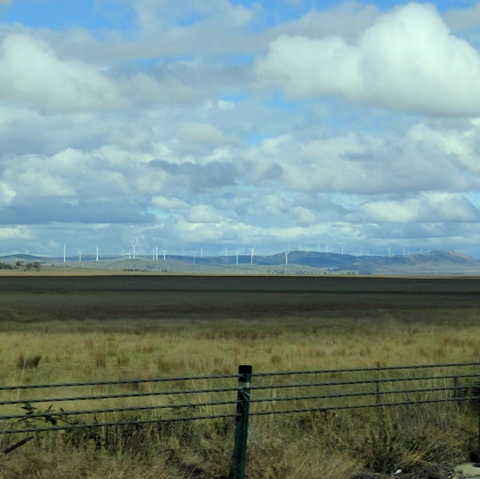
Dave Jones: That's legit. Yeah. That's a legit wind farm. You poke a little phone cameras. There's going to. I think it's going to. Like, there'll be a few dots on the white poles on the horizon and that'll be it.
Chris Gammell: Whatever, man. I think that's going to look good. It's amazing. The HDR on these things, too. Like. It's just like. Like. I was thinking some low light stuff.
Dave Jones: But they're still shit cameras. Phone cameras are still shit cameras.
Chris Gammell: I don't think so. I don't think so. Like, once they process, like. It's pretty amazing.
Dave Jones: Eh. If you've got outdoor light. Yes. Yes. Oh, yeah. If you've got a lot. Like, once you do anything remotely. I'm not even going to use the word low light. But, like. Anything that's not full brightness.
Chris Gammell: Right.
Dave Jones: They just start to really suck in. Right.
Chris Gammell: Well, that. That is one of. One of the only articles that I've posted in the Amp Hour since we last talked. There was a. I think it's a military camera. But, like. You look at it. And so, like. We're out in the hills right now. And you look at the footage. And not only is it. It looks like daylight. Right. Even though it's pitch black. It has color. Oh. I don't know how. They must be doing some kind of, like. Compression. And, like. Yeah. Like color shifting or something. Like.
Dave Jones: Wow. Because. You sure it's not false color?
Chris Gammell: It's not false color. But it's not. I mean, it's not full color. It's not, like. Right. Like we're seeing now. But there is, like. Plants are green.
Dave Jones: Wow.
Chris Gammell: Dirt is brown. Yeah. It's really weird. Wow. And then they, like. And then they pan up to the sky, too. And the stars are just, like.
Dave Jones: Like, I mean.
Chris Gammell: Like any kind of point light source. Right. Is obviously overloading their sensor. But. I don't know how the hell they're doing it. It looks really impressive, though.
Dave Jones: Wow.
Chris Gammell: So. Try and push. I'll put that in the show notes, too.
Dave Jones: It's called aperture.
Chris Gammell: Yeah. I. That's the thing. I never really. I never did the photography thing. Do you ever do the.
Dave Jones: Oh. I know enough to be dangerous. Yeah. You know. Yeah. Oh, I guess, yeah.
Chris Gammell: With all your video stuff.
Dave Jones: Yeah. Yeah. Kind of. I'm kind of. Sort of in that business. Right. Right. Sort of. Yep.
Chris Gammell: In a sense. That's a pretty big wind farm.
Dave Jones: That's a big. Count them. 50 plus. Yeah. Yeah. It's got to be.
Chris Gammell: I mean, it depends how deep it is. It's like up on. Yep. So to give people an audio picture. It's like up on a ridge. So. And we're kind of. We're at the. At the foot of another ridge.
Dave Jones: Yep. So it's probably catching all the wind coming up. So there's a big plane. There's a big flat plane. Yeah. Yeah.
Chris Gammell: But maybe. But there might be another line of. Yep. With turbines behind it. So.
Dave Jones: And all of this actually floods, too. It actually turns into a lake. Oh, really? Yeah.
Chris Gammell: I wouldn't want to live down there. There's a house. Oh, there's a paddock.
Dave Jones: Oh. Sheep. Do sheep float? I don't know. Do sheep float?
Chris Gammell: I guess you'd move them up the hill.
Dave Jones: I guess you'd move them up onto the road. Yeah.
Chris Gammell: Wow. Yeah. Like a full lake? Like a.
Dave Jones: We could have gone to the rest area. And we could have photographed it properly.
Chris Gammell: I mean, this is pretty close. I know. I don't think it turned into a bad photo. But. Is there like a lake at the end of this thing, then, too?
Dave Jones: Not unless it's been like heavily flooded and raining and all the rest of it.
Chris Gammell: Yeah. That's good timing. Yeah. We were talking about turbines and then they show up, so.
Chris Gammell: Hallelujah. Hallelujah.
Chris Gammell: So we were talking before about the. We were talking about kind of the full scale of power stuff, too, right? Because we were talking about nuclear storage and stuff like that. Right. Nuclear waste storage. Yep. And you were saying that you think Mr. Musk is a little over. Overzealous with the storage.
Dave Jones: With the grid scale storage. Yeah. Yeah. Yeah. Well, and so, like. There's going to be. But I do not see. I'm going to make a big call here.
Chris Gammell: Oh. As he likes to.
Dave Jones: There's another rest area on the left. Would you like to stop?
Chris Gammell: No, it's fine.
Dave Jones: Okay. I'm going to make another big call here. I am going to say that lithium ion batteries, as we know them, are not going to be a grid scale storage solution. It'll be a start, but yeah. Oh, no. Yeah, yeah. It'll be some amount. Yeah, there'll be some amount, but it will not be the solution.
Chris Gammell: Yeah.
Dave Jones: That makes grid scale storage viable.
Chris Gammell: Got it. Actually, so one of the people who showed up at the Wellington meetup, I didn't realize that they're doing this, but he actually volunteers at a recycling center.
Dave Jones: Right.
Chris Gammell: And then strips out the packs from old laptops. They test the cells. Oh, interesting. Yeah, yeah. They're DIY, like whatever the power bank they're called, right? Like the thing that Tesla's making. But their home grid storage.
Dave Jones: Right.
Chris Gammell: He said he had, I think he was pushing like 10 kilowatt hours of storage.
Dave Jones: Right. Yeah. That's a decent pack. Right.
Chris Gammell: And so he had like three or 4K kilowatts on the roof, and he had like a 10 kilowatt hour storage system, but it was all DIY. It was like 3D printed holders. Oh, that's right.
Dave Jones: Wow.
Chris Gammell: So all of these batteries, I'm trying to remember, it was showing only, it was like three and a half volts on the, it had a little built-in meter as well. Hmm. It was showing three and a half volts, so it wasn't fully charged, so they must have been all in parallel, right? Right. Yeah, yeah.
Dave Jones: If it's a three and a half volt pack, yeah.
Chris Gammell: And then I think, I think each, so each of those was in parallel, but then you would take this full pack, and then you would, the three and a half volt pack, or sorry, the wait, the 3.7 volt pack would then be in series with a bunch of other of those packs. Right, yep. And then you, um.
Dave Jones: Got it.
Chris Gammell: There must be controllers, all that other stuff. It was really, it was a neat solution. And I mean, 10K is not.
Dave Jones: No, no, that's.
Chris Gammell: I mean, that'll run, that'll run your house.
Dave Jones: That is a Tesla Powerwall. Right. Powerwall, that's it. Yeah, yeah. And, uh.
Chris Gammell: And that's what they're doing too. They're using the spent, you know, they're not like bad batteries. They're just not to the same standard of being able to fast charge and do all that stuff.
Dave Jones: Well, see, the problem with lithium ion batteries is they're the wrong type of battery for grid scale energy storage, because they're super low ESR. They're designed for the, you know. For like fast delivery, right? Yeah, they're designed for fast delivery, you know, super high currents. You don't want that for a grid scale storage solution. You want something that has. Low and slow. Low and slow. Low and slow. Yeah. You know, that's what you want. So I'm thinking about maybe getting a flow battery pack.
Chris Gammell: What's that?
Dave Jones: For, um, a flow battery pack is, um, it uses, um, pumps. And it pumps, uh, the electrolyte, uh, fluid. So hence it flows through the cells and they're designed for just that. They won't produce like high peak currents, but they're designed for, you know, slow charging, sort of slow, slow ish charging, slow ish discharging.
Chris Gammell: Uh huh.
Dave Jones: Right. But they basically never wear out. Like, um, you know, sorry.
Chris Gammell: I just saw a roadkill kangaroo.
Dave Jones: Oh, you saw a roadkill kangaroo. There you go. Oh, there was a lookout. There was a lookout. Oh, that was the lookout for the wind farm.
Chris Gammell: Watch out here. Oh, there we go. Oh no, that's too nice. Yeah. No, it's all right. Yeah.
Dave Jones: Ah, damn it.
Chris Gammell: Ah, I got pictures.
Dave Jones: That's all right. Okay. Anyway, yes. So much stuff in one area. One area.
Chris Gammell: So flow battery. So how much, how big would that system be then? Cause that's the thing. Like, it seems like these, the power wall is pretty small.
Dave Jones: Yeah. Well, the, um, there's an Australian company, uh, that make a 10 kilowatt hour, uh, flow pack. Oh yeah. Yeah. Yeah. So like normally these are like, they do use them in industry, but they're normally like big, large scale solutions, but they've actually developed a home one, which is 10 kilowatt hours. Um, but they're in Adelaide. So I don't, you know, it's hard to get to and do a video on. Oh, I see. So, uh, yeah, it's, um, but they do like, like to trailer, like, uh, two, two containers shipping, shipping container size ones. Oh, okay. Right.
Chris Gammell: Oh, so like they'll show up for like, uh, for like a small city or something. Yeah. Yeah. Yeah. Yeah. Like, yeah.
Dave Jones: If a power, you know, if a town's out of power or something, they could show up with their, on the back of the truck with their, you know, thin, they can power the town for a day or something.
Chris Gammell: Right. Or you could like power up cell phone tower. Oh, you can. Yeah. Yeah. For like a long time.
Dave Jones: Yes. Yes. Exactly. So, yeah. So I think, you know, they've got a reasonable future, but they are, they, they are mechanical. They require pumps, right. To pump the fluid through. Yeah. But nothing extreme, nothing that you can't get a super reliable pump for, but they don't drop in, in, in capacity at all. So a 10 kilowatt hour pack you buy today will still deliver 10 kilowatt hours in 10 years time. Right.
Chris Gammell: Does it have to add electrolyte? It doesn't evaporate?
Dave Jones: I don't know the maintenance cycle on them. I think it's almost zero. As long as they don't leak. As long as they don't leak. Because what they do, don't quote me on this, but they basically, it basically coats and then strips off a zinc bromine coating onto these plates. So when you put charge into them, it actually plates these zinc plates, right? So it actually plates them with this bromine, it's a zinc bromine solution.
Chris Gammell: So it probably just pulls the zinc out.
Dave Jones: Yeah, exactly. So it's a completely replaced, so unless the system leaks or whatever, you can plate and replate these plastic sheets or glass sheets or whatever they are. There's multiple sheets and it just actually plates them. And then when you extract energy from them, it de-plates them and Bob's your uncle. You can do that infinite number of times.
Chris Gammell: I doubt it's infinite, but yeah.
Dave Jones: You know, well.
Chris Gammell: Yeah, it's probably some.
Dave Jones: No, there's other, some system limit thing to, you know. Right. Yeah, I'm sure. So they won't be working 100 years time, maybe.
Chris Gammell: How much does it cost on that kind of thing?
Dave Jones: They are more expensive than a lithium ion solution, probably 50% more cost, I think. Okay, okay. Round about that, so yeah.
Chris Gammell: But you might get more years out of it.
Dave Jones: Bet you might get a lot more years, yeah. If you're thinking long term and they're not exothermic like the ion packs are, right? So they're completely safe. They cannot explode and catch on fire.
Chris Gammell: Challenge accepted.
Dave Jones: Yeah, exactly. So anyway, they've got a reasonable future. But they're very niche at the moment.
Chris Gammell: Did you see that article about the, I don't, I didn't quite understand the technology, but there's a guy, the 90, he was being talked about a lot because he's a 94 year old scientist.
Dave Jones: Yeah.
Chris Gammell: He was at UT Austin. He helped with lithium ion.
Dave Jones: Oh, he actually developed them. Yeah.
Chris Gammell: Yeah, but now there's some new solid battery that they were talking about.
Dave Jones: It's actually a glass. It uses, yeah, some glass in some way, shape or form. And I don't know, some people are raving about it. And of course it made all the media because like the guy who invented lithium ion batteries says this is the future. Right. You know, so it grabs all the headlines, of course, right?
Chris Gammell: Well, like any battery technology, it's like, we'll believe it when we see it. Yeah, yeah, yeah. Exactly. You have to, otherwise you get so excited every time you see like all this stuff. But it's, that is such a huge piece of, of energy stuff. And I mean, yeah.
Dave Jones: But are any of those, like, let's say like the flow batteries, for example. Sure. Right. The tech, if they are the technology for the grid storage solution. Sure. Right. Let's just assume they are. Right. But there's so little call for that at the moment. Like the, you know, the Tesla car uses, and all their cars use the 18650 lithium ion cells. So they can leverage that market, that massive market. Right. To pay for the R&D, to pay for everything else, you know, to pay for the early years of, you know, high, high price stuff to get the manufacturing costs down. Well, yeah, those have already been paid for by all the laptop makers. Exactly. All the laptop manufacturers, all the, and now, now all the car manufacturers who are putting all the cells in their car. Right.
Speaker ?: Right.
Dave Jones: Yeah.
Chris Gammell: We were talking about the, the gigafactory too. Exactly.
Dave Jones: So, but where does that advantage come from, from a grid scale solution that might be perfect for grid selling, but it has no play anywhere else. Right.
Chris Gammell: Well, I think these days it's like you have to, honestly, I think China's energy policy is really encouraging. Like they're investing in solar like crazy and grid storage stuff too. Yeah. And so like something like that where, I mean, they were, they were part of the reason, better or worse, China was part of the reason that the, the solar, the cell costs dropped so much. Yep. And because they were basically flooding the market with a government subsidy, I imagine that if there was some kind of grid storage solution that they endorsed as well, that could also drop the market. But it's pretty dependent on, you know, something of that scale of like countries endorsing a solution is, is potentially problematic. Right. It is. So, so, yeah. I mean, it's not, not that it's never happened. Right. I mean, like, I mean, hell we're going to do space stuff. Right. Right. How much stuff has been, uh, you know, enabled by, and, uh, NASA investing in some kind of technology.
Dave Jones: Exactly. Infinite. Almost all technology these days can stem from NASA programs somewhere, probably. Right. You know, in some way, shape or form.
Chris Gammell: Yeah, exactly. So. Yep. Good old money.
Dave Jones: Fusion. Fusion.
Chris Gammell: Yeah.
Dave Jones: Fusion. Fusion. Fusion. It's going to be the solution. Yeah. In 20 years.
Chris Gammell: In 20 years. In 20 years.
Dave Jones: Everyone guarantees it.
Chris Gammell: 20 years from now. 20 years from then. 20 years from tomorrow.
Speaker ?: Yeah.
Dave Jones: Why is like 20, well, 20 years from now. 20 years is a generation. Sure. Right. So I guess that's the round ballpark.
Chris Gammell: They'll never, they'll never check on this. Right. No, no, no.
Dave Jones: They'll never check. Yeah.
Chris Gammell: Right, right.
Dave Jones: And people live to be a hundred. Oh, shit. We checked. Yeah. Right, right, right.
Chris Gammell: Yeah.
Dave Jones: I don't know. Ray Kurzweil's screwed, right? Yeah, right, right. He keeps taking them vitamins. Yeah.
Chris Gammell: Oh, man. Yeah, that guy's crazy. He works for Google now, doesn't he? I don't know. No idea. He does. But, yeah.
Dave Jones: I'm very disappointed. I said fusion would happen 20 years ago. You know, I thought, like, I didn't necessarily think it would be 20 years, but I thought we would have had a lot more progress than we have had now. You know, like, which is basically bugger all. Right.
Chris Gammell: They're still like, well, we're almost at non-negative energy.
Dave Jones: Yeah, we can generate, like, 100 watts for a microsecond or something. Right, right, right.
Chris Gammell: A net 100 watts. Yeah, a net 100 watts. It takes, like, a megawatt to get started.
Dave Jones: Yeah, yeah, yeah. Exactly.
Chris Gammell: So, yeah.
Dave Jones: Do you think there's just some technology like that is just uncrackable? It's just not possible. I'm sure there is. And that could be one of them.
Chris Gammell: I mean, that feels like one of those things where it's like there's so much... What is it called where, like, the condition where, like, it's like a ball teetering at the top of a hill.
Dave Jones: Oh, right. Yes, right.
Chris Gammell: Like, it requires that kind of level of control to get that. Yeah. I mean, so much of, like... So, like, it's an entropy thing, right? Like, any kind of amount of entropy then basically makes that ball roll off in an unusual direction, right? And you can't really control it then. Whereas, like, I don't know, like, existing energy solutions is like burn things.
Dave Jones: Yeah, burn things.
Chris Gammell: There's a lot of energy and entropy, rather. Yeah, yeah, yeah. When you're burning things, right? It's just...
Dave Jones: Stuff that's taken millions of years to build up. Yeah, right. There's a lot of stored energy.
Chris Gammell: Right, exactly. And so it's like, yeah, I get it, but it doesn't feel like we operate on the level where it's required. Like, yes, okay, I get that the sun is also, you know, it's fusing things.
Dave Jones: Yep.
Chris Gammell: But we don't have that kind of gravitational control.
Dave Jones: Right.
Chris Gammell: Yeah.
Dave Jones: Someone will crack it. Yeah, Gravitrons. Smart cookie.
Chris Gammell: Stuff, yeah.
Dave Jones: There's a Nobel Prize to be had, folks.
Chris Gammell: Yes, that's right.
Dave Jones: Just keep trying. Start working on it. Yeah, be safe. Be safe. Well, there's so many... Yeah, there'd be a lot of crackpots, I guess, in quote marks out there working on it, you know. Oh, sure. Thinking they can crack it, you know. Right. But we've talked about this before, right? Sure. Like the age of the individual being able to make such a huge monumental discovery is practically zero.
Chris Gammell: Well, I think that a lot of that, too, is like we're living off myths, right? Right. Like we talk about Elon Musk, right? Right. Elon Musk is not doing anything. I mean, like he's... No, no, no, no. Sure, he's helping guide what he wants to do, and obviously he's raising money.
Dave Jones: And he could do it because he had money and he got...
Chris Gammell: And he is very technically minded. Like he's a smart guy. I get all that stuff. But like there are hordes of people that are doing this work with him.
Dave Jones: Oh, yeah.
Chris Gammell: You know, just like with Edison, just like with Tesla, just like with everyone, right? Maybe Tesla, you know. Tesla had assistants, you know. Right. Yeah, he was a smart guy. But like, yeah, I mean, I think that a lot of the times there is that... There is the myth of, you know... I remember Bunny was talking about it, too. He's like, remember he was talking about Tony Stark and telling Jarvis just to fabricate the thing? Right, yeah. Yeah, I mean, like, it's just the myth. That's what we love to think because we want to think that we can do it all on our own, too.
Dave Jones: Yep, exactly. So we project that onto others. Right, exactly.
Chris Gammell: Whereas, you know, me and Dave, we don't do shit.
Dave Jones: No, no, no. We just, I don't know.
Chris Gammell: Drive to Canberra. Yap on for a living. Yeah, right, right.
Dave Jones: We make a living.
Chris Gammell: Yeah.
Dave Jones: Yeah. Don't dare criticize us. How dare you. We feed our... This is how we feed our families. I don't know how the family did. Well, yeah, okay. Yeah, right. Yeah.
Chris Gammell: Well, how about... Well, we were talking about your... Speaking of feeding Dave's family. Right. We were talking about your new probe. We didn't talk about that in the show yet, did we? Is it...
Dave Jones: No, no, no. Is that public? It is public, right? Oh, yeah, yeah, yeah. Yeah, it's up on my website. Oh, okay, good. You just can't buy it yet. So... And there's no price on it yet. Yeah.
Chris Gammell: Who's that for, though? Like, so who should be getting one of those?
Dave Jones: Everyone who's watched my video, how not to blow up your oscilloscope. That's all 200,000 people who've watched that video.
Chris Gammell: Right, right, right.
Dave Jones: Should have a high-voltage differential probe. Right. It just means that you can probe around on anything mains-related or any other circuit that... You know, it basically floats the ground. Basically. Right. Well, it high-impedances the ground via a 4-meg resistor. Right. Right. But, yeah, it just allows you to program without blowing up your circuit under test or your oscilloscope or yourself. Well, I think that's good. Yeah. It's a good thing. I always... Oop.
Chris Gammell: We're now entering. Sorry.
Dave Jones: We are now in the Australian capital territory. Sorry.
Chris Gammell: Yeah, we're just getting a little driving updates here as we go.
Dave Jones: Yep.
Chris Gammell: And, of course, the roads got worse.
Dave Jones: Right. Yeah, you're right.
Chris Gammell: We're now in government territory. It just...
Dave Jones: You might have heard that. It just instantly changed. Yeah. Different state.
Chris Gammell: And gungalins on the... Is that how you say it? What? Gungalin? Gungalin. Gungalin? Gungalin. Gungalin? Gungalin. Oh, I didn't see a D in there. Okay. Oh, okay. Anyways, so... I was always disappointed that, like, handheld scopes didn't get more... You know, we're talking about batteries, too, right? Yeah. I'm always disappointed that they didn't become a bigger thing. You know, like...
Dave Jones: No, yeah, I...
Chris Gammell: I guess you could do that. We could do kind of like what Jonathan did with the... You know, you have a battery, but you just need an inverter then, and then you... Yep. You know, you can do that kind of thing.
Dave Jones: Well, you can, but, like, everyone has a scope. So, you know, it's easier, and you know, you like it. You know how to use it. It sits on your bench. You're better off buying a differential, a high-voltage differential probe...
Chris Gammell: Yeah.
Dave Jones: ...than getting a, you know, a properly rated portable scope, right? The key part there is properly rated. Right, right. That's true. Yep. And, yep.
Chris Gammell: Yeah, because we used to use those things for when we were doing, like, floating ground stuff. Right. For, like, test measurement equipment type things.
Chris Gammell: Yeah, it's good to keep that stuff. There's currently my traffic on the road.
Chris Gammell: We got GPSs, we got rain, we've got loud noises. Yeah, we got dead kangaroos, man.
Dave Jones: This is gonna suck ass.
Chris Gammell: This is gonna be a weird show, man. Yeah. It's all for the novelty of listening to people in a car while you're in a car.
Dave Jones: So, how dead was the kangaroo?
Chris Gammell: Oh, there's been, like, four of them, and they were way dead. Right. They were dead, dead.
Dave Jones: Dead, dead. Yeah. Right.
Chris Gammell: Like, yeah.
Dave Jones: And we're slowing down.
Chris Gammell: Yep. Yeah, so, I don't know. I think that, I guess, yeah, it's just not as specialized, and I guess probably at the end of the day, it's cheaper to have, like, an offline switching power supply or something, right?
Dave Jones: Well, God.
Chris Gammell: I mean, like, just in, in, right, so take a Rigol scope, right?
Dave Jones: Yep.
Chris Gammell: You know, that's $400. Yep. That's definitely using an offline switcher, right? It's.
Dave Jones: Well, the other, one of the problems is it doesn't come with nice, safe probes, right? Ah, yeah. It's like, you know, that's another thing, and the BNC connectors are exposed and all that sort of stuff. True. So, if you get a properly rated, uh, portable scope, right, it's got a plastic BNC, like plastic-coated BNC connectors, right? So, you can't physically touch them, and proper shrouded BNCs, which go over, so you can't Right, they, like, lock in or something. Yeah, yeah. So you can't use stupid little fingers in there and zap yourself, right? So, um, you know, they, they have to be designed properly. So you can't just buy a portable scope and expect it to be safe on measurement. Yes, it, you'll avoid the mains ground issue. Right. But you won't avoid the personal safety issue.
Speaker ?: Yeah.
Dave Jones: So, you know, that's where your high-voltage differential probes come in. They've just got, you know, two wires coming out. Yeah. Separate wires. They've all got, you know, four-millimeter shrouded BNCs and four-millimeter shrouded banana plugs, and they've got...
Chris Gammell: Oh, that's the, you know, the figure test thing. Yep, yep.
Dave Jones: And, you know, and they go into high-voltage hooks and they, you know, which then you hook onto your circuit. You know, it's just...
Chris Gammell: That's exciting. So, new EEV blog product on the way.
Dave Jones: Yep. I didn't design it. It's like... But? But it's a new one on the market, so nobody else is selling it yet. Yeah. So, I like the BMT35.
Chris Gammell: Cool. Oh, yeah. I get to see the new DMM yesterday.
Dave Jones: The new multimeter?
Chris Gammell: That thing's got some heft. I like it.
Dave Jones: Scratch and sniff. Yeah, yeah. Some people didn't. Some people said they didn't like the thickness of it. You know? Whatever. But it's a psychological thing.
Chris Gammell: I mean, like, nobody's putting that in their pocket. Nobody's putting a DMM in their pocket.
Dave Jones: No, no, no, no. Exactly. You buy a pocket DMM if you want a pocket. Right. You know, so.
Chris Gammell: Personally, I don't really use the... I mean, like, handhelds are okay. Yeah. I've got bench stuff, too.
Dave Jones: People said they would have wanted it thinner, and they were happy with the triple A's and a shorter battery life. I'm not. I want a long frickin' battery life, you know?
Chris Gammell: I agree with that.
Dave Jones: Okay.
Chris Gammell: I want that in my phones. I want that in my test equipment. I want...
Speaker ?: Oh.
Dave Jones: Power line's down. Oh, no, that's a truck. A truck has tipped. A truck has rolled over on the side of the road. Jeez. Is that what that was? Yeah. That's why we're going around? Yep. That was... Jeez. Yep. We're doing a detour. They closed off the road. Oh, wow. Truck line on the side. He didn't take enough uppers, I guess. Oh, I guess so. Yeah.
Chris Gammell: Sleepy truck drivers.
Dave Jones: You shouldn't laugh. It's bloody dangerous. I know. Yeah.
Chris Gammell: Yeah. I... You should drink what I was just drinking. Yep. V. This is the disgusting energy drink of Australia. Right. And New Zealand. I saw it there, too. Oh, right. Okay. Yep. Yeah. I've been shaking with caffeinated delight all day, so. Right. Yeah. Yeah.
Chris Gammell: Okay.
Dave Jones: I'm just going to follow everyone else.
Chris Gammell: Oh.
Dave Jones: And, uh... Hey, Canberra. We can buy fireworks in Canberra. Ooh.
Chris Gammell: Yeah. Yeah. Yeah.
Dave Jones: Because it's not legal. They banned them in all the other states. It's legal to buy them in Canberra. Blow our fingers off. Yeah. Yeah.
Chris Gammell: Great. Awesome. I've never played with fireworks.
Dave Jones: No, you haven't? Okay. We used to do this. It almost blew my hand off when I was a kid. Yeah.
Chris Gammell: Exactly. Yeah. I knew a kid who did.
Dave Jones: Oh, okay. Wow.
Chris Gammell: Yeah.
Dave Jones: Yeah. Yeah.
Chris Gammell: So that scared me sufficiently.
Dave Jones: Right. Yeah. That incident almost blew my hand off sort of, yeah, went, oh, shit. Yeah. Right. These things can actually be dangerous.
Chris Gammell: Oh, yeah. What do you know? Yeah. It's basically black powder.
Speaker ?: Right.
Dave Jones: Yeah. It didn't help that I actually took them apart and added them all together. Oh, you did? Yeah. Yeah. Yeah. Yeah. Right. And stuck them down a hole and lit it all up.
Chris Gammell: Sagan, if you're listening many years later, don't do what your dad did.
Dave Jones: Oh.
Chris Gammell: Yeah.
Dave Jones: Man. Yep. Those were the days. And then they banned it, you know. The safety police came along and went, nope, too dangerous for our kitties.
Chris Gammell: I can't really blame them.
Dave Jones: They're not banned in the states, are they?
Chris Gammell: State by state. Oh, state.
Dave Jones: Okay. It's a state law.
Chris Gammell: Yeah. So, like, yeah, it's like the same kind of thing where you'd go over state lines if you really wanted to get them. Oh, okay. But you could get, like, the little.
Dave Jones: Are you allowed to go across by them and then bring them back? Or is it illegal to possess them?
Chris Gammell: I mean, if you get caught, I think you're not supposed to have them.
Dave Jones: Oh, right. Okay.
Chris Gammell: Yeah. Right. So, like, when I was in Colorado last, my uncle's friend went across to, like, Utah or somewhere. Yeah. Maybe north to, like, Wyoming or something. But he bought a ton of them and brought them back. Right. Yeah. So. It's silly.
Dave Jones: Right. So, Colorado, weed is legal. Fireworks, illegal. Right. Yeah. Guns? Legal everywhere. Legal. Okay. Got it. Of course. That duh. Yeah. Okay. Right. Yeah. Yes. Jeez, we're really scratching for topics now. We are. No, we are. Yeah. Yeah. We're officially. Yeah.
Chris Gammell: So, well, let's see. Any other electronics related things in Canberra? I guess that don't really. I mean, we're going towards spacey stuff, but.
Dave Jones: There is the telecom tower, which is the big transmitter.
Chris Gammell: Oh, we're driving towards it. Tower up on the hill.
Dave Jones: Yeah. Somewhere up there.
Chris Gammell: Yep.
Dave Jones: Somewhere.
Speaker ?: I don't know.
Chris Gammell: I don't really know anything about Canberra. No.
Dave Jones: Yeah. You don't really want to know.
Chris Gammell: We might be going to the science museum if there's time. Yeah.
Dave Jones: If there's time. We don't know what time it's open till. We're driving in in the afternoon now because, well, it just takes time to drive from Sydney to Canberra.
Chris Gammell: Yep. Let's see. So, I'm going to post this on Sunday. Well, probably Sunday, Aussie time. I will be in Melbourne by then, so if people are listening. Like I said, there will be a meetup on Tuesday, Tuesday 18th, and I will obviously have announced it at the beginning of this episode. So, anything else going on for you, Dave? You're going to be doing it. You said you might do another meetup at some point in the future?
Dave Jones: Yeah. I'll probably make it three monthly, I think. Everyone said monthly would suck. Yeah. That'd be too many. Yeah. And two months, yeah. So, yeah, I'll make it three. Quarterly is good. Yeah. Quarterly, I think, is probably good. Right.
Chris Gammell: Because we also, we were talking about that. It's like, that's a good amount of time to finish up your next project, bring it in.
Dave Jones: Yes, exactly. Yeah.
Chris Gammell: So, that's good. Yeah.
Dave Jones: You can do a reasonable size project in three months.
Chris Gammell: Yeah. I mean, yeah, you get maybe at least one board rep, maybe two.
Dave Jones: Right. Oh, with the quick turn boards these days, all you kiddies take for granted.
Chris Gammell: Yeah. Kids these days, right? Young whipper snappers. Yeah. I don't know. It's the, it's the, it's the, it's how we make up for having to pay so much for college, Dave.
Dave Jones: Right. Okay.
Speaker ?: Yeah.
Chris Gammell: All right. Well, we should wrap that up then. I think we, I think, I think we hit our hour. Probably.
Dave Jones: Yeah, we have. And we're in Canberra now. So.
Chris Gammell: Oh, all right. Yep. Cool.
Dave Jones: We have been for a while, dude. Oh, okay. Yeah.
Chris Gammell: Okay. See ya.
Speaker ?: Bye. Bye. Bye. Bye. administered in administered
Archived Discussion (3)
Comments are closed. Archived from the original site.
Show archived discussion (3)Hide discussion
CanberraCostDeep Space Tracking NetworkEducationMeetupUniversity
Keep current
Every episode, plus the occasional job post, in your inbox.
This was when alcohol sales were only done at a licensed outlet Mon-Fri 8-5, and all outlets that did retail sales had to close at 11. Casino 24/7/365. They cleaned out the entire country of certain coin denominations in the first week of opening, and they were sent back not in armoured cars but in containers on trucks to be redistributed.
But enjoyed the drive time, made me remember those famous Dave Drive Time videos he made in the car.