
#304 – Alexa joins the fray
Download episode · 40 MB
Also on Apple · Spotify · YouTube · RSS
Show Notes
- Wired stuff still wins for reliability...especially if it's fiber! Wifi continues to be unreliable for most things.
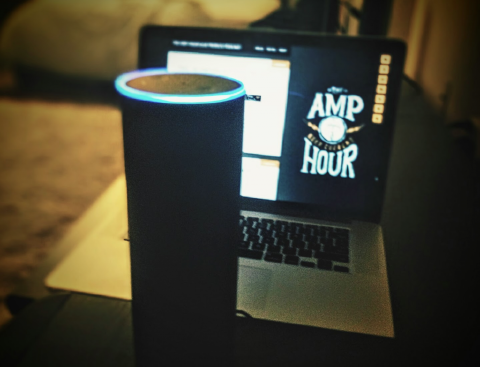
- Chris has an Amazon Echo in the AirBnB where he's staying. He's been talking to Alexa.
- Dave recently did a Sigilent Teardown.
- While in the Bay Area, Chris finally got to try out the CastAR.
- The HTC Vive is a true VR platform Chris got to try. It was designed by former guest Alan Yates and the controllers partially by regular guest Jeff Keyzer.
- UBM sold all of the assets around EETimes, EDN and more to Arrow.
- Newark/Element 14/Farnell was sold to a Swiss holding company.
- Intel's web/TV series "America's Greatest Makers" has a winner...a toothbrush.
- The makers of the ESP8266 have released a new model that has integrated flash.
- Chris started working at the same place that Bob Widlar started at (in Cleveland!). If you've never seen it, you can download the poster here.
- Tools that arean't used that often, but imporant to have on the bench.:
- Network analyzer
- IMTTI eye prober
- USB to RS485
- Chip of the Week: TPS54A20
Transcript
Chris Gammell: This is the F-Hour Podcast. Recorded June 22nd, 2016. Episode 304. Alexa joins the fray.
Dave Jones: Welcome to the Amp Hour. I'm Dave Jones from the EEV Blog.
Chris Gammell: And I'm Chris Gammell of Contextual Electronics. Take two. Take two. Man, I freaking hate Wi-Fi.
Dave Jones: You know, this is the thing. You keep telling every guest, Wi-Fi sucks, don't use it. Wi-Fi sucks, don't use it. And then what does Chris do today? Uses Wi-Fi. We've been dicking around for half an hour trying to get something working.
Chris Gammell: Here's the thing. Okay, this is actually a good topic because, well, first off, all these devices that are Wi-Fi based, we'll talk about that in a second. But the main thing is that, like, you don't expect to see the Wi-Fi. Or rather, I don't expect to see the modem. I actually ended up pulling the LAN cable out of the television in order to plug into my laptop. So, like, I'm an Airbnb. This is not like it's an unknown. Like, this is just a – or it is an unknown, right? It's not like this is somewhere I'm usually at. This is – yeah. LAN. LAN. Wires still win. This is our argument for a lot of things.
Dave Jones: Tell me about it. We're having our federal election is in a week and a half or something, right?
Chris Gammell: Oh, yeah?
Dave Jones: Yeah, yeah. So we're going to elect a new government, kick out the current bastards and put new bastards in. Yeah. And the big thing, as it was in our last federal election, like, three years ago and before that – Oh, the broadband stuff? Our national broadband network, right? You guys got to do that, man. I know. Well, we are, but they're doing it the wrong way. And the current government's saying, oh, we can use copper. And, oh, we can use Wi-Fi, too. Wi-Fi is wonderful. It's a great technology. It's only getting better and better. Bullshit.
Chris Gammell: But, yeah.
Dave Jones: Can't beat fiber to the freaking home.
Chris Gammell: Yeah, I would – you know, in terms of reliability, that's the main thing, right? I mean, like –
Dave Jones: Yeah. It's just – and they – oh, it's just – it's so retarded.
Chris Gammell: Nothing like a tiny blinking light to really get your signal delivered, right? Yeah.
Dave Jones: Yeah, I mean, you know, solid – I mean, I'm on solid copper here. I've got fiber coming into the building and then 50 meters of twisted pair copper coming up to here. And I can get 100 megbits. But, you know, if I had fiber coming straight in here, I could get one gig.
Chris Gammell: Yeah, right. Exactly.
Dave Jones: As our Estonian – I think it's our Estonian – Oh, lots of places have it now. Yeah, lots of places. Country fiber to the home for 20 bucks a month. One gig, one gig symmetrical plan. Like, oh, it just makes me cry. Well, okay.
Chris Gammell: I think there are some limits to it. You know, like, it's not like that alone is going to do – that's a good thing. But it's like, after a certain point, reliability – if you have a reliable, you know, certain bandwidth type of thing, then it's just – the rest is just how fast can you download a movie kind of thing.
Speaker ?: Oh, yeah.
Dave Jones: Like, no, I'm happy with mine because mine's rock solid reliable. Yeah.
Chris Gammell: Yeah.
Dave Jones: But, you know, I mean, it's – Well, it's interesting, too, because, I mean, like – Why was this crap?
Chris Gammell: Well, we see stuff – like, I'm staring – so, again, I'm in an Airbnb. This is not my stuff. But I'm staring at an Amazon Echo right now. And it's like –
Dave Jones: What's an Amazon Echo?
Chris Gammell: That's the one where it's like – you know, Alexa? I mean, it's like there's – No. Oh, it's just turned on. You're speaking of for Klingon. Creepy. Oh, that was creepy as shit.
Dave Jones: What? No, explain.
Chris Gammell: Right. So, it's basically – it sits around and it listens for its name. And when it does, then it's basically tied to Amazon. And –
Dave Jones: Oh, so it's one of these home hub –
Chris Gammell: Yeah, let's see.
Dave Jones: Technology hub things or whatever.
Chris Gammell: Alexa, play some Prime music.
Dave Jones: Oh, so it streams music that comes from Amazon Prime. Can you hear that? Yeah. Oh, so you just – it listens – it's currently listening to your voice. So, this could switch on any time during the amp hour that you get animated.
Chris Gammell: Alexa, cut that shit out. Oh, it worked. Yeah. No, it's – yeah. I mean – yeah, it's interesting. Who was I talking to about this?
Dave Jones: Is that all it can do? What else can it do? No, no.
Chris Gammell: I mean, you obviously can order from Amazon as well. And there's the Echo – Wait, what?
Dave Jones: So, you can be at the dinner table just talking about ordering a book and it automatically orders one for you? What the –
Chris Gammell: You would have to say the name of the – I'm not going to say its first name again because it's obviously listening to me.
Dave Jones: Disconnect this evil technology.
Chris Gammell: Well, it's like what we were talking to about – with Dimitri about last week too, right? Yeah, yeah. The TV here I think is always on too. And yeah. So, maybe it's a good thing that – Is there a microphone in it? I'll guarantee it. Yeah. But maybe it's a good thing that I'm stealing the LAN cable because now it's – Right.
Dave Jones: It can't phone home unless it's phoning home via wireless and then it's –
Chris Gammell: Yeah, that's true. The Wi-Fi connection is still active. I can see it. So, yeah. I just stole the LAN – the breakout LAN thing.
Dave Jones: Dude, I'm telling you, go to the kitchen, okay? There's bound to be a roll of aluminium foil in there.
Chris Gammell: Right? Sorry.
Dave Jones: Sorry. Aluminum foil. You won't know what I'm talking about.
Chris Gammell: Should I be fashioning myself a hat? Is that what you're going to say?
Dave Jones: And I'd wrap it around your whole body including your head and you'll be completely safe.
Chris Gammell: Yeah, man. It's the only way you can be certain. Yeah. And then run outside screaming.
Dave Jones: I think we have to nuke it from orbit. It's the only way to be sure. Right, right. That's just like – like why would you want that? Yeah. Why would you want that in your home? Like what's the point? Well, no, no, no.
Chris Gammell: I mean some of this stuff – it's always a trade-off, right? This kind of thing, it's interesting.
Dave Jones: Yeah, but what's the advantage of it?
Chris Gammell: Well, I think about – not necessarily like the playing music. Like what else is on here? Connect it home. You could – well, if you wanted to. Let's see. Is it plugged in? Alexa, turn on the lights. I do – oh, there it is. Yeah, it just turned on. You couldn't hear the click but it did turn on.
Dave Jones: The lights turned on. Yeah, there's like a – it's got like a –
Chris Gammell: One of those, you know, plug-in to wall. It has like a Wi-Fi connected outlet basically.
Speaker ?: Oh, okay.
Dave Jones: Yeah, yeah, right. Okay.
Chris Gammell: Alexa, turn off the lights.
Speaker ?: Okay.
Chris Gammell: Oh, wait. Let's try this one. Hold on, hold on. Alexa, play the amp hour.
Dave Jones: You'd like to play the program called the amp hour.
Chris Gammell: Oh, yes, I would. Are you hearing that? Yeah.
Dave Jones: Yes. Say yes, dude. Say yes.
Chris Gammell: You'd like to play the program called the amp hour. Yes. Will it play? Come on. Come on. Come on. You can do it. I don't think that's us.
Dave Jones: What is that? Will you see the world? This is great.
Chris Gammell: All right. Alexa, cut that shit out. Okay, so maybe people do this just because it's fun to yell at it. Oh, wait. Actually, so I got to hang out with Alicia and Chris. They did tell me about this one. I think it was them or somewhere else. Alexa, open the pod bay doors. I'm sorry, Dave. I'm afraid I can't do that.
Dave Jones: Oh, that's great. Okay. Some nerds have had some fun.
Chris Gammell: Yes, they definitely have.
Dave Jones: Hopefully, you can hear that at home. Yeah, I'll try and all up it if we can.
Chris Gammell: If you can hear it, they can probably hear it. I can hear it in my headphones.
Dave Jones: Might not be able to hear it on speakers that well.
Chris Gammell: Oh, man.
Dave Jones: All right. Yeah. So that's a little Easter egg. See, that would be hard-coded somewhere. You know, somebody's done that.
Chris Gammell: No, there's multiple versions, too. I think it was Alicia talking about that. Maybe it was someone else. I'm sorry if it was someone else. But I don't know. Like, this kind of stuff. Like, the whole... So we were talking about the Wi-Fi thing, right? Wi-Fi. This is obviously... It has some lag time. This isn't a huge deal if this is Wi-Fi connected. But, like, some of the other stuff, like, a lot of the products that are coming out, they're just Wi-Fi connected. And then they expect to be responsive, you know? It's like, eh. I don't know. The powers.
Dave Jones: Yeah. No. It's awful. No, I've got... No, I'm trying to stream my new Netflix thing at home, right? I'm trying to stream Netflix. And I forgot we disconnected the cable and it switched over to Wi-Fi. And I was wondering why I was getting all these little issues, you know? Right. And it's just like, oh, it's so painful.
Chris Gammell: Yeah.
Dave Jones: It's just, no. I hate Wi-Fi. It's convenient for some things. But when you need reliable performance, there's always something wrong with it. Always.
Chris Gammell: Yeah. Murphy gets you every time. And this is, like, the... When I was doing industrial stuff, too. You know, I used to ask about that. It's like, oh, well, you have these long runs. Why are you still dealing with cables? And, like, dude, when you're in a power plant... No, no, no. Like, you do not want to... Oh, hey, that boiler's about to explode. But the Wi-Fi's out, so... Sorry. Oops. Oh, that's bad. Yeah. Yeah, I mean, well, you know, there's certain ultrasonic power companies that we dislike that are the same argument, right? I remind people of that whenever I hear it. It's just like, look, you just can't... You can do other things, but it's just not worth it. It's not worth the cost difference yet. So, keep trying. Good luck. Yeah.
Dave Jones: No, I don't like... No. No. I don't like the Samsung Echo thing. It's fine.
Chris Gammell: We'll just be the curmudgeons and the ones with good power and, you know, high-speed connections.
Dave Jones: And turning our lights off and on using one of these old-fashioned switches, you know. Yes. Unbelievable.
Chris Gammell: Sorry, Omer. Yeah. You weren't there for that, right? No. Yeah. Don't think so. Yep. That's what they're doing. They're doing... They are doing, you know, network-connected... Some kind of wireless-connected switch. And it's fast. They do it fast, but not everybody does. What do you do? Yep. Yep.
Dave Jones: No, sorry. Not impressed. Anyway, so what else has been happening?
Chris Gammell: Well, you made a video about... I heard our first try, and then you made a video about Spectrum Analyzer.
Dave Jones: We did launch into that. It proves that this show is random. Our first attempt, which we published, if you like, was me launching straight into, well, actually having a dig at you for being late, of course, to the show. And then jumping into the Spectrum Analyzer, which I just told you. I don't know, man.
Chris Gammell: We're doing it now, so is this kind of like... It's like one of those fate things, you know?
Dave Jones: Right. Got back around to it. Destined to talk about this. Yes, exactly. Exactly. No, what brought it up, actually, was that we were talking about... Was it... No. Spending time? I don't know. I can't remember. It's all too hard. Anyway, I've... Yes, you said, oh, what's happening lately? I said, you know, no, that's right. I was...
Chris Gammell: Wait, did we just play the tape back? It's made great...
Dave Jones: My mental tape just kicked in. Yeah, yeah. And if I keep talking, I'll forget what I just remembered a second ago. He's getting older, folks. I'm going to do it. I'm going to do it. What I'm going to forget? Yes, I've forgotten. Hang on. Oh, that's great. Ted buttered the mic.
Chris Gammell: Oh, it's fine. Dave, you did a spectrum analyzer. Who cares? You did a spectrum analyzer tear down. You were talking about how you did it differently.
Dave Jones: Yeah, but I want to know why I did it.
Chris Gammell: You were talking about how you did it with photos instead of... No, that's right.
Dave Jones: Here we go. No, I've got it back. I've got it back. You were complaining that I don't have a real job. Oh, yeah, that's right.
Chris Gammell: You don't have a real job. That reminds me to remind you that you don't have a real job.
Dave Jones: That's right. Thank you. That's my wife reminds me all the time. Yes, right. Anyway, I... Because she doesn't want to come work for me. Anyway, and I was saying that, yeah, I actually put the extra effort in this week because I've been spending the last couple of days trying to finish this one tear down video, which ordinarily, you know, I'd shoot in a few hours and it'd take an hour or two, you know, to edit because tear downs often had, you know, data sheet add-ins and things like that. It takes longer to, you know, edit those sorts of things in. But no, this took a couple of days to shoot this damn thing because I, instead of doing my regular thing of just, well, taking the cover off, turning the camera on and then using my little poker to randomly poke around the board and just guess at what, you know, everything does.
Chris Gammell: This might be this thing, yeah.
Dave Jones: Yeah, and half the shit's wrong that I'm saying. And instead of doing that, I took my regular... I usually take high-res photos when I do my tear downs as well. As I'm actually tearing down each part, I take a high... get another camera and take a high-res photo so I can upload later. I decided to take those. And then instead of doing a video thing in front of the camera with my poker, I would actually do this all in the edit and I would insert the photos and I'd do these fancy zoom-ins and I added the RF section of the Siglent, the new Siglent Spectrum Analyzer, their low-cost Spectrum Analyzer. Of course, the RF section has all the RF voodoo, right?
Chris Gammell: Yeah, so how much is low-cost, by the way, for those things?
Dave Jones: It's $1,600, $1,700 with... Well, the Rigol's cheaper, but its performance isn't as good as this Siglent one.
Chris Gammell: Is this up to... is it 3GB or 6GB or 2GB?
Dave Jones: It's 2.1GB for the base model, but the hardware's capable of 3.2GB, so it's just like a software option. Oh, nice, like an unlock. Yeah, yeah, yeah. So, anyway, so it's a 3.2GB Spectrum Analyzer front end and, of course, all the RF voodoo magic, you know, inside the bigger aluminium block.
Chris Gammell: The islanded RF section, stuff like that.
Dave Jones: The RF section, if you haven't seen them yet, they've got machined aluminium over each section, and they're all building blocks inside, because you don't want coupling between different sections, you know, the front end pre-amplifier. You don't want that coupled to your local oscillator or something like that, so they, you know, mill out these, you know, aluminium blocks, top and bottom of the board and everything's sectioned. Anyway, so I decided to go to the effort of taking my high-rise photo and then overlaying, you know, blocks and identifying each block and then labelling them and labelling the signal flow across the board, and there's like 25 different blocks on here, and I could have actually done more. In fact, I'm looking at the photo now, and I just could have mentioned a few more things that I forgot. Anyway, it doesn't matter. And there's 25 different blocks, so I went through and explained and added like zoom in, like, you know, as I'm talking, the photo zooms in, and then the data sheet pops up, and it's, you know, much more polished than my usual teardown waffle. And the result was quite...
Chris Gammell: No, no, you saved that for here.
Dave Jones: Exactly. Waffle hour.
Chris Gammell: Yes.
Dave Jones: Yes. And the result, everyone liked it, of course, because, yeah, it's much more highly polished, so now I've set a new expectation, I think, for teardowns, unfortunately. But, yeah, it's just like I thought, oh, yeah, I'll do this, and it'll take me an extra hour or two, you know, a couple of hours. It won't be a big deal. But, no, it was like just all these little things add up to a ton of extra time.
Chris Gammell: Oh, yeah.
Dave Jones: You know, just these little touches here and there, and, you know, tracing the secret.
Chris Gammell: I think the same thing for just general documentation, too. Like, you know, it's easy to give, like, a cursory overview for, you know, a product you're designing, but it's all about, like, like, you ever had a product that you worked on where the main designer left?
Dave Jones: Like, you inherited the product? Because this is, like, all I ever did. You inherited the design, yeah, yeah. Yeah.
Chris Gammell: And it's like, you know, you kind of have some ideas about why they did that, but there's no, like, you cannot possibly replace all of it. You know, you just kind of always lean on, oh, well, I could just go ask, you know, Bob, what was he actually thinking here? You know, like, man, that's terrible when it happens. I remember...
Dave Jones: Well, I've had that. I've left a company, and then I've got a phone call from the new guy working there saying,
Chris Gammell: what's this?
Dave Jones: How does this work? You know? Right. It's like, it's in the documentation. Oh, there's documentation. Is there? Yeah. I spent a lot of time doing it. Go read it.
Chris Gammell: Yeah.
Dave Jones: Like, hmm.
Chris Gammell: Anyway. Well, that's a little different, though. I mean, like, that's, like, that existed, but I mean, like, even, that would be like if he called you even after the documentation. You know, I assume it was good documentation.
Dave Jones: They have, yeah. Even though it's documentation, it's not sufficient, you know. Right.
Chris Gammell: Right, right. Yeah, you just can't, you can't capture everything.
Dave Jones: You can't be. You can't capture everything. That's right. Right.
Chris Gammell: I've seen, I've seen they recorded, like, one of the designers left at a place he used to work, and they recorded videos of just, like, him talking through, and even that. Oh, wow. It was, like, six to eight hours of, like, him whiteboarding how things worked, and, like, and then they did, like, an ESPN-style breakdown of it, and it was like, oh. You know, like, even that, like, it was great, and that was a great resource, but it's still not enough. You know, you basically have to have someone else come in and build up a new set of knowledge based around that kind of thing. Yep. Because, yeah, that's how it goes sometimes. Them's the breaks, you know. Wow. Yeah. Anyway. So, yes,
Dave Jones: I spent a lot of extra time doing this, so that's been kicking my butt.
Chris Gammell: Well, I'll have to check that out now. That sounds like, that sounds like a very educational thing.
Dave Jones: Yeah, go about halfway into the video, and you'll start to see the better stuff, you know. That's great. So, yeah. Anyway. So, thank you, everyone who commented on that and said it's fantastic, but, yeah, I may not be able to... Don't expect one. Don't expect it for every single... Right. Well, most teardowns aren't that involved. I mean, RF front ends like that. I mean, I'm... You know, there were 25 separate blocks that I went through there. I mean, you know, your average... If you tear down an oscilloscope, there's not 25 different blocks to talk about.
Chris Gammell: Right.
Dave Jones: Okay. Yeah, well, there's the front end. I guess you could break down the oscilloscope front end further, but, like, it's like... That's to the discrete transistor level, usually, you know. Yep. But, yeah, there's a couple of discrete fit transistors on the front end and then there's a programmable gain amp. It goes to an ADC, then it goes off to an FPGA, then it goes to an application processor and Bob's your uncle. You know? It's like... You know, it's... They're all the same, whereas RF front ends are, you know, spectacular things. My hat's off to the designers of these things. They're just great because that's not my area.
Chris Gammell: Right, right, right, right.
Dave Jones: And so much attention to detail and effort's gone into that that I wonder how many spins it took them to do that. Right. Like, how much is it
Chris Gammell: each spin, you know? Like, it's crazy.
Dave Jones: Yeah, well, yeah, because, you know, these are expensive controlled impedance boards, you know. These aren't just, you know, your regular ones from, you know, purple bloody prototype boards, you know. Right, right. These are, you know, real expensive.
Chris Gammell: These are super controlled impedance, multi-layer.
Dave Jones: Yeah, and anyway, so, but, you know, there's a lot of tools these days that design the distributed element filters and things like that. So you can get those working first time, you know, on the first spin. That's not, you know, isn't really a problem. You just need the tools and you need to spend the time to get it right before you spin your first board, I guess. But yeah, it would have been impressive. In fact, they had this problem. They were supposed to release this scope at the end of last year because I had the Siglent CEO here in the lab. Yeah, yeah. What did I say?
Chris Gammell: Spectrumetalizer. Yeah, sorry. Yeah, I say.
Dave Jones: Spectrumetalizer. And they were supposed to, you know, like it was like borderline released. And in fact, I saw, you know, saw an early version of it. And like, but they went, oh, no, oops, we goofed it. Something's wrong. Yeah,
Chris Gammell: but you can't get that wrong either. I mean, like it's good to, I'd rather put that off.
Dave Jones: Oh, yeah, no, so they held over for six months. Yeah, they did it. So they redesigned it. I don't know how much, but they did the right thing, went back, redesigned it, and six months later, it's now finally out.
Chris Gammell: So,
Dave Jones: crazy. Have you ever had that where a product is almost, you know, like, yes, it's going to, yeah, we've promised everyone it's going to be released this week, and then, oh, shit, somebody
Chris Gammell: found something. Not at like the 11th hour like that. Right. Definitely pushback.
Dave Jones: Not a total showstopper.
Chris Gammell: Yeah.
Dave Jones: Right.
Chris Gammell: Yeah, I take it you have? Oh,
Dave Jones: it's happened the odd time, yep.
Chris Gammell: Yeah, that's,
Dave Jones: yeah, it's a killer.
Chris Gammell: But again, it's usually worth it though, like if you're actually pulling that trigger, you know, like if you're hitting that big red button, that's usually the right call, you know?
Dave Jones: Although it doesn't happen often, and for me, when it's happened, it's only be one customer, like, you know, because I, you know, I have never worked on consumer stuff, so it's not like, you know, I worked at a company where we promise the whole world, you know, like an Apple, where we promise the whole world we're going to release this, and then,
Chris Gammell: you know, it doesn't happen. Well, by the time they're announcing something too, like because they're building up, like those kind of consumer things, by the time they're actually doing all the press hubbub, I mean, they've already got stuff in stock somewhere. Oh, yeah,
Dave Jones: yeah, exactly.
Chris Gammell: Yeah.
Dave Jones: Exactly. So it's a different ballgame, but yeah. Anyway.
Chris Gammell: I was at that event that I throw in San Francisco. There was a, it was a prototype story, but Jason from Cast AR was there, and he, I think I caught it on camera, so I might be able to post it, but basically he was telling us a story about a thing they caught after the fact, where basically the silkscreen overrode each other, and so like everything else looked, it was a great troubleshooting thing, where it almost felt unavoidable, but basically, there was a cutout in the silkscreen that made it look like it was the pin one marker, but the pin one marker was actually underneath another chip, like the silkscreen thing for that. Yeah, yeah, yeah. Oh, man. Like, and you see it, like you see it up close, you're like, wow, oh, it looks, like it looks, it, I don't know how they could have caught it, other than the fact that someone actually did catch that error, so someone did hit the red button at some point at the assembly stage, he did hit the red button, and then, yeah,
Dave Jones: but that's, that's not a showstopper. No, no, no, this is prototyping too. Yeah, no, no,
Chris Gammell: this is prototyping too, so yeah, this is totally fixable, which I think is why he told us about it. Yeah, right. But, yeah, no, it was a great story, so I'll try and post that too, because I think I have video of that, yeah, it's crazy. But I got to try a food cast AR finally, our old friend Jerry, who was just over on Embedded Podcast as well, so, oh, okay,
Dave Jones: yeah,
Chris Gammell: so she was back over there talking about that, that was a good show, but I still had, so all these years in, I still had not tried it after all the times that Make Her Fair and everything like that, and, you finally tried it. Very interesting, I've now tried.
Dave Jones: What do you think? You're not blown away?
Chris Gammell: I, it's, no, I don't know. No,
Dave Jones: no, well, no, by your lack of excitement, I can, I know your answer is no, right? Yeah,
Chris Gammell: I don't think I was blown away, I think I see the, I can hear it in your voice. I see the potential for it though, like, and, but, I had just, tried, the Vive, the HTC Vive as well.
Dave Jones: Oh, right, I've heard that's just come out, yep.
Chris Gammell: Yeah, and that's, that's a lot better, and, I know we're not this kind of podcast, we don't need to talk, it's not about gaming, but it's the Vive,
Dave Jones: but the Vive HTC, that's different. Cast AR is augmented reality,
Chris Gammell: right,
Dave Jones: whereas the Vive is virtual reality, right, which are two different technologies.
Chris Gammell: Yeah, totally different stuff.
Dave Jones: Right, for people who don't know, the Cast AR system that Jerry's working on, you can watch, we'll link in our episode, which is fantastic, that talks all about the technical details of it, but it's augmented reality in that you actually look into the real world, so you're looking at the room you're in, and there's these retro reflective surfaces that project onto it and project back, so you can actually interact with the real environment that you're in.
Chris Gammell: Yeah.
Dave Jones: That's why it's augmented, it is reality, but it's augmented with, yeah, it's mixed, whereas the Vive HTC thing, and the, what's the other one, the big one, the Oculus Rift, right, these are, you know, full headset virtual reality, you've just got screens in front of your eyes, and you can't see anything else around you. Right.
Chris Gammell: So the Vive is a little different though, too, because there's actually monitoring, and actually another, so this is the, the, the amp hour playlist, right, so Alan Yates, who's also been on the show. Yes, he's been on the show, yep. Yeah, so Alan worked on some of the tracking stuff, so basically there's like lasers that, or like, some kind of point tracking. There's a video,
Dave Jones: that I, that I tweeted the other day, which is excellent. Yeah. Yeah.
Chris Gammell: I didn't realize that's what Alan was working on, I mean, I know, so like, Jeff worked on the controller there, and, and Alan worked on that stuff, Monty worked on the headset, we haven't had Monty on, but I've talked to Monty before, and, it's weird, like, these people that we know, like, it's like, they're making real stuff, Dave, we're a little, we're a little behind the time, man. Yeah. It's like commercial level stuff, it's crazy.
Dave Jones: We make content.
Chris Gammell: Yeah, we make content.
Dave Jones: Actually, I, I much prefer, what I do now.
Chris Gammell: Amazon doesn't know what our content is, sorry. Right,
Dave Jones: no, I, I, I, I much prefer my content, what I'm doing now, because I'm producing content, like, every day, that's like, it's like having a finished product every day, you know, several times a week, whereas before, I would work for years on one product, that would never get released.
Chris Gammell: Well, the real question is, is, does anyone notice that we're making content? So, let's check. Alexa, who is EEV blog? I don't know if she'll get what I, sorry,
Dave Jones: I can't find the answer to the question. Well, you did stutter there a bit.
Chris Gammell: I did stutter. Alexa, who is EEV blog?
Dave Jones: Hmm, I don't know. But you can take a look at the Bing stuff I added in the Alexa app.
Chris Gammell: Alexa, who is David L. Jones?
Dave Jones: David Diel Jones,
Chris Gammell: the Welsh rugby union,
Dave Jones: and professional rugby league football.
Chris Gammell: She said,
Dave Jones: professional rugby playoff.
Chris Gammell: Yeah, you wish. She said Diel Jones. Alexa, that's fine. Sorry,
Dave Jones: I didn't understand. See, this is no fun. No, no, no, this is evil. Yeah, this is stupid. Rid this from your life.
Chris Gammell: No, this is, this is like the, the comedy. This is like the comic relief. Yeah. Yeah. Oh, goodness. This is actually kind of good though. We could use this as like fact check. If it understood what we were saying, it could fact check us.
Dave Jones: As in real time. So, it could be like a, a third co-host. That, that, that corrects us. Dave, you're a dickhead. That's wrong.
Speaker ?: Right.
Chris Gammell: I'm sorry, Dave, but you're a dickhead. I'm sure we could, we could find lots of people that would come on and do that for, for us, you know, like. Yeah. So, um.
Dave Jones: Anyway, yes, that's what I'm saying. I much prefer my, what I do now, even though I miss, you know, working on hardcore design. Right. Of course.
Chris Gammell: Yeah.
Dave Jones: Cause I don't have the time to do it anymore. It's different challenges too. You know, like I've. It's a different thing. I've noticed this is. It's much more satisfying.
Chris Gammell: Well, both of our careers have changed a bit from that stuff. We still do hardware, you know, in, in some form, but. We're not, we're not, you know, in the trenches anymore. And.
Dave Jones: That's right.
Chris Gammell: It just, you know, it's changes. It's like, but when you really think about it, everyone kind of goes through that at some point is it's, it's actually usually the exception of people that are doing 30 years of hands-on hardware, you know, like.
Dave Jones: Well, I've done 25 years of hands-on hardware, maybe 30. I don't know. When did I start? 87. Sorry. 89 was my first job. So I'm coming up to.
Chris Gammell: In 28. Yeah. Yeah. Yeah. Yeah. Yeah. 29 next year. Yeah. 28 next year. Anyways. Okay. Yeah. I guess you're right. I don't know. I just don't think that most people though, end up moving into other stuff. That's what I really mean. Eventually. Okay.
Dave Jones: I don't know. Well, it's a different world. This into what it was 15, 20 years ago.
Chris Gammell: I totally agree with that. Yeah.
Dave Jones: You know, there was less to move into, you know, now it's like, geez, like my, my job that I'm doing now did not exist eight years ago. It did not. It just did not exist.
Chris Gammell: Mine. Out of the three jobs I have. Yeah. Yeah. About 10 years ago. Yeah. They, they would not have existed. Yeah. Yeah.
Dave Jones: No, exactly. You know, social media. What was that? Right. You're a social media dude.
Chris Gammell: Right. Right.
Dave Jones: No, didn't exist.
Chris Gammell: You know, that's another one actually. So one of my other buddies who's an electronics designer. So mentioning the Vive after trying, this is what I really wanted to try it for is because he's like, he was the one telling me about like how it's not, you know, the people think about games, but it's actually like the thing that's really interesting. It's like the other stuff. Oh yeah. No, there's stuff where like you're designing like solar systems and stuff like that. Like, like to the point where he's a 20, he's a 20 plus year hardware guy. Like he's considering quitting his job and becoming a VR developer. Like that, that kind of like when you hear someone say that, like that's a, that definitely.
Dave Jones: Is he working for a VR company or doing his own thing?
Chris Gammell: He's working as an industrial person, an industrial, at a big industrial company. Oh, right. Yeah. Yeah. So no, not, nothing like that at all. Like he's very talented, but that kind of shift, like someone saying that, like it's such an early, early days, like that kind of stuff. Is that, that piques my interest for sure.
Dave Jones: Yeah.
Chris Gammell: No,
Dave Jones: I think there's a huge future for it. I just, yeah, I, I just don't like it. I prefer a hundred percent reality. Thank you very much.
Chris Gammell: Uh, yeah. Well, you know me, I alter my reality a lot with beer, so I'll be doing that after this. I'm sure. Right. Yeah. I had a rough show with Dave.
Dave Jones: The only one I've tried is the Oculus Rift and it was like, it was crap.
Chris Gammell: Yeah. Try this, like try this new one. I mean, like I, I agree. Like I wouldn't have thought, but it's different. Something's different. So, I mean like, and so again, like, uh, someone I saw, I was hanging out before I went to go see Jerry, they, they mentioned like, you know, the killer app is, uh, looking at voltages on a circuit board, you know, like things that like, like, did you wouldn't think, you know, a lot of these platforms are made for gaming, right? That is the leading edge. Yeah.
Dave Jones: But how does that work? I mean, it's great to say that. Oh, just look at the voltages on a circuit board. I mean,
Chris Gammell: it could be an educational thing where it's not actually, yeah, I totally agree. I know what you mean, but like, but, uh, uh,
Dave Jones: it would have to be pre-programmed to, you know, you look at the board and then it maps, uh, it maps, you know, current flow through the traces and things like that. I've a bit, you know, like, but why do you need to do that in a headset? Like, it's just, well, no,
Chris Gammell: with the, with the cast AR, that would be like, it would be like an overlay type thing, but like, yeah, no, you're right. There's, there's, there's, there's always, it's always looking for an application kind of thing, but, but thinking about it with, with, in terms of electronics, you know, and educational type stuff, like all this stuff, when you really start to think about like educational type stuff.
Dave Jones: yeah, yeah, it's big for education. It's just,
Chris Gammell: I mean, think about all the mental models that you and I have about like how we think about electronics. That, that is a hard thing to acquire. If you could start to accelerate people towards that of, you know, how to think about how current interacts, voltage interacts, stuff like that. Like that is a, that's a really hard thing to wrap your head around. That's a, that's a five year task. And, um, if you start to accelerate that and you get people past that, you know, they can do other things. I don't, I don't, I never subscribed to the, idea that like, Oh, well you should learn it like how I learned it. Like that's not, I don't agree with that at all.
Dave Jones: No, no, totally.
Chris Gammell: So that,
Dave Jones: that reminds me, I did promise someone who was reminded of this a couple of months back that I promised to go visit, um, spoiler alert, turn off now.
Chris Gammell: Well, for what? Spoiler for what?
Dave Jones: Um, one of the world's biggest, uh, virtual reality, um, training centers.
Chris Gammell: Oh, cool. Okay. So this is going to be a future video you're saying?
Dave Jones: Yeah. Future video. Yes. Oh, okay. Yes. So, you know, one of those ones where you stand in the middle of the room and it's the walls around you, three, 60 degrees are all projected and you can enter, you know, it's like a hollow deck. Yeah. Yeah. Yeah. Yeah.
Chris Gammell: Yeah. Cool. Yeah. That's great, man. Yeah. You should totally do that.
Dave Jones: Yep. I always say that and then I never do because it requires me getting off my backside. You know, I've got to drive halfway up the coast to do it, you know, like, yeah. Yeah. Anyway, requires commitment. Hey, commitment.
Chris Gammell: Yeah, man.
Dave Jones: Commitment's overrated. I'm telling you. Anyway, next.
Chris Gammell: Uh, I'm sorry. I'm kind of looking back. Like, when's the last time we had a show with just us? It's been like,
Dave Jones: I don't know. It's been two weeks,
Chris Gammell: at least two weeks, right? We had, cause we had, uh, yeah, we had two in a row. Dimitri on.
Dave Jones: Yeah. We had two in a row, which you just threw that.
Chris Gammell: Wait, so that was like 24 days ago. So it's articles that were like posted as many as 24 days ago. Is that right? No, 21 days ago.
Dave Jones: Uh, well,
Chris Gammell: yeah, no, that's true. 21 days ago. So yeah, uh, we didn't mention last time, uh, e times and EDN got bought. Did you hear about that?
Dave Jones: Hang on. No, I didn't hear about this.
Chris Gammell: Oh yeah. Yeah. Yeah. Yeah.
Dave Jones: Yeah. Where is this linked in here? Where? It is. Yeah. Where?
Chris Gammell: 24. Uh, we're looking at our subreddit. I will remind people that we do have a subreddit where we submit and we ask people to submit and we'll take suggestions.
Dave Jones: I totally missed that one. Why, why did I not see this on Twitter? My, my tweets, are they called tweets? People who follow me on Twitter obviously didn't, or people I follow didn't.
Chris Gammell: I didn't know. And like pinged you with it kind of thing.
Dave Jones: I don't, yeah. Like, I don't think I, I was pinged with this.
Chris Gammell: Yeah. So UBM used to own, so this, you know, this is the, this is the remainder of years and years and years of, of consolidation, right? Oh yeah. Yeah. No. Read publications. e-times,
Dave Jones: e-times, e-times, e-times, all separate things.
Chris Gammell: Like all of these, well all the parent companies too, they all kind of just kept kind of getting smooshed into one thing.
Dave Jones: so, so UBM was the gobbler. UBM used to, was the gobbler.
Chris Gammell: Yeah.
Dave Jones: New term. You know, gobbling up all these companies. And then now Arrow have what bought UBM or they've bought some things from UBM.
Chris Gammell: they just bought, so they bought let's see the other list here ee times edn esm I don't know what that is embedded.com ebm which is the I think sourcing tech online and datasheets.com
Dave Jones: well what does that leave ebm
Chris Gammell: they're an events company so that's actually what they've oh okay right that's what they've always been doing
Dave Jones: always been doing and they just went oh all this electronics business I don't know if you know like Black Hat
Chris Gammell: Black Hat the the hacker conference
Dave Jones: yeah
Chris Gammell: that's them I mean I didn't realize that so like and DEF CON's tied to that but it's not specifically run by them but like basically they're making money on you know the ticket prices all of the that stuff well that
Dave Jones: that makes sense to divest yourself of these other things like ee times you know all these electronics online presences and focus on events that makes presuming that's what they've done yeah from a business
Chris Gammell: perspective sure we can lament the death of trade journals you know like it's not like this is take a step back this is not surprising this is not surprising
Dave Jones: I would rather have Arrow owning them than bloody UBM who's an events company
Chris Gammell: that is a surprising response I wouldn't have guessed you'd say that but yeah but at least
Dave Jones: Arrow's in the business right oh yeah
Chris Gammell: that's that's true
Dave Jones: I mean it makes sense
Chris Gammell: UBM is in other publications though too it's not like I mean I guess you're right
Dave Jones: okay they're into publications and I don't know but I mean I think
Chris Gammell: I think if it was like if like some ostensibly ostensibly you know impartial you know long long long lasting like if the New York Times assuming the New York Times is an impartial journalistic enterprise that is you know on its own can I scoff yeah you can do whatever you want yeah I'm just trying to find a good example I mean you can say about any any journalistic thing these days but assuming that it's you know some level of independence if it got bought by someone and saying like oh that's going to ruin the independence it's like okay that might be legit with these trade journals like for years it's just been like you know it's kind of like the a lot of the chip companies are writing all the articles anyways because they can't afford to pay writers right they're basically you know like and it's it's not that there's not still some decent stuff in there but it's print yeah okay I mean they don't do print anymore they're not they're not websites they're like yeah so I I'm sad because I I liked a lot of people that were and it's not like they're going away but it's just you know it's just another nail in the coffin kind of thing so
Dave Jones: yeah interesting okay so who what else does Arrow own
Chris Gammell: they also own Silicon Expert and they own they bought what is Hearst they bought a bunch of Hearst stuff a while back too
Dave Jones: oh Hearst okay yep
Chris Gammell: so yeah and so it what it really means is that Arrow could be moving into more of the you know they're a distributor people don't know but they also could be moving more into the the you know they just might be making more content too and that could be a positive thing right I mean a lot of these a lot of the distributors are looking for ways to add more value in the first place because you know they basically they make margin on you know buy a part sell a part and they make the difference and if you're more likely to go to them they can get their volume up and sell you more parts and stuff like that so that's not necessarily a bad thing but then you know some people will say oh well there's you know
Dave Jones: aha here's the reason why UBM are divesting themselves of this online rubbish is because events generate net profits in excess of 30% woohoo no wonder so they're going for UBM going for an events first strategy so I actually called it before
Chris Gammell: you called what you called that the thing that I told you was from the article
Dave Jones: no I I guessed like seconds ago I guess that minutes back I guess that yeah they're going focusing on events and I actually read the bottom of the article here and it says yes they are holding their new strategies events first Alexa is
Chris Gammell: David L. Jones a soothsayer
Dave Jones: sorry I didn't understand the question
Chris Gammell: don't worry I didn't either
Dave Jones: wouldn't it suck if your wife was called Alexa or something
Chris Gammell: yeah right you can actually change the name that's the other thing
Dave Jones: oh you can oh I thought it was deliberately chosen because it's like not common and it's easy to voice recognize or something less
Chris Gammell: maybe yeah maybe the the verbiage or like how the phonetics of it are or something
Dave Jones: right yeah something like that anyway anyway so okay my verdict on this is I don't necessarily think it's a bad move yet unless other info comes to
Chris Gammell: I mean it's better than them letting it just you know wither on the vine kind of thing yeah yeah yeah I mean like so maybe Arrow will
Dave Jones: yep do something if they keep
Chris Gammell: it going if the people that I know and like at these publications keep getting the right stuff there's a potential for getting better and that's that's not bad so
Dave Jones: okay speaking of buyouts beautiful segue into a huge buyout who was it oh yes Farnell Element 14 have been bought that's huge I mean it's a 1.1 billion dollar deal how much was the other deal worth didn't it say are they even a listed company or was it
Chris Gammell: UBM the UBM yeah
Dave Jones: the UBM no because they only bought parts of it I think it would be a private it would be a private sale yeah right not much anyway this is a 1.1 billion dollar deal Swiss how do you pronounce it
Chris Gammell: Detweiler is that what it is
Dave Jones: Detweiler Swiss the Swiss Detweiler company yeah
Chris Gammell: Detweiler I think yeah
Dave Jones: anyway they've agreed to acquire premier Farnell for 1.1 billion and for those who don't know probably in the US you might know them as Element 14
Chris Gammell: and Newark still and
Dave Jones: Newark as well right so Element 14 down by you guys it's
Chris Gammell: Element 14 right
Dave Jones: it's Element 14 here they changed from Farnell's it used to be Farnell's went oh it was a boy you know yeah
Chris Gammell: I think most of Asia as well is Element 14 yeah so yeah
Dave Jones: that was their big rebranding wank
Chris Gammell: and
Dave Jones: hopefully they'll kill the stupid website community I'm sorry for anyone who's on that Element 14 community but it sucks balls what's Jive
Chris Gammell: that's what the software's called
Dave Jones: oh right I didn't know it had a name except evil that yeah it's software that a lot of companies started using about five years ago it's an
Chris Gammell: enterprise solution enterprise
Dave Jones: solution that just does nothing well it just like nothing it does
Chris Gammell: everything but nothing well
Dave Jones: but nothing even remotely well it's just awful and oh it's just how many times back in the day Element 14 tried to talk me into doing content for them and I just said no your platform sucks ass it really does yeah
Chris Gammell: I'm not we've I'm sure people can go back and search and we've definitely complained
Dave Jones: we would be flogging this to death
Chris Gammell: oh man five years Dave five years man well it's been almost six in August right I know it's scary yeah that's that's nutty so
Dave Jones: yeah anyway yeah I
Chris Gammell: don't know I don't really have again like much like you I don't this feels like when Warren Buffett and Berkshire Hathaway buys a company it's like I don't know I think it's interesting seeing the difference because I think Arrow is like a 30 billion dollar company so just that scale difference is pretty big so that's interesting but
Dave Jones: so I Swiss Datlia how do you pronounce it are they a Danaher
Chris Gammell: are they yeah I mean maybe a Danaher but maybe a little bit less right for those who
Dave Jones: don't know Danaher bought Fluke Tektronix Keithley you know and basically drove them and they're
Chris Gammell: spinning it out to something else did you know that did you did we talk about that
Dave Jones: I think we talked about it yeah you got some
Chris Gammell: stupid new name I don't know yeah I don't know yeah so they're this is I mean this is all just you know what this is whenever I see these kind of deals I'm like you know someone had a really good steak and some nice scotch after they cut this deal like but what is it really like it doesn't change anything I mean like yeah someone someone made a lot of money right right I don't even know if it was was it private was it private company before but it doesn't matter much for us until they start changing things public company yeah
Dave Jones: this reminded me I showed him my Twitter feed the other day it's a complete nonsense it's totally off topic but it's on topic if you know what I mean it's a buyout the ultimate fighting you know organization right which is huge now right UFC they just sold that and I went you know like what is that it was like when they sold who was the YouTube partnership franchise you know partner program thing to Disney right they sold them to Disney for like a billion dollars or something and I went it's the same thing what is the ultimate fighting thing it's the people who do the fighting right it's a branding plus the people who actually produce the content and they what do they get out of it nothing but the owners sell it for you know a billion dollars right yeah well
Chris Gammell: licensing is always a thing right I mean that's
Dave Jones: you know
Chris Gammell: I think there's actually some logistics here though you know like there's warehousing and stuff like that oh yeah
Dave Jones: no no no no anyway bit of a non-circle anyway as a content producer that just yeah really pees me off
Chris Gammell: really grind your gears
Dave Jones: yep
Chris Gammell: yep yeah
Dave Jones: so is that is that all for this week's buyouts you know
Chris Gammell: people are running out of things to buy so
Dave Jones: yeah I know it's like we always say that but there seems to be a never-ending pool of acquisite you know like things just float up to the top of the pool oh we'll acquire that you know like yeah right I'll take one of those and one of those and one of those and we think surely there's nothing left to consolidate but there always is like we're just not creative enough to think of it amazon
Chris Gammell: alexa add intel to my shopping list
Dave Jones: i've added intel to your shopping list yes you know this is actually
Chris Gammell: tied to the it's tied to the airbnb guys shopping list there's amazon account so that's going to be interesting
Dave Jones: all right yeah
Chris Gammell: i would totally turn it off if i had i would never have one in the first place
Dave Jones: yeah surely yeah yeah
Chris Gammell: so you can
Dave Jones: add all this weird stuff to their yeah right right exactly to their amazon buy list right go and find the weirdest freakyest shit you can find on amazon yeah and add it to the cart and then they'll keep getting spammed with the you know because they think you're interested in that product so uh
Chris Gammell: speaking of intel did you see uh did you see they blew a ton of money on making a television show
Dave Jones: no but thanks for reminding me i got footage of the intel drone thing from the vivid festival which i haven't uploaded yet so i edited oh yeah cool yeah
Chris Gammell: that's that'll be good
Dave Jones: thanks for that hope i haven't overwritten oh do wait
Chris Gammell: was it a dancing like the 50 drones like flying in formation yep
Dave Jones: yep oh that's cool
Chris Gammell: yeah no i've seen i've seen previous footage of that type of thing so anyway that's cool that's great
Dave Jones: footage of that hopefully it's somewhere
Chris Gammell: i'm sure it's on a camera or data stick
Dave Jones: it's on a memory card these days yeah somewhere data block this is concerning now anyway
Chris Gammell: uh so basically they they they basically did like a shark tank like i remember we were complaining about shark tank and uh well i was complaining about shark tank last time and uh basically that's what the show they made
Dave Jones: i probably shouldn't complain about shark tank because i'm thinking about teeing up with somebody from shark tank um i've got an invite um to no no it's it's a good thing it's one of the people on the australian shark tank is a director of a company that i'm very interested in so
Chris Gammell: so what you're trying to say is that you found a company that you're very interested in that you might partner with no not
Dave Jones: not partner just go do a video um yeah anyway he's got one of the thing one of the products from this company installed at his house and i thought i would uh i've got a contact that can put me in contact with him so yep anyway
Chris Gammell: yeah
Dave Jones: just saying
Chris Gammell: well yeah but
Dave Jones: shark tank otherwise yeah
Chris Gammell: yeah i'm not not a fan personally but uh that's basically what this is but it's like they were actually showing the build process and all this stuff but they the only requirement is that they had to be built on intel technology right so basically it's like i don't remember the curie came out
Dave Jones: oh no no um yes um somebody on the forum was it said that yeah they posted they couldn't talk about it they were actually on the show oh interesting that they were one of the intel experts that were helping people um develop their products it's like a maker type thing right
Chris Gammell: right exactly yeah yeah they are gonna do a second season apparently but this is like on real tv like this is on like real tv this is on cable man like this is not just internet based so they spend a lot of money on
Dave Jones: real tv's not cable real tv comes through the air dude
Chris Gammell: right right two four and seven yeah uh that's different there i'm sure um but
Dave Jones: no it's um yeah here it's uh two seven nine and ten
Chris Gammell: yeah yeah there you go um man your sons your your kids are never gonna know what that means why are you saying numbers why are you saying numbers and not urls right then it's two.com
Dave Jones: sagan watches all his cartoons on channel two two you know there you
Chris Gammell: go yeah maybe yeah um anyways uh the winner was a toothbrush a
Dave Jones: toothbrush i don't
Chris Gammell: know like all these things like it was
Dave Jones: it an electric toothbrush obviously it was like an app connected thing yeah it was basically a god an app connected to no stop right there no right no no just no no no no i uh i
Chris Gammell: don't know alexa where should we go next i can't find the answer to the question
Dave Jones: we'll just end the show then bloody no yeah
Chris Gammell: anyways it's uh it's a whole lot of uh build up for not much but they probably spent millions and millions and millions of dollars on this marketing
Dave Jones: oh for sure yeah yeah
Chris Gammell: so we just gave them a little boost there you
Dave Jones: know big dollars just the intel drone event that i went to i actually shot some like walk around footage of the i went to this invite only event you know intel invited me and uh it was on the opera it was at the opera house you know so right
Chris Gammell: so like right down there yeah yeah
Dave Jones: right it was actually on the actually on the opera house forecourt and they had their own string like like a 30 piece string orchestra with the conductor and everything that played music while you were you know sipping you're eating your canopies and you know bloody sipping you're whatever right
Chris Gammell: you smarmy bastard and
Dave Jones: and then they'll play in the live music as the drones were flying like and i'm just going how much did they spend on this wank you know like
Chris Gammell: it sounds beautiful and they're laying
Dave Jones: off 10 percent of their workforce well there is that
Chris Gammell: yeah yeah yeah i mean well
Dave Jones: yeah right
Chris Gammell: i don't think i think i think what i wanted i think what i remember what i wanted to talk about this is like okay so they're trying to find an interesting project and uh but at the end of the day it's a connected toothbrush right and uh and there's other projects and some of them were slightly better maybe maybe not i don't i don't know but like intel is a company that has a lot of money for marketing because they were selling parts that were you know 200 bucks a pop right you know like you buy an i7 and it's expensive but now they're trying to move into the space with like a curie and like they're they're cool like don't get me wrong those are cool little boards i mean like they really are packing a ton of stuff into these into these chips and they're getting a little better on the software it seems like too like so again those are all positive things however in 10 years from now if they're just selling stuff that goes into toothbrushes and small connected devices like that there is no way that you will be eating intel sponsored canapes right i mean like there's just no way and so what the hell is their plan you know like i mean yes they're trying to promote this stuff but like other than make stuff for more laptops and servers like i don't get where they go from here you know there was already articles about how they're they're you know they're they're laptop the reason the layoffs happened is because there's less there's more tablets and then there are laptops type of thing you know there's still this high-end there's still the high-end you know like my macbook has a high-end processor in it but there's less of those in general because most people can get away with having uh you know a media tech processor in it or an arm base whatever
Dave Jones: because and intel aren't in that space
Chris Gammell: so right and they they can't be you know like they just
Dave Jones: well they could have been but they passed it up so
Chris Gammell: no that's the thing it's just not it's not were we talking about this on here maybe it was somewhere else was it clint talking about i don't remember someone was talking about this recently it all just kind of matches together in my brain these days but like you know like when you when you come into a space and you have all these oh it was clint you had it was talking about uh fpgas remember and he was talking about when you have all these like built-in costs you you can't go to that low-end thing you know like you just aren't built right yeah you know that's that was the problem and um and it's the same thing with intel you know they have all of these costs so that when you come in and you say oh well we want to make the super low cost thing and they say well how are you going to pay for all the amortized you know overhead for you know all of our fabs and stuff like that is that you just can't but that's where the world's going so that's what that's you know like the world wants more esp8266 is and whatever their which has just been
Dave Jones: supplanted because that's on the list beautiful segue thank you chris it's a well there's i don't know a new variant of it the 80285 which has a built-in flash memory yeah okay right right okay but i
Chris Gammell: mean like that's the kind of device where it's like i mean granted this is still you know there's a lot of people that are at the hobby level and they but like this this is not like an isolated thing it's a it's interesting one but it's not isolated there are other you know wi-fi or rf based chips coming out of china and coming out of you know small bottom up type problems where it's going to be someone you know it's going to be if you if you put it into enough people's hands then eventually someone's going to use it for something interesting right and and when it costs three dollars a chip versus ten dollars a chip that is a significant difference absolutely yeah i had a co-worker today who was showing me a chip and he's like i saw the price it was like forty dollars and i'm like whoa but like he he was a graphics guy and i'm like oh well like i don't know if you know this but that's like a lot for a chip but then when you really think about it it's like that probably doesn't seem that weird if you look at a chip as a you know as a finished thing versus something that's going into a product that you know yeah right stack up of overhead and stuff like that and so yeah it's like go for something like four dollars that's like that's a good point
Dave Jones: that's an expensive bomb item you know it's like oh can i optimize that out right i know but it
Chris Gammell: was it was for a single piece dave that's right yeah yeah it's better than yeah yeah so i mean it's just i don't know like i don't know i don't know how an intel survives 10 more years well i i do know and i will restate my uh you know divestiture of uh the fab business from the design business i just think that's going to happen so or they'll keep playing people off either one of the two i'd rather have them divest i think
Dave Jones: they'll go for the uh latter there they'll just keep playing people off that's what these companies do anyway can we talk about something more betterer better yeah
Chris Gammell: i was reading on i forget what i was reading about but um so first off i found i found again i think this blog called analog footsteps and
Dave Jones: it's been i was going to talk i've got this open right here i want to talk about this this is killer read it yeah so it's uh
Chris Gammell: basically it's a it's an article written on the premise of uh you know malcolm gladwell's the you know outliers thing and he said it talks about 10 000 hours and it's been debunked many times that doesn't matter but basically it's about bob weidlar who sorry we'll
Dave Jones: explain that better it takes 10 000 hours to become an expert at something that's the original proposition
Chris Gammell: that is the idea how and
Dave Jones: why has it been busted and what is the figure does it matter like you know it's still in the thousands you
Chris Gammell: know yeah i'm sure it is it's just that you can't
Dave Jones: spend a hundred hours on something and be it depends on the topic but we're talking about electronics here which is generally a quite complex technical topic you know you're not going to be able to get an expert in something in you know you can become an expert in the on an anaduino in you know with a hundred hours of coding right of course but yeah you know like a lot of other aspects no it's thousands
Chris Gammell: yep um so bob weidlar uh if people don't know we have a very fun poster
Dave Jones: we are not worthy we are not worthy right right
Chris Gammell: uh so the poster that we have if you search bob weidlar we are the first result for images because of the poster that jaime made for us uh which basically talks about bob's accomplishments and it's him flipping the bird and uh yes great uh and you can go download it and print it out for your lab we both me and dave both have it in our labs um but it was talking about him because he was actually a really early so i this sent me down this huge rabbit hole just kind of reading about the traders eight and stuff like that and uh i didn't realize really how uh weidlar was super early at national i like one of the first engineers at national semiconductor right almost right after they broke off from fairchild did you know
Dave Jones: that i i maybe back in then yeah it doesn't he
Chris Gammell: was but anyways this is all just about his his history and so i was reading i you know i'll always stop and read about weidlar because he's you know he's just a very eccentric kind of dude and then i'm reading this and i'm like what the hell uh so his father passed away when he was 15 but he worked uh he his his family friend ray bird took him in and uh gave him a job at bird electronics which is where i did my second internship which i was like holy shit it's just on the street from where i live it's crazy so i mean obviously it wasn't there then but you know uh so he grew up in cleveland and all this other stuff so uh that got me even uh more interested in this kind of stuff and after the
Dave Jones: show chris will uh stalk down the original house he grew up in and take a selfie out the
Chris Gammell: front maybe yeah right
Dave Jones: cleveland yeah go on so i i challenge you to find the original house that weidlar grew up in and tweet a photo of you standing out front
Chris Gammell: that'd be so creepy
Dave Jones: flipping the bird flipping the
Chris Gammell: bird yeah flipping the bird yeah i was i found your picture too and i looked up the weidlar picture yeah i never quite realized that when you had the pen sticking out that was supposed to be like a cigarette in your mouth or something i never quite got that
Dave Jones: so you didn't get it yeah no i
Chris Gammell: was like why is they got a pen in his mouth anyways yeah yeah
Dave Jones: yeah that's that's why yeah i was trying to emulate the photo
Chris Gammell: yeah right so what what about this uh tickled tickled your brain uh with the 10k oh i just
Dave Jones: there was lots of um info about his history i hadn't actually uh heard about before so i just thought it was a nice little
Chris Gammell: article right yeah right and so a lot of this analog foot i don't think it's actually active anymore let's see yeah the last one was april of 2015 so it's not really being updated much anymore uh but the there is some interesting stuff so basically this guy was writing there's other articles kind of where he's digging in like some of the information in here he actually was talking to to bob's brother i think it was yeah communication maybe your son jim weidlar i don't know who that was in relation to bob but
Dave Jones: um yeah hang on is it is i'm doing the image search for bob weidlar and like the eighth one or something is an original ad from it yeah national semiconductor flipping the bird yeah and i think that's bob's hand
Chris Gammell: uh yeah well there's another one too there's a there's a couple flipping the bird kind of stuff oh yeah you said it was our message to the competition right
Dave Jones: our message to the competition is simple and we're flip yeah it's a photo flipping the bird yeah it
Chris Gammell: makes you wonder like is maybe this is another good one with the uh talking about the the decline of print is it like did they get away with that because it was like you know 60s and 70s type of thing or because it was such a narrow audience that was actually viewing these ads or well and and you
Dave Jones: couldn't or is it even real and you couldn't respond instantly you had to write a letter to the editor and it'd be published in a couple of months in the letter to the editors column you know so there'd be outrage i was very out of it who wrote letters to the letters to the end i've done that when i was a kid you know wrote a letter oh really you know yeah
Chris Gammell: nice old old old school but that's
Dave Jones: how it was done you know like there was a big lag you know yes in in terms of outrage you know it was like a two-month lag in in outrage before right it's just great anyway yeah you know
Chris Gammell: and honestly so like reading about some of the other stuff too what was the other thing that kind of uh so you talked about like oh yeah so this the author is kind of like adding up the hours as well and uh but you know like the thing he's talking about is like is kind of that thing that clint was mentioning you know like you remember how clint was talking about he wanted to hire the guys that were like in the lab till like three or four in the morning basically that's that's exactly what this was i mean like that's how why there was he was just like in in the lab at national working on these things non-stop you know and like i mean there's uh there's arguments against that of course right you know like it's good to be have some other things going on in your life too but like just being really into it like that is uh you know like you will you will come out on top much like uh you know you'll you'll come out with things like the the ua 702 and the 709 right i mean like that's what he was known for yep so he said what it says here so bob locked himself in a room for 170 hours and reappeared with the legendary 709 op amp as a result so yeah that kind of stuff it's uh just crazy to read about so watch out if you read these articles it's very easy to go down the rabbit hole i was reading all about the like i said the traitorous eight that story is always interesting to me
Dave Jones: that that story reminds me of the uh bill gates one you know like back you know back in the real early days of microsoft you know bill was a real nerd you know and he would oh yeah code all night you know and um and you know like at a meeting if you were in a meeting and he you know thought your code was this code is shit i can go home and write it on the weekend and he would go home and write it on the weekend something better on the weekend that you know like and it took a team of people he got i can write this in on the weekend or overnight or something and he'd go do it you know yep yep
Chris Gammell: anyway actually i was around a bunch of other history uh so i finally i finally stopped into the i had a car when i was in san francisco last last week and um i got to stop in the stanford campus i never i never visited there have you ever been there no oh man it is it is first off it's one of the most beautiful campuses i've ever seen in my life like just like the architecture and stuff like that that alone is worth seeing it but then i was at the the dave packard uh ee building yep and then i ate lunch across i was like looking and i was like wait gates computer science building i'm like oh really yeah like all of the engineering buildings there like if you look at a map and then there's uh is it varian uh who was one of the guys i think varian no um and then have you read uh so you read like histories of like bill and dave and stuff like that oh yeah yeah yeah so there's the there's a there's a yeah oh
Dave Jones: yeah right well that's written by them
Chris Gammell: yeah right right and then there's uh so hewlett has a building as well but then uh their professor the i forget the guy's
Dave Jones: name oh now you're stretching me
Chris Gammell: yeah but anyways it was their mentor basically while they were there and anyways there was a 200 day oscillator in the lobby there and uh just like history all over the place it was really it was really neat i mean it's really really cool to see that aside from just the beauty of the campus seeing all the the nerd uh memorabilia there it was really really awesome so i highly recommend people stopping in if they can it's uh i still didn't get a chance to go to the commuter history museum so of course dave says i am uh a fraud now dude yeah uh but
Dave Jones: i did get to see that but you're not really a computer history guy are you no no
Chris Gammell: um should i be i don't know
Dave Jones: no you don't have to be i just think it's cool i know i mean like a lot of stuff is interesting but i you know yeah i mean
Chris Gammell: like the the early processing day stuff like that's interesting obviously like i've had some great guests on the show like bill and um chuck and stuff like that so i'm always interested in it but i i don't yeah i don't seek it out so all right yeah so yeah uh bob weidler get the poster now um i saw one thing that i didn't want to mention on here because i love when people ask this question well ask questions on the subreddit too so someone had asked let's see so mixed on the subreddit um he was he or she was asking about uh niche tools that can help an engineer in the day-to-day work um so the example was like a uh a 485 rs45 to serial converter and uh stuff like that so our dave do you have a similar type of things like like very specific like uh type of tool like now you're
Dave Jones: putting me on the spot no not nothing comes to mind um because i'm always working on different stuff so there's no like one tool that sort of oh i use for everything kind of
Chris Gammell: you know no no no this would be one tool used for one thing like one thing and one thing alone like really really specific i'm trying to think about stuff around my my lab as well i would it's it's not uh it's not a small tool and i don't have one anymore but i would i would put a and again i would i would put a uh you know an asterisk on this because some people use it every day but like for me i'm not using a network analyzer all the time but when i do uh all right yeah you know like that is super specific to like me i'm like breaking a control loop injecting a signal and measuring it right that's what a network analyzer does and like just because i don't use it for anything else uh no right but when it's like one of those tools when you need it you really friggin need it you know
Dave Jones: like it's it's i can think of one which is the amtti eye prober um it's i've done a video on it it's a uh it's a whole effect current sensor probe that allows you to get the way to get the current waveforms in traces without breaking the trace you you put the probe over the trace on the p and it's all you know insulated and everything so you stick it in a high voltage switch mode power supply right stick it over the trace and get the current waveform out of it it's just you know none of this clamp probe rubbish you know and breaking things it's just it's just yeah it really is the duck's gut it's very niche and when you need it you need it you know right and when
Chris Gammell: you need it you're also gonna pay through the yeah
Dave Jones: it's like an 800 tool you know right well yeah that's
Chris Gammell: actually lower than i would have guessed uh yeah so i i think i i mean i think the the mixed is asking as well about you know probably lower cost like you know maybe even custom made by us type of things oh right and if that's the case i mean there's a lot of stuff out there i actually i really like this example that they gave about the 485 to serial type thing like that's like a great that's like a debug tool that gets made kind of thing so and i saw i thought there was one wasn't there one on the list here usb oh there was there was another one that i posted to the list i'm not sure if it was in response to that but there's a usb to rs45 uh link that i'll put on here too so people don't want to build
Dave Jones: their own uh no well like when i was working in various production environments there are lots of custom tools that i'd make for myself and i'd carry them around in a pouch you know when i go to troubleshoot like a kangaroo folks like a kangaroo pouch that's right and
Dave Jones: and
Chris Gammell: where is australia australia is a un recognized country in the australian continent okay that's enough okay that's enough alexa
Dave Jones: it shares a border we don't share a freaking border it shares a border with indonesia vanuatu oh it does not yeah that's kind of
Chris Gammell: i mean if you count the ocean you know
Dave Jones: yeah we're a freaking island
Chris Gammell: yeah this this internet thing doesn't know crap failed yeah so anyways you carry it around in your little kangaroo pouch
Dave Jones: yep in my kangaroo pouch and you know lots of little custom tools and custom connecting cables and you know custom you know jumper links and and things that were you know designed for specific products that we're making and you know and it was just impossible to do the job without them you know they weren't used for anything else they were totally useless but they're essential for daily oh yeah right and it's like and you always make
Chris Gammell: three of them because you know two of them are gonna break at some point right you're gonna lose them or they're
Dave Jones: oh can i borrow your thing it'll be for five minutes i'll bring it back and then build three build three
Chris Gammell: oh man uh okay so we are we're probably running down on time we're out of time no no no one more thing because this is actually someone posted this and i just i just looked at it uh but check out this part uh it's a it's a buck converter 10 amp 10 megahertz is this chip of the week that's what someone posted i i just looked started looking at it
Dave Jones: losses in your magnetics and everything 10 megahertz that's really screaming for a dc to dc super if you don't know for those who don't know like one megahertz like in the megahertz range is considered high frequency dc to dc converter stuff you know 10 megahertz is you know
Chris Gammell: jeez you're practically making an rs transmitter i've heard i've used a four and a six megahertz before and i mean they're they keep going up and right because it's like they're talking about losses in in the switching fets right that's usually what the yeah yeah um but the capacitance
Dave Jones: in the switching fets is just horrible you know right but you can get ultra ultra ultra crazy capacity switching fets and you know as as the technology gets better yeah and as someone
Chris Gammell: pointed out take a look at the footprint on these things too it's got like all these well i can't
Dave Jones: see it because you haven't sent me a link so oh it's on the it's on the subreddit buddy oh yeah okay
Chris Gammell: well you know so anyways uh uh let's see rsj souza writes uh buck converter at 10 megahertz switching 10 amps without any external fets and smaller than an smd push button dang that's crazy so i'll have to check that out more tps 54 820 all right wow uh sweet it's the chip of the week thank you to rsj souza for uh submitting that one last thing uh we will be announcing directly after this because we haven't actually picked it yet uh we did a twitter contest back in 301 and we had a bunch of people that actually uh tweeted about the episode that was really great so uh this will be for a uh a bullport subscription and uh so listen in post credits and we will insert the name there that'll be like uh the post credits will be like a drum roll you know right right or i'll just forget
Dave Jones: to do it in editing so do you still own your drum set do you can you do a real drum roll oh well i'm in
Chris Gammell: la right now so it would be a little it would be a long distance you know but maybe i could find a clip or something you know yeah sweet all right all right man well hey you're gonna be on vacation next week but i will have someone to fill your shoes you know no worries maybe maybe i'll have uh you know alexa do it alexa can you replace dave sorry i didn't understand the question i heard ah she can do it all right man have a good vacation catch you next time and the winner of the bold pork club subscription for three months for tweeting about episode 301 and sharing it with all your people that follow you is oh yeah we sprung for the high-end uh sound effects there jameson coppinger or tall norsk on twitter so congratulations jameson get in contact with us just email chris at the amp hour.com and we'll get you your code for the boldport thing thanks everyone for participating we appreciate it we will do things like this in the future if you want to give away something or if you uh would like to participate of course you can always let us know feedback at the amp hour.com that's all for now thanks again for listening you
Archived Discussion (4)
Comments are closed. Archived from the original site.
Show archived discussion (4)Hide discussion
Keep current
Every episode, plus the occasional job post, in your inbox.
You talked about content and design, but in fact you all are giving for many of us the directions, showing what and where to go in design so in some way you make part of many decisions that people that are developing in their jobs in professional development not only the hobby development.
I really like the teardowns (I do mines and repairs in old equipment’s that I have just to know how the old masters did that equipment)and critics about the products because, in my opinion, many times it takes us from some misunderstood or give us new ideas for some problems.
Your work are very important to industry development, and more important in places that don’t have the conditions to people that wants that knowledge.
Bests regards from Brazil.
thank you so much for your work. It is interesting, it is funny, it boosts my maker-motivation and EEnthusiasm each time I hear your voices. Thank you!
Just wanted to stop by and say that. Your podcast is the greatest, so please please please keep up the good work. Greetings from Poland! Trzymajcie sie :)
http://freakonomics.com/podcast/peak/
Would love to visit the Packard EE building at Stanford someday!