
#299 – An Interview with Jonathan Hirschman of PCB:NG
Download episode · 46 MB
Also on Apple · Spotify · YouTube · RSS
Show Notes
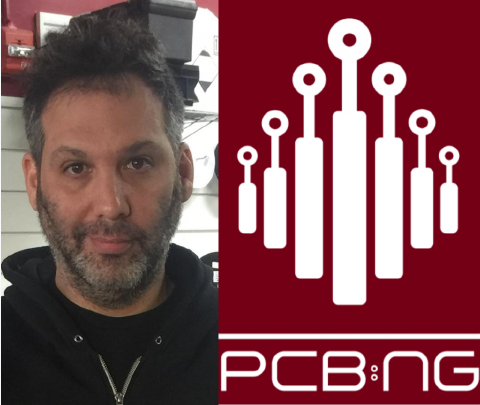
Welcome Jonathan Hirschman of PCB:NG!
- The "NG" stands for "Next Generation" (think Star Trek)
- They are not alone! Refactory (Tom Kennedy) is another assembly house in Brooklyn .
- PCB:NG will be similar to other on-demand services (with low customer service needs). Sites like Moo/Teespring/Shapeways/Ponoko.
- There is not much standardization in the industry. There was an attempt using ODB++ and GerberX2.
- Dave uploaded one of his micro supply designs: http://imgur.com/f9wABJS
- The limits of PCB:NG are:
- 4 mil space / 4 mil trace
- 2 or 4 layer
- 8 mil drill, 5 mil annular ring.
- 1 oz outer copper, 0.5 oz inner
- Surface mount only
- Betas get $1/sq inch in 6 quantity. Other future promos might include incentivizing doing everything in metric.
- Like other online services, DFM (orientation) needs to be verified in the web interface.
- "Confounding user tricks" really means dumb mistakes users make (including Chris).
- Pricing
- Quantity 6
- $8 sq single sided
- $12 sq double sided
- Delivered in 12 calendar day
- It's never quite "apples to apples" comparisons.
- Pick and place machines have a wide range of interface software. There are roughly between 20 and 30 vendors.
- The PCB:NG Software
- After a user uploads, it gets assgned to panel.
- Then another algorithm does the Tab routing.
- The front end updates the database, which delivers files to machine automatically.
- In the US, assembly amounts for $35B in economic activity. However, most designs are 1-100 quantity.
- Jon as also the person who brought the Pieco paste press to market. Jon shuttered the company after the support requests became untenable.
- If you're interested in trying out PCB:NG beta and want to jump the line, use the signup code "theamphour" or "amp hour" and you'll get instant access.
Transcript
Jonathan Hirschman Of Pcb: This is The Amp Hour Podcast, recorded May 18th, 2016. Episode 299, an interview with Jonathan Hirschman of PCB&G.
Dave Jones: Welcome to the Amp Hour. I'm Dave Jones from the EEV blog.
Chris Gammell: And I'm Chris Gammell of Contextual Electronics.
Jonathan Hirschman Of Pcb: And I'm Jonathan Hirschman from PCB&G in Brooklyn, New York. Brooklyn, New York. Yeah.
Chris Gammell: Thanks for joining us, Jonathan. All the manufacturing is these days, right?
Jonathan Hirschman Of Pcb: Yeah. Actually, we're the second ones.
Chris Gammell: The second?
Jonathan Hirschman Of Pcb: We're the second electronics assembly company in Brooklyn. Really? Oh, that's interesting. Yeah. Who's the other one? The first one is a nice company called Reef Factory.
Chris Gammell: Oh, yeah. I know those guys. Yeah. Kennedy. Tom Kennedy? Yeah. Yeah. Nice guy. Yeah. Yeah. That place is cool. Yeah. And I was actually surprised. I visited his place and I visited your place. And I was surprised, you know, I think New York. And you don't really think about industrial space. But then it's like, yeah, of course, Brooklyn. Like, that's where a lot of original manufacturing was, right?
Jonathan Hirschman Of Pcb: You know, as recently as actually just the pre-war period. So the 30s and into World War II, more than 50% of the economy in New York City was manufacturing.
Dave Jones: Really? Wow. See, I wouldn't like as a regular tourist who's just been there, you wouldn't think there's any manufacturing in New York. You just think it's 10 million depressed people living in apartments, you know? Like, that's a nice view of New York, Dave.
Jonathan Hirschman Of Pcb: Those two things are not mutually exclusive.
Chris Gammell: Right. Okay. They can also be depressed in factories. Is that right?
Jonathan Hirschman Of Pcb: Well, I think the people that are like doing manufacturing tend to be happier in general. But, yes. Because Art of Fruit are in Brooklyn as well, aren't they? They're in Manhattan. They are really – yeah, that's pretty wacky. They do their manufacturing in downtown Manhattan.
Dave Jones: Yeah. Oh.
Chris Gammell: Right. Just because of the relative cost of per square footage type of space. But, yeah, that's just the choice that you can make, right, between different places.
Jonathan Hirschman Of Pcb: Well, one of the things that – I mean I have to say we were blessed with in some respects by Mayor Bloomberg and what Mayor Bloomberg did during his tenure is he realized that he needed to diversify the economy of New York City. And so he started really pushing for a lot of initiatives to start to bring manufacturing back to the city.
Chris Gammell: Interesting.
Jonathan Hirschman Of Pcb: Yeah. He figured it's not going to all happen with Wall Street and real estate transfer taxes. Right. So, yeah. So, I mean that was a great thing that he did and it's being continued by the current administration.
Chris Gammell: So, pretty cool. So, like tax breaks, stuff like that?
Jonathan Hirschman Of Pcb: Energy subsidies. Oh, nice. Oh, okay. Well, I mean the thing is –
Dave Jones: Is energy high price there? That it needed subsidies?
Jonathan Hirschman Of Pcb: I was going to say that half of insanely expensive still equals insanely expensive. Ah, right. Okay.
Jonathan Hirschman Of Pcb: There you go. Indeed, yes.
Jonathan Hirschman Of Pcb: Yeah. I think that normally we would pay something like 8X compared to more traditional manufacturing areas in the country.
Chris Gammell: Come on out to Ohio, buddy. Come on. There you go. There you go.
Dave Jones: How much? Like how many cents per kilowatt hour?
Jonathan Hirschman Of Pcb: I think that depending on additional fees, it can range between 30 and 40 cents.
Dave Jones: Whoa.
Jonathan Hirschman Of Pcb: Oh, yeah.
Dave Jones: And so – Well, I pay 26 cents at home here.
Jonathan Hirschman Of Pcb: Wow. That's pretty –
Dave Jones: You know?
Jonathan Hirschman Of Pcb: That's pretty expensive.
Dave Jones: Yeah.
Chris Gammell: Yeah. One, if you're heating up like a reflow oven, that can add up pretty quick. Oh, yeah, yeah. Right.
Jonathan Hirschman Of Pcb: Well, we had to be really careful about making those kind of choices because we were looking at reflow ovens where they looked like wonderful units and great deals. And then we sat and we calculated the energy by – and the energy cost could be for some of these ovens up to $10,000 a month. A month? A month. Wow. That would be for like 20 shifts a month.
Chris Gammell: Aren't you glad that you actually did the calculations, huh?
Jonathan Hirschman Of Pcb: Yeah.
Chris Gammell: Total cost of ownership. It's important.
Jonathan Hirschman Of Pcb: Oh, yeah. It is. No, no. We're already in ROI line for sure with what we chose.
Chris Gammell: Oh, nice. Radio on internet, right? Yeah. Sorry.
Dave Jones: Did we actually ask you what you're doing?
Jonathan Hirschman Of Pcb: Well, so what we do is this. At PSBNG, we decided that making electronics, your own designs, getting them fully assembled, it should be just as easy as ordering a custom T-shirt or making a business card or maybe getting a 3D printer. It shouldn't be any harder than that.
Chris Gammell: So you are the Mood slash Teespring slash –
Jonathan Hirschman Of Pcb: Well, the one thing though is that if you look at the way that say Custom Inc. or Mood does it, they make a really great front end so that you can easily order. But the truth is – and I'm sure they would disagree. But the truth is that printing a business card these days is not that difficult to do. So our challenge was not only to work on the front end aspect of things but also to actually make the – actually fulfilling the order, start to approach making that as easy as printing a business card. And that is a neat trick if you can do it. And we haven't quite gotten there yet. But we've definitely made it a lot easier than I think that other vendors – what their experience is.
Dave Jones: Have you actually released yet? Because I see that you have to – on your website, like you have to apply for an invite.
Jonathan Hirschman Of Pcb: Well, that's interesting. What's that about? We have – well, so one of the things that we're trying to do is we're being really, really careful. I mean when we're accepting money – there's certain expectations when you're accepting money from clients. And so one of the things that we're trying to do is just be 100 percent sure that our software is not stepping on anyone's design or causing any problems. It hasn't kept people from joining. But one of the things that we've done to make it easier – and I'm about to give myself a little plug here – is that we do from time to time release certain codes that let you jump the line and not have to ask for an invite but just go ahead and jump into the beta. And so one of those codes is the amp hour.
Chris Gammell: Hey. Okay.
Jonathan Hirschman Of Pcb: Or if – Sign up now, folks. Or amp hour will also work. And so effectively –
Speaker ?: Spaces?
Chris Gammell: No spaces?
Jonathan Hirschman Of Pcb: No spaces. Spaces. And so you head over to our site and hit redeem invite. And at that point, it's just a question of putting in the code, your email address, and your desired password. I'm doing that right now. And you will be in in minutes.
Dave Jones: Well, I will come back in a few minutes and tell you if it works.
Chris Gammell: Just hold tight, John. Everybody else listening, just hold tight. We'll be – we'll be taking here for a second. A couple minutes. I've already tested it. It worked.
Jonathan Hirschman Of Pcb: Okay. The community code is the amp hour.
Dave Jones: I've clicked – I've clicked – Redeemy. Hi there. Thanks for joining. It's a beta. Delivery time. It's due to 4.
Chris Gammell: I really don't want to hear Dave read through all this stuff. Like, really. I really don't. John, why PCBNG? While Dave's doing that, why NG? What is that?
Jonathan Hirschman Of Pcb: So, well, you know, we found that there's a strange coincidence, a correlation maybe between people that love electronics and people that love Star Trek. What if I'm more of a Star Wars person? Okay. Fair enough. Yes, am I. Yep. But nonetheless, certainly – PCB.wookie. So, NG is, you know, PCB next generation. And we've kind of adopted a very, very, you know, mild science fiction themed identity. We haven't fully blown that out. One of the things that we actually have done is if you order electronics from us, you get very – we've been told very humorous ESD warning stickers on the packaging. So, there's an extra –
Chris Gammell: That's something to look forward to. That's a good teaser. That's good. Extra incentive. There you go. Yeah. Right. Right. Awesome. It's also revolutionizing marketing for people buying assembled boards. We're doing our best. Good, man. That's good. So, where did this all come from? I mean, so what's your background? Dave's still cranking through the demo.
Dave Jones: I'm trying to upload a board now. That's okay.
Chris Gammell: That's fine. John, what's your background? How did you even get into this?
Jonathan Hirschman Of Pcb: That's kind of – you know, it's an interesting story. So, my last gig before I, I guess, you know, embarked on the path that got me to PCBNG, I was actually – up until 2009, 2010, had never touched hardware, had never touched electronics, didn't know anything at all about it. I had sold my company and I thought to myself, you know, I really kind of want to do something very different with my life and I really want to learn how to make physical things. And so, I started teaching myself things like, you know, solid works and, you know, how to, you know, design electronics and taught myself about some fundamentals and how to read a data sheet, how to lay out PCBs. I mean, it was kind of a self – an iterative self-taught process and I got pretty – I got good – I did well enough, you know, in my self-learning that, you know, I started getting requests from people like, hey, will you teach a class on how to design a PCB? Will you teach a class on how to do hand assembly? Will you teach a class on how to design a computer? Will you teach a class on how to design a computer in administered administered administered administered administered administered administered administered administered administered administered administered administered administered administered administered administered administered administered administered administered administered administered administered administered administered administered administered administered administered administered administered administered administered administered administered administered administered administered administered administered administered administered administered administered administered administered administered administered administered administered administered administered administered administered administered administered administered administered administered administered administered administered administered administered administered administered administered administered administered administered administered administered administered administered administered administered administered administered administered administered administered administered administered administered administered administered administered administered administered administered administered administered administered administered administered administered administered administered administered administered administered administered administered administered administered administered administered administered administered administered administered administered administered administered administered administered administered administered administered administered administered administered administered administered administered administered administered administered administered administered administered administered administered administered administered administered administered administered administered administered administered administered administered administered administered administered administered administered administered administered administered administered administered administered administered administered administered administered administered administered administered administered administered administered administered administered administered administered administered administered administered administered administered administered administered administered administered administered administered administered administered administered administered administered administered administered administered administered administered administered administered administered administered administered administered administered administered administered administered administered administered administered administered administered administered administered administered administered you know, electronics assembly, you know, something that is really stress-free and just a piece of cake so that someone could get an order done in a couple of minutes.
Dave Jones: Got it.
Chris Gammell: Well, yeah.
Dave Jones: Speaking of which, done in a couple of minutes, I have uploaded my microcurrent panel, and it loaded, like you upload your zip file, right, which contains all your Gerber files and your drill files and everything, and it detected all the Gerber files just fine, but unfortunately it didn't detect the drill file properly. It chose the wrong file, but I selected the right one, and it still doesn't do the preview. Boo-hoo, but it's given me a price.
Jonathan Hirschman Of Pcb: We are in data, but I will definitely take a look and find out why you're having that issue.
Dave Jones: Well, and also I generate, well, there seems to be no provision for having two separate drill files because I've got two drill files, one for slots and one for round holes.
Jonathan Hirschman Of Pcb: That is actually correct right now, and one of the things that we've been debating is, the issue that we get into is, is that one of the ways that we're able to offer very inexpensive prices is kind of following, you know, the 80-20 rule, say the way that, you know, Proto Labs does, and one of the things that we're debating is what exactly, what features should we allow and what features should we not? And so far, we're probably ultimately going to allow a separate routing file for, but one of the issues that we get into is, then what kinds of files do we accept and which files that we don't, because some software can create a proper routing path and some can't, and then, you know, our board vendors get really mad at us when we give them something that uses a deprecated thing. So one of the things that we were considering doing is allowing people to upload, you know, another assembly layer that would be the routing layer and effectively just create the routing for them based on that, but it's something that is still in development.
Dave Jones: Are we allowed to ask who your board manufacturers are?
Jonathan Hirschman Of Pcb: We're not discussing that at this time, but they're multiple. I thought not.
Dave Jones: Right, multiple. They're very capable. Why multiple? You got ones for cheap and slow and ones for fast and expensive?
Jonathan Hirschman Of Pcb: No, because the thing is, is that what we found is, is that the board producers can be extremely variable and being beholden to us.
Chris Gammell: In terms of quality or a process or what?
Jonathan Hirschman Of Pcb: Well, I mean, it's really strange. I mean, we have, I mean, one nameless, you know, board house. You know, they were our number one with a bullet because everything they did was just amazingly great. And then we started receiving orders from them that were, well, you know, kind of subpar in that we would get, you know, a number of panels and one of them would be just completely unacceptable. And we actually got one panel from them where things were rotated within the panel. And so, you know, we had, you know, and the thing is we got another order from them where, you know, their routing just went kind of berserk and we got misshaped boards. And so one of the, you know, and so that's, so the thing is it's always good to keep them on their toes to some degree and load balance the orders and just make sure that you're not beholden to somebody that is suddenly going to start slipping in quality. You know, we've had other producers that were great and then suddenly they decided they wanted to change the pricing that we had negotiated with them. So, you know, we can never be 100% certain. We always need to have at least, you know, at least three.
Chris Gammell: Yeah, that makes sense. And I mean, that's just a negotiation tactic as well, right? I mean, then keep the workflow going. Yeah, that makes sense.
Jonathan Hirschman Of Pcb: Yeah. The difficulty though is that there's, you know, the vast majority of the board folks we've talked to, we don't want to work with. Right.
Chris Gammell: Because you see, you guys are focusing a lot on automation. I mean, are you seeing the automation on their side of things or no?
Jonathan Hirschman Of Pcb: That's the interesting part is that we're starting to see, I mean, the folks that we're talking to are the ones with the most clue in that, you know, they can actually grab files, you know, off the cloud. That's actually a really hard thing to find. That's the bar they have to jump over. That's pretty low bar. You'd be amazed. Dropbox. Right off the bat, that, you know, extinguishes most of them.
Dave Jones: What cloud are we talking about here? We're talking about Dropbox?
Jonathan Hirschman Of Pcb: I'm talking about Dropbox. Like send them a Dropbox URL, you know, send them, you know.
Dave Jones: And they can't do it.
Chris Gammell: If you could just fax us the Gerbers sheet by sheet, we'll have someone scan those in to transparencies.
Jonathan Hirschman Of Pcb: Again, I'll make this a nameless, you know, company to protect the guilty. But, you know, we were dealing with a vendor who insisted that every document they sent or that we sent to them had to be an RTF format. I mean, why? I mean, why? Because that's how they've been doing it since the 80s, right? Right.
Chris Gammell: Yeah, it's the same thing.
Jonathan Hirschman Of Pcb: And so, yeah, we like to say that a lot of the vendors out there, and this is on the assembly side and on the board side, they're kind of stuck in the fax age. They've been doing that. That's where they kind of stopped evolving, technologically speaking. And not surprisingly, a lot of the software that they tend to use has largely stopped evolving as well. And that's why we've had to write so much of our own.
Chris Gammell: Yeah. That makes sense. That's good. I mean, it's good. And it's good that you guys are moving this forward. I mean, there's other people doing similar things, starting to see more similar things out there. And that's – I love it. We were talking, I think, before the show too, that I just don't want to talk to people. That is my main thing. I just don't want – Yeah. I don't want a phone call. You shouldn't have to. I don't want email back. I just want to like everything – I want it to work, obviously. But like I just don't want to interact with people because that means that there's just friction in the process.
Jonathan Hirschman Of Pcb: Well, what's funny is that we like to talk to – at this time, we like to talk to folks if they're willing to just so that we can get some feedback and we can incorporate it and kind of iterate real quickly. Yeah, but it's a product thing.
Chris Gammell: That's not necessarily – yeah. That's not like a –
Jonathan Hirschman Of Pcb: Absolutely. But some of the feedback that we get is interesting in that regard. I mean, I was talking to a gentleman recently and he's been getting Assemble Electronics for 20 years. And when I told him like, hey, our paradigm is self-serve. The idea is that you're not going to talk to an engineer. You're going to upload it and the system is going to be smart enough to do what it has to do. And his response was, but I really like the whole concierge thing. I really like someone just like doing it. And so the thing is is that right now in electronics, there's – and I hate – this is going to sound really terrible. And I don't mean this in a judgment way, but there's a janitorial layer right now in the way that it's done. And what that means is that there's an engineer that's taking the files that they're getting from users.
Chris Gammell: Oh, yeah.
Jonathan Hirschman Of Pcb: And they're fixing them because they're all invariably broken.
Chris Gammell: I think that there's even that – So like Dave, you do a lot of panels, right? But like even when we're – when you upload something that's – like Oshpark panelizes stuff programmatically, but I think there's – when they send it off to a board house, there might be someone there. But like anytime you send in a non-panelized board, someone is panelizing that for you. Like that is just – Oh, yeah, of course. That's just a reality. There's someone there with a Gerber tool and they're just shoving stuff around and panelizing it. And like there's someone doing that. There is someone there. Same thing with assembly houses. There's people dealing with spreadsheets and doing that kind of stuff, you know?
Jonathan Hirschman Of Pcb: Well, I mean I'll put it to you this way. We – you know, as part of our research, we looked at almost every CAM package that was out there. And what we were really shocked to find out is is that there wasn't a single package that you could buy from anybody where you could say, here are like eight designs. Make an array, you know, a heterogeneous array and automatically, you know, tab route them without human intervention. And as far as I know, that still does not exist today. We had a –
Dave Jones: No, because that's not a – is that a marketable thing? I mean –
Chris Gammell: Right, you're selling that to a board house.
Jonathan Hirschman Of Pcb: I think it is actually a marketable thing because – well, I mean I'll put it to you this way. None of them really actually will take a single design and automatically tab route without human intervention either. Yeah, that's right. So – and that certainly is a marketable thing. So what we had to do was we had to write our own CAM system that would take designs and automatically, you know, array them in a rational fashion and then do all – you know, put all those features on the board.
Dave Jones: So why don't you sell it?
Jonathan Hirschman Of Pcb: Well, I mean because – I mean I think the thing is it's a – I think it's a remarkable competitive advantage. I'm not sure that necessarily anyone else actually – maybe other people do have their own homegrown solutions, but I'm kind of thinking we might be the –
Dave Jones: But Oshpark had their own – Oshpark wrote their own solution, for example.
Jonathan Hirschman Of Pcb: I honestly don't – I don't know if it does everything ours does.
Dave Jones: Right.
Chris Gammell: Well, yeah. But there is some automation. No, I know there's automation there. Absolutely. Lane was on the show talking about that. No, there would have to be.
Jonathan Hirschman Of Pcb: There would have to be. Yeah. Yeah. No question. And maybe his is more sophisticated than ours. But what ours does is it does the efficiency calculations. It puts certain proprietary features on the board that allow us to further automate. So our panels look – I mean – well, Chris, you saw them. I mean they look kind of wacky compared to anyone else's panels.
Chris Gammell: They're very unique and that is good though. Like I – yeah. There's added features that definitely help you out for the thing. So it makes sense.
Dave Jones: Hang on. I've got myself in errors popped up. We're not live troubleshooting, man. No, it's still beta. Here we go. The outline layer is a collection of 11 unconnected line segments. We require the border of the PCB to be represented by a continuously connected path that makes up a valid polygon.
Jonathan Hirschman Of Pcb: Did you do this design in an Altium product?
Dave Jones: Yes. Yes.
Jonathan Hirschman Of Pcb: Yes. Well, it's interesting because –
Dave Jones: There's your problem.
Jonathan Hirschman Of Pcb: Well, no. I mean we think Altium is a great company with great stuff. But at the same time, they have a different conception of what an outline layer is than pretty much anyone else. So their outline layers are actually typically not actually contiguous. And this is something that we've been working through because at the end of the day, we have to support it. It has to just work.
Chris Gammell: Of course. And you mentioned in general just like all of the different – like every – aside from user differences and how they actually decide to put this stuff out, just all the CAD programs that are out there, there are all these idiosyncrasies between them, right? There is some –
Dave Jones: And maybe the manufacturers are manually tweaking. If I send them my Altium files with their board out, like maybe they're just manually tweaking in the background and I'd never know.
Jonathan Hirschman Of Pcb: Yep. Exactly.
Dave Jones: Manually fixing it.
Jonathan Hirschman Of Pcb: Well, I would actually say that's probably the case. But the thing is is that in some – I mean there are some – my guess is that they are dealing with some CAD packages that automatically deal with that. Right. That's probably an issue they've been dealing with for a long time and they kind of have some kind of – Solution for it. Yeah. They probably have a thing where it's like if it's a certain – there's a certain closeness between two disjointed points, it's going to assume it's closed. And that's along the lines of what we've been building. Clearly, we still have some bugs there. But I'll definitely look forward to looking at those files and seeing why we didn't succeed.
Chris Gammell: Yeah. So what are some of the – I mean what are some of the – you see a lot of different packages now, right? As you've got more people in your system. So some things just do it completely different or it breaks your system or how does it even work?
Jonathan Hirschman Of Pcb: Well, I mean I could talk about the stuff that has broken our system in the past. Sure. So one thing there was – and again, I'll try and since we love all the EDA packages out there. I know. Well, that's okay. What we found is there are some packages out there that whenever you do a copper pour, they use a painting technique instead of actually creating a polygon like they're supposed to. I mean basically using a whole bunch of traces is way deprecated now.
Chris Gammell: Painting like it's rasters back and forth to actually make a layer.
Jonathan Hirschman Of Pcb: That's exactly – yes, yes. So dip traces is the worst offender in that regard. Right. And so that's something that breaks – that broke us pretty badly for a while because trying to figure out what's contiguous and what's not, that actually becomes a pretty difficult program – excuse me. So that's a pretty difficult algorithm to write. If you're basically stepping through every paintbrush stroke that someone did as part of their pour. Mm-hmm.
Jonathan Hirschman Of Pcb: We came up with a smarter way to deal with that. And actually, we're going to be releasing that pretty soon with our next feature drop. Mm-hmm. So that's an example. We've seen a lot of packages that use zero-sized flashes for various functions. We've seen a lot of issues. What is that?
Chris Gammell: Sorry. I didn't know what that was.
Jonathan Hirschman Of Pcb: Well, the thing is is that in a Gerber file, you can define just a polygon. But typically, like if you have a pad, it's what's known as a flash. It's a defined primitive effectively.
Chris Gammell: Oh, OK. OK. And so – So like a square or it's a rectangle. You define the sides instead of drawing it.
Jonathan Hirschman Of Pcb: Exactly. And then you just keep on saying, OK, do this flash again and again and again for every pad. So the thing is is that zero-sized flashes are actually legal but they're not entirely a good idea and they're kind of frowned upon in some regards. So that was giving us a lot of fits and starts. You know, so there are a lot of – you know, the fact that Eagle is – I believe that Eagle. I believe that – I don't think Kaikad. I don't think Diptrace. I mean some of the lower end packages, they can't do a proper milling path. I mean they just can't do it. They'll use a very, very deprecated style of just defining two drill hits and effectively just – you know, the commands cause it to do a million drill hits in between.
Dave Jones: Yeah, right. Yeah.
Jonathan Hirschman Of Pcb: Yeah. The boardhouses really don't like that.
Dave Jones: No. No, they don't. So – Which they will fix that stuff manually before they put it through. Their cam software will flag it.
Jonathan Hirschman Of Pcb: Like scrubbers or something? Yeah.
Dave Jones: No.
Jonathan Hirschman Of Pcb: Depends on the boardhouse. I mean one of the things that we do is we give folks absolutely airtight Exelon milling paths. You know, our stuff is beautiful from that perspective and we have boardhouses that are like, well, can you give it to us in this other really weird format? And we typically frown on that and say, you know, get with the times. It's industry standard. Deal with it. Right.
Chris Gammell: So there's another interesting topic though too is like I know Gerber's and Exelon and that stuff is out there but like it's not really standard. That's the thing. There's not like an IPC standard for how board files are sent, is there?
Jonathan Hirschman Of Pcb: Gerber's – well, I mean the thing is this. That's why –
Dave Jones: They tried to create, didn't they? Wasn't there some industry push to try and create a standardized thing at one point?
Jonathan Hirschman Of Pcb: Oh, definitely. I mean the thing is, you know, ODB++ is one option and we're going to be supporting that pretty soon. But, you know, and then there's Gerber X2. I don't think that's really getting traction. But really the default choice for everyone is zipping up the Gerber's and the NC drill files.
Chris Gammell: It's okay. Keep going.
Dave Jones: That's all right. I just sent a screen capture in the background. Because I got it. I got my board. Sorry. Continue.
Jonathan Hirschman Of Pcb: So the thing is is that –
Chris Gammell: You're saying ODB2 and Gerber X2. Yeah.
Jonathan Hirschman Of Pcb: But ultimately we're going to be in – well, I can't see it because my Mac – sorry. I'm not multitasking more right now. See what you did, Dave? You broke it. You broke it, Dave. Yeah. Yeah. Yeah. You broke my Mac. But, you know, for the time being, it's going to be Gerber's plus drill files as the vast majority. Although you're starting to see – and this is something that we're not really thrilled about – is that people are just basically, you know, doing an end around the whole issue and just saying we're just going to deal with native file formats. And I think that's actually a pretty bad idea for a lot of reasons. Why is that? Well, I mean for one thing, the support burden for us right now is unsustainable. Because, you know, native proprietary or semi-proprietary file formats, they change with revisions. Oh, yeah. And so, you know, so the testing, you know, to do that is substantial. It doesn't mean that we're not going to do it. It just means that we're not going to do it right away. So that's one way to – you know, and other people have done that. But really there needs to be – there just needs to be an interchange between all of these programs and not just for output, not just for like, you know, the equivalent of PostScript. There needs to be a common file format that everybody supports so that I can – you know, I can take a file from Altium and load it into DipTrace or into KiCat or into Eagle. And I really think it would be to the advantage of a lot of the smaller guys if that happened. And yet they really just don't want to do that. Yep. Yeah, they don't play nice together.
Dave Jones: Well, the big players don't want to do that as well.
Jonathan Hirschman Of Pcb: Well, and I think that, you know, ultimately you could do that with ODB++. You could do that. What is that again?
Chris Gammell: So you mentioned that before. It's like a Gerber similar type thing?
Jonathan Hirschman Of Pcb: I hope I'm not like having a brain fire right now and using the wrong acronym. But ODB++ is kind of like a superset of what – you can put in it, you know, not only the different layer information and the different drill and milling information, but you could also put in netless and all the good stuff that you really could, you know, recreate a design.
Chris Gammell: It's proprietary CAD to CAM data exchange format.
Jonathan Hirschman Of Pcb: But it's not proprietary. It's actually something that a surprising number of packages are doing it for output, but none of them will do it for input.
Chris Gammell: Oh, interesting. Okay.
Jonathan Hirschman Of Pcb: Right. You know, and it's like this gentleman's agreement between all of them that we'll spit it out, but we won't digest it. Interesting. And I think that's a terrible mistake, honestly, you know. Yeah. But, hey.
Dave Jones: Anyway, my board worked. My board worked. I put in a – well, a different one, which is just a square board instead of a big complex panel with all sorts of routing paths. Oh, well, there you go. And crap like that. And, yeah, it worked. Once again, I've got multiple drill files. Like, I've got one that does square holes, which is actually like a routing path kind of thing, and it doesn't let me select that. But apart from that, it works beautifully, and the preview looks fantastic. How did you know that I wanted a red solder mask? Well, we – They're all red.
Jonathan Hirschman Of Pcb: I mean, actually, we need to tweak the color because it's supposed to be our kind of blood red, our PCB and G-red. Yeah, right. You know, so it's a little bit off these days. But, yeah, that's one of the things that we do that I think, again, is kind of – makes us heretics. You don't get to specify what your solder mask color is with us. Oh. We have one stack – we have basically one choice for a stack up. If it works for you, that's awesome. If it doesn't, then you don't get to enjoy our really unbelievably low prices. And it's the same –
Chris Gammell: I think you said you're an engineer, not a salesman. Come on, man.
Jonathan Hirschman Of Pcb: Well, I mean, the thing is is that –
Chris Gammell: All today's low, low prices.
Jonathan Hirschman Of Pcb: Sunday, Sunday, Sunday. Well, if you think about it, you know, in order to get to scale, it's a lot easier if you follow the Model T. philosophy, any color. Of course, yeah. But the other thing is is that that goes to the finish. I mean, you can only get Enig. You can't get anything else. It goes to the – you know, our trace and space specifications and on and on. It's like – Which is what? For copper, it's 4 mil trace, 4 mil space. Nice.
Dave Jones: Wow. That's nice.
Jonathan Hirschman Of Pcb: Yeah. For – we do an 8 mil – Two layer, four layer? We can do two layer and four layer. Right now, you get – let's see. Minimum drill hit is 8 mil. Annular ring is 5 mil. All right. So, you know, that's pretty – that's actually pretty tidy but it's not necessarily great for people that are trying to do little BGAs. Yes, it's not like a via but it's still – it's not bad, right? I mean – It's pretty decent and the other thing is is – you know, but again, some things are really standard. It's like one ounce copper outer layers, half ounce inner layers. We suggest but don't enforce copper to edge clearances. So, we will do, you know, castellations at your own peril.
Chris Gammell: Okay.
Jonathan Hirschman Of Pcb: Yep. But, you know – and so, what we found is is that, you know, all this stuff is sitting in our help files and, of course, nobody reads those. And so, what we've been getting is a lot of designs where people are looking for really advanced features and they're not going to get them. You know, I mean because one of the things that we started doing is as a way to really bang on our Gerber parser is we thought, hey, you know, let's like start to increase the volume. So, for beta, we said to folks, hey, you know what? If you just want a PCB, we'll do – we'll give you six copies, you know, for a dollar a square inch. So, you know, that's pretty inexpensive and it's a pretty high quality PCB. And so, we've been getting a lot of people taking advantage of that, which is great. The bad thing is we've been seeing things like, you know, microvias and we've been seeing people that are looking for clearances of one mil. Oh, wow. Yeah. Wow. And, you know, the thing is –
Chris Gammell: Time to review, folks. That's probably never going to happen with –
Jonathan Hirschman Of Pcb: So, you know, what we – we've been working on this anyway but it's just really spurred us to accelerate development is that we're going to be introducing the first DFM layer that a system like this has so that if you upload something that's going to cause you to shoot your toes off, we're going to bounce – we're going to either bounce the order in some cases or eventually we'll allow you to fix it in our system. Just fatten up some traces. Well, no. We're never going to do that with copy. I know. That's a bad idea.
Dave Jones: But you don't want to be fixing your design at the board house.
Chris Gammell: That's right because you export the exact same design next time, right?
Dave Jones: Well, that's true. Yeah, yeah. Exactly.
Jonathan Hirschman Of Pcb: I would – well, this is the thing. This is the dirty secret. If you upload something that, say, for instance, has mass clearances that are out of spec, the board house is going to fix it anyway. I mean –
Jonathan Hirschman Of Pcb: Yes. They may not – they may not – you probably won't notice because it probably will be just fine. But if they're going to – if you have mass clivers, they're going to fix it. All kinds of things. If your annular ring is too small, they may actually ask – in some cases, they'll just fatten it up.
Dave Jones: I've had that and they've shorted out things or they've actually removed copper fuel between the traces because they expanded my annular ring. So I just lost my ground playing connection.
Jonathan Hirschman Of Pcb: Well, we had something worse. We had something that was really annoying. I mean one of the things that we do is we have certain features on our board that, again, help our manufacturing in ways that I'm going to remain purposely vague about. But some of those involved exposed copper. And so one of our providers thought it would be a really great idea for them to just arbitrarily put their logo over what they thought were just useless features. And so we get the stuff and it's like, oh, our system is not running really well. Why is that? Oh, let's see. We're expecting copper there and it is silk and it's throwing things off. Yeah, and so – and literally the engineer, his response was he's like, I don't see the problem. That's a useless feature. Your face is a useless feature. And I said – that's the kind of thing that really – I mean –
Chris Gammell: Oh, I got – I had a very similar one where they put a marking on there that was not showing in any of the previews. And I was like, you didn't put that there. I don't know. If I wouldn't have paid up front with the credit card, I never would have paid the invoice because –
Dave Jones: One of my pet hates is when they – when you do like a PCB front panel and they think it's a board and they put all logos and all sorts of other crap and information on the board, on your silk screen. It's like, it's a front panel. Yep. Or it's a board that's used as a front panel. Yeah. It's like, oh.
Jonathan Hirschman Of Pcb: We have some really – yeah. I mean, that's one of – again, that's one of the things that we deal with with vendors where we say, you know, thou shall not do this. Thou shall not do that because we would never put our logo on someone else's design. I mean, that's like verboten. Although I scored a win here.
Dave Jones: I actually – a PCB house that I used to use – oh, I still do use them. I complained about this. And they said, that's a fair point. And they actually rejigged their quoting system. Now it has the option. They added in quite a few years ago. Now it has – do you wish us to put all these marks, you know, on your overlay? Do you wish to add them? Oh, yeah. Yes, no. No, no, no. Thank you very much. You know. Great. And yeah, it's great. So they actually recognized that problem and they added it to their quote system.
Jonathan Hirschman Of Pcb: Yeah, we're thinking of doing a few things along those lines where if you allow us to put our logo on, you know, we may give you a discount. But we'll never insist on it. The other thing is that one of the things that we really, really want to encourage and people think we're nuts about this. We really want to encourage people to do everything in metric. Oh, nice. Interesting. Because actually – Evil.
Dave Jones: Evil.
Chris Gammell: Evil? Evil. Well, you know, there's – You're going to have a lot of confused people. But, you know, once – if it's automated, right, you don't have to listen to them.
Jonathan Hirschman Of Pcb: Well, the thing is we obviously – we accept it both ways. But the issue is, I mean, the real issue is that you'd be surprised that most of the pick-and-place machines out there, you know, speak metric natively. Yes. And they convert from Imperial. And so, you know, you get these cascading rounding errors. Yep. And so that's why we're like – we were thinking about, hey, wouldn't it be great to have like metric day where we give a discount for metric files? I love that. Yeah.
Dave Jones: Although you did give us your specs before in Imperial. It's true. Yes.
Jonathan Hirschman Of Pcb: Well, that is my audience, you know. Oh, yeah, yeah, yeah.
Chris Gammell: Us uncouth users of mills.
Jonathan Hirschman Of Pcb: Well, it's terrible because the thing is – and I think I'm probably like most – certainly American, you know, users. I think in terms of the board features in mills. I think in terms of, you know, the – I think of passives in Imperial. And I think of ICs in metric. And, you know, you're constantly jumping back and forth. It's kind of weird.
Chris Gammell: So – Yeah. Any footprint is default metric, you know. So –
Dave Jones: Well, the new surface mount ones are the old through-hole ones. That was all Imperial. Thank you very much. Yeah, I'm sorry. You know, headers and things like that.
Chris Gammell: Some of us make modern products, Dave. Come on.
Dave Jones: Right.
Jonathan Hirschman Of Pcb: One of the limitations of our system or we think features is that our policy on through-hole is that you can't have it. Oh, that's right. Yeah. Right. We're surface mount only. That's it. If you have through-hole parts.
Dave Jones: But headers and things. I mean, oh, this is where you were talking about the start where you would get people to sort of do some of it themselves, right? And this through-hole.
Jonathan Hirschman Of Pcb: Well, what I was really talking about in terms of people doing things themselves is that our system, that as you progress through PCB and G and get closer to ordering, one of the stops you have to make is actually verifying all your parts placements. Oh, okay. You have to visually verify. Diodes. You know, but I mean, yeah. The orientations make sure that you're putting polarized stuff in the right way. ICs in the right orientation. And so that's something that we ask the users to do because the truth is they know their design the best. And so they certainly know it a lot better than a pick-and-place operator. But in terms of through-hole, what we're saying is if you are using headers, we're saying, hey, you know what? Those are available surface mount too. And I understand there are some disadvantages to them.
Chris Gammell: Do you give refunds when those stupid surface mount headers get ripped off the board like they always do?
Jonathan Hirschman Of Pcb: They only get ripped off if they're not staked down. If they're staked down, they're not coming off. So you're saying that you can stake stuff down but no through-hole? We do stake stuff down pretty routinely where especially if it's obvious there's going to be physical stress or if we're seeing that the user did a confounding user trick where they're likely to get –
Chris Gammell: Confounding user trick.
Jonathan Hirschman Of Pcb: Yeah.
Chris Gammell: That's the nice way of saying idiotic mistakes that Chris makes. Okay. I'm not saying that. That's okay. That's your job not to say that. I'm saying that. I can say that about myself.
Jonathan Hirschman Of Pcb: If we see that somebody is using – for instance, we see this a lot where people use really strange pad sizes for standard parts for passives. Yeah. We'll stake that. We'll detect that and stake it down.
Jonathan Hirschman Of Pcb: Interesting.
Jonathan Hirschman Of Pcb: Because otherwise they're going to get tombstoning. They're going to get billboards. They're going to get all kinds of funny gymnastics during reflux.
Chris Gammell: What's billboarding? Is that when it goes on the side?
Jonathan Hirschman Of Pcb: Yeah. It stands on the side.
Chris Gammell: I've never heard that.
Jonathan Hirschman Of Pcb: Yep. And actually we've actually seen the strange phenomenon where – I can't begin to tell you how this is happening, but we've seen passives that actually flip over during reflux. No.
Dave Jones: Oh, I think – yeah. I think I've seen that once. Yes.
Jonathan Hirschman Of Pcb: It's not common, but it definitely happens. No, no.
Chris Gammell: You should call that the – what should you call that? Like the Greg Louganis or I don't know? I don't know.
Jonathan Hirschman Of Pcb: You know, but I mean we see a lot of other weirdness. Like one of the things is that we were doing a design recently and it was using a really standard passive. It was using like a – you know, it was just using an 0603 cap that, you know, pretty standard bypass value. And the cap was out of spec for the physical size. It was actually more narrow than the 0603 cap is supposed to be. And this was from a major manufacturer and it was surprising that – The cap was more narrow or the footprint was more narrow? No, the cap itself. Oh, wow.
Dave Jones: Are you sure they weren't just putting them 90 degrees instead of –
Jonathan Hirschman Of Pcb: No. Well, I mean it's – I mean I guess that is possible that they were in the pockets, you know, kind of rotated in the pocket. But yeah, we've seen weirdness like that.
Chris Gammell: That's crazy. Wow. Yeah. I want to go back to pricing for a second because that is actually one of the things that you promote as one of your things is like – obviously we've heard about some of your automation stuff. But tell us about the actual pricing on – if we upload a design, how does this get priced right now?
Jonathan Hirschman Of Pcb: Well, that's the interesting part. One thing that really has always irked us is if you go to – if you find an assembly outfit that has something that – you know, a place where you could get some kind of quote, typically not binding but you can get some kind of quote, you have to fill out, you know, field after field of information. And yet all that information is inherently in – can be found in the Gerber files and the drill files. So what we do is we just basically just jump to the end. We do flat rate pricing. If you have a one square inch design, you get charged at a given rate for one square inch. For six of them is our minimum order quantity. It doesn't matter how many components you put on it. I mean as long as you're not violating, you know, pretty decent courtyard rules. But, you know, it doesn't matter what you're doing with it. You can just do it. The price for the PCB in the assembly doesn't change.
Chris Gammell: Right. So it's getting rid of like a lot of the setup costs and stuff like that, right? I mean those are baked in at least.
Jonathan Hirschman Of Pcb: Well, I think the more important thing is that it's not uncommon to say have a design and then you switch one component out and suddenly the price is radically different from a given – because you've just tripped some evil, you know, part of someone's, you know, opaque pricing engine. So, you know, if you change your design from QFP to QFN, there are some companies out there that will double or triple your cost. We don't do that. If we support the part, it's the same price. That's it. So what is the price right now? The price is for – we're only doing quantity sixes right now because we're trying to solve the hard problem first. But the price on that is $8. I think it's $8 a square inch.
Chris Gammell: Two-layer or four?
Jonathan Hirschman Of Pcb: For two and for four-layer.
Chris Gammell: Uh-huh. Oh, okay.
Jonathan Hirschman Of Pcb: But that's single-sided. If you do double-sided, there's an upcharge. But it's still a bargain. All right. So, yeah. So, I mean, the thing is you can get – it's possible to get fully assembled PCBs, a batch of them for under $100 with our system. That's good.
Dave Jones: How big a pain is a double-sided load as opposed to a single-sided?
Jonathan Hirschman Of Pcb: Well, I mean –
Dave Jones: Is it just annoying or is it –
Jonathan Hirschman Of Pcb: It really depends. That's a really good question because it actually harkens back to something we were talking about before, which is confounding user tricks. The thing is is that people will do double-sided. Typically, a double-sided design is not any more difficult than a single-sided design except for the fact that you're doing –
Dave Jones: You have to do a second pass.
Jonathan Hirschman Of Pcb: You have to do a second pass. Yeah.
Chris Gammell: Well, and all the first pass ones have to stay on the board.
Jonathan Hirschman Of Pcb: Well, I mean that's actually not that big a problem.
Chris Gammell: Well, it is if you don't –
Dave Jones: Because the surface tension will usually keep them on there.
Chris Gammell: Usually. That's the problem, right? I mean you have to – there are qualifications on that, right?
Jonathan Hirschman Of Pcb: Well, there are certain ratios where surface tension is going to keep it in place.
Chris Gammell: Yeah.
Jonathan Hirschman Of Pcb: And so there are also certain things where you need to take some action to make sure it stays in place. But the real issue is when people pick components that have no business being on the backside because – You mean my 800-pin BGA shouldn't be on the backside? Is that right? Well, that's actually not – well, honestly, that's not as big a problem as you think. The problem is when people – what we found is interesting behavior when – there are certain parts that always show up on every design no matter what. So there's a certain coin cell holder that is the cheapest first one that you find on DigiKey that everybody uses. Yeah, you have that one. Okay. And the issue with that is that it's really unrealistic to put it on the back because it doesn't – it has tiny little feet. So it doesn't have the surface area. It's heavy. And to make matters worse, there's no part of that component that you can stake down because it doesn't have any flat surfaces at all. And so it's designed only for top placement and that's it. And that's – now, of course, you can do things in reverse where you do the top and then the bottom. But for certain designs, that's not feasible either because you may start to get into yield issues because –
Chris Gammell: Well, that also sounds like a human thing. That sounds like it's counter to your entire process of like – that sounds like a human in the loop kind of thing, right?
Jonathan Hirschman Of Pcb: Well, I mean those are one of the things that kind of – it's one of the challenges that we're going to be fixing. How to effectively detect that part and say, yeah, you can't have that there. You can't.
Chris Gammell: Well, it seems like one of the main things that you guys are doing is basically you're saying, look, here's what we do. Here's what our rules are. There is really good pricing if you do it. If not, maybe we're not the place for you. Does that sound right?
Jonathan Hirschman Of Pcb: That is 100% on the money. And that's another alien notion to most assemblers out there. They want to – most assemblers will do anything you want. If you say – Don't say no. Just quote them a price. If you say, hey, we want you to do reflow while you're standing on your head, sure, no problem.
Chris Gammell: As you wish.
Jonathan Hirschman Of Pcb: We do what we call the anti-Burger King philosophy, have it our way. And that's not for everybody. But what's interesting is it's for a lot of people. If you're going to an assembler where they'll do anything you want at any time, that means every job they do is a bespoke job. And that also means that a really simple meat and potatoes job carries the cost of a really complex job. Some of that. Correct. Okay. So what we say is, hey, we only do it one way, so you're paying a much lower price because you're not subsidizing somebody's complicated design that requires a lot of care and feeding.
Dave Jones: The other manufacturers aren't transparent in this. They will simply just do it. They won't go, oh, this is difficult and we're going to have to charge you extra. They will simply just do it and you won't know. Well, what they're – That you'll be in charge extra for this. They'll simply just quote you on that, you know, like – No, but that's the thing.
Jonathan Hirschman Of Pcb: That's the thing. You are being charged extra every single time.
Dave Jones: Oh, yes, you are, but they won't tell you, so you don't realize it. No, but here's the thing.
Jonathan Hirschman Of Pcb: Even if you have a real piece of cake job, there's the underlying assumption in their pricing model that you're going to be a problem child. Correct. Yes. Right, right, right.
Dave Jones: Yeah, yeah, yeah.
Jonathan Hirschman Of Pcb: So we say –
Dave Jones: They don't tell you any of that. That's the thing. You don't realize that they're charging – Right. That they're thinking that every job is a custom.
Chris Gammell: I remember when I used to work at a place that I used to live near. I won't say which one, but everybody knows what it is. We had actually a spreadsheet where we were trying to optimize the cost of a board. And even with in-house manufacturing, we didn't know how their pricing structure was. Like basically, you know, we tried to say, oh, well, what if we made the stuff BGA instead of QFP? Didn't matter. We'd still have to get it all quoted through, right? Or if we, you know, put everything only on the front side. Didn't matter. You still had to put it through. And that was even with in-house manufacturing. When you go to outside assembly, all bets are off because like you said, all the pricing models are opaque.
Jonathan Hirschman Of Pcb: Well, and on top of that, what you'll notice is – I mean, what I like to do is – I mean, obviously, we look at competition. And what we like to do is – what I like to do is give them, you know, improbable use cases to see what it does to their pricing engine if they have something. So one of the things is that, you know, the first thing that I'll always do is basically give them the same specs for double-sided and single-sided. Same number of placements, same this, same that. And what I typically find is the difference between single-sided and double-sided placement is about 10%. So, you know – Really? It shouldn't – you know, it's usually not that great. There's not a huge savings by keeping it single-sided with most vendors. The other thing that I like to do is to take a certain part that I know is probably going to, you know, be a tripwire part for them and see just, you know, what multiple the price goes to. So, you know, let's add, you know, a four-ball BGA and see what happens or let's add a QFM – you know, some other, you know, BTC and see what happens. So it's always an interesting thing to see how those price models kind of break down and they typically do. We decided to just go with perfect transparency. It's really very self-serving in one sense that if word gets out about what we're doing, we become the pricing model that everyone carries around in their head.
Chris Gammell: Yeah. Right. Right. Yeah. You know? Yeah. So when you're – What's the price to beat, right? It's like especially if you have the convenience piece of I don't have to talk to a human, right? It's like great. Awesome.
Jonathan Hirschman Of Pcb: I think the other thing is when you add some of the other features like, you know, as we start to roll out what we call the fail-proofing features, you know, I think that that's something that people come to appreciate. But, I mean, ultimately, it's not just a price – it's not a price thing. I mean if you look at why people say shop on Amazon, it's not because it's the cheapest price because it rarely is.
Chris Gammell: Because Amazon Prime.
Jonathan Hirschman Of Pcb: Well, people shop on Amazon because they know they're getting something that's pretty close to the lowest price for everything. They don't even think about it. And so, you know, comparative shopping, it stinks. And it's actually worse in this industry because you can't send the same file set to every vendor.
Chris Gammell: Apples to apples is really tough.
Jonathan Hirschman Of Pcb: Yeah, it is. Or they need things in a different way so you're sending it to all these different folks and it's like, okay, I got to make this for this vendor A, another package for vendor B. It's a nightmare.
Chris Gammell: Yeah. Interesting. Whoa.
Dave Jones: Tell us about pick-and-place machines.
Chris Gammell: Yeah, I was going to say, how the hell are you doing this?
Jonathan Hirschman Of Pcb: So here's the thing. I mean, you know, most pick-and – so it's interesting. Pick-and-place machines are basically – in a nutshell, the problem with pick-and-place machines is that they're typically designed to have really great specs. But those specs are geared towards the wrong problem.
Chris Gammell: How so?
Jonathan Hirschman Of Pcb: Well, I mean the thing is is that if you go to buy a pick-and-place machine, they will tell you how many, you know, how many part – components per hour that machine can place. And that sounds really great. Oh, it's like that one does 12,000 an hour. That one does 8,000. 12,000 is better. What they're not doing is is how many, you know, unmonitored components an hour it can place.
Chris Gammell: Oh, but the baked-in assumption is that there's a person, an operator there that's a specialist.
Jonathan Hirschman Of Pcb: It's even worse than that. We always ask the simple question of most vendors and we said, tell us about your error rates. And nobody could answer. They don't measure them.
Chris Gammell: How do you qualify that or quantify that rather?
Jonathan Hirschman Of Pcb: Well, I mean just in any way. Like in other words, how many mispicks do you have for a given component type? Okay? Per million. Per 1,000. Whatever. They don't measure that. They don't measure it.
Chris Gammell: They probably do. They just don't tell you.
Jonathan Hirschman Of Pcb: Well, I guess what I'm saying.
Chris Gammell: We're not putting that on brochure.
Jonathan Hirschman Of Pcb: I guess what I'm saying is that we – I mean I would actually say that from the responses that we got, it was – they were befuddled. You know, when the salesperson stops talking, they usually means that like they've never had the question before. Right, yeah. So that's issue number one. They don't understand that it's better to have a slow machine that never needs to – that could be run unattended versus a fast machine that needs to be constantly babied or has unexpected, you know, issues. So that's one problem. The second problem is – and when we were talking earlier, you know, how many pick-and-place machine vendors did we talk to? And I said the answer was all of them. Most of them – and that wasn't as bad as it sounds because most of them we kind of cross off the list in a 15-minute conversation. And the reason why that happened in a 15-minute conversation is because we'd start out and say, great, we want you to document certain things. Like we want to know about how you're – you know, how are you storing data on the back end of your machine? Whoa, whoa, whoa there, buddy.
Chris Gammell: You deliver your data on a floppy drive or floppy disk and you shove it in the machine and then it does the thing.
Dave Jones: Whoa, wearing a blindfold. Yeah, exactly.
Jonathan Hirschman Of Pcb: So the thing is is that what we soon discovered is is that if you go to most lines at most places, the data is effectively siloed and destroyed between each station that your job goes to. So your inspection machine is not talking to your pick-and-place machine. You know, it's not working from the same data set and in many cases, the data is effectively being recreated at that station manually and then used again, which is not the way it's supposed to be. But in terms of just back-end storage, what we found is most people didn't really want to talk about it for one of two reasons. In some cases, they felt that they had some proprietary rocket science that if they told us about, you know, their market share would collapse.
Chris Gammell: I figured it would be that they said back-end storage. You mean the Pentium 4 computer we shoved in the bottom of this thing? We make machines. We're machinists, man.
Jonathan Hirschman Of Pcb: Well, we had one vendor that like – you know, we were talking to a representative from one vendor and they obviously didn't know the way things are supposed to work because they were remarkably candid. They were telling us everything we wanted to know. And so, you know, I'm not going to name the vendor. And I'll say the mechanical engineering on this machine was impeccable. And so we're talking about the software back-end. And I said, so how do you store the data? And they're like, well, for certain data, it's in text files. And I said, okay. And then in certain data, it's in, you know, MDB database files. And for certain data, it's in XML files. And I said, okay. And I said to the rep, I said, I'm going to go out on a limb here. I'm going to guess that you've had three major revisions of your software. And yes, in fact, that was the case. I love it. So the thing is, is that the reason why they don't want to talk about it very often is because they're embarrassed. They know that it's not a good thing to know. So, I mean, too many of these machines are running. Their data is being stored in a file on a file system. And that's, you know, only one process can get to it at a time. If you try and, like, you know, access it externally, you're going to corrupt the file and on and on and on. All the limitations of Windows file.
Chris Gammell: Well, it sounds like it mostly that machine makers don't necessarily have software engineers working there, right? Because it just wasn't a big deal.
Jonathan Hirschman Of Pcb: I just think that it's not something that they, you know, it's not something they've had to deal with. I mean, you look at a lot of other industries and it's like, okay, we, you know, there was once a time when every, you know, computer printer had its own page description language, so to speak. You know, I remember, like, the big deal, I mean, back in the day when I was a kid, you know, Epson MX80 compatibility.
Dave Jones: Oh, yeah.
Jonathan Hirschman Of Pcb: Kind of dating myself. But the thing is, is that, you know, every machine had its own way of, you know, its own protocol, whatever. And so then eventually you started to get, you know, HP and Adobe kind of helped fix that. That doesn't exist in this industry at all, that notion of it. It's, it's like, it's a black box and there's no reason for you to ever pierce the black box. And if you are, you're a troublemaker and we don't want to talk to you.
Dave Jones: So how did you end up buying a pick and place machine?
Chris Gammell: We don't want to. So, no, no, no. Some people say, I know, but I'm just saying some people would say that.
Dave Jones: You manufacturing terrorist you. How did you manage to get that?
Jonathan Hirschman Of Pcb: We found two vendors who actually were pretty open and rational. For one of those vendors, their format was completely self-documenting. And it was just a question of, you know, looking at their formats and bam, it was a piece of cake. And so, you know, that went very high up on our list. I'll put it to you that way. Gotcha. So, so, but that's like, you know, it's amazing because, you know, they don't like what, you know, they don't like us. I mean, they really don't like us.
Dave Jones: Right.
Chris Gammell: You know. When you, when you said, you said we talked to all of them. Can you give us a rough idea of how many are even out there? I don't, I don't really have an idea.
Jonathan Hirschman Of Pcb: You know, it tends to, it tends to vary because, you know, like for instance, I mean, I think at least at one point and then maybe still there's effectively two different Yamaha lines of machines. Oh. And then Samsung, some of their machines at least got spun off into another subsidiary. But, you know, when I was in Munich in November at Productronica, I would say there's probably between 20 and 30 vendors.
Chris Gammell: Okay.
Jonathan Hirschman Of Pcb: I mean, which seems like a lot, right? I mean, you wouldn't think so, but it's really more a function of just how massive the electronics industry is in aggregate. Yep. So.
Dave Jones: Are you allowed to name which one you went with?
Jonathan Hirschman Of Pcb: We're not, we're not addressing that at this time. And part of the reason is, is because we don't want to, we don't necessarily want to reward that vendor at this point because.
Dave Jones: Right. Verdict's still out. Yeah.
Jonathan Hirschman Of Pcb: Well, I mean, the thing that's interesting is, is that, you know, I mean, again, and this was a culture clash. So we get the machine and we start finding some pretty, some pretty horrendous bugs. Now I'm guessing that probably every pick and place machine suffers from the same kind of bugs that we found or at least to some degree.
Dave Jones: Very likely. Yep.
Jonathan Hirschman Of Pcb: But the thing is, so what we would do is we would write them bug reports. I mean, a pretty standard bug report. If you do this, you will get this, you know, unwanted behavior so you could reproduce it. And, you know, this is what needs to be addressed. And we would send it to them and their, their developers would get, would get furious. They would get. Wow. How dare you, sir. And, and the thing is, is that we literally got to the point with them where we would get, we gave them, you know, again, a bug report. This is probably the 20th or 25th bug report we gave them. And, and the developer that was fielding it just simply said, I can't reproduce it. And, and, and it was complete bullshit. He, you know, there was no question in my mind that he could probably reproduce it every single time. But I just think he got fed up that somebody was calling him, calling them on their maybe not best of breed programming skills. And, and so that's, I mean, to this day, we're still discovering new bugs that, that probably existed from, for the last year we've been using the machines. But we only finally figured out how to reproduce the bug, you know, recently. Right. Yep.
Chris Gammell: So why did you need, why did you need this kind of software backend in the first place? I mean, are you, you're using that for something or what?
Jonathan Hirschman Of Pcb: Oh, absolutely. When someone creates, so basically when someone creates an order on our system, our software automatically assigns it to a panel set. Our software automatically does, it does, it does the arraying, it does the tab routing automatically. And then what it does is it actually does, you know, it basically, you know, after it's created that panel set, it takes that panel set and delivers it to our machine automatically as a recipe. Sweet. And so there's no, there's no, you know, there's no, no operator sitting there and doing traditional teaching for, for most of the setup. You know, and, and we're increasing that automation more and more. So, so the old, the old rule of thumb that we've heard, it's never been substantiated, but it seems to be accurate, is that the average assembly job takes about eight hours of setup. No matter.
Dave Jones: Yes, that's about right. Yeah.
Jonathan Hirschman Of Pcb: Okay. Well, we've got that, we've got that, we've got that average down below two. Nice. And we have a roadmap to get it below 15 minutes. Nice. So, so, so the thing is, is that the only way we can, you know, I'll put it to you this way. I'm the only production employee of PCBNJ. We don't have more than one. It's just me. I'll make, I'll make the developers occasionally do production jobs so that they can just understand what the eventual production staff is going to be dealing with. But ultimately, yeah, we, we have a very low headcount and a very low labor footprint to do what we're doing. Hmm. And that's the only way, and I think it's the only way the industry can survive. Right. And I think they need to be pulled kicking and screaming to adopt a lot of this. And, and in their typical manner, they are starting to adopt it, but they're doing it in like a really bizarre, strange way.
Chris Gammell: So, you know.
Jonathan Hirschman Of Pcb: Like? There's something called, I think it's OML. It's a markup language for assembly production. And, and, and it, and it's a good start. I think, I think Valor is leading the charge on that. But the, the problem that they're getting into is, is that one of the, one of the things that Valor had to do is kind of make a lowest common denominator language because they need to support machines that you can't talk to at all. And in fact, one of the things Valor did was introduce a line of, of industrial Internet of Things devices that, you know. Wi-Fi dongles that plug into parallel ports? That turn, you know. Well, no. Actually, we'll, we'll, we'll, you know, turn the dials or, or, you know, be able to read from an analog sensor. Wow. And that's just not a good idea. And, and that's, that's the other issue with the industry is that the average lifespan of a pick and place machine is at least 10 years.
Dave Jones: No, at least. Yeah.
Jonathan Hirschman Of Pcb: Yeah. Yeah. And we've, and, and, and there are some machines out there that keep on, you know, I mean, if you look at like, you know, like, and I'm not saying anything bad about the brand, but if you look at universals, they keep on being refurbed and refurbed and refurbed. I don't even know if universal exists anymore. Um, so those machines out there are like, are, you know, routinely 20 years old and, you know, they're still very capable machines, but you're not going to be able to, um, drive them from an external software process.
Chris Gammell: So you mentioned, uh, two hours setup time now. Uh, one of the things that is traditionally in setup is like reels and loading up reels and stuff like that. How do you guys deal with that?
Jonathan Hirschman Of Pcb: Well, I mean, this is probably talk and probably something we don't entirely want to talk about. But what I will say is, is that if you're doing, um, uh, you know, if you're delivering six boards, it really doesn't make sense to put reels on the machine at all. Um, so we, so we've developed our own system of, of, of, uh, part handling, um, so that we're not dealing, uh, with the, I mean, tape and, you know, I mean, if you're using a Micronic, um, tape and reels are not so painful. Um, for everyone else, they're a little bit painful, they can be a little bit painful. Uh, but we just, we, we don't use tape and reel at all. And so that actually gives us a much faster setup time.
Chris Gammell: Well, that makes sense for, uh, the way that a lot of these boards are going to be ordering parts anyways, right? Like I, when I'm hand assembling, I'm only ordering, you know, maybe 20, 10, 20% extra for what I need. And I don't want to, you know, I don't want to be buying huge reels for production, even though that there was going to be a benefit to do that cost wise over time. So make sense.
Jonathan Hirschman Of Pcb: Well, for, for passive, if you're doing a short run for passives, you're probably going to get hit by most assemblers, uh, anywhere from 50 to 200% overage for the passives. Um, sometimes it's, it's, it's a huge amount. Sometimes they will bill you for, you know, every, you know, uh, a 10 K resistor that spills on the floor when they take that reel off the shelf and put it on the machine. Um, you know, so, so it's funny cause we were actually talking about this in the shop. And, and one of the things that you see in a mature industry, and it's not necessarily a good thing always, but, you know, like take for instance, food service, you know, the reason, eventually when you can't sell bricks of cheese at a premium anymore, you find, you go to the convenience packaging and you end up with like, you know, individually wrapped cheese slices. Um, which is not necessarily great for the environment, but it's great for convenience and it's great for someone's, you know, profit margin. Um, it's always made me wonder why exactly it is the component manufacturer. Now, I mean, we're, we're moving into a long tail world, you know, people want shorter runs. They, they want stuff that's more customized to their lifestyle. Um, it would seem that would be logical that, you know, the component manufacturers would come up with the equivalent of the, you know, the individually wrapped cheese slice for, you know, for, for components. Um, something that, that is, is really optimized for short, for short runs.
Dave Jones: Well, isn't that called a cut tape?
Jonathan Hirschman Of Pcb: Well, no, it's not actually, because cut tape is probably the worst thing that you could use for a short run. Cause cut, cut, cut tape is a disaster.
Dave Jones: Um, although you, there are pick and place machines that do support them. You stick them down inside the machine and they will actually handle those fairly decently. My local assembler has a machine that handles the cut tape.
Jonathan Hirschman Of Pcb: And that's, and, and, and, and that's absolutely true. But the issue comes down to, um, for most machines is actually just the logistics of getting that part in the machine with the cover tape off and, and not, you know, basically making a mess. Um, and that's actually a really, really tough thing to, to, to, to solve. Now there are other machines that have what look like truncated, uh, tape and reel feeders where you can give them cut tape. Um, those typically don't work particularly well. I'm sure that there are probably some out there that aren't so bad, but in general, they don't work all that great. Um, so, so cut tape is really problematic. But what I would say is, is that I can't believe it's beyond the capabilities of any of these component makers to come up with a new packaging paradigm for say a hundred, you know, uh, you know, ceramic caps. That isn't cut tape that, you know, premium for it. You're saying like stuff. Well, sure. Because the thing is, is I think people would pay that premium. They'd love to. Sure. I totally would.
Dave Jones: Is there enough market out there for them? Cause the manufacturers, they're really concerned with the volume market. What's this, you know, tens and twenties crap, you know, that's like from a packaging point of view.
Jonathan Hirschman Of Pcb: Well, you know, Dave, it's interesting that you say that because if you look at the later, you know, the research, you know, say from the IPC, what you'll find is now. The vast majority of, of, you know, the spoils are going, are going overseas. The thing is, is that if you look at the American market for Assemble Electronics, probably the entire market is worth about per year between 34 or $36 billion for Assemble, just a la carte Assemble Electronics. Okay. And if you look at the quantities, the biggest, the biggest quantity, the biggest segment of that market is for quantity one to a hundred. Oh, really? Yeah. Yeah. And then the second one, I mean, basically as you move up through the different breaks, the slice of the market goes way down. By the time you get over a thousand, you know, you're, you're probably at like 4% of the market.
Dave Jones: Right. Interesting.
Jonathan Hirschman Of Pcb: So, so yeah, there is actually a massive amount of interest in smaller volumes. And, and we hear that from our users constantly. They don't want to buy that. You know, it's interesting. They don't want to buy thousands. They want to buy dozens or hundreds. That's what they want to buy.
Dave Jones: But, but is that enough? Is even that, you know, you can wave that data in the component manufacturer's face. Are they going to care?
Jonathan Hirschman Of Pcb: I think eventually they will. I think that again, as, as you know, I think the world is changing and there's just going to be less and less designs out there that someone's going to make, you know, a hundred thousand of or more. And so they're going to have to adapt to it eventually. I think the pick and place manufacturer is going to have to adapt to it eventually. We actually saw a new company, an Italian company. I can't remember who their name offhand, but they were introducing their first pick and place machine. And it was the first pick and place machine I'd ever seen that was designed inherently for short runs. How so?
Dave Jones: What made it?
Jonathan Hirschman Of Pcb: Well, I mean, because again, they were dealing with a lot of the issues they had mentioned. They were, for instance, instead of just using, you know, a look up and a look down camera, you know, they were, I think they were using a total of eight cameras. So they had multiple side lookers and so that, you know, they could, so miss picks were, were largely addressed just from that. Let's see what else were they were doing. They actually had a really interesting and novel cut tape feeding system that I'd never seen before. They had what they called, you know, they had some, they were trying to do some, I think, some interesting stuff with machine vision to help reduce setup times, which is something we've never seen before. So, you know, I mean, the fact that someone, someone from a traditional industry said, oh, wow, you know, maybe this is something that people need. It was, it was very surprising to see it.
Chris Gammell: You know, what would be really interesting is, is the people that have always benefited from the low volume stuff or the price margin from the low volume, maybe not in aggregate overall, but like the ones who benefit are the distributors. Right. So like, I would think it would be like, like a DigiKey, a Mauser, an Arrow, an Avnet, one of those guys, they would have their own custom style of packaging. That would be the place to do it. If, if there was a place to do it, you know, like, like basically they set up the contract, a new type of packaging with the, with the packaging people, because like then you could.
Dave Jones: But you've got to talk to the manufacturer. The manufacturer has to supply the parts to them so that they can package it in their custom little thing.
Chris Gammell: If you, if you supplied it in bulk and then you repackage them, like there are repackagers, right? And even if you look at like, you know, how DigiKey does DigiReels, that is technically sort of a repackaging, but not really. It is. But you could move, move into a whole new paradigm of, of, of packaging and then make that at something.
Jonathan Hirschman Of Pcb: When we were in our research phase, we actually came across, um, uh, uh, an assembly line out west where they were doing repackaging, um, for, for some, you know, some pretty odd components, um, just for that reason. Um, not necessarily for short runs, but just to make it more manufacturable. Um, uh, and, and it was great to see these, like, you know, these five axis robot arms, you know, picking up parts and putting them into custom trays that they machined out with CNC. Um, so, oh no, it was definitely overkill, but it was awesome. Uh, but I think that you're going to see more and more of that kind of thing. It's going to happen at some part in the supply chain where someone's going to deal with that logistical issue. It would make perfect sense for a DigiKey to say, you know what, we're going to basically automate this system where we're derailing resistors and putting them in a DigiTray. Um, that would be really, really smart. Um, but. Hint, hint. Hint. I'm just saying, uh, but, um, I, I, I wouldn't, I wouldn't get your hopes up.
Chris Gammell: Well, there's a lot of cost to that, uh, to that kind of process and with no guarantees, but yeah. Yeah. Yeah. I think so.
Jonathan Hirschman Of Pcb: I think so, but I think the trends are pretty obvious and, and I think that it's going to be neat. Look, eventually it's going to be required anyway. If, if, if any of these desktop solutions actually, you know, becomes somewhat more workable, you're going to need it just for that. Yeah.
Chris Gammell: Yeah.
Jonathan Hirschman Of Pcb: So, you know, if someone has a, if someone actually does deliver a below $5,000 pick and place machine that really, really works, it's not going to probably be big enough or, you know, have the structural integrity to hold, you know, 10,000 components on a big reel. Yeah. Did you ever assemble yours? Did you ever put yours together?
Dave Jones: No, it's still in kit. It's still in boxes.
Chris Gammell: That's fine. Like we've talked about a lot. I mean, we, we talk about this on the show a lot, right? It's like, it still really isn't a need. I mean, there is a need sometimes, like some of the people we've had on the show have used these lower volume ones and, and some people like them, but, uh, you need to have, you know, there's still that crossover point of where you need it versus the, the cost and, and the hassle of getting one set up. So you and I are both out there.
Jonathan Hirschman Of Pcb: I think that ultimately at this point, from what I've seen, you're not going to find to my, to my mind, I'm not being a snob, but I think that you're just simply not going to find a viable pick and place machine, uh, that's equipped well enough to be dangerous, uh, for under about 50 K.
Dave Jones: I don't think either. Well, I know I wouldn't say 50 K, but you know, 10 or 20, like you, I I'm pretty sure the five, the magic five K sub five K, very capable home pick and place machine is not going to happen.
Jonathan Hirschman Of Pcb: No, I don't think so either. But I mean, it was funny because, because again, at product Tronica, there were two vendors showing, uh, 10 to 20 K pick and place machines. And, and they were, they, and they were great except for the fact they didn't work. Um, but they had nice colors. Well, I mean, the thing is, is that probably if you ran them really, really slowly, they would probably work most of the time. But what they're trying to do is they're, they're trying to use stepper motors to do things that you really need a closed loop system for. Um, and, and that's, that, that is really the issue is that it's hard to have a good pick and place machine. If you don't have a very accurate, you know, using very good encoders or, you know, some other methodology. And those costs a lot of money. So, and they're not going to get cheaper anytime soon. So that's it.
Dave Jones: And, and, and it's also a, it's not just a matter of cost and capability. It's a matter of, uh, you know, hassle and payback and things like that. Having that personal pick and place machine, you got to learn how to use it. You got to massage it. You've got to, you know, like you're better off using. Yeah. Yeah. No, you're better off just paying a company like yours to do it.
Jonathan Hirschman Of Pcb: You know, we think, we think so.
Dave Jones: He's doing this every day. I mean, you know, it's, I mean, if you've got a small pick and place machine, you're not going to use it every day. You know, you may not use it for six months and then you'll go, oh, I've got to use it. And then, you know.
Chris Gammell: Well, actually, so this is a good topic too. It's probably to, probably to end on as well. But, um, one of the reasons people always give, and then we, you and I have talked about before, Dave, is the, the, the lead time stuff. Right. So.
Dave Jones: Of course.
Chris Gammell: You know, like I want it because I need to be able to turn it around quickly. Um, so what is, what is the lead time that you guys have right now, John?
Jonathan Hirschman Of Pcb: Well, I mean, our, what we are, what we are trying to do and we're getting, we're getting closer to hit this regularly is a 12 calendar day term. And notice that I said calendar day because one of our peeves is, is working days because that tends to get redefined when you're, when you're, when you're, when you're, when you're irritated that your stuff is late.
Chris Gammell: You know. Could you explain the difference? Sorry. So like working days, like business days basically?
Jonathan Hirschman Of Pcb: Well, yeah. Business days. And so the thing is, is that, you know, and the, you know, the biggest trick that always happens is that, you know, your stuff is late and they have some kind of a guarantee. And then you're like, okay, where's my stuff? And they're like, oh, no, no, no, no, no. We got your stuff on day zero. Day one started, you know.
Chris Gammell: Yeah. I love that. Day four was a holiday, of course. It was a big holiday in Malaysia. But, you know, then we count those. Those are big holidays. Those are holidays.
Jonathan Hirschman Of Pcb: Exactly. So we make it really simple. We just call it 12 calendar days, which is actually fairly, fairly aggressive compared to what's out there. It is. Especially at our price point. It's possible that may have to be adjusted. But I think we're going to be able to, you know, especially once volume starts to ramp, really, really hit that pretty easily. The real issue comes down to is that if you try and do it faster, you're paying, you know, unless you're so vertically integrated that you own your own board house, you start to incur some pretty substantial costs in expedited fees. Oh, yeah. Right. And so – and the thing is the board houses, they do not work on calendar days. They work on working days. So that's part of the issue. You know, we're finding ways around that. But we think that 12 calendar days is kind of the happy medium between it's fast enough, especially at that price. I would love to get it down. But it's just, you know, that may or may not happen. We just have to see. But so far, people are pretty happy with the notion of 12 calendar days. Sweet.
Dave Jones: Now, you've been – you've mentioned just quickly before we finish up. You've mentioned that you had like a research phase and then you had to build all this complex software and automation and everything else. This must have taken a year or two. Where's your funding coming from? Have you got venture backing or like how do you survive? Because I can imagine it's a huge amount of effort before you can actually take the first customer's order before you actually get income.
Jonathan Hirschman Of Pcb: Man, that is a major bunch of worms there. But, you know, so just to give you the quick chronology, I started researching this three years ago. Actually, it's probably – at this point, it's actually closer to four years ago. Right.
Dave Jones: So as a side thing while you –
Jonathan Hirschman Of Pcb: As a side thing. As a side thing. I mean I needed to get a lot of education and so it wasn't – you know, it wasn't – we weren't playing beat the clock at that point. But we actually incorporated officially in December 2014. And it took us from December 2014, believe it or not, until June 2015 to actually be in a space with equipment and crates.
Dave Jones: That doesn't surprise me at all, no.
Jonathan Hirschman Of Pcb: Yeah. Well, you know, but again, investors don't – investors just don't understand. And so we are currently funded by a bunch of nice angels. Excellent. And, you know, the thing is, is that doing a manufacturing startup, the issue – and I think that there are probably other people that are going to be listening to this and nodding their heads – is that you don't follow the same growth curves as other companies. Right. Not. You're not going to – you know, you'll be talking to someone and they'll be like, oh, I'd be interested in investing in your company but I need to see X dollars per month. And it's like, well, you know, it doesn't work that way in manufacturing.
Chris Gammell: If you're not a unicorn, get out of here.
Jonathan Hirschman Of Pcb: Well, I think that honestly there's the potential for someone that is almost electronic to be a unicorn. I do believe that. But – because I think that once you get to the point where anybody can make electronics, where school kids can make electronics, where you can easily make Christmas ornaments, it opens up a lot of interesting ideas. But in terms of investors, it's a tricky thing because they don't understand that you're working on different metrics, that you're working on maybe a different timeframe and not necessarily a bad one but just not necessarily the one that they're used to especially with, you know, dating – social dating for greyhounds or whatever they're investing in typically. I love that app. You know, yeah. And the other thing is that they really hate it when they're investing in money and you're saying, we're going to make this big-ass capital expenditure. Oh, man. They really hate that.
Chris Gammell: They'd rather you slowly give it to software engineers over time. John, let's be honest here. Let's get down to brass tacks. You funded this entire thing yourself by selling Pico Paste Press, didn't you? You know, I mean, this is a good place to end. We didn't bring that up but I do still use mine and I enjoy it.
Jonathan Hirschman Of Pcb: Well, the funny thing is is that there was a pivotal moment in the Paste Press when I sent one to Australia for a certain person to review. And the thing is is that, you know, when you do that, you realize that like, yeah, I can live and die on what's about to happen. And I'll never forget – well, first of all, no, let me just – let me finish the story. But there was this certain panic when Dave started to, you know, berate the product. And then like magically he's like, oh, this is how it works. This is great. And I was like, yes. And so Dave, you really – you know, you gave me a very – Excellent. You gave me a very nice Christmas that year. So thank you. Fantastic.
Dave Jones: You're welcome.
Jonathan Hirschman Of Pcb: You don't sell it anymore though. What the hell, man? You know, it's – you'd be amazed at how much time it takes to support even, you know, something that's really just a miniature cocking gun at the end of the day. I wasn't going to say anything. And people really, really get very demanding of your time because they bought a –
Chris Gammell: Internet connected.
Jonathan Hirschman Of Pcb: I wanted to – Wi-Fi, Pi Press. Because they bought a $40 item. They're just like, yeah, they get really demanding. And the worst part is is that ultimately the product – what we found was – what I found was that the problem that a lot of people were having with it was that they were using a certain brand of solder paste. Oh.
Speaker ?: Oh.
Jonathan Hirschman Of Pcb: And so there's a certain very well-known brand that is infused with air bubbles. And so, yeah, unlike every other brand. And that's probably the reason why it's so inexpensive. And as a result, people would get crappy results because the stuff would start to compress, which it's not supposed to do. And that would cause weird – you know, if you have caulk that's infused with air bubbles, you're probably going to have a really hard time dispensing that. So it was just better to get out of Dodge entirely and focus on making it so that people didn't need to use a paste press anymore.
Chris Gammell: Gotcha. Good. Actually, I guess you are trying to solve that in a different way, right? Indeed. Yeah. Cool. Well, thank you for being on here. So remind people again. What is the code that they can use to get an instant beta access?
Jonathan Hirschman Of Pcb: So if folks go to PCB.ng, which is printed circuit board next generation, so PCB.ng, and go to redeem invite code. If they use the code THEAMPHOUR, enter their email address, enter a desired password, you're in the beta. Don't have to wait for an invite. Don't have to wait for us to –
Dave Jones: I can verify. It worked. I'll straight in. There you go.
Jonathan Hirschman Of Pcb: And you can get the dollar per square inch. Yep.
Dave Jones: Straight away, you start getting your quotes, you upload your Gerber's, and you're in like Flynn.
Jonathan Hirschman Of Pcb: And we're doing the really stupid cheap blank PCB – bare PCBs only during beta. Yeah. Because it's just – like I say, it's just a way for us to really exercise our Gerber parser and make it so that we're not screwing up on Dave again in the future. But it's a –
Chris Gammell: So waste your businesses around him. That's not a good idea.
Jonathan Hirschman Of Pcb: Hey, man, we want Dave and everyone else to get it right the first time every time. So if it doesn't work, it's our fault. That's our motto. So great opportunity for folks and great way to get your stuff assembled as well. Fantastic. Guys, thank you so much. Thank you very much for joining us. Thank you so much for having me. It's been awesome. Thanks, John. Talk to you guys soon. Talk to you soon. Okay, bye. Catch you next time. Bye. Bye.
Jonathan Hirschman Of Pcb: Bye.
Speaker ?: Bye. Bye. Bye. Bye. Bye. Thank you.
Archived Discussion (1)
Comments are closed. Archived from the original site.
Show archived discussion (1)Hide discussion
assemblyBrooklynElectronicsPCBPCBAPick and PlacePiecoPonokoShapewayssoftware
Keep current
Every episode, plus the occasional job post, in your inbox.
All my comments are based on running my own low-volume assembly service.
Single sided vs double sided. Since the board goes through the entire process twice, I've found that the labor nearly doubles. Also yield goes down for the same reason. What can go on each side ? Anything 1206 or smaller will stay on. So if one side is restricted to that you are good. Having said that, single-side will always cost you less to assemble and yields will be better.
Overage. Yes, the big CMs might ask or charge for 100% extra parts. I've found 20% is good enough.
Pnp error rates; Mis-picks per component type would be nice. There is no substitute for talking to an experienced, objective owner/operator before you buy; That said, many pnps are not used in high-mix/low-volume operations where things like changeover time is critical.
Having built a software process around a pick and place machine I can say how pick and place machines store data internally is oftentimes archaic, but at the end of the day, does not matter so much; If you've written a whole software front-end already, emitting a format for a particular PNP is or other piece of machinery not that big a deal.
Regarding PnP job setup time; I've found, 90% of the setup time is loading the parts, so it is directly proportional to BOM size. My process takes about 5..7 minutes per BOM item on average. Remember you have to include the dismount time also.
Regarding cut tape being a disaster; Cut tape with leader is the defacto I am used to mainly b/c the distributors do this (mouse reel, digi-reel). What I'd love to see is all the parts on for a job shipped as a JEDEC trays which is sort of a standard that most PnPs can handle (are you listening, Digikey, Mouser, Newark?)
Self-serve model vs. Concierge model. While I started out thinking everyone would accept a one-size-fits-all type of service, I found a very significant percentage just want to do it old-school; Bouncing emails and files back and forth. Some people want total turnkey, Some people even want design services... All this comes through the door.. But you cannot raise your prices overall for high-maintenance customers; Accurate pricing models are a must for everything you offer. That's true for any business, I suppose.
..c