
#284 – An Interview with Great Scott
Download episode · 41 MB
Also on Apple · Spotify · YouTube · RSS
Show Notes
Welcome, Scott of the Great Scott YouTube channel!
- The channel started October of 2013. YouTube in Germany is more focused on gaming and non-electronics channels.
- Scott's job training started in 2011. He works in the electrical power industry.
- Apprenticeship in Germany has a bunch of different names. One of them is einer ausbildung. The one that Scott did was duales studium.
- The electric longboard project was 10 - 20 hours of building/prep! The controller uses a wii numchuck and it communicates via an attiny85 (with an RF chip). The Xcarve was also used for the mechanical portion.
- German distributors
- Conrad.de has a component window, as well as other home automation type equipment.
- Scott buys most components on eBay.
- Chris asked if he had used Ragworm for boards.
- The mentioned 7 segment display project
- Scott is an expert soldering with perfboard (see the intro to each video as an example). The mapping program Lochmaster helps plan out spread it
- Audio amplifier video
- Scott's town does not have any hackerspaces. CCC is held in Hamburg.
- Beginners are a larger portion of the audience. The recent electronics basics video goes over brushless motors. Scott things the Afrotechmods video on amps vs volts is a great start.
- Scott started with op amps and encourages users to do the same.
- The 555 timer contest was back in 2011. Analog Tom's servo videos blew Chris away.
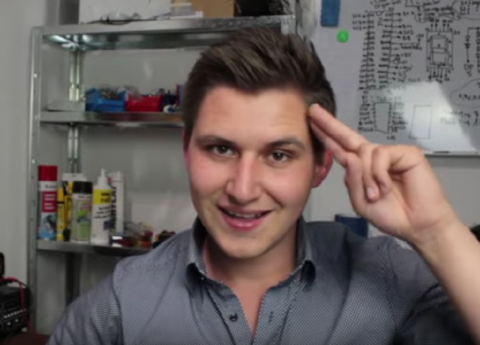
Image via YouTube on Scott’s Patreon video
Transcript
Chris Gammell: This is The Amp Hour Podcast, recorded January 27, 2016. Episode 284, an interview with Great Scott. Welcome to the Amp Hour. I'm Chris Gammell of Contextual Electronics. And I'm Scott from the Great Scott YouTube channel. Welcome. We are even further apart than I expected to be. I'm all the way on the west coast of the U.S. and you are somewhere in Germany, right? Yeah, it's Saxony. Very cool, very cool. So thanks for being here. I actually had not heard about your YouTube channel until about three or four months ago. Really? Yeah, and I started watching it and I'm like, how have I not ever heard of this? Obviously, I know Dave, I know Martin, but I started watching your videos and really good, not even just beginner content. You've been doing some really advanced stuff lately. Where have you been?
Dave Jones: I don't know. I started in October 2013. And in the beginning, it was the usual YouTube stuff. When you begin, nobody watches. Right, exactly. It's just the truth. Nobody watches and just a small amount of people care. And over the year of 2014, I made two videos. Sorry, one video every two weeks. Oh, wow. And I just continued that trend. And I think at the beginning of 2015, it just exploded. Yeah. I don't know why either. It just happened. It's not like I did anything special. It just progressed that way. Yeah. Okay. More people watching? Great. That's awesome. Let's keep going here. And I think in 2015, I started with 15,000 subscribers. And now I'm at 180,000, I think. Oh, my God.
Chris Gammell: So that's not bad. Okay. Yes. I also hope to grow by the 1,000% in a year. That's awesome. Yeah. That's great. So what made you start in the first place? What's your background? What made you start making these videos in the first place?
Dave Jones: That's a long story.
Chris Gammell: Okay. We have at least an hour.
Dave Jones: That should do. Yeah. I've always been a fan of YouTube because it's a great way for small people to bring ideas and to share stuff. But the problem in Germany is that much of the YouTube stuff is, let's say, it's for smaller, for younger people. Yeah. Okay. It's mostly about vlogging, gaming, and all that kind of stuff that does not interest me. And I always loved watching Dave or Ben Heck or AfroTechMod. Yeah. Also very good. But the problem was, it was just not enough, you could say. So it was frustrating to see that no one else was trying to do something like that in this direction with electronics. electronics. And in October 2013, I wasn't an engineer yet. I actually just started. I started my job training in 2011. And I wasn't even finished with that. So I had just not much experience with electronics. But I want to create something that would entertain people, that would educate them as well. Because I think the combination of entertainment and education is something very important. Because let's use an example from university. If there's a professor who is just plain boring, you don't care for what he says. And you don't remember the stuff he says. And I try to do something different in my videos, trying to keep it fast-paced entertainment with a lot of practical examples and a lot of projects as well. And that's something many people like, apparently. Yeah. Well, I'm right there with you, man. And then I started in 2013. I did my first video about the LED color organ. I don't know if you've watched that. I have.
Chris Gammell: Was it vodka bottles or some kind of bottles that lit up, right? Yeah. These were vodka bottles. Yeah, right. Exactly. College student. Former college student, huh? Maybe. Maybe. Yeah. Yeah.
Dave Jones: It's okay. No, it was the first bigger project I did by myself, completely by myself. And I thought it was pretty awesome. Because that's not something you can get that easily in the store. It's something you have to build. Because you can understand it that way and you can customize it in your own way. Right. And I think that's pretty awesome.
Chris Gammell: Yeah. No, definitely. And I think that that kind of... Well, I think something like that too, where there's a lot of projects out there where people look at it and they say, I specifically want that thing, right? So that's something where they might want that to have around their apartment or something like that too. And then the fact that you can't get it, like you said, you can't get it in the store, that will drive people and that it's a good beginner project. I think a lot of those things that it's really confluence. And in the meantime, they're also... It's like, oh, hey, by the way, you've been learning electronics. Ha ha, I fooled you.
Chris Gammell: Ha ha, I fooled you. That's the idea, I guess. Yeah, yeah. That's great though. So I apologize. I don't remember the name, but could you just clue me into some of the education stuff in Germany? I know that there was some word for like apprenticeship style in Germany that I really got into. And I forget the name of it. I remember tweeting about it, but... Is it apprenticeship? Yeah. So I forget that there was a German word for it though. So, um, but it doesn't ring a bell. Well, no, it's like the practical plus the education stuff together. That's, that's really what it is. So it's like you're, you're doing on the job training plus school and kind of back and forth stuff.
Dave Jones: Uh, you mean working plus university or just school for a job?
Chris Gammell: I think it was somewhere in between those two even. Oh, that's hard. Yeah, I know. Right. But, but there are multiple types, right? There's multiple levels of, um, I'm trying to find it now in my Twitter feed. This is, this is truly hopeless on my searching ability, but, uh, no, I can tell you anyway.
Dave Jones: Okay. So, um, the way it goes after school, you can either do, uh, that's the word in German. Uh, it means, um, you go to a company and they hire you with, uh, uh, very low budget, I would say. Um, and you learn the job while working and then sometimes you go to school, sometimes you work, school work, and that repeats all the way, I think, um, for two or three years and then you have, um, mastered, I would say the job. Okay. The practical side of it, you mean, like, or, or the whole thing, the whole thing. So you've got the theory and the practical thing. Gotcha. Then other companies can hire you in this position or you continue, uh, in the company, however you want. Uh, that's called the Ausbildung. And, uh, the other way to go in Germany is the Studium. Uh, so it's like university. I think, um, something like a college, we don't, we don't have something like a college. Okay. I think, uh, in your, in the USA, it's like school, then you go to college and then you
Chris Gammell: specialize or am I wrong? No, no, that's, yeah, that's actually usually right. I think, uh, like bachelor's degree is kind of the base knowledge and then, you know, master's might, master's degree might start to specialize you more or you kind of learn more on the job when you start working. That's kind of the, how I usually look at it. Okay. Yeah. No, that's cool.
Dave Jones: So yeah, that's the second way. And there's the third way, uh, which I did. Okay. It's a combination of both. It's like, um, a company hires you and you learn the job. I learned the job of an electrician technician. I think it's in English. Uh-huh. Um, and while working, while learning this job and again, switching between theory and practical, um, you go, so go to university and there I learned my, I got my bachelor of engineering in electrical and power engineering. Yes. Oh, very cool. So like, like the higher power design type stuff. Something like that. Yeah. Yeah. It's, uh, mostly about power grids, uh, motors, uh, power electronics. Very cool.
Chris Gammell: Yeah. No, that's the good stuff. And I think, I mean, that kind of, obviously, so I have, I have a very strong interest in the apprentice side of thing because of my, my course. But, um, I think that the German model, like that was, that really resonated with me. And I think it was the, I'm going to butcher this word. The, I know, how do you say it? I know, uh, belong. The Ausbildung. Yeah. That one. Uh, I think that's the word that I looked up. Uh, so I will, I will verify that. And I think that was the, the wiki page that I, honestly, I remember looking at Wikipedia. That's about it. So, uh, yeah, very cool though. Uh, and so, um, but yeah. And, and, and so that, that kind of tie into practical, it seems like that is also translated into your videos that you've been able to, you know, that you've, you've been delivering a lot of this stuff. Um, how much of it is you kind of learning on your own when you're starting a project? I mean, when you, how do you, how do you pick your projects and then start, start digging into it?
Dave Jones: So, um, I think lots of the projects are new stuff to me. I think, uh, because power electronics, like power grids and lots of motor stuff and calculations, which are important for power distributors are not really, um, a good subject for such videos where you build stuff. So in many cases I learned much, I would say 60%. I learned new stuff all by myself, just, you know, digging in to the material, what is available online, because we can practically learn everything online nowadays. Yep. And I think when it's about Arduino or programming or RF stuff, which I did lately and all that small electronic stuff, that's was not really what I learned, but everything with electronics is just interesting. Right. And it's what keeps me going.
Chris Gammell: Right. You just, you keep finding the Wikipedia hole, right? Where you just keep going further and further deep and finding new things.
Dave Jones: Maybe not Wikipedia because, um, it's not the best source, I would say. That's true. We learned that in school only, um, in Germany, when you have Wikipedia in your source, like you do a presentation and you go through the source list, that's always a minus point for you when you've got Wikipedia there.
Chris Gammell: That's right. Yep. Yeah. Yeah. No, I, and I don't get that either too, because like a lot of times it's just a list of other sources, but yeah, whatever. I guess that's, that's the academic side of things as well. Yeah. So, uh, how, how are you queuing up new projects? How are you figuring out what you want to build next? Do you have kind of just a list that you go down or are you going off of recommendations from your audience or what, what makes you want to build the next thing?
Dave Jones: Uh, well, most of the time it's like, I want to have something on my own. Uh, like I did lately with the electric lawn board. Oh yeah. That's something I saw because in the USA, um, it's something much bigger. There's a industry there, I would say for stuff like that, because it's legal, uh, in Germany, it's not legal. So many people don't use something like that and, uh, no, the other way around, not many people use something like that. It's very rare and you cannot buy it in Germany. So I wanted to build it. That's as simple as that.
Chris Gammell: So you can't, you can't even import one? Is that kind of, I mean, obviously I totally agree with building it, but like, is it actually illegal to even buy in Germany?
Dave Jones: You can buy it, I think, but, um, you can't ride the streets. Ah, uh, okay. Yeah. The police will stop you and then really, it's not so nice. Yeah. Yeah. That sucks.
Chris Gammell: Um, I actually don't do that because I don't want to, uh, crack my head open. Uh, that's a personal thing where I can't ride skateboards, but, uh, that was a great build too, because I, I didn't, you know, I remember you and I were, you know, emailing a little bit before you had done it and you had said you wanted to finish that video first. And so I was watching it very intently and I didn't even think about all the mechanical aspects of it. You know, you were drilling out, you know, you were mounting all of the gears and everything to the, the back, back wheel. Can you just talk about some of the challenges with that?
Dave Jones: Well, uh, just like you said, the mechanical parts are not really my specialty as well. So, um, it was a lot to learn. I think I did a post-production. So just thinking about what I want to do, just doing some sketches, a couple of schematics that took easily like 10 to 20 hours. Oh, wow. And then I just started, um, doing some prototypes, figuring out how it would work the best. And yeah, that's the end design I came up with. It's still not the best. Um, I agree with that totally because, um, when you try to prototype something, you don't have practical experience. So I wrote it the other day and then I noticed, okay, maybe I should have that in another way or that in another way.
Chris Gammell: Right, right. Yeah. Like, yeah. Cause like the, you have that enclosure on the bottom to hold the batteries and the drivers and stuff like that. And that would definitely impede how you're moving stuff, you know, like stuff like that.
Dave Jones: Yeah. Maybe, um, for future improvement, I want to, I wanted to include, um, a better mount, uh, the adapter with motor and the wheel. Um, that's not so good because it's only held by one screw and the screw goes left and right sometimes because it's not that good fixed. So that needs to be improved. But other than that, it's, it's decent. It works. Yeah. And that's the point.
Chris Gammell: And that's the idea behind prototyping too, right? I mean, you, you're able to kind of get towards a lot of these other, you could dream all day on, you know, what should be on a skateboard and electric longboard, but until you're on one riding it and improving it, yeah, you're never going to, you're never going to actually experience the things that, that make that great product. Right. I mean, that's a, did, did you, and I remind me, how did you actually, how do you control it? Is it a hand controller? Like, yeah.
Dave Jones: Um, I saw people using, um, Bluetooth, uh, with a smartphone, but I think, um, that's not really the best idea because when you're riding longboards, um, and let's say it's going 30 kilometer per hour and you fall and you've got your smartphone in your hand. I didn't like that idea. Right. Right. So I was, um, using from the Wii remote, uh, the nunchuck. It's this, I don't know if you know it.
Chris Gammell: Yeah. Yeah. Yeah. Yeah. It plugs. So there's the main, there's the main controller and then there's a secondary one with like a little, like an analog joystick. Right. Right.
Dave Jones: And I was using that joystick, um, basically just cracking it open and then putting a small 80 tiny 85 insights, um, with our F, um, transmitter. And I was using the both buttons. Um, one button was a safety trigger. Like if you don't push it, you can, cannot go with it. It doesn't accelerate. Uh, and the other was a cruise control, which actually was an idea from a friend, which was the best idea he ever gave me for a project. Um, because it's, um, really comfortable. You've got your perfect speed and then you press the cruise control and it stays at that speed.
Chris Gammell: Yeah.
Dave Jones: It, it was really, uh, nice.
Chris Gammell: Yeah. You wouldn't, I've actually never seen that on another, on any of the long boards I've seen. I, uh, I think that's the first one. Yeah. I wonder if they do that because they want to make sure that if you fall off, the thing will stop running kind of thing. But if you're, if you're, if you know what it's going on there and yeah, that's a great idea. Cause then you don't have to hold it down and keep controlling it. You can actually concentrate on not crashing into things like I would need to do. Well, that's your thing. Right. Of course. Of course. Yeah. No, that's great though. Um, so we were also talking, so speaking about the mechanical side of things as well, before the show, we were talking a little bit about the fact that you're in apartment and just kind of the kind of access to equipment and the fact that, you know, there, there are space restrictions, stuff like that. So, so what is, what are, what are some of the challenges there? I mean, what, what did you borrow equipment for some of the mechanical side of things or are you, are you outgrowing your current lab? How's that going?
Dave Jones: Hmm. I'm not borrowing anything. Um, it's like pretty much I own my apartment is my own stuff. Um, that was the X, X carve you saw in the video. Yeah. Right, right, right. Right. Uh, that's something inventable, inventables is the company, I think. Yeah. I'm Chicago. Yep. Yep. They offered me this, um, for a small review or a project with it because, you know, they want to expand their business, I guess, and want to promote their product. Yep. So that was really nice of them. I could use that, uh, in the video, but all the other stuff, um, also all bought by myself. Um, so nothing borrowed. Uh, and, uh, it's slowly getting, getting crowded in here because you know how it is, I think. Yeah. Yeah.
Dave Jones: A lot of stuff like the bench power supply, oscilloscopes, all the, well, it's, it's not mainly that, that takes a lot of space. It's all the tools you need. Like you need that saw, then you need another saw, then you need screwdrivers, tons of them. Right. And all that stuff.
Chris Gammell: Right. And I think just even, I mean, I don't know about you, but I'm extremely messy. So, um, you know, it, it just, the sprawl happens real fast. So even if you had a perfectly, you know, a spot for everything, when you start getting in the thick of a project and you have all your tools out and, you know, actually using them, then it becomes super cluttered. So that's kind of, that's always my challenge. I know that feeling. Yeah. Right. It's just like, you need, even if you have a great organization system, it's, it's only when everything's done and cleaned up that that really helps, you know? So that's, that's kind of, that's kind of difficult. Um, what about, uh, what about in Germany? I mean, so, uh, obviously I think I've mentioned before we, you know, obviously Dave's not here because the time difference is just crazy between the States and Europe and Australia and stuff. Um, I think it's 5am. Yeah, probably. At Dave's place. Yeah. I think that's right. Yeah. Um, so what, what we don't, so what I'm trying to get to though is we don't talk to a lot of guests from Europe very often, but what is, what is the scene like in terms of getting access to components, equipment? I mean, Ford houses, what, what are some of your resources in, in Germany or just Europe more broadly?
Dave Jones: Well, um, it's not that big. I think in the U S there is a radio shack.
Chris Gammell: Is that still? No, they're, they're kind of going down the tubes, uh, in terms of, yeah, that's not nice. No, no. They, yeah, they kind of, well, that's their management. But yeah, we've talked about that a couple of times there. They, they used to be, yeah, for sure. And, uh, you know, a couple of years ago they were, they were the main option, but I think, um, there's, there's a increasingly shrinking set of places you can buy components and gear and stuff. Like how many on your site? I don't even know. Like, so in Cleveland where I live most of the time, uh, there's a surplus store so you can go buy old stuff. Um, there are one or two radio shacks left, but they're pretty gutted. And then, um, I think that's it. I guess micro, micro centers, I got computer stores. You could go buy like Arduinos, like SparkFun stuff's there, Adafruit stuff. They actually have it on site, but it's, it's still not, you're not buying, you know, resistors and capacitors and stuff like that. So do passive stuff. Yeah. I mean, do you have stores that actually still sell that stuff? I mean, is that, is that still a thing?
Dave Jones: Yeah. Yeah. It's, um, it's rare, like on your site, but, um, there's one store which is called Conrad Electronics.
Chris Gammell: Yeah. They had a bunch of stuff when I was at Electronica. I saw a bunch of stuff by Conrad. Um, yeah.
Dave Jones: Conrad is, um, the biggest and they even have, um, in the basement, they still have like an electronics corner, I would say there are like two or three employees, um, who just take your order. Like you want a resistor, you go there like, okay, I need that resistor, uh, quarter Watts, one kilo ohm and they get it for you. It's, um, really nice actually.
Chris Gammell: Actually, I think, uh, I think Dave has that. So I know that he's talked about the, um, there's like a pickup desk for, uh, element 14 or Newark. So I think there are still some of those things, but I've, at least where I live. Uh, they don't have that. I, and maybe there's some around, or maybe, um, maybe Jameco does that out here in California. I, but yeah, it's, it's, it's definitely going away.
Dave Jones: Um, but I think, um, Conrad, also Conrad, like you would say it in German. Okay. Yeah. It's pretty certain that they're going to stay because, um, their main focus is not the small passive component stuff that I need. Um, it's, um, it's more about, they also have RC, they have, uh, home automation. They've got lights. They got everything you need. It's like a small home improvement store, but more specialized on electronics. So I think they're doing pretty good, good with their business. Um, I think they're going to stay, but, uh, in the end I don't go too often there because it's just overpriced.
Chris Gammell: Right. Right. As any onsite type of thing would definitely be. Uh, yeah. Yeah. Pay a premium for the, for being handed a resistor.
Dave Jones: Something like that. Yeah. Yeah. But there are other, um, kinds of stores like online stores. That's the main thing actually with my orders. Um, I don't order from German, uh, stores. I always go to eBay and get it all from China. Like it's the cheapest variation and I've never had any problems. No parts were ever damaged. They all did what were, what they were supposed to do. So I'm happy with it. I'm going to continue doing it like that. And I think there's nothing wrong with it.
Chris Gammell: Yeah. And I think that, that also, you know, enables you to keep doing more projects, you know, just keeping costs down. We'll just enable future projects too. So, you know, I, you know, I've actually never done, I've never bought components off eBay. I don't know why, but I know that like people talk about like, they, they just buy like, you know, a bag of a thousand connectors or something. And it's like, yeah, why should I should of course do that, you know? But then I just, I kind of get in the, I'm so used to the, from my jobs in the past, I'm just like, ah, digi key, whatever. I pay a little bit more, who cares? But it seems like, you know, it's people who are outfitting their labs or, you know, they're going to AliExpress, they're going to eBay, stuff like that. And they're, and like you said, it's not necessarily bad components. They're probably some of the same ones that are stocked in regular distributors, but it's just a, you know, it's there, there's maybe a little bit more risk, but most of the time it works out. So that's good. But what about like board houses? I mean, like, so I've talked to a couple people in Germany and surrounding countries and stuff, and it seems like they're, I mean, are you, are you doing printed circuit boards mostly? Or I noticed you did a lot of perf board stuff. Yeah. Perf board mostly.
Dave Jones: I did a printed circuit boards not too long ago for my seven segment display, which connects to the internet, grabs a bit of data, what you want, and then displays it. And I did a printed circuit board there, but it was a sponsored video. So the company came to me and it was just an opportunity for me to do something like that. I'm not an expert when it comes to designing PCBs. I think everybody can see that when they have a look at the video and the design, because many people also said so in the comments. Don't listen to those guys. Come on. Well, I agree in some, in some things like the edges shouldn't have been too sharp. I did nine degree edges. Oh yeah, for the traces and stuff. Yeah. That was apparently a big mistake. And otherwise I didn't look out for the width of the traces because it was just a small project. It wasn't something I want to produce for other people or something like that. It's just for me in the end.
Chris Gammell: And that's good enough. That's always the problem with kind of being, you know, producing in the spotlight too. You get all these kind of, uh, the, the phrase here is, uh, armchair quarterbacks. So like people who love coaching from sitting around, but it's like you're putting yourself out there and they can, you know, they can go take a leap.
Dave Jones: It's, it's always easy to say something. Exactly. Yeah. Mean to someone when you're, when you're not known. Right. Exactly. Yeah.
Chris Gammell: Yeah. Yeah. It's, uh, that is, that is an unfortunate side effect, but we keep doing it, uh, putting ourselves out there. So that's YouTube. Yeah. That is, that is YouTube. That is goes with the territory. Uh, yeah, no. So, um, so, but yeah, board houses, I, I've actually, I know some people that are doing like hobby, hobby style projects still that like, uh, I have, I have one friend in Germany. He said he even gets Oshpark boards pretty quickly, you know, like obviously there's still a wait. And I think there's a couple of board sharing services in Europe as well, but usually the costs are a little bit higher and there's not as much volume, but there's, um, I think is it ragworm? I think is one of them. I'll, I'll look, I'll, I'll put them in the show notes. I think there's a couple others. Okay. Yeah. I don't know. I don't know. I have like, I haven't used them, but I'm kind of dependent on circuit board PCBs. I, I actually can't do what you do. So, uh, one thing that I, someone mentioned to me is they said, you got to check out this great Scott channel because of the perf board stuff. So, so that's actually what I learned in my job. Really? Okay. So what about it? It's number one. Just for, for the ease of prototyping or because of current or what about it? Um, nowhere.
Dave Jones: Well, in the, let's say territory I would work in, if I would do my job, what I learned. Um, it's more like you're in industries, like there are dozens of machines and maybe one machine have a problem with, I don't know, something exploded, something doesn't work. Yeah. That'll happen. Yeah. You're the guy then who tests all the things and the solutions have to come very quickly because, you know, production is not going to stop because of this one machine. It has to go on. And that's the moment you bring out the perf boards and maybe you saw something to it. Then two wires go to the main PCB and then it does the job again. It's something like that. Right. Right.
Chris Gammell: So it's the, it is the perf board is your version is, is the electronics version of duct tape. Is that right? Yeah. You could say so. Yeah. Yeah. I like that. No, but you, I mean, and you do some really, I mean, some intricate stuff too. I think it was the, you've done, you said you've done some RF videos, right? Uh, was it the FM transmitter or something like that? Uh, I remember seeing something where you did a bunch of perf board stuff that was really quite impressive.
Dave Jones: It was an FM transmitter. I did not too long ago, but it's not that difficult perf board. It just like you saw there. Okay. With RF, you have to be careful a bit that you don't bring too much interference into the circuit. But other than that, you just connect the parts. You have to have a close eye on not bridging anything out. And yeah, it was, um, something my teacher at the job actually took very seriously. Like she had a magnification glass and she just looked super carefully that everything was isolated from each other. And it's just something I learned along the way. So for me, it's not a problem to do on the videos. For others, um, I don't know. It's just practice in the end and soldering is not that hard.
Chris Gammell: What about the, so the thing that, yeah. And I, I mean, I agree that like once, yeah, once you get good at soldering and you, you know how to drag between and everything, that's good. Um, but what about the actual mapping out? Do you, do you do that beforehand? Like just on paper or how? Cause I think that's one thing that I've, I've heard from people in the past too, is like, it's the kind of being able to see the connections, uh, in before mapping it out, that kind of thing.
Dave Jones: Well, sometimes like, um, I think I did it. No, I didn't even do it for, I did RGB ID cube, um, a while ago that was also not mapped, but I wished I did at some point. Yeah. Yeah. Yeah. That would have been good. But, um, most of the time, like mapping is good for strip boards. Like you have your copper strips. That's pretty easy. I always use the program Lochmaster. Are you familiar with it? No. No. It's, it's pretty unknown. I noticed it also in the comment section that nobody knows it. And I always say I use it. Apparently I do spread it quite a lot.
Chris Gammell: Uh huh.
Dave Jones: Um, yeah, it's a pretty good program.
Chris Gammell: Especially with, um, strip boards. I can do that. Will this take like a schematic that you drew and then help you kind of map it onto these, onto the strip board? Is that kind of the idea?
Dave Jones: Yeah, that's the idea. You put your components in and then your bridge wire and all the interruptions you need to make in the copper. And then you can print it out, put it beside you and then build it after this example. I think I, I did it for, um, the audio amplifier. I put in my bathroom.
Chris Gammell: Okay. Okay.
Dave Jones: There I did it. Okay. And it was a good idea.
Chris Gammell: Yeah. Yeah. Right. Exactly. Well, and I think there's, um, I know that fritzing does that. It helps you with, uh, with, I think some of those, when you say strip board, do you mean like a, like a breadboard where it's, it's like the plugin style? Or are you talking about strip board, like where it's already got the copper on the back plate side of, of, uh, the second variation of the copper on the back.
Dave Jones: Okay, cool.
Chris Gammell: Yeah. Yeah. So fritzing I've seen for, for the actual breadboarding before, but I've, I haven't heard of the other ones. I'll have to check those out. That's pretty interesting. Oh, cool. That's good. Um, I have a question that's a little bit, uh, maybe I should have asked it first. Um, why don't, why don't you make your videos in German? I mean, do you do videos in German on maybe a different channel or?
Dave Jones: No, no, no.
Chris Gammell: Why, why not? I mean, really? That's, I mean, so, I mean, I heard you say at the beginning, you talked about the, uh, the YouTube there is maybe a little bit different on, you know, what the types of videos people are looking for. But why not German?
Dave Jones: I don't know. Like, um, there is, I think one other German YouTuber who does electronics, who is interesting. It's, he's called condensator schaden. Oh my goodness. If I would translate it, it's like a capacitor. Uh, okay. I don't have the second word, but it's something with capacitor and he does pretty good stuff. Uh, he does projects and also, um, some basic stuff like I do with electronics basics. Um, but he doesn't get, um, much attention, I would say. Like, Germany isn't the place where you put electronics videos out there and many people watch it. And it's just like, it's dominated by another field. Like I already said, like gaming, vlogging, all that stuff that I don't really care about. Yeah. And I thought English, um, is more known. Of course, it's a world language in the end. And it's always also a nice language. It's okay. It's okay. Yeah. It's okay. Um, it's easy to understand and speak. Well, not right now, maybe. No, come on. You're speaking.
Chris Gammell: You're great.
Dave Jones: Come on. You're good. Well, uh, life is always something. It's a little bit different than writing a script and then doing the voiceover, but it's okay.
Chris Gammell: I loved, I loved your, your video where you're talking about your process. And then, and then it was like you like looking, what was the word you were looking at? Like not microcontroller. It was something like that.
Dave Jones: No, no, it's, it's always the same because, um, it was centimeters. Centimeters. That's it. Yeah. You know, I, I always say it's, um, with a set in the beginning. I like the comments say so. Yeah. And it's always the same when I put this one word in the video, everybody comments. Centimeter with a set. And I think it's a running gag at this time. That's good. That's good.
Chris Gammell: Yeah. But, um, that's really interesting too about, so I, I used to work for ABB and we had, uh, we had a bunch of, I had a bunch of coworkers in Germany as well. And it seems like there's an interesting, it's an interesting culture. Like every country, it seems like has different cultures around, around the electronics industry as well. And I think there's, uh, you know, I think there's a lot of strong talent in Germany, of course, but I think it's also, it's very serious around electronics. You know, it's, uh, you know, it's, there's, it's in industry, it's these, you know, it's these very strong personalities working on stuff. There's a lot of veterans there. So is there, is there a difference in, like, do you find a lot of hobby type stuff, hobby and kind of people trying stuff on their own in Germany in general? Or, uh, I guess the question would be, do you, do you find community around Germany? Do you like, do you have local meetups and do you, do you meet people that are doing things, similar things with electronics? Yes, correct.
Dave Jones: Well, a good question. Um, I would say, um, electronics is not that big of a field when it comes to, um, what you do in your free time, I would say. Okay. Um, but like when you go to university and you learn electronics, there are tons of people who are in this electronics community fields area, however you want to call it. And you always find people there who are interested in this and want to talk about it, share experiences, all that good stuff.
Chris Gammell: Yeah. Because I think, um, so one thing that I'm not surprised by, but I was, one thing I learned was that like, you know, people started talking about hacker spaces back in 2000, you know, nine, 10, 11, whatever. And those really started getting bigger in the U S but there was a much bigger thing with like the, there was hacker spaces in Germany and you know, there's the chaos camp and yeah. Oh yeah. Like all of that stuff. It really was brought over from Germany and a lot of the people that were doing this kind of stuff in Europe. And I was surprised by that. I'm not surprised. I was interested by that because, uh, you know, just that that culture was there already. Um, so I was wondering if you kind of had seen that or if it was, maybe it's different areas of, of, of Germany.
Dave Jones: I think it's different areas of Germany. No. Um, I've heard of a hacker space. It was in Berlin. Um, I found like it was a person in the comment section who was like, he had a question and I answered and then he said like, Oh, that's cool. Maybe you are near Berlin. Then you can come to the hacker space and you know, talk a bit with other people. Um, something like that does exist, but really not clearly not in my area because I've never heard of it here. Gotcha. Yeah.
Chris Gammell: Yeah. And I, I've always wanted to go to, uh, the chaos communication. I think it's Congress. I forget what, I know it's always in Germany, but it's chaos. What is it again? So chaos communication, there's camp and Congress. So one is like where they go and hack in field and like basically while camping. Uh, and the other one though is, uh, they, uh, they just had it back in late December. Um, so the problem is it's always right around Christmas. So it's like for me traveling, you know, I'm usually the family around Christmas and then I think it's right before new years. So it'd be like Christmas happens and I'd have to fly to Germany. So that would be the tough part. Okay.
Dave Jones: I think I know what you mean. That's, um, I think I read about it that they cracked the, uh, piece for security system. Was there something like that? Oh, maybe. Yeah. Yeah. Yeah. Yeah. They, they, um, put it Linux. Well, it was awesome.
Chris Gammell: Yeah.
Dave Jones: I saw it.
Chris Gammell: Yeah. So that was, yeah, it was in, uh, so I'm just looking up on Twitter now. It was, uh, it was in Hamburg on December 27th to 30th. And there's, there was a bunch of talks that were all released as well. And that's kind of how I really saw it. Uh, but yeah, they were doing some, there's some crazy stuff there and it seems like, it seems like there are pockets around Germany. So I was just kind of wondering if you'd seen that kind of stuff. I'm sure it's very location dependent as well. Yeah.
Dave Jones: That's the thing I think. Yeah.
Chris Gammell: Cool. Uh, what about, uh, what about your, your community? So, I mean, obviously any, any YouTube channel kind of has its own community spring up around it. Do you, do you find what's, what is the, who are, who are the people that you're usually interacting with within your community? Are they beginners, intermediate, advanced? What, what kind of level?
Dave Jones: Mostly beginners. Like, um, comment section is, I think always a beginner because advanced, advanced, um, don't really have that much questions about the video because most of the time I do the basic stuff. Um, and on Facebook, um, I also get a lot of questions from viewers. Um, about beginner stuff. Like I want to do that. Um, can you help me? And I think I love to read. I love to communicate with viewers, like what they're working on and whether I have problems. Um, they always tell me suggestions, what I should build next. I always put that on my very, very long to do list. Increasingly long list. Yeah. It's never ending. Right. Right. Right. Um, and it's great, but the problem is, um, I think I have one over a million views per month and the questions just keep coming all the time. And most of the time I just have to say, I'm sorry, I can't help you with your project because it's not just a simple question. Like, Hey, what is that resistor value? It's like, I don't know how this works. Then how do I do this and this and this? Right. And I'm just sitting there like, I cannot explain everything to you because I don't have time to do other things as well. Right. No, it's not that great, but yeah. If a viewer wants to communicate on what they're working on or what I should do next, I definitely also, I answer a lot of comments. I try to do that. I know many YouTubers don't do that nowadays, which, um, is a pity because most of the comments I get are still very nice. Um, it just shows that people are interested in the video and just want to know more or sometimes they don't understand something. That's also not a problem. I always answer, but, um, other YouTubers just, um, ignore them because the comment section is just, I don't know if Dave ever talked about something like that, but sometimes there's a lot of trash in the comment section. Yes. Yes.
Chris Gammell: I think we've all seen that one time or another.
Dave Jones: Yeah. Yeah. And, um, especially when I did the longboard video part one, a lot of people just jumped on the hate train because, uh, I split the video in three parts and many people said, um, they didn't like that the three parts structure or basically just splitting a project in between because, um, it takes time from them. Um, but the problem just for me is I put so much time in one video. I, and I do videos every week, uh, weekly uploads every Sunday, 5 PM at my time. Uh huh. And it just, it's just not possible to do one big project in one video. I mean, for the longboard, it might have taken 25 minutes for one complete video and I split into four and a half minutes and then two nine minute parts. Wow. It was a lot of work, but that's the only time. Um, I think that was, uh, I would say trash because it was getting ridiculous at some point and the argumentation of some viewers is just right. Oh yeah. Let's not talk about that. You can't please everybody, right? Yeah. That's the thing. Like I understand big YouTubers who then say, I don't care about the comments anymore. I don't answer anyone. I don't read it because sometimes it just drags you down and you just lose your motivation. You don't want to continue. And yeah, just at one time I had this problem. The next video, everybody was again happy about it because in the beginning you can see that it's that much work with longboard. And then the two part two actually shows what goes into the mechanical part. And it was a ton of work.
Chris Gammell: It was amazing. It was amazing. Yeah.
Dave Jones: I like my community. Um, I talk to them whenever I can, but yeah, it's, it's tough.
Chris Gammell: It's tough to keep. Yeah. No, the motivation, it can, uh, play with the emotions a little bit, right? I'm sure if, uh, I'm sure if Dave were here right now, he would highly promote starting a forum. I think that I thought about that. Yeah. Yeah. Yeah. I think it's good. I mean, it's, it's tough too. Like it's, uh, you know, I think it's interesting because I watch a lot of people on YouTube as well and it's this interesting dynamic, you know, it's like where you, you kind of feel like you start to get to know someone. Right. And I've even to the point where like, I've seen someone at a conference before and I walk up and I'm like, Oh, Hey, how are you doing? You know, like, I'm like, I, you know, it feels like, you know, this person and they're looking at you like, uh, yeah, what, uh, this is weird. And, uh, yeah. And you know, one or two people have said that to me where they're like, Oh yeah, you know, I listen, you're in my head sometimes. And I'm like, that's kind of weird, but I understand it as well. Cause I listen to a lot of podcasts and it's a compliment. Yeah. Right. I hope. Yes. Um, but yeah, no, it's, it's, it is tough because it's kind of this one to many kind of of thing. It's where, you know, you have, you said 180,000 people like that quickly becomes, you know, even, even 20 people can become untenable. You can only answer so many questions. So the forum kind of helps it become peer to peer then one person helping another and that kind of thing.
Dave Jones: Yeah. I thought about that because, um, first off it's puts away all the trash comments in the end, because when you go to a forum, you're interested in this stuff and you want help or you just want to get into the project. And I think, um, the forum could also offer something like, um, a project post and then maybe other people say what they experienced and from their, uh, from their side solution that maybe I didn't even think of. So I think, um, the forum would be a big step in my direction. I will try to do that in 2016. But again, it's, um, I have, I want to do weekly, weekly videos and that I also do university along the way. I do my master of science in electrical power engineering.
Chris Gammell: Dang.
Dave Jones: It's a lot to put up with.
Chris Gammell: Do you sleep at all or no? I try, I try. That's a lot of work, man. That's crazy. That's great. Uh, so, uh, let's, let's talk about that. Obviously that's working towards your future. I mean, um, uh, you see a future where you're, you're, is your future designing power systems or is it, uh, being a full-time YouTuber? A la Dave.
Dave Jones: I, I obviously, I really don't know. Um, it's hard to say like, it's like this. I did my dualistudium.
Chris Gammell: Like I already said, like the combination of this, this spelling is going to kill me on this episode. I mean, I mean, look a lot of stuff up. So do, is it like dual school? That's kind of like what it sounded like? Dual. Dual.
Dave Jones: You could, you could say it like this. Yes. Uh, dual school, like university and learning a job with a company. Uh huh. Yeah. Yeah. And, uh, the problem was, um, I was almost done with university. So my bachelor of engineering and then was the question like, do I want to continue in this company or do I want to do something on my own? Yeah. And I would have loved, uh, I would have loved to continue in the company. But the problem was, um, the job offering was not really what I wanted. Like it was all just, um, okay. As an engineer, you also are in an office very often. Right. Yes. Yes. The jobs which were offered were just office jobs where you do things that most of the time don't have much to do with electrical engineering. So I said, well, I make a bit of money through YouTube and my Patreon supporters and, uh, my Amazon links and eBay links, like it's all a bit of money I can use, um, to keep myself alive in the end. Yeah. And, um, I wanted to continue doing YouTube. And, um, but I thought, no, I, I still think, uh, that YouTube alone, um, it's not, many people think that it's making tons of money doing YouTube, but I think every creator knows how hard it is to actually make a bit of money with YouTube. Right. So it's not that much that I would say, okay, it's as much as I would do with an engineering job in a company, let's say. So I'm not sure how I will continue. I would do my master's, masters of science, uh, for the moment. Um, I just started, um, there are actually exams coming up. No, it's terrible. And that was my least favorite time. And, um, that goes, it ends in summer 2017. My master's. Yeah. And I don't know how it goes on. Like if you, the problem is even if YouTube makes enough money that I would say, okay, it's just as much as I would get as a normal engineer because, um, in the end I don't learn all this stuff and then get, gets paid, um, almost nothing. That's not the point of learning all this stuff and using it. Right. Um, I would consider becoming a full-time YouTuber, I would say, but, um, problem is, and I've heard that from a lot of people who are doing university jobs. The problem is that after five years, you're pretty much become unattractive for the industry because you've worked so much isolated on this, all the scientific stuff on the university type of things. And at my type of YouTube thing, I don't even know how a company would react. If I say, I have to be like, what am I looking at here?
Chris Gammell: Right.
Dave Jones: I did five years YouTube.
Chris Gammell: Yeah.
Dave Jones: Uh, that's not a good starting point. I think in such a conversation with them, but I don't know.
Chris Gammell: Which is crazy too, because you'd think it'd be like, uh, you can see exactly the work that I just did. Right. It's like, you could see all of my mistakes, all of the things I did well, how I worked through problems. Like that is, that is one of the best parts about it is that you, you know, like you're showing off the, the learning process, you know, that's what people, that's what people relate to as well. So yeah, it's, that is, yeah, no, it's, that's a very interesting, um, I think it's good to keep going through the school thing because from my own personal experience, I know I will never, ever, ever go back. Uh, you know, I did a bachelor's and then I went to work and I'm just like, there's no, there's no point in it for me. Um, and because, you know, like, like you see in your own program, you know, as you're, as you're doing this stuff, you, you're going to have to teach all your, everything yourself pretty much anyways, even, even a master's degree, you're ended up a lot of times, you know, you're teaching yourself, you know, you're, you're presented with more difficult problems and you may be given advanced instruction on certain things, but the rest of the time, it's like, if you're doing any research, you're off, you're off doing that on your own either way, you know, you're, so that's, yeah, that's, it's a fun challenge. So it's smart to keep going through it, I think.
Dave Jones: Yeah. I've, um, no, like you already said, I think, um, it's good to do all the educational stuff. Um, when you're young, I would say like, I'm only 23 years old, uh, now doing my master's. So I did school, then batch, then job, then bachelor, then now master, because once you start doing a job and get, uh, getting the paycheck in the end, it's always hard to go back. And then trying to live, um, with some small jobs you do along the way, university. So I think, um, it's a good way.
Chris Gammell: Let's see how it goes. Yeah. No, and I think, you know, the, the being younger part as well, I think, um, you know, this is something that I, I, I talked to, you know, people that I've mentored or, you know, talked to in the past or try to advise on career stuff and engineering, you know, the other thing that's interesting is I think about when I was 23, I was like, I didn't have a house, you know, I wasn't, uh, you know, I really didn't, I didn't care about my car and feel like that, you know, just standard of living type stuff. And, and I, again, I I'm channeling Dave here. I know Dave would say the same where it's like, if you keep your expenses low, then you have freedom on a lot of fronts. Right. And I think that oftentimes just people that are getting started have that anyways. Like when I think about coming out of school, I, you know, I wasn't eating ramen, but I wasn't eating steak every night, you know, like, yeah, exactly. It's like, it's just, you, you're used to a lower standard of living and that's, and that's a good thing. So that's, um, that's, that's a good time to really explore and try a lot of things and, and keep going with education because, you know, there's less family obligations, stuff like that too. So yeah, that's good. Uh, I wanted to talk a little bit about your, uh, I saw you just released, uh, this brushless DC motor thing. So I actually haven't watched the video yet, but I really liked that you do a lot of these basics videos. What's, uh, what are some of the topics that you see requested most often? What do you, what do you think are some of the toughest concepts for people to learn when they're getting started?
Dave Jones: Ooh, that's a good question. Oh, it's a hard question. Finally a hard question, right? The hardest thing for people to learn. What I see often, um, very often, but I think Afro Tech mod did a brilliant video about it. Um, it's not the, it's not the amps that kills you. It's the volts. Right. Right.
Chris Gammell: That's always funny. I think it's the other way around, isn't it? Didn't you say it's not the volts, it's the amps? Which one is it? It's the, yeah, it's the amps that kill you, isn't it? Like the actual amount of current flowing through you. Correct. Correct. It's not the volts.
Dave Jones: It's, it's, it's, yeah, it's the amps, yeah. Right. But in the end, it's, um, both combined. Of course, right.
Chris Gammell: It's the watts. It's the watts in the end. Yeah, right. Yeah. Power engineers would know that kind of things too, right? Yeah. Yeah.
Dave Jones: Um, but other than that, um, the hardest thing, I think, um, I could only say a misconception many people have nowadays, I think. It's like, um, I read it in the comments all the time, I'm just getting started with electronics and I have an Arduino. Like, Arduino as the starting point, I don't know. Oh, you don't like that? Interesting. Not really, like, I started with analog circuits, something like op-amps, like transistors, um, and all that stuff. I learned it through my job as well. Mm-hmm. And I think that's a very good starting point because you just get to know, like, um, how voltage and current behave with resistance. And then you put your passive components, um, transistors, diodes, all that stuff into there. And you just know how this works. And I think, um, this should come first before an Arduino because with an Arduino, you may have the option to switch things on and off, like, high, low, but, and put things together, like, um, getting shields, putting Wi-Fi in it, uh, on it, and then programming it to grab data from the internet. But in the end, it's not like you learned electronics. It's, you learned how to put two things together and use an example code. Yeah. That's not really electronics. Right, right. That's a misconception I always hear. Um, I don't really like it, but in the end, if Arduino is interesting and gets people into electronics, like maybe if they are done with their small example project, they think, okay, now I want to light up an LED. I want to amplify something. And maybe then they get into the analog stuff, I would say. Right. So, Arduino, not the best starting point, but at least it's a starting point.
Chris Gammell: Right, right. It kind of gets that, that quick hit of dopamine and you get your, you get like a little bit of success. So you want to keep pushing through when you get to the, the tough stuff and op amps and things like that. So, so when you, when you, when someone comes up to you and asks you then, okay, I want to start with the analog side of things. What's the project you, of your videos even, what's the project you tell them to, to go with first?
Dave Jones: I think I didn't make an exclusive video for that yet. Actually.
Chris Gammell: Now we have a new idea.
Dave Jones: It was the 555 timer. It's right. It's classic. Like the first I see I ever did a circuit booth, I think.
Chris Gammell: Yep. That's good. So you think using, just using that though, to get, to get started and get, get things blinking. So you still get those, you get some kind of output there. Did you ever see, do you know, I ran a 555 timer contest many, many years ago? A contest. Yeah. It was, it was called the 555 timer contest. No. Yeah. It was me and Jerry and we had, and Dave judged it. And there was a, there was a bunch of stuff. The site, the site is down now, but the amazing thing is the guy that won it. Tom's circuit. I forget his, his full name, but his handle was Tom's circuit. He did 555 for like all these different types of like servos and actuators and stuff like that. And he made probably 25 circuits. The video is still up. It is amazing. Just like showing all of the different ways that he was using the 555 to actuate things. It was so awesome. It sounds awesome. Yeah. I'll send you that link after this. It was, it was so much fun just to see all the different ways that he was using it to interact. Cause he uses those, you know, the flexible resistor strips as well, like the bend sensors. So use that as the input to the trigger circuit basically. And that basically changes the timer. And then, then he could drive a servo based on that. You know, it's like a linear acceleration type thing. So.
Dave Jones: Oh, that's cool.
Chris Gammell: Yeah. It was really awesome. So, yeah, it, yeah, but that's, that is a great, and obviously that's a lot of, did you start with the, the MIMS books or, or just more on the, from the university side of things?
Dave Jones: Well, I think it was on the university side.
Chris Gammell: Okay. Right.
Dave Jones: That brought me into it.
Chris Gammell: A lot of people, a lot of people in the past have always, you know, we ask people this question a lot and a lot of them say, oh, the Forrest MIMS books, kind of the, the Radio Shack kind of stuff got, got me into it. So.
Dave Jones: Well, I started electronics actually very late. I wasn't really aware of it because you already said that where hackerspaces in Germany, like I didn't, I didn't even know that exist. And so I pretty much had no big interest in electronics until I was 18 years old. So only five years ago. Yeah. I was the exact same. Actually. I was. Okay. Um, I, I, I applied for a company where I also did my dualist studio. Um, and that was actually the first time where I saw that, like they wanted me to do a small, like it's called the assistant center. You go there and then all your day you do a couple of different tasks. So they see what you can do and whether you're suitable for the job in the end. And there I was supposed to solder a small tester, an LED tester, I think. It was just, it was basically a small strip board, um, with a battery. And then you've got an interruption, which you close with a wire and then an LED lights up. It's like super simple if I think about it now. Right. But back then it was the first time soldering.
Chris Gammell: Oh my God. It was really hard. Right. Exactly. No, exactly. And then it seems like, and you think about it when beginners are coming in and that is like the first mountain to climb. And then especially with the internet, you can see how much other stuff there is. And it's so easy to just say, uh, I can't do any of this stuff, but ultimately it comes down to, it's like, well, the first step is to solder that, that LED tester, right? That's the way you have, everyone starts there. And so it's, uh, you know, there's a lot of, a couple of shows ago we were talking about kind of mindset of, you know, beginners and just people getting into electronics. And it's just, it's tough, you know, it's tough to, to keep motivated and to find projects that are, you know, make people successful, things like that. It's, um, it can be very, very frustrating. So it's good. It's good that you had that program though. So like, okay. So you walked in, you were, you had a rough first day, but I got the job. That's great. That's great. So based on, uh, just, uh, your, your willingness to try it and everything like that.
Dave Jones: And well, um, it actually worked in the end.
Chris Gammell: Oh, good. Okay. Yeah. Nice. I think you had the knack, right? You, you had the, the natural ability somewhere in there. You can say so. Yeah, that's great. That's really cool. Yeah. Yeah. You know, I, I, I've, I've struggled with that in the past. Obviously, you know, I, I talked to, uh, Dave a lot and Dave talks about how he did it from being very young. He was working electronics for a long time. I think though, a lot of people start at the age we started, you know, like it's just, I had other interests and then I started thinking about what I wanted to do. I was really into physics in high school. I wanted to do the practical application of physics and electronics seemed like the best way forward. And I think that that, um, I think that it's, well, obviously it's worked out for me so far. It was, we'll see for the next 30 to 50 years, but yeah.
Dave Jones: That's actually how I started as well. Like I was interested in physics and mathematics and it was just the way to go with electronics because it's a good combination of both, I would say. Yeah. And I didn't even know what to expect. Like I just, uh, went into it and it was great. I think it was a very good coincidence that all of a sudden, I feel the exact same way.
Chris Gammell: Like, so, uh, you know, some of my friends have changed careers. I'm in my thirties and a couple of my friends have changed careers a couple of times already. And, you know, we sit down, we're drinking beers and talking and, and I, I feel so grateful, but also just like, I feel kind of like a doink just for saying like, I got so lucky that I chose right. You know, it was just, it was, it was luck. It was, it was, I could have chosen, I could have switched a couple of times now by now as well, but it's just, yeah, I got lucky that I chose correctly when I was 18. Uh, and some people don't have that. So, you know, it's just, many people don't. Yeah, exactly. They don't, you know, they choose for different reasons and maybe they should just all choose electronics, you know, that's maybe that's a real problem.
Dave Jones: No, that's the problem right now with, um, many people I know I went to school with, um, they're still searching like five years later, still beginning, um, one lesson, then they don't like it, stop it there, go to another. So, and I think that already repeat five or six times. Oh, wow. Wow. Okay. It's hard. Yeah.
Chris Gammell: So you said you were really into the, um, the physics and the math inside of things. Um, it seems like the, I mean, any, a lot of the beginner type videos as well, you try and stay away from the math, but do you, do you think that eventually you're going to be working more towards into the, the advanced topics inside of things, or do you find yourself doing a lot of complicated math day to day type things for your videos that maybe you don't show?
Dave Jones: I do a lot of, uh, math type things. And by, because the circuit has to work in the end, so it's pretty much always behind the scenes. Like I calculate this, this, and then, uh, all kinds of different formulas. But, um, I don't think I want to put it too much in the video. Maybe, um, with another series I start, uh, video series, like maybe more advanced stuff. Right. There I wouldn't, I wouldn't, I wouldn't mind, um, putting a lot of mathematics into that. But, um, for the normal videos, something like that, I, I keep that out because in the end, if you go by yourself into detail with the things I try to teach people, um, they go into all this mathematical stuff by themselves. I think it's better this way instead of me just trying to shove in all this stuff in, I don't know, five or six minutes, how long my videos are. Right. Right. So I think I'm going to keep it that way for now.
Chris Gammell: No, no, that's, and that's a good call too. I think that, um, I think that a lot of people, when I ask them, you know, have you thought about doing electronics? They say, well, no, I'm no good at math. And then it's like, well, I don't, I don't know though. Like sometimes you're right. Sometimes there are, there are formulas, but a lot of times it's just like, it's, it's, you know, there is the application of math, but it's, it's not necessarily like I'm not doing derivatives or integrals on a daily basis. It's more internalizing the concepts, you know, like understanding how, you know, an integral is talking, you know, if you're talking about a capacitive circuit, yes, there are integrals involved and talking about charge over time, but it's really more about, I, I even more visualize, you know, charge filling up a bucket type of thing, you know, or talking about that kind of stuff. And it's not really math. It's just mathematical concepts. So it, it's, it's tough, but it's like most of the time I'm like, it's not really math, you know, it's there. Yes, there's math, but it's not like you don't need to be like a math whiz. You just need to be a little bit fluent in it.
Dave Jones: I think. Yeah. That's, that's a good point. But the problem is in the end, um, you have to pass the exam and the university and that's the problem with those people.
Chris Gammell: Right. Yeah. No, that's, yeah, that's true. Yeah. Especially if they wanted to do it for a job type of thing. Um, do you, do you see a future where, uh, universities are less important? I mean, obviously you've, you've had this dualist, sorry, I don't know how to say it, but dualist studium. Dualist studium. Uh, do you, do you see a future where it's more practical only or, or, I mean, what's your view on education into the future?
Dave Jones: Oh, good question. Um, I think I like it the way it is. Yeah. It is pretty good.
Chris Gammell: I mean, yeah. Your program sounds like very awesome. Actually. Um, I would love to do that kind of thing. I think that would have been very helpful.
Dave Jones: Um, well, it's actually a new thing. Like it wasn't that popular. Like if you go back 10 years, like nobody would have known what you mean, but, um, like five or six years ago, like it became popular with many companies. Like I think every big company offers, uh, das dualist studium.
Chris Gammell: Mm-hmm. So is it, is it beneficial because they, do they get like, uh, like assistance on hire, like hiring assistance for, for hiring people or is it just a good way to recruit people or what?
Dave Jones: Um, I would say it's brings in older people. Like the problem, uh, nowadays is you've got two types of schools in Germany. Uh-huh. Okay. Now I have to say even more German words. Okay. That's okay.
Chris Gammell: I'm going to get all these words written down for me and type today soon. So. Okay.
Dave Jones: So it's, um, basically a mittelschule or a gymnasium. And in the mittelschule, um, it goes for 10 years in total. So when you're done with it, you're 16 years old and when you come from such school, you're not allowed to study at a university. You only can, let's say you can only get a job. Like I already said, like you do the theory and practical together and do eine Ausbildung, like you already said. And the problem is you are only 16 years old and let's say two years don't sound like much because in the gymnasium you do, um, two years more, but, um, and then you're 18 years old and can go to university. But many companies don't like it, uh, with these 16 years old because two years do a lot, uh, in the aspect of, yeah, maturity and it's just kind of, yeah, yeah.
Chris Gammell: Yeah. That is, that is a very formative age. I think, you know, that hiring, hiring an 18 year old versus hiring a 16 year old. Yeah, sure. That's a big difference.
Dave Jones: And the way this duale studium is, is that, um, higher educated people get brought to companies because, you know, if you want to choose a person who is 16 years old and isn't sometimes really not that smart or you get an 18 year old person do the same job at the end because they also learn the job, but study along the way. Um, a company would obviously go for the 18 year old and have no problems with them instead of 16 year olds who might think about something else.
Chris Gammell: They're still 18 years old. I mean, come on. Yeah, of course. Of course. Right, right. If you want to compare it sometimes. Yes. Yeah. I see what you mean. Okay. No, that's, that's interesting that there's, there's different schools as well. That's, uh, yeah, that's, uh, that going forwards, that's, that's, I think it's a model that should be at least considered other places. I think that's actually really quite interesting. So we'll see. Okay. Uh, speaking of going forward, we should probably wrap this up, but I, I, I have to ask what do, are you willing to give a preview of what you're, you're most, you're most excited about your next video that you're most excited about? Oh, um, oh, sorry.
Dave Jones: I have to turn back because I've got my ideas written on my whiteboard. Aha.
Chris Gammell: Yes. Okay.
Dave Jones: Okay. I think I've, I've got 12 of them right now written out. Okay. But what am I excited about? Um, that's a good question. Like I think in the next month or two, it's, um, not going to be the biggest stuff like the longboard or I did the big led matrix, which was a lot of work. Um, not something like that, but, uh, let's say it's going to involve, um, a single board computer, but it's not a Raspberry Pi. Okay.
Chris Gammell: Okay. Very cool. Okay. So something, something with a single board computer, uh, something accessible, I'm guessing. Um, yeah. The funnel. Fun one. Okay. Good. We will keep an eye out for that. Okay. Thank you so much for telling us all about, I mean, obviously I, I didn't even expect to ask you about the, the German education stuff, but that's been very interesting. And obviously all of your videos are very, uh, very awesome and very impressive to watch. So I highly recommend people. Uh, you also have a Patreon page where people should go and support you. Uh, what is the address for that? Is that just Patreon?
Dave Jones: Um, I think it's, um, Patreon, but, um, if you go to the search bar, you can just go great Scots. It's not hard to find. It's, it's actually in the video description of every one of my videos. Okay. Perfect. Yeah. Yeah. That's good. Because that's what, um, keeps the show going in the end. Right. And you also have a Twitter. Yes. It's at great Scots lab, I think. Mm-hmm.
Chris Gammell: Yep. That looks right. Okay. Awesome. Well, Hey, it was great talking to you. And, uh, like I said, everyone should definitely go check out all these videos and we'll keep watching. Okay. Thanks for being on. All right. Bye. Bye. Bye.
Archived Discussion (8)
Comments are closed. Archived from the original site.
Show archived discussion (8)Hide discussion
555 Timer ContestapprenticeshipATtiny85CCCConradGreatScottLochmasterLongBoardXcarveYoutube
Keep current
Every episode, plus the occasional job post, in your inbox.
But with the rest, I find myself so much disagreeing with Scot it's crazy. I think it might be a generational thing.
Hobby electronics is a HUGE thing in Germany. Lots of kit manufacturers and electronics magazines.
But it's less connected and community focused. More top down.
Hackerspaces might be more of a computer hacker focused thing, which is a area Scot clearly knows very little. Saxony has multiple hacker spaces. (Which is I think where is from)
Buying parts is not so nice, because the businesses around that are often not well approachable for individuals. Farnell for example explicitly does no business with individuals. But there are tons of little online shops. (His eBay advice is sound though. If you stay under the taxable amounts)
Ah, and the educational system Chris referred to is the so called 'dual system' with is the standard modus of Apprenticeships. Apprentices are employed by a company but part time go to vocational school. (Similar things exist for higher schools exist too. But mostly more like a intern-ship system)
And it's a great system, even though I have to say I learned very little when I went through it. But at least you have a national education standard and you learn something even if the company just uses you as cheap labour (illegal but not uncommon).
But despite me agreeing a lot. Good on you Scot. Keep it up.
The have a some podcast as well, I listen to them regularly. http://chaosradio.ccc.de/
I also went through the dual education system to get my bachelors degree in EE. But I diti it in Baden-Wuerttemberg. It sontrongly depends on your company and your preferences what you can get out of that program. The University tries to give you a lot of offportuinities to learn as well as some of the employers do.
I really do link the videos Scott puts out. As well as the Videos from Kondensatorschaden and TPAI. There needs to be more Content in German though. I tried a few years ago but could not keep it up with youtube. I have huge respect for all of those guys doing the work of producing videos on a weekly basis!
Another German electronics / hobbyist / tinkering YouTuber that incidentally also narrates in English is "The Post Apocalyptic Inventor". You might get a kick out of his stuff, for example his in-depth SMPS tutorials. This part for example specifically concerns inductors and magnetic circuits: https://www.youtube.com/watch?v=a21zh-obKWg
I haven't watched Great Scott's videos before but I'll make sure to check out his inductor video now to compare their styles. :-)
In the former western part of Germany there was a huge electronics diy culture in the 70's and 80's which unfortunately died away a bit in the 90s. But a lot of those small electronic part stores survived until now. I live in a small town (population about 100000) and we've still got 2 small shops selling transistors and stuff. Ok, it might happen that you get an original TI 2n3444 handed out when asking for a mid-sized npn transistor (wiped away the dust of my 1960's transistor books afterwards to get the datasheet :) ) but you get all the basic stuff (breadboards, perfboards, soldering tin...).
Sadly, most of them still haven't adapted new fresh air coming in from all that arduino/raspberry/iot stuff where business happens mostly in the internet.
But i think it's not as bad as Scott said. We also have a Conrad store in the next town (which is, as Scott said, not so cheap when it comes to single parts. )
then which should i use b22k 10 k or what