
#283 – An Interview with Jonathan Ellis
Download episode · 58 MB
Also on Apple · Spotify · YouTube · RSS
Show Notes
Welcome, Jon Ellis AKA @ProfGears,
- Jon runs the Precision Instrumentation Group at University of Rochester.
- NIST LEGO Watt Balance: https://www.youtube.com/watch?v=oST_krdqLPQ
- Jon's blog and new podcast is located is GEARS-tt.com
- Read the old GEARS posts here: http://engineerblogs.org/author/gears/
- More links on the way!
Transcript
Chris Gammell: This is the Amar podcast, recorded January 20th, 2016. Episode 283, an interview with Jonathan Ellis.
Dave Jones: Welcome to the Amp Hour. I'm Dave Jones from the AEV blog.
Chris Gammell: And I'm Chris Gammell of Contextual Electronics.
Jonathan Ellis: And I'm John Ellis from the University of Rochester.
Chris Gammell: Hey, John, thanks for joining us. And today I think I'm going to actually revise my title. I'm Chris Gammell, former engineer blogger. Who else do we have here, John?
Jonathan Ellis: You have John Ellis, former engineer blogger as well. That's right.
Dave Jones: I just feel so left out that I never joined your network.
Chris Gammell: You didn't join the network that got a total of 300 readers a week?
Jonathan Ellis: You laugh, but that's more than I have on my blog right now.
Chris Gammell: Well, you know, we wrote kind of generic content. Hey, we all started there.
Dave Jones: I started with about 30.
Chris Gammell: Well, John, do you want to reveal what your handle was, though?
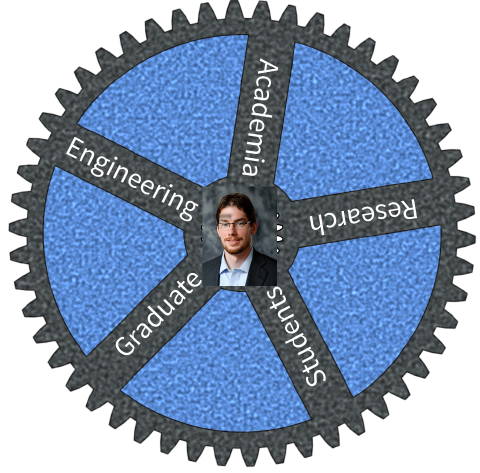
Jonathan Ellis: Come on, man. Oh, yeah. So my handle is GEARS, which stands for Graduate Engineering, Academia, Research, and Students. I was over on Blogspot. Oh, yeah. I had to have something that was sort of Mech-y themed. I mean, I am a mechanical engineer.
Chris Gammell: But you started with the word GEAR, and then you figured it out after, right? That's not most people. That's like I figured, like, whenever you see, like, bills coming through the U.S. Senate or something, they always come up with the acronym first, and then they back-calculate with the words.
Speaker ?: Yeah, yeah.
Jonathan Ellis: It's like the HOPE Act, and it's something that—
Dave Jones: Yeah, yeah, yeah, exactly.
Chris Gammell: Honorary Open Protocol.
Dave Jones: The Patriot Act. Yeah, yeah, sure.
Chris Gammell: Yeah, they're always acronyms. Yeah, so that's how you started it. Well, welcome, John. Thanks for having me. We were talking before the show. So, possibly our first professor. Apologies to former professors if we had them on. But I guess Larry Sears was, but he's also, you know, he was an entrepreneur before that. Like, first straight professor.
Dave Jones: Yeah, straight career professor. Gunning for tenureship.
Jonathan Ellis: Yeah, I would say I'm a baby professor right now. So I'm assistant. I haven't graduated to associate. I don't have my leather patches on my tweed coat yet and all that.
Chris Gammell: Like Letterman, the next time? Yeah.
Dave Jones: And I don't want to be mean. I think it's just funny, but we were commenting before the show about you sent us your CV, which we won't make public, of course. But it's totally different. It's an academic CV.
Jonathan Ellis: It's about as pompous as I can make it, because that's what you do in academia. Right.
Dave Jones: It's hilarious. And it's just so different to, you know, because in a, you know, in the real world, in quote marks, sorry, you know, in a practical, you know, in practical engineering jobs, you know, your qualifications almost don't matter. So, like, they go down the bottom of your resume, your publications go down the bottom, and your work experience is everything, you know, and this is like the total opposite. It's interesting.
Jonathan Ellis: Yeah, they like to count metrics a lot in academia, and so how many papers you have, and how many patents, and how much money you've brought in, how many students you have. Yep. But then at the same time, they say, well, none of that actually really counts when you go up for 10 years. I don't understand. Really?
Dave Jones: Oh, bull. What counts? They always say that, but, you know.
Jonathan Ellis: I mean, officially, there's no benchmark numbers on any of this. They don't say you need X number of papers, or you need X amount in research. It's, you need a productive research program, and you can't get more nebulous than that. Yeah, seriously.
Chris Gammell: Wank, wank, wank. Yeah, right.
Dave Jones: No, of course there are. Of course they go on the numbers and things like that. They just, they're just not allowed to say it.
Jonathan Ellis: I think that's true.
Dave Jones: It's the same in, it's the same in public service and stuff like that. You know, if you go for a public service job, my wife's in the public service, and, you know, oh, the amount of, you know, hoops they're going to jump through to get the job. You know, it takes her like two weeks to do an application, the job application for it, you know, for her job. And it's just crazy. And they say, oh, you know, yes, we're equal, you know, it doesn't, this doesn't matter, and that doesn't matter, but it really does, you know, like, you know, you can lose the job because you don't, you didn't do one particular thing right, you know, or didn't, yeah.
Jonathan Ellis: I mean, I think that's one of the reasons, so, I mean, I started up the blog again, and now I blog with a colleague of mine down at the University of South Carolina. And I think that's one of the reasons why we did this is because some of the things that you learn on the tenure track is that there's actually no rules whatsoever. But everything matters, but nothing officially matters. Matters, right. And so how do you navigate that water there? It's difficult at times, and sometimes it's the blind leading the blind. Like, you ask even tenured folks, and you get, you ask three different tenured folks, and you get three different answers, you know, well, that's really helpful.
Chris Gammell: Does that mean that you're like that guy that runs the special, like the magician that reveals all the secrets? Is that kind of the role that you're going to be playing here, John, or what? Maybe. Like the Magic Guild is going to come after you, like in Arrested Development, or what?
Jonathan Ellis: I think that it's talking about only the things that everybody already knows. That once you're in that situation, everybody knows that. But I don't think students have a clue. Like when you talk to students and you go, hey, my primary job is research, not actually to teach you, and so that's the reason why I'm not really around. They go, what's research? You know? Right. Right. Yeah.
Chris Gammell: And then you say, you don't matter, get out of my way.
Jonathan Ellis: Politely. Let's put it that way. Right.
Chris Gammell: Of course. Of course. Office hours are Monday from 4 to 4.30, of course.
Jonathan Ellis: I mean, you have to do that, though. You'll get students coming by and they'll say, are you available? And I said, well, it depends. Is this a one-minute question or is this a 20-minute question? And they'll say, ah, it's just a minute. Wow. And then 20 minutes later, you're like, all right, I thought you said this was a second. You know?
Chris Gammell: Yeah. Actually, when, so Dave Vandenbout, he used to be, actually, he used to be a professor. That's right. Right. So he runs XS or however you say it, XS or whatever. It's an FPGA company. He was talking about this. I remember him telling a story when it was him and Bob Davidson came back on our, what did we call it, impedance matching episode. He talked about some lady that got an award for teaching and he said the next year she was fired because if you're focusing that much on teaching, you're probably not performing as an academic researcher. I don't know if it's that drastic, but it is a, I mean. Dave's a pretty cynical guy, too. Dave's a pretty broad. People can hear, yeah, Dave's, that's my favorite part about him.
Jonathan Ellis: I think it's, but it's totally true that you can be an excellent teacher and not get tenure and you can be a great researcher and a mediocre teacher and you can get, you can definitely get tenure with that. I mean, it's, it's almost, it's almost that teaching will not, teaching by itself will not get you tenure. Right. But teaching won't necessarily keep you from tenure either. It's really weird. You just have to have a non-zero in that column. I think if you have. All right. Check marks. Pretty much. If you check the box, you're okay. Or check minus. Yeah.
Dave Jones: But you can't have too big a tick. Right. It's got to be the right size tick and it's got to be the right angle.
Jonathan Ellis: Well, if your research and service are better than, than those, I mean, there are, I mean, I work with a couple people on the tenure track and they are superstars in sort of the, the, the triumvirate of academia, which is research, teaching, and then service. And so long as your research piece of the pie is the biggest piece of the pie, that's fine. It doesn't matter. Right. If you're a good teacher, they just want your, your research to be better, I think.
Chris Gammell: Right. Right.
Dave Jones: But for those of us, for those non-academics like us, can you please explain tenure? Why is it the Holy Grail? Is it like, you know, can you never get fired once you get, is it a job for life?
Jonathan Ellis: Can you please explain? In the US. So I studied overseas and in the Netherlands for my PhD. So there it's a little bit different and you're in Australia, right, Dave?
Dave Jones: Yeah. And I have no idea how it works here. So don't ask me. Okay. Yes, I am in Australia.
Jonathan Ellis: I'll qualify this with in the US. It basically means that you have a job for life. Right. There's some exceptions. Obviously, any sort of inappropriate.
Dave Jones: If you become a serial killer or something, they will sack you.
Chris Gammell: Sexual harassment.
Jonathan Ellis: Yeah. Inappropriate relations with a student or something like that is grounds for dismissal and so forth. But I mean, for the most part, you can mosey along. You can be terrible at teaching. You can be terrible at research. You can be terrible at service. Right. And you can still keep your tenure.
Dave Jones: It's kind of like marriage, right? So, you know, you're all buff and looking good and then you get married and you just let yourself go. Right. Is that good? Oh, yeah. I know that one.
Jonathan Ellis: Well, they talk about that.
Dave Jones: Do they? What?
Jonathan Ellis: Not in the context of marriage. That's probably a bad pun. Hopefully, Kate isn't going to listen to this.
Chris Gammell: I wasn't talking to anyone for two hours last night. Definitely don't search my name on theampire.com.
Jonathan Ellis: No, but I mean, in the context of there's a lot of people who they climb this steep hill, right? So imagine tenure like you're climbing this steep hill. And then once you get tenure that you plateau and some people even just cruise down to the next sort of steady state level. There's a group of people that climb up to the next sort of peak on there and they get a high, if you will, from getting tenure. But there's a lot of people that once they get tenure, like that's the pinnacle.
Dave Jones: Right.
Chris Gammell: That would totally be me and Dave. Oh, come on. Let's be honest, Dave, right? I mean, like coasters.
Dave Jones: I've got a job. I've already got tenure on the EEV blog. Tenure for life. Yeah, right.
Chris Gammell: Dictator for life, EEV blog.
Dave Jones: As soon as you hit, you know, 100,000 subscribers or something, you know, it's like the YouTube tenure equivalent. As soon as you get a silver play button, you know, like.
Chris Gammell: You can do wrong, but people still watch it for some god awful reason. Yeah, exactly.
Dave Jones: I have no idea what, but. Yep. So is there limited, I presume this is highly sought after. So is there, like at each university, is there limited positions available? Do you have to wait until somebody dies before a position, another tenure position becomes available?
Jonathan Ellis: It depends on the university. So for the most part, people are hired on with the expectation that they'll get tenure at the university that I'm at. There are other places where, and I'm not going to point any out in particular, but it's readily known that they will hire four to six people for an assistant professorship. And they basically tell them, one of you will get tenure, and you've just made four to six mortal enemies at that point. Because there's no reason, no incentive to work with them, because they're competing for that tenure slot.
Dave Jones: Ouch.
Chris Gammell: Yeah. So I'm guessing that's probably another similarly top echelon with less scruples. Yes. Yes.
Jonathan Ellis: And frankly, a lot more money and a lot more name recognition. Yeah, prestige. Blah, blah, blah.
Dave Jones: Are there any professors that just have no desire for tenureship? Does that happen?
Jonathan Ellis: I actually wish they would do away with it. As much as I'm fighting for tenure and all that, and I'm slogging around, I wish they would do away with it.
Dave Jones: As soon as you get it. Yeah, exactly. It's like being a politician and getting that lifetime pension. As soon as you get it, oh, yeah.
Chris Gammell: I want to get money out of the system, man. As soon as I get elected, I'm getting money out of the system with all this money. Sure, yeah.
Jonathan Ellis: No, I think that they need to do something about it in the context of you go on this tenure track. I talked with a colleague of mine about this, and he had actually a fantastic idea, which was you go on this tenure track for, say, five years, and then you get a tenure reprieve, which means you basically get five to seven to maybe ten years or something.
Chris Gammell: Seven-year itch, man, just like marriage. Yeah, totally.
Jonathan Ellis: And then once that's over, you restart on the tenure clock.
Chris Gammell: Huh.
Jonathan Ellis: That would be interesting because, yeah. Because there are some people that get tenure and they live basically off past glories. And you get complacent in your position and you don't strive as much. You don't reach for that extra grant. You don't take on that extra student or that extra service obligation or whatever else. You don't care as much about teaching. And so you just sort of plateau there. And I think there's a – at least I see it in some of the dealings that I've had. So I would be for a different system than a tenured system.
Chris Gammell: Yeah. Yeah. Man, that would change a lot of things. You know, like – because, I mean, like a lot of stuff – obviously, I've stated my issues publicly on this show before with academia. And I started a program to go outside of academia because I think that there's knowledge that's necessary outside of it. However, I also still – I think that actually academia is one of the few places that research still gets done. And so I see its need and even in the way that it's being talked about. However, you know, having these systems in place sure makes change harder. Yes. I think that there still needs to be protection for people because, you know, when you remove tenure, you also can, you know – so say someone's doing research that has a seven-year lifespan and then on the seventh year they don't – maybe they wouldn't have made that discovery on the eighth year they would have. But maybe in that system that's where it starts to hurt people, right? So there still needs to be protections for long-term vision and research and stuff. But, you know, balancing it with not charging students $60,000 a year to access these professors that might not give a crap about them by design.
Jonathan Ellis: I mean, I think it's – it's also that you should have multiple irons in the fire, right? There's a lot of people that, you know, they have a hammer and they're looking for a nail for their research. And, you know, they get that one lucky hit. They get a big grant and then they coast through tenure. And then after tenure, what do you do after that? And so if you diversify, right? I mean, it's much like financial, you know, investments and so forth, right? Diversify. You work on a couple of different things. When one side of that research program peters out, you still have something else to draw back on and, you know, build back up the research program and investigate other stuff. And I think that's really what they're looking for, but I don't think tenure is the mechanism to do that. I mean, for instance, I could say something on this podcast tonight and some powers that be would listen to this and that would disqualify me from getting tenure.
Chris Gammell: If you're listening and you're John's boss or you're in charge of his tenure board or however the hell they do this stuff, he's a good guy. Come on. Let's be honest.
Dave Jones: Well, you've already said it because if you – I presume that if you, you know, in the canteen, if you talk about, oh, geez, they should, you know, have a seven or ten year limit on tenureship. Like, he's a scab. Your name is mud, right?
Jonathan Ellis: Well, I'm someone that wears my emotions on my sleeve. I don't hold back. I don't have a very good filter either. I don't hold back too well. And so – So you're screwed anyways. Yep, yep, yep. No hope. No. This is me. It's the same thing when the students outed me on the blog. They – I didn't know what to do with it for a while. They outed you? Oh, yeah. It was spectacular. Spectacular.
Dave Jones: Really? Tell us. I don't know this.
Jonathan Ellis: All right. So I had the Gears blog and for a number of years I started this when I was a PhD student but I had already received my offer to come to the University of Rochester and was committed, et cetera, et cetera, et cetera. And so I blogged pretty hardcore for maybe the first year and a half, two years. It's hard right now.
Chris Gammell: Sorry, I couldn't resist. So they – Sorry. Sorry.
Jonathan Ellis: So apparently they had figured this out. I mean it was thinly veiled. I mean you could figure it out if you knew the field and you knew what I had said on the blog. You could figure out who I was. But they had apparently stalked me for something like a year to 18 months of following me on Twitter, following the blog post, talking behind the scenes. And not one of them slipped up and tried to friend me or follow the blog. So I couldn't check to see any – no Twitter handles. There was nothing from the University of Rochester. Anyway, so we have this faculty roast at the end of the year. And they literally listed all of my tweets talking about drinking or talking about drinking and grading papers or talking about how students are cheating and so forth. And this went on and on and on. And some of the faculty members were looking around and they were, of course, laughing. And then they were looking like thinking this is the greatest joke ever. And I'm like, no, they're 100% true. That is me.
Chris Gammell: And there's no administrators here, right? What's that? And there's no administrators here. Oh, no.
Jonathan Ellis: I think I was sitting next to the department chair. The department chair was laughing. I mean, he was a good sport about it. But that made me think, you know, what can I say and what can I not say on the internet? And now I have to be a little bit guarded. But I still think there's a lot of things I want to talk about. And if that precludes me from tenure, I mean, then it's a shitty system.
Chris Gammell: I agree. Yeah. Well, I've been promoting that you talk about who you are for years. So I'm glad your students finally did it for you. Yeah. Well, I didn't really have a choice after that, right? Right. Of course. Right.
Dave Jones: You can't stay anonymous in today's world. I don't think it's...
Chris Gammell: No, it's not possible.
Dave Jones: I don't think it's possible.
Chris Gammell: I don't think it's worth it, honestly. I mean, that's what I have always... I say flood the market with what you want to be saying about yourself. And it becomes reality a little bit, at least. Yeah. Obviously, there are very big limits to that. I will put that caveat on there.
Dave Jones: Tell us about funding. And look at your CV here. What the heck is extramural funding?
Jonathan Ellis: That's funding...
Dave Jones: That's word of the day.
Jonathan Ellis: That comes... Yeah. That's money that comes in from outside of the university. Right. So I went out and grovelled for funding at some government agency or company.
Dave Jones: Right. Is that most of your job as a researcher, just grovelling for funding? I think we've had somebody else on before who... I think it might have been Shario who mentioned that. Oh, maybe. Yeah. Yeah.
Jonathan Ellis: I mean, the vast majority... That is half your job. I'd say it's more than half. Oh, really? Wow. Yeah.
Dave Jones: Wow. Yeah. So how do you get time to actually do the research?
Jonathan Ellis: That's a sticky point, right? I mean, that's why you have students. I kid you not.
Dave Jones: Is it... Do you work like full time for six months, just grovelling, give me money, give me money, and once you get that money, then you can actually work for a year, and then you start grovelling again? Is that how... Or is it just continually grovelling?
Jonathan Ellis: It's a continuous grind.
Chris Gammell: And when you say grovelling, does that mean, though, like writing grants or actually like face-to-face or what does that mean?
Jonathan Ellis: That's writing grants. It also means going and meeting with program managers and meeting with companies and talking about your research and getting them in touch.
Dave Jones: And you're talking about people and, you know... Yeah, exactly. And... I smell sitcom. Isn't that the Big Bang Theory?
Jonathan Ellis: I don't watch it. I have no idea. It has Laugh Track. I can't watch anything from Laugh Track.
Chris Gammell: Yeah. Yeah, it's terrible.
Jonathan Ellis: So I'm pulling up...
Dave Jones: Yeah, I agree that their editing of the Laugh Track is pretty bad, but I've actually been to the live recording of it, and we do actually laugh in the audience like that, but yeah, just their editing of it's a bit quite poor. Anyway, how do you... Like... Okay, so you're continually grovelling for all this money, and you get it. You know, but then how do you show results to the person that just gave you the money if you've got no time, because you're continually grovelling to other people?
Jonathan Ellis: So there's like... Yeah, it's a really messed up system, I think. At some point, I gotta go on the web. There was a great, like, control diagram. You guys are easy. You can understand a control diagram. Yeah. There's this great, like, simple feedback control diagram of, you know, okay, I have idea. Well, I write proposal, and then, you know, research is funded from that proposal, and then I do said research, and then I write results. You know, and it's this sort of, like, linear control path you can imagine schematically. And the actual control path of how it works is, like, you have this idea. You start doing some research on it from funding that's not related to that project. Then you do... You know, then you write the proposal when you have half the results already, but they're not published. But you may publish one little thing to demonstrate you have some competency in that area. Then you get that money, and you spend half of it completing that research, publish the rest of the stuff, and use that to funnel into the next idea. I mean, and... It sounds like a PhD comic style. Exactly. I mean, it's in that same vein. So, whoever thought that up, I mean, that's just absolutely brilliant. And it's a little tongue-in-cheek, but it also, to a certain extent, has a bit of truth
Dave Jones: to it. Like Dilbert, right? Yeah. Like, it's like... Yeah. It's almost like a documentary.
Jonathan Ellis: I mean, to give you an idea, so I started in July 2011 on the tenure track. I submitted my first proposal even before July as a faculty member, because I knew writing proposals was that critical. And I am... So, that's what? Four and a half, a little over four and a half years in. And I've submitted 59 proposals. So, that's one a month.
Dave Jones: Do the math. How... What is that? One a month or something? I don't know. Yeah, something like that.
Chris Gammell: What is... And what does a proposal entail? Like, number of pages and number of time you spend on each one?
Jonathan Ellis: The typical one is anywhere between 10 and 15 of, like, the hardcore technical content. And then the auxiliary documents and all the other bullshit and budgets and everything else is probably another 30 to 40.
Dave Jones: I can see what you say that is most of your time.
Jonathan Ellis: Yeah.
Dave Jones: I mean, that is insane.
Jonathan Ellis: I mean, some of it becomes rinse and repeat. I mean, if I had to have a budget for a project, I mean, I could throw it together in five minutes. I have a template for my previous proposal. I change the numbers, yada, yada, yada, yada, yada.
Dave Jones: Or it's just a variant of it, you know? Exactly, yeah. Like, it's like a patent. You come up with one idea and then you patent 10 ways to do it, you know? Yeah, every variant. Yeah.
Chris Gammell: Yeah. Well, that's still, though. That's... So, okay. So, let's talk a little bit more about that. Because, like I said, I think, honestly, when we really talk about, like, pie-in-the-sky type research, like the stuff Bell Labs used to do. Yeah. Right? I think that only exists in academia. Ouch. I'm sure I'm proven wrong. But I think that...
Jonathan Ellis: I think there's a few places where it happens, but it's, I would say, Google, Apple... Right. Right, right, right, right. Those...
Chris Gammell: And it's not being funded directly, but it's being funded by industry, so not as much as... You know, a lot of that was government funding in the back of the day as well. You know, there's military contracts, stuff like that as well. But I'm sure that someone's going to write in very angry, but whatever. So, let's just assume that academia is the hope for pie-in-the-sky type research that might be breakthrough. How is this still working at all? I don't know. I mean, I know that's like a cop-out answer, but...
Dave Jones: Shear numbers, quantity. Is it?
Chris Gammell: I mean, maybe, yeah.
Dave Jones: It comes down to the old thing. How do you make money giving stuff away? Volume.
Chris Gammell: Volume, that's right.
Dave Jones: Volume, yes. Yeah.
Jonathan Ellis: Well, I mean, so... I've said... I think I've said this before. I don't know if I wrote this in a post or somewhere else, but my best ideas that I have submitted to government agencies for funding, where I knew they were rock-solid ideas, have never been funded. It's always been some oddball thing that I'm like, I'll throw this against the wall, see if this sticks. And lo and behold, six months later, they're like, hey, congratulations, you have funding. Do you mind if we slash your budget by 60%, but you can still have it. Yeah, right. But, I mean, that's literally been the case. The best proposals that I have submitted have never been funded.
Chris Gammell: The best proposals by what metric? Just by likelihood of success, like baseline of likelihood of success or what?
Jonathan Ellis: I would call it... In the NSF world, the National Science Foundation, we call it broader impact. So what would have the biggest impact on things? Right. Gotcha. And I think those proposals have been the ones that have been shot down. And that's where you look at that and you're like, but I got this other stuff funded. I mean, why can't I get the good stuff funded?
Dave Jones: But where does the majority of your funding come from? Looking at some of your funded projects here, I mean, there's companies I've heard of, you know, there's, you know, I don't know if I'm allowed to give these away. We can edit them out. No, you're fine. IBM. I work for IBM. Like, you've gotten money from IBM. You've gotten money from NIST, right? The National Institute of Standards. But the others... Which is awesome. Yeah. The others I haven't heard of. Like, where's it coming from? Private industry or quasi-government?
Jonathan Ellis: I don't have it. Organizations? Broken down by organization. I know roughly, it's probably about one half government agency and one half corporate funding.
Dave Jones: Right.
Jonathan Ellis: And some of that corporate funding is like a pass-through from a defense contract.
Dave Jones: Oh, okay. But why would a corporate company fund you? Do they then own rights to it? How does that work?
Jonathan Ellis: I think the standard lip service the university gives on that is that they don't pre-negotiate any IP. So...
Chris Gammell: Yeah. Which would make sense because if it's something... You don't know how valuable it is to the end. Yeah.
Jonathan Ellis: Yeah. I think they... Valid. They negotiate in the context of the company has right of first refusal, which in the patent world, and I have a couple attorney friends that I'm probably butchering this, but in the right of first... They have right of first refusal to, you know, license the technology at a competitive rate and so forth. Yeah. Right. Right. Okay. Yeah.
Dave Jones: Because there's got to be something in it for them financially. Otherwise, it's just dumb for them to do it.
Jonathan Ellis: There's a few reasons why companies will do it. One of it is for IP. And, I mean, when I worked with some companies, you know, the first question we would have in monthly meetings is, is there any new IP generated? And it's mostly because they have to tick the box to...
Chris Gammell: Right. Yeah, because their lawyers are asking them all what's in our portfolio, what's in the pipeline, because it takes five years to get all that.
Dave Jones: Or the KPI, that monthly key performance indicator, you know.
Jonathan Ellis: So that's one thing. The other thing that they're looking for is really breakthrough ideas, because if you think about it, you know, if a company funds, let's say, $150,000 a year to a university, all right, to a university, that's a decent amount of money. But that's one employee. Yeah, for a company, it's one employee.
Dave Jones: That's one full-time employee plus all the parts they want. Right.
Jonathan Ellis: And usually, you know, there's ways to get reduced overhead rates by, you know, different mechanisms the university has for working with companies. You can also get matching funds if it's, for instance, a New York State company and so forth. So if we get $150,000 from a New York company, it very easily could be, you know, $180,000 to $200,000 at a reduced overhead rate. And you can get, you know, two to three graduates.
Chris Gammell: Do you know how many grad students you can buy? Yeah, that's what it boils down to.
Jonathan Ellis: Yeah.
Chris Gammell: They eat ramen. Tons of ramen.
Jonathan Ellis: Well, I mean, but you get a lot of people, you can get a lot of people working on it. That means you also get a spectrum, right? You don't get, you don't necessarily know who the students are from the company perspective. So that can be hit or miss. But on the flip side, that also is a pathway and a pipeline for talent. These are people that you took a $150,000 flyer on, which in terms of a recruitment budget is near zero.
Dave Jones: Right.
Jonathan Ellis: And if you followed them for three or four years of a PhD and you were part of this project, when you're ready to make them that employment offer, you know what this person is capable of. And so I really think in terms of a pipeline, that's the most important thing. That's why companies should work with universities.
Dave Jones: And I presume it's tax deductible, is it?
Jonathan Ellis: I have no idea. I don't know.
Dave Jones: Don't know from that business side of thing? Well, no, no, no.
Chris Gammell: There's R&D, but yeah, no, there's R&D type stuff. There's R&D, yep. I don't know how that would actually get tagged, but.
Dave Jones: Oh, it'd definitely be R&D. Oh, yeah. Here in Australia, we have like a 150% R&D tax deduction or something like that. So every dollar you spend, you get $1.5 in, you know.
Chris Gammell: Yeah. I'm sure all the lawyers that are listening will tell us about that too. Oh, yeah. Yeah. Because we have such a large audience base of lawyers. All one patent lawyer who's really bored checking new patent applications. Oh, goodness. That's a really good point though too because I bet that crossover is right there with, on the recruitment side, like an IBM, in terms of people who hire PhDs like crazy, like consulting houses and, you know, big, big corporations with internal labs, stuff like that. Yeah. I mean, you totally want to try and get the talent like that. Yeah. And, yeah, you're spot on about the recruitment costs too. Thinking about just the recruitment crap I hear about in San Francisco, you know, like, no big deal. $30,000, $40,000 referral fee for a stupid recruiter, no big deal.
Jonathan Ellis: Yeah. The headhunter fees that I'm familiar with are usually like 25% to 75% of the first year salary, something like that. Yep.
Dave Jones: 75. Yeah. Here in Australia, it's at least 25% of your first year salary. So if you get, yeah, a lot of people don't realize this. If you take a job for $100,000, right, that is through a recruitment company, the company that just hired you is paying $25,000 after a couple of months. Usually there's like a two-month, like, you know, two or three-month clause, like if you don't leave straight away. But after that, they've got to pay $25,000 for you. So if you're going for a job and you go direct to a company, there's a lot of wiggle room to negotiate up because they've got a lot of money that they otherwise would have spent on a recruitment company.
Chris Gammell: I never thought of that one.
Dave Jones: So just remember that.
Chris Gammell: Yeah. And that's also why when you work for about two years in industry, you start getting all these LinkedIn requests. Who do? And phone calls. Oh, hey, I'm just calling to check. You know, I just, you know, someone referred me. Yeah, right. And I just wanted to see if you're looking for new opportunities. Yeah, right. And, you know, they're just trying to make money.
Jonathan Ellis: The thing that I do with that, the standard spiel I give, which is, you know, I work with a lot of companies in my research because my research actually is closer to the corporate side than it is to fundamental research. And so my standard spiel to them is, hey, you know, I push my students to go work for the companies that fund our research because they're supporting this research program. They'll train them. And so if you want to support my research program, then I'd be happy to toss candidates your way. Right. And that usually gets them to like unfriend me and I'm fine with that.
Chris Gammell: No, that's a really smart response though, because yeah, that is like, you are really interested. Let's talk. Yeah. Versus throw us a free one, you know.
Dave Jones: Now I'm looking at your journal publications, 21 of them and excellent. Well done. Now I notice that your name is in bold letters.
Jonathan Ellis: Yep.
Dave Jones: Depending on the position of the, you know, are you lead author or not? How important is it to be the lead author of a paper as opposed to just Joe Bloggs who co-authored?
Jonathan Ellis: Joe Bloggs. It depends on where you are in your career.
Dave Jones: Right. Okay.
Jonathan Ellis: So early on when you're in grad school or even undergrad if you're publishing papers that soon, you know, the closer to the front, the better. Leading the pack. Right. So whoever, whoever is the first author is the one who did most of the stuff. There's some caveats to that.
Dave Jones: Is that always the case or is... For the most part. Or is the person with the biggest, meanest voice? No, no, no. No? No?
Jonathan Ellis: Usually the first author is the person who did most of the work.
Dave Jones: Okay. Okay. That's the... And not necessarily came up with the idea.
Jonathan Ellis: That's true. Yeah. Oh, no. It's who did the work. Okay. The PI. All right. Yeah. It's usually the what?
Chris Gammell: I said the PI, the primary investigator, right?
Jonathan Ellis: No, no, no, no. So, I mean, most of mine... So, you're thumbing through my CV. So, early on, the stuff towards the bottom, right? So, like one through 10 or one through 11.
Dave Jones: One through 10. Yeah.
Jonathan Ellis: I'm pretty much one or two for the most part. You are. Yeah. Right? So, that's all stuff during my master's and PhD. And, you know, I was doing the work or the lead author was doing the majority of the work and the majority of the write-up. Okay. Once I got the tenure track position, I started having students of my own.
Dave Jones: And you become a lazy ass, right?
Jonathan Ellis: No. Well, I'm guiding the research and I'm being a mentor.
Chris Gammell: Busy trying to go over for money. I like that. Mentor is a three-syllable word, right?
Jonathan Ellis: So, then you shift to what's called the responsible author position, which is usually the last author. Oh, okay. So, in engineering, well, in the STEM fields, the first author, the way you look at this, the first author is the person who did the majority of the work and the majority of writing the paper. The middle people contributed something. And the last person is the person who oversees the research, who's responsible for the research direction, for the funding of the research, and yada, yada, yada, yada.
Chris Gammell: So, what is a PI then? Because I've...
Jonathan Ellis: Then that's the PI position.
Chris Gammell: That is the PI position. So, I wasn't sure if that was like a... So, my friend's a researcher. He always talks about the PI. And he talks about, well, that's primary investigator, but that is like his boss, but also like... What does that actually mean?
Jonathan Ellis: So, the PI is usually the group head. So, I am the PI, right? So, my students report directly to me. I'm the one that decides where their research goes or what they should work on. And there's some give and take in that. I mean, if you have a good collegial relationship with your students. I mean, so... I mean, I've had students say, hey, I want to try this for a little bit and see where this goes. And they go and do it, and I'm fine with that. There's other PIs that are like, no, you're going to work on XYZ, and that's it.
Chris Gammell: Gotcha. Okay. Okay. So, when... Yeah. So, Dave was asking about like, what is the... Who comes up with the ideas? So, that's normally you because you have these kind of broad views on the industry, but sometimes you're saying that there could be input.
Jonathan Ellis: Yeah. I think it's... Think of it like a higher level perspective. You're starting out at A, and you want to get to B. And so, the idea of going to A to B is, you know, you have some semblance... Usually, you have some semblance of an idea because you need to have some semblance of an idea to make sense when you write a proposal. All right. And so, the way you could think of it is this sort of overgrown path in the woods that hasn't been trekked in a while. And then you hire some students, and you give them some machetes, i.e. some lab supplies and equipment, and they start cutting a path. And hopefully, they end up, you know, at the temple they were after or whatever. And sometimes they go off into the woods, and then they come back, and then they go off into the woods again. Or they go off on a tangent, and they come around from the backside. I mean, you know, but how you get from point A to point B is really, I think, left up to the students and, you know, postdocs and the individual researchers doing the day-to-day lab stuff.
Chris Gammell: Gotcha. Now, okay, so another term here, postdoc, because I hear this one a lot as well. What the heck is a postdoc?
Jonathan Ellis: So, postdoc is a, it's basically a level above a PhD student. They typically, so they typically have a doctoral degree, right? So, they have a PhD, postdoctoral, that's what it stands for. So, and a postdoc is usually a, kind of like an academic finishing school. So, you've already gone through, yeah. Where you don't get paid. No, you get paid. You get paid.
Chris Gammell: Oh, you get paid.
Jonathan Ellis: Okay, cool. So, you go through, you go through grad school, you get your PhD, you want to go on the tenure track, and so you go, hey, I need a postdoc. I'm going to do a postdoc in this area. And the reason you do it is twofold. One, you might shift your research into a different direction. So, you did research A, and now you want to merge research A and research B, and so you go do a postdoc to learn more about B. The other reason why you do it is because now you don't have the obligations of classes and all the other, you know, TA work type of stuff that you had to do during your PhD. So, you can actually get research done. And you've already presumably published papers, and so now it doesn't take you six months to write that paper. It takes you two months to write that paper. Or it takes you one month, you know, or... Okay.
Chris Gammell: Just because you're super focused, that's the idea.
Jonathan Ellis: You're more focused, and you're more familiar with the process. Gotcha.
Chris Gammell: Okay. So, you're a pro grad student.
Jonathan Ellis: Something. I was on mute there for a second. Something like that.
Speaker ?: Okay.
Chris Gammell: Cool. Well, I think this is the point. So, let's see. We're about half hour into the show now. We should probably mention what your research actually is. I don't think we've actually touched on this yet. But did we? I don't think we did. No, no. What do you work on? So, I... Because people might be surprised that you're not a double E.
Jonathan Ellis: No, no, I am not a double E. So, I run what I call the precision instrumentation group. So, if you take the first letters of that, you get P-I-G. So, my students are affectionately known as piglets. The lab is the pigsty. Their office is the pig pen. And they call me boss hog, which is really funny. Dude, that is awesome. And it, much like gears, I knew what I wanted to start with. And then I had to make the letters work. That's good, though.
Chris Gammell: I like that. I like that a lot. So, okay. So, precision instrumentation group. What is that? What is that around? I mean, are you doing... You're not doing what I used to do. You're not doing super low-level electronics measurement. You're doing precision what?
Jonathan Ellis: We do basically precision optical measurements. So, we try to think of new ways to measure usually the unit of length. So, meters. So, stages. Positioning equipment. Machine tools that would make, in manufacturing, a lot of semiconductor equipment. And that would be, you know, like the back-end stuff for all the electronics industry. Right? So, your wafer scan.
Chris Gammell: So, if you're measuring, like, the size or the distance between two pieces of, like, an accelerometer, like the on-silicon type stuff? Or is that what you mean? No, no, no.
Jonathan Ellis: So, for instance, you've got, you know, your 300-millimeter wafer in your semiconductor process. And that's sitting on a lithography stage. And it's flying around at a meter per second. And you need to know where that is to a nanometer. Oh, really? Oh, wow. So, that's the type of precision stuff we do. Gotcha.
Chris Gammell: And so, the reason, besides knowing you from Engineer Blog Days, of course, and besides being interested in this academic stuff, I think you and I have talked a bunch in the past about kind of the crossover stuff. So, this is very, obviously, there's a bunch of mechanical stuff. Your Unix of length are almost always mechanically, you know, inclined type things. However, you end up having to incorporate tons and tons of instrumentation and electronics that you weren't, that, well, usually when we talk, you're usually under duress about, I can't figure out how to do blank because I've got this brand new thing. So, what is that crossover point?
Jonathan Ellis: So, let me take a step back and paint the picture a little bit. So, I mean, I'm a MECI by trade and training and all my degrees. I have a dual appointment in MECI and optics, and that's where the optical metrology stuff comes into play. And I have students from MECI and I have students from optics and optical engineering, but I also have a token EE student in my group. So, I mean, in the instrumentation world, I mean, the other way you can think of it is sort of optomechatronics. And the reason… Optomechatronics. The mechatronics thing is a very European way of saying instrumentation. But the things that we focus on are not just can we devise this new measurement process, but how do we incorporate it into the existing system? How do we interface between subsystem A, subsystem B, and so forth? And that's where you need not only the mechanics to physically fit things in there, you need the optics, which usually pertains to the function of how you're transmitting some information back and forth. And then you need, obviously, electronics to talk back and forth. And so, a lot of the troubleshooting that my students do is actually literally getting box A in the lab to talk to box B, and it often ends up, you know, just coding back and forth between the two. So, there's also a whole signal processing aspect that I think falls under the EE umbrella.
Chris Gammell: Yeah. So, okay, so you mentioned this, you know, a stage moving at a meter per second and this crazy accuracy. Is that a good example for us to use here as an example of, you know, going through all the different pieces? Or is there a better example for that kind of thing?
Jonathan Ellis: I think that's a fairly… I mean, that's a fairly standard example, at least in my world. I mean, maybe the speed… I mean, we don't work with anything that goes up to a meter per second, but we design systems such that we can at least electronically validate them up to those speeds.
Chris Gammell: Wow. So, okay, so let's walk through some of the pieces here because this is actually… I love this crossover stuff. I think, like, this is the… I mean, Dave and I talk about electronics a lot, but there is… Very few things are pure analog anymore or pure digital or pure even just electrical versus mechanical versus optical type stuff. So, what are some of the blocks here in your interdisciplinary piggy team?
Jonathan Ellis: Okay, so, I mean, one of the… Where's the pork? So, one of the Legos is the stage, and I'll talk about the stage in the mechanical context. So, usually that's… Okay. That's either on some bearings or floating on a curtain of air, right? So, you have compressed air and you have a thin orifice, and so it glides like a…
Dave Jones: Mercury. Mercury's the bomb, isn't it? Floating stages?
Jonathan Ellis: Yes. Floating stages on air, on an air bearing. Yeah, much like a hockey puck will… An air hockey puck on, like, an air hockey table, but you put your stage on there and you put some really nicely lapped surfaces and you can float a 22-kilogram stage on top of it. No problem. Oh, sweet. Okay. All right, so…
Dave Jones: But wouldn't you ultimately get some micro tilt on that, some tiny aberrations?
Jonathan Ellis: Sure, you will, and that's another thing we try to measure.
Dave Jones: Oh, okay. Cool. How do you measure that? Do you just whack an accelerometer on each corner and do it that way? How do you accurately measure?
Jonathan Ellis: Usually accelerometers aren't accurate enough for what we want to do, so…
Dave Jones: I thought they may not be, but that's what I'm used to in engineering, you know, I whack accelerometers on everything to measure shock and vibration. So, how do you guys do it? Laser, laser interferometer, laser… Laser distant, laser vibration.
Jonathan Ellis: Laser interferometry. We do… A laser, right? So, if you're doing shock, then using accelerometers is probably the best tool, but if you're looking for… The way you could think of it is, if you've got this stage moving from point A to point B, and if you just look at it from the, you know, the 35,000-foot view, you know, it looks like it moved in a straight line. Right. But if you looked at it really closely, it would look like if you threw a string between point A and point B, it would look sort of like a snake. Like, it'll tip a little, it'll tilt a little bit, it'll shift laterally left and right. And we typically use optical systems to be able to measure that.
Dave Jones: Wow. What sort of tolerance are we talking about?
Jonathan Ellis: So, we think of, for the main distance between point A and point B, we look to go sub-nanometer, and then for the lateral dimensions, we go as low as we can go. I think we can go like 100 nanometers, maybe 50 nanometers now. And for tip and tilt, it's in the micro-radian and sub-micro-radian.
Dave Jones: As otherwise known as half a bee's dick. Yeah.
Jonathan Ellis: Really, really, really tiny. Wow.
Dave Jones: Wow.
Jonathan Ellis: I mean, some of the angles we talk about here are if you were to take, you know, a ruler and you were to pluck one of your hairs, and you put it on the table, and you lay the ruler from the table, and then stand it up just a little bit on your hair, that's the sort of angles we're talking about here.
Chris Gammell: Oh, dear. Yeah, and that's why semiconductor equipment is expensive, folks. Yes. Yes. Okay, so this is a stage. It's floating on an air curtain. Yes. Dave mentioned lasers. What else? So lasers are pointing at it, or it's mounted on it, or what are some other pieces?
Jonathan Ellis: Lasers are pointing at it. They're not trying to blow it up. Okay. But the, I mean, the laser is how we define the unit of length. So we know the frequency of the laser really well. We can trace that back to the meter, and that gives us effectively a really good ruler. Huh. So the way you can think about it is just a laser is just a really fancy ruler in my book. And we have to do all sorts of tricks to stabilize them.
Dave Jones: It's got to reflect. It's got to reflect off the thing. You've got to get some return from it. It's not like you have a sensor on the stage itself.
Jonathan Ellis: No, the stage has mirrors. Right, it's a reflection-based thing. The stage has mirrors all over it. It's actually really funny. Some of the lithography stages have spoilers on them, much like a car would, to try to like baffle the air in a certain way. Because the...
Dave Jones: Oh, of course. The aberrations in the air. You can get aberrations caused by airflow.
Jonathan Ellis: Yes, you can. And that's actually one of the bigger things.
Dave Jones: If you turn on your air conditioner, have you ever sat in stinking hot 30 degrees in your lab Celsius for you? Of course. Dave, he's a scientist. Come on. Right. Okay. And you're sitting there, it's stinking hot because of the aberrations from the air con.
Jonathan Ellis: Well, let's be honest. I mean, our ivory towers are air conditioned, at least. I mean, it's academia. Right, okay.
Chris Gammell: They just have... What they do is they have extra grad students just blowing.
Dave Jones: See, no, I've done this, right? Because in my seismic field where I was, right, our sensors were that in our big tanks. You know, we'd test things in water tanks and things like that. It was so sensitive. We would have to be in there at midnight and start our experiment. And we'd have to know the train timetable because there was a train five kilometers away that would cause vibration. And we could pick this stuff up. So we'd have to start our experiment at, you know, 10 past midnight. Because the train left the station at midnight or whatever, you know, a big freight or a freight train comes through or whatever. We'd have to know this stuff.
Jonathan Ellis: That is 100% true. I haven't had to do it in a couple of years. But during my PhD, I used to set up measurements, you know, and the goal was to try to get them set up by five o'clock, six o'clock, seven o'clock, something like that. And then, you know, set a delay and have them turn themselves on at midnight and make a measurement throughout the middle of the night.
Dave Jones: Right, yes. When, you know, there's no one around. Because what, there were students, right, bumming down the corridor, drunk, you know? No, no, no, no. No.
Chris Gammell: So, okay, so these lasers now, so, and when we talk about interferometry, the way I understand it is you're pulsing the laser at a certain frequency and then you're measuring how that changes when something's moving closer or further. Is that right?
Jonathan Ellis: No, it's slightly different than that. So the laser, it's a continuous beam. And basically, you split the beam somewhere, you know, where your reference frame is. And you send part of it to some reference surface and part of it to the stage. And then you direct them both back to the beam splitter again. I'm being sort of hand-wavy here. Okay. And then they go through a process called interference. And so this...
Chris Gammell: And so now it's waves interfering or constructive, destructive.
Dave Jones: So we're talking Young, you know, this is Young's double-slit experiment stuff, is it?
Jonathan Ellis: Something like that. Much more sophisticated at this point, but very similar to that. Dave, there's lasers. Come on, man.
Dave Jones: Freaking lasers. All we need is shocks. Lasers on shocks.
Jonathan Ellis: If you think about it, right, so a red laser pointer, hand-wavy in frequency space is 473 terahertz. There's no detector that can detect that fast. Yet. Yet. I know. That's funny. Yeah. But if you take two lasers that are, you know, tuned and you... And this is what we do. We tune them so we know that there's a nominal frequency between them, say 20 or 40 megahertz. Then when you interfere them, you know you're looking for a signal at 20 or 40 megahertz.
Chris Gammell: Got it. So it's almost... Well, is it kind of like down conversion almost? Is that the idea?
Jonathan Ellis: Optical down... The process of interference does optical down conversion. Interesting. That's the beauty of this is because this same process...
Dave Jones: But how can you know the... Sorry. How can you know the difference at that... The difference between the frequencies if you can't measure the frequency that high to begin with?
Jonathan Ellis: Ah, because you've stabilized the laser and you've already set it up to do that.
Chris Gammell: Because the laser costs tens of thousands of dollars paid for by your groveling. No, no.
Dave Jones: So do you know the exact frequency purely based on the physics? You don't have to measure it?
Jonathan Ellis: Is that... No, you have to measure it. No. Okay. So we have what's called...
Dave Jones: But you said you can't measure 70 terahertz or something.
Jonathan Ellis: Yeah. 470. How they actually define... So where do they define the starting point of the ruler? I think that's what you're getting at, right? So I can make all these measurements that are relative, but then how do I know the frequency of my light, right? Right. All right. So how they do that is there's a bunch of different ways. The way we do it in the lab is we use an iodine stabilized laser. So we send the light through an iodine cell. And depending on the frequency of the light, it will absorb a little peak. And so you modulate around it. You do a sideband lock-in detection, da-da-da-da-da. Ah.
Chris Gammell: Okay. That's really cool, though. Yeah. I never would have thought about that as being like a similar thing, but... It's exactly the same thing. Basically, if the ham guys got their hands on this and if you could transmit... I mean, if you had line of sight past the 18, 19 miles of the curve of the earth, whatever, you could basically... Not repurpose, but some of the stuff is similar, at least, right?
Jonathan Ellis: Some of the concepts. I mean, all of these concepts end up being fairly straightforward and fairly transferable between all these disciplines, right? So optical down-conversion. It's just interference, right? Yeah. I mean, it's two cosine waves, like, mixing with them and you have a... Mixing together and you have a, you know, the 2F component and the difference.
Speaker ?: Everything is waves, dude.
Dave Jones: It doesn't matter what it is. Yeah, 4A and shit. Whether it's in optical, you know, RF, electrical conduction, whether it's in... Whether it's sound, whether it's through the air, whether it's mechanical vibration. It's all the same thing.
Jonathan Ellis: I have an interferometer that does the same thing via sound waves, right? It's like two bells that are tuned to be really close to each other. And depending on when you ring them, depending on how far apart they are, they'll interfere. Yeah. And so you can audibly hear that as you move them closer and farther apart, you get this interference signal. And you can explain that, you know, mechanically in terms of I'm holding these Zs far apart, but then you can translate that to a frequency space and talk about the audio frequencies. You can then do it with laser beams and talk about it in the, you know, the optical sense. It's all the same thing. The math translates, you know, readily to all the disciplines, so...
Chris Gammell: That is... Okay. So are there other pieces then? So you have... I mean, you said multiple lasers now. So when you're pointing it at the stage, are you basically pointing it in different ways? I mean, how is it that you can detect the tilt versus the distance type stuff? I mean, what is the difference there?
Jonathan Ellis: So if you... I mean, the easy way to think about it is, so if you assume that if every beam that hits the stage, I can measure length, right? So take that with a grain of salt, right? Or take... Well, take that for granted, right?
Chris Gammell: That every beam... That's our baseline assumption. Yeah.
Jonathan Ellis: Yep. If I send a beam to the stage, that that gives me some unit of length. If I send two beams to the stage and I get two units of length and I know the separation between the beams, then I have a seesaw.
Chris Gammell: Yep.
Jonathan Ellis: Right? So I can figure out what the angle is based on the separation between the two beams and the relative distance that they travel. Wow. And so you do that multiple times and then you can figure out where this body is in space in all six degrees of freedom.
Dave Jones: Isn't it totally different to what we do, Chris? We just go to DigiKey and buy these parts that work and build stuff. And I like...
Chris Gammell: I mean... Well, I mean... But honestly, so John already mentioned this. This is what powers... Like the metrology side of this stuff. Like this is... The output of this ends up feeding into those... Like I used to use these kind of stages for the metrology equipment I used in the fab. And ultimately this, you know, it just kind of travels down the line. Obviously, we take advantage of the silicon that's processed with this material, this equipment. But I'll tell you what, it's becoming very apparent to me. I mean, I've always known, but it's very apparent here, hopefully to everyone, why semi-expense... Semi-expense... Semi-conductor equipment is so expensive. Like that is just... That is nutty, you know?
Jonathan Ellis: There are some just insane specifications that... On some of those systems. So I'll give you probably the most ridiculous thing that... Most ridiculous spec that I could think of is this. So the laser... There's a laser in there that illuminates... There's a source. There's an optical source and a wafer stepper that illuminates the wafer eventually to imprint, you know, whatever pattern they have on there.
Chris Gammell: So on like a photo... On a photolithography machine while you're doing that.
Jonathan Ellis: And so the distance between the stage and... Or where the wafer is illuminated and the actual source is about three meters. All right? And if you fire the laser...
Chris Gammell: Fire the laser!
Jonathan Ellis: Sorry. No, that's fine. If you don't take into account that the speed of light, it takes a certain amount of time for that light to propagate to the stage. So to go over three meters takes 10 nanoseconds. But if you're moving at a meter... That's a lot! If you're moving at a meter per second, you're off by 10 nanometers. And you've just blown your entire uncertainty budget.
Chris Gammell: Exactly.
Jonathan Ellis: That's right. And so if you didn't account for the timing of the light to get from point A to point B, you've just missed. Right.
Chris Gammell: Because, again, to use... So to keep talking about photolithography stuff, usually... I think I'm right in saying that the light that they use for photolithography still is 193, and then with all the double refraction crap that they have to do for that stuff to do double exposure... Again, I'm probably going to get yelled at in the comment section or whatever. But the idea is the next generation is the EUV stuff that finally might be coming online after all these years is 13 nanometers. That's the wavelength of stuff that they use to expose next generation wafers. So, like you said, 10 nanometers off, you are almost a full wavelength. And, yeah, you're toast. That's... You know, or even just talking about the transistor... Sorry, the gate length on a transistor these days, right? Intel is chasing 10 nanometers. I don't know what the node number actually is, but, you know, that's... Like Intel, TSMC, all those guys, their researchers are already at that level. So, yeah, it's...
Jonathan Ellis: Yeah, I think... That's why... I mean, when we've worked on this, we've... When we were doing metrology, this is not on the fab side, but this is on the inspection side of do the chips have the features that you want them to have? I mean, we were focusing on trying to come up with metrology tools for sub-20 nanometer nodes. Wow. Right? That's insane.
Dave Jones: Have you ever...
Chris Gammell: And that's what we take advantage of, Dave, right? I mean, we really do. Like, everyone here is listening. Yeah.
Dave Jones: Of course we do. Everyone does. Every person on the planet takes advantage of this. That's true.
Chris Gammell: Yeah, right. Right? The guy swiping right on his iPhone to, you know, on Tinder.
Dave Jones: It sounds like you're down in the league where Einstein's theory of relativity is going to play a part. Have you ever had to take that?
Jonathan Ellis: No. No. And I... No? No? Never?
Dave Jones: Because the distances are so small or something?
Jonathan Ellis: No, I... And...
Dave Jones: No? You've never had to? This is my ignorance of being an engineer and not a physicist. Right. Okay. Right. I mean...
Speaker ?: Right.
Dave Jones: Yeah, no. It's the poor applications bastards who do the GPS satellites who have to take that into account, right? Because...
Jonathan Ellis: Yeah, that is true. Because, I mean, that's where it's, you know, transit time between the surface and... Yeah.
Dave Jones: Whereas nothing is... Yeah, I guess everything... Nothing's traveling at any... Yeah, of course. No. Duh. Silly Dave. Nothing's traveling at any speed at all in the wafer lab. No? It's all just sitting there.
Chris Gammell: Well, no. Actually, that is a good point, though, because that's another thing that usually with, like, like, when they install photolithography equipment, like, they usually, they, like... I mean, it's, like, stabilized against everything. You know? Like, it has to be the most solid thing in the fab. I know that. So...
Jonathan Ellis: Yeah. If they can put that on bedrock, they want to put that on bedrock.
Chris Gammell: Right. Exactly. And they're probably in a place where there's very few tremors and everything else, too.
Jonathan Ellis: Like, Southeast Asia, but there's actually a lot of tremors there.
Chris Gammell: Yeah, that's true.
Dave Jones: Although, I just did a tour video of the Australian synchrotron thing, you know, the... Yeah. The, yeah, synchrotron facility. And everything's... Instead of being anchored, everything's actually floating. There's actually a vibration floating floor in there.
Jonathan Ellis: Yeah.
Dave Jones: Like, the entire facility is, like, the entire laser ring, like, the entire ring, you know, however hundreds of meters wide, is on its own floating slab, its own concrete slab. And then all the offices on the outside are separate from that.
Jonathan Ellis: They're built on a different slab. And they probably do that to prevent, you know, people walking around in the office from inducing vibration in the instruments. Yeah. I mean, all of our instruments in the lab are on floating tables. They're not as sophisticated as the thing you're talking about, but it's the same principle.
Chris Gammell: Got it. Yeah. So, I was probably wrong about locking it to the building, but... Yeah. Yeah. Whoa, whoa. Yeah. There's a lot of stress about that. That's what I do know. And I didn't have to... I was an etch, so whatever.
Dave Jones: There are some experiments where you want to anchor to the planet. You know, you want to anchor to bedrock. And there's others where you don't. You want to be floating, you know. Yeah.
Chris Gammell: So, John, does that end up affecting, like, are you in a special part of a building? Or how does that work with your...
Jonathan Ellis: No, I'm on a fifth floor of a building where the vibrations couldn't be worse. And they're building a new building just right next to it. And so, they're banging away 24-7. Oh, God. Yeah.
Chris Gammell: Ah, nice. Yeah. Get your back there in the midnight. Or your grad students are there at midnight.
Jonathan Ellis: Sometimes. You're usually there late. But, no, there's like... I actually feel really bad. A lot of the stuff we've been doing lately isn't as sensitive to that. And one of the things is we design systems... I mean, one of the things we're trying to do is design systems that are more robust to that sort of thing. So, you don't have to have them in this Uber vibration isolation environment. But there's a guy that I work with who's one floor above me in the building that I'm in. And literally, his students come in. They've switched their schedules. They come in at midnight. They work till late in the morning. Because they can't... All of their systems don't function at all when the construction's going on.
Chris Gammell: Wow. Wow. That sucks. That's scary. You should just... Rochester's right there, man. Just float your experiments out into Lake Ontario, right?
Jonathan Ellis: Apparently, and I'm not going to say the name of the company, but there is a company here that has some really precise instruments that are mounted on bedrock. Like, you go down in a cave below the company and they're mounted on bedrock. I haven't seen them. I may get a tour in the near future of this. So, I will report back if this is true.
Dave Jones: That's really cool. Shoot some video and upload it. I don't think they'll allow that. They're really secretive about this. How important is temperature in the stuff you do?
Jonathan Ellis: Very.
Dave Jones: Okay. Because, like, even at the metrology I can do in my lab here, right, my aircon here can keep the temperature stable within 0.5 degrees. Mm-hmm. So, I turn my aircon on and I can actually see the sawtooth wave of the temperature of my precision metrology stuff that I've got here. Mm-hmm. Right? I mean, how do you handle that? How do you keep the temperature so stable? Even when you try and keep it within half a degree, for example, which, you know, like cow labs and things like that are all kept at a certain temperature. Even that, you know, there's got to be some variation there. How do you handle that?
Jonathan Ellis: Usually we build an individual box around most of our setups once it's to the point that it needs that. And so we do this for three reasons. We do this, one, for temperature. And usually we get, like, a 50x reduction. So if you go from, like, a degree, you get 20 millikelvin or so. And so if you get half a degree, you get half that and so forth.
Dave Jones: Bloody fizzer Kelvin. Rubbish.
Jonathan Ellis: Okay, half a Celsius or 20 millicelcius. Okay, 0.02. Right. And then we do it for acoustics to prevent people talking or listening to music in the lab from screwing things up.
Chris Gammell: Because, wait, would that end up coupling in or how does that work? Oh, yeah. Just from the air, like the air molecules?
Jonathan Ellis: From the pressure waves causing vibrations.
Chris Gammell: Huh. Interesting. Okay.
Jonathan Ellis: Yeah. I mean, when they're actually making measurements, they don't have music on. But, I mean, students are in the lab. If they're building something up and no one's making any measurements, of course they're going to have music going. It's what they do, right? Yeah. And then the next thing is most of them are light sensitive to stray light. So you baffle the light.
Dave Jones: Yeah. But how do you handle, I mean, you know, yeah, okay, you've built the box around it to keep it temperature stable. You've got a control system in there that has to keep it at a temperature. Just like my air con in the lab here, there's going to be some variation in that. And there's got to be some low frequency variation over minutes. Yeah.
Jonathan Ellis: So the next step that we do is we try to measure that at the same time that we're making our measurements and figure out what the correlation is to temperature.
Dave Jones: And see if there's any correlation. Yep.
Jonathan Ellis: Got it.
Dave Jones: Yeah.
Jonathan Ellis: Yeah.
Chris Gammell: So you do that on all three things, like sound, light, and temperature? No.
Jonathan Ellis: Usually if we need to do that, it's usually just temperature. Okay. Right. The others are generally low enough that it's not a problem. Gotcha. Right.
Dave Jones: So that's actually a mandatory thing. Like if you published a paper on something like this and you didn't measure the temperature and say, oh, there was no correlation, would you get laughed out of the...
Jonathan Ellis: No. It depends on the measure. I mean, the biggest thing is, so, I mean, when we use these lasers, they're not going through vacuum. They're going through air. And so it's not actually the temperature...
Dave Jones: Air is horrible. Air sucks, doesn't it?
Jonathan Ellis: Well, I like to breathe air. I mean, you like to breathe air. But in the... You highfalutin researchers. For the... But for optical people, the air ends up being a real big problem because the refractive index is a function of air pressure and air temperature. Yeah. And so what it does is it bends the light and it causes the frequency of the light or the wavelength of the light to change.
Chris Gammell: So why don't you just draw a vacuum on it? I mean, even just a slight vacuum and then measure that.
Jonathan Ellis: It's just really a pain in the ass. You've got to get the beams in there.
Dave Jones: Yeah, you've got big gear. You've got...
Jonathan Ellis: The two major things is you've got to get the beams in there and then you have to get either the beams out again without perturbing them too much or you have to get the electronics out. Yeah. And so it just ends up being this cluster.
Chris Gammell: Well, just like how you had the grad students blowing before, then you just have the grad students, you know, sucking at the other time. A bunch of straws.
Jonathan Ellis: Like everybody get in there all at once. Yeah, exactly.
Chris Gammell: Exactly. Doc, Dr. Ellis, my head hurts. Shut up. Keep going.
Jonathan Ellis: I'll give you a really funny story. It's not about the airflow or anything, but I saw a talk maybe about four years ago. And they were talking about this master cylinder mold for x-ray optics. And this thing had to be super precise based on all these specifications, yada, yada, yada. Basically, they were trying to make this cylinder, which is about the size of an American football. They needed it round to like less than 50 nanometers out of roundness, but a tapered cylinder. Anyway, so the guy gets up there and they showed all the metrology for how they measured this thing and everything else. And someone raised their hand and asked a question and said, well, how did you get it that good? And they said, we have one grad student who sits there with a cloth and he'll just polish the area that we need to. And he's like, he can do this for maybe like four hours a day and then his hand gets too tired. And so that limits our throughput on making these. And I felt so bad for that student.
Chris Gammell: Do you think that guy gets first author or what?
Jonathan Ellis: I don't know.
Chris Gammell: He put the most time in. He lost an arm. But yeah.
Jonathan Ellis: I don't know. But I made some joke right before that. I talked to a colleague of mine. I said, I bet you they're hand polishing that. And sure enough, that's what they were doing.
Dave Jones: And holy crap.
Jonathan Ellis: So some of the things that people do to do really ultra precise stuff can be really ridiculous.
Dave Jones: They're saying that now one of the best places to do that is the International Space Station. Because you can make perfectly round objects. Yeah, you don't have gravity. When you have no pesky gravity stuff. You know?
Jonathan Ellis: Yeah. But are you going to start a forge in space? I mean, you know. Well, I think if you got it close on Earth and then brought it up there and finished it. But then the problem is, is you're not going to leave it up there. You've got to bring it back down to Earth.
Speaker ?: No, no.
Dave Jones: Exactly. You've got to, yeah, to make use of the damn thing.
Chris Gammell: Suspended midair or something. Yeah. That's crazy.
Jonathan Ellis: That's an interesting dichotomy. So there's another project that I work on with NIST. This is the National Institute of Standards and Technology. And this is for the watt balance, which is to try to redefine the kilogram. Nice. And I didn't realize you were working on that.
Dave Jones: Oh, you're working on that. Okay.
Jonathan Ellis: Partially. Really cool. Very, very small project. It's petering down. That's good enough for us. Yeah. Yeah. I have my toe in the water. Let's put it that way.
Dave Jones: What is, for the background, what is the kilogram currently, how is the kilogram currently defined and why are they looking to change it?
Jonathan Ellis: Okay. So the kilogram as it stands right now is a lump of platinum iridium that sits in Paris, France. It's under a bell jar, right?
Dave Jones: Under a bell jar, yes.
Jonathan Ellis: And it is, it's the last artifact standard. So the, I think the, and I'm paraphrasing here, but I think the language is, you know, the unit of the kilogram is the mass of the international prototype kilogram.
Dave Jones: Yes. Right.
Chris Gammell: Unit, can you say that one more time? Sorry. Unit of the kilogram is the mass of the, so like measuring just that thing. Is that the idea?
Jonathan Ellis: Well, it just is that thing. The next question is how do you use that as like a transfer standard, right? So how does that, gotcha. Yeah, because you need to track it back, right? Yeah. So how does that turn into the voltmeter of kilograms, if you will? Right. Right. So how do you, how do you have, how do you translate that into a series of calibrated weights and measures that you could check your scale at the local supermarket or deli counter or whatever?
Chris Gammell: Right. Because every time you touch this thing too, it also is exposed to the air, which causes something to decay, all that other crap, right?
Jonathan Ellis: And so there's, there's a bunch of competing, well, there's two main competing ways of doing this. One of those is trying, trying to make a perfect sphere of silicon. That's called Avogadro sphere. And then there's another path that's called the watt balance path, which basically equates mechanical power and electrical power and balances a mass. And on top of what? Interesting. On top of a balance. Literally one side of the balance is controlled electronically and the other side is controlled via gravity.
Dave Jones: So which camp are you in? Which are you a fanboy of?
Jonathan Ellis: So I'm on the watt balance side of things. And that's why he's a lot of this show. He's a watt balance man, yes. Watt balance for the win.
Dave Jones: Watt balance for the win. None of those silicon sphere rubbish. There's a great video on one of the science channels. He's looked at that, he's, you know, that silicon sphere and it is really amazing how they make that thing.
Jonathan Ellis: So, so one of the things with those. Watt balance. One of the things with those is this is, this happens to be for both the watt balance and for Avogadro sphere. You can do the measurements more precisely in vacuum because you don't have to worry about the air. But the problem is, is then you can't, you can't use that as a transfer standard because your normal set of weights that you're going to use to calibrate, you know, you're going to calibrate these set of weights based on what you get for that kilogram. Those are going to be in air. And so the air has to be there on some level. If you pull the air out, you're also going to pull molecules off of this thing and it's going to change its weight by, you know, billions of a gram or something.
Chris Gammell: Wow.
Dave Jones: Now, but the interesting thing here is this is not a change in the paradigm really. I mean, you're not like, you know, all the other base units are defined on physics principles now, are they not? So, whereas this is not, this is still going to be effectively based on a lump of something. A thing? Yeah.
Jonathan Ellis: No, no, because, for instance, well, if you use the, if you use the Avogadro sphere, then I'm trying to think of the best way to describe it. If you use the Avogadro sphere, then that becomes a physical artifact, but that gives you a way of, that gives you a way of, of calibrating it via another mean, which basically, basically means you take the size of, of the sphere and you know, it's furacity to a certain amount and you know how many moles of silicon are in there. So, you can back out the mass that way and check it.
Dave Jones: Okay. But you, okay. Yes. So, you measure, yes. So, you actually, via, with lasers, you can measure the actual volume of this thing and based on, because you know, it's a pure substance. You know how much each atom weighs, blah, blah, blah. Yep. Right. So, you can, okay. So, you can do that. But ultimately, it still comes down to how many of these things you can manufacture and which one you define to be the standard, right? So, it comes down to manufacturing.
Jonathan Ellis: Not necessarily, because there's this thing between, there's a difference between how something's defined and how something is in the vocabulary of the metrology community is realized. So, for instance, I'll talk about the ampere. Okay. If you read how the ampere is defined, it's something like the, where one newton of force is between two infinitely long conductors that are spaced one meter apart or something like that. That would create, you know, it takes... Spherical cows, man. Spherical cows. Yeah. It's some ridiculous thing. But they have a standard for actually create, there's a way that they realize the ampere, and I'm blanking on it off the top of my head. But you do the same thing for voltage, and that's based on the Josephson junction. They have...
Chris Gammell: Yep. So, versus being based on, like, a single ohm resistor or something like that, right? That would be the equivalent type of thing.
Jonathan Ellis: And so, the way that they realize it is very much a procedure base. So, length, the one that I deal with the most, is based on the speed of light, which is fixed.
Chris Gammell: Right. And how... So, you're saying you've got it easy. Is that what I'm hearing?
Jonathan Ellis: In the grand scheme of things, actually, yeah. I mean, the length is fairly easy to deal with.
Chris Gammell: But it would... Do you get a tiny, like, tug in your chest when you, like, see a news article where it's like, speed of light broken? You're like, oh, crap. Somebody's like, no, that's not right.
Jonathan Ellis: No.
Chris Gammell: I'm living a lie.
Jonathan Ellis: But what's interesting in the metrology community is they're actually going to switch, and I think 2018, there's a plan to switch to all fundamental constants. And so, the kilogram won't be defined based on, you know, some artifact. It'll be defined based on the Planck constant. Right. And length won't be defined based on the laser, or won't be realized based on the laser, but it'll be defined based on the speed of light. And then you'll use time as the master standard. Time is the one that we know the best. All right.
Dave Jones: I was going to say that. I've heard that, yes, that time is the most... The thing we can accurately measure, we can most accurately measure.
Chris Gammell: Is it because of stability of, like, decay stuff, like in atoms, or why is that?
Dave Jones: It's basic physics, yes, of atoms. Yeah.
Chris Gammell: Okay. Just consistent stuff.
Dave Jones: Because it's fundamental physics, yeah. I'm reading the Ampere page here now, actually, and it says the standard Ampere in the realization part, there's that industry term, the standard Ampere is most accurately realized using a watt balance.
Jonathan Ellis: Another one?
Dave Jones: Another one.
Jonathan Ellis: I didn't...
Dave Jones: There you go. That's what it says in Wikipedia.
Jonathan Ellis: Well, I just ended that right before the show.
Dave Jones: So, how does... So, how does... Tell us how the watt balance works.
Jonathan Ellis: So, on one...
Dave Jones: In terms of your... For the actual kilogram.
Jonathan Ellis: So, the beauty of the watt balance is that it's actually independent of the mass that it's trying to measure, and so you could stick your mass that you want to measure on the watt balance. Sounds good.
Dave Jones: Although, hang on, why couldn't you also do that with the silicon sphere? Why couldn't you have any size silicon sphere, and if you measure its volume accurately, you know how much it weighs, because it's a pure silicon.
Jonathan Ellis: No, I didn't think of that. I don't know. Oh, okay. Food for thought.
Chris Gammell: So, is a watt balance good because you can take a second watt balance, turn it over, and put it on the first watt balance, and they should both equal one watt? Is that kind of the idea behind...
Jonathan Ellis: Well, the idea behind it is more that... So, let me explain a little bit how it works, all right? So, on one side, you've got the electrical side, which is you're trying to get power on one side. So, power is current times voltage. Voltage, yep. And then... We got that one. Yep, yep, yep. And then power... All right. Got it nailed. All right. Power is also, what is it, voltage squared divided by resistance? Yep. Uh-huh. Or is it... V squared on R? Yeah, V squared on R. All right. And so, those are the two that they know really well. And so, there's actually two standards that they can trace back to fundamental constants.
Dave Jones: And they're... And so, those two are fundamental constants. Yes. So, when you use two fundamental constants to get a third, it also becomes a fundamental constant.
Jonathan Ellis: I'm not sure it works that way. Damn it! Damn it! Well, think of it this way. Take a step back and just sort of balance the equation. You have V squared over R on one side has to equal mechanical power, which is mass times gravity moving at a certain velocity. So, it's mg times V. All right? So, if you work the units on that, you get power on both sides. And that has to equal. So, it takes a certain amount of mass... Or, sorry. It takes a certain amount of electrical power to drive a mass opposing the acceleration of gravity at a certain velocity. And so, if you measure V squared really well, and you measure R really well, and you measure the velocity really well, and you measure gravity really well, you can back out the mass really well.
Chris Gammell: Why is there velocity? I get why velocity is in there, but velocity should be zero, right? Is that the idea?
Jonathan Ellis: Well, there's two different modes that they go through to actually back this out just on how it works. So, they have a static mode where they hold the system constant, and then they have a driving mode where they scan back and forth repeatedly. So, to get a calibration, they have to go through a bunch of steps to do this. And if my colleague at NIST is listening to this, he's probably trying to pull his hair out right now. Like, you suck.
Chris Gammell: You're terrible.
Jonathan Ellis: I'm never giving you money again.
Chris Gammell: I'm going to make sure you never get tenure.
Jonathan Ellis: I'm never hiring your students.
Dave Jones: Yeah, right. Right. So, which one, I mean, you're a Watt Balance fanboy, but which one is currently leading,
Jonathan Ellis: do you think? That's really interesting. Which one? So, when the big, I'm not at this high level, but the results from the big meeting were that when everybody met and they showed their error bars, so everybody lays their cards down on the table.
Dave Jones: Yeah, yeah. Lay out. I'll show you mine if you show me yours, right? Whip out your error bars on the table. Hey, let's measure out.
Jonathan Ellis: Right. Who's the smallest? So, they showed, everybody showed their error bars and they were separated, so they didn't conform. And so, the community doesn't know what to do.
Dave Jones: One's rated, one's not? Oh. What does that mean? Can you explain? I didn't...
Jonathan Ellis: So, the people who do the Avogadro Sphere claim that it has an accuracy of some amount and it has some error associated with it.
Chris Gammell: Some small amount.
Jonathan Ellis: And the people who do the Watt Balance claim that their system has a different accuracy with different error bars and the two of them don't overlap. So, there's... So, when they read this...
Dave Jones: But they're different methods. Why? Of course, I would have expected different errors on different ones and one might be better than the other, so you use that.
Jonathan Ellis: If you're trying to use them to compare to the same artifact...
Chris Gammell: If you're actually measuring reality, right? Right, right. Versus measuring the measurement systems.
Jonathan Ellis: And so...
Chris Gammell: Okay, so John, here's what you should do. You should break into that meeting and be like, all right, the way we're going to decide this, breakdance competition. Right.
Jonathan Ellis: That's funny. I'll tell you something really interesting, though. So, as a gag, the people at NIST decided... And I think it was an undergraduate student was just clowning around and he's like, you know, we can make a Watt Balance out of Legos and make this really simple. And they were just joking around and everything. And you can go on YouTube and they actually... And they published a paper in Journal of Modern Physics or something like that that details how to make a calibrated Watt Balance using something like $360 worth of Legos and other odds and ends. Oh, that is awesome. It's great. I mean, and he published, you know, the LabVIEW instructions on how to control this thing and what software to write and everything. There's this really, really cheesy video. I'll send you guys a link to it, but it is glorious. It's glorious.
Chris Gammell: And we will, of course, post that in the show notes, too.
Dave Jones: Are there many joke publications in your field? Is that frowned upon or do they actually make it through into prestigious journals? Is there like an April edition that always sneaks in one joke article?
Jonathan Ellis: So, I know of... I'm not going to poo-poo the Watt Balance thing, because... It's actually... It is a traceable calibrated measurement thing. It's kind of tongue-in-cheek a little bit, but it actually works and has a full uncertainty budget. But I know of two sort of ridiculous journal articles that were published as April Fool's. And one of them was something about Bigfoot. The reason why you couldn't find him was because he only walked counterclockwise around the mountain because one foot was longer than the other or something. And they were trying to measure the length difference in his feet. I don't... I don't... I don't have that paper anymore. I've lost it a couple years ago, and I can't find it since. And the publisher has disowned it.
Chris Gammell: Weird. Weird.
Jonathan Ellis: The other one is actually... It's a colleague of mine. And he had an April Fool's paper that was... So, there's these things called pulse lasers, and there's these things called femtosecond pulse lasers, which are really, really, really short pulse lasers. And so, he wrote an April Fool's paper on the observation of the zero-second femtosecond pulse laser. Basically, where the pulse goes to zero and no more pulse appears. And he wrote, like, the first half of the paper as you would write any real hardcore academic paper. And then, about halfway through, he makes a reference to some song title from the 70s or something like that. And the wheels, like, really come off.
Chris Gammell: It's just, are you still awake type of thing, right? Yeah.
Jonathan Ellis: Are people actually reviewing this? Well, so, as he says it, he got a call about a year later from a colleague of his overseas in a foreign country. And the idea of April Fool's doesn't exist over there. And so, when you see this and you're an American and you see it's published on April 1st, you go, aha, you know, that's like the April Fool's joke. But he's like, I've had a graduate student working on this for the last 18 months and I can't figure out how to do this. And you're like, oh, no.
Dave Jones: Oh, my God. That brings up an interesting point. Wait, what, you know, let's say you publish a paper, you know, this new whiz-bang thing or whatever it is. And people, you know, with the results, these are the results you get. What happens when, you know, I'm sure it happens. Down the track, you might find, oh, that was actually wrong. You know, how does it get flagged? I mean, I know the paper might still contain useful stuff. So, you know, in other things. But how does somebody coming down the track who then searches for and finds your paper know that there was a fault with it?
Jonathan Ellis: So, you can go through the, you know, if it's the math in there, you can look at the results. You, other researchers.
Dave Jones: You can, but what if it's really, really subtle and there's only one person on the planet who was able to prove that it was wrong? And, you know, and then they published a subsequent paper proving that your paper was wrong. Then how does, you know? Yeah.
Jonathan Ellis: So, if something like that happens, and especially if it's in a prestigious journal, there's, you know, that's going to get a lot of attention because presumably the entity that's trying to do the debunking of the other person is going to issue, their institute is going to issue a press release saying that these people are wrong and da-da-da-da-da. And we found the right way to do this. And so, in and of itself, that these, it will come to light. And it turns out actually there's...
Dave Jones: But then if you don't find that information, bad luck for you, right? So, you could put your graduate student for 18 months working on something when that's actually fundamentally not going to work.
Chris Gammell: But that's on you too, right? That's part of the... Oh, yeah, no, no, of course. Reading the background.
Dave Jones: That's part of your research.
Jonathan Ellis: Well, but it's also checking with the graduate students and making sure that you know that they're doing good lab practices, that you, I mean, you have a good rapport with them and you trust the results that they're bringing you. I mean, some of this is in the training, right? I mean, when a student first comes to you... Oh, of course. And if they go to, you know, hey, I've got this, you know, really new and novel thing and they just started working in your group, I mean, I think anybody would look at that and go, well, let me check this really, really thoroughly. There's also an issue in my area. I'm so far into engineering and not into the fundamental science side of things that I literally think we have less to worry about on that front because we know when something works or something doesn't. Of course.
Dave Jones: Yeah, yeah, yeah.
Jonathan Ellis: I mean, I don't... None of my stuff...
Chris Gammell: We have this thing called reality that always interferes with our experiments.
Jonathan Ellis: Well, they do say that, you know, there's correlations between the prestigiousness of the journal and the amount of retractions they have to issue. And more and more... Really? Especially in sort of the nanoscience and biological sciences area, because things like the cell lines that they're using for some biological experiment are so specialized and the procedures to handle them are so specialized, there's probably maybe one other group that could even think about reproducing that. And if they screw up one of those steps, it's just not going to work. Right.
Chris Gammell: So peer review is a vanishingly small peer group.
Jonathan Ellis: Is that kind of the idea? Yeah. On some levels, yeah. I think in my area, it's not something I have to brush up against, but I think just in academia, it's something you have to deal with.
Dave Jones: Is there... Ultimately, though, I guess to answer my question, is there any mechanism in place when you're searching papers? Is there any... You know, can you... Like, if you found a paper that you really like and you want to do work on this, can you then find, search for papers that have refuted that?
Jonathan Ellis: Yeah. Yeah. Usually, if you're refuting someone else's stuff, you're publishing in the same journal or same type of journals. And so... Right, of course. Yeah. ...you'd immediately go and look to see whether, you know, there's any corrections issued. There's any... Yeah. Right. So usually... It's the errata of the academic world.
Dave Jones: So it's actually possible is the answer. It's possible to search for... Yeah. I mean, I... Other papers that link to it.
Jonathan Ellis: I mean, I had a paper that was published some years ago that refuted maybe three or four other previously published results. And I actually know the mistake that the authors made because it was the same mistake when I first started to duplicate their research. Because they built a laser system that I basically wanted to duplicate and just use that as a tool in my lab. Right. And then when I started...
Dave Jones: This is what I'm talking about. Yeah.
Jonathan Ellis: What's that?
Dave Jones: Yeah. This is exactly what I'm talking about. Please. Go on. Yeah.
Jonathan Ellis: So when I... A colleague of mine and I, we were trying to build this laser system and we wanted to just use it as a tool. And so he did some journal searches. I did some journal searches. We came up with, you know, a method that we saw in journals and we said, hey, let's duplicate this here. It doesn't look too hard. And then when we started trying to actually investigate it and qualify it a little bit, we realized what they were... How they were saying the stabilization worked versus how it actually works is two different things. And it doesn't actually fundamentally work that way. So we, you know, like any good academics, we wrote a paper saying, hey, look how these people did it is incorrect. And here's the actual way. And here's us proving how that works. Awesome.
Chris Gammell: So that's science and action, huh?
Jonathan Ellis: On some levels, yeah.
Chris Gammell: Yeah. That's good. That's good.
Dave Jones: And the response from them was... Crickets. I was going to say, could they send you one of those glitter bombs? Screw you, man.
Chris Gammell: I lost fun because of you. Enjoy your glitter cleanup, laser boy. Enjoy your refractive surfaces now. Wow. That's funny. No, so I... I'm so surprised, by the way, that Dave's never gotten a glitter bomb. I'm just putting it out there. Come on. Mailbag. How has no one sent him a glitter bomb yet? It's so obvious.
Dave Jones: Thanks, dude.
Chris Gammell: Yeah, no problem. Just make sure you post it when someone does it, finally. Now you have to open all your mail on video.
Dave Jones: Yeah. Well, he does already. Come on, man. I do. Yes. Okay. That's one of my most popular segments. Oh. Yeah. Yeah.
Chris Gammell: Okay, so we need to go back a little bit. I know we're getting up there in time. So you said you're working a little bit on the watt balance. I just pulled up your page as well. Absolute refractromity for the NIST watt balance. Can you just explain what your small thing is into this?
Jonathan Ellis: So in the... So of the five things that you want to measure, you want to measure V, you want to measure R, you want to measure gravity, you want to measure mass, which is ultimately what you're after, and you need to measure velocity. Well, you're measuring the velocity of a moving stage, and so this is much like we talked about with the semiconductor stuff. You use a laser system to do that, and we're trying to come up with a measurement method for qualifying the refractive index of the air. So basically, the refractive index of the air is going to stretch or shrink your ruler, and the better you know the refractive index, the better you can measure the motion of the watt balance system.
Chris Gammell: Wow. That's crazy. Yep. Is there ever a scenario where the laser, the force that the laser imparts, I'm not sure what the power is on these lasers, but is there ever such a scenario where the force that the laser, the photon striking it imparts, is that even a thing or no?
Jonathan Ellis: In my area, no, but in other physics areas, yeah, all the time.
Chris Gammell: That is crazy. Because, yeah, it's, I mean, it's photons, right? So it's not like they have any mass, but they still impart force.
Jonathan Ellis: So they use those in, like, optical tweezer experiments to levitate little nanodiamonds and other stuff. Nanodiamonds. That's so crazy. Yeah, a colleague of mine got a bunch of press maybe a year ago. He's got a great photograph of it, too, of, you know, levitating a nanodiamond in space. And, you know, it's just light that's holding it up. So cool.
Chris Gammell: I know I've sounded like I disparage research in the past. I don't disparage research. I disparage the, I think, the stuff we started talking about the top of the show with the academic stuff. This stuff is so freaking cool. Like, I think about, like, if I'd be qualified for that. I've thought about this in the past. Could I have made it through a PhD program? I just, I'm honestly, all my friends that have gone through it, they've struggled, obviously. Everyone I know struggles through this kind of stuff. It is so impressive, the level of detail that kind of stuff happens, but then also just the persistence that you need in this. And so, good job, man.
Dave Jones: I think there is some difference. Isn't there some difference? Yes, excellent job. Isn't there some difference from somebody who just gets their PhD and buggers off? You know, some, I'm going to use simple in quote marks, you know, some, you know, generic PhD and then buggers off, and somebody who's a real researcher. You know, I can imagine, like, because I know people with PhDs, and it's like, well, yeah, and they've just done one thing, and that was it. And, you know, I don't think they're capable of doing anything else.
Jonathan Ellis: Yeah, I mean, I think, I think the, sort of the larger question that I see you asking is, what should PhDs be trained for, and how should they fit into society, and in industry, and in academia, and all that? And I think in academia, we do a poor job of adequately training PhDs for post-careers outside of academia, and that may be an effect of what you're seeing, right? I mean, so I'm an academic. I'm in academia. I mean, I have a, started a company with colleagues and stuff, and so I've seen some of the corporate world. My wife is in industry, so I see the corporate world from her perspective, and she has a PhD in engineering. But, you know, I don't live in that world, right? I don't live in a corporate world, so I don't really know the day-to-day, in-and-out type of thing. And so how can I really train students for that environment? Well, now think of someone who, their research doesn't even come anywhere close to anything that companies are interested in right now. You know, that it's 20-year, 20-year timeline. 10, 20 years out, and they sit in the lab, and they do X, Y, Z thing for four, five, six, seven, eight, ten years, whatever it is, and then they get, you know, their stamp of a PhD, and there's no academic positions at that time because of an economic downturn or just because of the hiring cycle or your application wasn't picked out of it. Professors kicked it, right?
Chris Gammell: What's that?
Jonathan Ellis: Not enough professors have kicked the bucket yet. That's the main thing. I mean, just...
Chris Gammell: They're waiting for you, John.
Jonathan Ellis: They're waiting. Look at the numbers, though. I mean, for every single academic position, I mean, it's got to be something like 20 to 40 positions outside of academia per graduate.
Chris Gammell: Yeah, it's probably like... Well, it's not NBA levels, but it's, yeah, for everyone who starts in school, maybe it's like NBA levels of like... There's not a lot of basketball teams out there, right? And there's a lot of kids that start playing basketball. Yep.
Jonathan Ellis: So, yeah. Big old news. So, that's the type of thing that you... I mean, I try to train my students, and I try to get them in with companies and network at conferences and all that sort of stuff. And the research that they work on is much more relatable to a corporate setting in terms of, you know, the scope and what they would be expected to do. And so, it's easy for my students, I think, in the grand scheme of things, to translate their skills to a corporate setting. But I do think that there's a whole segment of academia that, frankly, doesn't give a shit about it. And they, you know, they just churn out students and they hope to get faculty positions. And if they don't, well, what then? Yeah. And I think that may be what you're referring to of people not having the skills or whatever.
Chris Gammell: Yeah. Yeah, no, no, no. I think you've got a great grasp on it, too. I think you've got it... You hit the nail on the head with, you know, the fact that you're in the engineering side kind of forces that, you know, you have reality there. You're not just trying to get the publication. You're also trying to get the stuff out in the world. So, I think that probably lends itself well to this as well, right?
Jonathan Ellis: Yeah, I mean, my mantra in the group is, you know, we look to patent things first, frankly. We like to do tech transfer. So, we first look to patent. And then we do all the publication hunting. Whereas in, you know, these Uber nanoscience groups, they're looking for the next thing that can get them into nature or science or some other high-level journal. And that...
Chris Gammell: And then stolen by PhysOrg, right? That site that reposts, oh, new nanotechnology will change the way you lose weight.
Jonathan Ellis: Sorry. So, I mean, there's... I mean, people put out... There's this thing called the archive. I don't know if people in the EE world know about it, but it's really huge in the physics world. And people put up, basically, work-in-progress articles to get first claim of stuff before they've even submitted it to journals. And so, I mean, this rat race of the first to do whatever physics-y type thing is kind of ridiculous, I think.
Dave Jones: Because, you know, back in the day, before the internet, it was whoever actually post-stamped their paper to nature first got the, you know, actually won the Nobel Prize, right? They're the ones, you know, if it, you know, you were the winner if the post office stamped your paper first as you had sent it. Yeah, if you had two competing papers,
Jonathan Ellis: that whoever sent it first is the one that would get the credit as being the first inventors or first discoverers.
Dave Jones: First discoverers, yes.
Chris Gammell: I feel like I have to state for our listening-only audience, archive is spelled A-R-X-I-V. Right.
Jonathan Ellis: That's not helpful at all, folks. Sorry about that. Well, at this point, I mean, your listeners have dropped off at least a hundredfold. Oh, yeah. They're all gone.
Chris Gammell: Which makes it a good time to announce what you're doing now. So what is new in your life? What are you working on now in a public forum?
Jonathan Ellis: In the public? So are you referring to the blog? Are you referring to what's the still in academia?
Chris Gammell: Yeah, the new podcast, man. Come on. Yeah, yeah.
Jonathan Ellis: Yeah, so I sort of arm-twisted Joshua. He's an assistant professor. He started maybe a year or two behind me on the tenure track at the University of South Carolina. I arm-twisted him into blogging with me on the new site, which I'll shamelessly plug, which is www.gears-tt.com. And he's a little slow on content, but he's new. Let's be nice.
Chris Gammell: But anyway. No, man. I know how it is managing other people writing. I was horrible. I'm sorry. I can't trust anyone. I know. Yeah, yeah. I can't trust anyone.
Jonathan Ellis: So, yeah, the whole thing for the blog, for me, is actually, it's just a release mechanism. I mean, sometimes, frankly, the bullshit in academia can just sort of pile up, and if that ends up being the release mechanism for me, then that's probably a fairly good venue for that, rather than, you know, either taking it out on my students or getting into a yelling match with some senior faculty member or whatever. Yeah, right, right. And so we're, you know, so I'm doing that, and then I've wanted to do this for a while, actually, and I've actually looked for podcasts in academia that, you know, that talk about, you know, the tenure track and how to do, how to deal with, you know, the financial stuff of a tenure track position or how to do management of students and yada, yada, yada. There's so many bloggers out there, but so many of them are anonymous bloggers because, frankly, they're worried about, you know, either retaliation or...
Dave Jones: Of course, yeah.
Jonathan Ellis: You know, they're postdocs and they're worried they're not going to get a job and so forth. And so I figured, you know, there's not really anything out there, so what the hell, give it a shot and start podcasting and see, you know, whether we can build a community for at least information that, you know, Joshua and I have experienced relatively recently on the tenure track. I mean, we're both still on the tenure track. We'll probably both get in trouble for podcasting, you know, tenure review and all that sort of stuff, but what the hell, we'll have some fun with it too.
Chris Gammell: I think it's good, though. I mean, I think some insight in the process, I'm sure there's other people that are feeling the same thing. I think that this has been really interesting, hearing about a lot of this stuff and, you know, having the research stuff in there, like, there is the right stuff on the output, right? That's the reason people are putting up with this BS in the first place is often for the right reasons and really that's, you know, that's the positive output and maybe it'll bring some change in the meantime.
Jonathan Ellis: Yeah, and I think I've had even just enough, like, oh shit moments where stuff that was so simple that if it was pointed out to me right from the start, you know, you'd never make that mistake, but I've had proposals kicked out for, you know, the dumbest things, like a number not being in the right place and so forth. And, you know, I think there's a lot of, you know, pre-academics, you know, the postdocs and so forth out there and grad students that think that, oh, well, you can just submit it and even though if it's not 100% correct, you'll be fine. Like, no, you literally, you know, you'll get your stuff kicked out because you used the wrong citation format, you know, stuff like that. Yuck. So, you know, and if we can shed some light on those in our experiences, I think that's, you know, that can be helpful. I also think, you know, just being able to just bitch and moan about it on some levels is kind of fun, right? Oh, yeah, yeah. That's, welcome to the Ambo.
Chris Gammell: I'm Chris. Yeah. That's good. Awesome. All right, well, we will have links to all that stuff, of course. We will. I had no idea about the watt balance, honestly, before we started talking. So that is really cool, too. All this, I mean, this stuff's been really cool. So.
Jonathan Ellis: Thank you. Yeah.
Chris Gammell: Thank you very much. Thanks for having me. Join us.
Jonathan Ellis: This has been a pleasure. Cool, man.
Chris Gammell: Thanks a lot. All right, well, good luck with your research. Good luck with your pig pen and your piglets and pork products. We'll talk to you soon. All right. Take care. See ya.
Chris Gammell: We'll see you next time.
Archived Discussion (6)
Comments are closed. Archived from the original site.
Show archived discussion (6)Hide discussion
Keep current
Every episode, plus the occasional job post, in your inbox.
http://spectrum.ieee.org/tech-talk/at-work/test-and-measurement/measure-plancks-constant-and-define-the-kilogramwith-legos
https://www.youtube.com/watch?v=GqTB7mLpiQY
Secondly, the reason that university costs so much is not because of professor's salaries; full professors (the stage after getting tenure; the absolute top of the totem pole, faculty-wise) are paid 100k to 130k; rarely more. Administrators, on the other hand, are regularly paid over 180k, at least in California, and more administrators are being hired every year. http://www.washingtonmonthly.com/magazine/septemberoctober_2011/features/administrators_ate_my_tuition031641.php?page=all
Also, you are correct that admin salaries are skyrocketing, much like CEOs of companies. And sadly, on some levels we need more admins to support larger research programs. But neither of those compares to the startup packages that STEM faculty get. These can be relatively modest (like my startup) to >$2M for promising young faculty. If you're bringing on 1 new faculty member per year, this can be a significant cost.