
#279 – Merry Keyzermas!
Download episode · 53 MB
Also on Apple · Spotify · YouTube · RSS
Show Notes
Merry Keyzermas! Welcome again, Jeff Keyzer!
- Jeff is still selling his Geiger counter kits.
- He has been working on Valve on the Steam Controller
- Part of the process for high volume manufacturing is doing Monte Carlo analysis.
- If you haven't seen it yet, the video of the the Steam Controller is amazing!
- Chris asked about using the Steam controller for layout but it doesn't seem like a good fit. Dave and Jeff use space navigators with Altium.
- Jeff has a go-kit. He brings it everytime he goes to China
- DMM
- USB digital microscope - the dino-lite
- Tweezers
- Spudgers
- Soldering supplies
- Gloves sized for Jeff
- Finger cots (magnum sized)
- Dealing with part switching due to sourcing issues is an ongoing process.
- Paper qual - if the datasheet looks good
- Full qualification - test rigs and sample builds
- Jeff uses OneNote (Chris uses Evernote) for documenting projects over the product lifecycle. A paper trail is very important.
- iFixit teardown of the Steam controller.
- Chris asked about the reliability of Chinese manufacturers. Dave has been reading a book called Poorly Made in China. Jeff says the most important thing is representing the interests of the company paying for the manufacturing (often with an employee on the ground).
- Jeff has turned into the "Quality Tzar", making sure the boards are up to snuff. Using the USB microscope, he shares problems he finds with boards. A picture is worth a 1000 words.
- The level of competence in china is so high because they have consumer electronics experience. Getting to the point of "steady state" manufacturing will help you maintain quality.
- Rework adds uncertainty and sometimes it's not worth it. For a finished goods product that is $49.99 retail the decisions are different than for a $4K board. The value of time is a big factor.
- Could this all be done stateside? It's very dependent on the support and the supply chain. In China, there's no issue that can't be solved within one day (with a mfg rep).
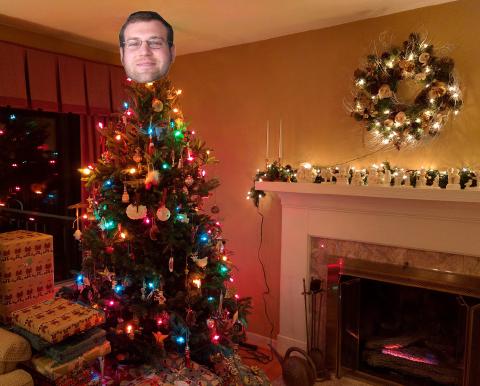
Image courtesy of Jeff’s face and Chris’s family’s house
Transcript
Narrator: This is the F-Hour Podcast. Recorded December 22nd, 2015. Episode 279. Merry Kaisermis.
Dave Jones: Welcome to the Amp Hour. I'm Dave Jones from the AEV blog.
Chris Gammell: And I'm Chris Gammell of Contextual Electronics. And this is Jeff Kaiser from MightyOhm.com. Do it, Chris. Yes, sir.
Jeff Kaiser: Hey, guys. How you doing? Merry Kaisermis, everybody. I'm back.
Dave Jones: He has emerged from his valve-induced hole that he's been living in for the last...
Chris Gammell: Valve-induced hole.
Dave Jones: I don't know what that came out there.
Jeff Kaiser: I think there's a portal reference in there somewhere. He's used the portal gun to escape for the weekend or something, for the holiday.
Chris Gammell: It is great to be back, guys.
Jeff Kaiser: Oh, man. It's so good to have you back. We love when you come on here, Jeff. Come on, man. It's like this is our new holiday tradition. I think we should do this forever.
Dave Jones: We're old and sitting on a porch and...
Jeff Kaiser: Yeah, exactly. Exactly.
Dave Jones: No, I said that because, yeah, we don't hear from you apart from when you emerge from, you know, like once a year. Yeah. It seems like you're, you know, you're...
Chris Gammell: Yeah. You don't... I can't believe that it's been a year. And I was looking back and it seems like... Well, I mean, it seems like it was a long time ago, but it also seems like it wasn't that long ago because this year has gone so fast. But I know exactly what you mean. I haven't been super active online this year, probably more so than in any previous year just because of how incredibly busy I've been this year. So it feels kind of like it was just yesterday I was on the show. But at the same time, I remember stuff we were talking about last year and it's like, oh, man.
Jeff Kaiser: I didn't know anything. And I will bring up front. I will bring up front that Jeff said last year that he's going to be able to tell us everything this year. Everything. Everything. Everything. Time to spill, Jeff.
Chris Gammell: I feel like I need to see evidence of that because I totally don't remember that.
Jeff Kaiser: I was literally listening to the episode like two minutes ago and like you said, I feel like I'll be able to talk about much more next year. And so here we are one year later.
Chris Gammell: Here we are. Here we are. And I promise that next year I'll tell you everything next year.
Dave Jones: Just kick that can down the road. That's right. Yep. So are you still doing your own kits and stuff like that or is that dropped by the wayside?
Chris Gammell: I'm still doing everything. I mean, I'm still doing kits. It's still kind of a part time thing. I admit that I haven't really done a lot of new development this year, but I'm still shipping kits, Geiger counter kits. I'm still doing the rescue shields. And I mean, at this point for me, it's kind of like it's something I do for fun and it's kind of on the side, but it's not really what I spend a lot of my time on. But at the same time, I really enjoy doing it. And it's something that I don't want to necessarily stop doing just because it's so much fun. But I don't get to do as much new kit development as I'd like to do. So I really hope that in 2016, I can start spending a little bit more time because it's been a while since I did a new kit and I've got a lot of ideas and just stuff that I want to try. I just need to find the way to make the time for it. Right. Plus, now you have all this experience getting stuff made, right? Ah, gosh, yeah. I mean, this year has been a whirlwind course in volume manufacturing for me. So on one hand, it is cool to see all that stuff. On the other hand, I can't see any of my electronics kits being at the scale of what I've worked on this year. No, right. Because I don't think I'm going to be making a million Geiger counters. Anytime soon. And it's just been... Yeah. I mean, this year, as I said, it's been a crash course in electronics manufacturing and particularly high volume manufacturing. And it's just amazing to see the things that happen at that scale. It's just unbelievable. But it's been an awesome, awesome ride. And like I said, it's just been... This year has been nuts. It's just completely nuts for me. And the time has kind of flown by. And here we are. And I can't believe that it's December. Sure.
Jeff Kaiser: Is your product going to show up under the tree this year? Is that something that's going to happen? Is that part of your stress on a daily basis?
Chris Gammell: It is really... Actually, can you guys give me just five minutes? I'm really sorry. I've got to close the door here. Hold on, guys.
Jeff Kaiser: Sorry. Takes you five minutes to close the door.
Dave Jones: Well, have you seen how much time and effort's involved in high volume manufacture? You know, like he's in that mindset now that, oh, yeah, I can't just... It's not just closing a door. No, you can't just quickly... You can't just close the door. You've got to implement an automated test system to ensure that the door is closed.
Jeff Kaiser: It's creating a standard operating procedure. That's right.
Chris Gammell: Okay. I'm back. Sorry. I had a cat. A cat came in into the room. Thanks, guys.
Dave Jones: We were just making jokes about how you couldn't just... How one cannot just close the door now. It's not that simple. You have to develop a test methodology for ensuring that the door is closed. And have you moved to a different mindset now?
Chris Gammell: Is that... Oh, gosh. It is easy to become like super paranoid about everything. Because when you're building anything at scale, the number of things that can go wrong just keeps going up and up. And it is... It's crazy. I mean, it teaches you to pay a lot of attention to details and just to try to be, I don't know, very precise in everything. But also, you're trying to move very quickly. Because when you're in volume manufacturing, you're building things constantly. And so, if you find a bug, every day matters. Every hour matters. Because you're pumping out more and more of the same thing. And it's got the same bug. And so, you have to be super responsive. But also, you have to make sure that what you do works. Because otherwise, you just... I mean, you don't want to be chasing problems like that in a volume production kind of a situation. And so, it is a really good feeling when you design something. You put the time and energy into it. And you get it right. And it just works. And it works when you're building one. And it works when you're building a thousand of something. And even bigger quantities. And that's really what, to me, has been super rewarding. Has been, you know... So, I don't know if everybody knows. But this year, Valve, the company I work for, launched a couple products in the hardware space. And so, I've been super involved in one of those products. Which is the controller that we released this year. And I've been involved, you know, from the beginning, from early prototypes, all the way to volume manufacturing. And so, it's really cool to see, as a designer, you know, you make all these assumptions along the way. And there's all these choices you make. And decisions you make. And it's not until you actually try to build a large quantity that you actually get to validate that, you know, yeah, that was a good idea. And, yeah, that was the right set of trade-offs at the hardware level. And so, you sort of get to validate all of these assumptions that you made along the way. And that's just an amazing experience to kind of be all the way through that from, you know, those early days of breadboarding stuff. And kind of just throwing together hot glue prototypes to, okay, we're going to make, you know, a huge number of these. And it had better work, you know, because we don't want to produce 100,000 PCBs and have them all not work. And it's just, it's very humbling. And it's also super exciting. So, it's like the ultimate told you so? The ultimate I told you so. Well, yeah, I mean, it is like just being able to make a design that actually works over production variation is, it's really hard. I mean, you have to, it's one thing to make a design that will work when you make 10 or 100 or 1,000. It's another altogether to make a design that works even though all of the components are varying across all of their production. You know, you think about things like transistors. Their characteristics are not the same every time. And if you build 100 of something, chances are all those transistors came from the same reel. Exactly. And they all behave kind of the same. But when you go into the big volumes, things change. And you're going through reels of components. And so, you're seeing shifts in everything. You know, threshold voltage, everything. And so, that impacts the design. And a good design is going to be fairly resistant to those variations. And then a bad design is going to be super sensitive and could actually stop working when you get a reel that's got a, you know, super high threshold voltage. And maybe you assumed it was going to be on the low end. Or you just assumed it was always going to be like what you had in the lab when you did the design. And it's definitely not the case when you get to the big numbers. So, that's just something that I've never had to really work with or had to deal with. I mean, at the chip level, I certainly did. But a lot of it was taken care of in just doing simulations and Monte Carlo analysis and things like that. But, you know, you don't always get to do that on everything. And you just have to try to incorporate as much flexibility into the design as possible to accommodate. You know, some components may vary very little because they're very stable. But others might vary a lot. Or you get a second source component and all of a sudden it's varying, you know, quite a bit because you've got two different suppliers. And each of those components are a little different. You know, you could have two different transistors from two different manufacturers. Or maybe they're not even exactly the same part. And you just need to accommodate all of that variation. So, that's been really, really interesting to get to see firsthand the actual effects of that in a design.
Dave Jones: With the Monte Carlo stuff, what sort of parameters are you talking about? Temperature would be a big one. Because you're working on a consumer product, right? So, it could be used in some unheated hut in Norway somewhere at, you know, minus five degrees. You know, the kid's just there shaking, you know, freezing cold.
Jeff Kaiser: You're bored down in the Antarctica station. It's true. Yeah.
Chris Gammell: Absolutely. So, I mean, yeah, you need to account for that. You also need to account for storage temperature, which is, you know, when a controller's in the belly of a 747 or whatever going across the Atlantic.
Dave Jones: Or on the back deck of a ship. In the north, you know, back deck of a ship. Yeah, exactly. In the raging hot sun on that metal shipping container. You know, that's a, yeah.
Chris Gammell: Right. Right. And it turns out that things you wouldn't expect are sensitive to things like that. Like, electronics are pretty good at recovering, but mechanical components tend to be more sensitive. And in particular, magnets tend to be sensitive to temperature variation in ways that you wouldn't expect. And some alloys are more sensitive than others. But there's always, in a course of a product design, those things that you get surprised by. And, you know, I've been surprised by a lot of things, you know, partly because this was a lot of it a new experience for me. But also just because there's these things that you just don't even really think about during the design process. And the fact that magnets are not always really good magnets when you subject them to wide temperature swings. And they may not always recover in exactly the same way. And magnets can be in things that you don't think of. Like motors. That's right. Yeah. It's totally true.
Dave Jones: You know, vibration motor in your controller. Ooh, there's magnets in there. Oh, yeah. I didn't think of that. You know? Hmm.
Chris Gammell: Yeah, it tends to be the electromechanical stuff that's hard. And mechanical. I mean, a lot of things that are on a PCB are pretty simple and they're pretty well behaved. Like resistors and capacitors. Those are probably not going to be an issue. But it's the other stuff that you have to worry about. And it is the inductors and the magnetics and the electromagnetics and the stuff that moves and the stuff that clicks and things like that. Those tend to be the hard things.
Speaker ?: Hmm.
Dave Jones: Were you involved in the... Because everyone's seen the video, right? The awesome...
Chris Gammell: Which was awesome.
Dave Jones: The video of this thing, right?
Chris Gammell: The video is really cool. Yeah, the video is awesome.
Dave Jones: And I assume that that wasn't shot by someone on their, you know, hand-holding their iPhone. I think it was... I think you had a professional company come in to do that. So were you involved in that?
Chris Gammell: No, actually, Valve has a documentary crew in the company. Oh, okay. We had our documentary crew come out and actually film at the factory. And yeah, I saw the video for the first time pretty recently. I mean, it just came out a couple weeks ago. And it is so awesome. They did an amazing job at making that video. And it sort of does capture what it's like to be standing there walking around. Because I've spent a bit of time at that factory. And it is kind of jaw-dropping, just the scale of it. And seeing that many robots. And just watching kind of the delicate operations that they're performing, knowing full well that those robots are capable of, you know, crushing things. And it is super, super cool. How much are you allowed to say about that? Anything at all or no? I mean, it's one of the largest automated assembly lines in the world. Really? Certainly in the United States. Okay. And certainly in consumer electronics.
Jeff Kaiser: It was definitely surprising that it was Illinois. I mean, I got to say that, like, I had misquoted even at the beginning. I was like, oh, I had to go back and rewatch it. I'm like, Illinois? Really? Like, that was surprising to me. Yeah.
Chris Gammell: And I'm not sure what all the factors were that led to that decision. But it's true. And it's really cool to be able to do domestic manufacturing at that scale. And that's something that I don't think very many companies are doing. And so it was neat to be part of something that's really different from what's going on. And hopefully is sort of a sign of what's possible and what may happen more in the future. And I've been able to work with a bunch of people who are really skilled at automation design. And it's interesting to me how design for automation kind of trickles back into the design process. Because I was sitting mainly on the design side and having to sort of think about things that normally you wouldn't need to think about much earlier in the process than you might think about otherwise. Like, you know, automation is an amazing tool, but it also imposes a bunch of requirements on design. Like, you have to lock down many elements of the design much earlier because, you know, there's guys that have to program and build robots and tooling and manipulators and things. Test points and mounting points and stuff like that? Or what would that kind of be? It's everything from assembly order and assembly operations to the specific dimensions of the components that are being used for assembly. It's kind of, it's like everything that the robots want to know. I mean, you can build in a lot of flexibility, but you sort of have to know what the things are you need to be flexible with. And I think you have to understand much earlier in the product's lifecycle sort of what it's going to look like, how it's going to work, but more importantly, how it's going to be put together. Because if you think about it, you know, if a person is assembling a product, you can kind of tell them, even at the 11th hour, like, oh, yeah, you're going to do B before A instead of, yeah, move that wire a little to the left. Or, oh, we made a mistake and you're going to have to add this green wire somewhere because, you know, we've got this temporary fix that we need to implement. But with automation, it takes a lot more time in general to build, you know, tooling, because a lot of times you've actually got hard tooling that's touching things. And that actually needs to be machined and manufactured to very tight tolerances usually. And that takes time. So that's something that, you know, might be easy with a person, but it's hard for a robot. But then, of course, you've got the other side of it, which is once you get it down, you just, you turn on the line and it just goes. And it requires very little intervention, unlike a traditional manual assembly line where you might have 100 people or more that are doing the same thing. And those people might come and go because they get new jobs or maybe your capacity, you want to increase it. So you have to hire, you know, 100 more people and it takes time to get them up to speed. And maybe they make mistakes because they don't know what they're doing in the beginning and they're getting training. And so the quality is very different when you compare automated assembly with manual assembly. Automated assembly is certainly capable of achieving a very amazing degree of quality once you get everything dialed in. But it's also true that automation is good at making the same mistake lots of times. Yeah, exactly. Yeah, it's just, it's different. And that's been really cool. And I feel really lucky that I was able to spend a lot of time on the front lines sort of working with all that stuff and seeing those tradeoffs being made and making some of those tradeoffs.
Jeff Kaiser: So when you start thinking about that stuff, I mean, is it just kind of a back and forth or is it, do you actually sit down and plan out the eventual automation? Like, so you talked about, okay, so maybe we're just talking about test points. Do you start with that in mind? And then are those like a standard set of test points or is it more like, well, we know this, now we have to go back and change and add those test points. And then also that's going to impact how high our connectors can be around it, that kind of thing. Like, what is the interplay there because it is so front loaded?
Chris Gammell: It is, it's really tempting to want to solve for everything at the beginning. And I think that if you have a stable product, something that's not changing much, that's very known, like you sort of know what it's going to look like. You know, okay, this is the shape of it. This is, these are the things that we're going to want to test. And so we're going to add test points for all the things that we anticipate. It, that definitely makes it easier. But in reality, I found that you sort of, and I think we talked about this on the last show, like you sort of just need to make a bunch of assumptions based on the information you have. And particularly for a product that's more fluid, that's kind of changing through the process. You pick a set of constraints, you know, you run forward with them and you're going to find out, oh yeah, you know, there's all these things we didn't anticipate. Or there's all these things that we didn't really understand at the outset that are becoming a bigger deal because now we know how hard they are to pull off. And then you end up changing the design. And so it ends up being kind of iterative just because it is almost impossible to know everything at the outset. You know, I assume that this was a new thing for us and it was something that we'd never done before. I'm assuming that, you know, on the, on round two or beyond, it's going to be easier because we'll have learned a lot through the, through the way. But it's also true that, you know, with products, it's, it's hard. I mean, if product design would be pretty easy if you knew exactly what you were building on day one, but that, that's probably a pretty boring product also because it's not something that you've been able to learn from and then incorporate changes into throughout the design process.
Dave Jones: Now you may not be able to answer this one and that's okay, but did you, was there an original like mandate way back at the start that we're going to build this thing in the U S and we're going to design, you know, we're going to have the world's biggest automated factory to do it, blah, blah, blah. Or did that more, or was that, you know, or you didn't know how you were going to do it at the start. And that sort of became a more logical choice for some reason.
Chris Gammell: It sort of evolved over time. Right. And I think we wanted to do something that was in the U S that was something that we thought would be really interesting and really significant to, to try to manufacture as much as possible in the U S. But I also think that we tried to.
Dave Jones: You weren't quite sure what maybe.
Chris Gammell: Well, we, we had, we had an idea for a product. And so we were kind of like, okay, well, we could do what everybody else is doing or what a lot of other companies in the space are doing and build it in China. Or we could try to do something that's different that maybe is, is better for us as a company and build it in the U S. And I think it was kind of both. It was something that seemed like an interesting idea. It also kind of evolved over time, but at some point you have to make decisions and say, okay, here's what we're going to do. And then, and then do it. Yeah. And it's been amazing to see all of that stuff come together and sort of like those decisions that were made quite a long time ago, see that actually turn into a product that you can hold and you can actually use. And that people that, that are not in the company are using is, is just a really cool. It's a, it's an amazing experience.
Dave Jones: Did you do all of the automated factory stuff in house? Did you have people to do that or did you like, I've, I've worked on stuff like this before for automated factory production. We just hire companies who specialize in making automated jigs, you know, and they're really good at it.
Chris Gammell: There are a lot of companies out there or several companies that are really good at designing automated assembly systems. And I think it would have been really challenging to try to develop all of that in house. So yeah, we're, we're lucky to work with some really good partners and it's cool to work with somebody that's done it before. That's kind of been in the space because they know so much and they do things, they make decisions that you're sort of even looking at and saying, wow, I don't think I would have thought to do it that way.
Jeff Kaiser: So I'm looking at the Steam controller too. I'm just over on the, the, uh, the page right now. Are you using this for other stuff now? I'm starting to wonder now, like, look, I use this for layout. Like if it's really this, this new paradigm, am I able to use this for layout, Jeff? Come on, man.
Chris Gammell: I, you, it, I have not tried using it for layout. That would be interesting. I know, I know that, uh, on the assembly line, uh, we actually use controllers for different things and use them to control interfaces, user interfaces for the automation system, which is kind of cool. It's like, it's like dog fooding, right? It's like you're using the thing you're making in order to do stuff. Eating your own dog food, yes. And that's, yeah, right. Um, no, I, I haven't tried to do layout, uh, but now I'm curious. Yeah, right? Now I want to try.
Dave Jones: Excuse the gaming dummy newbie, um.
Jeff Kaiser: Ignorance, yes.
Dave Jones: Ignorance, yes. Um, but it looks like an Xbox controller. What, what sort of, you know, what's revolutionary about this thing? Like.
Chris Gammell: Oh, well, it uses touchpads.
Dave Jones: Yeah, okay. So that's something that's very different.
Jeff Kaiser: Locker switches. Yeah, instead of buttons. Right. Well, that's. And instead of, well.
Dave Jones: Yeah, but, yeah, but it's still the same. Use your thumbs to move left, right, up and down, right? Left and right thumbs.
Chris Gammell: It is, but instead of using thumbsticks, which are typically used in, in kind of existing controllers, uh, and sort of make a bunch of assumptions about how you're actually going to interact with the controller. Because mechanically, a thumbstick is a lever on a set of springs, right? Yeah. It's got center return springs that force it back to the center when you let go. And that sort of assumes that you want to use it in a certain way. It does. But it can be advantageous, too. And what we wanted to do was build something that was more flexible.
Dave Jones: Because you get force feedback and, you know, like, kind of.
Chris Gammell: And it's really, so that, that, right, what you said there is really one of the challenges, I think, in controller design, which is that you're trying to trade, uh, flexibility for haptic feedback. Right. Or having feedback about what actions you're performing. And so what we did is we actually took, uh, trackpads, which are super, uh, flexible, super configurable. And then we paired them with a haptic feedback system that actually gives you, um, it, it gives you cues about what's actually happening and, and how you're interacting with those touchpads as a substitute. So, so what we do is we, we fire these things called linear resonant actuators. We call them force reactors. And those are underneath the trackpads. So as you're moving across the trackpad surface, you feel the feedback actually coming through the pad. And we've actually got things like momentum built into those haptics so that when you flick the pad quickly, you kind of get the impression that you're spinning a ball, like a trackball. And so you'll get this like kind of thing. And that gives you actually a really compelling feeling that you're moving something physical.
Dave Jones: So you have to physically use this thing. You can't just have a look at the photo like I'm doing and go, oh, it's just a trackpad.
Chris Gammell: No, no. And in fact, you know, I think it, it, you, you want to use it and you want to use it for more than just five minutes. Because it does take some getting used to because it's so different from traditional controllers. Yeah.
Jeff Kaiser: Just like one of those zoomy things. Dave, you use that zoomy thing. I forget what it's called. Like the flying. You know, when you do layout, use that, that 3D zoomy thing. Oh, the 3D space navigator. The space navigator. Yeah. Right. Space. Yeah. I mean like that, any kind of new, you know, control scheme is going to be difficult to switch into. Yeah.
Dave Jones: But I don't use that for layout. I use that for rotating the three dimensional board. Yes. And it's very intuitive. Once you, you know, but once again, it requires a bit of getting used to. Yeah.
Jeff Kaiser: It's just, it's just, it's just acclimating to it. Right. Yeah.
Dave Jones: Yeah.
Jeff Kaiser: Yeah. That's cool though. Yeah. I would, I, Jeff, you definitely should try and hook it in, man. Hook it into your layout program. Totally. Let us know. That'll be good. Yeah.
Dave Jones: I, in terms of layout, like at Altium, I always, I always told him this, I wanted to, you know, I, you know, like we sit here with a mouse and we just sit in our chair and, you know, but I think like stand up at a desk and like have this huge, big 40 inch, you know, like big, the size of a table and use your hands and arms to, you know, drag traces and, you know. Yeah. Do something like that. Yeah. Like a minority report.
Chris Gammell: Kind of like minority report.
Jeff Kaiser: Yeah. Yeah. Yeah.
Dave Jones: That sort of thing. Except not, not in the air, but on a, yeah. Like on a. Yeah.
Jeff Kaiser: Like still 2D, but you could then pull it up to see the 3D kind of thing.
Dave Jones: Oh, I'm not interested in that. I'm just more interested in the productivity side of PCB layout and, you know, stuff like that. So, um, yeah, I'm not necessarily, you know, fancy stuff. Oh, you just grab it with your hands and throw it up in the air and there comes a 3D model and you rotate it.
Jeff Kaiser: I just mean switching from 2D to 3D mode is useful for actually seeing how you're diving through layers, that kind of thing.
Dave Jones: Oh yeah, true. But yeah, but it, but it already has that. I'm more interested in, yeah, like, you know, physically laying out all the traces and, you know, moving them and shuffling them and, you know, yeah. I think there's a lot to be had in the user interface space there for, uh, PCB layout anyway. Maybe for other CAD stuff as well. I think there's a lot of innovation there. People get on it.
Jeff Kaiser: Yeah. Seriously. It starts with the Steam controller. It ends with Tom Cruise.
Dave Jones: No, no, no, no. Manipulating stuff in free space. See, here, I can already tell you that I wouldn't want to use the Steam controller for doing PCB layout. Because, like, you're sitting there with the thumbs. You're like, like, no, you know, I can't see the advantage of it over a mouse and a keyboard.
Jeff Kaiser: Like, in terms of productivity. Well, I just meant it's meant to replace, like, that's, I mean, Jeff, you can verify or deny this stuff. But, like, it's, as far as I understand it, it's meant to replace a lot of, you know, mouse and keyboard kind of actions, right?
Chris Gammell: I mean, it's basically an alternative to that. Yeah. Right. I mean, it's all about using the best input device for the job. So, you know, for PCB layout, maybe a mouse and keyboard or a space navigator and a mouse and a keyboard are the best thing. And, you know, that's what I use when I do PCB layout. I use a space navigator to do the 3D navigation in Altium. I use mouse and keyboard to do all the kind of traditional 2D stuff. What the controller does is it allows you to do a lot of the same things, but without having necessarily a mouse and a keyboard available. So if you're sitting on your couch or you're somewhere, maybe you're standing, then it's a lot easier to interact with something you can hold in your hands than having to deal with, you know, coming up with a flat surface or something that you can put a mouse on. And so I think it's sort of an option that's available, and not everybody is going to like it. And we definitely have folks that have done mouse and keyboard in the living room and are totally happy with that, and that's totally awesome. But this gives you another option, and it also is something that is an option to the traditional game controllers that are being used in the living room where, okay, maybe two analog sticks is not really the best thing for using certain types of games, and in particular games that were actually written for mouse and keyboard, especially older titles, stuff that's really intended for you to be sitting at your desk. Now you can actually play these games pretty comfortably in a living room setting, and that's something that you couldn't really easily do before. And I think that's what's so cool about it, is that it gives you this option that, you know, if you don't want to use it, sure, you know, use whatever you want. You could use another controller, you could use a mouse and a keyboard, but you don't have to. And it's all super interoperable, too, which is the cool part, is the controller is very configurable.
Jeff Kaiser: All right. Dave, what about using a power glove for layout? What do you think about that? Nah. Nah. I think you should try it. Power glove. Nah. So, Jeff, you mentioned, so we know, obviously, from the video that the controller is being assembled in the States, but you have been spending buttloads of time in Asia. So, could you tell us about your exploits over there? And what, you know, how that affects yourself? Yeah.
Chris Gammell: I spent a lot of time in China this year. So, just like I'm new to volume manufacturing, I'm also pretty new to the China thing. And so, this year, I spent a lot of time in China. I don't think it was really a huge amount of time.
Dave Jones: Are we able to say whereabouts in China? Shenzhen, or is it?
Chris Gammell: I was in, no, actually, I wasn't in South China, which is where you'd probably, that'd be most people's first guess, but I was actually closer to Shanghai. Okay. Yep. And it was a pretty amazing experience. I first went over early in the year, and I actually just got back a few days ago from my last trip of the year. So, I actually spent several weeks in China this year over the course of, I think I was there six times. And it was basically for the purposes of setting up a PCB assembly line. And so, I went over sort of early in the year to kind of get ready and do some EV kind of trial builds, and then a few times over the course of the year to work on things related to just volume manufacturing of PCB assemblies. And that was just amazing. It's like, again, talking about building things at scale, it's so cool to go into a room, and it's not a small room, but a large warehouse or factory room, and see, you know, thousands and thousands of PCBs of a design that you worked on. And so, I've been able to do that. Yeah. It's extremely satisfying. It's all fun and games until you find that there's a problem with those thousands.
Jeff Kaiser: How do you guys feel about re-soldering 0201s by hand?
Dave Jones: Been there, done that, in a factory in Shanghai.
Chris Gammell: Been there, done that, yeah. So, I have this, like, Go kit that I have developed over the course of the year, which is my China kit. And everyone always makes fun of me, because I bring it in just a cardboard box. I don't have, like, anything fancy, like a toolbox or anything for it. But I've got a bunch of stuff that I bring every time I go to China. And I've got stuff at the factory, but it's always, I like to bring certain tools, and I always keep them on my person, just in case things go missing or whatever. There's a certain core set of stuff I want to make sure that I've always got. And that's things like a digital multimeter, you know, digital multimeter, really basic, but it's the kind of thing that if you have to go looking for one, you waste a lot of time. I don't have an oscilloscope, although if I had a portable one, I'd probably bring that. And I'd say, actually, the most valuable tool that's in that toolkit is a USB digital microscope. Oh, okay. And I have used that probably more than any other tool this year. Why a USB one? And it's for everything.
Dave Jones: You can get those ported ones with the LCD already on them. You know, they're, like, self-contained. I haven't seen those. Oh, okay.
Chris Gammell: Yeah. Well, it's nice to be able to take screenshots. And so I use this thing. It's called a DinoLite. And actually, one of the engineers that I work with- DinoLite! One of the engineers I work with introduced me to it. And it has kind of changed my life because it is this super high-quality, high-resolution USB scope. And it comes with some pretty decent software that allows you to actually calibrate to distance and then take measurements on images, which is super cool.
Jeff Kaiser: Oh, yeah.
Chris Gammell: And it's kind of like a secret weapon because a lot of times at the factory, you may not have ready access to a microscope. You might be in a conference room or you might be somewhere where you just don't have access to one. And you've got a circuit that's misbehaving or you've got an issue where maybe there's some quality control problem or something. And there's pretty much nothing more powerful than being able to take a photo of an actual defect or a problem and then email it to a bunch of people and say, okay, the problem is here and then circle it with a big arrow, right? Like that is probably the number one tool, I would say, for getting things done in China has been having this ability to take really good high-resolution photos of stuff. And it works great for surface mount components, but you can also zoom out quite a bit and take pictures of bigger stuff like switches. And I've used that, like I said, more than any other tool. So that's definitely in there. But I've got a lot of other stuff like, you know, tweezers sometimes cause problems with airport security and I do everything carry-on. That's the other probably big rule is always bring what you can carry onto the plane because checked luggage can go missing or maybe it arrives a day later or whatever. And so I've got just this kind of small box of stuff and it's got, you know, a little, those spudger sticks and some basic maybe like soldering supplies. But I actually don't bring a soldering iron because the factory's got lots of those. And that's kind of it. Like, I mean, some gloves in a size that fits me is really good because you have to wear gloves or also finger cots, those little, you know, the finger cots. They're like these little condom looking things that you put on your fingers. Well, the kind that you get in China are typically too small for my fingers. And so I bring just my own and that's the kind of thing that fits in a little tiny box. It's stuff, stuff like that, that just makes it a lot more just easy and you don't have to scrounge around for materials because, you know, I've been to the electronics markets. So I, I have been to the ones up in the part of China that I spent time in. I haven't been to the ones in Shenzhen, which I've heard are amazing and probably much bigger. But even where I am, there are electronics markets and you can get stuff if you need it, but then you've got to take a half day to get a taxi and get over there. And it takes a long time because you're, you know, you have trouble with the language and stuff like that. So transportation and stuff can be kind of slow. And also working with the vendors, sometimes you get a good deal, sometimes you don't. So what I do is I just bring as much as I can so I don't have to do that. And that saves a lot of time.
Jeff Kaiser: That's good. Yeah. Uh, so this is mostly, this is like just purely because you want to make sure that you're ready to go.
Chris Gammell: Yeah. I mean, when I hit the ground, I want to be able to, you know, wake up after hopefully getting some sleep, uh, go to the factory the next morning. Cause I usually get in kind of close to maybe nine, 10 o'clock in the evening because of the flights. And, and Seattle is cool because Seattle has a direct flight to Shanghai. So I can take a direct flight out there, which is, is awesome. Uh, and then try to get a full night's sleep, which never actually works. But I, you know, wake up the next morning and I've got my tools. I've got the stuff I need. I can go right to the factory and just get right to work. And I don't have to worry about spending a day collecting things that, you know, the, the funny thing about factories. And I, I actually haven't worked in a lot of factories, but I suspect that this is true everywhere. Is that if you leave something out, like the factory, any factory has this like, there's this, there's this like current and there's this constant movement. And so stuff is not allowed to like sit out. Like the factory doesn't want to accumulate junk around the assembly line. So like, if you have a board that you're working on and it looks like a finished board, it's going to get shipped. Like you better be really careful because you could be hacking on a board and it looks like a finished PCB. And so doggone it, you know, somebody's going to say the right place for this. Yeah. And you go home for the night or you go out to lunch and somebody in the inner, inner, interim looks at it and says, Oh, well, you know, that board obviously should be, should be shipped out. Uh, and, and that has similar things have happened to me before, but also stuff just gets kind of cleaned up regularly where electronic supplies and stuff get put back in their place, which is, you know, usually somewhere far away that I don't even really know where stuff goes, but I've got to talk to somebody to get it back. And that can take a huge amount of time because you're just waiting for somebody to go back into a supply room that might be like halfway across this giant building. Uh, and so I found that you have to be very just scrappy and, and able to make do with, with very little. And I've actually solved pretty significant for me issues, you know, on the production floor that saved a huge amount of time because I was able to do the diagnosis. Like I, I had a, an issue with a logic analyzer or I had an issue. I needed a logic analyzer to solve. And it just so happened that one of the guys I was with brought a logic analyzer and I was able to solder up, you know, Kynar wire, which we, in that case we were lucky because the factory had Kynar sitting around. We were able to use Kynar. And I think one of the things that's, it's that 30 gauge, uh, wire wrapping wire. Oh, okay. You've probably seen it before. It's blue, blue wire. Right.
Dave Jones: But it's got actual insulation versus whatever you want to call it. Yeah.
Chris Gammell: Okay. Okay. Yeah, exactly. And we were able to actually patch something together and do some tests and solve an issue. And then I got right into Altium and I made a change to a PCB and it was, it was the kind of thing that, you know, I'm, I'm glad that I had the stuff I had because otherwise it would have taken much longer or maybe I would have decided to, to solve it when I got back home, which would have been a week later and, you know, X many boards down the line. Yeah.
Jeff Kaiser: Right.
Chris Gammell: Uh, and so, you know, I think one of the big things for me that was a surprise is that in general, um, factories that are doing volume production don't tend to have a lot of stuff around. Like you expect that you're going to this factory and yeah, exactly. So you, you, you expect it to look like a prototyping lab, or at least that's what I expected where there's just lots of equipment around there's scopes, you know, there's everything. But I think it's not generally true. It's the factory is actually a very lean, mean operation and they don't have a lot of extra stuff around because it's not relevant for volume manufacturing. Once you've got a stable design, you don't need a ton of prototyping stuff and it would just take up room. And it's a bunch of capital investment that's not really necessary for volume manufacturing. So, you know, I found that if you want it, you've got to either make special arrangements and tell somebody that you need this equipment or, uh, you just bring it.
Dave Jones: Like you said, as simple as a multimeter, like try and walk into any, you can walk into one of the largest contract manufacturing factories in the world. Yeah. And try and find a multimeter, right? You're better off just using one of those pocket ones.
Chris Gammell: So what you're going to find is that you're going to get a multimeter, but it's going to have like one of the inputs blown out and it's going to be like, like, look like it went through a war. Like that's been my experience, especially oscilloscopes, you know, the, the loaner oscilloscope. I mean, that thing has seen some stuff like that. That scope has been through a lot before you got to it. And, uh, you, you pretty much never can trust the calibration. You know, that one of the inputs is probably blown if it's a multi-channel scope. Uh, and so there's going to be all these things that, yeah, I mean, there's a reason that is the loaner scope. It's usually got, you know, some other customer's name like scratched off 10 years ago. You know, it's the kind of thing, like for some reason that scope went into general circulation a long time ago and that is now the loaner scope and your mileage may vary. Um, and so if you want to put up with that and sometimes you have to, because like a scope is kind of a lot to travel with. Like I, uh, actually I've seen handheld scopes that are pretty cool. I don't have one. Um, but I know that Keysight or Agilent, whatever, they make a handheld scope. That's actually pretty capable. Uh, and so that's the kind of thing that if you want to have a really nice scope, you could probably bring one in your, your carry on luggage if that was kind of the only thing you, you took, but I just don't have the room. Yeah. And so I, I usually just settle for, I try to bring the stuff that's most critical, like a DMM, you're always going to need a DMM, right? You always are going to need a DMM for something. Yeah. So that's kind of necessary. Logic analyzer is a good idea too. Hopefully you're not, I mean, the, like a salient. Logic analyzers are great because they have a lot of, they have a lot of functionality and they're really small and they're lightweight. And so I, I do bring the, the logic, uh, 16, uh, the slay, uh, because it's tiny. I mean, it's, it takes up no space at all. You can do a lot with it. He says, what is it supposed to be? Salie?
Jeff Kaiser: Salie. We've, we've had Mark and Joe on the show. Salie. Yep. Salie. Salie. Anyway, story.
Chris Gammell: Uh, you know, I, I would love to have a, like a Swiss army knife kind of scopey thing that would help more on the analog side. And I have not done a lot of research, but I've never seen anything I was in love with.
Jeff Kaiser: I just, just found out about one and I don't think I'm allowed to talk about it yet, but, uh, it's, it's pretty exciting stuff. It can do like, it's like a handheld, it looks like a kind of like digi pen and hooks into a phone. And there's, you know, there's some stuff out there like that, but I'm, I'm pretty excited about it. So hopefully we'll have.
Chris Gammell: Now keep in mind phones, uh, like smartphones are typically not allowed on a factory floor. That's another lesson. Not even with like the sticker over the camera. Usually not allowed to bring, you know, if you, if you wind about it enough, you could probably get away with it. And, and that's one thing is that as the customer, you typically have quite a bit of leverage at a factory. And so if you really need something, you can typically make it happen. But again, a lot of time. And so what I've found is, uh, I actually, uh, bought in China, uh, like a candy bar phone, like, you know, a Nokia, or I think it's actually a Sony Ericsson phone. And it's an, a model that's probably an older model. It reminds me of, of like college. Like you have to use for text entry, you have to use the funny, what is it? Like I 14? No, it's a, uh, Oh, I can't remember now, but the numbers, you press the button and it, it, it guesses at what the word is. Come on children, let me tell you about the old days of texting and SMS. So it really does feel like being in the nineties or I guess the two thousands. Uh, but it doesn't have a camera and so you can bring it anywhere and no one asks any questions. As soon as you add a camera, then you might have trouble actually getting it easily into a production line, especially if there's other customers that are sharing, uh, kind of the same space. So, but, but at the same time, it would be awesome to have a scope that used a phone because then you're, you know, you're already carrying half of it all the time.
Jeff Kaiser: Well, Samsung used to have a thing where they would give you a little sticker and then if you peeled it off, it would show and then they would basically confiscate the, the memory card if, if it was, if the sticker over the camera was moved at all. I'm not sure if they still do that in places, but I like that better because yeah, phones these days.
Chris Gammell: That's not a bad idea.
Jeff Kaiser: Mm-hmm. Yeah. Uh, yeah. I wanted to, I want to ask you about the, so you mentioned the size of the factory, like if you needed to get something from the storeroom, it was kind of halfway across the factory. Does your factory have one of the, uh, have bicycles because it's so big?
Chris Gammell: No, no, it's not, it's not that big actually. Uh, I, I've never been to a factory of that scale, although the one in, in Chicago, actually that one would be nice to have something because it is just, you, you, you don't realize it except that after being on the floor for a couple of days, uh, your feet are killing you because you've been on your feet most of the day and you're walking, you know, miles. I should get a pedometer and, and just track it because it is, it is a crazy distance, but no, I've never used the bicycles. I've never seen bicycles. I only saw them at, uh, the Tesla factory had them, you know, cause it just says it's a huge
Dave Jones: large automated factories. Whereas, whereas, you know, PCB assembly factories are usually actually quite space efficient. You know, they'll, they'll just have, you know, like, like the line might be 30, 40 meters long or something with all the, you know, the paste dispenser and the, you know, the oven and the pick and place, various pick and place machines all in, in series. But apart from that, you know, they're not vast.
Jeff Kaiser: From lines side by side basically then versus like one huge linear thing.
Dave Jones: Yeah, yeah, and then they'll have, you know, eight lines wide, but they won't be, you know, hugely deep. It's not like hundreds and hundreds of meters deep factory. You know, they, they're usually not that big. I've never seen one that, that sort of scale.
Jeff Kaiser: But a car factory will be like that because they're all linear.
Dave Jones: A larger automated factory. Yeah, of course. Yeah.
Jeff Kaiser: Yep.
Dave Jones: Yep. Yeah. I used to work in like a 200 plus meter long factory because we were making something that was 150 meters long, you know, like it just had to be that big, you know? Yeah. So, um.
Jeff Kaiser: That's crazy. So Jeff, you had mentioned, uh, you had mentioned DFM before, but, uh, so how does things change then for, I mean, obviously you're designing outside the country. Are you doing a lot of, uh, part replacement type stuff or are you using, are you using a lot of the local supply chain then? Or are you basically kind of designing, designing in the States and then kind of just dealing with it when you get there?
Chris Gammell: Uh, it's, I mean, it's both. It's a continual process. Yeah. Um, so like a larger contract manufacturer is going to have people that, that, that is kind of their job. Yeah. Like they're going to help optimize supply chain. And typically it's, uh, so that you have supply chain continuity. So you don't have a single source component, especially for easy jelly bean stuff. They make sure that you've got a, a large number of alternates that you can specify in the design. Um, and then, I mean, for specialized stuff, sometimes there just isn't any option. And so you just need to work with the manufacturer to make sure that, you know, whatever proprietary silicon, you can, you can get that in the quantities you need. Yeah. And they've got a heads up. It's a schedule and yeah, you're monitoring. Exactly. And a lot of, a lot of effort goes into that because I mean, in some cases, uh, at the scale that we're building a, a manufacturer may need to build an assembly line or open a factory that they didn't have before because they need to meet the demand. And that's something that requires a huge amount of time. And so, you know, if you're doing a really rapid development, it's hard to, to, to get all that kicked off while you're still doing component selection. So you sort of need to nail down a lot of things early in the process, especially single sourced components that might be hard to find alternates for. Um, but it is a continuous thing. So, you know, I'm lucky that I don't have to do a lot of the legwork to do that myself. I've got lots of folks I work with who are super good at doing that and able to help.
Jeff Kaiser: That's like having an, having an internal supply chain team basically, right?
Chris Gammell: Like that's a big help. So like the CM helps a lot too. And, and it's kind of in their interest to do that too, because typically there's a lot of they're going to want to steer you to vendors that they have an established relationship with that maybe they make a little more money on vendor a versus vendor B. And if you talk to people who have been involved in manufacturing in China, you hear in some cases kind of horror stories about components changing without you being aware of it. And you know, the, the manufacturer subbing in, I've heard all sorts of crazy stuff. I've been lucky that I haven't, you know, I'm working with a really good CM and we haven't had any issues at all with that kind of stuff. And so there's a AVL approved vendor list and you've got a copy of the bomb. And basically you authorize the factory to use different manufacturers and different component substitutions. And a lot of times when you go in, you don't have all that stuff fleshed out yet, but it's something that happens continually over the course of the life of the product. Like it's entirely possible that in six months or a year that there will be some significant changes and it could even result in redesign of things. If a component goes end of life or maybe something just isn't working as well, or the yield isn't quite where you want it to be. And so there's kind of all levels, like everything from what they call a paper qual, where you just, you know, look at a data sheet and you're like, okay, yeah, it looks, looks good. It's a resistor. Yeah, exactly. To stuff that you actually have to go back to the design and, you know, say you need to change DC to DC converters. You're probably not going to do that just by looking at a data sheet. You're actually going to want to build a sample build and do a bunch of testing. And those are kind of the harder ones because you have to actually go back to the board, go back to the square one on the design and say, okay, wait, what was I, what was I doing here again? Because it's been a while since I looked at this circuit. Ah, documentation. And so you kind of get the whole, yeah, documentation is good. And especially documenting the design process of like, why did I use a, you know, 4.7 microfarad cap and not a 10? And there was probably some stuff that went into that. And what are the things I had to deal with, like acoustics and things that you wouldn't immediately think about. So yeah, it's, you know, I use OneNote actually to keep a pretty good record. I don't know if you guys have ever used OneNote before, but it's a note taking tool.
Jeff Kaiser: Yeah, I've used, I use Evernote, Evernote for my stuff.
Chris Gammell: So Evernote also? Yeah. And that falls into that category of stuff that is kind of radically changed the way that I do design is using OneNote to keep a notebook of pretty much everything I do, you know, from a failure analysis where I get a unit back from the field and I'm trying to figure out, okay, what, what broke? Like, what is the thing that is not working and actually going into doing, okay, yeah, the radio is not working the way it's supposed to. And here's the defect. And then if I see that same issue down the road, say this is kind of an isolated failure. It's not like something where there's tens, but it's like there's one of something. Then you kind of make a note, take some pictures with the USB microscope. So, and then in six months, if I see that again, I can go back and say, hey, yeah, I remember seeing that before. And oh, you know, we're having the same issue that was supposed to be resolved. And again, that's a really good tool for going to the CM and saying, hey, you know, what's going on? We, we talked about this already and, you know, we're seeing this problem. This was supposed to be fixed. And just having a paper trail for everything is very powerful. Yeah, especially searchable.
Dave Jones: Are you allowed to say if there's any custom silicon in this thing? I'm sure someone's done a teardown already, haven't they? It's shipping, isn't it?
Chris Gammell: Actually, iFixit did a teardown. Oh, right. There you go. That was really cool to see. I think that's the first time I've ever worked on a product that got a teardown, which is pretty neat to see that. And what was their verdict? They did a pretty good analysis. Okay. Uh, they didn't go into a lot of detail on the electronics design. Um, they, they talked about some of the big parts of it. Uh, uh, like there's some pretty big ICs and we didn't do sneaky stuff like erase markings. I don't know. I'm not really sure why manufacturers do that, but sometimes they go to great lengths to, to hide all of those design details. We didn't do any of that stuff. Um, but they actually didn't go into a lot of detail. Um, but you know, I have not done, uh, custom silicon for, uh, consumer before. It's something I'd love to do. It'd be super interesting. Um, but you know, when you can get the parts off the shelf, it's just so much easier. You think about, you know, especially with a small design team trying to do a, a kind of ambitious design and do it fast. Uh, it's hard when you start adding those other factors to it. Like, Oh, we need to build our own chip and then actually get somebody to produce that in large volumes. And that's the kind of thing that I'd, uh, I'd love to get into. It sounds super exciting, but you know, when you can use stuff that's off the shelf, it's so much easier. There's no, uh, there's no going back.
Dave Jones: You know, there's no, there's no bodge wires in silicon. It is not. I mean, yeah, it is not. There's not much on the board, is there? But I guess it doesn't have to be. It's a bunch of buttons and, and some, uh, there's, there's a lot of, uh, there's a lot
Chris Gammell: of blood, sweat, and tears on there. I don't know. You must be, you might have to zoom in a little bit to see those. Oh yeah. Right.
Dave Jones: No, well, I'm like in terms of chip count and stuff like that, you know, it's like, so, so is this your board layout that we're actually looking at or, um, I, I did parts of it.
Chris Gammell: Uh, I didn't do all of it. I actually work with some other engineers who were amazingly talented guys that are, I'm lucky to have, um, as part of the team. Um, so no, I didn't lay out every trace on there, but I did some of them. Um, and I can definitely point at stuff and say, yeah, you know, this is something I did a lot of work on. So I did a lot of the work on the radio, uh, and, and worked. I mean, there isn't a single subsystem on there that I didn't touch at some point or didn't do the original design for, but of course, you know, over time you, you kind of share the responsibility with others. Yeah. And otherwise, I mean, you can't do everything yourself.
Dave Jones: So what is the main chip on there? What's that main quad flap?
Chris Gammell: NXP, LPC something? Yeah. It's an arm cortex. Right. Uh, it's a, it's an NXP IC for the MCU. And, uh, and then there's a Nordic radio, which I know is super common for a lot of hobby projects also. And that's an arm core, uh, the NRF 51. Yeah. Uh, and, and that's a super cool chip as well.
Jeff Kaiser: Uh, are you allowed to say, uh, again with the, uh, with the test? So we saw the video and you saw the robots doing the little, the little, the, um, actually manipulating the controller and stuff. Did, are you allowed to say if the, the radios were connected during that time? I mean, like that, that's the thing I was wondering about, like, cause there's no physical connection. I was like, oh, dude, there was our individual, was each one like individually connected during that test?
Chris Gammell: Oh, um, so you, I guess you can't see it easily in the video, but, uh, the controller has a USB port on it. And so we use that for a lot of communication. Oh, yeah. That's, that's one of those things that like you, you think about like, okay, yeah, we're going to have USB. Uh, and the reason we wanted USB was that it gives you a really low latency connection back to the computer and it's super reliable. You don't have to worry about it. You can have a bunch connected at once, right? If you've got, yeah, if you've got 20 controllers in the same room, you don't have to worry about them like stomping on each other if they choose to share the same wireless channels. Um, but it turns out that USB is also super useful for a lot of other reasons, including debugging, uh, and including a manufacturing test. And so it gives you this really common interface that everybody knows how to work with that, uh, is just built into sort of every computer possible that you might want to use for manufacturing tests. And so, uh, a lot of those tests have a USB connection back to, uh, a host that's executing, you know, special test mode commands to, to test functionality of all sorts of stuff.
Jeff Kaiser: Yeah, that's great.
Dave Jones: You've got, um, I see some, uh, surface mount tactile domes in there in the shape of a cross. Yeah.
Chris Gammell: Um, yeah, those are, those are tactile domes. Uh, and there's a lot of different flavors of those. There are. I've experimented with many of them.
Dave Jones: Yeah. Can you tell us about the trials and tribulations of PCB mount tactile domes?
Chris Gammell: Uh, yeah, they are. And those are actually pretty common in, um, consumer products. You see those domes and there's actually a lot of different styles of them. Like you can get the ones that are surface mount that are just like a component that you solder onto the PCB. And then you also can get the ones that, uh, you basically like stick on, like they're adhered with tape. Yeah, they actually glue. Yeah, they have adhesive. Yeah. We've actually got both in the design and, uh, really it's a, it's about getting the right feel. Um, so, you know, those, those ones that are cross-shaped.
Dave Jones: And the reliability as well, because there's a big difference between a tactile dome used in a $2 farting novelty toy you buy on eBay and one that's required to do 10 million operations in a game controller. Yeah.
Chris Gammell: And so, so we've actually got kind of every different kind of switch you could have, um, because there's also membrane switches which use those conductive, uh, pucks that push down on, on the PCB. Uh, and it's, it's funny. That's each one of those I could go on for a long time just because there's a lot of stuff that goes into each of them. Um, but it's really, when it comes down to it, it is really about feel and it getting the feel right. Like for example, you know, those cross style switches are, are custom parts and we had those made to get a specific force and, you know, a specific return force and, uh, and, and to also get them to where they're a big enough size that, uh, the exact position of the thing pushing on them is not as important in getting a reproducible force. Uh, and, and that's the kind of stuff that you really only learn when you, when you get, you know, pretty deep into the design process. Uh, so, you know, that was a big education for me, um, as, as well as other folks that I worked with. Um, but you know, we're super happy with how it came out and it, they feel really good. Yeah.
Jeff Kaiser: That's great. What about, uh, so let's talk quality. I mean, so Dave's reading a book about quality in China and you've obviously been to China a bunch and, uh, let's, I mean, so, you know, we've obviously we talk about that on the show a lot as well, but what, what is your impression of China and, you know, quality of, uh, obviously it's, you know, some of it's going to be specific to the place you're using and I'm sure they're great, but you know, just kind of general feel.
Dave Jones: Let's first of all, mention the book that I'm writing, which is called poorly made in China. And the title of the book is nice. Cause the A in China is like falling off. If you can pitch on the front page, it's like, like as in, yeah, everything's poorly made in China. You know, that's sort of the stereotype.
Jeff Kaiser: That's the, that's the thesis, but I'm sure that they're bucking the trend here for, you know, you add money.
Dave Jones: No, no, as always you can get some of the best quality stuff in the world is made in China. Let's not, you know. Exactly.
Chris Gammell: Yeah.
Dave Jones: But you have to control the process every single step.
Chris Gammell: What I think is true is that there is a certain default level of quality and that's going to vary depending on who you're working with, right? If you're working with a really great CM, you might have one level. And if you're working with somebody else who's bigger or smaller, maybe you're going to have a different level of quality, but there's sort of going to be this default level of quality. And one of the things I'll say is that nobody, but you, you know, you being the customer or the designer cares as much about quality as, as anybody else. Like you're the, you're the person. And so, you know, a lot of times, um, you have to sort of work as the, as the person who is representing the interests of the company that's doing the manufacturing, like, or sorry, the company that is paying to have the product manufactured. And you sort of have to just, I don't know, be very active. Like if you're passive and you just let things come together, you might not get what you want. And it's a, it's a combination of a lot of things, but it's a combination of the CM may not really understand what your bar is or necessarily how to achieve it. Like some of the things that they're doing are hard and they'd be hard for anybody, not just, uh, CM in China, but they'd be hard for anybody in the U S or otherwise. Yep. And so it requires a lot of effort to figure out how to do certain operations, uh, consistently and correctly every time. And it may require building custom fixtures, you know, which I've seen a lot of where, you know, say you need to put a label on something. So I'll say it right now. Adhesives and labels are probably, and I might've said this last year, but adhesives and labels are among the hardest things to get right. And it's because they are these kind of just, I mean, they're, they're sticky, right? So they don't, they don't want to go where you want them to go and, and they, they stick when they're not supposed to, and they don't stick when they're supposed to.
Jeff Kaiser: What about silk screens? Is that also in that, also in that, uh, you mean like PCB silk screen? No, no, no, no. I mean more like plastic silk screens, that kind of thing.
Chris Gammell: Oh, I have, I don't have any experience, but it sounds any, any process that is a wet process where it's consuming something and, and soldering is definitely in that category. Anything where you've got like a consumable that is a liquid or, or even just something that can vary, uh, like solder, you know, solder is not going to be exactly the same every time. And it's, it, I mean, SMT is pretty darn close. They're really good at keeping that consistent, but wire solder isn't as close. It's not as consistent. Yeah, like a solder pot type thing. Exactly. Or like a, a, you know, yeah, exactly. Or, or something where solder is being fed into a tip, kind of like an auto automated soldering application. Um, those things vary more. And so, uh, certain processes are really hard to get consistent results, but you know, you make fixtures, you make it so that people have an easier time sticking on a label or doing a solder process and you're going to get more consistent results. So what I've found is that China, and I really shouldn't generalize because this is really just my experience. And I know that every factory is going to be a bit different, but in my experience, you know, really 90% of it is, uh, looking for and identifying the issues and doing it in a way where you document, okay, here is exactly what is wrong. It's not enough to say this feels kind of weird. Like it's more like you, you take the data, like once you have the data, it's usually easy to have the factory respond to it. Like they're very responsive and very capable at fixing problems if they know that there are problems. So it's like the first step is identifying that there's a problem. And a lot of times having screenshots or having some evidence, you know, production test data or whatever to show, you know, okay, here is the specific component that failed because it tombstone, for example. And like I was saying with the microscope, you know, a photo, a high res photo of a tombstone component is like gold. Like you send that to somebody and it is fixed within, you know, an hour. Like it is not going to...
Jeff Kaiser: Pictures worth a thousand words kind of thing. Like...
Chris Gammell: Yeah, exactly. And so what I've done and I spent... So this year was kind of the year of me doing volume manufacturing and learning that whole process. And so I spent a pretty good chunk of the summer working on quality issues and really just being kind of the quality czar. Like the guy who is like, no, this isn't good enough. This isn't good enough. You need to fix these issues. And I have to say that it has been awesome. Like, I mean, one thing that the factories I've worked with do really well is just respond to issues. You say, okay, here's something I see. And a lot of times I may not know how to fix the problem or exactly why it's occurring, but you've got these capable teams and they do this every day. You know, this is... You know, one of the things that is really a big takeaway from China is that the level of competence and ability is so high because you're working with teams that, you know, even the operators who they've hired maybe on short notice to build out a line, more than likely they've got consumer electronics experience. And they've done this before. And so this... You've got a team that's kind of prepped that they know how to solve these kinds of problems. And that's really cool just to see where you kind of... You just have to do a minimum amount of work and you have to be very precise. Like you have to be very, as I said, detail-oriented. And you've got to track, okay, here on this serial number range, I identified this issue and just document it. And then you sort of watch the wheels or the gears turn. And so sort of this whole organization is committed to producing quality products and they're going to make it right. And especially if you're an important customer, they're really going to go the extra mile to make sure that you're happy. And that's been awesome. Now, what I haven't done is do this process as like a small startup or somebody who is just not important to a client. Who doesn't have... Yeah, exactly. Who doesn't have the resources or the market or any of these things. I mean, I'd be really curious to share stories with somebody who has done this from a different perspective. Because I suspect that it's much harder in a lot of ways to get the same level of support if you don't represent this big opportunity, like a business opportunity to a manufacturer.
Jeff Kaiser: Right, because you're also going to be in a much more multifaceted factory probably where there's multiple jobs running versus, you know, if you're a big job, you're going to take over basically a floor. And then it's like, okay.
Chris Gammell: So that is another key to quality is if you can take up a full SMT line and you can take up... And one of the other things is you want to get your own line so that they're only making your stuff. And that helps a lot because consistency is the key to quality, right? You want to have them doing the same thing and not be like heating up and cooling down and changing paste and doing all that kinds of stuff. And that actually goes for the backend too. So the backend processes are the things that happen after SMT, like adding through-hole components or doing manual operations to the board. And that's the kind of stuff where the thing... You're always going to have trouble maintaining really good quality when you build a thousand of something and then you stop. If you stop even for a week, but particularly if you stop for like three months. Like say that you're in the prototyping process and you're doing periodic builds every six weeks, right? And you build a thousand, you stop. Right. It's totally possible... They tear apart your line. Exactly. Like the people that built that thousand may not even be there anymore. They may not be there. Like they might have moved on. And so if you... Once you get to volume manufacturing, you reach a steady state and steady state is going to help you tremendously in terms of maintaining quality. So that's one of the things that's hard is there's this chicken and egg problem of how do you know what your achievable long-term sustainable quality level is going to be? Because in the early days, things are just kind of all over the place because you're not building large quantities and you're not using these lines 100%. That's a hard thing. So you have to really trust the people that you're working with and the companies that you're working with that they're going to do the right thing. And I got to say that once you get all the right people together and you're working with a good organization, getting into steady state, you want to get there as fast as possible because it is going to make your life a lot easier because you're not going to have to chase these like transient startup shutdown kind of problems.
Jeff Kaiser: Right. Right. Yeah. Like the beginning of like the first 100 boards are always bad or something like that. Right.
Chris Gammell: It's not, you know, I wish it was that simple. I know, I know.
Jeff Kaiser: I'm just saying like that kind of like temporal type problems versus like a more systemic like, oh crap, we had the wrong reel. Like not saying that happens, but like having a reel of bad parts that might have just come in bad. And it's like, yeah, okay, you can figure that out. You can go back and calculate that and that kind of thing. But when it's time-based, that kind of thing where it's the heat up, cool down kind of stuff, it's a lot harder to chase down.
Dave Jones: Did you have any cases where, okay, you made a thousand units and they did put the wrong reel on and you can't just scrap those boards sometimes because there's a lot of, you know, the value has been added to those boards. It's actually, it's cheaper to get somebody to hand replace that one part.
Chris Gammell: I have seen every combination. Yeah, I mean, it all happens. Like, yeah, it's, again, it's like every day is a new adventure, especially when you're first getting started up. And yeah, I mean, it's, you frequently have to make those tough decisions. And I got to say that a lot of times it's cheaper to just throw away stuff because you don't want to risk, anytime you do rework.
Dave Jones: For a big company, it can be. Exactly. Yeah, exactly.
Chris Gammell: Yeah. So if we were only building a thousand of something, then yeah, you would do everything possible because that thousand, every, if you had like, you know, a hundred defects, that's a big percentage. You're not going to just throw away those hundred boards. But when you're building much larger quantities, like say you want to build a million of something, then if you've got a hundred defects, it's probably not worth the risk to, like I was saying, like rework adds uncertainty. Because anytime you have a reworked assembly, like I think what it really comes down to is you want to try to minimize the number of variants of the thing. And so that reworked board becomes a new animal. It becomes something that's unlike all the other boards around it. And you want to try to minimize that. I've seen a lot of issues come out of rework and rework can be a scary thing because you don't necessarily know that it's being done exactly the same time.
Dave Jones: You have no control over the process because it hasn't been done before. It's brand new.
Chris Gammell: You have less control. It adds another process to your list that you need to control and that you need to document. And it can be hard to anticipate every possible rework that can occur.
Dave Jones: It depends on the complexity of the cost of the board too. Like, you know, I've been in Shanghai, you know, setting up an automated production line for a board which retails for $4,000, just a bare board. You know, it's like, you know, just like all like real expensive FPGAs on there. You know, you can't just like scrap a board. It's got, you know, $500,000 worth of parts on it. You can't just, you know, so you're forced to rework.
Jeff Kaiser: We won't make Jeff reveal any costs here, but I can guess just from the $49.99 retail price on this thing that the assembly cost is no more than $12. And then I probably guess plastics and assembly. So like the board is probably no more than $6. And even if it is $6, you mess up a thousand boards, $6,000 is nothing. That's chicken food. It is nothing.
Chris Gammell: You have to price. So I won't comment on pricing. Of course. We don't expect you to. You do have to place a value on your time. Oh, yeah. So especially when you're a small team, it doesn't make sense to chase certain types of issues. Like if you had 100 people working on a product, I think then you can start to think about, okay, yeah, especially if there are 100 people who are sort of that's what they do. But when you've got a small team where you've got a small number of engineers who are doing a wide variety of stuff. Like when I was doing all this quality stuff, I was also doing all the regulatory compliance, for example. And I was also doing support for automation and all that kinds of stuff. And so when you're dividing your time, you have to be like, okay, yeah, are those 100 boards really worth not getting an answer to this other group that needs my help? And so you have to make these decisions. I mean, it's good to be wanted, but you've got to be smart with how you divide your time.
Jeff Kaiser: Well, then you go to the restroom and you're like, oh, right. And they just made 6,000 more boards. Yeah, you're right.
Chris Gammell: That is, like I was saying earlier, like that is the thing that keeps you awake at night is like, yeah, every day that I don't solve this problem, they're making more. Yep. They're not stopping. Just going off a cliff, right? That is one of those things about once you finally get to production, the work doesn't stop, right? It keeps going because there is a lot of sustaining work that's required. And I wouldn't say that I'm doing much sustaining because it still feels very new. But I mean, even long term, as I said, components go obsolete, stuff becomes unavailable, and you've got to continually support that. And I think every product is going to be different. But yeah, the work, you know, as long as the factory is cranking out parts, the work doesn't stop, right? It keeps going. As long as the micro doesn't go obsolete. Good God. Or the radio. Good God. Well, I think it's safe to say that at a certain volume, the micro is not going to go obsolete. That's true. That's true. We'll buy the factory. Please. Just give us the factory. We'll buy it. We'll build ourselves. Last buys. Yeah, exactly. Right.
Dave Jones: And it's like, you know, when you're on the floor, like if you're the resident engineer, you know, on the production floor, it's not like you can suddenly scream out, stop the line, stop the line. You know, it's just everyone just in apology, right?
Jeff Kaiser: It's just like the big red button. You don't get that. Right. Yeah. Right. Yeah.
Dave Jones: You know, it doesn't work like that. Yeah.
Chris Gammell: It's a big behemoth that I have definitely pushed the big red button multiple times. Yeah. I mean, there are definitely cases where you stop the line, especially early in the process. Yeah. You don't you don't do it. I mean, eventually the factory is probably going to stop returning your calls. Yeah, exactly. But, you know, you do that when you need to. And I mean, anytime you see a situation where the outgoing product is going to be compromised because of an issue, then you you have to do it. I mean, the like the customer is kind of the most important thing. And so you do what it takes to make sure that they get a good piece of hardware. And it's yeah, it takes a lot of just like you have to be vigilant and always watching out for issues. And of course, it it tapers down because, again, you reaching like it's kind of like there is this theoretical steady state where everything is just the same every time and there's no issues. And at that point, you wouldn't need to do support. But the reality is just not it's not quite like that. Yeah.
Dave Jones: So do you always have some poor schmuck who draws the short straw and has to be the production engineer on the floor? You've got to have someone there all year round.
Chris Gammell: I mean, it depends. It depends. And again, I think that's a case where different CMs are going to provide different levels of support. Yeah. You know, there's been times that I've wished that I could be in every factory location more. And I've also wished that I had really good people that I could I could send out there for me. And it's been challenging, actually, particularly in China. It's been challenging to find really good people to provide local support. And so, as I've said, I've spent a lot of time in China as a result, just because I didn't feel like I could hand off certain types of things. And to be honest, you know, it's I think it's actually pretty unusual. Like the factories are not used to the designer being there. Yes. So you sort of get a lot of respect and attention because they realize that you are this super high bandwidth source of information. Like if there's an issue, you are the guy who kind of has... You're carrying Altium with you, right? So that is definitely true. I mean, I am carrying Altium and that's not common. They're used to working with guys who are working with design teams and probably with design teams that are larger that are back home. And so they're used to this certain level of like inefficiency and bureaucracy and making changes. But, you know, when I'm there, it's kind of like, oh, OK, I need to change this resistor. OK, it's done. And yeah, I have the authority to say that, yes, you need to now change that resistor. And so you can have things that happen in an afternoon that normally would have taken days or even weeks to do. And I think that's something that once the factory figures out that you are this person who can do this, you get a really, really high level of support because they're trying to take advantage of you as this, you know, very important resource to them. And so that has meant that I've had mixed experiences with sending people out. Like if you send someone out, they're going to get a very different or have a different experience than if you were there because they're not you. They're not the designer.
Jeff Kaiser: Exactly.
Chris Gammell: That is something that it's kind of a tradeoff because obviously somebody like me also wants to work on new designs too and is very motivated to not just spend my entire year in China. I mean, there are people that want to do that, but I'm not one of them. I want to spend some of my time there, but also have time at home. Uh, and so striking that balance is hard because you do like I'm tempted to be there always like and just kind of always be there because it's, it's fascinating. Like stuff just comes up on a daily basis that are genuinely really interesting problems that need to be solved. And you want to be there because solving them on hand is much, it's faster, more efficient. And you even find things that maybe wouldn't have been apparent at home because you can walk out to the line and grab a board and say, okay, yeah, we're looking for this failure. Here, find me 10 more of this failure mode and doing that from home might be a lot harder.
Dave Jones: Uh, so yeah, it's, it's great when you have the factory in your design building. Like I've done that. I've done not only the designer, but also the production support engineer. And it's like 10 steps away or it's a couple of minutes to the production line.
Chris Gammell: I've had it be, uh, I've had it be in my, in my, from my bedroom to my office. A little lower volume though. A little lower volume, but, but I mean, yeah, it, I totally agree. And I, I, uh, I have a special place in my heart for that kind of manufacturing because I, I love that. That is so cool.
Chris Gammell: You just wander out there. And that's something that I think is, it's a lot less common in the U S now than it used to be, unfortunately. Of course. Um, where you've got that in-house manufacturing and that kind of vertical integration, but there's still companies that are in special industries that are doing that. And, you know, I've talked to folks that are from that scene still today that are building, you know, telecom equipment or like stuff that's probably higher margins, um, to where they can afford to do that domestic manufacturing in-house. And I mean, yeah, I would honestly love to do that again. It would be awesome because it involve a lot less airfare or a lot less traveling.
Dave Jones: When everything's under the one roof. Would Tesla be an example of that? That you've been there, uh, Chris. No, I haven't.
Jeff Kaiser: Do they, uh, I've been there. I've been there. Yeah. Yeah. Yeah.
Dave Jones: Like, do they have the design and the production in this, in the one essentially complex? Uh, yeah. Yeah. Yeah.
Jeff Kaiser: I think they do. Designs on, on hand. I mean, Keithley used to be like that. I mean, I was, when I was at Keithley, it was, I mean, I was much smaller, obviously, but, um, and I think, uh, but I'm guessing, I'm guessing the engineering is there as well. You know, it is, uh, because yeah, no, no, no. Because they pointed out the different parts of the office and stuff as well. Right. Yeah. Maybe the SpaceX, I don't know, whatever. Too many tours. You paid to too many factories. Yeah. Too many tours. Yeah. But yeah, it's, it's, it's very nice. Just, I mean, even just having a good relationship with, with, uh, you know, people that are hands on every day, even if, even if you have some time differences, it's a hell of a lot different if you know someone well. That's all I'll say. I mean, like.
Chris Gammell: Yeah, totally. Totally. Totally. I, I work with teams around the world and, uh, it is, I mean, if you can do it, if you have a good team that you work with, you kind of get a work day that never stops, right? Because there's always somebody in the world that's doing work. Uh, and, and that actually is a, it's a nice way of getting work done fast. Um, I mean, it also means that the emails never stopped coming, but I think that's just kind of the reality of like global manufacturing these days. Yeah, I agree. Um, but it's, it's, you, I totally agree. Like I've worked with a lot of good people and I've met people in China. I've met people at home. Uh, and it's true that you, you sort of have to build this team that you, you can trust and that you understand sort of their abilities and what their, what their motivations are. And it, it makes it so much cooler if you can put a face to a name too, and they're not just on email.
Jeff Kaiser: Yeah, totally. Uh, one last question for me, at least, uh, would this work in the States? This, this, so you're doing more PCBA stuff and I understand that that's, there's a lot of supply chain stuff for sure in China. Would, in your opinion, would this work in terms of expertise and supply chain and flexibility in the States?
Chris Gammell: That is a really difficult question to answer.
Jeff Kaiser: You know what you should do is just, just start doing that and then just switch everything back to the States. And then next year when you're on the show, you'll be like, you know what, Chris, we were wrong. Uh, we lost a lot of money and, uh, that was a terrible idea.
Dave Jones: It was complete balls up and yet China's the way to go. It's so good. I don't know what they do, you know?
Jeff Kaiser: But you know, we'll know, me and Dave will know either way and our, and the audience of course too. So that's what's important.
Dave Jones: Although, because like, I would think this is like almost an ideal case where you could do it because, you know, you've got this huge automated factory where you're doing almost everything mechanically and packaging and testing for this controller. Why can't you have a two SMT lines there and the people to man them? And you're making one line, I mean, you're making one fairly simple board. I don't want to, you know, like it's, you know, there's, you know, there's like five, half a dozen chips on it. Right. But it's not, you know, it's, it's, it's not really an iPhone board. You know, it's a, you know, it's a fairly, yeah, density side, it's a, in complexity side, it's a fairly run of the mill board essentially.
Jeff Kaiser: Jeff's weeping right now, Dave.
Dave Jones: I know, I'm sorry, but you know, it's a controller, right? How could you?
Jeff Kaiser: I came back for Christmas.
Dave Jones: There's a micro and there's a radio and there's some haptic, you know, drives and stuff.
Chris Gammell: So clearly, clearly this is not an iPhone. But yeah, I mean, so SMT by itself is a automated or largely automated process. So yeah, I mean, I, I do think that that is ripe for automation and, and is already automated at a level that is.
Dave Jones: Well, it is, but we're talking about bringing it in house. That's what I told you about.
Chris Gammell: Yeah, it's a high chain being the, the big, the big thing is there, I think. I think, I think to be honest, it's the, it's, there's, there's two things that I think are challenging. Number one is the experience or the, the support, like getting the expertise. Yes. Locally is challenging because you're doing something that a lot of companies are not doing. Now, granted, there are a lot of companies that are doing it.
Dave Jones: Like they would love to come to the US and get paid more, wouldn't they? I mean.
Chris Gammell: Gosh, I think that would be an interesting way of pursuing it. I think that you, you need to get those people somehow that are experienced with high volume manufacturing. But even once you do that, you still have the supply chain side of it. And that is also really challenging. So, you know, I can say that I've had experiences in China where I had an issue with a component. And the thing I found about China is that there seems to be no issue that within one or two days cannot be solved by bringing in like a local manufacturer's representative. Right. And, and having them provide support. And that's something that you're never going to get in the States at the same level. Because. Could you, could you explain that a little bit further? So, sorry, I just, because. So, say, say you've got a problem with a chip. Like you've got a chip that maybe it's not, not booting correctly or something like that. I've got silicon that's not starting up correctly. And I, I don't know what the problem is. You know, I'm the designer, but it's at this point, I think it's the part. I'm not sure. It could be something I'm doing in the design. I need to talk to the manufacturer because maybe there are some pins that I don't know if they need to be tied a certain direction or if they've got internal pull-ups or something like that. And it's not in the data sheet. Like that's, let's say that it's not something that can be easily answered by the data sheet. I want to call up the manufacturer and have them help me out.
Jeff Kaiser: So, like a level, like a level one request type of thing. Like you are. Yeah.
Chris Gammell: So, so you want to, normally in the States, this is something you talk to like your local apps engineer or FAE or something like that. Right. And it takes a week to get to. Yeah. So typically they're, they're not going to be like right next door, but in China, they are right next door. Like they are in the same city that you are manufacturing in. And within an hour, they can be with you on site looking at PCBs. That's the kind of support that I've seen in China where every major manufacturing city, you know, including the Shanghai area, you've got a local rep for all of the components that you're, and including companies that maybe are based in other countries, they are going to have local guys who are actually there, like locally being within an hour in China. Um, or maybe they're further away, but they're not at all against just hopping on a train and coming to see you. Uh, I found that that level of support is something that's harder to get. Typically in the U S you're going to be on email.
Jeff Kaiser: Uh, and so you're not, I think it's more money, honestly. I mean, like I've seen the, the small versus big. And when you're big, man, they move mountains, man. Yeah, exactly. That's I honestly, that's the big thing.
Chris Gammell: Small versus big may be different in terms of the size though, between like in, in China, it feels like it's easier to just have that happen. You don't really need to try that.
Jeff Kaiser: I think there's more feet on the ground for sure too, just cause there's, there's a bigger market to serve. Like, like, so like the Bay area, I know that I, some, some large silicon manufacturers, I've talked to them, they were like, yeah, we have six or seven reps just in the Bay area.
Chris Gammell: So that's the Bay area I think is a special case and that's probably approaching kind of a similar level of support, but you're not going to get that everywhere. Like if I'm in, if I'm in Cleveland, somewhere in the middle of nowhere, Buffalo, then it's, it's going to be, it's going to be different. But I mean, what I'm saying though, is that all of that infrastructure you're like, especially if you're manufacturing someplace where, which is not a design hub, you're going to have trouble getting the same support because people are going to have to jump on a plane. Like they're just not, they don't live there. And so I think that's a difference. But also if you think about it, if you send 30 boxes of components of each individual component to the U S that's probably going to be a bit harder to, to, to arrange than one box of your finished product. So you've got all the overhead about shipping because components are not made locally for the most part. They're going to be made somewhere else. And in most cases they're made in Asia.
Jeff Kaiser: They're assembled in China for sure. Yeah. Even if they're, even if the fabs are in the States or something.
Chris Gammell: Right. And that goes for kind of all sorts of components, semiconductors as well as like plastic components, stamped metal components, all that stuff. You know, you're probably going to have all that stuff in, in Asia as well. Now that said, you know, I think it is totally possible that you do all of that and you arrange for all of that to happen in the U S and I think that would be a really cool thing to, to try. But, um, I haven't, I haven't, I don't have experience with that. So I'm, I'm actually really curious. I know that, uh, companies are doing it, uh, large and small. Um, but I, I have not really worked with, uh, PCBA assembly at more than like a prototype level, uh, in the U S.
Jeff Kaiser: Well, uh, I guess that's, yeah, switch it up, man. Just shake some things up. 2016 will be the year you don't fly to China. You fly at all the different places in the States and yell at suppliers.
Dave Jones: No, I, I, I just think this is a classic case where you could, if you, if anyone's going to be able to bring a PCB in house, it's probably, you know, you guys, you could probably do it. Come on.
Jeff Kaiser: Do it.
Dave Jones: Have a goal.
Jeff Kaiser: You guys aren't that big. Just, just for you guys. I don't think we're selling it to him, Chris. I don't think so either. Yeah.
Dave Jones: Not, well then the show's over Dave. It's all over. He's not going to take our advice and we're going elsewhere.
Jeff Kaiser: We'll call someone next year that takes our terrible advice.
Dave Jones: We've been going for an hour and a half.
Chris Gammell: Maybe you guys should, maybe you guys should start up, uh, uh, your own PCB shop. Dave, you can move over. Yeah. Yeah. Well, I mean, you could be in Australia.
Jeff Kaiser: Australia, low cost of living there. Yeah. Oh, goodness.
Dave Jones: Anyway, Jeff, thank you very much for joining us because we are way over time.
Chris Gammell: We are. Oh, well, thanks for having me on the show. It was great. It's great to catch up.
Jeff Kaiser: Yeah, man.
Chris Gammell: And, uh, we'll talk to you next year, I think, right? I mean, like, so does this mean like I shouldn't call you guys or talk to you guys until like December, you know, 15th next year. You can, you can call us sooner, but we won't have you on the show until then.
Jeff Kaiser: We gotta, we gotta save it up, you know?
Chris Gammell: Yeah. Well, thanks for having me on. It's great to, great to be on the show as always. Cool, man.
Jeff Kaiser: Cool. Thanks, man. Merry Kaisermis. x
Archived Discussion (6)
Comments are closed. Archived from the original site.
Show archived discussion (6)Hide discussion
ChinaControllerCostDynoliteGeiger CounteriFixitNXPQualitySteamValve
Keep current
Every episode, plus the occasional job post, in your inbox.
Thanks!
http://mightyohm.com/blog/2015/04/cool-tools-dino-lite-am4113t-usb-digital-microscope/
https://www.kickstarter.com/projects/754265265/peek-the-professional-microscope-that-fits-in-your/description
They always say ideas are cheap, but it sounds like even having a working prototype is... meh.... the real meat on the bone, comes after all that!
http://www.bunniestudios.com/blog/?p=4527