
#267 – Standing With Ahmed
Download episode · 58 MB
Also on Apple · Spotify · YouTube · RSS
Show Notes
- Dave just got back from Electronex
- Chris uses Boomerang to return emails. This is better than letting the amount of emails build up to the point of needing to "declare email bankruptcy"
- Ahmed, a 14 year old hardware enthusiast from Dallas, was arrested when he brought his clock project to school.
- Ahmed seems like a pretty collected individual for being a teenager. Here he talks about the experience:
- Mike from Hackaday wrote about building clocks in conjunction with NYC Resistor.
- Chris just got back from XOXO which was an emotional and awesome conference.
- In order to make more connections, Chris made a blinking badge.
- You can see past years videos on the XOXO youtube page.
- Chris is helping put together a hardware conference in November with Hackaday.
- The BB8 is a fantastic little robot, based on the Sphero.
- Elecia recently did a talk about the guts of the BB8 at the Hardware Developer Didactic Galactic.
- Chris from Bolt wrote about who is investing in hardware.
- After hearing him speak at XOXO, Chris had a chance to talk to Bryce from Indie.vc.
- Dave was surprised that OpenROV is taking investment. They also just launched a new Kickstarter.
- Argonne recently announced a breakthrough in the Mott transition...OK!
- You can write assembly language for a MIPS processor in the browser and simulate it!
- Chris thinks that most designs these days that people will just throw more horsepower at problems.
- Watch a talk relating semiconductor physics to Angry Birds.
- Saar from Boldport discusses the backwards nature of the EDA industry.
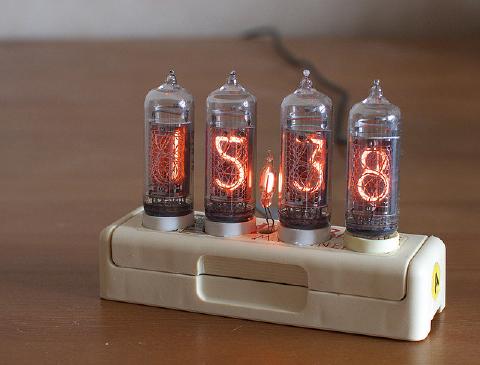
Thanks to svofski for the picture of the nixie tube clock.
Transcript
Ahmed: This is the F-Hour Podcast. Recorded September 16th, 2015. Episode 267. Standing with Ahmed.
Dave Jones: Welcome to the Amp Hour. I'm Dave Jones from the EEV Blog.
Ahmed: And I'm Chris Camel of Contextual Electronics.
Dave Jones: We are guestless. We attempted to have a guest.
Ahmed: We are back. We'll get to the guest later. That's fine.
Dave Jones: Yeah, it was a bit of a goof up. They were at an airport and it wasn't working too well. It's okay.
Ahmed: We'll carry on and we'll announce it at the end. So you're back though. You were just on vacation.
Dave Jones: I am back. Back from the future. Yeah. Or Melbourne. Yep. Same time zone? Yes, it is the same time zone. So yeah. No, I'm doing fine. Cool.
Ahmed: Good.
Dave Jones: Yeah, I've got videos coming out. I went to the electronics exhibition. Show. I don't know what to call it. Show. Exhibition. Conference.
Ahmed: As a guest as well. Not as a presenter this time. So different experience? Same experience? I guess you've gone to the past as not a... Yes, of course I have. ...person, right? Yes.
Dave Jones: Right, so... Every second year in Melbourne. Every year it's in Sydney. I said, well, I've had for the last two times in Sydney, I've had a stand. Right, right. So...
Ahmed: Dave is his own booth, babe.
Dave Jones: Right. Yeah, like it's... Like I can't walk like five meters through the show without somebody stopping me. You know, it's like... It's impossible. Unbelievable. So, too many people recognize me. Oh, yeah. It's terrible. Fame.
Ahmed: Yeah. Yeah, yeah. Really bad.
Dave Jones: No, it's good. Thanks to everyone who came up and said hi.
Ahmed: That's true. I did see some pictures of you and some people at the show, so that's cool.
Dave Jones: Yeah, yeah. They wanted me to sign... Signed oscilloscopes, microcurrents, and all sorts of...
Ahmed: Don't encourage them, folks. Come on. Don't. Don't. All right. Here we go. Got to warm up the... Bring Dave down a peg-o-meter. Right.
Dave Jones: I'm just telling you what happened. It's fun.
Ahmed: That is fun. That's really nice. I mean, that's great to be able to get out and meet people and meet people that... Yeah, it's cool. You know, like put names to faces, all that kind of thing. That's always really nice. Yeah. So, that's good. That's really good. Yeah. Any... I mean, they don't show any... Do they showcase anything new there, or is it kind of just year-to-year similar things?
Dave Jones: No, it's... You know, it's the same, pretty much the same crew every year, you know? Like, yeah, there might be a new scope, or there might be a new, you know, microscope or something like that, or a new pick-and-place machine, but, you know, eh. Yeah. Right, right. Yeah. No, like, you know, if you go every year, you kind of go, well, yeah, I've seen most of it last year, you know?
Ahmed: Right, yeah. It's like going back to the zoo, right?
Dave Jones: Right.
Ahmed: But just because you've seen the polar bears doesn't mean you want to see the polar bears again. No, no, no. Of course not. No, of course not. I mean... I don't know.
Dave Jones: Well, it's the event where everyone gets together, so it's more of a... Yeah. It's more of a social catch-up.
Ahmed: He said it, folks. Dave's a social butterfly now.
Dave Jones: I am a social butterfly. Mm-hmm. Mm-hmm.
Ahmed: Talk about having influence on Dave. Ha-ha. Yeah.
Dave Jones: Anyway, yeah, my big one event a year. That's right. Oh, two if you can't make it fair. Yeah, right. Right. Social butterfly. Yep. That's good.
Ahmed: And... Ah, boy. And then relaxing from your difficult life of spending all day on a forum. I'm sure that was a good break as well.
Dave Jones: Yeah. Yeah, there'd be...
Ahmed: I'm sure you weren't on the forum while you were on vacation at all either.
Dave Jones: I was. I was on the forum while I was on vacation because there were a few forum issues I had to deal with while I was on. So, in the hotel room and dealing with crap.
Ahmed: Yep. Workaholic here, folks. He's a workaholic. Yep. 32 whole hours a week. He is there for you. Yeah. Yeah, right.
Dave Jones: That's probably how much longer I spend at the lab, but yeah. No, it doesn't stop, unfortunately.
Ahmed: Yeah.
Dave Jones: And I'm way behind. You know how you come back and you've got, you know, 300 unread emails and, you know. Yeah. No, I... Well, granted, there were a lot of those emails before I left as well. So, sorry.
Ahmed: Yeah, that happens too. Yeah. But yeah, no, that's tough when you get back. I mean, you got a lot of... I think even just the, you know, like, there is definitely like the admin type stuff. That's always a big deal. But then, you know, even like if you kind of leave off, you ever like walk away from your bench for a while? Even like overnight, you're like walk back and you're like, what the hell was I doing? Yeah, yeah. Every time. Every time. Every morning I walk down here, I'm like, ooh, that's not pretty. And I feel like, you know, like Indiana Jones always finds his hat or it always comes back to him? I feel like it's the opposite of that with like my tweezers. I don't know if that's a good thing. Right. Yeah, no, it is.
Dave Jones: Yep. All sorts of lab. Yeah. Name the lab. Like, I've got like 20 multimeters in this lab. You think I can find one to hand when I need one? No.
Ahmed: Yeah. So, coming back to your bench though, that can be really tough, huh? I mean like...
Dave Jones: Yeah. It's the same. You can leave a project. Like a day is not too bad, but if you leave a project for a week, you're screwed. Yeah. You know, you try and come back to it and it's just, nah, it takes half a day. I mentioned it before.
Ahmed: Yeah.
Dave Jones: Like, just get back up to speed.
Ahmed: You know, organization is not my forte in the first place. Right. I think the best case scenario is like, just try to keep it kind of clear when you go. You know, just try and push one or two things aside. Right. And then, yeah. Yeah. Should be okay.
Dave Jones: And it's... Are you in that thing where you, like, you scan through your unread email list and you go, oh, right, that's from that person. Oh, I know that's going to take me a while to reply because I've got to, you know... Like, so you don't read it, so you put it aside because you know it's going to take time. And, you know, often, like, because you can tell by the person it's from or the subject title or whatever. It's not that you don't want to. It's just that, oh, look, I'll... It's like, I'll do that later. I don't have time to do that. This is going to be an argument.
Ahmed: Right, right, right.
Dave Jones: You know, or it's, no, it's just, you know, some things just require actions on your part. You know, I don't mind having 300 unread emails when I get back. Like, that's fine if I just have to read them and, you know, or send a simple reply to a fan saying, you know, thanks for your support. You know? Yeah, right, right, right. You know, easy, right? But it still takes time. But, yeah, no, when you've got to, you know, if you've got some crisis you've got to deal with or, you know, somebody wants you to do something and, you know, you have to go and, you know, spend 10, 20 minutes just, you know, answering that email.
Ahmed: Right. I have a method for this. I don't know if it'll work for everyone, but it's called, it's a plugin called Boomerang. Have you ever heard about that?
Dave Jones: No.
Ahmed: You should. You're from Australia, right? That's what you guys use to hunt, right?
Dave Jones: Yeah, but does it work on Gmail?
Ahmed: Yeah, yeah, it does. Oh, okay. It's a plugin for Chrome and Firefox. Oh, okay, cool. And I pay like five bucks a month. There's a free version too, but I kind of went past the tier. Right. But basically what you do is you basically like click a button saying, it basically just waits and it sends it back to you. So you see it's from Boomerang and it tags it like that. But it's just really useful because it's like if I get an email from you and I'm like, I don't have to deal with this for two days, I just click send it back in two days. And then the other thing is I can use it for if I don't get it, like if I send you an email and I don't get a response in a week, I can have it send it back to me and remind me Dave hasn't responded yet. And that kind of stuff is really useful for like vendors and for, you know, just especially if you're on a deadline for getting a board out or something like that. Okay. You know, just regular stuff. Yeah, yeah, cool. I really like it. I mean, I don't mean to shill for a product. I'm really, I have no investment in it otherwise. So, but it's fantastic.
Dave Jones: I will check it out.
Ahmed: Yeah.
Dave Jones: Although I must, I must educate you on boomerangs. You yank. Who doesn't know? A very common misconception, actually, boomerangs. You know, like you mentioned the word hunting, right? You know, Aboriginals used to hunt with the boomerangs and, you know, it's true. But they're not returning boomerangs, right? You know, everyone thinks every boomerang returns, right? That's what, you know, you throw it and it comes back to you. And, yeah, you can design boomerangs like that. But the hunting boomerang, they never used returning boomerangs to hunt things. They were, you know, like straight as an arrow so that you could throw it at your, you know, your kangaroo or whatever. Yeah. Well, kind of. Yes. Yeah. In fact, they were shaped kind of similar. If you look at a hunting boomerang, then they're not the traditional boomerang shape. They're kind of, you know, they're sort of, you know, they're a different shape to a returning boomerang, as you'd expect. You know, the aerodynamics are all different.
Ahmed: Well, you know, I bet they started out as returning boomerangs and then, you know, that problem took care of itself. The hunting sharp ones.
Dave Jones: Oh, crap, here it comes. All I can picture is that the kid from, the feral kid from Mad Max, you know, with his stainless, sharp and stainless steel boomerang and chops off the fingers. You know, I've got it.
Ahmed: Yeah. Sorry. But yeah, that is a great, you know, productivity style tool to, you know, kind of make sure you don't miss stuff. So, although the one thing I will say is that usually I have to ask, like, stop myself. Because after I boomerang something to myself, like, five times and I realize that it's an email from, like, you know, two months ago, I'm like, ooh, okay. Right. That's kind of bad.
Dave Jones: Yeah. So, yeah. Have you ever, do you ever get to go through your list and go, oh, like, do you ever set, like, a threshold going, right, that was more than a month ago. I'm just going to delete it. It's like.
Ahmed: Yeah. Oh, I don't, I don't have, like, an official one.
Dave Jones: Because it's just too embarrassing to reply now that it's a month later, you know.
Ahmed: What do they call it? There's, we might have talked about that on the show at one point where someone's like, oh, they call it, oh, it's email bankruptcy. Have you ever heard of that?
Dave Jones: Oh, right. I think I've heard of it. But what is it? Yeah.
Ahmed: We might have mentioned it on here, but yeah, it's when you basically, you go, you're like, well, I've got 2,500 unread emails. Mark them all as read. Yeah. Right. If they need me, they'll call me again. Right.
Dave Jones: Exactly.
Ahmed: Yep. Yeah.
Dave Jones: Yep.
Ahmed: That's rough. I hope I never get to the point where that many people are sending me email.
Dave Jones: So, sorry to everyone who sent me an email and I haven't replied. I do get a lot. Yeah. Yeah.
Ahmed: Well, now that you are back, we have some, some sad news. Not sad. I don't know if it's just, it's messed up, you know. Yeah. The world is messed up. The world is. Yeah. But.
Dave Jones: Yeah. Yeah. I've, I've, I've done a video on this. I'm about to release it straight after the show.
Ahmed: It might make it out before this, for this. Oh, it'll definitely out.
Dave Jones: Yeah. Yeah. It'll be up in the next, it's only three minutes long. So it'll be up in the next.
Ahmed: So we'll try and get that linked in as well. But yeah, so if people don't know, there was a, there was a, this ninth grade kid, he's like 14 or so. 14. Yep. Yeah. Yeah. Ahmed. And, and he built a clock and he took it to school. He's really proud of it. And they called the cops on him. Yep.
Dave Jones: Because it looked like a bomb. Yep. Yeah. You guessed it. If you haven't heard the story, it was all over social. It went viral, it went absolutely viral. Everyone's supporting this kid because, you know, the dumb ass teachers, you know, as I said in my video, at what point does an otherwise intelligent teacher, right? Teachers are supposed to be intelligent, you know, reason, you know, people who can reason things, right? I mean, they're, you know, they, they're supposed to be a, probably a cut above your average person in intelligence. You would, you would hope so anyway. Yeah. I mean, yeah.
Ahmed: I think most of my, most of my teachers I've been very blessed with. Yeah. Sure.
Dave Jones: Maybe I'm going to piss off some people here and go, well, maybe not in Texas where they teach creationism in the public schools. But anyway, let's not go there. I went there, didn't I? Yeah. And anyway, right. They're supposed to, right. And he's English teacher, apparently, like he took it in to show his science or engineering teacher or whatever. And he said, oh yeah, cool. Well, you know, but you know, you probably might not want to show it to the other teachers or something like that, you know, because they're maybe a bit dumb. Perhaps they might not get it. And sure enough, it was in his bag in his English class and it beeped or something. And then they showed it to the teacher and said, oh, look, it's a clock. And the teacher went, you know, I don't know the exact quotes. I'm sort of paraphrasing here. And I'm imagining the situation. Actually, I'm making this up entirely. Almost entirely. Anyway, it was his English teacher. It was my day. It went beep, right? You can watch this guy's video. He actually explains this kid's video, right? He actually, they interviewed him and he explains how it all went down and, and, and he explained, yeah, look, it's a clock, you know, it's, and she went, it looks like a bomb. And he's going, no, no, it's a clock. Look, you know, and then it went to the principal and then the principal had a look at it. Supposedly another rung up the intelligence ladder, right? And the principal went, oh, I don't, I think we'll call the cops, you know, like, come on. Jeez. I mean, surely the average human has enough intelligence.
Ahmed: I make no assumptions.
Dave Jones: I mean, come on, you know, like, and, and he's a nerd. Like, if you take a look at, we'll post a photo of him. He'll, he'll have to be the thumbnail for this episode. Right. There, you know, nerdy looking kid in his NASA t-shirt, you know, we'll put in the photo of him in his handcuffs at the school, in his NASA t-shirt. Right. This is like, you know, he's got nerd written all over him. Right. No, no, a fenced armoured, of course, you know, like, yeah, nerds. No, no. Yeah. That's. Yeah. Yeah. No, no. It's a, it's a, it's a badge of pride. We bestow this honour upon you. Yes. Exactly. Nerd be with you. And like, and, you know, and he says it's a clock and you can clearly, anyone with any intelligence can, knows it's a clock. Right, right.
Ahmed: What I think the other thing too is that there are some, there's some, like, there's a lot of questions about racial undertones as well because he's Muslim.
Dave Jones: There is because he's, his name's Ahmed Mohammed, you know, like, but yeah. Come on, he's a, look at him, he's a nerd. He brought it in. Like, geez, have some, have some pride in your kids and go, wow, that's awesome. Nice work. Bringing that, keep bringing that stuff in.
Ahmed: Where's the encouragement for kids to be creative? Even. Okay, so here's the thing I don't get though. Like, um, the cops came in.
Dave Jones: You don't get why you're, sorry, not going.
Ahmed: What, are you going to say something about America? Go. Well, no, so I don't, the thing I don't get is like the cops keep asking, you try to make a bomb and he says, no, it's a clock. Yeah, I know. No, it's a clock.
Dave Jones: Oh, I know.
Ahmed: I'm sure he showed them how it's a clock. Like, where do they think anything else was in there? I'm looking at the picture of this thing, like, I know it's in a suitcase, but that's just good protection of your project.
Dave Jones: Oh, yeah.
Ahmed: And it's got also this huge display. That's the thing. Like, that's what it's mounted in, right? There's got this huge.
Dave Jones: Yeah, it's mounted in a little case, like a little, um, you know, one of those aluminium cases, you know, one of those little.
Ahmed: That's what they say, too. It looks like, it looks like a movie bomb to me. And it's like, nobody makes bombs that look like that. I think I saw that on Twitter.
Dave Jones: And, like, where's the sticks of dynamite? And, you know, like.
Ahmed: They don't tick. They don't have huge countdown timers. If you want to blow something up, you put a frigging switch in there. You know, it's not like, this is not how it happens. This is, movies are not real life. And, uh.
Dave Jones: And I'm sure this kid has a history of, like, being, like, everyone probably knows he's nerdy or whatever, right? You know, he's a tech nerd. You're coming back to this, huh? You're coming back to this. He's an engineer. And, like, they can't even take that into account. You know? Like, it's just ridiculous. And, as you mentioned, right, the cops overreacting and everything else. If it didn't go as viral as it did, they were probably going to charge him. Right? Because there was all, like. Because I saw this last night before it actually made, you know. Right, before it got to get bigger. Before it went hugely viral. I was going to make this video last night. But I woke up this morning. All of a sudden, yes, here's the president coming in saying, good work, Ahmed. Welcome, you know, come to the White House. Mark Zuckerberg came in and said, good on you, Ahmed. You know, you want to come over to Facebook? You know? Pop on over. I'd love to meet you. And, you know. Anyway, before all that. Yeah, I was reading it as it sort of went live. And the cops were all saying, oh, yeah. We, you know, he may be charged. And all this sort of stuff. And then, no. Once it all hit the fan. And the president came out and defended him. And Hillary Clinton came out and defended him. And everyone, every man and his dog came out and defended him. Then they backed down and said, oh, yeah. No, no, no, sorry. You know? And they apologized. It was like, oh, come on. Well, so, I mean, I think that. So, I think the large.
Ahmed: Yes, we are. Yes, this is bad. But there are, I think, the next line that most people say, there's also worse things going on in the world. And this is, you know, this is. I think this is sad for maybe. I think the things that I feel about this are. I wish there was better education. We've said this also when we're, when we talk about going through security with our projects, stuff like that, that we talk about that kind of thing. You know, hoping that people don't make these assumptions about that stuff. But, yeah, I think it comes down to just education and then trust and everything else. So, I think the. Yeah.
Dave Jones: Common sense. I mean, geez, good old-fashioned common sense. As I mentioned in the video, the problem is we live in a culture of fear. Right? Everyone's, you know. That is true. Everyone's scared. Right? Everyone's scared of the boogeyman.
Ahmed: Right. And I totally agree about that, Dave. I'm saying what we can talk about is an electronics podcast. That's what I mean. Like, yes. Yeah, I know. I know. Anyway. There's always going to be fear and stuff like that, though. And I think that actually there. So, I saw Mike over on Hackaday wrote about NYC Resistor is doing some things about building clocks and posting them online, just stuff like that. Right. But it's a good opportunity as well for, you know, people to show that this is, you know, things that people do, that's a good hobby. It's good that they're encouraging Ahmed and kids like him. I mean, that's, I think, turning this into a positive thing. It could have gone a lot worse.
Dave Jones: Oh, no, no, no. Totally. In the end, it's an excellent result. Right? Right. But I just, you know, it just makes me angry that our society is in such a state that it even, that it happened. Right? But really good stuff came out of it, you know. Yeah, exactly.
Ahmed: And I think that's, and that's, going forwards, that's the thing to focus on and, you know, hope for the best on. I mean, if there's racial undertones, I mean, that's, I don't even know how to deal with that stuff.
Dave Jones: Oh, well, no, no, just the common sense. We need to, just from a common sense point of view of dragging society back out of the post-9-11 fear era, right? And just, you know, like common sense, let's just, you know, don't worry about shit like this. Don't be, you know, don't always assume the worst. Just, you know, look, nerdy kid brings in a clock project. And he said it's a clock project. He clearly said it's a clock project.
Ahmed: Yeah, I don't think there's anything, like literally nothing we could do about that. But I think people, things people can do in our listening audience are, you know, like showing support, like building the clocks online, you know, posting pictures, that kind of stuff. That's also a good opportunity to show that people are doing interesting things with technology. It's, you know, again, it's taking advantage of a bad situation. Exactly. And hopefully more.
Dave Jones: And using it to change people's mindsets.
Ahmed: Change people's mindsets, but also encourage other, you know, kids to come into the field as well. I think that's also an interesting opportunity. Oh, yeah.
Dave Jones: Well, hopefully other kids will say, oh, look, he's been invited to the White House. Oh, he's been invited to Facebook. Look at this. People are, you know. This kid's a celebrity now. It's fantastic. All he did was build a clock and now he's a celebrity. It's terrific. Right? And hopefully other kids will see that, oh, maybe I can do something creative too, you know. Like, hopefully.
Ahmed: Hopefully. Yeah. So that's hopeful.
Dave Jones: That's how society changes. The world is what you make it.
Ahmed: Yes.
Dave Jones: And, yeah. Thankfully, a good thing came out of this. Yeah.
Ahmed: And, I mean, if you watch the videos, the kid is pretty level-headed and he looked confused on why everything was happening for sure.
Dave Jones: I saw the first interview with him that the newspaper did with him. And, yeah, he was, you know, like, yeah, like bamboozled, you know, kind of. As you would be. 14-year-old kid, you know. Like, he was just.
Ahmed: Yeah.
Dave Jones: Yep. And now he's, yeah, he's really quite well-spoken now. Sounds good. Cool. Big future for Ahmed. Good on you, Ahmed. I wonder if he listens to the Amp Hour or watches the EUV blog. Oh, my God.
Ahmed: If he does or if anyone knows him and he does, that would be. Yeah. Let us know. Excellent. Yep.
Dave Jones: Anyway, so that was, yeah, that was all the to-do today. That was a lot of, yeah. The last 24 hours. What else have we got on the list? We have no, we prepared even less for this episode than what we did for our regular episodes, which is saying something, because we thought we'd have a guest on today. So we just didn't prompt you so. So what else have we got?
Ahmed: Well, none on the list, but I just got back from XOXO.
Dave Jones: What is XOXO? Yeah, exactly. You tweeted. I saw you were quite excited. There was some band playing or something. Oh, my God, yeah. Like, straight over my head. Zoom.
Ahmed: What? Yeah. So it was, I don't even remember how I heard about it. It was really weird. I think it was because they're opening a new space, like a design slash tech space in Portland. And I think that's actually what got me interested in this. Who is they? So Andy and Andy, the guys that started it. So they've been doing this conference for four years now, and now they're opening a big space or they're taking over a big space or something like that.
Dave Jones: And what is this conference? You still haven't told us.
Ahmed: Right. So the conference itself, which has been, this is its fourth year. It's meant for people that are doing, the tagline is people doing art and technology online to make a living. Right. And so I...
Dave Jones: Why is it called XOXO?
Ahmed: You know, I didn't ask that. I think, I mean, that's like how people used to sign letters, like hugs and kisses. But I don't know if that's actually what the... I should really find that out, huh?
Dave Jones: You should, yeah.
Ahmed: Yeah. It doesn't really matter, though. You can call it like, you know...
Dave Jones: Anyway, so it's some conference thing.
Ahmed: Donkey taco stand or something. Like, you know, I don't care. Like, eventually it takes on its own meeting, that kind of thing. I don't know. It was a terrible example. Right. But yeah. And so it was actually really interesting. So some of the speakers were like Heather... Crap, I forget her last name. She was... Her blog was deuce.com. She was one of the first mommy bloggers. And so she got fired from blogging and do this other stuff. But it was really interesting. Her talk was about, like, sponsored content, right? So, like, if someone... Oh, God. You don't do sponsored content. Sponsored content. Right? But a lot of the...
Dave Jones: I get bombarded every day with requests for sponsored content.
Ahmed: Right. And that would be like if Dave... Like, Dave always does reviews on oscilloscopes that are, like, independent, right? They send them the gear, but it's never for money. It's never, like, that kind of thing. And that's what a lot of these sites are doing. A lot of blogs for a while were doing that because that was kind of the only place to get money anymore. Like, banner ads were drying up, stuff like that. So, anyway, she had this ridiculous story about just, like, how that was... She's stopping all content. And she basically... This ridiculous story she told was the reason that now every sponsored content story has to be checked by the sponsor. Right? And you can imagine that if we...
Dave Jones: Yeah, yeah, yeah.
Ahmed: You know, so we've had sponsors for the show before, but we were never like, well, we're going to be talking about Ahmed this week. How do you feel about that? Do you approve of the show? Right? That would be... You're right. You're right. That's a big deal. And, you know, when you think about, you know, obviously this is a podcast. We don't do funding anymore, but... Well, we have our Patreon page, which we are very thankful for, for all of our people. And that's what keeps it free and stuff like that. But anytime there's an advertiser involved, there's always that line. And it seems like the sponsored content one just got her kind of over the line. So she's not doing it anymore. And it just, like, all of these talks were just really... So the Gamergate... So Zoe from one of the women that was affected by Gamergate... I mean, we didn't talk about that on here, but that was a bunch of nastiness online. And I'll let people look that up if they want to. It was just... I just... It was just... Don't, don't, people.
Dave Jones: It'll, it'll... Well, I mean, for... Don't, don't go down the rabbit. Don't go down the Gamergate rabbit hole.
Ahmed: Yeah, I mean, it's... But it, but it, it is important online because of harassment and misogyny and stuff like that. I mean, it's stuff that experienced, that happens in the electronics industry. It happens in every industry, I think. And, um...
Dave Jones: It was overblown on both sides.
Ahmed: So... I don't know, man. Well, anyways, I agree. I don't want to get into it either, but, uh, it, it was... You know, so I heard someone speak about her, right? And she was very, very deeply affected. And, and, like, kind of all of these talks, they're just really... I mean, they were really personal. And actually, it was really weird for me to be at a conference that was so... I mean, it was, it was quite emotional for me. And, uh, it was...
Dave Jones: Oh, I hate those. No.
Ahmed: I, no, I know, right? And, but, like... Yeah. I mean, just so good, too. That's the other thing, like... And I think that's why the conference has so many people that just want to keep going back to the point where I had, I had to apply to go to the conference, which was really different. Um, and, and so I did. And I luckily got in, I think because of this podcast. This is my... Oh, right. This is my artsy thing, Dave. Talking to you every week is artsy. But, uh... But it was great. I get to meet some great people. I met someone who might be a guest on the show in the future. And it was a lot of people that were, like, kind of more on the website, it felt like. You know, they were mostly, like, a lot of designers, stuff like that. Because they, you know, they are a lot of, you know, a lot of people that are working as freelancers. But, you know, the interesting thing about it, and the thing that I think is relevant to a lot of people here, is that a lot... Everyone there was basically kind of working on their own, right? So they're all kind of independent contractors. And, you know, you're like that, and I'm partially like that. I used to be like that more. And, you know, and I think... But I think that's the... We've talked about in the past that that kind of feels like the future of work, right? You know, working on your own. Maybe you're going to be, you know, federated and working together. Like, together, you know, you and I might join up for a project here, but then it's not like we're starting a company. We're just starting on one thing, little partnerships, and here and there, and, you know, trying a bunch of different things, and having, you know, four different jobs. That's kind of the... That was kind of one of the threads.
Dave Jones: Yeah, but it's not the future. It's a part of the future. I agree with that. Not everyone can work for themselves, you know. Right, but it's increasing. But the world just doesn't work like that. Oh, yeah, no, totally.
Ahmed: It's increasing, for sure. And I think that more and more people... I mean, obviously, some of our listeners, our guests are already like that, right? I mean, we just had Mike Osman on, what, a week or two ago, and Ron, who was on last week when you weren't here. I mean, like, we've had people that are consultants and working on your own. I mean, you don't know this. It's tough, right? You're kind of out there, and there's a lot of uncertainty, and there's failures involved and stuff like that. And if I was going to characterize a conference, it would be kind of working through some of those issues. And there was a lot of other stuff associated with, you know...
Dave Jones: Interesting.
Ahmed: Yeah. So, I mean, honestly, it was the best conference I've ever been to. Oh, big call. Oh, yeah. I mean, yeah. I mean, I don't go to conferences like that normally, and it was way out of my comfort level. But, yeah, it was really good. So, the way I got around it, if you saw any pictures on Twitter, I laser-cut the logo, and then I replaced my Iron Man badge. I, like...
Dave Jones: Oh, right.
Ahmed: I took the LED backing from my Iron Man badge that I used for Halloween last year, and then I actually moved it out a little bit to get better diffusion, and then I switched it out so I had a...
Dave Jones: I didn't see that.
Ahmed: Oh, no? I can... I'll post a picture of it as well. I don't know if I actually posted the whole thing. It's actually... It's really janky. It's all held together with a solo cup, and... But it had this really nice warm, like, glow to it. I had, like, a... You know, like, a breathing kind of thing. So, at night, I would switch it on, and I'd have this, like, breathing logo that was attached to my conference badge. Oh, right. And, uh...
Dave Jones: Oh, yeah. Here we go. Got it. Right. Oh, you got it?
Ahmed: Okay. Yeah, yeah. And, I mean, it was really... It was good because it kind of... I mean, I got some sideways looks of, like, what the hell's up with that guy? Yeah, yeah, yeah. But it was great because the ones who were like, what is that? You know, they kind of like the tone of, like, I want to talk about electronics, and I'm like, I want to talk to you. So, you know, it's like an any... At any nerd beat up, too, right? I mean, when we're kind of nervous, it's so much easier when you have a project there, and people are just like... Yeah, yeah, yeah.
Dave Jones: It totally breaks the ice. Yeah.
Ahmed: It's not like, tell me about yourself. It's like, what does that thing do? And then you get to be like, and this is how I did it. So... Yep. So I do recommend that, actually. I mean, it... Blinkies are obviously very, uh... Very, uh... Obvious, right? That kind of grabs a lot of attention and stuff like that, but... Uh... Yeah, it's like kind of... It's kind of like... It's kind of like the positive outcome of, like, bringing a clock to school, you know? Like, more people wanting to talk to you. Ugh. Very true. But obviously, you know, like, it's that same kind of thing where it is getting attention, but it's hopefully for a positive outcome, right? And that's what I'm going to do with this teacher, I'm sure, but... Yeah. Anyways, um... So yeah, really... Like, really kind of a... Like, emotionally raw conference. Like, I'm not normally like that, but...
Dave Jones: Yeah, no. Yeah, see, if I knew it was something like that, I probably wouldn't go.
Ahmed: Yeah. Oh, well... Yeah, and I wonder about that. I don't know. I don't know. I don't know if... I mean, I knew it was going to be like that. You can see all the past talks online, stuff like that, so... Okay, right. I'll post a link to those, too.
Dave Jones: I'm still thinking about running the camp here.
Ahmed: Oh, cool. Yeah, good.
Dave Jones: Yeah, yeah. I've got a few ideas.
Ahmed: Good, good.
Dave Jones: Yeah.
Ahmed: Yeah, so I don't know if you'd want to do it super... And that's the other thing I was thinking about. Like, I don't know if it would work for a more hardware-y kind of conference, right? There's not as many... It's not like I'm emotional about...
Dave Jones: No, nobody wants to go... Oh, no, it wasn't like that. This was the greatest thing I've ever done in my life, this project. And, oh, it changed my life totally. You know, like, nobody wants to hear that shit. Well, no, I did actually do that.
Ahmed: Show us the hardware, you know? I mean, yeah, I want to see the hardware, but I mean, like, so much of... I mean, like, you know this, too. Like, so much of what we do, even as independent people, right?
Dave Jones: Yeah.
Ahmed: So much of it isn't hands-on hardware, unfortunately. I mean, like, that's what we like. That's the fun part. But, like, it's not, right? It's dealing with people. It's dealing with setbacks, stuff like that, so...
Dave Jones: Oh, people love that sort of, you know, people love the real-life story. You know, people love a good backstory of, you know, getting things done or whatever. But, yeah, but not all the soppy part of it. Yeah, I mean, there was some... I don't think that'd go down well at a tech conference.
Ahmed: Well, I wonder. Yeah, I wonder. And I think that, you know, like, XOXO, the one I went to, I think that was, you know, definitely self-selecting, people that knew that kind of thing. Yeah, yeah. I think if you... If you, like, I met some really great people and people that were... You know, that's the other thing, too. That's the other reason I really wanted to go is to get outside my sphere. I mean, like, I love going to Maker Faires. I love going to all the other tech events we have, like the meetups I go to in San Francisco, stuff like that. But, you know, it's really different, you know? And if you want to meet people that are outside your sphere and, you know, start a new thing... I mean, like, if you want to, like, meet arts... If I wanted to meet artsy people, right? I can meet artsy people that are happening to be going to electronics things. But... Yep. It's probably a lower likelihood and probably the ones that really need help that from someone like me would be, you know, not going to an electronics thing. So... Totally. So, yeah. Weird, but awesome. Really awesome.
Dave Jones: Right.
Ahmed: And I will... I'll keep an eye out for when the talks from this year are posted. They all posted on YouTube. And they're pretty good. So...
Dave Jones: All right. What's this about? Who invests in hardware startups? You put this on here.
Ahmed: Yes. That is a Bolt article. Can I say one more thing about conferences?
Dave Jones: You may say one more thing about conferences.
Ahmed: I am planning a conference. No. Along with... Along with the Hackaday folks. And it's going to be in November. So... Keep an ear to the ground. It's not going to be... It's going to be in San Francisco. It's not going to be big. It's going to be limited registration. So if there's people out there... Ooh. It's... Exclusive.
Dave Jones: Will there be exclusive passes for Ampower listeners? Probably not. We might... God, jeez. You can't even swing that.
Ahmed: We might do the application thing, though. So...
Dave Jones: Ooh, you've got to apply.
Ahmed: Right. Well, I mean, like, that's the limit kind of thing.
Dave Jones: May I have more?
Ahmed: Yeah. It'll be... It won't be... It'll be low cost. So I think it's going to be good. It's going to be good. And also, we're going to be putting out a call for speakers at some point. So keep an eye out for that as well. If people are interested in taking part, it's definitely going to be like... It's going to be a low enough... It's not going to be a huge thing. A huge number of people. So it's not going to be like, you know, in front of the stadium or something. But, you know, there's a lot of good people in our audience. And I think there are a lot of them are Hackaday fans as well. So it'll be part of the thing.
Dave Jones: So we don't get a big stadium event where you... And here's Christopher Gamble to throw the opening pitch. Yeah, right, right.
Ahmed: Dave, it'll be that when you finally come back to the States, then we'll get the other stadium for you. Okay?
Dave Jones: Okay. Right. Okay. Awesome. Yeah. And five people will show up. Woo-hoo! Yeah. Yay! Yay! Yay!
Ahmed: Love it. Yeah. So, yeah. Hardware startups. This is actually a really good article. This is Chris from Bolt, who I've met before. He's a really cool guy. Interesting. Actually, I was more interested than the people investing. It's just like you don't really hear about the startups, really. You know what I mean? Like, you hear about some of them, but not a lot of them.
Dave Jones: Yeah, yeah. No, most of them go... 99% of them go under the radar.
Ahmed: Right, right. And also, because it's that weird crossover. Like, so many of these I just haven't heard of. Like, there's some big ones on here. Like, Sphero. You see that BB-8 thing?
Dave Jones: Oh, yes, right. Yeah, yeah. I didn't know they were a startup.
Ahmed: Well, they've been around for a while. I mean, they... Yeah. I mean, they've... Right. They've been growing, for sure. But...
Dave Jones: It's the new robot from Star Wars, if people don't know. Oh, it's that little ball.
Ahmed: Yeah. Yep. So, I got to... Did I tell you I had to see one?
Dave Jones: Yes. Alicia did that, didn't she?
Ahmed: Yeah, she gave a talk at that event.
Dave Jones: So, did she work for them, or what? What's the...
Ahmed: No, she was just... She was so excited. She ran out and bought them right away, and then her and Chris, her husband, other... Chris and Alicia both from Embedded.
Dave Jones: Oh, so you can buy this thing, can you?
Ahmed: You could. And that's the thing. I told her, I was like, if you get an inside scoop on when they're showing up again... So, it was just like an early run was out on Amazon.
Dave Jones: Oh, right. Okay.
Ahmed: Dude, these things are going to sell out so fast. Like, can you imagine the Christmas crowd? Like, oh.
Dave Jones: Yeah, yeah, yeah. It's a small thing, though. It's not like a full-size BB-8, right? No.
Ahmed: I mean, and they're $150 for that. You know, so if people have seen a Sphero before, it looks like it's a little bit bigger than like an 8-ball, you know, like a tool 8-ball kind of thing. So, it's not huge, but then it's got the little magnetic thing. And I was thinking about it. I meant to go back and listen. You and I were arguing about how they did that, because they copied the technology that they have in the movie.
Dave Jones: You're right. Yep.
Ahmed: And I think you were wrong.
Dave Jones: What? I was wrong about what?
Ahmed: About how they did it.
Dave Jones: Well, I don't even remember what I said. I don't either. That's the problem.
Ahmed: But I think you were wrong.
Dave Jones: I don't remember which episode we mentioned it.
Ahmed: Yeah, I know. It was whenever that came. We could probably go look it up, but whatever. Right. So, yeah, that thing is awesome. Cool.
Dave Jones: So, it's cooler than what I, it's more complicated than what I said, or it's simpler than what I said, or what?
Ahmed: Yeah, I just remember it being how I expected it to be. And I remember you said, no, that's not how it is. This is really good radio. Right, yeah, yeah. And next, Chris will remember all the things he doesn't remember about calculus. I can tell you now,
Dave Jones: I remember nothing about calculus.
Ahmed: Yeah, right. Don't even ask me. Slope of the line is the, derivative is the slope of the line.
Dave Jones: Actually, I'm looking at this, I am looking at this article, and it's like a huge infographic kind of thing of what VC company has invested in what companies.
Ahmed: Right, exactly. And you kind of see where the different areas are, of who's investing in what, and stuff like that. So, yeah, that is interesting, because I saw the SK Ventures as the one where they're just doing robots, basically. Robots and drones.
Dave Jones: Yes, and one other thing which will remain nameless.
Ahmed: SK Ventures?
Dave Jones: That I'm battling at the moment. Yep.
Ahmed: Which one are you talking about?
Dave Jones: The one that's caused all the big to-do. And I've done several videos on. They're behind that. Oh my God, that's them? Yep, yep. No freaking way. Yes. I didn't know they're venture-backed. Oh, well, no, sorry. Well, I don't know. It's SK Telecom. I don't know if they're associated with SK Ventures.
Ahmed: I mean, dude, SK is pretty big, so.
Dave Jones: Right. Okay. Well, maybe they're not the same company in that case. Okay. But it's SK Telecom who are behind back in the company who Sharon made nameless.
Ahmed: The stupid B-word.
Dave Jones: Yep, yep, yep. Yeah. Okay. So, yeah, so I'm not sure if they're the same. Anyway, there you go.
Ahmed: Okay. All right. That was pointless. So, yeah. But, yeah, it's interesting.
Dave Jones: Wow, there's so many of these companies. Right.
Ahmed: And the crazy thing is you keep sliding down, too. And so the top ones are, like, just the little guys. And the bottom ones are traditional, so they're kind of bigger. Right? But then the thing you don't even realize is that when you get to the bottom, there's, like, this doesn't include, like, the accelerators, which is, like, Hacks, which is formerly Hackscelerator. Right, right. Highway 1, Alpha Lab, Techstar, Y Combinator. Right. Yeah, right. So, like.
Dave Jones: It doesn't even include them. This is just, like, the top tier venture capital firms, right? So. You know, Google, Qualcomm, you know, like, you know. One's on it. Like, I've never heard of most of them. I have no idea.
Ahmed: You know, like. But that's the point. Like, you and I are, like, who cares for us, right? I mean, like. I mean, I know some of the actual companies, but not the other ones. Like, Foundry Group, I know that one. Right. Yeah.
Dave Jones: Yeah, no, I don't know 95% of them.
Ahmed: Yeah, the interesting thing I think that would be for this is, like, if you're not using. If you're not going to, like, a Bolt, right? If you're. Like, so Bolt's great. I love the Bolt people. If you're not. You know, if you're not going to a program like that where you get those introductions, if you wanted to try and do it on your own, I guess you could do that. But, ugh, my God.
Dave Jones: Yeah, no, no. There's just so many of them. It would take you months and months of research just to find out who's who. You know?
Ahmed: Yeah. And, well, yeah. I just. I don't. So dumb. Like, I get it. Like, I get that, like, you need money more so in Harvard than anything else. But, man, I cannot imagine doing that kind of thing. And I think that we must have had a couple guests that have done that. And I'm sure our guest next week can tell us all about that. Yeah. And we'll announce who that is at the end of the show. Yeah. And. But, man, I do not envy anyone. Like. And, actually, well, I guess we've had Aureos on here, right? So. Yeah, yeah. Whatever the hell their thing's called. The squirty printer circuit thingy. Yeah. Sorry. But, yeah, I talked to him at one point. He's like, yeah, you know, like, it's just so hard. If you want to keep being an engineer, you don't get to go hunting for money. If you want to be in charge, you've got to go hunt for the money, you know? And it's like.
Dave Jones: Yeah, yeah. That's it.
Ahmed: That sucks. Like, that really sucks.
Dave Jones: Yeah, I don't know. It takes a certain kind of person to want to do that. But that's all that, you know, that people seem to be interested in these days. People, you know, think that's the only avenue. Oh, I've got to go through all this.
Ahmed: Yeah.
Dave Jones: VC crap. Oh, I've got to get a million. If I don't get a million dollars, I'm a failure, you know?
Ahmed: Oh, well, that's on them.
Dave Jones: You know, how about putting a K in and just building, you know, a K of your own money in and building a couple of things and just bootstrapping it. Yeah, some of these. I mean, for some of these things. I keep crapping on about that. But it's just so boring now. Every single bloody startup hardware company is getting a million dollars for this.
Ahmed: The things that I would imagine, like the times when it's good to get money and go big, is like, you know, if you need to get like volume, right? If you think you're actually going to sell a bunch or if you actually do sell a bunch, maybe on, you know, somewhere on crowdfunding. Yeah, yeah. Then you want some money up front so you can actually go buy a bunch of parts at a decent price versus building onesie twosie. But the other one would be if you're building something really big, right? So if you're like some of these robot companies, like, you know, robots are not cheap. Okay. No, no, no. Exactly. So.
Dave Jones: Yeah.
Ahmed: Yep. I just don't. I mean, these, not necessarily these, but some, you know, just like some startups. I'm like, if you go to, who was, oh, actually Bryce, one of the VCs that used to be at OATV, which is listed here, he's doing something called Indie.VC. And he gave a talk and he's like, he was talking about the success rate of like, you know, the billion dollar companies and stuff like that being 0.06 or 7% per year or something ridiculous like that. What I really wonder about is not, not the numbers there. Like some of the things where they're just like, they look at something like, oh yeah, this social dog app is a billion dollar company.
Dave Jones: Yeah. It's like, just go away. Yeah, I know. I know.
Ahmed: Yeah.
Dave Jones: One I see on here, which I'm surprised to see is OpenROV, which I've done a video on them before. I've been, I've talked to the OpenROV, well, someone from OpenROV. Right. Sorry, I forget your name.
Ahmed: David Lang and company, right?
Dave Jones: Uh, that's not who I spoke to. But anyway, yeah, they, they do like an open source underwater. Yeah.
Ahmed: And they just raised a big Kickstarter too. They just put out a new one. Yeah.
Dave Jones: Oh, I didn't know about the new one. Okay. Right. But they've got, you know, they're being backed by SK Ventures and, you know, hmm.
Ahmed: What's the problem? I don't get it. I don't know. I just thought. What's the market for underwater robots?
Dave Jones: No, I, I, I didn't think it was a company, so to speak. I just thought it was like a couple of, you know, hackers getting together, just making this open source ROV. I didn't know they were, you know, sort of taking it seriously as a company and out there scouting for funding and all that sort of jazz. You know, I just.
Ahmed: That's how it starts, man. That's. That's how it starts. Yeah.
Dave Jones: But that's, that's, yeah, that's not the impression that I got. Right. That they were going after that. I didn't, you know.
Ahmed: Oh. Anyway. They didn't hit you up for dough? No. They didn't. Dave, would you like to invest? Right.
Dave Jones: Hey. Right. If, if, if you had. If I had. Tens of millions. If I had tens of millions? If you had tens, would you. Wouldn't be talking to you. Right. Yeah. Would you be investing in. Would you be tempted to invest in tech startups?
Ahmed: No, I don't know. That's, that's a pretty big theoretical because I'm never getting there, buddy.
Dave Jones: Right. No, but yeah. I've read about other people.
Ahmed: It's an interesting talking point, right? I think people talk about paying it forwards, you know, like they're like, oh, well, this is how I got here. And I think that's legit. I don't want, I wouldn't want to hassle.
Dave Jones: I think it comes down to statistics in the end. I mean, you know, if you think you can pick a winner, if you think you can pick Facebook, you know, and, and whatever, it's like, it's bullshit. You got lucky. Right. Right.
Ahmed: But, but if I was like angel, like you're talking about angel investing and I, this is, this has to be the last thing we talk about investing. Cause I'm sure people are gagging themselves right now. Yeah. If I was an angel, which is the early ones where you're actually given money directly, like I would just do things that I think are cool and I want to support. Right. It's like Kickstarter with tens of thousands of dollars at a time. Right. Yeah. Yeah.
Dave Jones: You wouldn't try and pick a winner. Right. You wouldn't try and pick a winner. You do it to make connections.
Ahmed: You make friends. You find new projects that kind of like that's, and that's really a best case scenario. I think that's what I would, I would think in a best case scenario.
Dave Jones: I would be doing that too. I wouldn't try and pick a winner. Right.
Ahmed: And.
Dave Jones: Yeah.
Ahmed: Who cares? We're never getting there, Dave. Come on. Yeah. Maybe you. Not me. Yeah.
Dave Jones: Well, I, I buy lottery tickets and you don't. So I have a chance. That's true. That's true. Yeah. There it is, folks. There it is. You literally will never get there. Yeah. Yeah. Yeah. Unless you take somebody's money and do your own startup.
Ahmed: Yeah. You know.
Dave Jones: So can you ever see yourself doing that? Are you that kind of person who would go down that route or what?
Ahmed: Oh, I don't know, Dave.
Dave Jones: I mean, come on. You've, you've kind of just like me, right? You come up with a million ideas, right? Ideas are a dime a dozen.
Ahmed: Well, I stopped Bryce and I talked to him a little bit after his talk and I wanted to mention it. Like, and I just wanted to ask him some things and stuff like that. And I mentioned him that, you know, I thought about it with contextual electronics for a little while and then I'm like, eh. Oh, really? You, you, you thought about getting funding for that? Well, for like a split second, but then I'm like. Right. I mean, that's not like something that I don't want to give it away, you know? Like I don't want to just.
Dave Jones: Right, right. It was too. Yeah, yeah.
Ahmed: I'm doing it for me and to help people. Like, and like, you know, like you lose control, man. It's gone.
Dave Jones: Oh yeah, no, no, totally. It's gone. Yeah. So. No, as soon as you take money, it's gone.
Ahmed: Yeah. So it's, I mean, it's, it's not always a bad story, but it's, you know, I just don't think I'm cut out for that right now. And maybe. Right. Maybe someday if I, I don't think so. Right.
Dave Jones: Yeah. I can't see myself either, but you know, I'm not going to say never, but you know, like it'd have to be an idea that I wanted to turn into a business. It wouldn't be one of my own, like it'd have to be sort of almost deliberate decision to go, oh yeah. Yeah.
Ahmed: So like if, if there was like something where like, you know, a project you think is really going to help the world and you need dough, then maybe. Okay.
Dave Jones: And I can't see myself doing it on my own. I would, it'd probably have to team up with somebody else who wanted to drive it because, you know, I, I wouldn't be able to drive the thing. I, you know, cause like, cause I wouldn't give up my blog, which is probably what I'd have to do. Or I'd have to give up my blog for six months to try and, you know, devote full time to something like that. You can't just do it on the side and think that, you know, somebody is just going to hand you money. It's like, you know, you, everyone we've spoken to, it's like, oh yeah, we've, you know, worked our ass off for, you know, 12 months trying to get somebody to fund us, you know?
Ahmed: Yeah, man.
Dave Jones: Doesn't just happen. So you, you need more than just an idea. No one's going to give you money for an idea.
Ahmed: Right.
Dave Jones: You got to do the hard yards. So.
Ahmed: Ah, let's talk about more ideas.
Dave Jones: Oh, great.
Ahmed: What? I don't know.
Dave Jones: Come on. You just raised it. You must've had something.
Ahmed: I'm just trying to get you off of the investment stuff. Cause we don't know what we're talking about. It's over. You're the one who keeps bringing it up. Well, I'm looking at these, these, I posted this thing about Argon produced the breakthrough and the Mott transition. And then I was like rereading it again. That's an article that I posted. And I'm like, oh, this is, this is probably important. And then I'm like, what's a Mott transition again? No. Yeah.
Dave Jones: I get it. It rings the bell, but yeah, I'd get, I'd have to go.
Ahmed: Google it. I think it's something with the, uh, the, uh, flash, the, I don't really know.
Dave Jones: I, yeah, no, sorry. When we are not semiconductor physics. Right. No.
Ahmed: Yeah.
Dave Jones: Yeah. Everyone was screaming at us.
Ahmed: Right. Right. Right. Did you see the thing about Danaher or our old pals?
Dave Jones: I just clicked on that. Yeah. They're splitting their science and manufacturing businesses to milk even more money from the moo, moo, that cash cow using their Danaher business system. Yeah.
Ahmed: Oh yeah. Mm-hmm. Mm-hmm. Delicious. Delicious.
Dave Jones: So who are they splitting off? Does this affect like, uh, tech and fluke and. Yeah.
Ahmed: Like they're all kind of on their own now. Oh, right. Okay. Yeah. So no, it's actually probably a good thing.
Dave Jones: They're owned by, does that mean what Danaher's selling them or what? Oh, what? No, no, no.
Ahmed: They're just going to go as different companies.
Dave Jones: Oh, whoop-dee-freaking-doo.
Dave Jones: It's like Googler now. What do they call themselves? Alphabet. Yeah. That's right. Yeah. Or some crap like that. You know? Like who cares, right?
Ahmed: Yeah.
Dave Jones: It's still Google. Right? No one cares. Yeah.
Ahmed: Yep. Okay. Next. Uh, did you see this basic MIPS simulation in JavaScript? I, uh, I did not.
Dave Jones: Is there a point to doing a MIPS simulation in JavaScript? I mean, it's just. You don't need any hardware. I mean. It's cool.
Ahmed: I mean, no, it's just for school. And you learn more about the MIPS processor, stuff like that. Right. And, uh, well, it's.
Dave Jones: Very cool.
Ahmed: And techie. If your processor blows off, right? And you just, it's not like your hardware doesn't come back. Your reset is hitting the reload button in the browser.
Dave Jones: I'll just go and put my opcodes into my MIPS JavaScript simulator. And, hey. It seems kind of weird, right? More fun than a barrel of monkeys. I know.
Ahmed: But no, it's good. I mean, it's, it's. I don't know. I mean.
Dave Jones: It's fine. I.
Ahmed: I wonder about this stuff too, because like, you know, I've been doing robotics project for a little while now and we're going like low, low level, you know, it's still C, but it's, you know, it's low power, low everything. Right. And I've been thinking about it like, like, like I want to do that just for the, uh, just for the learning side of it. Right. But if I was.
Dave Jones: I used to do that. I wrote my own, uh, compiler once. It was like, you know, back when I was more of a software, I was going through a software phase, you know, and why did I, I don't know, sound like fun at the time, you know? Uh-uh.
Ahmed: Yeah. Yeah. Uh, well, like these days, would you really bother? I mean, like, I mean, I guess it depends on where the robot is, right? So if you're building like a, so Alicia went over the BB-8, right? It has like an STM 32 on there. And I forget what the F something number was, like maybe a 400, something like that. You know, it was pretty beefy, but that's like a consumer level device. So maybe if you're at that point, you would, you know, use the low level, but like so many things these days, if I was building like a robot robot, you know, like something that needed vision and everything else like that. Yeah. I think a lot of people are just going to, I think increasingly when I, what I wonder, what I'm really getting to here is, you know, so this is assembly, right? And it's important to know for people to know assembly so that they can, you know, deconstruct their code and understand what's going on and troubleshoot and stuff like that. Like, but other than like the low power stuff, I mean, like for like a lot of stuff these days, people are just going to be throwing horsepower at it.
Dave Jones: Like you got to, of course you are. You got to throw horsepower at it. It's like shocking. As a, as a, as practical design engineers, that's, you know, that's something that we do and we shouldn't be ashamed of doing that. It's, you know, if it's the right tool for the job, it's the right tool for the job. Right. And it doesn't have to be the coolest tool for the job. You know, it doesn't have to be the hardest core tool for the job. Right. It's, it's engineering is about using the, using the most practical method.
Speaker ?: Yeah.
Dave Jones: There's always going to be trade-offs, right?
Ahmed: Because even if you're using a high level processor, you're going to have to still deal with power and everything else. Right. So yeah. And there's cost and whatever else you're doing there.
Dave Jones: Yeah. But like assembly and people have to remember, assembler is not magic. Right. People think, oh, I'll do it in assembler and it's going to be 10 times faster and it's going to be lower power, blah, blah, blah. Bullshit. Right. A good compiler will, will beat a crappy assembler programmer any day of the week, any day of the week. Right. Just because you wrote it in assembler does not mean it's efficient. Right. Right. Right. Right. If you're a, you're a crap assembler programmer, you know, garbage in, garbage out.
Ahmed: Right.
Dave Jones: Right. It's not magic. It's not a magic bullet.
Ahmed: I think, I think that it's kind of like one of those asymptotic things where you're kind of like, if you're going towards trying to get squeezed more and more and more out of the same part, that's when you have to really, you know, start digging in there. Like, like, yeah, you're right. Most assemblers will get you to the, or compilers rather, will get you the most, most of the way. Yeah.
Dave Jones: I can, yeah. I can remember doing that, you know, doing pick everything in pick assembler because, you know, back then it was like, oh yeah, a, a, a one K pick was like standard. Right. It had one K of flash memory and well, you know, like, yeah, if you try and do something in C, well, you've pissed away most of that. Yeah. Right. Just with, just with overhead. Right. So yeah, you have to do it. And there was like, oh, you know, I was coding this thing and in assembler and oh yeah, right. There's two program words left. Woohoo. Winner. You know, like, like, yeah, I fit into my one K pick. Now it's like, you know, you don't have to worry about limitations like that. I know it's bad. I know it's. Right. Right.
Ahmed: I mean, yeah, people are probably screaming like that. I do that just so it's a challenge. Right. And that's, and that's true. Some people do that. And some people don't have a choice. Right. If you're working on legacy products, you don't have a choice always. But yeah, I just wonder about that going forwards too. You know, there's different levels of what you throw at it. Like I've seen people throw a Raspberry Pi at something to get an LED to blink. And it's like, well, okay. Okay. Yeah. I mean, yeah. Yeah. Right. Relatively low cost, maybe high power, but yeah, I mean, that's one way to do it. And then kind of like all the levels down from there of how much you want to trade off ease of use and power and everything else. So yeah, I don't know. It's, it feels like, and it might just be because it might just be perception bias because I'm throwing more horsepower at something that I need or I have the option to. Yeah. I don't, I don't feel the need.
Dave Jones: Well, that's the thing. You have the option these days. It's, you know, there's so many easy options out there. When I was a boy.
Ahmed: Right.
Dave Jones: You know, there weren't these easy options. Right. Right. You know, an equivalent to an Arduino back in my day. Right. Yeah. There were same thing. Right. And essentially the same development board available. Right. Yeah. But it might cost you a couple of hundred bucks.
Ahmed: Right. Yeah. Right. Right.
Dave Jones: And yeah. So, so you just didn't. So you rolled your own because it was cheaper. It was, it was the better engineering solution. Nowadays. No, if you just want to do a robot, of course, you're going to whack in a, a Raspberry Pi controller. If you're doing vision and all that sort of stuff, you're not going to go, well, I'm going to choose my pick with 4k of memory and I'm going to hand code this thing in assembler. I'm going to spend six months doing it. So it fits in, you know, it fits in my 4k of flash memory.
Ahmed: Yeah.
Dave Jones: You know, and do all the vision algorithms myself and everything else. Yeah. When you can just go and get, you know, open CV. Yeah. What is it? Open CV or whatever it is. You know, like where all the libraries are already done. Everything's already done. Just run it on a, on an arm platform or something. You know, that's like.
Ahmed: Yeah. It's a trade off. Yeah. Sure. Sure.
Dave Jones: Well, it's not just, it's, it's the obvious solution. You know, I, I don't, you know, I would, I, I like hardcore engineering as much as the next person. But if you're doing, for example, the BB-8 robot and it's got vision, it's got, you know, Monica, everything else. If you're going back and writing everything yourself in assembler on, you know, some tiny little crazy small processor, just because you can, and it's an engineering challenge, you're doing it wrong. Right. Yeah. That, that, that, that's poor engineering.
Ahmed: Yeah. I agree with that. Yeah, definitely.
Dave Jones: Right. But I, so.
Ahmed: Most people don't have the choice for that.
Dave Jones: It's poor practical engineering. Right. And that's, that's almost the definition of engineering. Is it not? To solve problems. Oh yeah. I don't know. What is the definition of engineering? You know, broadly to solve problems, you know, in, in the most efficient, um, and productive way, because ultimately you've got to be productive, especially. I would say. Doing it for a living. Right. You've got to be productive.
Ahmed: I mean, I think if you're talking about, talking about a definition of engineering, you, you always have to mention constraints too. Right. So it's solving problems. Oh yeah. Yeah. Constraints and things like that. Yeah. Yeah. Right. Right. Right.
Dave Jones: Yeah. And yeah. All that sort of stuff. But try being say a contract hardware design engineer and having, and trying to be, oh yeah, I'm going to write everything in assembler. No, you'd go out of business quicker than you could start it. Right. Right. Right. Right.
Dave Jones: Because that was the constraint that came down from the customer. Right. That's fine. But if you're contracted, you know, if you're a hardware contract firm and they want, I want this automated production test jig. Thank you very much. And I need it by the end of the month.
Ahmed: Yeah.
Dave Jones: You know. Right. Right. Right. Right.
Ahmed: We've talked about that before too, where you just buy your solution. You pay as much as you need to. Exactly. Get it done. Yeah.
Dave Jones: You don't bother laying out that switch mode controller, that switch mode converter. Right. That's just a waste of time. It's just stupid to do that. You buy an off the shelf brick, off the shelf power brick that does it. Buy an off the shelf processing platform. You use off the shelf algorithms that already work. You know, that's the nature of practical engineering.
Ahmed: Yeah, definitely.
Dave Jones: And with that, our hour's up.
Ahmed: So last links I want to mention. Just ticked out. Just because I think they're going to slide past people. It doesn't quite get there with the title, but Semiconductor Physics as Explained by Irate Avians. Do you get that title?
Dave Jones: No, I don't.
Ahmed: Irate Avians is how you get around saying angry birds.
Dave Jones: Right. Yeah. No. So that. Using. Yeah.
Ahmed: Yeah. She couldn't use the title. No. She couldn't use the title.
Dave Jones: I didn't even get what avians meant until you explained it to me. Exactly. So yeah.
Ahmed: So good talk. You should check it out. And then what was the other one? That one. Oh, oh, Sar over at Boldport. He wrote about pretty angry. Not angry. He's pretty worked up about the EDA industry. So people should read that too.
Dave Jones: Is there a takeaway from that?
Ahmed: Basically that the EDA industry. What do you say? The EDA industry is hostile to innovation. I thought that was a strong statement until I uttered it in a talk and an industry veteran remarked that it was actually an understatement.
Dave Jones: Right. I mean, just like, yeah. Innovation in what way?
Ahmed: You know, just the workflows, stuff like that.
Dave Jones: Oh, really? Okay. Yeah. Right. Stuff that Altium's trying to address with, you know, buying all those companies to try and, you know, one click solution for, you know, design your board and all that sort of crap.
Ahmed: Yeah.
Dave Jones: Is that innovative enough for you?
Ahmed: I don't know. I don't know. I think that it's just that it's a, you know, it's a constrained industry, right? You know, it's, there's not a lot of players and, you know, it's kind of same old, same old.
Dave Jones: Yeah. But it's constrained for a reason because there's ways to do things. This is why the Altium approach never worked. Oh, everything's going to be FPGAs. Everything's going to be modular block design. You'll never have to lay out boards anymore. You just plug these blocks together. It just doesn't work. Engineering has never worked like that and probably never will in the foreseeable future. It just, it just completely failed. So, you know, you can take innovation too far, right? Be careful what you wish for, right?
Ahmed: Yeah. But there's also, I think it's also between, you know, private, not privately owned, that's the wrong word. So, like, so like a good thing would, like if there was an open standard, you know, standard for schematics and layouts and stuff like that, that would be good for the industry but bad for a company, right?
Dave Jones: Yeah, right. That's a commercial, that's not really an industry. That's purely commercial driven decision. I mean, it's, you know, I mean, like how often do people have to translate formats? Not, you know, probably not as often as you think, you know. You aren't going to switch between Eagle and Altium every day of the week. That's correct. You know, so, yeah, I would love to see that too. But I don't think that's stifling innovation because there's no, everyone's not using a standard open format. I'd love to see them use an open standard format. But, you know, there's, yeah, I'd rather have a more useful tool than, right. So that's kind of like at the bottom of the list.
Ahmed: Right. I know. But so basically it says usability methodologies, distribution style and pricing. Understandable on all counts. Yeah. So.
Dave Jones: Oh, yeah.
Ahmed: People can write to Zara.
Dave Jones: Businesses will be businesses. Hey, if you don't like it, start up your own. Right?
Ahmed: Yeah.
Dave Jones: Or use KiCad. Right. Yeah.
Ahmed: He knew I was going to say that though. Yeah. All right. So that's it for this week. Next week we will have our guest in absentia this week. Unfortunately, Luke couldn't make it. But Luke is the new head of hardware at Y Combinator. And I'm very excited to talk to him. He had a couple startups of his own. So we'll be able to talk to him about that stuff. And there's a new class. I think they're accepting applications for a new class. So we'll be talking about that. And if people want to check that out sooner, they can go check out Y Combinator. And if they have a hardware startup idea or just a startup idea, they can go join the crew. Sweet. Yeah. I'm excited.
Dave Jones: And don't forget, if you want to support us, you can do that on Patreon. Yes, you can.
Ahmed: And we appreciate everyone who does.
Dave Jones: Somewhere. Yeah. Yes.
Speaker ?: All right.
Dave Jones: All right. See you next week. Catch you next time.
Speaker ?: Bye.
Archived Discussion (20)
Comments are closed. Archived from the original site.
Show archived discussion (20)Hide discussion
AhmedBadgeBB8BoltBoomerangClockEDAElectronexHackadayHardware StartupInvestmentMIPSMott transitionOpenROVSpheroXOXO
Keep current
Every episode, plus the occasional job post, in your inbox.
Regarding using assembler; about 12 years ago I went on the war path with assembler. It's agreed in the literature that a good programmer can write 50 lines of commented, debugged, code a day. 50 lines of assembler does next to nothing, whereas 50 lines of C can do real work.
On our medical device project I gave a budget of 50 lines of assembler. This was enough to boot the processor, set up the memory control registers, set up the stack, and call the C bootstrap code that brings up the rest of the system. I believe I came in a few opcodes high.
On that project, one of the engineers (not a software guy) warned of using a processor that is too small. He had the experience of picking a processor way to early in the project, running out of space, and having the complexity go exponential as he tried to fit 10 pounds of crap into a 5 pound bag.
As Dave said, the C optimizers are very good. These compilers have been developed over many years, by very experienced people, with an eye towards speed, size, and correctness. Processors are being developed assuming that a compiler will be used, and if you have tried to write assembly for X86 or ARM, it's obvious that the architects are expecting a compiler. PICs are a different story completely, just say no.
Do yourself a favour and use a processor with more resources, speed, and space than you think you will need. This will give you the ability to recover from when the boss comes in and tells you to put a toaster into your refrigerator.
http://www.locorobo.co/
https://www.youtube.com/watch?v=wvMA10NuZG8 (UCSD)
https://www.youtube.com/watch?v=qTQFQaSYZjk (similar to OLLIE and arcbotics)
http://www.seeedstudio.com/blog/2015/09/07/build-your-own-iot-applications-with-acer-cloud-professor-and-groves/
BTW, looking forward to Bryce dot vc's talk from XOXO 2015
CE is all about building the hardware and programming the firmware. A lot of those programs seem to focus on using existing robots as an interesting introduction to programming (which is great!).
Anyway, here is my humble contribution to the Ahmed situation:
I have started ahmedsclock.org
The purpose of this site will be to provide a place for like minded Makers, geeks, teachers, learners, professionals, hobbyists and hams to gather, share info and inspiration, AND to encourage young people to take an interest in the guts of technology of all sorts.
The concept is unformed at this time, so any input is appreciated. Also, if you, or anyone you know, would like to help on the website, please leave a message. Looking for people to contribute content, projects, or be mentors, etc.
And be patient while we build out the site.
Brad
WA5PSA
73
-callsign not disclosed because my fucking name and address are connected with it (I do care a bit about my privacy!)
Kids who show inquisitiveness need to be encouraged.
I'm going to stop ranting because my tinfoil hat is starting to slip off. :)
It is an attempt to have OCaml for PIC and it is called OcaPIC: http://www.algo-prog.info/ocapic/web/?id=OCAPIC:OCAPIC