
#260 – An interview with Ariel Briner of Cartesian Co
Download episode · 63 MB
Also on Apple · Spotify · YouTube · RSS
Show Notes
- Another Aussie! Ariel and his team are from Brisbane, which is in Queensland, Australia.
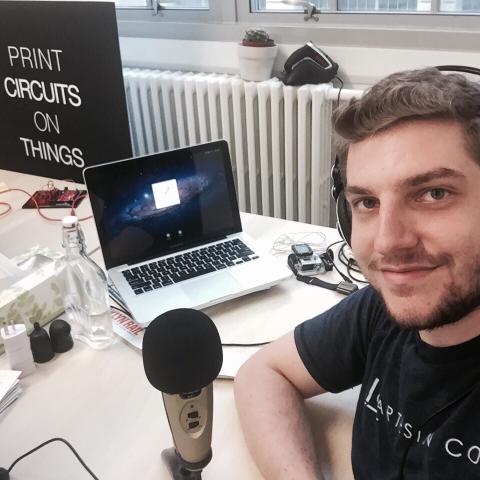
- Dave interviewed Ariel on site at CeBIT
- Moved to Brooklyn where there are other 3D printing companies:
- The product that Cartesian Co makes is called the Argentum. Formerly called the EX1, when it was raising money on Kickstarter.
- They are currently on batch 4. 200 total have shipped, 80 went to Kickstarter backers.
- The Argentum uses 2 part ink vs 1 part ink (nano particles) make by companies like Dupont, Mitsubishi and Mithode. Currently these only are advertised to print on pre treated materials.
- The printer itself uses old inkject cartridges to deliver the inks.
- Competitors:
- The focus was on an MVP...just like in Southpark.
- The reason for using silver is copper chemicals are much more dangerous to handle.
- Cartesian is planning on creating multi layer boards using insulative ink in selective areas.
- One interesting future avenue is printing on fabric/paper. The paper can even be reflowed.
- A current issue is stringing, which causes unwanted shapes on a print.
- The specs - 20 mil space/trace.
- Dave was interested about the business setup moving to the US. Cartesian is setup as a corporation in Delaware, as many are.
- Apparently internet denizens can now also apply to be part of Estonia as a digital citizen.
- We were of course discussing "Fartesian Faux, Inc" in all of these discussions.
- Though investment in startups is changing via the JOBS act, it might not be as much as people expect. Public/general solicitation is still very restricted, especially since the SEC rewrote some of the rules.
- The main idea is to protect investors without much money from losing their life savings. This was implemented during the great depression. China is experiencing a crash right now because of similar boundless enthusiasm in their stock market (and the resulting correction/crash)
Transcript
Ariel Of Cartesian Co: This is The Amp Hour Podcast. Recorded July 28th, 2015. Episode 260. An interview with Ariel of Cartesian Co.
Dave Jones: Welcome to The Amp Hour. I'm Dave Jones from the EEV blog.
Chris Gammell: And I'm Chris Gammell of Contextual Electronics. And I'm Ariel Bryner of Cartesian Co.
Dave Jones: An Australian! Yes!
Chris Gammell: Yay! Aussie, Aussie, Aussie!
Dave Jones: Oi, oi, oi, oi!
Chris Gammell: There we go, good.
Dave Jones: I knew it too. Even if he is a bloody Queenslander. Sorry, I have to get in there.
Chris Gammell: Dirty Sydney-siders.
Dave Jones: You're right.
Chris Gammell: Alright, here we go. Grudge match. 2015. I've pissed off almost all of Australia now.
Dave Jones: Right, yeah. Excellent. Thanks for joining us.
Chris Gammell: Thank you for having me.
Dave Jones: Has it been two years since we first met at that... At the Seabit. What show was it?
Chris Gammell: Yeah, Seabit. Seabit. Back in Sydney. Oh, man. Yep. One and a half years, I think. Yeah, it's been a little while.
Dave Jones: Oh, okay.
Chris Gammell: What is Seabit for us Ohioans?
Dave Jones: It's kind of like our consumer... No, is it the Consumer Electronics Show? Yeah, like CES. It's our version of... It's like our version of CES. It's a really... It's a really crap version of CES. Yeah, right. Okay. But they did have a... Like, they had like a hardware-y type section. Yeah, that was... Hardware start-up section, didn't they?
Chris Gammell: That was the saving grace, really. Because I think that was the first year that they ran it.
Speaker ?: Right, yeah, it was.
Chris Gammell: Was that there was all the hardware booths. And then you walk past IBM and... Right. And Nikon and all the other ones.
Dave Jones: Singing their company songs and...
Chris Gammell: Yeah, exactly.
Dave Jones: Because we are so gay. Hey! That was their company song, wasn't it? Or something. Anyway. Yeah, did that happen last year as well? Because I didn't go. Because I was like... Yeah. Something came up.
Chris Gammell: I think it is... I think it was in February or March. Yeah, I think it was in February or March. And we moved the entire company to New York in January. So, unfortunately, it was... Ooh, missed it. Australia was a bit far to go for CBIT.
Dave Jones: Yes. Why did you move your company to New York?
Chris Gammell: So, we moved to New York in January of this year. And we did it because we really wanted to be close to the epicenter, the heart of 3D printing. And that really, literally is here. I see us following very much in the footsteps of early day MakerBot. I actually had one of the very first MakerBot cupcake printers. I had number 299, which was like the first, the half-dozent one in Australia or something like that. So, I've been a part of their community since the get-go. So, is it really the center is there though? Like, that's why I don't... Totally. It totally is. Yeah. Well, because isn't... Really?
Ariel Of Cartesian Co: Isn't Formlabs in...
Chris Gammell: In Boston. Yeah. Right. Voxelate's in Boston. Voxelate's in Boston. So, there is a lot of new stuff happening, obviously, around MIT. You can't avoid that. But as an example of what's here, MakerBot, the big hitter, is actually just our neighbor. Literally, they are in the next building across from us. Oh, so you're in Brooklyn. Yeah, we're in Brooklyn. In a hipster set of offices called Industry City, which is really great. Right.
Ariel Of Cartesian Co: Did you go there thinking you were going to save money too and now you're like paying all the high rents like everyone else in Brooklyn?
Chris Gammell: Yeah. It's not the cheapest, but we had a two-story office back in Brisbane and it cost us only two-thirds as much as this place. Wow.
Dave Jones: Two-thirds? I'm surprised it was even that much. Yeah.
Chris Gammell: Yeah. It was a big place. It was a big place. Oh, right. Okay. And it wasn't in the floodplains. So, you know, that's good.
Dave Jones: Oh, right.
Chris Gammell: Woo, Brisbane. So, I mean, other companies that are really notable here. One of my personal favorites is Sols, S-O-L-S. Oh, yeah. They make the shoes, right? The 3D printed shoes? They make the insoles. So, what they do is they do custom-made 3D printed insoles. So, rather than going to a podiatrist and having them mold your foot and having one individually made.
Dave Jones: Orthopedic things. Yes. Yes.
Chris Gammell: Yeah, the orthopedic insoles. And as someone with flat feet, that is great because those orthopedic insoles are expensive and eventually wear out. And they can just... And it's a perfect business model to be run on 3D printing because each item is custom by definition. So, that's what 3D printing is great at. And then also Shapeways, another big hitter in 3D printing is based here. So, this really is an excellent scene.
Ariel Of Cartesian Co: So, why did you go after the 3D printing then versus like the electronics? Because obviously... Oh, have we mentioned what your product is yet? Yeah, yeah, yeah. Was it eight minutes in or so? We should probably get to that part. But yeah, so why the difference there?
Chris Gammell: Yeah, so that's a great question. I don't think that electronics is really as centralized in any one place around the world or in the US. I mean, Silicon...
Speaker ?: Cleveland, Ohio.
Chris Gammell: Yeah, obviously, Cleveland, Ohio. Excellent, excellent place. Silicon Valley, also an excellent place. But it's full of a lot of competition. There's a lot of makers and hobbyists and general hackers in the Brooklyn and Manhattan area, which are great to connect with all the time. And you'll never get better artisanal pickles, to be honest. That's true. That's true. I actually don't love pickles, but they are also excellent. They're the best artisanal pickles I've ever not liked.
Ariel Of Cartesian Co: Yeah, exactly. So what is Cartesian Co?
Chris Gammell: We should probably get to that now. Right. Yeah, this is a good time. So we make the Argentum. It's the world's first desktop circuit board printer, in a nutshell.
Dave Jones: And it started out as the EX1 on...
Chris Gammell: Yeah, on Kickstarter.
Dave Jones: Kickstarter, didn't it?
Chris Gammell: Yeah, it was called the X1, Superscript 1.
Dave Jones: Yeah, we've talked about it. Right, yes. Right. And so what... Can you give us a quick update on that? What happened with the Kickstarter? You raised $137,000 from 30 grand target. Have you shipped everything?
Chris Gammell: We have. We have now shipped all of the Kickstarter backers. That was a while ago. That was at the end of last year. We've now been delivering on the pre-orders we made since then. And we're just about to deliver batch four, which will bring us up to just short of 200 printers shipped, which is crazy. Yeah. I cannot believe that.
Dave Jones: That's on top of the Kickstarter from the Kickstarter, is that right?
Chris Gammell: So the 307 backers in the Kickstarter weren't all printer orders. Oh, okay. Yeah, I mean, a lot of people bought... Like T-shirts and coffee mugs. And it counts people who give a dollar. I actually don't off the top of my head remember how many printers we sold through Kickstarter, but no, the 200 includes the ones through Kickstarter.
Ariel Of Cartesian Co: Looks like 60, 70, 80...
Dave Jones: 20, yes, 80.
Chris Gammell: Yeah, it was 80-ish. It was 80-ish. Okay. So that's pretty good. And scaling up that manufacturing has been one hell of an effort. Yeah.
Dave Jones: What is the most difficult aspect of scaling that up? And, you know, by scaling up, I mean, people aren't aware. Like, we're talking scaling up to hundreds. We're not talking about scaling up to tens of thousands, right? So tell us the problem scaling up from, like, a handful to just a couple of hundreds.
Chris Gammell: So I think the number one problem with scaling up this much is not blowing our brains out. That would be my number one complaint. The number two complaint would definitely be... I mean, it's super fun, but it's just every single thing goes wrong all the time. You can never... You think you've planned out everything that will and could possibly go wrong, and you'll be surprised every time. The main issue that we have, the main challenge that we face is that, you know, so I didn't mention that we use inkjet technology in our printer. Yes, that's right. We use inkjet cartridges with conductive inks in the printer, and I'd love to talk about that more in a minute. But essentially, what we're doing with the cartridges is pushing them... They're old HP cartridges, as I've been taught to say. They're used.
Dave Jones: So you buy used cartridges, and you refill them with the conductive ink.
Chris Gammell: That's exactly right. So one of the problems is that those cartridges were meant for ink, and they were designed in the late 80s, and they were never designed with this use in mind. So we're pushing them well outside of what they're meant to be done, of what they're meant to be used for, and as a result, we get some pushback from the cartridges. They don't like it very much. So, I mean, the two main challenges we face with the cartridges, which is where the crux of the technology in our printer is, is that we don't have the world's best shelf life on the cartridges right now. Interesting. I say world's best. We're the only ones who've shipped a printer, so we do technically have the world's best cartridge. Yes. But we're not happy with it.
Dave Jones: How does the mechanism work? Does the conductive ink dry up, solidify? Yes. So what's going on there?
Chris Gammell: So I wanted to get a little bit more into the technology. This is a lot of fun. So we use two cartridges in the printer. One of them contains an ink with silver nitrate in it, and the other one contains an ink with ascorbic acid or vitamin C in it. And the printer prints with both of the cartridges such that the inks end up in the same spot on the substrate, and the two inks mix, react, and form silver. And you're left with silver on the substrate, and that's what's conductive. Now, the problem is that ascorbic acid is an acid, and silver nitrate is highly corrosive. And they will eventually eat their way out of the cartridges and spill everywhere. Oh.
Dave Jones: Oh. Like battery leakage. Yeah. A little bit like that.
Chris Gammell: A little bit like that. Right. So we've fought that in a couple of different ways. So one, the easiest way by far is that we ship them in sealed bags, and then they're resealable bags. And we advise all of our users to keep them in the reseal bags, because we have ones that have leaked after, like old production batches that have leaked after six months. That's generally when they fail after six months. It's like a punishment for not using it fast enough. Yeah, pretty much. Yeah. Make more boards. Come on, man. Buy cartridges. Yeah, come on. Let's get it going. Cartridges aren't terribly expensive either. We sell a pair of them for $70. And when you consider that they contain silver, not colored ink, then that's pretty cheap.
Dave Jones: How scary is it forming a startup based on a third-party company's ancient-used technology that has a certain shelf life? What are you talking about scary, Dave?
Chris Gammell: I don't even know what you're talking about. I don't even know what you're talking about.
Ariel Of Cartesian Co: I'm sure HP doesn't have any lawyers. I'm sure they're so busy inventing new technology these days when they're splitting their company up. Oh, no. They're still- Let's not bring no one up. Yeah, right, right.
Chris Gammell: Let's not-
Dave Jones: They are still- They're still milking that cash cow. Oh, they are, yeah. No, they are.
Chris Gammell: They are. Oh, they spend millions of dollars in R&D developing these things. I'm not surprised they want to see it through the-
Ariel Of Cartesian Co: I don't think anyone ever complains about ink cartridges or the cost of ink or anything anyways, right? No. No, that's- Never heard of that. Right, yeah.
Chris Gammell: Yeah, I mean, it is scary, but at the same time, when you consider the fact that you can't develop- a startup cannot develop an inkjet cartridge themselves because- Oh, sure. It's like spinning your own chip.
Dave Jones: Certainly understand. Have you ever gotten pushback from investors going, oh, I don't want to touch this because you're using- like, you don't have the technology for the cartridge. You're just using used cartridges. Has anyone ever said that?
Chris Gammell: Actually, no, because generally the type of investor-
Chris Gammell: Okay. There are other types of pushback we get, but not in that front. This is the way that I think about it as well, is that if you truly want to do something new, if you want to make something that is unique and value-added in the world, at the beginning, you're going to have to bootstrap. And that bootstrapping process is going to be ugly and silly. Right. It's not just Kickstarter. It's also technologies, beg, borrow, steal. Yeah, exactly. Use what you have, that kind of thing. It's very much beg, borrow, steal. And we're trying to do something that is so different to what anyone has done before. Like, I mean, I often will hop back to 3D printing as a comparison because I think of it as a very similar sister technology. But if you look at the 3D printing world, the desktop 3D printing world, when it kicked off in about 2009, prior to that, there had already been the RepRap project, which was, you know, the open source beginnings of all of this. And the RepRap guys had gone and figured out most of the hard technical problems. And then MakerBot and Ultimaker and everyone else who does FDM extrusion printing was able to come along and take that technology and, you know, improve it a little and make a business around it. Right. But run with it. Run with something that had already existed. We didn't do that. There was no research that existed prior to what we were doing. We just literally got together, the three of us, myself, John and Bella, my other two co-founders, got together in my spare room of my house over the weekend and were like, yeah, we reckon we can do this. And went down to Officeworks, which is, Dave, what does that translate to in American?
Dave Jones: Office Max.
Chris Gammell: We went down to the local office supply store and bought two Canon printers. And I already had some of the chemicals lying around from when I'd been thinking about this a couple of weeks before. And we just locked ourselves in a room over the weekend and started messing around with the printer. And then by Monday, we had our very first conductive circuit. It was shit, but it worked. Right.
Ariel Of Cartesian Co: Right. Yeah. So, well, I don't know if I agree completely with your history or his timeline there. I mean, like, it's not like the, I mean, even the RepRap stuff, like that stuff, that technology was all out there since the 70s, 80s as well, right? FDMs were around forever in a similar manner to Inkjet, right? I mean, Inkjet's been around for a long time as well. That's so true, yeah. I think you're right. I'm right on point about like, you know, not that the manufacturing was, you know, super smooth from the beginning with all those smaller 3D printing companies, but more so the cost was, the cost basis for all the stuff involved was dropping so rapidly. That really was the piece that was there. Does that sound right or no? Yeah.
Chris Gammell: Yeah. I like to think about it as science risk so that you evaluate different types of risks in startups. And, you know, there's technology risk and then there's science risk, which is a unique thing.
Ariel Of Cartesian Co: Like material science type stuff? Definitely.
Chris Gammell: Yeah. The things that you know that you just don't know yet and that will take honest to goodness science to solve. And that was the sort of thing most startups don't have science risk. You start a startup once the technology has already been de-scienced. That's not for us. We don't like that.
Dave Jones: The internet of things. Yeah. Everyone just buy these modules, whack them together. You've got an internet of things startup. Yeah.
Chris Gammell: That's very true. But at the same time, like that means that you can iterate very quickly and you can make something impressive with the pieces of the puzzle that already exist in the world. Right. Whereas for us, it is much more effort to make an improvement because we have to go and do science. It takes a while.
Dave Jones: We have to science the shit out of it. Yeah, exactly. The new upcoming Martian movie. Yeah. Oh, that's right. Yeah. Yeah. Yeah. I'm going to science the shit out of it. That's exactly right. I'm going to put that up on our wall. That's great. That's exactly what we did. Yeah. So, I'm so looking forward to that movie. Sorry.
Ariel Of Cartesian Co: So, I mean, so how did you guys get to the point where, I mean, was it well known the combination of ascorbic acid and silver nitrate together? I mean, obviously, we've seen other silver circuits. We've seen silver pens. Those have been around for a long time. Where did that all come from, the chemistry side? Hmm.
Chris Gammell: So, this is really interesting and I would love to talk about the different, because I said at the beginning that we were the world's first desktop circuit board printer, but what I missed out on saying is that we're not the world's only desktop circuit board printer anymore. So, since we came into the scene, we've actually spawned a couple of competitors, which is really great because it just shows that more people are interested in this. And every single one of our competitors is using a different technology, not only to us, but to each other. So, it really shows that the field is, I mean, we're in a VHS Betamax, HD DVD, Blu-ray moment at the moment. There's some hotly competing technologies. And they all kind of did exist in the lab or in various levels prior to this, but had never been commercialized. So, I explained our one, let's just call our technology two-part ink, where they combine on the board and react. Right. And most of our competitors are using some derivative of a one-part ink. Now, the one-part inks contain silver nanoparticles. So, you've got tiny balls of solid silver in some sort of a solution. And then you are in some fashion depositing that onto a substrate. One of our competitors uses an inkjet head. The other one of our competitors uses an extrusion syringe, and they have a paste instead of an ink. I'm trying to think which one of the inkjet one was.
Dave Jones: When you start talking about nanoparticles, nanoparticles sounds expensive to manufacture.
Chris Gammell: So, actually, yeah, that's one of the big things. So, we started off, I don't think, this might be news to some of our competitors, but we started off with nanoparticles and researching all of that stuff, because those are the inks that you can buy commercially off the shelf. You can buy them from DuPont.
Dave Jones: Oh, okay.
Chris Gammell: Right. And Mitsubishi and another company called Method. And yeah, they're pre-formulated for inkjets. You can just buy them and chuck them in your inkjet cartridge or in your extrusion syringe and start going. The problem with them is that because they're already commercially available, they're heavily patented, which means you can't really move much on your own. Got it. And they're also quite expensive. Luckily, I mean, our ink is the price of bulk silver, but their inks are bulk silver plus processing.
Dave Jones: Well, silver's very cheap at the moment. That's true. But anyway, could you be potentially put out of business if Canon HP or something just decided to sell a conductive ink cartridge? Possibly.
Chris Gammell: I mean, that's always the risk with a startup, right? What happens if...
Dave Jones: Sure, yeah. If one of the big players comes in.
Chris Gammell: If one of the big players comes in and tries to invent this technology. And I would say that that would be tricky if HP or Canon came around and started doing this. But I also strongly disagree with the idea that they would start doing it because that's not how big... That's not how it ever worked in the past. Big players don't usually get in to these emerging fields. Yeah, of course. Because it doesn't make sense for their bottom line. They have to spend so much money and they've got a big team and they move slowly. I would say they would just buy you, to be honest. I mean, or someone, you know, like or a similar competitor, right? That's usually what happens. Yeah. Yeah, exactly. Yeah, that's...
Dave Jones: Okay. Or, but can somebody just come along and just manufacture a cartridge which goes into an existing off-the-shelf printer? Oh, I mean... Like a HP compatible cartridge that just plugs in and that's their whole business. They don't have to sell the printer, in other words.
Chris Gammell: So that is something that someone has tried. That was our very first competitor. Oh, okay. Right. The company is called AGIC, A-G-I-C, and they're really cool guys. I've met them now a couple of times. They were founded in Japan and I think I don't have up to the minute information on them, but I think that most of them are still based in Japan. Some of them are in the US. And what they did was they took research from their university and which was about silver nanoparticle link. They took this silver nanoparticle link that already existed, chucked it in some brother printers and then did a Kickstarter. And that was the very first Kickstarter to come after us. And it's really cool. Okay. There are some limitations just generally with silver nanoparticle link. And like I said, we tried it at first and there's a reason that we didn't go with it. Some of the problems are that you can really only print on specifically pre-treated materials. So most of the silver nanoparticle links are restricted to printing on only a special type of paper. It's kind of like photo paper.
Dave Jones: That's a real problem. Yeah, that's a real problem. That's a real problem.
Chris Gammell: And then another one of our competitors that launched more recently, Volterra, they are the ones with the extrusion syringe. They can now use that to print on fiberglass. That's a big step forward. That's kind of a necessity. And another problem with the silver nanoparticle link is that, and a lot of people have been working on this, you can't really solder to it. That's the big one for me. Oh. Yeah. Oops. Yeah. So is it Volterra? That's a showstopper. Yeah, that's kind of a... And it was at that point in our original development that we stopped. Yeah. Conductive paste? Yes. You're thinking of Voxelate. So Voxelate and Volterra both use a conductive paste. I believe the two pastes are different.
Dave Jones: Right.
Chris Gammell: And Voxelate.
Dave Jones: And they raised half a million bucks on Kickstarter. Yeah, they did.
Chris Gammell: Yeah, Volterra. It's good because it just, it further shows that the, I like to think that we did the heavy lifting for them and were the first ones out and started growing the market. And it just shows that there's more people that are interested in exactly this desktop board fabrication, rapid production of boards, which is so great. And I have no doubt that these guys will refine their technology or potentially switch to another technology that does allow them to get around these issues of material choice, substrate choice and solderability. I didn't mention our inks, our printer is compatible with fiberglass, capton, polyamide and paper and fabric. And you can solder to the prints. Not, you can't solder the prints on fabric, but surprisingly you can solder the prints on paper. And skin. And skin. We haven't done that yet. So Chris has signed up to have us print on his skin, but we haven't had a chance to do it yet. His skin and our printer haven't been in the same room. Not yet.
Dave Jones: So you're literally going to print the company logo on his, on his arm. Sure. No, no, no, no, no. Sure, sure.
Chris Gammell: I'll tell you that it's going to be a 555 circuit, Chris, but it's actually going to be our logo. Right. Oh no. It has to be a 555 circuit. But it's got to be, we've got to embed some LEDs or something in there. We've got to show that it actually is conductive and works. Yeah. Yeah. And we're going to solder it, right?
Ariel Of Cartesian Co: Maybe some paste. I think some, or the conductive, the conductive glue would be better.
Chris Gammell: So, you know, yeah, we can, yeah, we can use conductive glue. Yeah. That's, that's how we assemble our fabric circuits is we use the, the conductive glue. It's, it's pretty good. It doesn't burn. I think.
Dave Jones: I'm sorry. I can't make a noise of a guinea pig. Oh, that's great. So these, so you can, so that's your strength. Is it, is that you can print on a lot and pretty much anything. Yeah.
Chris Gammell: Yeah. Well, so.
Dave Jones: Do you see that as the strategic advantage?
Chris Gammell: Yeah. I mean, that's interesting. We have a lot of different thoughts at the moment about where this, this field is so new and people are still starting to get a grips with what the capabilities are going to be. Like when 3D printing first started, you could tell your average person, hey, you can now buy a machine off the internet for a thousand bucks that will make anything for you. And they're like, cool, but what do I make? You know, it's like this blank canvas problem. People don't know what to make yet. Um, or we just.
Dave Jones: I see your biggest competition though is, uh, the $5 professional silkscreen solder mask plated through PCB. I mean. Definitely. Definitely. That's our main competitor. Yeah. Yeah. I mean, from that aspect, the only thing you've got going for you is you can print on different types of materials and the fact that you can have it today.
Chris Gammell: Yep. Exactly. So I mean, I like to think when I talk about this, I, uh, when I talk to investors, when I talk to like customers, um, I tell them that we have two, two competitors, one, our competitors and two, the old way of doing things, which is this batch circuit board production, which is great. You know, like there's a lot of excellent companies out there right now.
Dave Jones: It's never going to die. It's never going to die. You say the old way, right? It's not like it, you know, it, it will never die. It will never die. No, no, no, no, no. No.
Ariel Of Cartesian Co: I mean, there's also milling and stuff like that, especially because you're, you're at one layer right now as well. So that's another competitor, but yeah. Yeah.
Chris Gammell: Yeah. We can do one layer and double-sided. Oh, okay. Yeah. Um, but we're not at multi-layer yet, which I would actually really love to talk about, um, what we're working on. Oh yeah. What's coming up next. But we can, we can, we can talk about that later because, because this, this competition thing is an interesting point. Um, so Dave was saying that, uh, the advantages that we have is that we can get it today and we can do different materials. And I love both of those ideas because when I was doing university projects and when I first started getting into electronics, I would etch my own boards because like I had a weekend to complete something and I wanted to get it done right then. And at the same time, like that was a few years ago, boards, the quick batch boards you could actually get in Australia were like a hundred bucks, not 20 bucks. So when I was a uni student, so I wasn't doing that. But even now that it's 20 bucks, like I very rarely find myself. Um, I mean, I guess now I have, I'm surrounded by electronics printers, so I don't really need that anymore, but, but I very rarely find myself going and using that option because a lot of the time, if you're designing something that you need to have some hands on user experience testing, the only way that you can do that is with rapid prototyping. So electronics has never enjoyed the benefits of rapid prototyping before, not in a, not in a wide sense. And that's just the way a wrap day is. And even though they're not that rapid. Yeah. Why a wrap?
Dave Jones: Yeah. There's many different ways. I mean, as you said, you can make your own boards. I mean, I've, I've made my own board in under an hour. It's not, you know, it's not necessarily a, you know, it's just, it's just not a difficult process. It's not widespread.
Chris Gammell: It's messy though. Yeah. It's not, it's not a widespread practice. And I like to think about.
Dave Jones: Oh, well, no, no, I'll disagree with that. It has been a widespread practice. It's, it's the traditional hobby way of making boards. It has been since the 1960s.
Chris Gammell: I mean, it still is. I'm not disagreeing with the idea that, uh, that, that etching isn't popular. Etching is super popular. That's how most people get into, get into creating boards. I mean, that's how I got into creating boards as well. Um, no, no, no. I mean like with a hardware startup that is coming up with their next IOT device or their next doohickey or thingy, or the next time a large company is prototyping, uh, a crazy little project that's operating inside the company. You don't, I don't think you often get those people etching the boards they're creating because the sort of turnaround time and the effort and the setup cost and the, the mental energy that goes into doing something like that manually doesn't mesh very well with rapid prototyping. And there's...
Dave Jones: I will tell you why though. You left out the big reason why they don't do it is because a lot of tech is small and difficult these days where you need a professional PCB. You've got BGA parts that you have to reflow. You've got 0402 parts. You've got all these tiny little pain in the ass packages.
Chris Gammell: Actually, you're absolutely right. I forgot about that.
Dave Jones: That's what, that's why they're not going to roll their own boards. Yep. That is... So you have to go out and get the professional board made.
Chris Gammell: That is so true.
Dave Jones: So I don't see... Yeah. So you're not going to be able to print that on one of those.
Chris Gammell: We have to reach that. We have to reach that level. And that's, that's what... Yeah, yeah. Totally. Totally. That is what we want to do.
Dave Jones: Otherwise you are stuck in the hobbyist domain forever.
Chris Gammell: Exactly. And, and we, we consider success to be when we can produce a board with our printer that is equivalent to an industry standard board. That is the, that is the goal we've set for ourselves.
Dave Jones: Which would be maybe 5,000, 5,000.
Chris Gammell: Yeah, exactly. Yeah. I mean...
Speaker ?: Kind of.
Chris Gammell: With Sider Mask. Right. Yeah. With, with, with Sider Mask multi-layer, you know, on FR4. Yeah. And then this is, okay. So we're moving on to the stuff that we're working on right now. So, I mean, like this is, this is literally what we're working on right at the moment. So we've, we've come to market with our very first printer and it was, you know, there was nothing out there in the field. So we, we, we took a shot, we did what we, what we could to bootstrap. And now we're like, okay, that's great. It's happening. People are using it. They like it. Now let's move on to the next thing. And what we're doing is where we're making the technology better by increasing the resolution of what we can print. So getting down to a finer, finer pitch. And then also working on multi-layering. And that requires us essentially inventing new inks. That's where the science comes in. Right.
Dave Jones: Ooh. Got it.
Chris Gammell: So that stuff.
Dave Jones: How much?
Chris Gammell: Yeah. Sorry.
Dave Jones: How much, how much coin do you think is required to actually get to that level? Does it look achievable or, or, or do you need like a, no, we need a hundred million dollars and we need scientists in lab coats and we need, you know, I like to think, I like to think
Chris Gammell: that if there's a will, there's a way. I mean, the, the example that I would use.
Dave Jones: That's not always the case. I mean, hope is great, but you know, it's got to be matched by practical reality.
Chris Gammell: That's true. I mean, it does take some money. The, the, the, the, the, the argument that I would use is that when we very first started the company, we got like 20,000 Australian dollars of investment. And that was, and we took that money.
Dave Jones: You can, you can feed yourself for five months maybe.
Chris Gammell: Yep. Exactly. Exactly. Well, but also we had to, we had to actually prototype and make the printer and pay for those expenses. Okay. Well, you know, yeah.
Dave Jones: Okay. Well, you didn't eat then. Yeah. No, we didn't eat very much. That's why they're all skinny and anemic. Thank you.
Chris Gammell: Um, and, uh, uh, uh, we got all the way from a concept of what our printer could be to the actual looks like works like prototype, um, that we showed off in our Kickstarter, uh, with only about 8,000 of that $20,000. That was, that was really, that was bootstrapping hard. That was, I remember one day we couldn't pay or we, we couldn't wait and I didn't want to pay for the express shipping of an FFC connector, uh, from RS components. So instead I went out to the dumpster at the university, found a DVD player someone had thrown out, took it apart, found a compatible FFC connector and desoldered it and then put it into Appenture. I'm like, yeah, that's right.
Dave Jones: Yeah.
Chris Gammell: That's good. So, uh, that was, yeah, I mean that, that was bootstrapping hard. So it's, I enjoy bootstrapping hard. We all like that. Like, um, by the, by the seat of your pants engineering that has a place.
Ariel Of Cartesian Co: Well, I think that, and I mean, hardware, hardware people are by default cheapskates as well. I think we've talked about that on the show before as well.
Dave Jones: Yeah. Right. I mean, how do you, how do you battle with that?
Ariel Of Cartesian Co: I mean, do you have to just prove that this is a good enough value versus, you know, like the. Yeah.
Chris Gammell: We, that we like to think of things in minimum viable products. So we come up with an idea that we want to test and we have very, it's so important to be very specific about what the aim of the test that we're about to perform is going to be. What we consider success, what we consider failure, what we're actually going to trial, just like any, you know, scientific report. And then we figure out what is the absolute minimum fastest way, usually also cheapest, but not always. Sometimes you need to spend money to do something faster. Um, what is the absolute minimum way that we can test that one theory? Not, not do all of the fun things that we want to do, which we will eventually get around to. You know, we always want to make the printer shinier and, and, and lighter and faster and all of this stuff, which will, which will happen. But that's not what we're doing right now. Right now we're testing one theory. And, and for instance, uh, with multi-layering, we have tried to figure out, you know, what rather than, than build a whole big apparatus and buy a whole bunch of expensive scientific measuring equipment, what's the simplest possible way we can do it. And when you put yourself in that mindset, you can sometimes be very surprised what you come up with and you can start using things that were never, ever, ever meant for the purpose that you're using it for and find that it tests your theory just fine. And that's what we did at the very beginning with using those Canon printers from, from the office supply store.
Dave Jones: That's a, that's a great attitude. I, something just popped into my head before when we were talking about this was that all these young whippersnappers, right? They've done their university degree, right? And they're all going out, right? They've done their crowd, you know, they've done their entrepreneurial course, right? And they, I, I, I fear we might be going into, uh, a, how can I put this? It's a, uh, investment entitlement culture. I, I can see what you're saying. For want of a better word, where, where sort of, you know, like young people come out of university, oh, I'm going to do a startup and I'm going to get millions and millions of dollars right off the bat. And I'm going to hire 20 million people. And, you know, it's like, yeah, where's that hardcore, you know, yeah, let's go to the dumpster and get, you know, a bloody connector ever thing to save a few bucks.
Chris Gammell: Right. Uh, it's funny. There's a, there's a South Park episode on exactly that topic. The Redskins episode, right? Yeah. The Redskins episode. Yeah. The Redskins episode.
Ariel Of Cartesian Co: Everyone's a startup. That's right. Yeah. Everyone's a startup. Ridiculous. Ridiculous. And it's all a, well, I shouldn't, I shouldn't give away the ending. It's all a ploy, folks. It's all a ploy.
Speaker ?: Yeah.
Ariel Of Cartesian Co: Um.
Dave Jones: But can you guys, like, this is like diverging a bit. Can you guys possibly see that sort of problem happening? Oh, totally. Where everyone feels they're, they're, they're entitled to. Completely. Millions and millions of dollars for their idea.
Chris Gammell: Yeah. So, I mean, this is actually something that we think about a lot. And it's something that confronted us a lot when we first arrived in the US. Right. And I don't want to say anything that will piss off US listeners or Australian listeners. So, I'm going to trade very lightly with what I say next. You don't know you're on the amp hour, right? I mean.
Dave Jones: Yes. That's what we do here. Yeah.
Chris Gammell: That's what Dave does here, especially. So, I find, that's what Australians do. So, I find that it's a very Australian mentality to think that we have to prove something. We have to test it and be sure that it works before we go around saying that it's going to be the next big thing or saying that it's going to work. And not to say that it's the American viewpoint. And this doesn't go for everyone, but this is just what I've seen. No. Right. The American viewpoint is kind of the opposite. Not to say that Americans lie about what stuff can do, but they're just, it's confidence. You're talking about bravado. It's confidence. Right. Yeah. It's bravado. It's talking things up, selling big, go hard, go home, that sort of stuff, which doesn't, it's kind of the opposite of the way Australians think. And I think that's the reason we dumpster dive. I mean, still to this day, we just love dumpster diving. Well, there's a lot of people that dumpster dive.
Ariel Of Cartesian Co: I think that that's, you know.
Chris Gammell: But I think, yeah, you know, in terms of. For the parts we need.
Ariel Of Cartesian Co: Yeah. In terms of startup culture in general, I think that there's a lot of that, you know, chest puffing and, you know, like that bravado just because it's, yeah, it's about, you know, trying to make yourself seem bigger than you are. And then you sell a story and then you keep telling enough times and then eventually people give you a. It becomes true. A buttload of money for it.
Dave Jones: Well, because in Australia, we have the tour. Yeah, that's exactly what it is. If you get out of place and think you're a bigwig, people will just cut you down. You know, you don't, you know, you've got to earn it.
Chris Gammell: Yeah. You've got to, you can't go around bigging yourself up in Australia because people will think you're a wanker. Exactly. So, and that's not, like, that's not, I don't like that. That's not super beneficial. There are aspects of each country's thinking, which I think would be best. Like we, in Australia, we should have confidence that the thing that we're working on, even if everyone tells us it's crazy, we should have confidence that it isn't crazy, that it will work if we believe in it hard enough. And we should tell other people that. And then at the same time, on the flip side, testing theories before you go and do them is a great idea.
Dave Jones: That term you just said annoys me. If I just believe hard enough, it'll work.
Chris Gammell: And this is interesting, Dave. This is how tall poppy syndrome starts right there. This is how tall poppy syndrome starts. And I know you can't go around just believing anything will work. But if you didn't believe that something crazy was going to work, we would never have crazy things working.
Dave Jones: Right.
Chris Gammell: So there has to be some middle ground. Luckily, there's lots of different people in the world.
Ariel Of Cartesian Co: Well, so, okay. So let's talk a little bit about, so you've done this testing. And so one of the questions I always have for, especially this kind of stuff with the silver ink, right? The thing we haven't covered yet. This is the thing that we've criticized on the show before, is the fact that, you know, aside from resolution and everything else, I actually always worry about just straight conductivity. And the last time, I think I've talked to Volterra about this as well, but it seemed like in terms of the specs, I was comparing specs of copper versus the silver, it was like 30x worse conductivity. But when I talked to, and the other complaint that I always have is that people always just show the blinking light as an example. When I want to see a switching regulator pumping an amp, you know, doing, you know, some kind of voltage conversion. So what is the deal with yours? Yeah, what's the deal?
Chris Gammell: So this is one of the other things that I really love about our technology and another fundamental problem with silver nanoparticle. So one of the issues with silver nanoparticle, the reason it's like an order of magnitude worse conductivity than bulk copper is if you can imagine the silver nanoparticles, these tiny little spheres, you know, like a child's ball pit. So you imagine all of these spheres in a ball pit, and each one of the spheres is touching the next sphere on an infinitesimally small surface area. So as a result, you're not going to get the world's best conductivity through a large section of that.
Ariel Of Cartesian Co: Well, it's going to depend what it's floating. It's floating in some kind of substrate, right? That's the idea? Or is it just...
Chris Gammell: No, it's meant to be the silver. No, so it's floating in a binder that makes it ink-jetable. But most of the methods out there usually let the binder evaporate. So it is just the silver nanoparticles afterwards. I mean, there are some... It's all over the place. There's lots of different... There's lots of different inks and lots of different science on that. But... And yeah, sometimes it's better and sometimes it's worse. But fundamentally, what you want to strive for is a bulk metal. So... Right.
Ariel Of Cartesian Co: Like you want to melt it all together, right?
Chris Gammell: Like a copper sheet. Yeah, exactly. Right. And then the problem with melting is that's a post-processing step that no one wants to mess with. Like then you've got to have an oven or some sort of other stuff going on. And then you've got to deal with heat and then you've got burn issues. And yeah. So one of the neat things about our inks is that because the chemical reaction is happening on the surface of the substrate, what you actually get is... It's not quite bulk silver. It's not solid silver. But it's much closer than what silver nanoparticles are. So the silver is actually kind of forming in hairs, in tendrils that are interlocked with each other. So you have a nice large surface area of where the silver is touching itself. So you get really good conductivity. And then I actually don't have the number for the ohms per square off the top of my head because that would be the way that we'd compare it. But one of the nice things about our inks and our printer is that because it is a custom-built printer, not an off-the-shelf inkjet printer, which you have no control over because it's custom-built and it's a flatbed printer, you put a substrate in and then you tell it to print one pass. And then that pass won't be particularly conductive. But then you go and tell it to print another pass and then another pass. And after a half dozen or so passes, you have a board that is the same level of conductivity as the same width trace with copper. So do you have to...
Dave Jones: Can you selectively target traces? I want that trace. That's very clever. Man, the software. Of course it is. That's very clever. It's not just clever. It's obvious requirement. You know? Like, just bam, popped in my head.
Chris Gammell: Of course you want to do that. So now this is really cool because remember how I said at the beginning our goal was to achieve a printer that could produce the same quality board as an industry standard board. But what if on the path to that, we were to be able to do something that industry standard boards couldn't do? Something that was better, definitely better. And this is one of the things...
Dave Jones: Selectively different copper plating thickness on any selectable part of the board.
Chris Gammell: So that's one of the neat things. Because, I mean, think about designing your next board with a power trace. And rather than making that power trace fat, you instead make it tall. You would save a lot of board space as a result of that. So now... You could. Yes. Yeah. Definitely. Yeah.
Ariel Of Cartesian Co: Is there a practical limit to that though? I mean, like, in terms of like... At the moment. I mean, I guess it's a bulk how much silver you have there, but...
Chris Gammell: Yeah. I mean, there are some practical limits because... I mean, even I talk about the silver getting taller. You're really still talking about only a couple of microns of thickness. So it's not that big of a difference. But I mean, there is a limitation. After a certain height, the silver is going to become susceptible to rubbing off and things like that and breaking off. So you can't go full 3D on this thing.
Dave Jones: Right. Okay.
Chris Gammell: But you can increase the cross-sectional area by, you know, like a factor of 4 or something like that without any problems.
Ariel Of Cartesian Co: Okay.
Chris Gammell: Which means you can make it a quarter of the week.
Ariel Of Cartesian Co: What about copper? Why not... Why have I never seen a printer that's printing copper?
Chris Gammell: Well, that's a good question. I think that the reason you don't see printers print copper and the reason that we don't print copper is that the chemicals required, at least for the analog of what we do, our process, to do that in copper are incredibly toxic. So that would be a problem. Yeah. And then there are some copper nanoparticles. That is a thing that exists. But I think one of the issues with copper nanoparticles is that they rust a lot.
Dave Jones: So that makes it hard to work with. Oh, interesting.
Chris Gammell: Yeah. Right. And like there's a bunch of other chemical problems going on. So silver doesn't oxidize. It... Oh, what's the word? Um... It bonds with sulfur. Yeah, tarnishes. Yeah, it tarnishes. It bonds with sulfur. Which is a much, much slower process than rusting. And it's also a self-limiting process. So it just forms a tarnished skin and then doesn't penetrate further down into the board. So even without a solder mask layer, you don't have to worry about your board being ruined over time. You won't be able to assemble it. You won't be able to solder it after like a couple of months because the top layer will be... Right. ...will be...
Dave Jones: Right.
Chris Gammell: ...covered in sulfur. But you... The circuit itself, once assembled, will be fine.
Ariel Of Cartesian Co: Okay. That's great. Yeah.
Dave Jones: So how do you plan on doing... As you said, like the Holy Grail is to produce an industry equivalent board.
Ariel Of Cartesian Co: Mm-hmm.
Dave Jones: How do you plan on doing the insulating substrate so that you can then print a second layer? I mean, if you have to like flip the board over, that's kind of dicky. Mm-hmm. You know, things like that. How do you plan to, you know, drill holes? How do you plan to do the solder masking?
Chris Gammell: So I'd love to tell you all of our plans for how we're going to achieve multi-layer. They're a bit confidential at the moment. Let's just say... You think? Let's just say that it may or may not involve Elon Musk. Strongly on the may not involve. But basically, I can tell you roughly how we're going to do it. So what we're working on right now is the ability to have another ink that we can print in that is not conductive. That is insulative. Of course. That's dirt. That's the obvious... Well, that's kind of like... I mean, Volterra does that now, right? That's the one thing that... They use another paste that's insulative. Yep. They do a little hop over thing. And one of the cool things about doing that with... There's a few different aspects about Inkjet specifically that makes that really excellent. So firstly, with Inkjet, you can put down an incredibly flat layer of a material. So I think Volterra is limited in how many layers they can do. They can only do two layers because after that, it becomes a little bit out of control.
Ariel Of Cartesian Co: Right. Well, they do like a little... Some people have never seen... They do like a little dab over top of the over trace and then they hop a trace over it. So it's like effectively, instead of going down through a via and underneath the board, they kind of just cross the trace back over itself. Yeah. Yeah.
Chris Gammell: So the nice thing about using an Inkjet ink is that we'll be able to do that with an incredibly flat insulator layer, which means we'll be able to put another conductive layer, another insulative layer, another conductive layer without fear of it becoming out of control for N layers. I'm not sure what N is yet, but...
Dave Jones: So you're going to put a completely flat layer, a whole insulating layer there?
Chris Gammell: So then that's the...
Dave Jones: That seems like very time consuming.
Chris Gammell: No, no. So that's the next thing that is really brilliant about this is one of those angles where this technology could prove to be fundamentally better than conventional circuit board manufacturing. So there's no reason to put down an insulative layer over the entire board like you would normally do when you sandwich two boards together for a multi-layered board. What we could do instead is only put down an insulative layer where two traces are going to cross each other. And then... So that seems... Right.
Dave Jones: Just exactly like the Volterra. Exactly like Volterra.
Chris Gammell: And that seems rather straightforward. But the implications of that are what's interesting. So I think I talked to Chris about this ages ago. And maybe I talked to you about this, Dave. But if you're only insulating the points where two traces cross, then technically every trace anywhere where it's exposed is on the top layer. Everything is exposed to the top layer of the board. So you don't have to bring all of your footprints, all of your component placement pads up to the top layer of the board just to have a component there from a lower signal plane or whatever. All of the traces are on the top if you want them to be or whatever trace you want to be is on the top.
Ariel Of Cartesian Co: Which is kind of like... It's kind of like a highway system, right? Yeah. Like with overpasses of a highway where you can have multiple layers of them.
Dave Jones: But then the thing that comes to mind for me here is that then you have to lay out your boards differently for this technology as opposed to a standard process technology. Well, no.
Chris Gammell: You could lay it in the same. You could still use the same software and it could have this idea of top and bottom layer and then our parser just looks at where traces cross each other and puts that as the insulative layer. That's not too difficult to do. If you want to take full advantage of this idea of things all being on the top layer, then you would have to have different software, which doesn't exist yet. But the software doesn't exist because the technology doesn't exist. So it's a bit of a chicken and the egg problem.
Dave Jones: But it would still be different. So you would have to specifically, if you wanted to take advantage of that, you have to specifically design your board to use that process.
Ariel Of Cartesian Co: Well, maybe not though. I mean, Dave, think about it. I mean, if this... So, I mean, again, we're playing future looking here, right? But if this was actually a thing, then maybe this becomes a new process. I'm not saying it's going to be cheaper than mass producing, but there is a possibility there. There's always that crossover point between batch producing versus individual producing.
Chris Gammell: Yeah. I mean, Dave, the way that...
Dave Jones: But then they still become flexible, right? They're still flexible. You can't build up this sort of board and make it rigid.
Chris Gammell: Oh, so you build it on a rigid substrate.
Dave Jones: Oh, you build on a rigid substrate. Yeah, you build on a rigid substrate. It just came to mind. That's okay.
Chris Gammell: So, I mean, you can just use... Like, if I were to export from Eagle or Altium right now my Gerber files... Ahem.
Speaker ?: Ahem. Ahem.
Chris Gammell: ...or any other software... Come on, man. Say it.
Dave Jones: That's killer.
Ariel Of Cartesian Co: Interview over.
Dave Jones: Interview over. You're such a fanboy, Chris. I know.
Chris Gammell: Yeah, you should talk, Dave.
Dave Jones: Right.
Chris Gammell: So, if I were to export my Gerber's... Let's just say that. If I were to export... You can edit the other bit out. If I were to export my Gerber's... Yeah, yeah. It wouldn't be that hard to just print the insulative layer everywhere except where the vias are. So, you just have it. You wouldn't use... You wouldn't take advantage of this neat aspect of the printing feature. You would just create a normal looking board.
Ariel Of Cartesian Co: Yeah. No, I think that's...
Chris Gammell: I think it's cool. I mean... Okay. And then... So, that's going down the route of producing an industry standard board, which is where we... That's where we want to go. That's where we want to go. But right now, where we are is that we've got a printer that can print hobbyist level boards, but can at the same time print stuff on paper and fabric, which we've never... Like, we just... We've never been able to do that before. Humans have never been able to make circuits right on fabric. So, that's really fascinating to us. And it was actually completely by accident that that happened. Yeah. We didn't intend...
Ariel Of Cartesian Co: And actually, when you told me about this one, this is actually the thing that's most interesting to me because you started talking about, like, well, what if you started printing sensors into clothing for, like... Like, thinking about geriatric electronics or medicine, you know, with electronics. That kind of stuff. Like, there is stuff out in the marketplace, but having to attach stuff to clothing or anything else, like, that's pretty significant, I think.
Chris Gammell: And the idea that you can also prototype easily with that, that's, like, even if something is manufacturable. It's not necessarily prototypable. And that, I think, is a huge stifling force towards innovation. So, if you bring something down to the prototype scale, then people can start making it. And if a manufacturing technique doesn't exist for it, well, someone will invent a manufacturing technique or a manufacturing technique already does. So, now there's just more products you can make with it. So, that's pretty fun. I love printing on fabric. But full disclosure, it is challenging. It is, like, a fringe thing that our technology can achieve.
Dave Jones: I was going to say, yeah, because the fabric, like, is all floppy. It's not flat. You have to maybe stretch it to, you know, get it nice and tight. So, the print heads, you know, the distance between the print head, blah, blah, blah. Yeah.
Chris Gammell: So, we use microfiber fabric specifically for that reason. Right. So, because it has the finest weave. It's very accurate. It's not like a coarse something that would be almost impossible. Yeah.
Dave Jones: Like, you can't print on... Like, to print on a regular cotton t-shirt, you couldn't get the resolution. No. Like, to then solder an SO package on there. Yeah, exactly. Like, you just...
Chris Gammell: So, yeah, if you have a look at some of the photos that were on our Kickstarter, and I believe they're in our blog, we have actually done SO packages on microfiber, and they work. Yeah.
Dave Jones: But, yeah, you specifically need the microfiber, of course.
Chris Gammell: Yeah. So, we need to print on some microfiber t-shirts. That's, I think, is what we need to do there.
Dave Jones: And you print it onto a banana. Yeah, we printed it.
Chris Gammell: That was a little while ago. That was fun. Yeah. We haven't quite finished that project. That one's still on the back burner to be finished. That's a preface to printing on Chris.
Ariel Of Cartesian Co: Right. Right.
Chris Gammell: I am...
Ariel Of Cartesian Co: I will become the banana. You will be the banana. I am become banana. Destroyer of worlds.
Dave Jones: Now, what is it? What is the issue of stringing? Oh, yeah. Okay. Because I noticed that your, you know, your traces end up with all these little... Little bits on the end. ...dendrites. Yeah, dendrites, yeah. Like, little dendrites hanging out the side of the traces. Like, as if... Like, because that is the fear of manufacturing... Yeah, I know, yeah. ...like real PCBs, right? Is, like, getting a micro short between two traces. Like tin whiskers? That's a real...
Ariel Of Cartesian Co: Like with the lead-free process kind of thing?
Dave Jones: It's kind... It looks like a tin whisker, but it doesn't grow. I mean, it doesn't...
Chris Gammell: Yeah. So, you can look at photos of exactly what Chris... What Dave is talking about on our blog... Yes, that's where I'm looking. ...on a post called String Beans, I think, is where we talk about this. That's correct. Yeah, so we like... So, you know, one of the things is we're a completely open-source company. So, we talk about all of the great stuff we're doing and we talk about all of the stuff that happens that we don't want to happen and this is one of the things. So, stringing is the issue of when you print, you get artifacts in the print. So, you get areas of the print that were not supposed to be covered in ink end up being covered in ink. And in the... Why does that happen? Yeah, in the article we go into the fact that what's happening is the nozzles, some of the nozzles are misfiring. Now, we're actually not...
Dave Jones: Oh, it's a misfiring nozzle thing. Yeah. As in, not misfiring, they're actually firing when they shouldn't fire.
Chris Gammell: So, this is the thing. We're actually not 100% certain. We've narrowed it down to two options. It's either a nozzle that is firing when it's not meant to be firing or it's a nozzle that's partially clogged and is firing at an odd angle.
Dave Jones: Oh, interesting.
Chris Gammell: Yeah, so it ends up... And this is fascinating. Inkjet technology is incredibly advanced. It does.
Dave Jones: Yeah. And because all of the strings go in the same direction. All the strings go in the same direction. Yep.
Chris Gammell: Yep. So, now we have started being able to deal with that. We've got a workaround for our current users. We've included isopropyl prep pads. And you can use that to wipe the nozzle plate. And for whatever reason, that seems to fix the problem. So, either it was because there was a partially blocked nozzle and that's unblocking the nozzle or some other mechanism we don't yet understand. And then going forward...
Dave Jones: Can you add some isopropyl to the mixture?
Chris Gammell: Yeah. So, we did that once. It's self? The cartridges started spraying fire.
Dave Jones: Awesome. So, that's a bad thing?
Chris Gammell: Is that what we've determined? Yeah. Well, I mean, it was pretty cool. It was pretty excellent. We didn't expect that to happen. There was a loud pop and then we looked underneath the thing and there was smoke and flames coming out, which was excellent.
Ariel Of Cartesian Co: Great for like rock shows though, you know, like really, really tiny rock shows.
Chris Gammell: Really tiny rock shows and rock shows.
Ariel Of Cartesian Co: Right. Or like in Spinal Tap when they have the really tiny Stonehenge, you know? Oh, yeah. Yeah. Sorry.
Chris Gammell: I mean, as an aside, one of the other... Like, every so often we get bored and we put something else in the inkjet cartridge. So, one of the ones we did a little while ago was milk. And we're pretty sure the cartridge started printing in cream as a result. So, that didn't work very well. That wasn't great. Right, right, right. Jeez. But yeah, stringing. So, stringing is one of those issues where it's a side effect of the fact that we're pushing the technology so hard. Right. And we have done what we can to deal with it at the moment with the current people who already have a printer. And I mean, when I print and I get stringing in my prints, I can see it and be like, oh, okay, I'll just stop that print, wipe the nozzles and then it's all good and it goes away and doesn't come back until the next time I print.
Dave Jones: Is this specific to your method? Do the other ones with the particles have the same issue?
Chris Gammell: No, I think potentially it's specific to our method because of the fact that we're using our own formulated inks. I mean, no, even our competitors that use inkjets. Actually, this is a funny thing. It's difficult to say too much about how the competitor's technology works because, correct me if I'm wrong, anyone out there, but I think we're still the only one to have shipped any printers. So, I can only go off. Oh, like hands of consumers kind of thing. You can't get your own.
Speaker ?: Yeah, exactly.
Chris Gammell: Right. Yeah, right. I can only say what goes off what I see on other people's websites and from having conversations with them at Maker Fares and stuff like that. So, everything else is to be seen.
Ariel Of Cartesian Co: Yeah, I think Volterra was coming this year. I think September ship date was their plan. Yeah, I think that was what was on their Kickstarter.
Chris Gammell: I think maybe the rest of them ship in 2016. Yeah.
Dave Jones: It changes the game totally, don't you? When you ship it to people, people will find every single nitpicky issue that you would never have found.
Ariel Of Cartesian Co: Yeah, like flames coming out. What a nitpicky issue.
Dave Jones: It's always the way.
Chris Gammell: Dear Cartesian code, today my printer printed in flames. That was pretty cool. It's meant to do that. Dragon mode. That's what you should call that. Dragon mode. Yeah. Done. That's what it's called from now on.
Dave Jones: You found our Easter egg. Congratulations. You win a new printer.
Ariel Of Cartesian Co: Yeah. So, one thing we haven't covered yet. I mean, so you mentioned, you know, we're still at hobby level. But what does that actually translate to in terms of specs and, you know, stuff like that?
Chris Gammell: Yep. Throw us some numbers. Yep. Come on. So, we're able to. It varies a little bit depending on what substrate you print on. Because the inks bleed differently. Of course. Yeah, of course. Well, let's go with best case scenario though. Yeah. Under best case scenario, we quote on the website, I believe, that we're able to achieve a 20,000. 20,000 track and a 20,000 gap. Okay. But I think we can actually, in reality, you can achieve slightly better than that. It's around about 15,000, 16,000 under perfect conditions.
Dave Jones: And what material is the perfect condition? Yeah.
Chris Gammell: That's on, luckily, that's on fiberglass and Capdon.
Dave Jones: Oh, it is fiberglass. I thought it might be fiberglass. Yeah. That's on fiberglass and Capdon.
Chris Gammell: Very stable material. None treated at all.
Ariel Of Cartesian Co: Nothing just straight.
Chris Gammell: No. So, we actually do treat our materials. Okay. It's a very simple treating process. All we do is rough on the surface by sandblasting them. And that, the technical term promotes adhesion. That it gets the ink to stick. Right.
Ariel Of Cartesian Co: It's nooks and crannies.
Chris Gammell: That's what it is. Yeah. Exactly.
Ariel Of Cartesian Co: Nooks and crannies. Like, English muffins.
Speaker ?: Yep.
Dave Jones: I can just picture, like, you guys sitting in the office, just sandpaper, 100 grit sandpaper, just, you know. Oh, man. It's like you were there.
Chris Gammell: Yeah.
Ariel Of Cartesian Co: It's like you were there. Yeah. Well, that's good, though. I mean, and that's actually really nice. So, like, you can do FR-4 versus having, so, like, a lot of milling is only FR-1 because that is. Yeah, we use FR-4 and G10. Okay. I was going to mention before when you were talking about all these different, like, layers and the different selective areas, stuff like that. I imagine if we had you and Eric Bogdan at the same time, he would be screaming by this time. Because thinking about going into, like, signal integrity stuff into the future, you know, like, just, this throws such a wrinkle into all of that stuff because now you have It sure does. variable materials. So, still low frequency, lower current.
Chris Gammell: This is actually one of the interesting points that I think kind of works the opposite. It works in our favor. Because, so, like, one of the most difficult things in the world to synthesize correctly is RF circuits. You can't be certain that the thing that you design is going to work out the way that you think it's going to when you make it. And one of the advantages to having a rapid prototyping machine is that you can actually test whether or not it works the way you think that it's going to work. Oh, yeah. Obviously, there's other, I mean, there's lots of other stuff that are tricky.
Dave Jones: Well, it comes back to manufacturing repeatability, you know, like, how carefully they can etch a board, how carefully they can control the thickness of the copper, you know, blah, blah, blah.
Ariel Of Cartesian Co: All the stuff we love, right? Well, a lot of that stuff can be taken care of in simulation, though, too. But I think that would be the tough part for you guys is that, you know, until it gets to the point where it's repeatable enough, like Dave said, and then getting that pushed into a simulation type environment. But that's probably thinking way too far ahead anyways. So, you know, that is the end goal.
Dave Jones: That's if you're smart enough to simulate with wide enough margins that take into account your actual manufacturing tolerances. I mean, that's, you know, you've got to do that. You can't just run the RF simulator and go, yay, it works, you know, and you don't put in the tolerances for, you don't do your Monte Carlo with all your, you know, your manufacturing tolerances in there. So, tricky business.
Chris Gammell: It is. It's incredible. Let's stay away from RF, shall we? We usually do around here. Yeah.
Dave Jones: Yeah, right.
Chris Gammell: To all of the RF engineers listening, I'm so sorry. We salute you. Yeah, I know.
Dave Jones: Well, no, RF, as Eric said, RF is easy, right? Because it's a single fundamental frequency. That's true. Right? And what is hard is digital is really fast digital because it's broadband. You did say that. They're just really fast edges, right? They just broadband energy all over the place. And that's, that's horrible. That's a good point. That's horrible. RF is actually, yeah, child's play. You know. Anyway. So, how many printers have you guys shipped? He said 200, remember? 200.
Chris Gammell: Yeah, just short of when we finish this next batch, which is going out really soon, we will hit, it's like 190 something, which will be really cool.
Dave Jones: Right.
Chris Gammell: And then plus the ones that we have internally.
Dave Jones: Right. So, are you guys eating? You know, are you, are you surviving? Like, because, you know, like people think, oh, a couple of hundred, like that's bugger all. Yeah. Right? That's a lot. I mean, sure, they're expensive. They're like, oh, we should say it's like a 1500. 1500 for a kit. Just a US for a kit.
Chris Gammell: Sorry, 1600 for a kit. 2100 for an assembled unit.
Dave Jones: Assembled one. Yeah. So, yeah, 500 bucks premium to assemble it.
Chris Gammell: Yep. Hey, I assembled a lot of those ones myself. And it is good quality work.
Dave Jones: So, yeah. So, are you guys, yeah. Are you surviving? Are you looking good? Yeah. All that sort of jazz. You're not going to.
Chris Gammell: Actually, yes. I mean, one of the reasons we've only shipped 200 is because we're trying to scale up our production as quickly as we can. And most of the time, our orders get away from us. So, we do. I mean, some users will look on our website and see that the estimated shipping time is like September right now, I think. So, and that's just because that's as fast as we can make them because we've got ones on back order from that. We got orders while we were making the ones from our Kickstarter. And then we shipped the ones from our Kickstarter. And then we got more orders while we're making the ones we got after that. And just like we're having trouble catching up. So, yeah. And you got to print your own circuits too, right?
Ariel Of Cartesian Co: I'm sure that you're doing that.
Chris Gammell: Oh. One day. One day we will. One day we will.
Ariel Of Cartesian Co: That's the replicating machines thing.
Chris Gammell: Yeah. Oh, I am so looking forward to setting up a wall of our printers and then having them all like remote connected to an app and then just click go and having them all print off the boards all day long, all of the time. That is the thing that makes me happy as I go to sleep each night.
Dave Jones: So, you've got funding to keep you going?
Chris Gammell: Yes. Or are the sales keeping you afloat? Yeah. Yeah. So, we have some funding under our belt and sales are doing quite well. And we were talking about before the show the legality of talking about startup fundraising.
Dave Jones: Let's just finish off with that. Wait. Wait. Wait. Before we do that.
Ariel Of Cartesian Co: Because if we don't get to this point and we actually do finish on this, I'm going to actually be sad. Did you mention that you can solder this too? Did you mention that part or did I just miss that? Yeah. Yeah. Yeah. No. Yeah. We can. Yeah.
Chris Gammell: It works. Oh, yeah. Of course. You can solder. Yeah. Reflow works really well. And you can use normal lead or lead-free solder. Although, I find that lead works a little bit better. As always. Always works better. Always works better. Yeah. Okay. And you can actually reflow. I agree with everyone. Yeah.
Dave Jones: And you can reflow onto paper as well. Yes. Yes. So, we've got some videos on our blog.
Dave Jones: That's pretty cool. Of reflowing. They're a bit charred kind of thing.
Dave Jones: Yeah. So, they're a bit burnt around the edges.
Chris Gammell: So, it depends on what paper you use. Of course. So, these days we actually provide with the printer a variety of substrates when someone buys one. And the paper that we provide is a dark colored paper. Specifically to get around the issue. So, it's burnt but you just can't tell. Right. Yeah. Yeah. Well, it's slightly not as good. But you can't tell. It's not visible. Okay. So, we don't use white paper anymore. Because then it's just like... It's so sad. Because it's such a good thing having circuits soldered to paper. And then anyone that isn't technical looks at it and thinks, why isn't it pretty? And I'm like, it's not the point. It's very functional. It's a very functional piece of artwork. Okay.
Ariel Of Cartesian Co: So, sorry. Let's get into that other stuff. Right.
Dave Jones: Yeah. So, let's finish off on this stuff we were talking about before the show about you're incorporated in Delaware. Yep. And things like that. For what reasons? Tell us.
Chris Gammell: So, pretty much every startup incorporates... If you incorporate in the US, you incorporate in Delaware. And that's like... This is part of the startup playbook. Yeah, startup playbook. Yeah, startup playbook. Yeah, startup playbook. That's just part of the startup playbook. That's what everyone does.
Dave Jones: And who actually told you... How did you find out about this? Did you go to one of these... That's a good question. I don't... You know, meeting one of these event things for startups. Yeah. And they told you... It was on the PowerPoint slide.
Chris Gammell: I don't actually remember. I've just known about it for years now. It's just one of those general, you know, knowledge base of things.
Ariel Of Cartesian Co: There's like one building there that has like hundreds of thousands of businesses, just like PO boxes. There's like just tons of...
Chris Gammell: Oh, right. The PO box thing. Yeah, yeah, yeah. Right. We don't have one of those. Yeah. That'd be fun. Yeah. Go and visit us. Go and visit our company. It's it. PO box, blah, blah, blah, blah, blah, blah. Sweet something something.
Dave Jones: Yeah, yeah. Sweet something. And there's a thousand other companies with the same sweet number.
Chris Gammell: Yeah.
Dave Jones: So, tell us, yeah.
Chris Gammell: Tell us what are the advantages of doing this? So, there's a bunch of legal protection advantages to startups forming in Delaware. So, I'm by far not an expert on this topic and there are lots of other people. No, that's okay. I can't even think that everything I'm saying is correct. Yep. But, essentially, it's about protection for companies against lawsuits and being implicated in stuff like that as to why you incorporate in Delaware because it's very company friendly.
Ariel Of Cartesian Co: Because sometimes... Which is like, you know... Your circuit printer shoots out flames. Let's not forget about this.
Dave Jones: Sometimes your circuit printer shoots out flames. Because Chris can... Like, pretty much everything in the US is like state-based, isn't it? Yeah, it is. In terms of corporate laws and everything else. So, it's right.
Ariel Of Cartesian Co: I'm incorporated in Ohio personally. But, like, if I was an S-Corp or C-Corp, which is another type of structure, yeah, of course, I'd go to Delaware. You pay for the... Yeah, that's the way to do it. Where you have... You can have shareholders, all that other crap that goes along with it.
Chris Gammell: And it's... Yeah, and there's rules about how shareholdership works and how selling and buying shares work that just... In other states and in other countries around the world, it makes it very difficult for a startup to operate in the way that a startup works, which is just quickly because of all of the legal overhead that is put on them by the system that they exist in. Whereas Delaware has less legal overhead. So, it's easier for a startup to be quick.
Ariel Of Cartesian Co: And to Dave's point about the state thing as well, like, he's right, actually, because there's other states that are good for different things we've actually seen before. There's actually a single court in Texas, like some district in Texas, where, like, every patent suit is filed because of... The right law, yeah, exactly. Yeah, how the rules are written there. It's weird. So, that's where all the trolls are.
Dave Jones: Yeah, and that's where they're trying to prosecute, you know, Julian Assange from, you know, from Texas because, you know, some court in Texas because they have... I think that's something different. You know, specific rules. Anyway.
Chris Gammell: America's fun that way.
Dave Jones: Let's not go there.
Chris Gammell: Sure.
Dave Jones: So, do you have to actually have someone who lives there or do you just go on their website and go, I want to incorporate a company, please?
Chris Gammell: No, you don't have to have a US permanent resident or anything like that in order to incorporate in Delaware. And you can just do it online. Just, I think it's like a couple hundred bucks and a few pieces of paperwork.
Dave Jones: I've got to mention this. Yep. I've got to mention this. I tweeted this the other day. I tweeted this article. You can become online a resident of Estonia. I saw that. Oh. It's great. That's great. I want to be an Estonian resident because they're apparently like 20 years ahead of everything. They do everything online.
Ariel Of Cartesian Co: And they have the venerable .ee top level domain as well.
Dave Jones: .ee top level domain. Oh. Let's all become .ee citizens. Does anyone know? Yeah. Does anyone know out there if there's any downside to it? Like, because then you might become a dual citizen or legally or something. Does anyone know?
Chris Gammell: Abandon some. Some countries make you abandon other citizenships.
Ariel Of Cartesian Co: Right. Right. Right.
Dave Jones: Right. I just want to .ee.
Ariel Of Cartesian Co: Dave's going to click on some end user license agreement like in iTunes and then be like, oh, I have to serve in the Estonian military apparently. Oh, dear. Oh, my. Conscription.
Dave Jones: No, because the reason I ask that is because I often, like, occasionally there'll be a government form, you know, are you, you know, do you hold any other citizenship? You know, and you might have to tick yes because you, you know, just as a joke got this, you know, ID card from Estonia. Yeah.
Ariel Of Cartesian Co: So, if anyone knows, what Ariel doesn't know is that the three Cartesian co-founders also have to serve in the Delaware Army. Damn.
Dave Jones: It's Delaware National Guard. No, yeah.
Ariel Of Cartesian Co: But it's powerful. Yeah. Yeah. Yeah. It's made of a lot of startups. You have to use muskets, I think. I've seen, I've seen. I've read these muskets.
Chris Gammell: You throw, you throw smartphones at each other.
Dave Jones: But they're all, they're all nerds. So, they're all armed with Nerf guns.
Chris Gammell: Oh, Nerf guns. Oh, man. We have a lot of Nerf guns in the office. So, I'm, we're basically the armory for the Delaware, for the Delaware National Guard. And our, our, our bulletproof armor is hoodies. Right.
Dave Jones: Right. Yeah. So, what else were we talking about before the show? Apart from Delaware, there was something else.
Ariel Of Cartesian Co: Oh, we were talking about SEC regulations. Isn't that fun? Oh, yeah, because the, the Jobs Act and, and the, the, the misconceptions about that.
Dave Jones: Right.
Chris Gammell: Because we talked about that in the show before.
Dave Jones: Yes. Tell us about that.
Chris Gammell: So, I'm actually, again, not an expert on this topic at all. Food for thought. And we weren't talking about your company either.
Ariel Of Cartesian Co: What was the company we were talking about?
Chris Gammell: Oh, yeah. No. Because it would be illegal to talk about our company. We're talking about Cartesian Foe. Right.
Ariel Of Cartesian Co: I thought it was Fartesian Foe.
Chris Gammell: Fartesian Foe. Right. Fartesian Foe. Fartesian Foe. F-A-U-X. Right. F-A-U-X. Cartesian Foe. Company. Yeah, company. Inc. LLC. Inc. I like Inc. That's good. That fits the company. Inc. So, so yeah, there's a bunch of crazy rules around this topic of, I'm actually writing a couple of blog posts about this at the moment and they'll be on our blog on cartesianco.com soon. Will we be able to link that on?
Dave Jones: Like, will it be up in the next day or two?
Chris Gammell: Yeah. Well, I mean, I can finish it off and make sure that it's up by the time you want to put
Dave Jones: That'd be great because the show will go live like, yeah, in a day or two.
Chris Gammell: So, there's this concept called public solicitation or general solicitation, which is where you have a business and you're raising money in the business for securities. So, like for equity. And the issue is that you can't go around with a private company. You can't go around saying, hey, everyone, general populace, would you like to give me money to buy a portion of my company? I'm fundraising.
Dave Jones: Which kind of defeats the whole purpose of fundraising. Yes.
Chris Gammell: That is considered illegal. Or let's, I'm not going to say that anything is considered legal or illegal at the moment because the landscape changed a lot over the last couple of years. So, that was illegal. That's called general solicitation. And that's been illegal in the US since 1933. After the, as a result of the 30s Great Depression and economic crash because a lot of people lost their money because they were being, investing in charlatans companies. Often on margin as well, which also contributed.
Ariel Of Cartesian Co: So, they were borrowing to invest in these crap companies, snake oil companies. Man, that's bad. Yeah.
Chris Gammell: That's really bad.
Ariel Of Cartesian Co: Yeah. So, yeah. So, yeah. Kind of like what's happening in China, surprisingly, right now. Yes.
Dave Jones: Yes. It is.
Chris Gammell: That works as long as you just keep inflating the bubble. As long as the bubble never bursts, it's a great time. Right. Right. Right. Yeah. So, anyway. So, there were these laws put on the book since 1933 making public solicitation illegal. That means that for the entire time startups have existed, you have had to fundraise in secret. You have to fundraise in private. You're not allowed to buy an ad. Hey, buddy.
Dave Jones: You want to invest in my company? Buddy.
Chris Gammell: Exactly. Exactly. And it keeps things very backdoor, very closed room discussions. And that's why you get things like Silicon Valley, which is such a tight-knit in Silicon Community because they can't legally afford to be less tight-knit than that. That is the way that they protect their own ass. So, this is a problem because on one side, startups have a hard time finding good investors. You can always find investors, but finding a good investor that is actually going to agree with what you think, take the product in the same direction as what you want. Like Russ Hanneman. They'll be there to help you. Yeah, yeah. Exactly. Sorry. So, finding a good investor is hard because you're limited by just the people that are immediately around you. So, you don't have access to everyone. And then on the flip side, investors have a hard time finding startups. And you just don't get this sort of meshing growth that could accelerate a whole bunch of innovation and make more jobs. So, okay. Now we fast forward from 1933 to 2000 and something when Obama signed the Jobs Act, which was among many things meant to deregulate some of these issues to make it more of an investor-friendly environment so that more – basically get rid of the public solicitation, general solicitation laws so that startups could advertise that they were raising money. Now the –
Dave Jones: Because it's the land of the free, right? And you want to be – hey, if you want to invest your money, go ahead, lose it all.
Chris Gammell: Go ahead. Well, so no. This is the – so that can't happen technically. Theoretically, that can't happen because there is another set of laws about accredited investors. So, in order to get investment in a private company, only people who are considered accredited investors can invest in a private company. And those are people who – I.e.
Dave Jones: Rich bastards. Rich bastards.
Chris Gammell: Those are people who have earned over a certain amount in the last two years or have a certain amount of money to their name or whatever. I think it's – we were estimating it was – And that's real money. A million in liquid assets.
Dave Jones: And that's real money, not debt. So, you can't just go borrow money. Yeah, look, I've got a million bucks. I borrowed it. Exactly. You know, you can't do that.
Chris Gammell: So, those people are – like I mean, if I was writing a tax code, I don't know how else I would stipulate someone who's savvy with investment other than the amount of money that they have. I mean, you could issue IQ tests before someone invests. No, that's not necessary.
Ariel Of Cartesian Co: Well, then some of the people with money wouldn't be able to. Yeah, exactly.
Chris Gammell: So, then you'd be screwing everyone. That was – Then you'd be screwing everyone. Right, right. So, anyway, so you can only get investment from someone who's considered an accredited investor because they know what they're doing and you're not going to swindle them. So, if you've already got these rules about accredited investors, you can't swindle someone's grandmother out of her pension. You don't really need the laws around preventing public solicitation. So, that's essentially what the Jobs Act was trying to get rid of, make it so that you didn't need general solicitation and you still had the accredited investor laws to protect everyone. Now, the problem is that the Jobs Act itself, and this is my interpretation, which is probably not correct, was not law itself. It was an instruction for the SEC to write this into law and a certain deadline on when they had to do it. So, like at the 11th hour, which is a couple of years after the Jobs Act was put forward, the SEC finally gets around to putting some new laws on the books and they performed a beautiful piece of magic, which is where they took a very simple and clear instruction. Everyone understood what it was meant to be and turned it completely around and made it much of what it already was. Of course. Much of what it already was.
Ariel Of Cartesian Co: I think that there's a lot of incentive for people that are investors, right? I mean, like I couldn't go and invest in Uber, right? And some people made a literal crap ton of money or are going to when it finally goes public, like that kind of thing. I couldn't do that, right? The people that did that are probably very interested in that same situation happening in the future.
Chris Gammell: Well, I mean, some investors probably do think that way, but you'd be surprised. Most of the investment community is very open-minded, very forward-thinking and actually wrote letters, public letters about the Jobs Act and to the SEC saying that their decisions were ridiculous and they should have gone with what the intention was originally and open it up so that you could generally solicit. So actually, most of the, I mean, good investors don't see it that way. They see it as the more investment, the better. That's more startups. That's more business for them. And they want to see startups thrive.
Ariel Of Cartesian Co: Okay.
Chris Gammell: Well, that's positive then. Yeah. No, it's very, startup world is very generally very positive and nicely inclusive in that forward-thinking. So anyway, so the SEC made the new rules. Now, technically, public solicitation, legal. The problem is you have to comply with a million other laws in order to actually do it, which makes it impossible. So they've legalized and neutered public solicitation.
Dave Jones: Yay for politicians.
Chris Gammell: My reading of this, and in my post, I'm linking to a couple of other people who have written other blog posts that are much smarter on this topic than the other investors and lawyers that know what they're talking about. But my reading on this is that what it has meant is that you can start to get these Kickstarter-like websites where startups can offer equity in their company. And that is legal in some-
Dave Jones: There's a few of those around now. Yeah.
Chris Gammell: That's legal in some countries and illegal in others. I'm pretty sure it's still legal in Australia. It gets tricky. Pardon me. I'm pretty sure it's still legal in Australia. Right.
Ariel Of Cartesian Co: Which is interesting, too, because when you talk to some people, they think when there's Kickstarter involved, they're like, oh, so I get a piece of the company. And they're like, no, no, no. You get a thing at the end.
Chris Gammell: That's highly illegal. Right.
Dave Jones: I've seen these websites, and I see people fail on Kickstarter or something, and then they go on to these websites where you can do this, and they go, I'll give you 10 or 5% of my company for $50,000. You know, and it's like, yeah, exactly. And it's like, ah, you know, your little pissant idea and your little pissant PO box company. No, thank you.
Chris Gammell: So the new SEC rules has made that a little bit more possible now in the US. I think it may even be legal, as in actually possible to do that.
Ariel Of Cartesian Co: So it sounds like... That doesn't help most startups. It sounds like the best way for our audience to support you right now, though, is to buy a printer.
Chris Gammell: Oh, yo, most definitely. Yeah. I mean, you should get a printer just because it's fun. I love mine.
Ariel Of Cartesian Co: Right. Cool. Well, that's great. Yeah.
Dave Jones: Where can people buy one? Where can people check out your stuff?
Chris Gammell: Our website is cartesianco, C-A-R-T-E-S-I-A-N-C-O.com. Cartesianco.
Ariel Of Cartesian Co: Nice.
Dave Jones: Cool. Yeah. And they can just order one, drop it in the shopping cart and away they go.
Chris Gammell: Yeah, yeah. And we'll ship it as quickly as we can. I promise you.
Dave Jones: Because they're sitting there with sand, they're sitting there with 100 grit sandpaper, just, you know.
Chris Gammell: And like assembling it all night ourselves and making sure that we're trying to like scale up and like outsource some of the stuff so that we don't have to do it ourselves anymore. But yeah.
Dave Jones: In their very expensive Manhattan, Brooklyn apartment.
Chris Gammell: Oh, no, Brooklyn. Oh, man. Right, right. Brooklyn. Actually, I have a... Gold, Dave?
Ariel Of Cartesian Co: I have a request for you guys in the future as you do keep working on this, the insulative material. I'm guessing it's going to have some kind of, you know, it's going to have still a resistance per square like you do with the... Yes, it's not going to be...
Chris Gammell: It's not going to be infinite.
Ariel Of Cartesian Co: Right. And I think that actually is really a cool opportunity too because I used to use resistors that were printed like that. They actually were printed similarly, but it was like terra ohm resistors. And that'd be possible to do then too. Then we could basically print, you know, structures and stuff like that.
Chris Gammell: So, theoretically, one of the things we could look at in the future would be a... Not an insulative ink, but a... Semiconductor ink. Yeah, well...
Dave Jones: Well, a conductive ink like a graphite. And I've done a video on printed graphite resistors on PCBs. Yeah. It's, you know, it's one of those things you can order from an upmarket PCB manufacturer. Yeah. You know, they've got a process to lay down, you know, you, if you need it, yeah, you need a 10K resistor, we'll lay you down a 10K resistor. Not a problem.
Chris Gammell: That would be really cool if we could start printing resistors and inductors on board. And theoretically, we could start printing capacitors as well.
Ariel Of Cartesian Co: What about transistors? Come on, man.
Chris Gammell: That, so, well, I think the easiest thing to do...
Ariel Of Cartesian Co: You've got like 10 years for me to beat Dave in this bed. I mean, come on.
Chris Gammell: Yeah, yeah, no. So, definitely, definitely, that will happen. I don't know if it's going to happen in the next 10 years. We've got to vote for me, Dave.
Ariel Of Cartesian Co: But that will happen. Yeah.
Chris Gammell: That will happen. All right. Chip printers, we're going to get...
Ariel Of Cartesian Co: We're going to end on that high note. And I will let people know when I finally get my skin printed on. Maybe I'll have the first transistors printed on my skin.
Chris Gammell: Oh, we'll go for it.
Dave Jones: Yeah, full tilt. Awesome. Photo or it didn't happen.
Ariel Of Cartesian Co: Definitely.
Dave Jones: All right. Thank you very much, Ariel.
Chris Gammell: Thank you. It's been awesome. Thank you for having me on. It's been great talking to you guys. All right.
Dave Jones: Catch you next time.
Chris Gammell: See you.
Ariel Of Cartesian Co: This guy, he f***s. That's right. The three comic club. This guy, he f***ed.
Archived Discussion (13)
Comments are closed. Archived from the original site.
Show archived discussion (13)Hide discussion
Ascorbic AcidCartesian CoKickstarterMultilayerPCBPrintSilver NitrateTraces
Keep current
Every episode, plus the occasional job post, in your inbox.
Wikipedia says silver nitrate reacts explosively with ethanol, which would explain the fire printing.
https://www.youtube.com/watch?t=230&v=pfWb5xr1X1o#t=3m
https://www.youtube.com/watch?v=1wAo0A2fceM
etc
Source: am Estonian