
#231 – Supply Chain Woes And Wares - Nonplussed Neotechnic Nithing
Download episode · 33 MB
Also on Apple · Spotify · YouTube · RSS
Show Notes
- Dave and Chris recall minimum wage not so fondly, except having cash in hand.
- Dave has been having trouble getting his Maxim parts in hand, but it was actually DHL getting them stuck in customs.
- When working with small quantities, ordering parts up front can be a necessity. @Roteno tweeted about doing a design and getting stuck without any stock in the world.
- Bunnie Huang (former guest) writes about the 'soylent supply chain' ("It's made of people!"). Much of business is still done based upon relationships and working with other humans.
- Distributors have changed and consolidated, even since when Chris started working in the industry. Dave's friend used to collect and compare business cards so he could see as sales people jumped from one distributor to another.
- FAEs aren't likely to go away any time soon, nor will factory applications engineers. Marketing rep firms might though. Chris explained the difference between types of sales/marketing/technical support engineers on Engineer Blogs back in the day.
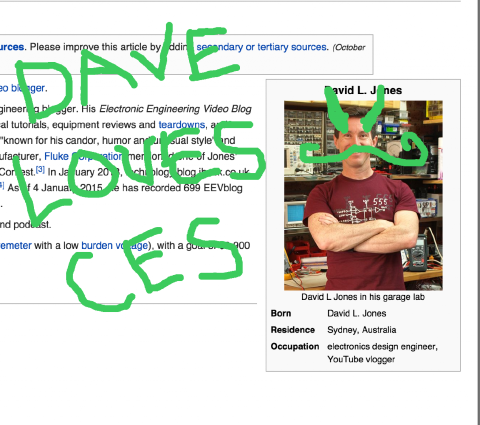
- Dave now has an article on wikipedia! Quick, someone deface it!
- Elon Musk recently did a fantastic AMA on reddit. This made Chris realize he doesn't really care about space (electronics); more specifically rockets seem boring, but it's likely ignorance about the required specs for doing something like that (similar for a Model S).
- The Hardware Battlefield showcases new hwstartups at CES, a range of which don't seem to be doing interesting tech. This competition feels similar to Dragon Den/Shark Tank.
- Chris mentioned the a lot of hwstartups aren't that interesting because of the fields they cover, but one that has been interesting (though it's "older" now) is Boosted Boards. Here's a good review of them:
- Amazon has big changes coming to Lab126 (designers of the Kindle) after failures of the Fire Phone. This highlights how even in big companies, even the "research" departments aren't immune to the sales cycle (which may point to the fact that they aren't truly research at all).
- Dave used to do research by doing long term testing of components. This still isn't basic physics/academic research, but it's closer than the development Chris mostly did.
- Bell Labs was able to operate because of the margins MaBell had due to their monopoly. Much like modern distributors, these margins continue to shrink.
- Graphene seems like a physics experiment that is on the cusp of being useful for the past 5 years. The New Yorker has an interesting piece comparing the graphene timeline to that of aluminum, which took nearly 50 years for its first commercial use and another 50 for its widespread use.
- The student who was told "No Microcontrollers" had a clever workaround.
- iRobot is offering the hackable Roomba for $200. Former guest Scott Miller used to run manufacturing for them.
- Dave is moving onto the next round of hiring for his intern. Still no word on which CAD package they'll use, though many Aussie students learn Altium because it's given to the Universities there to get them hooked.
- Chris is excited about the upcoming (but not research-new) feature on KiCad: Matched impedance calculation for traces as their being drawn.
- While Chris was interviewing after leaving college, he took part in a group interview.
- Will the changes to how courses are delivered to students affect how they learn and are hired for jobs? Do courses like this Georgia Tech online course help students stand out? Veritasium did a video about how online courses won't revolutionize education, just like technologies before it.
Transcript
Chris Gammell: This is the Amp Hour Podcast. Recorded January 6th, 2015. Episode 231. Nonplust. Neotechnic. Niving.
Dave Jones: Welcome to the Amp Hour. I'm Dave Jones from the EEV Blog.
Chris Gammell: And I'm Chris Gammell of Contextual Electronics.
Dave Jones: What's up?
Chris Gammell: Go, go, go, man. Go, go. Get going. Oh, okay. See ya. Hurry. Go.
Dave Jones: I'm out of here.
Chris Gammell: I know.
Dave Jones: Great show. Nice talking to you.
Chris Gammell: Yeah, it's been great, man. Dave was telling me before the show just how busy he is. Usually I'm pretty skeptical about Dave being busy, you know, busy, busy. But this week I actually believe you. I think this is legit busy.
Dave Jones: Yeah, you asked and you got my... Well, no, you didn't ask. I think I gave you my... Well, yeah, you probably did. But anyway, I gave you my extensive list of stuff that I'm... Actually, it was just a list of today's tasks. And yeah, they're just not going to get done.
Chris Gammell: That'll do it, man. Every time.
Dave Jones: Yep. No, it's just... I don't know whether it's the timing. You know, it's always... Everything always comes at once, you know?
Chris Gammell: Yeah, well, you always are going on holidays and stuff like that, though, too. So, I mean... Right. Yeah. Yeah.
Dave Jones: Around here, we just keep working. I won't be here next week. For minimum wage. That's right. For no benefits. Six bucks an hour or something, isn't it?
Chris Gammell: I think, yeah. When I started my first gig, I was getting paid $5.15 an hour.
Dave Jones: $5.15 an hour? Really? Yeah. Yep. My first job in 1989, my first job was... I tweeted a photo of the payslip once, and it was like $10 an hour or something. Nice. I think. Yeah. So, that was...
Chris Gammell: Yeah. I can't be too mad about that early stuff. Maybe I've said it on the show before, but like, you know, that was obviously in high school. I had to paper out when I was younger, but that didn't really count. But, you know, I was like scooping ice cream for a living, you know? Oh, right. Okay. I scooping ice cream as a teenager. Right. But, you know, it's actually great when you have like, when an eight hour shift and you're counting the seconds, right? Oh, yeah. Because you're bored. Yeah, yeah. And you're counting the seconds and you're like, well, that was a minute. And then you do the math and you're like, I just made eight cents or whatever it is. Yeah, right. You know?
Dave Jones: Yeah, yeah, right.
Chris Gammell: It's just, that's good, you know?
Dave Jones: But you're young, right? You have an infinite number of hours. So when that paycheck comes around, you go, oh, that's a lot of money, you know? And you don't think about the hours that you actually work to get it, really. You just, you know, I don't know about you, but back at my first job in the 80s, we got paid in cash, right? No, I never got paid in cash. Someone would go to the bank. They would send somebody out to the bank, you know, usually the secretary, plus they'd choose someone to ride a shotgun, right? Except we don't actually have guns here. So anyway, so yeah, so usually, you know, they'd send someone to ride a shotgun with her and she'd go to the bank and the bank would already have pre-prepared, because they know it's a regular scheduled thing, all of the, you know, cash for every employee in little brown paper bags, you know, with your name on it. And they'd, you know, bring this tray of, you know, they'd walk around with this tray of brown paper bags and they'd hand you your cash for the, was it? It might've been weekly. I think it was the only job I've had that was paid weekly. It might've been fortnightly. It might've been fortnightly. I'm not sure. It definitely wasn't monthly, which is the norm these days. Everyone, you know, everyone in the engineering industry gets paid monthly. I don't know what it's like in the States, but yeah. Anyway, that was...
Chris Gammell: Every two weeks are monthly. Every two weeks. Yeah. Yeah. I'd imagine with you and the existence of like hobby shops, that was probably dangerous. Like a wad of cash and Dave lusting after new multimeter.
Speaker ?: Exactly.
Dave Jones: Well, see, that's the thing, right? Because like you didn't have credit cards back then, you know, you didn't have online e-commerce, you didn't have shopping. Like you had to actually go spend your cash.
Chris Gammell: Which has its own perils, of course, right? The Amazon Prime is both the best and the worst thing that's ever happened. Right. Okay.
Dave Jones: Oh dear. Yeah. Yeah. We had none of that back then. So you were, you know, yeah, I went and spent my cash or usually hoarded my cash. If there's one advice I could give youngsters out there, hoard your cash, you know, don't go out and blow your wad.
Chris Gammell: Yeah. Oh yeah. That is, that's always good advice.
Dave Jones: Anyway. No, I'm flat out folks. Yes. But I am taking a break. I didn't really take much of a break over the Christmas, New Year thing. Just, you know, a couple of, just the odd day here and there, Christmas Day, Boxing Day, that sort of jazz. But I got my shelving this morning. My shelving was delivered this morning for the bunker. So that was, yeah, I didn't want to move everything in there until I had the shelving up. So that was task number one for today. And task number two was chasing up bloody parts. Maxim screwed me again. Well, actually, no, it wasn't Maxim. Sorry. No, sorry, Maxim. Maxim. As I said in the past, Maxim screwed me before, right? Right. I knew something had happened to these parts. And of course, they used DHL. The problem is DHL this time. Right. Apparently my parts have been sitting in customs in DHL in Sydney since the 4th of December. Right. This is my reel of, you know, 2,500 chips. You know, I had to buy them on the reel.
Chris Gammell: And this is actually going into the micro view and stuff?
Dave Jones: Yeah. Micro current. Yeah. This is going into the micro current, right? And I just realized yesterday I'm out of stock, you know? So like, and I've got a manually updated shopping cart, right? I've actually got a manually, like I don't actually put, you know, the amount of stock I've got in there. Um, so I've got a manually updated and so now I've got too many people who've ordered and I can't ship them all today. That's another today task. And so I've got to, you know, email and say, Oh, sorry. I don't, you know, I know you're paid and I know you, it said I had them in stock when you ordered, but oops, sorry, dude. Yeah. I hate that. You know, it's just, uh, it's just annoying.
Chris Gammell: I saw someone on, uh, Twitter. I forget who it was. Uh, but they mentioned that they were working on a low, a low quantity. I know obviously that's not a low quantity thing, but basically they were doing a low quantity project and I think it might've been Roteno on Twitter, but they said they didn't buy the parts up front. And then by the time the manufacturing came around, it was like, Nope, those aren't, those aren't available anymore. You know, it's just like, yeah. What?
Dave Jones: They couldn't even get like 10 or a hundred or. Yeah, exactly. I mean, yeah.
Chris Gammell: I mean, cause someone bought up the stock, that kind of thing, right? It's always the same thing with, with, uh, I remember, yeah, you talked about this when you, you bought those resistors for the microcurrent, right? Yeah. Yeah.
Dave Jones: The, the, the, yeah. The $4,000 reel of resistors. Yeah.
Chris Gammell: Yeah.
Dave Jones: A thousand bucks is four bucks apart.
Chris Gammell: I mean, other than, I mean, I think laying money out front is good. I think that that's, you know, that's a, that's a good thing when you do that. Yeah. Definitely. Sometimes people don't have that. Definitely. And it's just like.
Dave Jones: Well, and see, I've done that, right? Yeah. I ordered my, you know, $4,000 reel of resistors last time. Yes. I ordered a 2,500 reel of these chips, right? I've done this before, but I've gone through them and all of a sudden it creeps up on you. And the next thing you know, shit, I'm out of stock. And oh, did you care? You don't have any mouse. I don't have any. Nobody's bloody got any. Yeah. And you got to order them from fricking Maxim. Oh. That's a, that's a, if you want a horrific online experience, try buying from the Maxim website ID.
Chris Gammell: No. Pass. Man.
Dave Jones: Yeah.
Chris Gammell: That's one thing, you know, that's been getting better though. Cause I mean, like you think about, you think about 10, 10 years ago, you wouldn't even consider that though. Right. You wouldn't have considered buying direct from a manufacturer at all because they just didn't offer it. You know?
Dave Jones: Well, no, no, exactly. There was none of this. You know, I can remember back when I was doing kits back in the early nineties. Right. I, I had to order parts from the local, the local distributor, you know, Arrow or whoever it was. Right. And because there was no online e-commerce, the web didn't exist. You know, this is where you ordered parts and you didn't get them from bloody Farnell at the time. Right. I mean, yeah, Farnell might, might carry a few, but they didn't carry production quantity back then. And if they did, they were, if you think they're expensive now, you should have seen them back in the day. Right. 20 years ago. Holy crap. You know? So that, yeah. So you had to go through the local supplier and they didn't carry stock. So it'd be, you know, I'm not kidding. 40 weeks lead time, sir. You know? Wow. Holy shit.
Chris Gammell: That's a, yeah, that's, that's, that's a tough pill to swallow.
Dave Jones: Exactly. Yeah. We, we take it for granted these days, but no, it was worse. Water of magnitude worse.
Chris Gammell: So, I don't know if you saw, but Bunny actually wrote about, uh, Bunny Huang, who's been on the show. Yeah. Uh, he wrote about the Soylent, uh, supply chain. So he wrote about some of these issues as well.
Dave Jones: Soylent. Okay.
Chris Gammell: What is he, a Soylent fan? Is he? No, no, no, no. It was the supply chain. It's made of people. People. It's made of people.
Dave Jones: Right. Why? Because people have to make the ingredients or what's the, what's the story?
Chris Gammell: No, no. Just that like, you know, basically that you still have to have relationships. You still have to. Oh, right. Yeah. It's a really good point. I mean, you still have to have relationships. You still have to interact with salespeople. I mean, this is, we've talked about that on the show a lot as well. It's like, it's not going away. It's, it's, it's still a, it's still a, uh, industry that's based around salespeople and, and, and interactions and relationships.
Dave Jones: But I wish it would disappear. I wish. Of course. Every engineer does. This is why I don't like dealing with humans. It's just another step in the loop. I just like my, my interaction with DigiKey because I don't have to talk to a human.
Chris Gammell: Hey, look, I'm working on a website for this. Like, don't, I'm in the same boat, right? I mean, like. Yeah, yeah. Yeah. I mean, I agree. And, and, and I think there's tons of efficiency for that kind of stuff too. Um, but. I'm sorry.
Dave Jones: I'm just instantly viewing war games and what happens when they took humans out of the loop. Right? Right. Right.
Chris Gammell: Would you like to buy a part?
Dave Jones: Shall we play a game? Oh, goodness. Yeah. Yeah. But nah, this is one area where, yep. Sorry if you're in that business and your job relies on that, but I, yeah.
Chris Gammell: Well, there is a lot of people that do that, but I think, I think a lot of them have seen that, that downward trend. I mean, like you were talking about 10 years ago with those, you know, that expensive part, that money wasn't going back to manufacturers. That was going to, you know, distributors who took the risk to hold the stock and, and, you know, that funded a lot of stuff. And like that, that's just not there anymore.
Dave Jones: I'm sure they're, sure they're a shell of their former self. These, uh. I mean, they just consolidated, right?
Chris Gammell: I mean, look at Aero and Avnet. They're, you know, they're both like 30 billion plus companies, but they're made up of like, I mean, tons, they, they just acquire tons and tons of littler companies. They're right. I mean, like, even from when I started a lot of the, a lot of the business cards that I got when I started of people, like those companies just don't exist anymore. They exist, but they exist within Aero or within Avnet or within, you know, uh, Newark, Element 14, whatever. So, yeah, it's, it's just a consolidating industry.
Dave Jones: I've got a friend who actually keeps everyone's business card and he loves, like, and he sorts them. So he loves to, um, see where people have traveled over, you know, like, oh, look, he's been through five different distributors. You know, he's worked for five different distributors and he'll have the business cards and he'll go, look, look, they moved from here to here to here, you know? I do have LinkedIn. This company. Well, yeah.
Chris Gammell: People just offer that information now, you know? Right. Yeah.
Dave Jones: It's not a hobby anymore. No, it's, yes, it's all changed.
Chris Gammell: But yeah, oh yeah, yeah. I mean, there's, there's always tons of stuff like that too. You know, I, I got tempted by that a couple of times and maybe I've mentioned it on the show before, but like, you know, I think that, you know, people that are listening that are in the sales are probably on the technical side, right? And I think it's a common, it's a common path for a lot of engineers. To be like, well, I got to the top of the engineering or maybe not even the top, but the middle of the engineering field. And I can either stay in this company or go to other companies and do similar stuff for 30 years, or I can go and, you know, get to travel and make money, you know, because I think the FAE's and salespeople can make a lot more money because they're just, they're closer to the sale. And that I was tempted by that a couple of times and, you know, it's, it's not a, you know, you get to see a lot of cool stuff, but it's definitely a different existence. And I think it's a threatened existence in certain ways because, because those margins do keep shrinking. So.
Dave Jones: Well, I think I briefly flirted with thinking about that because, you know, back in the day, right? I was, you know, I'm talking like, you know, late nineties or something. Right. I would look at the job ads, you know, and the, and it was like these FAE's were getting paid double. Yeah.
Chris Gammell: Yeah.
Dave Jones: What engineering jobs were. So yeah, I'm bored at my current job. Okay. I look through the job ads, you know, back when you had to flick through, you know, newspapers. Right. And, um, yeah. And you would see these and they go like, like 140 K, you know, for a, for a bloody, you know, a sales, a field sales person, you know? And of course, you know, it's all based on how much commission you get and blah, blah, blah. Oh yeah. And so you've got to be a decent sales person, but that was sort of, you know, but the, even the base salary was like, you know, many tens of thousands of dollars. Yeah. Some of that stuff's on autopilot, right?
Chris Gammell: If you get assigned an account, you're going to be like, okay, economy's doing decent, you know, these 10 engineers you talk to are going to be designing with parts. You get credit for it. Good stuff. Right. Now that's not always the case and you're probably working on the more difficult stuff, but yeah, it's, uh, it's, but I think it's all changed now.
Dave Jones: I think, I think they don't earn a huge amount anymore. I think it goes through cycles and they're probably, I don't think they're in a great cycle at the moment or they were just having a real big boom there at the time. When, you know, it was that sort of job was, you know, trendy and I don't know.
Chris Gammell: Yeah. Well, you know, there's another thing to do that. There's the different layers as well. And I've written about this before, like the different, uh, I think it was on engineer blogs, but back when we had that, that blog going, but basically there, there's a lot of different levels, like, because even technical people, you could be at the FAE level, which is like, usually that's the guy that's coming in and helping you actually pick out a part and then actually get working if you have a problem, assuming you're a big enough company, you know, customer. Yeah. But then there's also like the distributor level ones who are more kind of closer to the sales side. Like, like the arrows and the avnets of the world also have FAEs, they have technical people and they usually run like seminars and stuff like that. And then there's like the marketing reps and the sales reps who are like independent from all everybody else. And, and they're usually much more sales focused as well, but they still kind of show a lot of products and stuff like that. So yeah, there's a lot of different things. I think, I think the FAEs will stick around for a long time because there's always going to be big companies. You know, there's always going to be the apples of the world and Samsung's of the world. And if you talk to FAEs about it, inside and outside FAEs, I guess inside are not called FAEs, they're called just factory FAEs or factory applications people. Yeah. But a lot of times they're actually doing the design work these days. So that, you know, that you think about reference designs, a lot of companies are using reference designs. Someone's designing that is usually within the actual manufacturer company. So yeah.
Dave Jones: So that's a, that's a, that's a great job to get if you can get it. Oh, I definitely think so. Yeah. Yeah.
Chris Gammell: But I think those ones are sticking around. I think FAEs will stick around as well. I think more like the marketing firms, the marketing rep firms and stuff like that. Those are the ones who keep kind of dwindling in numbers. I think the distributor FAEs and the sales will still be around, but in dwindling, dwindling numbers as well over time. But I think FAEs for a while will be pretty, pretty stable. So yeah, I'm sure, I'm sure anyone listening who is an FAE, I'm sure. A salesperson would, would love to tell us in the comments if we're wrong, but. I'm sure they will. I'm sure they will. That's right.
Dave Jones: People love to tell us when we roll.
Chris Gammell: Oh, that's, that's good. That's why there's, that's why people, that's why we're engineers, right? And we want to live to tell each other we're wrong. Dave, you're wrong. Come on, man. But, but apparently now I'm famous.
Dave Jones: I'm on Wikipedia. You are on Wikipedia and you didn't even put yourself there. No, that's a bit lame. It's been there for a couple of months. And like somebody emailed me, right? And, you know, a fan, they emailed me and said, Hey, you know, why don't you put a list of all your episodes up on there? Right. And I go, well, you can't do that because I, you know, like you've got to have a Wikipedia page to begin with, you know, to like, to even begin to be famous enough to have a list of episodes, you know, up there on Wikipedia. And he goes, don't you know you already have a Wikipedia page? And I go, no, I don't. And he goes, yes, you do. And sure enough, he was right. It's been up there for a couple of months. So yeah, thanks to whoever put that up. Now I'm on the grid. But yeah, I think true fame comes when the haters care enough to actually deface your page, you know. Yeah. That's when. Yeah.
Chris Gammell: I'll get on it, man. Come on. Yep.
Dave Jones: I had a call the other night at, it was like late. It was like 10.30, 11 o'clock at night. Thanks for that. At home. Right. And, you know, the phone rang and I, you know, picked up. Hello. And, you know, half asleep. And they go, is this Dave Jones from the EEV blog? And like, I didn't think. And I just said, you know, because I didn't know who it was. Yeah. Who's this? And is it really you? I'm inside your house. Yeah, right. Have you checked the children? Oh, creepy. If you've ever seen that video. No. That's scary. That was the scariest thing back in the 70s. Was it the late 70s? The night they called or something. I hate scary stuff. No. You don't like horror? I love horror. No. Anyway, people haven't seen it. Just Google, have you checked the children? I think it's, and a stranger calls. That's it. Anyway, it's a short video. It turned into a movie. I think it was a short play that turned into a movie or something. Anyway. Yeah. I got sidetracked. Yeah. Yeah. I'm Dave. Yeah. I'm Dave. Is it really you? Is it really you? And yeah, it's really me. Who the hell are you? You know? And oh, it's just a friend of mine. We wanted to know if we could find your home phone number. You know? And yeah, we did it. You know? I was like, congratulations. You know? Thanks. Oh, yeah. Dave Cashing.
Chris Gammell: Instead of geocashing, it's Dave Cashing.
Dave Jones: Right. And they were kind. You know? They were nice enough. You know? Oh, look. We're big fans. We love your show. Yeah. Okay. Thanks. For calling at 11 o'clock at night or whatever it was. You know? Time zone. So I don't know.
Chris Gammell: That could be a little creepy. Yeah.
Dave Jones: Yeah. I was half asleep. It was creepy, but it's kind of cool in an old school sort of way, you know, that they managed to, you know? Like old school kind of hack. They managed to track me down.
Chris Gammell: Old school like they used a phone book.
Dave Jones: Exactly. They, you know, went there. They just, you know, yeah. Actually called instead of emailing. You know? That's just retro these days, you know? Yeah. Right. Exactly. So anyway. Hmm.
Chris Gammell: Cool, man.
Dave Jones: Yeah. But please, people, don't call. Oh, goodness. Yep. Everyone's got my work number, but nobody's ever called it. Haven't, haven't had a fan call my work number.
Chris Gammell: Randy calls it sometimes, right? I mean, uh. Right. Yeah. Yeah. Yeah. I half expect that.
Dave Jones: I don't think the wife realizes that I've got a, uh, uh, and we've got the radio show on today because I completely forgot and, you know, I didn't remind her. So she's going to probably not realize. Yeah. She'll call and, you know, oh, we've got something to do quick. You know, or so I'll say it'll turn up like what happened the other week. Didn't he? Didn't he turn up? Uh, yeah. At the end of a show. Yeah. That's right. Exactly. That's right. Yep. So it's all happened. Ah. What else was happening?
Chris Gammell: Uh, well.
Dave Jones: Did you see the train set I scored?
Chris Gammell: I did see the train set you scored. Uh, that.
Dave Jones: And that, that's awesome.
Chris Gammell: Yeah. That, uh, it looks cool. I, I, I can't, I'm just, it's going to collect us, man. Sorry. I, I, like I was looking at it. The first thing I said was just like, that, that's really big and never going to get used.
Dave Jones: Well, the only place it could go is the bunker. Right. So, you know, but like I had to save it. It's awesome. Yeah, I know. It's like, it's like the only Indiana Jones themed train set in the world that, that, that I can find. It's like, it's one of a kind. I just had to have it.
Chris Gammell: Yeah. Just try and sell it, man. I mean, that's the main thing. Just get it out of there.
Dave Jones: No, I don't want to say it's one of a kind.
Chris Gammell: Yeah. Well, we were talking, I mean, like, like I mentioned before, when you, like you were running home from the, uh, the, uh, the, your first job with cash in hand, right. To the hobby shop. Right. But Sega's never going to be able to do that. Right. I mean, like that doesn't exist anymore. I think that's kind of the big thing too, is that like that just, I don't know. I mean, Radio Shack's obviously in the toilet. It's been for a long time. I don't know of anywhere that, I mean, actually Micro Center in Cleveland and around, uh, the Midwest. Micro Center actually kind of took over that role, but it's like a computer store. I think Fry's does that out in California. Yeah. But other than that, I don't really know where else you can get, you know, go to a store.
Dave Jones: No. And why, and why would you want to as a kid? Yeah. Everything's online. Everything's available.
Chris Gammell: You know, you can, I mean, if the instant gratification of the internet isn't, isn't, isn't instant enough. Right.
Dave Jones: I mean, right. You can go scratch and sniff on real stuff. Yeah. No, the world has just changed. You know, it's just, as you said, you know, you can order stuff on Amazon and have it the next day. Right.
Chris Gammell: Yeah.
Dave Jones: One of those same day ship things. It's not the same here, but you know, it's near enough, right. You can order something on eBay or whatever and it turns up pretty quick and yep.
Chris Gammell: Yeah, man. It's a, so that, that is, that is sad, but yeah, I can't imagine.
Dave Jones: Sagan's got somewhere to do it. He can hang out in daddy's lap, right?
Chris Gammell: He's got all the crap that you've got. Yeah. You can't give up. That's it. Dad, why do you, why do you have so many old copy machines and fax machines and other stuff from the junk room?
Dave Jones: Let me show you, son. Let's take it apart and see how much fun is this. Right. Yeah. Hopefully he thinks it's funny. He thinks it's all fun now, but you know, when he's like, yeah. Like 10 or 12.
Chris Gammell: Well, yeah, he'll probably like end up rebelling and become a salesperson or something like that, right?
Dave Jones: Right. Right. Ah, goodness.
Chris Gammell: I was thinking the other day, so I don't know if you saw the SpaceX launch got scrapped today.
Dave Jones: Oh, no, I didn't. I, yeah. I wanted to watch it, but no.
Chris Gammell: There was, so I didn't really know about it either, but I was reading, so Elon Musk did Ask Me Anything last night. I saw that. I read it. Yeah. And that was really good. It was really interesting just to kind of see. I, I really don't know anything about, about the space stuff, but I was thinking like, there's, I feel like there's like this shrinking sphere of things that I care about in terms of like the electronics world. And, and like the, I know, I know that there's interesting electronics on, on spacecraft like that, like the, the rockets and the control systems and stuff like that.
Chris Gammell: Yeah. I just, I can't, I can't bring myself to care about it though. Maybe again, maybe the, our listeners will correct me on that stuff, but yeah, I, I don't know. Like maybe it's a.
Dave Jones: Well, maybe because you've never seen it in real life. I'm sure if, you know, if you went to this place where they'll develop and, oh, look at this and where, you know, it's got to be cryogenically cooled and blah, blah, blah, you know, and that's true. You would think it's awesome. Right. And you would think it's a, you know, work of art.
Chris Gammell: Actually, I did get to go. I think I'm allowed to say that I went over there. But when I was in San Francisco last time, I got a tour of Planet Labs. Sean Meehan, who had been on the show, he's just on the street from the office where I work at. So he gave me a tour. And, and actually, yeah, I guess, I mean, like that stuff was really cool. Like a lot of those electronics and stuff like that, but still, I don't know. Like, I feel like a lot of that stuff, maybe it's, maybe it is just a matter of exposure. Like I, I, I didn't have exposure to it. I guess even before I started at Keithley, I didn't know about it.
Dave Jones: It used to be, right? It's not like, it's not like the Apollo era where back then that was like, you know, they had to invent shit to get these stuff working. And now it's like, well, it uses a 15 year old radiation hardened processor. Right. And it's like.
Chris Gammell: Planet Labs though.
Dave Jones: Oh, right. Okay. Yeah. But, you know, I mean, it's, yeah, it might be yawn worthy hardware compared to some of the modern stuff. Right. Because it has to be conservatively designed. And, you know, most of the engineering goes into the ruggedness, the, the actual survivability and the hardening of it.
Chris Gammell: So. I mean, yeah. I mean, maybe it is all that stuff, but I think personally for me, it's just like, like space as like a concept is like big and awesome. But like, but like, I want to like leap forward to like the Star Trek style. Right. Like that's what's in my head. And then it's, it's like, no, we have to solve like these really difficult economic and and realistic problems. Like, you know.
Dave Jones: All that boring shit.
Chris Gammell: Yeah, exactly. It's just like, oh man, like it's, it's, it's a lot of it is in, is in the details. Obviously they're doing things really fast at SpaceX and a lot of these other, like these, you know, privatized space companies, but.
Dave Jones: But, but ultimately it's the same old thing, right? It's launching rockets, you know. Payload goes to the space station, whoop-dee-doo, you know. Right. Right.
Chris Gammell: But still really important, right? It's like, eh, when there's this ray gun involved, I don't know.
Dave Jones: Yeah, right. And there's occasionally cool stuff like, like those rockets that, you know, that actually re-enter and land under power, right? Right.
Chris Gammell: Well, that's, and that's what this one was too, but, but yeah, I mean, and it's great, but it's just like, eh, I don't know.
Dave Jones: Eh, eh, right.
Chris Gammell: Maybe, maybe it's just like, we need like, we need, we need you to do a teardown or something of, of the control systems in that, right? Because I think that's what it is. It's like, you, you assume that it's like, well, there's probably control electronics in there for a lot of the thrusters and all that crazy stuff. But until you know about the actual specs of what needs to happen, like, well, how fast does that system need to react? Is it like, you know, millisecond response time kind of stuff or, you know, until you know that, it's hard to, yeah, it's hard to understand, I guess. I don't know.
Dave Jones: I can, I think I can see where you're coming from. I've got a bit more enthusiasm than you, but yep.
Chris Gammell: Yeah, probably.
Dave Jones: It might be true to a lot of things. Yeah. Yeah. Well, that's, that's why the whole space thing is boring to the general public, right? Nobody cares anymore. They're not doing anything interesting, right? No, it's just.
Chris Gammell: They're doing things foundational, right? They're, yeah. I mean. Yeah, right. Yeah. Which is boring. Foundation stuff is boring. Right. Yeah, that's right. It's not the first time they're landing on something, but it's the, you know, it's the stuff that's necessary to land something on the first time next year.
Speaker ?: Yeah, they're doing cool stuff, right?
Dave Jones: The Curiosity Rover, you know, but it wasn't the first time. I think, but that, that hit media pay dirt, right? Because, I don't, because just the hype surrounding it was cool, you know? Just, just the way they did it was awesome. And then, of course, you had the, the probe landing on the asteroid was cool, because that was the first time that had been done. And that was, and that was making the front page of the newspaper here, even in Australia. So, you know. Paper?
Chris Gammell: Newspaper?
Dave Jones: Yeah, newspaper. One of those dead tree things. Yeah. They still print. And even the, and even the shock tabloid ones, you know, it still made the front page. I actually tweeted a photo. It's like, oh yeah, shit, they had science on the front page? Holy crap.
Chris Gammell: Lands on Meteor and finds alien life related to Kardashians.
Dave Jones: And I was going to say, here's Kim Kardashian's ass, you know? I think, I think both of them were on the front page or something, you know? Anyway.
Chris Gammell: Yeah. I don't know. Like, I, I think the same things like, so obviously it's still the Elon Musk, but like with the, the, you know, the Tesla and stuff like that, right? But you look at the, you think about the electronics in cars, like, oh, well. You know, you think about the, the, the entertainment system and stuff like that. And that's okay. But then you, until you actually break it down and start looking at all the different control systems necessary.
Dave Jones: The hundreds of processes. Right. Right. Exactly. The Tesla has like 200 processes in it.
Chris Gammell: Right. Right. Yeah. It's until you actually go and look at that and see, see the necessity for, for innovation there. It's like that until you see the, at the, at the, at the lower level and in the system level, it's like, eh.
Dave Jones: I was going to say the, the thing that would impress would be the system level block diagram, right? Showing like, you would have to have like, it'd be the size of a wall. Oh yeah. Yeah. Chart. Right. And you'd have like 200 systems inter, you know, interconnected, blah, blah, blah. You know, it, it, it might all be a one or two buses. Right. But you know, there's like a couple other things hanging off this bus, you know? Yeah.
Chris Gammell: Yeah. Yeah. It's, uh, yeah, I don't know. Maybe it's just me becoming cynical too. I don't, I don't know. Like, I, I like so many things these days. I'm just like, oh, okay. That's doing that. Yeah. So like, there's like the, uh, this hardware battlefield. Have you seen the, uh, you know what that is? No. What's hardware battlefield? So tech, tech crunch is a big publication and they're out at CES. Uh, and there's a link on, on our, uh, on the subreddit. Uh, but basically it's like, they kind of like have voting and then they have finals and they do these contests and so many of these things. I don't, I don't know. I like, honestly, this is like, uh, for hard. So it is hardware, right? So like the hardware startups basically. And then basically they win some, they win some check at the end. I think like 50 grand or something, maybe 10 grand. I don't know. Okay. But it's just like tech crunch does like, if you, you watch the startup show or what is it called? Uh, Silicon Valley, you know, at the end there's the big check they hand out and they like have judging panels and stuff like the actual thing isn't, isn't what I'm talking about here though. I, uh, although that has its own silliness, but like going down the list of like the ones that are in this, right. And just like, or looking at the list of things at CES and I'm just like, eh, I don't know. Like maybe this is just me being cynical or maybe this is just, uh, me seeing the same things over and over again because it's CES. But like going down this list, I'm just like, eh.
Dave Jones: Well, you know what I'm getting sick of hearing? The term hardware startup.
Chris Gammell: Oh yeah. Well, yeah.
Dave Jones: Startup, startup, startup, everything's a freaking startup.
Chris Gammell: Yeah. Yeah, I guess.
Dave Jones: I'm getting sick of it.
Chris Gammell: Well, there's a lot of money in it right now. So that's, that's, that's the thing, right?
Dave Jones: Yeah. There's a lot of money floating around, but I don't know. Just stop calling yourself a startup. Just build a business, sell a product, bootstrap, do it the old school way.
Chris Gammell: Yes. No, I like that, but that's not where no one's excited about that, right? Yeah. Well, is anyone so excited about startups anymore? Not me. Oh, well, uh, I think sometimes it could be, but, but I think what it comes down to is like, what is it? Uh, you know, like actually the thing, the only thing that I've been.
Dave Jones: Oh, it always does. Yeah.
Chris Gammell: The, the stuff I've been interested in were things that I wouldn't have thought I would be interested in. Like the, uh, the boosted board, you know what that is? No, what's a boosted board? It's a, it's a, it's a, like a skateboard or a longboard. That has, um, it has like, uh, two electric motors on the back and like battery packs. Yeah. And basically it can go like. These are not new. No, no. It was, it was a Kickstarter a while ago. I guess that's the thing. Like it was a Kickstarter. I know that.
Dave Jones: Yeah. It was, it was a couple, a year or two back now.
Chris Gammell: Oh no. Like three, three or four. Three. Oh yeah. Yeah. Yeah.
Dave Jones: Long time ago. Yeah.
Chris Gammell: Long time. Yeah. Long time ago. Uh, but yeah. Like stuff like that where it's like, oh, okay. So now you have like my buddy who's like this, you know, button down doctor in New York city riding a skateboard to work. Like that's interesting. Right. Right. You know, and it's like, and it's cool electronics. It's, you know, it's got interesting motor drives on it and stuff like that. I don't know. I, I just, so many of these things, I'm just like, ah, sensor data going to a mobile phone. Yeah.
Dave Jones: Yeah. I know. Work and there's an app. Woo.
Speaker ?: Woo.
Dave Jones: I know. And it's like, I know it's not easy.
Chris Gammell: It's not easy. Right. Like none of this stuff is easy, but like smart watches. Oh yeah. Exactly. So yeah. I don't know what I'm expecting, but when I see it, the guy sitting here not making anything, when he sees it, he'll know it.
Dave Jones: I'm going through the list of companies in this hardware battlefield thing. And it's just, just the names are enough to put you to sleep. Right. Yeah. To actually turn you off. It's just, yeah. No, thanks. I don't think I could watch one of those startup shows.
Chris Gammell: Like the shows or like, you mean like the contest? Yeah.
Dave Jones: Like the, yeah, the startup, you know, the, you know, I used to enjoy Dragon's Den. Back in the day when they had it. I think it lasted one season here in Australia. Oh, you don't.
Chris Gammell: Is it like Shark Tank? But is it the Aussie version?
Speaker ?: Yeah.
Dave Jones: It's the same thing as Shark Tank. Yeah. But it's the UK version. I think the Dragon's Den was the UK version. Yeah. Exactly.
Chris Gammell: We steal TV all the time here.
Dave Jones: And they're starting up another one of those here. And it was like, you know, I mean, but the game has changed now. Haven't we? Did we discuss this or?
Chris Gammell: I don't know.
Dave Jones: Before it's like, well, why go on these shows? Why don't I just do the Kickstarter? I know it's the advertising, you know, I know it's the.
Chris Gammell: Oh, yeah. Right.
Dave Jones: You go on there for the publicity. Right. But ultimately, you know, you're just giving away your company and, you know, for pittance, really.
Chris Gammell: Oh, yeah. Right. Right. Right.
Dave Jones: You know, because, you know, they go on there, I'll give you, you know, the dragon will say, or the shark or whatever. Dragon. I'll give you 50 grand for 50% of your company. And their eyes light up. It's like, you dickhead. You're getting shafted, dude. Just. Maybe. Maybe. I don't know.
Chris Gammell: Some of these things, it's like, I have a new blender that will make a. I mean, like, that's what I mean. Like, all of the things that seem to go on these things. Like, it's not. It's not necessarily new technology or anything like that, you know. Like, that's the thing. Like, foundational technology, right? Like, that doesn't happen at startups, right? Startups are development. They're not research. And even at big companies with, like, tons of money, you know, it's still probably not necessarily research, right? Research is hard. It's really hard. And it fails a lot. And you need a crap load of money to do it. Bicing research.
Dave Jones: Yeah.
Chris Gammell: You know, and it's just like, and it needs to happen. And it just doesn't. I mean, like, and maybe that's the problem is that, like, the, I expect, you know, like, I'm sitting here in 2015 looking back. You know, it's like, oh, well, the transistor was made. It's like, yeah, of course it was made. But it was made over, you know, 20 years. And, you know, like, tons of. Yeah, exactly. Tons of physics, research. Tons of physics that went into that. And it's like, you know, you can't quite compare it. But at the same time, when I do compare, it's like, ugh.
Dave Jones: You wouldn't know what pisses me off.
Chris Gammell: What's that?
Dave Jones: Bloody.
Chris Gammell: How many listeners have we lost so far? I don't know. I know. It doesn't matter because they're not listening anymore.
Dave Jones: Exactly.
Chris Gammell: Yeah.
Dave Jones: What pisses me off is that it's got to be the majority of these startups, right? They're just ideas people, right? They just get the idea and they think all it needs is the application of money. I get my startup money and that's it. You know, it'll just happen, right? Regardless of whether or not it's actually a good viable idea. It's like that U-beam thing we talked about, right? No, don't go there.
Chris Gammell: It's just bullshit, right?
Dave Jones: Well, there's another one that just came out. The reason I mentioned that is that. I don't want.
Chris Gammell: Yeah, I just don't. Yeah.
Dave Jones: It's just a fundamentally stupid idea. Just, oh, but they'll get money for it. And it just, oh, it pisses me off, you know?
Chris Gammell: Yeah.
Dave Jones: Oh, and it's just, yeah. And like, that's the thing I hate about startups now is that every time I see something, it's like, oh, that's just another variation on some stupid idea that's just not going to work, you know? And, oh.
Chris Gammell: Yeah.
Dave Jones: Oh. Shoot me now. Yeah. Before I have to look at another bloody internet of things hardware startup.
Chris Gammell: Yeah. Or smartwatch. And so, like, the comparison here is that the, so Amazon has some lab, what's it called? Lab 126, right? So they're the ones who actually are. They're the ones who developed the Amazon Kindle. The Kindle, right? And then the Fire Phone. And then basically when that flopped, that started to change what is called an R&D group. But basically it's like, you know, you call it an R&D group, but like, really that means it's a D group, right? I mean, like, obviously the Kindle was different and cool and stuff like that. It's still consumer level, right? I think consumer has its own, you know, tangled mess of wires that you have to deal with.
Dave Jones: The Kindle was an excellent, brilliant example of a product that didn't do more than it claimed, right? It just, it was specifically for the task. And that's why the Kindle still rules today because of that killer battery life. You know, you get a couple of months battery life out of this thing, right? It's just freaking awesome. And all it does is read books.
Chris Gammell: And the whisper note on the back end. And yeah, exactly.
Dave Jones: It's just, it was executed nicely and did one task and did it very well, you know? Yeah. But everyone wants, you know, the smartwatch. Oh, I want it to do everything. And it's going to interact. It's got a Bluetooth and Wi-Fi and freaking, and it gets six hours battery life. Oh, you idiots.
Speaker ?: Right?
Chris Gammell: Yeah. Well, you know, I'm not a watch person myself anyway, so. But yeah, I mean, but my main point was that, you know, these aren't research. I mean, these aren't research. They might be doing some fundamental research, but it's like, you know, R&D is a term that's thrown around. Like I was once called an R&D engineer. That was not true. Right? I was not really doing research. No.
Dave Jones: Yeah, yeah. Exactly. Yeah.
Chris Gammell: And it's just like.
Dave Jones: You were doing the D part of it.
Chris Gammell: Exactly. Yeah, yeah, yeah.
Dave Jones: R&D is research and development. So you were doing the development. Yeah. Yeah.
Chris Gammell: Yeah. Yeah. Yeah. Little R big D, right? So more development than research. There's always going to be something you have to investigate, but it's like, it's not, it's not, it's not research, right? I mean, it's like, you know, it's investigation. It's stuff like that. It's another one. It's another one.
Dave Jones: I've done some, I've done some, well, academics out there might not call it research, but to me it was research, you know? I was researching, you know, the fundamental physical properties of long-term drift inside oscillators, right? That was like, you know, you would look out there and there's no research on it. Like, you know, we, I had to build my own jigs to actually test this thing. I had to write my own software algorithms to, you know, analyze the data and stuff like that. And drawing graphs, which nobody's probably ever done before. Right. And to me, that was sort of, you know, pretty basic kind of research.
Chris Gammell: No, I totally agree with that. I think that that, that kind of stuff is right. It's, it's not like fundamental physics, you're not going out and then trying to find new materials to put into an oscillator, but, but you're characterizing. No, no, that's right.
Dave Jones: But I was characterizing and using existing oscillators in different ways and characterizing their performance in ways that hadn't been done before.
Chris Gammell: Right. To enhance, basically to enhance performance. Yeah. I think that's, that's very realistic. I think that then if I, if I took your research, right. And I think that's the, the big difference is like, if I took your research and then just went and said, well, Dave found this is the best one. It goes into my product and I'm going to go sell it right away. That's development, right? There's still problems with that because. Yeah, yeah. Of course. Because the problems of development are what we talked about at the beginning of the show, which is can't get parts, have to deal with vendors, you know, like the, the integration side of things is the tough stuff. It's not the tough stuff, but the, that's the, that's the tough stuff of the development piece is, is the logistics and everything else. Yeah, that's right. Yeah. So no, I, I agree though. I think that's research and.
Dave Jones: Okay, cool.
Chris Gammell: Yeah. So you have been a researcher. I, I don't think I have been.
Dave Jones: I have done some basic research. Yes. I haven't done academic research. That's, you know, a different kettle of fish.
Chris Gammell: That's definitely a different kettle of fish. And I think that's, I mean, I think that's ultimately the, the longest term. That's probably what's probably most at risk in society, not society, but like in, in a, the, the time that we're living in with like all of this money chasing fast successes, right? Yeah, yeah, yeah. You know, you're not going to be funding. It's like, well, when, when can you get me this new breakthrough product? It's like, well. That's right. 10 years, maybe if it works out, you know, like graphene. Hey, hey, remember graphene? And every time they write about it, they're like, it's coming. Exactly. It'll hit some, someday it's going to be awesome. There was actually an article I posted, it was a while ago. I think maybe a couple of shows back, I posted an article about graphene. Oh yeah, yeah. It was from, it was from the New Yorker actually. The New Yorker, right? This is like this, you know, literary magazine, stuff like that. But they wrote about it. And, and the great thing about this, this article is they talk about how aluminum or aluminum, as some say. Aluminium. Yeah. Yeah. It's the same kind of, it was the same cycle. Obviously, you know, we're a little bit more advanced than when aluminum came out. But basically they, you know, they called it like ground silver or clay silver or something like that. Okay. But basically they, they, they, they found it, they refined it and they were like, well, now what? Right? And it was like, I think that was like the early, mid 1800s. And then they didn't start using it until World War II. It was like, holy moly. And now it's everywhere, right? I mean like that's. Right.
Dave Jones: Yeah, of course. Yeah.
Chris Gammell: You know, like obviously there's, there's a much, it was 1850s. Yeah. And so that's when they found it. They didn't start using it until, no, sorry, 1900. So 50 years it took. I mean, obviously we're much more compressed design cycle, but, but like you think about how critical aluminum is now. It's like, okay, well, it makes me feel a little better about graphene. Right. At the very least. Yeah. Yeah. So yeah, it's, it's, I don't know. It's, it's tough. Thinking about, about the research side of things. There was another article I posted about the, where'd it go? It was about Bell Labs again. Basically it was, it was a Quora answer. Um, why, why, why, why they were able to do so much beforehand. Obviously Quora is a, uh, you know, a user site. So it's, you know, it's usually not, it's going to be like an official answer or anything like that. But, but basically, you know, we were talking about the, uh, the margin stuff before as well. And we, and we talked to, uh, Shari about this as well, but like, you think about the margin that was available, just like the distributors that we talked about earlier in the show, you know, like when you have that margin, you can, when you're a monopoly, like Ma Bell was, uh, yeah, you can put that towards research. It's, it's probably still self-serving, but they were doing research, research. Right. And you think about margins today, like Amazon, we were just talking about in their, their lab 126, Amazon has no margin, right? They have big money and big investment, but it's just like, there's, there's, you're not going to be hiring. You can't hire throngs of scientists, even if you could find them, you know, it's just like, so I don't know. Uh, I don't think we're screwed.
Dave Jones: I want to get, no, no, I want to get, once I get more time, hopefully I want to get, you know, I want to get back into doing that. You know, I want to get back into doing some, not really, you know, fundamental physics level research. I'm not really capable of that, but you know, like research on just interesting, obscure type things, you know? And, um, yeah, it's fun. You know, it's fun just getting data, doing, you know, setting up experiments, doing tests and see what data pops out the other end. And, you know, it's fun stuff. Yeah.
Chris Gammell: Yeah, definitely.
Dave Jones: Yeah. Well, speaking of fun, I love this. Um, somebody tweeted this and it got put into the Reddit, uh, feed. Well, a, um, student here in Australia, um, I love this prank. Check it out. He, um, it's, his teacher, um, told him, right, you have to build a counter, you know, like an up counter, up, down counter thing. And you can't use a microcontroller. Right. And, you know, you've got to use it, you do it using discrete, you know, seven, four series TTL stuff or whatever. Right. So I went, yeah, that's cool. But then as a prank, what he did is he actually ground out a, a seven, four series chip. So I actually ground out the die in there, like on the underside of it, snuck a microcontroller in there and potted it back up and programmed it. So, you know, like, yeah, it, it did his basic, you know, count up, count down thing. Right. But then occasionally it would come up and just display something stupid on the display. You know, like, yeah. Ha ha. This is funny. I asked. Or whatever. You know. And it's just, I love it. I love it. Yeah. So it's worth, yep. Check it out. It'll be in the links down below.
Chris Gammell: At first when I was watching, I was like, I was like, how did, you know, I was like thinking, okay, maybe if you had like a state machine or something, you know, like some, some other kind of auxiliary logic or something. And then I obviously scrolled on the page and yeah. And his soldering was impressive. I gave a spoiler, didn't I? No. I gave a spoiler, didn't I? Well. It doesn't, it doesn't ruin it. It's fine.
Dave Jones: No, no, it doesn't ruin it. It's still cool. Yeah. It's still cool. So, and apparently the teaching never caught on or something. So yeah, it was like wasted, but no, it's never wasted when you document it and put it up like this. Cause people like us can enjoy it and go, yep, that's cool. Yeah. Right. That's awesome. You win the internet for today.
Chris Gammell: Yes. You win the internet. Yeah.
Dave Jones: Or the engineering part of the internet. Yep. And he's got, you know, nice photos of, you know, how he did it like step by step and how he destroyed several chips doing it and, you know, like dremeled out these chips and it's just great. Check it out. Yeah. So that's definitely link of the day. Link of the day.
Chris Gammell: I was actually pretty impressed. I don't know if you saw the announcement that I, so apparently I robot, the guys who do Roomba, obviously we've had Scott on the show who used to be, he's now at Dragon Innovation, Scott Miller. And then he, he was at I robot before that, but I didn't realize that they had actually started a hackable robot. Did you know that they had like an actual platform?
Dave Jones: No. But there's lots of hackable robot platforms, aren't there?
Chris Gammell: There are. So the thing, no, and I agree, but this is actually, the thing that was surprising to me was not, I think that the main thing to look at this is the cost. The cost of it is like, it's crazy. And, and basically it's, I think it's $200.
Dave Jones: As in low cost. Low cost. Yeah. Yeah. Yeah.
Chris Gammell: So like the chassis and the motors, I think, I think I'm right about this. I could be wrong, but chassis motors and I think the charger for like, and the battery for like 200 bucks. Okay. Cool. If that's the case, that's, that's, that's pretty awesome.
Dave Jones: Well, it depends. Yeah. But there's lots of low cost, you know, hardware platforms out there.
Chris Gammell: But not for a full chassis and stuff like that. Like an actual injection molded, you know, like the injection molding stuff is, is tough. Oh yeah. No.
Dave Jones: Of course. Yeah. Usually like they're made on a PCB or something, you know, they'll attach some motors to a PCB or something like that. You know, there's heaps of kits out there like that.
Chris Gammell: Yeah.
Dave Jones: Yeah. Okay.
Chris Gammell: We'll check it out. Yeah, definitely. Let's see. You've already ran through your tasks of things today.
Dave Jones: No, I haven't. No, my task is to actually invite people in for interviews. So that's going to happen today. Oh yeah.
Chris Gammell: Okay. Hopefully. Yeah. Yeah.
Dave Jones: Yes. That'll be fun.
Chris Gammell: Is the microcontroller guy on the list or no?
Dave Jones: Well, it didn't apply. Oh, darn. I don't think it's him.
Chris Gammell: I think that's why, that's how we found out about it. Yeah.
Dave Jones: That's how we found out. Somebody said, yeah, I should hire this guy. Yeah, totally.
Speaker ?: Right?
Dave Jones: That's the kind of thing. Like if you show me that webpage, I'm going to go, yeah. Okay. Oh yeah, of course. Exactly. That's a good example. Definitely get an interview. Right? So, yeah. Yeah. And I tell you what, I'm impressed by the standard. The standard of people who apply it is excellent. You know, so sorry if you don't, sorry if you're listening and you didn't make it. I'll also be sending out emails today if you didn't make it. Hopefully. That's the plan for today. Okay.
Chris Gammell: Any surveying of like the CAD packages that usual people were listing, if at all?
Dave Jones: Because they're students and a lot of, and the ones I'm considering are based in Australia here, it's almost always Altium, right? Okay. If they're a student, right? Because Altium just practically owns the student thing here.
Chris Gammell: Oh, they have like licenses at schools. Okay.
Dave Jones: Yeah. They always have. Like for the last 30 years, right? That's been Altium's thing. That's smart. No, that's smart. Yeah. They always got into the schools, right? So pretty much everyone knows Altium. See, but that's the problem, right? I hire someone. I can't afford another Altium license, right? Right. Like, you know, so we've got to either switch. Did we mention this the other way? I've got to either switch packages or, you know, choose something new or something more affordable. Maybe the new, if Altium ever get off their ass and actually release this new low-cost one, you know, if they release like a $1,000 package, okay, well, you know, we can buy a seat or two of the, you know, low-cost package. Or I could just switch to... I have a... Yeah, go on.
Chris Gammell: I have a new bad hobby of watching the KiCad developers list. And it's like... Right. Today they were asking for icons for the push and shove. They're doing differential. Like they've never had differential matching.
Dave Jones: Oh, right. Okay.
Chris Gammell: And like calculation as you're dragging around, which you need for... Yep. Obviously you need, but you know, but maybe people don't know you need for, you know, high-speed lines and memories and stuff like that. So, yeah, but it's tough because like you look at it and you're like, oh, it's coming. It's like, no, well, in a while maybe, you know? Right. So, yeah, that's kind of tough.
Dave Jones: But it's... Yeah, we might switch to, you know, because we might be in the same boat, you know? If we both have to switch, then hey, let's go to KiCad, you know, or something. So, I think...
Chris Gammell: And you know someone who can teach you. Yeah.
Dave Jones: Right. Well, yeah. No. It's just a matter of time. Apply time. I think so. Right. Yeah. To actually just lay out some boards and you'll learn pretty quick, you know? Yeah. I mean, that is the big thing. Yeah. And it's... See, that's the thing. I think it's, you know, it's pretty much either Altium or Altium or KiCad, right? That's going to be pretty much the only choice. I'm not going to go choose Eagle, you know? That's just brain dead, right? Yeah, Diptrace is...
Chris Gammell: You can use Diptrace, maybe.
Dave Jones: We could use Diptrace, but it's another commercial one, right? If I'm going to pay for a commercial one, well, I may as well get the one I'm familiar with and I like Altium, right?
Chris Gammell: Yeah. True.
Dave Jones: So, you know, assuming that they actually release the thing and it's good, right?
Chris Gammell: Yeah. Right, right.
Dave Jones: Yeah. So, yeah. At the moment, I'd be silly to commit to something like Diptrace. Like, I had a really good applicant who I'm getting in. He's got... He lays out all his boards using that, right? So... Oh, yeah. Okay. Yeah, yeah. So, anyway, you know... Anyway, we'll see. But it's kind of tough. You know? And it's going to be interesting, you know, whether or not... Like, I've, you know, interviewed tons of people before. You know, I'm so used to doing it through my work, right? And companies I've worked at. But I'm hiring for the company, you know, which is kind of different to... I think it might... You know, it's different to hiring...
Chris Gammell: Chairman, founder, and CEO. Exactly. Hiring manager.
Dave Jones: Hiring for yourself, you know? Because I still don't know if this is going to work, right? Right, right, right. This whole idea, right? I might find, oh, no, they just annoy the hell out of me, or, you know, I can't stand having someone in a lab, right?
Chris Gammell: That'll be a shift. Yeah.
Dave Jones: Well, it might turn into, well, they don't do work here, right? They, you know...
Chris Gammell: Send them to the dungeon.
Dave Jones: The bunker, right. No, there you go, bunker. All that, you know, anyway. So, yeah, we'll see what happens. But, yeah, I've got to interview. But it's such a time sink. You know, like, I don't want to give everyone just, like, oh, 10 minutes, you know? I don't want to get them in here and, you know, do 50 people in a day, right? You know, it's just...
Chris Gammell: You can do group interviews. You ever done those before?
Dave Jones: No, I've never done group interviews.
Chris Gammell: Oh, I've done those before. Really? Well, I've been interviewed like that before.
Dave Jones: Interview multiple... Really? When there's multiple people? Yeah. In the same room?
Chris Gammell: I interviewed a GE when I was leaving school.
Dave Jones: Oh, at GE, right.
Chris Gammell: Yeah, yeah, at GE. And they probably brought in, like, 10 people at once. And basically, though, they... Basically, they were, like... They're, like, here's an activity. Go figure this stuff out. And they had, like, different... They split us up into teams and, you know...
Dave Jones: Oh, wow. Really? You have to...
Chris Gammell: Think about GE. Think about how many people they hire. I know. Yeah, I know. They're an engineer factory, right? Yeah, yeah. Right, right. And a lot of times in the best way, right? I mean, they have a brilliant... Right, of course. It's called Edison Engineering Program, stuff like that. I have friends that go through that or went through that. And, yeah, so, I mean, it's... But it's just, like, the logistics of hiring that many people is, like...
Dave Jones: Got it. Yeah, no, they can't afford the time to interview everyone one by one. It's like, I can barely afford the time to interview the people I'm going to interview, right?
Chris Gammell: Yeah, and this was an argument. So, I brought up the whole, like, project-based engineering stuff when I was on Engineering Commons. I mentioned that last week. Like, but, you know, Jeff, the host over there now, he's like, but how do you do that when you have to hire lots of people, right? That's kind of the downside. You know, you can't go and... I mean, I think that ultimately it's worth it if you want a really good engineer. You should go out and find their projects and stuff like that and go look at what's online. But think about it logistically. Like, that's tough. You know, if you have to hire...
Dave Jones: When you've got 100, 200 resumes, which is not uncommon.
Chris Gammell: Oh, not even... No, not even 100 or 200. Think about when you have to hire 1,000 engineers, right? Oh, right, yeah. How do you do that, right? I mean, like, that's really tough.
Dave Jones: Yeah, yeah.
Chris Gammell: So, yeah.
Dave Jones: Because they do that every year, right? They've got budget to hire a new group of people coming out of the unis, right? Yeah, yeah. I mean, you're stressing about one.
Chris Gammell: You're stressing about one. I know.
Dave Jones: No, I can't say I've ever been involved in that. Usually it's the other way around. Usually there's, like, you know, four people interviewing one poor bastard who's coming in. Oh, yeah, and they still do that.
Chris Gammell: But they still do that, you know, for the ones that get through. But, yeah, it's tough.
Dave Jones: So, that's just a way to weed out people, like, see who... So, what do they do? Would they, like, then go, okay, the team that performed the best, you're all in, right? No, no, no. We're going to hire those five.
Chris Gammell: No, it was part of a bigger thing.
Dave Jones: Ah, or do you see who naturally rises as the leader of the group and just hire the leader of every group?
Chris Gammell: I think what they were really doing, from a people perspective, is they were looking at who's going to be the a-hole, right? So, can you actually... Like, you think about it, right? I mean, like, this is something that... Like, you go on any forum or talk to any engineer, what's the thing that they don't teach you in university, right? You know, they can be the best technical... Right, just how to be a team player. Exactly. They can be the best technical program ever. They still won't teach you how to communicate as well as you need to, right? Because it's just such a big component. And how to work well and how to manage stuff. It's just like... And it's... I don't think I'd even want to take those courses. Like, that would be terrible.
Dave Jones: And sometimes you can't teach that. It's, like, it's personality. It's like your... Yeah. You know, what family you were brought up... You know, there's like... By the time you get to that age, you're, you know... Like, you're pushing 18, 20 years old, right? You've had a lot of ingrained stuff through all of your development, right?
Chris Gammell: I don't agree with that. I think that anyone can be taught. I mean, but it's just... Oh, yeah, but it's not... Some are going to be more privileged than others, but it's...
Dave Jones: It's not easy. No, some people are just naturally kinder or they naturally play well with others better, right? Shut up, Dave. Yeah, I'm the kind of guy who's going to go, no, that's wrong. Here's why. You know, I don't... Some people have a lot more tact, right? Whereas I have zero tact, right? Because that's, you know... Yeah. I mean, I get it. You're right. I mean... Yeah. Totally different. You know, you can get total opposites and it's hard to teach. It is hard to teach, but it is possible to teach.
Chris Gammell: I think it is... It's at least possible to point out to people... Yeah, yeah. Hey, Dave. You have to be more tactful. Don't do that. You might not listen, but maybe you could at least get through that part of the interview.
Dave Jones: Well, you're not so much teaching it, right? You're not changing that person's behavior. You're just making them realize it's important to, say, suppress something like that. Right, right. You know, you're not actually changing the person. You're just telling them how to survive, you know, how to best, you know, keep your job, pretty much. How to best survive in that environment. Yeah, totally.
Chris Gammell: Yeah, yeah.
Dave Jones: Right? I mean, you know, it's like I've done that, right? I've worked in companies where I know, okay, you don't want me to open my mouth. Fine. I'll keep my mouth shut. Yep. You know? Okay, fine. All right. You know? You haven't changed me. You've waited as long as you can, right? Yeah, that's right. And so, yeah, it's... Anyway. So, that's really fascinating. So, what do you watch? Do you have one person watching the dynamics of each group? You know? Just sit in there, you know, with their pen and their clipboard. Oh, they were just kind of watching everyone.
Chris Gammell: It was like being in a focus group, basically. It was weird. So...
Dave Jones: Okay. Hmm.
Chris Gammell: Didn't get the job. I don't know. So, maybe I don't play well with others.
Dave Jones: Like, I've been in those team building things. You know, companies will send you on, like, team building courses, right? And, you know, and you have to, you know, operate as a team and, you know, all that sort of jazz. Yeah, right, right, right. Rogues courses. Yep. Yeah. And, you know, and you've got to... You know, you're all on a deserted island and you've got to learn how to work together and solve these problems and blah, blah, blah. You know? All that sort of wanky stuff. Yeah. And you see who naturally, you know, rises, you know, who's naturally the, you know, the ideas person who comes up with, you know, the organizer. Who's the natural leader? Who's the person who just sits there and, you know, goes, yes, okay, yeah, I agree. Yep. And just sits in the corner, timid.
Chris Gammell: And I think there's legit stuff for everything there. Like, it's like if you have, you know, you don't want someone who, you know, is in a low level position being like, no, I'm the boss. I am the CEO. Right. Yeah, yeah, of course. Because I'll never... There's humility as well, right?
Dave Jones: They will never do the work, right?
Chris Gammell: Right. Exactly.
Dave Jones: You know, sometimes you've got to have those yes people, right? Because they're the ones who, you know.
Dave Jones: And people change.
Chris Gammell: I mean, I think that people can change. I think they normally don't, but I think that they can and they can learn and stuff like that.
Dave Jones: That's what I'm saying. People normally don't change. That's what I'm saying. Yes, they can. They can learn to adapt, but, you know, it doesn't, you know, like you can't ultimately turn a real grumpy bastard of a person into the world's most friendliest human, right? It's just not going to happen.
Chris Gammell: Dave, I would like to introduce you to beer.
Dave Jones: Right.
Chris Gammell: Say yes, you can. No, I bet you can have good drunks and bad drunks, right?
Dave Jones: You can have good... But can't you have good drunks and bad drunks?
Chris Gammell: Yes, of course. And that's a terrible example. Exactly. If there's anyone out there... Thank you. Yeah, that was not a good example. But I think that, yeah, I don't know. I think that you could teach people to fake it a lot of times. When it comes down to it, I think you can... And fake it, you know, fake it till you make it too, right? I think that people will modify their behavior to match eventually anyway, so...
Dave Jones: And ultimately, those big companies, ultimately what they will do, like, because they have to hire so many people, ultimately what they'll do is just hire it based on your psych exam or based on the results from this, you know, simple team building, you know, team thing, right? They'll go, okay, you're the type of person we want. You know, we don't care about the details, you know, whether or not you're a good designer or bad designer, whether you're enthusiastic or not, you're just that type of person, you know? And I've been to job interviews, yeah, where I've had the psych exam and they would come back after, yeah, I would have a psych, you know, like a two-hour psych exam, you know, where you've got to fill in the, you know, and then they go away and, you know, they go away for half an hour, analyze it, they come back and say, we'd like to offer you this management job. And I'm going, but I don't want a management job, but you're perfectly suited for it, you know? It's like, oh, right? It's just crazy. They just didn't care about the details. They would offer me this job that I didn't want, you know, and that I didn't apply for and that because I, you know, hit some buttons on their psych exam, right?
Chris Gammell: That is nuts. I know. That's a reason to run the other way, right? I mean, like...
Dave Jones: But this was a big company, right? Yeah. This was like a huge, multi-national, you know, company. And that's what they did. That's how they hired people.
Chris Gammell: I wonder about how this is going to change over time, too, because like, I mean, I think that, you know, the university experience, there is some social stuff involved there. I think especially for like lab classes and stuff like that, but looking at like, you know, like reading social cues and everything else about like that the human, like, I think that because of cost constraints, right? We've been talking about cost constraints a lot and how that ends up affecting research. I think that ends up affecting education as well. And I think that the trend is going to be towards more and more automation, right? Online courses, right? Obviously, online courses, Chris says. Founder of Contextual Electronics says. Online courses. But even like Coursera and like MITx and stuff like that. But just like how that's going to affect stuff.
Dave Jones: I will send you an interesting video from Veritasium, fellow Aussie video blogger. Yeah. Have you seen this one? It's how people learn and stuff like that.
Chris Gammell: Maybe.
Dave Jones: I will link in. Anyway, somebody tweeted it.
Chris Gammell: Sorry, but I forgot it.
Dave Jones: Right. Will this, this will revolutionize education. Here we go. Here's the video. So I'll link it in. And of course, this doesn't work on radio, but I will send that to you. And it's interesting. If I remember, the result from this was that online courses didn't do any better. Yeah. And it was, anyway, it's, you know, like a lot of things that you would, and things like the difference between having video animation and still photos, right? You would think that the animation would explain better. Not necessarily so.
Chris Gammell: Yeah.
Dave Jones: Right. So yeah, there's interesting research, which has gone on to how people learn and stuff like that. And, you know, and the thing that came out of it, no, we will still be learning the same way. You know, a teacher imparting their, not just information, but imparting their enthusiasm for teaching it. Right. That's, yeah. Anyway, it's worth a watch.
Speaker ?: So.
Chris Gammell: Yeah. There is a Georgia Tech. So I saw, one of the reasons I bring this up, there is a Georgia Tech course that's out there. It's starting up in March. And it's like, you know, like, it's like an electronics course online. That's good. I mean, it's, and it's, it's free, I'm pretty sure. But it's just like, I wonder just about how, how it's going to end up all affecting that kind of stuff. But especially from the, ultimately people go to school to get jobs, right? That's kind of the thing. And. Right. And I just wonder how, how that all changes. I mean, maybe sitting in a lecture hall doesn't really matter that much anyways for, you know, being in a group interview later on, but I just wonder how this stuff's all going to end up changing. Maybe, because maybe job interviews will change as well. Maybe they, maybe the big companies will start looking at, do you have Coursera credits and stuff like that on your resume? Maybe. I don't know.
Dave Jones: I hope not. Because, you know, then they'll go, oh yeah, how many Coursera credits do you have? And how many people are you linked into, you know, on bloody LinkedIn, right? And that's right. I'm sure, I'm sure that happens at the moment, right? There's HR departments that, that cull based on your LinkedIn profile.
Chris Gammell: Oh, I know. They do that for GitHub. They do the, a lot of the.
Dave Jones: Oh, really? Yeah. If you don't have a GitHub.
Chris Gammell: How many GitHub repos you have and how much. Because if you go to GitHub for like someone's profile, if you go to my profile right now, you'll see like how many times I do commits per week. It's, it's pretty insane. And, and like, like you could be, you could be committed garbage. I mean, like you could literally be doing a thousand commits a day of like commit. Oops. Mess that up. Oops. Mess that up. And each, and that would be three commits.
Dave Jones: I have no idea what I'm doing. I'm a shit programmer. But I'm committing. I'm committing.
Chris Gammell: Yeah. I mean, I'm guessing hopefully they're a little bit more, a little bit more sophisticated than that. But, but, you know, it's hard, right? I mean, you're going through this too. Obviously you, you have good candidates going for one job and you think about, you know, good candidates being mixed in with mediocre being mixed in with bad candidates for like, you know, big jobs for big companies and stuff like that. And it's just like, how do you, how do you start to delineate between one or the other? And I think that eventually they're going to say, well, of course, era credits. Well, you know, this and that and this and that. And I think it's just, I don't know. Yeah. We'll see. We'll see. The future's coming. Yeah.
Dave Jones: Yeah. The future's coming. It's not looking bright, folks.
Chris Gammell: Well, I think, I think that the future is projects, right? Obviously I have, I have a horse in the race here, but I think it is a lot of what your, your, your applicants doing too, right? It's just, do you have, are you making stuff? Yeah. Ultimately, that's what, that's what matters. And yeah.
Dave Jones: And that's exactly what I found here. It's like, okay, I've got resumes from, you know, 30 different, you know, students. How do you stand out? Well, I don't necessarily give a toss about your grades. It's what have you done? Exactly. You, you haven't done any projects at all on the side. You've got no interest outside. Well, okay. Sorry. You go to the bottom of the list because there's so many other, you know, yeah, you might be a fine student. You might be a fine candidate, right? But I'm sorry, you're not going to make the interview because there's, you know, 10 other people who have all these interesting projects they've showed me, you know, I'm sorry. I can't interview everyone. So yeah, you've got to make that first cut. So yeah.
Chris Gammell: Well, you got a hard day ahead of you, I think.
Dave Jones: Oh, I do. So I better get started.
Chris Gammell: You should. Cool. Well, have a good holiday next week. I will be talking to others, not you. Right. So enjoy, enjoy the fun and sun while I sit here and minus, I guess what it would be in C, it'd be minus eight degrees C weather. Something.
Dave Jones: Right. Yeah. Okay. I'll tweet photos. Well, I tweeted photos the other day from the beach. I saw those.
Chris Gammell: Yeah.
Dave Jones: Yeah. Yeah.
Chris Gammell: Yeah. Maybe next winter I'll come visit. Maybe. Awesome. All right, man. Talk to you later. All right.
Dave Jones: See ya. See ya.
Dave Jones: See ya.
Speaker ?: See ya. See ya. See ya. x x x x x x x x x x x x x x x x x x x x x x x x x x x x x x x x x x x x x x x x x x x x x x x x x x x x x x x x x x x x x x x x x x x x x x x x x x x x x x x x x x x x x x x x x x x x x x x x x x x x x x x x x x x x x x x x x x x x x x x x x x x x x x x x x x x x x x x x x x x x x x x x x x x x x x x x x x x x x x x x x x x x x x x x x x x x x x x x x x x x x x x x x x x x x x x x x x x x x x x x x x x x x x x x x x x x x x x x x x x x x x x
Archived Discussion (6)
Comments are closed. Archived from the original site.
Show archived discussion (6)Hide discussion
AmazonBell LabsBoosted BoardsBunnie HuangCESCourseraElon MuskGrapheneInterviewMaximSpaceXsupply chainTesla
Keep current
Every episode, plus the occasional job post, in your inbox.
http://www.engadget.com/2015/01/05/energous-wattup-wireless-charging-demo/
Speaking of horror movies, how does Penn Jillettes' Director's Cut compare with 'When a Stranger Calls'?
Ha! That was the laugh I needed, thanks man.
You both do such a great job each week!
I'm glad you have continued to drive home the point that Bunnie put so well in his Soylent analogy. It tends to be so very easy to become vacuum sealed, especially when you work for/with yourself. I may just make more of an effort to overcome the shyness and make more real connections. There are a few of us out here that really benefit such advice and encouragement.
Thanks again for the podcast, it is like a supplement I take each week to maintain my engineering health & vigor.
Keep your iron's hot and for Ned Kelly's sake Stay Fluxy!
73 ( or 72 to all my fellow QRP'ers)
Being a manufacturer's rep used to be the pathway to big bucks, particularly if they had a large account, as they would get a percentage of everything that ships to that account, no matter if they did anything or not, as they concentrated on the "relationship" between the manufacturer and the end customer. Usually it was arranging the meeting, picking up the manufacturers' people at the airport and taking them to the customer. As the big customers have had to increase profits, they attacked the margin, and the reps lost out first. That part of the supply chain is withering and dying.
Different companies pay their sales force in different ways, and commissions used to be the path to riches for FAEs and FSEs. Again, because of the focus on shrinking margins, that is going away. All corporate sales and applications engineers in my company are straight salary- I appreciate that, since the engineers can concentrate on being technical rather than fighting to be attached to a high volume customer design.
In the US, big companies don't do much design- they outsource that to the part manufacturer (and the price gets wrapped into the chip cost), or to the end device manufacturer, where the price gets wrapped into what the end device manufacturer charges.
I think the distribution system is on life-support. In the US it is little more than a middle-man between manufacturer and customer, and in Asia it is dominated by corruption and questionable middle-man type relationships. The manufacturers don't want to be in the warehouse business, and no big customer (or distributor) is willing to carry the costs of keeping inventory. I think we're going to end up with a few big catalog houses that carry lots of things but charge for that service and being able to kit it and ship it to you quickly (with no technical support), and the silicon manufacturers who will either sell direct as the parts come off the testers, and where that can't keep up, keep some stock at the catalog houses.
(I'm going to try and stay anonymous- I'm not saying anything that is really secret, but some people might be upset - notably distributors and manufacturers reps - with an honest opinion about the industry.)
Sincerely,
a honest FAE