
#214 – "Impedance Matching" With Charvat And Ossmann - Recurring RF Remontados
Download episode · 46 MB
Also on Apple · Spotify · YouTube · RSS
Show Notes
Welcome back Michael Ossmann and Greg Charvat!
- Since we last talked to Greg, he has made many more media appearances.
- Engineering on TV shows continues to be a lame proposition. The auxiliary Mythbusters crew just got laid off. Joe Grand told us about the rigors of being on an engineering show when he was on The Amp Hour.
- Mike has started releasing videos in his SDR series. These are a supplement to the in-person 2 day classes he teaches at security conferences.
- Power and low cost requirements drove choice of no FPGA on the HackRF One (now shipping!).
- Greg has friends at the MIT Haystack observatory that have had doing similar SDR issues and don't hire FPGA programmers.
- Mike is planning to do some add-on boards for the HackRF; limpkin has already made some of these. The higher sample rates means you could see "farther" (up to 1Km) and more detail of things in the distance. This would also allow for range dopler imaging.
- Greg says that many Signal Processing PhDs talk about spacial frequency domain.
- Mike says he needs to buy Greg's book. You should too!
- Mike has been playing around with CW radar using "arduino radar" modules off eBay.
- Greg recommends instead using FMCW 24 GHz modules. One good example is RFbeam microwave K-LC1a, which cost roughly $5.
- The coffee can radar kit is currently avaiable from Quonset for $600. Lincoln Labs make one for their grad students and UC Davis are developing an Arduino shield.
- The Amp Hour (and Greg) recommend the upcoming kit of Tony Long, former guest of the show.
- Greg wrote a Circuit Cellar op ed about the future of small radar tech.
- RADAR is seeing more use in the home. One example is a video game system shown by MIT Media Lab that can detect gestures.
- Mike gave a DEFCON talk about the NSA playset. This is the set of tools used for spying, many of which used RF retroreflectors.
- Greg recommended that Mike skips the cheap Chinese modules and instead get a surplus police radar unit. Another good choice is the hot wheels radar gun which surprisingly runs with a 10GHz chipset. Jeri did a video with the toy: https://www.youtube.com/watch?v=Dhp21FxttWM
- Mike has been trying spread spectrum for his retroreflector setup.
- There is a research paper about doing arbitrary quadrature modulations in a backscatter device. They discuss a simple passive device that is a MOSFET with an antenna. Awesome.
- Mike uses antennas from WA5VJB (Kent Britton). These are log periodic, PCB based, antennas that can go from 850 to 6500 MHz.
- Chris was embarrassed for not doing more with his USB TV tuner. Mike explained that many don't because they are lacking PAL connectors (which convert to SMA or BNC).
- Greg talks about how LabView is great for getting set up with quick experiments and validations. Chris used to use this in his FPGA DSP work.
- The HackRF will hopefully be used for derivative/add-on project.
- Jared Boone (one of the HackRF team members) is working on the PortaPack. https://www.youtube.com/watch?v=koS-RobcKXI
- There are people that are connecting the HackRF with the BeagleBone Black.
- Mike is working on Filter/LNA board between HackRF and the antenna for extending filtering capabilities.
- He also wants to possibly do a VNA board that could also do RADAR.
- Greg explains that a prior company he interned for made coversion boxes to make the HP8510 into a RADAR array.
- Mike used to get grant funding (which helped to develop the HackRF/Daisho) from the Cyber Fast Track program (which recently ended).
- Mike also used to work on the P25 digital radio at the Boulder lab of the Dept of commerce (they also do the atomic clock, wwv & wwvb).
- All were a bit skeptical of the goTenna use cases, but were intrigued by the use of the MURS. This band is similar to the similar to FRS.
- We aren't completely sure about the goTenna but future filings about their FCC activity will be found on the FCC website.
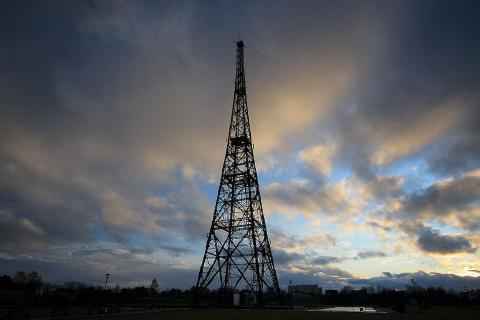
Thanks to the Poland MFA for the picture of the tower.
Transcript
Dave Jones: This is The Amp Hour Podcast. Recorded September 1st, 2014. Episode 214. Recurring RF Remontados.
Michael Osman: Welcome to The Amp Hour. I'm Michael Osman of Great Scott Gadgets.
Chris Gammell: And I'm Chris Gammell of Contextual Electronics.
Gregory Charvat: And I'm Gregory Charvat. And I'm an entrepreneur. I built some through-wall radar stuff. I made the MIT coffee can radar. And I wrote a book on small and short-range radars. And I can't really tell you what I'm doing with the entrepreneurial stuff. Is that good?
Chris Gammell: I guess. Well, why don't you just... Come on, Greg. It's been months now. It's been months.
Gregory Charvat: I can't say anything, Chris. I can't. But I'm involved in a new company with the same investor right now.
Chris Gammell: Okay. I guess we'll have to just go with that. You just have to go with that. We'll continue. Wait with bated breath until you can tell us. But I was excited because we got Greg and Mike on the show at the same time. And we're going to talk some RF today. All right. And I'm excited. Radios. I love radios. So, Greg, why don't we go back a little bit in time? Because we haven't talked to you since the Malaysian Airlines disaster. Oh, yeah. And you were the engineer expert on television. I was. What the hell was that?
Gregory Charvat: Well, first of all, they should never let an engineer go on national television. Never. Why is that? Well, because we have a tendency to jump into the details if you're not careful.
Michael Osman: Oh, do we? Yeah. Occasionally. I never noticed that before.
Gregory Charvat: And I don't know. They kept bringing me back, which was really great. So, for that reason, my goal was to kind of keep it high level. Uh-huh. And really, what they're looking for is, you know, a one to two to three to five minute interview where you provide some insight, some high level insight as to how the different radar sensors and things work. And the crux of the biggest problem with the Malaysian Flight 370 disaster was that there were so many different signals and satellites and radar and sonar and all these things involved. So, there's a lot of confusion as to, you know, why can't a radar in Malaysia detect a plane all the way 1,500 miles out into the Indian Ocean? You know, simple things like that that people don't really understand, you know. So, basically, I provided some insight and I actually even brought on television some models. I brought a little radar dish at one point and some, I even brought aluminum foil on the air, Chris. Yeah. Nice.
Chris Gammell: I saw the video at one point and it seemed like you were like, okay, okay, America, here we go. Let's sit down. Let's have, it was like, you should have put on the cardigan sweater and been like, hello, boys and girls. Today, the land of imaginary signals.
Gregory Charvat: Well, I'll tell you what, you know, what was happening was the, the, uh, conspiracy theories were flying around about that because of the confusion about the various signals. You know, like you had that, uh, you had that, um, there's a satellite transponder thing on the plane that would provide information about the, the engine, uh, maintenance. Okay. And that's sort of, that's how they ended up, you know, uh, locating or rather hypothesizing where the plane went. Then you have radar signals. You've got like the air traffic control radars and you've got the search radars on the P8 Orion. And then you've got sonar and you've got all this stuff and you've got satellite to satellite imagery. So, you know, it, it kind of was, was ripe for people to theorize. And the first one I helped put to bed was the theory that they flew North. So a lot of people thought that that plane went North up through the Chinese, the Himalaya mountains, you know, which is a very, um, militarized part of the world, sort of the border between India and China and so on and so forth. And there are a lot of radar sites. And the theory was that they deliberately dodged radar. So it's kind of like Top Gun, uh, meets a jumbo jet or something. You know what I mean? Here it is. Here's this conspiracy theory. Here's how it would have worked. It's Top Gun meets MacGyver. Okay. So you have a couple of these guys who would have flown that jumbo jet, like a, like a F-14 fighter pilot, dodging radar, which is hard to do with those planes alone. But also they would have to duct tape to the windshield of their plane, an electronic warfare ELINT receiver to see where all the radar sites are. And then they'd have to be bombing up and down the Himalaya mountains doing barrel rolls, you know, just crazy. So I helped put that to bed. And it was funny because there was a, there's an art radar guy in the New York Times who basically reiterated the same thing I did the following day. So I thought that was pretty cool that we were all sort of converging. And, and that part of the story, you know, started to go away, which was great. So I feel like I made some contribution to it. But, uh, you know, it was an exciting experience because they kind of, they actually send like a chauffeur car out to get you and you go into New York City and it's just like, it's crazy. And you're there for a couple hours and back out and, you know, they, they put you through makeup. That's another thing engineers aren't usually accustomed to. Yeah. Have you guys ever had makeup on before? You guys, you guys don't wear makeup every day? Not for a long time.
Chris Gammell: No? No. Not me either.
Gregory Charvat: That was my first time, Chris.
Chris Gammell: Oh, you never did like a theater in high school? No?
Gregory Charvat: No, I hated theater in high school. I always hated it.
Chris Gammell: Mike, you, do you ever do a... Yeah, I did a lot of theater and stuff. Yeah. So, yeah, me and Mike, we know what I do. Yeah, they cake it on you because all the lights are so bright and everything. Sure.
Gregory Charvat: Yeah. Well, they definitely caked it on. Yeah.
Chris Gammell: See, now I'm wondering more about the, like the mindset of like, was it like, if you'll excuse the phrase, here comes the nerd? Or is it like, here comes Dr. Charvat, the expert? Is it like, roll out the red carpet? Or is it like, we don't care because we have people coming through all the time kind of thing?
Gregory Charvat: No, it was more like the later. They were, you know, they treated me like the expert. They actually would, they put graphics of my book on. Nice. That's fancy. The actual television before I went up there. It was really nice of them. And I would say, especially the CNN people are very professional. I was very impressed by them. Very like positive, happy bunch. I would say a very, you know, like you ever go to a different company, you ever visit like a vendor or something and everyone's miserable at that company? Yeah. You know what I mean? I've seen it. And then you visit another vendor and they're all happy to be there. Like these guys had one of those very positive cultures at CNN. Everyone seemed to be really happy to be there. They're very, just super friendly, very supportive. And they'd tell you, oh, you did great. Of course they were.
Chris Gammell: They were making bank for, on the Malaysian Airlines crash for like six months. Yes. Yes, they probably were.
Gregory Charvat: I don't doubt that. The ratings went up a lot, I've heard. So, but they, you know, it was kind of crazy. They're a very, very positive group, I think. It was very interesting.
Chris Gammell: Well, that's crazy, man. That's an interesting experience. And you told me the other day that they asked you about Sonar at one point as well?
Gregory Charvat: Oh, so after, I saw you, I've made some appearances on CNN a few times in the evening around the 9 p.m. slot and then other shows. I was on ABC News this morning and they, on Saturday morning, and they wanted me to talk about the technology in general. So I had to read up on Sonar and satellite imaging and some other things and just sort of provide an engineer's perspective.
Chris Gammell: Well, Wikipedia says. Yeah.
Gregory Charvat: Well, I'm a little, I'm familiar with this stuff from my previous work. So it's not, you know, just a Wikipedia thing. But, you know, if you want specific details about the systems that are out there, then you kind of have to go with Wikipedia. Yeah. Or you go with Jane's. Actually, I use Jane's quite a bit. So, which is a military, kind of like a Wikipedia thing in the UK. But it's a little more technical, actually. So anyway, I started talking about everything because I was providing a perspective on all the systems sort of at the highest level. Like, what are these for? What's the satellite imaging for? What's the radar thing for? What's this for? What's that for? And then finally, some new radar data came out a week or two later and I was invited to be on Wolf Blitzer at 6 p.m. And so there was, the funny thing was, there was no pre-interview. They just asked me to be on Wolf and they'll send a car out. So I said, okay, great. And I show up there and I assume it's about the new radar data that came out about the flight taking a turn and blah, blah, blah. And I show up and they get me ready and so forth. And I'm on and I'm just waiting there. Okay. And I'm sitting there waiting and the lights are on and everything. And they're interviewing. Okay. The next person we're bringing on is a radar expert. And then they said someone else's name, not mine. Really? Yeah.
Speaker ?: Oops.
Gregory Charvat: So they interviewed this other guy about radar. And I thought, wait a minute. I'm the radar guy. Like, what the heck happened here? So I just sort of, at that point, you just need to kind of go with it. So then after they were done talking to that person, they said, and here's our sonar expert, Greg Charvat. And the cameras went on me. It was live. All this was live.
Chris Gammell: Wow. I imagine just like, like, just like looking really nervous and just being like, uh, beep. Beep. Beep. That's what sonar is. Beep. Beep. It's acoustic.
Gregory Charvat: You know how you can put your head in a swimming pool and you can hear things? So anyway, um, that happened. And, but fortunately, because I was on the ABC news show talking about all the sensors, I was read up on, on the sonar sensors that they were going to use out in the field. They had already been televised. They're going to use this type and that type and blah, blah, blah. So I was able to basically answer some very high level questions about those devices and it went all right. And, uh, they're happy with that. But I was really, man, I, you know, you can't really stop and say, well, wait a minute, wolf. Wait. Can we cut?
Chris Gammell: Can we cut? Is that, is that, is that cool?
Gregory Charvat: You can't do that, man. But if you know a little bit about it and, and, and, and you could talk truthfully to it, then it's fine. And so then I started kind of watching for that with all their other experts. And I noticed they do that routinely. They always ask people who aren't the expert about that, about something else. Yeah.
Chris Gammell: Cause they just think expert is a column, right? It's just, yes, you, you know, everything. So yeah, answer it, man.
Gregory Charvat: So if you're going to be on TV someday, Chris and Mike, you'll, you'll have to answer just about everything. Just be ready.
Michael Osman: It sounds like so much fun.
Chris Gammell: Have you, have you been on TV, Mike? I don't know.
Michael Osman: A little bit, but not a lot. Yeah. Like what kind of stuff? Yeah. Uh, you know, mostly I've been on things like, uh, podcasts, like the amp hour more than, more than I've been on TV. Then okay. Yeah. More than I've been on TV. Yeah. Yeah. I have a thing coming up, but I, I don't think I can really talk about it yet.
Chris Gammell: Oh, okay. I will be asking you afterwards.
Michael Osman: Yeah.
Gregory Charvat: Yeah. I'm intrigued. It must be one of those reality shows about the, you know, genius inventors building something in a short period of time.
Michael Osman: Oh man, I have so, so little interest in doing anything like that.
Chris Gammell: I know they keep coming out with those too. And it's just like, I mean, you talk to Joe. So like, so Mike, you probably know Joe as well, right? Joe talks about that a lot. And it just seems like the worst experience. And obviously Joe's been on the amp hour before, but it seems like just the worst experience because it's the same thing. It's like, oh, you're an expert. Just build this. Just, just go build something. It's not a big deal. So screw you producer.
Gregory Charvat: Well, those shows are brutal because, uh, I, I don't know. I, that would be tough. I think I, plus didn't they have, they've had a few of them where people are doing them, you know, they're on the show for a long period of time, like six months or so. And I mean, I, I wonder if you would, I'm not sure you'd be able to find the best, uh, electrical engineers or engineers to be on those shows because everyone else in six months, I mean, you can, you know, you can make a lot of money in your career six months. Right. Right. Unless they're paying a buttload. Yeah. And they don't, they don't pay that much. Usually that's right. They pay in fame.
Chris Gammell: Right. Right. Well, that's the other thing. Like, so, so I don't know if you guys saw like the, the Mythbusters, uh, they just changed their format and, uh, Grant and Tori and, uh, Carrie are all booted off. Uh, so that's. Yeah, I heard about that. Really?
Michael Osman: I haven't, I haven't seen it.
Chris Gammell: Well, I think that's cause it's a new, it's a new season coming up where they're going back just to Jamie and Adam. But, um, but like thinking about when Mythbusters started, right? Like 10 years, that was 10 years ago now. You think 10 years ago in the cable landscape, there actually was enough. I mean, it's not like it was not like it was the big three where it was like ABC, NBC, CBS type of thing, but it was like, you know, it was at least enough of a consolidated cable access where, you know, discovery channel still was one of maybe a hundred basic news or basic cable channels, at least in the States. And nowadays there's like, you know, there's like 700 channels, there's YouTube galore, there's all these different things. And it's just like, I don't even know how that would work these days. You'd never get paid for it. And you, you know, you never have a big audience either. You know, if they say they're going to pay you in fame, they're, they're lying through their teeth, right? Yeah.
Gregory Charvat: Also, I mean, if you want to stay in the headlines or whatever, you know, if you want to be famous, but you really got to be having, you have to have lots and lots of content out there nonstop. And it all has to be in big impact stuff. I mean, just it's a marathon. It would seem to me.
Chris Gammell: Yeah. Well, you know, we see Dave. I mean, obviously, oh, we should mention Dave's not here this week. People, if people didn't notice, the lazy, the lazy Australians on another vacation.
Gregory Charvat: I thought he was sitting in on this meeting here.
Chris Gammell: Oh no. Yeah. No, he's, he's usually so quiet. He's like, he's like a teller, right? You know, Penn and Teller. Oh yeah. He never says anything. That characterizes Dave exactly. Yeah, exactly. No, but he's on vacation this week. But I mean, Dave's a good example of that where like he, yeah, I think he just put out like 650 video or something crazy like that.
Gregory Charvat: So does he pay for his, um, does he put food on the table with YouTube views or how's that work?
Chris Gammell: Yeah, he does. Yeah. Wow. I mean, you got some, some of it, but, but it's, it's, it's such a long time. Yeah. But I'm more interested about people starting into the video scene and let's hear about Mr. Osman here. What is, uh, Mike, what's your, what's your deal with your new video series? I posted about it in the subreddit the other day.
Michael Osman: Oh yeah. So, uh, I just, uh, so I'm joining the club doing instructional online videos and, uh, it's been a lot of fun so far. It, it was a long time coming. I've been kind of working on setting the stage to do this for about a year now. Yeah. And, uh, finally, you know, finally sat down and started shooting and, uh, kind of had to throw out everything I thought I had figured out about my video editing and so forth. Uh, and, uh, finally, you know, I got some stuff working and, and I've posted three videos so far. I'll be doing a fourth very shortly. And, uh.
Chris Gammell: Could you, could you tell people what it, what it is in general as well? Good idea.
Michael Osman: Yeah. Um, I've, I'm doing an instructional video series on software defined radio. So it's, it's, yeah, it's cool. It's, it's something that's been missing. I think that like people are always asking me, uh, for a good book to recommend on software defined radio. And they're just, there just isn't a good book. That's, that's like introductory at the level that people want, uh, and is also practical kind of hands-on stuff and not just, not just theoretical math. Uh, and so I'm trying to, uh, and so I've, I've tried over the last several years to fill that void with a, an in-person two day class that I teach. And it's a really intense class. I mean, it's a lot of, a lot of information in two days and it's a lot of fun and people really like it and I enjoy teaching it. And I thought, well, it'd be nice to kind of bring that to a wider audience. Uh, and, and, and in particular, people always ask me like, Hey, get, can I get like your slides or your teaching materials from the class? And I'm like, uh, I'd love to publish that stuff, except it's mostly just me and a white board. You know, it's like, I don't have, I don't have this stuff written down. I don't have slides. Uh, it, it's all hands-on exercises and me at the whiteboard. So I finally decided, uh, to do this as an online video series and try to capture all the stuff that I teach in my in-person class, put it into an online video series. And, uh, and hopefully it will eventually income as, you know, as I add more content, it'll eventually encompass even more content than, than my two day class.
Chris Gammell: So what about the, uh, the level of people? So that's what I always wonder about, like when people are starting this kind of stuff too, like, so, so when people show up to your two day class, or do you have any like prerequisites of like, well, you should probably know math or programming, or you should have this software or that kind of thing. Like what is, what is that usually? And, and, and actually where are you, this is usually at like tour camp and, or tour con and, and like, uh, camps and stuff.
Michael Osman: Yeah, so I normally teach at information security conferences. So most of my students have been security professionals and, you know, they'll, they'll mostly, probably 80% of the students in my class have a fair amount of programming experience. Um, and a lot of them do pen testing or other security research, or, uh, it's, it's a highly technical group, but generally, uh, generally people who don't know much about radio or digital signal processing. And so that's, that's kind of the, the folks that I try to target is people who like, you don't, you don't have to be a computer programmer. You don't have to be into security at all, but you do have to be somebody who's kind of good at making computers do what you want them to do. Uh, and if you, you know, if you, if you're in that category of just kind of a person with some general technical knowledge, some general computer knowledge, and you don't necessarily know anything about radio or SDR, uh, that, that, then you're the kind of person that, uh, that I think could get a lot out of the course.
Gregory Charvat: Is it a project based course or what, how's it work in two days?
Michael Osman: Uh, so in two days I do a whole lot, a whole bunch of hands-on exercises and then, you know, some lecturing and group discussion and stuff in between, uh, in, in the video series, I'm breaking it up into pretty small chunks. Like I think my longest video so far is about 40 minutes and my others are under 20 minutes. Uh, and then in each, with each lesson, there's a homework assignment. So, and it's been, it's been, it's been actually really cool seeing people. So a lot of people have been talking to me about their homework, uh, and, you know, people are actually doing the homework, which is outstanding. And I try to make the homework assignments kind of fun, uh, and interesting. So there, I try to keep the, uh, the most boring parts of the content in, into, uh, the videos and then let people explore the more exciting stuff on their own. Uh, hopefully, I don't know. There's a little bit of a balance there, but, uh, well, in general, I tried to not actually do anything that's boring. I think it's a very, I think it's a very exciting subject. And I think that if it's presented correctly, uh, it, it can be exciting the whole way through.
Chris Gammell: Well, it's, it's interesting too, people coming from the software side going towards the physical world. Cause I think, uh, traditionally, you know, as people, as, as the field of SDR is developing as well, right. As people that were probably, you know, hams that were getting into the, the digital modes and stuff like that, moving the other direction, moving towards the programming side. And now there's people going the other direction now, like with this stuff. And it, it just basically brings new, uh, new stuff, the light and new ways of teaching and new ways of learning, that kind of thing.
Michael Osman: I think that's true. And to some extent, and, and it's similar to the, the way that we have this hobbyist electronics renaissance these days that so many of the people getting into electronics now are people who do have a, a computer background and, and, uh, it's, it's the same kind of thing happening with radio. Uh, SDR is, is kind of where, where, uh, where radio and computers meet and people can come at it from either direction and, and kind of microcontroller hobby stuff is, is where computers and electronics meet and people can come, can't come at that from either direction.
Gregory Charvat: Do you, for your homework assignments, I mean, what, is there a radio platform you use? Is there for the class or how does that work? How do you?
Michael Osman: Yeah. So I, you know, my hack RF is my own platform.
Gregory Charvat: Okay.
Michael Osman: And so I'm calling this, this series software defined radio with hack RF, um, because that's kind of the preferred platform for people to use. And, uh, but you don't have to have a hacker, a hack RF to, to use the, you know, to go through the class. You can really do a lot of the exercises with other SDR platforms and some of the class you can even do with, without having any SDR equipment, uh, and just, just learn it through simulation or, uh, uh, and just learn the theory and the computer side of it, uh, without necessarily having to deal with real world over the air signals. So I try to make it as accessible as possible to people who have, uh, varying, uh, hardware available to them. But the kind of the, the base assumption as far as, you know, what I will include in the class is that most people taking the class will have a hack RF and, uh, and that's kind of the, the, the, what I'll build the exercises around is that assumption.
Chris Gammell: And, and Mike remind me that the hack RF one. So that's the one that was the, the Kickstarter one, right? Uh, that is all shipped now or in the process of shipping, people can get one or what's the deal with that?
Michael Osman: That's shipping. Now, uh, all the Kickstarter rewards have shipped and just, just within the last week, I've shipped all of the pre-orders to resellers who were, who were taking pre-orders. So they're starting to ship those already. And, um, probably, you know, probably all the pre-orders will be shipped to the individual, uh, buyers by, you know, the end of this week.
Chris Gammell: Wow. That's great, man. Congratulations. Yeah. Thank you. It's very exciting. Yeah. And I got to, I got to, so I met Mike at, uh, at, at, uh, Defcon. I got to shake hands with him and talk for a little bit. I got to see the actual hack RF and the new case too. And that, that's a great, uh, great looking case. It's like a single, it's a unibody case, right? With like the end caps on it.
Michael Osman: And then, uh, actually it's a two part, uh, snap, snap together case.
Chris Gammell: Oh, I thought it was a unibody. Okay.
Michael Osman: No, but, uh, you didn't, we didn't have long to look at it. I didn't throw it on the ground.
Chris Gammell: That's the way to, uh, really test it. Oh yeah, it is. Definitely. Yeah. Sorry.
Michael Osman: We didn't get more time to hang out at Defcon. That was a crazy busy time for me.
Chris Gammell: Yeah, that's okay. I, I expected that. So, uh, Greg, what about you? So Greg, have you ever done the SDR side of things? Are you, uh, are you into that stuff? Cause we, we obviously know that you're into the, the ham side of things. Is it, uh, is this ever?
Gregory Charvat: I've never tried it yet. I think all of my radar stuff is in effect software defined. All my radar is all digital. Everything is, it's all about digitize as soon as you can. Yeah. Without, um, providing a lousy signal to digitize. Let's put it that way. And, uh, this is cool. I'm looking at the HECR F1 right now. I mean, what FPGA did you use on that?
Michael Osman: There's no FPGA.
Gregory Charvat: Really?
Michael Osman: Yeah. Which is one of the reasons that it was able to meet the, uh, uh, you know, my, my requirements were to, to make it very low cost and low power. Uh, I wanted, I wanted to run off of a, uh, uh, USB 2.0 port and, you know, operating over a very wide frequency range and, and at as high bandwidth as I can over USB 2.0, uh, made it very challenging to meet that power requirement. And, uh, so one way I was able to reduce costs and power consumption is just to go without an FPGA. There is a small CPLD on it. Uh, it isn't enough to do DSP, but it's a little bit of logic, a little bit of glue logic that lets us do things like convert a, convert an unsigned, uh, into a signed integer and that kind of thing. And, uh, then we have an arm on there and it's an arm cortex M4 that has some DSP instructions.
Gregory Charvat: Mm-hmm.
Michael Osman: So you can do some DSP on board, but the, you know, the, the primary use case that it's designed for is plugging it into a laptop or another PC that, that, you know, the modern, uh, modern PC CPUs are just incredible in their, in their ability to do signal processing. So, uh, based on that availability of, of that power that people can plug in, uh, I, I thought, uh, let's just see how it goes without an FPGA.
Gregory Charvat: I think that's the way to go is to try your best to avoid the FPGA. I mean, it's, they're, they're an enormous amount of time commitment to make them work properly.
Michael Osman: Yes.
Gregory Charvat: They really are. Uh, this is wonderful. You know, I, I know that, um, at, uh, some of my friends at MIT Haystack Observatory, they field large field, uh, radio telescopes and radar phase rate radar systems. Uh-huh. And their unofficial policy is to no longer use FPGAs. Really? Yeah. They're just too, it's just too much work. These guys feel the system in 12 to 18 months. They don't have time to develop all the FPGA, um, stuff, you know, and deal with all the bugs and blah, blah, blah. So they just don't, they stopped. They can't afford time anymore.
Chris Gammell: They just need to get better, uh, uh, VLSI designers, right? Yeah. Yeah. There's an army of them if you want to go that fast. Yeah.
Gregory Charvat: That's, that's just it with these things. I mean, it's, you, you use them if you need the, if you have to do some pre-computing, you know, when you're running a lot of bandwidth, that's when you have to use it, but you don't use them if you don't have to. That's kind of how a good designer approaches things. And I think Mike, by avoiding one here, I am just very impressed. Hats off to you, my friend. Oh, thanks. This is wonderful.
Michael Osman: It was a tricky design decision because, you know, obviously there are tremendous advantages to having an FPGA.
Gregory Charvat: Yeah.
Michael Osman: Uh, but you know, I've, I've been looking at, uh, uh, people, how people use software-defined radio platforms for a while.
Gregory Charvat: They never get into the FPGA. It's too much.
Michael Osman: It's very rare. Yeah. So even if, even if you have a nice platform that has an FPGA that has a whole bunch of DSP capabilities that you could use, uh, it just seems that, yeah, 90% of the people who use those platforms never really use those capabilities.
Gregory Charvat: Probably north of 90%. Everyone pretends like they're going to use it someday. Right. Right.
Chris Gammell: I love Xilinx. Yeah.
Michael Osman: It sounds like such a good, it sounds like such a good solution for so many problems. And it really is. It's just, it's just that big, uh, that big hurdle that people have to go through to actually put it to use. Right.
Gregory Charvat: And oftentimes you're debugging the code, the, the system for the manufacturer as well. I mean, it's not well developed. You try to do anything with these and it gets all messed up and you have got to have a really good FAE, a field engineer involved. And you need to, in order to have an FAE involved, you got to be a big player. Right. That's right. With FPGAs. I mean, I, so Chris, to answer your question, um, it's on my to-do list to do some software to find radio stuff. All my radar stuff is software to find. I think by definition. Yeah. Um, but this is something I want to do eventually.
Chris Gammell: Well, we haven't heard about any work you're doing. So, uh, obviously you have time to do this right now.
Gregory Charvat: Well, did you only have a, did you only have a four month old daughter too now?
Chris Gammell: I did. I knew that. Yes. But now everybody else knows that as well. And, uh, yeah, you just got a new place and you moved and yeah. So, uh, sounds like you don't have much on your plate, Greg. I'm just saying.
Gregory Charvat: Someday. And if, and so when I do jump into this, I'm getting Mike's board here, which, you know, the hack RF one or whatever one that he recommends and I'll take your course. I'll just come up, I'll show up for your two day course. This is just awesome.
Michael Osman: That'd be a lot of fun. I would love to, at some point, experiment with, uh, kind of combining the coffee can radar with hack RF.
Gregory Charvat: Oh dude, you should do it.
Michael Osman: And doing, you know, wider bandwidth stuff than, than you're able to do with the sound cart.
Gregory Charvat: You should do it. What that would buy you is you can chirp it faster and go further range. So what you could do if you, if you merge hack RF with the coffee can radar, you could do range Doppler imaging in real time.
Michael Osman: That'd be neat.
Gregory Charvat: That would be super.
Chris Gammell: Wait, so actually I have a question about that. So, so we're talking about FPGAs versus, versus, uh, you know, like kind of, uh, repetitive processing of stuff, right. Or capturing and then doing a computer. Does that mean Mike, is that the hacker streaming?
Gregory Charvat: It's not capture. He's Mike streaming, man.
Chris Gammell: So that's, that's the question I was going to have. Is it, is it real time? I mean, like, can it actually do that or remind us the bandwidth limits and stuff?
Michael Osman: So I don't really have, uh, much of any memory on, on the board itself. It's the, the goal is basically to get samples in and out, uh, to, you know, to get a waveform in and out between the host computer that's connected to and through the antenna, uh, as fast as possible. So my primary limitation and the limitation that hacker one is designed around is the, the maximum speed of high speed USB. So, uh, that, that basically is what dictates my, my sample rate that I can operate at. I'm using eight bit samples and they're quadrature samples. So there are two eight bit samples, every sample period. Uh, and so I'm getting a pair of eight bit samples, 20 million times per second. And that pretty much maxes out high speed USB. Yep. And so, uh, that, that's the, so the rest of the board is kind of designed around that 20 megahertz bandwidth limitation that comes from the USB interface. And that kind of works out pretty well because, uh, uh, finding other parts that could go much, you know, for other, other places, either digital or analog through the, the signal chain, uh, finding components that would really do the job much faster than that, end up being a lot more expensive. So it, it turned out to be a pretty good, a pretty good threshold where 20, 20 million samples per second or 20 megahertz of bandwidth, uh, is nice and fast compared to a lot of, of the other options that are out there. Like TV tuner dongles are almost 10 times slower than that, you know? Uh, so it's nice and fast compared to a lot of things that are kind of in the same price range, but it's slow enough to, uh, to not break the bank.
Gregory Charvat: Question for you, Mike. So if one way to, that would really be great for using these things for radar would be if there's some way by which we could trigger.
Michael Osman: Yes.
Gregory Charvat: So do you facilitate that? Cause I've, I've, my, when I've looked into these things, the software defined radio boards in the past is that there's basically no way to trigger it without diving into that black hole of work known as the FPGA code. It's not code. I don't call it. It shouldn't be called code. That's not a fair assessment of those people who actually design those things, you know, but that aside, uh, is there a way to trigger this one? Triggering would be great for radar stuff.
Michael Osman: Yeah. So one of the things that I really tried to do with HackRF was make it as hackable as possible. Uh, and you know, it's, it's open source hardware and, and I tried to kind of break out everything I possibly could from all the different chips on board, uh, into expansion headers and so forth. So there are lots of expansion options into the, uh, the arm microcontroller that, you know, controls everything on the board. There are lots of expansion. Uh, there are, there are a number of expansion pins, uh, for the CPLD. And there's also an expansion header for the baseband analog signals. Uh, so you could, um, you can directly kind of get in between the RF section and the, uh, ADC DAC. Uh, so you can potentially implement a trigger. The easiest way to implement a trigger would be with one of the microcontroller pins and use like an interrupt on the microcontroller.
Gregory Charvat: Yeah.
Michael Osman: Um, and then the, but then other things you could do would be like to implement if, if you needed more precise timing than the microcontroller could give you, and you wanted to like compare the, uh, uh, uh, an incoming wave form with, uh, with some trigger signal, uh, you know, like with sample per sample, uh, resolution, you'd have to integrate that into the baseband header somehow and do it in kind of an analog trigger.
Gregory Charvat: Oh man. If you can make this thing though, see what it needs for, for radar stuff would be great to have it, a trigger natively in there. So you can choose the, the streaming mode to be triggered or non-triggered or triggered, you know, with so many samples and then it waits and then streams the next batch that comes. Something like that would make these work great for radar. Cause a guy like me has to be able to do it. I couldn't jump into the microcontroller code.
Michael Osman: So what's the, uh, well, give it, give me an example of how you would use the trigger.
Chris Gammell: Well, it sounds like almost like a oscilloscope. It sounds like how you're, you're explaining it, right? I mean like, so you say trigger, it, it hits the trigger point and then it has this huge capture and then it crunches on. Is that, is that right or no?
Gregory Charvat: Yeah. And then it just sends the capture along and it can start sending it right away. But the trigger is absolutely key, which in any radar system, what you're doing is you're clocking the speed of light. You know, you're, you're clocking the time at which you emit a wave and it bounces off something and comes back. You're clocking that round trip time. So you have to very precisely know when your transmitter fires or begins. It's in, in, in, if we consider the case for the coffee can radar or any ultra wide band linear FM system, it's, you trigger when you start to up ramp. And that's essential to being able to do really fancy processing like range Doppler or synthetic aperture or, you know, good, you know, high SNR ranging.
Chris Gammell: And remind, Greg, remind us what, what is the frequency range of, of a lot of like the coffee can and other stuff that you work with?
Gregory Charvat: So the coffee can is 80 megahertz of bandwidth. Uh, it's fairly wide band.
Chris Gammell: What's the base band though on that?
Gregory Charvat: Uh, base band is 20 kilohertz or I think it's actually 15 kilohertz. So what you do in the coffee can radar is you multiply your chirp, your wide band chirp waveform by whatever you're receiving in real time and, and, and the frequency mixer. So, uh, then you only sample a small bandwidth of that. So you, you amplify the out, the product of that multiplication and you filter it so you don't alias your, um, sound card and that's what you're processing on. That's what you acquire.
Chris Gammell: Oh, and that's, and that's the capture mechanism right now is sound, is sound card.
Gregory Charvat: Yeah. It's just, it's not a great way of capturing it, but it is a way of capturing. And so the right channel is the, the product and the left channel is, are the synchronization pulses from the ramp generator. So you capture when the ramp generator fires. And then what we do is we, we just record and process offline. And what we do is we do some interpolation on the left channel to find out exactly when it fires. It's really not a great way of, of extracting good timing information. If you merge a coffee can radar with like, um, a national instruments deck card or something with that has really good triggering that it, the thing performs, starts to really perform.
Michael Osman: Yeah. I've been thinking about a couple of different ways to do similar things with HackRF. And the kind of the obvious way is to use two HackRFs since it's a, a, uh, half duplex transceiver. So we could transmit on one and receive with the other. Um, do you have to tie them together then? Is that like, like physically tie them together?
Michael Osman: You have to synchronize them. Yeah. Okay. Uh, and then, uh, and there is clock synchronization capability, but, uh, the, the, the, perhaps the more interesting approach would be to actually like make a little add on board for a single HackRF because you really only need one, uh, SDR. Yeah. And then the, like the transmit side, the chirp generator, uh, could just be like using your existing design or something similar to it, uh, from the coffee can design and, uh, and then have like a little add on board that, that synchronizes to the main board and, uh, and does the transmit part.
Gregory Charvat: Yeah. Yeah. You know what you could do with that? Even if you were to simply output a TTL line that goes high when, when your HackRF starts acquiring, that's fine. If you export a trigger, that's just as good as importing one. You know, radar systems can work around that, you know, a radar can export or take or receive a trigger.
Michael Osman: That's a good idea.
Gregory Charvat: Yeah. And that would cost nothing to do.
Michael Osman: Yeah. And another way of course would be just to ignore it, just completely bypass the whole RF section of HackRF and just use the baseband section and do, and basically plug in like your existing design, uh, to, to the baseband. And it would just be like your existing design, except with, uh, you know, a much higher sample rate than you get off a sound car.
Gregory Charvat: That's probably what I would do. Um, and, and, you know, the neat thing here is what, what sample rates buy you on chirp radar systems is, is you get a larger range extent. So with the coffee can radar, it chirps in 10, was it a, it's a 20 millisecond chirp. So that's how long it transmits for. And then, um, because we're band limited to 15 or so killer, it's on the audio input port. Uh, I think we have about a hundred meter, 150, a hundred, somewhere between 100, 150 meter at least free ranging. So if we increase the sample rate, then we could make the range out to a kilometer because the thing can actually see 10 DBSM car size targets out to a kilometer.
Michael Osman: No kidding.
Gregory Charvat: Yeah. And then if you, and then if you, then, then at the same time you could increase the chirp rate. So, so it's every 20 milliseconds, it's every one millisecond or 500 microseconds. So then you could see the whole kilometer, then chirp really, really fast. And now you can do range Doppler imaging of everything within a kilometer. And that would be cool.
Chris Gammell: So, so can you explain that a little, so I, I'm, I'm sorry, I don't understand this stuff, Greg. So, so you're saying like, okay, so you send a chirp and the idea is that you're measuring, you send that chirp and you're measuring how long it takes to get back to you bouncing off stuff, right? Yeah. And then, but you send multiples of it.
Gregory Charvat: What you do is you, you just chirp over and over and over again. So you basically, the, the ramp generator is just a sawtooth generator and it, it, it, it's fed into a voltage controlled oscillator. And then the voltage control oscillator is amplified and radiated out of the transmit antenna and it's radiated towards the target scene.
Chris Gammell: And that's why it's called a chirp because it has that increasing frequency, right? And that actually covers the hall.
Gregory Charvat: Yep. Yeah. It's a time. It just, it starts at one frequency, ends at a higher frequency. So it's low ends high. Yep. And, and what you're doing is at the same time as you're, you're radiating those chirps, you're, you're receiving everything on the second coffee can and multiplying it by what you're transmitting with right now. So you're multiplying the transmit chirp with delayed chirps coming from your, your target echoes. You see what I mean? Okay.
Chris Gammell: Yeah. And then that down converts it because it should be that aliasing is what down converts it basically or whatever.
Gregory Charvat: It down converts it right away. So let's say for example, you have a target that's 10 feet away. You know what it'll look like is that's a 20 nanosecond round trip. So it's 10 nanoseconds out to the target, 10 nanoseconds back because the speed of light is one foot per nanosecond and approximately in free space. So what will happen is you have a 20 nanosecond delay in, in what you receive, you receive a chirp that's delayed by 20 nanoseconds in the second can and the receive can. And you multiply that delayed chirp by chirp you're transmitting with right now. Now, bear in mind, your chirps are 20 milliseconds long. They're huge. So you're always transmitting and receiving at the same time.
Chris Gammell: Yeah.
Gregory Charvat: So you're multiplying one linear chirp by the other linear chirp with a slight time delay. What's the product of that multiplication? It's, it's a sine wave.
Michael Osman: It's just a low frequency sine wave.
Gregory Charvat: A very low frequency sine wave. In this case, uh, something 10 feet away might be one kilohertz. So you see a little one kilohertz, you see two or three sinusoids at one kilohertz. Then you move the target back further to 20 feet and you see something at, uh, you know, two kilohertz. And you move the target back to 30 feet and you see something, you see a three kilohertz sine wave. And so you, you, you have some, your data is really a sine wave whose frequency is proportional to range to target. And that's, if you ever hear PhD signal processing guys who Mike's, you must be one or you're familiar with them.
Michael Osman: I know some.
Gregory Charvat: Yeah. Whenever you hear those guys talk about spatial frequency domain, that's what, that's what this, that's what I just described to you. Spatial frequency domain. So that's all there is to it.
Michael Osman: So tell us about what the benefit is to doing, uh, increasing the chirp rate.
Gregory Charvat: Oh, that's a good question. So you get more looks in time. So right now the 20 millisecond, every 20 milliseconds I chirp, I'm only, you know, what's, I don't know what 50 Hertz, 60 Hertz, something like that. So I'm only looking, you know, 50 times a second or whatever it is. If I, if I look, if I have a one millisecond chirp, I can, I can look a thousand times a second.
Chris Gammell: Yeah. Your resolution goes up, right? Your spatial resolution.
Gregory Charvat: Well, your spatial resolution, here's the thing. Your spatial resolution depends on how much frequency you chirp. So it doesn't matter whether it takes a hundred milliseconds or 500 microseconds. It's the same. But here's the other dimension that we haven't talked about yet. Your Doppler resolution, your, your, your, your, your ability to resolve Doppler improves.
Michael Osman: Oh, okay.
Gregory Charvat: So, you know, if I'm sampling 50, if I'm blowing 50, uh, chirps a second out there, then I can only sample up to 25 Hertz of Doppler. Okay. But if I'm sending a thousand chirps a second, I can, I can, um, resolve up to 500 Hertz of Doppler and at S band at 2.4 gigahertz. That's all the Doppler you're ever going to see. It's a pretty big wavelength. So, uh, you know, if I can go to one millisecond chirps, then I could do range Doppler imaging of things. And what that looks like is, is this, if you Google or go to YouTube, look up range Doppler imaging, they do this, you know, fighter planes and all kinds of sophisticated radar systems to this all the time. It's a way of locating and identifying and differentiating targets. So if you have like a, um, if you have like a Mercedes that's going 90 miles an hour. And then the government shows up. No. So if you go, if you have like a Mercedes that's doing 90 miles an hour on the freeway and you see it with your coffee can radar closing at a kilometer and coming in, it's going to have a unique Doppler signature. And you'll see this target that's, you know, a hundred, uh, a kilometer away, but out to the right by 250 Hertz. And then it's going to have a Doppler spectrum associated with it because the wheels and different, you know, if it's got spinners, it's got dubs on it. You know what I mean? Okay. And then my, when, when I drive my Ford Escort down the road at 70 miles an hour, that's going to look different. So I might be. Come on, Greg.
Chris Gammell: We know you can't get up to 70 in that thing.
Gregory Charvat: We might be at the same range, uh, as I could be at the same range as that Mercedes, but if I'm driving 70 and he's driving 90, we'd show up as two distinct targets on the range Doppler map. Oh, wow. So it's a really cool thing. It allows you to see everything with just one pair of antennas, no scanner, no dish, no array, just one pair. So it's very powerful tool. So if you want to use small radars for unusual or different applications or consumer applications, the one of the first things you're going to want to do is range Doppler imaging. So you can use a rudimentary radar sensor and get all kinds of capability out of it, you know, and there are a lot of $5 radar sensors out there right now that are analog in analog out, just like the coffee can radar. And they need something like HackRF behind them to support them.
Michael Osman: Right. Yeah. I've been playing with some of those lately. Yeah. And I've just written down, buy Greg's book.
Chris Gammell: And everyone should write that down. Buy Greg's book. Buy HackRF one. You should.
Michael Osman: Those are the two things that we've learned today. Buy, buy, buy. Buy now. I've been playing with some just like CW radar modules, like these $5 modules that you can buy. Yes. I have those too. What's the name of one of those, Mike? I mean, just forget it. I don't even know if there are any name brand ones yet.
Gregory Charvat: There's a Chinese company. Some Chinese guys make those. They're on eBay all the time.
Michael Osman: Yeah. Oh, yeah. Totally. Like if you go on eBay and you look for Arduino radar.
Gregory Charvat: Yeah.
Michael Osman: You will find tons of these things.
Gregory Charvat: No, I've got better ones for you, Mike, that I want you to play with. Hang on a second. Okay. All right. I'll put something in. It could be in the show notes. I wrote an op-ed for Circuit Cellar recently on the Future of Small Radar. And there's actually a European company that makes FMCW 24 gigahertz radar sensors for $5. They're better than those Chinese Doppler ones. Right. Chinese Doppler ones. Nice. And they're really good. In fact, I have a few in my lab and they're outstanding. And I'll send it to Chris. You can put it in the show notes. And I'll tell you what it is. In a few minutes if I look it up.
Chris Gammell: What is FMCW? I'm sorry. I don't know these.
Michael Osman: FMCW is, I'll answer this while Greg looks for it. Thanks. FMCW is the process that he was talking about of chirping or modulating the frequency.
Chris Gammell: Yeah. FM is frequently modulated. Okay. Yeah.
Michael Osman: So, like I was talking, I was saying I've been playing with these CW radars. That just sends a constant carrier that's unmodulated. And then you can get, you know, measure the return signal. But when you chirp the frequency or modulate the frequency over time using FM, that's when you can use the technique he was talking about, about like mixing and getting that low frequency that tells you the distance. And it's a much more, you can get a lot more information without really increasing the complexity of the radar very much. Yes.
Chris Gammell: Has anyone used those, that baseband signal as like a theremin type thing? I know it's really trite, but it seems like it would be, yeah. It's easy. Like one kilohertz. Yeah.
Gregory Charvat: And you could do it with Mike's software defined radar thing or receiver easily. Yeah. I found it, Mike. Did you? Here it is. You got to write this down, okay?
Michael Osman: Okay. I got my pen.
Gregory Charvat: All right. The company is RF Beam Microwave. And the radar is called the K-LC1A.
Chris Gammell: All right. And they're sold out, folks. Yes.
Gregory Charvat: These things are five bucks. Yeah, five bucks. I know they're very capable, right? They're exactly, they're basically the, exactly a coffee can radar, but a much smaller form factor. Huh.
Chris Gammell: That'd be really interesting to check out. So you're going to update the, is the kit going to be updated, you think, eventually, Greg? Or, because that, I mean, not for nothing, that kit's kind of pricey.
Gregory Charvat: Well, there's a few ways you get the kit. So there's a company that makes it in Rhode Island, the company, your Warwick, Rhode Island, Quonset Microwave. They sell the one kit for 600 bucks. Then there's one that MIT Lincoln Labs makes, and they give away all the students. And then there are just a couple other people making their own versions of it. But UC Davis had a senior design capstone group that made an Arduino Shield coffee can radar. Oh, cool. And then Tony, our friend Tony, is trying to, or almost done making his Arduino Shield, which he intends to sell. The UC Davis folks will not be selling theirs, but Tony will be, and I expect his to be fairly inexpensive.
Chris Gammell: Right. Tony Long, who's been on the show as well. Yeah, so go to Tony Long.
Gregory Charvat: That's where you're going to find the lower cost one.
Chris Gammell: Yeah. Yeah, Tony was doing a lot of regulatory stuff. Because if people think about it, right, I mean, so like, even the stuff Greg was talking about, you think about being able to detect different types of cars, eventually different types of aircraft, that kind of thing. There are actually, you know, and if Dave was here, he'd be like, ah, blah, blah, blah, blah, blah. But there are export restriction type things. You know, they are ITAR controlled, all that crap. That's, you know, I'm not a huge fan of it either. But, you know, Tony doesn't want to go to jail to sell someone an Arduino Shield, so it makes sense. Right. You've got to get that stuff cleared.
Gregory Charvat: Hey, he had no problem clearing it, though.
Chris Gammell: Yeah.
Gregory Charvat: Yeah, I saw him at Maker Faire.
Chris Gammell: I get to talk to him for a little bit. So, yeah, I'm excited to see that stuff. That's good.
Gregory Charvat: All right. I just sent you the show notes, or on email, I sent you a link for the show notes if you want to include it. I have a little op-ed where I talk about this low-cost radar device. Yeah. So, that's valuable, and if anyone wants to kind of read about several examples of small radars in use already, I kind of have this belief or vision that I think we're going to see them used quite a bit more in consumer products in the medium term.
Chris Gammell: So, what's an example of that? I mean, I've been reading about some of the radar stuff, like talking about the new cars, driverless cars type of stuff. Yeah. But what else are you going to think we'll see it in?
Gregory Charvat: Well, I think they're going, you know, one example is at MIT Media Lab, there was a group who basically, I think they must have used old coffee can radar parts, and they built a 2.4 gigahertz radar set and integrated it with a video game system so that it could notice your gestures and your position inside of a small room. And then, if you're in rooms that are separated by drywall, it can actually track your position throughout all of the rooms. And so, the idea was that maybe you could use that for an interactive gaming system. So, I would expect these things to be used in gaming systems for sure at some point. And then, there's that one company, the Internet of Things company I talked about last show that they're using those parking sensors. Oh, yeah, the parking guys. That's right. And they work quite well for parking sensors.
Chris Gammell: Yeah, that's definitely an interesting use of it.
Gregory Charvat: Yeah, and I think, too, you see, you know, people are doing some gestures work with them now because you can, you know, with those low-cost Chinese-made ones that you find eBay that Mike was talking about, those, you know, those will give you, if you process them correctly, you can do real-time Doppler processing. So, you can watch Doppler spectra. You can actually differentiate gestures and movements. It's pretty cool.
Michael Osman: Yeah, that's cool.
Gregory Charvat: Yeah, so you let some software guys loose with that kind of data. They can do some cool stuff.
Chris Gammell: Yeah, and especially, I mean, I guess they already have some gesture stuff with IR, right? And I guess if you start layering all these different other sensors on top of it, you get multiple depth perception type things.
Gregory Charvat: Well, the gestures problem is exactly what you said. It's a lot of people view it as, and I think this is the right way to look at it, is kind of like get as much data as you can for as many sensors as you can.
Chris Gammell: Yeah, and that has designed in markets then, too. So, you make better Microsoft connects, right? And better whatever else, robot systems and targeting for old people.
Gregory Charvat: Or your cell phone. I mean, like if you want to stop ringing, you just like brush it off. You know, fling your hand by your cell phone.
Chris Gammell: Brush your shoulder. Yeah.
Gregory Charvat: Yeah, exactly. That'd be cool. I mean, that's worth a $5 radar sensor. In fact, that $5 radar sensor we were just talking about, the FMCW one from RF Beam. I mean, that thing, I don't know what's in it, but I'm pretty sure there's this 24 gigahertz low-cost chipset that's out there. And I'm pretty sure what's in there is that chipset. So, if that thing's $5, then if you just bought the chipset, it's got to be, I don't know, a couple bucks or less of a dollar probably.
Chris Gammell: Right, right. So, that brings up an interesting question. So, someone actually asked this on our subreddit of you as well. What about like FCC-type certification for this kind of stuff? So, if someone put that chip into a cell phone, I mean, does this change FCC certification-type stuff or how does that all work?
Gregory Charvat: No, this radar is in the ISM band, so it's clear to be used.
Chris Gammell: Oh, just because it's free? So, why? I don't know.
Gregory Charvat: I don't know why.
Chris Gammell: Well, you can get away with a lot more anyway in the ISM band. So, like, is that like a for now kind of thing or?
Gregory Charvat: It's about power. So, these radars that we're talking about, including the coffee can radar, are very low power. And they're able to go out to long ranges because they use pulse compression. They use linear FM and they use the 4A transform. They send long pulses. So, these are super low power radars, but we make them capable because we use software-defined techniques to process the data.
Chris Gammell: Ah, okay.
Gregory Charvat: So, yeah, they actually are so low power, you're going to have a hell of a time even picking them up 20 feet away if you try.
Chris Gammell: What is low power?
Gregory Charvat: Oh, you know, input power to the antenna on the order of a milliwatt or less with an antenna that might have, you know, 5, 10 decibels of gain compared to tropic. That's low power.
Chris Gammell: Yeah. That's great. That's great. And that kind of sounds like the, so we had talked about on the show, I think one of the times when Mike was on, we were talking about the NSA playset stuff. And since then, some of that stuff, Mike, you had been working on the playset stuff with the group at DEF CON. Is that right?
Michael Osman: Yeah. Yeah. So, I gave a talk at DEF CON. We actually had a whole big group of people. I think we had several different talks at DEF CON, different people who did different parts of the NSA playset, which is an ongoing project to kind of show people how we can build tools similar to, you know, the gadgets the NSA uses and that kind of thing. And, you know, show how this stuff can be, it's not rocket science and can be built with open source hardware and off the shelf tools. And, you know, we can do all the same capabilities. And the area of research that I've been focusing on, and this is actually the reason that I've been playing with CW radar stuff lately, is making RF retro reflectors, which are these kind of bugs that are implanted in either in a room or in a device or on a cable or something like that.
Chris Gammell: Or an iCloud. Yeah. Topical reference. Topical reference.
Michael Osman: You hit them with a radar and measure the return. And by analyzing that return, you determine, like, what data were being transmitted across that cable, for example. And it's a way of – it's basically the same type of technology, this backscatter communication that's used by RFID systems, like UHF RFID systems in particular. So, you know, you transmit a signal at the device and it modulates the reflection. And then you can analyze that reflection and figure out what the – you know, what data you're trying to tap with that device.
Chris Gammell: Right. And that sounds like that – the parking – that's what you said, right, Greg? The parking system thing was retro reflector-based?
Gregory Charvat: Oh, no. It's actually – they place these radars in little waterproof pucks that are disposable that are glued to the street. Oh, yeah. Oh, so they're active. Yeah, they're active. And they have a battery. Oh, okay. They've got, like, a UHF comm system, and then they've got a radar and another sensor. And they have a – they've got, like, a spread spectrum comm standard that they created just for these things, just for this one company. And they're really sophisticated. And you throw away the puck when it dies. It lasts for five to seven years.
Michael Osman: Yeah, you talked about that on a previous show, I think.
Gregory Charvat: Yeah. Yeah. It's really cool stuff. And they don't – they're not in mesh network. They actually have nodes that are hooked to, like, a 4G or 5G or whatever it is, a cell phone. And the node is solar-powered. And then they're on schedule. So because it's all about battery life, and they talk to the node on schedule. It's a pretty cool system.
Chris Gammell: Yeah, yeah. I had thought that – I thought that you said that was retro reflector at that point.
Gregory Charvat: No, no, no. But I have an idea for Mike here on his retro reflector project.
Michael Osman: I was hoping you would.
Gregory Charvat: Okay. So because you're using those crappy – The amp-hour labs. Yeah. Because you're using those crappy Doppler sensors from eBay, I want to get you off those and get you something good.
Michael Osman: Oh, well, I'm actually not using those anymore. Okay. But I still want to know your suggestion.
Gregory Charvat: All right. So what I would do, Mike, is order yourself a surplus police radar from eBay.
Michael Osman: Oh, yeah. I have one.
Gregory Charvat: That will do the trick. Okay. Good. Because you're not going to get any results from those crappy little Doppler radars. You need that thing. You need something with some directivity, a little bit of power.
Chris Gammell: So what, just because of the antenna array and the battery on it or the amp on it or what?
Gregory Charvat: It's the game. Power app.
Chris Gammell: Yeah.
Michael Osman: They have terrible antennas, those little units. Although one unit that is –
Gregory Charvat: You're being too kind, Mike. Terrible. You're being too – I was going to say shitty, but you took the force right out of my mouth.
Michael Osman: One unit that actually is very, very similar in design to those cheap CW radars but has a little bit of a better antenna is the Hot Wheels radar gun.
Gregory Charvat: Yeah.
Michael Osman: Oh, yeah. And I've been having a good time with that.
Gregory Charvat: Those are – aren't those at 2.9 gig or something like that in the rest band?
Michael Osman: They're at 10, 10.5 gigahertz. Oh, they're at 10? Yeah.
Gregory Charvat: Ooh.
Michael Osman: Yeah. Wow. I know. So those are fun. But what I've been doing lately for my retro reflectors is just using two HackRFs in the 2.4 gigahertz band and just transmitting with one and receiving with the other and just using a directional antenna on each one and just doing CW, which is sufficient to do what I wanted to do. But I'm actually starting to experiment with different kinds of modulations. I don't need – FMCW I don't think really gets me anything because I'm just dealing with trying to pick up a modulation – something that's intentionally modulating its reflection. Yeah. And – but I have been playing with like doing direct sequence spread spectrum type of modulation to be able to pick out the reflection from other interferers. Because that's been a problem that I've had is dealing with interferers in the 2.4 gigahertz band. Like water molecules? Well, no. I was thinking of things more like Wi-Fi. That's it, yeah. And like I'm pretty sure – so I did a demo. I did a live demo on stage at DEF CON where I was – I had one of these retro reflectors implanted in a PS2 cable, keyboard cable. And I was trying to – and so I had one HackRF aimed at the cable and another HackRF aimed at the cable. And I was trying to pick up a return off of it and show that I could decode keystrokes from the cable. And the demo totally failed. And I think the reason that it failed was actually due to RF interference. And since I was using a very unsophisticated method of demodulation and I'm just looking for the amplitude of the return, it's very prone to interference. And here I was in a room with 1,500 hackers. Go figure. There's some interference. So it'll be interesting to see how it goes doing like a direct sequence spread spectrum kind of modulation, code-based modulation to try to solve that interference problem.
Chris Gammell: And so why is the spread spectrum stuff better? Is it just because it captures more of the –
Michael Osman: It just gives me something on the return side. On the receive side, it gives me a signal to correlate to. So I'm looking only for reflections of my transmitted signal and I'm picking them out by correlating to exactly what I transmitted as opposed to what I'm doing now or what I have been doing, which is just picking up any variations in amplitude. Amplitude could vary for a lot of reasons and interference is a big one.
Gregory Charvat: Yeah. Do you phase cohere your two receivers? Are they same clock or what?
Michael Osman: I can, but that wouldn't have really gained me anything for the particular demo that I did at DEF CON.
Gregory Charvat: Okay.
Michael Osman: I'd be curious to know what benefit you think I'd get from that.
Gregory Charvat: Let's see. I think it becomes a problem of it's an interferometric problem now. You know, it's like taking a laser beam and splitting it twice and then looking at the interference patterns. So instead of – I think what you would end up doing is – here's what you'd end up getting, I think, with that is anything that's not exactly spot on your frequency for a given period of time – an extended period of time would go away. And if you low-pass filter the product of those two, you might reduce your susceptibility to RFI if it's a bandwidth issue. I think that's probably the one thing you could – would buy you.
Michael Osman: That's true. Yeah, that's a good point. And it also gives me a little less uncertainty. I mean, when I've done it in the lab and I'm at close range and I'm transmitting a CW signal with one hack RF and then I pick up the reflection with another, it's usually pretty obvious to me like, oh, I have to correct the frequency by just this much and, you know, a few kilohertz or something and then I'm right on and that's fine. But I have to go through that stage of correction, which would be totally unnecessary if they were phase-locked.
Gregory Charvat: The other thing it could buy you is you could look at the – what you get to view now is not only the amplitude differences but the phase differences as well. And so you can actually – since you're sampling I and Q, you can get absolute phase. Yes. You can unwrap the phase. So you might – that's got to buy you something, I would think. I would think if you watch the phase over time and then you bandpass filter, so you give it a high pass and a low pass because you don't necessarily want – you want to always limit as much as you're observing as much as possible. That might buy you something. Because I think at the DC at zero beat, you're going to be picking up every scatterer in the room. But then just above DC, you'll pick up only the scatterers who are being modulated. And I think that would buy you a lot.
Michael Osman: That's a good point.
Gregory Charvat: So I don't know. That's why I'd face coherent. It's just like the – it's phase coherence, whether it's for the software-defined radios or if it's playing with lasers, it's all the same.
Michael Osman: And effectively I've done that by high pass filtering after doing a frequency correction in the past. But it's just a lot simpler and automatic if they're already at the same precise frequency and phase.
Gregory Charvat: Yeah, yeah. It helps. You can do weird, crazy stuff too. You could even do it – if it's phase coherent and you have multiple channels, which in your case you have two for every hack RF, you might even be able to do direction of arrival as well.
Michael Osman: Yeah, that's something that would be definitely fun to play with. But there's also some potential for dealing with doing a more complicated modulation at the retroreflector. And there's a pretty interesting research paper from a year or two ago actually on doing arbitrary quadrature modulations in a backscatter device, which is pretty neat and something that I'd like to play with. So instead of what I'm doing now is the absolute simplest design that I possibly can for the retroreflector, which is basically just a MOSFET, you know, a MOSFET with an antenna attached.
Gregory Charvat: Okay, and it shorts out the antenna if it senses something on the gate or something like that?
Michael Osman: Yeah, and then I just plug the gate into the device or the cable that I want to tap.
Gregory Charvat: Is it powered otherwise?
Michael Osman: No.
Gregory Charvat: Huh.
Michael Osman: Wow. That's part of what makes it cool is that it's an unpowered design. Of course, in the use cases that I've played with so far, like tapping a PS2 cable, for example, there's a power source there. So there isn't really a great benefit in being an unpowered design. Yeah, you'd have that for USB too, a USB cable as well. Yeah, exactly. And so far, I've just played with PS2 and USB and VGA. And in all three cases, there's a power supply available. So a more sophisticated device that uses more power is certainly possible. But I'm trying to approach it from the standpoint of understanding the retroreflector technology and how it can be used in the more general case. And there are certainly use cases where having an unpowered design is particularly useful to someone who might want to implant such devices.
Chris Gammell: Mike's a spy. We know it. I wanted to ask about the antenna side of things. I mean, are they sophisticated antennas? Because I imagine that would impact things quite a bit with such sensitive levels. But I really don't know what you...
Michael Osman: In my retroreflectors?
Chris Gammell: No, no. Just on the, like, what you're using for transmitting and receiving. Oh. What's plugged into HackRF?
Michael Osman: I've been using these log periodic antennas made out of a PCB. The designer of the antenna is Kent Britton. It's WA5VJB. That's his call sign. So if you Google WA5VJB, I'm doing it right now just to make sure I got it right. Yes. That's Kent Britton. He makes these wonderful designs of these PCB antennas. And they're really affordable. They're really good quality antennas for their cost and their size. And so I've been using, like, his log periodic antenna that's from 850 megahertz to 6500 megahertz. And it's not very big. You know, it's kind of the size of my hand. And I just plug one into each HackRF and point them at the target. And it works great.
Chris Gammell: I guess I'm thinking of... Yeah, I guess for the higher frequency stuff, too. I mean, the antennas keep getting smaller and smaller, right? Yeah. I'm thinking of, like, hand towers and all that crap. Like, you know, the huge stuff. So that's quite different.
Gregory Charvat: Well, they don't necessarily get... It's just a matter of how much aperture you want, how much gain you want. It's sort of the thing. And once you get to microwave lengths, it becomes an issue of aperture. You can sort of view it as from an optics standpoint. You know, they still can be big, but they're like a mag light as compared to just a little light bulb emitting in every direction. Right.
Chris Gammell: So you can club someone over the head with it. Is that what you're saying? Yeah.
Gregory Charvat: Especially with a big dish. Those things are heavy, man.
Chris Gammell: Well, I mean, so it's embarrassing to say as much, but, like... So I have this little, you know, the USB dongle tuner thingy, whatever. And, you know, I've played with it a little bit, but it's like, you know, the little wimpy antenna that comes with it, that's not going to do anything. No. And I've just never bothered to upgrade the antenna for it, and it's just kind of, eh. Yeah, there's so many... Like I listen to the police band. So many good options.
Michael Osman: I mean, the best thing... The one thing that people run into with those little TV tuners is that they typically have a connector that isn't very popular, at least not in the U.S. Like, I think the most popular connector on those TV tuners is the PAL connector, P-A-L, because they're sold for TV reception in Europe. And that's, like... Yeah. That's the popular... That's the old TV... Yeah, PAL and NTSC, right? Yeah, exactly. So, I would definitely recommend you just find a PAL to SMA or PAL to BNC adapter, because in the U.S., and if you're looking at amateur radio antennas and stuff, I mean, you're going to find tons of stuff that uses BNC. Uh-huh. And you'll find a fair amount of stuff that uses SMA, too, like these antennas from Kent Britton use... Most of them have an SMA connector footprint on them, at least. So, yeah, get yourself an adapter, and you can use all kinds of fun antennas.
Gregory Charvat: Yeah, or a box of adapters, or three boxes that I have.
Michael Osman: Yeah. I used it for a while. Well, I was carrying around, well, NewElect that has been helping me with shipping HackRF units to my Kickstarter backers. They've been a supplier of mine for real tech dongles for a long time, and they started carrying these PAL to BNC adapters, and they're real cheap. So, I would buy, like, 50 of them at a time and just carry them around when I go to conferences. Yeah. And, like, anybody who's like, oh, yeah, I've been playing with these real tech dongles. I'm like, oh, do you want an adapter? Here you go. And I'm just, like, handing them out, like, candy. Merry Christmas! Yeah. It's amazing how few people actually had one. Like, everybody I ever handed one to was really appreciative. Like, wow, I can finally use that antenna that's been sitting on my shelf. That's so cool.
Chris Gammell: Well, I think the thing is that, like, the barrier to entry is so low on those things. It's just like, yeah, if it sits there, 20 bucks, whatever. Yeah. That's what it came down to.
Gregory Charvat: 20 bucks?
Chris Gammell: Not all of us are.
Michael Osman: 20 bucks?
Gregory Charvat: Yeah, man.
Michael Osman: Oh, yeah, the real tech TV tuner dongles.
Gregory Charvat: And so, you can, there's an SDR platform that works with that then?
Michael Osman: Yeah, there's all kinds of software.
Chris Gammell: Yeah, I use SDR Sharp, and it's just dialed in right into the, I say this all the time, though. So, like, just looking at the real-time, is it spectrogram over time? Spectrum over time?
Gregory Charvat: Waterfall, FFT.
Chris Gammell: Yeah, the waterfall, yeah. And so, looking at that, like, if I would have had that on my first day of Signos class, and you could actually see a waveform, but now in the time domain, and, like, I mean, it's like frequency, but also with time integrated in it.
Dave Jones: It's just like, why didn't they show us this crap?
Chris Gammell: Yes, yes. You know, like, I know that I had to do the hard fighting with the math and everything, but seriously, the math would have been so much more interesting if I knew what the hell was going on. Yes. Yep. And, so.
Gregory Charvat: Yes, I think Signos should be project base. We take Mike's, we start with Mike's kit and do something cool with it. Then dive into the difficult and boring math, and at least you understand why you have to bust your ass to figure it out. Then you swing back around and do some really cool stuff with Mike's kit.
Chris Gammell: Yeah. And you go back to letting the computer approximate it instead of, you know, doing it symbolically. Well, yeah.
Gregory Charvat: I mean, you just, you know, as long as you understand the Fourier kernel and a few other things, you can do a lot of damage in signal processing.
Michael Osman: So, well, all the stuff that seems really difficult, like all the hard math stuff and DSP, the more I learn and the more I try to teach people, the more I realize that, you know, it's really not difficult. It's just made up of a lot of simple parts. And just guiding people through finding those simple parts in the right sequence is, has become a great pleasure of mine.
Chris Gammell: That's good. Yeah. Otherwise, you have to use LabVIEW. Isn't that right, Greg? No, LabVIEW is a different problem. We were talking about this before the show. So, let's hear Greg's LabVIEW confessions here.
Gregory Charvat: Well, first of all, like, you know, I'm in the, you know, most of my work has been proving principles. You know, that's what I do.
Chris Gammell: Rhythms and stuff or?
Gregory Charvat: Yeah. Everything actually more like taking the measurements to prove the physics that we can do what we want to do, that we think we can do what we want to do. And so, if your goal is to prove a principle as fast as possible, then you don't want to spend your time, you know, coding the FPGA. Okay? Right. You don't want to spend your time even doing what Mike did. Mike's board is very complicated and impressive. You don't want to spend your time making that board. You know, you want to be able to buy something that just works like an appliance and that's well supported. And so, that's kind of where, and it has an excellent trigger and can be networked with others and so on and so forth. That's kind of why I think LabVIEW is so attractive to scientists and PhDs because we can crank up a system in no time. You know, an example of that is my through-wall imaging radar that I built at MIT. And the first one was built actually at Michigan State in my garage. You know, that's a near-field phased array imaging system. And both systems were done with LabVIEW. And they were done really fast because I think the one at MIT was built in, I don't know, about 12 months. And the one in my garage was made in, you know, I don't know, six months. And that was facilitated by National Instruments Hardware LabVIEW.
Chris Gammell: Well, I was mentioning last week that my, I say I used to work on FPGAs on signal processing stuff. But actually, it was LabVIEW and then it had like the FPGA converters on board. Same kind of thing.
Gregory Charvat: And yeah, it works great. I mean, it's not going to be, you know, efficient necessarily code and whatnot. But what it'll do is it'll get you to proof of concept really, really fast. I mean, that's kind of the way I look at it. And if you look at it in terms of industrial automation, people who make assembly lines where they manufacture boards and things and have testers, then that's a whole different paradigm that they're well-suited for as well. So, but I also know that the LabVIEW folks, the National Instruments folks are starting to offer some lower cost platforms that you could even license the design and put it, merge it with your PCB if you want to. They're starting to get their fingers into that stuff. And so there's a lot out there. Yeah.
Chris Gammell: So what, like you prototype on their system and then you kind of drop it onto like a, it's like a ROM that kind of drops onto an FPGA kind of idea?
Gregory Charvat: No, more like you, there's something at NI Week a year or two ago where, you know, someone was building an imaging, I think it was a medical imaging device. And in the heart of it was a LabVIEW box. And they had like this, this simplified box where you can put a, they call it a FAM card. It's basically data acquisition front end. And there's a FPGA sort of backend card. And they're willing to sell you those basically without the chassis that you could just bolt into your system. Oh, okay. So you can basically. It's like OEM almost. Yeah, yeah. It's kind of like OEM. So they're kind of, it's basically like a slightly more larger, more significantly more expensive version than Mike's card. But imagine Mike's card and you put it into an OEM product. That's kind of what they're trying to do. Yeah. So that's, I think that's a cool idea if you need to get something to the marketplace first and you're able to fit it within your cost model. I think the biggest issue for a lot of people though is the cost model. Their stuff is not cheap. You know, they put a lot of effort into building it and making it like an appliance and therefore it's not inexpensive. So, but I think it's an interesting option, especially if you're building some sort of military product or like aerospace product or something like that could be a way to get you to the end quicker.
Chris Gammell: So Mike, what do you think? Is the HackRF going to be designed into the next smart bomb? I wouldn't know. But on a serious basis, do you think it'll get designed into other products? Or have you seen it start to kind of get spun out into derivative versions or anything?
Gregory Charvat: Like Raspberry Pi does, for example?
Michael Osman: You know, a little bit. Obviously, it doesn't have the popularity of Raspberry Pi, but there are quite a few people I know who are working on trying to develop something out of HackRF. And what that something is, is pretty widely varying, which is really cool. You know, I always tell people that the way I know that the project is a success is when I see somebody do something with it that I hadn't thought of. You know, that's super cool to me. So it's going to be used in various ways. But in some cases, it may be people taking HackRF off the shelf and just making something out of it, like just a software add-on.
Chris Gammell: Well, Jared's doing that shield. So when I was with Hackaday, guys, we interviewed Jared about the shield that plugs on or whatever it's called. Yeah, the Portapack. Screen.
Michael Osman: Yeah, the Portapack is an excellent example of something kind of being built on top of HackRF. Now, of course, Jared was part of the HackRF project from day one. So, you know, this has been kind of an add-on that we've had in mind all along. But then I've got other people, you know, interested in using HackRF for various types of monitoring deployments, you know, monitoring broadcast stations or just doing spectrum sensing. Or doing kind of wireless intrusion detection type of things. All kinds of different applications. And some of those will probably be, you know, people buying HackRF and just building a solution on top of it. And others may be people taking the HackRF design and, you know, taking parts of it or all of it and incorporating it into another electronic design. And they can do that because it's open source. But, of course, that's a lot of work.
Chris Gammell: Can it plug into, like, a BeagleBone? I mean, I know the BeagleBone has, like, USB on the go so it can go both directions. Yeah. But can it do that?
Michael Osman: Actually, there's a blog post up. Somebody has already done some HackRF on BeagleBone Black.
Chris Gammell: Okay.
Michael Osman: That's cool. It'd be neat if we could kind of integrate it more tightly. But that's a whole lot of work that no one's done. But you can definitely integrate it over USB and it works great.
Chris Gammell: Yeah. It'll be interesting to see that, too, with, you know, with Bunny's thing, with the Novena now having the SDR card eventually. Right. Seeing how tightly that's integrated and, you know, kind of how that stuff all.
Michael Osman: And that's a platform where, you know, one of the things that makes it great is the FPGA. Right. He's got a Spartan 6 on there, right? Right. Right. So if you're going to use – if you're going to take advantage of the FPGA, if you have some signal processing that you can really use that for, then that's going to be a terrific platform.
Chris Gammell: What about – so one of the questions we had in the subreddit was HackRF2. Obviously, you just – people always want the next thing. You just finished one. So, Mike, how about that next Kickstarter?
Dave Jones: Yeah.
Michael Osman: Oh, boy. It's – you know, people keep asking me about HackRF2, and it is so far from my mind at this point.
Chris Gammell: Like, it's been a long road. How about sleeping, people? Yeah, exactly. Can Mike get a rest here? Exactly.
Gregory Charvat: Just stick with HackRF1, Mike, and just put cell upgrade modules that go to the breakout pins.
Michael Osman: Well, actually, that is a very real thing that I would like to do is kind of develop more accessories for HackRF. So, like, one thing in particular – You've got to collect them all. One thing in particular I'd like –
Gregory Charvat: They're trying with your friends.
Michael Osman: Yeah. There you go. I have a little design for a tiny little filter and LNA board that just goes in between the HackRF1 and the antenna. And the HackRF1 has a little software-controlled DC bias on the antenna port. So, something that's a low-power device can be powered just from that. And so, I have a little module that's just for a particular frequency band that just does filtering and amplification just to give you a cleaner signal on that band. And it would be – assuming it works, which I haven't actually assembled one yet because I haven't had time. But assuming it works, it would be great to have, like, a whole series of these little devices just using off-the-shelf, low-cost saw filters, for example. And just allow people to operate better with their existing hardware. Yeah. Yeah. That would be great. Then, of course, there's Jared's Port-A-Pak. There are various possibilities for antennas. There are various possibilities for add-on boards, like for doing radar stuff, like we talked about earlier. Yes. Or for doing – it would be fun to have kind of an oscilloscope slash function generator front-end module that just, you know, bypasses the RF section and just uses the HackRF as a way to get baseband signals in and out from a computer.
Chris Gammell: Right. That's kind of like what the Red Pitaya does. Yeah. There was a platform that did that kind of thing.
Michael Osman: Yeah. So stuff like that would be cool. It would be neat to have an add-on board that does, like, a VNA function. That would be – and actually, it's possible that that could be the same board that does radar, maybe.
Gregory Charvat: Yeah, probably. VNAs are actually radar devices themselves. Right.
Michael Osman: Yeah. So we need to have a, you know, a little add-on board that does kind of both functions. You could use it for – you could use it as a VNA or you could use it as a radar.
Gregory Charvat: I like to use my radars as VNAs.
Michael Osman: Do you? Yeah.
Gregory Charvat: They work really well for that.
Michael Osman: That's hilarious.
Gregory Charvat: Yeah, it's phase measurement and phase amplitude over frequency. In fact, I interned at a company when I was only 16 years old that they sold a product. They built radar systems to measure stealth airplanes. And one of their product lines that they could export from the U.S. was a box that plugged into it 8510, which for those of you guys out there, we may be too young. But I remember vividly the 8510 was the best network analyzer in the world. And, you know, they cost on the order of a quarter million if you buy them fully loaded. And anyway, you could – Is this an HP 8510? Of course. It was just assumed it was HP. It's not an Agilent. It's an HP. Right.
Chris Gammell: Well, of course. And it's definitely not Keysight. What Keysight?
Gregory Charvat: What is that?
Chris Gammell: That's what Agilent is now. What? Yeah, you're – You didn't know that? You got to get the new stickers. You didn't get the stickers on the mail? I was just playing them.
Gregory Charvat: It's so ridiculous. Okay. They're HP. Let's all just call them HP. Can't we just do that?
Chris Gammell: We were trying to get them to switch over to Bill and Dave's garage shop or something like that.
Gregory Charvat: That's what's next when they diverge again. And they're like, well, we got to spin off the – Hey, here's what they'll do. When they spin off the cheap inkjet printers, it'll be Bill and Dave's garage.
Chris Gammell: There you go. Yeah. Or did they already do that?
Gregory Charvat: I'm confused. Did they already do that? Oh, that was HP. They have not yet. HP is the one making the cheap computers now. Exactly.
Chris Gammell: Yeah. That's the downside is that, yeah, they keep trashing the actual name.
Gregory Charvat: That's terrible, man. Yeah. That's too bad. Well, anyway, it was an HP 8510. And that was the best network analyzer ever made, at least at the time. Probably still is one of the best ever made. And they had this box. It was like a 3U rack box that would sit on top of it. You'd plug your two ports into that. And you'd talk to it with a PC, a GPIB. You'd talk to both the box and the – Yeah. So you had the 8510. And the GPIB, as you remember, could trigger the device. It actually had a trigger line that was probably – I'm sure it had to be 50-ohm terminated or something. So anyway, you could run the thing off that. It was unbelievable. So they actually would do radar cross-section measurements and antenna measurements with the 8510 as a product. And there's probably a bunch of them still out there somewhere. That's pretty cool. Yeah. You could do radar stuff with the network analyzer. They're great for that.
Chris Gammell: Mike, I remember the grants that you had been working – or the program you had been working on was FastTrack, right? Cyber FastTrack, yeah. And that's over now? Is that right or no?
Michael Osman: It's officially over. I actually have a little bit of work outstanding left on a project. But yeah, the Cyber FastTrack program helped fund the – well, funded in a big way the development of HackRF and also the Daisho project, which is still going on. Yeah. And if there ever is anything like HackRF 2, it probably – it's more likely to be an outgrowth of the Daisho project than it is to be an outgrowth of the current HackRF design.
Chris Gammell: Right. Because you definitely need USB 3.0 at that point, right? You'd want that higher bandwidth. Most likely, yeah.
Michael Osman: I mean, like what's next after the current design? Like what we're doing now is basically making the most we possibly can out of USB 2.0.
Gregory Charvat: Yeah.
Michael Osman: Yeah, better chips doesn't help much because the standard is still the standard. Exactly. Right. Like the only thing we could do to upgrade it a whole lot would be to make it full duplex. But I haven't figured out a way to do that under USB 2.0 power. So it's probably – if there ever is a HackRF 2, it'll probably end up being USB 3.0. And –
Chris Gammell: You could do self-powered and then – We could. Or externally powered and then do like Ethernet or something. You know, you could do –
Michael Osman: Yeah, you could. But there are already other platforms in the world that are that kind of design. And I'm not necessarily trying to build something that people have done before. You know, I want to try to make things that people haven't done before. And that's what's fun for me. So one thing cool about the Daisho project, I know I mentioned it before, but we have the open source USB 3.0 FPGA core. Yeah. And, you know, that opens the door to some different kinds of designs and things that we've seen before. So I think that'll be fun to play with down the road. But, of course, it has the FPGA, which has its pros and cons, as we discussed earlier.
Chris Gammell: Yeah, it's a challenge, I guess. Yeah.
Gregory Charvat: That's right. You could staff up for that. Just get 10 more programmers on board. Yeah.
Chris Gammell: Sure. No problem. Just throw some bodies at it. Yeah, throw bodies at it.
Gregory Charvat: Parallelize it.
Chris Gammell: It's all paralyzing. Yeah, there you go. So does that mean, though, the FastTrack stuff, is there either a type of funding that you can work on with that stuff? Or is it mostly, is that just kind of gone for now?
Michael Osman: It's gone for now. Yeah. But, you know, we may see some other programs in the future that have some similarities to it. Hopefully we will. I think it was a, you know, it was a unique program in the way that it was able to fund a large number of small projects from people who typically wouldn't be government contractors. Yeah. And that was really exciting to be a part of. And it'll be, I hope, it will serve as a model for some future programs.
Gregory Charvat: That's cool.
Chris Gammell: So we had one other question that I don't even know what the person wrote here. But the person wanted to get your opinion on P25 slash Tetra and other digital radio protocols. Do you guys know what those are? Nope. I've never heard of those.
Michael Osman: Oh, I do. Okay. Oh, yeah. Okay. I'm looking at the Reddit. So P25 is APCO Project 25, which is a digital radio protocol for voice communications and low speed data that's used quite widely by public safety agencies in the U.S. Oh, okay. And in a couple of other countries. And Tetra is in some ways similar, but it's popular in Europe. And it's so like the police radios, fire, EMS, as they've gone digital, the way they've gone, at least in this country, has been P25. And that's the protocol that they speak. Oh.
Gregory Charvat: So, yeah. So, you can make a police scanner then with your machine there.
Michael Osman: Sure. Yeah. And there's already open source software that will allow you to do P25 stuff. In fact, I've been involved in that project somewhat. Actually, I know a lot about P25 because it's what I was working on when I was first learning software-defined radio.
Gregory Charvat: Yeah.
Michael Osman: Oh, interesting. I was working for a government research lab that was doing public safety communications research.
Gregory Charvat: Which lab was this?
Michael Osman: The Institute for Telecommunication Sciences, ITS. It's a small lab at the Department of Commerce Boulder Labs. Cool. Where the, you know, which is famous for the atomic clock. That's like the main civilian atomic clock in the U.S. And WWV. Yeah. WWV and WWVB. Those signals originate from that facility. Although then they get carried up to Fort Collins to the antennas. And then, yeah, so like I was right down the hall from the atomic clock and I had an incredibly beautiful 10 megahertz signal running through coax through the ceilings of the lab. And it was pretty cool. I mean, that's where I learned pretty much everything I know about SDR and electronics was like while I was working at that lab. That's awesome. So I was working on P25 security while all the other people around me were working on other aspects of P25 like voice quality and interference and all kinds of other aspects of radio communications other than security. So for me personally, SDR was incredibly empowering because I was going through P25 standards and looking for flaws, security flaws. And if I would find something, it was kind of hard to get people to really take them seriously until I used SDR to actually demonstrate how those flaws would impact a system. And the day that I could go into a room and show people what can happen to your radios, that's the day that people really started to kind of say, Oh, maybe we should think about doing something about these flaws. So it's been several years now, but P25 has only increased in popularity. And I think Tetra also just in different countries. And, you know, the question on Reddit is asking specifically about like, are these promoting the cause of SDR? And I don't know that that's really true for me personally. It was how I got into SDR, but I don't know that those two particular radio communication protocols have anything to do with the growth of SDR. But they have, but SDR has enabled some of the equipment that's used for P25 and Tetra. And it's enabled a lot of people who do scanning to be able to monitor Tetra and P25. But on the other hand, those technologies have also enabled encryption, which is relatively new to the public safety communications world. You know, for many, many years, they were running, you know, analog, narrowband FM radios.
Chris Gammell: So it's the one few things I can hear out of my TV tuner dongle is I can dial into the police band and hear it come through.
Michael Osman: Yeah. So that's kind of a controversial aspect of using these digital radio systems is can and should public safety agencies encrypt their communications?
Chris Gammell: Have you guys seen that, that new, I forget the name of it. It was like a, it was a smartphone, a Bluetooth smartphone add-on that had like a 400 megahertz radio. It was at the walkie talkie frequencies, but they basically encrypt it. It's the same kind of, well, not the same kind of thing, but what the hell was the call of it? It was, it was called, you don't know what I'm talking about. I don't know what you're talking about. I'm really interested to know what it is. Tell us more. Yeah. Tell us more.
Dave Jones: Oh, shit. Are you just making this up right now? It was a Kickstarter. Are you just, no. I have this great idea, guys. Wait a minute, wait a minute.
Gregory Charvat: You said it was a Kickstarter. Now I'm skeptical.
Chris Gammell: No, it was, it was a Kickstarter. It was a Bluetooth walkie talkie add-on basically.
Gregory Charvat: Bluetooth and it ran on like perpetual motion or something. Like a giant pastor they had on Kickstarter recently.
Chris Gammell: Go Tenna. Here we go. Oh, go Tenna. Yeah, I have seen this.
Gregory Charvat: Yeah.
Chris Gammell: Okay. You know what I'm talking now? Okay. Go Tenna. So, so basically the idea is you, you tether your phone to this, this antenna and then, you know, you can have encrypted communication across, you know, non, outside, outside of cell service areas. Okay.
Gregory Charvat: Well, what's the market for that? Right, right. Like people living in their bomb shelters or what? What are we talking about here?
Chris Gammell: I think it's probably people that are at festivals. That's, that's probably the one that I think of most. Oh, interesting. You know, they say emergency situations. But like, come on, it's probably going to be like kids who want to message their, you know, it's, it's, this is the new tin can type thing. And I'm sure there's other uses as well, but you know, it's walkie talkie range, but then you have encrypted stuff, you have encrypted channels.
Chris Gammell: Right.
Michael Osman: It lets you do like text messaging on your phone off of the. Off grid. Off grid. Right. Off of the infrastructure.
Gregory Charvat: Like I said, that's, you know, that's, that's interesting. That's like a bomb shelter kind of thing, isn't it? Yeah.
Chris Gammell: I mean, that is, that's a lot of what they sold it for. Yeah. It's for sure to be, you know, you can, you can text someone in an emergency. Oh no, the zombies are coming to get me. Uh, damn you autocorrect. Bring the ammunition. The zombies are eating my, my train. No, not my train. My.
Dave Jones: Right.
Michael Osman: Yeah. I actually looked this up. Uh, I don't know, a few weeks ago, I think somebody in the hacker F IRC channel mentioned it and I was like, Oh, I got to check that out. And, uh, I found their FCC, uh, uh, registration, like their, their company registration, but they didn't have any filings yet. So, uh, not that it'd been published on the FCC website. So like, I know where to look when they do get published, but, uh, they hadn't yet. And so, yeah, it's like a little bridge. It connects to your phone over Bluetooth low energy and, uh, which is the new flavor of Bluetooth. And then it connects to another Gotenna over some kind of a, some kind of a VHF link that we don't, we don't know much about.
Chris Gammell: 400 mega. It was definitely in the exact, it was like, basically if you have, you know, the, whatever the open band is for walkie talkies, but all I can say is, uh, one, one 51 to one 54, uh,
Michael Osman: which there's a name for that band.
Gregory Charvat: It's called the Marine band nautical band. Cause I think the Marine band is there.
Michael Osman: Oh, MERS multi-use radio service. A lot of people don't know about MERS. Uh, I first learned about it actually when I was working at, at the Boulder labs. Uh, like I, I was looking at some research that some college had done.
Chris Gammell: Yes.
Michael Osman: Uh, I was actually looking at a P25 implementation that somebody did over the MERS band. It was like this experimental thing. And, and they did a, a real over the air test, like two cars, you know, mobile test, uh, in some locality. And, and I was like, wow, well, you know, how did you get, you know, what, what spectrum did you get licensed for this test? And they said, oh, we just use MERS.
Chris Gammell: And I said, so this isn't the standard walkie talkie. This is like special walkie talkies.
Michael Osman: Uh, yeah. So this is, it, it's a particular band that, that not a lot of people know about, but it's, it's, it has some, um, it has some kind of rules that are a little bit similar to the family radio service FRS. Uh, but it's not, it's not FRS. It's a different, uh, chunk of spectrum with some slightly different rules. And one of the things that it lets you do is, is, uh, some data, uh, stuff that wouldn't be allowed over FRS. So FRS is, is that the walkie talkies? Okay. FRS is voice only. Yeah.
Chris Gammell: See, now that's what I thought it was. So I thought it was on the voice band. That's what I was wondering about would be like, you know, you're at a conference or you're at a festival and you're trying to track down your family or something. And, and then you'd get all this encrypted crap coming over top of your voice band, you know, that would be. No, no, completely different band.
Michael Osman: Yeah. Uh, vague similarities, but in terms of, uh, the FCC rules, uh, but, uh, but it's a different band than the FRS radios.
Chris Gammell: Yeah. This is, I'm looking on Wikipedia right now. I'm like Greg on CNN right now. I'm basically looking on Wikipedia and, uh, it says two watt, two watt limit for that. That's pretty good. You know, two watt. Yeah.
Gregory Charvat: Is it, is it ERP or is it, uh, input power?
Michael Osman: Uh, I'm not sure. Oh. ERP. What's ERP? Yeah.
Gregory Charvat: Effective, uh, radiated power or something like that compared to ISO. It's effective radiated power. It's a power density at a given range.
Chris Gammell: Gotcha. Oh, okay. So that's like what they'll actually do in the lab kind of thing when they're, when they're testing it.
Gregory Charvat: You might, um, if you've ever seen those, um, Hewlett Packard, uh, you know, EMI measurement systems with the standard antennas, they'll tell you in dB, they'll tell you in like watts per centimeter squared or dB watts centimeter squared. And then you.
Chris Gammell: You know, I haven't seen those. I've seen the Keysight ones though. Have you seen the Keysight ones? Oh, no. Oh, no. It's terrible. God. Wow. Oh, low blow. It's just. Oh. Gosh. Take it. Gosh. That's awesome. Just think, just think your daughter's going to grow up in a world where HP is nothing but crappy commercial level printers, you know? Yeah.
Gregory Charvat: It costs more than the printer.
Chris Gammell: Back in my day. HP used to stand for something. HP made some tonnage. That's right.
Gregory Charvat: HP used to stand for something. HP would break your foot if you dropped it. Remember that flag on Iwo Jima? Well, HP was there.
Michael Osman: It's so terrible. It's so terrible that the, you know, the core of the company, you know, what they started building in the garage is, is that's the part of the company that's been cast off twice.
Gregory Charvat: Yes.
Michael Osman: That's right.
Gregory Charvat: Yep. The meat and potatoes. You know? That's right. Oh, man. That's terrible.
Chris Gammell: So, yeah, it'll be interesting to see this Gotenna stuff. I don't know. It might be, I mean, it might be interesting to see it with the HackRF as well, see what they're doing there and stuff. But, because I wonder, my first question was also, they have a frequent asked questions where they talk about encryption and stuff like that. I think they're, you know, something, something, AES, you know, secure. How secure is Gotenna? Oh, yeah, they gave, oh, that's right, because they gave a very lame answer. How secure is it, guys? Very. Super secure. That's right. Well, you know. Trust us, citizen. Can't be any better than that.
Gregory Charvat: I still, guys, I'm still confused about what the market is for this thing. I can't get past that. I don't know who would buy it. You know, I think it's a cool thing, but I don't know what you'd do with it. You know what I mean?
Michael Osman: I'm not sure either. I mean, it sounds fun to play with, but I'm not sure, like, how they're going to sell lots of them, who they're going to go to.
Gregory Charvat: I mean, yeah. I don't know what you'd do with the thing. It's cool, though. It's a good project.
Chris Gammell: Yeah, right. I'm sure that they're going to sell a lot against, you know, preppers and stuff like that, people that are freaked out about stuff. Right, bomb shelter crowd.
Gregory Charvat: They might be into this stuff. Maybe.
Michael Osman: Or maybe people camping or skiing. This would be glamping, right? Glamping. Yeah, yeah, exactly.
Gregory Charvat: Well, I mean, let's think about the con-ups of this. So, I mean, you have a smartphone and then this other thing. So you have two things you have to drag around everywhere when you're on the ski, the ski slopes.
Michael Osman: Yeah, but it's like some small thing that fits in your pocket.
Gregory Charvat: But that's what the FRS radio is for, or your smartphone.
Michael Osman: Well, yeah, but I think that they're trying to do it. I would guess that, okay, let's say the skiers. Skiers on the mountain right now might have an FRS radio to talk to the people that they're skiing with and their family back at the lodge or whatever, and then also have a smartphone that they're carrying with them. So why have two devices? I've got to take a video for sweet jumps, right? I would only have one.
Gregory Charvat: Personally, I just have one or the other. I mean, usually I only have one. I don't carry two devices.
Michael Osman: Well, I'm thinking that there are some people today who do carry both, and maybe that's their target market is people who would rather carry one tiny little thing that stays in their pocket and then one device that they talk on. I don't know. Maybe.
Gregory Charvat: I don't know.
Chris Gammell: They're definitely looking for people with excess income.
Gregory Charvat: They're looking for people with deep pockets to put all this crap in their pockets. That's right. To put all this stuff in their pockets. Deep pockets.
Chris Gammell: But yeah, I mean, it'll be interesting to see this as well. And I had never heard of MERS, the band, so it could be interesting to see what else is on that band and stuff. Yeah. I think I did use the SDR Sharp, and I went to it and I looked this up, I think, but it was pretty vacant.
Michael Osman: The big recollection that I have is that some people use it for voice communications similar to FRS, but that it also permits some other stuff like digital communications.
Chris Gammell: Yeah, it's only got five channels, so. Interesting. Well, guys, what else is going on? Anything else? We've, what, like an hour and three quarters? We're almost to two hours here. Whoa. Oh my gosh. Yeah. How did that happen? Yeah. Well, you know, Greg's been working up the nerve to start telling us about his job. He's getting there. Oh, no.
Gregory Charvat: I can talk about my book and book series if you'd like. There you go. More books? More books, yeah.
Chris Gammell: Oh, the ones where you're trying to get everybody else to write books now? Yeah, I am. I'm trying to find it.
Gregory Charvat: That's good to you, Chris. I think you should write one. It'd be great. Yeah. Contextual electronics.
Chris Gammell: I have, like, no.
Gregory Charvat: The book form.
Chris Gammell: People are always trying to get me to write books. Mike knows. Video is where it's at. You can get a lot more across in video.
Gregory Charvat: You have videos easier in so many ways and so on and so forth.
Michael Osman: It is. I don't know. I have a dream of writing a book someday, but it's like the book that I want to write is still a long way off from becoming a reality. Yeah. I feel the same.
Gregory Charvat: It's a lot of work, man. Don't do it if you don't have to. But it's, you know, it does buy you interesting career opportunities. But if you already have those happening and you're, you know, just leave it alone. When you run out of other things to do, maybe that's when you pick up the pen.
Chris Gammell: I don't know, man. Wolf Blitzer ain't called me yet. That's true.
Gregory Charvat: That's kind of what enabled that stuff. You know, it really did.
Chris Gammell: Right. I could. Yeah. I could fake being a sonar expert. Or a radar expert for that matter. All you have to do is fake anything.
Gregory Charvat: No, you get a lot. It's funny. It does actually open up a lot of opportunities, especially for you guys who are, you know, self-employed doing this stuff. You'd get quite a few at least opportunities for contract gigs if you wanted them, if you write the book on it. Right. I get emails all the time about stuff. I don't have time to do it. But if I had the time, you could be involved in so many things. It's kind of fun. That's the fun part about it is really just meeting everyone. If you look at it from the short-term perspective of the few thousand bucks you're going to get from publishing the book, then that's really not what it's about. It's about the other things. The second order of facts is why you do it. And then the beauty is if you do it once, you never have to do it again. Think about it like that.
Chris Gammell: I'm sure you could ask you. You do. You do. Yeah. Sometimes you start a book series after that. Well, the series. Thank God.
Gregory Charvat: I actually don't have to write anything in the series. Basically, they just want me to recruit people who are good. Now you're a publisher. Who are good. Yeah. Like you, Chris. To write interesting books.
Chris Gammell: Talk to Mike, man. Talk to Mike. He's closer.
Gregory Charvat: Oh, man.
Michael Osman: I'm actually working on a book project. You are? Oh, no. But it's a very small one because I'm just doing like a couple of chapters in a book that has a host of authors. Oh, yeah, yeah. I'm actually kind of happy about that approach because it's a book that we kind of all want to see written. And since we have a whole bunch of authors, none of us has to put, you know, the tremendous amount of effort in that you would need to to write a whole book by yourself.
Gregory Charvat: Yeah. If you can do it that way, that's the way to do it. Are you a chapter author or co-author on it?
Michael Osman: I don't even know the answer to that question, but I think I'm a chapter author. Okay.
Gregory Charvat: Yeah, that's a much easier way to go than writing the whole thing from scratch. It's tough. Even if you have co-authors teed up, you know, things happen in people's lives over the three or four years you might write a book. They may not cross the finish line. Yeah. So it's tough. And I don't know. I don't recommend for everyone. But if, you know, it opens up opportunities, it'll definitely, definitely does that much.
Chris Gammell: I don't recommend it for everyone, but people should do it because I need authors.
Gregory Charvat: That's pretty much it, man. Yeah, it's good. Yeah, it's fun stuff.
Chris Gammell: The amp hour keeps contradiction alive, folks. It does. It does. All right. All right, guys. We should let Mike go eat dinner and Greg can go back to his burgeoning family and his new house and his new life with his mysterious job. Oh, yeah, I know. That's right.
Gregory Charvat: International Man of Mystery. Can't tell you what we're doing.
Chris Gammell: So, guys, thanks so much for being on the show this week. It was quite a lot of fun. I probably asked more questions this week than on any other show because I never know what you guys are talking about. Well, thanks for having us. That was a lot of fun.
Gregory Charvat: Thanks for introducing me to Mike as well. I've learned quite a bit about SDR and hopefully it'll be higher on the priority list in the near term to give it a spin.
Chris Gammell: Yeah, likewise. It was a lot of fun getting to meet Greg. You guys aren't allowed back until we see a coffee can hack our app.
Gregory Charvat: Oh, geez.
Chris Gammell: That's the price of admittance. All right, guys. We'll talk to you then. We can do that. Take care, Chris. See you.
Michael Osman: Thanks, guys.
Chris Gammell: We'll be right back.
Archived Discussion (15)
Comments are closed. Archived from the original site.
Show archived discussion (15)Hide discussion
FilterFMCWgoTennaLabViewModuleMythbustersPAL ConnectorsRADARRetroreflectorsRFSDRspread spectrumTVUSB TV TunerVNA
Keep current
Every episode, plus the occasional job post, in your inbox.
why trigger? Just Timestamp. This isnt analog, there is no hurry, no need to react to anything immediatelly,you wont lose any bits, its all streamed into computer ram. Timestamp when you transmit, timestamp when you start receiving and let software take care of the rest.
HOLY EFFIN CRAP, That was one of the best shows ever! Im loving this format of inviting two people from different, but crossing domains, and just letting them talk to each other.
I highly recomment Mikes SDR course.
Btw every time I hear or see Mike I cant stop thinking about Jon Lajoie, you are like twins!
https://www.youtube.com/watch?v=bSR3h1wUoS8
http://www.youtube.com/watch?v=e4UWqrCwCC0
I just purchased a few RFbeam Microwave K-LC2 24 GHz radar modules to play with.
RFbeam Microwave doesn't have a US distributor and won't sell to the US in large quantities because the modules aren't FCC certified, but they'll sell sample quantities if you email them directly. It cost me about $180 for five modules shipped.
Keep it up Chris, and let's get that slacker Australian guy back on the show! What the heck has Dave been up to?
I think radio is still magic. HackRF is somethng that has interest for me. Radar is the bomb, but my ears glaze over listening to it.
For me, video is a good way to quickly get exposed to something, but to learn, I liked printed material with photos best.