
#211 – Design Reviews Are Important - Habitual Hype Hebetude
Download episode · 38 MB
Also on Apple · Spotify · YouTube · RSS
Show Notes
This week’s show will have a very simple set of links due to the nature of the show. If there are any “must have” links that you think will benefit your fellow community members, please let it in the comments. Otherwise, we will update the notes on 8/13.
Transcript
Chris Gammell: This is The Amp Hour Podcast. Recorded August 11, 2014. Episode 211. Habitual. Hype. Habitube.
Dave Jones: Welcome to The Amp Hour. I'm Dave Jones from the EEV blog.
Chris Gammell: And I'm Chris Gammell of Contextual Electronics.
Dave Jones: Who sounds like he's in a bathroom, but he's... Well, we're not far off. You've got your feet up.
Chris Gammell: I am relaxing. Well, not really relaxing, but Dave thinks I'm taking it easy today. You're on a junket, dude. You're on a junket. I was on a junket. No, no, I'm doing work now.
Dave Jones: Oh, so the junket's over and you're really on junket time now.
Chris Gammell: No, I'm sitting in an Airbnb in Pacific Heights. So I have like a view of the bay right now. It's beautiful. I got lucky with this one. But no, it was over the weekend. That was DEFCON. It was like Thursday to Sunday. So that's all done now. That was in Las Vegas. And now I'm in San Francisco just doing work.
Dave Jones: Right.
Chris Gammell: Like a pro.
Dave Jones: And doing work for whom? Yourself? Is your contextual?
Chris Gammell: No, a little bit of that, but no, mostly supply frame stuff.
Dave Jones: Right.
Chris Gammell: Yeah. Got it. Got some exciting things coming there. Doing work for the man. Yeah, a little bit of work for the man. Yeah, we... The man's calling you, man.
Dave Jones: The man is calling me.
Chris Gammell: And Dave might have some interesting news next week, but we can't talk about it yet, so...
Dave Jones: No, it's not confirmed yet, but something we have spoken about on the show before.
Chris Gammell: Yeah.
Dave Jones: Ooh, hints. It's been a long time coming, but yeah.
Chris Gammell: No more hints, Dave. No more hints. No, I get it. Right.
Dave Jones: But anyway, I've heard it's coming, and I'm going to be talking to someone about it after the show, so...
Chris Gammell: Cool.
Dave Jones: We'll have to keep under an hour, Chris.
Chris Gammell: All right, fine.
Dave Jones: You know, and me and my busy lifestyle, you know, I'm a busy schedule, you know?
Chris Gammell: Right. Why do electronics when you can hear press releases? Because... So, yeah. Yeah, there was a big announcement at the end of DEF CON, actually. What was that? Oh, that they're moving? They're moving it and doubling the size next year, yeah. That's a big deal. So, it's still going to be in Vegas, but they were at the Rio, which is kind of like off the main strip area, and they're going to move it to the main strip area. And the cool thing is they're actually going to have lower cost rooms and everything as well, because it's pretty expensive.
Dave Jones: Well, it's hardly a big announcement that they move into a bigger hotel down the strip.
Chris Gammell: Well, going from 175,000 square feet to 320,000 square feet is kind of a big deal, because that means you could do a lot more stuff, basically, you know? And they're expecting more people, and yada, yada, yada, so...
Dave Jones: Right. Okay. What is cool, what is a big announcement, is that Tesla turned up?
Chris Gammell: They did, yeah, that's right. I saw... They had a car in there, and they were encouraging people. I didn't talk to anyone from there, but there was a news article about that, how they were encouraging hacking of the firmware, basically. So, that's... Right.
Dave Jones: Well, weren't you supposed to be there to cover the event? And you didn't... And Tesla turned up, and you don't talk to them?
Chris Gammell: Yeah, but it was like Tesla... Get on the case, dude. Yeah, I know.
Dave Jones: Anyway, how cool is that? They turn up to a hacker conference and go, hack our car.
Chris Gammell: Well, yeah. I mean, like, that's a lot of firmware. You know, there's tons of firmware these days. Oh, yeah. It's...
Dave Jones: Well, it's everything. You could say that's what makes the car, almost. Well, apart from the battery pack, you know?
Chris Gammell: Yeah, that's a good point. Yeah.
Dave Jones: It's a big-ass battery pack and firmware.
Chris Gammell: It's just a golf cart, guys. Come on.
Dave Jones: Right. It's a smart golf cart. Yeah.
Chris Gammell: Fancy. Fancy. Oh, goodness. I don't think they'd like that. Nah. No. I'm sure they get the comparison. We're cool with you saying that, Chris. You just stay over there. Never... You never get to buy one of our awesome vehicles. So... So, yeah.
Dave Jones: Considering that they built... Built to spec, that actually could happen, right? Are they still built to spec, or are they actually... No, they're mass-produced now. They're mass-produced, but there's still, like, a waiting list, right? Yeah, I think so. You can't just walk in the showroom and drive one out.
Chris Gammell: No, you can't. I know that they had announced they were opening a dealership in Columbus, which is the city two hours south of Cleveland.
Dave Jones: Yeah, that dealership doesn't mean they actually have stock, though.
Chris Gammell: Yeah, that's a good question, actually. I don't know. I don't know. I'm not in the... You're closer financially to buying a Tesla than I am, Dave, so...
Chris Gammell: Right.
Chris Gammell: Talk to the wife and see if you can go do some preliminary investigation, you know? Yeah, here... It's for the blog.
Dave Jones: Here, there's no change from $100,000. If you can even... I don't even think it's here yet.
Chris Gammell: Oh, no? You can't get one there? Oh, okay.
Dave Jones: I don't think so. I think you can put your name down for one. Last I checked.
Chris Gammell: But, yeah. Okay.
Dave Jones: And they won't even give you a price, but I think it's in the order of, like, $100,000. It's crazy.
Chris Gammell: Oh, yeah. It's way up there. Yeah.
Dave Jones: Yeah. It's madness. Whereas in the US, you get them pretty cheap, because they've got subsidies. And in various states, and, you know, all sorts of things. So... Yeah. Anyway, it's very cool. Yeah. So, anyway, if you hack the Tesla, they'll give you a gold medallion or something, and you get a free pass to rock up any time to their factory tour, which is worth its weight in gold.
Chris Gammell: Yeah, that's pretty cool. Yeah. You know, I don't really... The whole DEF CON thing, I didn't really understand it. You know, I didn't quite...
Chris Gammell: Tell. Do tell.
Dave Jones: Because, well, A, you're not in the field, so...
Chris Gammell: Right, right. So, yeah. I mean, it's really a security conference, right? So, it's meant for people that are penetration testing, they're doing vulnerabilities, they're trying to find that kind of stuff.
Dave Jones: Yeah, right.
Chris Gammell: And I think a lot of that stuff, especially like the Tesla thing, it was... There's a lot of, like, contest-type things where, you know, people will go there, and it's not necessarily... It's not like a trade show where you'll go around to different booths and find out about things. You'll go there, and you'll actually compete. You'll compete against other people, and...
Dave Jones: Ah, got it. What? So, there's rooms set up with all... Well, you wouldn't use someone else's PC. It'd be hacked. You would use your own, and you just plug in and hack away, do you? Is that what...
Chris Gammell: Yeah, well, that's some of it, right? So, there was, like, contest for, like, capture the flag, so, like... So, that's, like, people trying to, like, do penetration testing, I think, with IP networks and stuff like that. There were capture the packet, which is the same kind of thing, but on Ethernet, I think. And then they did the same kind of stuff, like, wirelessly, right? So, they were testing the same kind of thing out, trying to, you know, with either Bluetooth or over Wi-Fi and trying to see if they could find vulnerabilities and that kind of thing. And so, yeah, you'd see people sitting there kind of, like, the entire time, just, like, working on these problems.
Dave Jones: Sitting in a corner of the hotel, just sitting on the floor with their empty pizza box and their jolt cola and their laptop. No, no. Am I being too stereotypical? Am I being too stereotypical?
Chris Gammell: That was pretty stereotypical, yeah. You're right. Thank you. Yeah. But, yeah, it was, I mean, it was interesting. I didn't really know. I mean, and there was a lot of talks as well, and a lot of people go to those, and they're in these huge, you know, that's pretty standard for a conference. Yeah, of course. But the other stuff was, you know, the other stuff was a little closer to, like, Hamvention. You know, because I know that Ham Radio people have a lot of, like, contest-type things. You know, they'll do contesting where they try and make as many contacts as they can. And so, yeah, I mean, it was a cool experience. It was very different for me. I was kind of clueless on a lot of stuff, but a lot of the talks were really cool, too. And, yeah, you know, mostly the big thing for me was, yeah, I don't know about you, but for me, it's, like, thinking about even, like, creating a device, right? Like, the last thing I think about would be, like, the security side, because, you know, you and I are focused on the hardware.
Dave Jones: And our hardware generally doesn't need security. You know?
Chris Gammell: Yeah. Well, yeah, yeah. It's not, like, super firmware. It's not necessarily network-connected. And so, yeah, that stuff is very different. But then, you know, you do look at, like, you know, Pinocchio or an Electric Camp or, you know, a Spark or something like that where they're meant to be these connected, you know, they're helping other people connect. Yep. And, like, that's a big part of it, right? Because then when you think about... There was a talk about this. It was actually really good. I thought it was pretty good. It was about, you know, just, like, securing, you know, as more and more, like, Internet of Things things come online, especially, like, platforms, it's, like, it's not necessarily that, you know, it's not just one device that can get you in trouble. Yeah. Like, one vulnerable computer.
Dave Jones: You don't hack the device. Once you hack the platform. Right. And then... Right.
Chris Gammell: And then every... If you, you know, if you have, you know, 50,000 devices deployed, now you have 50,000 vulnerable devices deployed. And...
Dave Jones: You can flash 50,000 LEDs worldwide. Awesome. You can switch off everyone's thermostat, you know?
Chris Gammell: Yeah. Well, that's the thing, but, like, even, like, these thermostats, you know, like, the... Like, the Nest has pretty beefy processors in there. You know, if you know what the target device is and you can... And you can, you know...
Dave Jones: Oh, I can be a zombie Nest machine.
Chris Gammell: Yeah. I think that's the idea. I mean, eventually, like, the... What was... I had quoted the guy on Twitter at one point. But it was something about, like, putting Wireshark on one of your... Oh, on the egg time... Or, you know, that... That quirky device that has... You know, quirky is the one that does the product design stuff, like the social product design. And they made the egg carton that can tell you when you need to buy eggs or when your eggs have gone bad. And he said, it's someone wearing... Or someone running Wireshark from your egg tray. Think about that for a bit. And that says... I mean, like, you know, like, that's a lot of how they... You know, once... And then once you have a thing on the inside, if you have one device... Like, say you hijack the firmware update when that's coming down to whatever this device is. And then, you know... Basically, then you have, like, an insider on these networks, these trusted devices on, like, a, you know, home Wi-Fi. And then, you know, you could launch attacks from there, right? And that's... Right. That's kind of, like, the stuff they were talking about. I don't know how the hacks would work, but...
Dave Jones: Got it. So, are we going to see any content from you on this DEF CON thing? Did you do interviews? Did you shoot video? Did you record audio? Oh, yeah. Did you?
Chris Gammell: Yeah, that was the...
Speaker ?: What did you do?
Chris Gammell: I helped out the Hackaday guys, so they'll post a bunch of stuff.
Dave Jones: Oh, okay. Right.
Chris Gammell: Yeah. Got it. So, yeah, it's, you know... It was good.
Dave Jones: Very good. Next week, of course, make a fair in Sydney.
Chris Gammell: Oh, yeah? Okay, cool. How's the talk planning going?
Dave Jones: Oh, yeah, right.
Chris Gammell: Yeah, yeah, yeah. You'll start it in about four or five days for now.
Dave Jones: Yeah, exactly. Yeah, it's this Saturday, so it's already Tuesday. Yep. Hmm. Better figure out something to talk about.
Chris Gammell: Yeah. Go re-listen to last week, Dave.
Dave Jones: You're right. Nah, it's all good. So, yeah, if you want to meet me, come on down to Sydney Maker Faire. I'll be there for both days this weekend. Good stuff. Good stuff. Yeah. Yeah. I'll be there early again. I'll probably, you know, get, like, time-lapse footage of setting up and packing up and all that sort of jazz. And, yeah. It's going to be awesome.
Chris Gammell: Very cool. Very cool. Well, hopefully there'll be some good footage from you then. Yeah, I don't really go to these things as, like, me. Right.
Dave Jones: But, yeah, well, there is quite a lot of the same as last year. So, you know.
Chris Gammell: Yeah. Well, and that's a tough thing, right? I mean, like, so I think about going back to, like, Maker Faire and everything else. And it's like, you know, ultimately you go for the people. And you go to, you know, interact with, you know, people you know, people you don't know yet and you want to meet. But, yeah, a lot of the stuff is the same year to year just because, you know, some of that stuff, unless you're pushing big projects a lot.
Dave Jones: Somebody's built a big, you know, car-throwing robot or something. Well, they got to have that again next year, aren't they?
Chris Gammell: Yeah, of course. Right. And usually to the point where the press from the first year is, like, what people want to see the next year. You know, there's actual interest in that kind of thing. Yeah. Yep. So, it is nice. It was nice to try and get to go to a non-standard one. And I don't know. There's other ones that I'm going to go to. Like, I'm going to Electronica in November. That'll be different. You know, I'm just getting to try these kind of things. And that's been different for me. So, I know for a long time I didn't get to, usually.
Dave Jones: I challenge you at Electronica to get a photo in front of every single stand. Oh my, dude. No.
Chris Gammell: Because there's only like 2,000 of them or something. Yeah, I was going to say. I'd be running the whole time. Yeah, I know.
Dave Jones: Those shows are crazy.
Chris Gammell: Yeah. Yeah, we'll see. Yeah. So, that was that. What else is new by you, man? Other than announcements you're not allowed to talk about and everything else.
Dave Jones: Oh, well. I'm almost on... Well, I was kind of on track to keep my... Well, okay. I've fallen off the wagon.
Chris Gammell: Oh, yeah. Oh. You know, how I was trying to keep videos ahead of time. Dave was trying to get ahead on videos.
Dave Jones: Well, I tried to do it yesterday and then YouTube screwed up, right? You know, I didn't upload and I didn't process it properly.
Dave Jones: And I had to wait all night. And I think it's finally... Anyway. Blah, blah, blah, blah, blah.
Chris Gammell: Pain in the ass. Oh, goodness. That's too bad. Well, I did see you wrote a text blog. A text post the other day. Oh, right. Want to talk about that a little bit?
Dave Jones: I did write a text blog. Thanks. Thanks for reminding me. Yeah, what is it? It's the bloody... U-Beam. What's it called? U-Beam.
Chris Gammell: Yeah.
Dave Jones: U-Beam. Yes. Ultrasonic wireless charging.
Chris Gammell: Yeah. Yeah.
Dave Jones: Yeah. Okay. Okay. Technically, fine. Okay. Possible. And my hat's off to them for getting their money and working hard and working their ass off for the last couple of years and supposedly have a prototype, even though that's what they claim, but they won't show it. Well, that's... They won't tell anyone about it.
Chris Gammell: You know. If you... Yeah. Well, okay. Well, fine. People can operate in stealth mode, right?
Dave Jones: But why announce it if you're not... You know, if you don't have... Yeah. Stuff to show off. Anyway. Um... Yeah. Or, you know, my... Like, I don't... I never will, um... You know, uh... Talk ill of anyone who... Who, you know, who puts in the hard work and, you know, and gets funding and works their ass off for a project. And, you know... So my gripe is with the practical feasibility of the project. I don't think it's... It's gonna work... Well, it's gonna work in some way, shape, or form, but it's not gonna be practically viable, either from a practical sense or from an economic sense, just like the solar roadways. Right, right, right. So let's give some background here, too. It's practically exactly the same. The parallels are very the same.
Chris Gammell: Yeah. So the background is... Basically, U-Beam is claiming that there's an ultrasonic transducer, or a transmitter, rather. Transduce... Yeah. Transmitter and a transducer, right? So the transmitter outputs, or, you know, basically has an amplifier...
Dave Jones: Focused ultrasonic energy. Yeah. So it has an amplifier... It's a phased array thing, and it's... Yeah. It outputs a... Big ass amplifier.
Chris Gammell: ...50 kilohertz signal, right? So, you know, I'm not sure what the actual amplitude is. I don't know if they actually published that part, either.
Dave Jones: No, of course they don't.
Chris Gammell: But probably a lot more power than you're gonna be receiving. They're basically, you know, having a wall unit, something that actually can be plugged in and stuff like that. And then the idea is that you have something on your phone that's a, you know, captures that energy from a directed stream, and then that charges your phone.
Dave Jones: It charges in... Well, apparently it charges an internal battery, which then charges your phone. Just like the RCA energy device that I debunked years ago. Yeah, so you had posted about...
Chris Gammell: Yeah, I didn't see that one.
Dave Jones: So you... Did you make a video about that or something? Yeah, I made a video about this. This was like four years ago or something, four and a half years ago. It was way back. One of my very early videos.
Chris Gammell: So the... How do you say that? Airnergy?
Dave Jones: Airnergy. Yeah.
Chris Gammell: That's a terrible name.
Dave Jones: As in air and energy. Yeah. Right, right, right. Yeah, it was basically... But that was Wi-Fi, right? That was Wi-Fi. That was charging your phone with Wi-Fi energy. And I did the calculations, and it's just fundamentally bullshit. And, you know, it just was not going to work. And sure enough, they just vanished.
Chris Gammell: Right, right. And the drop-off on... Sorry, the received power, I mean, that's just going to be less for Wi-Fi because you're not going to be transmitting as much, right? They had pretty low...
Dave Jones: Well, they transmit like a watt or half a watt. But even if you do that, it has to do with the capture area, right, of your antenna. Because the amount of power... You may be outputting one watt, but the amount of power you can theoretically receive in your antenna is four pi r squared, right? It's the outer circumference. It's the outer area of a sphere surrounding the antenna, right? So you can do the basic math calculations, you know, like high school stuff to, you know, to calculate the maximum theoretical energy you can capture at a given distance. And then, of course, you've got the inverse square law of, you know, power drop-off and all that sort of stuff.
Chris Gammell: Right, the drop-off over distance, right? Yeah.
Dave Jones: And even if you do that, even if you have the thing sitting one metre away from your Wi-Fi antenna, it's just not going to capture enough energy to charge up, you know, it'd take like weeks and weeks to charge up the battery. And then you use that battery to then, oh, yeah, you can charge your phone quick, right? Because the battery's low impedance, it's got all the energy stored, right? And then you dump it. And, you know, nice. So even under ideal conditions, the thing was just worthless. It was useless.
Chris Gammell: Right. Now, the benefit to the ultrasonic thing is you can transmit more power just at the output, right? It's probably not going to be transmitting a watt. Well, you can. Right.
Dave Jones: Well, there's two factors which go in to make this viable.
Chris Gammell: Right.
Dave Jones: Right. There's two factors. One is, yeah, yeah, they're putting out, you know, hundreds of watts or something, right? Right. They have to be, right? It's got to be in the order of tens of watts, hundreds of watts kind of thing. Yeah. And also, it is steerable, right? So they get around from the, they get away from that, you know, that sphere area problem, which plays the energy device. Right, right, right.
Chris Gammell: They're more like a beam, right? They're going to be doing more like a beam.
Dave Jones: It's a beam. It's beam forming. It's, you know, phased array beam forming stuff. Right. Right.
Chris Gammell: So they talk about that too with the, because they talk about, you know, speaker shaped, you know, basically parabolic shape for a transmitter, right? That does make sense. You can focus the beam. You can go where you want to.
Dave Jones: That's what shows in their pattern. But then they talk about phased arrays and all sorts of, you know, steerable electronic phase arrays and stuff.
Chris Gammell: Oh, okay. I didn't get into that. So.
Dave Jones: Yeah. Well, yeah. So anyway, so they claim to be able to steer this ultrasonic beam. Okay, fine. That's viable too. But then you think about it for a second. You go, well, okay. You've got to track the device you're transmitting to. So you've got to track its location in three dimensional space. Right. Right. Inside your home.
Chris Gammell: Single device.
Dave Jones: And that's a single device. And then you've, you know, they claim to be able to use these in cafes and things where, you know, there could be 50 people sitting in there. Right. And it's just, well, it's okay. Oh my goodness. All this complexity.
Chris Gammell: It's very possible to step back to saying, you know, you could have single device and it follows you around. And they, they do talk about having multiples, you know, having one in each room and then having it, you know, track. Yeah. I was watching the earlier stuff, so I didn't, I didn't catch the phased array stuff, but yeah. But yeah, the multiples is another one. Then it's okay. And then, yeah. And well, then I think about that and they talk about, you know, receiving through clothing, everything else. So basically you'd have to have like an antenna exposed in order to capture the energy. And then you brought up.
Dave Jones: And then you've got to have a two-way communication medium between the transmitter and the receiver to know about the signal level and to not be pissing away energy when there's no device there actually receiving it. Right. Because, you know, hey, we're trying to save the planet. Right. And, and that's what these inductive wireless charges do. You can get for your phones these days. Right. My, my, my phone's got one built in. It does. One of these wireless inductive charges. Yeah. And I've never used it. I don't have a pad for it, but you stick it down on the pad and that, those pads are incredibly efficient, not only at transferring the energy, but also standby power. Oh, really? Okay. They actually back off to like, oh yeah, they back off to like a hundred microwatts or something. Tiny. So all they do is like do tiny little pings, you know, to see if you've placed a device on the pad. And that uses like, you know, hundreds of microwatts. Very low power.
Chris Gammell: And just what, they just detect the coupling or something or what?
Dave Jones: They detect the coupling. And as soon as the device is coupled on there, bam, it goes full power. Right. So there's very little wastage.
Chris Gammell: Right. And that's even better than most, you know, when people leave like a wall wart's plugged in. Oh yeah. Those things just burn based on a leakage induction and stuff like that. Right. I mean, they.
Dave Jones: Well, you've got the same thing here because you've got to use a wall wart to power it. Right. So.
Chris Gammell: Oh yeah.
Dave Jones: So, you know, so the, yeah. So all the wastage is in the wall wart and not in the, uh, not in the, you know, inductive charger servitory.
Chris Gammell: Yeah. I mean, like there's some chargers that do that, I think.
Dave Jones: Anyway. Anyway. Yeah. They're incredibly low standby power. They're cheap. They're readily available now. They work. They're high efficiency. There's no problems with, you know, having to steer energy. There's no safety issues with regards to pumping, you know, high ultrasonics. It's not just the frequency. I can imagine getting multiple ones of these in a room. And what if they're, they get out of sync and then there's a beat frequency between them. Whoa. You know, that's brown note stuff. Right.
Chris Gammell: Ah, yes. Rename one of our shows after a brown notes. Do you remember that one? Yeah.
Dave Jones: Oh, that was a long time ago. Yeah. Galaxy far, far away. Anyway, the whole idea is that, you know, the girl who runs this, you know, she's a graduate in, not in engineering, in astrobiology or something. Yeah. Yeah. She got this wonderful idea and she just ran with it. Right. And, which is great. I encourage people to do this.
Chris Gammell: Yeah.
Dave Jones: Yeah. You know, sometimes you've got to know, you know, you've got to stop, you know, step back and go, well, is this really viable? And it, it's, you know, the, all the problems, yeah, are solvable, but you're kind of missing the big picture in that, is it cheap and practical? And the answer is no. It never can be. It's not, there's no way this can possibly compete financially, technically, power-wise as saving and efficiency with inductive charging pads. It's, there's no way.
Chris Gammell: Or, well, yeah.
Dave Jones: Yeah, you're adding many orders of complexity and cost on top of, and all these, you know, oh, we've got to, you've got to get accurate location of where the device is and then you've got to do accurate, then you've got to do communication between them, handshake, and then you've got to use a phase array ultrasonic transmitter. Oh, man, it's like, wow. Well, and ultimately. I couldn't think of anything more complicated if I tried.
Chris Gammell: Oh, yes, you could. But, I mean, ultimately, though, you know, right, the main thing is that it's all about, like, what kind of pain points you're solving, right? I mean, that's what people talk about is pain points. Exactly, yeah. Like, at a certain point, the first time, the first time this thing doesn't work, and the same thing for the Qi charger, how do you say that thing, the inductive pad. Yeah, yeah, yeah, the Qi, this is one of those inductive. The first time it doesn't work, and someone has to just say, screw it, I'll just plug in my wall work.
Dave Jones: I'll just plug in my 5-volt, yeah.
Chris Gammell: Yeah, I mean, like, or, like, even, screw it, I'm on the road right now, right? I'm not going to bring that stuff with me, necessarily. You're not going to bring it with you. Why would you? Well, and, you know, aside from the feasibility, yeah, right, right.
Dave Jones: Yeah, right. That's the thing. Aside from the feasibility. Why would cafes go to all huge expense? Yeah, the feasibility, the practicality. You know, imagine, this is one thing they tell. Okay, we'll put them in cafes, and we'll, you know, be able to transmit to all the users. And then you step back and think about it, well, A, they've got to install all this transmission infrastructure. B, everyone has to have this little dongle, which they plug into their phone to make it actually receive and store and charge your phone from. So, either you've got to carry that everywhere yourself, right? It's not going to be built into the phone, right? As the current inductive ones are. Right, right. That's a huge advantage. It could get there eventually. They're already built in. That is possible, though. I mean, like, if it worked at first, right?
Chris Gammell: Yeah, come on. No. Let's give the benefit of the doubt, Dave. No, come on. Come on.
Dave Jones: Okay, let's just assume, okay? Oh, well, grant that, okay? It's possible to build into the phone. It's not, but I'll grant it, okay?
Chris Gammell: Yeah.
Dave Jones: And, because being the generous debater that I am.
Chris Gammell: Yeah, it's benevolent overlord here.
Dave Jones: No, right? Benevolent cynic. Even assume, okay? Yeah. Well, no, actually, I was talking about the practicality side. But, assuming it's an external dongle, right, you've either got to carry it everywhere or you've got to go to the shop and they have to give it to you. And what happens if you bugger off with it? So, you'd probably have to sign for it or something and then give it back, get a receipt for you. It's just, it's impractical. It's just ridiculous when they can just install a simple little charging pad, which costs $20 now on eBay. You can buy them. That's not even bulk. That's one-off delivered, right? But, $20 for an inductive charging pad, you can just sit on the coffee table at the restaurant and people can just lay their phone on it and use their phone at the same time as well as it's charging and they're drinking their coffee.
Chris Gammell: Well, you know, all the practicality stuff aside, I mean, I know that I agree with all that stuff. The only thing that honestly bugged me about it was in the demo video. They didn't show current draw. And that's what I asked her on Twitter. I asked her on Twitter just, like, if they had current draw or any kind of feature. You know, like, that's the only thing that... They don't have any data at all. Well, this is the same thing that happens, though. Well, none that they're giving. This is the same thing that happens with, like, piezoelectric stuff, right? You know, you have... Right. You know, there's the same, you know, people like, oh, well, it generates all this voltage. I don't care. You know, I care about power, right? That's ultimately what it comes down to.
Dave Jones: You've got to know the difference between voltage and current, yeah. And, you know, she obviously didn't know that right back in the day. I mean, this video is years old, right? And she's not an engineer. She was demoing this at a trade show, right? And she was, you know, talking about, oh, your five volts is enough to power, enough to charge a mobile phone. You know, it's got nothing to do with the fact that it's five volts, of course. Right, right. You know, and obviously she knows that now. But back then, it's clear, you know, that basics like that, they just, you know, didn't know. But anyway, I'm sure they've been working hard. I've seen photos of them, you know, work. They've got, like, lots of funding. They've had it for quite a few years now, all this funding. And they've been working their ass off to produce, which I'm sure is a very technically impressive prototype, if they'll ever show it to us. Yeah, well, we'll keep an eye out. Yeah. I mean, it's, yeah. They're welcome to jump on the blog or the forum anytime and talk technical to everyone who's interested.
Chris Gammell: Definitely.
Dave Jones: But that's the problem. I mean, you know, it's like the solar roadways thing. You know, you get an idea and you're so obsessed with it that the idea can work that you will just push it beyond all, you know, viability. You'll just keep pushing and keep pushing and keep accepting money and keep and not accepting that it's not simply not going to be practical. Yeah. And it'll have some niche application somewhere, right? Just like solar roadways, it'll probably have some niche application somewhere. But what they're claiming in that everyone will have it in their home and cafes and businesses, it's not. It's just not going to happen.
Speaker ?: Yeah.
Dave Jones: And it's obvious to anyone, you know, with any sort of, you know, product engineering design background. It's obvious why that's the case because it always comes down to cost and practicality.
Chris Gammell: Yeah.
Dave Jones: Right? Regardless of how wonderful your technology is and, you know, it doesn't matter which one is the simplest and costs the less and costs the least. Well, at the moment, it's plugging in your micro USB cable, right? That's the easiest one, right? You just plug in your micro USB and, right? And bingo, your phone charges. The next step up is the inductive wireless charging, you know? Yeah. You can't carry it with, you know, it sort of, you have to like sit the thing on the bench and your phone's got to sit on there and it's got to be closely coupled and, you know, but for a lot of uses, that's fine. And then the next level up, an order of magnitude, more complexity, several orders of magnitude is this thing. And what does it solve? As you say, it's the pain, you know, it's the pain points.
Chris Gammell: Yeah.
Dave Jones: And the pain point is, oh, I don't like wires. Well, okay, here's your inductive charging pad for 20 bucks. Works a treat. Right.
Chris Gammell: So you had, you had also posted on the... Sorry, there's nothing beyond that. You had also posted on the subreddit about, or some forum thread from earlier this week. Did I? Yeah, something about early, early failure of a product.
Dave Jones: Oh, fail early?
Chris Gammell: Yeah, right, right, right. So people like...
Dave Jones: I posted that, did I?
Chris Gammell: Someone asked about actually designing in, you know, we're talking about, you know, products not necessarily making it, but someone asked on the EEV blog forum about designing in early, early failure.
Dave Jones: Oh, early failure into a product. Oh, right. This is a different thing. Oh, yeah, yeah. Oh, by the way, one last, one, one last note on that U-beam thing. I'm always happy to be proven wrong. Please, I encourage them to prove us wrong. So...
Chris Gammell: Yeah, they probably... Please, do it. Won't take time to, but that's okay. Yeah, I mean, we'll go over data sets and stuff if they want us to do.
Dave Jones: No, but as a practical design engineer, you know, I can't, you know, I can't help but think that there's no way in hell.
Chris Gammell: Yeah, it does kind of make you wonder. You know, like, there's always that, I don't know what your first experience was, but like, the design review, like the terrifying, terrifying design review.
Dave Jones: The design, what, your first design review meeting?
Chris Gammell: Yeah, first design review with like a, you know, a couple of senior engineers and, you know, maybe you'd sat in. I'd sat in, personally, I'd sat in on one or two. And, you know, there's just, this is, you know, Dave's cantankerousness is not limited to Dave's and my cantankerousness increases over a living. No, no, this is what we do for a living. Right, yeah.
Dave Jones: You know, if you work in a decent company, this is what you're expected to do. You're expected to go into these design review meetings and go, this is bullshit. You know, it's not going to work because. And then, you know, they, and then the people on the other side of the table are supposed to defend themselves technically. And they go, yes, it will work because, look, here's our data. Here's the data.
Chris Gammell: Yeah, I tested this and this and this.
Dave Jones: And then your response is, great. Okay, fantastic. Thank you very much. Continue. I have changed my mind.
Speaker ?: Yeah.
Dave Jones: Engineers change their mind. That's what they do. Just show us the data. You know, it's a, you know, talk is, you know, one thing we don't like is talk. Data. Prove it to us.
Chris Gammell: That's right, folks. We don't like talk. And that's why we're going to talk for another half hour.
Dave Jones: And that's why we're going to talk. Yeah, that's why we waffle on for an hour every week. Goodness. Anyway, it's not a design review meeting. It's entertainment.
Chris Gammell: That would be interesting. Maybe we should do that at some point. Have, we could have people.
Dave Jones: Right, a real design review meeting.
Chris Gammell: Oh, God.
Dave Jones: Maybe we could have like a spoof design review meeting. Have you seen that video that goes around of, you know, that went around of that guy, that engineer, and he was trying to defend his, you know, no, they, yeah. You remember? You know the one I'm talking about?
Chris Gammell: Yeah, yeah. He was at a whiteboard, and there was a product designer, and being like, well, maybe we can do this and this and this. And he's staring at the camera. He's like, no, I just said you cannot do that. I don't remember what the...
Dave Jones: And they go, why? And he goes, the laws of physics. Or something like that, you know? Yeah, that's hilarious. Yeah. Ah, good. Well, I suppose the spoof's already been done, hasn't it? So, there you go.
Chris Gammell: Yeah, I mean, I think it'd be interesting just as a... Maybe it'd be really terrible radio, but like, you know, that's just kind of asking questions of, you know, people that are talking about their designs. You know, the other problem with design reviews, though, too, is like, you know, same thing here, right? Like, if people don't review data before they go in, right? So, like, I think that's a big problem with design reviews, too, is that when people are busy enough that they don't have time to actually go over the pre-prepared materials, there's no...
Chris Gammell: Yeah, they just rock up and...
Chris Gammell: Schematics haven't been done. And then what happens is, you know, usually you get... Assuming it's just, you know, like schematic or layout review. Like, for schematic review, it would be like... I'd be like, I'd bring in stuff and, you know, because other people are busy, you know, and it's like, oh, well, you missed a... You spelled this wrong. So what, man? Like, come on, like, tear me a new one here, you know? Like, this is... I need... And at the point, like, you really want... If you don't get that feedback, it's almost... If you don't get the people asking the deep questions, it's like, you know that either they haven't reviewed it or they don't understand it, you know? Yeah, so it's just really unnerving when people don't say anything. You know, they don't... They don't...
Dave Jones: Yeah, I know.
Chris Gammell: I don't know.
Dave Jones: I was always the person who, like, you know, asked all the questions.
Chris Gammell: Yeah, I can see that, Dave.
Dave Jones: Some people I've worked with for 10 years would never say a damn thing in a design review meeting. You know? And I'm the one asking questions. And I'm going, why? Like, are you too afraid to? Or are you just dumb enough not to think of questions? I, you know... And I know for a fact they aren't. You know? I know for a fact they're smart enough. And, well, why? You know? Do you not want to, you know, offend somebody? That's the whole idea of a design review meeting. And as you go in there and, you know, that is the stated goal. You know? Sometimes I'll formally announce it at the start of the meeting. Right. The goal of today's meeting is to tear this design to shreds. Right. Right? Who's first? You know? And have you ever been in those brainstorming sessions? You know? Often, you know, I've been in, like, you know, full day, you know, brainstorming sessions where you've got, you know, whiteboard and, you know, big paper, you know, things. And everyone has to come up with a different idea, you know? So you go away for an hour and you come up with your own idea. You come back and everyone compares ideas. And hopefully the goal is to come up with the best combination of all the ideas, you know? And often they will do that. It'll be the exact opposite. It'll be, right, you know, somebody gets up and they present their idea and you're not allowed to say anything negative. That's the rule. You're only allowed to say what I like about this and this is, you know, and this is going to work because, you know, and you're, yeah, that's the rule. It's sort of exactly the opposite to those design review meetings, you know? Right, right. Where you have to try and, you know, test, you know, it's like being at a DEF CON conference thing, right? People are trying to, you know, trying to test the security of a thing. It's like, and that's what design engineers do. They try and test the, you know, whether or not the design is a good idea or not, whether or not it's going in the right direction.
Chris Gammell: Yeah, well, I think the reason they do that kind of stuff is they do that because the, that's for like brainstorming. Like you're not supposed to, like in brainstorming sessions, you're not supposed to tear stuff down because it's like that never gets a chance. But that's also the downside.
Dave Jones: It's negative reinforcement.
Chris Gammell: Yeah, well, the downside there is that they're not really necessarily hashed out. That's the downside to start with. So, but at a design review meeting, it's like, you know, you're supposed to be coming there with your best as well, right?
Dave Jones: So yeah, yeah, yeah, it's right. Yeah. So it's a different, it's a different ballgame.
Chris Gammell: Oh, I'm going to, I'm going to riff on some ideas at a design review. You're, you're at the wrong meeting.
Dave Jones: Yep, exactly.
Chris Gammell: So how about this, how about, how about this question here? The designing in early failures, is that?
Dave Jones: Yeah. Somebody asked on the forum. Yes. Has anyone ever, and we ask here of our audience, has anyone ever, as an engineer, been asked to, or has designed in deliberate early failure into a product? I.e., you know, it's only supposed to last 12 month warranty. Have you put a timer in there that, you know, blows smoke after, after 13 months, right?
Chris Gammell: Yeah.
Dave Jones: And, and a few people have said, well, at least one I'm reading here has said, yes, you know, I've done that. Right.
Chris Gammell: Yeah. Yeah. Yeah. I believe it. I completely believe it. And I, you know, I was thinking about, before I got through the replies, I was thinking about how, if any of my stuff has ever done that. And I was thinking, you know, the only way that that, and someone actually said something similar is that, you know, if you go for a lower quality component or, you know, that there's a chance that, you know, something fails, but it'll probably be outside the, the failure window. Yeah. Yeah. I've done that, but, you know.
Dave Jones: But it's not, it's not deliberate. Well, I've, you know, you know, I've been forced to by economics or whatever, you know, they go, oh, look, we can't use this component because it's, you know, it's 10 bucks. You're going to have to use this $1 component. And then they come up, you know, and then, and then as the design engineer or one of the design engineers, you get pushed to, you know, look, they, you know, the management asks you, look, will this $1 component work? Will it work? And the engineering, you guys grumbles and goes, oh yeah, kind of, you know, it will.
Chris Gammell: Under these border conditions or boundary conditions, right?
Dave Jones: Under these border conditions. Yeah. And you're sort of coerced and forced into doing it. It's not like I, you know, it's not like me as a design engineer goes, oh, I'm going to deliberately use this $1 part because yeah, the company will make a fortune when it fails 13 months into the, you know, and I'm going to do accelerated life testing on it and prove that it only gets 13 months life, you know, on average, you know, that bell curve kind
Chris Gammell: of thing.
Dave Jones: And it's like, no, I've never done that. But yeah, sort of maybe by proxy, you know, I've been sort of, yeah, maybe.
Chris Gammell: I was surprised about this. I was talking to someone about, you know, like distributor websites. Maybe it was you. I actually don't remember. But the possible risk, you know, when you see like, oh, that part, you know, like when you sort by price, I know that's not a great thing to do, but it's, you know, it happens, right?
Dave Jones: No, it's an absolutely good thing to do. Why is it not? If you've got 20 different op-amps that can do the job, hell yes, I'm going to sort by price.
Chris Gammell: Right. Well, here's the problem. If you're buying from a distributor, right, there's no way to know that the pricing isn't based internally, right? So, you know, as people know, right, there's manufacturers, they make the chips, right? They make chips, they sell them in bulk, sometimes to directly to OEMs, but most of the time to distributors and distributors hold stock and then sell them in quantities of one up to, you know, very, very many. And the thing is, sometimes line cards change, alliances change, decision, you know, business decisions change. And the thing that can get you screwed is, like, your low price might be because they're trying to get rid of stock at the distributor, right? It's not common. Yeah, yeah, yeah, of course. But that's something where that would be a very impactful decision, right? You chose based on price. Yeah, of course. Yeah. And now you're kind of up a creek because, you know, maybe the part's not obsolete from the manufacturer, but you might have 12-week lead times or maybe it's actually double the price somewhere else. And, you know, that decision is just, these decisions that are made in, like, the short term that, you know, we only have so much knowledge as engineers, right? We don't have this, like, supreme supply chain knowledge, but, you know, that ends up hurting your product, right? And hurting the longevity of your product. I don't know. That's why it's good to design replacements, I guess.
Dave Jones: That is a real thing. Yeah.
Chris Gammell: So, well...
Dave Jones: It's not the same for every project you do. Some projects, you know, look, yeah, I'm only going to make 1,000 units, so I'm going to, you know, buy the cheapest part that I can get now. I don't care about, you know, a 10-year life span or something like that.
Chris Gammell: Right, right, right, right.
Dave Jones: So...
Chris Gammell: Yeah, yeah, because you might have to pay for that, you might have to... You know, that can change your specs, too. I mean, I've had that where, you know, so there's some, like, hot new whiz-bang part, but it's like... I think this is actually... I think I did this in contextual electronics, where I actually backed off on the specs in order to go towards a more commoditized component, right? So, actually...
Dave Jones: Yeah, I've done that.
Chris Gammell: Yeah, I mean, everyone has, right? You go, oh, well, this is the great-looking transistor, but I'm going to throw a 3904 in there because I know that if this one goes, I can get one later, right? It's a measure... It's all about a measure of risk. Like, and you kind of trade off the specs there and, you know, just got to do it, you know? I don't know.
Dave Jones: It's interesting that some projects, yeah, the specs are flexible like that. You know, others just aren't. You know, I've worked on ones that, you know, there is no compromise. The specs are the specs and it doesn't, you know... And your job is to meet the specs regardless of cost, you know? You have to meet that performance.
Chris Gammell: Well, yeah, there's the cost thing, right? There's the reserve. Regardless of cost. Full stop. Yeah, I could... Dave's working on military stuff. Great projects. Yeah, yeah, exactly.
Dave Jones: I've worked on that where, yeah, cost is not an issue.
Chris Gammell: Yeah.
Dave Jones: You know? So...
Chris Gammell: How about this, though? What do you prefer? So, I was actually talking to someone about this at DEF CON. They were talking about toy manufacturing and how, you know, just the challenge. Actually, it was Jared, the guy that... I think it's Jared. He works with Mike Osman on the...
Dave Jones: Right.
Chris Gammell: Actually, he's doing a plug-in board for the HackRF. So, HackRF's finally delivered. I talked to Mike about that a little bit. Got to meet Mike in person. Excellent. Before you. He showed me the HackRF number two in a case. It was very nice looking. Surprise, surprise. Yeah. But then Jared's... So, Jared's working on the Dysho, which is their USB 3.0 analyzer that's in progress right now. But then Jared's doing, like, a display board that can plug directly on top of the HackRF and then it can do all this crazy stuff.
Chris Gammell: Right.
Chris Gammell: But we were talking a little bit over lunch about just, like, you know, the difference between that, you know, pretty, not like high-end, but, you know, mid-tier, you know, prosumer type stuff, right? It's something that's going to plug into the HackRF. It's definitely not a toy, but he had worked in the toy sector. Obviously, we've had Todd on the show. We've had Jerry on the show. You know, and just kind of the difference in there. And, like, there's a difference in the type of engineering, right? Between that and military tech tech. Like, you know, and I've never done the super low-end stuff and I'm very intrigued by it. You know, like that.
Dave Jones: No, I've never done the super high-volume, you know, razor-thin margin consumer stuff. No. I've done the high-volume stuff. You know, I've done, like, 300,000 boards, you know, kind of volume. You know, it's pretty high-volume. But, you know, where, you know, look, if you save, you know, one cent per resistor, right? You know, spread that across. You know, you can save a lot, a lot of money just by, you know, it's worth somebody's full-time wage for a year just to get the cost down on one part. You know, so it's actually worth them, you know, flying out, you know, winning and dining some distributor or something like that to shave a couple of cents off a part.
Chris Gammell: Right, exactly.
Dave Jones: You know, because it's actually in the end when, you know, when the accountant goes, right, this is the profit we made. And, you know, it pays for itself. So, yeah. You have to put a lot of work in that sort of stuff.
Chris Gammell: That's not fun work, though, either. I don't think. I mean, like, the whining and dining is not bad. But, you know, like, the hunting for, you know, that's, like, close to manufacturing engineering, I think, as well. You know, there's that kind of weird middle ground between when a design leaves an engineer's desk to, you know. Yeah. You know, it depends how big the company is, too, right? If, like, if you have a manufacturer next to you, you can go out there and kind of talk to them. But, you know, usually for the big stuff where it's going to be high volume anyways, you're going to be, there's going to be, you know, intermediaries and that kind of thing and other engineers that are optimizing that stuff.
Dave Jones: Yeah. So, you design your little baby and, you know, and cross your fingers and hope it pops out the other end mostly intact, you know. Yeah.
Chris Gammell: Right, right. Or at all. Right, yeah.
Dave Jones: Yeah, or at all, yeah. As was often the case with my products. Yeah.
Chris Gammell: Yeah. Let's go there.
Chris Gammell: Yeah. Oh, boy.
Chris Gammell: And that's the weird thing, too. I think about it, like, you know, I'm pretty sure I'm never going to have a chance now to do that unless I start a toy company or something, like, super consumery, right? Like, you know, there's only so many. There's, you know, it's a subset of the population. I think definitely a subset of our listening audience. You know, I think the general audience, you know, maybe they make 100 boards and that's a lot, right? And that is a lot. You know, there's a lot of challenges there. But, you know, moving up to that next echelon, too, of, like, or not echelon, but just that next level of number of products and distributed nature of it, right? And trying to make these consumer-level things. That's a big deal. You know, like, that's why companies take on money and growth. We talked about it last week, right? Blah.
Chris Gammell: Blah. Blah.
Chris Gammell: Yeah.
Dave Jones: What's this rubbish about schematic auto-routing?
Chris Gammell: You know, I didn't get a chance to look at this, so we can look at it live if you'd like.
Dave Jones: I am looking at it live now. I'm watching the video, but I'm not getting...
Chris Gammell: Well, I was going to say, you know my take on the matter. I have a T-shirt. Not necessarily about schematics. That's for layout, but... I don't understand... Like, what is the draw of auto-routers? I don't...
Dave Jones: I don't know. People just want magic, you know, to happen. And I'm sorry, electronics designers, you know...
Chris Gammell: Well, you're going to do it at the front or you're going to do it at the back, right? I mean, you're going to spend the time up front and make sure things are right, or you're going to spend time hovering over your bench trying to figure out why the computer connected point A to point B through six different layers.
Dave Jones: I mean, yeah, you can auto-router board and you can probably get your prototype working, you know, but it's just... Oh, no. And now, yeah, there's something called Wire Wizard. I don't know. I just watched the video and, well, it drew some squiggly lines over the thing and it looks crap, quite frankly, is my initial take on that. Anyway, it was recently sponsored by SparkFun.
Chris Gammell: Oh, I don't know. Bloody hell.
Chris Gammell: You know, so I've actually... I talked to... When I was at Maker for this past time, I got to talk to Wendell from Evil Mad Science and he was, like, really, really into auto-routers, which I was really surprised by. But I think he was more interested in the math behind it. I think that's part of the intrigue is, like, from a computing perspective, it actually is interesting, right? They're...
Dave Jones: Oh, of course. No, the algorithms, the neural network algorithms that go into it. Oh, yeah. You can write PhD theses on, you know, these sorts of algorithms. They're... Oh, yeah, some of them are absolutely spectacular. And auto-routers can do a phenomenal job, right? I've mentioned this before. I'm not totally anti-auto-router. I use them and support their use. But, you know, it's not just throw down all your parts and go. You know, you've got to set up the rules and make sure, you know, you know what it's going to do and how it's going to do it and everything. And boom. Then, yeah, it can save you your time and it can do a really good job. But only under the watchful eye of a trained engineer, you know?
Chris Gammell: Yeah. Well, and I wonder, too, like, I look at, like, this kind of thing. Like, you know how, like, VHDL program or, like, how they... A lot of people started with the complexity of, like, actually hooking logic together inside of... Not VHDL, but, like, you know, like, CPLDs and early FPGAs and stuff like that. People would actually draw the logic diagrams on, like, a Quartus 2 or something like that. And then they'd carry that stuff through. You wrote VHDL. And then it would back annotate and it would show the actual connections with logic and everything else. Maybe that's what people are going towards. Like, they want to try and increase the level of complexity and abstraction by doing that kind of thing, you know, by scripting connection points and everything else like that. But I don't know. Like, I don't know how that... I don't think that really worked for, like, I think for, like, logic type stuff like an FPGA, if you're going to be debugging it, you're not going to be debugging it at this schematic level, but in hardware, I think you are going to be debugging it at this schematic level at some point, right? You know, you're going to want to see the connection. Whereas, you know, if you open up that... I don't remember... Do you remember what that view was called in Quartus? I don't remember what it was called. Maybe just the logic view or something like that. Yeah. Right. I mean, like, you open that up and it's like you're looking at... It looks like it's drawn by a computer, right? And even that, at least, you know, it's also placing the modules and you're creating the modules from, you know, from code so they're contained and it's still terrible. So, yes. I don't... Mm-hmm. Well, we'll see.
Chris Gammell: Anyway. Schematic. I don't understand why you'd want to auto-route a schematic in any way. Anyway, we're talking out of ass there. We haven't even looked at it.
Chris Gammell: It's not... Well, I'm going to say off the top, it's not for me, but maybe I could be... I could be convinced otherwise. I don't know.
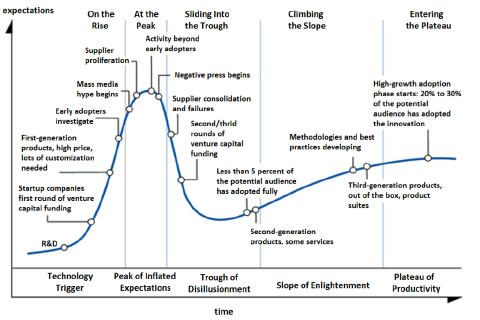
Dave Jones: Show us the data. Yeah. Yep. Engineers love to change their mind. Just prove it to us. Yeah. Yep. Hype. 2014 hype. Internet of things at peak of inflated expectations.
Chris Gammell: That's right. Headline.
Dave Jones: Banner headline. What's all this about?
Chris Gammell: Well, so we've talked about the hype cycle before, right? Usually we talked about it when we were talking about 3D printers and a lot of MakerBot stuff came out. Yep. And so...
Dave Jones: My, my, my, my... I just fixed my MakerBot, by the way.
Chris Gammell: Oh, I saw that. So what have you been printing? Any, like, cases or anything like that?
Dave Jones: Not cases as yet, but I've printed a few toys for sake.
Chris Gammell: That's good. As a trial. I think that's a legit use, you know, of 3D printers.
Dave Jones: Yeah, yeah. Totally. Totally. And, uh, it's, you know, it fixed, it, like, it's, like, not just repaired it, I actually changed the design of the, how the extruder works, and it's just so much better now. Oh, really?
Chris Gammell: Yeah. Interesting.
Dave Jones: Totally.
Chris Gammell: So, uh, what, what, what program, are you mostly just grabbing designs off, like, the, the, what is that called?
Dave Jones: The thingy-verse thingy. Oh, yeah.
Chris Gammell: Right, right. Yeah. So you just grab stuff off there. You don't have, like, a...
Dave Jones: To test it, yeah. Yeah. No, I don't have, like, a CAD program.
Chris Gammell: Okay.
Dave Jones: No. I, I did import a case, actually, um, and, uh, from, uh, Hammond. I did import a Hammond case, and then, unfortunately, they're only available as, from the manufacturers, only available as a STEP file or a, uh, IGES file.
Chris Gammell: Yeah, I can't believe these, these people are, are, uh, they're not giving away their design files so that I can print them easily. Well, yeah.
Speaker ?: Yeah.
Dave Jones: A bit, a bit, of course, that STEP is how you want it. I mean, STEP is the proper format to, uh, import into your CAD program so that you can use it, like your, um, you know, Altium CAD 3D model program and all that. Yeah, well, that's, that's what they're using it for, right? Yeah, that's what they're using it for, yeah, they're not anticipating people.
Chris Gammell: Right, and then 3D printing wants, like, STL or something like that, right?
Dave Jones: 3D printing wants the STL solid model file. Yeah. Yeah, exactly. So, you know, you've got to convert it, and, yeah, there's programs and tools around that do it, and sometimes they do a good job, sometimes they don't, but, um, yeah. Yeah. Okay.
Chris Gammell: Well, that'll be interesting to see if you, yeah. I mean, that, I think that is still a legit way, and so 3D printing is actually on this, uh, is on this hype cycle, right? Because it's, you know, it's, it's moved out, and it's, it's at least a little bit better understood, and there's a lot of printers in the market, and the price is dropping and everything else over time. Uh, so, yeah, you know, like, it's, it's there, right? You know, 3D printing is, it's not necessarily, like, you know, not everybody and their grandmother is doing it, but, but enough engineers are probably doing it that it, it, it's part of the product design cycle now. Uh, and so, but the, the news of this thing, so Gartner is the one, uh, the, the analysis agency, or whatever they're called, uh, they, uh, they basically plot things onto the hype cycle, and, you know, there's always a peak, and right now, Internet of Things is listed at the peak of inflated expectations.
Dave Jones: Yeah, exactly.
Chris Gammell: Seems about right, yeah, I mean, uh.
Dave Jones: Yeah, yeah. Oh, and, uh, and so are wearables. Wearables are there.
Chris Gammell: Wearables. Yep. Yeah. Yep. They're old.
Dave Jones: They're just slightly after the peak.
Chris Gammell: Yeah, what else is on this thing? Uh, gamification is a little bit further, further along.
Dave Jones: Well, the consumer 3D printing is there. It's right up there with wearables. It's basically on the peak of the hype cycle. Yeah. Peak of inflated expectations. Yes, technically it's within the field, so consumer 3D printers are within the peak of inflated expectations at the moment.
Chris Gammell: Right. I'd say it's a little further.
Dave Jones: And I've got to admit, because they're not, you know, push a button and out it comes perfect every time. Oh, right, right, right. You know, they're still fiddly, you know? So.
Chris Gammell: Yeah. Right, yeah, there's still the software chain and everything else that, and that does make it tough, right? I mean, that's annoying. Yeah. That's the same thing we talked to Nadia about for, like, machining, right? The same kind of thing, like. Yeah, yeah, right. You know, there's like a four or five step process right now. It's like, you know, who's going to, you have to really want it, right? Yeah.
Dave Jones: Yeah. And I love the augmented reality. Jerry will be pleased to see this. The augmented reality has fallen off the hype cycle, and it's now currently almost halfway through the trough of disillusionment. Disillusionment.
Chris Gammell: Congratulations, Jerry. Congratulations.
Dave Jones: I love these. And then the slope of enlightenment. What's on the slope of enlightenment? 3D scanners. Gesture control. Virtual reality's on the way up. Yeah, I can see that.
Chris Gammell: I mean, virtual reality, like, definitely Oculus is. Oculus is doing well. I mean, I've been seeing a couple interesting demos of that stuff lately, so. Yeah, it's, it seems like a lot of the hardware stuff is, you know, it's further back, right? You know, it takes longer to deploy it, necessarily, than other stuff is, so. Yeah. What's on the early side, the early stuff? No chip printers, huh? Yeah.
Dave Jones: Bio-acoustic sensing. Digital security. Virtual personal assistants are on the innovation trigger. Up curve.
Chris Gammell: Some of these are dumb.
Dave Jones: Human augmentation. Brain-computer interface, you know. Data science?
Chris Gammell: Data science is on the up, I don't know. I guess.
Dave Jones: Biochips. Neurobusiness. Oh, yeah. It's all there. Smart, smart robots are there.
Chris Gammell: Yeah.
Dave Jones: I love it. And then they reach the peak of, if people don't know how it goes, this thing goes, the innovation trigger is the up curve, and then you hit the peak of inflated expectations, and then the curve drops down drastically through the trough of disillusionment, and then it raises up again the slope of enlightenment, and then it gets to the plateau of productivity. That's how every product must go, apparently.
Chris Gammell: Right. Yeah.
Dave Jones: Are there ones that don't do this cycle? I wonder. Are there any people having any solid examples of things that... Yeah. Any solid examples of various technologies that haven't followed this curve? Probably the ones that don't get covered. Somebody very smart has come up with this curve, right?
Chris Gammell: Right. Well, no. It's probably the ones that don't get covered in, like, you know, that are, like, stealth when they start. Right. So, if you have...
Chris Gammell: And then all... Yeah. The reason that the peak happens is because all these people are writing about it, and they're waiting, and they're waiting, right? Right. Right. Oh, the Internet of Things is coming. Oh, the Internet of Things is coming. Where the hell is it? Right. Well, it'll get there once, you know, it gets there. You know? Right. Yeah, yeah, yeah. And that's where... Okay.
Dave Jones: She'll be coming around the mountain. Yeah, exactly. She comes.
Chris Gammell: So, I don't know.
Dave Jones: Oh, you love it. All right. So, there you go. Where are podcasts on the hype cycle?
Chris Gammell: I don't know. I was talking to someone about that, and someone asked me how the amp hour would be. It was, you know, like, how our audience is, and I said, we have a great audience, and you know, we've kind of flattened out in terms of how many listeners we have, but it doesn't really matter to me, because it's like, who cares, right? You know, like, that's... Yeah, that's right. The ones that we have are good, and honestly, what I told them is that the big thing, I think, is that I think podcasts are basically are going to follow smartphone growth, honestly, because that seems like that's the biggest trigger for people listening to podcasts, is getting a podcast application, and then not only that, but then also being able to easily hook into car stereos. I think that's a big one. Yep. Because, you know, like, as more and more Bluetooth comes online, once you have that, when your phone recognizes, your car radio turns on, it recognizes your phone, and you can just start playing a podcast, that's like, that's a really easy delivery mechanism versus, oh, I have to download it to my iPod. I used to have a shuffle, right? Yeah, yeah, yeah, exactly.
Dave Jones: The iPod just died. Yeah.
Chris Gammell: Yeah, I didn't like that. So... Yep. Obviously, we're preaching to the choir here, because whoever's listening is listening somehow. Maybe you're listening on the website right now, which is fine, but there are other options, and I think that, you know, the growth happens from... as smartphones continue to grow. Interesting.
Dave Jones: I've got an interesting story here.
Chris Gammell: No, I'm going to cut you off, because you always say, and one more thing. And we have...
Dave Jones: And one more thing, dammit. One more thing. Very, very shortly, I have...
Chris Gammell: No, I get to say one more thing.
Dave Jones: I get to say one more thing.
Chris Gammell: You always say one more thing. No! There's a new podcast. That's what I was going to say.
Dave Jones: Oh, there is a new podcast. Yep, awesome. Good to hear a new podcast. But I've got an example which ties into... I got the one more thing. Yes. ...of knowing when to quit. Of knowing when to quit, right? Because I had this great idea at the time of a fitness program, right? And that was on your... That could turn any phone into a fitness... You know, this was before smartphones, right? This was before smartphones. So it embedded voice prompts into... Yeah, yeah, yeah. Yeah, Nokia. Any phone at all, right? That could play, you know, that could play back an MP3, right? Which was almost all of them at the time. And, right? So it didn't have to be a smartphone. It wasn't an app. It would... It was a program which ran on your computer. I wrote this thing. And, yeah, it would... What it would take is your song library. It would take your existing song library. And I wrote code that actually embedded fitness instructions in the start of your song, right? And then it would re-download those songs automatically to your phone. And then... So you could listen to your music at the gym and it would automatically have all of your personalized fitness instructions tacked on to the music, right? And, you know, I thought this was really good, right? And then I... And then I... But I saw smartphones come in, right? I saw them come in and I'm going, like, there's going to be an app for everything and I'm going to be out of business. So I just gave it up, right? I was about to get a patent for it because my brother-in-law's a patent attorney and he wrote a patent for me and everything, you know? And I was going to, you know, invest a lot of... Well, I'd already invested a lot of time into writing this thing and getting it working. And, yeah, I just saw it coming. Yeah, but maybe having a go at it. Nah. And I went, well, okay, it was a great idea, but I think it's going to fail because... And sure enough, I'm glad I didn't spend any more time on it. I'm glad I just gave it up. Because then the app thing came along and just wiped the floor, you know? It just could not compete, you know? So, yep. Anyway, it's still... I think it's still novel. But there you go. I did see it coming on and knew when to quit. Fail fast, right?
Chris Gammell: Yeah.
Dave Jones: Anyway.
Chris Gammell: Yes. Yeah. And that's it for today's show. Well, speaking of... Yeah, so I was going to say, speaking of iPods, I did notice on the way in that this Airbnb I'm staying at has a Nest here. And I've actually never... As much as I lamented, I've never actually tried it. So, I'm going to go... Yeah. I'm going to go try it out.
Dave Jones: How do you try out a Nest? What do you do? Do you wave your arms in front of it and flip at the bird? What the hell do you do?
Chris Gammell: No, it's got like a... You know, like how like the... It's got like a rotating dial kind of interface. And there's like... If you push it in, it's got a push button. Oh, right.
Dave Jones: There's a wall plate thing, right? There's a... Right.
Chris Gammell: Yeah. I want to try out the UI. You know, I've read about it a lot, but I've actually never tried it in person. And really, I want to try out the UI, you know.
Dave Jones: Yep.
Chris Gammell: So, yeah. I'll let you know. I'll let you know how it is.
Dave Jones: Knock yourself off. Don't burn the house down.
Chris Gammell: Yeah. Right. Next week, we will have Trey German from TI, Texas Instruments. And he is an applications engineer in the C2000 group, which is the... It's a microcontroller that also has a DSP on board, I believe. We'll ask him more about that. But it's used a lot in motor control, and it's been around for a really long time. And I'm excited to ask about motor stuff, because I had that period where I was really interested in motors.
Dave Jones: Yeah, yeah. That's right. And there's that past, has it?
Chris Gammell: It's still lingering, so... All right. Yeah, yeah. Yeah.
Dave Jones: As all old projects do, they always linger. That's right. Just like my PodSweat fitness program, it always lingers.
Chris Gammell: Yeah. They don't die, they just go in the drawer.
Dave Jones: That's it. Yeah.
Chris Gammell: All right, man. I'll talk to you next week.
Dave Jones: See ya. Bye.
Chris Gammell: We'll be right back.
Speaker ?: x x x x x x x x x x x x x x x x x x x x x x x x x x x x x x x x x x x x x x x x x x x x x x x x x x x x x x x x x x x x x x x x x x x x x x x x x x x x x x x x x x x x x x x x x x x x x x x x x x x x x x x x x x x x x x x x x x x x x x x x x x x x x x x x x x x x x x x x x x x x x x x x x x x x x x x x x x x x x x x x x x x x x x x x x x x x x x x x x x x x x x x x x x x x x x x x x x x x x x x x x x x x x x x x x x x x x x x x x x x x x x x
Archived Discussion (15)
Comments are closed. Archived from the original site.
Show archived discussion (15)Hide discussion
Keep current
Every episode, plus the occasional job post, in your inbox.
Some sizable investments are being made on the industrial side where, for example, process controller providers have customers asking about sending packets up to a compute cloud for analytical processing and rendering of insights into their data. The demand is being seen across aerospace, chemical, and military sectors. So while this tech may not amount to much in the consumer space, it has attracted some serious interest on the part of those with deep pockets.
What?
605,000 2kW heating elements turning on at once is 1.21GW of sudden load.
My dog was very intrigued by the whistling at the end also.