
#205 – Solar Factories and HVDC Lines - Pollent Power Pushing
Download episode · 38 MB
Also on Apple · Spotify · YouTube · RSS
Show Notes
- Chris says that there is still lots of time to enter The Hackaday Prize. Don't Panic.
- Dave recently did a judge interview.
- Need to connect your project? Chris got his Electric Imp working in about 10 minutes using their getting started guide.
- Dave recently had to declare email bankruptcy. Chris was listening to a podcast about someone who had to do the same with nearly 10,000 unread emails.
- Sometimes we get used to the reminders we set for ourselves. Chris either needs a speaker in his house that announces meetings or a shock collar that punishes for not getting something done.
- Dave recently made a video debunking the solar roadways we discussed a few weeks back.
- Elon Musk (via SolarCity) recently bought a solar manufacturing company. They will be opening a new plant in Western New York near Chris's hometown.
- They will also use the abundant power from Niagara Falls to help power the plant. Chris took pictures with a Nikola Tesla statue up there when he was younger.
- Germany now gets 50% of its power from renewable sources.
- Martin Lorton is installing solar panels on his house in Cleveland. Even with cloudy cities like Cleveland (and some in Germany), they can still output significant power.
- Dave says there are now 1 million homes with solar in Australia.
- Chris reveals that he used to design instrumentation at ABB.
- The exciting stuff coming from ABB in the past few years have been around HVDC, specifically with an eye towards long distance transmission of massive amounts of power (think gigawatts).
- Another exciting piece is the DC Breaker that can switch the large amounts of power in less than 20 ms.
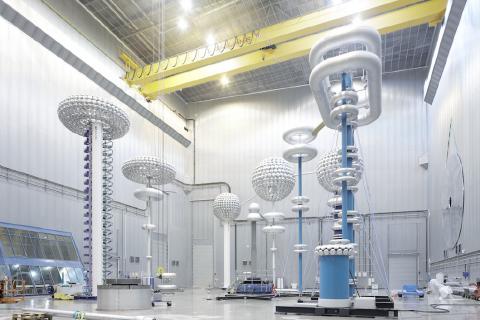
- They also look amazing, the standoffs required for 800kV is significant.
- The Diagrammer by Mergenthaler was a badass piece of industrial equipment for making schematics. Think there are any still around?
- Rhode & Schwarz stopped branding products in the Hameg product line as Hameg (with the associated logo).
- Someone made a compilation video of Dave saying America https://www.youtube.com/watch?v=5D8bdemvjIk
- Our buddy Mike Ossmann has been working on the NSA playset, a replication of the hardware shown in the catalog of gadgets to order. He will be showing it off DefCon.
- Chris will also be traveling to Detroit in two weekends to hang out with the Hackaday guys and film the Red Bull Create competition.
- Dave has been duking it out in the harsh Aussie winter by competing in the Tough Bloke competition.
Transcript
Chris Gammell: This is The Amp Hour Podcast, recorded June 30th, 2014. Episode 205, Pollent, Power, Pushing.
Dave Jones: Welcome to The Amp Hour. I'm Dave Jones from the EEV Blog.
Chris Gammell: And I'm Chris Gammell of Contextual Electronics.
Dave Jones: Hey dude, just us again.
Chris Gammell: David, don't panic.
Dave Jones: I expect you to use my middle name. You sound like my mother.
Chris Gammell: Oh, I don't know your middle name. Is L? Is your middle name L?
Dave Jones: L, L. That's it.
Chris Gammell: Like Homer J. Simpson? That's it. The message I want to get across to you is don't panic. Don't panic. You know what I'm talking about? No. It's space related.
Dave Jones: Oh, space related.
Chris Gammell: Space related. Just like Hitchhiker's Guide.
Dave Jones: You're going all corporate on me and talking the context.
Chris Gammell: Oh yeah, I know. It's just been so much of my life lately.
Dave Jones: Right.
Chris Gammell: Yeah, don't panic. You know why I'm saying don't panic?
Dave Jones: No, tell me.
Chris Gammell: Because you've still got time to go to space. You know, not you. You can't go.
Dave Jones: No, there's 34 days left. I've got the countdown timer here.
Chris Gammell: That's right. Yeah.
Dave Jones: I think, isn't it? Yeah, something like that.
Chris Gammell: Yeah, yeah, yeah, yeah.
Dave Jones: 34 days left in the contest.
Chris Gammell: I spent all last week out in California doing my, as Dave says, my corporate gig. So I've been doing a lot of this contest crap and I wanted to tell everyone there's only 180 entries so far. And there's like 50 plus prizes. So...
Dave Jones: Your odds are pretty good.
Chris Gammell: Yep, pretty good. It's awesome.
Dave Jones: Well, you know, like the first 50, right? You were saying get like a thousand bucks in components or something.
Chris Gammell: Yeah, yeah, exactly. So that's on the page right there.
Dave Jones: What sort of components do we know or is it not decided?
Chris Gammell: Ah, I'm not sure about that.
Dave Jones: You get a buttload of Raspberry Pis and... Yeah, it'll be a lot of stuff. D25 connectors. Yeah. Funny.
Chris Gammell: Yeah, right, right. All 1K resistors and you know how many you can get for a few thousand bucks. Yeah, yeah. So, yeah.
Dave Jones: I've got right next to me, up on the shelf here, I've got thousands and thousands like trays. They actually come on trays. These, I've got, I don't know how many trays, 50 trays or something of dual in line PCB mount 10-way pin headers. Like, you know, like the, you know, shrouded. Why? The shrouded box headers that go on a board. Because, well, I got them from my... They were dumping them from the previous company. So, I couldn't get them. Such a good deal.
Chris Gammell: You can't pass it up. Yeah.
Dave Jones: They were going to the dumpster. It's like, well, I've got to take them. I'm obligated to take them.
Chris Gammell: Yeah, yeah.
Dave Jones: As a hobby, as an enthusiast, I'm obligated to save these components from the dumpster. Right.
Chris Gammell: I could squeeze them in somewhere, right? I mean, they...
Dave Jones: And then I drove them all the way down to the ham fest at the car boot sale. I went to nobody wanted them there. So, now I bought them back. Yeah. Couldn't give them away. And now I'm stuck with bloody, I don't know, 5,000 freaking PCB connectors. I swear I'm going to design a project just to use them. Just for that, yeah. Well, that's what usually happens, right? Exactly. But you can't, yeah, you can't give these things away. It's just...
Chris Gammell: Well, surplus is weird like that too, though, right? I mean, surplus electronics are always like...
Dave Jones: Yeah.
Chris Gammell: You know, there's always that one thing that, you know, no one knows why it's really being sold. You know, like, it's not like...
Dave Jones: Right.
Chris Gammell: There's not a need for it. I'll say it would be sold right away, you know? Yeah.
Dave Jones: Well, no, like, I can give them away. I think I tweeted or something. I mentioned this somewhere else and everyone goes, oh, yeah, I'll have a tray. And it's like going, yeah, right. And I'll pay for the postage. Yeah, right. I'm going to go to all the trouble to split these things up into 50 different trays and post them to 50 different people just to make no profit. You know, like... No, I'm sorry. You know, like... If you physically come to my lab here, you can have them. There you go.
Chris Gammell: That's a reason to go knock on the EEV blog lab door if you can find it.
Dave Jones: That's it. That's right. Yep. Hidden in the corporate towers. Yeah, right. Somewhere in Norwest. That's right.
Chris Gammell: Nice.
Dave Jones: Yep. There's only about a thousand office buildings here. So, yeah, go for your life. But, yeah, I can't give the bloody things away. Anyway, so do we know, back on track, do we know what you get? Because the top 50, I mean, you know, your chances getting in the top 50 are pretty darn good.
Chris Gammell: Well, yeah, and that's the other thing. I mean, like, I figure, like, our audience, too. You know, like, it doesn't have to be, like, the awesomest, right? I mean, like, the awesomest will get the 200K or the space thing. But, like... Of course. There's going to be a lot of, you know, there's a lot of room in there. And I think a lot of our audience, too.
Dave Jones: Just doing good documentation will probably push you into the top 50, right? Because most people just won't bother, right? Right. So, probably, you know, there's a little tip for you. Yeah. I reckon if you've got some kick-ass documentation behind it, it probably doesn't matter what your project is. You might certainly squeeze into that top 50 and win a thousand bucks.
Chris Gammell: That was a huge difference for the 555. I mean, you looked at a lot of those entries as well. I mean, like, that was...
Dave Jones: Yeah, absolutely.
Chris Gammell: If you can, like, get your message across quickly, you know, and, like, you could show what your project does and it actually has some kind of output and some kind of, you know, interaction, yeah, you're ahead 90% of the pack, I think, so...
Dave Jones: Exactly. And if you do a good video, you know, not something shot on your cell phone that's all wobbly
Speaker ?: !
Dave Jones: Yeah, shaky. And out of focus. Webcam. And your audio is awful because you're going to be going... Or you're not talking at all, right? Or you're not talking at all.
Chris Gammell: Right.
Dave Jones: Yeah. Oh, they're just so painful to watch those videos. I've been involved in several contests now and it's, yeah...
Chris Gammell: Right. That makes a big... It doesn't have to be flashy. It just has to be, like, consistent and...
Dave Jones: Exactly. It has to be a minute long. I mean, if you can't speak for a minute about your own project that you're enthusiastic about, then really you probably shouldn't be in the business. Right. Like, seriously, you aren't going to get very far if you can't do that.
Chris Gammell: Right. And if you think you can't do it, it's worth trying to get some practice. I mean, that's good. Exactly. That's good job practice too. You've got to be able to...
Dave Jones: Absolutely.
Chris Gammell: ...argue your point with a crazy Aussie once a week, right? I mean...
Dave Jones: That's it.
Chris Gammell: It's tough.
Dave Jones: That's a vital skill. I mean, you know, if you can't communicate in this business, you're, you know, you're not going to get very far.
Chris Gammell: Right.
Dave Jones: Maybe. Maybe. Yeah. It's not a hard and fast rule. Right. Like, you know, some of the best engineers I know can't... Can't talk their way out of a paper bag. They can't communicate for shit. Right? Yeah. But they're fantastic. You know, they'll beaver away in the corner and they'll produce absolute black magic. Right? Right. But, you know, yeah. No, it's a vital skill. So if you don't have it, learn.
Chris Gammell: Yeah. Well, I mean, Einstein knew how to speak, right? I mean, like, he was brilliant, but he also knew how to, like, get his ideas out. And that's important. It sucks sometimes, right? That blows. But it does matter sometimes. And then the other thing is the connected thing, right? So I got... The imp guys were nice enough to send me one, right? I was on... I had a thing talking to the internet. I had a blinky LED in about 10 minutes. Five to 10 minutes.
Dave Jones: Right.
Chris Gammell: And...
Dave Jones: What just popped up on my Twitter feed, just when I got to the office here, is they've set up some EEVblog imp demo and it keeps tweeting me the temperature, presumably, in their office. It's got, like, hey, EEVblog, looks like it's 23 degrees right now. Well, 23 degrees where? In your office? Well, thanks for that.
Chris Gammell: Damn it, guys. We need some contextual information, too. Put a GPS signal on it or something.
Dave Jones: Or a photo that attaches a photo with it. Have you got a camera that hooks up and it takes a little... Even if it's only 320 by 240 photo or something.
Speaker ?: Yeah, right, right.
Dave Jones: Yeah. Yeah. That's right.
Chris Gammell: Yeah, but I mean, so those things were great. It was... I mean... Yeah, yeah. I mean, it was, what, like 10 minutes? And I got a... I was even able to go from there, turn it off, turn it on, to actually implement PWM and get different levels and have it so that it was... You know how they were talking about each device has its own, like, web address. Yep. It's like, basically, you just, like, append a query on the back so it's just, like, question mark, LED equals zero. Question mark, LED equals one.
Dave Jones: Oh, and then you turn it on.
Chris Gammell: Yeah, exactly.
Dave Jones: And you can toggle the LED via the web command line.
Chris Gammell: Right, which you could probably map to, like, a button on a website. That's the idea. Oh, of course. Yeah, yeah, totally. And it goes the other direction, too. That's the part I haven't tried out yet, but, you know...
Dave Jones: Oh, the inputs. Yeah. So you can pull the inputs. Right.
Chris Gammell: Right, you push a button on the imp and it says, hey, someone pushed a button. Cool. Turn on something, which would be, you know, like that button you have for your cough button now, right? That's just wired, but same kind of thing, you know? So you could do that kind of stuff. So, yeah, I mean... They haven't sent me one. Yeah, or not hard, rather.
Dave Jones: No. They didn't send me one. I think they did.
Chris Gammell: I think it's in the mail, Dave.
Dave Jones: Ah, right. Okay, it'll turn up in the mailbag, will it?
Chris Gammell: Oh, no, you probably deleted the email. That's probably what it was.
Dave Jones: All right. Yes, let's talk about that. Yeah, you're supposed to give it an address.
Chris Gammell: Yeah. We were talking about this before the show, how Dave has bankruptcy. He has email bankruptcy.
Dave Jones: I did the great purge of 2014. Yeah, I went through, and I think I tweeted this at the time, a week or so ago or something. I went through, I had like a thousand, over a thousand unread, I don't know, it might have been a couple of thousand, two thousand unread emails in my Gmail box, because I use, you know, the Google Mail platform. Yeah, right, right. So that my mail is accessible, any computer I use, you know, that's the main reason I like it. And yeah, I know there's people out there who hate Google, but I just, you know, yeah. You're treating privacy
Chris Gammell: for accessibility, right?
Dave Jones: Exactly, exactly. Ah, privacy's overrated. Anyway, yeah, I just like, I just went, this is ridiculous, you know, because like I've got like a priority inbox where, you know, Google learns, you know, it's intelligent, it learns which ones are important to you and they sort of rise to the problem. Right, it says Chris emailed you,
Chris Gammell: definitely pay attention to this. Yeah, exactly. Like if,
Dave Jones: yeah, if you email me, I'm going to get it every time. But if, you know, somebody else emails me, it may not, you know, it may filter right down or something.
Chris Gammell: Yeah, right, right.
Dave Jones: Anyway, yeah, I went through and I went, well, look, anything over three months is probably not worth relying to.
Chris Gammell: Sorry. If you're waiting for an email from Dave, you're probably not going to get it at this point. Yeah,
Dave Jones: and I went through and I, it took me hours and hours to go through. Oh, man. Like, because I didn't just massively, like I just didn't do highlight all and, you know, like just delete them all. I, I scanned through them. Right. So to speak. And once you get in the habit of scanning through them, you get to learn, you know, you get, just at a glance, you can go through and go, oh, no, it's worthless, worthless, worthless.
Chris Gammell: Right, right.
Dave Jones: Or whatever. And yep, yep.
Chris Gammell: Yeah, this came up, I was, I mentioned this to Dave too, because there was a, there was a podcast about some guy that, that had like 9,000 or 10,000 emails and they, like how you have to go through and do that. Right. And it's not just like, you know, someone at Dave's level or, or more famous. It's like, you know, a lot of people, when you start getting regular emails, you just kind of, they just kind of pile up. And I think once you kind of lose track, when you lose track of a couple of them, you start to really, it sucks.
Dave Jones: Well, that's my problem. You see, like, because like Gmail, you can like read the first line, you know, you have the whole list of emails. This is probably the same in any email program. And you can read the first line without opening the email. Right. So you get a gist, you know, who it's from, if you recognize their name, or you can read like the first sentence. And just from that, I can go, Oh, okay, that's important. So often I'll put like a star next to it. If I know it's important, but I don't want to read it yet, then I'll put a star next to it and goes in my staff folder or whatever. Otherwise it sits there and I go, Oh, I won't open it now because if I open it now and read it, I don't have time to reply now. And then it won't show up as an unread email anymore. So I'll definitely forget about it. So if I don't touch it, at least it stands a chance because it's highlighted as unread. So at least stands a chance of getting read later. Yeah. And, and I have the intention to go back. So I, but often there's just so many of them. Oh yeah, I'll reply later. I'll reply later.
Chris Gammell: I started using an Aussie themed thing for that too, where you like, it's called boomerang where you say, yeah, send this back to me in two days. And that's nice. But you know, then you get the same loop, you know, you keep sending it. I don't know. Like a lot of this stuff where it's like productivity types of stuff. I always like, you know, I send myself reminders when I have meetings and stuff like that, but I feel like what I really needed to do is to basically hook it up to like a speaker in my house and have like an announcement, like ding, Chris, you have a meeting starting in five minutes. Get off the can, you know, something like that, you know, like I need something more real world that, you know, it's just so hard with, with just a screen, you know, these days it's, you normalize to it so quickly. Every, every, you know, you just need ways, you need like a computer to surprise you basically. And you'd be like, oh wait, what the, what the hell was that? You know, like, I don't know. I've always, yeah, my,
Dave Jones: my problem is just like working on a project, for example, I've got to sort of be in the mood to do it.
Chris Gammell: Right.
Dave Jones: Like it's the same with email. I've got to be in the mood to sit down and go through my emails and actually reply, not just read them. Right. Right. But actually reply to them. And that, and that's why I go, oh, that's why I go, look, I won't open that email because I know I don't have time now.
Chris Gammell: Right.
Dave Jones: To actually reply. And I don't want to read it. And then realize I've got to reply and then not have time. That makes me feel bad. So I just leave it. I'm good. And, and this happens with really important emails too. You know, ones, ones that I know I really, really have to reply to, you know, it's important. And I just don't because I don't open it.
Chris Gammell: Right.
Dave Jones: And, yeah.
Chris Gammell: I don't know, man. I feel like this is, yeah, it's, it's a stupid modern, you know,
Dave Jones: psychological, mental thing. Yeah.
Chris Gammell: Well, I was thinking about it too, when I was listening to the other podcast about, about the, the mail thing, I was like thinking about when mail used to be like a physical item as well. Right. Like there is something about that. When it starts to pile up, you know, you could start to really, really see. It's so easy these days to just, you know, ignore the stimulus we, we develop for ourselves, you know, like, I don't know, like maybe we should start shocking ourselves. I think there was something like that where you can, you know, like apply a shock. If you have feedback, right? Well, I wasn't saying haptic. This is more like, like hectic feedback. I don't know. I don't know. Like, that feels like, like, but then at the same time, like all these systems, like, like I was thinking about this too, when I was like back in school and studying for stuff too, you know, it's like when it's like, Oh, you turn your, your internet access off or you, you know, you set all these crazy reminders. It's like, when you do it, like, you know, you know how to, to bypass the system at that point. So what's the real, you know, it's like, it's like, you need like a friend who is willing to torture you. So Dave, if you need me to, to shock the crap out of you with some kind of remote device, I'm your man, you know,
Dave Jones: great. You can remotely shock me from the other side of the world.
Chris Gammell: With electric imp, it's just a, it's just a web address away. Uh,
Speaker ?: right.
Dave Jones: Well, this goes back to the same thing we've talked about, about working on your own projects, getting motivation. Yeah.
Chris Gammell: Yeah.
Dave Jones: Work on your own projects. You know, it's different at work because you got somebody whipping your ass.
Chris Gammell: Exactly. Exactly.
Dave Jones: Right.
Chris Gammell: Yeah. There's going to be some kind of like service where you could, I mean, there's some, as the more I talk about it, it sounds like you're like hiring a dominatrix almost at a certain point. You know what I mean?
SPEAKER_02: Exactly. That's right.
Chris Gammell: not to go there, but it does sound like that. It's like, you know, you're basically hiring someone to punish you for, uh, but you know, like, yeah, you need some kind of extrinsic motivation, uh, at a certain point, but I don't know, man.
Dave Jones: It's tough. Anyway, I'm thinking about setting up like a, like deliberately getting people to email me with a specific subject header. Like if it's a fan email, I love reading fan email, but if it's a fan email, you know, I'm thinking about having a link on my website here, click here and it adds the word fan to the title. And then, and then I can get Gmail to automatically sort that into a different folder. So I can go, right, I'm going to sit down for an hour and I'm going to read my fan mail. Yeah. That's good. Or I, you know, I actually, I've already got advertising come in. So like if it's an advertiser, it's, you know, it automatically gets flagged and then it goes into a different folder and stuff like that. Right.
SPEAKER_02: Yeah.
Dave Jones: I'm going to have to do that. You know, something with a technical question. Yes. I can auto respond. You know, I can put in the auto responder. Forum. I hate doing that. Forum. Yeah. Forum. I hate doing that. Yeah. I know. Here's the forum. Yeah. But I've been doing that for a long time now. Um, quite a while in that if you send me a technical question, sorry, I've got little choice, but to send you a, I've got, I have a canned response, um, that I just hit a button in Gmail and send you a canned response.
Chris Gammell: Yeah.
Chris Gammell: you know, you had to do it, right? I mean, like,
Dave Jones: yeah, I know. I, I've got to,
Chris Gammell: yeah.
Dave Jones: Yeah. When, when your videos get viewed 45,000 times a day, every day, you know, like, right, right, right. Yeah. You're going to get a lot of email and messages and stuff like that. So, but I, I, I do my best, I think as a content producer to actually respond to, especially YouTube messages and forum messages and stuff like that.
Chris Gammell: you're a forum rat, right? I mean, we know that you're on there all the time.
Dave Jones: So I'm a forum nerd,
Chris Gammell: but that's even a better reason to say, you know, go to the forum. Cause you're probably going to get to that first.
Dave Jones: So exactly. Yeah.
Chris Gammell: Yeah.
Dave Jones: Because yeah, it's all about value of time spent. If I spend, you know, and look, even a basic email is going to take me 10, 15 minutes to respond in any sort of depth, you know, minimum. And if I have to do research, look stuff up or something just to, you know, make sure I've got it right, then well, you know, it's not, not unusual. Like I've, I've spent like an hour or two sometimes actually responding to a person's personal email, but that, yeah, you know, but that's an hour or two that only helps that one person. Right. Whereas if it's on the forum, um, it could potentially help, you know, countless people who go looking for the same, uh, answer.
Chris Gammell: Yeah.
Dave Jones: So, you know,
Chris Gammell: yeah, for, you know, the, uh, tough business, the vagaries of the internet, right? If that's the right word.
Dave Jones: Internet stardom. Yeah. Right. Right. Right. There are a lot of content producers who just refuse to, you know, they just don't respond to any YouTube comments. They don't respond to any emails at all. Right. And I'm, I try to be the total opposite to that. Um, yeah. So here's a tip, by the way, if you want me to respond to your YouTube comment, best to do it like on the same day that I upload the video. Um,
Chris Gammell: right.
Dave Jones: Because like do it straight away. Cause then, you know, if I upload a new video, I'm quite excited. I want to, I want to read what people have to say about my latest video, you know, especially if I've got something wrong or, you know, I'm, I'm really like, as soon as I upload it, my fear is always, oh, that I've goofed something. And sure enough, in five minutes, somebody's going to tell me that I've goofed something up and then I can even fix it with an annotation or in the worst case, actually delete it and re upload. But that really happens.
Chris Gammell: But right.
Dave Jones: Yeah. So yeah, if you want me to read and respond to my YouTube comment, yeah, do it in the first day. Otherwise it sort of drops off the list.
Chris Gammell: Right.
Dave Jones: You know, it sort of drops off the,
Chris Gammell: yeah. So, so what about your, your, your solar roadways? Did you get some, some blowback on that or no?
Dave Jones: A little bit, but mostly huge praise. I mean, it's gotten like, what is it? 80,000 views or something now. So it's really popular. And I'm like number two on YouTube, if you're typing solar roadways. So I'm like just behind their official, you know, solar fricking roadways. Point and counterpoint. Yeah. Yeah. Yeah. And yeah, I've really, yeah, there I am. Number two, no, third actually. Um, but yeah, I've had mostly huge positive feedback. Thanking me for debunking that bullshit. Yeah. Uh, mostly, but, oh, I'll tell you what the, the people who are supporters are religious, like support. It's like a, it's like a religion. It really is. Um, you know, nothing will sway them and they're, and they, and they play the victim, you know, they're the victim. I'm, I'm just stopping progress. You know, I'm like stifling progress, just like, you know, uh, and if another one of them tries to make the comparison with horseless carriages or Edison inventing the light bulb or something like that, I'm just gonna, yeah, I'm just gonna, oh, I'm gonna lose it. I really am. Oh, you can't, you can't talk sense into these people. They try and, you know, like as if any idea, you know, this is the mistake they make is that, you know, every idea has an equal chance of success. If you just give it, you know, a chance. Right. And it, no, I'm sorry. Okay. This is the world of engineering, right? This is, in fact, this is a massive, this solar railways thing is a massive systems project engineering thing. Right. Uh, just, this is aside from the fact of actual feasibility by, from using it as a road surface. Right. But just using it as a huge connected solar grid thing, it's just, you know, and you can do the calculations on it.
Chris Gammell: Yeah.
Dave Jones: So, you know, I mean, I'm on board.
Chris Gammell: Yeah. We talked about that, what, like four weeks, four or five weeks ago now. I mean, uh, yep. Yeah. And, uh, yeah, I mean, I, I, I'm on board. At the time.
Dave Jones: Yeah. At, at the time I had only just heard of it like five minutes before we went to air. Right. Then. Um, and you know, I sort of went, yeah, okay. It's a novel idea. I think I did anyway. Oh, it's a novel idea, but I can't see how it's going to work cost wise or, you know, or whatever. That was the first thing I thought, Oh, that's just,
Chris Gammell: you know, right. We, we want it. We want it to work, right? It's like, yeah, of course we want it to work. It's cool. Right. It was great. Yeah. No, no, no, no, sorry.
Dave Jones: Yep.
Chris Gammell: Yeah. Oh,
Dave Jones: uh, and those guys are nasty too. They are deleting all negative or questioning comments. Really? From both their, yeah, from their, uh, Indiegogo page and also their Facebook page. And I believe even their, uh, YouTube videos or something like that, but definitely their Facebook and Indiegogo. Yep. Anyone, uh, questions, anything in the mildest weight, delete, delete. And they're Johnny on the spot. Like it'll last their five minutes apparently. And it's gone.
Chris Gammell: So North Korea and China are going to try and hire him away.
Dave Jones: So that tells you a lot right there. You know?
Chris Gammell: Yeah.
Dave Jones: And, and I say, can I continue with this or are we done with solar roadways?
Chris Gammell: Well, I was going to go a little more positive. I was going to go a little more positive about solar. Uh,
Dave Jones: well, okay. Well, well, can I get the negative out of the way then?
Chris Gammell: Get the negative out of the way. Yeah. Well, you know, you only give negative feedback.
Dave Jones: That's right. I mean, this, um, like, as I said, I wanted to work, right. But you go through the calculations as an engineer and you just go, no. And this was going to be like, and I went through quite a few things like, and I came up with five major things. Like I was, you know, I, I had to limit myself because my video was originally going to be the top five reasons why solar roadways are bullshit. And I was going to do like a separate thing on each one, you know, but in the end I, I only did the video. I only ended up doing the video on just the solar, you know, the, just the payback, just how much energy will it produce. And right there it was busted, but there's probably half a dozen or a dozen, at least different showstoppers that make this project completely unviable. It's just, wow. You know,
SPEAKER_02: yeah,
Dave Jones: I could do another half dozen videos with, with calculations showing how it's just simply not feasible in many different ways.
Chris Gammell: Right. Well, as we said on the show last time, I think they should start with solar driveways, right? That's, that's the way to start. If you're going to do anything, solar driveways. And from there, you see if that works. Yeah. Oh, look, it's,
Dave Jones: it's got a niche, right? It's probably got like, I, as I said in the video, I do like the engineering. Well, apart from their lack of calculations and testing and all that sort of stuff, right? Apart, you know, if you look at these things, they're really funky, right? And I, I do like all the effort that they've put into actually manufacturing these hexagon tiles and, you know, the whole concrete kit and how they install it. You know, they've done a really good job from that point of view. And there's probably a niche somewhere if they're smart enough to exploit it, uh, rather than push these solar roadways, because it's just not going to work. These kind of, well,
Chris Gammell: I think the thing with this kind of stuff, I mean, you look at like R and D organizations too, like a lot of times, if you're going to do real research, right? Say, say that they, they were going to get it eventually. Sometimes you do have to lock yourself away and just go try it a bunch and then see if anything pops out. You know, if you, if, you know, if they are going to do it, they shouldn't, you know, they shouldn't listen to you. They shouldn't listen to anyone else. And they should, they should just go try it, but you know, failure is a component of research, right? And if that's the case, that's fine. Right. And then you could say,
Dave Jones: yeah, no, they believe in this thing so much that they simply, I mean, they've been working on this for five years and they don't have a single test result of the solar output or the, or trying to stop a car on this thing. I mean, like the two main things this thing must do and they haven't tested it.
Chris Gammell: Yeah.
Dave Jones: What does that tell you? Right. They put all this massive engineering into doing the PCBs and the multicolored RGB lights and the networking protocol to drive it all. And it looks great, but you know, I mean,
Chris Gammell: well, yeah, it's like any project, right? You could, you could have, you could be heads down and focus on what do you think is important. And then you get to the real market. I mean, you got, that's why you got to test early, right? When we had Eric on the show, right?
Dave Jones: He talks about fail early, fail early, fail fast. Is the startup mantra now, isn't it? Yeah,
Chris Gammell: it is. I mean, it's tough when there's scale stuff like that too, right? Because sometimes you do have to build it out, but the key is to try and find tests that are representative, you know, build the road without the PCB underneath, right? Build the panels without the glass over top. Yeah. Yeah. Yeah. You're right. I mean, Dave, yeah, this horse is, is well and truly dead. Let's, let's go get some horse burgers, man. Like, all right. And, and a bit of a happiness lemonade to go along with our horse burgers. All right. Our buddy Elon is, is looking to actually do some real work with solar. And this I'm actually more interested in. So, so basically a solar city, which is Elon Musk third company, because he's a bad-ass, basically just bought out some manufacturer. And basically they're, they're going to try and build a solar panel manufacturing site near Buffalo, New York, my hometown, using the power of Niagara Falls, where I have a picture of myself growing up, sitting, sitting on who I thought was, uh, sitting, sitting in the lap of a bronze statue of who I thought was Abraham Lincoln, but actually turns out to be Nikola Tesla. Uh, uh, and yeah, so basically they're going to try and build this huge ass solar fat panel factory. And this is ballsy as hell. Oh yeah. Yeah. Because, um, there's like, I mean, so we've talked about the solar panel market before, right there. And you have solar panels on your house. I do. The prices continue to plunge, but basically this is a quality play.
Dave Jones: Oh yeah. Almost to the point where solar panels are now so cheap that, you know, that the solar panel itself is not the cost. It's the install and everything, you know, it's, you know, they're, they're, they're almost to the point of giving them like, you're almost a fool. If you go into the, uh, solar panel manufacturing industry now, cause the margins are so low and there's such, such a commodity item that there, it's like trying to sell, you know, passive components, you know, like they're just so, yeah. Like you wouldn't go in and build a factory to manufacture capacitors because, you know, the market is just, we'll get rich. Exactly. I know it's, yeah. So, right. He's not going to play that game. Right.
Chris Gammell: They're talking about quality at low cost as well. And I'm guessing, you know, much like the Tesla factory, uh, yep. Which I drove by out in LA, by the way. Uh, well,
Dave Jones: and, and, and their new battery factory, which is going to be so completely solar power, like completely self-sufficient.
Chris Gammell: Right. Right.
Dave Jones: You know, like, and it recycles the material and it's completely solar powered and wind powered and everything else. And, ah, man, it's just, wow.
Chris Gammell: Right. And, and yeah. And the, and the key is going to be just like the Tesla factory is probably, you know, high, high amounts of automation, right? That's, I mean, they took advantage. We've posted a video like three or four times now, the video of the, of the Tesla, uh, the, the, the cars being assembled online.
Dave Jones: If you haven't seen it. Yeah.
Chris Gammell: So good. And, uh, but basically it's all automated. That's basically how you remove the human cost. Right. I mean, like basically that's one of the big things is that, you know, when it's mostly robots, you don't have to deal with unions. You don't have to deal with labor costs. You don't have to deal with, you know, injuries and basically robotic factories, folks. So welcome to the future.
Dave Jones: Well, they've been in the car industry for a long time,
Chris Gammell: you know, right? Well, there's varying levels.
Dave Jones: They're like stamping out entire chassis. Yeah. You know, right. Like it's just insane.
Chris Gammell: Yeah.
Dave Jones: Yeah.
Chris Gammell: So, uh, yeah, I'm sure that we're going to see this as well. Uh, I like it cause you know, uh, Buffalo, uh, well, Niagara Falls, I suppose, but, uh, you know, there's all these, there's, I mean, like, honestly, I don't know, you probably maybe know this from, from afar, but you know, there's, there's just car plants littering the entire landscape here. Right. Because there's compression in the entire market as well. As in empty. As in empty. Right. Yeah. Like ready to retrofit kind of stuff. And even still having, which is,
Dave Jones: which is exactly what they did. They came in and bought an old Ford plant or something. Did they?
Chris Gammell: It was Ford or Chevy. I don't remember.
Dave Jones: I don't know. Something like that. Yeah.
Chris Gammell: And, uh, yeah, that's awesome. And, uh, so Elon likely will win again. And I think it is interesting though. So, you know, this article talks about it as well. Uh, but, uh, they're really, they're all of this is supply chain stuff, right? I mean, like this is not about, you know, this is not about, I mean, it's, it's a manufacturing engineering problem because you, you have to get high quality and high yield and all that other stuff that manufacturing engineers love, which Dave knows. And I know, and, uh, but it's really, it's about controlling that stuff. That's, what's crazy. I mean, like when you start to, to crank this stuff out yourself, not only do you own the technology behind it, right? So like the battery packs, you know, that's the, if that's the magic sauce and you control the magic sauce, then you can get all your patents, right? I mean, like that's the key. That's it. And so same thing here, you know, if you start to have, you know, better assembly method methods at lower costs, you, you start to win over and over and over again. and, and then basically you can play a lot of games with accounting and, and, you know, like basically because you control all the money as well, you start to, you really get some benefits and, and you don't have to worry about deliveries and all that other crap. I mean, you get to control that stuff. So it's a control freak's, uh, uh, dream, you know, not nightmare dream.
Dave Jones: He's, he's just unbelievable. Really. I mean, he's just going from strength to strength. Yeah.
Chris Gammell: I don't think I'd want to work for him though. I don't know.
Dave Jones: Oh no, he'd be a, yeah, he'd be a hard task master. Master. I'm sure.
Chris Gammell: Right.
Dave Jones: It's crazy. 400 gigawatts a year. Right. Do you hear that? Um, Germany first country to hit 50% of their energy comes from solar.
Chris Gammell: Wow.
Dave Jones: 50% of their power. Like it was, they, they just surpassed in the last quarter or something, 50.8% or something of their, it's, it, that isn't on the list, but somebody tweeted it. Yeah. And, uh, yep. I have a 50%. See,
Chris Gammell: that's always the crazy thing for me too. And I've talked to some solar, I think I've talked to Martin about this, Martin Lorton, who lives in town here, but just talk, cause he's putting up a bunch of solar panels in Cleveland, right? And it's like, Oh, Cleveland. Okay. Yeah. Yeah. Yeah. Good luck, Martin. Good luck with that. Yeah. Welcome to town, buddy. Would you like to install a solar railway with that? Right. But I mean, it's the same thing with Germany, right? I mean, like you still do get a lot and you're in, you're in the dead of winter now in, in Australia. I mean, you still get a lot of sun, I'm sure, but yeah,
Dave Jones: yeah.
Chris Gammell: Oh yeah, totally. Uh, are you getting full output and everything? I mean, like,
Dave Jones: Oh no, no, no. My system will output three kilowatts in the peak of, uh, summer.
Chris Gammell: Okay.
Dave Jones: It's a three kilowatt, um, uh, system. Okay. And I basically get the, the spec of the solar panels, you know, I do actually get the, you know, the, the system based on the data sheet is rated at three kilowatts. And I think I get actually slightly over that on a really good day with high solar insulation.
Chris Gammell: And yeah, right, right. So what's on a winter day? Like what's on a less?
Dave Jones: Oh, I, I think it drops to like one and a half, like on a cloudless day. So like halves, the output halves or something in the middle of winter. I can't remember off the top of my head, but the data is all there. Yeah. That's interesting. Yeah. People can go and have a look. Yeah. But it's still pretty good.
Chris Gammell: Yeah. Like,
Dave Jones: and, and we are, I've had it installed for a full year now. Oh, nice. Yeah. We basically have exported more than we have taken from the grid.
Chris Gammell: Oh,
Dave Jones: so just over. So we are a net energy exporter, our house. And, and that's minus, that's minus the energy, which we've used during the day as well, because the way our solar panel works is it uses net metering. So any energy we don't use during the day is waste, you know, it's good balance, right? It's sent back to the grid. Yeah. Yeah. But at a very cheap rate. So it's more beneficial for us to use our energy during the day. So we've changed our habits so that, you know, we turn on, we turn on the washing machine during the day and, you know, stuff like that. Yeah. Um, just so we use the energy during the day instead of losing it back to the grid at some cheap rate. But even accounting for that where, yeah, we've exported more than we've used. Yeah. Which is great.
Chris Gammell: So I feel like I should probably finally tell people where I used to work. Uh, cause this stuff is actually like quite relevant. So I used to work at ABB, uh, working on power equipment and it was mostly like coal and gas type stuff, but it was interesting reading a lot of stuff. You know, the ABB is big and corporate and, and yada, yada, yada, you know, they're everywhere. They're like the GM of Europe basically. But, uh, you know, reading about that stuff too, you read, uh, because I was kind of doing coal and gas type stuff and a lot of that stuff uses on the peak, you know, that's really interesting going forwards. I think, because you look at someone like, like Dave here who has a solar panel on his house, usually the biggest rates when they get the most money is like, you want to kick on a generator when there's peak load, you basically want to do like a gas generator because those are the highest rates because it's so expensive to do that. It's not like they want to do it, but they get the most money for it. And usually that like those margins are where they make the most money because that's, I think unregulated in the States, at least that might not be right. But I wasn't actually that far into power. I was doing the, the, uh, the instrumentation stuff, but, uh, you know, that stuff like that, that's where solar is really going to be disruptive that actually, because, because of that peak offloading, you think about when, you know, it's, it's 3 PM in the afternoon and the sun's at its peak and, or, you know, at the days that it's hottest and everybody's got their air conditioning on and you have to kick on a bunch of coal plants. You have to kick on a gas plant to, you know, serve the demand. And now instead you have a bunch of solar panels that just immediately offload that. And that changes the entire grid basically. Yep. It's awesome.
Dave Jones: And here in Sydney, we were like, our grid was pretty overloaded. Like, yeah, you know, we, we were like on the verge of being in trouble, uh, because all these mansions going up, you know, everyone builds these big McMansion, you know, things. Right. And they're all air con, right. They've all got, of course, right. Yeah. 5,000 square feet. Yeah. They, they had to actually ban inefficient air conditioners here.
Chris Gammell: Oh, really?
Dave Jones: They had to ban. Yeah. They had to ban three phase air conditioners for homes because they were just, you know, chewing so much power. So all these, you know, new housing developments that spring up and every one of them has got a black fricking roof and 50 squares of, you know, not square meters, but 50 squares. Which is like 500 square meters or something of bloody living space. And they, you know, and they, people who buy these houses want their, you know, want their constant 23 degrees Celsius. I don't know if these units are making sense for me, Dave.
Speaker ?: Right.
Chris Gammell: It's okay. Everybody. Cause you're not alone. If you're in the States. So if I'm confused too. Yeah. All right. I know.
Dave Jones: And they want their constant temperature all day around. So they just leave them running 24 seven. Oh, wow. Oh man. These people are just pathetic. Right.
Chris Gammell: Right. And that's kicking on coal plants right now. Now, like you have excess, you're not only feeding your stuff, you're also feeding them back to the grid as well. And helping balance that stuff.
Dave Jones: They're feeding all the nearby houses and houses and everything else. Yeah, exactly. And, and, and now we have over a million homes in Australia with solar, with solar panels on their roof. And that, and that's like one 10th. That's amazing. Cause we, we, we have about 10 million homes here in Australia or something around that figure. Yeah. And so one 10th of them have solar panels on their roof.
Chris Gammell: Is that because of the, the, the subsidies that everybody was getting for a while?
Dave Jones: Yeah. It started about five years ago. The government really gave, it was practically free to get one of these solar systems. Sounds like a freaking work to me, man. Yeah. I, I didn't do it at the, at, at the time out of principle. Yeah. Because I didn't, I didn't like the way they were running the scheme and you had to give back your renewable energy certificates and all this sort of jazz. And I just didn't like it out of principle. And well, yeah, I diddled myself out of some money there, but anyway, I just, yeah.
Chris Gammell: Well, you were paying premium anyways for that stuff. So for the power stuff, that's okay. You kept your principles. That's fine.
Dave Jones: I kept my principles. And you haven't now.
Chris Gammell: That's interesting. I, I, I, I mean, I think that's really interesting. I don't think, I wonder about that in Cleveland.
Dave Jones: I got it now after they, I paid a lot more for it now because they, they basically stopped the existing scheme they had. So. Right.
Chris Gammell: But if you would wait another two or three years, I mean, I'm sure that, you know, that just like the way that the, the prices are falling are insane. Right. I mean, like, so.
Dave Jones: Oh, it's crazy, but there is a big difference between your cheap panels and your, like I deliberately got expensive panels, like top of the line LG branded ones. I got a top of the line, top of the line inverter. Right. There's a big difference in quality between, you know, you're sort of $300 inverter and your $2,000 inverter, you know, there's. Right. Well, yeah,
Chris Gammell: you think what, like a three kilowatts difference in quality. The 1% difference is what? 30 watts consistent, right? Over the entire time. Which has to heat up. Yep. Yeah. I mean, that's just, that's just burn.
Dave Jones: And the thing has to sit on the side of your house, you know, and this gets full sun. You know, you're supposed to mount these things not in full sun. So we, we deliberately mounted ours on the other side of the house, which, which actually doesn't get sun. So we had to run the cables all the way over there and then back. Oh. Um, but you know, it stays cooler and it's more efficient.
Chris Gammell: Yeah. When we had the, the Cree guys on, that's where a lot of those fancy, like silicon carbide MOSFETs. And I think some of the, the diodes as well. A lot of those are going in there for like the super.
Dave Jones: Oh yeah. Super efficient stuff. Very expensive devices. You can pay, you know, 50 bucks for a transistor or something. Yeah, exactly. You get a really ridiculously, you know, high end.
Chris Gammell: but they can run it like 600 volts and they can have like, you know, milli ohm drops across, you know, RDS on and stuff like that. And that's, that's why people pay for it. And they'll also last a, you know, really long time. So yeah, that's, that's where a lot of that stuff goes. And that's why they were so in high demand. Uh, and they continue to be really. So it's, it's interesting, you know, you actually, I hear about that from a lot of the, uh, you talk to the, uh, the, like international rectifier and all those guys, you know, it's, it's still basically a battle, you know, the, it's a balancing of costs off, you know, versus like IGBTs. Cause those are still really, good for a lot of that kind of switching stuff. And then even some of the trench fets as well, you know, it's basically, it's, it's all like a, it's all a cost game, you know, it's, it's really interesting seeing that stuff play out because, especially cause there's not that many players in the, the Silicon Carbine market. Yeah. Well, exactly. So hard to do.
Dave Jones: And this is why I like, uh, Elon's play here. He's going for quality, not just, you know, the one hung low, you know, cheapest possible price. And I think that's going to be a big, big difference. People are going to want quality panels that will last 20 years. They don't want just to buy some cheap one hung low brand on eBay that, you know, yeah, they're a quarter of the price, but yeah,
Chris Gammell: good luck.
Dave Jones: What happens when you mount them up there in the heat and the, you know, and the rain and the abuse and everything else, are they going to continue to work for that length of time? So,
Chris Gammell: yeah. One of my buddies actually bought some raw, some raw, uh, wafers. They're just like PN wafers off of eBay. And he tried making his own and it was, it was actually the mounting brackets and then the glass. That's a lot of, yeah, exactly. The cost, you know, like the, the silicon is,
Dave Jones: that's what I was saying before. They're just, the silicon solar cells themselves are almost free.
Chris Gammell: Right.
Dave Jones: You know, right.
Chris Gammell: As they get more and more, uh, you know, like they keep trying to push up efficiencies, obviously. I think they're what, like 20 ish still, I think. Yeah. Yeah. 22.
Dave Jones: I don't know. Something like that.
Chris Gammell: Yeah. But you know, they keep trying to push that up with like these really obscure, uh, uh, chemistries and stuff like that. But, and that's going to push the cost up, but really it's still a lot of that.
Dave Jones: And there's all sorts of technology. There's nano graphene, you know, things, promise, big things. And yeah, they're getting 40% in the lab or something like that with these nano. Right. No technologies. But can you scale those up to production? Well, you know, if you can't, it's pointless.
Chris Gammell: Right. If you can, your name's probably going to be much.
Dave Jones: It has niche uses. Yeah. You know, like for, there's always got to like these high temperature, uh, solar cells are designed to operate at ridiculously high temperatures. And they use lens focused lenses to actually, you know, actually the, the hotter they get, the more efficient they become. Um, and they're really useful in, uh, space, you know, in, um, you know, satellites and, uh, space, the front. Yes. The final frontier. These are, um, yeah. So they're, you know, using all your space probes and, you know, stuff like the ones that don't, you know, that have solar power backup instead of your radio isotope generators and all that sort of stuff. Yeah. But you know, they're, you know, using your space applications. Can you use them here efficiently on earth? Yeah. There's a couple of niche applications, but you know, then, then they're not going to be mainstream on your, you know, house roof, for example. Right.
Chris Gammell: Yeah. So since I, uh, uh, uh, I've been holding all this stuff in about ABB a long time, not like bad stuff, but actually really amazing stuff that I didn't feel amazing. Didn't feel good talking about on the show. Uh, but actually that's one thing. They had a thing that came out when I was still working there that I've always wanted to talk about. And it was the, uh, the, the high voltage switching relay. I think it was or something like that. Right. Basically it allowed, it allows for a switching grid now. So like one of the things they did was like high voltage DC stuff that like blows me away. Like, like 800 kilovolt DC.
Dave Jones: Oh, okay. So we're talking main transmission line.
Chris Gammell: Transmission line stuff. Yeah. And, and like the pictures, the pictures are amazing. Cause you think about the isolation you need for that. And stuff like there's like pictures.
Dave Jones: you've got to have huge arm, boom arms that come out and physically break.
Chris Gammell: exactly. You know, yeah,
Dave Jones: yeah.
Chris Gammell: So, uh, they had, they had something that, some big press release along like a year ago or so. Uh, but basically allowed switching in like 20 milliseconds if there was a fault. So you think about if you have all of that current. 20 milliseconds. Oh, it was frigging insane. Yeah. I mean like it really was a big deal. Wow. And the idea is that, uh, you know, we talk about AC grids. You think about when, okay, so we're in a hot summer, right? And there's a brownout in Cleveland. And, uh, I, you know, I, I short out my, my line. I take down the whole street somehow. Right. Basically there, you have to reroute power around. And the way they do that is they basically have these, you know, basically their, their physical switches, right? You switch it over. Right. Right. And, and you could do that pretty quickly with AC. Well, with DC,
Dave Jones: you've got to have redundant lines though. You've got to have redundant lines that go around paths to be able to switch around. Well,
Chris Gammell: for the DC or the AC?
Speaker ?: Well,
Dave Jones: the AC, why, why are we talking about DC? Have you guys got DC transmission over there?
Chris Gammell: There, it's actually all over the world, man. So that's the idea. So like right now, see, you know, like the three gorges dam, that huge ass dam in China,
Dave Jones: right? Like,
Chris Gammell: that makes an immense amount of power.
Dave Jones: Have they actually finished, have they finished that yet?
Chris Gammell: I don't know if it's finished, but I think it is. No, I think it is. Yeah. And it's like gross, right? Like, that's like the river it is, but it's super polluted and stuff. Yeah. Yeah. Oh, I think that, I think it's finished, but the idea is basically the difference between AC transmission and DC transmission starts to be like, like 20% losses versus 60, 6% losses. Like, like the high voltage DC transmission stuff is incredibly more efficient because you're at such a high voltage and, and, and you can use like thinner, thinner lines and stuff like that. All of that other stuff really starts to add up. The problem is that it's, you know, it's frigging 800 kilovolts or upwards.
Dave Jones: But then you've got, but then you've got losses in your conversions, whereas the AC ones are incredibly efficient. Right. Right. It's transformer. In actually converting. Yeah. Yeah. It's transformers instead. In your transformer stuff. Right. But even your, even your AC, like, don't know about in the U S, but here AC transmission lines are really big ones going between major power plants. They're 500 KV.
Chris Gammell: Yeah. They, uh, Oh, really that high? Usually they're like 300 ish around here. I think.
Dave Jones: Yep.
Chris Gammell: I don't remember all of the math and stuff.
Dave Jones: there's two types here. I think, I think there's 330 KV and there's 500 KV. Okay. Yeah. If you,
Chris Gammell: there's a wiki article that I'll link in as well, but basically it's about the high voltage DC stuff. And basically it explains all the links that are out there. And the idea is that you start to, you know, when you start getting up into like, like gigawatt transmission type stuff, it really, really starts to matter a lot. And, and a lot of this stuff, uh, the HVDC stuff really starts to matter. And yeah, I don't remember what the switching stuff. I don't remember how that happens, but it's usually an amazingly large stack up of, of fats and stuff like that. And,
Dave Jones: uh, so they actually do it at the silicon level.
Chris Gammell: Yeah. Yeah. Yeah. A lot of that stuff is so, wow. I might be talking on my butt. I would have thought it'd be physically. I didn't do any of this stuff, right? But that's why I could, that's why it was so amazing to me. Right. So it was like, I was in this company and I said to see this, you know, I saw these, these, these, this stuff. And, and the idea is that the, everything, you know, DC grid, you know, a large scale, high voltage DC grid was not, was not possible until you had the switching element within, you know, a 20 millisecond thought. And, and, and, and now they have it. And it could be that there starts to be some really significant transmission. You know, you think, you think about getting, even like Niagara Falls, near where I grew up, getting over to New York city. Right. I mean, like you start to have large scale transmissions like that. You could really start to, to move some power. You think about the wind field in Texas, moving that up to, you know, over to California or over to, you know, where else they need, I don't know.
Dave Jones: But the, the interesting thing is, is that they still generating AC, but then they have to convert it to DC to trans, to transmit this thing over the long distances. Right. And reconvert it back. And, you know, it all sounds very complicated to me. That's why I'm a, that's why I like AC in there. Right. Yeah. It seems a lot simpler. It's a lot of transmission schema things. That's just massively simpler. These transformers are massively efficient and you're generating AC anyway.
Chris Gammell: Right.
Dave Jones: And, and, and you're using AC at the end. It just, you know, to me, it just seems very inefficient to convert it to DC somewhere along the way.
Chris Gammell: I'm pretty sure, you know, the actual. Oh yeah. Yeah. Yeah.
Dave Jones: I think they, don't they use DC for the, like the country to country underwater stuff?
Chris Gammell: Yeah. That's another one. Yeah. That's another thing they do.
Dave Jones: Which we, we basically don't have here cause we don't live in Europe. Right. We, we, we don't have a country next to us. We don't, you know, we're like, like an island nation. Right. Right. You know, so.
Chris Gammell: Ain't nobody shipping you power, right? No, that's right. Yeah. Yeah. If Australia runs out of power, they're, they're, they're done for. But no, but I mean, seriously, you could start getting it from like, you know, maybe that distance is too far, but you know, like from China or something like that. No,
Dave Jones: it's too far.
Chris Gammell: I don't do geography.
Dave Jones: It's not going to happen. No, yeah,
Chris Gammell: yeah.
Dave Jones: It's not going to happen. We can barely do our own country, let alone go to another country.
Chris Gammell: Right, right.
Dave Jones: You know.
Chris Gammell: Yeah. So they say, let's see, I'm looking on the wiki page right now. So a 200 kilometer plus or minus 800 kilovolts, 6,400, 6.4 gigawatt link connecting the Zhang Zhaiba dam to Shanghai. That's crazy. That's really crazy. It's just. Wow. So much freaking power. So.
Dave Jones: What sort of diameter copper are we talking about here?
Chris Gammell: Well, that's the other thing you get to start going smaller too, right?
Dave Jones: It isn't even copper, right? A lot of the, because copper is too heavy. A lot of the transmission lines here are made out of, for you yanks, aluminum.
Chris Gammell: Oh yeah. Aluminium. I heard something about that the other day. Aluminium. That the Brits are right. Yeah, I know that's what it was. It was. Yeah. It was very interesting. I forget. Yeah.
Dave Jones: Even our local street poles. I can remember as a kid, scrapping like, you know, somebody would crash into the street pole, you know, a car would crash in and the wires had come falling down and you used to scrap the wire, you know, and it was, yeah, these, these multi-strand twisted aluminum cables. That was what they used in the, yeah, on the regular street poles. Yeah.
Chris Gammell: I heard that aluminum is bad for, usually because it's, it's a lot harder. So you can't clamp down to it as easily. That's why they don't, they don't try and use it in houses and stuff like that. Cause you have to retighten stuff down and stuff like that.
Dave Jones: Oh no. Copper is, you know, used in houses, of course. And it's copper is so expensive now that people steal the stuff, you know, it's a huge market. And when they're, you know, I'm sure it's the same in the U S people, you know, these still in houses under construction. Dave, I live in Cleveland.
Chris Gammell: Of course, of course. Right. Of course. Okay. So yeah, that was my former life. Like I said, I really didn't know much about the power side of stuff. Like the, I was just mostly interested in the HVDC stuff. I was doing instrumentation. So yeah, that's definitely neat.
Dave Jones: I'm, I'm curious to know if there's any installations in Australia at all. Cause off the top of my head, I'm not familiar with any high voltage DC transmission in Australia.
Chris Gammell: Let's see. Undersea cable schemes. Maybe we do. They have the,
Dave Jones: there's a 290 kilometer. Here we go.
Chris Gammell: Australian mainland. And Tasmania. And Tasmania.
Chris Gammell: Yeah.
Dave Jones: And Tasmania has a list of HVDC projects. Yeah, there you go.
Speaker ?: Okay.
Dave Jones: So it goes from Tasmania, which is, yeah. That's the island there,
Dave Jones: Which is the only underwater, yeah, that's the island. So that's the only underwater. Right. Yeah. Australia and Oceania are, uh, New Zealand. Well, that's, yeah. So there's a couple in New Zealand. There's one in Mullumbimby in Australia.
Chris Gammell: What's that?
Dave Jones: Quite a wall. Our listeners in Mullumbimby. Yeah, right.
Chris Gammell: Oh, if anyone's listening from whatever the hell that word was, you have to write in, please.
Dave Jones: Mullumbimby. Yeah. Mullumbimby. I'm sure it's Aboriginal word for, you know, it's Aboriginal for Mullumbimby. Yeah. Mullumbimby. I can speak Aboriginal. Right. Um, uh, yeah, we've got very few considering how big Australia is from Red, Red Cliffs to Bury. I've been to Bury. There you go. Um, yeah. And there's one in Victoria, but yeah, to Tasmania. Okay. So there's one that goes under the water to Tassie, the Bass Link, the Murray Link, and the, yeah. So I only got three.
Chris Gammell: Interesting. Well, it's still, that's something. Which is hardly anything. I mean, that's, that's pretty crazy. So.
Dave Jones: And they tell you the type, IGBT.
Chris Gammell: Oh yeah. Okay. There we go. Yeah.
Dave Jones: So. Yeah. So I assume that's the switching. Ah, supplier. Guess who the supplier is? Uh, I don't know. ABB. Oh, okay. It tells you in this, it tells you in this, look, I'll send you this list.
Chris Gammell: Yeah.
Dave Jones: Oh goodness.
Chris Gammell: Yeah.
Dave Jones: Here we go. Yeah. So a couple of them are IGBT or insulated gate bipolar transistor. And the others are, um, the THYR thigh, wrister. I'm assuming.
Chris Gammell: Yeah, I think so.
Dave Jones: Thigh, wrister based, uh, switching. So there you go.
Chris Gammell: Right. And the Mercury arc, that's like the, that's, isn't that the stuff that's inside of like a tube as well? Like the super high voltage glass tube type stuff. Yes,
Dave Jones: I think so. Don't quote us because we're talking out of us. We really are.
Chris Gammell: Yeah. We're kind of, we're reading directly off Wikipedia right now, but it's just so cool to me. Like, honestly, that's how cool it is. Like, yeah, you know, it's, it's, uh, it's definitely worth looking into. And, uh,
Dave Jones: wow, China, Asia has a lot.
Chris Gammell: Yeah.
Dave Jones: Well, you think, I mean, there's many countries in Asia.
Chris Gammell: You think about how much, how many people there are and just how, how disparate the cities are. Right. And then when the power sources are and it gets, it gets pretty intense, pretty fast. You know, we talk about the scale of power, right? So, so you and I always, you know, laugh about when people are like, oh, well, we're going to, you know, generate reasonable power with the PZ electrics and stuff like that. Yep. But like, you know, to generate enough power for like the, the amount of people, like the one point, however many billion people that are in China and, you know, coming online in India as well. Like, yep. You really need some frigging power. You need to really, really have it. And, you know, they're building nuclear plants, they're building coal plants, they're building whatever they need to, and they're going up fast.
Dave Jones: And it probably has a lot to do with, uh, how much space you have. Cause like, if you go in underground or, or undersea, you're likely using DC, right? Otherwise the losses I believe are too large or something, you know, but Australia is just, the outback, you know, there's just mass. So we just string in these huge, big poles, you know, these huge, big, uh, towers or, or whatever they're called, you know, and, ah, she'll be right. Transmit it at 500 KV. No worries. You know? Right.
Chris Gammell: Right. Yeah. Right.
Dave Jones: Just some, there's just some dingoes out there. No worries. You know? It doesn't matter. All right. All right. But yeah, I can understand in these big populated, you know, Europe and places like that, heavily populated China and other ones, maybe, yeah, they have to go underground or they've got to do something else. And it just makes more sense. Some of these, they've got dates on them too. Some of them go back to like 1882. The first one was installed in Europe.
Chris Gammell: Well, and you start to, I mean, yeah, I mean, this is a lot of Tesla versus Edison again. Right. And like, this is, it's not like either or it's like, it's, you know, it's, it's,
Dave Jones: it's interesting. There's a huge gap between like the sixties. Like they, they, they did it back in the early, like late 1800s, early 1900s, or, you know, like the forties, like the, you know, 1940s or whatever. And then a couple in the sixties and then basically nothing until, like the eighties, late eighties, nineties. Right. When the thyristor technology, cause before that they use mercury, right?
Chris Gammell: Yeah. So,
Dave Jones: you know, yeah, great.
Chris Gammell: Almost as healthy as being near a, you know, 800 kilovolt line.
Dave Jones: And, uh, they, yeah. So it's modern, um, you know, thyristor technology, insulated gate bipolar transistor. The first one there was 97, uh, by the looks of it. Yeah. So, and then they've really, rapidly increased in the last four or five years. Yeah. So it looks like all this, as, as you say, this switching technologies come online, mostly from ABB and Siemens.
Chris Gammell: Yeah. Yeah. Siemens is the other big one too. So yeah. Yeah. They're, you know, they're monoliths, right? And as I, I sent Dave a link as well. And, uh, the real thing to look at, uh, is some of the pictures of these switching facilities too. Then like the labs where they have this stuff and like,
Dave Jones: Oh, that's just, it looks like a real switch in. Is that, that looks like a test lab.
Chris Gammell: It is. No, it is. That is a test lab. No, it says test lab. I was going to say, right. But still, I mean like, look at the, so basically what we're looking at here is it looks like giant Tesla coils, right? Because they're, yeah, yeah. Off the ground. And if you look at the scale of humans too, like these are like probably 10 to 15 meters tall. I mean like pretty significant height to them, if not more. Yep. But yeah, that's how you do that stuff. I guess. I don't know. Like, honestly, I look at this stuff and I'm just like, I don't, I don't understand. I don't.
Dave Jones: It's, it's from a different world, isn't it? It is. It's from a different planet.
Chris Gammell: It's electrical versus electronic, right? This is like the thing we've talked about in the past. That's the thing. Right.
Dave Jones: That's the thing. Yep. Totally different fields.
Chris Gammell: But that's why it's so interesting to me. And, yep. Not what I was doing.
Chris Gammell: it's fascinating. Yeah.
Dave Jones: Yeah. I should, I should go on like a tour of a, of a power generation plant or something like that. I think that'd make for some interesting videos.
Chris Gammell: it definitely would. Yeah. Well, you did those, what were those, you went to those, oh no, those were, those were radio tower things that when the TV station shut down.
Dave Jones: They were the radio, they were the TV station. Yeah. Which was fascinating enough, let alone step it up another huge level and go to power generation. You know, I might see if I can get in a dam, some, you know, local hydro, dam or something.
Chris Gammell: Oh man. So did you go to Hoover? We talked about that when I, when I visit there. I have,
Dave Jones: I have been to Hoover dam. That's awesome.
Chris Gammell: Oh, so cool. I mean, and like that stuff. It's great. Unbelievable.
Dave Jones: And of course I dragged the wife along. She's just rolling her eyes.
Chris Gammell: Yeah.
Dave Jones: It's just a dam, you know, and I, and I'm just nerding out over all the, all the technology, you know, or the, just the sheer scale of the engineering, you know? Yeah. Nerd gasm, you know? Yep. Yep.
Chris Gammell: Uh, so what else should we talk about this week? We basically blew all of our time on talking about stuff we didn't know anything about, you know, like usual. Like, yeah, I know.
Dave Jones: Hi.
Chris Gammell: Did you see this, did you see this CAD thing, the drafting tool from the seventies? No. Oh my God. The diagram. This was sent to me, uh, on Twitter. Someone sent to me joking that this is why, uh, KiCad's important, but, but it's this amazing, uh, thing from the seventies. Basically it uses, it uses these, you know, each schematic symbol is like a slide inside a projector. And kids, if you don't know what a projector is, it's where you had, you shine light through a small transparency, usually the negative of, uh, developed version of a negative at the same scale. And then you, you know, you blow it up on, on a screen somewhere. Well, in this case, they do the same where they then, they basically expose a resist. So they basically, they can overlay it, uh, kind of like they, they kind of like steer it like you do with a, uh, with a, uh, uh, electron beam, right? So you're basically like, like inside an old CRT scope or, you know, a CRT screen. And then basically you expose parts of this large screen. And then basically that makes a, uh, I guess that's a negative image. Yeah. Photo image. That's what I was saying. It,
Dave Jones: it, it, it makes a photo negative of like, but they're not making PCBs here. They're drafting schematics. This is just schematics. Yeah.
Chris Gammell: Yeah.
Dave Jones: This is great. Oh, it's amazing. And draw them by. So, so they've got a button for a transistor. So they, so they press the transistor button. Then you can move it over your sheet and then you can rotate it. And then you can position it. And then you press the expose button and then it exposes that symbol onto the film. Right. And then you move it again. Oh, this is just.
Chris Gammell: Oh, it's, it's beautiful. And really it's like a type set machine, right? I mean, it's like, it's like each, each key is its own, its own, uh, individualized thing. And if you need, so say now you have a NPN and you need a Darlington. Well, if it's not in your rack of 256 keys, you have to switch it out and then go swap out. I've got to tweet this. Oh yeah. It's so good. And, uh, and basically though, I mean like you look at the size of this machine too. It's probably the size of like, you know, a walk-in cooler, you know, it's really, really big, you know, it's like old 1970s equipment. So you can only imagine how much it costs. And this is just for schematics folks. Uh, yeah, yeah.
Dave Jones: This is just for schematics and they're beautiful and they come out beautiful.
Chris Gammell: Yeah. Oh, this is the cost of, of, uh, of not having draftsman anymore. Yeah. You know,
Dave Jones: I've got to, I've got to wonder what the lifespan of that system was. How quickly was it obsoleted? Yeah. Right. Exactly. You know, like this is so much engineering, this is like going to the moon, right? This is, you know, kind of like the engineering that goes into producing this CAD system is just ridiculous, you know? And when was it obsolete? Did it have a five year lifespan and then something better came along?
Chris Gammell: Right. Right. Well, yeah. And eventually someone's going to say, oh, well we can tie this, you know, with, I mean, basically what, this is seventies, right? So when did the, when was the first CAD system you used was, I mean, like I heard about early eighties stuff, like Dasics and stuff like that, but there's stuff before that.
Dave Jones: CAD, no, CAD was late seventies. There, there, there was actual computer aided, actual real computers doing CAD. Not, you know, this isn't really a computer. This is like manual. Yeah. This is,
Chris Gammell: this is an operator driving, driving, uh, you know,
Dave Jones: like the machine driving, a, driving, a mechanical computer, not an electronic computer. Right. Right. I think it's more of a mechanical type.
Chris Gammell: You give it where the X, Y should go and you, you imprint it.
Dave Jones: And then you've got a joystick or whatever. And you've got, or you've got a roller board joystick. You move it around over the sheet. Then you press the expose button. How do you erase something like that? Cause you're exposing film. So, Oh no, I put my transistor in upside down. Scrap the film. Yeah. You have to, uh,
Chris Gammell: that's what, that's the same thing. Like, right. This is the ultimate version of having a layout guy or a CAD guy. Right. You didn't have just novices using this. There was the guy that ran. Oh no, pros. You know, like, yeah. And he got in trouble every time he wasted film. But it's the same thing happened with draftsman. Right. I mean, like if you got all the way to a draft and then you spilled ink on something and you, you messed it up and you had to start over, it's the same, you know, same cost. Well, you know,
Dave Jones: back when I was doing CAD layout, this is before you were born, Mr. Gamble, um, CAD layout on, on film, right? You would stick down tape, you know, you would have your light box. Yeah. Yeah. You would stick down your, you know, your tape and you get all the way through your layout and you'd go, Oh no, I can't get this trace from over here to over here.
Chris Gammell: Yeah.
Dave Jones: You know, you might have to rip up half of it to try and get that one trace over. If you're a bit of a perfectionist, otherwise you go, Oh, I'll just jump, put a wire. Yeah.
Chris Gammell: Right. Yeah. I'll get in the next round.
Dave Jones: You're right. Yeah. That's it. Well, that's, yeah. I mean, it's,
Chris Gammell: so yeah, this is where it's the art form, right? I mean, it's the same thing and you sketch it before you, you make, you put it to print, but yeah, this is gorgeous. I knew you'd love it.
Dave Jones: This is called the diagramma. Yeah. By Mergenthaler.
Chris Gammell: Mergenthaler.
Dave Jones: Mergenthaler. Is that German or something?
Chris Gammell: Probably. Yeah. I mean, they were a typeset machine. If you, they show the history too, going back from like the other stuff they did where, you know, they were typesetters and it probably seemed like a great new market for them. And, and then computers came along and they were screwed, right? I mean, this is, yeah. Oops. Yeah.
Dave Jones: And they're out of business overnight. Right.
Chris Gammell: PCs being like the desktop publishing revolution, right? I'm actually reading. Yeah. Yeah. Of course. The Gershenfeld book right now, Fab, which is talking about desktop manufacturing machines, kind of the same thing, talking about 3d printers and CNCs and all that stuff. But basically it's, you know, they talk about the same stuff, right? Computer, personal computers allowed for personal publishing. And then the new stuff is personal making. And, and personal publishing basically killed typesetters, right? I mean, there's still some, especially at scale, but then it just kept whittling away. And totally. So when Mergenthaler got pissed, I bet. Especially the sales guy that probably got, you know, a nice 20 grand commission on selling one of these things, you know?
Speaker ?: Yeah.
Dave Jones: Yeah. Oh, I'd love to know how much one of these systems cost.
Chris Gammell: Oh, it probably, you know, hundreds of thousands, right? I mean,
Dave Jones: yeah, probably. Yeah. Yeah. Like, you know, these, these go into your huge companies, like your small companies would not have one of these. Right. They'd be drawn with pencil and paper. Right. Right. This was, you know,
Chris Gammell: this is, they talked about having a, in the, in the video too, they talk about having like mil spec ready, uh, slides as well. Right. So that kind of, yeah, kind of shows it as well. Right. You know, you have your Northrop Grumman is going to have beautiful schematics, right? Right.
Dave Jones: Exactly. Then you've got to wonder how many of these systems they sold, you know, like, like a thousand systems tops.
Chris Gammell: I think the real question is how can we get near one and see one? Sure.
Dave Jones: I would, I know.
Chris Gammell: Yeah.
Dave Jones: I want one for like a teardown. Right. Sure. I bet,
Chris Gammell: you know, there's a, there's a place in Cleveland called, uh, uh, it was an HRC. I've been there once, but it's basically just old industrial machines. And it's, it's like going to a graveyard and, yeah, if it was one of those places that would be there, you know, but I bet it's hard to find one of these. Well,
Dave Jones: if anyone knows where we're putting the call out, does anyone know where you can see one of these, especially operational? Dave will fly to America to see one. I'll fly to America to see one.
Chris Gammell: Yeah. Yeah. This is part of a bigger, a bigger, uh, bigger documentary as well. Like Linotype, the film that's called, I don't, I haven't watched it yet, but, but it's, uh, it's all about, I think the Murgenthaler stuff. So, right. Very interesting, uh, stuff. Uh, Hey, what?
Dave Jones: Hey Megagon.
Chris Gammell: Oh yeah. You posted this, right? So,
Dave Jones: or yeah, however you want to pronounce it. I, you know, Hey Meg is how I pronounce it.
Chris Gammell: I'm sure the Germans have something to say about how it's pronounced.
Dave Jones: Germans will take me to task. Yeah, right. And, and, you know, there are not so much in the West here, right? They're not huge name in the West, but in Europe, they're, you know, almost number one. They're one of the big, you know, huge names, especially in like the education market and the low cost, you know, the really affordable test gear, you know, Hey Meg are.
Chris Gammell: Right.
Dave Jones: Yeah. One of the world, world's best in that area always have been.
Chris Gammell: So what, it was what, six months ago. I don't remember when it happened, uh, when they got bought out.
Dave Jones: Oh no, they know they got bought out like five years ago or something.
Chris Gammell: Oh, I thought we announced it on here. No, it was.
Dave Jones: No, Roden Schmortz. No, Roden Schmortz brought out Hey Meg along.
Chris Gammell: Schmortz. Sounds like your accountant bought him.
Dave Jones: Use the Schmortz.
Chris Gammell: Use the Schmortz. Use the Schmortz. No, I'm looking, uh, where the, uh, come on, I'm looking at Hey Meg on, uh, okay, well, I was looking through, uh, old.
Dave Jones: I think it was five. No, no, it was 2005. I acquired them in 2005. Yep. So now that was a sad day. You know,
Chris Gammell: the slow slide into obscurity now or what?
Speaker ?: Well,
Dave Jones: this is the bizarre thing, right? They, they claim that no, no new product they design or manufacture will have the Hey Meg logo on it. Right. It'll have the road and Schwarz logo. Right. Right. And, but they claim that Hey Meg will still exist as a separate company and will still keep their brand. Huh?
Chris Gammell: Yeah. How does that work? Probably some marketing guy trying to get his rocks off.
Dave Jones: Right. Yeah. Right.
Chris Gammell: I have a plan and here's what it is. Everything's the same logo. Bonuses for everyone, folks. Bonuses for everyone.
Dave Jones: That's it. I don't get it. It's just, it's dumb. Yeah. And, and there, there's another link, which I didn't put in, but somebody posted on the forum where this came from. And it is a link to the R and D manager or something at, uh, Roden Schwartz talking about this thing, right? Why they're actually doing it. And he's basically saying that they're doing it because Hey Meg is not known in the West. Okay. So we're just not going to buy, well, you know, instead of doing this, I would have sacked your marketing people for the last seven years or whatever. No, nine, nine years they've had to market Hey Meg around and they fail. They basically failed to market it internationally. And then are they going, Oh, well, Hey Meg's not known internationally. So we'll just get rid of the name and we'll, put Roden Schwartz on there. I mean,
Chris Gammell: also, I have to say guys, if Roden Schwartz are listening right now, uh, at least if you want to, if you want to have a positive connotation in the West, don't name your scope, the HMO 1002. HMOs have never had a positive connotation in the West because that was a terrible, it was like health medical organization or something. It was this, this, really? Yeah. This boondoggle of a way to get like, where you could only go to a certain set of doctors and in like, you can only go to like four or five doctors.
Dave Jones: By West, right. By West, you're talking about Merica. Merica. Merica, land of the free. Oh my God.
Chris Gammell: Did you hear that thing where someone cut together all of you? Oh, it was Noah from last week. So Noah, he tweeted out a link of someone cutting together you saying Merica over and over. I haven't seen it. Oh my God. It was so funny. You say it the same way every single time and it's terrible. No way.
Dave Jones: No way.
Chris Gammell: Oh my God. It's so terrible, Dave.
Dave Jones: I've got to see this. I'll cut it.
Chris Gammell: I'll cut it into the, uh, the outro as well, but the guy apparently, apparently this person, every time you say a new one, he, he basically, he appends it to the end and he re uploads it. Merica. Yeah.
SPEAKER_02: There's a couple more. Oh my God. Oh,
Chris Gammell: here we go. Yeah. Dave pronounces America. Let's see if we can get Dave listening to it over and over and over again. Here we go. It's 30 seconds worth of America. The United States are America.
Dave Jones: Oh, it's terrible. This is all from my mailbag video.
Chris Gammell: It's just from you. No, it's over and over. It's not just America. It's not just that you do it all the time. You do it on this show too. You need to cut in this stuff. Oh boy.
Dave Jones: Oh, this is great. I'm tweeting that. That's great. Yeah. So, thank you very much. Hero worshiper.
Chris Gammell: So, uh, uh, a sad day for Hameg, but, uh, hopefully, hopefully someone will pull their head out of their bum. Uh, other things I wanted to mention before, uh, it falls off the map. Uh, we had talked to Mike a little bit about this when he was on the show last time, but we couldn't mention it yet. But, uh, uh, they released the NSA play set. We had talked to Mike after the show about that, but basically, you know, all those, those, uh, those instruments, the NSA, that catalog from 2009, they're basically,
Dave Jones: Edward Snowden revealed.
Chris Gammell: Yeah. Yeah. They're trying to reverse engineer and make them now. So, uh, cool. Pretty awesome. Yeah. And I think they're take, I think Mike said they're going to probably take it to DEFCON. So there's a new sign into Starter Call about this, but, uh, they're going to take it to DEFCON, I think, and actually show it off, which is like the perfect place to show that off.
Dave Jones: Oh, of course. Yeah.
Chris Gammell: And, uh, and I might get to go to that. I find, I found out. And so I'm looking forward to that. Everything except August in, uh, Las Vegas sounds good. Uh, uh, so, uh, that's definitely worth checking out though, because, you know, there was a lot of cool gear in there that would like, I remember those, the, the radar stuff was specifically like where you ping like a microphone with a,
Dave Jones: with a high powered radar and it, yeah.
Chris Gammell: And it returns.
Dave Jones: So it doesn't have to have a battery or something. It just passively returns or something. Right. Yeah. It just modulates that high frequency signal. Yeah. Yeah. Yeah. It just modulates it. Yeah.
Chris Gammell: So that, that's really cool. And then, uh, I don't know if you got anything else, but I've also got other travel plans. I'm going to be in Detroit, uh, in two weeks from now for the Red Bull, uh, competition. They're doing that Red Bull build competition again.
Dave Jones: No, what's that?
Chris Gammell: They did it in New York last year. Uh, basically it's like, it's like a 48 hour hackathon, but like not just with code, it's like welding. And, uh, I don't know what they're building, but it's supposed to be awesome. You know, like basically all these.
Dave Jones: Right. So it's like a, like one of those junkyard wars shows. Yeah. Yeah. Yeah. Yeah.
Chris Gammell: It's usually it's hacker spaces and like, you know, similar type of groups that, that enter and, uh, you know, and it's fueled by Red Bull because it's supposed to be 48 hours straight of, I don't know. I have to say if it's, if the 45th hour and you got a fricking welding, uh, you were trying to weld, it's, uh,
Dave Jones: it's probably,
Chris Gammell: probably a bad idea. I'm just saying, I don't know. Maybe they have spotters.
Dave Jones: Now we expect you as the professional commentator and, uh, media reporter for this event, you must stay up for the complete 48 hours and stream it live.
Chris Gammell: No way. You're a wuss. I know. Total wuss. Uh, no, uh, no, I like sleeping. Uh, I've been sick for three weeks, so, uh, I'm going to start sleeping more and, uh, but I will be going around Detroit. And if there's other, if there's listeners in Detroit too, we'll be having meetups. It's with, I'm going to be hanging out with the Hackaday guys again. And, uh, and there's a ton. I mean, there's just so much old history up there in Detroit. You talk about, you know, I might have to go find a, maybe I could find one of these Mergenthaler things up there too. You know, like, that would be sweet. Uh, but you know, there's just a lot of broken down architecture and, you know, like stuff like that. It's coming back a little bit, but you know, like there's a lot of crazy stuff up there. So I'm going to try and find that stuff. So I'm looking forward to that. What else you got coming up?
Dave Jones: Oh, I got more obstacle events.
Chris Gammell: Ooh. Yeah. Coming up. I saw pictures of that. You look like you got pretty beat up.
Dave Jones: Yeah. Uh, yeah, I got beat up. Yeah. I, my legs got quite, I got rope burns and all sorts of things by doing this tough bloke competition. Yeah. And, uh, yeah, it was fun.
Chris Gammell: Yeah. That does do look like fun. I have to say, I'm a little jealous that you're doing this in the dead of winter in Australia. Yeah. Yeah. In the middle of winter. Probably doing something wrong here in Cleveland. It was a gorgeous day out there. Yep. Damn. Exactly. Cleveland loses again. Boy.
SPEAKER_02: But you know what? Yep. At least we're not Detroit. I'm going to get my comeuppance for this one now. No, I got it. Uh, all right, man. We'll talk to you next week.
Dave Jones: Have fun. See ya.
SPEAKER_00: in the United States of America, and the United States of America, I'm from the United States of America, in the United States of America,
SPEAKER_00: America and America, America. Made in America, America. They are made in America. Made in the United States of America. Made in the United States of America. USA, USA, USA.
Archived Discussion (14)
Comments are closed. Archived from the original site.
Show archived discussion (14)Hide discussion
ABBBreakerContestElon MuskHVDCMike OssmanNSA PlaysetsolarSolar CitySpaceThe Hackaday Prize
Keep current
Every episode, plus the occasional job post, in your inbox.
Read about ze Germans and its hilarious, the more 'green' energy they produce, the more expensive it gets. To the point of them having to shut down modern natural gas plants.
This is not going to end well, 'renewable' doesnt work without base load plants, and subsidies basically kill them.
By that method 'renewable' is the only thing that will work in the end. by that method non-green energy (coal, oil) is the only thing that will not work in the end. What we should question is how to get from A to B.
I don't know a lot about these short term political and economic problems (subsidies, taxes and such). One thing I believe is that people tend to be biased and we humans are not good at noticing our own bias. I believe that politicians are not often good at engineering.
The simple reason they use DC is that you only need a single wire in most cases, or 2 wires, to have a high power 3 phase link that can often transfer power in both directions as needed. High voltage DC allows more power to be carried, as the insulators are run at the DC voltage, whereas on a standard AC line you have to limit the voltage to 70% of that, as you have a RMS voltage. This extra 30% increase in voltage means a lot more power transfer, and you can also run the current higher as the end stations can do voltage compensation on a cycle by cycle basis without wear. Using one or 2 conductors with a ground return mat also reduces the cost of the line.
At high power the savings in line material and insulators will cover the extra cost at the end stations for the inverters and associated control and structures. As this cost is maintenance wise almost zero extra cost it pays for itself at the initial design stage. Line wise you save having less insulators to clean and less lines to maintain. You also have less loss to capacitive loading, and this capacitance actually helps with voltage regulation.
You don't get an award for participating. You get it when you win.
Most of our power is supplied via an HVDC link from the Benmore Dam in the South Island.
http://en.wikipedia.org/wiki/List_of_HVDC_projects
I bet there are a lot of old machines that are decaying in museums which nobody knows how to operate or restore. I offered to organise a team to attempt a complete restoration of the machine at the museum, but they weren't interested. I would have done it for free too. :(
Portugal got there first, with 58.3% of the country's electricity generation in 2013 form Renewable energy.
http://np.reddit.com/r/Futurology/comments/2a8jzn/how_the_outernet_will_free_the_internet_from/cispn98?context=3