
#180 – An Interview with Dave Taylor - Multi-talented Meter Maker
Download episode · 37 MB
Also on Apple · Spotify · YouTube · RSS
Show Notes
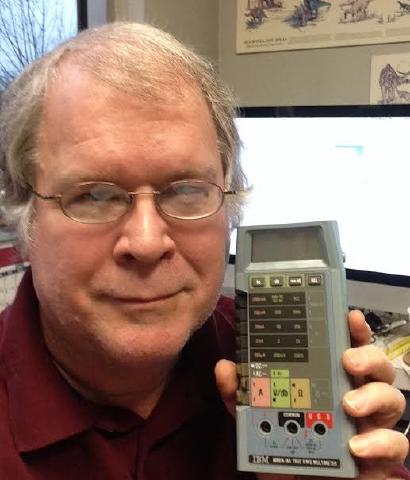
Welcome, Dave Taylor! He was the designer of the Fluke 8060 and currently works as the Director of Engineering at Rice Lake Weighing Systems!
Most importantly, there is an epic thread on the EEVblog forum where Dave talks about his experiences. That is a must read set of posts!
- Dave's first foray into electronics was building audio gear: Fuzz boxes, TA17s, Class D amps using 555 timers, soundboards/mixers.
- He was hired by Fluke after a short stint at a job after going to the University of Colorado at Boulder (the Buffalos!)
- He assisted on the design of the 8020 and the 8920, but was also sent to work on the production line.
- Do young engineers get experience these days when production is elsewhere?
- The Fluke handhelds used (and developed) the 429100, an all-in-one measurement chip for all its handheld 3.5 digit devices. It outputs readings directly to an LCD. Intersil then did minor modifications to the design and released it as the Intersil ICL7106.
- There was a lawsuit after they decapped an ICL7106 chip and found the silicon said Fluke! It was functionally equivalent to the 429100, except for the range changing (which was patented).
- After the experience with Intersil, John Fluke Sr decided to bring sensitive designs in-house and built a 5 micron fab.
- Dave worked closely with Caddock Networks and learned a lot about resistors and how they're manufactured/sorted to be precise.
- Once the project was over and there were unused 8060s, one was gifted to Jim Williams, who Dave knew.
- The 70 series went to a rotary switch which still persists today.
- These were a response to competition with Beckman. That company was later purchased by Fluke.
- Fluke also bought Datron, a company Dave almost went to work for.
- After Fluke, Dave went to WaveTek and designed the Model 52 datalogger. See one in action: http://www.youtube.com/watch?v=caQmiw2170A
- Once that company folded, Dave went to go work for MSI, which was then bought by Rice Lake Weighing Systems. They make industrial scales and weighing equipment. Dave still works there as the director of engineering.
Transcript
Chris Gammell: Hey guys, just a real quick note about this show. We had one of the worst connections between the U.S. and Australia that we've ever had. We were able to clean everything up in post, but what I'm disappointed about is that we actually didn't sound like we were that engaged with our guest. It usually was like Dave was talking or I was talking, but we really wanted to ask more and interact more, but we just literally could not communicate because of the delays and such. Luckily, our guest Dave Taylor was wonderful at telling stories, and I think you're really going to enjoy what he has to say. Also, while I have you here, Text Electronics starts January 20th. If you want to sign up, do it now. That's all I'll say. Enjoy the show. This is The Amp Hour Podcast. Recorded January 13th, 2014. Episode 180. With guest Dave Taylor. Multi-talented. Leader. Maker.
Dave Jones: Welcome to the Amp Hour. I'm Dave Jones from the EEV blog.
Chris Gammell: And I'm Chris Gammell of Contextual Electronics.
Dave Taylor: And I'm Dave Taylor, formerly of Fluke, now with Rice Lake Measurement Systems Division.
Chris Gammell: Welcome, Dave.
Dave Jones: Hey, Dave. Thanks for joining us.
Dave Taylor: My pleasure.
Chris Gammell: And for confusion's sake, I'm going to refer to you as David and other Aussie guy as Dave.
Dave Jones: Well, I can't do that, so I'll be calling him Dave.
Chris Gammell: Okay, that's fine.
Dave Taylor: Well, we'll know who that is. Dave-o.
Dave Jones: Dave-o. I'll give you a nice Australian nickname, Dave-o.
Dave Taylor: Only Chris needs to worry about it because he's got two Daves to talk to. Oh, my whole life is...
Chris Gammell: That sounds good. Yeah, I'm surrounded by Daves. But that's, of course, if we keep Aussie Dave on the line in the first place. We had some setup issues today, but I think we're going to power through. So we'll see.
Dave Jones: So if I mysteriously vanish, then you know what's happened.
Chris Gammell: Me and David will celebrate then. Okay. But, David, thanks for being on the show. I mean, it's great to have you here. We found out about you from the EEV blog forum where you were posting about the fluke meter that you worked on, and that's how we found out all about you. But maybe you can give us a rundown of some of your work history kind of going backwards, and we kind of work towards the present day.
Dave Taylor: Well, the extra reason why I posted on EEV blog is because my wife said, get rid of all this old junk. And so I thought, well, maybe Dave would like it, and I just put it in a box and ship it to Australia. So I'm still thinking of doing that, Dave, so I just have to figure out how to pay for the postage.
Dave Jones: Awesome. Right. I'm already stowed under with stuff, so, yeah, take your time.
Dave Taylor: Okay. Okay. Well, I started in electronics because of rock and roll. Yeah? I mean, a lot of people start because of ham radio and stuff like that. But way back then, I wanted to build amplifiers and effects pedals and stuff like that. And so my first electronics project was buying a Heath kit. Nice. They owe TA-17 large guitar app. It was really a pretty good amp, all in all. And then my friend Jack Simonton and I, we all lived on the Air Force Base. And the kind of cool thing about that is my next-door neighbor worked in the Minuteman supply depot. And he brings home, I don't know if he stole them or if they were obsoleted, but he brought home thousands of boxes of capacitors and resistors and all kinds of junk like that. And that stuff just fascinated me. And so between music and my next-door neighbor having all kinds of stuff, that's how I got into electronics in the first place. Because my friend Jack's dad was an engineer, and he and I, he, Jack, and I worked on, we built a fuzz tone from scratch and, you know, of our own design. So I was probably qualified as our first design project. Although I think we based it on something in a magazine like Popular Electronics or something like that. So that's when I heard my calling. And when I got into college, one of my projects was a mixer, a large mixer. And I made a 16-channel mixer and got it all working, all op-amp-based. With the, you know, the first low-noise audio op-amps were coming out about then, so it worked out pretty well. And then my senior project was to build a, I built a Class D power amplifier.
Chris Gammell: And that was, and if you realize this was, this was a 19- I was going to say timing-wise, that's pretty crazy, right?
Dave Taylor: Well, 1974. I mean, it was just, it was brand new. Yeah. My modulator was 555 timer-based. And I learned, and I tried to push it to 100,000, you know, samples per second to, you know, to get a good audio bandwidth at 20 kilohertz. And every time, every time I turned the thing on and brought the power up, all the power amps would blow up. I mean, the output transistors would blow up.
Chris Gammell: Yeah.
Dave Taylor: And. Brilliant. And I was trying to do something. I mean, the power transistors of the day just weren't fast enough. And so what we were having, I realized later that, you know, the NPNs weren't turning off fast enough for the PNPs on the other side. And, of course, yeah, it was just shooting right through. And I, you know, this was a totally naive engineer. I didn't know what the hell he was doing. And I fixed it by slowing the whole thing down to 20 kilohertz. And I called it a bass guitar amplifier.
Chris Gammell: Yeah, who needs highs anyway, right? All you'll hear is the fret buzzing at that point.
Dave Taylor: So I used that. I used that thing in bands and stuff.
Dave Jones: Yes, if your spec doesn't work, change your market. Yeah. That's right.
Dave Taylor: And so then I got a job in the, believe it or not, the sort of the semiconductor industry. I worked for a company called Granville Phillips that made high vacuum equipment. And they used electrometers to measure filament current and thermocouples that were used to measure vacuum. And so that was my first true electronics design job, other than my hobbies, of course.
Chris Gammell: Yeah.
Dave Taylor: And while I was working there, I saw an ad in the paper by Fluke. This is in Denver, by the way, or Boulder, to be precise. And I saw an ad for Fluke advertising for engineers. And so I went to an interview in downtown Denver, and they hired me on the spot.
Chris Gammell: That's pretty ballsy. They came into Colorado and started hiring for Fluke, huh? Yeah. Instead of Loveland coming down for HP. Is that like a friendly rivalry there? Were they like fighting each other off for the engineers around there?
Dave Taylor: Yeah, I don't think the Loveland division was doing the DMMs, so.
Chris Gammell: Oh, no, I thought they did. Okay.
Dave Taylor: Was it Loveland? I really don't remember, but yeah.
Chris Gammell: Yeah, I thought it was somewhere in Colorado. I don't know.
Dave Taylor: Yeah, it was Loveland, probably. But they didn't hire anyone from HP that I'm aware of. So they got me and one other guy who was a technician and packed up my dog into my Honda Civic and moved up to the great northwest.
Chris Gammell: Nice. So were you a buffalo at that point? Absolutely. Were you a boulder? Yeah. Yeah.
Dave Taylor: Yeah. Very cool. It's funny. It's funny, when we got to Fluke, the Fluke decides to take all their engineers, and I think this is a good practice, and I would recommend it for any company. They took their young engineers and they put them into the production line, and this was my first exposure to the 8020 DMM. So I think I've said in my blog entries that I had nothing to do with the design of the 8020 because it was just starting production when I got there. But I was put on the production line to learn to use the calibrators, and in the meantime, I did find some production problems with component props. We found a whole batch of polypropylene capacitors that had bad dialectic absorption and had to pull them all out and replace them and things like that. So I learned a lot just doing that.
Chris Gammell: Yeah, especially when you're the one who has to stay late at work, you start to learn those design lessons the hard way, right?
Dave Taylor: Yeah. So I showed in one of my pictures that I have one of the original first production run 8020s, so it's probably one of the oldest ones around. And learned a lot just how to troubleshoot and solder and stuff like that, although I'd done a lot of that at my previous job.
Chris Gammell: So you're basically a tech at that point?
Dave Taylor: Yeah. That's how they trained engineers.
Chris Gammell: No, that's great. I think Dave, you said that's how you learned in your electronics shed as well, but didn't you start your professional stuff in industry like that?
Dave Jones: Yeah, exactly the same way. I started out as a service tech and, yeah, worked my way up from there. And you do learn a lot. I have to agree. Working on the production floor, working in the repair shop, stuff like that, that's definitely the best way to learn.
Dave Taylor: Yeah, there's nothing like trying to figure out a learned circuitry when you have to repair it.
Chris Gammell: So it's interesting, too, because a lot of the manufacturing being off-site with CMs these days as well, you kind of lose a lot of that as well for younger engineers. They don't get that experience then.
Dave Taylor: Yeah, that's true. So anyway, then I was reprieved from—well, Fluke at the time had two major plants. They had a plant in Everett on Evergreen Way, which used to be a grocery store, and this was their production facility. And then the main plant was in Mount Lake Terrace, which is just south of—well, it's just north of Seattle. And that was their main plant, and that's where I went to work at first. And the project I was put on was called the 8920 True RMS Digital Multimeter. I mean, it's really a digital voltmeter, not a multimeter. And it was a fascinating project and really a great learning experience. There was this senior engineer called Marty Hightower that—no, Hightower wasn't his last name. What was it? Well, anyway, his name was Marty. And— Yeah, it was 30 years ago. It was like 30 years ago, folks. But he was a really sharp analog designer. And the 8920 was basically a discrete op-amp, a very high-bandwidth discrete op-amp built with all TO92 transistors, all leaded. And it was driving this custom Fluke-developed thermal RMS converter. And basically, you know, it's a resistor driving a transistor. And then another transistor gets the same millivope world output. And if you can put the same DC current into the other side of the resistor, you'll get the RMS power equivalent to the input, regardless of what the crest factor is. Yep. So this high-bandwidth op-amp drives the resistor on the input side. And then the output side has a compensating amplifier that balances out the bridge, basically, with DC. And then, of course, once you've converted your high crest factor AC signal into DC, it's easy to convert it with a—it was a 4-amp-digit converter in that thing. So—
Dave Jones: Well, even today, this is still one of the highest bandwidth volt meters available, isn't it? I mean, it's got a frequency range of 20 megahertz.
Dave Taylor: Yeah, for true RMS, it sure is.
Dave Jones: Yeah. Yeah. That's unbelievable. Is there anything that matches it these days, really?
Dave Taylor: I don't—I'm not aware of one. But probably—there probably some exist in the RF industry, but just in terms of general test equipment.
Dave Jones: Yep.
Dave Taylor: But yeah, you can buy the linear technology thermal converter and build a similar circuit. So I don't know why someone hasn't done that, because now you can buy an op-amp that's easily much faster than that discrete op-amp that we designed way back when.
Dave Jones: Well, it's a niche thing, right? It's a niche requirement.
Dave Taylor: It's really not that important anymore with all the digital control of lighting and crest factors. And I don't know. I really don't know what the requirement would be nowadays. You probably know better than I do, Dave.
Chris Gammell: For, like, crest factor, you mean, though? Or you mean just for an RMS meter?
Dave Taylor: Well, to have a high crest factor RMS meter, yeah. I mean, every Tom, Dick, and Harry DMM can get, you know, a true RMS converter in it that has maybe three-to-one crest factor. You know, the analog devices chip does you three-to-one. And the original chip developed for the 8060 was about three-to-one.
Dave Jones: Yep.
Dave Taylor: And that's adequate, but, you know, you're not going to get a real precise measurement out of a high-rise square wave or very narrow pulse widths. Well, you know, anything exceeding crest factor 3-to-one. Right.
Speaker ?: Yeah.
Dave Taylor: So, anyway, the 8920 was a wonderful learning experience. And the thing that really vaulted my position in that design group was that the lead engineer on it decided to go work for a telecom company, and he left. And I'll never forget the speech he gave when he was telling the rest of the team that he was leaving. He said, it's not because I don't think it will ever work. That's for sure. Yeah. Well, because the truth was we hadn't gotten it working yet. Someday, guys. Someday. And I'm thinking, oh, my God.
Speaker ?: Good luck, Phil.
Dave Taylor: I'll see ya. Yeah. I know he knows something that we don't know. Yeah. But as I said, this Marty guy, it wasn't Marty that left. And, you know, he got it all worked out. And I was basically, you know, his – when he had some new idea to try out, I'm the one that would modify the circuit and try it. And then I designed most of the peripherals for it. There was a logarithmic to linear converter and stuff like that. But it just – anyway, it was a fun project. And learned a hell of a lot there. I learned how to make really low-leakage FET switches, you know, out of JFETs. And that's where I learned the – using the 3904 as a low-leakage diode trick. And, you know, just all kinds of little, you know, recipes that Fluke used for doing certain high-precision things.
Chris Gammell: Well, that's a great thing about working with a mentor, too, because you get to see all those, like, small micro-decisions on a daily basis. And you get to see, oh, well, why did he choose that? It's not like you're guessing at it looking at the schematic after the fact. It's like you're seeing him work through the problems and you're working alongside. And that's really where you kind of put it all together.
Dave Taylor: Yeah, true. So after the 8920 project finally came out and was successful, I was sent back to production to train the technicians. But fortunately, that was only a couple weeks. Yeah. I didn't like working there at all. So then I got put on the new handheld four-and-a-half-digit meter. Oh, well, the other thing I should interject into this is the lawsuit with InterCell was going on at this time. Oh, do tell. I've had a lot of people ask – you know, a lot of people ask me about this. But the ubiquitous ICL 7106, excuse me. The three-and-a-half-digit –
Dave Jones: 7106, yep.
Dave Taylor: Yeah, 3106. That was designed by Fluke. I mean, it was in collaboration with InterCell. So there were InterCell silicon designers. But the concept of how it worked and how to make the low-noise amplifiers and all that stuff was all Fluke technology. And specifically, it was by probably my most important mentor there, Norm Strong, a brilliant man who has several patents for Fluke. Anyway, Norm, when we found a DMM that had the 7106 in it, we thought, wow, that's a whole lot like it. So we took it apart and we stripped – you know, we used chemical and stripped off the plastic, the epoxy on the outside, got it down to the die, put it under a microscope. And up in the corner, it said Fluke.
Chris Gammell: Ooh, that is no good. That one's not going to hold up in court.
Dave Taylor: They didn't even take the logo out on the Sun. Wow. Why? Yeah. And so – and also, a little down fact is the 7107 was also designed by Fluke. That's the LED version.
Chris Gammell: Yeah, that's what I'm looking at the datasheet for right now. It groups them all together, but –
Dave Taylor: Yeah, Fluke developed that one too, but they never used it. I used it once in a prototype power supply, but that's the only time I know of it was ever used. And I have a few of the Fluke versions of that in my drawers. But anyway, the only difference – the only – the way they thought they could get away with this 80-20 deception is they disabled the range switching. So – and that's one of the patents that – I believe Norm Strong had a patent on that. It basically was a digital means to switch between a 200-millivolt full-scale range and a 2-volt full-scale range. And so whereas the 7106, you had to pick, you know, the full-scale range, and you couldn't change it electronically, at least with the chip. So that's why I was really surprised when I read someone said they had converted an 8010 to that, and I said, I don't see how they could have done that. And then later on, he retracted. He said, I thought I'd done that, but I realized, no, I hadn't done it. So anyway, so the 429-100 chip was copied heavily by Intersil and put out in the market and then used for every imitation DMM on Earth, I guess.
Chris Gammell: So if we can go back up, back up. So this is – I'm actually looking at the block diagram right now. This is like – this is like with switching internal. It's got amplification. It's got servoing, right, on the input. So this is really meant to be an all-in-one meter chip, right?
Dave Taylor: Yeah, that's an all-in-one meter chip. There's no brains to it. There's a state engine that drives the – Yeah, the switches. Switches.
Chris Gammell: Yep. And it just did some set frequency effectively? Yes. Like an oscillator internally?
Dave Taylor: Yeah, there's an oscillator. It was driven by the cheapest crystal on Earth you could find right then, which was the IM frequency of TVs, 3. – I don't remember what it was – 3.5468. I don't know. Some kind of strange number.
Dave Jones: 3.580. Whatever that was, it was – Yeah. Well, it's different here in Australia. Yeah. Well, here it was the PAL color burst frequency.
Dave Taylor: Yeah. That's right. Color burst frequency. You're right. Anyway, so that crystal would work adequately for both 50 and 60 hertz. It'd give you a 100 millisecond integrate period, and so there you could cancel it out either both 60 and 50 hertz quite nicely. And it was cheap because they were made by the billions for TV sets. And so that's where – so the oscillator was divided down from that to get the timing for this chip. And the other thing that we were getting from Intersil was the reference, the bandgap reference. So anyway, they did – Fluke did sue Intersil for obviously copying their design. I really don't know what the agreement was. Maybe Intersil thought they were in their rights. Because they did a lot of the development. They certainly designed the silicon. We didn't have any IC designers at Fluke at the time. So basically, you know, Norm Strong designed the design, and Intersil implemented it. So Intersil was also responsible for the bandgap reference. And so if Fluke – you know, if Fluke got in too big a dispute with Intersil, I mean, they would have been screwed because 80-20 was so important to their growth, of course.
Dave Jones: So were there any alternative sources for the bandgap reference at the time? Or was it a – Yes.
Dave Taylor: Yeah, it was an Intersil bandgap reference, 1.2 volt.
Dave Jones: But were there any alternatives available if you, you know, fell out with Intersil?
Dave Taylor: No. No. Not at the time. Not with the precision. It was basically 100 ppm reference that was selected to 25 ppm.
Dave Jones: Oh, okay. Right. What they just chose – each one was individually tested for drift, and you just chose the best ones?
Dave Taylor: That's basically right, yeah.
Dave Jones: Right. Okay. That would have added significantly to the cost, I would have thought.
Dave Taylor: That's right. So 25 ppm is good enough for a 3.5-digit DMM, so – and plus it was only rated – at the time it was only rated for, what, 0.2% or something like that. So it was good enough. Plus the other thing that people don't realize is that the specs to DMMs are usually rated at 23 degrees C plus or minus 5 degrees.
Chris Gammell: Right.
Dave Taylor: So if you can stick within that range, you know, the drift of the reference becomes far less important.
Chris Gammell: Right.
Dave Taylor: Okay. So anyway, they settled with Intercell, and 8020 chips kept flowing, and the references kept flowing. I think they settled for a concession on the price of that expensive reference. That's what it came down to, if I remember correctly. But this experience really soured John Fluke for working with Intercell. He didn't want anyone to be able to take our designs again. And so the 8060 design was started. And Fluke spent millions, all money made from the 8020, by the way.
Chris Gammell: Right.
Dave Jones: How long has the 8020 been out?
Dave Taylor: About three to four years.
Dave Jones: Oh, okay. Right. Was that the only model, that stage? No, no. It was just the 8020?
Dave Taylor: No, the 8022 came out shortly thereafter, and there was an 8021 in there. I didn't have much to do with those, because they were basically just repackaging or adding a minor feature.
Dave Jones: How revolutionary was the 8020, though?
Dave Taylor: Well, it was quite revolutionary in being a single chip that did the whole thing. Right. There never had been a single chip DMM chip that could do everything, measurement, and put it out on an LCD.
Dave Jones: And that's what enabled the handheld form factor?
Dave Taylor: No, I think there was other handhelds before it. Right. I saw a history on it, but I think that particular form factor did depend on having not a whole lot of op amps and stuff all over the place, not to mention just using the CMOS, allowed it to be battery-powered for quite a long time.
Chris Gammell: Yeah. Without it being a car battery, of course. Yeah, exactly. Well, I just bring my backpack with me, and I'm fine.
Dave Taylor: So the 8060, you know, really set the, I mean, 8020 really set the standard for, you know, what you had to have in a handheld.
Dave Jones: Who decided on the side-ganged buttons?
Dave Taylor: The side switches?
Dave Jones: Was there much choice in that? Yeah, yeah, yeah, the side switches.
Dave Taylor: Well, it was standard art for Fluke. All their older DMMs, you know, the older LED DMMs, all the way back to the Nixie tube DMMs of Fluke, had ganged switches. I think those were made by Centrolab, if I remember correctly. And so there was a whole lot of history on how those things had to switch and how well they worked. I know they had diethylate insulation to make sure, you know, for impedance and leakage. It was just a proven, reliable design.
Chris Gammell: And boy, did it look pretty, by the way.
Dave Taylor: Yeah, but as far as having them side-mounted, you know, the 8020 was the first one to ever have that, that I'm aware of.
Chris Gammell: They remind me of a Hammond organ, like the little slides.
Dave Taylor: Yeah, they do look like Hammond organ slides.
Dave Jones: Is it one of those things where you decided to use the switches and then you came up with an idea, well, look, if you hold it in your hand like this, then you can operate. If you hold it in your left hand, then you can operate it with your thumb, the buttons with your thumb. And if you hold it in the other hand, you can operate it with your fingers, you know, and grip your hand around the thing. And it's sort of a, you know, that probably wasn't the initial decision. It would have went, well, we've always used these switches, so let's continue to use them. And, hey, look, it actually works quite well in a handheld form factor.
Dave Taylor: Yeah. Well, I have a story about that because when I finally took over the conceptual design for the 8060, you know, I actually posted a picture of my early design. And the counters group had just come out with this counter. They had these kind of cool slide switches. At least I thought they were cool. And I thought, well, heck, I could design that into DMM. So I came out with my first concept of the 8060 had slide switches along the side, which you could have still operated with your thumb or your index finger or whatever finger you wrapped around it. And what I liked about them is that they were the, the switches were just like, just like the rotary switches of today. They were just contacts that went over a circuit board. And so you could do all kinds of interesting things with just laying down the pads on the circuit board and you weren't stuck to having, you know, a bunch of, you know, single pole, single pole, double throw. Right. Well, the smallest switch on those side mounted centralized switches was, of course, a two pole, two, you know, DPDT switch, basically. And then you could add poles to them. So today I ran that one up the flagpole and that got nowhere because, oh, no, we're going to make the 8060 look like the 8020. So then I started saying, well, okay. Now, the other thing that, now, since Fluke had taken over, decided they were going to make their own silicon and they put in this five micron silicon facility at the Everett facility.
Chris Gammell: A cheap and quick decision, I'm sure it was. Oh, my God. Well.
Dave Taylor: And so, you know, Fluke Sr. vowed he would never let one of our designs out of the house again because he just, he was so pissed off about the interstellar thing. So that's how it all happened. And so they hired everybody, you know, all the chip designers and the process things and they spent millions putting in a process line. And in hindsight, you know, someone asked me what was the biggest mistake that Fluke ever made. And at the time, it seemed like it was a huge mistake because they didn't do enough volume in silicon to justify upgrading the process. Right. So just, you know, just three years later, it's totally obsolete. You know.
Chris Gammell: Yeah, but not for analog. Well, yeah. It was never obsolete analog.
Dave Taylor: Yeah. I don't know. I don't know how many more chips they did because I left after the 8060, but I suspect they did the 77 chip.
Chris Gammell: Yeah.
Dave Taylor: The 70 series chip, which was an interesting departure from dual slope. But anyway, so another little piece of history with Fluke is, as I said, I was working in the Mount Lake Terrace plant. And we were all organized in business units already. And we were called GTNS for general test and service. And we were responsible for the portable DMMs, 8020 being the most important early example. So, but while at the Mount Lake Terrace plant, we had a big field behind our plant. And people in the Seattle area will know this building as it's now the Group Health, not Group Health, Primera Blue Shield building. But it used to be Fluke's headquarters. And the lot behind it was completely empty, a huge lot. So, at break time, all us engineers would file outside and we'd launch model rockets for 15 minutes. It was really fun. And Norm Strong, you know, he was kind of the de facto, and he was a pretty much weird guy, you know, a true nerd, a true genius nerd. But he sanctioned it, so we didn't think we'd get in trouble. And so we'd go out and launch missiles. And one time I launched this missile, this rocket, and it landed right on the roof of the Fluke building. And Fluke Sr.'s office was on the top floor. And, you know, I'd spent a lot of time on this rocket. And so I, yeah, I climbed the, so I climbed the ladder and I got on the roof and I walked over and it landed right in front of his window. His window was face backwards. And I bent down to pick it up and I looked up and there's Fluke Sr. staring at me. I go, oh shit, I'm going to be in big trouble now. Team building, sir, team building. So I gave a little wave and I went down and I got back down and went back to work. Yeah, a few minutes later, the plant manager came over to my boss and he said, one of your engineers got on the roof. No one's allowed on the roof but me, you know. Because we just had it tarred, you know, three months ago and he could have ruined it and blah, blah, blah, blah. And while he's having this tirade, Fluke Sr. walks up and he talks to the plant manager. He says, you know, it's just Norm and the boys having some fun. Let it go.
Chris Gammell: Nice. It keeps my engineers happy.
Dave Taylor: Yeah, and I was standing there and John Fluke looked over at me and gave me a smile, you know.
Chris Gammell: Oh, that's great. Cheaper than buying everyone beers, right?
Dave Taylor: Yeah. And then a couple weeks later, the general test and service division's manager, who's a guy named Dick Van Son, who went very far at Fluke, he came out to the model rockets. He had never participated before because, I mean, he was management, right? It was usually just us engineers, a couple technicians. But Dick Van Son came out with a model rocket. And this was the most beautiful model rocket I have ever seen. It was a three-stage, polished to the hilt. Just beautiful. I mean, me, I'd take a can of spray paint and go, you know, I'm done.
Dave Jones: Yeah.
Dave Taylor: Because you lose rockets more often than anything. It's just not a lot of points, but a lot of time making them beautiful. So he says, well, I want, you know, he asked me, would you launch my rocket? And I said, well, why don't we just launch it a single stage? And he goes, no, no, I want to go three-stage. And I said, you know, we'll never see it again. And he said, no, no, I want to launch it three-stage. Sure enough, we launched that rocket. It went way up into the stratosphere. Never saw that sucker again.
Chris Gammell: No. Any kind of breeze and he's gone forever, right?
Dave Taylor: No, he couldn't say anything because I told him not to do it.
Chris Gammell: You should have mandated that you take a snapshot of it beforehand so you had a picture of it at least.
Dave Taylor: I know. It's sad because it was the most beautifully finished. I mean, this guy was a precision, you know, guy from the get-go.
Chris Gammell: Yeah, perfectionist, right?
Dave Taylor: But one other lesson that Dick Van Son taught me is that when I was working on the 8060 chip, when we first got the first silicon working, and we were having problems with the integrator, he came over and sat down and started probing around with, you know, a tech scope. And you could tell he just really missed engineering, being in management all the time. And he had some really good insights and helped us solve the problem. And at that very moment, it's when I decided, you know, I don't ever want a job where I don't get to design anymore. Yeah. Yeah. And I've lived by that credo ever since. So I've still, you know, I still consider myself a good analog engineer. And I never learned to write software, though. So I still depend on software engineers nowadays.
Chris Gammell: Well, now you get to boss them around, though, too. Yeah.
Dave Taylor: So anyway, back to the 8060 development. So I was forced into using those switches because they wanted to make the case the same. But then I said, well, I want to, you know, let's make the first handheld DMM that has a processor in it.
Chris Gammell: Oh, so, okay. So this 80, sorry, this 60, 7060. 8060. Come on, Chris. Even though it was before you were born. So that thing just cranked the measurement directly out to an LCD screen. Is that correct?
Dave Taylor: Yeah. The 8020 chip. The 8020 chip went right to an LCD.
Dave Jones: But it wasn't actually a CPU. It was just a state machine, kind of.
Speaker ?: Huh.
Dave Taylor: It was just a state machine. Exactly. It had counters and everything and LCD drivers. And that was it. So I wanted to make the perfect audio DMM because I was, you know, I was still into audio and guitars and amplifiers and stuff like that. And I always wanted something I could measure the flatness of my designs and, you know, check the filters and all that kind of stuff. And so, but you needed processing power to do dB conversions. And then we wanted to do frequency counting. That was also unheard of in a handheld at the time. And I'm fairly certain it was the first meter handheld that had frequency counting built in. These are all things that the software engineer and I worked very closely together as a team and thought of all kinds of things we could do. So, you know, we've got all those counters on that chip for doing measurement. Why can't we use them to count frequency? And then, so the silicon was still in development at this time. And I said, okay, so let's use the fast. We were also going to put in a fast stretched pulse continuity detector. Another thing which I insisted on. Yes.
Dave Jones: Thank you.
Dave Taylor: Because continuity detectors, if they aren't fast and stretched, are worthless.
Dave Jones: I'm a huge fan of the enlarged continuity tester, yeah.
Dave Taylor: And, well, I think the 8060 is the first one that you could, you know, high speed zip across a whole connector and find the one pin that's connected. I don't know if any DMM could do it at the time.
Dave Jones: But people still don't get that right these days. Anyway, so I was pretty proud of that. They still don't get it right. It annoys the crap out of me. Only some meters on the market have a nice fast latch. Well, it's because they're doing it with software.
Dave Taylor: They're comparing it.
Dave Jones: Sorry. End rant.
Dave Taylor: Yeah. Yeah, well, I totally agree. I mean, you've got to do it in analog hardware. You can't do it, you can't make a conversion, you know, and then say, oh, yeah, that's less than 20 ohms, so that's continuity. Now I'll turn the beeper on. By the time you all do that, it's, you know, it's way too late. So anyway, so we had this fast continuity comparator built in, and then we hit on the idea, well, heck, we just hooked that up to the AC input and drive the counter directly with it. It just takes one more analog switch and feed it into the counter.
Dave Jones: Continuity circuitry for the counter. Awesome.
Dave Taylor: That's right.
Dave Taylor: It was already a fast continuity. You know, silicon area costs money, so most we could use, you know, use things over again was the better. So, and then the software engineer said, well, heck, you know, we could also do reciprocal counting, so we could get, you know, we could get 0.01 hertz resolution, you know, three times a second or more. So we did, so up until it made no longer sense, we did inverse, you know, period measurement, converted to frequency, and then automated. And the whole thing, the other thing is it was all automated in software. So anyway, when I first proposed making it a processor-driven project, which would greatly simplify the Mac, you know, the measurement acquisition chip, because it didn't have to have a fancy state machine and we could do all kinds of stuff. I started casting around for a CMOS, because it still had to be battery-powered, CMOS processor. And at the time, the only thing you could get was an intercell 8048C, which was, you know, a crappy 8048.
Dave Jones: I know, because it was famously used. I shouldn't say that. There's been 5 billion successful projects in the IBM keyboards. I think they even still use it to this day as a keyboard control, the 8048, yeah.
Dave Taylor: Oh, yeah. Yeah, absolutely. So, yeah, but that was the only thing you could get in CMOS. And at the time, you know, the only thing you could get was in a huge DIP package. And that just wasn't going to fit. And so I remember looking through the pages of an electronics magazine one day, and I saw this ad from Sharp for the Sharp SM4 processor. And I showed it to the software engineer, and I said, well, do you think you could write the code for the, you know, with this 4-bit processor? Because it was designed for calculators, you know, really. But the cool thing about it is that, see, if we'd used an 8048, we also would have had to put a large LCD driver, which also were in giant DIP packages at the time. You know, so the whole thing just wouldn't have fit. But so I determined that this SM4 was going to do it. The software engineer said, yeah, I can work with that. And, you know, it had something like 2040, it had some odd number of bytes to it, something like 2044 and then some RAM. But anyway, after that, the trouble with that is that Fluke was anti-Japanese components. Oh. So he was adamantly against using Sharp, which is a Japanese company, obviously, at the time. So that was one of the first encounters I had with Fluke where I actually had to talk to him, you know. So I had to go make my case that this would really make the 8060 sparkle if we could use this processor. And, you know, I laid out how much smaller it was. It had the LCD driver built in, blah, blah, blah. And he goes, yeah, but it's made in Japan. And I said, well, no, but no one in America is making anything like this.
Chris Gammell: That's amazing that it would get all the way to that level where you'd have to go. I mean, so this is Fluke's the business manager at that point or he's a hero? No, he's the president. He's the president. And you're talking to him about what chip to use. Like that's a level of purchasing that I just cannot comprehend.
Dave Taylor: Well, it's because the purchasing department was told to not buy Japanese components. And so to get around that lot.
Chris Gammell: The only way to overrun it. It's even still like, you know, like supply chain being dictated from the top like that. That's just crazy to me. I mean, like these days I just think, you know, if you can get anything. I know that it's just indicative of the times. But the idea that there is these dictums from the higher up saying you can and cannot do these kind of things. I've heard other stories like that before too where there's, you know, broker deals. You have to use certain types of components. But I've never dealt with it.
Dave Taylor: Don't forget that people of Fluke's generation were all World War II vets and, you know, lived through World War II.
Chris Gammell: Yeah.
Dave Taylor: So, you know, Japan was a very popular.
Chris Gammell: Yeah, so we're top-down hierarchical.
Dave Taylor: Right. My father, to the age of 93, hated the Japanese.
Chris Gammell: Ah, right.
Dave Taylor: You know, he just died a couple years ago.
Speaker ?: Yeah.
Dave Taylor: It's very common in that generation. But I don't know if that's why. The other dictum that had come down is we couldn't design anything with only one source. Right. Which is good business practice. But, boy, it's impossible now.
Dave Jones: Yeah. Absolutely impossible. These days than those days. Yeah, I know. It's fighting the ass. Yeah.
Dave Taylor: So I had also overcome that one. I said, okay, not only are we going to go with, you know, I told him that if we'd use the 8048C, not only would we have to buy a single-source LCD driver, but the 80C48 was single-source too. So, you know, is it a big leap to go to a single-source in Japan when it will have so many benefits? So, hey, ultimately, he agreed. And the other thing that we did is Sharp was going to make a special deal to provide the LCDs as well. Now, one thing that everyone who is familiar with fluke multimeters knows is the weakness of old multimeters is the LCDs go out, right?
Dave Jones: Yep. Yeah, they fade. Well. There's people who are still on eBay selling replacement kits. Yeah.
Dave Taylor: Well, those LCDs are because they were made by LXD or crystalloid in the early days, mostly crystalloid at first. And these are all companies that came out of Kent State. You know, Kent State and Ohio was kind of the hotbed of LCD development. And two companies spun out from Kent State, crystalloid and LXD.
Chris Gammell: And Kent Displays is around these days. They're still a pretty big display company around.
Dave Taylor: Yeah, LXD is still around. I think crystalloid may have folded. Yeah. But every last one of LXDs and crystalloid displays would go bad with time. Sometimes it was the polarizer. And sometimes they would just plate inside. And I don't know if that's because the circuitry didn't perfectly make, you know, zero. You know, people who don't know about LCDs. I mean, you have to maintain an average of zero volts across them. Otherwise, they start to plate. And which is why they're always driven by square ways. And so a lot of the old units that were made by crystalloid and LXD have gone bad. Whereas if you look at 8060s, you hardly ever find one that the LCD has gone bad unless it got cracked or something. And that's because Sharp made them. And they had separate polarizers. So the 8060 is one of the few that actually the polarizer comes free when you take it out. And so a real weakness was the polarizer's weakening, yeah.
Chris Gammell: So was the polarizer also made by Sharp? Or was that a separate assembly or something?
Dave Taylor: You know, on LCDs, you have a front polarizer and you have a back polarizer. And the polarizer, you know, if the polarizer depolarizes, they just turn black. It's funny. I had built a bunch of 8060s with reverse polarizers. If you just rotate them 90 degrees, then they become white on black. It's kind of cool.
Chris Gammell: Yeah, that's cool.
Dave Taylor: Side note. But anyway, so where was I? So anyway, we've got our pieces all in place. We've got the Mac chip. We've figured out we're going to have frequency and the fast continuity. And we've got our really, really low noise. We had to do a dual stage comparator. That was one of the tricks to getting four and a half digits accurately. We had to have a low gain comparator and then another high gain comparator after it. Anyway, I did post the design article that explains that pretty well. About how we got the four and a half digit things. And I posted that on your blog. And someone can look at that. Yeah, on the forum. Yeah. The original release article that I released in Electronics Magazine. Yeah, Fluke, I really believed in letting the engineers write their own thing. It was heavily edited. So I'd like to say that all the errors in that thing were not mine.
Chris Gammell: Well, that's amazing. You're even allowed to do any kind of publishing about the – it's not high level how the device works. It's actually like the talking about how you were designing it, how you got these design concepts. Whereas these days, it feels like everything would just be locked down.
Dave Taylor: Yeah. Yeah, it was pretty thorough because it had all the block diagrams of the chips and everything. But at the time, Fluke felt pretty confident.
Dave Jones: What was the benefit to Fluke of publishing that though?
Dave Taylor: I don't know.
Dave Jones: It was just like bragging rights. Hey, look at our whiz-bang technology.
Dave Taylor: I felt that way.
Speaker ?: Okay.
Dave Taylor: I was bragging about the 8060. I was very, very proud of it. And, you know, with my mentor, Norm Strong, he did all the real high-end IC design. And then, of course, there was an IC designer whose name escapes me that worked for Fluke Labs and did the actual transistor design and all that kind of stuff. And then there was another group going on that did the 2RMS converter, which also was a new custom ship for the 8060. And that was being done in Bifet technology. So it was done at Motorola. But Norm Strong designed the silicon for that. I mean, you know, the design for that. And then a Motorola design engineer did the silicon. Anyway, so all the pieces are coming to place on this thing. And the software engineer and I went to town. And I remember laying awake at night trying to think of clever combinations of those damn Sinterlab switches to do funny things. I had always wondered why, even in the 8020, why didn't they go ahead and make the 2-volt range and the 200-millivolt range since they were all digital? Why did they just take out the 10-meg divider? Because, you know, why load everything with 10 megaohms? Because even 10 megaohms causes significant errors if you've got, you know, a couple hundred thousand ohms in your divider.
Chris Gammell: Yeah.
Dave Taylor: So I did all kinds of tricks to try to make sure that if you pop the two buttons out on the bottom that it would still read accurately in 2 volts and 200 millivolts. And then the other tricky part of the 8060 design was trying to get the bandwidth up. Because now I had an RMS converter that could go to 100 kilohertz pretty accurately. But making a 10-meg ohm front end that would be flat to 100 kilohertz was quite the design task. And I decided there was no way I could use the traditional DMM divider scheme where you had, you know, 10 megaohms over 100k ohms over, you know, all the way down. That would be 10k ohms and 990k ohms. Anyway, just a straight divider. There's too many nodes with too much stray capacitance to keep it flat. So that was a real fun job. And that, the bandwidth probably caused more iterations of the prototype boards than anything else. And in the end, if you look at an 8060 board, you see a whole bunch of cutouts around the divider. So I finally gave up on trying to control the bad capacitance of a FR4 material. And I just started cutting it out.
Chris Gammell: I'm going to ask you about that because, so the time frame seems like you'd have a lot of variations. So what years were these? I mean, like, that this was being done?
Dave Taylor: Early 80s. Okay, so. Yeah, I think the 8060 came out in the 83. Yeah.
Chris Gammell: But Chris Gammell came out in 83 too.
Dave Taylor: Huh?
Chris Gammell: Chris Gammell? Chris Gammell came out in 83, yeah.
Dave Taylor: Yeah, we spent longer making the 8060 than anyone spent making you.
Dave Jones: That's right.
Dave Taylor: Oh, anyway. So I had a hell of a time trying to get the things flat.
Dave Jones: But was this 100 kHz bandwidth spec, was this just your little wet dream? Or did this come down from the top that, oh, it must be?
Dave Taylor: No, it was me.
Dave Jones: It was just you?
Dave Taylor: Yeah. I wanted one perfect for audio apps. You know? Right. It had to be damn flat to 20 kHz.
Dave Jones: There was no top-down spec, really.
Dave Taylor: The spec from top-down was make a four-and-a-half-digit handheld. That was as much as we got. You know, it had to have the usual features, obviously. Right. But all the frequency counting and dB, it wasn't the first meter to have dB. Obviously, we already had done the 8920 with dB. And the 8050 had just been finished, which I had little to do with. But I had a little bit of design work on the 8050. But the 8050 had dB. But it didn't have a processor. It was all done in a chip, you know? It was all... It was funny. And the 8920 didn't have a processor either. It was all done in a state machine chip. And... Funny. So, anyway. Getting the bandwidth that high was quite difficult. So I finally ended up borrowing some tricks from the 8920. Because, obviously, I'd had a lot of experience with wide bandwidth dividers at that point. Based on trying to get the 8920 to work. But it was kind of a different task. Because the 8920 controlled capacitance at its nodes. By switching everything with either read relays or FETs. You know, low leakage JFETs.
Dave Jones: Right. Yeah.
Dave Taylor: But in the 8060, I had to do it with those switches. And they threw in a whole bunch of stray capacitors. Weird, hard to control stray capacitors. So, anyway. I ended up with a one node design. So there was just one resistor on the top. And one resistor on the bottom of the divider. And the input impedance of the 8060 actually changes when you push the range. A little tidbit that they never put in the specs. But if you measure the input impedance of the 8060 as you switch the ranges, it actually varies a little bit. Because sometimes it's 10 megs over 100K. Or it's actually 99 point whatever it is. 0909. 9.0909. And so the only time it became a problem is when we were trying to do the divide by 10 AC range. And so what I did is I used an extra leftover pole to switch in 100 megohm in parallel with it. Because it was going to be 1.1 megohms. You know? Yeah. I'm sorry. 11 megohms. So they thought that was too much off of 10. So I devised a way to just switch in a, you know, a 1% accurate 100 megohm resistor just in parallel. Just to try to bring it closer to 10 megohms. So, and then after I figured out the only way I was going to get it to be flat was to cut all that FR4 material out from under the sensitive nodes. So it is kind of interesting to look at all the cutouts on an 8060 board. I'm sure it made it cost a whole lot more. But, you know, what did I know? I just wanted to make a good DMF.
Speaker ?: Right.
Chris Gammell: Said like a true measurement engineer.
Dave Taylor: Yeah. It was also the first four-layer board that's ever been done in a handheld at the time.
Dave Jones: Oh, there you go.
Dave Taylor: Yeah.
Dave Jones: Why did you have to go four-layer?
Dave Taylor: Well, because I had a lot of switch connections. But the other thing that I had an unfun experience doing is that while still a junior engineer, I was put on the, I don't know, it was the torture. It was really the torture assignment. And that's where you go down to the fluke environmental lab and you sit outside a humidity temperature chamber and you watch things get high humidity and low humidity and cycle through temperatures and record if they make it or not.
Dave Jones: Oh, so much fun. Yeah.
Dave Taylor: Oh, God. I did that for the 8024 before I was able to foist it off on someone more junior to me. But the 8024, 8024 had a second board because they were trying to cram a whole bunch of extra stuff into it. And that second board ended up being a disaster for leakage. The other, I know I'm jumping around a lot here, but fluke spent millions on deionized water system to wash their boards. It was the, trying to get the leakage off the boards so that 10 megohms didn't cause errors in high humidity was very important. And so you should, you should have seen the amount of money they spent on these huge deionizing things to run their dishwashers with and, you know, the water soluble flux and all that kind of stuff.
Dave Jones: But once, but once the thing got out in the field, there's no control over that, over the, over the contamination on the board.
Dave Taylor: Well, as long as, you know, as long as someone didn't spray it or something and touch it, then you're probably okay.
Dave Jones: Right. Then it was, okay. Then it lasted pretty well. Yeah.
Dave Taylor: I mean, it was, it was flux residue and fingerprints and stuff like that would really screw them up and it would screw them up at high humidity. It's, you know, you could find something working perfectly well at, you know, average humidity, but you get it up to 90% and thing would go haywire, especially in the high megohms ranges and stuff like that. So yeah, cleanliness of the board was always very important. And I always thought in hindsight that if they had just done a better job of sealing off those 8020s rather than, you know, rather than worrying about how humidity free they were. So anyway, based on that experience, I decided that I was going to take every sensitive node of the 8060 and bury it in the inner layers. So there was no way that any service contamination could get to it. And of course it was impossible to keep them always on the inner layer. It had to hook to something, but it certainly minimized the amount of area. You know, putting a few guard traces in here and there helps too.
Chris Gammell: Yes, it does.
Dave Taylor: But a lot of people, I've noticed on some of the Japanese or Chinese stuff, they put guard traces in, but then they cover them over with solder mask. They missed the whole point.
Dave Jones: But with solder resist, yeah, it doesn't quite defeat the purpose, doesn't it?
Chris Gammell: That gating effect almost.
Dave Taylor: Yeah, I mean, what you're supposed to do is you're supposed to, you know, clean out the solder mask on the guard trace so everything leaks to it. And if you've covered over solder mask, you've still got a path. So, I mean, it just doesn't help anymore. So anyway, the 8060 came out. It was a huge success right up front. IBM placed the largest order in fluke history for them. I traveled to East Fishkill, New York, to work on the final details of the IBM deal. I think I told this story in the blog, but I'll tell it briefly here.
Dave Jones: Hang on, so you're a design engineer and you're out doing the deal. How does that work?
Dave Taylor: Well, here's how it worked. I mean, IBM wanted a few features that we hadn't had included. And so they sent me as the main design engineer out to talk to the technical people at IBM, right? And this was before we had finished silicon and all that stuff. So there was still a chance to make some changes. In the end, they were all changes I wanted to do anyway. So it worked out nicely for me. So I went to the IBM facility and sat down with a couple of their engineers and some managing guy. And then the fluke local rep who, you know, drove me there, picked me up at the airport and drove me there, all that stuff. And he just sat there, didn't say anything. So then later on, and of course, I also covered the color change and all that stuff for the blue colors and putting the IBM label. You got all that detail handled with them, exactly how they wanted to look. And we went back to fluke, finished the design. They made the order for 10,000 units and they started shipping the blue IBMs to them right away. And then next year, I went back for a follow-up because they asked me to go out and train. You know, they wanted me to train the trainers on how to use this device. They, of course, were using it with, they wanted it for their telecom networks. And at first they said they wanted it in DBRN and all that. But I convinced them that they just used relative DB, that it'd be just the same as long as they started it out right. But anyway. Right. So next time I went out there, the same fluke rep picked me up. And after we were done with the training sessions, he took me out on his brand new yacht. And I never get sitting there thinking, okay, this guy got a huge bonus. And all I got, me and the software engineer, which by this time we're the only ones involved with the A60, we got an attaboy from John Fluke Sr., which was nice.
Chris Gammell: You can't buy a yacht with an attaboy.
Dave Taylor: And I got a promotion.
Dave Jones: Attaboy, yay.
Dave Taylor: They made me a senior engineer at that point, which was nice. But, you know, I got more money, but I didn't get enough to get a yacht. So, you know, that's when I realized the engineer's place in this world. But, oh, well. And because probably, I don't know if it's because of the article I wrote or something, but I started getting headhunter calls all over the place, which was flattering. And I was going through a divorce at the time, and my dear ex-wife was trying to be buddies with me, you know. And I just needed to get away from her to get over her. And so I took a job with WaveTech, and I moved down to San Diego, where my sister lived. And that's where I met my current wife. And in WaveTech, I designed a thing called the Model 52 data multimeter.
Chris Gammell: I didn't know WaveTech did multimeters back in the day, too. I always think WaveTech is like signal generators, right?
Dave Jones: No.
Dave Taylor: Yeah, they were mostly known for function generators. Yeah. And I actually was hired as the engineering manager of the function generator group. And I made a lot of contribution to function generators because, you know, they were doing all kinds of things. They were putting pots everywhere to adjust things when all they really needed was well-matched resistors. So I taught the engineers how to use resistor networks and, you know, things like that that greatly simplified function generators. But I didn't design a function generator from start to finish. I did design this Model 52 data logger, which was a four-channel DMM, basically. It had four independent DMM channels all isolated from each other. That's nice.
Dave Jones: Yeah, it's quite an unusual beast.
Dave Taylor: And it was, you know, it got a lot of accolades, but I think it ultimately was doomed because it just, WaveTech wasn't known for multimeters. But the idea was to have, you know, how many times have you wanted to have, you know, three power supplies and a current all, you know, all in one screen?
Chris Gammell: Yeah.
Dave Taylor: That was the idea behind it. So I made one, and it worked quite well.
Chris Gammell: Yeah, you can build the best thing in the world if your sales guy doesn't know what the heck it is, and you're probably not going to get it too far.
Dave Jones: And it was a plug-in sort of modular system.
Dave Taylor: Yeah, it was a modular system. You could plug in one channel, or you could plug in up to four channels. It also had multiplexers available for it. I'd done a little bit of multiplexer work while at Fluke, you know, for test stands and stuff like that. I even designed a Kelvin Varley divider microvolt source while I was there. It was kind of fun.
Dave Jones: Nice. Yep. After WaveTech, where did you go after WaveTech? Well, we need to finish off your chronological work history here.
Dave Taylor: Okay, well, after WaveTech. Briefly. Well, I saw WaveTech was going to go under. And to me, WaveTech was a great company that was started by engineers.
Dave Jones: They were bought out by someone, weren't they?
Dave Taylor: No, they actually just went under. They split up.
Dave Jones: Oh, right.
Dave Taylor: Engineers started WaveTech, and then the marketing types took over. And then they started trying to grow through acquisitions. I mean, this was a fairly small company. You know, it was a hundred. I mean, I was there the year they became a $100 million company, you know. So, which was pretty good at the time. But they started buying all these companies. And every time they'd buy them, they'd pay off the guy that started it, you know, the vision guy. And he'd leave, and then the companies would fall apart. And I saw it happen over and over again. And then they bought a division that was making cable testers, you know, for the burgeoning cable TV networks. And so that division ended up being bigger and more valuable as time went on. And function generators, you know, we designed the first arbitrary waveform generator at WaveTech and went on from there. And so they were going pretty gangbusters. But I could just see the writing on the wall that they were making all these acquisitions in an effort to grow and make the stock look better to other people. And it just started going. And so about a year before they actually did fail, I said, I've got to get out of here. And it's kind of a sad story.
Dave Jones: Nice.
Dave Taylor: And I went to – I decided I wanted to go back to the Northwest because that's really what felt like home to me. So I started looking for jobs in Seattle. And I could have gone back to Fluke. I had been told dozens of times I'd always be welcome back there. But it was all spoiled by this one senior engineer. On the day I was leaving, he looked at me and he said, you'll be back. And I guess I'm just so stubborn that I wanted to prove him wrong so I didn't go back. You're right. I still don't know if that was a mistake. But I'm just – I just wanted to prove him wrong. I won't be back.
Dave Jones: Well, you would have ended up in the Danaher system.
Dave Taylor: It's true. And here's the other ironic thing. One of the companies that WaveTech bought was Datron. Are you familiar with Datron, Dave? Well, okay. Datron made very, very high-resolution DMMs. They made six-and-a-half, seven-and-a-half-digit DMMs.
Dave Jones: They do the kick-ass calibrators.
Dave Taylor: They were kick-ass, very expensive systems-level multimeters.
Dave Jones: Yep.
Dave Taylor: And when I announced to WaveTech I was leaving, the Datron guys offered to give me a job, but I'd have to move to England. And I said, okay, I'll be – I'm perfectly willing to move to England, but I want – I guarantee you five years. And after five years, I want to be paid to go back. And I want you to pay my expenses to go back. And they said, I mean, you will commit your life to us.
Chris Gammell: Your life, huh?
Dave Taylor: Anyway, I had two little – I had two little kids by this – I had two little kids by this time. And then I just, you know, didn't think that it was right for my family. So – and that's how I ended up at Measurement Systems in Seattle. They were the first ones that offered me a job that wasn't fluke and been there ever since. At Measurement Systems, I basically just – I pioneered a lot of things here. I mean, obviously, their first custom LCDs, their first service mount. You know, at WaveTech, I had switched 100% to service mount at the time and I haven't looked back. I admit I've done one design that wasn't service mount since then, but that's only one.
Chris Gammell: And so, can you just tell us a little bit about MSI now, Rice Lake, and like your – because you're like – you're director of engineering there. That's pretty cool. But you said you still get to actually do designs like you said your goal would always be.
Dave Taylor: Yeah, MSI was a fairly small company. They peaked out at around 8, 9 million. And a lot of years, especially during the recession, you know, they've gotten down to 5 or 6 million. But what MSI specialized in was heavy-duty crane scales. So, these are scales that are used in the heavy industry for material handling. They're used on bridge cranes to pick up giant beams of steel. They're used by the metals industry to pick up molten cauldrons of molten aluminum or steel. You know, all is part of their process control. They're used for coil grabbers to pick up giant coils of steel. And they're just used to move, you know, they're used as safety systems in a lot of systems so they don't overload their cranes. And, you know, we had a – I had a dictum from the president of the company about four years ago that everything from now on is going to be capable of being wireless. So, we've spent our last few years adding RF interfaces to every scale we make. And it's funny. I mean, load cells are kind of a funny thing. The only – the difference between a 5-pound load cell and a 5 million-pound load cell is just how big the steel is. The strain gauge is exactly the same.
Chris Gammell: Really?
Dave Taylor: And so, you know, we just – a lot of our designs are just scaled up from one design to another until it gets impractical. And then you just change it slightly and scale it up. So, this company has made scales as big as 1 million pounds. It's – you know, and the only thing – the only thing I know of that they were used for is they're sometimes used to haul ships out of the water, you know, things like that. But – and we've also sold a lot of great big ones to the nuclear industry where they use them to lift the entire reactor containment vessel off the reactor when they're ready to change the fuel rods. And those have to be very precise. And they have all kinds of special rules on accuracies and things like that. But you never get away from the bureaucracy of some industry no matter where you are. Anyway, so that's what I've been doing, designing scales. And lately I've been – I came up with a concept I call scale core, which I didn't know why I kept reinventing the A to D over and over again that did the same damn thing. So, I lit on this idea. I'll just make this super tiny little board that has a processor and an A to D converter on it. And it – it would handle all the basic scale functions. And then we'd just stick that module onto another module, and that module would dictate if it had a, you know, LED display or an LCD display or just an RF or just serial or something like that. So, scale core is being put into every product we make now.
Chris Gammell: Oh, wow. Okay. So, you're actually doing, like, true modular design then where you do build those things up.
Dave Taylor: Yeah. So, you know, as I said, I just kept reinventing the strain gauge load cell amplifier and A to D converter. And with the advent of, you know, sigma delta converters and really tiny but powerful processors, it just made sense to try to make a real small board. And, you know, that was the most dense design I've ever done. It's a six-layer board, but it's only a one-inch square.
Chris Gammell: Wow.
Dave Taylor: It has, you know – and most of it's taken up by connector.
Chris Gammell: Yeah, right, right. Why do these designs have to be so small for this stuff?
Dave Taylor: Well, the advantage of making it small is that we can put it inside small load cells. And we make also a line of load cells for the helicopters. And sometimes they're put right into what's known as a load pin. And a load pin is just a – it's like a tube. And you hollow out the inside and you put gauges inside. And you have to use all kind of special techniques to get those gauges in the right places inside. But so I needed something really small there to fit inside a load pin. And so that's the reason why it's so small. Plus, I just like making things small.
Chris Gammell: Yeah, that's a good design constraint, right?
Dave Taylor: But haven't helped anyone trying to fix it, of course. Yeah. Yeah, if Dave tried to fix one of these, he'd be cussing me. Yeah, yeah, exactly.
Dave Jones: No, it's unrepairable. No, I can understand.
Dave Taylor: But I haven't resorted – I haven't resorted to 0201s yet. Oh, good man. I've only gone as low as 0402s, so.
Dave Jones: You'll get there. It's not a bloody mobile phone, you know. You don't have to go down. Yeah.
Dave Taylor: Yeah, but I had a good reason to make it that small. Yeah, making it any smaller would have been just an exercise in fun. But oh well.
Dave Jones: We have a whole bunch of questions for you, I think. Don't we? We've probably covered a lot of them.
Dave Taylor: All right. Well, hit me with something.
Dave Jones: All right.
Chris Gammell: Well, where do you see measurement science going in the future? Do you think it's going to be continually shrunk down into single-chip solutions?
Dave Taylor: Well, yeah. I've looked heavily into a lot of the processors that have sigma-delta converters built into them. Mm-hmm. And I came close to putting one in the scale core when I was first developing that. Both TI and analog devices have pretty high-performing. I think one other company did, too. Pretty high-performing sigma-delta converters. But in the end, it was always a noise thing. By the time you get the sigma-delta inside the processor, you're trying to keep the noise out. Yeah. Especially when I'm dealing with microvolt-level signals in load cells. You have something which is 2 millivolts per volt. All load cells are rated in millivolts per volt. So if you're excited with 5 volts, at full scale, you're only getting 10 millivolts total.
Chris Gammell: Right.
Dave Taylor: And if you need to put 10,000 divisions into that, if you're dealing with one microvolt resolution, to keep that fairly flicker-free, you need to get the noise down half to that. And none of those built-in processors could get the noise down that well. So I ended up separating the processor from the sigma-delta converter and did manage to achieve. I can do pretty much 19 bits of flicker-free at 2 millivolts per volt with the skin core.
Dave Jones: The modern Fluke multimeters, they all use an off-the-shelf delta sigma. That's generally what they're doing these days or have done for the last decade or more. In the Fluke 289 and meters like that.
Dave Taylor: Yes. And, well, just as I had a small contribution to the 77 series of family, I was working on the RMS converter that they were going to try to build into it, but it didn't go anywhere. But, you know, the 77 series had another Norm Strong design of the multi-slope converter. And the main reason they did that is because they wanted to have the analog bar graph have to be a lot faster than the digital reading.
Dave Jones: Yeah, it was 20, 40, 40 times a second or something?
Dave Taylor: Yeah. So the multi-slope converter accomplished that. It was still basically dual slope, except for they just broke the signal up into many segments. And so you would drive the bar graph out of the short, you know, just one of the segments, and then you'd integrate all the rest of them to get the high-resolution reading. And they kept that going for many, many years. But, yes, I agree. All the rest of them, when sigma-delta started becoming cheap, that's when they switched over. But I really had nothing to do with any of that.
Dave Jones: Didn't HP invent the multi-slope?
Dave Taylor: The multi-slope? Yeah. There was another thing called multi-slope that was really just like two. It was like a doubled-up slope thing. And I've never seen that in a DMM made by – who the hell was it made? Teledyne made the A to D converter, I think. Hmm. Teledyne doesn't exist anymore. But they made a slope. They made one that would integrate up for a while, then integrate down for a while, then integrate back up again. Mm-hmm. And so it was technically multi-slope. The 70s took that a step further, where they did a lot of little short and many more than just two. I think that – so that first multi-slope. But I don't think it was HP, but I could be wrong. Okay. Interesting. I didn't delve in a lot into HP DMMs at the time.
Dave Jones: What's your take on the new name, Agilent's new name, Keysight? I hate it. It sucks ass, doesn't it? It is awful. But let's not go there.
Dave Taylor: Oh, goodness. Well, I'm just surprised, you know, if they're letting the medical division keep Agilent, you know, I guess maybe there's a lot more doctors that are exposed to medical equipment than there are engineers exposed to test equipment. And I guess that's the justification for it.
Dave Jones: Possibly something like that. But either way, the name is just awful. But there's one other question I wanted to ask. Fluke are famous for their accuracy way beyond the specs. I mean, was this a deliberate thing? Like, you know, it might be specced at like, you know, 0.5% or 0.1% spec, but it would always be well beyond that, the actual accuracy.
Dave Taylor: Okay, well, one thing that was always of concern is the long-term aging of components. And it was the most difficult spec to quantify. And so that was always a fudge factor into the spec. And maybe it never got as bad as it really was. But back in those days, and I remember it just being a revolution. One of the product managers who's very famous for writing articles at Fluke, his name is Chuck Newcomb, he brought in an Apple II computer. And it had, I think it was called multicomp or something like that. Anyway, it was like the first spreadsheet ever. And I remember him teaching me how to use that. And I did the entire error analysis of the 8060 in multicomp. And for those who don't know, I mean, if you actually tried to add together all the worst-case errors of components that go into EMMs, you would never, ever meet your spec.
Dave Jones: Never, ever.
Dave Taylor: Or it would be prohibitively expensive. So the way accuracy of a system is calculated is by root mean square. And so you take the, so the process is you'd take the initial accuracy, you'd take the temperature accuracy, your root mean, and you add them all together, and root mean square it all out of every component that affected accuracy. And then you'd come up with a value. And the rule of thumb for Fluke was that after all was said and done, if you did root mean square analysis and it came out to half of the published spec, that you were good enough. And that didn't mean that some didn't come out because a few worst-case items lined up. And, of course, the fewer components that go into that calculation or the more influence any one component has on it will push that. But, anyway, if you came out, so in the case of the 8060, which we were trying to get 0.05%, you know, I tried to get everything down to below 0.025%. And I can't tell you, I must have spent weeks doing error analysis on all the components that went into that thing. I thought I'd hit a magic bullet because I had found a thin film manufacturer that made these wonderful specs on dividers. And I got pretty far with that. And then one of my mentors, I think it was probably Norm Strong, came and said, oh, you can't use thin film. And I said, well, why not? And he goes, I got the first spike it gets, it will fall apart.
Dave Jones: Right. All right.
Dave Taylor: So I had to go back to our traditional supplier, which was Caddick. Caddick made most of the networks for Fluke at the time. And I got to meet Rich Caddick. He was a really nice guy. I flew down to, what was it, River? Starts with River. River. Anyway, California. A very smoggy place in California is where Caddick is. But I got down and I learned all I know about resistor dividers from him. You know, the tradeoffs of cost versus tolerance versus drift and all those kind of things. You know, and I would have conversations with him. Well, if I make this, you know, 10 ppm, but I loosen the tolerance to 0.03% to begin with. You know, just tons of conversations like that before we got down to the final spec. Plus, I worked with him on trying to minimize the stray capacitors. And he modified the way they do the serpentine patterns for the thick film elements and, you know, things like that. So anyway, so, yeah, so that's the basic technique for doing the error analysis of a DMM. It's just root, mean, square, all the components together and hope for the best.
Dave Jones: I like it.
Dave Taylor: Because of that, that's why they were always better. They were always just better than that because we've tended to get just real high quality components.
Dave Jones: Right. Because it's like, you know, it's industry legend that, you know, you buy a 20, 30 year old fluke meter and it's still way within spec. I mean, it's just almost a given that any fluke meter that works is within spec.
Dave Taylor: Yeah, the old common statement, if it's a fluke, if it works, it's a fluke.
Dave Jones: Exactly. Were there any internal jokes about the fluke name? Did people like it or did they treat it as a bit of a joke?
Dave Taylor: Yeah, I always defended the fluke name because if you look at the definition of fluke, it's a happenstance of good fortune.
Dave Jones: Of good fortune, yep.
Dave Taylor: Yeah, and people seem to treat it as a negative thing, you know, oh, that was a fluke.
Dave Jones: Yeah.
Dave Taylor: Well, yeah, I won a million dollars and it was a fluke.
Dave Jones: Right, yeah, exactly.
Dave Taylor: I'll take that, you know.
Dave Jones: That's it.
Dave Taylor: So, I don't know. Yeah, we made a little fun of it. But, you know, pretty much everyone there was pretty gung-ho on the company all in all. Back in those old days, anyway. It was a great place to work and we had a lot of fun. We had a lot of parties. We had a lot of, you know, we had business unit parties. We had company parties. We had Christmas parties. We had drinking parties. We had our model rocket, unofficial model rocket club, which, by the way, fell apart when we moved to the new building in Everett. Right. Because there was no big open fields there anymore. Of course. You either, if you launched rockets there, it would land in the lake or it would land in a swamp. I mean, the land that fluke built, you know, the fluke building is right behind the Boeing 767 plant, which is, I mean, 747 plants, though. One of the world's largest, I think it was the world's largest building. Building. It still is. Anyway, fluke is kind of in the shadow of that. You drive just to the west, the same road that most Boeing employees take to get in. You just stay on the right of that and head to the back and then you're at the fluke building. But I remember thinking that fluke wasn't going to be as fun anymore because they actually installed security guards for the first time ever.
Dave Jones: Boo-hoo.
Dave Taylor: You know, so I couldn't steal DMMs anymore and stuff like that. I swear to God, I did not steal a single DMM. And I told you, my boss, that when the 8060 first production run, which we called hard model run, was over, I mean, they all ended up, you know, I tested every last one of them personally and they all ended up in a box under my desk. And I said, well, are we going to sell these? And they said, no. And I said, well, what should I do with them? And my boss said, well, keep them.
Speaker ?: Awesome. Awesome.
Dave Taylor: So I literally had 40 8060s in my possession and everybody who knew me would came and, you know, talk me into giving them one. And some of the groups, some of the other groups came over and traded me stuff for them, which is how I got almost all the gear I have. So they were like, you know, they were like candy to people because they were highly desirable. They were an accurate meter.
Dave Jones: Oh, everyone lusted after it.
Dave Taylor: Anyway, so it was kind of fun. And I got down to eight and I said, I'm not giving any more away. Right. I gave one to Jim Williams. I knew Jim Williams personally. I was in his house and stuff. Gave one to him. That was fun. It was just an honor to know him. Did you ever meet him, Dave?
Dave Jones: No. No. Been from Australia? Nope. Unfortunately.
Dave Taylor: Well, I thought you traveled here all the time.
Dave Jones: Not all the time. I've only been there like four times or something.
Dave Taylor: You know, Jim Williams was a great guy. He had all kinds of weird stuff. He built, he had structures made out of Minuteman circuit boards from the 50s, you know. And he had, he liked to build electronics three-dimensional. He just attached leads together. And he had all these weird structures he built. And his lab was, his lab was the most incredible mess you ever saw. I actually have a, I don't know, Linear Tech was passing out puzzles of pictures of Jim Williams' lab. I have two of them.
Dave Jones: Oh.
Dave Taylor: Really quite funny.
Dave Jones: We have some last questions on the 70 series meter. Because that was a pivotal product for Fluke as well. Was the 70 series, if you know the answer, a catch-up to the Beckman stuff at the time, i.e. the rotary switch, the long battery life, you know, the thousand plus hours and the holster?
Dave Taylor: Yes. Absolutely. Right. Okay. When we were there, the only company Fluke really worried about was Beckman. Right. In at least the handheld division. I mean, maybe the, you know, high-res division worried about HP or the other ones. But in our group, all we cared about was Beckman. What's Beckman going to do? Is Beckman going to come out with 4.5 digit? Oh, my God. Oh, my God. They've got a longer battery life than we do. Mm-hmm. They're touting the rotary switch. So there's no question that the Beckman influenced Fluke design. Not to mention it's just easier to seal it so it didn't get dust in it. Mm-hmm. And ultimately, it's far cheaper because, you know, all those switches are…
Dave Jones: Of course, yeah.
Dave Taylor: …pretty much just circuit board traces. So, you know, I mean, one of the most expensive components in the 8060 is its multi-game push-button switch. Yeah, that's right. So, yeah, it had a number of advantages. And so, you know, the 70 series spelled the end of any of those side push-button types.
Dave Jones: The next question is did… Well, Beckman did an ad stating that each meter was burned in for at least 100 hours and then calibrated. Did Fluke do a similar burn-in for the 70?
Dave Taylor: No. Right. Not that I remember.
Dave Jones: Right. But because the precision was engineered in, you probably didn't have to, right?
Dave Taylor: Yeah. Yeah. I mean, a lot of times the references were burned in. Right. Especially on the high-resolution meters. And they would be burned in for months sometimes. But all the other things didn't really… I mean, to me, the only purpose of burn-in is if you do it at high temperature. And so you look for infant mortality in your components. Yeah. Or you look for high… Often running them at higher temperature or exposed bad solder joints and things like that. Yeah. The biggest… It's funny. The biggest thing I ever worried about at Fluke was always contamination. Yep. The boards had to be ultra-clean to work. And if you got that ultra-clean level, you'd achieve it. Every time I would repair a board… It's funny. Back in those days, you know, you had big tanks of Freon all over the place. Right.
Dave Jones: Yeah.
Dave Taylor: And they'd have gloves standing next to the Freon. But I'd just take the dam and hang it by its multimeter leads with my bare hands and spray Freon all over it, you know. Man, that sucker would be clean.
Speaker ?: It was.
Dave Taylor: And I really miss the days where you could just get to a Freon, you know, degreasing tank. Because, boy, that was a good cleaner. Because now you have to… You know, to use IPA, you've just got to scrub the crap out of it to really make it effective. And a Freon would dissolve everything.
Chris Gammell: Including my fingers. Yeah.
Dave Taylor: Well, apparently it caused, like, liver damage or kidney damage or something if you got it on your hands. And I can't tell you how many times I had spray all over my hands. Right. Hopefully my liver will hold up for a few more years. So, anyway, I do think that Beckman was a huge influence on Fluke. And ironically, Beckman is, of course, now owned by Fluke. Oh, the other ironic thing I was telling you about how Datron was owned by WaveTech at the time. And they had offered me a job. Well, when WaveTech fell apart, Fluke bought Datron.
Dave Jones: That's right. Yeah.
Dave Taylor: So, the funny thing was, if I had moved to Datron, I would have ended up working for Fluke again anyway.
Dave Jones: You would have ended up back there. Yep. It's a small incestuous industry. Yeah. It would have been… Happens all the time. Well, thank you very much. Yes, thank you so much. Thank you. This has been an excellent look at the history of Fluke. You got any last-minute stuff, Chris?
Chris Gammell: Nope. Nothing for me. I just like these stories.
Dave Taylor: Oh, I did want to… Someone had asked about the open-source hardware.
Dave Jones: Oh, right. Yes. Yes, that's right.
Dave Taylor: And…
Dave Jones: That was me. That was me.
Dave Taylor: And I was just thinking that it would be entirely possible to do it on open-source hardware, DMM. But I think by the time you got all those precision components in there…
Dave Jones: Yeah.
Dave Taylor: Because remember, Fluke can buy them by the thousands.
Dave Jones: Yep.
Dave Taylor: You bought one.
Dave Jones: Yeah, I know. It's just… Yeah, it's not going to cut it. And then there's all the safety stuff, which is big in multimeters these days and, you know, compliant ratings and testing and all that sort of stuff.
Dave Taylor: And what's really required to make them safe is the plastic enclosures around them and all that stuff. And that would be very difficult to do in an open-source hardware kind of project.
Dave Jones: That's always the hardest thing. You know, the housing as well.
Chris Gammell: Oh, plastics you could do with 3D printing, I'm sure.
Dave Jones: Oh, yeah. But it's not the… Yeah, it's got to be explosion-proof and, you know, all that sort of… You know, it's got to have nice tight gaskets on it and, you know, all that sort of jazz to make it really good.
Dave Taylor: No, I'm still high on the idea of a multi-channel, you know, basically a data logger but more oriented like a DMM. I've always been high on that idea and I thought the 52 was a good stab at it but it cost too much. So one thing I think would be cool would be to make a low-voltage DMM, you know, that had multiple channels that you can monitor all the supplies of a project and all the currents. You know, put them all on an Android screen or something.
Dave Jones: That was my idea for an open-source multimeter concept. I did a video once on that where I designed and it was multi-channel. That was my idea.
Chris Gammell: Well, Dave, thanks again for being on, talking all about your Fluke experience and the WaveTech and everywhere else. I mean, it's great to hear about all that stuff directly from you.
Dave Jones: Thank you very much, Dave.
Dave Taylor: All right. Well, thank you both very much. It's been fun reliving my past. And I will send you some old DMMs if you want them someday, David.
Dave Jones: If you're giving them away, I'll take them off your hands.
Dave Taylor: I've decided my one blue 8060 is a rarity. I'm going to put it out for sale, I think.
Chris Gammell: Yeah, don't give that one away.
Dave Taylor: Not very many people have the blue ones. Oh, yeah.
Dave Jones: Yeah, that'd be rare. I can't say I've ever seen them.
Dave Taylor: I wonder what happened to the 10,000 that IBM bought, though.
Dave Jones: I know. 10,000 is a lot. I was going to ask about that. I want one now. I'm obsessed with this. I'm going to put like an eBay search term now in there, like, you know, an eBay search alert now for, you know, IBM 8068 or something like that. Maybe one will pop up one day. And can people catch you, follow you anywhere, Dave? Are you on Twitter?
Dave Taylor: No. No. No. I've never been on Twitter. I've got a Facebook page and I've got a LinkedIn page.
Dave Jones: Right. And you're on the forum, though. So you can answer.
Dave Taylor: Just reach me at the forum. I enjoy your forum. So it's a lot of fun stuff going on in there. I've commented on a few things, even outside of my field at times.
Dave Jones: Excellent.
Chris Gammell: Thanks again for being on, Dave.
Dave Jones: All right. Thanks, Dave.
Dave Taylor: Yeah. Thank you both very much.
Dave Jones: Catch you next time.
Dave Taylor: All right. Bye-bye. Bye-bye.
Dave Taylor: Bye-bye.
Speaker ?: Bye-bye. Bye-bye. Bye-bye. Bye-bye. Bye-bye. Bye-bye.
Archived Discussion (4)
Comments are closed. Archived from the original site.
Show archived discussion (4)Hide discussion
Keep current
Every episode, plus the occasional job post, in your inbox.
Thanks to you 3.
I worked for a company where the Executive V P of Operations micromanaged engineering to the point where he specified hole sizes in enclosures and the switch we would use in the front panel.
Oh, and I think the first spreadsheet program for the Apple II was called VisiCalc. I remember using that too!
Did I ever tell you my Fluke story involving customs at the Canadian border? A colleague was traveling to Canada to do some work, and got pulled out of line and asked about the value of the various tools he had (to pay a use tax on them). Knowing that he'd have to pay a lot for the Fluke DMM, he told the customs officer that it was worth $50. The customs official said incredulously, "50 buck for a Fluke?!?, what did you do, get it on sale?!?" Even though the customs guy wasn't in the trade, he *knew* that it wasn't a $50 DMM!